연료 탱크 슬로싱

시뮬레이션 사례 설명

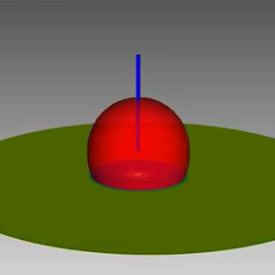
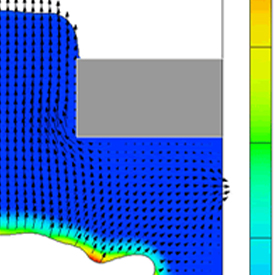
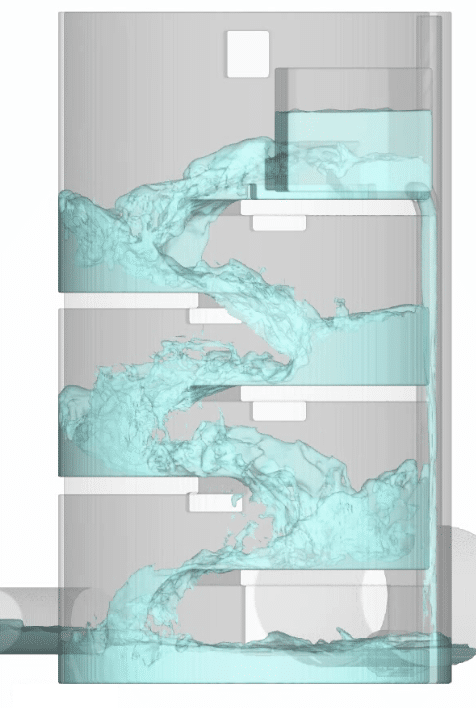
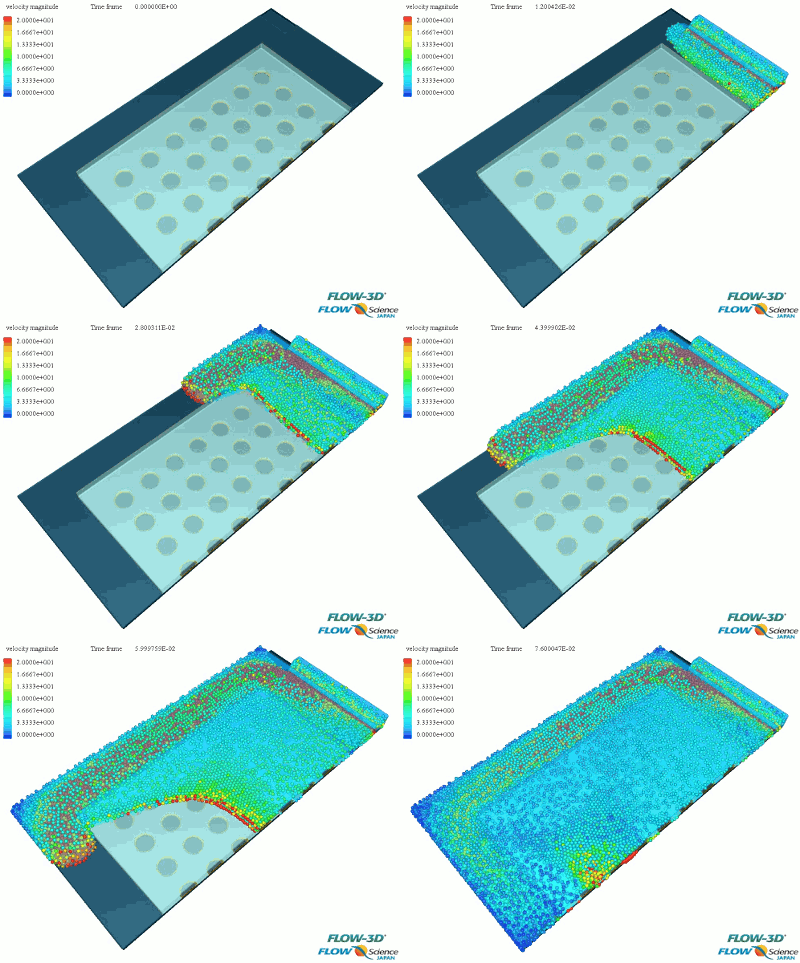
이 예는 제트 전투기 연료 탱크 내 연료 슬로싱을 나타냅니다. 이 시뮬레이션을 통해 엔지니어는 탱크 내 연료 모션을 제어하는 배플의 성능을 평가하고 적절한 제어 시스템을 설계할 수 있습니다.

자세한 내용이 궁금하시면 언제든지 기술지원팀에 연락주시기 바랍니다.

This example represents fuel sloshing in a jet fighter fuel tank. The simulation allows engineers to evaluate the performance of the baffles in controlling the fuel motion in the tank and to design appropriate control systems.

Fuel Tank Sloshing
FLOW-3D HYDRO 2025R1

FLOW-3D HYDRO

FLOW-3D HYDRO 2025R1

FLOW-3D HYDRO 2025R1 의 새로운 기능

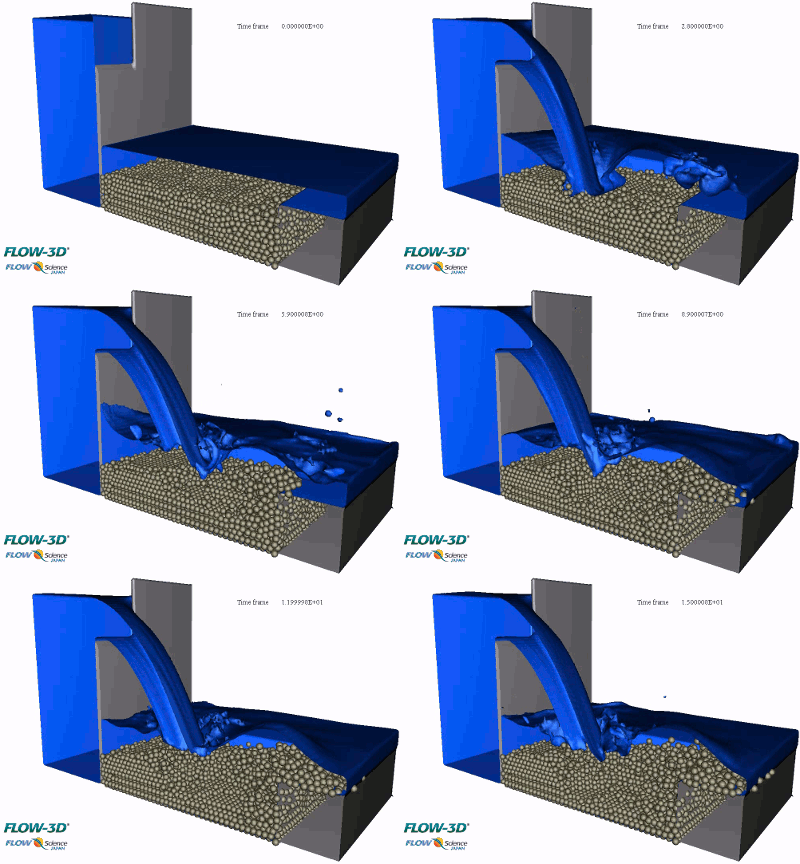
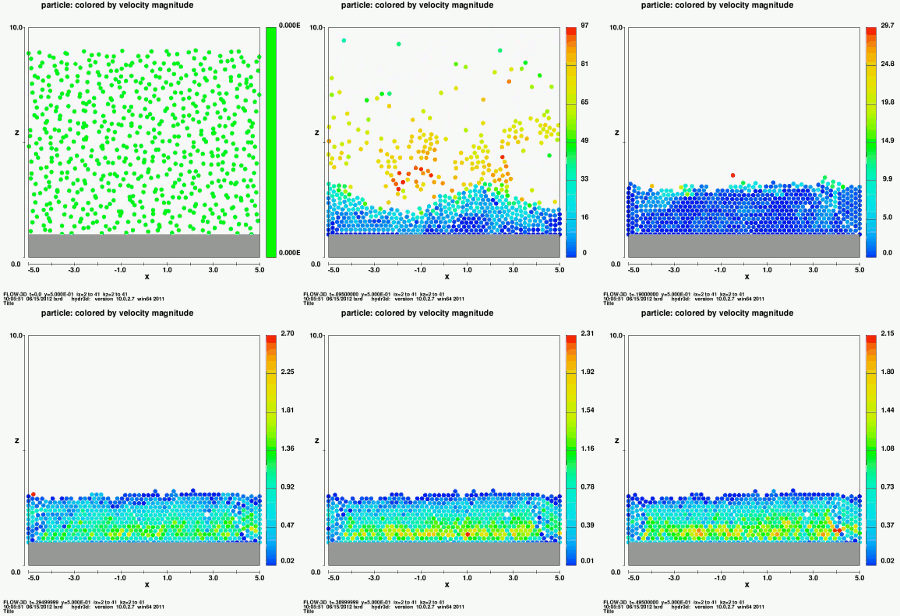
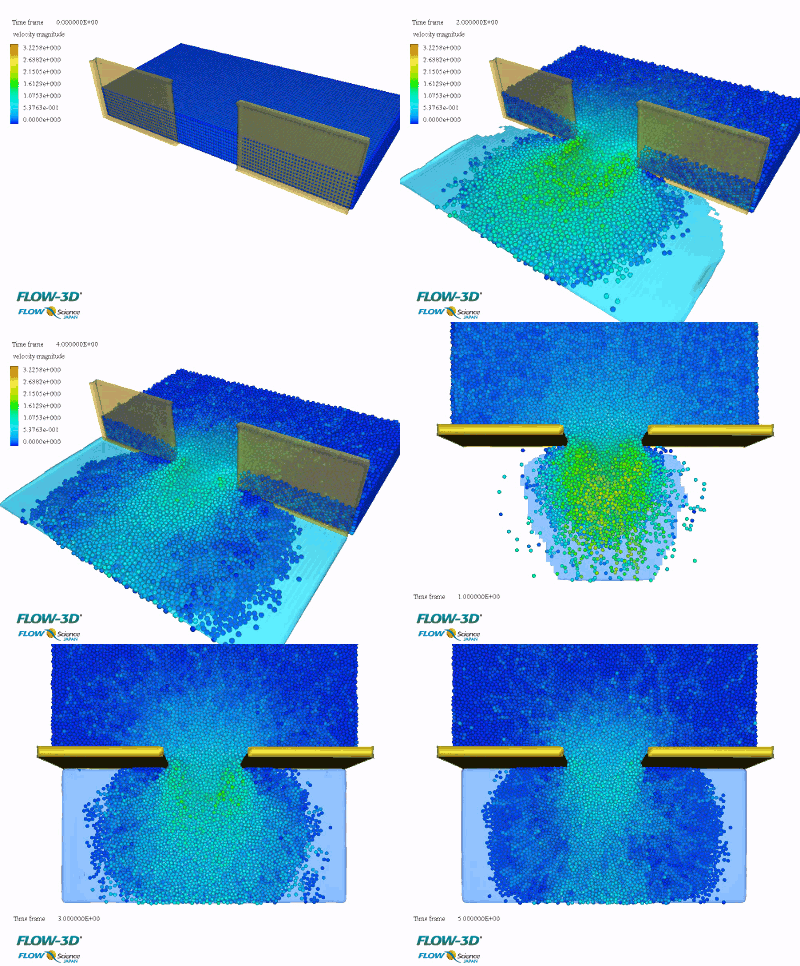
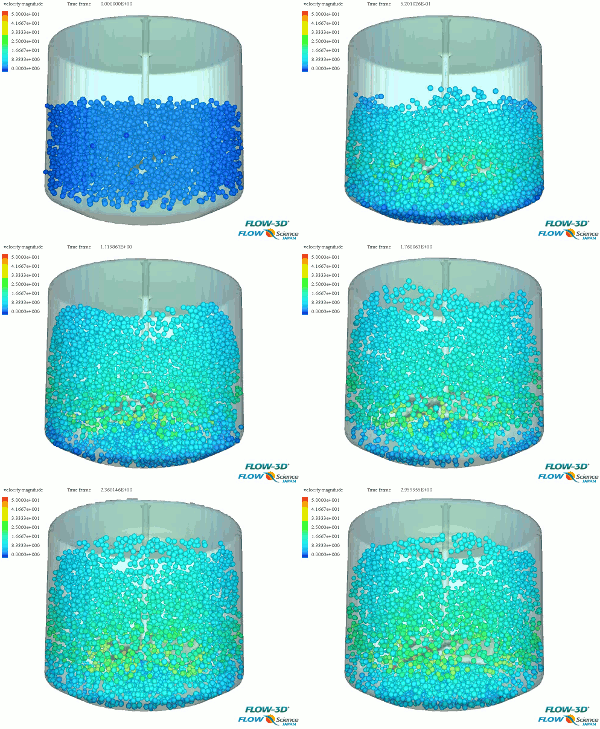
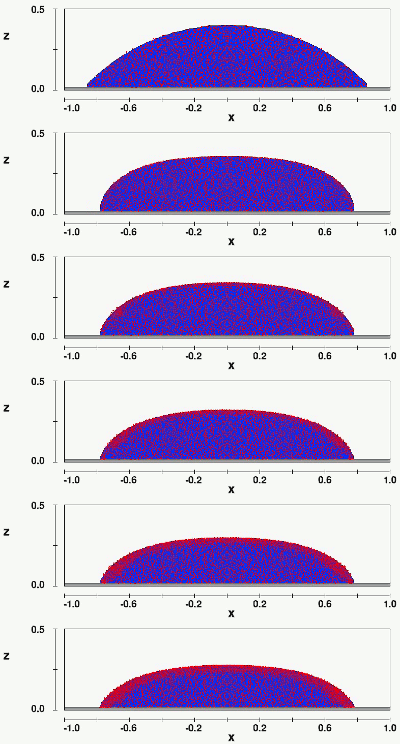
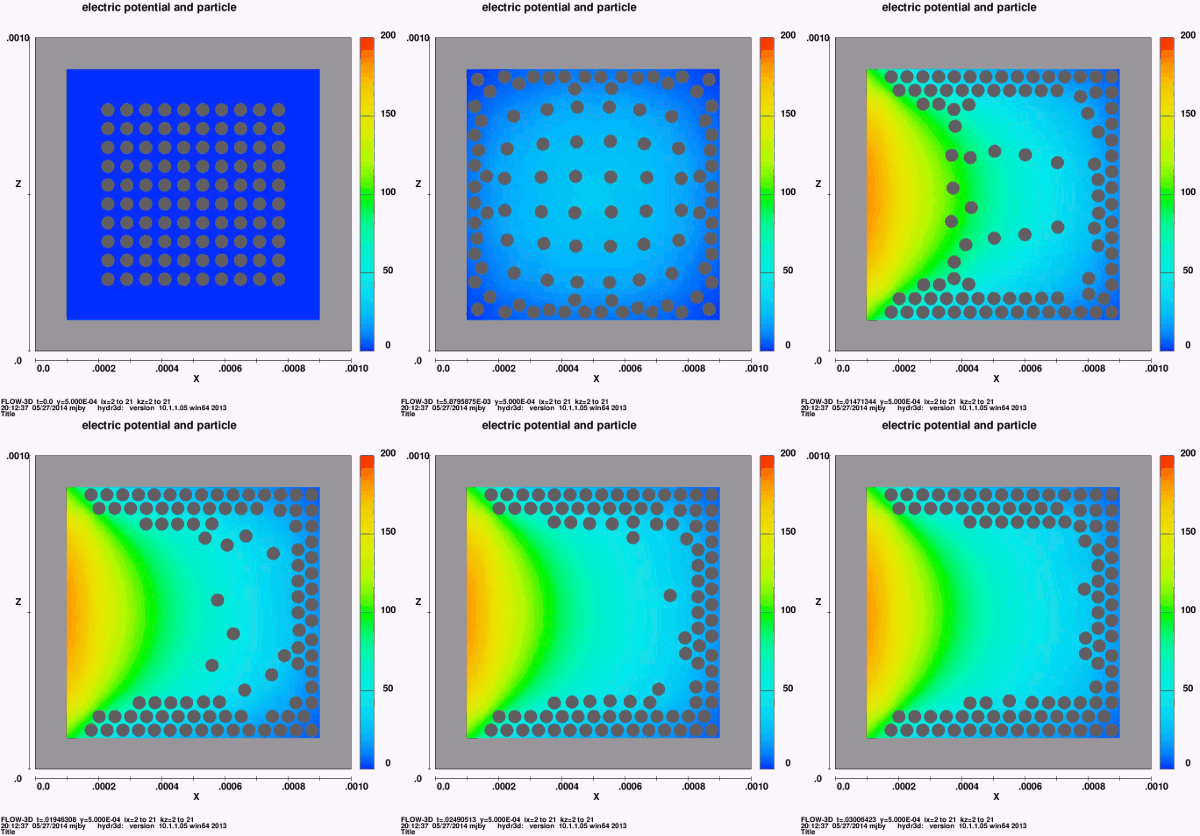
FLOW-3D HYDRO 2025R1은 새로운 이산 요소 방법(DEM) 모델을 도입했습니다. 이 모델은 사용자가 충돌 및 마찰과 같은 입자-입자 상호작용을 고려할 수 있게 하여 표준 라그랑지안 입자 모델을 넘어서는 유용성을 제공합니다.

물과 환경 프로젝트의 다양한 시나리오에는 암석이나 립랩이 포함됩니다. 예를 들어, 자연 채널 베드나 채널 및 구조물 보호 시스템의 일부가 포함됩니다. DEM 모델은 다양한 흐름 조건에서 암석의 안정성에 대한 통찰력을 제공하여 강둑 및 기타 구조물의 독특한 보호 시스템에 대한 비용 절감과 위험 감소의 흥미로운 가능성을 열어줄 수 있습니다.

Simulation image of river bank showing new DEM model
FLOW-3D HYRO의 새로운 DEM 모델을 사용한 강둑에 대한 위험 평가

이 모델은 또한 사용자가 그릿 분리 시스템, 빗물 분리기 및 작은 물체들이 서로 상호작용하는 다른 시나리오에 대한 통찰력을 얻는 데 도움을 줄 수 있습니다.

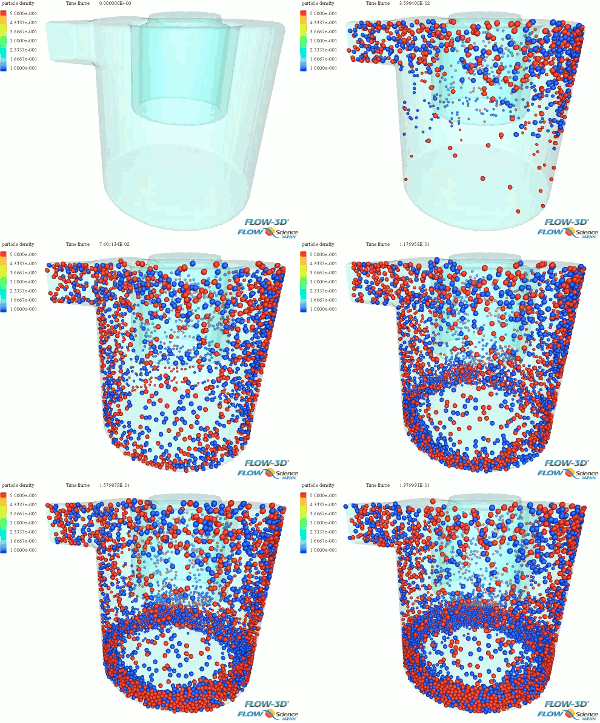
Simulation of a stormwater separator
새로운 DEM 모델을 사용하여 빗물 분리기의 미세먼지 오염 물질 추적하기

참고: 이 모델은 별도의 라이선스 토큰이 필요하며, 추가 비용을 지불하고 추가할 수 있습니다. 

FLOW-3D HYDRO 2024R1 의 새로운 기능

FLOW-3D HYDRO 2024R1의 흥미로운 새로운 발전은 지형 및 수심과 같은 물체를 지리적 좌표계(예: UTM)에 정의하고 다른 물체를 편리한 로컬 좌표계(예: BIM 좌표)에 정의할 수 있도록 하여 지리적 좌표계 작업을 용이하게 하는 사이트 좌표 시스템(일명 로컬 또는 프로젝트 좌표 시스템이라고도 함)의 도입입니다. 이 새로운 기능은 사이트 좌표 시스템을 설정하기 위한 명확하고 간단한 인터페이스와 Revit 공유 좌표 파일에서 읽기만 하면 모델 설정 중 수동 좌표 변환과 관련된 시간, 노력 및 위험을 줄입니다.

Site coordinate system
모델링 편의를 위해 별도의 사이트 좌표계(가운데 축)가
정의된 상태에서 UTM 좌표(오른쪽 하단의 축 방향 참조)로
정의된 LandXML 파일

FLOW-3D HYDRO의 두 번째 개발은 LandXML과 삼각형 래스터 표면을 EXODUS II 기반 출력 파일에 포함하는 것입니다. 따라서 후처리 시 전체 지형/수심 측정을 사용할 수 있으므로 모델링 세부 사항이 아닌 스토리에 초점을 맞춘 방식으로 청중에게 결과를 더 쉽게 전달할 수 있습니다.

Land XML support
모델링 영역 내부의 지형(왼쪽)과 삼각형으로 작성된 표면(오른쪽). 산과 하류 계곡은 모델링 영역에 포함되지 않지만 삼각형으로 작성된 표면은 맥락과 명확성을 높이기 위해 이들 지형을 포함한다는 점에 유의하세요.

FLOW-3D HYDRO 2023R2 의 새로운 기능

새로운 결과 파일 형식

FLOW-3D POST 2023R2는 EXODUS II 형식을 기반으로 하는 완전히 새로운 결과 파일 형식을 도입하여 더 빠른 후처리를 가능하게 합니다. 이 새로운 파일 형식은 크고 복잡한 시뮬레이션의 후처리 작업에 소요되는 시간을 크게 줄이는 동시에(평균 최대 5배!) 다른 시각화 도구와의 연결성을 향상시킵니다.

FLOW-3D POST 2023R2 에서 사용자는 이제 선택한 데이터를 flsgrf  또는 EXODUS II 파일 형식으로 쓸 수 있습니다 . 새로운 EXODUS II 파일 형식은 각 개체에 대해 유한 요소 메시를 활용하므로 사용자는 다른 호환 가능한 포스트 프로세서 및 FEA 코드를 사용하여 FLOW-3D HYDRO 결과를 열 수도 있습니다. 새로운 워크플로우를 통해 사용자는 크고 복잡한 사례를 신속하게 시각화하고 임의 슬라이싱, 볼륨 렌더링 및 통계를 사용하여 보조 정보를 추출할 수 있습니다. 

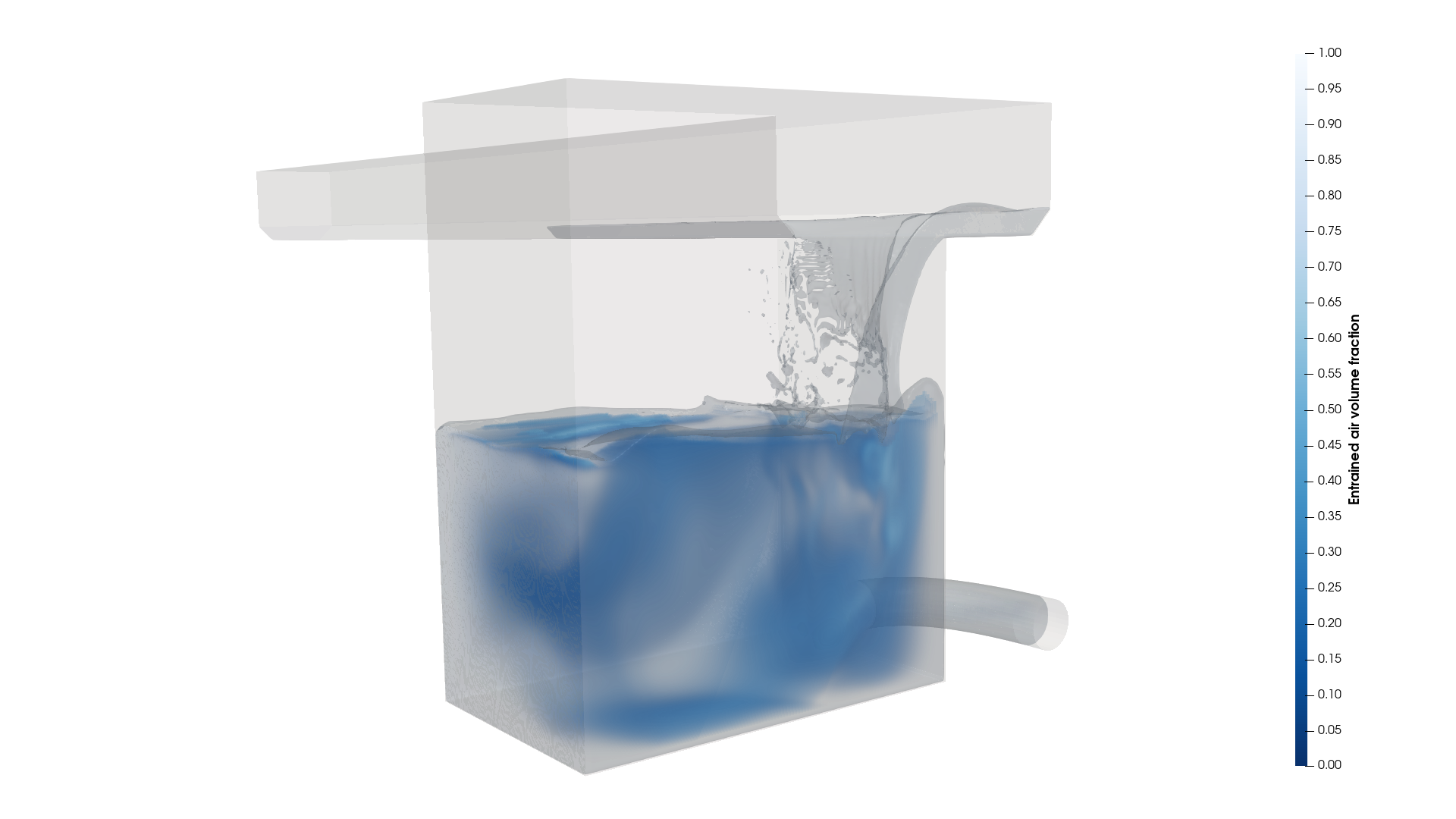
혼입 공기 시뮬레이션
FLOW-3D POST 의 새로운 EXODUS II 파일 형식에서 볼륨 렌더링 기능을 사용하여 동반된 공기를 보여주는 예입니다 .

새로운 결과 파일 형식은 hydr3d 솔버의 성능을 저하시키지 않으면서 flsgrf 에 비해 시각화 작업 흐름에서 놀라운 속도 향상을 자랑합니다. 이 흥미로운 새로운 개발은 결과 분석의 속도와 유연성이 향상되어 원활한 시뮬레이션 경험을 제공합니다. 

FLOW-3D POST 의 새로운 시각화 기능 에 대해 자세히 알아보세요 .

난류 모델 개선

FLOW-3D HYDRO 2023R2는 2방정식(RANS) 난류 모델에 대한 동적 혼합 길이 계산을 크게 개선했습니다. 거의 층류 흐름 체계와 같은 특정 제한 사례에서는 이전 버전의 코드 계산 제한기가 때때로 과도하게 예측되어 사용자가 특정 혼합 길이를 수동으로 입력해야 할 수 있습니다. 

새로운 동적 혼합 길이 계산은 이러한 상황에서 난류 길이와 시간 규모를 더 잘 설명하며, 이제 사용자는 고정(물리 기반) 혼합 길이를 설정하는 대신 더 넓은 범위의 흐름에 동적 모델을 적용할 수 있습니다.

접촉식 탱크 혼합 시뮬레이션
적절한 고정 혼합 길이와 비교하여 접촉 탱크의 혼합 시뮬레이션을 위한 기존 동적 혼합 길이 모델과 새로운 동적 혼합 길이 모델 간의 비교

정수압 초기화

사용자가 미리 정의된 유체 영역에서 정수압을 초기화해야 하는 경우가 많습니다. 이전에는 대규모의 복잡한 시뮬레이션에서 정수압 솔버의 수렴 속도가 느려지는 경우가 있었습니다. FLOW-3D HYDRO 2023R2는 정수압 솔버의 성능을 크게 향상시켜 전처리 단계에서 최대 6배 빠르게 수렴할 수 있도록 해줍니다.

확장된 지형 표현 지원

GeoTIFF 지원

2023R2 릴리스에서 FLOW-3D HYDRO는 기본적으로 래스터 지형 및 수심 측량을 위한 GeoTIFF(.tif) 파일 형식을 지원합니다. 이제 사용자는 GeoTIFF 파일을 사용자 인터페이스로 직접 가져올 수 있습니다. 

GeoTIFF 래스터 파일의 예
FLOW-3D HYDRO 에서 렌더링된 GeoTIFF(.tif) 래스터 파일의 예

LandXML 지원

측량 데이터가 균일하지 않거나 래스터 표면의 해상도가 충분하지 않은 경우 TIN 표면은 LandXML(.xml) 파일 형식을 통해 향상된 지형 지도를 제공합니다. FLOW-3D HYDRO 2023R2는 기본적으로 LandXML 파일을 가져옵니다. 

래스터 파일과의 향상된 상호 작용

래스터 파일은 고해상도에서 넓은 지형 영역을 다루는 경우가 많으므로 사용자 인터페이스에서 3D 표현의 상호 작용 속도가 느려질 수 있습니다. 이제 사용자는 3D 표현의 품질을 제어하여 렌더링 시간을 크게 줄이고 상호 작용성을 크게 향상시킬 수 있습니다.

FLOW-3D HYDRO 2023R1 의 새로운 기능

FLOW-3D 소프트웨어 제품군의 모든 제품은 2023R1에서 IT 관련 개선 사항을 받았습니다. 

FLOW-3D HYDRO 2023R1은 이제 Windows 11 및 RHEL 8을 지원합니다. Linux 설치 프로그램은 누락된 종속성을 보고하도록 개선되었으며 더 이상 루트 수준 권한이 필요하지 않으므로 설치가 더 쉽고 안전해집니다. 그리고 워크플로를 자동화한 분들을 위해 입력 파일 변환기에 명령줄 인터페이스를 추가하여 스크립트 환경에서도 워크플로가 업데이트된 입력 파일로 작동하는지 확인할 수 있습니다.

천수(shallow water) 난류 모델

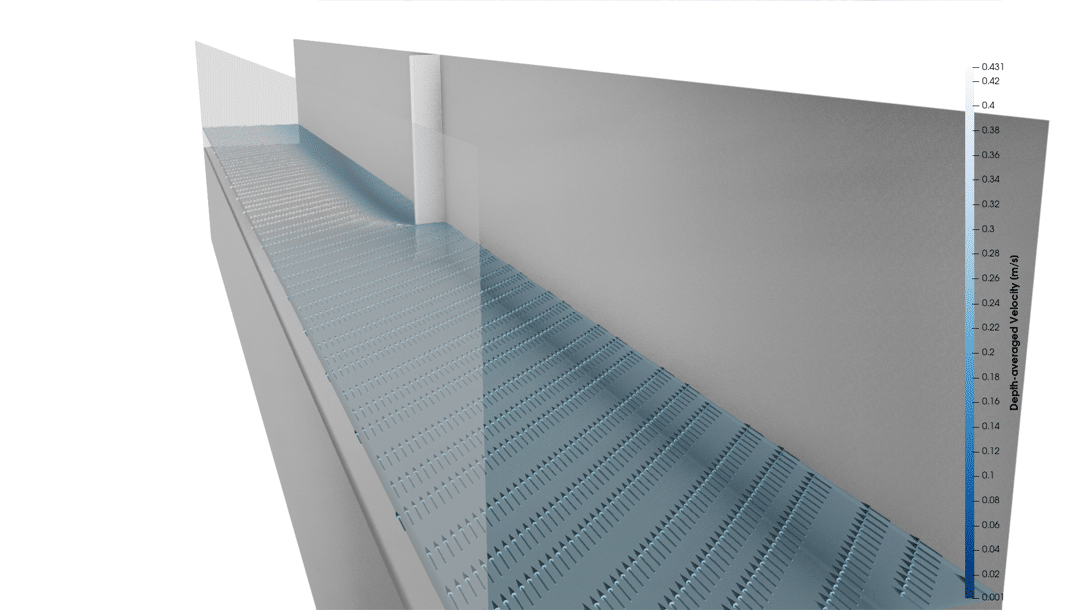
난류는 물과 환경 흐름장의 주요 측면이며, 특히 천수(shallow water) 근사치로 모델링된 영역에서는 더욱 그렇습니다. 우리는 모델링 위험을 줄이고 더 나은 결과를 제공하기 위해 세 가지 새로운 난류 모델, 일정한 확산도, 혼합 길이 및 Smagorinsky 모델을 포함하도록 천수(shallow water) 모델의 난류 처리를 개선했습니다.

방사제 주변의 흐름

FLOW-3D HYDRO 2022R2 의 새로운 기능

FLOW-3D HYDRO 2022R2 출시로 Flow Science는 FLOW-3D HYDRO 의 워크스테이션과 HPC 버전을 통합하여 단일 노드 CPU 구성에서 다중 노드에 이르기까지 모든 유형의 하드웨어 아키텍처를 활용할 수 있는 단일 솔버 엔진을 제공했습니다. 병렬 고성능 컴퓨팅 실행. 추가 개발에는 향상된 공기 동반 기능과 물 및 환경 응용 분야에 대한 경계 조건 정의 개선이 포함됩니다.

통합 솔버

우리는 FLOW-3D 제품을 단일 통합 솔버로 마이그레이션하여 로컬 워크스테이션이나 고성능 컴퓨팅 하드웨어 환경에서 원활하게 실행했습니다.

많은 사용자가 노트북이나 로컬 워크스테이션에서 모델을 실행하지만, 고성능 컴퓨팅 클러스터에서도 더 큰 모델을 실행합니다. 2022R2 릴리스에서는 통합 솔버를 통해 사용자가 HPC 솔루션의 OpenMP/MPI 하이브리드 병렬화와 동일한 이점을 활용하여 워크스테이션과 노트북에서 실행할 수 있습니다.

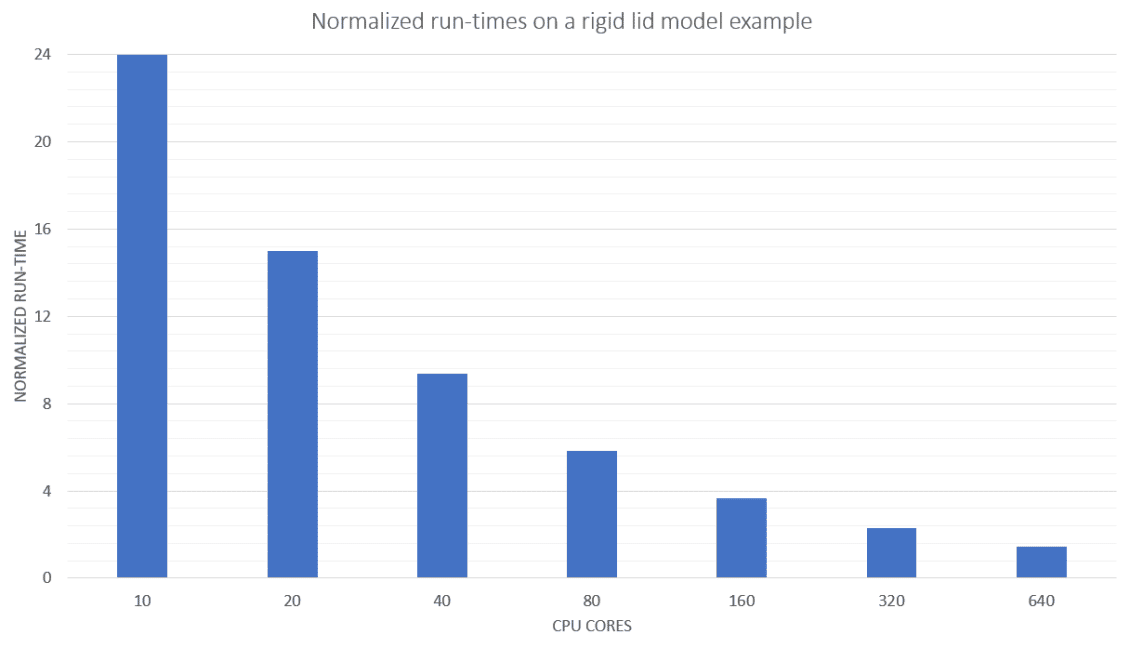
성능 확장의 예
증가하는 CPU 코어 수를 사용한 성능 확장의 예
메쉬 분해 - 2소켓 워크스테이션
2소켓 워크스테이션에서 OpenMP/MPI 하이브리드 병렬화를 위한 메시 분해의 예

멀티 소켓 워크스테이션

다중 소켓 워크스테이션은 이제 매우 일반적이며 대규모 시뮬레이션을 실행할 수 있습니다. 새로운 통합 솔버를 사용하면 이러한 유형의 하드웨어를 사용하는 사용자는 일반적으로 HPC 클러스터 구성에서만 사용할 수 있었던 OpenMP/MPI 하이브리드 병렬화를 활용하여 모델을 실행할 수 있어 성능이 향상되는 것을 확인할 수 있습니다.

낮은 수준의 루틴으로 향상된 벡터화 및 메모리 액세스

대부분의 테스트 사례에서 10~20% 정도의 성능 향상이 관찰되었으며 일부 사례에서는 20%를 초과하는 런타임 이점이 나타났습니다.

정제된 체적 대류 안정성 한계

시간 단계 안정성 제한은 모델 런타임의 주요 동인이며, 2022R2에서는 새로운 시간 단계 안정성 제한인 3D 대류 안정성 제한을 숫자 위젯에서 사용할 수 있습니다. 실행 중이고 대류가 제한된(cx, cy 또는 cz 제한) 모델의 경우 새 옵션은 일반적인 속도 향상을 30% 정도 보여줍니다.

압력 솔버 프리컨디셔너

경우에 따라 까다로운 흐름 구성의 경우 과도한 압력 솔버 반복으로 인해 실행 시간이 길어질 수 있습니다. 이러한 어려운 경우 2022R2에서는 모델이 너무 많이 반복되면 FLOW-3D가 자동으로 새로운 사전 조절기를 활성화하여 압력 수렴을 돕습니다. 테스트의 런타임은 1.9에서 335까지 더 빨라졌습니다!

점탄성 유체에 대한 로그 형태 텐서 방법

점탄성 유체에 대한 새로운 솔버 옵션을 사용자가 사용할 수 있으며 특히 높은 Weissenberg 수에 효과적입니다.

FLOW-3D HYDRO 경계 조건 개선

FLOW-3D HYDRO 2022R2 에서는 물 적용 경계 조건에 대한 두 가지 개선 사항을 사용할 수 있습니다 . 천수(shallow water)의 유량 경계 조건이 개선되어 보다 현실적이고 공간적으로 변화하는 속도 프로파일을 생성하므로 사용자는 정확도를 잃지 않고 도메인 크기를 줄일 수 있습니다. 자연적인 입구 경계 조건의 경우 정격 곡선 완화 시간 옵션을 사용하여 과도 조건에 대한 응답을 향상시킬 수 있습니다.

스트림 방향의 다양한 속도 프로파일
입구 경계에서 흐름 방향으로 변하는 속도 프로파일의 예

향상된 공기 동반 기능

디퓨저 및 유사한 기포 흐름 응용 분야의 경우 이제 질량 공급원을 사용하여 물기둥에 공기를 유입할 수 있습니다. 또한, 동반 공기 및 용존 산소의 난류 확산에 대한 기본값이 업데이트되었습니다.

디퓨저 모델의 예
디퓨저 모델의 예: 이제 질량 소스를 사용하여 물기둥에 공기를 유입할 수 있습니다.

FLOW-3D HYDRO 아카이브 의 새로운 기능

LOW-3D HYDRO 2022R1 의 새로운 기능

FLOW-3D HYDRO 의 새로운 기능

제품 개요

최근 FLOW Science, Inc에서는 토목 및 환경 엔지니어링 산업을위한 완벽한 CFD 모델링 솔루션인 FLOW-3D HYDRO 제품을 출시했습니다. 기존 FLOW-3D 사용자이거나 유압 엔지니어링 관행에 CFD 모델링 기능을 사용하시는 것에 관심이 있는 경우, 언제든지 아래 연락처로 연락주세요.
연락처 : 02-2026-0442
이메일 : flow3d@stikorea.co.kr

FLOW-3D HYDRO 는 더 높은 수준의 정확도와 모델 해상도를 제공하기 위해 3D 비 유압 모델링 기능이 필요한 경우 고급 모델링 도구로 사용할 수 있습니다. 일반적인 모델링 응용 분야는 소형 댐 / 인프라, 운송 수력학, 복잡한 3D 하천 수력학, 열 부력 연기, 배수구 및 오염 물질 수송과 관련됩니다. 

FLOW-3D HYDRO의 핵심 기능은 전체 3D 모델과 동적으로 연결될 수있는 천수(shallow water) 모델입니다. 

이 기능을 통해 사용자는 멀티 스케일 모델링 애플리케이션을위한 모델 도메인을 확장하여 필요한 모델 해상도로 계산 효율성을 극대화 할 수 있습니다. FLOW-3D HYDRO  또한 강 및 환경 응용 분야에 특화된 추가 기능과 고급 물리학을 포함합니다.

시뮬레이션 템플릿

FLOW-3D HYDRO 의 작업 공간 템플릿으로 시간을 절약하고 실수를 방지하며 일관된 모델을 실행하십시오 . 작업 공간 템플릿은 일반적인 응용 분야에 대한 유체 속성, 물리적 모델, 수치 설정 및 시뮬레이션 출력을 미리로드합니다.

작업 공간 템플릿은 7 가지 모델 클래스에 사용할 수 있습니다.

  • 자유 표면 – TruVOF (기본값)
  • 공기 유입
  • 열 기둥
  • 퇴적물 수송
  • 천수(shallow water)
  • 자유 표면 – 2 유체 VOF
  • 자유 표면 없음

사전로드 된 예제 시뮬레이션

FLOW-3D HYDRO 의 40 개 이상의 사전로드 된 물 중심 예제 시뮬레이션 라이브러리는 애플리케이션 모델링을위한 훌륭한 시작점을 제공합니다. 사전로드 된 예제 시뮬레이션은 모델러에게 모델 설정 및 모범 사례의 로드맵뿐만 아니라 대부분의 애플리케이션에 대한 자세한 시작점을 제공합니다.이전다음

비디오 튜토리얼

비디오 자습서는 새로운 사용자가 다양한 응용 프로그램을 모델링하는 방법을 빠르게 배울 수있는 훌륭한 경로를 제공합니다. FLOW-3D HYDRO 비디오 튜토리얼 기능 :

  • 광범위한 응용 및 물리학을위한 AZ 단계별 기록
  • “사용 방법”정보
  • 모범 사례를위한 팁
  • CAD / GIS 데이터, 시뮬레이션 파일 및 후 처리 파일

고급 솔버 개발

Tailings Model

새로운 Tailings Model은 tailings dam failure로 인한 tailings runout을 시뮬레이션하기위한 고급 기능을 제공합니다. tailings정의에 대한 다층 접근 방식과 함께 미세하고 거친 입자 구성을 나타내는 이중 모드 점도 모델은 모든 방법으로 건설 된 tailings 댐의 모델링을 허용합니다. 

천수(shallow water), 3D 및 하이브리드 3D / 천수(shallow water) 메싱을 포함한 유연한 메싱을 통해 얕은 지역에서 빠른 솔루션을 제공하면서 다층 tailings의 복잡성을 정확하게 모델링 할 수 있습니다. 점성 경계층의 정확한 표현을 위해 천수(shallow water) 메시에 2 층 Herschel-Bulkley 점도 모델을 사용할 수 있습니다.

모델 하이라이트

  • 미세 입자 및 거친 입자 광미 조성물을위한 이중 모드 점도 모델
  • 침전, 패킹 및 입자 종의 난류 확산을 포함한 Tailings  수송
  • 천수(shallow water) 메시를위한 2 층 Herschel-Bulkley 점도 모델
  • 3D, 천수(shallow water), 3D / 천수(shallow water) 하이브리드 메시를 포함한 유연한 메시 접근 방식
  • Multi-layer, variable composition tailings for general definition of tailings dam construction

Shallow Water

FLOW-3D HYDRO 의 천수(shallow water) 모델링 기능은 3D 메시를 천수(shallow water) 메시와 결합하여 탁월한 모델링 다양성을 제공하는 고유 한 하이브리드 메시를 사용합니다. 압력 솔버의 수치 개선으로 더 안정적이고 빠른 시뮬레이션이 가능합니다. 하이브리드 메쉬의 하단 전단 응력 계산이 크게 향상되어 정확도가 더욱 향상되었습니다. 지형에 거칠기를 적용하는 새로운 방법에는 Strickler, Chezy, Nikuradse, Colebrook-White, Haaland 및 Ramette 방정식이 포함됩니다.

Two-Fluid VOF Model

sharp 인터페이스가 있거나 없는 압축 가능 또는 비압축성 2 유체 모델은 항상 1 유체 자유 표면 모델과 함께 FLOW-3D 에서 사용할 수 있습니다 . 사실, sharp 인터페이스 처리는 TruVOF 기술을 자유 표면 모델과 공유하며 상용 CFD 소프트웨어에서 고유합니다. 최근 개발에는 2- 필드 온도 및 인터페이스 슬립 모델이 포함되었습니다. 이 모델은 오일 / 물, 액체 / 증기, 물 / 공기 및 기타 2 상 시스템에 성공적으로 적용되었습니다.

FLOW-3D HYDRO 는 2- 유체 솔루션의 정확성과 안정성에서 두 가지 중요한 발전을보고 있습니다. 운동량과 질량 보존 방정식의 강화 된 결합은 특히 액체 / 기체 흐름에서 계면에서 운동량 보존을 향상시킵니다. 연속성 방정식에서 제한된 압축성 항의 확장 된 근사값은 더 빠르고 안정적인 2 유체 압력 솔버를 만듭니다.

예를 들어, 터널 및 드롭 샤프트 설계와 같은 유압 응용 분야에서 공기가 종종 중요한 역할을 하기 때문에 두 개발 모두 FLOW-3D HYDRO 릴리스에 적시에 적용됩니다. 일반적으로 낮은 마하 수로 인해 이러한 경우 물과 공기에 제한된 압축성이 사용됩니다.

고성능 컴퓨팅 및 클라우드

고성능 컴퓨팅 FLOW-3D HYDRO

일반 워크스테이션 또는 랩톱으로 많은 작업을 수행 할 수 있지만, 대형 시뮬레이션과 고화질 시뮬레이션은 더 많은 CPU 코어를 활용함으로써 엄청난 이점을 얻을 수 있습니다. FLOW-3D CLOUD 및 고성능 컴퓨팅은 더 빠르고 정확한 모델을 실행할 수있는 더 빠른 런타임과 더 많은 선택권을 제공합니다.

하천 및 환경 중심 애플리케이션

TRANSPORTATION HYDRAULICS
SMALL DAMS AND DIVERSIONS
RIVER HYDRAULICS
SEDIMENT TRANSPORT AND DEPOSITION
OUTFALLS EFFLUENTS
THERMAL PLUMES BUOYANT FLOWS

Case Studies

컴팩트 디스크 ELISA 칩 [2]

컴팩트 디스크 미세 유체 장치: Optimizing Real Estate

Compact Disc Microfluidic Devices: Optimizing Real Estate

미세 유체 장치 사용자의 증가하는 기대를 충족하려면 작은 미세 유체 장치에서 제한된 공간을 최적화하는 것이 중요합니다. 사용자는 단일 미세 유체 장치에서 최대의 기능과 여러 병렬 작업을 기대합니다. 제한된 공간을 최적화하는 문제는 이러한 장치의 많은 물리적 이점에도 불구하고 회전하는 미세 유체 장치로 확장됩니다. 회전 에너지를 이용하여 미세 유체 작업을 수행하는 회전 장치를 컴팩트 디스크 (CD) 미세 유체 장치라고합니다.

컴팩트 디스크 ELISA 칩 [1]
컴팩트 디스크 ELISA 칩 [2]
컴팩트 디스크 ELISA 칩 [2]

10 년 넘게 CD는 혈액 진단을위한 신속한 면역 분석 및 임상 생화학에서 지속적으로 장점을 보여 왔습니다. 마이크로 토탈 분석 시스템 (μTAS)으로 사용되며, 여러 개별 분석이 내장되어 단일 칩에서 동시에 실행됩니다. 핸즈프리 제어를 위해 프로그래밍 된 간단하고 저렴한 모터에서 작동하며 자석이나 표면 처리와 같은 외부 액추에이터가 필요하지 않습니다. 기본적으로 CD는 훌륭합니다! 그러나 공짜 점심 같은 것은 없습니다. 단방향 (방사형) 원심력으로 인해 CD는 회전하지 않는 미세 유체 장치보다 빠르게 공간이 부족합니다. 유체는 방사형으로 바깥쪽으로 만 이동하므로 CD가 수행 할 수있는 분석 단계의 수가 제한됩니다.

그림 3. CD 채널 내부의 방사형 물 기둥에 적용되는 다양한 신체 힘을 강조하는 회로도. 방사상으로 바깥쪽으로 작용하는 원심력을 확인합니다.

CD의 단 방향성 극복

Gorkin    [3]에서는 CD의 단 방향성 제약을 극복하기 위해 공압 펌핑이 제안되었습니다. 아이디어는 원심 에너지를 압축 에너지로 저장하고 다시 풀어서 유체를 중심으로 발사하는 것입니다. 아래 이미지는 로딩 챔버, 흡입 하위 구획 및 압축 하위 구획의 세 개의 챔버가있는 비교적 간단한 미세 유체 칩을 보여줍니다.

그림 4. CD 사진
그림 4. CD 사진
그림 5. FLOW-3D에서 모방 된 CD 디자인

공압 펌핑 프로세스

유체가 로딩 챔버로 들어간 다음, 흡입 하위 구획을 통해 공기가 갇힌 압축 하위 구획으로 이동합니다. 공기가 갇 히면 CD가 특정 각속도로 회전하여 갇힌 공기가 압축됩니다. 공기가 더 이상 압축 할 수없는 경우 (안정 상태에 도달했기 때문에), 회전 속도가 감소하거나 완전히 꺼져 (누군가이 작업을 수행하고 있습니까? 아니면 장치가 수행하고 있습니까?) 유체가 로딩 챔버로 다시 펌핑됩니다. 이 마지막 단계는 이완 단계입니다. 공압 펌핑 공정의 5 단계는 다음과 같습니다.

그림 6. CD의 5 단계 공압 펌핑 [3]

회전 속도의 영향

회전 속도가 다르면 압축 하위 구획에서 공기의 압축 수준이 다릅니다. 회전 속도가 높을수록 유체가 공기에 더 세게 밀려 공기가 더 많이 압축됩니다. 그러나 공기가 압축 될 수있는 양에는 한계가 있습니다. 사실, 공기의 압축은 특정 회전 속도 이상으로 점진적으로 증가합니다. 압축 하위 구획의 부피는 회전 속도가 증가함에 따라 감소합니다. 흡입구의 액체 위치는 디스크 중앙에서 흡입 하위 구획의 유체 수준까지의 거리입니다. 이 거리는 증가합니다. 즉, 회전 속도가 증가함에 따라 유체가 중심에서 멀어집니다.

그림 7. 회전 주파수가 증가하면 압축이 증가합니다. [3]

CD 미세 유체 장치 모델링

실험은 미세 유체 장치 설계의 핵심입니다. 그러나 충분한 실험을 수행하고 각 실험에 대한 완벽한 제어 환경을 유지하는 것은 불가능할 수 있습니다. 복잡한 설계에는 복잡한 실험 설정 및 분석이 필요합니다. FLOW-3D 의 정확하고 포괄적 인 다중 물리  모델링 기능 은 미세 유체 설계에 대한 통찰력과이를 최적화하는 방법을 제공합니다. FLOW-3D가  위에서 논의한 CD 미세 유체 장치에 대한 실험적 및 이론적 결과와 어떻게 비교되는지 보여 드리겠습니다  .

CD 미세 유체 장치에 대한 실험적 및 이론적 결과와 비교

이미지 시퀀스는 실험 및 FLOW-3D  시뮬레이션 결과 의 시각적 비교를 제공합니다  . 두 유체 (공기 및 물) 압축 가능 모델을 사용하여 서로 다른 회전 속도에 대해 챔버 내부의 유체 역학을 시뮬레이션했습니다. 회귀 분석을 사용하여 아래 플롯에서 이러한 시각적 비교를 정량화하면 FLOW-3D  와 실험 결과,  FLOW-3D  및 분석 결과 간에 탁월한 상관 관계 (R 2 > 0.99)가 제공  됩니다.

그림 9. FLOW-3D 데이터와 실험 데이터의 비교. (Poly는 다항식 곡선 맞춤을 의미합니다.)

시뮬레이션은 또한 다양한 회전 속도에 대한 정상 상태에 대한 접근 방식을 보여줍니다. 아래의 애니메이션은 CD의 운동 에너지 변동을 1000rpm nd 7000rpm에서 보여줍니다. 더 빠른 속도는 더 빠른 정상 상태를 강제하지만 정상 상태에 도달할 때까지 수위를 빠르게 변동시킵니다. 저속 시뮬레이션의 경우 그 반대입니다.

Mean kinetic energy fluctuations for the CD rotating at 1000 rpm
Mean kinetic energy fluctuations for the CD rotating at 7000 rpm

전반적으로  FLOW-3D  는 실험 결과를 정확하게 검증합니다. 사소한 오류는 부정확 한 지오메트리 (CAD) 생성 및 / 또는 물과 공기 사이의 인터페이스를 엄격하게 정의하기 때문일 수 있습니다. 이 사례 연구는 FLOW-3D  가 실험 결과를 검증하고 컴팩트 디스크 설계의 신뢰도를 높이는 데 효과적으로 사용될 수 있음을 보여줍니다  .

References

[1] He, Hongyan et al. “Design and Testing of a Microfluidic Biochip for Cytokine Enzyme-Linked Immunosorbent Assay”. Biomicrofluidics 3(2):22401 February 2009

[2] Roy, Emmanuel, et al. “From Cellular Lysis to Microarray Detection, an Integrated Thermoplastic Elastomer (TPE) Point of Care Lab on a Disc.” Lab on a Chip, vol. 15, no. 2

[3] Gorkin III, Robert et al. “Pneumatic pumping in centrifugal microfluidic platforms”. February 2010 Springerlink.com

벨기에 Zele에서 나온 WWTP의 개략도

활성화 된 슬러지 모델링

Activated Sludge Model

폐수 처리 플랜트 (WWTP) 내부의 생화학 적 반응 및 유체 역학에 대한 자세한 이해는 설계자와 엔지니어가 새로운 플랜트 설계를 평가하고, 관리 결정을 정량화하고, 새로운 제어 계획을 개발하고, 안전한 작업자 교육을 제공하는 데 도움이 될 수 있습니다. 이 블로그에서는 독자들에게 대규모 생화학 반응 시스템을 동적으로 해결 하는 FLOW-3D 의 새로운 ASM (Activated Sludge Model)을 소개합니다.

폭기조

폭기조는 대부분의 생화학 반응이 WWTP의 2 차 처리 부분에서 발생하는 곳입니다. 일반적으로 폭기 탱크는 대부분의 생화학 반응이 완료되는 데 걸리는 시간을 허용하는 긴 경로를 가지고 있습니다. 종이 폭기조의 전체 길이를 횡단하는 데 걸리는 시간을 잔류 시간이라고합니다. 폭기조에 산소가 주입되어 폐수에서 박테리아가 증식합니다. 박테리아는 산소를 사용하여 물에있는 폐기물을 분해하고 그렇게하면서 플록 또는 슬러지 블랭킷이라고하는 응집체를 형성합니다. 활성화 된 슬러지의 일부는 폐수의 생화학 적 처리를 더욱 촉진하기 위해 폭기조로 다시 재활용됩니다.

벨기에 Zele에서 나온 WWTP의 개략도

생화학 반응의 표준 시스템

국제 물 협회 (IWA)는 지난 40 년간 생화학 적 반응을 설명하는 세 가지 주요 수학적 시스템을 제안했다. 이러한 각 시스템 인 ASM-1, ASM-2 및 ASM-3은 폭기조 내부의 다양한 종의 성장 및 붕괴 역학을 다양한 세부 수준으로 포착합니다. ASM-3이 가장 포괄적입니다. 첫 번째 시스템 인 ASM-1은 아래 표 형식과 확장 형식으로 표시됩니다.

결합 편미분 방정식의 확장 시스템으로서의 생화학 반응의 ASM-1 시스템

ASM 솔버 기능

대부분의 생화학 반응은 Monod 모델 또는 유사한 모델을 기반으로합니다. Monod 모델은 미생물의 성장 및 붕괴 속도를 예측하는 수학적 모델이며 간단한 방정식으로 설명됩니다.

여기서 a 와 k 는 최대 비 성장률 상수이고 기질 농도는 최대 비 성장률의 절반에 해당합니다. C 는 시간에 따라 변화하는 미생물 종의 농도 t 입니다. Monod 모델은 종의 농도에 따라 반응의 순서를 동적으로 변경하는 특성이 있습니다.

For C   >> A는 , 변화율 C는  0 차에 접근한다.

For C   << a는 , 변화율 C는 일차 접근한다.

이 모든 것은 미생물 종의 농도가 높으면 썩고 자라는 속도가 빨라지고, 종의 양이 적으면 썩거나 자라는 속도가 느리다는 것입니다. Monod 방정식의 해는 다음과 같이 Lambert 함수에 의해 제공됩니다.

간단한 Monod 방정식에 대한 분석 솔루션과 FLOW-3D 솔루션의 비교

생화학 반응을 설명하는 표준 시스템에는 Monod 용어의 긴 사슬이 포함되어 있습니다. FLOW-3D 의 ASM 모델은 WWTP에서 박테리아 종의 Monod 기반 성장 및 붕괴를 완벽하게 추적 할 수 있습니다. ASM 모델은 FLOW-3D 의 유체 역학 솔버 와 통합되어 속도 및 압력 장을 기반으로 한 박테리아의 움직임이 성장 및 붕괴 속도와 결합 될 수 있습니다.

FLOW-3D 의 ASM 솔버 결과가 벨기에 Zele의 폐수 처리장 (WWTP)에서 배출 될 때 다양한 유입수 종 농도의 붕괴 및 성장에 대해 보여줄 것 입니다. 종 및 유체 역학 계산을 정확하게 추적하면 폐수 처리 전문가가 정량적으로 뒷받침되는 설계 및 운영 결정을 내릴 수 있습니다.

Zele WWTP

Zele WWTP는 1983 년 50,000 명의 주민을 위해 벨기에에서 건설되었습니다. 일반적으로이 WWTP의 유입수는 가정용 폐수 40 %와 산업 폐수 60 %로 구성됩니다. 1 차 처리 공정 후 유입수는 생물학적 활성 슬러지 처리장으로 흘러 재활용 활성 슬러지와 혼합됩니다.

벨기에 Zele에서 나온 WWTP의 개략도 [2]. 녹색 상자는 2 차 처리 과정을 나타냅니다.

활성 오니 조 또는 폭기조는 약 400 m의 레인 6으로 분할되어 하나의 플러그 유동 폭기조 구성 3 각. 폭기조에서 나오는 유출 물은 각각 2050 m 3 용적의 2 개의 2 차 정화기 (SC1 및 SC2)로 이동합니다 . 최종 폐수는 인근 하천으로 배출됩니다. 2 차 정화기 아래에서 활성 슬러지의 일부는 폭기조로 다시 재활용되어 2 차 처리의 효율성을 높입니다.

우리는 2 차 처리 구성 요소의 기하학적 구조와 다양한 종의 유입 농도에 대한 자세한 정보를 이용할 수 있기 때문에 사례 연구를 위해이 WWTP를 선택했습니다. 정보는 상세하지만 완전하지는 않으며이 불완전한 정보는 폐수 농도에 중대한 영향을 미칠 것이며 나중에 논의 할 것입니다.

기하학, 메싱 및 물리학

지오메트리 생성 및 메싱은 간단했습니다. FLOW-3D 에는 완전한 WWTP를 완전히 정의하는 데 사용 된 기본 지오메트리 모양 모음이 있습니다. 이러한 모양은 생성하기 쉽고 외부 CAD 소프트웨어를 사용하여 생성 된 일부 지오메트리와 달리 오류가 없습니다. 마찬가지로, 구조화 된 그리드를 사용하면 구조화되지 않은 그리드 생성과 관련된 일반적인 오류를 처리하는 시간이 절약되었습니다.

폭기조 내부의 물리학은 복잡하며 질량 및 운동량 보존 방정식 (Navier-Stokes 방정식), 종 수송, 반응 역학, 산소 용해 및 연속 밀도 평가의 완전한 시스템을 해결해야합니다. FLOW-3D 는 가장 정확한 계산을 위해 완전히 결합 된 방식으로 이러한 모든 물리학을 설명합니다.

FLOW-3D의 Zele WWTP 설정. 화살표는 흐름 방향을 나타내며 유입수는 녹색 화살표의 시작 부분에서 도메인으로 들어갑니다.

세 가지 표준 수학적 모델 인 ASM-1, ASM-2 및 ASM-3 중에서 연구자들은이 WWTP에서 ASM-1 수학적 모델을 사용합니다. 이는 간단하면서도 많은 중요한 생화학 과정을 다루기 때문입니다. ASM-1 모델은 일반적으로 폐수에서 발견되거나 처리 과정에서 생성되는 13 종의 진화를 고려합니다 [표 1].

종 IDZele의 초기 유입 농도 (mg / l)
가용성 불활성 유기물SI7.5
쉽게 생분해되는 기질SS400.0
미립자 불활성 유기물XI40.0
천천히 생분해되는 기질XS40.0
활성 종속 영양 바이오 매스XB, H120.0
활성 독립 영양 바이오 매스XB, A5.0
바이오 매스 붕괴로 인한 미립자 제품XP0.0
산소SO0.0
질산염 및 아질산염 질소SNO0.0
암모늄 질소SNH15.0
용해성 생분해 성 유기 질소SND8.2
미립자 생분해 성 유기 질소XND11.3
알칼리도SALKNot included

표 1. 표준 ASM-1 수학 시스템의 종 목록과 Zele WWTP에서 측정 된 초기 유입수 농도. 이러한 초기 농도 중 일부는 추론되며 큰 불확실성이 관련 될 수 있습니다. S와 X는 각각 용해성 물질과 미립자 물질을 나타냅니다.

이들 종 각각은 반응하지 않는 불활성 종 (SI 및 XI)을 제외하고 하나 이상의 생화학 적 과정에 의존합니다. 불활성 종의 유입 및 유출 농도는 XI의 경우와 같이 침전으로 인해 달라질 수 있습니다. SALK는 WWTP에서 측정되지 않았기 때문에이 사례 연구에서 무시되었습니다.

관심 유출량

폐수 엔지니어가 관심을 갖는 주요 유출량은 총 화학적 산소 요구량 (COD tot ), 암모늄 질소 (SNH) 농도, 아질산염 및 질산염 질소 (SNO) 및 총 킬달 질소 (TKN)입니다.

  • COD tot = SI + SS + XI + XS
  • TKN ~ XND + SND + SNH

이 양은 처리 된 물의 전반적인 품질을 나타냅니다.

유출량측정 된 유입 농도 (mg / l)FLOW-3D 유출 농도 (mg / l)
CODtot600264.04
SNH1530.34
SNO01.86
TKN3537.28

총 COD, SNH 및 TKN의 농도는 폐수가 폭기조를 통과하여 WWTP를 빠져 나 가면서 감소해야합니다. 이 동작은 총 COD [표 2]에 대해 올바르게 예측되지만 SNH 및 TKN에 대해서는 그렇지 않습니다. SNO의 농도는 증가 할 것으로 예상되며 이는 ASM 솔버에 의해 정확하게 예측됩니다. 모든 폐수 종의 농도는 아래 애니메이션에 표시됩니다.

Zele WWTP에 있는 모든 종의 진화에 대한 시뮬레이션 결과

애니메이션은 Zele WWTP에있는 모든 종의 진화에 대한 시뮬레이션 결과를 보여줍니다.

WWTP 데이터에 대한 결과의 민감도

나는 폐수에서 일부 종의 잘못된 진화를 모델링의 가정과 누락된 WWTP 데이터에 기인합니다. 유입수에서 측정 된 종 농도의 불확실성; 초기 농도에 대한 정보 누락; 그리고 입자상 물질의 침강 특성에 대한 누락 된 데이터는 폐수의 종 농도에 영향을 미쳤을 가능성이 있습니다.

마찬가지로 불완전한 지오메트리 사양은 WWTP 내부의 유체 역학 계산의 정확성에 부정적인 영향을 미칠 수 있습니다. 또한 폭기조에 산소를 살포하는 것에 대한 정보는 부분적으로 만있었습니다. 산소는 다른 종의 부패와 성장에 큰 영향을 미치는 중요한 구성 요소입니다.

WWTP의 모든 데이터를 항상 측정 할 수있는 것은 아닙니다. 이러한 경우 보정 된 수치 모델을 가상 실험실로 효과적으로 사용하여 다양한 WWTP 설계를 테스트 할 수 있습니다. 이 사례 연구는 특히 폭기조에서 WWTP의 2 차 처리 부분에서 종의 농도를 추적 할 수 있음을 보여줍니다. 그리고 이것은 유체 역학 효과를 고려하면서 할 수 있습니다. 완전한 WWTP 데이터와 문제 사양이 존재하는 경우 엔지니어와 설계자는 WWTP 플랜트 운영 및 설계 최적화에 대해 더 나은 정보를 바탕으로 결정을 내릴 수 있습니다.

우리는 활성 슬러지 모델을 추가로 개발하고 보정하기 위해 폐수 처리 산업의 연구원 및 전문가와 협력 할 수 있습니다. 귀하의 WWTP 프로젝트 및 연구에 대해 논의하려면 adwaith@flow3d.com 으로 이메일을 보내 주십시오 .

참고 문헌

[1] Henze M., Lossdrecht M.C.M., Ekama G.A., Brdjanovic D., Biological Wastewater Treatment, Principles, Modelling and Design, IWA publishing 2008.

[2] Peterson B., Vanrollenghem P.A., Gernaey K., Henze M. (2002) Evaluation of an ASM-1 model calibration procedure on a municipal–industrial wastewater treatment plant, Journal of Hydroinformatics, 4(1): 15-38.

[3] Henze, M., Grady, C. P. L. Jr., Gujer, W., Marais, G. v. R. & Matsuo, T. (1987) Activated Sludge Model No. 1. IAWPRC Scientific and Technical Reports No. 1. London, UK.

Figure 4 A view of the ogee spillway and Type 2 piers in the 3D CFD model

NUMERICAL ANALYSIS AND THE REAL WORLD : IT LOOKS PRETTY BUT IS IT RIGHT?

D. K. H. Ho, S. M. Donohoo, K. M. Boyes and C. C. Lock
Advanced Analysis, Worley Pty Limited
L7, 116 Miller Street, North Sydney, NSW 2060 Australia
Tel: +61 2 8923 6817 e-mail: david.ho@worley.com.au

Abstract

엔지니어링 설계에서 유한 요소, 유한 차분 및 전산 유체 역학 분석 소프트웨어와 같은 수치 도구의 일상적인 사용이 최근 몇 년 동안 증가했습니다. 소프트웨어 및 하드웨어 기술의 발전은보다 비선형적이고 복잡한 3 차원 분석이 수행되고 있음을 의미합니다.

그러나 본질적으로 “블랙 박스”인 이러한 강력한 소프트웨어는 “컴퓨팅”기술을 보유하고 있지만 광범위한 엔지니어링 경험이 필요하지 않은 분석가의 손에 “컴퓨터 보조 재해”로 이어질 수 있습니다. 품질 보증 절차의 엄격한 구현은 수치 모델이나 분석 기법이 정확한지 확인할 필요가 없을 수 있습니다.

이 백서에서는 복잡성이 증가하는 세 가지 실제 토목 공학 응용 프로그램에서 수치 분석 결과를 검증하는 방법을 설명합니다. 여기에는 유한 요소법을 이용한 수조 탱크의 구조 해석, 전산 유체 역학법을 이용한 수력 구조물 위의 홍수 조사, 유한 ​​차분법을 이용한 안벽 시공 시뮬레이션 등이 있습니다. 입력 데이터의 불확실성 수준과 각 사례에 대한 계산 결과의 신뢰성에 대해 논의합니다. 분석 과정에서 몇 가지 흥미로운 결과가 발견되었습니다.

첫 번째 사례 연구는 시공의 질이 구조물의 성능에 상당한 영향을 미친다는 것을 보여주었습니다. 그러나 설계자는 설계 단계에서 이러한 상황을 수량화하고 분석하지 못할 수도 있습니다. 필요할 경우 향후 역분석은 물론 설계 검증의 기준점이 될 수 있도록 공사 종료 시 모니터링의 중요성이 필수적입니다. 유한 요소 분석은 복잡한 문제를 분석할 수 있는 강력한 수치 도구이지만, 분석가들은 문제의 행동이 단순하고 잘 이해되는 것처럼 보일 수 있는 상황에서 예상치 못한 결과를 만날 수 있도록 준비해야 합니다.

두 번째 사례 연구에서는 중요한 배수로 구조에 전산 유체 역학 분석이 처음으로 적용 되었기 때문에 엄격한 검증 프로세스가 강조됩니다. 그것은 2D ogee 방수로 프로파일로 시작하여 문제의 방수로의 3D 모델을 분석하기 위해 진행되는 방식으로 수행되었습니다.
계산된 결과를 각 단계에서 이론 및 물리적 테스트 데이터와 비교했습니다. 유체 흐름 문제의 비선형적 특성에도 불구하고, 분석은 확신을 가지고 실제 설계 목적에 적합한 결과를 제공할 수 있었습니다.

최종 사례 연구에서는 안벽의 거동이 시공 이력과 매립 방식에 영향을 받은 것으로 나타났습니다. 벽의 움직임은 매우 가변적인 토양 속성에도 불구하고 질적으로도 단순한 비선형 토양 모델을 사용하여 정확하게 예측되었습니다. 지속적인 모니터링 기록이 없기 때문에 검증은 어려웠습니다. 계산된 결과를 검증하는 열쇠는 수치 소프트웨어 도구를 사용하지 않는 독립적인 계산을 찾는 것입니다. 대부분의 경우 이러한 솔루션을 사용할 수 있습니다. 그러나 다른 경우에는 실험실 또는 현장 관찰에만 의존할 수 있습니다.

Introduction

오늘날 수치 해석은 대부분의 엔지니어링 설계에서 필수적인 부분을 형성합니다. 따라서 결과 검증의 필요성은 분석 기술 / 방법론을 신뢰할 수 있고 설계자가 계산 된 결과에 대한 확신을 가질 수 있도록 설계 프로세스 전반에 걸쳐 매우 중요합니다.

일반적인 관행은 고전 이론, 실험 데이터, 게시 된 데이터, 유사한 구조의 성능 및 다른 사람이 수행 한 수치 계산에 대해 결과를 검증하는 것입니다. 때때로 소프트웨어 개발자가 제공 한 벤치 마크 또는 검증 예제가 이러한 목적으로 사용될 수 있지만 전체 범위의 문제를 포괄 할만큼 포괄적 인 경우는 거의 없습니다.

수치 해석을 시작하기 전에 분석가는 입력 데이터의 신뢰성, 소프트웨어 도구가 문제의 문제를 해결할 수 있는지 여부 및 결과를 검증하는 방법을 결정해야합니다. 검증 프로세스가 많은 실무자들에 의해 품질 보증 절차의 일부로 채택되었지만 비용이 많이 드는 실패가 여전히 발생했습니다 [1].

Validation

결과 검증의 필요성은 수치 분석의 사용 (남용)에서 일부 나쁜 업계 관행을 관찰함으로써 강화 될 수 있습니다. 수치 계산을 수행하기 위해 고용 된 일부 엔지니어 / 분석가는 계산 뒤에있는 기본 이론을 완전히 이해하지 못하거나 숨겨진 함정을 처리 할 수있는 실제 엔지니어링 경험이 충분하지 않을 수 있습니다.

일부 소프트웨어가 “CAD와 유사”해지고 많은 사람들이 작동하기 쉽다고 주장하기 때문에 엔지니어링 회사가 대학원 엔지니어 대신 초보를 고용하여 수치 모델링 및 분석을 수행하는 경향이 점차 증가하고 있습니다.

사용자는 복잡한 지오메트리 모델을 생성하고, 적절한 요소와 메시를 만들고, 각 하중 케이스에 대한 경계 조건 (접촉, 하중 및 고정)을 적용하고, 속성을 할당하고, 제출에 필요한 모든 플래그 / 스위치 / 버튼을 설정하는 데 상당한 노력을 기울일 것입니다.

분석이 실행됩니다. 자체 검사를위한 일부 품질 보증 절차는 전처리 단계에서 따를 수 있지만 계산이 완료되고 결과가 후 처리 될 때까지 많은 사용자는 출력이 어느 정도 정확하다고 쉽게 믿을 것입니다. 지오메트리 생성은 수치 모델링 프로세스의 일부일뿐입니다. 가장 어려운 문제 중 하나는 전체 설계 프로세스에서 불확실성을 다루는 것입니다. 재료 속성 및 로딩 순서와 같은 입력과 관련된 불확실성이 있습니다.

예를 들어 모델이 선형 또는 비선형 방식으로 동작하는지 여부와 같이 솔루션 유형의 적절성과 관련된 불확실성이 있습니다. 마지막으로 결과 해석과 관련된 불확실성이 있습니다. 수치 분석에서 결과를 검증하고 문제를 발견하는 데있어 분석가를위한 좋은 방법에 대한 간단한 지침은 없습니다. 그러나 다음 방법을 통해 점차적으로 달성 할 수 있습니다.

• 수치 적 방법 과정에 대한 좋은 이해 – 이것은 학부 및 / 또는 대학원 수준의 공식 교육을 통해 얻을 수 있으며 지속적인 전문성 개발의 일환으로 자습을 통해 더욱 향상 될 수 있습니다.
• 특정 유형의 문제에 대한 기본 이론과 해결책의 범위를 잘 이해합니다. 이 역시 위와 같은 교육을 통해 이루어질 수 있습니다.
• 실제 문제를 해결하는 데 공학적 판단을 사용하고 수치 분석을 수행 한 경험이 있습니다. 이는 숙련 된 엔지니어가 분석가를 적절하게 감독하는 환경에서 작업함으로써 얻을 수 있습니다.

품질 보증 시스템의 구현이 실행 가능한 솔루션으로 이어지는 엔지니어링 판단을 대체하는 것은 아니라는 점에 유의해야합니다. 복잡한 대규모 모델을 분석하기 전에 시뮬레이션 기술과 문제의 근본적인 동작을 완전히 이해하기 위해 간단한 테스트 모델을 사용하여 수치 “실험”을 수행해야하는 경우가 매우 많습니다.

경험에 따르면 때때로 테스트 모델 자체가 분석가가 최종 설계 솔루션에 도달 할 수있는 충분한 정보를 제공 할 수 있습니다. 해당 대형 복합 모델의 분석은 설계 기대치를 확인하는 것입니다. 다음 사례 연구는 결과 검증이 수행 된 방법과 신뢰 수준 및 불확실성이 해결된 방법을 보여줍니다.

Applications

일반적인 토목 공학 프로젝트에서 수치 분석은 구조 역학, 기하학 및 유체 역학의 세 가지 기본 분야 중 하나 또는 조합을 포함 할 수 있습니다. 문제의 성격은 토양-구조 상호 작용, 유체-구조 상호 작용 또는 토양-유체 상호 작용 중 하나로 분류 될 수 있습니다.

어떤 경우에는 세 가지 모두를 포함 할 수 있습니다. 잠재적 인 복잡성을 고려하여, 정확도를 잃지 않고 실제 목적을 위해 중요한 동작을 캡처하지 않고 문제를 단순화하기 위해 몇 가지 가정과 이상화가 이루어져야합니다. 이러한 문제를 해결할 수있는 범용 및 특수 수치 분석 소프트웨어가 있습니다. 두 가지 유형의 소프트웨어가 사례 연구에 사용되었습니다.

Case 1 – Deflection of a steel water tank

직경 약 90m의 대형 원형 강철 물 탱크는 처음 채울 때 큰 벽면이 휘어지면서 탱크의 장기적인 구조적 무결성에 대한 우려를 불러 일으켰습니다.

물의 높이는 전체 저장 용량에서 약 10m였습니다. 지붕 구조는 탱크 내부에있는 기둥으로 거의 전적으로지지되었습니다. 스트레이크(strakes)는 벽의 바닥 1/3이 더 두꺼운 고급 강판으로 구성되었습니다. 1 차 윈드 거더는 탱크 상단 주위에 용접되었고 2 차 윈드 거더는베이스 위 2/3에 위치했습니다. 하단 스트레이 크는 환형베이스 플레이트에 필렛 용접되었습니다. 내부 기둥의 기초를 제외한 전체 바닥은 용접 된 강판으로 덮여있었습니다.

이 탱크는 유능한 중간층 사암과 미사암 기반암 위에 압축된 채움물 위에 세워졌습니다. 일련의 축 대칭 유한 요소 분석 (FEA)을 수행하여 관찰된 처짐을 예측할 수 있는지 여부를 결정하고 매일 물을 채우고 비울 때 피로 파괴가 발생할 가능성으로 인해 벽 바닥의 응력 상태를 계산했습니다.

내부 기둥과 지붕 빔을 포함하는 탱크의 12 분의 1 섹터에 대한 3 차원 모델을 처음에 분석하여 벽이 얼마나 많은 지붕 자중을지지하고 축 대칭 가정의 타당성을 조사했는지 조사했습니다. 이 분석의 결과는 지붕 구조의 강성 기여도가 중요하지 않아 후속 축 대칭 모델에 포함되지 않았 음을 보여주었습니다.

그러나 지붕 자체 무게의 작은 부분이 벽에 적용됩니다. 축 대칭 모델은 모든 강철 섹션, 필렛 및 맞대기 용접 및 기초로 구성되었습니다 (그림 1). 그것들은 몇 개의 3 노드 삼각형 축 대칭 요소가있는 4 노드 비 호환 모드 사변형으로 이산화되었습니다.

용접 재료를 통해서만 하중 전달이 허용되도록 용접이 모델링되었습니다. 용접 연결부에 미세한 메시를 사용하여 응력 상태를 정확하게 포착했습니다. 롤러 지지대는 모델의 측면 및 하단 경계에 적용되었습니다. 다음과 같은 하중이 적용되었습니다 :

철골 구조물의 자중, 지붕 자중, 벽의 정수압, 수위에 따른 바닥의 균일 한 압력. 한 모델은 용접 또는베이스의 강판이 플라스틱 힌지를 형성하기 위해 항복되었다고 가정했습니다. 이 경우 벽 바닥에서 핀 연결이 모델링되었습니다.

Partial FE mesh of tank/foundation. Insert shows mesh and stress distribution at wall base
그림2 Partial FE mesh of tank/foundation. Insert shows mesh and stress distribution at wall base

벽 처짐은 그림 2에 나와 있습니다. 측정 범위와 계산 된 결과는 비교 목적으로 표시됩니다. 계산 된 벽 처짐을 검증하기 위해 두 벽 두께에 대한 Timoshenko 및 Woinowsky-Krieger [2]에 기반한 고전 이론도 그림에 표시되었습니다. 계산 된 편향은 이론적 계산에 의해 제한됨을 관찰 할 수 있습니다.

벽 두께의 변화로 인한 전이가 분석에서 포착되었습니다. 이것은 유한 요소 모델에 대한 확신을 제공했습니다. 윈드 거더와 구속 된베이스의 영향도 볼 수 있습니다. 윈드 거더 설치로 인해 초기 변형이 발생하여 공사가 끝날 때 벽 상단이 안쪽으로 당겨질 수 있습니다. 굽힘 동작이 발생한베이스 근처를 제외하고는 후프 동작이 벽 동작을 지배했습니다.

계산된 최대 처짐이 측정된 순서와 동일하더라도 최대 돌출이 발생한 높이는 예측되지 않았습니다. 실제로 조사 데이터는 몇 가지 가능한 시나리오를 제안했습니다.베이스에 플라스틱 힌지 형성 (그러나이 영역에서 계산 된 응력은 항복 강도를 초과하지 않았습니다). 지반 재료의 국부적 인 베어링 고장 (다시 현장에서 균열과 같은 명백한 지시 신호가 보이지 않음); 또는 탱크 건설이 끝날 때 내장 된 기하학적 결함이있었습니다. 사전 변형 된 탱크에서 역 분석을 수행하여 측정 된 처짐이 정수압 하에서 “회복”되었습니다. 그러나 계산된 응력은 수율을 훨씬 초과했습니다. 불행히도 탱크는 완성 후 첫 번째 충전 전에 즉시 조사되지 않았습니다.

Figure 2 Wall deflection of water tank

탱크의 원래 디자인과 건설이 2000 년대 초에 수행되었다는 점은 흥미 롭습니다. 설계 계산에 관련 표준 [3]을 사용했습니다. 이 표준은 탱크 벽이 후프 동작만으로 작용한다고 가정하고이 구조의 경우가 아닌베이스의 제약 조건을 무시합니다. 벽 처짐의 크기는 기초 강성을 고려한 Rish [4]가 개발 한 고전 이론 [2] 또는 FEA와 같은 수치 분석에 의해 결정될 수 있습니다. 고급 강철을 사용하면 설계자는 강도에는 적합하지만 서비스 가능성에는 필요하지 않은 더 얇은 섹션을 선택해야합니다. 굽힘 강성은 큐브 두께에 의해 결정됩니다. 수중 부하에서 후속 벽 변형 프로파일은 제작 품질에 영향을받습니다. 이것은 설계 단계에서 추정하기 어려웠을 것입니다.

사례 2 – 배수로 배출

호주의 많은 댐 구조는 제한된 수 문학적 정보로 1950 년대와 60 년대에 설계 및 건설되었습니다. 이러한 기존 방수로 구조는 수정 된 가능한 최대 홍수 수준에 대처하기 위해 크기가 작습니다. 증가 된 홍수 조건 하에서 방수로 꼭대기에 대한 음압 생성과 같은 잠재적 인 문제가 발생할 수 있습니다. 이는 방수로 및 게이트 구조에 불안정성 또는 캐비테이션 손상을 유발할 수 있습니다. 역사적으로 스케일링 된 물리적 모델은 이러한 동작을 연구하기 위해 수력 학 실험실에서 구성되었지만 비용이 많이 들고 시간이 많이 걸리며 스케일링 효과와 관련된 많은 어려움이 있습니다. 오늘날 고성능 컴퓨터와보다 효율적인 전산 유체 역학 (CFD) 코드를 사용하여 수리적 구조의 동작을 합리적인 시간과 비용으로 수치 적으로 조사 할 수 있습니다. 이 분석 기법은 대도시 지역에 주요 상수원을 제공하는 가장 큰 콘크리트 중력 댐에 호주에서 처음으로 적용 되었기 때문에 검증을 수행 할 필요가있었습니다. 이것은 그림 3과 같이 조사 프로세스에 통합되었습니다. 순서도는 간단한 2D에서 상세한 3D 방수로 모델로 어떻게 발전했는지 보여줍니다.

Figure 3 Flowchart showing the validation process

미 육군 공병대 [5]에서 발표 한 광범위한 데이터가 있기 때문에 검증을 위해 ogee 방수로 프로필 (그림 4 참조)이 선택되었습니다. 계산 된 결과는 조사의 각 단계에서 검토되었습니다. 게시 된 데이터에서 크게 벗어나면 프로젝트가 중단됩니다. 이것은 프로젝트가 시작되기 전에 고객과 상호 합의되었습니다.

Figure 4 A view of the ogee spillway and Type 2 piers in the 3D CFD model

이러한 종류의 분석의 초기 어려움 중 하나는 개방 채널 중력 흐름 문제에서 자유 표면의 정확한 계산이었습니다. 자유 표면을 추적하는 데 적응 형 메싱 및 반복 방법을 사용하는 것은 일부 유한 체적 CFD 코드에서 사용되었지만 성공은 제한적이었습니다. 본 연구에 사용 된 코드는 SOLA-VOF 방법으로 Navier-Stokes 방정식을 해결합니다. 유체 운동의 과도 동작을 해결하기 위해 유한 차분 방법이 사용되었습니다. 유체의 부피 (VOF) 함수는 자유 표면 운동을 계산하는 데 사용됩니다 [6].

분석에 대한 자세한 내용은 [7]에 설명되어 있습니다. 계산 된 파고 압력 분포, 자유 표면 프로파일 및 정상 상태에서의 배출 속도는 검증 목적으로 사용되었습니다. 다른 상류 수두 (H) 아래의 배수로 꼭대기를 따라 압력 분포가 그림 5에 나와 있습니다. 일부 압력 진동은 코드가 일반 메시와 곡선 배수로 장애물 사이의 인터페이스에서 계산을 처리하는 방식에 기인 할 수 있습니다. 훨씬 더 미세한 메쉬는 이러한 불규칙성을 부드럽게 만들었습니다. 압력 분포에 대한 교각의 영향은 3D 모델에서 올바르게 예측되었습니다 (그림 6).

계산된 자유 표면 프로파일 (그림 7)도 게시 된 데이터와 잘 일치했습니다. Savage와 Johnson [8]은 분석 기법에 대한 신뢰도를 높이는 동일한 CFD 코드를 사용하여 유사한 유효성 검사를 수행했습니다. 문제의 배수로에 대한 후속 분석은 스케일링 된 물리적 모델 테스트에서 얻은 결과와 비교할 때 상당히 좋은 결과를 제공했습니다.

Figure 5 Comparison of crest pressure for various heads (2D model), Hd is the design head
Figure 6 Comparison of crest pressure next to pier (3D model)
Figure 7 Upper nappe profile next to pier

분석에서 배수로의 기하학적 구조와 물 속성이 잘 정의되었습니다. 물은 비압축성이며 고정 된 온도에서 일정한 특성을 가지고 있다고 가정했습니다. 실제로 좋은 품질의 콘크리트 표면 마감을 얻을 수 있기 때문에 배수로 경계는 매끄럽다 고 가정했습니다. 불확실성은 메쉬 밀도와 적절한 난류 모델의 선택이라는 두 가지 소스에서 비롯됩니다. 메쉬 크기는 메모리 양과 컴퓨터의 클럭 속도에 의해 제한됩니다.

높은 레이놀즈 수의 난류 흐름은 소용돌이와 소용돌이의 형성을 포착 할 수있는 매우 미세한 메시로 계산할 수 있지만 현재 메시 밀도는 검증 및 설계 목적에 필요한 변수를 예측하기에 충분히 미세했습니다. 조사 결과는 큰 와류, k-ε 및 RNG 모델과 같은 난류 모델의 선택에 의해 크게 영향을받지 않는 것으로 나타났습니다. 분명히 벽 거칠기와 난류 모델의 도입은 방전율을 감소시킬 것입니다. 그러나 다시 분석 결과는 사용 된 메시에 거의 영향을 미치지 않음을 보여줍니다. 향후 분석은 다른 메쉬 밀도로 인한 이산화 오류를 조사 할 것입니다.

사례 3 – 안벽 건설
주요 컨테이너 항구 시설은 설계 단계에서 최소한의 수치 분석을 수행하여 약 25 년 전에 건설되었습니다. 당시에는 이러한 분석 도구를 사용하는 것이 비용 효율적이지 않은 것으로 간주되었습니다. 다수의 컨테이너 크레인이 측면을 따라 이어지는 2km 길이의 안벽을 건설하기 위해 광범위한 준설 및 매립 작업이 수행되었습니다.

시설이 완공 된 이후 일련의 콘크리트 카운터 포트 유닛으로 구성된 안벽과 후방 크레인 빔은 크레인이 할 수 있도록 후방 빔에 대한 레벨 조정 작업이 수행 될 정도로 지속적으로 이동하고 있습니다. 정상적으로 작동합니다. 그러나 영향을받는 두 구조물의 움직임을 저지하기 위해보다 영구적 인 해결책을 모색했습니다. 토양-구조 상호 작용 및 시공 시뮬레이션을 처리 할 수있는 명시 적 유한 차이 분석을 사용하여 다양한 교정 옵션의 순위를 지정했습니다.

그라우트 기둥, 타이백 앵커 및 말뚝 지지대와 같은 다양한 제안 된 개선을 분석하기 전에, 토양 및 구조적 특성과 시공 과정의 선택이 적절하도록 계산 모델을 관찰에 대해 보정해야한다고 결정했습니다. 지질 및 지질 공학 정보는 현장 및 실험실 테스트 데이터를 포함하는 현장 조사 보고서에서 평가되었습니다. 시설의 범위를 고려할 때 현장에서 만나는 특정 토양 유형에 대해 상당한 분산 테스트 데이터가 예상됩니다. 수력 모래 충전재에 대한 표준 침투 테스트 (SPT) 블로우 횟수 (N) 및 콘 침투 테스트 (CPT) 저항 (qc)에 대한 몇 가지 일반적인 기록이 그림 8과 9에 나와 있습니다.

Figure 8 SPT ‘N’ profiles
Figure 9 CPT profiles

이 결과로부터 평균 해수면 위와 아래에있는 모래 채우기의 강도와 강성의 대비를 관찰 할 수 있습니다. 이 현상은 배치 방법에 기인한다고 제안되었다 [9]. 또한 기초 수준에서 진동 압축 된 모래의 특성에도 변동이있었습니다. 분석을 위해 선택된 토양 특성은 테스트 데이터, 인근 사이트의 경험 및 유사한 토양 조건에 대한 발표 된 데이터를 기반으로합니다. 그것들은 표 1에 요약되어 있습니다. 일반적으로 시설의 건설 순서는 다음과 같습니다.

  1. Removal of pockets of soft marine clay by dredging
  2. Dredging of sand to the required level
  3. Vibro-compaction of the sand on which the counterfort units were to be founded
  4. Placement of gravel for the quay wall foundation.
  5. Placement of concrete counterfort units weighing 360 tonne each
  6. Placement of hydraulic sand fill behind the units
  7. Surcharging the fill just behind the capping beam
  8. Construct capping beam and place more sand fill to the finished level
  9. Additional surcharge prior to the operation of container cranes.

Table 1 Soil properties used in the construction
simulation of the quay wall

Table 1 Soil properties used in the construction simulation of the quay wal

2D 평면 변형 모델의 수치 시뮬레이션에서 구성 순서 (그림 10)와 하중은 다음 단계에 따라 단순화 / 이상적입니다.

  1. The starting condition of the seabed consisted of the vibrocompacted sand, gravel bed, native sand, clay and fissured clay at depth. The “in-situ” stresses were also switched on in this step.
  2. Placement of counterfort unit (using equivalent linear elastic beam elements) with a vertical force applied through the centre of gravity of the unit to represent the buoyant self-weight.
  3. Sequentially placing hydraulic sand fill behind the unit to the level prior to surcharging.
  4. Apply an equivalent trapezoidal pressure to represent the surcharge.
  5. Placement of capping beam and the sand fill to the required level.
  6. Apply additional surcharge.
  7. Application of repeated loads from the crane seaward and landward legs.
Figure 10 Construction sequence

분석에서는 침수 된 물질과 평균 해수면 위에있는 물질을 나타 내기 위해 적절한 밀도를 사용했습니다. 안벽의 장기적인 움직임이 중요했기 때문에 배수 된 토양 매개 변수가 사용되었습니다. 토양은 분석에서 Mohr-Coulomb 실패 기준을 따르는 것으로 가정되었습니다. 단순한 탄성-완전 소성 응력-변형 거동이 가정되었습니다. 일련의 강체 다이어그램으로 표현 된 안벽 이동의 역사는 그림 11에 나와 있습니다. 벽의 상단과 바닥에서 계산 된 수직 및 수평 이동은 그림 12와 13에 표시됩니다. 수치는 모니터링 된 데이터와 해당 상한 및 하한 (해당 상자에 표시됨)입니다. 측정에서 산란의 양에도 불구하고 벽 건설에 대해 계산 된 움직임은 합리적으로 잘 비교되었습니다. 조사 데이터와 예측을 일치시키기 위해 분석에서 토양 속성을 변경하려는 시도가 없었습니다. 반복되는 크레인 하중의 래칫 효과를 관찰 할 수 있습니다. 불행히도 반복적 인 크레인 하중 하에서 벽 이동에 대한 기준이 없었기 때문에 이러한 예상 이동을 비교할 수 없었습니다. 문제의 복잡성과 고도로 가변적 인 토양 특성을 고려할 때 계산 된 결과는 매우 고무적입니다.

Figure 11 Wall deformations

토양에서 플라스틱 구역의 발달도 분석에서 계산되었습니다. 벽의 발가락 아래의 토양이 여러 번 과도하게 압박을받는 것으로 밝혀졌습니다. 접촉 압력은 경사 하중으로 인한 베어링 고장에 대한 안전 지표 (FOS)를 결정하는 데 사용되었습니다. 지지력은 계산 방법에 의해 크게 영향을 받았다고보고되었습니다 [10]. 원래의 기초 디자인은 덴마크 코드 [11]를 기반으로했기 때문에이 경우 일관성을 위해 사용되었습니다. 편심의 함수로서 FOS의 발전과 수평 대 수직 추력 (H / V)의 비율이 각각 그림 14와 15에 나와 있습니다.

Figure 12 Wall top movements
Figure 13 Wall base movements
Figure 14 ‘FOS’ vs. eccentricity
Figure 15 ‘FOS’ vs. H/V ratio

그림은 벽이 추가 요금과 반복적 인 적재 단계 동안 국부적 인 베어링 고장에 가까웠음을 보여줍니다. 크레인 하중 하에서 FOS의 명백한 증가는 벽에 대한 수직 하중이 증가하는 반면 유지된 토양의 수평 압력이 다소 일정하게 유지됨에 따라 편심이 감소했기 때문입니다.

끝 맺는 말
세 가지 매우 다른 실제 응용 프로그램의 유효성 검사 프로세스가 설명되었습니다. 각 사례의 주요 특징과 결과는 표 2에 요약되어 있습니다. 재료 및 하중 불확도 및 예상 결과가 강조 표시됩니다. 건설 품질은 구조의 성능에 상당한 영향을 미치는 것으로 나타났습니다.

이는 분석가가 프로젝트의 설계 단계에서 정량화하고 정확하게 분석하지 못할 수도 있습니다. 구조가 완료된 직후 모니터링의 중요성을 간과해서는 안됩니다. 이것은 미래의 역 분석을위한 유용한 자료가 될 것입니다. 수치 도구가 이러한 복잡한 문제를 분석 할 수 있다는 사실에도 불구하고 분석가는 어떤 매개 변수가 중요하거나 중요하지 않은지 식별 할 준비가되어 있어야합니다.

익숙하지 않은 문제를 분석 할 때 유효성 검사 프로세스를 점진적으로 수행해야합니다. 아마도 검증 방법을 찾는 핵심은 수치 분석 도구를 사용하지 않고 솔루션에 도달 할 수있는 다른 방법이 있는지 묻는 것입니다. 많은 경우 이러한 솔루션은 광범위한 문헌 검색 후에 존재합니다. 그러나 다른 경우에는 실험실 테스트와 현장 관찰이 유일한 대안이 될 것입니다.

자세한 내용은 원문을 참고하시기 바랍니다.

References
[1] Puri, S.P.S. (1998) “Avoiding Engineering Failures Caused by Computer-Related Errors”, J. Comp. in Civil Engineering, ASCE, 12(4), 170-172.
[2] Timoshenko, S.P. and Woinowsky-Krieger, S. (1959) Theory of Plates and Shells, 2nd edition, McGraw-Hill Kogakusha. p.580.
[3] BS2654 (1989) Manufacturing of vertical steel welded non-refrigerated storage tanks with butt-welded shells for the petroleum industry.
[4] Rish, R.F. (1977) “Design of Cylindrical Tanks on Elastic Foundations”, Civil Engineering Transactions, The Institution of Engineers, Australia, 192-195.
[5] US Army Corps of Engineers (1990) Hydraulic Design of Spillways, Engineer Manual No. 1110-2-1603.
[6] Hirt, C.W. and Nichols, B.D. (1981) “Volume of Fluid (VOF) Method for the Dynamics of Free Boundaries”, J. Comp. Phys. 39, 201- 225.
[7] Ho, D.K.H., Boyes, K.M and Donohoo, S.M. (2001) “Investigation of Spillway Behaviour under Increased Maximum Flood by Computational Fluid Dynamics Technique”, Proc. Conf. 14th Australasian Fluid Mechanics, Adelaide, December, 577-580.
[8] Savage, B.M. and Johnson, M.C. (2001) “Flow over Ogee Spillway: Physical and Numerical Model Case Study”, J. Hydraulic Engineering, ASCE, 127(8), 640-649.
[9] Lee, K.M., Shen, C.K., Leung, D.H.K. and Mitchell, J.K. (1999) “Effects of placement method on geotechnical behaviour of hydraulic fill sands” J. Geotech. and Geoenviron. Engineering, ASCE, 125(10), 832-846.
[10] Sieffert, J.G. and Bay-Gress, Ch. (2000) “Comparison of European bearing capacity calculation methods for shallow foundations”, Proceedings of the Institution of Civil Engineers, Geotechnical Engineering, 143, April, 65-74.
[11] DS 415 (1984) Code of Practice for Foundation Engineering. Table 2 Summary of findings for the three case studies

The LSM on the first deployment – the naval base in Rostock

Low head hydropower – its design and economic potential

낮은 수두 수력 – 설계 및 경제적 잠재력

Jana Hadler1,*, Klaus Broekel1
1 University of Rostock, Institute of Engineering Design, Rostock, Germany

초록 :

The CAD model of the LSM, separators included.

FSEC (Free Stream Energy Converter)의 대규모 모델이 구축되었으며 보호 지역과 조수 지역에 설치할 수 있습니다. 이것은 FP7이 자금을 지원하는 EU-Project HYLOW의 결정된 목표 중 하나입니다. 로프 윈치와 견인 보트를 사용한 첫 번째 현장 테스트가 수행되었습니다.

또한, Rostock 근처의 보호 지역과 조수 조건 및 선박 교통 하에서 ​​Ems 강에 설치하는 것은 2011 년 상반기에 계획되어 있습니다. 또한 FSEC에 대한 영구적인 설계 제어는 행동 모니터링만큼 필요합니다.

모든 사이트에 배치 된 모델의 설계 변경이나 수정이 필요한 경우에는 각각 가까운 철강 건설 회사에서 현장에서 직접 수행 할 수 있습니다.

그러나 이것이 실행에 적합한지는 여전히 다른 요인에 의해 좌우됩니다. 조사는 주로 기술적, 생태학적 수준에 한정되어 있습니다.
이제는 비용 측면의 개발도 살펴볼 필요가 있습니다. 설계 및 재료 비용에 이르는 비용 편익 분석에 대한 자금 조달 및 경제적 효율성에 대한 고려를 시작으로, 유럽의 필요성은 낮은 잠재력을 위해 수력 발전소에서 결정되어야 합니다. 수력 발전 계획의 실현에는 오랜 시간이 걸립니다.

설계 변경 또는 변경이 필요한 경우, 이 작업은 가까운 철강 건설 회사에서 현장에서 직접 수행할 수 있습니다.

The LSM on the first deployment – the naval base in Rostock

Hylow 프로젝트의 한 가지 이유는 에너지 수요 증가 때문입니다. 또 다른 하나는 천연 자원의 감소를 고려할 때 부인할 수없는 중요성 때문에 재생 가능한 에너지를 구현해야한다는 것입니다. 소수력은 이미 제한되어있는 화석 연료를 대체 할 수 있습니다. 유럽위원회는 재생 에너지로의 변화를 시작하기 위해 특정 목표를 정했습니다. 이러한 목표를 달성하기 위해 경제적으로 매력적이지 않았던 에너지 생성 시스템에 더 큰 우선 순위를 부여했습니다. Hylow 프로젝트는 낮은 수두 차이를위한 모바일 에너지 변환기 개발에 초점을 맞추고 있습니다.

자세한 내용은 본문을 참고하시기 바랍니다.

자유 표면 모델링 방법

본 자료는 국내 사용자들의 편의를 위해 원문 번역을 해서 제공하기 때문에 일부 오역이 있을 수 있어서 원문과 함께 수록합니다. 자료를 이용하실 때 참고하시기 바랍니다.

Free Surface Modeling Methods

An interface between a gas and liquid is often referred to as a free surface. The reason for the “free” designation arises from the large difference in the densities of the gas and liquid (e.g., the ratio of density for water to air is 1000). A low gas density means that its inertia can generally be ignored compared to that of the liquid. In this sense the liquid moves independently, or freely, with respect to the gas. The only influence of the gas is the pressure it exerts on the liquid surface. In other words, the gas-liquid surface is not constrained, but free.

자유 표면 모델링 방법

기체와 액체 사이의 계면은 종종 자유 표면이라고합니다.  ‘자유’라는 호칭이 된 것은 기체와 액체의 밀도가 크게 다르기 때문입니다 (예를 들어, 물 공기에 대한 밀도 비는 1000입니다).  기체의 밀도가 낮다는 것은 액체의 관성에 비해 기체의 관성은 일반적으로 무시할 수 있다는 것을 의미합니다.  이러한 의미에서, 액체는 기체에 대해 독립적으로, 즉 자유롭게 움직입니다.  기체의 유일한 효과는 액체의 표면에 대한 압력입니다.  즉, 기체와 액체의 표면은 제약되어있는 것이 아니라 자유롭다는 것입니다.

In heat-transfer texts the term ‘Stephen Problem’ is often used to describe free boundary problems. In this case, however, the boundaries are phase boundaries, e.g., the boundary between ice and water that changes in response to the heat supplied from convective fluid currents.

열전달에 관한 문서는 자유 경계 문제를 묘사할 때 “Stephen Problem’”라는 용어가 자주 사용됩니다.  그러나 여기에서 경계는 상(phase) 경계, 즉 대류적인 유체의 흐름에 의해 공급된 열에 반응하여 변화하는 얼음과 물 사이의 경계 등을 말합니다.

Whatever the name, it should be obvious that the presence of a free or moving boundary introduces serious complications for any type of analysis. For all but the simplest of problems, it is necessary to resort to numerical solutions. Even then, free surfaces require the introduction of special methods to define their location, their movement, and their influence on a flow.

이름이 무엇이든, 자유 또는 이동 경계가 존재한다는 것은 어떤 유형의 분석에도 복잡한 문제를 야기한다는 것은 분명합니다. 가장 간단한 문제를 제외한 모든 문제에 대해서는 수치 해석에 의존할 필요가 있습니다. 그 경우에도 자유 표면은 위치, 이동 및 흐름에 미치는 영향을 정의하기 위한 특별한 방법이 필요합니다.

In the following discussion we will briefly review the types of numerical approaches that have been used to model free surfaces, indicating the advantages and disadvantages of each method. Regardless of the method employed, there are three essential features needed to properly model free surfaces:

  1. A scheme is needed to describe the shape and location of a surface,
  2. An algorithm is required to evolve the shape and location with time, and
  3. Free-surface boundary conditions must be applied at the surface.

다음 설명에서는 자유 표면 모델링에 사용되어 온 다양한 유형의 수치적 접근에 대해 간략하게 검토하고 각 방법의 장단점을 설명합니다. 어떤 방법을 사용하는지에 관계없이 자유롭게 표면을 적절히 모델화하는 다음의 3 가지 기능이 필요합니다.

  1. 표면의 형상과 위치를 설명하는 방식
  2. 시간에 따라 모양과 위치를 업데이트 하는 알고리즘
  3. 표면에 적용할 자유 표면 경계 조건

Lagrangian Grid Methods

Conceptually, the simplest means of defining and tracking a free surface is to construct a Lagrangian grid that is imbedded in and moves with the fluid. Many finite-element methods use this approach. Because the grid and fluid move together, the grid automatically tracks free surfaces.

라그랑주 격자 법

개념적으로 자유 표면을 정의하고 추적하는 가장 간단한 방법은 유체와 함께 이동하는 라그랑주 격자를 구성하는 것입니다. 많은 유한 요소 방법이 이 접근 방식을 사용합니다. 격자와 유체가 함께 움직이기 때문에 격자는 자동으로 자유 표면을 추적합니다.

At a surface it is necessary to modify the approximating equations to include the proper boundary conditions and to account for the fact that fluid exists only on one side of the boundary. If this is not done, asymmetries develop that eventually destroy the accuracy of a simulation.

표면에서 적절한 경계 조건을 포함하고 유체가 경계의 한면에만 존재한다는 사실을 설명하기 위해 근사 방정식을 수정해야합니다. 이것이 수행되지 않으면 결국 시뮬레이션의 정확도를 훼손하는 비대칭이 발생합니다.

The principal limitation of Lagrangian methods is that they cannot track surfaces that break apart or intersect. Even large amplitude surface motions can be difficult to track without introducing regridding techniques such as the Arbitrary-Lagrangian-Eulerian (ALE) method. References 1970 and 1974 may be consulted for early examples of these approaches.

라그랑지안 방법의 주요 제한은 분리되거나 교차하는 표면을 추적 할 수 없다는 것입니다. ALE (Arbitrary-Lagrangian-Eulerian) 방법과 같은 격자 재생성 기법을 도입하지 않으면 진폭이 큰 표면 움직임도 추적하기 어려울 수 있습니다. 이러한 접근법의 초기 예를 보려면 참고 문헌 1970 및 1974를 참조하십시오.

The remaining free-surface methods discussed here use a fixed, Eulerian grid as the basis for computations so that more complicated surface motions may be treated.

여기에서 논의된 나머지 자유 표면 방법은 보다 복잡한 표면 움직임을 처리할 수 있도록 고정된 오일러 그리드를 계산의 기준으로 사용합니다.

Surface Height Method

Low amplitude sloshing, shallow water waves, and other free-surface motions in which the surface does not deviate too far from horizontal, can be described by the height, H, of the surface relative to some reference elevation. Time evolution of the height is governed by the kinematic equation, where (u,v,w) are fluid velocities in the (x,y,z) directions. This equation is a mathematical expression of the fact that the surface must move with the fluid:

표면 높이 법

낮은 진폭의 슬로 싱, 얕은 물결 및 표면이 수평에서 너무 멀리 벗어나지 않는 기타 자유 표면 운동은 일부 기준 고도에 대한 표면의 높이 H로 설명 할 수 있습니다. 높이의 시간 진화는 운동학 방정식에 의해 제어되며, 여기서 (u, v, w)는 (x, y, z) 방향의 유체 속도입니다. 이 방정식은 표면이 유체와 함께 움직여야한다는 사실을 수학적으로 표현한 것입니다.

Finite-difference approximations to this equation are easy to implement. Further, only the height values at a set of horizontal locations must be recorded so the memory requirements for a three-dimensional numerical solution are extremely small. Finally, the application of free-surface boundary conditions is also simplified by the condition on the surface that it remains nearly horizontal. Examples of this technique can be found in References 1971 and 1975.

이 방정식의 유한 차분 근사를 쉽게 실행할 수 있습니다.  또한 3 차원 수치 해법의 메모리 요구 사항이 극도로 작아지도록 같은 높이의 위치 값만을 기록해야합니다.  마지막으로 자유 표면 경계 조건의 적용도 거의 수평을 유지하는 표면의 조건에 의해 간소화됩니다.  이 방법의 예는 참고 문헌의 1971 및 1975을 참조하십시오.

Marker-and-Cell (MAC) Method

The earliest numerical method devised for time-dependent, free-surface, flow problems was the Marker-and-Cell (MAC) method (see Ref. 1965). This scheme is based on a fixed, Eulerian grid of control volumes. The location of fluid within the grid is determined by a set of marker particles that move with the fluid, but otherwise have no volume, mass or other properties.

MAC 방법

시간 의존성을 가지는 자유 표면 흐름의 문제에 대해 처음 고안된 수치 법이 MAC (Marker-and-Cell) 법입니다 (참고 문헌 1965 참조).  이 구조는 컨트롤 볼륨 고정 오일러 격자를 기반으로합니다.  격자 내의 유체의 위치는 유체와 함께 움직이고, 그 이외는 부피, 질량, 기타 특성을 갖지 않는 일련의 마커 입자에 의해 결정됩니다.

Grid cells containing markers are considered occupied by fluid, while those without markers are empty (or void). A free surface is defined to exist in any grid cell that contains particles and that also has at least one neighboring grid cell that is void. The location and orientation of the surface within the cell was not part of the original MAC method.

마커를 포함한 격자 셀은 유체로 채워져있는 것으로 간주되며 마커가 없는 격자 셀은 빈(무효)것입니다.  입자를 포함하고, 적어도 하나의 인접 격자 셀이 무효인 격자의 자유 표면은 존재하는 것으로 정의됩니다.  셀 표면의 위치와 방향은 원래의 MAC 법에 포함되지 않았습니다.

Evolution of surfaces was computed by moving the markers with locally interpolated fluid velocities. Some special treatments were required to define the fluid properties in newly filled grid cells and to cancel values in cells that are emptied.

표면의 발전(개선)은 국소적으로 보간된 유체 속도로 마커를 이동하여 계산되었습니다.  새롭게 충전된 격자 셀의 유체 특성을 정의하거나 비어있는 셀의 값을 취소하거나 하려면 특별한 처리가 필요했습니다.

The application of free-surface boundary conditions consisted of assigning the gas pressure to all surface cells. Also, velocity components were assigned to all locations on or immediately outside the surface in such a way as to approximate conditions of incompressibility and zero-surface shear stress.

자유 표면 경계 조건의 적용은 모든 표면 셀에 가스 압력을 할당하는 것으로 구성되었습니다. 또한 속도 성분은 비압축성 및 제로 표면 전단 응력의 조건을 근사화하는 방식으로 표면 위 또는 외부의 모든 위치에 할당되었습니다.

The extraordinary success of the MAC method in solving a wide range of complicated free-surface flow problems is well documented in numerous publications. One reason for this success is that the markers do not track surfaces directly, but instead track fluid volumes. Surfaces are simply the boundaries of the volumes, and in this sense surfaces may appear, merge or disappear as volumes break apart or coalesce.

폭넓게 복잡한 자유 표면 흐름 문제 해결에 MAC 법이 놀라운 성공을 거두고 있는 것은 수많은 문헌에서 충분히 입증되고 있습니다.  이 성공 이유 중 하나는 마커가 표면을 직접 추적하는 것이 아니라 유체의 체적을 추적하는 것입니다.  표면은 체적의 경계에 불과하며, 그러한 의미에서 표면은 분할 또는 합체된 부피로 출현(appear), 병합, 소멸 할 가능성이 있습니다.

A variety of improvements have contributed to an increase in the accuracy and applicability of the original MAC method. For example, applying gas pressures at interpolated surface locations within cells improves the accuracy in problems driven by hydrostatic forces, while the inclusion of surface tension forces extends the method to a wider class of problems (see Refs. 1969, 1975).

다양한 개선으로 인해 원래 MAC 방법의 정확성과 적용 가능성이 증가했습니다. 예를 들어, 셀 내 보간 된 표면 위치에 가스 압력을 적용하면 정 수력으로 인한 문제의 정확도가 향상되는 반면 표면 장력의 포함은 방법을 더 광범위한 문제로 확장합니다 (참조 문헌. 1969, 1975).

In spite of its successes, the MAC method has been used primarily for two-dimensional simulations because it requires considerable memory and CPU time to accommodate the necessary number of marker particles. Typically, an average of about 16 markers in each grid cell is needed to ensure an accurate tracking of surfaces undergoing large deformations.

수많은 성공에도 불구하고 MAC 방법은 필요한 수의 마커 입자를 수용하기 위해 상당한 메모리와 CPU 시간이 필요하기 때문에 주로 2 차원 시뮬레이션에 사용되었습니다. 일반적으로 큰 변형을 겪는 표면의 정확한 추적을 보장하려면 각 그리드 셀에 평균 약 16 개의 마커가 필요합니다.

Another limitation of marker particles is that they don’t do a very good job of following flow processes in regions involving converging/diverging flows. Markers are usually interpreted as tracking the centroids of small fluid elements. However, when those fluid elements get pulled into long convoluted strands, the markers may no longer be good indicators of the fluid configuration. This can be seen, for example, at flow stagnation points where markers pile up in one direction, but are drawn apart in a perpendicular direction. If they are pulled apart enough (i.e., further than one grid cell width) unphysical voids may develop in the flow.

마커 입자의 또 다른 한계는 수렴 / 발산 흐름이 포함된 영역에서 흐름 프로세스를 따라가는 작업을 잘 수행하지 못한다는 것입니다. 마커는 일반적으로 작은 유체 요소의 중심을 추적하는 것으로 해석됩니다. 그러나 이러한 유체 요소가 길고 복잡한 가닥으로 당겨지면 마커가 더 이상 유체 구성의 좋은 지표가 될 수 없습니다. 예를 들어 마커가 한 방향으로 쌓여 있지만 수직 방향으로 떨어져 있는 흐름 정체 지점에서 볼 수 있습니다. 충분히 분리되면 (즉, 하나의 그리드 셀 너비 이상) 비 물리적 공극이 흐름에서 발생할 수 있습니다.

Surface Marker Method

One way to limit the memory and CPU time consumption of markers is to keep marker particles only on surfaces and not in the interior of fluid regions. Of course, this removes the volume tracking property of the MAC method and requires additional logic to determine when and how surfaces break apart or coalesce.

표면 마커 법

마커의 메모리 및 CPU 시간의 소비를 제한하는 방법 중 하나는 마커 입자를 유체 영역의 내부가 아니라 표면에만 보존하는 것입니다.  물론 이는 MAC 법의 체적 추적 특성이 배제되기 때문에 표면이 분할 또는 합체하는 방식과 시기를 특정하기위한 논리를 추가해야합니다.

In two dimensions the marker particles on a surface can be arranged in a linear order along the surface. This arrangement introduces several advantages, such as being able to maintain a uniform particle spacing and simplifying the computation of intersections between different surfaces. Surface markers also provide a convenient way to locate the surface within a grid cell for the application of boundary conditions.

2 차원의 경우 표면 마커 입자는 표면을 따라 선형으로 배치 할 수 있습니다.  이 배열은 입자의 간격을 균일하게 유지할 수있는 별도의 표면이 교차하는 부분의 계산이 쉽다는 등 몇 가지 장점이 있습니다.  또한 표면 마커를 사용하여 경계 조건을 적용하면 격자 셀의 표면을 간단한 방법으로 찾을 수 있습니다.

Unfortunately, in three-dimensions there is no simple way to order particles on surfaces, and this leads to a major failing of the surface marker technique. Regions may exist where surfaces are expanding and no markers fill the space. Without markers the configuration of the surface is unknown, consequently there is no way to add markers. Reference 1975 contains examples that show the advantages and limitations of this method.

불행히도 3 차원에서는 표면에 입자를 정렬하는 간단한 방법이 없으며 이로 인해 표면 마커 기술이 크게 실패합니다. 표면이 확장되고 마커가 공간을 채우지 않는 영역이 존재할 수 있습니다. 마커가 없으면 표면의 구성을 알 수 없으므로 마커를 추가 할 방법이 없습니다.
참고 문헌 1975이 방법의 장점과 한계를 보여주는 예제가 포함되어 있습니다.

Volume-of-Fluid (VOF) Method

The last method to be discussed is based on the concept of a fluid volume fraction. The idea for this approach originated as a way to have the powerful volume-tracking feature of the MAC method without its large memory and CPU costs.

VOF (Volume-of-Fluid) 법

마지막으로 설명하는 방법은 유체 부피 분율의 개념을 기반으로합니다. 이 접근 방식에 대한 아이디어는 대용량 메모리 및 CPU 비용없이 MAC 방식의 강력한 볼륨 추적 기능을 갖는 방법에서 시작되었습니다.

Within each grid cell (control volume) it is customary to retain only one value for each flow quantity (e.g., pressure, velocity, temperature, etc.) For this reason it makes little sense to retain more information for locating a free surface. Following this reasoning, the use of a single quantity, the fluid volume fraction in each grid cell, is consistent with the resolution of the other flow quantities.

각 격자 셀 (제어 체적) 내에서 각 유량 (예 : 압력, 속도, 온도 등)에 대해 하나의 값만 유지하는 것이 일반적입니다. 이러한 이유로 자유 표면을 찾기 위해 더 많은 정보를 유지하는 것은 거의 의미가 없습니다. 이러한 추론에 따라 각 격자 셀의 유체 부피 분율인 단일 수량의 사용은 다른 유량의 해상도와 일치합니다.

If we know the amount of fluid in each cell it is possible to locate surfaces, as well as determine surface slopes and surface curvatures. Surfaces are easy to locate because they lie in cells partially filled with fluid or between cells full of fluid and cells that have no fluid.

각 셀 내의 유체의 양을 알고 있는 경우, 표면의 위치 뿐만 아니라  표면 경사와 표면 곡률을 결정하는 것이 가능합니다.  표면은 유체 가 부분 충전 된 셀 또는 유체가 전체에 충전 된 셀과 유체가 전혀없는 셀 사이에 존재하기 때문에 쉽게 찾을 수 있습니다.

Slopes and curvatures are computed by using the fluid volume fractions in neighboring cells. It is essential to remember that the volume fraction should be a step function, i.e., having a value of either one or zero. Knowing this, the volume fractions in neighboring cells can then be used to locate the position of fluid (and its slope and curvature) within a particular cell.

경사와 곡률은 인접 셀의 유체 체적 점유율을 사용하여 계산됩니다.  체적 점유율은 계단 함수(step function)이어야 합니다, 즉, 값이 1 또는 0 인 것을 기억하는 것이 중요합니다.  이 것을 안다면, 인접 셀의 부피 점유율을 사용하여 특정 셀 내의 유체의 위치 (및 그 경사와 곡률)을 찾을 수 있습니다.

Free-surface boundary conditions must be applied as in the MAC method, i.e., assigning the proper gas pressure (plus equivalent surface tension pressure) as well as determining what velocity components outside the surface should be used to satisfy a zero shear-stress condition at the surface. In practice, it is sometimes simpler to assign velocity gradients instead of velocity components at surfaces.

자유 표면 경계 조건을 MAC 법과 동일하게 적용해야 합니다.  즉, 적절한 기체 압력 (및 대응하는 표면 장력)을 할당하고, 또한 표면에서 제로 전단 응력을 충족 시키려면 표면 외부의 어떤 속도 성분을 사용할 필요가 있는지를 확인합니다.  사실, 표면에서의 속도 성분 대신 속도 구배를 지정하는 것이보다 쉬울 수 있습니다.

Finally, to compute the time evolution of surfaces, a technique is needed to move volume fractions through a grid in such a way that the step-function nature of the distribution is retained. The basic kinematic equation for fluid fractions is similar to that for the height-function method, where F is the fraction of fluid function:

마지막으로, 표면의 시간 변화를 계산하려면 분포의 계단 함수의 성질이 유지되는 방법으로 격자를 통과하고 부피 점유율을 이동하는 방법이 필요합니다.  유체 점유율의 기본적인 운동학방정식은 높이 함수(height-function) 법과 유사합니다.  F는 유체 점유율 함수입니다.

A straightforward numerical approximation cannot be used to model this equation because numerical diffusion and dispersion errors destroy the sharp, step-function nature of the F distribution.

이 방정식을 모델링 할 때 간단한 수치 근사는 사용할 수 없습니다.  수치의 확산과 분산 오류는 F 분포의 명확한 계단 함수(step-function)의 성질이 손상되기 때문입니다.

It is easy to accurately model the solution to this equation in one dimension such that the F distribution retains its zero or one values. Imagine fluid is filling a column of cells from bottom to top. At some instant the fluid interface is in the middle region of a cell whose neighbor below is filled and whose neighbor above is empty. The fluid orientation in the neighboring cells means the interface must be located above the bottom of the cell by an amount equal to the fluid fraction in the cell. Then the computation of how much fluid to move into the empty cell above can be modified to first allow the empty region of the surface-containing cell to fill before transmitting fluid on to the next cell.

F 분포가 0 또는 1의 값을 유지하는 같은 1 차원에서이 방정식의 해를 정확하게 모델링하는 것은 간단합니다.  1 열의 셀에 위에서 아래까지 유체가 충전되는 경우를 상상해보십시오.  어느 순간에 액체 계면은 셀의 중간 영역에 있고, 그 아래쪽의 인접 셀은 충전되어 있고, 상단 인접 셀은 비어 있습니다.  인접 셀 내의 유체의 방향은 계면과 셀의 하단과의 거리가 셀 내의 유체 점유율과 같아야 한다는 것을 의미합니다.  그 다음 먼저 표면을 포함하는 셀의 빈 공간을 충전 한 후 다음 셀로 유체를 보내도록 위쪽의 빈 셀에 이동하는 유체의 양의 계산을 변경할 수 있습니다.

In two or three dimensions a similar procedure of using information from neighboring cells can be used, but it is not possible to be as accurate as in the one-dimensional case. The problem with more than one dimension is that an exact determination of the shape and location of the surface cannot be made. Nevertheless, this technique can be made to work well as evidenced by the large number of successful applications that have been completed using the VOF method. References 1975, 1980, and 1981 should be consulted for the original work on this technique.

2 차원과 3 차원에서 인접 셀의 정보를 사용하는 유사한 절차를 사용할 수 있지만, 1 차원의 경우만큼 정확하게 하는 것은 불가능합니다.  2 차원 이상의 경우의 문제는 표면의 모양과 위치를 정확히 알 수없는 것입니다.  그래도 VOF 법을 사용하여 달성 된 다수의 성공 사례에서 알 수 있듯이 이 방법을 잘 작동시킬 수 있습니다.  이 기법에 관한 초기의 연구 내용은 참고 문헌 1975,1980,1981를 참조하십시오.

The VOF method has lived up to its goal of providing a method that is as powerful as the MAC method without the overhead of that method. Its use of volume tracking as opposed to surface-tracking function means that it is robust enough to handle the breakup and coalescence of fluid masses. Further, because it uses a continuous function it does not suffer from the lack of divisibility that discrete particles exhibit.

VOF 법은 MAC 법만큼 강력한 기술을 오버 헤드없이 제공한다는 목표를 달성 해 왔습니다.  표면 추적이 아닌 부피 추적 기능을 사용하는 것은 유체 질량의 분할과 합체를 처리하는 데 충분한 내구성을 가지고 있다는 것을 의미합니다.  또한 연속 함수를 사용하기 때문에 이산된 입자에서 발생하는 숫자를 나눌 수 없는 문제를 겪지 않게 됩니다.

Variable-Density Approximation to the VOF Method

One feature of the VOF method that requires special treatment is the application of boundary conditions. As a surface moves through a grid, the cells containing fluid continually change, which means that the solution region is also changing. At the free boundaries of this changing region the proper free surface stress conditions must also be applied.

VOF 법의 가변 밀도 근사

VOF 법의 특수 처리가 필요한 기능 중 하나는 경계 조건의 적용입니다.  표면이 격자를 통과하여 이동할 때 유체를 포함하는 셀은 끊임없이 변화합니다.  즉, 계산 영역도 변화하고 있다는 것입니다.  이 변화하고있는 영역의 자유 경계에는 적절한 자유 표면 응력 조건도 적용해야합니다.

Updating the flow region and applying boundary conditions is not a trivial task. For this reason some approximations to the VOF method have been used in which flow is computed in both liquid and gas regions. Typically, this is done by treating the flow as a single fluid having a variable density. The F function is used to define the density. An argument is then made that because the flow equations are solved in both liquid and gas regions there is no need to set interfacial boundary conditions.

유체 영역의 업데이트 및 경계 조건의 적용은 중요한 작업입니다.  따라서 액체와 기체의 두 영역에서 흐름이 계산되는 VOF 법에 약간의 근사가 사용되어 왔습니다.  일반적으로 가변 밀도를 가진 단일 유체로 흐름을 처리함으로써 이루어집니다.  밀도를 정의하려면 F 함수를 사용합니다.  그리고, 흐름 방정식은 액체와 기체의 두 영역에서 계산되기 때문에 계면의 경계 조건을 설정할 필요가 없다는 논증이 이루어집니다.

Unfortunately, this approach does not work very well in practice for two reasons. First, the sensitivity of a gas region to pressure changes is generally much greater than that in liquid regions. This makes it difficult to achieve convergence in the coupled pressure-velocity solution. Sometimes very large CPU times are required with this technique.

공교롭게도 이 방법은 두 가지 이유로 인해 실제로는 그다지 잘 작동하지 않습니다.  하나는 압력의 변화에 대한 기체 영역의 감도가 일반적으로 액체 영역보다 훨씬 큰 것입니다.  따라서 압력 – 속도 결합 해법 수렴을 달성하는 것은 어렵습니다.  이 기술은 필요한 CPU 시간이 매우 커질 수 있습니다.

The second, and more significant, reason is associated with the possibility of a tangential velocity discontinuity at interfaces. Because of their different responses to pressure, gas and liquid velocities at an interface are usually quite different. In the Variable-Density model interfaces are moved with an average velocity, but this often leads to unrealistic movement of the interfaces.

두 번째 더 중요한 이유는 계면에서 접선 속도가 불연속이되는 가능성에 관련이 있습니다.  압력에 대한 반응이 다르기 때문에 계면에서 기체와 액체의 속도는 일반적으로 크게 다릅니다.  가변 밀도 모델은 계면은 평균 속도로 동작하지만, 이는 계면의 움직임이 비현실적으로 되는 경우가 많습니다.

Even though the Variable-Density method is sometimes referred to as a VOF method, because is uses a fraction-of-fluid function, this designation is incorrect. For accurately tracking sharp liquid-gas interfaces it is necessary to actually treat the interface as a discontinuity. This means it is necessary to have a technique to define an interface discontinuity, as well as a way to impose the proper boundary conditions at that interface. It is also necessary to use a special numerical method to track interface motions though a grid without destroying its character as a discontinuity.

가변 밀도 방법은 유체 분율 함수를 사용하기 때문에 VOF 방법이라고도하지만 이것은 올바르지 않습니다. 날카로운 액체-가스 인터페이스를 정확하게 추적하려면 인터페이스를 실제로 불연속으로 처리해야합니다. 즉, 인터페이스 불연속성을 정의하는 기술과 해당 인터페이스에서 적절한 경계 조건을 적용하는 방법이 필요합니다. 또한 불연속성으로 특성을 훼손하지 않고 격자를 통해 인터페이스 동작을 추적하기 위해 특수한 수치 방법을 사용해야합니다.

Summary

A brief discussion of the various techniques used to numerically model free surfaces has been given here with some comments about their relative advantages and disadvantages. Readers should not be surprised to learn that there have been numerous variations of these basic techniques proposed over the years. Probably the most successful of the methods is the VOF technique because of its simplicity and robustness. It is this method, with some refinement, that is used in the FLOW-3D program.

여기에서는 자유 표면을 수치적으로 모델링 할 때 사용하는 다양한 방법에 대해 상대적인 장점과 단점에 대한 설명을 포함하여 쉽게 설명하였습니다.  오랜 세월에 걸쳐 이러한 기본적인 방법이 많이 제안되어 온 것을 알고도 독자 여러분은 놀라지 않을 것입니다.  아마도 가장 성과를 거둔 방법은 간결하고 강력한 VOF 법 입니다.  이 방법에 일부 개량을 더한 것이 현재 FLOW-3D 프로그램에서 사용되고 있습니다.

Attempts to improve the VOF method have centered on better, more accurate, ways to move fluid fractions through a grid. Other developments have attempted to apply the method in connection with body-fitted grids and to employ more than one fluid fraction function in order to model more than one fluid component. A discussion of these developments is beyond the scope of this introduction.

VOF 법의 개선은 더 나은, 더 정확한 방법으로 유체 점유율을 격자를 통과하여 이동하는 것에 중점을 두어 왔습니다.  기타 개발은 물체 적합 격자(body-fitted grids) 관련 기법을 적용하거나 여러 유체 성분을 모델링하기 위해 여러 유체 점유율 함수를 채용하기도 했습니다.  이러한 개발에 대한 논의는 여기에서의 설명 범위를 벗어납니다.

References

1965 Harlow, F.H. and Welch, J.E., Numerical Calculation of Time-Dependent Viscous Incompressible Flow, Phys. Fluids 8, 2182.

1969 Daly, B.J., Numerical Study of the Effect of Surface Tension on Interface Instability, Phys. Fluids 12, 1340.

1970 Hirt, C.W., Cook, J.L. and Butler, T.D., A Lagrangian Method for Calculating the Dynamics of an Incompressible Fluid with Free Surface, J. Comp. Phys. 5, 103.

1971 Nichols, B.D. and Hirt, C.W.,Calculating Three-Dimensional Free Surface Flows in the Vicinity of Submerged and Exposed Structures, J. Comp. Phys. 12, 234.

1974 Hirt, C.W., Amsden, A.A., and Cook, J.L.,An Arbitrary Lagrangian-Eulerian Computing Method for all Flow Speeds, J. Comp. Phys., 14, 227.

1975 Nichols, B.D. and Hirt, C.W., Methods for Calculating Multidimensional, Transient Free Surface Flows Past Bodies, Proc. of the First International Conf. On Num. Ship Hydrodynamics, Gaithersburg, ML, Oct. 20-23.

1980 Nichols, B.D. and Hirt, C.W., Numerical Simulation of BWR Vent-Clearing Hydrodynamics, Nucl. Sci. Eng. 73, 196.

1981 Hirt, C.W. and Nichols, B.D., Volume of Fluid (VOF) Method for the Dynamics of Free Boundaries, J. Comp. Phys. 39, 201.

원자력 시설물의 잔해물 거동 예측

Debris Transport in a Nuclear Reactor Containment Building

원자로 격리 건물에서 파편 운송

이 기사는 FLOW-3D가 원자력 시설에서 봉쇄 시설의 성능을 모델링하는데 사용된 방법을 설명하며, Alion Science and Technology의 Tim Sande & Joe Tezak이 기고 한 바 있습니다.

가압수형 원자로 원자력 발전소에서 원자로 노심을 통해 순환되는 물은 약 2,080 psi 및 585°F의 압력과 온도로 유지되는 1차 배관 시스템에 밀폐됩니다. 수압이 높기 때문에 배관이 파손되면 격납건물 내에 여러 가지 이물질 유형이 생성될 수 있습니다. 이는 절연재가 장비와 균열 주변 영역의 배관에서 떨어져 나가기 때문에 발생합니다. 생성될 수 있는 다양한 유형의 이물질의 일반적인 예가 나와 있습니다(오른쪽).

Emergency Core Cooling System (ECCS)

파이프 파손 후 ECCS (비상 코어 냉각 시스템)가 활성화됩니다. 격리 건물 압력을 낮추고 대기에서 방사성 물질을 제거하기 위해 격리 스프레이를 켤 것입니다. 물은 부식 열을 제거하고 용융을 방지하기 위해 코어에 주입됩니다. 이 물은 이후 파이프 파손 부위에서 흘러 나옵니다. 격납 스프레이와 부식 열 제거에서 나온 물은 외부 탱크에서 ECCS 펌프에 의해 격납용기로 펌핑됩니다. 스프레이 및 브레이크 흐름을 통해 격리실로 펌핑된 물의 양은 격리실 바닥에 모이고 풀을 형성합니다.

Sump Strainers and Debris

외부 탱크의 물이 고갈된 후에는 ECCS 펌프에 대한 흡입기가 격납건물 내 하나 이상의 섬프로 전환됩니다(두 개의 섬프 스트레이너 예가 왼쪽에 표시됨). 섬프의 기능은 원자로 건물 풀에서 펌프 흡입구로 물을 재순환하는 것입니다. 각 섬프에는 이물질이 ECCS 펌프로 빨려 들어가 막힘이나 손상이 발생하는 것을 방지하기 위해 스트레이너 시스템이 있습니다. 그러나 스트레이너에 쌓인 이물질로 인해 펌프가 요구하는 순정 흡수헤드(NPSH)를 초과하는 헤드 손실이 발생하여 펌프가 고장을 일으키고 발전소를 안전하게 정지시킬 수 없습니다. 원자력규제위원회 일반안전문제(GSI) 191의 핵심입니다.

FLOW-3D Applied to Evaluate Performance

FLOW-3D는 격납용기 풀을 모델링하고 스트레이너에 도달할 수 있는 이물질의 양을 결정하는 데 사용됩니다. 파이프 파손, 직접 분무 구역(분무기가 비처럼 POOL에 유입되는 지역), 유출 분무 구역(분무수가 더 높은 고도에서 바닥에서 흘러나와 폭포처럼 POOL에 유입되는 지역)은 질량-모멘텀 소스 입자가 밀집된 지역으로 모델링되며, 적절한 유량과 속도가 할당됩니다. 후자는 POOL 표면까지의 자유 낙하 거리에 따라 달라집니다. 여과기 영역은 격납용기 POOL에서 물을 끌어오는 흡입구로 모델링됩니다.

Containment pool simulation

모델을 자유 표면으로 실행하여 (풀의 섬프 흡입 또는 초크 포인트로 인한) 상당한 수위 변화를 식별하고, RNG 모델을 활성화하여 풀의 난류를 예측합니다. 파괴된 절연체가 격납용기 풀을 통해 이동할 수 있는 능력은 정착 속도(정지 상태에서 이동할 수 있는 기능)와 텀블링 속도(바닥을 가로질러 이동할 수 있는 기능)의 기능입니다. 안착 속도는 절연체를 고정하는 데 필요한 운동 에너지의 양과 관련이 있습니다. 이러한 안착 및 텀블링 속도는 연도 및 탱크 테스트를 통해 결정되며, FLOW-3D 모델에 의해 계산된 값입니다.

모델이 정상 상태 상태에 도달한 후에는 FLOW-3D 결과가 후처리되어 다양한 이물질 유형을 POOL 바닥(빨간색으로 표시됨)으로 넘어뜨릴 수 있을 정도로 속도가 높은 영역 또는 난류가 서스펜션의 이물질을 운반할 수 있을 정도로 높은 영역(노란색으로 표시됨)을 결정합니다.

그런 다음 속도 벡터를 빨간색 및 노란색 영역과 함께 사용하여 흐름이 이물질을 스트레이너 쪽으로 운반하는지 여부를 확인합니다. 그런 다음 이러한 영역을 초기 이물질 분포 영역과 비교하여 각 이물질의 유형 및 크기에 대한 운송 분율을 결정합니다.

Conclusions

이물질 잔해 수송 테스트를 CFD 모델링과 결합하면 ECCS 스트레이너가 견딜 수 있어야하는 잔해 부하를 다른 방법으로는 가정해야하는 지나치게 보수적인 값에서 크게 줄일 수 있습니다. CFD는 또한 수두 손실 테스트를 지원하기 위해 ECCS 스트레이너 주변의 흐름 패턴, 수두 손실 테스트 및 플랜트 설계 수정을 식별하는 데있어 격납용 POOL 수위 변화를 식별하는데 유용함이 입증되었습니다.

Alion logo

1Alion Science and Technology is a consulting engineering company with the ITS Operation comprised of engineering professionals skilled at developing and completing diverse projects vital to power plant operations. Alion ITSO provides engineering, program management, system integration, human-systems integration, design review, testing, and analysis for nuclear, electrical and mechanical systems, as well as environmental services. Alion ITSO has developed a meticulous Quality Assurance Program, which is compliant with 10CFR50 Appendix B, 10CFR21, ASME NQA-1, ANSI N45.2 and applicable daughter standards. Alion ITSO has provided a myriad of turnkey services to customers, delivering the highest levels of satisfaction for almost 15 years.

Micro/Bio/Nano Fluidics

Micro/Bio/Nano Fluidics

기계적, 유체적, 광학적 및 전자적 기능을 매우 작은 패키지에 통합한 현대적인 마이크로 유체 장치는 비용, 규모 및 대규모 시스템에 직접 통합하는 능력 면에서 기존 장치에 비해 중요한 장점을 가지고 있다. 3D모델링 및 시각화는 풍부한 기능을 제공하는 효율적인 도구이다. Ivy분석을 통해 연구 시간, 설계 및 생산 비용을 크게 절감할 수 있습니다. 마이크로, 바이오 및 나노 유체 역학은 FLOW-3D의 자유 표면 및 다중 유체 모델링 기능으로 쉽고 정확하게 시뮬레이션할 수 있습니다. 이 섹션의 시뮬레이션을 통해 보다 잘 이해할 수 있는 다양한 애플리케이션과 프로세스를 살펴보시기 바랍니다.

FLOW-3D는 시각적 관찰과 양호한 정량적 추세 예측을 바탕으로 우수한 정성적 합의를 제공했습니다. 마찬가지로 중요한 것은 소프트웨어가 설계 민감도를 정확하게 예측한다는 점이다. 그 결과, FLOW-3D는 Kodak의 고급 연구 개발 작업을 지원하는 데 유용한 통찰력을 제공했습니다.

FLOW-3D는 시각적 관찰과 양호한 정량적 추세 예측을 바탕으로 우수한 정성적 합의를 제공했습니다. 마찬가지로 중요한 것은 소프트웨어가 설계 민감도를 정확하게 예측한다는 점이다. 그 결과, FLOW-3D는 Kodak의 고급 연구 개발 작업을 지원하는 데 유용한 통찰력을 제공했습니다.

Christopher Delametter, Senior Research Scientist, Eastman Kodak Company

Acoustophoresis
Acoustophoresis
Microfluidics palette
Cell Behavior
Microfluidics particle sorting using hydrodynamics
Continuous Flow Microfluidics
Digital microfluidics
Digital Microfluidics
Droplet based microfluidics
Droplet Based Microfluidics
Optofluidics
Optofluidics
Phase change
Phase Change

Customer Case Studies

육안으로 볼 수 있는 것보다 더 작은 도전은 FLOW-3D를 사용하여 미세 유체 소자 응용 프로그램을 모델링하는 고객들이 매일 직면하는 과제입니다. FLOW-3D를 통해 이러한 엔지니어와 과학자들은 실험실에서 복제할 수 없는 것을 모델링하고, 생명을 구하는 의료 기기를 검증하고, 잉크젯 형성을 연구하며, 경우에 따라 육안 모델을 제작할 수 있습니다. 때로는 가장 작은 문제가 가장 큰 문제이기도 하지만, FLOW-3D가 도움이 될 수 있습니다.

CFD analysis of stem cell culture
Advances in Nanotechnology
Computational analysis drop formation low viscosity
Computational Analysis of Drop Formation and Detachment
Inkjet formations simulations
Inkjet Printhead Performance
Thermal bubble model
Kodak Develops New Printhead Design in 1/3rd the Time
Photonic switching platform
Microscopic Bubbles Switch Fiber-Optic Circuits
Blood volumetric fraction
Optimization of Magnetic Blood Cleansing Microdevices

관련 기술자료

Schematic view of the experimental set-up

Short-time numerical simulation of ultrasonically assisted electrochemical removal of strontium from water

September 2023 DOI:10.30955/gnc2023.00436 Conference: 18th International Conference on Environmental Science and Technology CEST2023, 30 August to 2 September 2023, Athens, ...
stencil

Experimental and numerical investigation of the squeegee process during stencil printing of thick adhesive sealings

두꺼운 접착제 실링의 스텐실 인쇄 중 스퀴지 프로세스에 대한 실험적 및 수치적 조사 Fabiano I. Indicatti, Bo Cheng, Michael Rädler, ...
The Fastest Laptops for 2024

FLOW-3D 수치해석용 노트북 선택 가이드

2024년 가장 빠른 노트북 PCMag이 테스트하는 방법 소개 : 기사 원본 출처: https://www.pcmag.com/picks/the-fastest-laptops CFD를 수행하기 위한 노트북 선정 기준은 별도로 ...
Overflow water film

Numerical Simulation Study on Characteristics of Airtight Water Film with Flow Deflectors

유동 편향기가 있는 밀폐수막의 특성에 관한 수치해석 연구 Zhang Weikang, Gong Hongwei Abstract In practical use, there is shrinkage in ...
Coating_image

Template-Free Scalable Fabrication of Linearly Periodic Microstructures by Controlling Ribbing Defects Phenomenon in Forward Roll Coating for Multifunctional Applications

다기능 응용을 위한 Forward Roll Coating 공정의 리브 경함 형상 제어를 통한 선형 주기적 미세구조물의 템플릿 프리 제작 Md Didarul ...
Ultrafast laser ablation of tungsten carbide: Quantification of threshold range and interpretation of feature transition

Ultrafast laser ablation of tungsten carbide: Quantification of threshold range and interpretation of feature transition

텅스텐 카바이드의 초고속 레이저 제거: 임계값 범위의 정량화 및 특징 전환 해석 Xiong Zhang, Chunjin Wang, Benny C. F. Cheung, Gaoyang Mi, Chunming WangFirst ...
Coupled CFD-DEM simulation of interfacial fluid–particle interaction during binder jet 3D printing

Coupled CFD-DEM simulation of interfacial fluid–particle interaction during binder jet 3D printing

바인더 제트 3D 프린팅 중 계면 유체-입자 상호 작용에 대한 CFD-DEM 결합 시뮬레이션 Joshua J. Wagner, C. Fred Higgs III https://doi.org/10.1016/j.cma.2024.116747 Abstract The coupled ...
Fig. 8. Pressure distribution during the infiltration of preform with the 50 ¯m particles and 20 % starches: (a) 25 % filled, (b) 57 % filled, and (c) 99 % filled.

Experimental study and numerical simulation of infiltration of AlSi12 alloys into Si porous preforms with micro-computed tomography inspection characteristics

마이크로 컴퓨터 단층 촬영 검사 특성을 가진 Si 다공성 프리폼에 AlSi12 합금의 침투에 대한 실험적 연구 및 수치 시뮬레이션 Ruizhe ...
Liquid-solid co-printing of multi-material 3D fluidic devices via material jetting

재료 분사를 통한 다중 재료 3D 유체 장치의 액체-고체 공동 인쇄

Liquid-solid co-printing of multi-material 3D fluidic devices via material jetting BrandonHayes,Travis Hainsworth, Robert MacCurdyUniversity of Colorado Boulder, Department of Mechanical ...
Fig. 2: Scheme of the LED photo-crosslinking and 3D-printing section of the microfluidic/3D-printing device. The droplet train is transferred from the chip microchannel into a microtubing in a straight section with nearly identical inner channel and inner microtubing diameter. Further downstream, the microtubing passes an LED-section for fast photo cross-linking to generate the microgels. This section is contained in an aluminum encasing to avoid premature crosslinking of polymer precursor in upstream channel sections by stray light. Subsequently, the microtubing is integrated into a 3D-printhead, where the microgels are jammed into a filament that is directly 3D-printed into the scaffold.

On-Chip Fabrication and In-Flow 3D-Printing of Cell-Laden Microgel Constructs: From Chip to Scaffold Materials in One Integral Process

세포가 함유된 마이크로겔의 온칩 제작 및 인-플로우 3D 프린팅구성:하나의 통합 프로세스에서 칩에서 스캐폴드 재료까지 Vollmer, Gültekin Tamgüney, Aldo BoccaciniSubmitted date: ...

Stormwater

Stormwater

Stormwater

FLOW-3D is an industry leader in free-surface flow modeling and is used extensively by civil engineering professionals for the design and analysis of stormwater collection and treatment systems. Highly accurate 3D simulations provide advanced investigations of conveyance through hydraulic control structures, sewers and wet tunnel designs. FLOW-3D is optimized for modeling both free-surface and constrained flow patterns and seamlessly models situations that switch between free-surface, pressurized, sub-critical, and super-critical flow conditions.

Combined-sewer-overflow
Combined sewer overflow

Engineers can seamlessly navigate the transition between flow regimes with advanced analysis of combined sewer overflow structures with complex shifts in hydraulic controls throughout the system. FLOW-3D accurately models energy dissipating structures, including complex, highly turbulent and aerated flow features in addition to the particle tracking model used to evaluate the efficiency of hydrodynamic separator devices.

Aerated flow feature

Applications include:

  • Hydraulic control structures
  • Combined sewer overflows
  • Detention/Retention basins
  • Hydrodynamics separators
  • Filtration systems
  • Pump stations
  • Wet tunnel hydraulics
  • Entrained air flow bulking
Hydrodynamic separator

Casting Case Study

Casting Case Study

금속 주조물의 결함을 식별하고, 가볍고 튼튼한 주조 부품을 위해 새로운 재료로 부품을 설계하거나, 최적의 설계를 위해 반복적인 설계 작업을 수행하는 것은 고객이 당사의 소프트웨어를 사용하여 작업 요구 사항을 충족하고, 고철 비율을 줄임으로써 조직의 비용을 절감하는 일부 방법입니다.

이를 통해 제품 개발 시간을 단축함으로써 제품의 시장 출시 및 경쟁 우위를 위한 시간 확보가 용이해 집니다.

Customer Case Studies

Increasing Productivity by Reducing Ejection Times
Realizing Da Vinci’s Il Cavallo
Aluminum Integral Foam Molding Process

FLOW-3D CAST Bibliography

FLOW-3D CAST bibliography

아래는 FSI의 금속 주조 참고 문헌에 수록된 기술 논문 모음입니다. 이 모든 논문에는 FLOW-3D CAST 해석 결과가 수록되어 있습니다. FLOW-3D CAST를 사용하여 금속 주조 산업의 응용 프로그램을 성공적으로 시뮬레이션하는 방법에 대해 자세히 알아보십시오.

Below is a collection of technical papers in our Metal Casting Bibliography. All of these papers feature FLOW-3D CAST results. Learn more about how FLOW-3D CAST can be used to successfully simulate applications for the Metal Casting Industry.

33-20     Eric Riedel, Martin Liepe Stefan Scharf, Simulation of ultrasonic induced cavitation and acoustic streaming in liquid and solidifying aluminum, Metals, 10.4; 476, 2020. doi.org/10.3390/met10040476

20-20   Wu Yue, Li Zhuo and Lu Rong, Simulation and visual tester verification of solid propellant slurry vacuum plate casting, Propellants, Explosives, Pyrotechnics, 2020. doi.org/10.1002/prep.201900411

17-20   C.A. Jones, M.R. Jolly, A.E.W. Jarfors and M. Irwin, An experimental characterization of thermophysical properties of a porous ceramic shell used in the investment casting process, Supplimental Proceedings, pp. 1095-1105, TMS 2020 149th Annual Meeting and Exhibition, San Diego, CA, February 23-27, 2020. doi.org/10.1007/978-3-030-36296-6_102

12-20   Franz Josef Feikus, Paul Bernsteiner, Ricardo Fernández Gutiérrez and Michal Luszczak , Further development of electric motor housings, MTZ Worldwide, 81, pp. 38-43, 2020. doi.org/10.1007/s38313-019-0176-z

09-20   Mingfan Qi, Yonglin Kang, Yuzhao Xu, Zhumabieke Wulabieke and Jingyuan Li, A novel rheological high pressure die-casting process for preparing large thin-walled Al–Si–Fe–Mg–Sr alloy with high heat conductivity, high plasticity and medium strength, Materials Science and Engineering: A, 776, art. no. 139040, 2020. doi.org/10.1016/j.msea.2020.139040

07-20   Stefan Heugenhauser, Erhard Kaschnitz and Peter Schumacher, Development of an aluminum compound casting process – Experiments and numerical simulations, Journal of Materials Processing Technology, 279, art. no. 116578, 2020. doi.org/10.1016/j.jmatprotec.2019.116578

05-20   Michail Papanikolaou, Emanuele Pagone, Mark Jolly and Konstantinos Salonitis, Numerical simulation and evaluation of Campbell running and gating systems, Metals, 10.1, art. no. 68, 2020. doi.org/10.3390/met10010068

102-19   Ferencz Peti and Gabriela Strnad, The effect of squeeze pin dimension and operational parameters on material homogeneity of aluminium high pressure die cast parts, Acta Marisiensis. Seria Technologica, 16.2, 2019. doi.org/0.2478/amset-2019-0010

94-19   E. Riedel, I. Horn, N. Stein, H. Stein, R. Bahr, and S. Scharf, Ultrasonic treatment: a clean technology that supports sustainability incasting processes, Procedia, 26th CIRP Life Cycle Engineering (LCE) Conference, Indianapolis, Indiana, USA, May 7-9, 2019. 

93-19   Adrian V. Catalina, Liping Xue, Charles A. Monroe, Robin D. Foley, and John A. Griffin, Modeling and Simulation of Microstructure and Mechanical Properties of AlSi- and AlCu-based Alloys, Transactions, 123rd Metalcasting Congress, Atlanta, GA, USA, April 27-30, 2019. 

84-19   Arun Prabhakar, Michail Papanikolaou, Konstantinos Salonitis, and Mark Jolly, Sand casting of sheet lead: numerical simulation of metal flow and solidification, The International Journal of Advanced Manufacturing Technology, pp. 1-13, 2019. doi.org/10.1007/s00170-019-04522-3

72-19   Santosh Reddy Sama, Eric Macdonald, Robert Voigt, and Guha Manogharan, Measurement of metal velocity in sand casting during mold filling, Metals, 9:1079, 2019. doi.org/10.3390/met9101079

71-19   Sebastian Findeisen, Robin Van Der Auwera, Michael Heuser, and Franz-Josef Wöstmann, Gießtechnische Fertigung von E-Motorengehäusen mit interner Kühling (Casting production of electric motor housings with internal cooling), Geisserei, 106, pp. 72-78, 2019 (in German).

58-19     Von Malte Leonhard, Matthias Todte, and Jörg Schäffer, Realistic simulation of the combustion of exothermic feeders, Casting, No. 2, pp. 28-32, 2019. In English and German.

52-19     S. Lakkum and P. Kowitwarangkul, Numerical investigations on the effect of gas flow rate in the gas stirred ladle with dual plugs, International Conference on Materials Research and Innovation (ICMARI), Bangkok, Thailand, December 17-21, 2018. IOP Conference Series: Materials Science and Engineering, Vol. 526, 2019. doi.org/10.1088/1757-899X/526/1/012028

47-19     Bing Zhou, Shuai Lu, Kaile Xu, Chun Xu, and Zhanyong Wang, Microstructure and simulation of semisolid aluminum alloy castings in the process of stirring integrated transfer-heat (SIT) with water cooling, International Journal of Metalcasting, Online edition, pp. 1-13, 2019. doi.org/10.1007/s40962-019-00357-6

31-19     Zihao Yuan, Zhipeng Guo, and S.M. Xiong, Skin layer of A380 aluminium alloy die castings and its blistering during solution treatment, Journal of Materials Science & Technology, Vol. 35, No. 9, pp. 1906-1916, 2019. doi.org/10.1016/j.jmst.2019.05.011

25-19     Stefano Mascetti, Raul Pirovano, and Giulio Timelli, Interazione metallo liquido/stampo: Il fenomeno della metallizzazione, La Metallurgia Italiana, No. 4, pp. 44-50, 2019. In Italian.

20-19     Fu-Yuan Hsu, Campbellology for runner system design, Shape Casting: The Minerals, Metals & Materials Series, pp. 187-199, 2019. doi.org/10.1007/978-3-030-06034-3_19

19-19     Chengcheng Lyu, Michail Papanikolaou, and Mark Jolly, Numerical process modelling and simulation of Campbell running systems designs, Shape Casting: The Minerals, Metals & Materials Series, pp. 53-64, 2019. doi.org/10.1007/978-3-030-06034-3_5

18-19     Adrian V. Catalina, Liping Xue, and Charles Monroe, A solidification model with application to AlSi-based alloys, Shape Casting: The Minerals, Metals & Materials Series, pp. 201-213, 2019. doi.org/10.1007/978-3-030-06034-3_20

17-19     Fu-Yuan Hsu and Yu-Hung Chen, The validation of feeder modeling for ductile iron castings, Shape Casting: The Minerals, Metals & Materials Series, pp. 227-238, 2019. doi.org/10.1007/978-3-030-06034-3_22

04-19   Santosh Reddy Sama, Tony Badamo, Paul Lynch and Guha Manogharan, Novel sprue designs in metal casting via 3D sand-printing, Additive Manufacturing, Vol. 25, pp. 563-578, 2019. doi.org/10.1016/j.addma.2018.12.009

02-19   Jingying Sun, Qichi Le, Li Fu, Jing Bai, Johannes Tretter, Klaus Herbold and Hongwei Huo, Gas entrainment behavior of aluminum alloy engine crankcases during the low-pressure-die-casting-process, Journal of Materials Processing Technology, Vol. 266, pp. 274-282, 2019. doi.org/10.1016/j.jmatprotec.2018.11.016

92-18   Fast, Flexible… More Versatile, Foundry Management Technology, March, 2018. 

82-18   Xu Zhao, Ping Wang, Tao Li, Bo-yu Zhang, Peng Wang, Guan-zhou Wang and Shi-qi Lu, Gating system optimization of high pressure die casting thin-wall AlSi10MnMg longitudinal loadbearing beam based on numerical simulation, China Foundry, Vol. 15, no. 6, pp. 436-442, 2018. doi: 10.1007/s41230-018-8052-z

80-18   Michail Papanikolaou, Emanuele Pagone, Konstantinos Salonitis, Mark Jolly and Charalampos Makatsoris, A computational framework towards energy efficient casting processes, Sustainable Design and Manufacturing 2018: Proceedings of the 5th International Conference on Sustainable Design and Manufacturing (KES-SDM-18), Gold Coast, Australia, June 24-26 2018, SIST 130, pp. 263-276, 2019. doi.org/10.1007/978-3-030-04290-5_27

64-18   Vasilios Fourlakidis, Ilia Belov and Attila Diószegi, Strength prediction for pearlitic lamellar graphite iron: Model validation, Metals, Vol. 8, No. 9, 2018. doi.org/10.3390/met8090684

51-18   Xue-feng Zhu, Bao-yi Yu, Li Zheng, Bo-ning Yu, Qiang Li, Shu-ning Lü and Hao Zhang, Influence of pouring methods on filling process, microstructure and mechanical properties of AZ91 Mg alloy pipe by horizontal centrifugal casting, China Foundry, vol. 15, no. 3, pp.196-202, 2018. doi.org/10.1007/s41230-018-7256-6

47-18   Santosh Reddy Sama, Jiayi Wang and Guha Manogharan, Non-conventional mold design for metal casting using 3D sand-printing, Journal of Manufacturing Processes, vol. 34-B, pp. 765-775, 2018. doi.org/10.1016/j.jmapro.2018.03.049

42-18   M. Koru and O. Serçe, The Effects of Thermal and Dynamical Parameters and Vacuum Application on Porosity in High-Pressure Die Casting of A383 Al-Alloy, International Journal of Metalcasting, pp. 1-17, 2018. doi.org/10.1007/s40962-018-0214-7

41-18   Abhilash Viswanath, S. Savithri, U.T.S. Pillai, Similitude analysis on flow characteristics of water, A356 and AM50 alloys during LPC process, Journal of Materials Processing Technology, vol. 257, pp. 270-277, 2018. doi.org/10.1016/j.jmatprotec.2018.02.031

29-18   Seyboldt, Christoph and Liewald, Mathias, Investigation on thixojoining to produce hybrid components with intermetallic phase, AIP Conference Proceedings, vol. 1960, no. 1, 2018. doi.org/10.1063/1.5034992

28-18   Laura Schomer, Mathias Liewald and Kim Rouven Riedmüller, Simulation of the infiltration process of a ceramic open-pore body with a metal alloy in semi-solid state to design the manufacturing of interpenetrating phase composites, AIP Conference Proceedings, vol. 1960, no. 1, 2018. doi.org/10.1063/1.5034991

41-17   Y. N. Wu et al., Numerical Simulation on Filling Optimization of Copper Rotor for High Efficient Electric Motors in Die Casting Process, Materials Science Forum, Vol. 898, pp. 1163-1170, 2017.

12-17   A.M.  Zarubin and O.A. Zarubina, Controlling the flow rate of melt in gravity die casting of aluminum alloys, Liteynoe Proizvodstvo (Casting Manufacturing), pp 16-20, 6, 2017. In Russian.

10-17   A.Y. Korotchenko, Y.V. Golenkov, M.V. Tverskoy and D.E. Khilkov, Simulation of the Flow of Metal Mixtures in the Mold, Liteynoe Proizvodstvo (Casting Manufacturing), pp 18-22, 5, 2017. In Russian.

08-17   Morteza Morakabian Esfahani, Esmaeil Hajjari, Ali Farzadi and Seyed Reza Alavi Zaree, Prediction of the contact time through modeling of heat transfer and fluid flow in compound casting process of Al/Mg light metals, Journal of Materials Research, © Materials Research Society 2017

04-17   Huihui Liu, Xiongwei He and Peng Guo, Numerical simulation on semi-solid die-casting of magnesium matrix composite based on orthogonal experiment, AIP Conference Proceedings 1829, 020037 (2017); doi.org/10.1063/1.4979769.

100-16  Robert Watson, New numerical techniques to quantify and predict the effect of entrainment defects, applied to high pressure die casting, PhD Thesis: University of Birmingham, 2016.

88-16   M.C. Carter, T. Kauffung, L. Weyenberg and C. Peters, Low Pressure Die Casting Simulation Discovery through Short Shot, Cast Expo & Metal Casting Congress, April 16-19, 2016, Minneapolis, MN, Copyright 2016 American Foundry Society.

61-16   M. Koru and O. Serçe, Experimental and numerical determination of casting mold interfacial heat transfer coefficient in the high pressure die casting of a 360 aluminum alloy, ACTA PHYSICA POLONICA A, Vol. 129 (2016)

59-16   R. Pirovano and S. Mascetti, Tracking of collapsed bubbles during a filling simulation, La Metallurgia Italiana – n. 6 2016

43-16   Kevin Lee, Understanding shell cracking during de-wax process in investment casting, Ph.D Thesis: University of Birmingham, School of Engineering, Department of Chemical Engineering, 2016.

35-16   Konstantinos Salonitis, Mark Jolly, Binxu Zeng, and Hamid Mehrabi, Improvements in energy consumption and environmental impact by novel single shot melting process for casting, Journal of Cleaner Production, doi.org/10.1016/j.jclepro.2016.06.165, Open Access funded by Engineering and Physical Sciences Research Council, June 29, 2016

20-16   Fu-Yuan Hsu, Bifilm Defect Formation in Hydraulic Jump of Liquid Aluminum, Metallurgical and Materials Transactions B, 2016, Band: 47, Heft 3, 1634-1648.

15-16   Mingfan Qia, Yonglin Kanga, Bing Zhoua, Wanneng Liaoa, Guoming Zhua, Yangde Lib,and Weirong Li, A forced convection stirring process for Rheo-HPDC aluminum and magnesium alloys, Journal of Materials Processing Technology 234 (2016) 353–367

112-15   José Miguel Gonçalves Ledo Belo da Costa, Optimization of filling systems for low pressure by FLOW-3D, Dissertação de mestrado integrado em Engenharia Mecânica, 2015.

89-15   B.W. Zhu, L.X. Li, X. Liu, L.Q. Zhang and R. Xu, Effect of Viscosity Measurement Method to Simulate High Pressure Die Casting of Thin-Wall AlSi10MnMg Alloy Castings, Journal of Materials Engineering and Performance, Published online, November 2015, doi.org/10.1007/s11665-015-1783-8, © ASM International.

88-15   Peng Zhang, Zhenming Li, Baoliang Liu, Wenjiang Ding and Liming Peng, Improved tensile properties of a new aluminum alloy for high pressure die casting, Materials Science & Engineering A651(2016)376–390, Available online, November 2015.

83-15   Zu-Qi Hu, Xin-Jian Zhang and Shu-Sen Wu, Microstructure, Mechanical Properties and Die-Filling Behavior of High-Performance Die-Cast Al–Mg–Si–Mn Alloy, Acta Metall. Sin. (Engl. Lett.), doi.org/10.1007/s40195-015-0332-7, © The Chinese Society for Metals and Springer-Verlag Berlin Heidelberg 2015.

82-15   J. Müller, L. Xue, M.C. Carter, C. Thoma, M. Fehlbier and M. Todte, A Die Spray Cooling Model for Thermal Die Cycling Simulations, 2015 Die Casting Congress & Exposition, Indianapolis, IN, October 2015

81-15   M. T. Murray, L.F. Hansen, L. Chilcott, E. Li and A.M. Murray, Case Studies in the Use of Simulation- Improved Yield and Reduced Time to Market, 2015 Die Casting Congress & Exposition, Indianapolis, IN, October 2015

80-15   R. Bhola, S. Chandra and D. Souders, Predicting Castability of Thin-Walled Parts for the HPDC Process Using Simulations, 2015 Die Casting Congress & Exposition, Indianapolis, IN, October 2015

76-15   Prosenjit Das, Sudip K. Samanta, Shashank Tiwari and Pradip Dutta, Die Filling Behaviour of Semi Solid A356 Al Alloy Slurry During Rheo Pressure Die Casting, Transactions of the Indian Institute of Metals, pp 1-6, October 2015

74-15   Murat KORU and Orhan SERÇE, Yüksek Basınçlı Döküm Prosesinde Enjeksiyon Parametrelerine Bağlı Olarak Döküm Simülasyon, Cumhuriyet University Faculty of Science, Science Journal (CSJ), Vol. 36, No: 5 (2015) ISSN: 1300-1949, May 2015

69-15   A. Viswanath, S. Sivaraman, U. T. S. Pillai, Computer Simulation of Low Pressure Casting Process Using FLOW-3D, Materials Science Forum, Vols. 830-831, pp. 45-48, September 2015

68-15   J. Aneesh Kumar, K. Krishnakumar and S. Savithri, Computer Simulation of Centrifugal Casting Process Using FLOW-3D, Materials Science Forum, Vols. 830-831, pp. 53-56, September 2015

59-15   F. Hosseini Yekta and S. A. Sadough Vanini, Simulation of the flow of semi-solid steel alloy using an enhanced model, Metals and Materials International, August 2015.

44-15   Ulrich E. Klotz, Tiziana Heiss and Dario Tiberto, Platinum investment casting material properties, casting simulation and optimum process parameters, Jewelry Technology Forum 2015

41-15   M. Barkhudarov and R. Pirovano, Minimizing Air Entrainment in High Pressure Die Casting Shot Sleeves, GIFA 2015, Düsseldorf, Germany

40-15   M. Todte, A. Fent, and H. Lang, Simulation in support of the development of innovative processes in the casting industry, GIFA 2015, Düsseldorf, Germany

19-15   Bruce Morey, Virtual casting improves powertrain design, Automotive Engineering, SAE International, March 2015.

15-15   K.S. Oh, J.D. Lee, S.J. Kim and J.Y. Choi, Development of a large ingot continuous caster, Metall. Res. Technol. 112, 203 (2015) © EDP Sciences, 2015, doi.org/10.1051/metal/2015006, www.metallurgical-research.org

14-15   Tiziana Heiss, Ulrich E. Klotz and Dario Tiberto, Platinum Investment Casting, Part I: Simulation and Experimental Study of the Casting Process, Johnson Matthey Technol. Rev., 2015, 59, (2), 95, doi.org/10.1595/205651315×687399

138-14 Christopher Thoma, Wolfram Volk, Ruben Heid, Klaus Dilger, Gregor Banner and Harald Eibisch, Simulation-based prediction of the fracture elongation as a failure criterion for thin-walled high-pressure die casting components, International Journal of Metalcasting, Vol. 8, No. 4, pp. 47-54, 2014. doi.org/10.1007/BF03355594

107-14  Mehran Seyed Ahmadi, Dissolution of Si in Molten Al with Gas Injection, ProQuest Dissertations And Theses; Thesis (Ph.D.), University of Toronto (Canada), 2014; Publication Number: AAT 3637106; ISBN: 9781321195231; Source: Dissertation Abstracts International, Volume: 76-02(E), Section: B.; 191 p.

99-14   R. Bhola and S. Chandra, Predicting Castability for Thin-Walled HPDC Parts, Foundry Management Technology, December 2014

92-14   Warren Bishenden and Changhua Huang, Venting design and process optimization of die casting process for structural components; Part II: Venting design and process optimization, Die Casting Engineer, November 2014

90-14   Ken’ichi Kanazawa, Ken’ichi Yano, Jun’ichi Ogura, and Yasunori Nemoto, Optimum Runner Design for Die-Casting using CFD Simulations and Verification with Water-Model Experiments, Proceedings of the ASME 2014 International Mechanical Engineering Congress and Exposition, IMECE2014, November 14-20, 2014, Montreal, Quebec, Canada, IMECE2014-37419

89-14   P. Kapranos, C. Carney, A. Pola, and M. Jolly, Advanced Casting Methodologies: Investment Casting, Centrifugal Casting, Squeeze Casting, Metal Spinning, and Batch Casting, In Comprehensive Materials Processing; McGeough, J., Ed.; 2014, Elsevier Ltd., 2014; Vol. 5, pp 39–67.

77-14   Andrei Y. Korotchenko, Development of Scientific and Technological Approaches to Casting Net-Shaped Castings in Sand Molds Free of Shrinkage Defects and Hot Tears, Post-doctoral thesis: Russian State Technological University, 2014. In Russian.

69-14   L. Xue, M.C. Carter, A.V. Catalina, Z. Lin, C. Li, and C. Qiu, Predicting, Preventing Core Gas Defects in Steel Castings, Modern Casting, September 2014

68-14   L. Xue, M.C. Carter, A.V. Catalina, Z. Lin, C. Li, and C. Qiu, Numerical Simulation of Core Gas Defects in Steel Castings, Copyright 2014 American Foundry Society, 118th Metalcasting Congress, April 8 – 11, 2014, Schaumburg, IL

51-14   Jesus M. Blanco, Primitivo Carranza, Rafael Pintos, Pedro Arriaga, and Lakhdar Remaki, Identification of Defects Originated during the Filling of Cast Pieces through Particles Modelling, 11th World Congress on Computational Mechanics (WCCM XI), 5th European Conference on Computational Mechanics (ECCM V), 6th European Conference on Computational Fluid Dynamics (ECFD VI), E. Oñate, J. Oliver and A. Huerta (Eds)

47-14   B. Vijaya Ramnatha, C.Elanchezhiana, Vishal Chandrasekhar, A. Arun Kumarb, S. Mohamed Asif, G. Riyaz Mohamed, D. Vinodh Raj , C .Suresh Kumar, Analysis and Optimization of Gating System for Commutator End Bracket, Procedia Materials Science 6 ( 2014 ) 1312 – 1328, 3rd International Conference on Materials Processing and Characterisation (ICMPC 2014)

42-14  Bing Zhou, Yong-lin Kang, Guo-ming Zhu, Jun-zhen Gao, Ming-fan Qi, and Huan-huan Zhang, Forced convection rheoforming process for preparation of 7075 aluminum alloy semisolid slurry and its numerical simulation, Trans. Nonferrous Met. Soc. China 24(2014) 1109−1116

37-14    A. Karwinski, W. Lesniewski, P. Wieliczko, and M. Malysza, Casting of Titanium Alloys in Centrifugal Induction Furnaces, Archives of Metallurgy and Materials, Volume 59, Issue 1, doi.org/10.2478/amm-2014-0068, 2014.

26-14    Bing Zhou, Yonglin Kang, Mingfan Qi, Huanhuan Zhang and Guoming ZhuR-HPDC Process with Forced Convection Mixing Device for Automotive Part of A380 Aluminum Alloy, Materials 2014, 7, 3084-3105; doi.org/10.3390/ma7043084

20-14  Johannes Hartmann, Tobias Fiegl, Carolin Körner, Aluminum integral foams with tailored density profile by adapted blowing agents, Applied Physics A, doi.org/10.1007/s00339-014-8377-4, March 2014.

19-14    A.Y. Korotchenko, N.A. Nikiforova, E.D. Demjanov, N.C. Larichev, The Influence of the Filling Conditions on the Service Properties of the Part Side Frame, Russian Foundryman, 1 (January), pp 40-43, 2014. In Russian.

11-14 B. Fuchs and C. Körner, Mesh resolution consideration for the viability prediction of lost salt cores in the high pressure die casting process, Progress in Computational Fluid Dynamics, Vol. 14, No. 1, 2014, Copyright © 2014 Inderscience Enterprises Ltd.

08-14 FY Hsu, SW Wang, and HJ Lin, The External and Internal Shrinkages in Aluminum Gravity Castings, Shape Casting: 5th International Symposium 2014. Available online at Google Books

103-13  B. Fuchs, H. Eibisch and C. Körner, Core Viability Simulation for Salt Core Technology in High-Pressure Die Casting, International Journal of Metalcasting, July 2013, Volume 7, Issue 3, pp 39–45

94-13    Randall S. Fielding, J. Crapps, C. Unal, and J.R.Kennedy, Metallic Fuel Casting Development and Parameter Optimization Simulations, International Conference on Fast reators and Related Fuel Cycles (FR13), 4-7 March 2013, Paris France

90-13  A. Karwińskia, M. Małyszaa, A. Tchórza, A. Gila, B. Lipowska, Integration of Computer Tomography and Simulation Analysis in Evaluation of Quality of Ceramic-Carbon Bonded Foam Filter, Archives of Foundry Engineering, doi.org/10.2478/afe-2013-0084, Published quarterly as the organ of the Foundry Commission of the Polish Academy of Sciences, ISSN, (2299-2944), Volume 13, Issue 4/2013

88-13  Litie and Metallurgia (Casting and Metallurgy), 3 (72), 2013, N.V.Sletova, I.N.Volnov, S.P.Zadrutsky, V.A.Chaikin, Modeling of the Process of Removing Non-metallic Inclusions in Aluminum Alloys Using the FLOW-3D program, pp 138-140. In Russian.

85-13    Michał Szucki,Tomasz Goraj, Janusz Lelito, Józef S. Suchy, Numerical Analysis of Solid Particles Flow in Liquid Metal, XXXVII International Scientific Conference Foundryman’ Day 2013, Krakow, 28-29 November 2013

84-13  Körner, C., Schwankl, M., Himmler, D., Aluminum-Aluminum compound castings by electroless deposited zinc layers, Journal of Materials Processing Technology (2014), doi.org/10.1016/j.jmatprotec.2013.12.01483-13.

77-13  Antonio Armillotta & Raffaello Baraggi & Simone Fasoli, SLM tooling for die casting with conformal cooling channels, The International Journal of Advanced Manufacturing Technology, doi.org/10.1007/s00170-013-5523-7, December 2013.

64-13   Johannes Hartmann, Christina Blümel, Stefan Ernst, Tobias Fiegl, Karl-Ernst Wirth, Carolin Körner, Aluminum integral foam castings with microcellular cores by nano-functionalization, J Mater Sci, doi.org/10.1007/s10853-013-7668-z, September 2013.

46-13  Nicholas P. Orenstein, 3D Flow and Temperature Analysis of Filling a Plutonium Mold, LA-UR-13-25537, Approved for public release; distribution is unlimited. Los Alamos Annual Student Symposium 2013, 2013-07-24 (Rev.1)

42-13   Yang Yue, William D. Griffiths, and Nick R. Green, Modelling of the Effects of Entrainment Defects on Mechanical Properties in a Cast Al-Si-Mg Alloy, Materials Science Forum, 765, 225, 2013.

39-13  J. Crapps, D.S. DeCroix, J.D Galloway, D.A. Korzekwa, R. Aikin, R. Fielding, R. Kennedy, C. Unal, Separate effects identification via casting process modeling for experimental measurement of U-Pu-Zr alloys, Journal of Nuclear Materials, 15 July 2013.

35-13   A. Pari, Real Life Problem Solving through Simulations in the Die Casting Industry – Case Studies, © Die Casting Engineer, July 2013.

34-13  Martin Lagler, Use of Simulation to Predict the Viability of Salt Cores in the HPDC Process – Shot Curve as a Decisive Criterion, © Die Casting Engineer, July 2013.

24-13    I.N.Volnov, Optimizatsia Liteynoi Tekhnologii, (Casting Technology Optimization), Liteyshik Rossii (Russian Foundryman), 3, 2013, 27-29. In Russian

23-13  M.R. Barkhudarov, I.N. Volnov, Minimizatsia Zakhvata Vozdukha v Kamere Pressovania pri Litie pod Davleniem, (Minimization of Air Entrainment in the Shot Sleeve During High Pressure Die Casting), Liteyshik Rossii (Russian Foundryman), 3, 2013, 30-34. In Russian

09-13  M.C. Carter and L. Xue, Simulating the Parameters that Affect Core Gas Defects in Metal Castings, Copyright 2012 American Foundry Society, Presented at the 2013 CastExpo, St. Louis, Missouri, April 2013

08-13  C. Reilly, N.R. Green, M.R. Jolly, J.-C. Gebelin, The Modelling Of Oxide Film Entrainment In Casting Systems Using Computational Modelling, Applied Mathematical Modelling, http://dx.doi.org/10.1016/j.apm.2013.03.061, April 2013.

03-13  Alexandre Reikher and Krishna M. Pillai, A fast simulation of transient metal flow and solidification in a narrow channel. Part II. Model validation and parametric study, Int. J. Heat Mass Transfer (2013), http://dx.doi.org/10.1016/j.ijheatmasstransfer.2012.12.061.

02-13  Alexandre Reikher and Krishna M. Pillai, A fast simulation of transient metal flow and solidification in a narrow channel. Part I: Model development using lubrication approximation, Int. J. Heat Mass Transfer (2013), http://dx.doi.org/10.1016/j.ijheatmasstransfer.2012.12.060.

116-12  Jufu Jianga, Ying Wang, Gang Chena, Jun Liua, Yuanfa Li and Shoujing Luo, “Comparison of mechanical properties and microstructure of AZ91D alloy motorcycle wheels formed by die casting and double control forming, Materials & Design, Volume 40, September 2012, Pages 541-549.

107-12  F.K. Arslan, A.H. Hatman, S.Ö. Ertürk, E. Güner, B. Güner, An Evaluation for Fundamentals of Die Casting Materials Selection and Design, IMMC’16 International Metallurgy & Materials Congress, Istanbul, Turkey, 2012.

103-12 WU Shu-sen, ZHONG Gu, AN Ping, WAN Li, H. NAKAE, Microstructural characteristics of Al−20Si−2Cu−0.4Mg−1Ni alloy formed by rheo-squeeze casting after ultrasonic vibration treatment, Transactions of Nonferrous Metals Society of China, 22 (2012) 2863-2870, November 2012. Full paper available online.

109-12 Alexandre Reikher, Numerical Analysis of Die-Casting Process in Thin Cavities Using Lubrication Approximation, Ph.D. Thesis: The University of Wisconsin Milwaukee, Engineering Department (2012) Theses and Dissertations. Paper 65.

97-12 Hong Zhou and Li Heng Luo, Filling Pattern of Step Gating System in Lost Foam Casting Process and its Application, Advanced Materials Research, Volumes 602-604, Progress in Materials and Processes, 1916-1921, December 2012.

93-12  Liangchi Zhang, Chunliang Zhang, Jeng-Haur Horng and Zichen Chen, Functions of Step Gating System in the Lost Foam Casting Process, Advanced Materials Research, 591-593, 940, DOI: 10.4028/www.scientific.net/AMR.591-593.940, November 2012.

91-12  Hong Yan, Jian Bin Zhu, Ping Shan, Numerical Simulation on Rheo-Diecasting of Magnesium Matrix Composites, 10.4028/www.scientific.net/SSP.192-193.287, Solid State Phenomena, 192-193, 287.

89-12  Alexandre Reikher and Krishna M. Pillai, A Fast Numerical Simulation for Modeling Simultaneous Metal Flow and Solidification in Thin Cavities Using the Lubrication Approximation, Numerical Heat Transfer, Part A: Applications: An International Journal of Computation and Methodology, 63:2, 75-100, November 2012.

82-12  Jufu Jiang, Gang Chen, Ying Wang, Zhiming Du, Weiwei Shan, and Yuanfa Li, Microstructure and mechanical properties of thin-wall and high-rib parts of AM60B Mg alloy formed by double control forming and die casting under the optimal conditions, Journal of Alloys and Compounds, http://dx.doi.org/10.1016/j.jallcom.2012.10.086, October 2012.

78-12   A. Pari, Real Life Problem Solving through Simulations in the Die Casting Industry – Case Studies, 2012 Die Casting Congress & Exposition, © NADCA, October 8-10, 2012, Indianapolis, IN.

77-12  Y. Wang, K. Kabiri-Bamoradian and R.A. Miller, Rheological behavior models of metal matrix alloys in semi-solid casting process, 2012 Die Casting Congress & Exposition, © NADCA, October 8-10, 2012, Indianapolis, IN.

76-12  A. Reikher and H. Gerber, Analysis of Solidification Parameters During the Die Cast Process, 2012 Die Casting Congress & Exposition, © NADCA, October 8-10, 2012, Indianapolis, IN.

75-12 R.A. Miller, Y. Wang and K. Kabiri-Bamoradian, Estimating Cavity Fill Time, 2012 Die Casting Congress & Exposition, © NADCA, October 8-10, 2012Indianapolis, IN.

65-12  X.H. Yang, T.J. Lu, T. Kim, Influence of non-conducting pore inclusions on phase change behavior of porous media with constant heat flux boundaryInternational Journal of Thermal Sciences, Available online 10 October 2012. Available online at SciVerse.

55-12  Hejun Li, Pengyun Wang, Lehua Qi, Hansong Zuo, Songyi Zhong, Xianghui Hou, 3D numerical simulation of successive deposition of uniform molten Al droplets on a moving substrate and experimental validation, Computational Materials Science, Volume 65, December 2012, Pages 291–301.

52-12 Hongbing Ji, Yixin Chen and Shengzhou Chen, Numerical Simulation of Inner-Outer Couple Cooling Slab Continuous Casting in the Filling Process, Advanced Materials Research (Volumes 557-559), Advanced Materials and Processes II, pp. 2257-2260, July 2012.

47-12    Petri Väyrynen, Lauri Holappa, and Seppo Louhenkilpi, Simulation of Melting of Alloying Materials in Steel Ladle, SCANMET IV – 4th International Conference on Process Development in Iron and Steelmaking, Lulea, Sweden, June 10-13, 2012.

46-12  Bin Zhang and Dave Salee, Metal Flow and Heat Transfer in Billet DC Casting Using Wagstaff® Optifill™ Metal Distribution Systems, 5th International Metal Quality Workshop, United Arab Emirates Dubai, March 18-22, 2012.

45-12 D.R. Gunasegaram, M. Givord, R.G. O’Donnell and B.R. Finnin, Improvements engineered in UTS and elongation of aluminum alloy high pressure die castings through the alteration of runner geometry and plunger velocity, Materials Science & Engineering.

44-12    Antoni Drys and Stefano Mascetti, Aluminum Casting Simulations, Desktop Engineering, September 2012

42-12   Huizhen Duan, Jiangnan Shen and Yanping Li, Comparative analysis of HPDC process of an auto part with ProCAST and FLOW-3D, Applied Mechanics and Materials Vols. 184-185 (2012) pp 90-94, Online available since 2012/Jun/14 at www.scientific.net, © (2012) Trans Tech Publications, Switzerland, doi:10.4028/www.scientific.net/AMM.184-185.90.

41-12    Deniece R. Korzekwa, Cameron M. Knapp, David A. Korzekwa, and John W. Gibbs, Co-Design – Fabrication of Unalloyed Plutonium, LA-UR-12-23441, MDI Summer Research Group Workshop Advanced Manufacturing, 2012-07-25/2012-07-26 (Los Alamos, New Mexico, United States)

29-12  Dario Tiberto and Ulrich E. Klotz, Computer simulation applied to jewellery casting: challenges, results and future possibilities, IOP Conf. Ser.: Mater. Sci. Eng.33 012008. Full paper available at IOP.

28-12  Y Yue and N R Green, Modelling of different entrainment mechanisms and their influences on the mechanical reliability of Al-Si castings, 2012 IOP Conf. Ser.: Mater. Sci. Eng. 33,012072.Full paper available at IOP.

27-12  E Kaschnitz, Numerical simulation of centrifugal casting of pipes, 2012 IOP Conf. Ser.: Mater. Sci. Eng. 33 012031, Issue 1. Full paper available at IOP.

15-12  C. Reilly, N.R Green, M.R. Jolly, The Present State Of Modeling Entrainment Defects In The Shape Casting Process, Applied Mathematical Modelling, Available online 27 April 2012, ISSN 0307-904X, 10.1016/j.apm.2012.04.032.

12-12   Andrei Starobin, Tony Hirt, Hubert Lang, and Matthias Todte, Core drying simulation and validation, International Foundry Research, GIESSEREIFORSCHUNG 64 (2012) No. 1, ISSN 0046-5933, pp 2-5

10-12  H. Vladimir Martínez and Marco F. Valencia (2012). Semisolid Processing of Al/β-SiC Composites by Mechanical Stirring Casting and High Pressure Die Casting, Recent Researches in Metallurgical Engineering – From Extraction to Forming, Dr Mohammad Nusheh (Ed.), ISBN: 978-953-51-0356-1, InTech

07-12     Amir H. G. Isfahani and James M. Brethour, Simulating Thermal Stresses and Cooling Deformations, Die Casting Engineer, March 2012

06-12   Shuisheng Xie, Youfeng He and Xujun Mi, Study on Semi-solid Magnesium Alloys Slurry Preparation and Continuous Roll-casting Process, Magnesium Alloys – Design, Processing and Properties, ISBN: 978-953-307-520-4, InTech.

04-12 J. Spangenberg, N. Roussel, J.H. Hattel, H. Stang, J. Skocek, M.R. Geiker, Flow induced particle migration in fresh concrete: Theoretical frame, numerical simulations and experimental results on model fluids, Cement and Concrete Research, http://dx.doi.org/10.1016/j.cemconres.2012.01.007, February 2012.

01-12   Lee, B., Baek, U., and Han, J., Optimization of Gating System Design for Die Casting of Thin Magnesium Alloy-Based Multi-Cavity LCD Housings, Journal of Materials Engineering and Performance, Springer New York, Issn: 1059-9495, 10.1007/s11665-011-0111-1, Volume 1 / 1992 – Volume 21 / 2012. Available online at Springer Link.

104-11  Fu-Yuan Hsu and Huey Jiuan Lin, Foam Filters Used in Gravity Casting, Metall and Materi Trans B (2011) 42: 1110. doi:10.1007/s11663-011-9548-8.

99-11    Eduardo Trejo, Centrifugal Casting of an Aluminium Alloy, thesis: Doctor of Philosophy, Metallurgy and Materials School of Engineering University of Birmingham, October 2011. Full paper available upon request.

93-11  Olga Kononova, Andrejs Krasnikovs ,Videvuds Lapsa,Jurijs Kalinka and Angelina Galushchak, Internal Structure Formation in High Strength Fiber Concrete during Casting, World Academy of Science, Engineering and Technology 59 2011

76-11  J. Hartmann, A. Trepper, and C. Körner, Aluminum Integral Foams with Near-Microcellular Structure, Advanced Engineering Materials 2011, Volume 13 (2011) No. 11, © Wiley-VCH

71-11  Fu-Yuan Hsu and Yao-Ming Yang Confluence Weld in an Aluminum Gravity Casting, Journal of Materials Processing Technology, Available online 23 November 2011, ISSN 0924-0136, 10.1016/j.jmatprotec.2011.11.006.

65-11     V.A. Chaikin, A.V. Chaikin, I.N.Volnov, A Study of the Process of Late Modification Using Simulation, in Zagotovitelnye Proizvodstva v Mashinostroenii, 10, 2011, 8-12. In Russian.

54-11  Ngadia Taha Niane and Jean-Pierre Michalet, Validation of Foundry Process for Aluminum Parts with FLOW-3D Software, Proceedings of the 2011 International Symposium on Liquid Metal Processing and Casting, 2011.

51-11    A. Reikher and H. Gerber, Calculation of the Die Cast parameters of the Thin Wall Aluminum Cast Part, 2011 Die Casting Congress & Tabletop, Columbus, OH, September 19-21, 2011

50-11   Y. Wang, K. Kabiri-Bamoradian, and R.A. Miller, Runner design optimization based on CFD simulation for a die with multiple cavities, 2011 Die Casting Congress & Tabletop, Columbus, OH, September 19-21, 2011

48-11 A. Karwiński, W. Leśniewski, S. Pysz, P. Wieliczko, The technology of precision casting of titanium alloys by centrifugal process, Archives of Foundry Engineering, ISSN: 1897-3310), Volume 11, Issue 3/2011, 73-80, 2011.

46-11  Daniel Einsiedler, Entwicklung einer Simulationsmethodik zur Simulation von Strömungs- und Trocknungsvorgängen bei Kernfertigungsprozessen mittels CFD (Development of a simulation methodology for simulating flow and drying operations in core production processes using CFD), MSc thesis at Technical University of Aalen in Germany (Hochschule Aalen), 2011.

44-11  Bin Zhang and Craig Shaber, Aluminum Ingot Thermal Stress Development Modeling of the Wagstaff® EpsilonTM Rolling Ingot DC Casting System during the Start-up Phase, Materials Science Forum Vol. 693 (2011) pp 196-207, © 2011 Trans Tech Publications, July, 2011.

43-11 Vu Nguyen, Patrick Rohan, John Grandfield, Alex Levin, Kevin Naidoo, Kurt Oswald, Guillaume Girard, Ben Harker, and Joe Rea, Implementation of CASTfill low-dross pouring system for ingot casting, Materials Science Forum Vol. 693 (2011) pp 227-234, © 2011 Trans Tech Publications, July, 2011.

40-11  A. Starobin, D. Goettsch, M. Walker, D. Burch, Gas Pressure in Aluminum Block Water Jacket Cores, © 2011 American Foundry Society, International Journal of Metalcasting/Summer 2011

37-11 Ferencz Peti, Lucian Grama, Analyze of the Possible Causes of Porosity Type Defects in Aluminum High Pressure Diecast Parts, Scientific Bulletin of the Petru Maior University of Targu Mures, Vol. 8 (XXV) no. 1, 2011, ISSN 1841-9267

31-11  Johannes Hartmann, André Trepper, Carolin Körner, Aluminum Integral Foams with Near-Microcellular Structure, Advanced Engineering Materials, 13: n/a. doi: 10.1002/adem.201100035, June 2011.

27-11  A. Pari, Optimization of HPDC Process using Flow Simulation Case Studies, Die Casting Engineer, July 2011

26-11    A. Reikher, H. Gerber, Calculation of the Die Cast Parameters of the Thin Wall Aluminum Die Casting Part, Die Casting Engineer, July 2011

21-11 Thang Nguyen, Vu Nguyen, Morris Murray, Gary Savage, John Carrig, Modelling Die Filling in Ultra-Thin Aluminium Castings, Materials Science Forum (Volume 690), Light Metals Technology V, pp 107-111, 10.4028/www.scientific.net/MSF.690.107, June 2011.

19-11 Jon Spangenberg, Cem Celal Tutum, Jesper Henri Hattel, Nicolas Roussel, Metter Rica Geiker, Optimization of Casting Process Parameters for Homogeneous Aggregate Distribution in Self-Compacting Concrete: A Feasibility Study, © IEEE Congress on Evolutionary Computation, 2011, New Orleans, USA

16-11  A. Starobin, C.W. Hirt, H. Lang, and M. Todte, Core Drying Simulation and Validations, AFS Proceedings 2011, © American Foundry Society, Presented at the 115th Metalcasting Congress, Schaumburg, Illinois, April 2011.

15-11  J. J. Hernández-Ortega, R. Zamora, J. López, and F. Faura, Numerical Analysis of Air Pressure Effects on the Flow Pattern during the Filling of a Vertical Die Cavity, AIP Conf. Proc., Volume 1353, pp. 1238-1243, The 14th International Esaform Conference on Material Forming: Esaform 2011; doi:10.1063/1.3589686, May 2011. Available online.

10-11 Abbas A. Khalaf and Sumanth Shankar, Favorable Environment for Nondentric Morphology in Controlled Diffusion Solidification, DOI: 10.1007/s11661-011-0641-z, © The Minerals, Metals & Materials Society and ASM International 2011, Metallurgical and Materials Transactions A, March 11, 2011.

08-11 Hai Peng Li, Chun Yong Liang, Li Hui Wang, Hong Shui Wang, Numerical Simulation of Casting Process for Gray Iron Butterfly Valve, Advanced Materials Research, 189-193, 260, February 2011.

04-11  C.W. Hirt, Predicting Core Shooting, Drying and Defect Development, Foundry Management & Technology, January 2011.

76-10  Zhizhong Sun, Henry Hu, Alfred Yu, Numerical Simulation and Experimental Study of Squeeze Casting Magnesium Alloy AM50, Magnesium Technology 2010, 2010 TMS Annual Meeting & ExhibitionFebruary 14-18, 2010, Seattle, WA.

68-10  A. Reikher, H. Gerber, K.M. Pillai, T.-C. Jen, Natural Convection—An Overlooked Phenomenon of the Solidification Process, Die Casting Engineer, January 2010

54-10    Andrea Bernardoni, Andrea Borsi, Stefano Mascetti, Alessandro Incognito and Matteo Corrado, Fonderia Leonardo aveva ragione! L’enorme cavallo dedicato a Francesco Sforza era materialmente realizzabile, A&C – Analisis e Calcolo, Giugno 2010. In  Italian.

48-10  J. J. Hernández-Ortega, R. Zamora, J. Palacios, J. López and F. Faura, An Experimental and Numerical Study of Flow Patterns and Air Entrapment Phenomena During the Filling of a Vertical Die Cavity, J. Manuf. Sci. Eng., October 2010, Volume 132, Issue 5, 05101, doi:10.1115/1.4002535.

47-10  A.V. Chaikin, I.N. Volnov, and V.A. Chaikin, Development of Dispersible Mixed Inoculant Compositions Using the FLOW-3D Program, Liteinoe Proizvodstvo, October, 2010, in Russian.

42-10  H. Lakshmi, M.C. Vinay Kumar, Raghunath, P. Kumar, V. Ramanarayanan, K.S.S. Murthy, P. Dutta, Induction reheating of A356.2 aluminum alloy and thixocasting as automobile component, Transactions of Nonferrous Metals Society of China 20(20101) s961-s967.

41-10  Pamela J. Waterman, Understanding Core-Gas Defects, Desktop Engineering, October 2010. Available online at Desktop Engineering. Also published in the Foundry Trade Journal, November 2010.

39-10  Liu Zheng, Jia Yingying, Mao Pingli, Li Yang, Wang Feng, Wang Hong, Zhou Le, Visualization of Die Casting Magnesium Alloy Steering Bracket, Special Casting & Nonferrous Alloys, ISSN: 1001-2249, CN: 42-1148/TG, 2010-04. In Chinese.

37-10  Morris Murray, Lars Feldager Hansen, and Carl Reinhardt, I Have Defects – Now What, Die Casting Engineer, September 2010

36-10  Stefano Mascetti, Using Flow Analysis Software to Optimize Piston Velocity for an HPDC Process, Die Casting Engineer, September 2010. Also available in Italian: Ottimizzare la velocita del pistone in pressofusione.  A & C, Analisi e Calcolo, Anno XII, n. 42, Gennaio 2011, ISSN 1128-3874.

32-10  Guan Hai Yan, Sheng Dun Zhao, Zheng Hui Sha, Parameters Optimization of Semisolid Diecasting Process for Air-Conditioner’s Triple Valve in HPb59-1 Alloy, Advanced Materials Research (Volumes 129 – 131), Vol. Material and Manufacturing Technology, pp. 936-941, DOI: 10.4028/www.scientific.net/AMR.129-131.936, August 2010.

29-10 Zheng Peng, Xu Jun, Zhang Zhifeng, Bai Yuelong, and Shi Likai, Numerical Simulation of Filling of Rheo-diecasting A357 Aluminum Alloy, Special Casting & Nonferrous Alloys, DOI: CNKI:SUN:TZZZ.0.2010-01-024, 2010.

27-10 For an Aerospace Diecasting, Littler Uses Simulation to Reveal Defects, and Win a New Order, Foundry Management & Technology, July 2010

23-10 Michael R. Barkhudarov, Minimizing Air Entrainment, The Canadian Die Caster, June 2010

15-10 David H. Kirkwood, Michel Suery, Plato Kapranos, Helen V. Atkinson, and Kenneth P. Young, Semi-solid Processing of Alloys, 2010, XII, 172 p. 103 illus., 19 in color., Hardcover ISBN: 978-3-642-00705-7.

09-10  Shannon Wetzel, Fullfilling Da Vinci’s Dream, Modern Casting, April 2010.

08-10 B.I. Semenov, K.M. Kushtarov, Semi-solid Manufacturing of Castings, New Industrial Technologies, Publication of Moscow State Technical University n.a. N.E. Bauman, 2009 (in Russian)

07-10 Carl Reilly, Development Of Quantitative Casting Quality Assessment Criteria Using Process Modelling, thesis: The University of Birmingham, March 2010 (Available upon request)

06-10 A. Pari, Optimization of HPDC Process using Flow Simulation – Case Studies, CastExpo ’10, NADCA, Orlando, Florida, March 2010

05-10 M.C. Carter, S. Palit, and M. Littler, Characterizing Flow Losses Occurring in Air Vents and Ejector Pins in High Pressure Die Castings, CastExpo ’10, NADCA, Orlando, Florida, March 2010

04-10 Pamela Waterman, Simulating Porosity Factors, Foundry Management Technology, March 2010, Article available at Foundry Management Technology

03-10 C. Reilly, M.R. Jolly, N.R. Green, JC Gebelin, Assessment of Casting Filling by Modeling Surface Entrainment Events Using CFD, 2010 TMS Annual Meeting & Exhibition (Jim Evans Honorary Symposium), Seattle, Washington, USA, February 14-18, 2010

02-10 P. Väyrynen, S. Wang, J. Laine and S.Louhenkilpi, Control of Fluid Flow, Heat Transfer and Inclusions in Continuous Casting – CFD and Neural Network Studies, 2010 TMS Annual Meeting & Exhibition (Jim Evans Honorary Symposium), Seattle, Washington, USA, February 14-18, 2010

60-09   Somlak Wannarumon, and Marco Actis Grande, Comparisons of Computer Fluid Dynamic Software Programs applied to Jewelry Investment Casting Process, World Academy of Science, Engineering and Technology 55 2009.

59-09   Marco Actis Grande and Somlak Wannarumon, Numerical Simulation of Investment Casting of Gold Jewelry: Experiments and Validations, World Academy of Science, Engineering and Technology, Vol:3 2009-07-24

56-09  Jozef Kasala, Ondrej Híreš, Rudolf Pernis, Start-up Phase Modeling of Semi Continuous Casting Process of Brass Billets, Metal 2009, 19.-21.5.2009

51-09  In-Ting Hong, Huan-Chien Tung, Chun-Hao Chiu and Hung-Shang Huang, Effect of Casting Parameters on Microstructure and Casting Quality of Si-Al Alloy for Vacuum Sputtering, China Steel Technical Report, No. 22, pp. 33-40, 2009.

42-09  P. Väyrynen, S. Wang, S. Louhenkilpi and L. Holappa, Modeling and Removal of Inclusions in Continuous Casting, Materials Science & Technology 2009 Conference & Exhibition, Pittsburgh, Pennsylvania, USA, October 25-29, 2009

41-09 O.Smirnov, P.Väyrynen, A.Kravchenko and S.Louhenkilpi, Modern Methods of Modeling Fluid Flow and Inclusions Motion in Tundish Bath – General View, Proceedings of Steelsim 2009 – 3rd International Conference on Simulation and Modelling of Metallurgical Processes in Steelmaking, Leoben, Austria, September 8-10, 2009

21-09 A. Pari, Case Studies – Optimization of HPDC Process Using Flow Simulation, Die Casting Engineer, July 2009

20-09 M. Sirvio, M. Wos, Casting directly from a computer model by using advanced simulation software, FLOW-3D Cast, Archives of Foundry Engineering Volume 9, Issue 1/2009, 79-82

19-09 Andrei Starobin, C.W. Hirt, D. Goettsch, A Model for Binder Gas Generation and Transport in Sand Cores and Molds, Modeling of Casting, Welding, and Solidification Processes XII, TMS (The Minerals, Metals & Minerals Society), June 2009

11-09 Michael Barkhudarov, Minimizing Air Entrainment in a Shot Sleeve during Slow-Shot Stage, Die Casting Engineer (The North American Die Casting Association ISSN 0012-253X), May 2009

10-09 A. Reikher, H. Gerber, Application of One-Dimensional Numerical Simulation to Optimize Process Parameters of a Thin-Wall Casting in High Pressure Die Casting, Die Casting Engineer (The North American Die Casting Association ISSN 0012-253X), May 2009

7-09 Andrei Starobin, Simulation of Core Gas Evolution and Flow, presented at the North American Die Casting Association – 113th Metalcasting Congress, April 7-10, 2009, Las Vegas, Nevada, USA

6-09 A.Pari, Optimization of HPDC PROCESS: Case Studies, North American Die Casting Association – 113th Metalcasting Congress, April 7-10, 2009, Las Vegas, Nevada, USA

2-09 C. Reilly, N.R. Green and M.R. Jolly, Oxide Entrainment Structures in Horizontal Running Systems, TMS 2009, San Francisco, California, February 2009

30-08 I.N.Volnov, Computer Modeling of Casting of Pipe Fittings, © 2008, Pipe Fittings, 5 (38), 2008. Russian version

28-08 A.V.Chaikin, I.N.Volnov, V.A.Chaikin, Y.A.Ukhanov, N.R.Petrov, Analysis of the Efficiency of Alloy Modifiers Using Statistics and Modeling, © 2008, Liteyshik Rossii (Russian Foundryman), October, 2008

27-08 P. Scarber, Jr., H. Littleton, Simulating Macro-Porosity in Aluminum Lost Foam Castings, American Foundry Society, © 2008, AFS Lost Foam Conference, Asheville, North Carolina, October, 2008

25-08 FMT Staff, Forecasting Core Gas Pressures with Computer Simulation, Foundry Management and Technology, October 28, 2008 © 2008 Penton Media, Inc. Online article

24-08 Core and Mold Gas Evolution, Foundry Management and Technology, January 24, 2008 (excerpted from the FM&T May 2007 issue) © 2008 Penton Media, Inc.

22-08 Mark Littler, Simulation Eliminates Die Casting Scrap, Modern Casting/September 2008

21-08 X. Chen, D. Penumadu, Permeability Measurement and Numerical Modeling for Refractory Porous Materials, AFS Transactions © 2008 American Foundry Society, CastExpo ’08, Atlanta, Georgia, May 2008

20-08 Rolf Krack, Using Solidification Simulations for Optimising Die Cooling Systems, FTJ July/August 2008

19-08 Mark Littler, Simulation Software Eliminates Die Casting Scrap, ECS Casting Innovations, July/August 2008

13-08 T. Yoshimura, K. Yano, T. Fukui, S. Yamamoto, S. Nishido, M. Watanabe and Y. Nemoto, Optimum Design of Die Casting Plunger Tip Considering Air Entrainment, Proceedings of 10th Asian Foundry Congress (AFC10), Nagoya, Japan, May 2008

08-08 Stephen Instone, Andreas Buchholz and Gerd-Ulrich Gruen, Inclusion Transport Phenomena in Casting Furnaces, Light Metals 2008, TMS (The Minerals, Metals & Materials Society), 2008

07-08 P. Scarber, Jr., H. Littleton, Simulating Macro-Porosity in Aluminum Lost Foam Casting, AFS Transactions 2008 © American Foundry Society, CastExpo ’08, Atlanta, Georgia, May 2008

06-08 A. Reikher, H. Gerber and A. Starobin, Multi-Stage Plunger Deceleration System, CastExpo ’08, NADCA, Atlanta, Georgia, May 2008

05-08 Amol Palekar, Andrei Starobin, Alexander Reikher, Die-casting end-of-fill and drop forge viscometer flow transients examined with a coupled-motion numerical model, 68th World Foundry Congress, Chennai, India, February 2008

03-08 Petri J. Väyrynen, Sami K. Vapalahti and Seppo J. Louhenkilpi, On Validation of Mathematical Fluid Flow Models for Simulation of Tundish Water Models and Industrial Examples, AISTech 2008, May 2008

53-07   A. Kermanpur, Sh. Mahmoudi and A. Hajipour, Three-dimensional Numerical Simulation of Metal Flow and Solidification in the Multi-cavity Casting Moulds of Automotive Components, International Journal of Iron & Steel Society of Iran, Article 2, Volume 4, Issue 1, Summer and Autumn 2007, pages 8-15.

36-07 Duque Mesa A. F., Herrera J., Cruz L.J., Fernández G.P. y Martínez H.V., Caracterización Defectológica de Piezas Fundida por Lost Foam Casting Mediante Simulación Numérica, 8° Congreso Iberoamericano de Ingenieria Mecanica, Cusco, Peru, 23 al 25 de Octubre de 2007 (in Spanish)

27-07 A.Y. Korotchenko, A.M. Zarubin, I.A.Korotchenko, Modeling of High Pressure Die Casting Filling, Russian Foundryman, December 2007, pp 15-19. (in Russian)

26-07 I.N. Volnov, Modeling of Casting Processes with Variable Geometry, Russian Foundryman, November 2007, pp 27-30. (in Russian)

16-07 P. Väyrynen, S. Vapalahti, S. Louhenkilpi, L. Chatburn, M. Clark, T. Wagner, Tundish Flow Model Tuning and Validation – Steady State and Transient Casting Situations, STEELSIM 2007, Graz/Seggau, Austria, September 12-14 2007

11-07 Marco Actis Grande, Computer Simulation of the Investment Casting Process – Widening of the Filling Step, Santa Fe Symposium on Jewelry Manufacturing Technology, May 2007

09-07 Alexandre Reikher and Michael Barkhudarov, Casting: An Analytical Approach, Springer, 1st edition, August 2007, Hardcover ISBN: 978-1-84628-849-4. U.S. Order Form; Europe Order Form.

07-07 I.N. Volnov, Casting Modeling Systems – Current State, Problems and Perspectives, (in Russian), Liteyshik Rossii (Russian Foundryman), June 2007

05-07 A.N. Turchin, D.G. Eskin, and L. Katgerman, Solidification under Forced-Flow Conditions in a Shallow Cavity, DOI: 10.1007/s1161-007-9183-9, © The Minerals, Metals & Materials Society and ASM International 2007

04-07 A.N. Turchin, M. Zuijderwijk, J. Pool, D.G. Eskin, and L. Katgerman, Feathery grain growth during solidification under forced flow conditions, © Acta Materialia Inc. Published by Elsevier Ltd. All rights reserved. DOI: 10.1016/j.actamat.2007.02.030, April 2007

03-07 S. Kuyucak, Sponsored Research – Clean Steel Casting Production—Evaluation of Laboratory Castings, Transactions of the American Foundry Society, Volume 115, 111th Metalcasting Congress, May 2007

02-07 Fu-Yuan Hsu, Mark R. Jolly and John Campbell, The Design of L-Shaped Runners for Gravity Casting, Shape Casting: 2nd International Symposium, Edited by Paul N. Crepeau, Murat Tiryakioðlu and John Campbell, TMS (The Minerals, Metals & Materials Society), Orlando, FL, Feb 2007

30-06 X.J. Liu, S.H. Bhavnani, R.A. Overfelt, Simulation of EPS foam decomposition in the lost foam casting process, Journal of Materials Processing Technology 182 (2007) 333–342, © 2006 Elsevier B.V. All rights reserved.

25-06 Michael Barkhudarov and Gengsheng Wei, Modeling Casting on the Move, Modern Casting, August 2006; Modeling of Casting Processes with Variable Geometry, Russian Foundryman, December 2007, pp 10-15. (in Russian)

24-06 P. Scarber, Jr. and C.E. Bates, Simulation of Core Gas Production During Mold Fill, © 2006 American Foundry Society

7-06 M.Y.Smirnov, Y.V.Golenkov, Manufacturing of Cast Iron Bath Tubs Castings using Vacuum-Process in Russia, Russia’s Foundryman, July 2006. In Russian.

6-06 M. Barkhudarov, and G. Wei, Modeling of the Coupled Motion of Rigid Bodies in Liquid Metal, Modeling of Casting, Welding and Advanced Solidification Processes – XI, May 28 – June 2, 2006, Opio, France, eds. Ch.-A. Gandin and M. Bellet, pp 71-78, 2006.

2-06 J.-C. Gebelin, M.R. Jolly and F.-Y. Hsu, ‘Designing-in’ Controlled Filling Using Numerical Simulation for Gravity Sand Casting of Aluminium Alloys, Int. J. Cast Met. Res., 2006, Vol.19 No.1

1-06 Michael Barkhudarov, Using Simulation to Control Microporosity Reduces Die Iterations, Die Casting Engineer, January 2006, pp. 52-54

30-05 H. Xue, K. Kabiri-Bamoradian, R.A. Miller, Modeling Dynamic Cavity Pressure and Impact Spike in Die Casting, Cast Expo ’05, April 16-19, 2005

22-05 Blas Melissari & Stavros A. Argyropoulous, Measurement of Magnitude and Direction of Velocity in High-Temperature Liquid Metals; Part I, Mathematical Modeling, Metallurgical and Materials Transactions B, Volume 36B, October 2005, pp. 691-700

21-05 M.R. Jolly, State of the Art Review of Use of Modeling Software for Casting, TMS Annual Meeting, Shape Casting: The John Campbell Symposium, Eds, M. Tiryakioglu & P.N Crepeau, TMS, Warrendale, PA, ISBN 0-87339-583-2, Feb 2005, pp 337-346

20-05 J-C Gebelin, M.R. Jolly & F-Y Hsu, ‘Designing-in’ Controlled Filling Using Numerical Simulation for Gravity Sand Casting of Aluminium Alloys, TMS Annual Meeting, Shape Casting: The John Campbell Symposium, Eds, M. Tiryakioglu & P.N Crepeau, TMS, Warrendale, PA, ISBN 0-87339-583-2, Feb 2005, pp 355-364

19-05 F-Y Hsu, M.R. Jolly & J Campbell, Vortex Gate Design for Gravity Castings, TMS Annual Meeting, Shape Casting: The John Campbell Symposium, Eds, M. Tiryakioglu & P.N Crepeau, TMS, Warrendale, PA, ISBN 0-87339-583-2, Feb 2005, pp 73-82

18-05 M.R. Jolly, Modelling the Investment Casting Process: Problems and Successes, Japanese Foundry Society, JFS, Tokyo, Sept. 2005

13-05 Xiaogang Yang, Xiaobing Huang, Xiaojun Dai, John Campbell and Joe Tatler, Numerical Modelling of the Entrainment of Oxide Film Defects in Filling of Aluminium Alloy Castings, International Journal of Cast Metals Research, 17 (6), 2004, 321-331

10-05 Carlos Evaristo Esparza, Martha P. Guerro-Mata, Roger Z. Ríos-Mercado, Optimal Design of Gating Systems by Gradient Search Methods, Computational Materials Science, October 2005

6-05 Birgit Hummler-Schaufler, Fritz Hirning, Jurgen Schaufler, A World First for Hatz Diesel and Schaufler Tooling, Die Casting Engineer, May 2005, pp. 18-21

4-05 Rolf Krack, The W35 Topic—A World First, Die Casting World, March 2005, pp. 16-17

3-05 Joerg Frei, Casting Simulations Speed Up Development, Die Casting World, March 2005, p. 14

2-05 David Goettsch and Michael Barkhudarov, Analysis and Optimization of the Transient Stage of Stopper-Rod Pour, Shape Casting: The John Campbell Symposium, The Minerals, Metals & Materials Society, 2005

36-04  Ik Min Park, Il Dong Choi, Yong Ho Park, Development of Light-Weight Al Scroll Compressor for Car Air Conditioner, Materials Science Forum, Designing, Processing and Properties of Advanced Engineering Materials, 449-452, 149, March 2004.

32-04 D.H. Kirkwood and P.J Ward, Numerical Modelling of Semi-Solid Flow under Processing Conditions, steel research int. 75 (2004), No. 8/9

30-04 Haijing Mao, A Numerical Study of Externally Solidified Products in the Cold Chamber Die Casting Process, thesis: The Ohio State University, 2004 (Available upon request)

28-04 Z. Cao, Z. Yang, and X.L. Chen, Three-Dimensional Simulation of Transient GMA Weld Pool with Free Surface, Supplement to the Welding Journal, June 2004.

23-04 State of the Art Use of Computational Modelling in the Foundry Industry, 3rd International Conference Computational Modelling of Materials III, Sicily, Italy, June 2004, Advances in Science and Technology,  Eds P. Vincenzini & A Lami, Techna Group Srl, Italy, ISBN: 88-86538-46-4, Part B, pp 479-490

22-04 Jerry Fireman, Computer Simulation Helps Reduce Scrap, Die Casting Engineer, May 2004, pp. 46-49

21-04 Joerg Frei, Simulation—A Safe and Quick Way to Good Components, Aluminium World, Volume 3, Issue 2, pp. 42-43

20-04 J.-C. Gebelin, M.R. Jolly, A. M. Cendrowicz, J. Cirre and S. Blackburn, Simulation of Die Filling for the Wax Injection Process – Part II Numerical Simulation, Metallurgical and Materials Transactions, Volume 35B, August 2004

14-04 Sayavur I. Bakhtiyarov, Charles H. Sherwin, and Ruel A. Overfelt, Hot Distortion Studies In Phenolic Urethane Cold Box System, American Foundry Society, 108th Casting Congress, June 12-15, 2004, Rosemont, IL, USA

13-04 Sayavur I. Bakhtiyarov and Ruel A. Overfelt, First V-Process Casting of Magnesium, American Foundry Society, 108th Casting Congress, June 12-15, 2004, Rosemont, IL, USA

5-04 C. Schlumpberger & B. Hummler-Schaufler, Produktentwicklung auf hohem Niveau (Product Development on a High Level), Druckguss Praxis, January 2004, pp 39-42 (in German).

3-04 Charles Bates, Dealing with Defects, Foundry Management and Technology, February 2004, pp 23-25

1-04 Laihua Wang, Thang Nguyen, Gary Savage and Cameron Davidson, Thermal and Flow Modeling of Ladling and Injection in High Pressure Die Casting Process, International Journal of Cast Metals Research, vol. 16 No 4 2003, pp 409-417

2-03 J-C Gebelin, AM Cendrowicz, MR Jolly, Modeling of the Wax Injection Process for the Investment Casting Process – Prediction of Defects, presented at the Third International Conference on Computational Fluid Dynamics in the Minerals and Process Industries, December 10-12, 2003, Melbourne, Australia, pp. 415-420

29-03 C. W. Hirt, Modeling Shrinkage Induced Micro-porosity, Flow Science Technical Note (FSI-03-TN66)

28-03 Thixoforming at the University of Sheffield, Diecasting World, September 2003, pp 11-12

26-03 William Walkington, Gas Porosity-A Guide to Correcting the Problems, NADCA Publication: 516

22-03 G F Yao, C W Hirt, and M Barkhudarov, Development of a Numerical Approach for Simulation of Sand Blowing and Core Formation, in Modeling of Casting, Welding, and Advanced Solidification Process-X”, Ed. By Stefanescu et al pp. 633-639, 2003

21-03 E F Brush Jr, S P Midson, W G Walkington, D T Peters, J G Cowie, Porosity Control in Copper Rotor Die Castings, NADCA Indianapolis Convention Center, Indianapolis, IN September 15-18, 2003, T03-046

12-03 J-C Gebelin & M.R. Jolly, Modeling Filters in Light Alloy Casting Processes,  Trans AFS, 2002, 110, pp. 109-120

11-03 M.R. Jolly, Casting Simulation – How Well Do Reality and Virtual Casting Match – A State of the Art Review, Intl. J. Cast Metals Research, 2002, 14, pp. 303-313

10-03 Gebelin., J-C and Jolly, M.R., Modeling of the Investment Casting Process, Journal of  Materials Processing Tech., Vol. 135/2-3, pp. 291 – 300

9-03 Cox, M, Harding, R.A. and Campbell, J., Optimised Running System Design for Bottom Filled Aluminium Alloy 2L99 Investment Castings, J. Mat. Sci. Tech., May 2003, Vol. 19, pp. 613-625

8-03 Von Alexander Schrey and Regina Reek, Numerische Simulation der Kernherstellung, (Numerical Simulation of Core Blowing), Giesserei, June 2003, pp. 64-68 (in German)

7-03 J. Zuidema Jr., L Katgerman, Cyclone separation of particles in aluminum DC Casting, Proceedings from the Tenth International Conference on Modeling of Casting, Welding and Advanced Solidification Processes, Destin, FL, May 2003, pp. 607-614

6-03 Jean-Christophe Gebelin and Mark Jolly, Numerical Modeling of Metal Flow Through Filters, Proceedings from the Tenth International Conference on Modeling of Casting, Welding and Advanced Solidification Processes, Destin, FL, May 2003, pp. 431-438

5-03 N.W. Lai, W.D. Griffiths and J. Campbell, Modelling of the Potential for Oxide Film Entrainment in Light Metal Alloy Castings, Proceedings from the Tenth International Conference on Modeling of Casting, Welding and Advanced Solidification Processes, Destin, FL, May 2003, pp. 415-422

21-02 Boris Lukezic, Case History: Process Modeling Solves Die Design Problems, Modern Casting, February 2003, P 59

20-02 C.W. Hirt and M.R. Barkhudarov, Predicting Defects in Lost Foam Castings, Modern Casting, December 2002, pp 31-33

19-02 Mark Jolly, Mike Cox, Ric Harding, Bill Griffiths and John Campbell, Quiescent Filling Applied to Investment Castings, Modern Casting, December 2002 pp. 36-38

18-02 Simulation Helps Overcome Challenges of Thin Wall Magnesium Diecasting, Foundry Management and Technology, October 2002, pp 13-15

17-02 G Messmer, Simulation of a Thixoforging Process of Aluminum Alloys with FLOW-3D, Institute for Metal Forming Technology, University of Stuttgart

16-02 Barkhudarov, Michael, Computer Simulation of Lost Foam Process, Casting Simulation Background and Examples from Europe and the USA, World Foundrymen Organization, 2002, pp 319-324

15-02 Barkhudarov, Michael, Computer Simulation of Inclusion Tracking, Casting Simulation Background and Examples from Europe and the USA, World Foundrymen Organization, 2002, pp 341-346

14-02 Barkhudarov, Michael, Advanced Simulation of the Flow and Heat Transfer of an Alternator Housing, Casting Simulation Background and Examples from Europe and the USA, World Foundrymen Organization, 2002, pp 219-228

8-02 Sayavur I. Bakhtiyarov, and Ruel A. Overfelt, Experimental and Numerical Study of Bonded Sand-Air Two-Phase Flow in PUA Process, Auburn University, 2002 American Foundry Society, AFS Transactions 02-091, Kansas City, MO

7-02 A Habibollah Zadeh, and J Campbell, Metal Flow Through a Filter System, University of Birmingham, 2002 American Foundry Society, AFS Transactions 02-020, Kansas City, MO

6-02 Phil Ward, and Helen Atkinson, Final Report for EPSRC Project: Modeling of Thixotropic Flow of Metal Alloys into a Die, GR/M17334/01, March 2002, University of Sheffield

5-02 S. I. Bakhtiyarov and R. A. Overfelt, Numerical and Experimental Study of Aluminum Casting in Vacuum-sealed Step Molding, Auburn University, 2002 American Foundry Society, AFS Transactions 02-050, Kansas City, MO

4-02 J. C. Gebelin and M. R. Jolly, Modelling Filters in Light Alloy Casting Processes, University of Birmingham, 2002 American Foundry Society AFS Transactions 02-079, Kansas City, MO

3-02 Mark Jolly, Mike Cox, Jean-Christophe Gebelin, Sam Jones, and Alex Cendrowicz, Fundamentals of Investment Casting (FOCAST), Modelling the Investment Casting Process, Some preliminary results from the UK Research Programme, IRC in Materials, University of Birmingham, UK, AFS2001

49-01   Hua Bai and Brian G. Thomas, Bubble formation during horizontal gas injection into downward-flowing liquid, Metallurgical and Materials Transactions B, Vol. 32, No. 6, pp. 1143-1159, 2001. doi.org/10.1007/s11663-001-0102-y

45-01 Jan Zuidema; Laurens Katgerman; Ivo J. Opstelten;Jan M. Rabenberg, Secondary Cooling in DC Casting: Modelling and Experimental Results, TMS 2001, New Orleans, Louisianna, February 11-15, 2001

43-01 James Andrew Yurko, Fluid Flow Behavior of Semi-Solid Aluminum at High Shear Rates,Ph.D. thesis; Massachusetts Institute of Technology, June 2001. Abstract only; full thesis available at http://dspace.mit.edu/handle/1721.1/8451 (for a fee).

33-01 Juang, S.H., CAE Application on Design of Die Casting Dies, 2001 Conference on CAE Technology and Application, Hsin-Chu, Taiwan, November 2001, (article in Chinese with English-language abstract)

32-01 Juang, S.H. and C. M. Wang, Effect of Feeding Geometry on Flow Characteristics of Magnesium Die Casting by Numerical Analysis, The Preceedings of 6th FADMA Conference, Taipei, Taiwan, July 2001, Chinese language with English abstract

26-01 C. W. Hirt., Predicting Defects in Lost Foam Castings, December 13, 2001

21-01 P. Scarber Jr., Using Liquid Free Surface Areas as a Predictor of Reoxidation Tendency in Metal Alloy Castings, presented at the Steel Founders’ Society of American, Technical and Operating Conference, October 2001

20-01 P. Scarber Jr., J. Griffin, and C. E. Bates, The Effect of Gating and Pouring Practice on Reoxidation of Steel Castings, presented at the Steel Founders’ Society of American, Technical and Operating Conference, October 2001

19-01 L. Wang, T. Nguyen, M. Murray, Simulation of Flow Pattern and Temperature Profile in the Shot Sleeve of a High Pressure Die Casting Process, CSIRO Manufacturing Science and Technology, Melbourne, Victoria, Australia, Presented by North American Die Casting Association, Oct 29-Nov 1, 2001, Cincinnati, To1-014

18-01 Rajiv Shivpuri, Venkatesh Sankararaman, Kaustubh Kulkarni, An Approach at Optimizing the Ingate Design for Reducing Filling and Shrinkage Defects, The Ohio State University, Columbus, OH, Presented by North American Die Casting Association, Oct 29-Nov 1, 2001, Cincinnati, TO1-052

5-01 Michael Barkhudarov, Simulation Helps Overcome Challenges of Thin Wall Magnesium Diecasting, Diecasting World, March 2001, pp. 5-6

2-01 J. Grindling, Customized CFD Codes to Simulate Casting of Thermosets in Full 3D, Electrical Manufacturing and Coil Winding 2000 Conference, October 31-November 2, 20

20-00 Richard Schuhmann, John Carrig, Thang Nguyen, Arne Dahle, Comparison of Water Analogue Modelling and Numerical Simulation Using Real-Time X-Ray Flow Data in Gravity Die Casting, Australian Die Casting Association Die Casting 2000 Conference, September 3-6, 2000, Melbourne, Victoria, Australia

15-00 M. Sirvio, Vainola, J. Vartianinen, M. Vuorinen, J. Orkas, and S. Devenyi, Fluid Flow Analysis for Designing Gating of Aluminum Castings, Proc. NADCA Conf., Rosemont, IL, Nov 6-8, 1999

14-00 X. Yang, M. Jolly, and J. Campbell, Reduction of Surface Turbulence during Filling of Sand Castings Using a Vortex-flow Runner, Conference for Modeling of Casting, Welding, and Advanced Solidification Processes IX, Aachen, Germany, August 2000

13-00 H. S. H. Lo and J. Campbell, The Modeling of Ceramic Foam Filters, Conference for Modeling of Casting, Welding, and Advanced Solidification Processes IX, Aachen, Germany, August 2000

12-00 M. R. Jolly, H. S. H. Lo, M. Turan and J. Campbell, Use of Simulation Tools in the Practical Development of a Method for Manufacture of Cast Iron Camshafts,” Conference for Modeling of Casting, Welding, and Advanced Solidification Processes IX, Aachen, Germany, August, 2000

14-99 J Koke, and M Modigell, Time-Dependent Rheological Properties of Semi-solid Metal Alloys, Institute of Chemical Engineering, Aachen University of Technology, Mechanics of Time-Dependent Materials 3: 15-30, 1999

12-99 Grun, Gerd-Ulrich, Schneider, Wolfgang, Ray, Steven, Marthinusen, Jan-Olaf, Recent Improvements in Ceramic Foam Filter Design by Coupled Heat and Fluid Flow Modeling, Proc TMS Annual Meeting, 1999, pp. 1041-1047

10-99 Bongcheol Park and Jerald R. Brevick, Computer Flow Modeling of Cavity Pre-fill Effects in High Pressure Die Casting, NADCA Proceedings, Cleveland T99-011, November, 1999

8-99 Brad Guthrie, Simulation Reduces Aluminum Die Casting Cost by Reducing Volume, Die Casting Engineer Magazine, September/October 1999, pp. 78-81

7-99 Fred L. Church, Virtual Reality Predicts Cast Metal Flow, Modern Metals, September, 1999, pp. 67F-J

19-98 Grun, Gerd-Ulrich, & Schneider, Wolfgang, Numerical Modeling of Fluid Flow Phenomena in the Launder-integrated Tool Within Casting Unit Development, Proc TMS Annual Meeting, 1998, pp. 1175-1182

18-98 X. Yang & J. Campbell, Liquid Metal Flow in a Pouring Basin, Int. J. Cast Metals Res, 1998, 10, pp. 239-253

15-98 R. Van Tol, Mould Filling of Horizontal Thin-Wall Castings, Delft University Press, The Netherlands, 1998

14-98 J. Daughtery and K. A. Williams, Thermal Modeling of Mold Material Candidates for Copper Pressure Die Casting of the Induction Motor Rotor Structure, Proc. Int’l Workshop on Permanent Mold Casting of Copper-Based Alloys, Ottawa, Ontario, Canada, Oct. 15-16, 1998

10-98 C. W. Hirt, and M.R. Barkhudarov, Lost Foam Casting Simulation with Defect Prediction, Flow Science Inc, presented at Modeling of Casting, Welding and Advanced Solidification Processes VIII Conference, June 7-12, 1998, Catamaran Hotel, San Diego, California

9-98 M. R. Barkhudarov and C. W. Hirt, Tracking Defects, Flow Science Inc, presented at the 1st International Aluminum Casting Technology Symposium, 12-14 October 1998, Rosemont, IL

5-98 J. Righi, Computer Simulation Helps Eliminate Porosity, Die Casting Management Magazine, pp. 36-38, January 1998

3-98 P. Kapranos, M. R. Barkhudarov, D. H. Kirkwood, Modeling of Structural Breakdown during Rapid Compression of Semi-Solid Alloy Slugs, Dept. Engineering Materials, The University of Sheffield, Sheffield S1 3JD, U.K. and Flow Science Inc, USA, Presented at the 5th International Conference Semi-Solid Processing of Alloys and Composites, Colorado School of Mines, Golden, CO, 23-25 June 1998

1-98 U. Jerichow, T. Altan, and P. R. Sahm, Semi Solid Metal Forming of Aluminum Alloys-The Effect of Process Variables Upon Material Flow, Cavity Fill and Mechanical Properties, The Ohio State University, Columbus, OH, published in Die Casting Engineer, p. 26, Jan/Feb 1998

8-97 Michael Barkhudarov, High Pressure Die Casting Simulation Using FLOW-3D, Die Casting Engineer, 1997

15-97 M. R. Barkhudarov, Advanced Simulation of the Flow and Heat Transfer Process in Simultaneous Engineering, Flow Science report, presented at the Casting 1997 – International ADI and Simulation Conference, Helsinki, Finland, May 28-30, 1997

14-97 M. Ranganathan and R. Shivpuri, Reducing Scrap and Increasing Die Life in Low Pressure Die Casting through Flow Simulation and Accelerated Testing, Dept. Welding and Systems Engineering, Ohio State University, Columbus, OH, presented at 19th International Die Casting Congress & Exposition, November 3-6, 1997

13-97 J. Koke, Modellierung und Simulation der Fließeigenschaften teilerstarrter Metallegierungen, Livt Information, Institut für Verfahrenstechnik, RWTH Aachen, October 1997

10-97 J. P. Greene and J. O. Wilkes, Numerical Analysis of Injection Molding of Glass Fiber Reinforced Thermoplastics – Part 2 Fiber Orientation, Body-in-White Center, General Motors Corp. and Dept. Chemical Engineering, University of Michigan, Polymer Engineering and Science, Vol. 37, No. 6, June 1997

9-97 J. P. Greene and J. O. Wilkes, Numerical Analysis of Injection Molding of Glass Fiber Reinforced Thermoplastics. Part 1 – Injection Pressures and Flow, Manufacturing Center, General Motors Corp. and Dept. Chemical Engineering, University of Michigan, Polymer Engineering and Science, Vol. 37, No. 3, March 1997

8-97 H. Grazzini and D. Nesa, Thermophysical Properties, Casting Simulation and Experiments for a Stainless Steel, AT Systemes (Renault) report, presented at the Solidification Processing ’97 Conference, July 7-10, 1997, Sheffield, U.K.

7-97 R. Van Tol, L. Katgerman and H. E. A. Van den Akker, Horizontal Mould Filling of a Thin Wall Aluminum Casting, Laboratory of Materials report, Delft University, presented at the Solidification Processing ’97 Conference, July 7-10, 1997, Sheffield, U.K.

6-97 M. R. Barkhudarov, Is Fluid Flow Important for Predicting Solidification, Flow Science report, presented at the Solidification Processing ’97 Conference, July 7-10, 1997, Sheffield, U.K.

22-96 Grun, Gerd-Ulrich & Schneider, Wolfgang, 3-D Modeling of the Start-up Phase of DC Casting of Sheet Ingots, Proc TMS Annual Meeting, 1996, pp. 971-981

9-96 M. R. Barkhudarov and C. W. Hirt, Thixotropic Flow Effects under Conditions of Strong Shear, Flow Science report FSI96-00-2, to be presented at the “Materials Week ’96” TMS Conference, Cincinnati, OH, 7-10 October 1996

4-96 C. W. Hirt, A Computational Model for the Lost Foam Process, Flow Science final report, February 1996 (FSI-96-57-R2)

3-96 M. R. Barkhudarov, C. L. Bronisz, C. W. Hirt, Three-Dimensional Thixotropic Flow Model, Flow Science report, FSI-96-00-1, published in the proceedings of (pp. 110- 114) and presented at the 4th International Conference on Semi-Solid Processing of Alloys and Composites, The University of Sheffield, 19-21 June 1996

1-96 M. R. Barkhudarov, J. Beech, K. Chang, and S. B. Chin, Numerical Simulation of Metal/Mould Interfacial Heat Transfer in Casting, Dept. Mech. & Process Engineering, Dept. Engineering Materials, University of Sheffield and Flow Science Inc, 9th Int. Symposium on Transport Phenomena in Thermal-Fluid Engineering, June 25-28, 1996, Singapore

11-95 Barkhudarov, M. R., Hirt, C.W., Casting Simulation Mold Filling and Solidification-Benchmark Calculations Using FLOW-3D, Modeling of Casting, Welding, and Advanced Solidification Processes VII, pp 935-946

10-95 Grun, Gerd-Ulrich, & Schneider, Wolfgang, Optimal Design of a Distribution Pan for Level Pour Casting, Proc TMS Annual Meeting, 1995, pp. 1061-1070

9-95 E. Masuda, I. Itoh, K. Haraguchi, Application of Mold Filling Simulation to Die Casting Processes, Honda Engineering Co., Ltd., Tochigi, Japan, presented at the Modelling of Casting, Welding and Advanced Solidification Processes VII, The Minerals, Metals & Materials Society, 1995

6-95 K. Venkatesan, Experimental and Numerical Investigation of the Effect of Process Parameters on the Erosive Wear of Die Casting Dies, presented for Ph.D. degree at Ohio State University, 1995

5-95 J. Righi, A. F. LaCamera, S. A. Jones, W. G. Truckner, T. N. Rouns, Integration of Experience and Simulation Based Understanding in the Die Design Process, Alcoa Technical Center, Alcoa Center, PA 15069, presented by the North American Die Casting Association, 1995

2-95 K. Venkatesan and R. Shivpuri, Numerical Simulation and Comparison with Water Modeling Studies of the Inertia Dominated Cavity Filling in Die Casting, NUMIFORM, 1995

1-95 K. Venkatesan and R. Shivpuri, Numerical Investigation of the Effect of Gate Velocity and Gate Size on the Quality of Die Casting Parts, NAMRC, 1995.

15-94 D. Liang, Y. Bayraktar, S. A. Moir, M. Barkhudarov, and H. Jones, Primary Silicon Segregation During Isothermal Holding of Hypereutectic AI-18.3%Si Alloy in the Freezing Range, Dept. of Engr. Materials, U. of Sheffield, Metals and Materials, February 1994

13-94 Deniece Korzekwa and Paul Dunn, A Combined Experimental and Modeling Approach to Uranium Casting, Materials Division, Los Alamos National Laboratory, presented at the Symposium on Liquid Metal Processing and Casting, El Dorado Hotel, Santa Fe, New Mexico, 1994

12-94 R. van Tol, H. E. A. van den Akker and L. Katgerman, CFD Study of the Mould Filling of a Horizontal Thin Wall Aluminum Casting, Delft University of Technology, Delft, The Netherlands, HTD-Vol. 284/AMD-Vol. 182, Transport Phenomena in Solidification, ASME 1994

11-94 M. R. Barkhudarov and K. A. Williams, Simulation of ‘Surface Turbulence’ Fluid Phenomena During the Mold Filling Phase of Gravity Castings, Flow Science Technical Note #41, November 1994 (FSI-94-TN41)

10-94 M. R. Barkhudarov and S. B. Chin, Stability of a Numerical Algorithm for Gas Bubble Modelling, University of Sheffield, Sheffield, U.K., International Journal for Numerical Methods in Fluids, Vol. 19, 415-437 (1994)

16-93 K. Venkatesan and R. Shivpuri, Numerical Simulation of Die Cavity Filling in Die Castings and an Evaluation of Process Parameters on Die Wear, Dept. of Industrial Systems Engineering, Presented by: N.A. Die Casting Association, Cleveland, Ohio, October 18-21, 1993

15-93 K. Venkatesen and R. Shivpuri, Numerical Modeling of Filling and Solidification for Improved Quality of Die Casting: A Literature Survey (Chapters II and III), Engineering Research Center for Net Shape Manufacturing, Report C-93-07, August 1993, Ohio State University

1-93 P-E Persson, Computer Simulation of the Solidification of a Hub Carrier for the Volvo 800 Series, AB Volvo Technological Development, Metals Laboratory, Technical Report No. LM 500014E, Jan. 1993

13-92 D. R. Korzekwa, M. A. K. Lewis, Experimentation and Simulation of Gravity Fed Lead Castings, in proceedings of a TMS Symposium on Concurrent Engineering Approach to Materials Processing, S. N. Dwivedi, A. J. Paul and F. R. Dax, eds., TMS-AIME Warrendale, p. 155 (1992)

12-92 M. A. K. Lewis, Near-Net-Shaiconpe Casting Simulation and Experimentation, MST 1992 Review, Los Alamos National Laboratory

2-92 M. R. Barkhudarov, H. You, J. Beech, S. B. Chin, D. H. Kirkwood, Validation and Development of FLOW-3D for Casting, School of Materials, University of Sheffield, Sheffield, UK, presented at the TMS/AIME Annual Meeting, San Diego, CA, March 3, 1992

1-92 D. R. Korzekwa and L. A. Jacobson, Los Alamos National Laboratory and C.W. Hirt, Flow Science Inc, Modeling Planar Flow Casting with FLOW-3D, presented at the TMS/AIME Annual Meeting, San Diego, CA, March 3, 1992

12-91 R. Shivpuri, M. Kuthirakulathu, and M. Mittal, Nonisothermal 3-D Finite Difference Simulation of Cavity Filling during the Die Casting Process, Dept. Industrial and Systems Engineering, Ohio State University, presented at the 1991 Winter Annual ASME Meeting, Atlanta, GA, Dec. 1-6, 1991

3-91 C. W. Hirt, FLOW-3D Study of the Importance of Fluid Momentum in Mold Filling, presented at the 18th Annual Automotive Materials Symposium, Michigan State University, Lansing, MI, May 1-2, 1991 (FSI-91-00-2)

11-90 N. Saluja, O.J. Ilegbusi, and J. Szekely, On the Calculation of the Electromagnetic Force Field in the Circular Stirring of Metallic Melts, accepted in J. Appl. Physics, 1990

10-90 N. Saluja, O. J. Ilegbusi, and J. Szekely, On the Calculation of the Electromagnetic Force Field in the Circular Stirring of Metallic Molds in Continuous Castings, presented at the 6th Iron and Steel Congress of the Iron and Steel Institute of Japan, Nagoya, Japan, October 1990

9-90 N. Saluja, O. J. Ilegbusi, and J. Szekely, Fluid Flow in Phenomena in the Electromagnetic Stirring of Continuous Casting Systems, Part I. The Behavior of a Cylindrically Shaped, Laboratory Scale Installation, accepted for publication in Steel Research, 1990

8-89 C. W. Hirt, Gravity-Fed Casting, Flow Science Technical Note #20, July 1989 (FSI-89-TN20)

6-89 E. W. M. Hansen and F. Syvertsen, Numerical Simulation of Flow Behaviour in Moldfilling for Casting Analysis, SINTEF-Foundation for Scientific and Industrial Research at the Norwegian Institute of Technology, Trondheim, Norway, Report No. STS20 A89001, June 1989

1-88 C. W. Hirt and R. P. Harper, Modeling Tests for Casting Processes, Flow Science report, Jan. 1988 (FSI-88-38-01)

2-87 C. W. Hirt, Addition of a Solidification/Melting Model to FLOW-3D, Flow Science report, April 1987 (FSI-87-33-1)

FLOW-3D What’s New Ver.12.0

FLOW-3D v12는 그래픽 사용자 인터페이스 (GUI)의 설계 및 기능에서 매우 큰 변화를 이룬 제품으로 모델 설정을 단순화하고 사용자 워크 플로를 향상시킵니다. 최첨단 Immersed Boundary Method(침수경계 방법)은 FLOW-3D v12 솔루션의 정확성을 높여줍니다. 다른 주요 기능으로는 슬러지 침강 모델, 2-Fluid 2-Temperature 모델 및 Steady State Accelerator가 있으며,이를 통해 사용자는 자유 표면 흐름을 더욱 빠르게 모델링 할 수 있습니다.

Physical and Numerical Model

Immersed boundary method

힘과 에너지 손실에 대한 정확한 예측은 고체 주위의 흐름과 관련된 많은 엔지니어링 문제를 모델링하는 데 중요합니다. 새 릴리스 FLOW-3D v12에는 이러한 문제점 해결을 위해 설계된 새로운 고스트 셀 기반 Immersed Boundary Method (IBM)가 있습니다. IBM은 내 외부 흐름 해석을 위해, 벽 근처에서 보다 정확한 해를 제공하여 드래그 앤 리프트 힘의 계산을 향상시킵니다.힘과 에너지 손실의 정확한 예측은 고체 주위의 흐름을 포함하는 많은 공학적 문제를 모델링 하는데 중요합니다.

Two-field temperature for the two-fluid model

2 유체 열전달 모델은 각 유체에 대한 에너지 전달 방정식을 분리하기 위해 확장되었습니다. 각 유체는 이제 자체 온도 변수를 가지므로 인터페이스 근처의 열 및 물질 전달 솔루션의 정확도가 향상됩니다. 인터페이스에서의 열전달은 이제 시간의 표 함수가 될 수 있는 사용자 정의 열전달 계수에 의해 제어됩니다.

블로그 보기

Sludge settling model

새로운 슬러지 정착 모델은 수처리 애플리케이션에 부가되어 사용자들이 수 처리 탱크와 클래리퍼의 고형 폐기물 역학을 모델링 할 수 있게 해 줍니다. 침전 속도가 분산상의 액적 크기의 함수 인 드리프트-플럭스 모델과 달리, 침전 속도는 슬러지 농도의 함수이며 기능 및 표 형식으로 입력 할 수 있습니다.

개발노트 읽기

Steady-state accelerator for free surface flows

이름에서 알 수 있듯이 정상 상태 가속기는 정상 상태 솔루션에 대한 접근을 빠르게합니다.
이것은 작은 진폭 중력과 모세관 표면파를 감쇠시킴으로써 달성되며 자유 표면 흐름에만 적용 할 수 있습니다.

개발노트 읽기

Void particles

Void particles 가 기포 및 상 변화 모델에 추가되었습니다. Void particles는 붕괴 된 Void 영역을 나타내며, 항력 및 압력을 통해 유체와 상호 작용하는 작은 기포로 작용합니다. 주변 유체 압력에 따라 크기가 변하고 시뮬레이션이 끝날 때의 최종 위치는 공기 유입 가능성을 나타냅니다.

Sediment scour model

퇴적물 수송 및 침식 모델은 정확성과 안정성을 향상시키기 위해 정비되었습니다. 특히 퇴적물 종의 질량 보존이 크게 개선되었습니다.

개발 노트 읽기>

Outflow pressure boundary condition

고정 압력 경계 조건에는 압력 및 유체 분율을 제외한 모든 유량이 해당 경계의 상류의 유량 조건을 반영하는 ‘유출’옵션이 포함됩니다. 유출 압력 경계 조건은 고정 압력 및 연속 경계 조건의 하이브리드입니다.

Moving particle sources

시뮬레이션 중에 입자 소스를 이동할 수 있습니다. 시간에 따른 병진 및 회전 속도는 표 형식으로 정의됩니다. 입자 소스의 운동은 소스에서 방출 된 입자의 초기 속도에 추가됩니다.

Variable center of gravity

기변 무게중심은 중력 및 비관 성 기준 프레임 모델에서, 시간의 함수로서 무게 중심의 위치는 외부 파일에서 테이블로서 정의 될 수있다. 이 기능은 연료를 소비하고 분리 단계를 수행하는 로켓과 같은 모형을 모델링 할 때 유용합니다.

공기 유입 모델

가장 간단한 부피 기반 공기 유입 모델 옵션이 기존 질량 기반 모델로 대체되었습니다. 질량 기반 모델은 부피와 달리 주변 유체 압력에 따라 부피가 변화하는 동안 흡입된 공기량이 보존되기 때문에 물리학적 모델입니다.

Tracer diffusion

유동 표면에서 생성된 추적 물질은 분자 및 난류 확산 과정에 의해 확산될 수 있으며, 예를 들어 실제 오염 물질의 동작을 모방한다.

Model Setup

Simulation units

온도를 포함하여 단위 시스템은 완전히 정의해야하는데 표준 단위 시스템이 제공됩니다. 또한 사용자는 다양한 옵션 중에서 질량, 시간 및 길이 단위를 정의 할 수 있으므로 사용자 정의가 가능한 편리한 단위를 사용할 수 있습니다. 사용자는 압력이 게이지 또는 절대 단위로 정의되는지 여부도 지정해야합니다. 기본 시뮬레이션 단위는 기본 설정에서 설정할 수 있습니다. 단위를 완전히 정의하면 FLOW-3D 가 물리량의 기본값을 정의하고 범용 상수를 설정하여 사용자가 요구하는 작업량을 최소화 할 수 있습니다.

Shallow water model

Manning’s roughness in shallow water model

Manning의 거칠기 계수는 지형 표면의 전단 응력 평가를 위해 천수(shallow water) 모델에서 구현되었습니다. 표면 결함의 크기를 기반으로 기존 거칠기 모델을 보완하며 이 모델과 함께 사용할 수 있습니다. 표준 거칠기와 마찬가지로 매닝 계수는 구성 요소 또는 하위 구성 요소의 속성이거나 지형 래스터 데이터 세트에서 가져올 수 있습니다.

Mesh generation

하단 및 상단 경계 좌표의 정의만으로 수직 방향의 메시 설정이 단순화되었습니다.

Component transformations

사용자는 이제 여러 하위 구성 요소로 구성된 구성 요소에 회전, 변환 및 스케일링 변환을 적용하여 복잡한 형상 어셈블리 설정 프로세스를 단순화 할 수 있습니다. GMO (General Moving Object) 구성 요소의 경우, 이러한 변환을 구성 요소의 대칭 축과 정렬되도록 신체에 맞는 좌표계에 적용 할 수 있습니다.

Changing the number of threads at runtime

시뮬레이션 중에 솔버가 사용하는 스레드 수를 변경하는 기능이 런타임 옵션 대화 상자에 추가되어 사용 가능한 스레드를 추가하거나 다른 태스크에 자원이 필요한 경우 스레드 수를 줄일 수 있습니다.

Probe-controlled heat sources

활성 시뮬레이션 제어가 형상 구성 요소와 관련된 heat sources로 확장되었습니다. 히스토리 프로브로 열 방출을 제어 할 수 있습니다.

Time-dependent temperature at sources     

질량 및 질량 / 운동량 소스의 유체 온도는 이제 테이블 입력을 사용하여 시간의 함수로 정의 할 수 있습니다.

Emissivity coefficients

공극으로의 복사 열 전달을위한 방사율 계수는 이제 사용자가 방사율과 스테판-볼츠만 상수를 지정하도록 요구하지 않고 직접 정의됩니다. 후자는 이제 단위 시스템을 기반으로 솔버에 의해 자동으로 설정됩니다.

Output

  • 등속 필드 솔버 옵션을 사용할 때 유량 속도를 선택한 데이터 로 출력 할 수 있습니다 .
  • 벽 접착력으로 인한 지오메트리 구성 요소의 토크 는 기존 벽 접착력의 출력 외에도 일반 이력 데이터에 별도의 수량으로 출력됩니다.
  • 난류 모델 출력이 요청 될 때 난류 에너지 및 소산과 함께 전단 속도 및 y +가 선택된 데이터로 자동 출력됩니다 .
  • 공기 유입 모델 출력에 몇 가지 수량이 추가되었습니다. 자유 표면을 포함하는 모든 셀에서 혼입 된 공기 및 빠져 나가는 공기의 체적 플럭스가 재시작 및 선택된 데이터로 출력되어 사용자에게 공기가 혼입 및 탈선되는 위치 및 시간에 대한 자세한 정보를 제공합니다. 전체 계산 영역 및 각 샘플링 볼륨 에 대해이 두 수량의 시간 및 공간 통합 등가물 이 일반 히스토리 로 출력됩니다.
  • 솔버의 출력 파일 flsgrf 의 최종 크기 는 시뮬레이션이 끝날 때보 고됩니다.
  • 2 유체 시뮬레이션의 경우, 기존의 출력 수량 유체 체류 시간 및 유체 가 이동 한 거리는 이제 유체 # 1 및 # 2와 유체의 혼합물에 대해 별도로 계산됩니다.
  • 질량 입자의 경우 각 종의 총 부피와 질량이 계산되어 전체 계산 영역, 샘플링 볼륨 및 플럭스 표면에 대한 일반 히스토리 로 출력되어 입자 종 수에 대한 현재 출력을 보완합니다.
  • 예를 들어 사용자가 가스 미순환을 식별하고 연료 탱크의 환기 시스템을 설계하는 데 도움이 되도록 마지막 국부적 가스 압력이 옵션 출력량으로 추가되었습니다. 이 양은 유체가 채워지기 전에 셀의 마지막 간극 압력을 기록하며, 단열 버블 모델과 함께 사용됩니다.

New Customizable Source Routines

사용자 정의 가능한 새로운 소스 루틴이 추가되었으며 사용자의 개발 환경에서 액세스 할 수 있습니다.

소스 루틴 이름설명
cav_prod_cal캐비 테이션 생산 및 확산 속도
sldg_uset슬러지 정착 속도
phchg_mass_flux증발 및 응축에 의한 질량 흐름
flhtccl유체#1과#2사이의 열 전달 계수
dsize_cal2상 유동에서의 동적 낙하 크기 모델의 충돌 및 이탈율
elstc_custom.점탄성 유체에 대한 응력 방정식의 소스 용어

Brand New User Interface

FLOW-3D의 사용자 인터페이스가 완전히 재설계되어 사용자의 작업 흐름을 획기적으로 간소화하는 최신의 타일 구조를 제공합니다.

Dock widgets 설정

Physics, Fluids, Mesh 및 FAVOR ™를 포함한 모든 설정 작업이 형상 창 주위의 dock widgets으로 변환되어 모델 설정을 단일 탭으로 압축 할 수 있습니다. 이 전환을 통해 이전 버전의 복잡한 트리가 훨씬 깔끔하고 효율적인 메뉴 표시로 바뀌어 모델 설정 탭을 떠나지 않고도 모든 매개 변수에 쉽게 액세스 할 수 있습니다.

New Model Setup icons
With our new Model Setup design comes new icons, representing each step of the setup process.
New Physics icons
Our Physics icons are designed to be easily differentiated from one another at a glance, while providing clear visual representation of each model’s purpose and use.

RSS feed

새 RSS 피드부터 FLOW-3D v12.0 의 시뮬레이션 관리자 탭이 개선되었습니다 . FLOW-3D 를 시작하면 사용자에게 Flow Science의 최신 뉴스, 이벤트 및 블로그 게시물이 표시됩니다.

Configurable simulation monitor

시뮬레이션을 실행할 때 중요한 작업은 모니터링입니다. FLOW-3Dv12.0에서는 사용자가 시뮬레이션을 더 잘 모니터링할 수 있도록 Simulation Manager의 플로팅 기능이 향상되었습니다. 사용자는 시뮬레이션 런타임 그래프를 통해 모니터링할 사용 가능한 모든 일반 기록 데이터 변수를 선택하고 각 그래프에 여러 변수를 추가할 수 있습니다. 이제 런타임에서 사용할 수 있는 일반 기록 데이터는 다음과 같습니다.

  • 최소/최대 유체 온도
  • 프로브 위치의 온도
  • 유동 표면 위치에서의 유량
  • 시뮬레이션 진단(예:시간 단계, 안정성 한계)
Runtime plots of the flow rate at the gates of the large dam / Large dam with flux surfaces at the gates

Conforming mesh visualization

사용자는 이제 새로운 FAVOR ™ 독 위젯을 통해 적합한 메쉬 블록을 시각화 할 수 있습니다 .

Large raster and STL data

데이터를 처리하는 데 걸리는 시간으로 인해 큰 형상 데이터를 처리하는 것은 어려울 수 있습니다. 대형 지오메트리 데이터를 처리하는 데 여전히 상당한 시간이 소요될 수 있지만 FLOW-3D는 이제 이러한 대형 데이터 세트를 백그라운드 작업으로로드하여 사용자가 데이터를 처리하는 동안 완벽하게 응답하고 중단없는 인터페이스에서 계속 작업 할 수 있습니다.

A vertical jet flowing into a moving cross stream

공기 유입 / Air Entrainment

Air Entrainment / 공기 유입

FLOW-3D 의 공기 혼입 모델(air entrainment model)은 자유 표면에서 용해되지 않은 공기 혼입을 시뮬레이션하는 강력한 도구입니다. 제트 및 방수로 충돌시 관찰되는 국부적이고 난류가없는 자유 표면 혼입 기능이 있습니다. 이러한 기능은 엔지니어가 설계시 공기 유입을 예측하고, 공기유입이 안전하게 작동하도록 적절한 수정을 할 수 있게 합니다.

Spillway hydraulics / 여수로 수리장치

여수로 구조는 다양한 작동 조건을 처리 할 수 ​​있도록 설계되어야 합니다. 유동 조건이 설계 범위의 상단에 도달하면 여수로 표면의 불규칙성으로 인해 유동이 분리 될 수 있습니다. 이는 여수로 표면의 압력이 캐비테이션을 일으킬 정도로 낮아지게 합니다. 캐비테이션은 구조물의 강도에 매우 해로우며 치명적인 손상을 초래할 수 있습니다.

공기 유입은 캐비테이션의 가능성을 줄이는 수단입니다. 물이 공기에 존재하면 캐비테이션 영역의 붕괴하는 기포에 감쇠 효과를 추가하여 캐비테이션 손상을 줄입니다. 여수로의 속도가 충분히 높으면 공기를 동반시키고 캐비테이션을 줄이기 위해 폭기 장치를 추가해야합니다.

폭기 흐름의 시뮬레이션과 폭기 장치에서 포획된 공기의 예측.

왼쪽 이미지는 거시적 인 밀도에 의해 착색됩니다. 오른쪽 그래프는 폭기 장치에 유입 된 수분의 일정한 부피와 폭기 장치 이후의 수분 및 공기의 양을 비교 한 것입니다.

아래 동영상은 FLOW-3D에서 공기 유입 과정을 시뮬레이션하는 방법을 보여줍니다. 여기에는 공기혼입 및 드리프트 플럭스 모델의 이론에 대한 세부 정보와 FLOW-3D에서 기본 공기혼입 시뮬레이션을 설정하는 방법에 대한 데모가 포함되어 있습니다.

Fish passage design / 물고기 개체수 유지를 위한 어도 설계

공기가 물로 혼입되면 미생물의 성장을 유지하고 건강한 어류 개체군의 생존을 보장 할 수 있습니다. 그러나 과포화 상태의 용존 기체는 수생 생물에 부정적인 영향을 미치는 수질 문제가 됩니다. 공기 동반 모델의 또 다른 용도는 강의 하류로 방출되는 배수로에서 동반되는 공기의 농도를 결정하기 위해 해양 생물학에서 사용됩니다.
이 모델에 대한 더 자세한 정보는 Air Entrainment 의 Flow Science Report를 다운로드하십시오.

폐수 처리에서 생물막에 대한 표면 왜곡 효과

Surface Skew Effects on Biofilms in Wastewater Treatment

이 연구는 뉴 멕시코 대학교와 플로우 사이언스의 협력입니다. Flow Science는 연구 지원 프로그램의 일환으로 무료 CFD 소프트웨어 및 CFD 전문 지식을 제공했습니다 .

물리적, 화학적 및 환경 적 장애에 대한 박테리아의 민감성은 폐수 처리장에서 미생물 질화를 유지하는 데 어려움을줍니다. 뉴 멕시코 대학교의 연구원들은 고리 형 질화 생물막 반응기에 대한 표면 거칠기의 영향을 이해하기 위해 일련의 실험을 수행했습니다 (Roveto et al., 2019). 그들의 팀은 FLOW-3D 를 사용 하여 실험 관찰에 대한 가능한 설명을 찾았습니다.

  1. Nitrifying Biofilms

생물막은 세포가 서로 그리고 표면에 달라 붙는 박테리아 세포의 공동체입니다. 생물막은 만성 감염 및 질병을 유발할 수 있으며 근절이 어렵고 농업과 의학에서 문제가됩니다. 그러나 폐수 처리 산업에서는 생물막을 활용하여 하수에서 유기 화합물을 추출하고 소화 할 수 있습니다.

최근, 암모니아 산화 박테리아를 포함하는 특정 유형의 생물막이 폐수 시스템에서 확인되었습니다. 이러한 질화 생물막은 폐수 처리 시스템에서 질화 공정의 효율성을 개선하는 데 사용됩니다. 그들은 또한 살수 필터 (van den Akker et al., 2011) 및 이동 층 생물막 반응기 (MBBRs, Song et al., 2019)에도 사용됩니다.

  • Annular Biofilm Reactors with Skewness

환형 생물막 반응기는 표준 Taylor-Couette 흐름 설정 (그림 1, 왼쪽 하단) 인 수중 회전 내부 실린더가있는 원통형 반응기로 구성됩니다. 이 반응기는 식수 시스템에서 미생물 군집 역학을 연구하고 회전 속도 증가에 대한 성장률을 결정하는 데 사용되었습니다 (Gomez-Alvarez et al., 2014). 이 연구로 인해 고리 형 생물막 반응기는 반응기의 내부 실린더에 추가 된 스큐와 함께 사용됩니다.

‘Skewness’는 표면 특징 분포의 비대칭 성을 설명하는 거칠기 매개 변수이며 생물막 형성에 영향을 미치는 것으로 생각됩니다. 왜도의 영향을 정량화하기 위해 잘 정의 된 양수 및 음수 왜곡 표면 (그림 1, 오른쪽 하단)을 평평한 (비뚤어지지 않은) 표면에서의 생물막 성장과 비교했습니다.

Figure 1. Annular reactors (top), plan view of annular bioreactor scheme (bottom left) and detail of rotating attachment surface, and outer stationary cylinder illustrating cylindrical Couette flow (bottom right).

  • CFD 모델링

FLOW-3D 는 포지티브 및 네거티브 스큐 표면의 전단력 분포를 계산하는 데 사용되었습니다. 기울어 진 표면의 누적 전단 응력을 평평한 제어 표면과 서로 비교하기 위해 각 기울어 진 표면의 대표적인 300 마이크로 미터 단면을 길이에 따른 벽 전단 응력에 대해 평가했습니다 (그림 2). 실험적으로 관찰 된 0.35 Pa의 일정한 평면 값 이상의 값은 “고 전단”으로 분류되고 아래 값은 “저 전단”으로 지정되었습니다.

그림 2. 정상 상태 흐름에서 (a) 포지티브 및 (b) 네거티브 스큐 표면을 따라 CFD 생성 2D 전단 응력 프로파일 및 (c) 포지티브 및 (d) 네거티브 스큐 표면에 대한 표면에서 예측 된 로그 전단 응력 값 대표 피처 길이 (300 m). 
수평 빨간색 선은 평평한 표면의 전단 응력 (0.35 Pa)을 나타냅니다. 
노란색 및 빨간색 음영 섹션은 각각 평평한 표면 전단보다 작거나 큰 전단 값을 나타냅니다.

낮은 전단 응력 값은 대부분의 포지티브 스큐 표면을 따라 예측되었으며 대표 섹션의 86 %는 0.35 Pa 미만의 값과 높은 전단 범위에서 14 %를 나타냅니다 (그림 2c). 네거티브 스큐 표면의 경우 62 %가 평평한 표면보다 낮은 전단 값을 가졌고 38 %는 고전 단으로 분류되었습니다 (그림 2d). 음의 스큐 표면은 양의 스큐 표면에 걸쳐 높은 전단 범위에서 예측 된 전단 벽 응력 값으로 2.5 배 더 많은 면적을 가졌습니다.

  • 결론

실험적으로 음의 비대칭 표면은 생물막 성장 중에 가장 높은 완전 질화 속도를 나타냅니다. FLOW-3D의 CFD 시뮬레이션은 이 현상에 대한 가능한 설명을 제공합니다. 그들은 음의 기울기 표면이 양의 기울기 표면보다 전단력이 큰 영역이 더 크다는 것을 보여줍니다. 이러한 고전 단 영역은 부착 속도와 질량 전달 속도를 증가시켜 생물막의 질화 속도를 증가시킵니다.

이 연구는 폐수 처리장에서 생물막의 질화 효율을 높이는 방법을 제안합니다.

이 연구의 계산 모델링 측면에 대해 자세히 알아 보거나 현재 프로젝트에 FLOW-3D 를 통합하는 방법에 대해 논의하려면 adwaith@flow3d.com 으로 저에게 연락하십시오 .

참조

Roveto, P.M., Gupta, A., Schuler, A.J., 2019. Effects of Attachment Surface Skew on Growth and Community Dynamics of Nitrifying Biofilms. Water Research (in review)

Van den Akker, B., Holmes, M., Pearce, P., Cromar, N.J., Fallowfield, H.J., 2011. Structure of nitrifying biofilms in a high-rate trickling filter designed for potable water pre-treatment. Water Res. 45, 3489–3498. https://doi.org/10.1016/j.watres.2011.04.017

Song, Z., Zhang, X., Ngo, H.H., Guo, W., Song, P., Zhang, Y., Wen, H., Guo, J., 2019. Zeolite powder based polyurethane sponges as biocarriers in moving bed biofilm reactor for improving nitrogen removal of municipal wastewater. Sci. Total Environ. 651, 1078–1086. https://doi.org/10.1016/j.scitotenv.2018.09.173

Gomez-Alvarez, V., Schrantz, K.A., Pressman, J.G., Wahman, D.G., 2014. Biofilm Community Dynamics in Bench-Scale Annular Reactors Simulating Arrestment of Chloraminated Drinking Water Nitrification. Environ. Sci. Technol. 48, 5448–5457. https://doi.org/10.1021/es5005208

Design, Fabrication and Testing of a Water Current Energy Device / 수류 에너지 장치 설계, 제작 및 테스트

강물은 깨끗하고 재생 가능한 에너지의 믿을만한 원천입니다. 많은 장치들이 이 에너지를 사용하도록 설계되었지만, 리프트 기반 터빈은 발전 시 가장 효율적인 옵션입니다.

저속 전류의 성능을 최적화하기 위해 Gorlov 나선형 교차 흐름 터빈을 사용할 것을 제안합니다. Gorlov 나선형 설계는 수류에서 성능이 입증되었으며, 또한 여러 풍력 터빈의 설계의 기초가 되었습니다.

파워레인저 설계 팀은 스케일 모델인 Gorlov 나선형 크로스 플로우 워터 터빈을 설계, 제작 및 테스트했으며, 이와 유사한 터빈을 공기 스트림에서 사용할 수 있도록 설계, 제작 및 테스트했습니다.

SolidWorks CAD 패키지는 시공 및 가상 분석을 위한 가상 모델을 개발하는 데 사용되었습니다.실제 모델을 구축하기 전에 결과 컴퓨터 모델을 Flow3D에서 유체역학적 특성을 분석하였습니다.허용 가능한 가상 성능을 얻으면, 고속 프로토타입 기계를 사용하여 ABS 블레이드를 인쇄하고 블레이드 및 샤프트 마운팅을 위한 가공 부품을 사용하여 물리적 모델을 제작했습니다.

하나는 프로토 타입의 웨이브 / 토우 탱크에서 테스트되었고 다른 하나는 대학의 풍동실험실에서 테스트되었습니다. 0.25m/s 내지 2.0m/s의 스트림 속도에 대해 0.25m/s의 증분으로 시험을 수행 하였습니다.

각 속도 시험에서 제로 토크 (프리휠)에서 시작하여 터빈이 회전 할 수 없을 때까지 계속해서 브레이크 토크를 높이면서 여러 토우를 수행했습니다. 이 테스트 결과를 분석하여 일반적인 터보 기계 성능 곡선과 비교하기 위해 전력 계수 대 속도 계수 및 전력 대 각도 속도 곡선을 생성했습니다. 윈드 터빈을 테스트하여 자체 시작 기능 및 팁 속도 비 (TSR)를 결정했습니다.

수력 터빈은 발전에서 예상보다 약간 더 나은 성능을 발휘했으며, 목표치보다 효율이 낮았습니다. 달성된 최대 전력 출력은 13와트입니다. Cp vs. Cs 및 Power vs. ωcurves는 기존의 터빈 구성과 유사합니다. 곡선은 전통적인 터빈 구성의 곡선과 매우 유사합니다.

Windturbine은 일반적인 수력 터빈보다 전체 TSR이 낮은 자체 시동 기능을 보여 주어 공기 최적화 헬리컬 터빈의 잠재력을 나타냅니다. 테스트 결과, 터빈이 미래의 최적화 연구를위한 좋은 출발점이라고 믿습니다. 


테스트 결과로부터, 우리는 미래에 최적화를 연구하기 위해 건설된 터빈이 좋은 출발점이라고 믿습니다.

Design, Fabrication and Testing of a Water Current Energy Device

지속 가능한 건축물 LEED 인증 획득한 건축사례

USGBC LEED4.1

LEED (Leadership in Energy and Environmental Design)는 제 3자가 친환경 건축물 인증을 제공하는 자발적 인증 시스템입니다. LEED 자발적 참여는 리더십, 혁신, 환경 보호 및 사회적 책임을 보여 줍니다. LEED는 건물 소유자와 운영자에게 건물의 성능과 수익에 즉시 영향을 미치는데 필요한 도구를 제공하는 동시에 건물 거주자에게 건강한 실내 공간을 제공합니다.

FLOW-3D는 보고타(콜롬비아)의 사무실 건물에서 “IEQ-Credit2–환기 증가”라는 신뢰를 얻는 데 큰 도움을 주었습니다. 이러한 인정을 받기 위해서는 실외 공기가 ASHRAE의 표준 비율인 30%를 초과한다는 것을 증명해야만 합니다. 이 건물에서 실외 공기는 태양 광선에 의해, 가열되는 지붕 위의 2개의 유리 굴뚝에 의해 발생되는 온도 차이에 의해 발생하는 열 부력의 영향으로 제공됩니다. 이것은 바람이 불지 않는 조건에서 이루어져야 합니다.

The model has been easily created using Google SketchUp® and exported directly to FLOW-3D in STL format. The STL model was imported as STL baffles in FLOW-3D.

외부 에너지 시뮬레이션 소프트웨어를 통해 공간 및 열 하중(또는 손실)의 초기 조건을 파악했습니다. 이 소프트웨어는 태양열 복사, 열 관성, 단열, 내부 부하, 단열, 유리 및 건물의 열 동작을 정의하는 기타 모든 매개 변수를 고려합니다. 열 하중은 FLOW-3D에 포함되어 있어 CFD시뮬레이션이 수행될 때 최종 온도 분포를 제공합니다.

<좌측>건물 내부의 공기 흐름이 간소화됩니다.     <우측>건물 내부 온도 분포

왼쪽 그림에서 2개의 열 굴뚝은 바람이 전혀 없는 상태에서도 실외 공기 유입을 유발합니다. 환기 효율, 시간당 공기 변화, 국소 난류, 공기 잔류 시간은 설계 프로세스에서 검사할 수 있는 변수 중 일부입니다. 오른쪽 그림에서 FLOW-3D는 건물 내부의 온도 분포를 제공하여 설계 과정에서 열적 쾌적성 평가를 수행할 수 있도록 합니다. 그릴 크기는 모든 공간에서 원하는 쾌적한 온도를 얻을 수 있도록 조정할 수 있습니다.

외부 공기 온도와 기압은 경계 조건(흡입 및 배출 공기 그릴)에서 설정되었습니다. 나머지는 건물 내부에서 상세한 공기 이동을 분석한 것입니다. 시뮬레이션은 에너지가 정상 상태 조건이 달성될 때까지 수행되었다.

건물 내 공기를 올바르게 분배하고 적절한 쾌적한 온도를 확보하기 위해 건물 구조와 그릴 치수를 조정해야 했습니다. 이 과정을 반복한 후 모델을 검증하여 LEED 인증 조건을 충족한 사례입니다.

환기시스템 열유동 해석

Comparing HVAC System Designs

HVAC 시스템 설계 비교이 기사의 내용은 TecsultInc. 의 AlecMercier에 의해 기고되었습니다.

최근 프로젝트에서 Tecsult의 HVAC(난방, 냉방 및 환기)시스템 엔지니어는 강력한 에어컨 시스템의 두 가지 다른 구성을 고려해야 했고 노동자들에게 어떤 것이 가장 쾌적함을 제공하는지 보여주기를 원했습니다. FLOW-3D는 대체 설계를 시뮬레이션하고 비교하는 데 사용되었습니다.

이 발전소는 대형(길이 90m, 너비 33m, 높이 26m)건물로 변압기, 전력선, 조명 등 열 발생 장비를 갖추고 있습니다. 에어컨 시스템의 목적은 건물 내 최대 온도를 35ºC로 제한하는 것입니다. 디퓨저가 하부 레벨에 위치하고 천장 근처의 환기구가 있기 때문에 천장 근처에서 최대 공기 온도가 발생하고 바닥 레벨은 반드시 몇도 더 낮습니다.

Comparing Design Alternatives

시뮬레이션을 통해 두 대안에 대한 발전소 전체의 온도와 흐름 패턴을 상세히 비교하고 Tecsult의 HVAC시스템 엔지니어에게 중요한 데이터를 제공했습니다. 디자인 선택을 하다 이 발전소의 상세 설계의 일환으로, 기술 팀은 에어컨 시스템의 두 가지 다른 구성을 제안했고, 그 수, 크기, 분포를 결정했습니다. 각 유량, 흡기/배기 가스 속도, 투영 각도와 함께 펄스와 환기구를 사용합니다. 두 구성에서 이 시스템은 25ºC의 온도에서 파워 트레인으로 냉기를 불어넣는 덕트 3개와 천장 근처에 위치한 리턴 벤트 3개로 구성됩니다. 두 가지 대안의 차이는 공기 덕트 중 하나의 위치에 있습니다. 첫 번째 대안으로 공기 덕트는 바닥에서 5.6m위에 있는 업 스트림 벽을 따라 움직입니다. 두 번째 대안으로, 에어 덕트는 바닥에서 11.1 m높이의 하류 벽을 따라 달립니다. 그림 1은 대체 1에 해당하는 기류의 동력과 레이아웃을 보여 줍니다.


Figure 1. Alternative 1: General view of the inside of the powerhouse, heat-generating equipment (green), and ducts (light blue).

이러한 유형의 문제에서 흐름 패턴을 지배하는 가장 중요한 현상은 일반적으로 바닥에있는 열 발생 장비에 의해 유도 된 대류 전류와 온도 (즉, 부력)에 따른 공기 밀도의 변화입니다

Modeling Diffusers and Vents with Mass/Momentum Sources

질량/운동량 소스로 디퓨저 및 벤트 모델링

시스템 엔지니어는 FLOW-3D의 mass momentum sources 기능을 사용하여 지정된 속도와 방향으로 정의 된 영역으로 공기를 흐르게 합니다. mass momentum sources 기능은  확산 영역과 배출구가 있는 HVAC 시스템을 시뮬레이션 할 때 특히 유용합니다. 확산 영역과 배출 영역은 수없이 많으며 계산 영역의 가장자리에서 멀리 떨어져 있기 때문입니다. 이것은 구조화 된 메쉬에서 그 설정을 어렵게 만듭니다. mass momentum sources는 메쉬 경계에 대한 근접성을 고려하지 않고 임의로 도메인에 배치 할 수 있습니다.

Conclusion

이 시뮬레이션은 두 가지 대안 모두에 대해 강국 전체의 온도와 흐름 패턴을 상세하게 비교하고 Tecsult의 HVAC 시스템 엔지니어에게 설계 선택을 지원하는 중요한 데이터를 제공했습니다. 그림 2는 층 위 약 1m의 강국의 평면도에서의 온도 분포를 보여줍니다. 표시된 온도는 일반적으로 29 ~ 30.5ºC이며 열 발생 장비 주변의 값이 로컬 값이 높습니다. 최대 온도는 왼쪽 벽에서 약 34ºC입니다.

Figure 2: Plan view, temperature distribution and velocities (heat-generating equipment in grey)

Indianapolis Storm-Water System

Indianapolis Storm-Water System

하수도 시스템은 액션영화의 도피 루트로 사용되지 않는 한 흥미롭지 않을 것입니다. 폭우로 인해 이산화탄소 수치가 올라갈 때까지 여러분은 그것에 대해 생각조차 하지 않을 것입니다. 불행하게도, 770개 이상의 오래 된 미국 도시들 아래에 있는 하수구 시스템은 심한 폭풍으로 오염 문제를 일으킵니다. 이러한 구형 설계는 하수 및 폭풍 유실을 위한 비용 효율적인 단일 스타일 파이프를 사용했으며 연결된 파이프로 강 및 호수에 하수를 내보냅니다(CSO).

1994년 미국 환경보호청(EPA)은 주로 북동부 및 그레이트 레이크 지역의 관련 지방 자치 단체들에게 CSO관련 문제를 줄이거나 제거하도록 하는 정책을 발표했습니다. (2000년 “Clean Water Act”의 일부로 법률화된 정책). 인디애나 폴리스(Indianapolis)는 가벼운 비 폭풍으로 인해 하수 오물의 백업 및 범람이 발생할 수 있는 도시 중 하나였으므로, 주요 건설 조건에서 2025년까지 문제를 해결하는 것이 필요하였습니다.

인디애나 폴리스는 국제 디자인 회사인 AECOM에 Citizens Energy Group이 건설하고 있는 3개의 깊은 암석 저장 터널 중 첫 번째를 설계할 것을 요청했습니다. 총 25마일인 이 시스템은 대규모 지하 펌프장과 기존의 하수구에서 CSO를 수직으로 떨어뜨리는 연결 구조물을 포함합니다. 첫 번째 터널의 경우, 강우가 가라 앉은 후에 3 개의 커다란 강하 구조물이 CSO를 저장 터널로 전환하여 후속 처리를 수행했습니다.

프로젝트를 해결하기 위해 AECOM은 여러 가능한 낙하 구조물 설계의 동작을 시뮬레이션하기 위해 FLOW-3D를 선택하여, 구축 및 평가 예산이 책정 된 물리적 모델에 대한 재 작업의 필요성을 최소화했습니다. 테스트 결과는 예측 값과 일치하였으므로 재설계가 필요하지 않았습니다. 또한, 이제 AECOM은 유압 설계작업의 첫 번째 단계를 일반적으로 CFD시뮬레이션을 사용합니다.

Large Scale Project on a Tight Delivery Schedule

촉박한 납품 일정에 따른 대규모 프로젝트

20세기에 건설된 하수 처리장은 주거용, 상업용, 환경유출물의 유출로 무엇을 해야 할 것인지에 대한 새로운 인식을 가져다 주었습니다. CSO 방전은 정상적으로 운영되는 동안 처리시설로 직접 이동되며 모든 과정이 양호하게 운영됩니다. 불행하게도, 대규모 폭풍이 발생하는 동안, 발전소들의 초과 용량문제를 피하기 위해 인근 수역으로 과도한 유량을 방출합니다. 이들 배출은 기름과 살충제, 야생동물 배설물에 이르기까지 다양한 오염 물질을 포함합니다.
고무적인 성공의 신호로, 1990 년대에 착공된 새로운 CSO 분리, 저장 및 처리 시설로 오염의 영향에 대해 67 %의 개선을 이루었지만, 여전히 많은 연구가 이루어져야 합니다. 인디애나 폴리스의 경우, 인디애나 폴리스시 공공사업부가 CSO 장기 통제계획을 준비한 2008년에 그러한 노력이 시작되었습니다. 정상적인 처리 공장에서 처리 할 수 있을 때까지 오버플로우가 발생하는 “저장 및 운송”접근법의 핵심은 인디애나 폴리스 터널 저장 시스템 또는 인디애나라고 합니다.

이 시스템의 첫번째 단계는 딥 록 터널 커넥터(DRTC)라고 불리는 1억 8천만달러 가치의 프로젝트입니다. DRTC는 길이 7마일의 18피트 직경의 지하 터널로, 기존의 인디애나 폴리스의 3개의 서버 대 계층 유출 연결의 흐름 경로를 다시 만들 것입니다(그림 1). 목표는 과잉 강우 유출을 기존 하수구와 새 터널 사이의 낙하 구조를 통해 이들 대피소에서 거대한 터널로 안전하게 재배치하고, 폭풍 후 처리를 위해 처리장으로 펌핑 될 수있을 때까지 유지합니다.

Fig. 1. City of Indianapolis Deep Rock Tunnel Connector (DRTC), a “storage and transport” concept being built to handle combined sewage overflow (CSO) during heavy storms. Three vertical drop structures will capture this flow and divert it downwards to 18-foot-diameter storage tunnels running more than 250 feet underground; the tunnels store the CSO until sewage treatment plant capacity becomes available. (Image courtesy Citizens Energy Group)

평균적으로 지표면 아래 250피트 깊이에서, DRTC는 건설과 궁극적인 운영 동안 위의 주변 지역에 대한 혼란을 최소화하도록 설계되었습니다. 그러나 이 프로젝트의 규모와 복잡성은 AECOM의 과제에 긴급성을 더했습니다. 세 장소 각각에 대한 가능한 낙하 구조 설계와 평가, 구조물 설계의 60%를 7개월 이내에 마무리 지었습니다.

이러한 구조물의 목적은 표준 도시 하수 시스템에서 깊은 저장 터널로 하수 흐름을 전달하는 동시에, 효율적 손실( 느린 속도 또는 백업)과 장기적인 도심을 방지하는 것입니다. 각 섹션의 크기와 모양이 유입 흐름의 볼륨 및 속도와 세심하게 일치하지 않을 경우 발생할 수 있는 구조적 손상입니다.
AECOM의 수석 기술 전문가인 라이언 에디슨 컨설턴트는 계약의 스케줄링 요구 사항이 유효성 검사를 위해서는, 단 하나의 모델에만 물리적 건물과 테스트 활동을 제한할 것이라는 것을 알게되었습니다. 다른 주요 건설 프로젝트에 15년간 FLOW-3D 시뮬레이션 소프트웨어를 사용해 왔기 때문에, 난류, 과전압 및 에너지 낭비를 예측하는 능력은 충분하지 않고 디자인 프로젝트에 적합하다고 자신했습니다. 또한 여러 검증(what-if) 시나리오를 실행하기 위한 소프트웨어 옵션을 통해 설계 세부 사항을 다시 실행해야 하는 위험을 최소화할 수 있었습니다. 변경 사항이 적용될 경우 상당한 이점은 여러개의 병렬 시공 트랙이 있는 프로젝트에 있습니다.
시간 제약에도 불구하고, 에디슨은 특히 이 도전에 만족했습니다. 왜냐하면 “CFD로 드롭 구조 설계를 만들고 물리학에서 이것들은 너무 큰 구조이기 때문입니다.”라고 그는 말합니다. 그것들은 CFD는 실제로 사용되지 않는데 보통 물리적 모델이나 손으로 계산하는 것으로 이루어집니다.

DRTC 프로젝트를 위해서, 그는 먼저 시뮬레이션된 작동 조건에 대해서 컴퓨터 설계를 테스트할 것입니다. 에디슨은 3차원의 일시적이고 격동적인 흐름 조건을 모델링 할 수 있는 소프트웨어 패키지인 FLOW-3D를 사용했습니다. 각 설계에 대한 계산 메쉬를 변경하지 않고도 여러 설계 지오 메트리를 모델링 할 수 있는 기능이였습니다.
시뮬레이션 데이터로 무장한 에디슨은 그 결과를 아이오와 대학교 II. 시설에서 시험한 1:10 크기의 물리적 모델의 작동 데이터와 비교하였습니다. (후자는 원래 아이오와 유압 연구소라고 불렸지만, 지금은 그룹의 다양한 범위를 반영하여 IIHR-Hydroscience & Engineering으로 알려져 있습니다.)

Zeroing in on the Drop-Structure Challenge

드롭 구조 과제에서 영점 조정

가장 제한적인 DRTC 사이트의 지오 메트리는 CSO 008로 지정된 레귤레이터에서 발생합니다. 기존 CSO 레귤레이터(기울기 약 75피트 아래)를 새 18피트 직경의 수집 터널과 연결하려면, 이 위치에서 150피트 이상의 수직 방향 주행이 필요합니다. 각 낙하 구조에 7백만달러 이상이 소요되는 경우, 프로젝트 관리자들은 물리적 모델이 구축된 후 비용과 시간이 많이 소요되는 재설계가 필요한 가능성을 낮추려고 애썼습니다.

역사적으로 낙하 구조는 이전 프로젝트를 적용하여 설계된 후 축소 모델로 구축되었으며, 테스트만으로도 6개월 이상이 소요될 수 있습니다. 가속화된 이 프로젝트에서, 2009년 가을에 시작한 AECOM의 초기 과제는 두가지 표준 개념 중에서 하나를 선택하는 것이었습니다. 포장-파운드 스타일과 접선 vortex버전, 둘 다 시속 35마일의 폭풍이 몰아치는 물 속에서 속도를 늦추고 통제하기 위해서 직접 계산 및 FLOW-3D에서 결정한 일반 구조 직경 및 구성 요소 크기를 사용한 초기 CFD분석으로, AECOM은 시공 가능성 및 비용 고려 사항을 평가하는 데 사용했습니다.
CSO 008의 현장 요구 사항과 비용 효율성을 고려할 때, 시 당국과 AECOM은 접선 소용돌이 낙하 구조를 선택했습니다. 이 설계의 핵심 요소는 흐름을 먼저 환상적인 제트로 유도한 다음, vortex 유도 나선형 흐름을 생성하는 테이퍼(확대) 접근 채널에 의해 공급되는 수직 튜브(드롭 샤프트)입니다. 이 통제 된 하강은 속도가 느려지고 하루 3 억 갤런 (mgd) 이상에 이르는 흐름을 안전하게 처리합니다. 스토리지 터널의 파괴적인 난류를 방지하는 것이 핵심 목표이므로 드롭 샤프트 흐름의 사전 차단이 설계의 핵심입니다.

구조 자체는 6 개의 주요 부분으로 구성됩니다. 1) 접근 채널 (기존의 하수 터널에서 나온 것), 2) 수평 흐름을 넓히고 수직 드롭 샤프트로 수평 흐름을 전달하는 직사각형 전이 테이퍼 채널, 3) 드롭 샤프트 자체 4) 탈 기실 (유량을 수평 방향으로 방향을 바꾸고 공기 유입을 감소시키는), 5) 수직 공기 배출구를 통해 낙하에서 유입 된 공기를 제거하고 적하 유체의 공기 코어가 열려 있고 6) 탈기 챔버와 저장 터널 챔버를 연결하는 파이프 (adit) (그림 2).

Fig. 2. CAD diagram of proposed Indianapolis DRTC combined sewage overflow (CSO) vertical drop structure, showing approach channel, taper channel and vortex dropshaft. Using FLOW-3D CFD analysis software, AECOM simulated the flow behavior, gaining confidence in the system performance prior to physical model testing. (Image courtesy AECOM)

Design and CFD Analysis

설계 및 CFD분석

일반적인 소용돌이 설계는 널리 받아들여지고 있지만, 각 낙하 구조는 최적의 접선 흐름 특성을 보장하기 위해 인디애나 폴리스의 위상에 맞는 적절한 크기를 가져야 했습니다. 특히, 가능한 설계에 대한 AECOM의 계획은 세가지 목표를 가지고 있었습니다. 결합된 접근법과 테이퍼 채널을 짧은 길이로 제한하는 현장, 고유의 제약이 있었는지를 결정합니다. 허용 가능하지만 접근 방식에서 과도한 난류 조건이 발생하지 않았습니다. 테이퍼 채널에 안정적인 흐름 조건이 존재하는지 확인하고 다양한 흐름 조건에서 흐름 안정성을 평가했고, 논리적 기준점은 밀워키 인라인 스토리지 프로젝트라고 불리는 잘 알려지고 문서화된 시스템이었습니다.

Edison은 DRTC 프로젝트 규모에 맞춰 H-4로 지정된 Milwaukee 드롭 구조 설계를 기반으로 초기 설계를 기반으로했습니다.
166 피트의 기본 낙하 길이를 포함하고 체적 유량, 벽, 대칭 및 기타 초기 매개 변수를 지정하는 FLOW-3D 분석을 설정합니다.
그는 우리가 CFD를 통해 발견한 것은 밀워키에서 이 디자인을 사용하면 우리의 어플리케이션에 잘 맞지 않는다는 것이라고 말합니다. FLOW-3D는 이것을 보여 주고 있었기 때문에 CFD를 사용하여 변형을 시도하고 우리의 수정된 디자인을 고안했습니다.
더 넓은 접근 경로, 더 넓은 테이퍼 및/또는 더 깊은 테이퍼 깊이를 사용한 수정은 에디슨은 FLOW-3D에서 각 변동 사항을 설정하는 것이 매우 빠르다고 말합니다. (그림 3,4,5). 개선의 진전은 고무적이었습니다. 시뮬레이션 결과의 높은 수준은 심지어 절삭(침식)을 개선하기 위해 드롭 축의 바닥에 의문스러운 플레이트가 수직 흐름이 수평으로 전환되는 난류 분리 및 감소가되도록 기능을 추가하도록 설득했습니다.

Figs. 3, 4 and 5. Tangential drop structure flow simulated with FLOW-3D. Structure dimensions were optimized through multiple design iterations. (Image courtesy AECOM)

9번째 설계 변동에 대한 FLOW-3D 출력 동작인 V9는 접근 섹션을 확장했으며, 모든 흐름 볼륨 레벨에서 300mg/d까지 양호한 흐름 안정성을 보였으며 유압식 점프는 없었습니다. 그리고 양호한 Froude numners(유체 움직임에 미치는 중력의 영향을 나타내기 위해 사용되는 치수 없는 수량), 2010년 2월부터 AECOM이 물리적 시험과 검증을 위해 선택하였습니다(그림 6). 그 계획은 아이오와 연구소의 시험 결과에 기초하여 CFD와 최적화를 추가하는 것이였습니다.

Fig. 6. Scale model (1:10) of vertical drop structure, tested at University of Iowa IIHR Hydroscience & Engineering facility. (Image courtesy AECOM)

에디슨은 V9에서 결정된 치수 매개 변수에 대해 그 디자인을 아이오와 주에 가져가서 CFD를 이용해 만들었는데 완벽하게 작동했습니다. (II.)직원들은 실제로 무언가를 설치한 것은 이번이 처음이며, 변경하라고 말할 만한 것이 아무것도 없다고 말했습니다. 측정된 데이터는 드롭 샤프트 연결 구조 내의 수면 높이, Adit내 공기 침투의 정량, 벤트 샤프트 위로 공기 흐름을 포함했습니다. 흐름이 증가함에 따라 와류량이 증가함에 따라 축 벽에 부착되어 탈산소까지 원활하게 회전하는 모습이 포착되었습니다(그림 7).

에디슨은 후속 실험을 위해 여러번 시험장을 돌아다녔습니다. 물리적 모델이 처음부터 올바르게 작동했기 때문에 시험 프로그램을 확장할 시간이 있었습니다. “재미 있는 것은 환기구를 움직이는 것과 같이 우리가 궁금했던 것들을 탐구해서 지적으로 그것을 가지고 놀 시간이 있었다는 것입니다.” 에디슨은 예정보다 앞서 있었기 때문에 잔여 프로젝트 시간을 이용해 탈염소와 adit 내의 유압 장치를 조사할 수 있었습니다.

Fig. 7. Operation of scale-model vertical drop structure, showing test run of 300 million gallons per day (mgd). Flow vortex development shows good rotation and attachment to the shaft wall all the way down to the de-aeration chamber. No design modifications were necessary to the simulated design. (Image courtesy AECOM)

Final Results

AECOM은 2010년 7월 DRTC에 대한 전반적인 작업을 마쳤습니다. 2013년 3월부터 18구경 터널을 굴착하기 시작했고, CSO드롭 구조 3개(CFD로 설계된 나머지 2개의 구조물만 있음)는 모두 현재 공사 중입니다.

에디슨의 의견으로는, 토목 공학은 전체적으로 CFD를 채택하는 데 느린 편이었습니다. 이를 입증하기 위해 그는 인천 국제 공항을 처음 방문한 당시 접선 소용돌이 모형의 소위 “묘지”에서 본것을 기술했습니다. 그러나 그는 이들을 다시 처리해야 했다고 말했습니다.  그는 유압 설계를 위한 시뮬레이션 사용으로 판매되는 것을 권장하고 있습니다.

에디슨은 DRTC노력을 요약하면서 “정말 재미 있었습니다. 물리적 모델링이 필요한 위치에 대해 더 자세히 알아보았고, 그렇다면 어떤 경우에는 순수한 RAID기반 설계를 수행할 수 있습니다. 많은 DRTC작업들이 그것의 증거입니다. 물리적 모델은 실제로 필요하지 않았지만 검증을 통해 위험을 줄일 수 있었습니다. 프로젝트에서 이 두가지를 모두 수행할 수 있었다는 것은 믿을 수 없는 일입니다.”라고 말했습니다.

This article first appeared in WaterWorld Magazine.

São Roque Hydro Power Plant

São Roque Hydro Power Plant

This article was contributed by Diego David Baptista de Souza, Alexandre Charles Allain, and Anaximandro Steckling Muller of Engevix Engenharia S/A.

The São Roque hydroplant project는 브라질의 카노아스 강 산타 카타리나 주에 있습니다. 롤러 압축 콘크리트 댐은 141,9MW의 설치 용량을 허용합니다. 그림 1은 프로젝트의 위치를 보여 줍니다.

Figure 1 – São Roque hydro power plant location

제트 편향은 낮은 홍수에 대해 배수로의 첫번째 단계에서 발생하며 불안전한 흐름과 진동을 일으킵니다. 수치 모델링은 제트 편향을 제한하는 첫 단계의 형상을 최적화하는데 사용될 수 있습니다. 편향이 발생하는 임계 방전을 최소화하는 기하학적 구조를 찾기 위해 여러 번의 시뮬레이션이 수행되었습니다. 처음 계단식 배수로를 따라 설치된 흐름을 스키핑 흐름이라 한다. 유량 시스템이 불안정성을 보이기 시작하면서 결국 제트가 임계 유량으로 비상할 때까지 저수지의 수위가 점차적으로 낮아지게 됩니다.

시뮬레이션한 모든 기하학적 구조는 고정 매개변수인 1.2m의 정규 계단높이와 53°의 경사를 포함합니다. 그림 2와 3은 두개의 기하학적 구조를 보여 줍니다. 수치 모델에는 TruVOF 기법을 이용한 공기 침투 및 자유 표면 추적이 포함됩니다. 색상 범례는 물의 농도를 나타내며, 물 1은 100% 물이고 0은 100% 공기입니다. 분석은 y축에 있는 단일 2D블록인 spillway의 단면 모델을 사용하여 수행되었습니다.
jet takeoff 에 따라 해당되는 유량을 사용해 관련 형상을 비교하고 가장 효율적인 형상을 결정할 수 있습니다. 제트 편향에 해당하는 임계 유량은 탱크 레벨이 낮아지는 속도와 시뮬레이션에 사용되는 메쉬의 크기에 따라 달라지게 됩니다.

Spillway Water Profile and Energy Dissipation

Jet Deflection on Upper Spillway

그림 2는 ‘생성자’ 프로파일과 단계별 섹션 사이의 전환 위치에 대한 2개의 기하학적 설계(상단과 하단)를 비교하여 보여줍니다. 좌측에는 흐름이 스키밍 체제에 있고 중앙에서 탱크 레벨이 점차 낮아지면서 플럭스가 동요되기 시작합니다. 우측에는 지속적인 상태 방출과 함께 jet takeoff 가 표시되어 있습니다.

Figure 2 – Comparison of 2 geometric designs         

Figure 3 – Spillway water and energy profiles

Figure 4 – Turbulent energy dissipation on stepped spillway         

발생 가능한 최대 홍수의 양에 대해 계단식 배수로와 에너지 분산이 평가되었습니다. 표준 단계는 공기 침투 모델과 함께 FLOW-3D와 비교했습니다. 그림 3은 수치 모델과 이론 모델 모두의 결과를 나타내는데 이 현상을 평가하기 위해 FLOW-3D에 단면 모델이 적용되었습니다.
수치 시뮬레이션으로 얻은 Water의 프로필은 공기 흡입을 고려할 때 이론적 모델과 잘 맞습니다. 에너지 프로필은 이론적 모델에서 수렴적인 결과로 약간의 차이가 나타납니다. 이러한 차이는 단계별 채널이 시작되기 전에 Creager프로필의 수두손실을 무시하는 것과 같은 일부 이론적 가정의 결과일 수 있습니다. 다운 스트림에서 유출되는 에너지 프로필은 유출되는 유압 점프로 인해 떨어지게 됩니다. 그림 4는 FLOW-3D의 난류 에너지 소산을 나타냅니다.

Flow Distribution at Turbine Entrance

Figure 5 – Flow trough penstocks upstream turbine entrance

물의 Head 높이는53m이고 총 방출량이333 m3/s인 동일한 3개의 강철 penstock를 통해 전달됩니다. 그 터빈들은 수직 축을 가진 Francis 타입입니다. penstock하단에는 플럭스가 터빈으로 유도되기 전 마지막 커브 뒤에 수평 부분이 남아 있습니다. 이 수평 부분은 터빈에 도달하기 전에 흐름을 안정화시키는데 필요합니다. 필요한 길이와 속도 및 압력 분포의 작동 방식을 결정하기 위해 수치 모델링이 사용되었습니다.
업 스트림 경계 조건은 유량 소스로 설정되며 물 취수구 끝에 위치합니다. 하류인 터빈 입구에는 특정 압력이 설정되어 있어 Bernoulli 방정식이 사용됩니다. 수두 손실은 이론적으로 계산되었고 이 등식에서 제외되었습니다. 마지막으로, 거칠기를 보정하여 수치모델과 이론 계산에서 헤드 손실이 동일하도록 2mm의 거칠기가 설정되었습니다. 이는 강철 penstock의 거칠기와 잘 일치합니다. 또한 메쉬 크기는 0.5m의 셀로 설정되었습니다.

이 세가지 구성은 모두 터빈 입구 바로 앞에 위치한 크로스 섹션의 하부에서 더 높은 속도를 보여 줍니다. 흐름은 단면 1과 단면 2사이에서 많은 변화는 없었습니다. 실제로 깊이 평균 속도와 압력 분포 측면에서 전체 결과는 직경이 전환된 직후에 흐름이 이미 안정화되었음을 나타냅니다.  구성 3에서 속도 분포는 수평 단면을 따라 계속 발전한다는 것은 흥미로운 사실입니다. 따라서, 이 수평적인 penstock의 길이를 증가시킬 필요가 없는 것처럼 보였습니다. 또한, 이것은 비용과 수두손실을 상당히 증가시킬 것입니다. 따라서 초기 프로젝트의 개요는 최종 프로젝트를 위해 그대로 유지되었습니다. 이 시뮬레이션은 수치 모델이 의사 결정 지원을 위한 효율적이고 빠른 도구임을 입증하게 됩니다.

Draft Tube Exit

그 draft tube는 운하의 흐름을 분산시킵니다. 하지만, 갑작스런 단면의 확장으로 인해, 흐름 체제는 난류와 수두 손실의 상당한 확산으로 인해 변화하게 됩니다. 수치 모델을 사용하여 수두손실을 확인할 수 있습니다.

상류 경계조건은 체적 흐름 속도로 설정되었고 draft tube의 수문에 위치합니다. 하류에서는 정상 작동 수위와 동등한 압력이 설정되었습니다. 메쉬 크기는 0.5m로 설정되었습니다.

이 수치 모델은 14cm의 수두 손실을 초래하는 반면, 이론적인 계산은 16.7cm로 비교적으로 수렴하고 있습니다. 3D수치 해석을 사용하면 수두손실을 최소화하는 기하학적인 최적화를 할 수 있습니다.

Figure 6 – Downstream view of the 3 units’ draft tube exit with the FAVOR™ option

Figure 7 – Cross section of the draft tube exit and tailrace channel in terms of velocity magnitude and vectors

Conclusions

수치 모델링은 수력학 엔지니어에게 유용한 도구이고 FLOW-3D와 같은 패키지는 매우 효율적인 도구입니다. 또한 솔루션 및 최적화를 통해 비용을 절감할 수 있습니다. 저자들의 경험에 따르면 다양한 문제에 있어 3차원 모델링은 훌륭한 옵션이며 물리적 모델링과 함께 추가 도구로 사용될 수 있습니다. 때때로, 그것은 실제 모델을 대체할 수도 있는데, 그것은 São Roque HPP의 경우였습니다. 또한 3D 수치해석 최적화를 통해 물리적 모델을 설계하는데 도움이 될 수 있습니다.

FLOW-3D DEM

FLOW DEM


FLOW DEM 은 FLOW-3D 의 기체 및 액체 유동 해석에 DEM(Discrete Element Method : 개별 요소법) 기법인 입자의 거동을 분석해주는 제품입니다.

입자 – 입자 간, 입자 – 벽 사이의 접촉이나 상호 작용을 모델링 할 수 있으므로 보다 현실적인 입자 거동의 해석이 가능합니다. 
또한 유체 부분은 전문적인 FLOW-3D 분석 기능을 사용하기 때문에 유체 와 입자거동의 연성해석을 정밀하게 또한 효율적으로 분석할 수 있습니다.

주요 기능 :
  • 고체 요소의 충돌, 스프링(Spring) / 대시 포트(Dash Pot) 모델 적용
  • Void, 1 fluid, 2 fluid(자유 계면 포함) 각각의 모드에 대응
  • 가변 밀도 / 가변 직경
  • 입자 크기조절로 입자 특성을 유지하면서 입자 수를 감소
  • 독립적인 DEM의 Sub Time Step 이용

Discrete Element Method : 개별 요소법

다수의 고체 요소의 충돌 운동을 분석하는 데 유용합니다. 유동 해석과 함께 사용하면 광범위한 용도에 응용을 할 수 있습니다.

dem1
dem2

입자 간의 충돌

Voigt model은 스프링(Spring) 및 대시 포트(Dash pot)의 조합에 의해 입자 충돌 시의 힘을 평가합니다. 탄성력 부분은 스프링 모델에서,
비탄성 충돌의 에너지 소산부분은 대시 포트 모델에서 시뮬레이션되고 있으며, 중량 및 항력은 작용하는 외력으로 고려 될 수 있습니다.

 
  • 스프링 : 변형에 관련된 힘
  • 대시 포트 : 충돌시의 상대 속도에 관련된 힘
    (점성 감쇠)
  • 스프링 및 대시 포트를 병렬로 연결
    ⇒ Voigt model
  • 힘은 법선 방향과 접선 방향으로 나누어진다

분석 모드

기본적으로 이용하는 운동 방정식은 FLOW-3D 에 사용되는 질량 입자의 운동 방정식과 같은 것이지만, 여기에 DEM으로 평가되는 항목이 추가되는 형태로 되어 있으며, 실제 시뮬레이션으로는 ‘void + DEM’, ‘1 Fluid + DEM’ , ‘ 1 Fluid 자유계면 + DEM ‘을 기본 유동 모드로 취급이 가능합니다.

dem4
dem5
dem6
void + DEM 1-fluid + DEM 1-fluid 자유계면 + DEM

입자 유형

입자 타입도 표준 기능의 질량 입자 모델처럼 입자 크기 (반경)와 밀도가 동일한 것 외, 크기는 같지만 밀도가 다른 것이나 밀도는 같지만 크기가 다른 것 등도 취급 가능합니다. 이로 인해 표준 질량 입자 모델에서는 입자 간의 상호 작용이 고려되어 있지 않기 때문에 모든 아래에 가라 앉아 버리고 있었지만, FLOW DEM을 이용하여 기하학적 관계를 평가하는 것이 가능합니다.

dem7-균일
-밀도 변화
-입자크기 변화

응용 분야

1. Mechanical Engineering 분야

Resin filling, screw conveyance, powder conveyance

dem8
dem9
dem10

2. Civil Engineering분야

Debris flow, gravel, falling rock

dem11
dem2

3. Chemical Engineering, Pharmaceutics 분야

Fluidized bed, cyclone, stirrer

dem12
dem13
dem14

4. MEMS, Electrical Engineering 분야

전기 입자를 포함한 전기장 해석 등

dem15

dem16


Coarse Graining

DEM은 일반적으로 다수의 입자를 필요로 하는 해석에 사용이 되고 있습니다. 다만 이 경우, 계산 부하가 높아지므로 현실적인 계산자원을 고려하면, 입자 수가 줄여 해석할 필요가 있습니다 .

Particle Size Increase 경우


중자 모래 분사 분석

DEM에서의 계산부하를 생각할 때는 입자모델에 의한 안정제한을 고려해야 하지만 서브타임스텝이라는 개념을 도입함으로써 입자의 경우와 유체의 경우의 타임스텝을 바꾸고 필요이상으로 계산시간을 들이지 않고 효율적으로 계산하는 것을 가능하게 하고 있습니다.

이를 통해 예를 들어 중자사 분사 시뮬레이션 실험에서는 이러한 문제로 자주 이용되는 빙엄 유체에서는 실험과의 정합성이 별로 좋지 않기 때문에 당사에서는 이전부터 입상류 모델이라는 모델을 개발하고 연속체로부터의 접근에서도 실험과의 높은 정합성을 실현할 수 있는 모델화를 해왔는데, 이번에 DEM을 사용해도 그것과 거의 같은 결과를 얻습니다. 할 수 있음을 확인할 수 있었다.

Reference :

  • Lefebvre D., Mackenbrock A., Vidal V., Pavan V. and Haigh PM, 2004,
  • Development and use of simulation in the Design of Blown Cores and Moulds

Wastewater Treatment Plant

Presented with thanks to Dr. Suda Bunduwongse and Mr. Preecha Kaewkla (Tyco Earth Tech Thailand), Mr. Rick Bitcon (Earth Tech Canada), Mr. Steve Kirkwood (Earth Tech UK) and Mr. Ken Doyle (CFD Solutions, UK).


태국, 캐나다, 영국에 기반을 둔 EarthTech 엔지니어링 팀은 방콕 메트로폴리탄 행정구역을 위한 7개의 대규모 폐수 처리 공장 중 4번째 공장을 설계하고 건설했을 때 FLOW-3D를 수처리 시설설계 최적화하는데 사용하였습니다. BMA-4처리방식은 EarthTech의 독자적으로 개발한 CASS™(슬러지 순환 활성화 시스템)SBR프로세스를 사용하여 최대 12.9평방마일까지 적용할 수 있습니다.

Site location within Bangkok Metro Zone

방콕 메트로폴리탄 지역에 서비스를 제공하는 대부분의 다른 대규모 폐수 처리 공장들과 마찬가지로, 현장은 기존의 도로와 건물들로 둘러싸여 있었고 배수로로 분리되어 있었습니다. 이 현장 조건은 4층에 건설된 BMA-2CASS™공장과 유사했기 때문에, BMA-4공장에 대해서도 동일한 설계 개념이 채택되었습니다. 이와 같은 수직 설계 개념에는 특히 예비 치료 및 CASS™피드와 관련하여 혁신적인 설계가 필요합니다. 이러한 시스템의 요소와 계단식 돌출부와 관련된 후속 문제가 FLOW-3D를 사용한 CFD분석이 주요 초점이었습니다.


BMA-4 Wastewater Treatment Facility

The BMA-4 Wastewater Treatment was designed with:

  1. 입구 펌프실,
    2. 예비 및 이차 치료
    3. 슬러지 처리 및 악취 관리 시설
    4. 처리된 배수.

EarthTech설계팀은 전처리(미세한 화면, 모래 제거, FFT제어 및 폭풍 오버 플로)와 2차 처리 CASS™피드(펌핑 스테이션, sumps및 피드 챔버)를 CFD분석을 통해 개선할 수 있는 BMA-4공장 설계의 주요 요소 처리된 배수로 근처에서 문질러 닦는 것과 관련된 후속 문제들은 추가적인 과제들을 확인했습니다. EarthTech 및 CFDSolutions는 이러한 시스템의 다양한 FLOW-3D 모델을 개발하고 연구 결과를 초기 상태의 태국 및 캐나다에 기반을 둔 엔지니어 팀에게 전달하기 위해 작업했습니다. 설계 시간과 비용을 절약하고 설계를 시작할 때 발전소 성능을 개선할 수 있는 설계 변경사항을 강조하여 발전소 설계에 포함시켰습니다.


Preliminary Treatment Analysis

Inlet and Screen Chamber simulation


Flow-3D는 Inlet 챔버 및 Bellmouth Inlets, Chamber, Grit Removal Unit과 같은 BMA-4공장의 전처리 스트림에서 일련의 요소를 분석하고 제어하는데 사용되었습니다. 오른쪽의 유입구 및 스크린 챔버 모델 (유속으로 표시)은 다양한 구성을 시뮬레이션할 플랫폼을 제공하고 그릿장치에 공급되는 2 개의 배출 채널 사이의 흐름결과를 제공합니다.

시뮬레이션은 유닛 중 하나에 과부하가 걸릴 수 있으며 최적화되지 않은 것을 초래할 가능성이 있는 모래 제거 유닛에 대한 유량의 비효율성을 나타냅니다. 2차 치료 이전의 모습으로 원래 용도에 맞게 제작된 그리트 유닛의 CFD시뮬레이션으로 대체 유닛으로 해석함으로써 그리트 캡처 효율을 높일 수 있었습니다.

시뮬레이션은 또한 모래 유닛의 하류에 있는 일부 구성 요소, 즉 완전 처리로의 흐름의 자동 penstock제어 및 결과적인 폭풍 오버 플로 준비를 다루었습니다. 이러한 프로세스 요소의 CFD모델에는 penstocktank제어 장치의 과도한 작동을 나타내기 위해 FLOW-3D(이동 장애물)고유의 기능이 통합되어 있습니다.
이러한 요소들의 소형 특성으로 인한 복잡한 3D유동 조건 및 소외 조건의 자유 표면 모델링은 지표면 표고와 관련된 항목에 추가적인 효과를 제공했습니다.


Secondary Treatment CASS™ Feed

공장의 각 스토리에 있는 4개의 CASS™분지형상을 각각의 모델을 사용하여 다양한 구성으로 모델링 하였습니다. CASS™프로세스는 사이클 중에 하나의 분지가 “탈착”모드에 있어야 하는 사이클 연속적 SBR방식입니다. CASS™ 공급섬프의 FLOW-3D모델을 사용하여 이 상태에서 각 분지 주입에 대한 유량 균형을 평가했습니다.

Simulation of a CASS™ Feed Chamber


Cascade Aerators

Cascade aerator weir simulation

발전소 운전경험에 따르면 처리된 유출물이 방출된 운하의 잠재적인 문제가 있는 것으로 나타났습니다. 폐수의 수동적 재분산을 제공하기 위해 설치된 계단은 수입물에 국소 침식 문제를 일으키고 있었으며 FLOW-3D모델은 다양한 에너지 분산 개발을 문제를 해결하는데 성공한 사례를 조사하는 데 사용되었습니다.
Flow-3D는 BMA-4폐수 처리 시설의 공학적 설계 문제를 해결하기 위한 효과적인 도구입니다.

이 기사가 작성되었을 때, 이 시설은 하루에 5940 만 갤런을 처리하는 1단계 작업을 하고 있었습니다.


Wastewater Treatment Plant

Presented with thanks to Dr. Suda Bunduwongse and Mr. Preecha Kaewkla (Tyco Earth Tech Thailand), Mr. Rick Bitcon (Earth Tech Canada), Mr. Steve Kirkwood (Earth Tech UK) and Mr. Ken Doyle (CFD Solutions, UK).


태국, 캐나다, 영국에 기반을 둔 EarthTech 엔지니어링 팀은 방콕 메트로폴리탄 행정구역을 위한 7개의 대규모 폐수 처리 공장 중 4번째 공장을 설계하고 건설했을 때 FLOW-3D를 수처리 시설설계 최적화하는데 사용하였습니다. BMA-4처리방식은 EarthTech의 독자적으로 개발한 CASS™(슬러지 순환 활성화 시스템)SBR프로세스를 사용하여 최대 12.9평방마일까지 적용할 수 있습니다.

Site location within Bangkok Metro Zone

방콕 메트로폴리탄 지역에 서비스를 제공하는 대부분의 다른 대규모 폐수 처리 공장들과 마찬가지로, 현장은 기존의 도로와 건물들로 둘러싸여 있었고 배수로로 분리되어 있었습니다. 이 현장 조건은 4층에 건설된 BMA-2CASS™공장과 유사했기 때문에, BMA-4공장에 대해서도 동일한 설계 개념이 채택되었습니다. 이와 같은 수직 설계 개념에는 특히 예비 치료 및 CASS™피드와 관련하여 혁신적인 설계가 필요합니다. 이러한 시스템의 요소와 계단식 돌출부와 관련된 후속 문제가 FLOW-3D를 사용한 CFD분석이 주요 초점이었습니다.


BMA-4 Wastewater Treatment Facility

The BMA-4 Wastewater Treatment was designed with:

  1. 입구 펌프실,
    2. 예비 및 이차 치료
    3. 슬러지 처리 및 악취 관리 시설
    4. 처리된 배수.

EarthTech설계팀은 전처리(미세한 화면, 모래 제거, FFT제어 및 폭풍 오버 플로)와 2차 처리 CASS™피드(펌핑 스테이션, sumps및 피드 챔버)를 CFD분석을 통해 개선할 수 있는 BMA-4공장 설계의 주요 요소 처리된 배수로 근처에서 문질러 닦는 것과 관련된 후속 문제들은 추가적인 과제들을 확인했습니다. EarthTech 및 CFDSolutions는 이러한 시스템의 다양한 FLOW-3D 모델을 개발하고 연구 결과를 초기 상태의 태국 및 캐나다에 기반을 둔 엔지니어 팀에게 전달하기 위해 작업했습니다. 설계 시간과 비용을 절약하고 설계를 시작할 때 발전소 성능을 개선할 수 있는 설계 변경사항을 강조하여 발전소 설계에 포함시켰습니다.


Preliminary Treatment Analysis

Inlet and Screen Chamber simulation


Flow-3D는 Inlet 챔버 및 Bellmouth Inlets, Chamber, Grit Removal Unit과 같은 BMA-4공장의 전처리 스트림에서 일련의 요소를 분석하고 제어하는데 사용되었습니다. 오른쪽의 유입구 및 스크린 챔버 모델 (유속으로 표시)은 다양한 구성을 시뮬레이션할 플랫폼을 제공하고 그릿장치에 공급되는 2 개의 배출 채널 사이의 흐름결과를 제공합니다.

시뮬레이션은 유닛 중 하나에 과부하가 걸릴 수 있으며 최적화되지 않은 것을 초래할 가능성이 있는 모래 제거 유닛에 대한 유량의 비효율성을 나타냅니다. 2차 치료 이전의 모습으로 원래 용도에 맞게 제작된 그리트 유닛의 CFD시뮬레이션으로 대체 유닛으로 해석함으로써 그리트 캡처 효율을 높일 수 있었습니다.

시뮬레이션은 또한 모래 유닛의 하류에 있는 일부 구성 요소, 즉 완전 처리로의 흐름의 자동 penstock제어 및 결과적인 폭풍 오버 플로 준비를 다루었습니다. 이러한 프로세스 요소의 CFD모델에는 penstocktank제어 장치의 과도한 작동을 나타내기 위해 FLOW-3D(이동 장애물)고유의 기능이 통합되어 있습니다.
이러한 요소들의 소형 특성으로 인한 복잡한 3D유동 조건 및 소외 조건의 자유 표면 모델링은 지표면 표고와 관련된 항목에 추가적인 효과를 제공했습니다.


Secondary Treatment CASS™ Feed

공장의 각 스토리에 있는 4개의 CASS™분지형상을 각각의 모델을 사용하여 다양한 구성으로 모델링 하였습니다. CASS™프로세스는 사이클 중에 하나의 분지가 “탈착”모드에 있어야 하는 사이클 연속적 SBR방식입니다. CASS™ 공급섬프의 FLOW-3D모델을 사용하여 이 상태에서 각 분지 주입에 대한 유량 균형을 평가했습니다.

Simulation of a CASS™ Feed Chamber


Cascade Aerators

Cascade aerator weir simulation

발전소 운전경험에 따르면 처리된 유출물이 방출된 운하의 잠재적인 문제가 있는 것으로 나타났습니다. 폐수의 수동적 재분산을 제공하기 위해 설치된 계단은 수입물에 국소 침식 문제를 일으키고 있었으며 FLOW-3D모델은 다양한 에너지 분산 개발을 문제를 해결하는데 성공한 사례를 조사하는 데 사용되었습니다.
Flow-3D는 BMA-4폐수 처리 시설의 공학적 설계 문제를 해결하기 위한 효과적인 도구입니다.

이 기사가 작성되었을 때, 이 시설은 하루에 5940 만 갤런을 처리하는 1단계 작업을 하고 있었습니다.


Prediction of Shrinkage Defects During Investment Casting Process

Indianapolis Storm-Water System

하수도 시스템은 액션영화의 도피 루트로 사용되지 않는 한 흥미롭지 않을 것입니다. 폭우로 인해 이산화탄소 수치가 올라갈 때까지 여러분은 그것에 대해 생각조차 하지 않을 것입니다. 불행하게도, 770개 이상의 오래 된 미국 도시들 아래에 있는 하수구 시스템은 심한 폭풍으로 오염 문제를 일으킵니다. 이러한 구형 설계는 하수 및 폭풍 유실을 위한 비용 효율적인 단일 스타일 파이프를 사용했으며 연결된 파이프로 강 및 호수에 하수를 내보냅니다(CSO).

1994년 미국 환경보호청(EPA)은 주로 북동부 및 그레이트 레이크 지역의 관련 지방 자치 단체들에게 CSO관련 문제를 줄이거나 제거하도록 하는 정책을 발표했습니다. (2000년 “Clean Water Act”의 일부로 법률화된 정책). 인디애나 폴리스(Indianapolis)는 가벼운 비 폭풍으로 인해 하수 오물의 백업 및 범람이 발생할 수 있는 도시 중 하나였으므로, 주요 건설 조건에서 2025년까지 문제를 해결하는 것이 필요하였습니다.

인디애나 폴리스는 국제 디자인 회사인 AECOM에 Citizens Energy Group이 건설하고 있는 3개의 깊은 암석 저장 터널 중 첫 번째를 설계할 것을 요청했습니다. 총 25마일인 이 시스템은 대규모 지하 펌프장과 기존의 하수구에서 CSO를 수직으로 떨어뜨리는 연결 구조물을 포함합니다. 첫 번째 터널의 경우, 강우가 가라 앉은 후에 3 개의 커다란 강하 구조물이 CSO를 저장 터널로 전환하여 후속 처리를 수행했습니다.

프로젝트를 해결하기 위해 AECOM은 여러 가능한 낙하 구조물 설계의 동작을 시뮬레이션하기 위해 FLOW-3D를 선택하여, 구축 및 평가 예산이 책정 된 물리적 모델에 대한 재 작업의 필요성을 최소화했습니다. 테스트 결과는 예측 값과 일치하였으므로 재설계가 필요하지 않았습니다. 또한, 이제 AECOM은 유압 설계작업의 첫 번째 단계를 일반적으로 CFD시뮬레이션을 사용합니다.

Large Scale Project on a Tight Delivery Schedule

촉박한 납품 일정에 따른 대규모 프로젝트

20세기에 건설된 하수 처리장은 주거용, 상업용, 환경유출물의 유출로 무엇을 해야 할 것인지에 대한 새로운 인식을 가져다 주었습니다. CSO 방전은 정상적으로 운영되는 동안 처리시설로 직접 이동되며 모든 과정이 양호하게 운영됩니다. 불행하게도, 대규모 폭풍이 발생하는 동안, 발전소들의 초과 용량문제를 피하기 위해 인근 수역으로 과도한 유량을 방출합니다. 이들 배출은 기름과 살충제, 야생동물 배설물에 이르기까지 다양한 오염 물질을 포함합니다.
고무적인 성공의 신호로, 1990 년대에 착공된 새로운 CSO 분리, 저장 및 처리 시설로 오염의 영향에 대해 67 %의 개선을 이루었지만, 여전히 많은 연구가 이루어져야 합니다. 인디애나 폴리스의 경우, 인디애나 폴리스시 공공사업부가 CSO 장기 통제계획을 준비한 2008년에 그러한 노력이 시작되었습니다. 정상적인 처리 공장에서 처리 할 수 있을 때까지 오버플로우가 발생하는 “저장 및 운송”접근법의 핵심은 인디애나 폴리스 터널 저장 시스템 또는 인디애나라고 합니다.

이 시스템의 첫번째 단계는 딥 록 터널 커넥터(DRTC)라고 불리는 1억 8천만달러 가치의 프로젝트입니다. DRTC는 길이 7마일의 18피트 직경의 지하 터널로, 기존의 인디애나 폴리스의 3개의 서버 대 계층 유출 연결의 흐름 경로를 다시 만들 것입니다(그림 1). 목표는 과잉 강우 유출을 기존 하수구와 새 터널 사이의 낙하 구조를 통해 이들 대피소에서 거대한 터널로 안전하게 재배치하고, 폭풍 후 처리를 위해 처리장으로 펌핑 될 수있을 때까지 유지합니다.

Fig. 1. City of Indianapolis Deep Rock Tunnel Connector (DRTC), a “storage and transport” concept being built to handle combined sewage overflow (CSO) during heavy storms. Three vertical drop structures will capture this flow and divert it downwards to 18-foot-diameter storage tunnels running more than 250 feet underground; the tunnels store the CSO until sewage treatment plant capacity becomes available. (Image courtesy Citizens Energy Group)

평균적으로 지표면 아래 250피트 깊이에서, DRTC는 건설과 궁극적인 운영 동안 위의 주변 지역에 대한 혼란을 최소화하도록 설계되었습니다. 그러나 이 프로젝트의 규모와 복잡성은 AECOM의 과제에 긴급성을 더했습니다. 세 장소 각각에 대한 가능한 낙하 구조 설계와 평가, 구조물 설계의 60%를 7개월 이내에 마무리 지었습니다.

이러한 구조물의 목적은 표준 도시 하수 시스템에서 깊은 저장 터널로 하수 흐름을 전달하는 동시에, 효율적 손실( 느린 속도 또는 백업)과 장기적인 도심을 방지하는 것입니다. 각 섹션의 크기와 모양이 유입 흐름의 볼륨 및 속도와 세심하게 일치하지 않을 경우 발생할 수 있는 구조적 손상입니다.
AECOM의 수석 기술 전문가인 라이언 에디슨 컨설턴트는 계약의 스케줄링 요구 사항이 유효성 검사를 위해서는, 단 하나의 모델에만 물리적 건물과 테스트 활동을 제한할 것이라는 것을 알게되었습니다. 다른 주요 건설 프로젝트에 15년간 FLOW-3D 시뮬레이션 소프트웨어를 사용해 왔기 때문에, 난류, 과전압 및 에너지 낭비를 예측하는 능력은 충분하지 않고 디자인 프로젝트에 적합하다고 자신했습니다. 또한 여러 검증(what-if) 시나리오를 실행하기 위한 소프트웨어 옵션을 통해 설계 세부 사항을 다시 실행해야 하는 위험을 최소화할 수 있었습니다. 변경 사항이 적용될 경우 상당한 이점은 여러개의 병렬 시공 트랙이 있는 프로젝트에 있습니다.
시간 제약에도 불구하고, 에디슨은 특히 이 도전에 만족했습니다. 왜냐하면 “CFD로 드롭 구조 설계를 만들고 물리학에서 이것들은 너무 큰 구조이기 때문입니다.”라고 그는 말합니다. 그것들은 CFD는 실제로 사용되지 않는데 보통 물리적 모델이나 손으로 계산하는 것으로 이루어집니다.

DRTC 프로젝트를 위해서, 그는 먼저 시뮬레이션된 작동 조건에 대해서 컴퓨터 설계를 테스트할 것입니다. 에디슨은 3차원의 일시적이고 격동적인 흐름 조건을 모델링 할 수 있는 소프트웨어 패키지인 FLOW-3D를 사용했습니다. 각 설계에 대한 계산 메쉬를 변경하지 않고도 여러 설계 지오 메트리를 모델링 할 수 있는 기능이였습니다.
시뮬레이션 데이터로 무장한 에디슨은 그 결과를 아이오와 대학교 II. 시설에서 시험한 1:10 크기의 물리적 모델의 작동 데이터와 비교하였습니다. (후자는 원래 아이오와 유압 연구소라고 불렸지만, 지금은 그룹의 다양한 범위를 반영하여 IIHR-Hydroscience & Engineering으로 알려져 있습니다.)

Zeroing in on the Drop-Structure Challenge

드롭 구조 과제에서 영점 조정

가장 제한적인 DRTC 사이트의 지오 메트리는 CSO 008로 지정된 레귤레이터에서 발생합니다. 기존 CSO 레귤레이터(기울기 약 75피트 아래)를 새 18피트 직경의 수집 터널과 연결하려면, 이 위치에서 150피트 이상의 수직 방향 주행이 필요합니다. 각 낙하 구조에 7백만달러 이상이 소요되는 경우, 프로젝트 관리자들은 물리적 모델이 구축된 후 비용과 시간이 많이 소요되는 재설계가 필요한 가능성을 낮추려고 애썼습니다.

역사적으로 낙하 구조는 이전 프로젝트를 적용하여 설계된 후 축소 모델로 구축되었으며, 테스트만으로도 6개월 이상이 소요될 수 있습니다. 가속화된 이 프로젝트에서, 2009년 가을에 시작한 AECOM의 초기 과제는 두가지 표준 개념 중에서 하나를 선택하는 것이었습니다. 포장-파운드 스타일과 접선 vortex버전, 둘 다 시속 35마일의 폭풍이 몰아치는 물 속에서 속도를 늦추고 통제하기 위해서 직접 계산 및 FLOW-3D에서 결정한 일반 구조 직경 및 구성 요소 크기를 사용한 초기 CFD분석으로, AECOM은 시공 가능성 및 비용 고려 사항을 평가하는 데 사용했습니다.
CSO 008의 현장 요구 사항과 비용 효율성을 고려할 때, 시 당국과 AECOM은 접선 소용돌이 낙하 구조를 선택했습니다. 이 설계의 핵심 요소는 흐름을 먼저 환상적인 제트로 유도한 다음, vortex 유도 나선형 흐름을 생성하는 테이퍼(확대) 접근 채널에 의해 공급되는 수직 튜브(드롭 샤프트)입니다. 이 통제 된 하강은 속도가 느려지고 하루 3 억 갤런 (mgd) 이상에 이르는 흐름을 안전하게 처리합니다. 스토리지 터널의 파괴적인 난류를 방지하는 것이 핵심 목표이므로 드롭 샤프트 흐름의 사전 차단이 설계의 핵심입니다.

구조 자체는 6 개의 주요 부분으로 구성됩니다. 1) 접근 채널 (기존의 하수 터널에서 나온 것), 2) 수평 흐름을 넓히고 수직 드롭 샤프트로 수평 흐름을 전달하는 직사각형 전이 테이퍼 채널, 3) 드롭 샤프트 자체 4) 탈 기실 (유량을 수평 방향으로 방향을 바꾸고 공기 유입을 감소시키는), 5) 수직 공기 배출구를 통해 낙하에서 유입 된 공기를 제거하고 적하 유체의 공기 코어가 열려 있고 6) 탈기 챔버와 저장 터널 챔버를 연결하는 파이프 (adit) (그림 2).

Fig. 2. CAD diagram of proposed Indianapolis DRTC combined sewage overflow (CSO) vertical drop structure, showing approach channel, taper channel and vortex dropshaft. Using FLOW-3D CFD analysis software, AECOM simulated the flow behavior, gaining confidence in the system performance prior to physical model testing. (Image courtesy AECOM)
Prediction of Shrinkage Defects During Investment Casting Process

This article was contributed by Dr. S. Savithri, Senior Principal Scientist at CSIR-NIIST


인베스트먼트 주조공정은 가장 오래된 주조 공정 중 하나로 기원전 4000년 이후에 보편화되었습니다. 이 과정은 용해된 금속을 소모품패턴으로 생성된 세라믹 쉘에 주입하는 과정을 수반합니다. 일찍이 그것은 금, 은, 구리와 청동 합금으로 장신구와 우상을 만드는데 사용되었습니다.

인베스트먼트 주조공정은 1897년 아이오와 주, 위원회 블러프스의 Barabas Frederick Philbrook이 묘사한 대로 치과의사들이 왕관과 인레이를 만들기 위해 그것을 사용하기 시작한 19세기 말 현대 산업공정으로 사용되기 시작했다. 1940년대에는 제2차 세계대전 당시 기존 방법으로는 형성될 수 없거나 지나치게 많은 가공이 필요한 특수 합금의 정밀 순모형 제조 기술에 대한 수요로 인해 투자 주조 공정이 증가하였다.

오늘날 투자 주조 공정은 표면 마감 및 치수 정확도가 우수하여 거의 순 형태에 가까운 철, 비철 및 초합금의 소형 산업용 부품을 생산하는데 주로 사용됩니다.

인베스트먼트 주조 공정은 다음 네 가지 주요 단계로 구성됩니다.

  • 왁스 패턴 생성 후, 패턴 클러스터를 만들기 위해 게이트 시스템으로 청소 및 조립합니다.
  • 나무는 세라믹 쉘을 얻기 위해 미세 모래와 Course한 모래 입자의 슬러리로 번갈아 코팅됩니다.
  • 용기는 건조되고, 왁스를 녹이기 위해 가열되며, 강도를 높이고 주입 준비합니다.
  • 마침내 주조 합금이 용해되어 예열된 쉘에 주입됩니다. 응고 후에 쉘이 파손되어 주조 부품을 얻습니다.

Figure 1. Solid model of the casting geometry

인베스트먼트 주조 공정에서 얻은 부품은 많은 중요한 용도에 사용되므로 내부적인 결함이 없어야 합니다. 투자 주조 공정에서 발생하는 주요 결함은 세라믹 포함, 균열, 변형, 플래시, 주탕불량, 수축, 슬래그 포함, 탕경계등입니다. 얻은 주조물의 품질을 예측하려면 금속-몰드 열 전달계수, 주입 온도 등 다양한 주조 공정 매개 변수의 영향을 연구해야 합니다. 즉, 쉘 두께 및 쉘 열 전달계수가 그것입니다. 현대 컴퓨터 시스템 및 시뮬레이션 소프트웨어의 출현과 함께 금형 충진 및 응고 시뮬레이션은 주조공장에서 결함을 예측하고 설계를 최적화하는데 점점 더 많이 사용되고 있습니다.

이 연구의 주요 목적은 투자 주조 공정에서 주요 요소인 복사 열 전달과 인베스트먼트 주조공정에 고유한 쉘 금형이 FLOW-3D에서 효과적으로 구현될 수 있는지를 조사하는 것입니다. FLOW-3D를 사용하여 간단한 형상을 위한 인베스트먼트 주조공정의 주입 및 응고 시뮬레이션을 수행함으로써 두 구성요소의 서로 다른 효과를 조사합니다. 다양한 위치에서 얻은 온도의 수치는 문헌 [1]에보고 된 실험 결과로 검증됩니다. 복사 열 전달계수, 쉘 몰드 두께, 탕구 및 게이트의 위치에 대한 영향도 조사했습니다.

Figure 2. Shell mold


Methodology

현재 연구에서 사용된 계산 형상은 그림 1에 나와 있습니다. 쉘 몰드는 다음 단계를 사용하여 작성되었습니다.

  • 구성 요소 1로 형상을 FLOW-3D로 가져오고 지정된 셀 크기로 가져온 형상을 중심으로 메쉬 블록을 작성합니다.
  • “보완”유형의 component1의 첫 번째 하위 구성 요소를 만들어 하위 구성 요소 외부의 모든 항목을 메쉬의 범위까지 확고하게 만듭니다.
  • 솔리드 데이터베이스에서 이 솔리드 블록의 금형 재질 특성을 정의하십시오.
  • 솔리드 특성 GUI의 구성 요소 특성에서 “열 침투 깊이”를 정의하는 옵션이 있습니다. 여기서 쉘 두께 값을 정의 할 수 있습니다.
  • 이제 전처리기를 실행하십시오.
  • 분석 탭> 3D 탭으로 이동 한 다음 이전 단계에서 생성 한 prpgrf 파일을 엽니다. ‘Iso-surface’와 ‘color variable’에서 “열 활성화 구성 요소 볼륨”을 선택하고 “렌더링”을 선택하십시오.
  • Display에 이제 형상의 셸 부분 만 표시됩니다.
  • 개체 목록 (창의 왼쪽 하단)에서 “구성 요소 1″을 선택하고 “구성 요소 1″을 마우스 오른쪽 단추로 클릭 한 다음 “stl로 내보내기”를 선택하여 이 곡면을 STL 파일로 저장하십시오.

Figure 3. The view of the two mesh blocks for the creation of a void with discretization

쉘 몰드 용 STL 파일을 만든 후 파일을 구성 요소 1로 새 시뮬레이션으로 가져오고 이전에 작성한 주조 형상을 하위 구성 요소로 가져오고 유형을 ‘hole’으로 선택합니다. 쉘 몰드와 함께 주조 형상이 그림 2에 나와 있습니다. 이것은 우리의 계산 영역으로 사용됩니다. 다음은 계산 영역을 cubical/rectangular셀로 분할하기 위한 메쉬를 만드는 것입니다. 메쉬 블록을 작성하여 FLOW-3D에서 메쉬를 생성합니다. 현재의 작업을 위해 우리는 2.5mm의 고정된 셀 크기가 선택된 그림 3에 표시된 균일한 메쉬 옵션을 선택했습니다. 입력 위치 주변에 메시 블록 2가 사용되는 현재 시뮬레이션을 위해 메시 블록 2개가 생성되었습니다. 쉘과 주변 공기 사이의 30°C에서의 열 전달을 고려하여 쉘 주위에 보이드 영역이 정의됩니다. 이 영역은 ‘열 전달 유형 1’이 있는 보이드 영역으로 선택되며 셸과 주변 공기 사이에 열 전달 계수 값이 지정됩니다. 열 전달 유형 1은 방사선을 포함한 종합 열 전달 계수가 됩니다.

쉘 주형에 선택된 재료는 zircon이며 열 특성은 Sabau and Vishwanathan에 의해 수행된 실험에서 얻을 수 있습니다[2]. 표 1은 연구에 사용된 재료에 대해 지정된 값을 보여 줍니다.

MATERIAL PROPERTY  VALUE UNIT
Fluid –AluminiumA356

alloy

Density   2437 kg/m³
Thermal conductivity 116.8 W/(mK)
Specific heat  1074 J/(kgK)
Latent heat  433.22 kJ/m³
Liquidus temperature 608 °C
Solidus temperature 552.4 °C
Zircon Mold Thermal conductivity 1.09 W/(mK)
Specific heat* Density 1.63E+06 J/( m³K)

Initial and boundary conditions used are show in Table 2.      


Mold temperature  430°C
Melt pouring temperature  680°C
Filling time  7 s
Interface heat transfer coefficient  850 W/m2K
Heat transfer coefficient between ambient and mold (radiation effect) 30 -100 W/m2K

Table 2. Initial and boundary conditions used for the simulation


탕구저에 들어가는 용융물의 초기 속도와 온도는 메시 블록 2의 상단 경계에서 속도 경계 조건으로 주어집니다. 기본적으로 다른 모든 경계는 대칭 유형으로 설정됩니다.


Results & Discussion

Validation with reported experimental results

충전 및 응고 동안 냉각 곡선을 얻기 위한 실험에서 Sabuet.al[1]에 의해 선택된 네 개의 위치가 검증 목적으로 사용되었습니다. 그들은 C1, C2, S11, S12및 S21로 언급됩니다. C1과 C2지점은 주물의 플레이트의 중심에 있으며 S11, S12및 S21은 모두 쉘에 위치합니다. 이러한 위치에서의 온도 변화는 그림 4와 같습니다.

온도 프로파일의 수치 및 실험결과의 차이가 허용한계 안에 있음을 알 수 있습니다. 프로브 포인트 C1과 C2의 경우, 수치와 실험 결과 사이의 차이는 응고 중에 5%, 응고 후 냉각 시 12% 이내입니다. 쉘의 점에 대한 수치 결과는 실험 결과보다 약 5% 높습니다. 이는 쉘 재료에 열 물리학적 특성을 할당할 때 발생하는 가정과 쉘 열 전달 계수의 값 때문일 수 있습니다.


Fill sequence & solidification pattern for two different sprue locations

두 가지 다른 스프 루 위치의 채우기 순서 및 응고 패턴

2 개의 상이한 탕구 위치에 주물충전 순서는5a 및5b에 나와 있습니다. 최종 탕구가 더 많은 스플라인을 생성하므로 결함으로 이어질 수 있습니다. 탕구가 중간에 놓여지면 흐름은 보다 균일 해지고 두 주조 단면에서 비슷한 온도 분포를 보입니다. 50 % 응고 후의 온도 프로파일의 2D 도면은 두 경우 모두 그림 5c 및 5d에 나와 있습니다. 수축 위치에서 볼 때 두 탕구 위치가 결함을 일으키는 것은 분명합니다.

Figure 5a. Fill sequence at different time intervals when the sprue is located at one end

Figure 5b. Fill sequence at different time intervals when the sprue is located in the middle

Figure 5c. 2D temperature profile after 50% solidification when the sprue is located at one end

Figure 5d. 2D temperature profile after 50% solidification when the sprue is located in the middle

Effect of shell thickness

인베스트먼트 주조에 대한 쉘 두께의 효과를 연구하기 위해 두께가 7.2, 10, 15 및 20 mm인 주물을 선정하였습니다. 그림 6a 및 6b는 주조품의 특정 위치에서 냉각 곡선을 나타내며, 이는 C1으로 나타내고 쉘 몰드 내의 특정 위치에 있으며, 응고 중에 S11로 나타납니다. 세라믹 쉘의 두께가 7.2 mm에서 15 mm로 증가하면 냉각 속도가 감소하여 응고 시간이 길어지는 것을 볼 수 있습니다.

Effect of shell heat transfer coefficient

셸 열 전달 계수는 열이 셸 금형의 외부 벽에서 방사선을 통해 주변 공기로 열을 방출하는 속도를 나타냅니다. 이 효과를 조사하기 위해 열 전달 계수의 값을 20에서 80W/m2K까지 다양하게 했습니다. 7a 및 7b로부터, h의 변화는 주조 재료 및 쉘의 냉각 속도에 중요한 영향을 미친다는 것을 알 수 있습니다. 열 전달 계수가 20에서 80W/m2K로 증가하면 C1에서의 응고 시간이 812 초에서 334 초 (약 44 %)로 감소되었음을 알 수 있습니다. 따라서, h의 값을 변화시키는 것은 주물의 미세 구조에 영향을 미칩니다.

Figure 6a. Temperature profile at location C1 (casting) for the casting geometry where the sprue is located at one end for various shell thickness values


F

Figure 6b. Temperature profile at location S11 (shell) for the casting geometry where the sprue is located at one end for various shell thickness values

Figure 7a. Temperature profile at location C1 (casting) for the casting geometry where the sprue is located at one end for various heat transfer coefficient values between the shell mold & ambient

Figure 7b. Temperature profile at location S11 (shell) for the casting geometry where the sprue is located at one end for various heat transfer coefficient values between the shell mold & ambient

Conclusions

인베스트먼트 주조 공정의 몰드 충진 및 응고 시뮬레이션은 FLOW-3D를 사용하여 수행되었습니다. 주조 공정에 대한 주조 매개변수의 영향을 연구하기 위해 파라메트릭 연구가 수행되었습니다. 본 연구에서 다음과 같은 결론을 도출 할 수 있습니다.

  • FLOW-3D는 멀티 캐비티 몰드의 주입 및 응고 모델링이 가능합니다. 프로브 위치의 예측 온도 프로파일은 실험 데이터의 허용오차 이내였다.
  • 쉘 두께의 경우, 두 경우 모두 셸의 임계 두께가 있으며, 그 이상으로 열 전달 특성이 역행하는 것으로 확인되었습니다. 셸 두께가 증가함에 따라 응고 시간이 임계 두께까지 증가하여 감소하기 시작했습니다. 원래 형상의 경우 임계 두께는 15~20mm인 반면 수정된 형상의 경우 10mm와 15mm 사이에 있다.
  • 쉘과 대기 사이의 열 전달 계수 h는 열 전달 특성에 가장 큰 영향을 미치는 것으로 나타났습니다. h가 20에서 80W/m2K로 4 배 증가할 때 탕구의 중심에서 응고 시간이 40 % 이상 감소했습니다.

References

Sabau, A.S., Numerical Simulation of the Investment Casting Process, Transactions of the American Foundry Society, vol. 113, Paper No. 05-160, 2005.

Sabau, A.S., and Viswanathan, S., Thermophysical Properties of Zircon and Fused Silica-based Shells used in the Investment Casting ProcessTransactions of the American Foundry Society, vol. 112, Paper No. 04-081, 2004.

 
Design and CFD Analysis

설계 및 CFD분석

일반적인 소용돌이 설계는 널리 받아들여지고 있지만, 각 낙하 구조는 최적의 접선 흐름 특성을 보장하기 위해 인디애나 폴리스의 위상에 맞는 적절한 크기를 가져야 했습니다. 특히, 가능한 설계에 대한 AECOM의 계획은 세가지 목표를 가지고 있었습니다. 결합된 접근법과 테이퍼 채널을 짧은 길이로 제한하는 현장, 고유의 제약이 있었는지를 결정합니다. 허용 가능하지만 접근 방식에서 과도한 난류 조건이 발생하지 않았습니다. 테이퍼 채널에 안정적인 흐름 조건이 존재하는지 확인하고 다양한 흐름 조건에서 흐름 안정성을 평가했고, 논리적 기준점은 밀워키 인라인 스토리지 프로젝트라고 불리는 잘 알려지고 문서화된 시스템이었습니다.

Edison은 DRTC 프로젝트 규모에 맞춰 H-4로 지정된 Milwaukee 드롭 구조 설계를 기반으로 초기 설계를 기반으로했습니다.
166 피트의 기본 낙하 길이를 포함하고 체적 유량, 벽, 대칭 및 기타 초기 매개 변수를 지정하는 FLOW-3D 분석을 설정합니다.
그는 우리가 CFD를 통해 발견한 것은 밀워키에서 이 디자인을 사용하면 우리의 어플리케이션에 잘 맞지 않는다는 것이라고 말합니다. FLOW-3D는 이것을 보여 주고 있었기 때문에 CFD를 사용하여 변형을 시도하고 우리의 수정된 디자인을 고안했습니다.
더 넓은 접근 경로, 더 넓은 테이퍼 및/또는 더 깊은 테이퍼 깊이를 사용한 수정은 에디슨은 FLOW-3D에서 각 변동 사항을 설정하는 것이 매우 빠르다고 말합니다. (그림 3,4,5). 개선의 진전은 고무적이었습니다. 시뮬레이션 결과의 높은 수준은 심지어 절삭(침식)을 개선하기 위해 드롭 축의 바닥에 의문스러운 플레이트가 수직 흐름이 수평으로 전환되는 난류 분리 및 감소가되도록 기능을 추가하도록 설득했습니다.

Figs. 3, 4 and 5. Tangential drop structure flow simulated with FLOW-3D. Structure dimensions were optimized through multiple design iterations. (Image courtesy AECOM)

9번째 설계 변동에 대한 FLOW-3D 출력 동작인 V9는 접근 섹션을 확장했으며, 모든 흐름 볼륨 레벨에서 300mg/d까지 양호한 흐름 안정성을 보였으며 유압식 점프는 없었습니다. 그리고 양호한 Froude numners(유체 움직임에 미치는 중력의 영향을 나타내기 위해 사용되는 치수 없는 수량), 2010년 2월부터 AECOM이 물리적 시험과 검증을 위해 선택하였습니다(그림 6). 그 계획은 아이오와 연구소의 시험 결과에 기초하여 CFD와 최적화를 추가하는 것이였습니다.

Fig. 6. Scale model (1:10) of vertical drop structure, tested at University of Iowa IIHR Hydroscience & Engineering facility. (Image courtesy AECOM)

에디슨은 V9에서 결정된 치수 매개 변수에 대해 그 디자인을 아이오와 주에 가져가서 CFD를 이용해 만들었는데 완벽하게 작동했습니다. (II.)직원들은 실제로 무언가를 설치한 것은 이번이 처음이며, 변경하라고 말할 만한 것이 아무것도 없다고 말했습니다. 측정된 데이터는 드롭 샤프트 연결 구조 내의 수면 높이, Adit내 공기 침투의 정량, 벤트 샤프트 위로 공기 흐름을 포함했습니다. 흐름이 증가함에 따라 와류량이 증가함에 따라 축 벽에 부착되어 탈산소까지 원활하게 회전하는 모습이 포착되었습니다(그림 7).

에디슨은 후속 실험을 위해 여러번 시험장을 돌아다녔습니다. 물리적 모델이 처음부터 올바르게 작동했기 때문에 시험 프로그램을 확장할 시간이 있었습니다. “재미 있는 것은 환기구를 움직이는 것과 같이 우리가 궁금했던 것들을 탐구해서 지적으로 그것을 가지고 놀 시간이 있었다는 것입니다.” 에디슨은 예정보다 앞서 있었기 때문에 잔여 프로젝트 시간을 이용해 탈염소와 adit 내의 유압 장치를 조사할 수 있었습니다.

Fig. 7. Operation of scale-model vertical drop structure, showing test run of 300 million gallons per day (mgd). Flow vortex development shows good rotation and attachment to the shaft wall all the way down to the de-aeration chamber. No design modifications were necessary to the simulated design. (Image courtesy AECOM)

Final Results

AECOM은 2010년 7월 DRTC에 대한 전반적인 작업을 마쳤습니다. 2013년 3월부터 18구경 터널을 굴착하기 시작했고, CSO드롭 구조 3개(CFD로 설계된 나머지 2개의 구조물만 있음)는 모두 현재 공사 중입니다.

에디슨의 의견으로는, 토목 공학은 전체적으로 CFD를 채택하는 데 느린 편이었습니다. 이를 입증하기 위해 그는 인천 국제 공항을 처음 방문한 당시 접선 소용돌이 모형의 소위 “묘지”에서 본것을 기술했습니다. 그러나 그는 이들을 다시 처리해야 했다고 말했습니다.  그는 유압 설계를 위한 시뮬레이션 사용으로 판매되는 것을 권장하고 있습니다.

에디슨은 DRTC노력을 요약하면서 “정말 재미 있었습니다. 물리적 모델링이 필요한 위치에 대해 더 자세히 알아보았고, 그렇다면 어떤 경우에는 순수한 RAID기반 설계를 수행할 수 있습니다. 많은 DRTC작업들이 그것의 증거입니다. 물리적 모델은 실제로 필요하지 않았지만 검증을 통해 위험을 줄일 수 있었습니다. 프로젝트에서 이 두가지를 모두 수행할 수 있었다는 것은 믿을 수 없는 일입니다.”라고 말했습니다.

This article first appeared in WaterWorld Magazine.

Detecting Porosity with the Core Gas Model

Detecting Porosity with the Core Gas Model

Producing High Quality Castings


Results options such as core gas flux, binder weight fraction and out-gassing rate can be analyzed using the core gas model

주조공장의 첫 번째 시험에서 주조 품질을 보장하기 위해 많은 선행 엔지니어링을 수행해야 합니다. 최근에는 금속 흐름, 응고, 미세 구조 진화 및 잔류 응력을 모델링하기 위한 수치 도구가 보편화되었습니다. 그러나 아직 완전히 다루어지지 않은 주조 결함 중 하나는 일반적인 코어 가스 불량 결함입니다. 이 문제의 물리학은 금속, 코어 및 바인더 사이의 복잡한 상호 작용을 포함합니다. 이를 해결하지 않으면 고철 수준이 높아질 수 있습니다. 대부분의 문제는 고온의 주입 온도를 사용하고 영향을 받는 영역에 벽체를 추가하여 문제를 관리하지만 완전히 해결할 수는 없습니다.

Designing the Optimum Break-Down

과거에는 재료 및 주조 엔지니어가 코어 가스 버블로 인해 다공성 결함 문제를 발견했을 경우 바인더 함량을 줄이거나 코어 환기량을 늘리거나 코어 환기 시간을 늘리거나 코어를 미리 굽거나 하는 등 일련의 표준 문제를 해결할 수 있었습니다. 가스가 따라가는 경로를 보는 것은 불가능했기 때문에 이것은 한 부분을 완성하는 데 수주가 걸리는 긴 인출 과정이었습니다. 그리고 다른 부분에 문제가 있을 때마다 반복해야 했습니다.

이 가공 일정을 단축해야 하는 시장 중심의 필요성 때문에 주조 시뮬레이션 소프트웨어가 개발되었습니다. 설계 및 제조에 모두 유용한 컴퓨터 기반 모델링을 통해 엔지니어는 실제 비용을 낭비 없이 다양한 접근 방식을 테스트 할 수 있습니다. 주조 공장이 환기 설계에 시뮬레이션을 적용 할 수 있도록 Flow Science는 주조 해석 기능에 핵심 가스 모델을 추가했습니다.

GM engine block water jacket, showing binder weight fraction

Applying CFD Methods to Core Gas Flow

수지 기반 바인더의 화학적 복잡성으로 인해 샌드 코어 열 차단 후 가스가 어디서 어떻게 흐르는 지 이해하는 것은 복잡합니다. 그러나 Flow Science는 여러 그룹과 협력하여 실험 데이터를 얻고 이를 수치 모델의 결과와 비교합니다. 이 회사는 General Motors, Graham-White Manufacturing 및 AlchemCast의 핵심 가스 유량 정보를 수집하여 알루미늄, 철 및 강철과 함께 사용되는 모래 수지 코어에 대한 실제 데이터를 얻었습니다.

GM Powertrain의 캐스팅 분석 엔지니어 인 David Goettsch 박사는 금속 주조물의 충진 및 응고 분석을 위해 15 년 동안 FLOW-3D를 사용했습니다. 새로운 코어 가스 모델은 설계 단계에서 자켓 코어 배출을 최적화하는 데 매우 유용합니다. 모든 요구 사항이 핵심 인화물에 있는 코어 박스에 vent tracks를 구현하기는 매우 어렵습니다.  “핵심 가스 배출에 대한 선행 분석 작업을 통해 시동 시 높은 스크랩률로 부터 벗어날 수 있습니다.”라고 그는 설명합니다. “아마도 프로세스 변경으로 문제가 해결 될 수 있습니다. 그러나 그 시점에 도달하려면 오랜 테스트 기간이 필요할 수 있습니다. “

현재 FLOW-3D에서 사용할 수 있는 코어 가스 모델을 통해 Goettsch는 다양한 삽입 및 배출 위치를 시도하고 글로벌 진단을 받을 수 있습니다. 가스가 얼마나 많이 발생하는지, 어디로 가는지, 금속 프런트가 따라 잡기 전에 얼마만큼 빠져 나오는지 확인하십시오.

Multi-Core Challenges

Core prints for casting with internal geometries

GM Powertrain jacket slab assembly

또 다른 노련한 주조공장 엔지니어인 Graham-White Manufacturing Co.의 Elizabeth Ryder는 가스 다공성은 항상 조사하기가 어려웠다고 주장했다. 그녀는 “특히 다중 코어의 경우, 어떤 코어가 문제의 원인인지 정확하게 찾아 내기가 어려웠으며 전체적인 시스템을 처리 하려고 했습니다. “

1700개의 부품으로 구성된 지속적인 생산으로, 그 중 일부는 연간 10,000개의 부품으로 구성되었으며, Graham-White는 시뮬레이션을 통해 제조 공정을 개선하는 데 매우 익숙했습니다.

Graham-White는 레이저 스캐닝으로 제작한 회주철 부품(약 3 x 4in)의 3D 모델로 작업하면서 평가를 위해 현재 vent 디자인을 제공했습니다. 이 탕구 디자인은 수평으로 분할된 금형에서 패턴 플레이트당 4개의 인상이 포함되었으며, 각 인상은 각 코어에 대한 vent가 있습니다. 중앙 sprue는 2 초 이내에 각각의 몰드를 충진할 수 있게 해주었습니다.

FLOW-3D를 이용한 시뮬레이션은 주입률을 확인시켜 주었지만, 또한 한 코어의 배출량이 충분하지 않다는 것을 보여주었다. Graham-White는 기존 분출구를 통해 가스를 더 많이 공급할 수 있도록 코어에 깊은 구멍을 뚫기 시작했습니다. 새로운 vent 디자인으로 전환한 이후, 회사는 코어 블로우 스크랩을 약 30% 감소 시켰습니다.

Ryder는 FLOW-3D 결과가 디자인 초점을 결정하는데 도움을 주었고, 어떤 코어 (멀티 코어 디자인)가 문제였는지, 코어의 어느 부분이 문제의 근원인지에 대해 파악할 수 있었습니다.

Learn more about the versatility and power of modeling metal casting processes with FLOW-3D Cast>

냉각 및 공급 시스템 설계 / Cooling and Feeding System Design

캐비티 또는 다공성 결함은 일반적으로 마지막 냉각 지점에서 발생됩니다. 라이저는 일반적으로 주조물이 응고 될 때 용융 금속을 주물에 제공하여 이러한 결함을 방지하는 데 사용됩니다. 그러나 라이저(risers)가 효과적이려면 수축을 보상하기에 충분한 재료를 포함 할 수 있도록 적절한 크기로 올바른 위치에 배치해야합니다. FLOW-3D에서 캐스터가 결함이 없는 주물을 위한 냉각 및 공급 시스템을 설계할 수 있도록 도와 주는 두가지 새로운 도구가 개발되었습니다. 즉, 마지막으로 동결할 장소의 예측과 열 계수의 계산입니다.

마지막으로 냉각할 위치 / Last Places to Freeze

주조물 내에서 마지막으로 냉각되고 수축 다공성 결함이 발생할 가능성이 높은 직접 표시 위치. 이러한 장소들은 고체 부분의 진행이나 응고 시간으로부터 파생될 수 있지만, 그것들을 시각화하는 좀 더 직접적인 방법이 항상 선호된다.

그림 2. 핫스팟 입자를 포함하는 액체 부피의 진행 예시 : t3> t2> t1.
그림 1. 핫스팟 입자는 바로 이웃이 고체가 된 후 응고 될 때 셀의 중앙에 삽입됩니다.Hot spot particle그림 2. 핫스팟 입자를 포함하는 액체 부피의 진화 예시 : t3> t2> t1.

특수한 유형의 고정 입자가 “핫 스폿”이라고 하는 가장 최근의 자유로운 위치를 식별하고 시각화하는 데 사용됩니다. 이 출력은 응고 모델이 사용될 때 자동으로 생성됩니다. 핫 스폿 입자는 그림 1에서 도해로 나타난 것처럼 모든 인접 요소가 고체가 된 후 응고될 때 셀에 삽입됩니다.

이러한 입자는 자유로운 마지막 위치를 식별하는것 외에도 이러한 위치에서 수축 다공성 결함의 가능성과 크기, 즉 셀 응고 시간, 핫 스폿 ID및 핫 스폿 크기를 결정하는 데 사용할 수 있는 다른 속성을 가지고 있습니다. 셀 응고 시간은 셀 이 응고되는 시간입니다. 핫 스폿 ID는 핫 스폿이 응고되는 순서를 보여 줍니다(1은 첫번째, 2는 두번째 등). 마지막으로, 핫 스폿 크기는 다음 등식으로 계산된다.

hsm (i) 는 입자 i의 핫스팟 크기입니다 .
t 0 은 입자의 위치에서 셀 응고 시간입니다.
ν liq (t) 는 시간 t

그림 2는 연결된 액체 영역 부피가 입자 i 의 시간 함수로 어떻게 변하는 지 보여줍니다 . 계산 된 양은 모든 핫스팟 크기의 값을 0과 1 사이의 범위로 가져 오도록 정규화됩니다. 이는 다공성 형성에 대한 잠재적 인 영향과 관련하여 주조 내 여러 핫스팟의 간단한 비교 분석을 허용합니다. 값이 높을수록 응고 중에 연결된 액체 영역이 더 커졌으며 마지막 동결 위치에서 수축 다공성 결함이있을 가능성이 더 큽니다.

열 모듈러스 방법 / The Thermal Modulus Method

열 계수 법은 특히 알루미늄 합금 및 강철 주조물의 경우 일반적인 라이저 설계에 가장 많이 사용되는 방법 중 하나입니다. 주어진 주물 부품의 경우 그 계수는 다음과 같이 정의됩니다.

, 여기서:

V는 주조 부품의 체적이고,

A은(는)주물 부품의 표면적입니다.

주물의 기하학적 계수는 구 또는 블록과 같은 일반적인 형상에 대해 계산하기 쉽습니다. 이보다 더 복잡한 작업에는 일반적인 모양에 따라 주조 섹션을 지루하게 근사치를 계산해야 합니다. 또한 기하학적 계수 접근 방식은 주물의 기하학적 구조에 전적으로 의존합니다. 실제 주조물은 한기 및 절연체를 사용하여 응고 진행을 제어합니다. 이러한 특성은 기하학적 계수 접근 방식에서 무시된다. 계수 계산을 자동화하고 냉각, 단열 및 기타 몰드 변화와 관련된 열 효과를 고려하기 위해 라이저 설계에 흔히 열 계수라는 혁신적인 접근 방식이 사용됩니다.

열 계수 접근 방식의 경우 먼저 주물의 응고 시뮬레이션을 실행합니다. 시뮬레이션이 완료되면, Chvorinov의 규칙에 따른 응고 시간으로부터 주물 전체에 해당하는 계수를 계산할 수 있습니다. 이 방법을 사용하여 계산된 등가 계수를 열 계수라고 합니다. 라이저 설계를 안내하기 위해 기하학적 계수와 동일한 방법으로 사용할 수 있다.

Chvorinov의 규칙은 응고 시간 사이의 관계를 제공하며, 그 계수는 다음과 같이 기록될 수 있다.

, 여기서:

  • t는 주조 응고 시간입니다.
  • N은 상수(일반적으로 2와 같음)입니다.
  • B는 금형의 상수입니다. 다음 공식을 사용하여 계산할 수 있습니다.

, 여기서:

  • mρρ는 금속의 밀도이고,
  • mT는 금속의 용해 또는 동결 온도입니다.
  • 0TT는 금형의 초기 온도입니다.
  • k는 주형의 열 전도율입니다.
  • ρ는 주형의 밀도입니다.
  • c는 곰팡이의 특정한 열이다.
  • L은 금속의 융해열이다.
  • mcc는 금속의 특정한 열이며,
  • pourTT는 금속 주입 온도이다.

일반적으로 주조 공정을 설계할 때 라이저의 응고 시간이 인접한 주조 섹션의 응고 시간보다 긴 방식으로 라이저를 선택하여 적절한 이송을 할 수 있습니다. Chvorinov의 규칙에 따르면 응고 시간은 주물의 계수에 정비례합니다. 따라서 응고 시간을 비교할 때 모듈을 직접 비교할 수 있습니다. 모듈은 기하학적인 양에 불과하기 때문에 모듈의 비교는 설계 작업을 훨씬 더 단순하게 만든다. 금속 주조 엔지니어는 실제 주조 공정의 구체적인 내용을 고려하지 않고도 보다 큰 계수로 압탕을 설계하여 부품을 적절하게 이송할 수 있습니다.

냉방 및 공급 시스템 설계를 위한 새로운 도구의 적용

예를 들어, 새로운 공구를 사용하는 증기 터빈 실린더의 절반에 대한 중력 주조를 위한 냉각 및 공급 시스템 설계가 유량 과학 중국에 의해 제공되고 이 절에서 논의된다. 부품의 외부 치수는 2.83×2.34×1.10 m이며, 총 용적은 아래와 같이 약 0.95입방 미터이다. 주조 재료는 탄소강이며 주입 온도는 1530°C이다.

Casting part geometry
그림 3. 주물 부품 지오 메트리

첫째, 냉각 장치와 라이저가 없는 주물의 응고 시뮬레이션을 실행합니다. 그 목적은 뜨거운 스폿 위치를 식별하고 한기와 라이저의 위치와 라이저의 크기를 결정하는 것이다. 이 두가지 새로운 공구는 냉기와 라이저 설계를 개선하는데 사용됩니다.

마지막으로 입자를 동결하는 장소는 셀 응고 시간, 입자 ID및 핫 스폿 크기로 각각 색상이 지정된 다음 그림에 표시됩니다. 핫 스폿 위치와 수축 다공성 결함이 발생할 가능성은 이러한 그림에서 직접 확인할 수 있습니다. 주조물의 기하학적 특성에 따라 라이저 배치 위치는 그림. 4의 마지막 프레임에서 볼 수 있듯이 쉽게 결정할 수 있습니다. 단, 바닥 껍질에는 라이저 배치에 적합하지 않은 몇개의 핫 스폿이 있습니다. 이러한 위치에서 수축 다공성 결함을 방지하기 위해 한기를 사용하여 응고 패턴을 변경하고 라이저 영역에 마지막으로 동결하는 위치를 구동할 수 있습니다.

Hot spot locations
그림 4. 핫 스폿 위치는 세가지 속성(왼쪽 위에서 시계 방향)으로 색상이 지정됩니다. 핫 스폿 응고 시간, 입자 ID및 핫 스폿 크기.

열 모듈 계산

계산된 열 계수는 오른쪽에 표시되어 있습니다. 값이 클수록 마지막으로 고정할 위치와 일치합니다. 또한 열 계수를 사용하여 핫 스폿 위치의 라이저 크기를 결정할 수 있습니다.

일단 한기와 라이저가 결정되면 냉각제와 라이저를 사용한 두번째 응고 시뮬레이션을 실행하여 냉각제와 라이저 설계를 검증한다. 핫 스폿 크기로 채색된 마지막 자유형 입자와 열 계수는 그림. 6과 같다. 한기가 마지막 부분을 성공적으로 운전하여 라이저 부위를 얼리는 것을 볼 수 있다. 하지만, 라이저 아래에는 여전히 위험한 핫 스폿이 있다. 실제로 실제 주조물은 아래 그림과 같이 핫 스폿 입자로 식별된 위치에서 수축 다공성 결함을 보여 줍니다.

Calculated thermal modulus
그림 5. 계산된 열 계수

마지막으로 동결할 장소는 라이저가 아니라 주조물에 있습니다. 이는 라이저 위치와 크기가 올바르게 결정되더라도 주물이 라이저 쪽으로 방향성 있게 응고되지 않도록 응고 패턴이 올바르지 않음을 나타냅니다. 한가지 해결책은 발열체 슬리브를 사용하여 응고 패턴을 수정하는 것이다. 이것은 이 글의 범위를 벗어나므로 더 이상의 논의는 없을 것이다.

Cooling and feeding system design
그림 6. 핫 스폿 위치(상단 좌측), 단열 계수(상단 오른쪽)는 계측된 주조물로 계산되며 수축 결함의 관측된 위치입니다.

결론

금속 공학자들이 결함이 없는 주물을 위한 냉각 및 공급 시스템을 설계하는 데 도움이 되도록 FLOW-3DCAST5.0에서 두개의 새로운 공구가 개발되었습니다:마지막으로 동결할 장소와 열 계수의 계산입니다. 수축 다공성 결함이 발생할 가능성이 높은 곳은 마지막으로 동결할 장소입니다. 이들은 한기와 라이저가 위치해야 하는 위치를 나타냅니다. 열 계수는 냉기와 라이저 위치를 결정하는 데도 사용할 수 있습니다. 또한 라이저 크기를 결정하는 데 사용할 수 있습니다.

이 비디오는 벽 온도에 의해 색칠 된 금형을 통해 10 사이클을 보여줍니다. 슬라이스는 첫 번째 단계에서 코어 냉각 채널을 표시하고 한 단계에서 다른 단계에서 꺼지는 것을 표시하도록 선택되었습니다.

Additive Manufacturing & Welding Bibliography

Additive Manufacturing & Welding Bibliography

다음은 적층 제조 및 용접 참고 문헌의 기술 문서 모음입니다. 이 모든 논문에는 FLOW-3D AM 결과가 나와 있습니다. FLOW-3D AM을 사용하여 적층 제조, 레이저 용접 및 기타 용접 기술에서 발견되는 프로세스를 성공적으로 시뮬레이션하는 방법에 대해 자세히 알아보십시오.

2024년 11월 20일 update

121-24 Lovejoy Mutswatiwa, Lauren Katch, Nathan John Kizer, Judith Anne Todd, Tao Sun, Samuel James Clark, Kamel Fezzaa, Jordan Lum, David Matthew Stobbe, Griffin Jones, Kenneth Charles Meinert Jr., Andrea Paola Argüelles, Christopher Micheal Kube, High-speed synchrotron X-ray imaging of melt pool dynamics during ultrasonic melt processing of Al6061, Communications Materials, 5; 143, 2024. doi.org/10.1038/s43246-024-00584-3

120-24 Mysore Nagaraja Kishore, Dong Qian, Masakazu Soshi, Wei Li, Conforming mesh modeling of multi-physics effect on residual stress in multi-layer powder bed fusion process, Journal of Manufacturing Processes, 124; pp. 793-804, 2024. doi.org/10.1016/j.jmapro.2024.06.033

113-24 Yusufu Ekubaru, Takuya Nakabayashi, Tomoharu Fujiwara, Behrang Poorganji, Processing windows of Ni625 alloy fabricated using direct energy deposition, Advanced Engineering Materials, 2024. doi.org/10.1002/adem.202400962

111-24 Ruijie Liu, Melt pool dynamic modelling for the titanium-based metal additive manufacturing process, Thesis, The University of Auckland, 2024.

104-24 Ju Wang, Meng Li, Huarong Zhang, Zhe Liu, Xiaodan Li, Dengzhi Yao, Yuhang Wu, Qiong Wu, Xizhong An, Shujun Li, Jian Wang, Xing Zhang , Cumulative effects of powder beds and melted areas on pore defects in electron beam powder bed fusion of tungsten, Powder Technology, 443; 119971, 2024. doi.org/10.1016/j.powtec.2024.119971

100-24 Xuesong Gao, Aryan Aryan, Wei Zhang, Numerical analysis of rotating scans’ effect on surface roughness in laser-powder bed fusion, Journal of Materials Research and Technology, 30; pp. 8671-8682, 2024. doi.org/10.1016/j.jmrt.2024.05.214

95-24 Yongbiao Wang, Yue Zhang, Junjie Jiang, Yang Zhang, Hongyang Cui, Xintian Liu, Yujuan Wu, Cross-scale simulation of macro/microstructure evolution during selective laser melting of Mg–Gd–Y alloy, Metallurgical and Materials Transactions B , 2024. doi.org/10.1007/s11663-024-03104-3

94-24 Yang Chu, Haichuan Shi, Peilei Zhang, Zhishui Yu, Hua Yan, Qinghua Lu, Shijie Song, Kaichang Yu, Simulation-assisted parameter optimization and tribological behavior of graphene reinforced IN718 matrix composite prepared by SLM, Intermetallics, 170; 108307, 2024. doi.org/10.1016/j.intermet.2024.108307

92-24 Ying Wei, Song Han, Shiwei Yu, Ziwei Chen, Ziang Li, Hailong Wang, Wenbo Cheng, Mingzhe An , Parameter impact on 3D concrete printing from single to multi-layer stacking, Automation in Construction, 164; 105449, 2024. doi.org/10.1016/j.autcon.2024.105449

90-24 Chuanbin Du, Yuewei Ai, Yiyuan Wang, Chenglong Ye, The effect mechanism of laser beam defocusing on the surface quality of IN718 alloy prepared by laser powder bed fusion, Powder Technology, 443; 119841, 2024. doi.org/10.1016/j.powtec.2024.119841

88-24 Arash Samaei, Joseph P. Leonor, Zhengtao Gan, Zhongsheng Sang, Xiaoyu Xie, Brian J. Simonds, Wing Kam Liu, Gregory J. Wagner, Benchmark study of melt pool and keyhole dynamics, laser absorptance, and porosity in additive manufacturing of Ti-6Al-4V, Progress in Additive Manufacturing, 2024. doi.org/10.1007/s40964-024-00637-6

83-24 Ao Fu, Zhonghao Xie, Jian Wang, Yuankui Cao, Bingfeng Wang, Jia Li, Qihong Fang, Xiaofeng Li, Bin Liu, Yong Liu, Controlling of cellular substructure and its effect on mechanical properties of FeCoCrNiMo0.2 high entropy alloy fabricated by selective laser melting, Materials Science and Engineering: A, 901; 146547, 2024. doi.org/10.1016/j.msea.2024.146547

82-24 Fatemeh Bodaghi, Mojtaba Movahedi, Suck-Joo Na, Lin-Jie Zhang, Amir Hossein Kokabi, Effect of welding current and speed on solidification cracking susceptibility in gas tungsten arc fillet welding of dissimilar aluminum alloys: Coupling a weld simulation and a cracking criterion, Journal of Materials Research and Technology, 30: pp. 4777-4785, 2024. doi.org/10.1016/j.jmrt.2024.04.195

81-24 Myeonghwan Choi, Dae-Won Cho, Kwang-Hyeon Lee, Seonghoon Yoo, Sangyong Nam, Namhyun Kang, Severe Mn vaporization for partial-penetrated laser keyhole welds of high-manganese cryogenic steel, International Journal of Heat and Mass Transfer, 227; 125567, 2024. doi.org/10.1016/j.ijheatmasstransfer.2024.125567

78-24 An Wang, Qianglong Wei, Zijue Tang, J.P. Oliviera, Chu Lun Alex Leung, Pengyuan Ren, Xiaolin Zhang, Yi Wu, Haowei Wang, Hongze Wang, Effects of hatch spacing on pore segregation and mechanical properties during blue laser directed energy deposition of AlSi10Mg, Additive Manufacturing, 85; 104147, 2024. doi.org/10.1016/j.addma.2024.104147

77-24 Jeongho Yang, Seonghun Ji, Du-Rim Eo, Jongcheon Yoon, Parviz Kahhal, Hyub Lee, Sang Hu Park, Effect of abnormal powder feeding on mechanical properties of fabricated part in directed energy deposition, International Journal of Precision Engineering and Manufacturing – Green Technology, 2024. doi.org/10.1007/s40684-024-00620-0

72-24 Minglei Qu, Jiandong Yuan, Ali Nabaa, Junye Huang, Chihpin Andrew Chuang, Lianyi Chen, Melting and solidification dynamics during laser melting of reaction-based metal matrix composites uncovered by in-situ synchrotron X-ray diffraction, Acta Materialia, 271; 119875, 2024. doi.org/10.1016/j.actamat.2024.119875

71-24 Chenze Li, Manish Jain, Qian Liu, Zhuohan Cao, Michael Ferry, Jamie J. Kruzic, Bernd Gludovatz, Xiaopeng Li, Multi-scale microstructure manipulation of an additively manufactured CoCrNi medium entropy alloy for superior mechanical properties and tunable mechanical anisotropy, Additive Manufacturing, 84; 104104, 2024. doi.org/10.1016/j.addma.2024.104104

68-24 Jialu Wang, Shuaicheng Zhu, Miaojin Jiang, Yunwei Gui, Huadong Fu, Jianxin Xie, Solidification track morphology, residual stress behavior, and microstructure evolution mechanism of FGH96-R nickel-based superalloys during laser powder bed fusion process, Journal of Materials Engineering and Performance, 2024. doi.org/10.1007/s11665-024-09326-5

66-24 Erik Holmen Olofsson, Ashley Dan, Michael Roland, Ninna Halberg Jokil, Rohit Ramachandran, Jesper Henri Hattel, Numerical modeling of fill-level and residence time in starve-fed single-screw extrusion: a dimensionality reduction study from a 3D CFD model to a 2D convection-diffusion model, The International Journal of Advanced Manufacturing Technology, 132; pp. 1111-1125, 2024. doi.org/10.1007/s00170-024-13378-1

64-24 Feipeng An, Linjie Zhang, Wei Ma, Suck Joo Na, Influences of the powder size and process parameters on the quasi-stability of molten pool shape in powder bed fusion-laser beam of molybdenum, Journal of Materials Engineering and Performance, 2024. doi.org/10.1007/s11665-024-09328-3

63-24 Haodong Chen, Xin Lin, Yajing Sun, Shuhao Wang, Kunpeng Zhu, Binbin Dan, Revealing formation mechanism of end of process depression in laser powder bed fusion by multi-physics meso-scale simulation, Virtual and Physical Prototyping, 19.1; e2326599, 2024. doi.org/10.1080/17452759.2024.2326599

57-24 Masayuki Okugawa, Kenji Saito, Haruki Yoshima, Katsuhiko Sawaizumi, Sukeharu Nomoto, Makoto Watanabe, Takayoshi Nakano, Yuichiro Koizumi, Solute segregation in a rapidly solidified Hastelloy-X Ni-based superalloy during laser powder bed fusion investigated by phase-field and computational thermal-fluid dynamics simulations, Additive Manufacturing, 84; 104079, 2024. doi.org/10.1016/j.addma.2024.104079

51-24 Jeongho Yang, Dongseok Kang, Si Mo Yeon, Yong Son, Sang Hu Park, Interval island laser-scanning strategy of Ti–6Al–4V part additively manufactured for anisotropic stress reduction, International Journal of Precision Engineering and Manufacturing, 25; pp. 1087-1099, 2024. doi.org/10.1007/s12541-024-00967-z

50-24 James Lamb, Ruben Ochoa, Adriana Eres-Castellanos, Jonah Klemm-Toole, McLean P. Echlin, Tao Sun, Kamel Fezzaa, Amy Clarke, Tresa M. Pollack, Quantification of melt pool dynamics and microstructure during simulated additive manufacturing, Scripta Materialia, 245; 116036, 2024. doi.org/10.1016/j.scriptamat.2024.116036

41-24 Xiong Zhang, Chunjin Wang, Benny C.F. Cheung, Gaoyang Mi, Chunming Wang, Ultrafast laser ablation of tungsten carbide: Quantification of threshold range and interpretation of feature transition, Journal of the American Ceramic Society, 107.6; pp. 3724-3734, 2024. doi.org/10.1111/jace.19718

38-24 Hao-Ping Yeh, Mohamad Bayat, Amirhossein Arzani, Jesper H. Hattel, Accelerated process parameter selection of polymer-based selective laser sintering via hybrid physics-informed neural network and finite element surrogate modelling, Applied Mathematical Modelling, 130; pp. 693-712, 2024. doi.org/10.1016/j.apm.2024.03.030

34-24 Khalid El Abbaoui, Issam Al Korachi, Mostapha El Jai, Berin Šeta, Md. Tusher Mollah, 3D concrete printing using computational fluid dynamics: Modeling of material extrusion with slip boundaries, Journal of Manufacturing Processes, 118; pp. 448-459, 2024. doi.org/10.1016/j.jmapro.2024.03.042

33-24 Hao Lu, Lida Zhu, Pengsheng Xue, Boling Yan, Yanpeng Hao, Zhichao Yang, Jinsheng Ning, Chuanliang Shi, Hao Wang, Ultrasonic machining response and improvement mechanism for differentiated bio-CoCrMo alloys manufactured by directed energy deposition, Journal of Materials Science & Technology, 193; pp. 226-243, 2024. doi.org/10.1016/j.jmst.2023.12.037

32-24 Yinghang Liu, Zhe Song, Yi Guo, Gaoming Zhu, Yunhao Fan, Huamiao Wang, Wentao Yan, Xiaoqin Zeng, Leyun Wang, Simultaneously enhancing strength and ductility of LPBF Ti alloy via trace Y2O3 nanoparticle addition, Journal of Materials Science & Technology, 191; pp. 146-156, 2024. doi.org/10.1016/j.jmst.2024.01.011

27-24 Zehui Liu, Yiyang Hu, Mingyang Zhang, Wei Zhang, Jun Wang, Wenbo Lei, Chunming Wang, Surface morphology evolution mechanisms of pulse laser polishing mold steel, International Journal of Mechanical Sciences, 269; 109039, 2024. doi.org/10.1016/j.ijmecsci.2024.109039

25-24 Muhammad Arif Mahmood, Kashif Ishfaq, Marwan Khraisheh, Inconel-718 processing windows by directed energy deposition: a framework combining computational fluid dynamics and machine learning models with experimental validation, The International Journal of Advanced Manufacturing Technology, 130; pp. 3997-4011, 2024. doi.org/10.1007/s00170-024-12980-7

24-24   Jinsheng Ning, Lida Zhu, Shuhao Wang, Zhichao Yang, Peihua Xu, Pengsheng Xue, Hao Lu, Miao Yu, Yunhang Zhao, Jiachen Li, Susmita Bose, Amit Bandyopadhyay, Printability disparities in heterogeneous material combinations via laser directed energy deposition: a comparative study, International Journal of Extreme Manufacturing, 6; 025001, 2024. doi.org/10.1088/2631-7990/ad172f

18-24   Delong Jia, Dong Zhou, Peng Yi, Chuanwei Zhang, Junru Li, Yankuo Guo, Shengyue Zhang, Yanhui Li, Splat deposition stress formation mechanism of droplets impacting onto texture, International Journal of Mechanical Sciences, 266; 109002, 2024. doi.org/10.1016/j.ijmecsci.2024.109002

11-24   Dae Gune Jung, Ji Young Park, Choong Mo Ryu, Jong Jin Hwang, Seung Jae Moon, Numerical study of laser welding of 270 μm thick silicon-steel sheets for electrical motors, Metals, 14.1; 24, 2024. doi.org/10.3390/met14010024

8-24   Zhifu Yao, Longke Bao, Mujin Yang, Yuechao Chen, Minglin He, Jiang Yi, Xintong Yang, Tao Yang, Yilu Zhao, Cuiping Wang, Zheng Zhong, Shuai Wang, Xingjun Liu, Thermally stabe strong <101> texture in additively manufactured cobalt-based superalloys, Scripta Materialia, 242; 115942, 2024. doi.org/10.1016/j.scriptamat.2023.115942

5-24   Xi Shu, Chunyu Wang, Guoqing Chen, Chunju Wang, Lining Sun, Pre-melted electron beam freeform fabrication additive manufacturing: modeling and numerical simulation, Welding in the World, 68; pp. 163-176, 2024. doi.org/10.1007/s40194-023-01647-8

4-24   Lin Gao, Andrew C. Chuang, Peter Kenesei, Zhongshu Ren, Lilly Balderson, Tao Sun, An operando synchrotron study on the effect of wire melting state on solidification microstructures of Inconel 718 in wire-laser directed energy deposition, International Journal of Machine Tools and Manufacture, 194; 104089, 2024. doi.org/10.1016/j.ijmachtools.2023.104089

3-24 Kunjie Dai, Xing He, Decheng Kong, Chaofang Dong, Multi-physical field simulation to yield defect-free IN718 alloy fabricated by laser powder bed fusion, Materials Letters, 355; 135437, 2024. doi.org/10.1016/j.matlet.2023.135437

2-24 You Wang, Yinkai Xie, Huaixue Li, Caiyou Zeng, Ming Xu, Hongqiang Zhang, In-situ monitoring plume, spattering behavior and revealing their relationship with melt flow in laser powder bed fusion of nickel-based superalloy, Journal of Materials Science & Technology, 177; pp. 44-58, 2024. doi.org/10.1016/j.jmst.2023.07.068

1-24 Yukai Chen, Hongtu Xu, Yu Lu, Yin Wang, Shuangyuzhou Wang, Ke Huang, Qi Zhang, Prediction of microstructure for Inconel 718 laser welding process using multi-scale model, Proceedings of the 14th International Conference on the Technology of Plasticity – Current Trends in the Technology of Plasticity, pp. 713-722, 2024. doi.org/10.1007/978-3-031-41341-4_75

211-23 Giovanni Chianese, Qamar Hayat, Sharhid Jabar, Pasquale Franciosa, Darek Ceglarek, Stanislao Patalano, A multi-physics CFD study to investigate the impact of laser beam shaping on metal mixing and molten pool dynamics during laser welding of copper to steel for battery terminal-to-casing connections, Journal of Materials Processing Technology, 322; 118202, 2023. doi.org/10.1016/j.jmatprotec.2023.118202

207-23 Dong Liu, Jiaqi Pei, Hua Hou, Xiaofeng Niu, Yuhong Zhao, Optimizing solidification dendrites and process parameters for laser powder bed fusion additive manufacturing of GH3536 superalloy by finite volume and phase-field method, Journal of Materials Research and Technology, 27; pp. 3323-3338, 2023. doi.org/10.1016/j.jmrt.2023.10.188

206-23 Houshang Yin, Jingfan Yang, Ralf D. Fischer, Zilong Zhang, Bart Prorok, Lang Yuan, Xiaoyuan Lou, Pulsed laser additive manufacturing for 316L stainless steel: a new approach to control subgrain cellular structure, JOM, 75; pp. 5027-5036, 2023. doi.org/10.1007/s11837-023-06177-8

205-23 Francis Ogoke, William Lee, Ning-Yu Kao, Alexander Myers, Jack Beuth, Jonathan Malen, Amir Barati Farimani, Convolutional neural networks for melt depth prediction and visualization in laser powder bed fusion, The International Journal of Advanced Manufacturing Technology, 129; pp. 3047-3062, 2023. doi.org/10.1007/s00170-023-12384-z

202-23 Habib Hamed Zargari, Kazuhiro Ito, Abhay Sharma, Effect of workpiece vibration frequency on heat distribution and material flow in the molten pool in tandem-pulsed gas metal arc welding, The International Journal of Advanced Manufacturing Technology, 129; pp. 2507-2522, 2023. doi.org/10.1007/s00170-023-12424-8

199-23 Yukai Chen, Yin Wang, Hao Li, Yu Lu, Bin Han, Qi Zhang, Effects of process parameters on the microstructure of Inconel 718 during powder bed fusion based on cellular automata approach, Virtual and Physical Prototyping, 18.1; e2251032, 2023. doi.org/10.1080/17452759.2023.2251032

197-23 Qiong Wu, Chuang Qiao, Yuhang Wu, Zhe Liu, Xiaodan Li, Ju Wang, Xizhong An, Aijun Huang, Chao Voon Samuel Lim, Numerical investigation on the reuse of recycled powders in powder bed fusion additive manufacturing, Additive Manufacturing, 77; 103821, 2023. doi.org/10.1016/j.addma.2023.103821

196-23 Daicong Zhang, Chunhui Jing, Wei Guo, Yuan Xiao, Jun Luo, Lehua Qi, Microchannels formed using metal microdroplets, Micromachines, 14.10; 1922, 2023. doi.org/10.3390/mi14101922

195-23 Trong-Nhan Le, Santosh Rauniyar, V.H. Nismath, Kevin Chou, An investigation into the effects of contouring process parameters on the up-skin surface characteristics in laser powder-bed fusion process, Manufacturing Letters, 35; Supplement, pp. 707-716, 2023. doi.org/10.1016/j.mfglet.2023.08.085

194-23 Kyubok Lee, Teresa J. Rinker, Masoud M. Pour, Wayne Cai, Wenkang Huang, Wenda Tan, Jennifer Bracey, Jingjing Li, A study on cracks and IMCs in laser welding of Al and Cu, Manufacturing Letters, 35; Supplement, pp. 221-231, 2023. doi.org/10.1016/j.mfglet.2023.08.026

192-23 Kunjie Dai, Xing He, Wei Zhang, Decheng Kong, Rong Guo, Minlei Hu, Ketai He, Chaofang Dong, Tailoring the microstructure and mechanical properties for Hastelloy X alloy by laser powder bed fusion via scanning strategy, Materials & Design, 235; 112386, 2023. doi.org/10.1016/j.matdes.2023.112386

191-23 Jun Du, Daqing Wang, Jimiao He, Yongheng Zhang, Zhike Peng, Influence of droplet size and ejection frequency on molten pool dynamics and deposition morphology in TIG-aided droplet deposition manufacturing, International Communications in Heat and Mass Transfer, 148; 107075, 2023. doi.org/10.1016/j.icheatmasstransfer.2023.107075

188-23 Jin-Hyeong Park, Du-Song Kim, Dae-Won Cho, Jaewoong Kim, Changmin Pyo, Influence of thermal flow and predicting phase transformation on various welding positions, Heat and Mass Transfer, 2023. doi.org/10.1007/s00231-023-03429-w

184-23 Lin Gao, Jishnu Bhattacharyya, Wenhao Lin, Zhongshu Ren, Andrew C. Chuang, Pavel D. Shevchenko, Viktor Nikitin, Ji Ma, Sean R. Agnew, Tao Sun, Tailoring material microstructure and property in wire-laser directed energy deposition through a wiggle deposition strategy, Additive Manufacturing, 77; 103801, 2023. doi.org/10.1016/j.addma.2023.103801

182-23 Liping Guo, Hanjie Liu, Hongze Wang, Qianglong Wei, Jiahui Zhang, Yingyan Chen, Chu Lun Alex Leung, Qing Lian, Yi Wu, Yu Zou, Haowei Wang, A high-fidelity comprehensive framework for the additive manufacturing printability assessment, Journal of Manufacturing Processes, 105; pp. 219-231, 2023. doi.org/10.1016/j.jmapro.2023.09.041

172-23 Liping Guo, Hanjie Liu, Hongze Wang, Qianglong Wei, Yakai Xiao, Zijue Tang, Yi Wu, Haowei Wang, Identifying the keyhole stability and pore formation mechanisms in laser powder bed fusion additive manufacturing, Journal of Materials Processing Technology, 321; 118153, 2023. doi.org/10.1016/j.jmatprotec.2023.118153

171-23 Yuhang Wu, Qiong Wu, Meng Li, Ju Wang, Dengzhi Yao, Hao Luo, Xizhong An, Haitao Fu, Hao Zhang, Xiaohong Yang, Qingchuan Zou, Shujun Li, Haibin Ji, Xing Zhang, Numerical investigation on effects of operating conditions and final dimension predictions in laser powder bed fusion of molybdenum, Additive Manufacturing, 76; 103783, 2023. doi.org/10.1016/j.addma.2023.103783

158-23 K. El Abbaoui, I. Al Korachi, M.T. Mollah, J. Spangenberg, Numerical modelling of planned corner deposition in 3D concrete printing, Archives of Materials Science and Engineering, 121.2; pp. 71-79, 2023. doi.org/10.5604/01.3001.0053.8488

156-23 Liping Guo, Hanjie Liu, Hongze Wang, Valentino A.M. Cristino, C.T. Kwok, Qianglong Wei, Zijue Tang, Yi Wu, Haowei Wang, Deepening the scientific understanding of different phenomenology in laser powder bed fusion by an integrated framework, International Journal of Heat and Mass Transfer, 216; 124596, 2023. doi.org/10.1016/j.ijheatmasstransfer.2023.124596

154-23 Zhiyong Li, Xiuli He, Shaoxia Li, Xinfeng Kan, Yanjun Yin, Gang Yu, Sulfur-induced transitions of thermal behavior and flow dynamics in laser powder bed fusion of 316L powders, Thermal Science and Engineering Progress, 45; 102072, 2023. doi.org/10.1016/j.tsep.2023.102072

149-23 Shardul Kamat, Wayne Cai, Teresa J. Rinker, Jennifer Bracey, Liang Xi, Wenda Tan, A novel integrated process-performance model for laser welding of multi-layer battery foils and tabs, Journal of Materials Processing Technology, 320; 118121, 2023. doi.org/10.1016/j.jmatprotec.2023.118121

148-23 Reza Ghomashchi, Shahrooz Nafisi, Solidification of Al12Si melt pool in laser powder bed fusion, Journal of Materials En gineering and Performance, 2023. doi.org/10.1007/s11665-023-08502-3

133-23 Hesam Moghadasi, Md Tusher Mollah, Deepak Marla, Hamid Saffari, Jon Spangenberg, Computational fluid dynamics modeling of top-down digital light processing additive manufacturing, Polymers, 15.11; 2459, 2023. doi.org/10.3390/polym15112459

131-23 Luca Santoro, Raffaella Sesana, Rosario Molica Nardo, Francesca Curà, In line defect detection in steel welding process by means of thermography, Experimental Mechanics in Engineering and Biomechanics – Proceedings ICEM20, 19981, 2023.

128-23 Md Tusher Mollah, Raphaël Comminal, Wilson Ricardo Leal da Silva, Berin Šeta, Jon Spangenberg, Computational fluid dynamics modelling and experimental analysis of reinforcement bar integration in 3D concrete printing, Cement and Concrete Research, 173; 107263, 2023. doi.org/10.1016/j.cemconres.2023.107263

123-23 Arash Samaei, Zhongsheng Sang, Jennifer A. Glerum, Jon-Erik Mogonye, Gregory J. Wagner, Multiphysics modeling of mixing and material transport in additive manufacturing with multicomponent powder beds, Additive Manufacturing, 67; 103481, 2023. doi.org/10.1016/j.addma.2023.103481

122-23 Chu Han, Ping Jiang, Shaoning Geng, Lingyu Guo, Kun Liu, Inhomogeneous microstructure distribution and its formation mechanism in deep penetration laser welding of medium-thick aluminum-lithium alloy plates, Optics & Laser Technology, 167; 109783, 2023. doi.org/10.1016/j.optlastec.2023.109783

111-23 Alexander J. Myers, Guadalupe Quirarte, Francis Ogoke, Brandon M. Lane, Syed Zia Uddin, Amir Barati Farimani, Jack L. Beuth, Jonathan A. Malen, High-resolution melt pool thermal imaging for metals additive manufacturing using the two-color method with a color camera, Additive Manufacturing, 73; 103663, 2023. doi.org/10.1016/j.addma.2023.103663

107-23 M. Mohsin Raza, Yu-Lung Lo, Hua-Bin Lee, Chang Yu-Tsung, Computational modeling of laser welding for aluminum–copper joints using a circular strategy, Journal of Materials Research and Technology, 25; pp. 3350-3364, 2023. doi.org/10.1016/j.jmrt.2023.06.122

106-23 H.Z. Lu, L.H. Liu, X. Luo, H.W. Ma, W.S. Cai, R. Lupoi, S. Yin, C. Yang, Formation mechanism of heterogeneous microstructures and shape memory effect in NiTi shape memory alloy fabricated via laser powder bed fusion, Materials & Design, 232; 112107, 2023. doi.org/10.1016/j.matdes.2023.112107

105-23 Harun Kahya, Hakan Gurun, Gokhan Kucukturk, Experimental and analytical investigation of the re-melting effect in the manufacturing of 316L by direct energy deposition (DED) method, Metals, 13.6; 1144, 2023. doi.org/10.3390/met13061144

100-23 Dongju Chen, Gang Li, Peng Wang, Zhiqiang Zeng, Yuhang Tang, Numerical simulation of melt pool size and flow evolution for laser powder bed fusion of powder grade Ti6Al4V, Finite Elements in Analysis and Design, 223; 103971, 2023. doi.org/10.1016/j.finel.2023.103971

97-23 Mahyar Khorasani, Martin Leary, David Downing, Jason Rogers, Amirhossein Ghasemi, Ian Gibson, Simon Brudler, Bernard Rolfe, Milan Brandt, Stuart Bateman, Numerical and experimental investigations on manufacturability of Al–Si–10Mg thin wall structures made by LB-PBF, Thin-Walled Structures, 188; 110814, 2023. doi.org/10.1016/j.tws.2023.110814

95-23 M.S. Serdeczny, Laser welding of dissimilar materials – simulation driven optimization of process parameters, IOP Conference Series: Materials Science and Engineering, 1281; 012018, 2023. doi.org/10.1088/1757-899X/1281/1/012018

90-23 Lin Liu, Tubin Liu, Xi Dong, Min Huang, Fusheng Cao, Mingli Qin, Numerical simulation of thermal dynamic behavior and morphology evolution of the molten pool of selective laser melting BN/316L stainless steel composite, Journal of Materials Engineering and Performance, 2023. doi.org/10.1007/s11665-023-08210-y

89-23 M. P. Serdeczny, A. Jackman, High fidelity modelling of bead geometry in directed energy deposition – simulation driven optimization, Journal of Physics: Conference Series, NOLAMP19, 2023.

88-23 Lu Wang, Shuhao Wang, Yanming Zhang, Wentao Yan, Multi-phase flow simulation of powder streaming in laser-based directed energy deposition, International Journal of Heat and Mass Transfer, 212; 124240, 2023. doi.org/10.1016/j.ijheatmasstransfer.2023.124240

80-23 Mahyar Khorasani, AmirHossein Ghasemi, Martin Leary, David Downing, Ian Gibson, Elmira G. Sharabian, Jithin Kozuthala Veetil, Milan Brandt, Stuart Batement, Bernard Rolfe, Benchmark models for conduction and keyhole modes in laser-based powder bed fusion of Inconel 718, Optics & Laser Technology, 164; 109509, 2023. doi.org/10.1016/j.optlastec.2023.109509

78-23   Md. Tusher Mollah, Raphaël Comminal, Marcin P. Serdeczny, Berin Šeta, Jon Spangenberg, Computational analysis of yield stress buildup and stability of deposited layers in material extrusion additive manufacturing, Additive Manufacturing, 71; 103605, 2023. doi.org/10.1016/j.addma.2023.103605

76-23   Asif Ur Rehman, Kashif Azher, Abid Ullah, Celal Sami Tüfekci, Metin Uymaz Salamci, Binder jetting of SS316L: a computational approach for droplet-powder interaction, Rapid Prototyping Journal, 2023. doi.org/10.1108/RPJ-08-2022-0264

75-23   Dengzhi Yao, Ju Wang, Hao Luo, Yuhang Wu, Xizhong An, Thermal behavior and control during multi-track laser powder bed fusion of 316 L stainless steel, Additive Manufacturing, 70; 103562, 2023. doi.org/10.1016/j.addma.2023.103562

61-23   Yaqing Hou, Hang Su, Hao Zhang, Fafa Li, Xuandong Wang, Yazhou He, Dupeng He, An integrated simulation model towards laser powder bed fusion in-situ alloying technology, Materials & Design, 228; 111795, 2023. doi.org/10.1016/j.matdes.2023.111795

56-23   Maohong Yang, Guiyi Wu, Xiangwei Li, Shuyan Zhang, Honghong Wang, Jiankang Huang, Influence of heat source model on the behavior of laser cladding pool, Journal of Laser Applications, 35.2; 2023. doi.org/10.2351/7.0000963

45-23   Daniel Martinez, Philip King, Santosh Reddy Sama, Jay Sim, Hakan Toykoc, Guha Manogharan, Effect of freezing range on reducing casting defects through 3D sand-printed mold designs, The International Journal of Advanced Manufacturing Technology, 2023. doi.org/10.1007/s00170-023-11112-x

39-23   Peter S. Cook, David J. Ritchie, Determining the laser absorptivity of Ti-6Al-4V during laser powder bed fusion by calibrated melt pool simulation, Optics & Laser Technology, 162; 109247. 2023. doi.org/10.1016/j.optlastec.2023.109247

36-23   Yixuan Chen, Weihao Wang, Yao Ou, Yingna Wu, Zirong Zhai, Rui Yang, Impact of laser power and scanning velocity on microstructure and mechanical properties of Inconel 738LC alloys fabricated by laser powder bed fusion, TMS 2023 152nd Annual Meeting & Exhibition Supplemental Proceedings, pp. 138-149, 2023. doi.org/10.1007/978-3-031-22524-6_15

34-23   Chao Kang, Ikki Ikeda, Motoki Sakaguchi, Recoil and solidification of a paraffin droplet impacted on a metal substrate: Numerical study and experimental verification, Journal of Fluids and Structures, 118; 103839, 2023. doi.org/10.1016/j.jfluidstructs.2023.103839

30-23   Fei Wang, Tiechui Yuan, Ruidi Li, Shiqi Lin, Zhonghao Xie, Lanbo Li, Valentino Cristino, Rong Xu, Bing liu, Comparative study on microstructures and mechanical properties of ultra ductility single-phase Nb40Ti40Ta20 refractory medium entropy alloy by selective laser melting and vacuum arc melting, Journal of Alloys and Compounds, 942; 169065, 2023. doi.org/10.1016/j.jallcom.2023.169065

29-23   Haejin Lee, Yeonghwan Song, Seungkyun Yim, Kenta Aoyagi, Akihiko Chiba, Byoungsoo Lee, Influence of linear energy on side surface roughness in powder bed fusion electron beam melting process: Coupled experimental and simulation study, Powder Technology, 418; 118292, 2023.

27-23   Yinan Chen, Bo Li, Double-phase refractory medium entropy alloy NbMoTi via selective laser melting (SLM) additive manufacturing, Journal of Physics: Conference Series, 2419; 012074, 2023. doi.org/10.1088/1742-6596/2419/1/012074

23-23   Yunwei Gui, Kenta Aoyagi, Akihiko Chiba, Development of macro-defect-free PBF-EB-processed Ti–6Al–4V alloys with superior plasticity using PREP-synthesized powder and machine learning-assisted process optimization, Materials Science and Engineering: A, 864; 144595, 2023. doi.org/10.1016/j.msea.2023.144595

21-23   Tatsuhiko Sakai, Yasuhiro Okamoto, Nozomi Taura, Riku Saito, Akira Okada, Effect of scanning speed on molten metal behaviour under angled irradiation with a continuous-wave laser, Journal of Materials Processing Technology, 313; 117866, 2023. doi.org/10.1016/j.jmatprotec.2023.117866

19-23   Gianna M. Valentino, Arunima Banerjee, Alexander lark, Christopher M. Barr, Seth H. Myers, Ian D. McCue, Influence of laser processing parameters on the density-ductility tradeoff in additively manufactured pure tantalum, Additive Manufacturing Letters, 4; 100117, 2023. doi.org/10.1016/j.addlet.2022.100117

15-23   Runbo Jiang, Zhongshu Ren, Joseph Aroh, Amir Mostafaei, Benjamin Gould, Tao Sun, Anthony D. Rollett, Quantifying equiaxed vs epitaxial solidification in laser melting of CMSX-4 single crystal superalloy, Metallurgical and Materials Transactions A, 54; pp. 808-822, 2023. doi.org/10.1007/s11661-022-06929-2

14-23   Nguyen Thi Tien, Yu-Lung Lo, M. Mohsin Raza, Cheng-Yen Chen, Chi-Pin Chiu, Optimization of processing parameters for pulsed laser welding of dissimilar metal interconnects, Optics & Laser Technology, 159; 109022, 2023. doi.org/10.1016/j.optlastec.2022.109022

9-23 Hou Yi Chia, Wentao Yan, High-fidelity modeling of metal additive manufacturing, Additive Manufacturing Technology: Design, Optimization, and Modeling, Ed. Kun Zhou, 2023.

8-23 Akash Aggarwal, Yung C. Shin, Arvind Kumar, Investigation of the transient coupling between the dynamic laser beam absorptance and the melt pool – vapor depression morphology in laser powder bed fusion process, International Journal of Heat and Mass Transfer, 201.2; 123663, 2023. doi.org/10.1016/j.ijheatmasstransfer.2022.123663

199-22 Md. Tusher Mollah, Raphaël Comminal, Marcin P. Serdeczny, David B. Pedersen, Jon Spangenberg, Numerical predictions of bottom layer stability in material extrusion additive manufacturing, JOM, 74; pp. 1096-1101, 2022. doi.org/10.1007/s11837-021-05035-9

198-22 Md. Tusher Mollah, Amirpasha Moetazedian, Andy Gleadall, Jiongyi Yan, Wayne Edgar Alphonso, Raphael Comminal, Berin Seta, Tony Lock, Jon Spangenberg, Investigation on corner precision at different corner angles in material extrusion additive manufacturing: An experimental and computational fluid dynamics analysis, Proceedings of the 33rd Annual Solid Freeform Fabrication Symposium, 2022.

197-22 Md. Tusher Mollah, Marcin P. Serdeczny, Raphaël Comminal, Berin Šeta, Marco Brander, David B. Pedersen, Jon Spangenberg, A numerical investigation of the inter-layer bond and surface roughness during the yield stress buildup in wet-on-wet material extrusion additive manufacturing, ASPE and euspen Summer Topical Meeting, 77, 2022.

182-22   Chan Kyu Kim, Dae-Won Cho, Seok Kim, Sang Woo Song, Kang Myung Seo, Young Tae Cho, High-throughput metal 3D printing pen enabled by a continuous molten droplet transfer, Advanced Science, 2205085, 2022. doi.org/10.1002/advs.202205085

180-22 Xu Kaikai, Gong Yadong, Zhang Qiang, Numerical simulation of dynamic analysis of molten pool in the process of direct energy deposition, The International Journal of Advanced Manufacturing Technology, 2022. doi.org/10.1007/s00170-022-10271-7

179-22 Yasuhiro Okamoto, Nozomi Taura, Akira Okada, Study on laser drilling process of solid metal on its liquid, International Journal of Electrical Machining, 27; 2022. doi.org/10.2526/ijem.27.35

175-22 Lu Min, Xhi Xiaojie, Lu Peipei, Wu Meiping, Forming quality and wettability of surface texture on CuSn10 fabricated by laser powder bed fusion, AIP Advances, 12.12; 125114, 2022. doi.org/10.1063/5.0122076

174-22 Thinus Van Rhijn, Willie Du Preez, Maina Maringa, Dean Kouprianoff, An investigation into the optimization of the selective laser melting process parameters for Ti6Al4V through numerical modelling, JOM, 2022. doi.org/10.1007/s11837-022-05608-2

171-22 Jonathan Yoshioka, Mohsen Eshraghi, Temporal evolution of temperature gradient and solidification rate in laser powder bed fusion additive manufacturing, Heat and Mass Transfer, 2022. doi.org/10.1007/s00231-022-03318-8

170-22 Subin Shrestha and Kevin Chou, Residual heat effect on the melt pool geometry during the laser powder bed fusion process, Journal of Manufacturing and Materials Processing, 6.6; 153, 2022. doi.org/10.3390/jmmp6060153

169-22 Aryan Aryan, Obinna Chukwubuzo, Desmond Bourgeois, Wei Zhang, Hardness prediction by incorporating heat transfer and molten pool fluid flow in a mult-pass, multi-layer weld for onsite repair of Grade 91 steel, U.S. Department of Energy Office of Scientific and Technical Information, DOE-OSU-0032067, 2022. doi.org/10.2172/1898594

158-22 Dafan Du, Lu Wang, Anping Dong, Wentao Yan, Guoliang Zhu, Baode Sun, Promoting the densification and grain refinement with assistance of static magnetic field in laser powder bed fusion, International Journal of Machine Tools and Manufacture, 183; 103965, 2022. doi.org/10.1016/j.ijmachtools.2022.103965

157-22 Han Chu, Jiang Ping, Geng Shaoning, Liu Kun, Nucleation mechanism in oscillating laser welds of 2024 aluminium alloy: A combined experimental and numerical study, Optics & Laser Technology, 158.A; 108812, 2022. doi.org/10.1016/j.optlastec.2022.108812

153-22 Zixiang Li, Yinan Cui, Baohua Chang, Guan Liu, Ze Pu, Haoyu Zhang, Zhiyue Liang, Changmeng Liu, Li Wang, Dong Du, Manipulating molten pool in in-situ additive manufacturing of Ti-22Al-25 Nb through alternating dual-electron beams, Additive Manufacturing, 60.A; 103230, 2022. doi.org/10.1016/j.addma.2022.103230

149-22   Qian Chen, Yao Fu, Albert C. To, Multiphysics modeling of particle spattering and induced defect formation mechanism in Inconel 718 laser powder bed fusion, The International Journal of Advanced Manufacturing Technology, 123; pp. 783-791, 2022. doi.org/10.1007/s00170-022-10201-7

146-22   Zixuan Wan, Hui-ping Wang, Jingjing Li, Baixuan Yang, Joshua Solomon, Blair Carlson, Effect of welding mode on remote laser stitch welding of zinc-coated steel with different sheet thickness combinations, Journal of Manufacturing Science and Engineering, MANU-21-1598, 2022. doi.org/10.1115/1.4055792

143-22   Du-Rim Eo, Seong-Gyu Chung, JeongHo Yang, Won Tae Cho, Sun-Hong Park, Jung-Wook Cho, Surface modification of high-Mn steel via laser-DED: Microstructural characterization and hot crack susceptibility of clad layer, Materials & Design, 223; 111188, 2022. doi.org/10.1016/j.matdes.2022.111188

142-22   Zichuan Fu, Xiangman Zhou, Bin Luo, Qihua Tian, Numerical simulation study of the effect of weld current on WAAM welding pool dynamic and weld bead morphology, International Conference on Mechanical Design and Simulation, Proceedings, 12261; 122614G, 2022. doi.org/10.1117/12.2639074

132-22   Yiyu Huang, Zhonghao Xie, Wenshu Li, Haoyu Chen, Bin Liu, Bingfeng Wang, Dynamic mechanical properties of the selective laser melting NiCrFeCoMo0.2 high entropy alloy and the microstructure of molten pool, Journal of Alloys and Compounds, 927; 167011, 2022. doi.org/10.1016/j.jallcom.2022.167011

126-22   Jingqi Zhang, Yingang Liu, Gang Sha, Shenbao Jin, Ziyong Hou, Mohamad Bayat, Nan Yang, Qiyang Tan, Yu Yin, Shiyang Liu, Jesper Henri Hattel, Matthew Dargusch, Xiaoxu Huang, Ming-Xing Zhang, Designing against phase and property heterogeneities in additively manufactured titanium alloys, Nature Communications, 13; 4660, 2022. doi.org/10.1038/s41467-022-32446-2

119-22   Xu Kaikai, Gong Yadong, Zhao Qiang, Numerical simulation on molten pool flow of Inconel718 alloy based on VOF during additive manufacturing, Materials Today Communications, 33; 104147, 2022. doi.org/10.1016/j.mtcomm.2022.104147

118-22   AmirPouya Hemmasian, Francis Ogoke, Parand Akbari, Jonathan Malen, Jack Beuth, Amir Barati Farimani, Surrogate modeling of melt pool thermal field using deep learning, SSRN, 2022. doi.org/10.2139/ssrn.4190835

117-22   Chiara Ransenigo, Marialaura Tocci, Filippo Palo, Paola Ginestra, Elisabetta Ceretti, Marcello Gelfi, Annalisa Pola, Evolution of melt pool and porosity during laser powder bed fusion of Ti6Al4V alloy: Numerical modelling and experimental validation, Lasers in Manufacturing and Materials Processing, 2022. doi.org/10.1007/s40516-022-00185-3

112-22   Chris Jasien, Alec Saville, Chandler Gus Becker, Jonah Klemm-Toole, Kamel Fezzaa, Tao Sun, Tresa Pollock, Amy J. Clarke, In situ x-ray radiography and computational modeling to predict grain morphology in β-titanium during simulated additive manufacturing, Metals, 12.7; 1217, 2022. doi.org/10.3390/met12071217

110-22   Haotian Zhou, Haijun Su, Yinuo Guo, Peixin Yang, Yuan Liu, Zhonglin Shen, Di Zhao, Haifang Liu, Taiwen Huang, Min Guo, Jun Zhang, Lin Liu, Hengzhi Fu, Formation and evolution mechanisms of pores in Inconel 718 during selective laser melting: Meso-scale modeling and experimental investigations, Journal of Manufacturing Processes, 81; pp. 202-213, 2022. doi.org/10.1016/j.jmapro.2022.06.072

109-22   Yufan Zhao, Huakang Bian, Hao Wang, Aoyagi Kenta, Yamanaka Kenta, Akihiko Chiba, Non-equilibrium solidification behavior associated with powder characteristics during electron beam additive manufacturing, Materials & Design, 221; 110915, 2022. doi.org/10.1016/j.matdes.2022.110915

107-22   Dan Lönn, David Spångberg, Study of process parameters in laser beam welding of copper hairpins, Thesis, University of Skövde, 2022.

106-22   Liping Guo, Hongze Wang, Qianglong Wei, Hanjie Liu, An Wang, Yi Wu, Haowei Wang, A comprehensive model to quantify the effects of additional nano-particles on the printability in laser powder bed fusion of aluminum alloy and composite, Additive Manufacturing, 58; 103011, 2022. doi.org/10.1016/j.addma.2022.103011

104-22   Hongjiang Pan, Thomas Dahmen, Mohamad Bayat, Kang Lin, Xiaodan Zhang, Independent effects of laser power and scanning speed on IN718’s precipitation and mechanical properties produced by LBPF plus heat treatment, Materials Science and Engineering: A, 849; 143530, 2022. doi.org/10.1016/j.msea.2022.143530

101-22   Yufan Zhao, Kenta Aoyagi, Kenta Yamanaka, Akihiko Chiba, A survey on basic influencing factors of solidified grain morphology during electron beam melting, Materials & Design, 221; 110927, 2022. doi.org/10.1016/j.matdes.2022.110927

98-22   Jon Spangenberg, Wilson Ricardo Leal da Silva, Md. Tusher Mollah, Raphaël Comminal, Thomas Juul Andersen, Henrik Stang, Integrating reinforcement with 3D concrete printing: Experiments and numerical modelling, Third RILEM International Conference on Concrete and Digital Fabrication, Eds. Ana Blanco, Peter Kinnell, Richard Buswell, Sergio Cavalaro, pp. 379-384, 2022.

93-22   Minglei Qu, Qilin Guo, Luis I. Escano, Samuel J. Clark Kamel Fezzaa, Lianyi Chen, Mitigating keyhole pore formation by nanoparticles during laser powder bed fusion additive manufacturing, Additive Manufacturing Letters, 100068, 2022. doi.org/10.1016/j.addlet.2022.100068

86-22   Patiparn Ninpetch, Prasert Chalermkarnnon, Pruet Kowitwarangkul, Multiphysics simulation of thermal-fluid behavior in laser powder bed fusion of H13 steel: Influence of layer thickness and energy input, Metals and Materials International, 2022. doi.org/10.1007/s12540-022-01239-z

85-22   Merve Biyikli, Taner Karagoz, Metin Calli, Talha Muslim, A. Alper Ozalp, Ali Bayram, Single track geometry prediction of laser metal deposited 316L-Si via multi-physics modelling and regression analysis with experimental validation, Metals and Materials International, 2022. doi.org/10.1007/s12540-022-01243-3

76-22   Zhichao Yang, Shuhao Wang, Lida Zhu, Jinsheng Ning, Bo Xin, Yichao Dun, Wentao Yan, Manipulating molten pool dynamics during metal 3D printing by ultrasound, Applied Physics Reviews, 9; 021416, 2022. doi.org/10.1063/5.0082461

73-22   Yu Sun, Liqun Li, Yu Hao, Sanbao Lin, Xinhua Tang, Fenggui Lu, Numerical modeling on formation of periodic chain-like pores in high power laser welding of thick steel plate, Journal of Materials Processing Technology, 306; 117638, 2022. doi.org/10.1016/j.jmatprotec.2022.117638

67-22   Yu Hao, Hiu-Ping Wang, Yu Sun, Liqun Li, Yihan Wu, Fenggui Lu, The evaporation behavior of zince and its effect on spattering in laser overlap welding of galvanized steels, Journal of Materials Processing Technology, 306; 117625, 2022. doi.org/10.1016/j.jmatprotec.2022.117625

65-22   Yanhua Zhao, Chuanbin Du, Peifu Wang, Wei Meng, Changming Li, The mechanism of in-situ laser polishing and its effect on the surface quality of nickel-based alloy fabricated by selective laser melting, Metals, 12.5; 778, 2022. doi.org/10.3390/met12050778

58-22   W.E. Alphonso, M. Bayat, M. Baier, S. Carmignato, J.H. Hattel, Multi-physics numerical modelling of 316L Austenitic stainless steel in laser powder bed fusion process at meso-scale, 17th UK Heat Transfer Conference (UKHTC2021), Manchester, UK, April 4-6, 2022.

57-22   Brandon Hayes, Travis Hainsworth, Robert MacCurdy, Liquid-solid co-printing of multi-material 3D fluidic devices via material jetting, Additive Manufacturing, in press, 102785, 2022. doi.org/10.1016/j.addma.2022.102785

55-22   Xiang Wang, Lin-Jie Zhang, Jie Ning, Suck-joo Na, Fluid thermodynamic simulation of Ti-6Al-4V alloy in laser wire deposition, 3D Printing and Additive Manufacturing, 2022. doi.org/10.1089/3dp.2021.0159

54-22   Junhao Zhao, Binbin Wang, Tong Liu, Liangshu Luo, Yanan Wang, Xiaonan Zheng, Liang Wang, Yanqing Su, Jingjie Guo, Hengzhi Fu, Dayong Chen, Study of in situ formed quasicrystals in Al-Mn based alloys fabricated by SLM, Journal of Alloys and Compounds, 909; 164847, 2022. doi.org/10.1016/j.jallcom.2022.164847

48-22   Yueming Sun, Jianxing Ma, Fei Peng, Konstantin G. Kornev, Making droplets from highly viscous liquids by pushing a wire through a tube, Physics of Fluids, 34; 032119, 2022. doi.org/10.1063/5.0082003

46-22   H.Z. Lu, T. Chen, H. Liu, H. Wang, X. Luo, C.H. Song, Constructing function domains in NiTi shape memory alloys by additive manufacturing, Virtual and Physical Prototyping, 17.3; 2022. doi.org/10.1080/17452759.2022.2053821

42-22   Islam Hassan, P. Ravi Selvaganapathy, Microfluidic printheads for highly switchable multimaterial 3D printing of soft materials, Advanced Materials Technologies, 2101709, 2022. doi.org/10.1002/admt.202101709

41-22   Nan Yang, Youping Gong, Honghao Chen, Wenxin Li, Chuanping Zhou, Rougang Zhou, Huifeng Shao, Personalized artificial tibia bone structure design and processing based on laser powder bed fusion, Machines, 10.3; 205, 2022. doi.org/10.3390/machines10030205

31-22   Bo Shen, Raghav Gnanasambandam, Rongxuan Wang, Zhenyu (James) Kong, Multi-Task Gaussian process upper confidence bound for hyperparameter tuning and its application for simulation studies of additive manufacturing, IISE Transactions, 2022. doi.org/10.1080/24725854.2022.2039813

27-22   Lida Zhu, Shuhao Wang, Hao Lu, Dongxing Qi, Dan Wang, Zhichao Yang, Investigation on synergism between additive and subtractive manufacturing for curved thin-walled structure, Virtual and Physical Prototyping, 17.2; 2022. doi.org/10.1080/17452759.2022.2029009

24-22   Hoon Sohn, Peipei Liu, Hansol Yoon, Kiyoon Yi, Liu Yang, Sangjun Kim, Real-time porosity reduction during metal directed energy deposition using a pulse laser, Journal of Materials Science & Technology, 116; pp. 214-223. doi.org/10.1016/j.jmst.2021.12.013

18-22   Yaohong Xiao, Zixuan Wan, Pengwei Liu, Zhuo Wang, Jingjing Li, Lei Chen, Quantitative simulations of grain nucleation and growth at additively manufactured bimetallic interfaces of SS316L and IN625, Journal of Materials Processing Technology, 302; 117506, 2022. doi.org/10.1016/j.jmatprotec.2022.117506

06-22   Amal Charles, Mohamad Bayat, Ahmed Elkaseer, Lore Thijs, Jesper Henri Hattel, Steffen Scholz, Elucidation of dross formation in laser powder bed fusion at down-facing surfaces: Phenomenon-oriented multiphysics simulation and experimental validation, Additive Manufacturing, 50; 102551, 2022. doi.org/10.1016/j.addma.2021.102551

05-22   Feilong Ji, Xunpeng Qin, Zeqi Hu, Xiaochen Xiong, Mao Ni, Mengwu Wu, Influence of ultrasonic vibration on molten pool behavior and deposition layer forming morphology for wire and arc additive manufacturing, International Communications in Heat and Mass Transfer, 130; 105789, 2022. doi.org/10.1016/j.icheatmasstransfer.2021.105789

150-21   Daniel Knüttel, Stefano Baraldo, Anna Valente, Konrad Wegener, Emanuele Carpanzano, Model based learning for efficient modelling of heat transfer dynamics, Procedia CIRP, 102; pp. 252-257, 2021. doi.org/10.1016/j.procir.2021.09.043

149-21   T. van Rhijn, W. du Preez, M. Maringa, D. Kouprianoff, Towards predicting process parameters for selective laser melting of titanium alloys through the modelling of melt pool characteristics, Suid-Afrikaanse Tydskrif vir Natuurwetenskap en Tegnologie, 40.1; 2021. 

148-21   Qian Chen, Multiscale process modeling of residual deformation and defect formation for laser powder bed fusion additive manufacturing, Thesis, University of Pittsburgh, Pittsburgh, PA USA, 2021. 

147-21   Pareekshith Allu, Developing process parameters through CFD simulations, Lasers in Manufacturing Conference, 2021.

143-21   Asif Ur Rehman, Muhammad Arif Mahmood, Fatih Pitir, Metin Uymaz Salamci, Andrei C. Popescu, Ion N. Mihailescu, Spatter formation and splashing induced defects in laser-based powder bed fusion of AlSi10Mg alloy: A novel hydrodynamics modelling with empirical testing, Metals, 11.12; 2023, 2021. doi.org/10.3390/met11122023

142-21   Islam Hassan, Ponnambalam Ravi Selvaganapathy, A microfluidic printhead with integrated hybrid mixing by sequential injection for multimaterial 3D printing, Additive Manufacturing, 102559, 2021. doi.org/10.1016/j.addma.2021.102559

137-21   Ting-Yu Cheng, Ying-Chih Liao, Enhancing drop mixing in powder bed by alternative particle arrangements with contradictory hydrophilicity, Journal of the Taiwan Institute of Chemical Engineers, 104160, 2021. doi.org/10.1016/j.jtice.2021.104160

134-21   Asif Ur Rehman, Muhammad Arif Mahmood, Fatih Pitir, Metin Uymaz Salamci, Andrei C. Popescu, Ion N. Mihailescu, Keyhole formation by laser drilling in laser powder bed fusion of Ti6Al4V biomedical alloy: Mesoscopic computational fluid dynamics simulation versus mathematical modelling using empirical validation, Nanomaterials, 11.2; 3284, 2021. doi.org/10.3390/nano11123284

128-21   Sang-Woo Han, Won-Ik Cho, Lin-Jie Zhang, Suck-Joo Na, Coupled simulation of thermal-metallurgical-mechanical behavior in laser keyhole welding of AH36 steel, Materials & Design, 212; 110275, 2021. doi.org/10.1016/j.matdes.2021.110275

127-21   Jiankang Huang, Zhuoxuan Li, Shurong Yu, Xiaoquan Yu, Ding Fan, Real-time observation and numerical simulation of the molten pool flow and mass transfer behavior during wire arc additive manufacturing, Welding in the World, 2021. doi.org/10.1007/s40194-021-01214-z

123-21   Boxue Song, Tianbiao Yu, Xingyu Jiang, Wenchao Xi, Xiaoli Lin, Zhelun Ma, ZhaoWang, Development of the molten pool and solidification characterization in single bead multilayer direct energy deposition, Additive Manufacturing, 102479, 2021. doi.org/10.1016/j.addma.2021.102479

112-21   Kathryn Small, Ian D. McCue, Katrina Johnston, Ian Donaldson, Mitra L. Taheri, Precision modification of microstructure and properties through laser engraving, JOM, 2021. doi.org/10.1007/s11837-021-04959-6

111-21   Yongki Lee, Jason Cheon, Byung-Kwon Min, Cheolhee Kim, Modelling of fume particle behaviour and coupling glass contamination during vacuum laser beam welding, Science and Technology of Welding and Joining, 2021. doi.org/10.1080/13621718.2021.1990658

110-21   Menglin Liu, Hao Yi, Huajun Cao, Rufeng Huang, Le Jia, Heat accumulation effect in metal droplet-based 3D printing: Evolution mechanism and elimination strategy, Additive Manufacturing, 48.A; 102413, 2021. doi.org/10.1016/j.addma.2021.102413

108-21   Nozomi Taura, Akiya Mitsunobu, Tatsuhiko Sakai, Yasuhiro Okamoto, Akira Okada, Formation and its mechanism of high-speed micro-grooving on metal surface by angled CW laser irradiation, Journal of Laser Micro/Nanoengineering, 16.2, 2021. doi.org/10.2961/jlmn.2021.02.2006

105-21   Jon Spangenberg, Wilson Ricardo Leal da Silva, Raphaël Comminal, Md. Tusher Mollah, Thomas Juul Andersen, Henrik Stang, Numerical simulation of multi-layer 3D concrete printing, RILEM Technical Letters, 6; pp. 119-123, 2021. doi.org/10.21809/rilemtechlett.2021.142

104-21   Lin Chen, Chunming Wang, Gaoyang Mi, Xiong Zhang, Effects of laser oscillating frequency on energy distribution, molten pool morphology and grain structure of AA6061/AA5182 aluminum alloys lap welding, Journal of Materials Research and Technology, 15; pp. 3133-3148, 2021. doi.org/10.1016/j.jmrt.2021.09.141

101-21   R.J.M. Wolfs, T.A.M. Salet, N. Roussel, Filament geometry control in extrusion-based additive manufacturing of concrete: The good, the bad and the ugly, Cement and Concrete Research, 150; 106615, 2021. doi.org/10.1016/j.cemconres.2021.106615

89-21   Wenlin Ye, Jin Bao, Jie Lei, Yichang Huang, Zhihao Li, Peisheng Li, Ying Zhang, Multiphysics modeling of thermal behavior of commercial pure titanium powder during selective laser melting, Metals and Materials International, 2021. doi.org/10.1007/s12540-021-01019-1

81-21   Lin Chen, Gaoyang Mi, Xiong Zhang, Chunming Wang, Effects of sinusoidal oscillating laser beam on weld formation, melt flow and grain structure during aluminum alloys lap welding, Journals of Materials Processing Technology, 298; 117314, 2021. doi.org/10.1016/j.jmatprotec.2021.117314

77-21   Yujie Cui, Yufan Zhao, Haruko Numata, Kenta Yamanaka, Huakang Bian, Kenta Aoyagi, Akihiko Chiba, Effects of process parameters and cooling gas on powder formation during the plasma rotating electrode process, Powder Technology, 393; pp. 301-311, 2021. doi.org/10.1016/j.powtec.2021.07.062

76-21   Md Tusher Mollah, Raphaël Comminal, Marcin P. Serdeczny, David B. Pedersen, Jon Spangenberg, Stability and deformations of deposited layers in material extrusion additive manufacturing, Additive Manufacturing, 46; 102193, 2021. doi.org/10.1016/j.addma.2021.102193

72-21   S. Sabooni, A. Chabok, S.C. Feng, H. Blaauw, T.C. Pijper, H.J. Yang, Y.T. Pei, Laser powder bed fusion of 17–4 PH stainless steel: A comparative study on the effect of heat treatment on the microstructure evolution and mechanical properties, Additive Manufacturing, 46; 102176, 2021. doi.org/10.1016/j.addma.2021.102176

71-21   Yu Hao, Nannan Chena, Hui-Ping Wang, Blair E. Carlson, Fenggui Lu, Effect of zinc vapor forces on spattering in partial penetration laser welding of zinc-coated steels, Journal of Materials Processing Technology, 298; 117282, 2021. doi.org/10.1016/j.jmatprotec.2021.117282

67-21   Lu Wang, Wentao Yan, Thermoelectric magnetohydrodynamic model for laser-based metal additive manufacturing, Physical Review Applied, 15.6; 064051, 2021. doi.org/10.1103/PhysRevApplied.15.064051

61-21   Ian D. McCue, Gianna M. Valentino, Douglas B. Trigg, Andrew M. Lennon, Chuck E. Hebert, Drew P. Seker, Salahudin M. Nimer, James P. Mastrandrea, Morgana M. Trexler, Steven M. Storck, Controlled shape-morphing metallic components for deployable structures, Materials & Design, 208; 109935, 2021. doi.org/10.1016/j.matdes.2021.109935

60-21   Mahyar Khorasani, AmirHossein Ghasemi, Martin Leary, William O’Neil, Ian Gibson, Laura Cordova, Bernard Rolfe, Numerical and analytical investigation on meltpool temperature of laser-based powder bed fusion of IN718, International Journal of Heat and Mass Transfer, 177; 121477, 2021. doi.org/10.1016/j.ijheatmasstransfer.2021.121477

57-21   Dae-Won Cho, Yeong-Do Park, Muralimohan Cheepu, Numerical simulation of slag movement from Marangoni flow for GMAW with computational fluid dynamics, International Communications in Heat and Mass Transfer, 125; 105243, 2021. doi.org/10.1016/j.icheatmasstransfer.2021.105243

55-21   Won-Sang Shin, Dae-Won Cho, Donghyuck Jung, Heeshin Kang, Jeng O Kim, Yoon-Jun Kim, Changkyoo Park, Investigation on laser welding of Al ribbon to Cu sheet: Weldability, microstructure and mechanical and electrical properties, Metals, 11.5; 831, 2021. doi.org/10.3390/met11050831

50-21   Mohamad Bayat, Venkata K. Nadimpalli, Francesco G. Biondani, Sina Jafarzadeh, Jesper Thorborg, Niels S. Tiedje, Giuliano Bissacco, David B. Pedersen, Jesper H. Hattel, On the role of the powder stream on the heat and fluid flow conditions during directed energy deposition of maraging steel—Multiphysics modeling and experimental validation, Additive Manufacturing, 43;102021, 2021. doi.org/10.1016/j.addma.2021.102021

47-21   Subin Shrestha, Kevin Chou, An investigation into melting modes in selective laser melting of Inconel 625 powder: single track geometry and porosity, The International Journal of Advanced Manufacturing Technology, 2021. doi.org/10.1007/s00170-021-07105-3

34-21   Haokun Sun, Xin Chu, Cheng Luo, Haoxiu Chen, Zhiying Liu, Yansong Zhang, Yu Zou, Selective laser melting for joining dissimilar materials: Investigations ofiInterfacial characteristics and in situ alloying, Metallurgical and Materials Transactions A, 52; pp. 1540-1550, 2021. doi.org/10.1007/s11661-021-06178-9

32-21   Shanshan Zhang, Subin Shrestha, Kevin Chou, On mesoscopic surface formation in metal laser powder-bed fusion process, Supplimental Proceedings, TMS 150th Annual Meeting & Exhibition (Virtual), pp. 149-161, 2021. doi.org/10.1007/978-3-030-65261-6_14

22-21   Patiparn Ninpetch, Pruet Kowitwarangkul, Sitthipong Mahathanabodee, Prasert Chalermkarnnon, Phadungsak Rattanadecho, Computational investigation of thermal behavior and molten metal flow with moving laser heat source for selective laser melting process, Case Studies in Thermal Engineering, 24; 100860, 2021. doi.org/10.1016/j.csite.2021.100860

19-21   M.B. Abrami, C. Ransenigo, M. Tocci, A. Pola, M. Obeidi, D. Brabazon, Numerical simulation of laser powder bed fusion processes, La Metallurgia Italiana, February; pp. 81-89, 2021.

16-21   Wenjun Ge, Jerry Y.H. Fuh, Suck Joo Na, Numerical modelling of keyhole formation in selective laser melting of Ti6Al4V, Journal of Manufacturing Processes, 62; pp. 646-654, 2021. doi.org/10.1016/j.jmapro.2021.01.005

11-21   Mohamad Bayat, Venkata K. Nadimpalli, David B. Pedersen, Jesper H. Hattel, A fundamental investigation of thermo-capillarity in laser powder bed fusion of metals and alloys, International Journal of Heat and Mass Transfer, 166; 120766, 2021. doi.org/10.1016/j.ijheatmasstransfer.2020.120766

10-21   Yufan Zhao, Yuichiro Koizumi, Kenta Aoyagi, Kenta Yamanaka, Akihiko Chiba, Thermal properties of powder beds in energy absorption and heat transfer during additive manufacturing with electron beam, Powder Technology, 381; pp. 44-54, 2021. doi.org/10.1016/j.powtec.2020.11.082

9-21   Subin Shrestha, Kevin Chou, A study of transient and steady-state regions from single-track deposition in laser powder bed fusion, Journal of Manufacturing Processes, 61; pp. 226-235, 2021. doi.org/10.1016/j.jmapro.2020.11.023

6-21   Qian Chen, Yunhao Zhao, Seth Strayer, Yufan Zhao, Kenta Aoyagi, Yuichiro Koizumi, Akihiko Chiba, Wei Xiong, Albert C. To, Elucidating the effect of preheating temperature on melt pool morphology variation in Inconel 718 laser powder bed fusion via simulation and experiment, Additive Manufacturing, 37; 101642, 2021. doi.org/10.1016/j.addma.2020.101642

04-21   Won-Ik Cho, Peer Woizeschke, Analysis of molten pool dynamics in laser welding with beam oscillation and filler wire feeding, International Journal of Heat and Mass Transfer, 164; 120623, 2021. doi.org/10.1016/j.ijheatmasstransfer.2020.120623

128-20   Mahmood Al Bashir, Rajeev Nair, Martina M. Sanchez, Anil Mahapatro, Improving fluid retention properties of 316L stainless steel using nanosecond pulsed laser surface texturing, Journal of Laser Applications, 32.4, 2020. doi.org/10.2351/7.0000199

127-20   Eric Riedel, Niklas Bergedieck, Stefan Scharf, CFD simulation based investigation of cavitation cynamics during high intensity ultrasonic treatment of A356, Metals, 10.11; 1529, 2020. doi.org/10.3390/met10111529

126-20   Benjamin Himmel, Material jetting of aluminium: Analysis of a novel additive manufacturing process, Thesis, Technical University of Munich, Munich, Germany, 2020. 

121-20   Yufan Zhao, Yujie Cui, Haruko Numata, Huakang Bian, Kimio Wako, Kenta Yamanaka, Kenta Aoyagi, Akihiko Chiba, Centrifugal granulation behavior in metallic powder fabrication by plasma rotating electrode process, Scientific Reports, 10; 18446, 2020. doi.org/10.1038/s41598-020-75503-w

116-20   Raphael Comminal, Wilson Ricardo Leal da Silva, Thomas Juul Andersen, Henrik Stang, Jon Spangenberg, Modelling of 3D concrete printing based on computational fluid dynamics, Cement and Concrete Research, 138; 106256, 2020. doi.org/10.1016/j.cemconres.2020.106256

112-20   Peng Liu, Lijin Huan, Yu Gan, Yuyu Lei, Effect of plate thickness on weld pool dynamics and keyhole-induced porosity formation in laser welding of Al alloy, The International Journal of Advanced Manufacturing Technology, 111; pp. 735-747, 2020. doi.org/10.1007/s00170-020-05818-5

108-20   Fan Chen, Wentao Yan, High-fidelity modelling of thermal stress for additive manufacturing by linking thermal-fluid and mechanical models, Materials & Design, 196; 109185, 2020. doi.org/10.1016/j.matdes.2020.109185

104-20   Yunfu Tian, Lijun Yang, Dejin Zhao, Yiming Huang, Jiajing Pan, Numerical analysis of powder bed generation and single track forming for selective laser melting of SS316L stainless steel, Journal of Manufacturing Processes, 58; pp. 964-974, 2020. doi.org/10.1016/j.jmapro.2020.09.002

100-20   Raphaël Comminal, Sina Jafarzadeh, Marcin Serdeczny, Jon Spangenberg, Estimations of interlayer contacts in extrusion additive manufacturing using a CFD model, International Conference on Additive Manufacturing in Products and Applications (AMPA), Zurich, Switzerland, September 1-3: Industrializing Additive Manufacturing, pp. 241-250, 2020. doi.org/10.1007/978-3-030-54334-1_17

97-20   Paree Allu, CFD simulation for metal Additive Manufacturing: Applications in laser- and sinter-based processes, Metal AM, 6.4; pp. 151-158, 2020.

95-20   Yufan Zhao, Kenta Aoyagi, Kenta Yamanaka, Akihiko Chiba, Role of operating and environmental conditions in determining molten pool dynamics during electron beam melting and selective laser melting, Additive Manufacturing, 36; 101559, 2020. doi.org/10.1016/j.addma.2020.101559

94-20   Yan Zeng, David Himmler, Peter Randelzhofer, Carolin Körner, Processing of in situ Al3Ti/Al composites by advanced high shear technology: influence of mixing speed, The International Journal of Advanced Manufacturing Technology, 110; pp. 1589-1599, 2020. doi.org/10.1007/s00170-020-05956-w

93-20   H. Hamed Zargari, K. Ito, M. Kumar, A. Sharma, Visualizing the vibration effect on the tandem-pulsed gas metal arc welding in the presence of surface tension active elements, International Journal of Heat and Mass Transfer, 161; 120310, 2020. doi.org/10.1016/j.ijheatmasstransfer.2020.120310

90-20   Guangxi Zhao, Jun Du, Zhengying Wei, Siyuan Xu, Ruwei Geng, Numerical analysis of aluminum alloy fused coating process, Journal of the Brazilian Society of Mechanical Science and Engineering, 42; 483, 2020. doi.org/10.1007/s40430-020-02569-y

85-20   Wenkang Huang, Hongliang Wang, Teresa Rinker, Wenda Tan, Investigation of metal mixing in laser keyhold welding of dissimilar metals, Materials & Design, 195; 109056, 2020. doi.org/10.1016/j.matdes.2020.109056

82-20   Pan Lu, Zhang Cheng-Lin, Wang Liang, Liu Tong, Liu Jiang-lin, Molten pool structure, temperature and velocity flow in selective laser melting AlCu5MnCdVA alloy, Materials Research Express, 7; 086516, 2020. doi.org/10.1088/2053-1591/abadcf

80-20   Yujie Cui, Yufan Zhao, Haruko Numata, Huakang Bian, Kimio Wako, Kento Yamanaka, Kenta Aoyagi, Chen Zhang, Akihiko Chiba, Effects of plasma rotating electrode process parameters on the particle size distribution and microstructure of Ti-6Al-4 V alloy powder, Powder Technology, 376; pp. 363-372, 2020. doi.org/10.1016/j.powtec.2020.08.027

78-20   F.Q. Liu, L. Wei, S.Q. Shi, H.L. Wei, On the varieties of build features during multi-layer laser directed energy deposition, Additive Manufacturing, 36; 101491, 2020. doi.org/10.1016/j.addma.2020.101491

75-20   Nannan Chen, Zixuan Wan, Hui-Ping Wang, Jingjing Li, Joshua Solomon, Blair E. Carlson, Effect of Al single bond Si coating on laser spot welding of press hardened steel and process improvement with annular stirring, Materials & Design, 195; 108986, 2020. doi.org/10.1016/j.matdes.2020.108986

72-20   Yujie Cui, Kenta Aoyagi, Yufan Zhao, Kenta Yamanaka, Yuichiro Hayasaka, Yuichiro Koizumi, Tadashi Fujieda, Akihiko Chiba, Manufacturing of a nanosized TiB strengthened Ti-based alloy via electron beam powder bed fusion, Additive Manufacturing, 36; 101472, 2020. doi.org/10.1016/j.addma.2020.101472

64-20   Dong-Rong Liu, Shuhao Wang, Wentao Yan, Grain structure evolution in transition-mode melting in direct energy deposition, Materials & Design, 194; 108919, 2020. doi.org/10.1016/j.matdes.2020.108919

61-20   Raphael Comminal, Wilson Ricardo Leal da Silva, Thomas Juul Andersen, Henrik Stang, Jon Spangenberg, Influence of processing parameters on the layer geometry in 3D concrete printing: Experiments and modelling, 2nd RILEM International Conference on Concrete and Digital Fabrication, RILEM Bookseries, 28; pp. 852-862, 2020. doi.org/10.1007/978-3-030-49916-7_83

60-20   Marcin P. Serdeczny, Raphaël Comminal, Md. Tusher Mollah, David B. Pedersen, Jon Spangenberg, Numerical modeling of the polymer flow through the hot-end in filament-based material extrusion additive manufacturing, Additive Manufacturing, 36; 101454, 2020. doi.org/10.1016/j.addma.2020.101454

58-20   H.L. Wei, T. Mukherjee, W. Zhang, J.S. Zuback, G.L. Knapp, A. De, T. DebRoy, Mechanistic models for additive manufacturing of metallic components, Progress in Materials Science, 116; 100703, 2020. doi.org/10.1016/j.pmatsci.2020.100703

55-20   Masoud Mohammadpour, Experimental study and numerical simulation of heat transfer and fluid flow in laser welded and brazed joints, Thesis, Southern Methodist University, Dallas, TX, US; Available in Mechanical Engineering Research Theses and Dissertations, 24, 2020.

48-20   Masoud Mohammadpour, Baixuan Yang, Hui-Ping Wang, John Forrest, Michael Poss, Blair Carlson, Radovan Kovacevica, Influence of laser beam inclination angle on galvanized steel laser braze quality, Optics and Laser Technology, 129; 106303, 2020. doi.org/10.1016/j.optlastec.2020.106303

34-20   Binqi Liu, Gang Fang, Liping Lei, Wei Liu, A new ray tracing heat source model for mesoscale CFD simulation of selective laser melting (SLM), Applied Mathematical Modeling, 79; pp. 506-520, 2020. doi.org/10.1016/j.apm.2019.10.049

27-20   Xuesong Gao, Guilherme Abreu Farira, Wei Zhang and Kevin Wheeler, Numerical analysis of non-spherical particle effect on molten pool dynamics in laser-powder bed fusion additive manufacturing, Computational Materials Science, 179, art. no. 109648, 2020. doi.org/10.1016/j.commatsci.2020.109648

26-20   Yufan Zhao, Yuichiro Koizumi, Kenta Aoyagi, Kenta Yamanaka and Akihiko Chiba, Isothermal γ → ε phase transformation behavior in a Co-Cr-Mo alloy depending on thermal history during electron beam powder-bed additive manufacturing, Journal of Materials Science & Technology, 50, pp. 162-170, 2020. doi.org/10.1016/j.jmst.2019.11.040

21-20   Won-Ik Cho and Peer Woizeschke, Analysis of molten pool behavior with buttonhole formation in laser keyhole welding of sheet metal, International Journal of Heat and Mass Transfer, 152, art. no. 119528, 2020. doi.org/10.1016/j.ijheatmasstransfer.2020.119528

06-20  Wei Xing, Di Ouyang, Zhen Chen and Lin Liu, Effect of energy density on defect evolution in 3D printed Zr-based metallic glasses by selective laser melting, Science China Physics, Mechanics & Astronomy, 63, art. no. 226111, 2020. doi.org/10.1007/s11433-019-1485-8

04-20   Santosh Reddy Sama, Tony Badamo, Paul Lynch and Guha Manogharan, Novel sprue designs in metal casting via 3D sand-printing, Additive Manufacturing, 25, pp. 563-578, 2019. doi.org/10.1016/j.addma.2018.12.009

02-20   Dongsheng Wu, Shinichi Tashiro, Ziang Wu, Kazufumi Nomura, Xueming Hua, and Manabu Tanaka, Analysis of heat transfer and material flow in hybrid KPAW-GMAW process based on the novel three dimensional CFD simulation, International Journal of Heat and Mass Transfer, 147, art. no. 118921, 2020. doi.org/10.1016/j.ijheatmasstransfer.2019.118921

01-20   Xiang Huang, Siying Lin, Zhenxiang Bu, Xiaolong Lin, Weijin Yi, Zhihong Lin, Peiqin Xie, and Lingyun Wang, Research on nozzle and needle combination for high frequency piezostack-driven dispenser, International Journal of Adhesion and Adhesives, 96, 2020. doi.org/10.1016/j.ijadhadh.2019.102453

88-19   Bo Cheng and Charles Tuffile, Numerical study of porosity formation with implementation of laser multiple reflection in selective laser melting, Proceedings Volume 1: Additive Manufacturing; Manufacturing Equipment and Systems; Bio and Sustainable Manufacturing, ASME 2019 14th International Manufacturing Science and Engineering Conference, Erie, Pennsylvania, USA, June 10-14, 2019. doi.org/10.1115/MSEC2019-2891

87-19   Shuhao Wang, Lida Zhu, Jerry Ying His Fuh, Haiquan Zhang, and Wentao Yan, Multi-physics modeling and Gaussian process regression analysis of cladding track geometry for direct energy deposition, Optics and Lasers in Engineering, 127:105950, 2019. doi.org/10.1016/j.optlaseng.2019.105950

78-19   Bo Cheng, Lukas Loeber, Hannes Willeck, Udo Hartel, and Charles Tuffile, Computational investigation of melt pool process dynamics and pore formation in laser powder bed fusion, Journal of Materials Engineering and Performance, 28:11, 6565-6578, 2019. doi.org/10.1007/s11665-019-04435-y

77-19   David Souders, Pareekshith Allu, Anurag Chandorkar, and Ruendy Castillo, Application of computational fluid dynamics in developing process parameters for additive manufacturing, Additive Manufacturing Journal, 9th International Conference on 3D Printing and Additive Manufacturing Technologies (AM 2019), Bangalore, India, September 7-9, 2019.

75-19   Raphaël Comminal, Marcin Piotr Serdeczny, Navid Ranjbar, Mehdi Mehrali, David Bue Pedersen, Henrik Stang, Jon Spangenberg, Modelling of material deposition in big area additive manufacturing and 3D concrete printing, Proceedings, Advancing Precision in Additive Manufacturing, Nantes, France, September 16-18, 2019.

73-19   Baohua Chang, Zhang Yuan, Hao Cheng, Haigang Li, Dong Du 1, and Jiguo Shan, A study on the influences of welding position on the keyhole and molten pool behavior in laser welding of a titanium alloy, Metals, 9:1082, 2019. doi.org/10.3390/met9101082

57-19     Shengjie Deng, Hui-Ping Wang, Fenggui Lu, Joshua Solomon, and Blair E. Carlson, Investigation of spatter occurrence in remote laser spiral welding of zinc-coated steels, International Journal of Heat and Mass Transfer, Vol. 140, pp. 269-280, 2019. doi.org/10.1016/j.ijheatmasstransfer.2019.06.009

53-19     Mohamad Bayat, Aditi Thanki, Sankhya Mohanty, Ann Witvrouw, Shoufeng Yang, Jesper Thorborg, Niels Skat Tieldje, and Jesper Henri Hattel, Keyhole-induced porosities in Laser-based Powder Bed Fusion (L-PBF) of Ti6Al4V: High-fidelity modelling and experimental validation, Additive Manufacturing, Vol. 30, 2019. doi.org/10.1016/j.addma.2019.100835

51-19     P. Ninpetch, P. Kowitwarangkul, S. Mahathanabodee, R. Tongsri, and P. Ratanadecho, Thermal and melting track simulations of laser powder bed fusion (L-PBF), International Conference on Materials Research and Innovation (ICMARI), Bangkok, Thailand, December 17-21, 2018. IOP Conference Series: Materials Science and Engineering, Vol. 526, 2019. doi.org/10.1088/1757-899X/526/1/012030

46-19     Hongze Wang and Yu Zou, Microscale interaction between laser and metal powder in powder-bed additive manufacturing: Conduction mode versus keyhole mode, International Journal of Heat and Mass Transfer, Vol. 142, 2019. doi.org/10.1016/j.ijheatmasstransfer.2019.118473

45-19     Yufan Zhao, Yuichiro Koizumi, Kenta Aoyagi, Kenta Yamanaka, and Akihiko Chiba, Manipulating local heat accumulation towards controlled quality and microstructure of a Co-Cr-Mo alloy in powder bed fusion with electron beam, Materials Letters, Vol. 254, pp. 269-272, 2019. doi.org/10.1016/j.matlet.2019.07.078

44-19     Guoxiang Xu, Lin Li, Houxiao Wang, Pengfei Li, Qinghu Guo, Qingxian Hu, and Baoshuai Du, Simulation and experimental studies of keyhole induced porosity in laser-MIG hybrid fillet welding of aluminum alloy in the horizontal position, Optics & Laser Technology, Vol. 119, 2019. doi.org/10.1016/j.optlastec.2019.105667

38-19     Subin Shrestha and Y. Kevin Chou, A numerical study on the keyhole formation during laser powder bed fusion process, Journal of Manufacturing Science and Engineering, Vol. 141, No. 10, 2019. doi.org/10.1115/1.4044100

34-19     Dae-Won Cho, Jin-Hyeong Park, and Hyeong-Soon Moon, A study on molten pool behavior in the one pulse one drop GMAW process using computational fluid dynamics, International Journal of Heat and Mass Transfer, Vol. 139, pp. 848-859, 2019. doi.org/10.1016/j.ijheatmasstransfer.2019.05.038

30-19     Mohamad Bayat, Sankhya Mohanty, and Jesper Henri Hattel, Multiphysics modelling of lack-of-fusion voids formation and evolution in IN718 made by multi-track/multi-layer L-PBF, International Journal of Heat and Mass Transfer, Vol. 139, pp. 95-114, 2019. doi.org/10.1016/j.ijheatmasstransfer.2019.05.003

29-19     Yufan Zhao, Yuichiro Koizumi, Kenta Aoyagi, Daixiu Wei, Kenta Yamanaka, and Akihiko Chiba, Comprehensive study on mechanisms for grain morphology evolution and texture development in powder bed fusion with electron beam of Co–Cr–Mo alloy, Materialia, Vol. 6, 2019. doi.org/10.1016/j.mtla.2019.100346

28-19     Pareekshith Allu, Computational fluid dynamics modeling in additive manufacturing processes, The Minerals, Metals & Materials Society (TMS) 148th Annual Meeting & Exhibition, San Antonio, Texas, USA, March 10-14, 2019.

24-19     Simulation Software: Use, Advantages & Limitations, The Additive Manufacturing and Welding Magazine, Vol. 2, No. 2, 2019

22-19     Hunchul Jeong, Kyungbae Park, Sungjin Baek, and Jungho Cho, Thermal efficiency decision of variable polarity aluminum arc welding through molten pool analysis, International Journal of Heat and Mass Transfer, Vol. 138, pp. 729-737, 2019. doi.org/10.1016/j.ijheatmasstransfer.2019.04.089

07-19   Guangxi Zhao, Jun Du, Zhengying Wei, Ruwei Geng and Siyuan Xu, Numerical analysis of arc driving forces and temperature distribution in pulsed TIG welding, Journal of the Brazilian Society of Mechanical Sciences and Engineering, Vol. 41, No. 60, 2019. doi.org/10.1007/s40430-018-1563-0

04-19   Santosh Reddy Sama, Tony Badamo, Paul Lynch and Guha Manogharan, Novel sprue designs in metal casting via 3D sand-printing, Additive Manufacturing, Vol. 25, pp. 563-578, 2019. doi.org/10.1016/j.addma.2018.12.009

03-19   Dongsheng Wu, Anh Van Nguyen, Shinichi Tashiro, Xueming Hua and Manabu Tanaka, Elucidation of the weld pool convection and keyhole formation mechanism in the keyhold plasma arc welding, International Journal of Heat and Mass Transfer, Vol. 131, pp. 920-931, 2019. doi.org/10.1016/j.ijheatmasstransfer.2018.11.108

97-18   Wentao Yan, Ya Qian, Wenjun Ge, Stephen Lin, Wing Kam Liu, Feng Lin, Gregory J. Wagner, Meso-scale modeling of multiple-layer fabrication process in Selective Electron Beam Melting: Inter-layer/track voids formation, Materials & Design, 2018. doi.org/10.1016/j.matdes.2017.12.031

84-18   Bo Cheng, Xiaobai Li, Charles Tuffile, Alexander Ilin, Hannes Willeck and Udo Hartel, Multi-physics modeling of single track scanning in selective laser melting: Powder compaction effect, Proceedings of the 29th Annual International Solid Freeform Fabrication Symposium, pp. 1887-1902, 2018.

81-18 Yufan Zhao, Yuichiro Koizumi, Kenta Aoyagi, Daixiu Wei, Kenta Yamanaka and Akihiko Chiba, Molten pool behavior and effect of fluid flow on solidification conditions in selective electron beam melting (SEBM) of a biomedical Co-Cr-Mo alloy, Additive Manufacturing, Vol. 26, pp. 202-214, 2019. doi.org/10.1016/j.addma.2018.12.002

77-18   Jun Du and Zhengying Wei, Numerical investigation of thermocapillary-induced deposited shape in fused-coating additive manufacturing process of aluminum alloy, Journal of Physics Communications, Vol. 2, No. 11, 2018. doi.org/10.1088/2399-6528/aaedc7

76-18   Yu Xiang, Shuzhe Zhang, Zhengying We, Junfeng Li, Pei Wei, Zhen Chen, Lixiang Yang and Lihao Jiang, Forming and defect analysis for single track scanning in selective laser melting of Ti6Al4V, Applied Physics A, 124:685, 2018. doi.org/10.1007/s00339-018-2056-9

74-18   Paree Allu, CFD simulations for laser welding of Al Alloys, Proceedings, Die Casting Congress & Exposition, Indianapolis, IN, October 15-17, 2018.

72-18   Hunchul Jeong, Kyungbae Park, Sungjin Baek, Dong-Yoon Kim, Moon-Jin Kang and Jungho Cho, Three-dimensional numerical analysis of weld pool in GMAW with fillet joint, International Journal of Precision Engineering and Manufacturing, Vol. 19, No. 8, pp. 1171-1177, 2018. doi.org/10.1007/s12541-018-0138-4

60-18   R.W. Geng, J. Du, Z.Y. Wei and G.X. Zhao, An adaptive-domain-growth method for phase field simulation of dendrite growth in arc preheated fused-coating additive manufacturing, IOP Conference Series: Journal of Physics: Conference Series 1063, 012077, 2018. doi.org/10.1088/1742-6596/1063/1/012077

59-18   Guangxi Zhao, Jun Du, Zhengying Wei, Ruwei Geng and Siyuan Xu, Coupling analysis of molten pool during fused coating process with arc preheating, IOP Conference Series: Journal of Physics: Conference Series 1063, 012076, 2018. doi.org/10.1088/1742-6596/1063/1/012076 (Available at http://iopscience.iop.org/article/10.1088/1742-6596/1063/1/012076/pdf and in shared drive)

58-18   Siyuan Xu, Zhengying Wei, Jun Du, Guangxi Zhao and Wei Liu, Numerical simulation and analysis of metal fused coating forming, IOP Conference Series: Journal of Physics: Conference Series 1063, 012075, 2018. doi.org/10.1088/1742-6596/1063/1/012075

55-18   Jason Cheon, Jin-Young Yoon, Cheolhee Kim and Suck-Joo Na, A study on transient flow characteristic in friction stir welding with realtime interface tracking by direct surface calculation, Journal of Materials Processing Tech., vol. 255, pp. 621-634, 2018.

54-18   V. Sukhotskiy, P. Vishnoi, I. H. Karampelas, S. Vader, Z. Vader, and E. P. Furlani, Magnetohydrodynamic drop-on-demand liquid metal additive manufacturing: System overview and modeling, Proceedings of the 5th International Conference of Fluid Flow, Heat and Mass Transfer, Niagara Falls, Canada, June 7 – 9, 2018; Paper no. 155, 2018. doi.org/10.11159/ffhmt18.155

52-18   Michael Hilbinger, Claudia Stadelmann, Matthias List and Robert F. Singer, Temconex® – Kontinuierliche Pulverextrusion: Verbessertes Verständnis mit Hilfe der numerischen Simulation, Hochleistungsmetalle und Prozesse für den Leichtbau der Zukunft, Tagungsband 10. Ranshofener Leichtmetalltage, 13-14 Juni 2018, Linz, pp. 175-186, 2018.

38-18   Zhen Chen, Yu Xiang, Zhengying Wei, Pei Wei, Bingheng Lu, Lijuan Zhang and Jun Du, Thermal dynamic behavior during selective laser melting of K418 superalloy: numerical simulation and experimental verification, Applied Physics A, vol. 124, pp. 313, 2018. doi.org/10.1007/s00339-018-1737-8

19-18   Chenxiao Zhu, Jason Cheon, Xinhua Tang, Suck-Joo Na, and Haichao Cui, Molten pool behaviors and their influences on welding defects in narrow gap GMAW of 5083 Al-alloy, International Journal of Heat and Mass Transfer, vol. 126:A, pp.1206-1221, 2018. doi.org/10.1016/j.ijheatmasstransfer.2018.05.132

16-18   P. Schneider, V. Sukhotskiy, T. Siskar, L. Christie and I.H. Karampelas, Additive Manufacturing of Microfluidic Components via Wax Extrusion, Biotech, Biomaterials and Biomedical TechConnect Briefs, vol. 3, pp. 162 – 165, 2018.

09-18   The Furlani Research Group, Magnetohydrodynamic Liquid Metal 3D Printing, Department of Chemical and Biological Engineering, © University at Buffalo, May 2018.

08-18   Benjamin Himmel, Dominik Rumschöttel and Wolfram Volk, Thermal process simulation of droplet based metal printing with aluminium, Production Engineering, March 2018 © German Academic Society for Production Engineering (WGP) 2018.

07-18   Yu-Che Wu, Cheng-Hung San, Chih-Hsiang Chang, Huey-Jiuan Lin, Raed Marwan, Shuhei Baba and Weng-Sing Hwang, Numerical modeling of melt-pool behavior in selective laser melting with random powder distribution and experimental validation, Journal of Materials Processing Tech. 254 (2018) 72–78.

60-17   Pei Wei, Zhengying Wei, Zhen Chen, Yuyang He and Jun Du, Thermal behavior in single track during selective laser melting of AlSi10Mg powder, Applied Physics A: Materials Science & Processing, 123:604, 2017. doi.org/10.1007/z00339-017-1194-9

51-17   Koichi Ishizaka, Keijiro Saitoh, Eisaku Ito, Masanori Yuri, and Junichiro Masada, Key Technologies for 1700°C Class Ultra High Temperature Gas Turbine, Mitsubishi Heavy Industries Technical Review, vol. 54, no. 3, 2017.

49-17   Yu-Che Wu, Weng-Sing Hwang, Cheng-Hung San, Chih-Hsiang Chang and Huey-Jiuan Lin, Parametric study of surface morphology for selective laser melting on Ti6Al4V powder bed with numerical and experimental methods, International Journal of Material Forming, © Springer-Verlag France SAS, part of Springer Nature 2017. doi.org/10.1007/s12289-017-1391-2.

37-17   V. Sukhotskiy, I. H. Karampelas, G. Garg, A. Verma, M. Tong, S. Vader, Z. Vader, and E. P. Furlani, Magnetohydrodynamic Drop-on-Demand Liquid Metal 3D Printing, Solid Freeform Fabrication 2017: Proceedings of the 28th Annual International Solid Freeform Fabrication Symposium – An Additive Manufacturing Conference

15-17   I.H. Karampelas, S. Vader, Z. Vader, V. Sukhotskiy, A. Verma, G. Garg, M. Tong and E.P. Furlani, Drop-on-Demand 3D Metal Printing, Informatics, Electronics and Microsystems TechConnect Briefs 2017, Vol. 4

14-17   Jason Cheon and Suck-Joo Na, Prediction of welding residual stress with real-time phase transformation by CFD thermal analysis, International Journal of Mechanical Sciences 131–132 (2017) 37–51.

91-16   Y. S. Lee and D. F. Farson, Surface tension-powered build dimension control in laser additive manufacturing process, Int J Adv Manuf Technol (2016) 85:1035–1044, doi.org/10.1007/s00170-015-7974-5.

84-16   Runqi Lin, Hui-ping Wang, Fenggui Lu, Joshua Solomon, Blair E. Carlson, Numerical study of keyhole dynamics and keyhole-induced porosity formation in remote laser welding of Al alloys, International Journal of Heat and Mass Transfer 108 (2017) 244–256, Available online December 2016.

68-16   Dongsheng Wu, Xueming Hua, Dingjian Ye and Fang Li, Understanding of humping formation and suppression mechanisms using the numerical simulation, International Journal of Heat and Mass Transfer, Volume 104, January 2017, Pages 634–643, Published online 2016.

39-16   Chien-Hsun Wang, Ho-Lin Tsai, Yu-Che Wu and Weng-Sing Hwang, Investigation of molten metal droplet deposition and solidification for 3D printing techniques, IOP Publishing, J. Micromech. Microeng. 26 (2016) 095012 (14pp), doi: 10.1088/0960-1317/26/9/095012, July 8, 2016

29-16   Scott Vader, Zachary Vader, Ioannis H. Karampelas and Edward P. Furlani, Advances in Magnetohydrodynamic Liquid Metal Jet Printing, Nanotech 2016 Conference & Expo, May 22-25, Washington, DC.

26-16   Y.S. Lee and W. Zhang, Modeling of heat transfer, fluid flow and solidification microstructure of nickel-base superalloy fabricated by laser powder bed fusion, S2214-8604(16)30087-2, doi.org/10.1016/j.addma.2016.05.003, ADDMA 86.

123-15   Koji Tsukimoto, Masashi Kitamura, Shuji Tanigawa, Sachio Shimohata, and Masahiko Mega, Laser welding repair for single crystal blades, Proceedings of International Gas Turbine Congress, pp. 1354-1358, 2015.

122-15   Y.S. Lee, W. Zhang, Mesoscopic simulation of heat transfer and fluid flow in laser powder bed additive manufacturing, Proceedings, 26th Solid Freeform Fabrication Symposium, Austin, Texas, 2015. 

116-15   Yousub Lee, Simulation of Laser Additive Manufacturing and its Applications, Ph.D. Thesis: Graduate Program in Welding Engineering, The Ohio State University, 2015, Copyright by Yousub Lee 2015

103-15   Ligang Wu, Jason Cheon, Degala Venkata Kiran, and Suck-Joo Na, CFD Simulations of GMA Welding of Horizontal Fillet Joints based on Coordinate Rotation of Arc Models, Journal of Materials Processing Technology, Available online December 29, 2015

96-15   Jason Cheon, Degala Venkata Kiran, and Suck-Joo Na, Thermal metallurgical analysis of GMA welded AH36 steel using CFD – FEM framework, Materials & Design, Volume 91, February 5 2016, Pages 230-241, published online November 2015

86-15   Yousub Lee and Dave F. Farson, Simulation of transport phenomena and melt pool shape for multiple layer additive manufacturing, J. Laser Appl. 28, 012006 (2016). doi: 10.2351/1.4935711, published online 2015.

63-15   Scott Vader, Zachary Vader, Ioannis H. Karampelas and Edward P. Furlani, Magnetohydrodynamic Liquid Metal Jet Printing, TechConnect World Innovation Conference & Expo, Washington, D.C., June 14-17, 2015

46-15   Adwaith Gupta, 3D Printing Multi-Material, Single Printhead Simulation, Advanced Qualification of Additive Manufacturing Materials Workshop, July 20 – 21, 2015, Santa Fe, NM

25-15   Dae-Won Cho and Suck-Joo Na, Molten pool behaviors for second pass V-groove GMAW, International Journal of Heat and Mass Transfer 88 (2015) 945–956.

21-15   Jungho Cho, Dave F. Farson, Kendall J. Hollis and John O. Milewski, Numerical analysis of weld pool oscillation in laser welding, Journal of Mechanical Science and Technology 29 (4) (2015) 1715~1722, www.springerlink.com/content/1738-494x, doi.org/10.1007/s12206-015-0344-2.

82-14  Yousub Lee, Mark Nordin, Sudarsanam Suresh Babu, and Dave F. Farson, Effect of Fluid Convection on Dendrite Arm Spacing in Laser Deposition, Metallurgical and Materials Transactions B, August 2014, Volume 45, Issue 4, pp 1520-1529

59-14   Y.S. Lee, M. Nordin, S.S. Babu, and D.F. Farson, Influence of Fluid Convection on Weld Pool Formation in Laser Cladding, Welding Research/ August 2014, VOL. 93

18-14  L.J. Zhang, J.X. Zhang, A. Gumenyuk, M. Rethmeier, and S.J. Na, Numerical simulation of full penetration laser welding of thick steel plate with high power high brightness laser, Journal of Materials Processing Technology (2014), doi.org/10.1016/j.jmatprotec.2014.03.016.

36-13  Dae-Won Cho,Woo-Hyun Song, Min-Hyun Cho, and Suck-Joo Na, Analysis of Submerged Arc Welding Process by Three-Dimensional Computational Fluid Dynamics Simulations, Journal of Materials Processing Technology, 2013. doi.org/10.1016/j.jmatprotec.2013.06.017

12-13 D.W. Cho, S.J. Na, M.H. Cho, J.S. Lee, A study on V-groove GMAW for various welding positions, Journal of Materials Processing Technology, April 2013, doi.org/10.1016/j.jmatprotec.2013.02.015.

01-13  Dae-Won Cho & Suck-Joo Na & Min-Hyun Cho & Jong-Sub Lee, Simulations of weld pool dynamics in V-groove GTA and GMA welding, Weld World, doi.org/10.1007/s40194-012-0017-z, © International Institute of Welding 2013.

63-12  D.W. Cho, S.H. Lee, S.J. Na, Characterization of welding arc and weld pool formation in vacuum gas hollow tungsten arc welding, Journal of Materials Processing Technology, doi.org/10.1016/j.jmatprotec.2012.09.024, September 2012.

77-10  Lim, Y. C.; Yu, X.; Cho, J. H.; et al., Effect of magnetic stirring on grain structure refinement Part 1-Autogenous nickel alloy welds, Science and Technology of Welding and Joining, Volume: 15 Issue: 7, Pages: 583-589, doi.org/10.1179/136217110X12720264008277, October 2010

18-10 K Saida, H Ohnishi, K Nishimoto, Fluxless laser brazing of aluminium alloy to galvanized steel using a tandem beam–dissimilar laser brazing of aluminium alloy and steels, Welding International, 2010

58-09  Cho, Jung-Ho; Farson, Dave F.; Milewski, John O.; et al., Weld pool flows during initial stages of keyhole formation in laser welding, Journal of Physics D-Applied Physics, Volume: 42 Issue: 17 Article Number: 175502 ; doi.org/10.1088/0022-3727/42/17/175502, September 2009

57-09  Lim, Y. C.; Farson, D. F.; Cho, M. H.; et al., Stationary GMAW-P weld metal deposit spreading, Science and Technology of Welding and Joining, Volume: 14 Issue: 7 ;Pages: 626-635, doi.org/10.1179/136217109X441173, October 2009

1-09 J.-H. Cho and S.-J. Na, Three-Dimensional Analysis of Molten Pool in GMA-Laser Hybrid Welding, Welding Journal, February 2009, Vol. 88

52-07   Huey-Jiuan Lin and Wei-Kuo Chang, Design of a sheet forming apparatus for overflow fusion process by numerical simulation, Journal of Non-Crystalline Solids 353 (2007) 2817–2825.

50-07  Cho, Min Hyun; Farson, Dave F., Understanding bead hump formation in gas metal arc welding using a numerical simulation, Metallurgical and Mateials Transactions B-Process Metallurgy and Materials Processing Science, Volume: 38, Issue: 2, Pages: 305-319, doi.org/10.1007/s11663-007-9034-5, April 2007

49-07  Cho, M. H.; Farson, D. F., Simulation study of a hybrid process for the prevention of weld bead hump formation, Welding Journal Volume: 86, Issue: 9, Pages: 253S-262S, September 2007

48-07  Cho, M. H.; Farson, D. F.; Lim, Y. C.; et al., Hybrid laser/arc welding process for controlling bead profile, Science and Technology of Welding and Joining, Volume: 12 Issue: 8, Pages: 677-688, doi.org/10.1179/174329307X236878, November 2007

47-07   Min Hyun Cho, Dave F. Farson, Understanding Bead Hump Formation in Gas Metal Arc Welding Using a Numerical Simulation, Metallurgical and Materials Transactions B, Volume 38, Issue 2, pp 305-319, April 2007

36-06  Cho, M. H.; Lim, Y. C.; Farson, D. F., Simulation of weld pool dynamics in the stationary pulsed gas metal arc welding process and final weld shape, Welding Journal, Volume: 85 Issue: 12, Pages: 271S-283S, December 2006

FLOW-3D World Users Conference 2023

Home

FLOW-3D AM
FLOW-3D AM
Improved reflection model, Improved heat source integration, Particle-particle interactions...
What's New in FLOW-3D 2025R1
New discrete element method (DEM) model
FLOW-3D WELD
FLOW-3D WELD
New unified user interface, New process templates, Improved Reflection model,...
What's New in FLOW-3D HYDRO 2025R1
New discrete element method (DEM) model
What's New in FLOW-3D CAST 2025R1
What's New in FLOW-3D POST 2025R1
Pathtracing improvements, History data calculator, EXODUS file format improvements
What's New in FLOW-3D CAST 2025R1
better quality, efficiency and precision in complex non-ferrous castings, Improved valve model


FLOW-3D HYDRO Workshops

FLOW-3D HYDRO Workshops
Register for a FLOW-3D HYDRO workshop

Civil & Environmental Consultants, Inc.

Knoxville, TN

Host a FLOW-3D HYDRO Local Workshop 


CUSTOMER 추천 평가

FLOW-3D는 오늘날 복잡한 자유 표면 및 제한된 흐름 문제를 분석하는 데 사용할 수 있는 가장 강력한 도구 중 하나입니다. 사용하기 쉬운 모델링 인터페이스를 제공하며 지난 15년 이상 제가 작업한 수력 발전, 환경, 수자원 및 처리 관련 프로젝트의 설계에 필수적인 도구였습니다. Flow Science의 기술 지원 팀과 개발자는 함께 작업하기 쉽고, 조언을 제공하고, 코드의 잠재적 개선 사항에 대한 사용자의 의견을 듣고, 발생하는 문제를 신속하게 해결하고자 합니다. Flow Science의 전체 팀은 함께 일하기에 훌륭했고 모든 엔지니어에게 훌륭한 자원입니다.

FLOW-3D is one of the most powerful tools available to analyze complex free surface and confined flow problems out there today. It provides an easy-to-use modeling interface and has been an integral tool in the design of hydroelectric, environmental, water resource and treatment related projects I’ve worked on over the last 15+ years. Flow Science’s technical support team and developers are easy to work with and are eager to provide advice, hear input from its users on potential enhancements to the code as well as quickly resolving issues that arise. The entire team at Flow Science have been great to work with and are a great resource to all engineers.
FLOW-3D CAST는 우리의 품질 프로그램에 엄청난 자산이었습니다. 6가지 주조 시뮬레이션 소프트웨어를 평가한 후 Howell Foundry는 FLOW-3D CAST를 구매하기로 결정했습니다. 이 결정의 일부 요인에는 설정 다양성, 비용 및 가장 중요한 시뮬레이션의 현실 정확도가 포함됩니다. 업데이트된 결과 뷰어와 결합된 FLOW-3D CAST 의 강력한 시뮬레이션 기능은 가장 복잡한 작업에서 특히 첫 번째 타설에서 고품질 주조를 보장하는 데 도움이 되었습니다.

FLOW-3D CAST has been a tremendous asset to our quality program. After having evaluated six different casting simulation software, Howell Foundry made the decision to purchase FLOW-3D CAST. Some of the factors in this decision include its setup versatility, cost, and most importantly its accuracy of the simulation to reality. FLOW-3D CAST’s powerful simulation ability coupled with its updated results viewer has been especially helpful on our most complex jobs to make sure we have a quality casting on the first pour.
우리는 FLOW-3D를 사용하여 지난 20년 동안 많은 소모성 발사체 시스템에 대한 추진제 슬로시 및 풀스루 시뮬레이션을 개발했습니다. 보다 최근에는 Flow Science 지원 직원이 차량 기동으로 인한 ullage collapse effects를 포착하기 위해 극저온 추진제 탱크 시뮬레이션에 열 전달을 추가하는 데 중요한 역할을 했습니다.

We have used FLOW-3D to develop propellant slosh and pull-through simulations for a number of expendable launch vehicle systems over the last 20 years. More recently, the Flow Science support staff has been instrumental in helping us add heat transfer to cryogenic propellant tank simulations in order to capture ullage collapse effects due to vehicle maneuvers.
저는 연구 및 산업 응용 분야에서 유체 흐름 문제를 해결하는 데 15년 이상 FLOW-3D를 사용해 왔습니다 . 우리는 강 및 해안 구조물, 수처리 장치, 댐, 여수로, 깊은 터널 및 CSO 전환 구조물의 설계에 이 소프트웨어를 광범위하게 사용합니다. FLOW-3D는 수치 솔버 기술, 클라우드 컴퓨팅, 전처리 및 후처리 도구의 최신 기술을 통합하여 고객에게 상당한 시간과 비용을 절감합니다. FLOW-3D 영업 및 기술 지원 팀은 훌륭합니다!

I have used FLOW-3D for over 15 years solving fluid flow problems in research and industrial applications. We use the software extensively in the design of river and coastal structures, water treatment units, dams, spillways, deep tunnels, and CSO diversion structures. FLOW-3D integrates state of the art in numerical solver techniques, cloud computing, pre- and post-processing tools resulting in substantial time and cost savings to our clients. FLOW-3D sales and technical support teams are excellent!
FLOW-3D 는 다른 소프트웨어로 시각화하거나 정량화하기 어려운 복잡한 유압 문제에 대한 통찰력을 제공하는 정교한 도구입니다. 정교함에도 불구하고 소프트웨어는 매우 사용자 친화적이며 Flow Science는 훌륭한 문서와 기술 지원을 제공합니다. FLOW-3D 모델 에서 얻은 결과는고객과 사내 비모델러 모두에게 깊은 인상을 남겼습니다.
 
FLOW-3D is a sophisticated tool that provides insight into complex hydraulic problems that would be difficult to visualize or quantify with other software. Despite the sophistication, the software is very user friendly, and Flow Science provide great documentation and technical support. The results we have obtained from our FLOW-3D models have impressed both our clients and non-modelers in-house.
4C-Technologies에서 우리는 거의 35년 동안 다양한 소프트웨어 흐름 시뮬레이션 솔루션을 사용하는 선구자였습니다. 다양한 금속 합금으로 주조된 HPDC 부품에서 부품 설계 및 도구/러너 설계를 최적화합니다. 2008년부터 우리는 FLOW-3D를 사용하여 지금까지 최고의 정확도를 제공하는 것으로 나타났습니다. 또한 FLOW-3D 팀 의 지원은 탁월합니다.

At 4C-Technologies we have been pioneers in using various software flow simulation solutions for nearly 35 years. We optimize part designs and tool/runner designs on casted HPDC parts in various metal alloys. Since 2008 we have solely been using FLOW-3D as it turned out to give by far the best accuracy. Furthermore, the support from the FLOW-3D team is outstanding.
20년 이상 FLOW-3D 와 함께 CFD 분석을 사용하면서 우리의 신뢰 수준은 이제 일반 연구 목적 및 최종 설계 응용 프로그램에 CFD 모델링을 사용하는 데 확신을 가질 정도로 높아졌습니다. 이 소프트웨어는 개념적 세부 사항과 구성을 신속하게 변경할 수 있는 유연성을 제공하여 설계를 단계적으로 진행할 수 있도록 합니다.

From using CFD analysis with FLOW-3D for over twenty years, our level of trust has increased to the point that we are now confident in using CFD modeling for general study purposes and final design applications. The software gives us flexibility to quickly change conceptual details and configurations allowing the design to advance in stages.
우리는 FLOW-3D AM을 사용하여 기초 과학의 경계를 발전시켜 왔습니다 . FLOW-3D AM은 다중 합금 3D 프린팅 중 복잡한 현상을 지배하는 물리학에 대한 우리의 가설을 테스트하는 훌륭한 도구였습니다. FLOW-3D AM은 우리가 열 프로필의 진화와 관련된 물질 전달 및 복잡한 적층 구조에서 열 응력의 발달을 이해하는 데 도움이 되었습니다.

We have been using FLOW-3D AM to advance the boundaries of fundamental science. FLOW-3D AM has been a great tool to test our hypotheses about the physics governing complex phenomena during multi-alloy 3D printing. FLOW-3D AM has helped us understand the evolution of thermal profiles and the associated mass transport and development of thermal stresses in complicated additively-built structures.
FLOW-3D 는 많은 응용 프로그램이 있는 강력한 도구입니다. 우리는 FLOW-3D를 사용하여 물 전환 구조의 흐름과 수력을 효과적으로 해결했습니다. 우리는 또한 제안된 물고기 통로를 통한 물 흐름을 모델링했습니다. 우리는 정확성, 계산 속도, 특히 사용자 친화적인 GUI에 깊은 인상을 받았습니다. 그리고 우리 고객들은 모델 출력과 포스트 프로세서에 의해 생성된 애니메이션에 깊은 인상을 받았습니다. 우리는 또한 매우 반응이 좋은 지원 직원에게 감사합니다.

FLOW-3D is a powerful tool with many applications. We used FLOW-3D to effectively resolve flow through and hydraulic forces on a water diversion structure. We also modeled water flow through a proposed fish passage. We have been impressed with the accuracy, computational speed, and especially the user friendly GUI. And, our clients have been impressed with the model output, as well as, animations created by the post-processer. We are also appreciative of the highly responsive support staff.
수년에 걸쳐 FLOW-3D는 기존의 유압 모델링 도구로는 해결하기 매우 어려웠을 복잡한 유압 문제를 해결하는 데 도움을 주었습니다. 우리는 FLOW-3D 팀에게 매우 감사합니다 . 그들은 수년에 걸쳐 지속적으로 소프트웨어를 개선해 왔으며 우리의 요구에 매우 신속하게 대응해 왔습니다.

Over the years, FLOW-3D has helped us solve complex hydraulic problems that would have otherwise been very difficult to solve with conventional hydraulic modeling tools. We are very thankful to the team at FLOW-3D. They have constantly been making the software better over the years, and have been very responsive to our needs.
FLOW-3D 는 당사의 우주 공학 연구 및 개발 프로세스에서 필수적인 도구입니다. FLOW-3D는 극저온 연료 역학의 프로세스를 더 잘 이해하여 질량을 줄이고 발사기 성능을 향상시키는데 도움이 됩니다.

FLOW-3D is an essential tool in our space engineering research & development process. FLOW-3D helps us better understand processes in cryogenic fuel dynamics, leading to savings in mass and improved launcher performance.
FLOW-3D CAST는 CASTMAN, Inc의 제품 개발 및 품질 확보에 매우 큰 도움을 주었습니다. FLOW-3D를 한국에 독점 공급하는 (주)에스티아이씨앤디의 수치해석 컨설팅팀과 협업을 통해 제품 개발 시 FLOW-3D 주조 시뮬레이션을 통해 기술적인 여러 어려움이 있는 제품 개발에 모두 성공하였습니다. 이는 개발 비용, 기술적인 어려움, 개발 기간 및 가장 중요한 시뮬레이션의 정확도가 포함됩니다. FLOW-3D CAST 의 강력한 시뮬레이션 기능은 가장 복잡한 작업에서 고품질 주조를 보장하는 데 도움이 되었습니다.

News

FLOW-3D 2026 European User Conference

FLOW-3D 2026 European User Conference

FLOW-3D 2026 European User Conference 6월 16일부터 17일까지 뒤셀도르프의 Steigenberger Icon Parkhotel에서 열리는 FLOW-3D 2026 European User Conference에 고객 여러분을 초대합니다. 주요 기업 및 기관의 동료 엔지니어, 연구원, 과학자들과 연결하여 ...
FLOW-3D WELD/AM

FLOW-3D WELD/AM 웨비나 안내

용접 및 3D프린팅에 특화된 수치해석 프로그램인 FLOW-3D WELD/AM의 새로운 기능을 소개해 드릴 웨비나를 개최합니다. 이번 웨비나에서는 익숙하지만 놓치고 있었던 FLOW-3D WELD/AM의 핵심 기능과 더욱 강력해진 최신 업데이트 내용을 집중적으로 다룹니다 ...

기술자료

FIGURE 9. Optical images of the microstructure of AISI 1020 high manganese alloy.

SAW로 용접된 AISI 1020 합금 이음매의 인장 강도 및 피크 온도 최적화에 미치는 용접 매개변수의 영향

SAW로 용접된 AISI 1020 합금 이음매의 인장 강도 및 피크 온도 최적화에 미치는 용접 매개변수의 영향 Influence of Welding Parameters ...
Fig. 3. Casting pores in AlSi7Mg observed by metallography

X-선 컴퓨터 단층 촬영 및 금속 조직학을 이용한 주조 기공 특성 분석

X-선 컴퓨터 단층 촬영 및 금속 조직학을 이용한 주조 기공 특성 분석 CASTING PORE CHARACTERIZATION BY X-RAY COMPUTED TOMOGRAPHY AND ...
Fig. 6 Weld profiles under different welding current at welding speed of 300mm/min (a) 40mA; (b) 50mA; (c) 60mA

진공 롤 클래딩 공정에서 AISI P20 공구강의 온도 및 응력장에 미치는 전자빔 용접 매개변수의 영향

진공 롤 클래딩 공정에서 AISI P20 공구강의 온도 및 응력장에 미치는 전자빔 용접 매개변수의 영향 Effect of Electron Beam Welding ...
Figure 5. (a) Electron backscatter diffraction (EBSD) orientation map, (b) grain boundary misorientation angles, (c) {100}, {110} and {111} pole figures of the alloy in the heat-tread condition

열처리된 다이캐스트 Al-Mg-Si 기반 알루미늄 합금의 반복 변형 거동

열처리된 다이캐스트 Al-Mg-Si 기반 알루미늄 합금의 반복 변형 거동 Cyclic Deformation Behavior of A Heat-Treated Die-Cast Al-Mg-Si-Based Aluminum Alloy 본 ...
Figure 1 Examples for the assessment of the weld quality a) cross-section 1,0 b) cross-section 0,0 c) upper bead 1,0 d) upper bead 0,0

진공 상태에서의 구리 레이저 빔 용접을 통한 공정 한계 확장

진공 상태에서의 구리 레이저 빔 용접을 통한 공정 한계 확장 Laser beam welding of copper under vacuum to extend the ...
Fig. 3 Welding testing (a) Tensile test samples; (b) Rockwell hardness instrument

상용강의 인장 강도에 미치는 그루브 형상의 영향 연구

상용강의 인장 강도에 미치는 그루브 형상의 영향 연구 Investigation into the Impact of Groove Shape on the Tensile Strength of ...
/ GMAW, 강재, 용접, 용접 논문
Figure 2. Simples schematic of joint design

저탄소강 283 G.C의 인장 강도에 미치는 용접 공정 매개변수의 영향

저탄소강 283 G.C의 인장 강도에 미치는 용접 공정 매개변수의 영향 EFFECT OF WELDING PROCESS PARAMETERS ON TENSILE OF LOW CARBON ...
Fig. 5 Crack of ADC12 die casting.

ADC12 알루미늄 합금 다이캐스팅의 냉간 균열 판정 기준

ADC12 알루미늄 합금 다이캐스팅의 냉간 균열 판정 기준 Cold Crack Criterion for ADC12 Aluminum Alloy Die Casting 본 연구는 자동차 ...
용접 비드의 경도 측정 위치(HAZ 및 FZ) 모식도

저탄소강 상의 마르텐사이트계 스테인리스강 클레이딩을 위한 펄스 FCAW: 미세조직, 경도 및 잔류 응력 분석

저탄소강 상의 마르텐사이트계 스테인리스강 클레이딩을 위한 펄스 FCAW: 미세조직, 경도 및 잔류 응력 분석 Pulsed FCAW of Martensitic Stainless Clads ...
Figure 2. Final precipitate size and morphologies predicted from multiscale simulations elucidating the differences that can be expected in high temperature precipitate homogeneous and heterogeneous nucleation and growth in Al-Cu alloys. Reproduced with permission from Ref. [8].

기계적 특성을 위한 합금 설계: 길이 스케일의 정복

기계적 특성을 위한 합금 설계: 길이 스케일의 정복 Alloy Design for Mechanical Properties: Conquering the Length Scales 본 보고서는 원자 ...
Figure 1. SEM micrographs of (a) TiH2 and (b) Al particles.

TiH2 및 Al 분말 혼합물의 비수계 겔 캐스팅을 이용한 다공성 TiAl 합금 제조 연구

TiH2 및 Al 분말 혼합물의 비수계 겔 캐스팅을 이용한 다공성 TiAl 합금 제조 연구 Study on the Fabrication of Porous ...
Figure 8. Optical microscopy images of Source D. (a) oxide bifilm in between the dendrites (b) pores.

A356 알루미늄 합금 주조의 허용 품질 한계 결정: 공급업체 품질 지수(SQI)

A356 알루미늄 합금 주조의 허용 품질 한계 결정: 공급업체 품질 지수(SQI) Determination of Acceptable Quality Limit for Casting of A356 ...
Figure 3 (a) IPF map of BM, and (b) HAGBs and IQ map in BM

FSSWed TRIP 강재 접합부의 미세조직 및 기계적 특성에 미치는 온도, 변형률 및 변형률 속도의 영향에 관한 유한요소 및 실험적 연구

FSSWed TRIP 강재 접합부의 미세조직 및 기계적 특성에 미치는 온도, 변형률 및 변형률 속도의 영향에 관한 유한요소 및 실험적 연구 ...
FIG. 1. Surface morphology of the arc melted, DAM, sample and detail (inset) of dendrite structure observed at grains (a); of the induction melted, DIM, sample (b), and of the ribbon, R, sample (c).

아크 및 유도 용해와 평면 유동 주조로 제작된 Co2FeAl 호이스러 합금의 미세구조 및 자성 비교 연구

아크 및 유도 용해와 평면 유동 주조로 제작된 Co2FeAl 호이스러 합금의 미세구조 및 자성 비교 연구 Microstructure and magnetism of ...
Figure 1. a) Sketch of the pier-caisson system considered in this study; b) Top view of a local scour hole, with the contour lines indicating the depth – values are normalized with respect to the maximum depth (after [9]).

국부 세굴 상태의 이상화된 교각 고유진동수 수치 예측

국부 세굴 상태의 이상화된 교각 고유진동수 수치 예측 Numerical prediction of the eigenfrequencies of an idealized bridge pier under local ...
Fig. 11. SADP (top), BF (middle), and WBDF (bottom) images of β-phase matrix with 𝑍𝑍≈[011]𝛽𝛽 zone axis for an area with accumulated dose ranging 7 to11 dpa under RT, increasing from bottom-right to top-left. The WBDF images were taken by selecting a diffraction spot indicated by a yellow cycle in each DP.

β-상 기질 내 ω-상 전구체로 인한 저온 Ti-6Al-4V 합금의 이중 상 조사 거동 대조 연구

β-상 기질 내 ω-상 전구체로 인한 저온 Ti-6Al-4V 합금의 이중 상 조사 거동 대조 연구 Contrasting Irradiation Behavior of Dual ...
Figure 1. a schematic of the sample, wire, and flux during submerged arc welding

요인 설계법을 이용한 잠호 용접(SAW) 공정 변수 최적화

요인 설계법을 이용한 잠호 용접(SAW) 공정 변수 최적화 Optimization Process Parameters of Submerged Arc Welding Using Factorial Design Approach 본 ...
Figure 7. Cast produced for different sprue height above the critical drop height: (a) 450mm sprue height (b) 400mm sprue height. The critical drop height is 377mm.

중력 사구 주조에서 알루미늄 합금(AL-91% Mg-8% Fe-0.4% Zn-0.2%)의 임계 낙하 높이 및 임계 유속 결정

중력 사구 주조에서 알루미늄 합금(AL-91% Mg-8% Fe-0.4% Zn-0.2%)의 임계 낙하 높이 및 임계 유속 결정 Determination of the critical drop ...
Figure 2. Porosity content for samples taken from Reduced Pressure Test (RPT) under partial vacuum; (a) without degassing; (b) with degassing tablet; and (c) degassed with high-shear melt conditioning

폐자동차 스크랩 유래 알루미늄 주조 합금의 고전단 탈가스 및 탈철 공정 연구

폐자동차 스크랩 유래 알루미늄 주조 합금의 고전단 탈가스 및 탈철 공정 연구 High-Shear De-Gassing and De-Ironing of an Aluminum Casting ...
Figure 7. TIF diagram display. (a) TIF diagram after positioning display processing, (b) TIF diagram after noise filtering, (c) TIF diagram after threshold segmentation processing.

결함 시각화에 기반한 알루미늄 합금의 멀티스케일 손상 진화 분석

결함 시각화에 기반한 알루미늄 합금의 멀티스케일 손상 진화 분석 Multiscale Damage Evolution Analysis of Aluminum Alloy Based on Defect Visualization ...
Fig. 2: 주조 및 압연된 시편의 제2상 입자 SEM 이미지 (표면, 1/4 지점, 중심부)

고속 쌍롤 주조로 제조된 A356 합금 스트립의 냉간 압연 및 고용화 처리에 따른 미세조직과 연신율 이방성

고속 쌍롤 주조로 제조된 A356 합금 스트립의 냉간 압연 및 고용화 처리에 따른 미세조직과 연신율 이방성 Microstructure and Elongation Anisotropy ...
FIGURE 4. Expansion test on cup B

SLS 및 진공 다이캐스팅을 이용한 환자 맞춤형 유연 실리콘 임플란트 개발

SLS 및 진공 다이캐스팅을 이용한 환자 맞춤형 유연 실리콘 임플란트 개발 Developing a Patient Individualized Flexible Silicone Implant using SLS ...
Figure 20. Scour depth of interaction of two piers; (A) square collar of dimension 24×24 cm on bed level; (B) triple collar of dimension 24×24 cm

교량 교각의 세굴 제어를 위한 최적 설계

교량 교각의 세굴 제어를 위한 최적 설계 Optimum Design for Controlling the Scouring on Bridge Piers 본 연구는 교량 붕괴의 ...
Fig. 1 Arc-melted and solidified Mo-Si-B-TiC alloy: (a) whole view showing the designation of the samples for microstructure observations, (b)–(d) illustration for the preparation of the samples cut from the ingot.

용해 및 틸트 주조법으로 제조된 Mo-Si-B-TiC 합금의 미세조직 정량적 평가

용해 및 틸트 주조법으로 제조된 Mo-Si-B-TiC 합금의 미세조직 정량적 평가 Quantitative Evaluation of Microstructure in Mo-Si-B-TiC Alloy Produced by Melting ...
Figure 7. Microsection of a clinch joint. (A) punch-side HCT590X, die-side AlSi9 (2.0 mm), (B) punch-side HCT590X, die-side AlSi9 (3 mm), (C) punch-side AlSi9 (2.0 mm), die-side HCT590X, (D) punch-side AlSi9 (3.0 mm), die-side HCT590X

사형 주조 시 응고 속도가 주조 알루미늄 합금의 기계적 접합성에 미치는 영향

사형 주조 시 응고 속도가 주조 알루미늄 합금의 기계적 접합성에 미치는 영향 Effect of Solidification Rates at Sand Casting on ...
Figure 10. Representative micrographs of selected composite after wear test under 15-N normal load, 4.69 m/s sliding velocity and 1500 m sliding distance of (a) A-1, 0 wt.% MD; (b) A-2, 1.5 wt.% MD; (c) A-3, 3 wt.% MD; (d) A-4, 4.5 wt.% MD; (e) A-5, 6 wt.% MD reinforced composites.

대리석 분말 강화 구리 기반 합금(C93200) 복합재의 진공 환경 교반 주조 개발 및 평가

대리석 분말 강화 구리 기반 합금(C93200) 복합재의 진공 환경 교반 주조 개발 및 평가 Evaluation of Copper-Based Alloy (C93200) Composites ...
/ 주조 논문
Fig. 4—Optical microscopy illustrating the parent, HAZ and TMAZ zones measured from (a) Weld 2, (b) Weld 3, (c) Weld 4, (d) Weld 5.

Ti-6Al-4V 관성 마찰 용접부의 열영향부 및 열기계적 영향부 모델링

Ti-6Al-4V 관성 마찰 용접부의 열영향부 및 열기계적 영향부 모델링 Modeling of the Heat-Affected and Thermomechanically Affected Zones in a Ti-6Al-4V ...
그림 4: 사각 단면 가공물의 침하 공정에 대한 물리적 실험 결과 ($Pb, t=20^\circ C$)

체적 단조에서 변형 역계산을 통한 가공물 형상 결정 방법론 연구

체적 단조에서 변형 역계산을 통한 가공물 형상 결정 방법론 연구 VERSION OF THE DETERMINATION WORKPIECE FORMS IN THE DIE FORGING ...
Fig. 7. Results of die casting fluidity test; (a) Schematic of die cast specimens, (b) flow length.

고압 다이캐스팅용 알루미늄 합금의 열전도성 및 주조성에 미치는 첨가원소의 영향

고압 다이캐스팅용 알루미늄 합금의 열전도성 및 주조성에 미치는 첨가원소의 영향 Effect of Alloying Elements on the Thermal Conductivity and Casting ...
Figure 2. SEM images of segregated Mo-based coarse particles: (a) clusters of Mo-rich polygonal particles observed in 0.1 Mo, (b) elongated and fragmented Mo-based phases found in 0.3 Mo casting probably deriving from (c) Mo-based needles contained in the Al–Mo10 master alloy; (d–f) corresponding EDS spectra [6].

A354 (Al–Si–Cu–Mg) 주조 합금에 대한 Mo 첨가: 상온 및 고온에서의 미세조직 및 기계적 특성에 미치는 영향

A354 (Al–Si–Cu–Mg) 주조 합금에 대한 Mo 첨가: 상온 및 고온에서의 미세조직 및 기계적 특성에 미치는 영향 Mo Addition to the ...
Figure 6. (a) Scour pattern around the 110-mm bridge pier for D50 = 0.470 mm type under open for the highest flow discharge. (b) Scour pattern around the 110-mm bridge pier for D 50 = 0.470 mm type under smooth for the highest flow discharge. (c) Scour patterns around the 110-mm bridge pier for D 50 = 0.470 mm type under rough for the highest flow discharge.

얼음으로 덮인 흐름 조건에서 병렬 교각 주변의 국부 세굴에 관한 실험적 연구

얼음으로 덮인 흐름 조건에서 병렬 교각 주변의 국부 세굴에 관한 실험적 연구 Experimental Study of Local Scour around Side-by-Side Bridge ...
Fig. 1. Caster layout and typical defects in continuously cast products.

연속 주조 중 결함 형성 모델링을 위한 유동, 열전달 및 응고의 역할을 이해하기 위한 핵심 윤활 개념

연속 주조 중 결함 형성 모델링을 위한 유동, 열전달 및 응고의 역할을 이해하기 위한 핵심 윤활 개념 Key Lubrication Concepts ...
Static temperature

컴프레서 하우징 다이캐스팅 공정의 온도 결함 분석

컴프레서 하우징 다이캐스팅 공정의 온도 결함 분석 Temperature Defects on Compressor Housing Die Casting Method 본 연구는 고압 다이캐스팅(HPDC) 공정에서 ...
FIG. 9: Temperature variations of the total thermal conductivity κ, lattice thermal conductivity κL, and electronic thermal conductivity κe for Ru2NbAl at H = 0.

반금속성 Ru2NbAl 호이슬러 합금의 강자성 상관 클러스터 연구

반금속성 Ru2NbAl 호이슬러 합금의 강자성 상관 클러스터 연구 Ferromagnetically correlated clusters in semi-metallic Ru2NbAl Heusler alloy 본 연구는 VEC(원자가 전자 ...
Figure 2. Illustration of boundary conditions for the finite element model; (a) conventional die casting die, (b) lightweight design die; see Table 1 for notes on 1–8.

모듈형 설계 방식을 이용한 경량 다이캐스팅 금형에 관한 기초 연구

모듈형 설계 방식을 이용한 경량 다이캐스팅 금형에 관한 기초 연구 AN INITIAL STUDY OF A LIGHTWEIGHT DIE CASTING DIE USING ...
Figure 2. As-cast microstructures of AZ91D: (a,c) non-treated samples; (b,d) US treated samples

AZ91D 마그네슘 합금의 정적 및 동적 기계적 거동에 미치는 초음파 처리의 영향

AZ91D 마그네슘 합금의 정적 및 동적 기계적 거동에 미치는 초음파 처리의 영향 Effect of Ultrasonic Treatment in the Static and ...
Figure 1 Ceramic shell composition close to magnesium alloy

SF6 및 3M NOVEC 612 보호 가스를 이용한 정밀 주조 시 마그네슘 합금 AZ91E의 주형-금속 반응 연구

SF6 및 3M NOVEC 612 보호 가스를 이용한 정밀 주조 시 마그네슘 합금 AZ91E의 주형-금속 반응 연구 MOLD METAL REACTIONS ...
Figure 11: Effect of voltage and current on the tensile strength.

반응 표면 분석법을 이용한 가스 텅스텐 아크 용접 연강의 용접 강도 특성 최적화

반응 표면 분석법을 이용한 가스 텅스텐 아크 용접 연강의 용접 강도 특성 최적화 OPTIMIZATION OF WELD STRENGTH PROPERTIES OF TUNGSTEN ...
Fig. 13 (a) TEM bright-field image of a transverse cross section of the Cu–5Zr alloy rod produced by VUCC. (b, c) Nanoelectron beam diffraction (NBD) patterns obtained at the points marked X and Y, respectively.

수직 상향 연속 주조법으로 제조된 아공정 Cu-Zr 합금 봉재의 특성

수직 상향 연속 주조법으로 제조된 아공정 Cu-Zr 합금 봉재의 특성 Characteristics of Hypoeutectic Cu–Zr Alloy Rods Manufactured by Vertically Upwards ...
Figure 7a and 7b: SEM micrographs of dmls_06 rupture surface

치과용 주조 및 레이저 소결 Cr-Co 합금의 성능 평가

치과용 주조 및 레이저 소결 Cr-Co 합금의 성능 평가 Evaluation of Performance of Cast and Laser-Sintered cr-co Alloys for Dental ...
Fig. 2. Frequency dispersion curve of phase velocity of acoustic wave in aluminum plate

램파의 투과파를 이용한 LY12 알루미늄 합금의 결함 초음파 탐상 연구

램파의 투과파를 이용한 LY12 알루미늄 합금의 결함 초음파 탐상 연구 Research on the ultrasonic testing of defect for LY12 aluminum ...
Fig.1 Microstructure of Al-18wt.%Si alloy (×100) (a),(b),(c): 1100r/min; (d),(e),(f): 1300r/min; (g),(h),(i): 1600 r/min; (a),(d),(g): Outer layer; (b),(e),(h): Middle layer; (c),(f),(i): Inner layer.

원심 주조가 과공정 Al-18wt.%Si 합금의 미세구조 및 특성에 미치는 영향

원심 주조가 과공정 Al-18wt.%Si 합금의 미세구조 및 특성에 미치는 영향 Effect of Centrifugal Casting on Microstructures and Properties of Hypereutectic ...
Fig. 4. Optical (a), (b) and SEM (c) micrographs of cast matrix alloy AA6061.

교반 주조법을 이용한 탄화티타늄 입자 강화 AA6061 알루미늄 합금 복합재의 제조 및 특성 분석

교반 주조법을 이용한 탄화티타늄 입자 강화 AA6061 알루미늄 합금 복합재의 제조 및 특성 분석 Production and characterization of titanium carbide ...
Fig. 1. Scanning electron micrographs (a) Mg97Y2Zn1 alloy after solution treatment with grains of the α-Mg matrix (dark grey) and interdendritic LPSO phases (grey) [4], (b) WZ62 after solution treatment [5] and (c) several Mg-Zn-RE alloys after homogenization [3] 1. Scanning electron micrographs (a) Mg97Y2Zn1 alloy after solution treatment with grains of the α-Mg matrix (dark grey) and interdendritic LPSO phases (grey) [4], (b) WZ62 after solution treatment [5] and (c) several Mg-Zn-RE alloys after homogenization [3]

주조 및 열간 압연으로 제조된 Mg-6.8Y-2.5Zn-0.5Al 마그네슘 합금의 기계적 성질 및 미세조직

주조 및 열간 압연으로 제조된 Mg-6.8Y-2.5Zn-0.5Al 마그네슘 합금의 기계적 성질 및 미세조직 Mechanical Properties and Microstructure of the Magnesium Alloy ...
Fig. 1 3D-CAD model

컴퓨터 시뮬레이션을 이용한 JIS ADC12 평판 다이캐스트 제품의 열 변형 예측

컴퓨터 시뮬레이션을 이용한 JIS ADC12 평판 다이캐스트 제품의 열 변형 예측 Computer simulation for prediction of thermal distortion of JIS ...
Figure 6. SEM Micrographs. a) Joint zone, b) Base material

휠 림의 기계적 성질에 미치는 플래시 버트 용접 파라미터의 영향

휠 림의 기계적 성질에 미치는 플래시 버트 용접 파라미터의 영향 Effect of flash butt welding parameters on mechanical properties of ...
Fig.4: Schematic view of the flux cored arc welding process

펄스 FCAW를 이용한 CA6M 육성 용접 및 L9 타구치 기법과 ANOVA를 통한 결과 분석

펄스 FCAW를 이용한 CA6M 육성 용접 및 L9 타구치 기법과 ANOVA를 통한 결과 분석 Cladding welding of CA6M with pulsed ...
Fig. 12. Microstructure of Al-12Si-1Mg-1Cu piston alloys: a) cast Alloy 1(AC); b) trace-Zr-added Alloy 2(AC); c) solution-treated Alloy 1(ST); and d) trace-Zr-added solution-treated Alloy 2(ST)

Al-12Si-1Mg-1Cu 피스톤 합금의 시효 경화 거동에 미치는 용체화 처리 및 미량 Zr 첨가의 영향

Al-12Si-1Mg-1Cu 피스톤 합금의 시효 경화 거동에 미치는 용체화 처리 및 미량 Zr 첨가의 영향 Effect of Solution Treatment on Age-Hardening ...
Fig. 2. Micrographs (200x) of the sample sections: (a) standard, (b) chill-off and (c) non-degassed castings.

알루미늄 합금제 브레이크 시스템 부품의 피로 저항성 연구

알루미늄 합금제 브레이크 시스템 부품의 피로 저항성 연구 Fatigue Resistance of Brake System Components Made of Aluminium Alloy 본 보고서는 ...
FIG. 3. (a) Defect configurations involving two (X − W)W mixed–interstitials in which X corresponds to V, Ti and Re atoms. The figure shows a slice parallel to a {110} plane of the structure. Small (blue) spheres indicate tungsten atoms whereas large (gray) spheres indicate X atoms. Thicker (yellow) cylinders indicate bond lengths shorter than 2.3 °A whereas thinner (gray) cylinders indicate bond lengths shorter than 2.5 °A. (b) An illustration of parallel h111i strings in BCC tungsten. (c) Binding energy of a pair of titanium bridge mixed–interstitial with respect to string number.

W-Re 합금의 방사선 유발 편석에서 격자 간 결합의 역할

W-Re 합금의 방사선 유발 편석에서 격자 간 결합의 역할 The role of interstitial binding in radiation induced segregation in W-Re ...
 

전체 기술자료로 바로가기

Integration of CFD Analysis into Die-Cast Process Design

Integration of CFD Analysis into Die-Cast Process Design

This article was contributed by Alex Reikher, Ph.D., of Shiloh Industries


오늘날의 조직은 오래되고, 잘 구축되었으며, 빠르게 성장하는 새로운 경제로부터 점점 더 많은 압박을 받고 있습니다. 시장의 세계화는 기업들이 그들의 경쟁 우위를 유지하기 위한 방안을 찾고 있습니다. 인터넷 기술의 급격한 발전과 자유로운 정보 교환은 기업이 경쟁 우위를 유지할 수 있는 기간을 단축하는 요인들입니다. 조직이 업계에서 선두 자리를 유지할 수 있는 방법 중 하나는 혁신기술을 시장에 도입하는데 필요한 시간을 줄이는 것입니다. 다이캐스팅 공정 개발 시간 단축이라는 목표를 가지고, FLOW-3D로 모델링하는 것은 Shiloh Industries의 엔지니어링 부서의 핵심 부분이 되었습니다.

우리는 7년이 넘게 다이캐스팅 모델링 도구인 FLOW-3D를 사용하여 예측 결과의 정확성과 신뢰성을 입증할 수 있었습니다. 이러한 결과는 실제 주조 결함, 온도 분포 및 흐름 패턴과 좋은 상관 관계를 가지고 있습니다.

Shiloh Industries의 새로운 프로젝트는 게이트와 러너의 컨셉개발에서 시작되며 대략적인 slow shot profile, shot 실린더 직경, 최소 환기 영역 및 프로세스압력 요구 조건사항이 필요합니다. 유동분석은 최상의 유동패턴을 개발하고 공기 유입을 최소화하기 위해 수행됩니다. 러너설계가 완료된 후 열 분석을 실행하여 waterline 배치를 최적화합니다

Figure 1: The casting part

FLOW-3D의 매력적인 특징은 프로세스의 단계마다 별도의 분석을 실행할 수 있는 기능입니다. 이를 통해 올바른 shot 프로파일, 게이트 디자인 및 워터 라인 위치를 선택할 수 있습니다. 완전히 결합된 흐름과 열 분석은 모든 구성 요소가 잘 작동하는지 확인하기 위해 한번만 수행하면 됩니다. GMO(움직이는 물체)모델을 도입하면 저속 촬영단계에서 샷 슬리브의 최고 플런저 속도를 설정할 수 있습니다. 여기에 설명된 프로젝트에서 부품 설계는 현재 생산 버전에서 크게 변경되었습니다.

부품 형상은 그림 1에 나와 있습니다. 요구되는 주조 품질을 보장하기 위해 충전 및 응고 과정에서 어려움이 있습니다. 예를 들어, 응고 및 후속 냉각 중에 높은 내부 응력이 발생하여 바람직하지 않은 변형력이 발생할 수 있습니다.

설계 프로세스의 초기 단계에서 평가를 위해 21 개의 러너 구성이 제안되었습니다. FLOW-3D는 모든 변형을 평가하는데 사용되었습니다. 그림 2는 고려된 주 디자인 중 일부를 보여줍니다.

Figure 2: Three of the twenty-one runner systems modeled in FLOW-3D

러너 시스템의 초기 평가 기준은 유동패턴이었습니다. 설계 프로세스의 첫 번째 단계가 완료된 후, 추가 평가를 위해 그림 3에 표시된 두 가지의 러너 설계가 추가평가를 위해 채택되었습니다.

Figure 3: Runners selected for further evaluation based on the flow pattern 

응고 분석은 두 번째 단계에서 평가하였습니다. 주조물뿐만 아니라 다이의 온도 분포도 분석하였습니다. 그림 4는 최종 러너 시스템 설계를 하여 응고가 끝날 때 부품의 온도 분포를 보여줍니다.

Figure 4: Different views of the final runner system chosen based on temperature distribution in the part at the end of solidification

Conclusion

7년이 넘는 기간 동안 우리는 다이 캐스팅공정 도구인 FLOW-3D를 사용하여 예측 결과의 정확성과 신뢰성을 입증할 수 있었습니다. 이러한 결과는 실제 주조 결함, 온도 분포 및 흐름 패턴과 좋은 상관 관계를 가지고 있습니다.

우리는 다이 캐스팅 공정 시뮬레이션뿐만 아니라 일반적인 CFD 모델링도 FLOW-3D를 사용하고 있습니다. 프로세스 개발 중에 설계 변경을 고객에게 권장해야 하는 경우 FLOW-3D를 사용하면 이러한 변경 사항을 신속하고 안정적으로 평가할 수 있으며 제안된 변경 사항뿐만 아니라 변경사항이 부품 성능에 미칠 영향을 고객에게 제시할 수 있습니다.


Learn more about the versatility and power of modeling metal casting processes with FLOW-3D Cast

Improving High Pressure Die Casting Designs

Improving High Pressure Die Casting Designs

The content for this article was contributed by Mark Littler of Littler Diecast Corporation.

고압 다이캐스팅 생산 업체인 Littler Diecast Corporation은 최근 우주 항공분야에서 전기 스위치 프레임을 재설계하고 다이캐스팅할 수 있었습니다. 이전에는 다른 제조업체에서 생산했기 때문에 많은 수의 주조에 결함 문제가 있었고 스크랩 비율을 낮추기 위해서는 새로운 디자인이 필요했습니다. Littler Diecast는 문제에 대한 사전 지식없이 시뮬레이션을 통해 결함을 찾아낼 수 있음을 입증할 수 있었습니다. 이것은 고객들이 그들에게 일을 맡길 수 있을 만큼 충분한 감명을 주었습니다.

Identifying the Problem

스위치는 A380 알루미늄으로 만들어졌으며 크기는 약 1¼ x 1x 1/2 입니다. Littler Diecast는 다공성 문제가 판과 굴뚝의 두 부분에서 문제가 되고 있음을 발견했습니다. 이는 고객이 확인한 것입니다. 각 부분이 채워지는 길 때문에 구멍이 각 위치에 형성되었습니다. 이 흐름은 그림 1과 같이 하나의 게이트를 통해 들어 와서 플레이트의 먼 쪽으로 분사한 다음 다시 채워지며 조기 응고로 인해 항상 닫히지 않는 현상으로 나타납니다. 굴뚝에서도 같은 문제가 발견되었습니다. 유체가 가장 먼 곳으로 분사되고 다시 채워지면 분리선을 통해 배출될 수 없는 갇힌 공기가 생성됩니다.

X-ray of original part, showing porosity problems

Figure 1: Original design with a single gate. Plot colored by velocity magnitude..

Figure 2: Final design with three gates. Plot colored by velocity magnitude.

The Original Part Design

기존의 부품 설계에는 다른 문제가 있었습니다. lock washer와 플레이트 밑면의 밀봉된 표면주위에 많은 다이의 침식이 있었습니다. 부품 모서리에 있는 overflow는 결함이 흘러 나오기에 충분하지 않았습니다.

FLOW-3D를 사용하여 Littler Diecast는 유동의 거동을 분석하고 현상을 시각적으로 확인할 수 있었습니다. 이러한 분석으로 인해 조기 응고는 얇은 부분의 급속 냉각으로 인해 문제가 되었습니다. 만약 부품과 후면을 가로질러 유동이 흐른다면, 액체는 냉각되고 갇힌 공기를 만들어 낼 시간이 많이 필요합니다. 마지막으로 뜨거운 액체가 들어오는 것이 가장 좋습니다. 이를 염두에 두고 Littler Diecast는 여러 가지 아이디어를 테스트하고 문제의 가능성을 최소화하고 프로세스 창을 극대화 한 디자인을 달성했습니다.

The Final Part Design

세 가지 주요 설계 변경 후 부품 품질이 크게 향상되었습니다. 첫째, 게이트와 러너를 세 개의 게이트를 통해 들어갈 수 있도록 재설계하였습니다. 이것은 큰 오버플로를 생성하는 두 번째 설계 변경과 함께, 온도가 가장 높은 유체가 마지막으로 들어갈 수 있으며 플레이트에 역류가 훨씬 적다는 것을 의미했습니다. 셋째, 진입 각도와 게이트 위치가 변경되어 역류를 방지하는데 도움이 되었습니다.

또한, 이 새로운 디자인은 공구에서 다이의 침식될 수 있는 가능성을 줄였습니다. 대신 유체는 굴뚝의 중심구멍에 사용된 코어 핀 위로 분사됩니다. 코어 핀은 금형 강철을 수리하는 것보다 훨씬 쉽고 빠르게 교체할 수 있습니다. 이러한 금형 설계 변경은 새로운 금형을 절단하기 전에 이루어졌으며 금형 제작이 완료된 후에 문제가 발견되면 비용이 많이 드는 프로세스를 제거하였습니다.

Physical Verification

생산 도구의 시운전 후 Littler Diecast는 short shots, x-rays 및 파괴 테스트를 통해 설계 변경 사항을 확인할 수 있었습니다. short shot은 균형 잡힌 러너를 보여 주었으며 엑스레이에는 다공성이 보이지 않았습니다. 파단 테스트는 공극이 없는 일정한 결정립 조직을 보여 주었고, 파손은 재료의 강도 때문이 아니라 주조 결함 때문인 것으로 나타났습니다.

X-rays at different angles of a sample final part that was picked up from the shop floor.


Learn more about the versatility and power of modeling metal casting processes with FLOW-3D Cast >

Increasing Productivity by Reducing Ejection Times

Increasing Productivity by Reducing Ejection Times

This article was contributed by Eugene Moore of Hellebusch Tool & Die

시뮬레이션 소프트웨어는 설계자와 엔지니어가 주조 공정의 세부 사항을 이해하고 경쟁사보다 저렴한 비용으로 고품질 부품을 일관성 있게 제작할 수 있게 해주는 유용한 도구입니다. 고압 다이캐스팅에서 시뮬레이션 소프트웨어는 주조 내로 금속을 공급하고 난류로 인한 공기 유입을 방지하기 위해 샷 슬리브 팁의 타이밍을 개선하고 오버 플로우에 대한 가장 효과적인 위치를 식별하는 더 나은 게이팅 시스템을 설계하는 데 사용됩니다. 이 기사에서는 프로세스 시간을 단축하기 위해 부품을 다이에서 배출하기 전에 시간을 줄이는 방법을 살펴 보겠습니다.

비스킷은 주조 과정에서 고형화 된 마지막 장소이기 때문에 우리의 노력에 집중할 수 있는 자연스러운 곳이며 따라서 부품을 언제 꺼낼 수 있는지를 결정합니다. 따라서 비스킷의 응고 시간을 줄일 수 있다면 전반적인 공정 시간을 줄일 수 있습니다. 이를 수행하는 한 가지 방법은 유체와 접촉하는 영역의 양을 늘려 샷팁을 통해 금속에서 더 많은 열을 제거하는 것입니다. 이 경우 정확하게 적용할 수는 없지만, 아래에 표시된 정상상태 대류 방정식을 사용하면 이 접근법의 기초가 가장 쉽게 표시됩니다.

이 방정식에서 열 흐름은 대류 열 전달 계수이고, 금속 팁과 샷 팁 온도의 차이이며, 금속과 접촉하는 샷 팁의 표면적입니다. 그림 1에서 볼 수 있듯이 오늘날 시장에서 볼 수 있는 다양한 형태의 플런저 팁이 금속과 접촉하는 표면적을 증가시키도록 설계되었습니다.

Figure 1: Plunger tips varying in size and surface area [1]

비스킷에서 제거된 열을 증가시키는 또 다른 방법은 비스켓에서 샷 팁과 금속 사이의 온도 차이를 조절하는 것입니다. 이는 그림 2 에서처럼 냉각 선을 팁에 추가하여 수행됩니다. 이 접근법의 단점은 피스톤 어셈블리에 상당한 복잡성을 추가한다는 것입니다.

Figure 2: Cooling within plunger tip [2]

New design

이 기사에서 FLOW-3D Cast를 사용하여 새로운 플런저 팁 디자인을 분석하고 수정되지 않은 표준 원통형 팁과 비교했습니다. 그림 3에서와 같이 끝 부분에 별 모양의 컷 아웃이 있는 원통형 팁으로 구성된 수정된 팁은 수정되지 않은 샷 팁보다 20 % 더 많은 표면적을 갖습니다. 팁은 분석을 위해 물로 냉각되지 않습니다.

Figure 3: Shape of the modified tip to give 20% increase in area


Analysis

각 샷 팁 디자인에 대해 충진 (샷 팁 모션 포함) 및 응고 (플로우 미포함) 시뮬레이션을 실행했습니다. 모든 다른 매개 변수는 사례간에 동일합니다. 주요 관심사는 두 가지입니다. 즉, 충전 중 흐름 패턴과 전반적인 응고 시간입니다. 샷 팁 디자인이 파동 및 공기 유입을 유발하는 경우 팁 또는 샷 슬리브 프로파일을 다시 설계해야 하기 때문에 충진 중 흐름 패턴이 중요합니다.

첫 번째 비교는 그림 4에 표시된 샷 슬리브의 흐름 패턴입니다. 이 그림은 수정 된 팁이 있거나 없는 샷 슬리브 중 유체의 이미지를 보여 주며 팁의 모양이 샷 슬리브에 영향을 주지 않는 것으로 나타났습니다. 흐름 패턴. 샷 프로파일에 거의 영향을 주지 않기 때문에 응고에 집중할 수 있습니다.

Figure 4: Flow patterns in the shot sleeves from both tips.


두 번째 비교는 응고 시간입니다. 그림 5는 시간의 함수로서 팁의 평균 온도, 시간의 함수로서 금속으로부터 팁으로의 열 유속 및 추출시의 액체 금속의 온도 프로파일을 비교합니다

Figure 5: The above time plots show the average temperature in tip on the upper left hand corner and the heat flux from the metal to the tip in the upper right hand corner. The images below this show the metal temperature within the biscuit of the two castings.

그림 5에서 볼 수 있듯이, 그래프는 금속에서 더 많은 열을 추출했기 때문에 수정 된 팁의 평균 온도가 더 높음을 보여줍니다. 이것은 또한 열 유속 플롯에 표시됩니다. 그래프 아래의 이미지는 비스킷과 탄환의 경계면에서 액체금속을 보여줍니다. 데이터는 수정된 팁을 사용하여 열 제거가 12.7 % 증가한 것을 보여줍니다.

Conclusions

샷 팁 디자인은 주조 부품의 응고 시간에 눈에 띄는 영향을 미칩니다. 시뮬레이션 소프트웨어는 효과를 분석하고 이 지식을 사용하여 프로세스 매개변수를 최적화하는 방법을 제공합니다.


References
[1] http://www.metalminotti.it/copper-alloys-semi-and-finished-products/plunger-tips-for-die-casting/
[2] http://www.castool.com/product/plunger-rod

Learn more about the versatility and power of modeling metal casting processes with FLOW-3D Cast >

Kodak Develops New Printhead Design in 1/3rd the Time

Kodak Develops New Printhead Design in 1/3rd the Time


Eastman Kodak Company가 잉크젯 프린팅 시장에 진입했을 때 회사는 낭비 할 시간이 없었습니다. Kodak은 프리미엄 안료-기반 잉크를 사용하여 잉크 카트리지를 교체하지 않고 프린트 헤드를 프린터에 통합하여 수명이 오래 지속되고 잉크 비용을 크게 절감하는 생생한 컬러의 사진 인쇄물을 제공함으로써 비즈니스 진출을 계획했습니다. 이러한 발전으로 완전히 새로운 프린트 헤드 개발이 필요했습니다. 업계 경험에 따르면 완전히 새로운 잉크젯 프린터 기술을 개발하는데 보통 8-10 년이 걸렸습니다. Kodak 연구원은 프로젝트의 시간 제약조건을 충족시키기 위해 매우 정확한 시뮬레이션 소프트웨어와 설계를 최적화하는 체계적인 방법이 모두 필요하다는 것을 알고 있었습니다. FLOW-3D 및 D-optimal 설계 실험 (DOE)을 사용하여 Kodak 연구원은 불과 3 년 만에 작업을 완료했습니다.

KODAK EASYSHARE 5500 all-in-one printer


Innovative Ink Leads to New Printer Line

Kodak의 EASYSHARE 프린터 라인을 형성하는 핵심 혁신은 염료-기반 잉크와 동일한 수준의 광택을 제공하지만 훨씬 오래 지속되는 안료-기반 잉크의 개발이었습니다. Kodak 엔지니어는 이 새로운 잉크를 용지 및 기타 용지에 정확하게 공급하면서 기존의 프린트 헤드보다 훨씬 긴 수명을 제공 할 수 있는 프린트 헤드를 개발할 필요가 있었습니다.

FLOW-3D는 우수한 경향 예측뿐만 아니라 시각적 관찰도 우수한 질적인 결과를 제공합니다. 마찬가지로 소프트웨어는 설계 민감도를 정확하게 예측합니다. 결과적으로, FLOW-3D는 Kodak의 첨단 연구 및 개발 활동을 지원하는 귀중한 통찰력을 제공했습니다.

– Christopher Delametter, Senior Research Scientist, Eastman Kodak Company


Simulation Spotlight: Homogeneous Bubble Model

Homogenous Thermal Bubble model                

Kodak 엔지니어는 유체 및 열 흐름에 증기 기포의 형성을 연결하는 균일한 버블 모델을 통합하는 FLOW-3D를 사용하여 프린트 헤드 작동을 정확하게 시뮬레이션 했습니다. thin-film stack내의 열원은 고체 구조내에서의 전도 및 유체 / 고체 계면에서의 열전달에 의해 잉크로 운반됩니다. 유체에서 과열 온도에 이르면 증기 거품이 폭발적으로 형성됩니다. 기포는 균질 한 압력과 온도를 갖는 것으로 가정되며, 그 동역학은 증기에 대한 Clapeyron 방정식에 의해 지배된다. 기포 / 액체 계면에서의 질량 및 열교환은 기포가 팽창함에 따라 계속되고, 질량 유속은 운동 이론에 따라 결정됩니다. 표면장력과 점성영역도 시뮬레이션에 포함됩니다. 모델에서의 힘과 플럭스의 적절한 구현은 자유 표면의 정확한 추적에 달려 있는데, 이는 TruVOF 방법론을 사용하여 달성되며 계산의 중요한 부분입니다.


Design of Experiments

DOE를 사용하여 CFD를 구동함으로써 Kodak 연구원은 경쟁사보다 훨씬 짧은 시간에 프린트 헤드 디자인을 최적화 할 수 있었습니다. 시뮬레이션의 장점은 연구원이 색상 중 하나에 대해보다 최적의 잉크 배합을 발견했을 때 나타나며 프로젝트 후반부에 분명했습니다. 잉크는 이러한 장점을 이용하기 위해 신속하게 재구성되었습니다. 그러나 프린트 헤드를 1 년 이상 재설계해야 할 필요가 있을까요? 다행히 Kodak 연구원은 이미 잉크 특성에 대한 민감성 연구를 수행했으므로 단일 시뮬레이션을 추가하지 않고도 기존의 프린트 헤드 설계가 제대로 작동 할 것이라고 신속하게 판단했습니다. 따라서 EASYSHARE 프린터 제품군은 프로젝트가 시작된 지 불과 3 년 만에 출시되었으며, 일반적으로 새로운 잉크젯 기술을 시장에 출시하는 데 소요되는 시간은 약 3 분의 1입니다.

Comparison between physical experiments and simulation—Early experimental device configuration.


Learn more about the power and versatility of modeling microfluidic applications with FLOW-3D >

Sludge Settling Model

Sludge Settling Model

이 기사에서는 선임 개발자인 Gengsheng Wei박사가 FLOW-3D v11.3 에서 사용할 수 있는 새로운 Sludge Settling Model에 대해 설명합니다.

침전은 하수 슬러지 처리 및 소화 및 처리의 첫 번째 단계입니다. FLOW-3D v11.3에서 정화조, 정화기 및 기타 하수 처리 장비의 슬러지 정화를 시뮬레이션 하기 위한 슬러지 침전 모델이 개발되었습니다. 슬러지 운동은 하수흐름과 중력에 의해 좌우됩니다. 슬러지의 운송방정식은 다음과 같습니다.

여기서는 u는 Slude-water 혼합물의 속도와 usettle은 중력방향에 있는 슬러지 안착속도를 나타낸다.

일반적으로 usettle값은 C가 증가함에 따라 감소한다. C가 임계 값, Cmax에 도달하면 0으로 떨어지는데, 이것은 정착 탱크의 최대 슬러지 농도이다. C=Cmax로 완전히 안착된 지역에서는 슬러지가 정착을 멈추지만, 유체 흐름과 함께 침전이 계속된다. Cmax는 모형에서 사용자가 지정한 입력 매개 변수이다.

사용자는 표, 데이터 또는 Vesilind방정식(1968)1을 사용하여 C함수로 정의할 수 있습니다.

여기서 U0는 최대 슬러지 속도이고 n은 volume/mass 치수의 Vesilind파라미터이다. C=Cmax로 모형에 의해 0으로 설정된 경우입니다.


위의 Simulation은 탱크에서 슬러지 침전의 해석결과입니다.  입구에서 8초 동안 5 kg/m3의 하수가 탱크로 유입됩니다. Cmax는 10kg/m3로 지정되며 탱크 바닥에 완전히 자리 잡은 지역에서 찾을 수 있습니다. U0=1.144×10⁻³m/s 및 n=0.4317 m3/kg이 시뮬레이션에 사용됩니다. 새로 추가된 슬러지는 탱크의 메인 챔버에 대부분 남아 있으며, 그 중 소량은 분리 벽의 구멍을 통해 2차 정산실로 유입되는 것을 확인하였습니다. 처음에 설정된 슬러지는 유입되는 슬러지로 인해 방해를 받지만 약 5분 후에 다시 고정됩니다

The new sludge settling model은 엔지니어가 슬러지의 흐름과 정착 과정을 더 잘 분석하고 폐수처리장비에 대한 설계를 개선하는데 도움이 될 것입니다.

Reference

1Vesilind P. A., 1968, Design of prototype thickeners from batch settling tests. Water Sewage Works 115(7), 302-307.

Cooling and Feeding System Design

Cooling and Feeding System Design

공동 또는 다공성 결함은 일반적으로 마지막 응고 위치에서 형성됩니다. 라이저는 일반적으로 주조물이 굳을 때 녹은 금속을 주조물에 제공하여 이러한 결함을 방지하는데 사용됩니다. 그러나 라이저가 효과를 발휘하려면 적절한 크기에 적절한 위치에 배치하여 수축량을 보상할 수 있는 충분한 재료를 포함해야 합니다. FLOW-3D CAST에서는 캐스터가 결점 없는 주물을 위한 냉각 및 공급 시스템을 설계할 수 있도록 두 가지 새로운 도구가 개발되었습니다. 즉, 마지막으로 응고될 장소의 예측과 열 계수 계산입니다.

Last Places to Freeze

마지막으로 응고딜 장소는 주물 내 가장 늦게 응고되는 위치와 수축 다공성 결함이 형성될 가능성이 있는 위치를 직접 표시합니다. 이러한 장소는 고체 분율 진화 또는 응고 시간으로부터 파생될 수 있지만, 보다 직접적인 시각화 방법이 항상 선호됩니다.

특수 유형의 고정 입자는 “핫 스폿”이라고 불리는 마지막 응고 위치를 식별하고 시각화하는 데 사용됩니다. 이 출력은 응고 모델을 사용할 때 자동으로 생성됩니다. 핫 스폿 입자는 그림 1에 도식적으로 나타난 바와 같이, 모든 인접 영역이 고체화된 후에 응고될 때 셀에 삽입됩니다.

이러한 입자는 최종 자유도 위치를 파악하는 것 외에 이러한 위치에서 수축 다공성 결함의 가능성과 크기를 결정하는 데 사용할 수 있는 다른 속성을 가지고 있습니다. 즉, 셀 응고 시간, 핫 스폿 ID 및 핫 스폿크기,  셀이 응고되는 시간입니다. 핫 스폿 ID는 핫 스폿이 첫번째 지점, 두번째 지점인 순서를 나타냅니다. 마지막으로 핫 스팟크기는 다음 공식으로 계산됩니다.

이 입자들은 마지막으로 동결된 위치를 식별하는 것 외에도 이러한 위치에서 수축 다공성 결함의 가능성 및 크기, 즉 셀 응고 시간, 핫 스폿 ID 및 핫 스폿 크기를 결정하는 데 사용할 수 있는 다른 속성을 가지고 있습니다. 셀 응고 시간은 셀이 응고되는 시간입니다. 핫 스폿 ID는 핫 스폿이 굳어지는 순서를 나타냅니다. 1은 첫 번째, 2는 두 번째 등. 마지막으로, 핫 스폿 크기는 다음 방정식으로 계산됩니다.


  • hsm(i) 는 입자 i에 대한 핫스팟 크기입니다.
  • t0 는 입자 위치에서의 세포 응고 시간입니다.
  • νliq(t) 는 시간 t에서 입자를 포함하는 액체 영역의 부피입니다.

Figure 1. A hot spot particle is inserted at the center of a cell when it solidifies after its immediate neighbors become solid.

Figure 2. 핫스팟 입자를 포함하는 액체 부피의 진행상태 예시 : t3> t2> t1.

그림 2는 연결된 액체 지역의 부피가 입자 속도의 함수로서 어떻게 변하는지를 보여 준다. 그런 다음 계산된 양을 정규화하여 모든 핫 스팟 크기 값을 0과 1사이의 범위로 가져옵니다. 이를 통해 다공성 형성에 미치는 잠재적인 영향과 관련하여 주물 내 여러 핫 스폿을 간단하게 비교 분석할 수 있습니다. 값이 높을수록 응고하는 동안 연결된 액체 영역이 커지며 최종-동결 위치에서 다공성 결함이 줄어들 가능성이 높아집니다.


The Thermal Modulus Method

열 계수 법은 일반적인 라이저 설계 시 가장 많이 사용되는 방법 중 하나이며, 특히 알루미늄 합금 및 강철 주물에 사용됩니다. 주어진 주물 부품의 경우, 그 계수는 다음과 같이 정의됩니다.

  • V는 주조 부품의 체적이며
  • A는 주조 부품의 표면적입니다.

주물의 기하학적 계수는 구체나 블록과 같은 정규 형상에 대해 계산하기 쉽습니다. 그보다 더 복잡한 것은 보통 모양으로 주조 섹션을 지루하게 근사치를 구하는 것입니다. 또한, 기하학적 계수형 접근 방식은 주물의 기하학적 구조에 전적으로 의존합니다.

실제 주조물은 냉각제와 절연체를 사용하여 응고 진행을 제어합니다. 이러한 형상은 기하 계수 접근 방식에서는 무시된다. 계수 계산을 자동화하고, 동결 융해, 단열 및 기타 주형 변형과 관련된 열 영향을 고려하기 위해 열 계수라고 하는 혁신적인 접근법이 라이저 디자인에 사용된다.

열 계수 접근 방식의 경우 먼저 주조물의 응고 시뮬레이션이 실행됩니다. 시뮬레이션이 완료되면, Cavorinov의 규칙에 근거한 응고 시간으로부터 주물 전체의 등가 계수를 계산할 수 있습니다. 이 접근법을 사용하여 계산된 등가 계수를 열 계수라고 한다. 그것은 라이저 설계를 가이드하기 위해 기하학적 계수와 동일한 방법으로 사용될 수 있다.


Chvorinov의 법칙은 응고 시간과의 관계를 나타내며 그 계수는 다음과 같이 쓸 수 있습니다.

  • t is the casting solidification time,
  • N is a constant (usually equal to 2), and
  • B is the mold constant. It can be calculated using the following formula:

주조 공정을 설계할 때 라이저는 적절한 유동을 위해 라이저의 응고 시간이 인접 주조 섹션의 응고 시간보다 긴 방식으로 설계됩니다. Chvorinov의 규칙에 따르면 응고 시간은 주물의 계수에 정비례합니다. 따라서 응고 시간을 비교할 때 모듈화를 직접 비교할 수 있습니다. 모듈형은 기하학적인 양이기 때문에, 모듈형의 비교는 훨씬 단순하게 설계를 할수있습니다. 금속 주조 엔지니어는 실제 주조 공정의 세부 사항을 고려하지 않고도 부품을 적절하게 이송할 수 있도록 계수가 큰 라이저를 설계할 수 있습니다.


Application of the New Tools to Cooling and Feeding System Design  

예를 들어, 새로운 도구를 사용하는 증기 터빈 실린더의 절반에 대한 냉각 및 공급 시스템 설계가 제공되고 이 섹션에서 Flow Science China 도움을 받아 논의됩니다. 부품의 외부 치수는 2.83×2.34×1.10미터이고 총 부피는 아래와 같이 약 0.95 세제곱미터입니다. 주물 재료는 탄소강이며 주입 온도는 150°C입니다.

Figure 3. Casting part geometry

첫째, 냉각제와 라이저가 없는 주조물의 응고 시뮬레이션을 실행합니다. 그 목적은 핫 스폿 위치를 확인하고 응고 건조기 및 라이저의 위치와 라이저의 크기를 결정하는 것입니다. 두개의 새로운 도구는 냉기와 라이저 설계를 개선하는 데 사용됩니다.

입자를 응고할 마지막 위치는 각각 셀 응고 시간, 입자 ID 및 핫 스폿 크기로 표시된 다음 그림과 같습니다. 이러한 그림을 통해 핫 스폿 위치와 수축 다공성 결함을 형성할 가능성을 직접 확인할 수 있습니다. 주물의 기하학적 특성에 기초하여, 라이저를 배치하는 위치는 그림의 마지막 프레임과 같이 쉽게 확인할 수 있습니다.

그러나 하단 쉘에 몇개의 핫 스폿이 있으며 이는 라이저를 배치하는 데 적합하지 않습니다. 이러한 위치에서 다공성 결함의 수축을 방지하기 위해 냉각제를 사용하여 응고 패턴을 변경하고 마지막으로 라이저 영역까지 응고시킬 수 있습니다.

Figure 4. Hot spot locations colored by three attributes (clockwise from top left): hot spot solidification time, particle id and hot spot magnitude.


Thermal Modulus Computation

계산 된  thermal modulus는 오른쪽에 표시됩니다. 더 큰 값은 응고될 마지막 위치와 일치합니다. 또한 열 모듈러스를 사용하여 핫스팟 위치에서 라이저의 크기를 결정할 수 있습니다.

냉각 및 라이저가 결정되면 냉각 및 라이저 설계를 확인하기 위해 냉각 및 라이저가 포함된 두 번째 응고 시뮬레이션이 실행됩니다. 핫스팟 크기로 채색된 마지막 응고 위치 입자와 thermal modulus가 그림 6에 나와 있습니다. 냉각이 마지막 장소를 라이저 영역으로 성공적으로 응고시키는 것을 볼 수 있습니다. 그러나 라이저 아래에는 여전히 위험한 핫 스팟이 있습니다. 실제로 실제 주조는 아래 그림에 표시된 것처럼 핫스팟 입자로 식별된 위치에서 수축 다공성 결함을 보여줍니다.


Figure 5. Calculated thermal modulus

Calculated thermal modulus 마지막으로 동결할 장소는 라이저가 아닌 주물 안에 있습니다. 즉, 라이저 위치와 크기가 올바르게 결정되더라도 주물이 라이저 쪽 방향으로 굳지 않도록 응고 패턴이 올바르지 않다는 것을 의미합니다. 한 가지 해결책은 발열 라이저 슬리브를 사용하여 응고 패턴을 수정하는 것입니다. 이것은 본 기사의 범위를 벗어나기 때문에, 더 이상 논의되지 않을 것입니다.


Figure 6. 핫 스폿 위치(왼쪽 위), 계측된 주조물을 사용하여 계산된 열적 계수(오른쪽 위) 및 수축 결함이 관찰된 위치


Validations

Validations

금속 주조 설계 과정에서 FLOW-3D CAST의 사용은 회사의 비용 절감 방안을 제시하여 수익성을 개선할 수 있습니다. FLOW-3D CAST 는 엔지니어와 설계자에게 경험과 전문지식을 향상시킬 수 있는 강력한 도구가 될 수 있습니다. 보통 수익성은 비용 절감과 비용 회피에서 찾을 수 있습니다. 지금, 품질과 생산성 문제는 제품개발 단계에서 다양한 시뮬레이션 통해 짧은 공정시간, 낮은 비용으로 해결 할 수 있는 방안을 찾을 수 있습니다. 새로운 개발도구인 FLOW-3D CAST의 효율성은 생산이 시작되기 전에 문제를 해결할 수 있는 방안을 제시하여 생산성을 크게 개선할 수 있습니다.

Ladle Pour

샷 슬리브 공정을 최적화하는 것은 고품질 부품을 확보하는 데 필수적입니다. FLOW-3D CAST의 시뮬레이션 결과와 실제 사례의 비교를 통해, 시뮬레이션을 사용하여 엔지니어가 값 비싼 툴링을 제작하기 전에 설계를 개선하는 방법을 강조합니다. FLOW-3D CAST는 프로세스 전반에 걸쳐 유체의 움직임을 정확하게 포착할 수 있으므로, 엔지니어가 실제 레들 주입 공정에서 신속하게 파악할 수 있습니다. 시뮬레이션은 Nemak Poland Sp. z o.o로부터 제공받았습니다.

Gravity Casting

열전대 데이터를 기반으로 한 실제 충진 재구성과 비교 한 중력 주조 시뮬레이션. Courtesy of XC Engineering and Peugeot PSA.

Foundry: Simulating a Flow Fill Pattern


사형 주조 충진중의 X- 레이 검증

X -레이 결과와 FLOW-3D CAST 시뮬레이션 결과를 나란히 비교합니다. A356 알루미늄 합금으로 사형 주조의 3 차원 충진 색상은 금속의 압력을 나타냅니다. 시뮬레이션 결과는 수직 대칭 평면에 표시됩니다. Modeling of Casting, Welding, and Advanced Solidification Processes VII, London, 1995.

HPDC: Flow Pattern


Short sleeve validation – 시뮬레이션 결과와 주조 부품, Littler Diecast Corporation의 예

Modeling Air Entrapment


디젤 엔진 용 오일 필터 하우징의 X-ray vs. FLOW-3D CAST 검증.

디젤 엔진 용 오일 필터 하우징의 X- 레이 검증, 380 다이캐스팅 합금. 결과는 혼입 된 공기의 비율로 표시됩니다. X- 레이의 상세한 영역은 최대 다공도 농도를 나타냅니다.

HPDC Filling


FLOW-3D 결과를 실제 부품과 비교하는 HPDC 캐스팅 검증

Short Shot Simulation


실제 주조 부품의 유효성 검사. 스냅 샷과 FLOW-3D CAST 시뮬레이션 결과. 왼쪽에서 오른쪽으로 : 변속기 하우징, 오일 팬 및 자동차 부품.

HPDC Air Entrapment Defects


Antrametal에 의한 주조 시뮬레이션 대 실험 결과의 성공적인 비교.

Antmetetal의 고객 검증은 FLOW-3D CAST의 Air Entrapment 모델을 사용하여 실험 결과와 시뮬레이션을 비교 한 결과를 보여줍니다. 세탁기 용 전동 모터의 앞 커버의 HPDC입니다. 공기 관련 결함은 이미지의 색상에 정 성적으로 표시됩니다. FLOW-3D CAST 내의 다른 수치 기능에 의해 포착 된 물리적 공기 포켓 또한 명확하게 표현됩니다.

Core Drying


시뮬레이션과 무기 코어의 건조 실험 사이의 BMW에 의한 비교.

Predicting Die Erosion


캐비테이션으로 인한 다이 침식 영역은 FLOW-3D CAST 결과를 실제 사례와 비교하여 올바르게 배치되었습니다.

Predicting Lost Foam Filling


Lost foam L850 블록 벌크 헤드 슬라이스에 대한 실시간 X-ray 및 FLOW-3D CAST 유동 시뮬레이션 결과의 비교. 시뮬레이션은 GM Powertrain의 예입니다.

Porosity Defects


Porosity due to entrained air

Predicting Shrinkage Porosity


A380 diesel engine block casting


Models
  • Cooling Channels
  • Core Gas
  • Thermal Stress Evolution
  • More Modeling Capabilities
Case Studies

Conference Proceedings

수치해석 기술 컨설팅 안내

FLOW-3D Case Studies

수치해석 기술 컨설팅 안내


  • 전화 :   02-2026-0455
  • Email : flow3d@stikorea.co.kr

컨설팅 형태


수치해석 의뢰

  • 고객이 당면한 문제를 분석 /검토/협의 후, 가장 적절한 수치해석 방법을 수립합니다.
  • 주로 상호 협의된 설계안 및 해석 조건에 대해 수치해석을 수행하여 결과를 도출 분석, 검토합니다.
  • 설계 변경 인자 및 해석 횟수는 고객과 협의하여 진행합니다. 수치해석 결과를 분석 검토하여 설계에 반영하기 위한 의견을 제시하여 드립니다.

해석 대행 의뢰

  • 고객사에 해석 프로세스가 정립되어 있는 경우에 대해, 계산 장비와 수치해석 인력을 이용하여 해석 대행 및 해석 결과물을 제출합니다.

컨설팅 절차


  • 해석 컨설팅을 저희에게 의뢰하시면, 상세한 상담 후 견적을 작성하여 보내 드립니다. 상담은 전화, 이메일, 방문 등의 방법으로 진행됩니다.
  • 계약이 체결된 후 수치해석을 위한 자료 및 데이터를 받아, 협의된 안으로 수치해석을 수행합니다.
  • 컨설팅 진행 과정 중에 수시로 해석 결과 및 진행 상황에 대해 연락 드리며, 변경, 수정 사항을 협의하여 반영할 수 있습니다.
  • 수치해석이 완료되면 최종 보고서를 작성하여 제출하며, 필요시 방문하여 결과를 상세히 설명 드립니다.
  • 수치해석 기술 전수가 포함된 계약일 경우, 최종 보고서 제출 이후에 기술 전수 교육을 진행합니다.
  • 모든 기술 자료는 대외비로 취급되며, 철저하게 보안을 유지해드립니다.

주요 컨설팅 의뢰 분야


수자원 분야

  • 댐체, 수문, 제반 구조물 안정성 검토
  • 댐, 여수로 유동 해석
  • 여수로 수위별 방류량 해석
  • 여수로 월류 및 수위 검토 해석
  • 발전소 취수로 유동 해석
  • 배수터널 방류향 해석
  • 취수탑 유입 유량 해석
  • 교각주위 세굴 해석
  • 수문 수차 유량 해석
  • 저수지 수위별 유동해석
  • 배수암거 부정류 해석
  • 저수지 연결 터널 유동 해석
  • 교각 유동 작용 힘 검토
  • 도수터널 통수 능력 해석
  • 부유사 확산 검토
  • 냉각수 취수로 유량 해석
  • 수문 유동 양상 분석
  • 배수터널 방류량 해석
  • 월류 수위별 유량 유속 해석

수처리 분야

Wastewater Treatment Plant
  • 정수지 유동해석
  • 분배수로 유량분배 해석
  • 침전지 유동 및 유속 분포 해석
  • 반응조 농도 및 반응시간 해석
  • 응집지 유동해석
  • 하수처리시설 슬러지 농도 해석
  • DAF 응집제 농도 해석
  • 수조 최적 교반 해석
  • 여과지 유동해석
  • 혼화지 유동해석
  • 호기조 담체 거동해석
  • 수처리 구조물 유동 양상 분석
  • 하수처리시설 유동해석
  • 분말활성탄 접촉조 해석
  • PSBR 반응조 해석
  • 지하수 ICE RING 형성 해석
  • 절리면 모세관 열유동 해석
  • DAF 실증시설 부상조 해석
  • 착수정 유량 분배 해석

우주 항공분야

  • 발사체 탱크 슬로싱 댐핑 평가 해석
  • 항공기 비행 및 급유 시 연료 탱크 내부 유동 해석
  • 항공기 날개 연료 탱크 내부 유동 해석
  • 항공기 연료 탱크 내부 유동 해석
  • 추진체 관리 장치 내부 유동 해석
  • 엔진 및 터빈 노즐 내부 유동 및 캐비테이션 해석

자동차 분야

FLOW-3D POST Gears
  • 자동차 연료 탱크에 연료 주입 시 탱크 내부 유동 해석
  • 피스톤 쿨링젯 시스템 해석
  • 전착 도장 해석
  • 자동차 연료 주입구의 주입 유량별 유동 특성 분석
  • 기어 펌프의 로터 회전에 따른 오일 유동 양상 분석
  • 엔진 실린더 내 피스톤 운동과 배기가스 유동 패턴 해석
  • 베어링 내 윤활을 위한 오일의 유동 양상 해석

해양분야

  • 해양 컨테이너 연료 탱크 슬로싱 해석
  • 방파제 구조물 주변 유동 해석
  • 선박 운항에 따른 항주파 및 유동 특성 분석
  • 사석 방파제 등 구조물 주변 유동 해석
  • 진동수주형 파력 발전 구조물 최적화 모델 해석
  • 선박 및 부유체 계류 시 계류 안정성 및 계류력 해석
  • 발전소 부근 해역 온배수 영향 예측
  • 지진 해일에 의한 영향 해석

주조 해석 분야

  • 고압다이캐스팅  충진 거동 및 응고 해석
  • 저압주조 충진 거동 및 응고 해석
  • 경동주조 충진 거동 및 응고 해석
  • 중력주조 충진 거동 및 응고 해석
  • 원심주조 충진 거동 및 응고 해석
  • 금형온도 분포 해석
  • 제품 및 금형 열응력, 변형 해석
  • 주조 공법 별 온도 분포, 산화물 분포 및 결함 분석
  • 금형 및 몰드 냉각방안 최적화 검토

Micro/Bio/Nano Fluidics 분야

  • Slit 및 Slot 코팅 해석
  • Roll 코팅 해석
  • Gravure / Gravure-offset 프린팅 해석
  • Curtain 코팅 해석
  • Multi-layer Slide 코팅 해석
  • 전기 삼투를 이용한 마이크로 펌프 전위 및 유동해석
  • 마이크로 채널 액적 생성 연속성 및 혼합 해석
  • 잉크젯 헤드 조건에 따른 잉크 분사 성능 해석
  • 열모데관 유동해석과 모세관 충진 해석
  • 유전 영동 현상을 이용한 액적 융합 해석

레이저 용접 분야

  • 이종재 레이저 용접 해석
  • 용접속도와 경사도에 따른 키홀 내부의 기공 거동 해석
  • 이종재의 레이저 용접 시 wobbling 해석
  • 레이저 용접 Melt Pool 거동 해석
  • 레이저 파워, 속도에 따른 balling 결함 영향 해석

공기/열 흐름 분야 (HVAC System Designs)

HVAC(난방, 냉방 및 환기)시스템 엔지니어가 고려해야 하는 최적 설계 배치에 대한 검토를 수행

발전소의 경우 대형(길이 90m, 너비 33m, 높이 26m)건물로 변압기, 전력선, 조명 등 열 발생 장비를 갖추고 있어서 여러가지 시설물의 상황을 고려할 수 있음

건물 내 공기를 올바르게 분배하고 적절한 쾌적한 온도를 확보하기 위해 건물 구조와 흡입그 크기 등의 검토 가능

고객 정보보호 보장


해석용역 주요 거래처


□ 공공기관

  • 한국수자원공사
  • 한국건설기술연구원
  • 한국시설안전공단
  • 한국전력기술
  • 한국생산기술연구원
  • 한국동서발전(주)
  • 한국남부발전(주)
  • 한국지질자원연구원 등

□ 기계전자분야

  • 삼성전자
  • LG전자
  • 현대-기아자동차
  • POSCO 등

□ 건설분야

  • 대우건설
  • GS건설
  • SK건설
  • 한화건설
  • 삼성건설 등

□ 엔지니어링 분야

  • (주)삼안
  • (주)도화
  • 현대엔지니어링(주)
  • 한국종합엔지니어링(주)
  • 유신
  • 벽산엔지니어링
  • (주)건화 등

컨설팅 절차

컨설팅 절차

  • 해석 컨설팅을 저희에게 의뢰하시면, 상세한 상담 후 견적을 작성하여 보내 드립니다. 상담은 전화, 이메일, 방문 등의 방법으로 진행됩니다.
  • 계약이 체결된 후 수치해석을 위한 자료 및 데이터를 받아, 협의된 안으로 수치해석을 수행합니다.
  • 컨설팅 진행 과정 중에 수시로 해석 결과 및 진행 상황에 대해 연락 드리며, 변경, 수정 사항을 협의하여 반영할 수 있습니다.
  • 수치해석이 완료되면 최종 보고서를 작성하여 제출하며, 필요시 방문하여 결과를 상세히 설명 드립니다.
  • 수치해석 기술 전수가 포함된 계약일 경우, 최종 보고서 제출 이후에 기술 전수 교육을 진행합니다.
  • 모든 기술 자료는 대외비로 취급되며, 철저하게 보안을 유지해드립니다.

컨설팅 분야

수자원 분야

  • 댐체, 수문, 제반 구조물 안정성 검토
  • 댐, 여수로 유동 해석
  • 여수로 수위별 방류량 해석
  • 여수로 월류 및 수위 검토 해석
  • 발전소 취수로 유동 해석
  • 배수터널 방류향 해석
  • 취수탑 유입 유량 해석
  • 교각주위 세굴 해석
  • 수문 수차 유량 해석
  • 저수지 수위별 유동해석
  • 배수암거 부정류 해석
  • 저수지 연결 터널 유동 해석
  • 교각 유동 작용 힘 검토
  • 도수터널 통수 능력 해석
  • 부유사 확산 검토
  • 냉각수 취수로 유량 해석
  • 수문 유동 양상 분석
  • 배수터널 방류량 해석
  • 월류 수위별 유량 유속 해석

수처리 분야

  • 정수지 유동해석
  • 분배수로 유량분배 해석
  • 침전지 유동 및 유속 분포 해석
  • 반응조 농도 및 반응시간 해석
  • 응집지 유동해석
  • 하수처리시설 슬러지 농도 해석
  • DAF 응집제 농도 해석
  • 수조 최적 교반 해석
  • 여과지 유동해석
  • 혼화지 유동해석
  • 호기조 담체 거동해석
  • 수처리 구조물 유동 양상 분석
  • 하수처리시설 유동해석
  • 분말활성탄 접촉조 해석
  • PSBR 반응조 해석
  • 지하수 ICE RING 형성 해석
  • 절리면 모세관 열유동 해석
  • DAF 실증시설 부상조 해석
  • 착수정 유량 분배 해석

우주 항공분야

  • 발사체 탱크 슬로싱 댐핑 평가 해석
  • 항공기 비행 및 급유 시 연료 탱크 내부 유동 해석
  • 항공기 날개 연료 탱크 내부 유동 해석
  • 항공기 연료 탱크 내부 유동 해석
  • 추진체 관리 장치 내부 유동 해석
  • 엔진 및 터빈 노즐 내부 유동 및 캐비테이션 해석

자동차 분야

FLOW-3D POST Gears
  • 자동차 연료 탱크에 연료 주입 시 탱크 내부 유동 해석
  • 피스톤 쿨링젯 시스템 해석
  • 전착 도장 해석
  • 자동차 연료 주입구의 주입 유량별 유동 특성 분석
  • 기어 펌프의 로터 회전에 따른 오일 유동 양상 분석
  • 엔진 실린더 내 피스톤 운동과 배기가스 유동 패턴 해석
  • 베어링 내 윤활을 위한 오일의 유동 양상 해석

해양분야

  • 해양 컨테이너 연료 탱크 슬로싱 해석
  • 방파제 구조물 주변 유동 해석
  • 선박 운항에 따른 항주파 및 유동 특성 분석
  • 사석 방파제 등 구조물 주변 유동 해석
  • 진동수주형 파력 발전 구조물 최적화 모델 해석
  • 선박 및 부유체 계류 시 계류 안정성 및 계류력 해석
  • 발전소 부근 해역 온배수 영향 예측
  • 지진 해일에 의한 영향 해석

주조 분야

  • 고압다이캐스팅  충진 거동 및 응고 해석
  • 저압주조 충진 거동 및 응고 해석
  • 경동주조 충진 거동 및 응고 해석
  • 중력주조 충진 거동 및 응고 해석
  • 원심주조 충진 거동 및 응고 해석
  • 금형온도 분포 해석
  • 제품 및 금형 열응력, 변형 해석
  • 주조 공법 별 온도 분포, 산화물 분포 및 결함 분석
  • 금형 및 몰드 냉각방안 최적화 검토

Micro/Bio/Nano Fluidics 분야

  • Slit 및 Slot 코팅 해석
  • Roll 코팅 해석
  • Gravure / Gravure-offset 프린팅 해석
  • Curtain 코팅 해석
  • Multi-layer Slide 코팅 해석
  • 전기 삼투를 이용한 마이크로 펌프 전위 및 유동해석
  • 마이크로 채널 액적 생성 연속성 및 혼합 해석
  • 잉크젯 헤드 조건에 따른 잉크 분사 성능 해석
  • 열모데관 유동해석과 모세관 충진 해석
  • 유전 영동 현상을 이용한 액적 융합 해석

레이저 용접 분야

  • 이종재 레이저 용접 해석
  • 용접속도와 경사도에 따른 키홀 내부의 기공 거동 해석
  • 이종재의 레이저 용접 시 wobbling 해석
  • 레이저 용접 Melt Pool 거동 해석
  • 레이저 파워, 속도에 따른 balling 결함 영향 해석

HVAC System Designs

HVAC(난방, 냉방 및 환기)시스템 엔지니어가 고려해야 하는 최적 설계 배치에 대한 검토를 수행

발전소의 경우 대형(길이 90m, 너비 33m, 높이 26m)건물로 변압기, 전력선, 조명 등 열 발생 장비를 갖추고 있어서 여러가지 시설물의 상황을 고려할 수 있음

건물 내 공기를 올바르게 분배하고 적절한 쾌적한 온도를 확보하기 위해 건물 구조와 흡입그 크기 등의 검토 가능

2016년 FLOW-3D Korea Users Conference 발표자료

2016년 FLOW-3D Korea Users Conference 발표자료를 업로드 해 드립니다.
공개 불가 자료는 올려드리지 못하오니 양해 바랍니다.
다운로드에 문제가 있으신 분들은 아래 연락처 혹은 이메일로 연락주시면 보내드리도록 하겠습니다.

-연락처 : 02-2026-0455
-이메일 : flow3d@stikorea.co.kr

01_Developments and Improvements_FlowScience
02_Through Intuitive Interface Design_FlowScience
03_해상구조물 주변 세굴 수치모의 실험_해풍기술
04_FLOW-3D_활용사례_건기연
05_FLOW-3D 고급기능을 이용한 수리구조물 해석_STI

수치해석용 컴퓨터의 성능분석 방법 및 권장사양

1. 개요

수치해석을 하는 엔지니어들은 사용하는 컴퓨터의 성능에 무척 민감합니다. 그 이유는 수치해석을 하기 위해 여러 준비단계와 분석 시간들이 필요하지만 당연히 압도적으로 시간을 소모하는 것이 계산 시간이기 때문일 것입니다.

따라서 컴퓨터의 성능 평가를 하기 위해서 기본적으로 검토해야 하는 사항을 살펴보도록 하겠습니다.

1-1시스템 성능의 정의

컴퓨터 시스템의 성능이란 단위 시간당 시스템이 처리하는 작업의 수에 의해 결정되거나 처리량, 응답시간, 평균 대기 시간 등의 요소가 복합적으로 상호작용하여 결정되는 것으로 시스템 총 생산성을 결정하는 요인입니다.

1-2시스템 성능 평가의 정의

  • 시스템(HW+SW)의 성능을 측정하거나 그 성능을 향상시킬 수 있는 방법을 조사하는 작업
  • 작업부하모델(Workload model)로 수행능력을 측정하여 시스템의 성능을 객관적이고 종합적으로 판단하는 것

1-3 목적

  • 선정(Selection) : 컴퓨터 시스템 구매나 선정시 이용.
  • 개선(Improvement) : 시스템 성능 향상이나 운용비용 절감
  • 설계(Design) : 제조, 개발업체들이 제품설계에 활용

2. 벤치마크

비교대상이 되는 여러 컴퓨터에 표준 벤치마크 프로그램을 수행시켜 속도를 비교 검사하여 성능을 측정하는 방법을 의미합니다.

2-1 벤치마크의 종류

SPEC ( Standard Performance Evaluation Corporation ) : 각 분야별 주요 환경을 통해 정수, 부동소수 또는 다수의 CPU에 대한 성능 측정방법

LADDIS : NFS 업체의 비공식 기구로 NFS의 업무 부하 증가에 따른 서버 응답 속도를 측정하는 방법

FLOPS (floating-point operations per second) : 플롭스는 초당 수행할 수 있는 실수 연산(부동소수점)의 횟수를 의미하는 컴퓨터 성능 단위로 1메가 플롭스라면 1초에 백만번의 실수을 처리할 수 있다는 것을 의미함. 플롭스 단위는 일반적으로 컴퓨터의 실수연산(FPU) 성능을 나타낼 때 주로 이용하고 있습니다.

LINPACK(linear programming package) : Single User FORTRAN Benchmark TEST로 공학 및 과학계산을 위한 선형 방정식을 풀고, 정수 및 부동소수점 계산을 수행하여 Cache Performance 측정. 프로그램 크기가 최근에 적용되는 캐시기억장치 크기보다 작아 실제 수행능력을 평가하는데 부족함이 있어서 최근에는 사용자가 실제 사용하는 응용프로그램 환경에서의 수행속도를 측정하기 위해 SPEC,AIM,코너스톤(Khornerstone) 등이 사용되고 있습니다.

Dhrystone : 정수계산 및 레코드와 포인터 조작 등을 위한 연산을 행하고 I/O 작업, 운영체제 호출(Operating system calling) 및 실수 연산은 하지 않음. 원시 프로그램을 시험하고자하는 컴퓨터에서 컴파일 한 후 실행시키므로 하드웨어 개선없이 단지 시험하고자하는 루틴에 해당하는 컴파일러 부분만을 개선하여도 빠른 결과를 얻을 수 있으므로 신뢰도가 떨어집니다.

Whetstone : 주로 부동소수점 처리 성능(Flops)을 평가하는 표준적인 벤치마크(benchmark) 프로그램의 하나로 부동소수점 처리성능을 평가하는 최초의 프로그램으로 정수처리능력을 평가하는 드라이스톤 벤치 프로그램처럼 컴파일러에 의존하여 신뢰도가 떨어집니다.

TPC ( Transaction Processing Performance Council) : OLTP 시스템의 처리성능 평가 기준의 표준 규격을 제정하기 위하여 결성된 비영리단체(1988)에서 제정했습니다.

2-2 전세계 슈퍼컴 현황

전세계에서 가장 빠른 슈퍼컴퓨터(HPC)의 현황은 https://www.top500.org 에서 1년에 2회 발표합니다. 현재까지 발표된 컴퓨터의 순위는 아래와 같습니다. 슈퍼컴은 대용량 데이터처리 또는 수치해석 처럼 대용량 과학기술 계산에 특화되어 있기 때문에 LINPACK 벤치마크 기준을 이용하여 Flops/s 성능을 기준으로 정하고 있습니다.

3. 내가 사용하는 컴퓨터의 성능 알아보기

3-1 방대한 순위 데이터베이스를 가지고 있는 “퍼포먼스테스트” 프로그램

이 프로그램은 시스템의 PC를 구성하는 각 주요 하드웨어에 부하를 가한 후 이를 토대로 성능을 수치화한 데이터를 사용자로부터 수집하여 데이터베이스를 가지고 있어서 자신의 컴퓨터가 어느정도 수준의 컴퓨터인지 쉽게 알 수 있습니다. 프로그램은 30일간 무료로 사용해볼 수 있는데 성능테스트는 늘 하는 것이 아니고 한번만 해보면 되기 때문에 사용기간은 충분합니다. 다음 사이트 (http://www.passmark.com/) 에서 다운로드 받을 수 있습니다.

이 외에도 게임에 특화된 ‘3D마크(3DMark)” 프로그램이나 하드디스크 성능 분석에 특화된 “HD튠 프로(HD Tune Pro)”나 “크리스탈디스크마크(CrystalDiskMark)” 등이 있습니다.

위 그림은 필자의 일반적인 업무용 노트북 컴퓨터를 대상으로 테스트한 결과로 초록색 Bar는 필자의 컴퓨터 성능을 의미합니다. 일반 사무 업무용으로 꽤 쓸만한 LG i5 gram 노트북으로  계산성능이 고사양이 아니어서 비교 순위는 좀 낮은편에 속한 것을 알 수 있습니다.

그래픽 성능의 경우 내장 그래픽을 사용하는 일반 업무용 노트북의 특성상 최하위에 속한 것을 알 수 있습니다. 그래픽카드의 경우 수치해석 결과를 분석하는 POST 업무는 꽤 많은 시간이 소요되는데, 일반적으로 내장 그래픽을 사용하는 컴퓨터의 경우 속도가 늦거나 프로그램 실행이 안되거나 화면의 일부 색상이나 형상등이 보이지 않는 여러가지 문제들이 발생합니다.

따라서 수치해석 결과분석을 하는 컴퓨터는 반드시 메인보드에 내장된 그래픽칩셉이 아닌 성능좋은 별도의 그래픽카드를 사용하는것을 권장합니다.
계산결과를 읽거나 저장하는 필자의 디스크 성능은 SSD가 기본 장착되어 있어서, 그나마  상위권에 속해 위안을 받았습니다.

3-2 계산용 컴퓨터의 선택

위에서 잠깐 살펴본 것처럼 컴퓨터의 성능이 어느정도 되는지 분석할 수 있는 여러가지 벤치마크 기준과 테스트 프로그램 들이 있습니다.
벤치마크 기준을 통해 수치해석에 적합한 성능을 가진 컴퓨터를 선별하는 Flops/sec 성능도 중요하지만, 방대한 계산 결과를 디스크에 읽고 쓰는 I/O 성능과, 해석결과를 분석할 때 절대적으로 필요한 그래픽 성능은 매우 중요하므로 메모리 디스크인 SSD 디스크와 고성능 그래픽카드에도 관심을 가져야 합니다.

Applications of FLOW-3Dr to MEMS (Multiphysics Capabilities)

One of the unique features of FLOW-3Dr is the FAVORTM advantage used to accurately represent complex geometry in a rectangular Cartesian mesh.
The tedious work of generating a mesh for complex geometry is avoided. Due to this advantage, FLOW-3Dr can be used to simulate °ow in complex mi-crochannels accurately and e±ciently. Figure 1 shows a novel design of a microchannel with obliquely ori-ented or staggered herringbone ridges on its bottom wall to generate chaotic mixing of °uids (Stroock et al., Science, 295, 647-651, 2002). Fluid °ow and mix-ing through this device can be easily simulated with complicated geometry resolved using FAVOR TM. Fig-ure 2 displays the secondary °ow in two typical cross sections along the channel axis of this device. The predicted °ow ¯elds matches the experimental obser-vations of Stroock et al. very well.


[다운로드]

Applications of FLOW-3Dr to MEMS (Multiphysics Capabilities)

Binder Gas Generation and Transport in Sand Cores and Molds

Overview
The making of resin-bonded sand castings has made great strides in quality over its long history. Even so, there remain some process-related defects that are not fully understood and can cause quality issues. For instance, chemical binders in the sand can produce gas when heated by the molten metal and if not vented adequately, the gas may flow into the metal resulting in a gas porosity defect. This is most likely with cores that form thin interior features of castings that heat up quickly and have long venting paths.

The core gas model in FLOW-3D1 is designed to predict the possibility of such gas defects and is intended to help design core venting that would evacuate safely all the binder product gas
from the cores.
Two major types of binders are used in core making practice: resin-based organic binders and inorganic binders such as sodium silicate [1]. The organic binders are either thermosetting, or cured at room temperature with an aid of a catalyst. These are favored in many applications due to their complete degradation even at aluminum casting temperatures and for the ease of subsequent sand shake out. The core gas model is developed with these binders in mind, but can be extended to inorganic binders if appropriate data on their decomposition is available.

The Non-Condensable Gas Model [비 응축 가스 모델]

Overview
The non-condensable gas model is built upon the two-fluid, liquid/vapor phase change model and includes the effects of a non-condensable gas present in the vapor space. The new model is designed to work only with the two-fluid phase change model because the spatial distribution of vapor and gas components is needed to predict the phase change behavior. By contrast, the one-fluid phase change model assumes spatially uniform pressure and temperature throughout the gas phase. The assumption of a uniform gas/vapor concentration in a two-component gas would rarely be valid. This model is the basis of work completed to simulate the ullage space of cryogenic tanks2, but it is applicable to any two-component gas problem.

Core gas defects in steel castings

Abstract

Porosity is a common but serious casting defect. One type of porosity is a result of core gas that has evolved and been trapped in the casting during solidification. In order to reduce or eliminate core gas related defects, detailed information regarding the core gas generation, flow, and venting in the core, and the metal flow and solidification behavior in the mold is needed. In this paper, numerical simulations are conducted based on a prototype design, which is a steel casting part from Caterpillar. The core gas in the core and the porosity defects in the casting are analyzed and discussed, and then compared with the real casting results. Using simulations to determine porosity defects can help in optimizing the design.

Keywords: Porosity, Core Gas Defects, Steel Castings, Numerical Simulation, PUCB

Microfluidics Bibliography

Microfluidics Bibliography

다음은 Microfluidics Bibliography의 기술 문서 모음입니다.
이 모든 논문은 FLOW-3D  결과를 특징으로  합니다. 미세 유체 공정 및 장치 를 성공적으로 시뮬레이션하기 위해 FLOW-3D 를 사용 하는 방법에 대해 자세히 알아보십시오  .

2024년 11월 20일 Update

109-24 Dileep Karnam, Yu-Lung Lo, Chia-Hua Yang, Spray mist-assisted drilling of through silicon vias (TSV) using nanosecond laser: Influence of CNT nanofluid, Journal of Materials Research and Technology, 31; pp. 679-688, 2024. doi.org/10.1016/j.jmrt.2024.06.109

22-24   Bin-Jie Lai, Li-Tao Zhu, Zhe Chen, Bo Ouyang, Zheng-Hong Luo, Review on blood flow dynamics in lab-on-a-chip systems: an engineering perspective, Chem & Bio Engineering, 1.1; pp. 26-43, 2024. doi.org/10.1021/cbe.3c00014

196-23 Daicong Zhang, Chunhui Jing, Wei Guo, Yuan Xiao, Jun Luo, Lehua Qi, Microchannels formed using metal microdroplets, Micromachines, 14.10; 1922, 2023. doi.org/10.3390/mi14101922

121-23 Feng Lin Ng, Zhanhong Cen, Yi-Chin Toh, Lay Poh Tan, A 3D-printed micro-perfused culture device with embedded 3D fibrous scaffold for enhanced biomimicry, International Journal of Bioprinting, 2023. doi.org/10.36922/ijb.0226

104-23 Cristina González-Fernández, Jenifer Gómez-Pastora, Eugenio Bringas, Inmaculada Ortiz, Computer-aided design of magnetophoretic microfluidic systems for enhanced recovery of target products, 33rd European Symposium on Computer-Aided Engineering (ESCAPE), 2023.

64-23   Tihomir Tjankov, Dimitar Trifonov, Conceptual design and 3D modeling of a microfluidic device for liver cells investigation, Industry 4.0, 8.2; pp. 39-41, 2023.

34-23   Chao Kang, Ikki Ikeda, Motoki Sakaguchi, Recoil and solidification of a paraffin droplet impacted on a metal substrate: Numerical study and experimental verification, Journal of Fluids and Structures, 118; 103839, 2023. doi.org/10.1016/j.jfluidstructs.2023.103839

64-22   Babatunde Aramide, Computational modelling of electrohydrodynamic jetting (Taylor cone formation, dripping & jet evolution): Case study of electrospinning, Thesis, University College London, 2022.

42-22   Islam Hassan, P. Ravi Selvaganapathy, Microfluidic printheads for highly switchable multimaterial 3D printing of soft materials, Advanced Materials Technologies, 2101709, 2022. doi.org/10.1002/admt.202101709

138-21   Enver Guler, Mine Eti, Aydin Cihanoglu, Esra Altiok, Kadriye Ozlem Hamaloglu, Burcu Gokcal, Ali Tuncel, Nalan Kabay, Ion exchange membranes with enhanced antifouling properties to produce energy from renewable sources, Proceedings of the 6th International Symposium on Green and Smart Technologies for a Sustainable Society, Santander, Cantabria, Spain, December 9-10, 2021.

45-21   Navid Tonekaboni, Mahdi Feizbahr, Nima Tonekaboni, Guang-Jun Jiang, Hong-Xia Chen, Optimization of solar CCHP systems with collector enhanced by porous media and nanofluid, Mathematical Problems in Engineering, 2021; 9984940, 2021. doi.org/10.1155/2021/9984840

40-21   B. Hayes, G.L. Whiting, R. MacCurdy, Modeling of contactless bubble–bubble interactions in microchannels with integrated inertial pumps, Physics of Fluids, 33.4; 042002, 2021. doi.org/10.1063/5.0041924

Below is a collection of technical papers in our Microfluidics Bibliography. All of these papers feature FLOW-3D results. Learn more about how FLOW-3D can be used to successfully simulate microfluidic processes and devices.

14-21   Jian-Chiun Liou, Chih-Wei Peng, Philippe Basset, Zhen-Xi Chen, DNA printing integrated multiplexer driver microelectronic mechanical system head (IDMH) and microfluidic flow estimation, Micromachines, 12.1; 25, 2021. doi.org/10.3390/mi12010025

08-20   Li Yong-Qiang, Dong Jun-Yan and Rui Wei, Numerical simulation for capillary driven flow in capsule-type vane tank with clearances under microgravity, Microgravity Science and Technology, 2020. doi.org/10.1007/s12217-019-09773-z

89-19   Tim Dreckmann, Julien Boeuf, Imke-Sonja Ludwig, Jorg Lumkemann, and Jorg Huwyler, Low volume aseptic filling: impact of pump systems on shear stress, European Journal of Pharmeceutics and Biopharmeceutics, in press, 2019. doi:10.1016/j.ejpb.2019.12.006

88-19   V. Amiri Roodan, J. Gomez-Pastora, C. Gonzalez-Fernandez, I.H. Karampelas, E. Bringas, E.P. Furlani, and I. Ortiz, CFD analysis of the generation and manipulation of ferrofluid droplets, TechConnect Briefs, pp. 182-185, 2019. TechConnect World Innovation Conference & Expo, Boston, Massachussetts, USA, June 17-19, 2019.

55-19     Julio Aleman, Sunil K. George, Samuel Herberg, Mahesh Devarasetty, Christopher D. Porada, Aleksander Skardal, and Graça Almeida‐Porada, Deconstructed microfluidic bone marrow on‐a‐chip to study normal and malignant hemopoietic cell–niche interactions, Small, 2019. doi: 10.1002/smll.201902971

37-19     Feng Lin Ng, Miniaturized 3D fibrous scaffold on stereolithography-printed microfluidic perfusion culture, Doctoral Thesis, Nanyang Technological University, Singapore, 2019.

32-19     Jenifer Gómez-Pastora, Ioannis H. Karampelas, Eugenio Bringas, Edward P. Furlani, and Inmaculada Ortiz, Numerical analysis of bead magnetophoresis from flowing blood in a continuous-flow microchannel: Implications to the bead-fluid interactions, Nature: Scientific Reports, Vol. 9, No. 7265, 2019. doi: 10.1038/s41598-019-43827-x

01-19  Jelena Dinic and Vivek Sharma, Computational analysis of self-similar capillary-driven thinning and pinch-off dynamics during dripping using the volume-of-fluid method, Physics of Fluids, Vol. 31, 2019. doi: 10.1063/1.5061715

75-18   Tobias Ladner, Sebastian Odenwald, Kevin Kerls, Gerald Zieres, Adeline Boillon and Julien Bœuf, CFD supported investigation of shear induced by bottom-mounted magnetic stirrer in monoclonal antibody formulation, Pharmaceutical Research, Vol. 35, 2018. doi: 10.1007/s11095-018-2492-4

53-18   Venoos Amiri Roodan, Jenifer Gómez-Pastora, Aditi Verma, Eugenio Bringas, Inmaculada Ortiz and Edward P. Furlani, Computational analysis of magnetic droplet generation and manipulation in microfluidic devices, Proceedings of the 5th International Conference of Fluid Flow, Heat and Mass Transfer, Niagara Falls, Canada, June 7 – 9, 2018; Paper no. 154, 2018.  doi: 10.11159/ffhmt18.154

35-18   Jenifer Gómez-Pastora, Cristina González Fernández, Marcos Fallanza, Eugenio Bringas and Inmaculada Ortiz, Flow patterns and mass transfer performance of miscible liquid-liquid flows in various microchannels: Numerical and experimental studies, Chemical Engineering Journal, vol. 344, pp. 487-497, 2018. doi: 10.1016/j.cej.2018.03.110

16-18   P. Schneider, V. Sukhotskiy, T. Siskar, L. Christie and I.H. Karampelas, Additive Manufacturing of Microfluidic Components via Wax Extrusion, Biotech, Biomaterials and Biomedical TechConnect Briefs, vol. 3, pp. 162 – 165, 2018.

15-18   J. Gómez-Pastora, I.H. Karampelas, A.Q. Alorabi, M.D. Tarn, E. Bringas, A. Iles, V.N. Paunov, N. Pamme, E.P. Furlani, I. Ortiz, CFD analysis and experimental validation of magnetic droplet generation and deflection across multilaminar flow streams, Biotech, Biomaterials and Biomedical TechConnect Briefs, vol. 3, pp. 182-185, 2018.

14-18   J. Gómez-Pastora, C. González-Fernández, I.H. Karampelas, E. Bringas, E.P. Furlani, and I. Ortiz, Design of Magnetic Blood Cleansing Microdevices through Experimentally Validated CFD Modeling, Biotech, Biomaterials and Biomedical TechConnect Briefs, vol. 3, pp. 170-173, 2018.

10-18   A. Gupta, I.H. Karampelas, J. Kitting, Numerical modeling of the formation of dynamically configurable L2 lens in a microchannel, Biotech, Biomaterials and Biomedical TechConnect Briefs, Vol. 3, pp. 186 – 189, 2018.

17-17   I.H. Karampelas, J. Gómez-Pastora, M.J. Cowan, E. Bringas, I. Ortiz and E.P. Furlani, Numerical Analysis of Acoustophoretic Discrete Particle Focusing in Microchannels, Biotech, Biomaterials and Biomedical TechConnect Briefs 2017, Vol. 3

16-17   J. Gómez-Pastora, I.H. Karampelas, E. Bringas, E.P. Furlani and I. Ortiz, CFD analysis of particle magnetophoresis in multiphase continuous-flow bioseparators, Biotech, Biomaterials and Biomedical TechConnect Briefs 2017, Vol. 3

15-17   I.H. Karampelas, S. Vader, Z. Vader, V. Sukhotskiy, A. Verma, G. Garg, M. Tong and E.P. Furlani, Drop-on-Demand 3D Metal Printing, Informatics, Electronics and Microsystems TechConnect Briefs 2017, Vol. 4

102-16   J. Brindha, RA.G. Privita Edwina, P.K. Rajesh and P.Rani, “Influence of rheological properties of protein bio-inks on printability: A simulation and validation study,” Materials Today: Proceedings, vol. 3, no.10, pp. 3285-3295, 2016. doi: 10.1016/j.matpr.2016.10.010

99-16   Ioannis H. Karampelas, Kai Liu, Fatema Alali, and Edward P. Furlani, Plasmonic Nanoframes for Photothermal Energy Conversion, J. Phys. Chem. C, 2016, 120 (13), pp 7256–7264

98-16   Jelena Dinic and Vivek Sharma, Drop formation, pinch-off dynamics and liquid transfer of simple and complex fluidshttp://meetings.aps.org/link/BAPS.2016.MAR.B53.12, APS March Meeting 2016, Volume 61, Number 2, March 14–18, 2016, Baltimore, Maryland

67-16  Vahid Bazargan and Boris Stoeber, Effect of substrate conductivity on the evaporation of small sessile droplets, PHYSICAL REVIEW E 94, 033103 (2016), doi: 10.1103/PhysRevE.94.033103

57-16   Ioannis Karampelas, Computational analysis of pulsed-laser plasmon-enhanced photothermal energy conversion and nanobubble generation in the nanoscale, PhD Dissertation: Department of Chemical and Biological Engineering, University at Buffalo, State University of New York, July 2016

44-16   Takeshi Sawada et al., Prognostic impact of circulating tumor cell detected using a novel fluidic cell microarray chip system in patients with breast cancer, EBioMedicine, Available online 27 July 2016, doi: 10.1016/j.ebiom.2016.07.027.

39-16   Chien-Hsun Wang, Ho-Lin Tsai, Yu-Che Wu and Weng-Sing Hwang, Investigation of molten metal droplet deposition and solidification for 3D printing techniques, IOP Publishing, J. Micromech. Microeng. 26 (2016) 095012 (14pp), doi: 10.1088/0960-1317/26/9/095012, July 8, 2016

30-16   Ioannis H. Karampelas, Kai Liu and Edward P. Furlani, Plasmonic Nanocages as Photothermal Transducers for Nanobubble Cancer Therapy, Nanotech 2016 Conference & Expo, May 22-25, Washington, DC.

29-16   Scott Vader, Zachary Vader, Ioannis H. Karampelas and Edward P. Furlani, Advances in Magnetohydrodynamic Liquid Metal Jet Printing, Nanotech 2016 Conference & Expo, May 22-25, Washington, DC.

02-16  Stephen D. Hoath (Editor), Fundamentals of Inkjet Printing: The Science of Inkjet and Droplets, ISBN: 978-3-527-33785-9, 472 pages, February 2016 (see chapters 2 and 3 for FLOW-3D results)

125-15   J. Berthier, K.A. Brakke, E.P. Furlani, I.H. Karampelas, V. Poher, D. Gosselin, M. Cubinzolles and P. Pouteau, Whole blood spontaneous capillary flow in narrow V-groove microchannels, Sensors and Actuators B: Chemical, 206, pp. 258-267, 2015.

86-15   Yousub Lee and Dave F. Farson, Simulation of transport phenomena and melt pool shape for multiple layer additive manufacturing, J. Laser Appl. 28, 012006 (2016). doi: 10.2351/1.4935711, published online 2015.

77-15   Ho-Lin Tsai, Weng-Sing Hwang, Jhih-Kai Wang, Wen-Chih Peng and Shin-Hau Chen, Fabrication of Microdots Using Piezoelectric Dispensing Technique for Viscous Fluids, Materials 2015, 8(10), 7006-7016. doi: 10.3390/ma8105355

63-15   Scott Vader, Zachary Vader, Ioannis H. Karampelas and Edward P. Furlani, Magnetohydrodynamic Liquid Metal Jet Printing, TechConnect World Innovation Conference & Expo, Washington, D.C., June 14-17, 2015

46-15   Adwaith Gupta, 3D Printing Multi-Material, Single Printhead Simulation, Advanced Qualification of Additive Manufacturing Materials Workshop, July 20 – 21, 2015, Santa Fe, NM

28-15   Yongqiang Li, Mingzhu Hu, Ling Liu, Yin-Yin Su, Li Duan, and Qi Kang, Study of Capillary Driven Flow in an Interior Corner of Rounded Wall Under MicrogravityMicrogravity Science and Technology, June 2015

20-15   Pamela J. Waterman, Diversity in Medical Simulation Applications, Desktop Engineering, May 2015, pp 22-26,

16-15   Saurabh Singh, Ann Junghans, Erik Watkins, Yash Kapoor, Ryan Toomey, and Jaroslaw Majewski, Effects of Fluid Shear Stress on Polyelectrolyte Multilayers by Neutron Scattering Studies, © 2015 American Chemical Society, DOI: 10.1021/acs.langmuir.5b00037, Langmuir 2015, 31, 2870−2878, February 17, 2015

11-15   Cheng-Han Wu and Weng-Sing Hwang, The effect of process condition of the ink-jet printing process on the molten metallic droplet formation through the analysis of fluid propagation direction, Canadian Journal of Physics, 2015. doi: 10.1139/cjp-2014-0259

03-15 Hanchul Cho, Sivasubramanian Somu, Jin Young Lee, Hobin Jeong and Ahmed Busnaina, High-Rate Nanoscale Offset Printing Process Using Directed Assembly and Transfer of Nanomaterials, Adv. Materials, doi: 10.1002/adma.201404769, February 2015

122-14  Albert Chi, Sebastian Curi, Kevin Clayton, David Luciano, Kameron Klauber, Alfredo Alexander-Katz, Sebastián D’hers and Noel M Elman, Rapid Reconstitution Packages (RRPs) implemented by integration of computational fluid dynamics (CFD) and 3D printed microfluidics, Research Gate, doi: 10.1007/s13346-014-0198-7, July 2014

113-14 Cihan Yilmaz, Arif E. Cetin, Georgia Goutzamanidis, Jun Huang, Sivasubramanian Somu, Hatice Altug, Dongguang Wei and Ahmed Busnaina, Three-Dimensional Crystalline and Homogeneous Metallic Nanostructures Using Directed Assembly of Nanoparticles, 10.1021/nn500084g, © 2014 American Chemical Society, April 2014

110-14 Koushik Ponnuru, Jincheng Wu, Preeti Ashok, Emmanuel S. Tzanakakis and Edward P. Furlani, Analysis of Stem Cell Culture Performance in a Microcarrier Bioreactor System, Nanotech, Washington, D.C., June 15-18, 2014

109-14   Ioannis H. Karampelas, Young Hwa Kim and Edward P. Furlani, Numerical Analysis of Laser Induced Photothermal Effects using Colloidal Plasmonic Nanostructures, Nanotech, Washington, D.C., June 15-18, 2014

108-14   Chenxu Liu, Xiaozheng Xue and Edward P. Furlani, Numerical Analysis of Fully-Coupled Particle-Fluid Transport and Free-Flow Magnetophoretic Sorting in Microfluidic Systems, Nanotech, Washington, D.C., June 15-18, 2014

95-14   Cheng-Han Wu, Weng-Sing Hwang, The effect of the echo-time of a bipolar pulse waveform on molten metallic droplet formation by squeeze mode piezoelectric inkjet printing, Accepted November 2014, Microelectronics Reliability (2014) , © 2014 Elsevier Ltd. All rights reserved.

85-14   Sudhir Srivastava, Lattice Boltzmann method for contact line dynamics, ISBN: 978-90-386-3608-5, Copyright © 2014 S. Srivastava

61-14   Chenxu Liu, A Computational Model for Predicting Fully-Coupled Particle-Fluid Dynamics and Self-Assembly for Magnetic Particle Applications, Master’s Thesis: State University of New York at Buffalo, 2014, 75 pages; 1561583, http://gradworks.umi.com/15/61/1561583.html

41-14 Albert Chi, Sebastian Curi, Kevin Clayton, David Luciano, Kameron Klauber, Alfredo Alexander-Katz, Sebastian D’hers, and Noel M. Elman, Rapid Reconstitution Packages (RRPs) implemented by integration of computational fluid dynamics (CFD) and 3D printed microfluidics, Drug Deliv. and Transl. Res., DOI 10.1007/s13346-014-0198-7, # Controlled Release Society 2014. Available for purchase online at SpringerLink.

21-14  Suk-Hee Park, Ung Hyun Koh, Mina Kim, Dong-Yol Yang, Kahp-Yang Suh and Jennifer Hyunjong Shin, Hierarchical multilayer assembly of an ordered nanofibrous scaffold via thermal fusion bonding, Biofabrication 6 (2014) 024107 (10pp), doi:10.1088/1758-5082/6/2/024107, IOP Publishing, 2014. Available for purchase online at IOP.

17-14   Vahid Bazargan, Effect of substrate cooling and droplet shape and composition on the droplet evaporation and the deposition of particles, Ph.D. Thesis: Department of Mechanical Engineering, The University of British Columbia, March 2014, © Vahid Bazargan, 2014

73-13  Oliver G. Harlen, J. Rafael Castrejón-Pita, and Arturo Castrejon-Pita, Asymmetric Detachment from Angled Nozzles Plates in Drop-on Demand Inkjet Printing, NIP & Digital Fabrication Conference, 2013 International Conference on Digital Printing Technologies. Pages 253-549, pp. 277-280(4)

63-13  Fatema Alali, Ioannis H. Karampelas, Young Hwa Kim, and Edward P. Furlani, Photonic and Thermofluidic Analysis of Colloidal Plasmonic Nanorings and Nanotori for Pulsed-Laser Photothermal ApplicationsJ. Phys. Chem. C, Article ASAP, DOI: 10.1021/jp406986y, Copyright © 2013 American Chemical Society, September 2013.

25-13  Sudhir Srivastava, Theo Driessen, Roger Jeurissen, Herma Wijshoff, and Federico Toschi, Lattice Boltzmann Method to Study the Contraction of a Viscous Ligament, International Journal of Modern Physics © World Scientific Publishing Company, May 2013.

11-13  Li-Chieh Hsu, Yong-Jhih Chen, Jia-Huang Liou, Numerical Investigation in the Factors on the Pool Boiling, Applied Mechanics and Materials Vol. 311 (2013) pp 456-461, © (2013) Trans Tech Publications, Switzerland, doi:10.4028/www.scientific.net/AMM.311.456. Available for purchase online at Scientific.Net.

10-13 Pamela J. Waterman, CFD: Shaping the Medical World, Desktop Engineering, April 2013. Full article available online at Desktop Engineering.

90-12 Charles R. Ortloff and Martin Vogel, Spray Cooling Heat Transfer- Test and CFD Analysis, Electronics Cooling, June 2012. Available online at Electronics Cooling.

79-12    Daniel Parsaoran Siregar, Numerical simulation of evaporation and absorption of inkjet printed droplets, Ph.D. Thesis: Technische Universiteit Eindhoven, September 18, 2012, Copyright 2012 by D.P. Siregar, ISBN: 978-90-386-3190-5.

71-12   Jong-hyeon Chang, Kyu-Dong Jung, Eunsung Lee, Minseog Choi, Seungwan Lee, and Woonbae Kim, Varifocal liquid lens based on microelectrofluidic technology, Optics Letters, Vol. 37, Issue 21, pp. 4377-4379 (2012) http://dx.doi.org/10.1364/OL.37.004377

70-12   Jong-hyeon Chang, Kyu-Dong Jung, Eunsung Lee, Minseog Choi, and Seunwan Lee, Microelectrofluidic Iris for Variable ApertureProc. SPIE 8252, MOEMS and Miniaturized Systems XI, 82520O (February 9, 2012); doi:10.1117/12.906587

69-12   Jong-hyeon Chang, Eunsung Lee, Kyu-Dong Jung, Seungwan Lee, Minseog Choi, and  Woonbae Kim, Microelectrofluidic Lens for Variable CurvatureProc. SPIE 8486, Current Developments in Lens Design and Optical Engineering XIII, 84860X (October 11, 2012); doi:10.1117/12.925852.

61-12  Biddut Bhattacharjee, Study of Droplet Splitting in an Electrowetting Based Digital Microfluidic System, Thesis: Doctor of Philosophy in the College of Graduate Studies (Applied Sciences), The University of British Columbia, September 2012, © Biddut Bhattacharjee.

55-12 Hejun Li, Pengyun Wang, Lehua Qi, Hansong Zuo, Songyi Zhong, Xianghui Hou, 3D numerical simulation of successive deposition of uniform molten Al droplets on a moving substrate and experimental validation, Computational Materials Science, Volume 65, December 2012, Pages 291–301. Available for purchase online at SciVerse.

54-12   Edward P. Furlani, Anthony Nunez, Gianmarco Vizzeri, Modeling Fluid Structure-Interactions for Biomechanical Analysis of the Human Eye, Nanotech Conference & Expo, June 18-21, 2012, Santa Clara, CA.

53-12   Xinyun Wu, Richard D. Oleschuk and Natalie M. Cann, Characterization of microstructured fibre emitters in pursuit of improved nano electrospray ionization performance, The Royal Society of Chemistry 2012, http://pubs.rsc.org, DOI: 10.1039/c2an35249d, May 2012

25-12    Edward P. Furlani, Ioannis H. Karampelas and Qian Xie, Analysis of Pulsed Laser Plasmon-assisted Photothermal Heating and Bubble Generation at the Nanoscale, Lab on a Chip, 10.1039/C2LC40495H, Received 01 May 2012, Accepted 07 Jun 2012. First published on the web 13 Jun 2012.

22-12  R.A. Sultanov, D. Guster, Numerical Modeling and Simulations of Pulsatile Human Blood Flow in Different 3D-Geometries, Book chapter #21 in Fluid Dynamics, Computational Modeling and Applications (2012), ISBN: 978-953-51-0052-2, p. 475 [18 pages]. Available online at INTECH.

21-12  Guo-Wei Huang, Tzu-Yi Hung, and Chin-Tai Chen, Design, Simulation, and Verification of Fluidic Light-Guide Chips with Various Geometries of Micro Polymer Channels, NEMS 2012, Kyoto, Japan, March 5-8, 2012. Available for purchase online at IEEE.

103-11   Suk-Hee Park, Development of Three-Dimensional Scaffolds containing Electrospun Nanofibers and their Applications to Tissue Regeneration, Ph.D. Thesis: School of Mechanical, Aersospace and Systems Engineering, Division of Mechanical Engineering, KAIST, 2011.

81-11   Xinyun Wu, Modeling and Characterization of Microfabricated Emitters-In Pursuit of Improved ESI-MS Performance, thesis: Department of Chemistry, Queen’s University, December 2011, Copyright © Xinyun Wu, 2011

79-11  Cong Lu, A Cell Preparation Stage for Automatic Cell Injection, thesis: Graduate Department of Mechanical and Industrial Engineering, University of Toronto, Copyright © Cong Lu, 2011

77-11 Ge Bai, W. Thomas Leach, Computational fluid dynamics (CFD) insights into agitation stress methods in biopharmaceutical development, International Journal of Pharmaceutics, Available online 8 December 2011, ISSN 0378-5173, 10.1016/j.ijpharm.2011.11.044. Available online at SciVerse.

72-11  M.R. Barkhudarov, C.W. Hirt, D. Milano, and G. Wei, Comments on a Comparison of CFD Software for Microfluidic Applications, Flow Science Technical Note #93, FSI-11-TN93, December 2011

45-11  Chang-Wei Kang, Jiak Kwang Tan, Lunsheng Pan, Cheng Yee Low and Ahmed Jaffar, Numerical and experimental investigations of splat geometric characteristics during oblique impact of plasma spraying, Applied Surface Science, In Press, Corrected Proof, Available online 20 July 2011, ISSN 0169-4332, DOI: 10.1016/j.apsusc.2011.06.081. Available to purchase online at SciVers

33-11  Edward P. Furlani, Mark T. Swihart, Natalia Litchinitser, Christopher N. Delametter and Melissa Carter, Modeling Nanoscale Plasmon-assisted Bubble Nucleation and Applications, Nanotech Conference and Expo 2011, Boston, MA, June 13-16, 2011

32-11  Lu, Cong and Mills, James K., Three cell separation design for realizing automatic cell injection, Complex Medical Engineering (CME), 2011 IEEE/ICME, pp: 599 – 603, Harbin, China, 10.1109/ICCME.2011.5876811, June 2011. Available online at IEEEXplore.

25-11 Issam M. Bahadur, James K. Mills, Fluidic vacuum-based biological cell holding device with piezoelectrically induced vibration, Complex Medical Engineering (CME), 2011 IEEE/ICME International Conference on, 22-25 May 2011, pp: 85 – 90, Harbin, China. Available online at: IEEE Xplore.

14-11  Edward P. Furlani, Roshni Biswas, Alexander N. Cartwright and Natalia M. Litchinitser, Antiresonant guiding optofluidic biosensor, doi:10.1016/j.optcom.2011.04.014, Optics Communication, April 2011

05-11 Hyeju Eom and Keun Park, Integrated numerical analysis to evaluate replication characteristics of micro channels in a locally heated mold by selective induction, International Journal of Precision Engineering and Manufacturing, Volume 12, Number 1, 53-60, DOI: 10.1007/s12541-011-0007-x, 2011. Available online at: SpringerLink.

70-10  I.N. Volnov, V.S. Nagornyi, Modeling Processes for Generation of Streams of Monodispersed Fluid Droplets in Electro-inkjet Applications, Science and Technology News, St. Petersburg State Polytechnic University, 4, pp 294-300, 2010. In Russian.

62-10  F. Mobadersani, M. Eskandarzade, S. Azizi and S. Abbasnezhad, Effect of Ambient Pressure on Bubble Growth in Micro-Channel and Its Pumping Effect, ESDA2010-24436, pp. 577-584, doi:10.1115/ESDA2010-24436, ASME 2010 10th Biennial Conference on Engineering Systems Design and Analysis (ESDA2010), Istanbul, Turkey, July 12–14, 2010. Available online at the ASME Digital Library.

58-10 Tsung-Yi Ho, Jun Zeng, and Chakrabarty, K, Digital microfluidic biochips: A vision for functional diversity and more than moore, Computer-Aided Design (ICCAD), 2010 IEEE/ACM International Conference on, DOI: 10.1109/ICCAD.2010.5654199, © IEEE, November 2010. Available online at IEEE Explore.

51-10  Regina Bleul, Marion Ritzi-Lehnert, Julian Höth, Nico Scharpfenecker, Ines Frese, Dominik Düchs, Sabine Brunklaus, Thomas E. Hansen-Hagge, Franz-Josef Meyer-Almes, Klaus S. Drese, Compact, cost-efficient microfluidics-based stopped-flow device, Anal Bioanal Chem, DOI 10.1007/s00216-010-4446-5, Available online at Springer, November 2010

22-10    Krishendu Chakrabarty, Richard B. Fair and Jun Zeng, Design Tools for Digital Microfluidic Biochips Toward Functional Diversification and More than Moore, IEEE Transactions on Computer-Aided Design of Integrated Circuits and Systems, Vol. 29, No. 7, July 2010

14-10 E. P. Furlani and M. S. Hanchak, Nonlinear analysis of the deformation and breakup of viscous microjets using the method of lines, International Journal for Numerical Methods in Fluids (2010), © 2010 John Wiley & Sons, Ltd., Published online in Wiley InterScience. DOI: 10.1002/fld.2205

55-09 R.A. Sultanov, and D. Guster, Computer simulations of  pulsatile human blood flow through 3D models of the human aortic arch, vessels of simple geometry and a bifurcated artery, Proceedings of the 31st Annual International Conference of the IEEE EMBS (Engineering in Medicine and Biology Society), Minneapolis, September 2-6, 2009, p.p. 4704-4710.

30-09 Anurag Chandorkar and Shayan Palit, Simulation of Droplet Dynamics and Mixing in Microfluidic Devices using a VOF-Based Method, Sensors & Transducers journal, ISSN 1726-5479 © 2009 by IFSA, Vol.7, Special Issue “MEMS: From Micro Devices to Wireless Systems,” October 2009, pp. 136-149.

13-09 E.P. Furlani, M.C. Carter, Analysis of an Electrostatically Actuated MEMS Drop Ejector, Presented at Nanotech Conference & Expo 2009, Houston, Texas, USA, May 3-7, 2009

12-09 A. Chandorkar, S. Palit, Simulation of Droplet-Based Microfluidics Devices Using a Volume-of-Fluid Approach, Presented at Nanotech Conference & Expo 2009, Houston, Texas, USA, May 3-7, 2009

3-09 Christopher N. Delametter, FLOW-3D Speeds MEMS Inkjet Development, Desktop Engineering, January 2009

42-08  Tien-Li Chang, Jung-Chang Wang, Chun-Chi Chen, Ya-Wei Lee, Ta-Hsin Chou, A non-fluorine mold release agent for Ni stamp in nanoimprint process, Microelectronic Engineering 85 (2008) 1608–1612

26-08 Pamela J. Waterman, First-Pass CFD Analyses – Part 2, Desktop Engineering, November 2008

09-08 M. Ren and H. Wijshoff, Thermal effect on the penetration of an ink droplet onto a porous medium, Proc. Eurotherm2008 MNH, 1 (2008)

04-08 Delametter, Christopher N., MEMS development in less than half the time, Small Times, Online Edition, May 2008

02-08 Renat A. Sultanov, Dennis Guster, Brent Engelbrekt and Richard Blankenbecler, 3D Computer Simulations of Pulsatile Human Blood Flows in Vessels and in the Aortic Arch – Investigation of Non-Newtonian Characteristics of Human Blood, The Journal of Computational Physics, arXiv:0802.2362v1 [physics.comp-ph], February 2008

01-08 Herman Wijshoff, thesis: University of Twente, Structure- and fluid dynamics in piezo inkjet printheads, ISBN 978-90-365-2582-4, Venlo, The Netherlands January 2008.

30-07 A. K. Sen, J. Darabi, and D. R. Knapp, Simulation and parametric study of a novel multi-spray emitter for ESI–MS applications, Microfluidics and Nanofluidics, Volume 3, Number 3, June 2007, pp. 283-298(16)

28-07 Dan Soltman and Vivek Subramanian, Inkjet-Printed Line Morphologies and Temperature Control of the Coffee Ring Effect, Langmuir; 2008; ASAP Web Release Date: 16-Jan-2008; (Research Article) DOI: 10.1021/la7026847

23-07 A K Sen and J Darabi, Droplet ejection performance of a monolithic thermal inkjet print head, Journal of Micromechanical and Microengineering,vol.17, pp.1420-1427 (2007) doi:10.1088/0960-1317/17/8/002; Abstract only.

18-07 Herman Wisjhoff, Better Printheads Via Simulation, Desktop Engineering, October 2007, Vol. 13, Issue 2

17-07 Jos de Jong, Ph.D. Thesis: University of Twente, Air entrapment in piezo inkjet printing, ISBN 978-90-365-2483-4, April 2007

15-07 Krishnendu Chakrabarty and Jun Zeng, (Ed.), Design Automation Methods and Tools for Microfluidics-Based Biochips, Springer, September 2006.

14-07 Fei Su and Jun Zeng, Computer-aided design and test for digital microfluidics, IEEE Design & Test of Computers, 24(1), 2007, 60-70.

13-07 Jun Zeng, Modeling and simulation of electrified droplets and its application to computer-aided design of digital microfluidics, IEEE Transactions on Computer-Aided Design of Integrated Circuits and Systems, 25(2), 2006, 224-233.

12-07 Krishnendu Chakrabarty and Jun Zeng, (2005), Automated top-down design for microfluidic biochips, ACM Journal on Emerging Technologies in Computing Systems, 1(3), 2005, 186–223.

01-07 Wijshoff, Herman, Drop formation mechanisms in piezo-acoustic inkjet, NSTI-Nanotech 2007, ISBN 1420061844 Vol. 3, 2007)

23-06 John J. Uebbing, Stephan Hengstler, Dale Schroeder, Shalini Venkatesh, and Rick Haven, Heat and Fluid Flow in an Optical Switch Bubble, Journal of Microelectromechanical Systems, Vol. 15, No. 6, December 2006

21-06 Wijshoff, Herman, Manipulating Drop Formation in Piezo Acoustic Inkjet, Proc. IS&T’s NIP22, 79 (2006)

20-06 J. de Jong, H. Reinten, M. van den Berg, H. Wijshoff, M. Versluis, G. de Bruin, A. Prosperetti and D. Lohse, Air entrapment in piezo-driven inkjet printheads, J. Acoust. Soc. Am. 120(3), 1257 (2006)

11-06 A. K. Sen, J. Darabi, D. R. Knapp and J. Liu, Modeling and Characterization of a Carbon Fiber Emitter for Electrospray Ionization, 1 MEMS and Microsystems Laboratory, Department of Mechanical Engineering, University of South Carolina, 300 Main Street, Columbia, SC 29208, USA, 2 Department of Pharmacology, Medical University of South Carolina, Charleston, SC

5-06 E. P. Furlani, B. G. Price, G. Hawkins, and A. G. Lopez, Thermally Induced Marangoni Instability of Liquid Microjets with Application to Continuous Inkjet Printing, Proceedings of NSTI Nanotech Conference 2006, Vol. 2, pp 534-537.

28-05 O B Fawehinmi, P H Gaskell, P K Jimack, N Kapur, and H M Thompson, A combined experimental and computational fluid dynamics analysis of the dynamics of drop formation, May 2005. DOI: 10.1243/095440605X31788

5-05 E. P. Furlani, Thermal Modulation and Instability of Newtonian Liquid Microjets, presented at Nanotech 2005, Anaheim, CA, May 8-12, 2005.

1-05 C.W. Hirt, Electro-Hydrodynamics of Semi-Conductive Fluids: With Application to Electro-Spraying, Flow Science Technical Note #70, FSI-05-TN70

19-04 G. F. Yao, Modeling of Electroosmosis Without Resolving Physics Inside a Electric Double Layer, Flow Science Technical Note (FSI-04-TN69)

12-04 Jun Zeng and Tom Korsmeyer, Principles of Droplet Electrohydrodynamics for Lab-on-a-Chip, Lab. Chip. Journal, 2004, 4(4), 265-277

9-04 Constantine N. Anagnostopoulos, James M. Chwalek, Christopher N. Delametter, Gilbert A. Hawkins, David L. Jeanmaire, John A. Lebens, Ali Lopez, and David P. Trauernicht, Micro-Jet Nozzle Array for Precise Droplet Metering and Steering Having Increased Droplet Deflection, Proceedings of the 12th International Conference on Solid State Sensors, Actuators and Microsystems, sponsored by IEEE, Boston, June 8-12, 2003, pp. 368-71

8-04 Christopher N. Delametter, David P. Trauernicht, James M. Chwalek, Novel Microfluidic Jet Deflection – Significant Modeling Challenge with Great Application Potential, Technical Proceedings of the 2002 International Conference on Modeling and Simulation of Microsystems sponsored by NSTI, San Juan, Puerto Rico, April 21-25, 2002, pp. 44-47

6-04 D. Vadillo*, G. Desie**, A Soucemarianadin*, Spreading Behavior of Single and Multiple Drops, *Laboratoire des Ecoulements Geophysiques et Industriels (LEGI), and **AGFA-Gevaert Group N.V., XXI ICTAM, 15-21 August 2004, Warsaw, Poland

2-04 Herman Wijshoff, Free Surface Flow and Acousto-Elastic Interaction in Piezo Inkjet, Nanotech 2004, sponsored by the Nano Science & Technology Institute, Boston, MA, March 2004

30-03 D Souders, I Khan and GF Yao, Alessandro Incognito, and Matteo Corrado, A Numerical Model for Simulation of Combined Electroosmotic and Pressure Driven Flow in Microdevices, 7th International Symposium on Fluid Control, Measurement and Visualization

27-03 Jun Zeng, Daniel Sobek and Tom Korsmeyer, Electro-Hydrodynamic Modeling of Electrospray Ionization – CAD for a µFluidic Device-Mass Spectrometer Interface, Agilent Technologies Inc, paper presented at Transducers 2003, June 03 Boston (note: Reference #10 is to FLOW-3D)

17-03 John Uebbing, Switching Fiber-optic Circuits with Microscopic Bubbles, Sensors Magazine, May 2003, Vol 20, No 5, p 36-42

16-03 CFD Speeds Development of MEMS-based Printing Technology, MicroNano Magazine, June 2003, Vol 8, No 6, p 16

3-03 Simulation Speeds Design of Microfluidic Medical Devices, R&D Magazine, March 2003, pp 18-19

1-03 Simulations Help Microscopic Bubbles Switch Fiber-Optic Circuits, Agilent Technologies, Fiberoptic Product News, January 2003, pp 22-23

27-02 Feng, James Q., A General Fluid Dynamic Analysis of Drop Ejection in Drop-on-Demand Ink Jet Devices, Journal of Imaging Science and Technology®, Volume 46, Number 5, September/October 2002

1-02 Feixia Pan, Joel Kubby, and Jingkuang Chen, Numerical Simulation of Fluid Structure Interaction in a MEMS Diaphragm Drop Ejector, Xerox Wilson Research Center, Institute of Physics Publishing, Journal of Micromechanics and Microengineering, 12 (2002), PII: SO960-1317(02)27439-2, pp. 70-76

48-01   Rainer Gruber, Radial Mass Transfer Enhancement in Bubble-Train Flow, PhD thesis in Engineering Sciences, Rheinisch- Westf alischen Technische Hochschule Aachen, December 2001.

34-01 Furlani, E.P., Delametter, C.N., Chwalek, J.M., and Trauernicht, D., Surface Tension Induced Instability of Viscous Liquid Jets, Fourth International Conference on Modeling and Simulation of Microsystems, April 2001

12-01 C. N. Delametter, Eastman Kodak Company, Micro Resolution, Mechanical Engineering, Col 123/No 7, July 2001, pp 70-72

11-01 C. N. Delametter, Eastman Kodak Company, Surface Tension Induced Instability of Viscous Liquid Jets, Technical Proceeding of the Fourth International Conference on Modeling and Simulation of Microsystems, April 2001

9-01 Aman Khan, Unipath Limited Research and Development, Effects of Reynolds Number on Surface Rolling in Small Drops, PVP-Col 431, Emerging Technologies for Fluids, Structures and Fluids, Structures and Fluid Structure Interaction — 2001

2-00 Narayan V. Deshpande, Significance of Inertance and Resistance in Fluidics of Thermal Ink-Jet Transducers, Journal of Imaging Science and Technology, Volume 40, Number 5, Sept./Oct. 1996, pp.457-461

4-98 D. Deitz, Connecting the Dots with CFD, Mechanical Engineering Magazine, pp. 90-91, March 1998

14-94 M. P. O’Hare, N. V. Deshpande, and D. J. Drake, Drop Generation Processes in TIJ Printheads, Xerox Corporation, Adv. Imaging Business Unit, IS&T’s Tenth International Congress on Advances in Non-Impact Printing, Tech. 1994

14-92 Asai, A.,Three-Dimensional Calculation of Bubble Growth and Drop Ejection in a Bubble Jet Printer, Journal of Fluids Engineering Vol. 114 December 1992:638-641

Aerospace Bibliography

아래는 항공 우주 분야에 대한 기술 문서 모음입니다.
이 모든 논문은 FLOW-3D  결과를 포함하고 있습니다. FLOW-3D를 사용하여 항공 우주 산업을 위한 응용 프로그램을 성공적으로 시뮬레이션  하는 방법에 대해 자세히 알아보십시오.

Aerospace Bibliography

2024년 8월 12일 Update

Below is a collection of technical papers in our Aerospace Bibliography. All of these papers feature FLOW-3D results. Learn more about how  FLOW-3D can be used to successfully simulate applications for the Aerospace Industry.

5-24 Yiming Sun, Hanwen Deng, Xinyu Liu, Xiaoming Kang, Simulation of liquid cone formation on the tip apex of indium field emission electric propulsion thrusters, Plasma Science and Technology, 2024. doi.org/10.1088/2058-6272/ad0d5b

208-23   Jason Hartwig, Narottama Esser, Shreykumar Jain, David Souders, Allen Prasad Varghese, Angelo Tafuni, CFD modeling of bidirectional PMDs inside cryogenic propellant tanks onboard parabolic flights, Journal of Spacecraft and Rockets, 2023. doi.org/10.2514/1.A35808

26-23   Jason Hartwig, Narottama Esser, Shreykumar Jain, David Souders, Allen Prasad Varghese, Angelantonio Tafuni, CFD design and analysis of a perforated plate for the control of cryogenic flow under reduced gravity, AIAA Scitech Forum, 2023. doi.org/10.2514/6.2023-0133

78-22   Timothy Aaron Blackman, Propellant optimization for a pulsed solid propellant thruster system for small satellites, Thesis, Florida Institute of Technology, 2022.

10-22   Nathan F. Andrews, Shane B. Coogan, Ellen Smith, Oliver Ouyang, Stephen Reiman, Brian Pincock, Bryan Munro, A three-dimensional, quick-running analysis method for large amplitude liquid slosh and bulk fluid motion in flight vehicles, AIAA Scitech Forum, AAIA 2022-0071, 2022. doi.org/10.2514/6.2022-0071

98-21   Pengxiang Hu, Zhihua Zhao, Shutao Yang, Yaoxiang Zeng, Feng Qi, Study on equivalent sloshing mass locations for liquid-filled cylindrical tanks, Journal of Spacecraft and Rockets, 2021. doi.org/10.2514/1.A35098

62-20   Zhang Dazhi, Meng Li, Li Yong-Qiang, Numerical simulation analysis of liquid transportation in capsule-type vane tank under microgravity, Microgravity Science and Technology, 32.3, 2020. doi.org/10.1007/s12217-020-09811-1

08-20   Li Yong-Qiang, Dong Jun-Yan and Rui Wei, Numerical simulation for capillary driven flow in capsule-type vane tank with clearances under microgravity, Microgravity Science and Technology, 2020. doi.org/10.1007/s12217-019-09773-z

107-19   Martin Konopka, Extension of a standard flow solver for simulating phase change in cryogenic tanks, Journal of Thermophysics and Heat Transfer, 33.3, 2019. doi.org/10.2514/1.T5546

79-19   Baotang Zhuang, Yong Li, Jintao Liu, and Wei Rui, Numerical simulation of fluid transport along parallel vanes for vane type propellant tanks, Microgravity Science and Technology, pp. 1-10, 2019. doi:10.1007/s12217-019-09746-2

54-19     Robert E. Manning, Ian Ballinger, Manoj Bhatia, and Mack Dowdy, Design of the Europa Clipper propellant management device, AIAA Propulsion and Energy 2019 Forum, Indianapolis, Indiana, August 19-22, 2019. doi:10.2514/6.2019-3858

48-19     Lei Wang, Tian Yan, Jiaojiao Wang, Shixuan Ye, Yanzhong Li, Rui Zhuan, and Bin Wang, CFD investigation on thermodynamic characteristics in liquid hydrogen tank during successive varied-gravity conditions, Cryogenics, Vol. 103, 2019. doi:10.1016/j.cryogenics.2019.102973

01-18   Martin Konopka, Extension of a Standard Flow Solver for Simulating Phase Change in Cryogenic Tanks, 018 AIAA Aerospace Sciences Meeting, AIAA SciTech Forum, (AIAA 2018-1818), https://doi.org/10.2514/6.2018-1818

69-16   Philipp Behruzi and Francesco De Rose, Coupling sloshing, GNC and rigid body motions during ballistic flight phases, Propulsion and Energy Forum, 52nd AIAA/SAE/ASEE Joint Propulsion Conference, July 25-27, 2016, Salt Lake City, UT.

55-16   Martin Konopka, Peter Noeding, Jörg Klatte, Philipp Behruzi, Jens Gerstmann, Anton Stark, Nicolas Darkow, Analysis of LN2 Filling, Draining, Stratification and Sloshing Experiments, 46th AIAA Fluid Dynamics Conference, Washington, D.C.

95-15   D Frank, Control of fluid mass center in the Gravity Probe B space mission Dewar, © 2015 IOP Publishing Ltd, Classical and Quantum Gravity, Volume 32, Number 22, November 17, 2015

58-15   Diana Gaulke and Michael E. Dreyer, CFD Simulation of Capillary Transport of Liquid Between Parallel Perforated Plates using FLOW-3D, Microgravity Science and Technology, August 2015

55-15   Sebastian Schmitt and Michael E. Dreyer, Free Surface Oscillations of Liquid Hydrogen in Microgravity Conditions, Cryogenics, doi:10.1016/j.cryogenics.2015.07.004, July 26, 2015

53-15   Jeffrey Moder and Kevin Breisacher, Preliminary Simulations of Ullage Dynamics in Microgravity during Jet Mixing Portion of the Tank Pressure Control Experiments, 51st AIAA/SAE/ASEE Joint Propulsion Conference, 2015

52-15   Philipp Behruzi, Diana Gaulke, Joerg Klatte, Nicolas Fries, Development of the MPCV ESM propellant tanks, 51st AIAA/SAE/ASEE Joint Propulsion Conference, 2015

51-15   Grant O. Musgrove and Shane B. Coogan, Validation and Rules-of-Thumb for Computational Predictions of Liquid Slosh Dynamics, 51st AIAA/SAE/ASEE Joint Propulsion Conference, 2015

23-15   Eckart Fuhrmann, Michael Dreyer, Steffen Basting, and Eberhard Bänsch, Free surface deformation and heat transfer by thermocapillary convection, Heat and Mass Transfer, June 2015, © SpringerLink

09-15   Zhicheng Zhou and Hua Huang, Constraint Surface Model for Large Amplitude Sloshing of the spacecraft with Multiple Tanks, Acta Astronautica, http://dx.doi.org/10.1016/j.actaastro.2015.02.023

43-14   C. Ludwig and M.E. Dreyer, Investigations on thermodynamic phenomena of the active-pressurization process of a cryogenic propellant tankCryogenics (2014), doi: http://dx.doi.org/10.1016/j.cryogenics.2014.05.005.

40-14   M. Berci, S. Mascetti; A. Incognito, P. H. Gaskell, and V. V. Toropov, Dynamic Response of Typical Section Using Variable-Fidelity Fluid Dynamics and Gust-Modeling Approaches—With Correction Methods, Journal of Aerospace Engineering, © ASCE, ISSN 0893-1321/04014026(20), May 2014.

22-14  M. Lazzarin, M. Biolo, A. Bettella, M. Manente, R. DaForno, and D. Pavarin, EUCLID satellite: Sloshing model development through computational fluid dynamics, Aerospace Science and Technology, JID:AESCTE AID:3040 /FLA, Available online 12 April 2014.

75-13   Carina Ludwig and Michael Dreyer, Analyses of Cryogenic Propellant Tank Pressurization based upon Experiments and Numerical Simulations, 5TH EUROPEAN CONFERENCE FOR AERONAUTICS AND SPACE SCIENCES (EUCASS), Munich, Germany, 1-5 July 2013

49-13 Damien Theureau, Astrium; Jean Mignot, French Space Agency (CNES); Sebastien Tanguy, Fluid Mechanics Institute of Toulouse (IMFT), Integration of low g sloshing models with spacecraft attitude control simulators, Chapter DOI: 10.2514/6.2013-4961, August 2013.

44-13  Philipp Behruzi, Jörg Klatte and Gaston Netter, Passive Phase Separation in Cryogenic Upper Stage Tanks, 49th AIAA/ASME/SAE/ASEE Joint Propulsion Conference, July 14 – 17, 2013, San Jose, CA.

43-13  Philipp Behruzi, Jörg Klatte, Nicolas Fries, Andreas Schütte, Burkhard Schmitz and Horst Köhler, Cryogenic Propellant Management Sounding Rocket Experiments on TEXUS 48, 49th AIAA/ASME/SAE/ASEE Joint Propulsion Conference, July 14 – 17, 2013, San Jose, CA.

113-12  M. Lazzarin, M. Biolo, A. Bettella, and R. Da Forno, EUCLID Mission: Theoretical Sloshing Model and CFD Comparison, 48th AIAA/ASME/SAE/ASEE Joint Propulsion Conference & Exhibit, 30 July – 01 August 2012, Atlanta, Georgia

34-12  N. Fries , P. Behruzi, T. Arndt, M. Winter, G. Netter, U. Renner, Modelling of fluid motion in spacecraft propellant tanks – Sloshing, Space Propulsion 2012 conference, 7th-10th May 2012, Bordeaux

55-11   P. Behruzi, F. de Rose, P. Netzlaf, H. Strauch, Ballistic Phase Management for Cryogenic Upper Stages, DGLR Conference, Bremen, Germany, 2011

11-11 Philipp Behruzi, Hans Strauch, and Francesco de Rose, Coasting Phase Propellant Management for Upper Stages, 38th COSPAR Scientific Assembly, 18-15 July 2010, Bremen, Germany. PowerPoint presentation.

73-10    Amber Bakkum, Kimberly Schultz, Jonathan Braun, Kevin M Crosby, Stephanie Finnvik, Isa Fritz, Bradley Frye, Cecilia Grove, Katelyn Hartstern, Samantha Kreppel and Emily Schiavone, Investigation of Propellant Sloshing and Zero Gravity Equilibrium for the Orion Service Module Propellant Tanks, Wisconsin Space Conference, Yingst, R. A., & Wisconsin Space Grant Consortium. (2010). Dawn of a new age: 20th Annual Wisconsin Space Conference, August 19-20, 2010. Green Bay, Wis: Wisconsin Space Grant Consortium; University of Wisconsin-Green Bay.

35-10   Kevin Breisacher and Jeffrey Moder, Computational Fluid Dynamics (CFD) Simulations of Jet Mixing in Tanks of Different Scales, NASA/TM—2010-216749

21-10 Berci M., Mascetti S., Incognito A., Gaskell P.H., Toropov V.V., Gust Response of a Typical Section Via CFD and Analytical Solutions, V European Conference on Computational Fluid Dynamics, ECCOMAS CFD 2010, Lisbon, Portugal, 14-17 June 2010 (A companion PowerPoint presentation in pdf format is available upon request)

49-08   Jens Gerstmann, Michael Dreyer, et al., Dependency of the apparent contact angle on nonisothermal conditions, PHYSICS OF FLUIDS 20, 042101 (2008)

35-07 N. Fries, K. Odic and M. Dreyer, Wicking of Perfectly Wetting Liquids into a Metallic Mesh, Proceedings of the 2nd International Conference on Porous Media and its Applications in Science and Engineering, ICPM2, Kauai, Hawaii, USA, June 17-21, 2007

08-07 Gary Grayson, Alfredo Lopez, Frank Chandler, Leon Hastings, Ali Hedayat, and James Brethour, CFD Modeling of Helium Pressurant Effects on Cryogenic Tank Pressure Rise Rates in Normal Gravity, 43rd AIAA/ASME/SAE/ASEE Joint Propulsion Conference and Exhibit, © 2007 by The Boeing Company. Published by the American Institute of Aeronautics and Astronautics, Inc. with permission. AIAA 2007-5524, 8 – 11 July 2007

34-06 Phillipp Behruzi, Mark Michaelis and Gaël Khimeche, Behavior of the Cryogenic Propellant Tanks during the First Flight of the Ariane 5 ESC-A Upper Stage, 42nd AIAA/ASME/SAE/ASEE Joint Propulsion Conference & Exhibit, 9-12 July 2006, Sacramento, California, © 2006 by the American Institute of Aeronautics and Astronautics, Inc. All rights reserved.

12-06 G. D. Grayson, A. Lopez, F. O. Chandler, L. J. Hastings, S. P. Tucker, Cryogenic Tank Modeling for the Saturn AS-203 Experiment, AIAA 2006-5258, presented at the 42nd AIAA/ASME/SAE/ASEE Joint Propulsion Conference and Exhibit, July 9-12, 2006, Sacramento, CA.

29-02 O. Bayle, V. L’Hullier, M. Ganet, P. Delpy, J.L. Francart and D. Paris, Influence of the ATV Propellant Sloshing on the GNC Performance, AIAA Guidance, Navigation, and Control Conference and Exhibit, Monterey, California, 5-8 August 2002, © 2002 by EADS Launch Vehicles

42-01 C. Figus and L. Ounougha, Correlations between Neutral Buoyancy Tests and CFD, Spacecraft Propulsion, Third International Conference held 10-13 October, 2000 at Cannes, France. European Space Agency ESASP-465, 2001, p.547

24-01 Hiroshi Nishino, Shujiro Sawai, & Katsumi Furukawa, Prediction of Sloshing Dynamics in Spinning Spherical Tanks, Mitsubishi Heavy Industry, The Institute of Space and Astronautical Science 9th Workshop on Astrodynamics and Flight Mechanics (1999)

5-96 D. J. Frank, Dynamics of Superfluid Helium in Low-Gravity: A Progress Report, Advanced Technology Center, Lockheed Martin Missiles & Space, Palo Alto, CA 94304, USA, To be published in Proceedings of 1996 NASA/JPL Microgravity Low Temperature Physics Workshop, April 1996

7-95 G. D. Grayson, Coupled Thermodynamic-Fluid-Dynamic Solution for a Liquid Hydrogen Tank, Journal of Spacecraft and Rockets, Vol. 32, No. 5, September-October 1995

5-94 G. Ross, Dynamics of Superfluid Helium in Low Gravity, dissertation submitted to Dept. Mech. Engrg. and Committee on Graduate Studies of Stanford University for Ph.D. degree, July 1994

9-93 N. H. Hughes, Numerical Stability Problem Encountered Modeling Large Liquid Mass in Micro Gravity, The Boeing Company, presented at the AAS/AIAA Astrodynamics Specialist Conference, Victoria, B.C., Canada, August 16-19, 1993

8-93 G. D. Grayson and J. Navickas, Interaction Between Fluid-Dynamic and Thermodynamic Phenomena in a Cryogenic Upper Stage, McDonnell Douglas, AIAA-93-2753, presented at the AIAA 28th Thermophysics Conference, Orlando, FL, July 6-9, 1993

7-93 G. Grayson and E. DiStefano, Propellant Acquisition for Single Stage Rocket Technology, McDonnell Douglas, AIAA-93-2283, presented at the AIAA/SAE/ASME/ASEE 29th Joint Propulsion Conference and Exhibit, Monterey, CA, June 28-30, 1993

6-93 Y. Letourneur and J. Sicilian, Propellant Reorientation Effects on the Attitude of the Main Cryotechnic Stage of Ariane V, Aerospatiale, Les Mureaux and Flow Science Inc, presented at the AIAA/SAE/ASME/ASEE 29th Joint Propulsion Conference and Exhibit, Monterey, CA, June 28-30, 1993

4-92 J. M. Sicilian, Evaluation of Space Vehicle Dynamics Including Fluid Slosh and Applied Forces, Flow Science report (FSI-92-47-01), August 1992

9-91 G. P. Sasmal, J. I. Hochstein, M. C. Wendl, Washington University and T. L. Hardy, NASA Lewis Research Center, Computational Modeling of the Pressurization Process in a NASP Vehicle Propellant Tank Experimental Simulation, (AIAA 91-2407), AIAA/SAE/ASME/ASEE 27th Joint Propulsion Conference, Sacramento, CA, June 24-26, 1991

8-91 M. F. Fisher, G. R. Schmidt, and J. J. Martin,  Analysis of Cryogenic Propellant Behavior in Microgravity and Low Thrust Environments, NASA-Marshall Space Flight Center, AIAA/SAE/ASME/ASEE 27th Joint Propulsion Conference, Sacramento, CA, June 24-26, 1991

15-90 T. L. Hardy and T. M. Tomasik, Prediction of the Ullage Gas Thermal Stratification in a NASP Vehicle Propellant Tank Experimental Simulation Using FLOW-3D, NASA Technical Memorandum 103217, NASA-Lewis Research Center, Cleveland, OH, July 1990

6-90 J. Navickas, McDonnell Douglas Space Systems Co., Huntington Beach, CA and P.Y. Cheng, McDonnell Douglas Aircraft Co., St. Louis, MO, Effect of Propellant Sloshing on the Design of Space Vehicle Propellant Storage Systems, presented at the 26th AIAA/SAE/ASME/ASEE Joint Propulsion Conference, Orlando World Center, Orlando, FL, July 16-18, 1990

1-90 S. M. Dominick and J. R. Tegart, Fluid Dynamics and Thermodynamics of a Low Gravity Liquid Tank Filling Method, AIAA 28th Aerospace Sciences Meeting, AAIA-90-0509, Reno, NV, January 1990.

9-89 S. Lin and D. K. Warinner, FLOW-3D Analysis of Pressure Responses in an Enclosed Launching System, presented at the Symposium on Computational Experiments, PVP ASME Conference, Honolulu, HI, July 22-27, 1989

3-89 C. W. Hirt, Flow in a Solid-Propellant Rocket Chamber, Flow Science Technical Note #17, March 1989 (FSI-89-TN17)

1-89 J. Navickas, E. C. Cady, and J. L. Ditter, Suspension of Solid Particles in the Aerospace Plane’s Slush Hydrogen Tanks, McDonnell Douglas Astronautics Co. report, Huntington Beach, CA, 1988, presented at the Symposium on Computational Experiments, PVP ASME Conference, Honolulu, HI, July 22-27, 1989

11-88 J. Navickas, Prediction of a Liquid Tank Thermal Stratification by a Finite Difference Computing Method, presented to AIAA/ASEE/ASME/SAE 24th Joint Propulsion Conference, Boston, MA, 11-14 July 1988

10-88 J. Navickas, Space-Based System Disturbances Caused by On-Board Fluid Motion During System Maneuvers, presented to 1st National Fluid Dynamics Congress, Cincinnati, OH, July 24-28, 1988

9-88 J. Navickas, E. C. Cady, and T. L. Flaska, Modeling of Solid-Liquid Circulation in the National Aerospace Plane’s Slush Hydrogen Tanks, Advanced Propulsion, Advanced Technology Center, McDonnell Douglas Astronautics Co., Huntington Beach, CA, May 24, 1988

3-88 J. M. Sicilian and C. W. Hirt, Nozzle/Case Joint Analysis with CFD Analysis Using the FLOW-3D Program, in Redesigned Solid Rocket Motor Circumferential Flow Technical Interchange Meeting Final Report, NASA-TWR-17788, February 1988

11-87 C. W. Hirt, A Perspective on NASA-VOF3D vs. FLOW-3D, Flow Science report, December 1987 (FSI-87-00-3)

8-87 J. M. Sicilian, Fluid Slosh in a Rotating and Accelerating Tank, Flow Science report, Sept. 1987 (FSI-87-37-1)

5-87 J. J. Der and C.L. Stevens, Liquid Propellant Tank Ullage Bubble Deformation and Breakup in Low Gravity Reorientation, AIAA/SAE/ASME/ASEE 23rd Joint Propulsion Conference, San Diego, Calif., June 1987 (AIAA-87-2021)

3-87 J. Navickas and J. Ditter, Effect of the Propellant Storage Tank Geometric Configuration on the Resultant Disturbing Forces and Moments during Low-Gravity Maneuvers, McDonnell Douglas Astronautics report, MDAC H2589, April 1987, presented at 1987 ASME Winter Annual Meeting

1-87 J. J. Der and C. L. Stevens, Low-Gravity Bubble Reorientation in Liquid Propellant Tanks, AIAA 25th Aerospace Sciences Meeting, Reno, Nevada, January 12-15, 1987 (AIAA-87-0622)

7-86 J. Navickas, C. R. Cross, and D. D. Van Winkle, Propellant Tank Forces Resulting from Fluid Motion in a Low-Gravity Field, ASME Symposium in Microgravity Fluid Mechanics, Winter Annual Meeting, Anaheim, CA, December 7-12, 1986

6-86 J. Navickas and C. R. Cross, Some Typical Applications of the HYDR3D CodeFLOW-3D Experience Conference, Redondo Beach, California, November 6-7, 1986

5-86 R. E. Martin, Effects of Transient Propellant Dynamics on Deployment of Large Liquid Stages in Zero-Gravity with Application to Shuttle-Centaur, 37th Annual Astronautical Congress, Innsbruck, Austria, Oct. 3-10, 1986 (IAF-86-119), Acta Astronautical Vol. 15, No. 6/7, pp. 331-340, 1987

4-86 C. W. Hirt, FLOW-3D Test Problems for Two-Fluid Sloshing, Flow Science report, July 1986 (FSI-86-31-1)

6-85 John I. Hochstein, Computational Prediction of Propellant Motion During Separation of a Centaur G-Prime Vehicle from the Shuttle, NASA report, Washington University, St. Louis, MO, December 1985 (WU/CFDL-85/1)

4-85 T. W. Eastes, Y. M. Chang, C. W. Hirt, and J. M. Sicilian, Zero-Gravity Slosh Analysis, ASME Winter Annual Meeting, Miami, Florida, November 1985

3-84 J. M. Sicilian and C. W. Hirt, Numerical Simulation of Propellant Sloshing for Spacecraft, ASME Winter Annual Meeting, New Orleans, LA, December 9-14, 1984

Coating Bibliography

아래는 코팅 참고 문헌의 기술 문서 모음입니다. 
이 모든 논문은 FLOW-3D  결과를 포함하고 있습니다. FLOW-3D를 사용하여 코팅 공정을 성공적으로 시뮬레이션  하는 방법에 대해 자세히 알아보십시오.

Coating Bibliography

2024년 11월 20일 Update

98-24 Fabiano I. Indicatti, Bo Cheng, Michael Rädler, Elisabeth Stammen, Klaus Dilger, Experimental and numerical investigation of the squeegee process during stencil printing of thick adhesive sealings, The Journal of Adhesion, 2024. doi.org/10.1080/00218464.2024.2356105

130-22   Md Didarul Islam, Himendra Perera, Benjamin Black, Matthew Phillips, Muh-Jang Chen, Greyson Hodges, Allyce Jackman, Yuxuan Liu, Chang-Jin Kim, Mohammed Zikry, Saad Khan, Yong Zhu, Mark Pankow, Jong Eun Ryu, Template-free scalable fabrication of linearly periodic microstructures by controlling ribbing defects phenomenon in forward roll coating for multifunctional applications, Advanced Materials Interfaces, 9.27; 2201237, 2022. doi.org/10.1002/admi.202201237

03-21   Delong Jia, Peng Yi, Yancong Liu, Jiawei Sun, Shengbo Yue, Qi Zhao, Effect of laser­ textured groove wall interface on molybdenum coating diffusion and metallurgical bonding, Surface and Coatings Technology, 405; 126561, 2021. doi.org/10.1016/j.surfcoat.2020.126561

50-19     Peng Yi, Delong Jia, Xianghua Zhan, Pengun Xu, and Javad Mostaghimi, Coating solidification mechanism during plasma-sprayed filling the laser textured grooves, International Journal of Heat and Mass Transfer, Vol. 142, 2019. doi:10.1016/j.ijheatmasstransfer.2019.118451

01-19   Jelena Dinic and Vivek Sharma, Computational analysis of self-similar capillary-driven thinning and pinch-off dynamics during dripping using the volume-of-fluid method, Physics of Fluids, Vol. 31, 2019. doi: 10.1063/1.5061715

85-18   Zia Jang, Oliver Litfin and Antonio Delgado, A semi-analytical approach for prediction of volume flow rate in nip-fed reverse roll coating process, Proceedings in Applied Mathematics and Mechanics, Vol. 18, no. 1, Special Issue: 89th Annual Meeting of the International Association of Applied Mathematics and Mechanics, 2018. doi: 10.1002/pamm.201800317

80-14   Hiroaki Koyama, Kazuhiro Fukada, Yoshitaka Murakami, Satoshi Inoue, and Tatsuya Shimoda, Investigation of Roll-to-Sheet Imprinting for the Fabrication of Thin-film Transistor Electrodes, IEICE TRAN, ELECTRON, VOL.E97-C, NO.11, November 2014

46-14   Isabell Vogeler, Andreas Olbers, Bettina Willinger and Antonio Delgado, Numerical investigation of the onset of air entrainment in forward roll coating, 17th International Coating Science and Technology Symposium September 7-10, 2014 San Diego, CA, USA

17-12  Chi-Feng Lin, Bo-Kai Wang, Carlos Tiu and Ta-Jo Liu, On the Pinning of Downstream Meniscus for Slot Die Coating, Advances in Polymer Technology, Vol. 00, No. 0, 1-9 (2012) © 2012 Wiley Periodicals, Inc. Available online at Wiley.

01-11  Reid Chesterfield, Andrew Johnson, Charlie Lang, Matthew Stainer, and Jonathan Ziebarth, Solution-Coating Technology for AMOLED Displays, Information Display Magazine, 1/11 0362-0972/01/2011-024 © SID 2011.

61-09 Yi-Rong Chang, Chi-Feng Lin and Ta-Jo Liu, Start-up of slot die coating, Polymer Engineering and Science, Vol. 49, pp. 1158-1167, 2009. doi:10.1002/pen.21360

26-06  James M. Brethour, 3-D transient simulation of viscoelastic coating flows, 13th International Coating Science and Technology Symposium, September 2006, Denver, Colorado

19-06  Ivosevic, M., Cairncross, R. A., and Knight, R., 3D Predictions of Thermally Sprayed Polymer Splats Modeling Particle Acceleration, Heating and Deformation on Impact with a Flat Substrate, Int. J. of Heat and Mass Transfer, 49, pp. 3285 – 3297, 2006

9-06  M. Ivosevic, R. A. Cairncross, R. Knight, T. E. Twardowski, V. Gupta, Drexel University, Philadelphia, PA; J. A. Baldoni, Duke University, Durham, NC, Effect of Substrate Roughness on Splatting Behavior of HVOF Sprayed Polymer Particles Modeling and Experiments, International Thermal Spray Conference, Seattle, WA, May 2006.

26-05  Ivosevic, M., Cairncross, R. A., Knight, R., Impact Modeling of Thermally Sprayed Polymer Particles, Proc. International Thermal Spray Conference [ITSC-2005], Eds., DVS/IIW/ASM-TSS, Basel, Switzerland, May 2005.

11-05  Brethour, J., Simulation of Viscoelastic Coating Flows with a Volume-of-fluid Technique, in Proceedings of the 6th European Coating Symposium, Bradford, UK, 2005

1-05 C.W. Hirt, Electro-Hydrodynamics of Semi-Conductive Fluids: With Application to Electro-Spraying, Flow Science Technical Note #70, FSI-05-TN70

38-04 K.H. Ho and Y.Y. Zhao, Modelling thermal development of liquid metal flow on rotating disc in centrifugal atomisation, Materials Science and Engineering, A365, pp. 336-340, 2004. doi:10.1016/j.msea.2003.09.044

30-04  M. Ivosevic, R.A. Cairncross, and R. Knight, Impact Modeling of HVOF Sprayed Polymer Particles, Presented at the 12th International Coating Science and Technology Symposium, Rochester, New York, September 23-25, 2004

29-04  J.M. Brethour and C.W. Hirt, Stains Arising from Dried Liquid Drops, Presented at the 12th International Coating Science and Technology Symposium, Rochester, New York, September 23-25, 2004

20-03  James Brethour, Filling and Emptying of Gravure Cells–A CFD Analysis, Convertech Pacific October 2002, Vol. 10, No 4, p 34-37

4-03   M. Toivakka, Numerical Investigation of Droplet Impact Spreading in Spray Coating of Paper, In Proceedings of 2003 TAPPI 8th Advanced Coating Fundamentals Symposium, TAPPI Press, Atlanta, 2003

28-02  J.M. Brethour and H. Benkreira, Filling and Emptying of Gravure Cells—Experiment and CFD Comparison, 11th International Coating Science and Technology Symposium, September 23-25, 2002, Minneapolis, Minnesota

22-02  Hirt, C.W., and Brethour, J.M., Contact Line on Rough Surfaces with Application to Air Entrainment, Presented at the 11th International Coating Science and Technology Symposium, September 23-25, 2002, Minneapolis, Minnesota. Unpublished.

17-01  J. M. Brethour, C. W. Hirt, Moving Contact Lines on Rough Surfaces, 4th European Coating Symposium, 2001, Belgium

16-01  J. M. Brethour, Filling and Emptying of Gravure Cells–-A CFD Analysis, proceedings of the 4th European Coating Symposium 2001, October 1-4, 2001, Brussels, Belgium

26-00 Ronald H. Miller and Gary S. Strumolo, A Self-Consistent Transient Paint Simulation, Proceedings of IMEC2000: 2000 ASME International Mechanical Engineering Congress and Exposition, November 2000, Orlando, Florida

6-99  C. W. Hirt, Direct Computation of Dynamic Contact Angles and Contact Lines, ECC99 Coating Conference, Erlangen, Germany (FSI-99-00-2), Sept. 1999

7-98 J. E. Richardson and Y. Becker, Three-Dimensional Simulation of Slot Coating Edge Effects, Flow Science Inc, and Polaroid Corporation, presented at the 9th International Coating Science and Technology Symposium, Newark, DE, May 18-20, 1998

6-98  C. W. Hirt and E. Choinski, Simulation of the Wet-Start Process in Slot Coating, Flow Science Inc, and Polaroid Corporation, presented at the 9th International Coating Science and Technology Symposium, Newark, DE, May 18-20, 1998

3-97  C. W. Hirt and J. E. Richardson of Flow Science Inc, and K.S. Chen, Sandia National Laboratory, Simulation of Transient and Three-Dimensional Coating Flows Using a Volume-of-Fluid Technique, presented at the 50th Annual Conference of the Society for Imaging and Science Technology, Boston, MA 18-23 May 1997

2-96 C. W. Hirt, K. S. Chen, Simulation of Slide-Coating Flows Using a Fixed Grid and a Volume-of-Fluid Front-Tracking Technique, presented a the 8th International Coating Process Science & Technology Symposium, February 25-29, 1996, New Orleans, LA

General Applications Bibliography

다음은 일반 응용 분야의 기술 문서 모음입니다.
이 모든 논문은 FLOW-3D  결과를 포함하고 있습니다. 복잡한 다중 물리와 관련된 문제를 성공적으로 시뮬레이션하기 위해 FLOW-3D를 사용 하는 방법에 대해 자세히 알아보십시오.

Below is a collection of technical papers in our General Applications Bibliography. All of these papers feature FLOW-3D results. Learn more about how FLOW-3D can be used to successfully simulate problems that involve complex multiphysics.

2024년 8월 12일 Upate

204-23   Togo Shinonaga, Hibiki Tajima, Yasuhiro Okamoto, Akira Okada, Application of large-area electron beam irradiation to micro-edge filleting, Journal of Manufacturing Processes, 107; pp. 65-73, 2023. doi.org/10.1016/j.jmapro.2023.10.039

167-23   Xiaoyong Cheng, Zhixian Cao, Ji Li, Alistair Borthwick, A numerical study of the settling of non-spherical particles in quiescent water, Physics of Fluids, 35.9; 2023. doi.org/10.1063/5.0165555

109-23 Dileep Karnam, Yu-Lung Lo, Chia-Hua Yang, Simulation study and parameter optimization of laser TSV using artificial neural networks, Journal of Materials Research and Technology, 25; pp. 3712-3727, 2023. doi.org/10.1016/j.jmrt.2023.06.199

66-23   Erik Holmen Olofsson, Michael Roland, Jon Spangenberg, Ninna Halberg Jokil, Jesper Henri Hattel, A CFD model with free surface tracking: predicting fill level and residence time in a starve-fed single-screw extruder, The International Journal of Advanced Manufacturing Technology, 126; pp. 3579-3591, 2023. doi.org/10.1007/s00170-023-11329-w

20-23   Giampiero Sciortino, Valentina Lombardi, Pietro Prestininzi, Modelling of cantilever-based flow energy harvesters featuring C-shaped vibration inducers: The role of the fluid/beam interaction, Applied Sciences, 13.1; 416, 2023. doi.org/10.3390/app13010416

134-22   Guozheng Ma, Shuying Chen, Haidou Wang, Impact spread behavior of flying droplets and properties of splats, Micro Process and Quality Control of Plasma Spraying, pp. 87-202, 2022. doi.org/10.1007/978-981-19-2742-3_3

111-22   Chia-Lin Chiu, Chia-Ming Fan, Chia-Ren Chu, Numerical analysis of two spheres falling side by side, Physics of Fluids, 34; 072112, 2022. doi.org/10.1063/5.0096534

58-21   Ruizhe Liu, Haidong Zhao, Experimental study and numerical simulation of infiltration of AlSi12 alloys into Si porous preforms with micro-computed tomography inspection characteristics, Journal of the Ceramic Society of Japan, 129.6; pp. 315-322, 2021. doi.org/10.2109/jcersj2.21018

56-20   Nils Steinau, CFD modeling of ascending Strombolian gas slugs through a constricted volcanic conduit considering a non-linear rheology, Thesis, Universität Hamburg, Hamburg, Germany, 2020.

30-20   Bita Bayatsarmadi, Mike Horne, Theo Rodopoulos and Dayalan Gunasegaram, Intensifying diffusion-limited reactions by using static mixer electrodes in a novel electrochemical flow cell, Journal of The Electrochemical Society, 167.6, 2020. doi.org/10.1149/1945-7111/ab7e8f

75-19   Raphaël Comminal, Marcin Piotr Serdeczny, Navid Ranjbar, Mehdi Mehrali, David Bue Pedersen, Henrik Stang, Jon Spangenberg, Modelling of material deposition in big area additive manufacturing and 3D concrete printing, Proceedings, Advancing Precision in Additive Manufacturing, Nantes, France, September 16-18, 2019.

35-19     Sung-Won Ha, Tae-Won Kim, Joo-Hwan Choi, and Young-Jin Park, Study for flow phenomenon in the circulation water pump chamber using the Flow-3D model, Journal of the Korea Academia-Industrial Cooperation Society, Vol. 20, No. 4, pp. 580-589, 2019. doi: 10.5762/KAIS.2019.20.4.580

27-19     Rolands Cepuritis, Elisabeth L. Skare, Evgeny Ramenskiy, Ernst Mørtsell, Sverre Smeplass, Shizhao Li, Stefan Jacobsen, and Jon Spangeberg, Analysing limitations of the FlowCyl as a one-point viscometer test for cement paste, Construction and Building Materials, Vol. 218, pp. 333-340, 2019. doi: 10.1016.j.conbuildmat.2019.05.127

26-19     Shanshan Hu, Lunliang Duan, Qianbing Wan, and Jian Wang, Evaluation of needle movement effect on root canal irrigation using a computational fluid dynamics model, BioMedical Engineering OnLine, Vol. 18, No. 52, 2019. doi: 10.1186/s12938-019-0679-5

83-18   Elisabeth Leite Skare, Stefan Jacobsen, Rolands Cepuritis, Sverre Smeplass and Jon Spangenberg, Decreasing the magnitude of shear rates in the FlowCyl, Proceedings of the 12th fib International PhD Symposium in Civil Engineering, Prague, Czech Republic, August 29-31, 2018.

71-18   Marc Bascompta, Jordi Vives, Lluís Sanmiqeul and José Juan de Felipe, CFD friction factors verification in an underground mine, Proceedings of the 4th World Congress on Mechanical, Chemical, and Material Engineering, August 16 – 18, 2018, Madrid, Spain, Paper No. MMME 105, 2018. doi.org/10.11159/mmme18.105

56-18   J. Spangenberg, A. Uzala, M.W. Nielsen and J.H. Hattel, A robustness analysis of the bonding process of joints in wind turbine blades, International Journal of Adhesion and Adhesives, vol. 85, pp. 281-285, 2018. doi.org/10.1016/j.ijadhadh.2018.06.009

21-18   Zhang Weikang and Gong Hongwei, Numerical Simulation Study on Characteristics of Airtight Water Film with Flow Deflectors, IOP Conference Series: Earth and Environmental Science vol. 153, no. 3, pp. 032025, 2018. doi.org/10.1088/1755-1315/153/3/032025

59-17  Han Eol Park and In Cheol Bang, Design study on mixing performance of rotational vanes in subchannel with fuel rod bundles, Transactions of the Korean Nuclear Society Autumn Meeting, Gyeongju, Korea, October 26-27, 2017.

58-17  Jian Zhou, Claudia Cenedese, Tim Williams and Megan Ball, On the propagation of gravity currents over and through a submerged array of circular cylinders, Journal of Fluid Mechanics, Vol. 831, pp. 394-417, 2017. doi.org/10.1017/jfm.2017.604

24-17   Zhiyuan Ge, Wojciech Nemec, Rob L. Gawthorpe, Atle Rotevatn and Ernst W.M. Hansen, Response of unconfined turbidity current to relay-ramp topography: insights from process-based numerical modelling, doi: 10.1111/bre.12255 This article is protected by copyright. All rights reserved.

06-17   Masoud Hosseinpoor, Kamal H. Khayat, Ammar Yahia, Numerical simulation of self-consolidating concrete flow as a heterogeneous material in L-Box set-up: coupled effect of reinforcing bars and aggregate content on flow characteristics, A. Mater Struct (2017) 50: 163. doi:10.1617/s11527-017-1032-8

94-16   Mehran Seyed Ahmadi, Markus Bussmann and Stavros A. Argyropoulos, Mass transfer correlations for dissolution of cylindrical additions in liquid metals with gas agitation, International Journal of Heat and Mass Transfer, Volume 97, June 2016, Pages 767-778

83-16   Masoud Hosseinpoor, Numerical simulation of fresh SCC flow in wall and beam elements using flow dynamics models, Ph.D. Thesis: University of Sherbrooke, September 2016.

51-16   Aditi Verma, Application of computational transport analysis – Oil spill dynamics, Master Thesis: State University of New York at Buffalo, 2016, 56 pages; 1012775

37-16   Hannah Dietterich, Einat Lev, and Jiangzhi Chen, Benchmarking computational fluid dynamics models for lava flow simulation, Geophysical Research Abstracts, Vol. 18, EGU2016-2202, 2016, EGU General Assembly 2016, © Author(s) 2016. CC Attribution 3.0 License.

 19-16   A.J. Vellinga, M.J.B. Cartigny, E.W.M. Hansen, P.J. Tallinga, M.A. Clare, E.J. Sumner and J.T. Eggenhuisen, Process-based Modelling of Turbidity Currents – From Computational Fluid-dynamics to Depositional Signature, Second Conference on Forward Modelling of Sedimentary Systems, 25 April 2016, DOI: 10.3997/2214-4609.201600374

106-15    Hidetaka Oguma, Koji Tsukimoto, Saneyuki Goya, Yoshifumi Okajima, Kouichi Ishizaka, and Eisaku Ito, Development of Advanced Materials and Manufacturing Technologies for High-efficiency Gas Turbines, Mitsubishi Heavy Industries Technical Review Vol. 52 No. 4, December 2015

93-15   James M. Brethour, Modelling of Cavitation within Highly Transient Flows with the Volume of Fluid Method, 1st Pan-American Congress on Computational Mechanics, April 27-29, 2015

90-15   Troy Shinbrot, Matthew Rutala, Andrea Montessori, Pietro Prestininzi and Sauro Succi, Paradoxical ratcheting in cornstarch, Phys. Fluids 27, 103101 (2015); http://dx.doi.org/10.1063/1.4934709

84-15   Nicolas Roussel, Annika Gram, Massimiliano Cremonesi, Liberato Ferrara, Knut Krenzer, Viktor Mechtcherine, Sergiy Shyshko, Jan Skocec, Jon Spangenberg, Oldrich Svec, Lars Nyholm Thrane and Ksenija Vasilic, Numerical simulations of concrete flow: A benchmark comparison, Cem. Concr. Res. (2015), http://dx.doi.org/10.1016/j.cemconres.2015.09.022

02-15   David Souders, FLOW-3D Version 11 Enhances CFD Simulation, Desktop Engineering, January 2015

125-14   Herbert Obame Mve, Romuald Rullière, Rémi Goulet and Phillippe Haberschill, Numerical Analysis of Heat Transfer of a Flow Confined by Wire Screen in Lithium Bromide Absorption Process, Defect and Diffusion Forum, ISSN: 1662-9507, Vol. 348, pp 40-50, doi:10.4028/www.scientific.net/DDF.348.40, © 2014 Trans Tech Publications, Switzerland

55-14   Agni Arumugam Selvi, Effect of Linear Direction Oscillation on Grain Refinement, Master’s Thesis: The Ohio State University, Graduate Program in Mechanical Engineering, Copyright by Agni Arumugam Selvi, 2014

99-13   R. C. Givler and M. J. Martinez, Computational Model of Miniature Pulsating Heat Pipes, SANDIA REPORT, SAND2012-4750, Unlimited Release, Printed January 2013.

82-13    Shizhao Li, Jon Spangenberg, Jesper Hattel, A CFD Approach for Prediction of Unintended Porosities in Aluminum Syntactic Foam A Preliminary Study, 8th International Conference on Porous Metals and Metallic Foams (METFOAM 2013), Raleigh, NC, June 2013

81-13   S. Li, J. Spangenberg, J. H. Hattel, A CFD Model for Prediction of Unintended Porosities in Metal Matrix Composites A Preliminary Study, 19th International Conference on Composite Materials (ICCM 2013), Montreal, Canada, July 2013

78-13   Haitham A. Hussein, Rozi Abdullah, Sobri, Harun and Mohammed Abdulkhaleq, Numerical Model of Baffle Location Effect on Flow Pattern in Oil and Water Gravity Separator Tanks, World Applied Sciences Journal 26 (10): 1351-1356, 2013, ISSN 1818-4952, DOI: 10.5829/idosi.wasj.2013.26.10.1239, © IDOSI Publications, 2013

74-13  Laetitia Martinie, Jean-Francois Lataste, and Nicolas Roussel, Fiber orientation during casting of UHPFRC: electrical resistivity measurements, image analysis and numerical simulations, Materials and Structures, DOI 10.1617/s11527-013-0205-3, November 2013. Available for purchase online at SpringerLink.

67-13 Stefan Jacobsen, Rolands Cepuritis, Ya Peng, Mette R. Geiker, and Jon Spangenberg, Visualizing and simulating flow conditions in concrete form filling using Pigments, Construction and Building Materials 49 (2013) 328–342, © 2013 Elsevier Ltd. All rights reserved. Available for purchase at ScienceDirect.

60-13 Huey-Jiuan Lin, Fu-Yuan Hsu, Chun-Yu Chiu, Chien-Kuo Liu, Ruey-Yi Lee, Simulation of Glass Molding Process for Planar Type SOFC Sealing Devices, Key Engineering Materials, 573, 131, September 2013. Available for purchase at Scientific.net.

32-13 M A Rashid, I Abustan and M O Hamzah, Numerical simulation of a 3-D flow within a storage area hexagonal modular pavement systems, 4th International Conference on Energy and Environment 2013 (ICEE 2013), IOP Conf. Series: Earth and Environmental Science 16 (2013) 012056 doi:10.1088/1755-1315/16/1/012056. Full paper available at IOP.

105-12 Jon Spangenberg, Numerisk modellering af formfyldning ved støbning i selvkompakterende beton, Ph.D. Thesis: Technical University of Denmark, ID: 0eeede98-fb07-4800-86e2-0a6baeb1e7a3, 2012.

100-12 Nurul Hasan, Validation of CFD models using FLOW-3D for a Submerged Liquid Jet, Ninth International Conference on CFD in the Minerals and Process Industries, CSIRO, Melbourne, Australia, 10-12 December 2012.

87-12  Abustan, Ismail, Hamzah, Meor Othman and Rashid, Mohd Aminur, A 3-Dimensional Numerical Study of a Flow within a Permeable Pavement, OIDA International Journal of Sustainable Development, Vol. 04, No. 02, pp. 37-44, April 2012.

86-12 Abustan, Ismail, Hamzah, Meor Othman and Rashid, Mohd Aminur, Review of Permeable Pavement Systems in Malaysia Conditions, OIDA International Journal of Sustainable Development, Vol. 04, No. 02, pp. 27-36, April 2012.

85-12  Mohd Aminur Rashid, Ismail Abustan, Meor Othman Hamzah, Infiltration Characteristic Modeling Using FLOW-3D within a Modular Pavement, Procedia Engineering, Volume 50, 2012, Pages 658-667, ISSN 1877-7058, 10.1016/j.proeng.2012.10.072.

73-12  Mohd Aminur Rashid, Ismail Abustan, Meor Othman Hamzah, Infiltration Characteristic Modeling Using FLOW-3D within a Modular Pavement, Procedia Engineering, Volume 50, 2012, Pages 658-667, ISSN 1877-7058, 10.1016/j.proeng.2012.10.072.

65-12  X.H. Yang, T.J. Lu, T. Kim, Influence of non-conducting pore inclusions on phase change behavior of porous media with constant heat flux boundaryInternational Journal of Thermal Sciences, Available online 10 October 2012. Available online at SciVerse.

56-12  Giancarlo Alfonsi, Agostino Lauria, Leonardo Primavera, Flow structures around large-diameter circular cylinder, Journal of Flow Visualization and Image Processing, DOI: 10.1615/JFlowVisImageProc.2012005088, 2012. Available for purchase online at Begell Digital Library.

49-12  M. Janocko, M.B.J. Cartigny, W. Nemec, E.W.M. Hansen, Turbidity current hydraulics and sediment deposition in erodible sinuous channels: laboratory experiments and numerical simulations, Marine and Petroleum Geology, Available online 17 September 2012. Available for purchase online at SciVerse.

32-12  Fatih Karadagli, Bruce E. Rittmann, Drew C. McAvoy, and John E. Richardson, Effect of Turbulence on the Disintegration Rate of Flushable Consumer Products, Water Environment Research, Volume 84, Number 5, May 2012

31-12    D. Valero Huerta and R. García-Bartual, Optimization of Air Conditioning Diffusers Location in Large Agricultural Warehouses Using CFD Techniques, International Conference of Agricultural Engineering (CIGR-AgEng2012) Valencia, Spain, July 8-12, 2012

16-12 Yi Fan Fu, Wei Dong, Ying Li, Yi Tan, Ming Hui Yi, Akira Kawasaki, Simulation of the Effects of the Physical Properties on Particle Formation of Pulsated Orifice Ejection Method (POEM), 2012, Advanced Materials Research, 509, 161. Available for purchase online at Scientific.Net.

92-11  Giancarlo Alfonsi, Agostino Lauria, Leonardo Primavera, The lower vertical structure past the Ahmed car model, International Conference on Computational Science, ICCS 2011. Available for purchase online at Begell Digital Library.

80-11  Ismail Abustan, Meor Othman Hamzah, Mohd Aminur Rashid, A 3-Dimensional Numerical Study of a Flow within a Permeable Pavement, OIDA International Conference on Sustainable Development, ISSN 1923-6670, Putrajaya, Malaysia, 5-7th December 2011

66-11   H. Kondo, T. Furukawa, Y. Hirakawa, K. Nakamura, M. Ida, K.Watanabe, T. Kanemura, E. Wakai, H. Horiike, N. Yamaoka, H. Sugiura, T. Terai, A. Suzuki, J. Yagi, S. Fukada, H. Nakamura, I. Matsushita, F. Groeschel, K. Fujishiro, P. Garin and H. Kimura, IFMIF-EVEDA lithium test loop design and fabrication technology of target assembly as a key componentNuclear Fusion Volume 51 Number 12, doi:10.1088/0029-5515/51/12/123008

49-11     N.I. Vatin, A.A. Girgidov, K.I. Strelets, Numerical modelling the three-dimensional velocity field in the cyclone, Inzhenerno-Stroitel’nyi Zhurnal, No. 4, 2011. In Russian.

41-11    Maiko Hosoda, Taichi Hirano, and Keiji Sakai, Low-Viscosity Measurement by Capillary Electromagnetically Spinning Technique, © 2011 The Japan Society of Applied Physics, Japanese Journal of Applied Physics, July 20, 2011.

18-11  Ortloff, C.R., Vogel, M., Spray cooling heat transfer — Test and CFD analysis, Semiconductor Thermal Measurement and Management Symposium (SEMI-THERM), 2011 27th Annual IEEE, 20-24 March 2011, pp 245 – 252, San Jose, CA, 10.1109/STHERM.2011.5767208.

82-10   Dr. John Abbott, Two problems on the flow of viscous sheets of molten glass, 26th Annual Workshop on Mathematical Problems in Industry, Rensselear Polytechnic Institute, June 14-18, 2010

57-10  Chouet, B. A., Dawson, P. B., James, M. R. and Lane, S. J., Seismic source mechanism of degassing bursts at Kilauea Volcano, Hawaii: Results from waveform inversion in the 10–50 s band, J. Geophys. Res., 115, B09311, doi:10.1029/2009JB006661, September 2010. Available online at JOURNAL OF GEOPHYSICAL RESEARCH.

55-10 Pamela Waterman, FEA and CFD: Getting Better All the Time, Desktop Engineering, December 2010.

53-10  Nicolas Fries, Capillary transport processes in porous materials – experiment and model, Cuvillier Verlag Göttingen; 2010; ISBN 978-3-86955-507-2. Available at www.cuvillier.de  and www.amazon.de.

45-10  Meiring Beyers, Thomas Harms, and Johan Stander, Mitigating snowdrift at the elevated SANAE IV research station in Antarctica CFD simulation and field application, The Fifth International Symposium on Computational Wind Engineering (CWE2010), Chapel Hill, North Carolina, USA, May 23-27, 2010.

31-10 J. Spangenberg, N. Roussel, J.H. Hattel, J. Thorborg, M.R. Geiker, H. Stang and J. Skocek, Prediction of the Impact of Flow-Induced Inhomogeneities in Self-Compacting Concrete (SCC), Ch. 25 of “Design, Production and Placement of Self-Consolidating Concrete,” RILEM Bookseries, 2010, Volume 1, Part 5, 209-215, DOI: 10.1007/978-90-481-9664-7_18. Available online at Springer Link.

28-10 Sirisha Burra, Daniel P. Nicolella, W. Loren Francis, Christopher J. Freitas, Nicholas J. Mueschke, Kristin Poole, and Jean X. Jiang, Dendritic processes of osteocytes are mechanotransducers that induce the opening of hemichannels, Proc Natl Acad Sci U S A. 2010 Jul 19. [Epub ahead of print], Available for purchase at PNAS.

19-10 Michael T. Tolley, Michael Kalontarov, Jonas Neubert, David Erickson and Hod Lipson, Stochastic Modular Robotic Systems A Study of Fluidic Assembly Strategies, IEEE Transactions on Robotics, Vol. 26, NO. 3, June 2010

59-17   Han Eol Park and In Cheol Bang, Design study on mixing performance of rotational vanes in subchannel with fuel rod bundles, Transactions of the Korean Nuclear Society Autumn Meeting, Gyeongju, Korea, October 26-27, 2017.

44-09 Micah Fuller, Fabian Bombardelli, Deb Niemeier, Particulate Matter Modeling in Near-Road Vegetation Environments, Contract AQ-04-01: Developing Effective and Quantifiable Air Quality Mitigation Measures, UC Davis, Caltrans, September 2009

28-09 D. C. Lo, Dong-Taur Su and Jan-Ming Chen (2009), Application of Computational Fluid Dynamics Simulations to the Analysis of Bank Effects in Restricted Waters, Journal of Navigation, 62, pp 477-491, doi:10.1017/S037346330900527X; Purchase the article online (clicking on this link will take you to the Cambridge Journals website).

24-09 Richard C. Givler and Mario J. Martinez, Modeling of Pulsating Heat Pipes, Sandia Report, SAND2009-4520, Sandia National Laboratories, August 2009.

45-08  J. Saeki, Seikei Kakou, Three-Dimensional Flow Analysis of a Thermosetting Compound in a Motor Stator, 20, 750-754 (2008) [in Japanese] (Zipped file contains paper and appendices)

38-08 Yoshifumi Kuriyama, Ken’ichi Yano and Masafumi Hamaguchi, Trajectory Planning for Meal Assist Robot Considering Spilling Avoidance, 17th IEEE International Conference on Control Applications, Part of 2008 1EEE Multi-conference on Systems and Control, San Antonio, Texas, September 3-5, 2008

29-08 Ernst W.M. Hansen, Wojciech Nemec and Snorre Heimsund, Numerical CFD simulations — a new tool for the modelling of turbidity currents and sand dispersal in deep-water basins, Production Geoscience 2008 in Stavanger, Norway, © 2008

17-08 James, M. R., Lane, S. J. & Corder, S. B., Modelling the rapid near-surface expansion of gas slugs in low-viscosity magmas, In Lane S. J., Gilbert J. S. (eds) Fluid Motion in Volcanic Conduits: A Source of Seismic and Acoustic Signals. Geol. Soc., London, Spec. Pub., 307, 147-167, doi: 10.1144/SP307.9. 2008

16-08 Stefano Malavasi, Nicola Trabucchi, Numerical Investigation of the Flow Around a Rectangular Cylinder Near a Solid Wall, BBAA VI International Colloquium on: Bluff Bodies Aerodynamics & Applications, Milano, Italy, July 2008

41-07 Nicolas Roussel, Mette R. Geiker, Frederic Dufour, Lars N. Thrane and Peter Szabo, Computational modeling of concrete flow General Overview, Cement and Concrete Research 37 (2007) 1298-1307, © 2007 Elsevier Ltd.

40-07 Nemec, W., Heimsund, S., Xu, J. & Hansen, E.W.M., Numerical CFD simulation of turbidity currents, British Sedimentological Research Group (BSRG) Annual Meeting, Birmingham, 17-18 December 2007

39-07 Heimsund, S, Xu, J. & Nemec, W., Numerical Simulation of Recent Turbidity Currents in the Monterey Canyon System, Offshore California, American Geophysical Union Fall Meeting, 10-14 December 2007

32-07 James, M. R., Lane, S. J. & Corder, S. B., Modeling the near-surface expansion of gas slugs in basaltic magmaEos Trans. A.G.U., 88(52), Fall Meet. Suppl.. Abs. V12B-03. 2007

31-07 James, M. R., Lane, S. J. and Corder, S. B., Degassing low-viscosity magma: Quantifying the transition between passive bubble-burst and explosive activityE.G.U. Geophys. Res. Abstr., 905336, SRef-ID: 1607-7962/gra/EGU2007-A-05336. 2007

35-06  S. Green and C. Manepally, Software Validation Report for FLOW-3D Version 9.0, Center for Nuclear Waste Regulatory Analyses, August 2006

33-06 N. Roussel, Correlation between yield stress and slump: Comparison between numerical simulations and concrete rheometers results, © RILEM 2006, Materials and Structures (2006) 39:501-509, Purchase online at Springer Link.

32-06 Heimsund, S., Möller, N. and Guargena, C., FLOW-3D simulation of the Ormen Lange field, mid-Norway, In: Hoyanagi, K., Takano, O. and Kano, K. (Ed.), Abstracts, International Association of Sedimentologists 17th International Sedimentological Congress, Fukuoka, Vol. B, p. 107, 2006

10-06 Gengsheng Wei, An Implicit Method to Solve Problems of Rigid Body Motion Coupled with Fluid Flow, Flow Science Technical Note #76, FSI-05-TN76.

8-06 Gengsheng Wei, Three-Dimensional Collision Modeling for Rigid Bodies and its Coupling with Fluid Flow Computation, Flow Science Technical Note #75, FSI-06-TN75.

34-05  Young Bae Kim, Kyung Do Kim, Sang Eui Hong, Jong Goo Kim, Man Ho Park, and Ju Hyun Kim, and Jae Keun Kweon, 3D Simulation of PU Foaming Flow in a Refrigerator Cabinet, Appliance Magazine.com, January 2005.

33-05 N. Roussel, Fifty-cent rheo-meter for yield stress measurements From slump to spreading flow, @2005 by The Society of Rheolgoy, Inc., J. Rheol. 49(3), 705-718 May/June (2005)

32-05 Heimsund, S., Möller, N., Guargena, C. and Thompson, L., Field-scale modeling of turbidity currents by FLOW-3D simulations, In: Workshop Abstracts, Modeling of Turbidity Currents and Related Gravity Currents, University of California, Santa Barbara, 2 p., (2005)

15-05 Gengsheng Wei, A Fixed-Mesh Method for General Moving Objects, Flow Science Technical Note #73, FSI-05-TN73

14-05 James M. Brethour, Incremental Thermoelastic Stress Model, Flow Science Technical Note #72, FSI-05-TN72

9-05 Gengsheng Wei, A Fixed-Mesh Method for General Moving Objects in Fluid Flow, Modern Physics Letters B, Vol. 19, Nos. 28-29 (2005) 1719-1722

1-05 C.W. Hirt, Electro-Hydrodynamics of Semi-Conductive Fluids: With Application to Electro-Spraying Flow Science Technical Note #70, FSI-05-TN70

35-04  J. Saeki, T. Kono and T. Teramae, Seikei Kakou, Formulation of Mathematical Models for Estimating Residual Stress and Strain Components Correlated with 3-D Flow of Thermosetting Compounds, 16, 5, 309-316 (2004) [in Japanese]. (Zipped file contains paper and appendices)

31-04 Heimsund, S., Möller, N., Guargena, C. and Thompson, L., The control of seafloor topography on turbidite sand dispersal in the Ormen Lange field: a large-scale application of FLOW-3D simulations, In: Martinsen, O.J. (Ed.), Abstracts and Proceedings of the Geological Society of Norway (NGF), Deep Water Sedimentary Systems of Arctic and North Atlantic Margins, Stavanger, 3, p. 25, (2004)

26-04 Beyers, J.H.M., Harms, T.M. and Sundsbø, P.A., 2004, Numerical simulation of three dimensional, transient snow drifting around a cube, Journal of wind engineering and industrial aerodynamics, vol. 92, pp. 725-747, ISSN 0167-6105

25-04 Beyers, J.H.M, Harms, T.M. and Sundsbø, P.A., 2004, Numerical simulation of snow drifting around an elevated obstacle, Proceedings of the 5th conference on snow engineering, Davos, Switzerland, pp.185-191

17-04 Michael Barkhudarov, Multi-Block Gridding Technique for FLOW-3D (Revised), Flow Science Technical Note #59-R2, FSI-00-TN59-R2

36-03 Heimsund, S., Hansen, E.W.M. and Nemec, W., Numerical CFD simulation of turbidity currents and comparison with laboratory data, In: Hodgetts, D., Hodgson, D. and Smith, R. (Ed.), Slope Modelling Workshop Abstracts, Experimental, Reservoir and Forward Modelling of Turbidity Currents and Deep-Water Sedimentary Systems, Liverpool Univ., p. 13., (2003b)

35-03 Heimsund, S., Hansen, E.W.M. and Nemec, W. Computational 3-D fluid-dynamics model for sediment transport, erosion and deposition by turbidity currents, In: Nakrem, H.A. (Ed.), Abstracts and Proceedings of the Geological Society of Norway (NGF), Den 18. Vinterkonferansen, Oslo, 1, p. 39., (2003a)

33-03 Beyers, J.H.M., Sundsbø, P.A. and Harms, T.M., 2003, Numerical simulation and verification of drifting snow around a cube, Proceedings of the 11th international conference on wind engineering, Texas Tech University, Lubbock, Texas, USA, pp. 1886-1893

27-03 Jun Zeng, Daniel Sobek and Tom Korsmeyer, Electro-Hydrodynamic Modeling of Electrospray Ionization CAD for a µFluidic Device-Mass Spectrometer Interface, Agilent Technologies Inc, paper presented at Transducers 2003, June 03 Boston (note: Reference #10 is to FLOW-3D)

25-03 J. M Brethour, Moving Boundaries an Eularian Approach, Moving Boundaries VII, Computational Modelling of Free and Moving Boundary Problems, A. A. Mammoli & C.A. Brebbia, WIT Press

19-03 James Brethour, Incremental Elastic Stress Model, Flow Science Technical Note (FSI-03-TN64)

18-03 Michael Barkhudarov, Semi-Lagrangian VOF Advection Method for FLOW-3D, Flow Science Technical Note (FSI-03-TN63)

11-02 Junichi Saeki and Tsutomu Kono, Three-Dimensional Flow Analysis of a Thermosetting Compound during Mold Filling, Polymer Processing Society 18th Annual Meeting, June 2002, Guimares, Portugal.

46-01 Yasunori Iwai, Takumi Hayashi, Toshihiko Yamanishi, Kazuhiro Kobayashi and Masataka Nishi, Simulation of Tritium Behavior after Intended Tritium Release in Ventilated Room, Journal of Nuclear Science and Technology, Vol. 38, No. 1, p. 63-75, January 2001

23-01 Borre Bang, Dag Lukkassen, Application of Homogenization Theory Related to Stokes Flow in Porous Media, Applications of Mathematics, Narvik, Norway, No 4, pp. 309-319.

15-01 Ernst Hansen, SINTEF Energy Research, Trondheim, Norway, Computer Simulation Helps Increase Flow Rate in Three-Phase Separator, Drilling Marketplace, Vol 55, No 10, May 15, 2001, pp.14

10-01 Ernst Hansen, SINTEF Energy Research, Phenomeological Modeling and Simulation of Fluid Flow and Separation Behaviour in Offshore Gravity Separators, PVP-Col 431, Emerging Technologies for Fluids, Structures and Fluids, Structures and Fluid Structure Interaction — 2001, ASME 2001, pp. 23-29

7-01 C. Bohm, D. A. Weiss, and C. Tropea, Multi-droplet Impact onto Solid Walls Droplet-droplet Interaction and Collision of Kinemeatic Discontinuities, DaimlerChrysler Research and Technology, ILASS-Europe 2000, September 11-13, 2000

6-01 Ernst Hansen, Simulation Raises Separator Flow RateEngineering Talk, March 21, 2001

3-01 M. Sick, H. Keck, G. Vullioud, and E. Parkinson, New Challenges in Pelton Research

1-01 Y. Darsht, K. Kuvanov, A. Puzanov, I. Kholkin, FLOW-3D in Designing Hydraulic Systems for Heavy Machinery  (in Russian), SAPR I Grafika (CAD and Graphics), August 2000, pp. 50-55.

22-00 A. K. Temu, O. K. Sønju and E. W. M. Hansen, Criteria for Minimum Particle Deposition onto a Cylinder in Crossflow, International Symposium on Multiphase Flow and Transport Phenomena, November 2000, Tekirova, Antalya, Turkey

21-00 Claus Maier, Stefan aus der Wiesche and Eberhard P. Hofer, Impact of Microdrops on Solid Surfaces for DNA-Synthesis, Department of Measurement, Control and Microtechnology, University of Ulm, Technical Proceedings of the 2000 International Conference on Modeling and Simulation of Microsystems, pp. 586-589

11-00 Thomas K. Thiis, A Comparison of Numerical Simulations and Full-scale Measurements of Snowdrifts around Buildings, Wind and Structures – ISSN: 1226-6116,Vol. 3, nr. 2 (2000), pp. 73-81

10-00 P.A. Sundsbo and B. Bang, Snow drift control in residential areas-Field measurements and numerical simulations, Fourth International Conference on Snow Engineering, pp. 377-382

9-00 Thomas K. Thiis and Christian Jaedicke, The Snowdrift Pattern Around Two Cubical Obstacles with Varying Distance—Measurement and Numerical Simulations, Snow Engineering, edited by Hjorth-Hansen, et al, Balkema, Rotterdam, 2000, pp.369-375.

8-00 Thomas K. Thiis and Christian Jaedicke, Changes in the Snowdrift Pattern Caused by a Building Extension—Investigations Through Scale Modeling and Numerical Simulations, Snow Engineering, edited by Hjorth-Hansen, et al, Balkema, Rotterdam, 2000, pp. 363-368

7-00 Bruce Letellier, Louis Restrepo, and Clinton Shaffer, Near-Field Dispersion of Fission Products in Complex Terrain Using a 3-D Turbulent Fluid-Flow Model, CCPS International Conference, San Francisco, CA, September 28-October 1, 1999

6-00 Bruce Letellier, Patrick McClure, and Louis Restrepo, Source-Term and Building-Wake Consequence Modeling for the GODIVA IV Reactor at Los Alamos National Laboratory, 1999 Safety Analysis Workshop, Portland, Oregon, June 13-18, 1999

11-99 Thomas K. Thiis and Yngvar Gjessing, Large-scale Measurements of Snowdrifts Around Flat-roofed and Single-pitch-roofed Buildings, Cold Regions Science and Technology 30, Narvik, Norway, May 17, 1999, pp. 175-181

3-99 A. A. Gubaidullin, Jr., T. N. Dinh, and B. R. Sehgal, Analysis of Natural Convection Heat Transfer and Flows in Internally Heated Stratified Liquid, accepted for publication 33rd Natl. Heat Transfer Conf. CD proceedings, Albuquerque, NM, August 15-17, 1999

20-98 Mark W. Silva, A Computational Study of Highly Viscous Impinging Jets, published by the Amarillo National Resource Center for Plutonium, ANRCP-1998-18, November 1998

17-98 P. A. Sundsbo and B. Bang, 1998, Calculation of Snowdrift Around Roadside Safety Barriers, Proc of the International Snow Science Workshop, Sept. 1998, Sunriver, Oregon, USA 279-283

11-98 P-A Sundsbo, Numerical simulations of wind deflection fins to control snow accumulation in building steps, Journal of Wind Engineering and Industrial Aerodynamics 74-76 (1998) 543-552

23-97  P.E. O’Donoghue, M.F. Kanninen, C.P. Leung, G. Demofonti, and S. Venzi, The development and validation of a dynamic propagation model for gas transmission pipelines, Intl J. Pres. Ves. & Piping 70 (1997) 11-25, P11 : S0308 – 0161 (96) 00012 – 9.

22-97  Christopher J. Matice, Simulation of High Speed Filling, Presented at High Speed Processing & Filling of Plastic Containers, SME, Chicago, Illinois, November 11, 1997.

12-97 B. Entezam and W. K. Van Moorhem, University of Utah, Salt Lake City, UT and J. Majdalani, Marquette University, Milwaukee, WI, Modeling of a Rijke-Tube Pulse Combustor Using Computational Fluid Dynamics, presented at 33rd AIAA/ASME/SAE/ASEE Joint Propulsion Conference & Exhibit, Seattle, WA, July 6-9, 1997.

11-97 B. Entezam, Computational and Experimental Investigation of Unsteady Flowfield Inside the Rijke Tube, doctoral thesis submitted to University of Utah, Dept. Mechanical Engineering, Salt Lake City, UT, June 1997

2-97 K. Fujisaki, T. Ueyama, and K. Okazawa, Magnetohydrodynamic Calculation of In-Mold Electromagnetic Stirring, Nippon Steel Corp., IEEE Transactions on Magnetics, Vol. 33, No. 2, March 1997

1-97 P. A. Sundsbo, Four Layer Modelling and Numerical Simulations of Snow Drift, to be submitted to the Journal of Glaciology, 1997

23-96 Andy K Palmer, Computational Fluid Dynamic Software Comparison and Electrostatic Precipitator Modeling, Presented to the Faculty of California State University, Summer 1996

21-96 P. A. Sundsbo, Computer Simulation of Snow-Drift around Structures, Proceedings of the 4th Symposium on Building Physics in the Nordic Countries, Vol. 2, 533-539, Finland, 9-10 Sep. 1996

20-96 P. A. Sundsbo and E.W.M. Hansen, Modelling and Numerical Simulation of Snow-Drift around Snow Fences, Proceedings of the 3rd International Conference on Snow Engineering, Sendai, Japan, 26-31 May 1996

19-96 P. A. Sundsbo, Numerical Modelling and Simulation of Snow Accumulations around Porous FencesProceedings of the International Snow Science Workshop, Banff, Alberta, Canada, 6-10 Oct. 1996

18-96 T. Iverson, Editor, Applied Modelling and Simulation, Proceedings of the 38th SIMS Simulation Conference, Norwegian University of Science and Technology, Trondheim, Norway, June 11-13, 1996

17-96 C. L. Parish, Modeling Compressible Flow Through an Orifice Stack Using Numerical Methods, thesis submitted for M.S. Mech. Engineering, NM State University, Las Cruces, NM, December 1996

15-96 T. Wiik and R. K. Calay, A Study of Balcony on Flow-Field and Wind Loads for Low-Rise Buildings, Fourth Symposium on Building Physics in the Nordic Countries, Dipoli, Espoo, Finland, September 1996

14-96 T. Wiik, E.W.M. Hansen, The Assessment of Wind Loads on Roof Overhang of Low-Rise Buildings, Second International Symposium Wind Engineering, Fort Collins, CO, September 1996

13-96 T. Wiik, R. K. Calay, and A. Holdo, A Study of Effects of Eaves on Flow-Field and Wind Loads for Low-Rise Houses, Third International Colloquium on Bluff Body Aerodynamics and Applications, Blacksburg, Virginia, August 1996

11-96 Y. Miyamoto and M. Harada, A Flow Analysis accompanied by Formation of the Liquid Droplets shown with an Animation Display Technique, SEA Corporation, presented at Visualization Information Conference, Tokyo, Japan, July 17, 1996

8-96 J. Bakken, E. Naess, T. Engebretsen, and E. W. M. Hansen, Fluid Flow in Porous Media, proceedings of the 38th SIMS Simulations Conference, Norwegian Univ. of Science & Technology, Trondheim, Norway, June 11-13, 1996

7-96E. W. M. Hansen, Performance of Oil/Water Gravity Separators Imposed to Motion, proceedings of the 38th SIMS Simulations Conference, Norwegian Univ. of Science & Technology, Trondheim, Norway, June 11-13, 1996

8-95 J. J. Francis, Computational Hydrodynamic Study of Flow through a Vertical Slurry Heat Exchanger, NSF Summer Research Program, Dept. Mech. Engineering, Univ. of Nevada Las Vegas, August 9, 1995

4-94 J. L. Ditter and C. W. Hirt, A Scalable Model for Mixing Vessels, Flow Science report, FSI-94-00-1, presented at the 1994 ASME Fluids Engineering Summer Meeting, Incline Village, NV, June 1994

3-94 A. Nielsen, B. Bang, P. A. Sundsbo and T. Wiik, Computer Simulation of Windspeed, Windpressure and Snow Accumulation around Buildings (SNOW-SIM), 1st International Conference on HVAC in Cold Climate, Rovaniemi, Finland, from Narvik Institute of Technology, Narvik, Norway, March 1994

2-94 J. M. Sicilian, Addition of an Extended Bubble Model to FLOW-3D, Flow Science report, FSI-94-58-1, March 1994

1-94 T. Hong, C. Zhu, P. Cal and L-S Fan, Numerical Modeling of Basic Modes of Formation and Interactions of Bubbles in Liquids, Dept. Chem. Engineering, Ohio State University, Columbus, OH 43210, March 1994

14-93 J. L. Ditter and C. W. Hirt, A Scalable Model for Stir Tanks, Flow Science Technical Note #38, December 1993 (FSI-93-TN38)

13-93 J. Partinen, N. Saluja and J. K. Kirtley, Jr., Experimental and Computational Investigation of Rotary Electromagnetic Stirring in a Woods Metal System, Dept. of Math, Science and Engr. and Dept. of Electrical Engr. and Computer Science, Massachusetts Institute of Technology, Cambridge, MA 02139-4307

12-93 J. Partinen, N. Saluja and J. K. Kirtley, Jr., Modeling of Surface Deformation in an Electromagnetically Stirred Metallic Melt, Dept. of Math, Science, and Engr. and Dept. of Electrical Engr. and Computer Science, Massachusetts Institute of Technology, Cambridge, MA 02139-4307

10-93 C. Philippe, Summary Report on Test Calculations with FLOW-3D/CAST93, (coupled-rigid-body dynamics model), ESTEC, Noordwijk, The Netherlands, September 17, 1993

5-93 J. M. Sicilian, J. L. Ditter and C. L. Bronisz, FLOW-3D Analyses of CFD Triathlon Benchmark, Flow Science report, presented at the ASME Fluids Engineering Conference, Washington DC, June 20-24, 1993

4-93 T. Wiik, Ventilation of the Attic due to Wind Loads on Low-Rise Buildings, paper for 3rd Symposium of Building Physics in Nordic Countries, Narvik Institute of Technology, Narvik, Norway, summer 1993

3-93 E. W. M. Hansen, Modelling and Simulation of Separation Effects and Fluid Flow Behaviour in Process-Units, SIMS’93 – 35th Simulation Conference, Kongsberg, Norway, June 9-11, 1993

2-93 M. A. Briones, R. S. Brodsky and J. J. Chalmers, Computer Simulation of the Rupture of a Gas Bubble at a Gas-Liquid Interface and its Implications in Animal Cell Damage, Dept. Chemical Engineering, Ohio State University, Manuscript No. RB68, April 1993

11-92 G. Trapaga, E. F. Matthys, J. J. Valencia and J. Szekely, Fluid Flow, Heat Transfer, and Solidification of Molten Metal Droplets Impinging on Substrates: Comparison of Numerical and Experimental Results, Metallurgical Transactions B, Vol. 23B, pp. 701-718, December 1992

10-92 J. B. Dalin, J. M. Le Guilly, P. Le Roy and E. Maas, Numerical Simulations Applied to the Production of Automotive Foundry Components, Numerical Methods in Industrial Forming Processes, Wood & Zienkiewicz (eds), Balkema, Rotterdam, 1992

5-92 C. W. Hirt, Volume-Fraction Techniques: Powerful Tools for Flow Modeling, Flow Science report (FSI-92-00-02), presented at the Computational Wind Engineering Conference, University of Tokyo, August 1992

3-92 C. L. Bronisz and C.W. Hirt, Lubricant Flow in a Rotary Lip Seal, Flow Science Technical Note #33, February 1992 (FSI-92-TN33)

16-91 A. Nielsen, SNOW-SIM – Computer Model for Simulation of Wind and Snow Loads on Buildings and Structures, Building Science, Narvik Institute of Technology, Narvik, Norway, (not dated)

15-91 E. W. M. Hansen, H. Heitmann, B. Laska, A. Ellingsen, O. Ostby, T. B. Morrow and F. T. Dodge, Fluid Flow Modelling of Gravity Separators, SINTEF, Norway and Southwest Research Institute, Texas, Elsevier Science Publishers, 1991

14-91 E. W. M. Hansen, H. Heitmann, B. Laska and M. Loes, Numerical Simulation of Fluid Flow Behaviour Inside, and Redesign of a Field Separator, SINTEF, Norway and STATOIL, Norway (not dated)

13-91 G. Trapaga and J. Szekely, Mathematical Modeling of the Isothermal Impingement of Liquid Droplets in Spraying Processes, Metallurgical Transactions, Vol. 22B, pp. 901-914, December 1991

11-91 N. Saluja and J. Szekely, Velocity Fields and Free Surface Phenomena in an Inductively Stirred Mercury Pool, European Journal of Mechanics, B/Fluids, Vol. 10, No. 5, pp. 563-572, Oct. 1991

4-90 J. M. Sicilian, A Note on Implementing Specified Velocities and Momentum Sources, Flow Science report, September 1990 (FSI-90-00-5)

13-90 P. Jonsson, N. Saluja, O. J. Ilegbusi, and J. Szekely, Fluid Flow Phenomena in the Filling of Cylindrical Molds Using Newtonian (Turbulent) and Non-Newtonian (Power Law) Fluids, submitted to Trans. of the American Foundrymen’s Soc., June 1990

12-90 N. Saluja, O. J. Ilegbusi, and J. Szekely, On the Computation of the Velocity Fields and the Dynamic Free Surface Generated in a Liquid Metal Column by a Rotating Magnetic Field, submitted to J. Fluid Mech., July 1990

7-90 C. L. Bronisz and C. W. Hirt, Modeling Unsaturated Flow in Porous Media: A FLOW-3D Extension, Flow Science report, July 1990 (FSI-90-48-2)

5-90 C. L. Bronisz and C. W. Hirt, Hydrodynamic Ram Simulations Using FLOW-3D, Flow Science report, May 1990 (FSI-90-49-1)

3-90 C. W. Hirt, Turbojet Plume Flow Analysis, Flow Science report, February 1990 (FSI-90-45-1)

5-89 K. S. Eckhoff and E. W. M. Hansen, Mathematical Modelling and Numerical Investigation of Separation in Two-Phase Rotating Flow, SINTEF-Foundation for Scientific and Industrial Research at the Norwegian Institute of Technology, Trondheim, Norway, Report No. OR 22 1907.00.01.89, 29 April 1989

2-89 J. M. Sicilian and J. R. Tegart, Comparisons of FLOW-3D Calculations with Very Large Amplitude Slosh Data, presented at the Symposium on Computational Experiments, PVP ASME Conference, Honolulu, HI, July 22-27, 1989

2-88 J. M. Sicilian and C. W. Hirt, AFT Field Joint: CFD Analysis Using the FLOW-3D Program, in Redesigned Solid Rocket Motor Circumferential Flow Technical Interchange Meeting Final Report, NASA-TWR-17788, February 1988

14-87 C. J. Freitas, S. T. Green, and T. B. Morrow, Fluid Dynamics Associated with Ductile Pipeline Fracture, Southwest Research Institute report presented at ASME Winter Annual Meeting, Boston, MA, December 1987

13-87 J. Sicilian, The FLOW-3D Model for Thermal Conduction in Solids, Flow Science report, Dec. 1987 (FSI-87-00-4)

7-87 C.W. Hirt, Vectored Nozzle Flow with Turbulence Modeling, Flow Science report, Sept. 1987 (FSI-87-29-1)

4-87 J.M. Sicilian, C.W. Hirt, and R. P. Harper, FLOW-3D: Computational Modeling Power for Scientists and Engineers, Flow Science report, 1987 (FSI-87-00-1)

3-86 J. M. Sicilian, Natural-Convection Heat-Transfer Analysis, Flow Science Technical Note #4, June 1986 (FSI-86-00-TN4)

2-86 J. Navickas and C. R. Cross, Air Circulation Characteristics and Convective Losses in a 5-MW Molten Salt Cavity Solar Receiver, ASME 8th Annual Conference on Solar Engineering, Anaheim, California, April 13-16, 1986

5-85 C. W. Hirt and R. P. Harper, Calculations of Vent Clearing in a Chemical Process Tank, Flow Science report, December 1985 (FSI-85-28-1)

2-84 Applications of SOLA-3D/FSI to Fluid Slosh, Flow Science report, May 1984

Metal Casting Bibliography

다음은 금속 주조 참고 문헌의 기술 문서 모음입니다. 
이 모든 논문은 FLOW-3D  CAST  결과를 포함하고 있습니다. FLOW-3D  CAST 를 사용하여 금속 주조 산업의 어플리케이션을 성공적으로 시뮬레이션  하는 방법에 대해 자세히 알아보십시오.

2024년 11월 20일 Update

93-24 Benedict Baumann, Andreas Kessler, Claudia Dommaschk, Gotthard Wolf , Influence of filter structure and casting system on filtration efficiency in aluminum mold casting, Multifunctional Ceramic Filter Systems for Metal Melt Filtration, Eds. C.G. Aneziris, H. Biermann, Springer Series in Materials Science, 337; 2024. doi.org/10.1007/978-3-031-40930-1_28

93-24 Benedict Baumann, Andreas Kessler, Claudia Dommaschk, Gotthard Wolf , Influence of filter structure and casting system on filtration efficiency in aluminum mold casting, Multifunctional Ceramic Filter Systems for Metal Melt Filtration, Eds. C.G. Aneziris, H. Biermann, Springer Series in Materials Science, 337; 2024. doi.org/10.1007/978-3-031-40930-1_28

87-24 Rahul Jayakumar, T.P.D. Rajan, Sivaraman Savithri, A GPU based accelerated solver for simulation of heat transfer during metal casting process, Modelling and Simulation in Materials Science and Engineering, 32.5; 055013, 2024. doi.org/10.1088/1361-651X/ad4406

46-24 Masyrukan, Irwan Mawarda, Sunardi Wiyono, Bibit Sugito, Ummi Kultsum, Dessy Ade Pratiwi, Desi Gustiani, Nur Annisa Istiqamah, The effect of differences in in-gate diameter size on the structure and mechanical properties of aluminum (Al) castings in pipe products with a red sand mold, AIP Conference Proceedings, 2838.1; 2024. doi.org/10.1063/5.0185773

43-24 German Alberto Barragán De Los Rios, Silvio Andrés Salazar Martínez, Emigdio Mendoza Fandiño, Patricia Fernández-Morales, Numerical simulation of aluminum foams by space holder infiltration, International Journal of Metalcasting, 2024. doi.org/10.1007/s40962-024-01287-8

40-24 Bin Zhang, Gary P. Grealy, Thermomechanical modeling on AirSlip® billet DC casting of high-strength crack-prone aluminum alloys, Light Metals 2024, Eds. S. Wagstaff, pp. 1015-1025, 2024. doi.org/10.1007/978-3-031-50308-5_128

35-24 Balaji Chandrakanth, Ved Prakash, Adwaita Maiti, Diya Mukherjee, Development of triply periodic minimal surface (TPMS) inspired structured cast iron foams through casting route, International Journal of Metalcasting, 2024. doi.org/10.1007/s40962-023-01247-8

19-24   Diya Mukherjee, Himadri Roy, Balaji Chandrakanth, Nilrudra Mandal, Sudip Kumar Samanta, Manidipto Mukherjee, Enhancing properties of Al-Zn-Mg-Cu alloy through microalloying and heat treatment, Materials Chemistry and Physics, 314; 128881, 2024. doi.org/10.1016/j.matchemphys.2024.128881

46-24 Masyrukan, Irwan Mawarda, Sunardi Wiyono, Bibit Sugito, Ummi Kultsum, Dessy Ade Pratiwi, Desi Gustiani, Nur Annisa Istiqamah, The effect of differences in in-gate diameter size on the structure and mechanical properties of aluminum (Al) castings in pipe products with a red sand mold, AIP Conference Proceedings, 2838.1; 2024. doi.org/10.1063/5.0185773

43-24 German Alberto Barragán De Los Rios, Silvio Andrés Salazar Martínez, Emigdio Mendoza Fandiño, Patricia Fernández-Morales, Numerical simulation of aluminum foams by space holder infiltration, International Journal of Metalcasting, 2024. doi.org/10.1007/s40962-024-01287-8

40-24 Bin Zhang, Gary P. Grealy, Thermomechanical modeling on AirSlip® billet DC casting of high-strength crack-prone aluminum alloys, Light Metals 2024, Eds. S. Wagstaff, pp. 1015-1025, 2024. doi.org/10.1007/978-3-031-50308-5_128

35-24 Balaji Chandrakanth, Ved Prakash, Adwaita Maiti, Diya Mukherjee, Development of triply periodic minimal surface (TPMS) inspired structured cast iron foams through casting route, International Journal of Metalcasting, 2024. doi.org/10.1007/s40962-023-01247-8

19-24   Diya Mukherjee, Himadri Roy, Balaji Chandrakanth, Nilrudra Mandal, Sudip Kumar Samanta, Manidipto Mukherjee, Enhancing properties of Al-Zn-Mg-Cu alloy through microalloying and heat treatment, Materials Chemistry and Physics, 314; 128881, 2024. doi.org/10.1016/j.matchemphys.2024.128881

181-23   Daichi Minamide, Ken’ichi Yano, Masahiro Sano, Takahiro Aoki, Overflow design system to decrease gas defects considering the direction of molten metal flow, 3rd International Conference on Electrical, Computer, Communications and Mechatronics Engineering (ICECCME), pp. 1-6, 2023. doi.org/10.1109/ICECCME57830.2023.10253413

102-23 Daichi Minamide, Ken’ichi Yano, Masahiro Sano, Takahiro Aoki, Automatic design of overflow system for preventing gas defects by considering the direction of molten metal flow, Computer-Aided Design, 163; 103586, 2023. doi.org/10.1016/j.cad.2023.103586

87-23 Prosenjit Das, Optimisation of melt pouring temperature and low superheat casting of Al-15Mg2Si-4.5Si composite, International Journal of Cast Metals Research, 36.1-3; 2023. doi.org/10.1080/13640461.2023.2211895

60-23   Yuanhao Gu, Feng Wang, Jian Jiao, Zhi Wang, Le Zhou, Pingli Mao, Zheng Liu, Study on semisolid rheo-diecasting process, microstructure and mechanical properties of Mg-6Al-1Ca-0.5Sb alloy with high solid fraction, International Journal of Metalcasting, 2023. doi.org/10.1007/s40962-023-01001-0

48-23   Patricia Fernández‑Morales, Lauramaría Echeverrí, Emigdio Mendoza Fandiño, Alejandro Alberto Zuleta Gil, Replication casting and additive manufacturing for fabrication of cellular aluminum with periodic topology: optimization by CFD simulation, The International Journal of Advanced Manufacturing Technology, 26; pp. 1789-1797, 2023. doi.org/10.1007/s00170-023-11124-7

45-23   Daniel Martinez, Philip King, Santosh Reddy Sama, Jay Sim, Hakan Toykoc, Guha Manogharan, Effect of freezing range on reducing casting defects through 3D sand-printed mold designs, The International Journal of Advanced Manufacturing Technology, 2023. doi.org/10.1007/s00170-023-11112-x

38-23   Emanuele Pagone, Christopher Jones, John Forde, William Shaw, Mark Jolly, Konstantinos Salonitis, Defect minimization in vacuum-assisted plaster mould investment casting through simulation of high-value aluminium alloy components, TMS 2023: Light Metals, pp. 1078-1086, 2023.

33-23   Philip King, Guha Manogharan, Novel experimental method for metal flow analysis using open molds for sand casting, International Journal of Metalcasting, 2023. doi.org/10.1007/s40962-023-00966-2

32-23   Sujeet Kumar Gautam, Himadri Roy, Aditya Kumar Lohar, Sudip Kumar Samanta, Studies on mold filling behavior of Al–10.5Si–1.7Cu Al alloy during rheo pressure die casting system, International Journal of Metalcasting, 2023. doi.org/10.1007/s40962-023-00958-2

31-23   Anand Kumbhare, Prasenjit Biswas, Anil Bisen, Chandan Choudary, Investigation of effect of the rheological parameters on the flow behavior of ADC12 Al alloy in rheo-pressure die casting, International Journal of Metalcasting, 2023. doi.org/10.1007/s40962-023-00962-6

24-23   Natalia Raźny, Anna Dmitruk, Maria Serdechnova, Carsten Blawert, Joanna Ludwiczak, Krzysztof Naplocha, The performance of thermally conductive tree-like cast aluminum structures in PCM-based storage units, International Communications in Heat and Mass Transfer, 142; 106606, 2023. doi.org/10.1016/j.icheatmasstransfer.2022.106606

172-22 J. Yokesh Kumar, S. Gopi, K.S. Amirthagadeswaran, Redesigning and numerical simulation of gating system to reduce cold shut defect in submersible pump part castings, Proceedings of the Institution of Mechanical Engineers, Part E: Journal of Process Mechanical Engineering, 2022. doi.org/10.1177/0954408922114218

125-22   Maximilian Erber, Tobias Rosnitschek, Christoph Hartmann, Bettina Alber-Laukant, Stephan Tremmel, Wolfram Volk, Geometry-based assurance of directional solidification for complex topology-optimized castings using the medial axis transform, Computer-Aided Design, 152; 103394, 2022. doi.org/10.1016/j.cad.2022.103394

74-22    Vasilios Fourlakidis, Ilia Belov, Attila Diószeg, Experimental model of the pearlite interlamellar spacing in lamellar graphite iron, Tecnologia em Metalurgia, Materiais e Mineração, 19; e2634, 2022. doi.org/10.4322/2176-1523.20222634

71-22   M. G. Mahmoud, Amr Abdelghany, Serag Salem, Numerical simulation of door lock plates castings produced by high pressure die casting process, International Journal of Metalcasting, 2022. doi.org/10.1007/s40962-022-00797-7

70-22   Andreas Schilling, Daniel Schmidt, Jakob Glück, Niklas Schwenke, Husam Sharabi, Martin Fehlbier, About the impact on gravity cast salt cores in high pressure die casting and rheocasting, Simulation Modelling Practice and Theory, 119; 102585, 2022. doi.org/10.1016/j.simpat.2022.102585

52-22   Manthan Dhisale, Jitesh Vasavada, Asim Tewari, An approach to optimize cooling channel parameters of low pressure die casting process for reducing shrinkage porosity in aluminium alloy wheels, Materials Today: Proceedings, in print, 2022. doi.org/10.1016/j.matpr.2022.03.478

44-22   Zihan Lang, Feng Wang, Wei Wang, Zhi Wang, Le Zhou, Pingli Mao, Zheng Liu, Numerical simulation and experimental study on semi-solid forming process of 319s aluminum alloy test bar, International Journal of Metalcasting, 2022. doi.org/10.1007/s40962-022-00788-8

32-22   Elisa Fracchia, Federico Simone Gobber, Claudio Mus, Raul Pirovino, Mario Russo, The local squeeze technology for challenging aluminium HPDC automotive components, Light Metals, pp. 772-778, 2022. doi.org/10.1007/978-3-030-92529-1_102

141-21   O. Ayer, O. Kaya, Mould design optimisation by FEM, Journal of Physics: Conference Series, 2130; 012021, 2021. doi.org/10.1088/1742-6596/2130/1/012021

117-21   I. Rajkumar, N. Rajini, T. Ram Prabhu, Sikiru O. Ismail, Suchart Siengchin, Faruq Mohammad, Hamad A. Al-Lohedan , Applicability of angular orientations of gating designs to quality of sand casting components using two-cavity mould set-up, Transactions of the Indian Institute of Metals, 2021. doi.org/10.1007/s12666-021-02434-z

106-21   M. Ahmed, E. Riedel, M. Kovalko, A. Volochko, R. Bähr, A. Nofal, Ultrafine ductile and austempered ductile irons by solidification in ultrasonic field, International Journal of Metalcasting, 2021. doi.org/10.1007/s40962-021-00683-8

97-21   J. Glueck, A. Schilling, N. Schwenke, A. Fros, M.Fehlbier, Efficiency and agility of a liquid CO2 cooling system for molten metal systems, Case Studies in Thermal Engineering, 28; 101485, 2021. doi.org/10.1016/j.csite.2021.101485

82-21   Giulia Scampone, Raul Pirovano, Stefano Mascetti, Giulio Timelli, Experimental and numerical investigations of oxide-related defects in Al alloy gravity die castings, The International Journal of Advanced Manufacturing Technology, 117; pp. 1765-1780, 2021. doi.org/10.1007/s00170-021-07680-5

74-21   Shuyang Ren, Feng Wang, Jingying Sun, Zheng Liu, Pingli Mao, Gating system design based on numerical simulation and production experiment verification of aluminum alloy bracket fabricated by semi-solid rheo-die casting process, International Journal of Metalcasting, 2021. doi.org/10.1007/s40962-021-00648-x

69-21   Ozen Gursoy, Murat Colak, Kazim Tur, Derya Dispinar, Characterization of properties of Vanadium, Boron and Strontium addition on HPDC of A360 alloy, Materials Chemistry and Physics, 271; 124931, 2021. doi.org/10.1016/j.matchemphys.2021.124931

54-21   K. Munpakdee, P. Ninpetch, S. Otarawanna, R. Canyook, P. Kowitwarangkul, Effect of feed sprue size on porosity defects in Platinum 950 centrifugal investment casting via numerical modelling, IOP Conference Series: Materials Science and Engineering, 11th TSME-International Conference on Mechanical Engineering, Ubon Ratchathani, Thailand, December 1-4, 2020, 1137; 012021, 2021. doi.org/10.1088/1757-899X/1137/1/012021/

44-21   Yunxiang Zhang, Haidong Zhao, Fei Liu, Microstructure characteristics and mechanical properties improvement of gravity cast Al-7Si-0.4Mg alloys with Zr additions, Materials Characterization, 176; 111117, 2021. doi.org/10.1016/j.matchar.2021.111117

05-21   Heqian Song, Lunyong Zhang, Fuyang Cao, Xu Gu, Jianfei Sun, Oxide bifilm defects in aluminum alloy castings, Materials Letters, 285; 129089, 2021. doi.org/10.1016/j.matlet.2020.129089

127-20   Eric Riedel, Niklas Bergedieck, Stefan Scharf, CFD simulation based investigation of cavitation cynamics during high intensity ultrasonic treatment of A356, Metals, 10.11; 1529, 2020. doi.org/10.3390/met10111529

86-20       Malte Leonhard, Matthias Todte, Jörg Schäfer, Realistic simulation of the combustion of exothermic feeders, Modern Casting, August 2020; pp. 35-40, 2020. (See also 58-19)

52-20       Mingfan Qi, Yonglin Kang, Jingyuan Li, Zhumabieke Wulabieke, Yuzhao Xu, Yangde Li, Aisen Liu, Junchen Chen, Microstructures refinement and mechanical properties enhancement of aluminum and magnesium alloys by combining distributary-confluence channel process for semisolid slurry preparation with high pressure die-casting, Journal of Materials Processing Technology, 285; 116800, 2020. doi.org/10.1016/j.jmatprotec.2020.116800

46-20       Yasushi Iwata, Shuxin Dong, Yoshio Sugiyama, Jun Yaokawa, Melt permeability changes during solidification of aluminum alloys and application to feeding simulation for die castings, Materials Transactions, 61.7; pp. 1381-1386, 2020. doi.org/10.2320/matertrans.F-M2020822

45-20       Daniel Bernal, Xabier Chamorro, Iñaki Hurtado, Iñaki Madariaga, Effect of boron content and cooling rate on the microstructure and boride formation of β-solidifying γ-TiAl TNM alloy, Metals, 10.5; 698, 2020. doi.org/10.3390/met10050698

33-20     Eric Riedel, Martin Liepe Stefan Scharf, Simulation of ultrasonic induced cavitation and acoustic streaming in liquid and solidifying aluminum, Metals, 10.4; 476, 2020. doi.org/10.3390/met10040476

20-20   Wu Yue, Li Zhuo and Lu Rong, Simulation and visual tester verification of solid propellant slurry vacuum plate casting, Propellants, Explosives, Pyrotechnics, 2020. doi.org/10.1002/prep.201900411

17-20   C.A. Jones, M.R. Jolly, A.E.W. Jarfors and M. Irwin, An experimental characterization of thermophysical properties of a porous ceramic shell used in the investment casting process, Supplimental Proceedings, pp. 1095-1105, TMS 2020 149th Annual Meeting and Exhibition, San Diego, CA, February 23-27, 2020. doi.org/10.1007/978-3-030-36296-6_102

12-20   Franz Josef Feikus, Paul Bernsteiner, Ricardo Fernández Gutiérrez and Michal Luszczak , Further development of electric motor housings, MTZ Worldwide, 81, pp. 38-43, 2020. doi.org/10.1007/s38313-019-0176-z

09-20   Mingfan Qi, Yonglin Kang, Yuzhao Xu, Zhumabieke Wulabieke and Jingyuan Li, A novel rheological high pressure die-casting process for preparing large thin-walled Al–Si–Fe–Mg–Sr alloy with high heat conductivity, high plasticity and medium strength, Materials Science and Engineering: A, 776, art. no. 139040, 2020. doi.org/10.1016/j.msea.2020.139040

07-20   Stefan Heugenhauser, Erhard Kaschnitz and Peter Schumacher, Development of an aluminum compound casting process – Experiments and numerical simulations, Journal of Materials Processing Technology, 279, art. no. 116578, 2020. doi.org/10.1016/j.jmatprotec.2019.116578

05-20   Michail Papanikolaou, Emanuele Pagone, Mark Jolly and Konstantinos Salonitis, Numerical simulation and evaluation of Campbell running and gating systems, Metals, 10.1, art. no. 68, 2020. doi.org/10.3390/met10010068

102-19   Ferencz Peti and Gabriela Strnad, The effect of squeeze pin dimension and operational parameters on material homogeneity of aluminium high pressure die cast parts, Acta Marisiensis. Seria Technologica, 16.2, 2019. doi.org/0.2478/amset-2019-0010

94-19   E. Riedel, I. Horn, N. Stein, H. Stein, R. Bahr, and S. Scharf, Ultrasonic treatment: a clean technology that supports sustainability incasting processes, Procedia, 26th CIRP Life Cycle Engineering (LCE) Conference, Indianapolis, Indiana, USA, May 7-9, 2019.

93-19   Adrian V. Catalina, Liping Xue, Charles A. Monroe, Robin D. Foley, and John A. Griffin, Modeling and Simulation of Microstructure and Mechanical Properties of AlSi- and AlCu-based Alloys, Transactions, 123rd Metalcasting Congress, Atlanta, GA, USA, April 27-30, 2019.

84-19   Arun Prabhakar, Michail Papanikolaou, Konstantinos Salonitis, and Mark Jolly, Sand casting of sheet lead: numerical simulation of metal flow and solidification, The International Journal of Advanced Manufacturing Technology, pp. 1-13, 2019. doi:10.1007/s00170-019-04522-3

72-19   Santosh Reddy Sama, Eric Macdonald, Robert Voigt, and Guha Manogharan, Measurement of metal velocity in sand casting during mold filling, Metals, 9:1079, 2019. doi:10.3390/met9101079

71-19   Sebastian Findeisen, Robin Van Der Auwera, Michael Heuser, and Franz-Josef Wöstmann, Gießtechnische Fertigung von E-Motorengehäusen mit interner Kühling (Casting production of electric motor housings with internal cooling), Geisserei, 106, pp. 72-78, 2019 (in German).

58-19     Von Malte Leonhard, Matthias Todte, and Jörg Schäffer, Realistic simulation of the combustion of exothermic feeders, Casting, No. 2, pp. 28-32, 2019. In English and German.

52-19     S. Lakkum and P. Kowitwarangkul, Numerical investigations on the effect of gas flow rate in the gas stirred ladle with dual plugs, International Conference on Materials Research and Innovation (ICMARI), Bangkok, Thailand, December 17-21, 2018. IOP Conference Series: Materials Science and Engineering, Vol. 526, 2019. doi: 10.1088/1757-899X/526/1/012028

47-19     Bing Zhou, Shuai Lu, Kaile Xu, Chun Xu, and Zhanyong Wang, Microstructure and simulation of semisolid aluminum alloy castings in the process of stirring integrated transfer-heat (SIT) with water cooling, International Journal of Metalcasting, Online edition, pp. 1-13, 2019. doi: 10.1007/s40962-019-00357-6

31-19     Zihao Yuan, Zhipeng Guo, and S.M. Xiong, Skin layer of A380 aluminium alloy die castings and its blistering during solution treatment, Journal of Materials Science & Technology, Vol. 35, No. 9, pp. 1906-1916, 2019. doi: 10.1016/j.jmst.2019.05.011

25-19     Stefano Mascetti, Raul Pirovano, and Giulio Timelli, Interazione metallo liquido/stampo: Il fenomeno della metallizzazione, La Metallurgia Italiana, No. 4, pp. 44-50, 2019. In Italian.

20-19     Fu-Yuan Hsu, Campbellology for runner system design, Shape Casting: The Minerals, Metals & Materials Series, pp. 187-199, 2019. doi: 10.1007/978-3-030-06034-3_19

19-19     Chengcheng Lyu, Michail Papanikolaou, and Mark Jolly, Numerical process modelling and simulation of Campbell running systems designs, Shape Casting: The Minerals, Metals & Materials Series, pp. 53-64, 2019. doi: 10.1007/978-3-030-06034-3_5

18-19     Adrian V. Catalina, Liping Xue, and Charles Monroe, A solidification model with application to AlSi-based alloys, Shape Casting: The Minerals, Metals & Materials Series, pp. 201-213, 2019. doi: 10.1007/978-3-030-06034-3_20

17-19     Fu-Yuan Hsu and Yu-Hung Chen, The validation of feeder modeling for ductile iron castings, Shape Casting: The Minerals, Metals & Materials Series, pp. 227-238, 2019. doi: 10.1007/978-3-030-06034-3_22

04-19   Santosh Reddy Sama, Tony Badamo, Paul Lynch and Guha Manogharan, Novel sprue designs in metal casting via 3D sand-printing, Additive Manufacturing, Vol. 25, pp. 563-578, 2019. doi: 10.1016/j.addma.2018.12.009

02-19   Jingying Sun, Qichi Le, Li Fu, Jing Bai, Johannes Tretter, Klaus Herbold and Hongwei Huo, Gas entrainment behavior of aluminum alloy engine crankcases during the low-pressure-die-casting-process, Journal of Materials Processing Technology, Vol. 266, pp. 274-282, 2019. doi: 10.1016/j.jmatprotec.2018.11.016

82-18   Xu Zhao, Ping Wang, Tao Li, Bo-yu Zhang, Peng Wang, Guan-zhou Wang and Shi-qi Lu, Gating system optimization of high pressure die casting thin-wall AlSi10MnMg longitudinal loadbearing beam based on numerical simulation, China Foundry, Vol. 15, no. 6, pp. 436-442, 2018. doi: 10.1007/s41230-018-8052-z

80-18   Michail Papanikolaou, Emanuele Pagone, Konstantinos Salonitis, Mark Jolly and Charalampos Makatsoris, A computational framework towards energy efficient casting processes, Sustainable Design and Manufacturing 2018: Proceedings of the 5th International Conference on Sustainable Design and Manufacturing (KES-SDM-18), Gold Coast, Australia, June 24-26 2018, SIST 130, pp. 263-276, 2019. doi: 10.1007/978-3-030-04290-5_27

64-18   Vasilios Fourlakidis, Ilia Belov and Attila Diószegi, Strength prediction for pearlitic lamellar graphite iron: Model validation, Metals, Vol. 8, No. 9, 2018. doi: 10.3390/met8090684

51-18   Xue-feng Zhu, Bao-yi Yu, Li Zheng, Bo-ning Yu, Qiang Li, Shu-ning Lü and Hao Zhang, Influence of pouring methods on filling process, microstructure and mechanical properties of AZ91 Mg alloy pipe by horizontal centrifugal casting, China Foundry, vol. 15, no. 3, pp.196-202, 2018. doi: 10.1007/s41230-018-7256-6

47-18   Santosh Reddy Sama, Jiayi Wang and Guha Manogharan, Non-conventional mold design for metal casting using 3D sand-printing, Journal of Manufacturing Processes, vol. 34-B, pp. 765-775, 2018. doi: 10.1016/j.jmapro.2018.03.049

42-18   M. Koru and O. Serçe, The Effects of Thermal and Dynamical Parameters and Vacuum Application on Porosity in High-Pressure Die Casting of A383 Al-Alloy, International Journal of Metalcasting, pp. 1-17, 2018. /doi: 10.1007/s40962-018-0214-7

41-18   Abhilash Viswanath, S. Savithri, U.T.S. Pillai, Similitude analysis on flow characteristics of water, A356 and AM50 alloys during LPC process, Journal of Materials Processing Technology, vol. 257, pp. 270-277, 2018. doi: 10.1016/j.jmatprotec.2018.02.031

29-18   Seyboldt, Christoph and Liewald, Mathias, Investigation on thixojoining to produce hybrid components with intermetallic phase, AIP Conference Proceedings, vol. 1960, no. 1, 2018. doi: 10.1063/1.5034992

28-18   Laura Schomer, Mathias Liewald and Kim Rouven Riedmüller, Simulation of the infiltration process of a ceramic open-pore body with a metal alloy in semi-solid state to design the manufacturing of interpenetrating phase composites, AIP Conference Proceedings, vol. 1960, no. 1, 2018. doi: 10.1063/1.5034991

41-17   Y. N. Wu et al., Numerical Simulation on Filling Optimization of Copper Rotor for High Efficient Electric Motors in Die Casting Process, Materials Science Forum, Vol. 898, pp. 1163-1170, 2017.

12-17   A.M.  Zarubin and O.A. Zarubina, Controlling the flow rate of melt in gravity die casting of aluminum alloys, Liteynoe Proizvodstvo (Casting Manufacturing), pp 16-20, 6, 2017. In Russian.

10-17   A.Y. Korotchenko, Y.V. Golenkov, M.V. Tverskoy and D.E. Khilkov, Simulation of the Flow of Metal Mixtures in the Mold, Liteynoe Proizvodstvo (Casting Manufacturing), pp 18-22, 5, 2017. In Russian.

08-17   Morteza Morakabian Esfahani, Esmaeil Hajjari, Ali Farzadi and Seyed Reza Alavi Zaree, Prediction of the contact time through modeling of heat transfer and fluid flow in compound casting process of Al/Mg light metals, Journal of Materials Research, © Materials Research Society 2017

04-17   Huihui Liu, Xiongwei He and Peng Guo, Numerical simulation on semi-solid die-casting of magnesium matrix composite based on orthogonal experiment, AIP Conference Proceedings 1829, 020037 (2017); doi: 10.1063/1.4979769.

100-16  Robert Watson, New numerical techniques to quantify and predict the effect of entrainment defects, applied to high pressure die casting, PhD Thesis: University of Birmingham, 2016.

88-16   M.C. Carter, T. Kauffung, L. Weyenberg and C. Peters, Low Pressure Die Casting Simulation Discovery through Short Shot, Cast Expo & Metal Casting Congress, April 16-19, 2016, Minneapolis, MN, Copyright 2016 American Foundry Society.

61-16   M. Koru and O. Serçe, Experimental and numerical determination of casting mold interfacial heat transfer coefficient in the high pressure die casting of a 360 aluminum alloy, ACTA PHYSICA POLONICA A, Vol. 129 (2016)

59-16   R. Pirovano and S. Mascetti, Tracking of collapsed bubbles during a filling simulation, La Metallurgia Italiana – n. 6 2016

43-16   Kevin Lee, Understanding shell cracking during de-wax process in investment casting, Ph.D Thesis: University of Birmingham, School of Engineering, Department of Chemical Engineering, 2016.

35-16   Konstantinos Salonitis, Mark Jolly, Binxu Zeng, and Hamid Mehrabi, Improvements in energy consumption and environmental impact by novel single shot melting process for casting, Journal of Cleaner Production, doi:10.1016/j.jclepro.2016.06.165, Open Access funded by Engineering and Physical Sciences Research Council, June 29, 2016

20-16   Fu-Yuan Hsu, Bifilm Defect Formation in Hydraulic Jump of Liquid Aluminum, Metallurgical and Materials Transactions B, 2016, Band: 47, Heft 3, 1634-1648.

15-16   Mingfan Qia, Yonglin Kanga, Bing Zhoua, Wanneng Liaoa, Guoming Zhua, Yangde Lib,and Weirong Li, A forced convection stirring process for Rheo-HPDC aluminum and magnesium alloys, Journal of Materials Processing Technology 234 (2016) 353–367

112-15   José Miguel Gonçalves Ledo Belo da Costa, Optimization of filling systems for low pressure by FLOW-3D, Dissertação de mestrado integrado em Engenharia Mecânica, http://hdl.handle.net/1822/40132, 2015

89-15   B.W. Zhu, L.X. Li, X. Liu, L.Q. Zhang and R. Xu, Effect of Viscosity Measurement Method to Simulate High Pressure Die Casting of Thin-Wall AlSi10MnMg Alloy Castings, Journal of Materials Engineering and Performance, Published online, November 2015, DOI: 10.1007/s11665-015-1783-8, © ASM International.

88-15   Peng Zhang, Zhenming Li, Baoliang Liu, Wenjiang Ding and Liming Peng, Improved tensile properties of a new aluminum alloy for high pressure die casting, Materials Science & Engineering A651(2016)376–390, Available online, November 2015.

83-15   Zu-Qi Hu, Xin-Jian Zhang and Shu-Sen Wu, Microstructure, Mechanical Properties and Die-Filling Behavior of High-Performance Die-Cast Al–Mg–Si–Mn Alloy, Acta Metall. Sin. (Engl. Lett.), DOI 10.1007/s40195-015-0332-7, © The Chinese Society for Metals and Springer-Verlag Berlin Heidelberg 2015.

82-15   J. Müller, L. Xue, M.C. Carter, C. Thoma, M. Fehlbier and M. Todte, A Die Spray Cooling Model for Thermal Die Cycling Simulations, 2015 Die Casting Congress & Exposition, Indianapolis, IN, October 2015

81-15   M. T. Murray, L.F. Hansen, L. Chilcott, E. Li and A.M. Murray, Case Studies in the Use of Simulation- Improved Yield and Reduced Time to Market, 2015 Die Casting Congress & Exposition, Indianapolis, IN, October 2015

80-15   R. Bhola, S. Chandra and D. Souders, Predicting Castability of Thin-Walled Parts for the HPDC Process Using Simulations, 2015 Die Casting Congress & Exposition, Indianapolis, IN, October 2015

76-15   Prosenjit Das, Sudip K. Samanta, Shashank Tiwari and Pradip Dutta, Die Filling Behaviour of Semi Solid A356 Al Alloy Slurry During Rheo Pressure Die Casting, Transactions of the Indian Institute of Metals, pp 1-6, October 2015

74-15   Murat KORU and Orhan SERÇE, Yüksek Basınçlı Döküm Prosesinde Enjeksiyon Parametrelerine Bağlı Olarak Döküm Simülasyon, Cumhuriyet University Faculty of Science, Science Journal (CSJ), Vol. 36, No: 5 (2015) ISSN: 1300-1949, May 2015

69-15   A. Viswanath, S. Sivaraman, U. T. S. Pillai, Computer Simulation of Low Pressure Casting Process Using FLOW-3D, Materials Science Forum, Vols. 830-831, pp. 45-48, September 2015

68-15   J. Aneesh Kumar, K. Krishnakumar and S. Savithri, Computer Simulation of Centrifugal Casting Process Using FLOW-3D, Materials Science Forum, Vols. 830-831, pp. 53-56, September 2015

59-15   F. Hosseini Yekta and S. A. Sadough Vanini, Simulation of the flow of semi-solid steel alloy using an enhanced model, Metals and Materials International, August 2015.

44-15   Ulrich E. Klotz, Tiziana Heiss and Dario Tiberto, Platinum investment casting material properties, casting simulation and optimum process parameters, Jewelry Technology Forum 2015

41-15   M. Barkhudarov and R. Pirovano, Minimizing Air Entrainment in High Pressure Die Casting Shot Sleeves, GIFA 2015, Düsseldorf, Germany

40-15   M. Todte, A. Fent, and H. Lang, Simulation in support of the development of innovative processes in the casting industry, GIFA 2015, Düsseldorf, Germany

19-15   Bruce Morey, Virtual casting improves powertrain design, Automotive Engineering, SAE International, March 2015.

15-15   K.S. Oh, J.D. Lee, S.J. Kim and J.Y. Choi, Development of a large ingot continuous caster, Metall. Res. Technol. 112, 203 (2015) © EDP Sciences, 2015, DOI: 10.1051/metal/2015006, www.metallurgical-research.org

14-15   Tiziana Heiss, Ulrich E. Klotz and Dario Tiberto, Platinum Investment Casting, Part I: Simulation and Experimental Study of the Casting Process, Johnson Matthey Technol. Rev., 2015, 59, (2), 95, doi:10.1595/205651315×687399

138-14 Christopher Thoma, Wolfram Volk, Ruben Heid, Klaus Dilger, Gregor Banner and Harald Eibisch, Simulation-based prediction of the fracture elongation as a failure criterion for thin-walled high-pressure die casting components, International Journal of Metalcasting, Vol. 8, No. 4, pp. 47-54, 2014. doi:10.1007/BF03355594

107-14  Mehran Seyed Ahmadi, Dissolution of Si in Molten Al with Gas Injection, ProQuest Dissertations And Theses; Thesis (Ph.D.), University of Toronto (Canada), 2014; Publication Number: AAT 3637106; ISBN: 9781321195231; Source: Dissertation Abstracts International, Volume: 76-02(E), Section: B.; 191 p.

99-14   R. Bhola and S. Chandra, Predicting Castability for Thin-Walled HPDC Parts, Foundry Management Technology, December 2014

92-14   Warren Bishenden and Changhua Huang, Venting design and process optimization of die casting process for structural components; Part II: Venting design and process optimization, Die Casting Engineer, November 2014

90-14   Ken’ichi Kanazawa, Ken’ichi Yano, Jun’ichi Ogura, and Yasunori Nemoto, Optimum Runner Design for Die-Casting using CFD Simulations and Verification with Water-Model Experiments, Proceedings of the ASME 2014 International Mechanical Engineering Congress and Exposition, IMECE2014, November 14-20, 2014, Montreal, Quebec, Canada, IMECE2014-37419

89-14   P. Kapranos, C. Carney, A. Pola, and M. Jolly, Advanced Casting Methodologies: Investment Casting, Centrifugal Casting, Squeeze Casting, Metal Spinning, and Batch Casting, In Comprehensive Materials Processing; McGeough, J., Ed.; 2014, Elsevier Ltd., 2014; Vol. 5, pp 39–67.

77-14   Andrei Y. Korotchenko, Development of Scientific and Technological Approaches to Casting Net-Shaped Castings in Sand Molds Free of Shrinkage Defects and Hot Tears, Post-doctoral thesis: Russian State Technological University, 2014. In Russian.

69-14   L. Xue, M.C. Carter, A.V. Catalina, Z. Lin, C. Li, and C. Qiu, Predicting, Preventing Core Gas Defects in Steel Castings, Modern Casting, September 2014

68-14   L. Xue, M.C. Carter, A.V. Catalina, Z. Lin, C. Li, and C. Qiu, Numerical Simulation of Core Gas Defects in Steel Castings, Copyright 2014 American Foundry Society, 118th Metalcasting Congress, April 8 – 11, 2014, Schaumburg, IL

51-14   Jesus M. Blanco, Primitivo Carranza, Rafael Pintos, Pedro Arriaga, and Lakhdar Remaki, Identification of Defects Originated during the Filling of Cast Pieces through Particles Modelling, 11th World Congress on Computational Mechanics (WCCM XI), 5th European Conference on Computational Mechanics (ECCM V), 6th European Conference on Computational Fluid Dynamics (ECFD VI), E. Oñate, J. Oliver and A. Huerta (Eds)

47-14   B. Vijaya Ramnatha, C.Elanchezhiana, Vishal Chandrasekhar, A. Arun Kumarb, S. Mohamed Asif, G. Riyaz Mohamed, D. Vinodh Raj , C .Suresh Kumar, Analysis and Optimization of Gating System for Commutator End Bracket, Procedia Materials Science 6 ( 2014 ) 1312 – 1328, 3rd International Conference on Materials Processing and Characterisation (ICMPC 2014)

42-14  Bing Zhou, Yong-lin Kang, Guo-ming Zhu, Jun-zhen Gao, Ming-fan Qi, and Huan-huan Zhang, Forced convection rheoforming process for preparation of 7075 aluminum alloy semisolid slurry and its numerical simulation, Trans. Nonferrous Met. Soc. China 24(2014) 1109−1116

37-14    A. Karwinski, W. Lesniewski, P. Wieliczko, and M. Malysza, Casting of Titanium Alloys in Centrifugal Induction Furnaces, Archives of Metallurgy and Materials, Volume 59, Issue 1, DOI: 10.2478/amm-2014-0068, 2014.

26-14    Bing Zhou, Yonglin Kang, Mingfan Qi, Huanhuan Zhang and Guoming ZhuR-HPDC Process with Forced Convection Mixing Device for Automotive Part of A380 Aluminum Alloy, Materials 2014, 7, 3084-3105; doi:10.3390/ma7043084

20-14  Johannes Hartmann, Tobias Fiegl, Carolin Körner, Aluminum integral foams with tailored density profile by adapted blowing agents, Applied Physics A, 10.1007/s00339-014-8377-4, March 2014.

19-14    A.Y. Korotchenko, N.A. Nikiforova, E.D. Demjanov, N.C. Larichev, The Influence of the Filling Conditions on the Service Properties of the Part Side Frame, Russian Foundryman, 1 (January), pp 40-43, 2014. In Russian.

11-14 B. Fuchs and C. Körner, Mesh resolution consideration for the viability prediction of lost salt cores in the high pressure die casting process, Progress in Computational Fluid Dynamics, Vol. 14, No. 1, 2014, Copyright © 2014 Inderscience Enterprises Ltd.

08-14 FY Hsu, SW Wang, and HJ Lin, The External and Internal Shrinkages in Aluminum Gravity Castings, Shape Casting: 5th International Symposium 2014. Available online at Google Books

103-13  B. Fuchs, H. Eibisch and C. Körner, Core Viability Simulation for Salt Core Technology in High-Pressure Die Casting, International Journal of Metalcasting, July 2013, Volume 7, Issue 3, pp 39–45

94-13    Randall S. Fielding, J. Crapps, C. Unal, and J.R.Kennedy, Metallic Fuel Casting Development and Parameter Optimization Simulations, International Conference on Fast reators and Related Fuel Cycles (FR13), 4-7 March 2013, Paris France

90-13  A. Karwińskia, M. Małyszaa, A. Tchórza, A. Gila, B. Lipowska, Integration of Computer Tomography and Simulation Analysis in Evaluation of Quality of Ceramic-Carbon Bonded Foam Filter, Archives of Foundry Engineering, DOI: 10.2478/afe-2013-0084, Published quarterly as the organ of the Foundry Commission of the Polish Academy of Sciences, ISSN, (2299-2944), Volume 13, Issue 4/2013

88-13  Litie and Metallurgia (Casting and Metallurgy), 3 (72), 2013, N.V.Sletova, I.N.Volnov, S.P.Zadrutsky, V.A.Chaikin, Modeling of the Process of Removing Non-metallic Inclusions in Aluminum Alloys Using the FLOW-3D program, pp 138-140. In Russian.

85-13    Michał Szucki,Tomasz Goraj, Janusz Lelito, Józef S. Suchy, Numerical Analysis of Solid Particles Flow in Liquid Metal, XXXVII International Scientific Conference Foundryman’ Day 2013, Krakow, 28-29 November 2013

84-13  Körner, C., Schwankl, M., Himmler, D., Aluminum-Aluminum compound castings by electroless deposited zinc layers, Journal of Materials Processing Technology (2014), http://dx.doi.org/10.1016/j.jmatprotec.2013.12.01483-13.

77-13  Antonio Armillotta & Raffaello Baraggi & Simone Fasoli, SLM tooling for die casting with conformal cooling channels, The International Journal of Advanced Manufacturing Technology, DOI 10.1007/s00170-013-5523-7, December 2013.

64-13   Johannes Hartmann, Christina Blümel, Stefan Ernst, Tobias Fiegl, Karl-Ernst Wirth, Carolin Körner, Aluminum integral foam castings with microcellular cores by nano-functionalization, J Mater Sci, DOI: 10.1007/s10853-013-7668-z, September 2013.

46-13  Nicholas P. Orenstein, 3D Flow and Temperature Analysis of Filling a Plutonium Mold, LA-UR-13-25537, Approved for public release; distribution is unlimited. Los Alamos Annual Student Symposium 2013, 2013-07-24 (Rev.1)

42-13   Yang Yue, William D. Griffiths, and Nick R. Green, Modelling of the Effects of Entrainment Defects on Mechanical Properties in a Cast Al-Si-Mg Alloy, Materials Science Forum, 765, 225, 2013.

39-13  J. Crapps, D.S. DeCroix, J.D Galloway, D.A. Korzekwa, R. Aikin, R. Fielding, R. Kennedy, C. Unal, Separate effects identification via casting process modeling for experimental measurement of U-Pu-Zr alloys, Journal of Nuclear Materials, 15 July 2013.

35-13   A. Pari, Real Life Problem Solving through Simulations in the Die Casting Industry – Case Studies, © Die Casting Engineer, July 2013.

34-13  Martin Lagler, Use of Simulation to Predict the Viability of Salt Cores in the HPDC Process – Shot Curve as a Decisive Criterion, © Die Casting Engineer, July 2013.

24-13    I.N.Volnov, Optimizatsia Liteynoi Tekhnologii, (Casting Technology Optimization), Liteyshik Rossii (Russian Foundryman), 3, 2013, 27-29. In Russian

23-13  M.R. Barkhudarov, I.N. Volnov, Minimizatsia Zakhvata Vozdukha v Kamere Pressovania pri Litie pod Davleniem, (Minimization of Air Entrainment in the Shot Sleeve During High Pressure Die Casting), Liteyshik Rossii (Russian Foundryman), 3, 2013, 30-34. In Russian

09-13  M.C. Carter and L. Xue, Simulating the Parameters that Affect Core Gas Defects in Metal Castings, Copyright 2012 American Foundry Society, Presented at the 2013 CastExpo, St. Louis, Missouri, April 2013

08-13  C. Reilly, N.R. Green, M.R. Jolly, J.-C. Gebelin, The Modelling Of Oxide Film Entrainment In Casting Systems Using Computational Modelling, Applied Mathematical Modelling, http://dx.doi.org/10.1016/j.apm.2013.03.061, April 2013.

03-13  Alexandre Reikher and Krishna M. Pillai, A fast simulation of transient metal flow and solidification in a narrow channel. Part II. Model validation and parametric study, Int. J. Heat Mass Transfer (2013), http://dx.doi.org/10.1016/j.ijheatmasstransfer.2012.12.061.

02-13  Alexandre Reikher and Krishna M. Pillai, A fast simulation of transient metal flow and solidification in a narrow channel. Part I: Model development using lubrication approximation, Int. J. Heat Mass Transfer (2013), http://dx.doi.org/10.1016/j.ijheatmasstransfer.2012.12.060.

116-12  Jufu Jianga, Ying Wang, Gang Chena, Jun Liua, Yuanfa Li and Shoujing Luo, “Comparison of mechanical properties and microstructure of AZ91D alloy motorcycle wheels formed by die casting and double control forming, Materials & Design, Volume 40, September 2012, Pages 541-549.

107-12  F.K. Arslan, A.H. Hatman, S.Ö. Ertürk, E. Güner, B. Güner, An Evaluation for Fundamentals of Die Casting Materials Selection and Design, IMMC’16 International Metallurgy & Materials Congress, Istanbul, Turkey, 2012.

103-12 WU Shu-sen, ZHONG Gu, AN Ping, WAN Li, H. NAKAE, Microstructural characteristics of Al−20Si−2Cu−0.4Mg−1Ni alloy formed by rheo-squeeze casting after ultrasonic vibration treatment, Transactions of Nonferrous Metals Society of China, 22 (2012) 2863-2870, November 2012. Full paper available online.

109-12 Alexandre Reikher, Numerical Analysis of Die-Casting Process in Thin Cavities Using Lubrication Approximation, Ph.D. Thesis: The University of Wisconsin Milwaukee, Engineering Department (2012) Theses and Dissertations. Paper 65.

97-12 Hong Zhou and Li Heng Luo, Filling Pattern of Step Gating System in Lost Foam Casting Process and its Application, Advanced Materials Research, Volumes 602-604, Progress in Materials and Processes, 1916-1921, December 2012.

93-12  Liangchi Zhang, Chunliang Zhang, Jeng-Haur Horng and Zichen Chen, Functions of Step Gating System in the Lost Foam Casting Process, Advanced Materials Research, 591-593, 940, DOI: 10.4028/www.scientific.net/AMR.591-593.940, November 2012.

91-12  Hong Yan, Jian Bin Zhu, Ping Shan, Numerical Simulation on Rheo-Diecasting of Magnesium Matrix Composites, 10.4028/www.scientific.net/SSP.192-193.287, Solid State Phenomena, 192-193, 287.

89-12  Alexandre Reikher and Krishna M. Pillai, A Fast Numerical Simulation for Modeling Simultaneous Metal Flow and Solidification in Thin Cavities Using the Lubrication Approximation, Numerical Heat Transfer, Part A: Applications: An International Journal of Computation and Methodology, 63:2, 75-100, November 2012.

82-12  Jufu Jiang, Gang Chen, Ying Wang, Zhiming Du, Weiwei Shan, and Yuanfa Li, Microstructure and mechanical properties of thin-wall and high-rib parts of AM60B Mg alloy formed by double control forming and die casting under the optimal conditions, Journal of Alloys and Compounds, http://dx.doi.org/10.1016/j.jallcom.2012.10.086, October 2012.

78-12   A. Pari, Real Life Problem Solving through Simulations in the Die Casting Industry – Case Studies, 2012 Die Casting Congress & Exposition, © NADCA, October 8-10, 2012, Indianapolis, IN.

77-12  Y. Wang, K. Kabiri-Bamoradian and R.A. Miller, Rheological behavior models of metal matrix alloys in semi-solid casting process, 2012 Die Casting Congress & Exposition, © NADCA, October 8-10, 2012, Indianapolis, IN.

76-12  A. Reikher and H. Gerber, Analysis of Solidification Parameters During the Die Cast Process, 2012 Die Casting Congress & Exposition, © NADCA, October 8-10, 2012, Indianapolis, IN.

75-12 R.A. Miller, Y. Wang and K. Kabiri-Bamoradian, Estimating Cavity Fill Time, 2012 Die Casting Congress & Exposition, © NADCA, October 8-10, 2012Indianapolis, IN.

65-12  X.H. Yang, T.J. Lu, T. Kim, Influence of non-conducting pore inclusions on phase change behavior of porous media with constant heat flux boundaryInternational Journal of Thermal Sciences, Available online 10 October 2012. Available online at SciVerse.

55-12  Hejun Li, Pengyun Wang, Lehua Qi, Hansong Zuo, Songyi Zhong, Xianghui Hou, 3D numerical simulation of successive deposition of uniform molten Al droplets on a moving substrate and experimental validation, Computational Materials Science, Volume 65, December 2012, Pages 291–301.

52-12 Hongbing Ji, Yixin Chen and Shengzhou Chen, Numerical Simulation of Inner-Outer Couple Cooling Slab Continuous Casting in the Filling Process, Advanced Materials Research (Volumes 557-559), Advanced Materials and Processes II, pp. 2257-2260, July 2012.

47-12    Petri Väyrynen, Lauri Holappa, and Seppo Louhenkilpi, Simulation of Melting of Alloying Materials in Steel Ladle, SCANMET IV – 4th International Conference on Process Development in Iron and Steelmaking, Lulea, Sweden, June 10-13, 2012.

46-12  Bin Zhang and Dave Salee, Metal Flow and Heat Transfer in Billet DC Casting Using Wagstaff® Optifill™ Metal Distribution Systems, 5th International Metal Quality Workshop, United Arab Emirates Dubai, March 18-22, 2012.

45-12 D.R. Gunasegaram, M. Givord, R.G. O’Donnell and B.R. Finnin, Improvements engineered in UTS and elongation of aluminum alloy high pressure die castings through the alteration of runner geometry and plunger velocity, Materials Science & Engineering.

44-12    Antoni Drys and Stefano Mascetti, Aluminum Casting Simulations, Desktop Engineering, September 2012

42-12   Huizhen Duan, Jiangnan Shen and Yanping Li, Comparative analysis of HPDC process of an auto part with ProCAST and FLOW-3D, Applied Mechanics and Materials Vols. 184-185 (2012) pp 90-94, Online available since 2012/Jun/14 at www.scientific.net, © (2012) Trans Tech Publications, Switzerland, doi:10.4028/www.scientific.net/AMM.184-185.90.

41-12    Deniece R. Korzekwa, Cameron M. Knapp, David A. Korzekwa, and John W. Gibbs, Co-Design – Fabrication of Unalloyed Plutonium, LA-UR-12-23441, MDI Summer Research Group Workshop Advanced Manufacturing, 2012-07-25/2012-07-26 (Los Alamos, New Mexico, United States)

29-12  Dario Tiberto and Ulrich E. Klotz, Computer simulation applied to jewellery casting: challenges, results and future possibilities, IOP Conf. Ser.: Mater. Sci. Eng.33 012008. Full paper available at IOP.

28-12  Y Yue and N R Green, Modelling of different entrainment mechanisms and their influences on the mechanical reliability of Al-Si castings, 2012 IOP Conf. Ser.: Mater. Sci. Eng. 33,012072.Full paper available at IOP.

27-12  E Kaschnitz, Numerical simulation of centrifugal casting of pipes, 2012 IOP Conf. Ser.: Mater. Sci. Eng. 33 012031, Issue 1. Full paper available at IOP.

15-12  C. Reilly, N.R Green, M.R. Jolly, The Present State Of Modeling Entrainment Defects In The Shape Casting Process, Applied Mathematical Modelling, Available online 27 April 2012, ISSN 0307-904X, 10.1016/j.apm.2012.04.032.

12-12   Andrei Starobin, Tony Hirt, Hubert Lang, and Matthias Todte, Core drying simulation and validation, International Foundry Research, GIESSEREIFORSCHUNG 64 (2012) No. 1, ISSN 0046-5933, pp 2-5

10-12  H. Vladimir Martínez and Marco F. Valencia (2012). Semisolid Processing of Al/β-SiC Composites by Mechanical Stirring Casting and High Pressure Die Casting, Recent Researches in Metallurgical Engineering – From Extraction to Forming, Dr Mohammad Nusheh (Ed.), ISBN: 978-953-51-0356-1, InTech

07-12     Amir H. G. Isfahani and James M. Brethour, Simulating Thermal Stresses and Cooling Deformations, Die Casting Engineer, March 2012

06-12   Shuisheng Xie, Youfeng He and Xujun Mi, Study on Semi-solid Magnesium Alloys Slurry Preparation and Continuous Roll-casting Process, Magnesium Alloys – Design, Processing and Properties, ISBN: 978-953-307-520-4, InTech.

04-12 J. Spangenberg, N. Roussel, J.H. Hattel, H. Stang, J. Skocek, M.R. Geiker, Flow induced particle migration in fresh concrete: Theoretical frame, numerical simulations and experimental results on model fluids, Cement and Concrete Research, http://dx.doi.org/10.1016/j.cemconres.2012.01.007, February 2012.

01-12   Lee, B., Baek, U., and Han, J., Optimization of Gating System Design for Die Casting of Thin Magnesium Alloy-Based Multi-Cavity LCD Housings, Journal of Materials Engineering and Performance, Springer New York, Issn: 1059-9495, 10.1007/s11665-011-0111-1, Volume 1 / 1992 – Volume 21 / 2012. Available online at Springer Link.

104-11  Fu-Yuan Hsu and Huey Jiuan Lin, Foam Filters Used in Gravity Casting, Metall and Materi Trans B (2011) 42: 1110. doi:10.1007/s11663-011-9548-8.

99-11    Eduardo Trejo, Centrifugal Casting of an Aluminium Alloy, thesis: Doctor of Philosophy, Metallurgy and Materials School of Engineering University of Birmingham, October 2011. Full paper available upon request.

93-11  Olga Kononova, Andrejs Krasnikovs ,Videvuds Lapsa,Jurijs Kalinka and Angelina Galushchak, Internal Structure Formation in High Strength Fiber Concrete during Casting, World Academy of Science, Engineering and Technology 59 2011

76-11  J. Hartmann, A. Trepper, and C. Körner, Aluminum Integral Foams with Near-Microcellular Structure, Advanced Engineering Materials 2011, Volume 13 (2011) No. 11, © Wiley-VCH

71-11  Fu-Yuan Hsu and Yao-Ming Yang Confluence Weld in an Aluminum Gravity Casting, Journal of Materials Processing Technology, Available online 23 November 2011, ISSN 0924-0136, 10.1016/j.jmatprotec.2011.11.006.

65-11     V.A. Chaikin, A.V. Chaikin, I.N.Volnov, A Study of the Process of Late Modification Using Simulation, in Zagotovitelnye Proizvodstva v Mashinostroenii, 10, 2011, 8-12. In Russian.

54-11  Ngadia Taha Niane and Jean-Pierre Michalet, Validation of Foundry Process for Aluminum Parts with FLOW-3D Software, Proceedings of the 2011 International Symposium on Liquid Metal Processing and Casting, 2011.

51-11    A. Reikher and H. Gerber, Calculation of the Die Cast parameters of the Thin Wall Aluminum Cast Part, 2011 Die Casting Congress & Tabletop, Columbus, OH, September 19-21, 2011

50-11   Y. Wang, K. Kabiri-Bamoradian, and R.A. Miller, Runner design optimization based on CFD simulation for a die with multiple cavities, 2011 Die Casting Congress & Tabletop, Columbus, OH, September 19-21, 2011

48-11 A. Karwiński, W. Leśniewski, S. Pysz, P. Wieliczko, The technology of precision casting of titanium alloys by centrifugal process, Archives of Foundry Engineering, ISSN: 1897-3310), Volume 11, Issue 3/2011, 73-80, 2011.

46-11  Daniel Einsiedler, Entwicklung einer Simulationsmethodik zur Simulation von Strömungs- und Trocknungsvorgängen bei Kernfertigungsprozessen mittels CFD (Development of a simulation methodology for simulating flow and drying operations in core production processes using CFD), MSc thesis at Technical University of Aalen in Germany (Hochschule Aalen), 2011.

44-11  Bin Zhang and Craig Shaber, Aluminum Ingot Thermal Stress Development Modeling of the Wagstaff® EpsilonTM Rolling Ingot DC Casting System during the Start-up Phase, Materials Science Forum Vol. 693 (2011) pp 196-207, © 2011 Trans Tech Publications, July, 2011.

43-11 Vu Nguyen, Patrick Rohan, John Grandfield, Alex Levin, Kevin Naidoo, Kurt Oswald, Guillaume Girard, Ben Harker, and Joe Rea, Implementation of CASTfill low-dross pouring system for ingot casting, Materials Science Forum Vol. 693 (2011) pp 227-234, © 2011 Trans Tech Publications, July, 2011.

40-11  A. Starobin, D. Goettsch, M. Walker, D. Burch, Gas Pressure in Aluminum Block Water Jacket Cores, © 2011 American Foundry Society, International Journal of Metalcasting/Summer 2011

37-11 Ferencz Peti, Lucian Grama, Analyze of the Possible Causes of Porosity Type Defects in Aluminum High Pressure Diecast Parts, Scientific Bulletin of the Petru Maior University of Targu Mures, Vol. 8 (XXV) no. 1, 2011, ISSN 1841-9267

31-11  Johannes Hartmann, André Trepper, Carolin Körner, Aluminum Integral Foams with Near-Microcellular Structure, Advanced Engineering Materials, 13: n/a. doi: 10.1002/adem.201100035, June 2011.

27-11  A. Pari, Optimization of HPDC Process using Flow Simulation Case Studies, Die Casting Engineer, July 2011

26-11    A. Reikher, H. Gerber, Calculation of the Die Cast Parameters of the Thin Wall Aluminum Die Casting Part, Die Casting Engineer, July 2011

21-11 Thang Nguyen, Vu Nguyen, Morris Murray, Gary Savage, John Carrig, Modelling Die Filling in Ultra-Thin Aluminium Castings, Materials Science Forum (Volume 690), Light Metals Technology V, pp 107-111, 10.4028/www.scientific.net/MSF.690.107, June 2011.

19-11 Jon Spangenberg, Cem Celal Tutum, Jesper Henri Hattel, Nicolas Roussel, Metter Rica Geiker, Optimization of Casting Process Parameters for Homogeneous Aggregate Distribution in Self-Compacting Concrete: A Feasibility Study, © IEEE Congress on Evolutionary Computation, 2011, New Orleans, USA

16-11  A. Starobin, C.W. Hirt, H. Lang, and M. Todte, Core Drying Simulation and Validations, AFS Proceedings 2011, © American Foundry Society, Presented at the 115th Metalcasting Congress, Schaumburg, Illinois, April 2011.

15-11  J. J. Hernández-Ortega, R. Zamora, J. López, and F. Faura, Numerical Analysis of Air Pressure Effects on the Flow Pattern during the Filling of a Vertical Die Cavity, AIP Conf. Proc., Volume 1353, pp. 1238-1243, The 14th International Esaform Conference on Material Forming: Esaform 2011; doi:10.1063/1.3589686, May 2011. Available online.

10-11 Abbas A. Khalaf and Sumanth Shankar, Favorable Environment for Nondentric Morphology in Controlled Diffusion Solidification, DOI: 10.1007/s11661-011-0641-z, © The Minerals, Metals & Materials Society and ASM International 2011, Metallurgical and Materials Transactions A, March 11, 2011.

08-11 Hai Peng Li, Chun Yong Liang, Li Hui Wang, Hong Shui Wang, Numerical Simulation of Casting Process for Gray Iron Butterfly Valve, Advanced Materials Research, 189-193, 260, February 2011.

04-11  C.W. Hirt, Predicting Core Shooting, Drying and Defect Development, Foundry Management & Technology, January 2011.

76-10  Zhizhong Sun, Henry Hu, Alfred Yu, Numerical Simulation and Experimental Study of Squeeze Casting Magnesium Alloy AM50, Magnesium Technology 2010, 2010 TMS Annual Meeting & ExhibitionFebruary 14-18, 2010, Seattle, WA.

68-10  A. Reikher, H. Gerber, K.M. Pillai, T.-C. Jen, Natural Convection—An Overlooked Phenomenon of the Solidification Process, Die Casting Engineer, January 2010

54-10    Andrea Bernardoni, Andrea Borsi, Stefano Mascetti, Alessandro Incognito and Matteo Corrado, Fonderia Leonardo aveva ragione! L’enorme cavallo dedicato a Francesco Sforza era materialmente realizzabile, A&C – Analisis e Calcolo, Giugno 2010. In  Italian.

48-10  J. J. Hernández-Ortega, R. Zamora, J. Palacios, J. López and F. Faura, An Experimental and Numerical Study of Flow Patterns and Air Entrapment Phenomena During the Filling of a Vertical Die Cavity, J. Manuf. Sci. Eng., October 2010, Volume 132, Issue 5, 05101, doi:10.1115/1.4002535.

47-10  A.V. Chaikin, I.N. Volnov, and V.A. Chaikin, Development of Dispersible Mixed Inoculant Compositions Using the FLOW-3D Program, Liteinoe Proizvodstvo, October, 2010, in Russian.

42-10  H. Lakshmi, M.C. Vinay Kumar, Raghunath, P. Kumar, V. Ramanarayanan, K.S.S. Murthy, P. Dutta, Induction reheating of A356.2 aluminum alloy and thixocasting as automobile component, Transactions of Nonferrous Metals Society of China 20(20101) s961-s967.

41-10  Pamela J. Waterman, Understanding Core-Gas Defects, Desktop Engineering, October 2010. Available online at Desktop Engineering. Also published in the Foundry Trade Journal, November 2010.

39-10  Liu Zheng, Jia Yingying, Mao Pingli, Li Yang, Wang Feng, Wang Hong, Zhou Le, Visualization of Die Casting Magnesium Alloy Steering Bracket, Special Casting & Nonferrous Alloys, ISSN: 1001-2249, CN: 42-1148/TG, 2010-04. In Chinese.

37-10  Morris Murray, Lars Feldager Hansen, and Carl Reinhardt, I Have Defects – Now What, Die Casting Engineer, September 2010

36-10  Stefano Mascetti, Using Flow Analysis Software to Optimize Piston Velocity for an HPDC Process, Die Casting Engineer, September 2010. Also available in Italian: Ottimizzare la velocita del pistone in pressofusione.  A & C, Analisi e Calcolo, Anno XII, n. 42, Gennaio 2011, ISSN 1128-3874.

32-10  Guan Hai Yan, Sheng Dun Zhao, Zheng Hui Sha, Parameters Optimization of Semisolid Diecasting Process for Air-Conditioner’s Triple Valve in HPb59-1 Alloy, Advanced Materials Research (Volumes 129 – 131), Vol. Material and Manufacturing Technology, pp. 936-941, DOI: 10.4028/www.scientific.net/AMR.129-131.936, August 2010.

29-10 Zheng Peng, Xu Jun, Zhang Zhifeng, Bai Yuelong, and Shi Likai, Numerical Simulation of Filling of Rheo-diecasting A357 Aluminum Alloy, Special Casting & Nonferrous Alloys, DOI: CNKI:SUN:TZZZ.0.2010-01-024, 2010.

27-10 For an Aerospace Diecasting, Littler Uses Simulation to Reveal Defects, and Win a New Order, Foundry Management & Technology, July 2010

23-10 Michael R. Barkhudarov, Minimizing Air Entrainment, The Canadian Die Caster, June 2010

15-10 David H. Kirkwood, Michel Suery, Plato Kapranos, Helen V. Atkinson, and Kenneth P. Young, Semi-solid Processing of Alloys, 2010, XII, 172 p. 103 illus., 19 in color., Hardcover ISBN: 978-3-642-00705-7.

09-10  Shannon Wetzel, Fullfilling Da Vinci’s Dream, Modern Casting, April 2010.

08-10 B.I. Semenov, K.M. Kushtarov, Semi-solid Manufacturing of Castings, New Industrial Technologies, Publication of Moscow State Technical University n.a. N.E. Bauman, 2009 (in Russian)

07-10 Carl Reilly, Development Of Quantitative Casting Quality Assessment Criteria Using Process Modelling, thesis: The University of Birmingham, March 2010 (Available upon request)

06-10 A. Pari, Optimization of HPDC Process using Flow Simulation – Case Studies, CastExpo ’10, NADCA, Orlando, Florida, March 2010

05-10 M.C. Carter, S. Palit, and M. Littler, Characterizing Flow Losses Occurring in Air Vents and Ejector Pins in High Pressure Die Castings, CastExpo ’10, NADCA, Orlando, Florida, March 2010

04-10 Pamela Waterman, Simulating Porosity Factors, Foundry Management Technology, March 2010, Article available at Foundry Management Technology

03-10 C. Reilly, M.R. Jolly, N.R. Green, JC Gebelin, Assessment of Casting Filling by Modeling Surface Entrainment Events Using CFD, 2010 TMS Annual Meeting & Exhibition (Jim Evans Honorary Symposium), Seattle, Washington, USA, February 14-18, 2010

02-10 P. Väyrynen, S. Wang, J. Laine and S.Louhenkilpi, Control of Fluid Flow, Heat Transfer and Inclusions in Continuous Casting – CFD and Neural Network Studies, 2010 TMS Annual Meeting & Exhibition (Jim Evans Honorary Symposium), Seattle, Washington, USA, February 14-18, 2010

60-09   Somlak Wannarumon, and Marco Actis Grande, Comparisons of Computer Fluid Dynamic Software Programs applied to Jewelry Investment Casting Process, World Academy of Science, Engineering and Technology 55 2009.

59-09   Marco Actis Grande and Somlak Wannarumon, Numerical Simulation of Investment Casting of Gold Jewelry: Experiments and Validations, World Academy of Science, Engineering and Technology, Vol:3 2009-07-24

56-09  Jozef Kasala, Ondrej Híreš, Rudolf Pernis, Start-up Phase Modeling of Semi Continuous Casting Process of Brass Billets, Metal 2009, 19.-21.5.2009

51-09  In-Ting Hong, Huan-Chien Tung, Chun-Hao Chiu and Hung-Shang Huang, Effect of Casting Parameters on Microstructure and Casting Quality of Si-Al Alloy for Vacuum Sputtering, China Steel Technical Report, No. 22, pp. 33-40, 2009.

42-09  P. Väyrynen, S. Wang, S. Louhenkilpi and L. Holappa, Modeling and Removal of Inclusions in Continuous Casting, Materials Science & Technology 2009 Conference & Exhibition, Pittsburgh, Pennsylvania, USA, October 25-29, 2009

41-09 O.Smirnov, P.Väyrynen, A.Kravchenko and S.Louhenkilpi, Modern Methods of Modeling Fluid Flow and Inclusions Motion in Tundish Bath – General View, Proceedings of Steelsim 2009 – 3rd International Conference on Simulation and Modelling of Metallurgical Processes in Steelmaking, Leoben, Austria, September 8-10, 2009

21-09 A. Pari, Case Studies – Optimization of HPDC Process Using Flow Simulation, Die Casting Engineer, July 2009

20-09 M. Sirvio, M. Wos, Casting directly from a computer model by using advanced simulation software, FLOW-3D Cast, Archives of Foundry Engineering Volume 9, Issue 1/2009, 79-82

19-09 Andrei Starobin, C.W. Hirt, D. Goettsch, A Model for Binder Gas Generation and Transport in Sand Cores and Molds, Modeling of Casting, Welding, and Solidification Processes XII, TMS (The Minerals, Metals & Minerals Society), June 2009

11-09 Michael Barkhudarov, Minimizing Air Entrainment in a Shot Sleeve during Slow-Shot Stage, Die Casting Engineer (The North American Die Casting Association ISSN 0012-253X), May 2009

10-09 A. Reikher, H. Gerber, Application of One-Dimensional Numerical Simulation to Optimize Process Parameters of a Thin-Wall Casting in High Pressure Die Casting, Die Casting Engineer (The North American Die Casting Association ISSN 0012-253X), May 2009

7-09 Andrei Starobin, Simulation of Core Gas Evolution and Flow, presented at the North American Die Casting Association – 113th Metalcasting Congress, April 7-10, 2009, Las Vegas, Nevada, USA

6-09 A.Pari, Optimization of HPDC PROCESS: Case Studies, North American Die Casting Association – 113th Metalcasting Congress, April 7-10, 2009, Las Vegas, Nevada, USA

2-09 C. Reilly, N.R. Green and M.R. Jolly, Oxide Entrainment Structures in Horizontal Running Systems, TMS 2009, San Francisco, California, February 2009

30-08 I.N.Volnov, Computer Modeling of Casting of Pipe Fittings, © 2008, Pipe Fittings, 5 (38), 2008. Russian version

28-08 A.V.Chaikin, I.N.Volnov, V.A.Chaikin, Y.A.Ukhanov, N.R.Petrov, Analysis of the Efficiency of Alloy Modifiers Using Statistics and Modeling, © 2008, Liteyshik Rossii (Russian Foundryman), October, 2008

27-08 P. Scarber, Jr., H. Littleton, Simulating Macro-Porosity in Aluminum Lost Foam Castings, American Foundry Society, © 2008, AFS Lost Foam Conference, Asheville, North Carolina, October, 2008

25-08 FMT Staff, Forecasting Core Gas Pressures with Computer Simulation, Foundry Management and Technology, October 28, 2008 © 2008 Penton Media, Inc. Online article

24-08 Core and Mold Gas Evolution, Foundry Management and Technology, January 24, 2008 (excerpted from the FM&T May 2007 issue) © 2008 Penton Media, Inc.

22-08 Mark Littler, Simulation Eliminates Die Casting Scrap, Modern Casting/September 2008

21-08 X. Chen, D. Penumadu, Permeability Measurement and Numerical Modeling for Refractory Porous Materials, AFS Transactions © 2008 American Foundry Society, CastExpo ’08, Atlanta, Georgia, May 2008

20-08 Rolf Krack, Using Solidification Simulations for Optimising Die Cooling Systems, FTJ July/August 2008

19-08 Mark Littler, Simulation Software Eliminates Die Casting Scrap, ECS Casting Innovations, July/August 2008

13-08 T. Yoshimura, K. Yano, T. Fukui, S. Yamamoto, S. Nishido, M. Watanabe and Y. Nemoto, Optimum Design of Die Casting Plunger Tip Considering Air Entrainment, Proceedings of 10th Asian Foundry Congress (AFC10), Nagoya, Japan, May 2008

08-08 Stephen Instone, Andreas Buchholz and Gerd-Ulrich Gruen, Inclusion Transport Phenomena in Casting Furnaces, Light Metals 2008, TMS (The Minerals, Metals & Materials Society), 2008

07-08 P. Scarber, Jr., H. Littleton, Simulating Macro-Porosity in Aluminum Lost Foam Casting, AFS Transactions 2008 © American Foundry Society, CastExpo ’08, Atlanta, Georgia, May 2008

06-08 A. Reikher, H. Gerber and A. Starobin, Multi-Stage Plunger Deceleration System, CastExpo ’08, NADCA, Atlanta, Georgia, May 2008

05-08 Amol Palekar, Andrei Starobin, Alexander Reikher, Die-casting end-of-fill and drop forge viscometer flow transients examined with a coupled-motion numerical model, 68th World Foundry Congress, Chennai, India, February 2008

03-08 Petri J. Väyrynen, Sami K. Vapalahti and Seppo J. Louhenkilpi, On Validation of Mathematical Fluid Flow Models for Simulation of Tundish Water Models and Industrial Examples, AISTech 2008, May 2008

53-07   A. Kermanpur, Sh. Mahmoudi and A. Hajipour, Three-dimensional Numerical Simulation of Metal Flow and Solidification in the Multi-cavity Casting Moulds of Automotive Components, International Journal of Iron & Steel Society of Iran, Article 2, Volume 4, Issue 1, Summer and Autumn 2007, pages 8-15.

36-07 Duque Mesa A. F., Herrera J., Cruz L.J., Fernández G.P. y Martínez H.V., Caracterización Defectológica de Piezas Fundida por Lost Foam Casting Mediante Simulación Numérica, 8° Congreso Iberoamericano de Ingenieria Mecanica, Cusco, Peru, 23 al 25 de Octubre de 2007 (in Spanish)

27-07 A.Y. Korotchenko, A.M. Zarubin, I.A.Korotchenko, Modeling of High Pressure Die Casting Filling, Russian Foundryman, December 2007, pp 15-19. (in Russian)

26-07 I.N. Volnov, Modeling of Casting Processes with Variable Geometry, Russian Foundryman, November 2007, pp 27-30. (in Russian)

16-07 P. Väyrynen, S. Vapalahti, S. Louhenkilpi, L. Chatburn, M. Clark, T. Wagner, Tundish Flow Model Tuning and Validation – Steady State and Transient Casting Situations, STEELSIM 2007, Graz/Seggau, Austria, September 12-14 2007

11-07 Marco Actis Grande, Computer Simulation of the Investment Casting Process – Widening of the Filling Step, Santa Fe Symposium on Jewelry Manufacturing Technology, May 2007

09-07 Alexandre Reikher and Michael Barkhudarov, Casting: An Analytical Approach, Springer, 1st edition, August 2007, Hardcover ISBN: 978-1-84628-849-4. U.S. Order Form; Europe Order Form.

07-07 I.N. Volnov, Casting Modeling Systems – Current State, Problems and Perspectives, (in Russian), Liteyshik Rossii (Russian Foundryman), June 2007

05-07 A.N. Turchin, D.G. Eskin, and L. Katgerman, Solidification under Forced-Flow Conditions in a Shallow Cavity, DOI: 10.1007/s1161-007-9183-9, © The Minerals, Metals & Materials Society and ASM International 2007

04-07 A.N. Turchin, M. Zuijderwijk, J. Pool, D.G. Eskin, and L. Katgerman, Feathery grain growth during solidification under forced flow conditions, © Acta Materialia Inc. Published by Elsevier Ltd. All rights reserved. DOI: 10.1016/j.actamat.2007.02.030, April 2007

03-07 S. Kuyucak, Sponsored Research – Clean Steel Casting Production—Evaluation of Laboratory Castings, Transactions of the American Foundry Society, Volume 115, 111th Metalcasting Congress, May 2007

02-07 Fu-Yuan Hsu, Mark R. Jolly and John Campbell, The Design of L-Shaped Runners for Gravity Casting, Shape Casting: 2nd International Symposium, Edited by Paul N. Crepeau, Murat Tiryakioðlu and John Campbell, TMS (The Minerals, Metals & Materials Society), Orlando, FL, Feb 2007

30-06 X.J. Liu, S.H. Bhavnani, R.A. Overfelt, Simulation of EPS foam decomposition in the lost foam casting process, Journal of Materials Processing Technology 182 (2007) 333–342, © 2006 Elsevier B.V. All rights reserved.

25-06 Michael Barkhudarov and Gengsheng Wei, Modeling Casting on the Move, Modern Casting, August 2006; Modeling of Casting Processes with Variable Geometry, Russian Foundryman, December 2007, pp 10-15. (in Russian)

24-06 P. Scarber, Jr. and C.E. Bates, Simulation of Core Gas Production During Mold Fill, © 2006 American Foundry Society

7-06 M.Y.Smirnov, Y.V.Golenkov, Manufacturing of Cast Iron Bath Tubs Castings using Vacuum-Process in Russia, Russia’s Foundryman, July 2006. In Russian.

6-06 M. Barkhudarov, and G. Wei, Modeling of the Coupled Motion of Rigid Bodies in Liquid Metal, Modeling of Casting, Welding and Advanced Solidification Processes – XI, May 28 – June 2, 2006, Opio, France, eds. Ch.-A. Gandin and M. Bellet, pp 71-78, 2006.

2-06 J.-C. Gebelin, M.R. Jolly and F.-Y. Hsu, ‘Designing-in’ Controlled Filling Using Numerical Simulation for Gravity Sand Casting of Aluminium Alloys, Int. J. Cast Met. Res., 2006, Vol.19 No.1

1-06 Michael Barkhudarov, Using Simulation to Control Microporosity Reduces Die Iterations, Die Casting Engineer, January 2006, pp. 52-54

30-05 H. Xue, K. Kabiri-Bamoradian, R.A. Miller, Modeling Dynamic Cavity Pressure and Impact Spike in Die Casting, Cast Expo ’05, April 16-19, 2005

22-05 Blas Melissari & Stavros A. Argyropoulous, Measurement of Magnitude and Direction of Velocity in High-Temperature Liquid Metals; Part I, Mathematical Modeling, Metallurgical and Materials Transactions B, Volume 36B, October 2005, pp. 691-700

21-05 M.R. Jolly, State of the Art Review of Use of Modeling Software for Casting, TMS Annual Meeting, Shape Casting: The John Campbell Symposium, Eds, M. Tiryakioglu & P.N Crepeau, TMS, Warrendale, PA, ISBN 0-87339-583-2, Feb 2005, pp 337-346

20-05 J-C Gebelin, M.R. Jolly & F-Y Hsu, ‘Designing-in’ Controlled Filling Using Numerical Simulation for Gravity Sand Casting of Aluminium Alloys, TMS Annual Meeting, Shape Casting: The John Campbell Symposium, Eds, M. Tiryakioglu & P.N Crepeau, TMS, Warrendale, PA, ISBN 0-87339-583-2, Feb 2005, pp 355-364

19-05 F-Y Hsu, M.R. Jolly & J Campbell, Vortex Gate Design for Gravity Castings, TMS Annual Meeting, Shape Casting: The John Campbell Symposium, Eds, M. Tiryakioglu & P.N Crepeau, TMS, Warrendale, PA, ISBN 0-87339-583-2, Feb 2005, pp 73-82

18-05 M.R. Jolly, Modelling the Investment Casting Process: Problems and Successes, Japanese Foundry Society, JFS, Tokyo, Sept. 2005

13-05 Xiaogang Yang, Xiaobing Huang, Xiaojun Dai, John Campbell and Joe Tatler, Numerical Modelling of the Entrainment of Oxide Film Defects in Filling of Aluminium Alloy Castings, International Journal of Cast Metals Research, 17 (6), 2004, 321-331

10-05 Carlos Evaristo Esparza, Martha P. Guerro-Mata, Roger Z. Ríos-Mercado, Optimal Design of Gating Systems by Gradient Search Methods, Computational Materials Science, October 2005

6-05 Birgit Hummler-Schaufler, Fritz Hirning, Jurgen Schaufler, A World First for Hatz Diesel and Schaufler Tooling, Die Casting Engineer, May 2005, pp. 18-21

4-05 Rolf Krack, The W35 Topic—A World First, Die Casting World, March 2005, pp. 16-17

3-05 Joerg Frei, Casting Simulations Speed Up Development, Die Casting World, March 2005, p. 14

2-05 David Goettsch and Michael Barkhudarov, Analysis and Optimization of the Transient Stage of Stopper-Rod Pour, Shape Casting: The John Campbell Symposium, The Minerals, Metals & Materials Society, 2005

36-04  Ik Min Park, Il Dong Choi, Yong Ho Park, Development of Light-Weight Al Scroll Compressor for Car Air Conditioner, Materials Science Forum, Designing, Processing and Properties of Advanced Engineering Materials, 449-452, 149, March 2004.

32-04 D.H. Kirkwood and P.J Ward, Numerical Modelling of Semi-Solid Flow under Processing Conditions, steel research int. 75 (2004), No. 8/9

30-04 Haijing Mao, A Numerical Study of Externally Solidified Products in the Cold Chamber Die Casting Process, thesis: The Ohio State University, 2004 (Available upon request)

28-04 Z. Cao, Z. Yang, and X.L. Chen, Three-Dimensional Simulation of Transient GMA Weld Pool with Free Surface, Supplement to the Welding Journal, June 2004.

23-04 State of the Art Use of Computational Modelling in the Foundry Industry, 3rd International Conference Computational Modelling of Materials III, Sicily, Italy, June 2004, Advances in Science and Technology,  Eds P. Vincenzini & A Lami, Techna Group Srl, Italy, ISBN: 88-86538-46-4, Part B, pp 479-490

22-04 Jerry Fireman, Computer Simulation Helps Reduce Scrap, Die Casting Engineer, May 2004, pp. 46-49

21-04 Joerg Frei, Simulation—A Safe and Quick Way to Good Components, Aluminium World, Volume 3, Issue 2, pp. 42-43

20-04 J.-C. Gebelin, M.R. Jolly, A. M. Cendrowicz, J. Cirre and S. Blackburn, Simulation of Die Filling for the Wax Injection Process – Part II Numerical Simulation, Metallurgical and Materials Transactions, Volume 35B, August 2004

14-04 Sayavur I. Bakhtiyarov, Charles H. Sherwin, and Ruel A. Overfelt, Hot Distortion Studies In Phenolic Urethane Cold Box System, American Foundry Society, 108th Casting Congress, June 12-15, 2004, Rosemont, IL, USA

13-04 Sayavur I. Bakhtiyarov and Ruel A. Overfelt, First V-Process Casting of Magnesium, American Foundry Society, 108th Casting Congress, June 12-15, 2004, Rosemont, IL, USA

5-04 C. Schlumpberger & B. Hummler-Schaufler, Produktentwicklung auf hohem Niveau (Product Development on a High Level), Druckguss Praxis, January 2004, pp 39-42 (in German).

3-04 Charles Bates, Dealing with Defects, Foundry Management and Technology, February 2004, pp 23-25

1-04 Laihua Wang, Thang Nguyen, Gary Savage and Cameron Davidson, Thermal and Flow Modeling of Ladling and Injection in High Pressure Die Casting Process, International Journal of Cast Metals Research, vol. 16 No 4 2003, pp 409-417

2-03 J-C Gebelin, AM Cendrowicz, MR Jolly, Modeling of the Wax Injection Process for the Investment Casting Process – Prediction of Defects, presented at the Third International Conference on Computational Fluid Dynamics in the Minerals and Process Industries, December 10-12, 2003, Melbourne, Australia, pp. 415-420

29-03 C. W. Hirt, Modeling Shrinkage Induced Micro-porosity, Flow Science Technical Note (FSI-03-TN66)

28-03 Thixoforming at the University of Sheffield, Diecasting World, September 2003, pp 11-12

26-03 William Walkington, Gas Porosity-A Guide to Correcting the Problems, NADCA Publication: 516

22-03 G F Yao, C W Hirt, and M Barkhudarov, Development of a Numerical Approach for Simulation of Sand Blowing and Core Formation, in Modeling of Casting, Welding, and Advanced Solidification Process-X”, Ed. By Stefanescu et al pp. 633-639, 2003

21-03 E F Brush Jr, S P Midson, W G Walkington, D T Peters, J G Cowie, Porosity Control in Copper Rotor Die Castings, NADCA Indianapolis Convention Center, Indianapolis, IN September 15-18, 2003, T03-046

12-03 J-C Gebelin & M.R. Jolly, Modeling Filters in Light Alloy Casting Processes,  Trans AFS, 2002, 110, pp. 109-120

11-03 M.R. Jolly, Casting Simulation – How Well Do Reality and Virtual Casting Match – A State of the Art Review, Intl. J. Cast Metals Research, 2002, 14, pp. 303-313

10-03 Gebelin., J-C and Jolly, M.R., Modeling of the Investment Casting Process, Journal of  Materials Processing Tech., Vol. 135/2-3, pp. 291 – 300

9-03 Cox, M, Harding, R.A. and Campbell, J., Optimised Running System Design for Bottom Filled Aluminium Alloy 2L99 Investment Castings, J. Mat. Sci. Tech., May 2003, Vol. 19, pp. 613-625

8-03 Von Alexander Schrey and Regina Reek, Numerische Simulation der Kernherstellung, (Numerical Simulation of Core Blowing), Giesserei, June 2003, pp. 64-68 (in German)

7-03 J. Zuidema Jr., L Katgerman, Cyclone separation of particles in aluminum DC Casting, Proceedings from the Tenth International Conference on Modeling of Casting, Welding and Advanced Solidification Processes, Destin, FL, May 2003, pp. 607-614

6-03 Jean-Christophe Gebelin and Mark Jolly, Numerical Modeling of Metal Flow Through Filters, Proceedings from the Tenth International Conference on Modeling of Casting, Welding and Advanced Solidification Processes, Destin, FL, May 2003, pp. 431-438

5-03 N.W. Lai, W.D. Griffiths and J. Campbell, Modelling of the Potential for Oxide Film Entrainment in Light Metal Alloy Castings, Proceedings from the Tenth International Conference on Modeling of Casting, Welding and Advanced Solidification Processes, Destin, FL, May 2003, pp. 415-422

21-02 Boris Lukezic, Case History: Process Modeling Solves Die Design Problems, Modern Casting, February 2003, P 59

20-02 C.W. Hirt and M.R. Barkhudarov, Predicting Defects in Lost Foam Castings, Modern Casting, December 2002, pp 31-33

19-02 Mark Jolly, Mike Cox, Ric Harding, Bill Griffiths and John Campbell, Quiescent Filling Applied to Investment Castings, Modern Casting, December 2002 pp. 36-38

18-02 Simulation Helps Overcome Challenges of Thin Wall Magnesium Diecasting, Foundry Management and Technology, October 2002, pp 13-15

17-02 G Messmer, Simulation of a Thixoforging Process of Aluminum Alloys with FLOW-3D, Institute for Metal Forming Technology, University of Stuttgart

16-02 Barkhudarov, Michael, Computer Simulation of Lost Foam Process, Casting Simulation Background and Examples from Europe and the USA, World Foundrymen Organization, 2002, pp 319-324

15-02 Barkhudarov, Michael, Computer Simulation of Inclusion Tracking, Casting Simulation Background and Examples from Europe and the USA, World Foundrymen Organization, 2002, pp 341-346

14-02 Barkhudarov, Michael, Advanced Simulation of the Flow and Heat Transfer of an Alternator Housing, Casting Simulation Background and Examples from Europe and the USA, World Foundrymen Organization, 2002, pp 219-228

8-02 Sayavur I. Bakhtiyarov, and Ruel A. Overfelt, Experimental and Numerical Study of Bonded Sand-Air Two-Phase Flow in PUA Process, Auburn University, 2002 American Foundry Society, AFS Transactions 02-091, Kansas City, MO

7-02 A Habibollah Zadeh, and J Campbell, Metal Flow Through a Filter System, University of Birmingham, 2002 American Foundry Society, AFS Transactions 02-020, Kansas City, MO

6-02 Phil Ward, and Helen Atkinson, Final Report for EPSRC Project: Modeling of Thixotropic Flow of Metal Alloys into a Die, GR/M17334/01, March 2002, University of Sheffield

5-02 S. I. Bakhtiyarov and R. A. Overfelt, Numerical and Experimental Study of Aluminum Casting in Vacuum-sealed Step Molding, Auburn University, 2002 American Foundry Society, AFS Transactions 02-050, Kansas City, MO

4-02 J. C. Gebelin and M. R. Jolly, Modelling Filters in Light Alloy Casting Processes, University of Birmingham, 2002 American Foundry Society AFS Transactions 02-079, Kansas City, MO

3-02 Mark Jolly, Mike Cox, Jean-Christophe Gebelin, Sam Jones, and Alex Cendrowicz, Fundamentals of Investment Casting (FOCAST), Modelling the Investment Casting Process, Some preliminary results from the UK Research Programme, IRC in Materials, University of Birmingham, UK, AFS2001

49-01   Hua Bai and Brian G. Thomas, Bubble formation during horizontal gas injection into downward-flowing liquid, Metallurgical and Materials Transactions B, Vol. 32, No. 6, pp. 1143-1159, 2001. doi.org/10.1007/s11663-001-0102-y

45-01 Jan Zuidema; Laurens Katgerman; Ivo J. Opstelten;Jan M. Rabenberg, Secondary Cooling in DC Casting: Modelling and Experimental Results, TMS 2001, New Orleans, Louisianna, February 11-15, 2001

43-01 James Andrew Yurko, Fluid Flow Behavior of Semi-Solid Aluminum at High Shear Rates,Ph.D. thesis; Massachusetts Institute of Technology, June 2001. Abstract only; full thesis available at http://dspace.mit.edu/handle/1721.1/8451 (for a fee).

33-01 Juang, S.H., CAE Application on Design of Die Casting Dies, 2001 Conference on CAE Technology and Application, Hsin-Chu, Taiwan, November 2001, (article in Chinese with English-language abstract)

32-01 Juang, S.H. and C. M. Wang, Effect of Feeding Geometry on Flow Characteristics of Magnesium Die Casting by Numerical Analysis, The Preceedings of 6th FADMA Conference, Taipei, Taiwan, July 2001, Chinese language with English abstract

26-01 C. W. Hirt., Predicting Defects in Lost Foam Castings, December 13, 2001

21-01 P. Scarber Jr., Using Liquid Free Surface Areas as a Predictor of Reoxidation Tendency in Metal Alloy Castings, presented at the Steel Founders’ Society of American, Technical and Operating Conference, October 2001

20-01 P. Scarber Jr., J. Griffin, and C. E. Bates, The Effect of Gating and Pouring Practice on Reoxidation of Steel Castings, presented at the Steel Founders’ Society of American, Technical and Operating Conference, October 2001

19-01 L. Wang, T. Nguyen, M. Murray, Simulation of Flow Pattern and Temperature Profile in the Shot Sleeve of a High Pressure Die Casting Process, CSIRO Manufacturing Science and Technology, Melbourne, Victoria, Australia, Presented by North American Die Casting Association, Oct 29-Nov 1, 2001, Cincinnati, To1-014

18-01 Rajiv Shivpuri, Venkatesh Sankararaman, Kaustubh Kulkarni, An Approach at Optimizing the Ingate Design for Reducing Filling and Shrinkage Defects, The Ohio State University, Columbus, OH, Presented by North American Die Casting Association, Oct 29-Nov 1, 2001, Cincinnati, TO1-052

5-01 Michael Barkhudarov, Simulation Helps Overcome Challenges of Thin Wall Magnesium Diecasting, Diecasting World, March 2001, pp. 5-6

2-01 J. Grindling, Customized CFD Codes to Simulate Casting of Thermosets in Full 3D, Electrical Manufacturing and Coil Winding 2000 Conference, October 31-November 2, 20

20-00 Richard Schuhmann, John Carrig, Thang Nguyen, Arne Dahle, Comparison of Water Analogue Modelling and Numerical Simulation Using Real-Time X-Ray Flow Data in Gravity Die Casting, Australian Die Casting Association Die Casting 2000 Conference, September 3-6, 2000, Melbourne, Victoria, Australia

15-00 M. Sirvio, Vainola, J. Vartianinen, M. Vuorinen, J. Orkas, and S. Devenyi, Fluid Flow Analysis for Designing Gating of Aluminum Castings, Proc. NADCA Conf., Rosemont, IL, Nov 6-8, 1999

14-00 X. Yang, M. Jolly, and J. Campbell, Reduction of Surface Turbulence during Filling of Sand Castings Using a Vortex-flow Runner, Conference for Modeling of Casting, Welding, and Advanced Solidification Processes IX, Aachen, Germany, August 2000

13-00 H. S. H. Lo and J. Campbell, The Modeling of Ceramic Foam Filters, Conference for Modeling of Casting, Welding, and Advanced Solidification Processes IX, Aachen, Germany, August 2000

12-00 M. R. Jolly, H. S. H. Lo, M. Turan and J. Campbell, Use of Simulation Tools in the Practical Development of a Method for Manufacture of Cast Iron Camshafts,” Conference for Modeling of Casting, Welding, and Advanced Solidification Processes IX, Aachen, Germany, August, 2000

14-99 J Koke, and M Modigell, Time-Dependent Rheological Properties of Semi-solid Metal Alloys, Institute of Chemical Engineering, Aachen University of Technology, Mechanics of Time-Dependent Materials 3: 15-30, 1999

12-99 Grun, Gerd-Ulrich, Schneider, Wolfgang, Ray, Steven, Marthinusen, Jan-Olaf, Recent Improvements in Ceramic Foam Filter Design by Coupled Heat and Fluid Flow Modeling, Proc TMS Annual Meeting, 1999, pp. 1041-1047

10-99 Bongcheol Park and Jerald R. Brevick, Computer Flow Modeling of Cavity Pre-fill Effects in High Pressure Die Casting, NADCA Proceedings, Cleveland T99-011, November, 1999

8-99 Brad Guthrie, Simulation Reduces Aluminum Die Casting Cost by Reducing Volume, Die Casting Engineer Magazine, September/October 1999, pp. 78-81

7-99 Fred L. Church, Virtual Reality Predicts Cast Metal Flow, Modern Metals, September, 1999, pp. 67F-J

19-98 Grun, Gerd-Ulrich, & Schneider, Wolfgang, Numerical Modeling of Fluid Flow Phenomena in the Launder-integrated Tool Within Casting Unit Development, Proc TMS Annual Meeting, 1998, pp. 1175-1182

18-98 X. Yang & J. Campbell, Liquid Metal Flow in a Pouring Basin, Int. J. Cast Metals Res, 1998, 10, pp. 239-253

15-98 R. Van Tol, Mould Filling of Horizontal Thin-Wall Castings, Delft University Press, The Netherlands, 1998

14-98 J. Daughtery and K. A. Williams, Thermal Modeling of Mold Material Candidates for Copper Pressure Die Casting of the Induction Motor Rotor Structure, Proc. Int’l Workshop on Permanent Mold Casting of Copper-Based Alloys, Ottawa, Ontario, Canada, Oct. 15-16, 1998

10-98 C. W. Hirt, and M.R. Barkhudarov, Lost Foam Casting Simulation with Defect Prediction, Flow Science Inc, presented at Modeling of Casting, Welding and Advanced Solidification Processes VIII Conference, June 7-12, 1998, Catamaran Hotel, San Diego, California

9-98 M. R. Barkhudarov and C. W. Hirt, Tracking Defects, Flow Science Inc, presented at the 1st International Aluminum Casting Technology Symposium, 12-14 October 1998, Rosemont, IL

5-98 J. Righi, Computer Simulation Helps Eliminate Porosity, Die Casting Management Magazine, pp. 36-38, January 1998

3-98 P. Kapranos, M. R. Barkhudarov, D. H. Kirkwood, Modeling of Structural Breakdown during Rapid Compression of Semi-Solid Alloy Slugs, Dept. Engineering Materials, The University of Sheffield, Sheffield S1 3JD, U.K. and Flow Science Inc, USA, Presented at the 5th International Conference Semi-Solid Processing of Alloys and Composites, Colorado School of Mines, Golden, CO, 23-25 June 1998

1-98 U. Jerichow, T. Altan, and P. R. Sahm, Semi Solid Metal Forming of Aluminum Alloys-The Effect of Process Variables Upon Material Flow, Cavity Fill and Mechanical Properties, The Ohio State University, Columbus, OH, published in Die Casting Engineer, p. 26, Jan/Feb 1998

8-97 Michael Barkhudarov, High Pressure Die Casting Simulation Using FLOW-3D, Die Casting Engineer, 1997

15-97 M. R. Barkhudarov, Advanced Simulation of the Flow and Heat Transfer Process in Simultaneous Engineering, Flow Science report, presented at the Casting 1997 – International ADI and Simulation Conference, Helsinki, Finland, May 28-30, 1997

14-97 M. Ranganathan and R. Shivpuri, Reducing Scrap and Increasing Die Life in Low Pressure Die Casting through Flow Simulation and Accelerated Testing, Dept. Welding and Systems Engineering, Ohio State University, Columbus, OH, presented at 19th International Die Casting Congress & Exposition, November 3-6, 1997

13-97 J. Koke, Modellierung und Simulation der Fließeigenschaften teilerstarrter Metallegierungen, Livt Information, Institut für Verfahrenstechnik, RWTH Aachen, October 1997

10-97 J. P. Greene and J. O. Wilkes, Numerical Analysis of Injection Molding of Glass Fiber Reinforced Thermoplastics – Part 2 Fiber Orientation, Body-in-White Center, General Motors Corp. and Dept. Chemical Engineering, University of Michigan, Polymer Engineering and Science, Vol. 37, No. 6, June 1997

9-97 J. P. Greene and J. O. Wilkes, Numerical Analysis of Injection Molding of Glass Fiber Reinforced Thermoplastics. Part 1 – Injection Pressures and Flow, Manufacturing Center, General Motors Corp. and Dept. Chemical Engineering, University of Michigan, Polymer Engineering and Science, Vol. 37, No. 3, March 1997

8-97 H. Grazzini and D. Nesa, Thermophysical Properties, Casting Simulation and Experiments for a Stainless Steel, AT Systemes (Renault) report, presented at the Solidification Processing ’97 Conference, July 7-10, 1997, Sheffield, U.K.

7-97 R. Van Tol, L. Katgerman and H. E. A. Van den Akker, Horizontal Mould Filling of a Thin Wall Aluminum Casting, Laboratory of Materials report, Delft University, presented at the Solidification Processing ’97 Conference, July 7-10, 1997, Sheffield, U.K.

6-97 M. R. Barkhudarov, Is Fluid Flow Important for Predicting Solidification, Flow Science report, presented at the Solidification Processing ’97 Conference, July 7-10, 1997, Sheffield, U.K.

22-96 Grun, Gerd-Ulrich & Schneider, Wolfgang, 3-D Modeling of the Start-up Phase of DC Casting of Sheet Ingots, Proc TMS Annual Meeting, 1996, pp. 971-981

9-96 M. R. Barkhudarov and C. W. Hirt, Thixotropic Flow Effects under Conditions of Strong Shear, Flow Science report FSI96-00-2, to be presented at the “Materials Week ’96” TMS Conference, Cincinnati, OH, 7-10 October 1996

4-96 C. W. Hirt, A Computational Model for the Lost Foam Process, Flow Science final report, February 1996 (FSI-96-57-R2)

3-96 M. R. Barkhudarov, C. L. Bronisz, C. W. Hirt, Three-Dimensional Thixotropic Flow Model, Flow Science report, FSI-96-00-1, published in the proceedings of (pp. 110- 114) and presented at the 4th International Conference on Semi-Solid Processing of Alloys and Composites, The University of Sheffield, 19-21 June 1996

1-96 M. R. Barkhudarov, J. Beech, K. Chang, and S. B. Chin, Numerical Simulation of Metal/Mould Interfacial Heat Transfer in Casting, Dept. Mech. & Process Engineering, Dept. Engineering Materials, University of Sheffield and Flow Science Inc, 9th Int. Symposium on Transport Phenomena in Thermal-Fluid Engineering, June 25-28, 1996, Singapore

11-95 Barkhudarov, M. R., Hirt, C.W., Casting Simulation Mold Filling and Solidification-Benchmark Calculations Using FLOW-3D, Modeling of Casting, Welding, and Advanced Solidification Processes VII, pp 935-946

10-95 Grun, Gerd-Ulrich, & Schneider, Wolfgang, Optimal Design of a Distribution Pan for Level Pour Casting, Proc TMS Annual Meeting, 1995, pp. 1061-1070

9-95 E. Masuda, I. Itoh, K. Haraguchi, Application of Mold Filling Simulation to Die Casting Processes, Honda Engineering Co., Ltd., Tochigi, Japan, presented at the Modelling of Casting, Welding and Advanced Solidification Processes VII, The Minerals, Metals & Materials Society, 1995

6-95 K. Venkatesan, Experimental and Numerical Investigation of the Effect of Process Parameters on the Erosive Wear of Die Casting Dies, presented for Ph.D. degree at Ohio State University, 1995

5-95 J. Righi, A. F. LaCamera, S. A. Jones, W. G. Truckner, T. N. Rouns, Integration of Experience and Simulation Based Understanding in the Die Design Process, Alcoa Technical Center, Alcoa Center, PA 15069, presented by the North American Die Casting Association, 1995

2-95 K. Venkatesan and R. Shivpuri, Numerical Simulation and Comparison with Water Modeling Studies of the Inertia Dominated Cavity Filling in Die Casting, NUMIFORM, 1995

1-95 K. Venkatesan and R. Shivpuri, Numerical Investigation of the Effect of Gate Velocity and Gate Size on the Quality of Die Casting Parts, NAMRC, 1995.

15-94 D. Liang, Y. Bayraktar, S. A. Moir, M. Barkhudarov, and H. Jones, Primary Silicon Segregation During Isothermal Holding of Hypereutectic AI-18.3%Si Alloy in the Freezing Range, Dept. of Engr. Materials, U. of Sheffield, Metals and Materials, February 1994

13-94 Deniece Korzekwa and Paul Dunn, A Combined Experimental and Modeling Approach to Uranium Casting, Materials Division, Los Alamos National Laboratory, presented at the Symposium on Liquid Metal Processing and Casting, El Dorado Hotel, Santa Fe, New Mexico, 1994

12-94 R. van Tol, H. E. A. van den Akker and L. Katgerman, CFD Study of the Mould Filling of a Horizontal Thin Wall Aluminum Casting, Delft University of Technology, Delft, The Netherlands, HTD-Vol. 284/AMD-Vol. 182, Transport Phenomena in Solidification, ASME 1994

11-94 M. R. Barkhudarov and K. A. Williams, Simulation of ‘Surface Turbulence’ Fluid Phenomena During the Mold Filling Phase of Gravity Castings, Flow Science Technical Note #41, November 1994 (FSI-94-TN41)

10-94 M. R. Barkhudarov and S. B. Chin, Stability of a Numerical Algorithm for Gas Bubble Modelling, University of Sheffield, Sheffield, U.K., International Journal for Numerical Methods in Fluids, Vol. 19, 415-437 (1994)

16-93 K. Venkatesan and R. Shivpuri, Numerical Simulation of Die Cavity Filling in Die Castings and an Evaluation of Process Parameters on Die Wear, Dept. of Industrial Systems Engineering, Presented by: N.A. Die Casting Association, Cleveland, Ohio, October 18-21, 1993

15-93 K. Venkatesen and R. Shivpuri, Numerical Modeling of Filling and Solidification for Improved Quality of Die Casting: A Literature Survey (Chapters II and III), Engineering Research Center for Net Shape Manufacturing, Report C-93-07, August 1993, Ohio State University

1-93 P-E Persson, Computer Simulation of the Solidification of a Hub Carrier for the Volvo 800 Series, AB Volvo Technological Development, Metals Laboratory, Technical Report No. LM 500014E, Jan. 1993

13-92 D. R. Korzekwa, M. A. K. Lewis, Experimentation and Simulation of Gravity Fed Lead Castings, in proceedings of a TMS Symposium on Concurrent Engineering Approach to Materials Processing, S. N. Dwivedi, A. J. Paul and F. R. Dax, eds., TMS-AIME Warrendale, p. 155 (1992)

12-92 M. A. K. Lewis, Near-Net-Shaiconpe Casting Simulation and Experimentation, MST 1992 Review, Los Alamos National Laboratory

2-92 M. R. Barkhudarov, H. You, J. Beech, S. B. Chin, D. H. Kirkwood, Validation and Development of FLOW-3D for Casting, School of Materials, University of Sheffield, Sheffield, UK, presented at the TMS/AIME Annual Meeting, San Diego, CA, March 3, 1992

1-92 D. R. Korzekwa and L. A. Jacobson, Los Alamos National Laboratory and C.W. Hirt, Flow Science Inc, Modeling Planar Flow Casting with FLOW-3D, presented at the TMS/AIME Annual Meeting, San Diego, CA, March 3, 1992

12-91 R. Shivpuri, M. Kuthirakulathu, and M. Mittal, Nonisothermal 3-D Finite Difference Simulation of Cavity Filling during the Die Casting Process, Dept. Industrial and Systems Engineering, Ohio State University, presented at the 1991 Winter Annual ASME Meeting, Atlanta, GA, Dec. 1-6, 1991

3-91 C. W. Hirt, FLOW-3D Study of the Importance of Fluid Momentum in Mold Filling, presented at the 18th Annual Automotive Materials Symposium, Michigan State University, Lansing, MI, May 1-2, 1991 (FSI-91-00-2)

11-90 N. Saluja, O.J. Ilegbusi, and J. Szekely, On the Calculation of the Electromagnetic Force Field in the Circular Stirring of Metallic Melts, accepted in J. Appl. Physics, 1990

10-90 N. Saluja, O. J. Ilegbusi, and J. Szekely, On the Calculation of the Electromagnetic Force Field in the Circular Stirring of Metallic Molds in Continuous Castings, presented at the 6th Iron and Steel Congress of the Iron and Steel Institute of Japan, Nagoya, Japan, October 1990

9-90 N. Saluja, O. J. Ilegbusi, and J. Szekely, Fluid Flow in Phenomena in the Electromagnetic Stirring of Continuous Casting Systems, Part I. The Behavior of a Cylindrically Shaped, Laboratory Scale Installation, accepted for publication in Steel Research, 1990

8-89 C. W. Hirt, Gravity-Fed Casting, Flow Science Technical Note #20, July 1989 (FSI-89-TN20)

6-89 E. W. M. Hansen and F. Syvertsen, Numerical Simulation of Flow Behaviour in Moldfilling for Casting Analysis, SINTEF-Foundation for Scientific and Industrial Research at the Norwegian Institute of Technology, Trondheim, Norway, Report No. STS20 A89001, June 1989

1-88 C. W. Hirt and R. P. Harper, Modeling Tests for Casting Processes, Flow Science report, Jan. 1988 (FSI-88-38-01)

2-87 C. W. Hirt, Addition of a Solidification/Melting Model to FLOW-3D, Flow Science report, April 1987 (FSI-87-33-1)

Automotive Bibliography

다음은 자동차 관련 기술 문서 모음입니다.
이 모든 논문은 FLOW-3D  결과를 포함하고 있습니다. FLOW-3D  를 사용하여 자동차 산업의 어플리케이션을 성공적으로 시뮬레이션  하는 방법에 대해 자세히 알아보십시오.

Below is a collection of technical papers in our Automotive Bibliography. All of these papers feature FLOW-3D results. Learn more about how  FLOW-3D can be used to successfully simulate applications for the Automotive Industry.

2024년 8월 12일 Update

159-22 Shihao Li, Yan Yan, Wei Wei, Zhao Wang, Zhonghua Ni, Numerical simulation on the thermal dynamic behavior of liquid hydrogen in a storage tank for trailers, Case Studies in Thermal Engineering, 40; 102520, 2022. doi.org/10.1016/j.csite.2022.102520

53-22   Ilias Papadimitriou, Michael Just, Manufacturing of structural components for internal combustion engine, electric motor and battery using casting and 3D printing, Advances in Engine and Powertrain Research and Technology, Mechanisms and Machine Science 114, Ed. Tigran Parikyan, 2022. doi.org/10.1007/978-3-030-91869-9_15

33-21   Xiaozhou Hu Ao Wang Pingping Li Jianing Wang, Influence of dynamic attitudes on oil supply for bearings and churning power losses in a splash lubricated spiral bevel gearbox, Tribology International, 159; 106951, 2021. doi.org/10.1016/j.triboint.2021.106951

64-18   Vasilios Fourlakidis, Ilia Belov and Attila Diószegi, Strength prediction for pearlitic lamellar graphite iron: Model validation, Metals, Vol. 8, No. 9, 2018. doi.org/10.3390/met8090684

43-18   R.A. Ibrahim and B. Singh, Assessment of ground vehicle tankers interacting with liquid sloshing dynamics, International Journal of Heavy Vehicle Systems, vol. 25, no. 1, 2018. doi.org/10.1504/IJHVS.2018.089894

34-17   Hidenori Arisawa, Yuji Shinoda, Mitsuaki Tanaka, Tatsuhiko Goi, Hirofumi Akahori and Mamoru Yoshitomi, Classification of Fluid Dynamic Loss in Aeroengine Transmission Gears – Experimental Analysis and CFD Validation, Proceedings of ASME Turbo Expo 2017: Turbomachinery Technical Conference and Exposition, GT2017, June 26-30, 2017, Charlotte, NC, USA.

26-15   Herbert Obame Mve, Romuald Rullière and Philippe Haberschill, Modeling and Parametric Study of the Heat Transfer Inside a Lithium Bromide Flow Confined by Wire Screen, Journal of Energy and Power Engineering 9 (2015) 417-425, doi: 10.17265/1934-8975/2015.05.001

17-15   Peyman Jafarian, Gear interlocking effect study using CFD, published online April 2015.

23-14  Daiki Saegusa and Shinji Kawai, CFD Analysis of Lubricant Fluid Flow in Automotive Transmission, SAE Technical Paper 2014-01-1772, 2014, doi:10.4271/2014-01-1772, Copyright © 2014 SAE International.

15-14  Hidenori Arisawa, Motohiko Nishimura, Hideyuki Imai and Tatsuhiko Goi, CFD Simulations and Experiments for Reduction of Oil Churning Loss and Windage Loss in Aeroengine Transmission Gears, Journal of Engineering for Gas Turbines and Power, ASME, doi:10.1115/1.4026952, 2014.

87-13 Daiki Saegusa and Shinji Kawai, Technique for Prediction of Automotive Transmission Lubrication Performance, Honda R&D Technical Review, October 2013.

26-13  Hidenori Arisawa, Motohiko Nishimura, Hideyuki Imai, Kenichiro Tanaka, and Tatsuhiko Goi, CFD Simulations and Experiments for Reduction of Oil Churning Loss and Windage Loss on Aeroengine Transmission Gears, No. 2012-JCT-0705, © 2013 The Japan Society of Mechanical Engineers. In Japanese.

53-09  Hidenori Arisawa, Motohiko Nishimura, Hideyuki Imai and Tatsuhiko Goi, CFD Simulation for Reduction of Oil Churning Loss and Windage Loss on Aeroengine Transmission Gears, ASME Turbo Expo 2009: Power for Land, Sea and Air, Orlando, Florida, USA, June 8-12, 2009.

45-09 Chih-Chung Chang, Sy-Chi Kuo, Chen-Kang Huang, and Sih-Li Chen, The Investigation of Motor Cooling Performance, International Journal of Mechanical, Industrial and Aerospace Engineering, 3:1, 2009.

37-04   U, H., Cleghorn, W. and Mills, J., Design and Analysis of Fuel Tank Baffles to Reduce the Noise Generated From Fuel Sloshing, SAE Technical Paper 2004-01-0403, 2004, doi:10.4271/2004-01-0403.

38-03   Hidenori Arisawa, Katsuya Umemoto, Atsushi Ueshima and Yuichi Kawamoto, CFD Simulation of the Lubricating Oil Flow in Motorcycle Oilpan, 2003 SAE/JSAE Small Engine Technology, Conference & Exhibition, Madison, Wisconsin, USA, September 15-18, 2003.

Coastal & Maritime Bibliography

Coastal & Maritime Bibliography

다음은 연안 및 해양 분야의 기술 문서 모음입니다.
이 모든 논문은 FLOW-3D  결과를 포함하고 있습니다. FLOW-3D를 사용하여 연안 및 해양 시설물을 성공적으로 시뮬레이션 하는 방법에 대해 자세히 알아보십시오.

2024년 11월 20일 Update

119-24 Faris Ali Hamood Al-Towayti, Hee-Min Teh, Zhe Ma, Idris Ahmed Jae, Agusril Syamsir, Ebrahim Hamid Hussein Al-Qadami, Hydrodynamic performance assessment of emerged, alternatively submerged and submerged semicircular breakwater: An experimental and computational study, Journal of Marine Science and Engineering, 12; 1105, 2024. doi.org/10.3390/jmse12071105

117-24 Dong Zeng, Wuyang Bi, Yi Yu, Yun Yan, Weiqiu Chen, Yong Yao, Cheng Zhang, Tianyu Wu, Prediction of local scouring of offshore wind turbine foundations based on the amplification principle of local seabed shear stress, The 34th International Ocean and Polar Engineering Conference, ISOPE-I-24-125, 2024.

116-24 Chen-Shan Kung, Ya-Cing You, Pei-Yu Lee, Siu-Yu Pan, The air entrainment effect of pump blades operation under different water depths, The 34th International Ocean and Polar Engineering Conference, ISOPE-I-24-595, 2024.

114-24 Chen-Shan Kung, Siu-Yu Pan, Pei-Yu Lee, Ya-Cing You, Sediment flushing of different angle on density outflow, The 34th International Ocean and Polar Engineering Conference, ISOPE-I-24-183, 2024.

102-24 Mary Kathryn Walker, Computational fluid dynamics study of perforated monopiles, Thesis, Florida Institute of Technology, 2024.

80-24 Deniz Velioglu Sogut, Erdinc Sogut, Ali Farhadzadeh, Tian-Jian Hsu, Non-equilibrium scour evolution around an emerged structure exposed to a transient wave, Journal of Marine Science and Engineering, 12; 946, 2024. doi.org/10.3390/jmse12060946

79-24 Sujantoko, D.R. Ahidah, W. Wardhana, E.B. Djatmiko, M. Mustain, Numerical modeling of wave reflection and transmission in I-shaped floating breakwater series, IOP Conference Series: Earth and Environmental Science, 1321; 012010, 2024. doi.org/10.1088/1755-1315/1321/1/012010

75-24 Sahel Sohrabi, Mohamad Ali Lofollahi Yaghin, Alireza Mojtahedi, Mohamad Hosein Aminfar, Mehran Dadashzadeh, Experimental and numerical investigation of a hybrid floating breakwater-WEC system, Ocean Engineering, 303; 117613, 2024. doi.org/10.1016/j.oceaneng.2024.117613

73-24 Penghui Wang, Chunning Ji, Xiping Sun, Dong Xu, Chao Ying, Development and test of FDEM–FLOW-3D—A CFD–DEM model for the fluid–structure interaction of AccropodeTM blocks under wave loads, Ocean Engineering, 303; 117735, 2024. doi.org/10.1016/j.oceaneng.2024.117735

67-24 Alexander Schendel, Stefan Schimmels, Mario Welzel, Philippe April-LeQuéré, Abdolmajid Mohammadian, Clemens Krautwald, Jacob Stolle, Ioan Nistor, Nils Goseberg, Spatiotemporal scouring processes around a square column on a sloped beach induced by tsunami bores, Journal of Waterway, Port, Coastal, and Ocean Engineering, 150.3; 2024. https://doi.org/10.1061/JWPED5.WWENG-2052

65-24 Kaiqi Yu, Elda Miramontes, Matthieu J.B. Cartigny, Yuping Yang, Jingping Xu, The impacts of profile concavity on turbidite deposits: Insights from the submarine canyons on global continental margins, Geomorphology, 454; 109157, 2024. doi.org/10.1016/j.geomorph.2024.109157

61-24 M.T. Mansouri Kia, H.R. Sheibani, A. Hoback, Initial maintenance notes about the first river ship lock in Iran, Journal of Hydraulic and Water Engineering, 1.2; pp. 143-162, 2024.

47-24 Cheng Yee Ng, Nauman Riyaz Maldar, Muk Chen Ong, Numerical investigation on performance enhancement in a drag-based hydrokinetic turbine with a diffuser, Ocean Engineering, 298; 117179, 2024. doi.org/10.1016/j.oceaneng.2024.117179

26-24 Zegao Yin, Guoqing Li, Fei Wu, Zihan Ni, Feifan Li, Experimental and numerical study on hydrodynamic characteristics of a bottom-hinged pitching flap breakwater under regular waves, Ocean Engineering, 293; 116665, 2024. doi.org/10.1016/j.oceaneng.2024.116665

21-24   Young-Ki Moon, Chang-Ill Yoo, Jong-Min Lee, Sang-Hyub Lee, Han-Sam Yoon, Evaluation of pedestrian safety for wave overtopping by ship-induced waves in waterfront revetment, Journal of Coastal Research, 116; pp.314-318, 2024. doi.org/10.2112/JCR-SI116-064.1

14-24   Hongliang Wang, Xuanwen Jia, Chuan Wang, Bo Hu, Weidong Cao, Shanshan Li, Hui Wang, Study on the sand-scouring characteristics of pulsed submerged jets based on experiments and numerical models, Journal of Marine Science and Engineering, 12.1; 57, 2024. doi.org/10.3390/jmse12010057

239-23 Sara Tuozzo, Angela Di Leo, Mariano Buccino, Fabio Dentale, Eugenio Pugliese Carratelli, Mario Calabrese, The effect of wind stress on wave overtopping on vertical seawall, Coastal Engineering Proceedings, 37; 2023. doi.org/10.9753/icce.v37.papers.49

224-23   Helia Molaei Nodeh, Reza Dezvareh, Mahdi Yousefifard, Numerical analysis of the effects of rubble mound breakwater geometry under the effect of nonlinear wave force, Arabian Journal for Science and Engineering, 2023. doi.org/10.1007/s13369-023-08520-2

212-23   Feifei Cao, Mingqi Yu, Meng Han, Bing Liu, Zhiwen Wei, Juan Jiang, Huiyuan Tian, Hongda Shi, Yanni Li, WECs microarray effect on the coupled dynamic response and power performance of a floating combined wind and wave energy system, Renewable Energy, 219.2; 119476, 2023. doi.org/10.1016/j.renene.2023.119476

210-23   H. Omara, Sherif M. Elsayed, Karim Adel Nassar, Reda Diab, Ahmed Tawfik, Hydrodynamic and morphologic investigating of the discrepancy in flow performance between inclined rectangular and oblong piers, Ocean Engineering, 288.2; 116132, 2023. doi.org/10.1016/j.oceaneng.2023.116132

190-23   M.F. Ahmad, M.I. Ramli, M.A. Musa, S.E.G. Goh, C.W.M.N Che Wan Othman, E.H. Ariffin, N.A. Mokhtar, Numerical simulation for overtopping discharge on tetrapod breakwater, AIP Conference Proceedings, 2746.1; 2023. doi.org/10.1063/5.0153371

183-23   Youkou Dong, Enjin Zhao, Lan Cui, Yizhe Li, Yang Wang, Dynamic performance of suspended pipelines with permeable wrappers under solitary waves, Journal of Marine Science and Engineering, 11.10; 1872, 2023. doi.org/10.3390/jmse11101872

176-23   Guoxu Niu, Yaoyong Chen, Jiao Lu, Jing Zhang, Ning Fan, Determination of formulae for the hydrodynamic performance of a fixed box-type free surface breakwater in the intermediate water, Journal of Marine Science and Engineering, 11.9; 1812, 2023. doi.org/10.3390/jmse11091812

168-23   Yupeng Ren, Huiguang Zhou, Houjie Wang, Xiao Wu, Guohui Xu, Qingsheng Meng, Study on the critical sediment concentration determining the optimal transport capability of submarine sediment flows with different particle size composition, Marine Geology, 464; 107142, 2023. doi.org/10.1016/j.margeo.2023.107142

163-23   Ahmad Fitriadhy, Sheikh Fakruradzi, Alamsyah Kurniawan, Nita Yuanita, Anuar Abu Bakar, 3D computational fluid dynamic investigation on wave transmission behind low-crested submerged geo-bag breakwater, CFD Letters, 15.10; 2023. doi.org/10.37934/cfdl.15.10.1222

162-23   Ramtin Sabeti, Landslide-generated tsunami waves-physical and numerical modelling, International Seminar on Tsunami Research, University of Bath, 2023.

161-23   Duy Linh Du, Study on the optimal location for pile-rock breakwater in reducing wave height in Dong Hai District, Bac Lieu Province, Vietnam, Thesis, Can Tho University, 2023.

160-23   Duy Linh Du, Dai Bang Pham, Van Duy Dinh, Tan Ngoc Cao, Van Ty Tran, Gia Bao Tran, Hieu Duc Tran, Modelling the wave reduction effectiveness of pile-rock breakwater using FLOW-3D, (in Vietnamese) Journal of Materials and Construction, 13.04; 2023. doi.org/10.54772/jomc.04.2023.537

151-23 Zhiguo Zhang, Jinpeng Chen, Tong Ye, Zhengguo Zhu, Mengxi Zhang, Yutao Pan, Wave-induced response of seepage pressure around shield tunnel in sand seabed slope, International Journal of Geomechanics, 23.10; 2023. doi.org/10.1061/IJGNAI.GMENG-8072

147-23 Jiale Li, Jijian Lian, Haijun Wang, Yaohua Guo, Sha Liu, Yutong Zhang, FengWu Zhang, Numerical study of the local scour characteristics of bottom-supported installation platforms during the installation of a monopile, Ships and Offshore Structures, 2023. doi.org/10.1080/17445302.2023.2243700

144-23 Weixang Liang, Min Lou, Changhong Fan, Deguang Zhao, Xiang Li, Coupling effect of vortex-induced vibration and local scour of double tandem pipelines in steady current, Ocean Engineering, 286.1; 115495, 2023. doi.org/10.1016/j.oceaneng.2023.11549

136-23 Zegao Yin, Jiahao Li, Yanxu Wang, Haojian Wang, Tianxu Yin, Solitary wave attenuation characteristics of mangroves and multi-parameter prediction model, Ocean Engineering, 285.2; 115372, 2023. doi.org/10.1016/j.oceaneng.2023.115372

130-23 Sheng Wang, Chaozhe Yuan, Yuchi Hao, Xiaowei Yan, Feasibility analysis of laying and construction of deep-water dredging sinking pipeline, The 33rd International Ocean and Polar Engineering Conference, ISOPE-1-23-030, 2023.

127-23 Chen-Shan Kung, Ya-Cing You, Pei-Yu Lee, Siu-Yu Pan, Yu-Chun Chen, The air entrainment effect stability on the marine pipeline, The 33rd International Ocean and Polar Engineering Conference, ISOPE-I-23-242, 2023.

126-23 Yuting Wang, Zhaode Zhang, Yuan Zhang, Numerical simulationa and measurement of artificial flow creation in reclamation projects, The 33rd International Ocean and Polar Engineering Conference, ISOPE-1-23-168, 2023.

125-23 Chen-Shan Kung, Siu-Yu Pan, Pei-Yu Lee, Ya-Cing You, Yu-Chun Chen, Numerical simulation of wave motion on the submarine HDPE pipe system, The 33rd International Ocean and Polar Engineering Conference, ISOPE-I-23-327, 2023.

115-23 Qishun Li, Yanpeng Hao, Peng Zhang, Haotian Tan, Wanxing Tian, Linhao Chen, Lin Yang, Numerical study of the local scouring process and influencing factors of semi-exposed submarine cables, Journal of Marine Science and Engineering, 11.7; 1349, 2023. doi.org/10.3390/jmse11071349

113-23 Minxi Zhang, Hanyan Zhao, Dongliang Zhao, Shaolin Yue, Huan Zhou, Xudong Zhao, Carlo Gualtieri, Guoliang Yu, Numerical study of the flow at a vertical pile with net-like scour protection mat, Journal of Ocean Engineering and Science, 2023. doi.org/10.1016/j.joes.2023.06.002

108-23 Seyed A. Ghaherinezhad, M. Behdarvandi Askar, Investigating effect of changing vegetation height with irregular layout on reduction of waves using FLOW-3D numerical model, Journal of Hydraulic and Water Engineering, 1.1; pp.55-64, 2023. doi.org/10.22044/JHWE.2023.12844.1004

92-23 Tongshun Yu, Xingyu Chen, Yuying Tang, Junrong Wang, Yuqiao Wang, Shuting Huang, Numerical modelling of wave run-up heights and loads on multi-degree-of-freedom buoy wave energy converters, Applied Energy, 344; 121255, 2023. doi.org/10.1016/j.apenergy.2023.121255

85-23   Emilee A. Wissmach, Biomimicry of natural reef hydrodynamics in an artificial spur and groove reef formation, Thesis, Florida Institute of Technology, 2023.

81-23   Zhi Fan, Feifei Cao, Hongda Shi, Numerical simulation on the energy capture spectrum of heaving buoy wave energy converter, Ocean Engineering, 280; 114475, 2023. doi.org/10.1016/j.oceaneng.2023.114475

72-23   Zegao Yin, Fei Wu, Yingni Luan, Xuecong Zhang, Xiutao Jiang, Jie Xiong, Hydrodynamic and aeration characteristics of an aerator of a surging water tank with a vertical baffle under a horizontal sinusoidal motion, Ocean Engineering, 287; 114396, 2023. doi.org/10.1016/j.oceaneng.2023.114396

71-23   Erfan Amini, Mahdieh Nasiri, Navid Salami Pargoo, Zahra Mozhgani, Danial Golbaz, Mehrdad Baniesmaeil, Meysam Majidi Nezhad, Mehdi Neshat, Davide Astiaso Garcia, Georgios Sylaios, Design optimization of ocean renewable energy converter using a combined Bi-level metaheuristic approach, Energy Conversion and Management: X, 19; 100371, 2023. doi.org/10.1016/j.ecmx.2023.100371

70-23   Ali Ghasemi, Rouholla Amirabadi, Ulrich Reza Kamalian, Numerical investigation of hydrodynamic responses and statistical analysis of imposed forces for various geometries of the crown structure of caisson breakwater, Ocean Engineering, 278; 114358, 2023. doi.org/10.1016/j.oceaneng.2023.114358

67-23   Aisyah Dwi Puspasari, Jyh-Haw Tang, Numerical simulation of scouring around groups of six cylinders with different flow directions, Journal of the Chinese Institute of Engineers, 46.4; 2023. doi.org/10.1080/02533839.2023.2194919

62-23   Rob Nairn, Qimiao Lu, Rebecca Quan, Matthew Hoy, Dain Gillen, Data collection and modeling in support of the Mid-Breton Sediment Diversion Project, Coastal Sediments, 2023. doi.org/10.1142/9789811275135_0246

55-23   Yupeng Ren, Hao Tian, Zhiyuan Chen, Guohui Xu, Lejun Liu, Yibing Li, Two kinds of waves causing the resuspension of deep-sea sediments: excitation and internal solitary waves, Journal of Ocean University of China, 22; pp. 429-440, 2023. doi.org/10.1007/s11802-023-5293-2

42-23   Antonija Harasti, Gordon Gilja, Simulation of equilibrium scour hole development around riprap sloping structure using the numerical model, EGU General Assembly, 2023. doi.org/10.5194/egusphere-egu23-6811

25-23   Ke Hu, Xinglan Bai, Murilo A. Vaz, Numerical simulation on the local scour processing and influencing factors of submarine pipeline, Journal of Marine Science and Engineering, 11.1; 234, 2023. doi.org/10.3390/jmse11010234

12-23   Fan Zhang, Zhipeng Zang, Ming Zhao, Jinfeng Zhang, Numerical investigations on scour and flow around two crossing pipelines on a sandy seabed, Journal of Marine Science and Engineering, 10.12; 2019, 2023. doi.org/10.3390/jmse10122019

10-23 Wenshe Zhou, Yongzhou Cheng, Zhiyuan Lin, Numerical simulation of long-wave wave dissipation in near-water flat-plate array breakwaters, Ocean Engineering, 268; 113377, 2023. doi.org/10.1016/j.oceaneng.2022.113377

181-22   Ramtin Sabeti, Mohammad Heidarzadeh, Numerical simulations of water waves generated by subaerial granular and solid-block landslides: Validation, comparison, and predictive equations, Ocean Engineering, 266.3; 112853, 2022. doi.org/10.1016/j.oceaneng.2022.112853 

167-22 Zhiyong Zhang, Cunhong Pan, Jian Zeng, Fuyuan Chen, Hao Qin, Kun He, Kui Zhu, Enjin Zhao, Hydrodynamics of tidal bore overflow on the spur dike and its infuence on the local scour, Ocean Engineering, 266.4; 113140, 2022. doi.org/10.1016/j.oceaneng.2022.113140

166-22 Nguyet-Minh Nguyen, Duong Do Van, Duy Tu Le, Quyen Nguyen, Bang Tran, Thanh Cong Nguyen, David Wright, Ahad Hasan Tanim, Phong Nguyen Thanh, Duong Tran Anh, Physical and numerical modeling of four different shapes of breakwaters to test the suspended sediment trapping capacity in the Mekong Delta, Estuarine, Coastal and Shelf Science, 279; 108141, 2022. doi.org/10.1016/j.ecss.2022.108141

163-22 Sahameddin Mahmoudi Kurdistani, Giuseppe Roberto Tomasicchio, Felice D’Alessandro, Antonio Francone, Formula for wave transmission at submerged homogeneous porous breakwaters, Ocean Engineering, 266.4; 113053, 2022. doi.org/10.1016/j.oceaneng.2022.113053

162-22 Kai Wei, Xueshuang Yin, Numerical study into configuration of horizontal flanges on hydrodynamic performance of moored box-type floating breakwater, Ocean Engineering, 266.4; 112991, 2022. doi.org/10.1016/j.oceaneng.2022.112991

161-22 Sung-Chul Jang, Jin-Yong Jeong, Seung-Woo Lee, Dongha Kim, Identifying hydraulic characteristics related to fishery activities using numerical analysis and an automatic identification system of a fishing vessel, Journal of Marine Science and Engineering, 10; 1619, 2022. doi.org/10.3390/jmse10111619

156-22 Keith Adams, Mohammad Heidarzadeh, Extratropical cyclone damage to the seawall in Dawlish, UK: Eyewitness accounts, sea level analysis and numerical modelling, Natural Hazards, 2022. doi.org/10.1007/s11069-022-05692-2

155-22 Youxiang Lu, Zhenlu Wang, Zegao Yin, Guoxiang Wu, Bingchen Liang, Experimental and numerical studies on local scour around closely spaced circular piles under the action of steady current, Journal of Marine Science and Engineering, 10; 1569, 2022. doi.org/10.3390/jmse10111569

152-22 Nauman Riyaz Maldar, Ng Cheng Yee, Elif Oguz, Shwetank Krishna, Performance investigation of a drag-based hydrokinetic turbine considering the effect of deflector, flow velocity, and blade shape, Ocean Engineering, 266.2; 112765, 2022. doi.org/10.1016/j.oceaneng.2022.112765

148-22   Ramtin Sabeti, Mohammad Heidarzadeh, Numerical simulations of water waves generated by subaerial granular and solid-block landslides: Validation, comparison, and predictive equations, Ocean Engineering, 266.3; 112853, 2022. doi.org/10.1016/j.oceaneng.2022.112853

145-22   I-Fan Tseng, Chih-Hung Hsu, Po-Hung Yeh, Ting-Chieh Lin, Physical mechanism for seabed scouring around a breakwater—a case study in Mailiao Port, Journal of Marine Science and Engineering, 10; 1386, 2022. doi.org/10.3390/jmse10101386

144-22   Jiarui Yu, Baozeng Yue, Bole Ma, Isogeometric analysis with level set method for large-amplitude liquid sloshing, Ocean Engineering, 265; 112613, 2022. doi.org/10.1016/j.oceaneng.2022.112613

141-22   Qi Yang, Peng Yu, Hongjun Liu, Computational investigation of scour characteristics of USAF in multi-specie sand under steady current, Ocean Engineering, 262; 112141, 2022. doi.org/10.1016/j.oceaneng.2022.112141

128-22   Atish Deoraj, Calvin Wells, Justin Pringle, Derek Stretch, On the reef scale hydrodynamics at Sodwana Bay, South Africa, Environmental Fluid Mechanics, 2022. doi.org/10.1007/s10652-022-09896-9

108-22   Angela Di Leo, Mariano Buccino, Fabio Dentale, Eugenio Pugliese Carratelli, CFD analysis of wind effect on wave overtopping, 32nd International Ocean and Polar Engineering Conference,  ISOPE-I-22-428, 2022.

105-22   Pin-Tzu Su, Chen-shan Kung, Effects of currents and sediment flushing on marine pipes, 32nd International Ocean and Polar Engineering Conference, ISOPE-I-22-153, 2022.

89-22   Kai Wei, Cong Zhou, Bo Xu, Spatial distribution models of horizontal and vertical wave impact pressure on the elevated box structure, Applied Ocean Research, 125; 103245, 2022. doi.org/10.1016/j.apor.2022.103245

87-22   Tran Thuy Linh, Numerical modelling (3D) of wave interaction with porous structures in the Mekong Delta coastal zone, Thesis, Ho Chi Minh City University of Technology, 2022.

82-22   Seyyed-Mahmood Ghassemizadeh, Mohammad Javad Ketabdari, Modeling of solitary wave interaction with curved-facing seawalls using numerical method, Advances in Civil Engineering, 5649637, 2022. doi.org/10.1155/2022/5649637

81-22   Raphael Alwan, Boyin Ding, David M. Skene, Zhaobin Li, Luke G. Bennetts, On the structure of waves radiated by a submerged cylinder undergoing large-amplitude heave motions, 32nd International Ocean and Polar Engineering Conference, Shanghai, China, June 5-10, 2022. doi.org/10.1111/jfr3.12828

77-22   Weiyun Chen, Linchong Huang, Dan Wang, Chao Liu, Lingyu Xu, Zhi Ding, Effects of siltation and desiltation on the wave-induced stability of foundation trench of immersed tunnel, Soil Dynamics and Earthquake Engineering, 160; 107360, 2022. doi.org/10.1016/j.soildyn.2022.107360

63-22   Yongzhou Cheng, Zhiyuan Lin, Gan Hu, Xing Lyu, Numerical simulation of the hydrodynamic characteristics of the porous I-type composite breakwater, Journal of Marine Science and Application, 21; pp. 140-150, 2022. doi.org/10.1007/s11804-022-00251-4

37-22   Ray-Yeng Yang, Chuan-Wen Wang, Chin-Cheng Huang, Cheng-Hsien Chung, Chung-Pang, Chen, Chih-Jung Huang, The 1:20 scaled hydraulic model test and field experiment of barge-type floating offshore wind turbine system, Ocean Engineering, 247.1; 110486, 2022. doi.org/10.1016/j.oceaneng.2021.110486

35-22   Mingchao Cui, Zhisong Li, Chenglin Zhang, Xiaoyu Guo, Statistical investigation into the flow field of closed aquaculture tanks aboard a platform under periodic oscillation, Ocean Engineering, 248; 110677, 2022. doi.org/10.1016/j.oceaneng.2022.110677

30-22   Jijian Lian, Jiale Li, Yaohua Guo, Haijun Wang, Xu Yang, Numerical study on local scour characteristics of multi-bucket jacket foundation considering exposed height, Applied Ocean Research, 121; 103092. doi.org/10.1016/j.apor.2022.103092

19-22   J.J. Wiegerink, T.E. Baldock, D.P. Callaghan, C.M. Wang, Slosh suppression blocks – A concept for mitigating fluid motions in floating closed containment fish pen in high energy environments, Applied Ocean Research, 120; 103068, 2022. doi.org/10.1016/j.apor.2022.103068

9-22   Amir Bordbar, Soroosh Sharifi, Hassan Hemida, Investigation of scour around two side-by-side piles with different spacing ratios in live-bed, Lecture Notes in Civil Engineering, 208; pp. 302-309, 2022. doi.org/10.1007/978-981-16-7735-9_33

7-22   Jinzhao Li, Xuan Kong, Yilin Yang, Lu Deng, Wen Xiong, CFD investigations of tsunami-induced scour around bridge piers, Ocean Engineering, 244; 110373, 2022. doi.org/10.1016/j.oceaneng.2021.110373

3-22   Ana Gomes, José Pinho, Wave loads assessment on coastal structures at inundation risk using CFD modelling, Climate Change and Water Security, 178; pp. 207-218, 2022. doi.org/10.1007/978-981-16-5501-2_17

2-22   Ramtin Sabeti, Mohammad Heidarzadeh, Numerical simulations of tsunami wave generation by submarine landslides: Validation and sensitivity analysis to landslide parameters, Journal of Waterway, Port, Coastal, and Ocean Engineering, 148.2; 05021016, 2022. doi.org/10.1061/(ASCE)WW.1943-5460.0000694

146-21   Ming-ming Liu, Hao-cheng Wang, Guo-qiang Tang, Fei-fei Shao, Xin Jin, Investigation of local scour around two vertical piles by using numerical method, Ocean Engineering, 244; 110405, 2021. doi.org/10.1016/j.oceaneng.2021.110405

135-21   Jian Guo, Jiyi Wu, Tao Wang, Prediction of local scour depth of sea-crossing bridges based on the energy balance theory, Ships and Offshore Structures, 16.10, 2021. doi.org/10.1080/17445302.2021.2005362

133-21   Sahel Sohrabi, Mohamad Ali Lofollahi Yaghin, Mohamad Hosein Aminfar, Alireza Mojtahedi, Experimental and numerical investigation of hydrodynamic performance of a sloping floating breakwater with and without chain-net, Iranian Journal of Science and Technology: Transactions of Civil Engineering, , 2021. doi.org/10.1007/s40996-021-00780-y

131-21   Seyed Morteza Marashian, Mehdi Adjami, Ahmad Rezaee Mazyak, Numerical modelling investigation of wave interaction on composite berm breakwater, China Ocean Engineering, 35; pp. 631-645, 2021. doi.org/10.1007/s13344-021-0060-x

124-21   Ramin Safari Ghaleh, Omid Aminoroayaie Yamini, S. Hooman Mousavi, Mohammad Reza Kavianpour, Numerical modeling of failure mechanisms in articulated concrete block mattress as a sustainable coastal protection structure, Sustainability, 13.22; pp. 1-19, 2021.

118-21   A. Keshavarz, M. Vaghefi, G. Ahmadi, Investigation of flow patterns around rectangular and oblong peirs with collar located in a 180-degree sharp bend, Scientia Iranica A, 28.5; pp. 2479-2492, 2021.

109-21   Jacek Jachowski, Edyta Książkiewicz, Izabela Szwoch, Determination of the aerodynamic drag of pneumatic life rafts as a factor for increasing the reliability of rescue operations, Polish Maritime Research, 28.3; p. 128-136, 2021. doi.org/10.2478/pomr-2021-0040

107-21   Jiay Han, Bing Zhu, Baojie Lu, Hao Ding, Ke Li, Liang Cheng, Bo Huang, The influence of incident angles and length-diameter ratios on the round-ended cylinder under regular wave action, Ocean Engineering, 240; 109980, 2021. doi.org/10.1016/j.oceaneng.2021.109980

96-21   Andrea Franco, Jasper Moernaut, Barbara Schneider-Muntau, Michael Strasser, Bernhard Gems, Triggers and consequences of landslide-induced impulse waves – 3D dynamic reconstruction of the Taan Fiord 2015 tsunami event, Engineering Geology, 294; 106384, 2021. doi.org/10.1016/j.enggeo.2021.106384

95-21   Ahmed A. Romya, Hossam M. Moghazy, M.M. Iskander, Ahmed M. Abdelrazek, Performance assessment of corrugated semi-circular breakwaters for coastal protection, Alexandria Engineering Journal, in press, 2021. doi.org/10.1016/j.aej.2021.08.086

87-21   Ruigeng Hu, Hongjun Liu, Hao Leng, Peng Yu, Xiuhai Wang, Scour characteristics and equilibrium scour depth prediction around umbrella suction anchor foundation under random waves, Journal of Marine Science and Engineering, 9; 886, 2021. doi.org/10.3390/jmse9080886

78-21   Sahir Asrari, Habib Hakimzadeh, Nazila Kardan, Investigation on the local scour beneath piggyback pipelines under clear-water conditions, China Ocean Engineering, 35; pp. 422-431, 2021. doi.org/10.1007/s13344-021-0039-7

64-21   Pin-Tzu Su, Chen-shan Kung, Effects of diffusers on discharging jet, 31st International Ocean and Polar Engineering Conference (ISOPE), Rhodes, Greece, June 20-25, 2021.

62-21   Fei Wu, Wei Li, Shuzhao Li, Xiaopeng Shen, Delong Dong, Numerical simulation of scour of backfill soil by jetting flows on the top of buried caisson, 31st International Ocean and Polar Engineering Conference (ISOPE), Rhodes, Greece, June 20-25, 2021.

56-21   Murat Aksel, Oral Yagci, V.S. Ozgur Kirca, Eryilmaz Erdog, Naghmeh Heidari, A comparitive analysis of coherent structures around a pile over rigid-bed and scoured-bottom, Ocean Engineering, 226; 108759, 2021. doi.org/10.1016/j.oceaneng.2021.108759

52-21   Byeong Wook Lee, Changhoon Lee, Equation for ship wave crests in a uniform current in the entire range of water depths, Coastal Engineering, 167; 103900, 2021. doi.org/10.1016/j.coastaleng.2021.103900

43-21   Agnieszka Faulkner, Claire E. Bulgin, Christopher J. Merchant, Characterising industrial thermal plumes in coastal regions using 3-D numerical simulations, Environmental Research Communications, 3; 045003, 2021. doi.org/10.1088/2515-7620/abf62e

39-21   Fan Yang, Yiqi Zhang, Chao Liu, Tieli Wang, Dongin Jiang, Yan Jin, Numerical and experimental investigations of flow pattern and anti-vortex measures of forebay in a multi-unit pumping station, Water, 13.7; 935, 2021. doi.org/10.3390/w13070935

30-21   Norfadhlina Khalid, Aqil Azraie Che Shamshudin, Megat Khalid Puteri Zarina, Analysis on wave generation and hull: Modification for fishing vessels, Advanced Engineering for Processes and Technologies II: Advanced Structured Materials, 147; pp. 77-89, 2021. doi.org/10.1007/978-3-030-67307-9_9

28-21   Jae-Sang Jung, Jae-Seon Yoon, Seokkoo Kang, Seokil Jeong, Seung Oh Lee, Yong-Sung Park, Discharge characteristics of drainage gates on Saemangeum tidal dyke, South Korea, KSCE Journal of Engineering, 25; pp. 1308-1325, 2021. doi.org/10.1007/s12205-021-0590-z

24-21   Ali Temel, Mustafa Dogan, Time dependent investigation of the wave induced scour at the trunk section of a rubble mound breakwater, Ocean Engineering, 221; 108564, 2021. doi.org/10.1016/j.oceaneng.2020.108564

13-21   P.X. Zou, L.Z. Chen, The coupled tube-mooring system SFT hydrodynamic characteristics under wave excitations, Proceedings, 14th International Conference on Vibration Problems, Crete, Greece, September 1 – 4, 2019, pp. 907-923, 2021. doi.org/10.1007/978-981-15-8049-9_55

122-20  M.A. Musa, M.F. Roslan, M.F. Ahmad, A.M. Muzathik, M.A. Mustapa, A. Fitriadhy, M.H. Mohd, M.A.A. Rahman, The influence of ramp shape parameters on performance of overtopping breakwater for energy conversion, Journal of Marine Science and Engineering, 8.11; 875, 2020. doi.org/10.3390/jmse8110875

120-20  Lee Hooi Chie, Ahmad Khairi Abd Wahab, Derivation of engineering design criteria for flow field around intake structure: A numerical simulation study, Journal of Marine Science and Engineering, 8.10; 827, 2020.  doi.org/10.3390/jmse8100827

109-20  Mario Maiolo, Riccardo Alvise Mel, Salvatore Sinopoli, A stepwise approach to beach restoration at Calabaia Beach, Water, 12.10; 2677, 2020. doi.org/10.3390/w12102677

107-20  S. Deshpande, P. Sundsbø, S. Das, Ship resistance analysis using CFD simulations in Flow-3D, International Journal of Multiphysics, 14.3; pp. 227-236, 2020. doi.org/10.21152/1750-9548.14.3.227

103-20   Mahmood Nematollahi, Mohammad Navim Moghid, Numerical simulation of spatial distribution of wave overtopping on non-reshaping berm breakwaters, Journal of Marine Science and Application, 19; pp. 301-316, 2020. doi.org/10.1007/s11804-020-00147-1

98-20   Lin Zhao, Ning Wang, Qian Li, Analysis of flow characteristics and wave dissipation performances of a new structure, Proceedings, 30th International Ocean and Polar Engineering Conference (ISOPE), Online, October 11-16, ISOPE-I-20-3289, 2020.

96-20   Xiaoyu Guo, Zhisong Li, Mingchao Cui, Benlong Wang, Numerical investigation on flow characteristics of water in the fish tank on a force-rolling aquaculture platform, Ocean Engineering, 217; 107936, 2020. doi.org/10.1016/j.oceaneng.2020.107936

92-20   Yong-Jun Cho, Scour controlling effect of hybrid mono-pile as a substructure of offshore wind turbine: A numerical study, Journal of Marine Science and Engineering, 8.9; 637, 2020. doi.org/10.3390/jmse8090637

89-20   Andrea Franco, Jasper Moernaut, Barbara Schneider-Muntau, Michael Strasser, Bernhard Gems, The
1958 Lituya Bay tsunami – pre-event bathymetry reconstruction and 3D numerical modelling utilising the computational fluid dynamics software
Flow-3D
, Natural Hazards and Earth Systems Sciences, 20; pp. 2255–2279, 2020. doi.org/10.5194/nhess-20-2255-2020

81-20   Eliseo Marchesi, Marco Negri, Stefano Malavasi, Development and analysis of a numerical model for a two-oscillating-body wave energy converter in shallow water, Ocean Engineering, 214; 107765, 2020. doi.org/10.1016/j.oceaneng.2020.107765

79-20   Zegao Yin, Yanxu Wang, Yong Liu, Wei Zou, Wave attenuation by rigid emergent vegetation under combined wave and current flows, Ocean Engineering, 213; 107632, 2020. doi.org/10.1016/j.oceaneng.2020.107632

71-20   B. Pan, N. Belyaev, FLOW-3D software for substantiation the layout of the port water area, IOP Conference Series: Materials Science and Engineering, Construction Mechanics, Hydraulics and Water Resources Engineering (CONMECHYDRO), Tashkent, Uzbekistan, 23-25 April, 883; 012020, 2020. doi.org/10.1088/1757-899X/883/1/012020

51-20       Yupeng Ren, Xingbei Xu, Guohui Xu, Zhiqin Liu, Measurement and calculation of particle trajectory of liquefied soil under wave action, Applied Ocean Research, 101; 102202, 2020. doi.org/10.1016/j.apor.2020.102202

50-20       C.C. Battiston, F.A. Bombardelli, E.B.C. Schettini, M.G. Marques, Mean flow and turbulence statistics through a sluice gate in a navigation lock system: A numerical study, European Journal of Mechanics – B/Fluids, 84; pp.155-163, 2020. doi.org/10.1016/j.euromechflu.2020.06.003

49-20     Ahmad Fitriadhy, Nur Amira Adam, Nurul Aqilah Mansor, Mohammad Fadhli Ahmad, Ahmad Jusoh, Noraieni Hj. Mokhtar, Mohd Sofiyan Sulaiman, CFD investigation into the effect of heave plate on vertical motion responses of a floating jetty, CFD Letters, 12.5; pp. 24-35, 2020. doi.org/10.37934/cfdl.12.5.2435

40-20       P. April Le Quéré, I. Nistor, A. Mohammadian, Numerical modeling of tsunami-induced scouring around a square column: Performance assessment of FLOW-3D and Delft3D, Journal of Coastal Research (preprint), 2020. doi.org/10.2112/JCOASTRES-D-19-00181

38-20       Sahameddin Mahmoudi Kurdistani, Giuseppe Roberto Tomasicchio, Daniele Conte, Stefano Mascetti, Sensitivity analysis of existing exponential empirical formulas for pore pressure distribution inside breakwater core using numerical modeling, Italian Journal of Engineering Geology and Environment, 1; pp. 65-71, 2020. doi.org/10.4408/IJEGE.2020-01.S-08

36-20       Mohammadamin Torabi, Bruce Savage, Efficiency improvement of a novel submerged oscillating water column (SOWC) energy harvester, Proceedings, World Environmental and Water Resources Congress (Cancelled), Henderson, Nevada, May 17–21, 2020. doi.org/10.1061/9780784482940.003

32-20       Adriano Henrique Tognato, Modelagem CFD da interação entre hidrodinâmica costeira e quebra-mar submerso: estudo de caso da Ponta da Praia em Santos, SP (CFD modeling of interaction between sea waves and submerged breakwater at Ponta de Praia – Santos, SP: a case study, Thesis, Universidad Estadual de Campinas, Campinas, Brazil, 2020.

29-20   Ana Gomes, José L. S. Pinho, Tiago Valente, José S. Antunes do Carmo and Arkal V. Hegde, Performance assessment of a semi-circular breakwater through CFD modelling, Journal of Marine Science and Engineering, 8.3, art. no. 226, 2020. doi.org/10.3390/jmse8030226

23-20  Qi Yang, Peng Yu, Yifan Liu, Hongjun Liu, Peng Zhang and Quandi Wang, Scour characteristics of an offshore umbrella suction anchor foundation under the combined actions of waves and currents, Ocean Engineering, 202, art. no. 106701, 2020. doi.org/10.1016/j.oceaneng.2019.106701

04-20  Bingchen Liang, Shengtao Du, Xinying Pan and Libang Zhang, Local scour for vertical piles in steady currents: review of mechanisms, influencing factors and empirical equations, Journal of Marine Science and Engineering, 8.1, art. no. 4, 2020. doi.org/10.3390/jmse8010004

104-19   A. Fitriadhy, S.F. Abdullah, M. Hairil, M.F. Ahmad and A. Jusoh, Optimized modelling on lateral separation of twin pontoon-net floating breakwater, Journal of Mechanical Engineering and Sciences, 13.4, pp. 5764-5779, 2019. doi.org/10.15282/jmes.13.4.2019.04.0460

103-19  Ahmad Fitriadhy, Nurul Aqilah Mansor, Nur Adlina Aldin and Adi Maimun, CFD analysis on course stability of an asymmetrical bridle towline model of a towed ship, CFD Letters, 11.12, pp. 43-52, 2019.

90-19   Eric P. Lemont and Karthik Ramaswamy, Computational fluid dynamics in coastal engineering: Verification of a breakwater design in the Torres Strait, Proceedings, pp. 762-768, Australian Coasts and Ports 2019 Conference, Hobart, Australia, September 10-13, 2019.

86-19   Mohammed Arab Fatiha, Benoît Augier, François Deniset, Pascal Casari, and Jacques André Astolfi, Morphing hydrofoil model driven by compliant composite structure and internal pressure, Journal of Marine Science and Engineering, 7:423, 2019. doi.org/10.3390/jmse7120423

83-19   Cong-Uy Nguyen, So-Young Lee, Thanh-Canh Huynh, Heon-Tae Kim, and Jeong-Tae Kim, Vibration characteristics of offshore wind turbine tower with gravity-based foundation under wave excitation, Smart Structures and Systems, 23:5, pp. 405-420, 2019. doi.org/10.12989/sss.2019.23.5.405

68-19   B.W. Lee and C. Lee, Development of an equation for ship wave crests in a current in whole water depths, Proceedings, 10th International Conference on Asian and Pacific Coasts (APAC 2019), Hanoi, Vietnam, September 25-28, 2019; pp. 207-212, 2019. doi.org/10.1007/978-981-15-0291-0_29

62-19   Byeong Wook Lee and Changhoon Lee, Equation for ship wave crests in the entire range of water depths, Coastal Engineering, 153:103542, 2019. doi.org/10.1016/j.coastaleng.2019.103542

23-19     Mariano Buccino, Mohammad Daliri, Fabio Dentale, Angela Di Leo, and Mario Calabrese, CFD experiments on a low crested sloping top caisson breakwater, Part 1: Nature of loadings and global stability, Ocean Engineering, Vol. 182, pp. 259-282, 2019. doi.org/10.1016/j.oceaneng.2019.04.017

21-19     Mahsa Ghazian Arabi, Deniz Velioglu Sogut, Ali Khosronejad, Ahmet C. Yalciner, and Ali Farhadzadeh, A numerical and experimental study of local hydrodynamics due to interactions between a solitary wave and an impervious structure, Coastal Engineering, Vol. 147, pp. 43-62, 2019. doi.org/10.1016/j.coastaleng.2019.02.004

15-19     Chencong Liao, Jinjian Chen, and Yizhou Zhang, Accumulation of pore water pressure in a homogeneous sandy seabed around a rocking mono-pile subjected to wave loads, Vol. 173, pp. 810-822, 2019. doi.org/10.1016/j.oceaneng.2018.12.072

09-19     Yaoyong Chen, Guoxu Niu, and Yuliang Ma, Study on hydrodynamics of a new comb-type floating breakwater fixed on the water surface, 2018 International Symposium on Architecture Research Frontiers and Ecological Environment (ARFEE 2018), Wuhan, China, December 14-16, 2018, E3S Web of Conferences Vol. 79, Art. No. 02003, 2019. doi.org/10.1051/e3sconf/20197902003

08-19     Hongda Shi, Zhi Han, and Chenyu Zhao, Numerical study on the optimization design of the conical bottom heaving buoy convertor, Ocean Engineering, Vol. 173, pp. 235-243, 2019. doi.org/10.1016/j.oceaneng.2018.12.061

06-19   S. Hemavathi, R. Manjula and N. Ponmani, Numerical modelling and experimental investigation on the effect of wave attenuation due to coastal vegetation, Proceedings of the Fourth International Conference in Ocean Engineering (ICOE2018), Vol. 2, pp. 99-110, 2019. doi.org/10.1007/978-981-13-3134-3_9

87-18   Muhammad Syazwan Bazli, Omar Yaakob and Kang Hooi Siang, Validation study of u-oscillating water column device using computational fluid dynamic (CFD) simulation, 11thInternational Conference on Marine Technology, Kuala Lumpur, Malaysia, August 13-14, 2018.

86-18   Nur Adlina Aldin, Ahmad Fitriadhy, Nurul Aqilah Mansor, and Adi Maimun, CFD analysis on unsteady yaw motion characteristic of a towed ship, 11th International Conference on Marine Technology, Kuala Lumpur, Malaysia, August 13-14, 2018.

78-18 A.A. Abo Zaid, W.E. Mahmod, A.S. Koraim, E.M. Heikal and H.E. Fath, Wave interaction of partially immersed semicircular breakwater suspended on piles using FLOW-3D, CSME Conference Proceedings, Toronto, Canada, May 27-30, 2018.

73-18   Jian Zhou and Subhas K. Venayagamoorthy, Near-field mean flow dynamics of a cylindrical canopy patch suspended in deep water, Journal of Fluid Mechanics, Vol. 858, pp. 634-655, 2018. doi.org/10.1017/jfm.2018.775

69-18   Keisuke Yoshida, Shiro Maeno, Tomihiro Iiboshi and Daisuke Araki, Estimation of hydrodynamic forces acting on concrete blocks of toe protection works for coastal dikes by tsunami overflows, Applied Ocean Research, Vol. 80, pp. 181-196, 2018. doi.org/10.1016/j.apor.2018.09.001

68-18   Zegao Yin, Yanxu Wang and Xiaoyu Yang, Regular wave run-up attenuation on a slope by emergent rigid vegetation, Journal of Coastal Research (in-press), 2018. doi.org/10.2112/JCOASTRES-D-17-00200.1

65-18   Dagui Tong, Chencong Liao, Jinjian Chen and Qi Zhang, Numerical simulation of a sandy seabed response to water surface waves propagating on current, Journal of Marine Science and Engineering, Vol. 6, No. 3, 2018. doi.org/10.3390/jmse6030088

61-18   Manuel Gerardo Verduzco-Zapata, Aramis Olivos-Ortiz, Marco Liñán-Cabello, Christian Ortega-Ortiz, Marco Galicia-Pérez, Chris Matthews, and Omar Cervantes-Rosas, Development of a Desalination System Driven by Low Energy Ocean Surface Waves, Journal of Coastal Research: Special Issue 85 – Proceedings of the 15th International Coastal Symposium, pp. 1321 – 1325, 2018. doi.org/10.2112/SI85-265.1

37-18   Songsen Xu, Chunshuo Jiao, Meng Ning and Sheng Dong, Analysis of Buoyancy Module Auxiliary Installation Technology Based on Numerical Simulation, Journal of Ocean University of China, vol. 17, no. 2, pp. 267-280, 2018. doi.org/10.1007/s11802-018-3305-4

36-18   Deniz Velioglu Sogut and Ahmet Cevdet Yalciner, Performance comparison of NAMI DANCE and FLOW-3D® models in tsunami propagation, inundation and currents using NTHMP benchmark problems, Pure and Applied Geophysics, pp. 1-39, 2018. doi.org/10.1007/s00024-018-1907-9

26-18   Mohammad Sarfaraz and Ali Pak, Numerical investigation of the stability of armour units in low-crested breakwaters using combined SPH–Polyhedral DEM method, Journal of Fluids and Structures, vol. 81, pp. 14-35, 2018. doi.org/10.1016/j.jfluidstructs.2018.04.016

25-18   Yen-Lung Chen and Shih-Chun Hsiao, Numerical modeling of a buoyant round jet under regular waves, Ocean Engineering, vol. 161, pp. 154-167, 2018. doi.org/10.1016/j.oceaneng.2018.04.093

13-18   Yizhou Zhang, Chencong Liao, Jinjian Chen, Dagui Tong, and Jianhua Wang, Numerical analysis of interaction between seabed and mono-pile subjected to dynamic wave loadings considering the pile rocking effect, Ocean Engineering, Volume 155, 1 May 2018, Pages 173-188, doi.org/10.1016/j.oceaneng.2018.02.041

11-18  Ching-Piao Tsai, Chun-Han Ko and Ying-Chi Chen, Investigation on Performance of a Modified Breakwater-Integrated OWC Wave Energy Converter, Open Access Sustainability 2018, 10(3), 643; doi:10.3390/su10030643, © Società Italiana di Fisica and Springer-Verlag GmbH Germany, part of Springer Nature 2018.

58-17   Jian Zhou, Claudia Cenedese, Tim Williams and Megan Ball, On the propagation of gravity currents over and through a submerged array of circular cylinders, Journal of Fluid Mechanics, Vol. 831, pp. 394-417, 2017. doi.org/10.1017/jfm.2017.604

56-17   Yu-Shu Kuo, Chih-Yin Chung, Shih-Chun Hsiao and Yu-Kai Wang, Hydrodynamic characteristics of Oscillating Water Column caisson breakwaters, Renewable Energy, vol. 103, pp. 439-447, 2017. doi.org/10.1016/j.renene.2016.11.028

47-17   Jae-Nam Cho, Chang-Geun Song, Kyu-Nam Hwang and Seung-Oh Lee, Experimental assessment of suspended sediment concentration changed by solitary wave, Journal of Marine Science and Technology, Vol. 25, No. 6, pp. 649-655 (2017) 649 DOI: 10.6119/JMST-017-1226-04

45-17   Muhammad Aldhiansyah Rifqi Fauzi, Haryo Dwito Armono, Mahmud Mustain and Aniendhita Rizki Amalia, Comparison Study of Various Type Artificial Reef Performance in Reducing Wave Height, Regional Conference in Civil Engineering (RCCE) 430 The Third International Conference on Civil Engineering Research (ICCER) August 1st-2nd 2017, Surabaya – Indonesia.

44-17   Fabio Dentale, Ferdinando Reale, Angela Di Leo, and Eugenio Pugliese Carratelli, A CFD approach to rubble mound breakwater design, International Journal of Naval Architecture and Ocean Engineering, Available online 30 December 2017.

39-17   Milad Rashidinasab and Mehdi Behdarvandi Askar, Modeling the Pressure Distribution and the Changes of Water Level around the Offshore Platforms Exposed to Waves, Using the Numerical Model of FLOW-3D, Computational Water, Energy, and Environmental Engineering, 2017, 6, 97-106, http://www.scirp.org/journal/cweee, ISSN Online: 2168-1570, ISSN Print: 2168-1562

30-17   Omid Nourani and Mehdi Behdarvandi Askar, Comparison of the Effect of Tetrapod Block and Armor X block on Reducing Wave Overtopping in Breakwaters, Open Journal of Marine Science, 2017, 7, 472-484 http://www.scirp.org/journal/ojms ISSN Online: 2161-7392.

29-17   J.A. Vasquez, Modelling the generation and propagation of landslide generated waves, Leadership in Sustainable Infrastructure, Annual Conference – Vancouver, May 31 – June 3, 2017

28-17   Manuel G. Verduzco-Zapata, Francisco J. Ocampo-Torres, Chris Matthews, Aramis Olivos-Ortiz, Diego E. and Galván-Pozos, Development of a Wave Powered Desalination Device Numerical Modelling, Proceedings of the 12th European Wave and Tidal Energy Conference 27th Aug -1st Sept 2017, Cork, Ireland

20-17   Chu-Kuan Lin, Jaw-Guei Lin, Ya-Lan Chen, Chin-Shen Chang, Seabed Change and Soil Resistance Assessment of Jack up Foundation, Proceedings of the Twenty-seventh (2017) International Ocean and Polar Engineering Conference, San Francisco, CA, USA, June 25-30, 2017, Copyright © 2017 by the International Society of Offshore and Polar Engineers (ISOPE), ISBN 978-1-880653-97-5; ISSN 1098-6189.

19-17   Velioğlu Deniz, Advanced Two- and Three-Dimensional Tsunami – Models Benchmarking and Validation, Ph.D Thesis:, Middle East Technical University, June 2017

18-17   Farrokh Mahnamfar and Abdüsselam Altunkaynak, Comparison of numerical and experimental analyses for optimizing the geometry of OWC systems, Ocean Engineering 130 (2017) 10–24.

07-17   Jonas Čerka, Rima Mickevičienė, Žydrūnas Ašmontas, Lukas Norkevičius, Tomas Žapnickas, Vasilij Djačkov and Peilin Zhou, Optimization of the research vessel hull form by using numerical simulation, Ocean Engineering 139 (2017) 33–38

05-17   Liang, B.; Ma, S.; Pan, X., and Lee, D.Y., Numerical modelling of wave run-up with interaction between wave and dolosse breakwater, In: Lee, J.L.; Griffiths, T.; Lotan, A.; Suh, K.-S., and Lee, J. (eds.), 2017, The 2nd International Water Safety Symposium. Journal of Coastal Research, Special Issue No. 79, pp. 294-298. Coconut Creek (Florida), ISSN 0749-0208.

02-17   A. Yazid Maliki, M. Azlan Musa, Ahmad M.F., Zamri I., Omar Y., Comparison of numerical and experimental results for overtopping discharge of the OBREC wave energy converter, Journal of Engineering Science and Technology, In Press, © School of Engineering, Taylor’s University

01-17   Tanvir Sayeed, Bruce Colbourne, David Molyneux, Ayhan Akinturk, Experimental and numerical investigation of wave forces on partially submerged bodies in close proximity to a fixed structure, Ocean Engineering, Volume 132, Pages 70–91, March 2017

101-16 Xin Li, Liang-yu Xu, Jian-Min Yang, Study of fluid resonance between two side-by-side floating barges, Journal of Hydrodynamics, vol. B-28, no. 5, pp. 767-777, 2016. doi.org/10.1016/S1001-6058(16)60679-0

81-16   Loretta Gnavi, Deep water challenges: development of depositional models to support geohazard assessment for submarine facilities, Ph.D. Thesis: Politecnico di Torino, May 2016

80-16   Mohammed Ibrahim, Hany Ahmed, Mostafa Abd Alall and A.S. Koraim, Proposing and investigating the efficiency of vertical perforated breakwater, International Journal of Scientific & Engineering Research, Volume 7, Issue 3, March 2016, ISSN 2229-5518

72-16   Yen-Lung Chen and Shih-Chun Hsiao, Generation of 3D water waves using mass source wavemaker applied to Navier–Stokes model, Coastal Engineering 109 (2016) 76–95.

64-16   Jae Nam Cho, Dong Hyun Kim and Seung Oh Lee, Experimental Study of Shape and Pressure Characteristics of Solitary Wave generated by Sluice Gate for Various Conditions, Journal of the Korean Society of Safety, Vol. 31, No. 2, pp. 70-75, April 2016, Copyright @ 2016 by The Korean Society of Safety (pISSN 1738-3803, eISSN 2383-9953) All right reserved. http://dx.doi.org/10.14346/JKOSOS.2016.31.2.70

56-16   Ali A. Babajani, Mohammad Jafari and Parinaz Hafezi Sefat, Numerical investigation of distance effect between two Searasers for hydrodynamic performance, Alexandria Engineering Journal, June 2016.

53-16   Hwang-Ki Lee, Byeong-Kuk Kim, Jongkyu Kim and Hyeon-Ju Kim, OTEC thermal dispersion in coastal waters of Tarawa, Kiribati, OCEANS 2016 – Shanghai, April 2016, 10.1109/OCEANSAP.2016.7485548, © IEEE.

50-16   Mohsin A. R. Irkal, S. Nallayarasu and S. K. Bhattacharyya, CFD simulation of roll damping characteristics of a ship midsection with bilge keel, Proceedings of the ASME 2016 35th International Conference on Ocean, Offshore and Arctic Engineering, OMAE2016, June 19-24, 2016, Busan, South Korea

49-16   Bill Baird, Seth Logan, Wim Van Der Molen, Trevor Elliot and Don Zimmer, Thoughts on the future of physical models in coastal engineering, Proceedings of the 6th International Conference on the Application of Physical Modelling in Coastal and Port Engineering and Science (Coastlab16) Ottawa, Canada, May 10-13, 2016 Copyright ©: Creative Commons CC BY-NC-ND 4.0

47-16   KH Kim et. al, Numerical analysis on the effects of shoal on the ship wave, Applied Engineering, Materials and Mechanics: Proceedings of the 2016 International Conference on Applied Engineering, Materials and Mechanics (ICAEMM 2016)

17-16  Nan-Jing Wu, Shih-Chun Hsiao, Hsin-Hung Chen, and Ray-Yeng Yang, The study on solitary waves generated by a piston-type wave maker, Ocean Engineering, 117(2016)114–129

13-16   Maryam Deilami-Tarifi, Mehdi Behdarvandi-Askar, Vahid Chegini, and Sadegh Haghighi-Pou, Modeling of the Changes in Flow Velocity on Seawalls under Different Conditions Using FLOW-3DSoftware, Open Journal of Marine Science, 2016, 6, 317-322, Published Online April 2016 in SciRes.

01-16   Mohsin A.R. Irkal, S. Nallayarasu, and S.K. Bhattacharyya, CFD approach to roll damping of ship with bilge keel with experimental validation, Applied Ocean Research, Volume 55, February 2016, Pages 1–17

121-15   Josh Carter, Scott Fenical, Craig Hunter and Joshua Todd, CFD modeling for the analysis of living shoreline structure performance, Coastal Structures and Solutions to Coastal Disasters Joint Conference, Boston, MA, Sept. 9-11, 2015. © 2017 by the American Society of Civil Engineers. doi.org/10.1061/9780784480304.047

114-15   Jisheng Zhang, Peng Gao, Jinhai Zheng, Xiuguang Wu, Yuxuan Peng and Tiantian Zhang, Current-induced seabed scour around a pile-supported horizontal-axis tidal stream turbine, Journal of Marine Science and Technology, Vol. 23, No. 6, pp. 929-936 (2015) 929, DOI: 10.6119/JMST-015-0610-11

108-15  Tiecheng Wang, Tao Meng, and Hailong Zha, Analysis of Tsunami Effect and Structural Response, ISSN 1330-3651 (Print), ISSN 1848-6339 (Online), DOI: 10.17559/TV-20150122115308

107-15   Jie Chen, Changbo Jiang, Wu Yang, Guizhen Xiao, Laboratory study on protection of tsunami-induced scour by offshore breakwaters, Natural Hazards, 2015, 1-19

85-15   Majid A. Bhinder, M.T. Rahmati, C.G. Mingham and G.A. Aggidis, Numerical hydrodynamic modelling of a pitching wave energy converter, European Journal of Computational Mechanics, Volume 24, Issue 4, 2015, DOI: 10.1080/17797179.2015.1096228

65-15   Giancarlo Alfonsi, Numerical Simulations of Wave-Induced Flow Fields around Large-Diameter Surface-Piercing Vertical Circular CylinderComputation 20153(3), 386-426; doi:10.3390/computation3030386

61-15   Bingchen Liang, Duo Li, Xinying Pan and Guangxin Jiang, Numerical Study of Local Scour of Pipeline under Combined Wave and Current Conditions, Proceedings of the Twenty-fifth (2015) International Ocean and Polar Engineering Conference Kona, Big Island, Hawaii, USA, June 21-26, 2015 Copyright © 2015 by the International Society of Offshore and Polar Engineers (ISOPE) ISBN 978-1-880653-89-0; ISSN 1098-6189.

60-15   Chun-Han Ko, Ching-Piao Tsai, Ying-Chi Chen, and Tri-Octaviani Sihombing, Numerical Simulations of Wave and Flow Variations between Submerged Breakwaters and Slope Seawall, Proceedings of the Twenty-fifth (2015) International Ocean and Polar Engineering Conference Kona, Big Island, Hawaii, USA, June 21-26, 2015 Copyright © 2015 by the International Society of Offshore and Polar Engineers (ISOPE) ISBN 978-1-880653-89-0; ISSN 1098-6189.

57-15   Giacomo Viccione and Settimio Ferlisi, A numerical investigation of the interaction between debris flows and defense barriers, Advances in Environmental and Geological Science and Engineering, ISBN: 978-1-61804-314-6, 2015

56-15   Vittorio Bovolin, Eugenio Pugliese Carratelli and Giacomo Viccione, A numerical study of liquid impact on inclined surfaces, Advances in Environmental and Geological Science and Engineering, ISBN: 978-1-61804-314-6, 2015

49-15   Fabio Dentale, Giovanna Donnarumma, Eugenio Pugliese Carratelli, and Ferdinando Reale, A numerical method to analyze the interaction between sea waves and rubble mound emerged breakwaters, WSEAS TRANSACTIONS on FLUID MECHANICS, E-ISSN: 2224-347X, Volume 10, 2015

45-15   Diego Vicinanza, Daniela Salerno, Fabio Dentale and Mariano Buccino, Structural Response of Seawave Slot-cone Generator (SSG) from Random Wave CFD Simulations, Proceedings of the Twenty-fifth (2015) International Ocean and Polar Engineering Conference, Kona, Big Island, Hawaii, USA, June 21-26, 2015, Copyright © 2015 by the International Society of Offshore and Polar Engineers (ISOPE), ISBN 978-1-880653-89-0; ISSN 1098-6189

38-15   Yen-Lung Chen, Shih-Chun Hsiao, Yu-Cheng Hou, Han-Lun Wu and Yuan Chieh Wu, Numerical Simulation of a Neutrally Buoyant Round Jet in a Wave Environment, E-proceedings of the 36th IAHR World Congress, 28 June – 3 July, 2015, The Hague, the Netherlands

34-15   Dieter Vanneste and Peter Troch, 2D numerical simulation of large-scale physical model tests of wave interaction with a rubble-mound breakwater, Coastal Engineering, Volume 103, September 2015, Pages 22–41.

29-15   Masanobu Toyoda, Hiroki Kusumoto, and Kazuo Watanabe, Intrinsically Safe Cryogenic Cargo Containment System of IHI-SPB LNG Tank, IHI Engineering Review, Vol. 47, No. 2, 2015.

24-15   Xixi Pan, Shiming Wang, and Yongcheng Liang, Three-dimensional simulation of floating wave power device, International Power, Electronics and Materials Engineering Conference (IPEMEC 2015)

05-15   M. A. Bhinder, A. Babarit, L. Gentaz, and P. Ferrant, Potential Time Domain Model with Viscous Correction and CFD Analysis of a Generic Surging Floating Wave Energy Converter, (2015), doi: http://dx.doi.org/10.1016/j.ijome.2015.01.005

137-14   A. Najafi-Jilani, M. Zakiri Niri and Nader Naderi, Simulating three dimensional wave run-up over breakwaters covered by antifer units, Int. J. Nav. Archit. Ocean Eng. (2014) 6:297~306

128-14   Dong Chule Kim, Byung Ho Choi, Kyeong Ok Kim and Efim Pelinovsky, Extreme tsunami runup simulation at Babi Island due to 1992 Flores tsunami and Okushiri due to 1993 Hokkido tsunami, Geophysical Research Abstracts, Vol. 16, EGU2014-1341, 2014, EGU General Assembly 2014, © Author(s) 2013. CC Attribution 3.0 License.

123-14   Irkal Mohsin A.R., S. Nallayarasu and S.K. Bhattacharyya, Experimental and CFD Simulation of Roll Motion of Ship with Bilge Keel, International Conference on Computational and Experimental Marine Hydrodynamics MARHY 2014 3-4 December 2014, Chennai, India.

101-14  Dieter Vanneste, Corrado Altomare, Tomohiro Suzuki, Peter Troch and Toon Verwaest, Comparison of Numerical Models for Wave Overtopping and Impact on a Sea Wall, Coastal Engineering 2014

91-14   Fabio Dentale, Giovanna Donnarumma, and Eugenio Pugliese Carratelli, Numerical wave interaction with tetrapods breakwater, Int. J. Nav. Archit. Ocean Eng. (2014) 6:0~0, http://dx.doi.org/10.2478/IJNAOE-2013-0214, ⓒSNAK, 2014, pISSN: 2092-6782, eISSN: 2092-6790

87-14   Philipp Behruzi, Simulation of breaking wave impacts on a flat wall, The 15th International Workshop on Trends In Numerical and Physical Modeling for Industrial Multiphase Flows, Cargèse, Corsica, October 13th–17th, 2014

86-14   Chuan Sim and Sung-uk Choi, Three-Dimensional Scour at Submarine Pipelines under Indefinite Boundary Conditions, 2014

83-14   Hongda Shi, Dong Wang, Jinghui Song, and Zhe Ma, Systematic Design of a Heaving Buoy Wave Energy Device, 5th International Conference on Ocean Energy, 4th November, Halifax, 2014

71-14   Hadi Sabziyan, Hassan Ghassemi, Farhood Azarsina, and Saeid Kazemi, Effect of Mooring Lines Pattern in a Semi-submersible Platform at Surge and Sway Movements, Journal of Ocean Research, 2014, Vol. 2, No. 1, 17-22 Available online at http://pubs.sciepub.com/jor/2/1/4 © Science and Education Publishing DOI:10.12691/jor-2-1-4

56-14   Fernandez-Montblanc, T., Izquierdo, A., and Bethencourt, M., Modelling the oceanographic conditions during storm following the Battle of Trafalgar, Encuentro de la Oceanografıa Fısica Espanola 2014

52-14   Fabio Dentale, Giovanna Donnarumma, and Eugenio Pugliese Carratelli, A new numerical approach to the study of the interaction between wave motion and roubble mound breakwaters, Latest Trends in Engineering Mechanics, Structures, Engineering Geology, ISBN: 978-960-474-376-6

49-14   H. Ahmed and A. Schlenkhoff, Numerical Investigation of Wave Interaction with Double Vertical Slotted Walls, World Academy of Science, Engineering and Technology, International Journal of Environmental, Ecological, Geological and Mining Engineering Vol:8 No:8, 2014

32-14  Richard Keough, Victoria Mullaley, Hilary Sinclair, and Greg Walsh, Design, Fabrication and Testing of a Water Current Energy Device, Memorial University of Newfoundland, Faculty of Engineering and Applied Science, Mechanical Design Project II – ENGI 8926, April 2014

25-14    Paulius Rapalis, Vytautas Smailys, Vygintas Daukšys, Nadežda Zamiatina, and Vasilij Djačkov, Vandens  – Duju Silumos Mainai Gaz-Lifto Tipo Skruberyje,Technologijos mokslo darbai Vakarų Lietuvoje, Vol 9 > Rapalis. Available for download at http://journals.ku.lt/index.php/TMD/article/view/259.

92-13   Matteo Tirindelli, Scott Fenical and Vladimir Shepsis, State-of-the-Art Methods for Extreme Wave Loading on Bridges and Coastal Highways, Seventh National Seismic Conference on Bridges and Highways (7NSC), May 20-22, 2013, Oakland, CA

89-13 Worakanok Thanyamanta, Don Bass and David Molyneux, Prediction of sloshing effects using a coupled non-linear seakeeping and CFD code, Proceedings of the ASME 2013 32nd International Conference on Ocean, Offshore and Arctic Engineering, OMAE2013, June 9-14, 2013, Nantes, France. Available for purchase online at ASME.

83-13   B.W. Lee and C. Lee, Development of Wave Power Generation Device with Resonance Channels, Proceedings of the 7th International Conference on Asian and Pacific Coasts (APAC 2013) Bali, Indonesia, September 24-26, 2013

68-13   Fabio Dentale, Giovanna Donnarumma, and Eugenio Pugliese Carratelli, Rubble Mound Breakwater Run-Up, Reflection and Overtopping by Numerical 3D Simulation, ICE Conference, September 2013, Edinburgh (UK).

66-13  Peter Arnold, Validation of FLOW-3D against Experimental Data for an Axi-Symmetric Point Absorber WEC, © wavebob™, 2013

62-13 Yanan Li, Junwei Zhou, Dazheng Wang and Yonggang Cui, Resistance and Strength Analysis of Three Hulls with ifferent Knuckles, Advanced Materials Research Vols. 779-780 (2013) pp 615-618, © (2013) Trans Tech Publications, Switzerland, doi:10.4028/www.scientific.net/AMR.779-780.615.

61-13  M.R. Soliman, Satoru Ushijima, Nobu Miyagi and Tetsuay Sumi, Density Current Simulation Using Two-Dimensional High Resolution Model, Annuals of Disas. Prev. Res. Inst., Kyoto Univ., No 56 B, 2013.

59-13  Guang Wei Liu, Qing He Zhang, and Jin Feng Zhang, Wave Forces on the Composite Bucket Foundation of Offshore Wind Turbines, Applied Mechanics and Materials, 405-408, 1420, September 2013. Available for purchase online at Scientific.net.

50-13  Joel Darnell and Vladimir Shepsis, Pontoon Launch Analysis, Design and Performance, Ports 2013, © ASCE 2013. Available for purchase online at ASCE.

45-13 Min-chi Li, Numerical Simulation of Wave Overtopping Rate at Sloping Seawalls with Different Configurations of Wave Dissipators, Master’s Thesis: Department of Marine Environment and Engineering, National Sun Yat-Sen University. Abstract only available here: http://etd.lib.nsysu.edu.tw/ETD-db/ETD-search/view_etd?URN=etd-0701113-144919.

22-13  Nahidul Khan, Jonathan Smith, and Michael Hinchey, Models with all the right curves, © Journal of Ocean Technology, The Journal of Ocean Technology, Vol. 8, No. 1, 2013.

20-13  Efim Pelinovsky, Dong-Chul Kim, Kyeong-Ok Kim and Byung-Ho Choi, Three-dimensional simulation of extreme runup heights during the 2004 Indonesian and 2011 Japanese tsunamis, EGU General Assembly 2013, held 7-12 April, 2013 in Vienna, Austria, id. EGU2013-1760. Online at: http://adsabs.harvard.edu/abs/2013EGUGA..15.1760P.

18-13 Dazheng Wang, Fei Ma, and Lei Mei, Optimization of a 17m Catamaran based on the Resistance Performance, Advanced Materials Research Vols. 690-693, pp 3414-3418, © Trans Tech Publications, Switzerland, doi:10.4028/www.scientific.net/AMR.690-693.3414, May 2013.

16-13  Dong Chule Kim, Kyeong Ok Kim, Efim Pelinovsky, Ira Didenkulova, and Byung Ho Choi, Three-dimensional tsunami runup simulation for the port of Koborinai on the Sanriku coast of Japan, Journal of Coastal Research, Special Issue No. 65, 2013.

15-13  Dong Chule Kim, Kyeong Ok Kim, Byung Ho Choi, Kyung Hwan Kim, and Efin Pelinovsky, Three –dimensional runup simulation of the 2004 Ocean tsunami at the Lhok Nga twin peaks, Journal of Coastal Research, Special Issue No. 65, 2013.

14-13  Jae-Seol Shim, Jinah Kim, Dong-Shul Kim, Kiyoung Heo, Kideok Do, and Sun-Jung Park, Storm surge inundation simulations comparing three-dimensional with two-dimensional models based on Typhoon Maemi over Masan Bay of South Korea, Journal of Coastal Research, Special Issue No. 65, 2013.

115-12  Worakanok Thanyamanta and David Molyneux, Prediction of Stabilizing Moments and Effects of U-Tube Anti-Roll Tank Geometry Using CFD, ASME 2012 31st International Conference on Ocean, Offshore and Arctic Engineering, Volume 5: Ocean Engineering; CFD and VIV, Rio de Janeiro, Brazil, July 1–6, 2012, ISBN: 978-0-7918-4492-2, Copyright © 2012 by ASME

114-12   Dane Kristopher Behrens, The Russian River Estuary: Inlet Morphology, Management, and Estuarine Scalar Field Response, Ph.D. Thesis: Civil and Environmental Engineering, UC Davis, © 2012 by Dane Kristopher Behrens. All Rights Reserved.

111-12  James E. Beget, Zygmunt Kowalik, Juan Horrillo, Fahad Mohammed, Brian C. McFall, and Gyeong-Bo Kim, NEeSR-CR Tsunami Generation by Landslides Integrating Laboratory Scale Experiments, Numerical Models and Natural Scale Applications, George E. Brown, Jr. Network for Earthquake Engineering Simulation Research, July 2012, Boston, MA.

110-12   Gyeong-Bo Kim, Numerical Simulation of Three-Dimensional Tsunami Generation by Subaerial Landslides, M.S. Thesis: Texas A&M University, Copyright 2012 Gyeong-Bo Kim, December 2012

109-12 D. Vanneste, Experimental and Numerical study of Wave-Induced Porous Flow in Rubble-Mound Breakwaters, Ph.D. thesis (Chapters 5 and 6), Faculty of Engineering and Architecture, Ghent University, Ghent (Belgium), 2012.

104-12 Junwoo Choi, Kab Keun Kwon, and Sung Bum Yoon, Tsunami Inundation Simulation of a Built-up Area using Equivalent Resistance Coefficient, Coastal Engineering Journal, Vol. 54, No. 2 (2012) 1250015 (25 pages), © World Scientific Publishing Company and Japan Society of Civil Engineers, DOI: 10.1142/S0578563412500155

94-12 Parviz Ghadimi, Abbas Dashtimanesh, Mohammad Farsi, and Saeed Najafi, Investigation of free surface flow generated by a planing flat plate using smoothed particle hydrodynamics method and FLOW-3D simulations, Proceedings of the Institution of Mechanical Engineers, Part M: Journal of Engineering for the Maritime Environment, December 7, 2012 1475090212465235. Available for purchase online at sage journals.

92-12    Panayotis Prinos, Maria Tsakiri, and Dimitris Souliotis, A Numerical Simulation of the WOS and the Wave Propagation along a Coastal Dike, Coastal Engineering 2012.

88-12  Nahidul Khan and Michael Hinchey, Adaptive Backstepping Control of Marine Current Energy Conversion System, PKP Open Conference Systems, IEEE Newfoundland and Labrador Section, 2012.

72-12   F. Dentale, G. Donnarumma, and E. Pugliese Carratelli, Wave Run Up and Reflection on Tridimensional Virtual, Journal of Hydrogeology & Hydrologic Engineering, 2012, 1:1, http://dx.doi.org/10.4172/jhhe.1000102.

64-12  Anders Wedel Nielsen, Xiaofeng Liu, B. Mutlu Sumer, Jørgen Fredsøe, Flow and bed shear stresses in scour protections around a pile in a current, Coastal Engineering, Volume 72, February 2013, Pages 20–38.

56-12  Giancarlo Alfonsi, Agostino Lauria, Leonardo Primavera, Flow structures around large-diameter circular cylinder, Journal of Flow Visualization and Image Processing, 2012. DOI:10.1615/JFlowVisImageProc.2012005088.

51-12  Chun-Ho Chen, Study on the Application of FLOW-3D for Wave Energy Dissipation by a Porous Structure, Master’s Thesis: Department of Marine Environment and Engineering, National Sun Yat-sen University, July 2012. In Chinese.

37-12  Yu-Ren Chen, Numerical Modeling on Internal Solitary Wave propagation over an obstacle using FLOW-3D, Master’s Thesis: Department of Marine Environment and Engineering, National Sun Yat-sen University June 2012. In Chinese.

26-12  D.C. Lo Numerical simulation of hydrodynamic interaction produced during the overtaking and the head-on encounter process of two ships, Engineering Computations: International Journal for Computer-Aided Engineering and Software, Vol. 29 No. 1, 2012. pp. 83-10, Emerald Group Publishing Limited, www.emeraldinsight.com/0264-4401.htm.

14-12  Bahaa Elsharnouby, Akram Soliman, Mohamed Elnaggar, and Mohamed Elshahat, Study of environment friendly porous suspended breakwater for the Egyptian Northwestern Coast, Ocean Engineering 48 (2012) 47-58. Available for purchase online at Science Direct.

11-12  Sang-Ho Oh, Young Min Oh, Ji-Young Kim, Keum-Seok Kang, A case study on the design of condenser effluent outlet of thermal power plant to reduce foam emitted to surrounding seacoast, Ocean Engineering, Volume 47, June 2012, Pages 58–64. Available for purchase online at SciVerse.

101-11 Tsunami – A Growing Disaster, edited by Mohammad Mokhtari, ISBN 978-953-307-431-3, 232 pages, Publisher: InTech, Chapters published December 16, 2011 under CC BY 3.0 license, DOI: 10.5772/922. Available for download at Intech.

100-11 Kwang-Oh Ko, Jun-Woo Choi, Sung-Bum Yoon, and Chang-Beom Park, Internal Wave Generation in FLOW-3D Model, Proceedings of the Twenty-first (2011) International Offshore and Polar Engineering Conference, Maui, Hawaii, USA, June 19-24, 2011, Copyright © 2011 by the International Society of Offshore and Polar Engineers (ISOPE), ISBN 978-1-880653-96-8 (Set); ISSN 1098-6189 (Set); www.isope.org

95-11  S. Brizzolara, L. Savio, M. Viviani, Y. Chen, P. Temarel, N. Couty, S. Hoflack, L. Diebold, N. Moirod and A. Souto Iglesias, Comparison of experimental and numerical sloshing loads in partially filled tanks, Ships and Offshore StructuresVol. 6, Nos. 1–2, 2011, 15–43. Available for purchase online at Francis & Taylor.

85-11 Andrew Eoghan Maguire, Hydrodynamics, control and numerical modelling of absorbing wavemakers, thesis: The University of Edinburgh, 2011.

74-11  Jonathan Smith, Nahidul Khan and Michael Hinchey, CFD Simulation of AUV Depth Control, Paper presented at NECEC 2011, St. John’s, Newfoundland and Labrador, Canada. Abstract available online.

70-11  G. Kim, S.-H. Oh, K.S. Lee, I.S. Han, J.W. Chae, and S.-J Ahn, Numerical Investigation on Water Discharge Capability of Sluice Caisson of Tidal Power Plant, Proceedings of the Sixth International Conference on Asian and Pacific Coasts (APAC 2011), December 14-16, 2011, Hong Kong, China.

69-11  G. Alfonsi, A. Lauria, and L. Primavera, Wave-Field Flow Structures Developing Around Large-Diameter Vertical Circular Cylinder, Proceedings of the Sixth International Conference on Asian and Pacific Coasts (APAC 2011), December 14-16, 2011, Hong Kong, China.

68-11    C. Lee, B.W. Lee, Y.J. Kim, and K.O. Ko, Ship Wave Crests in Intermediate-Depth Water, Proceedings of the Sixth International Conference on Asian and Pacific Coasts (APAC 2011), December 14-16, 2011, Hong Kong, China.

63-11   Worakanok Thanyamanta, Paul Herrington, and David Molyneux, Wave patterns, wave induced forces and moments for a gravity based structure predicted using CFD, Proceedings of the ASME 2011, 30th International Conference on Ocean, Offshore and Arctic Engineering, OMAE2011, Rotterdam, The Netherlands, June 19-24, 2011.

61-11  Jun Jin and Bo Meng, Computation of wave loads on the superstructures of coastal highway bridges, Ocean Engineering, available online October 19, 2011, ISSN 0029-8018, 10.1016/j.oceaneng.2011.09.029. Available for purchase at Science Direct.

36-11    Nadir Yilmaz, Geoffrey E. Trapp, Scott M. Gagan, Timothy R. Emmerich, CFD Supported Examination of Buoy Design for Wave Energy Conversion, IGEC-VI-2011-173, pp: 537-541

28-11  Rodolfo Bolaños, Laurent O. Amoudry and Ken Doyle, Effects of Instrumented Bottom Tripods on Process Measurements, Journal of Atmospheric and Oceanic Technology, June 2011, Vol. 28, No. 6: pp. 827-837. Available online at: AMS Journals Online.

81-10    Ashwin Lohithakshan Parambath, Impact of Tsunamis on Near Shore Wind Power Units, M.S. Thesis: Texas A&M University, Copyright 2010 Ashwin Lohithakshan Parambath December 2010.

80-10    Juan J. Horrillo, Amanda L. Wood, Charles Williams, Ashwin Parambath, and Gyeong-Bo Kim, Construction of Tsunami Inundation Maps in the Gulf of Mexico, Report to the National Tsunami Hazard Mitigation Program, December 2010.

69-10    George A Aggidis and Clive Mingham, A Joint Numerical and Experimental Study of a Surging Point Absorbing Wave Energy Converter (WRASPA), Joule Centre Research Grant Joint Final Report (Lancaster University and Macnhester Metropolitan University), Joule Grant No: JIRP306/02, 2010

67-10  Kazuhiko Terashima, Ryuji Ito, Yoshiyuki Noda, Yoji Masui and Takahiro Iwasa, Innovative Integrated Simulator for Agile Control Design on Shipboard Crane Considering Ship and Load Sway, 2010 IEEE International Conference on Control Applications, Part of 2010 IEEE Multi-Conference on Systems and Control, Yokohama, Japan, September 8-10, 2010

66-10  Shan-Hwei Ou, Tai-Wen Hsu, Jian-Feng Lin, Jian-Wu Lai, Shih-Hsiang Lin, Chen-Chen Chang, Yuan-Jyh Lan, Experimental and Numerical Studies on Wave Transformation over Artificial Reefs, Proceedings of the International Conference on Coastal Engineering, No 32 (2010), Shanghai, China, 2010.

65-10 Tai-Wen Hsu, Jian-Wu Lai, Yuan-Jyh Lan, Experimental and Numerical Studies on Wave Propagation over Coarse Grained Sloping Beach, Proceedings of the International Conference on Coastal Engineering, No 32 (2010), Shanghai, China, 2010.

26-10 R. Marcer, C. Berhault, C. de Jouëtte, N. Moirod and L. Shen, Validation of CFD Codes for Slamming, V European Conference on Computational Fluid Dynamics, ECCOMAS CFD 2010, J.C.F. Pereira and A. Sequeira (Eds), Lisbon, Portugal, 14-17 June 2010

25-10 J.M. Zhan, Z. Dong, W. Jiang, and Y.S. Li, Numerical Simulation of wave transformation and runup incorporating porous media wave absorber and turbulence models, Ocean Engineering (2010), doi: 10.1016/j.oceaneng.2010.06.005. Available for purchase at Science Direct.

17-10 F. Dentale, S.D. Russo, E. Pugliese Carratelli, S. Mascetti, A New Numerical Approach to Study the Wave Motion with Breakwaters and the Armor Stability, Marine Technology Reporter, May 2010

01-10 F. Dentale, S.D. Russo, E. Pugliese Carratelli, Innovative Numerical Simulation to Study the Fluid withing Rubble Mound Breakwaters and the Armour Stability, 17th Armourstone Wallingford Armourstone Meeting, Wallingford, UK, February 2010.

52-09  Mark Reed, Øistein Johansen, Frode Leirvik, and Bård Brørs, Numerical Algorithm to Compute the Effects of Breaking Waves on Surface Oil Spilled at Sea, Final Report, Second revision, SINTEF, October 2009.

49-09  Anna Pellicioli, Indagine Numerica Sulla Resistenza Idrodinamica Di Uno Scafo In Presenza Di Superficie Libera, thesis: Univerista Degli Studi Di Bergamo, 2008/2009. In Italian. Available upon request.

46-09 Carlos Guedes Soares, P.K. Das, Analysis and Design of Marine Structures, CRC Press; 1 Har/Cdr edition (March 2, 2009), 0415549345

32-09 M.A. Binder, C.G. Mingham, D.M. Causon, M.T. Rahmati, G.A. Aggidis, R.V. Chaplin, Numerical Modelling of a Surging Point Absorber Wave Energy Converter, 8th European Wave and Tidal Energy Conference EWTEC 2009, Uppsala, Sweden, 7-10 September 2009

28-09 D. C. Lo, Dong-Taur Su and Jan-Ming Chen (2009), Application of Computational Fluid Dynamics Simulations to the Analysis of Bank Effects in Restricted Waters, Journal of Navigation, 62, pp 477-491, doi:10.1017/S037346330900527X; Purchase the article online (clicking on this link will take you to the Cambridge Journals website).

26-09 Fabio Dentale, E. Pugliese Carratelli, S.D. Russo, and Stefano Mascetti, Advanced Numerical Simulations on the Interaction between Waves and Rubble Mound Breakwaters, Journal of the Engineering Association for Offshore and Marine in Italy, (translation from the Italian)

25-09 F. Dentale, B. Messina, E. Pugliese Carratelli, S. Mascetti, Studio numerico avanzato sul moto di filtrazione in ambito marittimo, A & C, Analisi e Calcolo, Giugno 2009 (in Italian)

22-09 M.A. Bhinder, C.G. Mingham, D.M. Causon, M.T. Rahmati, G.A. Aggidis and R.V. Chaplin, A Joint Numerical And Experimental Study Of a Surging Point Absorbing Wave Energy Converter (WRASPA)2, Proceedings of the ASME 28th International Conference on Ocean, Offshore and Arctic Engineering, OMAE2009-79392, Honolulu, Hawaii, May 31-June 5, 2009

8-09 Basu, D., S. Green, K. Das, R. Janetzke, and J. Stamatakos, Numerical Simulation of Surface Waves Generated by a Subaerial Landslide at Lituya Bay, 28th International Conference on Ocean, Offshore and Arctic Engineering, May 31–June 5, 2009, Honolulu, Hawaii

17-09 Das, K., R. Janetzke, D. Basu, S. Green, and J. Stamatakos, Numerical Simulations of Tsunami Wave Generation by Submarine and Aerial Landslides Using RANS and SPH Models, 28th International Conference on Ocean, Offshore and Arctic Engineering, May 31–June 5, 2009, Honolulu, Hawaii

16-09 Basu, D., S. Green, K. Das, R. Janetzke, and J. Stamatakos, Navier-Stokes Simulations of Surface Waves Generated by Submarine Landslides Effect of Slide Geometry and Turbulence, 2009 Society of Petroleum Engineering Americas E&P Environmental & Safety Conference, March 23–25, 2009, San Antonio, Texas.

48-08    Osamu Kiyomiya1 and Kazuya Kuroki, Flap Gate to Prevent Urban Area from Tsunami, The 14th World Conference on Earthquake Engineering, October 12-17, 2008, Beijing, China

43-08  Eldina Fatimah, Ahmad Khairi Abd. Wahab, and Hadibah Ismail, Numerical modeling approach of an artificial mangrove root system (ArMs) submerged breakwater as wetland habitat protector, COPEDEC VII, Dubai UAE, 2008.

40-08 Giacomo Viccione, Fabio Dentale, and Vittorio Bovolin, Simulation of Wave Impact Pressure on Vertical Structures with the SPH Method, 3rd ERCOFTAC SPHERIC workshop on SPH applications, Laussanne, Switzerland, June 4-6, 2008.

39-08 Kang, Young-Seung, Kim, Pyeong-Joong, Hyun, Sang-Kwon and Sung, Ha-Keun, Numerical Simulation of Ship-induced Wave Using FLOW-3D, Journal of Korean Society of Coastal and Ocean Engineers / v.20, no.3, 2008, pp.255-267, ISSN: 1976-8192, http://ksci.kisti.re.kr/search/article/articleView.ksci?articleBean.artSeq=HOHODK_2008_v20n3_255

35-08 B.W. Nam, S.H. Shin, K.Y. Hong, S.W. Hong, Numerical Simulation of Wave Flow over the Spiral-Reef Overtopping Device, Proceedings of the Eighth (2008) ISOPE Pacific/Asia Offshore Mechanics Symposium, Bangkok, Thailand, November 10-14, 2008, © 2008 by The International Society of Offshore and Polar Engineers, ISBN 978-1-880653-52-4

34-08 B. H. Choi, E. Pelinovsky, D.C. Kim, I. Didenkulova and S.-B. Woo, Two and three-dimensional computation of solitary wave runup on non-plane beach, Nonlin. Processes Geophys., 15, 489-502, 2008, www.nonlin-processes-geophys.net/15/489/2008 (c) Author(s) 2008.

23-08 Barb Schmitz, Tecplot, Nastran & FLOW-3D Win the Race, Desktop Engineering’s Elements of Analysis, September 2008

38-07 Choi, B.-H., Kim, D. C., Pelinovsky, E., and Woo, S. B., Three-dimensional simulation of tsunami run-up around conical island, Coast. Eng., Vol. 54, Issue 8, 618-629, 2007.

33-07 Mirela Zalar, Sime Malenica, Zoran Mravak, Nicolas Moirod, Some Aspects of Direct Calculation Methods for the Assessment of LNG Tank Structure Under Sloshing Impacts, La Asociación Española del Gas (sedigas) Spain 2007

20-07 Oceanic Consulting Corporation, Berthing Studies for LNG Carriers in the Calcasieu River Waterway, Making Waves: Newsletter of Oceanic Consulting Corporation, Winter 2007

10-07 Gildas Colleter, Breaking wave uplift and overtopping on a horizontal deck using physical and numerical modeling, Coasts and Ports 2007 Conference in Melbourne, Australia

18-06 Brizzolara, Stefano and Rizzuto, Enrico, Wind Heeling Moments on Very Large Ships. Some Insights through CFD Results, Proceedings on the 9th International Conference on Stability of Ships and Ocean Vehicles, Rio de Janeiro, September 25, 2006

16-06 Ransau, Samuel R, and Hansen, Ernst W.M., Numerical Simulations of Sloshing in Rectangular Tanks, Proceedings of OMAE2006, 25th International Conference on Offshore Mechanics and Arctic Engineering, Hamburg, Germany, June 4-9, 2006

15-06 Ema Muk-Pavic, Shin Chin and Don Spencer, Validation of the CFD code FLOW-3D for the free surface flow around the ships’; hulls, 14th Annual Conference of the CFD Society of Canada, Kingston, Canada, July 16-18, 2006

3-06 Hansen, E.W.M. and Geir J. Rørtveit, Numerical Simulation of Fluid Mechanisms and Separation Behaviour in Offshore Gravity Separators, Chapter 16 in Emulsions and Emulsion Stability, 2nd Edition, edited by Johan Sjøblom, Taylor & Francis, 2006

24-05 Hansen E.W., Separation Offshore Survey – Design-Redesign of Gravity Separators, Exploration & Production: The Oil & Gas Review 2005 – Issue 2

8-05 T. Kristiansen, R. Baarholm, C.T. Stansberg, G. Rortveit and E.W.M. Hansen, Kinematics in a Diffracted Wave Field Particle Image Velocimetry (PIV) and Numerical Models, Presented at the 24th International Conference on Offshore Mechanics and Arctic Engineering, OMAE 67176, Halkidiki, Greece, June 12-17, 2005

7-05 C.T. Stansberg, R. Baarholm, T. Kristiansen, E.W.M. Hansen and G. Rortveit, Extreme Wave Amplification and Impact Loads on Offshore Structures, presented at the 2005 Offshore Technology Conference, Houston, TX, May 2-5, 2005

16-04 Carl Trygve Stansberg, Kjetil Berget, Oyvind Hellan, Ole A. Hermundstad, Jan R. Hoff and Trygve Kristiansen and Ernst Hansen, Prediction of Green Sea Loads on FPSO in Random Seas, presented at the 14th International Offshore and Polar Engineering Conference (ISOPE 2004), Toulon, France, May 2004

15-04 Š. Malenica, M. Zalar, J.M. Orozco, B. LeGallo & X.B. Chen, Linear and Non-Linear Effects of Sloshing on Ship Motions, 23rd International Conference on Offshore Mechanics and Artic Engineering, OMAE 2004, Vancouver, June 2004

11-04 Don Bass, David Molyneux, Kevin McTaggart, Simulating Wave Action in the Well Deck of Landing Platform Dock Ships Using Computational Fluid Dynamics

37-03  Sreenivasa C Chopakatla, A CFD Model for Wave Transformations and Breaking in the Surf Zone, thesis: Master of Science, The Ohio State Univeristy, 2003.

29-02   O. Bayle, V. L’Hullier, M. Ganet, P. Delpy, J.L. Francart and D. Paris, Influence of the ATV Propellant Sloshing on the GNC Performance, AIAA Guidance, Navigation, and Control Conference and Exhibit, Monterey, California, 5-8 August 2002, © 2002 by EADS Launch Vehicles

25-02 Y. Kim, Numerical Analysis of Sloshing Problem, American Bureau of Shipping, Research Dept, Houston, TX

10-02 Peter Chang III & Xiongjun Wu, Entrainment Correlations Based on a Fuel-Water Stratified Shear Flow, Proceedings of FEDSM2002, 2002 ASME Fluids Engineering Decision Summer Meeting, July 14-18, 2002, Montreal, Quebec, Canada

37-01 Ismail B. Celik, Allen E. Badeau Jr., Andrew Burt and Sherif Kandil, A Single Fluid Transport Model For Computation of Stratified Immiscible Liquid-Liquid Flows, Mechanical and Aerospace Engineering Department, West Virginia University, Proceedings of the XXIX IAHR Congress, September 2001. Beijing, China

14-01 Charles Ortloff, CTC/United Defense, Computer Simulation Analyzed Typhoon Damage to FPSOs, Marine News, April 30, 2001, pp. 22-23

8-01 Charles Ortloff, Computer Simulations Analyze Wave Damage to Offloading Vessels, Marine News, April 30, 2001, pp. 22-23

25-00 Faltinsen, O.A. and Rognebakke, O.F., Sloshing in Rectangular Tanks and Interaction with Ship Motions-Sloshing, Int. Conf. on Ship and Shipping Research NAV, Venice, Italy, 2000.

20-97   C.R. Ortloff, Numerical Test Tank Simulation of Ocean Engineering Problems by Computational Fluid Dynamics, Offshore Technology Conference Paper 8269B, Houston, TX, 1997

19-97   C.R. Ortloff and M. Krafft, Numerical Test Tanks-Computer Simulation-Test Verification of Major Ocean Engineering Problems for the Off-Shore Oil Industry, OTC 8269A, Offshore Technology Conference, Copyright 1997, Houston, Texas, May 1997

9-94 P. A. Chang, C-W Lin, CD-NSWC, Hydrodynamic Analysis of Oil Outflow from Double Hull Tankers, The Advanced Double-Hull Technical Symposium, Gaithersburg, MD, October 25-26, 1994.

8-90 C. W. Hirt, Computational Modeling of Cavitation, Flow Science report, July 1990, presented at the 2nd International Symposium on Performance Enhancement for Marine Applications, Newport, RI, October 14-16, 1990

10-87 H. W. Meldner, USA’s Revolutionary Appendages and CFD, CORDTRAN Corp. Report presented at AIAA and SNAME 17th Annual International Symposium on Sailing, Stanford University, Palo Alto, CA, Oct. 31-Nov. 1, 1987

3-85 C. W. Hirt and J. M. Sicilian, A Porosity Technique for the Definition of Obstacles in Rectangular Cell Meshes, Fourth International Conference on Ship Hydrodynamics, Washington, DC, September 1985