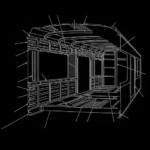
A photo of HeMOSU-1.

FLOW-3D를 이용한 해상 자켓구조물 주변의 세굴 수치모의 실험

Numerical Simulation Test of Scour around Offshore Jacket Structure using FLOW-3D

J Korean Soc Coast Ocean Eng. 2015;27(6):373-381Publication date (electronic) : 2015 December 31doi : https://doi.org/10.9765/KSCOE.2015.27.6.373Dong Hui Ko*Shin Taek Jeong,**Nam Sun Oh****Hae Poong Engineering Inc.**Department of Civil and Environmental Engineering, Wonkwang University***Ocean·Plant Construction Engineering, Mokpo Maritime National University
고동휘*, 정신택,**, 오남선***

*(주)해풍기술**원광대학교 토목환경공학과***목포해양대학교 해양·플랜트건설공학과

Abstract

해상풍력 기기, 해상 플랫폼과 같은 구조물이 해상에서 빈번하게 설치되면서 세굴에 관한 영향도 중요시되고 있다. 이러한 세굴 영향을 검토하기 위해 세굴 수치모의 실험을 수행한다. 일반적으로 수치모의 조건은 일방향 흐름에 대해서만 검토가 이뤄지고 있으며 서해안과 같은 왕복성 조류 흐름에 대해서는 검토되지 않는다. 본 연구에서는 서해안에 설치된 HeMOSU-1호 해상 자켓구조물 주변에서 발생하는 세굴 현상을 FLOW-3D를 이용하여 수치모의하였다. 해석 조건으로는 일방향 흐름과 조석현상을 고려한 왕복성 흐름을 고려하였으며, 이를 현장 관측값과 비교하였다. 10,000초 동안의 수치모의 결과, 일방향의 흐름 조건에서는 1.32 m의 최대 세굴심이 발생하였으며, 양방향 흐름 조건에서는 1.44 m의 최대 세굴심이 발생하였다. 한편, 현장 관측값의 경우 약 1.5~2.0 m의 세굴심이 발생하여 양방향의 흐름에 대한 해석 결과와 근사한 값을 보였다.

Keywords 세굴일방향 흐름왕복성 조류 흐름해상 자켓구조물FLOW-3D최대 세굴심, scouruni-directional flowbi-directional tidal current flowoffshore jacket substructureFlow-3Dmaximum scour depth

As offshore structures such as offshore wind and offshore platforms have been installed frequently in ocean, scour effects are considered important. To test the scour effect, numerical simulation of scour has been carried out. However, the test was usually conducted under the uni-directional flow without bi-directional current flow in western sea of Korea. Thus, in this paper, numerical simulations of scour around offshore jacket substructure of HeMOSU-1 installed in western sea of Korea are conducted using FLOW-3D. The conditions are uni-directional and bi-directional flow considering tidal current. And these results are compared to measured data. The analysis results for 10,000 sec show that under uni-directional conditions, maximum scour depth was about 1.32 m and under bi-directional conditions, about 1.44 m maximum scour depth occurred around the structure. Meanwhile, about 1.5~2.0 m scour depths occurred in field observation and the result of field test is similar to result under bi-directional conditions.

1. 서 론

최근 해상풍력기기, 해상플랫폼과 같은 해상구조물 설치가 빈번해지면서 해상구조물의 안정성을 저하시키는 요인에 대한 대응 연구가 필요하다. 특히 해상에서의 구조물 설치는 육상과 달리 수력학적 하중이 작용하게 되기 때문에 파랑에 의한 구조물과의 진동, 세굴 현상에 대하여 철저한 사전 검토가 요구된다. 특히, 해상 기초에서 발생하는 세굴은 조류 및 파랑 등 유체 흐름과 구조물 사이의 상호작용으로 인해 해저 입자가 유실되는 현상으로 정의할 수 있으며 해상 외력 조건에 포함되어 설계시 고려하도록 제안하고 있다(IEC, 2009).구조물을 해상에 설치하게 되면 구조물이 흐름을 방해하는 장애요인으로 작용하여 구조물 주위에 부분적으로 더 빠른 유속이 발생하게 된다. 이러한 유속 변화는 압력 분포 변화에 기인하게 되어 해양구조물 주위에 아래로 흐르는 유속(downflow), 말굽형 와류(horseshoe vortex) 그리고 후류 와류(wake vortex)가 나타난다. 결국, 유속과 흐름의 변화를 야기하고 하상전단응력과 유사이동 능력을 증가시켜 해저 입자를 유실시키며 구조물의 안정성을 위협하는 요인으로 작용하게 된다. 이러한 세굴 현상이 계속 진행되면 해상풍력 지지구조물 기초의 지지력이 감소하게 될 뿐만 아니라 지지면의 유실로 상부반력 작용에 편심을 유발하여 기초의 전도를 초래한다. 또한 세굴에 의한 기초의 부등 침하가 크게 발생하면 상부 해상풍력 지지구조물에 보다 큰 단면력이 작용하므로 세굴에 의한 붕괴가 발생할 수 있다. 이처럼 세굴은 기초지지구조물을 붕괴하고, 침하와 얕은 기초의 변형을 초래하며, 구조물의 동적 성능을 변화시키기 때문에 설계 및 시공 유지관리시 사전에 세굴심도 산정, 세굴 완화 대책 등을 고려하여야 한다.또한 각종 설계 기준서에서는 세굴에 대해 다양하게 제시하고 있다. IEC(2009)ABS(2013)BSH(2007)MMAF(2005)에서는 세굴에 대한 영향을 검토할 것을 주문하지만 심도 산정 등 세굴에 대한 구체적인 내용은 언급하지 않고 전반적인 내용만 수록하고 있다. 그러나 DNV(2010)CEM(2006)에서는 경험 공식을 이용한 세굴 심도 산정 등 구체적인 내용을 광범위하게 수록하고 있어 세굴에 대한 영향 검토시 활용가능하다. 그 외의 기준서에서는 수치 모델 등을 통한 세굴 검토를 주문하고 있어 사용자들이 직접 판단하도록 제안하고 있다.그러나 세굴은 유속, 수심, 구조물 폭, 형상, 해저입자 등에 의해 결정되기 때문에 세굴의 영향 정도를 정확하게 예측하기란 쉽지 않지만 수리 모형 실험 또는 CFD(Computational Fluid Dynamics)를 이용한 수치 해석을 통해 지반 침식 및 퇴적으로 인한 지형변화를 예측할 수 있다. 한편, 침식과 퇴적 등 구조물 설치로 인한 해저 지형 변화를 예측하는 모델은 다양하지만, 본 연구에서는 Flowscience의 3차원 유동해석모델인 Flow-3D 모델을 사용하였다.해상 구조물은 목적에 따라 비교적 수심이 낮은 지역에 설치가 용이하다. 국내의 경우, 서남해안과 같이 비교적 연안역이 넓고 수심이 낮은 지역에 구조물을 설치하는 것이 비용 및 유지관리 측면에서 유리할 수 있다. 그러나 국내 서남해안 지역은 왕복성 흐름, 즉 조류가 발생하는 지역으로 흐름의 방향이 시간에 따라 변화하게 된다. 따라서, 세굴 수치 모의시 이러한 왕복성 흐름을 고려해야한다. 그러나 대부분의 수치 모델 적용시 조류가 우세한 지역에서도 일방향의 흐름에 대해서만 검토하며 왕복성 흐름에 의한 지층의 침식과 퇴적작용으로 인해 발생하는 해저 입자의 상호 보충 효과는 배제되게 된다. 또한 이로 인해 수치모델 결과에 많은 의구심이 발생하게 되며 현실성이 결여된 해석으로 보여질 수 있다. 이러한 왕복흐름의 영향을 검토하기 위해 Kim and Gang(2011)은 조류의 왕복류 흐름을 고려하여 지반의 수리 저항 성능 실험을 수행하였으며, 양방향이 일방향 흐름보다 세굴이 크게 발생하는 것을 발표하였다. 또한 Kim et al.(2012)은 흐름의 입사각에 따른 수리저항 실험을 수행하였으며 입사각이 커짐에 따라 세굴률이 증가하는 것으로 나타났다.본 연구에서는 단일방향 고정유속 그리고 양방향 변동유속조건에서 발생하는 지형 변화와 세굴 현상을 수치 모의하였으며, 이러한 비선형성 흐름변화에 따른 세굴 영향 정도를 검토하였다. 더불어 현장 관측 자료와의 비교를 통해 서남해안과 같은 왕복성 흐름이 발생하는 지역에서의 세굴 예측시 적절한 모델 수립 방안을 제안하고자 한다.

2. 수치해석 모형

본 연구에서는 Autodesk의 3D max 프로그램을 이용하여 지지구조물 형상을 제작하였으며, 수치해석은 미국 Flowscience가 개발한 범용 유동해석 프로그램인 FLOW-3D(Ver. 11.0.4.5)를 사용하였다. 좌표계는 직교 좌표계를 사용하였으며 복잡한 3차원 형상의 표현을 위하여 FAVOR 기법(Fractional Area/Volume Obstacle Representation Method)을 사용하였다. 또한 유한차분법에 FAVOR 기법을 도입한 유한체적법의 접근법을 사용하였으며 직교좌표계 에서 비압축성 유체의 3차원 흐름을 해석하기 위한 지배방정식으로는 연속방정식과 운동방정식이 사용되었다. 난류모형으로는 RNG(renormalized group)모델을 사용하였다.

2.1 FLOW-3D의 지배방정식

수식은 MathML 표현문제로 본 문서의 하단부의 원문바로가기 링크를 통해 원문을 참고하시기 바랍니다.

2.1.1 연속방정식

직교좌표계 (x,y,z)에서 비압축성 유체는 압축성 유체의 연속방정식에서 유도될 수 있으며 다음 식 (1)과 같다.

(1)

∂∂x(uAx)+∂∂y(vAy)+∂∂z(wAz)=RSORρ∂∂x(uAx)+∂∂y(vAy)+∂∂z(wAz)=RSORρ
여기서, u, v, w는 (x,y,z) 방향별 유체속도, Ax, Ay, Az는 각 방향별 유체 흐름을 위해 확보된 면적비 (Area fraction), ρ는 유체 밀도, RSOR은 질량생성/소멸(Mass source/sink)항이다.

2.1.2 운동방정식

본 모형은 3차원 난류모형이므로 각각의 방향에 따른 운동량 방정식은 다음 식(2)~(4)와 같다.

(2)

∂u∂t+1VF(uAx∂u∂x+vAy∂u∂y+wAz∂u∂z)   =−1ρ∂p∂x+Gx+fx−bx−RSORρVFu∂u∂t+1VF(uAx∂u∂x+vAy∂u∂y+wAz∂u∂z)   =−1ρ∂p∂x+Gx+fx−bx−RSORρVFu

(3)

∂v∂t+1VF(uAx∂v∂x+vAy∂v∂y+wAz∂v∂z)   =−1ρ∂p∂y+Gy+fy−by−RSORρVFv∂v∂t+1VF(uAx∂v∂x+vAy∂v∂y+wAz∂v∂z)   =−1ρ∂p∂y+Gy+fy−by−RSORρVFv

(4)

∂w∂t+1VF(uAx∂w∂x+vAy∂w∂y+wAz∂w∂z)   =−1ρ∂p∂z+Gz+fz−bz−RSORρVFw∂w∂t+1VF(uAx∂w∂x+vAy∂w∂y+wAz∂w∂z)   =−1ρ∂p∂z+Gz+fz−bz−RSORρVFw여기서, RSOR은 질량생성/소멸(Mass source/sink)항, VF는 체적비 (Volume fraction), p는 압력, Gx, Gy, Gz는 방향별 체적력항, fx, fy, fz는 방향별 점성력항, bx, by, bz는 다공질 매체에서 방향별 흐름 손실이다.그리고 점성계수 µ에 대하여 점성력항은 다음 식 (5)~(7)과 같다.

(5)

ρVffx=wsx−{∂∂x(Axτxx)+R∂∂y(Ayτxy)+∂∂z(Azτxz)+ζx(Axτxx−Ayτyy)}ρVffx=wsx−{∂∂x(Axτxx)+R∂∂y(Ayτxy)+∂∂z(Azτxz)+ζx(Axτxx−Ayτyy)}

(6)

ρVffy=wsy−{∂∂x(Axτxy)+R∂∂y(Ayτyy)+∂∂z(Azτyz)+ζx(Axτxx−Ayτxy)}ρVffy=wsy−{∂∂x(Axτxy)+R∂∂y(Ayτyy)+∂∂z(Azτyz)+ζx(Axτxx−Ayτxy)}

(7)

ρVffz=wsz−{∂∂x(Axτxz)+R∂∂y(Ayτyz)+∂∂z(Azτzz)+ζx(Axτzz)}ρVffz=wsz−{∂∂x(Axτxz)+R∂∂y(Ayτyz)+∂∂z(Azτzz)+ζx(Axτzz)}여기서, wsx, wsy, wsz는 벽전단응력이며, 벽전단응력은 벽 근처에서 벽 법칙 (law of the wall)을 따르며, 식 (8)~(13)에 의해 표현되어진다.

(8)

τxx=−2μ{∂u∂x−13(∂u∂x+R∂v∂y+∂w∂z+ζux)}τxx=−2μ{∂u∂x−13(∂u∂x+R∂v∂y+∂w∂z+ζux)}

(9)

τyy=−2μ{R∂v∂y+ζux−13(∂u∂x+R∂v∂y+∂w∂z+ζux)}τyy=−2μ{R∂v∂y+ζux−13(∂u∂x+R∂v∂y+∂w∂z+ζux)}

(10)

τzz=−2μ{R∂w∂y−13(∂u∂x+R∂v∂y+∂w∂z+ζux)}τzz=−2μ{R∂w∂y−13(∂u∂x+R∂v∂y+∂w∂z+ζux)}

(11)

τxy=−μ{∂v∂x+R∂u∂y−ζvx}τxy=−μ{∂v∂x+R∂u∂y−ζvx}

(12)

τxz=−μ{∂u∂y+∂w∂x}τxz=−μ{∂u∂y+∂w∂x}

(13)

τyz=−μ{∂v∂z+R∂w∂y}τyz=−μ{∂v∂z+R∂w∂y}

2.1.3 Sediment scour model

Flow-3D 모델에서 사용하는 sediment scour model은 해저입자의 특성에 따라 해저 입자의 침식, 이송, 전단과 흐름 변화로 인한 퇴적물의 교란 그리고 하상 이동을 계산한다.

2.1.3.1 The critical Shields parameter

무차원 한계소류력(the dimensionless critical Shields parameter)은 Soulsby-Whitehouse 식에 의해 다음 식 (14)와 같이 나타낼 수 있다(Soulsby, 1997).

(14)

θcr,i=0.31+1.2R∗i+0.055[1−exp(−0.02R∗i)]θcr,i=0.31+1.2Ri*+0.055[1−exp(−0.02Ri*)]여기서 무차원 상수, R∗iRi*는 다음 식 (15)와 같다.

(15)

R∗i=ds,i0.1(ρs,i−ρf)ρf∥g∥ds,i−−−−−−−−−−−−−−−−−−−√μfRi*=ds,i0.1(ρs,i−ρf)ρf‖g‖ds,iμf여기서 ρs, i는 해저 입자의 밀도, ρf는 유체 밀도, ds, i는 해저입자 직경, g는 중력가속도이다.한편, 안식각에 따라 한계소류력은 다음 식 (16)과 같이 표현될 수 있다.

(16)

θ′cr,i=θcr,icosψsinβ+cos2βtan2ψi−sin2ψsin2β−−−−−−−−−−−−−−−−−−−−√tanψiθcr,i′=θcr,icosψsinβ+cos2βtan2ψi−sin2ψsin2βtanψi여기서, β는 하상 경사각, ψi는 해저입자의 안식각, ψ는 유체와 해저경사의 사잇각이다.또한 local Shields number는 국부 전단응력, τ에 기초하여 다음 식 (17)과 같이 계산할 수 있다.

(17)

θi=τ∥g∥ds,i(ρs,i−ρf)θi=τ‖g‖ds,i(ρs,i−ρf)여기서, ||g||g 는 중력 벡터의 크기이며, τ는 식 (8)~(13)의 벽 법칙을 이용하여 계산할 수 있다.

2.1.3.2 동반이행(Entrainment)과 퇴적

다음 식은 해저 지반과 부유사 사이의 교란을 나타내는 동반이행과 퇴적 현상을 계산한다. 해저입자의 동반이행 속도의 계산식은 다음 식 (18)과 같으며 부유사로 전환되는 해저의 양을 계산한다.

(18)

ulift,i=αinsd0.3∗(θi−θ′cr,i)1.5∥g∥ds,i(ρs,i−ρf)ρf−−−−−−−−−−−−−−√ulift,i=αinsd*0.3(θi−θcr,i′)1.5‖g‖ds,i(ρs,i−ρf)ρf여기서, αi는 동반이행 매개변수이며, ns는 the packed bed interface에서의 법선벡터, µ는 유체의 동점성계수 그리고 d*은 무차원 입자 직경으로 다음 식 (19)와 같다.

(19)

d∗=ds,i[ρf(ρs,i−ρf)∥g∥μ2]1/3d*=ds,i[ρf(ρs,i−ρf)‖g‖μ2]1/3또한 퇴적 모델에서 사용하는 침강 속도 식은 다음 식 (20)같이 나타낼 수 있다.

(20)

usettling,i=νfds,i[(10.362+1.049d3∗)0.5−10.36]usettling,i=νfds,i[(10.362+1.049d*3)0.5−10.36]여기서, νf는 유체의 운동점성계수이다.

2.1.3.3 하상이동 모델(Bedload transport)

하상이동 모델은 해저면에 대한 단위 폭당 침전물의 체적흐름을 예측하는데 사용되며 다음 식 (21)과 같이 표현되어진다.

(21)

Φi=βi(θi−θ′cr,i)1.5Φi=βi(θi−θcr,i′)1.5여기서 Φi는 무차원 하상이동률이며 βi는 일반적으로 8.0의 값을 사용한다(van Rijn, 1984).단위 폭당 체적 하상이동률, qi는 다음 식 (22)와 같이 나타낼 수 있다.

(22)

qb,i=fb,i Φi[∥g∥(ρs,i−ρfρf)d3s,i]1/2qb,i=fb,i Φi[‖g‖(ρs,i−ρfρf)ds,i3]1/2여기서, fb, i는 해저층의 입자별 체적률이다.또한 하상이동 속도를 계산하기 위해 다음 식 (23)에 의해 해저면층 두께를 계산할 수 있다.

(23)

δi=0.3ds,id0.7∗(θiθ′cr,i−1)0.5δi=0.3ds,id*0.7(θiθcr,i′−1)0.5그리고 하상이동 속도 식은 다음 식 (24)와 같이 계산되어진다.

(24)

ubedload,i=qb,iδifb,iubedload,i=qb,iδifb,i

2.2 모델 구성 및 해역 조건

2.2.1 해역 조건 및 적용 구조물

본 수치해석은 위도와 안마도 사이의 해양 조건을 적용하였으며 지점은 Fig. 1과 같다.
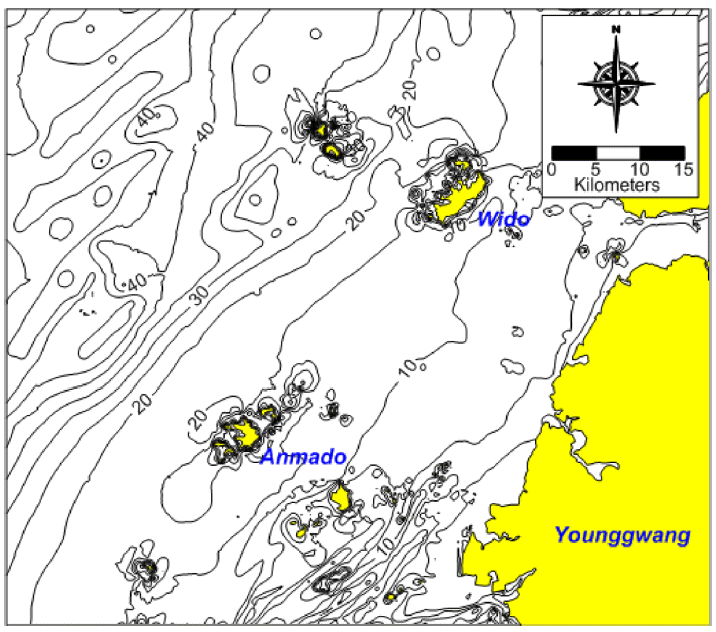
jkscoe-27-6-373f1.gifFig. 1.Iso-water depth contour map in western sea of Korea.

본 해석 대상 해역은 서해안의 조석 현상이 뚜렷한 지역으로 조류 흐름이 지배적이며 위도의 조화분석의 결과를 보면 조석형태수가 0.21로서 반일주조 형태를 취한다. 또한 북동류의 창조류와 남서류의 낙조류의 특성을 보이며 조류의 크기는 대상 영역에서 0.7~1 m/s의 최강유속 분포를 보이는 것으로 발표된 바 있다. 또한 대상 해역의 시추조사 결과를 바탕으로 해저조건은 0.0353 mm 로 설정하였고(KORDI, 2011), 수위는 등수심도를 바탕으로 15 m로 하였다.한편, 풍황자원 분석을 통한 단지 세부설계 기초자료 제공, 유속, 조류 등 해양 환경변화 계측을 통한 환경영향평가 기초자료 제공을 목적으로 Fig. 2와 같이 해상기상탑(HeMOSU-1호)을 설치하여 운영하고 있다. HeMOSU-1호는 평균해수면 기준 100 m 높이이며, 중량은 100 톤의 자켓구조물로 2010년 설치되었다. 본 연구에서는 HeMOSU-1호의 제원을 활용하여 수치 모의하였으며, 2013년 7월(설치 후 약 3년 경과) 현장 관측을 수행하였다.
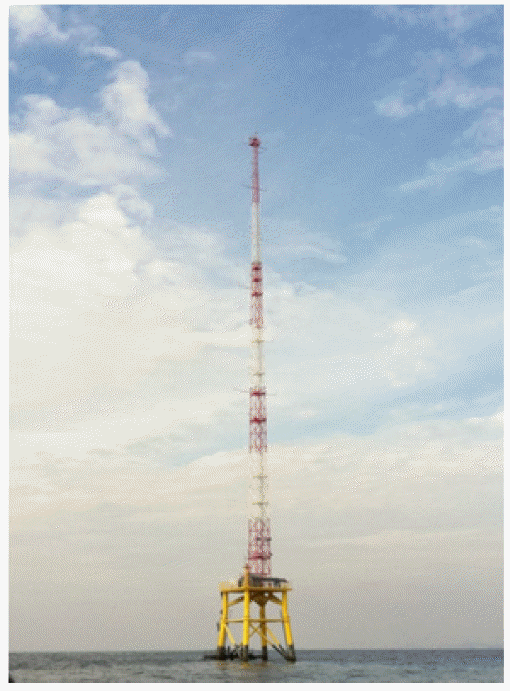
jkscoe-27-6-373f2.gifFig. 2.A photo of HeMOSU-1.

2.2.2 모델 구성

본 연구에서는 왕복성 조류의 영향을 살펴보기 위해 2 case에 대하여 해석하였다. 먼저, Case 1은 1 m/s의 고정 유속을 가진 일방향 흐름에 대한 해석이며, Case 2는 -1~1 m/s의 유속분포를 가진 양방향 흐름에 대한 해석이다. 여기서 (-)부호는 방향을 의미한다. Fig. 3은 시간대별 유속 분포를 나타낸 것이다.
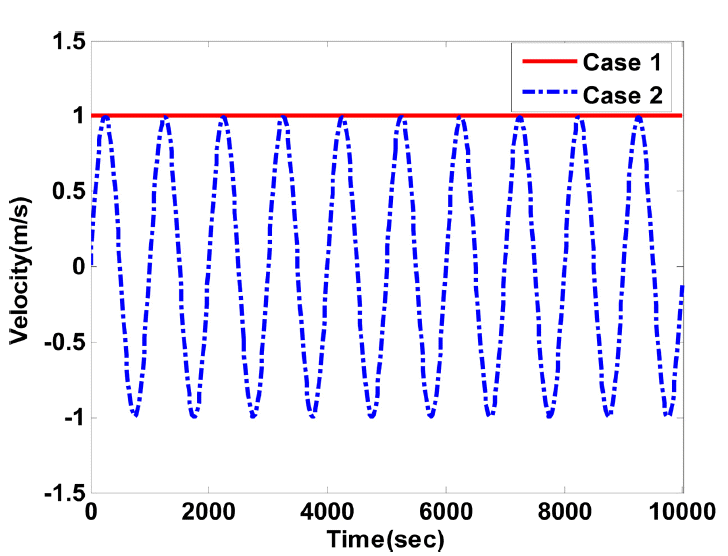
jkscoe-27-6-373f3.gifFig. 3.Comparison of current speed conditions.

2.2.3 구조물 형상 및 격자

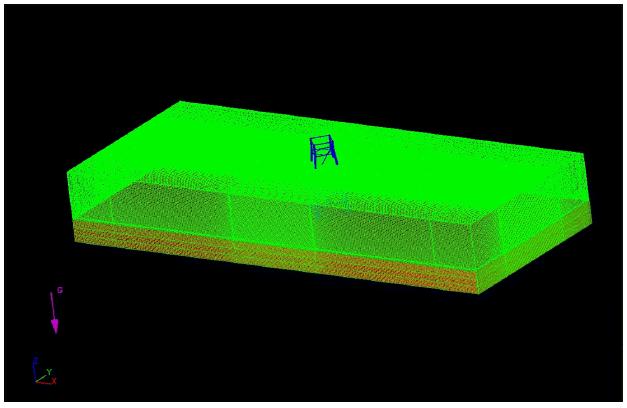
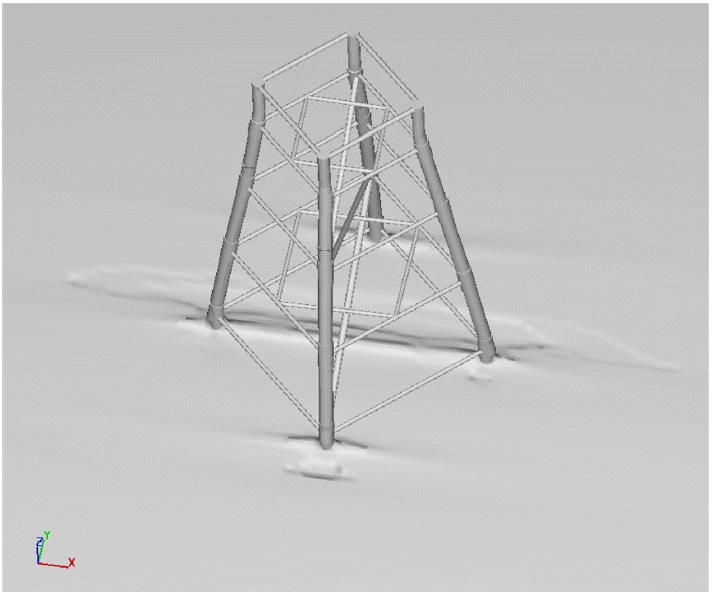
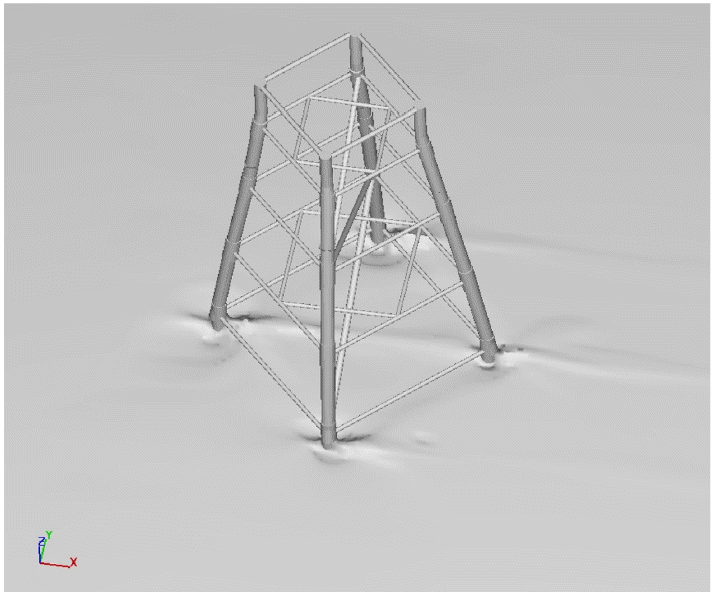
HeMOSU-1호 기상 타워 자켓 구조물 형상은 Fig. 4, 격자 정보는 Table 1과 같으며, 본 연구에서는 총 2,883,000 개의 직교 가변 격자체계를 구성하였다.

jkscoe-27-6-373f4.gifFig. 4.3 Dimensional plot of jacket structure.
Table 1.

Grid information of jacket structure

Xmin/Xmax(m)Ymin/Ymax(m)Zmin/Zmax(m)No. of x gridNo. of y gridNo. of z grid
−100/100−40/40−9/2031015560
Download Table

한편, 계산영역의 격자 형상은 Fig. 5와 같다.

jkscoe-27-6-373f5.gifFig. 5.3 dimensional grid of jacket structure.

2.3 계산 조건

계산영역의 경계 조건으로, Case 1의 경우, 유입부는 유속 조건을 주었으며 유출부는 outflow 조건을 적용하였다. 그리고 Case 2의 경우, 왕복성 흐름을 표현하기 위해 유입부와 유출부 조건을 유속 조건으로 설정하였다. 또한 2가지 경우 모두 상부는 자유수면을 표현하기 위해 pressure로 하였으며 하부는 지반 조건의 특성을 가진 wall 조건을 적용하였다. 양측면은 Symmetry 조건으로 대칭면으로 정의하여 대칭면에 수직한 방향의 에너지와 질량의 유출입이 없고 대칭면에 평행한 방향의 유동저항이 없는 경우로 조건을 설정하였다. 본 연구에서 케이스별 입력 조건을 다음 Table 2에 정리하였다.

Table 2.

Basic information of two scour simulation tests

CaseStructure typeVelocityDirectionAnalysis time
Case 1Jacket1 m/sUnidirectional10,000 sec
Case 2−1~1 m/sBidirectional
Download Table

FLOW-3D는 자유표면을 가진 유동장의 계산에서 정상상태 해석이 불가능하므로 비정상유동 난류해석을 수행하게 되는데 정지 상태의 조건은 조위를 설정하였다. 또한 유속의 초기 흐름은 난류상태의 비정상흐름이 되므로 본 해석에서는 정상상태의 해석 수행을 위해 1,000초의 유동 해석을 수행하였으며 그 후에 10,000초의 sediment scour 모델을 수행하였다. 해수의 밀도는 1,025 kg/m3의 점성유체로 설정하였으며 RNG(renormalized group) 난류 모델을 적용하였다.Go to : Goto

3. 수치모형 실험 결과

3.1 Case 1

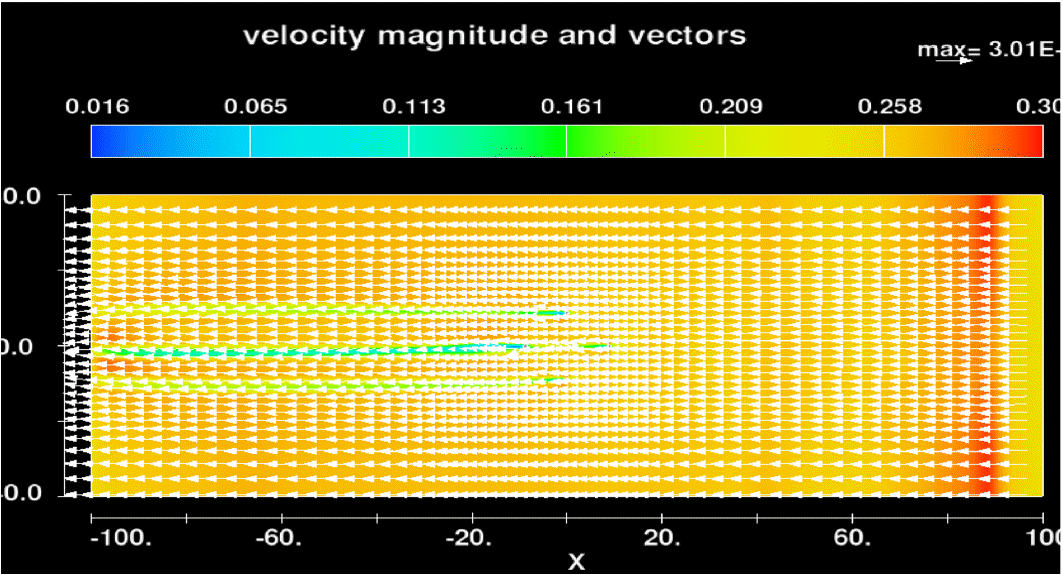
본 케이스에서는 1 m/s의 유속을 가진 흐름이 구조물 주변을 흐를 때, 발생하는 세굴에 대해서 수치 모의하였다. Fig. 6은 X-Z 평면의 유속 분포도이고 Fig. 7은 X-Y 평면의 유속 분포이다. 구조물 주변에서 약간의 유속 변화가 발생했지만 전체적으로 1 m/s의 정상 유동 상태를 띄고 있다.
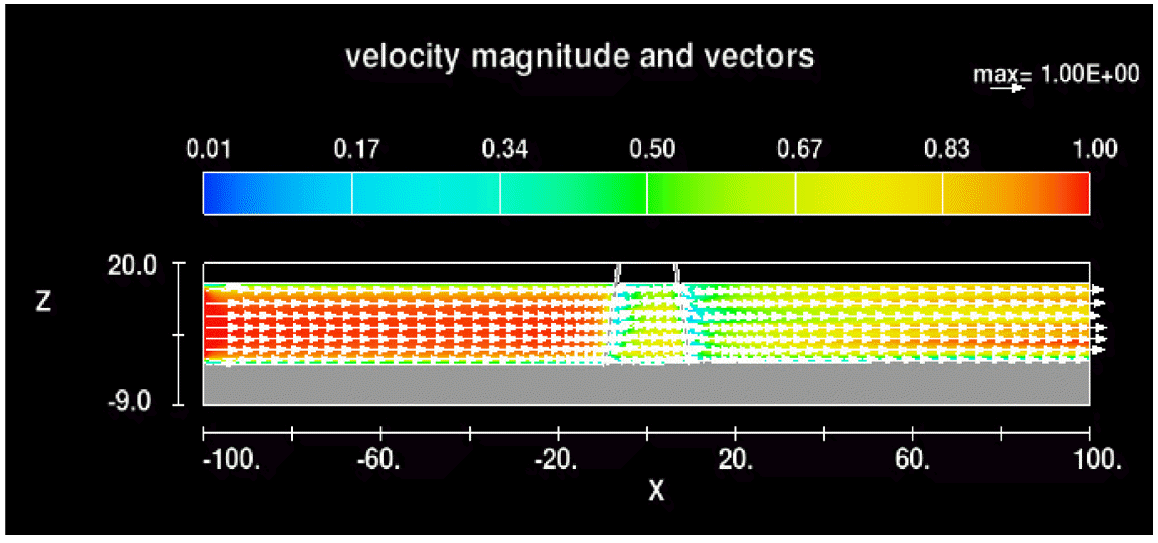
jkscoe-27-6-373f6.gifFig. 6.Current speed distribution in computational domain of case 1 at t = 10,000 sec (X–Z plane).
jkscoe-27-6-373f7.gifFig. 7.Current speed distribution in computational domain of case 1 at t = 10,000 sec (X–Y plane).

이러한 흐름과 구조물과의 상호 작용에 의한 세굴 현상이 발생되며 Fig. 8에 구조물 주변 지형 변화를 나타내었다. 유속이 발생하는 구조물의 전면부는 대체로 침식이 일어나 해저지반이 초기 상태보다 낮아진 것을 확인할 수 있으며, 또한 전면부의 지반이 유실되어 구조물 후면부에 최대 0.13 m까지 퇴적된 것을 확인할 수 있다.
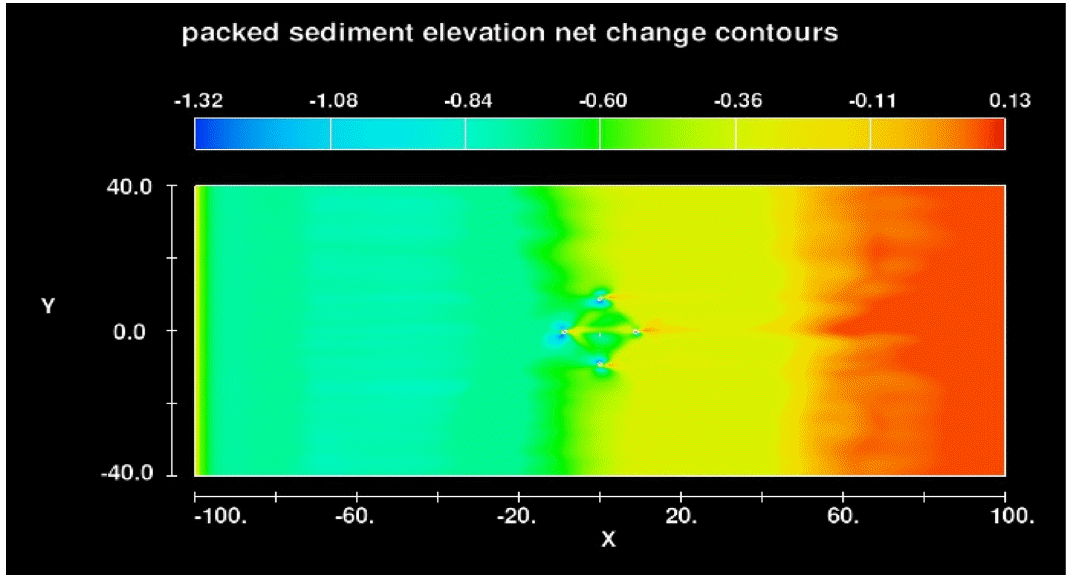
jkscoe-27-6-373f8.gifFig. 8.Sea-bed elevation change of case 1 at t = 10,000 sec.

일방향 흐름인 Case 1의 경우에는 Fig. 9와 같이 10,000초 후 구조물 주변에 최대 1.32 m의 세굴이 발생하는 것으로 나타났다. 또한 구조물 뒤쪽으로는 퇴적이 일어났으며, 구조물 전면부에는 침식작용이 일어나고 있다.
jkscoe-27-6-373f9.gifFig. 9.Scour phenomenon around jacket substructure(Case 1).

3.2 Case 2

서해안은 조석현상으로 인해 왕복성 조류 흐름이 나타나고 있으며 대상해역은 -1~1 m/s의 유속분포를 가지고 있다. 본 연구에서는 이러한 특성을 고려한 왕복성 흐름에 대해서 수치모의하였다.다음 Fig. 10은 X-Z 평면의 유속 분포도이며 Fig. 11은 X-Y 평면의 유속 분포도이다.
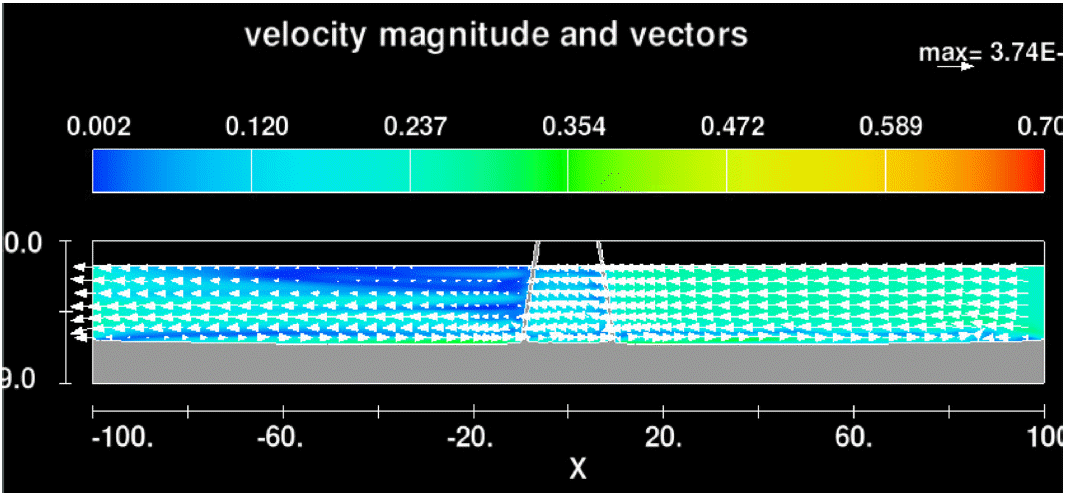
jkscoe-27-6-373f10.gifFig. 10.Current speed distribution in computational domain of case 2 at t = 10,000 sec (X–Z plane).
jkscoe-27-6-373f11.gifFig. 11.Current speed distribution in computational domain of case 2 at t = 10,000 sec (X–Y plane).

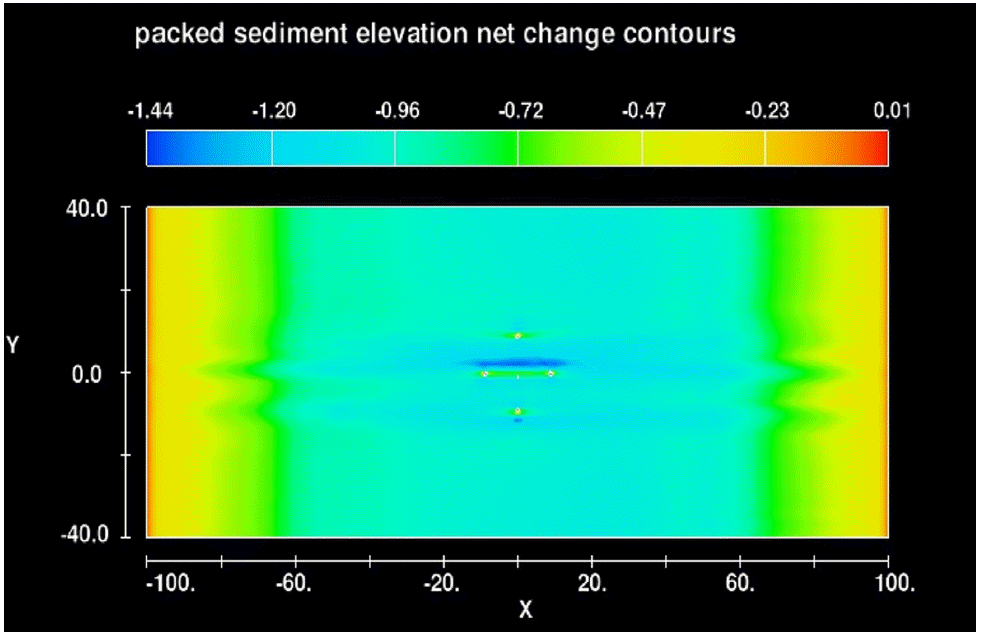
양방향 흐름인 Case 2의 경우에는 Fig. 12와 같이 10,000초후 구조물 주변에 최대 1.44 m의 세굴이 발생하는 것으로 나타났다. 특히 구조물 내부에 조류 흐름 방향으로 침식 작용이 일어나고 있는 것으로 나타났다.
jkscoe-27-6-373f12.gifFig. 12.Sea-bed elevation change of case 2 at t = 10,000 sec.

Fig. 13은 3차원 수치해석 모의 결과이다.

jkscoe-27-6-373f13.gifFig. 13.Scour phenomenon around jacket substructure(Case 2).

3.3 현장 관측

본 연구에서는 수치모의 실험의 검증을 위해 HeMOSU-1호 기상 타워를 대상으로 하여 2013년 7월 1일 수심 측량을 실시하였다.HeMOSU-1호 주변의 수심측량은 Knudsen sounder 1620과 미국 Trimble사의 DGPS를 이용하여 실시하였다. 매 작업시 Bar-Check를 실시하고, 수중 음파속도는 1,500 m/s로 결정하여 조위 보정을 통해 수심을 측량하였다. 측량선의 해상위치자료는 DGPS를 사용하여 UTM 좌표계로 변환을 실시하였다. 한편, 수심측량은 해면이 정온할 때 실시하였으며 관측 자료의 변동성을 제거하기 위해 2013년 7월 1일 10시~13시에 걸쳐 수심 측량한 자료를 동시간대에 국립해양조사원에서 제공한 위도 자료를 활용해 조위 보정하였다. 다음 Fig. 14는 위도 조위 관측소의 현장관측시간대 조위 시계열 그래프이다.
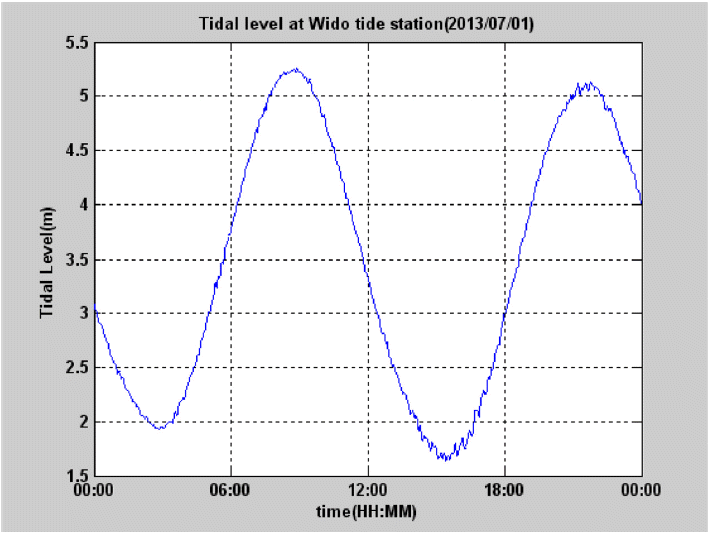
jkscoe-27-6-373f14.gifFig. 14.Time series of tidal data at Wido (2013.7.1).

2013년 7월 1일 오전 10시부터 오후 1시에 걸쳐 수심측량한 결과를 이용하여 0.5 m 간격으로 등수심도를 작성하였으며 그 결과는 Fig. 15와 같다. 기상탑 내부 해역은 선박이 접근할 수 없기 때문에 측량을 실시하지 않고 Blanking 처리하였다.
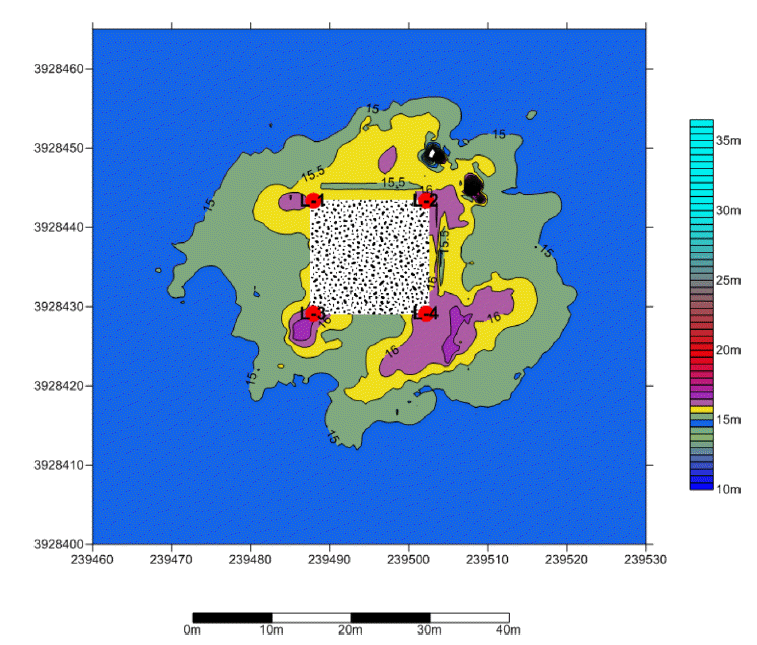
jkscoe-27-6-373f15.gifFig. 15.Iso-depth contour map around HeMOSU-1.

대상 해역의 수심은 대부분 -15 m이나 4개의 Jacket 구조물 주변에서는 세굴이 발생하여 수심의 변화가 나타났다. 특히 L-3, L-4 주변에서 최대 1.5~2.0 m의 세굴이 발생한 것으로 보였으며, L-4 주변에서는 넓은 범위에 걸쳐 세굴이 발생하였다. 창조류는 북동, 낙조류는 남서 방향으로 흐르는 조류 방향성을 고려하였을 때, L-4 주변은 조류방향과 동일하게 세굴이 발생하고 있었으며, 보다 상세한 세굴형태는 원형 구조물 내부 방향의 세굴 심도를 측정하여 파악하여야 할 것으로 판단된다.관측결과 최대 1.5~2.0 m인 점을 고려하면 양방향 흐름을 대상으로 장기간에 걸쳐 모의실험을 진행하는 경우, 실제 현상에 더 근접하는 결과를 얻을 수 있을 것으로 사료된다.Go to : Goto

4. 결론 및 토의

본 연구에서는 자켓구조물인 해상기상탑 HeMOSU-1 주변에서 발생하는 세굴현상을 검토하기 위하여 2013년 7월 1일 현장 관측을 수행하고, FLOW-3D를 이용하여 수치모의 실험을 수행하였다. 실험 조건으로는 먼저 1 m/s의 유속을 가진 일방향 흐름과 -1~1 m/s의 흐름 분포를 가진 왕복성 흐름에 대해서 수치모의를 수행하였다. 그 결과 일방향 흐름의 경우, 10,000 초에 이르렀을 때 1.32 m, 왕복성 흐름의 경우 동일 시간에서 1.44 m의 최대 세굴심도가 발생하였다. 동일한 구조물에 대해서 현장 관측 결과는 1.5~2.0 m로 관측되어 일방향 흐름보다 왕복성 흐름의 경우 실제 현상에 더 근사한 것으로 판단되었다. 이는 일방향 흐름의 경우, Fig. 8에서 보는 바와 같이 구조물 후면에 퇴적과 함께 해저입자의 맞물림이 견고해져 해저 지반의 저항력이 커지는 현상에 기인한 것으로 판단된다. 반면 양방향 흐름의 경우, 흐름의 변화로 인해 맞물림이 약해지고 이로 인해 지반의 저항력이 일방향 흐름보다 약해져 세굴이 더 크게 발생하는 것으로 판단되었다.또한 장시간에 걸쳐 모델링을 수행하는 경우, 보다 근사한 결과를 얻을 수 있을 것을 사료되며, 신형식 기초 구조물을 개발하여 세굴을 저감할 수 있는 지 여부를 판단하는 등의 추가 연구가 필요하다.Go to : GotoInternational Electrotechnical Commission (IEC). (2009). IEC 61400-3: Wind turbines – Part 3: Design Requirements for Offshore Wind Turbines, Edition 1.0, IEC.

감사의 글

본 연구는 지식경제 기술혁신사업인 “승강식 해상플랫폼을 가진 수직 진자운동형 30kW급 파력발전기 개발(과제번호 :20133010071570)”와 첨단항만건설기술개발사업인 “해상풍력 지지구조 설계기준 및 콘크리트 지지구조물 기술 개발(과제번호:20120093)”의 일환으로 수행되었습니다.Go to : Goto

References

American Bureau of Shipping (ABS). (2013). Guide for Building and Classing Bottom-Founded Offshore Wind turbine Installations.

API RP 2A WSD. (2005). Recommended Practice for Planning, Designing and Constructing Fixed Offshore Platforms-Working Stress Design, API.

Det Norske Veritas (DNV). (2010). OS-J101 Design of Offshore Wind Turbine Structures.

Federal Maritime and Hydrographic Agency (BSH). (2007). Standard. Design of Offshore Wind Turbines.

FLOW SCIENCE. (2014). FLOW-3D User’s Manual, Version 11.0.4.5.

International Electrotechnical Commission (IEC). (2009). IEC 61400-3: Wind turbines – Part 3: Design Requirements for Offshore Wind Turbines, Edition 1.0, IEC.

International Organization for Standardization (ISO). (2007). ISO 19902: Petroleum and Natural Gas Industries – Fixed Steel Offshore Structures.

Kim, YS, Kang, GO. (2011). Experimental Study on Hydraulic Resistance of Sea Ground Considering Tidal Current Flow, Journal of Korean Society of Coastal and Ocean Engineers. 23(1):118-125 (in Korean).

Kim, YS, Han, BD, Kang, GO. (2012). Effect of Incidence Angle of Current on the Hydraulic Resistance Capacity of Clayey Soil, Journal of Korean Society of Coastal and Ocean Engineers. 24(1):26-35 (in Korean).

KORDI. (2011). BSPN64710-2275-2. An Analysis on the Marine Characteristics and Design Supporting for Offshore Wind Power Plant (in Korean).

Ministry of Maritime Affairs and Fisheries. (2005). Harbor and fishery design criteria (in Korean).

Soulsby, R. (1997). Dynamics of marine sands. Thomas Telford Publications, London.

U.S. Army Corps of Engineers. (2006). Coastal Engineering Manual, Part II : Coastal Hydrodynamics, Chapter II–2, Meteorology and Wave Climate.

van Rijn, L. (1984). Sediment transport, Part II:bed load transport, Journal of Hydraulic Engineering, 110(10):1431-1456.

자유 표면 모델링 방법

본 자료는 국내 사용자들의 편의를 위해 원문 번역을 해서 제공하기 때문에 일부 오역이 있을 수 있어서 원문과 함께 수록합니다. 자료를 이용하실 때 참고하시기 바랍니다.

Free Surface Modeling Methods

An interface between a gas and liquid is often referred to as a free surface. The reason for the “free” designation arises from the large difference in the densities of the gas and liquid (e.g., the ratio of density for water to air is 1000). A low gas density means that its inertia can generally be ignored compared to that of the liquid. In this sense the liquid moves independently, or freely, with respect to the gas. The only influence of the gas is the pressure it exerts on the liquid surface. In other words, the gas-liquid surface is not constrained, but free.

자유 표면 모델링 방법

기체와 액체 사이의 계면은 종종 자유 표면이라고합니다.  ‘자유’라는 호칭이 된 것은 기체와 액체의 밀도가 크게 다르기 때문입니다 (예를 들어, 물 공기에 대한 밀도 비는 1000입니다).  기체의 밀도가 낮다는 것은 액체의 관성에 비해 기체의 관성은 일반적으로 무시할 수 있다는 것을 의미합니다.  이러한 의미에서, 액체는 기체에 대해 독립적으로, 즉 자유롭게 움직입니다.  기체의 유일한 효과는 액체의 표면에 대한 압력입니다.  즉, 기체와 액체의 표면은 제약되어있는 것이 아니라 자유롭다는 것입니다.

In heat-transfer texts the term ‘Stephen Problem’ is often used to describe free boundary problems. In this case, however, the boundaries are phase boundaries, e.g., the boundary between ice and water that changes in response to the heat supplied from convective fluid currents.

열전달에 관한 문서는 자유 경계 문제를 묘사할 때 “Stephen Problem’”라는 용어가 자주 사용됩니다.  그러나 여기에서 경계는 상(phase) 경계, 즉 대류적인 유체의 흐름에 의해 공급된 열에 반응하여 변화하는 얼음과 물 사이의 경계 등을 말합니다.

Whatever the name, it should be obvious that the presence of a free or moving boundary introduces serious complications for any type of analysis. For all but the simplest of problems, it is necessary to resort to numerical solutions. Even then, free surfaces require the introduction of special methods to define their location, their movement, and their influence on a flow.

이름이 무엇이든, 자유 또는 이동 경계가 존재한다는 것은 어떤 유형의 분석에도 복잡한 문제를 야기한다는 것은 분명합니다. 가장 간단한 문제를 제외한 모든 문제에 대해서는 수치 해석에 의존할 필요가 있습니다. 그 경우에도 자유 표면은 위치, 이동 및 흐름에 미치는 영향을 정의하기 위한 특별한 방법이 필요합니다.

In the following discussion we will briefly review the types of numerical approaches that have been used to model free surfaces, indicating the advantages and disadvantages of each method. Regardless of the method employed, there are three essential features needed to properly model free surfaces:

  1. A scheme is needed to describe the shape and location of a surface,
  2. An algorithm is required to evolve the shape and location with time, and
  3. Free-surface boundary conditions must be applied at the surface.

다음 설명에서는 자유 표면 모델링에 사용되어 온 다양한 유형의 수치적 접근에 대해 간략하게 검토하고 각 방법의 장단점을 설명합니다. 어떤 방법을 사용하는지에 관계없이 자유롭게 표면을 적절히 모델화하는 다음의 3 가지 기능이 필요합니다.

  1. 표면의 형상과 위치를 설명하는 방식
  2. 시간에 따라 모양과 위치를 업데이트 하는 알고리즘
  3. 표면에 적용할 자유 표면 경계 조건

Lagrangian Grid Methods

Conceptually, the simplest means of defining and tracking a free surface is to construct a Lagrangian grid that is imbedded in and moves with the fluid. Many finite-element methods use this approach. Because the grid and fluid move together, the grid automatically tracks free surfaces.

라그랑주 격자 법

개념적으로 자유 표면을 정의하고 추적하는 가장 간단한 방법은 유체와 함께 이동하는 라그랑주 격자를 구성하는 것입니다. 많은 유한 요소 방법이 이 접근 방식을 사용합니다. 격자와 유체가 함께 움직이기 때문에 격자는 자동으로 자유 표면을 추적합니다.

At a surface it is necessary to modify the approximating equations to include the proper boundary conditions and to account for the fact that fluid exists only on one side of the boundary. If this is not done, asymmetries develop that eventually destroy the accuracy of a simulation.

표면에서 적절한 경계 조건을 포함하고 유체가 경계의 한면에만 존재한다는 사실을 설명하기 위해 근사 방정식을 수정해야합니다. 이것이 수행되지 않으면 결국 시뮬레이션의 정확도를 훼손하는 비대칭이 발생합니다.

The principal limitation of Lagrangian methods is that they cannot track surfaces that break apart or intersect. Even large amplitude surface motions can be difficult to track without introducing regridding techniques such as the Arbitrary-Lagrangian-Eulerian (ALE) method. References 1970 and 1974 may be consulted for early examples of these approaches.

라그랑지안 방법의 주요 제한은 분리되거나 교차하는 표면을 추적 할 수 없다는 것입니다. ALE (Arbitrary-Lagrangian-Eulerian) 방법과 같은 격자 재생성 기법을 도입하지 않으면 진폭이 큰 표면 움직임도 추적하기 어려울 수 있습니다. 이러한 접근법의 초기 예를 보려면 참고 문헌 1970 및 1974를 참조하십시오.

The remaining free-surface methods discussed here use a fixed, Eulerian grid as the basis for computations so that more complicated surface motions may be treated.

여기에서 논의된 나머지 자유 표면 방법은 보다 복잡한 표면 움직임을 처리할 수 있도록 고정된 오일러 그리드를 계산의 기준으로 사용합니다.

Surface Height Method

Low amplitude sloshing, shallow water waves, and other free-surface motions in which the surface does not deviate too far from horizontal, can be described by the height, H, of the surface relative to some reference elevation. Time evolution of the height is governed by the kinematic equation, where (u,v,w) are fluid velocities in the (x,y,z) directions. This equation is a mathematical expression of the fact that the surface must move with the fluid:

표면 높이 법

낮은 진폭의 슬로 싱, 얕은 물결 및 표면이 수평에서 너무 멀리 벗어나지 않는 기타 자유 표면 운동은 일부 기준 고도에 대한 표면의 높이 H로 설명 할 수 있습니다. 높이의 시간 진화는 운동학 방정식에 의해 제어되며, 여기서 (u, v, w)는 (x, y, z) 방향의 유체 속도입니다. 이 방정식은 표면이 유체와 함께 움직여야한다는 사실을 수학적으로 표현한 것입니다.

Finite-difference approximations to this equation are easy to implement. Further, only the height values at a set of horizontal locations must be recorded so the memory requirements for a three-dimensional numerical solution are extremely small. Finally, the application of free-surface boundary conditions is also simplified by the condition on the surface that it remains nearly horizontal. Examples of this technique can be found in References 1971 and 1975.

이 방정식의 유한 차분 근사를 쉽게 실행할 수 있습니다.  또한 3 차원 수치 해법의 메모리 요구 사항이 극도로 작아지도록 같은 높이의 위치 값만을 기록해야합니다.  마지막으로 자유 표면 경계 조건의 적용도 거의 수평을 유지하는 표면의 조건에 의해 간소화됩니다.  이 방법의 예는 참고 문헌의 1971 및 1975을 참조하십시오.

Marker-and-Cell (MAC) Method

The earliest numerical method devised for time-dependent, free-surface, flow problems was the Marker-and-Cell (MAC) method (see Ref. 1965). This scheme is based on a fixed, Eulerian grid of control volumes. The location of fluid within the grid is determined by a set of marker particles that move with the fluid, but otherwise have no volume, mass or other properties.

MAC 방법

시간 의존성을 가지는 자유 표면 흐름의 문제에 대해 처음 고안된 수치 법이 MAC (Marker-and-Cell) 법입니다 (참고 문헌 1965 참조).  이 구조는 컨트롤 볼륨 고정 오일러 격자를 기반으로합니다.  격자 내의 유체의 위치는 유체와 함께 움직이고, 그 이외는 부피, 질량, 기타 특성을 갖지 않는 일련의 마커 입자에 의해 결정됩니다.

Grid cells containing markers are considered occupied by fluid, while those without markers are empty (or void). A free surface is defined to exist in any grid cell that contains particles and that also has at least one neighboring grid cell that is void. The location and orientation of the surface within the cell was not part of the original MAC method.

마커를 포함한 격자 셀은 유체로 채워져있는 것으로 간주되며 마커가 없는 격자 셀은 빈(무효)것입니다.  입자를 포함하고, 적어도 하나의 인접 격자 셀이 무효인 격자의 자유 표면은 존재하는 것으로 정의됩니다.  셀 표면의 위치와 방향은 원래의 MAC 법에 포함되지 않았습니다.

Evolution of surfaces was computed by moving the markers with locally interpolated fluid velocities. Some special treatments were required to define the fluid properties in newly filled grid cells and to cancel values in cells that are emptied.

표면의 발전(개선)은 국소적으로 보간된 유체 속도로 마커를 이동하여 계산되었습니다.  새롭게 충전된 격자 셀의 유체 특성을 정의하거나 비어있는 셀의 값을 취소하거나 하려면 특별한 처리가 필요했습니다.

The application of free-surface boundary conditions consisted of assigning the gas pressure to all surface cells. Also, velocity components were assigned to all locations on or immediately outside the surface in such a way as to approximate conditions of incompressibility and zero-surface shear stress.

자유 표면 경계 조건의 적용은 모든 표면 셀에 가스 압력을 할당하는 것으로 구성되었습니다. 또한 속도 성분은 비압축성 및 제로 표면 전단 응력의 조건을 근사화하는 방식으로 표면 위 또는 외부의 모든 위치에 할당되었습니다.

The extraordinary success of the MAC method in solving a wide range of complicated free-surface flow problems is well documented in numerous publications. One reason for this success is that the markers do not track surfaces directly, but instead track fluid volumes. Surfaces are simply the boundaries of the volumes, and in this sense surfaces may appear, merge or disappear as volumes break apart or coalesce.

폭넓게 복잡한 자유 표면 흐름 문제 해결에 MAC 법이 놀라운 성공을 거두고 있는 것은 수많은 문헌에서 충분히 입증되고 있습니다.  이 성공 이유 중 하나는 마커가 표면을 직접 추적하는 것이 아니라 유체의 체적을 추적하는 것입니다.  표면은 체적의 경계에 불과하며, 그러한 의미에서 표면은 분할 또는 합체된 부피로 출현(appear), 병합, 소멸 할 가능성이 있습니다.

A variety of improvements have contributed to an increase in the accuracy and applicability of the original MAC method. For example, applying gas pressures at interpolated surface locations within cells improves the accuracy in problems driven by hydrostatic forces, while the inclusion of surface tension forces extends the method to a wider class of problems (see Refs. 1969, 1975).

다양한 개선으로 인해 원래 MAC 방법의 정확성과 적용 가능성이 증가했습니다. 예를 들어, 셀 내 보간 된 표면 위치에 가스 압력을 적용하면 정 수력으로 인한 문제의 정확도가 향상되는 반면 표면 장력의 포함은 방법을 더 광범위한 문제로 확장합니다 (참조 문헌. 1969, 1975).

In spite of its successes, the MAC method has been used primarily for two-dimensional simulations because it requires considerable memory and CPU time to accommodate the necessary number of marker particles. Typically, an average of about 16 markers in each grid cell is needed to ensure an accurate tracking of surfaces undergoing large deformations.

수많은 성공에도 불구하고 MAC 방법은 필요한 수의 마커 입자를 수용하기 위해 상당한 메모리와 CPU 시간이 필요하기 때문에 주로 2 차원 시뮬레이션에 사용되었습니다. 일반적으로 큰 변형을 겪는 표면의 정확한 추적을 보장하려면 각 그리드 셀에 평균 약 16 개의 마커가 필요합니다.

Another limitation of marker particles is that they don’t do a very good job of following flow processes in regions involving converging/diverging flows. Markers are usually interpreted as tracking the centroids of small fluid elements. However, when those fluid elements get pulled into long convoluted strands, the markers may no longer be good indicators of the fluid configuration. This can be seen, for example, at flow stagnation points where markers pile up in one direction, but are drawn apart in a perpendicular direction. If they are pulled apart enough (i.e., further than one grid cell width) unphysical voids may develop in the flow.

마커 입자의 또 다른 한계는 수렴 / 발산 흐름이 포함된 영역에서 흐름 프로세스를 따라가는 작업을 잘 수행하지 못한다는 것입니다. 마커는 일반적으로 작은 유체 요소의 중심을 추적하는 것으로 해석됩니다. 그러나 이러한 유체 요소가 길고 복잡한 가닥으로 당겨지면 마커가 더 이상 유체 구성의 좋은 지표가 될 수 없습니다. 예를 들어 마커가 한 방향으로 쌓여 있지만 수직 방향으로 떨어져 있는 흐름 정체 지점에서 볼 수 있습니다. 충분히 분리되면 (즉, 하나의 그리드 셀 너비 이상) 비 물리적 공극이 흐름에서 발생할 수 있습니다.

Surface Marker Method

One way to limit the memory and CPU time consumption of markers is to keep marker particles only on surfaces and not in the interior of fluid regions. Of course, this removes the volume tracking property of the MAC method and requires additional logic to determine when and how surfaces break apart or coalesce.

표면 마커 법

마커의 메모리 및 CPU 시간의 소비를 제한하는 방법 중 하나는 마커 입자를 유체 영역의 내부가 아니라 표면에만 보존하는 것입니다.  물론 이는 MAC 법의 체적 추적 특성이 배제되기 때문에 표면이 분할 또는 합체하는 방식과 시기를 특정하기위한 논리를 추가해야합니다.

In two dimensions the marker particles on a surface can be arranged in a linear order along the surface. This arrangement introduces several advantages, such as being able to maintain a uniform particle spacing and simplifying the computation of intersections between different surfaces. Surface markers also provide a convenient way to locate the surface within a grid cell for the application of boundary conditions.

2 차원의 경우 표면 마커 입자는 표면을 따라 선형으로 배치 할 수 있습니다.  이 배열은 입자의 간격을 균일하게 유지할 수있는 별도의 표면이 교차하는 부분의 계산이 쉽다는 등 몇 가지 장점이 있습니다.  또한 표면 마커를 사용하여 경계 조건을 적용하면 격자 셀의 표면을 간단한 방법으로 찾을 수 있습니다.

Unfortunately, in three-dimensions there is no simple way to order particles on surfaces, and this leads to a major failing of the surface marker technique. Regions may exist where surfaces are expanding and no markers fill the space. Without markers the configuration of the surface is unknown, consequently there is no way to add markers. Reference 1975 contains examples that show the advantages and limitations of this method.

불행히도 3 차원에서는 표면에 입자를 정렬하는 간단한 방법이 없으며 이로 인해 표면 마커 기술이 크게 실패합니다. 표면이 확장되고 마커가 공간을 채우지 않는 영역이 존재할 수 있습니다. 마커가 없으면 표면의 구성을 알 수 없으므로 마커를 추가 할 방법이 없습니다.
참고 문헌 1975이 방법의 장점과 한계를 보여주는 예제가 포함되어 있습니다.

Volume-of-Fluid (VOF) Method

The last method to be discussed is based on the concept of a fluid volume fraction. The idea for this approach originated as a way to have the powerful volume-tracking feature of the MAC method without its large memory and CPU costs.

VOF (Volume-of-Fluid) 법

마지막으로 설명하는 방법은 유체 부피 분율의 개념을 기반으로합니다. 이 접근 방식에 대한 아이디어는 대용량 메모리 및 CPU 비용없이 MAC 방식의 강력한 볼륨 추적 기능을 갖는 방법에서 시작되었습니다.

Within each grid cell (control volume) it is customary to retain only one value for each flow quantity (e.g., pressure, velocity, temperature, etc.) For this reason it makes little sense to retain more information for locating a free surface. Following this reasoning, the use of a single quantity, the fluid volume fraction in each grid cell, is consistent with the resolution of the other flow quantities.

각 격자 셀 (제어 체적) 내에서 각 유량 (예 : 압력, 속도, 온도 등)에 대해 하나의 값만 유지하는 것이 일반적입니다. 이러한 이유로 자유 표면을 찾기 위해 더 많은 정보를 유지하는 것은 거의 의미가 없습니다. 이러한 추론에 따라 각 격자 셀의 유체 부피 분율인 단일 수량의 사용은 다른 유량의 해상도와 일치합니다.

If we know the amount of fluid in each cell it is possible to locate surfaces, as well as determine surface slopes and surface curvatures. Surfaces are easy to locate because they lie in cells partially filled with fluid or between cells full of fluid and cells that have no fluid.

각 셀 내의 유체의 양을 알고 있는 경우, 표면의 위치 뿐만 아니라  표면 경사와 표면 곡률을 결정하는 것이 가능합니다.  표면은 유체 가 부분 충전 된 셀 또는 유체가 전체에 충전 된 셀과 유체가 전혀없는 셀 사이에 존재하기 때문에 쉽게 찾을 수 있습니다.

Slopes and curvatures are computed by using the fluid volume fractions in neighboring cells. It is essential to remember that the volume fraction should be a step function, i.e., having a value of either one or zero. Knowing this, the volume fractions in neighboring cells can then be used to locate the position of fluid (and its slope and curvature) within a particular cell.

경사와 곡률은 인접 셀의 유체 체적 점유율을 사용하여 계산됩니다.  체적 점유율은 계단 함수(step function)이어야 합니다, 즉, 값이 1 또는 0 인 것을 기억하는 것이 중요합니다.  이 것을 안다면, 인접 셀의 부피 점유율을 사용하여 특정 셀 내의 유체의 위치 (및 그 경사와 곡률)을 찾을 수 있습니다.

Free-surface boundary conditions must be applied as in the MAC method, i.e., assigning the proper gas pressure (plus equivalent surface tension pressure) as well as determining what velocity components outside the surface should be used to satisfy a zero shear-stress condition at the surface. In practice, it is sometimes simpler to assign velocity gradients instead of velocity components at surfaces.

자유 표면 경계 조건을 MAC 법과 동일하게 적용해야 합니다.  즉, 적절한 기체 압력 (및 대응하는 표면 장력)을 할당하고, 또한 표면에서 제로 전단 응력을 충족 시키려면 표면 외부의 어떤 속도 성분을 사용할 필요가 있는지를 확인합니다.  사실, 표면에서의 속도 성분 대신 속도 구배를 지정하는 것이보다 쉬울 수 있습니다.

Finally, to compute the time evolution of surfaces, a technique is needed to move volume fractions through a grid in such a way that the step-function nature of the distribution is retained. The basic kinematic equation for fluid fractions is similar to that for the height-function method, where F is the fraction of fluid function:

마지막으로, 표면의 시간 변화를 계산하려면 분포의 계단 함수의 성질이 유지되는 방법으로 격자를 통과하고 부피 점유율을 이동하는 방법이 필요합니다.  유체 점유율의 기본적인 운동학방정식은 높이 함수(height-function) 법과 유사합니다.  F는 유체 점유율 함수입니다.

A straightforward numerical approximation cannot be used to model this equation because numerical diffusion and dispersion errors destroy the sharp, step-function nature of the F distribution.

이 방정식을 모델링 할 때 간단한 수치 근사는 사용할 수 없습니다.  수치의 확산과 분산 오류는 F 분포의 명확한 계단 함수(step-function)의 성질이 손상되기 때문입니다.

It is easy to accurately model the solution to this equation in one dimension such that the F distribution retains its zero or one values. Imagine fluid is filling a column of cells from bottom to top. At some instant the fluid interface is in the middle region of a cell whose neighbor below is filled and whose neighbor above is empty. The fluid orientation in the neighboring cells means the interface must be located above the bottom of the cell by an amount equal to the fluid fraction in the cell. Then the computation of how much fluid to move into the empty cell above can be modified to first allow the empty region of the surface-containing cell to fill before transmitting fluid on to the next cell.

F 분포가 0 또는 1의 값을 유지하는 같은 1 차원에서이 방정식의 해를 정확하게 모델링하는 것은 간단합니다.  1 열의 셀에 위에서 아래까지 유체가 충전되는 경우를 상상해보십시오.  어느 순간에 액체 계면은 셀의 중간 영역에 있고, 그 아래쪽의 인접 셀은 충전되어 있고, 상단 인접 셀은 비어 있습니다.  인접 셀 내의 유체의 방향은 계면과 셀의 하단과의 거리가 셀 내의 유체 점유율과 같아야 한다는 것을 의미합니다.  그 다음 먼저 표면을 포함하는 셀의 빈 공간을 충전 한 후 다음 셀로 유체를 보내도록 위쪽의 빈 셀에 이동하는 유체의 양의 계산을 변경할 수 있습니다.

In two or three dimensions a similar procedure of using information from neighboring cells can be used, but it is not possible to be as accurate as in the one-dimensional case. The problem with more than one dimension is that an exact determination of the shape and location of the surface cannot be made. Nevertheless, this technique can be made to work well as evidenced by the large number of successful applications that have been completed using the VOF method. References 1975, 1980, and 1981 should be consulted for the original work on this technique.

2 차원과 3 차원에서 인접 셀의 정보를 사용하는 유사한 절차를 사용할 수 있지만, 1 차원의 경우만큼 정확하게 하는 것은 불가능합니다.  2 차원 이상의 경우의 문제는 표면의 모양과 위치를 정확히 알 수없는 것입니다.  그래도 VOF 법을 사용하여 달성 된 다수의 성공 사례에서 알 수 있듯이 이 방법을 잘 작동시킬 수 있습니다.  이 기법에 관한 초기의 연구 내용은 참고 문헌 1975,1980,1981를 참조하십시오.

The VOF method has lived up to its goal of providing a method that is as powerful as the MAC method without the overhead of that method. Its use of volume tracking as opposed to surface-tracking function means that it is robust enough to handle the breakup and coalescence of fluid masses. Further, because it uses a continuous function it does not suffer from the lack of divisibility that discrete particles exhibit.

VOF 법은 MAC 법만큼 강력한 기술을 오버 헤드없이 제공한다는 목표를 달성 해 왔습니다.  표면 추적이 아닌 부피 추적 기능을 사용하는 것은 유체 질량의 분할과 합체를 처리하는 데 충분한 내구성을 가지고 있다는 것을 의미합니다.  또한 연속 함수를 사용하기 때문에 이산된 입자에서 발생하는 숫자를 나눌 수 없는 문제를 겪지 않게 됩니다.

Variable-Density Approximation to the VOF Method

One feature of the VOF method that requires special treatment is the application of boundary conditions. As a surface moves through a grid, the cells containing fluid continually change, which means that the solution region is also changing. At the free boundaries of this changing region the proper free surface stress conditions must also be applied.

VOF 법의 가변 밀도 근사

VOF 법의 특수 처리가 필요한 기능 중 하나는 경계 조건의 적용입니다.  표면이 격자를 통과하여 이동할 때 유체를 포함하는 셀은 끊임없이 변화합니다.  즉, 계산 영역도 변화하고 있다는 것입니다.  이 변화하고있는 영역의 자유 경계에는 적절한 자유 표면 응력 조건도 적용해야합니다.

Updating the flow region and applying boundary conditions is not a trivial task. For this reason some approximations to the VOF method have been used in which flow is computed in both liquid and gas regions. Typically, this is done by treating the flow as a single fluid having a variable density. The F function is used to define the density. An argument is then made that because the flow equations are solved in both liquid and gas regions there is no need to set interfacial boundary conditions.

유체 영역의 업데이트 및 경계 조건의 적용은 중요한 작업입니다.  따라서 액체와 기체의 두 영역에서 흐름이 계산되는 VOF 법에 약간의 근사가 사용되어 왔습니다.  일반적으로 가변 밀도를 가진 단일 유체로 흐름을 처리함으로써 이루어집니다.  밀도를 정의하려면 F 함수를 사용합니다.  그리고, 흐름 방정식은 액체와 기체의 두 영역에서 계산되기 때문에 계면의 경계 조건을 설정할 필요가 없다는 논증이 이루어집니다.

Unfortunately, this approach does not work very well in practice for two reasons. First, the sensitivity of a gas region to pressure changes is generally much greater than that in liquid regions. This makes it difficult to achieve convergence in the coupled pressure-velocity solution. Sometimes very large CPU times are required with this technique.

공교롭게도 이 방법은 두 가지 이유로 인해 실제로는 그다지 잘 작동하지 않습니다.  하나는 압력의 변화에 대한 기체 영역의 감도가 일반적으로 액체 영역보다 훨씬 큰 것입니다.  따라서 압력 – 속도 결합 해법 수렴을 달성하는 것은 어렵습니다.  이 기술은 필요한 CPU 시간이 매우 커질 수 있습니다.

The second, and more significant, reason is associated with the possibility of a tangential velocity discontinuity at interfaces. Because of their different responses to pressure, gas and liquid velocities at an interface are usually quite different. In the Variable-Density model interfaces are moved with an average velocity, but this often leads to unrealistic movement of the interfaces.

두 번째 더 중요한 이유는 계면에서 접선 속도가 불연속이되는 가능성에 관련이 있습니다.  압력에 대한 반응이 다르기 때문에 계면에서 기체와 액체의 속도는 일반적으로 크게 다릅니다.  가변 밀도 모델은 계면은 평균 속도로 동작하지만, 이는 계면의 움직임이 비현실적으로 되는 경우가 많습니다.

Even though the Variable-Density method is sometimes referred to as a VOF method, because is uses a fraction-of-fluid function, this designation is incorrect. For accurately tracking sharp liquid-gas interfaces it is necessary to actually treat the interface as a discontinuity. This means it is necessary to have a technique to define an interface discontinuity, as well as a way to impose the proper boundary conditions at that interface. It is also necessary to use a special numerical method to track interface motions though a grid without destroying its character as a discontinuity.

가변 밀도 방법은 유체 분율 함수를 사용하기 때문에 VOF 방법이라고도하지만 이것은 올바르지 않습니다. 날카로운 액체-가스 인터페이스를 정확하게 추적하려면 인터페이스를 실제로 불연속으로 처리해야합니다. 즉, 인터페이스 불연속성을 정의하는 기술과 해당 인터페이스에서 적절한 경계 조건을 적용하는 방법이 필요합니다. 또한 불연속성으로 특성을 훼손하지 않고 격자를 통해 인터페이스 동작을 추적하기 위해 특수한 수치 방법을 사용해야합니다.

Summary

A brief discussion of the various techniques used to numerically model free surfaces has been given here with some comments about their relative advantages and disadvantages. Readers should not be surprised to learn that there have been numerous variations of these basic techniques proposed over the years. Probably the most successful of the methods is the VOF technique because of its simplicity and robustness. It is this method, with some refinement, that is used in the FLOW-3D program.

여기에서는 자유 표면을 수치적으로 모델링 할 때 사용하는 다양한 방법에 대해 상대적인 장점과 단점에 대한 설명을 포함하여 쉽게 설명하였습니다.  오랜 세월에 걸쳐 이러한 기본적인 방법이 많이 제안되어 온 것을 알고도 독자 여러분은 놀라지 않을 것입니다.  아마도 가장 성과를 거둔 방법은 간결하고 강력한 VOF 법 입니다.  이 방법에 일부 개량을 더한 것이 현재 FLOW-3D 프로그램에서 사용되고 있습니다.

Attempts to improve the VOF method have centered on better, more accurate, ways to move fluid fractions through a grid. Other developments have attempted to apply the method in connection with body-fitted grids and to employ more than one fluid fraction function in order to model more than one fluid component. A discussion of these developments is beyond the scope of this introduction.

VOF 법의 개선은 더 나은, 더 정확한 방법으로 유체 점유율을 격자를 통과하여 이동하는 것에 중점을 두어 왔습니다.  기타 개발은 물체 적합 격자(body-fitted grids) 관련 기법을 적용하거나 여러 유체 성분을 모델링하기 위해 여러 유체 점유율 함수를 채용하기도 했습니다.  이러한 개발에 대한 논의는 여기에서의 설명 범위를 벗어납니다.

References

1965 Harlow, F.H. and Welch, J.E., Numerical Calculation of Time-Dependent Viscous Incompressible Flow, Phys. Fluids 8, 2182.

1969 Daly, B.J., Numerical Study of the Effect of Surface Tension on Interface Instability, Phys. Fluids 12, 1340.

1970 Hirt, C.W., Cook, J.L. and Butler, T.D., A Lagrangian Method for Calculating the Dynamics of an Incompressible Fluid with Free Surface, J. Comp. Phys. 5, 103.

1971 Nichols, B.D. and Hirt, C.W.,Calculating Three-Dimensional Free Surface Flows in the Vicinity of Submerged and Exposed Structures, J. Comp. Phys. 12, 234.

1974 Hirt, C.W., Amsden, A.A., and Cook, J.L.,An Arbitrary Lagrangian-Eulerian Computing Method for all Flow Speeds, J. Comp. Phys., 14, 227.

1975 Nichols, B.D. and Hirt, C.W., Methods for Calculating Multidimensional, Transient Free Surface Flows Past Bodies, Proc. of the First International Conf. On Num. Ship Hydrodynamics, Gaithersburg, ML, Oct. 20-23.

1980 Nichols, B.D. and Hirt, C.W., Numerical Simulation of BWR Vent-Clearing Hydrodynamics, Nucl. Sci. Eng. 73, 196.

1981 Hirt, C.W. and Nichols, B.D., Volume of Fluid (VOF) Method for the Dynamics of Free Boundaries, J. Comp. Phys. 39, 201.

FLOW-3D Home


수치해석(CFD)이 필요하십니까? 아마 FLOW-3D 는 귀하가 찾으시는 분야에 가장 적합한 최적의 수치해석 소프트웨어일 것입니다.
천천히 당사의 홈페이지 내용을 살펴보시면 FLOW-3D 의 기술적인 강점과 어떤 분야에 어떻게 적용하여 효과를 볼 수 있는지 알 수 있습니다.FLOW-3D 는 범용 3 차원 수치해석(CFD) 소프트웨어로, 특히 자유표면(자유수면)을 가진 유동흐름을 정확하게 예측하는 분야에서는 타의 추종을 불허하는 성능을 자랑합니다. FLOW-3D 는 수 많은 물리적 유동현상에 대한 시뮬레이션 모델을 제공하여 설계 및 운영단계에서 엔지니어에게 귀중한 통찰력을 제공할 수 있는 세계적인 CFD 소프트웨어입니다.FLOW-3D 는 해석에 필요한 모든 기능을 제공하는 풀 패키지 소프트웨어로, 격자 및 결과 분석에 추가 비용이 필요 없습니다.
또한 기존의 CAD 시스템이나 타 소프트웨어에서 생성된 모델데이터를 STL로 읽을 수 있기 때문에 기존 모델데이터를 쉽게 활용할 수 있습니다.
FLOW-3D 의 가장 큰 특징은 단 몇번의 조작만으로 격자를 생성할 수 있으며, 초보자도 쉽게 시작할 수 있고, 매우 뛰어난 정확성을 가지고 있다는 점 입니다.

FLOW-3DFDM (Finite Difference Method : 유한차분법)에 따라 비정상 흐름을 해석하는범용 3 차원 CFD 소프트웨어로, 비압축성 및 압축성을 고려한 2차원 / 3차원 열 유동 문제, 상 변화, 다양한 점성 현상 및 유체–구조 연성 등의 다중 물리 문제를 해석할 수 있으며, 특히 자유표면 및 두 유체사이 계면에 대한 고속 · 고정밀도 해석에 탁월합니다.

수치해석과 관련하여 궁금하신 사항은 언제든지 부담없이 문의 해주십시오.
감사합니다.

FLOW-3D 제품 안내
FLOW-3D 제품 안내

FLOW-3D MP버전 안내
FLOW-3D MP버전 안내

FLOW-3D Cast 버전 안내
FLOW-3D Cast 버전 안내

Technical Resource

FLOW-3D 당사의 주력 제품으로 강력하고 매우 정확한 다중 물리 전산 유체역학(CFD) 패키지 프로그램…
Read More >>
FLOW-3D/MP 는 매우 큰 영역 또는 긴 runtime 문제를 해결하기 위해 고성능 컴퓨팅을 사용할 수…
Read More >>
FLOW-3D Cast 는 다양한 주조 공정의 충전 및 응고, 결함 분포 예측이 가능한 3차원 유동해석 프로그램…
Read More >>
FLOW-3D 제품에 대한 기술자료와 이론 및 논문 등 다양한 기술자료를 제공합…
Read More >>
신규소식 기술자료

FLOW-3D 2026 European User Conference

FLOW-3D 2026 European User Conference

FLOW-3D 2026 European User Conference 6월 16일부터 17일까지 뒤셀도르프의 Steigenberger Icon Parkhotel에서 열리는 FLOW-3D 2026 European User Conference에 고객 여러분을 초대합니다. 주요 기업 및 기관의 동료 엔지니어, 연구원, 과학자들과 연결하여 ...
FLOW-3D WELD/AM

FLOW-3D WELD/AM 웨비나 안내

용접 및 3D프린팅에 특화된 수치해석 프로그램인 FLOW-3D WELD/AM의 새로운 기능을 소개해 드릴 웨비나를 개최합니다. 이번 웨비나에서는 익숙하지만 놓치고 있었던 FLOW-3D WELD/AM의 핵심 기능과 더욱 강력해진 최신 업데이트 내용을 집중적으로 다룹니다 ...

FLOW-3D 레이저분야 활용

FLOW-3D 레이저 용접분야 활용

FLOW-3D는 유체의 유동 및 열전달 수치 해석 소프트웨어이며, 자유표면(자유수면)을 가진 유체의 흐름을 정확하게 예측한다. FLOW-3D는 수 많은 물리적 유동 현상에 대한 시뮬레이션 모델을 제공하여, 설계 및 운영 단계에서 엔지니어가 쉽고 정확하게 판단할 수 있도록 해주기 때문에 수리, 주조, 기계, 항공, 용접, 적층 공정, 금속 3D 프린팅 등 여러 분야에서 사용되는 소프트웨어이다. 이번 호에서는 FLOW-3D의 다양한 활용 분야 중에서 레이저 용접 분야(Weld 모듈이 연계된 FLOW-3D Weld를 사용)에 대해 자세히 알아보고자 한다.

레이저 용접은 레이저 광선의 출력을 응용한 용접 방법을 말한다. 레이저 용접의 장점은 용접 강도가 좋고, 열 영향 부위가 작으며, 정밀도가 높고 변형이 적으며 강철, 알루미늄, 티타늄 및 이종 금속을 포함한 광범위한 금속 및 합금을 용접할 수 있다는 것이다.
FLOW-3D Weld는 이러한 레이저 용접 공정에 대해 정확한 결과를 얻게 해 주며, 엔지니어가 레이저 프로세스를 최적화하는데 도움을 준다. FLOW-3D Weld는 레이저 소스에 의해 생성된 Heat flux, 용융 금속에 대한 증발 압력, shield gas 효과, 다중 레이저 반사 등과 같은 물리적 모델을 적용하여 Conduction 용접, Keyhole 용접, Porosity, 용융풀 거동 등을 분석할 수 있다.
이번 호에서는 레이저 용접 프로세스 및 결과물을 최적화하기 위해 필요한 물리적 설정과 대표적인 레이저 용접 해석 예제를 설명하고자 한다.

레이저 광원

1. 레이저 광원
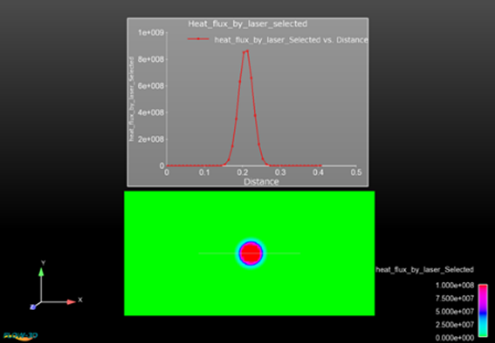
레이저 용접을 하는데 있어 레이저 광원의 설정이 필요하다. FLOW-3D Weld에서 사용되는 레이저 광원은 원통형과 원추형으로 설정할 수 있으며, <그림 1>과 같이 Heat flux를 일정한 상태 또는 가우시안 분포(Gaussian distribution)  형태로 나타낼 수 있다.

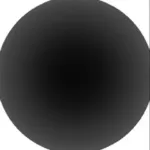
레이저 광원의 형태를 원추형으로, 가우시안 분포를 가지도록 Heat flux를 설정하면 <그림 2>와 같이 광원이 원추형으로 나타나며, 반경 거리에 따른 Heat flux의 에너지 밀도 차이도 확인할 수 있다.

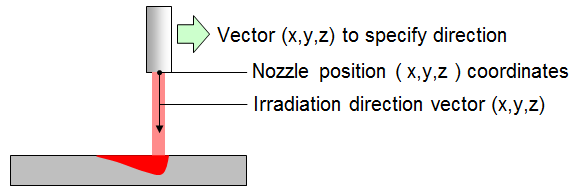
그리고, <그림 3>과 같이 레이저 광원의 위치 좌표와 속도 벡터를 설정하면, 레이저의 위치에 대한 광원의 움직임 설정이 가능하다.

기사 상세 내용은 PDF로 제공됩니다.

다운로드[2M] : [201906_FLOW3D_레이저용접]

작성자 | 양정호_에스티아이C&D 솔루션사업부 대리, 조애령_에스티아이C&D 솔루션 사업부 차장
이메일 | flow3d@stikorea.co.kr
홈페이지 | www.flow3d.co.kr

출처 : CAD&Graphics 2019년 06월호

FLOW-3D World Users Conference 2023

Home

FLOW-3D WELD
FLOW-3D WELD
New unified user interface, New process templates, Improved Reflection model,...
What's New in FLOW-3D CAST 2025R1
better quality, efficiency and precision in complex non-ferrous castings, Improved valve model
What's New in FLOW-3D CAST 2025R1
What's New in FLOW-3D POST 2025R1
Pathtracing improvements, History data calculator, EXODUS file format improvements
FLOW-3D AM
FLOW-3D AM
Improved reflection model, Improved heat source integration, Particle-particle interactions...
What's New in FLOW-3D 2025R1
New discrete element method (DEM) model
What's New in FLOW-3D HYDRO 2025R1
New discrete element method (DEM) model

📣 FLOW-3D 공식 LinkedIn 채널 OPEN!

복잡한 유동 현상을 정밀하게 해석하는 CFD 소프트웨어,
FLOW-3D의 공식 채널이 드디어 오픈했습니다!

이곳에서 앞으로
🔹 산업별 시뮬레이션 사례
🔹 실무 중심의 해석 팁
🔹 웨비나 및 교육 소식
등 다양한 콘텐츠를 공유드릴 예정입니다.

💡 FLOW-3D가 실제 현장에서 어떻게 활용되고 있는지 궁금하신가요?
💬 최신 유체해석 트렌드와 정보를 받고 싶으신가요?

👉 지금 바로 팔로우하시고,
실제 설계에 도움이 되는 인사이트를 받아보세요!

[Linkedin 방문 링크]


FLOW-3D WELD/AM 웨비나

FLOW-3D WELD/AM

FLOW-3D WELD/AM 웨비나를 2025.09.26. (금) 15:00~16:00에 진행하였습니다.

참석에 감사드립니다.


대한기계학회 창립 80주년 기념 학술대회 참가

2025년 12월 10일(수) ~ 13일(토), 하이원 그랜드호텔 컨벤션타워에서 개최하는 대한기계학회 창립 80주년 기념 학술대회에 참가하였습니다.
많은 관심 감사드립니다.


FLOW-3D European Users Conference가 2026년 6월 15일부터 17일까지 사흘간 독일 뒤셀도르프의 Steigenberger Icon Parkhotel 에서 개최될 예정입니다.
자세한 안내는 상세 페이지에서 알려드립니다.
많은 참석 부탁드립니다.


FLOW-3D HYDRO Workshops

FLOW-3D HYDRO Workshops
Register for a FLOW-3D HYDRO workshop

Civil & Environmental Consultants, Inc.

Knoxville, TN

Host a FLOW-3D HYDRO Local Workshop 


CUSTOMER 추천 평가

FLOW-3D는 오늘날 복잡한 자유 표면 및 제한된 흐름 문제를 분석하는 데 사용할 수 있는 가장 강력한 도구 중 하나입니다. 사용하기 쉬운 모델링 인터페이스를 제공하며 지난 15년 이상 제가 작업한 수력 발전, 환경, 수자원 및 처리 관련 프로젝트의 설계에 필수적인 도구였습니다. Flow Science의 기술 지원 팀과 개발자는 함께 작업하기 쉽고, 조언을 제공하고, 코드의 잠재적 개선 사항에 대한 사용자의 의견을 듣고, 발생하는 문제를 신속하게 해결하고자 합니다. Flow Science의 전체 팀은 함께 일하기에 훌륭했고 모든 엔지니어에게 훌륭한 자원입니다.

FLOW-3D is one of the most powerful tools available to analyze complex free surface and confined flow problems out there today. It provides an easy-to-use modeling interface and has been an integral tool in the design of hydroelectric, environmental, water resource and treatment related projects I’ve worked on over the last 15+ years. Flow Science’s technical support team and developers are easy to work with and are eager to provide advice, hear input from its users on potential enhancements to the code as well as quickly resolving issues that arise. The entire team at Flow Science have been great to work with and are a great resource to all engineers.
FLOW-3D CAST는 우리의 품질 프로그램에 엄청난 자산이었습니다. 6가지 주조 시뮬레이션 소프트웨어를 평가한 후 Howell Foundry는 FLOW-3D CAST를 구매하기로 결정했습니다. 이 결정의 일부 요인에는 설정 다양성, 비용 및 가장 중요한 시뮬레이션의 현실 정확도가 포함됩니다. 업데이트된 결과 뷰어와 결합된 FLOW-3D CAST 의 강력한 시뮬레이션 기능은 가장 복잡한 작업에서 특히 첫 번째 타설에서 고품질 주조를 보장하는 데 도움이 되었습니다.

FLOW-3D CAST has been a tremendous asset to our quality program. After having evaluated six different casting simulation software, Howell Foundry made the decision to purchase FLOW-3D CAST. Some of the factors in this decision include its setup versatility, cost, and most importantly its accuracy of the simulation to reality. FLOW-3D CAST’s powerful simulation ability coupled with its updated results viewer has been especially helpful on our most complex jobs to make sure we have a quality casting on the first pour.
우리는 FLOW-3D를 사용하여 지난 20년 동안 많은 소모성 발사체 시스템에 대한 추진제 슬로시 및 풀스루 시뮬레이션을 개발했습니다. 보다 최근에는 Flow Science 지원 직원이 차량 기동으로 인한 ullage collapse effects를 포착하기 위해 극저온 추진제 탱크 시뮬레이션에 열 전달을 추가하는 데 중요한 역할을 했습니다.

We have used FLOW-3D to develop propellant slosh and pull-through simulations for a number of expendable launch vehicle systems over the last 20 years. More recently, the Flow Science support staff has been instrumental in helping us add heat transfer to cryogenic propellant tank simulations in order to capture ullage collapse effects due to vehicle maneuvers.
저는 연구 및 산업 응용 분야에서 유체 흐름 문제를 해결하는 데 15년 이상 FLOW-3D를 사용해 왔습니다 . 우리는 강 및 해안 구조물, 수처리 장치, 댐, 여수로, 깊은 터널 및 CSO 전환 구조물의 설계에 이 소프트웨어를 광범위하게 사용합니다. FLOW-3D는 수치 솔버 기술, 클라우드 컴퓨팅, 전처리 및 후처리 도구의 최신 기술을 통합하여 고객에게 상당한 시간과 비용을 절감합니다. FLOW-3D 영업 및 기술 지원 팀은 훌륭합니다!

I have used FLOW-3D for over 15 years solving fluid flow problems in research and industrial applications. We use the software extensively in the design of river and coastal structures, water treatment units, dams, spillways, deep tunnels, and CSO diversion structures. FLOW-3D integrates state of the art in numerical solver techniques, cloud computing, pre- and post-processing tools resulting in substantial time and cost savings to our clients. FLOW-3D sales and technical support teams are excellent!
FLOW-3D 는 다른 소프트웨어로 시각화하거나 정량화하기 어려운 복잡한 유압 문제에 대한 통찰력을 제공하는 정교한 도구입니다. 정교함에도 불구하고 소프트웨어는 매우 사용자 친화적이며 Flow Science는 훌륭한 문서와 기술 지원을 제공합니다. FLOW-3D 모델 에서 얻은 결과는고객과 사내 비모델러 모두에게 깊은 인상을 남겼습니다.
 
FLOW-3D is a sophisticated tool that provides insight into complex hydraulic problems that would be difficult to visualize or quantify with other software. Despite the sophistication, the software is very user friendly, and Flow Science provide great documentation and technical support. The results we have obtained from our FLOW-3D models have impressed both our clients and non-modelers in-house.
4C-Technologies에서 우리는 거의 35년 동안 다양한 소프트웨어 흐름 시뮬레이션 솔루션을 사용하는 선구자였습니다. 다양한 금속 합금으로 주조된 HPDC 부품에서 부품 설계 및 도구/러너 설계를 최적화합니다. 2008년부터 우리는 FLOW-3D를 사용하여 지금까지 최고의 정확도를 제공하는 것으로 나타났습니다. 또한 FLOW-3D 팀 의 지원은 탁월합니다.

At 4C-Technologies we have been pioneers in using various software flow simulation solutions for nearly 35 years. We optimize part designs and tool/runner designs on casted HPDC parts in various metal alloys. Since 2008 we have solely been using FLOW-3D as it turned out to give by far the best accuracy. Furthermore, the support from the FLOW-3D team is outstanding.
20년 이상 FLOW-3D 와 함께 CFD 분석을 사용하면서 우리의 신뢰 수준은 이제 일반 연구 목적 및 최종 설계 응용 프로그램에 CFD 모델링을 사용하는 데 확신을 가질 정도로 높아졌습니다. 이 소프트웨어는 개념적 세부 사항과 구성을 신속하게 변경할 수 있는 유연성을 제공하여 설계를 단계적으로 진행할 수 있도록 합니다.

From using CFD analysis with FLOW-3D for over twenty years, our level of trust has increased to the point that we are now confident in using CFD modeling for general study purposes and final design applications. The software gives us flexibility to quickly change conceptual details and configurations allowing the design to advance in stages.
우리는 FLOW-3D AM을 사용하여 기초 과학의 경계를 발전시켜 왔습니다 . FLOW-3D AM은 다중 합금 3D 프린팅 중 복잡한 현상을 지배하는 물리학에 대한 우리의 가설을 테스트하는 훌륭한 도구였습니다. FLOW-3D AM은 우리가 열 프로필의 진화와 관련된 물질 전달 및 복잡한 적층 구조에서 열 응력의 발달을 이해하는 데 도움이 되었습니다.

We have been using FLOW-3D AM to advance the boundaries of fundamental science. FLOW-3D AM has been a great tool to test our hypotheses about the physics governing complex phenomena during multi-alloy 3D printing. FLOW-3D AM has helped us understand the evolution of thermal profiles and the associated mass transport and development of thermal stresses in complicated additively-built structures.
FLOW-3D 는 많은 응용 프로그램이 있는 강력한 도구입니다. 우리는 FLOW-3D를 사용하여 물 전환 구조의 흐름과 수력을 효과적으로 해결했습니다. 우리는 또한 제안된 물고기 통로를 통한 물 흐름을 모델링했습니다. 우리는 정확성, 계산 속도, 특히 사용자 친화적인 GUI에 깊은 인상을 받았습니다. 그리고 우리 고객들은 모델 출력과 포스트 프로세서에 의해 생성된 애니메이션에 깊은 인상을 받았습니다. 우리는 또한 매우 반응이 좋은 지원 직원에게 감사합니다.

FLOW-3D is a powerful tool with many applications. We used FLOW-3D to effectively resolve flow through and hydraulic forces on a water diversion structure. We also modeled water flow through a proposed fish passage. We have been impressed with the accuracy, computational speed, and especially the user friendly GUI. And, our clients have been impressed with the model output, as well as, animations created by the post-processer. We are also appreciative of the highly responsive support staff.
수년에 걸쳐 FLOW-3D는 기존의 유압 모델링 도구로는 해결하기 매우 어려웠을 복잡한 유압 문제를 해결하는 데 도움을 주었습니다. 우리는 FLOW-3D 팀에게 매우 감사합니다 . 그들은 수년에 걸쳐 지속적으로 소프트웨어를 개선해 왔으며 우리의 요구에 매우 신속하게 대응해 왔습니다.

Over the years, FLOW-3D has helped us solve complex hydraulic problems that would have otherwise been very difficult to solve with conventional hydraulic modeling tools. We are very thankful to the team at FLOW-3D. They have constantly been making the software better over the years, and have been very responsive to our needs.
FLOW-3D 는 당사의 우주 공학 연구 및 개발 프로세스에서 필수적인 도구입니다. FLOW-3D는 극저온 연료 역학의 프로세스를 더 잘 이해하여 질량을 줄이고 발사기 성능을 향상시키는데 도움이 됩니다.

FLOW-3D is an essential tool in our space engineering research & development process. FLOW-3D helps us better understand processes in cryogenic fuel dynamics, leading to savings in mass and improved launcher performance.
FLOW-3D CAST는 CASTMAN, Inc의 제품 개발 및 품질 확보에 매우 큰 도움을 주었습니다. FLOW-3D를 한국에 독점 공급하는 (주)에스티아이씨앤디의 수치해석 컨설팅팀과 협업을 통해 제품 개발 시 FLOW-3D 주조 시뮬레이션을 통해 기술적인 여러 어려움이 있는 제품 개발에 모두 성공하였습니다. 이는 개발 비용, 기술적인 어려움, 개발 기간 및 가장 중요한 시뮬레이션의 정확도가 포함됩니다. FLOW-3D CAST 의 강력한 시뮬레이션 기능은 가장 복잡한 작업에서 고품질 주조를 보장하는 데 도움이 되었습니다.

News

FLOW-3D 2026 European User Conference

FLOW-3D 2026 European User Conference

FLOW-3D 2026 European User Conference 6월 16일부터 17일까지 뒤셀도르프의 Steigenberger Icon Parkhotel에서 열리는 FLOW-3D 2026 European User Conference에 고객 여러분을 초대합니다. 주요 기업 및 기관의 동료 엔지니어, 연구원, 과학자들과 연결하여 ...
FLOW-3D WELD/AM

FLOW-3D WELD/AM 웨비나 안내

용접 및 3D프린팅에 특화된 수치해석 프로그램인 FLOW-3D WELD/AM의 새로운 기능을 소개해 드릴 웨비나를 개최합니다. 이번 웨비나에서는 익숙하지만 놓치고 있었던 FLOW-3D WELD/AM의 핵심 기능과 더욱 강력해진 최신 업데이트 내용을 집중적으로 다룹니다 ...

기술자료

Figure 2. Appearance of the samples' surfaces exposed to the molten alloy after the ejection tests

알루미늄 합금 주조와 접촉하는 미처리, 질화 및 PVD 코팅된 열간 공구강의 마모 및 솔더링 성능

알루미늄 합금 주조와 접촉하는 미처리, 질화 및 PVD 코팅된 열간 공구강의 마모 및 솔더링 성능 Wear and Soldering Performance of ...
Fig 2 Weld microstructure

5A02 알루미늄 합금 판재의 MIG 용접 공정에 관한 연구

5A02 알루미늄 합금 판재의 MIG 용접 공정에 관한 연구 Research on the process in MIG welding of 5A02 aluminum alloy ...
Fig. 4: Downstream TKE contours on the x-z vertical plane for the rectangular trash rack: (a) experimental data of Koczula (2016) and (b) CFD model data with Darcy-Forchheimer porous media approach. 𝛼 = 30°, 𝑏 =20 mm, 𝑈0 = 0.5 m/s, 𝐹𝑟1 = 0.206.

취수구의 유속 및 난류 운동 에너지 예측을 위한 Darcy-Forchheimer 모델 연구

취수구의 유속 및 난류 운동 에너지 예측을 위한 Darcy-Forchheimer 모델 연구 Velocity and Turbulent Kinetic Energy Prediction with Darcy-Forchheimer Model ...
Fig. 1. Example of typical casting tree design with ‘diablo’ type setup

백금 주조에서 공정 매개변수의 역할

백금 주조에서 공정 매개변수의 역할 The Role of Process Parameters in Platinum Casting 본 보고서는 백금 주얼리 합금의 주조 특성을 ...
Fig. 2.3: 레이저 용접 키홀 원리 (맞대기 용접 구성)

레이저 용접 및 마찰 교반 용접을 이용한 Al-B4C 금속 기질 복합재의 접합

레이저 용접 및 마찰 교반 용접을 이용한 Al-B4C 금속 기질 복합재의 접합 Joining of Al-B4C Metal Matrix Composites by Laser ...
Figure 1. Mechanical fixture for welding the aluminum sheet coupons and laser welding.

6016 알루미늄 테일러 용접 블랭크의 강도 및 성형성 조사

6016 알루미늄 테일러 용접 블랭크의 강도 및 성형성 조사 Investigation of Strength and Formability of 6016 Aluminum Tailor Welded Blanks ...
Figure 2: 첫 번째 시뮬레이션에서 달성된 주물의 기공 결과 분석

AZ91D 마그네슘 합금 고압 다이캐스팅 주조 기술의 최적화

AZ91D 마그네슘 합금 고압 다이캐스팅 주조 기술의 최적화 OPTIMIZATION OF CASTING TECHNOLOGY OF THE PRESSURE DIE CAST AZ91D MG-BASED ALLOY ...
Obr. 13: Svarovací program s jedním impulsem [2]

선택된 용접 공정 파라미터 모니터링 및 점 용접 품질 분석

선택된 용접 공정 파라미터 모니터링 및 점 용접 품질 분석 Monitoring of selected welding process parameters and spot welds quality ...
Figure 7 Microstructure of casting specimens at different pouring temperatures

ZL205A 금속 금형 주조의 미세조직 상 분석 및 공정 최적화

ZL205A 금속 금형 주조의 미세조직 상 분석 및 공정 최적화 Microstructure Phase Analysis and Process Optimization of ZL205A Metal Mold ...
Figure 1. Characterization of sample 8: (a) DLEPR polarization curve and (b) microstructure of cladding (SEM examination).

오스테나이트 스테인리스강 클래딩의 부식 저항성에 미치는 플럭스 코어드 아크 용접 공정 변수의 영향

오스테나이트 스테인리스강 클래딩의 부식 저항성에 미치는 플럭스 코어드 아크 용접 공정 변수의 영향 Effect of Flux Cored arc Welding Process ...
Figure 3 Cross section morphology of the gray iron inserts and thickness of zinc coating: (a) zinc barrel plating for 1 hour; (b) zinc barrel plating for 2 hours; (c) zinc barrel plating for 3 hours; (d) zinc rack plating for 1 hour

고압 다이캐스팅 공정을 이용한 이종 금속 주조물의 주철-알루미늄 결합

고압 다이캐스팅 공정을 이용한 이종 금속 주조물의 주철-알루미늄 결합 Bonding of Cast Iron-Aluminum In Bimetallic Castings By High Pressure Die ...
Fig. 3 — X-ray radiography film of sample no. 4 & 9.

그레이-다구치 방법을 이용한 용가재 없는 듀플렉스 스테인리스강 TIG 용접 공정 파라미터 최적화

그레이-다구치 방법을 이용한 용가재 없는 듀플렉스 스테인리스강 TIG 용접 공정 파라미터 최적화 Optimization of process parameters of TIG welding of ...
Fig. 1 Reliability Plots of RSM Predicted Versus Observed Values of (a) Brinell Hardness Number, (b) Heat Input, (c) Cooling Rate, (d) Preheat Temperature, and (e) Amount of Diffusible Hydrogen.

반응 표면 분석법을 이용한 텅스텐 불활성 가스 용접 공정 변수의 최적화

반응 표면 분석법을 이용한 텅스텐 불활성 가스 용접 공정 변수의 최적화 Optimization of the Tungsten Inert Gas Process Parameters using ...
Fig. 4 Comparison of corrosion properties between 329LD and 316L for slurry pipes in regional power plants

산업설비용 2상 스테인리스강 개발 동향 및 용접성 기술 보고서

산업설비용 2상 스테인리스강 개발 동향 및 용접성 기술 보고서 Development Trends of Duplex Stainless Steels for the Process Industries and ...
Figure C10b: Microstructure of PM Al indicating the grain measurements (x400)

5754 알루미늄 합금과 C11000 구리 간의 이종 마찰 교반 용접 특성 분석

5754 알루미늄 합금과 C11000 구리 간의 이종 마찰 교반 용접 특성 분석 CHARACTERISATION OF DISSIMILAR FRICTION STIR WELDS BETWEEN 5754 ...
Figure 3. Mold shape and flow pass change.

금속 압력 제어 시스템을 이용한 사형 프레스 주조

금속 압력 제어 시스템을 이용한 사형 프레스 주조 Sand Mold Press Casting with Metal Pressure Control System 본 보고서는 사형 ...
Figure 2 Physical model of horizontal centrifugal casting

Al-Cu 합금의 원심 주조를 위한 미세조직 및 열간 균열 민감도 시뮬레이션과 매개변수 최적화

Al-Cu 합금의 원심 주조를 위한 미세조직 및 열간 균열 민감도 시뮬레이션과 매개변수 최적화 Microstructure and hot tearing sensitivity simulation and ...
Fig. 4(a) 1.6mm 직경와이어, 싱글 용접

후판 Al 5083 합금의 GMA 용접에서 보호가스 조성 및 용접변수에 따른 용접성 평가

후판 Al 5083 합금의 GMA 용접에서 보호가스 조성 및 용접변수에 따른 용접성 평가 Effects of Shielding Gas Compositions and Welding ...
Figure 1: Schematic of friction stir welding.

알루미늄 합금 마찰 교반 용접 겹치기 이음부의 기계적 특성 최적화

알루미늄 합금 마찰 교반 용접 겹치기 이음부의 기계적 특성 최적화 Mechanical Properties Optimization of Friction Stir Welded Lap Joints in ...
Fig. 3: First mode shape amplitude at pier locations of bridge system due to varying levels of stiffness loss as a result of scour at Pier 3 (60 m point).

직접 기초 다경간 교량의 모드 형상 기반 세굴 모니터링 기법에 대한 실험적 실증

직접 기초 다경간 교량의 모드 형상 기반 세굴 모니터링 기법에 대한 실험적 실증 Experimental demonstration of a mode shape-based scour ...
Figure 2,3 Illustration of furnace operation before and after upgrading

다이캐스팅 공장의 알루미늄 용해로에 대한 엑서지 분석 및 효율 평가

다이캐스팅 공장의 알루미늄 용해로에 대한 엑서지 분석 및 효율 평가 Exergy analysis and efficiency evaluation for an aluminium melting furnace ...
Figure 2. SEM analysis of physico- chemical soldering: (a) back scattered electron image (b) X-ray mapping of Al.

다이캐스팅의 미세 균열 및 금형 침식 분석

다이캐스팅의 미세 균열 및 금형 침식 분석 Analysis of Micro Cracks and Die Erosion in Die Casting 본 보고서는 고압 ...
Figure-9, Macrograph of the weld Joint

이종 강재 용접을 위한 GMAW 공정의 매개변수 최적화

이종 강재 용접을 위한 GMAW 공정의 매개변수 최적화 Parameter Optimizations of GMAW Process for Dissimilar Steels Welding 본 연구는 철도 ...
FIGURE 9. Optical images of the microstructure of AISI 1020 high manganese alloy.

SAW로 용접된 AISI 1020 합금 이음매의 인장 강도 및 피크 온도 최적화에 미치는 용접 매개변수의 영향

SAW로 용접된 AISI 1020 합금 이음매의 인장 강도 및 피크 온도 최적화에 미치는 용접 매개변수의 영향 Influence of Welding Parameters ...
Fig. 3. Casting pores in AlSi7Mg observed by metallography

X-선 컴퓨터 단층 촬영 및 금속 조직학을 이용한 주조 기공 특성 분석

X-선 컴퓨터 단층 촬영 및 금속 조직학을 이용한 주조 기공 특성 분석 CASTING PORE CHARACTERIZATION BY X-RAY COMPUTED TOMOGRAPHY AND ...
Fig. 6 Weld profiles under different welding current at welding speed of 300mm/min (a) 40mA; (b) 50mA; (c) 60mA

진공 롤 클래딩 공정에서 AISI P20 공구강의 온도 및 응력장에 미치는 전자빔 용접 매개변수의 영향

진공 롤 클래딩 공정에서 AISI P20 공구강의 온도 및 응력장에 미치는 전자빔 용접 매개변수의 영향 Effect of Electron Beam Welding ...
Figure 5. (a) Electron backscatter diffraction (EBSD) orientation map, (b) grain boundary misorientation angles, (c) {100}, {110} and {111} pole figures of the alloy in the heat-tread condition

열처리된 다이캐스트 Al-Mg-Si 기반 알루미늄 합금의 반복 변형 거동

열처리된 다이캐스트 Al-Mg-Si 기반 알루미늄 합금의 반복 변형 거동 Cyclic Deformation Behavior of A Heat-Treated Die-Cast Al-Mg-Si-Based Aluminum Alloy 본 ...
Figure 1 Examples for the assessment of the weld quality a) cross-section 1,0 b) cross-section 0,0 c) upper bead 1,0 d) upper bead 0,0

진공 상태에서의 구리 레이저 빔 용접을 통한 공정 한계 확장

진공 상태에서의 구리 레이저 빔 용접을 통한 공정 한계 확장 Laser beam welding of copper under vacuum to extend the ...
Fig. 3 Welding testing (a) Tensile test samples; (b) Rockwell hardness instrument

상용강의 인장 강도에 미치는 그루브 형상의 영향 연구

상용강의 인장 강도에 미치는 그루브 형상의 영향 연구 Investigation into the Impact of Groove Shape on the Tensile Strength of ...
/ GMAW, 강재, 용접, 용접 논문
Figure 2. Simples schematic of joint design

저탄소강 283 G.C의 인장 강도에 미치는 용접 공정 매개변수의 영향

저탄소강 283 G.C의 인장 강도에 미치는 용접 공정 매개변수의 영향 EFFECT OF WELDING PROCESS PARAMETERS ON TENSILE OF LOW CARBON ...
Fig. 5 Crack of ADC12 die casting.

ADC12 알루미늄 합금 다이캐스팅의 냉간 균열 판정 기준

ADC12 알루미늄 합금 다이캐스팅의 냉간 균열 판정 기준 Cold Crack Criterion for ADC12 Aluminum Alloy Die Casting 본 연구는 자동차 ...
용접 비드의 경도 측정 위치(HAZ 및 FZ) 모식도

저탄소강 상의 마르텐사이트계 스테인리스강 클레이딩을 위한 펄스 FCAW: 미세조직, 경도 및 잔류 응력 분석

저탄소강 상의 마르텐사이트계 스테인리스강 클레이딩을 위한 펄스 FCAW: 미세조직, 경도 및 잔류 응력 분석 Pulsed FCAW of Martensitic Stainless Clads ...
Figure 2. Final precipitate size and morphologies predicted from multiscale simulations elucidating the differences that can be expected in high temperature precipitate homogeneous and heterogeneous nucleation and growth in Al-Cu alloys. Reproduced with permission from Ref. [8].

기계적 특성을 위한 합금 설계: 길이 스케일의 정복

기계적 특성을 위한 합금 설계: 길이 스케일의 정복 Alloy Design for Mechanical Properties: Conquering the Length Scales 본 보고서는 원자 ...
Figure 1. SEM micrographs of (a) TiH2 and (b) Al particles.

TiH2 및 Al 분말 혼합물의 비수계 겔 캐스팅을 이용한 다공성 TiAl 합금 제조 연구

TiH2 및 Al 분말 혼합물의 비수계 겔 캐스팅을 이용한 다공성 TiAl 합금 제조 연구 Study on the Fabrication of Porous ...
Figure 8. Optical microscopy images of Source D. (a) oxide bifilm in between the dendrites (b) pores.

A356 알루미늄 합금 주조의 허용 품질 한계 결정: 공급업체 품질 지수(SQI)

A356 알루미늄 합금 주조의 허용 품질 한계 결정: 공급업체 품질 지수(SQI) Determination of Acceptable Quality Limit for Casting of A356 ...
Figure 3 (a) IPF map of BM, and (b) HAGBs and IQ map in BM

FSSWed TRIP 강재 접합부의 미세조직 및 기계적 특성에 미치는 온도, 변형률 및 변형률 속도의 영향에 관한 유한요소 및 실험적 연구

FSSWed TRIP 강재 접합부의 미세조직 및 기계적 특성에 미치는 온도, 변형률 및 변형률 속도의 영향에 관한 유한요소 및 실험적 연구 ...
FIG. 1. Surface morphology of the arc melted, DAM, sample and detail (inset) of dendrite structure observed at grains (a); of the induction melted, DIM, sample (b), and of the ribbon, R, sample (c).

아크 및 유도 용해와 평면 유동 주조로 제작된 Co2FeAl 호이스러 합금의 미세구조 및 자성 비교 연구

아크 및 유도 용해와 평면 유동 주조로 제작된 Co2FeAl 호이스러 합금의 미세구조 및 자성 비교 연구 Microstructure and magnetism of ...
Figure 1. a) Sketch of the pier-caisson system considered in this study; b) Top view of a local scour hole, with the contour lines indicating the depth – values are normalized with respect to the maximum depth (after [9]).

국부 세굴 상태의 이상화된 교각 고유진동수 수치 예측

국부 세굴 상태의 이상화된 교각 고유진동수 수치 예측 Numerical prediction of the eigenfrequencies of an idealized bridge pier under local ...
Fig. 11. SADP (top), BF (middle), and WBDF (bottom) images of β-phase matrix with 𝑍𝑍≈[011]𝛽𝛽 zone axis for an area with accumulated dose ranging 7 to11 dpa under RT, increasing from bottom-right to top-left. The WBDF images were taken by selecting a diffraction spot indicated by a yellow cycle in each DP.

β-상 기질 내 ω-상 전구체로 인한 저온 Ti-6Al-4V 합금의 이중 상 조사 거동 대조 연구

β-상 기질 내 ω-상 전구체로 인한 저온 Ti-6Al-4V 합금의 이중 상 조사 거동 대조 연구 Contrasting Irradiation Behavior of Dual ...
Figure 1. a schematic of the sample, wire, and flux during submerged arc welding

요인 설계법을 이용한 잠호 용접(SAW) 공정 변수 최적화

요인 설계법을 이용한 잠호 용접(SAW) 공정 변수 최적화 Optimization Process Parameters of Submerged Arc Welding Using Factorial Design Approach 본 ...
Figure 7. Cast produced for different sprue height above the critical drop height: (a) 450mm sprue height (b) 400mm sprue height. The critical drop height is 377mm.

중력 사구 주조에서 알루미늄 합금(AL-91% Mg-8% Fe-0.4% Zn-0.2%)의 임계 낙하 높이 및 임계 유속 결정

중력 사구 주조에서 알루미늄 합금(AL-91% Mg-8% Fe-0.4% Zn-0.2%)의 임계 낙하 높이 및 임계 유속 결정 Determination of the critical drop ...
Figure 2. Porosity content for samples taken from Reduced Pressure Test (RPT) under partial vacuum; (a) without degassing; (b) with degassing tablet; and (c) degassed with high-shear melt conditioning

폐자동차 스크랩 유래 알루미늄 주조 합금의 고전단 탈가스 및 탈철 공정 연구

폐자동차 스크랩 유래 알루미늄 주조 합금의 고전단 탈가스 및 탈철 공정 연구 High-Shear De-Gassing and De-Ironing of an Aluminum Casting ...
Figure 7. TIF diagram display. (a) TIF diagram after positioning display processing, (b) TIF diagram after noise filtering, (c) TIF diagram after threshold segmentation processing.

결함 시각화에 기반한 알루미늄 합금의 멀티스케일 손상 진화 분석

결함 시각화에 기반한 알루미늄 합금의 멀티스케일 손상 진화 분석 Multiscale Damage Evolution Analysis of Aluminum Alloy Based on Defect Visualization ...
Fig. 2: 주조 및 압연된 시편의 제2상 입자 SEM 이미지 (표면, 1/4 지점, 중심부)

고속 쌍롤 주조로 제조된 A356 합금 스트립의 냉간 압연 및 고용화 처리에 따른 미세조직과 연신율 이방성

고속 쌍롤 주조로 제조된 A356 합금 스트립의 냉간 압연 및 고용화 처리에 따른 미세조직과 연신율 이방성 Microstructure and Elongation Anisotropy ...
FIGURE 4. Expansion test on cup B

SLS 및 진공 다이캐스팅을 이용한 환자 맞춤형 유연 실리콘 임플란트 개발

SLS 및 진공 다이캐스팅을 이용한 환자 맞춤형 유연 실리콘 임플란트 개발 Developing a Patient Individualized Flexible Silicone Implant using SLS ...
Figure 20. Scour depth of interaction of two piers; (A) square collar of dimension 24×24 cm on bed level; (B) triple collar of dimension 24×24 cm

교량 교각의 세굴 제어를 위한 최적 설계

교량 교각의 세굴 제어를 위한 최적 설계 Optimum Design for Controlling the Scouring on Bridge Piers 본 연구는 교량 붕괴의 ...
Fig. 1 Arc-melted and solidified Mo-Si-B-TiC alloy: (a) whole view showing the designation of the samples for microstructure observations, (b)–(d) illustration for the preparation of the samples cut from the ingot.

용해 및 틸트 주조법으로 제조된 Mo-Si-B-TiC 합금의 미세조직 정량적 평가

용해 및 틸트 주조법으로 제조된 Mo-Si-B-TiC 합금의 미세조직 정량적 평가 Quantitative Evaluation of Microstructure in Mo-Si-B-TiC Alloy Produced by Melting ...
Figure 7. Microsection of a clinch joint. (A) punch-side HCT590X, die-side AlSi9 (2.0 mm), (B) punch-side HCT590X, die-side AlSi9 (3 mm), (C) punch-side AlSi9 (2.0 mm), die-side HCT590X, (D) punch-side AlSi9 (3.0 mm), die-side HCT590X

사형 주조 시 응고 속도가 주조 알루미늄 합금의 기계적 접합성에 미치는 영향

사형 주조 시 응고 속도가 주조 알루미늄 합금의 기계적 접합성에 미치는 영향 Effect of Solidification Rates at Sand Casting on ...
Figure 10. Representative micrographs of selected composite after wear test under 15-N normal load, 4.69 m/s sliding velocity and 1500 m sliding distance of (a) A-1, 0 wt.% MD; (b) A-2, 1.5 wt.% MD; (c) A-3, 3 wt.% MD; (d) A-4, 4.5 wt.% MD; (e) A-5, 6 wt.% MD reinforced composites.

대리석 분말 강화 구리 기반 합금(C93200) 복합재의 진공 환경 교반 주조 개발 및 평가

대리석 분말 강화 구리 기반 합금(C93200) 복합재의 진공 환경 교반 주조 개발 및 평가 Evaluation of Copper-Based Alloy (C93200) Composites ...
/ 주조 논문
Fig. 4—Optical microscopy illustrating the parent, HAZ and TMAZ zones measured from (a) Weld 2, (b) Weld 3, (c) Weld 4, (d) Weld 5.

Ti-6Al-4V 관성 마찰 용접부의 열영향부 및 열기계적 영향부 모델링

Ti-6Al-4V 관성 마찰 용접부의 열영향부 및 열기계적 영향부 모델링 Modeling of the Heat-Affected and Thermomechanically Affected Zones in a Ti-6Al-4V ...
 

전체 기술자료로 바로가기

Planing Hulls – Ship Motion

Planing Hulls – Ship Motion

선박의 선체 주위 유동 흐름은 선박 설계자들의 중요한 관심사입니다. 선체 후류의 여러 부분 – 저항 (드래그), 선미 경계층, 유선 와류 및 프로펠러 면의 속도장 등은 정확한 검사가 필요합니다. FLOW-3D내의 GMO(Moving Objects Model) 선박 설계자로 하여금 수면위의 가속되는 선체, 선박의 변위 거동, semi planing의 거동을 모델링 하게 해줍니다. 자유수면에 강한 FLOW-3D의 강점은 엔지니어로 하여금 고진폭파 영향에 있는 선체에 작용하는 압력장, 고속영역의 lamming force 등을 정확하게 예측을 할 수 있게 해 줍니다.

물 위를 달리는 선체의 수상 동적 응답(hydro-dynamic response)은 시뮬레이션 시계열상 나타나는세가지 영역으로 분석된다. 첫 번째 시뮬레이션 단계는 ‘수면에서의 상승’ 단계입니다. 이는 모터 요트가 수력학적 힘( hydrodynamic forcing )이 충분해져 효과적으로 물위의 요트를 들어올릴때 까지의 단계입니다. 두 번째 시뮬레이션 단계는 40 노트로 평면 수면위로 운행하는 것을 보여주고, 세 번째 시뮬레이션은 밀려오는 파도 필드로 고속의 요트의 응답을 보여줍니다.