Investigation of Mould Leakages in a Gravity Casting

Investigation of Mould Leakages in a Gravity Casting


This article was contributed by Gabriele Taricco of CM Taricco and Stefano Mascetti of XC Engineering.

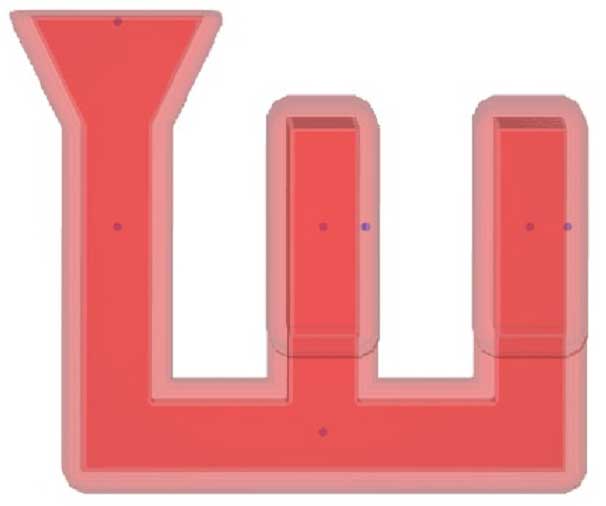
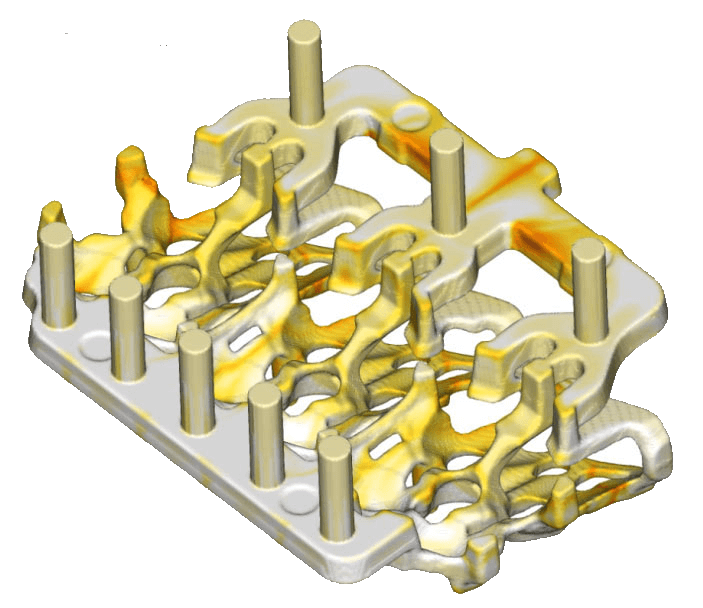
Metal leakages in the original gravity casting mould

몰드 설계는 유체 역학과 금속 응고 패턴뿐만 아니라 주형 자체에서 발생할 수 있는 문제와 응력에 대한 반응을 고려해야 하는 매우 복잡한 작업입니다. 이탈리아에 본사를 둔 주형 제작 업체인 CMTaricco 사는 최근에 새로운 주형 중 하나의 하부에서 금속 누출 문제에 직면했습니다. 주형 누출의 원인은 처음에는 분명하지 않았으며 몇 번의 공정 주기 후에만 나타났습니다. 제작 일정에 차질이 생기고 부품 주조 비용이 급격히 증가하기 때문에 문제가 중요한 것은 분명했습니다.

Investigation of an idea

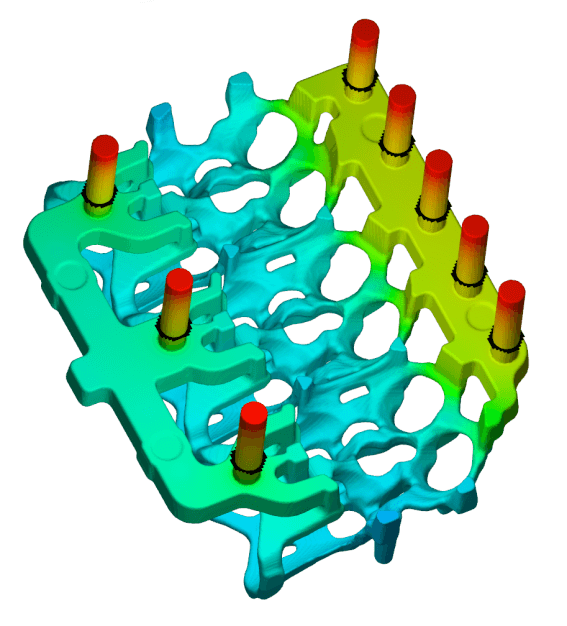
공정 자체는 주입과 오버플로우 설계인 중력 주조 방식이었기 때문에 유체 역학 부분에서는 문제가 발생할 수 없었습니다. GabrieleTaricco (CMTaricco의 소유주)의 가설은 금속 누출이 주형의 열 손실의 설계 불량에서 기인하여 균일하지 않은 분포를 초래한다는 것이었습니다. 변형률과 그에 따라 주형 바닥에서 크고 원하지 않는 변형이 순환하면서 금속이 유출될 수 있는 중요한 영역의 개방까지 주기적으로 시행되었습니다. 이를 확인하고 문제에 대한 신속한 해결책을 찾기 위해 FLOW-3D시뮬레이션을 실행하여 주형이 가열될 때 발생하는 현상을 정확하게 파악했습니다.

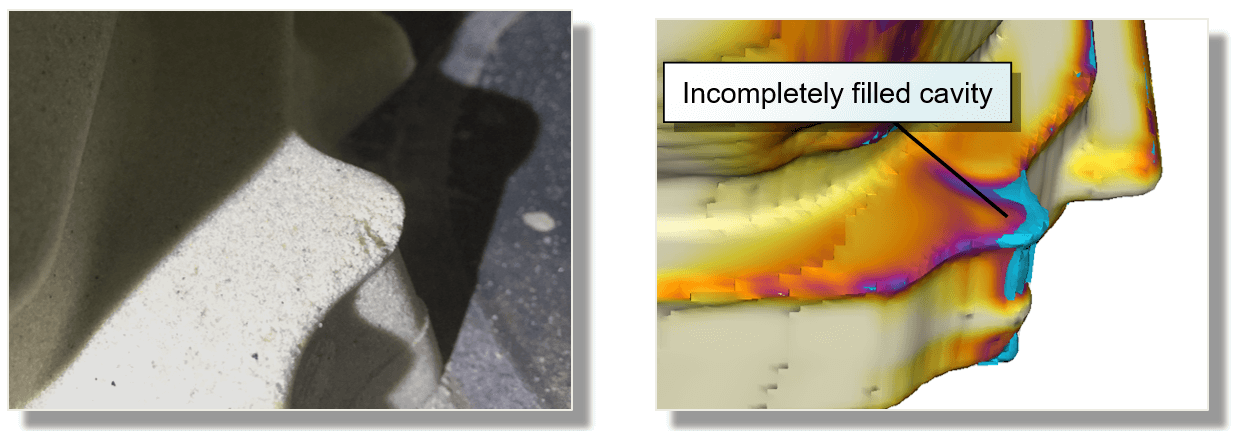
Schematic of a critical area where metal was flowing out of the mould


A careful setup, to achieve a fast resolution of the issue

문제의 원인은 신속하게 파악할 수 있어야 했기 때문에 최신 Flow-3D기능을 모두 활용하여 정확한 설정이 필요했습니다. 특히, 채택된 meshing기법은 전통적인 설정과 거의 동일한 정확도를 유지하면서 전산 셀의 수를 크게 줄이는데 매우 도움이 되었습니다. 빠른 시뮬레이션으로 주형 세척에 사용된 첫 번째 방법은 주형 내부의 얇은 캐비티를 직교 축과 정렬하기 위해 주형을 수직 축 주위로 회전시키는 것이었습니다.

Rotating the mould around the vertical axis in order to align the inner thin cavity of the mould


두 번째 트릭은 내부 공동 (얇은 벽)에 new conformal mesh기능을 사용하는 한편 전체 도메인에 대해 기존의 더 큰 메쉬 블록을 유지하는 것 이었습니다. The conformal mesh는 open volume과 일치하고, 작은 간극을 갖는 cavity로 제한됩니다.

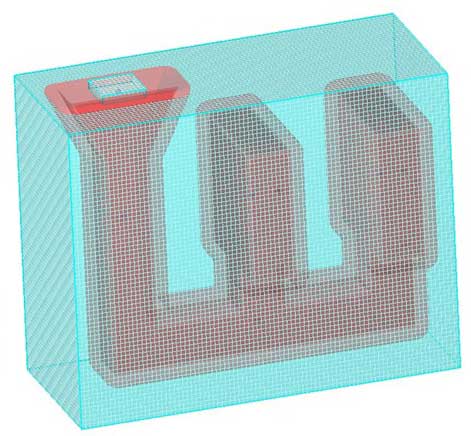
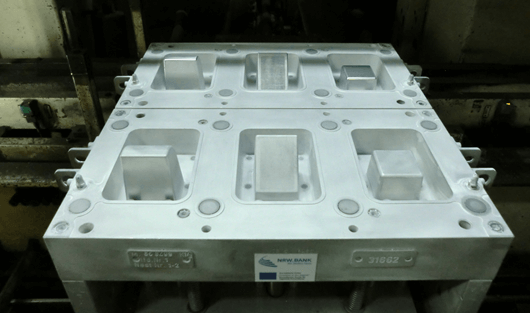
A global view of the mould with cores and its alignment with the mesh blocks


마지막으로, 외부 공간을 주형에 제한하기 위해(현재 구두 상자 모양이 되고, 20도 회전하며, 모델 축과 정렬상태) 일부’ 도메인제거’ 요소가 사용되었습니다.즉, FLOW-3D의 내부 솔리드 모델을 통해 직접 연결됩니다

Domain removing components (yellow) were used to limit the space externally to the mould.


나머지 설정은 소프트웨어의 권장 기본값 대부분을 이용하여 기존 체계를 따랐습니다. 이러한 기능과 FLOW-3D의 새로운 하위 도메인 분해 기능 덕분에 설계된 9 000 000 셀을 유체 하위 도메인의 경우에만 1 840 000 셀로, 고체 서브 도메인의 경우 2 430 000 셀로 줄이는 것이 가능했습니다.


The analysis

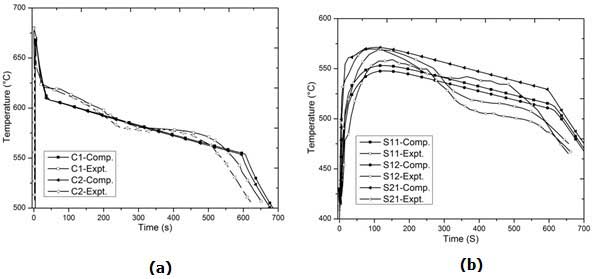
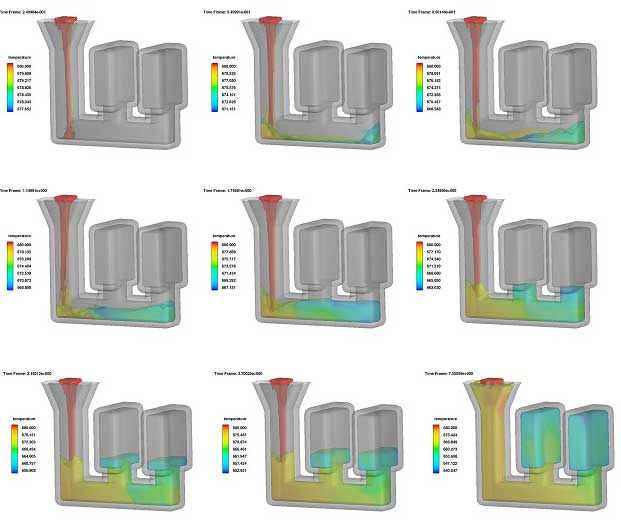
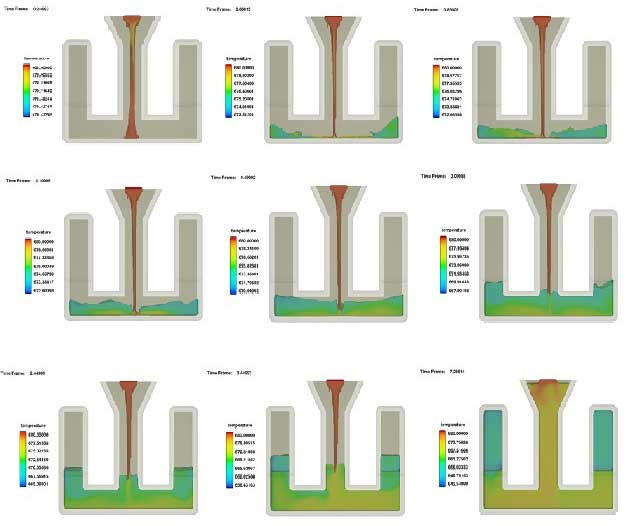
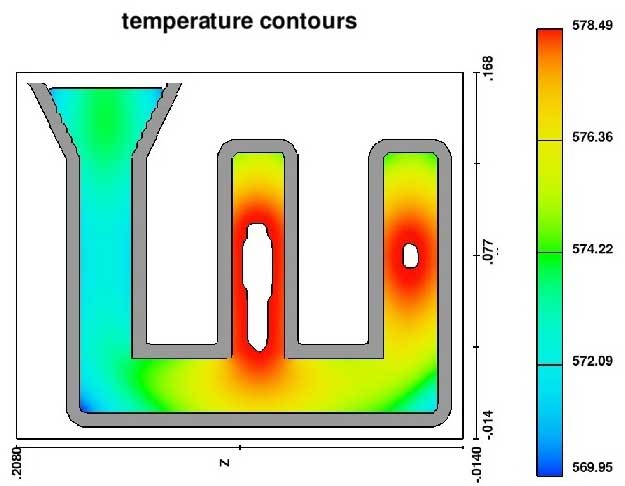
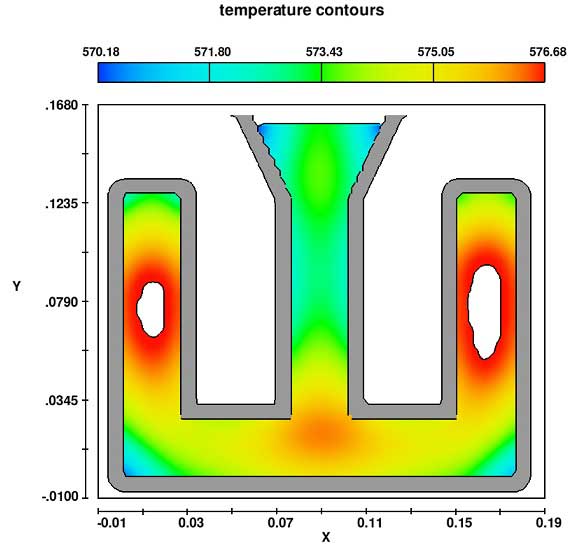
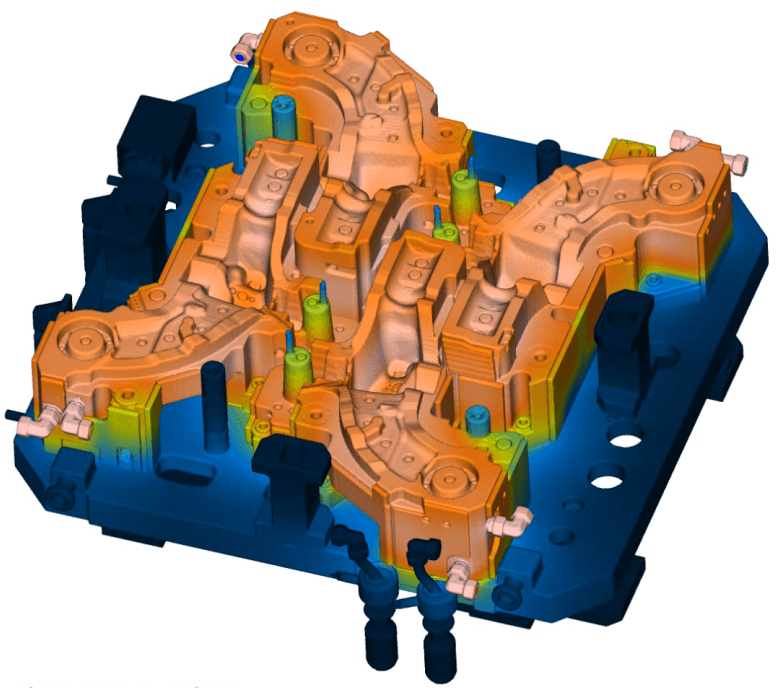
주입 시뮬레이션 후, 양호한 주입 패턴을 보장하기 위해 시뮬레이션의 초점이 열 다이 사이클링 분석으로 리디렉션 되었습니다. 이 경우 설정은 일반 데스크 톱 컴퓨터에서 10개의 생산 사이클을 재현하는 데 1시간이면 간단하고 빠릅니다(i7930 K, 상업적 가치 1500달러). 그 결과 CM의 초기 가설이 확인되었습니다. FlowSight를 사용하여 단일 이미지에서 여러 시점과 횡단면에서 온도 필드를 관찰한 결과 온도가 d라는 것이 분명했습니다. 주형의 침입은 예상되는 변형과 금속 누출을 쉽게 유발할 수 있습니다.

Simulation of the mould’s temperature during the die cyclings


Further analysis with the Fluid-Structure Interaction module


일단 문제가 확인되고 기술 요원이 향상된 금형 설계를 시작하면 CM Taricco는 다이 상의 응력 및 변형에 대한 FEM 해석을 실행하는 최종 확인을 원했습니다. 이 분석을 수행하기 위해 XC Engineering Srl은 CM이 계산을 설정하고 수행하는 것을 도왔습니다. 분석의 결과는 정확히 CM이 생각하고 있는 것을 보여주었습니다. FLOW-3D는 붓기가 거의 걸리지 않은 금형에서 발견 된 실제 변형과 동일한 위치와 크기를 극도의 정확도로 재현 할 수 있었습니다. 이것은 CM에 대한 좋은 소식이었으며, 실제 주조 조건을 기반으로 실제 금형 변형을 예측하기 위해 설계 단계에서 FSI 모듈을 사용하는 추가 권장 사항을 시행했습니다.

Deformation of the mould during the die cyclings, simulated using the Fluid Structure Interaction model. Deformations are amplified x20.


Conclusion

해석결과, CM직원은 CFD솔루션의 온도영역에 대한 모든정보를 사용하여 최적화된 새로운 주형을 설계할 수 있었습니다. 새로운 주형은 열 에너지를 보다 효율적인 방법으로 방출할 수 있었으며 주조물은 수 십번의 공정 주기 후에도 금속 누출의 영향을 받지 않았습니다.

The cast part after mould optimization. No critical leak defects are present.


Sand Core Making / 모래 코어 제작

Sand Core Making / 모래 코어 제작

This article on sand core making was contributed by Dr. Matthias Todte and Frieder Semler, Flow Science Deutschland GmbH.

주조 품질에 대한 수요가 증가하고 고성능 구성 요소에 대한 박막형 구조로의 추세로 인해 품질에 대한 요구가 강화되었으며 동시에 모래 코어의 기하학적 복잡성도 증가했습니다. 시뮬레이션은 코어 박스의 설계를 최적화하는 데 도움이 되며, 저온 및 고온 코어 박스를 위한 유기 및 무기 바인더 시스템의 촬영, 가스 처리 및 경화를 위한 강력한 공정 조건을 확립합니다.

기체 주입, 건조 및 템퍼링의 기본 프로세스에 대한 논의는 실험적 검증을 거쳐야 합니다. 그런 다음 주물 결함을 방지하기 위해 코어 사격 공정 시뮬레이션이 필수적이었는지를 보여 줍니다. 마지막으로 코어 박스의 마모와 수명을 예측하는 수치모델을 개발한 연구 프로젝트를 소개합니다.

Water jacket core

Simulation of sand core making processes

Shooting

Shooting Simulation에서 모래로 채워진 타격 헤드가 공기를 통해 가압되고, 이로 인해 공기/모래/실린더/바인더 혼합물로 구성된 “유체”가 생성됩니다. 이 유체는 분사 노즐을 통해 코어 박스로 흐르고 배출 노즐을 통해 상자 밖으로 공기가 배출됩니다. Shooting Simulation의 목적은 코어 박스에 있는 모래의 밀도분포를 높히고 균일하게 하는 것입니다.

촬영 과정에서 모래로 채워진 블로 헤드가 공기를 통해 가압되어 공기/모래/바인더 혼합물로 구성된 “유체”가 생성됩니다. 이 유체는 블로우 헤드에서 분사 노즐을 통해 코어 박스로 흘러 나와 공기를 환기 노즐을 통해 박스 밖으로 밀어냅니다. Shooting 의 목표는 가능한 한 높고 균일하게 코어 박스에 있는 모래의 밀도 분포를 달성하는 것입니다. 변경할 수 있는 프로세스 매개 변수는 분사 압력과 발사 및 배기 노즐의 수와 위치입니다. 시간과 비용을 절약하기 위해 코어의 품질을 저하시키지 않고 가능한 한 노즐을 적게 사용하는 것이 바람직합니다.

Sand density distribution

Sand density distribution after the shooting

시뮬레이션을 사용하여 다양한 사격 및 환기 노즐 구성과 그 구성이 결과 모래 밀도 분포에 미치는 영향을 분석할 수 있습니다. 엔지니어는 속도와 전단 응력을 예측하여 코어 상자의 마모 및 이에 따른 수명에 대한 결론을 도출할 수 있습니다.

Gassing

유기 바인더 시스템에서는 모래가 유기 수지로 코팅됩니다. 이 수지의 경화는 보통 아민이라는 기체에 의해 이루어지는데, 이것은 일반적으로 분사에 사용된 노즐을 통해 주입됩니다. 이 가스는 코어가 모든 부분에서 경화되도록 하기위해 모든부분에 도달할 만큼 길어야 한다. 반면에, 유독 가스를 줄이기 위해서는 가스 배출이 필요이상으로 길어서는 안됩니다.

유기 바인더 시스템에서는 모래가 유기 레진으로 코팅되어 있습니다. 이 레진의 경화는 보통 아민 가스 작용제에 의해 이루어지는데, 아민은 주로 인젝션에 사용되는 노즐을 통해 분사됩니다. 이 가스 주입은 가스가 코어의 모든 부분에 도달할 수 있도록 충분히 길어야 합니다. 코어가 모든 곳에서 경화되도록 하기 위해서입니다. 반면, 가스 배출은 독성 가스를 절약하기 위해 필요 이상으로 길지 않아야 합니다.

Amine concentration core

Amine concentration in a core

시뮬레이션은 시간 경과에 따른 코어의 아민 농도 분포를 예측하며, 이는 코어의 경도와 동일하다. 이를 통해 엔지니어들은 가스 생성 공정에 대한 합리적인 시간 규모를 결정할 수 있습니다.

Drying

주조물의 수가 증가하는 경우, 독성이 있는 유기적 시스템 대신 무기, 수성-기반 바인더 시스템이 사용됩니다. 배기 가스 배출이 없는 코어 생산 공정의 이점 외에도 이 시스템은 주조 공정 중 코어 가스 생산량을 줄여 주조 품질을 향상시킵니다.

모래 코어의 경화를 위해서는 일반적으로 뜨거운 공기가 주입되어 이루어지는 코어에서 물을 제거해야 합니다. 이러한 바인더 시스템의 경우, 코어의 잔류 수분은 경도에 대한 측정 값입니다. 시뮬레이션은 코어를 통과하는 공기의 흐름뿐만 아니라 물이나 증기의 증발과 응축, 뜨거운 공기와 함께 증기의 이동을 모델링 해야 합니다.

아래 이미지는 예측된 잔류 수분과 실제 코어의 강도(또는 손상)의 상관 관계를 보여 줍니다.

Correlation of predicted residual moisture and the damage of a real core

Tempering of core boxes                                                                    

핫 박스 및 크로닝과 같은 특정 코어 제조 공정에서는 가열된 코어 박스에 있는 바인더의 열 반응을 통해 코어의 경화가 이루어집니다. 상자의 가열은 가열 채널과 전기 가열 요소를 사용하여 수행됩니다. 좋은 코어 품질을 위해서는 코어 상자의 균일한 온도 분포가 바람직합니다. 시뮬레이션은 특정 가열 소자 구성에 대한 온도 분포를 시간 경과에 따른 예측하고 발열의 균일성과 원하는 온도에 도달하는 데 필요한 시간을 표시합니다.

Heated core box

Temperature distribution in a heated core box

Validation of the core blowing model

Experiments and simulations for a water jacket core

핵심 shooting 실험은 TU 뮌헨의 파운드리 연구소에서 실시되었습니다. shooting  시간과 압력, 흡입구와 환기구의 수 등의 공정 매개 변수들이 다양하였으며 이들 매개 변수들이 분석된 코어 품질에 미치는 영향이 다양하였다. 실제 코어에서 발생한 결점은 시뮬레이션에서 모래 밀도가 낮은 영역과 상관 관계가 있습니다(아래 그림 참조).

Core blowing validation

Core defects compared to simulated density distribution

Application of the core blowing model : 리어 액슬 하우징의 주조 품질 개선

품질 보증에서 리어 액슬 하우징의 주물 결함을 감지했습니다(아래 그림 참조). 그 결함들은 중심부의 표면 결함의 결과인 것처럼 보였다. 이 가설을 뒷받침하고 코어 표면 품질을 개선하기 위한 조치를 권고하기 위해 시뮬레이션이 수행되었다. 마지막으로, 코어 박스 환기구의 다른 구성(숫자 및 위치)을 통해 주조 품질을 개선할 수 있었습니다.

Casting defects of a rear axle housing

Casting defects of a rear axle housing

Validation surface defects

Correlation of surface defects and simulated density distribution

Research project: Prediction of the lifetime of core boxes

코어 박스는 대부분 폴리우레탄 수지 코팅의 알루미늄으로 제작된다. 사격 과정에서 모래에 의한 코어 박스 표면의 침식은 코어 박스의 수명을 제한하는 요인이다. 프로젝트 목표는 표면 처리가 수명에 미치는 영향을 이해하고 단일 시뮬레이션에서 다수의 샷에 의해 발생하는 침식을 예측할 수 있는 연산 모델을 개발하는 침식 프로세스를 분석하는 것이었다.

일반적인 코어 상자(아래 참조)는 다른 모양의 삽입물로 제작되었습니다.

Core box with different inserts

Core box with different inserts

수치 모델은 코어 박스 벽의 압력과 전단력의 공간적, 시간적 통합에 기초하여 부식에 대한 양을 도출한다. 모형에 의해 예측된 침식은 실험 값과 일치했습니다(아래 그림 참조).

Measured and simulated erosion

Comparison of measured and simulated erosion

Cooling and Feeding System Design

Cooling and Feeding System Design

공동 또는 다공성 결함은 일반적으로 마지막 응고 위치에서 형성됩니다. 라이저는 일반적으로 주조물이 굳을 때 녹은 금속을 주조물에 제공하여 이러한 결함을 방지하는데 사용됩니다. 그러나 라이저가 효과를 발휘하려면 적절한 크기에 적절한 위치에 배치하여 수축량을 보상할 수 있는 충분한 재료를 포함해야 합니다. FLOW-3D CAST에서는 캐스터가 결점 없는 주물을 위한 냉각 및 공급 시스템을 설계할 수 있도록 두 가지 새로운 도구가 개발되었습니다. 즉, 마지막으로 응고될 장소의 예측과 열 계수 계산입니다.

Last Places to Freeze

마지막으로 응고딜 장소는 주물 내 가장 늦게 응고되는 위치와 수축 다공성 결함이 형성될 가능성이 있는 위치를 직접 표시합니다. 이러한 장소는 고체 분율 진화 또는 응고 시간으로부터 파생될 수 있지만, 보다 직접적인 시각화 방법이 항상 선호됩니다.

특수 유형의 고정 입자는 “핫 스폿”이라고 불리는 마지막 응고 위치를 식별하고 시각화하는 데 사용됩니다. 이 출력은 응고 모델을 사용할 때 자동으로 생성됩니다. 핫 스폿 입자는 그림 1에 도식적으로 나타난 바와 같이, 모든 인접 영역이 고체화된 후에 응고될 때 셀에 삽입됩니다.

이러한 입자는 최종 자유도 위치를 파악하는 것 외에 이러한 위치에서 수축 다공성 결함의 가능성과 크기를 결정하는 데 사용할 수 있는 다른 속성을 가지고 있습니다. 즉, 셀 응고 시간, 핫 스폿 ID 및 핫 스폿크기,  셀이 응고되는 시간입니다. 핫 스폿 ID는 핫 스폿이 첫번째 지점, 두번째 지점인 순서를 나타냅니다. 마지막으로 핫 스팟크기는 다음 공식으로 계산됩니다.

이 입자들은 마지막으로 동결된 위치를 식별하는 것 외에도 이러한 위치에서 수축 다공성 결함의 가능성 및 크기, 즉 셀 응고 시간, 핫 스폿 ID 및 핫 스폿 크기를 결정하는 데 사용할 수 있는 다른 속성을 가지고 있습니다. 셀 응고 시간은 셀이 응고되는 시간입니다. 핫 스폿 ID는 핫 스폿이 굳어지는 순서를 나타냅니다. 1은 첫 번째, 2는 두 번째 등. 마지막으로, 핫 스폿 크기는 다음 방정식으로 계산됩니다.


  • hsm(i) 는 입자 i에 대한 핫스팟 크기입니다.
  • t0 는 입자 위치에서의 세포 응고 시간입니다.
  • νliq(t) 는 시간 t에서 입자를 포함하는 액체 영역의 부피입니다.

Figure 1. A hot spot particle is inserted at the center of a cell when it solidifies after its immediate neighbors become solid.

Figure 2. 핫스팟 입자를 포함하는 액체 부피의 진행상태 예시 : t3> t2> t1.

그림 2는 연결된 액체 지역의 부피가 입자 속도의 함수로서 어떻게 변하는지를 보여 준다. 그런 다음 계산된 양을 정규화하여 모든 핫 스팟 크기 값을 0과 1사이의 범위로 가져옵니다. 이를 통해 다공성 형성에 미치는 잠재적인 영향과 관련하여 주물 내 여러 핫 스폿을 간단하게 비교 분석할 수 있습니다. 값이 높을수록 응고하는 동안 연결된 액체 영역이 커지며 최종-동결 위치에서 다공성 결함이 줄어들 가능성이 높아집니다.


The Thermal Modulus Method

열 계수 법은 일반적인 라이저 설계 시 가장 많이 사용되는 방법 중 하나이며, 특히 알루미늄 합금 및 강철 주물에 사용됩니다. 주어진 주물 부품의 경우, 그 계수는 다음과 같이 정의됩니다.

  • V는 주조 부품의 체적이며
  • A는 주조 부품의 표면적입니다.

주물의 기하학적 계수는 구체나 블록과 같은 정규 형상에 대해 계산하기 쉽습니다. 그보다 더 복잡한 것은 보통 모양으로 주조 섹션을 지루하게 근사치를 구하는 것입니다. 또한, 기하학적 계수형 접근 방식은 주물의 기하학적 구조에 전적으로 의존합니다.

실제 주조물은 냉각제와 절연체를 사용하여 응고 진행을 제어합니다. 이러한 형상은 기하 계수 접근 방식에서는 무시된다. 계수 계산을 자동화하고, 동결 융해, 단열 및 기타 주형 변형과 관련된 열 영향을 고려하기 위해 열 계수라고 하는 혁신적인 접근법이 라이저 디자인에 사용된다.

열 계수 접근 방식의 경우 먼저 주조물의 응고 시뮬레이션이 실행됩니다. 시뮬레이션이 완료되면, Cavorinov의 규칙에 근거한 응고 시간으로부터 주물 전체의 등가 계수를 계산할 수 있습니다. 이 접근법을 사용하여 계산된 등가 계수를 열 계수라고 한다. 그것은 라이저 설계를 가이드하기 위해 기하학적 계수와 동일한 방법으로 사용될 수 있다.


Chvorinov의 법칙은 응고 시간과의 관계를 나타내며 그 계수는 다음과 같이 쓸 수 있습니다.

  • t is the casting solidification time,
  • N is a constant (usually equal to 2), and
  • B is the mold constant. It can be calculated using the following formula:

주조 공정을 설계할 때 라이저는 적절한 유동을 위해 라이저의 응고 시간이 인접 주조 섹션의 응고 시간보다 긴 방식으로 설계됩니다. Chvorinov의 규칙에 따르면 응고 시간은 주물의 계수에 정비례합니다. 따라서 응고 시간을 비교할 때 모듈화를 직접 비교할 수 있습니다. 모듈형은 기하학적인 양이기 때문에, 모듈형의 비교는 훨씬 단순하게 설계를 할수있습니다. 금속 주조 엔지니어는 실제 주조 공정의 세부 사항을 고려하지 않고도 부품을 적절하게 이송할 수 있도록 계수가 큰 라이저를 설계할 수 있습니다.


Application of the New Tools to Cooling and Feeding System Design  

예를 들어, 새로운 도구를 사용하는 증기 터빈 실린더의 절반에 대한 냉각 및 공급 시스템 설계가 제공되고 이 섹션에서 Flow Science China 도움을 받아 논의됩니다. 부품의 외부 치수는 2.83×2.34×1.10미터이고 총 부피는 아래와 같이 약 0.95 세제곱미터입니다. 주물 재료는 탄소강이며 주입 온도는 150°C입니다.

Figure 3. Casting part geometry

첫째, 냉각제와 라이저가 없는 주조물의 응고 시뮬레이션을 실행합니다. 그 목적은 핫 스폿 위치를 확인하고 응고 건조기 및 라이저의 위치와 라이저의 크기를 결정하는 것입니다. 두개의 새로운 도구는 냉기와 라이저 설계를 개선하는 데 사용됩니다.

입자를 응고할 마지막 위치는 각각 셀 응고 시간, 입자 ID 및 핫 스폿 크기로 표시된 다음 그림과 같습니다. 이러한 그림을 통해 핫 스폿 위치와 수축 다공성 결함을 형성할 가능성을 직접 확인할 수 있습니다. 주물의 기하학적 특성에 기초하여, 라이저를 배치하는 위치는 그림의 마지막 프레임과 같이 쉽게 확인할 수 있습니다.

그러나 하단 쉘에 몇개의 핫 스폿이 있으며 이는 라이저를 배치하는 데 적합하지 않습니다. 이러한 위치에서 다공성 결함의 수축을 방지하기 위해 냉각제를 사용하여 응고 패턴을 변경하고 마지막으로 라이저 영역까지 응고시킬 수 있습니다.

Figure 4. Hot spot locations colored by three attributes (clockwise from top left): hot spot solidification time, particle id and hot spot magnitude.


Thermal Modulus Computation

계산 된  thermal modulus는 오른쪽에 표시됩니다. 더 큰 값은 응고될 마지막 위치와 일치합니다. 또한 열 모듈러스를 사용하여 핫스팟 위치에서 라이저의 크기를 결정할 수 있습니다.

냉각 및 라이저가 결정되면 냉각 및 라이저 설계를 확인하기 위해 냉각 및 라이저가 포함된 두 번째 응고 시뮬레이션이 실행됩니다. 핫스팟 크기로 채색된 마지막 응고 위치 입자와 thermal modulus가 그림 6에 나와 있습니다. 냉각이 마지막 장소를 라이저 영역으로 성공적으로 응고시키는 것을 볼 수 있습니다. 그러나 라이저 아래에는 여전히 위험한 핫 스팟이 있습니다. 실제로 실제 주조는 아래 그림에 표시된 것처럼 핫스팟 입자로 식별된 위치에서 수축 다공성 결함을 보여줍니다.


Figure 5. Calculated thermal modulus

Calculated thermal modulus 마지막으로 동결할 장소는 라이저가 아닌 주물 안에 있습니다. 즉, 라이저 위치와 크기가 올바르게 결정되더라도 주물이 라이저 쪽 방향으로 굳지 않도록 응고 패턴이 올바르지 않다는 것을 의미합니다. 한 가지 해결책은 발열 라이저 슬리브를 사용하여 응고 패턴을 수정하는 것입니다. 이것은 본 기사의 범위를 벗어나기 때문에, 더 이상 논의되지 않을 것입니다.


Figure 6. 핫 스폿 위치(왼쪽 위), 계측된 주조물을 사용하여 계산된 열적 계수(오른쪽 위) 및 수축 결함이 관찰된 위치


Metal Casting Models

Metal Casting Models

FLOW-3D CAST는 금속 주조를 위해 특별히 설계된 다양한 물리적 모델을 포함하고 있습니다. 이는 모든 종류의 금속 주조 용도와 관련된 문제에 대한 가장 정확한 해결책을 제공합니다. 이를 통해 고객은 보다 적은 시간과 비용으로 지속적으로 주조 수율과 품질을 개선할 수 있습니다.

자유 표면 흐름을 정확하게 예측할 수 있는 특수 기능을 갖춘 FLOW-3D CAST는 금형 용탕 충진 및 공기 주입과 같은 관련된 결함을 시뮬레이션하는 데 가장 적합합니다. 강력하고 유연한 열전달 모델은 응고, 냉각 채널, 열 다이 사이클 시뮬레이션과 같은 금속과 금형 사이의 열 교환을 빠르고 정확하게 예측할 수 있습니다. 금형 용탕 충진과 결합할 수 있는 응고 및 수축 모델은 과도한 수축공과 기공 영역을 정확히 찾아내어 결함이 완화됩니다. granular media 모델과 수분 건조 모델을 사용하여 모래 코어의 blowing과 건조 공정을 시뮬레이션 할 수 있습니다. FLOW-3D CAST의 유한 요소 기반 열 응력 모델을 사용하면, 고객이 응력이 발생하는 위치와 주조 변형이 일어나는 이유를 정확하게 예측할 수 있으므로 열 변형 결함을 제거할 수 있습니다. 주철 모델은 공정 반응하는 동안 흑연, 감마 – 철 및 탄화물 형성을 예측하여, FLOW-3D CAST의 적용 범위를 확장합니다. 코어 가스 제품 군의 고유한 특징은 코어 가스 생성 및 모래 코어에서의 흐름을 모델링 하여 금속 주물의 코어 가스 관련 결함을 예측하는 데 사용할 수 있습니다.

FLOW-3D CAST는 금속 주조 모델링 및 시뮬레이션 분야의 선두 프로그램입니다. 금속 주조 업계에 대한 당사의 헌신은 금속 주조와 관련된 모델과 용도에 대한 당사의 지속적인 개발로 입증되었습니다. 당사는 고객과 지속적으로 협력하여 실제 애플리케이션을 위해 개발하여 품질과 생산성을 향상시키고 지속적으로 혁신할 수 있도록 지원할 것입니다.

Jewelry Casting

Continuous Casting

Continuous Casting

연속 주조는 용강이 반제품 빌렛, 블룸 또는 슬래브로 응고되어 후속 압연기에서 압연하는 공정입니다. 연속 주조시, 용강은 레들에서 주조기로 이송됩니다. 주조 작업이 시작되면 레들의 바닥에 있는 슬라이딩 셔터가 열리고 철강은 제어된 속도로 턴디쉬 안으로 그리고 턴디쉬에서 하나 이상의 주형으로 흐릅니다.

1950 년대에 연속 주조가 도입되기 전에 철강은 고정 금형에 붓고 잉곳을 성형했습니다. 그 이후로 지속적인 주조는 수율, 품질, 생산성 및 비용 효율성을 향상시키기 위해 발전해 왔습니다. 주조 회사는 공정 개선을 위해 항상 노력하고 있으며, FLOW-3D CAST를 사용한 시뮬레이션은 물리적 시행 착오없이 비용을 절감할 수 있는 기회를 제공합니다.

Semi-Continuous Casting of a 600 mm Slab with Stress Calculation

이 시뮬레이션에서는 600mm직경 슬래브의 반 연속 주조의 공정이 모델링 됩니다. 액체 금속, A7050 합금은 세라믹 노즐을 통해 상단에서 들어가 흑연 주형을 통과하고, 표면 열전달계수와 지정된 온도로 모델링 된 물 분무에 의해 냉각됩니다. 하단의 강철 캡은 금속의 이동을 시작하여 액체 금속이 유출되는 것을 방지합니다. 캡은 0.3mm/sec의 일정한 속도로 아래쪽으로 이동하는 General Moving Object 물리 모델로 모델링 됩니다. 열응력 해석 모델은 균일하지 않은 냉각 및 수축으로 인해 고상 금속에서 발생하는 응력 및 변형을 예측하는 데 사용됩니다. 이 애니메이션은 Von Mises stress 결과를 보여 주는데, 400배로 확대된 결과입니다.

Continuous Casting Simulations

Rotational channel continuous casting example.


Solid fraction contours of the continuous casting process of a cylindrical steed rod using the general moving object and solidification models.


A 2D axisymmetric slice showing transient solidification contours through the transition region during continuous casting of a cylindrical steel rod.

Centrifugal Casting

Centrifugal Casting

원심 주조에서는 금형이 고속으로 회전하고 용해된 금속은 그 안으로 주입됩니다. 용해된 금속은 금형 내부에서 바깥쪽으로 방사되어 냉각되면서 응고됩니다. 중심 가속도와 관련된 더 높은 압력이 결함을 회전축 쪽으로 미는데, FLOW-3D CAST의 non-inertial reference frame model은 속도와 결함들의 위치를 수정할 수 있는 기능을 통해, 이러한 회전조건을 설정하여 매우 정확한 시뮬레이션 결과를 얻을 수 있습니다.


Centrifugal Casting Examples

강철 임펠러 원심 주조 공정의 부분 주입 시뮬레이션. 회전 속도는 250rpm으로 설정되었습니다.

FLOW-3D CAST는 임펠러 베인을 주조할 때 초기 응고 문제를 시뮬레이션하고 보여 주는 데 사용됩니다.


Centrifugal casting simulations, courtesy Metaltek.

Gravity Pour

Gravity Pour

중력 주조는 큰 부품(일반적으로 철, 청동, 황동 또는 알루미늄)을 만드는 데 사용됩니다. 사형 주조 및 영구 금형을 포함한 대부분의 주조 공장 주조 공정은 FLOW-3D CAST를 사용하여 모델링 할 수 있습니다. 주입 프로세스는 고압 다이 캐스팅에 비해 덜하지만 과도한 공기 주입으로 인한 공기 유입으로 인해 품질이 저하될 수 있습니다. 주입하는 동안 잠재적 결함의 위치와 온도의 변화 뿐만 아니라, 용탕 표면의 움직임도 정확하게 예측됩니다. 충진이 완료된 후 용탕의 응고 및 수축을 모델링 할 수도 있습니다.


Accurate Filling Simulations

주조 공정에서 주입 작업은 결함들이 라이저로 이동하는지, 또는 부품에 갇힌 채로 남아 있는지 여부와 같은 주입 패턴 및 관련 결함을 분석하는 작업으로 이루어집니다. 시뮬레이션 분석을 사용하면 설계의 효율성을 검증하고 비용을 절감하면서 생산에 들어가기 전에 설계를 테스트할 수 있습니다. 주입의 정확성은 산화물의 결함과 갇힌 공기의 위치를 추적하는 데 중요할 뿐만 아니라, 응고 결과의 핵심입니다. 올바른 주입 패턴은 주입 마지막의 올바른 열 분포를 의미합니다. 이 열 분포는 응고 분석의 기초가 됩니다.

Solidification of Castings for Foundry Applications

편석, 열응력, 마이크로 및 매크로 기공 등 응고와 관련된 다양한 결함들이 있습니다. 정확한 응고 결과를 얻기 위한 중요한 첫번째 단계는, 정확한 주입입니다. 정확한 주입은 응고 모델링의 초기 조건인 올바른 열 프로필을 캡처하는데, FLOW-3D CAST는 주조 부품을 보다 신속하게 설계하고 폐기율을 낮출 수 있는 많은 응고 관련 결함을 감지할 수 있습니다.

Tilt Pour

Tilt Pour

경동 주조에서는 금형이 수평 위치에 있는 동안 용탕이 주입 래들에 주입됩니다. 그런 다음 사전에 설정된 사이클 시간을 사용하여 주조 기계가 수직 위치로 상승하고, 용탕이 느리고 연속적인 주입 속도로 금형으로 들어갈 수 있습니다. 경동 주조 방법은 다양한 주조 형태를 가능하게 하는 런너-게이트 유연성 때문에 일반적인 주조 용도에 적합합니다.

Temperature profile during a tilt pour filling cycle

아래와 같은 예에서는 케이블 탭으로 연결되는 알루미늄 커플러 케이블에 대해 경동 주조의 시뮬레이션을 수행하여, 부품의 무결성과 표면 품질을 보장했습니다. 경동 회전을 완료하는 데 걸리는 시간은 중요합니다. 회전 속도는 FLOW-3D CAST에서 쉽게 수정할 수 있으므로 사용자가 이 속도를 최적화할 수 있습니다. 회전 속도가 너무 빠르면 공기가 유입되어 더 느리게 표면 결함이 나타날 수 있습니다. 온도 프로파일은 최대 및 최소 그래프 값을 각각 액상과 고상 온도로 설정하여 시각화 합니다. 여기서 부품이 반쯤 채워져 있고 용탕 온도가 고상 온도에 가깝지 않기 때문에 조기 응고는 나타나지 않습니다.

Simulation of the tilt pour process using FLOW-3D Cast.

Tilt pour casting simulations

수상 래프팅 장비에 사용되는 경량 알루미늄 부품은 고품질의 마감이 필요하며, 이상적으로 표면이 없고 결함이 없도록 주조됩니다. 이러한 경동 주조 프로세스의 시뮬레이션은 주입 프로세스를 통해 갇힌 표면 산화물 및 침입 공기의 잠재적 영역을 보여줍니다. 이러한 결점의 움직임을 알면 주조 엔지니어가 더 나은 게이트, 런너 및 라이저를 설계하여, 주물 내의 결점을 제거하는 데 도움이 됩니다. FLOW-3D CAST는 독자적인 6자유도 이동 기능을 통해, 금형의 복잡한 경사 순서와 각도 가속도를 시뮬레이션하는 데 사용할 수 있습니다.

Predicting metal casting defects

Surface oxide and entrained air defects in a tilt pour casting

Visualizing non-inertial reference frame motion

 casting with non-inertial reference frame motion on the left and stationary motion on the right


 blog 에서 FLOW-3D CAST v4.2의 FlowSight 에 대해 자세히 알아보십시오.


Low Pressure Die Casting

LPDC (Low Pressure Die Casting)

High Pressure Die Casting

Permanent Mold

Permanent Mold

영구 금형과 모래 금형의 차이점은 영구 금형을 재사용 할 수 있다는 것입니다. 금형을 재사용하는 주조 공정에는 중력, 경동, 저압 다이캐스팅 및 고압 다이 캐스팅이 포함됩니다. 영구 금형에는 금속과 흑연의 두 가지 유형이 있고 몰드 유형의 사용은 주조 금속에 달려 있습니다. 금속 주형에 사용되는 주조 금속은 알루미늄, 구리 합금, 아연 및 마그네슘을 포함합니다. 흑연 주형에 사용되는 주조 금속은 강 및 철입니다. 또한 내부 공동을 생성하기 위해 샌드 코어를 사용하는 반영구적인 금형이 있습니다. FLOW-3D CAST는 금형의 충진, 응고 및 열응력과 관련된 주조 결함을 포착하여 처음 프로세스를 올바르게 설계하고 궁극적으로 시간과 비용을 절약 할 수 있습니다.

Simulation of a low pressure die casting showing the filling temperature of a tire rim.


Customer Examples of Permanent Mold Castings

Courtesy Peugeot PSACourtesy Littler DiecastCourtesy SANDEN Manufacturing

Validations

Validations

금속 주조 설계 과정에서 FLOW-3D CAST의 사용은 회사의 비용 절감 방안을 제시하여 수익성을 개선할 수 있습니다. FLOW-3D CAST 는 엔지니어와 설계자에게 경험과 전문지식을 향상시킬 수 있는 강력한 도구가 될 수 있습니다. 보통 수익성은 비용 절감과 비용 회피에서 찾을 수 있습니다. 지금, 품질과 생산성 문제는 제품개발 단계에서 다양한 시뮬레이션 통해 짧은 공정시간, 낮은 비용으로 해결 할 수 있는 방안을 찾을 수 있습니다. 새로운 개발도구인 FLOW-3D CAST의 효율성은 생산이 시작되기 전에 문제를 해결할 수 있는 방안을 제시하여 생산성을 크게 개선할 수 있습니다.

Ladle Pour

샷 슬리브 공정을 최적화하는 것은 고품질 부품을 확보하는 데 필수적입니다. FLOW-3D CAST의 시뮬레이션 결과와 실제 사례의 비교를 통해, 시뮬레이션을 사용하여 엔지니어가 값 비싼 툴링을 제작하기 전에 설계를 개선하는 방법을 강조합니다. FLOW-3D CAST는 프로세스 전반에 걸쳐 유체의 움직임을 정확하게 포착할 수 있으므로, 엔지니어가 실제 레들 주입 공정에서 신속하게 파악할 수 있습니다. 시뮬레이션은 Nemak Poland Sp. z o.o로부터 제공받았습니다.

Gravity Casting

열전대 데이터를 기반으로 한 실제 충진 재구성과 비교 한 중력 주조 시뮬레이션. Courtesy of XC Engineering and Peugeot PSA.

Foundry: Simulating a Flow Fill Pattern


사형 주조 충진중의 X- 레이 검증

X -레이 결과와 FLOW-3D CAST 시뮬레이션 결과를 나란히 비교합니다. A356 알루미늄 합금으로 사형 주조의 3 차원 충진 색상은 금속의 압력을 나타냅니다. 시뮬레이션 결과는 수직 대칭 평면에 표시됩니다. Modeling of Casting, Welding, and Advanced Solidification Processes VII, London, 1995.

HPDC: Flow Pattern


Short sleeve validation – 시뮬레이션 결과와 주조 부품, Littler Diecast Corporation의 예

Modeling Air Entrapment


디젤 엔진 용 오일 필터 하우징의 X-ray vs. FLOW-3D CAST 검증.

디젤 엔진 용 오일 필터 하우징의 X- 레이 검증, 380 다이캐스팅 합금. 결과는 혼입 된 공기의 비율로 표시됩니다. X- 레이의 상세한 영역은 최대 다공도 농도를 나타냅니다.

HPDC Filling


FLOW-3D 결과를 실제 부품과 비교하는 HPDC 캐스팅 검증

Short Shot Simulation


실제 주조 부품의 유효성 검사. 스냅 샷과 FLOW-3D CAST 시뮬레이션 결과. 왼쪽에서 오른쪽으로 : 변속기 하우징, 오일 팬 및 자동차 부품.

HPDC Air Entrapment Defects


Antrametal에 의한 주조 시뮬레이션 대 실험 결과의 성공적인 비교.

Antmetetal의 고객 검증은 FLOW-3D CAST의 Air Entrapment 모델을 사용하여 실험 결과와 시뮬레이션을 비교 한 결과를 보여줍니다. 세탁기 용 전동 모터의 앞 커버의 HPDC입니다. 공기 관련 결함은 이미지의 색상에 정 성적으로 표시됩니다. FLOW-3D CAST 내의 다른 수치 기능에 의해 포착 된 물리적 공기 포켓 또한 명확하게 표현됩니다.

Core Drying


시뮬레이션과 무기 코어의 건조 실험 사이의 BMW에 의한 비교.

Predicting Die Erosion


캐비테이션으로 인한 다이 침식 영역은 FLOW-3D CAST 결과를 실제 사례와 비교하여 올바르게 배치되었습니다.

Predicting Lost Foam Filling


Lost foam L850 블록 벌크 헤드 슬라이스에 대한 실시간 X-ray 및 FLOW-3D CAST 유동 시뮬레이션 결과의 비교. 시뮬레이션은 GM Powertrain의 예입니다.

Porosity Defects


Porosity due to entrained air

Predicting Shrinkage Porosity


A380 diesel engine block casting


FLOW-3D CAST Suites

FLOW-3D CAST Suites

FLOW-3D CAST v5 comes in Suites of relevant casting processes: 

HIGH PRESSURE DIE CASTING SUITE

Process Workspace

High Pressure Die Casting

Features

Thermal Die Cycling
– Cooling/heating channels
– Spray cooling
Filling
– Shot sleeve with Plunger
– Shot motion
– Ladles, stoppers
– Venting efficiency
– PQ^2 analysis
– HPDC machine database
Solidification
– Squeeze pins
Cooling


PERMANENT MOLD CASTING SUITE

Process Workspaces

Permanent Mold Casting
Low Pressure Die Casting
Tilt Pour Casting

Features

Thermal Die Cycling
– Cooling/heating channels
Filling
– Tilt pouring
Solidification
– Squeeze pins
Cooling


SAND CASTING SUITE

Process Workspaces

Sand Casting
Low Pressure Sand Casting

Features

Filling
– Permeable molds
– Moisture evaporation in molds
– Gas generation in cores
– Ladle model
Solidification
– Exothermic sleeves
– Chills
– Cast iron solidification
Cooling


LOST FOAM CASTING SUITE

Process Workspaces

Lost Foam
Sand Casting
Low Pressure Sand Casting

Features

Filling
– Permeable molds
– Moisture evaporation in molds
– Gas generation in cores
– Ladle model
– Lost foam pattern evaporation models (Fast model and Full model)
– Lost foam defect prediction
Solidification
– Exothermic sleeves
– Chills
– Cast iron solidification
Cooling


ALL SUITES INCLUDE THESE CORE FEATURES:

Solver Engine

  • TruVOF – The most accurate filling simulation tool in the industry
  • Heat transfer and solidification
  • Shrinkage – Rapid Shrinkage model and Shrinkage with flow model
  • Temperature dependent properties
  • Multi-block meshing including conforming meshes
  • Turbulence models
  • Non-Newtonian viscosity (shear thinning/thickening, thixotropic)
  • Flow tracers
  • Active Simulation Control with Global Conditions
  • Surface tension model
  • Thermal stress analysis with warpage
  • General moving geometry w/6 DOF

FlowSight

  • Multi-case analysis
  • Porosity analysis tool

Defect Prediction Tools

  • Gas entrainment model
  • Thermal Modulus output
  • Hot Spot identification
  • Micro and macro porosity prediction
  • Surface defect prediction
  • Shrinkage
  • Cavitation and Cavitation Potential
  • Particle models (Inclusion modeling, collapsed bubble tracking)

User Conveniences

  • Process-oriented workspaces
  • Configurable Simulation Monitor
  • Metal and solid material databases
  • Heat transfer database
  • Filter database
  • Remote solving queues
  • Quick Analyze/Display tool

ALL NEW FLOW-3D CAST v5

ALL NEW FLOW-3D CAST v5

ALL NEW FLOW-3D CAST v5 는 금속 주조 시뮬레이션 및 공정 모델링에 있어 큰 발전입니다. 이제 FLOW-3D CAST는 시뮬레이션 할 프로세스를 선택할 수 있으며, 소프트웨어는 적절한 프로세스 매개 변수, 지오메트리 유형 및 합리적인 기본 값을 제공합니다. 이렇게 하면 시뮬레이션 설정이 상당히 간소화됩니다. 또한 FLOW-3D CAST의 강력한 시뮬레이션 엔진과 결함 예측을 위한 새로운 도구는 설계 주기를 단축하고 비용을 절감하는 통찰력을 제공합니다. 대표적인 개발 기능으로 응고 시뮬레이션을 위한 열 계수 및 핫 스팟 식별 출력, 갇혀 있는 가스를 식별하고 환기 효율을 예측하기 위한 결함 채우기 도구 등이 포함됩니다. 그리고 더 빠르고 더 강력한 압력과 및 응력 해소 기능이 모두 포함합니다.

ALL NEW FLOW-3D CAST v5 는 관련 프로세스가 포함된 Suite제품으로 제공됩니다. 영구 금형 제품군은 중력 다이 캐스팅, 저압 다이캐스팅(LPDC), 틸트 주입 주조와 같은 프로세스 작업 공간을 포함합니다. 각 프로세스에 대해 사용자 인터페이스는 특정 프로세스와 관련된 내용만 표시합니다. 모래 주조 Suite에는 중력 사형 주조 및 저압 사형 주조(LPSC)와 같은 프로세스가 포함되어 있습니다. 소실 폼 제품 군에는 사형 주조 Suite의 모든 것과 소실 폼 공정 작업 공간이 포함됩니다. HPDC 제품군은 열 응력 및 변형을 포함하여 고압 다이 캐스팅과 관련된 모든 것을 포함합니다. 각 프로세스 작업 공간 내에서 채우기, 응고 및 냉각과 같은 하위 프로세스는 서로 연결된 시뮬레이션으로, 처음부터 끝까지 차례로 전체 프로세스를 모델링 합니다. 사용자가 그것을 작업장 바닥에서 하는 것처럼. 사용자는 레들을 용융 풀 안에 담갔다가, 숏 슬리브 또는 주입 컵에 옮겨, 전체 이동 및 주입과 같은 단계를 포함하도록 프로세스를 확장할 수 있습니다. LPDC의 경우 프로세스 엔지니어는 도가니의 가압 및 금속 흐름을 주형으로 모델링 할 수 있습니다.  FLOW-3D CAST v5를 사용하면 가능성이 무한해 집니다.

WYSIWYN Process Workspaces

What-You-See-Is-What-You-Need (WYSIWYN) 프로세스 작업 공간은 FLOW-3D CAST의 다기능성을 간소화하여 사용 편의성과 탁월한 솔루션입니다. 대부분의 인터페이스는 사용자가 제공해야 하는 정보만을 요구하고, 사용자 설계 원칙을 적용하여 단순화되었습니다.

FLOW-3D CAST v4.2에 도입된 프로세스 중심 작업 공간은 중력 다이 주조, 저압 주조 및 경사 주입, 모래 등과 같은 영구 금형 공정으로 확장되었습니다. 중력 모래 주조, 저압 모래 주조 및 소실 폼과 같은 주조 공정 지속적인 주조, 투자 주조, 모래 코어 제작, 원심 주조를 포함한 더 많은 공정 작업 공간이 현재 진행 중에 있습니다.

Simulation setup is simplified by only showing the components applicable for a given process.

Types of casting components available in a HPDC simulation. Mold pieces available in a high pressure die casting include cover and ejector dies, sliders, and shot sleeves.

Defect Prediction / 결함 예측

Identify Filling Defects using Particles  결함 예측 및 입자를 이용한 주입 결함 식별

파티클을 사용하는 FLOW-3D CAST v5를 통해 유입된 가스로 인한 충전 결함을 식별하는 것이 훨씬 쉬워 졌습니다. 결함을 식별하기가 훨씬 용이할 뿐만 아니라, 결함 예측에 따른 계산 비용도 크게 절감되었습니다.

붕괴된 가스 지역을 나타내는 보이드 입자가 도입되었습니다. 이전에 붕괴된 가스 영역은 너무 압축되어 수치 메쉬에서 해결할 수 없으면 시뮬레이션에서 사라졌습니다. 보이드 입자는 작은 기포처럼 작용하며 드래그와 압력을 통해 금속과 상호 작용합니다. 주변의 금속 압력에 따라 크기가 변하며, 주입이 끝난 후 최종 위치를 보면 공기 침투 및 산화물로 인한 잠재적인 결함이 있음을 알 수 있습니다.

Predict filling defects caused by entrapped gas using the Particle Model.

Metal/Wall Contact Time 금속/벽 접촉 시간

벽면 접촉 시간은 금형 표면에서 다른 부위보다 금속에 더 오래 노출된 부위를 식별하는 데 유용합니다. 금속 접촉 시간은 금속이 고체 구성 요소와 접촉한 시간을 나타냅니다. 예를 들어 모래 입자가 핵분해 부위의 역할을 하기 때문에 미세 먼지가 발생할 수 있습니다. 개별 솔리드 구성 요소와의 금속 접촉 시간 출력이 모든 구성 요소와의 접촉 시간을 포함하도록 확장되었습니다. 접촉 시간 계산은 출력 탭에서 벽 접촉 시간을 선택하여 활성화합니다.

Identify solidification defects with the new Thermal Modulus output.

Solidification Defect Identification 응고 결함 식별

일반적으로 라이저 크기 조정에 사용되는 열 모듈은 이제 응고 시뮬레이션에서 출력됩니다.

Risers will likely need to be placed on the circled regions.

Hot Spots  핫 스팟

또 다른 결과인 “핫 스팟”은 라이저를 찾고 크기를 조정하며, 응고 관련 결함의 가능성을 식별하는 데 유용합니다. 핫 스팟은 최종적으로 응고된 부위를 나타냅니다. 이것들은 입자들로 표현되고 뜨거운 점 크기에 의해 색깔이 변하기도 합니다. 라이저는 핫 스팟 크기가 가장 큰 곳에 배치해야 합니다.

Porosity Analysis Tool

FlowSight의 새로운 Porosity Analysis Tool은 실제적인 측면에서 porosity-related 결점을 식별합니다. 결점은 이제 순 볼륨, 최대 선형 범위, 모양 인자 및 total count로 식별됩니다.

New defect identification tools allow users to analyze porosity.

Arbitrary 2D Clips 임의 2D 클립

기능 지향적인 2D 클립은 결함을 찾기 위해 전면적으로 살펴 볼 때 유용합니다. 이전에는 클립에 표시된 금속 영역이 솔리드에 의해 점유된 셀로 확장되었습니다. 잡식의 FLOW-3D CAST v5에서 이 클립은 구성 요소를 숨기는 옵션을 선택해야만 열린 공간(예:주조 부품)의 금속을 보여 줄 수 있습니다.

Intensification Pressure 강화 압력

고압 주조 시뮬레이션에 지정된 강화 압력은 이제 매크로 및 마이크로 Porosity모델 모두에 결합되어 형성 사이의 보다 현실적인 관계를 형성합니다. 이러한 결함의 크기 및 플런저에 의해 가해지는 압력의 크기입니다.

Adjusting Shrinkage Porosity 수축 기공 조절

사용자가 금속의 특성을 수정할 필요 없이 수축 다공성의 양과 크기를 미세 조정할 수 있도록 수축 조정 계수가 추가되었습니다. 계수를 사용하면 응고 중에 체적 수축의 양을 전화로 설정하거나 줄일 수 있습니다.

Gas Pressure and Venting Efficiency  가스 압력 및 밴트 효율성 검토

사용자가 충전 결함을 식별하고 다이캐스트에서 밴트 시스템을 설계하는 데 도움을 주기 위해 마지막 국부적인 가스 압력 및 밴트 효율성 검토 결과가 주조 시뮬레이션 출력에 추가되었습니다. 가스 압력은 셀이 금속으로 채워지기 전에 셀의 마지막 보이드 압력을 기록하며, 밴트 효율은 환기구를 배치하는 것이 밴트 위치에서 공기를 배출하는 데 가장 효율적인 영역을 보여 줍니다.

Databases 데이터베이스

주조 공정에서 일반적으로 사용되는 정보의 데이터베이스는 설정 오류를 줄이고 시뮬레이션 workflow 를 개선합니다.

Configurable Simulation Monitor 구성 가능한 시뮬레이션 모니터

시뮬레이션을 실행할 때 발생하는 중요하지만 종종 힘든 작업은 시뮬레이션을 모니터링하는 것입니다. FLOW-3D CAST를 사용하면 다음과 같은 일반적인 시뮬레이션 목표를 모니터링할 수 있습니다.

  • 게이트 속도
    주형 내 고상 분율
    최저/최고 용탕 온도 및 금형 온도
    다양한 프로브 위치에서의 온도
    시뮬레이션 진단(예:시간 스텝, 안정성 한계)

Plotting Capabilities  Plotting기능

이제 시뮬레이션 관리자에는 더 많은 플롯 기능이 포함됩니다. 플롯은 사용자가 구성할 수 있으며 구성은 다른 시뮬레이션에서 사용하기 위해 데이터베이스에 저장됩니다. 사용자는 시뮬레이션 런타임 그래프와 history-data 에서 모니터링할 이력 데이터 변수를 지정할 수 있습니다. 다중 변수를 각 그래프에 입력합니다.

Conforming Meshes

임의 형상의 활성 계산 영역을 정의할 수 있도록 적합한 메쉬 기능이 확장되었습니다. 이는 메쉬 블록이 준수할 수 있는 열린 볼륨과 솔리드 볼륨을 모두 포함하여 계산 도메인의 영역을 정의하는 meshing구성 요소라고 하는 새로운 유형의 지오메트리 구성 요소를 사용합니다.
메쉬 블록은 냉각 채널이나 공동에 선택적으로 조합할 수 있어 사용자가 이러한 기하학적 객체에 대해 최적의 해상도를 선택할 수 있습니다. 이제 확인할 수 있는 메쉬가 FAVORize 탭에 표시될 수 있습니다.

Summary Views of Components/Cooling Channels

FLOW-3D CAST v5의 인터페이스는 주조 시뮬레이션에서 다양한 형상 구성 요소를 꽉 차게 보여줍니다. 2개의 새로운 형상 요약 뷰인 구성 요소 요약 뷰와 냉각 채널 요약 뷰는 기하학적 구성 요소 및 냉각 채널의 플라이 아웃을 제공하여 사용자가 신속하게 수행할 수 있도록 합니다. 중요 설정을 한 눈에 파악하고 필요한 경우 변경 할 수 있습니다.

Under the Hood

FLOW-3D CAST의 많은 강력한 구성 요소들은 Solver Engine이라고 부르는 것 들에서 중요합니다. 아래에서는 이면에서 무거운 작업을 수행하는 데 도움이 되는 몇가지 중요한 사항을 설명합니다.

Thermal Die Cycling (TDC) Model TDC(열 다이 사이클)모델

열 다이 사이클 시뮬레이션의 주입/응고 단계는 균일하지 않은 캐비티 온도를 사용하여 개선할 수 있습니다. 이제 캐비티에 있는 금속의 초기 온도는 재시작 중에 채우기 시뮬레이션을 통해 지정하거나 초기 유체 영역을 사용하는 사용자 정의 분포에서 지정할 수 있습니다. 이 기능은 옵션으로 사용할 수 있는 균일한 초기 금속 온도에 비해 다이 사이클링의 열해석의 정확성과 현실성을 높여줍니다.

Melt temperatures in the casting cavity read from a filling simulation are applied to ejector die during filling/solidification stage of thermal die cycling simulation.

Heat Transfer Coefficient Calculator for Spray Cooling 분사 냉각을 위한 열 전달 계수 계산기

스프레이 유체와 다이 표면 사이의 열 전달 계수(HTC)를 추정하는 것은 어려운 일입니다. 계산 또는 측정을 통해 값을 사용할 수 있는 경우 사용자는 이러한 값을 스프레이 거리 및 각도의 함수로 직접 지정할 수 있습니다. 새로운 기능을 통해 노즐의 스프레이 액의 유량을 기준으로 HTC를 동적으로 계산할 수 있습니다. 단일 조정 계수를 통해 스프레이 유출량을 기준으로 HTC를 미세 조정할 수 있습니다.

FLOW-3D CAST 소개

FLOW-3D CAST

FLOW-3D CAST는 광범위한 금속 주조 공정을 위한 완벽한 해석 솔루션을 제공합니다. 시뮬레이션을 통해 다양한 종류의 다공성, 표면 산화물, 공기 및 기포, 열 응력 및 변형 등과 같은 다양한 결함을 추적하면서, 주조 부품의 충진 및 응고에 대한 상세한 통찰력을 제공합니다. 금형을 분석하거나 FLOW-3D CAST로 코어의 가스 처리 같은 열 특성 및 기타 특성을 제거 할 수 있습니다.

최적화된 시뮬레이션을 통한 설계는 생산 현장에서의 개발 시간이 단축되고 출시 시간이 단축되며 생산량이 늘어나게 됩니다. FLOW-3D CAST는 담당자가 새로운 주조 공정 또는 합금을 배치 할 때 설계 및 개발 비용을 절감 할 수 있습니다.

직관적이고 편의성 높은 사용자 인터페이스를 결합한 FLOW-3D CAST는 성공적인 프로젝트를 통해 충진 및 응고 결함에 대한 정확한 예측을 제공합니다. 공정 요구 사항에 가장 적합한 샌드 캐스팅, 금형 주조 및 고압 다이 캐스팅을 사용할 수 있습니다.

High Performance Computing: in-House or in the Cloud

대규모 시뮬레이션의 경우 많은 계산 시간이 필요하게 되는데 이를 극복하기 위한 최고의 컴퓨팅 성능이 필요하십니까? FLOW-3D CAST는 필요 시 고성능 클라우드 컴퓨팅 환경인 클러스터 버전으로 손 쉽게 전활할 수 있습니다.

Courtesy Littler Diecasting Corporation

금속 주조 애플리케이션은 매우 어려운 시뮬레이션 중 하나입니다. 관련된 물리학의 복잡성과 적용 범위, 박막 주조, 주조 장비 정교함 등 고객의 높은 눈높이가 증가함에 따라 FLOW-3D CAST도 이를 충족하기 위한 다양한 솔루션과 기능을 제공합니다. 사형 주조, LPDC, HPDC, LostForm, 원심주조 등 FLOW-3D CAST사용자 인터페이스 안에는 고유의 전용 모델링 워크 플로우가 있습니다.

FLOW-3D CAST는 매우 정확한 흐름과 응고 결과를 통해 표면 산화물, 발생 기포, 매크로 및 미세 극성을 포함한 중요한 주조 결함을 포착할 수 있습니다. 다른 고유한 모델링 기능으로는 로봇 스프레이 냉각 및 윤활을 모델링 할 수 있는 열 다이 사이클링, 샷 슬리브 흐름 프로파일, 압착 핀 및 열 스트레스가 있습니다.

Customer Case Studies

금속 주물의 결함 식별, 보다 가볍고 강한 주조 부품을 위한 새로운 재료로 부품 설계 또는 최적 설계를 위한 반복 설계 작업은 다음과 같은 방법 중 일부입니다. 고객은 당사의 소프트웨어를 사용하여 작업 요구 사항을 충족하고 폐기율을 줄이고 시장 진출 시간을 단축하며 경쟁 업체보다 앞서 나감으로써 조직을 위한 비용을 절감합니다.

“ The more you can do on a computer ahead of time, the better. It all comes down to saving time.”

“컴퓨터에서 좀 더 많은 것을 할 수 있으면 더욱 좋습니다. 모든 것은 시간 절약에 달려있습니다.”

– Elizabeth Ryder of Graham-White Manufacturing Co.

냉각 열 응력과 변형 해석

FLOW-3D로 해석한 냉각 열 응력과 변형 시뮬레이션

Temperature contour after cooling

Flow Science, INC 소속의 AHG Isfahani & JM Brethour기 발표한 FLOW-3D로 냉각 열 응력과 변형을 시뮬레이션 한 결과입니다.

주조 업계에서는 고형화 및 냉각 중 열응력을 예측하고 그 결과로 변형되는 현상을 예측하는 것이 여전히 어려운 과제입니다.

플로우 사이언스는 최근 이러한 종류의 예측을 고객에게 제공하기 위해 FSI(Fuid-Structure Interaction)와 TSE(Thermal Stress Evolution) 모델을 개발했습니다. Fuid-cocus 모델링 포트폴리오에 솔리드 메카니즘이 추가됨에 따라 FLOW-3D*(www.fow3d.com)는 이제 하나의 소프트웨어 패키지에서 완전히 결합된 Auid-structure 상호 작용 모델을 제공하는 몇 안 되는 시뮬레이션 툴 중 하나가 되었습니다.

내장된 유한 요소 분석과 FLOW-3D의 입증된 자유 표면 Aows 기록은 주조 업계에 매력적인 선택입니다. 많은 사용자들이 주조 프로세스를 포함한 유체 구조 상호 작용 문제를 시뮬레이션하기 위해 여러 소프트웨어 패키지를 결합해 왔습니다.

모델 제작자는 Auid 역학을 별도로 해결한 다음 표면 경계 조건을 고체 역학적 패키지로 가져와 응력과 변형을 얻은 다음 변형된 형상을 다시 조류 해결기로 공급하고 주기는 계속됩니다.

이 프로세스의 수동 구현은 지루함을 증명하고 스크립트 및 래퍼를 통해 프로세스를 자동화하는 것은 어려운 일입니다. 게다가, 대부분의 경우 이 커플링은 사례별로 수행되어야 합니다.

FLOW-3D는 이 프로세스의 두 측면을 단일 시뮬레이션의 결과로 두 솔루션이 모두 제공되는 하나의 패키지로 원활하게 통합했습니다.

이 기사에서는 시뮬레이션 결과를 실제 주조 부품의 변형과 비교하는 경우를 제시한다. 부품 및 실험 결과는 Littler Diecast Corporation의 Mark Littler에 의해 제공되었습니다.

Introduction
In the casting industry, the ability to predict thermal stresses and resulting deformations during solidification and cooling continues to be a challenge. Flow Science has recently developed its fuid-structure interaction (FSI) and thermal stress evolution (TSE) models to provide these kinds of predictions to its customers. With the addition of solid mechanics to its existing fuid focused modeling port- folio, FLOW-3D*(www.fow3d.com) is now one of the few simulation tools that provide a fully coupled Auid-structure interaction model within one software package. The built- in finite element analysis along with FLOW-3D’s proven record in free surface Aows makes it an attractive choice to the casting industry. Many users have been coupling multiple software packages in order to simulate fuid-structure interaction problems including casting processes. The modeler solves the Auid mechanics separately, then imports the surface boundary conditions into a solid mechanics package, obtains the stresses and deformations and then feeds the deformed geometry back into the fow solver and the cycle continues. The manual implementation of this process proves tedious and automating it through scripts and wrappers is challeng- ing. Besides, most of the time, this coupling has to be done on a per case basis. FLOW-3D has seamlessly integrated both aspects of this process into one package where both solutions come out as the result of a single simulation. In this article, a case where the simulation results are compared to deformations from an actual cast part is pre- sented. The part and experimental results were provided by Mark Littler of Littler Diecast Corporation.

결론

FLOW-3D는 최근 고체 역학을 컴퓨팅하면서 Auid Aow를 동시에 시뮬레이션하는 기능을 추가했습니다.

업계에서 단일 시뮬레이션 내에서 완전히 결합된 Auid-Structure 상호 작용을 해결할 수 있는 소프트웨어 패키지는 몇 개 되지 않습니다. 이 모델은 선형 후크 모델을 기반으로 하지만 각 시간 단계에서 스트레스가 점진적으로 계산되기 때문에 큰 변형이 가능합니다.

이 방법에서, 각 작은 증가 동안의 응력-변형 관계는 대부분의 경우 선형으로 가정할 수 있다. 또한 다이 및 응고 합금의 온도 의존성 탄성 특성을 지정할 수 있습니다. 이 모델은 열 잔류 응력으로 인해 냉각 중에 부품이 원하는 형상에서 변형되는 주조 업계에 특히 유용합니다.

캐스터는 이러한 변형을 예측하고 다이를 아주 약간만 변화시켜 최종 변형 기하학이 원하는 형태가 되도록 수정합니다.

이 작업은 FLOW-3D 사용자에게 흥미로운 새로운 경로를 제시하며 향후 릴리즈에서 몇 가지 새로운 기능을 제공하는 토대가 됩니다.

그러한 노력에는 플라스틱 변형과 인접한 고체 구성 요소 간, 그리고 고체 구성 요소와 고체화된 Auid 영역 사이의 완전한 결합이 포함됩니다.

Conclusions

FLOW-3D has recently added the capability of simulta- neously simulating the Auid Aow while computing the solid mechanics. There are only a few software packages in the industry that can solve a fully coupled Auid-struc- ture interaction within a single simulation. Although the model is based on a linear Hookean model, large deformations are possible because the stress is computed incrementally during each time step. In this method, the stress-strain relationship during each small incre- ment can be assumed to be linear in most cases. Fur- thermore, temperature-dependent elastic properties of the die and solidified alloy can be specified. This model is particularly beneficial to the casting industry where thermal residual stresses cause the part to deform from the desired geometry during cooling. Casters can predict these deformations and correct for them by changing the die ever so slightly so that in fact the final deformed geometry is the desired shape. This work represents an exciting new path for FLOW- 3D users and serves as a foundation for several new capabilities in future releases. Such efforts will include plastic deformations and full coupling between neigh- boring solid components and between solid components and solidified Auid regions.

수치해석 용역 실적

FLOW-3D Case Studies

수행 실적

주식회사 에스티아이씨앤디의 수치해석 컨설팅 수행회사 입니다. 아래 회사 목록은 많은 회사로부터 기술개발 및 수치해석 컨설팅을 의뢰받아 수행한 회사입니다.

한국수자원공사 ,도화종합기술공사 ,한국수자원공사 ,대우건설 ,도화종합, 삼안건설, 한국종합개발기술공사 ,도화종합, 삼안건설기술공사 ,삼안건설기술공사 ,한국시설안전관리공단 ,한국종합엔지니어링 ,현대엔지니어링 ,SK건설 ,선진엔지니어링 ,엘지건설 ,한국동서발전주식회사 ,한국종합기술개발공사 ,벽산엔지니어링 ,부강테크(GS건설) ,신우엔지니어링 ,유신코퍼레이션 ,한화건설 ,항도엔지니어링(포스코건설) ,(주)삼안 ,건화엔지니어링 ,삼성건설 ,한국전력기술 ,한국지질자원연구원 ,대림기업(주) ,에스케이건설 ,엘지전자 ,포스코 ,한국생산기술연구원 ,한국시설안전기술공단 ,한수테크니컬서비스 ,현대자동차 ,제이슨기술단 ,(주)바셈 ,계룡건설산업 ,(주)건화 ,(주)대우건설 ,(주)도화종합기술공사 ,(주)엔지비 ,(주)유신 ,태영건설 ,도화 ,매탈젠텍(POSCO) ,매탈젠텍(RIST) ,이산 ,코다코(캐스트맨 매출) ,현대기아기술연구소 ,현대제철 ,태성종합기술 ,선진ENG ,그레넥스 ,엔바이로솔루션 ,기아차 ,농어촌공사(충남도본부 예산지사) ,농어촌공사(충남도본부) ,지자체(수원시) ,지자체(전남공흥군) ,해피콜 ,HMK ,국민대학교 ,대림산업 ,도화엔지니어링 ,삼진정밀 ,오투엔비 ,한국건설기술연구원 ,해안해양기술 ,E&H컨설턴트 ,GS칼텍스 ,서울시립대학교 ,선일엔바이로 ,알이디 ,오투앤비 ,전남대학교 ,제이에스테크 ,한국농어촌공사 ,그린텍환경컨설팅 ,제일테크 ,창원대학교(ADD) ,한국종합기술 ,한국항공우주연구원 ,GS건설 ,유신 ,두산중공업 ,세메스 ,(재)포항산업과학연구원 ,(주)그린텍환경컨설팅 ,LG전자(평택) ,LG전자(창원)

 수리/수자원 분야
01 교량 설치에 따른 하천흐름 및 세굴영향 검토
컨설팅내용
  • 교량 설치로 인한 3차원 모형의 수리영향 검토
  • 세굴방지공 설치로 교량의 수리적 안정성 확보
필요데이터
  • 교각 3차원 형상 또는 도면
  • 하천 수심측량 자료 및 수치지형도
  • 하천 상/하류 홍수위 및 홍수량
해석방법
  • 하천의 유동해석 수행 후 최고유속에 해당하는 교각 선정
  • 선정교각 대상을 중심으로 세굴 모형 적용
결과물
  • 하천 유동흐름, 수위분석
  • 평형세굴심 도달시간
  • 최대세굴심 및 최대퇴적고 등
02 댐체 월류 시 수리/수문 구조적 안정성 검토
컨설팅내용
  • 상류 댐 붕괴 시 급격한 방류로 인하여 하류 댐에 미치는 영향을 검토하기 위해 댐체 월류 시 수리/수문 구조적 안정성검토
필요데이터
  • 공도교 및 수문 구조물 상세 도면
  • 하천 수심측량자료 및 주변 수치지형도
  • 하천 상/하류 홍수위 및 홍수량
해석방법
  • 상류 댐 붕괴시 홍수위/홍수량 정보입력
  • 구조물/수문 분리 후 취약한 수문 선정
  • 수문 구조해석 및 Total 힘 분석
결과물
  • 수문/구조물 받는 힘 분석
  • 굥도교 월류 여부 및 수위/유속 분포
  • 방류량 및 구조물 부압 등
 수처리 분야
01 정수처리시설 구조물 최적설계
컨설팅내용
  • 정수시설 구조물에 대한 유동, 유량, 압력, 온도분포 분석
  • 수처리과정에 발생하는 현상분석
필요데이터
  • 정수시설 구조물의 제원
  • 분배수로, 침전지 등 도면 및 3D CAD 자료
  • 초기 수위데이터 등
해석방법
  • 정수시설 구조물의 경계조건 설정
  • 형상에 따른 유동흐름 및 유량 등 초기조건 
결과물
  • 정수시설물에 작용하는 압력분포 확인
  • 유동 유입에 따른 유동양상, 유량, 유속데이터 분석
  • 온도변화에 따른 유동 및 침전효율 분석

02 하수처리시설 방류량 및 유동양상 분석
컨설팅내용
  • 토출수조의 수위 및 유동현상검토
  • 각 방류 Box의 방류유량분포 및 유속분석 
필요데이터
  • 구조물관련 설계도면 자료
  • 전체 모형 작성 및 지형데이터
  • 유체 유입량, 초기 수위관련 자료
해석방법
  • 시설 구조물에 따른 경계조건 설정
  • 초기 수위조건 및 유동현상 등 조건 확인
결과물
  • 토출 수조의 수위량 및 유동흐름
  • 유동 유입에 따른 유량, 유속데이터 분석
  • 구조물 단면의 유량흐름 데이터
 
 주조 분야
01 수축 결함최소화를 위한 주조해석
컨설팅내용
  • 주조 시 산화물 혼입방지 설계
  • 조립부 수축결함 최소화 
필요데이터
  • Frame형상 제원
  • 금형, 형상 도면자료 및 3D CAD자료
  • 초기 용탕 주입시간, 충진속도, 온도 등의 데이터
해석방법
  • 금형형상에 따른 주조해석 경계조건 설정
  • 초기 조건설정에 따른 파라미터분석
결과물
  • 충진시 산화물발생 위치 및 수축공 발생 위치
  • Solidification 확인, 결함부 현상분석
  • Gate, Runner 위치 최적화
         
02 금형 최적설계를 위한 주조해석
컨설팅내용
  • 충진 온도유지 및 제품 결함 최소화를 위한 최적설계
필요데이터
  • 금형관련 제원
  • 금형, 형상 도면자료 및 3D CAD자료
  • 초기 주조 공정조건 데이터
해석방법
  • 금형형상에 맞는 Runner, Gate 모델링
  • 용탕온도, 속도, 압력 등 조건에 따른 제품 최적설계
결과물
  • 충진시 압력분포 및 산화물 발생 위치분석
  • Solid Fraction, Solidification 등 현상분석
  • 결함부위 최소화를 위한 Gate, Runner 위치 최적화
 코팅 분야
01 Nozzle 분사를 이용한 Slit Coating 해석
컨설팅내용
  • 표면 Coating에 적합한 Nozzle 형상 설계
  • Coating 구동조건 및 압력분포 분석
필요데이터
  • 초기 Nozzle 형상 제원
  • 형상 도면자료 및 3D CAD자료
  • 초기 Coating 도포현상 및 구동조건 데이터
해석방법
  • Nozzle 구동에 따른 Coating 분석
  • 액상조건에 따른 Coating 도포형상 분석
결과물
  • Nozzle 형상 파라미터에 따른 Coating 현상분석
  • Coating 분포에 따른 높이 균일성 확인
  • 액상 온도에 따른 도포량분석
  
 MEMS 분야
01 연료전지 시스템의 최적설계를 위한 유동해석
컨설팅내용
  • 연료전지 내부형상에 따른 유동장변화 데이터
  • 유량분배에 적절한 최적의 형상조건 설계
필요데이터
  • 초기 형상 도면자료 및 3D CAD자료
  • 연료전지의 구동조건 및 물성조건
  • Actuator의 작동, 토출량, 유동 등의 데이터
해석방법
  • Micro-Channel에서의 유동분배 설정
  • 액체의 특성에 따른 토출조건 확인
결과물
  • Actuator의 속도에 따른 유동량 분석
  • Micro-Channel에서의 유동양상
  • 공동현상 최소화를 위한 최적의 구동조건

Thermal Stress Evolution

Thermal Stress Evolution

FLOW-3D의 열 응력 진화 (TSE) 모델은 모델링 할 수있는 주조 공정의 범위를 확장합니다. FSI / TSE 모델은 주변 유체의 압력 력, 온도 구배 및 지정된 구속 조건에 대한 응답으로 솔리드 및 응고 부품의 모델 응력 및 변형에 대한 유한 요소 접근법을 사용하여 유체와 솔리드 간의 완전 결합 상호 작용을 설명합니다.

불균일 냉각으로 인해 응고 과정에서 열 응력이 발생합니다. 이러한 응력은 주형 벽의 수축과 주조 모양의 불규칙성에 영향을받습니다.

위의 시뮬레이션은 고형 알루미늄 V6 엔진 블록의 Von Mises 응력을 보여줍니다. 이 블록은 강철 다이 내에서 주조 된 알루미늄 A380 합금으로 구성됩니다. 알루미늄의 주입 온도는 527 ° C 였고 초기 다이 온도는 125 ° C였다. 부품을 다이에서 60 초 동안 냉각시킨 후 다이를 열고 주변 조건 (125 ° C)에서 부품을 9 분 동안 계속 냉각시켜 총 10 분의 시뮬레이션 시간을 가졌다. 보여진 폰 미제스 응력은 부품 내부의 전단 응력의 크기를 측정 한 것으로, 파열이 가장 많이 발생하는 부위를 나타냅니다. 응력은 금형과 응고 금속에서 동시에 계산 될 수 있습니다. 메싱은 FLOW-3D의 구조화 된 메쉬를 초기 템플릿으로 사용하여 자동으로 수행 할 수 있습니다. 사용자는 중첩 또는 링크 된 메쉬 블록을 생성하고 V11.0의 새로운 준수 메쉬 기능을 사용하여 메쉬의 로컬 해상도를 제어 할 수 있습니다. 또는 Exodus-II 형식의 타사 메쉬 생성 소프트웨어에서 Finite Element 메쉬를 가져 오는 옵션이 있습니다.

Simulating Thermal Stress

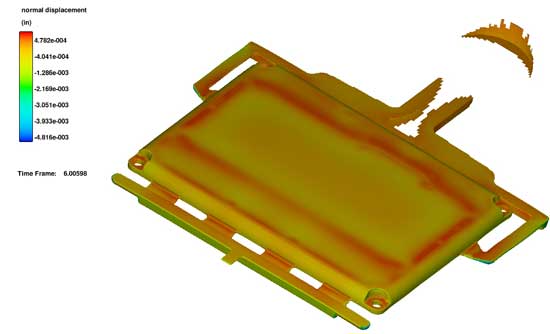
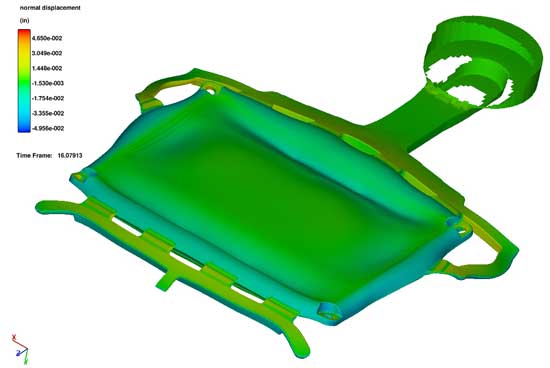
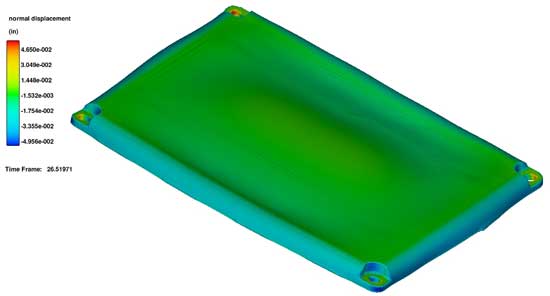
아래 그림은 강철 다이 내에 알루미늄 A380 합금 주물로 구성된 알루미늄 커버입니다. 주입 온도는 654 ℃이고 초기 다이 온도는 240 ℃이다. 부품은 6 초 동안 다이 내에서 냉각되어 부품이 완전히 고화되었다 (러너 시스템 제외). 그런 다음 다이를 열고 부품을 주변 조건 (25 ° C)에서 10 초 더 냉각시켰다. 러너 시스템을 제거한 후 주위 조건에서 10 초간 더 냉각시켰다. 여기에 표시된 일반 변위는 가장 큰 변형 영역을 강조하기 위해 30 번 확대 된 부품 표면의 동작을 나타냅니다.

Component Coupling within the Fluid-Structure Interaction and Thermal Stress Evolution Models

FLOW-3D v11의 새로운 기능은 인접한 유체 구조 상호 작용 (FSI) 구성 요소 및 / 또는 열 응력 진화 (TSE) 응고 유체 영역 사이의 탄성 응력을 허용하는 기존의 유한 요소 역학 해석법으로의 업그레이드입니다. 결합. 이 새로운 기능은 복잡하고 변형이 심한 다중 재료 부품 (예 : 몰드에서 금속 주 조용 응고 또는 바이메탈 게이지)의 열 응력과 변형을 시뮬레이션하고 연결된 유압에서 힘을 시뮬레이션하는 것을 포함하여 풍부한 모델링 가능성을 열어줍니다. 레이디 얼 게이트 및 파이프 라인 지원 시스템과 같은

모델에는 복잡한 프로세스를 효율적으로 계산할 수있는 몇 가지 옵션이 있습니다.

No coupling

이 옵션은 인접한 FSI 구성 요소가 스트레스를 교환하지 않는 단순화 된 사례를 나타냅니다. 이것은 계산 상 효율적이며 구성 요소 간의 응력 상호 작용이 중요하지 않은 시나리오에 적합합니다.

Full coupling

전체 커플 링 옵션은 함께 융합되었지만 재료 특성이 다른 이웃 FSI 구성 요소를 모델링하기위한 것입니다. 두 구성 요소는 서로 떨어져서 당기거나 서로 밀어 낼 수 없지만 인터페이스의 응력은 구성 요소간에 전송됩니다. 이는 바이메탈 스트립과 같은 접합 구조를 모델링하는 데 이상적입니다.

Partial coupling

부분 커플 링 옵션은 인접한 FSI 구성 요소가 마찰 및 수직력을 통해 상호 작용하지만 분리 될 수있는 일반적인 문제를 모델링하기위한 것입니다. 이 옵션은 FSI 구성 요소와 TSE 응고 유체 영역을 결합하는 데 사용할 수 있으므로 다이에서 냉각되는 부품과 주조 부품에 대한 열 응력의 영향을 조사하는 데 이상적입니다.

모델의 새로운 기능을보다 자세히 보여주기 위해 두 가지 시뮬레이션이 제공됩니다. 첫 번째 상황은 전체 커플 링 옵션을 사용하여 시간에 따라 변화하는 온도에 따라 바이메탈 스트립 벤딩을 모델링하는 반면 두 번째 예는 다이 커플 링에서 V6 엔진 블록의 응고 중 열 응력을 보는 부분 커플 링 모델의 사용을 보여줍니다 .

Full Coupling Example: Bimetallic Strip

전체 커플 링 옵션의 가장 단순한 예 중 하나는 온도 구배에 따른 바이메탈 스트립의 움직임입니다. 이러한 스트립은 두 개의 금속이 온도 변화에 반응하여 동일한 속도로 팽창하지 않기 때문에 열 스위치 및 굴곡에서 일반적으로 사용됩니다. 시뮬레이션에서 모델링 된 바이메탈 스트립은 그림 1에서와 같이 동일 치수의 구리 스트립에 접합 된 길이 15cm, 두께 0.5cm의 강철 스트립으로 구성된 캔틸레버 빔입니다.

Schematic of bimetallic strip

그림 1 : 예제 시뮬레이션에 사용 된 바이메탈 스트립의 개략도. 검은 색 화살표는 처짐이 탐지 된 곳을 나타냅니다. 긍정적 인 처짐은 상향이다.
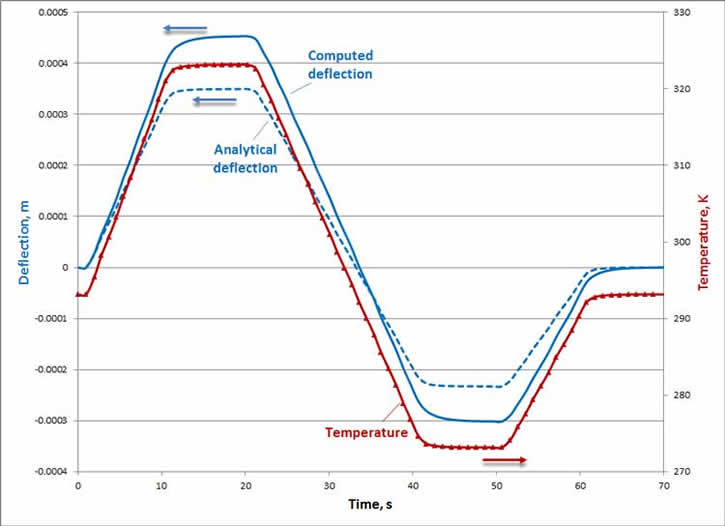
이어서, 스트립을 온도가 70 초 이상 균일하게 변화하는 환경에 두었다. 그림 2는 시뮬레이션을위한 스트립 팁의 편향과 시간 경과에 따른 다양한 온도에서의 분석 솔루션을 보여줍니다. 결과는 온도가 변했을 때와 스트립의 열 관성으로 인한 스트립의 응답 사이의 약간의 지연을 포함하여 몇 가지 흥미로운 특징을 보여줍니다. 이 지연은 해석 솔루션이 온도의 순간 변화를 가정하기 때문에 계산 된 해석 편차와 해석 편향 사이의 타이밍 차이에 영향을 미칩니다. 변위의 진폭 차이는 분석 결과에서 무한히 얇은 스트립의 가정에 기인 할 수 있습니다. 계산 모델의 두께는 장착 지점에서 추가 응력을 추가하여 처짐이 증가합니다.

Bimetallic deflection plot FLOW-3D

그림 2 : 시뮬레이션 시간 동안 스트립의 끝에서의 처짐. 플롯에는 해석 적 (밝은 파란색) 및 계산 된 (빨간색) 편향과 스트립의 평균 온도 (진한 파란색)가 표시됩니다.

Partial Coupling Example: Metal Casting within a Deformable Die

Temperature profile of a v6 engine block

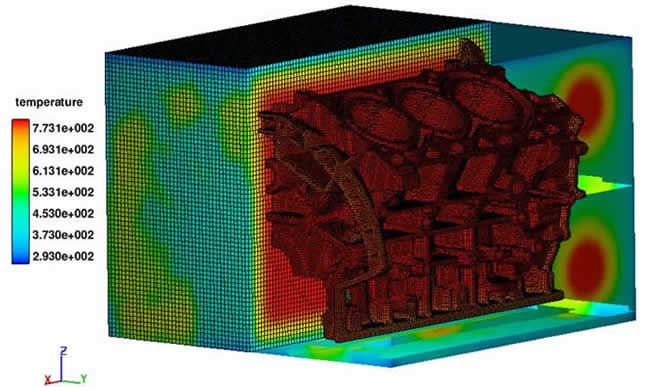
그림 3 : V6 엔진 블록의 온도 프로파일 단면도. 시뮬레이션 시작 7 초.

두 번째 예제 시뮬레이션은 부분 결합 모델을 사용하여 변형 가능한 스틸 다이 내의 금속 주조물에 응력이 발생하는 것을 보여줍니다. 다이의 두 반쪽과 응고 된 유체는 서로 부분적으로 결합되어있어 정상 응력과 마찰을 통해 상호 작용합니다. 이 시뮬레이션은 금형과 주조 부품의 열 응력 변화가 770K의 고 상선 온도 바로 아래에서 293K의 주변 온도까지 냉각되는 것을 보여줍니다. 주조 부품은 A380 알루미늄 합금으로 이루어져 있으며 금형 반은 H-13 강으로 구성됩니다.

캐스트 부품과 주변 다이의 유한 요소 메쉬는 그림 3과 같이 3,665,533 개의 요소와 3,862,378 개의 노드로 구성됩니다. 또한 다이 반쪽과 TSE 응고 된 유체 영역 각각에 대해 서로 다른 메쉬가 표시됩니다. 앞면에있는 빨간색 원은지지 피스톤 (그림에서는 보이지 않음)으로 인한 것입니다.


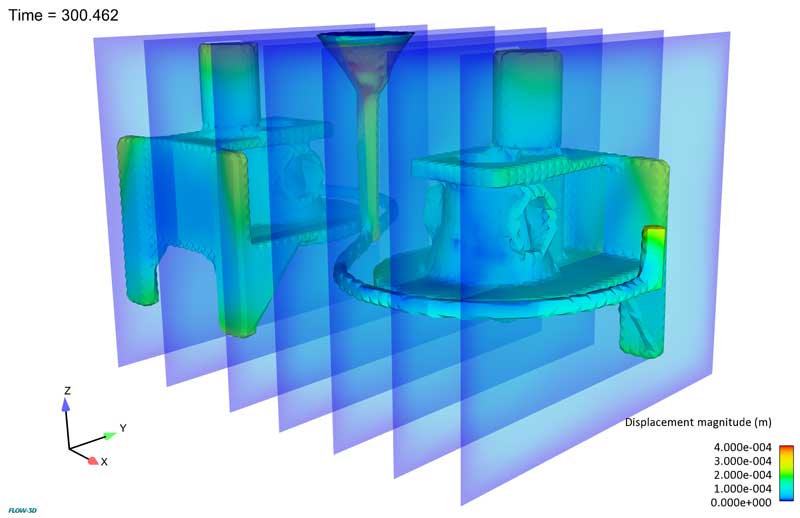
그림 4는 충진 후 고압 다이 캐스팅 부품 300s의 주조물 온도와 변위 크기로 채색 된 강철 다이 조각을 결합한 이미지를 보여줍니다. 이 시뮬레이션에서, 다이는 응고 알루미늄에 결합되어 응력이 그들 사이에 전달됩니다. 변위 크기는 다이의 에지에서 0에서부터 주조에 인접한 0.1mm 이상까지 다양합니다.

몰드와 응고 된 유체 표면 사이의 계면에서의 응력은 부분적으로 결합되고, 구속 된 수축이 보일 수있다. 그림 4는 시뮬레이션을 통해 주조 부품과 다이 반제품의 절반에 발생하는 변형을 보여줍니다. 다이 반쪽과 주물은 온도가 감소함에 따라 다른 속도로 줄어들므로 간섭 영역에 큰 응력이 발생하고 잠재적 문제 영역이 있음을 나타냅니다. 금형과 부품의 결합 응력을 계산하면 각 부품 내에서 발생하는 응력을 더 잘 예측하고 부품 품질을 개선하고 공구 수명을 연장하는 방법에 대한 통찰력을 얻을 수 있습니다.

Conclusion

서로 다른 솔리드 오브젝트의 상호 작용은 현대의 설계 및 엔지니어링에서 중요한 부분입니다. FLOW-3D에 대한 FSI 구성 요소와 TSE 응고 유체 영역 간의 새로운 커플 링 옵션을 추가하면 오늘날의 엔지니어가 정기적으로 겪게되는 복잡한 형상을 평가할 수있는 유용한 도구를 제공합니다.

FLOW-3D CAST 사양

FLOW-3D CAST Feature


Active Simulation Control

실행중인 해석의 제어 파라미터는 History probes에서 사용자가 정의한 조건에 따라, 런타임 동안에 자동으로 변경 될 수 있습니다. History probes에 의해 기록된 시뮬레이션 변수는 경계 조건, mass source 및 General Moving Object 기능을 이용하여, 시간에 따른 개체의 동작을 제어하기 위해 사용될 수있습니다. 예를 들어, 고압다이캐스팅 해석에서 게이트에 설정한 History probes에 유체가 도달하면, 그 정보를 캡처하는 데이터 출력 주파수를 증가시켜 플런저의 속도를 고속으로 자동 전환 될 수있습니다. 고압다이캐스팅 해석은 유체가 게이트에 도달 할 때 자동으로 고속 전환됩니다. 이 프로세스는 새로운 실행 시뮬레이션 제어 기능을 통해 자동으로 진행됩니다. 저속 구간에서 플런저의 움직임은 trigger 슬리브의 용융물에 혼입되는 공기의 양을 최소화하기 위해 Barkhudarov 방법 1을 사용하여 계산됩니다. 이 결과는 훨씬 더 높은 품질의 주조품이 나올수 있도록 설계하는데 도움이 될 수 있습니다. Read the development note > Read the blog post >

Batch Postprocessing & Report Generation

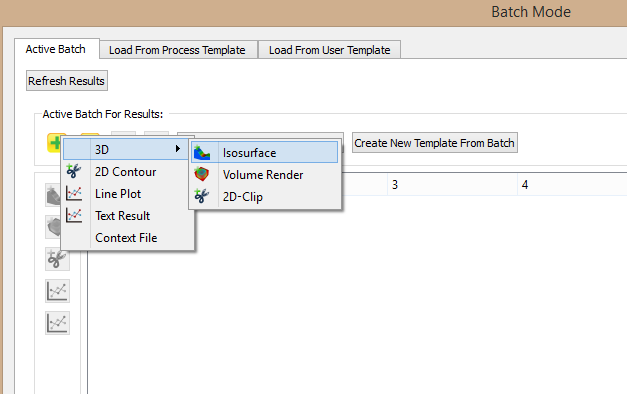
Batch 후처리 및 보고서 생성은 해석 결과 분석시 사용자의 해석 처리 시간을 절약하기 위해 개발되었습니다. Batch 후처리는, 해석이 완료된 후, 사용자가 애니메이션, 시나리오, 그래프, 텍스트 데이터 시리즈를 정의하여 자동으로 생성되도록 할 수 있습니다. 그래픽 요청은 백그라운드에서 FlowSight를 실행하여 처리되도록 FLOW-3D Cast에 정의되어 있습니다. 원하는 해석 결과를 생성할 수 있는 컨텍스트 파일을 사용하면 Batch 후처리 기능을 사용할 수 있습니다. Batch 후처리가 완료되면, 사용자는 쉽게 자신의 관리자, 동료, 또는 클라이언트에 보낼 수있는 HTML5 형식의 완벽한 기능을 갖춘 보고서를 만들 수 있습니다. 이미지 및 동영상도 보고서에 포함 할 수 있고, 사용자는 텍스트, 캡션, 참고 문헌의 형식을 완벽하게 제어 하고 유지할 수 있습니다. Read the blog post >

Metal Casting Models

Squeeze Pin Model

스퀴즈 핀은 주조시 주입 공급이 어려운 영역에서, 응고하는 동안 금속 수축을 보상하기 위해 사용되는 실제의 다이 캐스팅 머신의 동작을 모델링하는 해석을 할 수 있습니다. 스퀴즈 핀은 선택된 표면에 cylinderical squeeze pin을 추가하여, STL 파일 또는 대화식으로 생성 될 수 있습니다. Read the development note >

Intensification Pressure Model

새로운 플런저 타입 형상이 추가 되었습니다. 강화된 압력 조건으로 macro-shrinkage 와 micro-porosity 제거를 지정할 수 있습니다.

Thermal Die Cycling model

FLOW-3D Cast v4.1's full process thermal die cycling model

다이싸이클링 (Thermal die cycling, TDC) 모델에 새로운 두 가지의 단계가 추가되었습니다. 금형이 열린 상태에서 제품이 여전히 금형 내부에 있는 ejection 단계와, 금형이 닫혔지만 사출 바로전의 preparation 단계가 추가되었습니다. 또한, 마지막 싸이클만이 아닌 모든 금형 싸이클 모두 수렴된 결과를 전달하기 위해 TDC 솔버가 성능 손실 없이 최적화 되었습니다. Read the blog post >

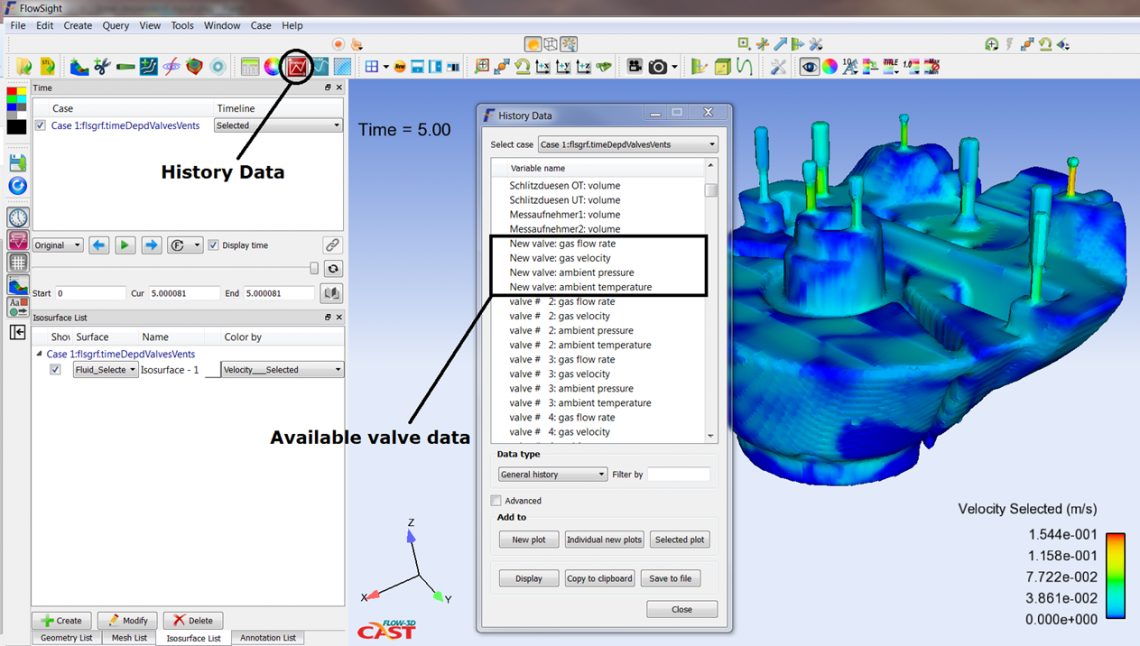
Valves and Vents

Modeling valves and vents in FLOW-3D Cast v4.1

밸브와 밴트의 외부 압력과 온도는 이제 사용자가 다이 캐스팅 공정에서 충진중에 보다 실제적인 동작을 정의 할 수 있도록, 시간의 표 함수로서 정의 할 수있습니다. 밸브 및 벤트의 압력 및 온도는 프로세스 설계 단계에서 유용한 제품 내부에 설정된 프로브에 의해 제어 될 수 있습니다.

PQ2 Diagram

PQ2다이어그램의 사용은 사용자가 더 나은 슬리브의 플런저 실제 움직임과 유사하게 적용 할 수 있습니다. 새로운 기능은 실제 공정 변수가 아직 알려져 있지 않았을 때 다이캐스팅 설계 단계 중에 특히 유용합니다. Read the blog post >

Cooling Channels

냉각 채널은 금형 각각의 냉각 유로에 의해 제거되거나 추가된 열의 총량에 의해 제어 될 수 있습니다. Read the development note >

Air Entrainment Model

Air entrainment 모델에 compressibility를 입력하는 새로운 옵션이 추가되었습니다. 고압 다이캐스팅의 충진 공정과 같은 경우, 공기 압축성은 유체 압력의 변화로 인한 유체의 흐름에 중요한 인자가 됩니다.
 

Cavitation Model

캐비테이션 모델은 유동 조건의 더 넓은 범위에 걸쳐 유체의 캐비테이션 거동을 나타내도록 개선되었습니다. 캐비테이션 생성에 대한 새로운 옵션은 경험적 관계를 기반으로, 기존의 일정한 속도로 생성되는 방식에서 보완되었습니다. 새로운 passive gas model 옵션은 open bubbles이 아닌 유체내에 cavitationg gas를 추적하여, 계산에 필요한 격자와 계산시간을 줄일 수 있습니다. Read the development note >

Two-fluid Phase Change Model

Two-fluid phase change model 은 과냉각을 포함하도록 확장되었습니다. 일정한 과냉각 온도를 정의하고 가스 온도가 응축이 일어나기 전에 포화점 이하로 내려갈 수 있게 함으로써 구현됩니다.

Simulation Results and Analysis

Simulation Results File Editor

사용자가 FLOW-3D Cast v4.1 결과 파일들을 병합 및 제거 할 수 있는 편집 유틸리티

Linking flsgrf.* files

Restart 해석 결과 파일들(flsgrf.*)은 FlowSight 에서 하나의 연속적인 애니메이션 결과를 표시하기 위해 restart source 결과로 링크될 수 있습니다.

Fluid/wall Contact Time

A new spatial quantity has been added to the solution output that stores the time that metal spent in contact with each geometric component, as well as the time spent by each component with metal.

용탕이 각 geometry 컴포넌트를 접촉한 시간과 각 컴포넌트가 용탕과의 접촉 시간을 나타내는 새로운 공간적 양이 해석 아웃풋에 추가 되었습니다.

Performance and Usability

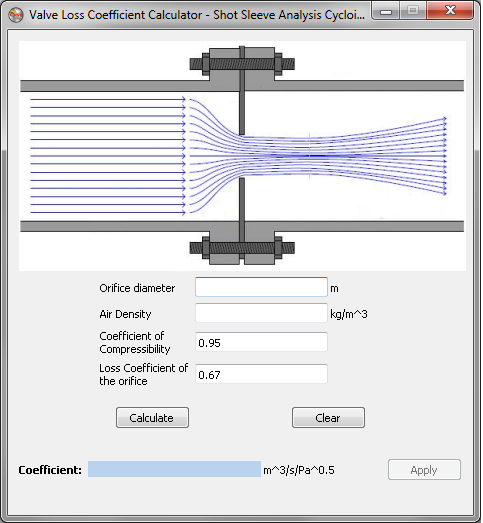
Calculators

열전달 계수, 열 침투 깊이, 밸브 손실 계수, 슬리브에 용탕량(깊이), 플런저의 속도를 계산할 수 있는 Calculators 기능이 Model Setup 창에서 바로 가능해졌습니다. 또한 유틸리티 메뉴에서도 가능합니다.

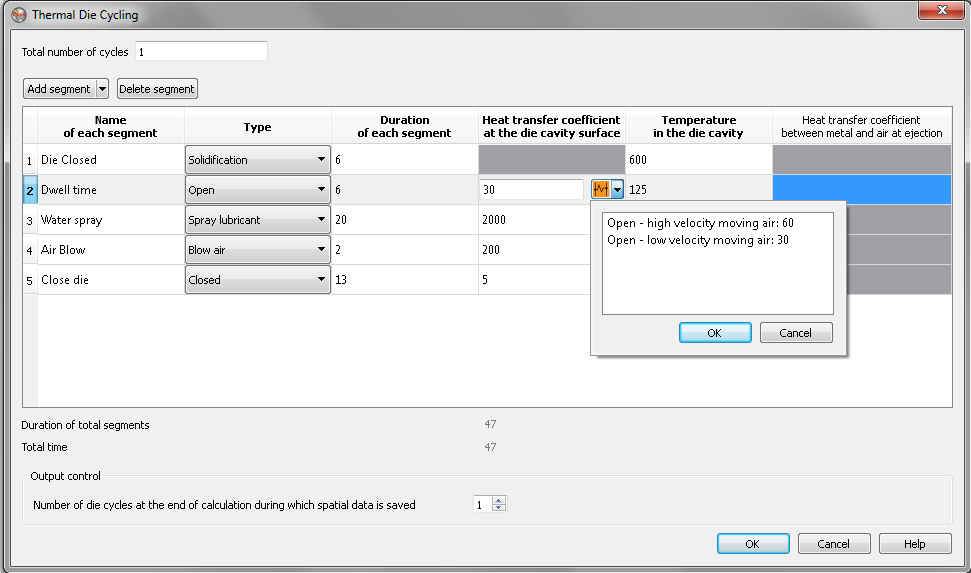
Thermal Die Cycling

Heat transfer database in FLOW-3D Cast v4.1

열전달 계수 데이터베이스와 각 싸이클 단계들이 입력되어있어 간편하게 다이싸이클링 해석을 하실 수 있습니다.

GMRES Pressure Solver

GMRES pressure solver의 속도가 솔버 데이터 구조의 최적화로 인해 2배까지 향상되었습니다. 이로 인해 메모리 사용량이 20% 미만으로 증가할 수 있습니다. Read the blog post >

Sampling Volumes

Sampling volume 기능은 STL로 정의할 수 있습니다. 각 sampling volume에 의해 계산된 양들의 목록은 유체의 부피, 최대/최소 온도, 파티클의 갯수와 같은 전체 해석 영역에 대해 모두 같은 양이 되도록 확장되었습니다.


FSI/TSE Model

구조분석 모델의 성능이 부분적인 coupling으로 해석 솔버의 병렬화와 최적화를 통해 향상되었습니다.

Workspaces

Workspaces 를 이전에 설치된 FLOW-3D에서 가져올 수 있습니다. Workspaces 와 사용자가 선택한 시뮬레이션들을 복사할 수 있습니다.

Expanded Simulation Pre-check

Simulation pre-check 기능은 preprocessor checks를 포함하고, 문제가 발생하는 경우 링크됩니다.

Improved Transparency

Depth-peeling 옵션은 transparent geometries 를 좀 더 잘 표현하고, v4.0보다 10배 빨라졌습니다.

Interactive Tools

Baffles, history probes, void/fluid pointers, valves, mass-momentum sources, squeeze pins에 대한 새로운 대화형 생성 기능이 추가되었습니다. 또한 probing과 clipping 도구들이 대화형으로 개선되었습니다.

General Enable/Disable

모든 objects (e.g., mesh blocks)은 활성화/비활성화 할 수 있습니다.

Estimated Remaining Simulation Time

솔버 메세지 파일에 short-print로 추정된 잔여 해석 시간이 추가 되었습니다.

Tabular Data

테이블 형식의 데이터에서 선택된 데이터를 마우스 오른쪽 버튼을 클릭하여 csv파일 또는 외부 파일에 복사, 저장할 수 있습니다.

1 23-10 Michael R. Barkhudarov, Minimizing Air Entrainment, The Canadian Die Caster, June 2010

[FLOW-3D 물리모델] Solidification 응고

응고 모델은 열전달이 활성화되고(Physics Heat Transfer Fluid internal energy advection) 유체비열(Fluids Fluid 1 Thermal Properties Specific heat)과 전도도(Fluids Fluid 1 Thermal Properties Thermal Conductivity) 이 지정될 때 사용될 수 있다. 단지 유체 1만 상 변화를 겪을 수 있다.

Solidification - Activate solidification

응고모델을 활성화하기 위해 Fluids Fluid 1 Solidification Model 을 체크하고 물성 Fluids Fluid 1 Solidification Model 가지에서 Liquidus temperature, Solidus temperature, 그리고 Latent heat of fusion 를 지정한다. 가장 간단한 모델(Latent Heat Release Definition 에 펼쳐지는 메뉴에서 Linearly with constant 를 선택)에서, 잠열은 물체가 Liquidus 에서 Solidus 온도로 냉각될 때 선형적으로 방출된다. 고상에서의 상변화열을 포함하는, 잠열 방출의 더 자세한 모델을 위해 온도의 함수로 잠열방출을 정의하기 위해 Specific energy vs. temperature 또는 Solid fraction vs. temperature 선택을 사용한다. 이 지정에 대한 더 자세한 내용은 이론 매뉴얼의 Heat of Transformation 를 참조한다.

solidification-fluid-properties

응고는 유체의 강직성 및 유동저항을 뜻한다. 이 강직성은 두 가지로 모델링 된다. 낮은 고상율에 대해 즉 Fluids Fluid 1 Solidification Model Solidified Fluid 1 Properties Coherent Solid Fraction 의 coherency 점 밑에서는 점도는 고상율의 함수이다. 간섭 고상율보다 큰 고상율에 대해서는 고상율의 함수에 비례하는 항력계수를 갖는 Darcy 형태의 항력이 이용된다. 이 항력은 모멘텀 방정식에 (bx,by,bz) 로써 추가된다- Momentum Equations 를 보라. 이 항력의 계산은 Solidification Drag Model 에서 기술된다. 항력계수는 사용자가 유동저항에 양을 조절할 수 있는 Coefficient of Solidification Drag 인자를 포함한다. 항력계수는 FLOW-3D 출력에서 기록된 속도에 상응하는 지역 상 평균 속도에 의해 곱해진다.

Fluid 1 Properties)을 지나면 항력은 무한대가 되고 계산격자 관련하여 유동이 있을 수 없다(단 예외로 Moving Solid Phase를 참조).

Note

모든 유체가 완전히 응고하면 모사를 정지시키기 위해 General Finish condition Solidified fluid fraction 를 이용한다. General Finish condition Finish fraction 은 모사를 중지하기 위한 고상율 값을 정한다.

Drag in the Mushy Zone, Mushy영역 내 항력

주조 시 mushy zone 은 액상과 고상이 혼합물로 존재하는 지역이다. 이 지역 혼합점도는 동축의 수지상 조직(과냉각된 액체 안에서 방사상으로 자라는 결정으로 된 구조) 이 액체 안에서 자유롭게 부유할 때 영향을 미친다.

일단 수지상 조직의 간섭성이 발생하여 고정된 고상 망이 형성되면 액상이 고정된 다공 수지상 구조를 통과해야 하므로 추가의 유동손실이 발생한다. 다른 방법으로는 간섭점을 지난 액/고상 혼합물은 다공물질을 통한 유동 대신에 고점도의 유체로 간주될 수 있다. 점성유체로 간주하는 접근은 예를 들면 연속 이중 롤 주조 과정같이 고상이 계속 이동 및 변형할 때 유용하다.

Solidification Drag Models in FLOW-3D, FLOW-3D 내 응고 항력모델

응고에 의한 항력계수를 정의하기 위해 사용자는 우선 열전달 및 응고모델을 활성화 해야 한다. 이들은 Model Setup Physics 탭 에서 활성화될 수 있다. 수축모델 또한 응고모델 창에서 활성화될 수 있다.

Solidification model

일단 Solidification 모델이 활성화되면 항력의 공식이 지정될 필요가 있다. Solidification대화의 밑 좌측 모퉁이에서 Porous media drag-based Viscosity-based 의 항력공식 중의 선택을 한다.

    • Viscosity-based 공식은 점성 유체로 취급하며 Viscosity 영역 내Flow model for solidified metal 입력 밑에서 지정되는 순수 고상 점성을 갖는 고상화된 유체로 간주된다. 이 접근법은 경직성의 항력모델(즉, 응고 금속이 롤러 사이로 압착될 때)을 사용할 수 없는 경우의 모사에 이용된다. 이 점성은 고상율에 따라 선형으로 변한다.고상율이0일 때 점도는 유체1의 점도이다.고상율이1이면 점도는 Solidification 패널에서 지정된 값과 같다.
    • Porous media drag-based 공식은 응고상태를 결정하기 위해 고상율을 사용한다. 고상율이 Critical Solid Fraction 이거나 초과하면 이때 항력은 무한대가 된다-즉, 액상/고상 혼합물은 고체같이 거동한다. 고상율이 Coherent Solid Fraction 보다 작으면 항력은 0이다. 이 두 값 사이에서 유동은 mushy 지역에 있고 이를 통한 유동은 마치 다공질 내에서의 유동같이 처리된다. 또한 모델은 고상율이 Coherent Solid Fraction 보다 작을 때 자동적으로 용융 금속의 점도를 조절한다. 이 상태에서 고상결정은 점도를 올리지만 결합하지는 않는다(즉, 간섭 없음). 일단 유체가 Coherent Solid Fraction 에 도달하면 항력방정식이 고려되고 점도는 간섭성에 도달하기 전의 값으로 일정하게 된다. 임계 및 간섭 고상율은 사용자가 정의하며 논문이나 책 등에서 찾을 수 있다. 이 식에서는 Coefficient of Solidification Drag 가 정의되어야 한다. 이는 Solidification 창 또는 Fluid 1 Solidification ModelSolidified Fluid 1 Properties tree Other 트리를열어 Model Setup Fluids 탭에서 될 수 있다.

How to Calculate Permeability 투과성 계산법

밑에 주어진 Darcy법칙은 수지상 구조를 위한 다공매질내의 수학적 유동기술이다.[Poi87].

(19)\mathbf{u} = - \frac{K}{\mu} \nabla P

여기서 u 는 수지상 구조 내 유동의 속도이고 ∇P 는 지역 압력구배, 그리고 K 는 mushy 구역의 특정 투수성이다. 이 방정식은 단지 유동이 거의 정상 상태이고, 관성효과가 없으며 유체의 체적율이 일정하고 균일하며 액체-액체의 상호작용 힘이 없을 때 유효하다. 투수성을 정의하는데 이용될 수 있는 대 여섯 개의 모델이 있으나 FLOW-3D 는 밑에 보여주는 Blake-Kozeny 을 이용한다. 다른 모델들은 코드와 함께 제공되는 소스코드를 사용자 사양에 맞게 수정하여 추가할 수 있다.

(20)\mathbf{u} = -C_2 \left( \frac{\lambda_1^2 (1-f_s)^3}{\mu f_s^2} \right) \left( \nabla P - \rho \mathbf{g} \right)

여기서

C2 는 전형적으로 와 같은 비틀림

fs 는 고상율이고

λ1는 유동을 위한 특정 치수

이 응용에서 수지상 가지 간격(DAS)이 이용된다.

  • 식 (11.19) 을 식(11.20) 에 적용하면 투수성을 위한 다음 식을 얻는다.

(21)K = \lambda_1^2 \frac{(1-f_s)^3}{180f_s^2}

수지상 가지 간격(DAS)에 대한 일반적인 값들은 밑에 주어져 있다.

Range of Cooling Rates in Solidification Processes
COOLING RATE, K/sPRODUCTION PROCESSESDENDRITE ARM SPACING, \mu m
10^{-4} to 10^{-2}large castings5000 to 200
10^{-2} to 10^3small castings, continuous castings, die castings, strip castings, coarse powder atomization200 to 5
10^3 to 10^9fine powder atomization, melt spinning, spray deposition, electron beam or laser surface melting5 to 0.05

Range of cooling rates in solidification processes [CF85]

How FLOW-3D Defines the Coefficient of Solidification Drag FLOW-3D 가 응고 항력계수를 결정하는법

FLOW-3D 는 액고상 변화를 모델링하기 위해 다공매질항력을 이용한다. 항력은 고상율의 함수이다. 사용자에게 두 수축모델이 이용 가능하다; 급속 수축 모델 과 완전 유동모델. 급속 수축 모델은 상변화와 연관된 체적변화를 고려하지 않으며 유체는 정지해 있다고 가정한다. 완전 유동모델은 상변화가 관련된 체적변화를 고려한다. 항력은 투수성에 역으로 비례하므로 다음과 같이 표현될 수 있다.

(22)K = \frac{\mu}{\rho F_d}

여기서, Fd FLOW-3D 에서 사용된 항력계수이다. 이 항력계수는 지역 속도에 의해 곱해지고 모멘텀 방정식의 오른쪽에서 차감된다 (Momentum Equations 참조). 식 (11.22) 를 재정리하고 식 (11.21) 로부터의 투수성에 치환하면 다음을 얻는다.

  • The Coefficient of Solidification Drag: \text{TSDRG}=\frac{180 \mu}{\lambda_1^2\rho },
  • The drag force: F_d = \mbox{TSDRG} \frac{ f_s^2}{(1-f_s)^3}.

Macro-Segregation during Alloy Solidification 합금응고시 거시적 편절

편절 모델은 대류와 확산에 의한 용질 이동에 따른 이원합금 요소에서의 변화를 모델링 하도록 되어 있다. 이 모델링은 Physics → Solidification 로 부터 될 수 있다.

Solidification

Activate binary alloy segregation model 을 체크하고 편절 모델을 활성화한다.

여러 온도에서 평형에 있는2원합금 요소농도를 정의하는 상태도는 직선의 고상선 및 액상선을 가진다고 가정된다. 상태도는 입력데이터에 의해 구성되고 전처리 그림파일 prpplt 에 포함된다. Analyze Existing 에서 이용 가능하다

Macro-Segregation Model (under Fluids Fluid 1 Solidification Model)에 관련된 일부 유체물성 트리가 밑에 보여진다. 상태도는 Reference Solute Concentration 에서의 the Solidus Liquidus Temperatures 값들에 의해 정의된다. 추가로 Concentration Variables 밑의 Partition coefficient 도 정의되어야 한다. 그렇지 않으면 Pure Solvent Melting Temperature 가 정의될 수 있다. Partition coefficient Pure Solvent Melting Temperature 둘 다가 지정되면 용매 용융 온도는 상태도로부터 재 정의된다.

Macro segregation fluid properties

Eutectic Temperature 또는 Eutectic Concentration 는 융해작용을 정의하기 위해 지정될 수 있다. 또 이 두 변수가 다 지정되면 Eutectic Concentration 은 상태도에서 재 정의된다.

Diffusion Coefficients 는 고상과 액상 사이의 용질의 확산계수 비율을 정의한다. 액체 내의 용질의 분자 확산계수는 Physics Solidification 에서 specifying Solute diffusion coefficient 를 지정함으로써 정해진다. RMSEG 는 용질의 난류 확산계수 승수를 정의한다; 이는 입력파일에서 직접 지정된다.

Density evaluation

용질 재 분배에 의한 농도변화가 중요하면 Physics Density evaluation Density evaluated as a function of other quantities를 정하고 용질농도의 선형함수로써 금속농도를 정의하기 위해 Fluids Segregation model 밑의 Solutal Expansion Coefficient 를 용질 확장계수로 지정한다. 이 경우 Reference Solute Concentration 이 기준농도로 사용될 것이다. 추가로 Fluids Fluid 1 Density Properties Volumetric Thermal Expansion 은 액체 내 열부력 효과를 참작하기 위해 지정될 수 있다(또한 Buoyant Flow참조).

초기 용질농도는 Meshing & Geometry Initial Global Uniform alloy solute concentration 에서 지정될 수 있다. 불 균일한 초기 분포는 Alloy solute concentration 밑의 초기유체 구역 안에서 정의될 수 있다. 추가로 농도는 Initial Conditions: Region Values 에서 기술된 바와 같이 2차함수를 사용하는 부분을 편집하여 공간상의2차함수로 변화할 수 있다. 압력과속도 경계에서 용질 경계조건을 정하기 위해 Boundaries Boundary face Solute concentration 를 이용한다.

액상 및 고상 구성은 후처리에서 데이터 변환을 이용하여 그려질 수 있다. 용융 응고금속은 금속 내 용융의 질량 분율을 저장하는 SLDEUT 를 그림으로써 가시화될 수 있다.

액상 내 열구배가 크면 Physics Heat Transfer Second order monotonicity preserving 를 지정함으로써 더 나은 정확성을 위해 고차원 이류법을 사용한다.

Heat Transfer

mushy 지역에서의 유동손실은 수지상 가지 간격(DAS)의 함수인 Fluids Fluid 1 Solidification Model Solidified Fluid 1 Properties Coefficient of Solidification Drag 에 의해 조절된다. 후자는 이 모델에 의해 계산되지 않으므로 사용자는 Coefficient of Solidification Drag 를 지정해야 한다

Note

  • 표준 응고모델 과는 달리 상태도상의 용융점을 지나 고상선을 외삽하여 정의되므로 여기서 응고선의 값은 음수일 수 있다.

Microporosity Formation 미세다공형성

Solidification

미세다공모델은 단지 응고(Solidification참조)를 모델링할 때 사용될 수 있고 Physics Solidification Activate micro-porosity model 에서 활성화된다. 필요한 입력은 Fluids Densities Fluid 1 and Fluids Solidification Properties Solidified Fluid 1 Properties Density 에서 정의되는 액체와 고상 유체밀도이며 고상유체밀도는 액체밀도보다 크다. 또한 Fluids Fluid 1 Solidification Model Solidified Fluid 1 Properties 안에 있는 Critical Solid Fraction 은 1.0보다작게 설정되어야 한다.

Square of the speed of sound at critical solid fraction 값이 정의될 수 있다. 이는 수축에 의해 mushy 지역에서 전개되는 커다란 음압에서의 응고유체의 압축성을 기술한다. Critical pressure at which gas pores can form 값은 모델이 Initial tab 탭에서 또는 재 시작 데이터에서 정의되는 유체내의 초기 압력과 결합되도록 한다.

Intensification pressure 또한 다공 생성을 지연시키기 위해 응고 시 shot sleeve plunger 에 의해 형성되는 추가압력을 고려하기 위한 고압 주조모사를 위해 정의될 수 있다. Intensification pressure 가 클수록 더 적은 양의 다공이 주조 시 응고 과정에서 발생할 것이다.

미세 다공 모델은 응고 모델의 활성화 이외의 어떤 다른 설정을 필요로 하지 않는다. 이는 완전 유동방정식이나 속도장이 0인 경우, 즉 순수한 열 문제에서도 함께 사용될 수 있다.

이 모델은 후처리 과정의 공간 및 이력에서 사용 가능한 Percent micro-porosity 라고 불리는 추가 출력 양을 생성한다.

Note

A Flow Science technical note on modeling micro-porosity (TN66) can be found at http://users.flow3d.com/technical-notes/.

Moving Solid Phase  이동고상

MAIN VARIABLES:OBS:IFOB, UTOBS, VTOBS, WTOBS

이동고상 선택은 연속주조 모델링을 가능하게 한다. Continuous Casting Phantom 요소는 응고된 이동 유체가 있는 지역에서 정의된다. 이는 지정된 영역을 차지하지만 정의에만 존재하므로 환영요소라고 한다. 이는 실제로 면적이나 체적을 차지하지 않으므로 체적이 없고 결과에서도 고체요소로 보이지 않는다. 이는 Meshing & Geometry Geometry Component Component Type 옆 펼쳐지는 메뉴에서 정의된다.

Moving solid phase selection

다른 방법으로는 입력파일(prepin.*)에서 IFOB(N) 변수가 4로 지정되고 N 은 요소 번호이다. 이 파일은 File Edit Simulation…. 을 선택하여 이용될 수 있다. 또한 입력파일에서 시간의 함수(TOBS(t) 에 의해 지정되는)일 수 있는 가상 요소의 속도성분 UTOBS(t,N), VTOBS(t,N) 그리고 WTOBS(t,N) 이 지정된다.

Fluids Fluid 1 Solidification Properties Solidified Fluid 1 Properties Coherent Solid Fraction 에 의해 정의된 간섭 고상율 보다 큰 고상율에 대해서는 Darcy 형태의 항력 이 유체를 가상 요소의 속도로 움직이게 하는데 사용된다. 고상율이 Fluids Fluid 1 Solidification Properties Solidified Fluid 1 Properties Critical Solid Fraction 에서 지정된 경직점을 능가하게 되면 가상 요소의 속도를 따라 움직일 것이다.

Note

  • 가상 요소는 요소 그림에 안 나타나나 Component number 를 그릴 때는 보여진다.가상 요소는 균일속도가 요소의 전체에 적용되므로 평평해야 한다.

Solidification Shrinkage 응고수축

체적 수축은 소재가 응고하고 응고소재의 밀도가 액체소재의 밀도보다 클 때 나타난다(즉, Fluids Fluid 1 Solidification Model Solidified Fluid 1 Properties Density > Fluids Fluid 1 Density Properties Density). 수축모델은 그러므로 Solidification 모델이 활성화되어야 하고 고상/액상의 두 밀도가 정의되어야 한다. 수축은 단지 1유체의 뚜렷한 경계면 문제에서만 모델링 될 수 있다.

두 가지 수축모델이 있다. Shrinkage model with flow effects 를 선택하면 완전 열 유체방정식을 해석한다(이론 매뉴얼의Solidification Shrinkage and Porosity Models 참조). 그러나 이 모델은 특히 장시간의 응고가 고려되면 컴퓨터 계산시간이 많이 소요된다. 다른 방법으로 사용자 Interface 에 Shrinkage model 이라고 불리는 단순모델이 있다.

Activate simplified shrinkage model

이 모델은 단지 열전달 방정식의 해석에 의존하며 특히 내재적 열전달 모델 (Numerics Explicit/implicit options Heat transfer Implicit Thermal solution 참조)과 사용시에 빨리 해석할 수 있다. 액체 체적 내로의 유동 통로가 없을 때 내부공동이 발생한다.

이 두 모델에서 유입은 mushy 지역 유동에 대한 항력계수를 계산함으로써 정의된다. 격자 내 모든 점에서의 항력함수는 상수승수 Fluids Solidification properties Other Coefficient of Solidification Drag (Solidification Drag Model 참조)를 가지는 지역 고상율의 함수로 계산된다. 항력함수의 역의 값은 공간 그림에서 가시화 될 수 있다: 이 그림을 위한 변수이름은 ‘drag coefficient’ 이다.

Mushy 지역에서의 커다란 유동 손실에 따른 부분적 유입이 Shrinkage model with flow effects 에서 발생할 수 있지만 단순화된 Shrinkage model 은 완전 유입이 아니면 유입이 없게 된다. 후자는 유입 통로를 따라 지역 고상율이 Fluids Fluid 1 Solidification Model Solidified Fluid 1 Properties Critical Solid Fraction (디폴트는1.0)에서 정의된 임계값보다 커질 때 발생한다. 추가로 고립된 액체 내의 금속의 고상율이 Coherent Solid Fraction 에 도달할 때까지 단순모델에서의 유입은 고립부 상부로부터 발생한다. 그 후로는 유입이 고립부의 가장 뜨거운 부분에서부터 발생한다.

모든 유체가 완전히 응고되면 모사가 정지하도록 General Additional finish condition Solidified fluid fraction 를 사용한다. 변수 Finish fraction 는 유체가 지정된 고상율에 도달할 때 모사가 정지하도록 하는데 사용될 수 있다.

Solid fraction finish condition

Note

이송 방향을 결정하기 위해 단순 수축 모델에서 중력이 필요하며 좌표축 중 하나를 따라야합니다. 둘 이상의 중력 구성 요소가 0이 아닌 경우, 가장 큰 중력 구성 요소가 공급 방향을 결정하는 데 사용됩니다.

열응력 개선 / Thermal Stress Evolution

열응력 개선 / Thermal Stress Evolution

FLOW-3D의 TSE(Thermalstressdiversion)모델은 모델링 가능한 주조 프로세스의 범위를 확장합니다. FSI/SETSE모델은 주변 유체, 열 구배 및 지정된 구속 조건의 압력에 대응하여 솔리드 및 단단한 구성 요소의 응력 및 변형을 모델링 하는 유한 요소 접근 방식을 사용하여 유체와 솔리드 사이의 완전 결합 상호 작용을 설명합니다.

균일하지 않은 냉각에 의해 발생하는 응고 과정 동안 열 스트레스가 발생합니다. 이러한 응력은 주형 벽의 수축 및 주물 형상의 불규칙에 의해 영향을 받습니다.Thermal stress evolution simulation
Von Mises stresses in a solidified aluminum V6 engine block

위의 시뮬레이션은 VonMises가 단단한 알루미늄 V6엔진 블록에서 응력을 나타냅니다. 이 블록은 강철 다이 내에서 주조된 알루미늄 A380합금으로 구성되어 있습니다.

알루미늄의 주입 온도는 527°C였으며 초기 다이 온도는 125°C였습니다. 부품을 60초 동안 다이 내에서 냉각한 후 주변 조건(125°C)에서 9분 동안 부품을 계속 냉각시켜 총 10분의 시뮬레이션 시간을 제공했습니다. 표시된 VonMises 응력은 부품 내 전단 응력의 크기를 측정한 것이며, 따라서 찢어지기 쉬운 부위를 보여 줍니다.

응력은 금형과 응고 금속에서 동시에 계산할 수 있습니다. FLOW-3D의 구조화된 메쉬를 초기 템플릿으로 사용하여 자동으로 메쉬 작업을 수행할 수 있습니다. 사용자는 중첩 또는 링크된 메쉬 블록을 만들고 V1.1.0의 새로운 적합한 메쉬 기능을 사용하여 메쉬의 로컬 해상도를 제어할 수 있습니다. 또는, Exodus-II형식의 타사 메쉬 생성 소프트웨어에서 유한 요소 메쉬를 가져올 수 있습니다.

Simulating Thermal Stress

아래에 표시된 알루미늄 커버는 강철 다이 내 알루미늄 A380합금으로 구성되어 있습니다. 주입 온도는 654°C였으며 초기 다이 온도는 240°C였습니다. 부품이 다이 내에서 6s동안 냉각되었으며 이때 부품이 완전히 경화되었습니다(러너 시스템 제외). 그런 다음 다이를 열고 부품이 주변 조건(25°C)에서 10초 이상 냉각되도록 했습니다. 그런 다음 탕도(runner)시스템을 제거했고, 이후 주변 조건에서 10초간 더 냉각했습니다. 여기에 표시된 정상 변위는 부품 표면의 움직임을 나타내며, 최대 변형 영역을 강조하기 위해 30회 증폭됩니다.

Displacements in a die cast part, die closed
Displacements in a die cast part, die closed.
Displacements in the part and runners, die open
Displacements in the part and runners, die open.
Displacements in the part with runner system removed
Displacements in the part with runner system removed.

Component Coupling within the Fluid-Structure Interaction and Thermal Stress Evolution Models

FLOW-3Dv11의 새로운 기능은 인접한 FSI(유체-구조물 상호 작용)구성 요소 및/또는 TSE(열 스트레스 진화)고체화된 유체 영역 간의 탄성 응력을 결합할 수 있는 기존의 유한 요소 고체 역학 용제의 업그레이드입니다. 이 새로운 기능은 복합 재료 부품(예:주형에서 응고되는 금속 주물 응고제 또는 바이메탈 게이지)의 열 응력과 변형을 시뮬레이션하고 반경 게이트 및 파이프 라인 지지 시스템과 같은 연결된 유압 구조에 가해지는 힘을 시뮬레이션하는 등 다양한 모델링 가능성을 열어 줍니다.

모델에는 복잡한 프로세스를 효율적으로 계산할 수 있는 여러가지 옵션이 있습니다.

No coupling

이 옵션은 인접 FSI구성 요소가 응력을 교환하지 않는 단순화된 경우를 나타냅니다. 그것은 계산적으로 효율적이며 요소들 간의 스트레스 상호 작용이 중요하지 않은 시나리오에 적합하다.

Full coupling

전체 커플링 옵션은 서로 다른 재료 특성을 가진 인접 FSI구성 요소를 모델링 하기 위한 것입니다. 두 구성 요소는 서로 당기거나 미끄러질 수 없지만 인터페이스의 응력은 구성 요소 간에 전달됩니다. 이는 바이메탈과 같이 접합된 구조물을 모델링 하는 데 이상적입니다.

Partial coupling

부분 커플링 옵션은 인접 FSI구성 요소가 마찰력과 정상적인 힘을 통해 상호 작용하지만 분리될 수 있는 일반적인 문제를 모델링 하기 위한 것. 이 옵션은 FSI구성 요소와 TSE의 고체화된 유체 영역을 결합하는 데 사용될 수 있으므로 부품이 다이에서 냉각될 때 주조 부품 및 다이에 대한 열 응력의 영향을 조사하는 데 이상적입니다.

두가지 시뮬레이션이 제시되어 모델의 새로운 특징을 보다 자세히 보여 줍니다. 첫번째 상황에서는 완전한 커플링 옵션을 사용하여 시간이 변화하는 온도에 대응하여 바이메탈 벤딩을 모델링 하는 반면, 두번째 예에서는 다이에서 V6엔진 블록을 응고하는 동안 부분 커플링 모델을 사용하여 열 응력을 확인하는 것을 보여 줍니다.

Full Coupling Example: Bimetallic Strip

전체 커플링 옵션의 가장 간단한 예 중 하나는 온도 구배에 대한 반응으로 바이메탈이 움직이는 것입니다. 이러한 스트립은 온도 변화에 대응하여 두 금속이 동일한 속도로 팽창하지 않기 때문에 열 스위치 및 벤딩에 일반적으로 사용됩니다. 시뮬레이션에서 모델링 된 바이메탈은 그림 1과 같이 길이 15cm, 두께 0.5cm의 강철 스트립으로 구성된 캔틸레버 빔입니다.

Schematic of bimetallic strip
그림 1:예제 시뮬레이션에 사용된 바이메탈의 개략도; 검은 색 화살표는 편향이 프로브 되는 위치를 나타내고, 양의 편향은 상향이다.

그리고 나서 스트립은 온도가 70초에 걸쳐 균일하게 변화하는 환경에 배치되었다. 그림 2는 시간 경과에 따른 다양한 온도에서 시뮬레이션 및 분석 용액을 위한 스트립 팁의 편향을 보여 준다. 결과는 온도가 변한 시기와 스트립의 열적 관성으로 인한 스트립의 반응 사이의 약간의 지연을 포함하여 몇가지 흥미로운 특징을 보여 준다. 이러한 지연은 분석 솔루션이 온도의 즉각적인 변화를 가정하기 때문에 계산된 편향과 분석적 편향 사이의 타이밍 차이에도 영향을 미친다. 변위의 진폭 차이는 분석 결과에서 무한대의 얇은 스트립의 가정에 기인할 수 있다. 계산 모델의 두께는 장착 지점에 응력을 추가하여 편향을 증가시킵니다.

Bimetallic deflection plot FLOW-3D
그림 2:스트립의 끝에서 시뮬레이션 시간에 걸쳐 처짐. 그림에 표시된 것은 스트립의 평균 온도( 진한 파란 색)뿐만 아니라 분석적( 연한 파란 색)및 계산( 빨간 색)편향입니다.

Partial Coupling Example: Metal Casting within a Deformable Die

Temperature profile of a v6 engine block
Figure 3: V6 엔진 블록의 온도 프로파일 단면도. 시뮬레이션 시작 7 초.

두번째 예제 시뮬레이션에서는 부분 커플링 모델을 사용하여 변형 가능한 강철 다이 내 금속 주물의 응력 개발을 보여 줍니다. 다이의 두 절반과 응고된 유체는 부분적으로 서로 결합되어 정상적인 응력과 마찰을 통해 상호 작용합니다. 시뮬레이션은 다이와 주물 부품의 열 응력 변화를 770,000 K의 solidus온도 바로 아래에서 298K의 주변 온도로 냉각하는 모습을 보여 줍니다. 주물 부분은 A380알루미늄 합금으로 구성되어 있고 다이 반쪽은 H-13강철로 구성되어 있습니다.

주조 부품과 주변 다이의 유한 요소 메시는 그림 3과 같이 3,665,533 요소와 3,862,378개 노드로 구성됩니다. 또한 각 다이의 절반에 대해 분리된 메쉬와 TSE고형화된 유체 영역도 나와 있습니다. 전면의 빨간 색 원은 서포트 피스톤 때문입니다(그림과 같이 표시되지 않음).

Thermal stress model
Figure 4 는 채워진 후 고압 다이 캐스팅 부품 300s의 주조물 온도와 변위 크기로 채색 된 강철 다이 조각을 결합한 이미지를 보여줍니다. 이 시뮬레이션에서, 다이는 응고하는 알루미늄에 연결되어 응력이 그들 사이에 전달됩니다. 변위 크기는 다이의 에지에서 0에서부터 주조에 인접한 0.1mm 이상까지 다양합니다.

금형과 응고된 유체 표면 사이의 경계면에서 발생하는 응력이 부분적으로 결합되어 제한된 수축을 확인할 수 있습니다. 그림 4는 시뮬레이션을 통해 주형 부분의 변형과 다이 부분의 절반의 변형을 보여 줍니다. 온도가 감소함에 따라 다이 캐스트와 주물이 서로 다른 속도로 수축하여 간섭 영역에 큰 응력이 발생하고 잠재적인 문제 영역이 나타납니다. 다이와 부품에서 결합된 응력을 계산하면 사용자가 각 구성 요소 내에서 발생하는 응력을 더 잘 예측하고 부품 품질을 개선하고 도구 수명을 연장하는 방법에 대한 통찰력을 제공할 수 있습니다.

Conclusion

다른 단단한 물체들의 상호 작용은 현대 디자인과 공학의 중요한 부분입니다. FSI구성 요소와 TSE고정 유체 영역 간의 새로운 결합 옵션이 FLOW-3D에 추가되어 오늘날의 엔지니어들이 정기적으로 접하는 복잡한 기하학적 구조를 평가하는 데 유용한 도구가 되었습니다.

다이 스프레이 냉각 / Die Spray Cooling

열 다이 사이클링 시뮬레이션에서 다이의 온도 분포를 정확하게 예측하려면 스프레이 냉각의 공간 변화를 모델링해야 합니다. 새로운 다이 스프레이 냉각 모델은 이러한 목적으로 개발되었으며 현재 FLOW-3D의 최신 버전에서 사용할 수 있습니다. 이 모델은 전체 다이 캐비티에 걸쳐 일정한 열 전달 계수를 가정하는 대신 각 스프레이의 냉각을 명시적으로 계산합니다. 다이 표면의 스프레이 영역은 스프레이 노즐의 움직임으로 인해 지속적으로 계산되고 업데이트됩니다. 또한 모델은 분무되는 유체의 차단을 고려하여 살수 각도와 다이 표면의 형태로 인해 냉각에 미치는 영향을 고려한다. 새로운 모델은 안정적이고 현실적인 입력 매개 변수를 사용하여 다이 표면에 정확한 온도 분포를 제공하여 엔지니어가 냉각 프로세스를 보다 효율적으로 설계하고 최적화하여 핫 스팟을 제거할 수 있도록 도와 줍니다.

스프레이 구역 계산 / Spray Area Computation

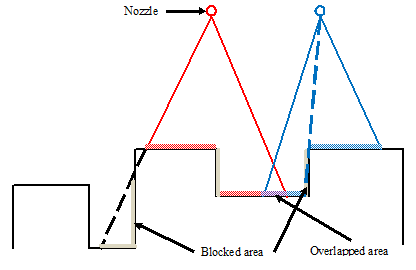
새 모델에서는 다이 표면의 형상과 분무 노즐 위치가 살수 냉각에 미치는 영향을 고려합니다. 아래 그림과 같이 다이 표면에 분사되는 일부 영역은 막히고 일부 영역은 2개 이상의 스프레이로 덮여 있습니다. 이러한 영역은 다양한 스프레이 냉각 효과를 구별하기 위해 광선 추적 알고리즘을 사용하여 계산하고 식별합니다. 스프레이 영역은 FlowSightTM에서 시각화할 수 있으며, 스프레이 냉각을 통해 유닛 영역별로 제거된 총 분사 시간 및 총 열 등의 다른 특성도 확인할 수 있습니다.

Spray area computation

열 전달 계수 결정 / Heat Transfer Coefficient Determination

스프레이 냉각 메커니즘은 복잡하며 스프레이 냉각 열전달 계수 (HTC)는 스프레이 모양, 냉각수 유량, 스프레이 압력, 금형 온도, 스프레이 각도 및 스프레이 거리와 같은 다양한 변수에 따라 달라집니다. 스프레이 냉각 HTC 계산을 단순화하기 위해, 모든 스프레이 표면 요소에 대해 HTC는 기본 요소 HTC에 종속 요소 ( : 원추형 스프레이)를 곱하여 계산됩니다.

스프레이 냉각 메커니즘은 복잡하며, 스프레이 냉각 열 전달 계수(HTC)는 스프레이 형태, 냉각수 유량, 스프레이 압력, 금형 온도, 스프레이 각도, 스프레이 거리 등 다양한 변수에 따라 달라집니다. 스프레이 냉각 HTC의 계산을 단순화하기 위해 모든 스프레이 표면 요소에 대해 HTC는 기본 HTC에 원뿔형 스프레이의 경우와 같은 의존성 요인을 곱한 후 계산됩니다.

\displaystyle HTC=HT{{C}_{0}}(T)\cdot {{f}_{d}}(d)\cdot {{f}_{b}}(\beta )\cdot {{f}_{e}}(\varepsilon )

여기에서

  • 0HTCHTC는 노즐이 지정된 거리에서 몰드에 분사할 때 기본 스프레이 열 전달 계수입니다. 기준 열 전달 계수는 분무 콘의 특성, 살수 매체 및 살수 압력 등에 따라 달라지며, 주형 표면 온도의 함수입니다.
  • dff는 거리 d종속 인자 함수이다.
  • bff는 살수 각도β의존적 인자 함수이다.
  • eff는(표면 법선과 살수 방향 사이의)살수 각도이며, Eu의존적 인자 함수이다.

스프레이 거리 d와 스프레이 각도 β 및 ε의 의미는 아래 그림과 같습니다

Spray distance and angle

기본 열 전달 계수 및 의존 계수 함수는 이론 또는 경험으로부터 유도 된 실험 측정으로부터 곡선 맞춤을 할 수 있습니다. 스프레이가 원추형이 아닌 경우 종속 요소가 다를 수 있습니다.

스프레이 노즐 정의 / Spray Nozzles Definition

분무 노즐은 뱅크로 분류된다. 동일한 뱅크의 노즐은 스프레이 콘 각도와 같은 특성을 가지고 있다. 또한, 동일한 살수 매체 온도와 동일한 그룹의 다이 구성 요소에 분사하고, 동일한 상태 제어 표를 공유하며, 동일한 열 전달 계수 기능을 가진다.

모든 스프레이 노즐 뱅크는 사실상 동일한 로봇 암에 장착됩니다. 로봇 암의 변환 및 회전 이동은 FLOW3D 에서 지정할 수 있습니다. 모션 데이터가 외부 파일에 저장된 경우 외부 파일에서 가져오거나 연결할 수 있습니다. 스프레이 기계에 프로그래밍된 제어 데이터를 모델에 직접 사용할 수 있기 때문에 외부 파일을 가져오거나 연결할 수 있으면 입력이 상당히 간단해 집니다.

노즐 속성은 노즐 데이터베이스에서 직접 읽을 수 있습니다. 열 전달 계수 기능은 스프레이 콘 각도를 포함한 스프레이 콘 특성에 따라 달라지기 때문에 노즐 데이터베이스에 포함된 모든 노즐 특성의 일부입니다. 데이터베이스에 노즐이 정의되어 있지 않으면 그 속성을 직접 입력할 수 있습니다. 열 전달 계수 기능은 상수이거나 표로 정의할 수 있습니다. 다른 테이블 입력과 마찬가지로 데이터를 외부 파일에 연결할 수 있습니다. 동일한 노즐을 자주 사용하는 경우 재료 데이터베이스에 새 재료를 추가하는 것과 유사하게 해당 특성을 노즐 데이터베이스에 쉽게 추가할 수 있습니다.

각 노즐에 대해 스프레이 출처 및 엔드 좌표 또는 스프레이 방향을 정의해야 합니다. 노즐 위치가 미리 설계되어 있고 데이터를 사용할 수 있거나 노즐 수가 상대적으로 많을 경우 외부 파일에서 이 위치를 읽을 수 있습니다. 노즐 수가 적으면 위치를 대화식으로 선택하고 표 형식으로 입력할 수 있습니다.

Sample Results

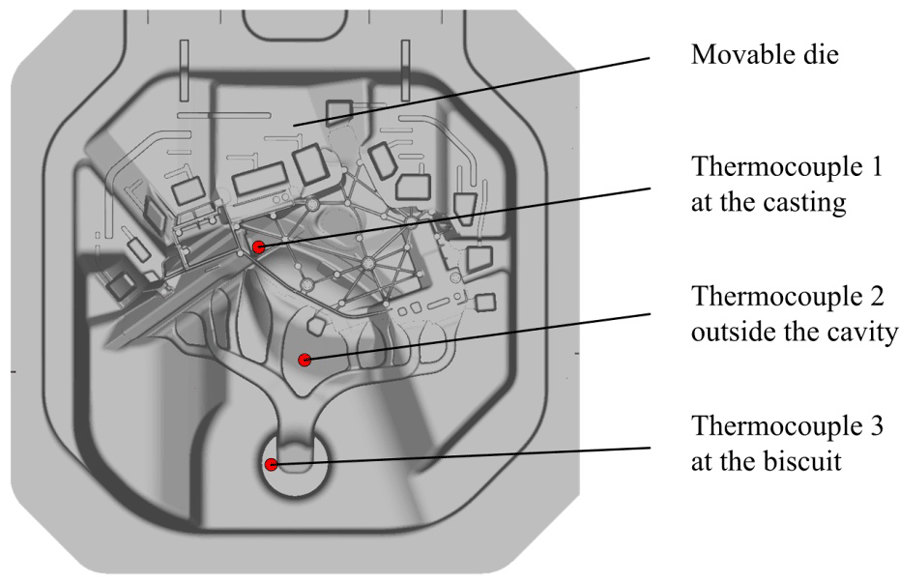
새로운 모델의 성능과 다이 스프레이 프로세스를 명시적으로 시뮬레이션하는 것의 중요성을 입증하기 위해 사례 연구가 수행되었습니다. 이는 큰 치수와 얇은 벽 두께를 가진 차량 구조 부품의 생산에 기초한다. 이젝터 다이의 다이 표면 안에 세개의 열전대가 배치됩니다. 위치는 다음 그림에 나와 있습니다. 첫번째 열전대는 주조 영역의 다이 표면에 배치됩니다. 두번째 열전대는 캐비티 밖에서 정의됩니다. 따라서 용해된 부분은 접촉하지 않지만 분사 과정 중에는 냉각되는 부분이 있습니다. 세번째 열전대는 비스킷에 있는데, 이것은 다이 내부의 핫 스폿입니다.

Thermocouples die spray cooling model

시뮬레이션은 5개의 사이클을 기반으로 하며, 각 사이클은 응고, 방출, 스프레이 냉각 및 주거라는 4개의 세그먼트로 정의됩니다. 전체 다이 캐비티에 걸쳐 일정한 열 전달 계수를 가정하는 암시적 다이 스프레이 냉각 시뮬레이션에서는 실제 공정 값을 사용할 수 없으므로 항상 스프레이의 평균 시간을 추정하기가 어렵습니다. 이 사례 연구에서는 열전대 1의 온도가 측정과 일치하도록 평균 시간을 추정하고 조정합니다. 반대로 각 스프레이 노즐의 냉각을 명시적으로 시뮬레이션하는 새로운 스프레이 냉각 모델의 경우, 실제 분사 프로세스에는 모든 시간 값이 포함되어 있어 시뮬레이션에 직접 전달될 수 있습니다. 이는 새로운 다이 스프레이 냉각 모델의 장점 중 하나입니다.

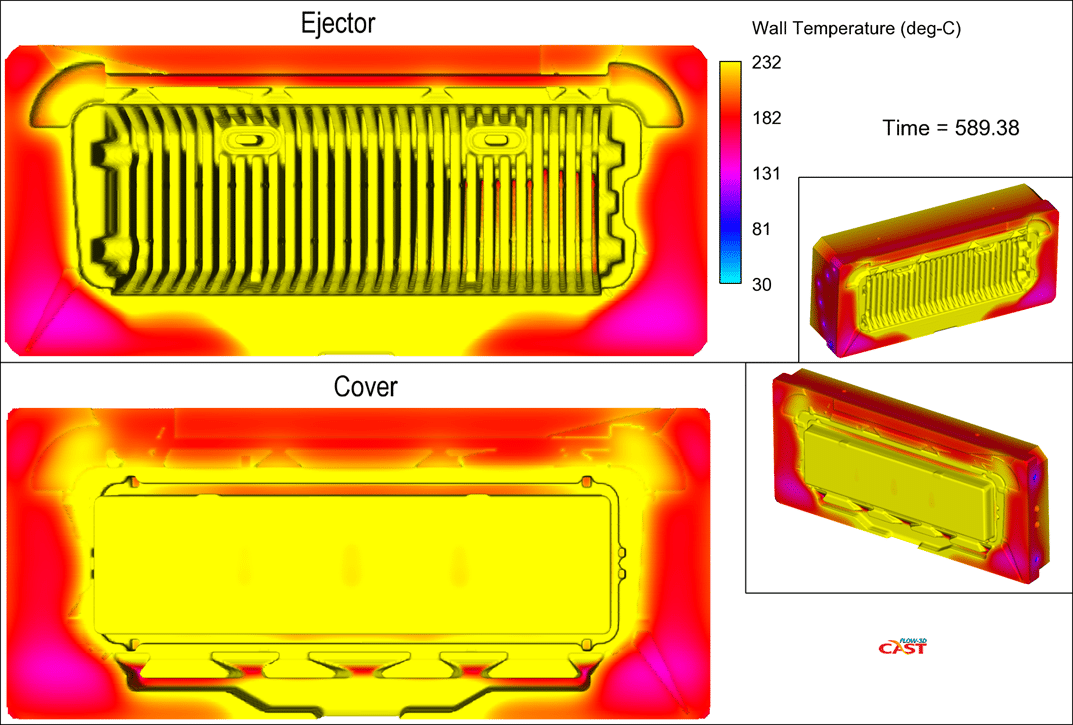
아래의 첫번째 애니메이션은 스프레이 냉각 중 다이 표면의 스프레이 영역을 보여 줍니다. 두번째 애니메이션은 다섯번째 주기에서 스프레이 냉각 중의 다이 표면 온도를 보여 줍니다. 글로벌 스프레이 및 핫 스팟 스프레이의 효과를 명확하게 확인할 수 있습니다.

Spray area during spray cooling. Simulation courtesy of Audi AG.

Die surface temperature at the fifth cycle of spray cooling. Simulation courtesy of Audi AG.

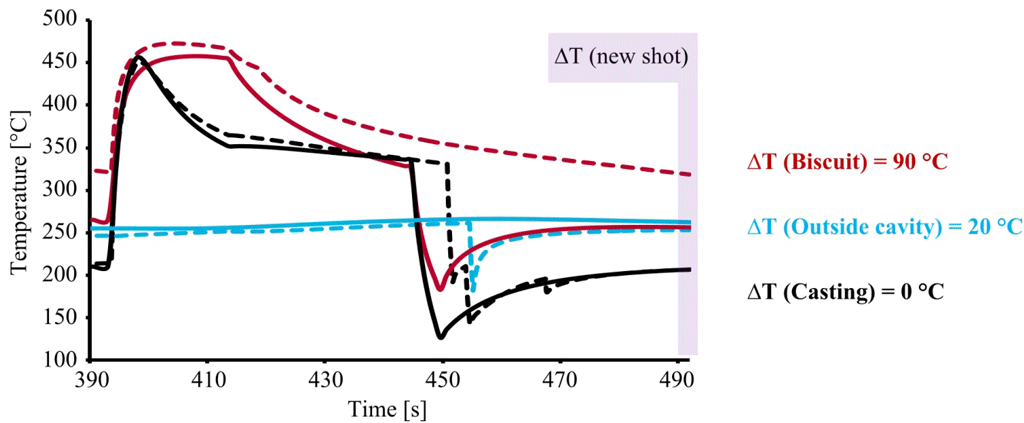
다섯번째 사이클 동안 세개의 열전대 온도가 다음 그림에 표시되어 있습니다. 실선은 암시적 모델의 결과를 나타내고 점선은 새로운 다이 스프레이 냉각 모델의 결과를 나타냅니다. 사이클이 끝날 때 세개의 열전대의 온도 차이도 표시됩니다. 암시적 모델에서 열전대 1의 온도를 일치시키기 위해 비스킷 영역이 지나치게 냉각되어 열전대 3에서 다이 온도의 90°C차이가 발생한다는 것을 알 수 있습니다. 이는 극적인 차이입니다. 다이 캐스터의 경우 비스킷의 온도는 다이 캐스팅 프로세스에서 매우 민감한 온도입니다. 사이클이 끝날 때 캐비티(열전대 2)외부의 온도 차이는 20°C입니다. 이러한 값은 실제 공정에서 우수한 품질의 주물이 생산되거나 사출 중에 다이에 응고되는지 여부를 결정합니다. 다이 스프레이 냉각 프로세스의 명확한 시뮬레이션은 정확한 다이 온도 분포를 예측하는 데 매우 중요합니다.

Temperatures thermocouples - die spray cooling model

Conclusions

새로운 다이 스프레이 냉각 모델은 몰드 표면 형태의 영향과 스프레이 노즐의 위치 및 움직임을 고려하여 FLOW-3D 사용자에게 다이 준비의 모든 측면을 모델링 할 수 있는 능력을 제공합니다. 또한 열 다이 사이클 시뮬레이션을 위한 신뢰할 수 있고 사실적인 입력 파라미터를 사용하여 다이 표면의 정확한 온도 분포를 정확하게 예측할 수 있습니다. 이를 통해 금속 주물 엔지니어는 다이의 내부 냉각 구조와 스프레이 냉각 매개 변수를 보다 효율적으로 설계하고 평가할 수 있습니다.

References

  1. Müller, et al., A die spray cooling model for thermal die cycling simulations, Transactions of NADCA 2015 Die Casting Congress & Exposition, Indianapolis, T15-101, 2015

주철 / Cast Iron

 Carbide (red) and graphite (blue) rich areas in a solidified gray iron casting.

Cast iron model

FLOW-3D‘의 주철 모델은 hypo 및 hyper-eutectic 철-탄소-실리콘 합금의 응고를 설명합니다. FLOW-3D‘는 융해하는 혼합반응(eutectic reaction) 동안 흑연, 오스테나이트 (또는 감마 – 철) 및 탄화물 상(유동) 형성을 예측합니다. 냉각 및 고형화 동안의 용적 변화는 수축 및 다공성 형성 모델과 결합됩니다. 주철 모델은 실제 철 동결 경로와 냉각 취약성 기준을 사용하여 현장의 탄화 수소 형성을 제어합니다.

주조 공장 엔지니어의 주요 관심사 중 하나는 응고 중에 형성될 수 있는 과도한 수축 다공성입니다. 주철의 체적 변화는 대부분 액체 합금을 주입 온도에서 고체로 냉각할 때, 그리고 더욱 중요하게는 감마선, 흑연 및 탄화물 형태로 응고할 때 발생합니다. 라이저(or risering)를 배치하면 수축을 유도할 수 있는 추가 금속이 제공됩니다. 최소 비용으로 우수한 품질의 주물을 달성하기 위해서는 최적의 하역이 중요합니다. 또한 금속의 적절한 합금과 냉각을 통해 수축의 양을 제어할 수 있습니다. FLOW-3D의 주철 모델은 이러한 모든 요소를 고려하여 용융, 응고 동안 기공 형성 및 위상 개발을 예측합니다.

주철 모델 개요 / Overview of the Cast Iron Model

주철은 탄소와 실리콘이 합금 된 용융 철입니다. 탄소는 전형적으로 2.5 wt % 내지 4.5 wt % 범위로 존재하고 실리콘은 1 wt % 내지 3 wt % 범위로 존재합니다. 흑연을 안정화하고 “냉각”경향 (즉, 탄소 철의 형성)을 줄이기 위해 실리콘이 첨가됩니다. 다른 원소 및 화합물은 미량으로 존재하며 일반적으로 흑연 모양 (예 : 연성 철의 마그네슘)을 제어하거나, 추가 탈산제 (예 : 인)로 작용하거나, 흑연의 주입제 (예 : 페로 실리콘) 역할을합니다.

FLOW-3D  의 주철 모델은 주입 온도에서 응고까지 발생하는 부피 변화를 설명합니다. 액체 상태에서 냉각 중 수축; 사전 용융 감마 철 형성 동안 추가 수축; 용융 반응 동안 후속 수축 또는 팽창; 그리고 용융 반응의 끝에서 고형 선으로의 2 차 수축. 주철은 일반적으로 탄화물의 형성에 영향을 미칠 수있는 비철 상을 포함하기 때문에, 응고된 금속의 밀도에 대한 이러한상의 영향에 대해 휴리스틱 허용치 (냉각 민감성 매개 변수의 형태)가 만들어집니다.

주철 응고 모델의 잠열 방출은 초기 용융물에서 탄소와 실리콘의 농도를 사용하여 Fe-C 위상 다이어그램 [1] 에서 결정된 온도 함수 (소위 동결 경로)로 계산됩니다 . 이 모델은 유동 유무에 관계없이 일반 응고 모델과 함께 사용할 수 있습니다. 그러나 다른 단계의 형성과 관련된 체적 변화는 흐름을 포함하지 않는 단순화된 수축 모델에만 결합됩니다.

철 확장 중 금형 벽 이동의 효과는 현재 모델에 포함되지 않습니다. 금형에서 사용 가능한 공간으로 수용 할 수없는 순 체적 확장은 무시됩니다.

융해 영역에서는 융해 경계의 속도를 사용하여 국부적인 냉각 경향을 계산하고, 따라서 국부적인 탄화물의 양을 계산하므로 금형 벽 근처의 냉각 영역을 모델링 할 수 있습니다. 고체 유전체 변환 중에는 더 이상의 공기상 변화를 추적하려는 시도가 없습니다. 즉, 최종 물질 미세 구조가 예측되지 않습니다.

hyper-eutectic cast irons의 경우, 회색 및 연성 주철과 같이 초기 경화전 공정 단계에서 흑연만 형성되는 것으로 가정합니다. 즉, 이 모델은 주로 탄화물이 형성되는 사전 융해 단계에서 hyper-eutectic white irons의 응고를 포함하지 않습니다.

Cast Iron Freezing Path

주철 동결 경로는 공융 합금의 경로입니다. 이는 액상 선 온도, 공융 온도, 공융 – 시작 및 공융 – 말단 고체 분율 및 고 상면 온도에 의해 특징 지어 질 수 있습니다. 모두지만, 마지막 두 양은 평형 3 원 Fe-C-Si 상 다이어그램 [1]에서 계산됩니다.
(The cast iron freezing path is that of a eutectic alloy. It can be characterized by the liquidus temperature, eutectic temperature, the eutectic-start and eutectic-end solid fractions and the solidus temperature. All, but the last two quantities are computed from the equilibrium ternary Fe-C-Si phase diagram [1].)

감마상의 탄소 용해도는 다음에 따라 중량 % 단위 Si 함량 에 따라 달라집니다 .

(1)     \displaystyle {{C}_{{\gamma ,mx}}}=2.07-0.098Si,

이는 Stefanescu [2]에 의해 보고된 용해도와 밀접한 관련이 있습니다. 합금의 액상 점 (섭씨 온도)은 hypo-eutectic liquidus plane :

(2)     \displaystyle {{T}_{i}}=1636-113\left( {C+0.25Si} \right)

또는 초정밀 액상 평면 [2] :

(3)     \displaystyle {{T}_{i}}=-505.8+389.1\left( {C+0.31Si} \right),

그리고 공융 혼합물 및 온도는 이들 평면의 교차점에 의해 주어집니다.

(4)     \displaystyle {{C}_{e}}=4.26-0.296Si,     \displaystyle {{T}_{e}}=1154.6+5.2Si

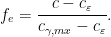
공융 반응의 시작은 레버 규칙에 의해 주어진 파생된 양입니다.

(5)     \displaystyle {{f}_{e}}=\frac{{c-{{c}_{\varepsilon }}}}{{{{c}_{{\gamma ,mx}}}-{{c}_{\varepsilon }}}}.

[3]의 측정은 이 근사가 많은 주철에 적합 함을 암시합니다.

흑연 공융 반응의 끝, 수수료 및 solidus Ts는 사용자 정의 수량으로 남습니다. 액체에서 인의 양의 분리를 고려하면 실제 고 상선 온도는 흑연 공융 온도보다 낮고 1100 ° C 정도로 낮습니다. 이 경우, 흑연 침전은 동결이 끝나기 전에 완료되고 동결되는 금속의 마지막 부분은 공융 밀도와 다른 밀도 ρei 에서 수행된다고 가정합니다.

흑연 공융 반응의 끝 f ee 및 고형 선 T s 는 사용자 정의 수량으로 남습니다. 액체에서 인의 양의 분리를 고려하면 실제 고 상선 온도는 흑연 공융 온도보다 낮으며 1100 ° C까지 낮습니다. 이 경우, 흑연 침전이 동결이 끝나기 전에 완료되고 동결 할 마지막 금속 부분 인 1- f ee 가 공융 밀도와 다른 밀도 ρ ei 에서 그렇게 한다고 가정합니다.
( The end of graphitic eutectic reaction, fee , and the solidus Ts, are left as user-defined quantities. If one considers positive segregation of phosphorous in the liquid, the actual solidus temperature is below the graphitic eutectic temperature, and is as low as 1100 °C. For this case, it is assumed that graphite precipitation is complete before the end of freezing, and that the last fraction of metal to freeze, 1-fee, does so at a density ρei different from the eutectic density. )

밀도 변화 / Density Changes

일반적으로 주철 주물의 과열은 크며 응고가 시작되기 전에 냉각 중 수축이 중요합니다. 액체 철 밀도의 온도 의존성은 선형 형태로 모델링됩니다 :

(6)     \displaystyle \rho \left( T \right)={{\rho }_{0}}\left[ {1-\alpha \left( {T-{{T}_{0}}} \right)} \right]

또는 테이블 형식으로 함수 ρ (T) 를 정의하여 .

일단 동결 범위에 들어가면 감마철은 고형분수에 도달할 때까지 형성됩니다. 이 단계의 농도 값인 ,ϒ은 7.2 g/cc입니다 [4,5,6]. 고형분수에 도달하면, 일반(흰색) 공극과 불규칙한 회색 공극이 경쟁적으로 성장하는 동안 공극 반응이 시작됩니다. 높은 동결률과 높은 황동-전방 속도에서 백색 황동은 부분적으로 황동 전방에 앞서 탄소 농도 구배가 더 낮기 때문에 안정적입니다. 낮은 Eutectic-front 속도에서는 회색 Eutectic이 안정적입니다.
( Once in the freezing range, gamma iron forms until fe solid fraction is reached. The density value of this phase, ρϒ, is a 7.2 g/cc [4,5,6]. Upon reaching fe solid fraction, the eutectic reaction begins during which a regular (white) eutectic and an irregular grey eutectic grow competitively. At high freezing rates and high eutectic-freezing-front speeds the white eutectic is stable in part due to shallower carbon concentration gradients ahead of the eutectic front. At lower eutectic-front speeds the grey eutectic is stable. )

냉기 형성을 설명하기 위해 간단한 접근 방식이 사용됩니다.  In a range of eutectic freezing front speeds,

(7)     \displaystyle {{\nu }_{e}}\in \left[ {\frac{{\nu -}}{{{{X}_{{eut}}}}},\frac{{\nu +}}{{{{X}_{{eut}}}}}} \right]

형성되는 냉기의 양은 주어진 탄소 구성에서 허용되는 최대치에서 0까지 다양합니다. 파라미터 ν-=30μ/ms, ν+=60μ/ms, Xeut은 사용자 정의 파라미터인 쿨링 취약성 기준이며, 값이 0.0 ~ 1.0 범위이고 기본값은 1입니다. 잘 절연된 철이나 특정 표면적이 높은 회색 광택제의 경우 Xeut는 0에 가깝고 추위는 형성되지 않습니다. 반면, 철이 절연되지 않은 경우 기본값인 1이 더 적합해야 합니다. Xeut의 실제 값은 예를 들어 ASTM 쿨웨지 테스트(그림 1)에서 실험적으로 결정해야 합니다.
( the amount of chill formed varies from zero to the maximum allowed for a given carbon composition. The parameters ν-=30 μ/ms, and ν+=60 μ/ms, and Xeut is the chilling susceptibility criterion, a user-defined parameter, with values in the range from 0.0 to 1.0 with the default of one. For well-inoculated iron, or for a grey eutectic with a high specific surface area, Xeut is close to zero, and no chill will form. On the other hand, if the iron is un-inoculated the default value of one should be more appropriate. The actual value of Xeut must be determined experimentally, for example, from an ASTM chill-wedge test (Fig 1.).)

Figure 1. Carbide (left) and graphite (right) content in a 3.4 wt% C, 1.7 wt% Si iron with Xeut=0.25 (top) and Xeut=0.40 (bottom)

주조물의 순 체적 변화는 응고 과정에서 형성되는 서로 다른 상의 양과 액체 수축의 결합 효과입니다. 그림 2는 3.4wt %의 탄소와 2.5wt %의 실리콘을 갖는 합금에 대한 3 가지 상이한 과열 온도에 대한 금속 부피의 변화를 보여줍니다. 더 큰 과열은 금속 체적의 순수한 감소로 이어. 그래파이트 형성으로 인해 응고 동안 나중에 팽창은 체적의 손실을 보상 할 수 없습니다.

Figure 2. Computed volume vs. time for three pouring temperatures for a 3.4 wt % C, 2.5 wt % Si cast iron. From top to bottom: 1250, 1400 and 1550°C pouring temperatures.

Summary

동결시 철의 밀도 변화를 추적하고 흑연, 오스테나이트 및 탄화물 상을 포함하는 미세 구조를 예측하기 위한 주철 모델을 기술하였습니다. 이 모델은 단순 응고 수축 및 미세 다공성 모델에 대한 옵션입니다. 고형물 (> 2 %)을 함유 한 철의 변성 열을 정의하기 위해 유동이 있건, 없건 응고 중에 사용할 수 있습니다. 수축 및 팽창 모두 흐름없이 모델에 포함됩니다. 팽창을 위한 공간이 없는 경우를 제외하고 팽창은 무시됩니다.

References

[1] G. Goodrich and John Svoboda, “Basic Concepts of Ferrous Metallurgy,” Cast Metals Institute, Inc., American Foundry Society, Inc., 1997.

[2] D. M. Stefanescu, S. Katz, “Thermodynamic Properties of Iron-Base Alloys,” ASM Handbook Volume 15, Casting (ASM International), 2008.

[3] K.G. Upadhya, D.M. Stefanescu, K. Lieu and D.P. Yeager, “Computer-Aided Cooling Curve Analysis: Principles and Applications in Metal Casting,” AFS Transactions, Vol. 97, 1989, 61-66.

[4] AFS, “Gating Calculations for Iron Castings,” spreadsheet, 2009.

[5] Von Alfred Holzmuller, VDG and Robert Wlodawer, VDG, “Zehn Jahre Speiser-Eingrs-Verfahren fur Guseisen,” Giesserei, 1963.

[6] G. Goodrich, “Introduction to Cast Irons,” ASM Handbook, Volume 15: Casting, 2008, pp 794-795.

[7] A. Starobin, M.C. Carter, “Modeling Volume Changes and High Temperature Microstructure in Cast Iron,” Flow Science Technical Note FSI-11-TN89, 2011.

금속 주조 모델 / Metal Casting Models

FLOW-3D 는 금속 주조를 위해 특별히 고안된 다양한 물리모델을 제공하고 있습니다. 제공되는 물리모델은 모든 종류의 금속 주조 응용 및 분석이 필요한 업무에 가장 정확한 솔루션을 제공합니다. 이를 통해 고객들은 지속적으로 주조 수율과 품질을보다 적은 시간과 비용으로 개선할 수 있습니다.

자유 표면 흐름을 정확하게 예측하기 위한 특수 기능을 갖춘 FLOW-3D  는 금형 충진 및 공기 포집과 같은 관련 결함을 시뮬레이션하는데 가장 먼저 선택됩니다. 강력하고 유연한 열 전달 모델은 금속과 금형 사이의 열 교환을 빠르고 정확하게 예측할 수 있으며 응고, 냉각 채널 및 열 다이 사이클링 시뮬레이션을위한 견고한 기반을 마련합니다.

금형 충진과 결합 할 수있는 응고 및 수축 모델은 과도한 수축 또는 다공성 영역을 정확히 파악할 수 있으며, 고객이 라이저의 배치를 결정하여 이러한 결함이 완화되도록 할 수 있습니다. 세분화된 매체 모델 및 수분 건조 모델을 사용하여 모래 코어 분사 및 건조를 시뮬레이션 할 수 있습니다.

FLOW-3D  의 유한 요소 기반 열 응력 모델을 통해 고객은 응력이 발생하는 위치와 주조가 왜곡되는 현상을 정확하게 예측할 수 있으므로, 고객은 금속 주조에서 열 응력 결함을 제거 할 수 있습니다. 주철 모델은 공극 반응 동안 흑연, 감마철 및 탄화물 위상의 형성을 예측하여 FLOW-3D 의 적용 범위를 확장합니다 . 코어 가스 제품군의 독특한 특징으로 코어 가스 생성 및 모래 코어의 유동을 모델링하며, 이는 금속 주조에서 코어 가스 관련 결함을 예측할 수 있습니다.

FLOW-3D 는 금속 주조 모델링 및 시뮬레이션의 선두 주자입니다. 금속 주조 산업에 대한 오랜 연구개발과  고객과의 지속적인 협력을 통해 개발된 응용 프로그램으로 고객의 품질과 생산성을 향상시키고 지속적으로 혁신 할 수 있도록 지원할 것입니다.

Predicting Defects Lform [Lost Form 결함 예측]

Introduction

There is increasing interest in the lost foam casting technique because of its ability to produce near-net-shaped components of high complexity. The idea is to first make a prototype of the part to be cast in foam. This is then used as a pattern that can be placed in a box and surrounded by sand. Finally, metal is poured such that it smoothly replaces the foam by melting and/or evaporating it.

The stiffness of the foam makes it possible to cast parts having thin walls or other fine-scale features, and since the foam does not have to be removed at the end of the casting process, parts can be made that require fewer gaskets to assemble. Furthermore, because the foam pattern holds the sand (mold) in place there is little need to use binders in the sand, which means that the sand doesn’t have to be disposed of and can be used again. All these features make the lost foam process highly attractive to manufacturers.

Unfortunately, one rarely gets a free lunch and lost foam casting is no exception. For the process to be successful there must be a high degree of process control. Foams must have the proper characteristics and be coated with just the right material, and pouring sprues and gates for delivering metal to the mold must be carefully arranged. Metal pour temperatures must be sufficiently high to prevent premature solidification. And finally, the filling pattern of a mold should be such that metal fronts do not merge in a way that traps liquefied foam material, which could cause internal defects in the cast part.

To help casters address some of these difficult problems the computational fluid dynamics (CFD) program FLOW-3DÒ has been outfitted with special modeling capabilities to simulate the lost foam process. Using these models, it is possible to simulate the filling of a lost foam mold and the subsequent solidification of the metal. An extra feature in FLOW-3DÒ is the capability to predict where folds or other defects associated with trapped foam products are likely to be located.

The purpose of this paper is to demonstrate the usefulness and accuracy of lost foam predictions made with FLOW-3DÒ by presenting a direct comparison between experimental and computational results. The example chosen for this comparison is described in the next section. Subsequent sections present the comparisons with an emphasis on how the computational results can be used to understand why things happened as they did. This last point is most important, because it offers the user direct evidence and insight into how a casting could be improved.


[다운로드]

Predicting Defects Lform

Binder Gas Generation and Transport in Sand Cores and Molds

Overview
The making of resin-bonded sand castings has made great strides in quality over its long history. Even so, there remain some process-related defects that are not fully understood and can cause quality issues. For instance, chemical binders in the sand can produce gas when heated by the molten metal and if not vented adequately, the gas may flow into the metal resulting in a gas porosity defect. This is most likely with cores that form thin interior features of castings that heat up quickly and have long venting paths.

The core gas model in FLOW-3D1 is designed to predict the possibility of such gas defects and is intended to help design core venting that would evacuate safely all the binder product gas
from the cores.
Two major types of binders are used in core making practice: resin-based organic binders and inorganic binders such as sodium silicate [1]. The organic binders are either thermosetting, or cured at room temperature with an aid of a catalyst. These are favored in many applications due to their complete degradation even at aluminum casting temperatures and for the ease of subsequent sand shake out. The core gas model is developed with these binders in mind, but can be extended to inorganic binders if appropriate data on their decomposition is available.

Lost Foam Variable Pattern Density

Overview
Making foam patterns for use in the lost foam casting process is a difficult business. To make a pattern foam beads are blown into a mold containing discrete vent locations for the displaced air and steam. This makes the density of the packed beads difficult to control. Patterns typically show final density variations of ±20%. Much larger variations are not uncommon.
One goal of the Lost Foam Consortium is to evaluate techniques for improving the uniformity of patterns. A related goal is to determine to what extent density variations in patterns are significant with respect to the quality of the parts produced.
Recent real-time X-Ray observations of the metal filling process reported by Dr. Wayne Sun (Advanced Lost Foam Casting Technology-Phase V Meeting, June 20-21, 2001) revealed several interesting facts about the behavior of foam patterns. In particular, when the foam has a low degree of fusion metal is observed to move very fast into the foam (e.g., 4 to 5 times faster than in normal fusion foam). The advancement of the metal is typically in the form of fingers, which subsequently spread sideways causing the meeting of metal fronts that result in many fold defects. Furthermore, the location of the fingering is significantly affected by density variations in the foam pattern.
In contrast, when the foam patterns consisted of normal fusion foam, the metal front moved smoothly (i.e., no fingering) and considerably fewer fold defects occur. Also, the presence of density variations in the foam has little effect on the propagation of the metal fronts.
Based on these findings it was concluded that no attempt should be made to model low fusion foam because this in not likely to be choice for production work. Instead, we report here the development and testing of a model for adding a variable foam density to the FLOW-3D® software package from Flow Science, Inc.

Modeling shrinkage induced microporosity [마이크로 미세기공 발생 예측]

Overview
Cast metal parts are sometimes unusable because they have internal gas pockets, or bubbles, which develop when the metal shrinks during solidification. A general term describing such bubbles or voids is “porosity.” When these bubbles are relatively large and localized the porosity is called macro-porosity. Prediction of macro-porosity in the interior of cast parts is a capability of most software packages currently used for the modeling of metal casting processes.
Another type of porosity, characterized by a more uniform distribution of small bubbles with a total average volume fraction on the order of one percent, is referred to as micro-porosity. This type of porosity is also caused by metal shrinkage during solidification, but its character is different from macro-porosity because it develops at a later stage in the solidification process. This distinction in types of porosity is important because each type requires a different modeling approach.
In this note we propose a new model that has been implemented in FLOW-3D® for predicting the occurrence of micro-porosity. The model is simple, requires only basic material property data, and adds virtually no noticeable CPU time to a solidification simulation. Best of all, the model is complimentary to macro-porosity models and may be used in conjunction with either a complete hydrodynamic shrinkage simulation that includes fluid flow or with simpler heat-transfer and shrinkage simulation having no fluid flow.
The new model has been checked using three sets of experimental test data. A final test, involving only qualitative results for the influence of pressure on micro-porosity formation has also been conducted.

Core gas defects in steel castings

Abstract

Porosity is a common but serious casting defect. One type of porosity is a result of core gas that has evolved and been trapped in the casting during solidification. In order to reduce or eliminate core gas related defects, detailed information regarding the core gas generation, flow, and venting in the core, and the metal flow and solidification behavior in the mold is needed. In this paper, numerical simulations are conducted based on a prototype design, which is a steel casting part from Caterpillar. The core gas in the core and the porosity defects in the casting are analyzed and discussed, and then compared with the real casting results. Using simulations to determine porosity defects can help in optimizing the design.

Keywords: Porosity, Core Gas Defects, Steel Castings, Numerical Simulation, PUCB

Coating Bibliography

아래는 코팅 참고 문헌의 기술 문서 모음입니다. 
이 모든 논문은 FLOW-3D  결과를 포함하고 있습니다. FLOW-3D를 사용하여 코팅 공정을 성공적으로 시뮬레이션  하는 방법에 대해 자세히 알아보십시오.

Coating Bibliography

2024년 11월 20일 Update

98-24 Fabiano I. Indicatti, Bo Cheng, Michael Rädler, Elisabeth Stammen, Klaus Dilger, Experimental and numerical investigation of the squeegee process during stencil printing of thick adhesive sealings, The Journal of Adhesion, 2024. doi.org/10.1080/00218464.2024.2356105

130-22   Md Didarul Islam, Himendra Perera, Benjamin Black, Matthew Phillips, Muh-Jang Chen, Greyson Hodges, Allyce Jackman, Yuxuan Liu, Chang-Jin Kim, Mohammed Zikry, Saad Khan, Yong Zhu, Mark Pankow, Jong Eun Ryu, Template-free scalable fabrication of linearly periodic microstructures by controlling ribbing defects phenomenon in forward roll coating for multifunctional applications, Advanced Materials Interfaces, 9.27; 2201237, 2022. doi.org/10.1002/admi.202201237

03-21   Delong Jia, Peng Yi, Yancong Liu, Jiawei Sun, Shengbo Yue, Qi Zhao, Effect of laser­ textured groove wall interface on molybdenum coating diffusion and metallurgical bonding, Surface and Coatings Technology, 405; 126561, 2021. doi.org/10.1016/j.surfcoat.2020.126561

50-19     Peng Yi, Delong Jia, Xianghua Zhan, Pengun Xu, and Javad Mostaghimi, Coating solidification mechanism during plasma-sprayed filling the laser textured grooves, International Journal of Heat and Mass Transfer, Vol. 142, 2019. doi:10.1016/j.ijheatmasstransfer.2019.118451

01-19   Jelena Dinic and Vivek Sharma, Computational analysis of self-similar capillary-driven thinning and pinch-off dynamics during dripping using the volume-of-fluid method, Physics of Fluids, Vol. 31, 2019. doi: 10.1063/1.5061715

85-18   Zia Jang, Oliver Litfin and Antonio Delgado, A semi-analytical approach for prediction of volume flow rate in nip-fed reverse roll coating process, Proceedings in Applied Mathematics and Mechanics, Vol. 18, no. 1, Special Issue: 89th Annual Meeting of the International Association of Applied Mathematics and Mechanics, 2018. doi: 10.1002/pamm.201800317

80-14   Hiroaki Koyama, Kazuhiro Fukada, Yoshitaka Murakami, Satoshi Inoue, and Tatsuya Shimoda, Investigation of Roll-to-Sheet Imprinting for the Fabrication of Thin-film Transistor Electrodes, IEICE TRAN, ELECTRON, VOL.E97-C, NO.11, November 2014

46-14   Isabell Vogeler, Andreas Olbers, Bettina Willinger and Antonio Delgado, Numerical investigation of the onset of air entrainment in forward roll coating, 17th International Coating Science and Technology Symposium September 7-10, 2014 San Diego, CA, USA

17-12  Chi-Feng Lin, Bo-Kai Wang, Carlos Tiu and Ta-Jo Liu, On the Pinning of Downstream Meniscus for Slot Die Coating, Advances in Polymer Technology, Vol. 00, No. 0, 1-9 (2012) © 2012 Wiley Periodicals, Inc. Available online at Wiley.

01-11  Reid Chesterfield, Andrew Johnson, Charlie Lang, Matthew Stainer, and Jonathan Ziebarth, Solution-Coating Technology for AMOLED Displays, Information Display Magazine, 1/11 0362-0972/01/2011-024 © SID 2011.

61-09 Yi-Rong Chang, Chi-Feng Lin and Ta-Jo Liu, Start-up of slot die coating, Polymer Engineering and Science, Vol. 49, pp. 1158-1167, 2009. doi:10.1002/pen.21360

26-06  James M. Brethour, 3-D transient simulation of viscoelastic coating flows, 13th International Coating Science and Technology Symposium, September 2006, Denver, Colorado

19-06  Ivosevic, M., Cairncross, R. A., and Knight, R., 3D Predictions of Thermally Sprayed Polymer Splats Modeling Particle Acceleration, Heating and Deformation on Impact with a Flat Substrate, Int. J. of Heat and Mass Transfer, 49, pp. 3285 – 3297, 2006

9-06  M. Ivosevic, R. A. Cairncross, R. Knight, T. E. Twardowski, V. Gupta, Drexel University, Philadelphia, PA; J. A. Baldoni, Duke University, Durham, NC, Effect of Substrate Roughness on Splatting Behavior of HVOF Sprayed Polymer Particles Modeling and Experiments, International Thermal Spray Conference, Seattle, WA, May 2006.

26-05  Ivosevic, M., Cairncross, R. A., Knight, R., Impact Modeling of Thermally Sprayed Polymer Particles, Proc. International Thermal Spray Conference [ITSC-2005], Eds., DVS/IIW/ASM-TSS, Basel, Switzerland, May 2005.

11-05  Brethour, J., Simulation of Viscoelastic Coating Flows with a Volume-of-fluid Technique, in Proceedings of the 6th European Coating Symposium, Bradford, UK, 2005

1-05 C.W. Hirt, Electro-Hydrodynamics of Semi-Conductive Fluids: With Application to Electro-Spraying, Flow Science Technical Note #70, FSI-05-TN70

38-04 K.H. Ho and Y.Y. Zhao, Modelling thermal development of liquid metal flow on rotating disc in centrifugal atomisation, Materials Science and Engineering, A365, pp. 336-340, 2004. doi:10.1016/j.msea.2003.09.044

30-04  M. Ivosevic, R.A. Cairncross, and R. Knight, Impact Modeling of HVOF Sprayed Polymer Particles, Presented at the 12th International Coating Science and Technology Symposium, Rochester, New York, September 23-25, 2004

29-04  J.M. Brethour and C.W. Hirt, Stains Arising from Dried Liquid Drops, Presented at the 12th International Coating Science and Technology Symposium, Rochester, New York, September 23-25, 2004

20-03  James Brethour, Filling and Emptying of Gravure Cells–A CFD Analysis, Convertech Pacific October 2002, Vol. 10, No 4, p 34-37

4-03   M. Toivakka, Numerical Investigation of Droplet Impact Spreading in Spray Coating of Paper, In Proceedings of 2003 TAPPI 8th Advanced Coating Fundamentals Symposium, TAPPI Press, Atlanta, 2003

28-02  J.M. Brethour and H. Benkreira, Filling and Emptying of Gravure Cells—Experiment and CFD Comparison, 11th International Coating Science and Technology Symposium, September 23-25, 2002, Minneapolis, Minnesota

22-02  Hirt, C.W., and Brethour, J.M., Contact Line on Rough Surfaces with Application to Air Entrainment, Presented at the 11th International Coating Science and Technology Symposium, September 23-25, 2002, Minneapolis, Minnesota. Unpublished.

17-01  J. M. Brethour, C. W. Hirt, Moving Contact Lines on Rough Surfaces, 4th European Coating Symposium, 2001, Belgium

16-01  J. M. Brethour, Filling and Emptying of Gravure Cells–-A CFD Analysis, proceedings of the 4th European Coating Symposium 2001, October 1-4, 2001, Brussels, Belgium

26-00 Ronald H. Miller and Gary S. Strumolo, A Self-Consistent Transient Paint Simulation, Proceedings of IMEC2000: 2000 ASME International Mechanical Engineering Congress and Exposition, November 2000, Orlando, Florida

6-99  C. W. Hirt, Direct Computation of Dynamic Contact Angles and Contact Lines, ECC99 Coating Conference, Erlangen, Germany (FSI-99-00-2), Sept. 1999

7-98 J. E. Richardson and Y. Becker, Three-Dimensional Simulation of Slot Coating Edge Effects, Flow Science Inc, and Polaroid Corporation, presented at the 9th International Coating Science and Technology Symposium, Newark, DE, May 18-20, 1998

6-98  C. W. Hirt and E. Choinski, Simulation of the Wet-Start Process in Slot Coating, Flow Science Inc, and Polaroid Corporation, presented at the 9th International Coating Science and Technology Symposium, Newark, DE, May 18-20, 1998

3-97  C. W. Hirt and J. E. Richardson of Flow Science Inc, and K.S. Chen, Sandia National Laboratory, Simulation of Transient and Three-Dimensional Coating Flows Using a Volume-of-Fluid Technique, presented at the 50th Annual Conference of the Society for Imaging and Science Technology, Boston, MA 18-23 May 1997

2-96 C. W. Hirt, K. S. Chen, Simulation of Slide-Coating Flows Using a Fixed Grid and a Volume-of-Fluid Front-Tracking Technique, presented a the 8th International Coating Process Science & Technology Symposium, February 25-29, 1996, New Orleans, LA

General Applications Bibliography

다음은 일반 응용 분야의 기술 문서 모음입니다.
이 모든 논문은 FLOW-3D  결과를 포함하고 있습니다. 복잡한 다중 물리와 관련된 문제를 성공적으로 시뮬레이션하기 위해 FLOW-3D를 사용 하는 방법에 대해 자세히 알아보십시오.

Below is a collection of technical papers in our General Applications Bibliography. All of these papers feature FLOW-3D results. Learn more about how FLOW-3D can be used to successfully simulate problems that involve complex multiphysics.

2024년 8월 12일 Upate

204-23   Togo Shinonaga, Hibiki Tajima, Yasuhiro Okamoto, Akira Okada, Application of large-area electron beam irradiation to micro-edge filleting, Journal of Manufacturing Processes, 107; pp. 65-73, 2023. doi.org/10.1016/j.jmapro.2023.10.039

167-23   Xiaoyong Cheng, Zhixian Cao, Ji Li, Alistair Borthwick, A numerical study of the settling of non-spherical particles in quiescent water, Physics of Fluids, 35.9; 2023. doi.org/10.1063/5.0165555

109-23 Dileep Karnam, Yu-Lung Lo, Chia-Hua Yang, Simulation study and parameter optimization of laser TSV using artificial neural networks, Journal of Materials Research and Technology, 25; pp. 3712-3727, 2023. doi.org/10.1016/j.jmrt.2023.06.199

66-23   Erik Holmen Olofsson, Michael Roland, Jon Spangenberg, Ninna Halberg Jokil, Jesper Henri Hattel, A CFD model with free surface tracking: predicting fill level and residence time in a starve-fed single-screw extruder, The International Journal of Advanced Manufacturing Technology, 126; pp. 3579-3591, 2023. doi.org/10.1007/s00170-023-11329-w

20-23   Giampiero Sciortino, Valentina Lombardi, Pietro Prestininzi, Modelling of cantilever-based flow energy harvesters featuring C-shaped vibration inducers: The role of the fluid/beam interaction, Applied Sciences, 13.1; 416, 2023. doi.org/10.3390/app13010416

134-22   Guozheng Ma, Shuying Chen, Haidou Wang, Impact spread behavior of flying droplets and properties of splats, Micro Process and Quality Control of Plasma Spraying, pp. 87-202, 2022. doi.org/10.1007/978-981-19-2742-3_3

111-22   Chia-Lin Chiu, Chia-Ming Fan, Chia-Ren Chu, Numerical analysis of two spheres falling side by side, Physics of Fluids, 34; 072112, 2022. doi.org/10.1063/5.0096534

58-21   Ruizhe Liu, Haidong Zhao, Experimental study and numerical simulation of infiltration of AlSi12 alloys into Si porous preforms with micro-computed tomography inspection characteristics, Journal of the Ceramic Society of Japan, 129.6; pp. 315-322, 2021. doi.org/10.2109/jcersj2.21018

56-20   Nils Steinau, CFD modeling of ascending Strombolian gas slugs through a constricted volcanic conduit considering a non-linear rheology, Thesis, Universität Hamburg, Hamburg, Germany, 2020.

30-20   Bita Bayatsarmadi, Mike Horne, Theo Rodopoulos and Dayalan Gunasegaram, Intensifying diffusion-limited reactions by using static mixer electrodes in a novel electrochemical flow cell, Journal of The Electrochemical Society, 167.6, 2020. doi.org/10.1149/1945-7111/ab7e8f

75-19   Raphaël Comminal, Marcin Piotr Serdeczny, Navid Ranjbar, Mehdi Mehrali, David Bue Pedersen, Henrik Stang, Jon Spangenberg, Modelling of material deposition in big area additive manufacturing and 3D concrete printing, Proceedings, Advancing Precision in Additive Manufacturing, Nantes, France, September 16-18, 2019.

35-19     Sung-Won Ha, Tae-Won Kim, Joo-Hwan Choi, and Young-Jin Park, Study for flow phenomenon in the circulation water pump chamber using the Flow-3D model, Journal of the Korea Academia-Industrial Cooperation Society, Vol. 20, No. 4, pp. 580-589, 2019. doi: 10.5762/KAIS.2019.20.4.580

27-19     Rolands Cepuritis, Elisabeth L. Skare, Evgeny Ramenskiy, Ernst Mørtsell, Sverre Smeplass, Shizhao Li, Stefan Jacobsen, and Jon Spangeberg, Analysing limitations of the FlowCyl as a one-point viscometer test for cement paste, Construction and Building Materials, Vol. 218, pp. 333-340, 2019. doi: 10.1016.j.conbuildmat.2019.05.127

26-19     Shanshan Hu, Lunliang Duan, Qianbing Wan, and Jian Wang, Evaluation of needle movement effect on root canal irrigation using a computational fluid dynamics model, BioMedical Engineering OnLine, Vol. 18, No. 52, 2019. doi: 10.1186/s12938-019-0679-5

83-18   Elisabeth Leite Skare, Stefan Jacobsen, Rolands Cepuritis, Sverre Smeplass and Jon Spangenberg, Decreasing the magnitude of shear rates in the FlowCyl, Proceedings of the 12th fib International PhD Symposium in Civil Engineering, Prague, Czech Republic, August 29-31, 2018.

71-18   Marc Bascompta, Jordi Vives, Lluís Sanmiqeul and José Juan de Felipe, CFD friction factors verification in an underground mine, Proceedings of the 4th World Congress on Mechanical, Chemical, and Material Engineering, August 16 – 18, 2018, Madrid, Spain, Paper No. MMME 105, 2018. doi.org/10.11159/mmme18.105

56-18   J. Spangenberg, A. Uzala, M.W. Nielsen and J.H. Hattel, A robustness analysis of the bonding process of joints in wind turbine blades, International Journal of Adhesion and Adhesives, vol. 85, pp. 281-285, 2018. doi.org/10.1016/j.ijadhadh.2018.06.009

21-18   Zhang Weikang and Gong Hongwei, Numerical Simulation Study on Characteristics of Airtight Water Film with Flow Deflectors, IOP Conference Series: Earth and Environmental Science vol. 153, no. 3, pp. 032025, 2018. doi.org/10.1088/1755-1315/153/3/032025

59-17  Han Eol Park and In Cheol Bang, Design study on mixing performance of rotational vanes in subchannel with fuel rod bundles, Transactions of the Korean Nuclear Society Autumn Meeting, Gyeongju, Korea, October 26-27, 2017.

58-17  Jian Zhou, Claudia Cenedese, Tim Williams and Megan Ball, On the propagation of gravity currents over and through a submerged array of circular cylinders, Journal of Fluid Mechanics, Vol. 831, pp. 394-417, 2017. doi.org/10.1017/jfm.2017.604

24-17   Zhiyuan Ge, Wojciech Nemec, Rob L. Gawthorpe, Atle Rotevatn and Ernst W.M. Hansen, Response of unconfined turbidity current to relay-ramp topography: insights from process-based numerical modelling, doi: 10.1111/bre.12255 This article is protected by copyright. All rights reserved.

06-17   Masoud Hosseinpoor, Kamal H. Khayat, Ammar Yahia, Numerical simulation of self-consolidating concrete flow as a heterogeneous material in L-Box set-up: coupled effect of reinforcing bars and aggregate content on flow characteristics, A. Mater Struct (2017) 50: 163. doi:10.1617/s11527-017-1032-8

94-16   Mehran Seyed Ahmadi, Markus Bussmann and Stavros A. Argyropoulos, Mass transfer correlations for dissolution of cylindrical additions in liquid metals with gas agitation, International Journal of Heat and Mass Transfer, Volume 97, June 2016, Pages 767-778

83-16   Masoud Hosseinpoor, Numerical simulation of fresh SCC flow in wall and beam elements using flow dynamics models, Ph.D. Thesis: University of Sherbrooke, September 2016.

51-16   Aditi Verma, Application of computational transport analysis – Oil spill dynamics, Master Thesis: State University of New York at Buffalo, 2016, 56 pages; 1012775

37-16   Hannah Dietterich, Einat Lev, and Jiangzhi Chen, Benchmarking computational fluid dynamics models for lava flow simulation, Geophysical Research Abstracts, Vol. 18, EGU2016-2202, 2016, EGU General Assembly 2016, © Author(s) 2016. CC Attribution 3.0 License.

 19-16   A.J. Vellinga, M.J.B. Cartigny, E.W.M. Hansen, P.J. Tallinga, M.A. Clare, E.J. Sumner and J.T. Eggenhuisen, Process-based Modelling of Turbidity Currents – From Computational Fluid-dynamics to Depositional Signature, Second Conference on Forward Modelling of Sedimentary Systems, 25 April 2016, DOI: 10.3997/2214-4609.201600374

106-15    Hidetaka Oguma, Koji Tsukimoto, Saneyuki Goya, Yoshifumi Okajima, Kouichi Ishizaka, and Eisaku Ito, Development of Advanced Materials and Manufacturing Technologies for High-efficiency Gas Turbines, Mitsubishi Heavy Industries Technical Review Vol. 52 No. 4, December 2015

93-15   James M. Brethour, Modelling of Cavitation within Highly Transient Flows with the Volume of Fluid Method, 1st Pan-American Congress on Computational Mechanics, April 27-29, 2015

90-15   Troy Shinbrot, Matthew Rutala, Andrea Montessori, Pietro Prestininzi and Sauro Succi, Paradoxical ratcheting in cornstarch, Phys. Fluids 27, 103101 (2015); http://dx.doi.org/10.1063/1.4934709

84-15   Nicolas Roussel, Annika Gram, Massimiliano Cremonesi, Liberato Ferrara, Knut Krenzer, Viktor Mechtcherine, Sergiy Shyshko, Jan Skocec, Jon Spangenberg, Oldrich Svec, Lars Nyholm Thrane and Ksenija Vasilic, Numerical simulations of concrete flow: A benchmark comparison, Cem. Concr. Res. (2015), http://dx.doi.org/10.1016/j.cemconres.2015.09.022

02-15   David Souders, FLOW-3D Version 11 Enhances CFD Simulation, Desktop Engineering, January 2015

125-14   Herbert Obame Mve, Romuald Rullière, Rémi Goulet and Phillippe Haberschill, Numerical Analysis of Heat Transfer of a Flow Confined by Wire Screen in Lithium Bromide Absorption Process, Defect and Diffusion Forum, ISSN: 1662-9507, Vol. 348, pp 40-50, doi:10.4028/www.scientific.net/DDF.348.40, © 2014 Trans Tech Publications, Switzerland

55-14   Agni Arumugam Selvi, Effect of Linear Direction Oscillation on Grain Refinement, Master’s Thesis: The Ohio State University, Graduate Program in Mechanical Engineering, Copyright by Agni Arumugam Selvi, 2014

99-13   R. C. Givler and M. J. Martinez, Computational Model of Miniature Pulsating Heat Pipes, SANDIA REPORT, SAND2012-4750, Unlimited Release, Printed January 2013.

82-13    Shizhao Li, Jon Spangenberg, Jesper Hattel, A CFD Approach for Prediction of Unintended Porosities in Aluminum Syntactic Foam A Preliminary Study, 8th International Conference on Porous Metals and Metallic Foams (METFOAM 2013), Raleigh, NC, June 2013

81-13   S. Li, J. Spangenberg, J. H. Hattel, A CFD Model for Prediction of Unintended Porosities in Metal Matrix Composites A Preliminary Study, 19th International Conference on Composite Materials (ICCM 2013), Montreal, Canada, July 2013

78-13   Haitham A. Hussein, Rozi Abdullah, Sobri, Harun and Mohammed Abdulkhaleq, Numerical Model of Baffle Location Effect on Flow Pattern in Oil and Water Gravity Separator Tanks, World Applied Sciences Journal 26 (10): 1351-1356, 2013, ISSN 1818-4952, DOI: 10.5829/idosi.wasj.2013.26.10.1239, © IDOSI Publications, 2013

74-13  Laetitia Martinie, Jean-Francois Lataste, and Nicolas Roussel, Fiber orientation during casting of UHPFRC: electrical resistivity measurements, image analysis and numerical simulations, Materials and Structures, DOI 10.1617/s11527-013-0205-3, November 2013. Available for purchase online at SpringerLink.

67-13 Stefan Jacobsen, Rolands Cepuritis, Ya Peng, Mette R. Geiker, and Jon Spangenberg, Visualizing and simulating flow conditions in concrete form filling using Pigments, Construction and Building Materials 49 (2013) 328–342, © 2013 Elsevier Ltd. All rights reserved. Available for purchase at ScienceDirect.

60-13 Huey-Jiuan Lin, Fu-Yuan Hsu, Chun-Yu Chiu, Chien-Kuo Liu, Ruey-Yi Lee, Simulation of Glass Molding Process for Planar Type SOFC Sealing Devices, Key Engineering Materials, 573, 131, September 2013. Available for purchase at Scientific.net.

32-13 M A Rashid, I Abustan and M O Hamzah, Numerical simulation of a 3-D flow within a storage area hexagonal modular pavement systems, 4th International Conference on Energy and Environment 2013 (ICEE 2013), IOP Conf. Series: Earth and Environmental Science 16 (2013) 012056 doi:10.1088/1755-1315/16/1/012056. Full paper available at IOP.

105-12 Jon Spangenberg, Numerisk modellering af formfyldning ved støbning i selvkompakterende beton, Ph.D. Thesis: Technical University of Denmark, ID: 0eeede98-fb07-4800-86e2-0a6baeb1e7a3, 2012.

100-12 Nurul Hasan, Validation of CFD models using FLOW-3D for a Submerged Liquid Jet, Ninth International Conference on CFD in the Minerals and Process Industries, CSIRO, Melbourne, Australia, 10-12 December 2012.

87-12  Abustan, Ismail, Hamzah, Meor Othman and Rashid, Mohd Aminur, A 3-Dimensional Numerical Study of a Flow within a Permeable Pavement, OIDA International Journal of Sustainable Development, Vol. 04, No. 02, pp. 37-44, April 2012.

86-12 Abustan, Ismail, Hamzah, Meor Othman and Rashid, Mohd Aminur, Review of Permeable Pavement Systems in Malaysia Conditions, OIDA International Journal of Sustainable Development, Vol. 04, No. 02, pp. 27-36, April 2012.

85-12  Mohd Aminur Rashid, Ismail Abustan, Meor Othman Hamzah, Infiltration Characteristic Modeling Using FLOW-3D within a Modular Pavement, Procedia Engineering, Volume 50, 2012, Pages 658-667, ISSN 1877-7058, 10.1016/j.proeng.2012.10.072.

73-12  Mohd Aminur Rashid, Ismail Abustan, Meor Othman Hamzah, Infiltration Characteristic Modeling Using FLOW-3D within a Modular Pavement, Procedia Engineering, Volume 50, 2012, Pages 658-667, ISSN 1877-7058, 10.1016/j.proeng.2012.10.072.

65-12  X.H. Yang, T.J. Lu, T. Kim, Influence of non-conducting pore inclusions on phase change behavior of porous media with constant heat flux boundaryInternational Journal of Thermal Sciences, Available online 10 October 2012. Available online at SciVerse.

56-12  Giancarlo Alfonsi, Agostino Lauria, Leonardo Primavera, Flow structures around large-diameter circular cylinder, Journal of Flow Visualization and Image Processing, DOI: 10.1615/JFlowVisImageProc.2012005088, 2012. Available for purchase online at Begell Digital Library.

49-12  M. Janocko, M.B.J. Cartigny, W. Nemec, E.W.M. Hansen, Turbidity current hydraulics and sediment deposition in erodible sinuous channels: laboratory experiments and numerical simulations, Marine and Petroleum Geology, Available online 17 September 2012. Available for purchase online at SciVerse.

32-12  Fatih Karadagli, Bruce E. Rittmann, Drew C. McAvoy, and John E. Richardson, Effect of Turbulence on the Disintegration Rate of Flushable Consumer Products, Water Environment Research, Volume 84, Number 5, May 2012

31-12    D. Valero Huerta and R. García-Bartual, Optimization of Air Conditioning Diffusers Location in Large Agricultural Warehouses Using CFD Techniques, International Conference of Agricultural Engineering (CIGR-AgEng2012) Valencia, Spain, July 8-12, 2012

16-12 Yi Fan Fu, Wei Dong, Ying Li, Yi Tan, Ming Hui Yi, Akira Kawasaki, Simulation of the Effects of the Physical Properties on Particle Formation of Pulsated Orifice Ejection Method (POEM), 2012, Advanced Materials Research, 509, 161. Available for purchase online at Scientific.Net.

92-11  Giancarlo Alfonsi, Agostino Lauria, Leonardo Primavera, The lower vertical structure past the Ahmed car model, International Conference on Computational Science, ICCS 2011. Available for purchase online at Begell Digital Library.

80-11  Ismail Abustan, Meor Othman Hamzah, Mohd Aminur Rashid, A 3-Dimensional Numerical Study of a Flow within a Permeable Pavement, OIDA International Conference on Sustainable Development, ISSN 1923-6670, Putrajaya, Malaysia, 5-7th December 2011

66-11   H. Kondo, T. Furukawa, Y. Hirakawa, K. Nakamura, M. Ida, K.Watanabe, T. Kanemura, E. Wakai, H. Horiike, N. Yamaoka, H. Sugiura, T. Terai, A. Suzuki, J. Yagi, S. Fukada, H. Nakamura, I. Matsushita, F. Groeschel, K. Fujishiro, P. Garin and H. Kimura, IFMIF-EVEDA lithium test loop design and fabrication technology of target assembly as a key componentNuclear Fusion Volume 51 Number 12, doi:10.1088/0029-5515/51/12/123008

49-11     N.I. Vatin, A.A. Girgidov, K.I. Strelets, Numerical modelling the three-dimensional velocity field in the cyclone, Inzhenerno-Stroitel’nyi Zhurnal, No. 4, 2011. In Russian.

41-11    Maiko Hosoda, Taichi Hirano, and Keiji Sakai, Low-Viscosity Measurement by Capillary Electromagnetically Spinning Technique, © 2011 The Japan Society of Applied Physics, Japanese Journal of Applied Physics, July 20, 2011.

18-11  Ortloff, C.R., Vogel, M., Spray cooling heat transfer — Test and CFD analysis, Semiconductor Thermal Measurement and Management Symposium (SEMI-THERM), 2011 27th Annual IEEE, 20-24 March 2011, pp 245 – 252, San Jose, CA, 10.1109/STHERM.2011.5767208.

82-10   Dr. John Abbott, Two problems on the flow of viscous sheets of molten glass, 26th Annual Workshop on Mathematical Problems in Industry, Rensselear Polytechnic Institute, June 14-18, 2010

57-10  Chouet, B. A., Dawson, P. B., James, M. R. and Lane, S. J., Seismic source mechanism of degassing bursts at Kilauea Volcano, Hawaii: Results from waveform inversion in the 10–50 s band, J. Geophys. Res., 115, B09311, doi:10.1029/2009JB006661, September 2010. Available online at JOURNAL OF GEOPHYSICAL RESEARCH.

55-10 Pamela Waterman, FEA and CFD: Getting Better All the Time, Desktop Engineering, December 2010.

53-10  Nicolas Fries, Capillary transport processes in porous materials – experiment and model, Cuvillier Verlag Göttingen; 2010; ISBN 978-3-86955-507-2. Available at www.cuvillier.de  and www.amazon.de.

45-10  Meiring Beyers, Thomas Harms, and Johan Stander, Mitigating snowdrift at the elevated SANAE IV research station in Antarctica CFD simulation and field application, The Fifth International Symposium on Computational Wind Engineering (CWE2010), Chapel Hill, North Carolina, USA, May 23-27, 2010.

31-10 J. Spangenberg, N. Roussel, J.H. Hattel, J. Thorborg, M.R. Geiker, H. Stang and J. Skocek, Prediction of the Impact of Flow-Induced Inhomogeneities in Self-Compacting Concrete (SCC), Ch. 25 of “Design, Production and Placement of Self-Consolidating Concrete,” RILEM Bookseries, 2010, Volume 1, Part 5, 209-215, DOI: 10.1007/978-90-481-9664-7_18. Available online at Springer Link.

28-10 Sirisha Burra, Daniel P. Nicolella, W. Loren Francis, Christopher J. Freitas, Nicholas J. Mueschke, Kristin Poole, and Jean X. Jiang, Dendritic processes of osteocytes are mechanotransducers that induce the opening of hemichannels, Proc Natl Acad Sci U S A. 2010 Jul 19. [Epub ahead of print], Available for purchase at PNAS.

19-10 Michael T. Tolley, Michael Kalontarov, Jonas Neubert, David Erickson and Hod Lipson, Stochastic Modular Robotic Systems A Study of Fluidic Assembly Strategies, IEEE Transactions on Robotics, Vol. 26, NO. 3, June 2010

59-17   Han Eol Park and In Cheol Bang, Design study on mixing performance of rotational vanes in subchannel with fuel rod bundles, Transactions of the Korean Nuclear Society Autumn Meeting, Gyeongju, Korea, October 26-27, 2017.

44-09 Micah Fuller, Fabian Bombardelli, Deb Niemeier, Particulate Matter Modeling in Near-Road Vegetation Environments, Contract AQ-04-01: Developing Effective and Quantifiable Air Quality Mitigation Measures, UC Davis, Caltrans, September 2009

28-09 D. C. Lo, Dong-Taur Su and Jan-Ming Chen (2009), Application of Computational Fluid Dynamics Simulations to the Analysis of Bank Effects in Restricted Waters, Journal of Navigation, 62, pp 477-491, doi:10.1017/S037346330900527X; Purchase the article online (clicking on this link will take you to the Cambridge Journals website).

24-09 Richard C. Givler and Mario J. Martinez, Modeling of Pulsating Heat Pipes, Sandia Report, SAND2009-4520, Sandia National Laboratories, August 2009.

45-08  J. Saeki, Seikei Kakou, Three-Dimensional Flow Analysis of a Thermosetting Compound in a Motor Stator, 20, 750-754 (2008) [in Japanese] (Zipped file contains paper and appendices)

38-08 Yoshifumi Kuriyama, Ken’ichi Yano and Masafumi Hamaguchi, Trajectory Planning for Meal Assist Robot Considering Spilling Avoidance, 17th IEEE International Conference on Control Applications, Part of 2008 1EEE Multi-conference on Systems and Control, San Antonio, Texas, September 3-5, 2008

29-08 Ernst W.M. Hansen, Wojciech Nemec and Snorre Heimsund, Numerical CFD simulations — a new tool for the modelling of turbidity currents and sand dispersal in deep-water basins, Production Geoscience 2008 in Stavanger, Norway, © 2008

17-08 James, M. R., Lane, S. J. & Corder, S. B., Modelling the rapid near-surface expansion of gas slugs in low-viscosity magmas, In Lane S. J., Gilbert J. S. (eds) Fluid Motion in Volcanic Conduits: A Source of Seismic and Acoustic Signals. Geol. Soc., London, Spec. Pub., 307, 147-167, doi: 10.1144/SP307.9. 2008

16-08 Stefano Malavasi, Nicola Trabucchi, Numerical Investigation of the Flow Around a Rectangular Cylinder Near a Solid Wall, BBAA VI International Colloquium on: Bluff Bodies Aerodynamics & Applications, Milano, Italy, July 2008

41-07 Nicolas Roussel, Mette R. Geiker, Frederic Dufour, Lars N. Thrane and Peter Szabo, Computational modeling of concrete flow General Overview, Cement and Concrete Research 37 (2007) 1298-1307, © 2007 Elsevier Ltd.

40-07 Nemec, W., Heimsund, S., Xu, J. & Hansen, E.W.M., Numerical CFD simulation of turbidity currents, British Sedimentological Research Group (BSRG) Annual Meeting, Birmingham, 17-18 December 2007

39-07 Heimsund, S, Xu, J. & Nemec, W., Numerical Simulation of Recent Turbidity Currents in the Monterey Canyon System, Offshore California, American Geophysical Union Fall Meeting, 10-14 December 2007

32-07 James, M. R., Lane, S. J. & Corder, S. B., Modeling the near-surface expansion of gas slugs in basaltic magmaEos Trans. A.G.U., 88(52), Fall Meet. Suppl.. Abs. V12B-03. 2007

31-07 James, M. R., Lane, S. J. and Corder, S. B., Degassing low-viscosity magma: Quantifying the transition between passive bubble-burst and explosive activityE.G.U. Geophys. Res. Abstr., 905336, SRef-ID: 1607-7962/gra/EGU2007-A-05336. 2007

35-06  S. Green and C. Manepally, Software Validation Report for FLOW-3D Version 9.0, Center for Nuclear Waste Regulatory Analyses, August 2006

33-06 N. Roussel, Correlation between yield stress and slump: Comparison between numerical simulations and concrete rheometers results, © RILEM 2006, Materials and Structures (2006) 39:501-509, Purchase online at Springer Link.

32-06 Heimsund, S., Möller, N. and Guargena, C., FLOW-3D simulation of the Ormen Lange field, mid-Norway, In: Hoyanagi, K., Takano, O. and Kano, K. (Ed.), Abstracts, International Association of Sedimentologists 17th International Sedimentological Congress, Fukuoka, Vol. B, p. 107, 2006

10-06 Gengsheng Wei, An Implicit Method to Solve Problems of Rigid Body Motion Coupled with Fluid Flow, Flow Science Technical Note #76, FSI-05-TN76.

8-06 Gengsheng Wei, Three-Dimensional Collision Modeling for Rigid Bodies and its Coupling with Fluid Flow Computation, Flow Science Technical Note #75, FSI-06-TN75.

34-05  Young Bae Kim, Kyung Do Kim, Sang Eui Hong, Jong Goo Kim, Man Ho Park, and Ju Hyun Kim, and Jae Keun Kweon, 3D Simulation of PU Foaming Flow in a Refrigerator Cabinet, Appliance Magazine.com, January 2005.

33-05 N. Roussel, Fifty-cent rheo-meter for yield stress measurements From slump to spreading flow, @2005 by The Society of Rheolgoy, Inc., J. Rheol. 49(3), 705-718 May/June (2005)

32-05 Heimsund, S., Möller, N., Guargena, C. and Thompson, L., Field-scale modeling of turbidity currents by FLOW-3D simulations, In: Workshop Abstracts, Modeling of Turbidity Currents and Related Gravity Currents, University of California, Santa Barbara, 2 p., (2005)

15-05 Gengsheng Wei, A Fixed-Mesh Method for General Moving Objects, Flow Science Technical Note #73, FSI-05-TN73

14-05 James M. Brethour, Incremental Thermoelastic Stress Model, Flow Science Technical Note #72, FSI-05-TN72

9-05 Gengsheng Wei, A Fixed-Mesh Method for General Moving Objects in Fluid Flow, Modern Physics Letters B, Vol. 19, Nos. 28-29 (2005) 1719-1722

1-05 C.W. Hirt, Electro-Hydrodynamics of Semi-Conductive Fluids: With Application to Electro-Spraying Flow Science Technical Note #70, FSI-05-TN70

35-04  J. Saeki, T. Kono and T. Teramae, Seikei Kakou, Formulation of Mathematical Models for Estimating Residual Stress and Strain Components Correlated with 3-D Flow of Thermosetting Compounds, 16, 5, 309-316 (2004) [in Japanese]. (Zipped file contains paper and appendices)

31-04 Heimsund, S., Möller, N., Guargena, C. and Thompson, L., The control of seafloor topography on turbidite sand dispersal in the Ormen Lange field: a large-scale application of FLOW-3D simulations, In: Martinsen, O.J. (Ed.), Abstracts and Proceedings of the Geological Society of Norway (NGF), Deep Water Sedimentary Systems of Arctic and North Atlantic Margins, Stavanger, 3, p. 25, (2004)

26-04 Beyers, J.H.M., Harms, T.M. and Sundsbø, P.A., 2004, Numerical simulation of three dimensional, transient snow drifting around a cube, Journal of wind engineering and industrial aerodynamics, vol. 92, pp. 725-747, ISSN 0167-6105

25-04 Beyers, J.H.M, Harms, T.M. and Sundsbø, P.A., 2004, Numerical simulation of snow drifting around an elevated obstacle, Proceedings of the 5th conference on snow engineering, Davos, Switzerland, pp.185-191

17-04 Michael Barkhudarov, Multi-Block Gridding Technique for FLOW-3D (Revised), Flow Science Technical Note #59-R2, FSI-00-TN59-R2

36-03 Heimsund, S., Hansen, E.W.M. and Nemec, W., Numerical CFD simulation of turbidity currents and comparison with laboratory data, In: Hodgetts, D., Hodgson, D. and Smith, R. (Ed.), Slope Modelling Workshop Abstracts, Experimental, Reservoir and Forward Modelling of Turbidity Currents and Deep-Water Sedimentary Systems, Liverpool Univ., p. 13., (2003b)

35-03 Heimsund, S., Hansen, E.W.M. and Nemec, W. Computational 3-D fluid-dynamics model for sediment transport, erosion and deposition by turbidity currents, In: Nakrem, H.A. (Ed.), Abstracts and Proceedings of the Geological Society of Norway (NGF), Den 18. Vinterkonferansen, Oslo, 1, p. 39., (2003a)

33-03 Beyers, J.H.M., Sundsbø, P.A. and Harms, T.M., 2003, Numerical simulation and verification of drifting snow around a cube, Proceedings of the 11th international conference on wind engineering, Texas Tech University, Lubbock, Texas, USA, pp. 1886-1893

27-03 Jun Zeng, Daniel Sobek and Tom Korsmeyer, Electro-Hydrodynamic Modeling of Electrospray Ionization CAD for a µFluidic Device-Mass Spectrometer Interface, Agilent Technologies Inc, paper presented at Transducers 2003, June 03 Boston (note: Reference #10 is to FLOW-3D)

25-03 J. M Brethour, Moving Boundaries an Eularian Approach, Moving Boundaries VII, Computational Modelling of Free and Moving Boundary Problems, A. A. Mammoli & C.A. Brebbia, WIT Press

19-03 James Brethour, Incremental Elastic Stress Model, Flow Science Technical Note (FSI-03-TN64)

18-03 Michael Barkhudarov, Semi-Lagrangian VOF Advection Method for FLOW-3D, Flow Science Technical Note (FSI-03-TN63)

11-02 Junichi Saeki and Tsutomu Kono, Three-Dimensional Flow Analysis of a Thermosetting Compound during Mold Filling, Polymer Processing Society 18th Annual Meeting, June 2002, Guimares, Portugal.

46-01 Yasunori Iwai, Takumi Hayashi, Toshihiko Yamanishi, Kazuhiro Kobayashi and Masataka Nishi, Simulation of Tritium Behavior after Intended Tritium Release in Ventilated Room, Journal of Nuclear Science and Technology, Vol. 38, No. 1, p. 63-75, January 2001

23-01 Borre Bang, Dag Lukkassen, Application of Homogenization Theory Related to Stokes Flow in Porous Media, Applications of Mathematics, Narvik, Norway, No 4, pp. 309-319.

15-01 Ernst Hansen, SINTEF Energy Research, Trondheim, Norway, Computer Simulation Helps Increase Flow Rate in Three-Phase Separator, Drilling Marketplace, Vol 55, No 10, May 15, 2001, pp.14

10-01 Ernst Hansen, SINTEF Energy Research, Phenomeological Modeling and Simulation of Fluid Flow and Separation Behaviour in Offshore Gravity Separators, PVP-Col 431, Emerging Technologies for Fluids, Structures and Fluids, Structures and Fluid Structure Interaction — 2001, ASME 2001, pp. 23-29

7-01 C. Bohm, D. A. Weiss, and C. Tropea, Multi-droplet Impact onto Solid Walls Droplet-droplet Interaction and Collision of Kinemeatic Discontinuities, DaimlerChrysler Research and Technology, ILASS-Europe 2000, September 11-13, 2000

6-01 Ernst Hansen, Simulation Raises Separator Flow RateEngineering Talk, March 21, 2001

3-01 M. Sick, H. Keck, G. Vullioud, and E. Parkinson, New Challenges in Pelton Research

1-01 Y. Darsht, K. Kuvanov, A. Puzanov, I. Kholkin, FLOW-3D in Designing Hydraulic Systems for Heavy Machinery  (in Russian), SAPR I Grafika (CAD and Graphics), August 2000, pp. 50-55.

22-00 A. K. Temu, O. K. Sønju and E. W. M. Hansen, Criteria for Minimum Particle Deposition onto a Cylinder in Crossflow, International Symposium on Multiphase Flow and Transport Phenomena, November 2000, Tekirova, Antalya, Turkey

21-00 Claus Maier, Stefan aus der Wiesche and Eberhard P. Hofer, Impact of Microdrops on Solid Surfaces for DNA-Synthesis, Department of Measurement, Control and Microtechnology, University of Ulm, Technical Proceedings of the 2000 International Conference on Modeling and Simulation of Microsystems, pp. 586-589

11-00 Thomas K. Thiis, A Comparison of Numerical Simulations and Full-scale Measurements of Snowdrifts around Buildings, Wind and Structures – ISSN: 1226-6116,Vol. 3, nr. 2 (2000), pp. 73-81

10-00 P.A. Sundsbo and B. Bang, Snow drift control in residential areas-Field measurements and numerical simulations, Fourth International Conference on Snow Engineering, pp. 377-382

9-00 Thomas K. Thiis and Christian Jaedicke, The Snowdrift Pattern Around Two Cubical Obstacles with Varying Distance—Measurement and Numerical Simulations, Snow Engineering, edited by Hjorth-Hansen, et al, Balkema, Rotterdam, 2000, pp.369-375.

8-00 Thomas K. Thiis and Christian Jaedicke, Changes in the Snowdrift Pattern Caused by a Building Extension—Investigations Through Scale Modeling and Numerical Simulations, Snow Engineering, edited by Hjorth-Hansen, et al, Balkema, Rotterdam, 2000, pp. 363-368

7-00 Bruce Letellier, Louis Restrepo, and Clinton Shaffer, Near-Field Dispersion of Fission Products in Complex Terrain Using a 3-D Turbulent Fluid-Flow Model, CCPS International Conference, San Francisco, CA, September 28-October 1, 1999

6-00 Bruce Letellier, Patrick McClure, and Louis Restrepo, Source-Term and Building-Wake Consequence Modeling for the GODIVA IV Reactor at Los Alamos National Laboratory, 1999 Safety Analysis Workshop, Portland, Oregon, June 13-18, 1999

11-99 Thomas K. Thiis and Yngvar Gjessing, Large-scale Measurements of Snowdrifts Around Flat-roofed and Single-pitch-roofed Buildings, Cold Regions Science and Technology 30, Narvik, Norway, May 17, 1999, pp. 175-181

3-99 A. A. Gubaidullin, Jr., T. N. Dinh, and B. R. Sehgal, Analysis of Natural Convection Heat Transfer and Flows in Internally Heated Stratified Liquid, accepted for publication 33rd Natl. Heat Transfer Conf. CD proceedings, Albuquerque, NM, August 15-17, 1999

20-98 Mark W. Silva, A Computational Study of Highly Viscous Impinging Jets, published by the Amarillo National Resource Center for Plutonium, ANRCP-1998-18, November 1998

17-98 P. A. Sundsbo and B. Bang, 1998, Calculation of Snowdrift Around Roadside Safety Barriers, Proc of the International Snow Science Workshop, Sept. 1998, Sunriver, Oregon, USA 279-283

11-98 P-A Sundsbo, Numerical simulations of wind deflection fins to control snow accumulation in building steps, Journal of Wind Engineering and Industrial Aerodynamics 74-76 (1998) 543-552

23-97  P.E. O’Donoghue, M.F. Kanninen, C.P. Leung, G. Demofonti, and S. Venzi, The development and validation of a dynamic propagation model for gas transmission pipelines, Intl J. Pres. Ves. & Piping 70 (1997) 11-25, P11 : S0308 – 0161 (96) 00012 – 9.

22-97  Christopher J. Matice, Simulation of High Speed Filling, Presented at High Speed Processing & Filling of Plastic Containers, SME, Chicago, Illinois, November 11, 1997.

12-97 B. Entezam and W. K. Van Moorhem, University of Utah, Salt Lake City, UT and J. Majdalani, Marquette University, Milwaukee, WI, Modeling of a Rijke-Tube Pulse Combustor Using Computational Fluid Dynamics, presented at 33rd AIAA/ASME/SAE/ASEE Joint Propulsion Conference & Exhibit, Seattle, WA, July 6-9, 1997.

11-97 B. Entezam, Computational and Experimental Investigation of Unsteady Flowfield Inside the Rijke Tube, doctoral thesis submitted to University of Utah, Dept. Mechanical Engineering, Salt Lake City, UT, June 1997

2-97 K. Fujisaki, T. Ueyama, and K. Okazawa, Magnetohydrodynamic Calculation of In-Mold Electromagnetic Stirring, Nippon Steel Corp., IEEE Transactions on Magnetics, Vol. 33, No. 2, March 1997

1-97 P. A. Sundsbo, Four Layer Modelling and Numerical Simulations of Snow Drift, to be submitted to the Journal of Glaciology, 1997

23-96 Andy K Palmer, Computational Fluid Dynamic Software Comparison and Electrostatic Precipitator Modeling, Presented to the Faculty of California State University, Summer 1996

21-96 P. A. Sundsbo, Computer Simulation of Snow-Drift around Structures, Proceedings of the 4th Symposium on Building Physics in the Nordic Countries, Vol. 2, 533-539, Finland, 9-10 Sep. 1996

20-96 P. A. Sundsbo and E.W.M. Hansen, Modelling and Numerical Simulation of Snow-Drift around Snow Fences, Proceedings of the 3rd International Conference on Snow Engineering, Sendai, Japan, 26-31 May 1996

19-96 P. A. Sundsbo, Numerical Modelling and Simulation of Snow Accumulations around Porous FencesProceedings of the International Snow Science Workshop, Banff, Alberta, Canada, 6-10 Oct. 1996

18-96 T. Iverson, Editor, Applied Modelling and Simulation, Proceedings of the 38th SIMS Simulation Conference, Norwegian University of Science and Technology, Trondheim, Norway, June 11-13, 1996

17-96 C. L. Parish, Modeling Compressible Flow Through an Orifice Stack Using Numerical Methods, thesis submitted for M.S. Mech. Engineering, NM State University, Las Cruces, NM, December 1996

15-96 T. Wiik and R. K. Calay, A Study of Balcony on Flow-Field and Wind Loads for Low-Rise Buildings, Fourth Symposium on Building Physics in the Nordic Countries, Dipoli, Espoo, Finland, September 1996

14-96 T. Wiik, E.W.M. Hansen, The Assessment of Wind Loads on Roof Overhang of Low-Rise Buildings, Second International Symposium Wind Engineering, Fort Collins, CO, September 1996

13-96 T. Wiik, R. K. Calay, and A. Holdo, A Study of Effects of Eaves on Flow-Field and Wind Loads for Low-Rise Houses, Third International Colloquium on Bluff Body Aerodynamics and Applications, Blacksburg, Virginia, August 1996

11-96 Y. Miyamoto and M. Harada, A Flow Analysis accompanied by Formation of the Liquid Droplets shown with an Animation Display Technique, SEA Corporation, presented at Visualization Information Conference, Tokyo, Japan, July 17, 1996

8-96 J. Bakken, E. Naess, T. Engebretsen, and E. W. M. Hansen, Fluid Flow in Porous Media, proceedings of the 38th SIMS Simulations Conference, Norwegian Univ. of Science & Technology, Trondheim, Norway, June 11-13, 1996

7-96E. W. M. Hansen, Performance of Oil/Water Gravity Separators Imposed to Motion, proceedings of the 38th SIMS Simulations Conference, Norwegian Univ. of Science & Technology, Trondheim, Norway, June 11-13, 1996

8-95 J. J. Francis, Computational Hydrodynamic Study of Flow through a Vertical Slurry Heat Exchanger, NSF Summer Research Program, Dept. Mech. Engineering, Univ. of Nevada Las Vegas, August 9, 1995

4-94 J. L. Ditter and C. W. Hirt, A Scalable Model for Mixing Vessels, Flow Science report, FSI-94-00-1, presented at the 1994 ASME Fluids Engineering Summer Meeting, Incline Village, NV, June 1994

3-94 A. Nielsen, B. Bang, P. A. Sundsbo and T. Wiik, Computer Simulation of Windspeed, Windpressure and Snow Accumulation around Buildings (SNOW-SIM), 1st International Conference on HVAC in Cold Climate, Rovaniemi, Finland, from Narvik Institute of Technology, Narvik, Norway, March 1994

2-94 J. M. Sicilian, Addition of an Extended Bubble Model to FLOW-3D, Flow Science report, FSI-94-58-1, March 1994

1-94 T. Hong, C. Zhu, P. Cal and L-S Fan, Numerical Modeling of Basic Modes of Formation and Interactions of Bubbles in Liquids, Dept. Chem. Engineering, Ohio State University, Columbus, OH 43210, March 1994

14-93 J. L. Ditter and C. W. Hirt, A Scalable Model for Stir Tanks, Flow Science Technical Note #38, December 1993 (FSI-93-TN38)

13-93 J. Partinen, N. Saluja and J. K. Kirtley, Jr., Experimental and Computational Investigation of Rotary Electromagnetic Stirring in a Woods Metal System, Dept. of Math, Science and Engr. and Dept. of Electrical Engr. and Computer Science, Massachusetts Institute of Technology, Cambridge, MA 02139-4307

12-93 J. Partinen, N. Saluja and J. K. Kirtley, Jr., Modeling of Surface Deformation in an Electromagnetically Stirred Metallic Melt, Dept. of Math, Science, and Engr. and Dept. of Electrical Engr. and Computer Science, Massachusetts Institute of Technology, Cambridge, MA 02139-4307

10-93 C. Philippe, Summary Report on Test Calculations with FLOW-3D/CAST93, (coupled-rigid-body dynamics model), ESTEC, Noordwijk, The Netherlands, September 17, 1993

5-93 J. M. Sicilian, J. L. Ditter and C. L. Bronisz, FLOW-3D Analyses of CFD Triathlon Benchmark, Flow Science report, presented at the ASME Fluids Engineering Conference, Washington DC, June 20-24, 1993

4-93 T. Wiik, Ventilation of the Attic due to Wind Loads on Low-Rise Buildings, paper for 3rd Symposium of Building Physics in Nordic Countries, Narvik Institute of Technology, Narvik, Norway, summer 1993

3-93 E. W. M. Hansen, Modelling and Simulation of Separation Effects and Fluid Flow Behaviour in Process-Units, SIMS’93 – 35th Simulation Conference, Kongsberg, Norway, June 9-11, 1993

2-93 M. A. Briones, R. S. Brodsky and J. J. Chalmers, Computer Simulation of the Rupture of a Gas Bubble at a Gas-Liquid Interface and its Implications in Animal Cell Damage, Dept. Chemical Engineering, Ohio State University, Manuscript No. RB68, April 1993

11-92 G. Trapaga, E. F. Matthys, J. J. Valencia and J. Szekely, Fluid Flow, Heat Transfer, and Solidification of Molten Metal Droplets Impinging on Substrates: Comparison of Numerical and Experimental Results, Metallurgical Transactions B, Vol. 23B, pp. 701-718, December 1992

10-92 J. B. Dalin, J. M. Le Guilly, P. Le Roy and E. Maas, Numerical Simulations Applied to the Production of Automotive Foundry Components, Numerical Methods in Industrial Forming Processes, Wood & Zienkiewicz (eds), Balkema, Rotterdam, 1992

5-92 C. W. Hirt, Volume-Fraction Techniques: Powerful Tools for Flow Modeling, Flow Science report (FSI-92-00-02), presented at the Computational Wind Engineering Conference, University of Tokyo, August 1992

3-92 C. L. Bronisz and C.W. Hirt, Lubricant Flow in a Rotary Lip Seal, Flow Science Technical Note #33, February 1992 (FSI-92-TN33)

16-91 A. Nielsen, SNOW-SIM – Computer Model for Simulation of Wind and Snow Loads on Buildings and Structures, Building Science, Narvik Institute of Technology, Narvik, Norway, (not dated)

15-91 E. W. M. Hansen, H. Heitmann, B. Laska, A. Ellingsen, O. Ostby, T. B. Morrow and F. T. Dodge, Fluid Flow Modelling of Gravity Separators, SINTEF, Norway and Southwest Research Institute, Texas, Elsevier Science Publishers, 1991

14-91 E. W. M. Hansen, H. Heitmann, B. Laska and M. Loes, Numerical Simulation of Fluid Flow Behaviour Inside, and Redesign of a Field Separator, SINTEF, Norway and STATOIL, Norway (not dated)

13-91 G. Trapaga and J. Szekely, Mathematical Modeling of the Isothermal Impingement of Liquid Droplets in Spraying Processes, Metallurgical Transactions, Vol. 22B, pp. 901-914, December 1991

11-91 N. Saluja and J. Szekely, Velocity Fields and Free Surface Phenomena in an Inductively Stirred Mercury Pool, European Journal of Mechanics, B/Fluids, Vol. 10, No. 5, pp. 563-572, Oct. 1991

4-90 J. M. Sicilian, A Note on Implementing Specified Velocities and Momentum Sources, Flow Science report, September 1990 (FSI-90-00-5)

13-90 P. Jonsson, N. Saluja, O. J. Ilegbusi, and J. Szekely, Fluid Flow Phenomena in the Filling of Cylindrical Molds Using Newtonian (Turbulent) and Non-Newtonian (Power Law) Fluids, submitted to Trans. of the American Foundrymen’s Soc., June 1990

12-90 N. Saluja, O. J. Ilegbusi, and J. Szekely, On the Computation of the Velocity Fields and the Dynamic Free Surface Generated in a Liquid Metal Column by a Rotating Magnetic Field, submitted to J. Fluid Mech., July 1990

7-90 C. L. Bronisz and C. W. Hirt, Modeling Unsaturated Flow in Porous Media: A FLOW-3D Extension, Flow Science report, July 1990 (FSI-90-48-2)

5-90 C. L. Bronisz and C. W. Hirt, Hydrodynamic Ram Simulations Using FLOW-3D, Flow Science report, May 1990 (FSI-90-49-1)

3-90 C. W. Hirt, Turbojet Plume Flow Analysis, Flow Science report, February 1990 (FSI-90-45-1)

5-89 K. S. Eckhoff and E. W. M. Hansen, Mathematical Modelling and Numerical Investigation of Separation in Two-Phase Rotating Flow, SINTEF-Foundation for Scientific and Industrial Research at the Norwegian Institute of Technology, Trondheim, Norway, Report No. OR 22 1907.00.01.89, 29 April 1989

2-89 J. M. Sicilian and J. R. Tegart, Comparisons of FLOW-3D Calculations with Very Large Amplitude Slosh Data, presented at the Symposium on Computational Experiments, PVP ASME Conference, Honolulu, HI, July 22-27, 1989

2-88 J. M. Sicilian and C. W. Hirt, AFT Field Joint: CFD Analysis Using the FLOW-3D Program, in Redesigned Solid Rocket Motor Circumferential Flow Technical Interchange Meeting Final Report, NASA-TWR-17788, February 1988

14-87 C. J. Freitas, S. T. Green, and T. B. Morrow, Fluid Dynamics Associated with Ductile Pipeline Fracture, Southwest Research Institute report presented at ASME Winter Annual Meeting, Boston, MA, December 1987

13-87 J. Sicilian, The FLOW-3D Model for Thermal Conduction in Solids, Flow Science report, Dec. 1987 (FSI-87-00-4)

7-87 C.W. Hirt, Vectored Nozzle Flow with Turbulence Modeling, Flow Science report, Sept. 1987 (FSI-87-29-1)

4-87 J.M. Sicilian, C.W. Hirt, and R. P. Harper, FLOW-3D: Computational Modeling Power for Scientists and Engineers, Flow Science report, 1987 (FSI-87-00-1)

3-86 J. M. Sicilian, Natural-Convection Heat-Transfer Analysis, Flow Science Technical Note #4, June 1986 (FSI-86-00-TN4)

2-86 J. Navickas and C. R. Cross, Air Circulation Characteristics and Convective Losses in a 5-MW Molten Salt Cavity Solar Receiver, ASME 8th Annual Conference on Solar Engineering, Anaheim, California, April 13-16, 1986

5-85 C. W. Hirt and R. P. Harper, Calculations of Vent Clearing in a Chemical Process Tank, Flow Science report, December 1985 (FSI-85-28-1)

2-84 Applications of SOLA-3D/FSI to Fluid Slosh, Flow Science report, May 1984

Metal Casting Bibliography

다음은 금속 주조 참고 문헌의 기술 문서 모음입니다. 
이 모든 논문은 FLOW-3D  CAST  결과를 포함하고 있습니다. FLOW-3D  CAST 를 사용하여 금속 주조 산업의 어플리케이션을 성공적으로 시뮬레이션  하는 방법에 대해 자세히 알아보십시오.

2024년 11월 20일 Update

93-24 Benedict Baumann, Andreas Kessler, Claudia Dommaschk, Gotthard Wolf , Influence of filter structure and casting system on filtration efficiency in aluminum mold casting, Multifunctional Ceramic Filter Systems for Metal Melt Filtration, Eds. C.G. Aneziris, H. Biermann, Springer Series in Materials Science, 337; 2024. doi.org/10.1007/978-3-031-40930-1_28

93-24 Benedict Baumann, Andreas Kessler, Claudia Dommaschk, Gotthard Wolf , Influence of filter structure and casting system on filtration efficiency in aluminum mold casting, Multifunctional Ceramic Filter Systems for Metal Melt Filtration, Eds. C.G. Aneziris, H. Biermann, Springer Series in Materials Science, 337; 2024. doi.org/10.1007/978-3-031-40930-1_28

87-24 Rahul Jayakumar, T.P.D. Rajan, Sivaraman Savithri, A GPU based accelerated solver for simulation of heat transfer during metal casting process, Modelling and Simulation in Materials Science and Engineering, 32.5; 055013, 2024. doi.org/10.1088/1361-651X/ad4406

46-24 Masyrukan, Irwan Mawarda, Sunardi Wiyono, Bibit Sugito, Ummi Kultsum, Dessy Ade Pratiwi, Desi Gustiani, Nur Annisa Istiqamah, The effect of differences in in-gate diameter size on the structure and mechanical properties of aluminum (Al) castings in pipe products with a red sand mold, AIP Conference Proceedings, 2838.1; 2024. doi.org/10.1063/5.0185773

43-24 German Alberto Barragán De Los Rios, Silvio Andrés Salazar Martínez, Emigdio Mendoza Fandiño, Patricia Fernández-Morales, Numerical simulation of aluminum foams by space holder infiltration, International Journal of Metalcasting, 2024. doi.org/10.1007/s40962-024-01287-8

40-24 Bin Zhang, Gary P. Grealy, Thermomechanical modeling on AirSlip® billet DC casting of high-strength crack-prone aluminum alloys, Light Metals 2024, Eds. S. Wagstaff, pp. 1015-1025, 2024. doi.org/10.1007/978-3-031-50308-5_128

35-24 Balaji Chandrakanth, Ved Prakash, Adwaita Maiti, Diya Mukherjee, Development of triply periodic minimal surface (TPMS) inspired structured cast iron foams through casting route, International Journal of Metalcasting, 2024. doi.org/10.1007/s40962-023-01247-8

19-24   Diya Mukherjee, Himadri Roy, Balaji Chandrakanth, Nilrudra Mandal, Sudip Kumar Samanta, Manidipto Mukherjee, Enhancing properties of Al-Zn-Mg-Cu alloy through microalloying and heat treatment, Materials Chemistry and Physics, 314; 128881, 2024. doi.org/10.1016/j.matchemphys.2024.128881

46-24 Masyrukan, Irwan Mawarda, Sunardi Wiyono, Bibit Sugito, Ummi Kultsum, Dessy Ade Pratiwi, Desi Gustiani, Nur Annisa Istiqamah, The effect of differences in in-gate diameter size on the structure and mechanical properties of aluminum (Al) castings in pipe products with a red sand mold, AIP Conference Proceedings, 2838.1; 2024. doi.org/10.1063/5.0185773

43-24 German Alberto Barragán De Los Rios, Silvio Andrés Salazar Martínez, Emigdio Mendoza Fandiño, Patricia Fernández-Morales, Numerical simulation of aluminum foams by space holder infiltration, International Journal of Metalcasting, 2024. doi.org/10.1007/s40962-024-01287-8

40-24 Bin Zhang, Gary P. Grealy, Thermomechanical modeling on AirSlip® billet DC casting of high-strength crack-prone aluminum alloys, Light Metals 2024, Eds. S. Wagstaff, pp. 1015-1025, 2024. doi.org/10.1007/978-3-031-50308-5_128

35-24 Balaji Chandrakanth, Ved Prakash, Adwaita Maiti, Diya Mukherjee, Development of triply periodic minimal surface (TPMS) inspired structured cast iron foams through casting route, International Journal of Metalcasting, 2024. doi.org/10.1007/s40962-023-01247-8

19-24   Diya Mukherjee, Himadri Roy, Balaji Chandrakanth, Nilrudra Mandal, Sudip Kumar Samanta, Manidipto Mukherjee, Enhancing properties of Al-Zn-Mg-Cu alloy through microalloying and heat treatment, Materials Chemistry and Physics, 314; 128881, 2024. doi.org/10.1016/j.matchemphys.2024.128881

181-23   Daichi Minamide, Ken’ichi Yano, Masahiro Sano, Takahiro Aoki, Overflow design system to decrease gas defects considering the direction of molten metal flow, 3rd International Conference on Electrical, Computer, Communications and Mechatronics Engineering (ICECCME), pp. 1-6, 2023. doi.org/10.1109/ICECCME57830.2023.10253413

102-23 Daichi Minamide, Ken’ichi Yano, Masahiro Sano, Takahiro Aoki, Automatic design of overflow system for preventing gas defects by considering the direction of molten metal flow, Computer-Aided Design, 163; 103586, 2023. doi.org/10.1016/j.cad.2023.103586

87-23 Prosenjit Das, Optimisation of melt pouring temperature and low superheat casting of Al-15Mg2Si-4.5Si composite, International Journal of Cast Metals Research, 36.1-3; 2023. doi.org/10.1080/13640461.2023.2211895

60-23   Yuanhao Gu, Feng Wang, Jian Jiao, Zhi Wang, Le Zhou, Pingli Mao, Zheng Liu, Study on semisolid rheo-diecasting process, microstructure and mechanical properties of Mg-6Al-1Ca-0.5Sb alloy with high solid fraction, International Journal of Metalcasting, 2023. doi.org/10.1007/s40962-023-01001-0

48-23   Patricia Fernández‑Morales, Lauramaría Echeverrí, Emigdio Mendoza Fandiño, Alejandro Alberto Zuleta Gil, Replication casting and additive manufacturing for fabrication of cellular aluminum with periodic topology: optimization by CFD simulation, The International Journal of Advanced Manufacturing Technology, 26; pp. 1789-1797, 2023. doi.org/10.1007/s00170-023-11124-7

45-23   Daniel Martinez, Philip King, Santosh Reddy Sama, Jay Sim, Hakan Toykoc, Guha Manogharan, Effect of freezing range on reducing casting defects through 3D sand-printed mold designs, The International Journal of Advanced Manufacturing Technology, 2023. doi.org/10.1007/s00170-023-11112-x

38-23   Emanuele Pagone, Christopher Jones, John Forde, William Shaw, Mark Jolly, Konstantinos Salonitis, Defect minimization in vacuum-assisted plaster mould investment casting through simulation of high-value aluminium alloy components, TMS 2023: Light Metals, pp. 1078-1086, 2023.

33-23   Philip King, Guha Manogharan, Novel experimental method for metal flow analysis using open molds for sand casting, International Journal of Metalcasting, 2023. doi.org/10.1007/s40962-023-00966-2

32-23   Sujeet Kumar Gautam, Himadri Roy, Aditya Kumar Lohar, Sudip Kumar Samanta, Studies on mold filling behavior of Al–10.5Si–1.7Cu Al alloy during rheo pressure die casting system, International Journal of Metalcasting, 2023. doi.org/10.1007/s40962-023-00958-2

31-23   Anand Kumbhare, Prasenjit Biswas, Anil Bisen, Chandan Choudary, Investigation of effect of the rheological parameters on the flow behavior of ADC12 Al alloy in rheo-pressure die casting, International Journal of Metalcasting, 2023. doi.org/10.1007/s40962-023-00962-6

24-23   Natalia Raźny, Anna Dmitruk, Maria Serdechnova, Carsten Blawert, Joanna Ludwiczak, Krzysztof Naplocha, The performance of thermally conductive tree-like cast aluminum structures in PCM-based storage units, International Communications in Heat and Mass Transfer, 142; 106606, 2023. doi.org/10.1016/j.icheatmasstransfer.2022.106606

172-22 J. Yokesh Kumar, S. Gopi, K.S. Amirthagadeswaran, Redesigning and numerical simulation of gating system to reduce cold shut defect in submersible pump part castings, Proceedings of the Institution of Mechanical Engineers, Part E: Journal of Process Mechanical Engineering, 2022. doi.org/10.1177/0954408922114218

125-22   Maximilian Erber, Tobias Rosnitschek, Christoph Hartmann, Bettina Alber-Laukant, Stephan Tremmel, Wolfram Volk, Geometry-based assurance of directional solidification for complex topology-optimized castings using the medial axis transform, Computer-Aided Design, 152; 103394, 2022. doi.org/10.1016/j.cad.2022.103394

74-22    Vasilios Fourlakidis, Ilia Belov, Attila Diószeg, Experimental model of the pearlite interlamellar spacing in lamellar graphite iron, Tecnologia em Metalurgia, Materiais e Mineração, 19; e2634, 2022. doi.org/10.4322/2176-1523.20222634

71-22   M. G. Mahmoud, Amr Abdelghany, Serag Salem, Numerical simulation of door lock plates castings produced by high pressure die casting process, International Journal of Metalcasting, 2022. doi.org/10.1007/s40962-022-00797-7

70-22   Andreas Schilling, Daniel Schmidt, Jakob Glück, Niklas Schwenke, Husam Sharabi, Martin Fehlbier, About the impact on gravity cast salt cores in high pressure die casting and rheocasting, Simulation Modelling Practice and Theory, 119; 102585, 2022. doi.org/10.1016/j.simpat.2022.102585

52-22   Manthan Dhisale, Jitesh Vasavada, Asim Tewari, An approach to optimize cooling channel parameters of low pressure die casting process for reducing shrinkage porosity in aluminium alloy wheels, Materials Today: Proceedings, in print, 2022. doi.org/10.1016/j.matpr.2022.03.478

44-22   Zihan Lang, Feng Wang, Wei Wang, Zhi Wang, Le Zhou, Pingli Mao, Zheng Liu, Numerical simulation and experimental study on semi-solid forming process of 319s aluminum alloy test bar, International Journal of Metalcasting, 2022. doi.org/10.1007/s40962-022-00788-8

32-22   Elisa Fracchia, Federico Simone Gobber, Claudio Mus, Raul Pirovino, Mario Russo, The local squeeze technology for challenging aluminium HPDC automotive components, Light Metals, pp. 772-778, 2022. doi.org/10.1007/978-3-030-92529-1_102

141-21   O. Ayer, O. Kaya, Mould design optimisation by FEM, Journal of Physics: Conference Series, 2130; 012021, 2021. doi.org/10.1088/1742-6596/2130/1/012021

117-21   I. Rajkumar, N. Rajini, T. Ram Prabhu, Sikiru O. Ismail, Suchart Siengchin, Faruq Mohammad, Hamad A. Al-Lohedan , Applicability of angular orientations of gating designs to quality of sand casting components using two-cavity mould set-up, Transactions of the Indian Institute of Metals, 2021. doi.org/10.1007/s12666-021-02434-z

106-21   M. Ahmed, E. Riedel, M. Kovalko, A. Volochko, R. Bähr, A. Nofal, Ultrafine ductile and austempered ductile irons by solidification in ultrasonic field, International Journal of Metalcasting, 2021. doi.org/10.1007/s40962-021-00683-8

97-21   J. Glueck, A. Schilling, N. Schwenke, A. Fros, M.Fehlbier, Efficiency and agility of a liquid CO2 cooling system for molten metal systems, Case Studies in Thermal Engineering, 28; 101485, 2021. doi.org/10.1016/j.csite.2021.101485

82-21   Giulia Scampone, Raul Pirovano, Stefano Mascetti, Giulio Timelli, Experimental and numerical investigations of oxide-related defects in Al alloy gravity die castings, The International Journal of Advanced Manufacturing Technology, 117; pp. 1765-1780, 2021. doi.org/10.1007/s00170-021-07680-5

74-21   Shuyang Ren, Feng Wang, Jingying Sun, Zheng Liu, Pingli Mao, Gating system design based on numerical simulation and production experiment verification of aluminum alloy bracket fabricated by semi-solid rheo-die casting process, International Journal of Metalcasting, 2021. doi.org/10.1007/s40962-021-00648-x

69-21   Ozen Gursoy, Murat Colak, Kazim Tur, Derya Dispinar, Characterization of properties of Vanadium, Boron and Strontium addition on HPDC of A360 alloy, Materials Chemistry and Physics, 271; 124931, 2021. doi.org/10.1016/j.matchemphys.2021.124931

54-21   K. Munpakdee, P. Ninpetch, S. Otarawanna, R. Canyook, P. Kowitwarangkul, Effect of feed sprue size on porosity defects in Platinum 950 centrifugal investment casting via numerical modelling, IOP Conference Series: Materials Science and Engineering, 11th TSME-International Conference on Mechanical Engineering, Ubon Ratchathani, Thailand, December 1-4, 2020, 1137; 012021, 2021. doi.org/10.1088/1757-899X/1137/1/012021/

44-21   Yunxiang Zhang, Haidong Zhao, Fei Liu, Microstructure characteristics and mechanical properties improvement of gravity cast Al-7Si-0.4Mg alloys with Zr additions, Materials Characterization, 176; 111117, 2021. doi.org/10.1016/j.matchar.2021.111117

05-21   Heqian Song, Lunyong Zhang, Fuyang Cao, Xu Gu, Jianfei Sun, Oxide bifilm defects in aluminum alloy castings, Materials Letters, 285; 129089, 2021. doi.org/10.1016/j.matlet.2020.129089

127-20   Eric Riedel, Niklas Bergedieck, Stefan Scharf, CFD simulation based investigation of cavitation cynamics during high intensity ultrasonic treatment of A356, Metals, 10.11; 1529, 2020. doi.org/10.3390/met10111529

86-20       Malte Leonhard, Matthias Todte, Jörg Schäfer, Realistic simulation of the combustion of exothermic feeders, Modern Casting, August 2020; pp. 35-40, 2020. (See also 58-19)

52-20       Mingfan Qi, Yonglin Kang, Jingyuan Li, Zhumabieke Wulabieke, Yuzhao Xu, Yangde Li, Aisen Liu, Junchen Chen, Microstructures refinement and mechanical properties enhancement of aluminum and magnesium alloys by combining distributary-confluence channel process for semisolid slurry preparation with high pressure die-casting, Journal of Materials Processing Technology, 285; 116800, 2020. doi.org/10.1016/j.jmatprotec.2020.116800

46-20       Yasushi Iwata, Shuxin Dong, Yoshio Sugiyama, Jun Yaokawa, Melt permeability changes during solidification of aluminum alloys and application to feeding simulation for die castings, Materials Transactions, 61.7; pp. 1381-1386, 2020. doi.org/10.2320/matertrans.F-M2020822

45-20       Daniel Bernal, Xabier Chamorro, Iñaki Hurtado, Iñaki Madariaga, Effect of boron content and cooling rate on the microstructure and boride formation of β-solidifying γ-TiAl TNM alloy, Metals, 10.5; 698, 2020. doi.org/10.3390/met10050698

33-20     Eric Riedel, Martin Liepe Stefan Scharf, Simulation of ultrasonic induced cavitation and acoustic streaming in liquid and solidifying aluminum, Metals, 10.4; 476, 2020. doi.org/10.3390/met10040476

20-20   Wu Yue, Li Zhuo and Lu Rong, Simulation and visual tester verification of solid propellant slurry vacuum plate casting, Propellants, Explosives, Pyrotechnics, 2020. doi.org/10.1002/prep.201900411

17-20   C.A. Jones, M.R. Jolly, A.E.W. Jarfors and M. Irwin, An experimental characterization of thermophysical properties of a porous ceramic shell used in the investment casting process, Supplimental Proceedings, pp. 1095-1105, TMS 2020 149th Annual Meeting and Exhibition, San Diego, CA, February 23-27, 2020. doi.org/10.1007/978-3-030-36296-6_102

12-20   Franz Josef Feikus, Paul Bernsteiner, Ricardo Fernández Gutiérrez and Michal Luszczak , Further development of electric motor housings, MTZ Worldwide, 81, pp. 38-43, 2020. doi.org/10.1007/s38313-019-0176-z

09-20   Mingfan Qi, Yonglin Kang, Yuzhao Xu, Zhumabieke Wulabieke and Jingyuan Li, A novel rheological high pressure die-casting process for preparing large thin-walled Al–Si–Fe–Mg–Sr alloy with high heat conductivity, high plasticity and medium strength, Materials Science and Engineering: A, 776, art. no. 139040, 2020. doi.org/10.1016/j.msea.2020.139040

07-20   Stefan Heugenhauser, Erhard Kaschnitz and Peter Schumacher, Development of an aluminum compound casting process – Experiments and numerical simulations, Journal of Materials Processing Technology, 279, art. no. 116578, 2020. doi.org/10.1016/j.jmatprotec.2019.116578

05-20   Michail Papanikolaou, Emanuele Pagone, Mark Jolly and Konstantinos Salonitis, Numerical simulation and evaluation of Campbell running and gating systems, Metals, 10.1, art. no. 68, 2020. doi.org/10.3390/met10010068

102-19   Ferencz Peti and Gabriela Strnad, The effect of squeeze pin dimension and operational parameters on material homogeneity of aluminium high pressure die cast parts, Acta Marisiensis. Seria Technologica, 16.2, 2019. doi.org/0.2478/amset-2019-0010

94-19   E. Riedel, I. Horn, N. Stein, H. Stein, R. Bahr, and S. Scharf, Ultrasonic treatment: a clean technology that supports sustainability incasting processes, Procedia, 26th CIRP Life Cycle Engineering (LCE) Conference, Indianapolis, Indiana, USA, May 7-9, 2019.

93-19   Adrian V. Catalina, Liping Xue, Charles A. Monroe, Robin D. Foley, and John A. Griffin, Modeling and Simulation of Microstructure and Mechanical Properties of AlSi- and AlCu-based Alloys, Transactions, 123rd Metalcasting Congress, Atlanta, GA, USA, April 27-30, 2019.

84-19   Arun Prabhakar, Michail Papanikolaou, Konstantinos Salonitis, and Mark Jolly, Sand casting of sheet lead: numerical simulation of metal flow and solidification, The International Journal of Advanced Manufacturing Technology, pp. 1-13, 2019. doi:10.1007/s00170-019-04522-3

72-19   Santosh Reddy Sama, Eric Macdonald, Robert Voigt, and Guha Manogharan, Measurement of metal velocity in sand casting during mold filling, Metals, 9:1079, 2019. doi:10.3390/met9101079

71-19   Sebastian Findeisen, Robin Van Der Auwera, Michael Heuser, and Franz-Josef Wöstmann, Gießtechnische Fertigung von E-Motorengehäusen mit interner Kühling (Casting production of electric motor housings with internal cooling), Geisserei, 106, pp. 72-78, 2019 (in German).

58-19     Von Malte Leonhard, Matthias Todte, and Jörg Schäffer, Realistic simulation of the combustion of exothermic feeders, Casting, No. 2, pp. 28-32, 2019. In English and German.

52-19     S. Lakkum and P. Kowitwarangkul, Numerical investigations on the effect of gas flow rate in the gas stirred ladle with dual plugs, International Conference on Materials Research and Innovation (ICMARI), Bangkok, Thailand, December 17-21, 2018. IOP Conference Series: Materials Science and Engineering, Vol. 526, 2019. doi: 10.1088/1757-899X/526/1/012028

47-19     Bing Zhou, Shuai Lu, Kaile Xu, Chun Xu, and Zhanyong Wang, Microstructure and simulation of semisolid aluminum alloy castings in the process of stirring integrated transfer-heat (SIT) with water cooling, International Journal of Metalcasting, Online edition, pp. 1-13, 2019. doi: 10.1007/s40962-019-00357-6

31-19     Zihao Yuan, Zhipeng Guo, and S.M. Xiong, Skin layer of A380 aluminium alloy die castings and its blistering during solution treatment, Journal of Materials Science & Technology, Vol. 35, No. 9, pp. 1906-1916, 2019. doi: 10.1016/j.jmst.2019.05.011

25-19     Stefano Mascetti, Raul Pirovano, and Giulio Timelli, Interazione metallo liquido/stampo: Il fenomeno della metallizzazione, La Metallurgia Italiana, No. 4, pp. 44-50, 2019. In Italian.

20-19     Fu-Yuan Hsu, Campbellology for runner system design, Shape Casting: The Minerals, Metals & Materials Series, pp. 187-199, 2019. doi: 10.1007/978-3-030-06034-3_19

19-19     Chengcheng Lyu, Michail Papanikolaou, and Mark Jolly, Numerical process modelling and simulation of Campbell running systems designs, Shape Casting: The Minerals, Metals & Materials Series, pp. 53-64, 2019. doi: 10.1007/978-3-030-06034-3_5

18-19     Adrian V. Catalina, Liping Xue, and Charles Monroe, A solidification model with application to AlSi-based alloys, Shape Casting: The Minerals, Metals & Materials Series, pp. 201-213, 2019. doi: 10.1007/978-3-030-06034-3_20

17-19     Fu-Yuan Hsu and Yu-Hung Chen, The validation of feeder modeling for ductile iron castings, Shape Casting: The Minerals, Metals & Materials Series, pp. 227-238, 2019. doi: 10.1007/978-3-030-06034-3_22

04-19   Santosh Reddy Sama, Tony Badamo, Paul Lynch and Guha Manogharan, Novel sprue designs in metal casting via 3D sand-printing, Additive Manufacturing, Vol. 25, pp. 563-578, 2019. doi: 10.1016/j.addma.2018.12.009

02-19   Jingying Sun, Qichi Le, Li Fu, Jing Bai, Johannes Tretter, Klaus Herbold and Hongwei Huo, Gas entrainment behavior of aluminum alloy engine crankcases during the low-pressure-die-casting-process, Journal of Materials Processing Technology, Vol. 266, pp. 274-282, 2019. doi: 10.1016/j.jmatprotec.2018.11.016

82-18   Xu Zhao, Ping Wang, Tao Li, Bo-yu Zhang, Peng Wang, Guan-zhou Wang and Shi-qi Lu, Gating system optimization of high pressure die casting thin-wall AlSi10MnMg longitudinal loadbearing beam based on numerical simulation, China Foundry, Vol. 15, no. 6, pp. 436-442, 2018. doi: 10.1007/s41230-018-8052-z

80-18   Michail Papanikolaou, Emanuele Pagone, Konstantinos Salonitis, Mark Jolly and Charalampos Makatsoris, A computational framework towards energy efficient casting processes, Sustainable Design and Manufacturing 2018: Proceedings of the 5th International Conference on Sustainable Design and Manufacturing (KES-SDM-18), Gold Coast, Australia, June 24-26 2018, SIST 130, pp. 263-276, 2019. doi: 10.1007/978-3-030-04290-5_27

64-18   Vasilios Fourlakidis, Ilia Belov and Attila Diószegi, Strength prediction for pearlitic lamellar graphite iron: Model validation, Metals, Vol. 8, No. 9, 2018. doi: 10.3390/met8090684

51-18   Xue-feng Zhu, Bao-yi Yu, Li Zheng, Bo-ning Yu, Qiang Li, Shu-ning Lü and Hao Zhang, Influence of pouring methods on filling process, microstructure and mechanical properties of AZ91 Mg alloy pipe by horizontal centrifugal casting, China Foundry, vol. 15, no. 3, pp.196-202, 2018. doi: 10.1007/s41230-018-7256-6

47-18   Santosh Reddy Sama, Jiayi Wang and Guha Manogharan, Non-conventional mold design for metal casting using 3D sand-printing, Journal of Manufacturing Processes, vol. 34-B, pp. 765-775, 2018. doi: 10.1016/j.jmapro.2018.03.049

42-18   M. Koru and O. Serçe, The Effects of Thermal and Dynamical Parameters and Vacuum Application on Porosity in High-Pressure Die Casting of A383 Al-Alloy, International Journal of Metalcasting, pp. 1-17, 2018. /doi: 10.1007/s40962-018-0214-7

41-18   Abhilash Viswanath, S. Savithri, U.T.S. Pillai, Similitude analysis on flow characteristics of water, A356 and AM50 alloys during LPC process, Journal of Materials Processing Technology, vol. 257, pp. 270-277, 2018. doi: 10.1016/j.jmatprotec.2018.02.031

29-18   Seyboldt, Christoph and Liewald, Mathias, Investigation on thixojoining to produce hybrid components with intermetallic phase, AIP Conference Proceedings, vol. 1960, no. 1, 2018. doi: 10.1063/1.5034992

28-18   Laura Schomer, Mathias Liewald and Kim Rouven Riedmüller, Simulation of the infiltration process of a ceramic open-pore body with a metal alloy in semi-solid state to design the manufacturing of interpenetrating phase composites, AIP Conference Proceedings, vol. 1960, no. 1, 2018. doi: 10.1063/1.5034991

41-17   Y. N. Wu et al., Numerical Simulation on Filling Optimization of Copper Rotor for High Efficient Electric Motors in Die Casting Process, Materials Science Forum, Vol. 898, pp. 1163-1170, 2017.

12-17   A.M.  Zarubin and O.A. Zarubina, Controlling the flow rate of melt in gravity die casting of aluminum alloys, Liteynoe Proizvodstvo (Casting Manufacturing), pp 16-20, 6, 2017. In Russian.

10-17   A.Y. Korotchenko, Y.V. Golenkov, M.V. Tverskoy and D.E. Khilkov, Simulation of the Flow of Metal Mixtures in the Mold, Liteynoe Proizvodstvo (Casting Manufacturing), pp 18-22, 5, 2017. In Russian.

08-17   Morteza Morakabian Esfahani, Esmaeil Hajjari, Ali Farzadi and Seyed Reza Alavi Zaree, Prediction of the contact time through modeling of heat transfer and fluid flow in compound casting process of Al/Mg light metals, Journal of Materials Research, © Materials Research Society 2017

04-17   Huihui Liu, Xiongwei He and Peng Guo, Numerical simulation on semi-solid die-casting of magnesium matrix composite based on orthogonal experiment, AIP Conference Proceedings 1829, 020037 (2017); doi: 10.1063/1.4979769.

100-16  Robert Watson, New numerical techniques to quantify and predict the effect of entrainment defects, applied to high pressure die casting, PhD Thesis: University of Birmingham, 2016.

88-16   M.C. Carter, T. Kauffung, L. Weyenberg and C. Peters, Low Pressure Die Casting Simulation Discovery through Short Shot, Cast Expo & Metal Casting Congress, April 16-19, 2016, Minneapolis, MN, Copyright 2016 American Foundry Society.

61-16   M. Koru and O. Serçe, Experimental and numerical determination of casting mold interfacial heat transfer coefficient in the high pressure die casting of a 360 aluminum alloy, ACTA PHYSICA POLONICA A, Vol. 129 (2016)

59-16   R. Pirovano and S. Mascetti, Tracking of collapsed bubbles during a filling simulation, La Metallurgia Italiana – n. 6 2016

43-16   Kevin Lee, Understanding shell cracking during de-wax process in investment casting, Ph.D Thesis: University of Birmingham, School of Engineering, Department of Chemical Engineering, 2016.

35-16   Konstantinos Salonitis, Mark Jolly, Binxu Zeng, and Hamid Mehrabi, Improvements in energy consumption and environmental impact by novel single shot melting process for casting, Journal of Cleaner Production, doi:10.1016/j.jclepro.2016.06.165, Open Access funded by Engineering and Physical Sciences Research Council, June 29, 2016

20-16   Fu-Yuan Hsu, Bifilm Defect Formation in Hydraulic Jump of Liquid Aluminum, Metallurgical and Materials Transactions B, 2016, Band: 47, Heft 3, 1634-1648.

15-16   Mingfan Qia, Yonglin Kanga, Bing Zhoua, Wanneng Liaoa, Guoming Zhua, Yangde Lib,and Weirong Li, A forced convection stirring process for Rheo-HPDC aluminum and magnesium alloys, Journal of Materials Processing Technology 234 (2016) 353–367

112-15   José Miguel Gonçalves Ledo Belo da Costa, Optimization of filling systems for low pressure by FLOW-3D, Dissertação de mestrado integrado em Engenharia Mecânica, http://hdl.handle.net/1822/40132, 2015

89-15   B.W. Zhu, L.X. Li, X. Liu, L.Q. Zhang and R. Xu, Effect of Viscosity Measurement Method to Simulate High Pressure Die Casting of Thin-Wall AlSi10MnMg Alloy Castings, Journal of Materials Engineering and Performance, Published online, November 2015, DOI: 10.1007/s11665-015-1783-8, © ASM International.

88-15   Peng Zhang, Zhenming Li, Baoliang Liu, Wenjiang Ding and Liming Peng, Improved tensile properties of a new aluminum alloy for high pressure die casting, Materials Science & Engineering A651(2016)376–390, Available online, November 2015.

83-15   Zu-Qi Hu, Xin-Jian Zhang and Shu-Sen Wu, Microstructure, Mechanical Properties and Die-Filling Behavior of High-Performance Die-Cast Al–Mg–Si–Mn Alloy, Acta Metall. Sin. (Engl. Lett.), DOI 10.1007/s40195-015-0332-7, © The Chinese Society for Metals and Springer-Verlag Berlin Heidelberg 2015.

82-15   J. Müller, L. Xue, M.C. Carter, C. Thoma, M. Fehlbier and M. Todte, A Die Spray Cooling Model for Thermal Die Cycling Simulations, 2015 Die Casting Congress & Exposition, Indianapolis, IN, October 2015

81-15   M. T. Murray, L.F. Hansen, L. Chilcott, E. Li and A.M. Murray, Case Studies in the Use of Simulation- Improved Yield and Reduced Time to Market, 2015 Die Casting Congress & Exposition, Indianapolis, IN, October 2015

80-15   R. Bhola, S. Chandra and D. Souders, Predicting Castability of Thin-Walled Parts for the HPDC Process Using Simulations, 2015 Die Casting Congress & Exposition, Indianapolis, IN, October 2015

76-15   Prosenjit Das, Sudip K. Samanta, Shashank Tiwari and Pradip Dutta, Die Filling Behaviour of Semi Solid A356 Al Alloy Slurry During Rheo Pressure Die Casting, Transactions of the Indian Institute of Metals, pp 1-6, October 2015

74-15   Murat KORU and Orhan SERÇE, Yüksek Basınçlı Döküm Prosesinde Enjeksiyon Parametrelerine Bağlı Olarak Döküm Simülasyon, Cumhuriyet University Faculty of Science, Science Journal (CSJ), Vol. 36, No: 5 (2015) ISSN: 1300-1949, May 2015

69-15   A. Viswanath, S. Sivaraman, U. T. S. Pillai, Computer Simulation of Low Pressure Casting Process Using FLOW-3D, Materials Science Forum, Vols. 830-831, pp. 45-48, September 2015

68-15   J. Aneesh Kumar, K. Krishnakumar and S. Savithri, Computer Simulation of Centrifugal Casting Process Using FLOW-3D, Materials Science Forum, Vols. 830-831, pp. 53-56, September 2015

59-15   F. Hosseini Yekta and S. A. Sadough Vanini, Simulation of the flow of semi-solid steel alloy using an enhanced model, Metals and Materials International, August 2015.

44-15   Ulrich E. Klotz, Tiziana Heiss and Dario Tiberto, Platinum investment casting material properties, casting simulation and optimum process parameters, Jewelry Technology Forum 2015

41-15   M. Barkhudarov and R. Pirovano, Minimizing Air Entrainment in High Pressure Die Casting Shot Sleeves, GIFA 2015, Düsseldorf, Germany

40-15   M. Todte, A. Fent, and H. Lang, Simulation in support of the development of innovative processes in the casting industry, GIFA 2015, Düsseldorf, Germany

19-15   Bruce Morey, Virtual casting improves powertrain design, Automotive Engineering, SAE International, March 2015.

15-15   K.S. Oh, J.D. Lee, S.J. Kim and J.Y. Choi, Development of a large ingot continuous caster, Metall. Res. Technol. 112, 203 (2015) © EDP Sciences, 2015, DOI: 10.1051/metal/2015006, www.metallurgical-research.org

14-15   Tiziana Heiss, Ulrich E. Klotz and Dario Tiberto, Platinum Investment Casting, Part I: Simulation and Experimental Study of the Casting Process, Johnson Matthey Technol. Rev., 2015, 59, (2), 95, doi:10.1595/205651315×687399

138-14 Christopher Thoma, Wolfram Volk, Ruben Heid, Klaus Dilger, Gregor Banner and Harald Eibisch, Simulation-based prediction of the fracture elongation as a failure criterion for thin-walled high-pressure die casting components, International Journal of Metalcasting, Vol. 8, No. 4, pp. 47-54, 2014. doi:10.1007/BF03355594

107-14  Mehran Seyed Ahmadi, Dissolution of Si in Molten Al with Gas Injection, ProQuest Dissertations And Theses; Thesis (Ph.D.), University of Toronto (Canada), 2014; Publication Number: AAT 3637106; ISBN: 9781321195231; Source: Dissertation Abstracts International, Volume: 76-02(E), Section: B.; 191 p.

99-14   R. Bhola and S. Chandra, Predicting Castability for Thin-Walled HPDC Parts, Foundry Management Technology, December 2014

92-14   Warren Bishenden and Changhua Huang, Venting design and process optimization of die casting process for structural components; Part II: Venting design and process optimization, Die Casting Engineer, November 2014

90-14   Ken’ichi Kanazawa, Ken’ichi Yano, Jun’ichi Ogura, and Yasunori Nemoto, Optimum Runner Design for Die-Casting using CFD Simulations and Verification with Water-Model Experiments, Proceedings of the ASME 2014 International Mechanical Engineering Congress and Exposition, IMECE2014, November 14-20, 2014, Montreal, Quebec, Canada, IMECE2014-37419

89-14   P. Kapranos, C. Carney, A. Pola, and M. Jolly, Advanced Casting Methodologies: Investment Casting, Centrifugal Casting, Squeeze Casting, Metal Spinning, and Batch Casting, In Comprehensive Materials Processing; McGeough, J., Ed.; 2014, Elsevier Ltd., 2014; Vol. 5, pp 39–67.

77-14   Andrei Y. Korotchenko, Development of Scientific and Technological Approaches to Casting Net-Shaped Castings in Sand Molds Free of Shrinkage Defects and Hot Tears, Post-doctoral thesis: Russian State Technological University, 2014. In Russian.

69-14   L. Xue, M.C. Carter, A.V. Catalina, Z. Lin, C. Li, and C. Qiu, Predicting, Preventing Core Gas Defects in Steel Castings, Modern Casting, September 2014

68-14   L. Xue, M.C. Carter, A.V. Catalina, Z. Lin, C. Li, and C. Qiu, Numerical Simulation of Core Gas Defects in Steel Castings, Copyright 2014 American Foundry Society, 118th Metalcasting Congress, April 8 – 11, 2014, Schaumburg, IL

51-14   Jesus M. Blanco, Primitivo Carranza, Rafael Pintos, Pedro Arriaga, and Lakhdar Remaki, Identification of Defects Originated during the Filling of Cast Pieces through Particles Modelling, 11th World Congress on Computational Mechanics (WCCM XI), 5th European Conference on Computational Mechanics (ECCM V), 6th European Conference on Computational Fluid Dynamics (ECFD VI), E. Oñate, J. Oliver and A. Huerta (Eds)

47-14   B. Vijaya Ramnatha, C.Elanchezhiana, Vishal Chandrasekhar, A. Arun Kumarb, S. Mohamed Asif, G. Riyaz Mohamed, D. Vinodh Raj , C .Suresh Kumar, Analysis and Optimization of Gating System for Commutator End Bracket, Procedia Materials Science 6 ( 2014 ) 1312 – 1328, 3rd International Conference on Materials Processing and Characterisation (ICMPC 2014)

42-14  Bing Zhou, Yong-lin Kang, Guo-ming Zhu, Jun-zhen Gao, Ming-fan Qi, and Huan-huan Zhang, Forced convection rheoforming process for preparation of 7075 aluminum alloy semisolid slurry and its numerical simulation, Trans. Nonferrous Met. Soc. China 24(2014) 1109−1116

37-14    A. Karwinski, W. Lesniewski, P. Wieliczko, and M. Malysza, Casting of Titanium Alloys in Centrifugal Induction Furnaces, Archives of Metallurgy and Materials, Volume 59, Issue 1, DOI: 10.2478/amm-2014-0068, 2014.

26-14    Bing Zhou, Yonglin Kang, Mingfan Qi, Huanhuan Zhang and Guoming ZhuR-HPDC Process with Forced Convection Mixing Device for Automotive Part of A380 Aluminum Alloy, Materials 2014, 7, 3084-3105; doi:10.3390/ma7043084

20-14  Johannes Hartmann, Tobias Fiegl, Carolin Körner, Aluminum integral foams with tailored density profile by adapted blowing agents, Applied Physics A, 10.1007/s00339-014-8377-4, March 2014.

19-14    A.Y. Korotchenko, N.A. Nikiforova, E.D. Demjanov, N.C. Larichev, The Influence of the Filling Conditions on the Service Properties of the Part Side Frame, Russian Foundryman, 1 (January), pp 40-43, 2014. In Russian.

11-14 B. Fuchs and C. Körner, Mesh resolution consideration for the viability prediction of lost salt cores in the high pressure die casting process, Progress in Computational Fluid Dynamics, Vol. 14, No. 1, 2014, Copyright © 2014 Inderscience Enterprises Ltd.

08-14 FY Hsu, SW Wang, and HJ Lin, The External and Internal Shrinkages in Aluminum Gravity Castings, Shape Casting: 5th International Symposium 2014. Available online at Google Books

103-13  B. Fuchs, H. Eibisch and C. Körner, Core Viability Simulation for Salt Core Technology in High-Pressure Die Casting, International Journal of Metalcasting, July 2013, Volume 7, Issue 3, pp 39–45

94-13    Randall S. Fielding, J. Crapps, C. Unal, and J.R.Kennedy, Metallic Fuel Casting Development and Parameter Optimization Simulations, International Conference on Fast reators and Related Fuel Cycles (FR13), 4-7 March 2013, Paris France

90-13  A. Karwińskia, M. Małyszaa, A. Tchórza, A. Gila, B. Lipowska, Integration of Computer Tomography and Simulation Analysis in Evaluation of Quality of Ceramic-Carbon Bonded Foam Filter, Archives of Foundry Engineering, DOI: 10.2478/afe-2013-0084, Published quarterly as the organ of the Foundry Commission of the Polish Academy of Sciences, ISSN, (2299-2944), Volume 13, Issue 4/2013

88-13  Litie and Metallurgia (Casting and Metallurgy), 3 (72), 2013, N.V.Sletova, I.N.Volnov, S.P.Zadrutsky, V.A.Chaikin, Modeling of the Process of Removing Non-metallic Inclusions in Aluminum Alloys Using the FLOW-3D program, pp 138-140. In Russian.

85-13    Michał Szucki,Tomasz Goraj, Janusz Lelito, Józef S. Suchy, Numerical Analysis of Solid Particles Flow in Liquid Metal, XXXVII International Scientific Conference Foundryman’ Day 2013, Krakow, 28-29 November 2013

84-13  Körner, C., Schwankl, M., Himmler, D., Aluminum-Aluminum compound castings by electroless deposited zinc layers, Journal of Materials Processing Technology (2014), http://dx.doi.org/10.1016/j.jmatprotec.2013.12.01483-13.

77-13  Antonio Armillotta & Raffaello Baraggi & Simone Fasoli, SLM tooling for die casting with conformal cooling channels, The International Journal of Advanced Manufacturing Technology, DOI 10.1007/s00170-013-5523-7, December 2013.

64-13   Johannes Hartmann, Christina Blümel, Stefan Ernst, Tobias Fiegl, Karl-Ernst Wirth, Carolin Körner, Aluminum integral foam castings with microcellular cores by nano-functionalization, J Mater Sci, DOI: 10.1007/s10853-013-7668-z, September 2013.

46-13  Nicholas P. Orenstein, 3D Flow and Temperature Analysis of Filling a Plutonium Mold, LA-UR-13-25537, Approved for public release; distribution is unlimited. Los Alamos Annual Student Symposium 2013, 2013-07-24 (Rev.1)

42-13   Yang Yue, William D. Griffiths, and Nick R. Green, Modelling of the Effects of Entrainment Defects on Mechanical Properties in a Cast Al-Si-Mg Alloy, Materials Science Forum, 765, 225, 2013.

39-13  J. Crapps, D.S. DeCroix, J.D Galloway, D.A. Korzekwa, R. Aikin, R. Fielding, R. Kennedy, C. Unal, Separate effects identification via casting process modeling for experimental measurement of U-Pu-Zr alloys, Journal of Nuclear Materials, 15 July 2013.

35-13   A. Pari, Real Life Problem Solving through Simulations in the Die Casting Industry – Case Studies, © Die Casting Engineer, July 2013.

34-13  Martin Lagler, Use of Simulation to Predict the Viability of Salt Cores in the HPDC Process – Shot Curve as a Decisive Criterion, © Die Casting Engineer, July 2013.

24-13    I.N.Volnov, Optimizatsia Liteynoi Tekhnologii, (Casting Technology Optimization), Liteyshik Rossii (Russian Foundryman), 3, 2013, 27-29. In Russian

23-13  M.R. Barkhudarov, I.N. Volnov, Minimizatsia Zakhvata Vozdukha v Kamere Pressovania pri Litie pod Davleniem, (Minimization of Air Entrainment in the Shot Sleeve During High Pressure Die Casting), Liteyshik Rossii (Russian Foundryman), 3, 2013, 30-34. In Russian

09-13  M.C. Carter and L. Xue, Simulating the Parameters that Affect Core Gas Defects in Metal Castings, Copyright 2012 American Foundry Society, Presented at the 2013 CastExpo, St. Louis, Missouri, April 2013

08-13  C. Reilly, N.R. Green, M.R. Jolly, J.-C. Gebelin, The Modelling Of Oxide Film Entrainment In Casting Systems Using Computational Modelling, Applied Mathematical Modelling, http://dx.doi.org/10.1016/j.apm.2013.03.061, April 2013.

03-13  Alexandre Reikher and Krishna M. Pillai, A fast simulation of transient metal flow and solidification in a narrow channel. Part II. Model validation and parametric study, Int. J. Heat Mass Transfer (2013), http://dx.doi.org/10.1016/j.ijheatmasstransfer.2012.12.061.

02-13  Alexandre Reikher and Krishna M. Pillai, A fast simulation of transient metal flow and solidification in a narrow channel. Part I: Model development using lubrication approximation, Int. J. Heat Mass Transfer (2013), http://dx.doi.org/10.1016/j.ijheatmasstransfer.2012.12.060.

116-12  Jufu Jianga, Ying Wang, Gang Chena, Jun Liua, Yuanfa Li and Shoujing Luo, “Comparison of mechanical properties and microstructure of AZ91D alloy motorcycle wheels formed by die casting and double control forming, Materials & Design, Volume 40, September 2012, Pages 541-549.

107-12  F.K. Arslan, A.H. Hatman, S.Ö. Ertürk, E. Güner, B. Güner, An Evaluation for Fundamentals of Die Casting Materials Selection and Design, IMMC’16 International Metallurgy & Materials Congress, Istanbul, Turkey, 2012.

103-12 WU Shu-sen, ZHONG Gu, AN Ping, WAN Li, H. NAKAE, Microstructural characteristics of Al−20Si−2Cu−0.4Mg−1Ni alloy formed by rheo-squeeze casting after ultrasonic vibration treatment, Transactions of Nonferrous Metals Society of China, 22 (2012) 2863-2870, November 2012. Full paper available online.

109-12 Alexandre Reikher, Numerical Analysis of Die-Casting Process in Thin Cavities Using Lubrication Approximation, Ph.D. Thesis: The University of Wisconsin Milwaukee, Engineering Department (2012) Theses and Dissertations. Paper 65.

97-12 Hong Zhou and Li Heng Luo, Filling Pattern of Step Gating System in Lost Foam Casting Process and its Application, Advanced Materials Research, Volumes 602-604, Progress in Materials and Processes, 1916-1921, December 2012.

93-12  Liangchi Zhang, Chunliang Zhang, Jeng-Haur Horng and Zichen Chen, Functions of Step Gating System in the Lost Foam Casting Process, Advanced Materials Research, 591-593, 940, DOI: 10.4028/www.scientific.net/AMR.591-593.940, November 2012.

91-12  Hong Yan, Jian Bin Zhu, Ping Shan, Numerical Simulation on Rheo-Diecasting of Magnesium Matrix Composites, 10.4028/www.scientific.net/SSP.192-193.287, Solid State Phenomena, 192-193, 287.

89-12  Alexandre Reikher and Krishna M. Pillai, A Fast Numerical Simulation for Modeling Simultaneous Metal Flow and Solidification in Thin Cavities Using the Lubrication Approximation, Numerical Heat Transfer, Part A: Applications: An International Journal of Computation and Methodology, 63:2, 75-100, November 2012.

82-12  Jufu Jiang, Gang Chen, Ying Wang, Zhiming Du, Weiwei Shan, and Yuanfa Li, Microstructure and mechanical properties of thin-wall and high-rib parts of AM60B Mg alloy formed by double control forming and die casting under the optimal conditions, Journal of Alloys and Compounds, http://dx.doi.org/10.1016/j.jallcom.2012.10.086, October 2012.

78-12   A. Pari, Real Life Problem Solving through Simulations in the Die Casting Industry – Case Studies, 2012 Die Casting Congress & Exposition, © NADCA, October 8-10, 2012, Indianapolis, IN.

77-12  Y. Wang, K. Kabiri-Bamoradian and R.A. Miller, Rheological behavior models of metal matrix alloys in semi-solid casting process, 2012 Die Casting Congress & Exposition, © NADCA, October 8-10, 2012, Indianapolis, IN.

76-12  A. Reikher and H. Gerber, Analysis of Solidification Parameters During the Die Cast Process, 2012 Die Casting Congress & Exposition, © NADCA, October 8-10, 2012, Indianapolis, IN.

75-12 R.A. Miller, Y. Wang and K. Kabiri-Bamoradian, Estimating Cavity Fill Time, 2012 Die Casting Congress & Exposition, © NADCA, October 8-10, 2012Indianapolis, IN.

65-12  X.H. Yang, T.J. Lu, T. Kim, Influence of non-conducting pore inclusions on phase change behavior of porous media with constant heat flux boundaryInternational Journal of Thermal Sciences, Available online 10 October 2012. Available online at SciVerse.

55-12  Hejun Li, Pengyun Wang, Lehua Qi, Hansong Zuo, Songyi Zhong, Xianghui Hou, 3D numerical simulation of successive deposition of uniform molten Al droplets on a moving substrate and experimental validation, Computational Materials Science, Volume 65, December 2012, Pages 291–301.

52-12 Hongbing Ji, Yixin Chen and Shengzhou Chen, Numerical Simulation of Inner-Outer Couple Cooling Slab Continuous Casting in the Filling Process, Advanced Materials Research (Volumes 557-559), Advanced Materials and Processes II, pp. 2257-2260, July 2012.

47-12    Petri Väyrynen, Lauri Holappa, and Seppo Louhenkilpi, Simulation of Melting of Alloying Materials in Steel Ladle, SCANMET IV – 4th International Conference on Process Development in Iron and Steelmaking, Lulea, Sweden, June 10-13, 2012.

46-12  Bin Zhang and Dave Salee, Metal Flow and Heat Transfer in Billet DC Casting Using Wagstaff® Optifill™ Metal Distribution Systems, 5th International Metal Quality Workshop, United Arab Emirates Dubai, March 18-22, 2012.

45-12 D.R. Gunasegaram, M. Givord, R.G. O’Donnell and B.R. Finnin, Improvements engineered in UTS and elongation of aluminum alloy high pressure die castings through the alteration of runner geometry and plunger velocity, Materials Science & Engineering.

44-12    Antoni Drys and Stefano Mascetti, Aluminum Casting Simulations, Desktop Engineering, September 2012

42-12   Huizhen Duan, Jiangnan Shen and Yanping Li, Comparative analysis of HPDC process of an auto part with ProCAST and FLOW-3D, Applied Mechanics and Materials Vols. 184-185 (2012) pp 90-94, Online available since 2012/Jun/14 at www.scientific.net, © (2012) Trans Tech Publications, Switzerland, doi:10.4028/www.scientific.net/AMM.184-185.90.

41-12    Deniece R. Korzekwa, Cameron M. Knapp, David A. Korzekwa, and John W. Gibbs, Co-Design – Fabrication of Unalloyed Plutonium, LA-UR-12-23441, MDI Summer Research Group Workshop Advanced Manufacturing, 2012-07-25/2012-07-26 (Los Alamos, New Mexico, United States)

29-12  Dario Tiberto and Ulrich E. Klotz, Computer simulation applied to jewellery casting: challenges, results and future possibilities, IOP Conf. Ser.: Mater. Sci. Eng.33 012008. Full paper available at IOP.

28-12  Y Yue and N R Green, Modelling of different entrainment mechanisms and their influences on the mechanical reliability of Al-Si castings, 2012 IOP Conf. Ser.: Mater. Sci. Eng. 33,012072.Full paper available at IOP.

27-12  E Kaschnitz, Numerical simulation of centrifugal casting of pipes, 2012 IOP Conf. Ser.: Mater. Sci. Eng. 33 012031, Issue 1. Full paper available at IOP.

15-12  C. Reilly, N.R Green, M.R. Jolly, The Present State Of Modeling Entrainment Defects In The Shape Casting Process, Applied Mathematical Modelling, Available online 27 April 2012, ISSN 0307-904X, 10.1016/j.apm.2012.04.032.

12-12   Andrei Starobin, Tony Hirt, Hubert Lang, and Matthias Todte, Core drying simulation and validation, International Foundry Research, GIESSEREIFORSCHUNG 64 (2012) No. 1, ISSN 0046-5933, pp 2-5

10-12  H. Vladimir Martínez and Marco F. Valencia (2012). Semisolid Processing of Al/β-SiC Composites by Mechanical Stirring Casting and High Pressure Die Casting, Recent Researches in Metallurgical Engineering – From Extraction to Forming, Dr Mohammad Nusheh (Ed.), ISBN: 978-953-51-0356-1, InTech

07-12     Amir H. G. Isfahani and James M. Brethour, Simulating Thermal Stresses and Cooling Deformations, Die Casting Engineer, March 2012

06-12   Shuisheng Xie, Youfeng He and Xujun Mi, Study on Semi-solid Magnesium Alloys Slurry Preparation and Continuous Roll-casting Process, Magnesium Alloys – Design, Processing and Properties, ISBN: 978-953-307-520-4, InTech.

04-12 J. Spangenberg, N. Roussel, J.H. Hattel, H. Stang, J. Skocek, M.R. Geiker, Flow induced particle migration in fresh concrete: Theoretical frame, numerical simulations and experimental results on model fluids, Cement and Concrete Research, http://dx.doi.org/10.1016/j.cemconres.2012.01.007, February 2012.

01-12   Lee, B., Baek, U., and Han, J., Optimization of Gating System Design for Die Casting of Thin Magnesium Alloy-Based Multi-Cavity LCD Housings, Journal of Materials Engineering and Performance, Springer New York, Issn: 1059-9495, 10.1007/s11665-011-0111-1, Volume 1 / 1992 – Volume 21 / 2012. Available online at Springer Link.

104-11  Fu-Yuan Hsu and Huey Jiuan Lin, Foam Filters Used in Gravity Casting, Metall and Materi Trans B (2011) 42: 1110. doi:10.1007/s11663-011-9548-8.

99-11    Eduardo Trejo, Centrifugal Casting of an Aluminium Alloy, thesis: Doctor of Philosophy, Metallurgy and Materials School of Engineering University of Birmingham, October 2011. Full paper available upon request.

93-11  Olga Kononova, Andrejs Krasnikovs ,Videvuds Lapsa,Jurijs Kalinka and Angelina Galushchak, Internal Structure Formation in High Strength Fiber Concrete during Casting, World Academy of Science, Engineering and Technology 59 2011

76-11  J. Hartmann, A. Trepper, and C. Körner, Aluminum Integral Foams with Near-Microcellular Structure, Advanced Engineering Materials 2011, Volume 13 (2011) No. 11, © Wiley-VCH

71-11  Fu-Yuan Hsu and Yao-Ming Yang Confluence Weld in an Aluminum Gravity Casting, Journal of Materials Processing Technology, Available online 23 November 2011, ISSN 0924-0136, 10.1016/j.jmatprotec.2011.11.006.

65-11     V.A. Chaikin, A.V. Chaikin, I.N.Volnov, A Study of the Process of Late Modification Using Simulation, in Zagotovitelnye Proizvodstva v Mashinostroenii, 10, 2011, 8-12. In Russian.

54-11  Ngadia Taha Niane and Jean-Pierre Michalet, Validation of Foundry Process for Aluminum Parts with FLOW-3D Software, Proceedings of the 2011 International Symposium on Liquid Metal Processing and Casting, 2011.

51-11    A. Reikher and H. Gerber, Calculation of the Die Cast parameters of the Thin Wall Aluminum Cast Part, 2011 Die Casting Congress & Tabletop, Columbus, OH, September 19-21, 2011

50-11   Y. Wang, K. Kabiri-Bamoradian, and R.A. Miller, Runner design optimization based on CFD simulation for a die with multiple cavities, 2011 Die Casting Congress & Tabletop, Columbus, OH, September 19-21, 2011

48-11 A. Karwiński, W. Leśniewski, S. Pysz, P. Wieliczko, The technology of precision casting of titanium alloys by centrifugal process, Archives of Foundry Engineering, ISSN: 1897-3310), Volume 11, Issue 3/2011, 73-80, 2011.

46-11  Daniel Einsiedler, Entwicklung einer Simulationsmethodik zur Simulation von Strömungs- und Trocknungsvorgängen bei Kernfertigungsprozessen mittels CFD (Development of a simulation methodology for simulating flow and drying operations in core production processes using CFD), MSc thesis at Technical University of Aalen in Germany (Hochschule Aalen), 2011.

44-11  Bin Zhang and Craig Shaber, Aluminum Ingot Thermal Stress Development Modeling of the Wagstaff® EpsilonTM Rolling Ingot DC Casting System during the Start-up Phase, Materials Science Forum Vol. 693 (2011) pp 196-207, © 2011 Trans Tech Publications, July, 2011.

43-11 Vu Nguyen, Patrick Rohan, John Grandfield, Alex Levin, Kevin Naidoo, Kurt Oswald, Guillaume Girard, Ben Harker, and Joe Rea, Implementation of CASTfill low-dross pouring system for ingot casting, Materials Science Forum Vol. 693 (2011) pp 227-234, © 2011 Trans Tech Publications, July, 2011.

40-11  A. Starobin, D. Goettsch, M. Walker, D. Burch, Gas Pressure in Aluminum Block Water Jacket Cores, © 2011 American Foundry Society, International Journal of Metalcasting/Summer 2011

37-11 Ferencz Peti, Lucian Grama, Analyze of the Possible Causes of Porosity Type Defects in Aluminum High Pressure Diecast Parts, Scientific Bulletin of the Petru Maior University of Targu Mures, Vol. 8 (XXV) no. 1, 2011, ISSN 1841-9267

31-11  Johannes Hartmann, André Trepper, Carolin Körner, Aluminum Integral Foams with Near-Microcellular Structure, Advanced Engineering Materials, 13: n/a. doi: 10.1002/adem.201100035, June 2011.

27-11  A. Pari, Optimization of HPDC Process using Flow Simulation Case Studies, Die Casting Engineer, July 2011

26-11    A. Reikher, H. Gerber, Calculation of the Die Cast Parameters of the Thin Wall Aluminum Die Casting Part, Die Casting Engineer, July 2011

21-11 Thang Nguyen, Vu Nguyen, Morris Murray, Gary Savage, John Carrig, Modelling Die Filling in Ultra-Thin Aluminium Castings, Materials Science Forum (Volume 690), Light Metals Technology V, pp 107-111, 10.4028/www.scientific.net/MSF.690.107, June 2011.

19-11 Jon Spangenberg, Cem Celal Tutum, Jesper Henri Hattel, Nicolas Roussel, Metter Rica Geiker, Optimization of Casting Process Parameters for Homogeneous Aggregate Distribution in Self-Compacting Concrete: A Feasibility Study, © IEEE Congress on Evolutionary Computation, 2011, New Orleans, USA

16-11  A. Starobin, C.W. Hirt, H. Lang, and M. Todte, Core Drying Simulation and Validations, AFS Proceedings 2011, © American Foundry Society, Presented at the 115th Metalcasting Congress, Schaumburg, Illinois, April 2011.

15-11  J. J. Hernández-Ortega, R. Zamora, J. López, and F. Faura, Numerical Analysis of Air Pressure Effects on the Flow Pattern during the Filling of a Vertical Die Cavity, AIP Conf. Proc., Volume 1353, pp. 1238-1243, The 14th International Esaform Conference on Material Forming: Esaform 2011; doi:10.1063/1.3589686, May 2011. Available online.

10-11 Abbas A. Khalaf and Sumanth Shankar, Favorable Environment for Nondentric Morphology in Controlled Diffusion Solidification, DOI: 10.1007/s11661-011-0641-z, © The Minerals, Metals & Materials Society and ASM International 2011, Metallurgical and Materials Transactions A, March 11, 2011.

08-11 Hai Peng Li, Chun Yong Liang, Li Hui Wang, Hong Shui Wang, Numerical Simulation of Casting Process for Gray Iron Butterfly Valve, Advanced Materials Research, 189-193, 260, February 2011.

04-11  C.W. Hirt, Predicting Core Shooting, Drying and Defect Development, Foundry Management & Technology, January 2011.

76-10  Zhizhong Sun, Henry Hu, Alfred Yu, Numerical Simulation and Experimental Study of Squeeze Casting Magnesium Alloy AM50, Magnesium Technology 2010, 2010 TMS Annual Meeting & ExhibitionFebruary 14-18, 2010, Seattle, WA.

68-10  A. Reikher, H. Gerber, K.M. Pillai, T.-C. Jen, Natural Convection—An Overlooked Phenomenon of the Solidification Process, Die Casting Engineer, January 2010

54-10    Andrea Bernardoni, Andrea Borsi, Stefano Mascetti, Alessandro Incognito and Matteo Corrado, Fonderia Leonardo aveva ragione! L’enorme cavallo dedicato a Francesco Sforza era materialmente realizzabile, A&C – Analisis e Calcolo, Giugno 2010. In  Italian.

48-10  J. J. Hernández-Ortega, R. Zamora, J. Palacios, J. López and F. Faura, An Experimental and Numerical Study of Flow Patterns and Air Entrapment Phenomena During the Filling of a Vertical Die Cavity, J. Manuf. Sci. Eng., October 2010, Volume 132, Issue 5, 05101, doi:10.1115/1.4002535.

47-10  A.V. Chaikin, I.N. Volnov, and V.A. Chaikin, Development of Dispersible Mixed Inoculant Compositions Using the FLOW-3D Program, Liteinoe Proizvodstvo, October, 2010, in Russian.

42-10  H. Lakshmi, M.C. Vinay Kumar, Raghunath, P. Kumar, V. Ramanarayanan, K.S.S. Murthy, P. Dutta, Induction reheating of A356.2 aluminum alloy and thixocasting as automobile component, Transactions of Nonferrous Metals Society of China 20(20101) s961-s967.

41-10  Pamela J. Waterman, Understanding Core-Gas Defects, Desktop Engineering, October 2010. Available online at Desktop Engineering. Also published in the Foundry Trade Journal, November 2010.

39-10  Liu Zheng, Jia Yingying, Mao Pingli, Li Yang, Wang Feng, Wang Hong, Zhou Le, Visualization of Die Casting Magnesium Alloy Steering Bracket, Special Casting & Nonferrous Alloys, ISSN: 1001-2249, CN: 42-1148/TG, 2010-04. In Chinese.

37-10  Morris Murray, Lars Feldager Hansen, and Carl Reinhardt, I Have Defects – Now What, Die Casting Engineer, September 2010

36-10  Stefano Mascetti, Using Flow Analysis Software to Optimize Piston Velocity for an HPDC Process, Die Casting Engineer, September 2010. Also available in Italian: Ottimizzare la velocita del pistone in pressofusione.  A & C, Analisi e Calcolo, Anno XII, n. 42, Gennaio 2011, ISSN 1128-3874.

32-10  Guan Hai Yan, Sheng Dun Zhao, Zheng Hui Sha, Parameters Optimization of Semisolid Diecasting Process for Air-Conditioner’s Triple Valve in HPb59-1 Alloy, Advanced Materials Research (Volumes 129 – 131), Vol. Material and Manufacturing Technology, pp. 936-941, DOI: 10.4028/www.scientific.net/AMR.129-131.936, August 2010.

29-10 Zheng Peng, Xu Jun, Zhang Zhifeng, Bai Yuelong, and Shi Likai, Numerical Simulation of Filling of Rheo-diecasting A357 Aluminum Alloy, Special Casting & Nonferrous Alloys, DOI: CNKI:SUN:TZZZ.0.2010-01-024, 2010.

27-10 For an Aerospace Diecasting, Littler Uses Simulation to Reveal Defects, and Win a New Order, Foundry Management & Technology, July 2010

23-10 Michael R. Barkhudarov, Minimizing Air Entrainment, The Canadian Die Caster, June 2010

15-10 David H. Kirkwood, Michel Suery, Plato Kapranos, Helen V. Atkinson, and Kenneth P. Young, Semi-solid Processing of Alloys, 2010, XII, 172 p. 103 illus., 19 in color., Hardcover ISBN: 978-3-642-00705-7.

09-10  Shannon Wetzel, Fullfilling Da Vinci’s Dream, Modern Casting, April 2010.

08-10 B.I. Semenov, K.M. Kushtarov, Semi-solid Manufacturing of Castings, New Industrial Technologies, Publication of Moscow State Technical University n.a. N.E. Bauman, 2009 (in Russian)

07-10 Carl Reilly, Development Of Quantitative Casting Quality Assessment Criteria Using Process Modelling, thesis: The University of Birmingham, March 2010 (Available upon request)

06-10 A. Pari, Optimization of HPDC Process using Flow Simulation – Case Studies, CastExpo ’10, NADCA, Orlando, Florida, March 2010

05-10 M.C. Carter, S. Palit, and M. Littler, Characterizing Flow Losses Occurring in Air Vents and Ejector Pins in High Pressure Die Castings, CastExpo ’10, NADCA, Orlando, Florida, March 2010

04-10 Pamela Waterman, Simulating Porosity Factors, Foundry Management Technology, March 2010, Article available at Foundry Management Technology

03-10 C. Reilly, M.R. Jolly, N.R. Green, JC Gebelin, Assessment of Casting Filling by Modeling Surface Entrainment Events Using CFD, 2010 TMS Annual Meeting & Exhibition (Jim Evans Honorary Symposium), Seattle, Washington, USA, February 14-18, 2010

02-10 P. Väyrynen, S. Wang, J. Laine and S.Louhenkilpi, Control of Fluid Flow, Heat Transfer and Inclusions in Continuous Casting – CFD and Neural Network Studies, 2010 TMS Annual Meeting & Exhibition (Jim Evans Honorary Symposium), Seattle, Washington, USA, February 14-18, 2010

60-09   Somlak Wannarumon, and Marco Actis Grande, Comparisons of Computer Fluid Dynamic Software Programs applied to Jewelry Investment Casting Process, World Academy of Science, Engineering and Technology 55 2009.

59-09   Marco Actis Grande and Somlak Wannarumon, Numerical Simulation of Investment Casting of Gold Jewelry: Experiments and Validations, World Academy of Science, Engineering and Technology, Vol:3 2009-07-24

56-09  Jozef Kasala, Ondrej Híreš, Rudolf Pernis, Start-up Phase Modeling of Semi Continuous Casting Process of Brass Billets, Metal 2009, 19.-21.5.2009

51-09  In-Ting Hong, Huan-Chien Tung, Chun-Hao Chiu and Hung-Shang Huang, Effect of Casting Parameters on Microstructure and Casting Quality of Si-Al Alloy for Vacuum Sputtering, China Steel Technical Report, No. 22, pp. 33-40, 2009.

42-09  P. Väyrynen, S. Wang, S. Louhenkilpi and L. Holappa, Modeling and Removal of Inclusions in Continuous Casting, Materials Science & Technology 2009 Conference & Exhibition, Pittsburgh, Pennsylvania, USA, October 25-29, 2009

41-09 O.Smirnov, P.Väyrynen, A.Kravchenko and S.Louhenkilpi, Modern Methods of Modeling Fluid Flow and Inclusions Motion in Tundish Bath – General View, Proceedings of Steelsim 2009 – 3rd International Conference on Simulation and Modelling of Metallurgical Processes in Steelmaking, Leoben, Austria, September 8-10, 2009

21-09 A. Pari, Case Studies – Optimization of HPDC Process Using Flow Simulation, Die Casting Engineer, July 2009

20-09 M. Sirvio, M. Wos, Casting directly from a computer model by using advanced simulation software, FLOW-3D Cast, Archives of Foundry Engineering Volume 9, Issue 1/2009, 79-82

19-09 Andrei Starobin, C.W. Hirt, D. Goettsch, A Model for Binder Gas Generation and Transport in Sand Cores and Molds, Modeling of Casting, Welding, and Solidification Processes XII, TMS (The Minerals, Metals & Minerals Society), June 2009

11-09 Michael Barkhudarov, Minimizing Air Entrainment in a Shot Sleeve during Slow-Shot Stage, Die Casting Engineer (The North American Die Casting Association ISSN 0012-253X), May 2009

10-09 A. Reikher, H. Gerber, Application of One-Dimensional Numerical Simulation to Optimize Process Parameters of a Thin-Wall Casting in High Pressure Die Casting, Die Casting Engineer (The North American Die Casting Association ISSN 0012-253X), May 2009

7-09 Andrei Starobin, Simulation of Core Gas Evolution and Flow, presented at the North American Die Casting Association – 113th Metalcasting Congress, April 7-10, 2009, Las Vegas, Nevada, USA

6-09 A.Pari, Optimization of HPDC PROCESS: Case Studies, North American Die Casting Association – 113th Metalcasting Congress, April 7-10, 2009, Las Vegas, Nevada, USA

2-09 C. Reilly, N.R. Green and M.R. Jolly, Oxide Entrainment Structures in Horizontal Running Systems, TMS 2009, San Francisco, California, February 2009

30-08 I.N.Volnov, Computer Modeling of Casting of Pipe Fittings, © 2008, Pipe Fittings, 5 (38), 2008. Russian version

28-08 A.V.Chaikin, I.N.Volnov, V.A.Chaikin, Y.A.Ukhanov, N.R.Petrov, Analysis of the Efficiency of Alloy Modifiers Using Statistics and Modeling, © 2008, Liteyshik Rossii (Russian Foundryman), October, 2008

27-08 P. Scarber, Jr., H. Littleton, Simulating Macro-Porosity in Aluminum Lost Foam Castings, American Foundry Society, © 2008, AFS Lost Foam Conference, Asheville, North Carolina, October, 2008

25-08 FMT Staff, Forecasting Core Gas Pressures with Computer Simulation, Foundry Management and Technology, October 28, 2008 © 2008 Penton Media, Inc. Online article

24-08 Core and Mold Gas Evolution, Foundry Management and Technology, January 24, 2008 (excerpted from the FM&T May 2007 issue) © 2008 Penton Media, Inc.

22-08 Mark Littler, Simulation Eliminates Die Casting Scrap, Modern Casting/September 2008

21-08 X. Chen, D. Penumadu, Permeability Measurement and Numerical Modeling for Refractory Porous Materials, AFS Transactions © 2008 American Foundry Society, CastExpo ’08, Atlanta, Georgia, May 2008

20-08 Rolf Krack, Using Solidification Simulations for Optimising Die Cooling Systems, FTJ July/August 2008

19-08 Mark Littler, Simulation Software Eliminates Die Casting Scrap, ECS Casting Innovations, July/August 2008

13-08 T. Yoshimura, K. Yano, T. Fukui, S. Yamamoto, S. Nishido, M. Watanabe and Y. Nemoto, Optimum Design of Die Casting Plunger Tip Considering Air Entrainment, Proceedings of 10th Asian Foundry Congress (AFC10), Nagoya, Japan, May 2008

08-08 Stephen Instone, Andreas Buchholz and Gerd-Ulrich Gruen, Inclusion Transport Phenomena in Casting Furnaces, Light Metals 2008, TMS (The Minerals, Metals & Materials Society), 2008

07-08 P. Scarber, Jr., H. Littleton, Simulating Macro-Porosity in Aluminum Lost Foam Casting, AFS Transactions 2008 © American Foundry Society, CastExpo ’08, Atlanta, Georgia, May 2008

06-08 A. Reikher, H. Gerber and A. Starobin, Multi-Stage Plunger Deceleration System, CastExpo ’08, NADCA, Atlanta, Georgia, May 2008

05-08 Amol Palekar, Andrei Starobin, Alexander Reikher, Die-casting end-of-fill and drop forge viscometer flow transients examined with a coupled-motion numerical model, 68th World Foundry Congress, Chennai, India, February 2008

03-08 Petri J. Väyrynen, Sami K. Vapalahti and Seppo J. Louhenkilpi, On Validation of Mathematical Fluid Flow Models for Simulation of Tundish Water Models and Industrial Examples, AISTech 2008, May 2008

53-07   A. Kermanpur, Sh. Mahmoudi and A. Hajipour, Three-dimensional Numerical Simulation of Metal Flow and Solidification in the Multi-cavity Casting Moulds of Automotive Components, International Journal of Iron & Steel Society of Iran, Article 2, Volume 4, Issue 1, Summer and Autumn 2007, pages 8-15.

36-07 Duque Mesa A. F., Herrera J., Cruz L.J., Fernández G.P. y Martínez H.V., Caracterización Defectológica de Piezas Fundida por Lost Foam Casting Mediante Simulación Numérica, 8° Congreso Iberoamericano de Ingenieria Mecanica, Cusco, Peru, 23 al 25 de Octubre de 2007 (in Spanish)

27-07 A.Y. Korotchenko, A.M. Zarubin, I.A.Korotchenko, Modeling of High Pressure Die Casting Filling, Russian Foundryman, December 2007, pp 15-19. (in Russian)

26-07 I.N. Volnov, Modeling of Casting Processes with Variable Geometry, Russian Foundryman, November 2007, pp 27-30. (in Russian)

16-07 P. Väyrynen, S. Vapalahti, S. Louhenkilpi, L. Chatburn, M. Clark, T. Wagner, Tundish Flow Model Tuning and Validation – Steady State and Transient Casting Situations, STEELSIM 2007, Graz/Seggau, Austria, September 12-14 2007

11-07 Marco Actis Grande, Computer Simulation of the Investment Casting Process – Widening of the Filling Step, Santa Fe Symposium on Jewelry Manufacturing Technology, May 2007

09-07 Alexandre Reikher and Michael Barkhudarov, Casting: An Analytical Approach, Springer, 1st edition, August 2007, Hardcover ISBN: 978-1-84628-849-4. U.S. Order Form; Europe Order Form.

07-07 I.N. Volnov, Casting Modeling Systems – Current State, Problems and Perspectives, (in Russian), Liteyshik Rossii (Russian Foundryman), June 2007

05-07 A.N. Turchin, D.G. Eskin, and L. Katgerman, Solidification under Forced-Flow Conditions in a Shallow Cavity, DOI: 10.1007/s1161-007-9183-9, © The Minerals, Metals & Materials Society and ASM International 2007

04-07 A.N. Turchin, M. Zuijderwijk, J. Pool, D.G. Eskin, and L. Katgerman, Feathery grain growth during solidification under forced flow conditions, © Acta Materialia Inc. Published by Elsevier Ltd. All rights reserved. DOI: 10.1016/j.actamat.2007.02.030, April 2007

03-07 S. Kuyucak, Sponsored Research – Clean Steel Casting Production—Evaluation of Laboratory Castings, Transactions of the American Foundry Society, Volume 115, 111th Metalcasting Congress, May 2007

02-07 Fu-Yuan Hsu, Mark R. Jolly and John Campbell, The Design of L-Shaped Runners for Gravity Casting, Shape Casting: 2nd International Symposium, Edited by Paul N. Crepeau, Murat Tiryakioðlu and John Campbell, TMS (The Minerals, Metals & Materials Society), Orlando, FL, Feb 2007

30-06 X.J. Liu, S.H. Bhavnani, R.A. Overfelt, Simulation of EPS foam decomposition in the lost foam casting process, Journal of Materials Processing Technology 182 (2007) 333–342, © 2006 Elsevier B.V. All rights reserved.

25-06 Michael Barkhudarov and Gengsheng Wei, Modeling Casting on the Move, Modern Casting, August 2006; Modeling of Casting Processes with Variable Geometry, Russian Foundryman, December 2007, pp 10-15. (in Russian)

24-06 P. Scarber, Jr. and C.E. Bates, Simulation of Core Gas Production During Mold Fill, © 2006 American Foundry Society

7-06 M.Y.Smirnov, Y.V.Golenkov, Manufacturing of Cast Iron Bath Tubs Castings using Vacuum-Process in Russia, Russia’s Foundryman, July 2006. In Russian.

6-06 M. Barkhudarov, and G. Wei, Modeling of the Coupled Motion of Rigid Bodies in Liquid Metal, Modeling of Casting, Welding and Advanced Solidification Processes – XI, May 28 – June 2, 2006, Opio, France, eds. Ch.-A. Gandin and M. Bellet, pp 71-78, 2006.

2-06 J.-C. Gebelin, M.R. Jolly and F.-Y. Hsu, ‘Designing-in’ Controlled Filling Using Numerical Simulation for Gravity Sand Casting of Aluminium Alloys, Int. J. Cast Met. Res., 2006, Vol.19 No.1

1-06 Michael Barkhudarov, Using Simulation to Control Microporosity Reduces Die Iterations, Die Casting Engineer, January 2006, pp. 52-54

30-05 H. Xue, K. Kabiri-Bamoradian, R.A. Miller, Modeling Dynamic Cavity Pressure and Impact Spike in Die Casting, Cast Expo ’05, April 16-19, 2005

22-05 Blas Melissari & Stavros A. Argyropoulous, Measurement of Magnitude and Direction of Velocity in High-Temperature Liquid Metals; Part I, Mathematical Modeling, Metallurgical and Materials Transactions B, Volume 36B, October 2005, pp. 691-700

21-05 M.R. Jolly, State of the Art Review of Use of Modeling Software for Casting, TMS Annual Meeting, Shape Casting: The John Campbell Symposium, Eds, M. Tiryakioglu & P.N Crepeau, TMS, Warrendale, PA, ISBN 0-87339-583-2, Feb 2005, pp 337-346

20-05 J-C Gebelin, M.R. Jolly & F-Y Hsu, ‘Designing-in’ Controlled Filling Using Numerical Simulation for Gravity Sand Casting of Aluminium Alloys, TMS Annual Meeting, Shape Casting: The John Campbell Symposium, Eds, M. Tiryakioglu & P.N Crepeau, TMS, Warrendale, PA, ISBN 0-87339-583-2, Feb 2005, pp 355-364

19-05 F-Y Hsu, M.R. Jolly & J Campbell, Vortex Gate Design for Gravity Castings, TMS Annual Meeting, Shape Casting: The John Campbell Symposium, Eds, M. Tiryakioglu & P.N Crepeau, TMS, Warrendale, PA, ISBN 0-87339-583-2, Feb 2005, pp 73-82

18-05 M.R. Jolly, Modelling the Investment Casting Process: Problems and Successes, Japanese Foundry Society, JFS, Tokyo, Sept. 2005

13-05 Xiaogang Yang, Xiaobing Huang, Xiaojun Dai, John Campbell and Joe Tatler, Numerical Modelling of the Entrainment of Oxide Film Defects in Filling of Aluminium Alloy Castings, International Journal of Cast Metals Research, 17 (6), 2004, 321-331

10-05 Carlos Evaristo Esparza, Martha P. Guerro-Mata, Roger Z. Ríos-Mercado, Optimal Design of Gating Systems by Gradient Search Methods, Computational Materials Science, October 2005

6-05 Birgit Hummler-Schaufler, Fritz Hirning, Jurgen Schaufler, A World First for Hatz Diesel and Schaufler Tooling, Die Casting Engineer, May 2005, pp. 18-21

4-05 Rolf Krack, The W35 Topic—A World First, Die Casting World, March 2005, pp. 16-17

3-05 Joerg Frei, Casting Simulations Speed Up Development, Die Casting World, March 2005, p. 14

2-05 David Goettsch and Michael Barkhudarov, Analysis and Optimization of the Transient Stage of Stopper-Rod Pour, Shape Casting: The John Campbell Symposium, The Minerals, Metals & Materials Society, 2005

36-04  Ik Min Park, Il Dong Choi, Yong Ho Park, Development of Light-Weight Al Scroll Compressor for Car Air Conditioner, Materials Science Forum, Designing, Processing and Properties of Advanced Engineering Materials, 449-452, 149, March 2004.

32-04 D.H. Kirkwood and P.J Ward, Numerical Modelling of Semi-Solid Flow under Processing Conditions, steel research int. 75 (2004), No. 8/9

30-04 Haijing Mao, A Numerical Study of Externally Solidified Products in the Cold Chamber Die Casting Process, thesis: The Ohio State University, 2004 (Available upon request)

28-04 Z. Cao, Z. Yang, and X.L. Chen, Three-Dimensional Simulation of Transient GMA Weld Pool with Free Surface, Supplement to the Welding Journal, June 2004.

23-04 State of the Art Use of Computational Modelling in the Foundry Industry, 3rd International Conference Computational Modelling of Materials III, Sicily, Italy, June 2004, Advances in Science and Technology,  Eds P. Vincenzini & A Lami, Techna Group Srl, Italy, ISBN: 88-86538-46-4, Part B, pp 479-490

22-04 Jerry Fireman, Computer Simulation Helps Reduce Scrap, Die Casting Engineer, May 2004, pp. 46-49

21-04 Joerg Frei, Simulation—A Safe and Quick Way to Good Components, Aluminium World, Volume 3, Issue 2, pp. 42-43

20-04 J.-C. Gebelin, M.R. Jolly, A. M. Cendrowicz, J. Cirre and S. Blackburn, Simulation of Die Filling for the Wax Injection Process – Part II Numerical Simulation, Metallurgical and Materials Transactions, Volume 35B, August 2004

14-04 Sayavur I. Bakhtiyarov, Charles H. Sherwin, and Ruel A. Overfelt, Hot Distortion Studies In Phenolic Urethane Cold Box System, American Foundry Society, 108th Casting Congress, June 12-15, 2004, Rosemont, IL, USA

13-04 Sayavur I. Bakhtiyarov and Ruel A. Overfelt, First V-Process Casting of Magnesium, American Foundry Society, 108th Casting Congress, June 12-15, 2004, Rosemont, IL, USA

5-04 C. Schlumpberger & B. Hummler-Schaufler, Produktentwicklung auf hohem Niveau (Product Development on a High Level), Druckguss Praxis, January 2004, pp 39-42 (in German).

3-04 Charles Bates, Dealing with Defects, Foundry Management and Technology, February 2004, pp 23-25

1-04 Laihua Wang, Thang Nguyen, Gary Savage and Cameron Davidson, Thermal and Flow Modeling of Ladling and Injection in High Pressure Die Casting Process, International Journal of Cast Metals Research, vol. 16 No 4 2003, pp 409-417

2-03 J-C Gebelin, AM Cendrowicz, MR Jolly, Modeling of the Wax Injection Process for the Investment Casting Process – Prediction of Defects, presented at the Third International Conference on Computational Fluid Dynamics in the Minerals and Process Industries, December 10-12, 2003, Melbourne, Australia, pp. 415-420

29-03 C. W. Hirt, Modeling Shrinkage Induced Micro-porosity, Flow Science Technical Note (FSI-03-TN66)

28-03 Thixoforming at the University of Sheffield, Diecasting World, September 2003, pp 11-12

26-03 William Walkington, Gas Porosity-A Guide to Correcting the Problems, NADCA Publication: 516

22-03 G F Yao, C W Hirt, and M Barkhudarov, Development of a Numerical Approach for Simulation of Sand Blowing and Core Formation, in Modeling of Casting, Welding, and Advanced Solidification Process-X”, Ed. By Stefanescu et al pp. 633-639, 2003

21-03 E F Brush Jr, S P Midson, W G Walkington, D T Peters, J G Cowie, Porosity Control in Copper Rotor Die Castings, NADCA Indianapolis Convention Center, Indianapolis, IN September 15-18, 2003, T03-046

12-03 J-C Gebelin & M.R. Jolly, Modeling Filters in Light Alloy Casting Processes,  Trans AFS, 2002, 110, pp. 109-120

11-03 M.R. Jolly, Casting Simulation – How Well Do Reality and Virtual Casting Match – A State of the Art Review, Intl. J. Cast Metals Research, 2002, 14, pp. 303-313

10-03 Gebelin., J-C and Jolly, M.R., Modeling of the Investment Casting Process, Journal of  Materials Processing Tech., Vol. 135/2-3, pp. 291 – 300

9-03 Cox, M, Harding, R.A. and Campbell, J., Optimised Running System Design for Bottom Filled Aluminium Alloy 2L99 Investment Castings, J. Mat. Sci. Tech., May 2003, Vol. 19, pp. 613-625

8-03 Von Alexander Schrey and Regina Reek, Numerische Simulation der Kernherstellung, (Numerical Simulation of Core Blowing), Giesserei, June 2003, pp. 64-68 (in German)

7-03 J. Zuidema Jr., L Katgerman, Cyclone separation of particles in aluminum DC Casting, Proceedings from the Tenth International Conference on Modeling of Casting, Welding and Advanced Solidification Processes, Destin, FL, May 2003, pp. 607-614

6-03 Jean-Christophe Gebelin and Mark Jolly, Numerical Modeling of Metal Flow Through Filters, Proceedings from the Tenth International Conference on Modeling of Casting, Welding and Advanced Solidification Processes, Destin, FL, May 2003, pp. 431-438

5-03 N.W. Lai, W.D. Griffiths and J. Campbell, Modelling of the Potential for Oxide Film Entrainment in Light Metal Alloy Castings, Proceedings from the Tenth International Conference on Modeling of Casting, Welding and Advanced Solidification Processes, Destin, FL, May 2003, pp. 415-422

21-02 Boris Lukezic, Case History: Process Modeling Solves Die Design Problems, Modern Casting, February 2003, P 59

20-02 C.W. Hirt and M.R. Barkhudarov, Predicting Defects in Lost Foam Castings, Modern Casting, December 2002, pp 31-33

19-02 Mark Jolly, Mike Cox, Ric Harding, Bill Griffiths and John Campbell, Quiescent Filling Applied to Investment Castings, Modern Casting, December 2002 pp. 36-38

18-02 Simulation Helps Overcome Challenges of Thin Wall Magnesium Diecasting, Foundry Management and Technology, October 2002, pp 13-15

17-02 G Messmer, Simulation of a Thixoforging Process of Aluminum Alloys with FLOW-3D, Institute for Metal Forming Technology, University of Stuttgart

16-02 Barkhudarov, Michael, Computer Simulation of Lost Foam Process, Casting Simulation Background and Examples from Europe and the USA, World Foundrymen Organization, 2002, pp 319-324

15-02 Barkhudarov, Michael, Computer Simulation of Inclusion Tracking, Casting Simulation Background and Examples from Europe and the USA, World Foundrymen Organization, 2002, pp 341-346

14-02 Barkhudarov, Michael, Advanced Simulation of the Flow and Heat Transfer of an Alternator Housing, Casting Simulation Background and Examples from Europe and the USA, World Foundrymen Organization, 2002, pp 219-228

8-02 Sayavur I. Bakhtiyarov, and Ruel A. Overfelt, Experimental and Numerical Study of Bonded Sand-Air Two-Phase Flow in PUA Process, Auburn University, 2002 American Foundry Society, AFS Transactions 02-091, Kansas City, MO

7-02 A Habibollah Zadeh, and J Campbell, Metal Flow Through a Filter System, University of Birmingham, 2002 American Foundry Society, AFS Transactions 02-020, Kansas City, MO

6-02 Phil Ward, and Helen Atkinson, Final Report for EPSRC Project: Modeling of Thixotropic Flow of Metal Alloys into a Die, GR/M17334/01, March 2002, University of Sheffield

5-02 S. I. Bakhtiyarov and R. A. Overfelt, Numerical and Experimental Study of Aluminum Casting in Vacuum-sealed Step Molding, Auburn University, 2002 American Foundry Society, AFS Transactions 02-050, Kansas City, MO

4-02 J. C. Gebelin and M. R. Jolly, Modelling Filters in Light Alloy Casting Processes, University of Birmingham, 2002 American Foundry Society AFS Transactions 02-079, Kansas City, MO

3-02 Mark Jolly, Mike Cox, Jean-Christophe Gebelin, Sam Jones, and Alex Cendrowicz, Fundamentals of Investment Casting (FOCAST), Modelling the Investment Casting Process, Some preliminary results from the UK Research Programme, IRC in Materials, University of Birmingham, UK, AFS2001

49-01   Hua Bai and Brian G. Thomas, Bubble formation during horizontal gas injection into downward-flowing liquid, Metallurgical and Materials Transactions B, Vol. 32, No. 6, pp. 1143-1159, 2001. doi.org/10.1007/s11663-001-0102-y

45-01 Jan Zuidema; Laurens Katgerman; Ivo J. Opstelten;Jan M. Rabenberg, Secondary Cooling in DC Casting: Modelling and Experimental Results, TMS 2001, New Orleans, Louisianna, February 11-15, 2001

43-01 James Andrew Yurko, Fluid Flow Behavior of Semi-Solid Aluminum at High Shear Rates,Ph.D. thesis; Massachusetts Institute of Technology, June 2001. Abstract only; full thesis available at http://dspace.mit.edu/handle/1721.1/8451 (for a fee).

33-01 Juang, S.H., CAE Application on Design of Die Casting Dies, 2001 Conference on CAE Technology and Application, Hsin-Chu, Taiwan, November 2001, (article in Chinese with English-language abstract)

32-01 Juang, S.H. and C. M. Wang, Effect of Feeding Geometry on Flow Characteristics of Magnesium Die Casting by Numerical Analysis, The Preceedings of 6th FADMA Conference, Taipei, Taiwan, July 2001, Chinese language with English abstract

26-01 C. W. Hirt., Predicting Defects in Lost Foam Castings, December 13, 2001

21-01 P. Scarber Jr., Using Liquid Free Surface Areas as a Predictor of Reoxidation Tendency in Metal Alloy Castings, presented at the Steel Founders’ Society of American, Technical and Operating Conference, October 2001

20-01 P. Scarber Jr., J. Griffin, and C. E. Bates, The Effect of Gating and Pouring Practice on Reoxidation of Steel Castings, presented at the Steel Founders’ Society of American, Technical and Operating Conference, October 2001

19-01 L. Wang, T. Nguyen, M. Murray, Simulation of Flow Pattern and Temperature Profile in the Shot Sleeve of a High Pressure Die Casting Process, CSIRO Manufacturing Science and Technology, Melbourne, Victoria, Australia, Presented by North American Die Casting Association, Oct 29-Nov 1, 2001, Cincinnati, To1-014

18-01 Rajiv Shivpuri, Venkatesh Sankararaman, Kaustubh Kulkarni, An Approach at Optimizing the Ingate Design for Reducing Filling and Shrinkage Defects, The Ohio State University, Columbus, OH, Presented by North American Die Casting Association, Oct 29-Nov 1, 2001, Cincinnati, TO1-052

5-01 Michael Barkhudarov, Simulation Helps Overcome Challenges of Thin Wall Magnesium Diecasting, Diecasting World, March 2001, pp. 5-6

2-01 J. Grindling, Customized CFD Codes to Simulate Casting of Thermosets in Full 3D, Electrical Manufacturing and Coil Winding 2000 Conference, October 31-November 2, 20

20-00 Richard Schuhmann, John Carrig, Thang Nguyen, Arne Dahle, Comparison of Water Analogue Modelling and Numerical Simulation Using Real-Time X-Ray Flow Data in Gravity Die Casting, Australian Die Casting Association Die Casting 2000 Conference, September 3-6, 2000, Melbourne, Victoria, Australia

15-00 M. Sirvio, Vainola, J. Vartianinen, M. Vuorinen, J. Orkas, and S. Devenyi, Fluid Flow Analysis for Designing Gating of Aluminum Castings, Proc. NADCA Conf., Rosemont, IL, Nov 6-8, 1999

14-00 X. Yang, M. Jolly, and J. Campbell, Reduction of Surface Turbulence during Filling of Sand Castings Using a Vortex-flow Runner, Conference for Modeling of Casting, Welding, and Advanced Solidification Processes IX, Aachen, Germany, August 2000

13-00 H. S. H. Lo and J. Campbell, The Modeling of Ceramic Foam Filters, Conference for Modeling of Casting, Welding, and Advanced Solidification Processes IX, Aachen, Germany, August 2000

12-00 M. R. Jolly, H. S. H. Lo, M. Turan and J. Campbell, Use of Simulation Tools in the Practical Development of a Method for Manufacture of Cast Iron Camshafts,” Conference for Modeling of Casting, Welding, and Advanced Solidification Processes IX, Aachen, Germany, August, 2000

14-99 J Koke, and M Modigell, Time-Dependent Rheological Properties of Semi-solid Metal Alloys, Institute of Chemical Engineering, Aachen University of Technology, Mechanics of Time-Dependent Materials 3: 15-30, 1999

12-99 Grun, Gerd-Ulrich, Schneider, Wolfgang, Ray, Steven, Marthinusen, Jan-Olaf, Recent Improvements in Ceramic Foam Filter Design by Coupled Heat and Fluid Flow Modeling, Proc TMS Annual Meeting, 1999, pp. 1041-1047

10-99 Bongcheol Park and Jerald R. Brevick, Computer Flow Modeling of Cavity Pre-fill Effects in High Pressure Die Casting, NADCA Proceedings, Cleveland T99-011, November, 1999

8-99 Brad Guthrie, Simulation Reduces Aluminum Die Casting Cost by Reducing Volume, Die Casting Engineer Magazine, September/October 1999, pp. 78-81

7-99 Fred L. Church, Virtual Reality Predicts Cast Metal Flow, Modern Metals, September, 1999, pp. 67F-J

19-98 Grun, Gerd-Ulrich, & Schneider, Wolfgang, Numerical Modeling of Fluid Flow Phenomena in the Launder-integrated Tool Within Casting Unit Development, Proc TMS Annual Meeting, 1998, pp. 1175-1182

18-98 X. Yang & J. Campbell, Liquid Metal Flow in a Pouring Basin, Int. J. Cast Metals Res, 1998, 10, pp. 239-253

15-98 R. Van Tol, Mould Filling of Horizontal Thin-Wall Castings, Delft University Press, The Netherlands, 1998

14-98 J. Daughtery and K. A. Williams, Thermal Modeling of Mold Material Candidates for Copper Pressure Die Casting of the Induction Motor Rotor Structure, Proc. Int’l Workshop on Permanent Mold Casting of Copper-Based Alloys, Ottawa, Ontario, Canada, Oct. 15-16, 1998

10-98 C. W. Hirt, and M.R. Barkhudarov, Lost Foam Casting Simulation with Defect Prediction, Flow Science Inc, presented at Modeling of Casting, Welding and Advanced Solidification Processes VIII Conference, June 7-12, 1998, Catamaran Hotel, San Diego, California

9-98 M. R. Barkhudarov and C. W. Hirt, Tracking Defects, Flow Science Inc, presented at the 1st International Aluminum Casting Technology Symposium, 12-14 October 1998, Rosemont, IL

5-98 J. Righi, Computer Simulation Helps Eliminate Porosity, Die Casting Management Magazine, pp. 36-38, January 1998

3-98 P. Kapranos, M. R. Barkhudarov, D. H. Kirkwood, Modeling of Structural Breakdown during Rapid Compression of Semi-Solid Alloy Slugs, Dept. Engineering Materials, The University of Sheffield, Sheffield S1 3JD, U.K. and Flow Science Inc, USA, Presented at the 5th International Conference Semi-Solid Processing of Alloys and Composites, Colorado School of Mines, Golden, CO, 23-25 June 1998

1-98 U. Jerichow, T. Altan, and P. R. Sahm, Semi Solid Metal Forming of Aluminum Alloys-The Effect of Process Variables Upon Material Flow, Cavity Fill and Mechanical Properties, The Ohio State University, Columbus, OH, published in Die Casting Engineer, p. 26, Jan/Feb 1998

8-97 Michael Barkhudarov, High Pressure Die Casting Simulation Using FLOW-3D, Die Casting Engineer, 1997

15-97 M. R. Barkhudarov, Advanced Simulation of the Flow and Heat Transfer Process in Simultaneous Engineering, Flow Science report, presented at the Casting 1997 – International ADI and Simulation Conference, Helsinki, Finland, May 28-30, 1997

14-97 M. Ranganathan and R. Shivpuri, Reducing Scrap and Increasing Die Life in Low Pressure Die Casting through Flow Simulation and Accelerated Testing, Dept. Welding and Systems Engineering, Ohio State University, Columbus, OH, presented at 19th International Die Casting Congress & Exposition, November 3-6, 1997

13-97 J. Koke, Modellierung und Simulation der Fließeigenschaften teilerstarrter Metallegierungen, Livt Information, Institut für Verfahrenstechnik, RWTH Aachen, October 1997

10-97 J. P. Greene and J. O. Wilkes, Numerical Analysis of Injection Molding of Glass Fiber Reinforced Thermoplastics – Part 2 Fiber Orientation, Body-in-White Center, General Motors Corp. and Dept. Chemical Engineering, University of Michigan, Polymer Engineering and Science, Vol. 37, No. 6, June 1997

9-97 J. P. Greene and J. O. Wilkes, Numerical Analysis of Injection Molding of Glass Fiber Reinforced Thermoplastics. Part 1 – Injection Pressures and Flow, Manufacturing Center, General Motors Corp. and Dept. Chemical Engineering, University of Michigan, Polymer Engineering and Science, Vol. 37, No. 3, March 1997

8-97 H. Grazzini and D. Nesa, Thermophysical Properties, Casting Simulation and Experiments for a Stainless Steel, AT Systemes (Renault) report, presented at the Solidification Processing ’97 Conference, July 7-10, 1997, Sheffield, U.K.

7-97 R. Van Tol, L. Katgerman and H. E. A. Van den Akker, Horizontal Mould Filling of a Thin Wall Aluminum Casting, Laboratory of Materials report, Delft University, presented at the Solidification Processing ’97 Conference, July 7-10, 1997, Sheffield, U.K.

6-97 M. R. Barkhudarov, Is Fluid Flow Important for Predicting Solidification, Flow Science report, presented at the Solidification Processing ’97 Conference, July 7-10, 1997, Sheffield, U.K.

22-96 Grun, Gerd-Ulrich & Schneider, Wolfgang, 3-D Modeling of the Start-up Phase of DC Casting of Sheet Ingots, Proc TMS Annual Meeting, 1996, pp. 971-981

9-96 M. R. Barkhudarov and C. W. Hirt, Thixotropic Flow Effects under Conditions of Strong Shear, Flow Science report FSI96-00-2, to be presented at the “Materials Week ’96” TMS Conference, Cincinnati, OH, 7-10 October 1996

4-96 C. W. Hirt, A Computational Model for the Lost Foam Process, Flow Science final report, February 1996 (FSI-96-57-R2)

3-96 M. R. Barkhudarov, C. L. Bronisz, C. W. Hirt, Three-Dimensional Thixotropic Flow Model, Flow Science report, FSI-96-00-1, published in the proceedings of (pp. 110- 114) and presented at the 4th International Conference on Semi-Solid Processing of Alloys and Composites, The University of Sheffield, 19-21 June 1996

1-96 M. R. Barkhudarov, J. Beech, K. Chang, and S. B. Chin, Numerical Simulation of Metal/Mould Interfacial Heat Transfer in Casting, Dept. Mech. & Process Engineering, Dept. Engineering Materials, University of Sheffield and Flow Science Inc, 9th Int. Symposium on Transport Phenomena in Thermal-Fluid Engineering, June 25-28, 1996, Singapore

11-95 Barkhudarov, M. R., Hirt, C.W., Casting Simulation Mold Filling and Solidification-Benchmark Calculations Using FLOW-3D, Modeling of Casting, Welding, and Advanced Solidification Processes VII, pp 935-946

10-95 Grun, Gerd-Ulrich, & Schneider, Wolfgang, Optimal Design of a Distribution Pan for Level Pour Casting, Proc TMS Annual Meeting, 1995, pp. 1061-1070

9-95 E. Masuda, I. Itoh, K. Haraguchi, Application of Mold Filling Simulation to Die Casting Processes, Honda Engineering Co., Ltd., Tochigi, Japan, presented at the Modelling of Casting, Welding and Advanced Solidification Processes VII, The Minerals, Metals & Materials Society, 1995

6-95 K. Venkatesan, Experimental and Numerical Investigation of the Effect of Process Parameters on the Erosive Wear of Die Casting Dies, presented for Ph.D. degree at Ohio State University, 1995

5-95 J. Righi, A. F. LaCamera, S. A. Jones, W. G. Truckner, T. N. Rouns, Integration of Experience and Simulation Based Understanding in the Die Design Process, Alcoa Technical Center, Alcoa Center, PA 15069, presented by the North American Die Casting Association, 1995

2-95 K. Venkatesan and R. Shivpuri, Numerical Simulation and Comparison with Water Modeling Studies of the Inertia Dominated Cavity Filling in Die Casting, NUMIFORM, 1995

1-95 K. Venkatesan and R. Shivpuri, Numerical Investigation of the Effect of Gate Velocity and Gate Size on the Quality of Die Casting Parts, NAMRC, 1995.

15-94 D. Liang, Y. Bayraktar, S. A. Moir, M. Barkhudarov, and H. Jones, Primary Silicon Segregation During Isothermal Holding of Hypereutectic AI-18.3%Si Alloy in the Freezing Range, Dept. of Engr. Materials, U. of Sheffield, Metals and Materials, February 1994

13-94 Deniece Korzekwa and Paul Dunn, A Combined Experimental and Modeling Approach to Uranium Casting, Materials Division, Los Alamos National Laboratory, presented at the Symposium on Liquid Metal Processing and Casting, El Dorado Hotel, Santa Fe, New Mexico, 1994

12-94 R. van Tol, H. E. A. van den Akker and L. Katgerman, CFD Study of the Mould Filling of a Horizontal Thin Wall Aluminum Casting, Delft University of Technology, Delft, The Netherlands, HTD-Vol. 284/AMD-Vol. 182, Transport Phenomena in Solidification, ASME 1994

11-94 M. R. Barkhudarov and K. A. Williams, Simulation of ‘Surface Turbulence’ Fluid Phenomena During the Mold Filling Phase of Gravity Castings, Flow Science Technical Note #41, November 1994 (FSI-94-TN41)

10-94 M. R. Barkhudarov and S. B. Chin, Stability of a Numerical Algorithm for Gas Bubble Modelling, University of Sheffield, Sheffield, U.K., International Journal for Numerical Methods in Fluids, Vol. 19, 415-437 (1994)

16-93 K. Venkatesan and R. Shivpuri, Numerical Simulation of Die Cavity Filling in Die Castings and an Evaluation of Process Parameters on Die Wear, Dept. of Industrial Systems Engineering, Presented by: N.A. Die Casting Association, Cleveland, Ohio, October 18-21, 1993

15-93 K. Venkatesen and R. Shivpuri, Numerical Modeling of Filling and Solidification for Improved Quality of Die Casting: A Literature Survey (Chapters II and III), Engineering Research Center for Net Shape Manufacturing, Report C-93-07, August 1993, Ohio State University

1-93 P-E Persson, Computer Simulation of the Solidification of a Hub Carrier for the Volvo 800 Series, AB Volvo Technological Development, Metals Laboratory, Technical Report No. LM 500014E, Jan. 1993

13-92 D. R. Korzekwa, M. A. K. Lewis, Experimentation and Simulation of Gravity Fed Lead Castings, in proceedings of a TMS Symposium on Concurrent Engineering Approach to Materials Processing, S. N. Dwivedi, A. J. Paul and F. R. Dax, eds., TMS-AIME Warrendale, p. 155 (1992)

12-92 M. A. K. Lewis, Near-Net-Shaiconpe Casting Simulation and Experimentation, MST 1992 Review, Los Alamos National Laboratory

2-92 M. R. Barkhudarov, H. You, J. Beech, S. B. Chin, D. H. Kirkwood, Validation and Development of FLOW-3D for Casting, School of Materials, University of Sheffield, Sheffield, UK, presented at the TMS/AIME Annual Meeting, San Diego, CA, March 3, 1992

1-92 D. R. Korzekwa and L. A. Jacobson, Los Alamos National Laboratory and C.W. Hirt, Flow Science Inc, Modeling Planar Flow Casting with FLOW-3D, presented at the TMS/AIME Annual Meeting, San Diego, CA, March 3, 1992

12-91 R. Shivpuri, M. Kuthirakulathu, and M. Mittal, Nonisothermal 3-D Finite Difference Simulation of Cavity Filling during the Die Casting Process, Dept. Industrial and Systems Engineering, Ohio State University, presented at the 1991 Winter Annual ASME Meeting, Atlanta, GA, Dec. 1-6, 1991

3-91 C. W. Hirt, FLOW-3D Study of the Importance of Fluid Momentum in Mold Filling, presented at the 18th Annual Automotive Materials Symposium, Michigan State University, Lansing, MI, May 1-2, 1991 (FSI-91-00-2)

11-90 N. Saluja, O.J. Ilegbusi, and J. Szekely, On the Calculation of the Electromagnetic Force Field in the Circular Stirring of Metallic Melts, accepted in J. Appl. Physics, 1990

10-90 N. Saluja, O. J. Ilegbusi, and J. Szekely, On the Calculation of the Electromagnetic Force Field in the Circular Stirring of Metallic Molds in Continuous Castings, presented at the 6th Iron and Steel Congress of the Iron and Steel Institute of Japan, Nagoya, Japan, October 1990

9-90 N. Saluja, O. J. Ilegbusi, and J. Szekely, Fluid Flow in Phenomena in the Electromagnetic Stirring of Continuous Casting Systems, Part I. The Behavior of a Cylindrically Shaped, Laboratory Scale Installation, accepted for publication in Steel Research, 1990

8-89 C. W. Hirt, Gravity-Fed Casting, Flow Science Technical Note #20, July 1989 (FSI-89-TN20)

6-89 E. W. M. Hansen and F. Syvertsen, Numerical Simulation of Flow Behaviour in Moldfilling for Casting Analysis, SINTEF-Foundation for Scientific and Industrial Research at the Norwegian Institute of Technology, Trondheim, Norway, Report No. STS20 A89001, June 1989

1-88 C. W. Hirt and R. P. Harper, Modeling Tests for Casting Processes, Flow Science report, Jan. 1988 (FSI-88-38-01)

2-87 C. W. Hirt, Addition of a Solidification/Melting Model to FLOW-3D, Flow Science report, April 1987 (FSI-87-33-1)

Automotive Bibliography

다음은 자동차 관련 기술 문서 모음입니다.
이 모든 논문은 FLOW-3D  결과를 포함하고 있습니다. FLOW-3D  를 사용하여 자동차 산업의 어플리케이션을 성공적으로 시뮬레이션  하는 방법에 대해 자세히 알아보십시오.

Below is a collection of technical papers in our Automotive Bibliography. All of these papers feature FLOW-3D results. Learn more about how  FLOW-3D can be used to successfully simulate applications for the Automotive Industry.

2024년 8월 12일 Update

159-22 Shihao Li, Yan Yan, Wei Wei, Zhao Wang, Zhonghua Ni, Numerical simulation on the thermal dynamic behavior of liquid hydrogen in a storage tank for trailers, Case Studies in Thermal Engineering, 40; 102520, 2022. doi.org/10.1016/j.csite.2022.102520

53-22   Ilias Papadimitriou, Michael Just, Manufacturing of structural components for internal combustion engine, electric motor and battery using casting and 3D printing, Advances in Engine and Powertrain Research and Technology, Mechanisms and Machine Science 114, Ed. Tigran Parikyan, 2022. doi.org/10.1007/978-3-030-91869-9_15

33-21   Xiaozhou Hu Ao Wang Pingping Li Jianing Wang, Influence of dynamic attitudes on oil supply for bearings and churning power losses in a splash lubricated spiral bevel gearbox, Tribology International, 159; 106951, 2021. doi.org/10.1016/j.triboint.2021.106951

64-18   Vasilios Fourlakidis, Ilia Belov and Attila Diószegi, Strength prediction for pearlitic lamellar graphite iron: Model validation, Metals, Vol. 8, No. 9, 2018. doi.org/10.3390/met8090684

43-18   R.A. Ibrahim and B. Singh, Assessment of ground vehicle tankers interacting with liquid sloshing dynamics, International Journal of Heavy Vehicle Systems, vol. 25, no. 1, 2018. doi.org/10.1504/IJHVS.2018.089894

34-17   Hidenori Arisawa, Yuji Shinoda, Mitsuaki Tanaka, Tatsuhiko Goi, Hirofumi Akahori and Mamoru Yoshitomi, Classification of Fluid Dynamic Loss in Aeroengine Transmission Gears – Experimental Analysis and CFD Validation, Proceedings of ASME Turbo Expo 2017: Turbomachinery Technical Conference and Exposition, GT2017, June 26-30, 2017, Charlotte, NC, USA.

26-15   Herbert Obame Mve, Romuald Rullière and Philippe Haberschill, Modeling and Parametric Study of the Heat Transfer Inside a Lithium Bromide Flow Confined by Wire Screen, Journal of Energy and Power Engineering 9 (2015) 417-425, doi: 10.17265/1934-8975/2015.05.001

17-15   Peyman Jafarian, Gear interlocking effect study using CFD, published online April 2015.

23-14  Daiki Saegusa and Shinji Kawai, CFD Analysis of Lubricant Fluid Flow in Automotive Transmission, SAE Technical Paper 2014-01-1772, 2014, doi:10.4271/2014-01-1772, Copyright © 2014 SAE International.

15-14  Hidenori Arisawa, Motohiko Nishimura, Hideyuki Imai and Tatsuhiko Goi, CFD Simulations and Experiments for Reduction of Oil Churning Loss and Windage Loss in Aeroengine Transmission Gears, Journal of Engineering for Gas Turbines and Power, ASME, doi:10.1115/1.4026952, 2014.

87-13 Daiki Saegusa and Shinji Kawai, Technique for Prediction of Automotive Transmission Lubrication Performance, Honda R&D Technical Review, October 2013.

26-13  Hidenori Arisawa, Motohiko Nishimura, Hideyuki Imai, Kenichiro Tanaka, and Tatsuhiko Goi, CFD Simulations and Experiments for Reduction of Oil Churning Loss and Windage Loss on Aeroengine Transmission Gears, No. 2012-JCT-0705, © 2013 The Japan Society of Mechanical Engineers. In Japanese.

53-09  Hidenori Arisawa, Motohiko Nishimura, Hideyuki Imai and Tatsuhiko Goi, CFD Simulation for Reduction of Oil Churning Loss and Windage Loss on Aeroengine Transmission Gears, ASME Turbo Expo 2009: Power for Land, Sea and Air, Orlando, Florida, USA, June 8-12, 2009.

45-09 Chih-Chung Chang, Sy-Chi Kuo, Chen-Kang Huang, and Sih-Li Chen, The Investigation of Motor Cooling Performance, International Journal of Mechanical, Industrial and Aerospace Engineering, 3:1, 2009.

37-04   U, H., Cleghorn, W. and Mills, J., Design and Analysis of Fuel Tank Baffles to Reduce the Noise Generated From Fuel Sloshing, SAE Technical Paper 2004-01-0403, 2004, doi:10.4271/2004-01-0403.

38-03   Hidenori Arisawa, Katsuya Umemoto, Atsushi Ueshima and Yuichi Kawamoto, CFD Simulation of the Lubricating Oil Flow in Motorcycle Oilpan, 2003 SAE/JSAE Small Engine Technology, Conference & Exhibition, Madison, Wisconsin, USA, September 15-18, 2003.

No Loss with FAVOR™

본 자료는 국내 사용자들의 편의를 위해 원문 번역을 해서 제공하기 때문에 일부 오역이 있을 수 있어서 원문과 함께 수록합니다. 자료를 이용하실 때 참고하시기 바랍니다.

No Loss with FAVOR™

Mampaey and Xu1 showed how Cartesian grid representations of curved flow channels, using a zigzag approximation for the walls, can result in substantial numerical flow losses. There are two sources for these losses. The first source arises from changes in flow direction at a zigzag in the grid boundary. Each abrupt direction change is accompanied by a small loss in kinetic energy. The second source of flow loss may arise from poor approximations of fluid momentum advection near a zigzag boundary. If the finite-difference algorithm uses velocity data located in solid regions outside the channel, these values generally contribute to a slowing down of the flow, i.e., result in a loss of energy.

FAVOR TM를 사용한 손실 제로

Mampaey 와 Xu (아래 자료 참조)는 벽에 대해 지그재그 근사를 사용하여 곡선 유로를 직교 격자로 나타낸 결과 상당한 수치적 유동 손실이 발생할 수 있음을 보여줍니다.  이 손실에는 두 가지 원인이 있습니다.  첫 번째 원인은 격자 경계의 지그재그 부분에서 흐름의 방향이 변화하는 것입니다.  방향이 급변 할 때마다 운동 에너지는 조금씩 감소합니다.  유동 손실의 두 번째 원인으로 생각되는 것은 지그재그 경계 부근의 유체 운동량 이류(advection)의 근사치가 불충분 한 것입니다.  유로의 외부 고체 영역의 속도 데이터를 유한 차분 알고리즘에서 사용하는 경우 이 값이 유속 저하되는 것은 일반적이며, 그 결과 에너지 손실이 발생합니다.

No loss with FAVOR

Flow Loss Reduction

Since FLOW-3D uses a Cartesian grid, it is reasonable to ask if it too suffers from numerical flow losses. The answer is no, it does not. The Fractional Area-Volume Obstacle Representation, FAVOR™, method used exclusively in FLOW-3D eliminates zigzag direction changes by smoothly blocking out fractional portions of grid cell faces and volumes. FAVOR™ also has a collection of special algorithms for computing interfacial areas, evaluating wall stresses, enhancing numerical stability, and for computing advection along solid boundaries.

유동 손실의 감소

FLOW-3D는 직교 격자를 사용하고 있기 때문에 수치적 유동 손실의 영향에 대한 의문이 나오는 것은 당연합니다.  대답은 ‘노’입니다.  영향은 없습니다.  FLOW-3D에서 독점적으로 사용되는 FAVOR TM (Fractional Area-Volume Obstacle Representation) 법에서는 격자 셀면이나 체적의 세세한 부분을 매끄럽게 블록 분류하여 지그재그 방향 변화를 제거합니다 .  FAVOR TM는 계면 면적 계산, 벽 응력의 평가, 수치 안정성 강화, 고체 경계에 따른 이류의 계산 등을 목적으로 한 일련의 특수한 알고리즘도 포함되어 있습니다.

Energy Conservation Example

A simple demonstration of energy conservation in FLOW-3D is provided by a variation of the Mampaey and Xu experiment. In the figure, we show the lower half of a circular channel with fluid located in the left half. The fluid is initially at rest, but gravity is directed downwards causing the fluid to flow to the right side of the channel. In the absence of flow losses, the fluid should reach the same height on the right side as it started from on the left side.

에너지 보존의 예

FLOW-3D의 에너지 절약에 대한 부분을 Mampaey 와 Xu 의 실험을 응용하여 쉽게 보여줍니다.  그림은 원형 수로의 하단에서 왼쪽에 유체가 배치되어있는 모습을 보여줍니다.  이 유체는 처음에는 정지하고 있습니다 만, 아래로 중력이 걸려 있기 때문에 유체는 수로의 오른쪽으로 흐릅니다.  유동 손실이 없는 경우 이 유체는 오른쪽으로 흐를 때 왼쪽에서 첫 번째 상태와 같은 높이에 도달해야합니다.

FLOW-3D simulations of this problem show a realistic sloshing distortion of the free surface (figure above) and the center of mass of the fluid rises to nearly its initial height on the right side of the channel indicating little flow loss. This result is all the more remarkable considering the coarse gridding.

이 문제를 FLOW-3D로 시뮬레이션하면 자유 표면의 리얼한 슬로싱 왜곡은 있지만 (위 그림 참조) 유체의 질량 중심은 수로의 오른쪽에서 처음과 거의 같은 높이까지 상승하고 유동 손실이 거의없는 것을 보여줍니다.  격자가 거친 것을 고려하면이 결과는 더욱 주목할만 합니다.

Reference

Mampaey, F. and Xu, Zhi-An, Simulation and Experimental Validation of Mould Filling, Proc. Modeling of Casting, Welding and Advanced Solidification Processes VII, London, September 10-12, p.3 (1995).

Real-World Validations

실제 산업현장에서의 검증

FLOW-3D 의 고객들은 끊임없이 자신의 설계 및 제조 공정을 개선하기 위하여 시뮬레이션을 사용한 결과와 실제를 비교 검증을 하고 있습니다.

Ladle Pour Simulation

Shot sleeve 공정을 최적화하는 것은 제품 품질을 보장하는 데 매우 중요합니다. FLOW-3D의 시뮬레이션 결과와 실제 사례 간의 비교는 시뮬레이션을 사용하여 엔지니어가 고가의 금형을 제조하기 전에 디자인을 향상시킬 수 있는 방법을 강조합니다. FLOW-3D의 GMO 기능을 이용하여 사용자는 전체 공정을 따라 실제 ladle로부터 fast shot까지 유체의 움직임을 정확하게 포착 할 수 있습니다. Simulation courtesy of Mr. Antoni Drys from Nemak Poland Sp. z o.o

Gravity Casting Validation

A gravity casting simulation compared with the reconstruction of the real filling, based on thermocoupled data. Courtesy of XC Engineering and Peugeot PSA.

Foundry: Simulating a Flow Fill Pattern

X 레이 사진 및 FLOW-3D 충전 시뮬레이션 비교표입니다. A356 알루미늄 합금으로의 사형 주형의 3 차원 중력 충진양상이고, legend 색은 용탕의 압력입니다. 시뮬레이션 결과는 대칭의 수직면에 나타나고 있습니다. X-rays courtesy of Modeling of Casting, Welding, and Advanced Solidification Processes VII, London, 1995.

X-ray validation of a sand mold filling

HPDC: Flow Pattern

Short shot compared to simulation results show good correlation. Courtesy of Littler Diecast Corporation.

Short sleeve validation – simulation versus casting part

HPDC Validation Showing Air Entrapment Defects

FLOW-3D의 Air Entrapment model을 사용하여 나온 시뮬레이션과 실험결과를 보여줍니다. 이는 세탁기 용 전동 모터에 대한 프론트 커버의 HPDC 결과입니다. 공기 관련 결함은 이미지의 컬러 형태로 정성적으로 표시됩니다. FLOW-3D 내의 다른 수치 기능에 의해 물리적인 air pocket도 명확하게 포착됩니다.

Successful comparison of casting simulation versus experimental results courtesy of Antrametal.

Modeling Air Entrapment

디젤 엔진 용 오일 필터 하우징(380 다이 캐스트 합금.)의 X 선 검증 사례입니다. X 선에 대한 자세한 영역은 최대 porosity concentration를 나타냅니다.

X-ray vs. FLOW-3D Cast validation of an oil filter housing for a diesel engine.

Simulation vs. Short Shot

Validation snapshots of actual casting parts vs. FLOW-3D  simulations. From left to right: A transmission housing, an oil pan and an auto part.

Validating a High Pressure Die Casting Filling

HPDC casting validation comparing FLOW-3D results to the actual part

Predicting Die Erosion

The area of die erosion due to cavitation was correctly located in a comparison of FLOW-3D results to a real-world case.

Core Drying Validation

A comparison made by BMW between simulation and experiment of the drying of an inorganic core.

Predicting Lost Foam Filling

Comparison of real time X-ray and FLOW-3D  metal flow simulation results on a lost foam L850 Block Bulkhead Slice. Simulation courtesy of GM Powertrain.

Tilt Pour Casting (경동주조)

ilt Pour Casting (경동주조)

Simulation of the tilt pour process using FLOW-3D Cast.

경동주조는 수평 위치에 있는 금형에 용탕을 주입하는 공정입니다.  미리 세팅된 회전조건으로 주조 기계를 수직 위치로 회전시켜 용탕을 천천히 금형 안에 들어가게 합니다.

Temperature profile during a tilt pour filling cycle

경동주조 공정의 해석에서  금형의 회전을 완료하는 데 걸리는 시간은 매우 중요합니다. 회전속도는 사용자가 쉽게 최적화 할 수 있도록 FLOW-3D안에서 변경 가능합니다.  금형의 회전속도가 너무 빠르면 공기가 용탕에 포집되고, 너무 느리면 표면에 결함이 있을 것입니다. 온도 프로파일은 각각 액상 및 고상 온도로 최대 및 최소값을 그래프로 설정하여 가시화 됩니다. 여기는 제품이 절반 부분 채워지고 용탕 온도는 응고 온도에 접근하지 않아 초기 응고 현상이 일어나지 않을 것입니다.

Tilt pour casting animations

Surface oxide and entrained air defects (표면산화물과 공기의 혼입 결함)

수상 스포츠와 래프팅 장비에 사용되는 경량 알루미늄 부품은 높은 품질의 마무리가 필요로 하며 표면의 결함도 거의 없도록 주조 됩니다. 이 경동주조 시뮬레이션은 충진 과정에서의 표면 산화물과 공기가 포집될 가능성이 있는 영역을 보여 줍니다. 이러한 결함의 움직임을 아는 것은 주조 엔지니어가 결함을 제거하고자 게이트, 러너 및 라이저를 설계하는 데 도움이 됩니다. FLOW-3D는  6자유도(x,y,z 방향의 이동과 회전) 기능을 복합하여 금형의 모든 운동을 기술할 수 있으며 금형의 각 가속도 / 감속도을 시뮬레이션 할 수 있는 기능을 가지고 있습니다.

Velocity contours and thermal gradients

합금 속도의 정확한 제어는 turbulent gas porosity 같은 주조 결함을 최소화 시킬 수 있습니다.이 애니메이션은 자동 틸팅 순서를 통해 sprue 와 gate 설계 내 속도 윤곽을 보여줍니다. 온도 구배의 분석은 초기 응고와 뜨거운 금속을 나타냅니다. 더 나은 금형 설계를 위해 수축 결함 및 응고 볼륨 보상을 위한 금형을 설계합니다.

LPDC (Low Pressure Die Casting, 저압주조)

LPDC (Low Pressure Die Casting, 저압주조)

저압주조는 금형 하부에 위치한 스토크(stoke)가 용탕이 들어있는 보온로(furnace)와 금형을 연결하여 주조하는 공정입니다. 또한, 보온로는 탕구를 통해 용탕을 채우기 위한 압력을 제공합니다. 금형의 제품이 응고되면 스토크안의 미응고 용탕이 보온로 회수되도록 보온로의 공기압은 감소합니다. FLOW-3D는 금형온도분포해석, 충진, 응고, 열응력를 연속적이고 효과적으로 해석에서 재현할 수 있어 더 나은 설계를 할 수 있도록 해 줍니다.

Example of a low pressure die casting, predicting an incorrect fill pattern. Courtesy Form Stampi, SRL.

HPDC (High Pressure Die Casting, 고압다이캐스팅)

HPDC (High Pressure Die Casting, 고압다이캐스팅)

주조 기술 중 하나인 고압 다이 캐스팅 해석시 다른 많은 주조해석 소프트웨어에서 큰 문제들이 나타납니다. 충진되어야 할 부분은 대부분 매우 얇은 두께를 가지고 있어서 형상 구현에 필요한 격자의 수가 크게 증가되어야 합니다. 무엇보다도 금속은 높은 압력과 매우 빠른 속도로 금형안의 빈 공간에 충진됩니다. 금형 내부로 분사되고 비산하는 유동은 이 과정에서 혼입 된 공기로 인한 기포결함, 제품이 완전히 충진되기 전에 냉각이 시작하면서 발생하는 탕주름과 산화물 결함으로 이어질 수 있습니다.  FLOW-3D는 실질적인 금형 충진 해석의 정밀도를 향상시키기 위해 정확성이 고도로 향상된 TruVOF™ 추적기법과 복잡한 형상을 모델링하는FAVOR ™ 기법을 포함하고 있습니다. 또한 FLOW-3D는 혼입 된 공기, 열 응력, 미세 결함 영역을 검출하기 위한 다양한 모델을 가지고 있습니다.

Thermal Die Cycling (금형온도분포,  금형싸이클링)

Die cycling 해석은 다이캐스팅 금형이 수천 개의 제품 생산에 반복적으로 사용되기 때문에 고압 다이 캐스팅에 필수적인 공정입니다. 생산시 모든 주조품에 대해서 동일한 금형 온도를 유지하는 것은 매우 중요한데, 이는 금형온도에 따라 주조품의 결괌이 발생할 수 있기 때문입니다. FLOW-3D는 다이캐스팅 싸이클에서 발생하는  금형 가열(충진, 응고), 스프레이, 에어 블로우로부터 온도 분포를 해석하므로 사용자는 냉각 채널의 위치를 정확하고 효과적으로 예측할 수 있습니다.

Shot Sleeve Optimization (슬리브 유동 최적화)

고압다이캐스팅에서 슬리브는 금형 속에 용탕을 빠르게 밀어넣는 데 사용됩니다. 일반적으로 슬리브는 수평으로 위치되고, 용탕은 슬리브 상면의 주입구를 통해 부어집니다. 플런저는 금형 반대편에서 슬리브를 통해 금형 안쪽으로 용탕을 밀어 넣게 됩니다. 적절하게 설계된  플런저 이동조건은 슬리브 내부의 공기 혼입을 최소화하고 슬리브에서의 응고를 피하기 위해 가능한 한 빨리 금형에 용탕을 충진하게 설계되어야 합니다. 하지만,  피스톤이 너무 빨리 이동하는 경우, 슬리브 내에서 용탕의 겹침현상이 발생하여 주조품에 공기 갇힘 결함이 나타날 수 있습니다. FLOW-3D는 다이캐스팅 해석시 플런저 이동에 따른 슬리브 내부의 유동을 실제와 동일하게 반영하여 이와 같은 기포 결함을 최소화할 수 있습니다.

Filling Simulations (충진해석)

고압 다이 캐스팅을 해석할 때, 가장 어려운 과제는 고압 및 고속으로 금형에 충진되는 용탕의 유동을 정확하게 추적하는 것입니다. 많은 주조해석 소프트웨어에서 용탕의 분사와 비산을 정확하게 모사하지 못하는 것이 제품의 결함 예측에 가장 큰 장애물이됩니다. FLOW-3D의 TruVOF™ method는 설계 엔지니어들이 금형내부에서 최적의 유동 패턴을 유도하기 위해 게이트의 위치를 확인하고, 오버 플로우의 위치를 확인하는데 핵심적인 역할을 할 수 있습니다.

Modeling Solidification (응고모델링)

Courtesy of Littler Diecast Corporation

FLOW-3D는 엔지니어로 하여금 최종 제품의 품질에 영향을 미칠 수 있는 내부 기공(porosity)의 발생을 알수 있도록 합니다. FLOW-3D는 2원계합금(binary alloy)의 편석(segregation)을 해석할 수 있습니다. 해석에 의한 온도 이력은 냉금(chill)  또는 냉각라인(cooling line)이 추가되거나 수정 될 필요가 있는지, 초기 용탕 온도를 변경해야 하는지 등을 결정하는데 도움을 줍니다. FLOW-3D는 내부 미세수축공의 형성, 열응력 및 2원계합금의 편석을 예측할 수 있습니다.

HPDC Videos

Core Gas Defects (사형중자 가스에 의한 기포결함)

Core Gas Defects (사형중자 가스에 의한 기포결함)

FLOW-3D의 Core Gas model은 주조물의 코어 가스에 의한 기포 결함을 제거 하기 위한 기능으로 충진되는 용탕에 의해 사형중자의 점결제가 연소하면서 발생하는 가스를 예측합니다. 사형중자의 수지 점결제의 연소와 코어 가스 방출의 진행 상황을 모니터링 할 수 있습니다. 점결제의 연소는 코어 강도의 손실을 의미합니다. 주조과정에서 충진현상과 응고현상을 동시에 같이 모니터 할 때, 이 모델을 통해서 용융 금속안으로 들어가는 가스를 예측할 수 있습니다. 이 모델의 core gas flow 와 core gas pressure가 가스 결함의 가능성을 알게하여 줍니다.

Binder loss in two internal cores of a valve iron casting

Core Gas Defect Videos

Defect Prediction (주조결함 예측)

Defect Prediction (주조결함 예측)

Prevent Defects in Your Castings

금형 설계 시 항상 마주치게 되는 문제는 최종 주조품이 결함을 가져는지 아닌지를 판단하는 것입니다. 설계자는 설계기준과 경험, 양호한 설계사례(gate, runner, riser, 용탕의 온도, 냉각범위 등)을 참조하여 좋은 품질의 부품을 생산할 수도 있습니다. 그러나, 오늘날의 비즈니스 환경에서, 이와 같은 방법으로는 경쟁사를 이기기에 충분하지 않습니다. FLOW-3D의 강력한 결함 예측 기능은 설계자에게 신속하고 정확하게 판단할 수 있게 하고, 짧은 시간에 더 높은 품질로 제품을 제조 할 수 있도록 주조결함을 판단하고 찾을 수 있게 해 줍니다.

HPDC filling colored by surface defect concentration. Final locations of defects such as oxides are shown at the end the filling.

FLOW-3D/MP Features List

FLOW-3D/MP Features

FLOW-3D/MP v6.1 은 FLOW-3D v11.1 솔버에 기초하여 물리 모델, 특징 및 그래픽 사용자 인터페이스가 동일합니다. FLOW-3D v11.1의 새로운 기능은 아래 파란색으로 표시되어 있으며 FLOW-3D/MP v6.1 에서 사용할 수 있습니다. 새로운 개발 기능에 대한 자세한 설명은 FLOW-3D v11.1에서 새로운 기능을 참조하십시오.

Meshing & Geometry

  • Structured finite difference/control volume meshes for fluid and thermal solutions
  • Finite element meshes in Cartesian and cylindrical coordinates for structural analysis
  • Multi-Block gridding with nested, linked, partially overlapping and conforming mesh blocks
  • Fractional areas/volumes (FAVOR™) for efficient & accurate geometry definition
  • Mesh quality checking
  • Basic Solids Modeler
  • Import CAD data
  • Import/export finite element meshes via Exodus-II file format
  • Grid & geometry independence
  • Cartesian or cylindrical coordinates
Flow Type Options
  • Internal, external & free-surface flows
  • 3D, 2D & 1D problems
  • Transient flows
  • Inviscid, viscous laminar & turbulent flows
  • Hybrid shallow water/3D flows
  • Non-inertial reference frame motion
  • Multiple scalar species
  • Two-phase flows
  • Heat transfer with phase change
  • Saturated & unsaturated porous media
Physical Modeling Options
  • Fluid structure interaction
  • Thermally-induced stresses
  • Plastic deformation of solids
  • Granular flow
  • Moisture drying
  • Solid solute dissolution
  • Sediment transport and scour
  • Cavitation (potential, passive tracking, active tracking)
  • Phase change (liquid-vapor, liquid-solid)
  • Surface tension
  • Thermocapillary effects
  • Wall adhesion
  • Wall roughness
  • Vapor & gas bubbles
  • Solidification & melting
  • Mass/momentum/energy sources
  • Shear, density & temperature-dependent viscosity
  • Thixotropic viscosity
  • Visco-elastic-plastic fluids
  • Elastic membranes & walls
  • Evaporation residue
  • Electro-mechanical effects
  • Dielectric phenomena
  • Electro-osmosis
  • Electrostatic particles
  • Joule heating
  • Air entrainment
  • Molecular & turbulent diffusion
  • Temperature-dependent material properties
  • Spray cooling
Flow Definition Options
  • General boundary conditions
    • Symmetry
    • Rigid and flexible walls
    • Continuative
    • Periodic
    • Specified pressure
    • Specified velocity
    • Outflow
    • Grid overlay
    • Hydrostatic pressure
    • Volume flow rate
    • Non-linear periodic and solitary surface waves
    • Rating curve and natural hydraulics
    • Wave absorbing layer
  • Restart from previous simulation
  • Continuation of a simulation
  • Overlay boundary conditions
  • Change mesh and modeling options
  • Change model parameters
Thermal Modeling Options
  • Natural convection
  • Forced convection
  • Conduction in fluid & solid
  • Fluid-solid heat transfer
  • Distributed energy sources/sinks in fluids and solids
  • Radiation
  • Viscous heating
  • Orthotropic thermal conductivity
  • Thermally-induced stresses
Turbulence Models
  • RNG model
  • Two-equation k-epsilon model
  • Two-equation k-omega model
  • Large eddy simulation
Metal Casting Models
  • Thermal stress & deformations
  • Iron solidification
  • Sand core blowing
  • Sand core drying
  • Permeable molds
  • Solidification & melting
  • Solidification shrinkage with interdendritic feeding
  • Micro & macro porosity
  • Binary alloy segregation
  • Thermal die cycling
  • Surface oxide defects
  • Cavitation potential
  • Lost-foam casting
  • Semi-solid material
  • Core gas generation
  • Back pressure & vents
  • Shot sleeves
  • PQ2 diagram
  • Squeeze pins
  • Filters
  • Air entrainment
  • Temperature-dependent material properties
  • Cooling channels
  • Fluid/wall contact time
Numerical Modeling Options
  • TruVOF Volume-of-Fluid (VOF) method for fluid interfaces
  • First and second order advection
  • Sharp and diffuse interface tracking
  • Implicit & explicit numerical methods
  • GMRES, point and line relaxation pressure solvers
  • User-defined variables, subroutines & output
  • Utilities for runtime interaction during execution
Fluid Modeling Options
  • One incompressible fluid – confined or with free surfaces
  • Two incompressible fluids – miscible or with sharp interfaces
  • Compressible fluid – subsonic, transonic, supersonic
  • Stratified fluid
  • Acoustic phenomena
  • Mass particles with variable density or diameter
Shallow Flow Models
  • General topography
  • Raster data interface
  • Subcomponent-specific surface roughness
  • Wind shear
  • Ground roughness effects
  • Laminar & turbulent flow
  • Sediment transport and scour
  • Surface tension
  • Heat transfer
  • Wetting & drying
Advanced Physical Models
  • General Moving Object model with 6 DOF–prescribed and fully-coupled motion
  • Rotating/spinning objects
  • Collision model
  • Tethered moving objects (springs, ropes, mooring lines)
  • Flexing membranes and walls
  • Porosity
  • Finite element based elastic-plastic deformation
  • Finite element based thermal stress evolution due to thermal changes in a solidifying fluid
  • Combusting solid components
Chemistry Models
  • Stiff equation solver for chemical rate equations
  • Stationary or advected species
Porous Media Models
  • Saturated and unsaturated flow
  • Variable porosity
  • Directional porosity
  • General flow losses (linear & quadratic)
  • Capillary pressure
  • Heat transfer in porous media
  • Van Genunchten model for unsaturated flow
Discrete Particle Models
  • Massless marker particles
  • Mass particles of variable size/mass
  • Linear & quadratic fluid-dynamic drag
  • Monte-Carlo diffusion
  • Particle-Fluid momentum coupling
  • Coefficient of restitution or sticky particles
  • Point or volumetric particle sources
  • Charged particles
  • Probe particles
Two-Phase & Two-Component Models
  • Liquid/liquid & gas/liquid interfaces
  • Variable density mixtures
  • Compressible fluid with a dispersed incompressible component
  • Drift flux
  • Two-component, vapor/non-condensable gases
  • Phase transformations for gas-liquid & liquid-solid
  • Adiabatic bubbles
  • Bubbles with phase change
  • Continuum fluid with discrete particles
  • Scalar transport
  • Homogeneous bubbles
  • Super-cooling
Coupling with Other Programs
  • Geometry input from Stereolithography (STL) files – binary or ASCII
  • Direct interfaces with EnSight®, FieldView® & Tecplot® visualization software
  • Finite element solution import/export via Exodus-II file format
  • PLOT3D output
  • Neutral file output
  • Extensive customization possibilities
  • Solid Properties Materials Database
Data Processing Options
  • State-of-the-art post-processing tool, FlowSight™
  • Batch post-processing
  • Report generation
  • Automatic or custom results analysis
  • High-quality OpenGL-based graphics
  • Color or B/W vector, contour, 3D surface & particle plots
  • Moving and stationary probes
  • Measurement baffles
  • Arbitrary sampling volumes
  • Force & moment output
  • Animation output
  • PostScript, JPEG & Bitmap output
  • Streamlines
  • Flow tracers
User Conveniences
  • Active simulation control (based on measurement of probes)
  • Mesh generators
  • Mesh quality checking
  • Tabular time-dependent input using external files
  • Automatic time-step control for accuracy & stability
  • Automatic convergence control
  • Mentor help to optimize efficiency
  • Change simulation parameters while solver runs
  • Launch and manage multiple simulations
  • Automatic simulation termination based on user-defined criteria
  • Run simulation on remote servers using remote solving
Multi-Processor Computing

FlowSight

FlowSight

FlowSight는 FLOW-3DFLOW-3D CAST결과의 정교한 시각화를 제공하도록 설계된 고급 후 처리 도구입니다. FlowSight는 직관적인 후처리 인터페이스 내에서 우수한 결과 분석 기능을 갖춘 모델을 제공합니다. 스플 라인 경로를 따라 임의의 2D클립, 3D클립 및 투명도, 볼륨 렌더링, 고급 데이터 타임 시리즈 플로팅, 간소화 및 벡터 플롯은 사용 가능한 놀라운 도구의 일부에 불과합니다. FlowSight를 사용하면 여러 뷰 포트와 동적 객체 시각화 도구로 구성된 풍부한 기능 세트와 결합되어 있으므로 엔지니어는 분석 및 프레젠테이션 요구 사항에 맞게 CFD결과를 최대한 활용할 수 있습니다.

FlowSight는 모든 FLOW-3DFLOW-3D CAST라이센스에 포함되어 추가비용 없이 사용할 수 있습니다.

새로운–스플 라인 클립!

FlowSight의 스플라인 클립 기능을 사용하면 복잡한 곡면을 따라 클립을 생성할 수 있습니다. ogee weir 위로 물이 흐르는 시뮬레이션에서, 스플 라인은 ogee weir의 표면을 따라 형성됩니다. 그런 다음 스플 라인이 돌출되어 웨어 표면을 따라 물의 자유 표면 높이에 의해 색상이 지정된 클립을 생성합니다.

키 프레임 기능

크고 복잡한 시뮬레이션을 분석 할 때 매우 일반적인 문제는 관심 영역이 형상에 의해 가려지거나 시뮬레이션이 시간이 지남에 따라 변경됨에 따라 관심 영역이 변경 될 수 있다는 것입니다. 키 프레임은 분석 중에 형상을 “분리되도록”허용하고 시점이 시간과 공간을 통해 이동할 수 있도록 하여 이 문제를 해결합니다.

이 애니메이션은 FlowSight의 키 프레임 기능을 사용하여 충전하는 동안 다이 반쪽을 “시각적으로”열고 다이를 채우는 금속을 표시하면서 다이 표면에 고체 온도를 표시하는 방법을 보여줍니다.

Particle Visualization

FlowSight는 파티클(입자) 시각화 기능을 완벽하게 갖추고 있습니다. 입자는 입자 직경, 입자 밀도, 입자 수명, 속도 및 관련성이 있는 기타 변수에 의해 색상이 지정될 수 있습니다. 이 경우, 입자는 각각의 직경의 크기에 의해 착색됩니다.

속도 벡터 필드

FlowSight는 사용자에게 평면 또는 도메인 전체에 걸친 전체 볼륨 속도 및 방향 분석에 속도 벡터 필드를 시각화하는 옵션을 제공합니다. 사용자 지정 가능한 벡터 필드를 사용하면 다양한 색상 지정 및 밀도 조정이 가능하여 선명도를 높일 수 있습니다.

Streamlines & Pathlines

FlowSight의 유선(Streamlines) 기능은 복잡한 동적 패턴을 완전한 충실도로 시각화하여 유동장 속도 방향에 대해 실시간 스냅 샷을 제공합니다. 경로 선(Pathlines)은 시간을 따른 유체 입자의 궤적을 시뮬레이션하는 동안, 히스토리 라인은 유동장에서 유체 입자를 애니메이션 합니다.

Iso-surfaces

Iso-surfaces 은 유체 및 고체 표면을 시각화하는 강력하고 빠른 방법으로, 일정한 난류 에너지 영역을 표시하는 데 적합합니다.

Volume Render

iso-surface에서만 변수를 표시하는 대신 사용자 지정 가능한 볼륨 맵을 사용하여 볼륨 전체에 걸쳐 변수를 표시합니다. 그림에 표시된 바와 같이 각 기포와 주변 액체의 변형률 크기는 볼륨 렌더링과 함께 표시됩니다.


Multiple Data Views

숫자 및 다양한 그래프 등의 시각적 형식으로 분석하기

Visualizing Non-inertial Reference Frame Motion

Non-inertial reference frame visualization는 편리한 시뮬레이션 설정을 제공하고 계산 시간을 단축하며 사용자가 사실적인 방식으로 모델을 시각화 할 수 있게합니다.

2D Clips

2D 클립은 모든 단면 평면에서 유체 매개 변수를 시각화하는 데 사용됩니다.

3D Clipping

3D 클리핑 도구를 사용하면 사용자가 6 개 방향 모두에서 등면을 동시에 슬라이스 할 수 있으며, 높은 결함 영역을 감지하고 유체 및 고체 영역 내부의 온도, 압력, 속도 프로파일을 시각화하는 데 유용합니다.

  • 특정 방향의 범위 사이에 애니메이션 제공
  • 한 번에 한 방향으로 스왑
  • 양방향 애니메이션 : 앞으로 및 뒤로

Arbitrary Clips

평면, 원통형, 상자, 원뿔형, 구형 및 간소화된 표면에 대한 시각화를 포함하여 광범위한 유연성으로 표면 뷰를 분석할 수 있습니다. 유체 흐름이 평면이 아닌 표면에 대한 시각화가 필요한 경우 유용합니다. 임의 클립을 사용하면 연속적으로 여러 클립을 만들 수도 있습니다.

Probe Data

포인트 프로브는 시간에 따른 변수의 진화를 보여주고, 라인 프로브는 거리에 따른 변수 값의 변화를 반환합니다. 오른쪽, 프로브는 유체의 응고 비율을 보여줍니다.

Vortex Cores

와류 코어 식별에 사용할 수있는 두 가지 옵션인 와류 및 고유 분석을 통해 코어 강도에 따라 필터링 가능한 결과 생성이 가능합니다.

엔지니어들은 연구를 위해 다양한 시각화 방법을 사용합니다. 유체 흐름에서 와류 코어의 분석은 중요한 문제로, 와류 코어는 속도 필드 내에 와류 구조 (중앙 트레이스)를 나타내는 선 입니다. 기술적으로, FlowSight는 와류 방법 및 고유치 분석에서 속도 벡터와 소용돌이 벡터의 속도장에서의 식별위치는 평행합니다. FlowSight는 사용자에게 와류 코어 식별을 위한 두 가지 옵션을 제공합니다. 코어는 특정 강도 이상 또는 이하로 FlowSight에서 필터링 될 수 있습니다. 코어는 일반적으로 코어 주위에 회전 또는 단순히 순환 강도의 비율에 의해 채색됩니다. 아래의 예에서는, 와류 코어 고유치 값 분석을 이용하여 생성됩니다. 강한 코어는 소용돌이의 중심에 형성되어있는 것을 알 수 있습니다. 이를 통해 사용자는 펌프로 공기 흡입의 가능성을 연구 할 수 있습니다. 코어가 너무 강한 경우, 공기는 강한 와류로 인해 야기되는 열린 통로로부터 흡입될 수 있습니다.

History Data

그래프 도구는 일반적인 히스토리, 진단 및 메시 종속 데이터에 강력한 수준의 분석을 제공하여 서로 다른 시뮬레이션 데이터를 상대적으로 보여줍니다.

회사 소개

소개

company_banner
  • 설립일 : 1997 년 11 월
  • 위치 : ( 본사 ) 서울시 금천구 가산동 우림라이온스밸리 B 동 301~2 호

사업 영역

당사는 엔지니어링 전문 기술서비스 업체로 다음과 같은 분야에서 탁월한 기술 서비스를 제공하고 있습니다 .

  • 국내유일의 수치해석 프로그램 (FLOW-3D) 공급 및 기술지원 – 한국총판
  • 수치해석 기술 컨설팅 전문 회사로 오랜 경험과 노하우를 바탕으로 차별화된 전문 기술 서비스 제공
  • 해양, 댐, 수처리, 주조, 철강, 조선, 항공/우주 분야, MEMS, 바이오 등 다양한 산업분야의 전문 해석
  • 용접 , Laser Welding, 3D 프린팅 해석
  • 첨단 제조 , 제철 , 우주항공 , 바이오 분야 수치해석컨설팅 및 연구용역
  • 엔지니어링 소프트웨어 개발
  • 사이펀 여수로 , 취수사이펀 시공설치

대표이사 인사말

(주)에스티아이씨앤디는 고품질 엔지니어링 서비스인 수치해석, 엔지니어링 S/W 개발 등 선진 기술개발에 힘쓰고 있습니다.

국내 최고의 기술력과 수치해석 경험을 통해 수처리분야의 댐해석, 강과 하천, 정수장, 하폐수처리장, 바이오 배양시설 및 첨단 제품 개발을 위한 자동차 부품개발, 전자, 주조, 철강 등 고난이도 수치해석 컨설팅 및 엔지니어링 소프트웨어를 개발 제공하고 있습니다.

고객의 성공이 최상의 가치임을 알기에 언제나 고객 여러분의 의견에 귀 기울이고 고객과 함께 성장하도록 최선을 다하겠습니다. 여러분의 관심과 조언을 부탁 드립니다.

대표이사 홍기원

주요 고객사

STI C&D 주요 고객사
STI C&D 주요 고객사

수치해석 (CFD) 분야 소개

FLOW-3D 공급 기술지원

  • FLOW-3D 의 국내 독점 공급 및 기술지원
  • FLOW-3D 의 정기 및 비정기 교육지원과 기술지원
  • 국내 대학 및 국가연구기관 교육 및 세미나

엔지니어링 수치해석 기술 컨설팅 용역

  • 홍수 시 하천 , 수리구조물의 3 차원적 영향검토
  • 댐 , 여수로 , 갑문 등 수리구조물의 다양한 설계안 3 차원 동수역학적 검토 및 최적 설계안 도출
  • 정수장 , 하수처리장 3 차원 유량분배 , 유동현상 등의 검토
  • 발전소 취배수로의 3 차원 유동해석을 통한 평면배치 및 적정규모 검토 , 증설 영향등 검토
  • 기계 , MEMS, 항공 , 조선 등 다양한 분야의 열전달 및 유체 유동에 대한 해석
  • 금형설계 및 주조품 결함예측에 관련된 Die Casting 분야 해석
  • 제강 , 연주 공정 , 열유동 , 응고해석 등 철강분야 3 차원 유동해석

오시는 길

제품 소개 요청

제품에 대한 기술시연 및 데모는 다음 링크에서 신청 가능하십니다.

산업 분야별 해석 사례

주조분야
Gravity Pour 중력 주조
High Pressure Die Casting 고압 다이캐스팅
Tilt Casting 경동 주조
Centrifugal Casting 원심 주조
Investment Casting 정밀 주조
Vacuum Casting 진공 주조
Continuous Casting 연속 주조
Lost Foam Casting 소실 모형 주조
Fill and Defects Tracking 용탕 주입 및 결함 추적
Solidification and Shrinkage 응고 및 수축 해석
Thermal Stress Evolution and Deformation 열응력 및 변형 해석
물 및 환경 응용 분야
Wastewater Treatment and Recovery 폐수 처리 및 복구
Pump Stations 펌프장
Dams, Weirs, Spillways 댐, 위어, 여수로
River Hydraulics 강 유역
Inundation & Flooding 침수 및 범람
Open Channel Flow 개수로 흐름
Sediment and Scour 퇴적 및 세굴(쇄굴)
Plumes, Hydraulic Zones of Influence 기둥, 수리 영향 구역
Coastal and Critical Infrastructure Wave Run-Up 연안 및 핵심 인프라 웨이브 런업
에너지 분야
Fuel/cargo sloshing in oceangoing containers 해양 컨테이너 용 연료 /화물 슬로싱
Offshore platform wave effects 근해 플랫폼 파 영향
Separation devices undergoing 6 DOF motion 6 자유도 운동을 하는 분리 장치
Wave energy converters 파동 에너지 변환기
미세유체
Continuous-Flow 연속 흐름
Droplet, Digital 물방울, 디지털
Molecular Biology 분자 생물학
Opto-Microfluidics 광 마이크로 유체
Cell Behavior 세포 행동
Fuel Cells 연료 전지들
용접 제조
Laser Welding 레이저 용접
Laser Metal Deposition 레이저 금속 증착
Additive Manufacturing 첨가제 제조
Multi-Layer Build 다중 레이어 빌드
Polymer 3D Printing 폴리머 3D 프린팅
코팅 분야
Curtain Coating 커튼 코팅
Dip Coating 딥 코팅
Gravure Printing 그라비아 코팅
Roll Coating 롤 코팅
Slide Coating 슬라이드 코팅
Slot Coating 슬롯 코팅
Contact Insights 접촉면 분석
연안 / 해양분야
Breakwater Structures 방파제 구조물
Offshore Structures 항만 연안 구조물
Ship Hydrodynamics 선박 유체 역학
Sloshing & Slamming 슬로싱 & 슬래밍
Tsunamis 쓰나미 해석
생명공학 분야
Active Mixing 액티브 믹싱
Chemical Reactions 화학 반응
Dissolution 용해
Drug Delivery 약물 전달
Drug Particles 마약 입자
Microdispensers 마이크로 디스펜서
Passive Mixing 패시브 믹싱
Piezo Driven Pumps 피에조 구동 펌프
자동차 분야
Fuel Tanks 연료 탱크
Early Fuel Shut-Off 초기 연료 차단
Gear Interaction 기어 상호 작용
Filters 필터
Degas Bottles 병의 가스제거