업무에 적합한 올바른 CFD 소프트웨어 선택 방법

업무에 적합한 올바른 CFD 소프트웨어 선택 방법

많은 제품들이 모두 자신의 소프트웨어가 가장 적합하다고 말하기 떄문에, 사람들은 자신의 업무에 적합한 CFD 소프트웨어 선택에 어려움을 겪습니다. 그 이유는 유체 흐름 및 열 전달 분석을 위한 소프트웨어 패키지는 다양한 형태로 제공됩니다. 이러한 패키지는 물리적 근사치와 수치적 솔루션 기법이 크게 다르기 때문에 적합한 패키지를 선택하는 것이 어렵습니다.

아래 내용에서 올바른 CFD 소프트웨어를 선택할 때 고려해야 할 중요한 항목을 설명합니다.

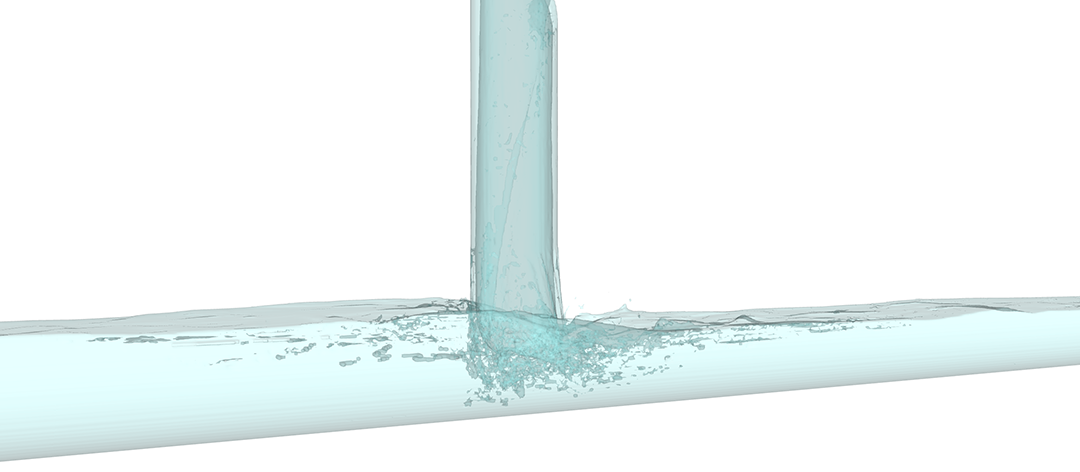
Spillway’s tailrace over natural rock

1. 메싱 및 지오메트리

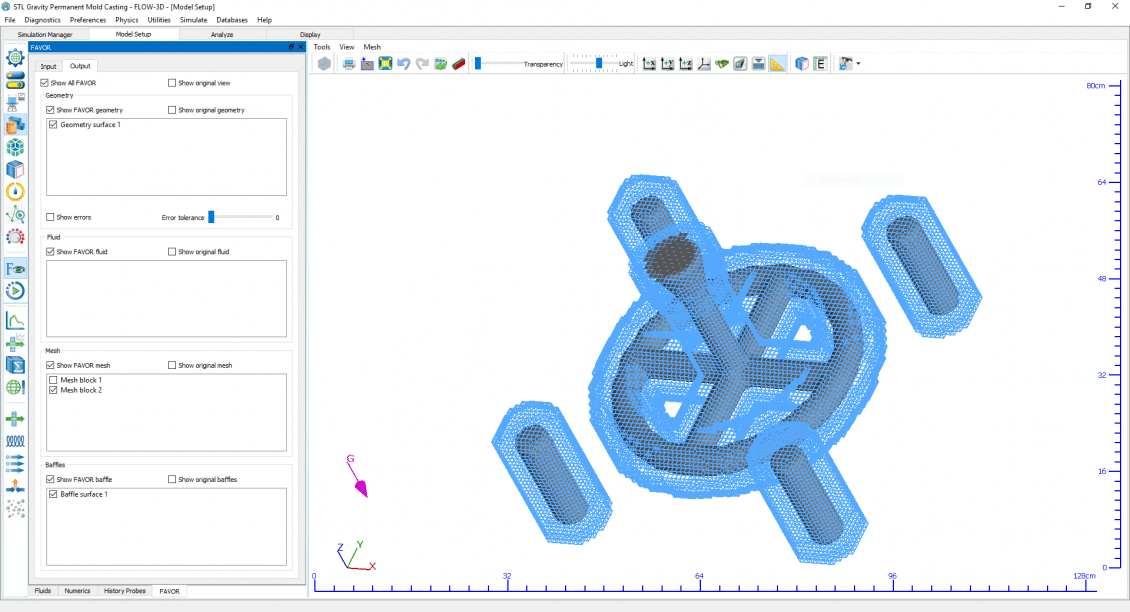
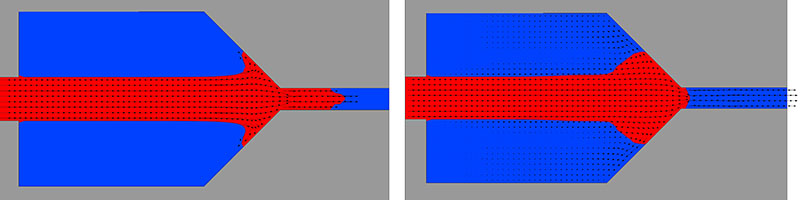
유한 요소 또는 “바디 맞춤 좌표”를 사용하는 솔루션 방법은 유동 영역의 기하학적 구조를 준수하는 해석용 그리드를 생성해야합니다. 정확한 수치 근사를 위해 허용 가능한 요소 크기와 모양으로 이러한 그리드를 생성하는 것은 쉽지 않은 작업입니다. 복잡한 경우 이러한 유형의 그리드 생성에는 며칠 또는 몇주의 노력이 소요될 수 있습니다. 일부 프로그램은 직사각형 그리드 요소만 사용하여 이러한 생성 문제를 제거하려고 시도하지만 흐름 및 열 전달 특성을 변경하는 “계단현상” 경계 문제를 해결해야 합니다. FLOW-3D는 FAVOR ™ (분수 면적 / 체적) 방법을 사용하여 기하학적 특성이 매끄럽게 포함된 생성하기 쉬운 직사각형 그리드를 사용하여 두 문제를 모두 해결합니다. 간단하고 강력한 솔리드 모델러가 FLOW-3D와 함께 패키지로 제공되거나 사용자가 CAD 프로그램에서 기하학적 데이터를 가져올 수 있습니다.

2. 운동량 방정식과 대략적인 흐름 모델

유체 운동량의 정확한 처리는 여러 가지 이유로 중요합니다. 첫째, 복잡한 지오메트리를 통해 유체가 어떻게 흐를지 예측할 수 있는 유일한 방법입니다. 둘째, 유체에 의해 가해지는 동적 힘 (즉, 압력)은 모멘텀을고려하여야만 계산할 수 있습니다. 마지막으로, 열 에너지의 대류 이동을 계산하려면 개별 유체 입자가 다른 유체 입자 및 제한 경계와 관련하여 어떻게 움직이는지를 정확하게 파악할 수 있어야 합니다.

이것은 운동량의 정확한 처리를 의미합니다. 모멘텀의 보존을 대략적으로만 하는 단순화된 흐름 모델은 실제적인 유체 구성과 온도 분포를 예측하는데 사용할 수 없기 때문에 FLOW-3D에서는 사용되지 않습니다.

3. 액체-고체 열 전달 영역

액체와 고체 (예 : 금속-금형) 사이의 열 전달에는 계면 영역의 정확한 추정이 필요합니다. 계단 경계는 이 영역을 과대 평가합니다. 예를 들어, 실린더의 표면적은 27 %의 비율로 과대 평가됩니다. FLOW-3D 전 처리기의 각 제어 볼륨에 대해 FAVOR ™ 방법에 의해 정확한 계면 영역이 자동으로 계산됩니다.

4. 액체-고체 열 전달에 대한 볼륨 효과 제어

제어 볼륨의 크기는 액체 / 고체 인터페이스를 포함하는 제어 볼륨에서도 열이 흐르기 때문에 액체와 고체 사이에서 교환되는 열의 속도와 양에 영향을 미칠 수 있습니다. FLOW-3D에서는 액체-고체 인터페이스에서 열 전달 속도를 계산할 때 체적 크기와 전도도가 고려됩니다.

5. 암시성(Implicitness)과 정확성

비선형 및 결합 방정식에 대한 암시적 방법에는 각 반복에서 under-relaxation 특성이 있는 반복 솔루션 방법이 필요합니다. 이 동작은 일부 상황에서 심각한 오류 (또는 매우 느린 수렴)를 일으킬 수 있습니다 (예 : 큰 종횡비로 제어 볼륨을 사용하거나 실제로 중요하지 않은 효과를 예상하여 암시성이 사용되는 경우).

FLOW-3D에서는 계산 노력FLOW-3D에서는 계산 작업이 덜 필요하기 때문에 가능한 경우 언제나 명시적 수치 방법을 사용하며, 수치 안정성 요구 사항은 정확도 요구 사항과 동일합니다. Implicit vs. Explicit Numerical Methods 문서에서 자세히 알아보세요.

6. 대류 전송을 위한 암시적 수치 방법 (Implicit Numerical Methods)

임의적으로 큰 시간 단계 크기를 계산에 사용할 수 있는 암시적 수치 기법은 CPU 시간을 줄이는데 널리 사용되는 방법입니다. 불행히도 이러한 방법은 대류 해석에 정확하지 않습니다. 암시적 방법은 근사 방정식에 확산 효과를 도입하여 시간 단계 독립성을 얻습니다. 물리적 확산(예 : 열전도)에 수치적 확산을 추가하는 것은 확산 속도만 수정하기 때문에 심각한 문제를 일으키지 않을 수 있습니다. 그러나 대류 과정에 수치 확산을 추가하면 모델링되는 물리적 현상의 특성이 완전히 바뀝니다. FLOW-3D에서 시간 단계는 프로그램에 의해 자동으로 제어되어 정확한 시간 근사치를 보장합니다.

7. 이완 및 수렴 매개 변수 (Relaxation and Convergence Parameters)

암시적 근사를 사용하는 수치 방법은 하나 이상의 수렴 및 이완 매개 변수를 선택해야합니다. 이러한 매개 변수를 잘못 선택하면 발산 또는 수렴 속도가 느려질 수 있습니다. FLOW-3D에서는 하나의 수렴 및 하나의 이완 매개 변수만 사용되며, 두 매개 변수는 프로그램에 의해 동적으로 선택됩니다. 사용자는 수치해석 솔버를 제어하는 ​​매개 변수를 설정할 필요가 없습니다.

8. 자유 표면 추적

액체-가스 인터페이스 (즉, 자유 표면)를 모델링하는 데 사용되는 두 가지 방법이 있습니다. 그 중 하나는 액체 및 가스 영역의 흐름을 계산하고 계면을 유체 밀도의 급격한 변화로 처리하는 것입니다. 일반적으로 밀도 불연속성은 고차 수치 근사를 사용하여 모델링됩니다.

불행히도, 이 치료는 몇몇 그리드 셀에 걸쳐 인터페이스가 매끄럽게 진행되도록 해주며, 그러한 인터페이스에 일반적으로 존재하는 접선 유속의 급격한 변화는 설명하지 않습니다. 또한 이 기법은 가스가 계산 영역으로 유입되는 액체로 대체될 경우 탈출 포트 또는 가스의 싱크로도 보완해야 합니다. 또한 이러한 방법은 일반적으로 유체의 비압축성을 만족시키기 위해 더 많은 노력을 기울여야 합니다.  가스 영역은 거의 균일한 압력 조정을 통해 솔루션 수렴 속도를 늦추는 경향이 있기 때문에 이러한 현상이 발생합니다.

FLOW-3D에서는 다른 기술인 VOF (Volume-of-Fluid) 방법이 사용됩니다. 이것은 인터페이스가 단계 불연속으로 긴밀하게 유지되는 진정한 3 차원 인터페이스 추적 체계입니다. 또한 선택적 표면 장력을 포함하여 수직 및 접선 응력 경계 조건이 인터페이스에 적용됩니다. 가스 영역은 사용자가 모델에 포함되도록 요청하지 않는 한 계산되지 않습니다.

Moving Boundaries: An Eulerian Approach

Moving Boundaries: An Eulerian Approach

많은 문제에서, 유체 및 고체 영역의 내부 경계가 그 안에서 이동할 수 있도록하면서 공간에 고정 된 그리드를 유지하는 것이 유리합니다. 이는 리 메싱의 필요성을 피할 수 있으므로 이러한 경계의 형태에 급격한 변화가 발생할 때마다 적절합니다. 메시 생성도 크게 단순화되었습니다.

고정 그리드 내에서 유체 인터페이스, 침전물, 응고 된 유체 및 탄성 재료의 경계 이동을 모델링하기위한 다양한 접근 방식이 표시됩니다. 유체 경계의 이동은 VOF (Volume-of-Fluid) 방법의 변형으로 수행되며, 각 계산 셀에서 유체의 양을 나타내는 양이 고정 메시를 통해 조정됩니다.

퇴적물의 침식 및 퇴적은 퇴적물 수색 모델을 사용하여 계산됩니다. 국부적 인 침식 속도는 패킹 된 퇴적물 / 유체 경계면에 존재하는 국부적 인 전단 응력을 기반으로하며, 증착은 Stokes 유동 근사치로 예측됩니다.

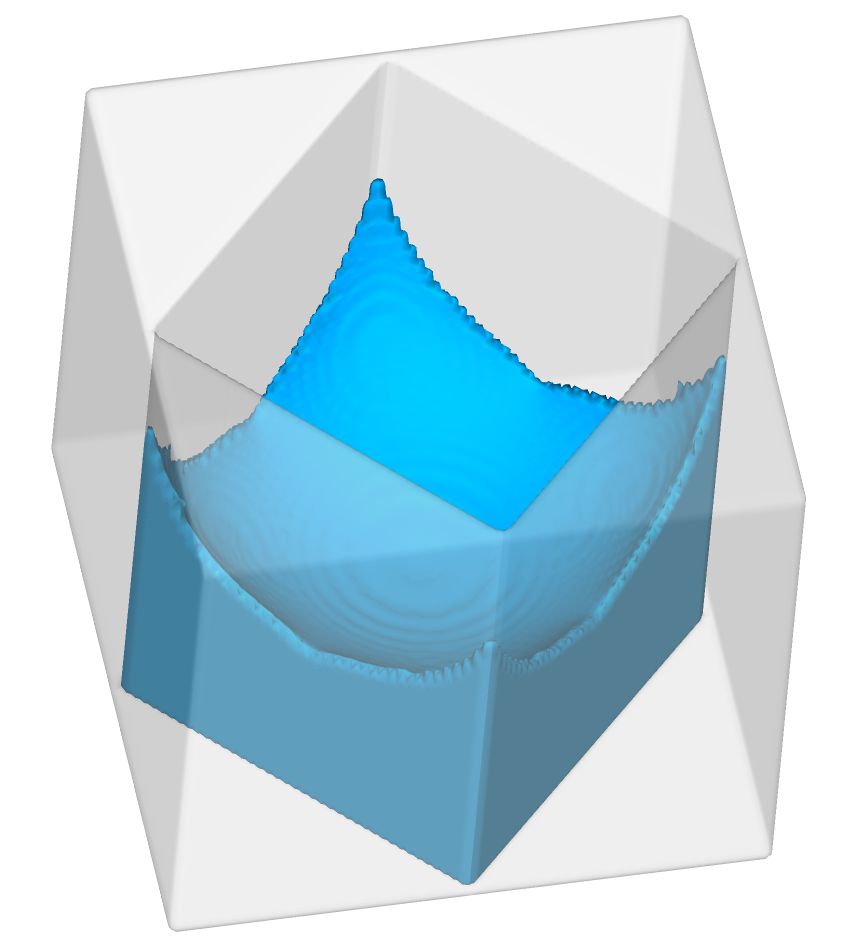
Emptying of gravure cell (same cell dimensions as filling case); a
three-dimensional perspective is shown. The transfer roll surface
(block at top) is moving away from the gravure roll at 0.5m/s. The
static contact of the fluid with all surfaces is 30°. The elapsed time
is 150

충진 층 경계면은 퇴적물 농도와 퇴적물의 포장 분율에 따라 달라집니다. 용융 금속은 온도가 빙점 아래로 떨어지면 굳을 수 있습니다. 응고 된 “유체”는 동결 및 용융을 유발하는 열유속의 양으로부터 결정된대로 표면이 증가하거나 수축하는 고체처럼 처리됩니다.

탄성 응력은 응고 된 재료 / 공기 인터페이스를 예측하는 VOF 방법을 사용하여 동일한 고정 그리드 내의 운동량 균형에 탄성 응력 계산을 추가하여 응고 된 영역에서 계산됩니다.

매우 일시적인 흐름 문제의 경우 유체와 공극 공간 사이 또는 두 개의 혼합 불가능한 유체 사이에있는 유체 인터페이스는 문제의 역학에 따라 자유롭게 움직여야합니다.

한 가지 해결책은 인터페이스와 함께 변형되는 메시를 만드는 것입니다. 이것은 시뮬레이션 중에 인터페이스의 형태가 거의 변경되지 않는 상황에서 잘 작동합니다. 그러나보다 일반적인 경우에는 시뮬레이션 중에 새 메시를 반복적으로 생성해야하거나 변경되지 않은 메시 내에서 자유 표면 경계를 생성하는 방법이 필요합니다. 이 작업은 후자를 제시합니다. VOF (Vol-of-fluid) 함수는 자유 표면의 위치를 추적하는 데 사용됩니다. 또한이 함수는 곡률을 계산하여 표면 장력의 영향을 예측하는 데 사용됩니다.

<원문보기> Moving-Boundaries-an-Eularian-Approach.pdf

Non-Newtonian Fluids

Non-Newtonian Fluids

혈액, 케첩, 치약, 샴푸, 페인트 및 로션과 같은 비 뉴턴 유체는 점도가 다양한 복잡한 유변학을 가지고 있습니다. FLOW-3D는 변형 및 온도에 따라 달라지는 비 뉴턴 점도를 가진 유체를 모델링합니다. 전단 및 온도 의존 점도는 Carreau, 거듭 제곱 법칙 함수 또는 단순히 표 형식 입력을 통해 설명됩니다. 일부 폴리머, 세라믹 및 반고체 금속의 특성인 시간 의존적 또는 요 변성 거동(thixotropic behavior)도 시뮬레이션 할 수 있습니다.

Hand Lotion Pump

핸드 로션 펌프는 종종 몇 가지 설계 문제와 관련이 있습니다. 펌프가 공극을 막지 않고 효과적으로 작동하고 로션을 연속적으로 생성하는 것이 중요합니다. 좋은 디자인은 노력을 덜 필요로하며 이상적으로는 로션을 원하는 위치로 향하게합니다. FLOW-3D의 움직이는 물체 모델은 노즐이 아래로 밀리는 것을 시뮬레이션하여 저장소의 로션을 가압하는 데 사용됩니다. 로션의 압력과 로션을 추출하는 데 필요한 힘을 연구 할 수 있습니다. 동일한 고정 구조화 된 메시 내에서 여러 설계 변수를 쉽게 분석 할 수 있습니다.

FLOW-3D’s TruVOF method accurately captures the pulsating lotion as the ball regulates the frequency of dispensing lotion.

Flushing

Flushing

화장실이 어떻게 작동하는지 궁금한 적이 있습니까? 사실 꽤 복잡합니다. 손잡이를 밀면 물이 용기를 채우기 시작합니다. 용기의 유체 레벨이 트랩 상단 (보울 뒤) 위로 올라가면 위어 유형의 흐름이 시작됩니다. 흐름이 충분히 빠르면 트랩 상단에 거품이 형성되어 사이펀이 생성됩니다. 그 시점에서 사이펀은 용기에서 물을 빼내고 변기가 내립니다.

많은 지역에서 물 절약은 중요한 문제이며 가정과 상업용 모두에 저 유량 화장실이 필요합니다. 그러나 화장실이 첫 번째 시도에서 작업을 완료하지 못하면 물 절약 목표가 실패합니다. FLOW-3D는 최적의 결과를 얻기 위해 다양한 설계를 모델링하는 데 사용할 수 있습니다.

Toilet Flushing Examples

아래 3D 애니메이션에서 FLOW-3D는 물 동작의 세척 순서를 보여줍니다. 물의 두 영역이 공과 함께 초기화됩니다. 공은 6 자유도의 완전 결합 유체-고체 모션을 시뮬레이션하기 위해 움직이는 물체 모델(GMO)을 사용하여 모델링됩니다. 중력은 수세식 탱크에서 물을 용기로 밀어 넣습니다. 분석은 정체 영역과 공이 영역을 벗어나는 기간을 나타내는 흐름 프로파일과 압력 윤곽을 보여줍니다. 공 대신 다른 질량과 모양을 사용할 수 있습니다. 플러싱 과정에서 잔여 물도 분석 할 수 있습니다.

아래의 횡단면 플롯은 수조의 흐름 재순환과 상세한 흐름 프로필을 보여줍니다. Collision 모델은 규정된 반발 및 마찰 계수를 기반으로 바운싱을 예측하는 공을 시뮬레이션하는 데 사용되었습니다. 물과 공기 사이의 일시적인 예리한 경계면은 FLOW-3D의 TruVOF 방법을 사용하여 잘 유지됩니다.

Sloshing & Slamming

Sloshing & Slamming

LNG 선과 같은 전 세계 항해 선박의 내부 슬로싱 운동에 의해 유발되는 가속 및 하중은 이러한 선박의 안전 설계에 중요한 요소입니다. 선박은 이러한 파도 슬로싱 역학으로 인해 상당한 내부 강제력을 경험할 수 있으며,화물 탱크는 격리 시스템 및 지지 구조물에 추가 하중을 경험할 수 있습니다. FLOW-3D의 비관성 기준 프레임 모델을 사용하면 컨테이너에서 유체 모션을 정확하게 추적하기 위해 복잡한 모션 매개 변수를 규정 할 수 있습니다. FLOW-3D는 연료 탱크의 액체화물과 추진체 움직임을 정확하게 예측합니다.

슬래밍 분석과 “그린 워터”(파동 스프레이 또는 선체 오버 토핑의 결과로 데크를 덮는 물)는 FLOW-3D의 일반적인 응용 분야이며, 이러한 문제에 대한 FLOW-3D의 TruVOF 접근 방식은 엔지니어에게 고유 한 기능을 제공합니다.

이 시뮬레이션은 FLOW-3D로 캡처한 것처럼 파도로 움직이는 LNG 유조선의 복잡하고 완전히 결합된 동작을 보여줍니다. 탱크에서 유체의 슬로싱은 선박의 역학에 영향을 미치며, 여기에는 bilge keels 과 bulbous bow가 포함되어 입사파에서 안정성을 유지하는데 도움이됩니다. 또한 탱크의 유체 슬로싱은 예상대로 선박의 움직임에서 위상 이동이 있습니다. FLOW-3D의 움직이는 물체 모델, 밀도 평가 모델 및 파동 생성 경계 조건은 해양 엔지니어가 유사한 문제를 분석하는 데 도움이 될 수 있습니다.

Precision Droplet Creation

Precision Droplet Creation

신속하고 반복적이며 정밀한 액적 생성 및 증착, 작은 피처의 인쇄 또는 패턴 화 (예 : l = 10-3-1 mm), 분무를 통해 제어되고 균일 한 두께로 박막을 형성하는 것이 매우 중요합니다.

다양한 이전 및 새로운 산업 응용 프로그램 (1-5). 액체 이동 및 액적 형성 / 증착 공정에는 복잡한 자유 표면 흐름과 자발적인 모세관 구동 불안정, 얇아 짐 및 핀치 오프 (1-5)를 겪는 원주 형 목의 형성이 포함됩니다. 단순한 뉴턴 유체 및 비탄성 유체에 대한 액적 형성 및 액체 전달을 분석하기위한 실험적, 이론적 및 1 차원 시뮬레이션 연구를 사용하여 이루어진 진전에도 불구하고 인쇄 및 스프레이에 대한 기계적 이해는 여전히 어려운 과제입니다.

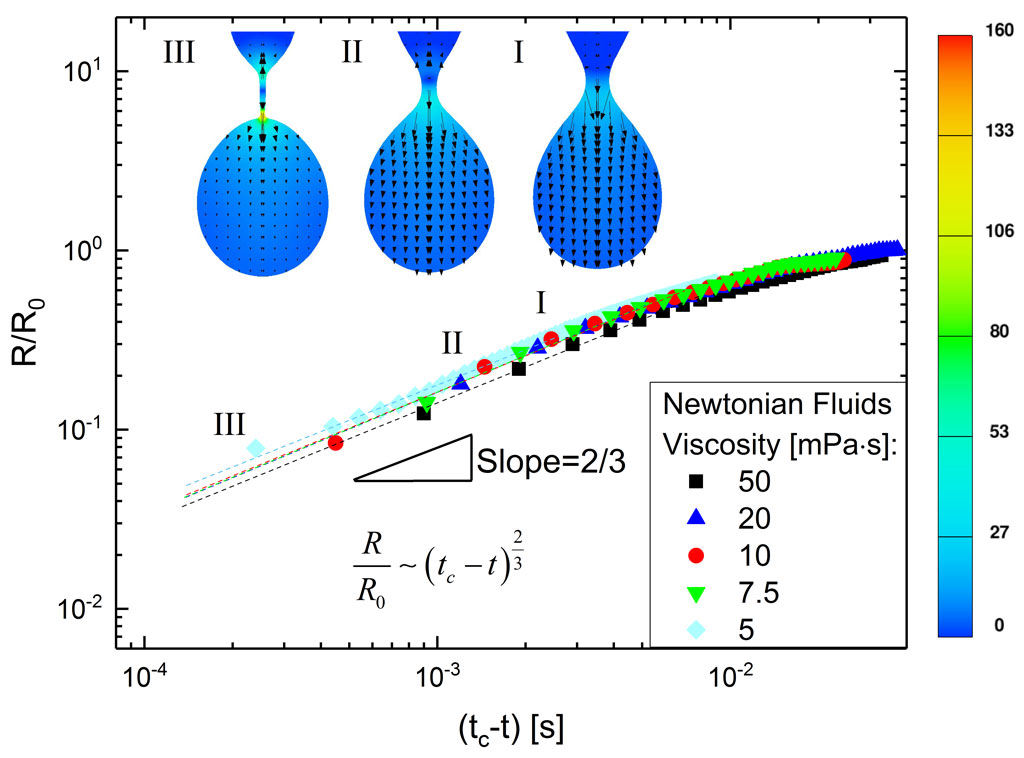
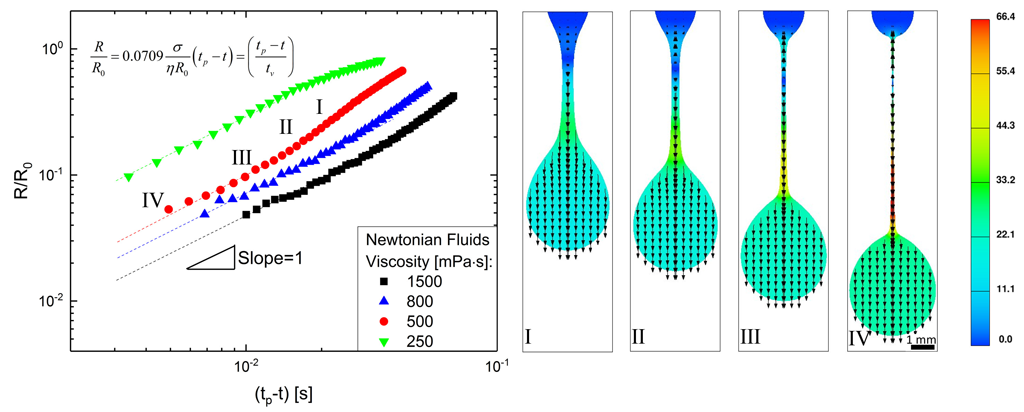
현재 계산 노력의 주요 동기는 FLOW-3D에 포함 된 VOF (체적-유체) 접근 방식을 사용하여 뉴턴 유체의 핀치 오프 역학에 대한 기계 론적 이해를 얻을 수있는 가능성을 조사하는 것입니다. 우리는 계산 분석이 자기 유사 모세관 얇아 짐 및 핀치 오프 역학을 결정하는 모세관, 관성 및 점성 응력의 복잡한 상호 작용을 포착 함을 보여줍니다. 뉴턴 유체의 낙하 형성 및 분리를 위해, 우리는 이론 및 1D 시뮬레이션 (1-7)뿐만 아니라 실험 (1, 1)에서 예상되는 범용 스케일링 법칙을 사용하여 계산 분석에서 얻은 자기 유사 목 진화를 설명 할 수 있음을 보여줍니다.

2, 8-12). 이러한 프로토 타입 흐름을 시뮬레이션하는 데있어 우리의 성공은 FLOW-3D를 사용하여 유한 시간 특이점, 위성 낙하 형성 및 더 복잡한 형상의 인쇄 가능성에 대한 신중한 계산 분석을 위해 필요한 단계이며 설명이나 연구가 훨씬 더 어렵습니다. 1D 모델과 실험을 사용합니다.

Courtesy of University of Illinois at Chicago

Read the Computational Analysis of Drop Formation and Detachment case study.

모델링 기능(Modeling Capabilities)

모델링 기능(Modeling Capabilities)

범용 CFD 소프트웨어인 FLOW-3D는 40년의 역사를 통해 개발 된 비압축 유체의 내부 및 외부의 자유 표면 흐름, 열 전달, 난류, 이동 및 변형하는 고체, 표면 장력 및 상변화와 같은 광범위한 물리적 및 수치적 기능을 갖추고 있습니다. FLOW-3D를 성공적으로 사용하여 광범위한 공학적 및 과학적 문제를 해결하고 설계를 최적화하며 복잡한 과정에 대한 통찰력을 얻을 수 있습니다.


FLOW-3D의 단열 버블 및 표면 장력 모델과 결합 된 1 유체 VOF 방식을 사용하면 유체를 사용하여 빈 공간을 효과적으로 모델링 할 수 있습니다. 이 솔루션은 빠르고 강력하며 정확하고 복잡한 2 유체 VOF 접근 방식을 우회합니다.

FLOW-3D 튜토리얼 V12

FLOW-3D 튜토리얼 V12

빠른 시작

이 튜토리얼 매뉴얼은 FLOW-3D 처음 사용하는 사용자에게 그래픽 사용자 인터페이스(GUI)의 주요 구성 요소를 쉽게 익히도록 하고, 다양한 시뮬레이션의 설정 및 실행 방법을 안내하기 위한 것입니다.

이 매뉴얼에 있는 실습과정은 FLOW-3D의 기본 사항을 다루기 위한 것입니다. 이 매뉴얼에서 제시하는 문제는 다양한 주제를 설명하고, 발생할 수 있는 많은 질문을 해결하기 위해 선정되었습니다. 이 매뉴얼의 실습과정은 FLOW-3D실행하는 컴퓨터에 앉아 사용하는 것이 가장 좋습니다.

CFD 사용 철학에 대한 간단한 섹션 다음에는 중요 파일과 시뮬레이션 파일을 실행하는 방법이 소개되어 있습니다. 이 소개 섹션 다음에는 모델 설정, 시뮬레이션 실행 및 포스트 프로세스, Simulation Manager 탐색 방법에 대한 설명이 있습니다. 이러한 각 단계에 대한 자세한 내용은 모델 설정, 컴퓨팅 결과 및 후처리 장에서 확인할 수 있습니다.

1.CFD 사용에 대한 철학

CFD (Computational Fluid Dynamics)는 유체 흐름(질량, 운동량 및 에너지 보존)에 대한 지배 방정식의 컴퓨터 솔루션입니다. 지정된 지배방정식은 이론 장에 설명된 Numerical방법을 사용하여 이산화되고 계산됩니다.

CFD 소프트웨어를 사용하는 것은 여러 면에서 실험을 설정하는 것과 유사합니다. 실제 상황을 시뮬레이션하기 위해 실험을 올바르게 설정하지 않으면, 그 결과는 실제 상황을 반영하지 않습니다. 같은 방법으로 수치 모델이 실제 상황을 정확하게 나타내지 않으면, 그 결과는 실제 상황을 반영하지 않습니다. 사용자는 어떤 것이 중요한지, 어떻게 표현해야 하는지를 결정해야 합니다. 시작하기 전에 다음과 같은 질문을 하는 것이 중요합니다.

  • CFD 계산에서 무엇을 알고 싶습니까?
  • 중요한 현상을 포착하기 위해 규모와 Mesh는 어떻게 설계되어야 하는가?
  • 실제 물리적 상황을 가장 잘 나타내는 경계 조건은 무엇입니까?
  • 어떤 종류의 유체를 사용해야합니까?
  • 이 문제에 어떤 유체 특성이 중요합니까?
  • 다른 어떤 물리적 현상이 중요합니까?
  • 초기 유체 상태는 어떻게 됩니까?
  • 어떤 단위 시스템을 사용해야합니까?

모델링 되는 문제가 실제 상황을 가능한 한 유사하게 나타내는지 확인하는 것이 중요합니다. 사용자는 복잡한 시뮬레이션 작업을 해결 가능한 부분으로 나누는 것이 좋습니다.

복잡한 물리 효과를 추가하기 전에, 간단하고 쉽게 이해할 수 있는 근사값으로 점차적으로 시작하여 프로세스 진행하십시오. 간단한 손 계산(베르누이 방정식, 에너지 균형, 파동
전파, 경계층 성장 등)은 물리 및 매개 변수를 선택하는데 도움이 되고, 결과와 비교할 수 있는 점검항목을 제공합니다.

CFD의 장단점을 이해하면 분석을 진행하는데 도움이 될 수 있습니다. CFD는 다음과 같은 경우 탁월한 분석 옵션입니다.

  • 기하 구조, 물리학 또는 필요한 상세 수준으로 인해 표준 엔지니어링 계산이 유용하지 않은 경우가 많습니다.
  • 실제 실험은 비용이 많이 소요됩니다.
  • 실험에서 수집할 수 있는 것보다 유체흐름에 대한 자세한 정보가 필요한 경우 유용합니다.
  • 위험하거나 적대적인 조건, 확장이 잘되지 않는 프로세스 등으로 인해 정확한 실험 측정을 하기가 어려운 경우
  • 복잡한 흐름 정보에 대한 커뮤니케이션

CFD는 다음과 같은 경우에 덜 효과적입니다.

  • 솔루션이 계산 리소스가 매우 많이 소요되거나, 도메인 크기를 줄이기 위한 가정 또는 해결되지 않은 물리적 현상을 설명하기 위한 반 임계 모델이 필요한 경우
  • CFD 시뮬레이션에 대한 입력이 되는 중요한 물리적 현상이 알려지지 않은 경우
  • 물리적 현상이 잘 이해되지 않거나 매우 복잡한 경우

CFD를 사용할 때 명심해야 할 몇 가지 중요한 참고 사항이 있습니다.

  • CFD는 규정된 초기 및 경계 조건에 따라 지정된 지배 방정식의 수치해석 솔루션입니다. 따라서 모델 설정, 즉 어떤 방정식을 풀어야 하는지, 재료 특성, 초기 조건 및 경계 조건이, 가능한 한 물리적 상황과 최대한 일치해야 합니다.
  • 방정식의 수치 해는 일반적으로 어떤 종류의 근사치를 필요로 합니다. 물리적 모델에 대한 가정과 해결방법을 검토한 후 사용하는 것이 좋습니다.
  • 디지털 컴퓨터는 숫자가 유한 정밀도로 이진수로 표시되는 방식으로 인해 반올림 오류가 발생합니다. 이는 문제를 악화시키기 때문에 매우 근소한 숫자의 차이를 계산해야 하는 상황을 피하십시오. 이러한 상황의 예는 시뮬레이션 도메인이 원점에서 멀리 떨어져 있을 때입니다.


2.중요한 파일

FLOW-3D 시뮬레이션과 관련된 많은 파일이 있습니다. 가장 중요한 것들이 아래에 설명되어 있습니다. 모든 prepin.* 파일의 명칭에서 prepin는 파일 형식을 의미하며, 별표시* 위치는 시뮬레이션 이름을 의미합니다. ( : prepin.example_simulation.)

  • ·prepin.*: 시뮬레이션용 입력 파일입니다. 시뮬레이션 설정을 설명하는 모든 입력 변수가 포함되어 있습니다.
  • ·prpgrf.*: 이것은 전 처리기 출력 파일입니다. 여기에는 계산된 초기 조건이 포함되며 시뮬레이션을 실행하기 전에 설정을 확인하는 데 사용될 수 있습니다.
  • ·flsgrf.*: 솔버 출력 파일입니다. 시뮬레이션의 최종 결과가 포함됩니다.
  • ·prperr.*, report.*, prpout.*: 이 파일들은 Preprocessor Diagnostic Files.
  • ·hd3err.*, hd3msg.*, hd3out.*: 이 파일들은 Solver Diagnostic Files.

모든 시뮬레이션 파일은 단일 폴더에 함께 유지하므로, 설명이 될 수 있는 시뮬레이션 이름을 사용하는 것이 좋습니다. 그러나 매우 긴 파일 이름은 운영 체제에 따라 문제가 될 수 있습니다.

노트

  • 시뮬레이션 이름이 inp(즉, 입력 파일이 있다면 prepin.inp) 출력 및 진단 파일은 모두 .dat이름을 갖습니다. 예: flsgrf.dat.
  • 모든 입력 파일은 네트워크 위치의 컴퓨터 대신 로컬 디렉토리에 저장하는 것이 좋습니다. 이것은 솔버가 더 빠르게 실행되고 GUI의 응답 속도가 빨라지며 실행중인 시뮬레이션을 방해하는 네트워크 문제 가능성을 제거합니다.

3.시뮬레이션 관리자

FLOW-3D 시뮬레이션 관리자의 탭은 주로 시뮬레이션을 실행할 수 있도록 시뮬레이션 환경을 구성하고 실행 시뮬레이션에 대한 상태 정보를 표시하는데 사용됩니다.

작업 공간 (Workspaces)

작업 공간(Workspaces)Simulation Manager의 필수 부분이며 파일을 FLOW-3D에서 처리하는 방식입니다. 기본적으로 시뮬레이션을 포함하고 구성하는 폴더입니다. 몇 가지 예를 들면 시뮬레이션과 또 다른 작업 공간인 검증 사례를 포함하도록 할 수 있습니다:

포트폴리오의 작업 공간

새로운 작업 공간 만들기

튜토리얼에서는 작성하려는 시뮬레이션을 포함할 작업 공간(Workspaces)을 작성하십시오.

1.File -> New workspace 이동

2.작업 공간 이름으로 Tutorial를 입력하십시오.

3.기본 위치는 현재 사용자의 홈 디렉토리에 있습니다. 다른 곳에서 찾을 수 있지만 기본 위치가 우리의 목적에 적합합니다.

4.하위 디렉토리를 사용하여 작업 공간 이름 만들기 확인란을 선택합니다. 이렇게 하면 파일 시스템에서 작업 공간에 대한 새로운 하위 디렉토리가 만들어져 시뮬레이션 파일을 훨씬 쉽게 구성할 수 있습니다.

새로운 작업 공간 만들기

5.확인을 눌러 새 작업 공간을 작성하십시오. 이제 포트폴리오에 표시됩니다.

새로운 작업 공간 만들기

작업 공간 닫기

포트폴리오를 정리하고 탐색하기 쉽도록 필요 없는 작업공간을 닫는 것이 편리합니다. 작업 공간을 닫으면 포트폴리오에서 해당 작업 공간만 제거됩니다. 그러나, 컴퓨터에서 작업 공간을 삭제하지는 않습니다.

작업 공간을 닫으려면

1.기존 작업 공간을 마우스 오른쪽 버튼으로 클릭하고 작업 Close Workspace 선택하십시오. 또는 포트폴리오에서 작업 공간을 선택 (왼쪽 클릭) 하고 Delete 키를 누를 수 있습니다.

2.작업 공간을 닫을 것인지 묻는 메세지가 표시됩니다. 예를 선택하십시오.

3.포트폴리오는 더 이상 닫힌 작업 공간을 포함하지 않습니다.

기존 작업 공간 열기

오래된 작업 공간을 열어야 할 때가 있을 것입니다. 예를 들어, 새 프로젝트에 유사한 시뮬레이션을 작성하기 전에 기존 시뮬레이션의 설정을 검토할 수 있습니다. 기존 작업 공간을 열려면

1.File -> Open Workspace를 선택하십시오

2.작업 공간 파일이 있는 디렉토리를 찾으십시오. Tutorial.FLOW-3D_Workspace.

작업 공간 열기

3.작업 공간을 로드 하려면 OK누르십시오.

작업 공간에서 시뮬레이션 작업

작업 공간을 사용하는 방법을 알았으니, 여기에 시뮬레이션을 추가해 봅시다.

Example를 추가하십시오

작업 공간에 작업 시뮬레이션을 추가하는 가장 간단한 방법은 포함된 예제 시뮬레이션 중 하나를 추가하는 것입니다. FLOW-3D의 다양한 기능을 사용하는
방법을 보여주기 위해 설계된 간단하고 빠른 시뮬레이션입니다. 기존 작업 공간에 예제를 추가하려면 다음을 수행하십시오.

1.포트폴리오에서 원하는 작업 공간을 강조 표시하십시오

2.File -> Add example 선택하십시오. 또는 작업공간을 마우스 오른쪽 버튼으로 클릭하고 예제 추가선택할 수 있습니다.

3.예제 대화 상자에서 예제를 선택하고 열기를 누르십시오. 자연 대류(Natural Convection) 예제를 선택했습니다.

시뮬레이션 예제 추가

4.새 시뮬레이션 대화 상자가 열립니다.

5.디렉토리가 작업 공간 위치에 있는지 확인하는 것이 좋으므로 기본 시뮬레이션 이름과 위치를 잘 확인하는 것이 좋습니다. FLOW-3D는 모든 시뮬레이션 파일을 이 작업 공간 디렉토리의 별도 하위 디렉토리에 배치하여 파일 구성을 쉽게 만들어 줍니다.

6.시뮬레이션을 위한 단위 시스템을 선택하십시오. 표준 단위 시스템이 권장되지만 각 단위를 독립적으로 선택하기 위해 사용자 지정 단위 시스템을 선택할 수 있습니다.

7.확인을 눌러 새 시뮬레이션을 작업 공간에 추가하십시오.

작업 공간에서의 시뮬레이션

작업 공간에서 시뮬레이션 제거

작업 공간에서 시뮬레이션을 제거해야 하는 경우가 있습니다 (이는 작업 공간에서 시뮬레이션을 제거만 하며, 컴퓨터에서 시뮬레이션을 삭제하지는 않습니다). 작업 공간에서 시뮬레이션을 제거하려면 다음을 수행하십시오.

1.작업 공간에서 기존 시뮬레이션을 마우스 오른쪽 버튼으로 클릭하고 (이 경우 이전 섹션에서 추가 한 예제 사용) 시뮬레이션 제거를 선택하십시오. 또는 작업 공간에서 시뮬레이션을 선택 (왼쪽 클릭)하고 Delete 키를 누를 수 있습니다.

2.작업 공간에는 더 이상 시뮬레이션이 포함되지 않습니다.

모든 작업 공간 및 디스크에서 시뮬레이션 삭제

작업 공간에서 시뮬레이션을 제거하는 것 외에도 디스크에서 모든 시뮬레이션 파일을 삭제해야 할 수도 있습니다. 작업 공간에서 시뮬레이션을 제거하고 디스크에서 시뮬레이션
파일을 삭제하려면 다음을 수행하십시오.

1.작업 공간에서 기존 시뮬레이션을 마우스 오른쪽 단추로 클릭하고 (이 경우 이전 섹션에서 추가 한 예제 사용) 모든 작업 공간 및 디스크에서 시뮬레이션
삭제를
선택하십시오.

2.시뮬레이션 디렉토리에서 삭제할 파일을 선택할 수 있는 창이 나타납니다. 삭제할 파일을 선택한 다음 확인을 눌러 해당 파일을 삭제하거나 취소를 눌러 작업을 중단하십시오.

3.OK를 선택한 경우 선택한 작업 공간은 더 이상 시뮬레이션을 포함하지 않습니다. 선택한 작업 공간의 모든 시뮬레이션 파일은 디렉토리에서 삭제됩니다.

경고

이 작업은 취소할 수 없으므로 계속하기 확인 후 파일을 삭제해야 합니다.

작업 공간에 기존 시뮬레이션 추가

기존 시뮬레이션을 작업 공간에 추가하려면 다음을 수행하십시오.

1.열린 작업 공간을 마우스 오른쪽 버튼으로 클릭하고 기존 시뮬레이션 추가 선택합니다. 작업 공간을 선택한 다음 File->Add Existing Simulation 을 선택할 수도 있습니다.

2.prepin.*파일 위치로 이동하여 열기를 선택하십시오.

작업 공간에 기존 시뮬레이션 추가

3.시뮬레이션이 이제 작업 공간에 나타납니다.

작업 공간에 새로운 시뮬레이션 추가

대부분의 경우 기존 시뮬레이션을 사용하는 대신 새 시뮬레이션을 작성하게 됩니다. 작업 공간에 새로운 시뮬레이션을 추가하려면:

1.기존 작업 공간을 마우스 오른쪽 버튼으로 클릭하고 새 시뮬레이션 추가 선택하십시오.

2.시뮬레이션 이름을 입력하라는 message가 표시됩니다. 이 예제에서는 heat transfer example 불러오십시오.

3.그런 다음 드롭다운 목록을 사용하여 시뮬레이션을 위한 단위 시스템을 결정합니다. 사용 가능한 옵션은 질량, 길이, 시간, 전기요금
각각 g, cm, s, coul기준의 Kg, m, s, CGS입니다. 또한 엔지니어링 단위도 사용할 수 있으며, slug, ft, s의 기초 단위가 있지만, 전기
충전을 위한 단위는 없습니다. 이러한 옵션 중 어느 것도 해당되지 않는 경우, 질량, 길이, 시간 및 전기요금에 대한 기준 등을 사용자 정의하여 사용자 지정 단위 시스템을 사용할 수 있습니다.

4.온도 단위는 드롭다운 목록을 사용하여 지정해야 합니다. 사용 가능한 옵션은 SI CGS 단위의 경우 Celsius
Kelvin, 엔지니어링 단위의 경우 Fahrenheit Rankine입니다. Custom units(사용자 정의 단위) 옵션을 선택한 경우, 사용 가능한 온도 단위는 질량
및 길이에 대해 선택한 기본 단위에 따라 변경됩니다.

노트

새 시뮬레이션의 시뮬레이션 단위는 신중하게 선택하십시오. 일단 설정하면 단위를 변경할 수 없습니다.

5.이 시뮬레이션에 사용된 템플릿이 기본 템플릿이 됩니다. 템플릿은 포함된 설정을 새 시뮬레이션에 적용하는 저장된 값 세트입니다. 다른 템플릿을 사용해야하는 경우
찾아보기 아이콘 (
browse_icon_v12)을 클릭하여 사용 가능한 템플릿 목록에서 선택하십시오.

6.기본 시뮬레이션 이름과 위치는 디렉토리가 작업 공간 위치에 있는지 확인하는 것이 좋습니다. FLOW-3D는 모든 시뮬레이션 파일을 이 작업 공간 디렉토리의 별도 하위 디렉토리에 배치하여 파일 구성을 훨씬 쉽게 만듭니다. 시뮬레이션을 다른 위치에 저장하려면 찾아보기 아이콘 ( browse_icon_v12)을 사용하여 원하는 위치로 이동하십시오.

7.확인을 클릭하여 작업 공간에 새 시뮬레이션을 추가하십시오.

heat transfer example

새로운 시뮬레이션 추가

다른 옵션

우리는 지금 이러한 옵션을 사용하지 않는 동안, 이 시뮬레이션을 마우스 오른쪽 버튼으로 클릭하여 추가 옵션에 대한 액세스를 제공합니다.

일반적으로 사용되는 Add Simulation Copy… 그리고 Add Restart Simulation…을 추가합니다. 첫 번째 옵션은 기존 시뮬레이션의 사본을
작성하고, 두 번째 옵션은 기존 시뮬레이션을 복사하고 원래 시뮬레이션의 결과를 다시 시작 시뮬레이션의 초기 조건으로 사용하도록 다시 시작 옵션을 구성합니다.

추가 정보

재시작 시뮬레이션에 대한 자세한 내용은 도움말에서 모델 설정 장의 재시작 섹션을 참조하십시오.

전처리 및 시뮬레이션 실행

시뮬레이션 전처리

시뮬레이션 전처리는 초기 조건을 계산하고 입력 파일에서 일부 진단 테스트를 실행합니다. 문제가 올바르게 구성되었는지 확인하거나 전 처리기의 진단 정보가 필요한 경우에
유용합니다. 시뮬레이션을 실행하기 전에 전처리할 필요가 없습니다. 시뮬레이션을 전처리 하려면

1.작업 공간에서 시뮬레이션을 마우스 오른쪽 버튼으로 클릭하고 Preprocess Simulation->Local 선택합니다. 이 경우 입력 파일 heat transfer example이 아직 완전히 정의되지 않았으므로 작업 공간에서 예제 문제를 선택하십시오.

2.전처리 프로세스가 시작되고 Simulation Manager 하단의 텍스트 창에 일부 정보가 인쇄된 후 성공적으로 완료됩니다. 포트폴리오에서 시뮬레이션 이름 옆의 아이콘도 시뮬레이션이 성공적으로 처리되었음을 나타내도록 변경됩니다.

추가 정보

자세한 내용은 도움말의 컴퓨팅 결과 장의 전처리 섹션을 참조하십시오.

시뮬레이션 실행

시뮬레이션을 실행하면 입력 파일에 정의된 문제에 대한 지배 방정식(물리적 모델, 형상, 초기 조건, 경계 조건 등)이 해석됩니다. 시뮬레이션을 실행하려면

1.작업 공간에서 시뮬레이션을 마우스 오른쪽 버튼으로 클릭하고 Run Simulation->Local을 선택하십시오. 이 경우 입력 파일 heat transfer example이 아직 완전히
정의되지 않았으므로 작업 공간에서 예제 문제를 선택하십시오.

2.솔버가 시작되고 시뮬레이션 관리자 하단의 텍스트 창에 일부 정보가 인쇄되고 플롯이 업데이트 된 후 성공적으로 완료됩니다. 포트폴리오에서 시뮬레이션 이름 옆의
아이콘도 시뮬레이션이 성공적으로 실행되었음을 나타내도록 변경됩니다. 또한 솔버가 실행되는 동안 큐에 시뮬레이션이 나타나는 것을 볼 수 있으며, 완료되면 사라집니다
.

추가 정보

시뮬레이션 실행 및 진단 읽기에 대한 자세한 내용은 도움말의 컴퓨팅 결과 장에서 솔버 실행 섹션을 참조하십시오.

작업 공간에서 모든 시뮬레이션 실행

작업 공간을 마우스 오른쪽 버튼으로 클릭하고 Simulate Workspace->Local을 선택하여 작업 공간에서 모든 시뮬레이션을 실행할 수도 있습니다.

추가 정보

자세한 내용은 컴퓨팅 결과 장에서 솔버 실행 섹션을 참조하십시오.

대기열

사전 처리 또는 실행에 작업이 제출되면 큐의 맨 아래에 시뮬레이션이 자동으로 추가됩니다. 그런 다음 솔버에 사용 가능한 라이센스 및 계산 리소스가 있으면 시뮬레이션이 사전 처리되거나 실행됩니다. 대기열에 있지만 아직 전처리 또는 실행되지 않은 시뮬레이션은 대기열 맨 아래의 컨트롤을 사용하여 대기열에서 다시 정렬하거나 대기열에서 제거할 수 있습니다.

추가 정보

자세한 내용은 컴퓨팅 결과 장을 참조하십시오.

파일 시스템에서 파일 찾기

어떤 이유로 구조물 파일에 액세스해야 하는 경우 (아마 *.STL 폴더에 파일을 배치해야 함) 표시된 파일 경로를 시뮬레이션 입력 파일로 클릭하여 파일 시스템의 해당 위치로 이동할 수 있습니다.

파일 링크

4.모델 설정

Model Setup(모델 설정) 탭은 시뮬레이션 관리자에서 현재 선택한 시뮬레이션에 대한 입력 매개 변수를 정의하는 곳입니다. 여기에는 전역설정, 물리학 모델, 유체,
기하학, 메싱, 구성요소 특성, 초기 조건, 경계 조건, 출력 옵션 및 숫자가 포함된다.

이 섹션은 물에 잠긴 모래(; 파랑)의 바닥에서 가열된 구리 블록(; 빨간색)에 의해 발생하는 열 기둥(아래)을 보여주는 간단한 시뮬레이션 설정 방법을 안내합니다.

예제 문제

이 튜토리얼은 방법이나 모델이 어떻게 작동하는지, 옵션을 선택한 이유 등에 대한 포괄적인 논의를 의도한 것이 아니며, 이 특정 시뮬레이션을 설정하기 위해 수행해야 할 사항에
대한 간략한 개요일 뿐입니다. 여기서 행해지는 것에 대한 방법/모델과 추론의 세부사항은 사용 설명서의 다른 장에서 확인할 수 있습니다.

시작하려면 새 작업 공간을 작성하고 새 시뮬레이션을 추가하십시오. 이를 수행하는 방법에 대한 지침은 새 작업 공간 작성 및 작업 공간에 새 시뮬레이션 추가를 참조하십시오.

탐색

모델 설정은 주로 빨간색으로 표시된 처음 9 개의 아이콘의 탐색을 통해 수행됩니다. 각 아이콘은 시뮬레이션의 특정 측면을 구성하기 위한 위젯을 엽니다. Global에서 시작하여 Numerics로 끝나는 다음 섹션은 각 위젯의 목적을 보여줍니다.

시뮬레이션의 다양한 측면을 정의하기위한 탐색 아이콘

통제 수단

다음은 FLOW-3D 사용자 인터페이스의 그래픽 디스플레이 영역에서 사용되는 마우스 컨트롤입니다.

행동

버튼/

동작

기술

회전

왼쪽

길게 클릭

마우스 왼쪽 버튼을 클릭 한 채로 Meshing & Geometry 창에서
마우스를 움직입니다. 그에 따라 모델이 회전합니다.

중간 버튼/스크롤

스크롤/클릭 한
상태

마우스를 앞뒤로 움직여 확대/축소하려면 가운데 휠을 굴리거나 마우스 가운데 버튼을 클릭
한 상태로 유지하십시오.

우측

길게 클릭

마우스 오른쪽 버튼을 클릭 한 채로 창에서 마우스를 움직입니다. 모델이 마우스와 함께 움직입니다.

객체에 초점 설정

해당 없음

객체 위에 커서를 놓기

커서를 개체 위로 가져 가면 마우스 오른쪽 버튼 클릭 메뉴를
통해 추가 조작을 위해 개체가 활성화됩니다. 개체가 활성화되면 강조 표시됩니다. Meshing & Geometry 탭에서 Tools->
Mouse Hover
Selection
환경 설정 이 활성화된 경우에만
수행됩니다.

선택

왼쪽

더블 클릭

객체를 두 번 클릭하면 마우스 오른쪽 버튼 메뉴를 통해 추가
조작을 위해 객체를 선택하고 활성화합니다. Meshing
& Geometry
탭에서 Tools
->Mouse Hover Selection 환경 설정 이
비활성화 된 경우에만 활성화됩니다.

액세스 객체 속성

우측

딸깍 하는 소리

강조 표시된 객체를 마우스 오른쪽 버튼으로 클릭하면 객체
식별, 표시/숨기기, 활성화/비활성화, 투명도 조정 등의 옵션 목록이 표시됩니다.

커서 좌표 반환 (프로브)

왼쪽

Shift + 클릭

Shift 키를 누르면 커서가 대상으로 바뀝니다. Shift 키를 누른 상태에서 클릭하면 화면의 왼쪽 하단에 표시된 표면의 좌표가 표시됩니다.

피벗 점 배치

왼쪽

cntrl + 클릭

Ctrl 키를 누르고 있으면 커서가 피벗 아이콘으로 바뀝니다. Ctrl 키를 누른 상태에서 클릭하여 피벗 점을 설정하십시오. 뷰가
피벗 점을 중심으로 회전합니다. 토글 사용자 정의 피벗 피벗 점을 끕니다.
보기 창 위의 버튼을 누릅니다.

도움이
되는 툴바 옵션도 있습니다. 옵션의 목적을 찾으려면 아이콘 위로 마우스를 가져갑니다.

메시 및 지오메트리 탭의 컨트롤

글로벌

이 매뉴얼에 대한 시뮬레이션을 만들려면 원하는 작업 공간을 마우스 오른쪽 단추로 클릭하고 새 시뮬레이션 추가를 선택하십시오. 매뉴얼 섹션의 새 시뮬레이션 추가 작업 공간에 설명된 대로 이름을 ‘heat transfer example’로 지정하고 작업 공간에 추가하십시오. SI Kelvin을 각각 단위 시스템과 온도로 선택합니다. 일단 설정되면
시뮬레이션을 위한 단위는 변경할 수 없다는 점을 기억하십시오.

글로벌 아이콘 f3d_global_icon을 클릭하여 글로벌 위젯을 여십시오. 여기에서 정의된 단위가 표시되고 시뮬레이션 완료 시간이 설정됩니다. 이 시뮬레이션의 경우 완료 시간을 200 초로 설정하십시오. 시뮬레이션에 대한 중요한 세부 정보는 여기 노트 필드에도 추가할 수 있습니다.

글로벌 탭 예를 들어 문제

추가 정보

자세한 내용은 모델 설정 장의 전역 섹션을 참조하십시오.

물리

물리 f3d_models_icon아이콘을 클릭하여 물리 위젯을 엽니다.

모델 선택을위한 물리 위젯

이 문제의 경우, 하나의 유체, 자유 표면, 경계 및 비압축/제한 압축의 기본 설정이 모두 정확합니다.

관련 물리 메커니즘(, 추가 지배 방정식 또는 지배 방정식 용어)은 물리 위젯에서 정의됩니다. 모델을 활성화하려면 해당 모델의 아이콘을 마우스 왼쪽 버튼으로 클릭하고활성화 선택하십시오. 이 시뮬레이션을 위해서는 다음 모델을 활성화해야 합니다.

·Density evaluation(밀도 평가): 이 모델은 열 기둥을 생성하는 밀도 변화를 설명합니다. 다른 양(: 온도 또는 스칼라)의 함수로 평가된 밀도를 선택하고 Include volumetric thermal expansion 상자를 선택하십시오.

문제 평가를위한 밀도 평가 모델

·Gravity and non-inertial reference frame(중력 및 비 관성 기준 프레임): 중력을 나타내는 힘이 추가되므로 Z 중력 성분에 -9.81을 입력하십시오.

예를 들어 중력 모델

·
Heat transfer(열 전달): 이 모델은 유체와 고체 물체 사이의 열 전달을 설명합니다. 이 시뮬레이션의 경우 First order for the Fluid internal Energy advection를 선택하고 Fluid to solid heat transfer를 활성화하려면 확인란을 선택하십시오. 나머지 옵션은 기본값으로 두어야합니다.

열전달 모델 예 : 문제

·
Viscosity and turbulence(점성 및 난류): 이 모델은 유체의 점성 응력을 설명합니다. Viscous flow 옵션을 선택하고 나머지 옵션은 기본값으로 두십시오.

예를 들어 문제의 점도 모델

추가 정보

자세한 내용은 모델 설정 장의 물리 섹션을 참조하십시오.

유체

유체의 속성은 모델 설정 탭의 유체 위젯에 정의되어 있습니다. 유체 위젯은 수직 도구 모음에서 Fluids f3d_fluids_icon f3d_fluids_icon아이콘을 클릭하여 액세스할 수 있습니다. 먼저 유체 옵션 1 이 속성 옵션으로 선택되어 있는지 확인하십시오. 유체 1의 속성은 수동으로 입력할 수 있지만 일반적인 유체의 속성을 설정하는 빠른 방법은 재료 속성로드 버튼Matdatbas을 클릭하여 재료 데이터베이스에서 유체를 로드하는 것입니다. 다음으로, 원하는 재료를 탐색하십시오. 이 경우 Fluids->Liquids->Water_at_20_C를 선택하고 Load를 클릭하십시오.

이 시뮬레이션에는 데이터베이스에 없는 특성인 체적 열 팽창 계수가 필요합니다. 밀도 하위 탭에서 207e-6을 입력하십시오. 최종 속성 세트는 다음과 같아야 합니다.

유체 특성 (예 : 문제)

추가 정보

자세한 내용은 모델 설정 장의 유체 섹션을 참조하십시오.

Geometry(기하)

기하형상 f3d_geometry_icon아이콘을 클릭하여 물리 위젯을 엽니다.

이 시뮬레이션을 위해 생성해야 하는 두 가지 형상은 구리 블록과 모래층이 있습니다. 둘 다 프리미티브를 사용하여 작성합니다. 보다 현실적인 시뮬레이션은 Primitives, Stereolithography(STL) Geometry File (s)/또는 Raster File (s)을 사용하여 지오메트리를 정의할 수 있습니다.

구리 블록을 만들려면 먼저 지정된 상자 형상 아이콘을 클릭하여 작성합니다. 구리 블록을 x y 방향 원점에서 +/- 2cm 연장하고 z 방향으로 0-4cm 연장합니다. 나머지 옵션은 그대로 두고 블럭을 솔리드로 만들고 새 구성 요소에 추가합니다.

예제 문제에 대한 구리 블록 정의

하위 구성 요소 정의를 마치고 구성 요소 정의로 이동하려면 확인을 선택하십시오. 자동으로 열린 구성요소 추가 대화상자에서 Type as General(솔리드)을 그대로 두고 Name(이름) 필드에 Copper block을 입력한 다음 OK(확인)를 선택하여 구성요소 정의를 완료하십시오.

상자아이콘을 다시 클릭하여 베드 하위 구성 요소를 작성하십시오. 아래 표시된 범위를 사용하고 컴포넌트에 추가 선택 사항을 새 컴포넌트(2)로 설정하십시오.

예를 들어 침대 문제 정의

하위 구성 요소 정의를 마치고 구성 요소 정의로 이동하려면 확인을 선택하십시오. 대화 형으로 이름 필드에서Bed를 입력한 후 구성요소 정의를 마칩니다. 최종 형상은 다음과 같이 표시됩니다.

예제 문제에 대한 형상 정의

새 구성 요소를 추가하면 가로 및 세로 방향으로 그래픽 표시 창에 길이 스케일이 자동으로 생성됩니다. 눈금자 도구를 사용하여 생성된 기하학적 객체의 범위를 빠르게 측정할 수 있습니다.

노트

표시 영역에는 지오메트리 모양 정의만 표시되므로 객체가 솔리드인지 구멍인지에 대한 정보는 표시되지 않습니다. 즐겨 찾기옵션을 사용하여 Mesh 후에 나중에 수행할 수 있습니다.

추가 정보

자세한 내용은 도움말 모델 설정 장의 형상 섹션을 참조하십시오.

구성 요소 속성

열전달 모델은 고체 구성 요소의 전도 방정식을 해결하기 위해 재료 특성이 필요합니다. 이러한 속성은 이 아이콘f3d_geometry_icon을 클릭하여 구성 요소 속성 위젯에서 설정합니다.

구성 요소 특성 위젯

각 구성 요소에는 솔리드 특성 및 표면 특성이 정의 되어 있어야합니다. 구리 블록에 대해 이를 설정하려면 먼저 형상 위젯에서 구성 요소 1: copper block 요소를 선택하십시오. 그런 다음 컴포넌트 특성 위젯에서 솔리드 특성을 선택하고 다음과 같이 특성을 정의하십시오.

구리 블록 고체 특성

여기에서 두 번째 구성 요소(베드)에 대해 설명된 구성 요소 특성 정의를 위한 대체 방법을 사용할 수 있습니다. 이 방법에서는 구성 요소 2: 베드 구성 요소를 클릭하고 재료 필드 옆에 있는 재료 특성로드 Matdatbas 아이콘을 선택하여 시작합니다. 다음으로 재료를 탐색합니다. 이 경우 Solids->Sands->Sand_Quartz 선택하고 Load를 선택하십시오.

베드 솔리드 속성

추가 정보

l 자세한 내용은 모델 설정 장의 유체 섹션을 참조하십시오.

l 주어진 물리적 모델에 필요한 속성에 대한 자세한 내용은 모델 참조 장을 참조하십시오.

Meshing(메싱)

Mesh Mesh 위젯에서 생성 및 정의되며, 위젯을 통해 액세스 할 수 있습니다. f3d_mesh_icon아이콘을 눌러 add_iconMesh를 추가합니다. Mesh의 범위를 형상에 빠르게 적용하려면 형상에 맞추기 라디오 버튼을 선택하고 오프셋 라디오 버튼을 백분율로 유지합니다. 블록 속성에서 셀 크기를 0.004로 설정하십시오.

메시 블록을 형상에 맞추기

Mesh 상단은 z 방향으로 위쪽으로 확장해야 합니다. Z-Direciton 탭을 선택하고 Mesh Plane 2 0.2를 입력합니다.

z 높이 조정

이 시뮬레이션은 2D가 될 것입니다. 동일한 프로세스에 따라 Y 방향 범위를 -0.005 0.005 로 설정하십시오. 그리고 합계 셀을 1로 설정하십시오.

y 메쉬 평면 조정

최종 Mesh는 그래픽 디스플레이 창 바로 위의 Mesh->Flow Mesh->View 모드 드롭 다운 메뉴에서 옵션을 변경하여 다른 방식으로 볼 수 있습니다. 그리드 라인 마다 그리드 선을 표시합니다 옵션은 Mesh Plane의 옵션만 표시됩니다 Plane Mesh 및 개요 옵션은 Mesh의 범위를 보여줍니다.

또한 솔버가 Mesh의 최종 지오메트리를 인식하는 방법은 FAVOR TM 알고리즘을 사용하여 형상 정의를 면적 분수 및 부피 분수로 변환합니다. 이렇게 하려면 즐겨 찾기아이콘을 클릭한 다음 생성을 선택하십시오.

호의

잠시 후 회색 영역이 고체 물질을 나타내는 아래와 같은 형상을 표시해야 합니다.

선호하는 결과

추가 정보

l Mesh에 대한 자세한 내용은 모델 설정 장의 Mesh 섹션을 참조하십시오.

l FAVORTM FAVORize
옵션에 대한 자세한 내용은 모델 설정 즐겨 찾기장의 Reviewing the FAVORized Geometry and Mesh 섹션을 참조하십시오.

경계 조건

FLOW-3D는 구성 요소 유형 및 활성 물리적 모델에 기초한 구성 요소에 적절한 경계 조건을 자동으로 적용합니다. 그러나 경계 조건 위젯에서 Mesh 블록면의 경계 조건은 각 Mesh 블록에 대해 수동으로 설정해야 합니다(f3d_bc_icon ).

이 매뉴얼의 경우 경계 조건 중 3 가지가 경계조건( X Min , X Max, Z Max 경계)을 기본 대칭 조건조건부터 변경해야 합니다.

·X Min :

o경계 조건 위젯의 경계 섹션 아래에 있는 X Min 목록을 클릭하십시오. Type에서 경계 유형을 Velocity로 설정하고 X 속도에 대해 0.001을 입력하십시오.

XMIN 경계 조건

·다음으로, 유체 분율 사용에서 유체 표고 사용으로 드롭다운 상자를 변경하고 유체 높이를 0.15로 설정하십시오.

·마지막으로 온도를 298K로 설정하십시오.

XMIN 경계 조건

·
X Max :

o경계 조건 위젯의 경계 섹션 아래에 있는 X 최대 목록을 클릭하십시오. 경계 유형을 압력으로 설정하고 압력에 대해 0을 입력하십시오.

o다음으로, 유체 분율 사용에서 유체 높이 사용으로 드롭다운 상자를 변경하고 유체 높이를 0.15로 설정하십시오.

o마지막으로 온도를 298K로 맞춥니다.

oXMAX 경계 조건

·
Z 최대 :

o경계 조건 위젯의 경계 섹션 아래에 있는 Z 최대 목록을 클릭하십시오. 경계 유형을 압력으로 설정하고 압력에 대해 0을 입력하십시오.

o다음으로 유체 분율을 0.0으로 설정하십시오.

o마지막으로 온도를 298K로 맞춘다.

ZMAX 경계 조건

추가 정보

자세한 내용은 모델 설정 장의 Mesh 경계 조건 섹션을 참조하십시오.

초기 조건

도메인 내부의 솔리드 객체(구성 요소)와 유체 모두에 대해 초기 조건을 설정해야 합니다.

·
구성 요소 :이 시뮬레이션에서 솔리드 객체에 필요한 유일한 초기 조건은 초기 온도입니다. 이것은 각 구성 요소에 대한 위젯에 설정되어 있는 구성 요소 속성에 대해 수행한 것과 유사한 방식으로 구성 요소를 등록합니다. 구성 요소 속성을 설정할 때 이전과 동일한 방법으로 구성 요소 1의 초기 온도를 350K로 설정하고 구성 요소 2의 초기 온도를 298K로 설정하십시오.

유체 초기 조건

유체: 유체의 초기 조건을 설정하기 위해 조금 더 설정해야 합니다. 이 경우 유체 구성, 온도, 속도 및 압력 분포를 모두 설정해야 합니다. 유체 초기 조건은 초기 위젯을 설정하고 초기 f3d_initial_icon를 클릭하면 열립니다.

f3d_initial_icon 아이콘을 선택한 후 유체 목록에서 압력을 선택하고 온도를 298K로 설정합니다. x, y, z 속도를 0.0으로 설정하십시오.

유체 초기 조건

다음으로, 높이/볼륨 목록과 유체 높이 사용 드롭다운 버튼을 선택합니다. 유체 높이를 0.15로 설정하십시오.

유체 초기 조건 계속

추가 정보

자세한 내용은 모델 설정 장의 초기 조건 섹션을 참조하십시오.

출력

FLOW-3D 옵션에는 결과 파일에 기록될 데이터와 출력 위젯에서 발견된 빈도를 제어하는 7가지 데이터 유형이 있습니다. 출력 f3d_output_icon 아이콘을 클릭합니다.

다른 데이터 유형은 다음과 같습니다.

·Restart: 모든 흐름 변수. 기본 출력 주기는 시뮬레이션 시간의 1/10입니다.

·Selected: 사용자가 선택한 흐름 변수 만. 기본 출력 주기는 시뮬레이션 시간의 1/100입니다.

·History: 하나의 변수와 시간의 변화를 보여주는 데이터. 예는 시간 단계 크기, 평균 운동 에너지, 배플에서의 유속 등을 포함합니다. 기본 출력 주기 = 시뮬레이션 시간의 1/100.

·Short print: hd3msg.*파일에 텍스트 진단 데이터가 기록 됩니다. 기본 출력 주기는 시뮬레이션 시간의 1/100입니다.

·Long print : hd3out.*파일에 텍스트 진단 데이터가 기록 됩니다. 기본 출력 주기는 시뮬레이션 시간의 1/10입니다.

·Solidification: 응고 모델이 활성화 된 경우에만 사용 가능합니다.

·FSI TSE: 변형 가능한 솔리드에 대한 추가 출력 옵션.

일반적으로 이 시뮬레이션에는 기본 출력 속도가 적합합니다. 그러나 Selected Data의 일부 추가 구성은 유용합니다. Selected data interval 0.5로 설정한 다음 Fluid 온도, Fluid velocity, Macroscopic density Wall 온도 옆에 있는 상자를 선택합니다. 그러면 이러한 값이 0.5초마다 출력됩니다.

출력 탭 설정

추가 정보

자세한 내용은 모델 설정 장의 출력 섹션을 참조하십시오.

Numerics

기본 Numerics 옵션은 대부분의 시뮬레이션에서 잘 작동하므로 기본 옵션에서 벗어나야 하는 충분한 이유가 없는 경우에는 현재 그대로 두는 것이 가장 좋습니다.

이것으로 모델 설정 섹션에서 시작된 예제 문제의 설정을 마칩니다. 이제 실행할 준비가 되었으므로 전처리 및 시뮬레이션 실행의 단계에 따라 시뮬레이션을 실행하십시오.

추가 정보

자세한 내용은 모델 설정 장의 Numerics 옵션 섹션을 참조하십시오.

일반 시뮬레이션 설정 점검 목록

시뮬레이션을 설정하는 데 필요한 단계에 대한 개략적인 개요가 아래에 나와 있습니다. 이 목록은 포괄적인 목록이 아닙니다. 일반적인 단계, 고려해야 할 몇 가지 중요한 사항 및 권장되는 설정 순서를 간단히 설명하는 안내서일 뿐입니다.

시작하기 전에

1.물리적 문제의 다이어그램을 그리기 및 주석 달기 : 이 다이어그램에는 기하학적 치수, 유체의 위치, 관련 힘, 움직이는 물체의 속도, 관련 열 전달 메커니즘 등이 포함되어야 합니다. 완성된 다이어그램은 문제에 대한 모든 관련 엔지니어링 정보로 인한 물리적 문제에 대한 이미지여야 합니다.

2.모델링 접근법 결정: 주석이 달린 다이어그램을 가이드로 사용하여 문제점에 접근하는 방법을 결정 : 문제가 되는 유체의 수, 혼화 가능한 경우, 하나 이상의 유체에서 방정식을 풀어야하는 경우 및 압축성이 중요한지 파악하여 시작하십시오. 그런 다음 어떤 물리적 메커니즘이 중요한지 결정하십시오. 이러한 각 옵션 (: 유체 유형, 열 전달 메커니즘 등)에 대한 관련 엔지니어링 정보를 다이어그램에 추가하십시오. 물리적 메커니즘이 포함되거나 무시된 이유를 정당화하려고 합니다. 이를 통해 시뮬레이션 프로세스 초기에 오류를 수정하는 데 시간이 거의 걸리지 않는 초기에 실수를 잡을 수 있습니다.

3.다이어그램에 계산 영역을 그리고, 계산 영역의 가장자리에 있는 물리적 상황 설명 : 경계의 물리적 상황을 가장 잘 나타내는 경계 조건 유형을 기록합니다. 사용 가능한 경계 조건 유형이 경계의 물리적 상황에 대한 합리적인 근사치가 아닌 경우 이 경계를 다른 곳으로 이동해야 합니다.

모델 설정 : 일반

1.문제, 시뮬레이션의 목적, 사례 번호 등을 설명하는 메모를 추가하십시오. 메모는 향후 사용자 또는 나중에 참조할 수 있도록 설정을 설명하고 정당화하는 데 도움이 됩니다. 시뮬레이션의 목적, 분석 방법 등을 논의해야합니다.

2.사용할 솔버와 프로세서 수를 선택하십시오.

3.단위 시스템 선택: 소규모 문제를 모델링 할 때는 작은 단위 ( : mm-gm-msec)사용하고 규모가 큰 문제는 큰 단위 ( : SI)를 사용하십시오. 이를 통해 기계 정밀도로 인한 반올림 오류를 방지할 수 있습니다.

4.유체 수, 인터페이스 추적 옵션 및 유량 모드를 선택하십시오. 주석이 달린 다이어그램을 이 단계의 지침으로 사용하십시오. 유체의 수는 질량, 운동량 및 에너지 보존을 관장하는 방정식이 유체 분율 f> 0″ width=”44″ height=”17″ border=”0″><!--[endif]--></span>(</span>유체<span lang= 1을 나타내는) 또는 유체 분획 f \ geq 0(유체 1 및 유체 2)이 있는 영역에서 해결되는지 여부를 나타냅니다. 인터페이스
추적 옵션은 유체 분율의 변화가 급격한지 또는 확산되어야 하는지 여부를 정의하는 반면, 흐름 모드는 f = 0두 유체 문제에서 처리되는 영역을 정의합니다.

5.마감 조건 정의: 시뮬레이션 종료 시점을 선택합니다. 시간, 채우기 비율 또는 기타 정상 상태 측정을 기반으로 할 수 있습니다.

6.기존 결과에서 시뮬레이션을 다시 시작하는 방법 정의 (선택 사항): 기존 결과 파일에서 시뮬레이션을 다시 시작할 때 다시 시작 옵션이 적용됩니다. 재시작 옵션은 재시작 소스 파일에서 가져온 정보와 시뮬레이션의 초기 조건을 사용하여 재설정되는 정보를 정의합니다.

모델 설정 : 물리

1.주석이 달린 다이어그램을 기반으로 관련 실제 모델 활성화

모델 설정 : 유체

1.유체의 속성 정의 1: 주석이 달린 다이어그램을 가이드로 사용하여 활성 물리적 모델에 대한 적절한 물리적 속성을 정의하십시오.

2.유체 2의 속성 정의 (사용하는 경우): 주석이 달린 다이어그램을 가이드로 사용하여 활성 물리적 모델에 적절한 물리적 속성을 정의하십시오.

3.인터페이스의 속성 정의: f = 1 f = 0의 영역 사이의 인터페이스 속성을 정의하십시오. 여기에는 표면 장력, 상 변화 및 확산에 대한 특성이 포함됩니다.

모델 설정 : Mesh 및 형상

1.모든 STL 파일의 오류 점검: ADmesh, netfabb Studio 또는 유사한 프로그램을 사용하여 모든 STL 파일의 오류를 점검하십시오. 이는 모델 설정에 시간을 소비하기 전에 형상
정의와 관련된 문제를 파악하는 데 도움이 됩니다.

2.모든 하위 구성 요소 및 구성 요소 가져 오기 및 정의 : 주석이 달린 다이어그램에 설명 된 대로 실제 사례와 일치하도록 3D 솔리드 형상을 정의합니다. 최종 결과는 물리적 형상의 정확한 복제본이어야 합니다. 각 부분에 설명적인 이름을 사용하고 대량 소스가 될 구성 요소를 포함하십시오.

3.모든 구성 요소의 속성 정의: 주석이 달린 다이어그램에 그려진 내용을 기반으로 각 구성 요소의 모든 재료 속성, 표면 속성, 모션 속성 등을 정의합니다. 경계 조건이 정의될 때까지 질량 소스 특성을 정의하기를 기다리십시오.

4.스프링과 로프 및 각각에 대한 관련 속성을 정의합니다.

5.주석이 달린 다이어그램에 설명된 시뮬레이션 도메인과 일치하도록 Mesh를 정의하십시오. 도메인의 모서리가 다이어그램에서 식별된 위치에 있는지 확인하십시오. 또한 인터페이스 (셀이 있는 셀과 셀이 f = 1다른 셀 이 있는 셀)를 식별하려면 세 개의 셀이 필요합니다.f = 0 ). 최소 5 개의 셀이 예상되는 가장 얇은 연속 영역에 맞도록 충분히 작은 셀을 사용하십시오. f = 1 f = 0 .

6.지오메트리를 정의하는 모든 배플 정의

7.경계 조건, 질량 소스, 질량 모멘텀 소스, 밸브 및 벤트 정의: 경계 조건 (질량 소스, 질량 모멘텀 소스, 밸브 및 벤트 포함)은 모든 방정식을 풀기 위해 주어진 위치에서 솔루션을 규정합니다. 주석이 달린 다이어그램을 사용하여 각 경계 (또는 소스 등)에 지정된 내용이 유동 솔루션, 열 전달 솔루션, 전위 등에 대한 현실과 일치하는지 확인하십시오.

8.유체 및 구성 요소의 초기 조건을 정의합니다. 초기 조건은 모든 방정식 (유량 솔루션, 열 전달 솔루션, 전위 등)에 대해 모든 영역에서 솔루션을 규정합니다.t = 0 .주석이
달린 다이어그램을 사용하여 초기 조건에 지정된 내용이 현재 현실에 대한 근사치인지 확인하십시오. 유체 영역뿐만 아니라 구성 요소의 초기 조건을 설정해야 합니다.

9.모든 측정 장치 정의 (샘플링 볼륨, 플럭스 표면 및 히스토리 프로브)

모델 설정 : 출력

1.출력 기준 (시간, 채우기 비율 또는 응고된 비율)을 선택하십시오.

2.재시작 데이터에 추가할 출력을 선택하십시오.

3.선택한 데이터에 기록할 정보를 선택하십시오.

4.재시작, 선택, 히스토리, 짧은 인쇄 및 긴 인쇄 데이터의 출력 속도 정의 : 기본 속도는 재시작 및 긴 인쇄 데이터의 경우 (10개 출력)/(시뮬레이션 종료 시간) 및 선택한 기록, 짧은 인쇄 데이터의 경우 (100개 출력)/(시뮬레이션 종료 시간)입니다.

모델 설정 : 숫자

1.기본값이 아닌 필수 숫자 옵션을 선택 FLOW-3D의 숫자 옵션은 고급 사용자를 대상으로 하며, 지배 방정식을 해결하는 데 사용되는 숫자 근사치 및 방법을 상당히 제어할 수 있습니다. 이러한 옵션 중 일부를 잘못 사용하면 솔루션에 문제가 발생할 수 있으므로 일반적으로 이 옵션의 기능을 먼저 이해하고 조정의 정당성을 갖추지 않고는 이러한 설정을 조정하지 않습니다.

5.FLOW-3D에서 후 처리

이 섹션에서는 FLOW-3D에 통합된 포스트 프로세서를 사용하는 방법에 대해 설명합니다. 보다 강력한 외부 포스트프로세서 FlowSight에 대한 튜토리얼은 FlowSight 설명서를 참조하십시오. 또한 이 섹션에서는 Flow Over A Weir 예제 문제를 실행하여 생성된 결과 파일을 사용합니다. 이 예제 문제를 실행하는 방법에 대한 지침은 예제 추가 및 시뮬레이션 사전 처리 및 실행을 참조합니다.

FlowSight 사용에 대한 기본 참조는 FlowSight Help->helpLocal Help 메뉴에서 액세스하는 FlowSight 사용자 설명서입니다.

추가 정보

기존 플롯

기존 플롯은 솔버가 자동으로 생성하는 사전 정의된 플롯입니다. 사용자 정의 플롯은 아래의 사용자 정의 플롯 섹션에 설명되어 있습니다.

1.분석 탭을 클릭하십시오. FLOW-3D 결과 대화 상자가 표시됩니다; 메세지가 나타나지 않으면 (분석 탭이 열림) 결과 파일 열기를 선택하여 동일한 대화 상자를 엽니다.

2.기존 라디오 버튼을 선택하십시오. 데이터 파일 경로 상자에 두 가지 유형의 파일이 표시됩니다 (있는 경우). 이름이 prpplt.*있는 파일 에는 전처리 flsplt.*기에 의해 자동으로 작성된 플롯이 포함되고 이름이 있는 파일에는 입력 파일에 사전 지정된 플롯 뿐만 아니라 후 처리기에 의해 자동으로 작성된 플롯이 포함됩니다.

3. 확인을 선택 flsplt.Flow_Over_A_Weir하고 클릭하십시오. 그러면 디스플레이 탭이 자동으로 열립니다.

기존 결과 대화 상자

4.사용 가능한 플롯 목록이 오른쪽에 나타납니다. 목록에서 해당 플롯의 이름을 클릭하면 특정 플롯을 볼 수 있습니다. 플롯 26 이 아래에 나와 있습니다.

기존 플롯보기

커스텀 플롯

1.분석 탭으로 돌아갑니다. 대화 상자를 열려면 결과 파일 열기를 선택하십시오.

2.전체 출력 파일을 보려면 사용자 정의 단일 선택 단추를 선택하십시오. 전체 출력 파일에는 prpgrf.*파일과 파일이 포함됩니다 flsgrf.*. 시뮬레이션이 실행되었으므로 전 처리기 출력 파일이 삭제되어 flsgrf파일에 통합되었습니다.

3.flsgrf.Flow_Over_A_Weir대화 상자 에서 파일을 선택하고 확인을 클릭하십시오.

FLOW-3D 결과 대화 상자

이제 분석 탭이 표시됩니다. 시뮬레이션 결과를 시각화 하는 방법에는 여러 가지가 있습니다. 사용 가능한 플롯 유형은 다음과 같습니다.

·Custom : 이 매뉴얼 의 FLSINP 파일을 사용하여 플롯합니다. 사용자 정의 섹션의 출력 코드를 사용하여 출력 플롯을 수동으로 수정하는 데 사용할 수 있습니다. 이것은 고급 옵션입니다.

·프로브 : 개별 셀, 경계, 구성 요소 및 도메인 전체(전역) 변수 대 시간에 대한 그래픽 및 텍스트 출력을 표시합니다. 자세한 내용은 프로브 플롯 프로브 : 특정 시점의 데이터와 시간 을 참조하십시오.

·1-D : 셀 데이터는 X, Y 또는 Z 방향의 셀 라인을 따라 볼 수 있습니다. 플롯 제한은 공간 및 시간에 모두 적용할 수 있습니다. 자세한 내용은 1-D 플롯 1-D : 라인을 따른 데이터 시간 을 참조하십시오.

·2-D : 셀 데이터는 XY, YZ 또는 XZ 평면에서 볼 수 있습니다. 플롯 제한은 공간 및 시간에 모두 적용할 수 있습니다. 속도 벡터 및 입자를 추가할 수 있습니다. 자세한 내용은 2 차원 플롯 2 차원 : 평면의 데이터와 시간의 데이터 를 참조하십시오.

·3-D : 유체와 고체의 표면 플롯을 생성하고 셀 데이터로 채색 할 수 있습니다. 속도 벡터, 입자 (있는 경우) 및 유선과 같은 추가 정보를 추가할 수 있습니다. 플롯 제한은 공간 및 시간에 모두 적용할 수 있습니다. 자세한 내용은 3D 플롯 3D : 표면의 데이터 시간 을 참조하십시오.

·텍스트 출력 : cell-by-cell 재시작, 선택 및 응고 데이터를 텍스트 파일에 쓸 수 있습니다. 자세한 내용은 텍스트 출력 텍스트 : ASCII 형식의 공간 데이터 출력 시간 을 참조하십시오.

·중립 파일 : 재시작 및 선택된 데이터는 별도의 텍스트 파일에 정의 된 지정된 지점(보간 또는 셀 중심)에서 출력 될 수 있습니다. 자세한 내용은 중립 파일 : 사용자 정의 좌표에서의 공간 데이터 출력 시간 을 참조하십시오.

·FSI TSE : 유한 요소 유체 / 고체 상호 작용 및 열 응력 진화 물리학 패키지에서 출력됩니다. 자세한 내용은 FSI / TSE : 표면의 구조 데이터와 시간 을 참조하십시오.

3 차원 도표

1.Analyze -> 3-D 탭을 선택하십시오.

2.Iso-surface = Fraction of fluid 선택하십시오. 이것은 표면을 그리는 데 사용되는 변수입니다. 선택한 등면 변수에 대한 등고선 값 기준을 충족하는 모든 셀을 통해 표면이 그려집니다. 유체의 분율이 기본값이며 유체 표면이 표시됩니다.

등 면형

3.색상 변수 = 압력을 선택하십시오. 이 선택은 등위면의 색을 지정하는 데 사용되는 변수를 결정합니다 (이 경우 유체 표면은 압력에 의해 색이 그려집니다).

색상 변수 유형

4.Component iso-surface overlay = Solid volume 선택하십시오. 솔리드 볼륨 은 유체와 함께 솔리드 구성 요소를 표시합니다. 이전 단계에서는 체적 분수의 보완을 등위면으로 선택하여 이 작업을 수행했지만 이 옵션을 사용하면 유체와 고체 표면을 동시에 플롯 할 수 있습니다.

등표면 옵션

5.이동 시간 프레임의 최소 및 최대 위치들 (0 내지 1.25 )에 슬라이더 위치.

시간대 옵션

6.렌더 버튼을 클릭하여 디스플레이 탭으로 전환하고 t = 0.0에서 1.25 초 사이에 일련의 11 플롯을 생성하여 압력에 의해 채색된 유체 표면과 위어 구조를 보여줍니다. 데이터 다시 시작 이 선택되었으므로 11 개의 플롯이 있습니다.

7.사용 가능한 플롯이 사용 가능한 시간 프레임 목록에 나열됩니다. 다음을 클릭하여 시간 프레임 사이를 이동하거나 시간 프레임을 두 번 클릭하여 표시하십시오. 첫 번째 및 마지막 시간 프레임은 다음과 같아야 합니다.

위어 구조 렌더링

8.Analyze -> 3-D 탭으로 돌아가서 Data Source 그룹에서 Selected data 라디오 버튼을 선택하십시오.

데이터 소스

9.시간 프레임 선택기의 두 슬라이더가 모두 오른쪽에 있으므로 마지막 시간 프레임 만 생성됩니다. 사용 가능한 시간 프레임이 많고 렌더링하는데 시간이 오래 걸리므로 선택한 데이터를 선택하면 인터페이스에서 자동으로 수행됩니다. 사용 가능한 모든 시간 프레임을 렌더링 하려면 왼쪽 슬라이더를 Time Frame Min = 0 으로 이동하십시오.

10. 렌더링 버튼을 클릭하십시오. 몇 초 안에 뷰가 디스플레이 창으로 전환되고 101 개의 플롯이 사용 가능한 시간 프레임 목록에 나열됩니다. 시간 프레임 사이를 이동하려면 다음을 반복해서 클릭하십시오.

대칭 흐름 표시

위어 중심 아래로 대칭 평면을 사용하여 시뮬레이션을 설정했으므로 위어 구조의 절반만 시뮬레이션되고 표시됩니다. 프리젠테이션 목적으로 대칭 모델의 두 반쪽을 모두 표시할
수 있습니다.

1.아래와 같이 Analyze -> 3-D 탭으로 돌아가서 Open Symmetry Boundaries 확인란을 선택하십시오.

열린 대칭 경계

2.렌더링을 클릭하십시오. 유체 표면이 디스플레이 탭의 대칭 경계에서 열린 상태로 나타납니다.

3.화면 위의 도구 모음 메뉴에서 도구 -> 대칭을 선택하십시오.

4.대화 상자에서 Y 방향 확인란을 선택하여 Y = 0 평면에서 결과를 미러링합니다.

대조

5.적용 닫기를 선택하십시오.

6.마지막 시간 프레임을 두 번 클릭하십시오. 디스플레이는 아래와 같이 전체 위어 구조를 보여줍니다.

전체 위어 구조

3 차원 애니메이션 만들기

다음 단계는 3 차원 유체 표면의 애니메이션을 만드는 것입니다. 애니메이션은 사용 가능한 시간 프레임 목록의 프레임에서 만든 동영상입니다. 애니메이션의 시각적 효과를 향상시키려면 모든 프레임에 공통 색상 스케일을 적용하는 것이 좋습니다.

1.분석 -> 3-D 탭으로 돌아갑니다.

2.윤곽 제한 그룹 상자에서 전역 라디오 버튼을 모두 선택하십시오.

윤곽 제한

3.렌더 클릭 하여 다시 그리고 디스플레이 탭으로 돌아갑니다.

4.도구 -> 대칭 -> Y 방향 -> 적용 선택을 반복하여 Y = 0 평면에서 결과를 반영합니다.

5.선택 도구 -> 애니메이션 -> 러버 밴드 캡처를 다음과 같이 선택 확인 Mesh지가 나타납니다 그것을 읽은 후.

러버 밴드 캡처

6.마우스 왼쪽 버튼을 클릭 한 상태에서 드래그하여 애니메이션을 적용할 화면 부분을 선택하십시오. 선택한 영역 주위에 선택 상자가 나타납니다.

X, Y, 너비 및 높이 상자

7.디스플레이 창 위에서 빨간색 캡처 버튼을 선택하십시오. 애니메이션을 시작하는 대화 상자가 나타납니다.

8.애니메이션의 기본 이름은 out.avi입니다. 아래에 표시된 것처럼 보다 구체적인 이름이 권장됩니다.

9.기본 프레임 속도는 초당 10 프레임입니다. 이 시뮬레이션의 마감 시간은 1.25 초이고, 일정한 시간 간격으로 100 개의 플롯이 있으므로실제속도는 초당 80 프레임입니다. 너무 빠를 수 있으므로 대신 5 입력 하고 확인을 누르십시오.

AVI 캡처

10. 각 시간 프레임이 표시 창에 렌더링 되고 비트 맵 파일이 시뮬레이션 디렉토리에 작성됩니다. 이 프로세스가 완료되면 다음 대화 상자가 나타납니다.

생성 된 이미지 소스 파일

  1. 프로세스의 다음 단계를 시작하려면 확인 버튼을 클릭하십시오. 새로운 프로세스 (BMP2VAI.exe)가 시작되고 압축 방법을 선택할 수 있는 새로운 비디오 압축 창이 나타납니다. 다른 창 뒤에 숨겨져 있으면 앞으로 가져옵니다.
  2. 애니메이션의 기본 압축은 압축되지 않습니다. 파일 크기가 너무 커서 뷰어에 로드 할 수 없으므로 대부분의 애니메이션에는 권장되지 않습니다. Windows를 사용하는 경우 Microsoft Video 1, Linux를 사용하는 경우 Cinepak 선택하십시오. 여기에서 선택하는 것은 컴퓨터에서 사용할 수 있는 비디오 코덱과 비디오를 표시하는 데 사용하는 기계에서 사용할 수 있는 것입니다.
  3. 애니메이션 속도가 데이터 속도에 의해 제한되지 않도록 데이터 속도 확인란을 선택 취소하십시오.
비디오 압축

  1. 압축 프로세스를 시작하려면 확인을 클릭하십시오. 압축이 완료되면 다음 대화 상자가 나타납니다.
AVI 파일 생성

  1. 확인을 클릭하십시오. 애니메이션 프로세스가 완료되었습니다.
  2. Windows 탐색기에서 .avi 파일을 찾는 가장 빠른 방법 은 시뮬레이션 관리자 탭으로 이동하여 시뮬레이션 입력 파일 링크를 클릭하는 것 입니다.
  3. .avi파일 을 두 번 클릭하여 애니메이션을 재생 하십시오. 이전에 선택한 압축 형식을 읽을 수 있는 올바른 코덱이 설치되어 있지 않으면 오픈 소스 다중 코덱 비디오 플레이어 설치를 고려하십시오.

2 차원 도표

1.Analyze -> 2-D 탭을 선택하십시오. 이 시뮬레이션의 결과를 보는 데 가장 유용한 평면은 평면 Y = 0.0에있는 위어 중심선의 XZ 평면입니다.

2.XZ 평면 라디오 버튼을 선택하십시오.

3.Y 제한 슬라이더를 모두 Y = 0.25 (Y = 0.0에 가장 가까운 셀 중심 y 좌표)로 드래그 합니다. 또한 동일한 위치가 J = 2 로 식별되어 해당 셀이 도메인에서 두 번째임을 나타냅니다. 첫 번째 셀 (J = 1) Mesh 외부에 있으며 경계
조건 속성을 계산하는 데 사용됩니다. 기본
윤곽 변수는 압력이며 기본 속도 벡터는 기본적으로 선택됩니다. 솔리드 형상은 모든 2D 플롯과 함께 자동으로 표시되므로 3D 플롯과 같이 활성화 할 필요가 없습니다.

4.벡터 옵션을 클릭하고 X = 2 Z = 2 입력하십시오. 벡터는 이제 다른 모든 셀에 플롯 됩니다. 벡터 옵션을 적용하려면 확인을 선택하십시오.

벡터 옵션

5.Y = 0 평면에서 2 차원 압력 플롯의 시간 시퀀스를 생성하려면 렌더링을 클릭하십시오. T = 0.0 (왼쪽) 인 다음과 유사한 그래픽이 나타납니다. T = 0.125 (중간); 그리고 T = 1.25 (오른쪽).

2D 결과

6.디스플레이 화면의 오른쪽 상단에 있는 형식 버튼을 선택하십시오.

형식 옵션

7.선 색상, 벡터 길이 및 화살촉 크기 변경과 같은 다양한 옵션을 시험해보십시오. 변경 사항을 보려면 적용을 선택하십시오. 완료되면 재설정 확인을 선택하여
기본 설정으로 돌아가서 대화 상자를 닫습니다. 모든 플롯에 대해 선호하는 옵션 세트가 있는 경우
저장 버튼을 선택하여 저장할 수 있습니다.

1 차원 도표

  1. 분석 -> 1-D 탭을 선택하십시오. 이 탭에서는 하나 이상의 플롯 시간에서 셀 행을 따라 압력, 유체 깊이, 유체 상승 및 속도와 같은 셀별 출력 변수의 꺾은 선형
    차트 플롯을 사용할 수 있습니다.
  2. 데이터 소스 로 선택을 선택합니다. 사용 가능한 변수는 이제 더 빈번한 플로팅을 위해 선택된 변수 만 표시합니다.
  3. 자유 변수 표고데이터 변수 로 선택하십시오. 유압 데이터출력 탭에서 선택되었으므로 사용할 수 있습니다.
ID 그래픽을 위해 선택된 데이터

  1. 이 시뮬레이션의 흐름 방향은 주로 x 축과 평행하므로 X 방향을 선택하십시오.
  2. Y 방향 슬라이더를 0.25(J = 2)로 이동하여 Y 방향에서 흐름 중심선에 가장 가까운 셀이 표시됩니다.
  3. 기본적으로 전체 X 범위가 표시됩니다. 플롯의 범위를 제한하려는 경우 X 방향 슬라이더를 이동할 수 있습니다. Z 방향 슬라이더의 위치는 주어진 x, y 위치에서 z 셀의 각 열에 대해 하나의 자유 표면 높이만 기록되므로 중요하지 않습니다. 시간 프레임 슬라이더는 0초와 1.25초여야 합니다.
흘러가는 방향

  1. 렌더링을 클릭하십시오. t = 0.0에서 t = 1.25s까지의 시리즈 플롯이 디스플레이 탭의 플롯 목록에 나열됩니다. 이러한 플롯을 볼 수 있는 여러 가지 모드가
    있습니다. 기본 모드는
    단일 모드이며 형식 버튼 아래의 드롭 다운 상자에 표시됩니다.
기본 단일 모드

  1. 다양한 시간에 유체 표면 높이의 플롯을 비교하려면 드롭 다운 상자에서 오버레이 모드를 선택하십시오.
  2. 오른쪽 창에서 플롯 1, 13 101 선택하려면 클릭하십시오. 플롯 이름에는 또한 기록된 시간이 표시됩니다 (t = 0.0, 0.15s 1.25 ). 출력은 아래와 같이 나타납니다.
자유 표면 고도

  1. 이 플롯을 비트 맵 또는 포스트 스크립트 파일에 저장하려면 출력 버튼을 선택하십시오.
  2. 확인 화면에 플롯 오버레이 플롯을 캡처하는 확인란을 (그리고 단 하나의 출력 파일을).
  3. 쓰기 버튼을 선택하여 이미지 파일을 만듭니다.
  4. 결과 이미지 파일은 시뮬레이션 디렉토리에 있으며 (시뮬레이션 관리자 탭 에서이 파일을 찾는 방법을 기억하십시오) 이름이 지정한 plots_on_screen.bmp됩니다.
출력 사진

프로브 플롯

1.
분석 -> 프로브 탭을 선택하십시오. 시간 기록 플롯은이 탭에서 변수 대 시간의 라인 그래프 또는 텍스트 출력으로 생성됩니다. FLOW-3D 에는 데이터 소스 그룹에서 선택되는 세 가지 유형의 시간 종속 데이터가 있습니다.

·공간 데이터 : 재시작 선택된 데이터 소스. 단일 x, y, z 셀 중심 좌표의 시간 종속 값이 표시됩니다. 값은 시간과 관련하여 통합되거나 시간과 관련하여 차별화되거나 이동 평균 (시간)으로 통합될 수 있습니다.

·일반 history 데이터 :. 글로벌 수량은 시간에 따라 다릅니다. 일반적인 양은 평균 운동 에너지, 시간 단계 및 대류 볼륨 오류입니다. 또한 이 데이터 유형에는 모델 설정 -> 메싱 및 지오메트리 탭에서 이러한 옵션을 선택한 경우 지정된 측정 위치(배플, 샘플링 볼륨, 히스토리 프로브)의 모든 데이터와 이동 또는 정지 상태의 솔리드 및 스프링/로프를
위한 통합 출력이 포함됩니다.

·Mesh-dependent data : 메쉬 경계에서 시간에 따른 수량(계산 또는 사용자 지정)입니다. 일반적인 수량은 경계에서의 유량 및 경계에서의 지정된 유체 높이입니다.

2.데이터 원본에서 일반 기록 라디오 버튼을 선택합니다. X, Y Z 데이터 점 슬라이더가 회색으로 바뀝니다. 이는 일반 기록 데이터가 특정 셀과 연결되어 있지 않기 때문입니다.

3.목록에서 질량  평균 유체 평균 운동 에너지를 선택하십시오.

그래픽 데이터 출력

4. 단위를 선택하여 플로팅 단위 대화 상자를 엽니다.

5. 플롯에 단위 표시를 선택하십시오.

6. SI, CGS, slugs/feet/seconds 또는 pounds/inches/seconds를 선택하여 원하는 단위 시스템으로 결과를 변환하고 출력합니다. 장치를 표시하고 변환하려면 모델 설정 -> 일반 탭에서 장치 시스템을 선택해야 합니다. 이전 단계에서 이 항목을 확인했으며, 지오메트리 및 유체 특성은 centimeters/grams/seconds 시스템에서 지정되었습니다.

플로팅 단위

7.Plotting Units 대화 상자를 닫으려면 OK를 선택하십시오.

8.데이터의 그래픽 출력을 생성하려면 렌더를 선택하십시오. 출력은 시간에 따른 영역의 모든 유체에 대한 질량 평균 평균 운동 에너지를 보여줍니다. 이전 단계에서 선택한 사항에 따라 단위 레이블과 함께 그림이 나타납니다. 플롯은 총 운동 에너지가 일부 평균값 주위에서 진동하고 있음을 나타냅니다. 진동이 작아짐에 따라 시뮬레이션은 정상 상태 흐름에 접근합니다.

프로브 MKE 출력

9.분석 -> 프로브 탭으로 돌아갑니다.

10. 출력 양식 그룹에서 텍스트를 선택하여 그래프를 텍스트 데이터로 출력한 다음 렌더링을 다시 선택하십시오.

출력 형태

11. 나타나는 텍스트 대화 상자에서 다른 이름으로 저장 버튼을 선택하여 출력을 텍스트 파일로 저장할 수 있습니다.

12. 출력 창을 닫으려면 계속을 선택하십시오.

텍스트 출력

1.Analyze -> Text Output 탭을 선택하십시오.

2.텍스트 출력 은 셀별 데이터 ( 다시 시작 또는 선택됨 ) 만 출력 할 수 있고 (구성 요소, 측정 스테이션 또는 글로벌 데이터 없음) 둘 이상의 셀을 선택할 수 있다는 점을 제외하고 프로브 탭 과 동일한 방식으로 작동합니다. 각 플롯 시간에 대한 출력 데이터. 셀은 슬라이더를 사용하여 3D 블록에서 선택됩니다. 기본 공간 범위는 전체 도메인으로 설정됩니다.

3.직접 텍스트 데이터를 출력해보십시오.


FLOW-3D TruVOF는 미국 및 기타 국가에서 등록 상표입니다.

Overview of free surface modeling setup

VOF(Volume of Fluid) 방법

  • 기체(Gas)와 액체(Liquid)사이의 경계면을 추적하는 방법으로 액체일 경우, fraction=1, 기체일 경우 fraction=0입니다.
  • 이에 대한 자세한 내용은 아래 링크를 참조하시길 바랍니다.

/wp-admin/post.php?post=3217&action=edit

[FLOW-3D이론] Fluid Interfaces andFree-Surfaces/유체경계면과 자유표면

FAVOR 기법

  • FLOW-3D의 검사체적(Control volume)은 형상을 오버레이(Overlay)하는 좌표 방향의 면이 있는 직사각형 블록으로 정의됩니다.
  • 6개의 면적분율(Area fraction)과 부피분율(Volume fraction)을 계산하여 각 셀의 평면으로 형상을 근사화합니다.
  • 격자 해상도(Mesh resolution)은 형상 표현 방법에 영향을 줄 수 있습니다.
  • 이에 대한 자세한 내용은 아래 링크를 참조하시길 바랍니다.

/wp-admin/post.php?post=1152&action=edit

FAVOR vs. Body-Fitted Coordinates

해석 사례 – Ogee crested weir

  • 유량공식 : Q=CLHe^2/3
  • 여기서 Q는 유량, C는 위어의 계수, L 위어 길이, He는 총 수두손실을 말합니다.

Ogee crested weir 해석 물리모델은 다음과 같습니다.

  • Gravity and Non-inertial ReferenceFrame
  • Viscosity and Turbulence

경계조건은 수위(Free surface elevation)조건으로 설정합니다.

해석 결과그래프는 다음과 같습니다.

해석 결과

São Roque Hydro Power Plant

São Roque Hydro Power Plant

This article was contributed by Diego David Baptista de Souza, Alexandre Charles Allain, and Anaximandro Steckling Muller of Engevix Engenharia S/A.

The São Roque hydroplant project는 브라질의 카노아스 강 산타 카타리나 주에 있습니다. 롤러 압축 콘크리트 댐은 141,9MW의 설치 용량을 허용합니다. 그림 1은 프로젝트의 위치를 보여 줍니다.

Figure 1 – São Roque hydro power plant location

제트 편향은 낮은 홍수에 대해 배수로의 첫번째 단계에서 발생하며 불안전한 흐름과 진동을 일으킵니다. 수치 모델링은 제트 편향을 제한하는 첫 단계의 형상을 최적화하는데 사용될 수 있습니다. 편향이 발생하는 임계 방전을 최소화하는 기하학적 구조를 찾기 위해 여러 번의 시뮬레이션이 수행되었습니다. 처음 계단식 배수로를 따라 설치된 흐름을 스키핑 흐름이라 한다. 유량 시스템이 불안정성을 보이기 시작하면서 결국 제트가 임계 유량으로 비상할 때까지 저수지의 수위가 점차적으로 낮아지게 됩니다.

시뮬레이션한 모든 기하학적 구조는 고정 매개변수인 1.2m의 정규 계단높이와 53°의 경사를 포함합니다. 그림 2와 3은 두개의 기하학적 구조를 보여 줍니다. 수치 모델에는 TruVOF 기법을 이용한 공기 침투 및 자유 표면 추적이 포함됩니다. 색상 범례는 물의 농도를 나타내며, 물 1은 100% 물이고 0은 100% 공기입니다. 분석은 y축에 있는 단일 2D블록인 spillway의 단면 모델을 사용하여 수행되었습니다.
jet takeoff 에 따라 해당되는 유량을 사용해 관련 형상을 비교하고 가장 효율적인 형상을 결정할 수 있습니다. 제트 편향에 해당하는 임계 유량은 탱크 레벨이 낮아지는 속도와 시뮬레이션에 사용되는 메쉬의 크기에 따라 달라지게 됩니다.

Spillway Water Profile and Energy Dissipation

Jet Deflection on Upper Spillway

그림 2는 ‘생성자’ 프로파일과 단계별 섹션 사이의 전환 위치에 대한 2개의 기하학적 설계(상단과 하단)를 비교하여 보여줍니다. 좌측에는 흐름이 스키밍 체제에 있고 중앙에서 탱크 레벨이 점차 낮아지면서 플럭스가 동요되기 시작합니다. 우측에는 지속적인 상태 방출과 함께 jet takeoff 가 표시되어 있습니다.

Figure 2 – Comparison of 2 geometric designs         

Figure 3 – Spillway water and energy profiles

Figure 4 – Turbulent energy dissipation on stepped spillway         

발생 가능한 최대 홍수의 양에 대해 계단식 배수로와 에너지 분산이 평가되었습니다. 표준 단계는 공기 침투 모델과 함께 FLOW-3D와 비교했습니다. 그림 3은 수치 모델과 이론 모델 모두의 결과를 나타내는데 이 현상을 평가하기 위해 FLOW-3D에 단면 모델이 적용되었습니다.
수치 시뮬레이션으로 얻은 Water의 프로필은 공기 흡입을 고려할 때 이론적 모델과 잘 맞습니다. 에너지 프로필은 이론적 모델에서 수렴적인 결과로 약간의 차이가 나타납니다. 이러한 차이는 단계별 채널이 시작되기 전에 Creager프로필의 수두손실을 무시하는 것과 같은 일부 이론적 가정의 결과일 수 있습니다. 다운 스트림에서 유출되는 에너지 프로필은 유출되는 유압 점프로 인해 떨어지게 됩니다. 그림 4는 FLOW-3D의 난류 에너지 소산을 나타냅니다.

Flow Distribution at Turbine Entrance

Figure 5 – Flow trough penstocks upstream turbine entrance

물의 Head 높이는53m이고 총 방출량이333 m3/s인 동일한 3개의 강철 penstock를 통해 전달됩니다. 그 터빈들은 수직 축을 가진 Francis 타입입니다. penstock하단에는 플럭스가 터빈으로 유도되기 전 마지막 커브 뒤에 수평 부분이 남아 있습니다. 이 수평 부분은 터빈에 도달하기 전에 흐름을 안정화시키는데 필요합니다. 필요한 길이와 속도 및 압력 분포의 작동 방식을 결정하기 위해 수치 모델링이 사용되었습니다.
업 스트림 경계 조건은 유량 소스로 설정되며 물 취수구 끝에 위치합니다. 하류인 터빈 입구에는 특정 압력이 설정되어 있어 Bernoulli 방정식이 사용됩니다. 수두 손실은 이론적으로 계산되었고 이 등식에서 제외되었습니다. 마지막으로, 거칠기를 보정하여 수치모델과 이론 계산에서 헤드 손실이 동일하도록 2mm의 거칠기가 설정되었습니다. 이는 강철 penstock의 거칠기와 잘 일치합니다. 또한 메쉬 크기는 0.5m의 셀로 설정되었습니다.

이 세가지 구성은 모두 터빈 입구 바로 앞에 위치한 크로스 섹션의 하부에서 더 높은 속도를 보여 줍니다. 흐름은 단면 1과 단면 2사이에서 많은 변화는 없었습니다. 실제로 깊이 평균 속도와 압력 분포 측면에서 전체 결과는 직경이 전환된 직후에 흐름이 이미 안정화되었음을 나타냅니다.  구성 3에서 속도 분포는 수평 단면을 따라 계속 발전한다는 것은 흥미로운 사실입니다. 따라서, 이 수평적인 penstock의 길이를 증가시킬 필요가 없는 것처럼 보였습니다. 또한, 이것은 비용과 수두손실을 상당히 증가시킬 것입니다. 따라서 초기 프로젝트의 개요는 최종 프로젝트를 위해 그대로 유지되었습니다. 이 시뮬레이션은 수치 모델이 의사 결정 지원을 위한 효율적이고 빠른 도구임을 입증하게 됩니다.

Draft Tube Exit

그 draft tube는 운하의 흐름을 분산시킵니다. 하지만, 갑작스런 단면의 확장으로 인해, 흐름 체제는 난류와 수두 손실의 상당한 확산으로 인해 변화하게 됩니다. 수치 모델을 사용하여 수두손실을 확인할 수 있습니다.

상류 경계조건은 체적 흐름 속도로 설정되었고 draft tube의 수문에 위치합니다. 하류에서는 정상 작동 수위와 동등한 압력이 설정되었습니다. 메쉬 크기는 0.5m로 설정되었습니다.

이 수치 모델은 14cm의 수두 손실을 초래하는 반면, 이론적인 계산은 16.7cm로 비교적으로 수렴하고 있습니다. 3D수치 해석을 사용하면 수두손실을 최소화하는 기하학적인 최적화를 할 수 있습니다.

Figure 6 – Downstream view of the 3 units’ draft tube exit with the FAVOR™ option

Figure 7 – Cross section of the draft tube exit and tailrace channel in terms of velocity magnitude and vectors

Conclusions

수치 모델링은 수력학 엔지니어에게 유용한 도구이고 FLOW-3D와 같은 패키지는 매우 효율적인 도구입니다. 또한 솔루션 및 최적화를 통해 비용을 절감할 수 있습니다. 저자들의 경험에 따르면 다양한 문제에 있어 3차원 모델링은 훌륭한 옵션이며 물리적 모델링과 함께 추가 도구로 사용될 수 있습니다. 때때로, 그것은 실제 모델을 대체할 수도 있는데, 그것은 São Roque HPP의 경우였습니다. 또한 3D 수치해석 최적화를 통해 물리적 모델을 설계하는데 도움이 될 수 있습니다.

FLOW-3D 교육 안내 및 신청

education_banner

HIGH-END TOP CLASS
FLOW-3D CFD EDUCATION

FLOW-3D 분야별 교육 과정 안내


  • 교육 과정명 : 수리 분야

댐, 하천의 여수로, 수문 등 구조물 설계 및 방류, 월류 등 흐름 검토를 하기 위한 유동 해석 방법을 소개하는 교육 과정입니다. 유입 조건(수위, 유량 등)과 유출 조건에 따른 방류량 및 유속, 압력 분포 등 유체의 흐름을 검토를 할 수 있도록 관련 예제를 통해 적절한 기능을 습득하실 수 있습니다.

  • 교육 과정명 : 해양 분야

해안, 항만, 해양 구조물에 대한 파랑의 영향 및 유체의 수위, 유속, 압력의 영향을 예측할 수 있는 해석 방법을 소개하는 과정입니다. 항주파, 슬로싱, 계류 등 해안, 해양, 에너지, 플랜트 분야 구조물 설계 및 검토에 필요한 유동해석을 하실 수 있는 방법을 알려드립니다. 각 현상에 대한 적절한 예제를 통해 기능을 습득하실 수 있습니다.

  • 교육 과정명 : 주조 분야

주조 분야 사용자들이 쉽게 접근할 수 있도록 각 공정별로 해석 절차 및 해석 방법을 소개하는 교육 과정입니다. 고압다이캐스팅, 저압다이캐스팅, 경동주조, 중력주조, 원심주조, 정밀주조 등 주조 공법 별 관련 예제를 통해 적절한 기능들을 습득할 수 있도록 도와 드립니다.

  • 교육 과정명 : 레이저 용접 분야

레이저 용접 해석을 하기 위한 물리 모델과 용접 조건들을 설정하는 방법에 대해 소개하는 교육 과정입니다. 해석을 통해 용접 공정을 최적화할 수 있도록 관련 예제와 함께 적절한 기능들을 습득할 수 있도록 도와 드립니다.

  • 교육 과정명 : 3D프린팅 분야 과정

Powder Bed Fusion(PBF)와 Directed Energy Deposition(DED) 공정에 대한 해석 방법을 소개하는 교육 과정입니다. 파우더 적층 및 레이저 빔을 조사하면서 동시에 금속 파우더 용융지가 적층되는 공정을 해석하는 방법을 관련 예제와 함께 습득하실 수 있습니다.

고객 맞춤형 과정


상기 과정 이외의 경우 고객의 사업 업무 환경에 적합한 사례를 중심으로 맞춤형 교육을 실시합니다. 필요하신 부분이 있으시면 언제든지 교육 담당자에게 연락하여 협의해 주시기 바랍니다.

고객센터 및 교육 담당자

  • 전화 : 02)2026-0450, 02)2026-0455
  • 이메일 : flow3d@stikorea.co.kr

교육 일정 안내


Education Banner

교육은 매월 정해진 일정에 시행되는 정기 교육과 고객의 요청에 의해 시행되는 비정기 교육이 있습니다. 비정기 교육은 별도문의 바랍니다.

1. 연간교육 일정

Education_2026


2. 교육 내용 : FLOW-3D Basic

  1. FLOW-3D 소개 및 이론
    • FLOW-3D 소개  – 연혁, 특징 등
    • FLOW-3D 기본 개념
      • VOF
      • FAVOR
    • 해석사례 리뷰
  2. GUI 소개 및 사용법
    • 해석 모델 작성법  – 물리 모델 설정
      • 모델 형상 정의
      • 격자 분할
      • 초기 유체 지정
      • 경계 조건 설정
    • 해석 결과 분석 방법  – 해석 모델 설명
  3. 해석 모델 작성 실습
    • 해석 모델 작성 실습  – 격자 분할
      • 물리 모델 설정
      • 모델 형상 및 초기 조건 정의
      • 경계 조건 설정
      • 해석 과정 모니터링
      • 해석 결과 분석
    • 질의 응답 및 토의

3. 교육 과정 : FLOW-3D Advanced

  1. Physics Ⅰ
    • Density evaluation
    • Drift flux
    • Scalars
    • Sediment scour
    • Shallow water
  2. Physics Ⅱ
    • Gravity and non-inertial reference frame
    • Heat transfer
    • Moving objects
    • Solidification
  3. FLOW-3D POST (Post-processor)
    • FLOW-3D POST 소개
    • Interface Basics
    • 예제 실습

FLOW-3D 교육 신청 방법 안내


  • 교육 신청은 홈페이지의 교육 신청 창에서 최소 3일 전에 신청합니다.
  • 모든 교육과정은 신청 인원이 2인 이상일때 개설되며, 선착순 마감입니다.
  • 교육 신청을 완료하시면, 신청시 입력하신 메일주소로 교육 담당자가 확인 메일을 보내드립니다.
  • 교육 시간은 Basic : 오전10시~오후5시, Advanced : 오후1시30분~오후5시30분까지입니다.
  • 교육비 안내
    • FLOW-3D, FLOW-3D CAST, FLOW-3D HYDRO Basic (2일) : 기업 66만원, 학생 55만원
    • FLOW-3D WELD/AM Basic 레이저용접, 3D 프린팅(2일) : 기업 88만원, 학생 66만원
    • FLOW-3D Advanced (1일) : 기업 33만원, 학생 25만원
    • 상기 가격은 부가세 포함 가격입니다.
  • 교육비는 현금(계좌이체)로 납부 가능하며, 교재 및 중식이 제공됩니다.
  • 세금계산서 발급을 위해 사업자등록증 또는 신분증 사본을 함께 첨부하여 신청해 주시기 바랍니다.
  • 교육 종료 후 이메일로 수료증이 발급됩니다.
고객센터 및 교육 담당자
  • 전화 : 02)2026-0450, 02)2026-0455
  • 이메일 : flow3d@stikorea.co.kr
교육 장소 안내
  • 지하철 1호선/가산디지털단지역 (8번출구), 지하철 7호선/가산디지털단지역 (5번출구)
  • 우림라이온스밸리 B동 302호 또는 교육장
  • 당사 건물에 주차할 경우 무료 주차 1시간만 지원되오니, 가능하면 대중교통을 이용해 주시기 바랍니다.
오시는 길

Landslide-Induced Wave Hazard

Landslide-Induced Wave Hazard 

Figure 1. The outskirts of Chungtangh village

인도 Sikkim에 위치한 The Teesta III Hydropower Project는 가파르고 좁은 히말라야 계곡에 위치한 60m의 Concrete Face Rockfill Dam (CFRD)이 포함되어 있습니다. 이 계곡은 지진 활동이 활발하며 가파른 경사면은 산사태를 발생시킬 수 있습니다. 댐 상류 저수지의 산사태로 CFRD를 범람할 수 있다는 우려가 있었습니다. 몇 초 이상 과도하게 지속되면 오버플로우로 인해 CFRD가 잘못될 수 있습니다. 비록 댐이 무너지지 않았지만, 여전히 Chungtangh에 있는 상류쪽 작은 마을은 홍수가 날 것이라는 우려가 있었습니다.

Teesta강 계곡의 가장 가파른 경사면은 댐의 바로 상류에 위치해 있는데, 댐의 산사태가 가장 일어날 가능성이 높은 지역입니다. 이 분석의 목적은 저수지에 대한 산사태를 시뮬레이션하고 그 결과로 발생하는 파도가 댐에 넘치는지 여부를 결정하는 것이었습니다.

Moving Objects Model Used to Simulate Landslide                                      

Tecsult는 저수지의 침전물과 퇴적물을 모델링하는데 성공적이었기 때문에 FLOW-3D를 선택하여 이를 시뮬레이션하였습니다. 저수지의 시뮬레이션은 시작점으로 사용되었습니다. FLOW-3D의 Moving Objects모델은 산사태를 시뮬레이션하는데 사용되었으며 VOF모델은 웨이브 생성을 시뮬레이션하는 데 사용되었습니다.

저수지의 산사태를 추정하기 위해서는 여러가지 방법이 고려되었습니다. 경험적 방법은 흔히 산사태가 발생한 파도를 평가하는데 사용되지만, 이러한 방법은 여러가지 면에서 부족합니다. 이러한 방법은 근접 필드 또는 스플래시 영역에 대한 정보를 제공하지 않습니다. 댐은 슬라이드 면과 매우 가깝기 때문에 스플래시 영역을 아는 것이 중요했습니다. CFRD는 몇 초 이상 overflow를 견딜 수 없었습니다. FLOW-3D는 미끄러운 지형 질량과 물 사이의 완전 결합된 상호 작용을 계산하여 시나리오를 3 차원에서 시뮬레이션하는 방법을 제공합니다.

이 문제를 시뮬레이션하기 위해 간단하고 작은 크기의 자유 낙하 블록으로 구성된 실험과 비교하였습니다. 이 경우는 아래 동영상에 나와 있습니다. 그 결과로 생긴 파도 높이는 그 실험과 잘 맞았습니다.

이 모델의 STL파일은 FLOW-3D로 직접 가져옵니다. 예상 산사태 지역의 크기는 지질 정보와 주변 산사태 관측치를 바탕으로 결정되었습니다. 30,000m³, 100m높이의 산사태가 310만 셀의 메쉬로 시뮬레이션 되었습니다. 높이가 1m인 측면 3m의 균일한 셀을 사용했습니다. 최대 슬라이딩 속도는 진입 지점에서 23m/s에 도달했습니다. 파도는 높이 8m, 속도 10m/s로 댐에 도달하여 몇 초 동안 범람했습니다. 그 결과로 상류 마을에서는 홍수가 나타나지 않았습니다.

Figure 3. Prediction of wave height in the splash zone and near field in a small reservoir, with refraction.

Figure 4. Wave heights plotted against each other

Figure 5. Downstream view of TEEST III dam and water intake CATIA model

Conclusions

이 작업의 주된 관심사는 댐의 범람으로 인해 댐과 Chungtangh 마을이 파괴될 수 있었다는 것입니다. 그러나 시뮬레이션에 따르면 댐은 잠시 동안만 범람했고 파도는 마을에 닿지 않았습니다. Chungtangh마을은 강 위에 충분히 높기 때문에, 그것을 범람시키기 위해서는 상당한 파도의 높이가 필요할 것입니다.


Additive Manufacturing & Welding Bibliography

Additive Manufacturing & Welding Bibliography

다음은 적층 제조 및 용접 참고 문헌의 기술 문서 모음입니다. 이 모든 논문에는 FLOW-3D AM 결과가 나와 있습니다. FLOW-3D AM을 사용하여 적층 제조, 레이저 용접 및 기타 용접 기술에서 발견되는 프로세스를 성공적으로 시뮬레이션하는 방법에 대해 자세히 알아보십시오.

2024년 11월 20일 update

121-24 Lovejoy Mutswatiwa, Lauren Katch, Nathan John Kizer, Judith Anne Todd, Tao Sun, Samuel James Clark, Kamel Fezzaa, Jordan Lum, David Matthew Stobbe, Griffin Jones, Kenneth Charles Meinert Jr., Andrea Paola Argüelles, Christopher Micheal Kube, High-speed synchrotron X-ray imaging of melt pool dynamics during ultrasonic melt processing of Al6061, Communications Materials, 5; 143, 2024. doi.org/10.1038/s43246-024-00584-3

120-24 Mysore Nagaraja Kishore, Dong Qian, Masakazu Soshi, Wei Li, Conforming mesh modeling of multi-physics effect on residual stress in multi-layer powder bed fusion process, Journal of Manufacturing Processes, 124; pp. 793-804, 2024. doi.org/10.1016/j.jmapro.2024.06.033

113-24 Yusufu Ekubaru, Takuya Nakabayashi, Tomoharu Fujiwara, Behrang Poorganji, Processing windows of Ni625 alloy fabricated using direct energy deposition, Advanced Engineering Materials, 2024. doi.org/10.1002/adem.202400962

111-24 Ruijie Liu, Melt pool dynamic modelling for the titanium-based metal additive manufacturing process, Thesis, The University of Auckland, 2024.

104-24 Ju Wang, Meng Li, Huarong Zhang, Zhe Liu, Xiaodan Li, Dengzhi Yao, Yuhang Wu, Qiong Wu, Xizhong An, Shujun Li, Jian Wang, Xing Zhang , Cumulative effects of powder beds and melted areas on pore defects in electron beam powder bed fusion of tungsten, Powder Technology, 443; 119971, 2024. doi.org/10.1016/j.powtec.2024.119971

100-24 Xuesong Gao, Aryan Aryan, Wei Zhang, Numerical analysis of rotating scans’ effect on surface roughness in laser-powder bed fusion, Journal of Materials Research and Technology, 30; pp. 8671-8682, 2024. doi.org/10.1016/j.jmrt.2024.05.214

95-24 Yongbiao Wang, Yue Zhang, Junjie Jiang, Yang Zhang, Hongyang Cui, Xintian Liu, Yujuan Wu, Cross-scale simulation of macro/microstructure evolution during selective laser melting of Mg–Gd–Y alloy, Metallurgical and Materials Transactions B , 2024. doi.org/10.1007/s11663-024-03104-3

94-24 Yang Chu, Haichuan Shi, Peilei Zhang, Zhishui Yu, Hua Yan, Qinghua Lu, Shijie Song, Kaichang Yu, Simulation-assisted parameter optimization and tribological behavior of graphene reinforced IN718 matrix composite prepared by SLM, Intermetallics, 170; 108307, 2024. doi.org/10.1016/j.intermet.2024.108307

92-24 Ying Wei, Song Han, Shiwei Yu, Ziwei Chen, Ziang Li, Hailong Wang, Wenbo Cheng, Mingzhe An , Parameter impact on 3D concrete printing from single to multi-layer stacking, Automation in Construction, 164; 105449, 2024. doi.org/10.1016/j.autcon.2024.105449

90-24 Chuanbin Du, Yuewei Ai, Yiyuan Wang, Chenglong Ye, The effect mechanism of laser beam defocusing on the surface quality of IN718 alloy prepared by laser powder bed fusion, Powder Technology, 443; 119841, 2024. doi.org/10.1016/j.powtec.2024.119841

88-24 Arash Samaei, Joseph P. Leonor, Zhengtao Gan, Zhongsheng Sang, Xiaoyu Xie, Brian J. Simonds, Wing Kam Liu, Gregory J. Wagner, Benchmark study of melt pool and keyhole dynamics, laser absorptance, and porosity in additive manufacturing of Ti-6Al-4V, Progress in Additive Manufacturing, 2024. doi.org/10.1007/s40964-024-00637-6

83-24 Ao Fu, Zhonghao Xie, Jian Wang, Yuankui Cao, Bingfeng Wang, Jia Li, Qihong Fang, Xiaofeng Li, Bin Liu, Yong Liu, Controlling of cellular substructure and its effect on mechanical properties of FeCoCrNiMo0.2 high entropy alloy fabricated by selective laser melting, Materials Science and Engineering: A, 901; 146547, 2024. doi.org/10.1016/j.msea.2024.146547

82-24 Fatemeh Bodaghi, Mojtaba Movahedi, Suck-Joo Na, Lin-Jie Zhang, Amir Hossein Kokabi, Effect of welding current and speed on solidification cracking susceptibility in gas tungsten arc fillet welding of dissimilar aluminum alloys: Coupling a weld simulation and a cracking criterion, Journal of Materials Research and Technology, 30: pp. 4777-4785, 2024. doi.org/10.1016/j.jmrt.2024.04.195

81-24 Myeonghwan Choi, Dae-Won Cho, Kwang-Hyeon Lee, Seonghoon Yoo, Sangyong Nam, Namhyun Kang, Severe Mn vaporization for partial-penetrated laser keyhole welds of high-manganese cryogenic steel, International Journal of Heat and Mass Transfer, 227; 125567, 2024. doi.org/10.1016/j.ijheatmasstransfer.2024.125567

78-24 An Wang, Qianglong Wei, Zijue Tang, J.P. Oliviera, Chu Lun Alex Leung, Pengyuan Ren, Xiaolin Zhang, Yi Wu, Haowei Wang, Hongze Wang, Effects of hatch spacing on pore segregation and mechanical properties during blue laser directed energy deposition of AlSi10Mg, Additive Manufacturing, 85; 104147, 2024. doi.org/10.1016/j.addma.2024.104147

77-24 Jeongho Yang, Seonghun Ji, Du-Rim Eo, Jongcheon Yoon, Parviz Kahhal, Hyub Lee, Sang Hu Park, Effect of abnormal powder feeding on mechanical properties of fabricated part in directed energy deposition, International Journal of Precision Engineering and Manufacturing – Green Technology, 2024. doi.org/10.1007/s40684-024-00620-0

72-24 Minglei Qu, Jiandong Yuan, Ali Nabaa, Junye Huang, Chihpin Andrew Chuang, Lianyi Chen, Melting and solidification dynamics during laser melting of reaction-based metal matrix composites uncovered by in-situ synchrotron X-ray diffraction, Acta Materialia, 271; 119875, 2024. doi.org/10.1016/j.actamat.2024.119875

71-24 Chenze Li, Manish Jain, Qian Liu, Zhuohan Cao, Michael Ferry, Jamie J. Kruzic, Bernd Gludovatz, Xiaopeng Li, Multi-scale microstructure manipulation of an additively manufactured CoCrNi medium entropy alloy for superior mechanical properties and tunable mechanical anisotropy, Additive Manufacturing, 84; 104104, 2024. doi.org/10.1016/j.addma.2024.104104

68-24 Jialu Wang, Shuaicheng Zhu, Miaojin Jiang, Yunwei Gui, Huadong Fu, Jianxin Xie, Solidification track morphology, residual stress behavior, and microstructure evolution mechanism of FGH96-R nickel-based superalloys during laser powder bed fusion process, Journal of Materials Engineering and Performance, 2024. doi.org/10.1007/s11665-024-09326-5

66-24 Erik Holmen Olofsson, Ashley Dan, Michael Roland, Ninna Halberg Jokil, Rohit Ramachandran, Jesper Henri Hattel, Numerical modeling of fill-level and residence time in starve-fed single-screw extrusion: a dimensionality reduction study from a 3D CFD model to a 2D convection-diffusion model, The International Journal of Advanced Manufacturing Technology, 132; pp. 1111-1125, 2024. doi.org/10.1007/s00170-024-13378-1

64-24 Feipeng An, Linjie Zhang, Wei Ma, Suck Joo Na, Influences of the powder size and process parameters on the quasi-stability of molten pool shape in powder bed fusion-laser beam of molybdenum, Journal of Materials Engineering and Performance, 2024. doi.org/10.1007/s11665-024-09328-3

63-24 Haodong Chen, Xin Lin, Yajing Sun, Shuhao Wang, Kunpeng Zhu, Binbin Dan, Revealing formation mechanism of end of process depression in laser powder bed fusion by multi-physics meso-scale simulation, Virtual and Physical Prototyping, 19.1; e2326599, 2024. doi.org/10.1080/17452759.2024.2326599

57-24 Masayuki Okugawa, Kenji Saito, Haruki Yoshima, Katsuhiko Sawaizumi, Sukeharu Nomoto, Makoto Watanabe, Takayoshi Nakano, Yuichiro Koizumi, Solute segregation in a rapidly solidified Hastelloy-X Ni-based superalloy during laser powder bed fusion investigated by phase-field and computational thermal-fluid dynamics simulations, Additive Manufacturing, 84; 104079, 2024. doi.org/10.1016/j.addma.2024.104079

51-24 Jeongho Yang, Dongseok Kang, Si Mo Yeon, Yong Son, Sang Hu Park, Interval island laser-scanning strategy of Ti–6Al–4V part additively manufactured for anisotropic stress reduction, International Journal of Precision Engineering and Manufacturing, 25; pp. 1087-1099, 2024. doi.org/10.1007/s12541-024-00967-z

50-24 James Lamb, Ruben Ochoa, Adriana Eres-Castellanos, Jonah Klemm-Toole, McLean P. Echlin, Tao Sun, Kamel Fezzaa, Amy Clarke, Tresa M. Pollack, Quantification of melt pool dynamics and microstructure during simulated additive manufacturing, Scripta Materialia, 245; 116036, 2024. doi.org/10.1016/j.scriptamat.2024.116036

41-24 Xiong Zhang, Chunjin Wang, Benny C.F. Cheung, Gaoyang Mi, Chunming Wang, Ultrafast laser ablation of tungsten carbide: Quantification of threshold range and interpretation of feature transition, Journal of the American Ceramic Society, 107.6; pp. 3724-3734, 2024. doi.org/10.1111/jace.19718

38-24 Hao-Ping Yeh, Mohamad Bayat, Amirhossein Arzani, Jesper H. Hattel, Accelerated process parameter selection of polymer-based selective laser sintering via hybrid physics-informed neural network and finite element surrogate modelling, Applied Mathematical Modelling, 130; pp. 693-712, 2024. doi.org/10.1016/j.apm.2024.03.030

34-24 Khalid El Abbaoui, Issam Al Korachi, Mostapha El Jai, Berin Šeta, Md. Tusher Mollah, 3D concrete printing using computational fluid dynamics: Modeling of material extrusion with slip boundaries, Journal of Manufacturing Processes, 118; pp. 448-459, 2024. doi.org/10.1016/j.jmapro.2024.03.042

33-24 Hao Lu, Lida Zhu, Pengsheng Xue, Boling Yan, Yanpeng Hao, Zhichao Yang, Jinsheng Ning, Chuanliang Shi, Hao Wang, Ultrasonic machining response and improvement mechanism for differentiated bio-CoCrMo alloys manufactured by directed energy deposition, Journal of Materials Science & Technology, 193; pp. 226-243, 2024. doi.org/10.1016/j.jmst.2023.12.037

32-24 Yinghang Liu, Zhe Song, Yi Guo, Gaoming Zhu, Yunhao Fan, Huamiao Wang, Wentao Yan, Xiaoqin Zeng, Leyun Wang, Simultaneously enhancing strength and ductility of LPBF Ti alloy via trace Y2O3 nanoparticle addition, Journal of Materials Science & Technology, 191; pp. 146-156, 2024. doi.org/10.1016/j.jmst.2024.01.011

27-24 Zehui Liu, Yiyang Hu, Mingyang Zhang, Wei Zhang, Jun Wang, Wenbo Lei, Chunming Wang, Surface morphology evolution mechanisms of pulse laser polishing mold steel, International Journal of Mechanical Sciences, 269; 109039, 2024. doi.org/10.1016/j.ijmecsci.2024.109039

25-24 Muhammad Arif Mahmood, Kashif Ishfaq, Marwan Khraisheh, Inconel-718 processing windows by directed energy deposition: a framework combining computational fluid dynamics and machine learning models with experimental validation, The International Journal of Advanced Manufacturing Technology, 130; pp. 3997-4011, 2024. doi.org/10.1007/s00170-024-12980-7

24-24   Jinsheng Ning, Lida Zhu, Shuhao Wang, Zhichao Yang, Peihua Xu, Pengsheng Xue, Hao Lu, Miao Yu, Yunhang Zhao, Jiachen Li, Susmita Bose, Amit Bandyopadhyay, Printability disparities in heterogeneous material combinations via laser directed energy deposition: a comparative study, International Journal of Extreme Manufacturing, 6; 025001, 2024. doi.org/10.1088/2631-7990/ad172f

18-24   Delong Jia, Dong Zhou, Peng Yi, Chuanwei Zhang, Junru Li, Yankuo Guo, Shengyue Zhang, Yanhui Li, Splat deposition stress formation mechanism of droplets impacting onto texture, International Journal of Mechanical Sciences, 266; 109002, 2024. doi.org/10.1016/j.ijmecsci.2024.109002

11-24   Dae Gune Jung, Ji Young Park, Choong Mo Ryu, Jong Jin Hwang, Seung Jae Moon, Numerical study of laser welding of 270 μm thick silicon-steel sheets for electrical motors, Metals, 14.1; 24, 2024. doi.org/10.3390/met14010024

8-24   Zhifu Yao, Longke Bao, Mujin Yang, Yuechao Chen, Minglin He, Jiang Yi, Xintong Yang, Tao Yang, Yilu Zhao, Cuiping Wang, Zheng Zhong, Shuai Wang, Xingjun Liu, Thermally stabe strong <101> texture in additively manufactured cobalt-based superalloys, Scripta Materialia, 242; 115942, 2024. doi.org/10.1016/j.scriptamat.2023.115942

5-24   Xi Shu, Chunyu Wang, Guoqing Chen, Chunju Wang, Lining Sun, Pre-melted electron beam freeform fabrication additive manufacturing: modeling and numerical simulation, Welding in the World, 68; pp. 163-176, 2024. doi.org/10.1007/s40194-023-01647-8

4-24   Lin Gao, Andrew C. Chuang, Peter Kenesei, Zhongshu Ren, Lilly Balderson, Tao Sun, An operando synchrotron study on the effect of wire melting state on solidification microstructures of Inconel 718 in wire-laser directed energy deposition, International Journal of Machine Tools and Manufacture, 194; 104089, 2024. doi.org/10.1016/j.ijmachtools.2023.104089

3-24 Kunjie Dai, Xing He, Decheng Kong, Chaofang Dong, Multi-physical field simulation to yield defect-free IN718 alloy fabricated by laser powder bed fusion, Materials Letters, 355; 135437, 2024. doi.org/10.1016/j.matlet.2023.135437

2-24 You Wang, Yinkai Xie, Huaixue Li, Caiyou Zeng, Ming Xu, Hongqiang Zhang, In-situ monitoring plume, spattering behavior and revealing their relationship with melt flow in laser powder bed fusion of nickel-based superalloy, Journal of Materials Science & Technology, 177; pp. 44-58, 2024. doi.org/10.1016/j.jmst.2023.07.068

1-24 Yukai Chen, Hongtu Xu, Yu Lu, Yin Wang, Shuangyuzhou Wang, Ke Huang, Qi Zhang, Prediction of microstructure for Inconel 718 laser welding process using multi-scale model, Proceedings of the 14th International Conference on the Technology of Plasticity – Current Trends in the Technology of Plasticity, pp. 713-722, 2024. doi.org/10.1007/978-3-031-41341-4_75

211-23 Giovanni Chianese, Qamar Hayat, Sharhid Jabar, Pasquale Franciosa, Darek Ceglarek, Stanislao Patalano, A multi-physics CFD study to investigate the impact of laser beam shaping on metal mixing and molten pool dynamics during laser welding of copper to steel for battery terminal-to-casing connections, Journal of Materials Processing Technology, 322; 118202, 2023. doi.org/10.1016/j.jmatprotec.2023.118202

207-23 Dong Liu, Jiaqi Pei, Hua Hou, Xiaofeng Niu, Yuhong Zhao, Optimizing solidification dendrites and process parameters for laser powder bed fusion additive manufacturing of GH3536 superalloy by finite volume and phase-field method, Journal of Materials Research and Technology, 27; pp. 3323-3338, 2023. doi.org/10.1016/j.jmrt.2023.10.188

206-23 Houshang Yin, Jingfan Yang, Ralf D. Fischer, Zilong Zhang, Bart Prorok, Lang Yuan, Xiaoyuan Lou, Pulsed laser additive manufacturing for 316L stainless steel: a new approach to control subgrain cellular structure, JOM, 75; pp. 5027-5036, 2023. doi.org/10.1007/s11837-023-06177-8

205-23 Francis Ogoke, William Lee, Ning-Yu Kao, Alexander Myers, Jack Beuth, Jonathan Malen, Amir Barati Farimani, Convolutional neural networks for melt depth prediction and visualization in laser powder bed fusion, The International Journal of Advanced Manufacturing Technology, 129; pp. 3047-3062, 2023. doi.org/10.1007/s00170-023-12384-z

202-23 Habib Hamed Zargari, Kazuhiro Ito, Abhay Sharma, Effect of workpiece vibration frequency on heat distribution and material flow in the molten pool in tandem-pulsed gas metal arc welding, The International Journal of Advanced Manufacturing Technology, 129; pp. 2507-2522, 2023. doi.org/10.1007/s00170-023-12424-8

199-23 Yukai Chen, Yin Wang, Hao Li, Yu Lu, Bin Han, Qi Zhang, Effects of process parameters on the microstructure of Inconel 718 during powder bed fusion based on cellular automata approach, Virtual and Physical Prototyping, 18.1; e2251032, 2023. doi.org/10.1080/17452759.2023.2251032

197-23 Qiong Wu, Chuang Qiao, Yuhang Wu, Zhe Liu, Xiaodan Li, Ju Wang, Xizhong An, Aijun Huang, Chao Voon Samuel Lim, Numerical investigation on the reuse of recycled powders in powder bed fusion additive manufacturing, Additive Manufacturing, 77; 103821, 2023. doi.org/10.1016/j.addma.2023.103821

196-23 Daicong Zhang, Chunhui Jing, Wei Guo, Yuan Xiao, Jun Luo, Lehua Qi, Microchannels formed using metal microdroplets, Micromachines, 14.10; 1922, 2023. doi.org/10.3390/mi14101922

195-23 Trong-Nhan Le, Santosh Rauniyar, V.H. Nismath, Kevin Chou, An investigation into the effects of contouring process parameters on the up-skin surface characteristics in laser powder-bed fusion process, Manufacturing Letters, 35; Supplement, pp. 707-716, 2023. doi.org/10.1016/j.mfglet.2023.08.085

194-23 Kyubok Lee, Teresa J. Rinker, Masoud M. Pour, Wayne Cai, Wenkang Huang, Wenda Tan, Jennifer Bracey, Jingjing Li, A study on cracks and IMCs in laser welding of Al and Cu, Manufacturing Letters, 35; Supplement, pp. 221-231, 2023. doi.org/10.1016/j.mfglet.2023.08.026

192-23 Kunjie Dai, Xing He, Wei Zhang, Decheng Kong, Rong Guo, Minlei Hu, Ketai He, Chaofang Dong, Tailoring the microstructure and mechanical properties for Hastelloy X alloy by laser powder bed fusion via scanning strategy, Materials & Design, 235; 112386, 2023. doi.org/10.1016/j.matdes.2023.112386

191-23 Jun Du, Daqing Wang, Jimiao He, Yongheng Zhang, Zhike Peng, Influence of droplet size and ejection frequency on molten pool dynamics and deposition morphology in TIG-aided droplet deposition manufacturing, International Communications in Heat and Mass Transfer, 148; 107075, 2023. doi.org/10.1016/j.icheatmasstransfer.2023.107075

188-23 Jin-Hyeong Park, Du-Song Kim, Dae-Won Cho, Jaewoong Kim, Changmin Pyo, Influence of thermal flow and predicting phase transformation on various welding positions, Heat and Mass Transfer, 2023. doi.org/10.1007/s00231-023-03429-w

184-23 Lin Gao, Jishnu Bhattacharyya, Wenhao Lin, Zhongshu Ren, Andrew C. Chuang, Pavel D. Shevchenko, Viktor Nikitin, Ji Ma, Sean R. Agnew, Tao Sun, Tailoring material microstructure and property in wire-laser directed energy deposition through a wiggle deposition strategy, Additive Manufacturing, 77; 103801, 2023. doi.org/10.1016/j.addma.2023.103801

182-23 Liping Guo, Hanjie Liu, Hongze Wang, Qianglong Wei, Jiahui Zhang, Yingyan Chen, Chu Lun Alex Leung, Qing Lian, Yi Wu, Yu Zou, Haowei Wang, A high-fidelity comprehensive framework for the additive manufacturing printability assessment, Journal of Manufacturing Processes, 105; pp. 219-231, 2023. doi.org/10.1016/j.jmapro.2023.09.041

172-23 Liping Guo, Hanjie Liu, Hongze Wang, Qianglong Wei, Yakai Xiao, Zijue Tang, Yi Wu, Haowei Wang, Identifying the keyhole stability and pore formation mechanisms in laser powder bed fusion additive manufacturing, Journal of Materials Processing Technology, 321; 118153, 2023. doi.org/10.1016/j.jmatprotec.2023.118153

171-23 Yuhang Wu, Qiong Wu, Meng Li, Ju Wang, Dengzhi Yao, Hao Luo, Xizhong An, Haitao Fu, Hao Zhang, Xiaohong Yang, Qingchuan Zou, Shujun Li, Haibin Ji, Xing Zhang, Numerical investigation on effects of operating conditions and final dimension predictions in laser powder bed fusion of molybdenum, Additive Manufacturing, 76; 103783, 2023. doi.org/10.1016/j.addma.2023.103783

158-23 K. El Abbaoui, I. Al Korachi, M.T. Mollah, J. Spangenberg, Numerical modelling of planned corner deposition in 3D concrete printing, Archives of Materials Science and Engineering, 121.2; pp. 71-79, 2023. doi.org/10.5604/01.3001.0053.8488

156-23 Liping Guo, Hanjie Liu, Hongze Wang, Valentino A.M. Cristino, C.T. Kwok, Qianglong Wei, Zijue Tang, Yi Wu, Haowei Wang, Deepening the scientific understanding of different phenomenology in laser powder bed fusion by an integrated framework, International Journal of Heat and Mass Transfer, 216; 124596, 2023. doi.org/10.1016/j.ijheatmasstransfer.2023.124596

154-23 Zhiyong Li, Xiuli He, Shaoxia Li, Xinfeng Kan, Yanjun Yin, Gang Yu, Sulfur-induced transitions of thermal behavior and flow dynamics in laser powder bed fusion of 316L powders, Thermal Science and Engineering Progress, 45; 102072, 2023. doi.org/10.1016/j.tsep.2023.102072

149-23 Shardul Kamat, Wayne Cai, Teresa J. Rinker, Jennifer Bracey, Liang Xi, Wenda Tan, A novel integrated process-performance model for laser welding of multi-layer battery foils and tabs, Journal of Materials Processing Technology, 320; 118121, 2023. doi.org/10.1016/j.jmatprotec.2023.118121

148-23 Reza Ghomashchi, Shahrooz Nafisi, Solidification of Al12Si melt pool in laser powder bed fusion, Journal of Materials En gineering and Performance, 2023. doi.org/10.1007/s11665-023-08502-3

133-23 Hesam Moghadasi, Md Tusher Mollah, Deepak Marla, Hamid Saffari, Jon Spangenberg, Computational fluid dynamics modeling of top-down digital light processing additive manufacturing, Polymers, 15.11; 2459, 2023. doi.org/10.3390/polym15112459

131-23 Luca Santoro, Raffaella Sesana, Rosario Molica Nardo, Francesca Curà, In line defect detection in steel welding process by means of thermography, Experimental Mechanics in Engineering and Biomechanics – Proceedings ICEM20, 19981, 2023.

128-23 Md Tusher Mollah, Raphaël Comminal, Wilson Ricardo Leal da Silva, Berin Šeta, Jon Spangenberg, Computational fluid dynamics modelling and experimental analysis of reinforcement bar integration in 3D concrete printing, Cement and Concrete Research, 173; 107263, 2023. doi.org/10.1016/j.cemconres.2023.107263

123-23 Arash Samaei, Zhongsheng Sang, Jennifer A. Glerum, Jon-Erik Mogonye, Gregory J. Wagner, Multiphysics modeling of mixing and material transport in additive manufacturing with multicomponent powder beds, Additive Manufacturing, 67; 103481, 2023. doi.org/10.1016/j.addma.2023.103481

122-23 Chu Han, Ping Jiang, Shaoning Geng, Lingyu Guo, Kun Liu, Inhomogeneous microstructure distribution and its formation mechanism in deep penetration laser welding of medium-thick aluminum-lithium alloy plates, Optics & Laser Technology, 167; 109783, 2023. doi.org/10.1016/j.optlastec.2023.109783

111-23 Alexander J. Myers, Guadalupe Quirarte, Francis Ogoke, Brandon M. Lane, Syed Zia Uddin, Amir Barati Farimani, Jack L. Beuth, Jonathan A. Malen, High-resolution melt pool thermal imaging for metals additive manufacturing using the two-color method with a color camera, Additive Manufacturing, 73; 103663, 2023. doi.org/10.1016/j.addma.2023.103663

107-23 M. Mohsin Raza, Yu-Lung Lo, Hua-Bin Lee, Chang Yu-Tsung, Computational modeling of laser welding for aluminum–copper joints using a circular strategy, Journal of Materials Research and Technology, 25; pp. 3350-3364, 2023. doi.org/10.1016/j.jmrt.2023.06.122

106-23 H.Z. Lu, L.H. Liu, X. Luo, H.W. Ma, W.S. Cai, R. Lupoi, S. Yin, C. Yang, Formation mechanism of heterogeneous microstructures and shape memory effect in NiTi shape memory alloy fabricated via laser powder bed fusion, Materials & Design, 232; 112107, 2023. doi.org/10.1016/j.matdes.2023.112107

105-23 Harun Kahya, Hakan Gurun, Gokhan Kucukturk, Experimental and analytical investigation of the re-melting effect in the manufacturing of 316L by direct energy deposition (DED) method, Metals, 13.6; 1144, 2023. doi.org/10.3390/met13061144

100-23 Dongju Chen, Gang Li, Peng Wang, Zhiqiang Zeng, Yuhang Tang, Numerical simulation of melt pool size and flow evolution for laser powder bed fusion of powder grade Ti6Al4V, Finite Elements in Analysis and Design, 223; 103971, 2023. doi.org/10.1016/j.finel.2023.103971

97-23 Mahyar Khorasani, Martin Leary, David Downing, Jason Rogers, Amirhossein Ghasemi, Ian Gibson, Simon Brudler, Bernard Rolfe, Milan Brandt, Stuart Bateman, Numerical and experimental investigations on manufacturability of Al–Si–10Mg thin wall structures made by LB-PBF, Thin-Walled Structures, 188; 110814, 2023. doi.org/10.1016/j.tws.2023.110814

95-23 M.S. Serdeczny, Laser welding of dissimilar materials – simulation driven optimization of process parameters, IOP Conference Series: Materials Science and Engineering, 1281; 012018, 2023. doi.org/10.1088/1757-899X/1281/1/012018

90-23 Lin Liu, Tubin Liu, Xi Dong, Min Huang, Fusheng Cao, Mingli Qin, Numerical simulation of thermal dynamic behavior and morphology evolution of the molten pool of selective laser melting BN/316L stainless steel composite, Journal of Materials Engineering and Performance, 2023. doi.org/10.1007/s11665-023-08210-y

89-23 M. P. Serdeczny, A. Jackman, High fidelity modelling of bead geometry in directed energy deposition – simulation driven optimization, Journal of Physics: Conference Series, NOLAMP19, 2023.

88-23 Lu Wang, Shuhao Wang, Yanming Zhang, Wentao Yan, Multi-phase flow simulation of powder streaming in laser-based directed energy deposition, International Journal of Heat and Mass Transfer, 212; 124240, 2023. doi.org/10.1016/j.ijheatmasstransfer.2023.124240

80-23 Mahyar Khorasani, AmirHossein Ghasemi, Martin Leary, David Downing, Ian Gibson, Elmira G. Sharabian, Jithin Kozuthala Veetil, Milan Brandt, Stuart Batement, Bernard Rolfe, Benchmark models for conduction and keyhole modes in laser-based powder bed fusion of Inconel 718, Optics & Laser Technology, 164; 109509, 2023. doi.org/10.1016/j.optlastec.2023.109509

78-23   Md. Tusher Mollah, Raphaël Comminal, Marcin P. Serdeczny, Berin Šeta, Jon Spangenberg, Computational analysis of yield stress buildup and stability of deposited layers in material extrusion additive manufacturing, Additive Manufacturing, 71; 103605, 2023. doi.org/10.1016/j.addma.2023.103605

76-23   Asif Ur Rehman, Kashif Azher, Abid Ullah, Celal Sami Tüfekci, Metin Uymaz Salamci, Binder jetting of SS316L: a computational approach for droplet-powder interaction, Rapid Prototyping Journal, 2023. doi.org/10.1108/RPJ-08-2022-0264

75-23   Dengzhi Yao, Ju Wang, Hao Luo, Yuhang Wu, Xizhong An, Thermal behavior and control during multi-track laser powder bed fusion of 316 L stainless steel, Additive Manufacturing, 70; 103562, 2023. doi.org/10.1016/j.addma.2023.103562

61-23   Yaqing Hou, Hang Su, Hao Zhang, Fafa Li, Xuandong Wang, Yazhou He, Dupeng He, An integrated simulation model towards laser powder bed fusion in-situ alloying technology, Materials & Design, 228; 111795, 2023. doi.org/10.1016/j.matdes.2023.111795

56-23   Maohong Yang, Guiyi Wu, Xiangwei Li, Shuyan Zhang, Honghong Wang, Jiankang Huang, Influence of heat source model on the behavior of laser cladding pool, Journal of Laser Applications, 35.2; 2023. doi.org/10.2351/7.0000963

45-23   Daniel Martinez, Philip King, Santosh Reddy Sama, Jay Sim, Hakan Toykoc, Guha Manogharan, Effect of freezing range on reducing casting defects through 3D sand-printed mold designs, The International Journal of Advanced Manufacturing Technology, 2023. doi.org/10.1007/s00170-023-11112-x

39-23   Peter S. Cook, David J. Ritchie, Determining the laser absorptivity of Ti-6Al-4V during laser powder bed fusion by calibrated melt pool simulation, Optics & Laser Technology, 162; 109247. 2023. doi.org/10.1016/j.optlastec.2023.109247

36-23   Yixuan Chen, Weihao Wang, Yao Ou, Yingna Wu, Zirong Zhai, Rui Yang, Impact of laser power and scanning velocity on microstructure and mechanical properties of Inconel 738LC alloys fabricated by laser powder bed fusion, TMS 2023 152nd Annual Meeting & Exhibition Supplemental Proceedings, pp. 138-149, 2023. doi.org/10.1007/978-3-031-22524-6_15

34-23   Chao Kang, Ikki Ikeda, Motoki Sakaguchi, Recoil and solidification of a paraffin droplet impacted on a metal substrate: Numerical study and experimental verification, Journal of Fluids and Structures, 118; 103839, 2023. doi.org/10.1016/j.jfluidstructs.2023.103839

30-23   Fei Wang, Tiechui Yuan, Ruidi Li, Shiqi Lin, Zhonghao Xie, Lanbo Li, Valentino Cristino, Rong Xu, Bing liu, Comparative study on microstructures and mechanical properties of ultra ductility single-phase Nb40Ti40Ta20 refractory medium entropy alloy by selective laser melting and vacuum arc melting, Journal of Alloys and Compounds, 942; 169065, 2023. doi.org/10.1016/j.jallcom.2023.169065

29-23   Haejin Lee, Yeonghwan Song, Seungkyun Yim, Kenta Aoyagi, Akihiko Chiba, Byoungsoo Lee, Influence of linear energy on side surface roughness in powder bed fusion electron beam melting process: Coupled experimental and simulation study, Powder Technology, 418; 118292, 2023.

27-23   Yinan Chen, Bo Li, Double-phase refractory medium entropy alloy NbMoTi via selective laser melting (SLM) additive manufacturing, Journal of Physics: Conference Series, 2419; 012074, 2023. doi.org/10.1088/1742-6596/2419/1/012074

23-23   Yunwei Gui, Kenta Aoyagi, Akihiko Chiba, Development of macro-defect-free PBF-EB-processed Ti–6Al–4V alloys with superior plasticity using PREP-synthesized powder and machine learning-assisted process optimization, Materials Science and Engineering: A, 864; 144595, 2023. doi.org/10.1016/j.msea.2023.144595

21-23   Tatsuhiko Sakai, Yasuhiro Okamoto, Nozomi Taura, Riku Saito, Akira Okada, Effect of scanning speed on molten metal behaviour under angled irradiation with a continuous-wave laser, Journal of Materials Processing Technology, 313; 117866, 2023. doi.org/10.1016/j.jmatprotec.2023.117866

19-23   Gianna M. Valentino, Arunima Banerjee, Alexander lark, Christopher M. Barr, Seth H. Myers, Ian D. McCue, Influence of laser processing parameters on the density-ductility tradeoff in additively manufactured pure tantalum, Additive Manufacturing Letters, 4; 100117, 2023. doi.org/10.1016/j.addlet.2022.100117

15-23   Runbo Jiang, Zhongshu Ren, Joseph Aroh, Amir Mostafaei, Benjamin Gould, Tao Sun, Anthony D. Rollett, Quantifying equiaxed vs epitaxial solidification in laser melting of CMSX-4 single crystal superalloy, Metallurgical and Materials Transactions A, 54; pp. 808-822, 2023. doi.org/10.1007/s11661-022-06929-2

14-23   Nguyen Thi Tien, Yu-Lung Lo, M. Mohsin Raza, Cheng-Yen Chen, Chi-Pin Chiu, Optimization of processing parameters for pulsed laser welding of dissimilar metal interconnects, Optics & Laser Technology, 159; 109022, 2023. doi.org/10.1016/j.optlastec.2022.109022

9-23 Hou Yi Chia, Wentao Yan, High-fidelity modeling of metal additive manufacturing, Additive Manufacturing Technology: Design, Optimization, and Modeling, Ed. Kun Zhou, 2023.

8-23 Akash Aggarwal, Yung C. Shin, Arvind Kumar, Investigation of the transient coupling between the dynamic laser beam absorptance and the melt pool – vapor depression morphology in laser powder bed fusion process, International Journal of Heat and Mass Transfer, 201.2; 123663, 2023. doi.org/10.1016/j.ijheatmasstransfer.2022.123663

199-22 Md. Tusher Mollah, Raphaël Comminal, Marcin P. Serdeczny, David B. Pedersen, Jon Spangenberg, Numerical predictions of bottom layer stability in material extrusion additive manufacturing, JOM, 74; pp. 1096-1101, 2022. doi.org/10.1007/s11837-021-05035-9

198-22 Md. Tusher Mollah, Amirpasha Moetazedian, Andy Gleadall, Jiongyi Yan, Wayne Edgar Alphonso, Raphael Comminal, Berin Seta, Tony Lock, Jon Spangenberg, Investigation on corner precision at different corner angles in material extrusion additive manufacturing: An experimental and computational fluid dynamics analysis, Proceedings of the 33rd Annual Solid Freeform Fabrication Symposium, 2022.

197-22 Md. Tusher Mollah, Marcin P. Serdeczny, Raphaël Comminal, Berin Šeta, Marco Brander, David B. Pedersen, Jon Spangenberg, A numerical investigation of the inter-layer bond and surface roughness during the yield stress buildup in wet-on-wet material extrusion additive manufacturing, ASPE and euspen Summer Topical Meeting, 77, 2022.

182-22   Chan Kyu Kim, Dae-Won Cho, Seok Kim, Sang Woo Song, Kang Myung Seo, Young Tae Cho, High-throughput metal 3D printing pen enabled by a continuous molten droplet transfer, Advanced Science, 2205085, 2022. doi.org/10.1002/advs.202205085

180-22 Xu Kaikai, Gong Yadong, Zhang Qiang, Numerical simulation of dynamic analysis of molten pool in the process of direct energy deposition, The International Journal of Advanced Manufacturing Technology, 2022. doi.org/10.1007/s00170-022-10271-7

179-22 Yasuhiro Okamoto, Nozomi Taura, Akira Okada, Study on laser drilling process of solid metal on its liquid, International Journal of Electrical Machining, 27; 2022. doi.org/10.2526/ijem.27.35

175-22 Lu Min, Xhi Xiaojie, Lu Peipei, Wu Meiping, Forming quality and wettability of surface texture on CuSn10 fabricated by laser powder bed fusion, AIP Advances, 12.12; 125114, 2022. doi.org/10.1063/5.0122076

174-22 Thinus Van Rhijn, Willie Du Preez, Maina Maringa, Dean Kouprianoff, An investigation into the optimization of the selective laser melting process parameters for Ti6Al4V through numerical modelling, JOM, 2022. doi.org/10.1007/s11837-022-05608-2

171-22 Jonathan Yoshioka, Mohsen Eshraghi, Temporal evolution of temperature gradient and solidification rate in laser powder bed fusion additive manufacturing, Heat and Mass Transfer, 2022. doi.org/10.1007/s00231-022-03318-8

170-22 Subin Shrestha and Kevin Chou, Residual heat effect on the melt pool geometry during the laser powder bed fusion process, Journal of Manufacturing and Materials Processing, 6.6; 153, 2022. doi.org/10.3390/jmmp6060153

169-22 Aryan Aryan, Obinna Chukwubuzo, Desmond Bourgeois, Wei Zhang, Hardness prediction by incorporating heat transfer and molten pool fluid flow in a mult-pass, multi-layer weld for onsite repair of Grade 91 steel, U.S. Department of Energy Office of Scientific and Technical Information, DOE-OSU-0032067, 2022. doi.org/10.2172/1898594

158-22 Dafan Du, Lu Wang, Anping Dong, Wentao Yan, Guoliang Zhu, Baode Sun, Promoting the densification and grain refinement with assistance of static magnetic field in laser powder bed fusion, International Journal of Machine Tools and Manufacture, 183; 103965, 2022. doi.org/10.1016/j.ijmachtools.2022.103965

157-22 Han Chu, Jiang Ping, Geng Shaoning, Liu Kun, Nucleation mechanism in oscillating laser welds of 2024 aluminium alloy: A combined experimental and numerical study, Optics & Laser Technology, 158.A; 108812, 2022. doi.org/10.1016/j.optlastec.2022.108812

153-22 Zixiang Li, Yinan Cui, Baohua Chang, Guan Liu, Ze Pu, Haoyu Zhang, Zhiyue Liang, Changmeng Liu, Li Wang, Dong Du, Manipulating molten pool in in-situ additive manufacturing of Ti-22Al-25 Nb through alternating dual-electron beams, Additive Manufacturing, 60.A; 103230, 2022. doi.org/10.1016/j.addma.2022.103230

149-22   Qian Chen, Yao Fu, Albert C. To, Multiphysics modeling of particle spattering and induced defect formation mechanism in Inconel 718 laser powder bed fusion, The International Journal of Advanced Manufacturing Technology, 123; pp. 783-791, 2022. doi.org/10.1007/s00170-022-10201-7

146-22   Zixuan Wan, Hui-ping Wang, Jingjing Li, Baixuan Yang, Joshua Solomon, Blair Carlson, Effect of welding mode on remote laser stitch welding of zinc-coated steel with different sheet thickness combinations, Journal of Manufacturing Science and Engineering, MANU-21-1598, 2022. doi.org/10.1115/1.4055792

143-22   Du-Rim Eo, Seong-Gyu Chung, JeongHo Yang, Won Tae Cho, Sun-Hong Park, Jung-Wook Cho, Surface modification of high-Mn steel via laser-DED: Microstructural characterization and hot crack susceptibility of clad layer, Materials & Design, 223; 111188, 2022. doi.org/10.1016/j.matdes.2022.111188

142-22   Zichuan Fu, Xiangman Zhou, Bin Luo, Qihua Tian, Numerical simulation study of the effect of weld current on WAAM welding pool dynamic and weld bead morphology, International Conference on Mechanical Design and Simulation, Proceedings, 12261; 122614G, 2022. doi.org/10.1117/12.2639074

132-22   Yiyu Huang, Zhonghao Xie, Wenshu Li, Haoyu Chen, Bin Liu, Bingfeng Wang, Dynamic mechanical properties of the selective laser melting NiCrFeCoMo0.2 high entropy alloy and the microstructure of molten pool, Journal of Alloys and Compounds, 927; 167011, 2022. doi.org/10.1016/j.jallcom.2022.167011

126-22   Jingqi Zhang, Yingang Liu, Gang Sha, Shenbao Jin, Ziyong Hou, Mohamad Bayat, Nan Yang, Qiyang Tan, Yu Yin, Shiyang Liu, Jesper Henri Hattel, Matthew Dargusch, Xiaoxu Huang, Ming-Xing Zhang, Designing against phase and property heterogeneities in additively manufactured titanium alloys, Nature Communications, 13; 4660, 2022. doi.org/10.1038/s41467-022-32446-2

119-22   Xu Kaikai, Gong Yadong, Zhao Qiang, Numerical simulation on molten pool flow of Inconel718 alloy based on VOF during additive manufacturing, Materials Today Communications, 33; 104147, 2022. doi.org/10.1016/j.mtcomm.2022.104147

118-22   AmirPouya Hemmasian, Francis Ogoke, Parand Akbari, Jonathan Malen, Jack Beuth, Amir Barati Farimani, Surrogate modeling of melt pool thermal field using deep learning, SSRN, 2022. doi.org/10.2139/ssrn.4190835

117-22   Chiara Ransenigo, Marialaura Tocci, Filippo Palo, Paola Ginestra, Elisabetta Ceretti, Marcello Gelfi, Annalisa Pola, Evolution of melt pool and porosity during laser powder bed fusion of Ti6Al4V alloy: Numerical modelling and experimental validation, Lasers in Manufacturing and Materials Processing, 2022. doi.org/10.1007/s40516-022-00185-3

112-22   Chris Jasien, Alec Saville, Chandler Gus Becker, Jonah Klemm-Toole, Kamel Fezzaa, Tao Sun, Tresa Pollock, Amy J. Clarke, In situ x-ray radiography and computational modeling to predict grain morphology in β-titanium during simulated additive manufacturing, Metals, 12.7; 1217, 2022. doi.org/10.3390/met12071217

110-22   Haotian Zhou, Haijun Su, Yinuo Guo, Peixin Yang, Yuan Liu, Zhonglin Shen, Di Zhao, Haifang Liu, Taiwen Huang, Min Guo, Jun Zhang, Lin Liu, Hengzhi Fu, Formation and evolution mechanisms of pores in Inconel 718 during selective laser melting: Meso-scale modeling and experimental investigations, Journal of Manufacturing Processes, 81; pp. 202-213, 2022. doi.org/10.1016/j.jmapro.2022.06.072

109-22   Yufan Zhao, Huakang Bian, Hao Wang, Aoyagi Kenta, Yamanaka Kenta, Akihiko Chiba, Non-equilibrium solidification behavior associated with powder characteristics during electron beam additive manufacturing, Materials & Design, 221; 110915, 2022. doi.org/10.1016/j.matdes.2022.110915

107-22   Dan Lönn, David Spångberg, Study of process parameters in laser beam welding of copper hairpins, Thesis, University of Skövde, 2022.

106-22   Liping Guo, Hongze Wang, Qianglong Wei, Hanjie Liu, An Wang, Yi Wu, Haowei Wang, A comprehensive model to quantify the effects of additional nano-particles on the printability in laser powder bed fusion of aluminum alloy and composite, Additive Manufacturing, 58; 103011, 2022. doi.org/10.1016/j.addma.2022.103011

104-22   Hongjiang Pan, Thomas Dahmen, Mohamad Bayat, Kang Lin, Xiaodan Zhang, Independent effects of laser power and scanning speed on IN718’s precipitation and mechanical properties produced by LBPF plus heat treatment, Materials Science and Engineering: A, 849; 143530, 2022. doi.org/10.1016/j.msea.2022.143530

101-22   Yufan Zhao, Kenta Aoyagi, Kenta Yamanaka, Akihiko Chiba, A survey on basic influencing factors of solidified grain morphology during electron beam melting, Materials & Design, 221; 110927, 2022. doi.org/10.1016/j.matdes.2022.110927

98-22   Jon Spangenberg, Wilson Ricardo Leal da Silva, Md. Tusher Mollah, Raphaël Comminal, Thomas Juul Andersen, Henrik Stang, Integrating reinforcement with 3D concrete printing: Experiments and numerical modelling, Third RILEM International Conference on Concrete and Digital Fabrication, Eds. Ana Blanco, Peter Kinnell, Richard Buswell, Sergio Cavalaro, pp. 379-384, 2022.

93-22   Minglei Qu, Qilin Guo, Luis I. Escano, Samuel J. Clark Kamel Fezzaa, Lianyi Chen, Mitigating keyhole pore formation by nanoparticles during laser powder bed fusion additive manufacturing, Additive Manufacturing Letters, 100068, 2022. doi.org/10.1016/j.addlet.2022.100068

86-22   Patiparn Ninpetch, Prasert Chalermkarnnon, Pruet Kowitwarangkul, Multiphysics simulation of thermal-fluid behavior in laser powder bed fusion of H13 steel: Influence of layer thickness and energy input, Metals and Materials International, 2022. doi.org/10.1007/s12540-022-01239-z

85-22   Merve Biyikli, Taner Karagoz, Metin Calli, Talha Muslim, A. Alper Ozalp, Ali Bayram, Single track geometry prediction of laser metal deposited 316L-Si via multi-physics modelling and regression analysis with experimental validation, Metals and Materials International, 2022. doi.org/10.1007/s12540-022-01243-3

76-22   Zhichao Yang, Shuhao Wang, Lida Zhu, Jinsheng Ning, Bo Xin, Yichao Dun, Wentao Yan, Manipulating molten pool dynamics during metal 3D printing by ultrasound, Applied Physics Reviews, 9; 021416, 2022. doi.org/10.1063/5.0082461

73-22   Yu Sun, Liqun Li, Yu Hao, Sanbao Lin, Xinhua Tang, Fenggui Lu, Numerical modeling on formation of periodic chain-like pores in high power laser welding of thick steel plate, Journal of Materials Processing Technology, 306; 117638, 2022. doi.org/10.1016/j.jmatprotec.2022.117638

67-22   Yu Hao, Hiu-Ping Wang, Yu Sun, Liqun Li, Yihan Wu, Fenggui Lu, The evaporation behavior of zince and its effect on spattering in laser overlap welding of galvanized steels, Journal of Materials Processing Technology, 306; 117625, 2022. doi.org/10.1016/j.jmatprotec.2022.117625

65-22   Yanhua Zhao, Chuanbin Du, Peifu Wang, Wei Meng, Changming Li, The mechanism of in-situ laser polishing and its effect on the surface quality of nickel-based alloy fabricated by selective laser melting, Metals, 12.5; 778, 2022. doi.org/10.3390/met12050778

58-22   W.E. Alphonso, M. Bayat, M. Baier, S. Carmignato, J.H. Hattel, Multi-physics numerical modelling of 316L Austenitic stainless steel in laser powder bed fusion process at meso-scale, 17th UK Heat Transfer Conference (UKHTC2021), Manchester, UK, April 4-6, 2022.

57-22   Brandon Hayes, Travis Hainsworth, Robert MacCurdy, Liquid-solid co-printing of multi-material 3D fluidic devices via material jetting, Additive Manufacturing, in press, 102785, 2022. doi.org/10.1016/j.addma.2022.102785

55-22   Xiang Wang, Lin-Jie Zhang, Jie Ning, Suck-joo Na, Fluid thermodynamic simulation of Ti-6Al-4V alloy in laser wire deposition, 3D Printing and Additive Manufacturing, 2022. doi.org/10.1089/3dp.2021.0159

54-22   Junhao Zhao, Binbin Wang, Tong Liu, Liangshu Luo, Yanan Wang, Xiaonan Zheng, Liang Wang, Yanqing Su, Jingjie Guo, Hengzhi Fu, Dayong Chen, Study of in situ formed quasicrystals in Al-Mn based alloys fabricated by SLM, Journal of Alloys and Compounds, 909; 164847, 2022. doi.org/10.1016/j.jallcom.2022.164847

48-22   Yueming Sun, Jianxing Ma, Fei Peng, Konstantin G. Kornev, Making droplets from highly viscous liquids by pushing a wire through a tube, Physics of Fluids, 34; 032119, 2022. doi.org/10.1063/5.0082003

46-22   H.Z. Lu, T. Chen, H. Liu, H. Wang, X. Luo, C.H. Song, Constructing function domains in NiTi shape memory alloys by additive manufacturing, Virtual and Physical Prototyping, 17.3; 2022. doi.org/10.1080/17452759.2022.2053821

42-22   Islam Hassan, P. Ravi Selvaganapathy, Microfluidic printheads for highly switchable multimaterial 3D printing of soft materials, Advanced Materials Technologies, 2101709, 2022. doi.org/10.1002/admt.202101709

41-22   Nan Yang, Youping Gong, Honghao Chen, Wenxin Li, Chuanping Zhou, Rougang Zhou, Huifeng Shao, Personalized artificial tibia bone structure design and processing based on laser powder bed fusion, Machines, 10.3; 205, 2022. doi.org/10.3390/machines10030205

31-22   Bo Shen, Raghav Gnanasambandam, Rongxuan Wang, Zhenyu (James) Kong, Multi-Task Gaussian process upper confidence bound for hyperparameter tuning and its application for simulation studies of additive manufacturing, IISE Transactions, 2022. doi.org/10.1080/24725854.2022.2039813

27-22   Lida Zhu, Shuhao Wang, Hao Lu, Dongxing Qi, Dan Wang, Zhichao Yang, Investigation on synergism between additive and subtractive manufacturing for curved thin-walled structure, Virtual and Physical Prototyping, 17.2; 2022. doi.org/10.1080/17452759.2022.2029009

24-22   Hoon Sohn, Peipei Liu, Hansol Yoon, Kiyoon Yi, Liu Yang, Sangjun Kim, Real-time porosity reduction during metal directed energy deposition using a pulse laser, Journal of Materials Science & Technology, 116; pp. 214-223. doi.org/10.1016/j.jmst.2021.12.013

18-22   Yaohong Xiao, Zixuan Wan, Pengwei Liu, Zhuo Wang, Jingjing Li, Lei Chen, Quantitative simulations of grain nucleation and growth at additively manufactured bimetallic interfaces of SS316L and IN625, Journal of Materials Processing Technology, 302; 117506, 2022. doi.org/10.1016/j.jmatprotec.2022.117506

06-22   Amal Charles, Mohamad Bayat, Ahmed Elkaseer, Lore Thijs, Jesper Henri Hattel, Steffen Scholz, Elucidation of dross formation in laser powder bed fusion at down-facing surfaces: Phenomenon-oriented multiphysics simulation and experimental validation, Additive Manufacturing, 50; 102551, 2022. doi.org/10.1016/j.addma.2021.102551

05-22   Feilong Ji, Xunpeng Qin, Zeqi Hu, Xiaochen Xiong, Mao Ni, Mengwu Wu, Influence of ultrasonic vibration on molten pool behavior and deposition layer forming morphology for wire and arc additive manufacturing, International Communications in Heat and Mass Transfer, 130; 105789, 2022. doi.org/10.1016/j.icheatmasstransfer.2021.105789

150-21   Daniel Knüttel, Stefano Baraldo, Anna Valente, Konrad Wegener, Emanuele Carpanzano, Model based learning for efficient modelling of heat transfer dynamics, Procedia CIRP, 102; pp. 252-257, 2021. doi.org/10.1016/j.procir.2021.09.043

149-21   T. van Rhijn, W. du Preez, M. Maringa, D. Kouprianoff, Towards predicting process parameters for selective laser melting of titanium alloys through the modelling of melt pool characteristics, Suid-Afrikaanse Tydskrif vir Natuurwetenskap en Tegnologie, 40.1; 2021. 

148-21   Qian Chen, Multiscale process modeling of residual deformation and defect formation for laser powder bed fusion additive manufacturing, Thesis, University of Pittsburgh, Pittsburgh, PA USA, 2021. 

147-21   Pareekshith Allu, Developing process parameters through CFD simulations, Lasers in Manufacturing Conference, 2021.

143-21   Asif Ur Rehman, Muhammad Arif Mahmood, Fatih Pitir, Metin Uymaz Salamci, Andrei C. Popescu, Ion N. Mihailescu, Spatter formation and splashing induced defects in laser-based powder bed fusion of AlSi10Mg alloy: A novel hydrodynamics modelling with empirical testing, Metals, 11.12; 2023, 2021. doi.org/10.3390/met11122023

142-21   Islam Hassan, Ponnambalam Ravi Selvaganapathy, A microfluidic printhead with integrated hybrid mixing by sequential injection for multimaterial 3D printing, Additive Manufacturing, 102559, 2021. doi.org/10.1016/j.addma.2021.102559

137-21   Ting-Yu Cheng, Ying-Chih Liao, Enhancing drop mixing in powder bed by alternative particle arrangements with contradictory hydrophilicity, Journal of the Taiwan Institute of Chemical Engineers, 104160, 2021. doi.org/10.1016/j.jtice.2021.104160

134-21   Asif Ur Rehman, Muhammad Arif Mahmood, Fatih Pitir, Metin Uymaz Salamci, Andrei C. Popescu, Ion N. Mihailescu, Keyhole formation by laser drilling in laser powder bed fusion of Ti6Al4V biomedical alloy: Mesoscopic computational fluid dynamics simulation versus mathematical modelling using empirical validation, Nanomaterials, 11.2; 3284, 2021. doi.org/10.3390/nano11123284

128-21   Sang-Woo Han, Won-Ik Cho, Lin-Jie Zhang, Suck-Joo Na, Coupled simulation of thermal-metallurgical-mechanical behavior in laser keyhole welding of AH36 steel, Materials & Design, 212; 110275, 2021. doi.org/10.1016/j.matdes.2021.110275

127-21   Jiankang Huang, Zhuoxuan Li, Shurong Yu, Xiaoquan Yu, Ding Fan, Real-time observation and numerical simulation of the molten pool flow and mass transfer behavior during wire arc additive manufacturing, Welding in the World, 2021. doi.org/10.1007/s40194-021-01214-z

123-21   Boxue Song, Tianbiao Yu, Xingyu Jiang, Wenchao Xi, Xiaoli Lin, Zhelun Ma, ZhaoWang, Development of the molten pool and solidification characterization in single bead multilayer direct energy deposition, Additive Manufacturing, 102479, 2021. doi.org/10.1016/j.addma.2021.102479

112-21   Kathryn Small, Ian D. McCue, Katrina Johnston, Ian Donaldson, Mitra L. Taheri, Precision modification of microstructure and properties through laser engraving, JOM, 2021. doi.org/10.1007/s11837-021-04959-6

111-21   Yongki Lee, Jason Cheon, Byung-Kwon Min, Cheolhee Kim, Modelling of fume particle behaviour and coupling glass contamination during vacuum laser beam welding, Science and Technology of Welding and Joining, 2021. doi.org/10.1080/13621718.2021.1990658

110-21   Menglin Liu, Hao Yi, Huajun Cao, Rufeng Huang, Le Jia, Heat accumulation effect in metal droplet-based 3D printing: Evolution mechanism and elimination strategy, Additive Manufacturing, 48.A; 102413, 2021. doi.org/10.1016/j.addma.2021.102413

108-21   Nozomi Taura, Akiya Mitsunobu, Tatsuhiko Sakai, Yasuhiro Okamoto, Akira Okada, Formation and its mechanism of high-speed micro-grooving on metal surface by angled CW laser irradiation, Journal of Laser Micro/Nanoengineering, 16.2, 2021. doi.org/10.2961/jlmn.2021.02.2006

105-21   Jon Spangenberg, Wilson Ricardo Leal da Silva, Raphaël Comminal, Md. Tusher Mollah, Thomas Juul Andersen, Henrik Stang, Numerical simulation of multi-layer 3D concrete printing, RILEM Technical Letters, 6; pp. 119-123, 2021. doi.org/10.21809/rilemtechlett.2021.142

104-21   Lin Chen, Chunming Wang, Gaoyang Mi, Xiong Zhang, Effects of laser oscillating frequency on energy distribution, molten pool morphology and grain structure of AA6061/AA5182 aluminum alloys lap welding, Journal of Materials Research and Technology, 15; pp. 3133-3148, 2021. doi.org/10.1016/j.jmrt.2021.09.141

101-21   R.J.M. Wolfs, T.A.M. Salet, N. Roussel, Filament geometry control in extrusion-based additive manufacturing of concrete: The good, the bad and the ugly, Cement and Concrete Research, 150; 106615, 2021. doi.org/10.1016/j.cemconres.2021.106615

89-21   Wenlin Ye, Jin Bao, Jie Lei, Yichang Huang, Zhihao Li, Peisheng Li, Ying Zhang, Multiphysics modeling of thermal behavior of commercial pure titanium powder during selective laser melting, Metals and Materials International, 2021. doi.org/10.1007/s12540-021-01019-1

81-21   Lin Chen, Gaoyang Mi, Xiong Zhang, Chunming Wang, Effects of sinusoidal oscillating laser beam on weld formation, melt flow and grain structure during aluminum alloys lap welding, Journals of Materials Processing Technology, 298; 117314, 2021. doi.org/10.1016/j.jmatprotec.2021.117314

77-21   Yujie Cui, Yufan Zhao, Haruko Numata, Kenta Yamanaka, Huakang Bian, Kenta Aoyagi, Akihiko Chiba, Effects of process parameters and cooling gas on powder formation during the plasma rotating electrode process, Powder Technology, 393; pp. 301-311, 2021. doi.org/10.1016/j.powtec.2021.07.062

76-21   Md Tusher Mollah, Raphaël Comminal, Marcin P. Serdeczny, David B. Pedersen, Jon Spangenberg, Stability and deformations of deposited layers in material extrusion additive manufacturing, Additive Manufacturing, 46; 102193, 2021. doi.org/10.1016/j.addma.2021.102193

72-21   S. Sabooni, A. Chabok, S.C. Feng, H. Blaauw, T.C. Pijper, H.J. Yang, Y.T. Pei, Laser powder bed fusion of 17–4 PH stainless steel: A comparative study on the effect of heat treatment on the microstructure evolution and mechanical properties, Additive Manufacturing, 46; 102176, 2021. doi.org/10.1016/j.addma.2021.102176

71-21   Yu Hao, Nannan Chena, Hui-Ping Wang, Blair E. Carlson, Fenggui Lu, Effect of zinc vapor forces on spattering in partial penetration laser welding of zinc-coated steels, Journal of Materials Processing Technology, 298; 117282, 2021. doi.org/10.1016/j.jmatprotec.2021.117282

67-21   Lu Wang, Wentao Yan, Thermoelectric magnetohydrodynamic model for laser-based metal additive manufacturing, Physical Review Applied, 15.6; 064051, 2021. doi.org/10.1103/PhysRevApplied.15.064051

61-21   Ian D. McCue, Gianna M. Valentino, Douglas B. Trigg, Andrew M. Lennon, Chuck E. Hebert, Drew P. Seker, Salahudin M. Nimer, James P. Mastrandrea, Morgana M. Trexler, Steven M. Storck, Controlled shape-morphing metallic components for deployable structures, Materials & Design, 208; 109935, 2021. doi.org/10.1016/j.matdes.2021.109935

60-21   Mahyar Khorasani, AmirHossein Ghasemi, Martin Leary, William O’Neil, Ian Gibson, Laura Cordova, Bernard Rolfe, Numerical and analytical investigation on meltpool temperature of laser-based powder bed fusion of IN718, International Journal of Heat and Mass Transfer, 177; 121477, 2021. doi.org/10.1016/j.ijheatmasstransfer.2021.121477

57-21   Dae-Won Cho, Yeong-Do Park, Muralimohan Cheepu, Numerical simulation of slag movement from Marangoni flow for GMAW with computational fluid dynamics, International Communications in Heat and Mass Transfer, 125; 105243, 2021. doi.org/10.1016/j.icheatmasstransfer.2021.105243

55-21   Won-Sang Shin, Dae-Won Cho, Donghyuck Jung, Heeshin Kang, Jeng O Kim, Yoon-Jun Kim, Changkyoo Park, Investigation on laser welding of Al ribbon to Cu sheet: Weldability, microstructure and mechanical and electrical properties, Metals, 11.5; 831, 2021. doi.org/10.3390/met11050831

50-21   Mohamad Bayat, Venkata K. Nadimpalli, Francesco G. Biondani, Sina Jafarzadeh, Jesper Thorborg, Niels S. Tiedje, Giuliano Bissacco, David B. Pedersen, Jesper H. Hattel, On the role of the powder stream on the heat and fluid flow conditions during directed energy deposition of maraging steel—Multiphysics modeling and experimental validation, Additive Manufacturing, 43;102021, 2021. doi.org/10.1016/j.addma.2021.102021

47-21   Subin Shrestha, Kevin Chou, An investigation into melting modes in selective laser melting of Inconel 625 powder: single track geometry and porosity, The International Journal of Advanced Manufacturing Technology, 2021. doi.org/10.1007/s00170-021-07105-3

34-21   Haokun Sun, Xin Chu, Cheng Luo, Haoxiu Chen, Zhiying Liu, Yansong Zhang, Yu Zou, Selective laser melting for joining dissimilar materials: Investigations ofiInterfacial characteristics and in situ alloying, Metallurgical and Materials Transactions A, 52; pp. 1540-1550, 2021. doi.org/10.1007/s11661-021-06178-9

32-21   Shanshan Zhang, Subin Shrestha, Kevin Chou, On mesoscopic surface formation in metal laser powder-bed fusion process, Supplimental Proceedings, TMS 150th Annual Meeting & Exhibition (Virtual), pp. 149-161, 2021. doi.org/10.1007/978-3-030-65261-6_14

22-21   Patiparn Ninpetch, Pruet Kowitwarangkul, Sitthipong Mahathanabodee, Prasert Chalermkarnnon, Phadungsak Rattanadecho, Computational investigation of thermal behavior and molten metal flow with moving laser heat source for selective laser melting process, Case Studies in Thermal Engineering, 24; 100860, 2021. doi.org/10.1016/j.csite.2021.100860

19-21   M.B. Abrami, C. Ransenigo, M. Tocci, A. Pola, M. Obeidi, D. Brabazon, Numerical simulation of laser powder bed fusion processes, La Metallurgia Italiana, February; pp. 81-89, 2021.

16-21   Wenjun Ge, Jerry Y.H. Fuh, Suck Joo Na, Numerical modelling of keyhole formation in selective laser melting of Ti6Al4V, Journal of Manufacturing Processes, 62; pp. 646-654, 2021. doi.org/10.1016/j.jmapro.2021.01.005

11-21   Mohamad Bayat, Venkata K. Nadimpalli, David B. Pedersen, Jesper H. Hattel, A fundamental investigation of thermo-capillarity in laser powder bed fusion of metals and alloys, International Journal of Heat and Mass Transfer, 166; 120766, 2021. doi.org/10.1016/j.ijheatmasstransfer.2020.120766

10-21   Yufan Zhao, Yuichiro Koizumi, Kenta Aoyagi, Kenta Yamanaka, Akihiko Chiba, Thermal properties of powder beds in energy absorption and heat transfer during additive manufacturing with electron beam, Powder Technology, 381; pp. 44-54, 2021. doi.org/10.1016/j.powtec.2020.11.082

9-21   Subin Shrestha, Kevin Chou, A study of transient and steady-state regions from single-track deposition in laser powder bed fusion, Journal of Manufacturing Processes, 61; pp. 226-235, 2021. doi.org/10.1016/j.jmapro.2020.11.023

6-21   Qian Chen, Yunhao Zhao, Seth Strayer, Yufan Zhao, Kenta Aoyagi, Yuichiro Koizumi, Akihiko Chiba, Wei Xiong, Albert C. To, Elucidating the effect of preheating temperature on melt pool morphology variation in Inconel 718 laser powder bed fusion via simulation and experiment, Additive Manufacturing, 37; 101642, 2021. doi.org/10.1016/j.addma.2020.101642

04-21   Won-Ik Cho, Peer Woizeschke, Analysis of molten pool dynamics in laser welding with beam oscillation and filler wire feeding, International Journal of Heat and Mass Transfer, 164; 120623, 2021. doi.org/10.1016/j.ijheatmasstransfer.2020.120623

128-20   Mahmood Al Bashir, Rajeev Nair, Martina M. Sanchez, Anil Mahapatro, Improving fluid retention properties of 316L stainless steel using nanosecond pulsed laser surface texturing, Journal of Laser Applications, 32.4, 2020. doi.org/10.2351/7.0000199

127-20   Eric Riedel, Niklas Bergedieck, Stefan Scharf, CFD simulation based investigation of cavitation cynamics during high intensity ultrasonic treatment of A356, Metals, 10.11; 1529, 2020. doi.org/10.3390/met10111529

126-20   Benjamin Himmel, Material jetting of aluminium: Analysis of a novel additive manufacturing process, Thesis, Technical University of Munich, Munich, Germany, 2020. 

121-20   Yufan Zhao, Yujie Cui, Haruko Numata, Huakang Bian, Kimio Wako, Kenta Yamanaka, Kenta Aoyagi, Akihiko Chiba, Centrifugal granulation behavior in metallic powder fabrication by plasma rotating electrode process, Scientific Reports, 10; 18446, 2020. doi.org/10.1038/s41598-020-75503-w

116-20   Raphael Comminal, Wilson Ricardo Leal da Silva, Thomas Juul Andersen, Henrik Stang, Jon Spangenberg, Modelling of 3D concrete printing based on computational fluid dynamics, Cement and Concrete Research, 138; 106256, 2020. doi.org/10.1016/j.cemconres.2020.106256

112-20   Peng Liu, Lijin Huan, Yu Gan, Yuyu Lei, Effect of plate thickness on weld pool dynamics and keyhole-induced porosity formation in laser welding of Al alloy, The International Journal of Advanced Manufacturing Technology, 111; pp. 735-747, 2020. doi.org/10.1007/s00170-020-05818-5

108-20   Fan Chen, Wentao Yan, High-fidelity modelling of thermal stress for additive manufacturing by linking thermal-fluid and mechanical models, Materials & Design, 196; 109185, 2020. doi.org/10.1016/j.matdes.2020.109185

104-20   Yunfu Tian, Lijun Yang, Dejin Zhao, Yiming Huang, Jiajing Pan, Numerical analysis of powder bed generation and single track forming for selective laser melting of SS316L stainless steel, Journal of Manufacturing Processes, 58; pp. 964-974, 2020. doi.org/10.1016/j.jmapro.2020.09.002

100-20   Raphaël Comminal, Sina Jafarzadeh, Marcin Serdeczny, Jon Spangenberg, Estimations of interlayer contacts in extrusion additive manufacturing using a CFD model, International Conference on Additive Manufacturing in Products and Applications (AMPA), Zurich, Switzerland, September 1-3: Industrializing Additive Manufacturing, pp. 241-250, 2020. doi.org/10.1007/978-3-030-54334-1_17

97-20   Paree Allu, CFD simulation for metal Additive Manufacturing: Applications in laser- and sinter-based processes, Metal AM, 6.4; pp. 151-158, 2020.

95-20   Yufan Zhao, Kenta Aoyagi, Kenta Yamanaka, Akihiko Chiba, Role of operating and environmental conditions in determining molten pool dynamics during electron beam melting and selective laser melting, Additive Manufacturing, 36; 101559, 2020. doi.org/10.1016/j.addma.2020.101559

94-20   Yan Zeng, David Himmler, Peter Randelzhofer, Carolin Körner, Processing of in situ Al3Ti/Al composites by advanced high shear technology: influence of mixing speed, The International Journal of Advanced Manufacturing Technology, 110; pp. 1589-1599, 2020. doi.org/10.1007/s00170-020-05956-w

93-20   H. Hamed Zargari, K. Ito, M. Kumar, A. Sharma, Visualizing the vibration effect on the tandem-pulsed gas metal arc welding in the presence of surface tension active elements, International Journal of Heat and Mass Transfer, 161; 120310, 2020. doi.org/10.1016/j.ijheatmasstransfer.2020.120310

90-20   Guangxi Zhao, Jun Du, Zhengying Wei, Siyuan Xu, Ruwei Geng, Numerical analysis of aluminum alloy fused coating process, Journal of the Brazilian Society of Mechanical Science and Engineering, 42; 483, 2020. doi.org/10.1007/s40430-020-02569-y

85-20   Wenkang Huang, Hongliang Wang, Teresa Rinker, Wenda Tan, Investigation of metal mixing in laser keyhold welding of dissimilar metals, Materials & Design, 195; 109056, 2020. doi.org/10.1016/j.matdes.2020.109056

82-20   Pan Lu, Zhang Cheng-Lin, Wang Liang, Liu Tong, Liu Jiang-lin, Molten pool structure, temperature and velocity flow in selective laser melting AlCu5MnCdVA alloy, Materials Research Express, 7; 086516, 2020. doi.org/10.1088/2053-1591/abadcf

80-20   Yujie Cui, Yufan Zhao, Haruko Numata, Huakang Bian, Kimio Wako, Kento Yamanaka, Kenta Aoyagi, Chen Zhang, Akihiko Chiba, Effects of plasma rotating electrode process parameters on the particle size distribution and microstructure of Ti-6Al-4 V alloy powder, Powder Technology, 376; pp. 363-372, 2020. doi.org/10.1016/j.powtec.2020.08.027

78-20   F.Q. Liu, L. Wei, S.Q. Shi, H.L. Wei, On the varieties of build features during multi-layer laser directed energy deposition, Additive Manufacturing, 36; 101491, 2020. doi.org/10.1016/j.addma.2020.101491

75-20   Nannan Chen, Zixuan Wan, Hui-Ping Wang, Jingjing Li, Joshua Solomon, Blair E. Carlson, Effect of Al single bond Si coating on laser spot welding of press hardened steel and process improvement with annular stirring, Materials & Design, 195; 108986, 2020. doi.org/10.1016/j.matdes.2020.108986

72-20   Yujie Cui, Kenta Aoyagi, Yufan Zhao, Kenta Yamanaka, Yuichiro Hayasaka, Yuichiro Koizumi, Tadashi Fujieda, Akihiko Chiba, Manufacturing of a nanosized TiB strengthened Ti-based alloy via electron beam powder bed fusion, Additive Manufacturing, 36; 101472, 2020. doi.org/10.1016/j.addma.2020.101472

64-20   Dong-Rong Liu, Shuhao Wang, Wentao Yan, Grain structure evolution in transition-mode melting in direct energy deposition, Materials & Design, 194; 108919, 2020. doi.org/10.1016/j.matdes.2020.108919

61-20   Raphael Comminal, Wilson Ricardo Leal da Silva, Thomas Juul Andersen, Henrik Stang, Jon Spangenberg, Influence of processing parameters on the layer geometry in 3D concrete printing: Experiments and modelling, 2nd RILEM International Conference on Concrete and Digital Fabrication, RILEM Bookseries, 28; pp. 852-862, 2020. doi.org/10.1007/978-3-030-49916-7_83

60-20   Marcin P. Serdeczny, Raphaël Comminal, Md. Tusher Mollah, David B. Pedersen, Jon Spangenberg, Numerical modeling of the polymer flow through the hot-end in filament-based material extrusion additive manufacturing, Additive Manufacturing, 36; 101454, 2020. doi.org/10.1016/j.addma.2020.101454

58-20   H.L. Wei, T. Mukherjee, W. Zhang, J.S. Zuback, G.L. Knapp, A. De, T. DebRoy, Mechanistic models for additive manufacturing of metallic components, Progress in Materials Science, 116; 100703, 2020. doi.org/10.1016/j.pmatsci.2020.100703

55-20   Masoud Mohammadpour, Experimental study and numerical simulation of heat transfer and fluid flow in laser welded and brazed joints, Thesis, Southern Methodist University, Dallas, TX, US; Available in Mechanical Engineering Research Theses and Dissertations, 24, 2020.

48-20   Masoud Mohammadpour, Baixuan Yang, Hui-Ping Wang, John Forrest, Michael Poss, Blair Carlson, Radovan Kovacevica, Influence of laser beam inclination angle on galvanized steel laser braze quality, Optics and Laser Technology, 129; 106303, 2020. doi.org/10.1016/j.optlastec.2020.106303

34-20   Binqi Liu, Gang Fang, Liping Lei, Wei Liu, A new ray tracing heat source model for mesoscale CFD simulation of selective laser melting (SLM), Applied Mathematical Modeling, 79; pp. 506-520, 2020. doi.org/10.1016/j.apm.2019.10.049

27-20   Xuesong Gao, Guilherme Abreu Farira, Wei Zhang and Kevin Wheeler, Numerical analysis of non-spherical particle effect on molten pool dynamics in laser-powder bed fusion additive manufacturing, Computational Materials Science, 179, art. no. 109648, 2020. doi.org/10.1016/j.commatsci.2020.109648

26-20   Yufan Zhao, Yuichiro Koizumi, Kenta Aoyagi, Kenta Yamanaka and Akihiko Chiba, Isothermal γ → ε phase transformation behavior in a Co-Cr-Mo alloy depending on thermal history during electron beam powder-bed additive manufacturing, Journal of Materials Science & Technology, 50, pp. 162-170, 2020. doi.org/10.1016/j.jmst.2019.11.040

21-20   Won-Ik Cho and Peer Woizeschke, Analysis of molten pool behavior with buttonhole formation in laser keyhole welding of sheet metal, International Journal of Heat and Mass Transfer, 152, art. no. 119528, 2020. doi.org/10.1016/j.ijheatmasstransfer.2020.119528

06-20  Wei Xing, Di Ouyang, Zhen Chen and Lin Liu, Effect of energy density on defect evolution in 3D printed Zr-based metallic glasses by selective laser melting, Science China Physics, Mechanics & Astronomy, 63, art. no. 226111, 2020. doi.org/10.1007/s11433-019-1485-8

04-20   Santosh Reddy Sama, Tony Badamo, Paul Lynch and Guha Manogharan, Novel sprue designs in metal casting via 3D sand-printing, Additive Manufacturing, 25, pp. 563-578, 2019. doi.org/10.1016/j.addma.2018.12.009

02-20   Dongsheng Wu, Shinichi Tashiro, Ziang Wu, Kazufumi Nomura, Xueming Hua, and Manabu Tanaka, Analysis of heat transfer and material flow in hybrid KPAW-GMAW process based on the novel three dimensional CFD simulation, International Journal of Heat and Mass Transfer, 147, art. no. 118921, 2020. doi.org/10.1016/j.ijheatmasstransfer.2019.118921

01-20   Xiang Huang, Siying Lin, Zhenxiang Bu, Xiaolong Lin, Weijin Yi, Zhihong Lin, Peiqin Xie, and Lingyun Wang, Research on nozzle and needle combination for high frequency piezostack-driven dispenser, International Journal of Adhesion and Adhesives, 96, 2020. doi.org/10.1016/j.ijadhadh.2019.102453

88-19   Bo Cheng and Charles Tuffile, Numerical study of porosity formation with implementation of laser multiple reflection in selective laser melting, Proceedings Volume 1: Additive Manufacturing; Manufacturing Equipment and Systems; Bio and Sustainable Manufacturing, ASME 2019 14th International Manufacturing Science and Engineering Conference, Erie, Pennsylvania, USA, June 10-14, 2019. doi.org/10.1115/MSEC2019-2891

87-19   Shuhao Wang, Lida Zhu, Jerry Ying His Fuh, Haiquan Zhang, and Wentao Yan, Multi-physics modeling and Gaussian process regression analysis of cladding track geometry for direct energy deposition, Optics and Lasers in Engineering, 127:105950, 2019. doi.org/10.1016/j.optlaseng.2019.105950

78-19   Bo Cheng, Lukas Loeber, Hannes Willeck, Udo Hartel, and Charles Tuffile, Computational investigation of melt pool process dynamics and pore formation in laser powder bed fusion, Journal of Materials Engineering and Performance, 28:11, 6565-6578, 2019. doi.org/10.1007/s11665-019-04435-y

77-19   David Souders, Pareekshith Allu, Anurag Chandorkar, and Ruendy Castillo, Application of computational fluid dynamics in developing process parameters for additive manufacturing, Additive Manufacturing Journal, 9th International Conference on 3D Printing and Additive Manufacturing Technologies (AM 2019), Bangalore, India, September 7-9, 2019.

75-19   Raphaël Comminal, Marcin Piotr Serdeczny, Navid Ranjbar, Mehdi Mehrali, David Bue Pedersen, Henrik Stang, Jon Spangenberg, Modelling of material deposition in big area additive manufacturing and 3D concrete printing, Proceedings, Advancing Precision in Additive Manufacturing, Nantes, France, September 16-18, 2019.

73-19   Baohua Chang, Zhang Yuan, Hao Cheng, Haigang Li, Dong Du 1, and Jiguo Shan, A study on the influences of welding position on the keyhole and molten pool behavior in laser welding of a titanium alloy, Metals, 9:1082, 2019. doi.org/10.3390/met9101082

57-19     Shengjie Deng, Hui-Ping Wang, Fenggui Lu, Joshua Solomon, and Blair E. Carlson, Investigation of spatter occurrence in remote laser spiral welding of zinc-coated steels, International Journal of Heat and Mass Transfer, Vol. 140, pp. 269-280, 2019. doi.org/10.1016/j.ijheatmasstransfer.2019.06.009

53-19     Mohamad Bayat, Aditi Thanki, Sankhya Mohanty, Ann Witvrouw, Shoufeng Yang, Jesper Thorborg, Niels Skat Tieldje, and Jesper Henri Hattel, Keyhole-induced porosities in Laser-based Powder Bed Fusion (L-PBF) of Ti6Al4V: High-fidelity modelling and experimental validation, Additive Manufacturing, Vol. 30, 2019. doi.org/10.1016/j.addma.2019.100835

51-19     P. Ninpetch, P. Kowitwarangkul, S. Mahathanabodee, R. Tongsri, and P. Ratanadecho, Thermal and melting track simulations of laser powder bed fusion (L-PBF), International Conference on Materials Research and Innovation (ICMARI), Bangkok, Thailand, December 17-21, 2018. IOP Conference Series: Materials Science and Engineering, Vol. 526, 2019. doi.org/10.1088/1757-899X/526/1/012030

46-19     Hongze Wang and Yu Zou, Microscale interaction between laser and metal powder in powder-bed additive manufacturing: Conduction mode versus keyhole mode, International Journal of Heat and Mass Transfer, Vol. 142, 2019. doi.org/10.1016/j.ijheatmasstransfer.2019.118473

45-19     Yufan Zhao, Yuichiro Koizumi, Kenta Aoyagi, Kenta Yamanaka, and Akihiko Chiba, Manipulating local heat accumulation towards controlled quality and microstructure of a Co-Cr-Mo alloy in powder bed fusion with electron beam, Materials Letters, Vol. 254, pp. 269-272, 2019. doi.org/10.1016/j.matlet.2019.07.078

44-19     Guoxiang Xu, Lin Li, Houxiao Wang, Pengfei Li, Qinghu Guo, Qingxian Hu, and Baoshuai Du, Simulation and experimental studies of keyhole induced porosity in laser-MIG hybrid fillet welding of aluminum alloy in the horizontal position, Optics & Laser Technology, Vol. 119, 2019. doi.org/10.1016/j.optlastec.2019.105667

38-19     Subin Shrestha and Y. Kevin Chou, A numerical study on the keyhole formation during laser powder bed fusion process, Journal of Manufacturing Science and Engineering, Vol. 141, No. 10, 2019. doi.org/10.1115/1.4044100

34-19     Dae-Won Cho, Jin-Hyeong Park, and Hyeong-Soon Moon, A study on molten pool behavior in the one pulse one drop GMAW process using computational fluid dynamics, International Journal of Heat and Mass Transfer, Vol. 139, pp. 848-859, 2019. doi.org/10.1016/j.ijheatmasstransfer.2019.05.038

30-19     Mohamad Bayat, Sankhya Mohanty, and Jesper Henri Hattel, Multiphysics modelling of lack-of-fusion voids formation and evolution in IN718 made by multi-track/multi-layer L-PBF, International Journal of Heat and Mass Transfer, Vol. 139, pp. 95-114, 2019. doi.org/10.1016/j.ijheatmasstransfer.2019.05.003

29-19     Yufan Zhao, Yuichiro Koizumi, Kenta Aoyagi, Daixiu Wei, Kenta Yamanaka, and Akihiko Chiba, Comprehensive study on mechanisms for grain morphology evolution and texture development in powder bed fusion with electron beam of Co–Cr–Mo alloy, Materialia, Vol. 6, 2019. doi.org/10.1016/j.mtla.2019.100346

28-19     Pareekshith Allu, Computational fluid dynamics modeling in additive manufacturing processes, The Minerals, Metals & Materials Society (TMS) 148th Annual Meeting & Exhibition, San Antonio, Texas, USA, March 10-14, 2019.

24-19     Simulation Software: Use, Advantages & Limitations, The Additive Manufacturing and Welding Magazine, Vol. 2, No. 2, 2019

22-19     Hunchul Jeong, Kyungbae Park, Sungjin Baek, and Jungho Cho, Thermal efficiency decision of variable polarity aluminum arc welding through molten pool analysis, International Journal of Heat and Mass Transfer, Vol. 138, pp. 729-737, 2019. doi.org/10.1016/j.ijheatmasstransfer.2019.04.089

07-19   Guangxi Zhao, Jun Du, Zhengying Wei, Ruwei Geng and Siyuan Xu, Numerical analysis of arc driving forces and temperature distribution in pulsed TIG welding, Journal of the Brazilian Society of Mechanical Sciences and Engineering, Vol. 41, No. 60, 2019. doi.org/10.1007/s40430-018-1563-0

04-19   Santosh Reddy Sama, Tony Badamo, Paul Lynch and Guha Manogharan, Novel sprue designs in metal casting via 3D sand-printing, Additive Manufacturing, Vol. 25, pp. 563-578, 2019. doi.org/10.1016/j.addma.2018.12.009

03-19   Dongsheng Wu, Anh Van Nguyen, Shinichi Tashiro, Xueming Hua and Manabu Tanaka, Elucidation of the weld pool convection and keyhole formation mechanism in the keyhold plasma arc welding, International Journal of Heat and Mass Transfer, Vol. 131, pp. 920-931, 2019. doi.org/10.1016/j.ijheatmasstransfer.2018.11.108

97-18   Wentao Yan, Ya Qian, Wenjun Ge, Stephen Lin, Wing Kam Liu, Feng Lin, Gregory J. Wagner, Meso-scale modeling of multiple-layer fabrication process in Selective Electron Beam Melting: Inter-layer/track voids formation, Materials & Design, 2018. doi.org/10.1016/j.matdes.2017.12.031

84-18   Bo Cheng, Xiaobai Li, Charles Tuffile, Alexander Ilin, Hannes Willeck and Udo Hartel, Multi-physics modeling of single track scanning in selective laser melting: Powder compaction effect, Proceedings of the 29th Annual International Solid Freeform Fabrication Symposium, pp. 1887-1902, 2018.

81-18 Yufan Zhao, Yuichiro Koizumi, Kenta Aoyagi, Daixiu Wei, Kenta Yamanaka and Akihiko Chiba, Molten pool behavior and effect of fluid flow on solidification conditions in selective electron beam melting (SEBM) of a biomedical Co-Cr-Mo alloy, Additive Manufacturing, Vol. 26, pp. 202-214, 2019. doi.org/10.1016/j.addma.2018.12.002

77-18   Jun Du and Zhengying Wei, Numerical investigation of thermocapillary-induced deposited shape in fused-coating additive manufacturing process of aluminum alloy, Journal of Physics Communications, Vol. 2, No. 11, 2018. doi.org/10.1088/2399-6528/aaedc7

76-18   Yu Xiang, Shuzhe Zhang, Zhengying We, Junfeng Li, Pei Wei, Zhen Chen, Lixiang Yang and Lihao Jiang, Forming and defect analysis for single track scanning in selective laser melting of Ti6Al4V, Applied Physics A, 124:685, 2018. doi.org/10.1007/s00339-018-2056-9

74-18   Paree Allu, CFD simulations for laser welding of Al Alloys, Proceedings, Die Casting Congress & Exposition, Indianapolis, IN, October 15-17, 2018.

72-18   Hunchul Jeong, Kyungbae Park, Sungjin Baek, Dong-Yoon Kim, Moon-Jin Kang and Jungho Cho, Three-dimensional numerical analysis of weld pool in GMAW with fillet joint, International Journal of Precision Engineering and Manufacturing, Vol. 19, No. 8, pp. 1171-1177, 2018. doi.org/10.1007/s12541-018-0138-4

60-18   R.W. Geng, J. Du, Z.Y. Wei and G.X. Zhao, An adaptive-domain-growth method for phase field simulation of dendrite growth in arc preheated fused-coating additive manufacturing, IOP Conference Series: Journal of Physics: Conference Series 1063, 012077, 2018. doi.org/10.1088/1742-6596/1063/1/012077

59-18   Guangxi Zhao, Jun Du, Zhengying Wei, Ruwei Geng and Siyuan Xu, Coupling analysis of molten pool during fused coating process with arc preheating, IOP Conference Series: Journal of Physics: Conference Series 1063, 012076, 2018. doi.org/10.1088/1742-6596/1063/1/012076 (Available at http://iopscience.iop.org/article/10.1088/1742-6596/1063/1/012076/pdf and in shared drive)

58-18   Siyuan Xu, Zhengying Wei, Jun Du, Guangxi Zhao and Wei Liu, Numerical simulation and analysis of metal fused coating forming, IOP Conference Series: Journal of Physics: Conference Series 1063, 012075, 2018. doi.org/10.1088/1742-6596/1063/1/012075

55-18   Jason Cheon, Jin-Young Yoon, Cheolhee Kim and Suck-Joo Na, A study on transient flow characteristic in friction stir welding with realtime interface tracking by direct surface calculation, Journal of Materials Processing Tech., vol. 255, pp. 621-634, 2018.

54-18   V. Sukhotskiy, P. Vishnoi, I. H. Karampelas, S. Vader, Z. Vader, and E. P. Furlani, Magnetohydrodynamic drop-on-demand liquid metal additive manufacturing: System overview and modeling, Proceedings of the 5th International Conference of Fluid Flow, Heat and Mass Transfer, Niagara Falls, Canada, June 7 – 9, 2018; Paper no. 155, 2018. doi.org/10.11159/ffhmt18.155

52-18   Michael Hilbinger, Claudia Stadelmann, Matthias List and Robert F. Singer, Temconex® – Kontinuierliche Pulverextrusion: Verbessertes Verständnis mit Hilfe der numerischen Simulation, Hochleistungsmetalle und Prozesse für den Leichtbau der Zukunft, Tagungsband 10. Ranshofener Leichtmetalltage, 13-14 Juni 2018, Linz, pp. 175-186, 2018.

38-18   Zhen Chen, Yu Xiang, Zhengying Wei, Pei Wei, Bingheng Lu, Lijuan Zhang and Jun Du, Thermal dynamic behavior during selective laser melting of K418 superalloy: numerical simulation and experimental verification, Applied Physics A, vol. 124, pp. 313, 2018. doi.org/10.1007/s00339-018-1737-8

19-18   Chenxiao Zhu, Jason Cheon, Xinhua Tang, Suck-Joo Na, and Haichao Cui, Molten pool behaviors and their influences on welding defects in narrow gap GMAW of 5083 Al-alloy, International Journal of Heat and Mass Transfer, vol. 126:A, pp.1206-1221, 2018. doi.org/10.1016/j.ijheatmasstransfer.2018.05.132

16-18   P. Schneider, V. Sukhotskiy, T. Siskar, L. Christie and I.H. Karampelas, Additive Manufacturing of Microfluidic Components via Wax Extrusion, Biotech, Biomaterials and Biomedical TechConnect Briefs, vol. 3, pp. 162 – 165, 2018.

09-18   The Furlani Research Group, Magnetohydrodynamic Liquid Metal 3D Printing, Department of Chemical and Biological Engineering, © University at Buffalo, May 2018.

08-18   Benjamin Himmel, Dominik Rumschöttel and Wolfram Volk, Thermal process simulation of droplet based metal printing with aluminium, Production Engineering, March 2018 © German Academic Society for Production Engineering (WGP) 2018.

07-18   Yu-Che Wu, Cheng-Hung San, Chih-Hsiang Chang, Huey-Jiuan Lin, Raed Marwan, Shuhei Baba and Weng-Sing Hwang, Numerical modeling of melt-pool behavior in selective laser melting with random powder distribution and experimental validation, Journal of Materials Processing Tech. 254 (2018) 72–78.

60-17   Pei Wei, Zhengying Wei, Zhen Chen, Yuyang He and Jun Du, Thermal behavior in single track during selective laser melting of AlSi10Mg powder, Applied Physics A: Materials Science & Processing, 123:604, 2017. doi.org/10.1007/z00339-017-1194-9

51-17   Koichi Ishizaka, Keijiro Saitoh, Eisaku Ito, Masanori Yuri, and Junichiro Masada, Key Technologies for 1700°C Class Ultra High Temperature Gas Turbine, Mitsubishi Heavy Industries Technical Review, vol. 54, no. 3, 2017.

49-17   Yu-Che Wu, Weng-Sing Hwang, Cheng-Hung San, Chih-Hsiang Chang and Huey-Jiuan Lin, Parametric study of surface morphology for selective laser melting on Ti6Al4V powder bed with numerical and experimental methods, International Journal of Material Forming, © Springer-Verlag France SAS, part of Springer Nature 2017. doi.org/10.1007/s12289-017-1391-2.

37-17   V. Sukhotskiy, I. H. Karampelas, G. Garg, A. Verma, M. Tong, S. Vader, Z. Vader, and E. P. Furlani, Magnetohydrodynamic Drop-on-Demand Liquid Metal 3D Printing, Solid Freeform Fabrication 2017: Proceedings of the 28th Annual International Solid Freeform Fabrication Symposium – An Additive Manufacturing Conference

15-17   I.H. Karampelas, S. Vader, Z. Vader, V. Sukhotskiy, A. Verma, G. Garg, M. Tong and E.P. Furlani, Drop-on-Demand 3D Metal Printing, Informatics, Electronics and Microsystems TechConnect Briefs 2017, Vol. 4

14-17   Jason Cheon and Suck-Joo Na, Prediction of welding residual stress with real-time phase transformation by CFD thermal analysis, International Journal of Mechanical Sciences 131–132 (2017) 37–51.

91-16   Y. S. Lee and D. F. Farson, Surface tension-powered build dimension control in laser additive manufacturing process, Int J Adv Manuf Technol (2016) 85:1035–1044, doi.org/10.1007/s00170-015-7974-5.

84-16   Runqi Lin, Hui-ping Wang, Fenggui Lu, Joshua Solomon, Blair E. Carlson, Numerical study of keyhole dynamics and keyhole-induced porosity formation in remote laser welding of Al alloys, International Journal of Heat and Mass Transfer 108 (2017) 244–256, Available online December 2016.

68-16   Dongsheng Wu, Xueming Hua, Dingjian Ye and Fang Li, Understanding of humping formation and suppression mechanisms using the numerical simulation, International Journal of Heat and Mass Transfer, Volume 104, January 2017, Pages 634–643, Published online 2016.

39-16   Chien-Hsun Wang, Ho-Lin Tsai, Yu-Che Wu and Weng-Sing Hwang, Investigation of molten metal droplet deposition and solidification for 3D printing techniques, IOP Publishing, J. Micromech. Microeng. 26 (2016) 095012 (14pp), doi: 10.1088/0960-1317/26/9/095012, July 8, 2016

29-16   Scott Vader, Zachary Vader, Ioannis H. Karampelas and Edward P. Furlani, Advances in Magnetohydrodynamic Liquid Metal Jet Printing, Nanotech 2016 Conference & Expo, May 22-25, Washington, DC.

26-16   Y.S. Lee and W. Zhang, Modeling of heat transfer, fluid flow and solidification microstructure of nickel-base superalloy fabricated by laser powder bed fusion, S2214-8604(16)30087-2, doi.org/10.1016/j.addma.2016.05.003, ADDMA 86.

123-15   Koji Tsukimoto, Masashi Kitamura, Shuji Tanigawa, Sachio Shimohata, and Masahiko Mega, Laser welding repair for single crystal blades, Proceedings of International Gas Turbine Congress, pp. 1354-1358, 2015.

122-15   Y.S. Lee, W. Zhang, Mesoscopic simulation of heat transfer and fluid flow in laser powder bed additive manufacturing, Proceedings, 26th Solid Freeform Fabrication Symposium, Austin, Texas, 2015. 

116-15   Yousub Lee, Simulation of Laser Additive Manufacturing and its Applications, Ph.D. Thesis: Graduate Program in Welding Engineering, The Ohio State University, 2015, Copyright by Yousub Lee 2015

103-15   Ligang Wu, Jason Cheon, Degala Venkata Kiran, and Suck-Joo Na, CFD Simulations of GMA Welding of Horizontal Fillet Joints based on Coordinate Rotation of Arc Models, Journal of Materials Processing Technology, Available online December 29, 2015

96-15   Jason Cheon, Degala Venkata Kiran, and Suck-Joo Na, Thermal metallurgical analysis of GMA welded AH36 steel using CFD – FEM framework, Materials & Design, Volume 91, February 5 2016, Pages 230-241, published online November 2015

86-15   Yousub Lee and Dave F. Farson, Simulation of transport phenomena and melt pool shape for multiple layer additive manufacturing, J. Laser Appl. 28, 012006 (2016). doi: 10.2351/1.4935711, published online 2015.

63-15   Scott Vader, Zachary Vader, Ioannis H. Karampelas and Edward P. Furlani, Magnetohydrodynamic Liquid Metal Jet Printing, TechConnect World Innovation Conference & Expo, Washington, D.C., June 14-17, 2015

46-15   Adwaith Gupta, 3D Printing Multi-Material, Single Printhead Simulation, Advanced Qualification of Additive Manufacturing Materials Workshop, July 20 – 21, 2015, Santa Fe, NM

25-15   Dae-Won Cho and Suck-Joo Na, Molten pool behaviors for second pass V-groove GMAW, International Journal of Heat and Mass Transfer 88 (2015) 945–956.

21-15   Jungho Cho, Dave F. Farson, Kendall J. Hollis and John O. Milewski, Numerical analysis of weld pool oscillation in laser welding, Journal of Mechanical Science and Technology 29 (4) (2015) 1715~1722, www.springerlink.com/content/1738-494x, doi.org/10.1007/s12206-015-0344-2.

82-14  Yousub Lee, Mark Nordin, Sudarsanam Suresh Babu, and Dave F. Farson, Effect of Fluid Convection on Dendrite Arm Spacing in Laser Deposition, Metallurgical and Materials Transactions B, August 2014, Volume 45, Issue 4, pp 1520-1529

59-14   Y.S. Lee, M. Nordin, S.S. Babu, and D.F. Farson, Influence of Fluid Convection on Weld Pool Formation in Laser Cladding, Welding Research/ August 2014, VOL. 93

18-14  L.J. Zhang, J.X. Zhang, A. Gumenyuk, M. Rethmeier, and S.J. Na, Numerical simulation of full penetration laser welding of thick steel plate with high power high brightness laser, Journal of Materials Processing Technology (2014), doi.org/10.1016/j.jmatprotec.2014.03.016.

36-13  Dae-Won Cho,Woo-Hyun Song, Min-Hyun Cho, and Suck-Joo Na, Analysis of Submerged Arc Welding Process by Three-Dimensional Computational Fluid Dynamics Simulations, Journal of Materials Processing Technology, 2013. doi.org/10.1016/j.jmatprotec.2013.06.017

12-13 D.W. Cho, S.J. Na, M.H. Cho, J.S. Lee, A study on V-groove GMAW for various welding positions, Journal of Materials Processing Technology, April 2013, doi.org/10.1016/j.jmatprotec.2013.02.015.

01-13  Dae-Won Cho & Suck-Joo Na & Min-Hyun Cho & Jong-Sub Lee, Simulations of weld pool dynamics in V-groove GTA and GMA welding, Weld World, doi.org/10.1007/s40194-012-0017-z, © International Institute of Welding 2013.

63-12  D.W. Cho, S.H. Lee, S.J. Na, Characterization of welding arc and weld pool formation in vacuum gas hollow tungsten arc welding, Journal of Materials Processing Technology, doi.org/10.1016/j.jmatprotec.2012.09.024, September 2012.

77-10  Lim, Y. C.; Yu, X.; Cho, J. H.; et al., Effect of magnetic stirring on grain structure refinement Part 1-Autogenous nickel alloy welds, Science and Technology of Welding and Joining, Volume: 15 Issue: 7, Pages: 583-589, doi.org/10.1179/136217110X12720264008277, October 2010

18-10 K Saida, H Ohnishi, K Nishimoto, Fluxless laser brazing of aluminium alloy to galvanized steel using a tandem beam–dissimilar laser brazing of aluminium alloy and steels, Welding International, 2010

58-09  Cho, Jung-Ho; Farson, Dave F.; Milewski, John O.; et al., Weld pool flows during initial stages of keyhole formation in laser welding, Journal of Physics D-Applied Physics, Volume: 42 Issue: 17 Article Number: 175502 ; doi.org/10.1088/0022-3727/42/17/175502, September 2009

57-09  Lim, Y. C.; Farson, D. F.; Cho, M. H.; et al., Stationary GMAW-P weld metal deposit spreading, Science and Technology of Welding and Joining, Volume: 14 Issue: 7 ;Pages: 626-635, doi.org/10.1179/136217109X441173, October 2009

1-09 J.-H. Cho and S.-J. Na, Three-Dimensional Analysis of Molten Pool in GMA-Laser Hybrid Welding, Welding Journal, February 2009, Vol. 88

52-07   Huey-Jiuan Lin and Wei-Kuo Chang, Design of a sheet forming apparatus for overflow fusion process by numerical simulation, Journal of Non-Crystalline Solids 353 (2007) 2817–2825.

50-07  Cho, Min Hyun; Farson, Dave F., Understanding bead hump formation in gas metal arc welding using a numerical simulation, Metallurgical and Mateials Transactions B-Process Metallurgy and Materials Processing Science, Volume: 38, Issue: 2, Pages: 305-319, doi.org/10.1007/s11663-007-9034-5, April 2007

49-07  Cho, M. H.; Farson, D. F., Simulation study of a hybrid process for the prevention of weld bead hump formation, Welding Journal Volume: 86, Issue: 9, Pages: 253S-262S, September 2007

48-07  Cho, M. H.; Farson, D. F.; Lim, Y. C.; et al., Hybrid laser/arc welding process for controlling bead profile, Science and Technology of Welding and Joining, Volume: 12 Issue: 8, Pages: 677-688, doi.org/10.1179/174329307X236878, November 2007

47-07   Min Hyun Cho, Dave F. Farson, Understanding Bead Hump Formation in Gas Metal Arc Welding Using a Numerical Simulation, Metallurgical and Materials Transactions B, Volume 38, Issue 2, pp 305-319, April 2007

36-06  Cho, M. H.; Lim, Y. C.; Farson, D. F., Simulation of weld pool dynamics in the stationary pulsed gas metal arc welding process and final weld shape, Welding Journal, Volume: 85 Issue: 12, Pages: 271S-283S, December 2006

FLOW-3D World Users Conference 2023

Home

What's New in FLOW-3D CAST 2025R1
What's New in FLOW-3D POST 2025R1
Pathtracing improvements, History data calculator, EXODUS file format improvements
What's New in FLOW-3D CAST 2025R1
better quality, efficiency and precision in complex non-ferrous castings, Improved valve model
What's New in FLOW-3D HYDRO 2025R1
New discrete element method (DEM) model
FLOW-3D AM
FLOW-3D AM
Improved reflection model, Improved heat source integration, Particle-particle interactions...
FLOW-3D WELD
FLOW-3D WELD
New unified user interface, New process templates, Improved Reflection model,...
What's New in FLOW-3D 2025R1
New discrete element method (DEM) model


FLOW-3D HYDRO Workshops

FLOW-3D HYDRO Workshops
Register for a FLOW-3D HYDRO workshop

Civil & Environmental Consultants, Inc.

Knoxville, TN

Host a FLOW-3D HYDRO Local Workshop 


CUSTOMER 추천 평가

FLOW-3D는 오늘날 복잡한 자유 표면 및 제한된 흐름 문제를 분석하는 데 사용할 수 있는 가장 강력한 도구 중 하나입니다. 사용하기 쉬운 모델링 인터페이스를 제공하며 지난 15년 이상 제가 작업한 수력 발전, 환경, 수자원 및 처리 관련 프로젝트의 설계에 필수적인 도구였습니다. Flow Science의 기술 지원 팀과 개발자는 함께 작업하기 쉽고, 조언을 제공하고, 코드의 잠재적 개선 사항에 대한 사용자의 의견을 듣고, 발생하는 문제를 신속하게 해결하고자 합니다. Flow Science의 전체 팀은 함께 일하기에 훌륭했고 모든 엔지니어에게 훌륭한 자원입니다.

FLOW-3D is one of the most powerful tools available to analyze complex free surface and confined flow problems out there today. It provides an easy-to-use modeling interface and has been an integral tool in the design of hydroelectric, environmental, water resource and treatment related projects I’ve worked on over the last 15+ years. Flow Science’s technical support team and developers are easy to work with and are eager to provide advice, hear input from its users on potential enhancements to the code as well as quickly resolving issues that arise. The entire team at Flow Science have been great to work with and are a great resource to all engineers.
FLOW-3D CAST는 우리의 품질 프로그램에 엄청난 자산이었습니다. 6가지 주조 시뮬레이션 소프트웨어를 평가한 후 Howell Foundry는 FLOW-3D CAST를 구매하기로 결정했습니다. 이 결정의 일부 요인에는 설정 다양성, 비용 및 가장 중요한 시뮬레이션의 현실 정확도가 포함됩니다. 업데이트된 결과 뷰어와 결합된 FLOW-3D CAST 의 강력한 시뮬레이션 기능은 가장 복잡한 작업에서 특히 첫 번째 타설에서 고품질 주조를 보장하는 데 도움이 되었습니다.

FLOW-3D CAST has been a tremendous asset to our quality program. After having evaluated six different casting simulation software, Howell Foundry made the decision to purchase FLOW-3D CAST. Some of the factors in this decision include its setup versatility, cost, and most importantly its accuracy of the simulation to reality. FLOW-3D CAST’s powerful simulation ability coupled with its updated results viewer has been especially helpful on our most complex jobs to make sure we have a quality casting on the first pour.
우리는 FLOW-3D를 사용하여 지난 20년 동안 많은 소모성 발사체 시스템에 대한 추진제 슬로시 및 풀스루 시뮬레이션을 개발했습니다. 보다 최근에는 Flow Science 지원 직원이 차량 기동으로 인한 ullage collapse effects를 포착하기 위해 극저온 추진제 탱크 시뮬레이션에 열 전달을 추가하는 데 중요한 역할을 했습니다.

We have used FLOW-3D to develop propellant slosh and pull-through simulations for a number of expendable launch vehicle systems over the last 20 years. More recently, the Flow Science support staff has been instrumental in helping us add heat transfer to cryogenic propellant tank simulations in order to capture ullage collapse effects due to vehicle maneuvers.
저는 연구 및 산업 응용 분야에서 유체 흐름 문제를 해결하는 데 15년 이상 FLOW-3D를 사용해 왔습니다 . 우리는 강 및 해안 구조물, 수처리 장치, 댐, 여수로, 깊은 터널 및 CSO 전환 구조물의 설계에 이 소프트웨어를 광범위하게 사용합니다. FLOW-3D는 수치 솔버 기술, 클라우드 컴퓨팅, 전처리 및 후처리 도구의 최신 기술을 통합하여 고객에게 상당한 시간과 비용을 절감합니다. FLOW-3D 영업 및 기술 지원 팀은 훌륭합니다!

I have used FLOW-3D for over 15 years solving fluid flow problems in research and industrial applications. We use the software extensively in the design of river and coastal structures, water treatment units, dams, spillways, deep tunnels, and CSO diversion structures. FLOW-3D integrates state of the art in numerical solver techniques, cloud computing, pre- and post-processing tools resulting in substantial time and cost savings to our clients. FLOW-3D sales and technical support teams are excellent!
FLOW-3D 는 다른 소프트웨어로 시각화하거나 정량화하기 어려운 복잡한 유압 문제에 대한 통찰력을 제공하는 정교한 도구입니다. 정교함에도 불구하고 소프트웨어는 매우 사용자 친화적이며 Flow Science는 훌륭한 문서와 기술 지원을 제공합니다. FLOW-3D 모델 에서 얻은 결과는고객과 사내 비모델러 모두에게 깊은 인상을 남겼습니다.
 
FLOW-3D is a sophisticated tool that provides insight into complex hydraulic problems that would be difficult to visualize or quantify with other software. Despite the sophistication, the software is very user friendly, and Flow Science provide great documentation and technical support. The results we have obtained from our FLOW-3D models have impressed both our clients and non-modelers in-house.
4C-Technologies에서 우리는 거의 35년 동안 다양한 소프트웨어 흐름 시뮬레이션 솔루션을 사용하는 선구자였습니다. 다양한 금속 합금으로 주조된 HPDC 부품에서 부품 설계 및 도구/러너 설계를 최적화합니다. 2008년부터 우리는 FLOW-3D를 사용하여 지금까지 최고의 정확도를 제공하는 것으로 나타났습니다. 또한 FLOW-3D 팀 의 지원은 탁월합니다.

At 4C-Technologies we have been pioneers in using various software flow simulation solutions for nearly 35 years. We optimize part designs and tool/runner designs on casted HPDC parts in various metal alloys. Since 2008 we have solely been using FLOW-3D as it turned out to give by far the best accuracy. Furthermore, the support from the FLOW-3D team is outstanding.
20년 이상 FLOW-3D 와 함께 CFD 분석을 사용하면서 우리의 신뢰 수준은 이제 일반 연구 목적 및 최종 설계 응용 프로그램에 CFD 모델링을 사용하는 데 확신을 가질 정도로 높아졌습니다. 이 소프트웨어는 개념적 세부 사항과 구성을 신속하게 변경할 수 있는 유연성을 제공하여 설계를 단계적으로 진행할 수 있도록 합니다.

From using CFD analysis with FLOW-3D for over twenty years, our level of trust has increased to the point that we are now confident in using CFD modeling for general study purposes and final design applications. The software gives us flexibility to quickly change conceptual details and configurations allowing the design to advance in stages.
우리는 FLOW-3D AM을 사용하여 기초 과학의 경계를 발전시켜 왔습니다 . FLOW-3D AM은 다중 합금 3D 프린팅 중 복잡한 현상을 지배하는 물리학에 대한 우리의 가설을 테스트하는 훌륭한 도구였습니다. FLOW-3D AM은 우리가 열 프로필의 진화와 관련된 물질 전달 및 복잡한 적층 구조에서 열 응력의 발달을 이해하는 데 도움이 되었습니다.

We have been using FLOW-3D AM to advance the boundaries of fundamental science. FLOW-3D AM has been a great tool to test our hypotheses about the physics governing complex phenomena during multi-alloy 3D printing. FLOW-3D AM has helped us understand the evolution of thermal profiles and the associated mass transport and development of thermal stresses in complicated additively-built structures.
FLOW-3D 는 많은 응용 프로그램이 있는 강력한 도구입니다. 우리는 FLOW-3D를 사용하여 물 전환 구조의 흐름과 수력을 효과적으로 해결했습니다. 우리는 또한 제안된 물고기 통로를 통한 물 흐름을 모델링했습니다. 우리는 정확성, 계산 속도, 특히 사용자 친화적인 GUI에 깊은 인상을 받았습니다. 그리고 우리 고객들은 모델 출력과 포스트 프로세서에 의해 생성된 애니메이션에 깊은 인상을 받았습니다. 우리는 또한 매우 반응이 좋은 지원 직원에게 감사합니다.

FLOW-3D is a powerful tool with many applications. We used FLOW-3D to effectively resolve flow through and hydraulic forces on a water diversion structure. We also modeled water flow through a proposed fish passage. We have been impressed with the accuracy, computational speed, and especially the user friendly GUI. And, our clients have been impressed with the model output, as well as, animations created by the post-processer. We are also appreciative of the highly responsive support staff.
수년에 걸쳐 FLOW-3D는 기존의 유압 모델링 도구로는 해결하기 매우 어려웠을 복잡한 유압 문제를 해결하는 데 도움을 주었습니다. 우리는 FLOW-3D 팀에게 매우 감사합니다 . 그들은 수년에 걸쳐 지속적으로 소프트웨어를 개선해 왔으며 우리의 요구에 매우 신속하게 대응해 왔습니다.

Over the years, FLOW-3D has helped us solve complex hydraulic problems that would have otherwise been very difficult to solve with conventional hydraulic modeling tools. We are very thankful to the team at FLOW-3D. They have constantly been making the software better over the years, and have been very responsive to our needs.
FLOW-3D 는 당사의 우주 공학 연구 및 개발 프로세스에서 필수적인 도구입니다. FLOW-3D는 극저온 연료 역학의 프로세스를 더 잘 이해하여 질량을 줄이고 발사기 성능을 향상시키는데 도움이 됩니다.

FLOW-3D is an essential tool in our space engineering research & development process. FLOW-3D helps us better understand processes in cryogenic fuel dynamics, leading to savings in mass and improved launcher performance.
FLOW-3D CAST는 CASTMAN, Inc의 제품 개발 및 품질 확보에 매우 큰 도움을 주었습니다. FLOW-3D를 한국에 독점 공급하는 (주)에스티아이씨앤디의 수치해석 컨설팅팀과 협업을 통해 제품 개발 시 FLOW-3D 주조 시뮬레이션을 통해 기술적인 여러 어려움이 있는 제품 개발에 모두 성공하였습니다. 이는 개발 비용, 기술적인 어려움, 개발 기간 및 가장 중요한 시뮬레이션의 정확도가 포함됩니다. FLOW-3D CAST 의 강력한 시뮬레이션 기능은 가장 복잡한 작업에서 고품질 주조를 보장하는 데 도움이 되었습니다.

News

FLOW-3D 2026 European User Conference

FLOW-3D 2026 European User Conference

FLOW-3D 2026 European User Conference 6월 16일부터 17일까지 뒤셀도르프의 Steigenberger Icon Parkhotel에서 열리는 FLOW-3D 2026 European User Conference에 고객 여러분을 초대합니다. 주요 기업 및 기관의 동료 엔지니어, 연구원, 과학자들과 연결하여 ...
FLOW-3D WELD/AM

FLOW-3D WELD/AM 웨비나 안내

용접 및 3D프린팅에 특화된 수치해석 프로그램인 FLOW-3D WELD/AM의 새로운 기능을 소개해 드릴 웨비나를 개최합니다. 이번 웨비나에서는 익숙하지만 놓치고 있었던 FLOW-3D WELD/AM의 핵심 기능과 더욱 강력해진 최신 업데이트 내용을 집중적으로 다룹니다 ...

기술자료

Figure 1 Welded samples

AA6063 알루미늄 합금의 TIG 용접 부식 저항성 최적화: 유전 알고리즘을 통한 공정 혁신

이 기술 요약은 S. Om Prakash, P. Karuppuswamy, N. Nirmal이 작성하여 2019년 METALURGIJA에 발표한 논문 "OPTIMAL CORROSIVE BEHAVIOUR ON THE ...
Fig. 3. Microstructure with porosity of sample A3, magnification 200x

AlSi7Mg0.3 주조 합금의 기공률 제어: 인장 강도 30% 향상을 위한 핵심 데이터

이 기술 요약은 Iryna Hren, Stefan Michna, Lenka Michnova가 저술하여 ENGINEERING FOR RURAL DEVELOPMENT (2019)에 발표한 논문 "[DEPENDENCE OF MECHANICAL ...
Table 1: Mechanical properties of AA6061 and AA7075 [36].

스터 캐스팅 공정 마스터하기: 실리콘 카바이드(SiC)로 강화된 고성능 알루미늄 복합재 제작의 모든 것

이 기술 요약은 Kiran Babu Nadikudi Bhanodaya가 작성하여 2023년 Nano World Journal에 게재한 학술 논문 "Comprehensive Analysis of Stir Casting ...
Figure 1. The geometry for investigating the slamming on a salt core in channel; all dimensions are in mm.

고압 다이캐스팅(HPDC) 슬래밍 CFD 모델링: 로스트 코어 파손, 정말 걱정해야 할까?

이 기술 요약은 Sebastian Kohlstädt, Michael Vynnycky, Stephan Goeke가 Metals (2021)에 발표한 논문 "On the CFD Modelling of Slamming of ...
Figure 6. Radiography examination of the produced wheel rim using different slope variation

알루미늄 중력 주조 불량률 감소의 핵심: 상부 금형 경사각 최적화

이 기술 요약은 Ahya Hidayat 외 저자가 2024년 Annales de Chimie - Science des Matériaux에 발표한 논문 "Impact of Top ...
Fig. 3 - Sample mold CT scan

CFD 해석을 통한 러너 및 벤트 시스템 최적화: 고압 다이캐스팅 기공 결함 감소의 새로운 해법

이 기술 요약은 M.D Ibrahim 외 저자가 2023년 INTERNATIONAL JOURNAL OF INTEGRATED ENGINEERING에 게재한 "[Parametric Study for Runner Modifications of ...
/ Casting, CFD, HPDC, 주조, 주조 논문
Fig. 1. The geometrical arrangement of reinforcements (a) Laminate, (b)Particulates, (c) Straight Fiber and (d) Whisker formin A6061 matrix.

AA 6061 금속 기지 복합재: 교반 주조법을 통한 기계적 특성 극대화 방안

이 기술 요약은 Balraj Hooda 외 저자가 International Journal for Multidisciplinary Research (IJFMR)에 발표한 논문 "[Metal Matrix Alloy AA 6061 ...
Figure 5. SEM micrographs for each condition of the cast specimen. (a) Blasting with ZrO2, (b) blasting with ZrO2 and etching with HF, (c) blasting with Al2O3, and (d) blasting with Al2O3 and etching with HF.

Ti6Al4V 표면 거칠기 최적화: 3D 프린팅이 주조 및 단조와 다른 접근법을 요구하는 이유

이 기술 요약은 János Kónya 외 저자가 Materials에 발표한 "Effect of Surface Modifications on Surface Roughness of Ti6Al4V Alloy Manufactured ...
Figure 3. Pareto chart

파레토 분석과 POKAYOKE를 활용한 크랭크케이스 주조 결함 27% 감소 및 생산성 향상 방안

이 기술 요약은 Sahil Rajendra Bavdhankar 외 저자가 International Journal for Multidisciplinary Research (IJFMR)에 발표한 논문 "Defect Analysis and Productivity ...
図8 鋳巣の種類

다이캐스팅 머신의 진화: 초고속 충전 및 전동화 기술이 품질을 혁신하는 방법

이 기술 요약은 Journal of The Japan Institute of Light Metals에 게재된 Yuji ABE의 논문 "Die-casting machine"(2019)을 기반으로 하며, STI ...
Figure 5. Rheo-squeeze casting A2 alloy pipe wall with gradient structure (a) puzzle of A2 alloy pipe wall microstructures; (b - f) microstructures of regions b - f.

레오-압착 주조(Rheo-Squeeze Casting): 고규소 알루미늄 합금의 경사 구조 제어를 통한 엔진 성능 극대화

이 기술 요약은 Lu Li 외 저자들이 Materials Research(2018)에 발표한 논문 "[Rheo-Squeeze Casting of High-Silicon Aluminium Alloy Pipes with Gradient ...
Figure 1. The schematic for the equipment.

초음파 탈가스: Al-Li 합금의 수소 제어 및 기계적 특성 향상을 위한 혁신적 주조 기술

이 기술 요약은 Yuqi Hu 외 저자가 2022년 Materials 학술지에 발표한 "Effect of Ultrasonic-Assisted Casting on the Hydrogen and Lithium ...

합금 산화물 본드 시너지 모델: 차세대 내부식성 합금 설계의 비밀을 풀다

이 기술 요약은 Szu-Chia Chien과 Wolfgang Windl이 발표한 "Bond Synergy Model for Bond Energies in Alloy Oxides" 논문을 기반으로 하며, ...
Fig 2.2 - Tipology of chamber and its components (adapted from [11, 17]). (a) - Cold chamber; (b) - Hot chamber;

HPDC 게이팅 설계 자동화: Python 기반 모델링 및 시뮬레이션으로 개발 시간 단축

이 기술 요약은 Nélson Moura Pereira Duro가 2024년 Universidade do Minho에 제출한 석사 학위 논문 "Modelling and Simulation of Die ...
/ Casting, CFD, HPDC, 주조, 주조 논문
Figure 5. Numerical analysis parts and the data measuring method. (a) The locations of the monitoring areas and analysis region. (b) The temperature and pressure measuring setup. (c) Numerical analysis model for distributor and the surrounding dies.

HPDC 금형의 열 피로 수명 예측: CFD-FEA 연성 해석을 통한 파손 시점 정밀 예측

이 기술 요약은 Joeun Choi 외 저자가 Metals (2022)에 게재한 논문 "Fatigue Life Prediction Methodology of Hot Work Tool Steel ...
Fig. 1. Measurement procedure for λ2 in a SEM micrograph (L – length; n – number of secondary arms)

Al-Si 합금 미세경도 예측: 주조 열 변수와 덴드라이트 간격의 상관관계 분석

이 기술 요약은 Diego CARVALHO 외 저자가 2018년 MATERIALS SCIENCE (MEDŽIAGOTYRA)에 발표한 논문 "Microindentation Hardness-Secondary Dendritic Spacings Correlation with Casting ...
Figure 10. Gas metal arc welding operation (Jeffus 2012, p. 235).

초고장력강(UHSS) GMAW 용접 최적화: FEA 예측을 통한 열 영향부(HAZ) 제어 전략

이 기술 요약은 Alnecino Alves Netto가 2019년 라펜란타-라티 기술대학교(Lappeenranta-Lahti University of Technology)에 제출한 석사 학위 논문 "Optimization of Gas Metal ...

경량 소재의 마찰 교반 용접(FSW)에서 열 지수 기반 주요 공정 변수 최적화 연구

Heat Index Based Optimisation of Primary Process Parameters in Friction Stir Welding on Light Weight Materials 마찰 교반 용접(FSW)은 항공우주 ...

TOPSIS 방법을 이용한 AZ31B 합금의 마찰 교반 용접 실험 분석 및 공정 변수 최적화

Friction Stir Welding Experiments on AZ31B Alloy to Analyse Mechanical Properties and Optimize Process Variables by TOPSIS Method 마그네슘 합금인 ...

CFD를 이용한 파쇄 암석 및 타원체 입자의 무작위 충전층 유동 저항 분석

Flow Resistance of Randomly Packed Beds of Crushed Rock and Ellipsoidal Particles using CFD 암석층 열에너지 저장(TES) 장치는 태양광 브레이튼 ...

태양광 보조 바이오가스 시스템용 태양열 온수기의 설계 및 CFD 시뮬레이션

Design and CFD Simulation of Solar Water Heater Used In Solar Assisted Biogas System 화석 연료 의존도를 낮추고 환경 문제를 ...

투과성 표면 위 수축/팽창 실린더를 향한 경계층 정체점 슬립 유동 및 열전달의 안정성 분석

A Stability Analysis of Boundary Layer Stagnation-Point Slip Flow and Heat Transfer towards a Shrinking/Stretching Cylinder over a Permeable Surface ...

내부 핀이 있는 사각 덕트 내 유체 흐름 및 열전달 분석을 위한 무요소법 절차

A meshless procedure for analysis of fluid flow and heat transfer in an internally finned square duct 내부 핀이 있는 ...

다이아몬드 필러가 적용된 통풍식 디스크 브레이크 로터의 공기 흐름 및 열전달 분석

Analysis of Air Flow and Heat Transfer in Ventilated Disc Brake Rotor with Diamond Pillars 브레이크 작동 중 발생하는 열은 ...

알루미늄 경량차체 제작을 위한 MIG 용접 용가재별 성형성 평가

Evaluation of Formability Depend on Aluminum Filler Wire to Make Lightweight Vehicle for MIG Welding Process 자동차 산업에서 연비 향상과 ...

Al 5052 및 6061 합금의 플라즈마-GMA 용접 공정 특성 평가

Al 5052, 6061합금에 대한 플라즈마-GMA 용접공정특성 평가 (Process Evaluation of Plasma-GMA Welding for Al 5052 and 6061 Alloy) 알루미늄 합금은 ...

리브 터뷸레이터가 있는 후향 계단 유동에서의 난류 및 열전달 시뮬레이션

SIMULATION OF TURBULENT FLOW AND HEAT TRANSFER OVER A BACKWARD-FACING STEP WITH RIBS TURBULATORS 본 연구는 리브 터뷸레이터가 장착된 채널 ...

고엔트로피 NiCoCrAl−(Ti, Nb) 브레이징 삽입재의 열역학적 파라미터에 미치는 접착 활성 성분의 영향

Influence of Adhesive-Active Components on Thermodynamic Parameters of High-Entropy NiCoCrAl−(Ti, Nb) Brazing Filler Metals 내열성 니켈 합금의 브레이징은 항공 및 ...

G-BOP 테스트를 이용한 다양한 상대 습도 조건에서의 수소 유기 균열 완화를 위한 용접 매개변수 최적화

Optimizing Welding Parameters to Mitigate Hydrogen-Induced Cracking Under Varying Relative Humidity Conditions Using the G-BOP Test 고장력 저합금(HSLA) 강의 용접 ...

이중관 열교환기 내 산화알루미늄(Al2O3) 나노입자가 강제 대류에 미치는 영향에 관한 CFD 수치 해석 연구

Numerical study by CFD, of the effect of the presence of aluminum oxide nanoparticles (Al2O3) on forced convection through a ...

스테인리스강 304의 TIG 용접 공정에서 보호 가스 유량이 기계적 성질에 미치는 영향 연구

Influence of shielding gas flow on the TIG welding process using stainless steel 304 material 산업용 열교환기 장비의 부적절한 작동은 ...
Fig 1: Microstructure (200x) of (a) Sample 1 (b) Sample 2 (c) Sample 3 (d) Sample 4

구리(Cu) 첨가로 아연-알루미늄 합금의 경도를 2배 높이는 방법: 고성능 코팅 재료의 혁신

이 기술 요약은 Md. Arifur Rahman Khan 외 저자가 2016년 1st International Conference on Engineering Materials and Metallurgical Engineering에 발표한 ...
Fig. 2 Macrographs of a, d Gd-free, b, e 0.1 mass%, and c, f 0.5 mass% Gd-containing alloys solidified at a–c low (0.2 °C s− 1) and d–f high (1.3 °C s− 1) cooling rates

가돌리늄(Gd) 첨가 AlSi7Mg0.3 합금의 응고 및 미세구조 분석: 고품질 주조를 위한 CFD 시뮬레이션 데이터 확보

이 기술 요약은 Ozen Gursoy와 Giulio Timelli가 저술하여 Journal of Thermal Analysis and Calorimetry (2024)에 발표한 학술 논문 "The influence ...
Figure 1. Example experimental image showing examples of the different irradiation-induced defect types characterized in this work. The red, yellow, and blue colors denote 〈111〉 loops, 〈100〉 loops, and black dot defects, respectively.

딥러닝 결함 분석: TEM 이미지에서 인간 수준의 정확도로 다중 결함을 자동으로 정량화하는 방법

이 기술 요약은 Ryan Jacobs 외 저자가 발표한 학술 논문 "Performance, Successes and Limitations of Deep Learning Semantic Segmentation of ...

투과성 층 내부 및 상부의 난류 유동에 대한 CFD 분석

CFD Analysis for Turbulent Flow within and over a Permeable Bed 이 연구는 투과성 층(Permeable Bed) 내부와 그 상부에서 발생하는 ...

알루미늄 합금 다이캐스팅용 금형의 조기 균열 및 파손 원인 분석

PREMATURE CRACKING OF DIES FOR ALUMINIUM ALLOY DIE-CASTING 알루미늄 합금 다이캐스팅 공정에서 금형의 수명은 생산 효율성과 제조 비용에 직결되는 핵심적인 ...

반응고 다이캐스팅 및 열처리 공정을 이용한 ADC10 합금의 미세조직 및 기계적 성질에 미치는 주조 변수의 영향

Effect of Casting Parameters on the Microstructure and Mechanical Properties of ADC10 Alloys Using a Semisolid Die Casting and Heat ...

혼합 등온 및 등열유속 벽면 경계 조건을 가진 마이크로 파이프 내 물 유동의 대류 열전달에 관한 CFD 연구

CFD study of Convective Heat Transfer of Water Flow Through Micro-Pipe with Mixed Constant Wall Temperature and Heat Flux Wall ...

단일 및 다중 입구 EGR 쿨러의 유동 거동 및 열 성능에 대한 CFD 분석

CFD Analysis of Flow Behavior and Thermal Performance in Single and Multi-Inlet EGR Coolers 대형 차량에서 배기가스 재순환(EGR) 시스템은 2002년 ...

AA2124/SiCp 복합재와 비강화 합금 간의 선형 마찰 용접(LFW) 공정 모델링

PROCESS MODELLING OF LINEAR FRICTION WELDING (LFW) BETWEEN AA2124/SICP COMPOSITE AND UNREINFORCED ALLOY 선형 마찰 용접(LFW)은 항공우주 산업에서 고성능 알루미늄 ...

Al 6063 마찰 교반 용접(FSW)의 공정 파라미터 최적화 연구

OPTIMIZATION OF PROCESS PARAMETERS IN FRICTION STIR WELDING OF AL 6063 마찰 교반 용접(FSW)은 알루미늄 및 마그네슘과 같은 경량 소재를 ...

TIG-MIG 하이브리드 용접법에 관한 기초적 연구

TIG-MIG 複合溶接法の基礎的検討 TIG 및 MIG 용접은 현대 산업 현장에서 가장 널리 활용되는 가스 보호 아크 용접 공정입니다. 일반적으로 MIG 용접은 ...
/ mig, TIG, Welding, 용접, 용접 논문

마그네슘 합금의 용접 기술: 최신 공정 및 야금학적 특성 분석

Welding of Magnesium Alloys 마그네슘 합금은 알루미늄보다 40%, 강철보다 78% 가벼운 초경량 구조용 소재로, 자동차 및 항공우주 산업에서 연비 향상과 ...

첨단 오비탈 파이프 용접 기술 분석 보고서

첨단 오비탈 파이프 용접 기술 분석 보고서 Advanced Orbital Pipe Welding 파이프 및 튜브 용접은 원자력 및 화력 발전소, 반도체 ...

Process Tape를 활용한 마그네슘 합금의 저항 점 용접 특성 연구

Process Tape를 사용한 마그네슘 합금의 저항 점 용접 특성 최근 자동차 산업에서는 경량화와 연비 향상을 위해 마그네슘 합금 판재의 적용이 ...

LM6 알루미늄 합금 주조의 피딩 효율에 미치는 응고 매개변수의 영향

Effect of Solidification Parameters on the Feeding Efficiency of Lm6 Aluminium Alloy Casting 최근 자동차 산업에서는 엔진 블록, 실린더 헤드, ...

종방향 자기장이 인가된 TIG 용접 공정 중 알루미늄 합금의 용융지 형성 및 유동 거동

Weld pool formation and flowing behaviors of aluminum alloy during TIG welding process with a longitudinal electromagnetic field 알루미늄 합금은 ...

전이 유동 영역에서의 열전달 특성 연구

Heat Transfer in the Transitional Flow Regime 전이 유동 영역(Reynolds 수 2,300에서 10,000 사이)은 유체 역학 및 열전달 분야에서 여전히 ...

Ni-Mo-Fe 합금 안테나 부품의 금형 단조에 대한 FEM 모델링 및 실험적 연구

FEM MODELLING AND EXPERIMENTAL RESEARCH OF DIE FORGING OF Ni-Mo-Fe ALLOY ANTENNA COMPONENTS Ni-Mo-Fe 합금은 우수한 자기적 특성과 내식성을 갖추고 ...

Ti-5Al-2.5Sn 합금의 완전 용입 펄스 TIG 용접부 잔류 응력 최소화를 위한 반응 표면 분석법 연구

Response surface approach to minimize the residual stresses in full penetration pulsed TIG weldments of Ti-5Al-2.5Sn alloy 티타늄 합금, 특히 ...
 

전체 기술자료로 바로가기

CFD에 대해서

What You Should Know About CFD Modeling when Selecting a CFD Package

유체 흐름 및 열 전달 해석용 소프트웨어 패키지에는 여러 형태가 있습니다. 물리적 근사와 수치 해법의 기법이 패키지마다 크게 다르기 때문에 적절한 패키지를 선택하는 것은 매우 어렵습니다. 다음 설명에서는 열유동 시뮬레이션 소프트웨어를 선택할 때 고려해야 할 중요한 몇 가지를 소개합니다.

Software packages for fluid flow and heat transfer analysis come in many forms. These packages differ greatly in their physical approximations and numerical solution techniques, which makes the selection of a suitable package a challenging proposition. The following discussion covers some important items to consider when choosing flow simulation software.

Meshing and Geometry

유한 요소 또는 “body-fitted coordinates”를 채용하고 있는 수치해석 방법은 유체 영역의 기하학적 형상에 적합한 격자를 생성해야 합니다. 정확한 수치 근사치를 얻기 위해 허용 할 수 있는 요소 크기 및 형상에서 이러한 격자를 생성하는 것은 매우 중요한 작업입니다.

복잡한 경우에는 이와 같은 방법으로 격자를 생성하면 며칠 또는 몇 주가 걸릴 수 있습니다.  어떤 프로그램은 사각형의 격자 요소만을 사용함으로써 문제를 해결하려고 하지만, 그럴 경우에는 경계부분에 계단이 생기고 흐름과 열전달 특성이 달라지는 문제에 직면하게 됩니다.

FLOW-3D는 FAVOR™(면적율 / 부피 비율)법 을 사용하여 지오메트리의 특성을 원활하게 포함하므로써, 간단한 사각형 격자만으로도 두 문제를 해결할 수 있습니다.  또한, 간단하고 강력한 솔리드 모델러가 FLOW-3D 패키지에 기본 포함되어 있으며, CAD 프로그램에서 생성한 기하형상 데이터를 가져올 수 있습니다.

Solution methods that employ finite-element or “body-fitted coordinates” require the generation of a solution grid that conforms to the geometry of the flow region. It is a non-trivial task to generate these grids with acceptable element sizes and shapes for accurate numerical approximations. In complicated cases this type of grid generation may consume days or even weeks of effort. Some programs attemptto eliminate this generation problem by using only rectangular grid elements, but then they must contend with “stair-step” boundaries that alter flow and heat-transfer properties. FLOW-3D solves both problems by using easy-to-generate rectangular grids in which geometric features are smoothly embedded using the FAVOR™ (fractional area/volume) method. A simple and powerful solids modeler is packaged with FLOW-3D or users may import geometric data from a CAD program.

Momentum Equation vs. Approximate Flow Models

유체 운동량의 정확한 처리가 중요한 몇 가지 이유가 있습니다.  첫째, 이것은 복잡한 기하학적 형상에서 유체가 어떻게 흐르는지를 예측하는 유일한 방법입니다.  둘째, 액체에 의하여 걸린 동적인 힘(압력)은 운동량에서만 계산할 수 있습니다.  마지막으로, 열 에너지의 대류 수송을 계산하려면 다른 유체 입자 및 경계에 대한 개별 유체 입자의 상대적인 움직임을 정확하게 파악하는 것이 필요합니다. 이것은 운동량의 정확한 처리를 의미합니다.  운동량 보존을 대충 근사하기만 한 CFD 모델은 FLOW-3D에서는 사용되지 않습니다.  이러한 모델은 현실적인 유체 구성 및 온도 분포 예측에 사용할 수 없기 때문입니다.

An accurate treatment of fluid momentum is important for several reasons. First, it is the only way to predict how fluid will flow through complicated geometry. Second, the dynamic forces (i.e., pressures) exerted by the fluid can only be computed from momentum considerations. Finally, to compute the convective transport of thermal energy, it is necessary to have an accurate picture of how individual fluid particles move in relation to other fluid particles and confining boundaries. This implies an accurate treatment of momentum. Simplified flow models that only crudely approximate the conservation of momentum are not used in FLOW-3D because they cannot be used to predict realistic fluid configurations and temperature distributions.

Liquid-Solid Heat Transfer Area

액체와 고체 사이 (금속 주형 등)의 열전달은 경계면 면적의 정확한 추정이 필요합니다.  경계가 계단 모양으로 되어 있는 경우, 보통 이 면적이 크게 추정됩니다.  예를 들어, 실린더의 표면적은 약 27 %정도 크게 추정됩니다.  FLOW-3D의 경우 정확한 경계면 면적은 FAVOR™법에 따라 FLOW-3D 전처리기에서 컨트롤 볼륨마다 자동으로 계산됩니다.

Heat transfer between a liquid and a solid (e.g., metal-to-mold) requires an accurate estimate of the interfacial area. Stair-step boundaries over-estimate this area; for example, the surface area of a cylinder would be over-estimated by a factor of 27%. Accurate interfacial areas are automatically computed by the FAVOR™ method for each control volume in the FLOW-3D pre-processor.

Control Volume Effects on Liquid-Solid Heat Transfer

컨트롤 볼륨의 크기가 액체와 고체 사이에서 교환되는 열 비율과 양에 영향을 줄 수 있습니다.  이것은 열이 액체와 고체의 경계면을 포함하는 컨트롤 볼륨을 흐를 필요가 있기 때문입니다.  FLOW-3D는 액체와 고체의 경계면에 걸쳐 열 전달률을 계산할 때 컨트롤 볼륨의 크기와 전도율이 고려됩니다.

The size of control volumes can influence the rate and amount of heat exchanged between a liquid and solid because heat must also flow in the control volumes containing the liquid/solid interface. In FLOW-3D control volume sizes and their conductivities are accounted for when computing heat transfer rates across liquid-solid interfaces.

Implicitness and Accuracy

비선형 방정식과 결합 방정식의 Implicit 방법은 반복 될 때마다 under-relaxation 특성을 갖는 반복적 해법이 필요합니다.  이 동작은 상황에 따라 심각한 오류 (또는 수렴 속도의 급격한 하락)가 발생할 수 있습니다.  예를 들어, 비율이 큰 컨트롤 볼륨을 사용하는 경우나, 실제로는 중요하지 않은 효과를 예상하고 암시적인 해법을 사용하는 경우 등입니다.  FLOW-3D는 가능한 명시적인 수치해법이 사용되고 있습니다.  이것은 필요한 계산량이 적고, 수치 안정성의 요구 사항이 요구된 정밀도에 상응하기 때문입니다.  자세한 내용은 “암시적인 수치해법과 명시적인 수치해법“을 참조하십시오.

Implicit methods for nonlinear and coupled equations require iterative solution methods that have the character of an under-relaxation in each iteration. This behavior can cause significant errors (or very slow convergence) in some situations, for example, when using control volumes with large aspect ratios or when the implicitness is used in anticipation of an effect that is not actually significant. In FLOW-3D explicit numerical methods are used whenever possible because they require less computational effort, and their numerical stability requirements are equivalent to accuracy requirements. Read more in the Implicit vs. Explicit Numerical Methods article.

Implicit Numerical Methods For Convective Transport

모든 크기의 타임 스텝 크기를 계산에 사용할 수 있는 암시적인 수치 기법은 CPU 시간을 줄이기 위해 많이 사용되는 방법입니다.  불행하게도, 이 방법은 대류 현상 해석에 대해 정확하지 않습니다.  암시적인 해법은 근사 방정식에 확산 효과를 도입함으로써 시간 단계의 독립성을 획득합니다.  수치 확산을 물리적 확산 (열전도 등)에 추가해도 확산율이 변경될 뿐이므로 심각한 문제가 되지 않을 수 있습니다.  그러나 수치 확산(발산)을 대류 과정에 추가하면 모델링 대상의 물리 현상의 특성은 완전히 다르게 됩니다.  FLOW-3D는 시간의 정확한 근사치를 보장하기 위해 프로그램에 의해 time step이 자동으로 제어됩니다.

Implicit numerical techniques that allow arbitrarily large time-step sizes to be used in calculations are a popular way to reduce CPU time requirements. Unfortunately, these methods are not accurate for convective processes. Implicit methods gain their time-step independence by introducing diffusive effects into the approximating equations. The addition of numerical diffusion to physical diffusion, e.g., to heat conduction, may not cause a serious problem as it only modifies the diffusion rate. However, adding numerical diffusion to convective processes completely changes the character of the physical phenomena being modeled. In FLOW-3D time steps are automatically controlled by the program to ensure time-accurate approximations.

Relaxation and Convergence Parameters

암시적으로 근사치를 사용하는 수치법은 하나 이상의 수렴 및 완화(이완)의 매개 변수를 선택해야 합니다.  이러한 매개 변수를 신중하게 선택하지 않으면 발산하거나 수렴에 시간이 걸리는 경우가 있습니다.  FLOW-3D를 융합하는 매개 변수와 완화(이완) 매개 변수를 하나씩만 사용하여 두 매개 변수는 프로그램에 의해 동적으로 선택됩니다.  수치 해법을 제어하는 매개 변수를 사용자가 설정할 필요는 없습니다.

Numerical methods that use implicit approximations also require the selection of one or more convergence and relaxation parameters. Making poor choices for these parameters can lead to either divergences or slow convergence rates. Only one convergence and one relaxation parameter are used in FLOW-3D, and both parameters are dynamically selected by the program. Users are not required to set any parameters controlling the numerical solver.

Free-Surface Tracking

액체와 기체의 경계면 (자유 표면 등)의 모델링에 사용되는 방법은 두 가지가 있습니다.  하나는 액체, 기체 두 영역의 흐름을 계산하고 경계면을 유체 밀도의 급격한 변화로 처리하는 방법입니다.

일반적으로 밀도의 불연속은 고차 수치 근사를 사용하여 모델링됩니다.  불행하게도 이 프로세스는 소수의 격자 셀에서 경계면이 평탄화되고, 이러한 경계면에 보통 존재하는 유체흐름의 접선 속도의 급격한 변화는 고려되지 않습니다.

기체가 계산 영역에 들어가는 액체로 대체되는 경우에는 이 방법에는 기체의 출구 포트 또는 출구 싱크도 보충 할 필요가 있습니다.  또한 이러한 방법은 일반적으로 유체의 비압축성를 충족하기 위해 더 많은 노력이 필요합니다.  이것이 발생하는 기체 영역에 거의 균일 한 압력 조정이 필요하며, 이를 통해 계산 수렴 시간이 소요되기 때문입니다.

FLOW-3D는 VOF (Volume-of-Fluid) 법 이라는 독창적인 방법이 사용되고 있습니다.  이것은 진정한 3 차원 경계면 추적 방식으로, 경계면을  3 차원 인터페이스로 추적하는 체계입니다.  또한 옵션의 표면 장력을 포함한 일반적인 접선 응력 경계 조건은 경계면에 적용됩니다.  기체 영역은 모델에 포함하도록 사용자가 요청하지 않는 한 계산되지 않습니다.

There are two methods used to model liquid-gas interfaces (i.e., free surfaces). One of these is to compute flow in both the liquid and gas regions and to treat the interface as a sharp change in fluid density. Typically, the density discontinuity is modeled using higher-order numerical approximations. Unfortunately, this treatment allows the interface to smooth out over a few grid cells and does not account for a corresponding sharp change in tangential flow velocity that generally exists at such interfaces. This technique must also be supplemented with escape ports or sinks for the gas if it is to be replaced by liquid entering a computational region. Further, such methods must typically work harder to satisfy the incompressibility of the fluids. This happens because gas regions must have nearly uniform pressure adjustments which tend to slow down the solution convergence rate. A different technique, the Volume-of-Fluid (VOF) method, is used in FLOW-3D. This is a true three-dimensional interface tracking scheme in which the interface is closely maintained as a step discontinuity. Moreover, normal and tangential stress boundary conditions, including optional surface tension forces, are applied at the interface. Gas regions are not computed unless the user requests these regions to be included in the model.

본 자료는 국내 사용자들의 편의를 위해 원문 번역을 해서 제공하기 때문에 일부 오역이 있을 수 있어서 원문과 함께 수록합니다. 자료를 이용하실 때 참고하시기 바랍니다.

Kodak Develops New Printhead Design in 1/3rd the Time

Kodak Develops New Printhead Design in 1/3rd the Time


Eastman Kodak Company가 잉크젯 프린팅 시장에 진입했을 때 회사는 낭비 할 시간이 없었습니다. Kodak은 프리미엄 안료-기반 잉크를 사용하여 잉크 카트리지를 교체하지 않고 프린트 헤드를 프린터에 통합하여 수명이 오래 지속되고 잉크 비용을 크게 절감하는 생생한 컬러의 사진 인쇄물을 제공함으로써 비즈니스 진출을 계획했습니다. 이러한 발전으로 완전히 새로운 프린트 헤드 개발이 필요했습니다. 업계 경험에 따르면 완전히 새로운 잉크젯 프린터 기술을 개발하는데 보통 8-10 년이 걸렸습니다. Kodak 연구원은 프로젝트의 시간 제약조건을 충족시키기 위해 매우 정확한 시뮬레이션 소프트웨어와 설계를 최적화하는 체계적인 방법이 모두 필요하다는 것을 알고 있었습니다. FLOW-3D 및 D-optimal 설계 실험 (DOE)을 사용하여 Kodak 연구원은 불과 3 년 만에 작업을 완료했습니다.

KODAK EASYSHARE 5500 all-in-one printer


Innovative Ink Leads to New Printer Line

Kodak의 EASYSHARE 프린터 라인을 형성하는 핵심 혁신은 염료-기반 잉크와 동일한 수준의 광택을 제공하지만 훨씬 오래 지속되는 안료-기반 잉크의 개발이었습니다. Kodak 엔지니어는 이 새로운 잉크를 용지 및 기타 용지에 정확하게 공급하면서 기존의 프린트 헤드보다 훨씬 긴 수명을 제공 할 수 있는 프린트 헤드를 개발할 필요가 있었습니다.

FLOW-3D는 우수한 경향 예측뿐만 아니라 시각적 관찰도 우수한 질적인 결과를 제공합니다. 마찬가지로 소프트웨어는 설계 민감도를 정확하게 예측합니다. 결과적으로, FLOW-3D는 Kodak의 첨단 연구 및 개발 활동을 지원하는 귀중한 통찰력을 제공했습니다.

– Christopher Delametter, Senior Research Scientist, Eastman Kodak Company


Simulation Spotlight: Homogeneous Bubble Model

Homogenous Thermal Bubble model                

Kodak 엔지니어는 유체 및 열 흐름에 증기 기포의 형성을 연결하는 균일한 버블 모델을 통합하는 FLOW-3D를 사용하여 프린트 헤드 작동을 정확하게 시뮬레이션 했습니다. thin-film stack내의 열원은 고체 구조내에서의 전도 및 유체 / 고체 계면에서의 열전달에 의해 잉크로 운반됩니다. 유체에서 과열 온도에 이르면 증기 거품이 폭발적으로 형성됩니다. 기포는 균질 한 압력과 온도를 갖는 것으로 가정되며, 그 동역학은 증기에 대한 Clapeyron 방정식에 의해 지배된다. 기포 / 액체 계면에서의 질량 및 열교환은 기포가 팽창함에 따라 계속되고, 질량 유속은 운동 이론에 따라 결정됩니다. 표면장력과 점성영역도 시뮬레이션에 포함됩니다. 모델에서의 힘과 플럭스의 적절한 구현은 자유 표면의 정확한 추적에 달려 있는데, 이는 TruVOF 방법론을 사용하여 달성되며 계산의 중요한 부분입니다.


Design of Experiments

DOE를 사용하여 CFD를 구동함으로써 Kodak 연구원은 경쟁사보다 훨씬 짧은 시간에 프린트 헤드 디자인을 최적화 할 수 있었습니다. 시뮬레이션의 장점은 연구원이 색상 중 하나에 대해보다 최적의 잉크 배합을 발견했을 때 나타나며 프로젝트 후반부에 분명했습니다. 잉크는 이러한 장점을 이용하기 위해 신속하게 재구성되었습니다. 그러나 프린트 헤드를 1 년 이상 재설계해야 할 필요가 있을까요? 다행히 Kodak 연구원은 이미 잉크 특성에 대한 민감성 연구를 수행했으므로 단일 시뮬레이션을 추가하지 않고도 기존의 프린트 헤드 설계가 제대로 작동 할 것이라고 신속하게 판단했습니다. 따라서 EASYSHARE 프린터 제품군은 프로젝트가 시작된 지 불과 3 년 만에 출시되었으며, 일반적으로 새로운 잉크젯 기술을 시장에 출시하는 데 소요되는 시간은 약 3 분의 1입니다.

Comparison between physical experiments and simulation—Early experimental device configuration.


Learn more about the power and versatility of modeling microfluidic applications with FLOW-3D >

High Pressure Die Casting

FLOW-3D CAST Suites

FLOW-3D CAST Suites

FLOW-3D CAST v5 comes in Suites of relevant casting processes: 

HIGH PRESSURE DIE CASTING SUITE

Process Workspace

High Pressure Die Casting

Features

Thermal Die Cycling
– Cooling/heating channels
– Spray cooling
Filling
– Shot sleeve with Plunger
– Shot motion
– Ladles, stoppers
– Venting efficiency
– PQ^2 analysis
– HPDC machine database
Solidification
– Squeeze pins
Cooling


PERMANENT MOLD CASTING SUITE

Process Workspaces

Permanent Mold Casting
Low Pressure Die Casting
Tilt Pour Casting

Features

Thermal Die Cycling
– Cooling/heating channels
Filling
– Tilt pouring
Solidification
– Squeeze pins
Cooling


SAND CASTING SUITE

Process Workspaces

Sand Casting
Low Pressure Sand Casting

Features

Filling
– Permeable molds
– Moisture evaporation in molds
– Gas generation in cores
– Ladle model
Solidification
– Exothermic sleeves
– Chills
– Cast iron solidification
Cooling


LOST FOAM CASTING SUITE

Process Workspaces

Lost Foam
Sand Casting
Low Pressure Sand Casting

Features

Filling
– Permeable molds
– Moisture evaporation in molds
– Gas generation in cores
– Ladle model
– Lost foam pattern evaporation models (Fast model and Full model)
– Lost foam defect prediction
Solidification
– Exothermic sleeves
– Chills
– Cast iron solidification
Cooling


ALL SUITES INCLUDE THESE CORE FEATURES:

Solver Engine

  • TruVOF – The most accurate filling simulation tool in the industry
  • Heat transfer and solidification
  • Shrinkage – Rapid Shrinkage model and Shrinkage with flow model
  • Temperature dependent properties
  • Multi-block meshing including conforming meshes
  • Turbulence models
  • Non-Newtonian viscosity (shear thinning/thickening, thixotropic)
  • Flow tracers
  • Active Simulation Control with Global Conditions
  • Surface tension model
  • Thermal stress analysis with warpage
  • General moving geometry w/6 DOF

FlowSight

  • Multi-case analysis
  • Porosity analysis tool

Defect Prediction Tools

  • Gas entrainment model
  • Thermal Modulus output
  • Hot Spot identification
  • Micro and macro porosity prediction
  • Surface defect prediction
  • Shrinkage
  • Cavitation and Cavitation Potential
  • Particle models (Inclusion modeling, collapsed bubble tracking)

User Conveniences

  • Process-oriented workspaces
  • Configurable Simulation Monitor
  • Metal and solid material databases
  • Heat transfer database
  • Filter database
  • Remote solving queues
  • Quick Analyze/Display tool

Computational Analysis of Drop Formation and Detachment

Computational Analysis of Drop Formation and Detachment

Introduction and Problem Statement

신속, 반복, 작은 물방울의 생성 및 증착, 작은 형상의 프린팅 또는 패터닝 (예 : l = 10-3-1 mm), 스프레이로  균일한 두께의 박막 형성은 다양한 산업에 매우 중요합니다(1-5). 액체 이동과 액적 형성 / 증착 공정은 복잡한 자유 표면 흐름, 자연적인 모세관운동 형성, thinning, pinch-off를 수반한다 (1-5). 단순한 뉴턴 및 비탄성 유체에 대해 액적 생성 및 액적 이동을 분석하기위한 실험적, 이론적 및 1 차원 시뮬레이션 연구가 진행되었지만 프린팅 또는 패터닝에 대한 기계론적인 이해는 여전히 과제로 남아 있습니다. 현재의 계산에 대한 주된 목표는 뉴턴 유체의 pinch-off에 대한 기계론적 이해를 얻기 위해 FLOW-3D에 내장된 VOF(volume-of-fluid) 접근법으로 시험하는 것입니다. 전산해석은 모세관, 관성, 점성 응력의 복잡한 상호 작용을 포착하여 자기유사 모세관의 thinning and pinch-off를 결정합니다. 뉴턴 유체의 물방울 형성 ​​및 분리현상은  전산해석으로부터 얻어진 자기유사 모세관현상 이론, 보편적인 축소화 기법인 1D 시뮬레이션 (1-7)과 실험 (1, 2, 8-12)을 이용하여 설명될 수 있음을 보여준다. 이러한 우리가 진행한 원형흐름 시뮬레이션은 유한한 시간의 비선형 역학, 위성 낙하현상, 복잡한 형상의 프린팅과 같이 어려운 전산해석의 기반이 될 것 입니다.

방울 형성의 전산 분석
그림 1 : FLOW-3D를 사용하여 시뮬레이션 한 저점도 유체의 드롭 형성 및 분리에 대한 전산해석 : (a) 5개의 저점도 유체에 대한 물방울의 necking에 대한 반경이 시간변화에 따라 표시됩니다. 물방울 necking의 반지름이 오른쪽에서 왼쪽으로 시간에 따른 전개를 보여줍니다. 마찬가지로 스냅 샷은 necking의 반경이 오른쪽에서 왼쪽으로 줄어듭니다. 속도의 크기 (단위 : cm/s) 와 화살표의 방향에 대한 컬러 맵을 사용하면 변형장을 결정할 수 있으며 Fluid 5 (표 1 참조)의 경우에는 순식간에 신장이됩니다. 이미지 II에 캡처 된 pinch-off 하기 전에 형성된 원추형 necking은 실험을 통해 얻은 necking 모양과 유사합니다.

Modeling Approach and Parameter Space

표면 장력 및 중력 모델을 적용한 FLOW-3D 에서 균일한 메쉬 크기를 사용하여 노즐에서 드롭 형성 및 분리에 대한 시뮬레이션을 수행하였습니다. 유한 체적의 유체를 떨어뜨리거나 분리하는 일은 물방울의 성장과 드롭, 노즐에 연결되는 모세관 현상, 관성, 점도 및 중력에 대한 상호 작용을 수반합니다. 시뮬레이션에서 스테인레스 강 노즐 ( {{D} _ {0}} = 2 {{R} _ {0}} = 1.7 \, \ text {mm}) 에서 유한 체적의 뉴턴 유체가 발생합니다. 표면 장력이 중력을 겪으면 새로 형성된 액적 분리가 발생합니다 (mg> 2 \ pi \ sigma {{R} _ {0}}). 시뮬레이션은 유체점도의 영향을 설명하기 위해 두 그룹으로 나누어져 있습니다: 저점도 유체 (글리세롤 함량이 40 % 미만인 물과 글리세롤/물 혼합물) 및 점도가 높은 유체 (예 : 글리세롤과 글리세롤/물 혼합물 점도 > 100x 물 점도). 두 그룹의 유체 특성은 각각 표 1과 2에 나와 있습니다.

계산 분석 드롭 형성 저점도

그림 2 : FLOW-3D를 사용하여 시뮬레이션 한 저점도 유체의 드롭형성 및 분리에 대한 전산 해석 : 반경 플롯에서 4개의 고점도 뉴톤유체에 대해 necking 반경을 시간변화에 따라 표시합니다. 낙하 분리 중 모세관 현상이 스냅 샷으로 표시됩니다. 컬러 맵은 Fluid 8의 속도 크기 (단위 : cm/s)의 변화를 포착합니다 (표2 참조). 화살표는 성장하는 물방울과 얇아지는 물방울내에서 흐름방향을 나타냅니다. FLOW-3D 시뮬레이션으로 얻은 necking 모양은 고점도의 뉴턴유체에 대한 특징인 원통형 유체요소로 이어집니다.


<표 1 : FLOW-3D를 사용하여 시뮬레이션 된 저점도 유체의 특성>
Fluid Property Fluid 1 Fluid 2 Fluid 3 Fluid 4 Fluid 5
Viscosity [Pa · s] 0.05 0.02 0.01 0.0075 0.005
Surface Tension  [mN / m] 68 68 68 68 68
Density [g / cm 3 ] 1 1 1 1 1
Ohnesorge Number 0.21 0.08 0.04 0.03 0.021
 저점도 유체 (표 1의 유체 2) 가 노즐에서 떨어지는 것을 시뮬레이션 합니다. 색상변수는 속도크기 (단위 : cm / s)이며 속도벡터가 표시됩니다.


<표 2 : FLOW-3D를 사용하여 시뮬레이션 된 고점도 유체의 특성>
Fluid Property Fluid 6 Fluid 7 Fluid 8 Fluid 9
Viscosity [Pa · s] 1.5 0.8 0.5 0.25
Surface Tension  [mN / m ] 68 68 68 68
Density [g / cm 3 ] 1 1 1 1
Ohnesorge Number 6.24 3.33 2.08 1.04

고점도 유체 (표 2의 유체 8) 가 노즐에서 떨어지는 것을 시뮬레이션 합니다. 색상변수는 속도크기 (단위 : cm / s) 이며 속도 벡터가 표시됩니다.

Discussion of the Simulation Results

드롭 형성 및 분리는 표1과 표2에 열거 된 유체에 대해 FLOW-3D 를 사용하여 시뮬레이션 하였고, 시간 경과에 따른 necking 모양, 반경을 분석하였습니다. 물방울의 necking 모양과 저점도에서의 necking에 대한 역학(그림 1 참조)은 실험, 흐름 이론, 1D 시뮬레이션, 자기유사 관성에 대한 모세현상의 특성을 나타냅니다 (1, 2, 6, 7, 13) :

(1)  \ displaystyle \ frac {{R (t)}} {{{{R} _ {0}}}} \ approx 0.8 R {{{{왼쪽} {R} {0} 3}}} 오른쪽}) ^ {{{{frac {1} {3}}} {{왼쪽 {{{{왼쪽}}} {2} {3}}}}

여기서 R (t)가  necking의 순간 반경이고, R0는 노즐의 외부반경이며,  \ displaystyle \ sigma 는 표면 장력,  \ displaystyle \ rho 는 유체의 밀도 tC 는 pinch-off 시간이다. 마찬가지로, 이러한 더 높은 점도의 뉴턴유체에 대한 반경 변화데이터는 시간에 따른 반경의 감소를 나타내는 것이며,  Papageorgiou’s visco-capillary scaling (8, 9)은 아래의 식으로 표현된다.

(2)  \ {0 \} {} {} {} {} {} {} {} {} {} {} {} {} { } ({{t} _ {p}} - t)

모세관 속도(표면 장력과 점도의 비)의 측정 값은 McKinley와 Tripathi (8)에 의해 Capillary Break-Up Extensional Rheometer (CaBER)라고 불리는 상업적으로 이용 가능한 장비를 사용하여 얻은 값과 모세관 속도는 공칭 표면 장력과 점도를 사용하여 계산됩니다.

FLOW-3D 는 물방울의 necking부분을 속도 벡터로 시각화하여 유체의 흐름을 나타낼 수 있습니다. 또한, 이는 그림 1과 같이 전단, 확장을 겪은 후 얇아지는 물방울이 흐르는 과정의 순간을 결정할 수 있는 가능성을 줍니다. 추가로, 낮은 점도의 뉴턴유체는 높은 점도의 뉴턴 유체에 비해 질적으로 다른 거동을 보여준다(그림 2참조). 낮은 점도의 뉴턴 유체에 대한 necking 프로파일은 이론(6,13)에 따라 자기 유사성이 됩니다.

Conclusions, Outlook and Ongoing work

우리의 예비결과는 FLOW-3D 기반의 전산해석이 액적 형성과 탈착의 기초가 되는 프로토타입의 자유 표면흐름을 시뮬레이션하는데 사용될 수 있음을 보여줍니다 . 시뮬레이션된 반경변화 프로파일이 실험적으로 관찰된 높은 유체 및 이론적으로 예측된 유체인 스케일링 법칙 및 pinch-off dynamics과 일치하는 것을 발견하였습니다.

자주 사용되는 1D 또는 2D 모델과 달리 FLOW-3D 는 기본 응력 및 확장 유동장 (균일도 및 크기)의 강도와 얇은 액체 필라멘트 내 흐름에 대한 시각화를 나타낼 수 있습니다(그림1과 2 참조). 확장 유동장과 연관된 흐름 방향 속도 구배는 모세관현상이 나타나는 물방울의 얇은 부분 내에서 발생합니다. 유동학적으로 복잡한 유체에서 non Newtonian shear 및 신장, 점도뿐만 아니라 그외의 탄성 응력이 nonlinear pinch-off dynamics을 급격하게 변화시킵니다(2, 10-12). 우리는 현재 점탄성과 non-Newtonian 유동학을 사용하여 FLow-3D에 복합 유체의 처리 성능평가를 위한 강력한 연산 프로토콜을 개발하고 있습니다.

References

  1. J. Eggers, Nonlinear dynamics and breakup of free-surface flows. Rev. Mod. Phys. 69, 865-929 (1997).
  2. G. H. McKinley, Visco-elasto-capillary thinning and break-up of complex fluids. Rheology Reviews, 1-48 (2005).
  3. B. Derby, Inkjet Printing of Functional and Structural Materials: Fluid Property Requirements, Feature Stability, and Resolution. Annual Review of Materials Research 40, 395-414 (2010).
  4. O. A. Basaran, H. Gao, P. P. Bhat, Nonstandard Inkjets. Annual Review of Fluid Mechanics 45, 85-113 (2013).
  5. S. Kumar, Liquid Transfer in Printing Processes: Liquid Bridges with Moving Contact Lines. Annual Review of Fluid Mechanics 47, 67-94 (2014).
  6. R. F. Day, E. J. Hinch, J. R. Lister, Self-similar capillary pinchoff of an inviscid fluid. Phys. Rev. Lett. 80, 704-707 (1998).
  7. J. Eggers, M. A. Fontelos, Singularities: Formation, Structure, and Propagation. (Cambridge University Press, Cambridge, UK, 2015), vol. 53.
  8. G. H. McKinley, A. Tripathi, How to extract the Newtonian viscosity from capillary breakup measurements in a filament rheometer. J. Rheol. 44, 653-670 (2000).
  9. D. T. Papageorgiou, On the breakup of viscous liquid threads. Phys. Fluids 7, 1529-1544 (1995).
  10. J. Dinic, L. N. Jimenez, V. Sharma, Pinch-off dynamics and dripping-onto-substrate (DoS) rheometry of complex fluids. Lab on a Chip 17, 460-473 (2017).
  11. J. Dinic, Y. Zhang, L. N. Jimenez, V. Sharma, Extensional Relaxation Times of Dilute, Aqueous Polymer Solutions. ACS Macro Letters 4, 804-808 (2015).
  12. V. Sharma et al., The rheology of aqueous solutions of Ethyl Hydroxy-Ethyl Cellulose (EHEC) and its hydrophobically modified Analogue (hmEHEC): Extensional flow response in capillary break-up, jetting (ROJER) and in a cross-slot extensional rheometer. Soft Matter 11, 3251-3270 (2015).
  13. J. R. Castrejón-Pita et al., Plethora of transitions during breakup of liquid filaments. Proc. Natl. Acad. Sci. U.S.A. 112, 4582-4587 (2015).

[CFD입문] 전산 유체 역학 모델의 기초 자료가 새롭게 등록 되었습니다.

홈페이지에 전산 유체 역학 모델의 기초 자료가 새롭게 등록 되었습니다.

CFD-101 전산 유체 역학 모델의 기초는 전산 유체 역학의 기본을 정리한 가장 포괄적인 온라인 소스입니다.

본 자료의 저자인 CW (Tony) Hirt 박사는 Flow Science Ince의 설립자이며, VOF 방법의 전문가로 널리 알려져 있으며, 본 자료는 Hirt 박사의 원문인 CFD-101을 일부 번역하여 소개하는 자료입니다.

CW (Tony) Hirt 박사


자료위치로 바로가기 클릭

문서에 일부 오타나 오역이 있을 수 있습니다. 지속적으로 보완하여 양질의 좋은 자료가 될 수 있도록 하겠습니다. 고객 여러분들 께서도 수정사항을 발견하시면 저희에게 연락주셔서 이용하는 모든 사람들이 혜택을 볼 수 있도록 도와주시기 바랍니다.

연락처 : 02-2026-0455
이메일 : flow3d@stikorea.co.kr

감사합니다.

FLOW-3D 제품소개

About FLOW-3D


FLOW-3D 2022R2
FLOW-3D 2022R2

FLOW-3D 개발 회사

Flow Science Inc Logo Green.svg
IndustryComputational Fluid Dynamics Software
Founded1980
FounderDr. C.W. “Tony” Hirt
Headquarters
Santa Fe, New Mexico, USA
United States
Key people
Dr. Amir Isfahani, President & CEO
ProductsFLOW-3D, FLOW-3D CAST, FLOW-3D AM, FLOW-3D CLOUD, FlowSight
ServicesCFD consultation and services

FLOW-3D 개요

FLOW-3D는 미국 뉴멕시코주(New Mexico) 로스알라모스(Los Alamos)에 있는 Flow Scicence, Inc에서 개발한 범용 전산유체역학(Computational Fluid Dynamics) 프로그램입니다. 로스알라모스 국립연구소의 수치유체역학 연구실에서 F.Harlow, B. Nichols 및 T.Hirt 등에 의해 개발된 MAC(Marker and Cell) 방법과 SOLA-VOF 방식을 기초로 하여, Hirt 박사가 1980년에 Flow Science, Inc사를 설립하여 계속 프로그램을 발전시켰으며 1985년부터 FLOW-3D를 전세계에 배포하였습니다.

유체의 3차원 거동 해석을 수행하는데 사용되는 CFD모형은 몇몇 있으나, 유동해석에 적용할 물리모델 선정은 해석의 정밀도와 밀접한 관계가 있으므로, 해석하고자 하는 대상의 유동 특성을 분석하여 신중하게 결정하여야 합니다.

FLOW-3D는 자유표면(Free Surface) 해석에 있어서 매우 정확한 해석 결과를 제공합니다. 해석방법은 자유표면을 포함한 비정상 유동 상태를 기본으로 하며, 연속방정식, 3차원 운동량 보전방정식(Navier-Stokes eq.) 및 에너지 보존방정식 등을 적용할 수 있습니다.

FLOW-3D는 유한차분법을 사용하고 있으며, 유한요소법(FEM, Finite Element Method), 경계요소법(Boundary Element Method)등을 포함하여 자유표면을 포함하는 유동장 해석(Fluid Flow Analysis)에서 공기와 액체의 경계면을 정밀하게 표현 가능합니다.

유체의 난류 해석에 대해서는 혼합길이 모형, 난류 에너지 모형, RNG(Renormalized Group Theory)  k-ε 모형, k-ω 모형, LES 모형 등 6개 모형을 적용할 수 있으며, 자유표면 해석을 위하여 VOF(Volume of Fluid) 방정식을 사용하고, 격자 생성시 사용자가 가장 쉽게 만들 수 있는 직각형상격자는 형상을 더욱 정확하게 표현하기 위해 FAVOR(Fractional Area Volume Obstacle Representation) 기법을 각 방정식에 적용하고 있습니다.

FLOW-3D는 비압축성(Incompressible Fluid Flow), 압축성 유체(Compressible Fluid Flow)의 유동현상 뿐만 아니라 고체와의 열전달 현상을 해석할 수 있으며, 비정상 상태의 해석을 기본으로 합니다.

FLOW-3D v12.0은 모델 설정을 간소화하고 사용자 워크 플로우를 개선하는 GUI(그래픽 사용자 인터페이스)의 설계 및 기능에 있어 중요한 변화를 가져왔습니다. 최첨단 Immersed Boundary Method는 FLOW-3Dv12.0솔루션의 정확도를 높여 줍니다. 다른 특징적인 주요 개발에는 슬러지 안착 모델, 2-유체 2-온도 모델, 사용자가 자유 표면 흐름을 훨씬 더 빠르게 모델링 할 수 있는 Steady State Accelerator등이 있습니다.

물리 및 수치 모델

Immersed Boundary Method

힘과 에너지 손실에 대한 정확한 예측은 솔리드 바디 주변의 흐름과 관련된 많은 엔지니어링 문제를 모델링하는 데 중요합니다. FLOW-3D v12.0의 릴리스에는 이러한 문제 해결을 위해 설계된 새로운 고스트 셀 기반 Immersed Boundary Method (IBM)가 포함되어 있습니다. IBM은 내부 및 외부 흐름을 위해 벽 근처 해석을 위해 보다 정확한 솔루션을 제공하여 드래그 앤 리프트 힘의 계산을 개선합니다.

Two-field temperature for the two-fluid model

2유체 열 전달 모델은 각 유체에 대한 에너지 전달 공식을 분리하도록 확장되었습니다. 이제 각 유체에는 고유한 온도 변수가 있어 인터페이스 근처의 열 및 물질 전달 솔루션의 정확도를 향상시킵니다. 인터페이스에서의 열 전달은 시간의 표 함수가 될 수 있는 사용자 정의 열 전달 계수에 의해 제어됩니다.

슬러지 침전 모델 / Sludge settling model

중요 추가 기능인 새로운 슬러지 침전 모델은 도시 수처리 시설물 응용 분야에 사용하면 수처리 탱크 및 정화기의 고형 폐기물 역학을 모델링 할 수 있습니다. 침전 속도가 확산된 위상의 방울 크기에 대한 함수인 드리프트-플럭스 모델과 달리, 침전 속도는 슬러지 농도의 함수이며 기능적인 형태와 표 형태로 모두 입력 할 수 있습니다.

Steady-state accelerator for free surface flows

이름이 암시하듯이, 정상 상태 가속기는 안정된 상태의 솔루션에 대한 접근을 가속화합니다. 이는 작은 진폭의 중력과 모세관 현상을 감쇠하여 이루어지며 자유 표면 흐름에만 적용됩니다.

꾸준한 상태 가속기

Void particles

보이드 입자가 버블 및 위상 변경 모델에 추가되었습니다. 보이드 입자는 항력과 압력 힘을 통해 유체와 상호 작용하는 작은 기포의 역할을 하는 붕괴된 보이드 영역을 나타냅니다. 주변 유체 압력에 따라 크기가 변경되고 시뮬레이션이 끝난 후 최종 위치는 공기 침투 가능성을 나타냅니다.

Sediment scour model

침전물의 정확성과 안정성을 향상시키기 위해 침전물의 운반과 침식 모델을 정밀 조사하였다. 특히, 침전물 종에 대한 질량 보존이 크게 개선되었습니다.

Outflow pressure boundary condition

고정 압력 경계 조건에는 이제 압력 및 유체 비율을 제외한 모든 유량이 해당 경계의 상류에 있는 흐름 조건을 반영하는 ‘유출’ 옵션이 포함됩니다. 유출 압력 경계 조건은 고정 압력 및 연속성 경계 조건의 혼합입니다.

Moving particle sources

시뮬레이션 중에 입자 소스는 이동할 수 있습니다. 시간에 따른 변환 및 회전 속도는 표 형식으로 정의됩니다. 입자 소스의 운동은 소스에서 방출 된 입자의 초기 속도에 추가됩니다.

Variable center of gravity

중력 및 비 관성 기준 프레임 모델에서 시간 함수로서의 무게 중심의 위치는 외부 파일의 표로 정의할 수 있습니다. 이 기능은 연료를 소모하는 로켓을 모델링하고 단계를 분리할 때 유용합니다.

공기 유입 모델

가장 간단한 부피 기반 공기 유입 모델 옵션이 기존 질량 기반 모델로 대체되었습니다.  질량 기반 모델은 부피와 달리 주변 유체 압력에 따라 부피가 변화하는 동안 흡입된 공기량이 보존되기 때문에 물리학적 모델입니다.

Air entrainment model in FLOW-3D v12.0

Tracer diffusion / 트레이서 확산

유동 표면에서 생성된 추적 물질은 분자 및 난류 확산 과정에 의해 확산될 수 있으며, 예를 들어 실제 오염 물질의 거동을 모방합니다.

모델 설정

시뮬레이션 단위

이제 온도를 포함하여 단위계 시스템을 완전히 정의해야 합니다. 표준 단위 시스템이 제공됩니다. 또한 사용자는 선택한 옵션에서 질량, 시간 및 길이 단위를 정의하여 편리하며, 사용자 정의된 단위를 사용할 수 있습니다. 사용자는 또한 압력이 게이지 단위로 정의되는지 절대 단위로 정의되는지 여부를 지정해야 합니다. 기본 시뮬레이션 단위는 Preferences(기본 설정)에서 설정할 수 있습니다. 단위를 완벽하게 정의하면 FLOW-3D는 물리적 수량에 대한 기본 값을 정의하고 범용 상수를 설정할 수 있으므로 사용자가 필요로 하는 작업량을 최소화할 수 있습니다.

Shallow water model

천수(shallow water) 모델에서 매닝의 거칠기

Manning의 거칠기 계수는 지형 표면의 전단 응력 평가를 위해 천수(shallow water) 모델에서 구현되었습니다. 표면 결함의 크기를 기반으로 기존 거칠기 모델을 보완하며이 모델과 함께 사용할 수 있습니다. 표준 거칠기와 마찬가지로 매닝 계수는 구성 요소 또는 하위 구성 요소의 속성이거나 지형 래스터 데이터 세트에서 가져올 수 있습니다.

메시 생성

하단 및 상단 경계 좌표의 정의만으로 수직 방향의 메시 설정이 단순화되었습니다.

구성 요소 변환

사용자는 이제 여러 하위 구성 요소로 구성된 구성 요소에 회전, 변환 및 스케일링 변환을 적용하여 복잡한 형상 어셈블리 설정 프로세스를 단순화 할 수 있습니다. GMO (General Moving Object) 구성 요소의 경우, 이러한 변환을 구성 요소의 대칭 축과 정렬되도록 신체에 맞는 좌표계에 적용 할 수 있습니다.

런타임시 스레드 수 변경

시뮬레이션 중에 솔버가 사용하는 스레드 수를 변경하는 기능이 런타임 옵션 대화 상자에 추가되어 사용 가능한 스레드를 추가하거나 다른 태스크에 자원이 필요한 경우 스레드 수를 줄일 수 있습니다.

프로브 제어 열원

활성 시뮬레이션 제어가 형상 구성 요소와 관련된 heat sources로 확장되었습니다.  history probes로 열 방출을 제어 할 수 있습니다.

소스에서 시간에 따른 온도

질량 및 질량/모멘트 소스의 유체 온도는 이제 테이블 입력을 사용하여 시간의 함수로 정의 할 수 있습니다.

방사율 계수

공극으로의 복사 열 전달을위한 방사율 계수는 이제 사용자가 방사율과 스테판-볼츠만 상수를 지정하도록 요구하지 않고 직접 정의됩니다. 후자는 이제 단위 시스템을 기반으로 솔버에 의해 자동으로 설정됩니다.

Output

  • 등속 필드 솔버 옵션을 사용할 때 유량 속도를 선택한 데이터로 출력 할 수 있습니다.
  • 벽 접착력으로 인한 지오메트리 구성 요소의 토크는 기존 벽 접착력 출력과 함께 별도의 수량으로 일반 이력 데이터에 출력됩니다.
  • 난류 모델 출력이 요청 될 때 난류 에너지 및 소산과 함께 전단 속도 및 y +가 선택된 데이터로 자동 출력됩니다.
  • 공기 유입 모델 출력에 몇 가지 수량이 추가되었습니다. 자유 표면을 포함하는 모든 셀에서 혼입 된 공기 및 빠져 나가는 공기의 체적 플럭스가 재시작 및 선택된 데이터로 출력되어 사용자에게 공기가 혼입 및 탈선되는 위치 및 시간에 대한 자세한 정보를 제공합니다. 전체 계산 영역 및 각 샘플링 볼륨 에 대해이 두 수량의 시간 및 공간 통합 등가물이 일반 히스토리 로 출력됩니다.
  • 솔버의 출력 파일 flsgrf 의 최종 크기는 시뮬레이션이 끝날 때 보고됩니다.
  • 2 유체 시뮬레이션의 경우, 기존의 출력 수량 유체 체류 시간 및 유체 가 이동 한 거리는 이제 유체 # 1 및 # 2와 유체의 혼합물에 대해 별도로 계산됩니다.
  • 질량 입자의 경우, 각 종의 총 부피 및 질량이 계산되어 전체 계산 영역, 샘플링 볼륨 및 플럭스 표면에 대한 일반 히스토리 로 출력되어 입자 종 수에 대한 현재 출력을 보완합니다.
  • 최종 로컬 가스 압력 은 사용자가 가스 포획을 식별하고 연료 탱크의 배기 시스템 설계를 지원하는 데 도움이되는 선택적 출력량으로 추가되었습니다. 이 양은 유체로 채워지기 전에 셀의 마지막 공극 압력을 기록하며 단열 버블 모델과 함께 사용됩니다.

새로운 맞춤형 소스 루틴

새로운 사용자 정의 가능 소스 루틴이 추가되었으며 사용자의 개발 환경에서 액세스 할 수 있습니다.

소스 루틴 이름기술
cav_prod_calCavitation 생성과 소산 비율
sldg_uset슬러지 침전 속도
phchg_mass_flux증발 및 응축으로 인한 질량 플럭스
flhtccl유체 # 1과 # 2 사이의 열전달 계수
dsize_cal2 상 흐름에서 동적 액적 크기 모델의 응집 및 분해 속도
elstc_custom점탄성 유체에 대한 응력 방정식의 Source Terms

새로운 사용자 인터페이스

FLOW-3D 사용자 인터페이스는 완전히 새롭게 디자인되어 현대적이고 평평한 구조로 사용자의 작업 흐름을 획기적으로 간소화합니다.

Setup dock widgets

Physics, Fluids, Mesh 및 FAVOR ™를 포함한 모든 설정 작업이 지오 메트리 윈도우 주변에서 독 위젯으로 변환되어 모델 설정을 단일 탭으로 요약할 수 있습니다. 이러한 전환으로 인해 이전 버전의 복잡한 접이식 트리가 훨씬 깨끗하고 효율적인 메뉴 프레젠테이션으로 대체되어 사용자는 ModelSetup탭을 떠나지 않고도 모든 매개 변수에 쉽게 액세스 할 수 있습니다.

New Model Setup icons

새로운 모델 설정 디자인에는 설정 프로세스의 각 단계를 나타내는 새로운 아이콘이 있습니다.

Model setup icons - FLOW-3D v12.0

New Physics icons

RSS feed

새 RSS 피드부터 FLOW-3D v12.0의 시뮬레이션 관리자 탭이 개선되었습니다. FLOW-3D 를 시작하면 사용자에게 Flow Science의 최신 뉴스, 이벤트 및 블로그 게시물이 표시됩니다.

RSS feed - FLOW-3D

Configurable simulation monitor

시뮬레이션을 실행할 때 중요한 작업은 모니터링입니다. FLOW-3Dv1.0에서는 사용자가 시뮬레이션을 더 잘 모니터링할 수 있도록 SimulationManager의 플로팅 기능이 향상되었습니다. 사용자는 시뮬레이션 런타임 그래프를 통해 모니터링할 사용 가능한 모든 일반 기록 데이터 변수를 선택하고 각 그래프에 여러 변수를 추가할 수 있습니다. 이제 런타임에서 사용할 수 있는 일반 기록 데이터는 다음과 같습니다.

  • 최소/최대 유체 온도
  • 프로브 위치의 온도
  • 유동 표면 위치에서의 유량
  • 시뮬레이션 진단(예:시간 단계, 안정성 한계)
출입문에 유동 표면이 있는 대형 댐
Runtime plots of the flow rate at the gates of the large dam

Conforming 메쉬 시각화

용자는 이제 새로운 FAVOR ™ 독 위젯을 통해 적합한 메쉬 블록을 시각화 할 수 있습니다.Visualize conforming mesh blocks

Large raster and STL data

데이터를 처리하는 데 걸리는 시간 때문에 큰 지오 메트리 데이터를 처리하는 것은 수고스러울 수 있습니다. 대형 지오 메트리 데이터를 처리하는 데는 여전히 상당한 시간이 걸릴 수 있지만, FLOW-3D는 이제 이러한 대규모 데이터 세트를 백그라운드 작업으로 로드하여 사용자가 데이터를 처리하는 동안 완전히 응답하고 중단 없는 인터페이스에서 작업을 계속할 수 있습니다

Computational Model for Simulation of Electroosmotic Flow in Microsystems

ABSTRACT
A numerical model has been developed to simulate three-dimensional and transient electroosmotic °ow oc-curring in various microdevices for handling °uid °ow and transport. The model can simulate one °uid °ow, with or without a free surface, and two-°uid °ow, with or without a sharp interface, using a VOF method. The model is validated by comparing numerical predictions against available analytical solution. Capabilities of the model to simulate processes such as sample focusing, mi-cropumping, and micromixing. are demonstrated through examples.
Keywords: Electroosmotic Flow, Micropump, Micromixer, and Sample Injection

Lagrangian VOF Advection Method for FLOW-3D

1. Introduction
A new VOF advection method based on a 3-D reconstruction of the fluid interface has been developed and implemented in FLOW-3D® Version 8.2. The Volume-of-Fluid (VOF) function is moved in one step, without resorting to an operator splitting technique, which gives the present method increased accuracy when the flow is not aligned with a coordinate direction.
The existing VOF advection method in FLOW-3D® (hereinafter called the standard method) is based on the donor-acceptor approach first introduced by Hirt and Nichols [1]. Numerous enhancements have been made to the original algorithm to improve its accuracy and stability in complex one- and two- fluid flows with sharp interfaces1.
The standard method uses operator splitting and old time-level values of the VOF function to compute fluxes in three coordinate directions. The approach creates a possibility of overfilling or over-emptying computational cells when volume fluxes are significant in all three directions and the time step size is close to the local Courant stability limit.
The new advection method has been developed to alleviate these deficiencies of the standard algorithm. The fluid interface is reconstructed in 3D using a piecewise linear representation, where the interface is assumed to be planar in each control volume (or cell) containing the interface. The fluid volume bounded by the interface and cell faces is then moved according to the local velocity vector in a Lagrangian manner. Finally, the advected volume is overlaid back onto the Eulerian grid to obtain the new values of the fraction-of-fluid function. This combination of the Lagrangian and Eulerian methodology gives the new method its name (similar approaches have been used to approximate advection terms, for example, by Colella [2], Puckett et al [3], and Pilliod and Puckett [4]). The new option is activated in the code by setting IFVOF=5.

Simulating the Wetting and Drying of Shallow Flows [얕은 흐름의 습윤 및 건조 시뮬레이션]

Introduction
Shallow flows, characterized by having a thickness much smaller than their lateral extent, can often be modeled by a depth-averaged (shallow-water or 2.5 dimensional) approximation.
Average fluid velocities are computed in the layer and the top fluid surface is free to move, which leads to a changing fluid-layer thickness. The advantages of this approach are its speed
and simplicity over full three-dimensional simulations.
One complication, however, is how to efficiently account for dynamic contact-line effects at lateral boundaries of the fluid. These boundaries are free to move over the underlying solid
surface. Furthermore, the fluid contact angle at these boundaries depends on the local dynamic flow conditions.
In this paper we present a new shallow-flow computational method based on the Volume-of-Fluid (VOF) technique, which conserves fluid mass, while allowing for general wetting and
drying behavior. Non-uniform surface tension and fluid-substrate interactions, defined by a static contact angle, are included in the model. No special prescriptions are needed to locate
contact line locations or define dynamic contact angles.

물리 모델 소개

FLOW-3D 는 고도의 정확성이 필요한 항공, 자동차,  수자원 및 환경, 금속 산업분야의 세계적인 선진 기업에서 사용됩니다.

FLOW-3D의 광범위한 다중 물리 기능(multiphysics )은 자유 표면 흐름, 표면 장력, 열전달, 난류, 움직이는 물체, 단순 변형 고체, 전기 기계, 캐비테이션, 탄/소성, 점성, 가소성, 입자, 고체 연료, 연소 및 위상 변화를 포함합니다.
이러한 모델은 FLOW-3D를 사용하는 사용자들이 기술 및 과학의 광범위한 문제를 해결하도록 설계를 최적화하고 복잡한 프로세스 흐름에 대한 통찰력을 얻을 수 있도록 합니다.

flow-3d-multiphysics-model
Physics Models
Flow/Fluid Modes
  • Incompressible and Compressible Flows
  • Constant/Varying Density
  • Fluid Sources
  • Non-Inertial Frame Reference
  • Laminar/Turbulent Flow
  • Elastic Stresses
  • Electro-Mechanics
  • Heat Transfer
  • Particle Tracking
  • Surface Tension
  • Wall Contact Time
  • Phase Change

Materials Databases

  • Fluids Database
  • Solids Database

매우 정확한
시뮬레이션 결과

FAVOR, 으로 알려진 특별한 메쉬 프로세스는 데카르트 구조의 단순함을 유지하면서 복잡한 형상을 효율적으로 구현합니다.

Optimized Setup
and Workflow

TruVOF 표면 추적 방법은 유동시뮬레이션을 위해 알려진 유체 체적을 사용하는 동안 가장 높은 정확도를 제공합니다.

FlowSight
Postprocessing

산업계에서 최고의 시각화 postprocessor인 FlowSight 는 사용자에게 2차원 및 3차원에 대한 심층 분석 기능을 제공합니다.


Microfluidics Bibliography

Microfluidics Bibliography

다음은 Microfluidics Bibliography의 기술 문서 모음입니다.
이 모든 논문은 FLOW-3D  결과를 특징으로  합니다. 미세 유체 공정 및 장치 를 성공적으로 시뮬레이션하기 위해 FLOW-3D 를 사용 하는 방법에 대해 자세히 알아보십시오  .

2024년 11월 20일 Update

109-24 Dileep Karnam, Yu-Lung Lo, Chia-Hua Yang, Spray mist-assisted drilling of through silicon vias (TSV) using nanosecond laser: Influence of CNT nanofluid, Journal of Materials Research and Technology, 31; pp. 679-688, 2024. doi.org/10.1016/j.jmrt.2024.06.109

22-24   Bin-Jie Lai, Li-Tao Zhu, Zhe Chen, Bo Ouyang, Zheng-Hong Luo, Review on blood flow dynamics in lab-on-a-chip systems: an engineering perspective, Chem & Bio Engineering, 1.1; pp. 26-43, 2024. doi.org/10.1021/cbe.3c00014

196-23 Daicong Zhang, Chunhui Jing, Wei Guo, Yuan Xiao, Jun Luo, Lehua Qi, Microchannels formed using metal microdroplets, Micromachines, 14.10; 1922, 2023. doi.org/10.3390/mi14101922

121-23 Feng Lin Ng, Zhanhong Cen, Yi-Chin Toh, Lay Poh Tan, A 3D-printed micro-perfused culture device with embedded 3D fibrous scaffold for enhanced biomimicry, International Journal of Bioprinting, 2023. doi.org/10.36922/ijb.0226

104-23 Cristina González-Fernández, Jenifer Gómez-Pastora, Eugenio Bringas, Inmaculada Ortiz, Computer-aided design of magnetophoretic microfluidic systems for enhanced recovery of target products, 33rd European Symposium on Computer-Aided Engineering (ESCAPE), 2023.

64-23   Tihomir Tjankov, Dimitar Trifonov, Conceptual design and 3D modeling of a microfluidic device for liver cells investigation, Industry 4.0, 8.2; pp. 39-41, 2023.

34-23   Chao Kang, Ikki Ikeda, Motoki Sakaguchi, Recoil and solidification of a paraffin droplet impacted on a metal substrate: Numerical study and experimental verification, Journal of Fluids and Structures, 118; 103839, 2023. doi.org/10.1016/j.jfluidstructs.2023.103839

64-22   Babatunde Aramide, Computational modelling of electrohydrodynamic jetting (Taylor cone formation, dripping & jet evolution): Case study of electrospinning, Thesis, University College London, 2022.

42-22   Islam Hassan, P. Ravi Selvaganapathy, Microfluidic printheads for highly switchable multimaterial 3D printing of soft materials, Advanced Materials Technologies, 2101709, 2022. doi.org/10.1002/admt.202101709

138-21   Enver Guler, Mine Eti, Aydin Cihanoglu, Esra Altiok, Kadriye Ozlem Hamaloglu, Burcu Gokcal, Ali Tuncel, Nalan Kabay, Ion exchange membranes with enhanced antifouling properties to produce energy from renewable sources, Proceedings of the 6th International Symposium on Green and Smart Technologies for a Sustainable Society, Santander, Cantabria, Spain, December 9-10, 2021.

45-21   Navid Tonekaboni, Mahdi Feizbahr, Nima Tonekaboni, Guang-Jun Jiang, Hong-Xia Chen, Optimization of solar CCHP systems with collector enhanced by porous media and nanofluid, Mathematical Problems in Engineering, 2021; 9984940, 2021. doi.org/10.1155/2021/9984840

40-21   B. Hayes, G.L. Whiting, R. MacCurdy, Modeling of contactless bubble–bubble interactions in microchannels with integrated inertial pumps, Physics of Fluids, 33.4; 042002, 2021. doi.org/10.1063/5.0041924

Below is a collection of technical papers in our Microfluidics Bibliography. All of these papers feature FLOW-3D results. Learn more about how FLOW-3D can be used to successfully simulate microfluidic processes and devices.

14-21   Jian-Chiun Liou, Chih-Wei Peng, Philippe Basset, Zhen-Xi Chen, DNA printing integrated multiplexer driver microelectronic mechanical system head (IDMH) and microfluidic flow estimation, Micromachines, 12.1; 25, 2021. doi.org/10.3390/mi12010025

08-20   Li Yong-Qiang, Dong Jun-Yan and Rui Wei, Numerical simulation for capillary driven flow in capsule-type vane tank with clearances under microgravity, Microgravity Science and Technology, 2020. doi.org/10.1007/s12217-019-09773-z

89-19   Tim Dreckmann, Julien Boeuf, Imke-Sonja Ludwig, Jorg Lumkemann, and Jorg Huwyler, Low volume aseptic filling: impact of pump systems on shear stress, European Journal of Pharmeceutics and Biopharmeceutics, in press, 2019. doi:10.1016/j.ejpb.2019.12.006

88-19   V. Amiri Roodan, J. Gomez-Pastora, C. Gonzalez-Fernandez, I.H. Karampelas, E. Bringas, E.P. Furlani, and I. Ortiz, CFD analysis of the generation and manipulation of ferrofluid droplets, TechConnect Briefs, pp. 182-185, 2019. TechConnect World Innovation Conference & Expo, Boston, Massachussetts, USA, June 17-19, 2019.

55-19     Julio Aleman, Sunil K. George, Samuel Herberg, Mahesh Devarasetty, Christopher D. Porada, Aleksander Skardal, and Graça Almeida‐Porada, Deconstructed microfluidic bone marrow on‐a‐chip to study normal and malignant hemopoietic cell–niche interactions, Small, 2019. doi: 10.1002/smll.201902971

37-19     Feng Lin Ng, Miniaturized 3D fibrous scaffold on stereolithography-printed microfluidic perfusion culture, Doctoral Thesis, Nanyang Technological University, Singapore, 2019.

32-19     Jenifer Gómez-Pastora, Ioannis H. Karampelas, Eugenio Bringas, Edward P. Furlani, and Inmaculada Ortiz, Numerical analysis of bead magnetophoresis from flowing blood in a continuous-flow microchannel: Implications to the bead-fluid interactions, Nature: Scientific Reports, Vol. 9, No. 7265, 2019. doi: 10.1038/s41598-019-43827-x

01-19  Jelena Dinic and Vivek Sharma, Computational analysis of self-similar capillary-driven thinning and pinch-off dynamics during dripping using the volume-of-fluid method, Physics of Fluids, Vol. 31, 2019. doi: 10.1063/1.5061715

75-18   Tobias Ladner, Sebastian Odenwald, Kevin Kerls, Gerald Zieres, Adeline Boillon and Julien Bœuf, CFD supported investigation of shear induced by bottom-mounted magnetic stirrer in monoclonal antibody formulation, Pharmaceutical Research, Vol. 35, 2018. doi: 10.1007/s11095-018-2492-4

53-18   Venoos Amiri Roodan, Jenifer Gómez-Pastora, Aditi Verma, Eugenio Bringas, Inmaculada Ortiz and Edward P. Furlani, Computational analysis of magnetic droplet generation and manipulation in microfluidic devices, Proceedings of the 5th International Conference of Fluid Flow, Heat and Mass Transfer, Niagara Falls, Canada, June 7 – 9, 2018; Paper no. 154, 2018.  doi: 10.11159/ffhmt18.154

35-18   Jenifer Gómez-Pastora, Cristina González Fernández, Marcos Fallanza, Eugenio Bringas and Inmaculada Ortiz, Flow patterns and mass transfer performance of miscible liquid-liquid flows in various microchannels: Numerical and experimental studies, Chemical Engineering Journal, vol. 344, pp. 487-497, 2018. doi: 10.1016/j.cej.2018.03.110

16-18   P. Schneider, V. Sukhotskiy, T. Siskar, L. Christie and I.H. Karampelas, Additive Manufacturing of Microfluidic Components via Wax Extrusion, Biotech, Biomaterials and Biomedical TechConnect Briefs, vol. 3, pp. 162 – 165, 2018.

15-18   J. Gómez-Pastora, I.H. Karampelas, A.Q. Alorabi, M.D. Tarn, E. Bringas, A. Iles, V.N. Paunov, N. Pamme, E.P. Furlani, I. Ortiz, CFD analysis and experimental validation of magnetic droplet generation and deflection across multilaminar flow streams, Biotech, Biomaterials and Biomedical TechConnect Briefs, vol. 3, pp. 182-185, 2018.

14-18   J. Gómez-Pastora, C. González-Fernández, I.H. Karampelas, E. Bringas, E.P. Furlani, and I. Ortiz, Design of Magnetic Blood Cleansing Microdevices through Experimentally Validated CFD Modeling, Biotech, Biomaterials and Biomedical TechConnect Briefs, vol. 3, pp. 170-173, 2018.

10-18   A. Gupta, I.H. Karampelas, J. Kitting, Numerical modeling of the formation of dynamically configurable L2 lens in a microchannel, Biotech, Biomaterials and Biomedical TechConnect Briefs, Vol. 3, pp. 186 – 189, 2018.

17-17   I.H. Karampelas, J. Gómez-Pastora, M.J. Cowan, E. Bringas, I. Ortiz and E.P. Furlani, Numerical Analysis of Acoustophoretic Discrete Particle Focusing in Microchannels, Biotech, Biomaterials and Biomedical TechConnect Briefs 2017, Vol. 3

16-17   J. Gómez-Pastora, I.H. Karampelas, E. Bringas, E.P. Furlani and I. Ortiz, CFD analysis of particle magnetophoresis in multiphase continuous-flow bioseparators, Biotech, Biomaterials and Biomedical TechConnect Briefs 2017, Vol. 3

15-17   I.H. Karampelas, S. Vader, Z. Vader, V. Sukhotskiy, A. Verma, G. Garg, M. Tong and E.P. Furlani, Drop-on-Demand 3D Metal Printing, Informatics, Electronics and Microsystems TechConnect Briefs 2017, Vol. 4

102-16   J. Brindha, RA.G. Privita Edwina, P.K. Rajesh and P.Rani, “Influence of rheological properties of protein bio-inks on printability: A simulation and validation study,” Materials Today: Proceedings, vol. 3, no.10, pp. 3285-3295, 2016. doi: 10.1016/j.matpr.2016.10.010

99-16   Ioannis H. Karampelas, Kai Liu, Fatema Alali, and Edward P. Furlani, Plasmonic Nanoframes for Photothermal Energy Conversion, J. Phys. Chem. C, 2016, 120 (13), pp 7256–7264

98-16   Jelena Dinic and Vivek Sharma, Drop formation, pinch-off dynamics and liquid transfer of simple and complex fluidshttp://meetings.aps.org/link/BAPS.2016.MAR.B53.12, APS March Meeting 2016, Volume 61, Number 2, March 14–18, 2016, Baltimore, Maryland

67-16  Vahid Bazargan and Boris Stoeber, Effect of substrate conductivity on the evaporation of small sessile droplets, PHYSICAL REVIEW E 94, 033103 (2016), doi: 10.1103/PhysRevE.94.033103

57-16   Ioannis Karampelas, Computational analysis of pulsed-laser plasmon-enhanced photothermal energy conversion and nanobubble generation in the nanoscale, PhD Dissertation: Department of Chemical and Biological Engineering, University at Buffalo, State University of New York, July 2016

44-16   Takeshi Sawada et al., Prognostic impact of circulating tumor cell detected using a novel fluidic cell microarray chip system in patients with breast cancer, EBioMedicine, Available online 27 July 2016, doi: 10.1016/j.ebiom.2016.07.027.

39-16   Chien-Hsun Wang, Ho-Lin Tsai, Yu-Che Wu and Weng-Sing Hwang, Investigation of molten metal droplet deposition and solidification for 3D printing techniques, IOP Publishing, J. Micromech. Microeng. 26 (2016) 095012 (14pp), doi: 10.1088/0960-1317/26/9/095012, July 8, 2016

30-16   Ioannis H. Karampelas, Kai Liu and Edward P. Furlani, Plasmonic Nanocages as Photothermal Transducers for Nanobubble Cancer Therapy, Nanotech 2016 Conference & Expo, May 22-25, Washington, DC.

29-16   Scott Vader, Zachary Vader, Ioannis H. Karampelas and Edward P. Furlani, Advances in Magnetohydrodynamic Liquid Metal Jet Printing, Nanotech 2016 Conference & Expo, May 22-25, Washington, DC.

02-16  Stephen D. Hoath (Editor), Fundamentals of Inkjet Printing: The Science of Inkjet and Droplets, ISBN: 978-3-527-33785-9, 472 pages, February 2016 (see chapters 2 and 3 for FLOW-3D results)

125-15   J. Berthier, K.A. Brakke, E.P. Furlani, I.H. Karampelas, V. Poher, D. Gosselin, M. Cubinzolles and P. Pouteau, Whole blood spontaneous capillary flow in narrow V-groove microchannels, Sensors and Actuators B: Chemical, 206, pp. 258-267, 2015.

86-15   Yousub Lee and Dave F. Farson, Simulation of transport phenomena and melt pool shape for multiple layer additive manufacturing, J. Laser Appl. 28, 012006 (2016). doi: 10.2351/1.4935711, published online 2015.

77-15   Ho-Lin Tsai, Weng-Sing Hwang, Jhih-Kai Wang, Wen-Chih Peng and Shin-Hau Chen, Fabrication of Microdots Using Piezoelectric Dispensing Technique for Viscous Fluids, Materials 2015, 8(10), 7006-7016. doi: 10.3390/ma8105355

63-15   Scott Vader, Zachary Vader, Ioannis H. Karampelas and Edward P. Furlani, Magnetohydrodynamic Liquid Metal Jet Printing, TechConnect World Innovation Conference & Expo, Washington, D.C., June 14-17, 2015

46-15   Adwaith Gupta, 3D Printing Multi-Material, Single Printhead Simulation, Advanced Qualification of Additive Manufacturing Materials Workshop, July 20 – 21, 2015, Santa Fe, NM

28-15   Yongqiang Li, Mingzhu Hu, Ling Liu, Yin-Yin Su, Li Duan, and Qi Kang, Study of Capillary Driven Flow in an Interior Corner of Rounded Wall Under MicrogravityMicrogravity Science and Technology, June 2015

20-15   Pamela J. Waterman, Diversity in Medical Simulation Applications, Desktop Engineering, May 2015, pp 22-26,

16-15   Saurabh Singh, Ann Junghans, Erik Watkins, Yash Kapoor, Ryan Toomey, and Jaroslaw Majewski, Effects of Fluid Shear Stress on Polyelectrolyte Multilayers by Neutron Scattering Studies, © 2015 American Chemical Society, DOI: 10.1021/acs.langmuir.5b00037, Langmuir 2015, 31, 2870−2878, February 17, 2015

11-15   Cheng-Han Wu and Weng-Sing Hwang, The effect of process condition of the ink-jet printing process on the molten metallic droplet formation through the analysis of fluid propagation direction, Canadian Journal of Physics, 2015. doi: 10.1139/cjp-2014-0259

03-15 Hanchul Cho, Sivasubramanian Somu, Jin Young Lee, Hobin Jeong and Ahmed Busnaina, High-Rate Nanoscale Offset Printing Process Using Directed Assembly and Transfer of Nanomaterials, Adv. Materials, doi: 10.1002/adma.201404769, February 2015

122-14  Albert Chi, Sebastian Curi, Kevin Clayton, David Luciano, Kameron Klauber, Alfredo Alexander-Katz, Sebastián D’hers and Noel M Elman, Rapid Reconstitution Packages (RRPs) implemented by integration of computational fluid dynamics (CFD) and 3D printed microfluidics, Research Gate, doi: 10.1007/s13346-014-0198-7, July 2014

113-14 Cihan Yilmaz, Arif E. Cetin, Georgia Goutzamanidis, Jun Huang, Sivasubramanian Somu, Hatice Altug, Dongguang Wei and Ahmed Busnaina, Three-Dimensional Crystalline and Homogeneous Metallic Nanostructures Using Directed Assembly of Nanoparticles, 10.1021/nn500084g, © 2014 American Chemical Society, April 2014

110-14 Koushik Ponnuru, Jincheng Wu, Preeti Ashok, Emmanuel S. Tzanakakis and Edward P. Furlani, Analysis of Stem Cell Culture Performance in a Microcarrier Bioreactor System, Nanotech, Washington, D.C., June 15-18, 2014

109-14   Ioannis H. Karampelas, Young Hwa Kim and Edward P. Furlani, Numerical Analysis of Laser Induced Photothermal Effects using Colloidal Plasmonic Nanostructures, Nanotech, Washington, D.C., June 15-18, 2014

108-14   Chenxu Liu, Xiaozheng Xue and Edward P. Furlani, Numerical Analysis of Fully-Coupled Particle-Fluid Transport and Free-Flow Magnetophoretic Sorting in Microfluidic Systems, Nanotech, Washington, D.C., June 15-18, 2014

95-14   Cheng-Han Wu, Weng-Sing Hwang, The effect of the echo-time of a bipolar pulse waveform on molten metallic droplet formation by squeeze mode piezoelectric inkjet printing, Accepted November 2014, Microelectronics Reliability (2014) , © 2014 Elsevier Ltd. All rights reserved.

85-14   Sudhir Srivastava, Lattice Boltzmann method for contact line dynamics, ISBN: 978-90-386-3608-5, Copyright © 2014 S. Srivastava

61-14   Chenxu Liu, A Computational Model for Predicting Fully-Coupled Particle-Fluid Dynamics and Self-Assembly for Magnetic Particle Applications, Master’s Thesis: State University of New York at Buffalo, 2014, 75 pages; 1561583, http://gradworks.umi.com/15/61/1561583.html

41-14 Albert Chi, Sebastian Curi, Kevin Clayton, David Luciano, Kameron Klauber, Alfredo Alexander-Katz, Sebastian D’hers, and Noel M. Elman, Rapid Reconstitution Packages (RRPs) implemented by integration of computational fluid dynamics (CFD) and 3D printed microfluidics, Drug Deliv. and Transl. Res., DOI 10.1007/s13346-014-0198-7, # Controlled Release Society 2014. Available for purchase online at SpringerLink.

21-14  Suk-Hee Park, Ung Hyun Koh, Mina Kim, Dong-Yol Yang, Kahp-Yang Suh and Jennifer Hyunjong Shin, Hierarchical multilayer assembly of an ordered nanofibrous scaffold via thermal fusion bonding, Biofabrication 6 (2014) 024107 (10pp), doi:10.1088/1758-5082/6/2/024107, IOP Publishing, 2014. Available for purchase online at IOP.

17-14   Vahid Bazargan, Effect of substrate cooling and droplet shape and composition on the droplet evaporation and the deposition of particles, Ph.D. Thesis: Department of Mechanical Engineering, The University of British Columbia, March 2014, © Vahid Bazargan, 2014

73-13  Oliver G. Harlen, J. Rafael Castrejón-Pita, and Arturo Castrejon-Pita, Asymmetric Detachment from Angled Nozzles Plates in Drop-on Demand Inkjet Printing, NIP & Digital Fabrication Conference, 2013 International Conference on Digital Printing Technologies. Pages 253-549, pp. 277-280(4)

63-13  Fatema Alali, Ioannis H. Karampelas, Young Hwa Kim, and Edward P. Furlani, Photonic and Thermofluidic Analysis of Colloidal Plasmonic Nanorings and Nanotori for Pulsed-Laser Photothermal ApplicationsJ. Phys. Chem. C, Article ASAP, DOI: 10.1021/jp406986y, Copyright © 2013 American Chemical Society, September 2013.

25-13  Sudhir Srivastava, Theo Driessen, Roger Jeurissen, Herma Wijshoff, and Federico Toschi, Lattice Boltzmann Method to Study the Contraction of a Viscous Ligament, International Journal of Modern Physics © World Scientific Publishing Company, May 2013.

11-13  Li-Chieh Hsu, Yong-Jhih Chen, Jia-Huang Liou, Numerical Investigation in the Factors on the Pool Boiling, Applied Mechanics and Materials Vol. 311 (2013) pp 456-461, © (2013) Trans Tech Publications, Switzerland, doi:10.4028/www.scientific.net/AMM.311.456. Available for purchase online at Scientific.Net.

10-13 Pamela J. Waterman, CFD: Shaping the Medical World, Desktop Engineering, April 2013. Full article available online at Desktop Engineering.

90-12 Charles R. Ortloff and Martin Vogel, Spray Cooling Heat Transfer- Test and CFD Analysis, Electronics Cooling, June 2012. Available online at Electronics Cooling.

79-12    Daniel Parsaoran Siregar, Numerical simulation of evaporation and absorption of inkjet printed droplets, Ph.D. Thesis: Technische Universiteit Eindhoven, September 18, 2012, Copyright 2012 by D.P. Siregar, ISBN: 978-90-386-3190-5.

71-12   Jong-hyeon Chang, Kyu-Dong Jung, Eunsung Lee, Minseog Choi, Seungwan Lee, and Woonbae Kim, Varifocal liquid lens based on microelectrofluidic technology, Optics Letters, Vol. 37, Issue 21, pp. 4377-4379 (2012) http://dx.doi.org/10.1364/OL.37.004377

70-12   Jong-hyeon Chang, Kyu-Dong Jung, Eunsung Lee, Minseog Choi, and Seunwan Lee, Microelectrofluidic Iris for Variable ApertureProc. SPIE 8252, MOEMS and Miniaturized Systems XI, 82520O (February 9, 2012); doi:10.1117/12.906587

69-12   Jong-hyeon Chang, Eunsung Lee, Kyu-Dong Jung, Seungwan Lee, Minseog Choi, and  Woonbae Kim, Microelectrofluidic Lens for Variable CurvatureProc. SPIE 8486, Current Developments in Lens Design and Optical Engineering XIII, 84860X (October 11, 2012); doi:10.1117/12.925852.

61-12  Biddut Bhattacharjee, Study of Droplet Splitting in an Electrowetting Based Digital Microfluidic System, Thesis: Doctor of Philosophy in the College of Graduate Studies (Applied Sciences), The University of British Columbia, September 2012, © Biddut Bhattacharjee.

55-12 Hejun Li, Pengyun Wang, Lehua Qi, Hansong Zuo, Songyi Zhong, Xianghui Hou, 3D numerical simulation of successive deposition of uniform molten Al droplets on a moving substrate and experimental validation, Computational Materials Science, Volume 65, December 2012, Pages 291–301. Available for purchase online at SciVerse.

54-12   Edward P. Furlani, Anthony Nunez, Gianmarco Vizzeri, Modeling Fluid Structure-Interactions for Biomechanical Analysis of the Human Eye, Nanotech Conference & Expo, June 18-21, 2012, Santa Clara, CA.

53-12   Xinyun Wu, Richard D. Oleschuk and Natalie M. Cann, Characterization of microstructured fibre emitters in pursuit of improved nano electrospray ionization performance, The Royal Society of Chemistry 2012, http://pubs.rsc.org, DOI: 10.1039/c2an35249d, May 2012

25-12    Edward P. Furlani, Ioannis H. Karampelas and Qian Xie, Analysis of Pulsed Laser Plasmon-assisted Photothermal Heating and Bubble Generation at the Nanoscale, Lab on a Chip, 10.1039/C2LC40495H, Received 01 May 2012, Accepted 07 Jun 2012. First published on the web 13 Jun 2012.

22-12  R.A. Sultanov, D. Guster, Numerical Modeling and Simulations of Pulsatile Human Blood Flow in Different 3D-Geometries, Book chapter #21 in Fluid Dynamics, Computational Modeling and Applications (2012), ISBN: 978-953-51-0052-2, p. 475 [18 pages]. Available online at INTECH.

21-12  Guo-Wei Huang, Tzu-Yi Hung, and Chin-Tai Chen, Design, Simulation, and Verification of Fluidic Light-Guide Chips with Various Geometries of Micro Polymer Channels, NEMS 2012, Kyoto, Japan, March 5-8, 2012. Available for purchase online at IEEE.

103-11   Suk-Hee Park, Development of Three-Dimensional Scaffolds containing Electrospun Nanofibers and their Applications to Tissue Regeneration, Ph.D. Thesis: School of Mechanical, Aersospace and Systems Engineering, Division of Mechanical Engineering, KAIST, 2011.

81-11   Xinyun Wu, Modeling and Characterization of Microfabricated Emitters-In Pursuit of Improved ESI-MS Performance, thesis: Department of Chemistry, Queen’s University, December 2011, Copyright © Xinyun Wu, 2011

79-11  Cong Lu, A Cell Preparation Stage for Automatic Cell Injection, thesis: Graduate Department of Mechanical and Industrial Engineering, University of Toronto, Copyright © Cong Lu, 2011

77-11 Ge Bai, W. Thomas Leach, Computational fluid dynamics (CFD) insights into agitation stress methods in biopharmaceutical development, International Journal of Pharmaceutics, Available online 8 December 2011, ISSN 0378-5173, 10.1016/j.ijpharm.2011.11.044. Available online at SciVerse.

72-11  M.R. Barkhudarov, C.W. Hirt, D. Milano, and G. Wei, Comments on a Comparison of CFD Software for Microfluidic Applications, Flow Science Technical Note #93, FSI-11-TN93, December 2011

45-11  Chang-Wei Kang, Jiak Kwang Tan, Lunsheng Pan, Cheng Yee Low and Ahmed Jaffar, Numerical and experimental investigations of splat geometric characteristics during oblique impact of plasma spraying, Applied Surface Science, In Press, Corrected Proof, Available online 20 July 2011, ISSN 0169-4332, DOI: 10.1016/j.apsusc.2011.06.081. Available to purchase online at SciVers

33-11  Edward P. Furlani, Mark T. Swihart, Natalia Litchinitser, Christopher N. Delametter and Melissa Carter, Modeling Nanoscale Plasmon-assisted Bubble Nucleation and Applications, Nanotech Conference and Expo 2011, Boston, MA, June 13-16, 2011

32-11  Lu, Cong and Mills, James K., Three cell separation design for realizing automatic cell injection, Complex Medical Engineering (CME), 2011 IEEE/ICME, pp: 599 – 603, Harbin, China, 10.1109/ICCME.2011.5876811, June 2011. Available online at IEEEXplore.

25-11 Issam M. Bahadur, James K. Mills, Fluidic vacuum-based biological cell holding device with piezoelectrically induced vibration, Complex Medical Engineering (CME), 2011 IEEE/ICME International Conference on, 22-25 May 2011, pp: 85 – 90, Harbin, China. Available online at: IEEE Xplore.

14-11  Edward P. Furlani, Roshni Biswas, Alexander N. Cartwright and Natalia M. Litchinitser, Antiresonant guiding optofluidic biosensor, doi:10.1016/j.optcom.2011.04.014, Optics Communication, April 2011

05-11 Hyeju Eom and Keun Park, Integrated numerical analysis to evaluate replication characteristics of micro channels in a locally heated mold by selective induction, International Journal of Precision Engineering and Manufacturing, Volume 12, Number 1, 53-60, DOI: 10.1007/s12541-011-0007-x, 2011. Available online at: SpringerLink.

70-10  I.N. Volnov, V.S. Nagornyi, Modeling Processes for Generation of Streams of Monodispersed Fluid Droplets in Electro-inkjet Applications, Science and Technology News, St. Petersburg State Polytechnic University, 4, pp 294-300, 2010. In Russian.

62-10  F. Mobadersani, M. Eskandarzade, S. Azizi and S. Abbasnezhad, Effect of Ambient Pressure on Bubble Growth in Micro-Channel and Its Pumping Effect, ESDA2010-24436, pp. 577-584, doi:10.1115/ESDA2010-24436, ASME 2010 10th Biennial Conference on Engineering Systems Design and Analysis (ESDA2010), Istanbul, Turkey, July 12–14, 2010. Available online at the ASME Digital Library.

58-10 Tsung-Yi Ho, Jun Zeng, and Chakrabarty, K, Digital microfluidic biochips: A vision for functional diversity and more than moore, Computer-Aided Design (ICCAD), 2010 IEEE/ACM International Conference on, DOI: 10.1109/ICCAD.2010.5654199, © IEEE, November 2010. Available online at IEEE Explore.

51-10  Regina Bleul, Marion Ritzi-Lehnert, Julian Höth, Nico Scharpfenecker, Ines Frese, Dominik Düchs, Sabine Brunklaus, Thomas E. Hansen-Hagge, Franz-Josef Meyer-Almes, Klaus S. Drese, Compact, cost-efficient microfluidics-based stopped-flow device, Anal Bioanal Chem, DOI 10.1007/s00216-010-4446-5, Available online at Springer, November 2010

22-10    Krishendu Chakrabarty, Richard B. Fair and Jun Zeng, Design Tools for Digital Microfluidic Biochips Toward Functional Diversification and More than Moore, IEEE Transactions on Computer-Aided Design of Integrated Circuits and Systems, Vol. 29, No. 7, July 2010

14-10 E. P. Furlani and M. S. Hanchak, Nonlinear analysis of the deformation and breakup of viscous microjets using the method of lines, International Journal for Numerical Methods in Fluids (2010), © 2010 John Wiley & Sons, Ltd., Published online in Wiley InterScience. DOI: 10.1002/fld.2205

55-09 R.A. Sultanov, and D. Guster, Computer simulations of  pulsatile human blood flow through 3D models of the human aortic arch, vessels of simple geometry and a bifurcated artery, Proceedings of the 31st Annual International Conference of the IEEE EMBS (Engineering in Medicine and Biology Society), Minneapolis, September 2-6, 2009, p.p. 4704-4710.

30-09 Anurag Chandorkar and Shayan Palit, Simulation of Droplet Dynamics and Mixing in Microfluidic Devices using a VOF-Based Method, Sensors & Transducers journal, ISSN 1726-5479 © 2009 by IFSA, Vol.7, Special Issue “MEMS: From Micro Devices to Wireless Systems,” October 2009, pp. 136-149.

13-09 E.P. Furlani, M.C. Carter, Analysis of an Electrostatically Actuated MEMS Drop Ejector, Presented at Nanotech Conference & Expo 2009, Houston, Texas, USA, May 3-7, 2009

12-09 A. Chandorkar, S. Palit, Simulation of Droplet-Based Microfluidics Devices Using a Volume-of-Fluid Approach, Presented at Nanotech Conference & Expo 2009, Houston, Texas, USA, May 3-7, 2009

3-09 Christopher N. Delametter, FLOW-3D Speeds MEMS Inkjet Development, Desktop Engineering, January 2009

42-08  Tien-Li Chang, Jung-Chang Wang, Chun-Chi Chen, Ya-Wei Lee, Ta-Hsin Chou, A non-fluorine mold release agent for Ni stamp in nanoimprint process, Microelectronic Engineering 85 (2008) 1608–1612

26-08 Pamela J. Waterman, First-Pass CFD Analyses – Part 2, Desktop Engineering, November 2008

09-08 M. Ren and H. Wijshoff, Thermal effect on the penetration of an ink droplet onto a porous medium, Proc. Eurotherm2008 MNH, 1 (2008)

04-08 Delametter, Christopher N., MEMS development in less than half the time, Small Times, Online Edition, May 2008

02-08 Renat A. Sultanov, Dennis Guster, Brent Engelbrekt and Richard Blankenbecler, 3D Computer Simulations of Pulsatile Human Blood Flows in Vessels and in the Aortic Arch – Investigation of Non-Newtonian Characteristics of Human Blood, The Journal of Computational Physics, arXiv:0802.2362v1 [physics.comp-ph], February 2008

01-08 Herman Wijshoff, thesis: University of Twente, Structure- and fluid dynamics in piezo inkjet printheads, ISBN 978-90-365-2582-4, Venlo, The Netherlands January 2008.

30-07 A. K. Sen, J. Darabi, and D. R. Knapp, Simulation and parametric study of a novel multi-spray emitter for ESI–MS applications, Microfluidics and Nanofluidics, Volume 3, Number 3, June 2007, pp. 283-298(16)

28-07 Dan Soltman and Vivek Subramanian, Inkjet-Printed Line Morphologies and Temperature Control of the Coffee Ring Effect, Langmuir; 2008; ASAP Web Release Date: 16-Jan-2008; (Research Article) DOI: 10.1021/la7026847

23-07 A K Sen and J Darabi, Droplet ejection performance of a monolithic thermal inkjet print head, Journal of Micromechanical and Microengineering,vol.17, pp.1420-1427 (2007) doi:10.1088/0960-1317/17/8/002; Abstract only.

18-07 Herman Wisjhoff, Better Printheads Via Simulation, Desktop Engineering, October 2007, Vol. 13, Issue 2

17-07 Jos de Jong, Ph.D. Thesis: University of Twente, Air entrapment in piezo inkjet printing, ISBN 978-90-365-2483-4, April 2007

15-07 Krishnendu Chakrabarty and Jun Zeng, (Ed.), Design Automation Methods and Tools for Microfluidics-Based Biochips, Springer, September 2006.

14-07 Fei Su and Jun Zeng, Computer-aided design and test for digital microfluidics, IEEE Design & Test of Computers, 24(1), 2007, 60-70.

13-07 Jun Zeng, Modeling and simulation of electrified droplets and its application to computer-aided design of digital microfluidics, IEEE Transactions on Computer-Aided Design of Integrated Circuits and Systems, 25(2), 2006, 224-233.

12-07 Krishnendu Chakrabarty and Jun Zeng, (2005), Automated top-down design for microfluidic biochips, ACM Journal on Emerging Technologies in Computing Systems, 1(3), 2005, 186–223.

01-07 Wijshoff, Herman, Drop formation mechanisms in piezo-acoustic inkjet, NSTI-Nanotech 2007, ISBN 1420061844 Vol. 3, 2007)

23-06 John J. Uebbing, Stephan Hengstler, Dale Schroeder, Shalini Venkatesh, and Rick Haven, Heat and Fluid Flow in an Optical Switch Bubble, Journal of Microelectromechanical Systems, Vol. 15, No. 6, December 2006

21-06 Wijshoff, Herman, Manipulating Drop Formation in Piezo Acoustic Inkjet, Proc. IS&T’s NIP22, 79 (2006)

20-06 J. de Jong, H. Reinten, M. van den Berg, H. Wijshoff, M. Versluis, G. de Bruin, A. Prosperetti and D. Lohse, Air entrapment in piezo-driven inkjet printheads, J. Acoust. Soc. Am. 120(3), 1257 (2006)

11-06 A. K. Sen, J. Darabi, D. R. Knapp and J. Liu, Modeling and Characterization of a Carbon Fiber Emitter for Electrospray Ionization, 1 MEMS and Microsystems Laboratory, Department of Mechanical Engineering, University of South Carolina, 300 Main Street, Columbia, SC 29208, USA, 2 Department of Pharmacology, Medical University of South Carolina, Charleston, SC

5-06 E. P. Furlani, B. G. Price, G. Hawkins, and A. G. Lopez, Thermally Induced Marangoni Instability of Liquid Microjets with Application to Continuous Inkjet Printing, Proceedings of NSTI Nanotech Conference 2006, Vol. 2, pp 534-537.

28-05 O B Fawehinmi, P H Gaskell, P K Jimack, N Kapur, and H M Thompson, A combined experimental and computational fluid dynamics analysis of the dynamics of drop formation, May 2005. DOI: 10.1243/095440605X31788

5-05 E. P. Furlani, Thermal Modulation and Instability of Newtonian Liquid Microjets, presented at Nanotech 2005, Anaheim, CA, May 8-12, 2005.

1-05 C.W. Hirt, Electro-Hydrodynamics of Semi-Conductive Fluids: With Application to Electro-Spraying, Flow Science Technical Note #70, FSI-05-TN70

19-04 G. F. Yao, Modeling of Electroosmosis Without Resolving Physics Inside a Electric Double Layer, Flow Science Technical Note (FSI-04-TN69)

12-04 Jun Zeng and Tom Korsmeyer, Principles of Droplet Electrohydrodynamics for Lab-on-a-Chip, Lab. Chip. Journal, 2004, 4(4), 265-277

9-04 Constantine N. Anagnostopoulos, James M. Chwalek, Christopher N. Delametter, Gilbert A. Hawkins, David L. Jeanmaire, John A. Lebens, Ali Lopez, and David P. Trauernicht, Micro-Jet Nozzle Array for Precise Droplet Metering and Steering Having Increased Droplet Deflection, Proceedings of the 12th International Conference on Solid State Sensors, Actuators and Microsystems, sponsored by IEEE, Boston, June 8-12, 2003, pp. 368-71

8-04 Christopher N. Delametter, David P. Trauernicht, James M. Chwalek, Novel Microfluidic Jet Deflection – Significant Modeling Challenge with Great Application Potential, Technical Proceedings of the 2002 International Conference on Modeling and Simulation of Microsystems sponsored by NSTI, San Juan, Puerto Rico, April 21-25, 2002, pp. 44-47

6-04 D. Vadillo*, G. Desie**, A Soucemarianadin*, Spreading Behavior of Single and Multiple Drops, *Laboratoire des Ecoulements Geophysiques et Industriels (LEGI), and **AGFA-Gevaert Group N.V., XXI ICTAM, 15-21 August 2004, Warsaw, Poland

2-04 Herman Wijshoff, Free Surface Flow and Acousto-Elastic Interaction in Piezo Inkjet, Nanotech 2004, sponsored by the Nano Science & Technology Institute, Boston, MA, March 2004

30-03 D Souders, I Khan and GF Yao, Alessandro Incognito, and Matteo Corrado, A Numerical Model for Simulation of Combined Electroosmotic and Pressure Driven Flow in Microdevices, 7th International Symposium on Fluid Control, Measurement and Visualization

27-03 Jun Zeng, Daniel Sobek and Tom Korsmeyer, Electro-Hydrodynamic Modeling of Electrospray Ionization – CAD for a µFluidic Device-Mass Spectrometer Interface, Agilent Technologies Inc, paper presented at Transducers 2003, June 03 Boston (note: Reference #10 is to FLOW-3D)

17-03 John Uebbing, Switching Fiber-optic Circuits with Microscopic Bubbles, Sensors Magazine, May 2003, Vol 20, No 5, p 36-42

16-03 CFD Speeds Development of MEMS-based Printing Technology, MicroNano Magazine, June 2003, Vol 8, No 6, p 16

3-03 Simulation Speeds Design of Microfluidic Medical Devices, R&D Magazine, March 2003, pp 18-19

1-03 Simulations Help Microscopic Bubbles Switch Fiber-Optic Circuits, Agilent Technologies, Fiberoptic Product News, January 2003, pp 22-23

27-02 Feng, James Q., A General Fluid Dynamic Analysis of Drop Ejection in Drop-on-Demand Ink Jet Devices, Journal of Imaging Science and Technology®, Volume 46, Number 5, September/October 2002

1-02 Feixia Pan, Joel Kubby, and Jingkuang Chen, Numerical Simulation of Fluid Structure Interaction in a MEMS Diaphragm Drop Ejector, Xerox Wilson Research Center, Institute of Physics Publishing, Journal of Micromechanics and Microengineering, 12 (2002), PII: SO960-1317(02)27439-2, pp. 70-76

48-01   Rainer Gruber, Radial Mass Transfer Enhancement in Bubble-Train Flow, PhD thesis in Engineering Sciences, Rheinisch- Westf alischen Technische Hochschule Aachen, December 2001.

34-01 Furlani, E.P., Delametter, C.N., Chwalek, J.M., and Trauernicht, D., Surface Tension Induced Instability of Viscous Liquid Jets, Fourth International Conference on Modeling and Simulation of Microsystems, April 2001

12-01 C. N. Delametter, Eastman Kodak Company, Micro Resolution, Mechanical Engineering, Col 123/No 7, July 2001, pp 70-72

11-01 C. N. Delametter, Eastman Kodak Company, Surface Tension Induced Instability of Viscous Liquid Jets, Technical Proceeding of the Fourth International Conference on Modeling and Simulation of Microsystems, April 2001

9-01 Aman Khan, Unipath Limited Research and Development, Effects of Reynolds Number on Surface Rolling in Small Drops, PVP-Col 431, Emerging Technologies for Fluids, Structures and Fluids, Structures and Fluid Structure Interaction — 2001

2-00 Narayan V. Deshpande, Significance of Inertance and Resistance in Fluidics of Thermal Ink-Jet Transducers, Journal of Imaging Science and Technology, Volume 40, Number 5, Sept./Oct. 1996, pp.457-461

4-98 D. Deitz, Connecting the Dots with CFD, Mechanical Engineering Magazine, pp. 90-91, March 1998

14-94 M. P. O’Hare, N. V. Deshpande, and D. J. Drake, Drop Generation Processes in TIJ Printheads, Xerox Corporation, Adv. Imaging Business Unit, IS&T’s Tenth International Congress on Advances in Non-Impact Printing, Tech. 1994

14-92 Asai, A.,Three-Dimensional Calculation of Bubble Growth and Drop Ejection in a Bubble Jet Printer, Journal of Fluids Engineering Vol. 114 December 1992:638-641

Aerospace Bibliography

아래는 항공 우주 분야에 대한 기술 문서 모음입니다.
이 모든 논문은 FLOW-3D  결과를 포함하고 있습니다. FLOW-3D를 사용하여 항공 우주 산업을 위한 응용 프로그램을 성공적으로 시뮬레이션  하는 방법에 대해 자세히 알아보십시오.

Aerospace Bibliography

2024년 8월 12일 Update

Below is a collection of technical papers in our Aerospace Bibliography. All of these papers feature FLOW-3D results. Learn more about how  FLOW-3D can be used to successfully simulate applications for the Aerospace Industry.

5-24 Yiming Sun, Hanwen Deng, Xinyu Liu, Xiaoming Kang, Simulation of liquid cone formation on the tip apex of indium field emission electric propulsion thrusters, Plasma Science and Technology, 2024. doi.org/10.1088/2058-6272/ad0d5b

208-23   Jason Hartwig, Narottama Esser, Shreykumar Jain, David Souders, Allen Prasad Varghese, Angelo Tafuni, CFD modeling of bidirectional PMDs inside cryogenic propellant tanks onboard parabolic flights, Journal of Spacecraft and Rockets, 2023. doi.org/10.2514/1.A35808

26-23   Jason Hartwig, Narottama Esser, Shreykumar Jain, David Souders, Allen Prasad Varghese, Angelantonio Tafuni, CFD design and analysis of a perforated plate for the control of cryogenic flow under reduced gravity, AIAA Scitech Forum, 2023. doi.org/10.2514/6.2023-0133

78-22   Timothy Aaron Blackman, Propellant optimization for a pulsed solid propellant thruster system for small satellites, Thesis, Florida Institute of Technology, 2022.

10-22   Nathan F. Andrews, Shane B. Coogan, Ellen Smith, Oliver Ouyang, Stephen Reiman, Brian Pincock, Bryan Munro, A three-dimensional, quick-running analysis method for large amplitude liquid slosh and bulk fluid motion in flight vehicles, AIAA Scitech Forum, AAIA 2022-0071, 2022. doi.org/10.2514/6.2022-0071

98-21   Pengxiang Hu, Zhihua Zhao, Shutao Yang, Yaoxiang Zeng, Feng Qi, Study on equivalent sloshing mass locations for liquid-filled cylindrical tanks, Journal of Spacecraft and Rockets, 2021. doi.org/10.2514/1.A35098

62-20   Zhang Dazhi, Meng Li, Li Yong-Qiang, Numerical simulation analysis of liquid transportation in capsule-type vane tank under microgravity, Microgravity Science and Technology, 32.3, 2020. doi.org/10.1007/s12217-020-09811-1

08-20   Li Yong-Qiang, Dong Jun-Yan and Rui Wei, Numerical simulation for capillary driven flow in capsule-type vane tank with clearances under microgravity, Microgravity Science and Technology, 2020. doi.org/10.1007/s12217-019-09773-z

107-19   Martin Konopka, Extension of a standard flow solver for simulating phase change in cryogenic tanks, Journal of Thermophysics and Heat Transfer, 33.3, 2019. doi.org/10.2514/1.T5546

79-19   Baotang Zhuang, Yong Li, Jintao Liu, and Wei Rui, Numerical simulation of fluid transport along parallel vanes for vane type propellant tanks, Microgravity Science and Technology, pp. 1-10, 2019. doi:10.1007/s12217-019-09746-2

54-19     Robert E. Manning, Ian Ballinger, Manoj Bhatia, and Mack Dowdy, Design of the Europa Clipper propellant management device, AIAA Propulsion and Energy 2019 Forum, Indianapolis, Indiana, August 19-22, 2019. doi:10.2514/6.2019-3858

48-19     Lei Wang, Tian Yan, Jiaojiao Wang, Shixuan Ye, Yanzhong Li, Rui Zhuan, and Bin Wang, CFD investigation on thermodynamic characteristics in liquid hydrogen tank during successive varied-gravity conditions, Cryogenics, Vol. 103, 2019. doi:10.1016/j.cryogenics.2019.102973

01-18   Martin Konopka, Extension of a Standard Flow Solver for Simulating Phase Change in Cryogenic Tanks, 018 AIAA Aerospace Sciences Meeting, AIAA SciTech Forum, (AIAA 2018-1818), https://doi.org/10.2514/6.2018-1818

69-16   Philipp Behruzi and Francesco De Rose, Coupling sloshing, GNC and rigid body motions during ballistic flight phases, Propulsion and Energy Forum, 52nd AIAA/SAE/ASEE Joint Propulsion Conference, July 25-27, 2016, Salt Lake City, UT.

55-16   Martin Konopka, Peter Noeding, Jörg Klatte, Philipp Behruzi, Jens Gerstmann, Anton Stark, Nicolas Darkow, Analysis of LN2 Filling, Draining, Stratification and Sloshing Experiments, 46th AIAA Fluid Dynamics Conference, Washington, D.C.

95-15   D Frank, Control of fluid mass center in the Gravity Probe B space mission Dewar, © 2015 IOP Publishing Ltd, Classical and Quantum Gravity, Volume 32, Number 22, November 17, 2015

58-15   Diana Gaulke and Michael E. Dreyer, CFD Simulation of Capillary Transport of Liquid Between Parallel Perforated Plates using FLOW-3D, Microgravity Science and Technology, August 2015

55-15   Sebastian Schmitt and Michael E. Dreyer, Free Surface Oscillations of Liquid Hydrogen in Microgravity Conditions, Cryogenics, doi:10.1016/j.cryogenics.2015.07.004, July 26, 2015

53-15   Jeffrey Moder and Kevin Breisacher, Preliminary Simulations of Ullage Dynamics in Microgravity during Jet Mixing Portion of the Tank Pressure Control Experiments, 51st AIAA/SAE/ASEE Joint Propulsion Conference, 2015

52-15   Philipp Behruzi, Diana Gaulke, Joerg Klatte, Nicolas Fries, Development of the MPCV ESM propellant tanks, 51st AIAA/SAE/ASEE Joint Propulsion Conference, 2015

51-15   Grant O. Musgrove and Shane B. Coogan, Validation and Rules-of-Thumb for Computational Predictions of Liquid Slosh Dynamics, 51st AIAA/SAE/ASEE Joint Propulsion Conference, 2015

23-15   Eckart Fuhrmann, Michael Dreyer, Steffen Basting, and Eberhard Bänsch, Free surface deformation and heat transfer by thermocapillary convection, Heat and Mass Transfer, June 2015, © SpringerLink

09-15   Zhicheng Zhou and Hua Huang, Constraint Surface Model for Large Amplitude Sloshing of the spacecraft with Multiple Tanks, Acta Astronautica, http://dx.doi.org/10.1016/j.actaastro.2015.02.023

43-14   C. Ludwig and M.E. Dreyer, Investigations on thermodynamic phenomena of the active-pressurization process of a cryogenic propellant tankCryogenics (2014), doi: http://dx.doi.org/10.1016/j.cryogenics.2014.05.005.

40-14   M. Berci, S. Mascetti; A. Incognito, P. H. Gaskell, and V. V. Toropov, Dynamic Response of Typical Section Using Variable-Fidelity Fluid Dynamics and Gust-Modeling Approaches—With Correction Methods, Journal of Aerospace Engineering, © ASCE, ISSN 0893-1321/04014026(20), May 2014.

22-14  M. Lazzarin, M. Biolo, A. Bettella, M. Manente, R. DaForno, and D. Pavarin, EUCLID satellite: Sloshing model development through computational fluid dynamics, Aerospace Science and Technology, JID:AESCTE AID:3040 /FLA, Available online 12 April 2014.

75-13   Carina Ludwig and Michael Dreyer, Analyses of Cryogenic Propellant Tank Pressurization based upon Experiments and Numerical Simulations, 5TH EUROPEAN CONFERENCE FOR AERONAUTICS AND SPACE SCIENCES (EUCASS), Munich, Germany, 1-5 July 2013

49-13 Damien Theureau, Astrium; Jean Mignot, French Space Agency (CNES); Sebastien Tanguy, Fluid Mechanics Institute of Toulouse (IMFT), Integration of low g sloshing models with spacecraft attitude control simulators, Chapter DOI: 10.2514/6.2013-4961, August 2013.

44-13  Philipp Behruzi, Jörg Klatte and Gaston Netter, Passive Phase Separation in Cryogenic Upper Stage Tanks, 49th AIAA/ASME/SAE/ASEE Joint Propulsion Conference, July 14 – 17, 2013, San Jose, CA.

43-13  Philipp Behruzi, Jörg Klatte, Nicolas Fries, Andreas Schütte, Burkhard Schmitz and Horst Köhler, Cryogenic Propellant Management Sounding Rocket Experiments on TEXUS 48, 49th AIAA/ASME/SAE/ASEE Joint Propulsion Conference, July 14 – 17, 2013, San Jose, CA.

113-12  M. Lazzarin, M. Biolo, A. Bettella, and R. Da Forno, EUCLID Mission: Theoretical Sloshing Model and CFD Comparison, 48th AIAA/ASME/SAE/ASEE Joint Propulsion Conference & Exhibit, 30 July – 01 August 2012, Atlanta, Georgia

34-12  N. Fries , P. Behruzi, T. Arndt, M. Winter, G. Netter, U. Renner, Modelling of fluid motion in spacecraft propellant tanks – Sloshing, Space Propulsion 2012 conference, 7th-10th May 2012, Bordeaux

55-11   P. Behruzi, F. de Rose, P. Netzlaf, H. Strauch, Ballistic Phase Management for Cryogenic Upper Stages, DGLR Conference, Bremen, Germany, 2011

11-11 Philipp Behruzi, Hans Strauch, and Francesco de Rose, Coasting Phase Propellant Management for Upper Stages, 38th COSPAR Scientific Assembly, 18-15 July 2010, Bremen, Germany. PowerPoint presentation.

73-10    Amber Bakkum, Kimberly Schultz, Jonathan Braun, Kevin M Crosby, Stephanie Finnvik, Isa Fritz, Bradley Frye, Cecilia Grove, Katelyn Hartstern, Samantha Kreppel and Emily Schiavone, Investigation of Propellant Sloshing and Zero Gravity Equilibrium for the Orion Service Module Propellant Tanks, Wisconsin Space Conference, Yingst, R. A., & Wisconsin Space Grant Consortium. (2010). Dawn of a new age: 20th Annual Wisconsin Space Conference, August 19-20, 2010. Green Bay, Wis: Wisconsin Space Grant Consortium; University of Wisconsin-Green Bay.

35-10   Kevin Breisacher and Jeffrey Moder, Computational Fluid Dynamics (CFD) Simulations of Jet Mixing in Tanks of Different Scales, NASA/TM—2010-216749

21-10 Berci M., Mascetti S., Incognito A., Gaskell P.H., Toropov V.V., Gust Response of a Typical Section Via CFD and Analytical Solutions, V European Conference on Computational Fluid Dynamics, ECCOMAS CFD 2010, Lisbon, Portugal, 14-17 June 2010 (A companion PowerPoint presentation in pdf format is available upon request)

49-08   Jens Gerstmann, Michael Dreyer, et al., Dependency of the apparent contact angle on nonisothermal conditions, PHYSICS OF FLUIDS 20, 042101 (2008)

35-07 N. Fries, K. Odic and M. Dreyer, Wicking of Perfectly Wetting Liquids into a Metallic Mesh, Proceedings of the 2nd International Conference on Porous Media and its Applications in Science and Engineering, ICPM2, Kauai, Hawaii, USA, June 17-21, 2007

08-07 Gary Grayson, Alfredo Lopez, Frank Chandler, Leon Hastings, Ali Hedayat, and James Brethour, CFD Modeling of Helium Pressurant Effects on Cryogenic Tank Pressure Rise Rates in Normal Gravity, 43rd AIAA/ASME/SAE/ASEE Joint Propulsion Conference and Exhibit, © 2007 by The Boeing Company. Published by the American Institute of Aeronautics and Astronautics, Inc. with permission. AIAA 2007-5524, 8 – 11 July 2007

34-06 Phillipp Behruzi, Mark Michaelis and Gaël Khimeche, Behavior of the Cryogenic Propellant Tanks during the First Flight of the Ariane 5 ESC-A Upper Stage, 42nd AIAA/ASME/SAE/ASEE Joint Propulsion Conference & Exhibit, 9-12 July 2006, Sacramento, California, © 2006 by the American Institute of Aeronautics and Astronautics, Inc. All rights reserved.

12-06 G. D. Grayson, A. Lopez, F. O. Chandler, L. J. Hastings, S. P. Tucker, Cryogenic Tank Modeling for the Saturn AS-203 Experiment, AIAA 2006-5258, presented at the 42nd AIAA/ASME/SAE/ASEE Joint Propulsion Conference and Exhibit, July 9-12, 2006, Sacramento, CA.

29-02 O. Bayle, V. L’Hullier, M. Ganet, P. Delpy, J.L. Francart and D. Paris, Influence of the ATV Propellant Sloshing on the GNC Performance, AIAA Guidance, Navigation, and Control Conference and Exhibit, Monterey, California, 5-8 August 2002, © 2002 by EADS Launch Vehicles

42-01 C. Figus and L. Ounougha, Correlations between Neutral Buoyancy Tests and CFD, Spacecraft Propulsion, Third International Conference held 10-13 October, 2000 at Cannes, France. European Space Agency ESASP-465, 2001, p.547

24-01 Hiroshi Nishino, Shujiro Sawai, & Katsumi Furukawa, Prediction of Sloshing Dynamics in Spinning Spherical Tanks, Mitsubishi Heavy Industry, The Institute of Space and Astronautical Science 9th Workshop on Astrodynamics and Flight Mechanics (1999)

5-96 D. J. Frank, Dynamics of Superfluid Helium in Low-Gravity: A Progress Report, Advanced Technology Center, Lockheed Martin Missiles & Space, Palo Alto, CA 94304, USA, To be published in Proceedings of 1996 NASA/JPL Microgravity Low Temperature Physics Workshop, April 1996

7-95 G. D. Grayson, Coupled Thermodynamic-Fluid-Dynamic Solution for a Liquid Hydrogen Tank, Journal of Spacecraft and Rockets, Vol. 32, No. 5, September-October 1995

5-94 G. Ross, Dynamics of Superfluid Helium in Low Gravity, dissertation submitted to Dept. Mech. Engrg. and Committee on Graduate Studies of Stanford University for Ph.D. degree, July 1994

9-93 N. H. Hughes, Numerical Stability Problem Encountered Modeling Large Liquid Mass in Micro Gravity, The Boeing Company, presented at the AAS/AIAA Astrodynamics Specialist Conference, Victoria, B.C., Canada, August 16-19, 1993

8-93 G. D. Grayson and J. Navickas, Interaction Between Fluid-Dynamic and Thermodynamic Phenomena in a Cryogenic Upper Stage, McDonnell Douglas, AIAA-93-2753, presented at the AIAA 28th Thermophysics Conference, Orlando, FL, July 6-9, 1993

7-93 G. Grayson and E. DiStefano, Propellant Acquisition for Single Stage Rocket Technology, McDonnell Douglas, AIAA-93-2283, presented at the AIAA/SAE/ASME/ASEE 29th Joint Propulsion Conference and Exhibit, Monterey, CA, June 28-30, 1993

6-93 Y. Letourneur and J. Sicilian, Propellant Reorientation Effects on the Attitude of the Main Cryotechnic Stage of Ariane V, Aerospatiale, Les Mureaux and Flow Science Inc, presented at the AIAA/SAE/ASME/ASEE 29th Joint Propulsion Conference and Exhibit, Monterey, CA, June 28-30, 1993

4-92 J. M. Sicilian, Evaluation of Space Vehicle Dynamics Including Fluid Slosh and Applied Forces, Flow Science report (FSI-92-47-01), August 1992

9-91 G. P. Sasmal, J. I. Hochstein, M. C. Wendl, Washington University and T. L. Hardy, NASA Lewis Research Center, Computational Modeling of the Pressurization Process in a NASP Vehicle Propellant Tank Experimental Simulation, (AIAA 91-2407), AIAA/SAE/ASME/ASEE 27th Joint Propulsion Conference, Sacramento, CA, June 24-26, 1991

8-91 M. F. Fisher, G. R. Schmidt, and J. J. Martin,  Analysis of Cryogenic Propellant Behavior in Microgravity and Low Thrust Environments, NASA-Marshall Space Flight Center, AIAA/SAE/ASME/ASEE 27th Joint Propulsion Conference, Sacramento, CA, June 24-26, 1991

15-90 T. L. Hardy and T. M. Tomasik, Prediction of the Ullage Gas Thermal Stratification in a NASP Vehicle Propellant Tank Experimental Simulation Using FLOW-3D, NASA Technical Memorandum 103217, NASA-Lewis Research Center, Cleveland, OH, July 1990

6-90 J. Navickas, McDonnell Douglas Space Systems Co., Huntington Beach, CA and P.Y. Cheng, McDonnell Douglas Aircraft Co., St. Louis, MO, Effect of Propellant Sloshing on the Design of Space Vehicle Propellant Storage Systems, presented at the 26th AIAA/SAE/ASME/ASEE Joint Propulsion Conference, Orlando World Center, Orlando, FL, July 16-18, 1990

1-90 S. M. Dominick and J. R. Tegart, Fluid Dynamics and Thermodynamics of a Low Gravity Liquid Tank Filling Method, AIAA 28th Aerospace Sciences Meeting, AAIA-90-0509, Reno, NV, January 1990.

9-89 S. Lin and D. K. Warinner, FLOW-3D Analysis of Pressure Responses in an Enclosed Launching System, presented at the Symposium on Computational Experiments, PVP ASME Conference, Honolulu, HI, July 22-27, 1989

3-89 C. W. Hirt, Flow in a Solid-Propellant Rocket Chamber, Flow Science Technical Note #17, March 1989 (FSI-89-TN17)

1-89 J. Navickas, E. C. Cady, and J. L. Ditter, Suspension of Solid Particles in the Aerospace Plane’s Slush Hydrogen Tanks, McDonnell Douglas Astronautics Co. report, Huntington Beach, CA, 1988, presented at the Symposium on Computational Experiments, PVP ASME Conference, Honolulu, HI, July 22-27, 1989

11-88 J. Navickas, Prediction of a Liquid Tank Thermal Stratification by a Finite Difference Computing Method, presented to AIAA/ASEE/ASME/SAE 24th Joint Propulsion Conference, Boston, MA, 11-14 July 1988

10-88 J. Navickas, Space-Based System Disturbances Caused by On-Board Fluid Motion During System Maneuvers, presented to 1st National Fluid Dynamics Congress, Cincinnati, OH, July 24-28, 1988

9-88 J. Navickas, E. C. Cady, and T. L. Flaska, Modeling of Solid-Liquid Circulation in the National Aerospace Plane’s Slush Hydrogen Tanks, Advanced Propulsion, Advanced Technology Center, McDonnell Douglas Astronautics Co., Huntington Beach, CA, May 24, 1988

3-88 J. M. Sicilian and C. W. Hirt, Nozzle/Case Joint Analysis with CFD Analysis Using the FLOW-3D Program, in Redesigned Solid Rocket Motor Circumferential Flow Technical Interchange Meeting Final Report, NASA-TWR-17788, February 1988

11-87 C. W. Hirt, A Perspective on NASA-VOF3D vs. FLOW-3D, Flow Science report, December 1987 (FSI-87-00-3)

8-87 J. M. Sicilian, Fluid Slosh in a Rotating and Accelerating Tank, Flow Science report, Sept. 1987 (FSI-87-37-1)

5-87 J. J. Der and C.L. Stevens, Liquid Propellant Tank Ullage Bubble Deformation and Breakup in Low Gravity Reorientation, AIAA/SAE/ASME/ASEE 23rd Joint Propulsion Conference, San Diego, Calif., June 1987 (AIAA-87-2021)

3-87 J. Navickas and J. Ditter, Effect of the Propellant Storage Tank Geometric Configuration on the Resultant Disturbing Forces and Moments during Low-Gravity Maneuvers, McDonnell Douglas Astronautics report, MDAC H2589, April 1987, presented at 1987 ASME Winter Annual Meeting

1-87 J. J. Der and C. L. Stevens, Low-Gravity Bubble Reorientation in Liquid Propellant Tanks, AIAA 25th Aerospace Sciences Meeting, Reno, Nevada, January 12-15, 1987 (AIAA-87-0622)

7-86 J. Navickas, C. R. Cross, and D. D. Van Winkle, Propellant Tank Forces Resulting from Fluid Motion in a Low-Gravity Field, ASME Symposium in Microgravity Fluid Mechanics, Winter Annual Meeting, Anaheim, CA, December 7-12, 1986

6-86 J. Navickas and C. R. Cross, Some Typical Applications of the HYDR3D CodeFLOW-3D Experience Conference, Redondo Beach, California, November 6-7, 1986

5-86 R. E. Martin, Effects of Transient Propellant Dynamics on Deployment of Large Liquid Stages in Zero-Gravity with Application to Shuttle-Centaur, 37th Annual Astronautical Congress, Innsbruck, Austria, Oct. 3-10, 1986 (IAF-86-119), Acta Astronautical Vol. 15, No. 6/7, pp. 331-340, 1987

4-86 C. W. Hirt, FLOW-3D Test Problems for Two-Fluid Sloshing, Flow Science report, July 1986 (FSI-86-31-1)

6-85 John I. Hochstein, Computational Prediction of Propellant Motion During Separation of a Centaur G-Prime Vehicle from the Shuttle, NASA report, Washington University, St. Louis, MO, December 1985 (WU/CFDL-85/1)

4-85 T. W. Eastes, Y. M. Chang, C. W. Hirt, and J. M. Sicilian, Zero-Gravity Slosh Analysis, ASME Winter Annual Meeting, Miami, Florida, November 1985

3-84 J. M. Sicilian and C. W. Hirt, Numerical Simulation of Propellant Sloshing for Spacecraft, ASME Winter Annual Meeting, New Orleans, LA, December 9-14, 1984

Coating Bibliography

아래는 코팅 참고 문헌의 기술 문서 모음입니다. 
이 모든 논문은 FLOW-3D  결과를 포함하고 있습니다. FLOW-3D를 사용하여 코팅 공정을 성공적으로 시뮬레이션  하는 방법에 대해 자세히 알아보십시오.

Coating Bibliography

2024년 11월 20일 Update

98-24 Fabiano I. Indicatti, Bo Cheng, Michael Rädler, Elisabeth Stammen, Klaus Dilger, Experimental and numerical investigation of the squeegee process during stencil printing of thick adhesive sealings, The Journal of Adhesion, 2024. doi.org/10.1080/00218464.2024.2356105

130-22   Md Didarul Islam, Himendra Perera, Benjamin Black, Matthew Phillips, Muh-Jang Chen, Greyson Hodges, Allyce Jackman, Yuxuan Liu, Chang-Jin Kim, Mohammed Zikry, Saad Khan, Yong Zhu, Mark Pankow, Jong Eun Ryu, Template-free scalable fabrication of linearly periodic microstructures by controlling ribbing defects phenomenon in forward roll coating for multifunctional applications, Advanced Materials Interfaces, 9.27; 2201237, 2022. doi.org/10.1002/admi.202201237

03-21   Delong Jia, Peng Yi, Yancong Liu, Jiawei Sun, Shengbo Yue, Qi Zhao, Effect of laser­ textured groove wall interface on molybdenum coating diffusion and metallurgical bonding, Surface and Coatings Technology, 405; 126561, 2021. doi.org/10.1016/j.surfcoat.2020.126561

50-19     Peng Yi, Delong Jia, Xianghua Zhan, Pengun Xu, and Javad Mostaghimi, Coating solidification mechanism during plasma-sprayed filling the laser textured grooves, International Journal of Heat and Mass Transfer, Vol. 142, 2019. doi:10.1016/j.ijheatmasstransfer.2019.118451

01-19   Jelena Dinic and Vivek Sharma, Computational analysis of self-similar capillary-driven thinning and pinch-off dynamics during dripping using the volume-of-fluid method, Physics of Fluids, Vol. 31, 2019. doi: 10.1063/1.5061715

85-18   Zia Jang, Oliver Litfin and Antonio Delgado, A semi-analytical approach for prediction of volume flow rate in nip-fed reverse roll coating process, Proceedings in Applied Mathematics and Mechanics, Vol. 18, no. 1, Special Issue: 89th Annual Meeting of the International Association of Applied Mathematics and Mechanics, 2018. doi: 10.1002/pamm.201800317

80-14   Hiroaki Koyama, Kazuhiro Fukada, Yoshitaka Murakami, Satoshi Inoue, and Tatsuya Shimoda, Investigation of Roll-to-Sheet Imprinting for the Fabrication of Thin-film Transistor Electrodes, IEICE TRAN, ELECTRON, VOL.E97-C, NO.11, November 2014

46-14   Isabell Vogeler, Andreas Olbers, Bettina Willinger and Antonio Delgado, Numerical investigation of the onset of air entrainment in forward roll coating, 17th International Coating Science and Technology Symposium September 7-10, 2014 San Diego, CA, USA

17-12  Chi-Feng Lin, Bo-Kai Wang, Carlos Tiu and Ta-Jo Liu, On the Pinning of Downstream Meniscus for Slot Die Coating, Advances in Polymer Technology, Vol. 00, No. 0, 1-9 (2012) © 2012 Wiley Periodicals, Inc. Available online at Wiley.

01-11  Reid Chesterfield, Andrew Johnson, Charlie Lang, Matthew Stainer, and Jonathan Ziebarth, Solution-Coating Technology for AMOLED Displays, Information Display Magazine, 1/11 0362-0972/01/2011-024 © SID 2011.

61-09 Yi-Rong Chang, Chi-Feng Lin and Ta-Jo Liu, Start-up of slot die coating, Polymer Engineering and Science, Vol. 49, pp. 1158-1167, 2009. doi:10.1002/pen.21360

26-06  James M. Brethour, 3-D transient simulation of viscoelastic coating flows, 13th International Coating Science and Technology Symposium, September 2006, Denver, Colorado

19-06  Ivosevic, M., Cairncross, R. A., and Knight, R., 3D Predictions of Thermally Sprayed Polymer Splats Modeling Particle Acceleration, Heating and Deformation on Impact with a Flat Substrate, Int. J. of Heat and Mass Transfer, 49, pp. 3285 – 3297, 2006

9-06  M. Ivosevic, R. A. Cairncross, R. Knight, T. E. Twardowski, V. Gupta, Drexel University, Philadelphia, PA; J. A. Baldoni, Duke University, Durham, NC, Effect of Substrate Roughness on Splatting Behavior of HVOF Sprayed Polymer Particles Modeling and Experiments, International Thermal Spray Conference, Seattle, WA, May 2006.

26-05  Ivosevic, M., Cairncross, R. A., Knight, R., Impact Modeling of Thermally Sprayed Polymer Particles, Proc. International Thermal Spray Conference [ITSC-2005], Eds., DVS/IIW/ASM-TSS, Basel, Switzerland, May 2005.

11-05  Brethour, J., Simulation of Viscoelastic Coating Flows with a Volume-of-fluid Technique, in Proceedings of the 6th European Coating Symposium, Bradford, UK, 2005

1-05 C.W. Hirt, Electro-Hydrodynamics of Semi-Conductive Fluids: With Application to Electro-Spraying, Flow Science Technical Note #70, FSI-05-TN70

38-04 K.H. Ho and Y.Y. Zhao, Modelling thermal development of liquid metal flow on rotating disc in centrifugal atomisation, Materials Science and Engineering, A365, pp. 336-340, 2004. doi:10.1016/j.msea.2003.09.044

30-04  M. Ivosevic, R.A. Cairncross, and R. Knight, Impact Modeling of HVOF Sprayed Polymer Particles, Presented at the 12th International Coating Science and Technology Symposium, Rochester, New York, September 23-25, 2004

29-04  J.M. Brethour and C.W. Hirt, Stains Arising from Dried Liquid Drops, Presented at the 12th International Coating Science and Technology Symposium, Rochester, New York, September 23-25, 2004

20-03  James Brethour, Filling and Emptying of Gravure Cells–A CFD Analysis, Convertech Pacific October 2002, Vol. 10, No 4, p 34-37

4-03   M. Toivakka, Numerical Investigation of Droplet Impact Spreading in Spray Coating of Paper, In Proceedings of 2003 TAPPI 8th Advanced Coating Fundamentals Symposium, TAPPI Press, Atlanta, 2003

28-02  J.M. Brethour and H. Benkreira, Filling and Emptying of Gravure Cells—Experiment and CFD Comparison, 11th International Coating Science and Technology Symposium, September 23-25, 2002, Minneapolis, Minnesota

22-02  Hirt, C.W., and Brethour, J.M., Contact Line on Rough Surfaces with Application to Air Entrainment, Presented at the 11th International Coating Science and Technology Symposium, September 23-25, 2002, Minneapolis, Minnesota. Unpublished.

17-01  J. M. Brethour, C. W. Hirt, Moving Contact Lines on Rough Surfaces, 4th European Coating Symposium, 2001, Belgium

16-01  J. M. Brethour, Filling and Emptying of Gravure Cells–-A CFD Analysis, proceedings of the 4th European Coating Symposium 2001, October 1-4, 2001, Brussels, Belgium

26-00 Ronald H. Miller and Gary S. Strumolo, A Self-Consistent Transient Paint Simulation, Proceedings of IMEC2000: 2000 ASME International Mechanical Engineering Congress and Exposition, November 2000, Orlando, Florida

6-99  C. W. Hirt, Direct Computation of Dynamic Contact Angles and Contact Lines, ECC99 Coating Conference, Erlangen, Germany (FSI-99-00-2), Sept. 1999

7-98 J. E. Richardson and Y. Becker, Three-Dimensional Simulation of Slot Coating Edge Effects, Flow Science Inc, and Polaroid Corporation, presented at the 9th International Coating Science and Technology Symposium, Newark, DE, May 18-20, 1998

6-98  C. W. Hirt and E. Choinski, Simulation of the Wet-Start Process in Slot Coating, Flow Science Inc, and Polaroid Corporation, presented at the 9th International Coating Science and Technology Symposium, Newark, DE, May 18-20, 1998

3-97  C. W. Hirt and J. E. Richardson of Flow Science Inc, and K.S. Chen, Sandia National Laboratory, Simulation of Transient and Three-Dimensional Coating Flows Using a Volume-of-Fluid Technique, presented at the 50th Annual Conference of the Society for Imaging and Science Technology, Boston, MA 18-23 May 1997

2-96 C. W. Hirt, K. S. Chen, Simulation of Slide-Coating Flows Using a Fixed Grid and a Volume-of-Fluid Front-Tracking Technique, presented a the 8th International Coating Process Science & Technology Symposium, February 25-29, 1996, New Orleans, LA

General Applications Bibliography

다음은 일반 응용 분야의 기술 문서 모음입니다.
이 모든 논문은 FLOW-3D  결과를 포함하고 있습니다. 복잡한 다중 물리와 관련된 문제를 성공적으로 시뮬레이션하기 위해 FLOW-3D를 사용 하는 방법에 대해 자세히 알아보십시오.

Below is a collection of technical papers in our General Applications Bibliography. All of these papers feature FLOW-3D results. Learn more about how FLOW-3D can be used to successfully simulate problems that involve complex multiphysics.

2024년 8월 12일 Upate

204-23   Togo Shinonaga, Hibiki Tajima, Yasuhiro Okamoto, Akira Okada, Application of large-area electron beam irradiation to micro-edge filleting, Journal of Manufacturing Processes, 107; pp. 65-73, 2023. doi.org/10.1016/j.jmapro.2023.10.039

167-23   Xiaoyong Cheng, Zhixian Cao, Ji Li, Alistair Borthwick, A numerical study of the settling of non-spherical particles in quiescent water, Physics of Fluids, 35.9; 2023. doi.org/10.1063/5.0165555

109-23 Dileep Karnam, Yu-Lung Lo, Chia-Hua Yang, Simulation study and parameter optimization of laser TSV using artificial neural networks, Journal of Materials Research and Technology, 25; pp. 3712-3727, 2023. doi.org/10.1016/j.jmrt.2023.06.199

66-23   Erik Holmen Olofsson, Michael Roland, Jon Spangenberg, Ninna Halberg Jokil, Jesper Henri Hattel, A CFD model with free surface tracking: predicting fill level and residence time in a starve-fed single-screw extruder, The International Journal of Advanced Manufacturing Technology, 126; pp. 3579-3591, 2023. doi.org/10.1007/s00170-023-11329-w

20-23   Giampiero Sciortino, Valentina Lombardi, Pietro Prestininzi, Modelling of cantilever-based flow energy harvesters featuring C-shaped vibration inducers: The role of the fluid/beam interaction, Applied Sciences, 13.1; 416, 2023. doi.org/10.3390/app13010416

134-22   Guozheng Ma, Shuying Chen, Haidou Wang, Impact spread behavior of flying droplets and properties of splats, Micro Process and Quality Control of Plasma Spraying, pp. 87-202, 2022. doi.org/10.1007/978-981-19-2742-3_3

111-22   Chia-Lin Chiu, Chia-Ming Fan, Chia-Ren Chu, Numerical analysis of two spheres falling side by side, Physics of Fluids, 34; 072112, 2022. doi.org/10.1063/5.0096534

58-21   Ruizhe Liu, Haidong Zhao, Experimental study and numerical simulation of infiltration of AlSi12 alloys into Si porous preforms with micro-computed tomography inspection characteristics, Journal of the Ceramic Society of Japan, 129.6; pp. 315-322, 2021. doi.org/10.2109/jcersj2.21018

56-20   Nils Steinau, CFD modeling of ascending Strombolian gas slugs through a constricted volcanic conduit considering a non-linear rheology, Thesis, Universität Hamburg, Hamburg, Germany, 2020.

30-20   Bita Bayatsarmadi, Mike Horne, Theo Rodopoulos and Dayalan Gunasegaram, Intensifying diffusion-limited reactions by using static mixer electrodes in a novel electrochemical flow cell, Journal of The Electrochemical Society, 167.6, 2020. doi.org/10.1149/1945-7111/ab7e8f

75-19   Raphaël Comminal, Marcin Piotr Serdeczny, Navid Ranjbar, Mehdi Mehrali, David Bue Pedersen, Henrik Stang, Jon Spangenberg, Modelling of material deposition in big area additive manufacturing and 3D concrete printing, Proceedings, Advancing Precision in Additive Manufacturing, Nantes, France, September 16-18, 2019.

35-19     Sung-Won Ha, Tae-Won Kim, Joo-Hwan Choi, and Young-Jin Park, Study for flow phenomenon in the circulation water pump chamber using the Flow-3D model, Journal of the Korea Academia-Industrial Cooperation Society, Vol. 20, No. 4, pp. 580-589, 2019. doi: 10.5762/KAIS.2019.20.4.580

27-19     Rolands Cepuritis, Elisabeth L. Skare, Evgeny Ramenskiy, Ernst Mørtsell, Sverre Smeplass, Shizhao Li, Stefan Jacobsen, and Jon Spangeberg, Analysing limitations of the FlowCyl as a one-point viscometer test for cement paste, Construction and Building Materials, Vol. 218, pp. 333-340, 2019. doi: 10.1016.j.conbuildmat.2019.05.127

26-19     Shanshan Hu, Lunliang Duan, Qianbing Wan, and Jian Wang, Evaluation of needle movement effect on root canal irrigation using a computational fluid dynamics model, BioMedical Engineering OnLine, Vol. 18, No. 52, 2019. doi: 10.1186/s12938-019-0679-5

83-18   Elisabeth Leite Skare, Stefan Jacobsen, Rolands Cepuritis, Sverre Smeplass and Jon Spangenberg, Decreasing the magnitude of shear rates in the FlowCyl, Proceedings of the 12th fib International PhD Symposium in Civil Engineering, Prague, Czech Republic, August 29-31, 2018.

71-18   Marc Bascompta, Jordi Vives, Lluís Sanmiqeul and José Juan de Felipe, CFD friction factors verification in an underground mine, Proceedings of the 4th World Congress on Mechanical, Chemical, and Material Engineering, August 16 – 18, 2018, Madrid, Spain, Paper No. MMME 105, 2018. doi.org/10.11159/mmme18.105

56-18   J. Spangenberg, A. Uzala, M.W. Nielsen and J.H. Hattel, A robustness analysis of the bonding process of joints in wind turbine blades, International Journal of Adhesion and Adhesives, vol. 85, pp. 281-285, 2018. doi.org/10.1016/j.ijadhadh.2018.06.009

21-18   Zhang Weikang and Gong Hongwei, Numerical Simulation Study on Characteristics of Airtight Water Film with Flow Deflectors, IOP Conference Series: Earth and Environmental Science vol. 153, no. 3, pp. 032025, 2018. doi.org/10.1088/1755-1315/153/3/032025

59-17  Han Eol Park and In Cheol Bang, Design study on mixing performance of rotational vanes in subchannel with fuel rod bundles, Transactions of the Korean Nuclear Society Autumn Meeting, Gyeongju, Korea, October 26-27, 2017.

58-17  Jian Zhou, Claudia Cenedese, Tim Williams and Megan Ball, On the propagation of gravity currents over and through a submerged array of circular cylinders, Journal of Fluid Mechanics, Vol. 831, pp. 394-417, 2017. doi.org/10.1017/jfm.2017.604

24-17   Zhiyuan Ge, Wojciech Nemec, Rob L. Gawthorpe, Atle Rotevatn and Ernst W.M. Hansen, Response of unconfined turbidity current to relay-ramp topography: insights from process-based numerical modelling, doi: 10.1111/bre.12255 This article is protected by copyright. All rights reserved.

06-17   Masoud Hosseinpoor, Kamal H. Khayat, Ammar Yahia, Numerical simulation of self-consolidating concrete flow as a heterogeneous material in L-Box set-up: coupled effect of reinforcing bars and aggregate content on flow characteristics, A. Mater Struct (2017) 50: 163. doi:10.1617/s11527-017-1032-8

94-16   Mehran Seyed Ahmadi, Markus Bussmann and Stavros A. Argyropoulos, Mass transfer correlations for dissolution of cylindrical additions in liquid metals with gas agitation, International Journal of Heat and Mass Transfer, Volume 97, June 2016, Pages 767-778

83-16   Masoud Hosseinpoor, Numerical simulation of fresh SCC flow in wall and beam elements using flow dynamics models, Ph.D. Thesis: University of Sherbrooke, September 2016.

51-16   Aditi Verma, Application of computational transport analysis – Oil spill dynamics, Master Thesis: State University of New York at Buffalo, 2016, 56 pages; 1012775

37-16   Hannah Dietterich, Einat Lev, and Jiangzhi Chen, Benchmarking computational fluid dynamics models for lava flow simulation, Geophysical Research Abstracts, Vol. 18, EGU2016-2202, 2016, EGU General Assembly 2016, © Author(s) 2016. CC Attribution 3.0 License.

 19-16   A.J. Vellinga, M.J.B. Cartigny, E.W.M. Hansen, P.J. Tallinga, M.A. Clare, E.J. Sumner and J.T. Eggenhuisen, Process-based Modelling of Turbidity Currents – From Computational Fluid-dynamics to Depositional Signature, Second Conference on Forward Modelling of Sedimentary Systems, 25 April 2016, DOI: 10.3997/2214-4609.201600374

106-15    Hidetaka Oguma, Koji Tsukimoto, Saneyuki Goya, Yoshifumi Okajima, Kouichi Ishizaka, and Eisaku Ito, Development of Advanced Materials and Manufacturing Technologies for High-efficiency Gas Turbines, Mitsubishi Heavy Industries Technical Review Vol. 52 No. 4, December 2015

93-15   James M. Brethour, Modelling of Cavitation within Highly Transient Flows with the Volume of Fluid Method, 1st Pan-American Congress on Computational Mechanics, April 27-29, 2015

90-15   Troy Shinbrot, Matthew Rutala, Andrea Montessori, Pietro Prestininzi and Sauro Succi, Paradoxical ratcheting in cornstarch, Phys. Fluids 27, 103101 (2015); http://dx.doi.org/10.1063/1.4934709

84-15   Nicolas Roussel, Annika Gram, Massimiliano Cremonesi, Liberato Ferrara, Knut Krenzer, Viktor Mechtcherine, Sergiy Shyshko, Jan Skocec, Jon Spangenberg, Oldrich Svec, Lars Nyholm Thrane and Ksenija Vasilic, Numerical simulations of concrete flow: A benchmark comparison, Cem. Concr. Res. (2015), http://dx.doi.org/10.1016/j.cemconres.2015.09.022

02-15   David Souders, FLOW-3D Version 11 Enhances CFD Simulation, Desktop Engineering, January 2015

125-14   Herbert Obame Mve, Romuald Rullière, Rémi Goulet and Phillippe Haberschill, Numerical Analysis of Heat Transfer of a Flow Confined by Wire Screen in Lithium Bromide Absorption Process, Defect and Diffusion Forum, ISSN: 1662-9507, Vol. 348, pp 40-50, doi:10.4028/www.scientific.net/DDF.348.40, © 2014 Trans Tech Publications, Switzerland

55-14   Agni Arumugam Selvi, Effect of Linear Direction Oscillation on Grain Refinement, Master’s Thesis: The Ohio State University, Graduate Program in Mechanical Engineering, Copyright by Agni Arumugam Selvi, 2014

99-13   R. C. Givler and M. J. Martinez, Computational Model of Miniature Pulsating Heat Pipes, SANDIA REPORT, SAND2012-4750, Unlimited Release, Printed January 2013.

82-13    Shizhao Li, Jon Spangenberg, Jesper Hattel, A CFD Approach for Prediction of Unintended Porosities in Aluminum Syntactic Foam A Preliminary Study, 8th International Conference on Porous Metals and Metallic Foams (METFOAM 2013), Raleigh, NC, June 2013

81-13   S. Li, J. Spangenberg, J. H. Hattel, A CFD Model for Prediction of Unintended Porosities in Metal Matrix Composites A Preliminary Study, 19th International Conference on Composite Materials (ICCM 2013), Montreal, Canada, July 2013

78-13   Haitham A. Hussein, Rozi Abdullah, Sobri, Harun and Mohammed Abdulkhaleq, Numerical Model of Baffle Location Effect on Flow Pattern in Oil and Water Gravity Separator Tanks, World Applied Sciences Journal 26 (10): 1351-1356, 2013, ISSN 1818-4952, DOI: 10.5829/idosi.wasj.2013.26.10.1239, © IDOSI Publications, 2013

74-13  Laetitia Martinie, Jean-Francois Lataste, and Nicolas Roussel, Fiber orientation during casting of UHPFRC: electrical resistivity measurements, image analysis and numerical simulations, Materials and Structures, DOI 10.1617/s11527-013-0205-3, November 2013. Available for purchase online at SpringerLink.

67-13 Stefan Jacobsen, Rolands Cepuritis, Ya Peng, Mette R. Geiker, and Jon Spangenberg, Visualizing and simulating flow conditions in concrete form filling using Pigments, Construction and Building Materials 49 (2013) 328–342, © 2013 Elsevier Ltd. All rights reserved. Available for purchase at ScienceDirect.

60-13 Huey-Jiuan Lin, Fu-Yuan Hsu, Chun-Yu Chiu, Chien-Kuo Liu, Ruey-Yi Lee, Simulation of Glass Molding Process for Planar Type SOFC Sealing Devices, Key Engineering Materials, 573, 131, September 2013. Available for purchase at Scientific.net.

32-13 M A Rashid, I Abustan and M O Hamzah, Numerical simulation of a 3-D flow within a storage area hexagonal modular pavement systems, 4th International Conference on Energy and Environment 2013 (ICEE 2013), IOP Conf. Series: Earth and Environmental Science 16 (2013) 012056 doi:10.1088/1755-1315/16/1/012056. Full paper available at IOP.

105-12 Jon Spangenberg, Numerisk modellering af formfyldning ved støbning i selvkompakterende beton, Ph.D. Thesis: Technical University of Denmark, ID: 0eeede98-fb07-4800-86e2-0a6baeb1e7a3, 2012.

100-12 Nurul Hasan, Validation of CFD models using FLOW-3D for a Submerged Liquid Jet, Ninth International Conference on CFD in the Minerals and Process Industries, CSIRO, Melbourne, Australia, 10-12 December 2012.

87-12  Abustan, Ismail, Hamzah, Meor Othman and Rashid, Mohd Aminur, A 3-Dimensional Numerical Study of a Flow within a Permeable Pavement, OIDA International Journal of Sustainable Development, Vol. 04, No. 02, pp. 37-44, April 2012.

86-12 Abustan, Ismail, Hamzah, Meor Othman and Rashid, Mohd Aminur, Review of Permeable Pavement Systems in Malaysia Conditions, OIDA International Journal of Sustainable Development, Vol. 04, No. 02, pp. 27-36, April 2012.

85-12  Mohd Aminur Rashid, Ismail Abustan, Meor Othman Hamzah, Infiltration Characteristic Modeling Using FLOW-3D within a Modular Pavement, Procedia Engineering, Volume 50, 2012, Pages 658-667, ISSN 1877-7058, 10.1016/j.proeng.2012.10.072.

73-12  Mohd Aminur Rashid, Ismail Abustan, Meor Othman Hamzah, Infiltration Characteristic Modeling Using FLOW-3D within a Modular Pavement, Procedia Engineering, Volume 50, 2012, Pages 658-667, ISSN 1877-7058, 10.1016/j.proeng.2012.10.072.

65-12  X.H. Yang, T.J. Lu, T. Kim, Influence of non-conducting pore inclusions on phase change behavior of porous media with constant heat flux boundaryInternational Journal of Thermal Sciences, Available online 10 October 2012. Available online at SciVerse.

56-12  Giancarlo Alfonsi, Agostino Lauria, Leonardo Primavera, Flow structures around large-diameter circular cylinder, Journal of Flow Visualization and Image Processing, DOI: 10.1615/JFlowVisImageProc.2012005088, 2012. Available for purchase online at Begell Digital Library.

49-12  M. Janocko, M.B.J. Cartigny, W. Nemec, E.W.M. Hansen, Turbidity current hydraulics and sediment deposition in erodible sinuous channels: laboratory experiments and numerical simulations, Marine and Petroleum Geology, Available online 17 September 2012. Available for purchase online at SciVerse.

32-12  Fatih Karadagli, Bruce E. Rittmann, Drew C. McAvoy, and John E. Richardson, Effect of Turbulence on the Disintegration Rate of Flushable Consumer Products, Water Environment Research, Volume 84, Number 5, May 2012

31-12    D. Valero Huerta and R. García-Bartual, Optimization of Air Conditioning Diffusers Location in Large Agricultural Warehouses Using CFD Techniques, International Conference of Agricultural Engineering (CIGR-AgEng2012) Valencia, Spain, July 8-12, 2012

16-12 Yi Fan Fu, Wei Dong, Ying Li, Yi Tan, Ming Hui Yi, Akira Kawasaki, Simulation of the Effects of the Physical Properties on Particle Formation of Pulsated Orifice Ejection Method (POEM), 2012, Advanced Materials Research, 509, 161. Available for purchase online at Scientific.Net.

92-11  Giancarlo Alfonsi, Agostino Lauria, Leonardo Primavera, The lower vertical structure past the Ahmed car model, International Conference on Computational Science, ICCS 2011. Available for purchase online at Begell Digital Library.

80-11  Ismail Abustan, Meor Othman Hamzah, Mohd Aminur Rashid, A 3-Dimensional Numerical Study of a Flow within a Permeable Pavement, OIDA International Conference on Sustainable Development, ISSN 1923-6670, Putrajaya, Malaysia, 5-7th December 2011

66-11   H. Kondo, T. Furukawa, Y. Hirakawa, K. Nakamura, M. Ida, K.Watanabe, T. Kanemura, E. Wakai, H. Horiike, N. Yamaoka, H. Sugiura, T. Terai, A. Suzuki, J. Yagi, S. Fukada, H. Nakamura, I. Matsushita, F. Groeschel, K. Fujishiro, P. Garin and H. Kimura, IFMIF-EVEDA lithium test loop design and fabrication technology of target assembly as a key componentNuclear Fusion Volume 51 Number 12, doi:10.1088/0029-5515/51/12/123008

49-11     N.I. Vatin, A.A. Girgidov, K.I. Strelets, Numerical modelling the three-dimensional velocity field in the cyclone, Inzhenerno-Stroitel’nyi Zhurnal, No. 4, 2011. In Russian.

41-11    Maiko Hosoda, Taichi Hirano, and Keiji Sakai, Low-Viscosity Measurement by Capillary Electromagnetically Spinning Technique, © 2011 The Japan Society of Applied Physics, Japanese Journal of Applied Physics, July 20, 2011.

18-11  Ortloff, C.R., Vogel, M., Spray cooling heat transfer — Test and CFD analysis, Semiconductor Thermal Measurement and Management Symposium (SEMI-THERM), 2011 27th Annual IEEE, 20-24 March 2011, pp 245 – 252, San Jose, CA, 10.1109/STHERM.2011.5767208.

82-10   Dr. John Abbott, Two problems on the flow of viscous sheets of molten glass, 26th Annual Workshop on Mathematical Problems in Industry, Rensselear Polytechnic Institute, June 14-18, 2010

57-10  Chouet, B. A., Dawson, P. B., James, M. R. and Lane, S. J., Seismic source mechanism of degassing bursts at Kilauea Volcano, Hawaii: Results from waveform inversion in the 10–50 s band, J. Geophys. Res., 115, B09311, doi:10.1029/2009JB006661, September 2010. Available online at JOURNAL OF GEOPHYSICAL RESEARCH.

55-10 Pamela Waterman, FEA and CFD: Getting Better All the Time, Desktop Engineering, December 2010.

53-10  Nicolas Fries, Capillary transport processes in porous materials – experiment and model, Cuvillier Verlag Göttingen; 2010; ISBN 978-3-86955-507-2. Available at www.cuvillier.de  and www.amazon.de.

45-10  Meiring Beyers, Thomas Harms, and Johan Stander, Mitigating snowdrift at the elevated SANAE IV research station in Antarctica CFD simulation and field application, The Fifth International Symposium on Computational Wind Engineering (CWE2010), Chapel Hill, North Carolina, USA, May 23-27, 2010.

31-10 J. Spangenberg, N. Roussel, J.H. Hattel, J. Thorborg, M.R. Geiker, H. Stang and J. Skocek, Prediction of the Impact of Flow-Induced Inhomogeneities in Self-Compacting Concrete (SCC), Ch. 25 of “Design, Production and Placement of Self-Consolidating Concrete,” RILEM Bookseries, 2010, Volume 1, Part 5, 209-215, DOI: 10.1007/978-90-481-9664-7_18. Available online at Springer Link.

28-10 Sirisha Burra, Daniel P. Nicolella, W. Loren Francis, Christopher J. Freitas, Nicholas J. Mueschke, Kristin Poole, and Jean X. Jiang, Dendritic processes of osteocytes are mechanotransducers that induce the opening of hemichannels, Proc Natl Acad Sci U S A. 2010 Jul 19. [Epub ahead of print], Available for purchase at PNAS.

19-10 Michael T. Tolley, Michael Kalontarov, Jonas Neubert, David Erickson and Hod Lipson, Stochastic Modular Robotic Systems A Study of Fluidic Assembly Strategies, IEEE Transactions on Robotics, Vol. 26, NO. 3, June 2010

59-17   Han Eol Park and In Cheol Bang, Design study on mixing performance of rotational vanes in subchannel with fuel rod bundles, Transactions of the Korean Nuclear Society Autumn Meeting, Gyeongju, Korea, October 26-27, 2017.

44-09 Micah Fuller, Fabian Bombardelli, Deb Niemeier, Particulate Matter Modeling in Near-Road Vegetation Environments, Contract AQ-04-01: Developing Effective and Quantifiable Air Quality Mitigation Measures, UC Davis, Caltrans, September 2009

28-09 D. C. Lo, Dong-Taur Su and Jan-Ming Chen (2009), Application of Computational Fluid Dynamics Simulations to the Analysis of Bank Effects in Restricted Waters, Journal of Navigation, 62, pp 477-491, doi:10.1017/S037346330900527X; Purchase the article online (clicking on this link will take you to the Cambridge Journals website).

24-09 Richard C. Givler and Mario J. Martinez, Modeling of Pulsating Heat Pipes, Sandia Report, SAND2009-4520, Sandia National Laboratories, August 2009.

45-08  J. Saeki, Seikei Kakou, Three-Dimensional Flow Analysis of a Thermosetting Compound in a Motor Stator, 20, 750-754 (2008) [in Japanese] (Zipped file contains paper and appendices)

38-08 Yoshifumi Kuriyama, Ken’ichi Yano and Masafumi Hamaguchi, Trajectory Planning for Meal Assist Robot Considering Spilling Avoidance, 17th IEEE International Conference on Control Applications, Part of 2008 1EEE Multi-conference on Systems and Control, San Antonio, Texas, September 3-5, 2008

29-08 Ernst W.M. Hansen, Wojciech Nemec and Snorre Heimsund, Numerical CFD simulations — a new tool for the modelling of turbidity currents and sand dispersal in deep-water basins, Production Geoscience 2008 in Stavanger, Norway, © 2008

17-08 James, M. R., Lane, S. J. & Corder, S. B., Modelling the rapid near-surface expansion of gas slugs in low-viscosity magmas, In Lane S. J., Gilbert J. S. (eds) Fluid Motion in Volcanic Conduits: A Source of Seismic and Acoustic Signals. Geol. Soc., London, Spec. Pub., 307, 147-167, doi: 10.1144/SP307.9. 2008

16-08 Stefano Malavasi, Nicola Trabucchi, Numerical Investigation of the Flow Around a Rectangular Cylinder Near a Solid Wall, BBAA VI International Colloquium on: Bluff Bodies Aerodynamics & Applications, Milano, Italy, July 2008

41-07 Nicolas Roussel, Mette R. Geiker, Frederic Dufour, Lars N. Thrane and Peter Szabo, Computational modeling of concrete flow General Overview, Cement and Concrete Research 37 (2007) 1298-1307, © 2007 Elsevier Ltd.

40-07 Nemec, W., Heimsund, S., Xu, J. & Hansen, E.W.M., Numerical CFD simulation of turbidity currents, British Sedimentological Research Group (BSRG) Annual Meeting, Birmingham, 17-18 December 2007

39-07 Heimsund, S, Xu, J. & Nemec, W., Numerical Simulation of Recent Turbidity Currents in the Monterey Canyon System, Offshore California, American Geophysical Union Fall Meeting, 10-14 December 2007

32-07 James, M. R., Lane, S. J. & Corder, S. B., Modeling the near-surface expansion of gas slugs in basaltic magmaEos Trans. A.G.U., 88(52), Fall Meet. Suppl.. Abs. V12B-03. 2007

31-07 James, M. R., Lane, S. J. and Corder, S. B., Degassing low-viscosity magma: Quantifying the transition between passive bubble-burst and explosive activityE.G.U. Geophys. Res. Abstr., 905336, SRef-ID: 1607-7962/gra/EGU2007-A-05336. 2007

35-06  S. Green and C. Manepally, Software Validation Report for FLOW-3D Version 9.0, Center for Nuclear Waste Regulatory Analyses, August 2006

33-06 N. Roussel, Correlation between yield stress and slump: Comparison between numerical simulations and concrete rheometers results, © RILEM 2006, Materials and Structures (2006) 39:501-509, Purchase online at Springer Link.

32-06 Heimsund, S., Möller, N. and Guargena, C., FLOW-3D simulation of the Ormen Lange field, mid-Norway, In: Hoyanagi, K., Takano, O. and Kano, K. (Ed.), Abstracts, International Association of Sedimentologists 17th International Sedimentological Congress, Fukuoka, Vol. B, p. 107, 2006

10-06 Gengsheng Wei, An Implicit Method to Solve Problems of Rigid Body Motion Coupled with Fluid Flow, Flow Science Technical Note #76, FSI-05-TN76.

8-06 Gengsheng Wei, Three-Dimensional Collision Modeling for Rigid Bodies and its Coupling with Fluid Flow Computation, Flow Science Technical Note #75, FSI-06-TN75.

34-05  Young Bae Kim, Kyung Do Kim, Sang Eui Hong, Jong Goo Kim, Man Ho Park, and Ju Hyun Kim, and Jae Keun Kweon, 3D Simulation of PU Foaming Flow in a Refrigerator Cabinet, Appliance Magazine.com, January 2005.

33-05 N. Roussel, Fifty-cent rheo-meter for yield stress measurements From slump to spreading flow, @2005 by The Society of Rheolgoy, Inc., J. Rheol. 49(3), 705-718 May/June (2005)

32-05 Heimsund, S., Möller, N., Guargena, C. and Thompson, L., Field-scale modeling of turbidity currents by FLOW-3D simulations, In: Workshop Abstracts, Modeling of Turbidity Currents and Related Gravity Currents, University of California, Santa Barbara, 2 p., (2005)

15-05 Gengsheng Wei, A Fixed-Mesh Method for General Moving Objects, Flow Science Technical Note #73, FSI-05-TN73

14-05 James M. Brethour, Incremental Thermoelastic Stress Model, Flow Science Technical Note #72, FSI-05-TN72

9-05 Gengsheng Wei, A Fixed-Mesh Method for General Moving Objects in Fluid Flow, Modern Physics Letters B, Vol. 19, Nos. 28-29 (2005) 1719-1722

1-05 C.W. Hirt, Electro-Hydrodynamics of Semi-Conductive Fluids: With Application to Electro-Spraying Flow Science Technical Note #70, FSI-05-TN70

35-04  J. Saeki, T. Kono and T. Teramae, Seikei Kakou, Formulation of Mathematical Models for Estimating Residual Stress and Strain Components Correlated with 3-D Flow of Thermosetting Compounds, 16, 5, 309-316 (2004) [in Japanese]. (Zipped file contains paper and appendices)

31-04 Heimsund, S., Möller, N., Guargena, C. and Thompson, L., The control of seafloor topography on turbidite sand dispersal in the Ormen Lange field: a large-scale application of FLOW-3D simulations, In: Martinsen, O.J. (Ed.), Abstracts and Proceedings of the Geological Society of Norway (NGF), Deep Water Sedimentary Systems of Arctic and North Atlantic Margins, Stavanger, 3, p. 25, (2004)

26-04 Beyers, J.H.M., Harms, T.M. and Sundsbø, P.A., 2004, Numerical simulation of three dimensional, transient snow drifting around a cube, Journal of wind engineering and industrial aerodynamics, vol. 92, pp. 725-747, ISSN 0167-6105

25-04 Beyers, J.H.M, Harms, T.M. and Sundsbø, P.A., 2004, Numerical simulation of snow drifting around an elevated obstacle, Proceedings of the 5th conference on snow engineering, Davos, Switzerland, pp.185-191

17-04 Michael Barkhudarov, Multi-Block Gridding Technique for FLOW-3D (Revised), Flow Science Technical Note #59-R2, FSI-00-TN59-R2

36-03 Heimsund, S., Hansen, E.W.M. and Nemec, W., Numerical CFD simulation of turbidity currents and comparison with laboratory data, In: Hodgetts, D., Hodgson, D. and Smith, R. (Ed.), Slope Modelling Workshop Abstracts, Experimental, Reservoir and Forward Modelling of Turbidity Currents and Deep-Water Sedimentary Systems, Liverpool Univ., p. 13., (2003b)

35-03 Heimsund, S., Hansen, E.W.M. and Nemec, W. Computational 3-D fluid-dynamics model for sediment transport, erosion and deposition by turbidity currents, In: Nakrem, H.A. (Ed.), Abstracts and Proceedings of the Geological Society of Norway (NGF), Den 18. Vinterkonferansen, Oslo, 1, p. 39., (2003a)

33-03 Beyers, J.H.M., Sundsbø, P.A. and Harms, T.M., 2003, Numerical simulation and verification of drifting snow around a cube, Proceedings of the 11th international conference on wind engineering, Texas Tech University, Lubbock, Texas, USA, pp. 1886-1893

27-03 Jun Zeng, Daniel Sobek and Tom Korsmeyer, Electro-Hydrodynamic Modeling of Electrospray Ionization CAD for a µFluidic Device-Mass Spectrometer Interface, Agilent Technologies Inc, paper presented at Transducers 2003, June 03 Boston (note: Reference #10 is to FLOW-3D)

25-03 J. M Brethour, Moving Boundaries an Eularian Approach, Moving Boundaries VII, Computational Modelling of Free and Moving Boundary Problems, A. A. Mammoli & C.A. Brebbia, WIT Press

19-03 James Brethour, Incremental Elastic Stress Model, Flow Science Technical Note (FSI-03-TN64)

18-03 Michael Barkhudarov, Semi-Lagrangian VOF Advection Method for FLOW-3D, Flow Science Technical Note (FSI-03-TN63)

11-02 Junichi Saeki and Tsutomu Kono, Three-Dimensional Flow Analysis of a Thermosetting Compound during Mold Filling, Polymer Processing Society 18th Annual Meeting, June 2002, Guimares, Portugal.

46-01 Yasunori Iwai, Takumi Hayashi, Toshihiko Yamanishi, Kazuhiro Kobayashi and Masataka Nishi, Simulation of Tritium Behavior after Intended Tritium Release in Ventilated Room, Journal of Nuclear Science and Technology, Vol. 38, No. 1, p. 63-75, January 2001

23-01 Borre Bang, Dag Lukkassen, Application of Homogenization Theory Related to Stokes Flow in Porous Media, Applications of Mathematics, Narvik, Norway, No 4, pp. 309-319.

15-01 Ernst Hansen, SINTEF Energy Research, Trondheim, Norway, Computer Simulation Helps Increase Flow Rate in Three-Phase Separator, Drilling Marketplace, Vol 55, No 10, May 15, 2001, pp.14

10-01 Ernst Hansen, SINTEF Energy Research, Phenomeological Modeling and Simulation of Fluid Flow and Separation Behaviour in Offshore Gravity Separators, PVP-Col 431, Emerging Technologies for Fluids, Structures and Fluids, Structures and Fluid Structure Interaction — 2001, ASME 2001, pp. 23-29

7-01 C. Bohm, D. A. Weiss, and C. Tropea, Multi-droplet Impact onto Solid Walls Droplet-droplet Interaction and Collision of Kinemeatic Discontinuities, DaimlerChrysler Research and Technology, ILASS-Europe 2000, September 11-13, 2000

6-01 Ernst Hansen, Simulation Raises Separator Flow RateEngineering Talk, March 21, 2001

3-01 M. Sick, H. Keck, G. Vullioud, and E. Parkinson, New Challenges in Pelton Research

1-01 Y. Darsht, K. Kuvanov, A. Puzanov, I. Kholkin, FLOW-3D in Designing Hydraulic Systems for Heavy Machinery  (in Russian), SAPR I Grafika (CAD and Graphics), August 2000, pp. 50-55.

22-00 A. K. Temu, O. K. Sønju and E. W. M. Hansen, Criteria for Minimum Particle Deposition onto a Cylinder in Crossflow, International Symposium on Multiphase Flow and Transport Phenomena, November 2000, Tekirova, Antalya, Turkey

21-00 Claus Maier, Stefan aus der Wiesche and Eberhard P. Hofer, Impact of Microdrops on Solid Surfaces for DNA-Synthesis, Department of Measurement, Control and Microtechnology, University of Ulm, Technical Proceedings of the 2000 International Conference on Modeling and Simulation of Microsystems, pp. 586-589

11-00 Thomas K. Thiis, A Comparison of Numerical Simulations and Full-scale Measurements of Snowdrifts around Buildings, Wind and Structures – ISSN: 1226-6116,Vol. 3, nr. 2 (2000), pp. 73-81

10-00 P.A. Sundsbo and B. Bang, Snow drift control in residential areas-Field measurements and numerical simulations, Fourth International Conference on Snow Engineering, pp. 377-382

9-00 Thomas K. Thiis and Christian Jaedicke, The Snowdrift Pattern Around Two Cubical Obstacles with Varying Distance—Measurement and Numerical Simulations, Snow Engineering, edited by Hjorth-Hansen, et al, Balkema, Rotterdam, 2000, pp.369-375.

8-00 Thomas K. Thiis and Christian Jaedicke, Changes in the Snowdrift Pattern Caused by a Building Extension—Investigations Through Scale Modeling and Numerical Simulations, Snow Engineering, edited by Hjorth-Hansen, et al, Balkema, Rotterdam, 2000, pp. 363-368

7-00 Bruce Letellier, Louis Restrepo, and Clinton Shaffer, Near-Field Dispersion of Fission Products in Complex Terrain Using a 3-D Turbulent Fluid-Flow Model, CCPS International Conference, San Francisco, CA, September 28-October 1, 1999

6-00 Bruce Letellier, Patrick McClure, and Louis Restrepo, Source-Term and Building-Wake Consequence Modeling for the GODIVA IV Reactor at Los Alamos National Laboratory, 1999 Safety Analysis Workshop, Portland, Oregon, June 13-18, 1999

11-99 Thomas K. Thiis and Yngvar Gjessing, Large-scale Measurements of Snowdrifts Around Flat-roofed and Single-pitch-roofed Buildings, Cold Regions Science and Technology 30, Narvik, Norway, May 17, 1999, pp. 175-181

3-99 A. A. Gubaidullin, Jr., T. N. Dinh, and B. R. Sehgal, Analysis of Natural Convection Heat Transfer and Flows in Internally Heated Stratified Liquid, accepted for publication 33rd Natl. Heat Transfer Conf. CD proceedings, Albuquerque, NM, August 15-17, 1999

20-98 Mark W. Silva, A Computational Study of Highly Viscous Impinging Jets, published by the Amarillo National Resource Center for Plutonium, ANRCP-1998-18, November 1998

17-98 P. A. Sundsbo and B. Bang, 1998, Calculation of Snowdrift Around Roadside Safety Barriers, Proc of the International Snow Science Workshop, Sept. 1998, Sunriver, Oregon, USA 279-283

11-98 P-A Sundsbo, Numerical simulations of wind deflection fins to control snow accumulation in building steps, Journal of Wind Engineering and Industrial Aerodynamics 74-76 (1998) 543-552

23-97  P.E. O’Donoghue, M.F. Kanninen, C.P. Leung, G. Demofonti, and S. Venzi, The development and validation of a dynamic propagation model for gas transmission pipelines, Intl J. Pres. Ves. & Piping 70 (1997) 11-25, P11 : S0308 – 0161 (96) 00012 – 9.

22-97  Christopher J. Matice, Simulation of High Speed Filling, Presented at High Speed Processing & Filling of Plastic Containers, SME, Chicago, Illinois, November 11, 1997.

12-97 B. Entezam and W. K. Van Moorhem, University of Utah, Salt Lake City, UT and J. Majdalani, Marquette University, Milwaukee, WI, Modeling of a Rijke-Tube Pulse Combustor Using Computational Fluid Dynamics, presented at 33rd AIAA/ASME/SAE/ASEE Joint Propulsion Conference & Exhibit, Seattle, WA, July 6-9, 1997.

11-97 B. Entezam, Computational and Experimental Investigation of Unsteady Flowfield Inside the Rijke Tube, doctoral thesis submitted to University of Utah, Dept. Mechanical Engineering, Salt Lake City, UT, June 1997

2-97 K. Fujisaki, T. Ueyama, and K. Okazawa, Magnetohydrodynamic Calculation of In-Mold Electromagnetic Stirring, Nippon Steel Corp., IEEE Transactions on Magnetics, Vol. 33, No. 2, March 1997

1-97 P. A. Sundsbo, Four Layer Modelling and Numerical Simulations of Snow Drift, to be submitted to the Journal of Glaciology, 1997

23-96 Andy K Palmer, Computational Fluid Dynamic Software Comparison and Electrostatic Precipitator Modeling, Presented to the Faculty of California State University, Summer 1996

21-96 P. A. Sundsbo, Computer Simulation of Snow-Drift around Structures, Proceedings of the 4th Symposium on Building Physics in the Nordic Countries, Vol. 2, 533-539, Finland, 9-10 Sep. 1996

20-96 P. A. Sundsbo and E.W.M. Hansen, Modelling and Numerical Simulation of Snow-Drift around Snow Fences, Proceedings of the 3rd International Conference on Snow Engineering, Sendai, Japan, 26-31 May 1996

19-96 P. A. Sundsbo, Numerical Modelling and Simulation of Snow Accumulations around Porous FencesProceedings of the International Snow Science Workshop, Banff, Alberta, Canada, 6-10 Oct. 1996

18-96 T. Iverson, Editor, Applied Modelling and Simulation, Proceedings of the 38th SIMS Simulation Conference, Norwegian University of Science and Technology, Trondheim, Norway, June 11-13, 1996

17-96 C. L. Parish, Modeling Compressible Flow Through an Orifice Stack Using Numerical Methods, thesis submitted for M.S. Mech. Engineering, NM State University, Las Cruces, NM, December 1996

15-96 T. Wiik and R. K. Calay, A Study of Balcony on Flow-Field and Wind Loads for Low-Rise Buildings, Fourth Symposium on Building Physics in the Nordic Countries, Dipoli, Espoo, Finland, September 1996

14-96 T. Wiik, E.W.M. Hansen, The Assessment of Wind Loads on Roof Overhang of Low-Rise Buildings, Second International Symposium Wind Engineering, Fort Collins, CO, September 1996

13-96 T. Wiik, R. K. Calay, and A. Holdo, A Study of Effects of Eaves on Flow-Field and Wind Loads for Low-Rise Houses, Third International Colloquium on Bluff Body Aerodynamics and Applications, Blacksburg, Virginia, August 1996

11-96 Y. Miyamoto and M. Harada, A Flow Analysis accompanied by Formation of the Liquid Droplets shown with an Animation Display Technique, SEA Corporation, presented at Visualization Information Conference, Tokyo, Japan, July 17, 1996

8-96 J. Bakken, E. Naess, T. Engebretsen, and E. W. M. Hansen, Fluid Flow in Porous Media, proceedings of the 38th SIMS Simulations Conference, Norwegian Univ. of Science & Technology, Trondheim, Norway, June 11-13, 1996

7-96E. W. M. Hansen, Performance of Oil/Water Gravity Separators Imposed to Motion, proceedings of the 38th SIMS Simulations Conference, Norwegian Univ. of Science & Technology, Trondheim, Norway, June 11-13, 1996

8-95 J. J. Francis, Computational Hydrodynamic Study of Flow through a Vertical Slurry Heat Exchanger, NSF Summer Research Program, Dept. Mech. Engineering, Univ. of Nevada Las Vegas, August 9, 1995

4-94 J. L. Ditter and C. W. Hirt, A Scalable Model for Mixing Vessels, Flow Science report, FSI-94-00-1, presented at the 1994 ASME Fluids Engineering Summer Meeting, Incline Village, NV, June 1994

3-94 A. Nielsen, B. Bang, P. A. Sundsbo and T. Wiik, Computer Simulation of Windspeed, Windpressure and Snow Accumulation around Buildings (SNOW-SIM), 1st International Conference on HVAC in Cold Climate, Rovaniemi, Finland, from Narvik Institute of Technology, Narvik, Norway, March 1994

2-94 J. M. Sicilian, Addition of an Extended Bubble Model to FLOW-3D, Flow Science report, FSI-94-58-1, March 1994

1-94 T. Hong, C. Zhu, P. Cal and L-S Fan, Numerical Modeling of Basic Modes of Formation and Interactions of Bubbles in Liquids, Dept. Chem. Engineering, Ohio State University, Columbus, OH 43210, March 1994

14-93 J. L. Ditter and C. W. Hirt, A Scalable Model for Stir Tanks, Flow Science Technical Note #38, December 1993 (FSI-93-TN38)

13-93 J. Partinen, N. Saluja and J. K. Kirtley, Jr., Experimental and Computational Investigation of Rotary Electromagnetic Stirring in a Woods Metal System, Dept. of Math, Science and Engr. and Dept. of Electrical Engr. and Computer Science, Massachusetts Institute of Technology, Cambridge, MA 02139-4307

12-93 J. Partinen, N. Saluja and J. K. Kirtley, Jr., Modeling of Surface Deformation in an Electromagnetically Stirred Metallic Melt, Dept. of Math, Science, and Engr. and Dept. of Electrical Engr. and Computer Science, Massachusetts Institute of Technology, Cambridge, MA 02139-4307

10-93 C. Philippe, Summary Report on Test Calculations with FLOW-3D/CAST93, (coupled-rigid-body dynamics model), ESTEC, Noordwijk, The Netherlands, September 17, 1993

5-93 J. M. Sicilian, J. L. Ditter and C. L. Bronisz, FLOW-3D Analyses of CFD Triathlon Benchmark, Flow Science report, presented at the ASME Fluids Engineering Conference, Washington DC, June 20-24, 1993

4-93 T. Wiik, Ventilation of the Attic due to Wind Loads on Low-Rise Buildings, paper for 3rd Symposium of Building Physics in Nordic Countries, Narvik Institute of Technology, Narvik, Norway, summer 1993

3-93 E. W. M. Hansen, Modelling and Simulation of Separation Effects and Fluid Flow Behaviour in Process-Units, SIMS’93 – 35th Simulation Conference, Kongsberg, Norway, June 9-11, 1993

2-93 M. A. Briones, R. S. Brodsky and J. J. Chalmers, Computer Simulation of the Rupture of a Gas Bubble at a Gas-Liquid Interface and its Implications in Animal Cell Damage, Dept. Chemical Engineering, Ohio State University, Manuscript No. RB68, April 1993

11-92 G. Trapaga, E. F. Matthys, J. J. Valencia and J. Szekely, Fluid Flow, Heat Transfer, and Solidification of Molten Metal Droplets Impinging on Substrates: Comparison of Numerical and Experimental Results, Metallurgical Transactions B, Vol. 23B, pp. 701-718, December 1992

10-92 J. B. Dalin, J. M. Le Guilly, P. Le Roy and E. Maas, Numerical Simulations Applied to the Production of Automotive Foundry Components, Numerical Methods in Industrial Forming Processes, Wood & Zienkiewicz (eds), Balkema, Rotterdam, 1992

5-92 C. W. Hirt, Volume-Fraction Techniques: Powerful Tools for Flow Modeling, Flow Science report (FSI-92-00-02), presented at the Computational Wind Engineering Conference, University of Tokyo, August 1992

3-92 C. L. Bronisz and C.W. Hirt, Lubricant Flow in a Rotary Lip Seal, Flow Science Technical Note #33, February 1992 (FSI-92-TN33)

16-91 A. Nielsen, SNOW-SIM – Computer Model for Simulation of Wind and Snow Loads on Buildings and Structures, Building Science, Narvik Institute of Technology, Narvik, Norway, (not dated)

15-91 E. W. M. Hansen, H. Heitmann, B. Laska, A. Ellingsen, O. Ostby, T. B. Morrow and F. T. Dodge, Fluid Flow Modelling of Gravity Separators, SINTEF, Norway and Southwest Research Institute, Texas, Elsevier Science Publishers, 1991

14-91 E. W. M. Hansen, H. Heitmann, B. Laska and M. Loes, Numerical Simulation of Fluid Flow Behaviour Inside, and Redesign of a Field Separator, SINTEF, Norway and STATOIL, Norway (not dated)

13-91 G. Trapaga and J. Szekely, Mathematical Modeling of the Isothermal Impingement of Liquid Droplets in Spraying Processes, Metallurgical Transactions, Vol. 22B, pp. 901-914, December 1991

11-91 N. Saluja and J. Szekely, Velocity Fields and Free Surface Phenomena in an Inductively Stirred Mercury Pool, European Journal of Mechanics, B/Fluids, Vol. 10, No. 5, pp. 563-572, Oct. 1991

4-90 J. M. Sicilian, A Note on Implementing Specified Velocities and Momentum Sources, Flow Science report, September 1990 (FSI-90-00-5)

13-90 P. Jonsson, N. Saluja, O. J. Ilegbusi, and J. Szekely, Fluid Flow Phenomena in the Filling of Cylindrical Molds Using Newtonian (Turbulent) and Non-Newtonian (Power Law) Fluids, submitted to Trans. of the American Foundrymen’s Soc., June 1990

12-90 N. Saluja, O. J. Ilegbusi, and J. Szekely, On the Computation of the Velocity Fields and the Dynamic Free Surface Generated in a Liquid Metal Column by a Rotating Magnetic Field, submitted to J. Fluid Mech., July 1990

7-90 C. L. Bronisz and C. W. Hirt, Modeling Unsaturated Flow in Porous Media: A FLOW-3D Extension, Flow Science report, July 1990 (FSI-90-48-2)

5-90 C. L. Bronisz and C. W. Hirt, Hydrodynamic Ram Simulations Using FLOW-3D, Flow Science report, May 1990 (FSI-90-49-1)

3-90 C. W. Hirt, Turbojet Plume Flow Analysis, Flow Science report, February 1990 (FSI-90-45-1)

5-89 K. S. Eckhoff and E. W. M. Hansen, Mathematical Modelling and Numerical Investigation of Separation in Two-Phase Rotating Flow, SINTEF-Foundation for Scientific and Industrial Research at the Norwegian Institute of Technology, Trondheim, Norway, Report No. OR 22 1907.00.01.89, 29 April 1989

2-89 J. M. Sicilian and J. R. Tegart, Comparisons of FLOW-3D Calculations with Very Large Amplitude Slosh Data, presented at the Symposium on Computational Experiments, PVP ASME Conference, Honolulu, HI, July 22-27, 1989

2-88 J. M. Sicilian and C. W. Hirt, AFT Field Joint: CFD Analysis Using the FLOW-3D Program, in Redesigned Solid Rocket Motor Circumferential Flow Technical Interchange Meeting Final Report, NASA-TWR-17788, February 1988

14-87 C. J. Freitas, S. T. Green, and T. B. Morrow, Fluid Dynamics Associated with Ductile Pipeline Fracture, Southwest Research Institute report presented at ASME Winter Annual Meeting, Boston, MA, December 1987

13-87 J. Sicilian, The FLOW-3D Model for Thermal Conduction in Solids, Flow Science report, Dec. 1987 (FSI-87-00-4)

7-87 C.W. Hirt, Vectored Nozzle Flow with Turbulence Modeling, Flow Science report, Sept. 1987 (FSI-87-29-1)

4-87 J.M. Sicilian, C.W. Hirt, and R. P. Harper, FLOW-3D: Computational Modeling Power for Scientists and Engineers, Flow Science report, 1987 (FSI-87-00-1)

3-86 J. M. Sicilian, Natural-Convection Heat-Transfer Analysis, Flow Science Technical Note #4, June 1986 (FSI-86-00-TN4)

2-86 J. Navickas and C. R. Cross, Air Circulation Characteristics and Convective Losses in a 5-MW Molten Salt Cavity Solar Receiver, ASME 8th Annual Conference on Solar Engineering, Anaheim, California, April 13-16, 1986

5-85 C. W. Hirt and R. P. Harper, Calculations of Vent Clearing in a Chemical Process Tank, Flow Science report, December 1985 (FSI-85-28-1)

2-84 Applications of SOLA-3D/FSI to Fluid Slosh, Flow Science report, May 1984

Water & Environmental Bibliography

다음은 수자원 및 환경 분야에 대한 참고 문 기술 문서 모음입니다.
이 모든 논문은 FLOW-3D  해석 결과를 사용하였습니다. FLOW-3D  를 사용하여 수처리 및 환경 산업을 위한 응용 프로그램을 성공적으로 시뮬레이션하는 방법에 대해 자세히 알아보십시오.

Water and Environmental Bibliography

2024년 11월 20일 Update

118-24 Lei Liao, Jia Li, Min Chen, Ruidong An, Effects of hydraulic cues in barrier environments on fish navigation downstream of dams, Journal of Environmental Management, 365; 121495, 2024. doi.org/10.1016/j.jenvman.2024.121495

115-24 H. Liu, Y.G. Cheng, Z.Y. Yang, J. Zhang, J.Y. Fan, W.X. Li, Effect of uneven inflow on hydrodynamic performance of bulb turbine, Journal of Physics: Conference Series, 2752; 012032, 2024. doi.org/10.1088/1742-6596/2752/1/012032

112-24 Jian Guo, Bowen Weng, Jiyi Wu, Investigation of the energy loss in cylindrical bridge piers scour depth prediction on sand-bed, Ocean Engineering, 309.1; 118513, 2024. doi.org/10.1016/j.oceaneng.2024.118513

110-24 Siyu Chen, Xiyen Liu, Junyao Tang, Ying Gao, Tianyou Zhang, Linhao Gu, Tao Ma, Can Chen, Study on the influence of design parameters of porous asphalt pavement on drainage performance, Journal of Hydrology, 638; 131514, 2024. doi.org/10.1016/j.jhydrol.2024.131514

108-24 Abubaker Sami Dheyab, Mustafa Günal, Experimental and numerical study for local scour around cylindrical bridge pier in non-cohesive sediment bed, 4th International Congress of Engineering and Natural Sciences (ICENSS), 2024.

106-24 P. Asabian, C.D. Rennie, N. Egsgard, Experimental and numerical investigation of the flow-structure of river surf waves, River Flow 2022, eds. Ana Maria Ferreira da Silva, Colin Rennie, Susan Gaskin, Jay Lacey, Bruce MacVicar, 2024.

105-24 M. Cihan Aydin, Ali Emre Ulu, Ercan Işık, Nizamettin Hamidi, An experimental and numerical investigation of hydraulic performance of in-channel triangular labyrinth weir for free overflow, ISH Journal of Hydraulic Engineering, pp. 1-10, 2024. doi.org/10.1080/09715010.2024.2363224

103-24 Yazhou Wang, Jinrong Da, Yuchen Luo, Sirui He, Zuocong Tian, Ziyi Xue, Zehao Li, Xianyu Zhao, Desheng Yin, Hui Peng, Xiang Liu, Xiaoning Liu , Minimization of heavy metal adsorption in struvite through effective separation and manipulation of flow field, Journal of Hazardous Materials, 474; 134820, 2024. doi.org/10.1016/j.jhazmat.2024.134820

101-24 Davut Yilmaz, Tugce Basar, Arzu Ozkaya, Assessing the pressure variation in the plunge pool of Yusufeli dam, Dams and Reservoirs, 2024. doi.org/10.1680/jdare.2024.1

99-24 Azim Turan, High resolution flash flood forecasting by combining a hydrometeorological modeling system with a computational fluid dynamics model, Thesis, Middle East Technical University, 2024.

97-24 Umut Aykan, Numerical investigation of vortex formation at single and multiple symmetric horizontal intakes, Thesis, Middle East Technical University, 2024.

91-24 Di Wang, Xiaoyong Cheng, Zhixuan Cao, Jinyun Deng, Three-dimensional flow structure in a confluence-bifurcation unit, Engineering Applications of Computational Fluid Mechanics, 18.1; 2024. doi.org/10.1080/19942060.2024.2349076

86-24 M.Z. Qamar, M.K. Verma, A.P. Meshram, Physical and numerical modelling for settling efficiency of desilting chamber, ISH Journal of Hydraulic Engineering, 30.3; 2024. doi.org/10.1080/09715010.2024.2345338

85-24 Ruichen Xu, Duane C. Chapman, Caroline M. Elliott, Bruce C. Call, Robert B. Jacobson, Binbin Wang, Ecological inferences on invasive carp survival using hydrodynamics and egg drift models, Scientific Reports, 14; 9556, 2024. doi.org/10.1038/s41598-024-60189-1

84-24 M. Cihan Aydin, Ali Emre Ulu, Ercan Işik, Experimental and numerical investigation of rectangular labyrinth weirs in an open channel, Water Management , 2024. doi.org/10.1680/jwama.22.00112

76-24 Chyan-Deng Jan, Litan Dey, Slump-flow channel test for evaluating the relations between spreading and rheological parameters of sediment mixtures, European Journal of Mechanics – B/Fluids, 106; pp. 137-147, 2024. doi.org/10.1016/j.euromechflu.2024.04.005

74-24 Abhishek K. Pandey, Pranab K. Mohapatra, 3D numerical simulations of the bed evolution at an open-channel junction in flood conditions, Journal of Irrigation and Drainage Engineering, 150.3; 2024. doi.org/10.1061/JIDEDH.IRENG-10321

70-24 Jianing Rao, Qi Wei, Lian Tang, Yuanming Wang, Ruifeng Liang, Kefeng Li, A design of a nature-like fishway to solve the fractured river connectivity caused by small hydropower based on hydrodynamics and fish behaviors, Environmental Science and Pollution Research, 31; pp. 27883-27896, 2024. doi.org/10.1007/s11356-024-33034-1

69-24 M. Cihan Aydin, Ali Emre Ulu, Ercan Işık, Determination of effective flow behaviors on discharge performance of trapezoidal labyrinth weirs using numerical and physical models, Modeling Earth Systems and Environment, 10; pp. 3763-3776, 2024. doi.org/10.1007/s40808-024-01996-3

62-24 Ramtin Sabeti, Mohammad Heidarzadeh, Estimating maximum initial wave amplitude of subaerial landslide tsunamis: A three-dimensional modelling approach, Ocean Modelling, 189; 102360, 2024. doi.org/10.1016/j.ocemod.2024.102360

60-24 Mahdi Ebrahimi, Mirali Mohammadi, Sayed Mohammad Hadi Meshkati, Farhad Imanshoar, Embankment dams overtopping breach: A numerical investigation of hydraulic results, Iranian Journal of Science and Technology: Transactions of Civil Engineering, 2024. doi.org/10.1007/s40996-024-01387-9

59-24 Behshad Mardasi, Rasoul Ilkhanipour Zeynali, Majid Heydari, Conducting experimental and numerical studies to analyze the impact of the base nose shape on flow hydraulics in PKW weir using FLOW-3D, Journal of Hydraulic Structures, 9.4; pp. 88-113, 2024. doi.org/10.22055/JHS.2024.45888.1284

58-24 Ramtin Sabeti, Mohammad Heidarzadeh, Alessandro Romano, Gabriel Barajas Ojeda, Javier L. Lara, Three-dimensional simulations of subaerial landslide-generated waves: Comparing OpenFOAM and FLOW-3D HYDRO models, Pure and Applied Geophysics, 181; pp. 1075-1093, 2024. doi.org/10.1007/s00024-024-03443-x

56-24 Ali Poorkarimi, Khaled Mafakheri, Shahrzad Maleki, Effect of inlet and baffle position on the removal efficiency of sedimentation tank using FLOW-3D software, Journal of Hydraulic Structures, 9.4; pp. 76-87, 2024. doi.org/10.22055/jhs.2024.44817.1265

55-24 P Sujith Nair, Aniruddha D. Ghare, Ankur Kapoor, An approach to hydraulic design of conical central baffle flumes, Flow Measurement and Instrumentation, 97; 102573, 2024. doi.org/10.1016/j.flowmeasinst.2024.102573

54-24 Isabelle Cheff, Julie Taylor, Andrew Mitchell, Kathleen Horita, Darren Shepherd, Steven Rintoul, Rob Millar, Evaluating uncertainty in debris flood modelling for the design of a steep built channel, EGU General Assembly, EGU24-20781, 2024. doi.org/10.5194/egusphere-egu24-20781

53-24 Antonija Harasti, Gordon Gilja, Josip Vuco, Jelena Boban, Manousos Valyrakis, Temporal development of the scour hole next to the riprap sloping structure, EGU General Assembly, EGU24-10349, 2024. doi.org/10.5194/egusphere-egu24-10349

52-24 Gordon Gilja, Antonija Harasti, Dea Delija, Iva Mejašić, Manousos Valyrakis, Change in flow field next to riprap sloping structure caused by variability of scoured bathymetry, EGU General Assembly, EGU24-10417, 2024. doi.org/10.5194/egusphere-egu24-10417

49-24 Mehdi Hamidi, Mehran Sadeqlu, Ali Mahdian Khalili, Investigating the design and arrangement of dual submerged vanes as mitigation countermeasure of bridge pier scour depth using a numerical approach, Ocean Engineering, 299; 117270, 2024. doi.org/10.1016/j.oceaneng.2024.117270

48-24 Yingying Wang, Mouchao Lv, Wen’e Wang, Ming Meng, Discharge formula and hydraulics of rectangular side weirs in the small channel and field inlet, Water, 16.5; 713, 2024. doi.org/10.3390/w16050713

45-24 José Saldanha Matos, Filipa Ferreira, Lisbon Master Plans and nature-based solutions, Urban Green Spaces – New Perspectives for Urban Resilience, Eds. Cristina M. Monteiro, Cristina Santos, Cristina Matos, Ana Briga Sá. doi.org/10.5772/intechopen.113870

44-24 Muhanad Al-Jubouri, Richard P. Ray, Enhancing pier local scour prediction in the presence of floating debris, Pollack Periodica, 2024. doi.org/10.1556/606.2023.00952

42-24 Huanquan Yang, Jiabao Ma, Xueying Liu, Numerical simulation research on energy dissipation characteristics of fish scale weir, ES3 Web of Conferences, 490; 03005, 2024. doi.org/10.1051/e3sconf/202449003005

39-24 Henry-John Wright, Investigation of novel deflector shapes for uncontrolled spillways, Thesis, Stellenbosch University, 2024.

37-24 Filipe Romão, Ana L. Quaresma, Joana Simão, Francisco J. Bravo-Córdoba, Teresa Viseu, José M. Santos, Francisco J. Sanz-Ronda, António N. Pi, Debating the rules: an experimental approach to assess cyprinid passage performance thresholds in vertical slot fishways, Water, 16.3; 439, 2024. doi.org/10.3390/w16030439

36-24 Berkay Erat, Efe Barbaros, Kerem Taştan, Experimental and numerical investigation on flow and scour upstream of pipe intake structures, Arabian Journal for Science and Engineering, 49; pp. 5973-5987, 2024. doi.org/10.1007/s13369-023-08539-5

31-24 Mahmoud T. Ghonim, Ashraf Jatwary, Magdy H. Mowafy, Martina Zelenakova, Hany F. Abd-Elhamid, H. Omara, Hazem M. Eldeeb, Estimating the peak outflow and maximum erosion rate during the breach of embankment dam, Water, 16.3; 399, 2024. doi.org/10.3390/w16030399

30-24 Deli Qiu, Jiangdong Xu, Hai Lin, Numerical analysis of the overtopping failure of the tailings dam model based on inception similarity optimization, Applied Sciences, 14.3; 990, 2024. doi.org/10.3390/app14030990

29-24 Tino Kostić, Yuanjie Ren, Stephan Theobald, 3D-CFD analysis of bedload transport in channel bifurcations, Journal of Hydroinformatics, 26.2; 480, 2024. doi.org/10.2166/hydro.2024.175

28-24 Chenhao Zhang, Xin Li, Renyu Zhou, Bernard A. Engel, Yubao Wang, Hydraulic characteristics and flow measurement performance of portable primary and subsidiary fish-shaped flumes in U-shaped channels, Flow Measurement and Instrumentation, 96; 102539, 2024. doi.org/10.1016/j.flowmeasinst.2024.102539

23-24   Arash Ahmadi, Amir H. Azimi, Effects of ramp slope and discharge on hydraulic performance of submerged hump weirs, Flow Measurement and Instrumentation, 96; 102520, 2024. doi.org/10.1016/j.flowmeasinst.2023.102520

20-24   Parisa Mirkhorli, Amir Ghaderi, Forough Alizadeh Sanami, Mirali Mohammadi, Alban Kuriqi, An investigation on hydraulic aspects of rectangular labyrinth pool and weir fishway using FLOW-3D, Arabian Journal for Science and Engineering, 2024. doi.org/10.1007/s13369-023-08537-7

17-24   Veysi Kartal, M. Emin Emiroglu, Numerical simulation of the flow passing through the side weir-gate, Flow Measurement and Instrumentation, 95; 102519, 2024. doi.org/10.1016/j.flowmeasinst.2023.102519

16-24   Junqi Chen, Wen Zhang, Chen Cao, Han Yin, Jia Wang, Wankun Li, Yanhao Zheng, The effect of the check dam on the sediment transport and control in debris flow events, Engineering Geology, 329; 107397, 2024. doi.org/10.1016/j.enggeo.2023.107397

15-24   Jingxin Mao, Yijun Wang, Hao Zhang, Xiaofei Jing, Study on the influence of urban water supply pipeline leakage on the scouring failure law of cohesive soil subgrade, Water, 16.1; 93, 2024. doi.org/10.3390/w16010093

13-24   Ramtin Sabeti, Mohammad Heidarzadeh, Alessandro Romano, Gabriel Barajas Ojeda, Javier L. Lara, Three-dimensional simulations of subaerial landslide-generated wave: comparing OpenFOAM and FLOW-3D HYDRO models, Pure and Applied Geophysics, 2024. doi.org/10.1007/s00024-024-03443-x

12-24   Damoon Mohammad Ali Nezhadian, Hossein Hamidifar, Effects of floating debris on flow characteristics around slotted bridge piers: a numerical simulation, Water, 16.1; 90, 2024. doi.org/10.3390/w16010090

10-24   Zhong Gao, Jinpeng Liu, Wen He, Bokai Lu, Manman Wang, Zikai Tang, Study of a tailings dam failure pattern and post-failure effects under flooding conditions, Water, 16.1; 68, 2024. doi.org/10.3390/w16010068

9-24   Yilin Yang, Jinzhao Li, Waner Zou, Benshuang Chen, Numerical investigation of flow and scour around complex bridge piers in wind-wave-current conditions, Journal of Marine Science and Engineering, 12.1; 23, 2024. doi.org/10.3390/jmse12010023

7-24   Penfeng Li, Haixiao Jing, Guodong Li, Generation and prediction of water waves induced by rigid piston-like landslide, Natural Hazards, 120; pp. 2683-2704, 2024. doi.org/10.1007/s11069-023-06300-7

6-24   Jie-yuan Zhang, Xing-Guo Yang, Gang Fan, Hai-bo Li, Jia-wen Zhou, Physical and numerical modeling of a landslide dam breach and flood routing process, Journal of Hydrology, 628; 130552, 2024. doi.org/10.1016/j.jhydrol.2023.130552

241-23 Kamyab Habibi, Farinaz Erfani Fard, Seyed Amin Asghari Pari, Investigation of the flow field around bridge piers on a non-eroding bed using FLOW-3D, 22nd Iranian Conference on Hydraulics, 2023.

240-23 Dong Hyun Kim, Su-Hyun Yang, Sung Sik Joo, Seung Oh Lee, Analysis of flow velocity in the channel according to the type of revetments blocks using 3D numerical model, Journal of Korean Society of Disaster and Security, 16.4; pp. 9-18, 2023.

238-23 Mohamed Elberry, Abdelazim Ali, Fahmy Abdelhaleem, Amir Ibrahim, Numerical investigations of stilling basin efficiency downstream radial gates – A case study of New Assuit Barrage, Egypt, Journal of Water and Land Development, 59 (X-XII); pp. 126-134, 2023. doi.org/10.24425/jwld.2023.147237

237-23 Oğuzhan Uluyurt, Numerical investigation of energy dissipation using macro roughness elements in a stilling basin, Thesis, Middle East Technical University, 2023.

236-23   Mohamed Galal Eltarabily, Mohamed Kamel Elshaarawy, Mohamed Elkiki, Tarek Selim, Computational fluid dynamics and artificial neural networks for modelling lined irrigation canals with low-density polyethylene and cement concrete liners, Irrigation and Drainage, 2023. doi.org/10.1002/ird.2911

234-23   Saman Baharvand, Babak Lashkar-Ara, Hydrodynamic and biological assessment of modified meander C-type fishway to pass rainbow trout (Oncorhynchus mykiss) fish species, Scientia Iranica, 2023.

232-23   Chung R. Song, Richard L. Wood, Basil Abualshar, Bashar Al-Nimri, Mark O’Brien, Mitra Nasimi, Erosion resistant rock shoulder, Nebraska Department of Transportation, Final Report SPR-P1(20), 2023.

230-23   Rongzhao Zhang, Wen Xiong, Xiaolong Ma, C.S. Cai, A forensic investigation of progressive bridge collapse under floods and asymmetric scour validated by incident video footages, Structure and Infrastructure Engineering, 2023. doi.org/10.1080/15732479.2023.2290701

229-23   Vivek Sharma Jai, Hydraulic simulation and numerical investigation of the flow in the stepped spillway with the help of FLOW-3D software, International Journal of Innovative Science and Research Technology, 8; 2023. doi.org/10.5281/zenodo.8076943

228-23   Hao Chen, Yang Tang, Jinyuan Li, Faxin Zhu, Xianbin Teng, The influence of impinging distance variable on the effect of submerged jet scour, Journal of Physics: Conference Series, 2660; 012004, 2023. doi.org/10.1088/1742-6596/2660/1/012004

225-23   Kyle Thomson, Towards safer bridges: Overcoming 2D model limitations and reducing flood risks through computational fluid dynamics, IPWEA Annual Conference Gold Coast, 2023.

223-23   Chong-xun Wang, Jia-wen Zhou, Chang-bing Zhang, Yu-xiang Hu, Hao Chen, Hai-bo Li, Failure mechanism analysis and mass movement assessment of a post‑earthquake high slope, Arabian Journal of Geosciences, 16; 683, 2023. doi.org/10.1007/s12517-023-11737-y

222-23   Alaa Ghzayel, Anthony Beaudoin, Sébastien Jarny, Three-dimensional numerical study of a local scour downstream of a submerged sluice gate using two hydro-morphodynamic models, SedFoam and FLOW-3D, Comptes Rendus. Mécanique, 351.G2; pp. 525-550, 2023. doi.org/10.5802/crmeca.223

221-23   Othon José Rocha, Luiz Renato Martini Filho, Caio Gripp Benevente, Letícia Imbuzeiro, Modelagem CFD-3D aplicada ao setor de mineração (3D CFD modeling applied to the mining sector), 34th Seminario Nacional de Grandes Barragens, 2023.

220-23   Gaetano Crispino, David Dorthe, Corrado Gisonni, Michael Pfister, Optimal hydraulic design of supercritical bend manholes, Proceedings of the 40th IAHR World Congress, Eds. Helmut Habersack, Michael Tritthart, Lisa Waldenberger, 2023. doi.org/10.3850/978-90-833476-1-5_iahr40wc-p0090-cd

218-23   Arun Goel, Aditya Thakare, M.K. Verma, M.Z. Qamar, Evaluation of design approaches of desilting basins for hydroelectric projects in Himalayan region, ISH Journal of Hydraulic Engineering, 30.1; pp. 122-131, 2023. doi.org/10.1080/09715010.2023.2283593

215-23   Ahmed Ashour, Emam Salah, Numerical study of energy dissipation in baffled stepped spillway using FLOW-3D, International Journal of Research in Engineering, Science and Management, 6.11; 2023.

214-23   Farshid Mosaddeghi, Mete Koken, Ismail Aydin, Finite volume analysis of dam breaking subjected to earthquake accelerations, Journal of Hydraulic Research, 61.6; pp. 845-865, 2023. doi.org/10.1080/00221686.2023.2259858

213-23   Habib Ahmari, Ashish Bhurtyal, Srinivas Prabakar, Qazi Ashique Mowla, Saman Baharvand, Hassan Alsaud, Laboratory testing of engineered media for biofiltration swales, University of Texas Arlington, Project No. TRN6835 Final Report, 2023.

209-23   Cong Trieu Tran, Cong Ty Trinh, Prediction of the vortex evolution and influence analysis of rough bed in a hydraulic jump with the Omega-Liutex method, Tehnički Vjesnik, 30.6; 2023. doi.org/10.17559/TV-20230206000327

203-23   Muhammad Waqas Zaffar, Ishtiaq Hassan, Zulfiqar Ali, Kaleem Sarwar, Muhammad Hassan, Muhammad Taimoor Mustafa, Faizan Ahmed Waris, Numerical investigation of hydraulic jumps with USBR and wedge-shaped baffle block basins for lower tailwater, AQUA – Water Infrastructure, Ecosystems and Society, 72.11; 2081, 2023. doi.org/10.2166/aqua.2023.261

201-23   E.F.R. Bollaert, Digital cloud-based platform to predict rock scour at high-head dams, Role of Dams and Reservoirs in a Successful Energy Transition, Eds. Robert Boes, Patrice Droz, Raphael Leroy, 2023. doi.org/10.1201/9781003440420

200-23   Iacopo Vona, Oysters’ integration on submerged breakwaters as nature-based solution for coastal protection within estuarine environments, Thesis, University of Maryland, 2023.

198-23   Hao Chen, Xianbin Teng, Zhibin Zhang, Faxin Zhu, Jie Wang, Zhaohao Zhang, Numerical analysis of the influence of the impinging distance on the scouring efficiency of submerged jets, Fluid Dynamics & Materials Processing, 20.2; pp. 429-445, 2023. doi.org/10.32604/fdmp.2023.030585

193-23   Chen Peng, Liuweikai Gu, Qiming Zhong, Numerical simulation of dam failure process based on FLOW-3D, Advances in Frontier Research on Engineering Structures, pp. 545-550, 2023. doi.org/10.3233/ATDE230245

189-23   Rebecca G. Englert, Age J. Vellinga, Matthieu J.B. Cartigny, Michael A. Clare, Joris T. Eggenhuisen, Stephen M. Hubbard, Controls on upstream-migrating bed forms in sandy submarine channels, Geology, 51.12; PP. 1137-1142, 2023. doi.org/10.1130/G51385.1

187-23   J.W. Kim, S.B. Woo, A numerical approach to the treatment of submerged water exchange processes through the sluice gates of a tidal power plant, Renewable Energy, 219.1; 119408, 2023. doi.org/10.1016/j.renene.2023.119408

186-23   Chan Jin Jeong, Hyung Jun Park, Hyung Suk Kim, Seung Oh Lee, Study on fish-friendly flow characteristic in stepped fishway, Proceedings of the Korean Water Resources Association Conference, 2023. (In Korean)

185-23   Jaehwan Yoo, Sedong Jang, Byunghyun Kim, Analysis of coastal city flooding in 2D and 3D considering extreme conditions and climate change, Proceedings of the Korean Water Resources Association Conference, 2023. (In Korean)

180-23   Prathyush Nallamothu, Jonathan Gregory, Jordan Leh, Daniel P. Zielinski, Jesse L. Eickholt, Semi-automated inquiry of fish launch angle and speed for hazard analysis, Fishes, 8.10; 476, 2023. doi.org/10.3390/fishes8100476

179-23   Reza Norouzi, Parisa Ebadzadeh, Veli Sume, Rasoul Daneshfaraz, Upstream vortices of a sluice gate: an experimental and numerical study, AQUA – Water Infrastructure, Ecosystems and Society, 72.10; 1906, 2023. doi.org/10.2166/aqua.2023.269

178-23   Bai Hao Li, How Tion Puay, Muhammad Azfar Bin Hamidi, Influence of spur dike’s angle on sand bar formation in a rectangular channel, IOP Conference Series: Earth and Environmental Science, 1238; 012027, 2023. doi.org/10.1088/1755-1315/1238/1/012027

177-23   Hao Zhe Khor, How Tion Puay, Influence of gate lip angle on downpull forces for vertical lift gates, IOP Conference Series: Earth and Environmental Science, 1238; 012019, 2023. doi.org/10.1088/1755-1315/1238/1/012019

175-23   Juan Francisco Macián-Pérez, Rafael García-Bartual, P. Amparo López-Jiménez, Francisco José Vallés-Morán, Numerical modeling of hydraulic jumps at negative steps to improve energy dissipation in stilling basins, Applied Water Science, 13.203; 2023. doi.org/10.1007/s13201-023-01985-4

174-23   Ahintha Kandamby, Dusty Myers, Narrows bypass chute CFD analysis, Dam Safety, 2023.

173-23   H. Jalili, R.C. Mahon, M.F. Martinez, J.W. Nicklow, Sediment sluicing from the reservoirs with high efficiency, SEDHYD, 2023.

170-23   Ramith Fernando, Gangfu Zhang, Beyond 2D: Unravelling bridge hydraulics with CFD modelling, 24th Queensland Water Symposium, 2023.

169-23   K. Licht, G. Lončar, H. Posavčić, I. Halkijević, Short-time numerical simulation of ultrasonically assisted electrochemical removal of strontium from water, 18th International Conference on Environmental Science and Technology (CEST), 2023.

166-23   Ebrahim Hamid Hussein Al-Qadami, Mohd Adib Mohammad Razi, Wawan Septiawan Damanik, Zahiraniza Mustaffa, Eduardo Martinez-Gomariz, Fang Yenn Teo, Anwar Ameen Hezam Saeed, Understanding the stability of passenger vehicles exposed to water flows through 3D CFD modelling, Sustainability, 15.17; 13262, 2023. doi.org/10.3390/su151713262

165-23   Ebrahim Hamid Hussein Al-Qadami, Mohd Adib Mohammad Razi, Wawan Septiawan Damanik, Zahiraniza Mustaffa, Eduardo Martinez-Gomariz, Fang Yenn Teo, Anwar Ameen Hezam Saeed, 3-dimensional numerical study on the critical orientation of the flooded passenger vehicles, Engineering Letters, 31.3; 2023.

159-23 Ruosi Zha, Weiwen Zhao, Decheng Wan, Numerical study of wave-ice floe interactions and overwash by a meshfree particle method, Ocean Engineering, 286.2; 115681, 2023. doi.org/10.1016/j.oceaneng.2023.115681

157-23 Hamidreza Abbaszadeh, Kiyoumars Roushangar, Zahra Salahpour, Theoretical and numerical investigation of the sluice and radial gates discharge coefficient in the conditions of sill application, Iranian Journal of Irrigation and Drainage, 2023.

155-23 Ting Zhang, Qunwei Dai, Dejun An, R. Agustin Mors, Qiongfang Li, Ricardo A. Astini, Jingwen He, Jie Cui, Ruiyang Jiang, Faqin Dong, Zheng Dang, Effective mechanisms in the formation of pool-rimstone dams in continental carbonate systems: The case study of Huanglong, China, Sedimentary Geology, 455; 106486, 2023. doi.org/10.1016/j.sedgeo.2023.106486

153-23 Jyh-Haw Tang, Aisyah Puspasari, Numerical simulation of scouring around four cylindrical piles with different inclination angles arrangements, Proceedings of the 4th International Conference on Advanced Engineering and Technology (ICATECH), 1; pp. 139-145, 2023. doi.org/10.5220/0012115500003680

152-23 Yasser El-Saie, Osama Saleh, Marihan El-Sayed, Abdelazim Ali, Eslam El-Tohamy, Yasser Mohamed Sadek, Dissipation of water energy by using a special stilling basin via three-dimensional numerical model, The Open Civil Engineering Journal, 17; 2023.

150-23 Shelby J. Koldewyn, Using computational fluid dynamics for predicting hydraulic performance of arced labyrinth weirs, Thesis, Utah State University, 2023.

146-23 Lav Kumar Gupta, Manish Pandey, P. Anand Raj, Numerical modeling of scour and erosion processes around spur dike, CLEAN Soil Air Water, 2023. doi.org/10.1002/clen.202300135

145-23 Nariman Mehranfar, Morteza Kolahdoozan, Shervin Faghihirad, Development of multiphase solver for the modeling of turbidity currents (the case study of Dez Dam), International Journal of Multiphase Flow, 168; 104586, 2023. doi.org/10.1016/j.ijmultiphaseflow.2023.104586

143-23 Fei Ma, Lei You, Jin Liu, Estimation in jet deflection angle of deflector on the chutes, ISH Journal of Hydraulic Engineering, 2023. doi.org/10.1080/09715010.2023.2241416

142-23 Ali Emre Ulu, M. Cihan Aydin, Fevzi Önen, Energy dissipation potentials of grouped spur dikes in an open channel, Water Resources Management, 37; pp. 4491-4506, 2023. doi.org/10.1007/s11269-023-03571-4

141-23 Haofei Feng, Shengtao Du, David Z. Zhu, Numerical study of effects of flushing gate height and sediment bed properties on cleaning efficiency in a simplified self-cleaning device, Water Science & Technology, 88.3; pp. 542-555, 2023. doi.org/10.2166/wst.2023.245

140-23 Brian Fox, 3D CFD modeling with FLOW-3D HYDRO, Proceedings, SEDHYD, 2023.

139-23 Masoumeh (Negar) Ghahramani, Improved empirical and numerical predictive modelling of potential tailings dam breaches and their downstream impacts, Thesis, The University of British Columbia, 2023.

138-23 Rui-Tao Yin, Bing Zhu, Shuai-Wei Yuan, Jun-Nan Li, Zhen-Yu Yang, Zhi-Ying Yang, Dynamic analyses of long-span cable-stayed and suspension cooperative system bridge under combined actions of wind and regular wave loads, Applied Ocean Research, 138; 103683, 2023. doi.org/10.1016/j.apor.2023.103683

137-23 Xuefeng Chen, Shikang Liu, Yuanming Wang, Yuetong Hao, Kefeng Li, Hongtao Wang, Ruifeng Liang, Restoration of a fish-attracting flow field downstream of a dam based on the swimming ability of endemic fishes: A case study in the upper Yangtze River basin, Journal of Environmental Management, 345; 118694, 2023. doi.org/10.1016/j.jenvman.2023.118694

135-23 Nelson Cely Calixto, Melquisedec Cortés Zambrano, Alberto Galvis Castaño, Gustavo Carrillo Soto, Analysis of a three-dimensional numerical modeling approach for predicting scour processes in longitudinal walls of granular bedding rivers, EUREKA: Physics and Engineering, 4; 2023. doi.org/10.21303/2461-4262.2023.002682

134-23 Tarek Selim, Abdelrahman Kamal Hamed, Mohamed Elkiki, Mohamed Galal Eltarabily, Numerical investigation of flow characteristics and energy dissipation over piano key and trapezoidal labyrinth weirs under free-flow conditions, Modeling Earth Systems and Environment, 2023. doi.org/10.1007/s40808-023-01844-w

132-23 Gang Lei, Hongbao Huang, Xiongan Fan, Junan Su, Qingxiang Wang, Xiaoliang Wang, Kai Peng, Jianmin Zhang, Influence of the transition section shape on the cavitation characteristics of the bottom outlet, Water Supply, 23.8; pp. 3061-3077, 2023. doi.org/10.2166/ws.2023.181

129-23 Rasoul Daneshfaraz, Reza Norouzi, John Patrick Abraham, Parisa Ebadzadeh, Behnaz Akhondi, Maryam Abar, Determination of flow characteristics over sharp-crested triangular plan form weirs using numerical simulation, Water Science, 37.1; 2023. doi.org/10.1080/23570008.2023.2236384

124-23 Imad Habeeb Obead, Ahmed Rahim Sahib, Mathematical models for simulating the hydraulic behavior of flow deflectors: laboratory and CFD-based study, Innovative Infrastructure Solutions, 8; 213, 2023. doi.org/10.1007/s41062-023-01170-1

120-23 Kwang-Su Kim, Jong-Song Jo, Improving the power output estimation for a tidal power plant: a case study, Energy, 2023. doi.org/10.1680/jener.23.00007

119-23 Hanif Pourshahbaz, Tadros Ghobrial, Ahmad Shakibaeinia, Evaluating a CFD model for three-dimensional simulation of ice structure interaction, CGU HS Committee on River Ice Processes and the Environment (CRIPE), 22nd Workshop on the Hydraulics of Ice-Covered Rivers, 2023.

118-23 Sruthi T. Kalathil, Venu Chandra, Experimental and numerical investigation on the hydraulic design criteria for a step-pool nature-like fishway, Progress in Physical Geography: Earth and Environment, 2023. doi.org/10.1177/03091333231187619

117-23 Lav Kumar Gupta, Manish Pandey, P. Anand Raj, Numerical simulation of local scour around the pier with and without airfoil collar (AFC) using FLOW-3D, Environmental Fluid Mechanics, 2023. doi.org/10.1007/s10652-023-09932-2

116-23 Paolo Peruzzo, Matteo Cappozzo, Nicola Durighetto, Gianluca Botter, Local processes with a global impact: unraveling the dynamics of gas evasion in a step-and-pool configuration, Biogeosciences, 20; pp. 3261-3271, 2023. doi.org/10.5194/bg-20-3261-2023

114-23 Muhammad Waqas Zaffar, Ishtiaq Hassan, Numerical investigation of hydraulic jump for different stilling basins using FLOW-3D, AQUA – Water Infrastructure, Ecosystems and Society, 72.7; pp. 1320-1343, 2023. doi.org/10.2166/aqua.2023.290

112-23 J. Chandrashekhar Iyer, E.J. James, Indispensability of model studies in the design of settling basins of hydropower projects in river basins with high sediment yield, Fluid Mechanics and Hydraulics, pp. 367-381, 2023. doi.org/10.1007/978-981-19-9151-6_30

110-23 Ehsan Afaridegan, Nosratollah Amanian, Abbas Parsaie, Amin Gharehbaghi, Hydraulic investigation of modified semi-cylindrical weirs, Flow Measurement and Instrumentation, 93; 102405, 2023. doi.org/10.1016/j.flowmeasinst.2023.102405

103-23 Jin Yang, Weqiang Su, Binhua Li, Calculation of natural alluvial separation of sandy tailings slurry based on FLOW-3D, Mechanics in Engineering, 45.3; pp. 559-564, 2023.

101-23 Tutku Ezgi Yönter, Modeling of river flow and flow dynamics near junctions, Thesis, Middle East Technical University, 2023.

99-23 Mohammad Sadeghpour, Mohammad Vaghefi, Seyed Hamed Meraji, Artificial roughness dimensions and their influence on bed topography variations downstream of a culvert: An experimental study, Water Resources Management, 37; pp. 4143-4157, 2023. doi.org/10.1007/s11269-023-03543-8

98-23 M. Aksel, Numerical analysis of the flow structure around inclined solid cylinder and its effect on bed shear stress distribution, Journal of Applied Fluid Mechanics, 16.8; pp. 1627-1639, 2023. doi.org/10.47176/jafm.16.08.1697

96-23 Waqed H. Hassan, Nidaa Ali Shabat, Numerical investigation of the optimum angle for open channel junction, Civil Engineering Journal, 9.5; 2023. doi.org/10.28991/CEJ-2023-09-05-07

94-23 Emad Khanahmadi, Amir Ahmad Dehghani, Seyed Nasrollah Alenabi, Navid Dehghani, Edward Barry, Hydraulic of curved type-B piano key weirs characteristics under free flow conditions, Modeling Earth Systems and Environment, 2023. doi.org/10.1007/s40808-023-01790-7

93-23 Laura-Louise Alicke, Improved priming of a siphon spillway with the use of a flexible membrane researched through numerical modeling, Thesis, Idaho State University, 2023.

91-23 Wahidullah Hakim Safi, Pranab K. Mohapatra, Flow past: An artificial channel confluence with mobile bed, World Environmental and Water Resources Congress, 2023. doi.org/10.1061/9780784484852.023

86-23 Ghasem Aghashirmohammadi, Mohammad Heidarnejad, Mohammad Hossein Purmohammadi, Alireza Masjedi, Experimental and numerical study the effect of flow splitters on trapezoidal and triangular labyrinth weirs, Water Science, 37.1; 2023. doi.org/10.1080/23570008.2023.2210391

84-23 Nikolaos Xafoulis, Evangelia Farsirotou, Spyridon Kotsopoulos, Three-dimensional computational flow dynamics analysis of free-surface flow in a converging channel, Energy Systems, 2023. doi.org/10.1007/s12667-023-00575-2

83-23 Navid Zarrabi, Mohammad Navid Moghim, Mohammad Reza Eftakhar, A semi-analytical study of fiber reinforced concrete abrasion-erosion through water-borne sand-jet flow in hydraulic structures, Tribology International, 185; 108568, 2023. doi.org/10.1016/j.triboint.2023.108568

82-23 Somayyeh Saffar, Abbas Safaei, Farnoush Aghaee Daneshvar, Mohsen Solimani Babarsad, FLOW-3D numerical modeling of converged side weir, Iranian Journal of Science and Technology: Transactions of Civil Engineering, 2023. doi.org/10.1007/s40996-023-01077-y

79-23 Wangshu Wei, Optimization of the mixing in a produced water storage tank using CFD, World Environmental and Water Resources Congress, Eds. Sajjad Ahmad, Regan Murray, 2023. doi.org/10.1061/9780784484852

77-23   Paolo Peruzzo, Matteo Cappozzo, Nicola Durighetto, Gianluca Botter, Local processes with global impact: unraveling the dynamics of gas evasion in a step-and-pool configuration, Biogeosciences, 2023. doi.org/10.5194/bg-2023-68

74-23   Kaywan Othman Ahmed, Nazim Nariman, Dara Muhammad Hawez, Ozgur Kisi, Ata Amini, Predicting and optimizing the influenced parameters for culvert outlet scouring utilizing coupled FLOW 3D-surrogate modeling, Iranian Journal of Science and Technology: Transactions of Civil Engineering, 47; pp. 1763-1776, 2023. doi.org/10.1007/s40996-023-01096-9

73-23   Ashkan Pilbala, Mahmood Shafai Bejestan, Seyed Mohsen Sajjadi, Luigi Fraccarollo, Investigation of the different models of elliptical-Lopac gate performance under submerged flow conditions, Water Resources Management, 2023. doi.org/10.1007/s11269-023-03512-1

69-23   Chonoor Abdi Chooplou, Masoud Ghodsian, Davoud Abediakbar, Aram Ghafouri, An experimental and numerical study on the flow field and scour downstream of rectangular piano key weirs with crest indentations, Innovative Infrastructure Solutions, 8; 140, 2023. doi.org/10.1007/s41062-023-01108-7

68-23   Mahmood Shafai Bajestan, Mostafa Adineh, Hesam Ghodousi, Numerical modeling of sediment washing (flushing) in dams (Case study of Sefidrood dam), Journal of Irrigation Sciences and Engineering, 2023.

65-23   Charles R. Ortloff, CFD investigations of water supply and distribution systems of ancient old and new world archaeological sites to recover ancient water engineering technologies, Water, 15.7; 1363, 2023. doi.org/10.3390/w15071363

63-23   Rasoul Daneshfaraz, Reza Norouzi, Parisa Ebadzadeh, Alban Kuriqi, Effect of geometric shapes of chimney weir on discharge coefficient, Journal of Applied Water Engineering and Research, 2023. doi.org/10.1080/23249676.2023.2192977

59-23   Hongbo Mi, Chuan Wang, Xuanwen Jia, Bo Hu, Hongliang Wang, Hui Wang, Yong Zhu, Hydraulic characteristics of continuous submerged jet impinging on a wall by using numerical simulation and PIV experiment, Sustainability, 15.6; 5159, 2023. doi.org/10.3390/su15065159

58-23   O.P. Maurya, K.K. Nandi, S. Modalavalasa, S. Dutta, Flow hydrodynamics influences due to flood plain sand mining in a meandering channel, Sustainable Environment (NERC 2022), Eds. D. Deka, S.K. Majumder, M.K., Purkait, 2023. doi.org/10.1007/978-981-19-8464-8_16

57-23   Harshvardhan Harshvardhan, Deo Raj Kaushal, CFD modelling of local scour and flow field around isolated and in-line bridge piers using FLOW-3D, EGU General Assembly, EGU23-3820, 2023. doi.org/10.5194/egusphere-egu23-3820

54-23   Reza Nematzadeh, Gholam-Abbas Barani, Ehsan Fadaei-Kermani, Numerical investigation of bed-load changes on sediment flushing cavity, Journal of Hydraulic Structures, 4; 2023. doi.org/10.22055/jhs.2023.42542.1237

53-23   Rasoul Daneshfaraz, Reza Norouzi, Parisa Ebadzadeh, Alban Kuriqi, Influence of sill integration in labyrinth sluice gate hydraulic performance, Innovative Infrastructure Solutions, 8.118; 2023. doi.org/10.1007/s41062-023-01083-z

52-23   Shu Jiang, Yutong Hua, Mengxing He, Ying-Tien Lin, Biyun Sheng, Effect of a circular cylinder on hydrodynamic characteristics over a strongly curved channel, Sustainability, 15.6; 4890, 2023. doi.org/10.3390/su15064890

51-23   Ehsan Aminvash, Kiyoumars Roushangar, Numerical investigation of the effect of the frontal slope of simple and blocky stepped spillway with sem-circular crest on its hydraulic parameters, Iranian Journal of Irrigation and Drainage, 17.1; pp. 102-116, 2023.

50-23   Shizhuang Chen, Anchi Shi, Weiya Xu, Long Yan, Huanling Wang, Lei Tian, Wei-Chau Xie, Numerical investigation of landslide-induced waves: a case study of Wangjiashan landslide in Baihetan Reservoir, China, Bulletin of Engineering Geology and the Environment, 82.110; 2023. doi.org/10.1007/s10064-023-03148-w

49-23   Jiří Procházka, Modelling flow distribution in inlet galleries, VTEI, 1; 2023. doi.org/10.46555/VTEI.2022.11.002

47-23   M. Cihan Aydin, Ali Emre Ulu, Numerical investigation of labyrinth‑shaft spillway, Applied Water Science, 13.89; 2023. doi.org/10.1007/s13201-023-01896-4

46-23   Guangwei Lu, Jinxin Liu, Zhixian Cao, Youwei Li, Xueting Lei, Ying Li, A computational study of 3D flow structure in two consecutive bends subject to the influence of tributary inflow in the middle Yangtze River, Engineering Applications of Computational Fluid Mechanics, 17.1; 2183901, 2023. doi.org/10.1080/19942060.2023.2183901

44-23   Xun Huang, Zhijian Zhang, Guoping Xiang, Sensitivity analysis of a built environment exposed to the synthetic monophasic viscous debris flow impacts with 3-D numerical simulations, Natural Hazards and Earth Systems Sciences, 23; pp. 871-889, 2023. doi.org/10.5194/nhess-23-871-2023

43-23   Yisheng Zhang, Jiangfei Wang, Qi Zhou, Haisong Li, Wei Tang, Investigation of the reduction of sediment deposition and river flow resistance around dimpled surface piers, Environmental Science and Pollution Research, 2023. doi.org/10.1007/s11356-023-26034-0

41-23   Nejib Hassen Abdullahi, Zulfequar Ahmad, Experimental and CFD studies on the flow field and bed morphology in the vicinity of a sediment mining pit, EGU General Assembly, 2023. doi.org/10.5194/egusphere-egu23-446

40-23   Seonghyeon Ju, Jongchan Yi, Junho Lee, Jiyoon Kim, Chaehwi Lim, Jihoon Lee, Kyungtae Kim, Yeojoon Yoon, High-efficiency microplastic sampling device improved using CFD analysis, Sustainability, 15.5; 3907, 2023. doi.org/10.3390/su15053907

37-23   Muhammad Waqas Zaffar, Ishtiaq Hassan, Hydraulic investigation of stilling basins of the barrage before and after remodelling using FLOW-3D, Water Supply, 23.2; pp. 796-820, 2023. doi.org/10.2166/ws.2023.032

35-23   Mehmet Cihan, Ali Emre Ulu, Developing and testing a novel pressure-controlled hydraulic profile for siphon-shaft spillways, Flow Measurement and Instrumentation, 90; 102332, 2023. doi.org/10.1016/j.flowmeasinst.2023.102332

28-23   Yuhan Li, Deshen Chen, Yan Zhang, Hongliang Qian, Jiangyang Pan, Yinghan Huang, Boo Cheong Khoo, Thermal structure and hydrodynamic analysis for a new type of flexible temperature-control curtain, Journal of Hydrology, 618; 129170, 2023. doi.org/10.1016/j.jhydrol.2023.129170

22-23   Rong Lu, Wei Jiang, Jingjing Xiao, Dongdong Yuan, Yupeng Li, Yukai Hou, Congcong Liu, Evaluation of moisture migration characteristics of permeable asphalt pavement: Field research, Journal of Environmental Management, 330; 117176, 2023. doi.org/10.1016/j.jenvman.2022.117176

18-23   Thu Hien-T. Le, Van Chien Nguyen, Cong Phuc Dang, Thanh Thin-T. Nguyen, Bach Quynh-T. Pham, Ngoc Thoa Le, Numerical assessment on hydraulic safety of existing conveyance structures, Modeling Earth Systems and Environment, 2023. doi.org/10.1007/s40808-022-01685-z

17-23   Meysam Nouri, Parveen Sihag, Ozgur Kisi, Mohammad Hemmati, Shamsuddin Shahid, Rana Muhammad Adnan, Prediction of the discharge coefficient in compound broad-crested weir gate by supervised data mining techniques, Sustainability, 15.1; 433, 2023. doi.org/10.3390/su15010433

16-23   Mohammad Bananmah, Mohammad Reza Nikoo, Mehrdad Ghorbani Mooselu, Amir H. Gandomi, Optimum design of the chute-flip bucket system using evolutionary algorithms considering conflicts between decision-makers, Expert Systems with Applications, 216; 119480, 2023. doi.org/10.1016/j.eswa.2022.119480

13-23   Xiaoyu Yi, Wenkai Feng, Botao Li, Baoguo Yin, Xiujun Dong, Chunlei Xin, Mingtang Wu, Deformation characteristics, mechanisms, and potential impulse wave assessment of the Wulipo landslide in the Baihetan reservoir region, China, Landslides, 20; pp. 615-628, 2023. doi.org/10.1007/s10346-022-02010-6

11-23 Şebnem Elçi, Oğuz Hazar, Nisa Bahadıroğlu, Derya Karakaya, Aslı Bor, Destratification of thermally stratified water columns by air diffusers, Journal of Hydro-environment Research, 46; pp. 44-59, 2023. doi.org/10.1016/j.jher.2022.12.001

7-23 Shikang Liu, Yuxiang Jian, Pengcheng Li, Ruifeng Liang, Xuefeng Chen, Yunong Qin, Yuanming Wang, Kefeng Li, Optimization schemes to significantly improve the upstream migration of fish: A case study in the lower Yangtze River basin, Ecological Engineering, 186; 106838, 2023. doi.org/10.1016/j.ecoleng.2022.106838

6-23 Maryam Shahabi, Javad Ahadiyan, Mehdi Ghomeshi, Marjan Narimousa, Christos Katopodis, Numerical study of the effect of a V-shaped weir on turbulence characteristics and velocity in V-weir fishways, River Research and Applications, 2023. doi.org/10.1002/rra.4064

5-23 Muhammad Nur Aiman Bin Roslan, Hee Min Teh, Faris Ali Hamood Al-Towayti, Numerical simulations of wave diffraction around a low-crested semicircular breakwater, Proceedings of the 5th International Conference on Water Resources (ICWR), Lecture Notes in Civil Engineering, 293.1; pp. 421-433, 2023. doi.org/10.1007/978-981-19-5947-9_34

4-23 V.K. Krishnasamy, M.H. Jamal, M.R. Haniffah, Modelling of wave runup and overtopping over Accropode II breakwater, Proceedings of the 5th International Conference on Water Resources (ICWR), Lecture Notes in Civil Engineering, 293.1; pp. 435-444, 2023. doi.org/10.1007/978-981-19-5947-9_35

3-23 Anas S. Ghamam, Mohammed A. Abohatem, Mohd Ridza Bin Mohd Haniffah, Ilya K. Othman, The relationship between flow and pressure head of partially submerged orifice through CFD modelling using Flow-3D, Proceedings of the 5th International Conference on Water Resources (ICWR), Lecture Notes in Civil Engineering, 293.1; pp. 235-250, 2023. doi.org/10.1007/978-981-19-5947-9_20

2-23 M.Y. Zainab, A.L.S. Zebedee, A.W. Ahmad Khairi, I. Zulhilmi, A. Shahabuddin, Modelling of an embankment failure using Flow-3D, Proceedings of the 5th International Conference on Water Resources (ICWR), Lecture Notes in Civil Engineering, 293.1; pp. 273-282, 2023. doi.org/10.1007/978-981-19-5947-9_23

1-23 Gaetano Crispino, David Dorthe, Corrado Gisonni, Michael Pfister, Hydraulic capacity of bend manholes for supercritical flow, Journal of Irrigation and Drainage Engineering, 149.2; 2022. doi.org/10.1061/JIDEDH.IRENG-10014

178-22 Greg Collecutt, Urs Baeumer, Shuang Gao, Bill Syme, Bridge deck afflux modelling — benchmarking of CFD and SWE codes to real-world data, Hydrology & Water Resources Symposium, 2022.

177-22 Kyle Thomson, Mitchell Redenbach, Understanding cone fishway flow regimes with CFD, Hydrology & Water Resources Symposium, 2022.

176-22 Kyle Thomson, Practical application of CFD for fish passage design, Hydrology & Water Resources Symposium, 2022.

173-22 Melquisedec Cortés Zambrano, Helmer Edgardo Monroy González, Wilson Enrique Amaya Tequia, Three-dimensional numerical evaluation of hydraulic efficiency and discharge coefficient in grate inlets, Environmental Research, Engineering and Management, 78.4; 2022. doi.org/10.5755/j01.erem.78.4.31243

168-22 Mohammad Javadi Rad, Pedram Eshaghieh Firoozbadi, Fatemeh Rostami, Numerical investigation of the effect dimensions of rectangular sedimentation tanks on its hydraulic efficiency using Flow-3D Software, Acta Technica Jaurinensis, 15.4; 2022. doi.org/10.14513/actatechjaur.00672

165-22 Saman Mostafazadeh-Fard, Zohrab Samani, Dissipating culvert end design for erosion control using CFD platform FLOW-3D numerical simulation modeling, Journal of Pipeline Systems Engineering and Practice, 14.1; 2022. doi.org/10.1061/JPSEA2.PSENG-1373

164-22 Mohammad Ahmadi, Alban Kuriqi, Hossein Mohammad Nezhad, Amir Ghaderi, Mirali Mohammadi, Innovative configuration of vertical slot fishway to enhance fish swimming conditions, Journal of Hydrodynamics, 34; pp. 917-933, 2022. doi.org/10.1007/s42241-022-0071-y

160-22 Serife Yurdagul Kumcu, Kamil Ispir, Experimental and numerical modeling of various energy dissipator designs in chute channels, Applied Water Science, 12; 266, 2022. doi.org/10.1007/s13201-022-01792-3

154-22 Usama Majeed, Najam us Saqib, Muhammad Akbar, Numerical analysis of energy dissipator options using computational fluid dynamics modeling — a case study of Mirani Dam, Arabian Journal of Geosciences, 15; 1614, 2022. doi.org/10.1007/s12517-022-10888-8

151-22 Meibao Chen, Xiaofei Jing, Xiaohua Liu, Xuewei Huang, Wen Nie, Multiscale investigations of overtopping erosion in reinforced tailings dam induced by mud-water mixture overflow, Geofluids, 7209176, 2022. doi.org/10.1155/2022/7209176

150-22   Daniel Damov, Francis Lepage, Michel Tremblay, Arian Cueto Bergner, Marc Villaneuve, Frank Scarcelli, Gord McPhail, Calabogie GS redevelopment—Capacity upgrade and hydraulic design, CDA Annual Conference, Proceedings, 2022.

147-22   Hien T.T. Le, Chien Van Nguyen, Duc-Hau Le, Numerical study of sediment scour at meander flume outlet of boxed culvert diversion work, PLoS One, 17.9; e0275347, 2022. doi.org/10.1371/journal.pone.0275347

140-22   Jackson Tellez-Alvarez, Manuel Gómez, Beniamino Russo, Numerical simulation of the hydraulic behavior of stepped stairs in a metro station, Advances in Hydroinformatics, Eds. P. Gourbesville, G. Caignaert, pp. 1001-1009, 2022. doi.org/10.1007/978-981-19-1600-7_62

139-22   Juan Yu, Keyao Liu, Anbin Li, Mingfei Yang, Xiaodong Gao, Xining Zhao, Yaohui Cai, The effect of plug height and inflow rate on water flow characteristics in furrow irrigation, Agronomy, 12; 2225, 2022. doi.org/10.3390/agronomy12092225

138-22   Nejib Hassen Abdullahi, Zulfequar Ahmad, Flow and morphological characteristics in mining pits of a river through numerical and experimental modeling, Modeling Earth Systems and Environment, 2022. doi.org/10.1007/s40808-022-01530-3

137-22   Romain N.H.M. Van Mol, Christian Mörtl, Azin Amini, Sofia Siachou, Anton Schleiss, Giovanni De Cesare, Plunge pool scour and bank erosion: assessment of protection measures for Ilarion dam by physical and numerical modelling, HYDRO 2022, Proceedings, 27.02, 2022.

136-22   Yong Cheng, Yude Song, Chunye Liu, Wene Wang, Xiaotao Hu, Numerical simulation research on the diversion characteristics of a trapezoidal channel, Water, 14.17; 2706, 2022. doi.org/10.3390/w14172706

135-22   Zegao Yin, Yao Li, Jiahao Li, Zihan Zheng, Zihan Ni, Fuxiang Zheng, Experimental and numerical study on hydrodynamic characteristics of a breakwater with inclined perforated slots under regular waves, Ocean Engineering, 264; 112190, 2022. doi.org/10.1016/j.oceaneng.2022.112190

133-22   Azin Amini, Martin Wickenhauser, Azad Koliji, Three-dimensional numerical modelling of Al-Salam storm water pumping station in Saudi Arabia, 39th IAHR World Congress, 2022. doi.org/10.3850/IAHR-39WC2521716X20221013

131-22   Alireza Koshkonesh, Mohammad Daliri, Khuram Riaz, Fariba Ahmadi Dehrashid, Farhad Bahmanpouri, Silvia Di Francesco, Dam-break flow dynamics over a stepped channel with vegetation, Journal of Hydrology, 613.A; 128395, 2022. doi.org/10.1016/j.jhydrol.2022.128395

129-22   Leona Repnik, Samuel Vorlet, Mona Seyfeddine, Asin Amini, Romain Dubuis, Giovanni De Cesare, Pierre Bourqui, Pierre-Adil Abdelmoula, Underground flow section modification below the new M3 Flon Metro station in Lausanne, Advances in Hydroinformatics, Eds. P. Gourbesville, G. Caignaert, pp. 979-999, 2022. doi.org/10.1007/978-981-19-1600-7_61

127-22   Qin Panpan, Huang Bolin, Li Bin, Chen Xiaoting, Jiang Xiannian, Hazard analysis of landslide blocking a river in Guang’an Village, Wuxi County, Chongqing, China, Landslides, 2022. doi.org/10.1007/s10346-022-01943-2

124-22   Vaishali P. Gadhe, S.R. Patnaik, M.R. Bhajantri, V.V. Bhosekar, Physical and numerical modeling of flow pattern near upstream guide wall of Jigaon Dam spillway, Maharashtra, River and Coastal Engineering, Water Science and Technology Library 117; pp. 237-247, 2022. doi.org/10.1007/978-3-031-05057-2_21

123-22   M.Z. Qamar, M.K. Verma, A.P. Meshram, Neena Isaac, Numerical simulation of desilting chamber using Flow 3D, River and Coastal Engineering, Water Science and Technology Library 117; pp. 177-186, 2022. doi.org/10.1007/978-3-031-05057-2_16

122-22   Abbas Parsaie, Saleh Jaafer Suleiman Shareef, Amir Hamzeh Haghiabi, Raad Hoobi Irzooki, Rasul M. Khalaf, Numerical simulation of flow on circular crested stepped spillway, Applied Water Science, 12; 215, 2022. doi.org/10.1007/s13201-022-01737-w

121-22   Kazuki Kikuchi, Hajime Naruse, Morphological function of trace fossil Paleodictyon: An approach from fluid simulation, Paleontological Research, 26.4; pp. 378-389, 2022. doi.org/10.2517/PR210001

120-22   Najam us Saqib, Muhammad Akbar, Huali Pan, Guoqiang Ou, Numerical investigation of pressure profiles and energy dissipation across the stepped spillway having curved treads using FLOW 3D, Arabian Journal of Geosciences, 15; 1363, 2022. doi.org/10.1007/s12517-022-10505-8

116-22   Ayşegül Özgenç Aksoy, Mustafa Doğan, Semire Oğuzhan Güven, Görkem Tanır, Mehmet Şükrü Güney, Experimental and numerical investigation of the flood waves due to partial dam break, Iranian Journal of Science and Technology: Transactions of Civil Engineering, 2022. doi.org/10.1007/s40996-022-00919-5

115-22   Abdol Mahdi Behroozi, Mohammad Vaghefi, Experimental and numerical study of the effect of zigzag crests with various geometries on the performance of A-type piano key weirs, Water Resources Management, 2022. doi.org/10.1007/s11269-022-03261-7

114-22   Xun Huang, Zhijian Zhang, Guoping Xiang, Sensitivity analysis of a built environment exposed to debris flow impacts with 3-D numerical simulations, Natural Hazards and Earth Systems Sciences, 2022. doi.org/10.5194/nhess-2022-173

113-22   Ahmad Ferdowsi, Mahdi Valikhan-Anaraki, Saeed Farzin, Sayed-Farhad Mousavi, A new combination approach for optimal design of sedimentation tanks based on hydrodynamic simulation model and machine learning algorithms, Physics and Chemistry of the Earth, 103201, 2022. doi.org/10.1016/j.pce.2022.103201

103-22   Wangshu Wei, Optimization of the mixing in produced water (PW) retention tank with computational fluid dynamics (CFD) modeling, Produced Water Society Permian Basin, 2022.

100-22   Michael Rasmussen, Using computational fluid dynamics to predict flow through the West Crack Breach of the Great Salt Lake railroad causeway, Thesis, Utah State University, 2022.

99-22   Emad Khanahmadi, Amir Ahmad Dehghani, Mehdi Meftah Halaghi, Esmaeil Kordi, Farhad Bahmanpouri, Investigating the characteristic of hydraulic T-jump on rough bed based on experimental and numerical modeling, Modeling Earth Systems and Environment, 2022. doi.org/10.1007/s40808-022-01434-2

97-22   Andrea Franco, A multidisciplinary approach for landslide-generated impulse wave assessment in natural mountain basins from a cascade analysis perspective, Thesis, University of Innsbruck, 2022.

96-22   Geng Li, Binbin Wang, Simulation of the flow field and scour evolution by turbulent wall jets under a sluice gate, Journal of Hydro-environment Research, 43; pp. 22-32, 2022. doi.org/10.1016/j.jher.2022.06.002

95-22   Philippe April LeQuéré, Ioan Nistor, Abdolmajid Mohammadian, Stefan Schimmels, Hydrodynamics and associated scour around a free-standing structure due to turbulent bores, Journal of Waterway, Port, Coastal, and Ocean Engineering, 148.5; 2022.

94-22   Ramtin Sobhkhiz Foumani, Alireza Mardookhpour, Numerical simulation of geotechnical effects on local scour in inclined pier group with Flow-3D software, Water Resources Engineering Journal, 15.52; 2022. doi.org/10.30495/wej.2021.20404.2114

92-22   Geng Li, Binbin Wang, Caroline M. Elliott, Bruce C.Call, Duane C. Chapman, Robert B. Jacobson, A three-dimensional Lagrangian particle tracking model for predicting transport of eggs of rheophilic-spawning carps in turbulent rivers, Ecological Modelling, 470; 110035, 2022. doi.org/10.1016/j.ecolmodel.2022.110035

91-22   Ebrahim Hamid Hussein Al-Qadami, Zahiraniza Mustaffa, Mohamed Ezzat Al-Atroush, Eduardo Martinez-Gomariz, Fang Yenn Teo, Yasser El-Husseini, A numerical approach to understand the responses of passenger vehicles moving through floodwaters, Journal of Flood Risk Management, 2022. doi.org/10.1111/jfr3.12828

90-22   Jafar Chabokpour, Hazi Md Azamathulla, Numerical simulation of pollution transport and hydrodynamic characteristics through the river confluence using FLOW 3D, Water Supply, 2022. doi.org/10.2166/ws.2022.237

88-22   Michael Rasmussen, Som Dutta, Bethany T. Neilson, Brian Mark Crookston, CFD model of the density-driven bidirectional flows through the West Crack Breach in the Great Salt Lake causeway, Water, 13.17; 2423, 2022. doi.org/10.3390/w13172423

84-22   M. Sobhi Alasta, Ahmed Shakir Ali Ali, Saman Ebrahimi, Muhammad Masood Ashiq, Abubaker Sami Dheyab, Adnan AlMasri, Anass Alqatanani, Mahdis Khorram, Modeling of local scour depth around bridge pier using FLOW 3D, CPRASE: Transactions of Civil and Environmental Engineering, 8.2; 2781, 2022.

83-22   Mostafa Taherian, Seyed Ahmad Reza Saeidi Hosseini, Abdolmajid Mohammadian, Overview of outfall discharge modeling with a focus on turbulence modeling approaches, Advances in Fluid Mechanics: Modelling and Simulations, Eds. Dia Zeidan, Eric Goncalves Da Silva, Jochen Merker, Lucy T. Zhang, 2022.

80-22   Soraya Naderi, Mehdi Daryaee, Seyed Mahmood Kashefipour, Mohammadreza Zayeri, Numerical and experimental study of flow pattern due to a plate installed upstream of orifice in pressurized flushing of dam reservoirs, Iranian Journal of Science and Technology: Transactions of Civil Engineering, 2022. doi.org/10.1007/s40996-022-00896-9

79-22   Mahmood Nemati Qalee Maskan, Khosrow Hosseini, Effects of the simultaneous presence of bridge pier and abutment on the change of erodible bed using FLOW-3D, Journal of Iranian Water Engineering Research, 1.1; pp. 57-69, 2022. doi.org/10.22034/IJWER.2022.312074.1012

75-22   Steven Matthew Klawitter, L-shaped spillway crest leg interface geometry impacts, Thesis, University of Colorado at Denver, 2022.

72-22   Md. Mukdiul Islam, Md. Samiun Basir, Badal Mahalder, Local scour analysis around single pier and group of piers in tandem arrangement using FLOW 3D, 6th International Conference on Civil Engineering for Sustainable Development (ICCESD 2022), Khulna, Bangladesh, February 10-12, 2022.

69-22   Kuo-Wei Liao, Zhen-Zhi Wang, Investigation of air-bubble screen on reducing scour in river facility, EGU General Assembly, EGU22-1137, 2022. doi.org/10.5194/egusphere-egu22-1137

68-22   Cüneyt Yavuz, Energy dissipation scale for dam prototypes, ADYU Mühendislik Bilimleri Dergisi (Adıyaman University Journal of Engineering Sciences), 16; pp. 105-116, 2022.

66-22   Ji-jian Lian, Shu-guang Zhang, Jun-ling He, An improved numerical model of ski-jump flood discharge atomization, Journal of Mountain Science, 19; pp. 1263-1273, 2022. doi.org/10.1007/s11629-021-7158-8

62-22   Ali Montazeri, Amirabbas Abedini, Milad Aminzadeh, Numerical investigation of pollution transport around a single non-submerged spur dike, Journal of Contaminant Hydrology, 248; 104018, 2022. doi.org/10.1016/j.jconhyd.2022.104018

61-22   Junhao Zhang, Yining Sun, Zhixian Cao, Ji Li, Flow structure at reservoir-tributary confluence with high sediment load, EGU General Assembly, Vienna, Austria, May 23-27, 2022. doi.org/10.5194/egusphere-egu22-1419

60-22   S. Modalavalasa, V. Chembolu, V. Kulkarni, S. Dutta, Numerical and experimental investigation of effect of green river corridor on main channel hydraulics, Recent Trends in River Corridor Management, Lecture Notes in Civil Engineering 229, pp. 165-176, 2022.

59-22   Philippe April LeQuéré, Scouring around multiple structures in extreme flow conditions, Thesis, University of Ottawa, Ottawa, ON, Canada, 2022.

51-22   Xianzheng Zhang, Chenxiao Tang, Yajie Yu, Chuan Tang, Ning Li, Jiang Xiong, Ming Chen, Some considerations for using numerical methods to simulate possible debris flows: The case of the 2013 and 2020 Wayao debris flows (Sichuan, China), Water, 14.7; 1050, 2022. doi.org/10.3390/w14071050

50-22   Daniel Valero, Daniel B. Bung, Sebastien Erpicum, Yann Peltier, Benjamin Dewals, Unsteady shallow meandering flows in rectangular reservoirs: A modal analysis of URANS modelling, Journal of Hydro-environment Research, 42; pp. 12-20, 2022. doi.org/10.1016/j.jher.2022.03.002

49-22   Behzad Noroozi, Jalal Bazargan, Comparing the behavior of ogee and piano key weirs under unsteady flows, Journal of Irrigation and Water Engineering, 12.3; pp. 97-120. doi.org/10.22125/iwe.2022.146390

47-22   Chen Xiaoting, Huang Bolin, Li Bin, Jiang Xiannian, Risk assessment study on landslide-generated impulse waves: case study from Zhongliang Reservoir in Chongqing, China, Bulletin of Engineering Geology and the Environment, 81; 158, 2022. doi.org/10.1007/s10064-022-02629-8

45-22   Mehmet Cihan Aydin, Havva Seda Aytemur, Ali Emre Ulu, Experimental and numerical investigation on hydraulic performance of slit-check dams in subcritical flow condition, Water Resources Management, 36; pp. 1693-1710, 2022. doi.org/10.1007/s11269-022-03103-6

43-22   Suresh Modalavalasa, Vinay Chembolu, Subashisa Dutta, Vinayak Kulkarni, Combined effect of bridge piers and floodplain vegetation on main channel hydraulics, Experimental Thermal and Fluid Science, 136; 110669, 2022. doi.org/10.1016/j.expthermflusci.2022.110669

40-22   Mohammad Bagherzadeh, Farhad Mousavi, Mohammad Manafpour, Reza Mirzaee, Khosrow Hoseini, Numerical simulation and application of soft computing in estimating vertical drop energy dissipation with horizontal serrated edge, Water Supply, 127, 2022. doi.org/10.2166/ws.2022.127

39-22   Masumeh Rostam Abadi, Saeed Kazemi Mohsenabadi, Numerical study of the weir angle on the flow pattern and scour around the submerged weirs, International Journal of Modern Physics C, 2022. doi.org/10.1142/S0129183122501108

38-22   Vahid Hassanzadeh Vayghan, Mirali Mohammadi, Behzad Shakouri, Experimental and numerical examination of flow resistance in plane bed streams, Arabian Journal of Geosciences, 15; 483, 2022. doi.org/10.1007/s12517-022-09691-2

36-22   Kyong Oh Baek, Byong Jo Min, Investigation for flow characteristics of ice-harbor type fishway installed at mid-sized streams in Korea, Journal of Korea Water Resources Association, 55.1; pp. 33-42, 2022. 

34-22   Kyong Oh Baek, Jeong-Min Lee, Eun-Jin Han, Young-Do Kim, Evaluating attraction and passage efficiencies of pool-weir type fishways based on hydraulic analysis, Applied Sciences, 12.4; 1880, 2022. doi.org/10.3390/app12041880

33-22   Christopher Paschmann, David F. Vetsch, Robert M. Boes, Design of desanding facilities for hydropower schemes based on trapping efficiency, Water, 14.4; 520, 2022. doi.org/10.3390/w14040520

29-22   Mehdi Heyrani, Abdolmajid Mohammadian, Ioan Nistor, Omerul Faruk Dursun, Application of numerical and experimental modeling to improve the efficiency of Parshall flumes: A review of the state-of-the-art, Hydrology, 9.2; 26 2022. doi.org/10.3390/hydrology9020026

28-22   Kiyoumars Roushangar, Samira Akhgar, Saman Shanazi, The effect of triangular prismatic elements on the hydraulic performance of stepped spillways in the skimming flow regime: An experimental study and numerical modeling, Journal of Hydroinformatics, 2022. doi.org/10.2166/hydro.2022.031

26-22   Jorge Augusto Toapaxi Alvarez, Roberto Silva, Cristina Torres, Modelación numérica tridimensional del medidor de caudal Palmer-Bowlus aplicando el programa FLOW-3D (Three-dimensional numerical modeling of the Palmer-Bowlus measuring flume applying the FLOW-3D program), Revista Politécnica, 49.1; 2022. doi.org/10.33333/rp.vol49n1.04 

25-22   Shubing Dai, Sheng Jin, Numerical investigations of unsteady critical flow conditions over an obstacle using three models, Physics of Fluids, 34.2; 2022. doi.org/10.1063/5.0077585

23-22   Negar Ghahramani, H. Joanna Chen, Daley Clohan, Shielan Liu, Marcelo Llano-Serna, Nahyan M. Rana, Scott McDougall, Stephen G. Evans, W. Andy Take, A benchmarking study of four numerical runout models for the simulation of tailings flows, Science of the Total Environment, 827; 154245, 2022. doi.org/10.1016/j.scitotenv.2022.154245

22-22   Bahador Fatehi-Nobarian, Razieh Panahi, Vahid Nourani, Investigation of the Effect of Velocity on Secondary Currents in Semicircular Channels on Hydraulic Jump Parameters, Iranian Journal of Science and Technology: Transactions of Civil Engineering, 2022. doi.org/10.1007/s40996-021-00800-x

21-22   G. Viccione, C. Izzo, Three-dimensional CFD modelling of urban flood forces on buildings: A case study, Journal of Physics: Conference Series, 2162; 012020, 2022. doi.org/10.1088/1742-6596/2162/1/012020

20-22   Tohid Jamali Rovesht, Mohammad Manafpour, Mehdi Lotfi, Effects of flow condition and chute geometry on the shockwaves formed on chute spillway, Journal of Water Supply: Research and Technology-Aqua, 71.2; pp. 312-329, 2022. doi.org/10.2166/aqua.2022.139

17-22   Yansong Zhang, Jianping Chen, Fujun Zhou, Yiding Bao, Jianhua Yan, Yiwei Zhang, Yongchao Li, Feifan Gu, Qing Wang, Combined numerical investigation of the Gangda paleolandslide runout and associated dam breach flood propagation in the upper Jinsha River, SE Tibetan Plateau, Landslides, 2022. doi.org/10.1007/s10346-021-01768-5

16-22   I.A. Hernández-Rodríguez, J. López-Ortega, G. González-Blanco, R. Beristain-Cardoso, Performance of the UASB reactor during wastewater treatment and the effect of the biogas bubbles on its hydrodynamics, Environmental Technology, pp. 1-21, 2022. doi.org/10.1080/09593330.2022.2028015

15-22   Xu Deng, Sizhong He, Zhouhong Cao, Numerical investigation of the local scour around a coconut tree root foundation under wave-current joint actions, Ocean Engineering, 245; 110563, 2022. doi.org/10.1016/j.oceaneng.2022.110563

14-22   Rasool Kosaj, Rafid S. Alboresha, Sadeq O. Sulaiman, Comparison between numerical Flow3d software and laboratory data, for sediment incipient motion, IOP Conference Series: Earth and Environmental Science, 961; 012031, 2022. doi.org/10.1088/1755-1315/961/1/012031

13-22   Joseph M. Sinclair, S. Karan Venayagamoorthy, Timothy K. Gates, Some insights on flow over sharp-crested weirs using computational fluid dynamics: Implications for enhanced flow measurement, Journal of Irrigation and Drainage Engineering, 148.6; 2022. doi.org/10.1061/(ASCE)IR.1943-4774.0001652

12-22   Mete Koken, Ismail Aydin, Serhan Ademoglu, An iterative hydraulic design methodology based on numerical modeling for piano key weirs, Journal of Hydro-environment Research, 40; pp. 131-141, 2022. doi.org/10.1016/j.jher.2022.01.002

11-22   Najam us Saqib, Muhammad Akbar, Huali Pan, Guoqiang Ou, Muhammad Mohsin, Assad Ali, Azka Amin, Numerical analysis of pressure profiles and energy dissipation across stepped spillways having curved risers, Applied Sciences, 12.1; 448, 2022. doi.org/10.3390/app12010448

9-22   Amir Bordbar, Soroosh Sharifi, Hassan Hemida, Investigation of scour around two side-by-side piles with different spacing ratios in live-bed, Lecture Notes in Civil Engineering, 208; pp. 302-309, 2022. doi.org/10.1007/978-981-16-7735-9_33

8-22    Jian-cheng Li, Wei Wang, Yan-ming Zheng, Xiao-hao Wen, Jing Feng, Li Sheng, Chen Wang, Ming-kun Qiu, Using computational fluid dynamic simulation with Flow-3D to reveal the origin of the mushroom stone in the Xiqiao Mountain of Guangdong, China, Journal of Mountain Science, 19; pp. 1-15, 2022. doi.org/10.1007/s11629-021-7019-5

4-22   Ankur Kapoor, Aniruddha D. Ghare, Avinash M. Badar, CFD simulations of conical central baffle flumes, Journal of Irrigation and Drainage Engineering, 148.2, 2022. doi.org/10.1061/(ASCE)IR.1943-4774.0001653

2-22   Ramtin Sabeti, Mohammad Heidarzadeh, Numerical simulations of tsunami wave generation by submarine landslides: Validation and sensitivity analysis to landslide parameters, Journal of Waterway, Port, Coastal, and Ocean Engineering, 148.2; 05021016, 2022. doi.org/10.1061/(ASCE)WW.1943-5460.0000694

1-22   Juan Francisco Fuentes-Pérez, Ana L. Quaresma, Antonio Pinheiro, Francisco Javier Sanz-Ronda, OpenFOAM vs FLOW-3D: A comparative study of vertical slot fishway modelling, Ecological Engineering, 174, 2022.

145-21   Ebrahim Hamid Hussein Al-Qadami, Zahiraniza Mustaffa, Eduardo Martínez-Gomariz, Khamaruzaman Wan Yusof, Abdurrasheed S. Abdurrasheed, Syed Muzzamil Hussain Shah, Numerical simulation to assess floating instability of small passenger vehicle under sub-critical flow, Lecture Notes in Civil Engineering, 132; pp. 258-265, 2021. doi.org/10.1007/978-981-33-6311-3_30

140-21   J. Zulfan, B.M.Ginting, Investigation of spillway rating curve via theoretical formula, laboratory experiment, and 3D numerical modeling: A case study of the Riam Kiwa Dam, Indonesia, IOP Conference Series: Earth and Environmental Science, 930; 012030, 2021. doi.org/10.1088/1755-1315/930/1/012030

130-21   A.S.N. Amirah, F.Y. Boon, K.A. Nihla, Z.M. Salwa, A.W. Mahyun, N. Yaacof, Numerical simulation of flow within a storage area of HDPE modular pavement, IOP Conference Series: Earth and Environmental Science, 920; 012044, 2021. doi.org/10.1088/1755-1315/920/1/012044

129-21   Z.M. Yusof, Z.A.L. Shirling, A.K.A. Wahab, Z. Ismail, S. Amerudin, A hydrodynamic model of an embankment breaching due to overtopping flow using FLOW-3D, IOP Conference Series: Earth and Environmental Science, 920; 012036, 2021. doi.org/10.1088/1755-1315/920/1/012036

125-21   Ketaki H. Kulkarni, Ganesh A. Hinge, Comparative study of experimental and CFD analysis for predicting discharge coefficient of compound broad crested weir, Water Supply, 2021. doi.org/10.2166/ws.2021.403

119-21   Yan Liang, Yiqun Hou, Wangbin Hu, David Johnson, Junxing Wang, Flow velocity preference of Schizothorax oconnori Lloyd swimming upstream, Global Ecology and Conservation, 32; e01902, 2021. doi.org/10.1016/j.gecco.2021.e01902

116-21   Atabak Feizi, Aysan Ezati, Shadi Alizadeh Marallo, Investigation of hydrodynamic characteristics of flow caused by dam break around a downstream obstacle considering different reservoir shapes, Numerical Methods in Civil Engineering, 6.2; pp. 36-48, 2021.

114-21   Jackson Tellez-Alvarez, Manuel Gómez, Beniamino Russo, Marko Amezaga-Kutija, Numerical and experimental approaches toestimate discharge coefficients and energy loss coefficients in pressurized grated inlets, Hydrology, 8.4; 162, 2021. doi.org/10.3390/hydrology8040162

113-21   Alireza Khoshkonesh, Blaise Nsom, Fariba Ahmadi Dehrashid, Payam Heidarian, Khuram Riaz, Comparison of the SWE and 3D models in simulation of the dam-break flow over the mobile bed, 5th Scientific Conference of Applied Research in Science and Technology of Iran, 2021.

103-21   Farshid Mosaddeghi, Numerical modeling of dam breach in concrete gravity dams, Thesis, Middle East Technical University, Ankara, Turkey, 2021.

102-21   Xu Deng, Sizhong He, Zhouhong Cao, Tao Wu, Numerical investigation of the hydrodynamic response of an impermeable sea-wall subjected to artificial submarine landslide-induced tsunamis, Landslides, 2021. doi.org/10.1007/s10346-021-01773-8

100-21   Jinmeng Yang, Zhenzhong Shen, Jing Zhang, Xiaomin Teng, Wenbing Zhang, Jie Dai, Experimental and numerical investigation of flow over a spillway bend with different combinations of permeable spur dikes, Water Supply, ws2021335, 2021. doi.org/10.2166/ws.2021.335

99-21   Nigel A. Temple, Josh Adams, Evan Blythe, Zidane Twersky, Steve Blair, Rick Harter, Investigating the performance of novel oyster reef materials in Apalachicola Bay, Florida, ASBPA National Coastal Conference, New Orleans, LA, USA, September 28-October 1, 2021.

94-21   Xiaoyang Shen, Mario Oertel, Comparitive study of nonsymmetrical trapezoidal and rectangular piano key weirs with varying key width ratios, Journal of Hydraulic Engineering, 147.11, 2021. doi.org/10.1061/(ASCE)HY.1943-7900.0001942

93-21   Aysar Tuama Al-Awadi, Mahmoud Saleh Al-Khafaji, CFD-based model for estimating the river bed morphological characteristics near cylindrical bridge piers due to debris accumulation, Water Resources, 48; pp. 763-773, 2021. doi.org/10.1134/S0097807821050031

92-21   Juan Francisco Macián-Pérez, Francisco José Vallés-Morán, Rafael García-Bartual, Assessment of the performance of a modified USBR Type II stilling basin by a validated CFD model, Journal of Irrigation and Drainage Engineering , 147.11, 2021. doi.org/10.1061/(ASCE)IR.1943-4774.0001623

91-21   Ali Yıldız, Ali İhsan Martı, Mustafa Göğüş, Numerical and experimental modelling of flow at Tyrolean weirs, Flow Measurement and Instrumentation, 81; 102040, 2021. doi.org/10.1016/j.flowmeasinst.2021.102040

90-21   Yasamin Aghaei, Fouad Kilanehei, Shervin Faghihirad, Mohammad Nazari-Sharabian, Dynamic pressure at flip buckets of chute spillways: A numerical study, International Journal of Civil Engineering, 2021. doi.org/10.1007/s40999-021-00670-4

88-21   Shang-tuo Qian, Yan Zhang, Hui Xu, Xiao-sheng Wang, Jian-gang Feng, Zhi-xiang Li, Effects of surface roughness on overflow discharge of embankment weirs, Journal of Hydrodynamics, 33; pp. 773-781, 2021. doi.org/10.1007/s42241-021-0068-y

86-21   Alkistis Stergiopoulou, Vassilios Stergiopoulos, CFD simulations of tubular Archimedean screw turbines harnessing the small hydropotential of Greek watercourses, International Journal of Energy and Environment, 12.1; pp. 19-30, 2021.

85-21   Jun-tao Ren, Xue-fei Wu, Ting Zhang, A 3-D numerical simulation of the characteristics of open channel flows with submerged rigid vegetation, Journal of Hydrodynamics, 33; pp. 833-843, 2021. doi.org/10.1007/s42241-021-0063-3

84-21   Rasoul Daneshfaraz, Amir Ghaderi, Maryam Sattariyan, Babak Alinejad, Mahdi Majedi Asl, Silvia Di Francesco, Investigation of local scouring around hydrodynamic and circular pile groups under the influence of river material harvesting pits, Water, 13.6; 2192, 2021. doi.org/10.3390/w13162192

83-21   Mahdi Feizbahr, Navid Tonekaboni, Guang-Jun Jiang, Hong-Xia Chen, Optimized vegetation density to dissipate energy of flood flow in open canals, Mathematical Problems in Engineering, 2021; 9048808, 2021. doi.org/10.1155/2021/9048808

80-21   Wenjun Liu, Bo Wang, Yakun Guo, Numerical study of the dam-break waves and Favre waves down sloped wet rigid-bed at laboratory scale, Journal of Hydrology, 602; 126752, 2021. doi.org/10.1016/j.jhydrol.2021.126752

79-21   Zhen-Dong Shen, Yang Zhang, The three-dimensional simulation of granular mixtures weir, IOP Conference Series: Earth and Environmental Science, 820; 012024, 2021. doi.org/10.1088/1755-1315/820/1/012024

75-21   Mehrdad Ghorbani Mooselu, Mohammad Reza Nikoo, Parnian Hashempour Bakhtiari, Nooshin Bakhtiari Rayani, Azizallah Izady, Conflict resolution in the multi-stakeholder stepped spillway design under uncertainty by machine learning techniques, Applied Soft Computing, 110; 107721, 2021. doi.org/10.1016/j.asoc.2021.107721

73-21   Romain Van Mol, Plunge pool rehabilitation with prismatic concrete elements – Case study and physical model of Ilarion dam in Greece, Infoscience (EPFL Scientific Publications), 2021.

70-21   Khosro Morovati, Christopher Homer, Fuqiang Tian, Hongchang Hu, Opening configuration design effects on pooled stepped chutes, Journal of Hydraulic Engineering, 147.9, 2021. doi.org/10.1061%2F(ASCE)HY.1943-7900.0001897

68-21   R. Daneshfaraz, E. Aminvash, S. Di Francesco, A. Najibi, J. Abraham, Three-dimensional study of the effect of block roughness geometry on inclined drop, Numerical Methods in Civil Engineering, 6.1; pp. 1-9, 2021. 

66-21   Benjamin Hohermuth, Lukas Schmoker, Robert M. Boes, David Vetsch, Numerical simulation of air entrainment in uniform chute flow, Journal of Hydraulic Research, 59.3; pp. 378-391, 2021. doi.org/10.1080/00221686.2020.1780492

65-21   Junjun Tan, Honglin Tan, Elsa Goerig, Senfan Ke, Haizhen Huang, Zhixiong Liu, Xiaotao Shi, Optimization of fishway attraction flow based on endemic fish swimming performance and hydraulics, Ecological Engineering, 170; 106332, 2021. doi.org/10.1016/j.ecoleng.2021.106332

63-21   Erdinc Ikinciogullari, Muhammet Emin Emiroglu, Mehmet Cihan Aydin, Comparison of scour properties of classical and trapezoidal labyrinth weirs, Arabian Journal for Science and Engineering, 2021. doi.org/10.1007/s13369-021-05832-z

59-21   Elias Wehrmeister, José J. Ota, Separation in overflow spillways: A computational analysis, Journal of Hydraulic Research, 59, 2021. doi.org/10.1080/00221686.2021.1908438

53-21   Zongxian Liang, John Ditter, Riadh Atta, Brian Fox, Karthik Ramaswamy, Numerical modeling of tailings dam break using a Herschel-Bulkley rheological model, USSD Annual Conference, online, May 11-21, 2021. 

51-21   Yansong Zhang, Jianping Chen, Chun Tan, Yiding Bao, Xudong Han, Jianhua Yan, Qaiser Mehmood, A novel approach to simulating debris flow runout via a three-dimensional CFD code: A case study of Xiaojia Gully, Bulletin of Engineering Geology and the Environment, 80.5, 2021. doi.org/10.1007/s10064-021-02270-x

49-21   Ramtin Sabeti, Mohammad Heidarzadeh, Preliminary results of numerical simulation of submarine landslide-generated waves, EGU General Assembly 2021, online, April 19-30, 2021. doi.org/10.5194/egusphere-egu21-284

48-21   Anh Tuan Le, Ken Hiramatsu, Tatsuro Nishiyama, Hydraulic comparison between piano key weir and rectangular labyrinth weir, International Journal of GEOMATE, 20.82; pp. 153-160, 2021. doi.org/10.21660/2021.82.j2106

46-21   Maoyi Luo, Faxing Zhang, Zhaoming Song, Liyuan Zhang, Characteristics of flow movement in complex canal system and its influence on sudden pollution accidents, Mathematical Problems in Engineering, 6617385, 2021. doi.org/10.1155/2021/6617385

42-21   Jakub Major, Martin Orfánus, Zbyněk Zachoval, Flow over broad-crested weir with inflow by approach shaft – Numerical model, Civil Engineering Journal, 30.1; 19, 2021. doi.org/10.14311/CEJ.2021.01.0019 

41-21   Amir Ghaderi, Saeed Abbasi, Experimental and numerical study of the effects of geometric appendance elements on energy dissipation over stepped spillway, Water, 13.7; 957, 2021. doi.org/10.3390/w13070957

38-21   Ana L. Quaresma, António N. Pinheiro, Modelling of pool-type fishways flows: Efficiency and scale effects assessment, Water, 13.6; 851, 2021. doi.org/10.3390/w13060851

37-21   Alireza Khoshkonesh, Blaise Nsom, Farhad Bahmanpouri, Fariba Ahmadi Dehrashid, Atefah Adeli, Numerical study of the dynamics and structure of a partial dam-break flow using the VOF Method, Water Resources Management, 35; pp. 1513-1528, 2021. doi.org/10.1007/s11269-021-02799-2

36-21   Amir Ghaderi, Mehdi Dasineh, Francesco Aristodemo, Constanza Aricò, Numerical simulations of the flow field of a submerged hydraulic jump over triangular macroroughnesses, Water, 13.5; 674, 2021. doi.org/10.3390/w13050674

35-21   Hongliang Qi, Junxing Zheng, Chenguang Zhang, Modeling excess shear stress around tandem piers of the longitudinal bridge by computational fluid dynamics, Journal of Applied Water Engineering and Research, 2021. doi.org/10.1080/23249676.2021.1884614

31-21   Seth Siefken, Robert Ettema, Ari Posner, Drew Baird, Optimal configuration of rock vanes and bendway weirs for river bends: Numerical-model insights, Journal of Hydraulic Engineering, 147.5, 2021. doi.org/10.1061/(ASCE)HY.1943-7900.0001871

29-21   Débora Magalhães Chácara, Waldyr Lopes Oliveira Filho, Rheology of mine tailings deposits for dam break analyses, REM – International Engineering Journal, 74.2; pp. 235-243, 2021. doi.org/10.1590/0370-44672020740098

27-21   Ling Peng, Ting Zhang, Youtong Rong, Chunqi Hu, Ping Feng, Numerical investigation of the impact of a dam-break induced flood on a structure, Ocean Engineering, 223; 108669, 2021. doi.org/10.1016/j.oceaneng.2021.108669

26-21   Qi-dong Hou, Hai-bo Li, Yu-Xiang Hu, Shun-chao Qi, Jian-wen Zhou, Overtopping process and structural safety analyses of the earth-rock fill dam with a concrete core wall by using numerical simulations, Arabian Journal of Geosciences, 14; 234, 2021. doi.org/10.1007/s12517-021-06639-w

25-21   Filipe Romão, Ana L. Quaresma, José M. Santos, Susana D. Amaral, Paulo Branco, António N. Pinheiro, Performance and fish transit time over vertical slots, Water, 13.3; 275, 2021. doi.org/10.3390/w13030275

23-21   Jiahou Hu, Chengwei Na, Yi Wang, Study on discharge velocity of tailings mortar in dam break based on FLOW-3D, IOP Conference Series: Earth and Environmental Science, 6th International Conference on Hydraulic and Civil Engineering, Xi’an, China, December 11-13, 2020, 643; 012052, 2021. doi.org/10.1088/1755-1315/643/1/012052

21-21   Asad H. Aldefae, Rusul A. Alkhafaji, Experimental and numerical modeling to investigate the riverbank’s stability, SN Applied Sciences, 3; 164, 2021. doi.org/10.1007/s42452-021-04168-5

20-21   Yangliang Lu, Jinbu Yin, Zhou Yang, Kebang Wei, Zhiming Liu, Numerical study of fluctuating pressure on stilling basin slabwith sudden lateral enlargement and bottom drop, Water, 13.2; 238, 2021. doi.org/10.3390/w13020238

18-21   Prashant Prakash Huddar, Vishwanath Govind Bhave, Hydraulic structure design with 3D CFD model, Proceedings, 25th International Conference on Hydraulics, Water Resources and Coastal Engineering (HYDRO 2020), Odisha, India, March 26-28, 2021.

17-21   Morteza Sadat Helbar, Atefah Parvaresh Rizi, Javad Farhoudi, Amir Mohammadi, 3D flow simulation to improve the design and operation of the dam bottom outlets, Arabian Journal of Geosciences, 14; 90, 2021. doi.org/10.1007/s12517-020-06378-4

15-21   Charles R. Ortloff, Roman hydraulic engineering: The Pont du Gard Aqueduct and Nemausus (Nîmes) Castellum, Water, 13.1; 54, 2021. doi.org/10.3390/w13010054

12-21   Mehdi Karami Moghadam, Ata Amini, Ehsan Karami Moghadam, Numerical study of energy dissipation and block barriers in stepped spillways, Journal of Hydroinformatics, 23.2; pp. 284-297, 2021. doi.org/10.2166/hydro.2020.245

08-21   Prajakta P. Gadge, M. R. Bhajantri, V. V. Bhosekar, Numerical simulations of air entraining characteristics over high head chute spillway aerator, Proceedings, ICOLD Symposium on Sustainable Development of Dams and River Basins, New Dehli, India, February 24 – 27, 2021.

07-21   Pankaj Lawande, Computational fluid dynamics simulation methodologies for stilling basins, Proceedings, ICOLD Symposium on Sustainable Development of Dams and River Basins, New Dehli, India, February 24 – 27, 2021.

Below is a collection of technical papers in our Water & Environmental Bibliography. All of these papers feature FLOW-3D results. Learn more about how FLOW-3D can be used to successfully simulate applications for the Water & Environmental Industry.

02-21   Aytaç Güven, Ahmed Hussein Mahmood, Numerical investigation of flow characteristics over stepped spillways, Water Supply, in press, 2021. doi.org/10.2166/ws.2020.283

01-21   Le Thi Thu Hien, Nguyen Van Chien, Investigate impact force of dam-break flow against structures by both 2D and 3D numerical simulations, Water, 13.3; 344, 2021. doi.org/10.3390/w13030344

125-20   Farhad Bahmanpouri, Mohammad Daliri, Alireza Khoshkonesh, Masoud Montazeri Namin, Mariano Buccino, Bed compaction effect on dam break flow over erodible bed; experimental and numerical modeling, Journal of Hydrology, in press, 2020. doi.org/10.1016/j.jhydrol.2020.125645

209-23   Cong Trieu Tran, Cong Ty Trinh, Prediction of the vortex evolution and influence analysis of rough bed in a hydraulic jump with the Omega-Liutex method, Tehnički Vjesnik, 30.6; 2023. doi.org/10.17559/TV-20230206000327

203-23   Muhammad Waqas Zaffar, Ishtiaq Hassan, Zulfiqar Ali, Kaleem Sarwar, Muhammad Hassan, Muhammad Taimoor Mustafa, Faizan Ahmed Waris, Numerical investigation of hydraulic jumps with USBR and wedge-shaped baffle block basins for lower tailwater, AQUA – Water Infrastructure, Ecosystems and Society, 72.11; 2081, 2023. doi.org/10.2166/aqua.2023.261

201-23   E.F.R. Bollaert, Digital cloud-based platform to predict rock scour at high-head dams, Role of Dams and Reservoirs in a Successful Energy Transition, Eds. Robert Boes, Patrice Droz, Raphael Leroy, 2023. doi.org/10.1201/9781003440420

200-23   Iacopo Vona, Oysters’ integration on submerged breakwaters as nature-based solution for coastal protection within estuarine environments, Thesis, University of Maryland, 2023.

198-23   Hao Chen, Xianbin Teng, Zhibin Zhang, Faxin Zhu, Jie Wang, Zhaohao Zhang, Numerical analysis of the influence of the impinging distance on the scouring efficiency of submerged jets, Fluid Dynamics & Materials Processing, 20.2; pp. 429-445, 2023. doi.org/10.32604/fdmp.2023.030585

193-23   Chen Peng, Liuweikai Gu, Qiming Zhong, Numerical simulation of dam failure process based on FLOW-3D, Advances in Frontier Research on Engineering Structures, pp. 545-550, 2023. doi.org/10.3233/ATDE230245

189-23   Rebecca G. Englert, Age J. Vellinga, Matthieu J.B. Cartigny, Michael A. Clare, Joris T. Eggenhuisen, Stephen M. Hubbard, Controls on upstream-migrating bed forms in sandy submarine channels, Geology, 51.12; PP. 1137-1142, 2023. doi.org/10.1130/G51385.1

187-23   J.W. Kim, S.B. Woo, A numerical approach to the treatment of submerged water exchange processes through the sluice gates of a tidal power plant, Renewable Energy, 219.1; 119408, 2023. doi.org/10.1016/j.renene.2023.119408

186-23   Chan Jin Jeong, Hyung Jun Park, Hyung Suk Kim, Seung Oh Lee, Study on fish-friendly flow characteristic in stepped fishway, Proceedings of the Korean Water Resources Association Conference, 2023. (In Korean)

185-23   Jaehwan Yoo, Sedong Jang, Byunghyun Kim, Analysis of coastal city flooding in 2D and 3D considering extreme conditions and climate change, Proceedings of the Korean Water Resources Association Conference, 2023. (In Korean)

180-23   Prathyush Nallamothu, Jonathan Gregory, Jordan Leh, Daniel P. Zielinski, Jesse L. Eickholt, Semi-automated inquiry of fish launch angle and speed for hazard analysis, Fishes, 8.10; 476, 2023. doi.org/10.3390/fishes8100476

179-23   Reza Norouzi, Parisa Ebadzadeh, Veli Sume, Rasoul Daneshfaraz, Upstream vortices of a sluice gate: an experimental and numerical study, AQUA – Water Infrastructure, Ecosystems and Society, 72.10; 1906, 2023. doi.org/10.2166/aqua.2023.269

178-23   Bai Hao Li, How Tion Puay, Muhammad Azfar Bin Hamidi, Influence of spur dike’s angle on sand bar formation in a rectangular channel, IOP Conference Series: Earth and Environmental Science, 1238; 012027, 2023. doi.org/10.1088/1755-1315/1238/1/012027

177-23   Hao Zhe Khor, How Tion Puay, Influence of gate lip angle on downpull forces for vertical lift gates, IOP Conference Series: Earth and Environmental Science, 1238; 012019, 2023. doi.org/10.1088/1755-1315/1238/1/012019

175-23   Juan Francisco Macián-Pérez, Rafael García-Bartual, P. Amparo López-Jiménez, Francisco José Vallés-Morán, Numerical modeling of hydraulic jumps at negative steps to improve energy dissipation in stilling basins, Applied Water Science, 13.203; 2023. doi.org/10.1007/s13201-023-01985-4

174-23   Ahintha Kandamby, Dusty Myers, Narrows bypass chute CFD analysis, Dam Safety, 2023.

173-23   H. Jalili, R.C. Mahon, M.F. Martinez, J.W. Nicklow, Sediment sluicing from the reservoirs with high efficiency, SEDHYD, 2023.

170-23   Ramith Fernando, Gangfu Zhang, Beyond 2D: Unravelling bridge hydraulics with CFD modelling, 24th Queensland Water Symposium, 2023.

169-23   K. Licht, G. Lončar, H. Posavčić, I. Halkijević, Short-time numerical simulation of ultrasonically assisted electrochemical removal of strontium from water, 18th International Conference on Environmental Science and Technology (CEST), 2023.

166-23   Ebrahim Hamid Hussein Al-Qadami, Mohd Adib Mohammad Razi, Wawan Septiawan Damanik, Zahiraniza Mustaffa, Eduardo Martinez-Gomariz, Fang Yenn Teo, Anwar Ameen Hezam Saeed, Understanding the stability of passenger vehicles exposed to water flows through 3D CFD modelling, Sustainability, 15.17; 13262, 2023. doi.org/10.3390/su151713262

165-23   Ebrahim Hamid Hussein Al-Qadami, Mohd Adib Mohammad Razi, Wawan Septiawan Damanik, Zahiraniza Mustaffa, Eduardo Martinez-Gomariz, Fang Yenn Teo, Anwar Ameen Hezam Saeed, 3-dimensional numerical study on the critical orientation of the flooded passenger vehicles, Engineering Letters, 31.3; 2023.

124-20   John Petrie, Yan Qi, Mark Cornwell, Md Al Adib Sarker, Pranesh Biswas, Sen Du, Xianming Shi, Design of living barriers to reduce the impacts of snowdrifts on Illinois freeways, Illinois Center for Transportation Series No. 20-019, Research Report No. FHWA-ICT-20-012, 2020. doi.org/10.36501/0197-9191/20-019

123-20   Mohammad Reza Namaee, Jueyi Sui, Yongsheng Wu, Natalie Linklater, Three-dimensional numerical simulation of local scour in the vicinity of circular side-by-side bridge piers with ice cover, Canadian Journal of Civil Engineering, 2020. doi.org/10.1139/cjce-2019-0360

119-20   Tuğçe Yıldırım, Experimental and numerical investigation of vortex formation at multiple horizontal intakes, Thesis, Middle East Technical University, Ankara, Turkey, , 2020.

118-20   Amir Ghaderi, Mehdi Dasineh, Francesco Aristodemo, Ali Ghahramanzadeh, Characteristics of free and submerged hydraulic jumps over different macroroughnesses, Journal of Hydroinformatics, 22.6; pp. 1554-1572, 2020. doi.org/10.2166/hydro.2020.298

117-20   Rasoul Daneshfaraz, Amir Ghaderi, Aliakbar Akhtari, Silvia Di Francesco, On the effect of block roughness in ogee spillways with flip buckets, Fluids, 5.4; 182, 2020. doi.org/10.3390/fluids5040182

115-20   Chi Yao, Ligong Wu, Jianhua Yang, Influences of tailings particle size on overtopping tailings dam failures, Mine Water and the Environment, 2020. doi.org/10.1007/s10230-020-00725-3

114-20  Rizgar Ahmed Karim, Jowhar Rasheed Mohammed, A comparison study between CFD analysis and PIV technique for velocity distribution over the Standard Ogee crested spillways, Heliyon, 6.10; e05165, 2020. doi.org/10.1016/j.heliyon.2020.e05165

113-20   Théo St. Pierre Ostrander, Analyzing hydraulics of broad crested lateral weirs, Thesis, University of Innsbruck, Innsbruck, Austria, 2020.

111-20   Mahla Tajari, Amir Ahmad Dehghani, Mehdi Meftah Halaghi, Hazi Azamathulla, Use of bottom slots and submerged vanes for controlling sediment upstream of duckbill weirs, Water Supply, 20.8; pp. 3393-3403, 2020. doi.org/10.2166/ws.2020.238

110-20   Jian Zhou, Subhas K. Venayagamoorthy, How does three-dimensional canopy geometry affect the front propagation of a gravity current?, Physics of Fluids, 32.9; 096605, 2020. doi.org/10.1063/5.0019760

106-20   Juan Francisco Macián-Pérez, Arnau Bayón, Rafael García-Bartual, P. Amparo López-Jiménez, Characterization of structural properties in high reynolds hydraulic jump based on CFD and physical modeling approaches, Journal of Hydraulic Engineering, 146.12, 2020. doi.org/10.1061/(ASCE)HY.1943-7900.0001820

105-20   Bin Deng, He Tao, Changbo Jian, Ke Qu, Numerical investigation on hydrodynamic characteristics of landslide-induced impulse waves in narrow river-valley reservoirs, IEEE Access, 8; pp. 165285-165297, 2020. doi.org/10.1109/ACCESS.2020.3022651

102-20   Mojtaba Mehraein, Mohammadamin Torabi, Yousef Sangsefidi, Bruce MacVicar, Numerical simulation of free flow through side orifice in a circular open-channel using response surface method, Flow Measurement and Instrumentation, 76; 101825, 2020. doi.org/10.1016/j.flowmeasinst.2020.101825

101-20   Juan Francisco Macián Pérez, Numerical and physical modelling approaches to the study of the hydraulic jump and its application in large-dam stilling basins, Thesis, Universitat Politècnica de València, Valencia, Spain, 2020.

99-20   Chen-Shan Kung, Pin-Tzu Su, Chin-Pin Ko, Pei-Yu Lee, Application of multiple intake heads in engineering field, Proceedings, 30th International Ocean and Polar Engineering Conference (ISOPE), Online, October 11-17,  ISOPE-I-20-3116, 2020.

Below is a collection of technical papers in our Water & Environmental Bibliography. All of these papers feature FLOW-3D results. Learn more about how FLOW-3D can be used to successfully simulate applications for the Water & Environmental Industry.

91-20      Selahattin Kocaman, Stefania Evangelista, Giacomo Viccione, Hasan Güzel, Experimental and numerical analysis of 3D dam-break waves in an enclosed domain with a single oriented obstacle, Environmental Science Proceedings, 2; 35, 2020. doi.org/10.3390/environsciproc2020002035

89-20      Andrea Franco, Jasper Moernaut, Barbara Schneider-Muntau, Michael Strasser, Bernhard Gems, The 1958 Lituya Bay tsunami – pre-event bathymetry reconstruction and 3D numerical modelling utilising the computational fluid dynamics software Flow-3D, Natural Hazards and Earth Systems Sciences, 20; pp. 2255–2279, 2020. doi.org/10.5194/nhess-20-2255-2020

88-20      Cesar Simon, Eddy J. Langendoen, Jorge D. Abad, Alejandro Mendoza, On the governing equations for horizontal and vertical coupling of one- and two-dimensional open channel flow models, Journal of Hydraulic Research, 58.5; pp. 709-724, 2020. doi.org/10.1080/00221686.2019.1671507

87-20       Mohammad Nazari-Sharabian, Moses Karakouzian, Donald Hayes, Flow topology in the confluence of an open channel with lateral drainage pipe, Hydrology, 7.3; 57, 2020. doi.org/10.3390/hydrology7030057

84-20       Naohiro Takeichi, Takeshi Katagiri, Harumi Yoneda, Shusaku Inoue, Yusuke Shintani, Virtual Reality approaches for evacuation simulation of various disasters, Collective Dynamics (originally presented in Proceedings from the 9th International Conference on Pedestrian and Evacuation Dynamics (PED2018), Lund, Sweden, August 21-23, 2018), 5, 2020. doi.org/10.17815/CD.2020.93

83-20       Eric Lemont, Jonathan Hill, Ryan Edison, A problematic installation: CFD modelling of waste stabilisation pond mixing alternatives, Ozwater’20, Australian Water Association, Online, June 2, 2020, 2020.

77-20       Peng Yu, Ruigeng Hu, Jinmu Yang, Hongjun Liu, Numerical investigation of local scour around USAF with different hydraulic conditions under currents and waves, Ocean Engineering, 213; 107696, 2020. doi.org/10.1016/j.oceaneng.2020.107696

76-20       Alireza Mojtahedi, Nasim Soori, Majid Mohammadian, Energy dissipation evaluation for stepped spillway using a fuzzy inference system, SN Applied Sciences, 2; 1466, 2020. doi.org/10.1007/s42452-020-03258-0

74-20       Jackson D., Tellez Alvarez E., Manuel Gómez, Beniamino Russo, Modelling of surcharge flow through grated inlet, Advances in Hydroinformatics: SimHydro 2019 – Models for Extreme Situations and Crisis Management, Nice, France, June 12-14, 2019, pp. 839-847, 2020. doi.org/10.1007/978-981-15-5436-0_65

73-20       Saurav Dulal, Bhola NS Ghimire, Santosh Bhattarai, Ram Krishna Regmi, Numerical simulation of flow through settling basin: A case study of Budhi-Ganga Hydropower Project (BHP), International Journal of Engineering Research & Technology (IJERT), 9.7; pp. 992-998, 2020.

70-20       B. Nandi, S. Das, A. Mazumdar, Experimental analysis and numerical simulation of hydraulic jump, IOP Conference Series: Earth and Environmental Science, 2020 6th International Conference on Environment and Renewable Energy, Hanoi, Vietnam, February 24-26, 505; 012024, 2020. doi.org/10.1088/1755-1315/505/1/012024

69-20       Amir Ghaderi, Rasoul Daneshfaraz, Mehdi Dasineh, Silvia Di Francesco, Energy dissipation and hydraulics of flow over trapezoidal–triangular labyrinth weirs, Water (Special Issue: Combined Numerical and Experimental Methodology for Fluid–Structure Interactions in Free Surface Flows), 12.7; 1992, 2020. doi.org/10.3390/w12071992

68-20       Jia Ni, Linwei Wang, Xixian Chen, Luan Luan Xue, Isam Shahrour, Effect of the fish-bone dam angle on the flow mechanisms of a fish-bone type dividing dyke, Marine Technology Society Journal, 54.3; pp. 58-67, 2020. doi.org/10.4031/MTSJ.54.3.9

67-20       Yu Zhuang, Yueping Yin, Aiguo Xing, Kaiping Jin, Combined numerical investigation of the Yigong rock slide-debris avalanche and subsequent dam-break flood propagation in Tibet, China, Landslides, 17; pp. 2217-2229, 2020. doi.org/10.1007/s10346-020-01449-9

66-20       A. Ghaderi, R. Daneshfaraz, S. Abbasi, J. Abraham, Numerical analysis of the hydraulic characteristics of modified labyrinth weirs, International Journal of Energy and Water Resources, 4.2, 2020. doi.org/10.1007/s42108-020-00082-5

65-20      D.P. Zielinski, S. Miehls, G. Burns, C. Coutant, Adult sea lamprey espond to induced turbulence in a low current system, Journal of Ecohydraulics, 5, 2020. doi.org/10.1080/24705357.2020.1775504

63-20       Raffaella Pellegrino, Miguel Ángel Toledo, Víctor Aragoncillo, Discharge flow rate for the initiation of jet flow in sky-jump spillways, Water, Special Issue: Planning and Management of Hydraulic Infrastructure, 12.6; 1814, 2020. doi.org/10.3390/w12061814

59-20       Nesreen Taha, Maged M. El-Feky, Atef A. El-Saiad, Ismail Fathy, Numerical investigation of scour characteristics downstream of blocked culverts, Alexandria Engineering Journal, 59.5; pp. 3503-3513, 2020. doi.org/10.1016/j.aej.2020.05.032

57-20       Charles Ortloff, The Hydraulic State: Science and Society in the Ancient World, Routledge, London, UK, eBook ISBN: 9781003015192, 2020. doi.org/10.4324/9781003015192

54-20       Navid Aghajani, Hojat Karami, Hamed Sarkardeh, Sayed‐Farhad Mousavi, Experimental and numerical investigation on effect of trash rack on flow properties at power intakes, Journal of Applied Mathematics and Mechanics (ZAMM), online pre-issue, 2020. doi.org/10.1002/zamm.202000017

53-20     Tian Zhou, Theodore Endreny, The straightening of a river meander leads to extensive losses in flow complexity and ecosystem services, Water (Special Issue: A Systems Approach of River and River Basin Restoration), 12.6; 1680, 2020. doi.org/10.3390/w12061680

50-20       C.C. Battiston, F.A. Bombardelli, E.B.C. Schettini, M.G. Marques, Mean flow and turbulence statistics through a sluice gate in a navigation lock system: A numerical study, European Journal of Mechanics – B/Fluids, 84; pp.155-163, 2020. doi.org/10.1016/j.euromechflu.2020.06.003

47-20       Mohammad Nazari-Sharabian, Aliasghar Nazari-Sharabian, Moses Karakouzian, Mehrdad Karami, Sacrificial piles as scour countermeasures in river bridges: A numerical study using FLOW-3D, Civil Engineering Journal, 6.6; pp. 1091-1103, 2020. doi.org/10.28991/cej-2020-03091531

44-20    Leena Jaydeep Shevade, L. James Lo, Franco A. Montalto, Numerical 3D model development and validation of curb-cut inlet for efficiency prediction, Water, 12; 1791, 2020. doi.org/10.3390/w12061791

43-20       Vitor Hugo Pereira de Morais, Tiago Zenker Gireli, Paulo Vatavuk, Numerical and experimental models applied to an ogee crest spillway and roller bucket stilling basin, Brazilian Journal of Water Resources, 2020. doi.org/10.1590/2318-0331.252020190005

42-20       Chen Xie, Qin Chen, Gang Fan, Chen Chen, Numerical simulation of the natural erosion and breaching process of the “10.11” Baige Landslide Dam on the Jinsha River, Dam Breach Modelling and Risk Disposal, pp. 376-377, International Conference on Embankment Dams (ICED), Beijing, China, June 5 – 7, 2020. doi.org/10.1007/978-3-030-46351-9_40

41-20       Niloofar Aghili Mahabadi, Hamed Reza Zarif Sanayei, Performance evaluation of bilateral side slopes in piano key weirs by numerical simulation, Modeling Earth Systems and Environment, 6; pp. 1477-1486, 2020. doi.org/10.1007/s40808-020-00764-3

40-20       P. April Le Quéré, I. Nistor, A. Mohammadian, Numerical modeling of tsunami-induced scouring around a square column: Performance assessment of FLOW-3D and Delft3D, Journal of Coastal Research (preprint), 2020. doi.org/10.2112/JCOASTRES-D-19-00181

39-20       Jian Zhou, Subhas K. Venayagamoorthy, Impact of ambient stable stratification on gravity currents propagating over a submerged canopy, Journal of Fluid Mechanics, 898; A15, 2020. doi.org/10.1017/jfm.2020.418

37-20     Aliasghar Azma, Yongxiang Zhang, The effect of variations of flow from tributary channel on the flow behavior in a T-shape confluence, Processes, 8; 614, 2020. doi.org/10.3390/pr8050614

35-20     Selahattin Kocaman, Hasan Güzel, Stefania Evangelista, Hatice Ozmen-Cagatay, Giacomo Viccione, Experimental and numerical analysis of a dam-break flow through different contraction geometries of the channel, Water, 12; 1124, 2020. doi.org/10.3390/w12041124

32-20       Adriano Henrique Tognato, Modelagem CFD da interação entre hidrodinâmica costeira e quebra-mar submerso: estudo de caso da Ponta da Praia em Santos, SP (CFD modeling of interaction between sea waves and submerged breakwater at Ponta de Praia – Santos, SP: a case study, Thesis, Universidad Estadual de Campinas, Campinas, Brazil, 2020.

31-20   Hamidreza Samma, Amir Khosrojerdi, Masoumeh Rostam-Abadi, Mojtaba Mehraein and Yovanni Cataño-Lopera, Numerical simulation of scour and flow field over movable bed induced by a submerged wall jet, Journal of Hydroinformatics, 22.2, pp. 385-401, 2020. doi.org/10.2166/hydro.2020.091

28-20   Halah Kais Jalal and Waqed H. Hassan, Three-dimensional numerical simulation of local scour around circular bridge pier using FLOW-3D software, IOP Conference Series: Materials Science and Engineering, art. no. 012150, 3rd International Conference on Engineering Sciences, Kerbala, Iraq, November 4-6, 2019745. doi.org/10.1088/1757-899X/745/1/012150

25-20   Faizal Yusuf and Zoran Micovic, Prototype-scale investigation of spillway cavitation damage and numerical modeling of mitigation options, Journal of Hydraulic Engineering, 146.2, 2020. doi.org/10.1061/(ASCE)HY.1943-7900.0001671

24-20   Huan Zhang, Zegao Yin, Yipei Miao, Minghui Xia and Yingnan Feng, Hydrodynamic performance investigation on an upper and lower water exchange device, Aquacultural Engineering, 90, art. no. 102072, 2020. doi.org/10.1016/j.aquaeng.2020.102072

22-20   Yu-xiang Hu, Zhi-you Yu and Jian-wen Zhou, Numerical simulation of landslide-generated waves during the 11 October 2018 Baige landslide at the Jinsha River, Landslides, 2020. doi.org/10.1007/s10346-020-01382-x

19-20   Amir Ghaderi, Mehdi Dasineh, Saeed Abbasi and John Abraham, Investigation of trapezoidal sharp-crested side weir discharge coefficients under subcritical flow regimes using CFD, Applied Water Science, 10, art. no. 31, 2020. doi.org/10.1007/s13201-019-1112-8

18-20   Amir Ghaderi, Saeed Abbasi, John Abraham and Hazi Mohammad Azamathulla, Efficiency of trapezoidal labyrinth shaped stepped spillways, Flow Measurement and Instrumentation, 72, art. no. 101711, 2020. doi.org/10.1016/j.flowmeasinst.2020.101711

16-20   Majid Omidi Arjenaki and Hamed Reza Zarif Sanayei, Numerical investigation of energy dissipation rate in stepped spillways with lateral slopes using experimental model development approach, Modeling Earth Systems and Environment, 2020. doi.org/10.1007/s40808-020-00714-z

15-20   Bo Wang, Wenjun Liu, Wei Wang, Jianmin Zhang, Yunliang Chen, Yong Peng, Xin Liu and Sha Yang, Experimental and numerical investigations of similarity for dam-break flows on wet bed, Journal of Hydrology, 583, art. no. 124598, 2020. doi.org/10.1016/j.jhydrol.2020.124598

14-20   Halah Kais Jalal and Waqed H. Hassan, Effect of bridge pier shape on depth of scour, IOP Conference Series: Materials Science and Engineering, art. no. 012001, 3rd International Conference on Engineering Sciences, Kerbala, Iraq, November 4-6, 2019671. doi.org/10.1088/1757-899X/671/1/012001

13-20   Shahad R. Mohammed, Basim K. Nile and Waqed H. Hassan, Modelling stilling basins for sewage networks, IOP Conference Series: Materials Science and Engineering, art. no. 012111, 3rd International Conference on Engineering Sciences, Kerbala, Iraq, November 4-6, 2019671. doi.org/10.1088/1757-899X/671/1/012111

11-20   Xin Li, Liping Jin, Bernie A. Engel, Zeng Wang, Wene Wang, Wuquan He and Yubao Wang, Influence of the structure of cylindrical mobile flumes on hydraulic performance characteristics in U-shaped channels, Flow Measurement and Instrumentation, 72, art. no. 101708, 2020. doi.org/10.1016/j.flowmeasinst.2020.101708

10-20   Nima Aein, Mohsen Najarchi, Seyyed Mohammad Mirhosseini Hezaveh, Mohammad Mehdi Najafizadeh and Ehsanollah Zeigham, Simulation and prediction of discharge coefficient of combined weir–gate structure, Proceedings of the Institution of Civil Engineers – Water Management (ahead of print), 2020. doi.org/10.1680/jwama.19.00047

03-20   Agostino Lauria, Francesco Calomino, Giancarlo Alfonsi, and Antonino D’Ippolito, Discharge coefficients for sluice gates set in weirs at different upstream wall inclinations, Water, 12, art. no. 245, 2020. doi.org/10.3390/w12010245

113-19   Ruidong An, Jia Li, Typical biological behavior of migration and flow pattern creating for fish schooling, E-Proceedings, 38th IAHR World Congress, Panama City, Panama, September 1-6, 2019.

112-19   Wenjun Liu, Bo Wang, Hang Wang, Jianmin Zhang, Yunliang Chen, Yong Peng, Xin Liu, Sha Yang, Experimental and numerical modeling of dam-break flows in wet downstream conditions, E-Proceedings, 38th IAHR World Congress, Panama City, Panama, September 1-6, 2019.

111-19   Zhang Chendi, Liu Yingjun, Xu Mengzhen, Wang Zhaoyin, The 3D numerical study on flow properties of individual step-pool, Proceedings: 14th International Symposium on River Sedimentation, Chengdu, China, September 16-19, 2019.

110-19   Mason Garfield, The effects of scour on the flow field at a bendway weir, Thesis: Colorado State University, Fort Collins, Colorado, Colorado State University, Fort Collins, Colorado.

109-19   Seth Siefken, Computational fluid dynamics models of Rio Grande bends fitted with rock vanes or bendway weirs, Thesis: Colorado State University, Fort Collins, Colorado, Colorado State University, Fort Collins, Colorado.

108-19   Benjamin Israel Devadason and Paul Schweiger, Decoding the drowning machines: Using CFD modeling to predict and design solutions to remediate the dangerous hydraulic roller at low head dams, The Journal of Dam Safety, 17.1, pp. 20-31, 2019.

106-19   Amir Ghaderi and Saeed Abbasi, CFD simulations of local scouring around airfoil-shaped bridge piers with and without collar, Sādhanā, art. no. 216, 2019. doi.org/10.1007/s12046-019-1196-8

105-19   Jacob van Alwon, Numerical and physical modelling of aerated skimming flows over stepped spillways, Thesis, University of Leeds, Leeds, United Kingdom, 2019.

100-19   E.H. Hussein Al-Qadami, A.S. Abdurrasheed, Z. Mustaffa, K.W. Yusof, M.A. Malek and A. Ab Ghani, Numerical modelling of flow characteristics over sharp crested triangular hump, Results in Engineering, 4, art. no. 100052, 2019. doi.org/10.1016/j.rineng.2019.100052

99-19   Agostino Lauria, Francesco Calomino, Giancarlo Alfonsi, and Antonino D’Ippolito, Discharge coefficients for sluice gates set in weirs at different upstream wall inclinations, Water, 12.1, art. no. 245, 2019. doi.org/10.3390/w12010245

98-19   Redvan Ghasemlounia and M. Sedat Kabdasli, Surface suspended sediment distribution pattern for an unexpected flood event at Lake Koycegiz, Turkey, Proceedings, 14th National Conference on Watershed Management Sciences and Engineering, Urmia, Iran, July 16-17, 2019.

97-19   Brian Fox, Best practices for simulating hydraulic structures with CFD, Proceedings, Dam Safety 2019, Orlando, Florida, USA, September 8-12, 2019.

96-19   John Wendelbo, Verification of CFD predictions of self-aeration onset on stepped chute spillways, Proceedings, Dam Safety 2019, Orlando, Florida, USA, September 8-12, 2019.

95-19   Pankaj Lawande, Anurag Chandorkar and Adhirath Mane, Predicting discharge rating curves for tainter gate controlled spillway using CFD simulations, Proceedings, 24th HYDRO 2019, International Conference, Hyderabad, India, December 18-20, 2019.

91-19   Gyeong-Bo Kim, Wei Cheng, Richards C. Sunny, Juan J. Horrillo, Brian C. McFall, Fahad Mohammed, Hermann M. Fritz, James Beget, and Zygmunt Kowalik , Three Dimensional Landslide Generated Tsunamis: Numerical and Physical Model Comparisons, Landslides, 2019. doi.org/10.1007/s10346-019-01308-2

85-19   Susana D. Amaral, Ana L. Quaresma, Paulo Branco, Filipe Romão, Christos Katopodis, Maria T. Ferreira, António N. Pinheiro, and José M. Santos, Assessment of retrofitted ramped weirs to improve passage of potamodromous fish, Water, 11, art. no. 2441, 2019. doi.org/10.3390/w11122441

82-19   Shubing Dai, Yong He, Jijian Yang, Yulei ma, Sheng Jin, and Chao Liang, Numerical study of cascading dam-break characteristics using SWEs and RANS, Water Supply, 2019. doi.org/10.2166/ws.2019.168

81-19   Kyong Oh Baek, Evaluation technique for efficiency of fishway based on hydraulic analysis, Journal of Korea Water Resources Association, 52.spc2, pp. 855-863, 2019. doi.org/10.3741/JKWRA.2019.52.S-2.855

80-19   Yongye Li, Yuan Gao, Xiaomeng Jia, Xihuan Sun, and Xuelan Zhang, Numerical simulations of hydraulic characteristics of a flow discharge measurement process with a plate flowmeter in a U-channel, Water, art. no. 2392, 2019. doi.org/10.3390/w11112382

76-19   Youtong Rong, Ting Zhang, Yanchen Zheng, Chunqi Hu, Ling Peng, and Ping Feng, Three-dimensional urban flood inundation simulation based on digital aerial photogrammetry, Journal of Hydrology, in press, 2019. doi.org/10.1016/j.jhydrol.2019.124308

74-19   Youtong Rong, Ting Zhang, Ling Peng, and Ping Feng, Three-dimensional numerical simulation of dam discharge and flood routing in Wudu Reservoir, Water, 11, art. no. 2157, 2019. doi.org/10.3390/w11102157

70-19   Le Thi Thu Hien, Study the flow over chute spillway by both numerical and physical models, Proceedings, pp. 845-851, 10th International Conference on Asian and Pacific Coasts (APAC 2019), Hanoi, Vietnam, September 25-28, 2019. doi.org/10.1007/978-981-15-0291-0_116

69-19   T. Vinh Cuong, N. Thanh Hung, V. Thanh Te, P. Anh Tuan, Analysis of spur dikes spatial layout to river bed degradation under reversing tidal flow, Proceedings, pp. 737-744, 10th International Conference on Asian and Pacific Coasts (APAC 2019), Hanoi, Vietnam, September 25-28, 2019. doi.org/10.1007/978-981-15-0291-0_101

67-19   Zongshi Dong, Junxing Wang, David Florian Vetsch, Robert Michael Boes, and Guangming Tan, Numerical simulation of air–water two-phase flow on stepped spillways behind X-shaped flaring gate piers under very high unit discharge, Water, 11, art. no. 1956, 2019. doi.org/10.3390/w11101956

66-19   Tony L. Wahl, Effect of boundary layer conditions on uplift pressures at open offset spillway joints, Sustainable and Safe Dams Around the World: Proceedings, 2019. doi.org/10.1201/9780429319778-182

65-19   John Petrie, Kun Zhang, and Mahmoud Shehata, Numerical simulation of snow deposition around living snow fences, Community Center for Environmentally Sustainable Transportation in Cold Climates (CESTiCC), Project Report, 2019.

64-19   Andrea Franco, Jasper Moernaut, Barbara Schneider-Muntau, Markus Aufleger, Michael Strasser, and Bernhard Gems, Lituya Bay 1958 Tsunami – detailed pre-event bathymetry reconstruction and 3D-numerical modelling utilizing the CFD software FLOW-3D, Natural Hazards and Earth Systems Sciences, under review, 2019. doi.org/10.5194/nhess-2019-285

63-19   J. Patarroyo, D. Damov, D. Shepherd, G. Snyder, M. Tremblay, and M. Villeneuve, Hydraulic design of stepped spillway using CFD supported by physical modelling: Muskrat Falls hydroelectric generating facility, Sustainable and Safe Dams Around the World: Proceedings, , pp. 205-219, 2019. doi.org/10.1201/9780429319778-19

61-19   A.S. Abdurrasheed, K.W. Yusof, E.H. Hussein Alqadami, H. Takaijudin, A.A. Ghani, M.M. Muhammad, A.T. Sholagberu, M.K. Zainalfikry, M. Osman, and M.S. Patel, Modelling of flow parameters through subsurface drainage modules for application in BIOECODS, Water, 11, art. no. 1823, 2019. doi.org/10.3390/w11091823

59-19     Brian Fox and Robert Feurich, CFD analysis of local scour at bridge piers, Proceedings of the Federal Interagency Sedimentation and Hydraulic Modeling Conference (SEDHYD), Reno, Nevada, June 24-28, 2019.

56-19     Pankaj Lawande, Brian Fox, and Anurag Chandorkar, Three dimensional CFD modeling of flow over a tainter gate spillway, International Dam Safety Conference, Bhubaneswar, Odisha, India, February 13-14, 2019.

49-19     Yousef Sangsefidi, Bruce MacVicar, Masoud Ghodsian, Mojtaba Mehraein, Mohammadamin Torabi, and Bruce M. Savage, Evaluation of flow characteristics in labyrinth weirs using response surface methodology, Flow Measurement and Instrumentation, Vol. 69, 2019. doi: 10.1016/j.flowmeasinst.2019.101617

43-19     Gongyun Liao, Zancheng Tang, and Fei Zhu, Self-cleaning performance of double-layer porous asphalt pavements with different granular diameters and layer combinations, 19th COTA International Conference of Transportation, Nanjing, China, July 6-8, 2019.

42-19     Tsung-Chun Ho, Gwo-Jang Hwang, Kao-Shu Hwang, Kuo-Cheng Hsieh, and Lung-Wei Chen, Experimental and numerical study on desilting efficiency of the bypassing tunnel for Nan-Hua reservoir, 3rd International Workshop on Sediment Bypass Tunnels, Taipei, Taiwan, April 9-12, 2019.

41-19     Chang-Ting Hsieh, Sheng-Yung Hsu, and Chin-Pin Ko, Planning of sluicing tunnel in front of the Wushe dam – retrofit the existing water diversion tunnel as an example, 3rd International Workshop on Sediment Bypass Tunnels, Taipei, Taiwan, April 9-12, 2019.

40-19     Chi-Lin Yang, Pang-ku Yang, Fu-June Wang, and Kuo-Cheng Hsieh, Study on the transportation of high-concentration sediment flow and the operation of sediment de-silting in Deji Reservoir, 3rd International Workshop on Sediment Bypass Tunnels, Taipei, Taiwan, April 9-12, 2019.

39-19   Sam Glovik and John Wendelbo, Advanced CFD air entrainment capabilities for baffle drop structure design, NYWEA 91st Annual Meeting, New York, NY, February 3-6, 2019.

36-19     Ahmed M. Helmi, Heba T. Essawy, and Ahmed Wagdy, Three-dimensional numerical study of stacked drop manholes, Journal of Irrigation and Drainage Engineering, Vol. 145, No. 9, 2019. doi: 10.1061/(ASCE)IR.1943-4774.0001414

33-19     M. Cihan Aydin, A. Emre Ulu, and Çimen Karaduman, Investigation of aeration performance of Ilısu Dam outlet using two-phase flow model, Applied Water Science, Vol. 9, No. 111, 2019. doi: 10.1007/s13201-019-0982-0

16-19     Bernard Twaróg, The analysis of the reactive work of the Alden Turbine, Technical Transactions I, Environmental Engineering, 2019. doi: 10.4467/2353737XCT.19.010.10050

14-19     Guodong Li, Xingnan Li, Jian Ning, and Yabing Deng, Numerical simulation and engineering application of a dovetail-shaped bucket, Water, Vol. 11, No. 2, 2019. doi: 10.3390/w11020242

13-19     Ilaria Rendina, Giacomo Viccione, and Leonardo Cascini, Kinematics of flow mass movements on inclined surfaces, Theoretical and Computational Fluid Dynamics, Vol. 33, No. 2, pp. 107-123, 2019. doi: 10.1007/s00162-019-00486-y

10-19     O.K. Saleh, E.A. Elnikhely, and Fathy Ismail, Minimizing the hydraulic side effects of weirs construction by using labyrinth weirs, Flow Measurement and Instrumentation, Vol. 66, pp. 1-11, 2019. doi: 10.1016/j.flowmeasinst.2019.01.016

05-19   Hakan Ersoy, Murat Karahan, Kenan Gelişli, Aykut Akgün, Tuğçe Anılan, M. Oğuz Sünnetci, Bilgehan Kul Yahşi, Modelling of the landslide-induced impulse waves in the Artvin Dam reservoir by empirical approach and 3D numerical simulation, Engineering Geology, Vol. 249, pp. 112-128, 2019. doi: 10.1016/j.enggeo.2018.12.025

96-18     Kyung-Seop Sin, Robert Ettema, Christopher I. Thornton, Numerical modeling to assess the influence of bendway weirs on flow distribution in river beds, Task 4 of Study: Native Channel Topography and Rock-Weir Structure Channel-Maintenance Techniques, U.S. Dept. of the Interior. CSU-HYD Report No. 2018-1, 2018.

95-18   Thulfikar Razzak Al-Husseini, Hayder A. Al-Yousify and Munaf A. Al-Ramahee, Experimental and numerical study of the effect of the downstream spillway face’s angle on the stilling basin’s energy dissipation, International Journal of Civil Engineering and Technology, 9.8, pp. 1327-1337, 2018.

94-18   J. Michalski and J. Wendelbo, Utilizing CFD methods as a forensic tool in pipeline systems to assess air/water transient issues, Proceedings, 7, pp. 5519-5527, 91st Water Environment Federation Technical Exhibition & Conference (WEFTEC), New Orleans, LA, United States, September 29 – October 3, 2018. doi.org/10.2175/193864718825138817

79-18 Harold Alvarez and John Wendelbo, Estudio de 3 modelos matemáticos para similar olas producidas por derrumbes en embalses y esfuerzos en compuertas, XXVIII Congreso Latinoamericano de Hidráulica, Buenos Aires, Argentina, September 2018. (In Spanish)

70-18   Michael Pfister, Gaetano Crispino, Thierry Fuchsmann, Jean-Marc Ribi and Corrado Gisonni, Multiple inflow branches at supercritical-type vortex drop shaft, Journal of Hydraulic Engineering, Vol. 144, No. 11, 2018. doi.org/10.1061/(ASCE)HY.1943-7900.0001530

67-18   F. Nunes, J. Matos and I. Meireles, Numerical modelling of skimming flow over small converging spillways, 3rd International Conference on Protection against Overtopping, June 6-8, 2018, Grange-over-Sands, UK, 2018.

66-18   Maria João Costa, Maria Teresa Ferreira, António N. Pinheiro and Isabel Boavida, The potential of lateral refuges for Iberian barbel under simulated hydropeaking conditions, Ecological Engineering, Vol. 124, 2018. doi.org/10.1016/j.ecoleng.2018.07.029

63-18   Michael J. Seluga, Frederick Vincent, Samuel Glovick and Brad Murray, A new approach to hydraulics in baffle drop shafts to address dry and wet weather flow in combined sewer tunnels, North American Tunneling Conference Proceedings, June 24-27, 2018, Washington, D.C. pp. 448-461, 2018. © Society for Mining, Metallurgy & Exploration

62-18   Ana Quaresma, Filipe Romão, Paulo Branco, Maria Teresa Ferreira and António N. Pinheiro, Multi slot versus single slot pool-type fishways: A modelling approach to compare hydrodynamics, Ecological Engineering, Vol. 122, pp. 197-206, 2018. doi.org/10.1016/j.ecoleng.2018.08.006

57-18   Amir Isfahani, CFD modeling of piano key weirs using FLOW-3D, International Dam Safety Conference, January 23-24, 2018, Thiruvananthapuram, Kerala, India; Technical Session 1A, Uncertainties and Risk Management in Dams, 2018.

49-18   Jessica M. Thompson, Jon M. Hathaway and John S. Schwartz, Three-dimensional modeling of the hydraulic function and channel stability of regenerative stormwater conveyances, Journal of Sustainable Water in the Built Environment, vol. 4, no.3, 2018. doi.org/10.1061/JSWBAY.0000861

46-18   A.B. Veksler and S.Z. Safin, Hydraulic regimes and downstream scour at the Kama Hydropower Plant, Power Technology and Engineering, vol. 51, no. 5, pp. 2-13, 2018. doi.org/10.1007/s10749-018-0862-z

45-18   H. Omara and A. Tawfik, Numerical study of local scour around bridge piers, 9th Annual Conference on Environmental Science and Development, Paris, France, Feb. 7-9, 2018; IOP Conference Series: Earth and Environmental Sciences, vol. 151, 2018. doi.org:10.1088/1755-1315/151/1/012013

40-18   Vincent Libaud, Christophe Daux and Yanis Oukid, Practical Capacities and Challenges of 3D CFD Modelling: Feedback Experience in Engineering Projects, Advances in Hydroinformatics, pp. 767-780, 2018. doi.org/10.1007/978-981-10-7218-5_55

39-18   Khosro Morovati and Afshin Eghbalzadeh, Study of inception point, void fraction and pressure over pooled stepped spillways using FLOW-3D, International Journal of Numerical Methods for Heat & Fluid Flow, vol. 28, no. 4, pp.982-998, 2018. doi.org/10.1108/HFF-03-2017-0112

34-18   Tomasz Siuta, The impact of deepening the stilling basin on the characteristics of hydraulic jump, Technical Transactions, vol. 3, pp. 173-186, 2018.

32-18   Azin Movahedi, M.R. Kavianpour, M. R and Omid Aminoroayaie Yamini, Evaluation and modeling scouring and sedimentation around downstream of large dams, Environmental Earth Sciences, vol. 77, no. 8, pp. 320, 2018. doi.org/10.1007/s12665-018-7487-2

31-18   Yang Song, Ling-Lei Zhang, Jia Li, Min Chen and Yao-Wen Zhang, Mechanism of the influence of hydrodynamics on Microcystis aeruginosa, a dominant bloom species in reservoirs, Science of The Total Environment, vol. 636, pp. 230-239, 2018. doi.org/10.1016/j.scitotenv.2018.04.257

30-18   Shaolin Yang, Wanli Yang, Shunquan Qin, Qiao Li and Bing Yang, Numerical study on characteristics of dam-break wave, Ocean Engineering, vol. 159, pp.358-371, 2018. doi.org/10.1016/j.oceaneng.2018.04.011

27-18   Rachel E. Chisolm and Daene C. McKinney, Dynamics of avalanche-generated impulse waves: three-dimensional hydrodynamic simulations and sensitivity analysis, Natural Hazards and Earth System Sciences, vol. 18, pp. 1373-1393, 2018. doi.org/10.5194/nhess-18-1373-2018.

24-18   Han Hu, Zhongdong Qian, Wei Yang, Dongmei Hou and Lan Du, Numerical study of characteristics and discharge capacity of piano key weirs, Flow Measurement and Instrumentation, vol. 62, pp. 27-32, 2018. doi.org/10.1016/j.flowmeasinst.2018.05.004

23-18   Manoochehr Fathi-Moghaddam, Mohammad Tavakol Sadrabadi and Mostafa Rahmanshahi, Numerical simulation of the hydraulic performance of triangular and trapezoidal gabion weirs in free flow condition, Flow Measurement and Instrumentation, vol. 62, pp. 93-104, 2018. doi.org/10.1016/j.flowmeasinst.2018.05.005

22-18   Anastasios I.Stamou, Georgios Mitsopoulos, Peter Rutschmann and Minh Duc Bui, Verification of a 3D CFD model for vertical slot fish-passes, Environmental Fluid Mechanics, June 2018. doi.org/10.1007/s10652-018-9602-z

17-18   Nikou Jalayeri, John Wendelbo, Joe Groeneveld, Andrew John Bearlin, and John Gulliver, Boundary dam total dissolved gas analysis using a CFD model, Proceedings from the U.S. Society on Dams Annual Conference, April 30 – May 4, 2018, © 2018 U.S. Society on Dams.

12-18   Bernard Twaróg, Interaction between hydraulic conditions and structures – fluid structure interaction problem solving. A case study of a hydraulic structure, Technical Transactions 2/2018, Environmental Engineering, DOI: 10.4467/2353737XCT.18.029.8002

06-18   Oscar Herrera-Granados, Turbulence Flow Modeling of One-Sharp-Groyne Field, © Springer International Publishing AG 2018, M. B. Kalinowska et al. (eds.), Free Surface Flows and Transport Processes, GeoPlanet: Earth and Planetary Sciences, https://doi.org/10.1007/978-3-319-70914-7_12

05-18  Shangtuo Qian, Jianhua Wu, Yu Zhou and Fei Ma, Discussion of “Hydraulic Performance of an Embankment Weir with Rough Crest” by Stefan Felder and Nushan Islam, J. Hydraul. Eng., 2018, 144(4): 07018003, © ASCE.

04-18   Faezeh Tajabadi, Ehsan Jabbari and Hamed Sarkardeh, Effect of the end sill angle on the hydrodynamic parameters of a stilling basin, DOI 10.1140/epjp/i2018-11837-y, Eur. Phys. J. Plus (2018) 133: 10

03-18   Dhemi Harlan, Dantje K. Natakusumah, Mohammad Bagus Adityawan, Hernawan Mahfudz and Fitra Adinata, 3D Numerical Modeling of Flow in Sedimentation Basin, MATEC Web of Conferences 147, 03012 (2018), https://doi.org/10.1051/matecconf/201814703012 SIBE 2017

02-18   ARKAN IBRAHIM, AZHEEN KARIM and Mustafa GÜNAL, Simulation of local scour development downstream of broad-crested weir with inclined apron, European Journal of Science and Technology Special Issue, pp. 57-61, January 2018, Copyright © 2017 EJOSAT.

62-17   Abbas Mansoori, Shadi Erfanian and Farhad Khamchin Moghadam, A study of the conditions of energy dissipation in stepped spillways with A-shaped step using FLOW-3D, Civil Engineering Journal, 3.10, 2017.

57-17   Ben Modra, Brett Miller, Nigel Moon and Andrew Berghuis, Physical model testing of a bespoke articulated concrete block (ACB) fishway, 13th Hydraulics in Water Engineering Conference, Sydney, Nov. 13-18, 2017; Engineers Australia, pp. 301-309, 2017.

53-17   C. Gonzalez, U. Baeumer and C. Russell, Natural disaster relief and recovery arrangements Fitzroy project, bridge scour remediation, 13th Hydraulics in Water Engineering Conference, Sydney. Nov. 13-18, 2017; Engineers Australia, pp. 274-281, 2017.

52-17   Nigel Moon, Russell Merz, Sarah Luu and Daley Clohan, Utilising CFD modelling to conceptualise a novel rock ramp fishway design, 13th Hydraulics in Water Engineering Conference, Sydney, Nov. 13-18, 2017; Engineers Australia, pp. 382-389, 2017.

50-17   B.M. Crookston, R.M. Anderson and B.P. Tullis, Free-flow discharge estimation method for Piano Key weir geometries, Journal of Hydro-environment Research (2017), http://dx.doi.org/10.1016/j.jher.2017.10.003.

48-17   Jian Zhou, Physics of Environmental Flows Interacting with Obstacles, PhD Thesis: Colorado State University, Copyright by Jian Zhou 2017, All Rights Reserved.

46-17   Michael Sturn, Bernhard Gems, Markus Aufleger, Bruno Mazzorana, Maria Papathoma-Köhle and Sven Fuchs, Scale Model Measurements of Impact Forces on Obstacles Induced by Bed-load Transport Processes, Proceedings of the 37th IAHR World Congress August 13 – 18, 2017, Kuala Lumpur, Malaysia.

43-17   Paula Beceiro, Maria do Céu Almeida and Jorge Matos, Numerical modelling of air-water flows in sewer drops, Available Online 28 April 2017, wst2017246; DOI: 10.2166/wst.2017.246

42-17   Arnau Bayon, Juan Pablo Toro,  Fabián A.Bombardelli, Jorge Matose and Petra Amparo López-Jiménez, Influence of VOF technique, turbulence model and discretization scheme on the numerical simulation of the non-aerated, skimming flow in stepped spillways, Journal of Hydro-environment Research, Available online 26 October 2017

40-17   Sturm M, Gems B, Mazzorana B, Gabl R and Aufleger M, Validation of physical and 3D numerical modelling of hydrodynamic flow impacts on objects (Validierung experimenteller und 3-D-numerischer Untersuchungen zur Einwirkung hydrodynamischer Fließprozesse auf Objekte), Bozen-Bolzano Institutional Archive (BIA), ISSN: 0043-0978, https://bia.unibz.it/handle/10863/3893, 2017

38-17   Tsung-Hsien Huang, Chyan-Deng Jan, and Yu-Chao Hsu, Numerical Simulations of Water Surface Profiles and Vortex Structure in a Vortex Settling Basin by using FLOW-3D, Journal of Marine Science and Technology, Vol. 25, No. 5, pp. 531-542 (2017) 531, DOI: 10.6119/JMST-017-0509-1

36-17   Jacob van Alwon, Duncan Borman and Andrew Sleigh, Numerical Modelling of Aerated Flows Over Stepped Spillways, 37th IAHR World Congress, 2017.

35-17   Abolfazl Nazari Giglou, John Alex Mccorquodale and Luca Solari, Numerical study on the effect of the spur dikes on sedimentation pattern, Ain Shams Engineering Journal, Available online 8 March 2017.

33-17   Giovanni De Cesare, Khalid Essyad, Paloma Furlan, Vu Nam Khuong, Sean Mulligan, Experimental study at prototype scale of a self-priming free surface siphon, Congrès SHF : SIMHYDRO 2017, Nice, 14-16 June

32-17   Kathryn Plymesser and Joel Cahoon, Pressure gradients in a steeppass fishway using a computational fluid dynamics model, Ecological Engineering 108 (2017) 277–283.

31-17   M. Ghasemi, S. Soltani-Gerdefaramarzi, The Scour Bridge Simulation around a Cylindrical Pier Using FLOW-3D, Journal of Hydrosciences and Environment 1(2): 2017 46-54

27-17   John Wendelbo and Brian Fox, CFD modeling of Piano Key weirs: validation and numerical parameter space analysis, 2017 Dam Safety, San Antonio, September 10-14, 2017, Copyright © 2017 Association of State Dam Safety Officials, Inc. All Rights Reserved.

26-17   Brian Fox and John Wendelbo, Numerical modeling of Piano Key Weirs using FLOW-3D, USSD Annual Conference, Anaheim, CA, April 3- 7, 2017

25-17   Rasoul Daneshfaraz, Sina Sadeghfam and Ali Ghahramanzadeh, Three-dimensional Numerical Investigation of Flow through Screens as Energy Dissipators, Canadian Journal of Civil Engineering, https://doi.org/10.1139/cjce-2017-0273

23-17   J.M, Duguay, R.W.J. Lacey and J. Gaucher, A case study of a pool and weir fishway modeled with OpenFOAM and FLOW-3D, Ecological Engineering, Volume 103, Part A, June 2017, Pages 31-42

22-17   Hanif Pourshahbaz, Saeed Abbasi and Poorya Taghvaei, Numerical scour modeling around parallel spur dikes in FLOW-3D, https://doi.org/10.5194/dwes-2017-21, Drinking Water Engineering and Science, © Author(s) 2017

21-17   Hamid Mirzaei, Zohreh Heydari and Majid Fazli, The effect of meshing and comparing different models of turbulence in topographic prediction of bed and amplitude of flow around the groin in 90-degree arc with movable bed, Modeling Earth Systems and Environment, pp 1–16, July 2017

13-17   Lan Qi, Hui Chen, Xiao Wang, Wencai Fei and Donghai Liu, Establishment and application of three-dimensional realistic river terrain in the numerical modeling of flow over spillways, Water Science & Technology: Water Supply | in press | 2017.

11-17   Allison, M.A., Yuill, B.T., Meselhe, E.A., Marsh, J.K., Kolker, A.S., Ameen, A.D., Observational and numerical particle tracking to examine sediment dynamics in a Mississippi River delta diversion, Estuarine, Coastal and Shelf Science (2017), doi: 10.1016/j.ecss.2017.06.004.

09-17   Hamid Mirzaei, Zohreh Heydari and Majid Fazli, The effect of meshing and comparing different turbulence models in predicting the topography of bed and flow field in the 90 degree bend with moving bed, M. Model. Earth Syst. Environ. (2017). doi:10.1007/s40808-017-0336-6

03-17   Luis G. Castillo and José M. Carrillo, Comparison of methods to estimate the scour downstream of a ski jump, Civil Engineering Department, Universidad Politécnica de Cartagena, UPCT Paseo Alfonso XIII, 52 – 30203 Cartagena, Spain, International Journal of Multiphase Flow 92 (2017) 171–180.

103-16 Daniel Valero and Rafael Garcia-Bartual, Calibration of an Air Entrainment Model for CFD Spillway Applications, Advances in Hydroinformatics, P. Gourbesville et al. (eds), pp. 571-582, 2016. doi.org/10.1007/978-981-287-615-7_38

97-16   M. Taghavi and H. Ghodousi, A Comparison on Discharge Coefficients of Side and Normal Weirs with Suspended Flow Load using FLOW-3D, Indian Journal of Science and Technology, Vol 9(3), doi.org/10.17485/ijst/2016/v9i3/78537, January 2016.

96-16   Luis G. Castillo and José M. Carrillo, Scour, Velocities and Pressures Evaluations Produced by Spillway and Outlets of DamWater 2016, 8(3), 68; doi.org/10.3390/w8030068.

95-16   Majid Heydari and Alireza KhoshKonesh, The Comparison of the Performance of Prandtl Mixing Length, Turbulence Kinetic Energy, K-e, RNG and LES Turbulence Models in Simulation of the Positive Wave Motion Caused by Dam Break on the Erodible Bed, Indian Journal of Science and Technology, Vol 9(7), 2016. doi.org/10.17485/ijst/2016/v9i7/87856

93-16   Saleh I. Khassaf, Ali N. Attiyah and Hayder A. Al-Yousify, Experimental investigation of compound side weir with modeling using computational fluid dynamic, International Journal of Energy and Environment, Volume 7, Issue 2, 2016 pp.169-178

92-16   Jason Duguay and Jay Lacey, Modeling: OpenFOAM CFD Modeling Case Study of a Pool and Weir Fishway with Implications for Free-Surface Flows, International Conference on Engineering and Ecohydrology for Fish Passage 2016

90-16   Giacomo Viccione, Vittorio Bovolin and Eugenio Pugliese Carratelli, A numerical investigation of liquid impact on planar surfaces, ECCOMAS Congress 2016 VII European Congress on Computational Methods in Applied Sciences and Engineering, Greece, June 2016.

89-16   Giacomo Viccione, A numerical investigation of flow dynamics over a trapezoidal smooth open channel, ECCOMAS Congress 2016 VII European Congress on Computational Methods in Applied Sciences and Engineering, Greece, June 2016.

87-16  Jian Zhou and Subhas K. Venayagamoorthy, Numerical simulations of intrusive gravity currents interacting with a bottom-mounted obstacle in a continuously stratified ambient, Environmental Fluid Mechanics, 17; 191–209, 2016. doi: 10.1007/s10652-016-9454-3

86-16   Charles R. Ortloff, Similitude in Archaeology: Examining Agricultural System Science in PreColumbian Civilizations of Ancient Peru and Bolivia, Hydrol Current Res 7:259. doi: 10.4172/2157-7587.1000259, October 2016.

85-16   Charles R. Ortloff, New Discoveries and Perspectives on Water Management at 300 Bc – Ad 1100 Tiwanaku’s Urban Center (Bolivia), MOJ Civil Eng 1(3): 00014. DOI: 10.15406/mojce.2016.01.00014.

82-16   S. Paudel and N. Saenger, Grid refinement study for three dimensional CFD model involving incompressible free surface flow and rotating object, Computers & Fluids, Volume 143, http://dx.doi.org/10.1016/j.compfluid.2016.10.025, 17 January 2017, Pages 134–140

77-16   José A. Vásquez, Daniel M. Robb, MODELACIÓN CFD DE ROTURA DE PRESAS EN PRESENCIA DE OBSTÁCULOS, XXVII CONGRESO LATINOAMERICANO DE HIDRÁULICA, LIMA, PERÚ, 28 AL 30 DE SETIEMBRE DE 2016.

76-16   José A. Vásquez and Guilherme de Lima, MODELACIÓN CFD DE ONDAS TSUNAMI EN RESERVORIOS, LAGOS Y MINAS CAUSADAS POR DESLIZAMIENTOS DE LADERAS, XXVII CONGRESO LATINOAMERICANO DE HIDRÁULICA, LIMA, PERÚ, 28 AL 30 DE SETIEMBRE DE 2016.

75-16   Bernhard Gems, Bruno Mazzorana, Thomas Hofer, Michael Sturm, Roman Gabl and Markus Aufleger, 3-D hydrodynamic modelling of flood impacts on a building and indoor flooding processes, Nat. Hazards Earth Syst. Sci., 16, 1351-1368, 2016, http://www.nat-hazards-earth-syst-sci.net/16/1351/2016/, doi:10.5194/nhess-16-1351-2016 © Author(s) 2016. This work is distributed under the Creative Commons Attribution 3.0 License.

74-16   Roman Gabl, Jakob Seibl, Manfred Pfeifer, Bernhard Gems and Markus Aufleger, 3D-numerische Modellansätze für die Berechnung von Lawineneinstößen in Speicher (Concepts to simulate avalanche impacts into a reservoir based on 3D-numerics), Österr Wasser- und Abfallw (2016). doi:10.1007/s00506-016-0346-z.

73-16   Sebastian Krzyzagorski, Roman Gabl, Jakob Seibl, Heidi Böttcher and Markus Aufleger, Implementierung eines schräg angeströmten Rechens in die 3D-numerische Berechnung mit FLOW-3D (Implementation of an angled trash rack in the 3D-numerical simulation with FLOW-3D), Österr Wasser- und Abfallw (2016) 68: 146. doi:10.1007/s00506-016-0299-2.

71-16   Khosro Morovati, Afshin Eghbalzadeh and Saba Soori, Numerical Study of Energy Dissipation of Pooled Stepped Spillways, Civil Engineering Journal Vol. 2, No. 5, May, 2016.

66-16   Sooyoung Kim, Seo-hye Choi and Seung Oh Lee, Analysis of Influence for Breach Flow According to Asymmetry of Breach Cross-section, Journal of the Korea Academia-Industrial cooperation Society, Vol. 17, No. 5 pp. 557-565, 2016, http://dx.doi.org/10.5762/KAIS.2016.17.5.557, ISSN 1975-4701 / eISSN 2288-4688.

65-16   Dae-Geun Kim, Analysis of Overflow Characteristics around a Circular-Crested Weir by Using Numerical Model, Journal of Korean Society of Water and Wastewater Vol. 30, No. 2, April 2016.

63-16   Farzad Ferdos and Bijan Dargahi, A study of turbulent flow in largescale porous media at high Reynolds numbers. Part II: flow physics, Journal of Hydraulic Research, 2016, DOI: 10.1080/00221686.2016.1211185.

62-16   Farzad Ferdos and Bijan Dargahi, A study of turbulent flow in largescale porous media at high Reynolds numbers. Part I: numerical validation, Journal of Hydraulic Research, 2016, DOI: 10.1080/00221686.2016.1211184.

60-16   Chia-Lin Chiu, Chia-Ming Fan and Shun-Chung Tsung, Numerical modeling for  periodic oscillation of free overfall in a vertical drop pool, DOI: 10.1061/(ASCE)HY.1943-7900.0001236. © 2016 American Society of Civil Engineers.

54-16   Serife Yurdagul Kumcu, Investigation of Flow Over Spillway Modeling and Comparison between Experimental Data and CFD Analysis, KSCE Journal of Civil Engineering, (0000) 00(0):1-10, Copyright 2016 Korean Society of Civil Engineers, DOI 10.1007/s12205-016-1257-z.

52-16   Gharehbaghi, A., Kaya, B. and Saadatnejadgharahassanlou, Two-Dimensional Bed Variation Models Under Non-equilibrium Conditions in Turbulent Streams, H. Arab J Sci Eng (2016). doi:10.1007/s13369-016-2258-4

48-16   M. Mohsin Munir, Taimoor Ahmed, Javed Munir and Usman Rasheed, Application of Computational Flow Dynamics Analysis for Surge Inception and Propagation for Low Head Hydropower Projects, Proceedings of the Pakistan Academy of Sciences: Pakistan Academy of Sciences, A. Physical and Computational Sciences 53 (2): 177–185 (2016), Copyright © Pakistan Academy of Sciences

46-16   Manuel Gómez, Joan Recasens, Beniamino Russo and Eduardo Martínez-Gomariz, Assessment of inlet efficiency through a 3D simulation: numerical and experimental comparison, wst2016326; DOI: 10.2166/wst.2016.326, August 2016

45-16   Chia-Ying Chang, Frederick N.-F. Chou, Yang-Yih Chen, Yi-Chern Hsieh, Chia-Tzu Chang, Analytical and experimental investigation of hydrodynamic performance and chamber optimization of oscillating water column system, Energy 113 (2016) 597-614

42-16   Bung, D. and Valero, D., Application of the Optical Flow Method to Velocity Determination, In B. Crookston & B. Tullis (Eds.), Hydraulic Structures and Water System Management, 6th IAHR International Symposium on Hydraulic Structures, Portland, OR, 27-30 June 2016, doi:10.15142/T3150628160853 (ISBN 978-1-884575-75-4).

41-16   Valero, D., Bung, D., Crookston, B. and Matos, J., Numerical investigation of USBR type III stilling basin performance downstream of smooth and stepped spillways, In B. Crookston & B. Tullis (Eds.), Hydraulic Structures and Water System Management. 6th IAHR International Symposium on Hydraulic Structures, Portland, OR, 27-30 June 2016, doi:10.15142/T340628160853 (ISBN 978-1-884575-75-4).

40-16   Bruce M. Savage, Brian M. Crookston and Greg S. Paxson, Physical and Numerical Modeling of Large Headwater Ratios for a 15° Labyrinth Spillway, J. Hydraul. Eng., 10.1061/(ASCE)HY.1943-7900.0001186, 04016046.

36-16   Kai-Wen Hsiao, Yu-Chao Hsu, Chyan-Deng Jan, and Yu-Wen Su, Characteristics of Hydraulic Shock Waves in an Inclined Chute Contraction by Using Three Dimensional Numerical Model, Geophysical Research Abstracts, Vol. 18, EGU 2016-11505, 2016, EGU General Assembly 2016, © Author(s) 2016. CC Attribution 3.0 License.

34-16   Dunlop, S., Willig, I., Paul, G., Cabinet Gorge Dam Spillway Modifications for TDG Abatement – Design Evolution and Field Performance, In B. Crookston & B. Tullis (Eds.), Hydraulic Structures and Water System Management. 6th IAHR International Symposium on Hydraulic Structures, Portland, OR, 27-30 June, 2016, doi:10.15142/T3650628160853 (ISBN 978-1-884575-75-4).

33-16   Crispino, G., Dorthe, D., Fuchsmann, T., Gisonni, C., Pfister, M., Junction chamber at vortex drop shaft: case study of Cossonay, In B. Crookston & B. Tullis (Eds.), Hydraulic Structures and Water System Management, 6th IAHR International Symposium on Hydraulic Structures, Portland, OR, 27-30 June 2016, doi:10.15142/T350628160853 (ISBN 978-1-884575-75-4).

32-16  Brown, K., Crookston, B., Investigating Supercritical Flows in Curved Open Channels with Three Dimensional Numerical Modeling, In B. Crookston & B. Tullis (Eds.), Hydraulic Structures and Water System Management, 6th IAHR International Symposium on Hydraulic Structures, Portland, OR, 27-30 June, 2016, doi:10.15142/T3580628160853 (ISBN 978-1-884575-75-4).

31-16  Cicero, G, Influence of some geometrical parameters on Piano Key Weir discharge efficiency,In B. Crookston & B. Tullis (Eds.), Hydraulic Structures and Water System Management, 6th IAHR International Symposium on Hydraulic Structures, Portland, OR, 27-30 June, 2016, doi:10.15142/T3320628160853 (ISBN 978-1-884575-75-4).

28-16   Anthoula Gkesouli, Maria Nitsa, Anastasios I. Stamou, Peter Rutschmann and Minh Duc Bui, Modeling the effect of wind in rectangular settling tanks for water supply, DOI: 10.1080/19443994.2016.1195290, Desalination and Water Treatment, June 22, 2016.

27-16   Eugenio Pugliese Carratelli, Giacomo Viccione and Vittorio Bovolin, Free surface flow impact on a vertical wall: a numerical assessment, Theor. Comput. Fluid Dyn., DOI 10.1007/s00162-016-0386-9, February 2016.

25-16   Daniel Valero and Daniel B. Bung, Sensitivity of turbulent Schmidt number and turbulence model to simulations of jets in crossflow, Environmental Modelling & Software 82 (2016) 218e228.

24-16   Il Won Seo, Young Do Kim, Yong Sung Park and Chang Geun Song, Spillway discharges by modification of weir shapes and overflow surroundings, Environmental Earth Sciences, March 2016, 75:496, 14 March 2016

23-16   Du Han Lee, Myounghwan Kim and Dong Sop Rhee, Evacuation Safety Evaluation of Inundated Stairs Using 3D Numerical Simulation, International Journal of Smart Home Vol. 10, No. 3, (2016), pp.149-158 http://dx.doi.org/10.14257/ijsh.2016.10.3.15

22-16   Arnau Bayon, Daniel Valero, Rafael García-Bartual, Francisco Jose Valles-Moran and Amparo Lopez-Jimenez, Performance assessment of OpenFOAM and FLOW-3D in the numerical modeling of a low Reynolds number hydraulic jump, Environmental Modelling & Software 80 (2016) 322e335.

21-16   Shima Bahadori and Mehdi Behdarvandi Askar, Investigating the Effect of Relative Width on Momentum Transfer between Main Channel and Floodplain in Rough Rectangular Compound Channel Sunder Varius Relative Depth Condition, Open Journal of Geology, 2016, 6, 225-231, Published Online April 2016 in SciRes.

18-16   Ali Ahrari,  Hong Lei, Montassar Aidi Sharif, Kalyanmoy Deb and  Xiaobo Tan, Optimum Design of Artificial Lateral Line Systems for Object Tracking under Uncertain Conditions, COIN Report Number: 2016006

16-16   Elena Battisacco, Giovanni De Cesare and Anton J. Schleiss, Re-establishment of a uniform discharge on the Olympic fountain in Lausanne, Journal of Applied Water Engineering and Research, (2016) DOI: 10.1080/23249676.2016.1163648.

14-16   Shima Bahadori, Mehdi and Behdarvandi Askar, Investigating the Simultaneous Effect of Relative Width and Relative Roughness on Apparent Shear Stress in Symmetric Compound Rectangular Channels, JOURNAL OF CURRENT RESEARCH IN SCIENCE, ISSN 2322-5009 CODEN (USA): JCRSDJ, S (1), 2016: 654-660

12-16   Charles R. Ortloff, Hydraulic Engineering Innovations at 100 BC- AD 300 Nabataean Petra (Jordan), In conference proceedings: De Aquaeductu atque Aqua Urbium Lyciae Pamphyliae Pisidiae. The Legacy of Sextus Julius Frontinus, Antalya, Turkey, G. Wiplinger, ed.  ISBN: 978-90-429-3361-3, 2016 Peeters Publisher, Leuven, Belgium.

11-16 G. Robblee, S. Kees and B.M. Crookston, Schnabel Engineering; and K. Keel, Town of Hillsborough, Ensuring Water Supply Reliability with Innovative PK Weir Spillway Design, 36th USSD Annual Meeting and Conference, Denver, CO, April 11-15, 2016

10-16 Tina Stanard and Victor Vasquez, Freese and Nichols, Inc.; Ruth Haberman, Upper Brushy Creek Water Control and Improvement District; Blake Tullis, Utah State University; and Bruce Savage, Idaho State University, Importance of Site Considerations for Labyrinth Spillway Hydraulic Design — Upper Brushy Creek Dam 7 Modernization, 36th USSD Annual Meeting and Conference, Denver, CO, April 11-15, 2016

09-16 James R. Crowder, Brian M. Crookston, Bradley T. Boyer and J. Tyler Coats, Schnabel Engineering, Cultivating Ingenuity and Safety in Alabama: The Taming of Lake Ogletree Reservoir, 36th USSD Annual Meeting and Conference, Denver, CO, April 11-15, 2016

08-16 Frank Lan, Robert Waddell and Michael Zusi, AECOM; and Brian Grant, Montana DNRC, Replacing Ruby Dam Outlet Uses Computational Fluid Dynamics to Model Energy Dissipation, 36th USSD Annual Meeting and Conference, Denver, CO, April 11-15, 2016

07-16 Elise N. Dombeck, Federal Energy Regulatory Commission, Applications of FLOW-3D for Stability Analyses of Concrete Spillways at FERC Projects, 36th USSD Annual Meeting and Conference, Denver, CO, April 11-15, 2016

06-16   Farhad Ghazizadeh and M. Azhdary Moghaddam, An Experimental and Numerical Comparison of Flow Hydraulic Parameters in Circular Crested Weir Using FLOW-3D, Civil Engineering Journal Vol. 2, No. 1, January, 2016

05-16   Sadegh Dehdar-behbahani and Abbas Parsaie, Numerical modeling of flow pattern in dam spillway’s guide wall. Case study: Balaroud dam, Iran, doi:10.1016/j.aej.2016.01.006, February 2016.

04-16   Oscar Herrera-Granados and Stanisław W. Kostecki, Numerical and physical modeling of water flow over the ogee weir of the new Niedów barrage, DOI: 10.1515/johh-2016-0013, J. Hydrol. Hydromech., 64, 2016, 1, 67–74

03-16   B. Gems, B. Mazzorana, T. Hofer, M. Sturm, R. Gabl, M. Aufleger, 3D-hydrodynamic modelling of flood impacts on a building and indoor flooding processes, Nat. Hazards Earth Syst. Sci. Discuss., doi:10.5194/nhess-2015-326, 2016, Manuscript under review for journal Nat. Hazards Earth Syst. Sci., Published: 19 January 2016 © Author(s) 2016. CC-BY 3.0 License.

124-15 Yousef Sangsefidi, Mojtaba Mehraein, and Masoud Ghodsian, Numerical simulation of flow over labyrinth spillways, Scientia Iranica, Transaction A, 22(5), 1779–1787, 2015.

120-15   Du Han Lee, Myounghwan Kim and Dong Sop Rhee, Analysis of Critical Evacuation Condition on Inundated Stairs Using Numerical Simulation, Advanced Science and Technology Letters Vol.120 (GST 2015), pp.522-525 http://dx.doi.org/10.14257/astl.2015.120.104

119-15  Shiqiang Ye and Paul Toth, Bank Erosion Control at Frederickhouse Dam, Ontario, CDA 2015 Annual Conference, Congrès annuel 2015 de l’ACB, Mississauga, ON, Canada, 2015 Oct 5-8

118-15  D.M. Robb and J.A. Vasquez, Numerical simulation of dam-break flows using depth-averaged hydrodynamic and three-dimensional CFD models, 22nd Canadian Hydrotechnical Conference, Montreal, Quebec, April 29 – May 2, 2015

117-15 Ashkan. Reisi, Parastoo. Salah, and Mohamad Reza. Kavianpour, Impact of Chute Walls Convergence Angle on Flow Characteristics of Spillways using Numerical Modeling, International Journal of Chemical, Environmental & Biological Sciences (IJCEBS), Volume 3, Issue 3 (2015) ISSN 2320–4087 (Online)

115-15  Ivana Vouk, Field and Numerical Investigation of Mixing and Transport of Ammonia in the Ottawa River, Master’s Thesis: Department of Civil Engineering, University of Ottawa, August 2015, © Ivana Vouk, Canada 2016.

113-15   J. Amblard, C. Pams Capoccioni, D. Nivon, L. Mellal, G. De Cesare, T. Ghilardi, M. Jafarnejad and E. Battisacco, Analysis of Ballast Transport in the Event of Overflowing of the Drainage System on High Speed Lines, International Journal of Railway Technology, Volume 4, 2015. doi:10.4203/ijr, t.4.xx.xx , ©Saxe-Coburg Publications, 2015

111-15   Y. Oukid, V. Libaud and C. Daux, 3D CFD modelling of spillways -Practical feedback on capabilities and challenges, Hydropower & Dams Issue Six, 2015

110-15  Zhiyong Zhang and Yuanping Yang, Numerical Study on Onset Condition of Scour Below Offshore Pipeline Under Reversing Tidal Flow, © EJGE, Vol. 20 [2015], Bund. 25

109-15  He Baohua, Numerical Simulation Analysis of Karst Tunnel Water Bursting Movement, © EJGE, Vol. 20 [2015], Bund. 25

105-15   Ali Yıldız and A. İhsan Martı, Comparison of Experimental Study and CFD Analysis of the Flow Under a Sluice Gate, Proceedings of International Conference on Structural Architectural and Civil Engineering Held on 21-22, Nov, 2015, in Dubai, ISBN:9788193137321

104-15  Yehui Zhu and Liquan Xie, Numerical Analysis of Flow Effects on Water Interface over a Submarine Pipeline, Resources, Environment and Engineering II: Proceedings of the 2nd Technical Congress on Resources, Environment and Engineering (CREE 2015, Hong Kong, 25-26 September 2015), Edited by Liquan Xie, CRC Press 2015, Pages 99–104, DOI: 10.1201/b19136-16.

100-15  Yizhou Xiao, Wene Wang, Xiaotao Hu, and Yan Zhou, Experimental and numerical research on portable short-throat flume in the field, Flow Measurement and Instrumentation, doi:10.1016/j.flowmeasinst.2015.11.003, Available online December 8, 2015

99-15   Mehdi Taghavi and Hesam Ghodousi, Simulation of Flow Suspended Load in Weirs by Using FLOW-3D Model, Civil Engineering Journal Vol. 1, No. 1, November 2015

98-15   Azin Movahedi, Ali Delavari and Massoud Farahi, Designing Manhole in Water Transmission Lines Using FLOW-3D Numerical Model, Civil Engineering Journal Vol. 1, No. 1, November 2015

97-15   R. Gabl, J. Seibl, B. Gems, and M. Aufleger, 3-D numerical approach to simulate the overtopping volume caused by an impulse wave comparable to avalanche impact in a reservoir, Nat. Hazards Earth Syst. Sci., 15, 2617-2630, doi:10.5194/nhess-15-2617-2015, 2015.

94-15   Jason Matthew Duguay and Jay Lacey, Numerical Study of an Innovative Fish Ladder Design for Perched Culverts, Canadian Journal of Civil Engineering, 10.1139/cjce-2014-0436, November 2015

92-15   H. A. Hussein, R. Abdulla and  M. A. Md Said, Computational Investigation of Inlet Baffle Height on the Flow in a Rectangular Oil/Water Separator Tanks, Applied Mechanics and Materials, Vol. 802, pp. 587-592, Oct. 2015

91-15   Mahmoud Mohammad Rezapour Tabari and Shiva Tavakoli, Effects of Stepped Spillway Geometry on Flow Pattern and Energy DissipationArabian Journal for Science and Engineering, October 2015

87-15   Erin R. Ryan, Effects of Hydraulic Structures on Fish Passage – An Evaluation of 2D vs 3D Hydraulic Analysis Methods, Master’s Thesis: Civil and Environmental Engineering, Colorado State University, Summer 2015, Copyright by Erin Rose Ryan 2015

79-15   Ana L. Quaresma, Is CFD an efficient tool to develop pool type fishways? International Conference on Engineering and Ecohydrology for Fish Passage. Paper 20, June 24, 2015

78-15   Amir Alavi, Don Murray, Claude Chartrand and Derek McCoy, CFD Modeling Provides Value Engineering, Hydro Review, October 2015

75-15   Rebekka Czerny, Classification of flow patterns in a nature-oriented fishway based on 3D hydraulic simulation results, International Conference on Engineering and Ecohydrology for Fish Passage. Paper 39, June 22, 2015

73-15   Frank Seidel, Hybrid model approach for designing fish ways – example fish lift system at Baldeney/Ruhr and fishway at Geesthacht /Elbet, International Conference on Engineering and Ecohydrology for Fish Passage 2015

72-15   G. Guyot, B. Huber, and A. Pittion-Rossillon, Assessment of a numerical method to forecast vortices with a scaled model, E-proceedings of the 36th IAHR World Congress, 28 June – 3 July, 2015, The Hague, the Netherlands

71-15   Abbas Parsaie, Amir Hamzeh Haghiabi and Amir Moradinejad, CFD modeling of flow pattern in spillway’s approach channel, Sustainable Water Resources Management, September 2015, Volume 1, Issue 3, pp 245-251

70-15   T. Liepert, A. Kuhlmann, G. Haimer, M.D. Bui and P. Rutschmann, Optimization of Fish Pass Entrance Location at a Hydropower Plant Considering Site-Specific Constraints, Proceedings of the 14th International Conference on Environmental Science and Technology, Rhodes, Greece, 3-5 September 2015

67-15   Alkistis Stergiopoulou and Efrossini Kalkani, Towards a first CFD study of modern horizontal axis Archimedean water current turbines, Volume: 02 Issue: 04, ISO 9001:2008 Certified Journal © 2015, IRJET, July 2015

66-15   Won Choi, Jeongbae Jeon, Jinseon Park, Jeong Jae Lee and Seongsoo Yoon, System reliability analysis of downstream spillways based on collapse of upstream spillways, Int J Agric & Biol Eng, 2015; 8(4): 140-150.

64-15   Szu-Hsien Peng and Chuan Tang, Development and Application of Two-Dimensional Numerical Model on Shallow Water Flows Using Finite Volume Method, Journal of Applied Mathematics and Physics, 2015, 3, 989-996, Published Online August 2015 in SciRes. http://www.scirp.org/journal/jamp, http://dx.doi.org/10.4236/jamp.2015.38121

62-15   Cuneyt Yavuz, Ali Ersin Dincer, Kutay Yilmaz and Samet Dursun, Head Loss Estimation of Water Jets from Flip Bucket of Cakmak-1 Diversion Weir and HEPP, RESEARCH GATE, August 2015 DOI: 10.13140/RG.2.1.3650.5440

54-15   Guo-bin Xu, Li-na Zhao, and Chih Ted Yang, Derivation and verification of minimum energy dissipation rate principle of fluid based on minimum entropy production rate principle, International Journal of Sediment Research, August 2015

50-15   Vafa Khoolosi, Sedat Kabdaşli, and Sevda Farrokhpour, Modeling and Comparison of Water Waves Caused by Landslides into Reservoirs, Watershed Management 2015 © ASCE 2015.

48-15   Mohammad Rostami and Maaroof Siosemarde, Human Life Saving by Simulation of Dam Break using FLOW-3D (A Case Study: Upper Gotvand Dam), www.sciencejournal.in, Volume- 4 Issue- 3 (2015) ISSN: 2319–4731 (p); 2319–5037 (e) © 2015 DAMA International. All rights reserved.

47-15   E. Kolden, B. D. Fox, B. P. Bledsoe and M. C. Kondratieff, Modelling Whitewater Park Hydraulics and Fish Habitat in Colorado, River Res. Applic., doi: 10.1002/rra.2931, 2015

43-15   Firouz Ghasemzadeh, Behzad Parsa, and Mojtaba Noury, Numerical Study of Overflow Capacity of Spillways, E-proceedings of the 36th IAHR World Congress, 28 June – 3 July, 2015, The Hague, the Netherlands

42-15   Mario Oertel, Numerical Modeling of Free-Surface Flows in Practical Applications, Chapter 8 in Rivers – Physical, Fluvial and Environmental Processes (GeoPlanet: Earth and Planetary Sciences), by Pawel Rowiński and Artur Radecki-Pawlik, July 2, 2015

39-15   R. Gabl, J. Seibl, B. Gems, and M. Aufleger, 3-D-numerical approach to simulate an avalanche impact into a reservoir, Nat. Hazards Earth Syst. Sci. Discuss., 3, 4121–4157, 2015, www.nat-hazards-earth-syst-sci-discuss.net/3/4121/2015/, doi:10.5194/nhessd-3-4121-2015, © Author(s) 2015. CC Attribution 3.0 License.

37-15   Mario Oertel, Discharge Coefficients of Piano Key Weirs from Experimental and Numerical Models, E-proceedings of the 36th IAHR World Congress, 28 June – 3 July, 2015, The Hague, the Netherlands

36-15   Jessica Klein and Mario Oertel, Comparison between Crossbar Block Ramp and Vertical Slot Fish Pass via Numerical 3D CFD Simulation, E-proceedings of the 36th IAHR World Congress, 28 June – 3 July, 2015, The Hague, the Netherlands

35-15   Mario Oertel, Jan P. Balmes and Daniel B. Bung, Numerical Simulation of Erosion Processes on Crossbar Block Ramps, E-proceedings of the 36th IAHR World Congress, 28 June – 3 July, 2015, The Hague, the Netherlands

33-15   Daniel Valero and Daniel B. Bung, Hybrid Investigation of Air Transport Processes in Moderately Sloped Stepped Spillway Flows, E-proceedings of the 36th IAHR World Congress, 28 June – 3 July, 2015, The Hague, the Netherlands

32-15   Deniz Velioglu, Nuray Denli Tokyay, and Ali Ersin Dincer, A Numerical and Experimental Study on the Characteristics of Hydraulic Jumps on Rough Beds, E-proceedings of the 36th IAHR World Congress, 28 June – 3 July, 2015, The Hague, the Netherlands

31-15   J.C.C. Amorim, R.C.R. Amante, and V.D. Barbosa, Experimental and Numerical Modeling of Flow in a Stilling Basin, E-proceedings of the 36th IAHR World Congress, 28 June – 3 July, 2015, The Hague, the Netherlands

30-15   Luna B.J. César, Salas V. Christian, Gracia S. Jesús, and Ortiz M. Victor, Comparative Analysis of the Modification of Turbulence and Its Effects on a Trapezoidal Section Stilling Basin, E-proceedings of the 36th IAHR World Congress, 28 June – 3 July, 2015, The Hague, the Netherlands

27-15   L. Castillo, J. Carrillo, and M. Álvarez, Complementary Methods for Determining the Sedimentation and Flushing in a Reservoir, J. Hydraul. Eng., 10.1061/(ASCE)HY.1943-7900.0001050 , 05015004, 2015.

22-15   Mohammad Vaghefi, Mohammad Shakerdargah and Maryam Akbari, Numerical investigation of the effect of Froude number on flow pattern around a submerged T-shaped spur dike in a 90º bend, © Turkish Journal of Engineering & Environmental Sciences, 03.04.2015, doi:10.3906/muh-1405-2

18-15   S. Michael Scurlock, Amanda L. Cox, Drew C. Baird, Christopher I. Thornton and Steven R. Abt, Hybrid Modeling of River Training Structures in Sinuous Channels, SEDHYD 2015, Joint 10th Federal Interagency Sedimentation Conference, 5th Federal Interagency Hydrologic Modeling Conference, April 19-23, 2015, Reno, Nevada

13-15   Selahattin Kocaman and Hatice Ozmen-Cagatay, Investigation of dam-break induced shock waves impact on a vertical wall, Journal of Hydrology (2015), doi: http://dx.doi.org/10.1016/j.jhydrol.2015.03.040.

12-15   Nguyen Cong Thanh and Wang Ling-Ling, Physical and Numerical Model of Flow through the Spillways with a Breast Wall, KSCE Journal of Civil Engineering (0000) 00(0):1-8, Copyright 2015 Korean Society of Civil Engineers, DOI 10.1007/s12205-015-0742-0, April 10, 2015.

10-15   Yueping Yin, Bolin Huang, Guangning Liu and Shichang Wang, Potential risk analysis on a Jianchuandong dangerous rockmass-generated impulse wave in the Three Gorges Reservoir, China, Environ Earth Sci, DOI 10.1007/s12665-015-4278-x, © Springer-Verlag Berlin Heidelberg 2015

08-15   Yue-ping Yin, Bolin Huang, Xiaoting Chen, Guangning Liu and Shichang Wang, Numerical analysis on wave generated by the Qianjiangping landslide in Three Gorges Reservoir, China, 10.1007/s10346-015-0564-7, © Springer-Verlag Berlin Heidelberg 2015

07-15   M. Vaghefi, A. Ahmadi and B. Faraji, The Effect of Support Structure on Flow Patterns Around T-Shape Spur Dike in 90° Bend Channel, Arabian Journal for Science and Engineering, February 2015,

06-15   Sajjad Mohammadpour Zalaki, Hosein Fathian, Ebrahim Zalaghi and Farhad Kalantar Hormozi, Investigation of hydraulic parameters and cavitation in Kheir Abad flood release structure, Canadian Journal of Civil Engineering, February 2015

04-15  Der-Chang Lo, Jin-Shuen Liou, and Shyy Woei Chang, Hydrodynamic Performances of Air-Water Flows in Gullies with and without Swirl Generation Vanes for Drainage Systems of Buildings, Water 2015, 7(2), 679-696; doi:10.3390/w7020679

01-15   William Daley Clohan, Three-Dimensional Numerical Simulations of Subaerial Landslide Generated Waves, Master’s Thesis: Civil Engineering, The University of British Columbia (Vancouver), January 2015 © William Daley Clohan, 2015. Available upon request.

136-14   Charles R. Ortloff, Hydraulic Engineering in 300 BCE- CE 300 Petra (Jordan), Encyclopedia of Ancient Science, Technology and Medicine in Nonwestern Cultures, Springer Publishing, Berlin Germany, 2014.

135-14   Charles R. Ortloff, Land, Labor, Water and Technology in Precolumbian South America, Encyclopedia of Ancient Science, Technology and Medicine in Nonwestern Cultures, Springer Publishing, Berlin Germany, 2014.

134-14   Charles R. Ortloff, Hydrologic Engineering of the 300 BCE- CE 1100 Precolumbian Tiwanaku State (Bolivia), Encyclopedia of Ancient Science, Technology and Medicine in Nonwestern Cultures, Springer Publishing, Berlin Germany, 2014.

133-14   Charles R. Ortloff, Water engineering at Petra (Jordan): Recreating the decision process underlying hydraulic engineering of the Wadi Mataha pipeline system, Journal of Archaeological Science, April 2014. 44. 91–97. 10.1016/j.jas.2014.01.015.

132-14   Charles R. Ortloff, Hydraulic Engineering in Ancient Peru and Bolivia, Encyclopedia of Ancient Science, Technology and Medicine in Nonwestern Cultures, Springer Publishing, Berlin Germany, 2014.

131-14    Charles R. Ortloff, Water Management in Ancient Peru, Living Reference Work Entry, Encyclopedia of Ancient Science, Technology and Medicine in Nonwestern Cultures, Springer Publishing, Berlin Germany, 2014.

130-14  Kordula Schwarzwälder and Peter Rutschmann, Sampling bacteria with a laser, Geophysical Research Abstracts Vol. 16, EGU2014-15144, 2014 EGU General Assembly 2014 © Author(s) 2014. CC Attribution 3.0 License.

129-14   Kordula Schwarzwälder, Eve Walters and Peter Rutschmann, Bacteria fate and transport in a river, Geophysical Research Abstracts Vol. 16, EGU2014-14022, 2014 EGU General Assembly 2014 © Author(s) 2014. CC Attribution 3.0 License.

127-14   Charles R. Ortloff, Hydraulic Engineering in Petra, Living Reference Work Entry, Encyclopedia of the History of Science, Technology, and Medicine in Non-Western Cultures, pp 1-13, 03 July 2014

124-14  G. Wei. M. Grünzner and F. Semler, Combination of 2D shallow water and full 3D numerical modeling for sediment transport in reservoirs and basins, Reservoir Sedimentation – Schleiss et al. (Eds) © 2014 Taylor & Francis Group, London, ISBN 978-1-138-02675-9.

121-14    A. Bayón-Barrachina, D. Valero, F. Vallès-Morán, and P.A. López-Jiménez, Comparison of CFD Models for Multiphase Flow Evolution in Bridge Scour Processes, 5th International Junior Researcher and Engineer Workshop on Hydraulic Structures, Spa, Belgium, 28-30 August 2014

120-14  D. Valero, R. García-Bartual and J. Marco, Optimisation of Stilling Basin Chute Blocks Using a Calibrated Multiphase RANS Model, 5th International Junior Researcher and Engineer Workshop on Hydraulic Structures, Spa, Belgium, 28-30 August 2014

119-14   R. Gabl, B. Gems, M. Plörer, R. Klar, T. Gschnitzer, S. Achleitner, and M. Aufleger, Numerical Simulations in Hydraulic Engineering, Computational Engineering, 2014, pp 195-224, April 2014

118-14  Kerilyn Ambrosini, Analysis of Flap Gate Design and Implementations for Water Delivery Systems in California and Nevada, BioResource and Agricultural Engineering, BioResource and Agricultural Engineering Department, California Polytechnic State University, San Luis Obispo, 2014

117-14  Amir Moradinejad, Abas Parssai, Mohamad Noriemamzade, Numerical Modeling of Flow Pattern In Kamal Saleh Dam Spillway Approach Channel, App. Sci. Report.10 (2), 2014: 82-89, © PSCI Publications

116-14  Luis G. Castillo and José M. Carrillo, Characterization of the Dynamic Actions and Scour Estimation Downstream of a Dam, 1st International Seminar on Dam Protection against Overtopping and Accidental Leakage, M.Á. Toledo, R. Morán, E. Oñate (Eds), Madrid, 24-25 November 2014

115-14  Luis G. Castillo, José M. Carrillo, Juan T. García, Antonio Vigueras-Rodríguez, Numerical Simulations and Laboratory Measurements in Hydraulic Jumps, 11th International Conference on Hydroinformatics, HIC 2014, New York City, USA

114-14  Du Han Lee, Young Joo Kim, and Samhee Lee, Numerical modeling of bed form induced hyporheic exchangePaddy and Water Environment, August 2014, Volume 12, Issue 1 Supplement, pp 89-97

112-14  Ed Zapel, Hank Nelson, Brian Hughes, Steve Fry, Options for Reducing Total Dissolved Gas at the Long Lake Hydroelectric Facility, Hydrovision International, July 22-24, 2014, Nashville, TN

111-14  Jason Duguay, Jay Lace, Dave Penny and Ken Hannaford, Evolution of an Innovative Fish Ladder Design to Address Issues of Perched Culverts, 2014 Conference of the Transportation Association of Canada, Montreal, Quebec

106-14   Manuel Gomez and Eduardo Martinez, 1D, 2D and 3D Modeling of a PAC-UPC Laboratory Canal Bend, SimHydro 2014: Modelling of rapid transitory flows, 11-13 June 2014, Sophia Antipolis

105-14 Jason Duguay and Jay Lacey, Numerical Validation of an Innovative Fish Baffle Design in Response to Fish Passage Issues at Perched Culverts, CSPI Technical Bulletin, January 14, 2014

104-14  Di Ning, Di,  A Computational Study on Hydraulic Jumps, including Air Entrainment, Master’s Thesis: Civil and Environmental Engineering, University of California, Davis, 2014, 1569799, Copyright ProQuest, UMI Dissertations Publishing 2014

103-14  S. M. Sayah, S. Bonanni, Ph. Heller, and M. Volpato, Physical and Numerical Modelling of Cerro del Águila Dam -Hydraulic and Sedimentation, DOI: 10.13140/2.1.5042.1122 Conference: Hydro 2014

102-14   Khosrow Hosseini, Shahab Rikhtegar, Hojat Karami, Keivan Bina, Application of Numerical Modeling to Assess Geometry Effect of Racks on Performance of Bottom Intakes, Arabian Journal for Science and Engineering, December 2014

98-14  Aysel Duru, Numerical Modelling of Contracted Sharp Crested Weirs, Master’s Thesis: The Graduate School of Natural and Applied Sciences of Middle East Technical University, November 2014

97-14  M Angulo, S Liscia, A Lopez and C Lucino, Experimental validation of a low-head turbine intake designed by CFD following Fisher and Franke guidelines, 27th IAHR Symposium on Hydraulic Machinery and Systems (IAHR 2014), IOP Publishing, IOP Conf. Series: Earth and Environmental Science 22 (2013) 042014 doi:10.1088/1755-1315/22/4/042014

94-14   Hamidreza Babaali, Abolfazl Shamsai, and Hamidreza Vosoughifar, Computational Modeling of the Hydraulic Jump in the Stilling Basin with ConvergenceWalls Using CFD Codes, Arab J Sci Eng, DOI 10.1007/s13369-014-1466-z, October 2014

93-14   A.J. Vellinga, M.J.B. Cartigny, J.T. Eggenhuisen, E.W.M. Hansen, and R. Rouzairol, Morphodynamics of supercritical-flow bedforms using depth-resolved computational fluid dynamics model, International Association of Sedimentologists, Geneva, 2014.

88-14   Marcelo A. Somos-Valenzuela, Rachel E. Chisolm, Daene C. McKinney, and Denny Rivas, Inundation Modeling of a Potential Glacial Lake Outburst Flood in Huaraz, Peru, CRWR Online Report 14-01, March 2014

84-14   Hossein Shahheydari, Ehsan Jafari Nodoshan, Reza Barati, and Mehdi Azhdary Moghadam, Discharge coefficient and energy dissipation over stepped spillway under skimming flow regimeKSCE Journal of Civil Engineering, 10.1007/s12205-013-0749-3, November 2014

81-14   Gaël Epely-Chauvin, Giovanni De Cesare and Sebastian Schwindt, Numerical Modelling of Plunge Pool Scour Evolution in Non-Cohesive Sediments, Engineering Applications of Computational Fluid Mechanics Vol. 8, No. 4, pp. 477–487 (2014).

79-14   Liquan Xie, Yanhui Xu, and Wenrui Huang, Numerical Study on Hydrodynamic Mechanism of Sediment Trapping by Geotextile Mattress with Sloping Curtain (GMSC), Proceedings of the Eleventh (2014) Pacific/Asia Offshore Mechanics Symposium Shanghai, China, October 12-16, 2014 Copyright © 2014 by The International Society of Offshore and Polar Engineers, ISBN 978–1 880653 90-6: ISSN 1946-004X.

78-14  D. N. Powell and A. A. Khan, Flow Field Upstream of an Orifice under Fixed Bed and Equilibrium Scour ConditionsJ. Hydraul. Eng., 10.1061/(ASCE)HY.1943-7900.0000960, 04014076, 2014.

76-14   Berk Sezenöz, Numerical Modelling of Continuous Transverse Grates for Hydraulic Efficiency, Master’s Thesis: The Graduate School of Natural and Applied Sciences of Middle East Technical University, October 2014

75-14   Francesco Calomino and Agostino Lauria, 3-D Underflow of a Sluice Gate at a Channel Inlet; Experimental Results and CFD Simulations, Journal of Civil Engineering and Urbanism, Volume 4, Issue 5: 501-508 (2014)

73-14   Som Dutta, Talia E. Tokyay, Yovanni A. Cataño-Lopera, Sergio Serafinod and Marcelo H. Garcia, Application of computational fluid dynamic modeling to improve flow and grit transport in Terence J. O’Brien Water Reclamation Plant, Chicago, Illinois, Journal of Hydraulic Research, DOI: 10.1080/00221686.2014.949883, October 2014

72-14   Ali Heidari, Poria Ghassemi, Evaluation of step’s slope on energy dissipation in stepped spillway, International Journal of Engineering & Technology, 3 (4) (2014) 501-505, ©Science Publishing Corporation, www.sciencepubco.com/index.php/IJET, doi: 10.14419/ijet.v3i4.3561

70-14   M. Tabatabai, M. Heidarnejad, A. Bordbar, Numerical Study of Flow Patterns in Stilling Basin with Sinusoidal Bed using FLOW-3D Model, Advances in Environmental Biology, 8(13) August 2014, Pages: 787-792

66-14   John S. Schwartz, Keil J. Neff, Frank E. Dworak, Robert R. Woockman, Restoring riffle-pool structure in an incised, straightened urban stream channel using an ecohydraulic modeling approach, Ecol. Eng. (2014), doi.org/10.1016/j.ecoleng.2014.06.002

65-14  Laura Rozumalski and Michael Fullarton, CFD Modeling to Design a Fish Lift Entrance, Hydro Review, July 2014

64-14   Pam Waterman, Scaled for Success: Computational Fluid Dynamics Analysis Prompts Swift Stormwater System Improvements in Indianapolis, WaterWorld, August 2014.

63-14   Markus Grünzner and Peter Rutschmann, Large Eddy Simulation  – Ein Beitrag zur Auflösung turbulenter Strömungsstrukturen in technischen Fischaufstiegshilfen; (LES – resolving turbulent flow in technical fish bypasses), Tagungsband Internationales Symposium in Zurich, Wasser- und Flussbau im Alpenraum, Versuchsanstalt fur Wasserbau, Hydrologie und Glaziologie, ETH Zurich. In German.

62-14   Jason Duguay, Jay Lace, Dave Penny, and Ken Hannaford, Evolution of an Innovative Fish Ladder Design to Address Issues of Perched Culverts, 2014 Conference of the Transportation Association of Canada, Montreal, Quebec

60-14   Kordula Schwarzwälder, Minh Duc Bui, and Peter Rutschmann, Simulation of bacteria transport processes in a river with FLOW-3D, Geophysical Research Abstracts, Vol. 16, EGU2014-12993, 2014, EGU General Assembly 2014, © Author(s) 2014. CC Attribution 3.0 License.

58-14   Eray Usta, Numercial Investigation of Hydraulic Characteristics of Laleili Dam Spillway and Comparison with Physical Model Study, Master’s Thesis: The Graduate School of Natural and Applied Sciences of Middle East Technical University, May 2014

57-14   Selahattin Kocaman, Prediction of Backwater Profiles due to Bridges in a Compound Channel Using CFD, Hindawi Publishing Corporation, Advances in Mechanical Engineering, Volume 2014, Article ID 905217, 9 pages, http://dx.doi.org/10.1155/2014/905217

54-14   Ines C. Meireles, Fabian A. Bombardelli, and Jorge Matos, Air entrainment onset in skimming flows on steep stepped spillways: an analysis, (2014) Journal of Hydraulic Research, 52:3, 375-385, DOI: 10.1080/00221686.2013.878401

53-14   Charles R Ortloff, Groundwater Management in the 300 bce-1100ce Pre-Columbian City of Tiwanaku (Bolivia), Hydrol Current Res 5: 168. doi:10.4172/2157-7587.1000168, 2014

50-14   Mohanad A. Kholdier, Weir-Baffled Culvert Hydrodynamics Evaluation for Fish Passage using Particle Image Velocimetry and Computational Fluid Dynamic Techniques, Ph.D. Thesis: Utah State University (2014). All Graduate Theses and Dissertations. Paper 3078. http://digitalcommons.usu.edu/etd/3078

48-14   Yu-Heng Lin, Study on raceway pond for microalgae culturing system, Master Thesis: Department of Marine Environment and Engineering, National Sun Yat-sen University, August 2014. In Chinese

38-14   David Ingram, Robin Wallacey, Adam Robinsonz and Ian Bryden, The design and commissioning of the first, circular, combined current and wave test basin, Proceedings of Oceans 2014 MTS/IEEE, Taipei, Taiwan, IEEE, April 2014

36-14   Charles R. Ortloff, Hydraulic Engineering in Precolumbian Peru and Bolivia, The Encyclopedia of the History of Science, Technology and Medicine in Non-Western Cultures, Springer-Verlag, Volumes II and III, Heidelberg, Germany, 2014.

35-14   Charles R. Ortloff, Hydraulic Engineering in BC 100- AD 300 Petra (Jordan), The Encyclopedia of the History of Science, Technology and Medicine in Non-Western Cultures, Springer-Verlag, Volumes II and III, Heidelberg, Germany, 2014.

34-14   Charles R. Ortloff, Hydraulic Engineering in Precolumbian Peru and Bolivia, The Encyclopedia of the History of Science, Technology and Medicine in Non-Western Cultures, Springer-Verlag, Volumes II and III, Heidelberg, Germany, 2014.

33-14   Roman Gabl, Bernhard Gems, Giovanni De Cesare, and Markus Aufleger, Contribution to Quality Standards for 3D-Numerical Simulations with FLOW-3D, Wasserwirtschaft (ISSN: 0043-0978), vol. 104, num. 3, p. 15-20, Wiesbaden: Springer Vieweg-Springer Fachmedien Wiesbaden Gmbh, 2014. Available for download at the University of Innsbruck. In German.

31-14   E. Fadaei-Kermani and G.A. Barani, Numerical simulation of flow over spillway based on the CFD method, Scientia Iranica A, 21(1), 91-97, 2014

30-14   Luis G. Castillo  and José M. Carrillo, Scour Analysis Downstream of Paute-Cardenillo Dam, © 3rd IAHR Europe Congress, Book of Proceedings, 2014, Porto, Portugal.

29-14    L. G. Castillo, M. A. Álvarez, and J. M. Carrillo, Numerical modeling of sedimentation and flushing at the Paute-Cardenillo Reservoir, ASCE-EWRI. International Perspective on Water Resources and Environment Quito, January 8-10, 2014

28-14   L. G. Castillo and J. M. CarrilloScour estimation of the Paute-Cardenillo Dam, ASCE-EWRI. International Perspective on Water Resources and Environment Quito, January 8-10, 2014.

27-14   Luis G. Castillo, Manual A. Álvarez and José M. Carrillo, Analysis of Sedimentation and Flushing into the Reservoir Paute-Cardenillo© 3rd IAHR Europe Congress, Book of Proceedings, 2014, Porto, Portugal.

24-14   Carter R. Newell and John Richardson, The Effects of Ambient and Aquaculture Structure Hydrodynamics on the Food Supply and Demand of Mussel Rafts, Journal of Shellfish Research, 33(1):257-272, DOI: http://dx.doi.org/10.2983/035.033.0125, 0125, 2014.

16-14   Han Hu, Jiesheng Huang, Zhongdong Qian, Wenxin Huai, and Genjian Yu, Hydraulic Analysis of Parabolic Flume for Flow Measurement, Flow Measurement and Instrumentation, http://dx.doi.org/10.1016/j.flowmeasinst.2014.03.002, 2014.

14-14   Seung Oh Lee, Sooyoung Kim, Moonil Kim, Kyoung Jae Lim and Younghun Jung, The Effect of Hydraulic Characteristics on Algal Bloom in an Artificial Seawater Canal: A Case Study in Songdo City, South Korea, Water 2014, 6, 399-413; doi:10.3390/w6020399, ISSN 2073-4441, www.mdpi.com/journal/water

13-14   Kathryn Elizabeth Plymesser, Modeling Fish Passage and Energy Expenditure for American Shad in a Steeppass Fishway using Computational Fluid Dynamics, Ph.D. Thesis: Montana State University, January 2014, © Kathryn Elizabeth Plymesser, 2014, All Rights Reserved.

12-14   Sangdo An and Pierre Y. Julien, Three-Dimensional Modeling of Turbid Density Currents in Imha Reservoir, J. Hydraul. Eng., 10.1061/(ASCE)HY.1943-7900.0000851, 05014004, 2014.

09-14   B. Gems, M. Wörndl, R. Gabl, C. Weber, and M. Aufleger, Experimental and numerical study on the design of a deposition basin outlet structure at a mountain debris cone, Nat. Hazards Earth Syst. Sci., 14, 175–187, 2014, www.nat-hazards-earth-syst-sci.net/14/175/2014/, doi:10.5194/nhess-14-175-2014, © Author(s) 2014. CC Attribution 3.0 License.

07-14   Charles R. Ortloff, Water Engineering at Petra (Jordan): Recreating the Decision Process underlying Hydraulic Engineering of the Wadi Mataha Pipeline System, Journal of Archaeological Science, Available online January 2014.

06-14   Hatice Ozmen-Cagatay, Selahattin Kocaman, Hasan Guzel, Investigation of dam-break flood waves in a dry channel with a hump, Journal of Hydro-environment Research, Available online January 2014.

05-14   Shawn P. Clark, Jonathan Scott Toews, and Rob Tkach, Beyond average velocity: Modeling velocity distributions in partially-filled culverts to support fish passage guidelines, International Journal of River Basin Management, DOI10.1080/15715124.2013.879591, January 2014.

04-14   Giovanni De Cesare, Martin Bieri, Stéphane Terrier, Sylvain Candolfi, Martin Wickenhäuser and Gaël Micoulet, Optimization of a Shared Tailrace Channel of Two Pumped-Storage Plants by Physical and Numerical Modeling, Advances in Hydroinformatics Springer Hydrogeology 2014, pp 291-305.

03-14   Grégory Guyot, Hela Maaloul and Antoine Archer, A Vortex Modeling with 3D CFD, Advances in Hydroinformatics Springer Hydrogeology 2014, pp 433-444.

02-14   Géraldine Milési and Stéphane Causse, 3D Numerical Modeling of a Side-Channel Spillway, Advances in Hydroinformatics Springer Hydrogeology 2014, pp 487-498.

01-14   Mohammad R. Namaee, Mohammad Rostami, S. Jalaledini and Mahdi Habibi, A 3-Dimensional Numerical Simulation of Flow Over a Broad-Crested Side Weir, Advances in Hydroinformatics, Springer Hydrogeology 2014, pp 511-523.

104-13   Alireza Nowroozpour, H. Musavi Jahromi and A. Dastgheib, Studying different cases of wedge shape deflectors on energy dissipation in flip bucket using CFD model, Proceedings, 6th International Perspective on Water Resources & the Environment Conference (IPWE), Izmir, Turkey, January 7-9, 2013.

102-13   Shari Dunlop, Isaac Willig and Roger L. Kay, Emergency Response to Erosion at Fort Peck Spillway: Hydraulic Analysis and Design, ICOLD 2013 International Symposium, Seattle, WA.

101-13   Taeho Kang and Heebeom Shin, Dam Emergency Action Plans in Korea, ICOLD 2013 International Symposium, Seattle, WA.

100-13   John Hess, Jeffrey Wisniewski, David Neff and Mike Forrest, A New Auxiliary Spillway for Folsom Dam, ICOLD 2013 International Symposium, Seattle, WA.

98-13   Neda Sharif and Amin Rostami Ravori, Experimental and Numerical Study of the Effect of Flow Separation on Dissipating Energy in Compound Bucket, 2013 5th International Conference on Chemical, Biological and Environmental Engineering (ICBEE 2013); 2013 2nd International Conference on Civil Engineering (ICCEN 2013)

97-13  A. Stergiopoulou, V. Stergiopoulos, and E. Kalkani, Contributions to the Study of Hydrodynamic Behaviour of Innovative Archimedean Screw Turbines Recovering the Hydropotential of Watercourses and of Coastal Currents, Proceedings of the 13th International Conference on Environmental Science and Technology Athens, Greece, 5-7 September 2013

96-13   Shokry Abdelaziz, Minh Duc Bui, Namihira Atsushi, and Peter Rutschmann, Numerical Simulation of Flow and Upstream Fish Movement inside a Pool-and-Weir Fishway, Proceedings of 2013 IAHR World Congress, Chengdu, China

95-13  Guodong Li, Lan Lang, and Jian Ning, 3D Numerical Simulation of Flow and Local Scour around a Spur Dike, Proceedings of 2013 IAHR World Congress, Chengdu, China

93-13   Matthew C. Kondratieff and Eric E. Richer, Stream Habitat Investigations and Assistance, Federal Aid Project F-161-R19, Federal Aid in Fish and Wildlife Restoration, Job Progress Report, Colorado Parks & Wildlife, Aquatic Wildlife Research Section, Fort Collins, Colorado, August 2013. Available upon request

92-13   Matteo Tirindelli, Scott Fenical and Vladimir Shepsis, State-of-the-Art Methods for Extreme Wave Loading on Bridges and Coastal Highways, Seventh National Seismic Conference on Bridges and Highways (7NSC), May 20-22, 2013, Oakland, CA

91-13   Cecia Millán Barrera, Víctor Manuel Arroyo Correa, Jorge Armando Laurel Castillo, Modeling contaminant transport with aerobic biodegradation in a shallow water body, Proceedings of 2013 IAHR Congress © 2013 Tsinghua University Press, Beijing

80-13  Brian Fox, Matthew Kondratieff, Brian Bledsoe, Christopher Myrick, Eco-Hydraulic Evaluation of Whitewater Parks as Fish Passage Barriers, International Conference on Engineering and Ecohydrology for Fish Passage, June 25-27, 2013, Oregon State University. Presentation available for download on the Scholarworks site.

79-13  Changsung Kim, Jongtae Kim, Joongu Kang, Analysis of the Cause for the Collapse of a Temporary Bridge Using Numerical Simulation, Engineering, 2013, 5, 997-1005, (http://www.scirp.org/journal/eng), Copyright © 2013 Changsung Kim et al. Published Online December 2013

76-13   Riley J. Olsen, Michael C. Johnson, and Steven L. Barfuss, Low-Head Dam Reverse Roller Remediation Options, Journal of Hydraulic Engineering, November 2013; doi:10.1061/(ASCE)HY.1943-7900.0000848.

72-13  M. Pfister, E. Battisacco, G. De Cesare, and A.J. Schleiss, Scale effects related to the rating curve of cylindrically crested Piano Key weirs, Labyrinth and Piano Key Weirs II – PKW 2013 – Erpicum et al. (eds), © 2014 Taylor & Francis Group, London, ISBN 978-1-138-00085-8.

71-13  F. Laugier, J. Vermeulen, and V. Lefebvre, Overview of Piano KeyWeirs experience developed at EDF during the past few years, Labyrinth and Piano Key Weirs II – PKW 2013 – Erpicum et al. (eds), © 2014 Taylor & Francis Group, London, ISBN 978-1-138-00085-8.

70-13   G.M. Cicero, J.R. Delisle, V. Lefebvre, and J. Vermeulen, Experimental and numerical study of the hydraulic performance of a trapezoidal Piano Key weir, Labyrinth and Piano Key Weirs II – PKW 2013 – Erpicum et al. (eds, © 2014 Taylor & Francis Group, London, ISBN 978-1-138-00085-8.

69-13   V. Lefebvre, J. Vermeulen, and B. Blancher, Influence of geometrical parameters on PK-Weirs discharge with 3D numerical analysis, Labyrinth and Piano Key Weirs II – PKW 2013 – Erpicum et al. (eds), © 2014 Taylor & Francis Group, London, ISBN 978-1-138-00085-8.

65-13 Alkistis Stergiopoulou and Efrossini Kalkani, Towards a First CFD Study of Innovative Archimedean Inclined Axis Hydropower Turbines, International Journal of Engineering Research & Technology (IJERT), ISSN: 2278-0181, Vol. 2 Issue 9, September 2013.

58-13  Timothy Sassaman, Andrew Johansson, Ryan Jones, and Marianne Walter, Hydraulic Analysis of a Pumped Storage Pond Using Complementary Methods, Hydrovision 2013 Conference Proceedings, Denver, CO, July 2013.

57-13  Jose Vasquez, Kara Hurtig, and Brian Hughes, Computational Fluid Dynamics (CFD) Modeling of Run-of-River Intakes, Hydrovision 2013 Conference Proceedings, Denver, CO July 2013.

56-13  David Souders, Jayesh Kariya, and Jeff Burnham, Validation of a Hybrid 3-Dimensional and 2-Dimensional Flow Modeling Technique for an Instanenous Dam-Break, Hydrovision 2013 Conference Proceedings, Denver, CO July 2013.

55-13  Keith Moen, Dan Kirschbaum, Joe Groeneveld, Steve Smith and Kimberly Pate, Sluiceway Deflector Design as part of the Boundary TDG Abatement Program, Hydrovision 2013 Conference Proceedings, Denver, CO, July 2013.

54-13  S. Temeepattanapongsa, G. P. Merkley, S. L. Barfuss and B. Smith, Generic unified rating for Cutthroat flumes, Irrig Sci, DOI 10.1007/s00271-013-0411-3, Springer-Verlag Berlin Heidelberg 2013, August 2013.

53-13 Hossein Afshar and Seyed Hooman Hoseini, Experimental and 3-D Numerical Simulation of Flow over a Rectangular Broad-Crested Weir, International Journal of Engineering and Advanced Technology (IJEAT), ISSN: 2249-8958, Volume 2, Issue 6, August 2013

52-13  Abdulmajid Matinfard (Kabi), Mohammad Heidarnejad, Javad Ahadian, Effect of Changes in the Hydraulic Conditions on the Velocity Distribution around a L-Shaped Spur Dike at the River Bend, Technical Journal of Engineering and Applied Sciences Available online at www.tjeas.com ©2013 TJEAS Journal-2013-3-16/1862-1868 ISSN 2051-0853 ©2013 TJEAS

51-13  Elham Radaei, Sahar Nikbin, and Mahdi Shahrokhi, Numerical Investigation of Angled Baffle on the Flow Pattern in a Rectangular Primary Sedimentation Tank, RCEE, Research in Civil and Environmental Engineering 1 (2013) 79-91.

48-13   Mohammad Kayser, Mohammed A. Gabr, Assessment of Scour on Bridge Foundations by Means of In Situ Erosion Evaluation Probe, Transportation Research Record: Journal of the Transportation Research Board, 0361-1981 (Print), Volume 2335 / 2013, pp 72-78. 10.3141/2335-08, August 2013.

47-13  Wei Ping Yin et al., 2013, Three-Dimensional Water Temperature and Hydrodynamic Simulation of Xiangxi River Estuary, Advanced Materials Research, 726-731, 3212, August, 2013.

41-13   N. Nekoue, R. Mahajan, J. Hamrick, and H. Rodriguez, Selective Withdrawal Hydraulic Study Using Computational Fluid Dynamics Modeling, World Environmental and Water Resources Congress 2013: pp. 1808-1813. doi: 10.1061/9780784412947.177.

40-13  Eleanor Kolden, Modeling in a three-dimensional world: whitewater park hydraulics and their impact on aquatic habitat in Colorado, Thesis: Master of Science, Civil and Environmental Engineering, Colorado State University. Full thesis available online at Colorado State University.

38-13  Prashant Huddar P.E. and Yashodhan Dhopavkar, CFD Use in Water – Insight, Foresight, and Efficiency, CFD Application in Water Engineering, Bangalore, India, June 2013.

37-13 B. Gems, M. Wörndl, R. Gabl, C. Weber, and M. Aufleger, Experimental and numerical study on the design of a deposition basin outlet structure at a mountain debris cone, Nat. Hazards Earth Syst. Sci. Discuss., 1, 3169–3200, 2013, www.nat-hazards-earth-syst-sci-discuss.net/1/3169/2013/, doi:10.5194/nhessd-1-3169-2013, © Author(s) 2013. Full paper online at: Natural Hazards and Earth System Sciences.

33-13   Tian Zhou and Theodore A. Endreny, Reshaping of the hyporheic zone beneath river restoration structures: Flume and hydrodynamic experiments, Water Resources Research, DOI: 10.1002/wrcr.20384, ©2013. American Geophysical Union. All Rights Reserved.

31-13  Francesco Calomino and Agostino Lauria, MOTO ALL’IMBOCCO DI UN CANALE RETTANGOLARE CONTROLLATO DA PARATOIA PIANA. Analisi sperimentale e modellazione numerica 3DFLOW AT THE INTAKE OF THE RECTANGULAR CHANNEL ;CONTROLLED BY A FLAT SLUICE GATE. Experimental and Numerical 3D ModelL’acqua, pp. 29-36, © Idrotecnica Italiana, 2013. In Italian and English.

30-13  Vinod V. Nair and S.K. Bhattacharyya, Numerical Study of Water Impact of Rigid Sphere under the Action of Gravity CFD Application in Water Engineering, Bangalore, India, June 2013. Abstract only.

29-13   Amar Pal Singh, Faisal Bhat, Ekta Gupta, 3-D Spillway Simulations of Ratle HEP (J&K) for the Assessment of Design Alternatives to be Tested in Model Studies, CFD Application in Water Engineering, Bangalore, India, June 2013.

28-13  Shun-Chung Tsung, Jihn-Sung Lai, and Der-Liang Young, Velocity distribution and discharge calculation at a sharp-crested weir, Paddy Water Environ, DOI 10.1007/s10333-013-0378-y, © Springer Japan 2013, May 2013.

27-13  Karen Riddette and David Ho, Assessment of Spillway Modeling Using Computational Fluid DynamicsANCOLD Proceedings of Technical Groups, 2013.

21-13  Tsung-Hsien Huang and Chyan-Deng Jan, Simulation of Velocity Distribution for Water Flow in a Vortex-Chamber-Type Sediment Extractor, EGU General Assembly 2013, held 7-12 April, 2013 in Vienna, Austria, id. EGU2013-7061. Online at: http://adsabs.harvard.edu/abs/2013EGUGA..15.7061H

19-13  Riley J. Olsen, Hazard Classification and Hydraulic Remediation Options for Flat-Topped and Ogee-Crested Low- Head Dams, Thesis: Master of Science in Civil and Environmental Engineering, Utah State University, All Graduate Theses and Dissertations. Paper 1538. http://digitalcommons.usu.edu/etd/1538, 2013.

17-13  Mohammad-Hossein Erfanain-Azmoudeh and Amir Abbas Kamanbedast, Determine the Appropriate Location of Aerator System on Gotvandolia Dam’s Spillway Using FLOW-3D, American-Eurasian J. Agric. & Environ. Sci., 13 (3): 378-383, 2013, ISSN 1818-6769, © IDOSI Publications, 2013.

13-13   Chia-Cheng Tsai, Yueh-Ting Lin, and Tai-Wen Hsu, On the weak viscous effect of the reflection and transmission over an arbitrary topography, Phys. Fluids 25, 043103 (2013); http://dx.doi.org/10.1063/1.4799099 (21 pages).

07-13  M. Kayser and M. A. Gabr, Scour Assessment of Bridge Foundations Using an In Situ Erosion Evaluation Probe (ISEEP), 92nd Transportation Research Board Annual Meeting, January 13-17, 2013, Washington, D.C.

06-13   Yovanni A. Cataño-Lopera, Blake J. Landry, Jorge D. Abad, and Marcelo H. García, Experimental and Numerical Study of the Flow Structure around Two Partially Buried Objects on a Deformed Bed, Journal of Hydraulic Engineering © ASCE /March 2013, 269-283.

04-13  Safinaz El-Solh, SPH Modeling of Solitary Waves and Resulting Hydrodynamic Forces on Vertical and Sloping Walls, Thesis: Master of Applied Science in Civil Engineering, Department of Civil Engineering, University of Ottawa, October 2012, © Safinaz El-Solh, Ottawa, Canada, 2013. Full paper available online at uOttawa.

108-12  Hatice Ozmen-Cagatay and Selahattin Kocaman, Investigation of Dam-Break Flow Over Abruptly Contracting Channel With Trapezoidal-Shaped Lateral Obstacles, Journal of Fluids Engineering © 2012 by ASME August 2012, Vol. 134 / 081204-1

102-12 B.M. Crookston, G.S. Paxson, and B.M. Savage, Hydraulic Performance of Labryinth Weirs for High Headwater Ratios, 4th IAHR International Symposium on Hydraulic Structures, 9-11 February 2012, Porto, Portugal, ISBN: 978-989-8509-01-7.

101-12 Jungseok Ho and Wonil Kim, Discrete Phase Modeling Study for Particle Motion in Storm Water Retention, KSCE Journal of Civil Engineering (2012) 16(6):1071-1078, DOI 10.1007/s12205-012-1304-3.

99-12  Charles R. Ortloff and Michael E. Mosely, Environmental change at a Late Archaic period site in north central coast Perú, Ñawpa Pacha, Journal of Andean Archaeology, Volume 32, Number 2 / December 2012, ISSN: 0077-6297 (Print); 2051-6207 (Online), Left Coast Press, Inc.

98-12  Tao Wang and Vincent H. Chu, Manning Friction in Steep Open-channel Flow, Seventh International Conference on Computational Fluid Dynamics (ICCFD7), Big Island, Hawaii, July 9-13, 2012.

96-12  Zhi Yong Dong, Qi Qi Chen, Yong Gang, and Bin Shi, Experimental and Numerical Study of Hydrodynamic Cavitation of Orifice Plates with Multiple Triangular Holes, Applied Mechanics and Materials, Volumes 256-259, Advances in Civil Engineering, December 2012.

95-12  Arjmandi H., Ghomeshi M.,  Ahadiayn J., and Goleij G., Prediction of Plunge Point in the Density Current using RNG Turbulence Modeling, Water and Soil Science (Agricultural Science) Spring 2012; 22(1):171-185. Abstract available online at the Scientific Online Database.

84-12  Li Ping Zhao, Jian Qiu Zhang, Lei Chen, Xuan Xie, Jun Qiang Cheng, Study of Hydrodynamic Characteristics of the Sloping Breakwater of Circular Protective Facing, Advanced Materials Research (Volumes 588 – 589), Advances in Mechanics Engineering, 1781-1785, 10.4028/www.scientific.net/AMR.588-589.1781.

83-12 Parviz Ghadimi, Abbas Dashtimanesh, and Seyed Reza Djeddi, Study of water entry of circular cylinder by using analytical and numerical solutions, J. Braz. Soc. Mech. Sci. & Eng. 2012, vol.34, n.3, pp. 225-232 . ISSN 1678-5878. http://dx.doi.org/10.1590/S1678-58782012000300001.

81-12  R. Gabl, S. Achleitner, A. Sendlhofer, T. Höckner, M. Schmitter and M. Aufleger, Side-channel spillway – Hybrid modeling, Hydraulic Measurements and Experimental Methods 2012, EWRI/ASCE, August 12-15, 2012, Snowbird, Utah.

80-12  Akin Aybar, Computational Modelling of Free Surface Flow in Intake Structures using FLOW-3D Software, Thesis: MS in Civil Engineering, The Graduate School of Natural and Applied Sciences of Middle East Technical University, June 2012.

74-12  Mahdi Shahrokhi, Fatemeh Rostami, Md Azlin Md Said, Saeed Reza Sabbagh Yazdi, and Syafalni Syafalni, Computational investigations of baffle configuration effects on the performance of primary sedimentation tanks, Water and Environment Journal, 22 October 2012, © 2012 CIWEM.

68-12  Jalal Attari and Mohammad Sarfaraz, Transitional Steps Zone in Steeply Stepped Spillways, 9th International Congress on Civil Engineering, May 8-10, 2012, Isfahan University of Technology (IUT), Isfahan, Iran

67-12  Mohammad Sarfaraz, Jalal Attari and Michael Pfister, Numerical Computation of Inception Point Location for Steeply Sloping Stepped Spillways, 9th International Congress on Civil Engineering, May 8-10, 2012, Isfahan University of Technology (IUT), Isfahan, Iran

64-12  Anders Wedel Nielsen, Xiaofeng Liu, B. Mutlu Sumer, Jørgen Fredsøe, Flow and bed shear stresses in scour protections around a pile in a current, Coastal Engineering, Volume 72, February 2013, Pages 20–38.

62-12  Ehab A. Meselhe, Ioannis Georgiou, Mead A. Allison, John A McCorquodale, Numerical Modeling of Hydrodynamics and Sediment Transport in Lower Mississippi at a Proposed Delta Building Diversion, Journal of Hydrology, October 2012.

60-12  Markus Grünzner and Gerhard Haimerl, Numerical Simulation Downstream Attraction Flow at Danube Weir Donauwörth, 9th ISE 2012, Vienna, Austria.

59-12 M. Grünzner, A 3 Dimensional Numerical (LES) and Physical ‘Golf Ball’ Model in Comparison to 1 Dimensional Approach, Hydraulic Measurements and Experimental Methods 2012, EWRI/ASCE, August 12-15, 2012, Snowbird, Utah

58-12  Shawn P. Clark, Jonathan S. Toews, Martin Hunt and Rob Tkach, Physical and Numerical Modeling in Support of Fish Passage Regulations, 9th ISE 2012, Vienna, Austria.

57-12  Mahdi Shahrokhi, Fatemeh Rostami, Md Azlin Md Said, Syafalni, Numerical Modeling of Baffle Location Effects on the Flow Pattern of Primary Sedimentation Tanks, Applied Mathematical Modelling, Available online October 2012, http://dx.doi.org/10.1016/j.apm.2012.09.060.

50-12  Gricelda Ramirez, A Virtual Flow Meter to Develop Velocity-Index Ratings and Evaluate the Effect of Flow Disturbances on these Ratings, Master’s Thesis: Department of Civil Engineering in the Graduate College of the University of Illinois at Urbana-Champaign, 2012.

43-12  A. A. Girgidov, A. D. Girgidov and M. P. Fedorov, Use of dispersing springboards to reduce near-bottom velocity in a toe basin, Power Technology and Engineering (formerly Hydrotechnical Construction), Volume 46, Number 2 (2012), 113-115, DOI: 10.1007/s10749-012-0316-y.

40-12  Jong Pil Park, Kyung Sik Choi, Ji Hwan Jeong, Gyung Min Choi, Ju Yeop Park, and Man Woong Kim, Experimental and numerical evaluation of debris transport augmentation by turbulence during the recirculation-cooling phase, Nuclear Engineering and Design 250 (2012) 520-537

39-12  Hossein Basser, Abdollah Ardeshir, Hojat Karami, Numerical simulation of flow pattern around spur dikes series in rigid bed, 9th International Congress on Civil Engineering, May 8-10, 2012 Isfahan University of Technology (IUT), Isfahan, Iran

38-12  Sathaporn Temeepattanapongsa, Unified Equations for Cutthroat Flumes Derived from a Three-Dimensional Hydraulic Model, (2012). Thesis: Utah State University, All Graduate Theses and Dissertations. Paper 1308. Available online at: http://digitalcommons.usu.edu/etd/1308

36-12 Robert Feurich, Jacques Boubée, Nils Reidar B. Olsen, Improvement of fish passage in culverts using CFD, Ecological Engineering, Volume 47, October 2012, Pages 1–8.

35-12 Yovanni A. Cataño-Lopera and Jorge D. Abad, Flow Structure around a Partially Buried Object in a Simulated River Bed, World Environmental And Water Resources Congress 2012, Albuquerque, New Mexico, United States, May 20-24, 2012.

33-12  Fatemeh Rostami, Saeed Reza Sabbagh Yazdi, Md Azlin Md Said and Mahdi Shahrokhi, Numerical simulation of undular jumps on graveled bed using volume of fluid method, Water Science & Technology Vol 66 No 5 pp 909–917 © IWA Publishing 2012 doi:10.2166/wst.2012.213.

30-12  Saman Abbasi and Amir Abbas Kamanbedast, Investigation of Effect of Changes in Dimension and Hydraulic of Stepped Spillways for Maximization Energy Dissipation, World Applied Sciences Journal 18 (2): 261-267, 2012, ISSN 1818-4952, © IDOSI Publications, 2012, DOI: 10.5829/idosi.wasj.2012.18.02.492

24-12  Mario Oertel, Jan Mönkemöller and Andreas Schlenkhoff, Artificial stationary breaking surf waves in a physical and numerical model, Journal of Hydraulic Research, 50:3, 338-343, 2012.

23-12  Mario Oertel, Cross-bar block ramps:Flow regimes – flow resistance – energy dissipation – stability, thesis, Bericht Nr. 20, 2012, © 2011/12 Dr. Mario Oertel, Hydraulic Engineering Section, Bergische University of Wuppertal. Duplication only with author’s permission.

20-12  M. Oertel and A. Schlenkhoff, Crossbar Block Ramps: Flow Regimes, Energy Dissipation, Friction Factors, and Drag Forces, Journal of Hydraulic Engineering © ASCE, May 2012, pp. 440-448.

19-12  Mohsen Maghrebi, Saeed Alizadeh, and Rahim Lotfi, Numerical Simulation of Flow Over Rectangular Broad Crested Weir, 1st International and 3rd National Conference on Dams and Hydropower in Iran, Tehran, Iran, February 8 – February 9, 2012

18-12  Alireza Daneshkhah and Hamidreza Vosoughifar, Solution of Flow Field Equations to Investigate the Best Turbulent Model of Flow over a Standard Ogee Spillway, 1st International and 3rd National Conference on Dams and Hydropower in Iran, Tehran, Iran, February 8 – February 9, 2012

03-12  Hamed Taghizadeh, Seyed Ali Akbar Salehi Neyshabour and Firouz Ghasemzadeh, Dynamic Pressure Fluctuations in Stepped Three-Side Spillway, Iranica Journal of Energy & Environment 3 (1): 95-104, 2012, ISSN 2079-2115

02-12   Kim, Seojun, Yu, Kwonkyu, Yoon, Byungman, and Lim, Yoonsung, A numerical study on hydraulic characteristics in the ice Harbor-type fishway, KSCE Journal of Civil Engineering, 2012-02-01, Issn: 1226-7988, pp 265- 272, Volume: 16, Issue: 2, Doi: 10.1007/s12205-012-0010-5.

105-11 Hatice Ozmen Cagatay and Selahattin Kocaman, Dam-break Flow in the Presence of Obstacle: Experiment and CFD Simulation, Engineering Applications of Computational Fluid Mechancis, Vol. 5, No. 4, pp. 541-552, 2011

102-11 Sang Do An, Interflow Dynamics and Three-Dimensional Modeling of Turbid Density Currents in IMHA Reservoir, South Korea, thesis: Doctor of Philosophy, Department of Civil and Environmental Engineering at Colorado State University, 2011.

101-11 Tsunami – A Growing Disaster, edited by Mohammad Mokhtari, ISBN 978-953-307-431-3, 232 pages, Publisher: InTech, Chapters published December 16, 2011 under CC BY 3.0 license, DOI: 10.5772/922. Available for download at Intech.

98-11  Selahattin Kocaman and Hasan Guzel, Numerical and Experimental Investigation of Dam-Break Wave on a Single Building Situated Downstream, Epoka Conference Systems, 1st International Balkans Conference on Challenges of Civil Engineering, 19-21 May 2011, EPOKA University, Tirana, Albania.

97-11   T. Endreny, L. Lautz, and D. I. Siegel, Hyporheic flow path response to hydraulic jumps at river steps: Flume and hydrodynamic models, WATER RESOURCES RESEARCH, VOL. 47, W02517, doi:10.1029/2009WR008631, 2011.

96-11   Mahdi Shahrokhi, Fatemeh Rostami, Md Azlin Md Said and Syafalni, Numerical Simulation of Influence of Inlet Configuration on Flow Pattern in Primary Rectangular Sedimentation Tanks, World Applied Sciences Journal 15 (7): 1024-1031, 2011, ISSN 1818-4952, © IDOSI Publications, 2011. Full article available online at IODSI.

94-11  Kathleen H. Frizell, Summary of Hydraulic Studies for Ladder and Flume Fishway Design- Nimbus Hatchery Fish Passage Project, Hydraulic Laboratory Report HL-2010-04, U.S. Department of the Interior Bureau of Reclamation Technical Service Center Hydraulic Investigations and Laboratory Services Group, December 2011

88-11   Abdelaziz, S, Bui, MD, Rutschmann, P, Numerical Investigation of Flow and Sediment Transport around a Circular Bridge Pier, Proceedings of the 34th World Congress of the International Association for Hydro- Environment Research and Engineering: 33rd Hydrology and Water Resources Symposium and 10th Conference on Hydraulics in Water Engineering, ACT: Engineers Australia, 2011: 2624-2630.

86-11  M. Heidarnejad, D. Halvai and M. Bina, The Proper Option for Discharge the Turbidity Current and Hydraulic Analysis of Dez Dam Reservoir, World Applied Sciences Journal 13 (9): 2052-2056, 2011, ISSN 1818-4952 © IDOSI Publications, 2011

84-11  Martina Reichstetter and Hubert Chanson, Physical and Numerical Modelling of Negative Surges in Open Channels, School of Civil Engineering at the University of Queensland, Report CH84/11, ISBN No. 9781742720388, © Reichstetter and Chanson, 2011.

83-11  Reda M. Abd El-Hady Rady, 2D-3D Modeling of Flow Over Sharp-Crested Weirs, Journal of Applied Sciences Research, 7(12): 2495-2505, ISSN 1819-544X, 2011.

78-11  S. Abbasi, A. Kamanbedast and J. Ahadian, Numerical Investigation of Angle and Geometric of L-Shape Groin on the Flow and Erosion Regime at River Bends, World Applied Sciences Journal 15 (2): 279-284, 2011, ISSN 1818-4952 © IDOSI Publications, 2011.

75-11  Mario Oertel and Daniel B. Bung, Initial stage of two-dimensional dam-break waves: laboratory versus VOF, Journal of Hydraulic Research, DOI: 10.1080/00221686.2011.639981, Available online: 08 Dec 2011.

73-11  T.N. Aziz and A.A. Khan, Simulation of Vertical Plane Turbulent Jet in Shallow Water, Advances in Civil Engineering, vol. 2011, Article ID 292904, 10 pages, 2011. doi:10.1155/2011/292904.

67-11   Chung R. Song, ASCE, Jinwon Kim, Ge Wang, and Alexander H.-D. Cheng, Reducing Erosion of Earthen Levees Using Engineered Flood Wall SurfaceJournal of Geotechnical and Geoenvironmental Engineering, Vol. 137, No. 10, October 2011, pp. 874-881, http://dx.doi.org/10.1061/(ASCE)GT.1943-5606.0000500.

64-11  Mahdi Shahrokhi, Fatemeh Rostami, Md Azlin Md Said, Syafalni, The Effect of Number of Baffles on the Improvement Efficiency of Primary Sedimentation Tanks, Available online 11 November 2011, ISSN 0307-904X, 10.1016/j.apm.2011.11.001.

62-11  Jana Hadler, Klaus Broekel, Low head hydropower – its design and economic potential, World Renewable Energy Congress 2011, Sweden, May 8-13, 2011.

60-11 Md. Imtiaj Hassan and Nahidul Khan, Performance of a Quarter-Pitch Twisted Savonius Turbine, The International Conference and Utility Exhibition 2011, Pattaya City, Thailand, 28-30 September 2011.

59-11   Erin K. Gleason, Ashraful Islam, Liaqat Khan, Darrne Brinker and Mike Miller, Spillway Analysis Techniques Using Traditional and 3-D Computational Fluid Dynamics Modeling, Dam Safety 2011, National Harbor, MD, September 25-29, 2011.

58-11  William Rahmeyer, Steve Barfuss, and Bruce Savage, Composite Modeling of Hydraulic Structures, Dam Safety 2011, National Harbor, MD, September 25-29, 2011.

57-11  B. Dasgupta, K. Das, D. Basu, and R. Green, Computational Methodology to Predict Rock Block Erosion in Plunge Pools, Dam Safety 2011, National Harbor, MD, September 25-29, 2011.

56-11  Jeff Burnham, Modeling Dams with Computational Fluid Dynamics- Past Success and New Directions, Dam Safety 2011, National Harbor, MD, September 25-29, 2011.

52-11  Madhi Shahrokhi, Fatemeh Rostami, Md Azlin Md Said, and Syafalni, The Computational Modeling of Baffle Configuration in the Primary Sedimentation Tanks, 2011 2nd International Conference on Environmental Science and Technology IPCBEE vol 6. (2011) IACSIT Press, Singapore.

47-11  Stefan Haun, Nils Reidar B. Olsen and Robert Feurich, Numerical Modeling of Flow over Trapezoidal Broad-Crested Weir, Engineering Applications of Computational Fluid Mechanics Vol 5., No. 3, pp. 397-405, 2011.

42-11  Anu Acharya, Experimental Study and Numerical Simulation of Flow and Sediment Transport around a Series of Spur Dikes, thesis: The University of Arizona Graduate College, Copyright © Anu Acharya 2011, July 2011.

38-11  Mehdi Shahosseini, Amirabbas Kamanbedast and Roozbeh Aghamajidi, Investigation of Hydraulic Conditions around Bridge Piers and Determination of Shear Stress using Numerical Methods, World Environmental and Water Resources Congress 2011, © ASCE 2011.

35-11  L. Toombes and H. Chanson, Numerical Limitations of Hydraulic Models, 34th IAHR World Congress, 33rd Hydrology & Water Resources Symposium, 10th Hydraulics Conference, Brisbane, Australia, 26 June – 1 July 2011.

34-11  Mohammad Sarfaraz, and Jalal Attari, Numerical Simulation of Uniform Flow Region over a Steeply Sloping Stepped Spillway, 6th National Congress on Civil Engineering, Semnan University, Semnan, Iran, April 26-27, 2011.

30-11  John Richardson and Pamela Waterman, Stemming the Flood, Mechanical Engineering, Vol. 133/No.7 July 2011

29-11  G. Möller & R. Boes, D. Theiner & A. Fankhauser, G. De Cesare & A. Schleiss, Hybrid modeling of sediment management during drawdown of Räterichsboden reservoir, Dams and Reservoirs under Changing Challenges – Schleiss & Boes (Eds), © 2011 Taylor & Francis Group, London, ISBN 978-0-415-68267-1.

24-11  Liaqat A. Khan, Computational Fluid Dynamics Modeling of Emergency Overflows through an Energy Dissipation Structure of a Water Treatment Plant, ASCE Conf. Proc. doi:10.1061/41173(414)155, World Environmental and Water Resources Congress 2011.

23-11  Anu Acharya and Jennifer G. Duan, Three Dimensional Simulation of Flow Field around Series of Spur Dikes, ASCE Conf. Proc. doi:10.1061/41173(414)218, World Environmental and Water Resources Congress 2011.

22-11  Mehdi Shahosseini, Amirabbas Kamanbedast, and Roozbeh Aghamajidi, Investigation of Hydraulic Conditions around Bridge Piers and Determination of Shear Stress Using Numerical Method, ASCE Conf. Proc. doi:10.1061/41173(414)435, World Environmental and Water Resources Congress 2011.

20-11  Jong Pil Park, Ji Hwan Jeong, Won Tae Kim, Man Woong Kim and Ju Yeop Park, Debris transport evaluation during the blow-down phase of a LOCA using computational fluid dynamics, Nuclear Engineering and Design, June 2011, ISSN 0029-5493, DOI: 10.1016/j.nucengdes.2011.05.017.

13-11 Ehab A. Meselhe, Myrtle Grove Delta Building Diversion Project, The Geological Society of America, South-Central Section – 45th Annual Meeting, New Orleans, Louisiana, March 2011.

12-11  Bryan Heiner and Steven L. Barfuss, Parshall Flume and Discharge Corrections Wall Staff Gauge and Centerline Measurements, Journal of Irrigation and Drainage Engineering, posted ahead of print February 1, 2011, DOI:10.1061/(ASCE)IR.1943-4774.0000355, © 2011 by the American Society of Civil Engineers.

06-11  T. Endreny, L. Lautz, and D. Siegel, Hyporheic flow path response to hydraulic jumps at river steps- Hydrostatic model simulations, Water Resources Research, Vol. 47, W02518, doi: 10.1029/2010WR010014, 2011, © 2011 by the American Geophysical Union, 0043-1397/11/2010WR010014

03-11  Jinwon Kim, Chung R. Song, Ge Wang and Alexander H.-D. Cheng Reducing Erosion of Earthen Levees Using Engineered Flood Wall Surface, Journal of Geotechnical and Geoenvironmental Engineering, © ASCE, January 2011.

02-11  F. Montagna, G. Bellotti and M. Di Risio, 3D numerical modeling of landslide-generated tsunamis around a conical island, Springer Link, Earth and Environmental Science, Natural Hazards, DOI: 10.1007/s11069-010-9689-0, Online First™, 7 January 2011.

83-10   S. Abdelaziz, M.D. Bui and P. Rutschmann, Numerical simulation of scour development due to submerged horizontal jet, River Flow 2010, eds. Dittrich, Koll, Aberle & Geisenhainer, © 2010 Bundesanstalt für Wasserbau, ISBN 978-3-939230-00-7.

79-10  Daniel J. Howes, Charles M. Burt, and Brett F. Sanders, Subcritical Contraction for Improved Open-Channel Flow Measurement Accuracy with an Upward-Looking ADVM, J. Irrig. Drain Eng. 2010.136:617-626.

78-10  M. Kaheh, S. M. Kashefipour, and A. Dehghani, Comparison of k-ε and RNG k-ε Turbulent Models for Estimation of Velocity Profiles along the Hydraulic Jump, presented at the 6th International Symposium on Environmental Hydraulics, Athens, Greece, June 2010.

75-10  Shahrokh Amiraslani, Jafar Fahimi, Hossein Mehdinezhad, The Numerical Investigation of Free Falling Jet’s Effect on the Scour of Plunge Pool, XVIII International Conference on Water Resources CMWR 2010 J. Carrera (Ed) CIMNE, Barcelona 2010

74-10  M. Ho Ta Khanh, Truong Chi Hien, and Dinh Sy Quat, Study and construction of PK Weirs in Vietnam (2004 to 2011), 78th Annual Meeting of the International Commission on Large Dams,  VNCOLD, Hanoi, Vietnam, May 23-26, 2010.

72-10  DKH Ho and KM Riddette, Application of computational fluid dynamics to evaluate hydraulic performance of spillways in Australia, © Institution of Engineers Australia, 2010, Australian Journal of Civil Engineering, Vol 6 No 1, 2010.

71-10  Cecilia Lucino, Sergio Liscia y Gonzalo Duro, Vortex Detection in Pump Sumps by Means of CFD, XXIV Latin American Congress on Hydraulics, Punta Del Este, Uruguay, November 2010; Deteccion de Vortices en Darsenas de Bombeo Mediante Modelacion MatematicaAvailable in English and Spanish.

64-10 Jose (Pepe) Vasquez, Assessing Sediment Movement by CFD Particle Tracking, 2nd Joint Federal Interagency Conference, Las Vegas, Nevada, June 27-July 1, 2010.

63-10 Sung-Min Cho, Foundation Design of the Incheon Bridge, Geotechnical Engineering Journal of the SEAGS & AGSSEA Vol 41 No.4, ISSN0046-5828, December 2010.

61-10  I. Meireles, F.A. Bombardelli and J. Matos, Experimental and Numerical Investigation of the Non-Aerated Skimming Flow on Stepped Spillways Over Embankment Dams, Presented at the 2010 IAHR European Congress, Edinburgh, UK, May 4-6, 2010.

60-10  Mario Oertel, G. Heinz and A. Schlenkhoff, Physical and Numerical Modelling of Rough Ramps and Slides, Presented at the 2010 IAHR European Congress, Edinburgh, UK, May 4-6, 2010.

59-10  Fatemeh Rostami, Mahdi Shahrokhi, Md Azlin Md Said, Rozi Abdullah and Syafalni, Numerical modeling on inlet aperture effects on flow pattern in primary settling tanks, Applied Mathematical Modelling, Copyright © 2010 Elsevier Inc., DOI: 10.1016/j.apm.2010.12.007, December 2010.

56-10  G. B. Sahoo, F Bombardelli, D. Behrens and J.L. Largier, Estimation of Stratification and Mixing of a Closed River System Using FLOW-3D, American Geophysical Union, Fall Meeting 2010, abstract #H31G-1091

50-10  Sung-Duk Kim, Ho-Jin Lee and Sang-Do An, Improvement of hydraulic stability for spillway using CFD model, International Journal of the Physical Sciences Vol. 5(6), pp. 774-780, June 2010. Available online at http://www.academicjournals.org/IJPS, ISSN 1992

49-10  Md. Imtiaj Hassan, Tariq Iqbal, Nahidul Khan, Michael Hinchey, Vlastimil Masek, CFD Analysis of a Twisted Savonius Turbine, PKP Open Conference Systems, IEEE Newfoundland and Labrador Section, October 2010

46-10  Hatice Ozmen-Cagatay and Selahattin Kocaman, Dam-break flows during initial stage using SWE and RANS approaches, Journal of Hydraulic Research, Vol 48, No. 5 (2010), pp. 603-611, doi: 10.108/00221686.2010.507342, © 2010 International Association for Hydro-Environment Engineering and Research.

44-10  Marie-Hélène Briand, Catherine Tremblay, Yannick Bossé, Julian Gacek, Carola Alfaro, and Richard Blanchet, Ashlu Creek hydroelectric project- Design and optimization of hydraulic structures under construction, CDA 2010 Annual Conference, Congrès annuel 2010 de l’A CB, Niagra Falls, ON, Canada, 2010 Oct 2-7.

43-10 Gordon McPhail, Justin Lacelle, Bert Smith, and Dave MacMillan, Upgrading of Boundary Dam Spillway, CDA 2010 Annual Conference, Congrès annuel 2010 de l’A CB, Niagra Falls, ON, Canada, 2010 Oct 2-7.

40-10 Selahattin Kocamana; Galip Seckinb; Kutsi S. Erduran, 3D model for prediction of flow profiles around bridges, DOI: 10.1080/00221686.2010.507340, Journal of Hydraulic Research, Volume 48, Issue 4 August 2010, pages 521 – 525. Available online at: informaworld

38-10  Kevin M. Sydor and Pamela J. Waterman, Engineering and Design: The Value of CFD Modeling in Designing a Hydro Plant, Hydro Review, Volume 29, Issue 6, September 2010 Available online at HydroWorld.com

33-10  Fabián A. Bombardelli, Inês Meireles and Jorge Matos, Laboratory measurements and multi-block numerical simulations of the mean flow and turbulence, SpringerLink, Environmental Fluid Mechanics, Online First™, 26 August 2010

30-10 Bijan Dargahi, Flow characteristics of bottom outlets with moving gates, IAHR, Journal of Hydraulic Research, Vol. 48, No. 4 (2010), pp. 476-482, doi: 10.1080/00221686.20101.507001, © 2010 International Association for Hydro-Environment Engineering and Research

24-10 Shuang Ming Wang and Kevin Sydor, Power Intake Velocity Modeling Using FLOW-3D at Kelsey Generating Station, Canadian Dam Association Bulletin, Vol. 21. No. 2, Spring 2010, pp: 16-21

20-10 Jungseok Ho, Todd Marti and Julie Coonrod, Flood debris filtering structure for urban storm water treatment, DOI: 10.1080/00221686.2010.481834, Journal of Hydraulic Research, Volume 48, Issue 3, pages 320 – 328, June 2010.

16-10 J. Jacobsen and N. R. B. Olsen, Three-dimensional numerical modeling of the capacity for a complex spillway, Proceedings of the ICE – Water Management, Volume 163, Issue 6, pages 283 –288, ISSN: 1741-7589, E-ISSN: 1751-7729.

13-10 J. Ho, J. Coonrod, L. J. Hanna, B. W. Mefford, Hydrodynamic modelling study of a fish exclusion system for a river diversion, River Research and Applications Volume 9999, mIssue 9999, Copyright © 2005 John Wiley & Sons, Ltd.

12-10 Nils Rüther, Jens Jacobsen, Nils Reidar B. Olsen and Geir Vatne, Prediction of the three-dimensional flow field and bed shear stresses in a regulated river in mid-Norway, Hydrology Research Vol 41 No 2 pp 145–152 © IWA Publishing 2010, doi:10.2166/nh.2010.064.

11-10 Xing Fang, Shoudong Jiang, and Shoeb R. Alam, Numerical Simulations of Efficiency of Curb-Opening Inlets, J. Hydr. Engrg. Volume 136, Issue 1, pp. 62-66 (January 2010).

54-09    K.W. Frizell, J.P. Kubitschek, and R.F. Einhellig, Folsom Dam Joint Federal Project Existing Spillway Modeling – Discharge Capacity Studies, American River Division Central Valley Project Mid-Pacific Region, Hydraulic Laboratory Report HL-2009-02, US Department of the Interior, Bureau of Reclamation, Denver, Colorado, September 2009

50-09  Mark Fabian, Variation in Hyporheic Exchange with Discharge and Slope in a Tropical Mountain Stream, thesis: State University of New York, College of Environmental Science & Forestry, 2009. Available online: http://gradworks.umi.com/14/82/1482174.html.

48-09 Junwoo Choi, Kwang Oh Ko, and Sung Bum Yoon, 3D Numerical Simulation for Equivalent Resistance Coefficient for Flooded Built-Up Areas, Asian and Pacific Coasts 2009 (pp 245-251), Proceedings of the 5th International Conference on APAC 2009, Singapore, 13 – 16 October 2009

47-09 Young-Il Kim, Chang-Jin Ahn, Chae-Young Lee, Byung-Uk Bae, Computational Fluid Dynamics for Optimal Design of Horizontal-Flow Baffled-Channel Powdered Activated Carbon Contactors, Mary Ann Liebert, Inc. publishers, Volume: 26 Issue 1: January 15, 2009.

43-09 Charles R. Ortloff, Water Engineering in the Ancient World: Archaeological and Climate Perspectives on Societies of Ancient South America, Meso-America, the Middle East and South East Asia, Oxford University Press, ISBN13: 978-0-19-923909-2ISBN10: 0-19-923909-6, December 2009 Available at Oxford University Press (clicking on this link will take you to OUP’s website).

40-09 Ge Wang, Chung R. Song, Jinwon Kim and Alexander, H.-D Cheng, Numerical Study of Erosion-proof of Loose Sand in an Overtopped Plunging Scour Process — FLOW-3D, The 2009 Joint ASCE-ASME-SES Conference on Mechanics and Materials, Blacksburg, Virginia, June 24-27, 2009

39-09 Charles R. Ortloff, Water Engineering in the Ancient World: Archaeological and Climate Perspectives on Societies of Ancient South America, the Middle East, and South-East Asia(Hardcover), Oxford University Press, USA (October 15, 2009), ISBN-10: 0199239096; ISBN-13: 978-0199239092 Buy Water Engineering in the Ancient World on Amazon.com.

38-09 David S. Brown, Don MacDonell, Kevin Sydor, and Nicolas Barnes, An Integrated Computational Fluid Dynamics and Fish Habitat Suitability Model for the Pointe Du Bois Generating Station, CDA 2009 Annual Conference, Congres annuel 2009 de l’A CB, Whistler, BC, Canada, 2009 Oct 3-8, pdf pages: 53-66

37-09 Warren Gendzelevich, Andrew Baryla, Joe Groenveld, and Doug McNeil, Red River Floodway Expansion Project-Design and Construction of the Outlet Structure, CDA 2009 Annual Conference, Congres annuel 2009 de l’A CB, Whistler, BC, Canada, 2009 Oct 3-8, pdf pages: 13-26

36-09 Jose A. Vasquez and Jose J. Roncal, Testing River2D and FLOW-3D for Sudden Dam-Break Flow Simulations, CDA 2009 Annual Conference, Congres annuel 2009 de l’A CB, Whistler, BC, Canada, 2009 Oct 3-8, pdf pages: 44-55

33-09 Pamela J. Waterman, Modeling Commercial Aquaculture Systems Employing FLOW-3D, (clicking on this link will take you to Desktop Engineering’s website) Desktop Engineering, November 2009

29-09 Bruce M. Savage, Michael C. Johnson, Brett Towler, Hydrodynamic Forces on a Spillway- Can we calculate them?, Dam Safety 2009, Hollywood, FL, USA, October 2009

27-09 Charles “Chick” Sweeney, Keith Moen, and Daniel Kirschbaum, Hydraulic Design of Total Dissolved Gas Mitigation Measures for Boundary Dam, Waterpower XVI, © PennWell Corporation, Spokane, WA, USA, July 2009

23-09 J.A. Vasquez and B.W. Walsh, CFD simulation of local scour in complex piers under tidal flow, 33rd IAHR Congress: Water Engineering for a Sustainable Environment, © 2009 by International Association of Hydraulic Engineering & Research (IAHR), ISBN: 978-94-90365-01-1

15-09 Kaushik Das, Steve Green, Debashis Basu, Ron Janetzke, and John Stamatakos, Effect of Slide Deformation and Geometry on Waves Generated by Submarine Landslides- A Numerical Investigation, Copyright 2009, Offshore Technology Conference, Houston, Texas, USA, May 4-7, 2009

5-09 Remi Robbe, Douglas Sparks, Calculation of the Rating Curves for the Matawin Dam’s Bottom Sluice Gates using FLOW-3D, Conference of the Société Hydrotechnique de France (SHF), 20-21 January 2009, Paris, France. (in French)

4-09 Frederic Laugier, Gregory Guyot, Eric Valette, Benoit Blancher, Arnaud Oguic, Lily Lincker, Engineering Use of Hydrodynamic 3D Simulation to Assess Spillway Discharge Capacity, Conference of the Société Hydrotechnique de France (SHF), 20-21 January 2009, Paris, France. (in French)

50-08   H. Avila and R.Pitt, The Calibration and use of CFD Models to Examine Scour from Stormwater Treatment Devices – Hydrodynamic Analysis, 11th International Conference on Urban Drainage, Edinburgh, Scotland, UK, 2008

47-08    Greg Paxson, Brian Crookston, Bruce Savage, Blake Tullis, and Frederick Lux III, The Hydraulic Design Toolbox- Theory and Modeling for the Lake Townsend Spillway Replacement Project, Assoc. of State Dam Safety Officials (ASDSO), Indian Wells, CA, September 2008.

46-08  Sh. Amirslani, M. Pirestani and A.A.S. Neyshabouri, The 3D numerical simulation of scour by free falling jet and compare geometric parameters of scour hole with DOT, River flow 2008-Altinakar, Kokipar, Gogus, Tayfur, Kumcu & Yildirim (eds) © 2008 Kubaba Congress Department and Travel Services ISBN 978-605-601360201

44-08  Paul Guy Chanel, An Evaluation of Computational Fluid Dynamics for Spillway Modeling, thesis: Department of Civil Engineering, University of Manitoba, Copyright © 2008 by Paul Guy Chanel

41-08 Jinwei Qiu, Gravel transport estimation and flow simulation over low-water stream crossings, thesis: Lamar University – Beaumont, 2008, 255 pages; AAT 3415945

37-08 Dae-Geun Kim, Numerical analysis of free flow past a sluice gate, KSCE Journal of Civil Engineering, Volume 11, Number 2 / March, 2007, 127-132.

36-08 Shuang Ming Wang and Kevin Sydor, Power Intake Velocity Modeling using FLOW-3D at Kelsey Generating Station, CDA 2008 Annual Conference, Congres annuel 2008 de l’ACB, Winnipeg, MB, Canada, September 27-October 2, 2008, du 27 septembre au 2 octobre 2008

33-08 Daniel B. Bung, Arndt Hildebrandt, Mario Oertel, Andreas Schlenkhoff and Torsten Schlurmann, Bore Propagation Over a Submerged Horizontal Plate by Physical and Numerical Simulation, ICCE 2008, Hamburg, Germany

32-08 Paul G. Chanel and John C. Doering, Assessment of Spillway Modeling Using Computational Fluid Dynamics, Canadian Journal of Civil Engineering, 35: 1481-1485 (2008), doi: 10.1139/L08-094 © NRC Canada

31-08 M. Oertel & A. Schlenkhoff, Flood wave propagation and flooding of underground facilities, River Flow 2008, © 2008, International Conference on Fluvial Hydraulics, Izmir, Turkey, September, 2008

18-08 Efrem Teklemariam, Bernie Shumilak, Don Murray, and Graham K. Holder, Combining Computational and Physical Modeling to Design the Keeyask Station, Hydro Review, © HCI Publications, July 2008

15-08 Jorge D. Abad; Bruce L. Rhoads; İnci Güneralp; and Marcelo H. García, Flow Structure at Different Stages in a Meander-Bend with Bendway Weirs, Journal of Hydraulic Engineering © ASCE, August 2008

11-08 Sreenivasa C. Chopakatla, Thomas C. Lippmann and John E. Richardson, Field Verification of a Computational Fluid Dynamics Model for Wave Transformation and Breaking in the Surf Zone, J. Wtrwy., Port, Coast., and Oc. Engrg., Volume 134, Issue 2, pp. 71-80 (March/April 2008) Abstract Only

51-07   Richmond MC, TJ Carlson, JA Serkowski, CB Cook, JP Duncan, and WA Perkins, Characterizing the Fish Passage Environment at The Dalles Dam Spillway: 2001-2004, PNNL-16521, Pacific Northwest National Laboratory, Richland, WA, 2007. Available upon request

46-07 Uplift and Crack Flow Resulting from High Velocity Discharges Over Open Offset Joints, Reclamation, Managing Water in the West, U.S. Department of the Interior, Bureau of Reclamation, Report DSO-07-07, December 2007

45-07 Selahattin Kocaman, thesis: Department of Civil Engineering, Institute of Natural and Applied Sciences, University of Çukurova, Experimental and Theoretical Investigation of Dam Break Problem, 2007. In Turkish. Available on request.

44-07   Saeed-reza Sabbagh-yazdi, Fatemeh Rostami, Habib Rezaei-manizani, and Nikos E. Mastorakis, Comparison of the Results of 2D and 3D Numerical Modeling of Flow over Spillway chutes with Vertical Curvatures, International Journal of Computers, Issue 4, Volume 1, 2007.

43-07    Staša Vošnjak and Jure Mlacnik, Verification of a FLOW-3D mathematical model by a physical hydraulic model of a turbine intake structure, International Conference and exhibition Hydro 2007, 15- 17 October 2007, Granada, Spain. New approaches for a new era: proceedings. [S.l.]: Aqua-Media International Ltd., 2007, 7 str. [COBISS.SI-ID 4991329]

42-07   Merlynn D. Bender, Joseph P. Kubitschek, Tracy B. Vermeyen, Temperature Modeling of Folsom Lake, Lake Natoma, and the Lower American River, Special Report, Sacramento County, California, April 2007

37-07 Heather D. Smith, Flow and Sediment Dynamics Around Three-Dimensional Structures in Coastal Environments, thesis: The Ohio State Unviersity, 2007 (available upon request)

34-07   P.G. Chanel and J.C. Doering, An Evaluation of Computational Fluid Dynamics for Spillway Modeling, 16th Australasian Fluid Mechanics Conference, Gold Coast, Australia, December 2007

29-07   J. Groeneveld, C. Sweeney, C. Mannheim, C. Simonsen, S. Fry, K. Moen, Comparison of Intake Pressures in Physical and Numerical Models of the Cabinet Gorge Dam Tunnel, Waterpower XV, Copyright HCI Publications, July 2007

25-07   Jungseok Ho, Hong Koo Yeo, Julie Coonrod, Won-Sik Ahn, Numerical Modeling Study for Flow Pattern Changes Induced by Single Groyne, IAHR Conference Proc., Harmonizing the Demands of Art and Nature in Hydraulics, IAHR, July 2007, Venice, Italy.

24-07   Jungseok Ho, Julie Coonrod, Todd Marti, Storm Water Best Management Practice- Development of Debris Filtering Structure for Supercritical Flow, EWRI Conference Proc. of World Water and Environmental Resources Congress, ASCE, May 2007, Tampa, Florida.

21-07 David S. Mueller, and Chad R. Wagner, Correcting Acoustic Doppler Current Profiler Discharge Measurements Biased by Sediment Transport, Journal of Hydraulic Engineering, Volume 133, Issue 12, pp. 1329-1336 (December 2007), Copyright © 2007, ASCE. All rights reserved.

19-07   A. Richard Griffith, James H. Rutherford, A. Alavi, David D. Moore, J. Groeneveld, Stability Review of the Wanapum Spillway Using CFD Analysis, Canadian Dam Association Bulletin, Fall 2007

06-07   John E. Richardson, CFD Saves the Alewife- Computer simulation helps the Alewife return to its Mt. Desert Island spawning grounds, Desktop Engineering, July 2007; Hatchery International, July/August 2007

39-06    Dae Geun Kim and Hong Yeun Cho, Modeling the buoyant flow of heated water discharged from surface and submerged side outfalls in shallow and deep water with a cross flow, Environ Fluid Mech (2006) 6: 501. https://doi.org/10.1007/s10652-006-9006-3

38-06   Cook, C., B. Dibrani, M. Richmond, M. Bleich, P. Titzler, T. Fu, Hydraulic Characteristics of the Lower Snake River during Periods of Juvenile Fall Chinook Salmon Migration, 2002-2006 Final Report, Project No. 200202700, 176 electronic pages, (BPA Report DOE/BP-00000652-29)

37-06  Cook CB, MC Richmond, and JA Serkowski, The Dalles Dam, Columbia River: Spillway Improvement CFD Study, PNNL-14768, Pacific Northwest National Laboratory, Richland, WA, 2006. Available upon request

31-06 John P. Raiford and Abdul A. Khan, Numerical Modeling of Internal Flow Structure in Submerged Hydraulic Jumps, ASCE Conf. Proc. 200, 49 (2006), DOI:10.1061/40856(200)49

29-06    Michael C. Johnson and Bruce Savage, Physical and Numerical Comparison of Flow over Ogee Spillway in the Presence of Tailwater, Journal of Hydraulic Engineering © ASCE, December 2006

28-06   Greg Paxson and Bruce Savage, Labyrinth Spillways- Comparison of Two Popular U.S.A. Design Methods and Consideration of Non-standard Approach Conditions and Geometries, International Junior Researcher and Engineer Workshop on Hydraulic Structures, Report CH61/06, Div. of Civil Eng., The University of Queensland, Brisbane, Australia-ISBN 1864998687

22-06   Brent Mefford and Jim Higgs, Link River Falls Passage Investigation – Flow Velocity Simulation, Water Resources Research Laboratory, February 2006

27-06  Jungseok Ho, Leslie Hanna, Brent Mefford, and Julie Coonrod, Numerical Modeling Study for Fish Screen at River Intake Channel, EWRI Conference Proc. of World Water and Environmental Resources Congress, ASCE, May 2006, Omaha, Nebraska.

17-06  Woolgar, Robert and Eddy, Wilmore, Using Computational Fluid Dynamics to Address Fish Passage Concerns at the Grand Falls-Windsor Hydroelectric Development, Canadian Dam Association meeting, Quebec City, Canada October 2006

14-06  Fuamba, M., Role and behavior of surge chamber in hydropower- Case of the Robert Bourassa hydroelectric power plant in Quebec, Canada, Dams and Reservoirs, Societies and Environment in the 21st Century- Berga et al (eds) @ 2006 Taylor & Francis Group, London, ISBN 0 415 40423 1

13-06  D.K.H. Ho, B.W. Cooper, K.M. Riddette, S.M. Donohoo, Application of numerical modelling to spillways in Australia, Dams and Reservoirs, Societies and Environment in the 21st Century—Berga et al (eds) © 2006 Taylor & Francis Group, London, ISBN 0 415 40423 1

4-06 James Dexter, William Faisst, Mike Duer and Jerry Flanagan, Computer Simulation Helps Prevent Nitrification of Storage Reservoir, Waterworld, March 2006, pp 18-24

36-05   P. Coussot, N. Rousell, Jarny and H. Chanson, (2005), Continuous or Catastrophic Solid-Liquid Transition in Jammed Systems, Physics of Fluids, Vol. 17, No. 1, Article 011703, 4 pages (ISSN 0031-9171).

35-05    Dae Geun Kim and Jae Hyun Park, Analysis of Flow Structure over Ogee-Spillway in Consideration of Scale and Roughness Effects by Using CFD Model,  KSCE Journal of Civil Engineering. Volume 9, Number 2, March 2005, pp 161 – 169.

31-05 Frank James Dworak, Characterizing Turbulence Structure along Woody Vegetated Banks in Incised Channels: Implications for Stream Restoration, thesis: The University of Tennessee, Knoxville, December 2005 (available upon request)

29-05 Gessler, Dan and Rasmussen, Bernie, Before the Flood, Desktop Engineering, October 2005

25-05   Jorge D. Abad and Marcelo H. Garcia, Hydrodynamics in Kinoshita-generated meandering bends- Importance for river-planform evolution, 4th IAHR Symposium on River, Coastal and Estuarine Morphodynamics, October 4-7, 2005, Urbana, Illinois

23-05 Kristiansen T., Baarholm R., Stansberg C.T., Rørtveit G.J. and Hansen E.W., Steep Wave Kinematics and Interaction with a Vertical Column, Presented at The Fifth International Symposium on Ocean Wave Measurement and Analysis (Waves 2005), Spain, July, 2005

16-05 Dan Gessler, CFD Modeling of Spillway Performance, Proceedings of the 2005 World Water and Environmental Resources Congress (sponsored by Environmental and Water Resources Institute of the American Society of Civil Engineers), May 15-19, 2005, Anchorage, Alaska

12-05 Charles Ortloff, The Water Supply and Distribution System of the Nabataean City of Petra (Jordan), 300 BC- AD 300, Cambridge Archaeological Journal 15:1, 93-109

33-04    Jose Carlos C. Amorim, Cavalcanti Renata Rodrigues, and Marcelo G. Marques, A Numerical and Experimental Study of Hydraulic Jump Stilling Basin, Advances in Hydro-Science and Engineering, Volume VI, Presented at the International Conference on Hydro-Science and Engineering, 2004

23-04   Jose F. Rodriguez, Fabian A. Bombardelli, Marcelo H. Garcia, Kelly Frothingham, Bruce L. Rhoads and Jorge D. Abad, High-Resolution Numerical Simulation of Flow Through a Highly Sinuous River Reach, Water Resources Management, 18:177-199, 2004.

18-04   John Richardson and Douglas Dixon, Modeling the Hydraulics Zone of Influence of Connecticut Yankee Nuclear Plants Cooling Water Intake Structure, a chapter in The Connecticut River Ecological Study (1965-1973) Revisited: Ecology of the Lower Connecticut River 1973-2003, Paul M. Jacobson, Douglas A. Dixon, William C. Leggett, Barton C. Marcy, Jr., and Ronald R. Massengill, editors; Published by American Fisheries Society, Publication date: November 2004, ISBN 1-888569-66-2

10-04   Bruce Savage, Kathleen Frizell, and Jimmy Crowder, Brains versus Brawn- The Changing World of Hydraulic Model Studies

7-04   C. B. Cook and M. C. Richmond, Monitoring and Simulating 3-D Density Currents and the Confluence of the Snake and Clearwater Rivers, Proceedings of EWRI World

24-03  David Ho, Karen Boyes, Shane Donohoo, and Brian Cooper, Numerical Flow Analysis for Spillways, 43rd ANCOLD Conference, Hobart, Tasmania, 24-29 October 2003

15-03   Ho, Dr K H, Boyes, S M, Donohoo, S M, Investigation of Spillway Behaviour Under Increased Maximum Flood by Computational Fluid Dynamics Technique, Proc Conf 14th Australian Fluid Mechanics, Adelaide, Australia, December 2001, 577-580

14-03   Ho, Dr K H, Donohoo, S M, Boyes, K M, Lock, C C, Numerical Analysis and the Real World- It Looks Pretty, but is It Right?, Proceedings of the NAFEMS World Congress, May 2003, Orlando, FL

13-03 Brethour, J. M., Sediment Scour, Flow Science Technical Note (FSI-03-TN62)

26-02   Sungyul Yoo, Kiwon Hong and Manha Hwang, A 3-dimensional numerical study of flow patterns around a multipurpose dam, 2002 Hydroinformatics Conference, Cardiff, Wales

23-02   Christopher B. Cook, Marshall C. Richmond, John A. Serkowski, and Laurie L. Ebner, Free-Surface Computational Fluid Dynamics Modeling of a Spillway and Tailrace- Case Study of The Dalles Project, Hydrovision 2002, 29 July -†2 Aug, 2002 Portland, OR

13-02   Efrem Teklemariam, Brian W. Korbaylo, Joe L. Groeneveld & David M. Fuchs, Computational Fluid Dynamics- Diverse Applications In Hydropower Project’s Design and Analysis, June 11-14, 2002, CWRA 55th Annual Conference, Winnipeg, Manitoba, CA

12-02   Snorre Heimsund, Ernst Hansen, W Nemec, Computational 3-D Fluid Dynamics Model for Sediment Transport, Erosion, and Deposition by Turbidity Currents, 16th International Sedimentological Congress Abstract Volume (2002) XX-XX

9-02   D. T. Souders & C. W. Hirt, Modeling Roughness Effects in Open Channel Flows, Flow Science Technical Note (FSI-02-TN60), May 2002

47-01    Fabián A. Bombardelli and Marcelo H. García, Three-dimensional Hydrodynamic Modeling of Density Currents in the Chicago River, Illinois, CIVIL ENGINEERING SERIES, UILU-ENG-01-2001 Hydraulic Engineering Series No. # 68, ISSN: 0442-1744, 2001

44-01   Christopher B. Cook and Marshall C. Richmond, Simulation of Tailrace Hydrodynamics Using Computational Fluid Dynamics Models, Report Number: PNNL-13467, May 2001

40-01 Joe L. Groeneveld, Kevin M. Sydor and David M. Fuchs (Acres Manitoba Ltd., Winnipeg, Manitoba, Canada) and Efrem Teklemariam and Brian W. Korbaylo (Manitoba Hydro, Winnipeg, Manitoba, Canada), Optimization of Hydraulic Design Using Computational Fluid Dynamics, Waterpower XII, July 9-11, 2001, Salt Lake City, Utah

39-01   Savage, B.M and Johnson, M.C., Flow over Ogee Spillway- Physical and Numerical Model Case Study, Journal of Hydraulic Engineering, ASCE, August 2001, pp. 640-649

38-01   Newell, Carter, Sustainable Mussel Culture- A Millenial Perspective, Bulletin of the Aquaculture Association of Canada, August 2001, pp 15-21

36-01   Diane L. Foster, Ohio State University, Numerical Simulations of Sediment Transport and Scour Around Mines, paper presented to the Office of Naval Research, Mine Burial Prediction Program, 2001

35-01 Heather D. Smith, Diane L. Foster, Ohio State University, The Modeling of Flow Around a Cylinder and Scour Hole, Poster prepared for the Office of Naval Research, Mine Burial Prediction Program, 2002

28-01   Brethour, J.M., Transient 3D Model for Lifting, Transporting, and Depositing Solid Material, Proc. 3rd Intrn. Environmental Hydraulics, Dec. 5-8, 2001, Tempe, AZ

25-01  Yuichi Kitamura, Takahiro Kato, & Petek Kitamura, Mathematical Modeling for Fish Adaptive Behavior in a Current, Proceedings of the 2001International Symposium of Environmental Hydraulics, Chigaski R&D Center

22-01 C. R. Ortloff, D. P. Crouch, The Urban Water Supply and Distribution System of the Ionian City of Ephesos in the Roman Imperial Period, CTC/United Defense Journal of Archeological Science (2001), pp 843-860

13-01 I. Lavedrine, and Darren Woolf, ARUP Research and Development, Application of CFD Modelling to Hydraulic Structures, CCWI 2001, Leicaster United Kingdom, 3-5 September 2001, De Montfort University

4-01 Rodriguez, Garcia, Bombardelli, Guzman, Rhoads, and Herricks, Naturalization of Urban Streams Using In-Channel Structures, Joint Conference on Water Resources Engineering and Water Resources Planning and Management, ASCE, July 30-August 2, 2000, Minneapolis, Minnesota

27-00    Tony L. Wahl, John A. Replogle, Brain T. Wahlin, and James A. Higgs, New Developments in Design and Application of Long-Throated Flumes, 2000 Joint Conference on Water Resources Engineering and Water Resources Planning & Management, Minneapolis, Minnesota, July 30-August 2, 2000.

5-00   John E. Richardson and Karel Pryl, Computer Simulation Helps Prague Modernize and Expand Sewer System, Water Engineering and Management, June, 2000, pp. 10-13; and in Municipal World, June, 2000, pp. 19-20,30

3-00 Efrem Teklemariam and John L. Groeneveld, Solving Problems in Design and Dam Safety with Computational Fluid Dynamics, Hydro Review, May, 2000, pp.48-52

1-00 Scott F. Bradford, Numerical Simulation of Surf Zone Dynamics, Journal of Waterway, Port, Coastal and Ocean Engineering, January/February, 2000, pp.1-13

9-99 John E. Richardson and Karel Pryl, Computational Fluid Dynamics, CE News, October, 1999, pp. 74-76

4-99 J. Groeneveld, Computer Simulation Leads to Faster, Cheaper Options, Water Engineering & Management magazine, pp.14-17, June 1999

16-98 C. R. Ortloff, Hydraulic Analysis of a Self-Cleaning Drainage Outlet at the Hellenistic City of Priene, Journal Archaeological Science, 25, 1211-1220, Article No. as980292, 1998

13-98 J. F. Echols, M.A. Pratt, K. A. Williams, Using CFD to Model Flow in Large Circulating Water Systems, Proc. PowerGen International, Orlando, FL, Dec. 9-11, 1998.

12-98 K. A. Williams, I. A. Diaz-Tous, P. Ulovg, Reduction in Pumping Power Requirements of the Circulation Water (CW) System at TU Electric’s Martin Lake Plant Using Computation Fluid Dynamics (CFD), ASME Mechanical Engineering Magazine, Jan. 1999

8-98 D. Hrabak, K. Pryl, J. Richardson, Calibration of Flowmeters using FLOW-3D Software, Hydroinform, a.s., Prague, CTU Prague, Flow Science Inc, USA, proceedings from the 3rd International Novatech Conference, Lyon, France, May 4-6, 1998

16-96 E. J. Kent and J.E. Richardson, Three-Dimensional Hydraulic Analysis for Calculation of Scour at Bridge Piers with Fender Systems, Earth Tech, Concord, NK and Flow Science Inc, Los Alamos, NM report, December 1996

12-96 J. E. Richardson, Control of Hydraulic Jump by Abrupt Drop, XXVII IAHR Congress, Water for a Changing Global Community, San Francisco, August 10, 1997

6-96 Y. Miyamoto, A Three-Dimensional Analysis around the Open Area of a Tsunami Breakwater, technical report, SEA Corporation, Tokyo, Japan, to be presented at the HYDROINFORMATICS 96 Conference, Zurich, Switzerland, Sept. 11-13, 1996

4-95 J. E. Richardson, V. G. Panchang and E. Kent, Three-Dimensional Numerical Simulation of Flow Around Bridge Sub-structures, presented at the Hydraulics ’95 ASCE Conference, San Antonio, TX, Aug. 1995

3-95 Y. Miyamoto and K. Ishino, Three Dimensional Flow Analysis in Open Channel, presented at the IAHR Conference, HYDRA 2000, Vol. 1, Thomas Telford, London, Sept. 1995

16-94 M. S. Gosselin and D. M. Sheppard, Time Rate of Local Scour, proceedings of ASCE Conf. on Water Resources Engineering, San Antonio, TX, August 1994

8-94 C. W. Hirt, Weir Discharges and Counter Currents, Flow Science report, FSI-94-00-3, to be presented at the Hydroinformatics Conference, IHE Delft, The Netherlands, Sept. 1994

7-94 C. W. Hirt and K. A.Williams, FLOW-3D Predictions for Free Discharge and Submerged Parshall Flumes, Flow Science Technical Note #40, August 1994 (FSI-94-TN40)

11-93 K. Ishino, H. Otani, R. Okada and Y. Nakagawa, The Flow Structure Around a Cylindrical Pier for the Flow of Transcritical Reynolds Number, Taisei Corp., Honshu Shikoku Bridge Authority, Akashi Kaikyo Ohashi Substructure Construction, Proc. XXV, Congress Intern. Assoc. Hydraulic Res., V, 417-424 (1993) Tokyo, Japan

6-87 J.M. Sicilian, FLOW-3D Model for Flow in a Water Turbine Passage, Flow Science report, July 1987 (FSI-87-36-1)

VOF (Volume of Fluid) 란 무엇인가?

본 자료는 국내 사용자들의 편의를 위해 원문 번역을 해서 제공하기 때문에 일부 오역이 있을 수 있어서 원문과 함께 수록합니다. 자료를 이용하실 때 참고하시기 바랍니다.

VOF – What’s in a Name?

A free surface is an interface between a liquid and a gas in which the gas can only apply a pressure on the liquid. Free surfaces are generally excellent approximations when the ratio of liquid to gas densities is large, e.g., for water to air the ratio is 1000.

자유 표면은 액체와 기체 사이의 계면이며, 기체에서만 액체에 대해 압력을 가할 수 있습니다.  자유 표면은 일반적으로 액체 대 기체의 밀도의 비율이 큰 경우 우수한 근사를 합니다.  예를 들어, 물 대 공기의 비율은 1,000입니다.

VOF Method Components

In FLOW-3D free surfaces are modeled with the Volume of Fluid (VOF) technique, which was first reported in Nichols and Hirt (1975), and more completely in Hirt and Nichols (1981). The VOF method consists of three ingredients: a scheme to locate the surface, an algorithm to track the surface as a sharp interface moving through a computational grid, and a means of applying boundary conditions at the surface.

FLOW-3D 의 자유 표면은 VOF (Volume of Fluid) 법을 사용하여 모델링됩니다.  이 기술은 Nichols 와 Hirt 에 의해 1975 년에 처음 보고된 Hirt 와 Nichols에 의해 1981년에 더 완전한 형태로 보고되었습니다.  VOF 법은 표면의 위치를 특정하는 방식, 계산 격자 내를 이동하는 명확한 계면으로 표면을 추적하는 알고리즘, 표면에서 경계 조건을 적용하는 방법 3가지 성분으로 구성되어 있습니다.

Pseudo VOF

In the past, a number of commercial CFD programs have claimed a VOF capability, when in reality they are only implementing one or two of the three VOF ingredients. Users of these programs should be aware that these pseudo-VOF schemes sometimes give incorrect results.

과거에도 많은 상용 CFD 프로그램이 VOF 기능을 주장했지만, 실제로는 세 가지 VOF 요소 중 하나 또는 두 개만 구현했습니다. 이들 프로그램 사용자는 이러한 pseudo VOF 체계는 때때로 잘못된 결과를 제공할 수 있다는 점에 유의해야 합니다.

Most pseudo-VOF methods use a fluid volume fraction to locate surfaces, but they then attempt to compute flow in both the liquid and gas regions instead of accounting for the gas by a boundary condition. This practice produces an incorrect motion of the surface since it is assumed to move with the average velocity of gas and liquid. In reality, the two fluids generally move independently of one another except for a thin viscous boundary layer.

많은 pseudo VOF 법은 유체의 체적 점유율을 사용하여, 표면의 위치를 파악하고 있으며, 경계 조건에 따라 기체를 처리하는 것이 아니라, 액체와 기체의 두 영역에서 흐름을 계산하려고합니다 .  이 방법에서는 표면은 기체와 액체의 평균 속도로 이동한다고 가정되기 때문에 표면의 움직임이 잘못 표시됩니다.  사실, 경계층이 가늘고 점성이있는 경우를 제외하고, 이 2 개의 유체는 일반적으로 서로 독립적으로 이동합니다.

VOF - What's in a name

Left: Correct jet shape predicted by TruVOF technique used in FLOW-3D.
Right: Incorrect jet shape predicted by pseudo-VOF technique used by other CFD codes.

그림 1 🙁 왼쪽) FLOW-3D 에 사용되는 TruVOF 법에 의해 예측되는 올바른 분류 모양
그림 2 🙁 우) 기타 CFD 코드에서 사용되는 의사 VOF 법에 의해 예측되는 잘못된 분류 형상

Comparing VOF methods

Left: FLOW-3D‘s TruVOF technique predicts jet impingement on wall and some outflow.
Right: Pseudo-VOF methods don’t predict realistic jetting of fluid on side walls.

그림 3 🙁 왼쪽) FLOW-3D TruVOF 법으로 분류 벽에 충돌과 유출을 예측
도표 4 🙁 우) 의사 VOF 법은 밀도가 높은 유체가 챔버에서 나가는 모습을 잘못 예측

VOF vs. Pseudo VOF Example

The consequences of trying to compute both gas and liquid flow can be illustrated with a simple example. All the computed results shown here were produced with FLOW-3D, which has a two-fluid option that can be run in a pseudo-VOF mode. Imagine a jet of water issuing at constant velocity from a long slit into air. If we neglect gravity and keep the velocity of the jet low (say 10.0 cm/s), we expect the jet to move more or less unimpeded by the air (see the FLOW-3D results in Fig. 1), obtained with its VOF free-surface model).

기체와 액체의 두 흐름을 계산하려고 한 결과는 간단한 예로 설명 할 수 있습니다.  여기에 표시된 계산 결과는 모든 FLOW-3D를 사용하여 요구한 것입니다.  FLOW-3D는 pseudo VOF 모드에서 실행할 수있는 2 유체 옵션이 있습니다.  물 분사를 일정한 속도로 가늘고 긴 슬릿에서 공기 중에 방출하는 경우를 상상해보십시오.  중력을 무시하고 분류 속도를 저속 (예 : 1.0cm / sec)으로 유지하면 기류는 공기에 전혀 구애받지 않고 자유롭게 이동할 것으로 예상됩니다 (그림 1, FLOW-3D의 VOF 자유 표면 모델에서 얻어진 결과 참조).

Pseudo-VOF methods produce a growth at the tip of the jet (Fig. 2). This growth is numerical, not physical, because it is independent of the density of air (e.g., the growth remains largely unchanged for air densities 100, 1000 and 10,000 times smaller than the liquid density).
At later times the FLOW-3D jet (Fig. 3) strikes the right-hand wall and a small portion of the flow has entered a slot in the wall.

Pseudo-VOF 방법은 제트의 끝에서 확산됩니다(그림 2). 이 확산은 공기 밀도와 무관하기 때문에 물리적인 현상이 아니라 수치적입니다 (예 : 액체 밀도보다 100, 1000 및 10,000 배 더 작은 공기 밀도의 경우 확산은 크게 변하지 않습니다).
그 후, FLOW-3D의 기류 (그림 3)는 오른쪽 벽에 충돌하고 흐름의 일부가 벽의 틈새에 들어갑니다.

In contrast, the lower density air flow in the pseudo-VOF method is pulling liquid into the slot just before the jet strikes the wall (Fig. 4). Also, because of the incompressibility of the air remaining in the chamber, the amount of liquid flowing out the slot in the pseudo-VOF method must be equal to the amount injected, which is more than would be expected under most physical conditions.

대조적으로, pseudo-VOF 방법의 저밀도 기류는 제트가 벽에 부딪히기 직전에 액체를 슬롯으로 끌어 당깁니다 (그림 4). 또한 챔버에 남아있는 공기의 비압축성으로 인해 pseudo-VOF 방법에서 슬롯 밖으로 흘러 나오는 액체의 양은 주입되는 양과 같아야 하며, 이는 대부분의 물리적 조건에서 전혀 예상할 수 없슨 것입니다.

Another pseudo-VOF practice is to use some type of higher-order advection scheme to track interfaces. The interface is represented as a rapid change in density. Such schemes result in smoothed transition regions between gas and liquid that cover several control volumes rather than sharp interfaces localized in one control volume as in the original VOF method. The reason that most people don’t implement free-surface boundary conditions is that it requires major changes to the structure of existing programs, and it must be done carefully to avoid numerical instabilities.

pseudo VOF 또 하나의 관례는 어떤 유형의 고차 이류(advection) 구성표를 사용하여 계면을 추적하는 것입니다.  계면 밀도의 급격한 변화로 표현됩니다.  이러한 방식은 기체와 액체 사이의 매끄러운 전환 영역이 복수의 컨트롤 볼륨에 펼쳐지는 결과가되어, 원형의 VOF 법처럼 하나의 컨트롤 볼륨에 명확한 계면이 국소화되는 것은 아닙니다 .  대부분의 사람들이 자유 표면 경계 조건을 구현하지 않는 이유는 기존의 프로그램의 구조를 크게 변경해야 하므로, 수치적 불안정을 피하기 위해 매우 신중하게 이루어져야 하기 때문입니다.

FLOW-3D has all the ingredients recommended for the successful treatment of free surfaces. Moreover, it incorporates major improvements beyond the original VOF method in each of its three major ingredients.

FLOW-3D는 자유 표면을 제대로 처리하기 위해 권장되는 모든 성분이 포함되어 있습니다.  또한 원형의 VOF 법의 3 가지 주성분에 대해 상당한 개선처리를 진행하였습니다.

References

Nichols, B.D. and Hirt, C.W., “Methods for Calculating Multi-Dimensional, Transient Free Surface Flows Past Bodies,” Proc. First Intern. Conf. Num. Ship Hydrodynamics, Gaithersburg, ML, Oct. 20-23, 1975

Hirt, C.W. and Nichols, B.D., “Volume of Fluid (VOF) Method for the Dynamics of Free Boundaries,” Journal of Computational Physics 39, 201, 1981.

사각형 격자

Rectangular Grids

전산 유체 역학 기법의 대부분은 공간을 세분화하여 흐름 변수의 평균 값을 정의 할 수 있는 이산화된 체적 요소의 격자 수에 의존하고 있습니다. 가장 간단한 격자는 각 좌표축 (x, y, z)에 수직인 일련의 평면에 의해 정의되는 사각형 요소로 구성되어 있는 것입니다.  평행하는 평면 사이의 간격은 일정한 경우와 가변의 경우가 있습니다.  많은 경우, 전자를 “균일”사각형 격자라고 부르며, 후자를 “불균일”사각형 격자라고 합니다.

Most techniques for doing computational fluid dynamics rely on the subdivision of space into a grid of discrete volume elements in which average values of flow variables can be defined. The simplest kind of grid is one composed of rectangular elements defined by a set of planes perpendicular to each of the coordinate axes (x,y,z). The spacing between parallel planes may be constant or variable. The former is often referred to as a “uniform” rectangular grid, while the latter is a “non-uniform” rectangular grid.

\(\displaystyle \frac{\delta uu}{\delta x}\approx \frac{1}{2}\left( \frac{3\delta {x}_{1}+\delta {x}{i+1}}{\delta {x}_{1}+\delta {x}{i+1}} \right)\frac{\partial uu}{\partial x}+O\left( \delta x \right).\)

Why are Rectangular Grids Simple?

직사각형 그리드는 생성하기가 매우 쉽기 때문에 간단합니다. 각 좌표 방향과 모델링 할 공간을 세분화하는 평면 사이의 간격에서 그리드의 시작 및 끝 좌표를 정의하기만 하면 됩니다.

Rectangular grids are simple because they are very easy to generate. It is only necessary to define the beginning and ending coordinate of the grid in each coordinate direction, and in the spacing between the planes subdividing the space to be modeled.

Pros and Cons of Rectangular Grids

어떤 격자 생성 시스템에서도 마찬가지이지만 경쟁이 되는 장단점이 있습니다 ( ” Free Gridding Saves Time “참조).  사각형 격자의 장점 중 하나는 격자를 설명하기 위해 저장되는 정보량을 최소화 할 수 있다는 것입니다.  단점은 모델링 대상의 영역이 사각형 영역에 들어 가지 않는 경우가 있는 것입니다.  예를 들어, 구불구불한 강 형상에 대해 생각해보면, 직사각형 영역으로 설정한 경우, 직사각형의 아주 작은 부분이 형상을 차지하게 되는 경우가 있습니다.  이러한 경우에는 격자의 대부분의 요소가 강 바깥에 존재하고 이는 계산에서 부담으로 작용합니다.

As with any gridding system, there are pros and cons to contend with (see, for example, Free Gridding Saves Time). One pro for rectangular grids is that the amount of information to be stored for describing the grid is minimal. A con is that a region to be modeled may not fit into a rectangular region. For example, think of a bird’s eye view of a winding river, which when set in a rectangular region, may only occupy a small portion of the area of the rectangle. In such a case, most of the grid elements lie outside the river and would be a computational burden.

Difference Equations are Simpler

직사각형 그리드의 또 다른 장점은 차분 방정식이 일반적으로 직사각형이 아닌 그리드보다 간단하다는 것입니다. 예를 들어, 3 차원에서 요소의 속도에 대한 Navier-Stokes 방정식의 근사치는 6 개의 인접한 요소, 즉 3 개의 좌표 방향 각각에 있는 2 개의 인접 요소 만 포함하면 됩니다. 대조적으로, 직사각형이 아닌 그리드는 일반적으로 중앙 요소를 둘러싸는 3x3x3 = 27 배열의 모든 주변 요소에 대한 결합이 필요합니다.

Another pro for a rectangular grid is that difference equations are generally simpler than they are in a non-rectangular grid. For instance, in three dimensions an approximation to the Navier-Stokes equation for the velocity in an element need only involve the six adjacent elements, that is, two neighbors in each of three coordinate directions. In contrast, a non-rectangular grid typically requires a coupling to all the surrounding elements in a 3x3x3=27 array surrounding the central element.

Numerical Accuracy is Best When Grid Elements are Uniform

일반적으로 유한 차분 방정식과 관련된 수치 정확도는 그리드 요소가 균일 할 때 가장 좋습니다. 이는 정의에 따라 편미분 방정식에 대한 수치적 근사치가 물리량의 공간적 및 시간적 값의 변화율을 포함하기 때문입니다. 요소의 양쪽에서 수량 값 간의 변화를 평가하는 것은 요소가 균일할 때 가장 정확합니다. 왜냐하면 고차 항은 일반적으로 대칭에 의해 취소되기 때문입니다. 균일하지 않은 그리드 요소를 사용하는 경우 정확도를 유지하기 위해 일반적으로 더 복잡한 수치 근사치가 필요합니다 (  예 는 부록 참조  ).

As a general rule, numerical accuracy associated with finite difference equations is best when grid elements are uniform. This is because numerical approximations to partial differential equations, by definition, involve the rate of change of spatial and temporal values of physical quantities. Evaluating the change between values of quantities on either side of an element is most accurate when the elements are uniform because higher order terms will then, as a rule, cancel by symmetry. When non-uniform grid elements are used, more complicated numerical approximations are usually needed to preserve accuracy (see the Appendix for an example).

Weighing the Pros and Cons of Rectangular Grids

장단점을 비교해 보면 단순한 직사각형 격자가 많은 좋은 속성을 가지고 있음을 알 수 있지만 복잡한 기하학적 모양을 수용하기 위한 한계가 유용성을 제한 할 수 있습니다. 이 기사의 나머지 부분에서는 좋은 속성을 희생하지 않고 직사각형 격자의 유용성을 크게 확장하는 몇 가지 개념적으로 간단한 기술에 대해 설명합니다. 표현의 단순화를 위해 2 차원 상황만 설명하지만 3 차원으로의 확장은 완전히 간단합니다.

By weighing the pros and cons it can be seen that simple rectangular grids have many good properties, but the limitations they have for accommodating complex geometric shapes can limit their usefulness. In the remainder of this article, several conceptually simple techniques are described that greatly extend the usefulness of rectangular grids without sacrificing their good properties. For simplicity of presentation only two-dimensional situations will be described, however, the extension to three-dimensions is completely straightforward.

Notation for Rectangular Grids

계산 시간을 절약하려면 다중 인덱스 수량을 단일 인덱스 배열로 대체하는 것이 유용합니다. 여러 배열 위치는 계산 문자열의 시작 부분에서 한 번만 계산됩니다.

예를 들어 ipj = i + 1, j 또는 ijm = i, j-1 표기법은 짧고 간단하며 읽기 쉬운 단일 인덱스입니다. ip는 i 더하기 1을 의미하고 jm은 j 빼기 1을 의미한다는 것을 기억하면 쉽게 읽을 수 있습니다.

따라서 이중 인덱스 수량 P (i + 1, j-1)는 단일 인덱스 수량 P ()로 대체됩니다. ipjm) 등이 있습니다. 이 표기법은 사용하기 쉽고 계산 시간을 절약 할뿐만 아니라 다른 매우 유용한 속성이 있음을 아래에서 확인할 수 있습니다.

In a rectangular (2D) grid, the elements are typically labeled by integers i and j in the x and y coordinate directions, respectively. An element (i,j) has principal neighbors (i-1,j), (i+1,j), (i,j-1) and (i,j+1). Physical properties in a cell are stored as values of two-dimensional arrays such as p(i,j) for the pressure of element (i,j). When programming difference equations, the use of repeated indexed arrays requires the compiler to perform the index shifts, e.g., i+1 or j-1, as arithmetic operations in order to evaluate the memory locations of these quantities.

직사각형 (2D) 그리드에서 요소는 일반적으로 각각 x 및 y 좌표 방향에서 정수 i 및 j로 레이블이 지정됩니다. 요소 (i, j)에는 주 이웃 (i-1, j), (i + 1, j), (i, j-1) 및 (i, j + 1)이 있습니다. 셀의 물리적 특성은 요소 (i, j)의 압력에 대한 p (i, j)와 같은 2 차원 배열의 값으로 저장됩니다. 

차분 방정식을 프로그래밍 할 때 반복 인덱스 배열을 사용하려면 컴파일러가 이러한 양의 메모리 위치를 평가하기 위해 산술 연산으로 인덱스 이동 (예 : i + 1 또는 j-1)을 수행해야합니다.

To save computational time it is useful to replace multiple-indexed quantities by single-indexed arrays. Multiple array locations are computed only once at the beginning of a string of computations, for instance, the notation ipj=i+1,j or ijm=i,j-1 are short, simple and easy to read single indices. They are easy to read by remembering that ip means i plus 1 and jm means j minus 1, etc. Thus, a double-indexed quantity P(i+1,j-1) would be replaced by the single-indexed quantity P(ipjm), and so forth. Not only is this notation easy to use and saves computational time, it will be seen below that it has another very useful property.

Multiple Grid Blocks

직사각형 그리드의 유용성을 확장하는 좋은 방법은 경계에서 결합 된 여러 직사각형 그리드를 사용하는 것입니다. 그림 1A와 그림 1B에 예시 된 것처럼 두 가지 간단한 가능성이 있습니다. 연결된 블록은 블록이 서로 인접한 경계 조건으로 연결됩니다. 중첩 된 블록은 서로 중첩되며 경계 조건을 사용하여 중첩 된 블록을 포함하는 블록에 연결합니다.

A good way to extend the usefulness of rectangular grids is to employ multiple rectangular grids that are coupled at their boundaries. There are two simple possibilities as illustrated in Fig. 1A and Fig. 1B. The linked blocks are connected by boundary conditions where the blocks are adjacent to one another. The nested blocks are superimposed on one another and use boundary conditions to couple the nested block to the containing block.

이 다중 블록 기능은 연결된 블록 기능을 사용하여 더 적은 격자 요소로 더 확장 된 기하학적 영역을 모델링 할 수 있으므로 직사각형 격자의 유용성을 크게 확장합니다. 중첩 된 블록 기능은 전체 영역에서 더 미세한 해상도를 시뮬레이션하는 비용을 견디지 않고도 로컬에서 시뮬레이션의 해상도를 높이는 데 매우 유용합니다.

This multi-block capability greatly extends the usefulness of rectangular grids, as the linked-block feature allows for more extended geometric regions to be modeled with fewer grid elements. The nested-block feature is very useful for locally increasing the resolution of a simulation without having to endure the cost of simulating the finer resolution throughout the full region.

Distributed Memory Parallelization

다중 블록 기능은 또한 분산 메모리 병렬화를위한 자연스러운 도메인 분해 방법을 제공합니다. 블록 간 경계에서 솔루션 데이터를 업데이트하려면 상호 연결을 사용하여 클러스터의 컴퓨팅 노드간에 해당 데이터를 교환해야합니다.

The multi-block feature also offers a natural way of domain decomposition for distributed memory parallelization. Updating of solution data at inter-block boundaries then requires an exchange of that data between compute nodes of the cluster using an interconnect.

Unstructured Grid Blocks

A further generalization can be made that allows considerably more efficiency in the gridding of complex geometric regions. If the simple, rectangular ordering of elements is replaced by lists that define which elements are adjacent to one another, then all unneeded elements can be eliminated from the grid. This frees up memory and forces solver routines to simply run through a list of active grid elements, further saving computational time. A simple illustration of such an “unstructured” grid is illustrated in Fig. 2.

CFD-101- rectangular grids - Figure 2
Figure 2. Unstructured rectangular grid example.

복잡한 기하학적 영역의 격자 화에서 훨씬 더 많은 효율성을 허용하는 추가 일반화를 만들 수 있습니다. 요소의 단순한 직사각형 순서가 서로 인접한 요소를 정의하는 목록으로 대체되면 불필요한 모든 요소를 ​​그리드에서 제거 할 수 있습니다. 이렇게하면 메모리가 확보되고 솔버 루틴이 활성 그리드 요소 목록을 간단히 실행하여 계산 시간을 더욱 절약 할 수 있습니다. 이러한 “구조화되지 않은”그리드의 간단한 그림이 그림 2에 나와 있습니다.

인접 요소가 계산하기 쉬운 메모리 위치를 갖는 구조화 된 직사각형 그리드에서 구조화되지 않은 요소 세트로 변경하는 것은 처음에는 어려운 작업으로 보일 수 있습니다. 그러나 예를 들어 위치 (i, j + 1)가 ijp로 대체되는 앞에서 설명한 단일 인덱스 표기법을 사용하면 이러한 전환이 매우 쉽습니다. 필요한 것은 인접 요소 목록을 사용하여 단일 인덱스 값을 재정의하는 것뿐입니다. 그러면 모든 솔버 알고리즘과 루틴을 추가 변경없이 사용할 수 있습니다.

비정형 그리드와 마찬가지로 인접 셀 인덱스 및 기타 메시 관련 수량을 신속하게 찾을 수 있으려면 추가 스토리지가 필요합니다. 구조화 된 그리드와 구조화되지 않은 그리드를 서로에 대한 양방향 매핑은 상당한 메모리 리소스를 사용하지 않고 구조화되지 않은 그리드를 탐색하는 효율적인 방법을 제공합니다.

이 아이디어의 다른 변형은 상상하기 쉽습니다. 예를 들어, 특정 요소에 두 개 이상의 물리적 특성 세트가 필요한 경우 (예 : 유체 및 고체) 재료의 일부 혼합물이 포함되어 있기 때문에 추가 요소를 요소 목록에 추가 할 수 있습니다. 같은 위치. 일치하는 요소는 혼합 요소를 처리하기위한 특수 목록에서 식별됩니다.

Changing from a structured, rectangular grid, where neighboring elements have memory locations that are easy to compute, to an unstructured set of elements may seem at first sight to be a daunting task. However, using the single index notation described earlier where, for example, location (i, j+1) is replace by ijp, makes this transition quite easy. All that is necessary is to redefine the single-indexed values using the list of neighboring elements and then all solver algorithms and routines can be used without further changes.

As with any unstructured grid, additional storage is required to be able to quickly find neighbor cell indices and other mesh-related quantities. A two-way mapping of the structured and unstructured grids onto each other provides an efficient way to navigate the unstructured grid without using significant memory resources.

Other variations of this idea are easy to imagine. For instance, if more than one set of physical properties are required in a given element, because it contains some mixture of materials (e.g., both fluid and solid), then an additional element could be added to the element list that is defined at the same location. The coincident elements would be identified in a special list intended for processing mixed elements.

Summary of the Simplest Gridding System

가장 단순한 그리드 시스템 인 직사각형 그리드의 진화적인 발전으로 볼 수 있는 것에 대해 짧은 논의가 있었습니다. 비교적 쉬운 적응의 여러 단계는 원래 단순 그리드 시스템의 많은 장점을 유지하면서 보다 정교한 시뮬레이션에 대한 요구 사항을 해결하는 수단으로 설명됩니다.

A short discussion has been given of what might be viewed as an evolutionary development of the simplest gridding system, a rectangular grid. Several stages of relatively easy adaptations are outlined as a means of addressing the demands for more sophisticated simulations while maintaining the many advantages of the original simple grid system.

Appendix: Illustration of Accuracy Considerations for Non-Uniform Grids

다음 설명은 CW Hirt 및 BD Nichols, J. Comp.의 “자유 경계 역학을위한 VOF (Volume of Fluid) 방법”논문에서 채택되었습니다. Phys. 39 , 201 (1981).

불균일 그리드에서 발생할 수있는 어려움에 대한 간단한 설명은 비압축성 유체의 운동량 이류 항을 수치 적으로 근사화하여 제공되며, 발산 형태는 ∇•uu 입니다. 유체의 일정한 밀도는 이 표현에서 분리되었습니다. 한 차원에서이 용어는\(\displaystyle \frac{\partial \left( uu \right)}{\partial x}.\) 입니다.

여기서 u는 x 방향의 유체 속도입니다. 발산 형태는 운동량 보존을 보장하는 간단한 방법이기 때문에 일반적으로 바람직합니다. 이는 그림 A1에서 점선으로 표시된 두 그리드 요소 사이의 경계에 위치한 u의 이산 값에 사용되는 제어 볼륨을 고려하여 볼 수 있습니다. 두 요소 사이의 경계에 속도를 배치하는 것을 비압축성 흐름 모델링에 자주 사용되는 엇갈린 격자 배열이라고합니다.

Figure A1. Control volume (dashed rectangle) used for constructing a difference approximation for the u velocity at the boundary of an element.

The following account has been adapted from the paper “Volume of Fluid (VOF) Method for the Dynamics of Free Boundaries,” by C.W. Hirt and B.D. Nichols, J. Comp. Phys. 39, 201 (1981).

A simple illustration of the difficulties that can occur in non-uniform grids is given by numerically approximating the term for advection of momentum of an incompressible fluid, which in divergence form is ∇•uuThe constant density of the fluid has been divided out from this expression.In one dimension this term is ∂(uu)∂x.

Here u is the fluid velocity in the x-direction. The divergence form is usually desirable because it is a simple way to insure a conservation of momentum. This may be seen by considering the control volume used for the discrete value of u located at the boundary between two grid elements as shown in Fig. A1 by the dashed lines. Placing the velocity at the boundary between two elements is referred to as the staggered grid arrangement often used for incompressible flow modeling.

In the divergence form, Gauss’ theorem may be used to convert the integrated values of the advective flux over the control volume to boundary fluxes at its sides. Then, the flux leaving one control volume will automatically be gained by the adjacent one and conservation during advection is guaranteed.

발산 형태에서 가우스 정리를 사용하여 제어 체적에 대한 능동 플럭스의 통합 값을 측면의 경계 플럭스로 변환 할 수 있습니다. 그런 다음 하나의 제어 볼륨을 떠나는 플럭스는 인접한 볼륨에 의해 자동으로 얻어지고 이류 중 보존이 보장됩니다.

그러나 균일하지 않은 그리드의 보존이 자동으로 정확도를 의미하지는 않습니다. 이를 확인하기 위해 조건부로 안정적인 알고리즘을 제공하는 것으로 알려진 상향 플럭스 (모든 u 값이 단순성을 위해 양수라고 가정)를 근사하기 위해 업스트림 또는 기증자 차이 근사를 사용한다고 가정합니다.

\(\displaystyle \frac{\partial uu}{\partial x}\approx \frac{{u_{i+1/2}}\left( {u_{i+3/2}}+{u_{i+1/2}} \right)/2-{u_{i-1/2}}\left( {u_{i+1/2}}+{u_{i-1/2}} \right)/2}{\left( \delta {x_{i}}+\delta {x_{i+1}} \right)/2}\)

표기법 u i +1/2 는 i 번째 요소의 오른쪽 가장자리에 할당 된 속도를 나타냅니다.

이 근사가 원래 편미분 방정식과 “일치”하는지 확인하기  위해 u 방정식이 평가되는 위치 x = x i +1/2 에 대한 Taylor 시리즈의 차이 방정식의 모든 항을 확장합니다( 휴리스틱 분석 참조 ).

\(\displaystyle \frac{\delta uu}{\delta x}\approx \frac{1}{2}\left( \frac{3\delta {x_{1}}+\delta {x_{i+1}}}{\delta {x_{1}}+\delta {x_{i+1}}} \right)\frac{\partial uu}{\partial x}+O\left( \delta x \right).\)

However, conservation in a non-uniform grid, does not automatically imply accuracy. To see this, suppose an upstream or donor difference approximation is used to approximate the advective flux (assuming all u values are positive for simplicity), which is known to provide a conditionally stable algorithm,

\(\displaystyle \frac{\partial uu}{\partial x}\approx \frac{{u_{i+1/2}}\left( {u_{i+3/2}}+{u_{i+1/2}} \right)/2-{u_{i-1/2}}\left( {u_{i+1/2}}+{u_{i-1/2}} \right)/2}{\left( \delta {x_{i}}+\delta {x_{i+1}} \right)/2}\)

The notation ui+1/2 stands for the velocity assigned to the right edge of the ith element.

To check that this approximation is “consistent” with the original partial differential equation we expand all terms in the difference equation in a Taylor series about the location x=xi+1/2  where the u equation is evaluated (see Heuristic Analysis),

\(\displaystyle \frac{\delta uu}{\delta x}\approx \frac{1}{2}\left( \frac{3\delta {x_{1}}+\delta {x_{i+1}}}{\delta {x_{1}}+\delta {x_{i+1}}} \right)\frac{\partial uu}{\partial x}+O\left( \delta x \right).\)

분명히 오른쪽은 요소 크기가 같지 않을 때 δx를 주문하는 왼쪽과 일치하지 않습니다. 즉, 차이 근사는 0 차에서 원래의 미분 표현과 일치하지 않기 때문에 “일관되지 않습니다”. 상류 또는 기증자 근사 대신에 유속에 대한 중심 값이 사용 된 경우 근사치는 2 차가 아닌 불균일 그리드에서 1 차 정확할 것입니다. 균일 한 그리드에서. 다시 말해서, 간단한 근사처럼 보이는 것은 균일하지 않은 그리드보다 균일하지 않은 그리드에서 1 차 덜 정확합니다.

유동 변수가 가장 빠르게 변할 것으로 예상되는 지역화 된 지역에서 더 미세한 구역화를 허용 할 수 있기 때문에 불균일 그리드가 항상 덜 정확하다는 것을 반드시 따르는 것은 아닙니다. 그럼에도 불구하고 균일하지 않은 그리드는주의해서 사용해야합니다. 예를 들어 근사 순서의 감소를 최소화하기 위해 요소 크기의 점진적인 변화를 허용하는 것이 가장 좋습니다. 균일하지 않은 그리드에서 정확도를 잃지 않는 다른 근사치를 찾는 것도 가치가 있습니다. 이와 관련하여, 이류 항의 보존 형태가 덜 정확한 이유는 제어 볼륨이 u 변수가 위치한 위치를 중심으로하지 않기 때문입니다. 하나의 근사값을 잃지 않으려면

Clearly, the right side does not agree with the left side to order δx when the element sizes are not equal. In other words, the difference approximation is not “consistent” since it does not agree with the original differential expression at zeroth order. It may be noted that, if instead of the upstream or donor approximation, a centered value for the fluxed velocity had been used, then the approximation would be first-order accurate in a non-uniform grid, instead of second-order as it is in a uniform grid. In other words, what seems like a straightforward approximation is one order less accurate in a non-uniform grid than in one that is uniform.

It does not necessarily follow that non-uniform grids are always less accurate because they may allow for finer zoning in localized regions where flow variables are expected to vary most rapidly. Nevertheless, non-uniform grids must be used with care. It is best, for example, to allow for gradual variations in element sizes to minimize the reduction in approximation order. It is also worthwhile to look for other approximations that do not lose their accuracy in a non-uniform grid. In this regard, it should be observed that the reason the conservation form of the advection term is less accurate is because the control volume is not centered about the position where the u variable is located. To avoid losing one order of approximation, the numerical approximation should have been corrected to account for the difference in locations of the variable being updated and the centroid of its control volume.

본 자료는 국내 사용자들의 편의를 위해 원문 번역을 해서 제공하기 때문에 일부 오역이 있을 수 있어서 원문과 함께 수록합니다. 자료를 이용하실 때 참고하시기 바랍니다.

Free Surface Fluid Flow | 자유 표면 유체 흐름

Free Surface Fluid Flow

유체 흐름 문제는 복잡한 기하학적 구조의 자유 표면과 관련되는 경우가 많으며 대부분 매우 일시적입니다. 수력학의 예로는 배수로, 강, 교각 주변, 홍수 범람, 수문, 잠금 장치 및 다수의 기타 구조물의 흐름이 있습니다. 이러한 유형의 흐름을 계산적으로 모델링 하는 능력은 이러한 계산이 정확하고 합리적인 계산 자원으로 수행될 수 있다면 매력적입니다. 유용하게 사용하려면 시뮬레이션은 물리적 모델을 사용하는 것보다 훨씬 빠르고 저렴해야 합니다.

Fluid flow problems often involve free surfaces in complex geometry and in many cases are highly transient. Examples in hydraulics are flows over spillways, in rivers, around bridge pilings, flood overflows, flows in sluices, locks, and a host of other structures. A capability to computationally model these types of flows is attractive if such computations can be done accurately and with reasonable computational resources. To be useful, simulations should be much faster and less expensive than using physical models.

많은 컴퓨터 프로그램은 유체의 역학을 설명하는 편미분 방정식을 풀 수 있습니다. 시뮬레이션에 자유 표면을 포함 할 수있는 프로그램은 많지 않습니다.  그 이유는 Free Surface 경계 문제로 잘 알려진 수학적인 문제입니다.  자유 경계 문제는 다루기 어려운 표면이 이동함에 따라 계산 영역이 변화하는 한편, 그 표면 이동 자체가 계산에 의해 결정된다는 점에 있습니다.  계산 영역의 변화는 그 크기와 모양의 변화뿐만 아니라, 경우에 따라서는 영역의 결합과 분리(즉, 자유 표면의 발생과 소멸)을 포함합니다.

Many computer programs can solve the partial differential equations describing the dynamics of fluids. Not many programs are capable of including free surfaces in their simulations. The difficulty is a classical mathematical one often referred to as the free-boundary problem. A free boundary poses the difficulty that on the one hand the solution region changes when its surface moves, and on the other hand, the motion of the surface is in turn determined by the solution. Changes in the solution region include not only changes in size and shape, but in some cases, may also include the coalescence and break up of regions (i.e., the loss and gain of free surfaces).

이 책에서는 모든 자유 표면을 고려한 유체흐름 현상을 수치 해석용으로 모델링하는 방법에 대해 설명합니다.  이 기술은 VOF (Volume-of-Fluid) 법에 근거한 것으로, 특히 자유 표면 흐름에 적합한 다양한 기능을 제공합니다.  이 책에서는 VOF 법이 자유 표면과 그 발생과 소멸을 해석하는데 가장 자연스럽고 매우 효율적인 방법을 제시합니다.

In this note a computational modeling technique for fluid flows with arbitrary free surfaces is discussed. The technique is based on the Volume-of-Fluid (VOF) technique. This technique has many unique properties that make it especially applicable to flows having free surfaces. The goal of this discussion is to show why the VOF approach offers a natural way to capture free surfaces and their evolution with great efficiency.

VOF 법의 특징을 잘 보여주기 위해 간단하지만 매우 중요한 유동 현상에 관한 문제를 다룹니다.  여기에서는 계단 낙차형상의 낙하류를 예로 들어 있습니다.  개념적으로 간단한 흐름인 동시에 결과의 타당성을 확인하기위한 좋은 실험 데이터도 제공되어 있습니다 (N. Rajaratnam and MR Chamani “Energy Loss at Drops”J. Hydraulic Res. Vol. 33 p.373,1995 참조).

A good recommendation for the VOF method is to demonstrate its capabilities on a simple hydraulic flow problem, one that is far from trivial. The example selected is of flow over a step. This flow has conceptual simplicity and good experimental data available for validation (see N. Rajaratnam and M.R. Chamani, “Energy Loss at Drops,” J. Hydraulic Res. Vol. 33, p.373, 1995).

Prototype Hydraulic Flow with Free Surfaces

그림 1a는 정상 상태에 도달 한 후 흐름의 문제를 보여줍니다.  계단 낙차형상 상부로부터의 월류(액체 또는 스냅 시트)에는 상하 모두의 자유 표면이 있습니다.  월류의 아래쪽에는 월류와 계단 가공면 사이에 웅덩이가 형성되어 있으며, 하류에서는 액체는 평평한 정상 표면에서 오른쪽으로 흐르고 있습니다.  엄밀히 말하면, 웅덩이 영역의 흐름 상태는 정상입니다.  이것은 충돌하는 액체에 의해 풀에 난류 혼합이 발생하고 있기 때문입니다.  그러나 평균적인 구성이 존재하고 그것은 실험에서도 보고됩니다.

Figure 1a shows the flow problem after it has reached a steady-state condition. The overflow (sheet of liquid or nappe) leaving the top of the step has both an upper and lower free surface. At the bottom of the overflow a pool has formed between the overflow and the face of the step, while downstream, liquid is flowing to the right with a flat, steady surface. Strictly speaking, the flow conditions in the pool region are not steady because turbulent mixing is generated in the pool by the impinging fluid. There is, however, an average configuration and that is what is reported in the experiments.

실용적인 목적 유동 흐름은 항상 2 차원입니다.  즉, 그림 1a에서 수직 방향에서는 큰 변화는 없습니다.  현실에서는 웅덩이 위쪽으로 공간을 만들기 위해서는 대기에 여유공간이 필요하고, 그게 없으면 닫힐 것입니다.

For all practical purposes the flow is two-dimensional, that is, it does not have any significant variation in the direction normal to the illustration in Fig. 1a. In actuality, to have an air space above the pool there must be some opening to the atmosphere otherwise it would close up.

계단 낙차형상 상단의 유속은 중요합니다.  즉, 이것은 표면파와 같거나 그 이상의 속도이기 때문에 하류에서의 교란이 영역을 관통하고 상류 흐름 (계단 낙차형상의 왼쪽)에 영향을 줄 수 없습니다.  따라서 이 영역에서의 흐름은 예외적으로 원활하고 정상입니다.

The flow speed at the top of the step is critical, that is, it has a speed equal to or greater than the speed of surface waves, so that no disturbances from downstream can penetrate through this region to affect flow upstream (to the left of the step), which is why the flow is exceptionally smooth and steady in that region.

이 문제는 수치 시뮬레이션과 비교할 수 있는 기하 형상 기능이 많이 있습니다.  예를 들어, 계단 낙차형상의 전후 흐름의 높이, 월류가 바닥에 충돌 할 때의 각도, 월류 아래에 형성되는 웅덩이의 깊이 등입니다.  또한 실용화를 위한 중요한 비교 항목으로는, 계단 낙차형상을 통해 떨어지는 낙하 류에 의해 손실되는 에너지의 양 (운동 에너지와 위치 에너지의 합)가 있습니다.

There are many geometric features in this problem that can be compared with a numerical simulation; such as flow heights before and after the step, the angle of the overflow stream when it strikes the bottom and the depth of the pool formed under the overflow. Additionally, an important comparison for practical applications is the amount of energy (i.e., kinetic plus potential) lost by the flow in passing over the step.

Simulation of Prototype Problem

그림 1a는 시뮬레이션의 결과입니다.  이 예에서는 실험에 사용된 모든 기하 형상 및 물질의 특성이 시뮬레이션에 사용되었습니다.  실험실 테스트에서 사용한 계단 낙차형상의 높이가 62cm에서 액체는 보통의 물 (밀도 = 1.0gm / cc 어떻게 점성 = 0.01dynes / cm)입니다.  계산 영역에 들어가는 물의 깊이는 15.5cm에서 속도가 임계에 가까운 123.0cm/s 였습니다.  물론, 중력은 수직 방향으로 크기는 g = -980cm / s^2입니다.

Figure 1a is from a simulation. For this example all of the geometric and material properties used in the experiments were used in the simulation. The height of the step used in the laboratory test is 62cm and the fluid is ordinary water (density=1.0 gm/cc and dynamic viscosity=0.01dynes/cm). The depth of water entering the computational region was 15.5cm and was given a near critical velocity of 123.0cm/s. Of course, gravity was in the vertical direction with magnitude g=-980cm/s^2.

Figure 1a. Simulation of flow over a step. Figure 1b. Grid used in simulation.

월류 왼쪽에 있는 웅덩이에 난류가 발생 할 것으로 예상 되었기 때문에, 시뮬레이션에서는 난류 모델 (the Renormalization Group, 즉 RNG 모델)을 사용했습니다.  그 후, 난류 모델을 사용하지 않고 한 시뮬레이션에서도 비슷한 결과를 얻을 수 있었지만, 이것은 그다지 놀라운 일이 아닙니다.  흐름의 중요한 요소의 대부분은 매끄러운 (즉 난류가 아닌) 유입, 유출, 월류 때문입니다.

Because some turbulence was expected to develop in the pool to the left of the overflow, a turbulence model (the Renormalization Group or RNG model) was used in the simulation. Subsequent simulations without a turbulence model produced very similar results, which is not too surprising since most of the important elements of the flow are smooth (i.e., non-turbulent) inflow, overflow and outflow streams.

그림 1b 시뮬레이션 영역은 폭 170cm, 높이 100cm에 가로 80 개, 세로 60 개, 총 4800 개의 셀로 구성되는 같은 크기의 사각형 셀의 격자로 세분화되어 있습니다.  이 격자는 유체 역학의 지배 미분 방정식 (나비에 – 스토크스 방정식)의 유한 차분 근사의 기초로 사용됩니다.  격자 셀의 수와 크기는 흐름 속에서 예측되는 최소의 특성을 파악하는 목적으로 선택되었습니다.  결과를보고 어떤 조정이 필요하다고 생각되는 경우는 숫자를 쉽게 늘리거나 줄일 수 있습니다.  사실, 해상도를 바꾸어 시뮬레이션을 반복하여 계산이 그러한 변화에 영향을 많이 들어 있지 않은지 확인하는 것이 좋습니다.

The simulation region shown in Fig. 1b is 170cm wide and 100cm high and has been subdivided into a grid of equal sized rectangular cells consisting of 80 cells in the horizontal direction and 60 cells in the vertical direction, for a total of 4800 cells. This grid is used as the basis for finite-difference approximations of the governing differential equations of fluid dynamics (the Navier-Stokes equations). The number and size of the grid cells was chosen with the goal of capturing the smallest expected features of the flow. The number can be easily increased or decreased if the results seem to warrant some adjustment. In fact, it is often a good idea to repeat a simulation with a change of resolution to make sure that the solution is not too sensitive to such changes.

왼쪽의 경계는 지정된 속도 경계입니다 (유체의 높이도 지정).  오른쪽의 경계는 유출 경계에서 모든 유량이 경계에 수직 제로 기울기이며, 균일 한 유출이 촉진됩니다.  상하 경계는 단단한 벽으로 세 번째 방향의 경계는 대칭면 (점성 저항 제로의 벽)으로 처리되었습니다.  계단 낙차형상의 표면도 자유-미끄럼(free slip) 경계로 처리되었습니다.

The left boundary was a specified velocity boundary (also with a specified fluid height). The right boundary was an outflow boundary where all flow quantities have a zero gradient normal to the boundary to encourage a uniform outflow. The top and bottom boundaries are rigid walls, while in the third direction the boundaries were treated as planes of symmetry (i.e., walls with zero viscous drag). The surface of the step was also treated as a free-slip boundary.

초기 조건은 예측되는 흐름의 배열을 대략적으로 근사하도록 설정할 수 있었지만, 흐름의 구성은 계산하고 싶은 것 중 하나이기 때문에 유체가 어떻게 분포되는지를 모르는 경우에는 간단한 방법이 필요합니다.  이 예제에서는 비정상 흐름 시뮬레이터를 사용했기 때문에 그림 1a의 계단 낙차형상에 유체의 블록만 있고 왼쪽 경계의 같은 수평 속도와 높이가 할당된 간단한 초기 조건을 정의할 수 있습니다.  시뮬레이션은 이후 정상 흐름으로 발전하고 있지만, 이것은 약 8.0 초 후에 발생합니다.  시뮬레이션은 정상 상태에 도달 한 것을 보장하기 위해, 10.0 초의 시간까지 실행되었습니다.  그림 2는 중간 시간을 두 보여줍니다.  도 2b는 0.2 초, 그림 2c는 0.5 초 시점에서 그림 2d는 마지막 10.0 초 시점을 보여줍니다.

Initial conditions could have been set to roughly approximate the expected flow arrangement, but since the flow configuration is one of the things that one would like to compute, especially for situations where one doesn’t know what the distribution of fluid is likely to be, a simpler approach is needed. Because a transient flow simulator was used for this example a simple initial condition could be defined that consisted of just a block of fluid on top of the step, Fig. 1a with the same horizontal velocity and height assigned to the left boundary. The simulation then followed the development of the steady flow, which occurs after about 8.0s. The simulation was run out to a time of 10.0s to assure that steady conditions had been reached. Figure 2 shows two intermediate times; 2.b at 0.2s and 2.c at 0.5s plus the final time in 2.d at 10.0s.

Figures 2a-2d. Simulation times of 0.0, 0.2, 0.5 and 10.0s.

처음에는 단일 결합하고 있는 자유 표면이었던 것이 액체가 바닥에 충돌한 후 2 개의 독립적인 자유 표면 (상하 스냅 표면)으로 변화하는 것에 주목하십시오.  아래 경계의 충격점의 좌우로 흐름이 분리되도 문제는 없습니다.  이에 대해서는 다음 섹션에서 자세히 설명합니다.

It should be noted that what starts as a single, connected free surface changes to two independent free surfaces (upper and lower nappe surfaces) after the fluid strikes the bottom. No difficulties are experienced with this separation of the flow into portions flowing to the left and right of the impact point on the bottom boundary. This will be discussed at further length in the next section.

실험과 시뮬레이션의 비교는 다음 표와 같으며 매우 잘 일치하고 있습니다.

Comparisons between experiment and simulation are given in the following table and are in excellent agreement.

Comparison TableExperimental ResultsSimulation Results
Outflow Height/Step Height0.0940.094
Pool Height/Step Height0.410.41
Angle of Nappe at Bottom57°59°
Energy Loss/Initial Energy0.290.296

이러한 결과를 고려하면이 같은 정밀도를 달성하려면 상당한 계산시간이 필요할 것으로 생각될지도 모릅니다.  그러나 실제로는 Pentium 4, 3.20GHz의 데스크톱 컴퓨터의 총 CPU 시간은 단 88 초였습니다. 계산시간이 너무 짧은 것은 설명이 필요하며, 이것은 다음 섹션의 목적입니다.

In view of these results it might be expected that a considerable amount of computational time would be required to achieve such accuracy. In fact, the total cpu time on a desktop Pentium 4, 3.20GHz computer was only 88s. Such a short computational time requires explanation and that is the purpose of the following sections.

Figures 2a-2d. Simulation times of 0.0, 0.2, 0.5 and 10.0s.

Why the VOF Technique Works Well / VOF 법이 적합한 이유

VOF 법의 구조와 그것이 매우 효율적인 방법인 이유를 이해하기 위해 다양한 계산법 중에서도 특히 VOF 법에 대한 몇 가지 기본 개념을 나타냅니다.

There are a few general concepts about computational methods and the VOF technique in particular that can be used to gain an understanding of how and why VOF works so efficiently.

Basic Theory

모든 수치해석 방법에서 흐름의 문제를 단순하게 산술 계산하도록 유한의 수치 세트로 단순화해야합니다.  연속 유체를 이산화된 수치 세트에 근사하기 위해서 일반적으로 사용되는 것이 유체가 차지하는 공간을 격자로 분할하는 방법입니다.  이 격자는 일반적으로 다수의 작은 직사각형의 블록(요소)로 구성됩니다.  이러한 각 요소에 대해 평균화 처리를 실시함으로써 그 요소의 유체의 압력, 밀도, 속도 및 온도의 대표 값을 얻을 수 있습니다.

All numerical methods must use some simplification to reduce a fluid flow problem to a finite set of numerical values that can then be manipulated using elementary arithmetical operations. A typical procedure for approximating a continuous fluid by a discrete set of numerical values is to subdivide the space occupied by the fluid into a grid consisting of a set of small, often rectangular “bricks.” Within each element an averaging process is applied to obtain representative element values for the fluid’s pressure, density, velocity and temperature.

간단한 수식을 사용해, 어느 시간에 걸친 각 요소 값과 인접한 요소의 상호 작용을 근사할 수 있습니다.  예를 들어, 요소의 밀도는 그 요소와 인접 요소 사이에서 (질량 보존에 의한) 질량 유량이 교환된 경우에만 변경됩니다.  요소 사이에서 질량이 교환되는 물질의 속도는 운동량 보존 법칙에 의해 계산되며 일반적으로 나비에-스토크스 방정식으로 표현됩니다.  나비에-스토크스 방정식은 인접한 요소 사이에 작용하는 압력과 점성 응력을 이용하여 요소에서 변화하는 유체 속도를 근사합니다.

Simple equations can be devised to approximate how each element’s values interact with neighboring elements over time. For instance, the density of an element can only change when there is a net flow of mass exchanged between an element and its neighbors (i.e., conservation of mass). The material velocity that carries mass between elements is computed from the conservation of momentum principal, usually expressed in the form of the Navier-Stokes equations, which uses the pressures and viscous stresses acting between neighboring elements to approximate the changing fluid velocities in the elements.

이러한 요소와 인접 요소 사이의 상호 작용에 따른 아이디어는 편미분 방정식 근방의 양의 변화에 의해 생기는 작은 변화의 효과를 평가하는 것과 본질적으로 동일합니다.  공학계의 교과서에서 파생된 작은 컨트롤 볼륨을 사용하여 그 크기를 무한대까지 작게 한 근사치의 극한으로 편미분 방정식이 유도됩니다.  수치 시뮬레이션에서도 같은 방식을 취하고 있지만, 요소 수가 너무 많으면 추적이 어렵게  되어 컨트롤 볼륨의 크기를 최대한 작게 만들 수 없습니다.  실제 시뮬레이션 현상을 해결하는데 충분하고 계산 시간을 최소한으로 억제 할 수 있는 요소수를 설정하는 것이 목표입니다.

This idea of an element interacting with its neighbors is essentially what is meant by a partial differential equation; that is, evaluating the effects of small changes caused by the variation in quantities nearby. Partial differential equations are typically derived in engineering text books as the limit of approximations made with small control volumes whose sizes are then reduced to infinitesimal values. In a numerical simulation the same thing is done except that the control volume sizes cannot be taken to the limit because that would require too many elements to keep track of. In practice, the goal is to use enough elements to resolve the phenomena of interest, and no more, so that computing times are kept to a minimum.

요소에 사용되는 연산은 기본적으로 더하기, 빼기, 곱하기 및 나누기만 포함된 간단한 것입니다.  예를 들어, 요소의 질량의 변화는 일정한 시간 간격에 걸쳐 요소의 측면에서 유입 및 유출된 질량의 가산 및 감산에서 구할 수 있습니다. 그러나 시뮬레이션에서는 이러한 연산을 수천, 때로는 수백만 요소에 대해 매우 짧은 시간 간격에 대해 반복 계산해야합니다.  따라서 이러한 반복 계산의 고속 처리는 컴퓨터가 적합합니다.

Arithmetical operations associated with an element generally involve only simple addition, subtraction, multiplication and division. For instance, the change of mass in an element involves the addition and subtraction of mass entering and leaving through the faces of the element over a fixed interval of time. A simulation requires that these operations be done for thousands or even millions of elements as well as repeated for many small time intervals. Computers are ideal for performing these types of repetitive operations very rapidly.

자유 표면을 수반하는 유체 운동의 시뮬레이션에서는 형상이 변화하는 계산 영역을 다루어야합니다.  이 복잡성에 대응할 수있는 분석 방법이 아래에서 설명하는 VOF 법입니다.

Simulating fluid motion with free surfaces introduces the complexity of having to deal with solution regions whose shapes are changing. A convenient way to deal with this is to use the Volume of Fluid (VOF) technique described next.

The VOF Concept

VOF 법은 각 격자 셀의 체적 중 액체가 차지하는 비율, 즉 체적 점유율을 기록한다는 생각에 근거합니다.  일반적으로 부피 점유율은  F로 표시됩니다.  F는 부피 점유율이기 때문에 값이 취할 수있는 범위는 0.0 ~ 1.0입니다.

The VOF technique is based on the idea of recording in each grid cell the fractional portion of the cell volume that is occupied by liquid. Typically the fractional volume is represented by the quantity F. Because it is a fractional volume, F must have a value between 0.0 and 1.0.

액체 내부의 영역에서는 F 값은 1.0이 액체의 외부, 즉 (공기 등) 기체 영역에서 F 값은 0입니다.  F 값이 0.0과 1.0 사이에서 변화하는 장소가 자유 표면이 존재하는 위치입니다.  즉 0.0보다 크고 1.0보다 작은 F 값을 가지는 요소는 반드시 표면을 가지고 있습니다.

In interior regions of liquid the value of F would be 1.0, while outside of the liquid, in regions of gas (air for example), the value of F is zero. The location of a free surface is where F changes from 0.0 to 1.0. Thus, any element having an F value lying between 0.0 and 1.0 must contain a surface.

여기서 유의해야 할 것은 VOF 법에서 자유 표면을 직접적으로 정의하는 것이 아니라 벌크 유체의 위치를 정의한다는 점입니다.  이렇게하면 계산상의 어려움을 초래하지 않고 유체 영역을 결합 또는 분할 할 수 있습니다.  자유 표면은 단순히 유체의 체적 점유율이 1.0과 0.0 사이에서 변화하는 장소로 정의됩니다.  이것은 자유 표면을 수반하는 거의 모든 문제에 적용 할 수 VOF 법의 뛰어난 특징이기도합니다.

It is important to emphasize that the VOF technique does not directly define a free surface, but rather defines the location of bulk fluid. It is for this reason that fluid regions can coalesce or break up without causing computational difficulties. Free surfaces are simply a consequence of where the fluid volume fraction passes from 1.0 to 0.0. This is a very desirable feature that makes the VOF technique applicable to just about any kind of free surface problem.

또한 격자의 각 요소에 단일 수치 (F)를 할당하여 유체의 위치를 기록 할 수 있는 점도 VOF 법의 중요한 특징입니다.  이것은 평균값을 기준으로 압력과 속도 등 다른 모든 유체 물성의 기록과 완전히 일치합니다.

Another important feature of the VOF technique is that it records the location of fluid by assigning a single numerical value (F) to each grid element. This is completely consistent with the recording of all other fluid properties in an element such as pressure and velocity components by their average values.

Some Details of the VOF Technique

Figure 3. Surface in 1D column of elements.

정확도를 위해 요소 내에 자유 표면을 배치하는 방법을 갖는 것이 바람직합니다. 인접 요소의 F 값을 고려하면 이를 쉽게 할 수 있습니다.  예를 들어, 열의 일부에 액체가 충전되어있는 1 차원 요소를 상상하십시오 (그림 3).  액체의 표면은 열 중앙 영역의 요소에 있습니다.  이것을 표면 요소라고합니다.  여기에서는 표면 요소를 제외하고 F 값은 0.0 또는 1.0이어야한다고 가정하고 있기 때문에 이를 사용하여 표면의 정확한 위치를 파악할 수 있습니다.  우선, 표면이 표면 또는 바닥을 확인하는 테스트를 실시합니다.  표면요소에 대해 액체가 없을 경우에는 표면으로 간주합니다.  위의 요소에 액체가 들어있는 경우는 물론, 그 표면은 바닥입니다.  윗면에 관해서는 정확한 위치는 표면 요소의 아래쪽에서 위쪽으로 요소의 세로 크기를 F 배 한 거리에있는로 계산합니다.  바닥도 마찬가지로 표면 요소의 상단에서 아래로, 요소의 세로 크기를 F 배 한 거리에 있습니다.  이 방법에 의한 요소의 표면 위치의 특정은 요소 내의 액체의 부피 점유율로 F를 정의한 후에 합니다.

For accuracy purposes it is desirable to have a way to locate a free surface within an element. Considering the F values in neighboring elements can easily do this. For example, imagine a one-dimensional column of elements in which a portion of the column is filled with liquid, Fig. 3. The liquid surface is in an element in the central region of the column, which will be referred to as the surface element. Because we assume the values of F must be either 0.0 or 1.0, except in the surface element, we can use this to locate the exact position of the surface. First a test is made to see if the surface is a top or bottom surface. If the element above the surface element is empty of liquid, the surface must be a top surface. It the element above is full of liquid then, of course, the surface is a bottom surface. For a top surface we compute its exact location as lying above the bottom edge of the surface element by a distance equal to F times the vertical size of the element. A bottom surface is similarly located a distance equal to F times the vertical size of the element below the top edge of the surface element. Locating the surface within an element in this way follows from the definition of F as a fractional volume of liquid in the element.

1 차원 열의 표면 위치 계산은 간단하고 정확하며 계산이 거의 필요없습니다. 그러나 2 차원 및 3 차원의 경우 하나의 표면 셀에 연속적인 표면 방향이 존재할 가능성이 있기 때문에 위치 계산은 조금 복잡해집니다.  그럼에도 불구하고 이를 취급하는 것은 어렵지 않습니다.  그림 4의 이차원의 예는 표면의 위치를 계산할 뿐만 아니라 경사와 곡률도 이해할 수 있는 쉬운 방법을 보여줍니다.

Calculating surface locations in one-dimensional columns is simple, accurate and requires very little arithmetic. In two and three dimensional situations, however, computing a location is a little more complicated because there is a continuous range of surface orientations possible within a surface cell. Nevertheless, dealing with this is not difficult. A two-dimensional example, Fig. 4, will illustrate a simple way to not only compute the location of the surface, but also to get a good idea of its slope and curvature.

Figure 4. Surface in 2D grid of elements.

1 차원의 경우처럼 먼저 인근 요소를 테스트하여 표면의 대략적인 방향을 찾아야합니다.  그림 4는 바깥 쪽의 법선이 상승 방향에 가장 가깝게 됩니다.  이것은 그 방향 밖의 값의 차이가 다른 방향보다 크기 때문입니다.  그럼 거의 수직으로 있는 요소 열에서 표면의 국소적인 높이가 계산됩니다.  그림 4의 2 차원의 경우에는 이러한 높이가 화살표로 표시되어 있습니다.  마지막으로, 표면 요소를 포함하는 컬럼의 높이에 따라 그 요소의 표면의 위치를 확인합니다.  다른 2 개의 높이를 사용하면 국소적인 표면 경사와 표면 곡률을 계산할 수 있습니다.

As in the one-dimensional case, it is first necessary to find the approximate orientation of the surface by testing the neighboring elements. In Fig. 4 the outward normal would be closest to the upward direction because the difference in neighboring values in that direction is larger than in any other direction. Next, local heights of the surface are computed in element columns that lie in the approximate normal direction. For the two-dimensional case in Fig. 4 these heights are indicated by arrows. Finally, the height in the column containing the surface element gives the location of the surface in that element, while the other two heights can be used to compute the local surface slope and surface curvature.

3 차원에서도 동일한 절차를 사용하지만, 표면 요소의 주위에 있는 9개의 열에 대해 열 높이를 요구해야합니다.  필요한 계산은 조금 더 걸리지만, 주된 내용은 열의 간단한 덧셈과 경사와 곡률을 추구하는 열의 높이의 합과 차이가 있습니다.  이 토론을 토대로, 이제 자유 표면을 정의하는 데 필요한 모든 정보를 빠르고 쉽게 평가하기 위해 부분 유체 체적을 사용하는 방법을 알아야합니다.

In three-dimensions the same procedure is used although column heights must be evaluated for nine columns around the surface element. Although a little more computation is needed, it consists primarily of simple summations in the columns and then sums and differences of column heights for evaluating the slope and curvature. Based on this discussion, the reader should now see how the fractional fluid volume can be used to quickly and easily evaluate all the information needed to define free surfaces.

다루어야 할 문제가 앞으로 2 개 남아 있습니다.  하나는 그림 1 및 2와 같은 시뮬레이션은 유체가 존재하는 영역에는 유체 역학만으로 해결합니다.  이것은 VOF 법의 계산 효율이 높은 또 하나의 이유입니다.  계단 형상의 낙하류의 문제로 유체가 차지하는 영역은 계산 격자의 오픈 공간의 절반 이하입니다.  액체를 둘러싼 기체의 흐름을 계산할 필요가 있다면 필요한 계산 시간이 크게 늘어납니다.  그러나 액체만으로 계산을 할 경우 자유 표면 경계 조건을 지정해야합니다.  이 조건은 접선 응력의 소실과 기체의 압력에 동일한 표준 압력을 표면에 추가하는 것입니다.

There are two remaining issues to deal with. One issue is that a simulation like that in Figs. 1 and 2 is only solving for the fluid dynamics in regions where there is fluid. This is another reason for the computational efficiency of the VOF method. The region occupied by fluid in the flow over a step problem is much less than half of the open region in the computational grid. If it were necessary to also solve for the flow of gas surrounding the liquid, then considerably more computational time would be required. In order to perform solutions only in the liquid, however, it is necessary to specify boundary conditions at free surfaces. These conditions are the vanishing of the tangential stress and application of a normal pressure at the surface that equals the pressure of the gas.

두 번째 문제는 자유 표면이 유체와 함께 움직일 때의 움직임과 변형을 유체 점유율 변수 F를 구함으로써 계산해야 한다는 것입니다.  변수 F는 불연속 (주로 0.0 또는 1.0)이기 때문에 계산 격자를 이동할 때 이 불연속성이 유지되도록주의해야합니다.  VOF 법은이 목적으로 특수 이류(advection) 알고리즘이 사용되고 있습니다.

A second issue is that movement and deformation of a free surface must be computed by solving for the fraction of fluid variable, F, as it moves with the fluid. Because the variable F is discontinuous (i.e., primarily 0.0 or 1.0) some care must be taken to maintain this discontinuity as it moves through a computational grid. In the VOF method, special advection algorithms are used for this purpose.

Illustration of Free-Surface Tracking by VOF Technique

그림 6a는 이것의 적합 여부를 보여줍니다.  유체의 체적 점유율은 격자 요소마다 균일하게 분류되고 그 요소의 값을 나타냅니다.  자유 표면은 거의 모든 곳에서 선명하게 정의되어 있습니다.  스냅의 가장 낮은 가장 좁은 부분에만 선명한 유체 분포의 손실을 확인할 수 있습니다 (그림 5b).  이것은 예상대로입니다.  이 영역에서는 스냅의 두께는 3 가지 요소보다 작고, 따라서 부분 충전된 표면 요소에 연결된 작은 F 값이 어떤 중심 요소 (값 1.0)에 혼입하기 때문입니다.  계산 목적으로 이 것은 별로 문제가 되지 않습니다.  이 시뮬레이션 방법은 액체 내부의 요소는 순수한 액체 성분과 같은 방식으로 처리되기 때문입니다.

Figure 6a is an illustration of how well this works; the fluid volume fraction is colored uniformly in each grid element to represent its value in that element. The free surface is sharply defined nearly everywhere. Only in the lowest and narrowest part of the nappe is there any noticeable loss of a sharp fluid fraction distribution, Fig. 5b. This was expected because in this region the nappe is less than three elements in thickness and this allows some of the smaller F values associated with partially filled surface elements to mix in with the central element, which should have a value of 1.0. For computational purposes this doesn’t really matter because the simulation method treats elements interior to the liquid as though they are pure liquid elements.

그림 5b에 나타내는 영역에서는 실제 실험에서 난류 및 공기 혼입이 관찰된 것도 지적해 두지 않으면 안됩니다.  따라서 유체 점유율의 값을 1보다 조금 작게 보이는 것이 다소 현실적입니다.  이것은 전혀 의외라는 것은 없습니다.  난류와 공기 유입을 담당하는 풀의 액체 제트의 교점은 난류와 공기 유입의 원인이 되지만, 유체 점유율 값(fluid fraction values )은 액체 내부에 “유입” 원인이 되기 때문에 실수가 아닙니다.

It should also be pointed out that in the region shown in Fig. 5b turbulence and air entrainment are observed in actual experiments. Thus, the appearance of fluid fraction values a little less than unity is somewhat realistic. This is not entirely accidental because the intersection of jet of liquid with a pool, which is responsible for turbulence and air entrainment, is also responsible for the “entrainment” of fluid fraction values into the interior of the liquid.

Figure 5a (left): Fluid fraction values in elements, showing sharpness of surface definition. Figure 5b (right): Close up of fluid fraction values where the overflow hits bottom.

Summary

처음에는 컴퓨터가 단순히 반복적인 산술 연산을 수행하고, 복잡하고 시간에 의존적인 유체 역학 문제에 대해, 현실적인 시뮬레이션을 할 수 있다는 것이 다소 마술처럼 보일 수 있습니다. 이 논의의 목적은 비교적 기본적인 절차로 이를 수행하는 접근법을 설명하는 것입니다.

간단하지만 사소한 유압 흐름 예제를 사용하여 계산된 시뮬레이션이 물리적인 측정 결과와 매우 일치하는 세부 결과를 생성 할 수 있음이 입증되었습니다. VOF (Volume of Fluid) 기술을 기반으로 한 시뮬레이션은 정확하고, 매우 효율적인 것이 추가로 입증되었습니다.

분명하게, 수력 발전소에서 사용되는 것과 같은 복잡한 유압 구조와 관련된 실제 예는 유용한 결과를 얻기 위해서는 이 예에서 사용되는 몇 초 이상의 많은 계산 시간을 소비해야합니다. 그럼에도 불구하고 이러한 결과는 합리적인 시간 (사람과 컴퓨터 모두)에서 수행 될 수 있으며, 실제 실험에서는 거의 불가능한 세부 사항들을 포함합니다. 또한, 지오메트리, 유동 조건 또는 유체 특성의 거의 모든 종류의 변화의 영향을 쉽게 테스트 할 수있는 능력은 시뮬레이션을 사용하는 또 다른 강력한 이유입니다. 기술의 발전에 따라 hydraulic flow 시뮬레이션을 위한 현재 소프트웨어 및 하드웨어는 기존의 물리적 모델링에 비해 상당한 비용 이점을 제공합니다.

At first it may seem somewhat magical that a computer can simply perform repeated arithmetic operations on arrays of numbers and produce a realistic simulation of a complex, time-dependent, fluid dynamics problem. It was the purpose of this discussion to explain an approach that does this with relatively elementary procedures.

Using a simple, but non-trivial, hydraulic flow example it has been demonstrated that computational simulations can produce detailed results in excellent agreement with physical measurements. It has been further demonstrated that the simulation, which was based on the Volume of Fluid (VOF) technique, uses simple approximation methods that are both accurate and efficient.

Clearly, real world examples involving complex hydraulic structures such as those used in hydroelectric power stations, must consume more than the few seconds of computational time used in our example to obtain useful results. Nevertheless, those results can be generated in reasonable times (both man and computer) and contain a richness of detail rarely possible in physical experiments. For examples visit our water and environmental application pages. In addition, the ability to easily test the influence of just about any kind of change in geometry, flow condition or fluid property is another powerful reason to employ simulations. Current software and hardware for hydraulic flow simulations offer a significant cost advantage over traditional physical modeling.

Postscript

The first detailed description of the VOF method was in 1981 by C.W. Hirt and B.D. Nichols, J. Comp. Phys., 39, p.201. All simulations appearing in this article were performed with the commercial software package FLOW-3D developed by Flow Science, Inc. This program uses an enhanced variant of the VOF concept called TruVOF.

본 자료는 국내 사용자들의 편의를 위해 원문 번역을 해서 제공하기 때문에 일부 오역이 있을 수 있어서 원문과 함께 수록합니다. 자료를 이용하실 때 참고하시기 바랍니다.

Early Fuel Shut-Off

Early Fuel Shut-Off

연료 시스템은 디자인 및 기능적인 관점에서 모두 자동차 산업에서 중요한 부분을 차지합니다. 조기 닫힘(shut off) 이나 기름 엎지름 등은 자동차 운전에 방해가 될뿐 아니라 예기치 못한 위험을 초래할 수 있습니다. 연료탱크 안에는 노즐을 닫히게 하기 위해서 가스 펌프 노즐 하단에 센서가 설계됩니다만, 연료의 충진 시 역류와 반복적인 조기 닫힘 또는 등을 일으킬 수 있으며 이는 성가심을 떠나 위험 할 수 있습니다.

FLOW-3D는 두 개의 연료 충전 시나리오를 분석하기 위해 사용됩니다. 공기가 백필없이 좁은 라인을 통해 통풍되면서 연료가 더 넓은 라인을 통해 채워집니다(좋은 경우, 위 애니메이션). 그러나, 다른 경우 (아래 동영상)는, 연료 인해 펌프 노즐의 위치에 좁은 벤트 라인을 통해 채우고 차단 / 유출 시나리오의 결과로 백필(Backfill) 현상이 발생하게 됩니다. FLOW-3D의 TruVOF 기술은 다상 연료 흐름의 신속하고 정확한 과도(Transient) 해석이 가능하고, 연료 탱크 및 연료 효율 표시 시스템 설계의 슬러싱 현상을 모델링 할 수 있습니다.

FLOW-3D를 사용한 디자인 비교 – 상단 애니메이션은 역류 흐름 문제가 없는 설계를 나타내고, 하단 애니메이션은 벤트 라인 역류 문제를 갖는다.

Roll Coating

Roll Coating

롤 코팅 공정은 직물, 접착제 및 실란트를 다루는 산업을 포함한 다양한 산업에서 일반적으로 많이 사용하는 공정입니다. FLOW-3D는 공정 엔지니어와 과학자에게 다양한 재료 특성과 코팅 방식을 평가하여 결함의 원인을 식별하고 롤 코팅 공정 매개 변수를 최적화 할 수있는 기능을 제공합니다.

1-D Gradient generator with de-coupled convection and diffusion

이러한 예에서 속도 유선은 롤 코팅 공정에서 흔히 볼 수있는 전방 (상단), 후방 (중간) 및 고갈 (하단) 작동 방식에 대해 플롯됩니다. FLOW-3D는 연구자들에게 롤 속도 및 재료 특성과 같은 요소와 동적 접촉 라인의 안정성에 미치는 영향뿐만 아니라 공기 혼입, 리브 및 비 균일 에지 프로파일과 같은 결함에 대한 기여도를 분석 할 수있는 기능을 제공합니다.

인쇄 공정 중 산업에서는 종종 인쇄면에 잉크를 전달하고 적용하는 롤 코팅(roll coating) 이라고 불리는 기술을 사용합니다. 이 공정에서 통상적으로 잉크 유액은 두 개의 회전하는 실린더 사이의 좁은 갭(gap)으로 흘러 들어갑니다.

FLOW-3D를 사용하는 이 1D microfluidic palette 시뮬레이션에서 주 중앙 마이크로 채널에서 대류 Cells의 clean decoupling을 플롯된 유선을 통해 확인할 수 있습니다. 이 흐름은 모두 대류 장치에만 제한되며 단일 장치조차도 마이크로 채널로 누출되지 않아 대류 및 확산의 탁월한 분리를 나타냅니다. 소스 농도의 변화는 플롯에서 볼 수 있으며 애니메이션이 끝날 때까지 시각적으로 일정해집니다.

Ribbing Instabilities

아래에 표시된 전 방향 롤 코팅 시뮬레이션에서 FLOW-3D는 Lee, et al [1]에 설명 된대로 증가 된 롤 속도와 관련된 리브 불안정성의 시작을 정확하게 포착합니다. 이 모델은 단일 유체 VOF, 표면 장력 및 점도를 구현하여 생산에서 볼 수있는 이러한 불안정성의 복잡한 특성을 포착합니다.

Cascade Defects

아래 시뮬레이션에서 FLOW-3D는 포워드 롤 코팅 공정에서 cascade defect을 포착합니다. 상단 웹 롤러의 증가된 롤 속도로 인해, 동적 접촉 라인이 불안정해져 공기가 코팅액에 유입 될 수 있습니다.

Reference

[1] Lee, J. H., Han, S. K., Lee, J. S., Jung, H. W., & Hyun, J. C. (2010). Ribbing instability in rigid and deformable forward roll coating flows. Korea Australia Rheology Journal, 22(1), 75-80.

Sloshing & Slamming

Sloshing & Slamming

가속도 및 LNG 선 등의 글로벌 항해 선박 안에서 발생하는 내부 슬로싱으로 인해 발생하는 하중은 선박의 안전 설계에 매우 중요한 요소입니다. 선박들은 파 슬로싱 같은 중요한 내부 강제력을 경험할 수 있습니다. 여기에서 화물칸 탱크는 컨테이너 시스템에서 추가적인 하중을 경험하게 됩니다. FLOW-3D의 비 관성 기준 프레임 모델(Non-Inertial Reference Frame model )은 복잡한 운동 파라미터를 정확하게 용기 내의 액체의 움직임을 추적할 수 있도록 사용되어 집니다.

FLOW-3D’s TruVOF 접근 방식은“Green water” (hull over-topping 과 wave spray로 인해 선체를 덮은 물) 뿐 아니라 Slamming analysis같은 현상들에게 적절한 답을 줄 수 있습니다.

FLOW-3D accurately predicts liquid cargo and propellant motion in fuel tanks. Simulation courtesy of Bureau Veritas.

HPDC (High Pressure Die Casting, 고압다이캐스팅)

HPDC (High Pressure Die Casting, 고압다이캐스팅)

주조 기술 중 하나인 고압 다이 캐스팅 해석시 다른 많은 주조해석 소프트웨어에서 큰 문제들이 나타납니다. 충진되어야 할 부분은 대부분 매우 얇은 두께를 가지고 있어서 형상 구현에 필요한 격자의 수가 크게 증가되어야 합니다. 무엇보다도 금속은 높은 압력과 매우 빠른 속도로 금형안의 빈 공간에 충진됩니다. 금형 내부로 분사되고 비산하는 유동은 이 과정에서 혼입 된 공기로 인한 기포결함, 제품이 완전히 충진되기 전에 냉각이 시작하면서 발생하는 탕주름과 산화물 결함으로 이어질 수 있습니다.  FLOW-3D는 실질적인 금형 충진 해석의 정밀도를 향상시키기 위해 정확성이 고도로 향상된 TruVOF™ 추적기법과 복잡한 형상을 모델링하는FAVOR ™ 기법을 포함하고 있습니다. 또한 FLOW-3D는 혼입 된 공기, 열 응력, 미세 결함 영역을 검출하기 위한 다양한 모델을 가지고 있습니다.

Thermal Die Cycling (금형온도분포,  금형싸이클링)

Die cycling 해석은 다이캐스팅 금형이 수천 개의 제품 생산에 반복적으로 사용되기 때문에 고압 다이 캐스팅에 필수적인 공정입니다. 생산시 모든 주조품에 대해서 동일한 금형 온도를 유지하는 것은 매우 중요한데, 이는 금형온도에 따라 주조품의 결괌이 발생할 수 있기 때문입니다. FLOW-3D는 다이캐스팅 싸이클에서 발생하는  금형 가열(충진, 응고), 스프레이, 에어 블로우로부터 온도 분포를 해석하므로 사용자는 냉각 채널의 위치를 정확하고 효과적으로 예측할 수 있습니다.

Shot Sleeve Optimization (슬리브 유동 최적화)

고압다이캐스팅에서 슬리브는 금형 속에 용탕을 빠르게 밀어넣는 데 사용됩니다. 일반적으로 슬리브는 수평으로 위치되고, 용탕은 슬리브 상면의 주입구를 통해 부어집니다. 플런저는 금형 반대편에서 슬리브를 통해 금형 안쪽으로 용탕을 밀어 넣게 됩니다. 적절하게 설계된  플런저 이동조건은 슬리브 내부의 공기 혼입을 최소화하고 슬리브에서의 응고를 피하기 위해 가능한 한 빨리 금형에 용탕을 충진하게 설계되어야 합니다. 하지만,  피스톤이 너무 빨리 이동하는 경우, 슬리브 내에서 용탕의 겹침현상이 발생하여 주조품에 공기 갇힘 결함이 나타날 수 있습니다. FLOW-3D는 다이캐스팅 해석시 플런저 이동에 따른 슬리브 내부의 유동을 실제와 동일하게 반영하여 이와 같은 기포 결함을 최소화할 수 있습니다.

Filling Simulations (충진해석)

고압 다이 캐스팅을 해석할 때, 가장 어려운 과제는 고압 및 고속으로 금형에 충진되는 용탕의 유동을 정확하게 추적하는 것입니다. 많은 주조해석 소프트웨어에서 용탕의 분사와 비산을 정확하게 모사하지 못하는 것이 제품의 결함 예측에 가장 큰 장애물이됩니다. FLOW-3D의 TruVOF™ method는 설계 엔지니어들이 금형내부에서 최적의 유동 패턴을 유도하기 위해 게이트의 위치를 확인하고, 오버 플로우의 위치를 확인하는데 핵심적인 역할을 할 수 있습니다.

Modeling Solidification (응고모델링)

Courtesy of Littler Diecast Corporation

FLOW-3D는 엔지니어로 하여금 최종 제품의 품질에 영향을 미칠 수 있는 내부 기공(porosity)의 발생을 알수 있도록 합니다. FLOW-3D는 2원계합금(binary alloy)의 편석(segregation)을 해석할 수 있습니다. 해석에 의한 온도 이력은 냉금(chill)  또는 냉각라인(cooling line)이 추가되거나 수정 될 필요가 있는지, 초기 용탕 온도를 변경해야 하는지 등을 결정하는데 도움을 줍니다. FLOW-3D는 내부 미세수축공의 형성, 열응력 및 2원계합금의 편석을 예측할 수 있습니다.

HPDC Videos

Water Tsunamis

Tsunamis

실제 일어나는 많은 현상들은 복잡한 형상의 자유 표면을 포함하여 지진 해일 모델링의 경우와 관련이 있습니다. 물론 쓰나미는 모두의 생명과 재산을 파괴하는 엄청난 것 입니다. 계산적으로 정확한 모델을 시뮬레이션함으로써 쓰나미 피해를 줄일 수 있습니다. 예를 들어, 아래와 같이 지진해일에 의한 와류가 나타날 것을 알아낼 수 있습니다. 이러한 와류의 크기와 위치를 알면, 엔지니어들은 미래에 대해 더 잘 준비 할 수 있습니다.

많은 컴퓨터 프로그램들은 유체 역학을 설명하는 결합된 편미분 방정식을 풀 수 있습니다. 끊임없이 계산 영역의 경계가 변하고 있기 때문에 자유 표면 계산은 복잡합니다. 또한 솔버에 정확한 유체-고체 상호작용 알고리즘이 필요한 지형과 유체로 구성되어있는 복잡한 형상이 있습니다. FLOW-3D 는 솔버에 내장되어있는 유체-고체 경계에 대한 FAVORTM 기법과 자유 표면 분석에 대한 TruVOF 알고리즘 덕분에 이런 시나리오에 특히 유용합니다.

위의 동영상은 임원항에서 일어난 쓰나미 현상을 해석한 결과입니다. FLOW-3D 는 항구의 중심부에서 일어나는 지진 해일에 의한 소용돌이를 정확하에 구현합니다. 이러한 와류 현상으로 항구의 형상 및 방파제 레이아웃에 따른 해일의 효과를 이해하는데 도움이 됩니다. FLOW-3D 의 post-processor인 FlowSight 는 Eigen 값 분석을 수행하여 vortex core strengths를 계산할 수 있습니다.


Vortex core formation in a tsunami simulation, visualized with FlowSight.

Water Catastrophic Events Flash Floods

Flash Floods

갑작스러운 홍수는 짧은 시간동안 급류같은 위험한 흐름으로 병합할 수있는 호우로 될 수 있습니다. 유동 특성은 자유 표면 제어 뿐 아니라, 지표층의 다공도와 포화 상태에 따라 달라지고, 3차원 적으로 복잡한 지형에 밀접하게 관련이 있습니다. 이러한 모든 역학들은 FLOW-3D의 장점들과 일치합니다. 특히:

  • FLOW-3D의 porosity 모델은 포화 또는 비포화된 토양을 통한 물의 배출정도를 예측합니다.
  • 그 강수 모델은 지표층 빗물의 시공간적인 축적을 정확히 포착합니다.
  • FLOW-3D‘s Volume of Fluid (TruVOF) approach to free-surface flow dynamics captures transient waves and run-ups
  • An advanced sediment and deposition model ties in seamlessly to these simulations when needed

강수 이벤트가 일어나는 동안 표면층에 서서히 표면층은 포화상태에 도달합니다. 지표수는 영역의 왼쪽에서 저수지에 인접한 부분으로 강한 유출과 중앙 계곡으로 급류가 빠르게 형성됩니다.
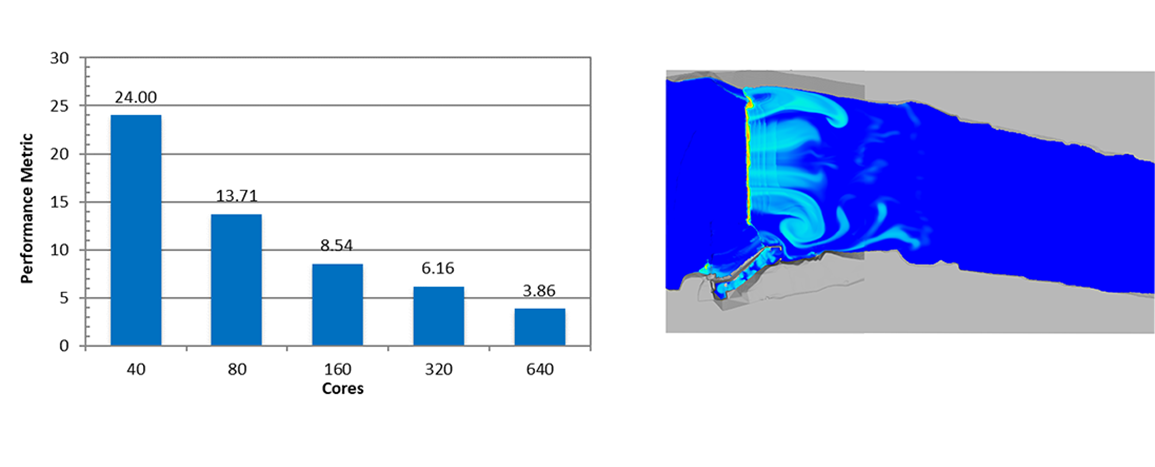
FLOW-3D/MP Performance Benchmarks

HPC Benchmarks

HPC벤치 마크

아래에는 물 및 환경, 금속 주조, 미세 유체 역학, 항공 우주 등 소프트웨어의 일반적인 응용 분야에 대한 HPC지원 FLOW-3D v12.0의 성능 분석 및 최대 2560개 코어까지 확장되는 것으로 나타난 lid-drived캐비티 시뮬레이션에 대한 전형적인 CFD벤치 마크 검증이 나와 있다.

하드웨어 정보

Skylake – Intel® Xeon® Gold 6148 CPU @ 2.40GHz, 40 Cores/Node, 384GB/Node RAM
Interconnect – Intel Omni-Path®

물과 환경–HYDRAULICJUMP

이 시뮬레이션에서 유압 점프와 레일 위의 전체 흐름이 연구되었습니다.
메쉬:146만개 셀
실제 모델: 동적으로 계산된 최대 난류 혼합 길이의 자유 표면 추적, 중력, 공기 침투 및 RNG난류 모델
수치 모델:GMRERE

고압 분사–엔진 블록

이 시뮬레이션에서는 엔진 블록의 중력 주조를 연구했습니다.
메쉬:360만개 셀
물리적 모델: 자유 표면 추적, 중력, 열 전달, 응고 및 점성 층류
수치 모델:GMRERE

마이크로 데이터–PrinterNOZ내의 INKDROP LE

이 시뮬레이션에서 프린터 노즐의 잉크 방울의 형성과 배출을 연구했습니다.
메쉬:200만개 셀
물리적 모델: 자유 표면 추적, 층류 점성 및 표면 장력
수치 모델:GMRERE

AEROspace–항공기 연료 탱크 부싱

이 시뮬레이션에서는 다양한 비행 조건에서 F-16항공기 연료 탱크에서 연료 슬로싱을 연구했다.
메쉬:0.7만개 셀
물리적 모델: 동적으로 계산된 최대 난류 혼합 길이를 가진 자유 표면 추적, 비이상적 기준 프레임, 중력, 전기 전위 및 RNG난류 모델
수치 모델: ImplicitAdvection, GMrrs 및 분할 LagrangianVOF

BestCaseSCENARIO–LiDDrivenCavity

표준 뚜껑 구동 공동 문제는 FLow-3D의 스케일링 잠재력을 보여 주기 위해 시뮬레이션되었다. 이 시뮬레이션은 표준 CFD코드 검증에 자주 사용되는 완전하게 채워진 완벽한 부하 분산 시뮬레이션입니다.
메쉬:10.0만 셀
물리적 모델: 점성과 RNG난류.
수치 모델:GMRERE

자세한 내용은 STI C&D 솔루션팀에 문의하시기 바랍니다.
flow3d@stikorea.co.kr or 02-2026-0455, 02-2026-0450.

FLOW-3D/MP Features List

FLOW-3D/MP Features

FLOW-3D/MP v6.1 은 FLOW-3D v11.1 솔버에 기초하여 물리 모델, 특징 및 그래픽 사용자 인터페이스가 동일합니다. FLOW-3D v11.1의 새로운 기능은 아래 파란색으로 표시되어 있으며 FLOW-3D/MP v6.1 에서 사용할 수 있습니다. 새로운 개발 기능에 대한 자세한 설명은 FLOW-3D v11.1에서 새로운 기능을 참조하십시오.

Meshing & Geometry

  • Structured finite difference/control volume meshes for fluid and thermal solutions
  • Finite element meshes in Cartesian and cylindrical coordinates for structural analysis
  • Multi-Block gridding with nested, linked, partially overlapping and conforming mesh blocks
  • Fractional areas/volumes (FAVOR™) for efficient & accurate geometry definition
  • Mesh quality checking
  • Basic Solids Modeler
  • Import CAD data
  • Import/export finite element meshes via Exodus-II file format
  • Grid & geometry independence
  • Cartesian or cylindrical coordinates
Flow Type Options
  • Internal, external & free-surface flows
  • 3D, 2D & 1D problems
  • Transient flows
  • Inviscid, viscous laminar & turbulent flows
  • Hybrid shallow water/3D flows
  • Non-inertial reference frame motion
  • Multiple scalar species
  • Two-phase flows
  • Heat transfer with phase change
  • Saturated & unsaturated porous media
Physical Modeling Options
  • Fluid structure interaction
  • Thermally-induced stresses
  • Plastic deformation of solids
  • Granular flow
  • Moisture drying
  • Solid solute dissolution
  • Sediment transport and scour
  • Cavitation (potential, passive tracking, active tracking)
  • Phase change (liquid-vapor, liquid-solid)
  • Surface tension
  • Thermocapillary effects
  • Wall adhesion
  • Wall roughness
  • Vapor & gas bubbles
  • Solidification & melting
  • Mass/momentum/energy sources
  • Shear, density & temperature-dependent viscosity
  • Thixotropic viscosity
  • Visco-elastic-plastic fluids
  • Elastic membranes & walls
  • Evaporation residue
  • Electro-mechanical effects
  • Dielectric phenomena
  • Electro-osmosis
  • Electrostatic particles
  • Joule heating
  • Air entrainment
  • Molecular & turbulent diffusion
  • Temperature-dependent material properties
  • Spray cooling
Flow Definition Options
  • General boundary conditions
    • Symmetry
    • Rigid and flexible walls
    • Continuative
    • Periodic
    • Specified pressure
    • Specified velocity
    • Outflow
    • Grid overlay
    • Hydrostatic pressure
    • Volume flow rate
    • Non-linear periodic and solitary surface waves
    • Rating curve and natural hydraulics
    • Wave absorbing layer
  • Restart from previous simulation
  • Continuation of a simulation
  • Overlay boundary conditions
  • Change mesh and modeling options
  • Change model parameters
Thermal Modeling Options
  • Natural convection
  • Forced convection
  • Conduction in fluid & solid
  • Fluid-solid heat transfer
  • Distributed energy sources/sinks in fluids and solids
  • Radiation
  • Viscous heating
  • Orthotropic thermal conductivity
  • Thermally-induced stresses
Turbulence Models
  • RNG model
  • Two-equation k-epsilon model
  • Two-equation k-omega model
  • Large eddy simulation
Metal Casting Models
  • Thermal stress & deformations
  • Iron solidification
  • Sand core blowing
  • Sand core drying
  • Permeable molds
  • Solidification & melting
  • Solidification shrinkage with interdendritic feeding
  • Micro & macro porosity
  • Binary alloy segregation
  • Thermal die cycling
  • Surface oxide defects
  • Cavitation potential
  • Lost-foam casting
  • Semi-solid material
  • Core gas generation
  • Back pressure & vents
  • Shot sleeves
  • PQ2 diagram
  • Squeeze pins
  • Filters
  • Air entrainment
  • Temperature-dependent material properties
  • Cooling channels
  • Fluid/wall contact time
Numerical Modeling Options
  • TruVOF Volume-of-Fluid (VOF) method for fluid interfaces
  • First and second order advection
  • Sharp and diffuse interface tracking
  • Implicit & explicit numerical methods
  • GMRES, point and line relaxation pressure solvers
  • User-defined variables, subroutines & output
  • Utilities for runtime interaction during execution
Fluid Modeling Options
  • One incompressible fluid – confined or with free surfaces
  • Two incompressible fluids – miscible or with sharp interfaces
  • Compressible fluid – subsonic, transonic, supersonic
  • Stratified fluid
  • Acoustic phenomena
  • Mass particles with variable density or diameter
Shallow Flow Models
  • General topography
  • Raster data interface
  • Subcomponent-specific surface roughness
  • Wind shear
  • Ground roughness effects
  • Laminar & turbulent flow
  • Sediment transport and scour
  • Surface tension
  • Heat transfer
  • Wetting & drying
Advanced Physical Models
  • General Moving Object model with 6 DOF–prescribed and fully-coupled motion
  • Rotating/spinning objects
  • Collision model
  • Tethered moving objects (springs, ropes, mooring lines)
  • Flexing membranes and walls
  • Porosity
  • Finite element based elastic-plastic deformation
  • Finite element based thermal stress evolution due to thermal changes in a solidifying fluid
  • Combusting solid components
Chemistry Models
  • Stiff equation solver for chemical rate equations
  • Stationary or advected species
Porous Media Models
  • Saturated and unsaturated flow
  • Variable porosity
  • Directional porosity
  • General flow losses (linear & quadratic)
  • Capillary pressure
  • Heat transfer in porous media
  • Van Genunchten model for unsaturated flow
Discrete Particle Models
  • Massless marker particles
  • Mass particles of variable size/mass
  • Linear & quadratic fluid-dynamic drag
  • Monte-Carlo diffusion
  • Particle-Fluid momentum coupling
  • Coefficient of restitution or sticky particles
  • Point or volumetric particle sources
  • Charged particles
  • Probe particles
Two-Phase & Two-Component Models
  • Liquid/liquid & gas/liquid interfaces
  • Variable density mixtures
  • Compressible fluid with a dispersed incompressible component
  • Drift flux
  • Two-component, vapor/non-condensable gases
  • Phase transformations for gas-liquid & liquid-solid
  • Adiabatic bubbles
  • Bubbles with phase change
  • Continuum fluid with discrete particles
  • Scalar transport
  • Homogeneous bubbles
  • Super-cooling
Coupling with Other Programs
  • Geometry input from Stereolithography (STL) files – binary or ASCII
  • Direct interfaces with EnSight®, FieldView® & Tecplot® visualization software
  • Finite element solution import/export via Exodus-II file format
  • PLOT3D output
  • Neutral file output
  • Extensive customization possibilities
  • Solid Properties Materials Database
Data Processing Options
  • State-of-the-art post-processing tool, FlowSight™
  • Batch post-processing
  • Report generation
  • Automatic or custom results analysis
  • High-quality OpenGL-based graphics
  • Color or B/W vector, contour, 3D surface & particle plots
  • Moving and stationary probes
  • Measurement baffles
  • Arbitrary sampling volumes
  • Force & moment output
  • Animation output
  • PostScript, JPEG & Bitmap output
  • Streamlines
  • Flow tracers
User Conveniences
  • Active simulation control (based on measurement of probes)
  • Mesh generators
  • Mesh quality checking
  • Tabular time-dependent input using external files
  • Automatic time-step control for accuracy & stability
  • Automatic convergence control
  • Mentor help to optimize efficiency
  • Change simulation parameters while solver runs
  • Launch and manage multiple simulations
  • Automatic simulation termination based on user-defined criteria
  • Run simulation on remote servers using remote solving
Multi-Processor Computing

FLOW-3D Features

The features in blue are newly-released in FLOW-3D v12.0.

Meshing & Geometry

  • Structured finite difference/control volume meshes for fluid and thermal solutions
  • Finite element meshes in Cartesian and cylindrical coordinates for structural analysis
  • Multi-Block gridding with nested, linked, partially overlapping and conforming mesh blocks
  • Conforming meshes extended to arbitrary shapes
  • Fractional areas/volumes (FAVOR™) for efficient & accurate geometry definition
  • Closing gaps in geometry
  • Mesh quality checking
  • Basic Solids Modeler
  • Import CAD data
  • Import/export finite element meshes via Exodus-II file format
  • Grid & geometry independence
  • Cartesian or cylindrical coordinates

Flow Type Options

  • Internal, external & free-surface flows
  • 3D, 2D & 1D problems
  • Transient flows
  • Inviscid, viscous laminar & turbulent flows
  • Hybrid shallow water/3D flows
  • Non-inertial reference frame motion
  • Multiple scalar species
  • Two-phase flows
  • Heat transfer with phase change
  • Saturated & unsaturated porous media

Physical Modeling Options

  • Fluid structure interaction
  • Thermally-induced stresses
  • Plastic deformation of solids
  • Granular flow
  • Moisture drying
  • Solid solute dissolution
  • Sediment transport and scour
  • Sludge settling
  • Cavitation (potential, passive tracking, active tracking)
  • Phase change (liquid-vapor, liquid-solid)
  • Surface tension
  • Thermocapillary effects
  • Wall adhesion
  • Wall roughness
  • Vapor & gas bubbles
  • Solidification & melting
  • Mass/momentum/energy sources
  • Shear, density & temperature-dependent viscosity
  • Thixotropic viscosity
  • Visco-elastic-plastic fluids
  • Elastic membranes & walls
  • Evaporation residue
  • Electro-mechanical effects
  • Dielectric phenomena
  • Electro-osmosis
  • Electrostatic particles
  • Joule heating
  • Air entrainment
  • Molecular & turbulent diffusion
  • Temperature-dependent material properties
  • Spray cooling

Flow Definition Options

  • General boundary conditions
    • Symmetry
    • Rigid and flexible walls
    • Continuative
    • Periodic
    • Specified pressure
    • Specified velocity
    • Outflow
    • Outflow pressure
    • Outflow boundaries with wave absorbing layers
    • Grid overlay
    • Hydrostatic pressure
    • Volume flow rate
    • Non-linear periodic and solitary surface waves
    • Rating curve and natural hydraulics
    • Wave absorbing layer
  • Restart from previous simulation
  • Continuation of a simulation
  • Overlay boundary conditions
  • Change mesh and modeling options
  • Change model parameters

Thermal Modeling Options

  • Natural convection
  • Forced convection
  • Conduction in fluid & solid
  • Fluid-solid heat transfer
  • Distributed energy sources/sinks in fluids and solids
  • Radiation
  • Viscous heating
  • Orthotropic thermal conductivity
  • Thermally-induced stresses

Numerical Modeling Options

  • TruVOF Volume-of-Fluid (VOF) method for fluid interfaces
  • Steady state accelerator for free-surface flows
  • First and second order advection
  • Sharp and diffuse interface tracking
  • Implicit & explicit numerical methods
  • Immersed boundary method
  • GMRES, point and line relaxation pressure solvers
  • User-defined variables, subroutines & output
  • Utilities for runtime interaction during execution

Fluid Modeling Options

  • One incompressible fluid – confined or with free surfaces
  • Two incompressible fluids – miscible or with sharp interfaces
  • Compressible fluid – subsonic, transonic, supersonic
  • Stratified fluid
  • Acoustic phenomena
  • Mass particles with variable density or diameter

Shallow Flow Models

  • General topography
  • Raster data interface
  • Subcomponent-specific surface roughness
  • Wind shear
  • Ground roughness effects
  • Manning’s roughness
  • Laminar & turbulent flow
  • Sediment transport and scour
  • Surface tension
  • Heat transfer
  • Wetting & drying

Turbulence Models

  • RNG model
  • Two-equation k-epsilon model
  • Two-equation k-omega model
  • Large eddy simulation

Advanced Physical Models

  • General Moving Object model with 6 DOF–prescribed and fully-coupled motion
  • Rotating/spinning objects
  • Collision model
  • Tethered moving objects (springs, ropes, breaking mooring lines)
  • Flexing membranes and walls
  • Porosity
  • Finite element based elastic-plastic deformation
  • Finite element based thermal stress evolution due to thermal changes in a solidifying fluid
  • Combusting solid components

Chemistry Models

  • Stiff equation solver for chemical rate equations
  • Stationary or advected species

Porous Media Models

  • Saturated and unsaturated flow
  • Variable porosity
  • Directional porosity
  • General flow losses (linear & quadratic)
  • Capillary pressure
  • Heat transfer in porous media
  • Van Genunchten model for unsaturated flow

Discrete Particle Models

  • Massless marker particles
  • Multi-species material particles of variable size and mass
  • Solid, fluid, gas particles
  • Void particles tracking collapsed void regions
  • Non-linear fluid-dynamic drag
  • Added mass effects
  • Monte-Carlo diffusion
  • Particle-fluid momentum coupling
  • Coefficient of restitution or sticky particles
  • Point or volumetric particle sources
  • Initial particle blocks
  • Heat transfer with fluid
  • Evaporation and condensation
  • Solidification and melting
  • Coulomb and dielectric forces
  • Probe particles

Two-Phase & Two-Component Models

  • Liquid/liquid & gas/liquid interfaces
  • Variable density mixtures
  • Compressible fluid with a dispersed incompressible component
  • Drift flux with dynamic droplet size
  • Two-component, vapor/non-condensable gases
  • Phase transformations for gas-liquid & liquid-solid
  • Adiabatic bubbles
  • Bubbles with phase change
  • Continuum fluid with discrete particles
  • Scalar transport
  • Homogeneous bubbles
  • Super-cooling
  • Two-field temperature

Coupling with Other Programs

  • Geometry input from Stereolithography (STL) files – binary or ASCII
  • Direct interfaces with EnSight®, FieldView® & Tecplot® visualization software
  • Finite element solution import/export via Exodus-II file format
  • PLOT3D output
  • Neutral file output
  • Extensive customization possibilities
  • Solid Properties Materials Database

Data Processing Options

  • State-of-the-art post-processing tool, FlowSight™
  • Batch post-processing
  • Report generation
  • Automatic or custom results analysis
  • High-quality OpenGL-based graphics
  • Color or B/W vector, contour, 3D surface & particle plots
  • Moving and stationary probes
  • Visualization of non-inertial reference frame motion
  • Measurement baffles
  • Arbitrary sampling volumes
  • Force & moment output
  • Animation output
  • PostScript, JPEG & Bitmap output
  • Streamlines
  • Flow tracers

User Conveniences

  • Active simulation control (based on measurement of probes)
  • Mesh generators
  • Mesh quality checking
  • Tabular time-dependent input using external files
  • Automatic time-step control for accuracy & stability
  • Automatic convergence control
  • Mentor help to optimize efficiency
  • Units on all variables
  • Custom units
  • Component transformations
  • Moving particle sources
  • Change simulation parameters while solver runs
  • Launch and manage multiple simulations
  • Automatic simulation termination based on user-defined criteria
  • Run simulation on remote servers using remote solving
  • Copy boundary conditions to other mesh blocks

Multi-Processor Computing

  • Shared memory computers
  • Distributed memory clusters

FlowSight

  • Particle visualization
  • Velocity vector fields
  • Streamlines & pathlines
  • Iso-surfaces
  • 2D, 3D and arbitrary clips
  • Volume render
  • Probe data
  • History data
  • Vortex cores
  • Link multiple results
  • Multiple data views
  • Non-inertial reference frame
  • Spline clip

Why FLOW-3D?

Why FLOW-3D ?

FLOW-3D는 엔지니어들에게 다양한 분야의 유동해석에 대해 귀중한 통찰력을 제공하는 강력한 모델링 도구입니다. 정확하게 자유 표면 흐름을 예측하는 특별한 기능을 통해 FLOW-3D는 설계 단계에서뿐만 아니라, 생산 공정 개선에도 사용할 수 있는 이상적인 전산 유체 역학 (CFD) 소프트웨어입니다.


TruVOF and Free Surface Modeling

TruVOF - Volume of Fluid - VOF Method

FLOW-3D 는 다른 유동해석 프로그램과는 유체 계면을 다루는 기법이 확연하게 다릅니다. FLOW-3D 는 자유표면의 위치를 추적하고, 그 자유표면에 적절한 동적 경계 조건을 적용하는 특수한 수치기법(numerical method)을 사용합니다. FLOW-3D 에서 모델링된 자유표면은 로스알라모스 국립 연구소에서 Flow Science의 설립자인 C. W. Hirt 박사와 함께 소속한 과학자 그룹에 의해서 개발된 VOF(Volume of Fluid) 기법으로 모델링됩니다. CFD 프로그램의 대부분은 세 가지 기본 VOF 성분 중 실제로는 단지 하나 또는 두 가지만 구현하여 VOF 기능을 통합 구현한 것으로 주장하고 있습니다. CFD 사용자는 이러한 유사 VOF 기법으론 종종 잘못된 결과를 얻을 수 있음을 알고 있어야 합니다. FLOW-3D는 자유표면의 성공적인 해석에 필요한 모든 요소를 포함하고 있습니다. 또한, FLOW-3D는 경계 조건과 계면 추적의 정확도를 증가시키기 위해 원래의 VOF 방법을 크게 향상 시키고 있습니다. 좀더 자세한 사항은 TruVOF 방법을 참고하시기 바랍니다.
<CFD-101에 FLOW-3D의 TruVOF 방법에 대해 자세히 알아보기>

Free Gridding Separates Meshing from Geometry Construction

Free gridding capabliity in FLOW-3DGridding에 대한 FLOW-3D’의 기본 접근 방식은 deformed, body-fitted grids의 유연성과 단순한 직사각형 그리드의 장점을 결합합니다. 직사각형 컨트롤 요소의 고정 그리드는 간단하고 매우 바람직한 특성을 갖도록(예를 들어, 향상된 정확도, 작은 메모리 크기 요구, 간단한 수치 근사치) 생성 처리됩니다. 이 접근법은 그리드나 형상을 각각 서로 독립적으로 자유롭게 변경 할 수 있기 때문에 “free-gridding”으로 지칭합니다.

이 기능은 body-fitted 또는 유한 요소 격자를 생성하는 지루한 작업을 하지 않도록 해 줍니다.
Rectangular gridding 의 유연성과 효율은 multi-block 과 conforming meshing 같은 고급 기능에 의해 강화됩니다. 연결되어 있고 부분적으로 중첩된 메쉬 블록은 복잡한 멀티 스케일 유동 도메인과 관심 영역에서 효과적으로 높은 해상도를 가질 수 있는 수단을 제공합니다. Conforming mesh는 직사각형 gridding 구조와 관계 없이 특별한 기하학적 형상, cavities, 얇은 구조물, 경계층 등에 적합한 고품질의 grids를 생성할 수 있습니다.
Read more about FLOW-3D‘s free-gridding approach in CFD-101 >

Modeling Fluid Flow in Complex Geometry is Easy with FAVOR™

FAVOR technique in FLOW-3DFLOW-3D 는 직사각형 격자 내에서 일반 기하학적 영역을 정의하는데 사용되는 FAVOR™ (Fractional Area Volume Obstacle Representation) 방법으로 알려진 특별한 기술을 사용합니다. FAVOR기본 철학은 수치 알고리즘이 각 제어 체적(control volume)에 대해 하나의 압력, 하나의 속도, 하나의 온도 등으로 이루어지는 정보를 기반으로 하므로 형상을 정의하는 데 많은 정보를 사용하는 것이 적합하지 않는다는 것입니다. 따라서, FAVOR ™ 기술은 직사각형 격자의 단순성을 유지하면서 각 제어 체적 내의 유동 값의 정밀도와 일치하는 수준으로 복잡한 기하학적 형상을 나타냅니다.

Read more about FLOW-3D‘s FAVOR™ technique in CFD-101 >

Meshing Capabilities

FLOW-3D 는 복잡한 유체 해석 모델링시 간단하면서도 효율적이고 견고한 대규모 격자 생성 능력을 제공합니다. 특히, FLOW-3D의 효율좋은 단순한 메쉬 구조와 다중 블록 메쉬의 다양한 특징에 의해 최고의 메싱 효율과 견고성을 자랑합니다. 여러개의 메쉬 블록 사용은 관심 영역의 최적화를 허용하고 주어진 시뮬레이션에 필요한 연산 리소스를 훨씬 감소시킵니다. 작은 장애물(Small obstacles), 복잡한 형상 그리고 전체 영역 크기에 비해 좁은 통로(channel)는 다음과 같은 linked, nested, conforming, 그리고/또는 부분 중첩 mesh blocks등의 여러 다중 블록 메싱능력 중 하나를 사용하여 정확히 해결 될 수있습니다. Linked mesh blocks은 관심영역의 격자 생성과 계산 격자의 총 수를 제한하는 데에만 사용될 수 있습니다. Nested mesh blocks은 관심영역 주위의 해상도를 향상시키기 위해 사용될 수 있습니다. Conforming 과 partially overlapping mesh blocks은 단순히 중첩된 급격한 변화와 불규칙한 형상을 해결하기 위해사용될 수 있습니다. FLOW-3D 는 또한 Fluid-Structure Interaction에 필요한 body-fitted 유한요소 격자를 허용합니다. 이 body-fitted 격자는 FLOW-3D 또는 외부 CAD 패키지 S/W로 부터 가져와 자동으로 생성할 수 있습니다. 이 모든 메쉬 기술은 사용자에게 간단하면서 효율적으로 메쉬를 생성하게 하여 솔버 성능 향상 및 해석시간을 줄이는 유연성을 제공합니다.

전산유체역학(CFD)의 기초

전산유체역학(CFD)의 기초

Dr. Tony Hirt, Founder of Flow Science

CFD-101은 FlowScience의 창립자이자 VOF(Volume-of-Fluid)개척자인 Dr. C.W. (Tony) Hirt에 의해 작성된 전산 유체 역학 기초를 위한 가장 포괄적인 온라인 자료 중 하나입니다. CFD-101은 전산 유체 역학과 관련된 다양한 문제에 대한 일반적인 소개와 개요를 제공하도록 설계되었습니다. 

우리는 유용하고 정확하며 효율적인 계산 모델을 만들 때 고려해야 할 많은 기능 중 몇 가지만 다루었습니다. CFD의 기초를 쌓는 데 사용할 수있는 많은 논문과 책이 있습니다. 여기서는 일반적으로 표준 참조에 포함되지 않은 몇 가지 주제에 주로 초점을 맞추도록 선택했습니다. 이 CFD 참조 도구를 탐색하려면 오른쪽 메뉴를 사용하십시오.

CFD-101 is one of the most comprehensive online resources for Computational Fluid Dynamics basics, edited by Flow Science’s founder and Volume-of-Fluid (VOF) pioneer, Dr. C.W. (Tony) Hirt. CFD-101 is designed to give a general introduction and overview of a variety of issues concerning computational fluid dynamics. We have only touched on a few of the many features that must be considered when attempting to make useful, accurate and efficient computational models. There are many papers and books available for gaining a basic grounding in CFD. We have chosen here to focus primarily on a few topics that are not generally included in standard references. Please use the menu on the right to explore this CFD reference tool.

CFD for Beginners

CFD (전산 유체 역학)에 대해 생각하는 방법에 대한 일반적인 설명은 자유 표면을 사용한 유체 흐름 시뮬레이션 기사에 나와 있습니다. 이 기사에서는 시뮬레이션 영역을 작은 볼륨 제어 요소로 축소하는 아이디어를 소개합니다. 이 요소에 대한 대수 방정식은 인접한 요소와의 질량, 운동량 및 에너지 교환을 설명하기 위해 구성됩니다. 또한 제어 요소 영역 내에서 자유 유체 인터페이스의 움직임을 설명하는 방법에 대한 간단한 방법이 도입되었습니다.

A general description of how to think about computational fluid dynamics (CFD) is given in the article, Simulating Fluid Flow with Free Surfaces. This article introduces the idea of reducing a simulation region into small volume control elements for which algebraic equations are constructed to describe the conservation of mass, momentum and energy exchanges with neighboring elements. Additionally, a simple method is introduced for a means of describing the motion of free fluid interfaces within the region of control elements.

또한 초보자를 위해 CFD 소프트웨어를 선택할 때 CFD 모델링에 대해 알아야 할 사항에는 유체 역학 문제에 대한 수치적 해결책을 구성하는데 중요한 고려 사항인 다양한 문제에 대한 간략한 요약이 포함되어 있습니다. 메싱, 지오메트리 표현, 암시적 대 명시적 수치 방법 및 완화/수렴 매개 변수와 같은 많은 문제는 CFD-101의 나머지 기사에서 자세히 살펴 봅니다.

Also for beginners, the article, What you should know about CFD modeling when selecting a CFD software, contains brief summaries of a variety of issues that are important considerations for constructing numerical solutions to fluid dynamic problems. Many of these issues, such as meshing, geometry representation, implicit versus explicit numerical methods and relaxation/convergence parameters are explored in greater detail in the remaining articles in CFD-101.

Beyond CFD-101

본 자료의 일부 주제는 CFD를 공부하는 고급수준 학생들에게도 흥미로울 수 있습니다. 예를 들어, 유체가 “비압축성”으로 설명 될 때 의미하는 것은 충족되어야 하는 두 가지 제한 조건을 포함합니다. 또 다른 예는 보존 조건을 완화하는 것이 바람직한 시기를 설명합니다. 그리고 마지막으로 레이놀즈수 의존성을 어떻게 평가해야 하는지 입니다.

Some of the topics in this series of articles may also be of interest to more advanced students of CFD. For example, what is meant when a fluid is described as “incompressible” includes two limit conditions that should be satisfied. Another example describes when it is preferable to relax conservation conditions. And, finally, how should Reynolds number dependencies be evaluated?

본 자료는 국내 사용자들의 편의를 위해 원문 번역을 해서 제공하기 때문에 일부 오역이 있을 수 있어서 원문과 함께 수록합니다. 자료를 이용하실 때 참고하시기 바랍니다.

FLOW-3D CLOUD 제품소개

FLOW-3D CLOUD

CLOUD COMPUTING1

FLOW-3D CLOUD는 사용 가능한 소프트웨어 및 하드웨어 리소스를 수천 개의 컴퓨팅 코어로 확장할 수 있는 클라우드 컴퓨팅 서비스입니다. FLOW-3D CLOUD는 Penguin Computing on Demand(POD)에 편리하게 설치되며 POD에서 자체 라이선스를 호스팅하거나 설계 및 분석 주기의 피크 시간에 대해 사용량에 따라 비용을 지불할 수 있습니다. 초대형 시뮬레이션, 파라메트릭 스터디 또는 실험 설계(DOE)를 실행하도록 설계된 FLOW-3D CLOUD를 사용하면 클러스터 획득 및 유지 관리에 대한 걱정 없이 시뮬레이션 기능을 확장할 수 있습니다. 또한 Flow Science는 시뮬레이션 피크 시간에 대한 HPC 서비스를 기존 고객에게 할인된 가격으로 제공합니다.

FLOW-3D CLOUD를 사용하면 최첨단 컴퓨팅 노드에서 수백 개의 코어에 액세스할 수 있으며 모든 웹 브라우저를 통해 고충실도 CFD 시뮬레이션에 액세스할 수 있는 유연성을 얻을 수 있습니다. 이 플랫폼을 사용함으로써 우리는 문제와 관련된 복잡한 물리학을 지속적으로 더 잘 해결할 수 있었고 프로젝트에서 상당한 시간을 절약할 수 있었습니다. 클라우드 컴퓨팅은 현대 CFD 관행의 판도를 바꾸고 있으며 Golder는 이 기술을 채택한 선구자 중 한 명임을 자랑스럽게 생각합니다.

FLOW3D로 가장 어려운 CFD문제 해결

CLOUD COMPUTING3

일시적이고 자유로운 표면 문제 해결을 전문으로 하는 고도로 정확한 CFD소프트웨어인 FLOW-3D로 제품 설계를 최적화하고 출시 기간을 단축할 수 있습니다. FLOW-3D의 완전한 멀티 물리학 제품군에는 당사의 최첨단 포스트 프로세서인 FLOW-3D POST가 포함되어 있습니다.

FLOW-3D는 광범위한 산업용 애플리케이션과 물리적 프로세스에서 액체와 가스의 동적 동작을 조사하는 엔지니어를 위한 완벽하고 다목적의 CFD시뮬레이션 플랫폼을 제공합니다. FLOW-3D는 자유 표면 및 다단계 애플리케이션에 초점을 맞추어 마이크로 필름, 바이오 의약품, 수상 민간 인프라, 항공 우주, 소비자 제품, 적층 제조, 잉크젯 프린팅, 레이저 용접, 해상, 에너지 및 자동차 등 광범위한 산업에 서비스를 제공합니다.

매우 강력한 멀티 물리학 도구인 FLOW-3D는 엔지니어가 모델링 목표를 추진하는 데 도움이 되는 기능, 사용 편의성 및 파워를 제공합니다. 최고 수준의 성능을 위해 구축된 FLOW-3D는 표준 워크 스테이션 솔루션에서 고성능 컴퓨팅 클러스터 솔루션의 수백개 CPU코어 솔루션으로 원활하게 확장됩니다.

고성능 컴퓨팅:사내 및 클라우드 환경

CLOUD COMPUTING2

최고의 성능이 필요하십니까? 대규모 시뮬레이션에 직면해 있습니까? 런타임 문제를 극복하고 계십니까? FLOW-3D는 업계에서 가장 까다로운 시뮬레이션을 지원하기 위해 데스크 톱 워크 스테이션 솔루션에서 고성능 온 디맨드 클라우드 컴퓨팅 및 클러스터 솔루션으로 원활하게 전환됩니다.

시뮬레이션 런타임은 주어진 시뮬레이션에 사용되는 크기, 복잡성 및 물리적 모델에 따라 달라집니다. 이상적인 경우, 덮개 구동 캐비티 흐름은 최대 2560개의 코어로 확장되는 반면 다른 모든 실제 애플리케이션은 최대 640개의 코어로 확장됩니다. 중요한 것은 FLOW-3D CLOUD를 사용하여 24시간 시뮬레이션을 45분(리드 구동 캐비티)으로 줄일 수 있다는 것입니다.

고성능 컴퓨팅 벤치마크1
고성능 컴퓨팅 벤치마크1
고성능 컴퓨팅 벤치마크2
고성능 컴퓨팅 벤치마크2
고성능 컴퓨팅 벤치마크3
고성능 컴퓨팅 벤치마크3
고성능 컴퓨팅 벤치마크4
고성능 컴퓨팅 벤치마크4
고성능 컴퓨팅 벤치마크5
고성능 컴퓨팅 벤치마크5

정확도

FLOW-3D는 업계 최고의 알고리즘 TruVOF 를 사용하여 높은 정확도의 시뮬레이션 결과를 더 빠르게 제공합니다. 유체 추적의 선구적인 방법인 TruVOF는 35년 전 처음 시작된 이래로 흐름 정확성에 대한 업계 표준을 설정하고 있습니다. FLOW-3D는 세계 유수의 과학, 제조 및 연구 회사와 협력하여 정확한 시뮬레이션과 효율적이고 효율적인 협업 워크 플로우를 제공한 결과입니다.

This case from Flow Science Japan

효율성

FLOW-3D는 당사의 혁신적인 Meshing방법 FAVOR™를 사용하여 기하학을 메쉬에 직접 삽입하여 문제 설정을 획기적으로 개선함으로써 다른 CFD소프트웨어에서 요구하는 노동 집약적인 재가공 없이 파라미터를 신속하게 조정할 수 있습니다. 엔지니어들은 런타임을 단축하고 결과를 더욱 정확하게 도출하여 설계 개념을 시각화, 최적화 및 협업하는 데 시간을 보냅니다.

Collaboration

FLOW-3D POST는 시뮬레이션 결과를 이해하고 공유하기 위한 강력하고 간단한 방법을 제공합니다. 수치 형식과 시각적 형식을 모두 동시에 분석하고, 동일한 뷰 포트에서 별도의 해석 사례를 연결하고 확인하여 결과를 비교할 수 있습니다.

FLOW-3D CLOUD는 매우 큰 영역 또는 긴 runtime 문제를 해결하기 위해 고성능 컴퓨팅 클러스터에 FLOW-3D CLOUD 버전을 설치하여 빠른 시간안에 문제를 해결할 수 있습니다.

하이브리드 병렬FLOW-3D 솔버는 병렬화 및 멀티 코어 클러스터 아키텍처의 활용을 최대화 시키기 위해 MPI와 OpenMP 모두를 사용합니다.

Hybrid : MPI (분산 메모리 형) / OpenMP (공유 메모리 형) 병렬화

MPI와 OpenMP를 하이브리드로 이용하여 메쉬 블록을 줄임으로써 통신 및 MPI 오버 헤드를 줄일 수 있습니다.
• 계산 노드에서 MPI와 각 계산 노드의 OpenMP를 하이브리드 사용
• 2 개의 병렬 처리 방식을 통해 높은 확장성 제공
• 더 적은 메쉬 블록, 적은 통신으로 MPI 오버 헤드를 줄임

FLOW-3D CLOUD는 짧은 개발 주기에서 포괄적인 연구를 할 수 있는 기회를 제공하여 상당한 성능상의 이점으로 runtime 감소를 제공합니다. FLOW-3D의 정확도를 유지하면서 이와 같은 효과를 달성 할 수 있습니다.