탠덤 빔 레이저(Tandem laser)에 의한 플럭스리스 브레이징

탠덤 빔 레이저(Tandem laser)에 의한 플럭스리스 브레이징

자료 제공: 오사카대학
자료 제공: FLOW Science Japan

자동차 경량화를 위해 주요 구성 재료인 철강과 비강도가 높은 알루미늄 접합 기술이 요구되고 있습니다. FLOW-3D Weld 에서는 플럭스의 사용을 피하기 위해 주빔에 더해 예열빔을 이용한 탠덤빔에 의한 레이저 브레이징 과정을 검토할 수 있습니다.

탠덤 빔 레이저에 의한 플럭스리스 브레이징

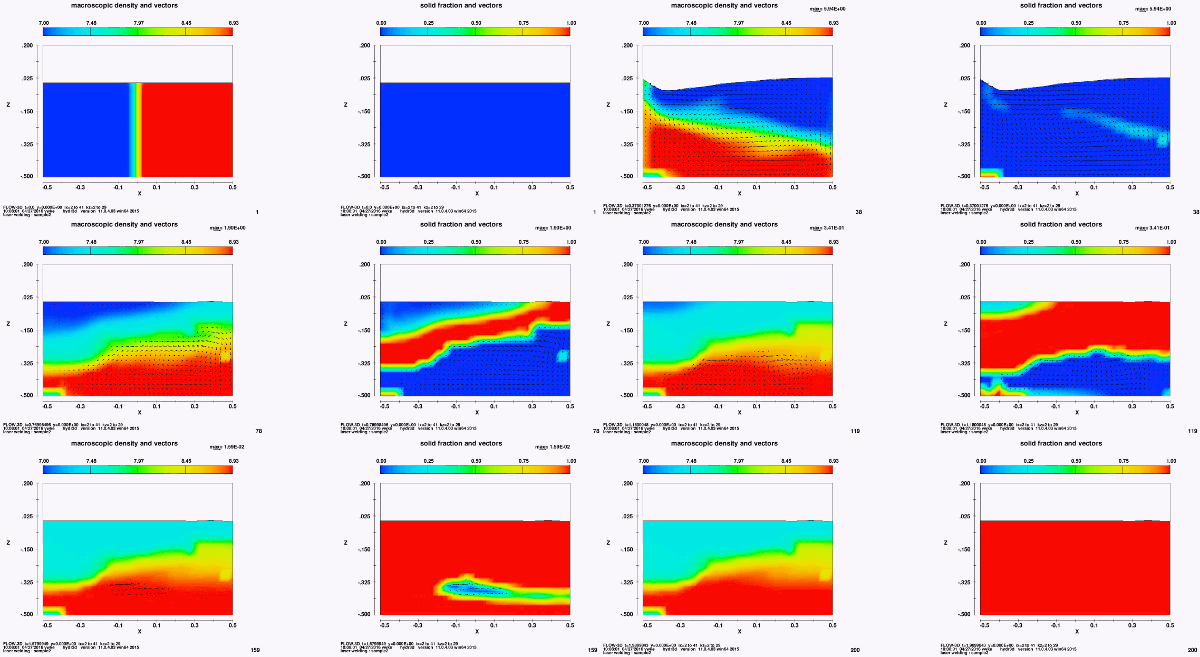
주빔의 영향을 용융재 초기 온도, 예열빔의 영향을 모재의 온도 분포로 각각 모델화하고, 알루미늄 합금과 아연도금강의 레이저 브레이징 과정에서의 용융재료의 젖음과 유동성을 해석하였습니다. 여기에서는 아연도금강이 ScG270(GA)인 경우와 l170(GI)인 경우를 비교하고 있습니다.

불균일한 온도장에서 FLOW3D의 표면장력 접촉각기능을 통해 누수확대 재현

GI강 조인트는 GA강 조인트에 비해 용융 밀림, 퍼짐성이 뛰어납니다. FLOW-3D@에 의한 해석 결과도 실험 결과와 잘 일치합니다. 이음매의 차이 이 외에도 주빔/예열빔 출력, 빔 간의 어긋남 거리등의 최적화 설계가 가능합니다.

Laser Welding and Additive Manufacturing

Melt Pool Modeling: Innovation in Laser Welding & Additive Manufacturing

Melt Pool Modeling - Innovation in Laser Welding & Additive Manufacturing Webinar

Additive Manufacturing 기술이 새로운 제조 방식을 계속 발전시키면서 CFD 모델링은 공정 개발 및 최적화와, 재료의 변화를 이해하고, 설계 및 연구를 수행하는 매우 유용한 도구가 되었습니다. 이 웨비나에서는 최첨단 CFD 소프트웨어 FLOW-3D AM이 레이저 파우더 베드 융합 및 직접 에너지 증착 공정에서 용융 풀 역학을 모델링하는데 어떻게 사용되는지 살펴볼 것입니다. 그런 다음 유용한 정보를 얻기 위해 모델 데이터의 추출 및 분석에 집중하고 FLOW-3D AM에서 최근에 구현된 기능에 대해 논의합니다. 마지막으로 레이저 용접 및 적층 제조 응용 분야 모두에 적용할 수 있는 관련 산업 사례 연구를 검토하여 산업 응용 분야에 소프트웨어 사용을 보여줍니다.

https://www.facebook.com/FLOW3D.CFD.Software/videos/359103388813376/

Laser Metal Deposition Simulation | FLOW-3D AM | Facebook
FLOW-3D - We'll be presenting and exhibiting at the 2021
FLOW-3D – We’ll be presenting and exhibiting at the 2021

등록 링크https://zoom.us/webinar/register/7516034917241/WN_tik88gXJRzult2_HDNIzPA
산지 표준시(미국 및 캐나다)의 2021년 5월 5일 11:00 오전 (현지 시간)
이벤트 주최: FLOW-3D

발표자

photo of Paree Allu

Paree AlluSenior CFD Engineer @Flow Science, Inc.Paree Allu is a Senior CFD Engineer with Flow Science, where he leads the technical and business strategy for Flow Science’s additive manufacturing and laser welding software solutions. Paree holds a Master’s Degree in Mechanical Engineering from The Ohio State University.

photo of Allyce Jackman

Allyce JackmanCFD Engineer @Flow Science, Inc.Allyce Jackman is a CFD Engineer with Flow Science, where she specializes in laser welding, coating, and complex multiphysics applications. Allyce holds a Bachelor’s Degree in Mechanical Engineering from the University of New Mexico.

FLOW-3D Weld

2025R1-flow-3d-weld

FLOW-3D WELD 2025R1 변경점

워크플로우 향상

User Interface 통일

FLOW-3D WELD 2025R1은 FLOW-3D와 FLOW-3D WELD의 기능을 원활하게 통합하는 사용자 인터페이스를 도입합니다. 사용자는 단일 애플리케이션 내에서 모든 관련 물리 모델을 활성화하고 단일 합금 또는 이종 금속 용접 애플리케이션에 필요한 모든 재료 특성을 정의할 수 있습니다.

신규 프로세스 탬플릿

새로운 사전 로드 레이저 용접 템플릿은 시뮬레이션 설정을 그 어느 때보다 쉽게 만듭니다.

Restrat 워크플로우 향상

FLOW-3D(x)에서는 전용 FLOW-3D WELD 노드를 추가하고 성능을 크게 향상시킴으로써 매개변수 연구와 최적화 루틴을 구성하는 데 시간이 많이 소요될 수 있습니다. 사용자는 모델 검증을 간소화하고, 프로세스 창을 식별하며, 매개변수 민감도 분석을 수행하고, 레이저 입력과 빔 특성을 최적화하기 위한 워크플로우를 설정할 수 있습니다.

FLOW-3D  WELD 는 레이저 용접 공정에 대한 강력한 통찰력을 제공하여 공정 최적화를 달성합니다. 더 나은 공정 제어를 통해 다공성, 열 영향 영역을 최소화하고, 미세 구조 변화를 제어 할 수 있습니다. 레이저 용접 프로세스를 정확하게 시뮬레이션하기 위해 FLOW-3D WELD 는 레이저 열원, 레이저-재료 상호 작용, 유체 흐름, 열 전달, 표면 장력, 응고, 다중 레이저 반사 및 위상 변화와 같은 모든 관련 물리학을 구현합니다.

퍼포먼스 향상

FLOW-3D WELD 2025R1은 고성능 컴퓨팅(HPC) 플랫폼을 지원하여 전례 없는 시뮬레이션 속도를 제공합니다. 코어 솔버의 고급 OpenMP – MPI 기능을 활용하여 HPC 플랫폼에서의 레이저 용접 시뮬레이션은 이제 표준 워크스테이션 구성에 비해 최대 약 9배 더 빠릅니다.

Scaling comparisons for a high-resolution single track laser melting simulation.

Solver 향상

반사 모델 향상

용융 표면의 에너지 반사는 특히 키홀 영역을 시뮬레이션할 때 중요한 요소가 될 수 있습니다. FLOW-3D WELD의 개선된 반사 모델은 레이저 반사를 보다 정확하게 표현할 수 있습니다.

열원 통합 및 개선

업그레이드된 열원 정의 옵션을 통해 사용자는 나선형 및 스큐 라인과 같은 복잡한 레이저 경로를 더 정밀하게 정의할 수 있습니다. 추가적인 제어 기능을 통해 다중 소스 시뮬레이션을 위한 열원 속성을 전송할 수 있어 시간을 절약하고 오류 발생 가능성을 줄입니다.

FLOW-3D POST 지원

유체, 용융 영역, 열원, 반사 및 입자를 위한 새로운 사전 구성 객체는 FLOW-3D WELD 시뮬레이션의 시각화를 용이하게 합니다. 일반적으로 사용되는 출력의 주석은 FLOW-3D POST에서 결과 파일을 열면 자동으로 제공되므로 후처리 워크플로우가 가속화됩니다.


낮은 열 입력,  뛰어난 생산성, 속도는 기존의 용접 방법을 대체하는 레이저 용접 프로세스로 이어집니다. 레이저 용접이 제공하는 장점 중 일부는 더 나은 용접 강도, 더 작은 열 영향 영역, 더 정밀한 정밀도, 최소 변형 및 강철, 알루미늄, 티타늄 및 이종 금속을 포함한 광범위한 금속 / 합금을 용접 할 수있는 능력을 포함합니다.

공정 최적화

FLOW-3D WELD 는 레이저 용접 공정에 대한 강력한 통찰력을 제공하고 궁극적으로 공정 최적화를 달성하는 데 도움이됩니다. 더 나은 공정 제어로 다공성을 최소화하고 열 영향을받는 영역을 제한하며 미세 구조 변화를 제어 할 수 있습니다. FLOW-3D WELD 는 자유 표면 추적 알고리즘으로 인해 매우 복잡한 용접 풀을 시뮬레이션하는 데 매우 적합합니다. FLOW-3D WELD 는 관련 물리적 모델을 FLOW-3D 에 추가로 통합하여 개발되었습니다.  레이저 소스에 의해 생성된 열유속, 용융 금속의 증발 압력, 차폐 가스 효과, 용융 풀의 반동 압력 및 키홀 용접의 다중 레이저 반사. 현실적인 공정 시뮬레이션을 위해 모든 관련 물리 현상을 포착하는 것이 중요합니다.


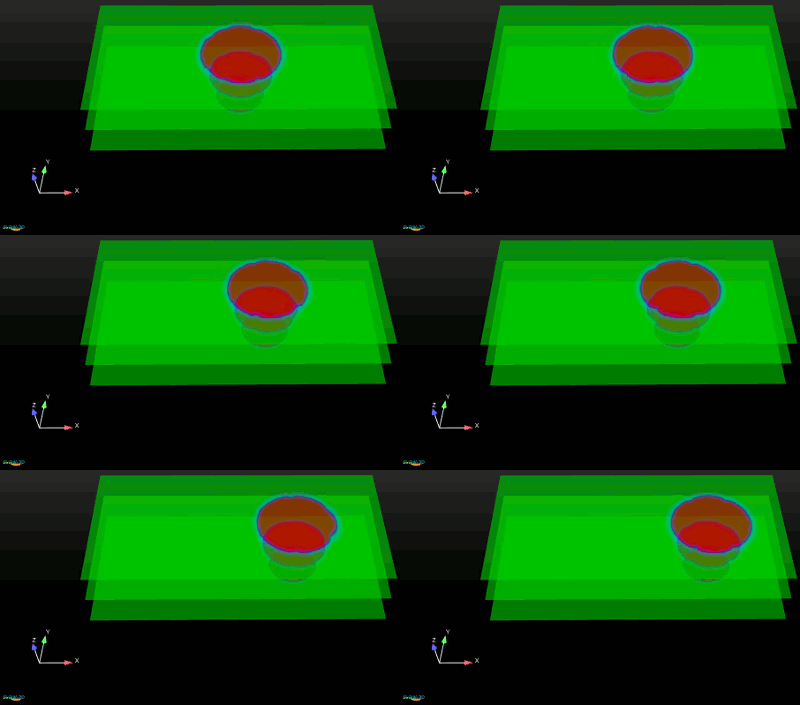
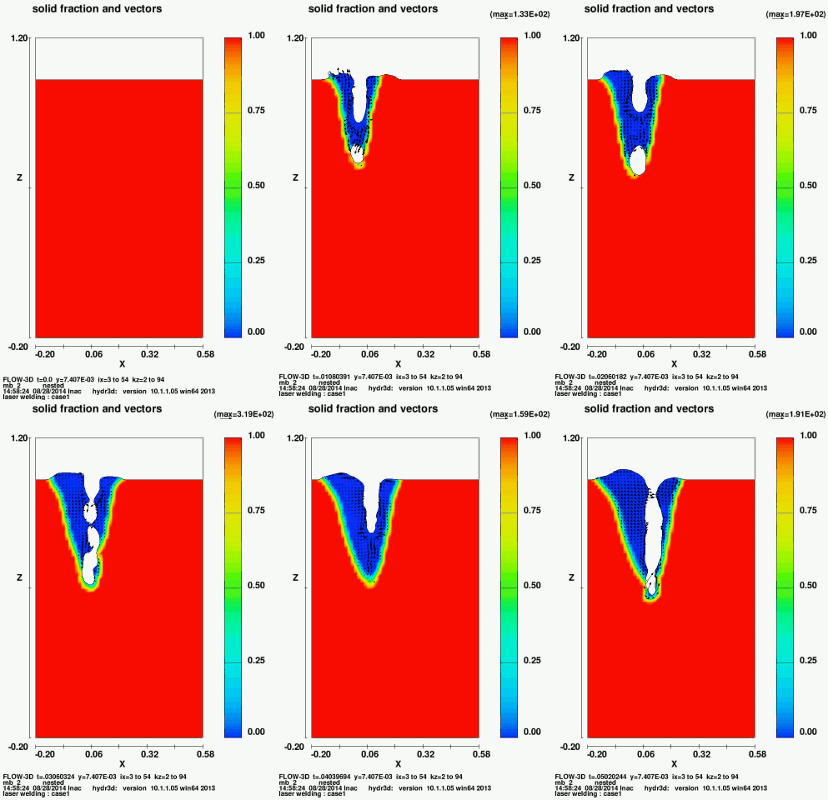
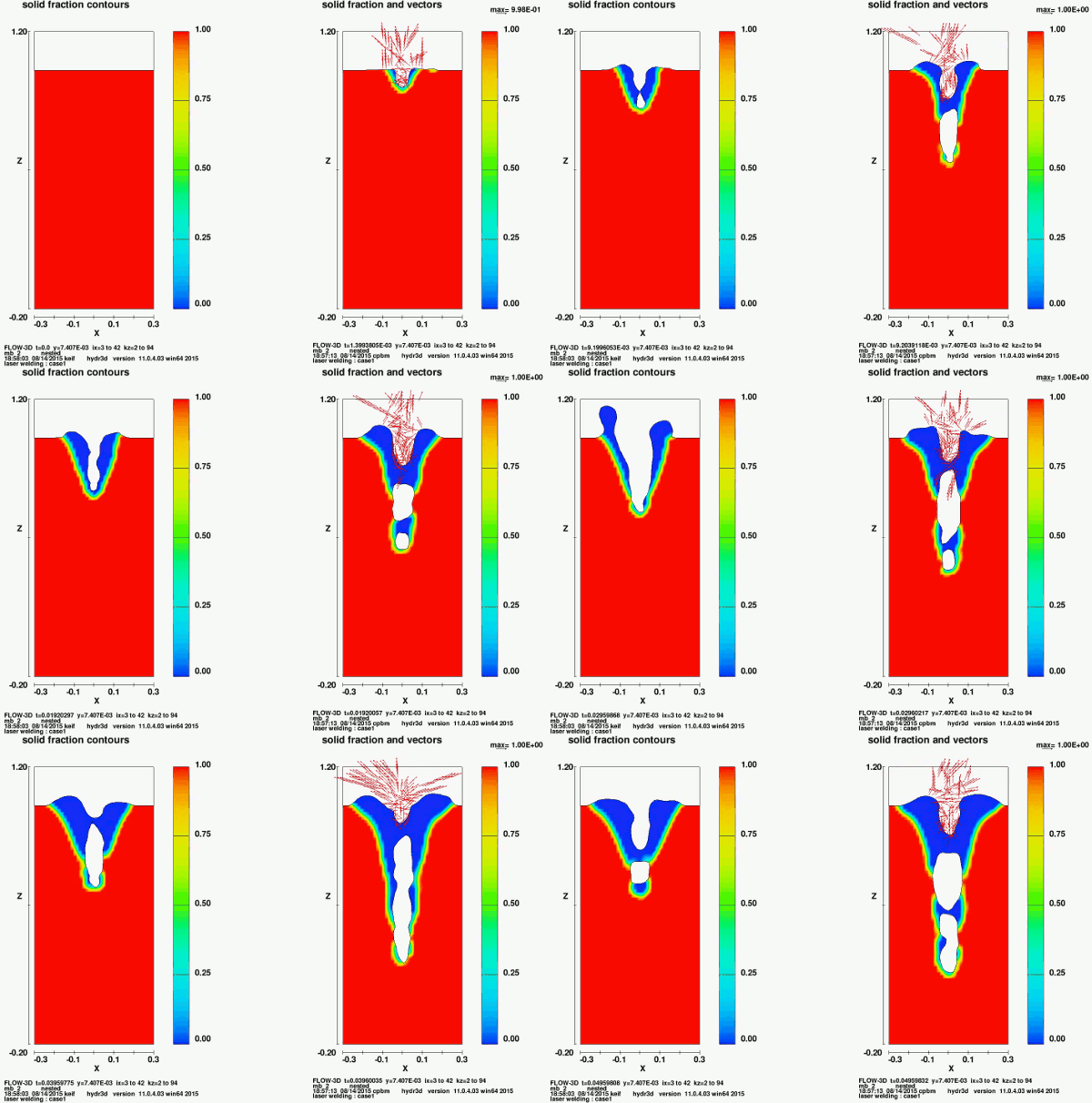
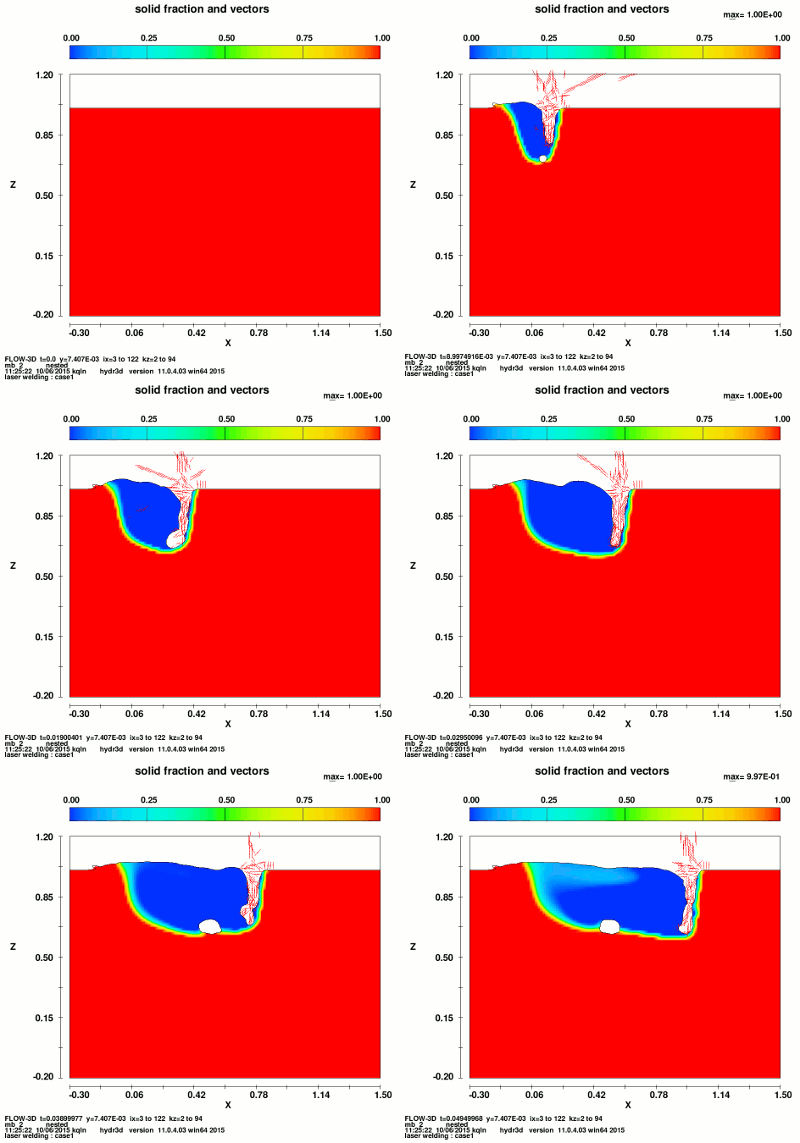
얕은 용입 용접 (왼쪽 상단); 실드 가스 효과가 있는 깊은 용입 용접 (오른쪽 상단); 쉴드 가스 및 증발 압력을 사용한 심 용입 용접 (왼쪽 하단); 쉴드 가스, 증발 압력 및 다중 레이저 반사 효과 (오른쪽 하단)를 사용한 깊은 침투 용접.

FLOW-3D WELD 는 레이저 용접의 전도 모드와 키홀 모드를 모두 시뮬레이션 할 수 있습니다. 전 세계의 연구원들은 FLOW-3D WELD 를 사용하여 용융 풀 역학을 분석하고 공정 매개 변수를 최적화하여 다공성을 최소화하며 레이저 용접 수리 공정에서 결정 성장을 예측합니다.

완전 관통 레이저 용접 실험

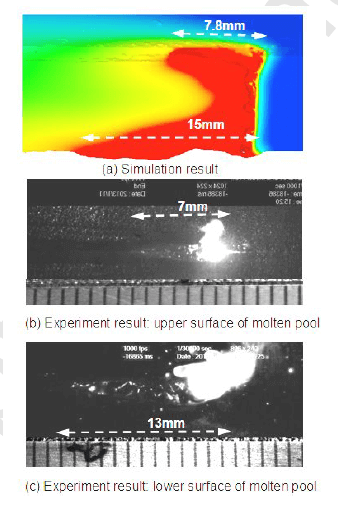
한국의 KAIST와 독일의 BAM은 16K kW 레이저를 사용하여 10mm 강판에 완전 침투 레이저 용접 실험을 수행했습니다. CCD 카메라의 도움으로 그들은 완전 침투 레이저 용접으로 인해 형성된 상단 및 하단 용융 풀 역학을 포착 할 수있었습니다. 그들은 또한 FLOW-3D WELD 에서 프로세스를  시뮬레이션하고 시뮬레이션과 실험 결과 사이에 좋은 일치를 얻었습니다.

실험 설정 레이저 용접
CCD 카메라로 상단 및 하단 용융 풀을 관찰하는 실험 설정
레이저 용접 회로도
FLOW-3D의 계산 영역 개략도
레이저 용접 시뮬레이션 실험 결과
상단의 시뮬레이션 결과는 용융 풀 길이가 8mm 및 15mm 인 반면 실험에서는 용융 풀 길이가 7mm 및 13mm임을 나타냅니다.
 

레이저 용접 다공성 사례 연구

General Motors, Michigan 및 Shanghai University는 중국의 공정 매개 변수, 즉 용접 속도 및 용접 경사각이 키홀 용접에서 다공성 발생에 미치는 영향을 이해하기 위해 상세한 연구를 공동으로 진행했습니다.

키홀 유도 용접 다공성
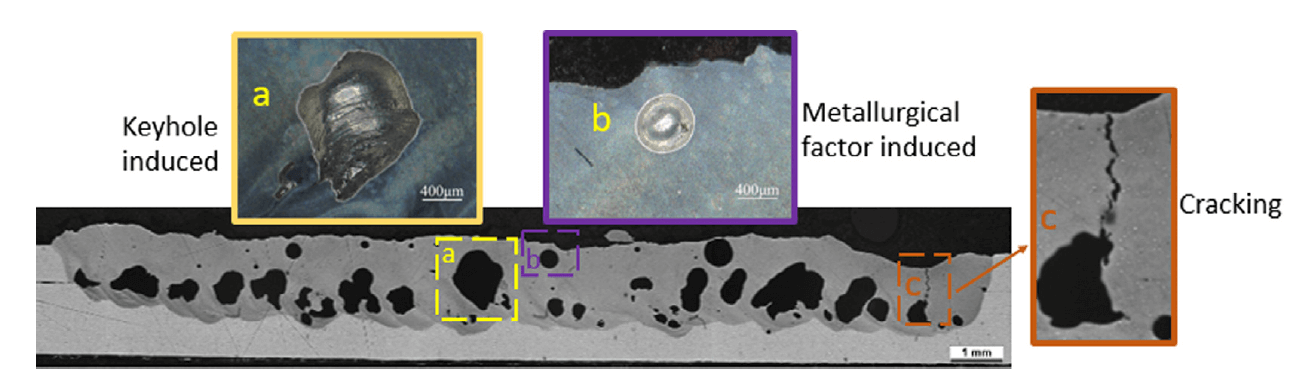
레이저 용접된 알루미늄 조인트 단면의 용접 다공성, 키홀 유도 다공성은 유동 역학으로 인해 발생하며 균열을 일으킬 수 있습니다. 최적화 된 공정 매개 변수는 이러한 종류의 다공성을 완화 할 수 있습니다.

연구원들은 FLOW-3D WELD를 사용 하여 증발 및 반동 압력, 용융풀 역학, 온도 의존적 ​​표면 장력 및 키홀 내에서 여러 번의 레이저 반사 동안 프레넬 흡수를 포함한 모든 중요한 물리적 현상을 설명했습니다.

시뮬레이션 모델을 기반으로 연구진은 키홀 용접에서 유도 다공성의 주요 원인으로 불안정한 키홀을 식별했습니다. 아래 이미지에서 볼 수 있듯이 후방 용융 풀의 과도한 재순환으로 인해 후방 용융 풀이 전방 용융 풀 벽에서 붕괴되고 공극이 발생하여 다공성이 발생합니다. 이러한 갇힌 공극이 진행되는 응고 경계에 의해 포착되었을 때 다공성이 유도되었습니다.

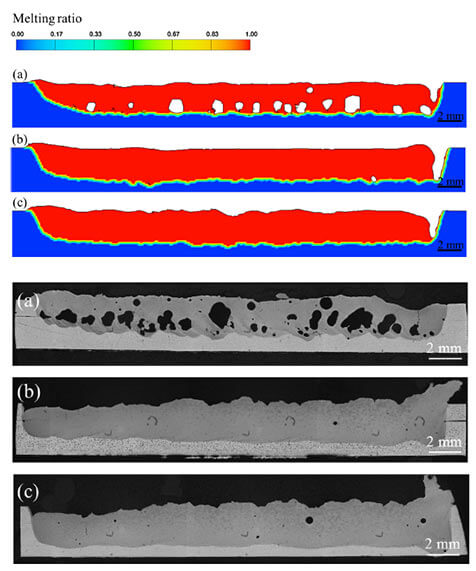
높은 용접 속도에서는 더 큰 키홀 개구부가 있으며 이는 일반적으로 더 안정적인 키홀 구성을 가져옵니다. 사용 FLOW-3D 용접 , 연구진은 그 높은 용접 속도와 경사도 완화 다공성의 큰 용접 각도를 예측했습니다.

레이저 용접 수치 실험 결과
시뮬레이션 (위) 및 실험 (아래)에서 볼 수있는 세로 용접 섹션의 다공성 분포

FLOW Weld

FLOW Weld  모듈은 용접 해석에 필요한 모델을 FLOW-3D 에 추가하는 추가 모듈입니다.

FLOW-3D 의 표면 장력 자유 표면 분석, 용융, 응고, 증발, 상 변화 모델 등의 기본 기능을

응용하여 각종 용접 현상을 분석 할 수 있습니다.

주요 기능 :열원 모델 (출력 지정, 가우스분포, 디 포커스 등) 열원의 자유로운 이동 증발 압력 (그에 따른 반력) 실드 가스 압력 다중 반사 용접에 관한 대표적인 출력 (온도 구배 냉각 속도, 에너지 분포 등)
분석 용도 :높은 방사선 강도와 고온에 의해 직접 관찰이 어려운 현상을 시각화 온도, 열, 용접 속도, 위치 관계, 재료 물성 등의 매개 변수 연구 결함 예측 (기공, 응고, 수축 등)

FLOW -3D Weld 분석 기능

weld_flow
  1. 열원 모델의 이동
      출력량 지정, 가우스분포
  2. 에너지 밀도의 분포 , 가공 속도
      가우스 테이블 입력
  3. 증발 압력
      온도 의존성
  4. 다중 반사
      용해 깊이에 미치는 영향
  5. 결과 처리
      용해 모양, 에너지 분포, 온도 구배 냉각 속도
  6. 다양항형상의 레이저와 거동 (+ csv 파일로드)
      다양한 모양을 csv 파일 형식으로 정의 회전 + 이동
      임의 형상 이동을 csv 파일로 로드 (나선형)
  7.  이종 재료
      이종 재료의 용접
  8.  3D Printing Method  
      Cladding 적층공정

1. 열원 모델의 이동

weld16-1weld16-2
에너지 밀도공간 분포

2. 에너지 밀도의 분포, 가공 속도

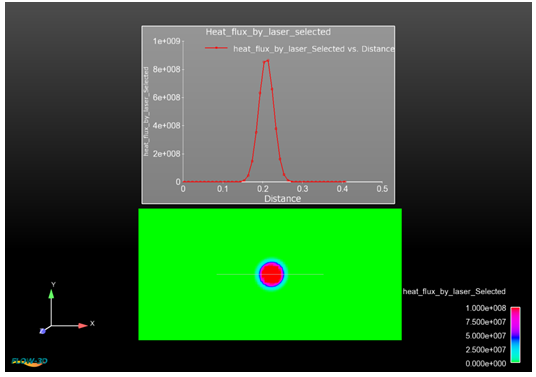
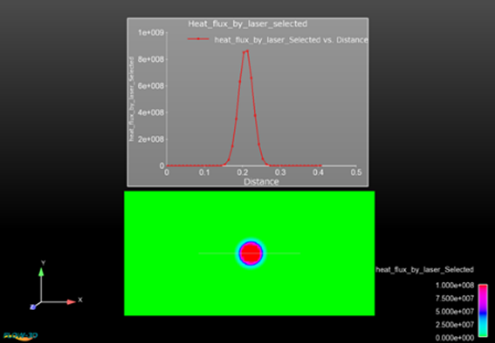
열 플럭스 r 방향의 분포 단면은 원형으로, r 방향으로 열유속 분포를 제공합니다.

에너지 밀도의 공간적 분포

가우스 : 원추형의 경우는 조사 방향으로 변화하고 열유속의 면적 분은 동일합니다.

가공 속도

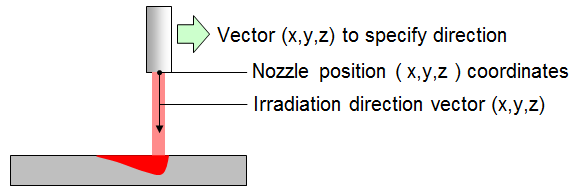
가공 노즐을 x, y, z 방향, 시간 – 속도의 테이블에서 지정합니다.
또한 노즐 (광원) 위치 좌표 조사 방향 벡터 성분을 지정합니다.

3. 증발 압력

에너지 밀도가 높은 경우, 용융 부 계면이 증발하고 그 반력에 의해 계면에 함몰이 발생합니다.
특히 깊은 용융부를 포함한 레이저 용접은 증발 압력을 고려한 모델링이 필요합니다.

증발 압력의 평가는 일반적인 수학적 모델이 없기 때문에 다음 모델 식을 사용합니다.

증발 가스의 상승 효과 (키 홀, 스퍼터 등)

증기의 상승 흐름의 영향을 동압, 전단력으로 평가합니다.

weld5-1 

4. 다중 반사

키홀 거동의 비교

weld9
다중 반사 없음다중 반사 있음

다중 반사를 고려한 레이저

weld10

5. 결과 처리

용접 기능에 관한 대표적인 출력 예입니다.

6. 다양한 형상의 레이저와 거동 (+ csv 파일 읽기)

weld17weld18

7. 이종 재료

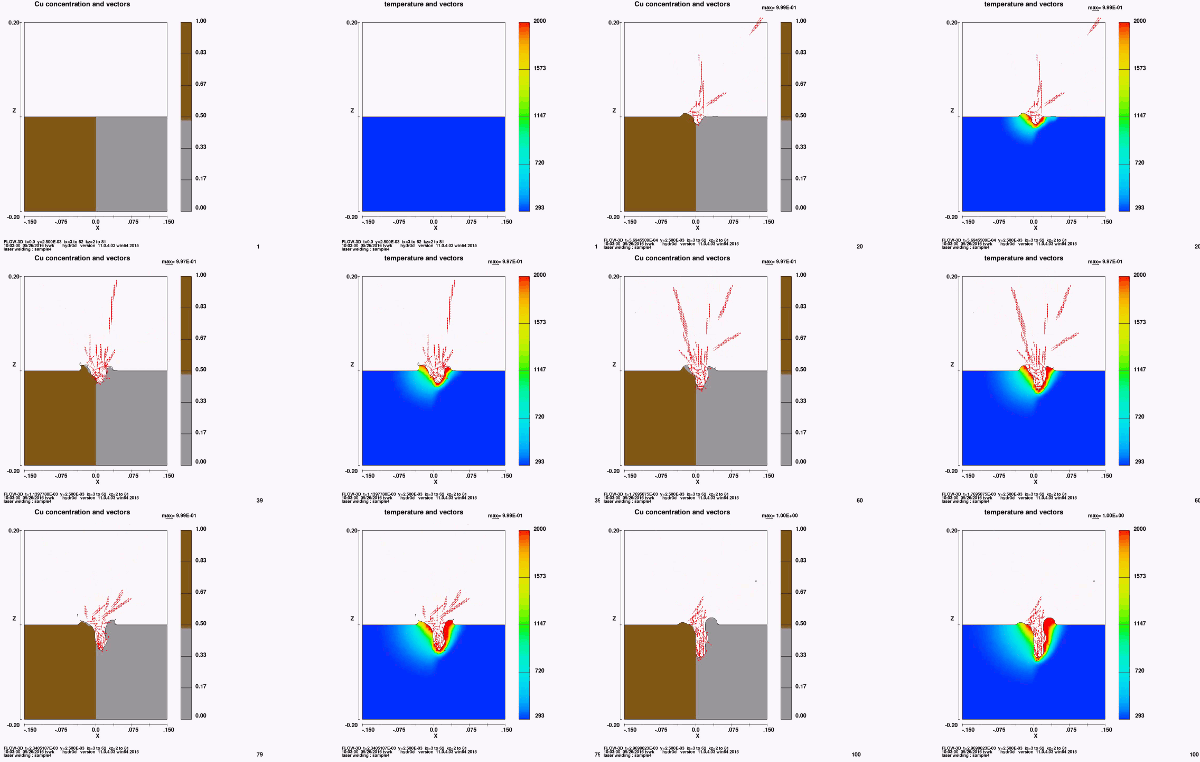
이종 재료 간이 분석

재료 : 철, 구리

밀도고상율
weld19

이종 재료를 이용한 레이저 용접

재료 : 구리, 철

재료 체적 비율온도
weld20

8. 금속 3D 프린팅 기법  

– 적층 제조 (Additive Manufacturing) 공정

– DED(Direct Energy Deposition) 공정 

Figure 5. 3D view of scour under square tide conditions (every 300 s).

조수 흐름이 있는 복잡한 교각에서 scour CFD 시뮬레이션

CFD simulation of local scour in complex piers under tidal flow

J. A. Vasquez1,2, and B. W. Walsh1,3
1 Northwest Hydraulic Consultants, 30 Gostick Place, North Vancouver, BC, Canada,
V7M 3G3; PH (604) 980-6011; FAX (604) 980-9264;
2 email: JVasquez@nhc-van.com
3 email: BWalsh@nhc-van.com

ABSTRACT

우리는 상용 CFD (Computational Fluid Dynamics) 모델 Flow-3D를 사용하여 조수 흐름 아래의 복잡한 교각에서 지역 scour의 질적 시뮬레이션을 보고합니다. 이 모델은 대형 piles 캡과 10 개의 원통형 piles로 구성된 복잡한 부두에서 scour 개발의 초기 단계를 계산하는 데 적용되었습니다. Flow-3D는 piles 사이에서 예상되는 상호 작용을 정확하게 재현 할 수있었습니다. CFD 모델은 또한 조류 역류 하에서 3- piles 그룹의 scour 시뮬레이션을 위해 적용되었습니다. 그 결과는 문헌에보고 된 측정치와 질적으로 일치하여 Flow-3D가 다양한 흐름 조건에서 복잡한 교각을위한 유압 설계 도구로서의 잠재력을 가지고 있음을 보여줍니다.

INTRODUCTION

캐나다 밴쿠버에 있는 프레이저 강과 피트 강 모두에서 현재 여러 다리가 건설 중이거나 최종 설계 단계에 있습니다. 이 다리는 상대적으로 크고 300m에서 1000m 사이의 수로 폭에 걸쳐 있으며 강바닥에 위치한 여러 개의 큰 교각에서 지원됩니다.

일반적으로 케이슨 또는 코퍼 댐을 사용하여 지어진 말뚝 위에 세워진 거대한 단단한 교각이 있는 오래된 교량과 달리, 새로운 교각은 일반적으로 떠 다니는 바지선에서 원통형 말뚝을 땅으로 밀어내어 지어집니다.

말뚝 상단의 수평 말뚝 캡은 수면에 위치하며 상부 구조에서 말뚝 기초까지 힘을 전달하고 선박 충돌을 방지하는 데 사용됩니다. piles 캡의 높이는 하단 및 상단 높이가 최저 및 최고 수위를 덮도록 설계되어 모든 흐름 조건에서 볼 수 있습니다.

piles 캡의 기하학적 구조와 piles의 레이아웃은 다소 복잡 할 수 있으며, 반드시 로컬 scour 예측 변수에서 가정 한 고전적인 교각 모양을 따르는 것은 아닙니다. 그림 1은 6 각형 패턴으로 배열된 두 그룹의 piles 위에 아령 모양의 piles 캡이 있는 프레이저 강의 교각 부두의 예를 보여줍니다.

지속 가능한 환경을 위한 물 공학 (그림 2) 두 개의 다른 직경으로 만들어진 10 개의 piles 위에 둥근 끝이 있는 직사각형 piles 캡으로 만들어진 피트 강의 교각 부두. 복잡한 교각에서 scour을 계산하기위한 일부 분석 공식이 존재합니다.

예를 들어, HEC-18 매뉴얼 (Richardson and Davis 2001)은 교각 스템, piles 캡 및 piles 그룹에 의해 생성된 세 가지 scour 구성 요소를 추가하여 총 scour 깊이를 계산합니다.

말뚝 그룹은 폭이 그룹에 있는 말뚝의 투영된 폭과 동일한 솔리드 말뚝으로 대체되고 말뚝 간격 및 정렬된 행 수의 효과에 대한 수정 계수를 곱합니다. Ataie-Ashtiani와 Beheshti (2006)는 지역 scour (piles 캡이 없는)에서 piles 그룹화의 효과를 연구했습니다.

그들의 실험 결과는 나란히 배열된 매우 밀접하게 배치된 말뚝의 경우 scour 깊이가 50 % 증가할 수 있음을 보여주었습니다. 탠덤 배열의 경우 전면 piles의 scour이 증가하고 후면 차폐 piles의 경우 감소합니다.

어쨌든 말뚝 사이의 간격 S가 말뚝 직경 D의 4 배 (S/D> 4)보다 크면 scour 증폭 효과가 사라지는 경향이 있습니다. 그러나 이러한 공식은 piles이 격자 모양의 레이아웃으로 균일하게 배치되어 있다고 가정합니다.

이는 그림 1과 2에 표시된 교각에서는 분명히 해당되지 않습니다. 문제를 더욱 복잡하게 하기 위해 프레이저 강과 특히 피트 강이 대상입니다.

Figure 1. Example of bridge pier with dumbbell-shaped pile cap and hexagonal pile layout, showing also scour hole measured in a physical model.

교각의 조석 scour은 단방향 scour과 동일한 세부 사항으로 연구되지 않았지만 실제로 주제에 대한 몇 가지 주목할 만한 연구가 있습니다.

Escarameia (1998)는 흐름 방향, 조수주기 기간, 수심, 교각 모양 및 퇴적물 크기에 대한 역전의 영향을 단일 원형 및 직사각형 교각의 국부 scour에 미치는 영향을 평가하여 조류 흐름 조건 하에서 국부 scour의 실험적 조사를 수행했습니다. 예상대로 퇴적물 크기는 국부 scour 깊이에 영향을 미치지 않았습니다.

조수 조건에서 최대 수세 깊이는 베드 폼이 존재하지 않는 경우 일방향 흐름에 대해 항상 평형 scour 깊이 아래로 유지되었습니다 (맑은 물 수세미). 직사각형 교각의 scour 깊이는 정사각형 교각보다 10 ~ 14 % 더 작은 것으로 나타났습니다. 정사각형 교각에서는 조수주기 동안 교각의 상류와 하류에 생성된 scour 구멍이 병합되는데 교각이 직사각형 인 경우에는 발생하지 않습니다.

May and Escarameia (2002)는 정사각형 및 정현파 조수를 사용하여 조수 조건 하에서 지역 scour의 시간적 진화를 연구했습니다. 그들은 맑은 물 scour에서 조수 흐름의 수력 학적 구조에서의 평형 scour이 일방향 유동을 사용하는 scour보다 훨씬 적을 수 있다고 결론지었습니다. 그러나 라이브 베드 scour에서 평형 깊이는 각 조수주기에서 scour 구멍이 더 빠르게 발생하고 구조물 주변에 모래 언덕이 형성되어 단방향 흐름 값에 가까울 수 있습니다.

Margheritini et al. (2006) 은 퇴적물 이동 (살상 조건)과 함께 단방향 및 조수 흐름에서 대 구경 말뚝 주변의 국부 scour 실험을 수행했습니다. 두 경우의 최종 평형 scour은 비슷했습니다. 조수 흐름의 scour 구멍은 대칭이며 원형 모양이고 일방향 scour 구멍보다 부피가 더 큽니다.

현재 물리적 모델링은 사용 가능한 scour 방정식의 가정을 따르지 않는 복잡한 모양을 가진 교각에서 로컬 scour를 평가하기위한 유일한 실용적인 엔지니어링 도구로 보입니다.

3 차원 (3D) 수치 모델링은 단일 원통형 말뚝에서 국부 scour을 재현하기 위해 성공적으로 적용되었지만, 복잡한 교각의 모델 scour이나 조류 역류 하의 말뚝 그룹에는 적용되지 않았습니다. 이 논문의 목적은 상업적으로 이용 가능한 3D 전산 유체 역학 (CFD) 모델을 사용하여 실제 복잡한 부두와 조수 역전 하에서 이상적인 3 파일 그룹에서 지역 scour의 예비 정성 결과를 제시하는 것입니다.

NUMERICAL MODELING OF PIER SCOUR

Olsen과 Melaan (1993)의 초기 작업 이후 여러 3D 수치 모델이 단일 원통형 부두에서 국소 scour을 모델링하는 데 성공적으로 적용되었습니다 (Roulund et al. 2005의 검토 참조). 그러나 복잡한 교각에서 3D scour 시뮬레이션은 거의 시도되지 않았습니다. 그 이유는 두 가지입니다.

대부분의 모델은 복잡한 교각의 형상을 수용하기 어려운 구조화된 곡선 형 경계 맞춤 그리드를 기반으로 합니다. 또 다른 중요한 제한 사항은 계산 시간이며, 이는 실제 모델에서 로컬 scour 테스트를 수행하는 데 필요한 시간보다 훨씬 큽니다.

그럼에도 불구하고 수치 모델은 귀중한 정보를 제공할 수 있으며 컴퓨터 속도가 더욱 향상될 것으로 예상되는 미래에 큰 잠재력을 가지고 있습니다. 여기에 사용된 CFD 모델은 뉴 멕시코 주 산타페의 Flow Science에서 개발한 Flow-3D입니다. Flow-3D는 유압 엔지니어링 애플리케이션을 위한 특수 모듈이 포함된 상용 CFD 패키지입니다.

구조화된 직교 그리드를 사용함에도 불구하고, 직사각형 계산 셀이 장애물에 의해 부분적으로 차단될 수 있도록 하는 FAVOR (fractional area/volume method)를 적용하여 복잡한 형상을 모델링 할 수 있습니다. 날카로운 자유 표면 (예: 수압 점프, 공기 중 자유 제트)은 VOF (Volume-of-Fluid) 방법으로 모델링 됩니다.

Flow-3D는 Brethour (2001)에 의해 자세히 설명된 대로 지역 scour을 모델링하는 고유 한 기능도 가지고 있습니다. 이러한 기능은 그림 2에 설명되어 있으며, 모델이 맑은 물 조건에서 복잡한 부두의 형상과 scour 개발의 초기 단계를 재현할 수 있는 방법을 보여줍니다.

그림 2에 표시된 복잡한 부두는 길이 51.5m, 너비 12.5m, 두께 6.7m의 끝이 둥근 파일 캡을 포함합니다. 파일 캡 아래에는 세 개의 개별 파일 그룹이 있습니다. 직경이 2.4m 인 3 개의 파일로 구성된 두 그룹 (U & D)은 파일 캡의 상류 및 하류 끝에 위치하며, 4 개의 작은 1.8m 파일 (C)은 중앙 주위에 있습니다.

파일 캡의 바닥은 침대 위 약 13m입니다. 수치 메쉬는 길이 115m, 너비 50m, 높이 22m였으며 균일 한 셀 크기는 0.5m (46,176 셀)입니다. 시뮬레이션은 수심 15.8m, 일정한 유속 1.5m/s, 퇴적물 크기 0.35mm에 대해 수행되었습니다. Flow-3D는 지역 scour에 대한 파일 간섭의 영향을 평가하는 데 사용되었습니다. 과도한 계산 시간이 필요하여 장기 시뮬레이션을 수행할 수 없었기 때문에 처음 1 시간 동안 scour 시작 만 시뮬레이션 했습니다.

말뚝 사이의 상대적 간격 S/D를 고려할 때, 그림 2에 표시된 Flow3D 결과는 Ataie-Ashtiani와 Beheshti (2006)가보고 한 말뚝 간의 상호 작용에 관한 실험적 관찰과 매우 잘 일치합니다. 결과는 부두 중심 주변의 C 말뚝이 2 쌍처럼 나란히 행동한다는 것을 시사합니다.

왼쪽과 오른짝이었는 두 쌍의 말뚝 사이에 간섭이 없는 것으로 보입니다 (C1-C2 및 C3-C4, S/D = 4); 파일 C1 (C2)은 scour (S/D = 2.3)으로부터 파일 C3 (C4)를 보호하는 것처럼 보입니다.

그림 2는 또한 파일 캡의 양쪽 끝에 있는 3 개 파일 그룹 U 및 D의 수세공 구멍이 이미 병합되어 3 개 파일 간의 강력한 상호 작용을 시사합니다 (S/D = 0.9). 또한 3- 파일 그룹 U는 더 작은 파일 C를 보호하지 않는 것 같습니다 (S/D> 5).

Figure 2. Initial scour development computed by Flow-3D in complex pier.

최대 평형 scour 깊이를 계산할 수는 없었지만, 복잡한 부두에서 말뚝과 말뚝 캡 사이의 상호 작용에 대해 얻은 통찰력은 scour 과정과 scour 대책의 잠재적 설계를 이해하는 데 여전히 중요합니다.

MODELING TIDAL SCOUR OF PILE GROUP

지속 가능한 환경을위한 물 공학 말뚝 그룹의 조수 조사 모델링 불안정한 조수 흐름의 잠재적 영향을 평가하기 위해 Flow-3D를 사용한 정성 시뮬레이션이 수행되었습니다.

전체 교각을 시뮬레이션하는 것이 불가능했기 때문에 이상화된 3- piles 그룹 (piles 캡 없음)이 거친 메시를 사용하여 재현되었습니다. 원통형 piles의 직경은 최소 간격 S / D = 0.95로 삼각형 패턴으로 배열 된 2m였습니다. 메쉬 셀 크기는 0.5m입니다.

이러한 메쉬 크기는 piles 주변 흐름의 모든 3D 세부 사항을 해결하기에 충분한 해상도를 제공하지 않지만 계산 시간을 관리 가능한 수준으로 유지하는 데 필요한 것으로 간주되었습니다.

따라서 이러한 예비 시뮬레이션은 정 성적이며 Flow-3D의 기능을 대략적으로 평가하기위한 탐색 적 특성을 가지고 있습니다. 수로는 길이 40m, 너비 16m, 높이 6.5m였습니다. 입구 / 출구의 첫 번째와 마지막 10m는 난류의 완전한 발달을 허용하기 위해 단단한 거친 베드로 만들어졌습니다.

3 개의 말뚝이있는 수로의 중앙 부분은 0.75mm의 모래로 만들어졌습니다. 수심은 2.5m였습니다. 유속의 조석 반전은 정사각형 및 정현파 조석을 사용하여 시뮬레이션되었습니다 (그림 3). 제곱 조는 Escarameia (1998)와 Margheritini et al. (2006). 단방향 흐름의 경우 조수 피크 (2m / s)를 사용했습니다.

Figure 3. idealized tidal velocity used for numerical simulations.

900 초에서 채널 중심선을 따라 세로로 된 베드 프로piles은 그림 4에서 단방향 흐름과 사인 곡선에 대해 보여집니다. 그림 5는 제곱 조수 시나리오에 대해 300 초마다 일련의 3D 이미지를 보여 주지만 화살표는 흐름 방향을 나타냅니다. 마지막으로, 세 가지 흐름 시나리오에 대한 scour의 시간적 진화가 그림 6에 나와 있습니다.

Figure 4. Computed centerline bed profiles after 900 s for unidirectional flow (left) and sinusoidal tide (right).

Figure 5. 3D view of scour under square tide conditions (every 300 s).
Figure 6. Temporal evolution of maximum scour depth under steady and tidal flow conditions (grid resolution is 0.5 m)
Figure 6. Temporal evolution of maximum scour depth under steady and tidal
flow conditions (grid resolution is 0.5 m)

단방향 흐름에서 scour는 상류에서 발생하고 퇴적물은 더미 뒤에 축적됩니다 (그림 4). 조수 조건에서 흐름 반전은 이전 조수주기에서 개발 된 scour hole을 일시적으로 채웁니다. scour의 계산 된 시간적 진화 (그림 6)는 Margheritini et al.의 실험과 유사합니다(2006). 조석 수조는 처음에 증가하지만 흐름이 역전되면 약간 감소하여 다음주기에 다시 자라납니다.

Flow-3D는 Escarameia (1998)와 일치하여 시뮬레이션의 맑은 물 조건에 대해 조석 정찰이 단방향 정찰보다 약간 낮다고 예측했습니다. 그러나 사용된 거친 0.5m 메시 해상도로 인해 정확한 scour 감소 크기를 정확하게 해결할 수 없습니다. 또한, 모델은 평형 scour 깊이를 달성 할만큼 충분히 오래 실행되지 않았습니다.

CONCLUSION

Flow-3D는 구조화된 경계 맞춤 그리드의 일반적인 제한없이 복잡한 구조에서 로컬 scour을 모델링 할 수 있는 기능을 갖춘 최초의 CFD 상용 모델 일 것입니다.

큰 piles 캡과 여러 개의 piles로 구성된 복잡한 부두에 적용했을 때 Flow-3D는 piles 간의 상호 작용을 정확하게 예측할 수 있었으며 실제 엔지니어링 응용 프로그램을 위한 설계 도구로서의 잠재력을 보여주었습니다.

Flow-3D를 사용하여 맑은 물의 조수 흐름 하에서 이상적인 3- piles 그룹의 정 성적 시뮬레이션은 동일한 최고 속도의 단방향 흐름에 비해 흐름 반전이 있는 조수 조건에서 scour 깊이가 감소함을 보여주었습니다.

이러한 수치 결과는 실험 데이터와 일치합니다. 그러나 모델을 정량적으로 검증하려면 더 미세한 그리드를 사용하는 추가 연구가 필요합니다. 현재 Flow-3D 및 일반적으로 CFD 모델의 주요 실제 제한은 계산 시간입니다.

구조를 모델링하는 데 매우 큰 그리드가 필요한 경우 장기 평형 조사를 계산하려면 물리적 모델을 실행하는 데 필요한 것보다 훨씬 더 많은 계산 시간이 필요할 수 있습니다.

논문 원본 링크 : CFD simulation of local scour in complex piers under tidal flow

기타 참고 자료 : https://flow3d.co.kr/scouring-knowledge/

REFERENCES

Ataie-Ashtiani, B. and Beheshti, A.A. (2006). “Experimental investigation of clearwater local scour at pile groups”. J. Hyd. Eng., ASCE, 132(10), 1100-1104.
Brethour, J. M. (2001). Transient 3-D model for lifting, transporting and depositing
solid material. 2001 International Symposium on Environmental Hydraulics,
Tempe, Arizona (http://flow3d.info/pdfs/tp/wat_env_tp/FloSci-Bib28-01.pdf).
Escarameia, M. (1998). Laboratory investigation of scour around large structures in
tidal waters. Conf. Basics of Sediment Transport and Scouring. HR
Wallingford (http://kfki.baw.de/conferences/ICHE/1998-Cottbus/55.pdf).
May, R.W.P. and Escarameia, M. (2002). Local scour around structures in tidal flows.
First International Conference on Scour Foundations, Texas A&M University.
Margheritini, L., Martinelli, L., Lamberti, A. and Frigaard, P. (2006). Erosione
indotta da onde e correnti di marea attorno a pali di grande diametro. XXX
Convegni di Idraulica e Construzioni Idrauliche, Rome, September 2006
(http://www.idra2006.it/referee/files/L356.pdf).

Pulsed Laser Welding

Pulsed Laser Welding | 펄스 레이저 용접

Pulsed Laser Welding

시뮬레이션 설명

펄스 레이저 용접은 레이저의 고출력 및 고속 주파수 펄스를 생성합니다. 이는 무엇보다도 열에 민감한 장비 주변의 용도에 도움이 될 수 있습니다. 이 예제는 FLOW-3D AM에서 이 효과를 모델링하는 방법을 보여줍니다. 이 시뮬레이션을 실행하려면 FLOW-3D WELD가 필요합니다.

시뮬레이션 세부 정보

버전#: FLOW-3D v11.2와 FLOW-3D WELD가 결합됨

본 사례에 대해 궁금하신 사항이 있으시면 언제든지 기술지원팀에 연락주세요.

Ring Beam Welding

Ring Beam Welding | 링 빔 용접

Ring Beam Welding

시뮬레이션 설명

이 시뮬레이션은 FLOW-3D 및 FLOW-3D WELD를 사용하여 만들 수 있는 수많은 다양한 레이저 모양 중 하나인 일반 링, 레이저 빔을 보여줍니다. 이 시뮬레이션을 실행하려면 FLOW-3D WELD가 필요합니다.

시뮬레이션 세부 정보

버전#: FLOW-3D v11.2와 FLOW-3D WELD가 결합됨

본 사례에 대해 궁금하신 사항이 있으시면 언제든지 기술지원팀에 연락주세요.

Laser Oscillation Welding

Laser Oscillation Welding | 레이저 진동 용접

Laser Oscillation Welding

시뮬레이션 설명

이 시뮬레이션은 8Hz 주파수에서 2개의 AISI 1026 강철 조각 사이의 진동 용접을 시연합니다. FLOW-3D AM을 사용하여 브리지 간격 거리에 사용되는 다양한 진동 용접 기법을 조사할 수 있습니다. 이 시뮬레이션을 실행하려면 FLOW-3D WELD가 필요합니다.

시뮬레이션 세부 정보

버전#: FLOW-3D v11.2와 FLOW-3D WELD가 결합됨
만든 날짜: 2020년 12월

본 사례에 대해 궁금하신 사항이 있으시면 언제든지 기술지원팀에 연락주세요.

T-joint Weld

T-joint Weld

시뮬레이션 사례 설명

T 조인트 용접은 두 개의 재료 조각을 서로 수직으로 놓고 용접할 때 생성됩니다. 이 예제는 펄스 레이저로 인한 알루미늄 합금 두 조각 사이의 용접 결과를 보여줍니다. 이 시뮬레이션을 실행하려면 FLOW-3D WELD가 필요합니다.

본 사례에 대해 궁금하신 사항이 있으시면 언제든지 기술지원팀에 연락주세요.

T-joint welds are created when two pieces of material are placed perpendicular to each other and welded together. This example shows the resulting weld between two pieces of aluminum alloy due to a pulsed laser. FLOW-3D WELD is required to run this simulation.

T-joint Weld

레이저 용접 수치해석 (FLOW-3D WELD)

FLOW-3D WELD Products

레이저 용접 수치해석 (FLOW-3D WELD)

FLOW-3D@ WELD는 레이저 용접 공정에 대한 정확한 시뮬레이션 기능을 제공하여 최적화된 공정을 개발하게 합니다. 더 나은 공정 제어를 통해 기공, 열 영향 영역을 최소화하고 미세 구조 변화를 제어할 수 있습니다.

레이저 용접 프로세스를 정확하게 시뮬레이션하기 위해 FLOW-3D@ WELD는 레이저 열원, 레이저-재료 상호 작용, 유체 흐름, 열 전달, 표면 장력, 응고, 다중 레이저 반사 및 위상 변화와 같은 모든 관련 물리 모델을 제공합니다.

Laser Welding

최근에는 뛰어난 생산성과 속도, 낮은 열 입력이 결합되어 기존의 용접 프로세스를 대체하는 레이저 용접 프로세스가 주목 받고 있습니다. 레이저 용접이 제공하는 장점은 용접강도가 좋고, 열 영향 부위가 작으며, 정밀도가 낮고 변형이 적으며, 강철, 알루미늄, 티타늄 및 이종 금속을 포함한 광범위한 금속 및 합금을 용접 할 수 있는 기능이 있습니다.

FLOW-3D@는 레이저 용접 공정에 대한 강력한 통찰력을 제공하고 궁극적으로 프로세스 최적화를 달성하는 데 도움이 됩니다.

보다 나은 프로세스 제어를 통해 기공을 최소화할 수 있습니다. 열 영향부위 및 미세조직을 제어가 가능합니다. FLOW-3D는 자유표면 추적 알고리즘을 통해 매우 복잡한 용접 POOL 시뮬레이션을 해석하는데 매우 적합합니다.

용접 모듈은 레이저 소스에 의해 생성된 Heat flux, 용융 금속에 대한 증발압력, shield gas 효과, 용융 풀의 반동압력 및 다중 레이저 반사와 같은 물리적 모델을 FLOW-3D에 적용하기 위해 개발되었습니다. 키홀 용접과 같은 현실적인 프로세스 시뮬레이션을 위해서는 모든 관련 물리적 현상을 적용하는 것이 중요합니다.

FLOW-3D는 레이저 용접의 conduction and keyhole 방식을 시뮬레이션 할 수 있습니다. 전 세계의 연구원들은 FLOW-3D를 사용하여 용접역학을 분석하고, 공정 매개 변수를 최적화하여 기공을 최소화하며, 레이저 용접공정에서의 dendrite 결정 성장 양상을 예측합니다.

Shallow penetration weld (top left); deep penetration weld with shield gas effects (top right); deep penetration weld with shield gas and evaporation pressure (bottom left); and deep penetration weld with shield gas, evaporation pressure and multiple laser reflections effects (bottom right).

Full Penetration Laser Welding Experiments

한국 카이스트와 독일 BAM은 16K kW레이저를 사용하여 10mm강판에 완전 침투 레이저 용접 실험을 수행하였습니다. CCD카메라의 도움을 받아 완전 용입 레이저 용접으로 형성된 상단 및 하단 용융풀 거동을 확인할 수 있었습니다. 그들은 또한 FLOW-3D 로 용접 공정 해석으로 해석과 실험결과의 경향이 일치하는 것을 알 수 있었습니다.

Experimental setup with CCD cameras observing the top and bottom molten pools
Schematic of computation domain in FLOW-3D


Simulation results at the top show melt pool lengths of 8mm and 15mm, whereas experiments indicated melt pool lengths of 7mm and 13mm

Laser Welding Porosity Case Study

General Motors, Michigan, 중국의 상하이 대학교는 용접 공정 변수, 즉 keyhole 용접에서 기공의 발생에 대해 용접 속도 및 용접 각도와 같은 공정 매개 변수가 미치는 영향을 알아보기 위해 협력하여 연구를 진행하였습니다.

레이저 용접된 Al 접합부 단면의 기공을 분석합니다. Keyhole이 유도 된 기공들은 유동 역학으로 인해 발생되고 균열을 일으킬 수 있습니다. 최적화 공정의 매개변수는 이러한 종류의 기공을 완화할 수 있습니다. FLOW-3D를 사용하여 연구원들은 증발 및 반동 압력, 용융풀, 온도에 따른 표면장력 및 Keyhole내의 다중 레이저 반사, 프레넬 흡수를 포함한 모든 중요한 물리적 현상을 설명했습니다.

연구진은 시뮬레이션 모델을 기반으로 Keyhole 용접에서 생성된 기공들의 주요 원인으로 불안정한 Keyhole을 규정하였습니다. 아래 이미지에서 볼 수 있듯이 뒤쪽 용융 풀의 과도한 재순환은 뒤쪽 용융 풀이 앞쪽 용융 풀 경계를 무너뜨리며 기공들을 생성시킵니다. 갇힌 공간이 증가하는 응고 전면에 의해 갇혔을때 기공들이 발생되었습니다.

Distribution of porosity in longitudinal welding sections as seen in simulations (top) and experiments (bottom)

용접 속도가 빠를수록 더 큰 keyhole이 생성되며 이로 인해, 보다 안정적인 keyhole이 생성됩니다. 연구진은 FLOW-3D를 사용하여 용접 속도와 용접 경사각으로 기공들의 생성을 완화시킬 수 있었습니다.


관련 기술자료

Figure 3. The simulated temperature distribution and single-layer multi-track isothermograms of LPBF Hastelloy X, located at the bottom of the powder bed, are presented for various laser energy densities. (a) depicts the single-point temperature distribution at the bottom of the powder bed, followed by the isothermograms corresponding to laser energy densities of (b) 31 J/mm3 , (c) 43 J/mm3 , (d) 53 J/mm3 , (e) 67 J/mm3 , and (f) 91 J/mm3 .

An integrated multiscale simulation guiding the processing optimisation for additively manufactured nickel-based superalloys

적층 가공된 니켈 기반 초합금의 가공 최적화를 안내하는 통합 멀티스케일 시뮬레이션 Xing He, Bing Yang, Decheng Kong, Kunjie Dai, Xiaoqing ...
Welding

A multi-physics CFD study to investigate the impact of laser beam shaping on metal mixing and molten pool dynamics during laser welding of copper to steel for battery terminal-to-casing connections

배터리 단자-케이싱 접합을 위한 구리와 강철 간 레이저 용접 시 레이저 빔 형상이 금속 혼합 및 용융풀 역학에 미치는 영향을 ...
The Fastest Laptops for 2024

FLOW-3D 수치해석용 노트북 선택 가이드

2024년 가장 빠른 노트북 PCMag이 테스트하는 방법 소개 : 기사 원본 출처: https://www.pcmag.com/picks/the-fastest-laptops CFD를 수행하기 위한 노트북 선정 기준은 별도로 ...
Melt pool EBSD and X-ray computed tomography analysis results.

High-speed synchrotron X-ray imaging of melt pool dynamics during ultrasonic melt processing of Al6061

알루미늄 6061의 초음파 용융 처리 중 용융 풀 역학에 대한 고속 동기화된 X선 영상 촬영 Lovejoy Mutswatiwa, Lauren Katch, Nathan ...
Concrete 3D Printing

Computational fluid dynamics modelling and experimental analysis of reinforcement bar integration in 3D concrete printing

3D 콘크리트 프린팅에서 철근 통합에 대한 전산 유체 역학 모델링 및 실험적 분석 Md Tusher Mollah, Raphaël Comminal, Wilson Ricardo ...
Ultrafast laser ablation of tungsten carbide: Quantification of threshold range and interpretation of feature transition

Ultrafast laser ablation of tungsten carbide: Quantification of threshold range and interpretation of feature transition

텅스텐 카바이드의 초고속 레이저 제거: 임계값 범위의 정량화 및 특징 전환 해석 Xiong Zhang, Chunjin Wang, Benny C. F. Cheung, Gaoyang Mi, Chunming WangFirst ...
Figure 1: Scheme of liquid metal printing process

Effect of Aging Heat Treatment in an Al-4008 Produced byLiquid Metal Printing

C. M. LadeiroDepartment of Metallurgical and Materials Engineering, Faculdade de Engenharia, Universidade do Porto, Rua Dr. RobertoFrias, 4200-465 PORTO, Portugal ...
Coupled CFD-DEM simulation of interfacial fluid–particle interaction during binder jet 3D printing

Coupled CFD-DEM simulation of interfacial fluid–particle interaction during binder jet 3D printing

바인더 제트 3D 프린팅 중 계면 유체-입자 상호 작용에 대한 CFD-DEM 결합 시뮬레이션 Joshua J. Wagner, C. Fred Higgs III https://doi.org/10.1016/j.cma.2024.116747 Abstract The coupled ...
Influences of the Powder Size and Process Parameters on the Quasi-Stability of Molten Pool Shape in Powder Bed Fusion-Laser Beam of Molybdenum

Influences of the Powder Size and Process Parameters on the Quasi-Stability of Molten Pool Shape in Powder Bed Fusion-Laser Beam of Molybdenum

몰리브덴 분말층 융합-레이저 빔의 용융 풀 형태의 준안정성에 대한 분말 크기 및 공정 매개변수의 영향 Feipeng An, Linjie Zhang, Wei ...
Figure 1. Experimental setup and materials. (a) Schematic of the DED process, where three types of base materials were adopted—B1 (IN718), B2 (IN625), and B3 (SS316L), and two types of powder materials were adopted—P1 (IN718) and P2 (SS316L). (b) In situ high-speed imaging of powder flow and the SEM images of IN718 and SS316L powder particle. (c) Powder size statistics, and (d) element composition of powder IN718 (P1) and SS316L (P2).

Printability disparities in heterogeneous materialcombinations via laser directed energy deposition:a comparative stud

Jinsheng Ning1,6, Lida Zhu1,6,∗, Shuhao Wang2, Zhichao Yang1, Peihua Xu1,Pengsheng Xue3, Hao Lu1, Miao Yu1, Yunhang Zhao1, Jiachen Li4, Susmita ...

CFD가 레이저 용접을 만나면 : 불꽃이 어떻게 날아갑니까?

Pareekshith Allu Senior CFD Engineer | Additive Manufacturing | Laser Welding | Business Development

When CFD meets laser welding: How sparks fly!

CFD 또는 전산 유체 역학은 수치적 방법을 사용하여 유체 흐름을 연구하는 것입니다. 유체 흐름의 기본 방정식에는 솔루션 해가 없으므로 컴퓨터를 사용하여 방정식을 반복적으로 계산하는 수치해석 방법으로 해결합니다. 일반적으로 CFD 도구는 공기 역학, 엔진 연소, 물 및 환경 흐름, 미세 유체 및 제조 공정에서 광범위한 연구 및 엔지니어링 문제에 적용될 수 있습니다. CFD가 개발에 중요한 역할을 한 기술을 매일 접할 가능성이 있습니다. FLOW-3D 소프트웨어 제품 제조업체인 Flow Science Inc.에서는 자유 표면 흐름 문제 라고하는 특수한 문제 해결에 중점을 둡니다 . 

자유 표면 흐름이란 무엇입니까? 밀도 차이가 큰 두 유체간에 인터페이스가 공유되는 분야는 자유 표면 흐름입니다. 예를 들어, 기체-액체 경계면이 제한되지 않고 시간에 따라 자유롭게 움직이고 변경할 수 있다는 점에서 강의 물과 주변 공기 사이에 자유 표면이 존재합니다. FLOW-3D 솔버의 기본 DNA 인 Volume of Fluid 또는 VoF 방법 은 자유 표면의 진화를 추적하는 강력한 계산 기술입니다. 우리는 지난 40 년 동안 이 문제에 거의 전적으로 집중했습니다.

자유 표면 흐름은 제조산업 분야에서도 널리 사용됩니다. 금속 주조에서는 용융 금속과 용융 금속이 채우는 금형 또는 다이의 공기 사이에 자유 표면이 존재합니다. L-PBF ( Laser Powder Bed fusion) 라고하는 적층 제조 공정에서 레이저를 사용하여 분말 입자를 녹이고 융합하여 공정에서 자유 표면 용융 풀을 만듭니다. 그리고 레이저 용접에서는 레이저 빔에 의해 녹아서 두 개의 금속 부품 / 부품을 함께 융합 할 때 형성되는 자유 표면 용융 풀이 있습니다. 

이 게시물에서는 레이저 용접 공정에 대한 CFD 시뮬레이션이 유용한 이유를 설명합니다.

레이저 기술은 지난 몇 년 동안 상당히 발전했으며 이제 다른 레이저 제조업체는 다양한 파장에서 펄싱 기능이 있는 고출력 레이저를 제공 할 수 있습니다. 레이저와 로봇 자동화 시스템, 컨트롤러 및 프로세스 센서의 통합은 다양한 제조 산업에서 사용을 확대하여 열 입력이 적고 열 영향 영역이 더 작은 레이저 용접 조인트를 가능하게합니다. 

레이저-재료 상호 작용은 복잡하며이를 정확하게 모델링하려면 이러한 시간적 및 공간적 규모와 관련된 물리학을 구현해야합니다. 레이저 열원은 표면에 에너지를 축적하여 기판을 녹이고 용융 금속 풀을 만듭니다. 용융 풀은 전력, 속도 및 스캔 경로와 같은 레이저 가공 매개 변수와 용융 풀의 자유 표면에 동적 증기압을 적용하는 차폐 가스의 영향을 더 많이받습니다. 또한 용접되는 기판의 재료 특성이 중요한 역할을합니다. 용융된 풀의 상 변화와 증발은 용융 풀을 더욱 압박하는 반동 압력을 유발할 수있는 반면 표면 장력은 풀 내의 유체 대류에 영향을줍니다. 키홀 링이있는 경우 레이저 광선이 키홀 내에 갇혀 추가 반사 영향을 받을 수 있습니다. 기판에 더 많은 에너지를 전달합니다. 불안정한 키홀이 붕괴되면 갇힌 공극이 진행되는 응고 경계에 의해 포착되는 다공성 형성으로 이어질 수 있습니다. 

분명히 많은 일이 진행되고 있습니다. 이것이 CFD 시뮬레이션이 강력 할 수있는 곳이며 FLOW-3D WELD를 개발할 때 레이저-재료 상호 작용을 이해하는 데 많은 노력을 기울이는 이유입니다. 자유 표면 추적 및 레이저 에너지 증착, 차폐 가스 역학, 상 변화, 반동 압력, 표면 장력, 레이저 광선 추적 및 응고와 함께 유체 및 열 흐름 방정식을 통합하는 물리 기반 모델은 레이저의 복잡한 상호 작용을 캡처하는 데 매우 정확합니다. 용접과정을 해석하는 기능은 용융 풀의 안정성에 대한 다양한 공정 매개 변수의 영향을 분리하고 엔지니어와 연구원이 용접 일정을 최적화하는 데 도움이 될 수 있습니다.

CFD 시뮬레이션은 레이저 용접 프로세스를 분석하고 개선하는데 도움이되는 프레임 워크를 제공 할 수 있습니다. 불안정한 용융 풀은 키홀 유발 다공성, 파열 및 스패 터와 같은 결함을 초래할 수 있기 때문에 용융 풀의 작동 방식을 이해하는 것은 조인트의 품질에 매우 중요합니다. 그 후, FLOW-3D WELD 모델의 출력인 응고된 용융 풀 데이터 및 열 구배와 같은 결과를 미세 구조 또는 유한 요소 분석 모델에 입력하여 각각 결정 성장 및 열 응력 진화를위한 길을 닦을 수 있습니다.

이 게시물이 CFD를 사용하여 레이저 용접 프로세스를 시뮬레이션하는 이점을 이해하는데 도움이 되기를 바랍니다.

레이저 용접 공정을 더 잘 이해하기 위해 CFD 시뮬레이션 적용을 고려해 보셨습니까? 어떤 특징 / 물리 현상이 모델링되기를 원하십니까? 질문과 의견이 있으면 언제든지 flow3d@stikorea.co.kr 또는 미국 본사의 paree.allu@flow3d.com에게 연락하십시오.

FLOW-3D 분말 소결 적층 조형 프로세스 해석

FLOW-3D 분말 소결 적층 조형 프로세스 해석

FLOW-3D DEM

FLOW-3D@ DEM을 이용하여 분말 적층 공정(파우더 베드 방식) 해석이 가능합니다. 여기에서는 재질: Ni 합금 (Inconel 718), 적층 피치 60μm 정도를 실시한 사례입니다. 지름 20um의 입자를 기준으로 지정하고, 자유낙하에 의해 베드를 형성합니다. 입자는 높이 방향으로 3개 정도로 적층되었습니다. 일정한 입경(case 1)에 미세한 입자를 섞은 것(case2)은 충전율이 높아졌습니다. 한편 굵은 입자를 지정한 케이스(case3)는 충전율이 나빠지는 결과를 확인할 수 있었습니다.

FLOW-3D DEM을 이용한 분말적층공정

FLOW-3D WELD 용융지 형성 후 다시 응고되어 가는 모습 확인

FLOW-3D@ DEM에서 얻은 입자 배드에 레이저를 조사하여 용융 해석을 실시한 사례입니다. FLOW-3D@ WELD에서는 레이저에 의한 에너지 밀도 분포를 부여하여 열, 유동 해석을 실시합니다. 용융지가 형성되었다가 다시 응고되어 가는 모습을 확인할 수 있습니다.

입자 충전율이 높은 경우(case2)에서는 용융지가 비교적 직선으로 늘어나지만 충전율이 낮은 경우에 구불구불한 형태로 용융지가 형성되었습니다. 입자가 형성되는 표면 형상, 틈새가 비드 형성에 영향을 준다는 것을 알 수 있습니다.

FLOW-3D WELD 온도  Contour Map
FLOW-3D WELD 온도 Contour Map

F.SAI를 이용한 열응력 해석

FEM mesh 데이터와 FLOW-3D@ 결과 파일에서 구조 인터페이스 F.SAI를 이용하여 온도 데이터를 추출합니다.

여기에서는 case2의 결과를 이용하여 온도 데이터를 추출하여 얻을 수 있고, 온도 데이터를 하중 데이터로 하여 각종 구조해석 소프트웨어에서 열응력 해석을 실시했습니다.

오른쪽 그림에 NX Nastran, MSC Nastran, Marc의 결과를 보여 줍니다. 수축에 의한 응력의 발생과 변위의 모습을 확인할 수 있습니다.

FEM 메시  데이터와 FLOW-3D결과 파일에서 구조 인터페이스를 통한 열응력해석
FEM 메시 데이터와 FLOW-3D결과 파일에서 구조 인터페이스를 통한 열응력해석

분말 베드 용융 결합의 Mesoscopic 열 유동해석

분말 베드 용융 결합의 Mesoscopic 열 유동해석

자료 제공: 오하이오 주립대학교
자료 제공: FLOW Science Japan

오하이오 주립대학의 YS Lee W.Zhang 등에 의한 Mesoscopic Simulation of Heat Transfer and Fluid Flow in Laser Powder Bed Additive Manufactuing는 FLOW-3D를 이용하여 금속 분말층의 레이저에 의한 용융 결합 (L-PBF)을 분석하고 있습니다. 논문에서는 DEM으로 생성한 임의의 분말층을 분석 대상으로 하고, FSJ 에서 개발한 FLOW-3D WELD(레이저 용접 모듈) 모듈을 이용하여 균일한 분말을 바닥에 분사한 후 그 결과를 비교했습니다.

Mesoscopic Simulation of Heat Transfer and Fluid Flow in Laser Powder Bed Additive Manufactuing
Mesoscopic Simulation of Heat Transfer and Fluid Flow in Laser Powder Bed Additive Manufactuing 해석 모델
Mesoscopic Simulation of Heat Transfer and Fluid Flow in Laser Powder Bed Additive Manufactuing 해석 결과

위 사례를 통해 열전도나 용융금속의 거동, 용접속도의 차이에 의한 영향 등, 같은 분말 베드에서도 정상적인 해석이 가능한 것을 알 수 있습니다.

온도분포등의 결과의 차이는 분말층의 차이로 발생될 수 있으며, 향후, FLOW-3D@ DEM(FSJ 개별요소법 모듈)을 이용한 분말층 생성기능도 개발 예정입니다.

레이저 용접에서의 키홀 동력학과 유도를 통한 Porosity 형성

레이저 용접에서의 Key Hole 동력학과 유도를 통한 Porosity 형성

자료 제공: General Motors Company, Shanghai Jiao Tong University
자료 제공: FLOW Science Japan

이 사례를 통해 FLOW-3D@ WELD를 이용하여 레이저 용접 프로세스의 키홀 형성 유도를 통한 porosity 형성에 대하여 검토가 가능한 것을 알 수 있습니다.

  • porosity 형성을 유도하는 키홀의 메커니즘
  • 레이저 출력과 용접 속도의 영향
  • 레이저 빔의 경사각의 영향으로 porosity 형성을 유도하는 키홀의 메커니즘
Porosity 형성을 유도하는 Key Hole 해석모델

위 그림과 같이 온도에 따른 표면장력 값과 강한 우회전 소용돌이에 의해 후방으로의 유동은 거의 억제되는 것을 확인할 수 있습니다. 강한 용융 유동에 의한 Key Hole 붕괴는 초기 porosity 형성의 원인이 되지만, Key Hole 재개나 기포가 자유표면으로 빠져 나가도록 반드시 porosity를 이끌지는 않습니다.

그러나 키홀 바닥부에서 강한 소용돌이에 의해 기포가 키홀 용융지 후방 저부로 운반될 때는 높은 열전도율로 응고면이 빠르게 이동하므로, 응고면에 의해 포획될 위험이 매우 높습니다.

또한 용융 시의 알루미늄은 소용돌이가 강하기 때문에, 기포를 용융지의 바닥 후방에 있는 상태에서 배출시키는 것은 거의 불가능합니다. 기포가 응고면에 의해 포획될 경우 porosity가 형성됩니다.

레이저 출력과 용접속도의 영향

일반적으로 용접속도를 크게 하면 결합부에서 Porosity가 감소합니다. 이는 용접 속도 상승으로 모재 내 용해 및 키홀 깊이가 감소하여 키홀이 안정되기 때문입니다.

레이저 출력과 용접 속도의 영향
레이저 출력과 용접 속도의 영향
저속과 고속의 2 케이스에서 예측된 용융지의 유속장과 온도 분포

실험에 의한 길이 방향 단면의 Porisity 분포와 FLOW-3D@ WELD에 의한 분석 결과를 보여줍니다. 3번 케이스도 실험과 비슷한 용해 깊이를 가지고 있으며, 분석 결과도 실험과 매우 잘 일치하고 있습니다.

용접 단면의 Porosity 분포
용접 단면의 Porosity 분포

용접 단면의 Porosity 분포를 보면, 레이저 조사 각도가 증가할 수록 Porosity가 뚜렷이 감소하고 있음을 알 수 있습니다. 위의 오른쪽 그림에 용융지 내의 유속장과 온도분포를 보면 레이저 빔의 경사각도는 키홀의 생성 방향을 결정하여 후방의 용융지와 용융유동에 영향을 미치고 있습니다.

또한, 레이저의 경사각도가 작을 경우 강력한 증발 반력이나 중력에 의해 용융금속이 다른 방향으로 이동합니다. 이는 강한 소용돌이 흐름의 원인이 되는 구동력으로 작용하여 키홀 붕괴로 이어지기 쉽다는 것을 확인할 수 있습니다.

FLOW-3D 용접해석 개요

FLOW-3D 용접해석 개요

자료 제공: FLOW Science Japan

용접은 금속의 상변화, 용융시의 유동, 방열에 의한 응고 등을 포함한 복잡한 물리 현상입니다. FLOW-3D@에는 그 현상을 정밀하게 모델링하는 기능이 있고, 용접 현상을 충실하게 재현할 수 있습니다.

특히 용융 금속의 유동은 표면 장력의 영향이 강하고, 그 해석은 정확한 자유 계면의 추적이 필요합니다.

FLOW-3D@의 정확한 계면 추적 기능인 TruVOF®는 그 현상을 파악하기에 매우 적합합니다.

해석 조건으로 레이저의 power, spot size, distance, 움직임(분사방향) 등을 입력할 수 있으며, 보호가스는 밀도와 유속으로 설정 할 수 있습니다. 스패터의 분출 해석은 현재 지원되지 않습니다.

해석 결과로 용접 비드의 폭, 깊이, 기공의 유무 등 관찰할 수 있습니다.

열응력 해석은 FLOW-3D 유동 해석 결과를 Abaqus 등의 구조해석 프로그램에서 불러와서 별도로 열응력 해석을 수행해야 합니다.

해석 필요성

FLOW-3D 를 이용한 용접해석은

  • 높은 방사 강도와 고온으로 직접 관찰하기 어려운 내부 현상의 상세 내용을 가시화
  • 온도, 열, 용접 속도, 위치 관계, 재료 물성 등의 파라미터 연구 검토
  • 결함 예측 (공기연행, 응고 수축, 금속 산화) 등의 필요성

해석을 통해 얻는 이점

금속의 상변화, 용융시의 유체의 힘, 방열에 의한 응고 등의 물리모델 용접 현상을 분석할 수 있습니다.

또한 용융시에는 표면장력의 영향이 강하고, 자유계면을 추적하는 수치해석 방법에 대해 높은 정밀도가 요구됩니다. FLOW-3D@는 이러한 요구사항을 잘 처리할 수 있는 장점을 가지고 있어, 용접 용융-응고의 연속적인 현상을 정확하게 파악합니다.

레이저 Soldering의 용융지 형성에 미치는 유체 대류의 영향

레이저 Soldering의 용융지 형성에 미치는 유체 대류의 영향

자료 제공: 오하이오 주립대학교
자료 제공: FLOW Science Japan

Laser Soldering
Laser Soldering

레이저 Soldering에서는 금속 분말은 레이저 빔 주위에 고리 모양으로 배치된 여러 종류의 분말 공급노즐을 통해 불활성 캐리어 가스 중으로 분사됩니다. 용융지의 형상은 표면장력으로 유도되는 말랑고니 대류 패턴의 영향을 크게 받는 것으로 알려져 있습니다. 따라서 용융지 내의 유체 흐름을 정밀하게 예측하기 위해서 FOW-3D@ WELD를 이용한 레이저 Soldering 프로세스를 개략화하여 시뮬레이션 할 수 있습니다.

해석과 시뮬레이션 비교1
해석과 시뮬레이션 비교1
해석과 시뮬레이션 비교2

다른 레이저 출력의 예측된 용접폭, 높이 및 용융지의 깊이는 실험 결과 실험 측정값과 동등한 결과를 얻을 수 있는 것을 확인할 수 있습니다. 용융지의 열유동에 의해 가장 깊은 용융 영역은 마랑고니 대류에 의해 유도된 2개의 마주보는 표면 흐름의 충돌로 인해 형성되는 것을 확인할 수 있습니다.

Shiloh사의 용접설비

FLOW-3D WELD를 이용한 해석과 실험 결과의 비교

FLOW-3D@ WELD를 이용한 해석과 실험 결과의 비교

자료 제공: SHILOH INDUSTRIES, INC
자료 제공: FLOW Science Japan

미국 Shiloh사는 주조 및 용접, 프레스 가공 등을 다루는 부품업체로 경량화, 원재료 절약, 원가에서 경쟁력을 갖춘 머티리얼 전문회사입니다. 그 동안 Shiloh사는 FLOW-3D@ 주조 문제 해결에 사용해 왔으나, 최근 FLOW-3D@ WELD 용접 모듈에 주목하여 FLOW-3D@ WELD를 이용하여 해석을 실시하였으며, 그 결과를 Shiloh사의 레이저 용접 실험 결과와 비교한 내용입니다.

Shiloh사의 용접설비
Shiloh사의 용접설비

두 금속은 사용하는 플레이트의 두께가 다르며 CASE2에서는 금속간 갭이 있습니다.

해석 결과 (실험과 비교)

FLOW-3D@ WELD를 사용하여 CASE1, CASE2 분석을 실시했습니다. CASE1은 바닥 직전까지 용해 시키지만, CASE2는 완전히 관통하고 있습니다. 관통시에도 바닥이 빠지지 않는 것은 표면 장력과 대류의 영향에 의한 것으로 생각됩니다.

용융 영역(CASE1)
용융 영역(CASE1)
CASE1-실험 결과와 FLOW-3D WELD에 의한 해석 결과와의 비교(단면 형상)
CASE2-실험 결과와 FLOW-3D WELD에 의한 해석 결과와의 비교(단면 형상)

Summary

CASE1, CASE2 모두 단면 형상에서 2개의 경사가 나타나고 있으며,그 특징은 분석 결과에서도 뚜렷하게 관찰됩니다.

CASE2는 용융 영역의 팽창도 잘 재현할 수 있었습니다. FLOW-3D@ WELD는 레이저 용접의 대략적인 형상, 용융폭 등 레이저 용접 경향을 잘 파악하는 것을 확인할 수 있습니다.

Advances in Magnetohydrodynamic Liquid Metal Jet Printing

Advances in Magnetohydrodynamic Liquid Metal Jet Printing

Scott Vader1, Zachary Vader1, Ioannis H. Karampelas2 and Edward P. Furlani2, 3
1Vader Systems, Buffalo, NY
2Dept. of Chemical and Biological Engineering, 3 Dept. of Electrical Engineering,
University at Buffalo SUNY, NY 14260, Office: (716) 645-1194, Fax: (716) 645-3822, efurlani@buffalo.edu

ABSTRACT

자기유체역학적 액체 금속 제트 프린팅

우리는 용해된 금속 방울을 3D 물체로 만드는 새로운 주문형 DOD(Drop-on-Demand) 인쇄 방법을 제안합니다. 이 접근 방식에서는 단단한 금속 와이어가 인쇄 헤드 내에서 용해된 다음 펄스 자기장에 노출됩니다.

적용된 필드가 챔버에 침투하여 액상 금속 내에 자기 유압(MHD) 기반 압력 펄스를 유도하여 금속 일부가 노즐 챔버를 통해 이동된 후 배출됩니다. 표면 장력은 분출된 금속 위에 작용하여 가해진 압력에 따라 초 당 수 미터 범위의 속도로 구형 방울을 형성합니다.

잠시 비행한 후 방울이 기질에 충돌하여 냉각되어 고체 덩어리를 형성합니다. 따라서 패턴이 있는 증착 및 드롭 방식의 고형화를 통해 3D 솔리드 구조를 인쇄할 수 있습니다.

현재 연구에서는 샘플 프린팅 구조와 함께 시제품 MHD 프린팅 시스템 개발에 대한 발전된 점을 제시합니다. 또한 드롭 생성을 관리하는 기본 물리학에 대해 논의하고 장치 성능을 예측하기 위한 새로운 컴퓨팅 모델을 소개합니다.

Computational model of magnetohydrodynamic-based drop generation
Computational model of magnetohydrodynamic-based drop generation (printhead reservoir and ejection chamber
not shown): (a) the magnetic field generated by a pulsed coil is shown

INTRODUCTION

주문형 드롭온 잉크젯 프린팅은 상업 및 소비자 이미지 재현을 위한 잘 확립된 방법입니다. 이 기술을 추진하는 원리와 동일한 원리가 기능 인쇄 및 적층 제조 분야에도 적용될 수 있습니다.

Early stage prototype of a single nozzle printhead

기존의 잉크젯 기술은 폴리머에서 살아있는 세포에 이르는 다양한 재료를 증착하고 패터링하여 다양한 기능성 매체, 조직 및 장치를 프린팅하는 데 사용되어 왔습니다. 현재 진행 중인 작업을 통해 잉크젯 인쇄를 3D 금속 부품으로 확장하려고 시도하고 있습니다.

현재, 대부분의 3D 금속 인쇄 애플리케이션은 고체 물체를 형성하기 위해 레이저(예: 선택적 레이저 소거 [1] 및 직접 금속 소거[2]) 또는 전자 빔(예: 전자 빔 용해 [3])과 같은 외부 유도 에너지원에 의해 소거 또는 녹는 퇴적 금속 분말을 포함합니다.

그러나 이러한 방법은 비용과 복잡성, 즉 3D 프린팅 공정에 앞서 금속을 분쇄해야 한다는 점에서 일정한 단점이 있을 수 있습니다.

이 프레젠테이션에서는 자기 유압 역학 원리를 기반으로 하는 금속 적층 제조의 근본적으로 다른 접근 방식을 제안합니다. 이 방법은 스풀링된 고체 금속 와이어를 인쇄 헤드에 공급하고 노즐에서 업스트림을 예열하여 노즐 챔버에 공급되는 액체 금속 저장소를 형성하는 것입니다. 챔버가 채워지면 액체 금속 내에서 과도 전류를 유도하는 펄스 자기장이 인가됩니다. 유도 전류가 인가된 필드에 결합되어 로렌츠 힘 밀도를 생성하여, 인가된 압력에 따라 속도가 달라지는 용융 금속 방울을 배출하는 작용을 하는 챔버 내의 유사 압력을 제공합니다.

방울은 냉각된 기질에 투영되어 고체 덩어리를 형성합니다. 3D 솔리드 구조를 패터닝으로 인쇄할 수 있습니다. 방울의 침적과 방울의 현명한 응고입니다. 이 유망한 신기술은 낮은 재료 비용, 높은 제조율 및 매력적인 재료 특성 때문에 적층 제조 애플리케이션에 광범위한 영향을 미칠 수 있습니다.

현재 작업에서는 새로운 3D 인쇄 시스템을 도입하고 기기 개발의 진보를 설명하고 샘플 인쇄 구조를 시연합니다. 또한 드롭 생성-배출 메커니즘에 대해 설명하고 인쇄 성능을 예측하기 위한 일련의 새로운 컴퓨팅 모델을 제시합니다.

자세한 내용은 본문을 참고하시기 바랍니다.

The realm of operations of FLOW-3D

ADDITIVE MANUFACTURING SIMULATIONS

Capabilities of FLOW-3D

FLOW-3D는 자유 표면 유체 흐름 시뮬레이션을 전문으로하는 다중 물리 CFD 소프트웨어입니다. 자유 표면의 동적 진화를 추적하는 소프트웨어의 알고리즘인 VOF (Volume of Fluid) 방법은 Flow Science의 설립자인 Tony Hirt 박사가 개척했습니다.

또한 FLOW-3D에는 금속 주조, 잉크젯 인쇄, 레이저 용접 및 적층 제조 (AM)와 같은 광범위한 응용 분야를 시뮬레이션하기위한 물리 모델이 내장되어 있습니다.
적층 제조 시뮬레이션 소프트웨어, 특히 L-PBF (레이저 파우더 베드 융합 공정)의 현상 유지는 열 왜곡, 잔류 응력 및지지 구조 생성과 같은 부분 규모 모델링에 도움이되는 열 기계 시뮬레이션에 초점을 맞추고 있습니다.

유용하지만 용융 풀 역학 및 볼링 및 다공성과 같은 관련 결함에 대한 정보는 일반적으로 이러한 접근 방식의 영역 밖에 있습니다. 용융 풀 내의 유체 흐름, 열 전달 및 표면 장력이 열 구배 및 냉각 속도에 영향을 미치며 이는 다시 미세 구조 진화에 영향을 미친다는 점을 명심하는 것도 중요합니다.

FLOW-3D와 이산 요소법 (DEM) 및 WELD 모듈을 사용하여 분말 및 용융 풀 규모에서 시뮬레이션 할 수 있습니다.
구현되는 관련 물리학에는 점성 흐름, 열 전달, 응고, 상 변화, 반동 압력, 차폐 가스 압력, 표면 장력, 움직이는 물체 및 분말 / 입자 역학이 포함됩니다. 이러한 접근 방식은 합금에 대한 공정을 성공적으로 개발할 수 있게 하고, AM 기계 제조업체와 AM 기술의 최종 사용자 모두에게 관심있는 미세 구조 진화에 대한 통찰력을 제공하는데 도움이 됩니다.

The realm of operations of FLOW-3D

FLOW-3D는 레이저 분말 베드 융합 (L-PBF), 직접 에너지 증착 (DED) 및 바인더 제트 공정으로 확장되는 기능을 가지고 있습니다.
FLOW-3D를 사용하면 분말 확산 및 패킹, 레이저 / 입자 상호 작용, 용융 풀 역학, 표면 형태 및 후속 미세 구조 진화를 정확하게 시뮬레이션 할 수 있습니다. 이러한 기능은 FLOW-3D에 고유하며 계산 효율성이 높은 방식으로 달성됩니다.

예를 들어 1.0mm x 0.4mm x 0.3mm 크기의 계산 영역에서 레이저 빔의 단일 트랙을 시뮬레이션하기 위해 레이저 용융 모델은 단 8 개의 물리적 코어에서 약 2 시간이 걸립니다.
FLOW-3D는 모든 관련 물리 구현 간의 격차를 해소하는 동시에 업계 및 연구 표준에서 허용하는 시간 프레임으로 결과를 생성합니다. 분말 패킹, 롤러를 통한 파워 확산, 분말의 레이저 용융, 용융 풀 형성 및 응고를 고려하고 다층 분말 베드 융합 공정을 위해 이러한 단계를 순차적으로 반복하여 FLOW-3D에서 전체 AM 공정을 시뮬레이션 할 수 있습니다.

FLOW-3D의 다층 시뮬레이션은 이전에 응고된 층의 열 이력을 저장한다는 점에서 독특하며, 열 전달을 고려하여 이전에 응고된 층에 확산된 새로운 분말 입자 세트에 대해 시뮬레이션이 수행됩니다.
또한, 응고 된 베드의 열 왜곡 및 잔류 응력은 FLOW-3D를 사용하여 평가할 수 있으며, 보다 복잡한 분석을 수행하기 위해 FLOW-3D의 압력 및 온도 데이터를 Abaqus 및 MSC Nastran과 같은 FEA 소프트웨어로 내보낼 수 있습니다.

Sequence of a multi-layer L-PBF simulation setup in FLOW-3D

Ease of Use

FLOW-3D는 다양한 응용 분야에서 거의 40 년 동안 사용되어 왔습니다. 사용자 피드백을 기반으로 UI 개발자는 소프트웨어를 사용하기 매우 직관적으로 만들었으며 새로운 사용자는 시뮬레이션 설정의 순서를 거의 또는 전혀 어려움없이 이해합니다.
사용자는 FLOW3D에서 구현 된 다양한 모델의 이론에 정통하며 새로운 실험을 설계 할 수 있습니다. 실습 튜토리얼, 비디오 강의, 예제 시뮬레이션 및 기술 노트의 저장소도 사용할 수 있습니다.
사용자가 특정 수준의 경험에 도달하면 고급 수치 교육 및 소프트웨어 사용자 지정 교육을 사용할 수 있습니다.

Available Literature

실험 데이터에 대해 FLOW-3D 모델을 검증하는 몇 가지 독립적으로 발표된 연구가 있습니다. 여기에서 수록된 저널 논문은 레이저 용접 및 적층 제조 공정으로 제한됩니다. 더 많은 참조는 당사 웹 사이트에서 확인할 수 있습니다.

Laser Welding

  1. L.J.Zhang, J.X.Zhang, A.Gumenyuk, M.Rethmeier, S.J.Na, Numerical simulation of full penetration laser welding of thick steel plate with high power high brightness laser, Journal of Materials Processing Technology, Volume 214, Issue 8, 2014.
    A study by researchers from BAM in Germany, KAIST in Korea, and State Key Laboratory of Mechanical Behavior of Materials in China that focuses on keyhole dynamics and full penetration laser welding of steel plates.
  2. Runqi Lin, Hui-ping Wang, Fenggui Lu, Joshua Solomon, Blair E.
    Carlson, Numerical study of keyhole dynamics and keyhole-induced porosity formation in remote laser welding of Al alloys, International Journal of Heat and Mass Transfer, Volume 108, Part A, 2017.
    General Motors (GM) and Shangai University collaborated on a study on the influence of welding speed and weld angle of inclination on porosity occurrence in laser keyhole welding.
  3. Koji Tsukimoto, Masashi Kitamura, Shuji Tanigawa, Sachio Shimohata, and Masahiko Mega, Laser Welding Repair for Single Crystal Blades, International Gas Turbine Congress, Tokyo, 2015.
    Mitsubishi Heavy Industry’s study on laser welding repair using laser cladding for single Ni crystal alloys used in gas turbine blades.

Additive Manufacturing

  1. Yu-Che Wu, Cheng-Hung San, Chih-Hsiang Chang, Huey-Jiuan Lin, Raed Marwan, Shuhei Baba, Weng-Sing Hwang, Numerical modeling of melt-pool behavior in selective laser melting with random powder distribution and experimental validation, Journal of Materials Processing Technology, Volume 254, 2018
    This paper discusses powder bed compaction with random packing for different powder-size distributions, and the importance of considering evaporation effects in the melting process to validate the melt pool dimensions.
  2. Lee, Y.S., and W.Zhang, Mesoscopic simulation of heat transfer and fluid flow in laser powder bed additive manufacturing, Proceedings of the Annual International Solid Freeform Fabrication Symposium, Austin, TX, USA. 2015
    A study conducted by Ohio State University researchers to understand the influence of process parameters in formation of balling defects.
  3. Y.S. Lee, W.Zhang, Modeling of heat transfer, fluid flow and solidification microstructure of nickel-base superalloy fabricated by laser powder bed fusion, Additive Manufacturing, Volume 12, Part B, 2016
    A study conducted by Ohio State University researchers to understand the influence of solidification parameters, calculated from the temperature fields, on solidification morphology and grain size using existing theoretical models in laser powder bed fusion processes.


FLOW-3D – CFD Software Simulation Gallery


FLOW-3D – CFD Software Simulation Gallery

FLOW-3D는 광범위한 산업 응용 분야 및 물리적 공정에서 액체 및 가스의 동적 거동을 연구하는 엔지니어를 위한 완전하고 다양한 CFD 시뮬레이션 플랫폼을 제공합니다. FLOW-3D는 자유 표면 및 다상 응용 분야에 매우 큰 강점을 가지고 있으며, 미세 유체 공학, 생물 의학 장치, 수자원 사회 기반 시설, 항공 우주, 소비재, 적층 제조, 잉크젯 인쇄, 레이저 용접, 자동차, 해양, 에너지 등 광범위한 산업에 사용됩니다.
https://flow3d.co.kr에서 FLOW-3D를 살펴봐 주시기 바랍니다.


[embedyt] https://www.youtube.com/watch?v=Z_3maw3Og4k[/embedyt]
[embedyt] https://www.youtube.com/watch?v=dHkF_8PXD7M[/embedyt]
[embedyt] https://www.youtube.com/watch?v=3-m5oBFU9iA[/embedyt]
[embedyt] https://www.youtube.com/watch?v=qU9awNjmZfg[/embedyt]
[embedyt] https://www.youtube.com/watch?v=bCpZ737mOWE[/embedyt]
[embedyt] https://www.youtube.com/watch?v=_-8mEihtcLs[/embedyt]

Additive manufacturing

LPBF 시뮬레이션 순서

  • Powder settling
  • Powder spreading
  • Laser scan tracks on a powder bed

선택적 레이저 용해(Melting) : 단일 트랙 모델링

  • Power Bed spreading : 파우더 베드(Bed)압축의 파라메트릭 분석
    – 블레이드(Blade) 모션
    – 롤러(Roller) 속도와 방향

용융 풀(Melt pool) 모델링

  • 용융 풀의 진화(Evolution of the melt pool)
  • 시뮬레이션 및 실험적 단면(Cross-section) 검증

다층 SLM프로세스 : TU덴마크

추가 특성 – 고객 요청

  • 두 재료의 온도 의존성 재료 특성
  • 유체 영역과 고체 영역 사이의 접촉각 설정

Wire Based Laser Metal Deposition (LMD)

와이어 기반 레이저 금속 증착

  • 레이저 클래딩 기술을 기반으로 한 용접 공정
  • 부품은 레이저 빔을 사용해 와이어를 녹여 만들어지며 near-net-shape의 공정을 거침
  • 레이저 파워, 와이어 속도 및 와이어 피드 방향의 최적화를 통해 공정 안정성을 달성 할 수 있음

FLOW-3D를 이용한 와이어 기반 레이저 금속 증착 시뮬레이션


와이어 기반 레이저 금속 증착

  • 레이저 클래딩 기술을 기반으로 한 용접 공정
  • 부품은 레이저 빔을 사용해 와이어를 녹여 만들어지며 near-net-shape의 공정을 거침
  • 레이저 파워, 와이어 속도 및 와이어 피드 방향의 최적화를 통해 공정 안정성을 달성 할 수 있음

FLOW-3D를 이용한 와이어 기반 레이저 금속 증착 시뮬레이션


와이어 기반 레이저 금속 증착

  • 레이저 클래딩 기술을 기반으로 한 용접 공정
  • 부품은 레이저 빔을 사용해 와이어를 녹여 만들어지며 near-net-shape의 공정을 거침
  • 레이저 파워, 와이어 속도 및 와이어 피드 방향의 최적화를 통해 공정 안정성을 달성 할 수 있음

FLOW-3D를 이용한 와이어 기반 레이저 금속 증착 시뮬레이션


Powder Based Laser Metal Deposition (LMD)

분말 기반 레이저 금속 증착

  • 복잡한 형상이면서 기능성 재료를 제작하는데 적합
  • 다양한 분말을 사전 혼합하여 맞춤형 합금을 만들 수 있음
  • 부품의 높은 치수 정확도가 가능
  • 시뮬레이션은 분말 분사 속도 및 레이저 매개 변수의 공정 최적화를 도움

FLOW-3D를 이용한 분말 기반 레이저 금속 증착 시뮬레이션


Selective electron beam melting – void Formation (선택적 전자 빔 용해 – 빈 공간 형성)

선택적 전자 빔 용해란?

  • L-PBF 프로세스와 매우 유사하지만 몇 가지 주요 차이점이 존재함
    – 레이저 소스 대신 사용되는 전자 빔
    – 진공 챔버에서 공정이 발생
    – 더 큰 층 / 분말 크기로 인해 만드는 속도는 높아지지만 표면 조도는 낮아짐
    – 고온에서 공정이 발생
    – 낮은 잔류 응력 및 더 조밀한 미세 구조
  • SEBM 프로세스 모델링
    – 깊이는 전자빔의 흡수를 기반함
    – 볼링이나 불균일성과 같은 용융지 결함은 여전히 연관됨

스캔 전략 및 빈 공간 형성

  • Ti-6Al-4V에서 다중 트랙 및 다중 레이어의 SEBM 프로세스를 조사한 연구
    – 분말 확산의 이산 소자 방법 (DEM) 모델과 분말 용융의 (CFD) 모델을 통합
  • 스캔 전략은 빈 공간의 심각성에 어떤 영향을 미칠까?

빈 공간 형성의 성향

  • 여러 트랙의 여러 레이어
    1. 단방향 케이스 (a)
    – 두 스캔 경로의 중간 부근에 빈 공간이 형성됨
    – 이 위치에서는 분말 입자의 두꺼운 층과 낮은 에너지 밀도를 가짐
    2. 반대 방향 케이스 (b)
    – 두 번째 레이어 트랙의 시작 근처에 추가로 빈 공간이 있는 중심으로부터 빈 위치 오프셋
    – 시작점 근처의 녹는 깊이는 트랙을 따라 멀어짐
    – 가장자리 근처의 빈 공간은 단방향보다 반대 방향의 경우 더 뚜렷함
  • 레이어 별로 회전하며 스캔하는 전략
    – 중심선 사이의 중간 지점에서 첫 번째 및 두 번째 레이어에서 빈 공간이 관찰 됨
    -빈 공간은 θ=0° 및 θ=180°에서 더 일반적임
  • 레이어 별로 엮어가며 스캔하는 전략
    – 제 2층 스캔 라인은 제 1층 스캔 라인의 중심을 따라 놓임
    – 두 번째 레이어 스캔 위치로 인한 빈 공간 제거가 보다 효과적임

적층 가공을 위한 유체학적 모델링

AM 공정에 CFD를 사용해야하는 이유

  • AM의 용융지 분해능(1~10 µm 길이 스케일)에서 유체 흐름을 정확하게 표현
  • Powder bed 퍼짐
    – powder bed 압축 및 흡수 특성을 예측하는데 도움이 되는 DEM (Discrete Element Method)
  • 선택적 레이저 용해
    – 결함 생성 지역 및 용융지 형상을 발견 및 예측
  • 급속 응고
    – 구성 분리 및 위상 핵 형성및 성장 예측

분말 증착 및 레이저 용융

  • 모델 입력 : 분말 크기 분포, 합금 재료 특성 및 레이저 공정 매개 변수
  • 모델 출력 : 가열 / 냉각 프로파일, 결함 밀도, 조성 변화

지속적이고 파동에 따른 레이저 용융

  • 두 매개 변수 설정 모두 고밀도 재료를 생산하지만 열 기록이 상당히 다름

모델의 정확도 및 검증


용융지 형태 및 키홀

  • 에너지 밀도의 함수로 결함 유형(융합 결손 대 키홀)을 성공적으로 구현

공정 공간에서 열분해에 대한 경향


솔리드 요소를 이용한 레이저 가열 – Laser Brazing (레이저 브레이징, 레이저 경납땜)

레이저 브레이징?

  • 레이저 브레이징 공정은 모재를 녹이지 않고 2개 이상의 밀착 부품을 접합하기 위해 필러 금속을 사용함
  • 다음과 같은 장점을 포함
    – 높은 기계적 안정성
    – 지점에 최소의 열만 가함
    – 매끄러운 표면

CuSi3 필러 와이어를 사용한 아연 도금 강판의 레이저 브레이징

  • Southern Methodist University의 고급 제조 연구소 (RCAM)의 Radovan Kovacevic 박사와 Masoud Mohammadpour 박사의 연구
    – 레이저 브레이징 공정에서 공정 안정성 및 가능한 결함에 대한 브레이징 매개 변수 및 레이저 빔 위치의 영향 확인
    – 강철 패널 (0.7mm 두께)및 필러로드 (직경 1.6mm)
    – 시뮬레이션은 프로세스 매개 변수 및 배열을 수정하기 위하여 권장 사항을 제공함

솔리드 요소를 이용한 레이저 가열 – Laser Soldering (레이저 납땜)

Laser Soldering (레이저 납땜)

  • 레이저 방사를 사용하여 솔더를 선택적으로 가열하고 용융하고 두 부분 사이에 결합을 형성하는 과정
  • 다음과 같은 장점을 포함함
    – 섬세한 부품을 선택적으로 가열할 수 있음
    – 100 마이크론 정도의 크기로 높은 정밀도를 가짐
    – 효율적이고 균일하게 열을 가할 수 있음

FLOW-3D를 이용한 납땜 시뮬레이션


SPATTER IN LASER SPIRAL WELDING OF ZINC-COATED STEELS (아연 코팅 강철에서의 나선형 레이저 용접으로 인한 튐 현상)

튀는 문제에 대한 설명

  • 간격 없이 아연 코팅 강재에 레이저 용접을 하는동안 아연 코팅이 기화되는 표면 사이에선 기화와 축적이 됨
  • 배출시킬 경로가 없으면 아연 증기는 계속해서 녹은 강철 풀에 유입되어 튀는 현상이 발생할 수 있음
  • 게다가 아연 증기는 키홀의 움직임과 공정의 안정성에 영향을 미침
  • 순간적인 아연 증기압을 추정하고 키홀의 움직임을 분석하기 위해 FLOW-3D WELD에서 개발 된 시뮬레이션 모델
    – 튀는 현상이 발생한 부분에서 아연 증기압을 줄이고 적절한 키홀 개방을 유지하기 위해 용접 일정을 재설계

FLOW-3D WELD의 수치 모델

  • 실험 및 모델 설정
    (a) 레이저 스티칭 설정
    (b) FLOW-3D WELD 모델 설정
    (c) 레이저 나선형 용접 설정 및
    (d) 레이저 나선형 스캐닝 경로
  • 아연도 금강의 레이저 용접에서 발생하는 물리적 현상의 개략도

모델 검증


공정 동특성

  • 용융 및 키홀이 접합면을 교차할 때, 축적 된 고압의 아연 증기가 용융 표면 틈에 작용하여 벽의 키홀 압력을 넘어서 튀는 결과로 발생함

용접 계획 개선

  • 제안 된 계획
    (a) 시간에 따른 제안 된 라인 에너지
    (b) 임계 라인 에너지의 개략도
  • 원래 계획과 제안 된 계획의 용접부 비교
    – (a), (b), (c) 및 (d)는 표면 형태, 용접 표면의 용융 영역, 단면 및 원래 계획에서 시뮬레이션 된 단면이며 (e), (f), (g) 및 (h)는 제안 된 계획에 맞게 함.

결론

  • 접합면에서의 순간적인 높은 아연 압력은 용융의 변동을 낮추고 튀는 현상을 야기시킴
  • 접합면에서 계산 된 아연 증기압은 튀는 현상의 형성에 지표가 될 수 있으며 용접 계획 설계를 제안 할 수 있음
  • 나선형 용접의 초기 에너지는 레이저가 접합면을 관통 할 때 심각하게 튀는 현상을 초래하기에 아연 증기압의 증가를 피하기 위해 제한됨

Laser Keyhole Welding (레이저 키홀 용접)

진동이 없는 레이저 키홀 용접


진동이 없는 레이저 용접의 문제점

  • 틈새 조건에서 허용 오차가 낮아지는 좁은 조인트 폭
  • 레이저가 꺼질 때 끝의 큰 구멍
  • 속도가 높아 침투가 불충분 할 수 있음
  • 사용 가능한 레이저 출력으로부터 제한을 받음

진동이 있는 레이저 랩 용접

  • 키홀의 붕괴를 방지하는 고속 스캐닝이 가능
    – 다공성을 최소화함
  • 인터페이스 간극에서 브리지 간격을 조정하여 조인트 폭을 조정할 수 있는 유연성을 제공함

진동이 있는 레이저 용접의 장점

  • 성능 및 스타일링을 위한 제품을 개선
  • 최초의 품질에서 요구를 충족시키기위해 결함을 감소
  • 성능의 요구 사항을 충족시킬 수 있는 맞춤형 용접 형상

진동 용접 : 실험 결과


모델 검증


한 사이클 내의 키홀의 움직임

  • 진동이 없을 때 : 일관된 전도 또는 키홀 용접
  • 진동이 있을 때 : 전도 용접을 하며 경로 및 시간에 따라 한 번의 주기 내에서 얕은 키홀과 깊은 키홀이 용접 간 전환 가능

진동을 이용한 레이저 용접의 장점

  • 진동을 이용한 최초 품질이 향상됨
  • 키홀로 인한 다공성을 피하면서 빠른 용접 속도를 가능하게 함
  • 전력 변조가 사용되지 않는 경우에 각 주기 내에서 키홀과 전도 모델 간의 전환이 가능
  • 진동의 매개 변수를 변경하여 중요한 용접의 너겟 치수 및 강도의 조정이 가능
  • 시트 간의 틈 브리징을 개선

Selective electron beam melting – Void formation / 선택적 전자빔 용해 – 공극 형성

L-PBF프로세스와의 차이점

  • 레이저 source대신 사용되는 전자빔
    – 진공 챔버에서 공정 발생
    – 더 큰층 / 분말 크기로 인해 빌드 속도는 높아지지만 표면 조도는 낮아짐
    – 고온에서 공정 발생
    – 낮은 잔류 응력 및 더 조밀 한 미세 구조
  • SEBM 프로세스 모델링
    – 전자빔의 깊이 기반 흡수
    – 볼링 및 불균일성과 같은 용융 풀(Melt pool) 결함과 관련

스캔 전략 및 공극 형성

  • Ti-6Al-4V에서 다중 트랙 및 다중 레이어의 SEBM 프로세스를 조사한 연구
    – 분말 확산의 DEM모델과 분말 용융의 CFD모델 통합
  • 스캔 전략은 공극의 영향을 미침

공극 형성의 성향 : 다중 트랙의 다중 레이어

  • 단방향 케이스 (그림 a)
    – 두 스캔 경로의 중간 부근에 보이드가 형성됨
    – 이 위치에서 분말 입자의 두꺼운 층과 낮은 에너지 밀도
  • 반대 방향 케이스 (그림 b)
    – 두 번째 레이어 트랙의 시작 근처에 추가 빈 공간이 있는 중심으로부터 빈 위치 오프셋
    – 시작점 근처의 녹는 깊이는 트랙을 따라 멀어짐
    – 가장자리 근처의 공극은 단방향보다 반대 방향의 겨우 더 뚜렷함
  • 레이어별 회전 스캔 전략
    – 중심선 사이의 중간 지점에서 첫 번째 및 두 번째 레이어에서 보이드가 관찰
    – 공극은 θ = 0 ° 및 θ = 180 °에서 더 일반적
  • 레이어 별 인터레이스 스캔 전략
    – 두 번째 레이어 스캔 라인은 첫 번째 레이어 스캔라이의 중심을 따라 놓임
    – 두 번째 레이어 스캔 위치로 인한 보이드 제거에 보다 효과적임

Fluid dynamics modelling for additive manufacturing

페이지 편집

Switch to draft
미리보기(새탭에서 열기)
업데이트

코드 편집 중
코드 에디터 나가기
제목 추가
Fluid dynamics modelling for additive manufacturing
텍스트 또는 HTML 입력

AM프로세스에 CFD를 사용해야하는 이유

  • AM의 용융 풀(Melt pool) 분해능(0.01 – 0.001mm 길이 스케일)에서 유체 흐름을 정확하게 표현
    – 파우더 페드 퍼짐(Powder bed spreading) : DEM(Discrete Element Method)을 통해 파우더 베드 압축 및 흡수 특성을 예측하는데 도움
    – 선택적 레이저 용해 : 결함 설계 공간 및 용융 풀(Melt pooe) 형상 매핑 및 예측
    – 빠른 응고(Solidification) : 구성 분리 및 위상 핵(Phase nucleation) 형성 및 예측

파우더 증착 및 레이저 용융(Powder deposition and laser melting)

  • 모델 입력 : 파우더 크기 분포, 합금 재료 특성 및 레이저 공정 매개 변수
  • 모델 출력 : 가열/냉각 프로파일, 결함 밀도, 조성 변화

연속 및 펄스 레이저 용융

  • Takeaway : 두 매개 변수 세트 모두 고밀도 재료를 생산하지만 열 이력(History)은 상당히 다름

모델 정확도 및 검증

NiTi, Ti64 및 316L에서 수행된 모델 검증

용융 풀(Melt pool) 형태 및 키홀링(Keyholing)

공정 공간에서 열분해에 대한 경향

패널 토글: All In One SEO Pack
메인 설정소셜 설정
Help
프로 버전으로 업그레이드 하기
스니펫 미리보기
Fluid dynamics modelling for additive manufacturing | FLOW-3D
/fluid-dynamics-modelling-for-additive-manufacturing/
타이틀
Fluid dynamics modelling for additive manufacturing

61
문자. 대부분의 검색 엔진은 60의 최대 타이틀 문자를 사용합니다.
설명

0
문자. 대부분의 검색 엔진은 160의 최대 설명 문자를 사용합니다.
키워드 (쉼표로 분리)
사용자 정의 대표(canonical) URL
NOINDEX이 페이지/게시물

NOFOLLOW 페이지/게시물

사이트 맵에서 제외

Sitemap Priority

오버라이드 안 함
Upgrade to Pro to unlock this feature.
Sitemap Frequency

오버라이드 안 함
페이지/포스트에 비활성화

패널 토글: EME Membership
Limit access to EME members of

Allow access after the membership has been active for this many days (drip content):
0

Access denied message
No templates defined yet!

The format of the text shown if access to the page is denied. If left empty, a default message will be shown.

패널 토글: Suggested tags
Choose a provider to get suggested tags (local, yahoo or tag the net).
패널 토글: Click tags
Display click tags
문서
블럭

Status & visibility
가시성
공개
공개
2020-04-01 9:17 오전
글쓴이

관리자
휴지통으로 이동

고유주소
URL 슬러그
fluid-dynamics-modelling-for-additive-manufacturing
URL의 마지막 부분 고유주소에 대해 읽기(새탭에서 열기)

페이지 보기

:443/fluid-dynamics-modelling-for-additive-manufacturing/(새탭에서 열기)

카테고리
TechnicalNote
Slide
Uncategorized
공지사항
물리모델 매뉴얼
이론 매뉴얼
새 카테고리 추가

Featured image

이미지 교체특성 이미지 제거

요약

토론

페이지 속성
패널 토글: Sidebars – Quick Select
우측 사이드바
3D 프린팅 / 적층제조 SidebarCFD-101 SidebarFLOW-3D Cast SidebarFLOW-3D SidebarFLOW-3D 기술자료 SidebarFLOW-3D 물리모델 적용사례 SidebarFLOW-3D 해석예제 SidebarFLOW-3D/MP SidebarFlowsight SidebarLaser Welding SidebarMEMS Sidebar공지사항교육안내 Sidebar구매 문의구매문의 Sidebar기술자료 Sidebar논문자료 Sidebar뉴스레터 Sidebar물리모델 매뉴얼 Sidebar바이오분야 Sidebar분야별적용사례 Sidebar수자원분야 Sidebar수처리분야 Sidebar에너지분야 Sidebar이론 매뉴얼 Sidebar자동차분야 Sidebar전용프로그램개발 Sidebar제품소개 Sidebar조선해양분야 Applications주조분야 Sidebar코팅분야 Sidebar항공분야 Sidebar해석용 컴퓨터 sidebar해석컨설팅/용역 SidebarType to Add New Sidebar
좌측 사이드바
Type to Add New Sidebar
헤더 사이드바
Type to Add New Sidebar

Note: Selected Sidebars are displayed on this 페이지 specifically.Display sidebars per 글쓴이, child page, page template etc. with the Sidebar Manager.

패널 토글: Tags (Simple Tags)
Separate tags with commas

패널 토글: Simple Tags – Settings
패널 토글: Hide Featured Image?
Yes No
패널 토글: 레이아웃 선택
기본 레이아웃
우측 사이드바
좌측 사이드바
사이드바 없는 전체 폭
사이드바 없는 콘텐츠 중앙
No Sidebar Content Stretched
공개하기 패널 열기

Laser heating with solid components/고체요소를 사용한 레이저 가열

레이저 납땜(Laser soldering)

  • 레이저 irradiation을 이용하여 솔더(Solder)를 선택적으로 가열 밀 용융하고 두 부품 사이에 본드를 형성하는 프로세스
  • 장점
    – 민감한 부품을 선택적으로 가열
    – 100마이크로 정도의 스폿(Spot)크기로 높은 정밀도
    – 효율적이고 균일한 열 압력

레이저 브레이징(Laser brazing)

  • 레이저 brazing 공정은 기본 재료를 녹이지 않고 2개 이상의밀착 부품을 접합하기 위해 필러(Filler)금속을 사용
  • 장점
    – 높은 기계적 안정성
    – 최소 열 영향 구역
    – 매끄러운 표면

CuSi3 필러 와이어를 사용한 아연 도금 강판 레이저 브레이징

  • Southern Methodis Univ.의 고급 제조연구소(RCAM)의 Radovan Kovacevic 박사와 Masoud Mohammadpour박사의 연구
  • 레이저 브레이징 공정에서 공정 안정성 및 가능한 결함에 대한 브레이징 매개 변수 및 레이저 빔 위치의 영향 확인
  • 강철 패널 (0.7mm 두께) 및 필러로드 (직경 1.6mm)시뮬레이션은 프로세스 매개 변수 및 배열을 수정하기 위한 권장 사항을 제공

Spatter in laser spiral welding of zinc-coated steels/아연 코팅된 강철의 레이저 스파이럴 용접 패턴

Problem description

  • 간격이없는 Zn 코팅 강재의 레이저 용접 동안 Zn 코팅은 기화 표면 사이에서 기화 및 축적
  • 배출 채널이 없으면 Zn 증기가 계속해서 녹은 강철 풀(Pool)에 유입되어 스패터(Spatter)가 발생
  • Zn 증기는 또한 키홀(Keyhole) 역학 및 공정 안정성에 영향을 미침
  • 순간 Zn 증기압을 추정하고 키홀(Keyhole) 역학을 분석하기 위해 FLOW-3D WELD에서 개발된 시뮬레이션 모델
  • 스패터(Spatter)가 발생한 지역에서 Zn 증기압을 줄이고 적절한 키홀(Keyhole) 개방을 유지하기 위해 용접 일정을 재설계

FLOW-3D WELD 수치적 모델

모델 검증

프로세스 역학(Process dynamics)

용접 일정(Welding schedule)의 향상

결론

  • Paying 인터페이스에서의 높은 순간 Zn압력은 풀(Pool) 변동 및 스패터(Spatter) 형성으로 이어짐
  • Paying 인터페이스에서 계산된 Zn증기압은 스패터(Spatter) 형성의 지표가 될 수 있으며 용접 일정(Welding schedule) 설계를 안내 할 수 있음
  • 나선형 용접의 초기 라인 에너지는 레이저가 Paying 인터페이스를 관통할 때, 심각한 스패터(Spatter)를 초래하는 Zn증기압의 증가를 피하기 위해 제한

What’s happening at the melt pool?/레이저 가공

Laser keyhole welding

레이저 키홀(Keyhole) 가공(No oscillations/진동 고려하지 않을 경우)

높은 속도에서 다공성을 감소시키는 경우(Reduced porosity at high speed-mechanism)

고속 레이저 가공(진동 고려하지 않음)해석 시 고려사항

  • 틈새 조건에 대한 허용 오차가 낮아지는 좁은 조인트(Joint) 너비
  • 레이저가 꺼질 때 큰 끝 분화구(Large end crater)
  • 속도가 높을 때 불충분한 침투(Penetration)
  • 제한된 사용가능한 레이저 출력 : 6kW

진동을 고려한 레이저 랩(Lap) 용접

  • 키홀(Keyhole) 붕괴를 방지하는 고속 스캐닝 가능
    – 다공성(Porosity) 최소화
  • 인터페이스 간극(Interface gaps)에서 브리지 간격(Bridge gaps)을 조정하여 조인트(Joint) 폭을 조정할 수 있는 유연성 제공

진동을 고려한 레이저 용접 : 실험 결과와 비교

모델 검증

사이클(One cycle) 내에서 키홀(Keyhole) 역학

  • 진동을 고려하지 않을 경우 : 일관된 전도 또는 키홀 용접
  • 진동을 고려할 경우 : 경로와 일정에 따라 한 번의 주기내에서 전도 용접, 얕은 키홀(Keyhole)과 깊은 키홀(Keyhole) 용접 간 전환 가능

진동을 고려한 레이저 가공의 이점

  • 진동을 통한 최초 품질 향상
  • 키홀(Keyhole)로 인한 다공성(Porosity)을 피하면서 높은 용접 속도 가능
  • 전력 변조가 사용되지 않는 경우, 각 주기내에서 키홀(Keyhole) 및 전도 모델간 전환
  • 진동 매개 변수 변경을 통해 중요 용접 너겟(Nugget) 치수 및 강도 조정 가능
  • 시트 간 틈 브리징(Gap gridging) 개선

금속 3D 프린팅 파우더 베드 해석(PBF해석)

Laser Powder Bed Additive Manufacturing

Heat transfer and fluid flow modeling

레이저 파우더 베드 퓨전 (L-PBF) 첨가제 제조에는 복잡한 물리적 공정이 필요합니다. 특히, 흡수 된 레이저 빔 에너지는 입자를 녹여 강한 유체 흐름이 표면 장력 기울기 (또는 Marangoni 전단 응력)에 의해 주로 발생하는 용융 풀을 형성합니다. 열 전달 및 유체 유동은 분말 베드 내의 분말 입자의 국부적 배열에 의해 영향을 받으며, 이는 위치에 따라 다를 수 있습니다. 매우 일시적인 유체 흐름으로 인해 용융 된 풀 표면 (자유 표면)의 형상이 끊임없이 진화하여 최종 표면 품질에 영향을 미칩니다.

Numerical modeling approach

본 연구에서는 분말 포장 특성, 공정 변수 및 용융 풀 역학이 표면 품질에 미치는 영향을 정량적으로 이해하기 위해 두 가지 모델을 순서대로 사용합니다. 첫 번째 모델은 오픈 소스 이산 요소 방법 (DEM) 코드 인 Yade를 기반으로 개발 된 분말 입자 포장 모델입니다. 입자 적층 정보 (예를 들어, 개별 입자의 위치 및 반경)를 제공한다. 이러한 정보는 FLOW-3D를 기반으로 한 3D 과도 용융 풀 모델 인 두 번째 모델에 입력됩니다. 두 모델의 세부 사항은 문헌 [1]에 나와있다. FLOW-3D를 기반으로 한 용융 풀 모델의 특징을 요약하면 다음과 같습니다.

과도 유체 흐름 시뮬레이션은 그림 1에서와 같이 1000 μm (길이), 270 μm (너비) 및 190 μm (높이) 치수의 3D 계산 영역에서 수행됩니다. 도메인은 50 μm 두께의 층 의 분말 입자를 90㎛ 두께의 기판 위에 놓았다. 도메인의 미리 알림은 처음에는 무효로 채워집니다. 분말 층 형상은 DEM 시뮬레이션의 결과를 사용하여 초기화됩니다. 총 셀 수를 줄이면서 공간 분해능을 극대화하기 위해 메쉬 크기가 기판 / 파우더 레이어 인터페이스를 향하여 기판에서 9 μm에서 3 μm까지 연속적으로 감소하는 편향 메쉬가 사용됩니다. 메쉬 크기는 파우더 레이어와 그 위의 빈 공간에서 3 μm로 일정하게 유지됩니다. 총 셀 수는 143 만입니다.

경계 조건의 경우, 가우시안 분포에 기초한 소정의 열유속이 분말 층의 상부 표면에 부과되어 X 방향을 따라 이동하는 레이저로부터의 열 입력을 나타낸다. 온도에 따른 표면 장력은 FLOW-3D에서 사용 가능한 개선 된 표면 장력 모델을 사용하여 포함됩니다. 다른 열 – 물리적 특성의 경우, FLOW-3D 데이터베이스에서 사용 가능한 IN718 합금에 대한 데이터가 사용됩니다.

Result and discussion

그림 2는 시간 = 55 μs에서 용융 풀 내의 온도 등면 및 속도 벡터의 종단면도 (즉, 레이저 이동 방향에 평행 한 단면)를 도시한다. 용융 된 풀 경계는 1608.15 K에서 등온선으로 표시되며, IN718의 액상 선 온도입니다. 이 그림의 오른쪽에 표시된 것처럼 입자는 부분적으로 용융 풀로 용융됩니다. 용융 된 풀 표면 근처에서, 용융 금속은 레이저 빔 바로 밑의 중심 위치에서 풀의 후단으로 당겨진다. 풀 표면 근처의 용융 금속의 이와 같은 역류는 풀의 후단을 향해 고비를 형성하는 동안 레이저 빔 아래에서 움푹 들어간 표면 프로파일을 생성한다. 다음에서 논의되는 바와 같이, 혹 모양은 볼 결함의 형성을 초래할 수 있습니다.

볼링(balling)은 그림 3에서와 같이 용융 풀이 불연속으로 분리되어 분리 된 섬으로 갈라질 때 발생할 수있는 결함입니다.이 그림에서 알 수 있듯이 레이저 빔 바로 아래의 용융 풀은 안정적이지 않으며 후단이 빠르게 분리됩니다 정면에서 분리 된 섬을 형성합니다. 분리는 그림 3 (c)와 같이 용융 풀의 중간에있는 보이드에서 시작된다. 이 공극은 레이저가 앞으로 계속 이동하면서 팽창하여 결국 용융 된 풀을 두 부분으로 나눕니다. 도 3 (e) 및 (f). 공극의 형성과 그 팽창은 표면 장력 구배 (Marangoni 효과)에 의해 강한 후진 유동에 의해 유발됩니다.

Summary

L-PBF에서의 열 전달 및 유체 흐름의 3D 과도 시뮬레이션은 볼 결함의 형성을 정량적으로 이해하기 위해 수행됩니다. 단순한 선형 트랙 만 시뮬레이션되었지만, 본 모델은 최종 빌드 품질의 중요한 속성 인 용융 풀 표면 프로파일 및 볼링 결함 형성을 연구 할 때 분말 레벨 시뮬레이션의 중요성을 보여줍니다.

뿐만 아니라 위의 금속 분말 소결 시뮬레이션은 금속 3D 프린팅(Metal 3D Printing) 산업의 핵심 기술이며 차후 많은 연구와 응용이 기대되는 분야가 될 것입니다.

Acknowledgements

이 자료는 수상 번호 N00014-14-1-0688하에 미해군 연구소(ONR)가 지원하는 연구과제에 기초로 작성되었습니다.

References

[1] Y.S. Lee and W. Zhang, Mesoscopic Simulation of Heat Transfer and Fluid Flow in Laser Powder Bed Additive Manufacturing, In: 2015 Annual International Solid Freeform Fabrication Symposium, Austin, TX, pp. 1154-1165, August 2015.

FLOW-3D 금속3D프린팅분야 활용

FLOW-3D 레이저 용접분야 활용

금속 3D 프린팅은 적층제조(Additive Manufacturing) 가공법이라고 불리며 일반적으로 금속 파우더 또는 와이어를 한 층씩 적층하여 제조하는 공법이다. 금속 적층제조 공법에 대한 관심은 지난 몇 년 동안 지속적으로 이루어지고 있으며 이와 관련된 연구개발도 활발히 진행되고 있다. 금속 3D 프린팅은 복잡하거나 특수한 형상을 손쉽게 설계하고 제조할 수 있는 장점을 가지고 있어 조선, 우주 항공, 자동차, 의료,기계 등 다양한 분야에서 사용되고 있다.이러한 금속 3D 프린팅은 크게 Powder Bed Fusion(PBF) 공정과 Directed Energy Deposition(DED) 공정으로 분류할 수 있다.

PBF는 금속 파우더를 소재로 하는 공정으로 파우더를 평평히 깔고, 고밀도 에너지를 가진 레이저 또는 전자빔을 지정된 영역에 조사(Irradiation)하여 파우더를 소결시키거나 용융시켜 한 층씩 적층하는 방법이다. DED는 고출력 레이저 빔을 금속 표면에 조사하면서 동시에 금속 파우더도 같이 분출되어 용융지가 실시간으로 적층되는 공정이다. 용접과 유사한 방법으로 기존 제품에 덧붙여 쌓아 올릴 수 있어 보수 작업에 활용할 수 있다. 그리고, DED 공정에서는 이종 소재의 적층이 가능하여 다양한 금속 파우더를 활용한 합금 제작이나 다른 재질을 소재를 적층할 수 있다

Powder Bed Fusion(PBF) 공정

FLOW-3D의 Weld 모듈을 이용하여 레이저 파워, 열 유속, 레이저 Spot 사이즈, 레이저 움직임과 속도, 실드 가스, 멀티 반사효과, 반사율, 증발압력 효과, 표면장력 설정 등을 고려하여 Powder에 레이저조사 조건을 설정하여 용융거동을 확인할 수 있다.

Directed Energy Deposition(DED) 공정

DED 공정 해석은 FLOW-3D의 Particle 기능을 이용한 방법으로, Base Metal에 입자들이 낙하되면서 레이저의 열유속에 의해 용융 및 적층된다. 이 방법은 입자가 떨어지는 현상을 시각적으로 확인할 수 있다.

기사 상세 내용은 PDF로 제공됩니다.

다운로드 : [201907_FLOW3D_금속3D프린팅]

작성자 | 양정호_에스티아이C&D 솔루션사업부 대리, 조애령_에스티아이C&D 솔루션 사업부 차장
이메일 | flow3d@stikorea.co.kr
홈페이지 | www.flow3d.co.kr

출처 : CAD&Graphics 2019년 07월호

FLOW-3D 레이저분야 활용

FLOW-3D 레이저 용접분야 활용

FLOW-3D는 유체의 유동 및 열전달 수치 해석 소프트웨어이며, 자유표면(자유수면)을 가진 유체의 흐름을 정확하게 예측한다. FLOW-3D는 수 많은 물리적 유동 현상에 대한 시뮬레이션 모델을 제공하여, 설계 및 운영 단계에서 엔지니어가 쉽고 정확하게 판단할 수 있도록 해주기 때문에 수리, 주조, 기계, 항공, 용접, 적층 공정, 금속 3D 프린팅 등 여러 분야에서 사용되는 소프트웨어이다. 이번 호에서는 FLOW-3D의 다양한 활용 분야 중에서 레이저 용접 분야(Weld 모듈이 연계된 FLOW-3D Weld를 사용)에 대해 자세히 알아보고자 한다.

레이저 용접은 레이저 광선의 출력을 응용한 용접 방법을 말한다. 레이저 용접의 장점은 용접 강도가 좋고, 열 영향 부위가 작으며, 정밀도가 높고 변형이 적으며 강철, 알루미늄, 티타늄 및 이종 금속을 포함한 광범위한 금속 및 합금을 용접할 수 있다는 것이다.
FLOW-3D Weld는 이러한 레이저 용접 공정에 대해 정확한 결과를 얻게 해 주며, 엔지니어가 레이저 프로세스를 최적화하는데 도움을 준다. FLOW-3D Weld는 레이저 소스에 의해 생성된 Heat flux, 용융 금속에 대한 증발 압력, shield gas 효과, 다중 레이저 반사 등과 같은 물리적 모델을 적용하여 Conduction 용접, Keyhole 용접, Porosity, 용융풀 거동 등을 분석할 수 있다.
이번 호에서는 레이저 용접 프로세스 및 결과물을 최적화하기 위해 필요한 물리적 설정과 대표적인 레이저 용접 해석 예제를 설명하고자 한다.

레이저 광원

1. 레이저 광원
레이저 용접을 하는데 있어 레이저 광원의 설정이 필요하다. FLOW-3D Weld에서 사용되는 레이저 광원은 원통형과 원추형으로 설정할 수 있으며, <그림 1>과 같이 Heat flux를 일정한 상태 또는 가우시안 분포(Gaussian distribution)  형태로 나타낼 수 있다.

레이저 광원의 형태를 원추형으로, 가우시안 분포를 가지도록 Heat flux를 설정하면 <그림 2>와 같이 광원이 원추형으로 나타나며, 반경 거리에 따른 Heat flux의 에너지 밀도 차이도 확인할 수 있다.

그리고, <그림 3>과 같이 레이저 광원의 위치 좌표와 속도 벡터를 설정하면, 레이저의 위치에 대한 광원의 움직임 설정이 가능하다.

기사 상세 내용은 PDF로 제공됩니다.

다운로드[2M] : [201906_FLOW3D_레이저용접]

작성자 | 양정호_에스티아이C&D 솔루션사업부 대리, 조애령_에스티아이C&D 솔루션 사업부 차장
이메일 | flow3d@stikorea.co.kr
홈페이지 | www.flow3d.co.kr

출처 : CAD&Graphics 2019년 06월호

Advances in Nanotechnology

Advances in Nanotechnology

This article was contributed by Prof. Edward Furlani and his students from the University at Buffalo, SUNY.

Microfluidics와 nanofluidics는 나노와 나노사이의 기능을 가진 재료와 시스템을 통한 유체 흐름의 과학과 기술을 포함하는 분야입니다. 최근 몇 년 사이에 이 분야의 연구는 재료 개발과 시스템의 급속한 발전된 유체공정의 독특한 이점으로 증가해 왔습니다. Microfluidic 및 nanofluidic 시스템은 화학 반응, 유체 가열, 혼합 및 감지와 같은 순차적 또는 다중화된 공정을 포함할 수 있는 응용 분야에서 마이크로 사이즈의 유체 유동은 매우 효율적이고 반복 가능하며 신속한 처리를 가능하게 합니다. 풀 라니 (Furlani) 교수 그룹의 연구는 새로운 공정 및 장치 개발에 대한 모델링 및 시뮬레이션을 보여줍니다. 이 연구의 대부분은 뉴턴 및 비 뉴턴 유체, 열 전달, 상변화 분석, 자유표면 및 다상분석, 유체와 관련된 유체 현상을 연구하기 위해 최첨단 전산 유체역학을 강조합니다. 매체 상호작용, 다공성 매체를 통한 유동, 완전히 결합된 유체구조 및 입자, 유체 상호작용에 대해 콜로이드. 국제 나노 기술 학술 대회에서 3 편의 논문이 발표될 예정입니다. 2014년 6월 15일부터 18 일까지 워싱턴 DC의 Gaylord National Hotel 및 Convention Center에서 개최됩니다. 이들은 버팔로 대학교 (University at Buffalo)에서 진행되는 획기적인 결과를 선보입니다. 여기에서는 이러한 작품의 미리 보기와 FLOW-3D로 생성된 시뮬레이션 결과 중 일부를 제시합니다.

Analysis of Stem Cell Culture Performance in a Microcarrier Bioreactor System

Koushik Ponnuru1, Jincheng Wu1, Preeti Ashok1, Emmanuel S. Tzanakakis1,3,4,5,6 and Edward P. Furlani1,2

1Dept. of Chemical and Biological Engineering, 2 Dept. of Electrical Engineering, 3Dept. of Biomedical Engineering, 4New York State Center of Excellence in Bioinformatics and Life Sciences, 5Western New York Stem Cell Culture and Analysis Center, 6Genetics, Genomics and Bioinformatics, University at Buffalo, SUNY

(left) Shear stress distribution along with velocity vectors in a cross sectional plane of the bioreactor running at 60 rpm; (right) Kolmogorov length scale distribution at the same plane under the same conditions.

CFD 기반 시뮬레이션과 실험결과의 조합으로 교반 탱크의 마이크로 캐리어 생물 반응기 시스템에서 세포 배양에 대한 난류 전단응력의 영향에 대한 분석을 제시합니다. Corning’s bench-scale spinner flask의 3D 계산 모델은 최첨단 CFD 소프트웨어 인 FLOW-3D를 사용하여 제작되었습니다. 임펠러 속도, 배양액 및 입자 크기와 같은 매개변수가 마이크로 캐리어 입자에 작용되는 전단응력에 미치는 영향을 CFD 분석을 사용하여 연구하였습니다. 이것은 세포가 겪는 정확한 전단 조건을 예측하고 세포의 손상을 방지하는 최적의 작동조건을 확인하는데 사용됩니다. 또한, 다원능 마커 Oct4, Sox2 및 Nanog를 운반하는 세포의 비율을 세포 계측법 및 정량적 PCR을 사용하여 측정함으로써 hPSCs의 다능성 전단효과를 연구합니다.

Numerical Analysis of Fully-Coupled Particle-Fluid Transport and Free-Flow Magnetophoretic Sorting in Microfluidic Systems

Chenxu Liu1, Xiaozheng Xue1 and Edward P. Furlani 1,2

1Dept. of Chemical and Biological Engineering, 2Dept. of Electrical Engineering, University at Buffalo, SUNY

Magnetic nanoparticle chaining and rotating following an external field and causing the mixing of two different molecular concentrations.

Magnetic 입자는 생체 의학 및 임상 진단 응용을 위해 생체 재료를 선택적으로 분리 및 분류하는 마이크로 유체시스템에 점점 더 많이 사용되고 있습니다. 그러한 시스템의 합리적인 설계에 사용될 수 있는 전산모델이 도입되었습니다. 이 모델은 자기 및 유체 역학적 힘, 완전 결합 입자 – 유체 상호 작용 및 입자의 자기 조립을 유도하는 자기 쌍극자와 쌍극자의 상호 작용을 비롯한 입자 수송에 대한 지배적 메커니즘을 고려합니다. 응용 프로그램을 통해 연속흐름 분리시스템 및 회전 조립 체인을 기반으로 하는 미세 유체 혼합프로세스로 시연됩니다.

Numerical Analysis of Laser Induced Photothermal Effects using Colloidal Plasmonic Nanostructures

Ioannis H. Karampelas1, Young Hwa Kim2 and Edward P. Furlani 1,2

1Dept. of Chemical and Biological Engineering, 2 Dept. of Electrical Engineering, University at Buffalo, SUNY

Photothermal heat cycle of a nanocage (a=50nm, t=5nm) (perspective 1/8 view): plot of nanocage temperature vs. time, pulse duration indicated by the red arrow and dashed line and inset plots showing various phases of the thermo -fluidic cycle: (a) nanobubble formation, (b) nanobubble (maximum size), (c) nanobubble collapse, (d) cooling.

Colloidal 귀금속 (plasmonic) 나노 구조는 나노 입자 합성에서부터 바이오 이미징 (bioimaging), 의학 요법 (medical therapy)에 이르기까지 다양한 광열 (photothermal) 분야에서 점점 더 많이 사용되고 있습니다. 많은 응용분야에서, 펄스 레이저는 plasmonic 공진 주파수에서 나노 구조를 사용하며, 이는 광자의 흡수 및 고도로 국부화된 파장필드의 향상을 가져옵니다. 원격 소스로부터 효율적인 나노 스케일 가열하는 것 외에도, 합성동안 나노 입자의 구조를 조정함으로써 근적외선 스펙트럼을 통한 공진 가열파장을 조정할 수 있습니다. 우리 그룹은 nanosecond-pulsed, laser-heated colloidal metallic nanoparticles 및 열 유체 거동을 예측하는 전산모델을 개발했습니다. 이 모델은 플라즈몬 공명, 입자에서 주변 유체로의 열 전달 및 균일한 기포 핵 형성을 유도하는 유체의 위상변화에서 나노 입자 내의 에너지 전환을 시뮬레이션 하는데 사용되었습니다. nanorods, nanotori, nanorings 및 nanocages 등 다양한 nanoparticle 형상이 연구되었습니다. 이 분석은 레이저 강도, 입사 파장, 편광, 펄스 지속 시간 및 나노 입자의 방향 및 모양과 같은 공정 매개 변수가 광열 공정을 최적화하도록 조정될 수 있음을 보여줍니다. Plasmonic nanoparticles는 악성 조직의 약물 치료, 약물 전달 및 생체치료에 사용됩니다.

Laser Metal Deposition and Fluid Particles

FLOW-3D의 신규 모듈 개발을 하면서, 입자 모델의 새로운 입자 부류 중 하나인 유체 입자의 기능에 초점을 맞출 것입니다. 유체 입자는 증발 및 응고를 포함하여 유체 속성을 본질적으로 부여합니다. 유체 입자가 비교적 간단한 강우 모델링에서 복잡한 레이저 증착(용접) 모델링에 이르기까지 다양한 사례가 있을 수 있습니다.

Fluid Particles

FLOW-3D에서 유체 입자 옵션이 활성화 되면 사용자는 다양한 직경과 밀도의 다양한 유체 입자 종을 설정할 수 있습니다. 또한 유체 입자의 동력학은 확산 계수, 항력 계수, 난류 슈미트 수, 반발 계수 및 응고 된 반발 계수와 같은 특성에 의해 제어 될 수 있습니다. 유체 입자는 열적 및 전기적 특성을 부여 받을 수도 있습니다.

사용자는 유체 입자 생성을 위해 여러 소스를 설정할 수 있습니다. 각 소스는 이전에 정의 된 모든 유체 입자 종 또는 일부 유체 입자 종의 혼합을 가질 수 있습니다. 또한 사용자는 무작위 또는 균일 한 파티클 생성을 선택하고 파티클이 소스에서 추출되는 속도를 정의 할 수 있습니다.

Laser Metal Deposition

레이저 금속 증착은 함께 미세한 금속 분말을 융합하여 입체 금속 부품을 제작하는 3D printing 공정이다. 레이저 금속 증착는 항공 우주 및 의료 정형 외과 분야에서 다양한 응용 프로그램을 찾습니다. 레이저 금속 증착의 개략도는 아래와 같습니다. 전력 밀도 분포, 기판의 이동 속도, 차폐 가스 압력 및 용융 / 응고, 상 변화 및 열전달과 같은 물리적 제어와 같은 제어 매개 변수가 함께 작동하여 레이저 금속 증착을 효과적인 첨가제 제조 공정으로 만듭니다.


Setting Up Laser Metal Deposition

새로운 유체 입자 모델은 분말 강도 분포를 할당하고 용융 풀 주변에서 발생하는 복잡한 입자 – 기판 상호 작용을 포착하기 때문에 레이저 금속 증착 시뮬레이션을 설정하는 데 없어서는 안될 부분입니다.

일반의 사용자들은 FLOW-3D에서 시뮬레이션을 쉽게 설정할 수 있다는 점을 계속 알고 있을 것입니다. 레이저 금속 증착 설정의 경우에도 다른 점은 없습니다. IN-718의 물리적 특성, 형상 생성, 입자 분말 강도 분포, 메쉬 생성 및 시뮬레이션 실행과 같은 모든 설정 단계는 직접적이고 사용자 친화적입니다.

IN-718의 물성은 기판과 응고 된 유체 입자 모두에 사용됩니다. 40 미크론 유체 입자가 무작위 방식으로 초당 500,000의 속도로 입자 영역에서 계산 영역으로 주입됩니다. 입자 빔은 기판의 운동 방향이 변화 될 때마다 순간적으로 정지되어 용융 풀이 급격한 속도 변화에 적응하도록 합니다. 이렇게 하면 기판에서 입자가 반사되는 것을 방지 할 수 있습니다. 매 5 초마다 기판이 회전하기 때문에 입자 생성 속도는 아래 그림과 같이 5 초마다 0으로 떨어집니다. 기판 이동 자체는 표 형식의 속도 데이터를 사용하여 FLOW-3D에 지정됩니다. 입자는 응고 된 유체 입자로 주입되어 고온의 용융 풀에 부딪혀 녹아 용융 풀 유체의 일부가 됩니다.


Substrate velocity

입자 모델 외에도 FLOW-3D의 밀도 평가, 열 전달, 표면 장력, 응고 및 점도 모델이 사용됩니다. 보다 구체적으로, 온도에 따른 표면 장력은 증착 된 층의 형태에 큰 영향을주는 Marangoni 효과를 일으킵니다.

레이저를 복제하기 위해 100 % 다공성 구성 요소가있는 매우 기본적인 설정이 열원으로 사용됩니다. 100 % 다공성은 구성 요소 주변의 유동 역학에 영향을 미치지 않습니다. 오히려 그것은 특정 영역의 기판에 열을 효과적으로 부가한다. 이 예비 가열 메커니즘을 자회사인 Flow Science Japan이 개발 한 고급 레이저 모듈로 교체하는 작업이 현재 본격적으로 진행 중입니다. 가열 다공성 구성 요소는 각각의 층이 동일한 양의 열을 얻도록 각 층이 증착 된 후에 약간 위로 이동됩니다.

Results and discussion

아래 애니메이션은 다중 층 증착을 이용한 레이저 금속 증착 공정을 보여줍니다. 기판이 방향을 바꿀 때마다 입자 빔 동작의 일시적인 정지를 확인하십시오. 또한, 층이 증착됨에 따라, 새로운 층의 형상은 다공성 열원으로부터 각 층에 열의 불균등 한 첨가로 인해 변화됩니다. 각 층을 증착 한 후에 열원을 위로 이동해야 하는 양을 측정하는 것은 현재의 기능에서는 어렵습니다. 다만  준비중인 Flow Science Japan의 레이저 모듈은 이 문제를 해결할 수 있습니다.

전반적으로 입자 모델은 레이저 금속 증착에서 매우 중요한 공정 매개 변수 인 분말 강도 분포를 정확하게 재현합니다. 입자 모델과 같은 수준의 제어와 정교함은 첨가제 제조 분야의 사용자와 공급자 모두가 제조 프로세스를 미세 조정하는 데 도움이 될 것으로 기대합니다.

레이저 용접 수치해석(FLOW WELD)

Laser Welding

뛰어난 생산성과 속도, 낮은 열 입력이 결합되어 기존의 용접 프로세스를 대체하는 레이저 용접 프로세스가 있습니다. 레이저 용접이 제공하는 장점은 용접강도가 좋고, 열 영향 부위가 작으며, 정밀도가 높고 변형이 적으며 강철, 알루미늄, 티타늄 및 이종 금속을 포함한 광범위한 금속 및 합금을 용접 할 수 있는 기능이 있습니다.

FLOW-3D는 레이저 용접 공정에 대한 강력한 통찰력을 제공하고 궁극적으로 프로세스 최적화를 달성하는 데 도움이 됩니다. 보다 나은 프로세스 제어를 통해 다공성을 최소화할 수 있습니다. 열 영향부위 및 마이크로-구조를 제어합니다. FLOW-3D는 자유표면 추적 알고리즘으로 인해 매우 복잡한 용접 풀 시뮬레이션을 해석하는데 적합합니다. 용접의 추가 모듈은 레이저 소스에 의해 생성된 Heat flux, 용융 금속에 대한 증발압력, shield gas효과, 용융 풀의 반동압력 및 다중 레이저반사와 같은 물리적 모델을 FLOW-3D에 통합하기 위해 개발되었습니다. Keyhole 용접과 같은 현실적인 프로세스 시뮬레이션을 위해서는 모든 관련 물리적 현상을 포착하는 것이 중요합니다.

FLOW-3D는 레이저 용접의 conduction and keyhole 방식을 시뮬레이션 할 수 있습니다. 전 세계의 연구원들은 FLOW-3D를 사용하여 용접역학을 분석하고, 공정 매개 변수를 최적화하여 다공성을 최소화하며, 레이저 용접공정의 수지결정 성장을 예측합니다.

Shallow penetration weld (top left); deep penetration weld with shield gas effects (top right); deep penetration weld with shield gas and evaporation pressure (bottom left); and deep penetration weld with shield gas, evaporation pressure and multiple laser reflections effects (bottom right).

Full Penetration Laser Welding Experiments

한국 카이스트와 독일 BAM은 16KW레이저를 사용하여 10mm강판에 완전 침투 레이저 용접 실험을 수행하였습니다. CCD카메라의 도움을 받아 완전 용입 레이저 용접으로 형성된 상단 및 하단 용융지 역학을 포착할 수 있었습니다. 그들은 또한 FLOW-3D공정을 시뮬레이션하여 해석과 실험결과가 경향이 일치하는 것을 나타내었습니다.

Experimental setup with CCD cameras observing the top and bottom molten pools
 
Simulation results at the top show melt pool lengths of 8mm and 15mm, whereas experiments indicated melt pool lengths of 7mm and 13mm


Schematic of computation domain in FLOW-3D


Laser Welding Porosity Case Study

General Motors, Michigan, 중국의 상하이 대학교는 공정변수, 즉 keyhole 용접에서 다공성 발생 에 대해 용접속도 및 용접각도와 같은 공정 매개 변수가 미치는 영향을 이해하기 위해 협력하여 연구를 진행하였습니다.

 
레이저 용접된 Al 접합부 단면의 다공성을 용접합니다. Keyhole 유도 된 다공성은 유동 역학으로 인해 발생되고 균열을 일으킬 수 있습니다. 최적화 공정의 매개변수는 이러한 종류의 다공성을 완화할 수 있습니다. FLOW-3D를 사용하여 연구원들은 증발 및 반동 압력, 용융풀, 온도에 따른 표면장력 및 Keyhole내의 다중 레이저 반사, 프레넬 흡수를 포함한 모든 중요한 물리적 현상을 설명했습니다.

연구진은 시뮬레이션 모델을 기반으로 Keyhole용접에서 유도된 다공성의 주요 원인으로 불안정한Keyhole을 규정하였습니다. 아래 이미지에서 볼 수 있듯이 뒤쪽 용융 풀의 과도한 재순환은 뒤쪽 용융 풀이 앞쪽 용융 풀 경계를 무너뜨리며 다공성을 초래시킵니다. 갇힌 공간이 증가하는 응고 전면에 의해 포착되었을 때 다공성이 유도되었습니다.

용접 속도가 빠를수록 더 큰 keyhole이 생성되며 이로 인해보다 안정적인 keyhole이 구성됩니다. 연구진은 FLOW-3D를 사용하여 높은 용접 속도와 큰 용접 경사각으로 다공성을 완화시킬 수 있다고 예측했습니다.


Distribution of porosity in longitudinal welding sections as seen in simulations (top) and experiments (bottom)

용접분야 활용

Conduction 용접

하이브리드 레이저 용접

깊은 용접 레이저용접

레이저 적층 공법

TIG 용접

이종소재 레이저 용접

FLOW-3D 교육 안내 및 신청

education_banner

HIGH-END TOP CLASS
FLOW-3D CFD EDUCATION

FLOW-3D 분야별 교육 과정 안내


  • 교육 과정명 : 수리 분야

댐, 하천의 여수로, 수문 등 구조물 설계 및 방류, 월류 등 흐름 검토를 하기 위한 유동 해석 방법을 소개하는 교육 과정입니다. 유입 조건(수위, 유량 등)과 유출 조건에 따른 방류량 및 유속, 압력 분포 등 유체의 흐름을 검토를 할 수 있도록 관련 예제를 통해 적절한 기능을 습득하실 수 있습니다.

  • 교육 과정명 : 해양 분야

해안, 항만, 해양 구조물에 대한 파랑의 영향 및 유체의 수위, 유속, 압력의 영향을 예측할 수 있는 해석 방법을 소개하는 과정입니다. 항주파, 슬로싱, 계류 등 해안, 해양, 에너지, 플랜트 분야 구조물 설계 및 검토에 필요한 유동해석을 하실 수 있는 방법을 알려드립니다. 각 현상에 대한 적절한 예제를 통해 기능을 습득하실 수 있습니다.

  • 교육 과정명 : 주조 분야

주조 분야 사용자들이 쉽게 접근할 수 있도록 각 공정별로 해석 절차 및 해석 방법을 소개하는 교육 과정입니다. 고압다이캐스팅, 저압다이캐스팅, 경동주조, 중력주조, 원심주조, 정밀주조 등 주조 공법 별 관련 예제를 통해 적절한 기능들을 습득할 수 있도록 도와 드립니다.

  • 교육 과정명 : 레이저 용접 분야

레이저 용접 해석을 하기 위한 물리 모델과 용접 조건들을 설정하는 방법에 대해 소개하는 교육 과정입니다. 해석을 통해 용접 공정을 최적화할 수 있도록 관련 예제와 함께 적절한 기능들을 습득할 수 있도록 도와 드립니다.

  • 교육 과정명 : 3D프린팅 분야 과정

Powder Bed Fusion(PBF)와 Directed Energy Deposition(DED) 공정에 대한 해석 방법을 소개하는 교육 과정입니다. 파우더 적층 및 레이저 빔을 조사하면서 동시에 금속 파우더 용융지가 적층되는 공정을 해석하는 방법을 관련 예제와 함께 습득하실 수 있습니다.

고객 맞춤형 과정


상기 과정 이외의 경우 고객의 사업 업무 환경에 적합한 사례를 중심으로 맞춤형 교육을 실시합니다. 필요하신 부분이 있으시면 언제든지 교육 담당자에게 연락하여 협의해 주시기 바랍니다.

고객센터 및 교육 담당자

  • 전화 : 02)2026-0450, 02)2026-0455
  • 이메일 : flow3d@stikorea.co.kr

교육 일정 안내


Education Banner

교육은 매월 정해진 일정에 시행되는 정기 교육과 고객의 요청에 의해 시행되는 비정기 교육이 있습니다. 비정기 교육은 별도문의 바랍니다.

1. 연간교육 일정

Education_2026


2. 교육 내용 : FLOW-3D Basic

  1. FLOW-3D 소개 및 이론
    • FLOW-3D 소개  – 연혁, 특징 등
    • FLOW-3D 기본 개념
      • VOF
      • FAVOR
    • 해석사례 리뷰
  2. GUI 소개 및 사용법
    • 해석 모델 작성법  – 물리 모델 설정
      • 모델 형상 정의
      • 격자 분할
      • 초기 유체 지정
      • 경계 조건 설정
    • 해석 결과 분석 방법  – 해석 모델 설명
  3. 해석 모델 작성 실습
    • 해석 모델 작성 실습  – 격자 분할
      • 물리 모델 설정
      • 모델 형상 및 초기 조건 정의
      • 경계 조건 설정
      • 해석 과정 모니터링
      • 해석 결과 분석
    • 질의 응답 및 토의

3. 교육 과정 : FLOW-3D Advanced

  1. Physics Ⅰ
    • Density evaluation
    • Drift flux
    • Scalars
    • Sediment scour
    • Shallow water
  2. Physics Ⅱ
    • Gravity and non-inertial reference frame
    • Heat transfer
    • Moving objects
    • Solidification
  3. FLOW-3D POST (Post-processor)
    • FLOW-3D POST 소개
    • Interface Basics
    • 예제 실습

FLOW-3D 교육 신청 방법 안내


  • 교육 신청은 홈페이지의 교육 신청 창에서 최소 3일 전에 신청합니다.
  • 모든 교육과정은 신청 인원이 2인 이상일때 개설되며, 선착순 마감입니다.
  • 교육 신청을 완료하시면, 신청시 입력하신 메일주소로 교육 담당자가 확인 메일을 보내드립니다.
  • 교육 시간은 Basic : 오전10시~오후5시, Advanced : 오후1시30분~오후5시30분까지입니다.
  • 교육비 안내
    • FLOW-3D, FLOW-3D CAST, FLOW-3D HYDRO Basic (2일) : 기업 66만원, 학생 55만원
    • FLOW-3D WELD/AM Basic 레이저용접, 3D 프린팅(2일) : 기업 88만원, 학생 66만원
    • FLOW-3D Advanced (1일) : 기업 33만원, 학생 25만원
    • 상기 가격은 부가세 포함 가격입니다.
  • 교육비는 현금(계좌이체)로 납부 가능하며, 교재 및 중식이 제공됩니다.
  • 세금계산서 발급을 위해 사업자등록증 또는 신분증 사본을 함께 첨부하여 신청해 주시기 바랍니다.
  • 교육 종료 후 이메일로 수료증이 발급됩니다.
고객센터 및 교육 담당자
  • 전화 : 02)2026-0450, 02)2026-0455
  • 이메일 : flow3d@stikorea.co.kr
교육 장소 안내
  • 지하철 1호선/가산디지털단지역 (8번출구), 지하철 7호선/가산디지털단지역 (5번출구)
  • 우림라이온스밸리 B동 302호 또는 교육장
  • 당사 건물에 주차할 경우 무료 주차 1시간만 지원되오니, 가능하면 대중교통을 이용해 주시기 바랍니다.
오시는 길

Detecting Porosity with the Core Gas Model

Detecting Porosity with the Core Gas Model

Producing High Quality Castings


Results options such as core gas flux, binder weight fraction and out-gassing rate can be analyzed using the core gas model

주조공장의 첫 번째 시험에서 주조 품질을 보장하기 위해 많은 선행 엔지니어링을 수행해야 합니다. 최근에는 금속 흐름, 응고, 미세 구조 진화 및 잔류 응력을 모델링하기 위한 수치 도구가 보편화되었습니다. 그러나 아직 완전히 다루어지지 않은 주조 결함 중 하나는 일반적인 코어 가스 불량 결함입니다. 이 문제의 물리학은 금속, 코어 및 바인더 사이의 복잡한 상호 작용을 포함합니다. 이를 해결하지 않으면 고철 수준이 높아질 수 있습니다. 대부분의 문제는 고온의 주입 온도를 사용하고 영향을 받는 영역에 벽체를 추가하여 문제를 관리하지만 완전히 해결할 수는 없습니다.

Designing the Optimum Break-Down

과거에는 재료 및 주조 엔지니어가 코어 가스 버블로 인해 다공성 결함 문제를 발견했을 경우 바인더 함량을 줄이거나 코어 환기량을 늘리거나 코어 환기 시간을 늘리거나 코어를 미리 굽거나 하는 등 일련의 표준 문제를 해결할 수 있었습니다. 가스가 따라가는 경로를 보는 것은 불가능했기 때문에 이것은 한 부분을 완성하는 데 수주가 걸리는 긴 인출 과정이었습니다. 그리고 다른 부분에 문제가 있을 때마다 반복해야 했습니다.

이 가공 일정을 단축해야 하는 시장 중심의 필요성 때문에 주조 시뮬레이션 소프트웨어가 개발되었습니다. 설계 및 제조에 모두 유용한 컴퓨터 기반 모델링을 통해 엔지니어는 실제 비용을 낭비 없이 다양한 접근 방식을 테스트 할 수 있습니다. 주조 공장이 환기 설계에 시뮬레이션을 적용 할 수 있도록 Flow Science는 주조 해석 기능에 핵심 가스 모델을 추가했습니다.

GM engine block water jacket, showing binder weight fraction

Applying CFD Methods to Core Gas Flow

수지 기반 바인더의 화학적 복잡성으로 인해 샌드 코어 열 차단 후 가스가 어디서 어떻게 흐르는 지 이해하는 것은 복잡합니다. 그러나 Flow Science는 여러 그룹과 협력하여 실험 데이터를 얻고 이를 수치 모델의 결과와 비교합니다. 이 회사는 General Motors, Graham-White Manufacturing 및 AlchemCast의 핵심 가스 유량 정보를 수집하여 알루미늄, 철 및 강철과 함께 사용되는 모래 수지 코어에 대한 실제 데이터를 얻었습니다.

GM Powertrain의 캐스팅 분석 엔지니어 인 David Goettsch 박사는 금속 주조물의 충진 및 응고 분석을 위해 15 년 동안 FLOW-3D를 사용했습니다. 새로운 코어 가스 모델은 설계 단계에서 자켓 코어 배출을 최적화하는 데 매우 유용합니다. 모든 요구 사항이 핵심 인화물에 있는 코어 박스에 vent tracks를 구현하기는 매우 어렵습니다.  “핵심 가스 배출에 대한 선행 분석 작업을 통해 시동 시 높은 스크랩률로 부터 벗어날 수 있습니다.”라고 그는 설명합니다. “아마도 프로세스 변경으로 문제가 해결 될 수 있습니다. 그러나 그 시점에 도달하려면 오랜 테스트 기간이 필요할 수 있습니다. “

현재 FLOW-3D에서 사용할 수 있는 코어 가스 모델을 통해 Goettsch는 다양한 삽입 및 배출 위치를 시도하고 글로벌 진단을 받을 수 있습니다. 가스가 얼마나 많이 발생하는지, 어디로 가는지, 금속 프런트가 따라 잡기 전에 얼마만큼 빠져 나오는지 확인하십시오.

Multi-Core Challenges

Core prints for casting with internal geometries

GM Powertrain jacket slab assembly

또 다른 노련한 주조공장 엔지니어인 Graham-White Manufacturing Co.의 Elizabeth Ryder는 가스 다공성은 항상 조사하기가 어려웠다고 주장했다. 그녀는 “특히 다중 코어의 경우, 어떤 코어가 문제의 원인인지 정확하게 찾아 내기가 어려웠으며 전체적인 시스템을 처리 하려고 했습니다. “

1700개의 부품으로 구성된 지속적인 생산으로, 그 중 일부는 연간 10,000개의 부품으로 구성되었으며, Graham-White는 시뮬레이션을 통해 제조 공정을 개선하는 데 매우 익숙했습니다.

Graham-White는 레이저 스캐닝으로 제작한 회주철 부품(약 3 x 4in)의 3D 모델로 작업하면서 평가를 위해 현재 vent 디자인을 제공했습니다. 이 탕구 디자인은 수평으로 분할된 금형에서 패턴 플레이트당 4개의 인상이 포함되었으며, 각 인상은 각 코어에 대한 vent가 있습니다. 중앙 sprue는 2 초 이내에 각각의 몰드를 충진할 수 있게 해주었습니다.

FLOW-3D를 이용한 시뮬레이션은 주입률을 확인시켜 주었지만, 또한 한 코어의 배출량이 충분하지 않다는 것을 보여주었다. Graham-White는 기존 분출구를 통해 가스를 더 많이 공급할 수 있도록 코어에 깊은 구멍을 뚫기 시작했습니다. 새로운 vent 디자인으로 전환한 이후, 회사는 코어 블로우 스크랩을 약 30% 감소 시켰습니다.

Ryder는 FLOW-3D 결과가 디자인 초점을 결정하는데 도움을 주었고, 어떤 코어 (멀티 코어 디자인)가 문제였는지, 코어의 어느 부분이 문제의 근원인지에 대해 파악할 수 있었습니다.

Learn more about the versatility and power of modeling metal casting processes with FLOW-3D Cast>

금속 3D 프린팅 파우더 베드 수치해석

Laser Powder Bed Additive Manufacturing


Heat transfer and fluid flow modeling

레이저 파우더 베드 퓨전 (L-PBF) 첨가제 제조에는 복잡한 물리적 공정이 필요합니다. 특히, 흡수 된 레이저 빔 에너지는 입자를 녹여 강한 유체 흐름이 표면 장력 기울기 (또는 Marangoni 전단 응력)에 의해 주로 발생하는 용융 풀을 형성합니다. 열 전달 및 유체 유동은 분말 베드 내의 분말 입자의 국부적 배열에 의해 영향을 받으며, 이는 위치에 따라 다를 수 있습니다. 매우 일시적인 유체 흐름으로 인해 용융 된 풀 표면 (자유 표면)의 형상이 끊임없이 진화하여 최종 표면 품질에 영향을 미칩니다.

Numerical modeling approach

본 연구에서는 분말 포장 특성, 공정 변수 및 용융 풀 역학이 표면 품질에 미치는 영향을 정량적으로 이해하기 위해 두 가지 모델을 순서대로 사용합니다. 첫 번째 모델은 오픈 소스 이산 요소 방법 (DEM) 코드 인 Yade를 기반으로 개발 된 분말 입자 포장 모델입니다. 입자 적층 정보 (예를 들어, 개별 입자의 위치 및 반경)를 제공한다. 이러한 정보는 FLOW-3D를 기반으로 한 3D 과도 용융 풀 모델 인 두 번째 모델에 입력됩니다. 두 모델의 세부 사항은 문헌 [1]에 나와있다. FLOW-3D를 기반으로 한 용융 풀 모델의 특징을 요약하면 다음과 같습니다.

과도 유체 흐름 시뮬레이션은 그림 1에서와 같이 1000 μm (길이), 270 μm (너비) 및 190 μm (높이) 치수의 3D 계산 영역에서 수행됩니다. 도메인은 50 μm 두께의 층 의 분말 입자를 90㎛ 두께의 기판 위에 놓았다. 도메인의 미리 알림은 처음에는 무효로 채워집니다. 분말 층 형상은 DEM 시뮬레이션의 결과를 사용하여 초기화됩니다. 총 셀 수를 줄이면서 공간 분해능을 극대화하기 위해 메쉬 크기가 기판 / 파우더 레이어 인터페이스를 향하여 기판에서 9 μm에서 3 μm까지 연속적으로 감소하는 편향 메쉬가 사용됩니다. 메쉬 크기는 파우더 레이어와 그 위의 빈 공간에서 3 μm로 일정하게 유지됩니다. 총 셀 수는 143 만입니다.

경계 조건의 경우, 가우시안 분포에 기초한 소정의 열유속이 분말 층의 상부 표면에 부과되어 X 방향을 따라 이동하는 레이저로부터의 열 입력을 나타낸다. 온도에 따른 표면 장력은 FLOW-3D에서 사용 가능한 개선 된 표면 장력 모델을 사용하여 포함됩니다. 다른 열 – 물리적 특성의 경우, FLOW-3D 데이터베이스에서 사용 가능한 IN718 합금에 대한 데이터가 사용됩니다.

약 600 마이크로 초 길이의 L-PBF의 과도 시뮬레이션은 약 40 시간의 클럭 시간이 소요되었으며 인텔 ® 제온 ® 프로세서 E5335 및 4GB RAM의 중간 정도급의 워크 스테이션에서 수행되었습니다.

Result and discussion

그림 2는 시간 = 55 μs에서 용융 풀 내의 온도 등면 및 속도 벡터의 종단면도 (즉, 레이저 이동 방향에 평행 한 단면)를 도시한다. 용융 된 풀 경계는 1608.15 K에서 등온선으로 표시되며, IN718의 액상 선 온도입니다. 이 그림의 오른쪽에 표시된 것처럼 입자는 부분적으로 용융 풀로 용융됩니다. 용융 된 풀 표면 근처에서, 용융 금속은 레이저 빔 바로 밑의 중심 위치에서 풀의 후단으로 당겨진다. 풀 표면 근처의 용융 금속의 이와 같은 역류는 풀의 후단을 향해 고비를 형성하는 동안 레이저 빔 아래에서 움푹 들어간 표면 프로파일을 생성한다. 다음에서 논의되는 바와 같이, 혹 모양은 볼 결함의 형성을 초래할 수 있습니다.

볼링(balling)은 그림 3에서와 같이 용융 풀이 불연속으로 분리되어 분리 된 섬으로 갈라질 때 발생할 수있는 결함입니다.이 그림에서 알 수 있듯이 레이저 빔 바로 아래의 용융 풀은 안정적이지 않으며 후단이 빠르게 분리됩니다 정면에서 분리 된 섬을 형성합니다. 분리는 그림 3 (c)와 같이 용융 풀의 중간에있는 보이드에서 시작된다. 이 공극은 레이저가 앞으로 계속 이동하면서 팽창하여 결국 용융 된 풀을 두 부분으로 나눕니다. 도 3 (e) 및 (f). 공극의 형성과 그 팽창은 표면 장력 구배 (Marangoni 효과)에 의해 강한 후진 유동에 의해 유발됩니다.


Summary

L-PBF에서의 열 전달 및 유체 흐름의 3D 과도 시뮬레이션은 볼 결함의 형성을 정량적으로 이해하기 위해 수행됩니다. 단순한 선형 트랙 만 시뮬레이션되었지만, 본 모델은 최종 빌드 품질의 중요한 속성 인 용융 풀 표면 프로파일 및 볼링 결함 형성을 연구 할 때 분말 레벨 시뮬레이션의 중요성을 보여줍니다.

뿐만 아니라 위의 금속 분말 소결 시뮬레이션은 금속 3D 프린팅(Metal 3D Printing) 산업의 핵심 기술이며 차후 많은 연구와 응용이 기대되는 분야가 될 것입니다.

Acknowledgements

이 자료는 수상 번호 N00014-14-1-0688하에 미해군 연구소(ONR)가 지원하는 연구과제에 기초로 작성되었습니다.

References

[1] Y.S. Lee and W. Zhang, Mesoscopic Simulation of Heat Transfer and Fluid Flow in Laser Powder Bed Additive Manufacturing, In: 2015 Annual International Solid Freeform Fabrication Symposium, Austin, TX, pp. 1154-1165, August 2015.

Additive Manufacturing & Welding Bibliography

Additive Manufacturing & Welding Bibliography

다음은 적층 제조 및 용접 참고 문헌의 기술 문서 모음입니다. 이 모든 논문에는 FLOW-3D AM 결과가 나와 있습니다. FLOW-3D AM을 사용하여 적층 제조, 레이저 용접 및 기타 용접 기술에서 발견되는 프로세스를 성공적으로 시뮬레이션하는 방법에 대해 자세히 알아보십시오.

2024년 11월 20일 update

121-24 Lovejoy Mutswatiwa, Lauren Katch, Nathan John Kizer, Judith Anne Todd, Tao Sun, Samuel James Clark, Kamel Fezzaa, Jordan Lum, David Matthew Stobbe, Griffin Jones, Kenneth Charles Meinert Jr., Andrea Paola Argüelles, Christopher Micheal Kube, High-speed synchrotron X-ray imaging of melt pool dynamics during ultrasonic melt processing of Al6061, Communications Materials, 5; 143, 2024. doi.org/10.1038/s43246-024-00584-3

120-24 Mysore Nagaraja Kishore, Dong Qian, Masakazu Soshi, Wei Li, Conforming mesh modeling of multi-physics effect on residual stress in multi-layer powder bed fusion process, Journal of Manufacturing Processes, 124; pp. 793-804, 2024. doi.org/10.1016/j.jmapro.2024.06.033

113-24 Yusufu Ekubaru, Takuya Nakabayashi, Tomoharu Fujiwara, Behrang Poorganji, Processing windows of Ni625 alloy fabricated using direct energy deposition, Advanced Engineering Materials, 2024. doi.org/10.1002/adem.202400962

111-24 Ruijie Liu, Melt pool dynamic modelling for the titanium-based metal additive manufacturing process, Thesis, The University of Auckland, 2024.

104-24 Ju Wang, Meng Li, Huarong Zhang, Zhe Liu, Xiaodan Li, Dengzhi Yao, Yuhang Wu, Qiong Wu, Xizhong An, Shujun Li, Jian Wang, Xing Zhang , Cumulative effects of powder beds and melted areas on pore defects in electron beam powder bed fusion of tungsten, Powder Technology, 443; 119971, 2024. doi.org/10.1016/j.powtec.2024.119971

100-24 Xuesong Gao, Aryan Aryan, Wei Zhang, Numerical analysis of rotating scans’ effect on surface roughness in laser-powder bed fusion, Journal of Materials Research and Technology, 30; pp. 8671-8682, 2024. doi.org/10.1016/j.jmrt.2024.05.214

95-24 Yongbiao Wang, Yue Zhang, Junjie Jiang, Yang Zhang, Hongyang Cui, Xintian Liu, Yujuan Wu, Cross-scale simulation of macro/microstructure evolution during selective laser melting of Mg–Gd–Y alloy, Metallurgical and Materials Transactions B , 2024. doi.org/10.1007/s11663-024-03104-3

94-24 Yang Chu, Haichuan Shi, Peilei Zhang, Zhishui Yu, Hua Yan, Qinghua Lu, Shijie Song, Kaichang Yu, Simulation-assisted parameter optimization and tribological behavior of graphene reinforced IN718 matrix composite prepared by SLM, Intermetallics, 170; 108307, 2024. doi.org/10.1016/j.intermet.2024.108307

92-24 Ying Wei, Song Han, Shiwei Yu, Ziwei Chen, Ziang Li, Hailong Wang, Wenbo Cheng, Mingzhe An , Parameter impact on 3D concrete printing from single to multi-layer stacking, Automation in Construction, 164; 105449, 2024. doi.org/10.1016/j.autcon.2024.105449

90-24 Chuanbin Du, Yuewei Ai, Yiyuan Wang, Chenglong Ye, The effect mechanism of laser beam defocusing on the surface quality of IN718 alloy prepared by laser powder bed fusion, Powder Technology, 443; 119841, 2024. doi.org/10.1016/j.powtec.2024.119841

88-24 Arash Samaei, Joseph P. Leonor, Zhengtao Gan, Zhongsheng Sang, Xiaoyu Xie, Brian J. Simonds, Wing Kam Liu, Gregory J. Wagner, Benchmark study of melt pool and keyhole dynamics, laser absorptance, and porosity in additive manufacturing of Ti-6Al-4V, Progress in Additive Manufacturing, 2024. doi.org/10.1007/s40964-024-00637-6

83-24 Ao Fu, Zhonghao Xie, Jian Wang, Yuankui Cao, Bingfeng Wang, Jia Li, Qihong Fang, Xiaofeng Li, Bin Liu, Yong Liu, Controlling of cellular substructure and its effect on mechanical properties of FeCoCrNiMo0.2 high entropy alloy fabricated by selective laser melting, Materials Science and Engineering: A, 901; 146547, 2024. doi.org/10.1016/j.msea.2024.146547

82-24 Fatemeh Bodaghi, Mojtaba Movahedi, Suck-Joo Na, Lin-Jie Zhang, Amir Hossein Kokabi, Effect of welding current and speed on solidification cracking susceptibility in gas tungsten arc fillet welding of dissimilar aluminum alloys: Coupling a weld simulation and a cracking criterion, Journal of Materials Research and Technology, 30: pp. 4777-4785, 2024. doi.org/10.1016/j.jmrt.2024.04.195

81-24 Myeonghwan Choi, Dae-Won Cho, Kwang-Hyeon Lee, Seonghoon Yoo, Sangyong Nam, Namhyun Kang, Severe Mn vaporization for partial-penetrated laser keyhole welds of high-manganese cryogenic steel, International Journal of Heat and Mass Transfer, 227; 125567, 2024. doi.org/10.1016/j.ijheatmasstransfer.2024.125567

78-24 An Wang, Qianglong Wei, Zijue Tang, J.P. Oliviera, Chu Lun Alex Leung, Pengyuan Ren, Xiaolin Zhang, Yi Wu, Haowei Wang, Hongze Wang, Effects of hatch spacing on pore segregation and mechanical properties during blue laser directed energy deposition of AlSi10Mg, Additive Manufacturing, 85; 104147, 2024. doi.org/10.1016/j.addma.2024.104147

77-24 Jeongho Yang, Seonghun Ji, Du-Rim Eo, Jongcheon Yoon, Parviz Kahhal, Hyub Lee, Sang Hu Park, Effect of abnormal powder feeding on mechanical properties of fabricated part in directed energy deposition, International Journal of Precision Engineering and Manufacturing – Green Technology, 2024. doi.org/10.1007/s40684-024-00620-0

72-24 Minglei Qu, Jiandong Yuan, Ali Nabaa, Junye Huang, Chihpin Andrew Chuang, Lianyi Chen, Melting and solidification dynamics during laser melting of reaction-based metal matrix composites uncovered by in-situ synchrotron X-ray diffraction, Acta Materialia, 271; 119875, 2024. doi.org/10.1016/j.actamat.2024.119875

71-24 Chenze Li, Manish Jain, Qian Liu, Zhuohan Cao, Michael Ferry, Jamie J. Kruzic, Bernd Gludovatz, Xiaopeng Li, Multi-scale microstructure manipulation of an additively manufactured CoCrNi medium entropy alloy for superior mechanical properties and tunable mechanical anisotropy, Additive Manufacturing, 84; 104104, 2024. doi.org/10.1016/j.addma.2024.104104

68-24 Jialu Wang, Shuaicheng Zhu, Miaojin Jiang, Yunwei Gui, Huadong Fu, Jianxin Xie, Solidification track morphology, residual stress behavior, and microstructure evolution mechanism of FGH96-R nickel-based superalloys during laser powder bed fusion process, Journal of Materials Engineering and Performance, 2024. doi.org/10.1007/s11665-024-09326-5

66-24 Erik Holmen Olofsson, Ashley Dan, Michael Roland, Ninna Halberg Jokil, Rohit Ramachandran, Jesper Henri Hattel, Numerical modeling of fill-level and residence time in starve-fed single-screw extrusion: a dimensionality reduction study from a 3D CFD model to a 2D convection-diffusion model, The International Journal of Advanced Manufacturing Technology, 132; pp. 1111-1125, 2024. doi.org/10.1007/s00170-024-13378-1

64-24 Feipeng An, Linjie Zhang, Wei Ma, Suck Joo Na, Influences of the powder size and process parameters on the quasi-stability of molten pool shape in powder bed fusion-laser beam of molybdenum, Journal of Materials Engineering and Performance, 2024. doi.org/10.1007/s11665-024-09328-3

63-24 Haodong Chen, Xin Lin, Yajing Sun, Shuhao Wang, Kunpeng Zhu, Binbin Dan, Revealing formation mechanism of end of process depression in laser powder bed fusion by multi-physics meso-scale simulation, Virtual and Physical Prototyping, 19.1; e2326599, 2024. doi.org/10.1080/17452759.2024.2326599

57-24 Masayuki Okugawa, Kenji Saito, Haruki Yoshima, Katsuhiko Sawaizumi, Sukeharu Nomoto, Makoto Watanabe, Takayoshi Nakano, Yuichiro Koizumi, Solute segregation in a rapidly solidified Hastelloy-X Ni-based superalloy during laser powder bed fusion investigated by phase-field and computational thermal-fluid dynamics simulations, Additive Manufacturing, 84; 104079, 2024. doi.org/10.1016/j.addma.2024.104079

51-24 Jeongho Yang, Dongseok Kang, Si Mo Yeon, Yong Son, Sang Hu Park, Interval island laser-scanning strategy of Ti–6Al–4V part additively manufactured for anisotropic stress reduction, International Journal of Precision Engineering and Manufacturing, 25; pp. 1087-1099, 2024. doi.org/10.1007/s12541-024-00967-z

50-24 James Lamb, Ruben Ochoa, Adriana Eres-Castellanos, Jonah Klemm-Toole, McLean P. Echlin, Tao Sun, Kamel Fezzaa, Amy Clarke, Tresa M. Pollack, Quantification of melt pool dynamics and microstructure during simulated additive manufacturing, Scripta Materialia, 245; 116036, 2024. doi.org/10.1016/j.scriptamat.2024.116036

41-24 Xiong Zhang, Chunjin Wang, Benny C.F. Cheung, Gaoyang Mi, Chunming Wang, Ultrafast laser ablation of tungsten carbide: Quantification of threshold range and interpretation of feature transition, Journal of the American Ceramic Society, 107.6; pp. 3724-3734, 2024. doi.org/10.1111/jace.19718

38-24 Hao-Ping Yeh, Mohamad Bayat, Amirhossein Arzani, Jesper H. Hattel, Accelerated process parameter selection of polymer-based selective laser sintering via hybrid physics-informed neural network and finite element surrogate modelling, Applied Mathematical Modelling, 130; pp. 693-712, 2024. doi.org/10.1016/j.apm.2024.03.030

34-24 Khalid El Abbaoui, Issam Al Korachi, Mostapha El Jai, Berin Šeta, Md. Tusher Mollah, 3D concrete printing using computational fluid dynamics: Modeling of material extrusion with slip boundaries, Journal of Manufacturing Processes, 118; pp. 448-459, 2024. doi.org/10.1016/j.jmapro.2024.03.042

33-24 Hao Lu, Lida Zhu, Pengsheng Xue, Boling Yan, Yanpeng Hao, Zhichao Yang, Jinsheng Ning, Chuanliang Shi, Hao Wang, Ultrasonic machining response and improvement mechanism for differentiated bio-CoCrMo alloys manufactured by directed energy deposition, Journal of Materials Science & Technology, 193; pp. 226-243, 2024. doi.org/10.1016/j.jmst.2023.12.037

32-24 Yinghang Liu, Zhe Song, Yi Guo, Gaoming Zhu, Yunhao Fan, Huamiao Wang, Wentao Yan, Xiaoqin Zeng, Leyun Wang, Simultaneously enhancing strength and ductility of LPBF Ti alloy via trace Y2O3 nanoparticle addition, Journal of Materials Science & Technology, 191; pp. 146-156, 2024. doi.org/10.1016/j.jmst.2024.01.011

27-24 Zehui Liu, Yiyang Hu, Mingyang Zhang, Wei Zhang, Jun Wang, Wenbo Lei, Chunming Wang, Surface morphology evolution mechanisms of pulse laser polishing mold steel, International Journal of Mechanical Sciences, 269; 109039, 2024. doi.org/10.1016/j.ijmecsci.2024.109039

25-24 Muhammad Arif Mahmood, Kashif Ishfaq, Marwan Khraisheh, Inconel-718 processing windows by directed energy deposition: a framework combining computational fluid dynamics and machine learning models with experimental validation, The International Journal of Advanced Manufacturing Technology, 130; pp. 3997-4011, 2024. doi.org/10.1007/s00170-024-12980-7

24-24   Jinsheng Ning, Lida Zhu, Shuhao Wang, Zhichao Yang, Peihua Xu, Pengsheng Xue, Hao Lu, Miao Yu, Yunhang Zhao, Jiachen Li, Susmita Bose, Amit Bandyopadhyay, Printability disparities in heterogeneous material combinations via laser directed energy deposition: a comparative study, International Journal of Extreme Manufacturing, 6; 025001, 2024. doi.org/10.1088/2631-7990/ad172f

18-24   Delong Jia, Dong Zhou, Peng Yi, Chuanwei Zhang, Junru Li, Yankuo Guo, Shengyue Zhang, Yanhui Li, Splat deposition stress formation mechanism of droplets impacting onto texture, International Journal of Mechanical Sciences, 266; 109002, 2024. doi.org/10.1016/j.ijmecsci.2024.109002

11-24   Dae Gune Jung, Ji Young Park, Choong Mo Ryu, Jong Jin Hwang, Seung Jae Moon, Numerical study of laser welding of 270 μm thick silicon-steel sheets for electrical motors, Metals, 14.1; 24, 2024. doi.org/10.3390/met14010024

8-24   Zhifu Yao, Longke Bao, Mujin Yang, Yuechao Chen, Minglin He, Jiang Yi, Xintong Yang, Tao Yang, Yilu Zhao, Cuiping Wang, Zheng Zhong, Shuai Wang, Xingjun Liu, Thermally stabe strong <101> texture in additively manufactured cobalt-based superalloys, Scripta Materialia, 242; 115942, 2024. doi.org/10.1016/j.scriptamat.2023.115942

5-24   Xi Shu, Chunyu Wang, Guoqing Chen, Chunju Wang, Lining Sun, Pre-melted electron beam freeform fabrication additive manufacturing: modeling and numerical simulation, Welding in the World, 68; pp. 163-176, 2024. doi.org/10.1007/s40194-023-01647-8

4-24   Lin Gao, Andrew C. Chuang, Peter Kenesei, Zhongshu Ren, Lilly Balderson, Tao Sun, An operando synchrotron study on the effect of wire melting state on solidification microstructures of Inconel 718 in wire-laser directed energy deposition, International Journal of Machine Tools and Manufacture, 194; 104089, 2024. doi.org/10.1016/j.ijmachtools.2023.104089

3-24 Kunjie Dai, Xing He, Decheng Kong, Chaofang Dong, Multi-physical field simulation to yield defect-free IN718 alloy fabricated by laser powder bed fusion, Materials Letters, 355; 135437, 2024. doi.org/10.1016/j.matlet.2023.135437

2-24 You Wang, Yinkai Xie, Huaixue Li, Caiyou Zeng, Ming Xu, Hongqiang Zhang, In-situ monitoring plume, spattering behavior and revealing their relationship with melt flow in laser powder bed fusion of nickel-based superalloy, Journal of Materials Science & Technology, 177; pp. 44-58, 2024. doi.org/10.1016/j.jmst.2023.07.068

1-24 Yukai Chen, Hongtu Xu, Yu Lu, Yin Wang, Shuangyuzhou Wang, Ke Huang, Qi Zhang, Prediction of microstructure for Inconel 718 laser welding process using multi-scale model, Proceedings of the 14th International Conference on the Technology of Plasticity – Current Trends in the Technology of Plasticity, pp. 713-722, 2024. doi.org/10.1007/978-3-031-41341-4_75

211-23 Giovanni Chianese, Qamar Hayat, Sharhid Jabar, Pasquale Franciosa, Darek Ceglarek, Stanislao Patalano, A multi-physics CFD study to investigate the impact of laser beam shaping on metal mixing and molten pool dynamics during laser welding of copper to steel for battery terminal-to-casing connections, Journal of Materials Processing Technology, 322; 118202, 2023. doi.org/10.1016/j.jmatprotec.2023.118202

207-23 Dong Liu, Jiaqi Pei, Hua Hou, Xiaofeng Niu, Yuhong Zhao, Optimizing solidification dendrites and process parameters for laser powder bed fusion additive manufacturing of GH3536 superalloy by finite volume and phase-field method, Journal of Materials Research and Technology, 27; pp. 3323-3338, 2023. doi.org/10.1016/j.jmrt.2023.10.188

206-23 Houshang Yin, Jingfan Yang, Ralf D. Fischer, Zilong Zhang, Bart Prorok, Lang Yuan, Xiaoyuan Lou, Pulsed laser additive manufacturing for 316L stainless steel: a new approach to control subgrain cellular structure, JOM, 75; pp. 5027-5036, 2023. doi.org/10.1007/s11837-023-06177-8

205-23 Francis Ogoke, William Lee, Ning-Yu Kao, Alexander Myers, Jack Beuth, Jonathan Malen, Amir Barati Farimani, Convolutional neural networks for melt depth prediction and visualization in laser powder bed fusion, The International Journal of Advanced Manufacturing Technology, 129; pp. 3047-3062, 2023. doi.org/10.1007/s00170-023-12384-z

202-23 Habib Hamed Zargari, Kazuhiro Ito, Abhay Sharma, Effect of workpiece vibration frequency on heat distribution and material flow in the molten pool in tandem-pulsed gas metal arc welding, The International Journal of Advanced Manufacturing Technology, 129; pp. 2507-2522, 2023. doi.org/10.1007/s00170-023-12424-8

199-23 Yukai Chen, Yin Wang, Hao Li, Yu Lu, Bin Han, Qi Zhang, Effects of process parameters on the microstructure of Inconel 718 during powder bed fusion based on cellular automata approach, Virtual and Physical Prototyping, 18.1; e2251032, 2023. doi.org/10.1080/17452759.2023.2251032

197-23 Qiong Wu, Chuang Qiao, Yuhang Wu, Zhe Liu, Xiaodan Li, Ju Wang, Xizhong An, Aijun Huang, Chao Voon Samuel Lim, Numerical investigation on the reuse of recycled powders in powder bed fusion additive manufacturing, Additive Manufacturing, 77; 103821, 2023. doi.org/10.1016/j.addma.2023.103821

196-23 Daicong Zhang, Chunhui Jing, Wei Guo, Yuan Xiao, Jun Luo, Lehua Qi, Microchannels formed using metal microdroplets, Micromachines, 14.10; 1922, 2023. doi.org/10.3390/mi14101922

195-23 Trong-Nhan Le, Santosh Rauniyar, V.H. Nismath, Kevin Chou, An investigation into the effects of contouring process parameters on the up-skin surface characteristics in laser powder-bed fusion process, Manufacturing Letters, 35; Supplement, pp. 707-716, 2023. doi.org/10.1016/j.mfglet.2023.08.085

194-23 Kyubok Lee, Teresa J. Rinker, Masoud M. Pour, Wayne Cai, Wenkang Huang, Wenda Tan, Jennifer Bracey, Jingjing Li, A study on cracks and IMCs in laser welding of Al and Cu, Manufacturing Letters, 35; Supplement, pp. 221-231, 2023. doi.org/10.1016/j.mfglet.2023.08.026

192-23 Kunjie Dai, Xing He, Wei Zhang, Decheng Kong, Rong Guo, Minlei Hu, Ketai He, Chaofang Dong, Tailoring the microstructure and mechanical properties for Hastelloy X alloy by laser powder bed fusion via scanning strategy, Materials & Design, 235; 112386, 2023. doi.org/10.1016/j.matdes.2023.112386

191-23 Jun Du, Daqing Wang, Jimiao He, Yongheng Zhang, Zhike Peng, Influence of droplet size and ejection frequency on molten pool dynamics and deposition morphology in TIG-aided droplet deposition manufacturing, International Communications in Heat and Mass Transfer, 148; 107075, 2023. doi.org/10.1016/j.icheatmasstransfer.2023.107075

188-23 Jin-Hyeong Park, Du-Song Kim, Dae-Won Cho, Jaewoong Kim, Changmin Pyo, Influence of thermal flow and predicting phase transformation on various welding positions, Heat and Mass Transfer, 2023. doi.org/10.1007/s00231-023-03429-w

184-23 Lin Gao, Jishnu Bhattacharyya, Wenhao Lin, Zhongshu Ren, Andrew C. Chuang, Pavel D. Shevchenko, Viktor Nikitin, Ji Ma, Sean R. Agnew, Tao Sun, Tailoring material microstructure and property in wire-laser directed energy deposition through a wiggle deposition strategy, Additive Manufacturing, 77; 103801, 2023. doi.org/10.1016/j.addma.2023.103801

182-23 Liping Guo, Hanjie Liu, Hongze Wang, Qianglong Wei, Jiahui Zhang, Yingyan Chen, Chu Lun Alex Leung, Qing Lian, Yi Wu, Yu Zou, Haowei Wang, A high-fidelity comprehensive framework for the additive manufacturing printability assessment, Journal of Manufacturing Processes, 105; pp. 219-231, 2023. doi.org/10.1016/j.jmapro.2023.09.041

172-23 Liping Guo, Hanjie Liu, Hongze Wang, Qianglong Wei, Yakai Xiao, Zijue Tang, Yi Wu, Haowei Wang, Identifying the keyhole stability and pore formation mechanisms in laser powder bed fusion additive manufacturing, Journal of Materials Processing Technology, 321; 118153, 2023. doi.org/10.1016/j.jmatprotec.2023.118153

171-23 Yuhang Wu, Qiong Wu, Meng Li, Ju Wang, Dengzhi Yao, Hao Luo, Xizhong An, Haitao Fu, Hao Zhang, Xiaohong Yang, Qingchuan Zou, Shujun Li, Haibin Ji, Xing Zhang, Numerical investigation on effects of operating conditions and final dimension predictions in laser powder bed fusion of molybdenum, Additive Manufacturing, 76; 103783, 2023. doi.org/10.1016/j.addma.2023.103783

158-23 K. El Abbaoui, I. Al Korachi, M.T. Mollah, J. Spangenberg, Numerical modelling of planned corner deposition in 3D concrete printing, Archives of Materials Science and Engineering, 121.2; pp. 71-79, 2023. doi.org/10.5604/01.3001.0053.8488

156-23 Liping Guo, Hanjie Liu, Hongze Wang, Valentino A.M. Cristino, C.T. Kwok, Qianglong Wei, Zijue Tang, Yi Wu, Haowei Wang, Deepening the scientific understanding of different phenomenology in laser powder bed fusion by an integrated framework, International Journal of Heat and Mass Transfer, 216; 124596, 2023. doi.org/10.1016/j.ijheatmasstransfer.2023.124596

154-23 Zhiyong Li, Xiuli He, Shaoxia Li, Xinfeng Kan, Yanjun Yin, Gang Yu, Sulfur-induced transitions of thermal behavior and flow dynamics in laser powder bed fusion of 316L powders, Thermal Science and Engineering Progress, 45; 102072, 2023. doi.org/10.1016/j.tsep.2023.102072

149-23 Shardul Kamat, Wayne Cai, Teresa J. Rinker, Jennifer Bracey, Liang Xi, Wenda Tan, A novel integrated process-performance model for laser welding of multi-layer battery foils and tabs, Journal of Materials Processing Technology, 320; 118121, 2023. doi.org/10.1016/j.jmatprotec.2023.118121

148-23 Reza Ghomashchi, Shahrooz Nafisi, Solidification of Al12Si melt pool in laser powder bed fusion, Journal of Materials En gineering and Performance, 2023. doi.org/10.1007/s11665-023-08502-3

133-23 Hesam Moghadasi, Md Tusher Mollah, Deepak Marla, Hamid Saffari, Jon Spangenberg, Computational fluid dynamics modeling of top-down digital light processing additive manufacturing, Polymers, 15.11; 2459, 2023. doi.org/10.3390/polym15112459

131-23 Luca Santoro, Raffaella Sesana, Rosario Molica Nardo, Francesca Curà, In line defect detection in steel welding process by means of thermography, Experimental Mechanics in Engineering and Biomechanics – Proceedings ICEM20, 19981, 2023.

128-23 Md Tusher Mollah, Raphaël Comminal, Wilson Ricardo Leal da Silva, Berin Šeta, Jon Spangenberg, Computational fluid dynamics modelling and experimental analysis of reinforcement bar integration in 3D concrete printing, Cement and Concrete Research, 173; 107263, 2023. doi.org/10.1016/j.cemconres.2023.107263

123-23 Arash Samaei, Zhongsheng Sang, Jennifer A. Glerum, Jon-Erik Mogonye, Gregory J. Wagner, Multiphysics modeling of mixing and material transport in additive manufacturing with multicomponent powder beds, Additive Manufacturing, 67; 103481, 2023. doi.org/10.1016/j.addma.2023.103481

122-23 Chu Han, Ping Jiang, Shaoning Geng, Lingyu Guo, Kun Liu, Inhomogeneous microstructure distribution and its formation mechanism in deep penetration laser welding of medium-thick aluminum-lithium alloy plates, Optics & Laser Technology, 167; 109783, 2023. doi.org/10.1016/j.optlastec.2023.109783

111-23 Alexander J. Myers, Guadalupe Quirarte, Francis Ogoke, Brandon M. Lane, Syed Zia Uddin, Amir Barati Farimani, Jack L. Beuth, Jonathan A. Malen, High-resolution melt pool thermal imaging for metals additive manufacturing using the two-color method with a color camera, Additive Manufacturing, 73; 103663, 2023. doi.org/10.1016/j.addma.2023.103663

107-23 M. Mohsin Raza, Yu-Lung Lo, Hua-Bin Lee, Chang Yu-Tsung, Computational modeling of laser welding for aluminum–copper joints using a circular strategy, Journal of Materials Research and Technology, 25; pp. 3350-3364, 2023. doi.org/10.1016/j.jmrt.2023.06.122

106-23 H.Z. Lu, L.H. Liu, X. Luo, H.W. Ma, W.S. Cai, R. Lupoi, S. Yin, C. Yang, Formation mechanism of heterogeneous microstructures and shape memory effect in NiTi shape memory alloy fabricated via laser powder bed fusion, Materials & Design, 232; 112107, 2023. doi.org/10.1016/j.matdes.2023.112107

105-23 Harun Kahya, Hakan Gurun, Gokhan Kucukturk, Experimental and analytical investigation of the re-melting effect in the manufacturing of 316L by direct energy deposition (DED) method, Metals, 13.6; 1144, 2023. doi.org/10.3390/met13061144

100-23 Dongju Chen, Gang Li, Peng Wang, Zhiqiang Zeng, Yuhang Tang, Numerical simulation of melt pool size and flow evolution for laser powder bed fusion of powder grade Ti6Al4V, Finite Elements in Analysis and Design, 223; 103971, 2023. doi.org/10.1016/j.finel.2023.103971

97-23 Mahyar Khorasani, Martin Leary, David Downing, Jason Rogers, Amirhossein Ghasemi, Ian Gibson, Simon Brudler, Bernard Rolfe, Milan Brandt, Stuart Bateman, Numerical and experimental investigations on manufacturability of Al–Si–10Mg thin wall structures made by LB-PBF, Thin-Walled Structures, 188; 110814, 2023. doi.org/10.1016/j.tws.2023.110814

95-23 M.S. Serdeczny, Laser welding of dissimilar materials – simulation driven optimization of process parameters, IOP Conference Series: Materials Science and Engineering, 1281; 012018, 2023. doi.org/10.1088/1757-899X/1281/1/012018

90-23 Lin Liu, Tubin Liu, Xi Dong, Min Huang, Fusheng Cao, Mingli Qin, Numerical simulation of thermal dynamic behavior and morphology evolution of the molten pool of selective laser melting BN/316L stainless steel composite, Journal of Materials Engineering and Performance, 2023. doi.org/10.1007/s11665-023-08210-y

89-23 M. P. Serdeczny, A. Jackman, High fidelity modelling of bead geometry in directed energy deposition – simulation driven optimization, Journal of Physics: Conference Series, NOLAMP19, 2023.

88-23 Lu Wang, Shuhao Wang, Yanming Zhang, Wentao Yan, Multi-phase flow simulation of powder streaming in laser-based directed energy deposition, International Journal of Heat and Mass Transfer, 212; 124240, 2023. doi.org/10.1016/j.ijheatmasstransfer.2023.124240

80-23 Mahyar Khorasani, AmirHossein Ghasemi, Martin Leary, David Downing, Ian Gibson, Elmira G. Sharabian, Jithin Kozuthala Veetil, Milan Brandt, Stuart Batement, Bernard Rolfe, Benchmark models for conduction and keyhole modes in laser-based powder bed fusion of Inconel 718, Optics & Laser Technology, 164; 109509, 2023. doi.org/10.1016/j.optlastec.2023.109509

78-23   Md. Tusher Mollah, Raphaël Comminal, Marcin P. Serdeczny, Berin Šeta, Jon Spangenberg, Computational analysis of yield stress buildup and stability of deposited layers in material extrusion additive manufacturing, Additive Manufacturing, 71; 103605, 2023. doi.org/10.1016/j.addma.2023.103605

76-23   Asif Ur Rehman, Kashif Azher, Abid Ullah, Celal Sami Tüfekci, Metin Uymaz Salamci, Binder jetting of SS316L: a computational approach for droplet-powder interaction, Rapid Prototyping Journal, 2023. doi.org/10.1108/RPJ-08-2022-0264

75-23   Dengzhi Yao, Ju Wang, Hao Luo, Yuhang Wu, Xizhong An, Thermal behavior and control during multi-track laser powder bed fusion of 316 L stainless steel, Additive Manufacturing, 70; 103562, 2023. doi.org/10.1016/j.addma.2023.103562

61-23   Yaqing Hou, Hang Su, Hao Zhang, Fafa Li, Xuandong Wang, Yazhou He, Dupeng He, An integrated simulation model towards laser powder bed fusion in-situ alloying technology, Materials & Design, 228; 111795, 2023. doi.org/10.1016/j.matdes.2023.111795

56-23   Maohong Yang, Guiyi Wu, Xiangwei Li, Shuyan Zhang, Honghong Wang, Jiankang Huang, Influence of heat source model on the behavior of laser cladding pool, Journal of Laser Applications, 35.2; 2023. doi.org/10.2351/7.0000963

45-23   Daniel Martinez, Philip King, Santosh Reddy Sama, Jay Sim, Hakan Toykoc, Guha Manogharan, Effect of freezing range on reducing casting defects through 3D sand-printed mold designs, The International Journal of Advanced Manufacturing Technology, 2023. doi.org/10.1007/s00170-023-11112-x

39-23   Peter S. Cook, David J. Ritchie, Determining the laser absorptivity of Ti-6Al-4V during laser powder bed fusion by calibrated melt pool simulation, Optics & Laser Technology, 162; 109247. 2023. doi.org/10.1016/j.optlastec.2023.109247

36-23   Yixuan Chen, Weihao Wang, Yao Ou, Yingna Wu, Zirong Zhai, Rui Yang, Impact of laser power and scanning velocity on microstructure and mechanical properties of Inconel 738LC alloys fabricated by laser powder bed fusion, TMS 2023 152nd Annual Meeting & Exhibition Supplemental Proceedings, pp. 138-149, 2023. doi.org/10.1007/978-3-031-22524-6_15

34-23   Chao Kang, Ikki Ikeda, Motoki Sakaguchi, Recoil and solidification of a paraffin droplet impacted on a metal substrate: Numerical study and experimental verification, Journal of Fluids and Structures, 118; 103839, 2023. doi.org/10.1016/j.jfluidstructs.2023.103839

30-23   Fei Wang, Tiechui Yuan, Ruidi Li, Shiqi Lin, Zhonghao Xie, Lanbo Li, Valentino Cristino, Rong Xu, Bing liu, Comparative study on microstructures and mechanical properties of ultra ductility single-phase Nb40Ti40Ta20 refractory medium entropy alloy by selective laser melting and vacuum arc melting, Journal of Alloys and Compounds, 942; 169065, 2023. doi.org/10.1016/j.jallcom.2023.169065

29-23   Haejin Lee, Yeonghwan Song, Seungkyun Yim, Kenta Aoyagi, Akihiko Chiba, Byoungsoo Lee, Influence of linear energy on side surface roughness in powder bed fusion electron beam melting process: Coupled experimental and simulation study, Powder Technology, 418; 118292, 2023.

27-23   Yinan Chen, Bo Li, Double-phase refractory medium entropy alloy NbMoTi via selective laser melting (SLM) additive manufacturing, Journal of Physics: Conference Series, 2419; 012074, 2023. doi.org/10.1088/1742-6596/2419/1/012074

23-23   Yunwei Gui, Kenta Aoyagi, Akihiko Chiba, Development of macro-defect-free PBF-EB-processed Ti–6Al–4V alloys with superior plasticity using PREP-synthesized powder and machine learning-assisted process optimization, Materials Science and Engineering: A, 864; 144595, 2023. doi.org/10.1016/j.msea.2023.144595

21-23   Tatsuhiko Sakai, Yasuhiro Okamoto, Nozomi Taura, Riku Saito, Akira Okada, Effect of scanning speed on molten metal behaviour under angled irradiation with a continuous-wave laser, Journal of Materials Processing Technology, 313; 117866, 2023. doi.org/10.1016/j.jmatprotec.2023.117866

19-23   Gianna M. Valentino, Arunima Banerjee, Alexander lark, Christopher M. Barr, Seth H. Myers, Ian D. McCue, Influence of laser processing parameters on the density-ductility tradeoff in additively manufactured pure tantalum, Additive Manufacturing Letters, 4; 100117, 2023. doi.org/10.1016/j.addlet.2022.100117

15-23   Runbo Jiang, Zhongshu Ren, Joseph Aroh, Amir Mostafaei, Benjamin Gould, Tao Sun, Anthony D. Rollett, Quantifying equiaxed vs epitaxial solidification in laser melting of CMSX-4 single crystal superalloy, Metallurgical and Materials Transactions A, 54; pp. 808-822, 2023. doi.org/10.1007/s11661-022-06929-2

14-23   Nguyen Thi Tien, Yu-Lung Lo, M. Mohsin Raza, Cheng-Yen Chen, Chi-Pin Chiu, Optimization of processing parameters for pulsed laser welding of dissimilar metal interconnects, Optics & Laser Technology, 159; 109022, 2023. doi.org/10.1016/j.optlastec.2022.109022

9-23 Hou Yi Chia, Wentao Yan, High-fidelity modeling of metal additive manufacturing, Additive Manufacturing Technology: Design, Optimization, and Modeling, Ed. Kun Zhou, 2023.

8-23 Akash Aggarwal, Yung C. Shin, Arvind Kumar, Investigation of the transient coupling between the dynamic laser beam absorptance and the melt pool – vapor depression morphology in laser powder bed fusion process, International Journal of Heat and Mass Transfer, 201.2; 123663, 2023. doi.org/10.1016/j.ijheatmasstransfer.2022.123663

199-22 Md. Tusher Mollah, Raphaël Comminal, Marcin P. Serdeczny, David B. Pedersen, Jon Spangenberg, Numerical predictions of bottom layer stability in material extrusion additive manufacturing, JOM, 74; pp. 1096-1101, 2022. doi.org/10.1007/s11837-021-05035-9

198-22 Md. Tusher Mollah, Amirpasha Moetazedian, Andy Gleadall, Jiongyi Yan, Wayne Edgar Alphonso, Raphael Comminal, Berin Seta, Tony Lock, Jon Spangenberg, Investigation on corner precision at different corner angles in material extrusion additive manufacturing: An experimental and computational fluid dynamics analysis, Proceedings of the 33rd Annual Solid Freeform Fabrication Symposium, 2022.

197-22 Md. Tusher Mollah, Marcin P. Serdeczny, Raphaël Comminal, Berin Šeta, Marco Brander, David B. Pedersen, Jon Spangenberg, A numerical investigation of the inter-layer bond and surface roughness during the yield stress buildup in wet-on-wet material extrusion additive manufacturing, ASPE and euspen Summer Topical Meeting, 77, 2022.

182-22   Chan Kyu Kim, Dae-Won Cho, Seok Kim, Sang Woo Song, Kang Myung Seo, Young Tae Cho, High-throughput metal 3D printing pen enabled by a continuous molten droplet transfer, Advanced Science, 2205085, 2022. doi.org/10.1002/advs.202205085

180-22 Xu Kaikai, Gong Yadong, Zhang Qiang, Numerical simulation of dynamic analysis of molten pool in the process of direct energy deposition, The International Journal of Advanced Manufacturing Technology, 2022. doi.org/10.1007/s00170-022-10271-7

179-22 Yasuhiro Okamoto, Nozomi Taura, Akira Okada, Study on laser drilling process of solid metal on its liquid, International Journal of Electrical Machining, 27; 2022. doi.org/10.2526/ijem.27.35

175-22 Lu Min, Xhi Xiaojie, Lu Peipei, Wu Meiping, Forming quality and wettability of surface texture on CuSn10 fabricated by laser powder bed fusion, AIP Advances, 12.12; 125114, 2022. doi.org/10.1063/5.0122076

174-22 Thinus Van Rhijn, Willie Du Preez, Maina Maringa, Dean Kouprianoff, An investigation into the optimization of the selective laser melting process parameters for Ti6Al4V through numerical modelling, JOM, 2022. doi.org/10.1007/s11837-022-05608-2

171-22 Jonathan Yoshioka, Mohsen Eshraghi, Temporal evolution of temperature gradient and solidification rate in laser powder bed fusion additive manufacturing, Heat and Mass Transfer, 2022. doi.org/10.1007/s00231-022-03318-8

170-22 Subin Shrestha and Kevin Chou, Residual heat effect on the melt pool geometry during the laser powder bed fusion process, Journal of Manufacturing and Materials Processing, 6.6; 153, 2022. doi.org/10.3390/jmmp6060153

169-22 Aryan Aryan, Obinna Chukwubuzo, Desmond Bourgeois, Wei Zhang, Hardness prediction by incorporating heat transfer and molten pool fluid flow in a mult-pass, multi-layer weld for onsite repair of Grade 91 steel, U.S. Department of Energy Office of Scientific and Technical Information, DOE-OSU-0032067, 2022. doi.org/10.2172/1898594

158-22 Dafan Du, Lu Wang, Anping Dong, Wentao Yan, Guoliang Zhu, Baode Sun, Promoting the densification and grain refinement with assistance of static magnetic field in laser powder bed fusion, International Journal of Machine Tools and Manufacture, 183; 103965, 2022. doi.org/10.1016/j.ijmachtools.2022.103965

157-22 Han Chu, Jiang Ping, Geng Shaoning, Liu Kun, Nucleation mechanism in oscillating laser welds of 2024 aluminium alloy: A combined experimental and numerical study, Optics & Laser Technology, 158.A; 108812, 2022. doi.org/10.1016/j.optlastec.2022.108812

153-22 Zixiang Li, Yinan Cui, Baohua Chang, Guan Liu, Ze Pu, Haoyu Zhang, Zhiyue Liang, Changmeng Liu, Li Wang, Dong Du, Manipulating molten pool in in-situ additive manufacturing of Ti-22Al-25 Nb through alternating dual-electron beams, Additive Manufacturing, 60.A; 103230, 2022. doi.org/10.1016/j.addma.2022.103230

149-22   Qian Chen, Yao Fu, Albert C. To, Multiphysics modeling of particle spattering and induced defect formation mechanism in Inconel 718 laser powder bed fusion, The International Journal of Advanced Manufacturing Technology, 123; pp. 783-791, 2022. doi.org/10.1007/s00170-022-10201-7

146-22   Zixuan Wan, Hui-ping Wang, Jingjing Li, Baixuan Yang, Joshua Solomon, Blair Carlson, Effect of welding mode on remote laser stitch welding of zinc-coated steel with different sheet thickness combinations, Journal of Manufacturing Science and Engineering, MANU-21-1598, 2022. doi.org/10.1115/1.4055792

143-22   Du-Rim Eo, Seong-Gyu Chung, JeongHo Yang, Won Tae Cho, Sun-Hong Park, Jung-Wook Cho, Surface modification of high-Mn steel via laser-DED: Microstructural characterization and hot crack susceptibility of clad layer, Materials & Design, 223; 111188, 2022. doi.org/10.1016/j.matdes.2022.111188

142-22   Zichuan Fu, Xiangman Zhou, Bin Luo, Qihua Tian, Numerical simulation study of the effect of weld current on WAAM welding pool dynamic and weld bead morphology, International Conference on Mechanical Design and Simulation, Proceedings, 12261; 122614G, 2022. doi.org/10.1117/12.2639074

132-22   Yiyu Huang, Zhonghao Xie, Wenshu Li, Haoyu Chen, Bin Liu, Bingfeng Wang, Dynamic mechanical properties of the selective laser melting NiCrFeCoMo0.2 high entropy alloy and the microstructure of molten pool, Journal of Alloys and Compounds, 927; 167011, 2022. doi.org/10.1016/j.jallcom.2022.167011

126-22   Jingqi Zhang, Yingang Liu, Gang Sha, Shenbao Jin, Ziyong Hou, Mohamad Bayat, Nan Yang, Qiyang Tan, Yu Yin, Shiyang Liu, Jesper Henri Hattel, Matthew Dargusch, Xiaoxu Huang, Ming-Xing Zhang, Designing against phase and property heterogeneities in additively manufactured titanium alloys, Nature Communications, 13; 4660, 2022. doi.org/10.1038/s41467-022-32446-2

119-22   Xu Kaikai, Gong Yadong, Zhao Qiang, Numerical simulation on molten pool flow of Inconel718 alloy based on VOF during additive manufacturing, Materials Today Communications, 33; 104147, 2022. doi.org/10.1016/j.mtcomm.2022.104147

118-22   AmirPouya Hemmasian, Francis Ogoke, Parand Akbari, Jonathan Malen, Jack Beuth, Amir Barati Farimani, Surrogate modeling of melt pool thermal field using deep learning, SSRN, 2022. doi.org/10.2139/ssrn.4190835

117-22   Chiara Ransenigo, Marialaura Tocci, Filippo Palo, Paola Ginestra, Elisabetta Ceretti, Marcello Gelfi, Annalisa Pola, Evolution of melt pool and porosity during laser powder bed fusion of Ti6Al4V alloy: Numerical modelling and experimental validation, Lasers in Manufacturing and Materials Processing, 2022. doi.org/10.1007/s40516-022-00185-3

112-22   Chris Jasien, Alec Saville, Chandler Gus Becker, Jonah Klemm-Toole, Kamel Fezzaa, Tao Sun, Tresa Pollock, Amy J. Clarke, In situ x-ray radiography and computational modeling to predict grain morphology in β-titanium during simulated additive manufacturing, Metals, 12.7; 1217, 2022. doi.org/10.3390/met12071217

110-22   Haotian Zhou, Haijun Su, Yinuo Guo, Peixin Yang, Yuan Liu, Zhonglin Shen, Di Zhao, Haifang Liu, Taiwen Huang, Min Guo, Jun Zhang, Lin Liu, Hengzhi Fu, Formation and evolution mechanisms of pores in Inconel 718 during selective laser melting: Meso-scale modeling and experimental investigations, Journal of Manufacturing Processes, 81; pp. 202-213, 2022. doi.org/10.1016/j.jmapro.2022.06.072

109-22   Yufan Zhao, Huakang Bian, Hao Wang, Aoyagi Kenta, Yamanaka Kenta, Akihiko Chiba, Non-equilibrium solidification behavior associated with powder characteristics during electron beam additive manufacturing, Materials & Design, 221; 110915, 2022. doi.org/10.1016/j.matdes.2022.110915

107-22   Dan Lönn, David Spångberg, Study of process parameters in laser beam welding of copper hairpins, Thesis, University of Skövde, 2022.

106-22   Liping Guo, Hongze Wang, Qianglong Wei, Hanjie Liu, An Wang, Yi Wu, Haowei Wang, A comprehensive model to quantify the effects of additional nano-particles on the printability in laser powder bed fusion of aluminum alloy and composite, Additive Manufacturing, 58; 103011, 2022. doi.org/10.1016/j.addma.2022.103011

104-22   Hongjiang Pan, Thomas Dahmen, Mohamad Bayat, Kang Lin, Xiaodan Zhang, Independent effects of laser power and scanning speed on IN718’s precipitation and mechanical properties produced by LBPF plus heat treatment, Materials Science and Engineering: A, 849; 143530, 2022. doi.org/10.1016/j.msea.2022.143530

101-22   Yufan Zhao, Kenta Aoyagi, Kenta Yamanaka, Akihiko Chiba, A survey on basic influencing factors of solidified grain morphology during electron beam melting, Materials & Design, 221; 110927, 2022. doi.org/10.1016/j.matdes.2022.110927

98-22   Jon Spangenberg, Wilson Ricardo Leal da Silva, Md. Tusher Mollah, Raphaël Comminal, Thomas Juul Andersen, Henrik Stang, Integrating reinforcement with 3D concrete printing: Experiments and numerical modelling, Third RILEM International Conference on Concrete and Digital Fabrication, Eds. Ana Blanco, Peter Kinnell, Richard Buswell, Sergio Cavalaro, pp. 379-384, 2022.

93-22   Minglei Qu, Qilin Guo, Luis I. Escano, Samuel J. Clark Kamel Fezzaa, Lianyi Chen, Mitigating keyhole pore formation by nanoparticles during laser powder bed fusion additive manufacturing, Additive Manufacturing Letters, 100068, 2022. doi.org/10.1016/j.addlet.2022.100068

86-22   Patiparn Ninpetch, Prasert Chalermkarnnon, Pruet Kowitwarangkul, Multiphysics simulation of thermal-fluid behavior in laser powder bed fusion of H13 steel: Influence of layer thickness and energy input, Metals and Materials International, 2022. doi.org/10.1007/s12540-022-01239-z

85-22   Merve Biyikli, Taner Karagoz, Metin Calli, Talha Muslim, A. Alper Ozalp, Ali Bayram, Single track geometry prediction of laser metal deposited 316L-Si via multi-physics modelling and regression analysis with experimental validation, Metals and Materials International, 2022. doi.org/10.1007/s12540-022-01243-3

76-22   Zhichao Yang, Shuhao Wang, Lida Zhu, Jinsheng Ning, Bo Xin, Yichao Dun, Wentao Yan, Manipulating molten pool dynamics during metal 3D printing by ultrasound, Applied Physics Reviews, 9; 021416, 2022. doi.org/10.1063/5.0082461

73-22   Yu Sun, Liqun Li, Yu Hao, Sanbao Lin, Xinhua Tang, Fenggui Lu, Numerical modeling on formation of periodic chain-like pores in high power laser welding of thick steel plate, Journal of Materials Processing Technology, 306; 117638, 2022. doi.org/10.1016/j.jmatprotec.2022.117638

67-22   Yu Hao, Hiu-Ping Wang, Yu Sun, Liqun Li, Yihan Wu, Fenggui Lu, The evaporation behavior of zince and its effect on spattering in laser overlap welding of galvanized steels, Journal of Materials Processing Technology, 306; 117625, 2022. doi.org/10.1016/j.jmatprotec.2022.117625

65-22   Yanhua Zhao, Chuanbin Du, Peifu Wang, Wei Meng, Changming Li, The mechanism of in-situ laser polishing and its effect on the surface quality of nickel-based alloy fabricated by selective laser melting, Metals, 12.5; 778, 2022. doi.org/10.3390/met12050778

58-22   W.E. Alphonso, M. Bayat, M. Baier, S. Carmignato, J.H. Hattel, Multi-physics numerical modelling of 316L Austenitic stainless steel in laser powder bed fusion process at meso-scale, 17th UK Heat Transfer Conference (UKHTC2021), Manchester, UK, April 4-6, 2022.

57-22   Brandon Hayes, Travis Hainsworth, Robert MacCurdy, Liquid-solid co-printing of multi-material 3D fluidic devices via material jetting, Additive Manufacturing, in press, 102785, 2022. doi.org/10.1016/j.addma.2022.102785

55-22   Xiang Wang, Lin-Jie Zhang, Jie Ning, Suck-joo Na, Fluid thermodynamic simulation of Ti-6Al-4V alloy in laser wire deposition, 3D Printing and Additive Manufacturing, 2022. doi.org/10.1089/3dp.2021.0159

54-22   Junhao Zhao, Binbin Wang, Tong Liu, Liangshu Luo, Yanan Wang, Xiaonan Zheng, Liang Wang, Yanqing Su, Jingjie Guo, Hengzhi Fu, Dayong Chen, Study of in situ formed quasicrystals in Al-Mn based alloys fabricated by SLM, Journal of Alloys and Compounds, 909; 164847, 2022. doi.org/10.1016/j.jallcom.2022.164847

48-22   Yueming Sun, Jianxing Ma, Fei Peng, Konstantin G. Kornev, Making droplets from highly viscous liquids by pushing a wire through a tube, Physics of Fluids, 34; 032119, 2022. doi.org/10.1063/5.0082003

46-22   H.Z. Lu, T. Chen, H. Liu, H. Wang, X. Luo, C.H. Song, Constructing function domains in NiTi shape memory alloys by additive manufacturing, Virtual and Physical Prototyping, 17.3; 2022. doi.org/10.1080/17452759.2022.2053821

42-22   Islam Hassan, P. Ravi Selvaganapathy, Microfluidic printheads for highly switchable multimaterial 3D printing of soft materials, Advanced Materials Technologies, 2101709, 2022. doi.org/10.1002/admt.202101709

41-22   Nan Yang, Youping Gong, Honghao Chen, Wenxin Li, Chuanping Zhou, Rougang Zhou, Huifeng Shao, Personalized artificial tibia bone structure design and processing based on laser powder bed fusion, Machines, 10.3; 205, 2022. doi.org/10.3390/machines10030205

31-22   Bo Shen, Raghav Gnanasambandam, Rongxuan Wang, Zhenyu (James) Kong, Multi-Task Gaussian process upper confidence bound for hyperparameter tuning and its application for simulation studies of additive manufacturing, IISE Transactions, 2022. doi.org/10.1080/24725854.2022.2039813

27-22   Lida Zhu, Shuhao Wang, Hao Lu, Dongxing Qi, Dan Wang, Zhichao Yang, Investigation on synergism between additive and subtractive manufacturing for curved thin-walled structure, Virtual and Physical Prototyping, 17.2; 2022. doi.org/10.1080/17452759.2022.2029009

24-22   Hoon Sohn, Peipei Liu, Hansol Yoon, Kiyoon Yi, Liu Yang, Sangjun Kim, Real-time porosity reduction during metal directed energy deposition using a pulse laser, Journal of Materials Science & Technology, 116; pp. 214-223. doi.org/10.1016/j.jmst.2021.12.013

18-22   Yaohong Xiao, Zixuan Wan, Pengwei Liu, Zhuo Wang, Jingjing Li, Lei Chen, Quantitative simulations of grain nucleation and growth at additively manufactured bimetallic interfaces of SS316L and IN625, Journal of Materials Processing Technology, 302; 117506, 2022. doi.org/10.1016/j.jmatprotec.2022.117506

06-22   Amal Charles, Mohamad Bayat, Ahmed Elkaseer, Lore Thijs, Jesper Henri Hattel, Steffen Scholz, Elucidation of dross formation in laser powder bed fusion at down-facing surfaces: Phenomenon-oriented multiphysics simulation and experimental validation, Additive Manufacturing, 50; 102551, 2022. doi.org/10.1016/j.addma.2021.102551

05-22   Feilong Ji, Xunpeng Qin, Zeqi Hu, Xiaochen Xiong, Mao Ni, Mengwu Wu, Influence of ultrasonic vibration on molten pool behavior and deposition layer forming morphology for wire and arc additive manufacturing, International Communications in Heat and Mass Transfer, 130; 105789, 2022. doi.org/10.1016/j.icheatmasstransfer.2021.105789

150-21   Daniel Knüttel, Stefano Baraldo, Anna Valente, Konrad Wegener, Emanuele Carpanzano, Model based learning for efficient modelling of heat transfer dynamics, Procedia CIRP, 102; pp. 252-257, 2021. doi.org/10.1016/j.procir.2021.09.043

149-21   T. van Rhijn, W. du Preez, M. Maringa, D. Kouprianoff, Towards predicting process parameters for selective laser melting of titanium alloys through the modelling of melt pool characteristics, Suid-Afrikaanse Tydskrif vir Natuurwetenskap en Tegnologie, 40.1; 2021. 

148-21   Qian Chen, Multiscale process modeling of residual deformation and defect formation for laser powder bed fusion additive manufacturing, Thesis, University of Pittsburgh, Pittsburgh, PA USA, 2021. 

147-21   Pareekshith Allu, Developing process parameters through CFD simulations, Lasers in Manufacturing Conference, 2021.

143-21   Asif Ur Rehman, Muhammad Arif Mahmood, Fatih Pitir, Metin Uymaz Salamci, Andrei C. Popescu, Ion N. Mihailescu, Spatter formation and splashing induced defects in laser-based powder bed fusion of AlSi10Mg alloy: A novel hydrodynamics modelling with empirical testing, Metals, 11.12; 2023, 2021. doi.org/10.3390/met11122023

142-21   Islam Hassan, Ponnambalam Ravi Selvaganapathy, A microfluidic printhead with integrated hybrid mixing by sequential injection for multimaterial 3D printing, Additive Manufacturing, 102559, 2021. doi.org/10.1016/j.addma.2021.102559

137-21   Ting-Yu Cheng, Ying-Chih Liao, Enhancing drop mixing in powder bed by alternative particle arrangements with contradictory hydrophilicity, Journal of the Taiwan Institute of Chemical Engineers, 104160, 2021. doi.org/10.1016/j.jtice.2021.104160

134-21   Asif Ur Rehman, Muhammad Arif Mahmood, Fatih Pitir, Metin Uymaz Salamci, Andrei C. Popescu, Ion N. Mihailescu, Keyhole formation by laser drilling in laser powder bed fusion of Ti6Al4V biomedical alloy: Mesoscopic computational fluid dynamics simulation versus mathematical modelling using empirical validation, Nanomaterials, 11.2; 3284, 2021. doi.org/10.3390/nano11123284

128-21   Sang-Woo Han, Won-Ik Cho, Lin-Jie Zhang, Suck-Joo Na, Coupled simulation of thermal-metallurgical-mechanical behavior in laser keyhole welding of AH36 steel, Materials & Design, 212; 110275, 2021. doi.org/10.1016/j.matdes.2021.110275

127-21   Jiankang Huang, Zhuoxuan Li, Shurong Yu, Xiaoquan Yu, Ding Fan, Real-time observation and numerical simulation of the molten pool flow and mass transfer behavior during wire arc additive manufacturing, Welding in the World, 2021. doi.org/10.1007/s40194-021-01214-z

123-21   Boxue Song, Tianbiao Yu, Xingyu Jiang, Wenchao Xi, Xiaoli Lin, Zhelun Ma, ZhaoWang, Development of the molten pool and solidification characterization in single bead multilayer direct energy deposition, Additive Manufacturing, 102479, 2021. doi.org/10.1016/j.addma.2021.102479

112-21   Kathryn Small, Ian D. McCue, Katrina Johnston, Ian Donaldson, Mitra L. Taheri, Precision modification of microstructure and properties through laser engraving, JOM, 2021. doi.org/10.1007/s11837-021-04959-6

111-21   Yongki Lee, Jason Cheon, Byung-Kwon Min, Cheolhee Kim, Modelling of fume particle behaviour and coupling glass contamination during vacuum laser beam welding, Science and Technology of Welding and Joining, 2021. doi.org/10.1080/13621718.2021.1990658

110-21   Menglin Liu, Hao Yi, Huajun Cao, Rufeng Huang, Le Jia, Heat accumulation effect in metal droplet-based 3D printing: Evolution mechanism and elimination strategy, Additive Manufacturing, 48.A; 102413, 2021. doi.org/10.1016/j.addma.2021.102413

108-21   Nozomi Taura, Akiya Mitsunobu, Tatsuhiko Sakai, Yasuhiro Okamoto, Akira Okada, Formation and its mechanism of high-speed micro-grooving on metal surface by angled CW laser irradiation, Journal of Laser Micro/Nanoengineering, 16.2, 2021. doi.org/10.2961/jlmn.2021.02.2006

105-21   Jon Spangenberg, Wilson Ricardo Leal da Silva, Raphaël Comminal, Md. Tusher Mollah, Thomas Juul Andersen, Henrik Stang, Numerical simulation of multi-layer 3D concrete printing, RILEM Technical Letters, 6; pp. 119-123, 2021. doi.org/10.21809/rilemtechlett.2021.142

104-21   Lin Chen, Chunming Wang, Gaoyang Mi, Xiong Zhang, Effects of laser oscillating frequency on energy distribution, molten pool morphology and grain structure of AA6061/AA5182 aluminum alloys lap welding, Journal of Materials Research and Technology, 15; pp. 3133-3148, 2021. doi.org/10.1016/j.jmrt.2021.09.141

101-21   R.J.M. Wolfs, T.A.M. Salet, N. Roussel, Filament geometry control in extrusion-based additive manufacturing of concrete: The good, the bad and the ugly, Cement and Concrete Research, 150; 106615, 2021. doi.org/10.1016/j.cemconres.2021.106615

89-21   Wenlin Ye, Jin Bao, Jie Lei, Yichang Huang, Zhihao Li, Peisheng Li, Ying Zhang, Multiphysics modeling of thermal behavior of commercial pure titanium powder during selective laser melting, Metals and Materials International, 2021. doi.org/10.1007/s12540-021-01019-1

81-21   Lin Chen, Gaoyang Mi, Xiong Zhang, Chunming Wang, Effects of sinusoidal oscillating laser beam on weld formation, melt flow and grain structure during aluminum alloys lap welding, Journals of Materials Processing Technology, 298; 117314, 2021. doi.org/10.1016/j.jmatprotec.2021.117314

77-21   Yujie Cui, Yufan Zhao, Haruko Numata, Kenta Yamanaka, Huakang Bian, Kenta Aoyagi, Akihiko Chiba, Effects of process parameters and cooling gas on powder formation during the plasma rotating electrode process, Powder Technology, 393; pp. 301-311, 2021. doi.org/10.1016/j.powtec.2021.07.062

76-21   Md Tusher Mollah, Raphaël Comminal, Marcin P. Serdeczny, David B. Pedersen, Jon Spangenberg, Stability and deformations of deposited layers in material extrusion additive manufacturing, Additive Manufacturing, 46; 102193, 2021. doi.org/10.1016/j.addma.2021.102193

72-21   S. Sabooni, A. Chabok, S.C. Feng, H. Blaauw, T.C. Pijper, H.J. Yang, Y.T. Pei, Laser powder bed fusion of 17–4 PH stainless steel: A comparative study on the effect of heat treatment on the microstructure evolution and mechanical properties, Additive Manufacturing, 46; 102176, 2021. doi.org/10.1016/j.addma.2021.102176

71-21   Yu Hao, Nannan Chena, Hui-Ping Wang, Blair E. Carlson, Fenggui Lu, Effect of zinc vapor forces on spattering in partial penetration laser welding of zinc-coated steels, Journal of Materials Processing Technology, 298; 117282, 2021. doi.org/10.1016/j.jmatprotec.2021.117282

67-21   Lu Wang, Wentao Yan, Thermoelectric magnetohydrodynamic model for laser-based metal additive manufacturing, Physical Review Applied, 15.6; 064051, 2021. doi.org/10.1103/PhysRevApplied.15.064051

61-21   Ian D. McCue, Gianna M. Valentino, Douglas B. Trigg, Andrew M. Lennon, Chuck E. Hebert, Drew P. Seker, Salahudin M. Nimer, James P. Mastrandrea, Morgana M. Trexler, Steven M. Storck, Controlled shape-morphing metallic components for deployable structures, Materials & Design, 208; 109935, 2021. doi.org/10.1016/j.matdes.2021.109935

60-21   Mahyar Khorasani, AmirHossein Ghasemi, Martin Leary, William O’Neil, Ian Gibson, Laura Cordova, Bernard Rolfe, Numerical and analytical investigation on meltpool temperature of laser-based powder bed fusion of IN718, International Journal of Heat and Mass Transfer, 177; 121477, 2021. doi.org/10.1016/j.ijheatmasstransfer.2021.121477

57-21   Dae-Won Cho, Yeong-Do Park, Muralimohan Cheepu, Numerical simulation of slag movement from Marangoni flow for GMAW with computational fluid dynamics, International Communications in Heat and Mass Transfer, 125; 105243, 2021. doi.org/10.1016/j.icheatmasstransfer.2021.105243

55-21   Won-Sang Shin, Dae-Won Cho, Donghyuck Jung, Heeshin Kang, Jeng O Kim, Yoon-Jun Kim, Changkyoo Park, Investigation on laser welding of Al ribbon to Cu sheet: Weldability, microstructure and mechanical and electrical properties, Metals, 11.5; 831, 2021. doi.org/10.3390/met11050831

50-21   Mohamad Bayat, Venkata K. Nadimpalli, Francesco G. Biondani, Sina Jafarzadeh, Jesper Thorborg, Niels S. Tiedje, Giuliano Bissacco, David B. Pedersen, Jesper H. Hattel, On the role of the powder stream on the heat and fluid flow conditions during directed energy deposition of maraging steel—Multiphysics modeling and experimental validation, Additive Manufacturing, 43;102021, 2021. doi.org/10.1016/j.addma.2021.102021

47-21   Subin Shrestha, Kevin Chou, An investigation into melting modes in selective laser melting of Inconel 625 powder: single track geometry and porosity, The International Journal of Advanced Manufacturing Technology, 2021. doi.org/10.1007/s00170-021-07105-3

34-21   Haokun Sun, Xin Chu, Cheng Luo, Haoxiu Chen, Zhiying Liu, Yansong Zhang, Yu Zou, Selective laser melting for joining dissimilar materials: Investigations ofiInterfacial characteristics and in situ alloying, Metallurgical and Materials Transactions A, 52; pp. 1540-1550, 2021. doi.org/10.1007/s11661-021-06178-9

32-21   Shanshan Zhang, Subin Shrestha, Kevin Chou, On mesoscopic surface formation in metal laser powder-bed fusion process, Supplimental Proceedings, TMS 150th Annual Meeting & Exhibition (Virtual), pp. 149-161, 2021. doi.org/10.1007/978-3-030-65261-6_14

22-21   Patiparn Ninpetch, Pruet Kowitwarangkul, Sitthipong Mahathanabodee, Prasert Chalermkarnnon, Phadungsak Rattanadecho, Computational investigation of thermal behavior and molten metal flow with moving laser heat source for selective laser melting process, Case Studies in Thermal Engineering, 24; 100860, 2021. doi.org/10.1016/j.csite.2021.100860

19-21   M.B. Abrami, C. Ransenigo, M. Tocci, A. Pola, M. Obeidi, D. Brabazon, Numerical simulation of laser powder bed fusion processes, La Metallurgia Italiana, February; pp. 81-89, 2021.

16-21   Wenjun Ge, Jerry Y.H. Fuh, Suck Joo Na, Numerical modelling of keyhole formation in selective laser melting of Ti6Al4V, Journal of Manufacturing Processes, 62; pp. 646-654, 2021. doi.org/10.1016/j.jmapro.2021.01.005

11-21   Mohamad Bayat, Venkata K. Nadimpalli, David B. Pedersen, Jesper H. Hattel, A fundamental investigation of thermo-capillarity in laser powder bed fusion of metals and alloys, International Journal of Heat and Mass Transfer, 166; 120766, 2021. doi.org/10.1016/j.ijheatmasstransfer.2020.120766

10-21   Yufan Zhao, Yuichiro Koizumi, Kenta Aoyagi, Kenta Yamanaka, Akihiko Chiba, Thermal properties of powder beds in energy absorption and heat transfer during additive manufacturing with electron beam, Powder Technology, 381; pp. 44-54, 2021. doi.org/10.1016/j.powtec.2020.11.082

9-21   Subin Shrestha, Kevin Chou, A study of transient and steady-state regions from single-track deposition in laser powder bed fusion, Journal of Manufacturing Processes, 61; pp. 226-235, 2021. doi.org/10.1016/j.jmapro.2020.11.023

6-21   Qian Chen, Yunhao Zhao, Seth Strayer, Yufan Zhao, Kenta Aoyagi, Yuichiro Koizumi, Akihiko Chiba, Wei Xiong, Albert C. To, Elucidating the effect of preheating temperature on melt pool morphology variation in Inconel 718 laser powder bed fusion via simulation and experiment, Additive Manufacturing, 37; 101642, 2021. doi.org/10.1016/j.addma.2020.101642

04-21   Won-Ik Cho, Peer Woizeschke, Analysis of molten pool dynamics in laser welding with beam oscillation and filler wire feeding, International Journal of Heat and Mass Transfer, 164; 120623, 2021. doi.org/10.1016/j.ijheatmasstransfer.2020.120623

128-20   Mahmood Al Bashir, Rajeev Nair, Martina M. Sanchez, Anil Mahapatro, Improving fluid retention properties of 316L stainless steel using nanosecond pulsed laser surface texturing, Journal of Laser Applications, 32.4, 2020. doi.org/10.2351/7.0000199

127-20   Eric Riedel, Niklas Bergedieck, Stefan Scharf, CFD simulation based investigation of cavitation cynamics during high intensity ultrasonic treatment of A356, Metals, 10.11; 1529, 2020. doi.org/10.3390/met10111529

126-20   Benjamin Himmel, Material jetting of aluminium: Analysis of a novel additive manufacturing process, Thesis, Technical University of Munich, Munich, Germany, 2020. 

121-20   Yufan Zhao, Yujie Cui, Haruko Numata, Huakang Bian, Kimio Wako, Kenta Yamanaka, Kenta Aoyagi, Akihiko Chiba, Centrifugal granulation behavior in metallic powder fabrication by plasma rotating electrode process, Scientific Reports, 10; 18446, 2020. doi.org/10.1038/s41598-020-75503-w

116-20   Raphael Comminal, Wilson Ricardo Leal da Silva, Thomas Juul Andersen, Henrik Stang, Jon Spangenberg, Modelling of 3D concrete printing based on computational fluid dynamics, Cement and Concrete Research, 138; 106256, 2020. doi.org/10.1016/j.cemconres.2020.106256

112-20   Peng Liu, Lijin Huan, Yu Gan, Yuyu Lei, Effect of plate thickness on weld pool dynamics and keyhole-induced porosity formation in laser welding of Al alloy, The International Journal of Advanced Manufacturing Technology, 111; pp. 735-747, 2020. doi.org/10.1007/s00170-020-05818-5

108-20   Fan Chen, Wentao Yan, High-fidelity modelling of thermal stress for additive manufacturing by linking thermal-fluid and mechanical models, Materials & Design, 196; 109185, 2020. doi.org/10.1016/j.matdes.2020.109185

104-20   Yunfu Tian, Lijun Yang, Dejin Zhao, Yiming Huang, Jiajing Pan, Numerical analysis of powder bed generation and single track forming for selective laser melting of SS316L stainless steel, Journal of Manufacturing Processes, 58; pp. 964-974, 2020. doi.org/10.1016/j.jmapro.2020.09.002

100-20   Raphaël Comminal, Sina Jafarzadeh, Marcin Serdeczny, Jon Spangenberg, Estimations of interlayer contacts in extrusion additive manufacturing using a CFD model, International Conference on Additive Manufacturing in Products and Applications (AMPA), Zurich, Switzerland, September 1-3: Industrializing Additive Manufacturing, pp. 241-250, 2020. doi.org/10.1007/978-3-030-54334-1_17

97-20   Paree Allu, CFD simulation for metal Additive Manufacturing: Applications in laser- and sinter-based processes, Metal AM, 6.4; pp. 151-158, 2020.

95-20   Yufan Zhao, Kenta Aoyagi, Kenta Yamanaka, Akihiko Chiba, Role of operating and environmental conditions in determining molten pool dynamics during electron beam melting and selective laser melting, Additive Manufacturing, 36; 101559, 2020. doi.org/10.1016/j.addma.2020.101559

94-20   Yan Zeng, David Himmler, Peter Randelzhofer, Carolin Körner, Processing of in situ Al3Ti/Al composites by advanced high shear technology: influence of mixing speed, The International Journal of Advanced Manufacturing Technology, 110; pp. 1589-1599, 2020. doi.org/10.1007/s00170-020-05956-w

93-20   H. Hamed Zargari, K. Ito, M. Kumar, A. Sharma, Visualizing the vibration effect on the tandem-pulsed gas metal arc welding in the presence of surface tension active elements, International Journal of Heat and Mass Transfer, 161; 120310, 2020. doi.org/10.1016/j.ijheatmasstransfer.2020.120310

90-20   Guangxi Zhao, Jun Du, Zhengying Wei, Siyuan Xu, Ruwei Geng, Numerical analysis of aluminum alloy fused coating process, Journal of the Brazilian Society of Mechanical Science and Engineering, 42; 483, 2020. doi.org/10.1007/s40430-020-02569-y

85-20   Wenkang Huang, Hongliang Wang, Teresa Rinker, Wenda Tan, Investigation of metal mixing in laser keyhold welding of dissimilar metals, Materials & Design, 195; 109056, 2020. doi.org/10.1016/j.matdes.2020.109056

82-20   Pan Lu, Zhang Cheng-Lin, Wang Liang, Liu Tong, Liu Jiang-lin, Molten pool structure, temperature and velocity flow in selective laser melting AlCu5MnCdVA alloy, Materials Research Express, 7; 086516, 2020. doi.org/10.1088/2053-1591/abadcf

80-20   Yujie Cui, Yufan Zhao, Haruko Numata, Huakang Bian, Kimio Wako, Kento Yamanaka, Kenta Aoyagi, Chen Zhang, Akihiko Chiba, Effects of plasma rotating electrode process parameters on the particle size distribution and microstructure of Ti-6Al-4 V alloy powder, Powder Technology, 376; pp. 363-372, 2020. doi.org/10.1016/j.powtec.2020.08.027

78-20   F.Q. Liu, L. Wei, S.Q. Shi, H.L. Wei, On the varieties of build features during multi-layer laser directed energy deposition, Additive Manufacturing, 36; 101491, 2020. doi.org/10.1016/j.addma.2020.101491

75-20   Nannan Chen, Zixuan Wan, Hui-Ping Wang, Jingjing Li, Joshua Solomon, Blair E. Carlson, Effect of Al single bond Si coating on laser spot welding of press hardened steel and process improvement with annular stirring, Materials & Design, 195; 108986, 2020. doi.org/10.1016/j.matdes.2020.108986

72-20   Yujie Cui, Kenta Aoyagi, Yufan Zhao, Kenta Yamanaka, Yuichiro Hayasaka, Yuichiro Koizumi, Tadashi Fujieda, Akihiko Chiba, Manufacturing of a nanosized TiB strengthened Ti-based alloy via electron beam powder bed fusion, Additive Manufacturing, 36; 101472, 2020. doi.org/10.1016/j.addma.2020.101472

64-20   Dong-Rong Liu, Shuhao Wang, Wentao Yan, Grain structure evolution in transition-mode melting in direct energy deposition, Materials & Design, 194; 108919, 2020. doi.org/10.1016/j.matdes.2020.108919

61-20   Raphael Comminal, Wilson Ricardo Leal da Silva, Thomas Juul Andersen, Henrik Stang, Jon Spangenberg, Influence of processing parameters on the layer geometry in 3D concrete printing: Experiments and modelling, 2nd RILEM International Conference on Concrete and Digital Fabrication, RILEM Bookseries, 28; pp. 852-862, 2020. doi.org/10.1007/978-3-030-49916-7_83

60-20   Marcin P. Serdeczny, Raphaël Comminal, Md. Tusher Mollah, David B. Pedersen, Jon Spangenberg, Numerical modeling of the polymer flow through the hot-end in filament-based material extrusion additive manufacturing, Additive Manufacturing, 36; 101454, 2020. doi.org/10.1016/j.addma.2020.101454

58-20   H.L. Wei, T. Mukherjee, W. Zhang, J.S. Zuback, G.L. Knapp, A. De, T. DebRoy, Mechanistic models for additive manufacturing of metallic components, Progress in Materials Science, 116; 100703, 2020. doi.org/10.1016/j.pmatsci.2020.100703

55-20   Masoud Mohammadpour, Experimental study and numerical simulation of heat transfer and fluid flow in laser welded and brazed joints, Thesis, Southern Methodist University, Dallas, TX, US; Available in Mechanical Engineering Research Theses and Dissertations, 24, 2020.

48-20   Masoud Mohammadpour, Baixuan Yang, Hui-Ping Wang, John Forrest, Michael Poss, Blair Carlson, Radovan Kovacevica, Influence of laser beam inclination angle on galvanized steel laser braze quality, Optics and Laser Technology, 129; 106303, 2020. doi.org/10.1016/j.optlastec.2020.106303

34-20   Binqi Liu, Gang Fang, Liping Lei, Wei Liu, A new ray tracing heat source model for mesoscale CFD simulation of selective laser melting (SLM), Applied Mathematical Modeling, 79; pp. 506-520, 2020. doi.org/10.1016/j.apm.2019.10.049

27-20   Xuesong Gao, Guilherme Abreu Farira, Wei Zhang and Kevin Wheeler, Numerical analysis of non-spherical particle effect on molten pool dynamics in laser-powder bed fusion additive manufacturing, Computational Materials Science, 179, art. no. 109648, 2020. doi.org/10.1016/j.commatsci.2020.109648

26-20   Yufan Zhao, Yuichiro Koizumi, Kenta Aoyagi, Kenta Yamanaka and Akihiko Chiba, Isothermal γ → ε phase transformation behavior in a Co-Cr-Mo alloy depending on thermal history during electron beam powder-bed additive manufacturing, Journal of Materials Science & Technology, 50, pp. 162-170, 2020. doi.org/10.1016/j.jmst.2019.11.040

21-20   Won-Ik Cho and Peer Woizeschke, Analysis of molten pool behavior with buttonhole formation in laser keyhole welding of sheet metal, International Journal of Heat and Mass Transfer, 152, art. no. 119528, 2020. doi.org/10.1016/j.ijheatmasstransfer.2020.119528

06-20  Wei Xing, Di Ouyang, Zhen Chen and Lin Liu, Effect of energy density on defect evolution in 3D printed Zr-based metallic glasses by selective laser melting, Science China Physics, Mechanics & Astronomy, 63, art. no. 226111, 2020. doi.org/10.1007/s11433-019-1485-8

04-20   Santosh Reddy Sama, Tony Badamo, Paul Lynch and Guha Manogharan, Novel sprue designs in metal casting via 3D sand-printing, Additive Manufacturing, 25, pp. 563-578, 2019. doi.org/10.1016/j.addma.2018.12.009

02-20   Dongsheng Wu, Shinichi Tashiro, Ziang Wu, Kazufumi Nomura, Xueming Hua, and Manabu Tanaka, Analysis of heat transfer and material flow in hybrid KPAW-GMAW process based on the novel three dimensional CFD simulation, International Journal of Heat and Mass Transfer, 147, art. no. 118921, 2020. doi.org/10.1016/j.ijheatmasstransfer.2019.118921

01-20   Xiang Huang, Siying Lin, Zhenxiang Bu, Xiaolong Lin, Weijin Yi, Zhihong Lin, Peiqin Xie, and Lingyun Wang, Research on nozzle and needle combination for high frequency piezostack-driven dispenser, International Journal of Adhesion and Adhesives, 96, 2020. doi.org/10.1016/j.ijadhadh.2019.102453

88-19   Bo Cheng and Charles Tuffile, Numerical study of porosity formation with implementation of laser multiple reflection in selective laser melting, Proceedings Volume 1: Additive Manufacturing; Manufacturing Equipment and Systems; Bio and Sustainable Manufacturing, ASME 2019 14th International Manufacturing Science and Engineering Conference, Erie, Pennsylvania, USA, June 10-14, 2019. doi.org/10.1115/MSEC2019-2891

87-19   Shuhao Wang, Lida Zhu, Jerry Ying His Fuh, Haiquan Zhang, and Wentao Yan, Multi-physics modeling and Gaussian process regression analysis of cladding track geometry for direct energy deposition, Optics and Lasers in Engineering, 127:105950, 2019. doi.org/10.1016/j.optlaseng.2019.105950

78-19   Bo Cheng, Lukas Loeber, Hannes Willeck, Udo Hartel, and Charles Tuffile, Computational investigation of melt pool process dynamics and pore formation in laser powder bed fusion, Journal of Materials Engineering and Performance, 28:11, 6565-6578, 2019. doi.org/10.1007/s11665-019-04435-y

77-19   David Souders, Pareekshith Allu, Anurag Chandorkar, and Ruendy Castillo, Application of computational fluid dynamics in developing process parameters for additive manufacturing, Additive Manufacturing Journal, 9th International Conference on 3D Printing and Additive Manufacturing Technologies (AM 2019), Bangalore, India, September 7-9, 2019.

75-19   Raphaël Comminal, Marcin Piotr Serdeczny, Navid Ranjbar, Mehdi Mehrali, David Bue Pedersen, Henrik Stang, Jon Spangenberg, Modelling of material deposition in big area additive manufacturing and 3D concrete printing, Proceedings, Advancing Precision in Additive Manufacturing, Nantes, France, September 16-18, 2019.

73-19   Baohua Chang, Zhang Yuan, Hao Cheng, Haigang Li, Dong Du 1, and Jiguo Shan, A study on the influences of welding position on the keyhole and molten pool behavior in laser welding of a titanium alloy, Metals, 9:1082, 2019. doi.org/10.3390/met9101082

57-19     Shengjie Deng, Hui-Ping Wang, Fenggui Lu, Joshua Solomon, and Blair E. Carlson, Investigation of spatter occurrence in remote laser spiral welding of zinc-coated steels, International Journal of Heat and Mass Transfer, Vol. 140, pp. 269-280, 2019. doi.org/10.1016/j.ijheatmasstransfer.2019.06.009

53-19     Mohamad Bayat, Aditi Thanki, Sankhya Mohanty, Ann Witvrouw, Shoufeng Yang, Jesper Thorborg, Niels Skat Tieldje, and Jesper Henri Hattel, Keyhole-induced porosities in Laser-based Powder Bed Fusion (L-PBF) of Ti6Al4V: High-fidelity modelling and experimental validation, Additive Manufacturing, Vol. 30, 2019. doi.org/10.1016/j.addma.2019.100835

51-19     P. Ninpetch, P. Kowitwarangkul, S. Mahathanabodee, R. Tongsri, and P. Ratanadecho, Thermal and melting track simulations of laser powder bed fusion (L-PBF), International Conference on Materials Research and Innovation (ICMARI), Bangkok, Thailand, December 17-21, 2018. IOP Conference Series: Materials Science and Engineering, Vol. 526, 2019. doi.org/10.1088/1757-899X/526/1/012030

46-19     Hongze Wang and Yu Zou, Microscale interaction between laser and metal powder in powder-bed additive manufacturing: Conduction mode versus keyhole mode, International Journal of Heat and Mass Transfer, Vol. 142, 2019. doi.org/10.1016/j.ijheatmasstransfer.2019.118473

45-19     Yufan Zhao, Yuichiro Koizumi, Kenta Aoyagi, Kenta Yamanaka, and Akihiko Chiba, Manipulating local heat accumulation towards controlled quality and microstructure of a Co-Cr-Mo alloy in powder bed fusion with electron beam, Materials Letters, Vol. 254, pp. 269-272, 2019. doi.org/10.1016/j.matlet.2019.07.078

44-19     Guoxiang Xu, Lin Li, Houxiao Wang, Pengfei Li, Qinghu Guo, Qingxian Hu, and Baoshuai Du, Simulation and experimental studies of keyhole induced porosity in laser-MIG hybrid fillet welding of aluminum alloy in the horizontal position, Optics & Laser Technology, Vol. 119, 2019. doi.org/10.1016/j.optlastec.2019.105667

38-19     Subin Shrestha and Y. Kevin Chou, A numerical study on the keyhole formation during laser powder bed fusion process, Journal of Manufacturing Science and Engineering, Vol. 141, No. 10, 2019. doi.org/10.1115/1.4044100

34-19     Dae-Won Cho, Jin-Hyeong Park, and Hyeong-Soon Moon, A study on molten pool behavior in the one pulse one drop GMAW process using computational fluid dynamics, International Journal of Heat and Mass Transfer, Vol. 139, pp. 848-859, 2019. doi.org/10.1016/j.ijheatmasstransfer.2019.05.038

30-19     Mohamad Bayat, Sankhya Mohanty, and Jesper Henri Hattel, Multiphysics modelling of lack-of-fusion voids formation and evolution in IN718 made by multi-track/multi-layer L-PBF, International Journal of Heat and Mass Transfer, Vol. 139, pp. 95-114, 2019. doi.org/10.1016/j.ijheatmasstransfer.2019.05.003

29-19     Yufan Zhao, Yuichiro Koizumi, Kenta Aoyagi, Daixiu Wei, Kenta Yamanaka, and Akihiko Chiba, Comprehensive study on mechanisms for grain morphology evolution and texture development in powder bed fusion with electron beam of Co–Cr–Mo alloy, Materialia, Vol. 6, 2019. doi.org/10.1016/j.mtla.2019.100346

28-19     Pareekshith Allu, Computational fluid dynamics modeling in additive manufacturing processes, The Minerals, Metals & Materials Society (TMS) 148th Annual Meeting & Exhibition, San Antonio, Texas, USA, March 10-14, 2019.

24-19     Simulation Software: Use, Advantages & Limitations, The Additive Manufacturing and Welding Magazine, Vol. 2, No. 2, 2019

22-19     Hunchul Jeong, Kyungbae Park, Sungjin Baek, and Jungho Cho, Thermal efficiency decision of variable polarity aluminum arc welding through molten pool analysis, International Journal of Heat and Mass Transfer, Vol. 138, pp. 729-737, 2019. doi.org/10.1016/j.ijheatmasstransfer.2019.04.089

07-19   Guangxi Zhao, Jun Du, Zhengying Wei, Ruwei Geng and Siyuan Xu, Numerical analysis of arc driving forces and temperature distribution in pulsed TIG welding, Journal of the Brazilian Society of Mechanical Sciences and Engineering, Vol. 41, No. 60, 2019. doi.org/10.1007/s40430-018-1563-0

04-19   Santosh Reddy Sama, Tony Badamo, Paul Lynch and Guha Manogharan, Novel sprue designs in metal casting via 3D sand-printing, Additive Manufacturing, Vol. 25, pp. 563-578, 2019. doi.org/10.1016/j.addma.2018.12.009

03-19   Dongsheng Wu, Anh Van Nguyen, Shinichi Tashiro, Xueming Hua and Manabu Tanaka, Elucidation of the weld pool convection and keyhole formation mechanism in the keyhold plasma arc welding, International Journal of Heat and Mass Transfer, Vol. 131, pp. 920-931, 2019. doi.org/10.1016/j.ijheatmasstransfer.2018.11.108

97-18   Wentao Yan, Ya Qian, Wenjun Ge, Stephen Lin, Wing Kam Liu, Feng Lin, Gregory J. Wagner, Meso-scale modeling of multiple-layer fabrication process in Selective Electron Beam Melting: Inter-layer/track voids formation, Materials & Design, 2018. doi.org/10.1016/j.matdes.2017.12.031

84-18   Bo Cheng, Xiaobai Li, Charles Tuffile, Alexander Ilin, Hannes Willeck and Udo Hartel, Multi-physics modeling of single track scanning in selective laser melting: Powder compaction effect, Proceedings of the 29th Annual International Solid Freeform Fabrication Symposium, pp. 1887-1902, 2018.

81-18 Yufan Zhao, Yuichiro Koizumi, Kenta Aoyagi, Daixiu Wei, Kenta Yamanaka and Akihiko Chiba, Molten pool behavior and effect of fluid flow on solidification conditions in selective electron beam melting (SEBM) of a biomedical Co-Cr-Mo alloy, Additive Manufacturing, Vol. 26, pp. 202-214, 2019. doi.org/10.1016/j.addma.2018.12.002

77-18   Jun Du and Zhengying Wei, Numerical investigation of thermocapillary-induced deposited shape in fused-coating additive manufacturing process of aluminum alloy, Journal of Physics Communications, Vol. 2, No. 11, 2018. doi.org/10.1088/2399-6528/aaedc7

76-18   Yu Xiang, Shuzhe Zhang, Zhengying We, Junfeng Li, Pei Wei, Zhen Chen, Lixiang Yang and Lihao Jiang, Forming and defect analysis for single track scanning in selective laser melting of Ti6Al4V, Applied Physics A, 124:685, 2018. doi.org/10.1007/s00339-018-2056-9

74-18   Paree Allu, CFD simulations for laser welding of Al Alloys, Proceedings, Die Casting Congress & Exposition, Indianapolis, IN, October 15-17, 2018.

72-18   Hunchul Jeong, Kyungbae Park, Sungjin Baek, Dong-Yoon Kim, Moon-Jin Kang and Jungho Cho, Three-dimensional numerical analysis of weld pool in GMAW with fillet joint, International Journal of Precision Engineering and Manufacturing, Vol. 19, No. 8, pp. 1171-1177, 2018. doi.org/10.1007/s12541-018-0138-4

60-18   R.W. Geng, J. Du, Z.Y. Wei and G.X. Zhao, An adaptive-domain-growth method for phase field simulation of dendrite growth in arc preheated fused-coating additive manufacturing, IOP Conference Series: Journal of Physics: Conference Series 1063, 012077, 2018. doi.org/10.1088/1742-6596/1063/1/012077

59-18   Guangxi Zhao, Jun Du, Zhengying Wei, Ruwei Geng and Siyuan Xu, Coupling analysis of molten pool during fused coating process with arc preheating, IOP Conference Series: Journal of Physics: Conference Series 1063, 012076, 2018. doi.org/10.1088/1742-6596/1063/1/012076 (Available at http://iopscience.iop.org/article/10.1088/1742-6596/1063/1/012076/pdf and in shared drive)

58-18   Siyuan Xu, Zhengying Wei, Jun Du, Guangxi Zhao and Wei Liu, Numerical simulation and analysis of metal fused coating forming, IOP Conference Series: Journal of Physics: Conference Series 1063, 012075, 2018. doi.org/10.1088/1742-6596/1063/1/012075

55-18   Jason Cheon, Jin-Young Yoon, Cheolhee Kim and Suck-Joo Na, A study on transient flow characteristic in friction stir welding with realtime interface tracking by direct surface calculation, Journal of Materials Processing Tech., vol. 255, pp. 621-634, 2018.

54-18   V. Sukhotskiy, P. Vishnoi, I. H. Karampelas, S. Vader, Z. Vader, and E. P. Furlani, Magnetohydrodynamic drop-on-demand liquid metal additive manufacturing: System overview and modeling, Proceedings of the 5th International Conference of Fluid Flow, Heat and Mass Transfer, Niagara Falls, Canada, June 7 – 9, 2018; Paper no. 155, 2018. doi.org/10.11159/ffhmt18.155

52-18   Michael Hilbinger, Claudia Stadelmann, Matthias List and Robert F. Singer, Temconex® – Kontinuierliche Pulverextrusion: Verbessertes Verständnis mit Hilfe der numerischen Simulation, Hochleistungsmetalle und Prozesse für den Leichtbau der Zukunft, Tagungsband 10. Ranshofener Leichtmetalltage, 13-14 Juni 2018, Linz, pp. 175-186, 2018.

38-18   Zhen Chen, Yu Xiang, Zhengying Wei, Pei Wei, Bingheng Lu, Lijuan Zhang and Jun Du, Thermal dynamic behavior during selective laser melting of K418 superalloy: numerical simulation and experimental verification, Applied Physics A, vol. 124, pp. 313, 2018. doi.org/10.1007/s00339-018-1737-8

19-18   Chenxiao Zhu, Jason Cheon, Xinhua Tang, Suck-Joo Na, and Haichao Cui, Molten pool behaviors and their influences on welding defects in narrow gap GMAW of 5083 Al-alloy, International Journal of Heat and Mass Transfer, vol. 126:A, pp.1206-1221, 2018. doi.org/10.1016/j.ijheatmasstransfer.2018.05.132

16-18   P. Schneider, V. Sukhotskiy, T. Siskar, L. Christie and I.H. Karampelas, Additive Manufacturing of Microfluidic Components via Wax Extrusion, Biotech, Biomaterials and Biomedical TechConnect Briefs, vol. 3, pp. 162 – 165, 2018.

09-18   The Furlani Research Group, Magnetohydrodynamic Liquid Metal 3D Printing, Department of Chemical and Biological Engineering, © University at Buffalo, May 2018.

08-18   Benjamin Himmel, Dominik Rumschöttel and Wolfram Volk, Thermal process simulation of droplet based metal printing with aluminium, Production Engineering, March 2018 © German Academic Society for Production Engineering (WGP) 2018.

07-18   Yu-Che Wu, Cheng-Hung San, Chih-Hsiang Chang, Huey-Jiuan Lin, Raed Marwan, Shuhei Baba and Weng-Sing Hwang, Numerical modeling of melt-pool behavior in selective laser melting with random powder distribution and experimental validation, Journal of Materials Processing Tech. 254 (2018) 72–78.

60-17   Pei Wei, Zhengying Wei, Zhen Chen, Yuyang He and Jun Du, Thermal behavior in single track during selective laser melting of AlSi10Mg powder, Applied Physics A: Materials Science & Processing, 123:604, 2017. doi.org/10.1007/z00339-017-1194-9

51-17   Koichi Ishizaka, Keijiro Saitoh, Eisaku Ito, Masanori Yuri, and Junichiro Masada, Key Technologies for 1700°C Class Ultra High Temperature Gas Turbine, Mitsubishi Heavy Industries Technical Review, vol. 54, no. 3, 2017.

49-17   Yu-Che Wu, Weng-Sing Hwang, Cheng-Hung San, Chih-Hsiang Chang and Huey-Jiuan Lin, Parametric study of surface morphology for selective laser melting on Ti6Al4V powder bed with numerical and experimental methods, International Journal of Material Forming, © Springer-Verlag France SAS, part of Springer Nature 2017. doi.org/10.1007/s12289-017-1391-2.

37-17   V. Sukhotskiy, I. H. Karampelas, G. Garg, A. Verma, M. Tong, S. Vader, Z. Vader, and E. P. Furlani, Magnetohydrodynamic Drop-on-Demand Liquid Metal 3D Printing, Solid Freeform Fabrication 2017: Proceedings of the 28th Annual International Solid Freeform Fabrication Symposium – An Additive Manufacturing Conference

15-17   I.H. Karampelas, S. Vader, Z. Vader, V. Sukhotskiy, A. Verma, G. Garg, M. Tong and E.P. Furlani, Drop-on-Demand 3D Metal Printing, Informatics, Electronics and Microsystems TechConnect Briefs 2017, Vol. 4

14-17   Jason Cheon and Suck-Joo Na, Prediction of welding residual stress with real-time phase transformation by CFD thermal analysis, International Journal of Mechanical Sciences 131–132 (2017) 37–51.

91-16   Y. S. Lee and D. F. Farson, Surface tension-powered build dimension control in laser additive manufacturing process, Int J Adv Manuf Technol (2016) 85:1035–1044, doi.org/10.1007/s00170-015-7974-5.

84-16   Runqi Lin, Hui-ping Wang, Fenggui Lu, Joshua Solomon, Blair E. Carlson, Numerical study of keyhole dynamics and keyhole-induced porosity formation in remote laser welding of Al alloys, International Journal of Heat and Mass Transfer 108 (2017) 244–256, Available online December 2016.

68-16   Dongsheng Wu, Xueming Hua, Dingjian Ye and Fang Li, Understanding of humping formation and suppression mechanisms using the numerical simulation, International Journal of Heat and Mass Transfer, Volume 104, January 2017, Pages 634–643, Published online 2016.

39-16   Chien-Hsun Wang, Ho-Lin Tsai, Yu-Che Wu and Weng-Sing Hwang, Investigation of molten metal droplet deposition and solidification for 3D printing techniques, IOP Publishing, J. Micromech. Microeng. 26 (2016) 095012 (14pp), doi: 10.1088/0960-1317/26/9/095012, July 8, 2016

29-16   Scott Vader, Zachary Vader, Ioannis H. Karampelas and Edward P. Furlani, Advances in Magnetohydrodynamic Liquid Metal Jet Printing, Nanotech 2016 Conference & Expo, May 22-25, Washington, DC.

26-16   Y.S. Lee and W. Zhang, Modeling of heat transfer, fluid flow and solidification microstructure of nickel-base superalloy fabricated by laser powder bed fusion, S2214-8604(16)30087-2, doi.org/10.1016/j.addma.2016.05.003, ADDMA 86.

123-15   Koji Tsukimoto, Masashi Kitamura, Shuji Tanigawa, Sachio Shimohata, and Masahiko Mega, Laser welding repair for single crystal blades, Proceedings of International Gas Turbine Congress, pp. 1354-1358, 2015.

122-15   Y.S. Lee, W. Zhang, Mesoscopic simulation of heat transfer and fluid flow in laser powder bed additive manufacturing, Proceedings, 26th Solid Freeform Fabrication Symposium, Austin, Texas, 2015. 

116-15   Yousub Lee, Simulation of Laser Additive Manufacturing and its Applications, Ph.D. Thesis: Graduate Program in Welding Engineering, The Ohio State University, 2015, Copyright by Yousub Lee 2015

103-15   Ligang Wu, Jason Cheon, Degala Venkata Kiran, and Suck-Joo Na, CFD Simulations of GMA Welding of Horizontal Fillet Joints based on Coordinate Rotation of Arc Models, Journal of Materials Processing Technology, Available online December 29, 2015

96-15   Jason Cheon, Degala Venkata Kiran, and Suck-Joo Na, Thermal metallurgical analysis of GMA welded AH36 steel using CFD – FEM framework, Materials & Design, Volume 91, February 5 2016, Pages 230-241, published online November 2015

86-15   Yousub Lee and Dave F. Farson, Simulation of transport phenomena and melt pool shape for multiple layer additive manufacturing, J. Laser Appl. 28, 012006 (2016). doi: 10.2351/1.4935711, published online 2015.

63-15   Scott Vader, Zachary Vader, Ioannis H. Karampelas and Edward P. Furlani, Magnetohydrodynamic Liquid Metal Jet Printing, TechConnect World Innovation Conference & Expo, Washington, D.C., June 14-17, 2015

46-15   Adwaith Gupta, 3D Printing Multi-Material, Single Printhead Simulation, Advanced Qualification of Additive Manufacturing Materials Workshop, July 20 – 21, 2015, Santa Fe, NM

25-15   Dae-Won Cho and Suck-Joo Na, Molten pool behaviors for second pass V-groove GMAW, International Journal of Heat and Mass Transfer 88 (2015) 945–956.

21-15   Jungho Cho, Dave F. Farson, Kendall J. Hollis and John O. Milewski, Numerical analysis of weld pool oscillation in laser welding, Journal of Mechanical Science and Technology 29 (4) (2015) 1715~1722, www.springerlink.com/content/1738-494x, doi.org/10.1007/s12206-015-0344-2.

82-14  Yousub Lee, Mark Nordin, Sudarsanam Suresh Babu, and Dave F. Farson, Effect of Fluid Convection on Dendrite Arm Spacing in Laser Deposition, Metallurgical and Materials Transactions B, August 2014, Volume 45, Issue 4, pp 1520-1529

59-14   Y.S. Lee, M. Nordin, S.S. Babu, and D.F. Farson, Influence of Fluid Convection on Weld Pool Formation in Laser Cladding, Welding Research/ August 2014, VOL. 93

18-14  L.J. Zhang, J.X. Zhang, A. Gumenyuk, M. Rethmeier, and S.J. Na, Numerical simulation of full penetration laser welding of thick steel plate with high power high brightness laser, Journal of Materials Processing Technology (2014), doi.org/10.1016/j.jmatprotec.2014.03.016.

36-13  Dae-Won Cho,Woo-Hyun Song, Min-Hyun Cho, and Suck-Joo Na, Analysis of Submerged Arc Welding Process by Three-Dimensional Computational Fluid Dynamics Simulations, Journal of Materials Processing Technology, 2013. doi.org/10.1016/j.jmatprotec.2013.06.017

12-13 D.W. Cho, S.J. Na, M.H. Cho, J.S. Lee, A study on V-groove GMAW for various welding positions, Journal of Materials Processing Technology, April 2013, doi.org/10.1016/j.jmatprotec.2013.02.015.

01-13  Dae-Won Cho & Suck-Joo Na & Min-Hyun Cho & Jong-Sub Lee, Simulations of weld pool dynamics in V-groove GTA and GMA welding, Weld World, doi.org/10.1007/s40194-012-0017-z, © International Institute of Welding 2013.

63-12  D.W. Cho, S.H. Lee, S.J. Na, Characterization of welding arc and weld pool formation in vacuum gas hollow tungsten arc welding, Journal of Materials Processing Technology, doi.org/10.1016/j.jmatprotec.2012.09.024, September 2012.

77-10  Lim, Y. C.; Yu, X.; Cho, J. H.; et al., Effect of magnetic stirring on grain structure refinement Part 1-Autogenous nickel alloy welds, Science and Technology of Welding and Joining, Volume: 15 Issue: 7, Pages: 583-589, doi.org/10.1179/136217110X12720264008277, October 2010

18-10 K Saida, H Ohnishi, K Nishimoto, Fluxless laser brazing of aluminium alloy to galvanized steel using a tandem beam–dissimilar laser brazing of aluminium alloy and steels, Welding International, 2010

58-09  Cho, Jung-Ho; Farson, Dave F.; Milewski, John O.; et al., Weld pool flows during initial stages of keyhole formation in laser welding, Journal of Physics D-Applied Physics, Volume: 42 Issue: 17 Article Number: 175502 ; doi.org/10.1088/0022-3727/42/17/175502, September 2009

57-09  Lim, Y. C.; Farson, D. F.; Cho, M. H.; et al., Stationary GMAW-P weld metal deposit spreading, Science and Technology of Welding and Joining, Volume: 14 Issue: 7 ;Pages: 626-635, doi.org/10.1179/136217109X441173, October 2009

1-09 J.-H. Cho and S.-J. Na, Three-Dimensional Analysis of Molten Pool in GMA-Laser Hybrid Welding, Welding Journal, February 2009, Vol. 88

52-07   Huey-Jiuan Lin and Wei-Kuo Chang, Design of a sheet forming apparatus for overflow fusion process by numerical simulation, Journal of Non-Crystalline Solids 353 (2007) 2817–2825.

50-07  Cho, Min Hyun; Farson, Dave F., Understanding bead hump formation in gas metal arc welding using a numerical simulation, Metallurgical and Mateials Transactions B-Process Metallurgy and Materials Processing Science, Volume: 38, Issue: 2, Pages: 305-319, doi.org/10.1007/s11663-007-9034-5, April 2007

49-07  Cho, M. H.; Farson, D. F., Simulation study of a hybrid process for the prevention of weld bead hump formation, Welding Journal Volume: 86, Issue: 9, Pages: 253S-262S, September 2007

48-07  Cho, M. H.; Farson, D. F.; Lim, Y. C.; et al., Hybrid laser/arc welding process for controlling bead profile, Science and Technology of Welding and Joining, Volume: 12 Issue: 8, Pages: 677-688, doi.org/10.1179/174329307X236878, November 2007

47-07   Min Hyun Cho, Dave F. Farson, Understanding Bead Hump Formation in Gas Metal Arc Welding Using a Numerical Simulation, Metallurgical and Materials Transactions B, Volume 38, Issue 2, pp 305-319, April 2007

36-06  Cho, M. H.; Lim, Y. C.; Farson, D. F., Simulation of weld pool dynamics in the stationary pulsed gas metal arc welding process and final weld shape, Welding Journal, Volume: 85 Issue: 12, Pages: 271S-283S, December 2006

금속 3D 프린팅 수치해석

금속 3D 프린팅 / 적층 제조 수치해석(FLOW-3D Weld/DEM)

Binder jetting

바인더 분사 시뮬레이션은 모세관 힘의 영향을 받는 파우더 베드의 바인더 확산 및 침투에 대한 통찰력을 제공합니다. 공정 매개 변수와 재료 특성은 증착 및 확산 공정에 직접적인 영향을 미친다.

Direct energy deposition

FLOW-3D의 Particle 모델을 사용하여 직접 에너지 축적 프로세스를 시뮬레이션 할 수도 있습니다. 고체 기판에 분말 주입 속도와 열유속 입사를 지정함으로써, 고체 입자는 용융풀을 통해 질량, 추진력 및 에너지를 추가할 수 있습니다. 다음 동영상에서는 용융풀을 통해 고체 금속 입자가 주입되고 이어서 기판에 용융풀응 응고시키는 과정이 관찰됩니다.


관련 기술자료

Figure 3. The simulated temperature distribution and single-layer multi-track isothermograms of LPBF Hastelloy X, located at the bottom of the powder bed, are presented for various laser energy densities. (a) depicts the single-point temperature distribution at the bottom of the powder bed, followed by the isothermograms corresponding to laser energy densities of (b) 31 J/mm3 , (c) 43 J/mm3 , (d) 53 J/mm3 , (e) 67 J/mm3 , and (f) 91 J/mm3 .

An integrated multiscale simulation guiding the processing optimisation for additively manufactured nickel-based superalloys

적층 가공된 니켈 기반 초합금의 가공 최적화를 안내하는 통합 멀티스케일 시뮬레이션 Xing He, Bing Yang, Decheng Kong, Kunjie Dai, Xiaoqing ...
Welding

A multi-physics CFD study to investigate the impact of laser beam shaping on metal mixing and molten pool dynamics during laser welding of copper to steel for battery terminal-to-casing connections

배터리 단자-케이싱 접합을 위한 구리와 강철 간 레이저 용접 시 레이저 빔 형상이 금속 혼합 및 용융풀 역학에 미치는 영향을 ...
The Fastest Laptops for 2024

FLOW-3D 수치해석용 노트북 선택 가이드

2024년 가장 빠른 노트북 PCMag이 테스트하는 방법 소개 : 기사 원본 출처: https://www.pcmag.com/picks/the-fastest-laptops CFD를 수행하기 위한 노트북 선정 기준은 별도로 ...
Melt pool EBSD and X-ray computed tomography analysis results.

High-speed synchrotron X-ray imaging of melt pool dynamics during ultrasonic melt processing of Al6061

알루미늄 6061의 초음파 용융 처리 중 용융 풀 역학에 대한 고속 동기화된 X선 영상 촬영 Lovejoy Mutswatiwa, Lauren Katch, Nathan ...
Concrete 3D Printing

Computational fluid dynamics modelling and experimental analysis of reinforcement bar integration in 3D concrete printing

3D 콘크리트 프린팅에서 철근 통합에 대한 전산 유체 역학 모델링 및 실험적 분석 Md Tusher Mollah, Raphaël Comminal, Wilson Ricardo ...
Ultrafast laser ablation of tungsten carbide: Quantification of threshold range and interpretation of feature transition

Ultrafast laser ablation of tungsten carbide: Quantification of threshold range and interpretation of feature transition

텅스텐 카바이드의 초고속 레이저 제거: 임계값 범위의 정량화 및 특징 전환 해석 Xiong Zhang, Chunjin Wang, Benny C. F. Cheung, Gaoyang Mi, Chunming WangFirst ...
Figure 1: Scheme of liquid metal printing process

Effect of Aging Heat Treatment in an Al-4008 Produced byLiquid Metal Printing

C. M. LadeiroDepartment of Metallurgical and Materials Engineering, Faculdade de Engenharia, Universidade do Porto, Rua Dr. RobertoFrias, 4200-465 PORTO, Portugal ...
Coupled CFD-DEM simulation of interfacial fluid–particle interaction during binder jet 3D printing

Coupled CFD-DEM simulation of interfacial fluid–particle interaction during binder jet 3D printing

바인더 제트 3D 프린팅 중 계면 유체-입자 상호 작용에 대한 CFD-DEM 결합 시뮬레이션 Joshua J. Wagner, C. Fred Higgs III https://doi.org/10.1016/j.cma.2024.116747 Abstract The coupled ...
Influences of the Powder Size and Process Parameters on the Quasi-Stability of Molten Pool Shape in Powder Bed Fusion-Laser Beam of Molybdenum

Influences of the Powder Size and Process Parameters on the Quasi-Stability of Molten Pool Shape in Powder Bed Fusion-Laser Beam of Molybdenum

몰리브덴 분말층 융합-레이저 빔의 용융 풀 형태의 준안정성에 대한 분말 크기 및 공정 매개변수의 영향 Feipeng An, Linjie Zhang, Wei ...
Figure 1. Experimental setup and materials. (a) Schematic of the DED process, where three types of base materials were adopted—B1 (IN718), B2 (IN625), and B3 (SS316L), and two types of powder materials were adopted—P1 (IN718) and P2 (SS316L). (b) In situ high-speed imaging of powder flow and the SEM images of IN718 and SS316L powder particle. (c) Powder size statistics, and (d) element composition of powder IN718 (P1) and SS316L (P2).

Printability disparities in heterogeneous materialcombinations via laser directed energy deposition:a comparative stud

Jinsheng Ning1,6, Lida Zhu1,6,∗, Shuhao Wang2, Zhichao Yang1, Peihua Xu1,Pengsheng Xue3, Hao Lu1, Miao Yu1, Yunhang Zhao1, Jiachen Li4, Susmita ...
FLOW-3D World Users Conference 2023

Home

What's New in FLOW-3D CAST 2025R1
What's New in FLOW-3D POST 2025R1
Pathtracing improvements, History data calculator, EXODUS file format improvements
FLOW-3D WELD
FLOW-3D WELD
New unified user interface, New process templates, Improved Reflection model,...
What's New in FLOW-3D CAST 2025R1
better quality, efficiency and precision in complex non-ferrous castings, Improved valve model
FLOW-3D AM
FLOW-3D AM
Improved reflection model, Improved heat source integration, Particle-particle interactions...
What's New in FLOW-3D HYDRO 2025R1
New discrete element method (DEM) model
What's New in FLOW-3D 2025R1
New discrete element method (DEM) model


FLOW-3D HYDRO Workshops

FLOW-3D HYDRO Workshops
Register for a FLOW-3D HYDRO workshop

Civil & Environmental Consultants, Inc.

Knoxville, TN

Host a FLOW-3D HYDRO Local Workshop 


CUSTOMER 추천 평가

FLOW-3D는 오늘날 복잡한 자유 표면 및 제한된 흐름 문제를 분석하는 데 사용할 수 있는 가장 강력한 도구 중 하나입니다. 사용하기 쉬운 모델링 인터페이스를 제공하며 지난 15년 이상 제가 작업한 수력 발전, 환경, 수자원 및 처리 관련 프로젝트의 설계에 필수적인 도구였습니다. Flow Science의 기술 지원 팀과 개발자는 함께 작업하기 쉽고, 조언을 제공하고, 코드의 잠재적 개선 사항에 대한 사용자의 의견을 듣고, 발생하는 문제를 신속하게 해결하고자 합니다. Flow Science의 전체 팀은 함께 일하기에 훌륭했고 모든 엔지니어에게 훌륭한 자원입니다.

FLOW-3D is one of the most powerful tools available to analyze complex free surface and confined flow problems out there today. It provides an easy-to-use modeling interface and has been an integral tool in the design of hydroelectric, environmental, water resource and treatment related projects I’ve worked on over the last 15+ years. Flow Science’s technical support team and developers are easy to work with and are eager to provide advice, hear input from its users on potential enhancements to the code as well as quickly resolving issues that arise. The entire team at Flow Science have been great to work with and are a great resource to all engineers.
FLOW-3D CAST는 우리의 품질 프로그램에 엄청난 자산이었습니다. 6가지 주조 시뮬레이션 소프트웨어를 평가한 후 Howell Foundry는 FLOW-3D CAST를 구매하기로 결정했습니다. 이 결정의 일부 요인에는 설정 다양성, 비용 및 가장 중요한 시뮬레이션의 현실 정확도가 포함됩니다. 업데이트된 결과 뷰어와 결합된 FLOW-3D CAST 의 강력한 시뮬레이션 기능은 가장 복잡한 작업에서 특히 첫 번째 타설에서 고품질 주조를 보장하는 데 도움이 되었습니다.

FLOW-3D CAST has been a tremendous asset to our quality program. After having evaluated six different casting simulation software, Howell Foundry made the decision to purchase FLOW-3D CAST. Some of the factors in this decision include its setup versatility, cost, and most importantly its accuracy of the simulation to reality. FLOW-3D CAST’s powerful simulation ability coupled with its updated results viewer has been especially helpful on our most complex jobs to make sure we have a quality casting on the first pour.
우리는 FLOW-3D를 사용하여 지난 20년 동안 많은 소모성 발사체 시스템에 대한 추진제 슬로시 및 풀스루 시뮬레이션을 개발했습니다. 보다 최근에는 Flow Science 지원 직원이 차량 기동으로 인한 ullage collapse effects를 포착하기 위해 극저온 추진제 탱크 시뮬레이션에 열 전달을 추가하는 데 중요한 역할을 했습니다.

We have used FLOW-3D to develop propellant slosh and pull-through simulations for a number of expendable launch vehicle systems over the last 20 years. More recently, the Flow Science support staff has been instrumental in helping us add heat transfer to cryogenic propellant tank simulations in order to capture ullage collapse effects due to vehicle maneuvers.
저는 연구 및 산업 응용 분야에서 유체 흐름 문제를 해결하는 데 15년 이상 FLOW-3D를 사용해 왔습니다 . 우리는 강 및 해안 구조물, 수처리 장치, 댐, 여수로, 깊은 터널 및 CSO 전환 구조물의 설계에 이 소프트웨어를 광범위하게 사용합니다. FLOW-3D는 수치 솔버 기술, 클라우드 컴퓨팅, 전처리 및 후처리 도구의 최신 기술을 통합하여 고객에게 상당한 시간과 비용을 절감합니다. FLOW-3D 영업 및 기술 지원 팀은 훌륭합니다!

I have used FLOW-3D for over 15 years solving fluid flow problems in research and industrial applications. We use the software extensively in the design of river and coastal structures, water treatment units, dams, spillways, deep tunnels, and CSO diversion structures. FLOW-3D integrates state of the art in numerical solver techniques, cloud computing, pre- and post-processing tools resulting in substantial time and cost savings to our clients. FLOW-3D sales and technical support teams are excellent!
FLOW-3D 는 다른 소프트웨어로 시각화하거나 정량화하기 어려운 복잡한 유압 문제에 대한 통찰력을 제공하는 정교한 도구입니다. 정교함에도 불구하고 소프트웨어는 매우 사용자 친화적이며 Flow Science는 훌륭한 문서와 기술 지원을 제공합니다. FLOW-3D 모델 에서 얻은 결과는고객과 사내 비모델러 모두에게 깊은 인상을 남겼습니다.
 
FLOW-3D is a sophisticated tool that provides insight into complex hydraulic problems that would be difficult to visualize or quantify with other software. Despite the sophistication, the software is very user friendly, and Flow Science provide great documentation and technical support. The results we have obtained from our FLOW-3D models have impressed both our clients and non-modelers in-house.
4C-Technologies에서 우리는 거의 35년 동안 다양한 소프트웨어 흐름 시뮬레이션 솔루션을 사용하는 선구자였습니다. 다양한 금속 합금으로 주조된 HPDC 부품에서 부품 설계 및 도구/러너 설계를 최적화합니다. 2008년부터 우리는 FLOW-3D를 사용하여 지금까지 최고의 정확도를 제공하는 것으로 나타났습니다. 또한 FLOW-3D 팀 의 지원은 탁월합니다.

At 4C-Technologies we have been pioneers in using various software flow simulation solutions for nearly 35 years. We optimize part designs and tool/runner designs on casted HPDC parts in various metal alloys. Since 2008 we have solely been using FLOW-3D as it turned out to give by far the best accuracy. Furthermore, the support from the FLOW-3D team is outstanding.
20년 이상 FLOW-3D 와 함께 CFD 분석을 사용하면서 우리의 신뢰 수준은 이제 일반 연구 목적 및 최종 설계 응용 프로그램에 CFD 모델링을 사용하는 데 확신을 가질 정도로 높아졌습니다. 이 소프트웨어는 개념적 세부 사항과 구성을 신속하게 변경할 수 있는 유연성을 제공하여 설계를 단계적으로 진행할 수 있도록 합니다.

From using CFD analysis with FLOW-3D for over twenty years, our level of trust has increased to the point that we are now confident in using CFD modeling for general study purposes and final design applications. The software gives us flexibility to quickly change conceptual details and configurations allowing the design to advance in stages.
우리는 FLOW-3D AM을 사용하여 기초 과학의 경계를 발전시켜 왔습니다 . FLOW-3D AM은 다중 합금 3D 프린팅 중 복잡한 현상을 지배하는 물리학에 대한 우리의 가설을 테스트하는 훌륭한 도구였습니다. FLOW-3D AM은 우리가 열 프로필의 진화와 관련된 물질 전달 및 복잡한 적층 구조에서 열 응력의 발달을 이해하는 데 도움이 되었습니다.

We have been using FLOW-3D AM to advance the boundaries of fundamental science. FLOW-3D AM has been a great tool to test our hypotheses about the physics governing complex phenomena during multi-alloy 3D printing. FLOW-3D AM has helped us understand the evolution of thermal profiles and the associated mass transport and development of thermal stresses in complicated additively-built structures.
FLOW-3D 는 많은 응용 프로그램이 있는 강력한 도구입니다. 우리는 FLOW-3D를 사용하여 물 전환 구조의 흐름과 수력을 효과적으로 해결했습니다. 우리는 또한 제안된 물고기 통로를 통한 물 흐름을 모델링했습니다. 우리는 정확성, 계산 속도, 특히 사용자 친화적인 GUI에 깊은 인상을 받았습니다. 그리고 우리 고객들은 모델 출력과 포스트 프로세서에 의해 생성된 애니메이션에 깊은 인상을 받았습니다. 우리는 또한 매우 반응이 좋은 지원 직원에게 감사합니다.

FLOW-3D is a powerful tool with many applications. We used FLOW-3D to effectively resolve flow through and hydraulic forces on a water diversion structure. We also modeled water flow through a proposed fish passage. We have been impressed with the accuracy, computational speed, and especially the user friendly GUI. And, our clients have been impressed with the model output, as well as, animations created by the post-processer. We are also appreciative of the highly responsive support staff.
수년에 걸쳐 FLOW-3D는 기존의 유압 모델링 도구로는 해결하기 매우 어려웠을 복잡한 유압 문제를 해결하는 데 도움을 주었습니다. 우리는 FLOW-3D 팀에게 매우 감사합니다 . 그들은 수년에 걸쳐 지속적으로 소프트웨어를 개선해 왔으며 우리의 요구에 매우 신속하게 대응해 왔습니다.

Over the years, FLOW-3D has helped us solve complex hydraulic problems that would have otherwise been very difficult to solve with conventional hydraulic modeling tools. We are very thankful to the team at FLOW-3D. They have constantly been making the software better over the years, and have been very responsive to our needs.
FLOW-3D 는 당사의 우주 공학 연구 및 개발 프로세스에서 필수적인 도구입니다. FLOW-3D는 극저온 연료 역학의 프로세스를 더 잘 이해하여 질량을 줄이고 발사기 성능을 향상시키는데 도움이 됩니다.

FLOW-3D is an essential tool in our space engineering research & development process. FLOW-3D helps us better understand processes in cryogenic fuel dynamics, leading to savings in mass and improved launcher performance.
FLOW-3D CAST는 CASTMAN, Inc의 제품 개발 및 품질 확보에 매우 큰 도움을 주었습니다. FLOW-3D를 한국에 독점 공급하는 (주)에스티아이씨앤디의 수치해석 컨설팅팀과 협업을 통해 제품 개발 시 FLOW-3D 주조 시뮬레이션을 통해 기술적인 여러 어려움이 있는 제품 개발에 모두 성공하였습니다. 이는 개발 비용, 기술적인 어려움, 개발 기간 및 가장 중요한 시뮬레이션의 정확도가 포함됩니다. FLOW-3D CAST 의 강력한 시뮬레이션 기능은 가장 복잡한 작업에서 고품질 주조를 보장하는 데 도움이 되었습니다.

News

FLOW-3D 2026 European User Conference

FLOW-3D 2026 European User Conference

FLOW-3D 2026 European User Conference 6월 16일부터 17일까지 뒤셀도르프의 Steigenberger Icon Parkhotel에서 열리는 FLOW-3D 2026 European User Conference에 고객 여러분을 초대합니다. 주요 기업 및 기관의 동료 엔지니어, 연구원, 과학자들과 연결하여 ...
FLOW-3D WELD/AM

FLOW-3D WELD/AM 웨비나 안내

용접 및 3D프린팅에 특화된 수치해석 프로그램인 FLOW-3D WELD/AM의 새로운 기능을 소개해 드릴 웨비나를 개최합니다. 이번 웨비나에서는 익숙하지만 놓치고 있었던 FLOW-3D WELD/AM의 핵심 기능과 더욱 강력해진 최신 업데이트 내용을 집중적으로 다룹니다 ...

기술자료

Figure 7 Temperature distribution for 3 months transient time simulation

CFD 3D 시뮬레이션을 이용한 열전달률 및 지중 열교환기 깊이에 관한 수치적 연구

CFD 3D 시뮬레이션을 이용한 열전달률 및 지중 열교환기 깊이에 관한 수치적 연구 Heat Transfer Rate and Borehole Heat Exchanger Depth: ...
Figure 5: Scour depth contours for experimental run CR4.

교량 세굴 예측 정확도 향상: 실제 현장 측정을 실험실 축소 모델로 재현하는 방법

이 기술 요약은 Seung Oh Lee와 Seung Ho Hong이 2018년 Advances in Civil Engineering에 발표한 논문 "Reproducing Field Measurements Using ...
Fig. 7 - Velocity streamline distribution for (a) sample mold; (b) outward curvature runner with air vent

CFD 해석을 통한 러너 및 벤트 시스템 최적화: 고압 다이캐스팅 기공 결함 감소의 새로운 해법

이 기술 요약은 M.D Ibrahim 외 저자가 2023년 INTERNATIONAL JOURNAL OF INTEGRATED ENGINEERING에 게재한 "Parametric Study for Runner Modifications of ...
Figure 7. Schematic illustration of the effect of die temperature on the solidification of pure aluminum molten metal. (a) Die temperature: 30 °C, plunger speed: 0.2 m/s (Figure 6a); (b) die temperature: 150 °C, plunger speed: 0.2 m/s (Figure 6b).

순수 알루미늄 다이캐스팅의 통념을 깨다: 얇고 높은 핀 히트싱크 제작을 위한 최적 공정 조건 발견

이 기술 요약은 Hiroshi Fuse와 Toshio Haga가 Metals (2025)에 발표한 논문 "Die-Casting Conditions for Pure Aluminum Heat Sink with Thin ...
FIG. 1. (Color online) Simulation cell exhibiting four vacancy plates, each measuring 1 nm in size. Upon relaxation, these plates undergo transformation into a stacking fault tetrahedra (SFT). Additionally, a 4 nm-sized SFT is included for comparison. Initial frame of the nanoindentation simulation, emphasizing the stacking fault tetrahedron and stair–rod dislocations near the surface. To enhance visual clarity, an atom with an FCC lattice position has been removed. The surface top view showcases the atomic arrangement of the five types of atoms: Ni, Fe, Cr, Co, and Mn and the indents. Additionally, the sample is strategically divided into three sections–frozen, thermostatic, and dynamical to facilitate the mechanical test.

고엔트로피 합금의 비밀: 나노인덴테이션으로 밝혀낸 적층결함의 역할과 기계적 물성 강화

이 기술 요약은 F. J. Domínguez-Gutiérrez 외 저자가 2024년 발표한 학술 논문 "Atomistic-Level Analysis of Nanoindentation-Induced Plasticity in Arc-Melted NiFeCrCo ...
Figure 5. SEM micrographs of the twin-roll cast and annealed WZ73 alloy at (a) 500 C, 2 h, (b) 525 C, 6 h and (c) the amount of Y and Zn within the magnesium matrix (mid-thickness of the strip) for dierent conditions: TRC and after annealing at C/h.

쌍롤 주조(Twin-Roll Casting) WZ73 마그네슘 합금의 미세구조 제어: 고강도, 고연성 부품 생산의 새로운 가능성

이 기술 요약은 Kristina Kittner 외 저자가 Crystals (2020)에 발표한 논문 "Microstructure and Texture Evolution during Twin-Roll Casting and Annealing ...
Figure 3. Removal of the cast ingot samples for the measurements secondary dendrite spacing and microhardness.

스퀴즈 캐스팅 압력 최적화: Al-Si-Cu 합금의 미세경도 및 품질 향상 비결

이 기술 요약은 Ronaldo Oliveira 외 저자가 Materials Research (2019)에 발표한 논문 "Effect of Squeeze Casting on Microhardness and Microstructure ...
Figure 3: Dynamic behaviours of maximum wave height under the ladle tilting condition of speed change of the low-speed section.

다이캐스팅 수율 극대화: SPH 시뮬레이션으로 최적의 가변 주탕 속도 찾기

이 기술 요약은 F. Itakura 외 저자들이 PARTICLES 2023(VIII International Conference on Particle-Based Methods)에 발표한 논문 "EXAMINATION OF VARIABLE TILTINNG ...
Figure 1 X-Ray images of part from trial 1 to 9, each part represents related process

결함 없는 다이캐스팅: 반용융 공정 최적화로 다공성을 줄이는 방법

이 기술 요약은 Yekta Berk SUSLU 외 저자가 METAL 2019에 발표한 논문 "SEMI-SOLID ALUMINUM DIE CASTING PROCESS DESIGN FOR PREVENTING ...
Figure 10. Cracking of NiTi alloy under different hot deformation processing parameters.

주조 NiTi 형상기억합금의 열간 변형 거동 최적화: 고품질 부품 생산을 위한 핵심 공정 변수 규명

이 기술 요약은 Chengchuang Tao 외 저자가 Materials (2021)에 발표한 논문 "Research on the Hot Deformation Behavior of the Casting ...
Figure 4. Shape and dimensions of rhombic-trapezoid dies used for AZ91 magnesium alloy forging

AZ91 마그네슘 합금 단조 최적화: 평면 앤빌 vs. 형상 앤빌, 시뮬레이션으로 밝혀낸 공정 혁신

이 기술 요약은 Grzegorz Banaszek 외 저자가 Materials (2020)에 발표한 논문 "[Analysis of the Open Die Forging Process of the ...
Figure 1: The increase in the fraction of peer-reviewed journal articles related to SRO effects in HEAs from 2019-2023 (in blue). The number of HEA articles published per year (in red). Data is obtained from the Web of Science with the values for 2023 annualized based on a search performed in September 2023.

차세대 성능의 실현: 고엔트로피 합금의 단거리 정렬이 재료 강도와 내구성을 재정의하는 방법

이 기술 요약은 Novin Rasooli, Wei Chen, Matthew Daly가 저술하고 2023년 발표한 학술 논문 "Deformation Mechanisms in High Entropy Alloys: ...
FIG. 1. (a) Potential energy and the CSRO parameter with increasing MCMD timesteps. (b) SFE for three selected CSRO degrees, denoted as α', α'', and α''' in (a). (c-d) the corresponding atom congurations to α', α'', and α''', respectively.

나노스케일 원자 배열(CSRO)이 Fe-Ni-Cr 합금의 방사선 손상에 미치는 영향 분석: 더 안전한 원자력 재료를 향한 분자동역학 시뮬레이션

이 기술 요약은 Hamdy Arkoub와 Miaomiao Jin이 발표한 "Impact of chemical short-range order on radiation damage in Fe-Ni-Cr alloys" 논문을 ...
Figure 1: (a) Cross section TEM image of the HEA film showing a region where EDS line scan is performed. (b) EDS line scan concentration profiles of the elements in the HEA film. (c) Cross7 section scanning electron microscopy micrograph with EDS maps of the elemental composition on the HEA film

차세대 핵융합로의 핵심, 방사선 손상을 극복한 텅스텐 고엔트로피 합금의 등장

이 기술 요약은 O. El-Atwani 외 저자의 논문 "Outstanding Radiation Resistance of Tungsten-based High Entropy Alloys"를 기반으로 하며, STI C&D의 ...
Figure 3. Magnesium alloy body casting element after welding: (a) magnification 0.1×; (b) macrograph.

스칸듐(Sc) 첨가 필러 재료를 활용한 마그네슘 합금 용접: 항공우주 부품의 신뢰성 및 수명 연장

이 기술 요약은 Vadym Shalomeev 외 저자가 Materials (2022)에 발표한 논문 "[Casting Welding from Magnesium Alloy Using Filler Materials That ...
Figure 2. Mold Filling Behavior Using JSCast

주조 시뮬레이션으로 굴삭기 부품의 수축 결함 잡기: BS100 Grade A6 합금 해석 사례

이 기술 요약은 Pham Quang이 SCIREA Journal of Materials (2025)에 발표한 논문 "Numerical modeling and simulation of mold filling and ...
Figure 1. High pressure die casting machine Müller Weingarten 600

다이캐스팅 금형 계면의 열 균형 최적화: 품질 및 생산성 향상을 위한 핵심 통찰

이 기술 요약은 [Jan Majernik, Stefan Gaspar, Martin Podaril, Tomas Coranic]이 [MM SCIENCE JOURNAL]에 발표한 "[EVALUATION OF THERMAL CONDITIONS AT ...
Figure 4. The major element distribution of the Mg-RE alloy sheet with TRC samples.

트윈 롤 캐스팅(Twin Roll Casting) 기술로 구현한 차세대 생체 이식용 비정질 Mg-RE 합금의 우수한 내부식성 및 생체 적합성

이 기술 요약은 Haijian Wang 외 저자가 2019년 Metals에 게재한 논문 "Preparation and Characterization of Mg-RE Alloy Sheets and Formation ...
FIG. 2. Elemental analysis of the Y3 sample showing immiscibility of yttrium in the V0:6Ti0:4 alloy.

이트륨(Y) 첨가로 V-Ti 합금 초전도체의 임계 전류 밀도 7.5배 향상: 고성능 초전도 자석 개발의 새로운 가능성

이 기술 요약은 SK. Ramjan 외 저자들이 arXiv에 발표한 논문 "Enhancement of functional properties of V0.6Ti0.4 alloy superconductor by the ...
Fig. 8 Track defect of casting crane with partial rail

주조 크레인의 피로 수명 예측: 트랙 결함이 구조적 안전성에 미치는 영향 분석

이 기술 요약은 Qing DONG 외 저자가 2018년 Journal of Advanced Mechanical Design, Systems, and Manufacturing에 발표한 논문 "Fatigue residual ...
Fig. 3. Microstructure of the bonding zone of an AZ31/6060 bimetallic sample: (a) low-magnification LM image, (b–d) high-magnification SEM images.

아연(Zn) 중간층의 마법: 화합물 주조(Compound Casting) 공법으로 마그네슘-알루미늄 접합 강도 4배 향상

이 기술 요약은 Renata Mola 외 저자가 2019년 JOM에 발표한 논문 "The Effect of a Zinc Interlayer on the Microstructure ...
Fig. 3 Gating system and location of monitoring places

HPDC 1단계 피스톤 속도 최적화: 충전 챔버 파형 제어를 통한 가스 혼입 결함 감소 전략

이 기술 요약은 Jan Majernik, Martin Podaril이 작성하여 Manufacturing Technology (2023)에 게재한 논문 "The Piston Velocity Impact on the Filling ...
Figure 1. The LPSC system with vibration.

기계적 진동으로 Al-Cu-Mn-Ti 합금의 수축 결함 제거: 저압주조 공정의 혁신

이 기술 요약은 Wei Chen, Shiping Wu, Rujia Wang이 저술하여 Materials (2022)에 발표한 논문 "Effect of Mechanical Vibration on the ...
Figure 7. Equilibrium scour hole around M2a pier with α = 45°

교각 형상 최적화를 통한 교량 붕괴 방지: 국부 세굴 55% 저감 기술

이 기술 요약은 Siva K. Reddy 외 저자가 2024년 Civil Engineering Journal에 발표한 논문 "Local Scour around Different-Shaped Bridge Piers"를 ...
Fig. 5. Electron micrograph of ML5 sample section inoculated with 0.10% SWCNT with indicated X-ray spectroscopic analysis areas

마그네슘 합금의 미세구조 제어: 탄소 나노입자 접종을 통한 주조 품질 혁신

이 기술 요약은 Spartak MAKOVSKYI 외 저자가 2023년 [Технології виробництва об'єктів авіаційно-космічної техніки]에 발표한 논문 "[INFLUENCE OF CARBON NANOPARTICLE INOCULATION ...
Table 1 Information and results of laboratory experiments

교각-교대 근접 상호작용이 교량 세굴에 미치는 영향: 최대 세굴 깊이 171% 증가의 비밀

이 기술 요약은 Mohammad Saeed Fakhimjoo 외 저자가 2023년 발표한 학술 논문 "Experimental investigation and flow analysis of clear-water scour ...
FIG. 2. Simulation techniques can be used to aid the inference of nanoscale defects in irradiation experiments. a) kMC can predict the isochronal evolution of defects and thus simulate the resistivity recovery spectrum. From [36], Copyright 2004 Springer Nature. b) DFT (inset) can determine the eect of defects on positron lifetime characteristics. From [57], CC BY-NC-ND 4.0. c) DFT can be used to predict the radial probability distribution and compared to extended X-ray absorption ne structure experiments. From [59], Copyright 2021 Elsevier. d) MD schemes can simulate the degradation in thermal diusivity with dose and can be compared to TGS experiments. From [60], CC BY 4.0. e) MD can also determine the system stored energy following PKA cascades and subsequent isothermal annealing. From [25], CC BY 4.0.

나노스케일 결함 정량화: 방사선 조사 금속의 수명과 성능을 예측하는 새로운 방법

이 기술 요약은 Charles A. Hirst와 Cody A. Dennett이 작성하여 2022년 arXiv에 제출한 "[Towards quantitative inference of nanoscale defects in ...
Fig. 1 Technical drawing of sample B, illustrating its cooling channel and three Ø 2-mm orifices for the placement of thermocouples during heat transfer testing

적층 제조 냉각 인서트의 성능 극대화: 다이캐스팅 금형의 열 접촉 저항(TCR) 정복하기

이 기술 요약은 P. Capela 외 저자가 [Journal of Materials Engineering and Performance]에 발표한 "[Experimental Analysis of Heat Transfer at ...
Fig. 2.0 Moulded and Child part (Reference VC ).

고압 다이캐스팅 기공 결함 감소 및 강도 향상: 공정 최적화를 통한 16kN 파단 하중 증대 달성

이 기술 요약은 Vinod Kumar Verrma 외 저자가 2023년 International Journal of Engineering and Computer Science에 발표한 논문 "Reduction Of ...
Figure 1. CCDR production equipment.

4043 Al 합금 열주기 성능 분석: 연속 주조 직접 압연(CCDR) 공법의 고온 안정성 및 파괴 메커니즘 규명

이 기술 요약은 Bo-Chin Huang과 Fei-Yi Hung이 저술하여 Materials (2023)에 게재한 논문 "Effect of High Temperature and Thermal Cycle of ...
Fig. 1. Viscous fracture facets of metal of welds No. 1 (a) and No. 2 (b). Arrows indicate the second phase particles (b)

탄소 첨가제가 저탄소 합금강의 용접 품질을 혁신하는 방법

이 기술 요약은 N. A. Kozyrev 외 저자가 CIS Iron and Steel Review (2022)에 발표한 논문 "[Structure, defect substructure and ...
FIGURE 9: Solidification Simulation Output X = 0:013 m

다이캐스팅 불확실성 정량화: 가상 인증 프레임워크로 제품 품질 예측 정확도 높이기

이 기술 요약은 Shantanu Shahane 외 저자가 2018년 ASME(미국기계학회)에 발표한 논문 "VIRTUALLY-GUIDED CERTIFICATION WITH UNCERTAINTY QUANTIFICATION APPLIED TO DIE CASTING"을 ...
Figure 6 – Conceptualised sketch for a debris accumulation

교량 붕괴의 숨은 주범, 부유물 유발 세굴: 새로운 CFD 기반 평가 기법으로 안전성 확보

이 기술 요약은 University of Exeter와 Devon County Council의 협력으로 Diego Panici, Prakash Kripakaran, Kevin Dentith가 작성한 기술 보고서 "EMBEDDING ...
Figure 2. Test set-up for electrical and thermal characterisation of tab-to-busbar joints (a) schematic view; and (b) experimental set-up.

EV 배터리 버스바 설계 최적화: 초음파 용접 접합부의 기계적, 전기적, 열적 특성 비교 분석

이 기술 요약은 Abhishek Das 외 저자가 2019년 World Electric Vehicle Journal에 발표한 논문 "Comparison of Tab-To-Busbar Ultrasonic Joints for ...
Blow hole is a defect in a casting caused by the escape of gas.

고압 다이캐스팅 기공 불량률 35%에서 1% 미만으로: 체계적 분석을 통한 수율 혁신

이 기술 요약은 Bharat Sharma가 2020년 International Journal of Engineering Applied Sciences and Technology에 발표한 논문 "BLOW HOLE CONTROL IN ...
Fig. 1. a) Schematic of the vertically upwards continuous casting (VUCC) 8 mm process. b) Photograph of setup.

CFD 시뮬레이션으로 구리 연속 주조 속도 한계 돌파: 고품질 생산성을 위한 응고 해석

이 기술 요약은 [Jones, Thomas D. A. 외]가 저술하여 [Engineering Science and Technology, an International Journal]에 발표한 논문 "Computational fluid ...
Рис. 3. Фазы процесса ЛПД

고압 다이캐스팅 가스 결함 66%의 원인과 해결책: 공정 최적화를 통한 품질 혁신

이 기술 요약은 V.I. Chechukha와 M.A. Sadokha가 Foundry Production and Metallurgy (2023)에 발표한 논문 "[Defects in High-Pressure Die Casting and ...
그림 5. 용접 파라미터 최적화를 통한 접합 강도 향상 및 중심선 균열 억제 (Sx=4m/min)

6xxx 알루미늄 레이저 용접 균열 완벽 제어: 자동차 배터리 트레이 생산성 향상을 위한 핵심 전략

이 기술 요약은 T. Sun 외 저자가 Procedia CIRP (2020)에 발표한 논문 "[Challenges and opportunities in laser welding of 6xxx ...
Figure 1: The moving half of a typical die casting die [2].

마찰이 답이다: 알루미늄 고압 다이캐스팅의 점착 및 솔더링 문제에 대한 새로운 열역학적 접근법

이 기술 요약은 Alex Monroe가 Michigan Technological University에서 2021년에 발표한 박사학위 논문 "THERMOMECHANICAL MECHANISMS THAT CAUSE ADHESION OF ALUMINUM HIGH ...
Fig. 2. Cr atom maps of binary Fe-20 at.% Cr alloy for: (a) solutionized condition, and aged at 773 K for time durations of: (b) 1 h, (c) 25 h and (d) 50 h respectively. Each purple dot represents one Cr atom. The inset shown in the upper right corners of each image corresponds comparative plots of observed Cr atom distribution with random binomial distribution.

Fe-Cr 합금 상분리의 미스터리: 점결함이 재료 강도를 결정하는 방법

이 기술 요약은 Sudip Kumar Sarkar 외 저자가 발표한 학술 논문 "Co-evolution of point defects and Cr-rich nano-phase in binary ...
Figure 1. SEM images of the powders: (a) Ti powder; (b) Ni powder; (c) Ni-Ti blended powders.

혁신적인 겔캐스팅-마이크로파 소결 공법으로 다공성 NiTi 합금의 기계적 특성 최적화: 의료용 임플란트의 미래

이 기술 요약은 Zhiqiang He 외 저자들이 Materials에 2022년 발표한 논문 "Microstructure and Mechanical Properties of Porous NiTi Alloy Prepared ...
Fig. 2. a) furnace; b-c) prepared casting in the two-part mold.

흡입 주조(Suction Casting)를 통한 Alloy 625+TiB2 복합재의 미세구조 및 경도 향상: 항공우주 부품의 미래

이 기술 요약은 Łukasz Rakoczy 외 저자가 Materials Science Forum (2025)에 게재한 논문 "Alloy 625+TiB2 Composites Fabricated via Suction Casting ...
Fig. 5 Optical micrographs showing effect of ECAP pass on microstructures a) Unprocessed, and ECAP processed at b) 2nd-pass, c) 4thpass, d) 6th-pass and e) 8th-pass.

AC4CH 알루미늄 주조 합금 연성 향상의 비밀: 공정 Si 입자 분포 정량화의 중요성

이 기술 요약은 Naohiro Saruwatari와 Yoshihiro Nakayama가 저술하여 2018년 Japan Foundry Engineering Society에서 발행한 "[Quantitative Evaluation of Eutectic Si Phase ...
Fig. 1. The microstructure of magnesium alloy samples with different content of Nd, ×350: a – 2.2 % Nd; b – 2.8 % Nd; c – 3.4 % Nd

차세대 의료용 임플란트: 2차 수술이 필요 없는 생분해성 마그네슘 합금 개발

이 기술 요약은 V. Shalomeev 외 저자가 2019년 Eastern-European Journal of Enterprise Technologies에 발표한 논문 "DESIGN AND EXAMINATION OF THE ...
Figure 1: (a) Schematic setup and (b) Muffle furnace.

초정밀 주조의 혁신: 초음파 진동 교반 압착 주조(UVSS)를 통한 고강도 H-Al-Si 합금의 기계적 특성 향상

이 기술 요약은 Meghavath Peeru Naik와 Korabu Tulasi Balaram Padal이 2023년 Nano World Journal에 발표한 논문 "Microstructure and Mechanical Characterization ...
Fig.10 Detail of die-casting die with microtubules

미세튜브 다이캐스팅 금형: 적층제조 기술로 불량률 줄이고 생산성 높이는 새로운 해법

이 기술 요약은 [堀 裕生 외]가 저술하여 [精密工学会誌] ([2023])에 게재한 논문 "[微小管付与による離型剤浸透金型の製作とダイカスト鋳造特性]"을 기반으로 하며, STI C&D의 기술 전문가에 의해 분석 ...
Figure 1. Complex pier geometry characteristics

하모니 탐색 최적화: 복합 교량 교각의 국부 세굴 깊이 예측 정확도를 16% 향상시키는 방법

이 기술 요약은 H. Ghodsi, M. J. Khanjani, A. A. Beheshti가 [Civil Engineering Journal]에 발표한 2018년 논문 "[Evaluation of Harmony ...
Figure 1 Welded samples

AA6063 알루미늄 합금의 TIG 용접 부식 저항성 최적화: 유전 알고리즘을 통한 공정 혁신

이 기술 요약은 S. Om Prakash, P. Karuppuswamy, N. Nirmal이 작성하여 2019년 METALURGIJA에 발표한 논문 "OPTIMAL CORROSIVE BEHAVIOUR ON THE ...
Fig. 3. Microstructure with porosity of sample A3, magnification 200x

AlSi7Mg0.3 주조 합금의 기공률 제어: 인장 강도 30% 향상을 위한 핵심 데이터

이 기술 요약은 Iryna Hren, Stefan Michna, Lenka Michnova가 저술하여 ENGINEERING FOR RURAL DEVELOPMENT (2019)에 발표한 논문 "[DEPENDENCE OF MECHANICAL ...
Table 1: Mechanical properties of AA6061 and AA7075 [36].

스터 캐스팅 공정 마스터하기: 실리콘 카바이드(SiC)로 강화된 고성능 알루미늄 복합재 제작의 모든 것

이 기술 요약은 Kiran Babu Nadikudi Bhanodaya가 작성하여 2023년 Nano World Journal에 게재한 학술 논문 "Comprehensive Analysis of Stir Casting ...
 

전체 기술자료로 바로가기

Advances in Nanotechnology

Advances in Nanotechnology

This article was contributed by Prof. Edward Furlani and his students from the University at Buffalo, SUNY.


Microfluidics와 nanofluidics는 나노와 나노사이의 기능을 가진 재료와 시스템을 통한 유체 흐름의 과학과 기술을 포함하는 분야입니다. 최근 몇 년 사이에 이 분야의 연구는 재료 개발과 시스템의 급속한 발전된 유체공정의 독특한 이점으로 증가해 왔습니다. Microfluidic 및 nanofluidic 시스템은 화학 반응, 유체 가열, 혼합 및 감지와 같은 순차적 또는 다중화된 공정을 포함할 수 있는 응용 분야에서 마이크로 사이즈의 유체 유동은 매우 효율적이고 반복 가능하며 신속한 처리를 가능하게 합니다. 풀 라니 (Furlani) 교수 그룹의 연구는 새로운 공정 및 장치 개발에 대한 모델링 및 시뮬레이션을 보여줍니다. 이 연구의 대부분은 뉴턴 및 비 뉴턴 유체, 열 전달, 상변화 분석, 자유표면 및 다상분석, 유체와 관련된 유체 현상을 연구하기 위해 최첨단 전산 유체역학을 강조합니다. 매체 상호작용, 다공성 매체를 통한 유동, 완전히 결합된 유체구조 및 입자, 유체 상호작용에 대해 콜로이드. 국제 나노 기술 학술 대회에서 3 편의 논문이 발표될 예정입니다. 2014년 6월 15일부터 18 일까지 워싱턴 DC의 Gaylord National Hotel 및 Convention Center에서 개최됩니다. 이들은 버팔로 대학교 (University at Buffalo)에서 진행되는 획기적인 결과를 선보입니다. 여기에서는 이러한 작품의 미리 보기와 FLOW-3D로 생성된 시뮬레이션 결과 중 일부를 제시합니다.

Analysis of Stem Cell Culture Performance in a Microcarrier Bioreactor System

Koushik Ponnuru1, Jincheng Wu1, Preeti Ashok1, Emmanuel S. Tzanakakis1,3,4,5,6 and Edward P. Furlani1,2

1Dept. of Chemical and Biological Engineering, 2 Dept. of Electrical Engineering, 3Dept. of Biomedical Engineering, 4New York State Center of Excellence in Bioinformatics and Life Sciences, 5Western New York Stem Cell Culture and Analysis Center, 6Genetics, Genomics and Bioinformatics, University at Buffalo, SUNY

(left) Shear stress distribution along with velocity vectors in a cross sectional plane of the bioreactor running at 60 rpm; (right) Kolmogorov length scale distribution at the same plane under the same conditions.

CFD 기반 시뮬레이션과 실험결과의 조합으로 교반 탱크의 마이크로 캐리어 생물 반응기 시스템에서 세포 배양에 대한 난류 전단응력의 영향에 대한 분석을 제시합니다. Corning’s bench-scale spinner flask의 3D 계산 모델은 최첨단 CFD 소프트웨어 인 FLOW-3D를 사용하여 제작되었습니다. 임펠러 속도, 배양액 및 입자 크기와 같은 매개변수가 마이크로 캐리어 입자에 작용되는 전단응력에 미치는 영향을 CFD 분석을 사용하여 연구하였습니다. 이것은 세포가 겪는 정확한 전단 조건을 예측하고 세포의 손상을 방지하는 최적의 작동조건을 확인하는데 사용됩니다. 또한, 다원능 마커 Oct4, Sox2 및 Nanog를 운반하는 세포의 비율을 세포 계측법 및 정량적 PCR을 사용하여 측정함으로써 hPSCs의 다능성 전단효과를 연구합니다.


Numerical Analysis of Fully-Coupled Particle-Fluid Transport and Free-Flow Magnetophoretic Sorting in Microfluidic Systems

Chenxu Liu1, Xiaozheng Xue1 and Edward P. Furlani 1,2

1Dept. of Chemical and Biological Engineering, 2Dept. of Electrical Engineering, University at Buffalo, SUNY

Magnetic nanoparticle chaining and rotating following an external field and causing the mixing of two different molecular concentrations.


Magnetic 입자는 생체 의학 및 임상 진단 응용을 위해 생체 재료를 선택적으로 분리 및 분류하는 마이크로 유체시스템에 점점 더 많이 사용되고 있습니다. 그러한 시스템의 합리적인 설계에 사용될 수 있는 전산모델이 도입되었습니다. 이 모델은 자기 및 유체 역학적 힘, 완전 결합 입자 – 유체 상호 작용 및 입자의 자기 조립을 유도하는 자기 쌍극자와 쌍극자의 상호 작용을 비롯한 입자 수송에 대한 지배적 메커니즘을 고려합니다. 응용 프로그램을 통해 연속흐름 분리시스템 및 회전 조립 체인을 기반으로 하는 미세 유체 혼합프로세스로 시연됩니다.


Numerical Analysis of Laser Induced Photothermal Effects using Colloidal Plasmonic Nanostructures

Ioannis H. Karampelas1, Young Hwa Kim2 and Edward P. Furlani 1,2

1Dept. of Chemical and Biological Engineering, 2 Dept. of Electrical Engineering, University at Buffalo, SUNY


Photothermal heat cycle of a nanocage (a=50nm, t=5nm) (perspective 1/8 view): plot of nanocage temperature vs. time, pulse duration indicated by the red arrow and dashed line and inset plots showing various phases of the thermo -fluidic cycle: (a) nanobubble formation, (b) nanobubble (maximum size), (c) nanobubble collapse, (d) cooling.

Colloidal 귀금속 (plasmonic) 나노 구조는 나노 입자 합성에서부터 바이오 이미징 (bioimaging), 의학 요법 (medical therapy)에 이르기까지 다양한 광열 (photothermal) 분야에서 점점 더 많이 사용되고 있습니다. 많은 응용분야에서, 펄스 레이저는 plasmonic 공진 주파수에서 나노 구조를 사용하며, 이는 광자의 흡수 및 고도로 국부화된 파장필드의 향상을 가져옵니다. 원격 소스로부터 효율적인 나노 스케일 가열하는 것 외에도, 합성동안 나노 입자의 구조를 조정함으로써 근적외선 스펙트럼을 통한 공진 가열파장을 조정할 수 있습니다. 우리 그룹은 nanosecond-pulsed, laser-heated colloidal metallic nanoparticles 및 열 유체 거동을 예측하는 전산모델을 개발했습니다. 이 모델은 플라즈몬 공명, 입자에서 주변 유체로의 열 전달 및 균일한 기포 핵 형성을 유도하는 유체의 위상변화에서 나노 입자 내의 에너지 전환을 시뮬레이션 하는데 사용되었습니다. nanorods, nanotori, nanorings 및 nanocages 등 다양한 nanoparticle 형상이 연구되었습니다. 이 분석은 레이저 강도, 입사 파장, 편광, 펄스 지속 시간 및 나노 입자의 방향 및 모양과 같은 공정 매개 변수가 광열 공정을 최적화하도록 조정될 수 있음을 보여줍니다. Plasmonic nanoparticles는 악성 조직의 약물 치료, 약물 전달 및 생체치료에 사용됩니다.

Products

What's New in FLOW-3D 2023R2
What's New in FLOW-3D HYDRO 2023R2
What's New in FLOW-3D CAST 2023R2
What's New in FLOW-3D POST 2023R2
FLOW-3D WELD
FLOW-3D WELD
FLOW-3D AM
FLOW-3D AM

FLOW-3D 제품 소개

STI C&D 에서 공급하는 CFD 프로그램은 미국 Flow Science 에서 개발된 FLOW-3D solver 를 기반으로 한 매우 강력하고 정확한 열유동 수치해석 프로그램 입니다. 귀하의 업무에 적합한 제품군을 찾고자 하시면 당사의 솔루션팀으로 문의 주시기 바랍니다.

FLOW-3D 는 유체의 동적 거동을 연구하는 개발 및 설계 엔지니어에게 꼭 필요한 유동 시뮬레이션 솔루션을 제공합니다. FLOW-3D는 1, 2, 3차원의 자유 표면 해석, 시간에 따른 유체의 유동해석, 제한된 유체의 흐름, 정상 상태의 문제들을 완벽하게 해결 할 수 있습니다.

FLOW-3D Hydro

FLOW-3D HYDRO는 토목 및 환경 엔지니어링 산업을 위한 완벽한 3D CFD 모델링 솔루션입니다. FLOW-3D HYDRO는 토목 또는 환경 엔지니어의 요구에 맞는 확장된 교육 자료를 제공합니다. 업계 최고의 FLOW-3D 솔버 엔진으로 구동되는 FLOW-3D HYDRO는 수처리, 광산 광미, 다상 흐름 및 천수(shallow water) 모델에 대한 지속적인 개발과 함께 사용자에게 탁월한 시뮬레이션 기능을 제공합니다.

FLOW-3D/CAST 는 금속 주조 공정 시뮬레이션을 위해 특별히 설계된 FLOW-3D의 특별 버전입니다. 본 제품은 FLOW-3D의 강력한 해석기능을 주조분야 설계자가 쉽게 사용할 수 있는 쉬운 인터페이스를 제공합니다.

FLOW-3D HPC 는 흔히 슈퍼컴퓨터 또는 클러스터 컴퓨터를 이용하여 고성능 컴퓨팅(HPC, High-Performance Computing)을 할 수 있는 제품으로 대규모 또는 장시간 계산이 필요한 문제를 효과적으로 해결할 수 있도록 뛰어난 성능을 제공합니다. FLOW-3D HPC 는 초대형 컴퓨팅 시스템부터 조립 클러스터까지 쉽게 고성능 컴퓨팅 클러스터를 활용할 수 있습니다.

FLOW Weld 는 용접 해석에 필요한 모델을 FLOW-3D 에 추가하는 추가 모듈입니다.  FLOW-3D 표면 장력 자유 표면 분석, 용융 · 응고 · 증발 상 변화 모델 등의 기본 기능을 응용하여 각종 용접 현상을 분석 할 수 있습니다.

FLOW-3D AM 은 레이저 파우더 베드 융합 (L-PBF), 바인더 제트 및 DED (Directed Energy Deposition)와 같은 적층 제조 공정 ( additive manufacturing )을 시뮬레이션하고 분석하는 CFD 소프트웨어입니다. FLOW-3D AM 의 다중 물리 기능은 공정 매개 변수의 분석 및 최적화를 위해 분말 확산 및 압축, 용융 풀 역학, L-PBF 및 DED에 대한 다공성 형성, 바인더 분사 공정을위한 수지 침투 및 확산에 대한 매우 정확한 시뮬레이션을 제공합니다.

<제품 브로셔 다운로드>

 
flow3d flow3dmp hydraulics maritime aerospace
 microfluidics inkjets coating casting hpdc


수치해석 용역 실적

FLOW-3D Case Studies

수행 실적

주식회사 에스티아이씨앤디의 수치해석 컨설팅 수행회사 입니다. 아래 회사 목록은 많은 회사로부터 기술개발 및 수치해석 컨설팅을 의뢰받아 수행한 회사입니다.

한국수자원공사 ,도화종합기술공사 ,한국수자원공사 ,대우건설 ,도화종합, 삼안건설, 한국종합개발기술공사 ,도화종합, 삼안건설기술공사 ,삼안건설기술공사 ,한국시설안전관리공단 ,한국종합엔지니어링 ,현대엔지니어링 ,SK건설 ,선진엔지니어링 ,엘지건설 ,한국동서발전주식회사 ,한국종합기술개발공사 ,벽산엔지니어링 ,부강테크(GS건설) ,신우엔지니어링 ,유신코퍼레이션 ,한화건설 ,항도엔지니어링(포스코건설) ,(주)삼안 ,건화엔지니어링 ,삼성건설 ,한국전력기술 ,한국지질자원연구원 ,대림기업(주) ,에스케이건설 ,엘지전자 ,포스코 ,한국생산기술연구원 ,한국시설안전기술공단 ,한수테크니컬서비스 ,현대자동차 ,제이슨기술단 ,(주)바셈 ,계룡건설산업 ,(주)건화 ,(주)대우건설 ,(주)도화종합기술공사 ,(주)엔지비 ,(주)유신 ,태영건설 ,도화 ,매탈젠텍(POSCO) ,매탈젠텍(RIST) ,이산 ,코다코(캐스트맨 매출) ,현대기아기술연구소 ,현대제철 ,태성종합기술 ,선진ENG ,그레넥스 ,엔바이로솔루션 ,기아차 ,농어촌공사(충남도본부 예산지사) ,농어촌공사(충남도본부) ,지자체(수원시) ,지자체(전남공흥군) ,해피콜 ,HMK ,국민대학교 ,대림산업 ,도화엔지니어링 ,삼진정밀 ,오투엔비 ,한국건설기술연구원 ,해안해양기술 ,E&H컨설턴트 ,GS칼텍스 ,서울시립대학교 ,선일엔바이로 ,알이디 ,오투앤비 ,전남대학교 ,제이에스테크 ,한국농어촌공사 ,그린텍환경컨설팅 ,제일테크 ,창원대학교(ADD) ,한국종합기술 ,한국항공우주연구원 ,GS건설 ,유신 ,두산중공업 ,세메스 ,(재)포항산업과학연구원 ,(주)그린텍환경컨설팅 ,LG전자(평택) ,LG전자(창원)

 수리/수자원 분야
01 교량 설치에 따른 하천흐름 및 세굴영향 검토
컨설팅내용
  • 교량 설치로 인한 3차원 모형의 수리영향 검토
  • 세굴방지공 설치로 교량의 수리적 안정성 확보
필요데이터
  • 교각 3차원 형상 또는 도면
  • 하천 수심측량 자료 및 수치지형도
  • 하천 상/하류 홍수위 및 홍수량
해석방법
  • 하천의 유동해석 수행 후 최고유속에 해당하는 교각 선정
  • 선정교각 대상을 중심으로 세굴 모형 적용
결과물
  • 하천 유동흐름, 수위분석
  • 평형세굴심 도달시간
  • 최대세굴심 및 최대퇴적고 등
02 댐체 월류 시 수리/수문 구조적 안정성 검토
컨설팅내용
  • 상류 댐 붕괴 시 급격한 방류로 인하여 하류 댐에 미치는 영향을 검토하기 위해 댐체 월류 시 수리/수문 구조적 안정성검토
필요데이터
  • 공도교 및 수문 구조물 상세 도면
  • 하천 수심측량자료 및 주변 수치지형도
  • 하천 상/하류 홍수위 및 홍수량
해석방법
  • 상류 댐 붕괴시 홍수위/홍수량 정보입력
  • 구조물/수문 분리 후 취약한 수문 선정
  • 수문 구조해석 및 Total 힘 분석
결과물
  • 수문/구조물 받는 힘 분석
  • 굥도교 월류 여부 및 수위/유속 분포
  • 방류량 및 구조물 부압 등
 수처리 분야
01 정수처리시설 구조물 최적설계
컨설팅내용
  • 정수시설 구조물에 대한 유동, 유량, 압력, 온도분포 분석
  • 수처리과정에 발생하는 현상분석
필요데이터
  • 정수시설 구조물의 제원
  • 분배수로, 침전지 등 도면 및 3D CAD 자료
  • 초기 수위데이터 등
해석방법
  • 정수시설 구조물의 경계조건 설정
  • 형상에 따른 유동흐름 및 유량 등 초기조건 
결과물
  • 정수시설물에 작용하는 압력분포 확인
  • 유동 유입에 따른 유동양상, 유량, 유속데이터 분석
  • 온도변화에 따른 유동 및 침전효율 분석

02 하수처리시설 방류량 및 유동양상 분석
컨설팅내용
  • 토출수조의 수위 및 유동현상검토
  • 각 방류 Box의 방류유량분포 및 유속분석 
필요데이터
  • 구조물관련 설계도면 자료
  • 전체 모형 작성 및 지형데이터
  • 유체 유입량, 초기 수위관련 자료
해석방법
  • 시설 구조물에 따른 경계조건 설정
  • 초기 수위조건 및 유동현상 등 조건 확인
결과물
  • 토출 수조의 수위량 및 유동흐름
  • 유동 유입에 따른 유량, 유속데이터 분석
  • 구조물 단면의 유량흐름 데이터
 
 주조 분야
01 수축 결함최소화를 위한 주조해석
컨설팅내용
  • 주조 시 산화물 혼입방지 설계
  • 조립부 수축결함 최소화 
필요데이터
  • Frame형상 제원
  • 금형, 형상 도면자료 및 3D CAD자료
  • 초기 용탕 주입시간, 충진속도, 온도 등의 데이터
해석방법
  • 금형형상에 따른 주조해석 경계조건 설정
  • 초기 조건설정에 따른 파라미터분석
결과물
  • 충진시 산화물발생 위치 및 수축공 발생 위치
  • Solidification 확인, 결함부 현상분석
  • Gate, Runner 위치 최적화
         
02 금형 최적설계를 위한 주조해석
컨설팅내용
  • 충진 온도유지 및 제품 결함 최소화를 위한 최적설계
필요데이터
  • 금형관련 제원
  • 금형, 형상 도면자료 및 3D CAD자료
  • 초기 주조 공정조건 데이터
해석방법
  • 금형형상에 맞는 Runner, Gate 모델링
  • 용탕온도, 속도, 압력 등 조건에 따른 제품 최적설계
결과물
  • 충진시 압력분포 및 산화물 발생 위치분석
  • Solid Fraction, Solidification 등 현상분석
  • 결함부위 최소화를 위한 Gate, Runner 위치 최적화
 코팅 분야
01 Nozzle 분사를 이용한 Slit Coating 해석
컨설팅내용
  • 표면 Coating에 적합한 Nozzle 형상 설계
  • Coating 구동조건 및 압력분포 분석
필요데이터
  • 초기 Nozzle 형상 제원
  • 형상 도면자료 및 3D CAD자료
  • 초기 Coating 도포현상 및 구동조건 데이터
해석방법
  • Nozzle 구동에 따른 Coating 분석
  • 액상조건에 따른 Coating 도포형상 분석
결과물
  • Nozzle 형상 파라미터에 따른 Coating 현상분석
  • Coating 분포에 따른 높이 균일성 확인
  • 액상 온도에 따른 도포량분석
  
 MEMS 분야
01 연료전지 시스템의 최적설계를 위한 유동해석
컨설팅내용
  • 연료전지 내부형상에 따른 유동장변화 데이터
  • 유량분배에 적절한 최적의 형상조건 설계
필요데이터
  • 초기 형상 도면자료 및 3D CAD자료
  • 연료전지의 구동조건 및 물성조건
  • Actuator의 작동, 토출량, 유동 등의 데이터
해석방법
  • Micro-Channel에서의 유동분배 설정
  • 액체의 특성에 따른 토출조건 확인
결과물
  • Actuator의 속도에 따른 유동량 분석
  • Micro-Channel에서의 유동양상
  • 공동현상 최소화를 위한 최적의 구동조건

수치해석 기술 컨설팅 안내

FLOW-3D Case Studies

수치해석 기술 컨설팅 안내


  • 전화 :   02-2026-0455
  • Email : flow3d@stikorea.co.kr

컨설팅 형태


수치해석 의뢰

  • 고객이 당면한 문제를 분석 /검토/협의 후, 가장 적절한 수치해석 방법을 수립합니다.
  • 주로 상호 협의된 설계안 및 해석 조건에 대해 수치해석을 수행하여 결과를 도출 분석, 검토합니다.
  • 설계 변경 인자 및 해석 횟수는 고객과 협의하여 진행합니다. 수치해석 결과를 분석 검토하여 설계에 반영하기 위한 의견을 제시하여 드립니다.

해석 대행 의뢰

  • 고객사에 해석 프로세스가 정립되어 있는 경우에 대해, 계산 장비와 수치해석 인력을 이용하여 해석 대행 및 해석 결과물을 제출합니다.

컨설팅 절차


  • 해석 컨설팅을 저희에게 의뢰하시면, 상세한 상담 후 견적을 작성하여 보내 드립니다. 상담은 전화, 이메일, 방문 등의 방법으로 진행됩니다.
  • 계약이 체결된 후 수치해석을 위한 자료 및 데이터를 받아, 협의된 안으로 수치해석을 수행합니다.
  • 컨설팅 진행 과정 중에 수시로 해석 결과 및 진행 상황에 대해 연락 드리며, 변경, 수정 사항을 협의하여 반영할 수 있습니다.
  • 수치해석이 완료되면 최종 보고서를 작성하여 제출하며, 필요시 방문하여 결과를 상세히 설명 드립니다.
  • 수치해석 기술 전수가 포함된 계약일 경우, 최종 보고서 제출 이후에 기술 전수 교육을 진행합니다.
  • 모든 기술 자료는 대외비로 취급되며, 철저하게 보안을 유지해드립니다.

주요 컨설팅 의뢰 분야


수자원 분야

  • 댐체, 수문, 제반 구조물 안정성 검토
  • 댐, 여수로 유동 해석
  • 여수로 수위별 방류량 해석
  • 여수로 월류 및 수위 검토 해석
  • 발전소 취수로 유동 해석
  • 배수터널 방류향 해석
  • 취수탑 유입 유량 해석
  • 교각주위 세굴 해석
  • 수문 수차 유량 해석
  • 저수지 수위별 유동해석
  • 배수암거 부정류 해석
  • 저수지 연결 터널 유동 해석
  • 교각 유동 작용 힘 검토
  • 도수터널 통수 능력 해석
  • 부유사 확산 검토
  • 냉각수 취수로 유량 해석
  • 수문 유동 양상 분석
  • 배수터널 방류량 해석
  • 월류 수위별 유량 유속 해석

수처리 분야

Wastewater Treatment Plant
  • 정수지 유동해석
  • 분배수로 유량분배 해석
  • 침전지 유동 및 유속 분포 해석
  • 반응조 농도 및 반응시간 해석
  • 응집지 유동해석
  • 하수처리시설 슬러지 농도 해석
  • DAF 응집제 농도 해석
  • 수조 최적 교반 해석
  • 여과지 유동해석
  • 혼화지 유동해석
  • 호기조 담체 거동해석
  • 수처리 구조물 유동 양상 분석
  • 하수처리시설 유동해석
  • 분말활성탄 접촉조 해석
  • PSBR 반응조 해석
  • 지하수 ICE RING 형성 해석
  • 절리면 모세관 열유동 해석
  • DAF 실증시설 부상조 해석
  • 착수정 유량 분배 해석

우주 항공분야

  • 발사체 탱크 슬로싱 댐핑 평가 해석
  • 항공기 비행 및 급유 시 연료 탱크 내부 유동 해석
  • 항공기 날개 연료 탱크 내부 유동 해석
  • 항공기 연료 탱크 내부 유동 해석
  • 추진체 관리 장치 내부 유동 해석
  • 엔진 및 터빈 노즐 내부 유동 및 캐비테이션 해석

자동차 분야

FLOW-3D POST Gears
  • 자동차 연료 탱크에 연료 주입 시 탱크 내부 유동 해석
  • 피스톤 쿨링젯 시스템 해석
  • 전착 도장 해석
  • 자동차 연료 주입구의 주입 유량별 유동 특성 분석
  • 기어 펌프의 로터 회전에 따른 오일 유동 양상 분석
  • 엔진 실린더 내 피스톤 운동과 배기가스 유동 패턴 해석
  • 베어링 내 윤활을 위한 오일의 유동 양상 해석

해양분야

  • 해양 컨테이너 연료 탱크 슬로싱 해석
  • 방파제 구조물 주변 유동 해석
  • 선박 운항에 따른 항주파 및 유동 특성 분석
  • 사석 방파제 등 구조물 주변 유동 해석
  • 진동수주형 파력 발전 구조물 최적화 모델 해석
  • 선박 및 부유체 계류 시 계류 안정성 및 계류력 해석
  • 발전소 부근 해역 온배수 영향 예측
  • 지진 해일에 의한 영향 해석

주조 해석 분야

  • 고압다이캐스팅  충진 거동 및 응고 해석
  • 저압주조 충진 거동 및 응고 해석
  • 경동주조 충진 거동 및 응고 해석
  • 중력주조 충진 거동 및 응고 해석
  • 원심주조 충진 거동 및 응고 해석
  • 금형온도 분포 해석
  • 제품 및 금형 열응력, 변형 해석
  • 주조 공법 별 온도 분포, 산화물 분포 및 결함 분석
  • 금형 및 몰드 냉각방안 최적화 검토

Micro/Bio/Nano Fluidics 분야

  • Slit 및 Slot 코팅 해석
  • Roll 코팅 해석
  • Gravure / Gravure-offset 프린팅 해석
  • Curtain 코팅 해석
  • Multi-layer Slide 코팅 해석
  • 전기 삼투를 이용한 마이크로 펌프 전위 및 유동해석
  • 마이크로 채널 액적 생성 연속성 및 혼합 해석
  • 잉크젯 헤드 조건에 따른 잉크 분사 성능 해석
  • 열모데관 유동해석과 모세관 충진 해석
  • 유전 영동 현상을 이용한 액적 융합 해석

레이저 용접 분야

  • 이종재 레이저 용접 해석
  • 용접속도와 경사도에 따른 키홀 내부의 기공 거동 해석
  • 이종재의 레이저 용접 시 wobbling 해석
  • 레이저 용접 Melt Pool 거동 해석
  • 레이저 파워, 속도에 따른 balling 결함 영향 해석

공기/열 흐름 분야 (HVAC System Designs)

HVAC(난방, 냉방 및 환기)시스템 엔지니어가 고려해야 하는 최적 설계 배치에 대한 검토를 수행

발전소의 경우 대형(길이 90m, 너비 33m, 높이 26m)건물로 변압기, 전력선, 조명 등 열 발생 장비를 갖추고 있어서 여러가지 시설물의 상황을 고려할 수 있음

건물 내 공기를 올바르게 분배하고 적절한 쾌적한 온도를 확보하기 위해 건물 구조와 흡입그 크기 등의 검토 가능

고객 정보보호 보장


해석용역 주요 거래처


□ 공공기관

  • 한국수자원공사
  • 한국건설기술연구원
  • 한국시설안전공단
  • 한국전력기술
  • 한국생산기술연구원
  • 한국동서발전(주)
  • 한국남부발전(주)
  • 한국지질자원연구원 등

□ 기계전자분야

  • 삼성전자
  • LG전자
  • 현대-기아자동차
  • POSCO 등

□ 건설분야

  • 대우건설
  • GS건설
  • SK건설
  • 한화건설
  • 삼성건설 등

□ 엔지니어링 분야

  • (주)삼안
  • (주)도화
  • 현대엔지니어링(주)
  • 한국종합엔지니어링(주)
  • 유신
  • 벽산엔지니어링
  • (주)건화 등