Modeling surface tension phenomena is computationally difficult because it requires the evaluation of second derivatives.
This is particulary true in the FLOW-3D program where the capability to represent highly complicated and multiple free surfaces difficulties are further compounded in three-dimensional calculations because one is often forced, for reasons of economy, to use marginal numerical resolution.
Simulating the Wetting and Drying of Shallow Flows [얕은 흐름의 습윤 및 건조 시뮬레이션]
Introduction
Shallow flows, characterized by having a thickness much smaller than their lateral extent, can often be modeled by a depth-averaged (shallow-water or 2.5 dimensional) approximation.
Average fluid velocities are computed in the layer and the top fluid surface is free to move, which leads to a changing fluid-layer thickness. The advantages of this approach are its speed
and simplicity over full three-dimensional simulations.
One complication, however, is how to efficiently account for dynamic contact-line effects at lateral boundaries of the fluid. These boundaries are free to move over the underlying solid
surface. Furthermore, the fluid contact angle at these boundaries depends on the local dynamic flow conditions.
In this paper we present a new shallow-flow computational method based on the Volume-of-Fluid (VOF) technique, which conserves fluid mass, while allowing for general wetting and
drying behavior. Non-uniform surface tension and fluid-substrate interactions, defined by a static contact angle, are included in the model. No special prescriptions are needed to locate
contact line locations or define dynamic contact angles.
A Surface Tension Model Update [표면장력 모델 업데이트]
PURPOSE AND BACKGROUND
The modeling of surface tension forces is computationally difficult because it requires the evaluation of surface curvatures, i.e., second derivatives of the surface location. This is
particularly true in FLOW-3D® since it uses a regular rectangular grid that does not conform to surface shapes. Although this simple grid structure makes it more difficult to evaluate surface
slopes and curvatures, it is this feature that also gives the strength needed to simulate coalescence and breakup of fluid blobs.
Evaluation of surface slope and curvature in FLOW-3D® is done by determining which coordinate direction is closest to the outward normal vector to the surface. Then fluid in a 3 by 3
by 3 set of grid cells surrounding a given cell is summed up in the cell columns parallel to the normal. This, in effect, gives a discrete representation of the surface height in nine (3×3)
columns, which can be used to compute slopes and curvatures.
In most cases this procedure works quite well, but when normal directions in the grid are near 45° the surface may be too steep for this procedure to work accurately. A consequence of this
loss of accuracy is the introduction of spurious pressures or perturbations that sometimes generate undesirable capillary waves (i.e., kinetic energy noise). Occasionally, these
perturbations can even destroy a computation.
A summary of the original surface tension model was given in Technical Note TN6, “Surface Tension Validation Tests,” (1987). Since that Note there have been a number of major improvements:
1. Wall adhesion sensitive to slope of wall,
2. Static contact angle as an obstacle property,
3. Two-fluid interfacial surface tension,
4. Thermocapillary (i.e., tangential) surface forces (see TN47).
In this Technical Note we document another improvement that has been made. In particular, we have improved the accuracy of the column summation technique for the computation of surface
curvatures. As the following examples will show, this improvement is quite dramatic in many cases where the earlier model experienced substantial difficulties.

물리 모델 소개
FLOW-3D 는 고도의 정확성이 필요한 항공, 자동차, 수자원 및 환경, 금속 산업분야의 세계적인 선진 기업에서 사용됩니다.
FLOW-3D의 광범위한 다중 물리 기능(multiphysics )은 자유 표면 흐름, 표면 장력, 열전달, 난류, 움직이는 물체, 단순 변형 고체, 전기 기계, 캐비테이션, 탄/소성, 점성, 가소성, 입자, 고체 연료, 연소 및 위상 변화를 포함합니다.
이러한 모델은 FLOW-3D를 사용하는 사용자들이 기술 및 과학의 광범위한 문제를 해결하도록 설계를 최적화하고 복잡한 프로세스 흐름에 대한 통찰력을 얻을 수 있도록 합니다.

Physics Models
- Air EntrainmentCavitation
- Cavitation
- Combustible Objects
- Core Gas
- Defect Tracking
- Dissolving Objects
- Drift Flux
- Granular Flow
- Lost Foam
- Moisture
- Moving Objects
- Porous Media
- Sediment Scour
- Shallow Water
- Thermal Die Cycling
- Solidification
- Wind Effects
Flow/Fluid Modes
- Incompressible and Compressible Flows
- Constant/Varying Density
- Fluid Sources
- Non-Inertial Frame Reference
- Laminar/Turbulent Flow
- Elastic Stresses
- Electro-Mechanics
- Heat Transfer
- Particle Tracking
- Surface Tension
- Wall Contact Time
- Phase Change
Materials Databases
- Fluids Database
- Solids Database
|
|
|
|


Microfluidics Bibliography
Microfluidics Bibliography
다음은 Microfluidics Bibliography의 기술 문서 모음입니다.
이 모든 논문은 FLOW-3D 결과를 특징으로 합니다. 미세 유체 공정 및 장치 를 성공적으로 시뮬레이션하기 위해 FLOW-3D 를 사용 하는 방법에 대해 자세히 알아보십시오 .
2024년 11월 20일 Update
109-24 Dileep Karnam, Yu-Lung Lo, Chia-Hua Yang, Spray mist-assisted drilling of through silicon vias (TSV) using nanosecond laser: Influence of CNT nanofluid, Journal of Materials Research and Technology, 31; pp. 679-688, 2024. doi.org/10.1016/j.jmrt.2024.06.109
22-24 Bin-Jie Lai, Li-Tao Zhu, Zhe Chen, Bo Ouyang, Zheng-Hong Luo, Review on blood flow dynamics in lab-on-a-chip systems: an engineering perspective, Chem & Bio Engineering, 1.1; pp. 26-43, 2024. doi.org/10.1021/cbe.3c00014
196-23 Daicong Zhang, Chunhui Jing, Wei Guo, Yuan Xiao, Jun Luo, Lehua Qi, Microchannels formed using metal microdroplets, Micromachines, 14.10; 1922, 2023. doi.org/10.3390/mi14101922
121-23 Feng Lin Ng, Zhanhong Cen, Yi-Chin Toh, Lay Poh Tan, A 3D-printed micro-perfused culture device with embedded 3D fibrous scaffold for enhanced biomimicry, International Journal of Bioprinting, 2023. doi.org/10.36922/ijb.0226
104-23 Cristina González-Fernández, Jenifer Gómez-Pastora, Eugenio Bringas, Inmaculada Ortiz, Computer-aided design of magnetophoretic microfluidic systems for enhanced recovery of target products, 33rd European Symposium on Computer-Aided Engineering (ESCAPE), 2023.
64-23 Tihomir Tjankov, Dimitar Trifonov, Conceptual design and 3D modeling of a microfluidic device for liver cells investigation, Industry 4.0, 8.2; pp. 39-41, 2023.
34-23 Chao Kang, Ikki Ikeda, Motoki Sakaguchi, Recoil and solidification of a paraffin droplet impacted on a metal substrate: Numerical study and experimental verification, Journal of Fluids and Structures, 118; 103839, 2023. doi.org/10.1016/j.jfluidstructs.2023.103839
64-22 Babatunde Aramide, Computational modelling of electrohydrodynamic jetting (Taylor cone formation, dripping & jet evolution): Case study of electrospinning, Thesis, University College London, 2022.
42-22 Islam Hassan, P. Ravi Selvaganapathy, Microfluidic printheads for highly switchable multimaterial 3D printing of soft materials, Advanced Materials Technologies, 2101709, 2022. doi.org/10.1002/admt.202101709
138-21 Enver Guler, Mine Eti, Aydin Cihanoglu, Esra Altiok, Kadriye Ozlem Hamaloglu, Burcu Gokcal, Ali Tuncel, Nalan Kabay, Ion exchange membranes with enhanced antifouling properties to produce energy from renewable sources, Proceedings of the 6th International Symposium on Green and Smart Technologies for a Sustainable Society, Santander, Cantabria, Spain, December 9-10, 2021.
45-21 Navid Tonekaboni, Mahdi Feizbahr, Nima Tonekaboni, Guang-Jun Jiang, Hong-Xia Chen, Optimization of solar CCHP systems with collector enhanced by porous media and nanofluid, Mathematical Problems in Engineering, 2021; 9984940, 2021. doi.org/10.1155/2021/9984840
40-21 B. Hayes, G.L. Whiting, R. MacCurdy, Modeling of contactless bubble–bubble interactions in microchannels with integrated inertial pumps, Physics of Fluids, 33.4; 042002, 2021. doi.org/10.1063/5.0041924
Below is a collection of technical papers in our Microfluidics Bibliography. All of these papers feature FLOW-3D results. Learn more about how FLOW-3D can be used to successfully simulate microfluidic processes and devices.
14-21 Jian-Chiun Liou, Chih-Wei Peng, Philippe Basset, Zhen-Xi Chen, DNA printing integrated multiplexer driver microelectronic mechanical system head (IDMH) and microfluidic flow estimation, Micromachines, 12.1; 25, 2021. doi.org/10.3390/mi12010025
08-20 Li Yong-Qiang, Dong Jun-Yan and Rui Wei, Numerical simulation for capillary driven flow in capsule-type vane tank with clearances under microgravity, Microgravity Science and Technology, 2020. doi.org/10.1007/s12217-019-09773-z
89-19 Tim Dreckmann, Julien Boeuf, Imke-Sonja Ludwig, Jorg Lumkemann, and Jorg Huwyler, Low volume aseptic filling: impact of pump systems on shear stress, European Journal of Pharmeceutics and Biopharmeceutics, in press, 2019. doi:10.1016/j.ejpb.2019.12.006
88-19 V. Amiri Roodan, J. Gomez-Pastora, C. Gonzalez-Fernandez, I.H. Karampelas, E. Bringas, E.P. Furlani, and I. Ortiz, CFD analysis of the generation and manipulation of ferrofluid droplets, TechConnect Briefs, pp. 182-185, 2019. TechConnect World Innovation Conference & Expo, Boston, Massachussetts, USA, June 17-19, 2019.
55-19 Julio Aleman, Sunil K. George, Samuel Herberg, Mahesh Devarasetty, Christopher D. Porada, Aleksander Skardal, and Graça Almeida‐Porada, Deconstructed microfluidic bone marrow on‐a‐chip to study normal and malignant hemopoietic cell–niche interactions, Small, 2019. doi: 10.1002/smll.201902971
37-19 Feng Lin Ng, Miniaturized 3D fibrous scaffold on stereolithography-printed microfluidic perfusion culture, Doctoral Thesis, Nanyang Technological University, Singapore, 2019.
32-19 Jenifer Gómez-Pastora, Ioannis H. Karampelas, Eugenio Bringas, Edward P. Furlani, and Inmaculada Ortiz, Numerical analysis of bead magnetophoresis from flowing blood in a continuous-flow microchannel: Implications to the bead-fluid interactions, Nature: Scientific Reports, Vol. 9, No. 7265, 2019. doi: 10.1038/s41598-019-43827-x
01-19 Jelena Dinic and Vivek Sharma, Computational analysis of self-similar capillary-driven thinning and pinch-off dynamics during dripping using the volume-of-fluid method, Physics of Fluids, Vol. 31, 2019. doi: 10.1063/1.5061715
75-18 Tobias Ladner, Sebastian Odenwald, Kevin Kerls, Gerald Zieres, Adeline Boillon and Julien Bœuf, CFD supported investigation of shear induced by bottom-mounted magnetic stirrer in monoclonal antibody formulation, Pharmaceutical Research, Vol. 35, 2018. doi: 10.1007/s11095-018-2492-4
53-18 Venoos Amiri Roodan, Jenifer Gómez-Pastora, Aditi Verma, Eugenio Bringas, Inmaculada Ortiz and Edward P. Furlani, Computational analysis of magnetic droplet generation and manipulation in microfluidic devices, Proceedings of the 5th International Conference of Fluid Flow, Heat and Mass Transfer, Niagara Falls, Canada, June 7 – 9, 2018; Paper no. 154, 2018. doi: 10.11159/ffhmt18.154
35-18 Jenifer Gómez-Pastora, Cristina González Fernández, Marcos Fallanza, Eugenio Bringas and Inmaculada Ortiz, Flow patterns and mass transfer performance of miscible liquid-liquid flows in various microchannels: Numerical and experimental studies, Chemical Engineering Journal, vol. 344, pp. 487-497, 2018. doi: 10.1016/j.cej.2018.03.110
16-18 P. Schneider, V. Sukhotskiy, T. Siskar, L. Christie and I.H. Karampelas, Additive Manufacturing of Microfluidic Components via Wax Extrusion, Biotech, Biomaterials and Biomedical TechConnect Briefs, vol. 3, pp. 162 – 165, 2018.
15-18 J. Gómez-Pastora, I.H. Karampelas, A.Q. Alorabi, M.D. Tarn, E. Bringas, A. Iles, V.N. Paunov, N. Pamme, E.P. Furlani, I. Ortiz, CFD analysis and experimental validation of magnetic droplet generation and deflection across multilaminar flow streams, Biotech, Biomaterials and Biomedical TechConnect Briefs, vol. 3, pp. 182-185, 2018.
14-18 J. Gómez-Pastora, C. González-Fernández, I.H. Karampelas, E. Bringas, E.P. Furlani, and I. Ortiz, Design of Magnetic Blood Cleansing Microdevices through Experimentally Validated CFD Modeling, Biotech, Biomaterials and Biomedical TechConnect Briefs, vol. 3, pp. 170-173, 2018.
10-18 A. Gupta, I.H. Karampelas, J. Kitting, Numerical modeling of the formation of dynamically configurable L2 lens in a microchannel, Biotech, Biomaterials and Biomedical TechConnect Briefs, Vol. 3, pp. 186 – 189, 2018.
17-17 I.H. Karampelas, J. Gómez-Pastora, M.J. Cowan, E. Bringas, I. Ortiz and E.P. Furlani, Numerical Analysis of Acoustophoretic Discrete Particle Focusing in Microchannels, Biotech, Biomaterials and Biomedical TechConnect Briefs 2017, Vol. 3
16-17 J. Gómez-Pastora, I.H. Karampelas, E. Bringas, E.P. Furlani and I. Ortiz, CFD analysis of particle magnetophoresis in multiphase continuous-flow bioseparators, Biotech, Biomaterials and Biomedical TechConnect Briefs 2017, Vol. 3
15-17 I.H. Karampelas, S. Vader, Z. Vader, V. Sukhotskiy, A. Verma, G. Garg, M. Tong and E.P. Furlani, Drop-on-Demand 3D Metal Printing, Informatics, Electronics and Microsystems TechConnect Briefs 2017, Vol. 4
102-16 J. Brindha, RA.G. Privita Edwina, P.K. Rajesh and P.Rani, “Influence of rheological properties of protein bio-inks on printability: A simulation and validation study,” Materials Today: Proceedings, vol. 3, no.10, pp. 3285-3295, 2016. doi: 10.1016/j.matpr.2016.10.010
99-16 Ioannis H. Karampelas, Kai Liu, Fatema Alali, and Edward P. Furlani, Plasmonic Nanoframes for Photothermal Energy Conversion, J. Phys. Chem. C, 2016, 120 (13), pp 7256–7264
98-16 Jelena Dinic and Vivek Sharma, Drop formation, pinch-off dynamics and liquid transfer of simple and complex fluids, http://meetings.aps.org/link/BAPS.2016.MAR.B53.12, APS March Meeting 2016, Volume 61, Number 2, March 14–18, 2016, Baltimore, Maryland
67-16 Vahid Bazargan and Boris Stoeber, Effect of substrate conductivity on the evaporation of small sessile droplets, PHYSICAL REVIEW E 94, 033103 (2016), doi: 10.1103/PhysRevE.94.033103
57-16 Ioannis Karampelas, Computational analysis of pulsed-laser plasmon-enhanced photothermal energy conversion and nanobubble generation in the nanoscale, PhD Dissertation: Department of Chemical and Biological Engineering, University at Buffalo, State University of New York, July 2016
44-16 Takeshi Sawada et al., Prognostic impact of circulating tumor cell detected using a novel fluidic cell microarray chip system in patients with breast cancer, EBioMedicine, Available online 27 July 2016, doi: 10.1016/j.ebiom.2016.07.027.
39-16 Chien-Hsun Wang, Ho-Lin Tsai, Yu-Che Wu and Weng-Sing Hwang, Investigation of molten metal droplet deposition and solidification for 3D printing techniques, IOP Publishing, J. Micromech. Microeng. 26 (2016) 095012 (14pp), doi: 10.1088/0960-1317/26/9/095012, July 8, 2016
30-16 Ioannis H. Karampelas, Kai Liu and Edward P. Furlani, Plasmonic Nanocages as Photothermal Transducers for Nanobubble Cancer Therapy, Nanotech 2016 Conference & Expo, May 22-25, Washington, DC.
29-16 Scott Vader, Zachary Vader, Ioannis H. Karampelas and Edward P. Furlani, Advances in Magnetohydrodynamic Liquid Metal Jet Printing, Nanotech 2016 Conference & Expo, May 22-25, Washington, DC.
02-16 Stephen D. Hoath (Editor), Fundamentals of Inkjet Printing: The Science of Inkjet and Droplets, ISBN: 978-3-527-33785-9, 472 pages, February 2016 (see chapters 2 and 3 for FLOW-3D results)
125-15 J. Berthier, K.A. Brakke, E.P. Furlani, I.H. Karampelas, V. Poher, D. Gosselin, M. Cubinzolles and P. Pouteau, Whole blood spontaneous capillary flow in narrow V-groove microchannels, Sensors and Actuators B: Chemical, 206, pp. 258-267, 2015.
86-15 Yousub Lee and Dave F. Farson, Simulation of transport phenomena and melt pool shape for multiple layer additive manufacturing, J. Laser Appl. 28, 012006 (2016). doi: 10.2351/1.4935711, published online 2015.
77-15 Ho-Lin Tsai, Weng-Sing Hwang, Jhih-Kai Wang, Wen-Chih Peng and Shin-Hau Chen, Fabrication of Microdots Using Piezoelectric Dispensing Technique for Viscous Fluids, Materials 2015, 8(10), 7006-7016. doi: 10.3390/ma8105355
63-15 Scott Vader, Zachary Vader, Ioannis H. Karampelas and Edward P. Furlani, Magnetohydrodynamic Liquid Metal Jet Printing, TechConnect World Innovation Conference & Expo, Washington, D.C., June 14-17, 2015
46-15 Adwaith Gupta, 3D Printing Multi-Material, Single Printhead Simulation, Advanced Qualification of Additive Manufacturing Materials Workshop, July 20 – 21, 2015, Santa Fe, NM
28-15 Yongqiang Li, Mingzhu Hu, Ling Liu, Yin-Yin Su, Li Duan, and Qi Kang, Study of Capillary Driven Flow in an Interior Corner of Rounded Wall Under Microgravity, Microgravity Science and Technology, June 2015
20-15 Pamela J. Waterman, Diversity in Medical Simulation Applications, Desktop Engineering, May 2015, pp 22-26,
16-15 Saurabh Singh, Ann Junghans, Erik Watkins, Yash Kapoor, Ryan Toomey, and Jaroslaw Majewski, Effects of Fluid Shear Stress on Polyelectrolyte Multilayers by Neutron Scattering Studies, © 2015 American Chemical Society, DOI: 10.1021/acs.langmuir.5b00037, Langmuir 2015, 31, 2870−2878, February 17, 2015
11-15 Cheng-Han Wu and Weng-Sing Hwang, The effect of process condition of the ink-jet printing process on the molten metallic droplet formation through the analysis of fluid propagation direction, Canadian Journal of Physics, 2015. doi: 10.1139/cjp-2014-0259
03-15 Hanchul Cho, Sivasubramanian Somu, Jin Young Lee, Hobin Jeong and Ahmed Busnaina, High-Rate Nanoscale Offset Printing Process Using Directed Assembly and Transfer of Nanomaterials, Adv. Materials, doi: 10.1002/adma.201404769, February 2015
122-14 Albert Chi, Sebastian Curi, Kevin Clayton, David Luciano, Kameron Klauber, Alfredo Alexander-Katz, Sebastián D’hers and Noel M Elman, Rapid Reconstitution Packages (RRPs) implemented by integration of computational fluid dynamics (CFD) and 3D printed microfluidics, Research Gate, doi: 10.1007/s13346-014-0198-7, July 2014
113-14 Cihan Yilmaz, Arif E. Cetin, Georgia Goutzamanidis, Jun Huang, Sivasubramanian Somu, Hatice Altug, Dongguang Wei and Ahmed Busnaina, Three-Dimensional Crystalline and Homogeneous Metallic Nanostructures Using Directed Assembly of Nanoparticles, 10.1021/nn500084g, © 2014 American Chemical Society, April 2014
110-14 Koushik Ponnuru, Jincheng Wu, Preeti Ashok, Emmanuel S. Tzanakakis and Edward P. Furlani, Analysis of Stem Cell Culture Performance in a Microcarrier Bioreactor System, Nanotech, Washington, D.C., June 15-18, 2014
109-14 Ioannis H. Karampelas, Young Hwa Kim and Edward P. Furlani, Numerical Analysis of Laser Induced Photothermal Effects using Colloidal Plasmonic Nanostructures, Nanotech, Washington, D.C., June 15-18, 2014
108-14 Chenxu Liu, Xiaozheng Xue and Edward P. Furlani, Numerical Analysis of Fully-Coupled Particle-Fluid Transport and Free-Flow Magnetophoretic Sorting in Microfluidic Systems, Nanotech, Washington, D.C., June 15-18, 2014
95-14 Cheng-Han Wu, Weng-Sing Hwang, The effect of the echo-time of a bipolar pulse waveform on molten metallic droplet formation by squeeze mode piezoelectric inkjet printing, Accepted November 2014, Microelectronics Reliability (2014) , © 2014 Elsevier Ltd. All rights reserved.
85-14 Sudhir Srivastava, Lattice Boltzmann method for contact line dynamics, ISBN: 978-90-386-3608-5, Copyright © 2014 S. Srivastava
61-14 Chenxu Liu, A Computational Model for Predicting Fully-Coupled Particle-Fluid Dynamics and Self-Assembly for Magnetic Particle Applications, Master’s Thesis: State University of New York at Buffalo, 2014, 75 pages; 1561583, http://gradworks.umi.com/15/61/1561583.html
41-14 Albert Chi, Sebastian Curi, Kevin Clayton, David Luciano, Kameron Klauber, Alfredo Alexander-Katz, Sebastian D’hers, and Noel M. Elman, Rapid Reconstitution Packages (RRPs) implemented by integration of computational fluid dynamics (CFD) and 3D printed microfluidics, Drug Deliv. and Transl. Res., DOI 10.1007/s13346-014-0198-7, # Controlled Release Society 2014. Available for purchase online at SpringerLink.
21-14 Suk-Hee Park, Ung Hyun Koh, Mina Kim, Dong-Yol Yang, Kahp-Yang Suh and Jennifer Hyunjong Shin, Hierarchical multilayer assembly of an ordered nanofibrous scaffold via thermal fusion bonding, Biofabrication 6 (2014) 024107 (10pp), doi:10.1088/1758-5082/6/2/024107, IOP Publishing, 2014. Available for purchase online at IOP.
17-14 Vahid Bazargan, Effect of substrate cooling and droplet shape and composition on the droplet evaporation and the deposition of particles, Ph.D. Thesis: Department of Mechanical Engineering, The University of British Columbia, March 2014, © Vahid Bazargan, 2014
73-13 Oliver G. Harlen, J. Rafael Castrejón-Pita, and Arturo Castrejon-Pita, Asymmetric Detachment from Angled Nozzles Plates in Drop-on Demand Inkjet Printing, NIP & Digital Fabrication Conference, 2013 International Conference on Digital Printing Technologies. Pages 253-549, pp. 277-280(4)
63-13 Fatema Alali, Ioannis H. Karampelas, Young Hwa Kim, and Edward P. Furlani, Photonic and Thermofluidic Analysis of Colloidal Plasmonic Nanorings and Nanotori for Pulsed-Laser Photothermal Applications, J. Phys. Chem. C, Article ASAP, DOI: 10.1021/jp406986y, Copyright © 2013 American Chemical Society, September 2013.
25-13 Sudhir Srivastava, Theo Driessen, Roger Jeurissen, Herma Wijshoff, and Federico Toschi, Lattice Boltzmann Method to Study the Contraction of a Viscous Ligament, International Journal of Modern Physics © World Scientific Publishing Company, May 2013.
11-13 Li-Chieh Hsu, Yong-Jhih Chen, Jia-Huang Liou, Numerical Investigation in the Factors on the Pool Boiling, Applied Mechanics and Materials Vol. 311 (2013) pp 456-461, © (2013) Trans Tech Publications, Switzerland, doi:10.4028/www.scientific.net/AMM.311.456. Available for purchase online at Scientific.Net.
10-13 Pamela J. Waterman, CFD: Shaping the Medical World, Desktop Engineering, April 2013. Full article available online at Desktop Engineering.
90-12 Charles R. Ortloff and Martin Vogel, Spray Cooling Heat Transfer- Test and CFD Analysis, Electronics Cooling, June 2012. Available online at Electronics Cooling.
79-12 Daniel Parsaoran Siregar, Numerical simulation of evaporation and absorption of inkjet printed droplets, Ph.D. Thesis: Technische Universiteit Eindhoven, September 18, 2012, Copyright 2012 by D.P. Siregar, ISBN: 978-90-386-3190-5.
71-12 Jong-hyeon Chang, Kyu-Dong Jung, Eunsung Lee, Minseog Choi, Seungwan Lee, and Woonbae Kim, Varifocal liquid lens based on microelectrofluidic technology, Optics Letters, Vol. 37, Issue 21, pp. 4377-4379 (2012) http://dx.doi.org/10.1364/OL.37.004377
70-12 Jong-hyeon Chang, Kyu-Dong Jung, Eunsung Lee, Minseog Choi, and Seunwan Lee, Microelectrofluidic Iris for Variable Aperture, Proc. SPIE 8252, MOEMS and Miniaturized Systems XI, 82520O (February 9, 2012); doi:10.1117/12.906587
69-12 Jong-hyeon Chang, Eunsung Lee, Kyu-Dong Jung, Seungwan Lee, Minseog Choi, and Woonbae Kim, Microelectrofluidic Lens for Variable Curvature, Proc. SPIE 8486, Current Developments in Lens Design and Optical Engineering XIII, 84860X (October 11, 2012); doi:10.1117/12.925852.
61-12 Biddut Bhattacharjee, Study of Droplet Splitting in an Electrowetting Based Digital Microfluidic System, Thesis: Doctor of Philosophy in the College of Graduate Studies (Applied Sciences), The University of British Columbia, September 2012, © Biddut Bhattacharjee.
55-12 Hejun Li, Pengyun Wang, Lehua Qi, Hansong Zuo, Songyi Zhong, Xianghui Hou, 3D numerical simulation of successive deposition of uniform molten Al droplets on a moving substrate and experimental validation, Computational Materials Science, Volume 65, December 2012, Pages 291–301. Available for purchase online at SciVerse.
54-12 Edward P. Furlani, Anthony Nunez, Gianmarco Vizzeri, Modeling Fluid Structure-Interactions for Biomechanical Analysis of the Human Eye, Nanotech Conference & Expo, June 18-21, 2012, Santa Clara, CA.
53-12 Xinyun Wu, Richard D. Oleschuk and Natalie M. Cann, Characterization of microstructured fibre emitters in pursuit of improved nano electrospray ionization performance, The Royal Society of Chemistry 2012, http://pubs.rsc.org, DOI: 10.1039/c2an35249d, May 2012
25-12 Edward P. Furlani, Ioannis H. Karampelas and Qian Xie, Analysis of Pulsed Laser Plasmon-assisted Photothermal Heating and Bubble Generation at the Nanoscale, Lab on a Chip, 10.1039/C2LC40495H, Received 01 May 2012, Accepted 07 Jun 2012. First published on the web 13 Jun 2012.
22-12 R.A. Sultanov, D. Guster, Numerical Modeling and Simulations of Pulsatile Human Blood Flow in Different 3D-Geometries, Book chapter #21 in Fluid Dynamics, Computational Modeling and Applications (2012), ISBN: 978-953-51-0052-2, p. 475 [18 pages]. Available online at INTECH.
21-12 Guo-Wei Huang, Tzu-Yi Hung, and Chin-Tai Chen, Design, Simulation, and Verification of Fluidic Light-Guide Chips with Various Geometries of Micro Polymer Channels, NEMS 2012, Kyoto, Japan, March 5-8, 2012. Available for purchase online at IEEE.
103-11 Suk-Hee Park, Development of Three-Dimensional Scaffolds containing Electrospun Nanofibers and their Applications to Tissue Regeneration, Ph.D. Thesis: School of Mechanical, Aersospace and Systems Engineering, Division of Mechanical Engineering, KAIST, 2011.
81-11 Xinyun Wu, Modeling and Characterization of Microfabricated Emitters-In Pursuit of Improved ESI-MS Performance, thesis: Department of Chemistry, Queen’s University, December 2011, Copyright © Xinyun Wu, 2011
79-11 Cong Lu, A Cell Preparation Stage for Automatic Cell Injection, thesis: Graduate Department of Mechanical and Industrial Engineering, University of Toronto, Copyright © Cong Lu, 2011
77-11 Ge Bai, W. Thomas Leach, Computational fluid dynamics (CFD) insights into agitation stress methods in biopharmaceutical development, International Journal of Pharmaceutics, Available online 8 December 2011, ISSN 0378-5173, 10.1016/j.ijpharm.2011.11.044. Available online at SciVerse.
72-11 M.R. Barkhudarov, C.W. Hirt, D. Milano, and G. Wei, Comments on a Comparison of CFD Software for Microfluidic Applications, Flow Science Technical Note #93, FSI-11-TN93, December 2011
45-11 Chang-Wei Kang, Jiak Kwang Tan, Lunsheng Pan, Cheng Yee Low and Ahmed Jaffar, Numerical and experimental investigations of splat geometric characteristics during oblique impact of plasma spraying, Applied Surface Science, In Press, Corrected Proof, Available online 20 July 2011, ISSN 0169-4332, DOI: 10.1016/j.apsusc.2011.06.081. Available to purchase online at SciVers
33-11 Edward P. Furlani, Mark T. Swihart, Natalia Litchinitser, Christopher N. Delametter and Melissa Carter, Modeling Nanoscale Plasmon-assisted Bubble Nucleation and Applications, Nanotech Conference and Expo 2011, Boston, MA, June 13-16, 2011
32-11 Lu, Cong and Mills, James K., Three cell separation design for realizing automatic cell injection, Complex Medical Engineering (CME), 2011 IEEE/ICME, pp: 599 – 603, Harbin, China, 10.1109/ICCME.2011.5876811, June 2011. Available online at IEEEXplore.
25-11 Issam M. Bahadur, James K. Mills, Fluidic vacuum-based biological cell holding device with piezoelectrically induced vibration, Complex Medical Engineering (CME), 2011 IEEE/ICME International Conference on, 22-25 May 2011, pp: 85 – 90, Harbin, China. Available online at: IEEE Xplore.
14-11 Edward P. Furlani, Roshni Biswas, Alexander N. Cartwright and Natalia M. Litchinitser, Antiresonant guiding optofluidic biosensor, doi:10.1016/j.optcom.2011.04.014, Optics Communication, April 2011
05-11 Hyeju Eom and Keun Park, Integrated numerical analysis to evaluate replication characteristics of micro channels in a locally heated mold by selective induction, International Journal of Precision Engineering and Manufacturing, Volume 12, Number 1, 53-60, DOI: 10.1007/s12541-011-0007-x, 2011. Available online at: SpringerLink.
70-10 I.N. Volnov, V.S. Nagornyi, Modeling Processes for Generation of Streams of Monodispersed Fluid Droplets in Electro-inkjet Applications, Science and Technology News, St. Petersburg State Polytechnic University, 4, pp 294-300, 2010. In Russian.
62-10 F. Mobadersani, M. Eskandarzade, S. Azizi and S. Abbasnezhad, Effect of Ambient Pressure on Bubble Growth in Micro-Channel and Its Pumping Effect, ESDA2010-24436, pp. 577-584, doi:10.1115/ESDA2010-24436, ASME 2010 10th Biennial Conference on Engineering Systems Design and Analysis (ESDA2010), Istanbul, Turkey, July 12–14, 2010. Available online at the ASME Digital Library.
58-10 Tsung-Yi Ho, Jun Zeng, and Chakrabarty, K, Digital microfluidic biochips: A vision for functional diversity and more than moore, Computer-Aided Design (ICCAD), 2010 IEEE/ACM International Conference on, DOI: 10.1109/ICCAD.2010.5654199, © IEEE, November 2010. Available online at IEEE Explore.
51-10 Regina Bleul, Marion Ritzi-Lehnert, Julian Höth, Nico Scharpfenecker, Ines Frese, Dominik Düchs, Sabine Brunklaus, Thomas E. Hansen-Hagge, Franz-Josef Meyer-Almes, Klaus S. Drese, Compact, cost-efficient microfluidics-based stopped-flow device, Anal Bioanal Chem, DOI 10.1007/s00216-010-4446-5, Available online at Springer, November 2010
22-10 Krishendu Chakrabarty, Richard B. Fair and Jun Zeng, Design Tools for Digital Microfluidic Biochips Toward Functional Diversification and More than Moore, IEEE Transactions on Computer-Aided Design of Integrated Circuits and Systems, Vol. 29, No. 7, July 2010
14-10 E. P. Furlani and M. S. Hanchak, Nonlinear analysis of the deformation and breakup of viscous microjets using the method of lines, International Journal for Numerical Methods in Fluids (2010), © 2010 John Wiley & Sons, Ltd., Published online in Wiley InterScience. DOI: 10.1002/fld.2205
55-09 R.A. Sultanov, and D. Guster, Computer simulations of pulsatile human blood flow through 3D models of the human aortic arch, vessels of simple geometry and a bifurcated artery, Proceedings of the 31st Annual International Conference of the IEEE EMBS (Engineering in Medicine and Biology Society), Minneapolis, September 2-6, 2009, p.p. 4704-4710.
30-09 Anurag Chandorkar and Shayan Palit, Simulation of Droplet Dynamics and Mixing in Microfluidic Devices using a VOF-Based Method, Sensors & Transducers journal, ISSN 1726-5479 © 2009 by IFSA, Vol.7, Special Issue “MEMS: From Micro Devices to Wireless Systems,” October 2009, pp. 136-149.
13-09 E.P. Furlani, M.C. Carter, Analysis of an Electrostatically Actuated MEMS Drop Ejector, Presented at Nanotech Conference & Expo 2009, Houston, Texas, USA, May 3-7, 2009
12-09 A. Chandorkar, S. Palit, Simulation of Droplet-Based Microfluidics Devices Using a Volume-of-Fluid Approach, Presented at Nanotech Conference & Expo 2009, Houston, Texas, USA, May 3-7, 2009
3-09 Christopher N. Delametter, FLOW-3D Speeds MEMS Inkjet Development, Desktop Engineering, January 2009
42-08 Tien-Li Chang, Jung-Chang Wang, Chun-Chi Chen, Ya-Wei Lee, Ta-Hsin Chou, A non-fluorine mold release agent for Ni stamp in nanoimprint process, Microelectronic Engineering 85 (2008) 1608–1612
26-08 Pamela J. Waterman, First-Pass CFD Analyses – Part 2, Desktop Engineering, November 2008
09-08 M. Ren and H. Wijshoff, Thermal effect on the penetration of an ink droplet onto a porous medium, Proc. Eurotherm2008 MNH, 1 (2008)
04-08 Delametter, Christopher N., MEMS development in less than half the time, Small Times, Online Edition, May 2008
02-08 Renat A. Sultanov, Dennis Guster, Brent Engelbrekt and Richard Blankenbecler, 3D Computer Simulations of Pulsatile Human Blood Flows in Vessels and in the Aortic Arch – Investigation of Non-Newtonian Characteristics of Human Blood, The Journal of Computational Physics, arXiv:0802.2362v1 [physics.comp-ph], February 2008
01-08 Herman Wijshoff, thesis: University of Twente, Structure- and fluid dynamics in piezo inkjet printheads, ISBN 978-90-365-2582-4, Venlo, The Netherlands January 2008.
30-07 A. K. Sen, J. Darabi, and D. R. Knapp, Simulation and parametric study of a novel multi-spray emitter for ESI–MS applications, Microfluidics and Nanofluidics, Volume 3, Number 3, June 2007, pp. 283-298(16)
28-07 Dan Soltman and Vivek Subramanian, Inkjet-Printed Line Morphologies and Temperature Control of the Coffee Ring Effect, Langmuir; 2008; ASAP Web Release Date: 16-Jan-2008; (Research Article) DOI: 10.1021/la7026847
23-07 A K Sen and J Darabi, Droplet ejection performance of a monolithic thermal inkjet print head, Journal of Micromechanical and Microengineering,vol.17, pp.1420-1427 (2007) doi:10.1088/0960-1317/17/8/002; Abstract only.
18-07 Herman Wisjhoff, Better Printheads Via Simulation, Desktop Engineering, October 2007, Vol. 13, Issue 2
17-07 Jos de Jong, Ph.D. Thesis: University of Twente, Air entrapment in piezo inkjet printing, ISBN 978-90-365-2483-4, April 2007
15-07 Krishnendu Chakrabarty and Jun Zeng, (Ed.), Design Automation Methods and Tools for Microfluidics-Based Biochips, Springer, September 2006.
14-07 Fei Su and Jun Zeng, Computer-aided design and test for digital microfluidics, IEEE Design & Test of Computers, 24(1), 2007, 60-70.
13-07 Jun Zeng, Modeling and simulation of electrified droplets and its application to computer-aided design of digital microfluidics, IEEE Transactions on Computer-Aided Design of Integrated Circuits and Systems, 25(2), 2006, 224-233.
12-07 Krishnendu Chakrabarty and Jun Zeng, (2005), Automated top-down design for microfluidic biochips, ACM Journal on Emerging Technologies in Computing Systems, 1(3), 2005, 186–223.
01-07 Wijshoff, Herman, Drop formation mechanisms in piezo-acoustic inkjet, NSTI-Nanotech 2007, ISBN 1420061844 Vol. 3, 2007)
23-06 John J. Uebbing, Stephan Hengstler, Dale Schroeder, Shalini Venkatesh, and Rick Haven, Heat and Fluid Flow in an Optical Switch Bubble, Journal of Microelectromechanical Systems, Vol. 15, No. 6, December 2006
21-06 Wijshoff, Herman, Manipulating Drop Formation in Piezo Acoustic Inkjet, Proc. IS&T’s NIP22, 79 (2006)
20-06 J. de Jong, H. Reinten, M. van den Berg, H. Wijshoff, M. Versluis, G. de Bruin, A. Prosperetti and D. Lohse, Air entrapment in piezo-driven inkjet printheads, J. Acoust. Soc. Am. 120(3), 1257 (2006)
11-06 A. K. Sen, J. Darabi, D. R. Knapp and J. Liu, Modeling and Characterization of a Carbon Fiber Emitter for Electrospray Ionization, 1 MEMS and Microsystems Laboratory, Department of Mechanical Engineering, University of South Carolina, 300 Main Street, Columbia, SC 29208, USA, 2 Department of Pharmacology, Medical University of South Carolina, Charleston, SC
5-06 E. P. Furlani, B. G. Price, G. Hawkins, and A. G. Lopez, Thermally Induced Marangoni Instability of Liquid Microjets with Application to Continuous Inkjet Printing, Proceedings of NSTI Nanotech Conference 2006, Vol. 2, pp 534-537.
28-05 O B Fawehinmi, P H Gaskell, P K Jimack, N Kapur, and H M Thompson, A combined experimental and computational fluid dynamics analysis of the dynamics of drop formation, May 2005. DOI: 10.1243/095440605X31788
5-05 E. P. Furlani, Thermal Modulation and Instability of Newtonian Liquid Microjets, presented at Nanotech 2005, Anaheim, CA, May 8-12, 2005.
1-05 C.W. Hirt, Electro-Hydrodynamics of Semi-Conductive Fluids: With Application to Electro-Spraying, Flow Science Technical Note #70, FSI-05-TN70
19-04 G. F. Yao, Modeling of Electroosmosis Without Resolving Physics Inside a Electric Double Layer, Flow Science Technical Note (FSI-04-TN69)
12-04 Jun Zeng and Tom Korsmeyer, Principles of Droplet Electrohydrodynamics for Lab-on-a-Chip, Lab. Chip. Journal, 2004, 4(4), 265-277
9-04 Constantine N. Anagnostopoulos, James M. Chwalek, Christopher N. Delametter, Gilbert A. Hawkins, David L. Jeanmaire, John A. Lebens, Ali Lopez, and David P. Trauernicht, Micro-Jet Nozzle Array for Precise Droplet Metering and Steering Having Increased Droplet Deflection, Proceedings of the 12th International Conference on Solid State Sensors, Actuators and Microsystems, sponsored by IEEE, Boston, June 8-12, 2003, pp. 368-71
8-04 Christopher N. Delametter, David P. Trauernicht, James M. Chwalek, Novel Microfluidic Jet Deflection – Significant Modeling Challenge with Great Application Potential, Technical Proceedings of the 2002 International Conference on Modeling and Simulation of Microsystems sponsored by NSTI, San Juan, Puerto Rico, April 21-25, 2002, pp. 44-47
6-04 D. Vadillo*, G. Desie**, A Soucemarianadin*, Spreading Behavior of Single and Multiple Drops, *Laboratoire des Ecoulements Geophysiques et Industriels (LEGI), and **AGFA-Gevaert Group N.V., XXI ICTAM, 15-21 August 2004, Warsaw, Poland
2-04 Herman Wijshoff, Free Surface Flow and Acousto-Elastic Interaction in Piezo Inkjet, Nanotech 2004, sponsored by the Nano Science & Technology Institute, Boston, MA, March 2004
30-03 D Souders, I Khan and GF Yao, Alessandro Incognito, and Matteo Corrado, A Numerical Model for Simulation of Combined Electroosmotic and Pressure Driven Flow in Microdevices, 7th International Symposium on Fluid Control, Measurement and Visualization
27-03 Jun Zeng, Daniel Sobek and Tom Korsmeyer, Electro-Hydrodynamic Modeling of Electrospray Ionization – CAD for a µFluidic Device-Mass Spectrometer Interface, Agilent Technologies Inc, paper presented at Transducers 2003, June 03 Boston (note: Reference #10 is to FLOW-3D)
17-03 John Uebbing, Switching Fiber-optic Circuits with Microscopic Bubbles, Sensors Magazine, May 2003, Vol 20, No 5, p 36-42
16-03 CFD Speeds Development of MEMS-based Printing Technology, MicroNano Magazine, June 2003, Vol 8, No 6, p 16
3-03 Simulation Speeds Design of Microfluidic Medical Devices, R&D Magazine, March 2003, pp 18-19
1-03 Simulations Help Microscopic Bubbles Switch Fiber-Optic Circuits, Agilent Technologies, Fiberoptic Product News, January 2003, pp 22-23
27-02 Feng, James Q., A General Fluid Dynamic Analysis of Drop Ejection in Drop-on-Demand Ink Jet Devices, Journal of Imaging Science and Technology®, Volume 46, Number 5, September/October 2002
1-02 Feixia Pan, Joel Kubby, and Jingkuang Chen, Numerical Simulation of Fluid Structure Interaction in a MEMS Diaphragm Drop Ejector, Xerox Wilson Research Center, Institute of Physics Publishing, Journal of Micromechanics and Microengineering, 12 (2002), PII: SO960-1317(02)27439-2, pp. 70-76
48-01 Rainer Gruber, Radial Mass Transfer Enhancement in Bubble-Train Flow, PhD thesis in Engineering Sciences, Rheinisch- Westf alischen Technische Hochschule Aachen, December 2001.
34-01 Furlani, E.P., Delametter, C.N., Chwalek, J.M., and Trauernicht, D., Surface Tension Induced Instability of Viscous Liquid Jets, Fourth International Conference on Modeling and Simulation of Microsystems, April 2001
12-01 C. N. Delametter, Eastman Kodak Company, Micro Resolution, Mechanical Engineering, Col 123/No 7, July 2001, pp 70-72
11-01 C. N. Delametter, Eastman Kodak Company, Surface Tension Induced Instability of Viscous Liquid Jets, Technical Proceeding of the Fourth International Conference on Modeling and Simulation of Microsystems, April 2001
9-01 Aman Khan, Unipath Limited Research and Development, Effects of Reynolds Number on Surface Rolling in Small Drops, PVP-Col 431, Emerging Technologies for Fluids, Structures and Fluids, Structures and Fluid Structure Interaction — 2001
2-00 Narayan V. Deshpande, Significance of Inertance and Resistance in Fluidics of Thermal Ink-Jet Transducers, Journal of Imaging Science and Technology, Volume 40, Number 5, Sept./Oct. 1996, pp.457-461
4-98 D. Deitz, Connecting the Dots with CFD, Mechanical Engineering Magazine, pp. 90-91, March 1998
14-94 M. P. O’Hare, N. V. Deshpande, and D. J. Drake, Drop Generation Processes in TIJ Printheads, Xerox Corporation, Adv. Imaging Business Unit, IS&T’s Tenth International Congress on Advances in Non-Impact Printing, Tech. 1994
14-92 Asai, A.,Three-Dimensional Calculation of Bubble Growth and Drop Ejection in a Bubble Jet Printer, Journal of Fluids Engineering Vol. 114 December 1992:638-641

수치 불안정성
Numerical Instability / 수치 불안정성
Many numerical approximations to partial differential equations are unusable because they produce unstable computational results. Computational stability issues have been discussed in two previous articles in the CFD-101 series: Computational Stability and Heuristic Analysis. In this article, a simple mechanical model is described that leads to an understanding of common numerical instabilities associated with approximations of the Navier-Stokes equations. In particular, the simple model applies to instabilities arising from fluid dynamic forces such as viscous stress, surface tension, elasticity and more. The stability conditions obtained with the simple model do not depend on any particular numerical approximations, but instead involve only generic considerations of mass and forces.
편미분 방정식의 많은 수치 근사는 불안정한 계산 결과가 발생하므로 불안정합니다. 계산 안정성의 문제는 “전산 유체 역학 모델의 기초”시리즈의 마지막 2 항, 즉 계산 안정성과 휴리스틱분석 에서 논의되고 있습니다. 이 절에서는 나비에-스토크스 방정식과 관련된 일반적인 수치 불안정성의 이해로 이어질 간단한 기계적 모델에 대해 설명합니다. 이 간단한 모델은 특히 점성 응력, 표면 장력, 탄성 등의 유체 역학적인 힘에서 발생하는 불안정성에 적용됩니다. 간단한 모델에 의해 얻어지는 안정성 조건은 특정 수치 근사에 의존하지 않지만 대신 질량과 힘에 대한 일반적인 고려 사항만을 포함합니다.
The Model System

Figure 1. Model System
Imagine a mass M located between two rigid walls and connected to the walls by springs, as shown in Fig. 1. Assuming that the springs satisfy Hook’s law in which a spring force on the block is proportional to the change in length of the spring, an equation of motion for the block, which moves in only the horizontal direction is,
그림 1과 같이 두 강체 벽 사이에 위치하고 그 벽에 스프링으로 연결된 질량 M을 가정합니다. 블록에 작용하는 스프링 힘이 스프링의 길이의 변화에 비례하는 훅의 법칙을이 스프링이 채운다고 가정했을 경우, 수평 방향으로만 이동하는 블록의 운동 방정식은 다음과 같이됩니다.
(1)

Symbol X0 indicates the initial x position of the block and M is the block mass. Initially X=X0 and the block is at rest, U=0. Now imagine a perturbation given to the block by assigning a velocity of U0 at time t=0. After a small time interval δt the block moves to position X1=X0+U0δt and a simple discretization of Eq. 1 gives the velocity at the end of the time interval as,
기호 X0는 블록의 초기 x 위치를 나타내는 기호 M은 블록의 질량을 나타냅니다. 초기 상태에서는 X = X0이며, 블록은 정지하고, U = 0입니다. 여기서, 시간 t=0에서 속도 U=0을 지정하여 블록에 섭동을 준다고 가정합니다. 작은 시간 간격 δt 후 블록은 위치 X 1 = X 0 + U 0 δt로 이동하여 식 1의 간단한 이산화에 의해 시간 간격의 마지막의 속도는 아래 식과 같이 표현됩니다.
(2)

Replacing X1 by its value X0+U0 δt and rearranging gives an equation for the new velocity U1,
X1을 값 X0 + U0 δt로 치환하여 정리하면 새로운 속도 U1의 식을 얻을 수 있습니다.
(3)

This is a recursion in which for each successive time-step the velocity at the end of the time step is equal to the previous value of the velocity times the bracketed quantity in Eq. 3, so that after n time steps,
이것은 재귀 식이고, 연속하는 각 시간 단계에 대해 그 시간 단계의 마지막에 속도가 이전 시간 단계의 속도 값으로 식 3의 괄호 안의 금액을 곱한 값과 같아, n 시간 단계 후에는 아래와 같이됩니다.
(4)

Note that the superscript n on the bracketed quantity in Eq. 4 is an exponent, not a time level index, although its value in this case is the same as the time level index. From Eq. 4 we see that if the quantity in the bracket has an absolute magnitude larger than 1.0 the velocity Un will increase exponentially with increasing n. Thus, to prevent the exponential growth of the velocity in this model system, the time-step size must be limited to satisfy the following inequality,
식 4의 괄호 안의 금액의 위 첨자가 시간 수준 지표가 아닌 지수인 것에주의하십시오. 그러나 이 경우 지수 값과 시간 수준 지표는 동일합니다. 식 4에서 괄호 안의 금액이 1.0보다 큰 절대 값을 가지는 경우, 속도 Un은 n의 증가와 함께 지수 적으로 증가하는 것을 알 수 있습니다. 따라서 이 모델 시스템에서 속도의 기하 급수적 증가를 막기 위해서는 다음의 부등식을 만족하도록 시간 단계 크기를 제한하는 것이 필요합니다.
(5)

When the left hand side of Eq. 5 is greater than one, the velocity Un will oscillate between positive and negative values on consecutive time steps while exponentially increasing in magnitude.
식 5의 왼쪽이 1보다 큰 경우 속도 Un은 크기가 기하 급수적으로 증가하면서, 연속 시간 단계에서 양수와 음수 사이를 진동하게됩니다.
This behavior is characteristic of a classical numerical instability. In this case, Eq. 5 shows that the instability can be prevented by keeping δt small enough to satisfy the inequality. As a general rule when a numerical instability occurs and exhibits the character of increasing plus and minus values on successive time steps it can be cured by reducing the time-step size.
이 동작은 고전적인 수치 불안정성의 특징입니다. 이 예에서는 불평등을 충족 δt를 충분히 작게 유지하여 불안정성을 막는 것이 가능하다고 식 5로 표시되어 있습니다. 일반적으로 수치 불안정성이 발생하여 연속 시간 단계에서 증가하는 긍정적이고 부정적인 값의 특징이 나타난 경우는 시간 단계 크기를 작게함으로써 해결할 수 있습니다.
Exploring this simple mechanical model further we can see from Eq. 4 that the instability results from an overreaction to an initial action. That is, when the time-step size large, Eq. 4 predicts a new velocity in the opposite direction and with a larger magnitude. This excessive velocity then becomes the starting condition for the subsequent time step, leading to an exponential increase in the velocity magnitude.
이 간단한 기계적 모델을 더 고려하면 불안정성이 초기 작용에 대한 과민 반응에 기인하는 것으로 식 4에서 알 수 있습니다. 즉, 시간 단계 크기가 큰 경우, 식 4는 반대 방향의 크기가 커진 새로운 속도가 예상됩니다. 이 과잉 속도가 이번에는 다음 시간 단계의 시작 조건이 속도의 크기의 지수적인 증가로 이어집니다.
The stability condition in Eq. 5 is based on an explicit formulation, meaning that the current response of the mass is expressed in terms of the previous displacement. An implicit formulation,where the current response of the mass is based on the subsequent position of the mass (i.e., using X2 in Eq. 2 instead of X1) would likely be unconditionally stable, but it requires a knowledge of the unknown final position X2. For most equations implicit methods require an iterative solution, and the additional computational effort required for such solutions is the price that must be paid to eliminate the stability condition.
식 5의 안정성 조건은 explicit 배합에 따라 있습니다. 이것은 질량의 현재 응답이 이전의 변위에 의해 표현되는 것을 의미합니다. 질량의 현재 응답이 후속 위치에 따른 implicit 공식화 (즉, 식2의 X1 대신 X2를 사용)는 무조건 안정이라고 생각됩니다 만, 미지의 최종 위치 X 2 이어야 합니다. 대부분의 방정식의 경우, implicit 해법은 반복 분석이 필요하기 때문에 반복 분석에 필요한 추가의 계산량은 안정성 조건을 없애기 위해 지불해야하는 대가입니다.
Application to the Navier-Stokes Equation
To use the above mechanical model of a numerical instability to understand instabilities that may occur in the Navier-Stokes equation imagine two elements of an Eulerian computational grid in which a perturbation is made to a velocity on the boundary separating two elements, as shown in Fig. 2.
위의 기계적 모델의 수치 불안정성을 이용하여 나비에-스토크스 방정식에서 발생할 수 있는 불안정성을 이해하기 위해 그림 2와 같이 두 개의 요소를 나눌 경계의 속도에 섭동이 된 오일러 계산 격자에 의한 2 개의 요소를 가정합니다.
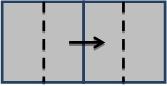
Figure 2. Grid Model
For simplicity, think of the elements outlined by solid lines as cubes of equal size, and that the vector represents a velocity in the x direction. The dashed lines in the centers of the elements (i.e., y-z planes) define the extent of the partial volumes of the elements assigned to the u velocity. The total mass of fluid in the partial volumes correlates to the mass M in the mechanical model. When the velocity U moves fluid between elements the elements respond by generating forces that act to counter the velocity, much like the springs in the mechanical model. These forces may arise because of compression or expansion of the fluid, viscous stresses, surface tension (if there is a fluid interface within the fluid mass M) or other forces. By identifying the appropriate stiffness coefficient k in each case we can use Eq. 5 to arrive at a stability criterion for that physical process when using an explicit numerical approximation in a grid like that shown in Fig. 2.
간단히, 실선에 의해 윤곽이 그려져 있는 요소가 동일 크기의 입방체라고하고 벡터 x 방향의 속도를 나타내는 것으로 생각합니다. 두 요소의 중앙 (즉 yx 평면)의 점선에 의해 속도 U에 할당 된 요소의 부분 체적의 범위가 정의됩니다. 부분 체적 내에 유량의 전체 질량은 기계적 모델의 질량 M과 상관 관계가 있습니다. 속도 U는 응답 요소 사이의 유체가 이동 된 경우 기계적 모델 스프링과 마찬가지로 속도에 대항하여 작용하는 힘을 발생하여 요소는 응답합니다. 이러한 힘은 유체 점성 응력, 표면 장력 (유체와 질량 M의 범위 내에 유체 계면가있는 경우) 또는 기타의 힘에 의한 압축 또는 인장으로 인해 발생 될 수 있습니다. 각 예에서 적절한 강성 계수 k를 특정하여 그림 2와 같은 격자에서 양으로 수치 근사를 사용하는 경우, 식 5를 사용하여이 물리적 과정에 대한 안정성 기준에 도달 가능합니다.
Several examples of how this analogy can be applied are given in the following sections. In each case the mass M of the fluid in the partial volumes is given by,
이 유사성을 어떻게 적용 할 수 있는지에 대한 예는 다음 절에서 설명합니다. 각 예에서 부분 부피의 유체의 질량 M은 아래 식에 의해 주어집니다.
(6)

where ρ is the density of the fluid and elements have dimensions δx, δy and δz.
여기서, ρ는 유체의 밀도이며, 요소의 치수는 δx, δy와 δz입니다.
Compressible Fluids
To find the stiffness coefficient, k, recall that k is a measure of the force generated to resist an applied perturbation. For a compressible fluid this force is related to the change in fluid pressure because of a change in fluid density according to the thermodynamic relation dp=c2dρ, where c is the speed of sound in the fluid. The fluid mass moved across the boundary between the elements is ρUδt*δyδz and the change in density in the element receiving the mass is this mass change divided by the volume of the element, dρ=ρUδt/(δx). The corresponding change in element pressure is then given by
강성 계수 k를 요구하려면, k가 더해진 섭동에 저항하기 위해 만들어지는 힘의 척도임을 기억하십시오. 압축성 유체의 경우,이 힘은 유체 압력의 변화와 관련이 있습니다. 이것은 열역학적 관계 dp = c 2 dρ 의한 유체 밀도의 변화에 의한 것입니다. 여기서 c는 유체의 음속입니다. 요소 사이의 경계를 넘어 이동 한 유체의 질량은 ρUδt * δyδz이며, 질량을받는 요소에서의 밀도 변화는이 질량을 요소의 부피로 나눈 dρ = ρUδt / (δx)입니다. 그 결과, 요소 압력의 대응하는 변화는 아래에 제공됩니다.
(7)

The force responding to the U velocity perturbation in each element is the product of the pressure change from Eq. 7 and the cross sectional area of the element δyδz. The effective stiffness of an element k, is therefore the force divided by the initial displacement Uδt,
각 요소의 속도 U의 섭동에 응답하는 힘은 식 7에 의한 압력 변화와 요소 단면적 δyδz의 곱입니다. 따라서 요소의 유효 강성 k는 힘을 초기 변위 Uδt로 나눈 것입니다.
(8)

Substituting this value for k and the definition for M, from Eq. 6, into the stability condition Eq. 5 results in the stability condition for compressible fluids,
이 k의 값과 식 6에 따르면 M의 정의를 안정성 조건 식 5에 대입하여 압축성 유체의 안정성 조건을 얻을 수 있습니다.
(9)

This is the well-known Courant condition than restricts the distance a sound wave travels in one time step to be less than the width of a computational element. An analogy with the simple mechanical model has provided this result without the need to write out an equation for pressure waves in a compressible fluid and then perform a stability analysis on that equation.
이것은 하나의 시간 스텝 중에 음파가 진행하는 거리를 계산 요소의 폭보다 짧게 제한하는 잘 알려진 쿨랑 조건입니다. 간단한 기계적 모델과의 유사성에 따라 압축성 유체 음파 방정식을 기술하고, 그 방정식에 의한 안정성 분석을 수행 할 필요없이이 결과를 얻을 수 있었습니다.
Viscous Stresses / 점성 응력
The viscous forces that are generated in response to a perturbed velocity U in a fluid of viscosity μ consist of shears in the x, y and z directions. For example, the shear stress on the lower surface of the element for the velocity U is μU/δz, assuming that the velocity in neighboring cells is zero. There is a corresponding stress at the upper surface of the element. Each of these stresses act on a surface of area δxδy (in the current example) to produce a viscous force. Similarly, there are stresses in the x and y direction acting on their corresponding areas. In each direction there are force pairs (similar to the two springs) but because of Eq. 5 it is necessary to use the effective k for a single spring. This is half of the total of all the the viscous forces divided by the initial displacement Uδt,
점도 μ의 유체의 섭동 속도 U에 대해 생성되는 점성 힘은 x, y 및 z 방향의 전단력으로 구성됩니다. 예를 들어, 인접 셀의 속도가 0이라고 가정하면 속도 U에 요소의 아랫면에 작용하는 전단 응력은 μU / δz입니다. 요소의 표면에는 압축 응력이 발생합니다. 이러한 응력의 각각은 표면적 δxδy (본 예의 경우)에 작용하고 점성 힘을 발생합니다. 마찬가지로 해당 면적에 작용하는 x 및 y 방향의 응력도 존재합니다. 각 방향에서 (2 개의 봄처럼) 세트 힘이 존재하지만, 식 5를 위해 1 개의 봄의 유효 강성 k를 사용하는 것이 필요합니다. 이것은 모든 점성 힘의 합계를 초기 변위 Uδt로 나눈 것의 절반입니다.
(10)

Inserting this value for k and using Eq. 6 for M into the stability condition for the mechanical model given in Eq. 5 yields
식 5에 의해 주어진 기계적 모델의 안정 조건에 k의 값을 넣고 M 식 6을 사용하면 아래 식을 얻을 수 있습니다.
(11)

Equation 11 is the stability condition for explicit viscous stresses approximated in an Eulerian grid.
식 11은 오일러 격자에 근접한 explicit 점성 응력의 안정성 조건입니다.
Surface Tension
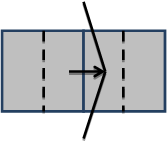
Figure 2A. With deformed interface.
Imagine a fluid interface located between the two elements that is deformed by a U velocity perturbation, as shown in Fig. 2A. In this case the reaction is a surface tension force on each of the segments of the surface illustrated in Fig. 2A. For simplicity, assume a two-dimensional surface (e.g., no variation in the z direction) and a constant surface tension coefficient σ.
그림 2A와 같이 속도 섭동 U에 의해 변형된 2 개의 요소 사이에 위치하는 유체 계면을 상정합니다. 이 예에서, 반응은 그림 2A에 표시된 표면의 각 구분에 작용하는 표면 장력에 의한 힘입니다. 간단히 2 차원 표면 (예 : z 방향의 변화없이)과 일정한 표면 장력 계수를 가정합니다.
Surface tension in each segment acts tangentially along the surface so the force responding to the U velocity is the x component of that force, i.e., the surface tension coefficient times the sine of the angle of the surface segment with respect to the vertical. For a small initial displacement, the x-force from each surface segment can be approximated by σUδtδz/δy giving the resulting stiffness coefficient,
각 구분의 표면 장력은 표면에 따라서 접선 방향으로 작용하기 때문에 속도 U에 대응하는 힘은 표면 장력의 x 성분입니다. 즉, 수직의 표면 구분 각도의 사인을 표면 장력에 곱한 것입니다. 작은 초기 변위의 경우 각 표면 세그먼트에서 x 방향의 힘은 σUδtδz / δy 의해 근사 할 수 있으며, 그 결과로 다음의 강성 계수를 얻을 수 있습니다.
(12)

Substituting this k and M into Eq. 5 gives the stability condition for surface tension,
이 k와 M을 식 5에 대입하면 표면 장력에 대한 안정성 조건을 얻을 수 있습니다.
(13)

This result appears somewhat odd because of the different exponents of the δx and δy factors, but for cubic or square elements this makes no difference. For non-uniform elements, however, we should perform a similar evaluation in the y and z directions and then use the most restrictive of the results. In any case, this is a reasonable and useful result from a very simple model based on action and reaction principles.
이 결과는 δx과 δy 지수가 다르기 때문에 다소 이상하게 보이지만, 입방체 또는 사각형 요소의 경우 그 영향은 없습니다. 하지만 For non-uniform 요소의 경우 y 및 z 방향에서 비슷한 평가를 실시하여 가장 제한적인 결과를 사용할 수 있어야합니다. 어쨌든, 이것은 작용과 반작용의 원리에 근거한 매우 간단한 모델에 의한 합리적이고 유익한 결과입니다.
Bulk Elasticity / 체적 탄성
For a fluid with elastic properties the U velocity perturbation is resisted by an elastic stress in a way that closely resembles a spring. If ε is the bulk modulus of the fluid then the stress associated with extension or compression in an element is εUδt/δx. This stress acts over the surface area δyδz, and the stiffness k is this force divided by the displacement Uδt. Substituting this into Eq. 5 provides the stability condition,
탄성 특성을 가진 유체의 경우 속도 U의 섭동은 스프링과 잘 닮은 형식의 탄성 응력에 의해 제한됩니다. 유체의 체적 탄성률이 ε의 경우 요소의 인장 또는 압축에 관련하는 응력은 εUδt / δx입니다. 이 응력은 표면적 δyδz 작용하고 강성 k는이 힘을 변위 Uδt로 나눈 것입니다. 이것을 식 5에 대입하면 아래의 안정성 조건을 얻을 수 있습니다.
(14)
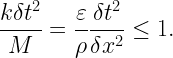
Similar results exist for the y and z directions.
비슷한 결과가 y 및 z 방향으로도 존재합니다.
Concluding Remarks
A simple mechanical model has been used to illustrate a common type of numerical instability, that arises from an action-reaction process. Using this simple model it is possible to quickly derive a variety of stability conditions for fluid dynamic forces modeled by explicit finite difference approximations in an Eulerian grid. The stability conditions are derived by using mass and force concepts in fluids that are analogous to the mass and forces in the model mechanical system. Significantly, the stability conditions arrived at are generic and do not depend on specific finite-difference approximations. Additionally, these derivations provide a simple way to understand the mechanisms driving the unstable behavior.
간단한 기계적 모델을 사용하여 작용과 반응 과정에서 발생하는 일반적인 유형의 수치 불안정성에 대해 설명했습니다. 이 간단한 모델을 사용하여 오일러 격자의 양으로 유한 차분 근사에 의해 모델링 된 유체 역학적인 힘에 대한 다양한 안정성 조건을 신속하게 도출 할 수 있습니다. 이러한 안정성 조건은 기계적 모델 시스템의 질량과 힘 유사한 유체의 질량과 힘의 개념을 이용하여 도출됩니다. 중요한 점은 도달한 안정성 조건이 일반적이며 특정 유한 차분 근사에 의존하지 않는 것입니다. 또한이 도출에 의해 불안정한 거동을 야기 메커니즘을 이해하는 간단한 방법도 제공됩니다.
The approach taken here could be extended to other types of physical forces (e.g., electrical, non-inertial, etc.) and even advective processes could be included by using the analogy that a change in momentum resulting from advection could be thought of as the result of an equivalent force.
여기서 사용한 방법은 다른 유형의 물리적 힘 (예 : 전기적 힘 비 관성력 등)로 확장 할 수 있으며, 이류(advective )에 의해 생기는 운동량의 변화를 등가 힘의 결과로 생각되면 유사성을 이용함으로써 이류 과정조차 포함 할 수 있습니다.
Furthermore, more refined estimates of the stiffness coefficient, for instance, by including more dimensional effects, could be added to enhance the stability conditions. In any case, the object here is to show that numerical instabilities can often be understood from a simple analysis. It is hoped that the insight this provides might guide the development of more robust and accurate numerical approximations.
또한, 예를 들어 더 많은 차원 효과를 포함하여 강성 계수보다 정밀한 추정을 추가하고 안정성 조건을 강화 할 수 있습니다. 어쨌든 여기에서의 목표는 대부분의 경우 수치 불안정성을 간단한 분석에서 이해하고 보여주는 것입니다. 여기에 제공된 통찰력이 더 강력하고 정확한 수치 근사치의 개발로 이어질 것으로 기대됩니다.

Acoustically-induced Inkjets
Acoustically-induced Inkjets
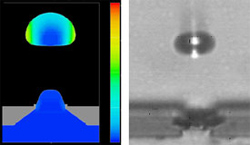
프린트 헤드의 노즐에서 잉크를 나오게 강제하는 방법에는 여러 가지가 있습니다. 예로는 기계식 피스톤, 진동식 다이어프램 및 증기 기포의 생성등이 있습니다. 그러나 어떠한 경우에도 목적은 노즐로부터 잉크가 나오도록 강제하지만, 또한 특정 량의 액적으로 변형되고 표면을 향해 원하는 속도로 이동하는 것이 되도록 잉크의 양을 제한하는 것이 아닙니다. 이러한 요구 사항은 구동 펄스에 엄격한 제한을 부과 토출되는 잉크의 pinch off를 돕는 다른 선택 방법이 비균일한 방식으로 잉크의 표면 장력을 변화시키는 것입니다. 여기에 도시 된 예에서, FLOW-3D는 잉크의 표면 장력은 노즐 출구에 국부적 가열에 의해 변화 될 때 어떻게 되는지 시뮬레이션 하였습니다. 오른쪽 이미지는 시뮬레이션 된 액적 및 실험적 관찰 방울을 나타냅니다.
This acoustically-induced inkjet animation shows a pressure-induced jet, which is unable to break off due to high surface tension forces and the same situation with heat added. The modified surface tension in the heated jet breaks off a droplet.
FLOW-3D/MP Features List
FLOW-3D/MP Features
FLOW-3D/MP v6.1 은 FLOW-3D v11.1 솔버에 기초하여 물리 모델, 특징 및 그래픽 사용자 인터페이스가 동일합니다. FLOW-3D v11.1의 새로운 기능은 아래 파란색으로 표시되어 있으며 FLOW-3D/MP v6.1 에서 사용할 수 있습니다. 새로운 개발 기능에 대한 자세한 설명은 FLOW-3D v11.1에서 새로운 기능을 참조하십시오.
Flow Type Options
- Internal, external & free-surface flows
- 3D, 2D & 1D problems
- Transient flows
- Inviscid, viscous laminar & turbulent flows
- Hybrid shallow water/3D flows
- Non-inertial reference frame motion
- Multiple scalar species
- Two-phase flows
- Heat transfer with phase change
- Saturated & unsaturated porous media
Physical Modeling Options
- Fluid structure interaction
- Thermally-induced stresses
- Plastic deformation of solids
- Granular flow
- Moisture drying
- Solid solute dissolution
- Sediment transport and scour
- Cavitation (potential, passive tracking, active tracking)
- Phase change (liquid-vapor, liquid-solid)
- Surface tension
- Thermocapillary effects
- Wall adhesion
- Wall roughness
- Vapor & gas bubbles
- Solidification & melting
- Mass/momentum/energy sources
- Shear, density & temperature-dependent viscosity
- Thixotropic viscosity
- Visco-elastic-plastic fluids
- Elastic membranes & walls
- Evaporation residue
- Electro-mechanical effects
- Dielectric phenomena
- Electro-osmosis
- Electrostatic particles
- Joule heating
- Air entrainment
- Molecular & turbulent diffusion
- Temperature-dependent material properties
- Spray cooling
Flow Definition Options
- General boundary conditions
- Symmetry
- Rigid and flexible walls
- Continuative
- Periodic
- Specified pressure
- Specified velocity
- Outflow
- Grid overlay
- Hydrostatic pressure
- Volume flow rate
- Non-linear periodic and solitary surface waves
- Rating curve and natural hydraulics
- Wave absorbing layer
- Restart from previous simulation
- Continuation of a simulation
- Overlay boundary conditions
- Change mesh and modeling options
- Change model parameters
Thermal Modeling Options
- Natural convection
- Forced convection
- Conduction in fluid & solid
- Fluid-solid heat transfer
- Distributed energy sources/sinks in fluids and solids
- Radiation
- Viscous heating
- Orthotropic thermal conductivity
- Thermally-induced stresses
Turbulence Models
- RNG model
- Two-equation k-epsilon model
- Two-equation k-omega model
- Large eddy simulation
Metal Casting Models
- Thermal stress & deformations
- Iron solidification
- Sand core blowing
- Sand core drying
- Permeable molds
- Solidification & melting
- Solidification shrinkage with interdendritic feeding
- Micro & macro porosity
- Binary alloy segregation
- Thermal die cycling
- Surface oxide defects
- Cavitation potential
- Lost-foam casting
- Semi-solid material
- Core gas generation
- Back pressure & vents
- Shot sleeves
- PQ2 diagram
- Squeeze pins
- Filters
- Air entrainment
- Temperature-dependent material properties
- Cooling channels
- Fluid/wall contact time
Numerical Modeling Options
- TruVOF Volume-of-Fluid (VOF) method for fluid interfaces
- First and second order advection
- Sharp and diffuse interface tracking
- Implicit & explicit numerical methods
- GMRES, point and line relaxation pressure solvers
- User-defined variables, subroutines & output
- Utilities for runtime interaction during execution
Fluid Modeling Options
- One incompressible fluid – confined or with free surfaces
- Two incompressible fluids – miscible or with sharp interfaces
- Compressible fluid – subsonic, transonic, supersonic
- Stratified fluid
- Acoustic phenomena
- Mass particles with variable density or diameter
Shallow Flow Models
- General topography
- Raster data interface
- Subcomponent-specific surface roughness
- Wind shear
- Ground roughness effects
- Laminar & turbulent flow
- Sediment transport and scour
- Surface tension
- Heat transfer
- Wetting & drying
Advanced Physical Models
- General Moving Object model with 6 DOF–prescribed and fully-coupled motion
- Rotating/spinning objects
- Collision model
- Tethered moving objects (springs, ropes, mooring lines)
- Flexing membranes and walls
- Porosity
- Finite element based elastic-plastic deformation
- Finite element based thermal stress evolution due to thermal changes in a solidifying fluid
- Combusting solid components
Chemistry Models
- Stiff equation solver for chemical rate equations
- Stationary or advected species
Porous Media Models
- Saturated and unsaturated flow
- Variable porosity
- Directional porosity
- General flow losses (linear & quadratic)
- Capillary pressure
- Heat transfer in porous media
- Van Genunchten model for unsaturated flow
Discrete Particle Models
- Massless marker particles
- Mass particles of variable size/mass
- Linear & quadratic fluid-dynamic drag
- Monte-Carlo diffusion
- Particle-Fluid momentum coupling
- Coefficient of restitution or sticky particles
- Point or volumetric particle sources
- Charged particles
- Probe particles
Two-Phase & Two-Component Models
- Liquid/liquid & gas/liquid interfaces
- Variable density mixtures
- Compressible fluid with a dispersed incompressible component
- Drift flux
- Two-component, vapor/non-condensable gases
- Phase transformations for gas-liquid & liquid-solid
- Adiabatic bubbles
- Bubbles with phase change
- Continuum fluid with discrete particles
- Scalar transport
- Homogeneous bubbles
- Super-cooling
Coupling with Other Programs
- Geometry input from Stereolithography (STL) files – binary or ASCII
- Direct interfaces with EnSight®, FieldView® & Tecplot® visualization software
- Finite element solution import/export via Exodus-II file format
- PLOT3D output
- Neutral file output
- Extensive customization possibilities
- Solid Properties Materials Database
Data Processing Options
- State-of-the-art post-processing tool, FlowSight™
- Batch post-processing
- Report generation
- Automatic or custom results analysis
- High-quality OpenGL-based graphics
- Color or B/W vector, contour, 3D surface & particle plots
- Moving and stationary probes
- Measurement baffles
- Arbitrary sampling volumes
- Force & moment output
- Animation output
- PostScript, JPEG & Bitmap output
- Streamlines
- Flow tracers
User Conveniences
- Active simulation control (based on measurement of probes)
- Mesh generators
- Mesh quality checking
- Tabular time-dependent input using external files
- Automatic time-step control for accuracy & stability
- Automatic convergence control
- Mentor help to optimize efficiency
- Change simulation parameters while solver runs
- Launch and manage multiple simulations
- Automatic simulation termination based on user-defined criteria
- Run simulation on remote servers using remote solving
Multi-Processor Computing
FLOW-3D Features
The features in blue are newly-released in FLOW-3D v12.0.
Meshing & Geometry
- Structured finite difference/control volume meshes for fluid and thermal solutions
- Finite element meshes in Cartesian and cylindrical coordinates for structural analysis
- Multi-Block gridding with nested, linked, partially overlapping and conforming mesh blocks
- Conforming meshes extended to arbitrary shapes
- Fractional areas/volumes (FAVOR™) for efficient & accurate geometry definition
- Closing gaps in geometry
- Mesh quality checking
- Basic Solids Modeler
- Import CAD data
- Import/export finite element meshes via Exodus-II file format
- Grid & geometry independence
- Cartesian or cylindrical coordinates
Flow Type Options
- Internal, external & free-surface flows
- 3D, 2D & 1D problems
- Transient flows
- Inviscid, viscous laminar & turbulent flows
- Hybrid shallow water/3D flows
- Non-inertial reference frame motion
- Multiple scalar species
- Two-phase flows
- Heat transfer with phase change
- Saturated & unsaturated porous media
Physical Modeling Options
- Fluid structure interaction
- Thermally-induced stresses
- Plastic deformation of solids
- Granular flow
- Moisture drying
- Solid solute dissolution
- Sediment transport and scour
- Sludge settling
- Cavitation (potential, passive tracking, active tracking)
- Phase change (liquid-vapor, liquid-solid)
- Surface tension
- Thermocapillary effects
- Wall adhesion
- Wall roughness
- Vapor & gas bubbles
- Solidification & melting
- Mass/momentum/energy sources
- Shear, density & temperature-dependent viscosity
- Thixotropic viscosity
- Visco-elastic-plastic fluids
- Elastic membranes & walls
- Evaporation residue
- Electro-mechanical effects
- Dielectric phenomena
- Electro-osmosis
- Electrostatic particles
- Joule heating
- Air entrainment
- Molecular & turbulent diffusion
- Temperature-dependent material properties
- Spray cooling
Flow Definition Options
- General boundary conditions
- Symmetry
- Rigid and flexible walls
- Continuative
- Periodic
- Specified pressure
- Specified velocity
- Outflow
- Outflow pressure
- Outflow boundaries with wave absorbing layers
- Grid overlay
- Hydrostatic pressure
- Volume flow rate
- Non-linear periodic and solitary surface waves
- Rating curve and natural hydraulics
- Wave absorbing layer
- Restart from previous simulation
- Continuation of a simulation
- Overlay boundary conditions
- Change mesh and modeling options
- Change model parameters
Thermal Modeling Options
- Natural convection
- Forced convection
- Conduction in fluid & solid
- Fluid-solid heat transfer
- Distributed energy sources/sinks in fluids and solids
- Radiation
- Viscous heating
- Orthotropic thermal conductivity
- Thermally-induced stresses
Numerical Modeling Options
- TruVOF Volume-of-Fluid (VOF) method for fluid interfaces
- Steady state accelerator for free-surface flows
- First and second order advection
- Sharp and diffuse interface tracking
- Implicit & explicit numerical methods
- Immersed boundary method
- GMRES, point and line relaxation pressure solvers
- User-defined variables, subroutines & output
- Utilities for runtime interaction during execution
Fluid Modeling Options
- One incompressible fluid – confined or with free surfaces
- Two incompressible fluids – miscible or with sharp interfaces
- Compressible fluid – subsonic, transonic, supersonic
- Stratified fluid
- Acoustic phenomena
- Mass particles with variable density or diameter
Shallow Flow Models
- General topography
- Raster data interface
- Subcomponent-specific surface roughness
- Wind shear
- Ground roughness effects
- Manning’s roughness
- Laminar & turbulent flow
- Sediment transport and scour
- Surface tension
- Heat transfer
- Wetting & drying
Turbulence Models
- RNG model
- Two-equation k-epsilon model
- Two-equation k-omega model
- Large eddy simulation
Advanced Physical Models
- General Moving Object model with 6 DOF–prescribed and fully-coupled motion
- Rotating/spinning objects
- Collision model
- Tethered moving objects (springs, ropes, breaking mooring lines)
- Flexing membranes and walls
- Porosity
- Finite element based elastic-plastic deformation
- Finite element based thermal stress evolution due to thermal changes in a solidifying fluid
- Combusting solid components
Chemistry Models
- Stiff equation solver for chemical rate equations
- Stationary or advected species
Porous Media Models
- Saturated and unsaturated flow
- Variable porosity
- Directional porosity
- General flow losses (linear & quadratic)
- Capillary pressure
- Heat transfer in porous media
- Van Genunchten model for unsaturated flow
Discrete Particle Models
- Massless marker particles
- Multi-species material particles of variable size and mass
- Solid, fluid, gas particles
- Void particles tracking collapsed void regions
- Non-linear fluid-dynamic drag
- Added mass effects
- Monte-Carlo diffusion
- Particle-fluid momentum coupling
- Coefficient of restitution or sticky particles
- Point or volumetric particle sources
- Initial particle blocks
- Heat transfer with fluid
- Evaporation and condensation
- Solidification and melting
- Coulomb and dielectric forces
- Probe particles
Two-Phase & Two-Component Models
- Liquid/liquid & gas/liquid interfaces
- Variable density mixtures
- Compressible fluid with a dispersed incompressible component
- Drift flux with dynamic droplet size
- Two-component, vapor/non-condensable gases
- Phase transformations for gas-liquid & liquid-solid
- Adiabatic bubbles
- Bubbles with phase change
- Continuum fluid with discrete particles
- Scalar transport
- Homogeneous bubbles
- Super-cooling
- Two-field temperature
Coupling with Other Programs
- Geometry input from Stereolithography (STL) files – binary or ASCII
- Direct interfaces with EnSight®, FieldView® & Tecplot® visualization software
- Finite element solution import/export via Exodus-II file format
- PLOT3D output
- Neutral file output
- Extensive customization possibilities
- Solid Properties Materials Database
Data Processing Options
- State-of-the-art post-processing tool, FlowSight™
- Batch post-processing
- Report generation
- Automatic or custom results analysis
- High-quality OpenGL-based graphics
- Color or B/W vector, contour, 3D surface & particle plots
- Moving and stationary probes
- Visualization of non-inertial reference frame motion
- Measurement baffles
- Arbitrary sampling volumes
- Force & moment output
- Animation output
- PostScript, JPEG & Bitmap output
- Streamlines
- Flow tracers
User Conveniences
- Active simulation control (based on measurement of probes)
- Mesh generators
- Mesh quality checking
- Tabular time-dependent input using external files
- Automatic time-step control for accuracy & stability
- Automatic convergence control
- Mentor help to optimize efficiency
- Units on all variables
- Custom units
- Component transformations
- Moving particle sources
- Change simulation parameters while solver runs
- Launch and manage multiple simulations
- Automatic simulation termination based on user-defined criteria
- Run simulation on remote servers using remote solving
- Copy boundary conditions to other mesh blocks
Multi-Processor Computing
- Shared memory computers
- Distributed memory clusters
FlowSight
- Particle visualization
- Velocity vector fields
- Streamlines & pathlines
- Iso-surfaces
- 2D, 3D and arbitrary clips
- Volume render
- Probe data
- History data
- Vortex cores
- Link multiple results
- Multiple data views
- Non-inertial reference frame
- Spline clip
MEMS/WELD 분야
Microfluidics
Microfluidics는 집적 회로 산업에서 사용되는 것과 유사한 공정을 사용하여 소형 기기의 제조에 급격하게 성장하는 기술입니다. Microfluidics 기술은 0.1 미크론에서 1mm에 이르기까지 매우 작은 장치로 기계, 유체, 광학, 전자 기능을 통합 할 수있는 방법을 제공합니다. Microfluidics는 기존의 방법과 비교하면 두 가지 중요한 장점이 있습니다. 첫째, 대량으로 제조 될 수 있으므로, 생산의 비용이 실질적으로 감소 될 수 있습니다. 둘째, 집적 회로에 통합 될 수 있어서 다른 기술보다 훨씬 더 복잡한 시스템으로 제조 될 수 있습니다.

Chip packaging simulation. Results generated by FLOW-3D/MP, FLOW-3D‘s HPC solution.
엔지니어 및 과학자가 설계, 시험 제작하고 그 성능을 최적화하기 위해 장치를 재 설계하는 등, 다른 제조 방법에서와 같이 microfluidics 설계 프로세스는 매우 고가 일 수 있습니다. 그러나, 수치 시뮬레이션은 전자, 기계, 화학, 열 과학 및 유체 과학 등의 분야에 걸쳐 정량 분석과 중요한 통찰력을 제공 할 수 있습니다.

laser-sintering
Downloads
FLOW-3D Microfluidics Brochure
Bibliography
- Effect of substrate cooling and droplet shape and composition on the droplet evaporation and the deposition of particles
- Microelectrofluidic Lens for Variable Curvature
- Photonic and Thermofluidic Analysis of Colloidal Plasmonic Nanorings and Nanotori for Pulsed-Laser Photothermal Applications
- Access the FLOW-3D Bibliography
Models
- Multiphase Flows
- Surface Tension
- More Modeling Capabilities
Case Studies
자동차 분야
Automotive

FLOW-3D는 자동차 산업에서 직면할 수 있는 많은 문제에 대한 해법을 제공하는 포괄적인 CFD 소프트웨어입니다. FLOW-3D는 과도적인 흐름 동역학(자유 표면과 한정된 유체 모두), 유체와 고체 간의 열전달, 상 변화, 고체의 6자유도 운동, 기계적 및 열로 유도된 응력에 대한 결합된 유한 요소 해석 등을 할 수 있습니다. 자세한 내용은 FLOW-3D의 모델링 기능의 전체 목록을 살펴보십시오.
자동차 분야의 시뮬레이션 대상 분야로는 연료 탱크 슬로 싱, 언더 후드 열 관리, 분사 제어, 조기 연료 차단, 자동차 부품의 도장, 용기의 가스 제거, 파워 트레인 부품의 유체 저항, 자동차 부품 주조 등의 주조품 및 주조 공정의 더 나은 설계를 위해 도움을 줄 수 있는 몇 가지 영역들이 있습니다.
자동차분야 해석 사례
Bibliography
Models
- Moving Objects
- Porous Media
- Surface Tension
- More Modeling Capabilities
관련 기술자료

FLOW-3D 수치해석용 노트북 선택 가이드
2024년 가장 빠른 노트북 PCMag이 테스트하는 방법 소개 : 기사 원본 출처: https://www.pcmag.com/picks/the-fastest-laptops CFD를 수행하기 위한 노트북 선정 기준은 별도로 ...

Strength Prediction for Pearlitic Lamellar Graphite Iron: Model Validation
펄라이트 라멜라 흑연 철의 강도 예측: 모델 검증 Vasilios Fourlakidis, Ilia Belov, Attila Diószegi Abstract The present work provides validation ...

Numerical study of the flow at a vertical pile with net-like scourprotection matt
그물형 세굴방지 매트를 사용한 수직말뚝의 유동에 대한 수치적 연구 Minxi Zhanga,b, Hanyan Zhaoc, Dongliang Zhao d, Shaolin Yuee, Huan Zhoue,Xudong ...

1 m/s보다 빠른 속도에서 액체 금속의 움직임 연구
ESTUDIO MOVIMIENTO DE METAL LIQUIDO A VELOCIDADES MAYORES DE 1 M/S Author: Primitivo Carranza TormeSupervised by :Dr. Jesus Mª Blanco ...

Molten pool structure, temperature and velocity
flow in selective laser melting AlCu5MnCdVA alloy
용융 풀 구조, 선택적 온도 및 속도 흐름 레이저 용융 AlCu5MnCdVA 합금 Pan Lu1 , Zhang Cheng-Lin2,6,Wang Liang3, Liu Tong4 ...

Optimization of filling systems for low pressure by Flow-3D
Dissertação de MestradoCiclo de Estudos Integrados Conducentes aoGrau de Mestre em Engenharia MecânicaTrabalho efectuado sob a orientação doDoutor Hélder de ...

3D Flow and Temperature Analysis of Filling a Plutonium Mold
플루토늄 주형 충전의 3D 유동 및 온도 분석 Authors: Orenstein, Nicholas P. [1] Publication Date:2013-07-24Research Org.: Los Alamos National Lab ...

Computer Simulation of Centrifugal Casting Process using FLOW-3D
Aneesh Kumar J1, a, K. Krishnakumar1, b and S. Savithri2, c 1 Department of Mechanical Engineering, College of Engineering, Thiruvananthapuram, ...
![Fig. 1. (a) Dimensions of the casting with runners (unit: mm), (b) a melt flow simulation using Flow-3D software together with Reilly's model[44], predicted that a large amount of bifilms (denoted by the black particles) would be contained in the final casting. (c) A solidification simulation using Pro-cast software showed that no shrinkage defect was contained in the final casting.](https://flow3d.co.kr/wp-content/uploads/Fig.-1.-a-Dimensions-of-the-casting-with-runners.png)
AZ91 합금 주물 내 연행 결함에 대한 캐리어 가스의 영향
TianLiabJ.M.T.DaviesaXiangzhenZhucaUniversity of Birmingham, Birmingham B15 2TT, United KingdombGrainger and Worrall Ltd, Bridgnorth WV15 5HP, United KingdomcBrunel Centre for Advanced Solidification ...

Gating System Design Based on Numerical Simulation and Production Experiment Verification of Aluminum Alloy Bracket Fabricated by Semi-solid Rheo-Die Casting Process
반고체 레오 다이 캐스팅 공정으로 제작된 알루미늄 합금 브래킷의 수치 시뮬레이션 및 생산 실험 검증을 기반으로 한 게이팅 시스템 설계 ...

항공/우주 분야
Aerospace

항공 우주 분야에서 연구하는 엔지니어를 위해 FLOW-3D는 정확한 액체/가스 인터페이스(자유 표면) 모델링, 열 솔루션을 사용하여 연료 안정성 확보, 극저온 온도 조절, PMD(Propellent management devices), 캐비테이션 및 전하 분포에 대한 귀중한 통찰력을 제공합니다. 위상 및 정전기 물리 모델을 사용합니다.
항공 우주 분야에서 FLOW-3D의 성공적인 사용을 보여주는 기술 문서로 이동하기
Aerospace Simulations
FLOW-3D 는 sloshing, 무중력 유체역학(zero gravity fluid dynamics), 다상유동(multi-phase fluids), 탄성 멤브레인(elastic membranes), 음속 및 초음속 상태에서 노즐(nozzles in subsonic and supersonic conditions), 유체구조의 상호 작용(fluid structure interactions) 등 항공분야에서 볼 수 있는 자연현상을 정확하게 표현하기 위해 자유표면 알고리즘을 고려하고 있습니다.
Bibliography
- CFD Modeling of Helium Pressurant Effects on Cryogenic Tank Pressure Rise Rates in Normal Gravity
- Computational Fluid Dynamics (CFD) Simulations of Jet Mixing in Tanks of Different Scales
- Modelling of fluid motion in spacecraft propellant tanks – Sloshing
- Access the FLOW-3D Bibliography
Models
- Air Entrainment
- Turbulence
- Surface Tension
- More Modeling Capabilities
Conference Proceedings
- Preliminary numerical simulation of a suborbital experiment
- Sloshing model and CFD analysis for the Euclid Mission
- Using the FLOW-3D General Moving Object Model to Simulate Coupled Liquid Slosh – Container Dynamics on the SPHERES Slosh Experiment aboard the International Space Station
- Download Conference Proceedings
관련 기술자료
FLOW-3D 수치해석용 노트북 선택 가이드
2024년 가장 빠른 노트북 PCMag이 테스트하는 방법 소개 : 기사 원본 출처: https://www.pcmag.com/picks/the-fastest-laptops CFD를 수행하기 위한 노트북 선정 기준은 별도로 ...

재사용 무인 우주비행체 고도화기술(ReUSV) 심포지엄 안내
아래와 같이 재사용 무인 우주비행체 고도화기술(ReUSV) 특화연구센터 센터에서 금년 첫 회를 맞이하는 ReUSV 심포지엄을 개최한다고 합니다. 아래에 초대장 전문을 소개합니다 ...

수평 Cassini 탱크에서 액체 슬로싱의 동적 특성에 대한 실험 및 분석
Experiments and analysis of dynamic characteristics of liquid sloshing in horizontal Cassini tank Houlin Luo1, Wenjun Wu2, Bingchao Jiang3, Shouyi ...

Reorientation of Cryogenic Fluids Upon Step Reduction of Gravity
단계적 중력 감소 시 극저온 유체의 방향 전환 Malte Stief∗, Jens Gerstmann∗∗, and Michael E. Dreyer∗∗∗ZARM, Center of Applied Space ...

실험 및 수치 시뮬레이션에 기반한 극저온 추진제 탱크 가압 분석
Analyses of Cryogenic Propellant Tank Pressurization based upon Experiments and Numerical SimulationsCarina Ludwig? and Michael Dreyer***DLR - German Aerospace Center, ...

NASA Perspectives on Cryo H2 Storage
Cryo H2 저장에 대한 NASA의 관점 DOE Hydrogen Storage WorkshopMarriott Crystal GatewayArlington, VAFebruary 15, 2011David J. ChatoNASA Glenn Research CenterMichael ...

액체-수소 탱크를 위한 결합된 열역학-유체-역학 솔루션
Coupled thermodynamic-fluid-dynamic solution for a liquid-hydrogen tank G. D. Grayson Published Online:23 May 2012 https://doi.org/10.2514/3.26706 Read Now Tools Share Introduction ...

Prediction of the ullage gas thermal stratification in a NASP vehicle propellant tank experimental simulation using FLOW-3D
As part of the National Aero-Space Plane (NASP) project, the multi-dimensional effects of gravitational force, initial tank pressure, initial ullage ...

Flow-3d를 이용한 표면장력 탱크용메시스크린모델링
Modeling of Mesh Screen for Use in Surface TensionTankUsing Flow-3d Software Hyuntak Kim․ Sang Hyuk Lim․Hosung Yoon․Jeong-Bae Park*․Sejin Kwon† ABSTRACT ...

Understanding dry-out mechanism in rod bundles of boiling water reactor
끓는 물 원자로 봉 다발의 건조 메커니즘 이해 Liril D.SilviaDinesh K.ChandrakercSumanaGhoshaArup KDasbaDepartment of Chemical Engineering, Indian Institute of Technology, Roorkee, ...
코팅분야
Coating
FLOW-3D는 산업계 및 학계의 코팅 연구원들이 기계 설계 연구, Display 공정개발 및 최적화를 위해 사용했습니다. 미크론 규모의 코팅 물리학을 이해하는 것은 코팅 유체 유변학의 복잡한 특성과 기판 및 Die와의 상호 작용으로 인해 어려울 수 있습니다.
FLOW-3D 는 비용이 많이 드는 실제 실험에 의존하지 않고, 코팅 프로세스를 분석할 수 있는 편리한 방법을 제공합니다. FLOW-3D는 표면 장력, Wall 접착, 용액 운반, 밀도 기반 흐름 및 상 변화의 영향을 이해하기위한 고밀도 모델링을 제공합니다.
Forward roll coating 공정에 대한 FLOW-3D의 시뮬레이션은 high capillary number수로 인한ribbing 결함을 포착합니다. 이 모델은 backing rollers가 400 micron nip을 통해 유체를 끌어 당길 때 표면 장력과 점도의 효과를 통합합니다. 시뮬레이션은 Lee, et al [1]의 연구를 기반으로합니다.
ribbing 시작에 대한 정확한 예측을 통해 엔지니어는 결함을 방지하기 위한 공정 매개 변수를 식별하고 수정할 수 있습니다.
Reference
[1] Lee, J. H., Han, S. K., Lee, J. S., Jung, H. W., & Hyun, J. C. (2010). Ribbing instability in rigid and deformable forward roll coating flows. Korea Australia Rheology Journal, 22(1), 75-80.
Bibliography
- Solution-Coating Technology for AMOLED Displays
- 3-D Transient Simulation of Viscoelastic Coating Flows
- 3D Predictions of Thermally Sprayed Polymer Splats
- Access the FLOW-3D Bibliography
Models
- Air Entrainment
- Porous Media
- Surface Tension
- More Modeling Capabilities
Conference Proceedings
- Coating of thin films using reverse roll process
- Model of dip coating with concomitant evaporation
- Download Conference
관련 기술자료

Short-time numerical simulation of ultrasonically assisted electrochemical removal of strontium from water
September 2023 DOI:10.30955/gnc2023.00436 Conference: 18th International Conference on Environmental Science and Technology CEST2023, 30 August to 2 September 2023, Athens, ...

Experimental and numerical investigation of the squeegee process during stencil printing of thick adhesive sealings
두꺼운 접착제 실링의 스텐실 인쇄 중 스퀴지 프로세스에 대한 실험적 및 수치적 조사 Fabiano I. Indicatti, Bo Cheng, Michael Rädler, ...
FLOW-3D 수치해석용 노트북 선택 가이드
2024년 가장 빠른 노트북 PCMag이 테스트하는 방법 소개 : 기사 원본 출처: https://www.pcmag.com/picks/the-fastest-laptops CFD를 수행하기 위한 노트북 선정 기준은 별도로 ...

Numerical Simulation Study on Characteristics of Airtight Water Film with Flow Deflectors
유동 편향기가 있는 밀폐수막의 특성에 관한 수치해석 연구 Zhang Weikang, Gong Hongwei Abstract In practical use, there is shrinkage in ...

Template-Free Scalable Fabrication of Linearly Periodic Microstructures by Controlling Ribbing Defects Phenomenon in Forward Roll Coating for Multifunctional Applications
다기능 응용을 위한 Forward Roll Coating 공정의 리브 경함 형상 제어를 통한 선형 주기적 미세구조물의 템플릿 프리 제작 Md Didarul ...

Ultrafast laser ablation of tungsten carbide: Quantification of threshold range and interpretation of feature transition
텅스텐 카바이드의 초고속 레이저 제거: 임계값 범위의 정량화 및 특징 전환 해석 Xiong Zhang, Chunjin Wang, Benny C. F. Cheung, Gaoyang Mi, Chunming WangFirst ...

Coupled CFD-DEM simulation of interfacial fluid–particle interaction during binder jet 3D printing
바인더 제트 3D 프린팅 중 계면 유체-입자 상호 작용에 대한 CFD-DEM 결합 시뮬레이션 Joshua J. Wagner, C. Fred Higgs III https://doi.org/10.1016/j.cma.2024.116747 Abstract The coupled ...

Experimental study and numerical simulation of infiltration of AlSi12 alloys into Si porous preforms with micro-computed tomography inspection characteristics
마이크로 컴퓨터 단층 촬영 검사 특성을 가진 Si 다공성 프리폼에 AlSi12 합금의 침투에 대한 실험적 연구 및 수치 시뮬레이션 Ruizhe ...

재료 분사를 통한 다중 재료 3D 유체 장치의 액체-고체 공동 인쇄
Liquid-solid co-printing of multi-material 3D fluidic devices via material jetting BrandonHayes,Travis Hainsworth, Robert MacCurdyUniversity of Colorado Boulder, Department of Mechanical ...

On-Chip Fabrication and In-Flow 3D-Printing of Cell-Laden Microgel Constructs: From Chip to Scaffold Materials in One Integral Process
세포가 함유된 마이크로겔의 온칩 제작 및 인-플로우 3D 프린팅구성:하나의 통합 프로세스에서 칩에서 스캐폴드 재료까지 Vollmer, Gültekin Tamgüney, Aldo BoccaciniSubmitted date: ...