Estimating maximum initial wave amplitude of subaerial landslide tsunamis: A three-dimensional modelling approach

Estimating maximum initial wave amplitude of subaerial landslide tsunamis: A three-dimensional modelling approach

해저 산사태 쓰나미의 최대 초기 파동 진폭 추정: 3차원 모델링 접근법

Ramtin Sabeti a, Mohammad Heidarzadeh ab

aDepartment of Architecture and Civil Engineering, University of Bath, Bath BA27AY, UK
bHydroCoast Consulting Engineers Ltd, Bath, UK

https://doi.org/10.1016/j.ocemod.2024.102360

Highlights

  • •Landslide travel distance is considered for the first time in a predictive equation.
  • •Predictive equation derived from databases using 3D physical and numerical modeling.
  • •The equation was successfully tested on the 2018 Anak Krakatau tsunami event.
  • •The developed equation using three-dimensional data exhibits a 91 % fitting quality.

Abstract

Landslide tsunamis, responsible for thousands of deaths and significant damage in recent years, necessitate the allocation of sufficient time and resources for studying these extreme natural hazards. This study offers a step change in the field by conducting a large number of three-dimensional numerical experiments, validated by physical tests, to develop a predictive equation for the maximum initial amplitude of tsunamis generated by subaerial landslides. We first conducted a few 3D physical experiments in a wave basin which were then applied for the validation of a 3D numerical model based on the Flow3D-HYDRO package. Consequently, we delivered 100 simulations using the validated model by varying parameters such as landslide volume, water depth, slope angle and travel distance. This large database was subsequently employed to develop a predictive equation for the maximum initial tsunami amplitude. For the first time, we considered travel distance as an independent parameter for developing the predictive equation, which can significantly improve the predication accuracy. The predictive equation was tested for the case of the 2018 Anak Krakatau subaerial landslide tsunami and produced satisfactory results.

Keywords

Tsunami, Subaerial landslide, Physical modelling, Numerical simulation, FLOW-3D HYDRO

1. Introduction and literature review

The Anak Krakatau landslide tsunami on 22nd December 2018 was a stark reminder of the dangers posed by subaerial landslide tsunamis (Ren et al., 2020Mulia et al. 2020a; Borrero et al., 2020Heidarzadeh et al., 2020Grilli et al., 2021). The collapse of the volcano’s southwest side into the ocean triggered a tsunami that struck the Sunda Strait, leading to approximately 450 fatalities (Syamsidik et al., 2020Mulia et al., 2020b) (Fig. 1). As shown in Fig. 1, landslide tsunamis (both submarine and subaerial) have been responsible for thousands of deaths and significant damage to coastal communities worldwide. These incidents underscored the critical need for advanced research into landslide-generated waves to aid in hazard prediction and mitigation. This is further emphasized by recent events such as the 28th of November 2020 landslide tsunami in the southern coast mountains of British Columbia (Canada), where an 18 million m3 rockslide generated a massive tsunami, with over 100 m wave run-up, causing significant environmental and infrastructural damage (Geertsema et al., 2022).

Fig 1

Physical modelling and numerical simulation are crucial tools in the study of landslide-induced waves due to their ability to replicate and analyse the complex dynamics of landslide events (Kim et al., 2020). In two-dimensional (2D) modelling, the discrepancy between dimensions can lead to an artificial overestimation of wave amplification (e.g., Heller and Spinneken, 2015). This limitation is overcome with 3D modelling, which enables the scaled-down representation of landslide-generated waves while avoiding the simplifications inherent in 2D approaches (Erosi et al., 2019). Another advantage of 3D modelling in studying landslide-generated waves is its ability to accurately depict the complex dynamics of wave propagation, including lateral and radial spreading from the slide impact zone, a feature unattainable with 2D models (Heller and Spinneken, 2015).

Physical experiments in tsunami research, as presented by authors such as Romano et al. (2020), McFall and Fritz (2016), and Heller and Spinneken (2015), have supported 3D modelling works through validation and calibration of the numerical models to capture the complexities of wave generation and propagation. Numerical modelling has increasingly complemented experimental approach in tsunami research due to the latter’s time and resource-intensive nature, particularly for 3D models (Li et al., 2019; Kim et al., 2021). Various numerical approaches have been employed, from Eulerian and Lagrangian frameworks to depth-averaged and Navier–Stokes models, enhancing our understanding of tsunami dynamics (Si et al., 2018Grilli et al., 2019Heidarzadeh et al., 20172020Iorio et al., 2021Zhang et al., 2021Kirby et al., 2022Wang et al., 20212022Hu et al., 2022). The sophisticated numerical techniques, including the Particle Finite Element Method and the Immersed Boundary Method, have also shown promising results in modelling highly dynamic landslide scenarios (Mulligan et al., 2020Chen et al., 2020). Among these methods and techniques, FLOW-3D HYDRO stands out in simulating landslide-generated tsunami waves due to its sophisticated technical features such as offering Tru Volume of Fluid (VOF) method for precise free surface tracking (e.g., Sabeti and Heidarzadeh 2022a). TruVOF distinguishes itself through a split Lagrangian approach, adeptly reducing cumulative volume errors in wave simulations by dynamically updating cell volume fractions and areas with each time step. Its intelligent adaptation of time step size ensures precise capture of evolving free surfaces, offering unparalleled accuracy in modelling complex fluid interfaces and behaviour (Flow Science, 2023).

Predictive equations play a crucial role in assessing the potential hazards associated with landslide-generated tsunami waves due to their ability to provide risk assessment and warnings. These equations can offer swift and reasonable evaluations of potential tsunami impacts in the absence of detailed numerical simulations, which can be time-consuming and expensive to produce. Among multiple factors and parameters within a landslide tsunami generation, the initial maximum wave amplitude (Fig. 1) stands out due to its critical role. While it is most likely that the initial wave generated by a landslide will have the highest amplitude, it is crucial to clarify that the term “initial maximum wave amplitude” refers to the highest amplitude within the first set of impulse waves. This parameter is essential in determining the tsunami’s impact severity, with higher amplitudes signalling a greater destructive potential (Sabeti and Heidarzadeh 2022a). Additionally, it plays a significant role in tsunami modelling, aiding in the prediction of wave propagation and the assessment of potential impacts.

In this study, we initially validate the FLOW-3D HYDRO model through a series of physical experiments conducted in a 3D wave tank at University of Bath (UK). Upon confirmation of the model’s accuracy, we use it to systematically vary parameters namely landslide volume, water depth, slope angle, and travel distance, creating an extensive database. Alongside this, we perform a sensitivity analysis on these variables to discern their impacts on the initial maximum wave amplitude. The generated database was consequently applied to derive a non-dimensional predictive equation aimed at estimating the initial maximum wave amplitude in real-world landslide tsunami events.

Two innovations of this study are: (i) The predictive equation of this study is based on a large number of 3D experiments whereas most of the previous equations were based on 2D results, and (ii) For the first time, the travel distance is included in the predictive equation as an independent parameter. To evaluate the performance of our predictive equation, we applied it to a previous real-world subaerial landslide tsunami, i.e., the Anak Krakatau 2018 event. Furthermore, we compare the performance of our predictive equation with other existing equations.

2. Data and methods

The methodology applied in this research is a combination of physical and numerical modelling. Limited physical modelling was performed in a 3D wave basin at the University of Bath (UK) to provide data for calibration and validation of the numerical model. After calibration and validation, the numerical model was employed to model a large number of landslide tsunami scenarios which allowed us to develop a database for deriving a predictive equation.

2.1. Physical experiments

To validate our numerical model, we conducted a series of physical experiments including two sets in a 3D wave basin at University of Bath, measuring 2.50 m in length (WL), 2.60 m in width (WW), and 0.60 m in height (WH) (Fig. 2a). Conducting two distinct sets of experiments (Table 1), each with different setups (travel distance, location, and water depth), provided a robust framework for validation of the numerical model. For wave measurement, we employed a twin wire wave gauge from HR Wallingford (https://equipit.hrwallingford.com). In these experiments, we used a concrete prism solid block, the dimensions of which are outlined in Table 2. In our experiments, we employed a concrete prism solid block with a density of 2600 kg/m3, chosen for its similarity to the natural density of landslides, akin to those observed with the 2018 Anak Krakatau tsunami, where the landslide composition is predominantly solid rather than granular. The block’s form has also been endorsed in prior studies (Watts, 1998Najafi-Jilani and Ataie-Ashtiani, 2008) as a suitable surrogate for modelling landslide-induced waves. A key aspect of our methodology was addressing scale effects, following the guidelines proposed by Heller et al. (2008) as it is described in Table 1. To enhance the reliability and accuracy of our experimental data, we conducted each physical experiment three times which revealed all three experimental waveforms were identical. This repetition was aimed at minimizing potential errors and inconsistencies in laboratory measurements.

Fig 2

Table 1. The locations and other information of the laboratory setups for making landslide-generated waves in the physical wave basin. This table details the specific parameters for each setup, including slope range (α), slide volume (V), kinematic viscosity (ν), water depth (h), travel distance (D), surface tension coefficient of water (σ), Reynolds number (R), Weber number (W), and the precise coordinates of the wave gauges (WG).

Labα(°)V (m³)h (m)D (m)WG’s Location(ν) (m²/s)(σ) (N/m)Acceptable range for avoiding scale effects*Observed values of W and R ⁎⁎
Lab 1452.60 × 10−30.2470.070X1=1.090 m1.01 × 10−60.073R > 3.0 × 105R1 = 3.80 × 105
Y1=1.210 m
W1 = 8.19 × 105
Z1=0.050mW >5.0 × 103
Lab 2452.60 × 10−30.2460.045X2=1.030 m1.01 × 10−60.073R2 = 3.78 × 105
Y2=1.210 mW2 = 8.13 × 105
Z2=0.050 m

The acceptable ranges for avoiding scale effects are based on the study by Heller et al. (2008).⁎⁎

The Reynolds number (R) is given by g0.5h1.5/ν, with ν denoting the kinematic viscosity. The Weber number (W) is W = ρgh2/σ, where σ represents surface tension coefficient and ρ = 1000kg/m3 is the density of water. In our experiments, conducted at a water temperature of approximately 20 °C, the kinematic viscosity (ν) and the surface tension coefficient of water (σ) are 1.01 × 10−6 m²/s and 0.073 N/m, respectively (Kestin et al., 1978).

Table 2. Specifications of the solid block used in physical experiments for generating subaerial landslides in the laboratory.

Solid-block attributesProperty metricsGeometric shape
Slide width (bs)0.26 mImage, table 2
Slide length (ls)0.20 m
Slide thickness (s)0.10 m
Slide volume (V)2.60 × 10−3 m3
Specific gravity, (γs)2.60
Slide weight (ms)6.86 kg

2.2. Numerical simulations applying FLOW-3D hydro

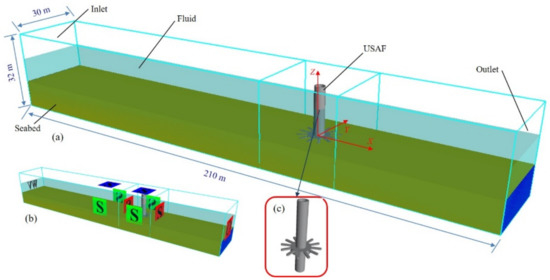
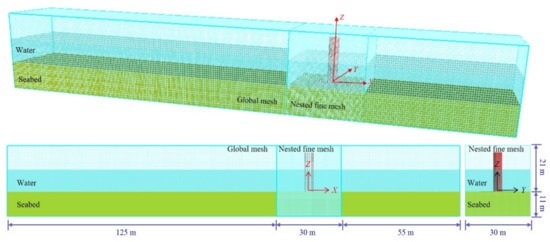
The detailed theoretical framework encompassing the governing equations, the computational methodologies employed, and the specific techniques used for tracking the water surface in these simulations are thoroughly detailed in the study by Sabeti et al. (2024). Here, we briefly explain some of the numerical details. We defined a uniform mesh for our flow domain, carefully crafted with a fine spatial resolution of 0.005 m (i.e., grid size). The dimensions of the numerical model directly matched those of our wave basin used in the physical experiment, being 2.60 m wide, 0.60 m deep, and 2.50 m long (Fig. 2). This design ensures comprehensive coverage of the study area. The output intervals of the numerical model are set at 0.02 s. This timing is consistent with the sampling rates of wave gauges used in laboratory settings. The friction coefficient in the FLOW-3D HYDRO is designated as 0.45. This value corresponds to the Coulombic friction measurements obtained in the laboratory, ensuring that the simulation accurately reflects real-world physical interactions.

In order to simulate the landslide motion, we applied coupled motion objects in FLOW-3D-HYDRO where the dynamics are predominantly driven by gravity and surface friction. This methodology stands in contrast to other models that necessitate explicit inputs of force and torque. This approach ensures that the simulation more accurately reflects the natural movement of landslides, which is heavily reliant on gravitational force and the interaction between sliding surfaces. The stability of the numerical simulations is governed by the Courant Number criterion (Courant et al., 1928), which dictates the maximum time step (Δt) for a given mesh size (Δx) and flow speed (U). According to Courant et al. (1928), this number is required to stay below one to ensure stability of numerical simulations. In our simulations, the Courant number is always maintained below one.

In alignment with the parameters of physical experiments, we set the fluid within the mesh to water, characterized by a density of 1000 kg/m³ at a temperature of 20 °C. Furthermore, we defined the top, front, and back surfaces of the mesh as symmetry planes. The remaining surfaces are designated as wall types, incorporating no-slip conditions to accurately simulate the interaction between the fluid and the boundaries. In terms of selection of an appropriate turbulence model, we selected the k–ω model that showed a better performance than other turbulence methods (e.g., Renormalization-Group) in a previous study (Sabeti et al., 2024). The simulations are conducted using a PC Intel® Core™ i7-10510U CPU with a frequency of 1.80 GHz, and a 16 GB RAM. On this PC, completion of a 3-s simulation required approximately 12.5 h.

2.3. Validation

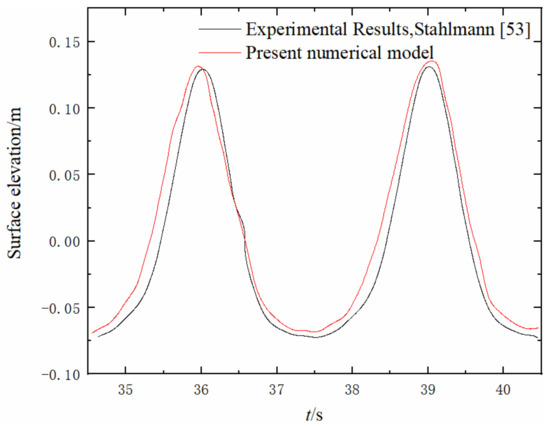
The FLOW-3D HYDRO numerical model was validated using the two physical experiments (Fig. 3) outlined in Table 1. The level of agreement between observations (Oi) and simulations (Si) is examined using the following equation:(1)�=|��−����|×100where ε represents the mismatch error, Oi denotes the observed laboratory values, and Si represents the simulated values from the FLOW-3D HYDRO model. The results of this validation process revealed that our model could replicate the waves generated in the physical experiments with a reasonable degree of mismatch (ε): 14 % for Lab 1 and 8 % for Lab 2 experiments, respectively (Fig. 3). These values indicate that while the model is not perfect, it provides a sufficiently close approximation of the real-world phenomena.

Fig 3

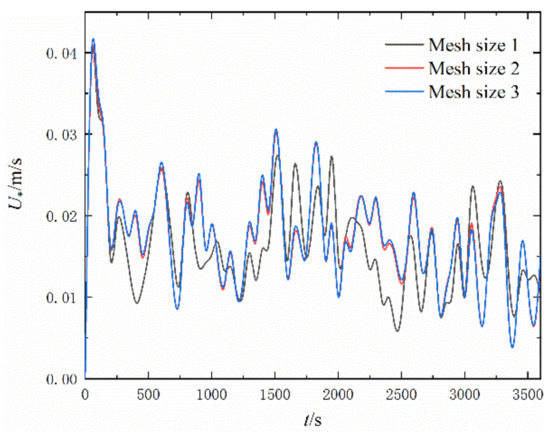
In terms of mesh efficiency, we varied the mesh size to study sensitivity of the numerical results to mesh size. First, by halving the mesh size and then by doubling it, we repeated the modelling by keeping other parameters unchanged. This analysis guided that a mesh size of ∆x = 0.005 m is the most effective for the setup of this study. The total number of computational cells applying mesh size of 0.005 m is 9.269 × 106.

2.4. The dataset

The validated numerical model was employed to conduct 100 simulations, incorporating variations in four key landslide parameters namely water depth, slope angle, slide volume, and travel distance. This methodical approach was essential for a thorough sensitivity analysis of these variables, and for the creation of a detailed database to develop a predictive equation for maximum initial tsunami amplitude. Within the model, 15 distinct slide volumes were established, ranging from 0.10 × 10−3 m3 to 6.25 × 10−3 m3 (Table 3). The slope angle varied between 35° and 55°, and water depth ranged from 0.24 m to 0.27 m. The travel distance of the landslides was varied, spanning from 0.04 m to 0.07 m. Detailed configurations of each simulation, along with the maximum initial wave amplitudes and dominant wave periods are provided in Table 4.

Table 3. Geometrical information of the 15 solid blocks used in numerical modelling for generating landslide tsunamis. Parameters are: ls, slide length; bs, slide width; s, slide thickness; γs, specific gravity; and V, slide volume.

Solid blockls (m)bs (m)s (m)V (m3)γs
Block-10.3100.2600.1556.25 × 10−32.60
Block-20.3000.2600.1505.85 × 10−32.60
Block-30.2800.2600.1405.10 × 10−32.60
Block-40.2600.2600.1304.39 × 10−32.60
Block-50.2400.2600.1203.74 × 10−32.60
Block-60.2200.2600.1103.15 × 10−32.60
Block-70.2000.2600.1002.60 × 10−32.60
Block-80.1800.2600.0902.11 × 10−32.60
Block-90.1600.2600.0801.66 × 10−32.60
Block-100.1400.2600.0701.27 × 10−32.60
Block-110.1200.2600.0600.93 × 10−32.60
Block-120.1000.2600.0500.65 × 10−32.60
Block-130.0800.2600.0400.41 × 10−32.60
Block-140.0600.2600.0300.23 × 10−32.60
Block-150.0400.2600.0200.10 × 10−32.60

Table 4. The numerical simulation for the 100 tests performed in this study for subaerial solid-block landslide-generated waves. Parameters are aM, maximum wave amplitude; α, slope angle; h, water depth; D, travel distance; and T, dominant wave period. The location of the wave gauge is X=1.030 m, Y=1.210 m, and Z=0.050 m. The properties of various solid blocks are presented in Table 3.

Test-Block Noα (°)h (m)D (m)T(s)aM (m)
1Block-7450.2460.0290.5100.0153
2Block-7450.2460.0300.5050.0154
3Block-7450.2460.0310.5050.0156
4Block-7450.2460.0320.5050.0158
5Block-7450.2460.0330.5050.0159
6Block-7450.2460.0340.5050.0160
7Block-7450.2460.0350.5050.0162
8Block-7450.2460.0360.5050.0166
9Block-7450.2460.0370.5050.0167
10Block-7450.2460.0380.5050.0172
11Block-7450.2460.0390.5050.0178
12Block-7450.2460.0400.5050.0179
13Block-7450.2460.0410.5050.0181
14Block-7450.2460.0420.5050.0183
15Block-7450.2460.0430.5050.0190
16Block-7450.2460.0440.5050.0197
17Block-7450.2460.0450.5050.0199
18Block-7450.2460.0460.5050.0201
19Block-7450.2460.0470.5050.0191
20Block-7450.2460.0480.5050.0217
21Block-7450.2460.0490.5050.0220
22Block-7450.2460.0500.5050.0226
23Block-7450.2460.0510.5050.0236
24Block-7450.2460.0520.5050.0239
25Block-7450.2460.0530.5100.0240
26Block-7450.2460.0540.5050.0241
27Block-7450.2460.0550.5050.0246
28Block-7450.2460.0560.5050.0247
29Block-7450.2460.0570.5050.0248
30Block-7450.2460.0580.5050.0249
31Block-7450.2460.0590.5050.0251
32Block-7450.2460.0600.5050.0257
33Block-1450.2460.0450.5050.0319
34Block-2450.2460.0450.5050.0294
35Block-3450.2460.0450.5050.0282
36Block-4450.2460.0450.5050.0262
37Block-5450.2460.0450.5050.0243
38Block-6450.2460.0450.5050.0223
39Block-7450.2460.0450.5050.0196
40Block-8450.2460.0450.5050.0197
41Block-9450.2460.0450.5050.0198
42Block-10450.2460.0450.5050.0184
43Block-11450.2460.0450.5050.0173
44Block-12450.2460.0450.5050.0165
45Block-13450.2460.0450.4040.0153
46Block-14450.2460.0450.4040.0124
47Block-15450.2460.0450.5050.0066
48Block-7450.2020.0450.4040.0220
49Block-7450.2040.0450.4040.0219
50Block-7450.2060.0450.4040.0218
51Block-7450.2080.0450.4040.0217
52Block-7450.2100.0450.4040.0216
53Block-7450.2120.0450.4040.0215
54Block-7450.2140.0450.5050.0214
55Block-7450.2160.0450.5050.0214
56Block-7450.2180.0450.5050.0213
57Block-7450.2200.0450.5050.0212
58Block-7450.2220.0450.5050.0211
59Block-7450.2240.0450.5050.0208
60Block-7450.2260.0450.5050.0203
61Block-7450.2280.0450.5050.0202
62Block-7450.2300.0450.5050.0201
63Block-7450.2320.0450.5050.0201
64Block-7450.2340.0450.5050.0200
65Block-7450.2360.0450.5050.0199
66Block-7450.2380.0450.4040.0196
67Block-7450.2400.0450.4040.0194
68Block-7450.2420.0450.4040.0193
69Block-7450.2440.0450.4040.0192
70Block-7450.2460.0450.5050.0190
71Block-7450.2480.0450.5050.0189
72Block-7450.2500.0450.5050.0187
73Block-7450.2520.0450.5050.0187
74Block-7450.2540.0450.5050.0186
75Block-7450.2560.0450.5050.0184
76Block-7450.2580.0450.5050.0182
77Block-7450.2590.0450.5050.0183
78Block-7450.2600.0450.5050.0191
79Block-7450.2610.0450.5050.0192
80Block-7450.2620.0450.5050.0194
81Block-7450.2630.0450.5050.0195
82Block-7450.2640.0450.5050.0195
83Block-7450.2650.0450.5050.0197
84Block-7450.2660.0450.5050.0197
85Block-7450.2670.0450.5050.0198
86Block-7450.2700.0450.5050.0199
87Block-7300.2460.0450.5050.0101
88Block-7350.2460.0450.5050.0107
89Block-7360.2460.0450.5050.0111
90Block-7370.2460.0450.5050.0116
91Block-7380.2460.0450.5050.0117
92Block-7390.2460.0450.5050.0119
93Block-7400.2460.0450.5050.0121
94Block-7410.2460.0450.5050.0127
95Block-7420.2460.0450.4040.0154
96Block-7430.2460.0450.4040.0157
97Block-7440.2460.0450.4040.0162
98Block-7450.2460.0450.5050.0197
99Block-7500.2460.0450.5050.0221
100Block-7550.2460.0450.5050.0233

In all these 100 simulations, the wave gauge was consistently positioned at coordinates X=1.09 m, Y=1.21 m, and Z=0.05 m. The dominant wave period for each simulation was determined using the Fast Fourier Transform (FFT) function in MATLAB (MathWorks, 2023). Furthermore, the classification of wave types was carried out using a wave categorization graph according to Sorensen (2010), as shown in Fig. 4a. The results indicate that the majority of the simulated waves are on the border between intermediate and deep-water waves, and they are categorized as Stokes waves (Fig. 4a). Four sample waveforms from our 100 numerical experiments are provided in Fig. 4b.

Fig 4

The dataset in Table 4 was used to derive a new predictive equation that incorporates travel distance for the first time to estimate the initial maximum tsunami amplitude. In developing this equation, a genetic algorithm optimization technique was implemented using MATLAB (MathWorks 2023). This advanced approach entailed the use of genetic algorithms (GAs), an evolutionary algorithm type inspired by natural selection processes (MathWorks, 2023). This technique is iterative, involving selection, crossover, and mutation processes to evolve solutions over several generations. The goal was to identify the optimal coefficients and powers for each landslide parameter in the predictive equation, ensuring a robust and reliable model for estimating maximum wave amplitudes. Genetic Algorithms excel at optimizing complex models by navigating through extensive combinations of coefficients and exponents. GAs effectively identify highly suitable solutions for the non-linear and complex relationships between inputs (e.g., slide volume, slope angle, travel distance, water depth) and the output (i.e., maximum initial wave amplitude, aM). MATLAB’s computational environment enhances this process, providing robust tools for GA to adapt and evolve solutions iteratively, ensuring the precision of the predictive model (Onnen et al., 1997). This approach leverages MATLAB’s capabilities to fine-tune parameters dynamically, achieving an optimal equation that accurately estimates aM. It is important to highlight that the nondimensionalized version of this dataset is employed to develop a predictive equation which enables the equation to reproduce the maximum initial wave amplitude (aM) for various subaerial landslide cases, independent of their dimensional differences (e.g., Heler and Hager 2014Heller and Spinneken 2015Sabeti and Heidarzadeh 2022b). For this nondimensionalization, we employed the water depth (h) to nondimensionalize the slide volume (V/h3) and travel distance (D/h). The slide thickness (s) was applied to nondimensionalize the water depth (h/s).

2.5. Landslide velocity

In discussing the critical role of landslide velocity for simulating landslide-generated waves, we focus on the mechanisms of landslide motion and the techniques used to record landslide velocity in our simulations (Fig. 5). Also, we examine how these methods were applied in two distinct scenarios: Lab 1 and Lab 2 (see Table 1 for their details). Regarding the process of landslide movement, a slide starts from a stationary state, gaining momentum under the influence of gravity and this acceleration continues until the landslide collides with water, leading to a significant reduction in its speed before eventually coming to a stop (Fig. 5) (e.g., Panizzo et al. 2005).

Fig 5

To measure the landslide’s velocity in our simulations, we attached a probe at the centre of the slide, which supplied a time series of the velocity data. The slide’s velocity (vs) peaks at the moment it enters the water (Fig. 5), a point referred to as the impact time (tImp). Following this initial impact, the slides continue their underwater movement, eventually coming to a complete halt (tStop). Given the results in Fig. 5, it can be seen that Lab 1, with its longer travel distance (0.070 m), exhibits a higher peak velocity of 1.89 m/s. This increase in velocity is attributed to the extended travel distance allowing more time for the slide to accelerate under gravity. Whereas Lab 2, featuring a shorter travel distance (0.045 m), records a lower peak velocity of 1.78 m/s. This difference underscores how travel distance significantly influences the dynamics of landslide motion. After reaching the peak, both profiles show a sharp decrease in velocity, marking the transition to submarine motion until the slides come to a complete stop (tStop). There are noticeable differences observable in Fig. 5 between the Lab-1 and Lab-2 simulations, including the peaks at 0.3 s . These variations might stem from the placement of the wave gauge, which differs slightly in each scenario, as well as the water depth’s minor discrepancies and, the travel distance.

2.6. Effect of air entrainment

In this section we examine whether it is required to consider air entrainment for our modelling or not as the FLOW-3D HYDRO package is capable of modelling air entrainment. The process of air entrainment in water during a landslide tsunami and its subsequent transport involve two key components: the quantification of air entrainment at the water surface, and the simulation of the air’s transport within the fluid (Hirt, 2003). FLOW-3D HYDRO employs the air entrainment model to compute the volume of air entrained at the water’s surface utilizing three approaches: a constant density model, a variable density model accounting for bulking, and a buoyancy model that adds the Drift-FLUX mechanism to variable density conditions (Flow Science, 2023). The calculation of the entrainment rate is based on the following equation:(2)�������=������[2(��−�����−2�/���)]1/2where parameters are: Vair, volume of air; Cair, entrainment rate coefficient; As, surface area of fluid; ρ, fluid density; k, turbulent kinetic energy; gn, gravity normal to surface; Lt, turbulent length scale; and σ, surface tension coefficient. The value of k is directly computed from the Reynolds-averaged Navier-Stokes (RANS) (kw) calculations in our model.

In this study, we selected the variable density + Drift-FLUX model, which effectively captures the dynamics of phase separation and automatically activates the constant density and variable density models. This method simplifies the air-water mixture, treating it as a single, homogeneous fluid within each computational cell. For the phase volume fractions f1and f2​, the velocities are expressed in terms of the mixture and relative velocities, denoted as u and ur, respectively, as follows:(3)��1��+�.(�1�)=��1��+�.(�1�)−�.(�1�2��)=0(4)��2��+�.(�2�)=��2��+�.(�2�)−�.(�1�2��)=0

The outcomes from this simulation are displayed in Fig. 6, which indicates that the influence of air entrainment on the generated wave amplitude is approximately 2 %. A value of 0.02 for the entrained air volume fraction means that, in the simulated fluid, approximately 2 % of the volume is composed of entrained air. In other words, for every unit volume of the fluid-air mixture at that location, 2 % is air and the remaining 98 % is water. The configuration of Test-17 (Table 4) was employed for this simulation. While the effect of air entrainment is anticipated to be more significant in models of granular landslide-generated waves (Fritz, 2002), in our simulations we opted not to incorporate this module due to its negligible impact on the results.

Fig 6

3. Results

In this section, we begin by presenting a sequence of our 3D simulations capturing different time steps to illustrate the generation process of landslide-generated waves. Subsequently, we derive a new predictive equation to estimate the maximum initial wave amplitude of landslide-generated waves and assess its performance.

3.1. Wave generation and propagation

To demonstrate the wave generation process in our simulation, we reference Test-17 from Table 4, where we employed Block-7 (Tables 34). In this configuration, the slope angle was set to 45°, with a water depth of 0.246 m and a travel distance at 0.045 m (Fig. 7). At 0.220 s, the initial impact of the moving slide on the water is depicted, marking the onset of the wave generation process (Fig. 7a). Disturbances are localized to the immediate area of impact, with the rest of the water surface remaining undisturbed. At this time, a maximum water particle velocity of 1.0 m/s – 1.2 m/s is seen around the impact zone (Fig. 7d). Moving to 0.320 s, the development of the wave becomes apparent as energy transfer from the landslide to the water creates outwardly radiating waves with maximum water particle velocity of up to around 1.6 m/s – 1.8 m/s (Fig. 7b, e). By the time 0.670 s, the wave has fully developed and is propagating away from the impact point exhibiting maximum water particle velocity of up to 2.0 m/s – 2.1 m/s. Concentric wave fronts are visible, moving outwards in all directions, with a colour gradient signifying the highest wave amplitude near the point of landslide entry, diminishing with distance (Fig. 7c, f).

Fig 7

3.2. Influence of landslide parameters on tsunami amplitude

In this section, we investigate the effects of various landslide parameters namely slide volume (V), water depth (h), slipe angle (α) and travel distance (D) on the maximum initial wave amplitude (aM). Fig. 8 presents the outcome of these analyses. According to Fig. 8, the slide volume, slope angle, and travel distance exhibit a direct relationship with the wave amplitude, meaning that as these parameters increase, so does the amplitude. Conversely, water depth is inversely related to the maximum initial wave amplitude, suggesting that the deeper the water depth, the smaller the maximum wave amplitude will be (Fig. 8b).

Fig 8

Fig. 8a highlights the pronounced impact of slide volume on the aM, demonstrating a direct correlation between the two variables. For instance, in the range of slide volumes we modelled (Fig. 8a), The smallest slide volume tested, measuring 0.10 × 10−3 m3, generated a low initial wave amplitude (aM= 0.0066 m) (Table 4). In contrast, the largest volume tested, 6.25 × 10−3 m3, resulted in a significantly higher initial wave amplitude (aM= 0.0319 m) (Table 4). The extremities of these results emphasize the slide volume’s paramount impact on wave amplitude, further elucidated by their positions as the smallest and largest aM values across all conducted tests (Table 4). This is corroborated by findings from the literature (e.g., Murty, 2003), which align with the observed trend in our simulations.

The slope angle’s influence on aM was smooth. A steady increase of wave amplitude was observed as the slope angle increased (Fig. 8c). In examining travel distance, an anomaly was identified. At a travel distance of 0.047 m, there was an unexpected dip in aM, which deviates from the general increasing trend associated with longer travel distances. This singular instance could potentially be attributed to a numerical error. Beyond this point, the expected pattern of increasing aM with longer travel distances resumes, suggesting that the anomaly at 0.047 m is an outlier in an otherwise consistent trend, and thus this single data point was overlooked while deriving the predictive equation. Regarding the inverse relationship between water depth and wave amplitude, our result (Fig. 8b) is consistent with previous reports by Fritz et al. (2003), (2004), and Watts et al. (2005).

The insights from Fig. 8 informed the architecture of the predictive equation in the next Section, with slide volume, travel distance, and slope angle being multiplicatively linked to wave amplitude underscoring their direct correlations with wave amplitude. Conversely, water depth is incorporated as a divisor, representing its inverse relationship with wave amplitude. This structure encapsulates the dynamics between the landslide parameters and their influence on the maximum initial wave amplitude as discussed in more detail in the next Section.

3.3. Predictive equation

Building on our sensitivity analysis of landslide parameters, as detailed in Section 3.2, and utilizing our nondimensional dataset, we have derived a new predictive equation as follows:(5)��/ℎ=0.015(tan�)0.10(�ℎ3)0.90(�ℎ)0.10(ℎ�)−0.11where, V is sliding volume, h is water depth, α is slope angle, and s is landslide thickness. It is important to note that this equation is valid only for subaerial solid-block landslide tsunamis as all our experiments were for this type of waves. The performance of this equation in predicting simulation data is demonstrated by the satisfactory alignment of data points around a 45° line, indicating its accuracy and reliability with regard to the experimental dataset (Fig. 9). The quality of fit between the dataset and Eq. (5) is 91 % indicating that Eq. (5) represents the dataset very well. Table 5 presents Eq. (5) alongside four other similar equations previously published. Two significant distinctions between our Eq. (5) and these others are: (i) Eq. (5) is derived from 3D experiments, whereas the other four equations are based on 2D experiments. (ii) Unlike the other equations, our Eq. (5) incorporates travel distance as an independent parameter.

Fig 9

Table 5. Performance comparison among our newly-developed equation and existing equations for estimating the maximum initial amplitude (aM) of the 2018 Anak Krakatau subaerial landslide tsunami. Parameters: aM, initial maximum wave amplitude; h, water depth; vs, landslide velocity; V, slide volume; bs, slide width; ls, slide length; s, slide thickness; α, slope angle; and ����, volume of the final immersed landslide. We considered ����= V as the slide volume.

EventPredictive equationsAuthor (year)Observed aM (m) ⁎⁎Calculated aM (m)Error, ε (%) ⁎⁎⁎⁎
2018 Anak Krakatau tsunami (Subaerial landslide) *��/ℎ=1.32���ℎNoda (1970)1341340
��/ℎ=0.667(0.5(���ℎ)2)0.334(���)0.754(���)0.506(�ℎ)1.631Bolin et al. (2014) ⁎⁎⁎13459424334
��/ℎ=0.25(������ℎ2)0.8Robbe-Saule et al. (2021)1343177
��/ℎ=0.4545(tan�)0.062(�ℎ3)0.296(ℎ�)−0.235Sabeti and Heidarzadeh (2022b)1341266
��/ℎ=0.015(tan�)0.10(�ℎ3)0.911(�ℎ)0.10(ℎ�)−0.11This study1341302.9

Geometrical and kinematic parameters of the 2018 Anak Krakatau subaerial landslide based on Heidarzadeh et al. (2020)Grilli et al. (2019) and Grilli et al. (2021)V=2.11 × 107 m3h= 50 m; s= 114 m; α= 45°; ls=1250 m; bs= 2700 m; vs=44.9 m/s; D= 2500 m; aM= 100 m −150 m.⁎⁎

aM= An average value of aM = 134 m is considered in this study.⁎⁎⁎

The equation of Bolin et al. (2014) is based on the reformatted one reported by Lindstrøm (2016).⁎⁎⁎⁎

Error is calculated using Eq. (1), where the calculated aM is assumed as the simulated value.

Additionally, we evaluated the performance of this equation using the real-world data from the 2018 Anak Krakatau subaerial landslide tsunami. Based on previous studies (Heidarzadeh et al., 2020Grilli et al., 20192021), we were able to provide a list of parameters for the subaerial landslide and associated tsunami for the 2018 Anak Krakatau event (see footnote of Table 5). We note that the data of the 2018 Anak Krakatau event was not used while deriving Eq. (5). The results indicate that Eq. (5) predicts the initial amplitude of the 2018 Anak Krakatau tsunami as being 130 m indicating an error of 2.9 % compared to the reported average amplitude of 134 m for this event. This performance indicates an improvement compared to the previous equation reported by Sabeti and Heidarzadeh (2022a) (Table 5). In contrast, the equations from Robbe-Saule et al. (2021) and Bolin et al. (2014) demonstrate higher discrepancies of 4200 % and 77 %, respectively (Table 5). Although Noda’s (1970) equation reproduces the tsunami amplitude of 134 m accurately (Table 5), it is crucial to consider its limitations, notably not accounting for parameters such as slope angle and travel distance.

It is essential to recognize that both travel distance and slope angle significantly affect wave amplitude. In our model, captured in Eq. (5), we integrate the slope angle (α) through the tangent function, i.e., tan α. This choice diverges from traditional physical interpretations that often employ the cosine or sine function (e.g., Heller and Hager, 2014Watts et al., 2003). We opted for the tangent function because it more effectively reflects the direct impact of slope steepness on wave generation, yielding superior estimations compared to conventional methods.

The significance of this study lies in its application of both physical and numerical 3D experiments and the derivation of a predictive equation based on 3D results. Prior research, e.g. Heller et al. (2016), has reported notable discrepancies between 2D and 3D wave amplitudes, highlighting the important role of 3D experiments. It is worth noting that the suitability of applying an equation derived from either 2D or 3D data depends on the specific geometry and characteristics inherent in the problem being addressed. For instance, in the case of a long, narrow dam reservoir, an equation derived from 2D data would likely be more suitable. In such contexts, the primary dynamics of interest such as flow patterns and potential wave propagation are predominantly two-dimensional, occurring along the length and depth of the reservoir. This simplification to 2D for narrow dam reservoirs allows for more accurate modelling of these dynamics.

This study specifically investigates waves initiated by landslides, focusing on those characterized as solid blocks instead of granular flows, with slope angles confined to a range of 25° to 60°. We acknowledge the additional complexities encountered in real-world scenarios, such as dynamic density and velocity of landslides, which could affect the estimations. The developed equation in this study is specifically designed to predict the maximum initial amplitude of tsunamis for the aforementioned specified ranges and types of landslides.

4. Conclusions

Both physical and numerical experiments were undertaken in a 3D wave basin to study solid-block landslide-generated waves and to formulate a predictive equation for their maximum initial wave amplitude. At the beginning, two physical experiments were performed to validate and calibrate a 3D numerical model, which was subsequently utilized to generate 100 experiments by varying different landslide parameters. The generated database was then used to derive a predictive equation for the maximum initial wave amplitude of landslide tsunamis. The main features and outcomes are:

  • •The predictive equation of this study is exclusively derived from 3D data and exhibits a fitting quality of 91 % when applied to the database.
  • •For the first time, landslide travel distance was considered in the predictive equation. This inclusion provides more accuracy and flexibility for applying the equation.
  • •To further evaluate the performance of the predictive equation, it was applied to a real-world subaerial landslide tsunami (i.e., the 2018 Anak Krakatau event) and delivered satisfactory performance.

CRediT authorship contribution statement

Ramtin Sabeti: Conceptualization, Methodology, Validation, Software, Visualization, Writing – review & editing. Mohammad Heidarzadeh: Methodology, Data curation, Software, Writing – review & editing.

Declaration of competing interest

The authors declare that they have no known competing financial interests or personal relationships that could have appeared to influence the work reported in this paper.

Funding

RS is supported by the Leverhulme Trust Grant No. RPG-2022-306. MH is funded by open funding of State Key Lab of Hydraulics and Mountain River Engineering, Sichuan University, grant number SKHL2101. We acknowledge University of Bath Institutional Open Access Fund. MH is also funded by the Great Britain Sasakawa Foundation grant no. 6217 (awarded in 2023).

Acknowledgements

Authors are sincerely grateful to the laboratory technician team, particularly Mr William Bazeley, at the Faculty of Engineering, University of Bath for their support during the laboratory physical modelling of this research. We appreciate the valuable insights provided by Mr. Brian Fox (Senior CFD Engineer at Flow Science, Inc.) regarding air entrainment modelling in FLOW-3D HYDRO. We acknowledge University of Bath Institutional Open Access Fund.

Data availability

  • All data used in this study are given in the body of the article.

References

Coupled CFD-DEM simulation of interfacial fluid–particle interaction during binder jet 3D printing

Coupled CFD-DEM simulation of interfacial fluid–particle interaction during binder jet 3D printing

바인더 제트 3D 프린팅 중 계면 유체-입자 상호 작용에 대한 CFD-DEM 결합 시뮬레이션

Joshua J. Wagner, C. Fred Higgs III

https://doi.org/10.1016/j.cma.2024.116747

Abstract

The coupled dynamics of interfacial fluid phases and unconstrained solid particles during the binder jet 3D printing process govern the final quality and performance of the resulting components. The present work proposes a computational fluid dynamics (CFD) and discrete element method (DEM) framework capable of simulating the complex interfacial fluid–particle interaction that occurs when binder microdroplets are deposited into a powder bed. The CFD solver uses a volume-of-fluid (VOF) method for capturing liquid–gas multifluid flows and relies on block-structured adaptive mesh refinement (AMR) to localize grid refinement around evolving fluid–fluid interfaces. The DEM module resolves six degrees of freedom particle motion and accounts for particle contact, cohesion, and rolling resistance. Fully-resolved CFD-DEM coupling is achieved through a fictitious domain immersed boundary (IB) approach. An improved method for enforcing three-phase contact lines with a VOF-IB extension technique is introduced. We present several simulations of binder jet primitive formation using realistic process parameters and material properties. The DEM particle systems are experimentally calibrated to reproduce the cohesion behavior of physical nickel alloy powder feedstocks. We demonstrate the proposed model’s ability to resolve the interdependent fluid and particle dynamics underlying the process by directly comparing simulated primitive granules with one-to-one experimental counterparts obtained from an in-house validation apparatus. This computational framework provides unprecedented insight into the fundamental mechanisms of binder jet 3D printing and presents a versatile new approach for process parameter optimization and defect mitigation that avoids the inherent challenges of experiments.

바인더 젯 3D 프린팅 공정 중 계면 유체 상과 구속되지 않은 고체 입자의 결합 역학이 결과 구성 요소의 최종 품질과 성능을 좌우합니다. 본 연구는 바인더 미세액적이 분말층에 증착될 때 발생하는 복잡한 계면 유체-입자 상호작용을 시뮬레이션할 수 있는 전산유체역학(CFD) 및 이산요소법(DEM) 프레임워크를 제안합니다.

CFD 솔버는 액체-가스 다중유체 흐름을 포착하기 위해 VOF(유체량) 방법을 사용하고 블록 구조 적응형 메쉬 세분화(AMR)를 사용하여 진화하는 유체-유체 인터페이스 주위의 그리드 세분화를 국지화합니다. DEM 모듈은 6개의 자유도 입자 운동을 해결하고 입자 접촉, 응집력 및 구름 저항을 설명합니다.

완전 분해된 CFD-DEM 결합은 가상 도메인 침지 경계(IB) 접근 방식을 통해 달성됩니다. VOF-IB 확장 기술을 사용하여 3상 접촉 라인을 강화하는 향상된 방법이 도입되었습니다. 현실적인 공정 매개변수와 재료 특성을 사용하여 바인더 제트 기본 형성에 대한 여러 시뮬레이션을 제시합니다.

DEM 입자 시스템은 물리적 니켈 합금 분말 공급원료의 응집 거동을 재현하기 위해 실험적으로 보정되었습니다. 우리는 시뮬레이션된 기본 과립과 내부 검증 장치에서 얻은 일대일 실험 대응물을 직접 비교하여 프로세스의 기본이 되는 상호 의존적인 유체 및 입자 역학을 해결하는 제안된 모델의 능력을 보여줍니다.

이 계산 프레임워크는 바인더 제트 3D 프린팅의 기본 메커니즘에 대한 전례 없는 통찰력을 제공하고 실험에 내재된 문제를 피하는 공정 매개변수 최적화 및 결함 완화를 위한 다용도의 새로운 접근 방식을 제시합니다.

Introduction

Binder jet 3D printing (BJ3DP) is a powder bed additive manufacturing (AM) technology capable of fabricating geometrically complex components from advanced engineering materials, such as metallic superalloys and ultra-high temperature ceramics [1], [2]. As illustrated in Fig. 1(a), the process is comprised of many repetitive print cycles, each contributing a new cross-sectional layer on top of a preceding one to form a 3D CAD-specified geometry. The feedstock material is first delivered from a hopper to a build plate and then spread into a thin layer by a counter-rotating roller. After powder spreading, a print head containing many individual inkjet nozzles traverses over the powder bed while precisely jetting binder microdroplets onto select regions of the spread layer. Following binder deposition, the build plate lowers by a specified layer thickness, leaving a thin void space at the top of the job box that the subsequent powder layer will occupy. This cycle repeats until the full geometries are formed layer by layer. Powder bed fusion (PBF) methods follow a similar procedure, except they instead use a laser or electron beam to selectively melt and fuse the powder material. Compared to PBF, binder jetting offers several distinct advantages, including faster build rates, enhanced scalability for large production volumes, reduced machine and operational costs, and a wider selection of suitable feedstock materials [2]. However, binder jetted parts generally possess inferior mechanical properties and reduced dimensional accuracy [3]. As a result, widescale adoption of BJ3DP to fabricate high-performance, mission-critical components, such as those common to the aerospace and defense sectors, is contingent on novel process improvements and innovations [4].

A major obstacle hindering the advancement of BJ3DP is our limited understanding of how various printing parameters and material properties collectively influence the underlying physical mechanisms of the process and their effect on the resulting components. To date, the vast majority of research efforts to uncover these relationships have relied mainly on experimental approaches [5], [6], [7], [8], [9], [10], [11], [12], [13], [14], [15], [16], [17], [18], [19], which are often expensive and time-consuming and have inherent physical restrictions on what can be measured and observed. For these reasons, there is a rapidly growing interest in using computational models to circumvent the challenges of experimental investigations and facilitate a deeper understanding of the process’s fundamental phenomena. While significant progress has been made in developing and deploying numerical frameworks aimed at powder spreading [20], [21], [22], [23], [24], [25], [26], [27] and sintering [28], [29], [30], [31], [32], simulating the interfacial fluid–particle interaction (IFPI) in the binder deposition stage is still in its infancy. In their exhaustive review, Mostafaei et al. [2] point out the lack of computational models capable of resolving the coupled fluid and particle dynamics associated with binder jetting and suggest that the development of such tools is critical to further improving the process and enhancing the quality of its end-use components.

We define IFPI as a multiphase flow regime characterized by immiscible fluid phases separated by dynamic interfaces that intersect the surfaces of moving solid particles. As illustrated in Fig. 1(b), an elaborate IFPI occurs when a binder droplet impacts the powder bed in BJ3DP. The momentum transferred from the impacting droplet may cause powder compaction, cratering, and particle ejection. These ballistic disturbances can have deleterious effects on surface texture and lead to the formation of large void spaces inside the part [5], [13]. After impact, the droplet spreads laterally on the bed surface and vertically into the pore network, driven initially by inertial impact forces and then solely by capillary action [33]. Attractive capillary forces exerted on mutually wetted particles tend to draw them inward towards each other, forming a packed cluster of bound particles referred to as a primitive [34]. A single-drop primitive is the most fundamental building element of a BJ3DP part, and the interaction leading to its formation has important implications on the final part characteristics, such as its mechanical properties, resolution, and dimensional accuracy. Generally, binder droplets are deposited successively as the print head traverses over the powder bed. The traversal speed and jetting frequency are set such that consecutive droplets coalesce in the bed, creating a multi-drop primitive line instead of a single-drop primitive granule. The binder must be jetted with sufficient velocity to penetrate the powder bed deep enough to provide adequate interlayer binding; however, a higher impact velocity leads to more pronounced ballistic effects.

A computational framework equipped to simulate the interdependent fluid and particle dynamics in BJ3DP would allow for unprecedented observational and measurement capability at temporal and spatial resolutions not currently achievable by state-of-the-art imaging technology, namely synchrotron X-ray imaging [13], [14], [18], [19]. Unfortunately, BJ3DP presents significant numerical challenges that have slowed the development of suitable modeling frameworks; the most significant of which are as follows:

  • 1.Incorporating dynamic fluid–fluid interfaces with complex topological features remains a nontrivial task for standard mesh-based CFD codes. There are two broad categories encompassing the methods used to handle interfacial flows: interface tracking and interface capturing [35]. Interface capturing techniques, such as the popular volume-of-fluid (VOF) [36] and level-set methods [37], [38], are better suited for problems with interfaces that become heavily distorted or when coalescence and fragmentation occur frequently; however, they are less accurate in resolving surface tension and boundary layer effects compared to interface tracking methods like front-tracking [39], arbitrary Lagrangian–Eulerian [40], and space–time finite element formulations [41]. Since interfacial forces become increasingly dominant at decreasing length scales, inaccurate surface tension calculations can significantly deteriorate the fidelity of IFPI simulations involving <100 μm droplets and particles.
  • 2.Dynamic powder systems are often modeled using the discrete element method (DEM) introduced by Cundall and Strack [42]. For IFPI problems, a CFD-DEM coupling scheme is required to exchange information between the fluid and particle solvers. Fully-resolved CFD-DEM coupling suggests that the flow field around individual particle surfaces is resolved on the CFD mesh [43], [44]. In contrast, unresolved coupling volume averages the effect of the dispersed solid phase on the continuous fluid phases [45], [46], [47], [48]. Comparatively, the former is computationally expensive but provides detailed information about the IFPI in question and is more appropriate when contact line dynamics are significant. However, since the pore structure of a powder bed is convoluted and evolves with time, resolving such solid–fluid interfaces on a computational mesh presents similar challenges as fluid–fluid interfaces discussed in the previous point. Although various algorithms have been developed to deform unstructured meshes to accommodate moving solid surfaces (see Bazilevs et al. [49] for an overview of such methods), they can be prohibitively expensive when frequent topology changes require mesh regeneration rather than just modification through nodal displacement. The pore network in a powder bed undergoes many topology changes as particles come in and out of contact with each other, constantly closing and opening new flow channels. Non-body-conforming structured grid approaches that rely on immersed boundary (IB) methods to embed the particles in the flow field can be better suited for such cases [50]. Nevertheless, accurately representing these complex pore geometries on Cartesian grids requires extremely high mesh resolutions, which can impose significant computational costs.
  • 3.Capillary effects depend on the contact angle at solid–liquid–gas intersections. Since mesh nodes do not coincide with a particle surface when using an IB method on structured grids, imposing contact angle boundary conditions at three-phase contact lines is not straightforward.

While these issues also pertain to PBF process modeling, resolving particle motion is generally less crucial for analyzing melt pool dynamics compared to primitive formation in BJ3DP. Therefore, at present, the vast majority of computational process models of PBF assume static powder beds and avoid many of the complications described above, see, e.g., [51], [52], [53], [54], [55], [56], [57], [58], [59]. Li et al. [60] presented the first 2D fully-resolved CFD-DEM simulations of the interaction between the melt pool, powder particles, surrounding gas, and metal vapor in PBF. Following this work, Yu and Zhao [61], [62] published similar melt pool IFPI simulations in 3D; however, contact line dynamics and capillary forces were not considered. Compared to PBF, relatively little work has been published regarding the computational modeling of binder deposition in BJ3DP. Employing the open-source VOF code Gerris [63], Tan [33] first simulated droplet impact on a powder bed with appropriate binder jet parameters, namely droplet size and impact velocity. However, similar to most PBF melt pool simulations described in the current literature, the powder bed was fixed in place and not allowed to respond to the interacting fluid phases. Furthermore, a simple face-centered cubic packing of non-contacting, monosized particles was considered, which does not provide a realistic pore structure for AM powder beds. Building upon this approach, we presented a framework to simulate droplet impact on static powder beds with more practical particle size distributions and packing arrangements [64]. In a study similar to [33], [64], Deng et al. [65] used the VOF capability in Ansys Fluent to examine the lateral and vertical spreading of a binder droplet impacting a fixed bimodal powder bed with body-centered packing. Li et al. [66] also adopted Fluent to conduct 2D simulations of a 100 μm diameter droplet impacting substrates with spherical roughness patterns meant to represent the surface of a simplified powder bed with monosized particles. The commercial VOF-based software FLOW-3D offers an AM module centered on process modeling of various AM technologies, including BJ3DP. However, like the above studies, particle motion is still not considered in this codebase. Ur Rehman et al. [67] employed FLOW-3D to examine microdroplet impact on a fixed stainless steel powder bed. Using OpenFOAM, Erhard et al. [68] presented simulations of different droplet impact spacings and patterns on static sand particles.

Recently, Fuchs et al. [69] introduced an impressive multipurpose smoothed particle hydrodynamics (SPH) framework capable of resolving IFPI in various AM methods, including both PBF and BJ3DP. In contrast to a combined CFD-DEM approach, this model relies entirely on SPH meshfree discretization of both the fluid and solid governing equations. The authors performed several prototype simulations demonstrating an 80 μm diameter droplet impacting an unconstrained powder bed at different speeds. While the powder bed responds to the hydrodynamic forces imparted by the impacting droplet, the particle motion is inconsistent with experimental time-resolved observations of the process [13]. Specifically, the ballistic effects, such as particle ejection and bed deformation, were drastically subdued, even in simulations using a droplet velocity ∼ 5× that of typical jetting conditions. This behavior could be caused by excessive damping in the inter-particle contact force computations within their SPH framework. Moreover, the wetted particles did not appear to be significantly influenced by the strong capillary forces exerted by the binder as no primitive agglomeration occurred. The authors mention that the objective of these simulations was to demonstrate their codebase’s broad capabilities and that some unrealistic process parameters were used to improve computational efficiency and stability, which could explain the deviations from experimental observations.

In the present paper, we develop a novel 3D CFD-DEM numerical framework for simulating fully-resolved IFPI during binder jetting with realistic material properties and process parameters. The CFD module is based on the VOF method for capturing binder–air interfaces. Surface tension effects are realized through the continuum surface force (CSF) method with height function calculations of interface curvature. Central to our fluid solver is a proprietary block-structured AMR library with hierarchical octree grid nesting to focus enhanced grid resolution near fluid–fluid interfaces. The GPU-accelerated DEM module considers six degrees of freedom particle motion and includes models based on Hertz-Mindlin contact, van der Waals cohesion, and viscoelastic rolling resistance. The CFD and DEM modules are coupled to achieve fully-resolved IFPI using an IB approach in which Lagrangian solid particles are mapped to the underlying Eulerian fluid mesh through a solid volume fraction field. An improved VOF-IB extension algorithm is introduced to enforce the contact angle at three-phase intersections. This provides robust capillary flow behavior and accurate computations of the fluid-induced forces and torques acting on individual wetted particles in densely packed powder beds.

We deploy our integrated codebase for direct numerical simulations of single-drop primitive formation with powder beds whose particle size distributions are generated from corresponding laboratory samples. These simulations use jetting parameters similar to those employed in current BJ3DP machines, fluid properties that match commonly used aqueous polymeric binders, and powder properties specific to nickel alloy feedstocks. The cohesion behavior of the DEM powder is calibrated based on the angle of repose of the laboratory powder systems. The resulting primitive granules are compared with those obtained from one-to-one experiments conducted using a dedicated in-house test apparatus. Finally, we demonstrate how the proposed framework can simulate more complex and realistic printing operations involving multi-drop primitive lines.

Section snippets

Mathematical description of interfacial fluid–particle interaction

This section briefly describes the governing equations of fluid and particle dynamics underlying the CFD and DEM solvers. Our unified framework follows an Eulerian–Lagrangian approach, wherein the Navier–Stokes equations of incompressible flow are discretized on an Eulerian grid to describe the motion of the binder liquid and surrounding gas, and the Newton–Euler equations account for the positions and orientations of the Lagrangian powder particles. The mathematical foundation for

CFD solver for incompressible flow with multifluid interfaces

This section details the numerical methodology used in our CFD module to solve the Navier–Stokes equations of incompressible flow. First, we introduce the VOF method for capturing the interfaces between the binder and air phases. This approach allows us to solve the fluid dynamics equations considering only a single continuum field with spatial and temporal variations in fluid properties. Next, we describe the time integration procedure using a fractional-step projection algorithm for

DEM solver for solid particle dynamics

This section covers the numerical procedure for tracking the motion of individual powder particles with DEM. The Newton–Euler equations (Eqs. (10), (11)) are ordinary differential equations (ODEs) for which many established numerical integrators are available. In general, the most challenging aspects of DEM involve processing particle collisions in a computationally efficient manner and dealing with small time step constraints that result from stiff materials, such as metallic AM powders. The

Unified CFD-DEM solver

The preceding sections have introduced the CFD and DEM solution algorithms separately. Here, we discuss the integrated CFD-DEM solution algorithm and related details.

Binder jet process modeling and validation experiments

In this section, we deploy our CFD-DEM framework to simulate the IFPI occurring during the binder droplet deposition stage of the BJ3DP process. The first simulations attempt to reproduce experimental single-drop primitive granules extracted from four nickel alloy powder samples with varying particle size distributions. The experiments are conducted with a dedicated in-house test apparatus that allows for the precision deposition of individual binder microdroplets into a powder bed sample. The

Conclusions

This paper introduces a coupled CFD-DEM framework capable of fully-resolved simulation of the interfacial fluid–particle interaction occurring in the binder jet 3D printing process. The interfacial flow of binder and surrounding air is captured with the VOF method and surface tension effects are incorporated using the CSF technique augmented by height function curvature calculations. Block-structured AMR is employed to provide localized grid refinement around the evolving liquid–gas interface.

CRediT authorship contribution statement

Joshua J. Wagner: Conceptualization, Data curation, Formal analysis, Investigation, Methodology, Software, Visualization, Writing – original draft, Writing – review & editing. C. Fred Higgs III: Conceptualization, Funding acquisition, Investigation, Methodology, Project administration, Resources, Supervision, Writing – original draft, Writing – review & editing.

Declaration of competing interest

The authors declare that they have no known competing financial interests or personal relationships that could have appeared to influence the work reported in this paper.

Acknowledgments

This work was supported by a NASA Space Technology Research Fellowship, United States of America, Grant No. 80NSSC19K1171. Partial support was also provided through an AIAA Foundation Orville, USA and Wilbur Wright Graduate Award, USA . The authors would like to gratefully acknowledge Dr. Craig Smith of NASA Glenn Research Center for the valuable input he provided on this project.

References (155)

Fig. 3. (a–c) Snapshots of the CtFD simulation of laser-beam irradiation: (a) Top, (b) longitudinal vertical cross-sectional, and (c) transversal vertical cross-sectional views. (d) z-position of the solid/liquid interface during melting and solidification.

Solute segregation in a rapidly solidified Hastelloy-X Ni-based superalloy during laser powder bed fusion investigated by phase-field simulations and computational thermal-fluid dynamics

Masayuki Okugawa ab, Kenji Saito a, Haruki Yoshima a, Katsuhiko Sawaizumi a, Sukeharu Nomoto c, Makoto Watanabe c, Takayoshi Nakano ab, Yuichiro Koizumi abShow moreAdd to MendeleyShareCite

https://doi.org/10.1016/j.addma.2024.104079

Get rights and content Under a Creative Commons license open access

Abstract

Solute segregation significantly affects material properties and is a critical issue in the laser powder-bed fusion (LPBF) additive manufacturing (AM) of Ni-based superalloys. To the best of our knowledge, this is the first study to demonstrate a computational thermal-fluid dynamics (CtFD) simulation coupled multi-phase-field (MPF) simulation with a multicomponent-composition model of Ni-based superalloy to predict solute segregation under solidification conditions in LPBF. The MPF simulation of the Hastelloy-X superalloy reproduced the experimentally observed submicron-sized cell structure. Significant solute segregations were formed within interdendritic regions during solidification at high cooling rates of up to 10K s-1, a characteristic feature of LPBF. Solute segregation caused a decrease in the solidus temperature (TS), with a reduction of up to 30.4 K, which increases the risk of liquation cracks during LPBF. In addition, the segregation triggers the formation of carbide phases, which increases the susceptibility to ductility dip cracking. Conversely, we found that the decrease in TS is suppressed at the melt-pool boundary regions, where re-remelting occurs during the stacking of the layer above. Controlling the re-remelting behavior is deemed to be crucial for designing crack-free alloys. Thus, we demonstrated that solute segregation at the various interfacial regions of Ni-based multicomponent alloys can be predicted by the conventional MPF simulation. The design of crack-free Ni-based superalloys can be expedited by MPF simulations of a broad range of element combinations and their concentrations in multicomponent Ni-based superalloys.

Graphical abstract

Keywords

Laser powder-bed fusion, Hastelloy-X Nickel-based superalloy, solute element segregation, computational thermal-fluid dynamics simulation, phase-field method

1. Introduction

Additive manufacturing (AM) technologies have attracted considerable attention as they allow us to easily build three-dimensional (3D) parts with complex geometries. Among the wide range of available AM techniques, laser powder-bed fusion (LPBF) has emerged as a preferred technique for metal AM [1][2][3][4][5]. In LPBF, metal products are built layer-by-layer by scanning laser, which fuse metal powder particles into bulk solids.

Significant attempts have been made to integrate LPBF techniques within the aerospace industry, with a particular focus on weldable Ni-based superalloys, such as IN718 [6][7][8], IN625 [9][10], and Hastelloy-X (HX) [11][12][13][14]. Non-weldable alloys, such as IN738LC [15][16] and CMSX-4 [1][17] are also suitable for their sufficient creep resistance under higher temperature conditions. However, non-weldable alloys are difficult to build using LPBF because of their susceptibility to cracking during the process. In general, a macro solute-segregation during solidification is suppressed by the rapid cooling conditions (up to 108 K s-1) unique to the LPBF process [18]. However, the solute segregation still occurs in the interdendritic regions that are smaller than the micrometer scale [5][19][20][21]; these regions are suggested to be related to the hot cracks in LPBF-fabricated parts. Therefore, an understanding of solute segregation is essential for the fabrication of reliable LPBF-fabricated parts while avoiding cracks.

The multiphase-field (MPF) method has gained popularity for modeling the microstructure evolution and solute segregation under rapid cooling conditions [5][20][21][22][23][24][25][26][27][28]. Moreover, quantifiable predictions have been achieved by combining the MPF method with temperature distribution analysis methods such as the finite-element method (FEM) [20] and computational thermal-fluid dynamics (CtFD) simulations [28]. These aforementioned studies have used binary-approximated multicomponent systems, such as Ni–Nb binary alloys, to simulate IN718 alloys. While MPF simulations using binary alloy systems can effectively reproduce microstructure formations and segregation behaviors, the binary approximation might be affected by the chemical interactions between the removed solute elements in the target multicomponent alloy. The limit of absolute stability predicted by the Mullins-Sekerka theory [29] is also crucial because the limit velocity is close to the solidification rate in the LPBF process and is different in multicomponent and binary-approximated systems. The difference between the solidus and liquidus temperatures, ΔT0, directly determines the absolute stability according to the Mullins-Sekerka theory. For example, the ΔT0 values of IN718 and its binary-approximated Ni–5 wt.%Nb alloy are 134 K [28] and 71 K [30], respectively. The solidification rate compared to the limit of absolute stability, i.e., the relative non-equilibrium of solidification, changes by simplification of the system. It is therefore important to use the composition of the actual multicomponent system in such simulations. However, to the best of our knowledge, there is no MPF simulation using a multicomponent model coupled with a temperature analysis simulation to predict solute segregation in a Ni-based superalloy.

In this study, we demonstrate that the conventional MPF model can reproduce experimentally observed dendritic structures by performing a phase-field simulation using the temperature distribution obtained by a CtFD simulation of a multicomponent Ni-based alloy (conventional solid-solution hardening-type HX). The MPF simulation revealed that the segregation behavior of solute elements largely depends on the regions of the melt pool, such as the cell boundary, the interior of the melt-pool boundary, and heat-affected regions. The sensitivities of the various interfaces to liquation and solidification cracks are compared based on the predicted concentration distributions. Moreover, the feasibility of using the conventional MPF model for LPBF is discussed in terms of the absolute stability limit.

2. Methods

2.1. Laser-beam irradiation experiments

Rolled and recrystallized HX ingots with dimensions of 20 × 50 × 10 mm were used as the specimens for laser-irradiation experiments. The specimens were irradiated with a laser beam scanned along straight lines of 10 mm in length using a laser AM machine (EOS 290 M, EOS) equipped with a 400 W Yb-fiber laser. Irradiation was performed with a beam power of P = 300 W and a scanning speed of V = 600 mm s-1, which are the conditions generally used in the LPBF fabrication of Ni-based superalloy [8]. The corresponding line energy was 0.5 J mm-1. The samples were cut perpendicular to the beam-scanning direction for cross-sectional observation using a field-emission scanning electron microscope (FE-SEM, JEOL JSM 6500). Crystal orientation analysis was performed by electron backscatter diffraction (EBSD). The sizes of each crystal grain and their aspect ratios were evaluated by analyzing the EBSD data.

2.2. CtFD simulation

CtFD simulations of the laser-beam irradiation of HX were performed using a 3D thermo-fluid analysis software (Flow Science FLOW-3D® with Flow-3D Weld module). A Gaussian heat source model was used, in which the irradiation intensity distribution of the beam is regarded as a symmetrical Gaussian distribution over the entire beam. The distribution of the beam irradiation intensity is expressed by the following equation.(1)q̇=2ηPπR2exp−2r2R2.

Here, P is the power, R is the effective beam radius, r is the actual beam radius, and η is the beam absorption rate of the substrate. To improve the accuracy of the model, η was calculated by assuming multiple reflections using the Fresnel equation:(2)�=1−121+1−�cos�21+1+�cos�2+�2−2�cos�+2cos2��2+2�cos�+2cos2�.

ε is the Fresnel coefficient and θ is the incident angle of the laser. A local laser melt causes the vaporization of the material and results in a high vapor pressure. This vapor pressure acts as a recoil pressure on the surface, pushing the weld pool down. The recoil pressure is reproduced using the following equation.(3)precoil=Ap0exp∆HLVRTV1−TVT.

Here, p0 is the atmospheric pressure, ∆HLV is the latent heat of vaporization, R is the gas constant, and TV is the boiling point at the saturated vapor pressure. A is a ratio coefficient that is generally assumed to be 0.54, indicating that the recoil pressure due to evaporation is 54% of the vapor pressure at equilibrium on the liquid surface.

Table 1 shows the parameters used in the simulations. Most parameters were evaluated using an alloy physical property calculation software (Sente software JMatPro v11). The values in a previously published study [31] were used for the emissivity and the Stefan–Boltzmann constant, and the values for pure Ni [32] were used for the heat of vaporization and vaporization temperatures. The Fresnel coefficient, which determines the beam absorption efficiency, was used as a fitting parameter to reproduce the morphology of the experimentally observed melt region, and a Fresnel coefficient of 0.12 was used in this study.

Table 1. Parameters used in the CtFD simulations.

ParameterSymbolValueReference
Density at 298.15 Kρ8.24 g cm-3[]
Liquidus temperatureTL1628.15 K[]
Solidus temperatureTS1533.15 K[]
Viscosity at TLη6.8 g m-1 s-1[]
Specific heat at 298.15 KCP0.439 J g-1 K-1[]
Thermal conductivity at 298.15 Kλ10.3 W m-1 K-1[]
Surface tension at TLγL1.85 J m-2[]
Temperature coefficient of surface tensiondγL/dT–2.5 × 10−4 J m-2 K-1[]
EmissivityΕ0.27[31]
Stefan–Boltzmann constantσ5.67 × 10⁻⁸ W m-2 K-4[31]
Heat of fusionΔHSL2.76 × 102 J g-1[32]
Heat of vaporizationΔHLV4.29 × 10J g-1[32]
Vaporization temperatureTV3110 K[32]

Calculated using JMatPro v11.

The dimensions of the computational domain of the numerical model were 4.0 mm in the beam-scanning direction, 0.4 mm in width, and 0.3 mm in height. A uniform mesh size of 10 μm was applied throughout the computational domain. The boundary condition of continuity was applied to all boundaries except for the top surface. The temperature was initially set to 300 K. P and V were set to their experimental values, i.e., 300 W and 600 mm s-1, respectively. Solidification conditions based on the temperature gradient, G, the solidification rate, R, and the cooling rate were evaluated, and the obtained temperature distribution was used in the MPF simulations.

2.3. MPF simulation

Two-dimensional MPF simulations weakly coupled with the CtFD simulation were performed using the Microstructure Evolution Simulation Software (MICRESS) [33][34][35][36][37] with the TQ-Interface for Thermo-Calc [38]. A simplified HX alloy composition of Ni-21.4Cr-17.6Fe-0.46Mn-8.80Mo-0.39Si-0.50W-1.10Co-0.08 C (mass %) was used in this study. The Gibbs free energy and diffusion coefficient of the system were calculated using the TCNI9 thermodynamic database [39] and the MOBNi5 mobility database [40]. Τhe equilibrium phase diagram calculated using Thermo-Calc indicates that the face-centered cubic (FCC) and σ phases appear as the equilibrium solid phases [19]. However, according to the time-temperature-transformation (TTT) diagram [41], the phases are formed after the sample is maintained for tens of hours in a temperature range of 1073 to 1173 K. Therefore, only the liquid and FCC phases were assumed to appear in the MPF simulations. The simulation domain was 5 × 100 μm, and the grid size Δx and interface width were set to 0.025 and 0.1 µm, respectively. The interfacial mobility between the solid and liquid phases was set to 1.0 × 10⁻⁸ m4 J-1 s-1. Initially, one crystalline nucleus with a [100] crystal orientation was placed at the left bottom of the simulation domain, with the liquid phase occupying the remainder of the domain. The model was solidified under the temperature field distribution obtained by the CtFD simulation. The concentration distribution and crystal orientation of the solidified model were examined. The primary dendrite arm space (PDAS) was compared to the experimental PDAS measured by the cross-sectional SEM observation.

In an actual LPBF process, solidified layers are remelted and resolidified during the stacking of the one layer above, thereby greatly affecting solute element distributions in those regions. Therefore, remelting and resolidification simulations were performed to examine the effect of remelting on solute segregation. The solidified model was remelted and resolidified by applying a time-dependent temperature field shifted by 60 μm in the height direction, assuming reheating during the stacking of the upper layer (i.e., the upper 40 μm region of the simulation box was remelted and resolidified). The changes in the composition distribution and formed microstructure were investigated.

3. Results

3.1. Experimental observation of melt pool

Fig. 1 shows a cross-sectional optical microscopy image and corresponding inverse pole figure (IPF) orientation maps obtained from the laser-melted region of HX. The dashed line indicates the fusion line. A deep melted region was formed by keyhole-mode melting due to the vaporization of the metal and resultant recoil pressure. Epitaxial growth from the unmelted region was observed. Columnar crystal grains with an average diameter of 5.46 ± 0.32 μm and an aspect ratio of 3.61 ± 0.13 appeared at the melt regions (Figs. 1b–1d). In addition, crystal grains growing in the z direction could be observed in the lower center.

Fig. 1

Fig. 2a shows a cross-sectional backscattering electron image (BEI) obtained from the laser-melted region indicated by the black square in Fig. 1a. The bright particles with a diameter of approximately 2 μm observed outside the melt pool. It is well known that M6C, M23C6, σ, and μ precipitate phases are formed in Hastelloy-X [41]. These precipitates mainly consisted of Mo, Cr, Fe, and Ni; The μ and M6C phases are rich in Mo, while the σ and M23C6 phases are rich in Cr. The SEM energy dispersive X-ray spectroscopy analysis suggested that the bright particles are the stable precipitates as shown in Fig. S2 and Table S1. Conversely, there are no carbides in the melt pool. This suggests that the cooling rate is extremely high during LPBF, which prevents the formation of a stable carbide during solidification. Figs. 2b–2f show magnified BEI images at different height positions indicated in Fig. 2a. Bright regions are observed between the cells, which become fragmentary at the center of the melt pool, as indicated by the yellow arrow heads in Figs. 2e and 2f.

Fig. 2

3.2. CtFD simulation

Figs. 3a–3c show snapshots of the CtFD simulation of HX at 2.72 ms, with the temperature indicated in color. A melt pool with an elongated teardrop shape formed and keyhole-mode melting was observed at the front of the melt region. The cooling rate, temperature gradient (G), and solidification rate (R) were evaluated from the temporal change in the temperature distribution of the CtFD simulation results. The z-position of the solid/liquid interface during the melting and solidification processes is shown in Fig. 3d. The interface goes down rapidly during melting and then rises during solidification. The MPF simulation of the microstructure formation during solidification was performed using the temperature distribution. Moreover, the microstructure formation process during the fabrication of the upper layer was investigated by remelting and resolidifying the solidified layer using the same temperature distribution with a 60 μm upward shift, corresponding to the layer thickness commonly used in the LPBF of Ni-based superalloys.

Fig. 3

Figs. 4a–4c show the changes in the cooling rate, temperature gradient, and solidification rate in the center line of the melt pool parallel to the z direction. To output the solidification conditions at the solid/liquid interface in the melt pool, only the data of the mesh where the solid phase ratio was close to 0.5 were plotted. Solidification occurred where the cooling rate was in the range of 2.1 × 10⁵–1.6 × 10K s-1G was in the range of 3.6 × 10⁵–1.9 × 10K m-1, and R was in the range of 8.2 × 10⁻²–6.3 × 10⁻¹ m s-1. The cooling rate was the highest near the fusion line and decreased as the interface approached the center of the melt region (Fig. 4a). G also exhibited the highest value in the regions near the fusion line and decreased throughout the solid/liquid interface toward the center of the melt pool (Fig. 4b). R had the lowest value near the fusion line and increased as the interface approached the center of the melt region (Fig. 4c).

Fig. 4

3.3. MPF simulations coupled with CtFD simulation

MPF simulations of solidification, remelting, and resolidification were performed using the temperature-time distribution obtained by the CtFD simulation. Fig. 5 shows the MPF solidified models colored by phase and Mo concentration. All the computational domains show the FCC phase after the solidification (Fig. 5a). Dendrites grew parallel to the heat flow direction, and solute segregations were observed in the interdendritic regions. At the bottom of the melt pool (Fig. 5d), planar interface growth occurred before the formation of primary dendrites. The bottom of the melt pool is the turning point of the solid/liquid interface from the downward motion in melting to the upward motion in solidification. Thus, the solidification rate at the boundary is zero, and is extremely low immediately above the molt-pool boundary. Here, the lower limit of the solidification rate (R) for dendritic growth can be represented by the constitutional supercooling criterion [29]Vcs = (G × DL) / ΔT, and planar interface growth occurs at R < VcsDL and ΔT denote the diffusion coefficient in the liquid and the equilibrium freezing range, respectively. The results suggest that planar interface growth occurs at the bottom of the melt pool, resulting in a dark region with a different solute element distribution. Some of the primary dendrites were diminished by competition with other dendrites. In addition, secondary dendrite arms could be seen in the upper regions (Fig. 5c), where solidification occurred at a lower cooling rate. The fragmentation of the solute segregation near the secondary dendrite arms is similar to that observed in the experimental melt pool shown in Figs. 2e and 2f, and the secondary dendrite arms are suggested to have appeared at the center of the melt region. Fig. 6 shows the PDASs measured from the MPF simulation models, compared to the experimental PDASs measured by the cross-sectional SEM observation of the laser-melted regions (Fig. 2). The PDAS obtained by the MPF simulation become larger as the solidification progress. Ghosh et al. [21] evident by the phase-field method that the PDAS decreases as the cooling rate increases under the rapid cooling conditions obtained by the finite element analysis. In this study, the cooling rate was decreased as the interface approached the center of the melt region (Fig. 4a), and the trends in PDAS changes with respect to cooling rate is same as the reported trend [21]. The simulated trends of the PDAS with the position in the melt pool agreed well with the experimental trends. However, all PDASs in the simulation were larger than those observed in the experiment at the same positions. Ode et al. [42] reported that PDAS differences between 2D and 3D MPF simulations can be represented by PDAS2D = 1.12 × PDAS3D owing to differences in the effects of the interfacial energy and diffusivity. We also performed 2D and 3D MPF simulations under the solidification conditions of G = 1.94 × 10K m-1 and R = 0.82 m s-1 (Fig. S1), and found that the PDAS from the 2D MPF simulation was 1.26 times larger than that from the 3D simulation. Therefore, the cell structure obtained by the CtFD simulation coupled with the 2D MPF simulation agreed well with the experimental results over the entire melt pool region considering the dimensional effects.

Fig. 5
Fig. 6

Fig. 7b1 and 7c1 show the concentration profiles of the solidified model along the growth direction indicated by dashed lines in Fig. 7a. The differences in concentrations from the alloy composition are also shown in Fig. 7b2 and 7c2. Cr, Mo, C, Mn, and W were segregated to the interdendritic regions, while Si, Fe, and Co were depressed. The solute segregation behavior agrees with the experimentally observation [43] and the prediction by the Scheil-Gulliver simulation [19]. Segregation occurred to the highest degree in Mo, while the ratio of segregation to the alloy composition was remarkable in C. The concentration fluctuations correlated with the position in the melt pool and decreased at the center of the melt pool, which was suggested to correspond to the lower cooling rate in this region. Conversely, droplets that appeared between secondary dendrite arms in the upper regions of the simulation domain exhibited a locally high segregation of solute elements, with the same amount of segregation as that at the bottom of the melt pool.

Fig. 7

3.4. Remelting and resolidification simulation

The solidified model was subjected to remelting and resolidification conditions by shifting the temperature profile upward by 60 µm to reveal the effect of reheating on the solute segregation behavior. Figs. 8a and 8b shows the simulation domains of the HX model after resolidification, colored by phase and Mo concentration. The magnified MPF models during the resolidification of the regions indicated by rectangles in Figs. 8a and 8b are also shown as Figs. 8c and 8d. Dendrites grew from the bottom of the remelted region, with the segregation of solute elements occurring in the interdendritic regions. The entire domain become the FCC phase after the resolidification, as shown in Fig. 8a. The bottom of the remelted regions exhibited a different microstructure, and Mo was depressed at the remelted regions, rather than the interdendritic regions. The different solute segregation behavior [44] and the microstructure formation [45] at the melt pool boundary is also observed in LPBF manufactured 316 L stainless steel. We found that this microstructure was formed by further remelting during the resolidification process, which is shown in Fig. 9. Here, the solidified HX model was heated, and the interdendritic regions were preferentially melted while concentration fluctuations were maintained (Fig. 9a1 and 9a2). Subsequently, planer interface growth occurs near the melt pool boundary where the solidification rate is almost zero, and the dendrites outside of the boundary are grown epitaxially (Fig. 9b1 and 9b2). However, these remelted again because of the temperature rise (Fig. 9c1 and 9c2, and the temperature-time profile shown in Fig. 9e). The remelted regions then cooled and solidified with the abnormal solute segregations (Fig. 9d1 and 9d2). Then, dendrite grows from amplified fluctuations under the solidification rate larger than the criterion of constitutional supercooling (Fig. 9d1, 9d2, and Fig. 8d). It has been reported [46][47] that temperature rising owning to latent heat affects microstructure formation: phase-field simulations of a Ni–Al binary alloy suggest that the release of latent heat during solidification increases the average temperature of the system [46] and strongly influences the solidification conditions [47]. In this study, the release of latent heat during solidification is considered in CtFD simulations for calculating the temperature distribution, and the temperature increase is suggested to have also occurred due to the release of latent heat.

Fig. 8
Fig. 9

Fig. 10b1 and 10c1 show the solute element concentration line profiles of the resolidified model along the growth direction indicated by dashed lines in Fig. 10a. Fig. 10b2 and 10c2 show the corresponding differences in concentration from the alloy composition. The segregation behavior of solute elements at the interdendritic regions (Fig. 10b1 and 10b2) was the same as that in the solidified model (Figs. 7b1 and 7b2). Here, Cr, Mo, C, Mn, and W were segregated to the interdendritic regions, while Si, Fe, and Co were depressed. However, the concentration fluctuations at the interdendritic regions were larger than those in the solidified model. Moreover, the segregation of the outside of the melt pool, i.e., the heat-affected zone, was remarkable throughout remelting and resolidification. Different segregation behaviors were observed in the re-remelted region: Mo, Si, Mn, and W were segregated, while Ni, Fe, and Co were depressed. These solute segregations caused by remelting are expected to heavily influence the crack behavior.

Fig. 10

4. Discussion

4.1. Effect of segregation of solute elements on liquation cracking susceptibility

Strong solute segregation was observed between the interdendritic regions of the solidified alloy (Fig. 7). In addition, the solute segregation behavior was significantly affected by remelting and resolidification and varied across the alloy. Solute segregation can be categorized by the regions shown in Fig. 11a1–11a4, namely the cell boundary (Fig. 11a1), interior of the melt-pool boundary (Fig. 11a2), re-remelted regions (Fig. 11a3), and heat-affected regions (Fig. 11a4). The concentration profiles of these regions are shown in Fig. 11b1–11b4. Solute segregation was the highest in the cell boundary region. The solute segregation in the heat-affected region was almost the same as that in the cell boundary region, but seemed to have been attenuated by reheating during remelting and resolidification. The interior of the melt-pool boundary region also had the same tendency for solute segregation. However, the amount of Cr segregation was smaller than that of Mo. A decrease in the Cr concentration was also mitigated, and the concentration remained the same as that in the alloy composition. Fig. 11c1–11c4 show the chemical potentials of the solute elements for the FCC phase at 1073 K calculated using the compositions of those interfacial regions. All the interfacial regions showed non-constant chemical potentials for each element along the perpendicular direction, but the fluctuations of the chemical potentials differed by the type of interfaces. In particular, the fluctuation of the chemical potential of C at the cell boundary region was the largest, suggesting it can be relaxed easily by heat treatment. On the other hand, the fluctuations of the other elements in all the regions were small. The solute segregations are most likely to remain after the heat treatment and are supposed to affect the cracking susceptibilities.

Fig. 11

The solidus temperatures TS, the difference between the liquidus and solidus temperatures (i.e., the brittle temperature range (BTR)), and the fractions of the equilibrium precipitate phases at 1073 K of the interfacial regions were calculated as the liquation, solidification, and ductility dip cracking susceptibilities, respectively. At the cell boundary (Fig. 12a1), interior of the melt-pool boundary (Fig. 12a1), and heat-affected regions (Fig. 12a1), the internal and interfacial regions exhibited higher and lower TS compared to that of the alloy composition, respectively. The lowest Ts was obtained with the composition at the cell boundary region, which is the largest solute-segregated region. It has been suggested that strong segregations of solute elements in LPBF lead to liquation cracks [16]. This study also supports this suggestion, and liquation cracks are more likely to occur at the interfacial regions indicated by predicting the solute segregation behavior using the MPF model. Additionally, the BTRs of the cell boundary, interior of the melt-pool boundary, and heat-affected regions were wider at the interdendritic regions, and solidification cracks were also likely to occur in these regions. Moreover, within the solute segregation regions, the fraction of the precipitate phases in these interfacial regions was larger than that calculated using the alloy composition (Fig. 12c1, 12c2, and 12c4). This indicates that ductility dip cracking is also likely to occur at the cell boundary, interior of the melt-pool boundary, and in heat-affected regions. Contrarily, we found that the re-remelted region exhibited a higher TS and smaller BTR even in the interfacial region (Fig. 12a3 and 12b3), where the solute segregation behavior was different from that of the other regions. In addition, the re-remelting region exhibited less precipitation compared with the other segregated regions (Fig. 12c3). The re-remelting caused by the latent heat can attenuate solute segregation, prevent Ts from decreasing, decrease the BTR, and decrease the amount of precipitate phases. Alloys with a large amount of latent heat are expected to increase the re-remelting region, thereby decreasing the susceptibility to liquation and ductility dip cracks due to solute element segregation. This can be a guide for designing alloys for the LPBF process. As mentioned in Section 3.4, the microstructure [45] and the solute segregation behavior [44] at the melt pool boundary of LPBF-manufactured 316 L stainless steel are observed, and they are different from that of the interdendritic regions. Experimental observations of the solute segregation behavior in the LPBF-fabricated Ni-based alloys are currently underway.

Fig. 12

4.2. Applicability of the conventional MPF simulation to microstructure formation under LPBF

As the solidification growth rate increases, segregation coefficients approach 1, and the fluctuation of the solid/liquid interface is suppressed by the interfacial tension. The interface growth occurs in a flat fashion instead of having a cellular morphology at a velocity above the absolute stability limit, Ras, predicted by the Mullins-Sekerka theory [29]Ras = (ΔT0 DL) / (k Γ) where ΔT0DLk, and Γ are the difference between the liquidus and solidus temperatures, equilibrium segregation coefficient, the diffusivity of liquid, and the Gibbs-Thomson coefficient, respectively.

The Ras of HX was calculated using the equation and the thermodynamic parameters obtained by the TCNI9 thermodynamic database [39]. The calculated Ras of HX was 3.9 m s-1 and is ten times larger than that of the Ni–Nb alloy (approximately 0.4 m s-1[20]. The HX alloy was solidified under R values in the range of 8.2 × 10⁻²–6.3 × 10⁻¹ m s-1. The theoretically calculated criterion is larger than the evaluated R, and is in agreement with the experiment in which dendritic growth is observed in the melt pool (Fig. 5). In contrast, Karayagiz et al. [20] reported that the R of the Ni–Nb binary alloy under LPBF was as high as approximately 2 m s-1, and planar interface growth was observed to be predominant under the high-growth-rate conditions. These experimentally observed microstructures agree well with the prediction by the Mullins-Sekerka theory about the relationship between the morphology and solidification rates.

In this study, the solidification microstructure formed by the laser-beam irradiation of an HX multicomponent Ni-based superalloy was reproduced by a conventional MPF simulation, in which the system was assumed to be in a quasi-equilibrium condition. Boussinot et al. [24] also suggested that the conventional phase-field model can be applied to simulate the microstructure of an IN718 multicomponent Ni-based superalloy in LPBF. In contrast, Kagayaski et al. [20] suggested that the conventional MPF simulation cannot be applied to the solidification of the Ni-Nb binary alloy system and that the finite interface dissipation model proposed by Steinbach et al. [48][49] is necessary to simulate the high solidification rates observed in LPBF. The difference in the applicability of the conventional MPF method to HX and Ni–Nb binary alloys is presumed to arise from the differences in the non-equilibrium degree of these systems under the high solidification rates of LPBF. The results suggest that Ras can be used as a simple index to apply the conventional MPF model for solidification in LPBF. Solidification becomes a non-equilibrium process as the solidification rate approaches the limit of absolute stability, Ras. In this study, the solidification of the HX multicomponent system occurred under a relatively low solidification rate compared to Ras, and the microstructure of the conventional MPF model was successfully reproduced in the physical experiment. However, note that the limit of absolute stability predicted by the Mullins-Sekerka theory was originally proposed for solidification in a binary alloy system, and further investigation is required to consider its applicability to multicomponent alloy systems. Moreover, the fast solidification, such as in the LPBF process, causes segregation coefficient approaching a value of 1 [20][21][25] corresponds to a diffusion length that is on the order of the atomic interface thickness. When the segregation coefficient approaches 1, solute undercooling disappears; hence, there is no driving force to amplify fluctuations regardless of whether interfacial tension is present. This phenomenon should be further investigated in future studies.

5. Conclusions

We simulated solute segregation in a multicomponent HX alloy under the LPBF process by an MPF simulation using the temperature distributions obtained by a CtFD simulation. We set the parameters of the CtFD simulation to match the melt pool shape formed in the laser-irradiation experiment and found that solidification occurred under high cooling rates of up to 1.6 × 10K s-1.

MPF simulations using the temperature distributions from CtFD simulation could reproduce the experimentally observed PDAS and revealed that significant solute segregation occurred at the interdendritic regions. Equilibrium thermodynamic calculations using the alloy compositions of the segregated regions when considering crack sensitivities suggested a decrease in the solidus temperature and an increase in the amount of carbide precipitation, thereby increasing the susceptibility to liquation and ductility dip cracks in these regions. Notably, these changes were suppressed at the melt-pool boundary region, where re-remelting occurred during the stacking of the layer above. This effect can be used to achieve a novel in-process segregation attenuation.

Our study revealed that a conventional MPF simulation weakly coupled with a CtFD simulation can be used to study the solidification of multicomponent alloys in LPBF, contrary to the cases of binary alloys investigated in previous studies. We discussed the applicability of the conventional MPF model to the LPBF process in terms of the limit of absolute stability, Ras, and suggested that alloys with a high limit velocity, i.e., multicomponent alloys, can be simulated using the conventional MPF model even under the high solidification velocity conditions of LPBF.

CRediT authorship contribution statement

Masayuki Okugawa: Writing – review & editing, Writing – original draft, Visualization, Validation, Software, Methodology, Investigation, Formal analysis, Data curation, Conceptualization. Takayoshi Nakano: Writing – review & editing, Validation, Supervision, Funding acquisition. Yuichiro Koizumi: Writing – review & editing, Visualization, Validation, Supervision, Project administration, Methodology, Investigation, Funding acquisition, Formal analysis, Data curation, Conceptualization. Sukeharu Nomoto: Writing – review & editing, Validation, Investigation. Makoto Watanabe: Writing – review & editing, Validation, Supervision, Funding acquisition. Katsuhiko Sawaizumi: Validation, Software, Investigation, Formal analysis, Data curation. Kenji Saito: Visualization, Validation, Software, Methodology, Investigation, Formal analysis, Data curation. Haruki Yoshima: Visualization, Validation, Software, Investigation, Formal analysis, Data curation.

Declaration of Competing Interest

The authors declare that they have no known competing financial interests or personal relationships that could have appeared to influence the work reported in this paper

Acknowledgments

This work was partly supported by the Cabinet Office, Government of Japan, Cross-ministerial Strategic Innovation Promotion Program (SIP), “Materials Integration for Revolutionary Design System of Structural Materials,” (funding agency: The Japan Science and Technology Agency), by JSPS KAKENHI Grant Numbers 21H05018 and 21H05193, and by CREST Nanomechanics: Elucidation of macroscale mechanical properties based on understanding nanoscale dynamics for innovative mechanical materials (Grant Number: JPMJCR2194) from the Japan Science and Technology Agency (JST). The authors would like to thank Mr. H. Kawabata and Mr. K. Kimura for their technical support with the sample preparations and laser beam irradiation experiments.

Appendix A. Supplementary material

Download : Download Word document (654KB)

Supplementary material.

Data availability

Data will be made available on request.

References

Lab-on-a-Chip 시스템의 혈류 역학에 대한 검토: 엔지니어링 관점

Review on Blood Flow Dynamics in Lab-on-a-Chip Systems: An Engineering Perspective

  • Bin-Jie Lai
  • Li-Tao Zhu
  • Zhe Chen*
  • Bo Ouyang*
  • , and 
  • Zheng-Hong Luo*

Abstract

다양한 수송 메커니즘 하에서, “LOC(lab-on-a-chip)” 시스템에서 유동 전단 속도 조건과 밀접한 관련이 있는 혈류 역학은 다양한 수송 현상을 초래하는 것으로 밝혀졌습니다.

본 연구는 적혈구의 동적 혈액 점도 및 탄성 거동과 같은 점탄성 특성의 역할을 통해 LOC 시스템의 혈류 패턴을 조사합니다. 모세관 및 전기삼투압의 주요 매개변수를 통해 LOC 시스템의 혈액 수송 현상에 대한 연구는 실험적, 이론적 및 수많은 수치적 접근 방식을 통해 제공됩니다.

전기 삼투압 점탄성 흐름에 의해 유발되는 교란은 특히 향후 연구 기회를 위해 혈액 및 기타 점탄성 유체를 취급하는 LOC 장치의 혼합 및 분리 기능 향상에 논의되고 적용됩니다. 또한, 본 연구는 보다 정확하고 단순화된 혈류 모델에 대한 요구와 전기역학 효과 하에서 점탄성 유체 흐름에 대한 수치 연구에 대한 강조와 같은 LOC 시스템 하에서 혈류 역학의 수치 모델링의 문제를 식별합니다.

전기역학 현상을 연구하는 동안 제타 전위 조건에 대한 보다 실용적인 가정도 강조됩니다. 본 연구는 모세관 및 전기삼투압에 의해 구동되는 미세유체 시스템의 혈류 역학에 대한 포괄적이고 학제적인 관점을 제공하는 것을 목표로 한다.

KEYWORDS: 

1. Introduction

1.1. Microfluidic Flow in Lab-on-a-Chip (LOC) Systems

Over the past several decades, the ability to control and utilize fluid flow patterns at microscales has gained considerable interest across a myriad of scientific and engineering disciplines, leading to growing interest in scientific research of microfluidics. 

(1) Microfluidics, an interdisciplinary field that straddles physics, engineering, and biotechnology, is dedicated to the behavior, precise control, and manipulation of fluids geometrically constrained to a small, typically submillimeter, scale. 

(2) The engineering community has increasingly focused on microfluidics, exploring different driving forces to enhance working fluid transport, with the aim of accurately and efficiently describing, controlling, designing, and applying microfluidic flow principles and transport phenomena, particularly for miniaturized applications. 

(3) This attention has chiefly been fueled by the potential to revolutionize diagnostic and therapeutic techniques in the biomedical and pharmaceutical sectorsUnder various driving forces in microfluidic flows, intriguing transport phenomena have bolstered confidence in sustainable and efficient applications in fields such as pharmaceutical, biochemical, and environmental science. The “lab-on-a-chip” (LOC) system harnesses microfluidic flow to enable fluid processing and the execution of laboratory tasks on a chip-sized scale. LOC systems have played a vital role in the miniaturization of laboratory operations such as mixing, chemical reaction, separation, flow control, and detection on small devices, where a wide variety of fluids is adapted. Biological fluid flow like blood and other viscoelastic fluids are notably studied among the many working fluids commonly utilized by LOC systems, owing to the optimization in small fluid sample volumed, rapid response times, precise control, and easy manipulation of flow patterns offered by the system under various driving forces. 

(4)The driving forces in blood flow can be categorized as passive or active transport mechanisms and, in some cases, both. Under various transport mechanisms, the unique design of microchannels enables different functionalities in driving, mixing, separating, and diagnosing blood and drug delivery in the blood. 

(5) Understanding and manipulating these driving forces are crucial for optimizing the performance of a LOC system. Such knowledge presents the opportunity to achieve higher efficiency and reliability in addressing cellular level challenges in medical diagnostics, forensic studies, cancer detection, and other fundamental research areas, for applications of point-of-care (POC) devices. 

(6)
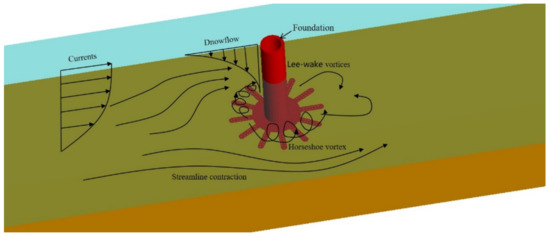
1.2. Engineering Approach of Microfluidic Transport Phenomena in LOC Systems

Different transport mechanisms exhibit unique properties at submillimeter length scales in microfluidic devices, leading to significant transport phenomena that differ from those of macroscale flows. An in-depth understanding of these unique transport phenomena under microfluidic systems is often required in fluidic mechanics to fully harness the potential functionality of a LOC system to obtain systematically designed and precisely controlled transport of microfluids under their respective driving force. Fluid mechanics is considered a vital component in chemical engineering, enabling the analysis of fluid behaviors in various unit designs, ranging from large-scale reactors to separation units. Transport phenomena in fluid mechanics provide a conceptual framework for analytically and descriptively explaining why and how experimental results and physiological phenomena occur. The Navier–Stokes (N–S) equation, along with other governing equations, is often adapted to accurately describe fluid dynamics by accounting for pressure, surface properties, velocity, and temperature variations over space and time. In addition, limiting factors and nonidealities for these governing equations should be considered to impose corrections for empirical consistency before physical models are assembled for more accurate controls and efficiency. Microfluidic flow systems often deviate from ideal conditions, requiring adjustments to the standard governing equations. These deviations could arise from factors such as viscous effects, surface interactions, and non-Newtonian fluid properties from different microfluid types and geometrical layouts of microchannels. Addressing these nonidealities supports the refining of theoretical models and prediction accuracy for microfluidic flow behaviors.

The analytical calculation of coupled nonlinear governing equations, which describes the material and energy balances of systems under ideal conditions, often requires considerable computational efforts. However, advancements in computation capabilities, cost reduction, and improved accuracy have made numerical simulations using different numerical and modeling methods a powerful tool for effectively solving these complex coupled equations and modeling various transport phenomena. Computational fluid dynamics (CFD) is a numerical technique used to investigate the spatial and temporal distribution of various flow parameters. It serves as a critical approach to provide insights and reasoning for decision-making regarding the optimal designs involving fluid dynamics, even prior to complex physical model prototyping and experimental procedures. The integration of experimental data, theoretical analysis, and reliable numerical simulations from CFD enables systematic variation of analytical parameters through quantitative analysis, where adjustment to delivery of blood flow and other working fluids in LOC systems can be achieved.

Numerical methods such as the Finite-Difference Method (FDM), Finite-Element-Method (FEM), and Finite-Volume Method (FVM) are heavily employed in CFD and offer diverse approaches to achieve discretization of Eulerian flow equations through filling a mesh of the flow domain. A more in-depth review of numerical methods in CFD and its application for blood flow simulation is provided in Section 2.2.2.

1.3. Scope of the Review

In this Review, we explore and characterize the blood flow phenomena within the LOC systems, utilizing both physiological and engineering modeling approaches. Similar approaches will be taken to discuss capillary-driven flow and electric-osmotic flow (EOF) under electrokinetic phenomena as a passive and active transport scheme, respectively, for blood transport in LOC systems. Such an analysis aims to bridge the gap between physical (experimental) and engineering (analytical) perspectives in studying and manipulating blood flow delivery by different driving forces in LOC systems. Moreover, the Review hopes to benefit the interests of not only blood flow control in LOC devices but also the transport of viscoelastic fluids, which are less studied in the literature compared to that of Newtonian fluids, in LOC systems.

Section 2 examines the complex interplay between viscoelastic properties of blood and blood flow patterns under shear flow in LOC systems, while engineering numerical modeling approaches for blood flow are presented for assistance. Sections 3 and 4 look into the theoretical principles, numerical governing equations, and modeling methodologies for capillary driven flow and EOF in LOC systems as well as their impact on blood flow dynamics through the quantification of key parameters of the two driving forces. Section 5 concludes the characterized blood flow transport processes in LOC systems under these two forces. Additionally, prospective areas of research in improving the functionality of LOC devices employing blood and other viscoelastic fluids and potentially justifying mechanisms underlying microfluidic flow patterns outside of LOC systems are presented. Finally, the challenges encountered in the numerical studies of blood flow under LOC systems are acknowledged, paving the way for further research.

2. Blood Flow Phenomena

ARTICLE SECTIONS

Jump To


2.1. Physiological Blood Flow Behavior

Blood, an essential physiological fluid in the human body, serves the vital role of transporting oxygen and nutrients throughout the body. Additionally, blood is responsible for suspending various blood cells including erythrocytes (red blood cells or RBCs), leukocytes (white blood cells), and thrombocytes (blood platelets) in a plasma medium.Among the cells mentioned above, red blood cells (RBCs) comprise approximately 40–45% of the volume of healthy blood. 

(7) An RBC possesses an inherent elastic property with a biconcave shape of an average diameter of 8 μm and a thickness of 2 μm. This biconcave shape maximizes the surface-to-volume ratio, allowing RBCs to endure significant distortion while maintaining their functionality. 

(8,9) Additionally, the biconcave shape optimizes gas exchange, facilitating efficient uptake of oxygen due to the increased surface area. The inherent elasticity of RBCs allows them to undergo substantial distortion from their original biconcave shape and exhibits high flexibility, particularly in narrow channels.RBC deformability enables the cell to deform from a biconcave shape to a parachute-like configuration, despite minor differences in RBC shape dynamics under shear flow between initial cell locations. As shown in Figure 1(a), RBCs initiating with different resting shapes and orientations displaying display a similar deformation pattern 

(10) in terms of its shape. Shear flow induces an inward bending of the cell at the rear position of the rim to the final bending position, 

(11) resulting in an alignment toward the same position of the flow direction.

Figure 1. Images of varying deformation of RBCs and different dynamic blood flow behaviors. (a) The deforming shape behavior of RBCs at four different initiating positions under the same experimental conditions of a flow from left to right, (10) (b) RBC aggregation, (13) (c) CFL region. (18) Reproduced with permission from ref (10). Copyright 2011 Elsevier. Reproduced with permission from ref (13). Copyright 2022 The Authors, under the terms of the Creative Commons (CC BY 4.0) License https://creativecommons.org/licenses/by/4.0/. Reproduced with permission from ref (18). Copyright 2019 Elsevier.

The flexible property of RBCs enables them to navigate through narrow capillaries and traverse a complex network of blood vessels. The deformability of RBCs depends on various factors, including the channel geometry, RBC concentration, and the elastic properties of the RBC membrane. 

(12) Both flexibility and deformability are vital in the process of oxygen exchange among blood and tissues throughout the body, allowing cells to flow in vessels even smaller than the original cell size prior to deforming.As RBCs serve as major components in blood, their collective dynamics also hugely affect blood rheology. RBCs exhibit an aggregation phenomenon due to cell to cell interactions, such as adhesion forces, among populated cells, inducing unique blood flow patterns and rheological behaviors in microfluidic systems. For blood flow in large vessels between a diameter of 1 and 3 cm, where shear rates are not high, a constant viscosity and Newtonian behavior for blood can be assumed. However, under low shear rate conditions (0.1 s

–1) in smaller vessels such as the arteries and venules, which are within a diameter of 0.2 mm to 1 cm, blood exhibits non-Newtonian properties, such as shear-thinning viscosity and viscoelasticity due to RBC aggregation and deformability. The nonlinear viscoelastic property of blood gives rise to a complex relationship between viscosity and shear rate, primarily influenced by the highly elastic behavior of RBCs. A wide range of research on the transient behavior of the RBC shape and aggregation characteristics under varied flow circumstances has been conducted, aiming to obtain a better understanding of the interaction between blood flow shear forces from confined flows.

For a better understanding of the unique blood flow structures and rheological behaviors in microfluidic systems, some blood flow patterns are introduced in the following section.

2.1.1. RBC Aggregation

RBC aggregation is a vital phenomenon to be considered when designing LOC devices due to its impact on the viscosity of the bulk flow. Under conditions of low shear rate, such as in stagnant or low flow rate regions, RBCs tend to aggregate, forming structures known as rouleaux, resembling stacks of coins as shown in Figure 1(b). 

(13) The aggregation of RBCs increases the viscosity at the aggregated region, 

(14) hence slowing down the overall blood flow. However, when exposed to high shear rates, RBC aggregates disaggregate. As shear rates continue to increase, RBCs tend to deform, elongating and aligning themselves with the direction of the flow. 

(15) Such a dynamic shift in behavior from the cells in response to the shear rate forms the basis of the viscoelastic properties observed in whole blood. In essence, the viscosity of the blood varies according to the shear rate conditions, which are related to the velocity gradient of the system. It is significant to take the intricate relationship between shear rate conditions and the change of blood viscosity due to RBC aggregation into account since various flow driving conditions may induce varied effects on the degree of aggregation.

2.1.2. Fåhræus-Lindqvist Effect

The Fåhræus–Lindqvist (FL) effect describes the gradual decrease in the apparent viscosity of blood as the channel diameter decreases. 

(16) This effect is attributed to the migration of RBCs toward the central region in the microchannel, where the flow rate is higher, due to the presence of higher pressure and asymmetric distribution of shear forces. This migration of RBCs, typically observed at blood vessels less than 0.3 mm, toward the higher flow rate region contributes to the change in blood viscosity, which becomes dependent on the channel size. Simultaneously, the increase of the RBC concentration in the central region of the microchannel results in the formation of a less viscous region close to the microchannel wall. This region called the Cell-Free Layer (CFL), is primarily composed of plasma. 

(17) The combination of the FL effect and the following CFL formation provides a unique phenomenon that is often utilized in passive and active plasma separation mechanisms, involving branched and constriction channels for various applications in plasma separation using microfluidic systems.

2.1.3. Cell-Free Layer Formation

In microfluidic blood flow, RBCs form aggregates at the microchannel core and result in a region that is mostly devoid of RBCs near the microchannel walls, as shown in Figure 1(c). 

(18) The region is known as the cell-free layer (CFL). The CFL region is often known to possess a lower viscosity compared to other regions within the blood flow due to the lower viscosity value of plasma when compared to that of the aggregated RBCs. Therefore, a thicker CFL region composed of plasma correlates to a reduced apparent whole blood viscosity. 

(19) A thicker CFL region is often established following the RBC aggregation at the microchannel core under conditions of decreasing the tube diameter. Apart from the dependence on the RBC concentration in the microchannel core, the CFL thickness is also affected by the volume concentration of RBCs, or hematocrit, in whole blood, as well as the deformability of RBCs. Given the influence CFL thickness has on blood flow rheological parameters such as blood flow rate, which is strongly dependent on whole blood viscosity, investigating CFL thickness under shear flow is crucial for LOC systems accounting for blood flow.

2.1.4. Plasma Skimming in Bifurcation Networks

The uneven arrangement of RBCs in bifurcating microchannels, commonly termed skimming bifurcation, arises from the axial migration of RBCs within flowing streams. This uneven distribution contributes to variations in viscosity across differing sizes of bifurcating channels but offers a stabilizing effect. Notably, higher flow rates in microchannels are associated with increased hematocrit levels, resulting in higher viscosity compared with those with lower flow rates. Parametric investigations on bifurcation angle, 

(20) thickness of the CFL, 

(21) and RBC dynamics, including aggregation and deformation, 

(22) may alter the varying viscosity of blood and its flow behavior within microchannels.

2.2. Modeling on Blood Flow Dynamics

2.2.1. Blood Properties and Mathematical Models of Blood Rheology

Under different shear rate conditions in blood flow, the elastic characteristics and dynamic changes of the RBC induce a complex velocity and stress relationship, resulting in the incompatibility of blood flow characterization through standard presumptions of constant viscosity used for Newtonian fluid flow. Blood flow is categorized as a viscoelastic non-Newtonian fluid flow where constitutive equations governing this type of flow take into consideration the nonlinear viscometric properties of blood. To mathematically characterize the evolving blood viscosity and the relationship between the elasticity of RBC and the shear blood flow, respectively, across space and time of the system, a stress tensor (τ) defined by constitutive models is often coupled in the Navier–Stokes equation to account for the collective impact of the constant dynamic viscosity (η) and the elasticity from RBCs on blood flow.The dynamic viscosity of blood is heavily dependent on the shear stress applied to the cell and various parameters from the blood such as hematocrit value, plasma viscosity, mechanical properties of the RBC membrane, and red blood cell aggregation rate. The apparent blood viscosity is considered convenient for the characterization of the relationship between the evolving blood viscosity and shear rate, which can be defined by Casson’s law, as shown in eq 1.

𝜇=𝜏0𝛾˙+2𝜂𝜏0𝛾˙⎯⎯⎯⎯⎯⎯⎯√+𝜂�=�0�˙+2��0�˙+�

(1)where τ

0 is the yield stress–stress required to initiate blood flow motion, η is the Casson rheological constant, and γ̇ is the shear rate. The value of Casson’s law parameters under blood with normal hematocrit level can be defined as τ

0 = 0.0056 Pa and η = 0.0035 Pa·s. 

(23) With the known property of blood and Casson’s law parameters, an approximation can be made to the dynamic viscosity under various flow condition domains. The Power Law model is often employed to characterize the dynamic viscosity in relation to the shear rate, since precise solutions exist for specific geometries and flow circumstances, acting as a fundamental standard for definition. The Carreau and Carreau–Yasuda models can be advantageous over the Power Law model due to their ability to evaluate the dynamic viscosity at low to zero shear rate conditions. However, none of the above-mentioned models consider the memory or other elastic behavior of blood and its RBCs. Some other commonly used mathematical models and their constants for the non-Newtonian viscosity property characterization of blood are listed in Table 1 below. 

(24−26)Table 1. Comparison of Various Non-Newtonian Models for Blood Viscosity 

(24−26)

ModelNon-Newtonian ViscosityParameters
Power Law(2)n = 0.61, k = 0.42
Carreau(3)μ0 = 0.056 Pa·s, μ = 0.00345 Pa·s, λ = 3.1736 s, m = 2.406, a = 0.254
Walburn–Schneck(4)C1 = 0.000797 Pa·s, C2 = 0.0608 Pa·s, C3 = 0.00499, C4 = 14.585 g–1, TPMA = 25 g/L
Carreau–Yasuda(5)μ0 = 0.056 Pa·s, μ = 0.00345 Pa·s, λ = 1.902 s, n = 0.22, a = 1.25
Quemada(6)μp = 0.0012 Pa·s, k = 2.07, k0 = 4.33, γ̇c = 1.88 s–1

The blood rheology is commonly known to be influenced by two key physiological factors, namely, the hematocrit value (H

t) and the fibrinogen concentration (c

f), with an average value of 42% and 0.252 gd·L

–1, respectively. Particularly in low shear conditions, the presence of varying fibrinogen concentrations affects the tendency for aggregation and rouleaux formation, while the occurrence of aggregation is contingent upon specific levels of hematocrit. 

(27) The study from Apostolidis et al. 

(28) modifies the Casson model through emphasizing its reliance on hematocrit and fibrinogen concentration parameter values, owing to the extensive knowledge of the two physiological blood parameters.The viscoelastic response of blood is heavily dependent on the elasticity of the RBC, which is defined by the relationship between the deformation and stress relaxation from RBCs under a specific location of shear flow as a function of the velocity field. The stress tensor is usually characterized by constitutive equations such as the Upper-Convected Maxwell Model 

(29) and the Oldroyd-B model 

(30) to track the molecule effects under shear from different driving forces. The prominent non-Newtonian features, such as shear thinning and yield stress, have played a vital role in the characterization of blood rheology, particularly with respect to the evaluation of yield stress under low shear conditions. The nature of stress measurement in blood, typically on the order of 1 mPa, is challenging due to its low magnitude. The occurrence of the CFL complicates the measurement further due to the significant decrease in apparent viscosity near the wall over time and a consequential disparity in viscosity compared to the bulk region.In addition to shear thinning viscosity and yield stress, the formation of aggregation (rouleaux) from RBCs under low shear rates also contributes to the viscoelasticity under transient flow 

(31) and thixotropy 

(32) of whole blood. Given the difficulty in evaluating viscoelastic behavior of blood under low strain magnitudes and limitations in generalized Newtonian models, the utilization of viscoelastic models is advocated to encompass elasticity and delineate non-shear components within the stress tensor. Extending from the Oldroyd-B model, Anand et al. 

(33) developed a viscoelastic model framework for adapting elasticity within blood samples and predicting non-shear stress components. However, to also address the thixotropic effects, the model developed by Horner et al. 

(34) serves as a more comprehensive approach than the viscoelastic model from Anand et al. Thixotropy 

(32) typically occurs from the structural change of the rouleaux, where low shear rate conditions induce rouleaux formation. Correspondingly, elasticity increases, while elasticity is more representative of the isolated RBCs, under high shear rate conditions. The model of Horner et al. 

(34) considers the contribution of rouleaux to shear stress, taking into account factors such as the characteristic time for Brownian aggregation, shear-induced aggregation, and shear-induced breakage. Subsequent advancements in the model from Horner et al. often revolve around refining the three aforementioned key terms for a more substantial characterization of rouleaux dynamics. Notably, this has led to the recently developed mHAWB model 

(35) and other model iterations to enhance the accuracy of elastic and viscoelastic contributions to blood rheology, including the recently improved model suggested by Armstrong et al. 

(36)

2.2.2. Numerical Methods (FDM, FEM, FVM)

Numerical simulation has become increasingly more significant in analyzing the geometry, boundary layers of flow, and nonlinearity of hyperbolic viscoelastic flow constitutive equations. CFD is a powerful and efficient tool utilizing numerical methods to solve the governing hydrodynamic equations, such as the Navier–Stokes (N–S) equation, continuity equation, and energy conservation equation, for qualitative evaluation of fluid motion dynamics under different parameters. CFD overcomes the challenge of analytically solving nonlinear forms of differential equations by employing numerical methods such as the Finite-Difference Method (FDM), Finite-Element Method (FEM), and Finite-Volume Method (FVM) to discretize and solve the partial differential equations (PDEs), allowing for qualitative reproduction of transport phenomena and experimental observations. Different numerical methods are chosen to cope with various transport systems for optimization of the accuracy of the result and control of error during the discretization process.FDM is a straightforward approach to discretizing PDEs, replacing the continuum representation of equations with a set of finite-difference equations, which is typically applied to structured grids for efficient implementation in CFD programs. 

(37) However, FDM is often limited to simple geometries such as rectangular or block-shaped geometries and struggles with curved boundaries. In contrast, FEM divides the fluid domain into small finite grids or elements, approximating PDEs through a local description of physics. 

(38) All elements contribute to a large, sparse matrix solver. However, FEM may not always provide accurate results for systems involving significant deformation and aggregation of particles like RBCs due to large distortion of grids. 

(39) FVM evaluates PDEs following the conservation laws and discretizes the selected flow domain into small but finite size control volumes, with each grid at the center of a finite volume. 

(40) The divergence theorem allows the conversion of volume integrals of PDEs with divergence terms into surface integrals of surface fluxes across cell boundaries. Due to its conservation property, FVM offers efficient outcomes when dealing with PDEs that embody mass, momentum, and energy conservation principles. Furthermore, widely accessible software packages like the OpenFOAM toolbox 

(41) include a viscoelastic solver, making it an attractive option for viscoelastic fluid flow modeling. 

(42)

2.2.3. Modeling Methods of Blood Flow Dynamics

The complexity in the blood flow simulation arises from deformability and aggregation that RBCs exhibit during their interaction with neighboring cells under different shear rate conditions induced by blood flow. Numerical models coupled with simulation programs have been applied as a groundbreaking method to predict such unique rheological behavior exhibited by RBCs and whole blood. The conventional approach of a single-phase flow simulation is often applied to blood flow simulations within large vessels possessing a moderate shear rate. However, such a method assumes the properties of plasma, RBCs and other cellular components to be evenly distributed as average density and viscosity in blood, resulting in the inability to simulate the mechanical dynamics, such as RBC aggregation under high-shear flow field, inherent in RBCs. To accurately describe the asymmetric distribution of RBC and blood flow, multiphase flow simulation, where numerical simulations of blood flows are often modeled as two immiscible phases, RBCs and blood plasma, is proposed. A common assumption is that RBCs exhibit non-Newtonian behavior while the plasma is treated as a continuous Newtonian phase.Numerous multiphase numerical models have been proposed to simulate the influence of RBCs on blood flow dynamics by different assumptions. In large-scale simulations (above the millimeter range), continuum-based methods are wildly used due to their lower computational demands. 

(43) Eulerian multiphase flow simulations offer the solution of a set of conservation equations for each separate phase and couple the phases through common pressure and interphase exchange coefficients. Xu et al. 

(44) utilized the combined finite-discrete element method (FDEM) to replicate the dynamic behavior and distortion of RBCs subjected to fluidic forces, utilizing the Johnson–Kendall–Roberts model 

(45) to define the adhesive forces of cell-to-cell interactions. The iterative direct-forcing immersed boundary method (IBM) is commonly employed in simulations of the fluid–cell interface of blood. This method effectively captures the intricacies of the thin and flexible RBC membranes within various external flow fields. 

(46) The study by Xu et al. 

(44) also adopts this approach to bridge the fluid dynamics and RBC deformation through IBM. Yoon and You utilized the Maxwell model to define the viscosity of the RBC membrane. 

(47) It was discovered that the Maxwell model could represent the stress relaxation and unloading processes of the cell. Furthermore, the reduced flexibility of an RBC under particular situations such as infection is specified, which was unattainable by the Kelvin–Voigt model 

(48) when compared to the Maxwell model in the literature. The Yeoh hyperplastic material model was also adapted to predict the nonlinear elasticity property of RBCs with FEM employed to discretize the RBC membrane using shell-type elements. Gracka et al. 

(49) developed a numerical CFD model with a finite-volume parallel solver for multiphase blood flow simulation, where an updated Maxwell viscoelasticity model and a Discrete Phase Model are adopted. In the study, the adapted IBM, based on unstructured grids, simulates the flow behavior and shape change of the RBCs through fluid-structure coupling. It was found that the hybrid Euler–Lagrange (E–L) approach 

(50) for the development of the multiphase model offered better results in the simulated CFL region in the microchannels.To study the dynamics of individual behaviors of RBCs and the consequent non-Newtonian blood flow, cell-shape-resolved computational models are often adapted. The use of the boundary integral method has become prevalent in minimizing computational expenses, particularly in the exclusive determination of fluid velocity on the surfaces of RBCs, incorporating the option of employing IBM or particle-based techniques. The cell-shaped-resolved method has enabled an examination of cell to cell interactions within complex ambient or pulsatile flow conditions 

(51) surrounding RBC membranes. Recently, Rydquist et al. 

(52) have looked to integrate statistical information from macroscale simulations to obtain a comprehensive overview of RBC behavior within the immediate proximity of the flow through introduction of respective models characterizing membrane shape definition, tension, bending stresses of RBC membranes.At a macroscopic scale, continuum models have conventionally been adapted for assessing blood flow dynamics through the application of elasticity theory and fluid dynamics. However, particle-based methods are known for their simplicity and adaptability in modeling complex multiscale fluid structures. Meshless methods, such as the boundary element method (BEM), smoothed particle hydrodynamics (SPH), and dissipative particle dynamics (DPD), are often used in particle-based characterization of RBCs and the surrounding fluid. By representing the fluid as discrete particles, meshless methods provide insights into the status and movement of the multiphase fluid. These methods allow for the investigation of cellular structures and microscopic interactions that affect blood rheology. Non-confronting mesh methods like IBM can also be used to couple a fluid solver such as FEM, FVM, or the Lattice Boltzmann Method (LBM) through membrane representation of RBCs. In comparison to conventional CFD methods, LBM has been viewed as a favorable numerical approach for solving the N–S equations and the simulation of multiphase flows. LBM exhibits the notable advantage of being amenable to high-performance parallel computing environments due to its inherently local dynamics. In contrast to DPD and SPH where RBC membranes are modeled as physically interconnected particles, LBM employs the IBM to account for the deformation dynamics of RBCs 

(53,54) under shear flows in complex channel geometries. 

(54,55) However, it is essential to acknowledge that the utilization of LBM in simulating RBC flows often entails a significant computational overhead, being a primary challenge in this context. Krüger et al. 

(56) proposed utilizing LBM as a fluid solver, IBM to couple the fluid and FEM to compute the response of membranes to deformation under immersed fluids. This approach decouples the fluid and membranes but necessitates significant computational effort due to the requirements of both meshes and particles.Despite the accuracy of current blood flow models, simulating complex conditions remains challenging because of the high computational load and cost. Balachandran Nair et al. 

(57) suggested a reduced order model of RBC under the framework of DEM, where the RBC is represented by overlapping constituent rigid spheres. The Morse potential force is adapted to account for the RBC aggregation exhibited by cell to cell interactions among RBCs at different distances. Based upon the IBM, the reduced-order RBC model is adapted to simulate blood flow transport for validation under both single and multiple RBCs with a resolved CFD-DEM solver. 

(58) In the resolved CFD-DEM model, particle sizes are larger than the grid size for a more accurate computation of the surrounding flow field. A continuous forcing approach is taken to describe the momentum source of the governing equation prior to discretization, which is different from a Direct Forcing Method (DFM). 

(59) As no body-conforming moving mesh is required, the continuous forcing approach offers lower complexity and reduced cost when compared to the DFM. Piquet et al. 

(60) highlighted the high complexity of the DFM due to its reliance on calculating an additional immersed boundary flux for the velocity field to ensure its divergence-free condition.The fluid–structure interaction (FSI) method has been advocated to connect the dynamic interplay of RBC membranes and fluid plasma within blood flow such as the coupling of continuum–particle interactions. However, such methodology is generally adapted for anatomical configurations such as arteries 

(61,62) and capillaries, 

(63) where both the structural components and the fluid domain undergo substantial deformation due to the moving boundaries. Due to the scope of the Review being blood flow simulation within microchannels of LOC devices without deformable boundaries, the Review of the FSI method will not be further carried out.In general, three numerical methods are broadly used: mesh-based, particle-based, and hybrid mesh–particle techniques, based on the spatial scale and the fundamental numerical approach, mesh-based methods tend to neglect the effects of individual particles, assuming a continuum and being efficient in terms of time and cost. However, the particle-based approach highlights more of the microscopic and mesoscopic level, where the influence of individual RBCs is considered. A review from Freund et al. 

(64) addressed the three numerical methodologies and their respective modeling approaches of RBC dynamics. Given the complex mechanics and the diverse levels of study concerning numerical simulations of blood and cellular flow, a broad spectrum of numerical methods for blood has been subjected to extensive review. 

(64−70) Ye at al. 

(65) offered an extensive review of the application of the DPD, SPH, and LBM for numerical simulations of RBC, while Rathnayaka et al. 

(67) conducted a review of the particle-based numerical modeling for liquid marbles through drawing parallels to the transport of RBCs in microchannels. A comparative analysis between conventional CFD methods and particle-based approaches for cellular and blood flow dynamic simulation can be found under the review by Arabghahestani et al. 

(66) Literature by Li et al. 

(68) and Beris et al. 

(69) offer an overview of both continuum-based models at micro/macroscales and multiscale particle-based models encompassing various length and temporal dimensions. Furthermore, these reviews deliberate upon the potential of coupling continuum-particle methods for blood plasma and RBC modeling. Arciero et al. 

(70) investigated various modeling approaches encompassing cellular interactions, such as cell to cell or plasma interactions and the individual cellular phases. A concise overview of the reviews is provided in Table 2 for reference.

Table 2. List of Reviews for Numerical Approaches Employed in Blood Flow Simulation

ReferenceNumerical methods
Li et al. (2013) (68)Continuum-based modeling (BIM), particle-based modeling (LBM, LB-FE, SPH, DPD)
Freund (2014) (64)RBC dynamic modeling (continuum-based modeling, complementary discrete microstructure modeling), blood flow dynamic modeling (FDM, IBM, LBM, particle-mesh methods, coupled boundary integral and mesh-based methods, DPD)
Ye et al. (2016) (65)DPD, SPH, LBM, coupled IBM-Smoothed DPD
Arciero et al. (2017) (70)LBM, IBM, DPD, conventional CFD Methods (FDM, FVM, FEM)
Arabghahestani et al. (2019) (66)Particle-based methods (LBM, DPD, direct simulation Monte Carlo, molecular dynamics), SPH, conventional CFD methods (FDM, FVM, FEM)
Beris et al. (2021) (69)DPD, smoothed DPD, IBM, LBM, BIM
Rathnayaka (2022) (67)SPH, CG, LBM

3. Capillary Driven Blood Flow in LOC Systems

ARTICLE SECTIONS

Jump To


3.1. Capillary Driven Flow Phenomena

Capillary driven (CD) flow is a pivotal mechanism in passive microfluidic flow systems 

(9) such as the blood circulation system and LOC systems. 

(71) CD flow is essentially the movement of a liquid to flow against drag forces, where the capillary effect exerts a force on the liquid at the borders, causing a liquid–air meniscus to flow despite gravity or other drag forces. A capillary pressure drops across the liquid–air interface with surface tension in the capillary radius and contact angle. The capillary effect depends heavily on the interaction between the different properties of surface materials. Different values of contact angles can be manipulated and obtained under varying levels of surface wettability treatments to manipulate the surface properties, resulting in different CD blood delivery rates for medical diagnostic device microchannels. CD flow techniques are appealing for many LOC devices, because they require no external energy. However, due to the passive property of liquid propulsion by capillary forces and the long-term instability of surface treatments on channel walls, the adaptability of CD flow in geometrically complex LOC devices may be limited.

3.2. Theoretical and Numerical Modeling of Capillary Driven Blood Flow

3.2.1. Theoretical Basis and Assumptions of Microfluidic Flow

The study of transport phenomena regarding either blood flow driven by capillary forces or externally applied forces under microfluid systems all demands a comprehensive recognition of the significant differences in flow dynamics between microscale and macroscale. The fundamental assumptions and principles behind fluid transport at the microscale are discussed in this section. Such a comprehension will lay the groundwork for the following analysis of the theoretical basis of capillary forces and their role in blood transport in LOC systems.

At the macroscale, fluid dynamics are often strongly influenced by gravity due to considerable fluid mass. However, the high surface to volume ratio at the microscale shifts the balance toward surface forces (e.g., surface tension and viscous forces), much larger than the inertial force. This difference gives rise to transport phenomena unique to microscale fluid transport, such as the prevalence of laminar flow due to a very low Reynolds number (generally lower than 1). Moreover, the fluid in a microfluidic system is often assumed to be incompressible due to the small flow velocity, indicating constant fluid density in both space and time.Microfluidic flow behaviors are governed by the fundamental principles of mass and momentum conservation, which are encapsulated in the continuity equation and the Navier–Stokes (N–S) equation. The continuity equation describes the conservation of mass, while the N–S equation captures the spatial and temporal variations in velocity, pressure, and other physical parameters. Under the assumption of the negligible influence of gravity in microfluidic systems, the continuity equation and the Eulerian representation of the incompressible N–S equation can be expressed as follows:

∇·𝐮⇀=0∇·�⇀=0

(7)

−∇𝑝+𝜇∇2𝐮⇀+∇·𝝉⇀−𝐅⇀=0−∇�+�∇2�⇀+∇·�⇀−�⇀=0

(8)Here, p is the pressure, u is the fluid viscosity, 

𝝉⇀�⇀ represents the stress tensor, and F is the body force exerted by external forces if present.

3.2.2. Theoretical Basis and Modeling of Capillary Force in LOC Systems

The capillary force is often the major driving force to manipulate and transport blood without an externally applied force in LOC systems. Forces induced by the capillary effect impact the free surface of fluids and are represented not directly in the Navier–Stokes equations but through the pressure boundary conditions of the pressure term p. For hydrophilic surfaces, the liquid generally induces a contact angle between 0° and 30°, encouraging the spread and attraction of fluid under a positive cos θ condition. For this condition, the pressure drop becomes positive and generates a spontaneous flow forward. A hydrophobic solid surface repels the fluid, inducing minimal contact. Generally, hydrophobic solids exhibit a contact angle larger than 90°, inducing a negative value of cos θ. Such a value will result in a negative pressure drop and a flow in the opposite direction. The induced contact angle is often utilized to measure the wall exposure of various surface treatments on channel walls where different wettability gradients and surface tension effects for CD flows are established. Contact angles between different interfaces are obtainable through standard values or experimental methods for reference. 

(72)For the characterization of the induced force by the capillary effect, the Young–Laplace (Y–L) equation 

(73) is widely employed. In the equation, the capillary is considered a pressure boundary condition between the two interphases. Through the Y–L equation, the capillary pressure force can be determined, and subsequently, the continuity and momentum balance equations can be solved to obtain the blood filling rate. Kim et al. 

(74) studied the effects of concentration and exposure time of a nonionic surfactant, Silwet L-77, on the performance of a polydimethylsiloxane (PDMS) microchannel in terms of plasma and blood self-separation. The study characterized the capillary pressure force by incorporating the Y–L equation and further evaluated the effects of the changing contact angle due to different levels of applied channel wall surface treatments. The expression of the Y–L equation utilized by Kim et al. 

(74) is as follows:

𝑃=−𝜎(cos𝜃b+cos𝜃tℎ+cos𝜃l+cos𝜃r𝑤)�=−�(cos⁡�b+cos⁡�tℎ+cos⁡�l+cos⁡�r�)

(9)where σ is the surface tension of the liquid and θ

bθ

tθ

l, and θ

r are the contact angle values between the liquid and the bottom, top, left, and right walls, respectively. A numerical simulation through Coventor software is performed to evaluate the dynamic changes in the filling rate within the microchannel. The simulation results for the blood filling rate in the microchannel are expressed at a specific time stamp, shown in Figure 2. The results portray an increasing instantaneous filling rate of blood in the microchannel following the decrease in contact angle induced by a higher concentration of the nonionic surfactant treated to the microchannel wall.

Figure 2. Numerical simulation of filling rate of capillary driven blood flow under various contact angle conditions at a specific timestamp. (74) Reproduced with permission from ref (74). Copyright 2010 Elsevier.

When in contact with hydrophilic or hydrophobic surfaces, blood forms a meniscus with a contact angle due to surface tension. The Lucas–Washburn (L–W) equation 

(75) is one of the pioneering theoretical definitions for the position of the meniscus over time. In addition, the L–W equation provides the possibility for research to obtain the velocity of the blood formed meniscus through the derivation of the meniscus position. The L–W equation 

(75) can be shown below:

𝐿(𝑡)=𝑅𝜎cos(𝜃)𝑡2𝜇⎯⎯⎯⎯⎯⎯⎯⎯⎯⎯⎯⎯⎯⎯⎯⎯⎯⎯√�(�)=��⁡cos(�)�2�

(10)Here L(t) represents the distance of the liquid driven by the capillary forces. However, the generalized L–W equation solely assumes the constant physical properties from a Newtonian fluid rather than considering the non-Newtonian fluid behavior of blood. Cito et al. 

(76) constructed an enhanced version of the L–W equation incorporating the power law to consider the RBC aggregation and the FL effect. The non-Newtonian fluid apparent viscosity under the Power Law model is defined as

𝜇=𝑘·(𝛾˙)𝑛−1�=�·(�˙)�−1

(11)where γ̇ is the strain rate tensor defined as 

𝛾˙=12𝛾˙𝑖𝑗𝛾˙𝑗𝑖⎯⎯⎯⎯⎯⎯⎯⎯⎯⎯⎯√�˙=12�˙���˙��. The stress tensor term τ is computed as τ = μγ̇

ij. The updated L–W equation by Cito 

(76) is expressed as

𝐿(𝑡)=𝑅[(𝑛+13𝑛+1)(𝜎cos(𝜃)𝑅𝑘)1/𝑛𝑡]𝑛/𝑛+1�(�)=�[(�+13�+1)(�⁡cos(�)��)1/��]�/�+1

(12)where k is the flow consistency index and n is the power law index, respectively. The power law index, from the Power Law model, characterizes the extent of the non-Newtonian behavior of blood. Both the consistency and power law index rely on blood properties such as hematocrit, the appearance of the FL effect, the formation of RBC aggregates, etc. The updated L–W equation computes the location and velocity of blood flow caused by capillary forces at specified time points within the LOC devices, taking into account the effects of blood flow characteristics such as RBC aggregation and the FL effect on dynamic blood viscosity.Apart from the blood flow behaviors triggered by inherent blood properties, unique flow conditions driven by capillary forces that are portrayed under different microchannel geometries also hold crucial implications for CD blood delivery. Berthier et al. 

(77) studied the spontaneous Concus–Finn condition, the condition to initiate the spontaneous capillary flow within a V-groove microchannel, as shown in Figure 3(a) both experimentally and numerically. Through experimental studies, the spontaneous Concus–Finn filament development of capillary driven blood flow is observed, as shown in Figure 3(b), while the dynamic development of blood flow is numerically simulated through CFD simulation.

Figure 3. (a) Sketch of the cross-section of Berthier’s V-groove microchannel, (b) experimental view of blood in the V-groove microchannel, (78) (c) illustration of the dynamic change of the extension of filament from FLOW 3D under capillary flow at three increasing time intervals. (78) Reproduced with permission from ref (78). Copyright 2014 Elsevier.

Berthier et al. 

(77) characterized the contact angle needed for the initiation of the capillary driving force at a zero-inlet pressure, through the half-angle (α) of the V-groove geometry layout, and its relation to the Concus–Finn filament as shown below:

𝜃<𝜋2−𝛼sin𝛼1+2(ℎ2/𝑤)sin𝛼<cos𝜃{�<�2−�sin⁡�1+2(ℎ2/�)⁡sin⁡�<cos⁡�

(13)Three possible regimes were concluded based on the contact angle value for the initiation of flow and development of Concus–Finn filament:

𝜃>𝜃1𝜃1>𝜃>𝜃0𝜃0no SCFSCF without a Concus−Finn filamentSCF without a Concus−Finn filament{�>�1no SCF�1>�>�0SCF without a Concus−Finn filament�0SCF without a Concus−Finn filament

(14)Under Newton’s Law, the force balance with low Reynolds and Capillary numbers results in the neglect of inertial terms. The force balance between the capillary forces and the viscous force induced by the channel wall is proposed to derive the analytical fluid velocity. This relation between the two forces offers insights into the average flow velocity and the penetration distance function dependent on time. The apparent blood viscosity is defined by Berthier et al. 

(78) through Casson’s law, 

(23) given in eq 1. The research used the FLOW-3D program from Flow Science Inc. software, which solves transient, free-surface problems using the FDM in multiple dimensions. The Volume of Fluid (VOF) method 

(79) is utilized to locate and track the dynamic extension of filament throughout the advancing interface within the channel ahead of the main flow at three progressing time stamps, as depicted in Figure 3(c).

4. Electro-osmotic Flow (EOF) in LOC Systems

ARTICLE SECTIONS

Jump To


The utilization of external forces, such as electric fields, has significantly broadened the possibility of manipulating microfluidic flow in LOC systems. 

(80) Externally applied electric field forces induce a fluid flow from the movement of ions in fluid terms as the “electro-osmotic flow” (EOF).Unique transport phenomena, such as enhanced flow velocity and flow instability, induced by non-Newtonian fluids, particularly viscoelastic fluids, under EOF, have sparked considerable interest in microfluidic devices with simple or complicated geometries within channels. 

(81) However, compared to the study of Newtonian fluids and even other electro-osmotic viscoelastic fluid flows, the literature focusing on the theoretical and numerical modeling of electro-osmotic blood flow is limited due to the complexity of blood properties. Consequently, to obtain a more comprehensive understanding of the complex blood flow behavior under EOF, theoretical and numerical studies of the transport phenomena in the EOF section will be based on the studies of different viscoelastic fluids under EOF rather than that of blood specifically. Despite this limitation, we believe these studies offer valuable insights that can help understand the complex behavior of blood flow under EOF.

4.1. EOF Phenomena

Electro-osmotic flow occurs at the interface between the microchannel wall and bulk phase solution. When in contact with the bulk phase, solution ions are absorbed or dissociated at the solid–liquid interface, resulting in the formation of a charge layer, as shown in Figure 4. This charged channel surface wall interacts with both negative and positive ions in the bulk sample, causing repulsion and attraction forces to create a thin layer of immobilized counterions, known as the Stern layer. The induced electric potential from the wall gradually decreases with an increase in the distance from the wall. The Stern layer potential, commonly termed the zeta potential, controls the intensity of the electrostatic interactions between mobile counterions and, consequently, the drag force from the applied electric field. Next to the Stern layer is the diffuse mobile layer, mainly composed of a mobile counterion. These two layers constitute the “electrical double layer” (EDL), the thickness of which is directly proportional to the ionic strength (concentration) of the bulk fluid. The relationship between the two parameters is characterized by a Debye length (λ

D), expressed as

𝜆𝐷=𝜖𝑘B𝑇2(𝑍𝑒)2𝑐0⎯⎯⎯⎯⎯⎯⎯⎯⎯⎯⎯⎯⎯⎯⎯⎯√��=��B�2(��)2�0

(15)where ϵ is the permittivity of the electrolyte solution, k

B is the Boltzmann constant, T is the electron temperature, Z is the integer valence number, e is the elementary charge, and c

0 is the ionic density.

Figure 4. Schematic diagram of an electro-osmotic flow in a microchannel with negative surface charge. (82) Reproduced with permission from ref (82). Copyright 2012 Woodhead Publishing.

When an electric field is applied perpendicular to the EDL, viscous drag is generated due to the movement of excess ions in the EDL. Electro-osmotic forces can be attributed to the externally applied electric potential (ϕ) and the zeta potential, the system wall induced potential by charged walls (ψ). As illustrated in Figure 4, the majority of ions in the bulk phase have a uniform velocity profile, except for a shear rate condition confined within an extremely thin Stern layer. Therefore, EOF displays a unique characteristic of a “near flat” or plug flow velocity profile, different from the parabolic flow typically induced by pressure-driven microfluidic flow (Hagen–Poiseuille flow). The plug-shaped velocity profile of the EOF possesses a high shear rate above the Stern layer.Overall, the EOF velocity magnitude is typically proportional to the Debye Length (λ

D), zeta potential, and magnitude of the externally applied electric field, while a more viscous liquid reduces the EOF velocity.

4.2. Modeling on Electro-osmotic Viscoelastic Fluid Flow

4.2.1. Theoretical Basis of EOF Mechanisms

The EOF of an incompressible viscoelastic fluid is commonly governed by the continuity and incompressible N–S equations, as shown in eqs 7 and 8, where the stress tensor and the electrostatic force term are coupled. The electro-osmotic body force term F, representing the body force exerted by the externally applied electric force, is defined as 

𝐹⇀=𝑝𝐸𝐸⇀�⇀=���⇀, where ρ

E and 

𝐸⇀�⇀ are the net electric charge density and the applied external electric field, respectively.Numerous models are established to theoretically study the externally applied electric potential and the system wall induced potential by charged walls. The following Laplace equation, expressed as eq 16, is generally adapted and solved to calculate the externally applied potential (ϕ).

∇2𝜙=0∇2�=0

(16)Ion diffusion under applied electric fields, together with mass transport resulting from convection and diffusion, transports ionic solutions in bulk flow under electrokinetic processes. The Nernst–Planck equation can describe these transport methods, including convection, diffusion, and electro-diffusion. Therefore, the Nernst–Planck equation is used to determine the distribution of the ions within the electrolyte. The electric potential induced by the charged channel walls follows the Poisson–Nernst–Plank (PNP) equation, which can be written as eq 17.

∇·[𝐷𝑖∇𝑛𝑖−𝑢⇀𝑛𝑖+𝑛𝑖𝐷𝑖𝑧𝑖𝑒𝑘𝑏𝑇∇(𝜙+𝜓)]=0∇·[��∇��−�⇀��+����������∇(�+�)]=0

(17)where D

in

i, and z

i are the diffusion coefficient, ionic concentration, and ionic valence of the ionic species I, respectively. However, due to the high nonlinearity and numerical stiffness introduced by different lengths and time scales from the PNP equations, the Poisson–Boltzmann (PB) model is often considered the major simplified method of the PNP equation to characterize the potential distribution of the EDL region in microchannels. In the PB model, it is assumed that the ionic species in the fluid follow the Boltzmann distribution. This model is typically valid for steady-state problems where charge transport can be considered negligible, the EDLs do not overlap with each other, and the intrinsic potentials are low. It provides a simplified representation of the potential distribution in the EDL region. The PB equation governing the EDL electric potential distribution is described as

∇2𝜓=(2𝑒𝑧𝑛0𝜀𝜀0)sinh(𝑧𝑒𝜓𝑘b𝑇)∇2�=(2���0��0)⁡sinh(����b�)

(18)where n

0 is the ion bulk concentration, z is the ionic valence, and ε

0 is the electric permittivity in the vacuum. Under low electric potential conditions, an even further simplified model to illustrate the EOF phenomena is the Debye–Hückel (DH) model. The DH model is derived by obtaining a charge density term by expanding the exponential term of the Boltzmann equation in a Taylor series.

4.2.2. EOF Modeling for Viscoelastic Fluids

Many studies through numerical modeling were performed to obtain a deeper understanding of the effect exhibited by externally applied electric fields on viscoelastic flow in microchannels under various geometrical designs. Bello et al. 

(83) found that methylcellulose solution, a non-Newtonian polymer solution, resulted in stronger electro-osmotic mobility in experiments when compared to the predictions by the Helmholtz–Smoluchowski equation, which is commonly used to define the velocity of EOF of a Newtonian fluid. Being one of the pioneers to identify the discrepancies between the EOF of Newtonian and non-Newtonian fluids, Bello et al. attributed such discrepancies to the presence of a very high shear rate in the EDL, resulting in a change in the orientation of the polymer molecules. Park and Lee 

(84) utilized the FVM to solve the PB equation for the characterization of the electric field induced force. In the study, the concept of fractional calculus for the Oldroyd-B model was adapted to illustrate the elastic and memory effects of viscoelastic fluids in a straight microchannel They observed that fluid elasticity and increased ratio of viscoelastic fluid contribution to overall fluid viscosity had a significant impact on the volumetric flow rate and sensitivity of velocity to electric field strength compared to Newtonian fluids. Afonso et al. 

(85) derived an analytical expression for EOF of viscoelastic fluid between parallel plates using the DH model to account for a zeta potential condition below 25 mV. The study established the understanding of the electro-osmotic viscoelastic fluid flow under low zeta potential conditions. Apart from the electrokinetic forces, pressure forces can also be coupled with EOF to generate a unique fluid flow behavior within the microchannel. Sousa et al. 

(86) analytically studied the flow of a standard viscoelastic solution by combining the pressure gradient force with an externally applied electric force. It was found that, at a near wall skimming layer and the outer layer away from the wall, macromolecules migrating away from surface walls in viscoelastic fluids are observed. In the study, the Phan-Thien Tanner (PTT) constitutive model is utilized to characterize the viscoelastic properties of the solution. The approach is found to be valid when the EDL is much thinner than the skimming layer under an enhanced flow rate. Zhao and Yang 

(87) solved the PB equation and Carreau model for the characterization of the EOF mechanism and non-Newtonian fluid respectively through the FEM. The numerical results depict that, different from the EOF of Newtonian fluids, non-Newtonian fluids led to an increase of electro-osmotic mobility for shear thinning fluids but the opposite for shear thickening fluids.Like other fluid transport driving forces, EOF within unique geometrical layouts also portrays unique transport phenomena. Pimenta and Alves 

(88) utilized the FVM to perform numerical simulations of the EOF of viscoelastic fluids considering the PB equation and the Oldroyd-B model, in a cross-slot and flow-focusing microdevices. It was found that electroelastic instabilities are formed due to the development of large stresses inside the EDL with streamlined curvature at geometry corners. Bezerra et al. 

(89) used the FDM to numerically analyze the vortex formation and flow instability from an electro-osmotic non-Newtonian fluid flow in a microchannel with a nozzle geometry and parallel wall geometry setting. The PNP equation is utilized to characterize the charge motion in the EOF and the PTT model for non-Newtonian flow characterization. A constriction geometry is commonly utilized in blood flow adapted in LOC systems due to the change in blood flow behavior under narrow dimensions in a microchannel. Ji et al. 

(90) recently studied the EOF of viscoelastic fluid in a constriction microchannel connected by two relatively big reservoirs on both ends (as seen in Figure 5) filled with the polyacrylamide polymer solution, a viscoelastic fluid, and an incompressible monovalent binary electrolyte solution KCl.

Figure 5. Schematic diagram of a negatively charged constriction microchannel connected to two reservoirs at both ends. An electro-osmotic flow is induced in the system by the induced potential difference between the anode and cathode. (90) Reproduced with permission from ref (90). Copyright 2021 The Authors, under the terms of the Creative Commons (CC BY 4.0) License https://creativecommons.org/licenses/by/4.0/.

In studying the EOF of viscoelastic fluids, the Oldroyd-B model is often utilized to characterize the polymeric stress tensor and the deformation rate of the fluid. The Oldroyd-B model is expressed as follows:

𝜏=𝜂p𝜆(𝐜−𝐈)�=�p�(�−�)

(19)where η

p, λ, c, and I represent the polymer dynamic viscosity, polymer relaxation time, symmetric conformation tensor of the polymer molecules, and the identity matrix, respectively.A log-conformation tensor approach is taken to prevent convergence difficulty induced by the viscoelastic properties. The conformation tensor (c) in the polymeric stress tensor term is redefined by a new tensor (Θ) based on the natural logarithm of the c. The new tensor is defined as

Θ=ln(𝐜)=𝐑ln(𝚲)𝐑Θ=ln(�)=�⁡ln(�)�

(20)in which Λ is the diagonal matrix and R is the orthogonal matrix.Under the new conformation tensor, the induced EOF of a viscoelastic fluid is governed by the continuity and N–S equations adapting the Oldroyd-B model, which is expressed as

∂𝚯∂𝑡+𝐮·∇𝚯=𝛀Θ−ΘΩ+2𝐁+1𝜆(eΘ−𝐈)∂�∂�+�·∇�=�Θ−ΘΩ+2�+1�(eΘ−�)

(21)where Ω and B represent the anti-symmetric matrix and the symmetric traceless matrix of the decomposition of the velocity gradient tensor ∇u, respectively. The conformation tensor can be recovered by c = exp(Θ). The PB model and Laplace equation are utilized to characterize the charged channel wall induced potential and the externally applied potential.The governing equations are numerically solved through the FVM by RheoTool, 

(42) an open-source viscoelastic EOF solver on the OpenFOAM platform. A SIMPLEC (Semi-Implicit Method for Pressure Linked Equations-Consistent) algorithm was applied to solve the velocity-pressure coupling. The pressure field and velocity field were computed by the PCG (Preconditioned Conjugate Gradient) solver and the PBiCG (Preconditioned Biconjugate Gradient) solver, respectively.Ranging magnitudes of an applied electric field or fluid concentration induce both different streamlines and velocity magnitudes at various locations and times of the microchannel. In the study performed by Ji et al., 

(90) notable fluctuation of streamlines and vortex formation is formed at the upper stream entrance of the constriction as shown in Figure 6(a) and (b), respectively, due to the increase of electrokinetic effect, which is seen as a result of the increase in polymeric stress (τ

xx). 

(90) The contraction geometry enhances the EOF velocity within the constriction channel under high E

app condition (600 V/cm). Such phenomena can be attributed to the dependence of electro-osmotic viscoelastic fluid flow on the system wall surface and bulk fluid properties. 

(91)

Figure 6. Schematic diagram of vortex formation and streamlines of EOF depicting flow instability at (a) 1.71 s and (b) 1.75 s. Spatial distribution of the elastic normal stress at (c) high Eapp condition. Streamline of an electro-osmotic flow under Eapp of 600 V/cm (90) for (d) non-Newtonian and (e) Newtonian fluid through a constriction geometry. Reproduced with permission from ref (90). Copyright 2021 The Authors, under the terms of the Creative Commons (CC BY 4.0) License https://creativecommons.org/licenses/by/4.0/.

As elastic normal stress exceeds the local shear stress, flow instability and vortex formation occur. The induced elastic stress under EOF not only enhances the instability of the flow but often generates an irregular secondary flow leading to strong disturbance. 

(92) It is also vital to consider the effect of the constriction layout of microchannels on the alteration of the field strength within the system. The contraction geometry enhances a larger electric field strength compared with other locations of the channel outside the constriction region, resulting in a higher velocity gradient and stronger extension on the polymer within the viscoelastic solution. Following the high shear flow condition, a higher magnitude of stretch for polymer molecules in viscoelastic fluids exhibits larger elastic stresses and enhancement of vortex formation at the region. 

(93)As shown in Figure 6(c), significant elastic normal stress occurs at the inlet of the constriction microchannel. Such occurrence of a polymeric flow can be attributed to the dominating elongational flow, giving rise to high deformation of the polymers within the viscoelastic fluid flow, resulting in higher elastic stress from the polymers. Such phenomena at the entrance result in the difference in velocity streamline as circled in Figure 6(d) compared to that of the Newtonian fluid at the constriction entrance in Figure 6(e). 

(90) The difference between the Newtonian and polymer solution at the exit, as circled in Figure 6(d) and (e), can be attributed to the extrudate swell effect of polymers 

(94) within the viscoelastic fluid flow. The extrudate swell effect illustrates that, as polymers emerge from the constriction exit, they tend to contract in the flow direction and grow in the normal direction, resulting in an extrudate diameter greater than the channel size. The deformation of polymers within the polymeric flow at both the entrance and exit of the contraction channel facilitates the change in shear stress conditions of the flow, leading to the alteration in streamlines of flows for each region.

4.3. EOF Applications in LOC Systems

4.3.1. Mixing in LOC Systems

Rather than relying on the micromixing controlled by molecular diffusion under low Reynolds number conditions, active mixers actively leverage convective instability and vortex formation induced by electro-osmotic flows from alternating current (AC) or direct current (DC) electric fields. Such adaptation is recognized as significant breakthroughs for promotion of fluid mixing in chemical and biological applications such as drug delivery, medical diagnostics, chemical synthesis, and so on. 

(95)Many researchers proposed novel designs of electro-osmosis micromixers coupled with numerical simulations in conjunction with experimental findings to increase their understanding of the role of flow instability and vortex formation in the mixing process under electrokinetic phenomena. Matsubara and Narumi 

(96) numerically modeled the mixing process in a microchannel with four electrodes on each side of the microchannel wall, which generated a disruption through unstable electro-osmotic vortices. It was found that particle mixing was sensitive to both the convection effect induced by the main and secondary vortex within the micromixer and the change in oscillation frequency caused by the supplied AC voltage when the Reynolds number was varied. Qaderi et al. 

(97) adapted the PNP equation to numerically study the effect of the geometry and zeta potential configuration of the microchannel on the mixing process with a combined electro-osmotic pressure driven flow. It was reported that the application of heterogeneous zeta potential configuration enhances the mixing efficiency by around 23% while the height of the hurdles increases the mixing efficiency at most 48.1%. Cho et al. 

(98) utilized the PB model and Laplace equation to numerically simulate the electro-osmotic non-Newtonian fluid mixing process within a wavy and block layout of microchannel walls. The Power Law model is adapted to describe the fluid rheological characteristic. It was found that shear-thinning fluids possess a higher volumetric flow rate, which could result in poorer mixing efficiency compared to that of Newtonian fluids. Numerous studies have revealed that flow instability and vortex generation, in particular secondary vortices produced by barriers or greater magnitudes of heterogeneous zeta potential distribution, enhance mixing by increasing bulk flow velocity and reducing flow distance.To better understand the mechanism of disturbance formed in the system due to externally applied forces, known as electrokinetic instability, literature often utilize the Rayleigh (Ra) number, 

(1) as described below:

𝑅𝑎𝑣=𝑢ev𝑢eo=(𝛾−1𝛾+1)2𝑊𝛿2𝐸el2𝐻2𝜁𝛿Ra�=�ev�eo=(�−1�+1)2��2�el2�2��

(22)where γ is the conductivity ratio of the two streams and can be written as 

𝛾=𝜎el,H𝜎el,L�=�el,H�el,L. The Ra number characterizes the ratio between electroviscous and electro-osmotic flow. A high Ra

v value often results in good mixing. It is evident that fluid properties such as the conductivity (σ) of the two streams play a key role in the formation of disturbances to enhance mixing in microsystems. At the same time, electrokinetic parameters like the zeta potential (ζ) in the Ra number is critical in the characterization of electro-osmotic velocity and a slip boundary condition at the microchannel wall.To understand the mixing result along the channel, the concentration field can be defined and simulated under the assumption of steady state conditions and constant diffusion coefficient for each of the working fluid within the system through the convection–diffusion equation as below:

∂𝑐𝒊∂𝑡+∇⇀(𝑐𝑖𝑢⇀−𝐷𝑖∇⇀𝑐𝒊)=0∂��∂�+∇⇀(���⇀−��∇⇀��)=0

(23)where c

i is the species concentration of species i and D

i is the diffusion coefficient of the corresponding species.The standard deviation of concentration (σ

sd) can be adapted to evaluate the mixing quality of the system. 

(97) The standard deviation for concentration at a specific portion of the channel may be calculated using the equation below:

𝜎sd=∫10(𝐶∗(𝑦∗)−𝐶m)2d𝑦∗∫10d𝑦∗⎯⎯⎯⎯⎯⎯⎯⎯⎯⎯⎯⎯⎯⎯⎯⎯⎯⎯⎯⎯⎯⎯⎯⎯⎯⎯⎯⎯⎯⎯⎯⎯⎯⎯⎯⎯⎯⎯�sd=∫01(�*(�*)−�m)2d�*∫01d�*

(24)where C*(y*) and C

m are the non-dimensional concentration profile and the mean concentration at the portion, respectively. C* is the non-dimensional concentration and can be calculated as 

𝐶∗=𝐶𝐶ref�*=��ref, where C

ref is the reference concentration defined as the bulk solution concentration. The mean concentration profile can be calculated as 

𝐶m=∫10(𝐶∗(𝑦∗)d𝑦∗∫10d𝑦∗�m=∫01(�*(�*)d�*∫01d�*. With the standard deviation of concentration, the mixing efficiency 

(97) can then be calculated as below:

𝜀𝑥=1−𝜎sd𝜎sd,0��=1−�sd�sd,0

(25)where σ

sd,0 is the standard derivation of the case of no mixing. The value of the mixing efficiency is typically utilized in conjunction with the simulated flow field and concentration field to explore the effect of geometrical and electrokinetic parameters on the optimization of the mixing results.

5. Summary

ARTICLE SECTIONS

Jump To


5.1. Conclusion

Viscoelastic fluids such as blood flow in LOC systems are an essential topic to proceed with diagnostic analysis and research through microdevices in the biomedical and pharmaceutical industries. The complex blood flow behavior is tightly controlled by the viscoelastic characteristics of blood such as the dynamic viscosity and the elastic property of RBCs under various shear rate conditions. Furthermore, the flow behaviors under varied driving forces promote an array of microfluidic transport phenomena that are critical to the management of blood flow and other adapted viscoelastic fluids in LOC systems. This review addressed the blood flow phenomena, the complicated interplay between shear rate and blood flow behaviors, and their numerical modeling under LOC systems through the lens of the viscoelasticity characteristic. Furthermore, a theoretical understanding of capillary forces and externally applied electric forces leads to an in-depth investigation of the relationship between blood flow patterns and the key parameters of the two driving forces, the latter of which is introduced through the lens of viscoelastic fluids, coupling numerical modeling to improve the knowledge of blood flow manipulation in LOC systems. The flow disturbances triggered by the EOF of viscoelastic fluids and their impact on blood flow patterns have been deeply investigated due to their important role and applications in LOC devices. Continuous advancements of various numerical modeling methods with experimental findings through more efficient and less computationally heavy methods have served as an encouraging sign of establishing more accurate illustrations of the mechanisms for multiphase blood and other viscoelastic fluid flow transport phenomena driven by various forces. Such progress is fundamental for the manipulation of unique transport phenomena, such as the generated disturbances, to optimize functionalities offered by microdevices in LOC systems.

The following section will provide further insights into the employment of studied blood transport phenomena to improve the functionality of micro devices adapting LOC technology. A discussion of the novel roles that external driving forces play in microfluidic flow behaviors is also provided. Limitations in the computational modeling of blood flow and electrokinetic phenomena in LOC systems will also be emphasized, which may provide valuable insights for future research endeavors. These discussions aim to provide guidance and opportunities for new paths in the ongoing development of LOC devices that adapt blood flow.

5.2. Future Directions

5.2.1. Electro-osmosis Mixing in LOC Systems

Despite substantial research, mixing results through flow instability and vortex formation phenomena induced by electro-osmotic mixing still deviate from the effective mixing results offered by chaotic mixing results such as those seen in turbulent flows. However, recent discoveries of a mixing phenomenon that is generally observed under turbulent flows are found within electro-osmosis micromixers under low Reynolds number conditions. Zhao 

(99) experimentally discovered a rapid mixing process in an AC applied micromixer, where the power spectrum of concentration under an applied voltage of 20 V

p-p induces a −5/3 slope within a frequency range. This value of the slope is considered as the O–C spectrum in macroflows, which is often visible under relatively high Re conditions, such as the Taylor microscale Reynolds number Re > 500 in turbulent flows. 

(100) However, the Re value in the studied system is less than 1 at the specific location and applied voltage. A secondary flow is also suggested to occur close to microchannel walls, being attributed to the increase of convective instability within the system.Despite the experimental phenomenon proposed by Zhao et al., 

(99) the range of effects induced by vital parameters of an EOF mixing system on the enhanced mixing results and mechanisms of disturbance generated by the turbulent-like flow instability is not further characterized. Such a gap in knowledge may hinder the adaptability and commercialization of the discovery of micromixers. One of the parameters for further evaluation is the conductivity gradient of the fluid flow. A relatively strong conductivity gradient (5000:1) was adopted in the system due to the conductive properties of the two fluids. The high conductivity gradients may contribute to the relatively large Rayleigh number and differences in EDL layer thickness, resulting in an unusual disturbance in laminar flow conditions and enhanced mixing results. However, high conductivity gradients are not always achievable by the working fluids due to diverse fluid properties. The reliance on turbulent-like phenomena and rapid mixing results in a large conductivity gradient should be established to prevent the limited application of fluids for the mixing system. In addition, the proposed system utilizes distinct zeta potential distributions at the top and bottom walls due to their difference in material choices, which may be attributed to the flow instability phenomena. Further studies should be made on varying zeta potential magnitude and distribution to evaluate their effect on the slip boundary conditions of the flow and the large shear rate condition close to the channel wall of EOF. Such a study can potentially offer an optimized condition in zeta potential magnitude through material choices and geometrical layout of the zeta potential for better mixing results and manipulation of mixing fluid dynamics. The two vital parameters mentioned above can be varied with the aid of numerical simulation to understand the effect of parameters on the interaction between electro-osmotic forces and electroviscous forces. At the same time, the relationship of developed streamlines of the simulated velocity and concentration field, following their relationship with the mixing results, under the impact of these key parameters can foster more insight into the range of impact that the two parameters have on the proposed phenomena and the microfluidic dynamic principles of disturbances.

In addition, many of the current investigations of electrokinetic mixers commonly emphasize the fluid dynamics of mixing for Newtonian fluids, while the utilization of biofluids, primarily viscoelastic fluids such as blood, and their distinctive response under shear forces in these novel mixing processes of LOC systems are significantly less studied. To develop more compatible microdevice designs and efficient mixing outcomes for the biomedical industry, it is necessary to fill the knowledge gaps in the literature on electro-osmotic mixing for biofluids, where properties of elasticity, dynamic viscosity, and intricate relationship with shear flow from the fluid are further considered.

5.2.2. Electro-osmosis Separation in LOC Systems

Particle separation in LOC devices, particularly in biological research and diagnostics, is another area where disturbances may play a significant role in optimization. 

(101) Plasma analysis in LOC systems under precise control of blood flow phenomena and blood/plasma separation procedures can detect vital information about infectious diseases from particular antibodies and foreign nucleic acids for medical treatments, diagnostics, and research, 

(102) offering more efficient results and simple operating procedures compared to that of the traditional centrifugation method for blood and plasma separation. However, the adaptability of LOC devices for blood and plasma separation is often hindered by microchannel clogging, where flow velocity and plasma yield from LOC devices is reduced due to occasional RBC migration and aggregation at the filtration entrance of microdevices. 

(103)It is important to note that the EOF induces flow instability close to microchannel walls, which may provide further solutions to clogging for the separation process of the LOC systems. Mohammadi et al. 

(104) offered an anti-clogging effect of RBCs at the blood and plasma separating device filtration entry, adjacent to the surface wall, through RBC disaggregation under high shear rate conditions generated by a forward and reverse EOF direction.

Further theoretical and numerical research can be conducted to characterize the effect of high shear rate conditions near microchannel walls toward the detachment of binding blood cells on surfaces and the reversibility of aggregation. Through numerical modeling with varying electrokinetic parameters to induce different degrees of disturbances or shear conditions at channel walls, it may be possible to optimize and better understand the process of disrupting the forces that bind cells to surface walls and aggregated cells at filtration pores. RBCs that migrate close to microchannel walls are often attracted by the adhesion force between the RBC and the solid surface originating from the van der Waals forces. Following RBC migration and attachment by adhesive forces adjacent to the microchannel walls as shown in Figure 7, the increase in viscosity at the region causes a lower shear condition and encourages RBC aggregation (cell–cell interaction), which clogs filtering pores or microchannels and reduces flow velocity at filtration region. Both the impact that shear forces and disturbances may induce on cell binding forces with surface walls and other cells leading to aggregation may suggest further characterization. Kinetic parameters such as activation energy and the rate-determining step for cell binding composition attachment and detachment should be considered for modeling the dynamics of RBCs and blood flows under external forces in LOC separation devices.

Figure 7. Schematic representations of clogging at a microchannel pore following the sequence of RBC migration, cell attachment to channel walls, and aggregation. (105) Reproduced with permission from ref (105). Copyright 2018 The Authors under the terms of the Creative Commons (CC BY 4.0) License https://creativecommons.org/licenses/by/4.0/.

5.2.3. Relationship between External Forces and Microfluidic Systems

In blood flow, a thicker CFL suggests a lower blood viscosity, suggesting a complex relationship between shear stress and shear rate, affecting the blood viscosity and blood flow. Despite some experimental and numerical studies on electro-osmotic non-Newtonian fluid flow, limited literature has performed an in-depth investigation of the role that applied electric forces and other external forces could play in the process of CFL formation. Additional studies on how shear rates from external forces affect CFL formation and microfluidic flow dynamics can shed light on the mechanism of the contribution induced by external driving forces to the development of a separate phase of layer, similar to CFL, close to the microchannel walls and distinct from the surrounding fluid within the system, then influencing microfluidic flow dynamics.One of the mechanisms of phenomena to be explored is the formation of the Exclusion Zone (EZ) region following a “Self-Induced Flow” (SIF) phenomenon discovered by Li and Pollack, 

(106) as shown in Figure 8(a) and (b), respectively. A spontaneous sustained axial flow is observed when hydrophilic materials are immersed in water, resulting in the buildup of a negative layer of charges, defined as the EZ, after water molecules absorb infrared radiation (IR) energy and break down into H and OH

+.

Figure 8. Schematic representations of (a) the Exclusion Zone region and (b) the Self Induced Flow through visualization of microsphere movement within a microchannel. (106) Reproduced with permission from ref (106). Copyright 2020 The Authors under the terms of the Creative Commons (CC BY 4.0) License https://creativecommons.org/licenses/by/4.0/.

Despite the finding of such a phenomenon, the specific mechanism and role of IR energy have yet to be defined for the process of EZ development. To further develop an understanding of the role of IR energy in such phenomena, a feasible study may be seen through the lens of the relationships between external forces and microfluidic flow. In the phenomena, the increase of SIF velocity under a rise of IR radiation resonant characteristics is shown in the participation of the external electric field near the microchannel walls under electro-osmotic viscoelastic fluid flow systems. The buildup of negative charges at the hydrophilic surfaces in EZ is analogous to the mechanism of electrical double layer formation. Indeed, research has initiated the exploration of the core mechanisms for EZ formation through the lens of the electrokinetic phenomena. 

(107) Such a similarity of the role of IR energy and the transport phenomena of SIF with electrokinetic phenomena paves the way for the definition of the unknown SIF phenomena and EZ formation. Furthermore, Li and Pollack 

(106) suggest whether CFL formation might contribute to a SIF of blood using solely IR radiation, a commonly available source of energy in nature, as an external driving force. The proposition may be proven feasible with the presence of the CFL region next to the negatively charged hydrophilic endothelial glycocalyx layer, coating the luminal side of blood vessels. 

(108) Further research can dive into the resonating characteristics between the formation of the CFL region next to the hydrophilic endothelial glycocalyx layer and that of the EZ formation close to hydrophilic microchannel walls. Indeed, an increase in IR energy is known to rapidly accelerate EZ formation and SIF velocity, depicting similarity to the increase in the magnitude of electric field forces and greater shear rates at microchannel walls affecting CFL formation and EOF velocity. Such correlation depicts a future direction in whether SIF blood flow can be observed and characterized theoretically further through the lens of the relationship between blood flow and shear forces exhibited by external energy.

The intricate link between the CFL and external forces, more specifically the externally applied electric field, can receive further attention to provide a more complete framework for the mechanisms between IR radiation and EZ formation. Such characterization may also contribute to a greater comprehension of the role IR can play in CFL formation next to the endothelial glycocalyx layer as well as its role as a driving force to propel blood flow, similar to the SIF, but without the commonly assumed pressure force from heart contraction as a source of driving force.

5.3. Challenges

Although there have been significant improvements in blood flow modeling under LOC systems over the past decade, there are still notable constraints that may require special attention for numerical simulation applications to benefit the adaptability of the designs and functionalities of LOC devices. Several points that require special attention are mentioned below:

1.The majority of CFD models operate under the relationship between the viscoelasticity of blood and the shear rate conditions of flow. The relative effect exhibited by the presence of highly populated RBCs in whole blood and their forces amongst the cells themselves under complex flows often remains unclearly defined. Furthermore, the full range of cell populations in whole blood requires a much more computational load for numerical modeling. Therefore, a vital goal for future research is to evaluate a reduced modeling method where the impact of cell–cell interaction on the viscoelastic property of blood is considered.
2.Current computational methods on hemodynamics rely on continuum models based upon non-Newtonian rheology at the macroscale rather than at molecular and cellular levels. Careful considerations should be made for the development of a constructive framework for the physical and temporal scales of micro/nanoscale systems to evaluate the intricate relationship between fluid driving forces, dynamic viscosity, and elasticity.
3.Viscoelastic fluids under the impact of externally applied electric forces often deviate from the assumptions of no-slip boundary conditions due to the unique flow conditions induced by externally applied forces. Furthermore, the mechanism of vortex formation and viscoelastic flow instability at laminar flow conditions should be better defined through the lens of the microfluidic flow phenomenon to optimize the prediction of viscoelastic flow across different geometrical layouts. Mathematical models and numerical methods are needed to better predict such disturbance caused by external forces and the viscoelasticity of fluids at such a small scale.
4.Under practical situations, zeta potential distribution at channel walls frequently deviates from the common assumption of a constant distribution because of manufacturing faults or inherent surface charges prior to the introduction of electrokinetic influence. These discrepancies frequently lead to inconsistent surface potential distribution, such as excess positive ions at relatively more negatively charged walls. Accordingly, unpredicted vortex formation and flow instability may occur. Therefore, careful consideration should be given to these discrepancies and how they could trigger the transport process and unexpected results of a microdevice.

Author Information

ARTICLE SECTIONS

Jump To


  • Corresponding Authors
    • Zhe Chen – Department of Chemical Engineering, School of Chemistry and Chemical Engineering, State Key Laboratory of Metal Matrix Composites, Shanghai Jiao Tong University, Shanghai 200240, P. R. China;  Email: zaccooky@sjtu.edu.cn
    • Bo Ouyang – Department of Chemical Engineering, School of Chemistry and Chemical Engineering, State Key Laboratory of Metal Matrix Composites, Shanghai Jiao Tong University, Shanghai 200240, P. R. China;  Email: bouy93@sjtu.edu.cn
    • Zheng-Hong Luo – Department of Chemical Engineering, School of Chemistry and Chemical Engineering, State Key Laboratory of Metal Matrix Composites, Shanghai Jiao Tong University, Shanghai 200240, P. R. China;  Orcidhttps://orcid.org/0000-0001-9011-6020; Email: luozh@sjtu.edu.cn
  • Authors
    • Bin-Jie Lai – Department of Chemical Engineering, School of Chemistry and Chemical Engineering, State Key Laboratory of Metal Matrix Composites, Shanghai Jiao Tong University, Shanghai 200240, P. R. China;  Orcidhttps://orcid.org/0009-0002-8133-5381
    • Li-Tao Zhu – Department of Chemical Engineering, School of Chemistry and Chemical Engineering, State Key Laboratory of Metal Matrix Composites, Shanghai Jiao Tong University, Shanghai 200240, P. R. China;  Orcidhttps://orcid.org/0000-0001-6514-8864
  • NotesThe authors declare no competing financial interest.

Acknowledgments

ARTICLE SECTIONS

Jump To


This work was supported by the National Natural Science Foundation of China (No. 22238005) and the Postdoctoral Research Foundation of China (No. GZC20231576).

Vocabulary

ARTICLE SECTIONS

Jump To


Microfluidicsthe field of technological and scientific study that investigates fluid flow in channels with dimensions between 1 and 1000 μm
Lab-on-a-Chip Technologythe field of research and technological development aimed at integrating the micro/nanofluidic characteristics to conduct laboratory processes on handheld devices
Computational Fluid Dynamics (CFD)the method utilizing computational abilities to predict physical fluid flow behaviors mathematically through solving the governing equations of corresponding fluid flows
Shear Ratethe rate of change in velocity where one layer of fluid moves past the adjacent layer
Viscoelasticitythe property holding both elasticity and viscosity characteristics relying on the magnitude of applied shear stress and time-dependent strain
Electro-osmosisthe flow of fluid under an applied electric field when charged solid surface is in contact with the bulk fluid
Vortexthe rotating motion of a fluid revolving an axis line

References

ARTICLE SECTIONS

Jump To


This article references 108 other publications.

  1. 1Neethirajan, S.; Kobayashi, I.; Nakajima, M.; Wu, D.; Nandagopal, S.; Lin, F. Microfluidics for food, agriculture and biosystems industries. Lab Chip 201111 (9), 1574– 1586,  DOI: 10.1039/c0lc00230eViewGoogle Scholar
  2. 2Whitesides, G. M. The origins and the future of microfluidics. Nature 2006442 (7101), 368– 373,  DOI: 10.1038/nature05058ViewGoogle Scholar
  3. 3Burklund, A.; Tadimety, A.; Nie, Y.; Hao, N.; Zhang, J. X. J. Chapter One – Advances in diagnostic microfluidics; Elsevier, 2020; DOI:  DOI: 10.1016/bs.acc.2019.08.001 .ViewGoogle Scholar
  4. 4Abdulbari, H. A. Chapter 12 – Lab-on-a-chip for analysis of blood. In Nanotechnology for Hematology, Blood Transfusion, and Artificial Blood; Denizli, A., Nguyen, T. A., Rajan, M., Alam, M. F., Rahman, K., Eds.; Elsevier, 2022; pp 265– 283.ViewGoogle Scholar
  5. 5Vladisavljević, G. T.; Khalid, N.; Neves, M. A.; Kuroiwa, T.; Nakajima, M.; Uemura, K.; Ichikawa, S.; Kobayashi, I. Industrial lab-on-a-chip: Design, applications and scale-up for drug discovery and delivery. Advanced Drug Delivery Reviews 201365 (11), 1626– 1663,  DOI: 10.1016/j.addr.2013.07.017ViewGoogle Scholar
  6. 6Kersaudy-Kerhoas, M.; Dhariwal, R.; Desmulliez, M. P. Y.; Jouvet, L. Hydrodynamic blood plasma separation in microfluidic channels. Microfluid. Nanofluid. 20108 (1), 105– 114,  DOI: 10.1007/s10404-009-0450-5ViewGoogle Scholar
  7. 7Popel, A. S.; Johnson, P. C. Microcirculation and Hemorheology. Annu. Rev. Fluid Mech. 200537 (1), 43– 69,  DOI: 10.1146/annurev.fluid.37.042604.133933ViewGoogle Scholar
  8. 8Fedosov, D. A.; Peltomäki, M.; Gompper, G. Deformation and dynamics of red blood cells in flow through cylindrical microchannels. Soft Matter 201410 (24), 4258– 4267,  DOI: 10.1039/C4SM00248BViewGoogle Scholar
  9. 9Chakraborty, S. Dynamics of capillary flow of blood into a microfluidic channel. Lab Chip 20055 (4), 421– 430,  DOI: 10.1039/b414566fViewGoogle Scholar
  10. 10Tomaiuolo, G.; Guido, S. Start-up shape dynamics of red blood cells in microcapillary flow. Microvascular Research 201182 (1), 35– 41,  DOI: 10.1016/j.mvr.2011.03.004ViewGoogle Scholar
  11. 11Sherwood, J. M.; Dusting, J.; Kaliviotis, E.; Balabani, S. The effect of red blood cell aggregation on velocity and cell-depleted layer characteristics of blood in a bifurcating microchannel. Biomicrofluidics 20126 (2), 24119,  DOI: 10.1063/1.4717755ViewGoogle Scholar
  12. 12Nader, E.; Skinner, S.; Romana, M.; Fort, R.; Lemonne, N.; Guillot, N.; Gauthier, A.; Antoine-Jonville, S.; Renoux, C.; Hardy-Dessources, M.-D. Blood Rheology: Key Parameters, Impact on Blood Flow, Role in Sickle Cell Disease and Effects of Exercise. Frontiers in Physiology 201910, 01329,  DOI: 10.3389/fphys.2019.01329ViewGoogle Scholar
  13. 13Trejo-Soto, C.; Lázaro, G. R.; Pagonabarraga, I.; Hernández-Machado, A. Microfluidics Approach to the Mechanical Properties of Red Blood Cell Membrane and Their Effect on Blood Rheology. Membranes 202212 (2), 217,  DOI: 10.3390/membranes12020217ViewGoogle Scholar
  14. 14Wagner, C.; Steffen, P.; Svetina, S. Aggregation of red blood cells: From rouleaux to clot formation. Comptes Rendus Physique 201314 (6), 459– 469,  DOI: 10.1016/j.crhy.2013.04.004ViewGoogle Scholar
  15. 15Kim, H.; Zhbanov, A.; Yang, S. Microfluidic Systems for Blood and Blood Cell Characterization. Biosensors 202313 (1), 13,  DOI: 10.3390/bios13010013ViewGoogle Scholar
  16. 16Fåhræus, R.; Lindqvist, T. THE VISCOSITY OF THE BLOOD IN NARROW CAPILLARY TUBES. American Journal of Physiology-Legacy Content 193196 (3), 562– 568,  DOI: 10.1152/ajplegacy.1931.96.3.562ViewGoogle Scholar
  17. 17Ascolese, M.; Farina, A.; Fasano, A. The Fåhræus-Lindqvist effect in small blood vessels: how does it help the heart?. J. Biol. Phys. 201945 (4), 379– 394,  DOI: 10.1007/s10867-019-09534-4ViewGoogle Scholar
  18. 18Bento, D.; Fernandes, C. S.; Miranda, J. M.; Lima, R. In vitro blood flow visualizations and cell-free layer (CFL) measurements in a microchannel network. Experimental Thermal and Fluid Science 2019109, 109847,  DOI: 10.1016/j.expthermflusci.2019.109847ViewGoogle Scholar
  19. 19Namgung, B.; Ong, P. K.; Wong, Y. H.; Lim, D.; Chun, K. J.; Kim, S. A comparative study of histogram-based thresholding methods for the determination of cell-free layer width in small blood vessels. Physiological Measurement 201031 (9), N61,  DOI: 10.1088/0967-3334/31/9/N01ViewGoogle Scholar
  20. 20Hymel, S. J.; Lan, H.; Fujioka, H.; Khismatullin, D. B. Cell trapping in Y-junction microchannels: A numerical study of the bifurcation angle effect in inertial microfluidics. Phys. Fluids (1994) 201931 (8), 082003,  DOI: 10.1063/1.5113516ViewGoogle Scholar
  21. 21Li, X.; Popel, A. S.; Karniadakis, G. E. Blood-plasma separation in Y-shaped bifurcating microfluidic channels: a dissipative particle dynamics simulation study. Phys. Biol. 20129 (2), 026010,  DOI: 10.1088/1478-3975/9/2/026010ViewGoogle Scholar
  22. 22Yin, X.; Thomas, T.; Zhang, J. Multiple red blood cell flows through microvascular bifurcations: Cell free layer, cell trajectory, and hematocrit separation. Microvascular Research 201389, 47– 56,  DOI: 10.1016/j.mvr.2013.05.002ViewGoogle Scholar
  23. 23Shibeshi, S. S.; Collins, W. E. The Rheology of Blood Flow in a Branched Arterial System. Appl. Rheol 200515 (6), 398– 405,  DOI: 10.1515/arh-2005-0020ViewGoogle Scholar
  24. 24Sequeira, A.; Janela, J. An Overview of Some Mathematical Models of Blood Rheology. In A Portrait of State-of-the-Art Research at the Technical University of Lisbon; Pereira, M. S., Ed.; Springer Netherlands: Dordrecht, 2007; pp 65– 87.ViewGoogle Scholar
  25. 25Walburn, F. J.; Schneck, D. J. A constitutive equation for whole human blood. Biorheology 197613, 201– 210,  DOI: 10.3233/BIR-1976-13307ViewGoogle Scholar
  26. 26Quemada, D. A rheological model for studying the hematocrit dependence of red cell-red cell and red cell-protein interactions in blood. Biorheology 198118, 501– 516,  DOI: 10.3233/BIR-1981-183-615ViewGoogle Scholar
  27. 27Varchanis, S.; Dimakopoulos, Y.; Wagner, C.; Tsamopoulos, J. How viscoelastic is human blood plasma?. Soft Matter 201814 (21), 4238– 4251,  DOI: 10.1039/C8SM00061AViewGoogle Scholar
  28. 28Apostolidis, A. J.; Moyer, A. P.; Beris, A. N. Non-Newtonian effects in simulations of coronary arterial blood flow. J. Non-Newtonian Fluid Mech. 2016233, 155– 165,  DOI: 10.1016/j.jnnfm.2016.03.008ViewGoogle Scholar
  29. 29Luo, X. Y.; Kuang, Z. B. A study on the constitutive equation of blood. J. Biomech. 199225 (8), 929– 934,  DOI: 10.1016/0021-9290(92)90233-QViewGoogle Scholar
  30. 30Oldroyd, J. G.; Wilson, A. H. On the formulation of rheological equations of state. Proceedings of the Royal Society of London. Series A. Mathematical and Physical Sciences 1950200 (1063), 523– 541,  DOI: 10.1098/rspa.1950.0035ViewGoogle Scholar
  31. 31Prado, G.; Farutin, A.; Misbah, C.; Bureau, L. Viscoelastic transient of confined red blood cells. Biophys J. 2015108 (9), 2126– 2136,  DOI: 10.1016/j.bpj.2015.03.046ViewGoogle Scholar
  32. 32Huang, C. R.; Pan, W. D.; Chen, H. Q.; Copley, A. L. Thixotropic properties of whole blood from healthy human subjects. Biorheology 198724 (6), 795– 801,  DOI: 10.3233/BIR-1987-24630ViewGoogle Scholar
  33. 33Anand, M.; Kwack, J.; Masud, A. A new generalized Oldroyd-B model for blood flow in complex geometries. International Journal of Engineering Science 201372, 78– 88,  DOI: 10.1016/j.ijengsci.2013.06.009ViewGoogle Scholar
  34. 34Horner, J. S.; Armstrong, M. J.; Wagner, N. J.; Beris, A. N. Investigation of blood rheology under steady and unidirectional large amplitude oscillatory shear. J. Rheol. 201862 (2), 577– 591,  DOI: 10.1122/1.5017623ViewGoogle Scholar
  35. 35Horner, J. S.; Armstrong, M. J.; Wagner, N. J.; Beris, A. N. Measurements of human blood viscoelasticity and thixotropy under steady and transient shear and constitutive modeling thereof. J. Rheol. 201963 (5), 799– 813,  DOI: 10.1122/1.5108737ViewGoogle Scholar
  36. 36Armstrong, M.; Tussing, J. A methodology for adding thixotropy to Oldroyd-8 family of viscoelastic models for characterization of human blood. Phys. Fluids 202032 (9), 094111,  DOI: 10.1063/5.0022501ViewGoogle Scholar
  37. 37Crank, J.; Nicolson, P. A practical method for numerical evaluation of solutions of partial differential equations of the heat-conduction type. Mathematical Proceedings of the Cambridge Philosophical Society 194743 (1), 50– 67,  DOI: 10.1017/S0305004100023197ViewGoogle Scholar
  38. 38Clough, R. W. Original formulation of the finite element method. Finite Elements in Analysis and Design 19907 (2), 89– 101,  DOI: 10.1016/0168-874X(90)90001-UViewGoogle Scholar
  39. 39Liu, W. K.; Liu, Y.; Farrell, D.; Zhang, L.; Wang, X. S.; Fukui, Y.; Patankar, N.; Zhang, Y.; Bajaj, C.; Lee, J.Immersed finite element method and its applications to biological systems. Computer Methods in Applied Mechanics and Engineering 2006195 (13), 1722– 1749,  DOI: 10.1016/j.cma.2005.05.049ViewGoogle Scholar
  40. 40Lopes, D.; Agujetas, R.; Puga, H.; Teixeira, J.; Lima, R.; Alejo, J. P.; Ferrera, C. Analysis of finite element and finite volume methods for fluid-structure interaction simulation of blood flow in a real stenosed artery. International Journal of Mechanical Sciences 2021207, 106650,  DOI: 10.1016/j.ijmecsci.2021.106650ViewGoogle Scholar
  41. 41Favero, J. L.; Secchi, A. R.; Cardozo, N. S. M.; Jasak, H. Viscoelastic flow analysis using the software OpenFOAM and differential constitutive equations. J. Non-Newtonian Fluid Mech. 2010165 (23), 1625– 1636,  DOI: 10.1016/j.jnnfm.2010.08.010ViewGoogle Scholar
  42. 42Pimenta, F.; Alves, M. A. Stabilization of an open-source finite-volume solver for viscoelastic fluid flows. J. Non-Newtonian Fluid Mech. 2017239, 85– 104,  DOI: 10.1016/j.jnnfm.2016.12.002ViewGoogle Scholar
  43. 43Chee, C. Y.; Lee, H. P.; Lu, C. Using 3D fluid-structure interaction model to analyse the biomechanical properties of erythrocyte. Phys. Lett. A 2008372 (9), 1357– 1362,  DOI: 10.1016/j.physleta.2007.09.067ViewGoogle Scholar
  44. 44Xu, D.; Kaliviotis, E.; Munjiza, A.; Avital, E.; Ji, C.; Williams, J. Large scale simulation of red blood cell aggregation in shear flows. J. Biomech. 201346 (11), 1810– 1817,  DOI: 10.1016/j.jbiomech.2013.05.010ViewGoogle Scholar
  45. 45Johnson, K. L.; Kendall, K.; Roberts, A. Surface energy and the contact of elastic solids. Proceedings of the royal society of London. A. mathematical and physical sciences 1971324 (1558), 301– 313,  DOI: 10.1098/rspa.1971.0141ViewGoogle Scholar
  46. 46Shi, L.; Pan, T.-W.; Glowinski, R. Deformation of a single red blood cell in bounded Poiseuille flows. Phys. Rev. E 201285 (1), 016307,  DOI: 10.1103/PhysRevE.85.016307ViewGoogle Scholar
  47. 47Yoon, D.; You, D. Continuum modeling of deformation and aggregation of red blood cells. J. Biomech. 201649 (11), 2267– 2279,  DOI: 10.1016/j.jbiomech.2015.11.027ViewGoogle Scholar
  48. 48Mainardi, F.; Spada, G. Creep, relaxation and viscosity properties for basic fractional models in rheology. European Physical Journal Special Topics 2011193 (1), 133– 160,  DOI: 10.1140/epjst/e2011-01387-1ViewGoogle Scholar
  49. 49Gracka, M.; Lima, R.; Miranda, J. M.; Student, S.; Melka, B.; Ostrowski, Z. Red blood cells tracking and cell-free layer formation in a microchannel with hyperbolic contraction: A CFD model validation. Computer Methods and Programs in Biomedicine 2022226, 107117,  DOI: 10.1016/j.cmpb.2022.107117ViewGoogle Scholar
  50. 50Aryan, H.; Beigzadeh, B.; Siavashi, M. Euler-Lagrange numerical simulation of improved magnetic drug delivery in a three-dimensional CT-based carotid artery bifurcation. Computer Methods and Programs in Biomedicine 2022219, 106778,  DOI: 10.1016/j.cmpb.2022.106778ViewGoogle Scholar
  51. 51Czaja, B.; Závodszky, G.; Azizi Tarksalooyeh, V.; Hoekstra, A. G. Cell-resolved blood flow simulations of saccular aneurysms: effects of pulsatility and aspect ratio. J. R Soc. Interface 201815 (146), 20180485,  DOI: 10.1098/rsif.2018.0485ViewGoogle Scholar
  52. 52Rydquist, G.; Esmaily, M. A cell-resolved, Lagrangian solver for modeling red blood cell dynamics in macroscale flows. J. Comput. Phys. 2022461, 111204,  DOI: 10.1016/j.jcp.2022.111204ViewGoogle Scholar
  53. 53Dadvand, A.; Baghalnezhad, M.; Mirzaee, I.; Khoo, B. C.; Ghoreishi, S. An immersed boundary-lattice Boltzmann approach to study the dynamics of elastic membranes in viscous shear flows. Journal of Computational Science 20145 (5), 709– 718,  DOI: 10.1016/j.jocs.2014.06.006ViewGoogle Scholar
  54. 54Krüger, T.; Holmes, D.; Coveney, P. V. Deformability-based red blood cell separation in deterministic lateral displacement devices─A simulation study. Biomicrofluidics 20148 (5), 054114,  DOI: 10.1063/1.4897913ViewGoogle Scholar
  55. 55Takeishi, N.; Ito, H.; Kaneko, M.; Wada, S. Deformation of a Red Blood Cell in a Narrow Rectangular Microchannel. Micromachines 201910 (3), 199,  DOI: 10.3390/mi10030199ViewGoogle Scholar
  56. 56Krüger, T.; Varnik, F.; Raabe, D. Efficient and accurate simulations of deformable particles immersed in a fluid using a combined immersed boundary lattice Boltzmann finite element method. Computers & Mathematics with Applications 201161 (12), 3485– 3505,  DOI: 10.1016/j.camwa.2010.03.057ViewGoogle Scholar
  57. 57Balachandran Nair, A. N.; Pirker, S.; Umundum, T.; Saeedipour, M. A reduced-order model for deformable particles with application in bio-microfluidics. Computational Particle Mechanics 20207 (3), 593– 601,  DOI: 10.1007/s40571-019-00283-8ViewGoogle Scholar
  58. 58Balachandran Nair, A. N.; Pirker, S.; Saeedipour, M. Resolved CFD-DEM simulation of blood flow with a reduced-order RBC model. Computational Particle Mechanics 20229 (4), 759– 774,  DOI: 10.1007/s40571-021-00441-xViewGoogle Scholar
  59. 59Mittal, R.; Iaccarino, G. IMMERSED BOUNDARY METHODS. Annu. Rev. Fluid Mech. 200537 (1), 239– 261,  DOI: 10.1146/annurev.fluid.37.061903.175743ViewGoogle Scholar
  60. 60Piquet, A.; Roussel, O.; Hadjadj, A. A comparative study of Brinkman penalization and direct-forcing immersed boundary methods for compressible viscous flows. Computers & Fluids 2016136, 272– 284,  DOI: 10.1016/j.compfluid.2016.06.001ViewGoogle Scholar
  61. 61Akerkouch, L.; Le, T. B. A Hybrid Continuum-Particle Approach for Fluid-Structure Interaction Simulation of Red Blood Cells in Fluid Flows. Fluids 20216 (4), 139,  DOI: 10.3390/fluids6040139ViewGoogle Scholar
  62. 62Barker, A. T.; Cai, X.-C. Scalable parallel methods for monolithic coupling in fluid-structure interaction with application to blood flow modeling. J. Comput. Phys. 2010229 (3), 642– 659,  DOI: 10.1016/j.jcp.2009.10.001ViewGoogle Scholar
  63. 63Cetin, A.; Sahin, M. A monolithic fluid-structure interaction framework applied to red blood cells. International Journal for Numerical Methods in Biomedical Engineering 201935 (2), e3171  DOI: 10.1002/cnm.3171ViewGoogle Scholar
  64. 64Freund, J. B. Numerical Simulation of Flowing Blood Cells. Annu. Rev. Fluid Mech. 201446 (1), 67– 95,  DOI: 10.1146/annurev-fluid-010313-141349ViewGoogle Scholar
  65. 65Ye, T.; Phan-Thien, N.; Lim, C. T. Particle-based simulations of red blood cells─A review. J. Biomech. 201649 (11), 2255– 2266,  DOI: 10.1016/j.jbiomech.2015.11.050ViewGoogle Scholar
  66. 66Arabghahestani, M.; Poozesh, S.; Akafuah, N. K. Advances in Computational Fluid Mechanics in Cellular Flow Manipulation: A Review. Applied Sciences 20199 (19), 4041,  DOI: 10.3390/app9194041ViewGoogle Scholar
  67. 67Rathnayaka, C. M.; From, C. S.; Geekiyanage, N. M.; Gu, Y. T.; Nguyen, N. T.; Sauret, E. Particle-Based Numerical Modelling of Liquid Marbles: Recent Advances and Future Perspectives. Archives of Computational Methods in Engineering 202229 (5), 3021– 3039,  DOI: 10.1007/s11831-021-09683-7ViewGoogle Scholar
  68. 68Li, X.; Vlahovska, P. M.; Karniadakis, G. E. Continuum- and particle-based modeling of shapes and dynamics of red blood cells in health and disease. Soft Matter 20139 (1), 28– 37,  DOI: 10.1039/C2SM26891DViewGoogle Scholar
  69. 69Beris, A. N.; Horner, J. S.; Jariwala, S.; Armstrong, M. J.; Wagner, N. J. Recent advances in blood rheology: a review. Soft Matter 202117 (47), 10591– 10613,  DOI: 10.1039/D1SM01212FViewGoogle Scholar
  70. 70Arciero, J.; Causin, P.; Malgaroli, F. Mathematical methods for modeling the microcirculation. AIMS Biophysics 20174 (3), 362– 399,  DOI: 10.3934/biophy.2017.3.362ViewGoogle Scholar
  71. 71Maria, M. S.; Chandra, T. S.; Sen, A. K. Capillary flow-driven blood plasma separation and on-chip analyte detection in microfluidic devices. Microfluid. Nanofluid. 201721 (4), 72,  DOI: 10.1007/s10404-017-1907-6ViewGoogle Scholar
  72. 72Huhtamäki, T.; Tian, X.; Korhonen, J. T.; Ras, R. H. A. Surface-wetting characterization using contact-angle measurements. Nat. Protoc. 201813 (7), 1521– 1538,  DOI: 10.1038/s41596-018-0003-zViewGoogle Scholar
  73. 73Young, T., III. An essay on the cohesion of fluids. Philosophical Transactions of the Royal Society of London 180595, 65– 87,  DOI: 10.1098/rstl.1805.0005ViewGoogle Scholar
  74. 74Kim, Y. C.; Kim, S.-H.; Kim, D.; Park, S.-J.; Park, J.-K. Plasma extraction in a capillary-driven microfluidic device using surfactant-added poly(dimethylsiloxane). Sens. Actuators, B 2010145 (2), 861– 868,  DOI: 10.1016/j.snb.2010.01.017ViewGoogle Scholar
  75. 75Washburn, E. W. The Dynamics of Capillary Flow. Physical Review 192117 (3), 273– 283,  DOI: 10.1103/PhysRev.17.273ViewGoogle Scholar
  76. 76Cito, S.; Ahn, Y. C.; Pallares, J.; Duarte, R. M.; Chen, Z.; Madou, M.; Katakis, I. Visualization and measurement of capillary-driven blood flow using spectral domain optical coherence tomography. Microfluid Nanofluidics 201213 (2), 227– 237,  DOI: 10.1007/s10404-012-0950-6ViewGoogle Scholar
  77. 77Berthier, E.; Dostie, A. M.; Lee, U. N.; Berthier, J.; Theberge, A. B. Open Microfluidic Capillary Systems. Anal Chem. 201991 (14), 8739– 8750,  DOI: 10.1021/acs.analchem.9b01429ViewGoogle Scholar
  78. 78Berthier, J.; Brakke, K. A.; Furlani, E. P.; Karampelas, I. H.; Poher, V.; Gosselin, D.; Cubizolles, M.; Pouteau, P. Whole blood spontaneous capillary flow in narrow V-groove microchannels. Sens. Actuators, B 2015206, 258– 267,  DOI: 10.1016/j.snb.2014.09.040ViewGoogle Scholar
  79. 79Hirt, C. W.; Nichols, B. D. Volume of fluid (VOF) method for the dynamics of free boundaries. J. Comput. Phys. 198139 (1), 201– 225,  DOI: 10.1016/0021-9991(81)90145-5ViewGoogle Scholar
  80. 80Chen, J.-L.; Shih, W.-H.; Hsieh, W.-H. AC electro-osmotic micromixer using a face-to-face, asymmetric pair of planar electrodes. Sens. Actuators, B 2013188, 11– 21,  DOI: 10.1016/j.snb.2013.07.012ViewGoogle Scholar
  81. 81Zhao, C.; Yang, C. Electrokinetics of non-Newtonian fluids: A review. Advances in Colloid and Interface Science 2013201-202, 94– 108,  DOI: 10.1016/j.cis.2013.09.001ViewGoogle Scholar
  82. 82Oh, K. W. 6 – Lab-on-chip (LOC) devices and microfluidics for biomedical applications. In MEMS for Biomedical Applications; Bhansali, S., Vasudev, A., Eds.; Woodhead Publishing, 2012; pp 150– 171.ViewGoogle Scholar
  83. 83Bello, M. S.; De Besi, P.; Rezzonico, R.; Righetti, P. G.; Casiraghi, E. Electroosmosis of polymer solutions in fused silica capillaries. ELECTROPHORESIS 199415 (1), 623– 626,  DOI: 10.1002/elps.1150150186ViewGoogle Scholar
  84. 84Park, H. M.; Lee, W. M. Effect of viscoelasticity on the flow pattern and the volumetric flow rate in electroosmotic flows through a microchannel. Lab Chip 20088 (7), 1163– 1170,  DOI: 10.1039/b800185eViewGoogle Scholar
  85. 85Afonso, A. M.; Alves, M. A.; Pinho, F. T. Analytical solution of mixed electro-osmotic/pressure driven flows of viscoelastic fluids in microchannels. J. Non-Newtonian Fluid Mech. 2009159 (1), 50– 63,  DOI: 10.1016/j.jnnfm.2009.01.006ViewGoogle Scholar
  86. 86Sousa, J. J.; Afonso, A. M.; Pinho, F. T.; Alves, M. A. Effect of the skimming layer on electro-osmotic─Poiseuille flows of viscoelastic fluids. Microfluid. Nanofluid. 201110 (1), 107– 122,  DOI: 10.1007/s10404-010-0651-yViewGoogle Scholar
  87. 87Zhao, C.; Yang, C. Electro-osmotic mobility of non-Newtonian fluids. Biomicrofluidics 20115 (1), 014110,  DOI: 10.1063/1.3571278ViewGoogle Scholar
  88. 88Pimenta, F.; Alves, M. A. Electro-elastic instabilities in cross-shaped microchannels. J. Non-Newtonian Fluid Mech. 2018259, 61– 77,  DOI: 10.1016/j.jnnfm.2018.04.004ViewGoogle Scholar
  89. 89Bezerra, W. S.; Castelo, A.; Afonso, A. M. Numerical Study of Electro-Osmotic Fluid Flow and Vortex Formation. Micromachines (Basel) 201910 (12), 796,  DOI: 10.3390/mi10120796ViewGoogle Scholar
  90. 90Ji, J.; Qian, S.; Liu, Z. Electroosmotic Flow of Viscoelastic Fluid through a Constriction Microchannel. Micromachines (Basel) 202112 (4), 417,  DOI: 10.3390/mi12040417ViewGoogle Scholar
  91. 91Zhao, C.; Yang, C. Exact solutions for electro-osmotic flow of viscoelastic fluids in rectangular micro-channels. Applied Mathematics and Computation 2009211 (2), 502– 509,  DOI: 10.1016/j.amc.2009.01.068ViewGoogle Scholar
  92. 92Gerum, R.; Mirzahossein, E.; Eroles, M.; Elsterer, J.; Mainka, A.; Bauer, A.; Sonntag, S.; Winterl, A.; Bartl, J.; Fischer, L. Viscoelastic properties of suspended cells measured with shear flow deformation cytometry. Elife 202211, e78823,  DOI: 10.7554/eLife.78823ViewGoogle Scholar
  93. 93Sadek, S. H.; Pinho, F. T.; Alves, M. A. Electro-elastic flow instabilities of viscoelastic fluids in contraction/expansion micro-geometries. J. Non-Newtonian Fluid Mech. 2020283, 104293,  DOI: 10.1016/j.jnnfm.2020.104293ViewGoogle Scholar
  94. 94Spanjaards, M.; Peters, G.; Hulsen, M.; Anderson, P. Numerical Study of the Effect of Thixotropy on Extrudate Swell. Polymers 202113 (24), 4383,  DOI: 10.3390/polym13244383ViewGoogle Scholar
  95. 95Rashidi, S.; Bafekr, H.; Valipour, M. S.; Esfahani, J. A. A review on the application, simulation, and experiment of the electrokinetic mixers. Chemical Engineering and Processing – Process Intensification 2018126, 108– 122,  DOI: 10.1016/j.cep.2018.02.021ViewGoogle Scholar
  96. 96Matsubara, K.; Narumi, T. Microfluidic mixing using unsteady electroosmotic vortices produced by a staggered array of electrodes. Chemical Engineering Journal 2016288, 638– 647,  DOI: 10.1016/j.cej.2015.12.013ViewGoogle Scholar
  97. 97Qaderi, A.; Jamaati, J.; Bahiraei, M. CFD simulation of combined electroosmotic-pressure driven micro-mixing in a microchannel equipped with triangular hurdle and zeta-potential heterogeneity. Chemical Engineering Science 2019199, 463– 477,  DOI: 10.1016/j.ces.2019.01.034ViewGoogle Scholar
  98. 98Cho, C.-C.; Chen, C.-L.; Chen, C. o.-K. Mixing enhancement in crisscross micromixer using aperiodic electrokinetic perturbing flows. International Journal of Heat and Mass Transfer 201255 (11), 2926– 2933,  DOI: 10.1016/j.ijheatmasstransfer.2012.02.006ViewGoogle Scholar
  99. 99Zhao, W.; Yang, F.; Wang, K.; Bai, J.; Wang, G. Rapid mixing by turbulent-like electrokinetic microflow. Chemical Engineering Science 2017165, 113– 121,  DOI: 10.1016/j.ces.2017.02.027ViewGoogle Scholar
  100. 100Tran, T.; Chakraborty, P.; Guttenberg, N.; Prescott, A.; Kellay, H.; Goldburg, W.; Goldenfeld, N.; Gioia, G. Macroscopic effects of the spectral structure in turbulent flows. Nat. Phys. 20106 (6), 438– 441,  DOI: 10.1038/nphys1674ViewGoogle Scholar
  101. 101Toner, M.; Irimia, D. Blood-on-a-chip. Annu. Rev. Biomed Eng. 20057, 77– 103,  DOI: 10.1146/annurev.bioeng.7.011205.135108ViewGoogle Scholar
  102. 102Maria, M. S.; Rakesh, P. E.; Chandra, T. S.; Sen, A. K. Capillary flow of blood in a microchannel with differential wetting for blood plasma separation and on-chip glucose detection. Biomicrofluidics 201610 (5), 054108,  DOI: 10.1063/1.4962874ViewGoogle Scholar
  103. 103Tripathi, S.; Varun Kumar, Y. V. B.; Prabhakar, A.; Joshi, S. S.; Agrawal, A. Passive blood plasma separation at the microscale: a review of design principles and microdevices. Journal of Micromechanics and Microengineering 201525 (8), 083001,  DOI: 10.1088/0960-1317/25/8/083001ViewGoogle Scholar
  104. 104Mohammadi, M.; Madadi, H.; Casals-Terré, J. Microfluidic point-of-care blood panel based on a novel technique: Reversible electroosmotic flow. Biomicrofluidics 20159 (5), 054106,  DOI: 10.1063/1.4930865ViewGoogle Scholar
  105. 105Kang, D. H.; Kim, K.; Kim, Y. J. An anti-clogging method for improving the performance and lifespan of blood plasma separation devices in real-time and continuous microfluidic systems. Sci. Rep 20188 (1), 17015,  DOI: 10.1038/s41598-018-35235-4ViewGoogle Scholar
  106. 106Li, Z.; Pollack, G. H. Surface-induced flow: A natural microscopic engine using infrared energy as fuel. Science Advances 20206 (19), eaba0941  DOI: 10.1126/sciadv.aba0941ViewGoogle Scholar
  107. 107Mercado-Uribe, H.; Guevara-Pantoja, F. J.; García-Muñoz, W.; García-Maldonado, J. S.; Méndez-Alcaraz, J. M.; Ruiz-Suárez, J. C. On the evolution of the exclusion zone produced by hydrophilic surfaces: A contracted description. J. Chem. Phys. 2021154 (19), 194902,  DOI: 10.1063/5.0043084ViewGoogle Scholar
  108. 108Yalcin, O.; Jani, V. P.; Johnson, P. C.; Cabrales, P. Implications Enzymatic Degradation of the Endothelial Glycocalyx on the Microvascular Hemodynamics and the Arteriolar Red Cell Free Layer of the Rat Cremaster Muscle. Front Physiol 20189, 168,  DOI: 10.3389/fphys.2018.00168ViewGoogle Scholar
Predicting solid-state phase transformations during metal additive manufacturing: A case study on electron-beam powder bed fusion of Inconel-738

Predicting solid-state phase transformations during metal additive manufacturing: A case study on electron-beam powder bed fusion of Inconel-738

금속 적층 제조 중 고체 상 변형 예측: Inconel-738의 전자빔 분말층 융합에 대한 사례 연구

Nana Kwabena Adomako a, Nima Haghdadi a, James F.L. Dingle bc, Ernst Kozeschnik d, Xiaozhou Liao bc, Simon P. Ringer bc, Sophie Primig a

Abstract

Metal additive manufacturing (AM) has now become the perhaps most desirable technique for producing complex shaped engineering parts. However, to truly take advantage of its capabilities, advanced control of AM microstructures and properties is required, and this is often enabled via modeling. The current work presents a computational modeling approach to studying the solid-state phase transformation kinetics and the microstructural evolution during AM. Our approach combines thermal and thermo-kinetic modelling. A semi-analytical heat transfer model is employed to simulate the thermal history throughout AM builds. Thermal profiles of individual layers are then used as input for the MatCalc thermo-kinetic software. The microstructural evolution (e.g., fractions, morphology, and composition of individual phases) for any region of interest throughout the build is predicted by MatCalc. The simulation is applied to an IN738 part produced by electron beam powder bed fusion to provide insights into how γ′ precipitates evolve during thermal cycling. Our simulations show qualitative agreement with our experimental results in predicting the size distribution of γ′ along the build height, its multimodal size character, as well as the volume fraction of MC carbides. Our findings indicate that our method is suitable for a range of AM processes and alloys, to predict and engineer their microstructures and properties.

Graphical Abstract

ga1

Keywords

Additive manufacturing, Simulation, Thermal cycles, γ′ phase, IN738

1. Introduction

Additive manufacturing (AM) is an advanced manufacturing method that enables engineering parts with intricate shapes to be fabricated with high efficiency and minimal materials waste. AM involves building up 3D components layer-by-layer from feedstocks such as powder [1]. Various alloys, including steel, Ti, Al, and Ni-based superalloys, have been produced using different AM techniques. These techniques include directed energy deposition (DED), electron- and laser powder bed fusion (E-PBF and L-PBF), and have found applications in a variety of industries such as aerospace and power generation [2][3][4]. Despite the growing interest, certain challenges limit broader applications of AM fabricated components in these industries and others. One of such limitations is obtaining a suitable and reproducible microstructure that offers the desired mechanical properties consistently. In fact, the AM as-built microstructure is highly complex and considerably distinctive from its conventionally processed counterparts owing to the complicated thermal cycles arising from the deposition of several layers upon each other [5][6].

Several studies have reported that the solid-state phases and solidification microstructure of AM processed alloys such as CMSX-4, CoCr [7][8], Ti-6Al-4V [9][10][11]IN738 [6]304L stainless steel [12], and IN718 [13][14] exhibit considerable variations along the build direction. For instance, references [9][10] have reported that there is a variation in the distribution of α and β phases along the build direction in Ti-alloys. Similarly, the microstructure of an L-PBF fabricated martensitic steel exhibits variations in the fraction of martensite [15]. Furthermore, some of the present authors and others [6][16][17][18][19][20] have recently reviewed and reported that there is a difference in the morphology and fraction of nanoscale precipitates as a function of build height in Ni-based superalloys. These non-uniformities in the as-built microstructure result in an undesired heterogeneity in mechanical and other important properties such as corrosion and oxidation [19][21][22][23]. To obtain the desired microstructure and properties, additional processing treatments are utilized, but this incurs extra costs and may lead to precipitation of detrimental phases and grain coarsening. Therefore, a through-process understanding of the microstructure evolution under repeated heating and cooling is now needed to further advance 3D printed microstructure and property control.

It is now commonly understood that the microstructure evolution during printing is complex, and most AM studies concentrate on the microstructure and mechanical properties of the final build only. Post-printing studies of microstructure characteristics at room temperature miss crucial information on how they evolve. In-situ measurements and modelling approaches are required to better understand the complex microstructural evolution under repeated heating and cooling. Most in-situ measurements in AM focus on monitoring the microstructural changes, such as phase transformations and melt pool dynamics during fabrication using X-ray scattering and high-speed X-ray imaging [24][25][26][27]. For example, Zhao et al. [25] measured the rate of solidification and described the α/β phase transformation during L-PBF of Ti-6Al-4V in-situ. Also, Wahlmann et al. [21] recently used an L-PBF machine coupled with X-ray scattering to investigate the changes in CMSX-4 phase during successive melting processes. Although these techniques provide significant understanding of the basic principles of AM, they are not widely accessible. This is due to the great cost of the instrument, competitive application process, and complexities in terms of the experimental set-up, data collection, and analysis [26][28].

Computational modeling techniques are promising and more widely accessible tools that enable advanced understanding, prediction, and engineering of microstructures and properties during AM. So far, the majority of computational studies have concentrated on physics based process models for metal AM, with the goal of predicting the temperature profile, heat transfer, powder dynamics, and defect formation (e.g., porosity) [29][30]. In recent times, there have been efforts in modeling of the AM microstructure evolution using approaches such as phase-field [31], Monte Carlo (MC) [32], and cellular automata (CA) [33], coupled with finite element simulations for temperature profiles. However, these techniques are often restricted to simulating the evolution of solidification microstructures (e.g., grain and dendrite structure) and defects (e.g., porosity). For example, Zinovieva et al. [33] predicted the grain structure of L-PBF Ti-6Al-4V using finite difference and cellular automata methods. However, studies on the computational modelling of the solid-state phase transformations, which largely determine the resulting properties, remain limited. This can be attributed to the multi-component and multi-phase nature of most engineering alloys in AM, along with the complex transformation kinetics during thermal cycling. This kind of research involves predictions of the thermal cycle in AM builds, and connecting it to essential thermodynamic and kinetic data as inputs for the model. Based on the information provided, the thermokinetic model predicts the history of solid-state phase microstructure evolution during deposition as output. For example, a multi-phase, multi-component mean-field model has been developed to simulate the intermetallic precipitation kinetics in IN718 [34] and IN625 [35] during AM. Also, Basoalto et al. [36] employed a computational framework to examine the contrasting distributions of process-induced microvoids and precipitates in two Ni-based superalloys, namely IN718 and CM247LC. Furthermore, McNamara et al. [37] established a computational model based on the Johnson-Mehl-Avrami model for non-isothermal conditions to predict solid-state phase transformation kinetics in L-PBF IN718 and DED Ti-6Al-4V. These models successfully predicted the size and volume fraction of individual phases and captured the repeated nucleation and dissolution of precipitates that occur during AM.

In the current study, we propose a modeling approach with appreciably short computational time to investigate the detailed microstructural evolution during metal AM. This may include obtaining more detailed information on the morphologies of phases, such as size distribution, phase fraction, dissolution and nucleation kinetics, as well as chemistry during thermal cycling and final cooling to room temperature. We utilize the combination of the MatCalc thermo-kinetic simulator and a semi-analytical heat conduction model. MatCalc is a software suite for simulation of phase transformations, microstructure evolution and certain mechanical properties in engineering alloys. It has successfully been employed to simulate solid-state phase transformations in Ni-based superalloys [38][39], steels [40], and Al alloys [41] during complex thermo-mechanical processes. MatCalc uses the classical nucleation theory as well as the so-called Svoboda-Fischer-Fratzl-Kozeschnik (SFFK) growth model as the basis for simulating precipitation kinetics [42]. Although MatCalc was originally developed for conventional thermo-mechanical processes, we will show that it is also applicable for AM if the detailed time-temperature profile of the AM build is known. The semi-analytical heat transfer code developed by Stump and Plotkowski [43] is used to simulate these profile throughout the AM build.

1.1. Application to IN738

Inconel-738 (IN738) is a precipitation hardening Ni-based superalloy mainly employed in high-temperature components, e.g. in gas turbines and aero-engines owing to its exceptional mechanical properties at temperatures up to 980 °C, coupled with high resistance to oxidation and corrosion [44]. Its superior high-temperature strength (∼1090 MPa tensile strength) is provided by the L12 ordered Ni3(Al,Ti) γ′ phase that precipitates in a face-centered cubic (FCC) γ matrix [45][46]. Despite offering great properties, IN738, like most superalloys with high γ′ fractions, is challenging to process owing to its propensity to hot cracking [47][48]. Further, machining of such alloys is challenging because of their high strength and work-hardening rates. It is therefore difficult to fabricate complex INC738 parts using traditional manufacturing techniques like casting, welding, and forging.

The emergence of AM has now made it possible to fabricate such parts from IN738 and other superalloys. Some of the current authors’ recent research successfully applied E-PBF to fabricate defect-free IN738 containing γ′ throughout the build [16][17]. The precipitated γ′ were heterogeneously distributed. In particular, Haghdadi et al. [16] studied the origin of the multimodal size distribution of γ′, while Lim et al. [17] investigated the gradient in γ′ character with build height and its correlation to mechanical properties. Based on these results, the present study aims to extend the understanding of the complex and site-specific microstructural evolution in E-PBF IN738 by using a computational modelling approach. New experimental evidence (e.g., micrographs not published previously) is presented here to support the computational results.

2. Materials and Methods

2.1. Materials preparation

IN738 Ni-based superalloy (59.61Ni-8.48Co-7.00Al-17.47Cr-3.96Ti-1.01Mo-0.81W-0.56Ta-0.49Nb-0.47C-0.09Zr-0.05B, at%) gas-atomized powder was used as feedstock. The powders, with average size of 60 ± 7 µm, were manufactured by Praxair and distributed by Astro Alloys Inc. An Arcam Q10 machine by GE Additive with an acceleration voltage of 60 kV was used to fabricate a 15 × 15 × 25 mm3 block (XYZ, Z: build direction) on a 316 stainless steel substrate. The block was 3D-printed using a ‘random’ spot melt pattern. The random spot melt pattern involves randomly selecting points in any given layer, with an equal chance of each point being melted. Each spot melt experienced a dwell time of 0.3 ms, and the layer thickness was 50 µm. Some of the current authors have previously characterized the microstructure of the very same and similar builds in more detail [16][17]. A preheat temperature of ∼1000 °C was set and kept during printing to reduce temperature gradients and, in turn, thermal stresses [49][50][51]. Following printing, the build was separated from the substrate through electrical discharge machining. It should be noted that this sample was simultaneously printed with the one used in [17] during the same build process and on the same build plate, under identical conditions.

2.2. Microstructural characterization

The printed sample was longitudinally cut in the direction of the build using a Struers Accutom-50, ground, and then polished to 0.25 µm suspension via standard techniques. The polished x-z surface was electropolished and etched using Struers A2 solution (perchloric acid in ethanol). Specimens for image analysis were polished using a 0.06 µm colloidal silica. Microstructure analyses were carried out across the height of the build using optical microscopy (OM) and scanning electron microscopy (SEM) with focus on the microstructure evolution (γ′ precipitates) in individual layers. The position of each layer being analyzed was determined by multiplying the layer number by the layer thickness (50 µm). It should be noted that the position of the first layer starts where the thermal profile is tracked (in this case, 2 mm from the bottom). SEM images were acquired using a JEOL 7001 field emission microscope. The brightness and contrast settings, acceleration voltage of 15 kV, working distance of 10 mm, and other SEM imaging parameters were all held constant for analysis of the entire build. The ImageJ software was used for automated image analysis to determine the phase fraction and size of γ′ precipitates and carbides. A 2-pixel radius Gaussian blur, following a greyscale thresholding and watershed segmentation was used [52]. Primary γ′ sizes (>50 nm), were measured using equivalent spherical diameters. The phase fractions were considered equal to the measured area fraction. Secondary γ′ particles (<50 nm) were not considered here. The γ′ size in the following refers to the diameter of a precipitate.

2.3. Hardness testing

A Struers DuraScan tester was utilized for Vickers hardness mapping on a polished x-z surface, from top to bottom under a maximum load of 100 mN and 10 s dwell time. 30 micro-indentations were performed per row. According to the ASTM standard [53], the indentations were sufficiently distant (∼500 µm) to assure that strain-hardened areas did not interfere with one another.

2.4. Computational simulation of E-PBF IN738 build

2.4.1. Thermal profile modeling

The thermal history was generated using the semi-analytical heat transfer code (also known as the 3DThesis code) developed by Stump and Plotkowski [43]. This code is an open-source C++ program which provides a way to quickly simulate the conductive heat transfer found in welding and AM. The key use case for the code is the simulation of larger domains than is practicable with Computational Fluid Dynamics/Finite Element Analysis programs like FLOW-3D AM. Although simulating conductive heat transfer will not be an appropriate simplification for some investigations (for example the modelling of keyholding or pore formation), the 3DThesis code does provide fast estimates of temperature, thermal gradient, and solidification rate which can be useful for elucidating microstructure formation across entire layers of an AM build. The mathematics involved in the code is as follows:

In transient thermal conduction during welding and AM, with uniform and constant thermophysical properties and without considering fluid convection and latent heat effects, energy conservation can be expressed as:(1)��∂�∂�=�∇2�+�̇where � is density, � specific heat, � temperature, � time, � thermal conductivity, and �̇ a volumetric heat source. By assuming a semi-infinite domain, Eq. 1 can be analytically solved. The solution for temperature at a given time (t) using a volumetric Gaussian heat source is presented as:(2)��,�,�,�−�0=33�����32∫0�1������exp−3�′�′2��+�′�′2��+�′�′2����′(3)and��=12��−�′+��2for�=�,�,�(4)and�′�′=�−���′Where � is the vector �,�,� and �� is the location of the heat source.

The numerical integration scheme used is an adaptive Gaussian quadrature method based on the following nondimensionalization:(5)�=��xy2�,�′=��xy2�′,�=��xy,�=��xy,�=��xy,�=���xy

A more detailed explanation of the mathematics can be found in reference [43].

The main source of the thermal cycling present within a powder-bed fusion process is the fusion of subsequent layers. Therefore, regions near the top of a build are expected to undergo fewer thermal cycles than those closer to the bottom. For this purpose, data from the single scan’s thermal influence on multiple layers was spliced to represent the thermal cycles experienced at a single location caused by multiple subsequent layers being fused.

The cross-sectional area simulated by this model was kept constant at 1 × 1 mm2, and the depth was dependent on the build location modelled with MatCalc. For a build location 2 mm from the bottom, the maximum number of layers to simulate is 460. Fig. 1a shows a stitched overview OM image of the entire build indicating the region where this thermal cycle is simulated and tracked. To increase similarity with the conditions of the physical build, each thermal history was constructed from the results of two simulations generated with different versions of a random scan path. The parameters used for these thermal simulations can be found in Table 1. It should be noted that the main purpose of the thermal profile modelling was to demonstrate how the conditions at different locations of the build change relative to each other. Accurately predicting the absolute temperature during the build would require validation via a temperature sensor measurement during the build process which is beyond the scope of the study. Nonetheless, to establish the viability of the heat source as a suitable approximation for this study, an additional sensitivity analysis was conducted. This analysis focused on the influence of energy input on γ′ precipitation behavior, the central aim of this paper. This was achieved by employing varying beam absorption energies (0.76, 0.82 – the values utilized in the simulation, and 0.9). The direct impact of beam absorption efficiency on energy input into the material was investigated. Specifically, the initial 20 layers of the build were simulated and subsequently compared to experimental data derived from SEM. While phase fractions were found to be consistent across all conditions, disparities emerged in the mean size of γ′ precipitates. An absorption efficiency of 0.76 yielded a mean size of approximately 70 nm. Conversely, absorption efficiencies of 0.82 and 0.9 exhibited remarkably similar mean sizes of around 130 nm, aligning closely with the outcomes of the experiments.

Fig. 1

Table 1. A list of parameters used in thermal simulation of E-PBF.

ParameterValue
Spatial resolution5 µm
Time step0.5 s
Beam diameter200 µm
Beam penetration depth1 µm
Beam power1200 W
Beam absorption efficiency0.82
Thermal conductivity25.37 W/(m⋅K)
Chamber temperature1000 °C
Specific heat711.756 J/(kg⋅K)
Density8110 kg/m3

2.4.2. Thermo-kinetic simulation

The numerical analyses of the evolution of precipitates was performed using MatCalc version 6.04 (rel 0.011). The thermodynamic (‘mc_ni.tdb’, version 2.034) and diffusion (‘mc_ni.ddb’, version 2.007) databases were used. MatCalc’s basic principles are elaborated as follows:

The nucleation kinetics of precipitates are computed using a computational technique based on a classical nucleation theory [54] that has been modified for systems with multiple components [42][55]. Accordingly, the transient nucleation rate (�), which expresses the rate at which nuclei are formed per unit volume and time, is calculated as:(6)�=�0��*∙�xp−�*�∙�∙exp−��where �0 denotes the number of active nucleation sites, �* the rate of atomic attachment, � the Boltzmann constant, � the temperature, �* the critical energy for nucleus formation, τ the incubation time, and t the time. � (Zeldovich factor) takes into consideration that thermal excitation destabilizes the nucleus as opposed to its inactive state [54]. Z is defined as follows:(7)�=−12�kT∂2∆�∂�2�*12where ∆� is the overall change in free energy due to the formation of a nucleus and n is the nucleus’ number of atoms. ∆�’s derivative is evaluated at n* (critical nucleus size). �* accounts for the long-range diffusion of atoms required for nucleation, provided that the matrix’ and precipitates’ composition differ. Svoboda et al. [42] developed an appropriate multi-component equation for �*, which is given by:(8)�*=4��*2�4�∑�=1��ki−�0�2�0��0�−1where �* denotes the critical radius for nucleation, � represents atomic distance, and � is the molar volume. �ki and �0� represent the concentration of elements in the precipitate and matrix, respectively. The parameter �0� denotes the rate of diffusion of the ith element within the matrix. The expression for the incubation time � is expressed as [54]:(9)�=12�*�2

and �*, which represents the critical energy for nucleation:(10)�*=16�3�3∆�vol2where � is the interfacial energy, and ∆Gvol the change in the volume free energy. The critical nucleus’ composition is similar to the γ′ phase’s equilibrium composition at the same temperature. � is computed based on the precipitate and matrix compositions, using a generalized nearest neighbor broken bond model, with the assumption of interfaces being planar, sharp, and coherent [56][57][58].

In Eq. 7, it is worth noting that �* represents the fundamental variable in the nucleation theory. It contains �3/∆�vol2 and is in the exponent of the nucleation rate. Therefore, even small variations in γ and/or ∆�vol can result in notable changes in �, especially if �* is in the order of �∙�. This is demonstrated in [38] for UDIMET 720 Li during continuous cooling, where these quantities change steadily during precipitation due to their dependence on matrix’ and precipitate’s temperature and composition. In the current work, these changes will be even more significant as the system is exposed to multiple cycles of rapid cooling and heating.

Once nucleated, the growth of a precipitate is assessed using the radius and composition evolution equations developed by Svoboda et al. [42] with a mean-field method that employs the thermodynamic extremal principle. The expression for the total Gibbs free energy of a thermodynamic system G, which consists of n components and m precipitates, is given as follows:(11)�=∑���0��0�+∑�=1�4���33��+∑�=1��ki�ki+∑�=1�4���2��.

The chemical potential of component � in the matrix is denoted as �0�(�=1,…,�), while the chemical potential of component � in the precipitate is represented by �ki(�=1,…,�,�=1,…,�). These chemical potentials are defined as functions of the concentrations �ki(�=1,…,�,�=1,…,�). The interface energy density is denoted as �, and �� incorporates the effects of elastic energy and plastic work resulting from the volume change of each precipitate.

Eq. (12) establishes that the total free energy of the system in its current state relies on the independent state variables: the sizes (radii) of the precipitates �� and the concentrations of each component �ki. The remaining variables can be determined by applying the law of mass conservation to each component �. This can be represented by the equation:(12)��=�0�+∑�=1�4���33�ki,

Furthermore, the global mass conservation can be expressed by equation:(13)�=∑�=1���When a thermodynamic system transitions to a more stable state, the energy difference between the initial and final stages is dissipated. This model considers three distinct forms of dissipation effects [42]. These include dissipations caused by the movement of interfaces, diffusion within the precipitate and diffusion within the matrix.

Consequently, �̇� (growth rate) and �̇ki (chemical composition’s rate of change) of the precipitate with index � are derived from the linear system of equation system:(14)�ij��=��where �� symbolizes the rates �̇� and �̇ki [42]. Index i contains variables for precipitate radius, chemical composition, and stoichiometric boundary conditions suggested by the precipitate’s crystal structure. Eq. (10) is computed separately for every precipitate �. For a more detailed description of the formulae for the coefficients �ij and �� employed in this work please refer to [59].

The MatCalc software was used to perform the numerical time integration of �̇� and �̇ki of precipitates based on the classical numerical method by Kampmann and Wagner [60]. Detailed information on this method can be found in [61]. Using this computational method, calculations for E-PBF thermal cycles (cyclic heating and cooling) were computed and compared to experimental data. The simulation took approximately 2–4 hrs to complete on a standard laptop.

3. Results

3.1. Microstructure

Fig. 1 displays a stitched overview image and selected SEM micrographs of various γ′ morphologies and carbides after observations of the X-Z surface of the build from the top to 2 mm above the bottom. Fig. 2 depicts a graph that charts the average size and phase fraction of the primary γ′, as it changes with distance from the top to the bottom of the build. The SEM micrographs show widespread primary γ′ precipitation throughout the entire build, with the size increasing in the top to bottom direction. Particularly, at the topmost height, representing the 460th layer (Z = 22.95 mm), as seen in Fig. 1b, the average size of γ′ is 110 ± 4 nm, exhibiting spherical shapes. This is representative of the microstructure after it solidifies and cools to room temperature, without experiencing additional thermal cycles. The γ′ size slightly increases to 147 ± 6 nm below this layer and remains constant until 0.4 mm (∼453rd layer) from the top. At this position, the microstructure still closely resembles that of the 460th layer. After the 453rd layer, the γ′ size grows rapidly to ∼503 ± 19 nm until reaching the 437th layer (1.2 mm from top). The γ′ particles here have a cuboidal shape, and a small fraction is coarser than 600 nm. γ′ continue to grow steadily from this position to the bottom (23 mm from the top). A small fraction of γ′ is > 800 nm.

Fig. 2

Besides primary γ′, secondary γ′ with sizes ranging from 5 to 50 nm were also found. These secondary γ′ precipitates, as seen in Fig. 1f, were present only in the bottom and middle regions. A detailed analysis of the multimodal size distribution of γ′ can be found in [16]. There is no significant variation in the phase fraction of the γ′ along the build. The phase fraction is ∼ 52%, as displayed in Fig. 2. It is worth mentioning that the total phase fraction of γ′ was estimated based on the primary γ′ phase fraction because of the small size of secondary γ′. Spherical MC carbides with sizes ranging from 50 to 400 nm and a phase fraction of 0.8% were also observed throughout the build. The carbides are the light grey precipitates in Fig. 1g. The light grey shade of carbides in the SEM images is due to their composition and crystal structure [52]. These carbides are not visible in Fig. 1b-e because they were dissolved during electro-etching carried out after electropolishing. In Fig. 1g, however, the sample was examined directly after electropolishing, without electro-etching.

Table 2 shows the nominal and measured composition of γ′ precipitates throughout the build by atom probe microscopy as determined in our previous study [17]. No build height-dependent composition difference was observed in either of the γ′ precipitate populations. However, there was a slight disparity between the composition of primary and secondary γ′. Among the main γ′ forming elements, the primary γ′ has a high Ti concentration while secondary γ′ has a high Al concentration. A detailed description of the atom distribution maps and the proxigrams of the constituent elements of γ′ throughout the build can be found in [17].

Table 2. Bulk IN738 composition determined using inductively coupled plasma atomic emission spectroscopy (ICP-AES). Compositions of γ, primary γ′, and secondary γ′ at various locations in the build measured by APT. This information is reproduced from data in Ref. [17] with permission.

at%NiCrCoAlMoWTiNbCBZrTaOthers
Bulk59.1217.478.487.001.010.813.960.490.470.050.090.560.46
γ matrix
Top50.4832.9111.591.941.390.820.440.80.030.030.020.24
Mid50.3732.6111.931.791.540.890.440.10.030.020.020.010.23
Bot48.1034.5712.082.141.430.880.480.080.040.030.010.12
Primary γ′
Top72.172.513.4412.710.250.397.780.560.030.020.050.08
Mid71.602.573.2813.550.420.687.040.730.010.030.040.04
Bot72.342.473.8612.500.260.447.460.500.050.020.020.030.04
Secondary γ′
Mid70.424.203.2314.190.631.035.340.790.030.040.040.05
Bot69.914.063.6814.320.811.045.220.650.050.100.020.11

3.2. Hardness

Fig. 3a shows the Vickers hardness mapping performed along the entire X-Z surface, while Fig. 3b shows the plot of average hardness at different build heights. This hardness distribution is consistent with the γ′ precipitate size gradient across the build direction in Fig. 1Fig. 2. The maximum hardness of ∼530 HV1 is found at ∼0.5 mm away from the top surface (Z = 22.5), where γ′ particles exhibit the smallest observed size in Fig. 2b. Further down the build (∼ 2 mm from the top), the hardness drops to the 440–490 HV1 range. This represents the region where γ′ begins to coarsen. The hardness drops further to 380–430 HV1 at the bottom of the build.

Fig. 3

3.3. Modeling of the microstructural evolution during E-PBF

3.3.1. Thermal profile modeling

Fig. 4 shows the simulated thermal profile of the E-PBF build at a location of 23 mm from the top of the build, using a semi-analytical heat conduction model. This profile consists of the time taken to deposit 460 layers until final cooling, as shown in Fig. 4a. Fig. 4b-d show the magnified regions of Fig. 4a and reveal the first 20 layers from the top, a single layer (first layer from the top), and the time taken for the build to cool after the last layer deposition, respectively.

Fig. 4

The peak temperatures experienced by previous layers decrease progressively as the number of layers increases but never fall below the build preheat temperature (1000 °C). Our simulated thermal cycle may not completely capture the complexity of the actual thermal cycle utilized in the E-PBF build. For instance, the top layer (Fig. 4c), also representing the first deposit’s thermal profile without additional cycles (from powder heating, melting, to solidification), recorded the highest peak temperature of 1390 °C. Although this temperature is above the melting range of the alloy (1230–1360 °C) [62], we believe a much higher temperature was produced by the electron beam to melt the powder. Nevertheless, the solidification temperature and dynamics are outside the scope of this study as our focus is on the solid-state phase transformations during deposition. It takes ∼25 s for each layer to be deposited and cooled to the build temperature. The interlayer dwell time is 125 s. The time taken for the build to cool to room temperature (RT) after final layer deposition is ∼4.7 hrs (17,000 s).

3.3.2. MatCalc simulation

During the MatCalc simulation, the matrix phase is defined as γ. γ′, and MC carbide are included as possible precipitates. The domain of these precipitates is set to be the matrix (γ), and nucleation is assumed to be homogenous. In homogeneous nucleation, all atoms of the unit volume are assumed to be potential nucleation sitesTable 3 shows the computational parameters used in the simulation. All other parameters were set at default values as recommended in the version 6.04.0011 of MatCalc. The values for the interfacial energies are automatically calculated according to the generalized nearest neighbor broken bond model and is one of the most outstanding features in MatCalc [56][57][58]. It should be noted that the elastic misfit strain was not included in the calculation. The output of MatCalc includes phase fraction, size, nucleation rate, and composition of the precipitates. The phase fraction in MatCalc is the volume fraction. Although the experimental phase fraction is the measured area fraction, it is relatively similar to the volume fraction. This is because of the generally larger precipitate size and similar morphology at the various locations along the build [63]. A reliable phase fraction comparison between experiment and simulation can therefore be made.

Table 3. Computational parameters used in the simulation.

Precipitation domainγ
Nucleation site γ′Bulk (homogenous)
Nucleation site MC carbideBulk (Homogenous)
Precipitates class size250
Regular solution critical temperature γ′2500 K[64]
Calculated interfacial energyγ′ = 0.080–0.140 J/m2 and MC carbide = 0.410–0.430 J/m2
3.3.2.1. Precipitate phase fraction

Fig. 5a shows the simulated phase fraction of γ′ and MC carbide during thermal cycling. Fig. 5b is a magnified view of 5a showing the simulated phase fraction at the center points of the top 70 layers, whereas Fig. 5c corresponds to the first two layers from the top. As mentioned earlier, the top layer (460th layer) represents the microstructure after solidification. The microstructure of the layers below is determined by the number of thermal cycles, which increases with distance to the top. For example, layers 459, 458, 457, up to layer 1 (region of interest) experience 1, 2, 3 and 459 thermal cycles, respectively. In the top layer in Fig. 5c, the volume fraction of γ′ and carbides increases with temperature. For γ′, it decreases to zero when the temperature is above the solvus temperature after a few seconds. Carbides, however, remain constant in their volume fraction reaching equilibrium (phase fraction ∼ 0.9%) in a short time. The topmost layer can be compared to the first deposit, and the peak in temperature symbolizes the stage where the electron beam heats the powder until melting. This means γ′ and carbide precipitation might have started in the powder particles during heating from the build temperature and electron beam until the onset of melting, where γ′ dissolves, but carbides remain stable [28].

Fig. 5

During cooling after deposition, γ′ reprecipitates at a temperature of 1085 °C, which is below its solvus temperature. As cooling progresses, the phase fraction increases steadily to ∼27% and remains constant at 1000 °C (elevated build temperature). The calculated equilibrium fraction of phases by MatCalc is used to show the complex precipitation characteristics in this alloy. Fig. 6 shows that MC carbides form during solidification at 1320 °C, followed by γ′, which precipitate when the solidified layer cools to 1140 °C. This indicates that all deposited layers might contain a negligible amount of these precipitates before subsequent layer deposition, while being at the 1000 °C build temperature or during cooling to RT. The phase diagram also shows that the equilibrium fraction of the γ′ increases as temperature decreases. For instance, at 1000, 900, and 800 °C, the phase fractions are ∼30%, 38%, and 42%, respectively.

Fig. 6

Deposition of subsequent layers causes previous layers to undergo phase transformations as they are exposed to several thermal cycles with different peak temperatures. In Fig. 5c, as the subsequent layer is being deposited, γ′ in the previous layer (459th layer) begins to dissolve as the temperature crosses the solvus temperature. This is witnessed by the reduction of the γ′ phase fraction. This graph also shows how this phase dissolves during heating. However, the phase fraction of MC carbide remains stable at high temperatures and no dissolution is seen during thermal cycling. Upon cooling, the γ′ that was dissolved during heating reprecipitates with a surge in the phase fraction until 1000 °C, after which it remains constant. This microstructure is similar to the solidification microstructure (layer 460), with a similar γ′ phase fraction (∼27%).

The complete dissolution and reprecipitation of γ′ continue for several cycles until the 50th layer from the top (layer 411), where the phase fraction does not reach zero during heating to the peak temperature (see Fig. 5d). This indicates the ‘partial’ dissolution of γ′, which continues progressively with additional layers. It should be noted that the peak temperatures for layers that underwent complete dissolution were much higher (1170–1300 °C) than the γ′ solvus.

The dissolution and reprecipitation of γ′ during thermal cycling are further confirmed in Fig. 7, which summarizes the nucleation rate, phase fraction, and concentration of major elements that form γ′ in the matrix. Fig. 7b magnifies a single layer (3rd layer from top) within the full dissolution region in Fig. 7a to help identify the nucleation and growth mechanisms. From Fig. 7b, γ′ nucleation begins during cooling whereby the nucleation rate increases to reach a maximum value of approximately 1 × 1020 m−3s−1. This fast kinetics implies that some rearrangement of atoms is required for γ′ precipitates to form in the matrix [65][66]. The matrix at this stage is in a non-equilibrium condition. Its composition is similar to the nominal composition and remains unchanged. The phase fraction remains insignificant at this stage although nucleation has started. The nucleation rate starts declining upon reaching the peak value. Simultaneously, diffusion-controlled growth of existing nuclei occurs, depleting the matrix of γ′ forming elements (Al and Ti). Thus, from (7)(11), ∆�vol continuously decreases until nucleation ceases. The growth of nuclei is witnessed by the increase in phase fraction until a constant level is reached at 27% upon cooling to and holding at build temperature. This nucleation event is repeated several times.

Fig. 7

At the onset of partial dissolution, the nucleation rate jumps to 1 × 1021 m−3s−1, and then reduces sharply at the middle stage of partial dissolution. The nucleation rate reaches 0 at a later stage. Supplementary Fig. S1 shows a magnified view of the nucleation rate, phase fraction, and thermal profile, underpinning this trend. The jump in nucleation rate at the onset is followed by a progressive reduction in the solute content of the matrix. The peak temperatures (∼1130–1160 °C) are lower than those in complete dissolution regions but still above or close to the γ′ solvus. The maximum phase fraction (∼27%) is similar to that of the complete dissolution regions. At the middle stage, the reduction in nucleation rate is accompanied by a sharp drop in the matrix composition. The γ′ fraction drops to ∼24%, where the peak temperatures of the layers are just below or at γ′ solvus. The phase fraction then increases progressively through the later stage of partial dissolution to ∼30% towards the end of thermal cycling. The matrix solute content continues to drop although no nucleation event is seen. The peak temperatures are then far below the γ′ solvus. It should be noted that the matrix concentration after complete dissolution remains constant. Upon cooling to RT after final layer deposition, the nucleation rate increases again, indicating new nucleation events. The phase fraction reaches ∼40%, with a further depletion of the matrix in major γ′ forming elements.

3.3.2.2. γ′ size distribution

Fig. 8 shows histograms of the γ′ precipitate size distributions (PSD) along the build height during deposition. These PSDs are predicted at the end of each layer of interest just before final cooling to room temperature, to separate the role of thermal cycles from final cooling on the evolution of γ′. The PSD for the top layer (layer 460) is shown in Fig. 8a (last solidified region with solidification microstructure). The γ′ size ranges from 120 to 230 nm and is similar to the 44 layers below (2.2 mm from the top).

Fig. 8

Further down the build, γ′ begins to coarsen after layer 417 (44th layer from top). Fig. 8c shows the PSD after the 44th layer, where the γ′ size exhibits two peaks at ∼120–230 and ∼300 nm, with most of the population being in the former range. This is the onset of partial dissolution where simultaneously with the reprecipitation and growth of fresh γ′, the undissolved γ′ grows rapidly through diffusive transport of atoms to the precipitates. This is shown in Fig. 8c, where the precipitate class sizes between 250 and 350 represent the growth of undissolved γ′. Although this continues in the 416th layer, the phase fractions plot indicates that the onset of partial dissolution begins after the 411th layer. This implies that partial dissolution started early, but the fraction of undissolved γ′ was too low to impact the phase fraction. The reprecipitated γ′ are mostly in the 100–220 nm class range and similar to those observed during full dissolution.

As the number of layers increases, coarsening intensifies with continued growth of more undissolved γ′, and reprecipitation and growth of partially dissolved ones. Fig. 8d, e, and f show this sequence. Further down the build, coarsening progresses rapidly, as shown in Figs. 8d, 8e, and 8f. The γ′ size ranges from 120 to 1100 nm, with the peaks at 160, 180, and 220 nm in Figs. 8d, 8e, and 8f, respectively. Coarsening continues until nucleation ends during dissolution, where only the already formed γ′ precipitates continue to grow during further thermal cycling. The γ′ size at this point is much larger, as observed in layers 361 and 261, and continues to increase steadily towards the bottom (layer 1). Two populations in the ranges of ∼380–700 and ∼750–1100 nm, respectively, can be seen. The steady growth of γ′ towards the bottom is confirmed by the gradual decrease in the concentration of solute elements in the matrix (Fig. 7a). It should be noted that for each layer, the γ′ class with the largest size originates from continuous growth of the earliest set of the undissolved precipitates.

Fig. 9Fig. 10 and supplementary Figs. S2 and S3 show the γ′ size evolution during heating and cooling of a single layer in the full dissolution region, and early, middle stages, and later stages of partial dissolution, respectively. In all, the size of γ′ reduces during layer heating. Depending on the peak temperature of the layer which varies with build height, γ′ are either fully or partially dissolved as mentioned earlier. Upon cooling, the dissolved γ′ reprecipitate.

Fig. 9
Fig. 10

In Fig. 9, those layers that underwent complete dissolution (top layers) were held above γ′ solvus temperature for longer. In Fig. 10, layers at the early stage of partial dissolution spend less time in the γ′ solvus temperature region during heating, leading to incomplete dissolution. In such conditions, smaller precipitates are fully dissolved while larger ones shrink [67]. Layers in the middle stages of partial dissolution have peak temperatures just below or at γ′ solvus, not sufficient to achieve significant γ′ dissolution. As seen in supplementary Fig. S2, only a few smaller γ′ are dissolved back into the matrix during heating, i.e., growth of precipitates is more significant than dissolution. This explains the sharp decrease in concentration of Al and Ti in the matrix in this layer.

The previous sections indicate various phenomena such as an increase in phase fraction, further depletion of matrix composition, and new nucleation bursts during cooling. Analysis of the PSD after the final cooling of the build to room temperature allows a direct comparison to post-printing microstructural characterization. Fig. 11 shows the γ′ size distribution of layer 1 (460th layer from the top) after final cooling to room temperature. Precipitation of secondary γ′ is observed, leading to the multimodal size distribution of secondary and primary γ′. The secondary γ′ size falls within the 10–80 nm range. As expected, a further growth of the existing primary γ′ is also observed during cooling.

Fig. 11
3.3.2.3. γ′ chemistry after deposition

Fig. 12 shows the concentration of the major elements that form γ′ (Al, Ti, and Ni) in the primary and secondary γ′ at the bottom of the build, as calculated by MatCalc. The secondary γ′ has a higher Al content (13.5–14.5 at% Al), compared to 13 at% Al in the primary γ′. Additionally, within the secondary γ′, the smallest particles (∼10 nm) have higher Al contents than larger ones (∼70 nm). In contrast, for the primary γ′, there is no significant variation in the Al content as a function of their size. The Ni concentration in secondary γ′ (71.1–72 at%) is also higher in comparison to the primary γ′ (70 at%). The smallest secondary γ′ (∼10 nm) have higher Ni contents than larger ones (∼70 nm), whereas there is no substantial change in the Ni content of primary γ′, based on their size. As expected, Ti shows an opposite size-dependent variation. It ranges from ∼ 7.7–8.7 at% Ti in secondary γ′ to ∼9.2 at% in primary γ′. Similarly, within the secondary γ′, the smallest (∼10 nm) have lower Al contents than the larger ones (∼70 nm). No significant variation is observed for Ti content in primary γ′.

Fig. 12

4. Discussion

A combined modelling method is utilized to study the microstructural evolution during E-PBF of IN738. The presented results are discussed by examining the precipitation and dissolution mechanism of γ′ during thermal cycling. This is followed by a discussion on the phase fraction and size evolution of γ′ during thermal cycling and after final cooling. A brief discussion on carbide morphology is also made. Finally, a comparison is made between the simulation and experimental results to assess their agreement.

4.1. γ′ morphology as a function of build height

4.1.1. Nucleation of γ′

The fast precipitation kinetics of the γ′ phase enables formation of γ′ upon quenching from higher temperatures (above solvus) during thermal cycling [66]. In Fig. 7b, for a single layer in the full dissolution region, during cooling, the initial increase in nucleation rate signifies the first formation of nuclei. The slight increase in nucleation rate during partial dissolution, despite a decrease in the concentration of γ′ forming elements, may be explained by the nucleation kinetics. During partial dissolution and as the precipitates shrink, it is assumed that the regions at the vicinity of partially dissolved precipitates are enriched in γ′ forming elements [68][69]. This differs from the full dissolution region, in which case the chemical composition is evenly distributed in the matrix. Several authors have attributed the solute supersaturation of the matrix around primary γ′ to partial dissolution during isothermal ageing [69][70][71][72]. The enhanced supersaturation in the regions close to the precipitates results in a much higher driving force for nucleation, leading to a higher nucleation rate upon cooling. This phenomenon can be closely related to the several nucleation bursts upon continuous cooling of Ni-based superalloys, where second nucleation bursts exhibit higher nucleation rates [38][68][73][74].

At middle stages of partial dissolution, the reduction in the nucleation rate indicates that the existing composition and low supersaturation did not trigger nucleation as the matrix was closer to the equilibrium state. The end of a nucleation burst means that the supersaturation of Al and Ti has reached a low level, incapable of providing sufficient driving force during cooling to or holding at 1000 °C for further nucleation [73]. Earlier studies on Ni-based superalloys have reported the same phenomenon during ageing or continuous cooling from the solvus temperature to RT [38][73][74].

4.1.2. Dissolution of γ′ during thermal cycling

γ′ dissolution kinetics during heating are fast when compared to nucleation due to exponential increase in phase transformation and diffusion activities with temperature [65]. As shown in Fig. 9Fig. 10, and supplementary Figs. S2 and S3, the reduction in γ′ phase fraction and size during heating indicates γ′ dissolution. This is also revealed in Fig. 5 where phase fraction decreases upon heating. The extent of γ′ dissolution mostly depends on the temperature, time spent above γ′ solvus, and precipitate size [75][76][77]. Smaller γ′ precipitates are first to be dissolved [67][77][78]. This is mainly because more solute elements need to be transported away from large γ′ precipitates than from smaller ones [79]. Also, a high temperature above γ′ solvus temperature leads to a faster dissolution rate [80]. The equilibrium solvus temperature of γ′ in IN738 in our MatCalc simulation (Fig. 6) and as reported by Ojo et al. [47] is 1140 °C and 1130–1180 °C, respectively. This means the peak temperature experienced by previous layers decreases progressively from γ′ supersolvus to subsolvus, near-solvus, and far from solvus as the number of subsequent layers increases. Based on the above, it can be inferred that the degree of dissolution of γ′ contributes to the gradient in precipitate distribution.

Although the peak temperatures during later stages of partial dissolution are much lower than the equilibrium γ′ solvus, γ′ dissolution still occurs but at a significantly lower rate (supplementary Fig. S3). Wahlmann et al. [28] also reported a similar case where they observed the rapid dissolution of γ′ in CMSX-4 during fast heating and cooling cycles at temperatures below the γ′ solvus. They attributed this to the γ′ phase transformation process taking place in conditions far from the equilibrium. While the same reasoning may be valid for our study, we further believe that the greater surface area to volume ratio of the small γ′ precipitates contributed to this. This ratio means a larger area is available for solute atoms to diffuse into the matrix even at temperatures much below the solvus [81].

4.2. γ′ phase fraction and size evolution

4.2.1. During thermal cycling

In the first layer, the steep increase in γ′ phase fraction during heating (Fig. 5), which also represents γ′ precipitation in the powder before melting, has qualitatively been validated in [28]. The maximum phase fraction of 27% during the first few layers of thermal cycling indicates that IN738 theoretically could reach the equilibrium state (∼30%), but the short interlayer time at the build temperature counteracts this. The drop in phase fraction at middle stages of partial dissolution is due to the low number of γ′ nucleation sites [73]. It has been reported that a reduction of γ′ nucleation sites leads to a delay in obtaining the final volume fraction as more time is required for γ′ precipitates to grow and reach equilibrium [82]. This explains why even upon holding for 150 s before subsequent layer deposition, the phase fraction does not increase to those values that were observed in the previous full γ′ dissolution regions. Towards the end of deposition, the increase in phase fraction to the equilibrium value of 30% is as a result of the longer holding at build temperature or close to it [83].

During thermal cycling, γ′ particles begin to grow immediately after they first precipitate upon cooling. This is reflected in the rapid increase in phase fraction and size during cooling in Fig. 5 and supplementary Fig. S2, respectively. The rapid growth is due to the fast diffusion of solute elements at high temperatures [84]. The similar size of γ′ for the first 44 layers from the top can be attributed to the fact that all layers underwent complete dissolution and hence, experienced the same nucleation event and growth during deposition. This corresponds with the findings by Balikci et al. [85], who reported that the degree of γ′ precipitation in IN738LC does not change when a solution heat treatment is conducted above a certain critical temperature.

The increase in coarsening rate (Fig. 8) during thermal cycling can first be ascribed to the high peak temperature of the layers [86]. The coarsening rate of γ′ is known to increase rapidly with temperature due to the exponential growth of diffusion activity. Also, the simultaneous dissolution with coarsening could be another reason for the high coarsening rate, as γ′ coarsening is a diffusion-driven process where large particles grow by consuming smaller ones [78][84][86][87]. The steady growth of γ′ towards the bottom of the build is due to the much lower layer peak temperature, which is almost close to the build temperature, and reduced dissolution activity, as is seen in the much lower solute concentration in γ′ compared to those in the full and partial dissolution regions.

4.2.2. During cooling

The much higher phase fraction of ∼40% upon cooling signifies the tendency of γ′ to reach equilibrium at lower temperatures (Fig. 4). This is due to the precipitation of secondary γ′ and a further increase in the size of existing primary γ′, which leads to a multimodal size distribution of γ′ after cooling [38][73][88][89][90]. The reason for secondary γ′ formation during cooling is as follows: As cooling progresses, it becomes increasingly challenging to redistribute solute elements in the matrix owing to their lower mobility [38][73]. A higher supersaturation level in regions away from or free of the existing γ′ precipitates is achieved, making them suitable sites for additional nucleation bursts. More cooling leads to the growth of these secondary γ′ precipitates, but as the temperature and in turn, the solute diffusivity is low, growth remains slow.

4.3. Carbides

MC carbides in IN738 are known to have a significant impact on the high-temperature strength. They can also act as effective hardening particles and improve the creep resistance [91]. Precipitation of MC carbides in IN738 and several other superalloys is known to occur during solidification or thermal treatments (e.g., hot isostatic pressing) [92]. In our case, this means that the MC carbides within the E-PBF build formed because of the thermal exposure from the E-PBF thermal cycle in addition to initial solidification. Our simulation confirms this as MC carbides appear during layer heating (Fig. 5). The constant and stable phase fraction of MC carbides during thermal cycling can be attributed to their high melting point (∼1360 °C) and the short holding time at peak temperatures [75][93][94]. The solvus temperature for most MC carbides exceeds most of the peak temperatures observed in our simulation, and carbide dissolution kinetics at temperatures above the solvus are known to be comparably slow [95]. The stable phase fraction and random distribution of MC carbides signifies the slight influence on the gradient in hardness.

4.4. Comparison of simulations and experiments

4.4.1. Precipitate phase fraction and morphology as a function of build height

A qualitative agreement is observed for the phase fraction of carbides, i.e. ∼0.8% in the experiment and ∼0.9% in the simulation. The phase fraction of γ′ differs, with the experiment reporting a value of ∼51% and the simulation, 40%. Despite this, the size distribution of primary γ′ along the build shows remarkable consistency between experimental and computational analyses. It is worth noting that the primary γ′ morphology in the experimental analysis is observed in the as-fabricated state, whereas the simulation (Fig. 8) captures it during deposition process. The primary γ′ size in the experiment is expected to experience additional growth during the cooling phase. Regardless, both show similar trends in primary γ′ size increments from the top to the bottom of the build. The larger primary γ’ size in the simulation versus the experiment can be attributed to the fact that experimental and simulation results are based on 2D and 3D data, respectively. The absence of stereological considerations [96] in our analysis could have led to an underestimation of the precipitate sizes from SEM measurements. The early starts of coarsening (8th layer) in the experiment compared to the simulation (45th layer) can be attributed to a higher actual γ′ solvus temperature than considered in our simulation [47]. The solvus temperature of γ′ in a Ni-based superalloy is mainly determined by the detailed composition. A high amount of Cr and Co are known to reduce the solvus temperature, whereas Ta and Mo will increase it [97][98][99]. The elemental composition from our experimental work was used for the simulation except for Ta. It should be noted that Ta is not included in the thermodynamic database in MatCalc used, and this may have reduced the solvus temperature. This could also explain the relatively higher γ′ phase fraction in the experiment than in simulation, as a higher γ′ solvus temperature will cause more γ′ to precipitate and grow early during cooling [99][100].

Another possible cause of this deviation can be attributed to the extent of γ′ dissolution, which is mainly determined by the peak temperature. It can be speculated that individual peak temperatures at different layers in the simulation may have been over-predicted. However, one needs to consider that the true thermal profile is likely more complicated in the actual E-PBF process [101]. For example, the current model assumes that the thermophysical properties of the material are temperature-independent, which is not realistic. Many materials, including IN738, exhibit temperature-dependent properties such as thermal conductivityspecific heat capacity, and density [102]. This means that heat transfer simulations may underestimate or overestimate the temperature gradients and cooling rates within the powder bed and the solidified part. Additionally, the model does not account for the reduced thermal diffusivity through unmelted powder, where gas separating the powder acts as insulation, impeding the heat flow [1]. In E-PBF, the unmelted powder regions with trapped gas have lower thermal diffusivity compared to the fully melted regions, leading to localized temperature variations, and altered solidification behavior. These limitations can impact the predictions, particularly in relation to the carbide dissolution, as the peak temperatures may be underestimated.

While acknowledging these limitations, it is worth emphasizing that achieving a detailed and accurate representation of each layer’s heat source would impose tough computational challenges. Given the substantial layer count in E-PBF, our decision to employ a semi-analytical approximation strikes a balance between computational feasibility and the capture of essential trends in thermal profiles across diverse build layers. In future work, a dual-calibration strategy is proposed to further reduce simulation-experiment disparities. By refining temperature-independent thermophysical property approximations and absorptivity in the heat source model, and by optimizing interfacial energy descriptions in the kinetic model, the predictive precision could be enhanced. Further refining the simulation controls, such as adjusting the precipitate class size may enhance quantitative comparisons between modeling outcomes and experimental data in future work.

4.4.2. Multimodal size distribution of γ′ and concentration

Another interesting feature that sees qualitative agreement between the simulation and the experiment is the multimodal size distribution of γ′. The formation of secondary γ′ particles in the experiment and most E-PBF Ni-based superalloys is suggested to occur at low temperatures, during final cooling to RT [16][73][90]. However, so far, this conclusion has been based on findings from various continuous cooling experiments, as the study of the evolution during AM would require an in-situ approach. Our simulation unambiguously confirms this in an AM context by providing evidence for secondary γ′ precipitation during slow cooling to RT. Additionally, it is possible to speculate that the chemical segregation occurring during solidification, due to the preferential partitioning of certain elements between the solid and liquid phases, can contribute to the multimodal size distribution during deposition [51]. This is because chemical segregation can result in variations in the local composition of superalloys, which subsequently affects the nucleation and growth of γ′. Regions with higher concentrations of alloying elements will encourage the formation of larger γ′ particles, while regions with lower concentrations may favor the nucleation of smaller precipitates. However, it is important to acknowledge that the elevated temperature during the E-PBF process will largely homogenize these compositional differences [103][104].

A good correlation is also shown in the composition of major γ′ forming elements (Al and Ti) in primary and secondary γ′. Both experiment and simulation show an increasing trend for Al content and a decreasing trend for Ti content from primary to secondary γ′. The slight composition differences between primary and secondary γ′ particles are due to the different diffusivity of γ′ stabilizers at different thermal conditions [105][106]. As the formation of multimodal γ′ particles with different sizes occurs over a broad temperature range, the phase chemistry of γ′ will be highly size dependent. The changes in the chemistry of various γ′ (primary, secondary, and tertiary) have received significant attention since they have a direct influence on the performance [68][105][107][108][109]. Chen et al. [108][109], reported a high Al content in the smallest γ′ precipitates compared to the largest, while Ti showed an opposite trend during continuous cooling in a RR1000 Ni-based superalloy. This was attributed to the temperature and cooling rate at which the γ′ precipitates were formed. The smallest precipitates formed last, at the lowest temperature and cooling rate. A comparable observation is evident in the present investigation, where the secondary γ′ forms at a low temperature and cooling rate in comparison to the primary. The temperature dependence of γ′ chemical composition is further evidenced in supplementary Fig. S4, which shows the equilibrium chemical composition of γ′ as a function of temperature.

5. Conclusions

A correlative modelling approach capable of predicting solid-state phase transformations kinetics in metal AM was developed. This approach involves computational simulations with a semi-analytical heat transfer model and the MatCalc thermo-kinetic software. The method was used to predict the phase transformation kinetics and detailed morphology and chemistry of γ′ and MC during E-PBF of IN738 Ni-based superalloy. The main conclusions are:

  • 1.The computational simulations are in qualitative agreement with the experimental observations. This is particularly true for the γ′ size distribution along the build height, the multimodal size distribution of particles, and the phase fraction of MC carbides.
  • 2.The deviations between simulation and experiment in terms of γ′ phase fraction and location in the build are most likely attributed to a higher γ′ solvus temperature during the experiment than in the simulation, which is argued to be related to the absence of Ta in the MatCalc database.
  • 3.The dissolution and precipitation of γ′ occur fast and under non-equilibrium conditions. The level of γ′ dissolution determines the gradient in γ′ size distribution along the build. After thermal cycling, the final cooling to room temperature has further significant impacts on the final γ′ size, morphology, and distribution.
  • 4.A negligible amount of γ′ forms in the first deposited layer before subsequent layer deposition, and a small amount of γ′ may also form in the powder induced by the 1000 °C elevated build temperature before melting.

Our findings confirm the suitability of MatCalc to predict the microstructural evolution at various positions throughout a build in a Ni-based superalloy during E-PBF. It also showcases the suitability of a tool which was originally developed for traditional thermo-mechanical processing of alloys to the new additive manufacturing context. Our simulation capabilities are likely extendable to other alloy systems that undergo solid-state phase transformations implemented in MatCalc (various steels, Ni-based superalloys, and Al-alloys amongst others) as well as other AM processes such as L-DED and L-PBF which have different thermal cycle characteristics. New tools to predict the microstructural evolution and properties during metal AM are important as they provide new insights into the complexities of AM. This will enable control and design of AM microstructures towards advanced materials properties and performances.

CRediT authorship contribution statement

Primig Sophie: Writing – review & editing, Supervision, Resources, Project administration, Funding acquisition, Conceptualization. Adomako Nana Kwabena: Writing – original draft, Writing – review & editing, Visualization, Software, Investigation, Formal analysis, Conceptualization. Haghdadi Nima: Writing – review & editing, Supervision, Project administration, Methodology, Conceptualization. Dingle James F.L.: Methodology, Conceptualization, Software, Writing – review & editing, Visualization. Kozeschnik Ernst: Writing – review & editing, Software, Methodology. Liao Xiaozhou: Writing – review & editing, Project administration, Funding acquisition. Ringer Simon P: Writing – review & editing, Project administration, Funding acquisition.

Declaration of Competing Interest

The authors declare that they have no known competing financial interests or personal relationships that could have appeared to influence the work reported in this paper.

Acknowledgements

This research was sponsored by the Department of Industry, Innovation, and Science under the auspices of the AUSMURI program – which is a part of the Commonwealth’s Next Generation Technologies Fund. The authors acknowledge the facilities and the scientific and technical assistance at the Electron Microscope Unit (EMU) within the Mark Wainwright Analytical Centre (MWAC) at UNSW Sydney and Microscopy Australia. Nana Adomako is supported by a UNSW Scientia PhD scholarship. Michael Haines’ (UNSW Sydney) contribution to the revised version of the original manuscript is thankfully acknowledged.

Appendix A. Supplementary material

Download : Download Word document (462KB)

Supplementary material.

Data Availability

Data will be made available on request.

References

Study on the critical sediment concentration determining the optimal transport capability of submarine sediment flows with different particle size composition

Study on the critical sediment concentration determining the optimal transport capability of submarine sediment flows with different particle size composition

Yupeng Ren abc, Huiguang Zhou cd, Houjie Wang ab, Xiao Wu ab, Guohui Xu cd, Qingsheng Meng cd

Abstract

해저 퇴적물 흐름은 퇴적물을 심해로 운반하는 주요 수단 중 하나이며, 종종 장거리를 이동하고 수십 또는 수백 킬로미터에 걸쳐 상당한 양의 퇴적물을 운반합니다. 그것의 강력한 파괴력은 종종 이동 과정에서 잠수함 유틸리티에 심각한 손상을 초래합니다.

퇴적물 흐름의 퇴적물 농도는 주변 해수와의 밀도차를 결정하며, 이 밀도 차이는 퇴적물 흐름의 흐름 능력을 결정하여 이송된 퇴적물의 최종 퇴적 위치에 영향을 미칩니다. 본 논문에서는 다양한 미사 및 점토 중량비(미사/점토 비율이라고 함)를 갖는 다양한 퇴적물 농도의 퇴적물 흐름을 수로 테스트를 통해 연구합니다.

우리의 테스트 결과는 특정 퇴적물 구성에 대해 퇴적물 흐름이 가장 빠르게 이동하는 임계 퇴적물 농도가 있음을 나타냅니다. 4가지 미사/점토 비율 각각에 대한 임계 퇴적물 농도와 이에 상응하는 최대 속도가 구해집니다. 결과는 점토 함량이 임계 퇴적물 농도와 선형적으로 음의 상관 관계가 있음을 나타냅니다.

퇴적물 농도가 증가함에 따라 퇴적물의 흐름 거동은 흐름 상태에서 붕괴된 상태로 변환되고 흐름 거동이 변화하는 두 탁한 현탁액의 유체 특성은 모두 Bingham 유체입니다.

또한 본 논문에서는 퇴적물 흐름 내 입자 배열을 분석하여 위에서 언급한 결과에 대한 미시적 설명도 제공합니다.

Submarine sediment flows is one of the main means for transporting sediment to the deep sea, often traveling long-distance and transporting significant volumes of sediment for tens or even hundreds of kilometers. Its strong destructive force often causes serious damage to submarine utilities on its course of movement. The sediment concentration of the sediment flow determines its density difference with the ambient seawater, and this density difference determines the flow ability of the sediment flow, and thus affects the final deposition locations of the transported sediment. In this paper, sediment flows of different sediment concentration with various silt and clay weight ratios (referred to as silt/clay ratio) are studied using flume tests. Our test results indicate that there is a critical sediment concentration at which sediment flows travel the fastest for a specific sediment composition. The critical sediment concentrations and their corresponding maximum velocities for each of the four silt/clay ratios are obtained. The results further indicate that the clay content is linearly negatively correlated with the critical sediment concentration. As the sediment concentration increases, the flow behaviors of sediment flows transform from the flow state to the collapsed state, and the fluid properties of the two turbid suspensions with changing flow behaviors are both Bingham fluids. Additionally, this paper also provides a microscopic explanation of the above-mentioned results by analyzing the arrangement of particles within the sediment flow.

Introduction

Submarine sediment flows are important carriers for sea floor sediment movement and may carry and transport significant volumes of sediment for tens or even hundreds of kilometers (Prior et al., 1987; Pirmez and Imran, 2003; Zhang et al., 2018). Earthquakes, storms, and floods may all trigger submarine sediment flow events (Hsu et al., 2008; Piper and Normark, 2009; Pope et al., 2017b; Gavey et al., 2017). Sediment flows have strong forces during the movement, which will cause great harm to submarine structures such as cables and pipelines (Pope et al., 2017a). It was first confirmed that the cable breaking event caused by the sediment flow occurred in 1929. The sediment flow triggered by the Grand Banks earthquake damaged 12 cables. According to the time sequence of the cable breaking, the maximum velocity of the sediment flow is as high as 28 m/s (Heezen and Ewing, 1952; Kuenen, 1952; Heezen et al., 1954). Subsequent research shows that the lowest turbidity velocity that can break the cable also needs to reach 19 m/s (Piper et al., 1988). Since then, there have been many damage events of submarine cables and oil and gas pipelines caused by sediment flows in the world (Hsu et al., 2008; Carter et al., 2012; Cattaneo et al., 2012; Carter et al., 2014). During its movement, the sediment flow will gradually deposit a large amount of sediment carried by it along the way, that is, the deposition process of the sediment flow. On the one hand, this process brings a large amount of terrestrial nutrients and other materials to the ocean, while on the other hand, it causes damage and burial to benthic organisms, thus forming the largest sedimentary accumulation on Earth – submarine fans, which are highly likely to become good reservoirs for oil and gas resources (Daly, 1936; Yuan et al., 2010; Wu et al., 2022). The study on sediment flows (such as, the study of flow velocity and the forces acting on seabed structures) can provide important references for the safe design of seabed structures, the protection of submarine ecosystems, and exploration of turbidity sediments related oil and gas deposits. Therefore, it is of great significance to study the movement of sediment flows.

The sediment flow, as a highly sediment-concentrated fluid flowing on the sea floor, has a dense bottom layer and a dilute turbulent cloud. Observations at the Monterey Canyon indicated that the sediment flow can maintain its movement over long distances if its bottom has a relatively high sediment concentration. This dense bottom layer can be very destructive along its movement path to any facilities on the sea floor (Paull et al., 2018; Heerema et al., 2020; Wang et al., 2020). The sediment flow mentioned in this research paper is the general term of sediment density flow.

The sediment flow, which occurs on the seafloor, has the potential to cause erosion along its path. In this process, the suspended sediment is replenished, allowing the sediment flow to maintain its continuous flow capacity (Zhao et al., 2018). The dynamic force of sediment flow movement stem from its own gravity and density difference with surrounding water. In cases that the gravity drive of the slope is absent (on a flat sea floor), the flow velocity and distance of sediment flows are essentially determined by the sediment composition and concentration of the sediment flows as previous studies have demonstrated. Ilstad et al. (2004) conducted underwater flow tests in a sloped tank and employed high speed video camera to perform particle tracking. The results indicated that the premixed sand-rich and clay-rich slurries demonstrated different flow velocity and flow behavior. Using mixed kaolinite(d50 = 6 μm) and silica flour(d50 = 9 μm) in three compositions with total volumetric concentration ranged 22% or 28%, Felix and Peakall (2006) carried out underwater flow tests in a 5° slope Perspex channel and found that the flow ability of sediment flows is different depending on sediment compositions and concentrations. Sumner et al. (2009) used annular flume experiments to investigate the depositional dynamics and deposits of waning sediment-laden flows, finding that decelerating fast flows with fixed sand content and variable mud content resulted in four different deposit types. Chowdhury and Testik (2011) used lock-exchange tank, and experimented the kaolin clay sediment flows in the concentration range of 25–350 g/L, and predicted the fluid mud sediment flows propagation characteristics, but this study focused on giving sediment flows propagate phase transition time parameters, and is limited to clay. Lv et al. (2017) found through experiments that the rheological properties and flow behavior of kaolin clay (d50 = 3.7 μm) sediment flows were correlated to clay concentrations. In the field monitoring conducted by Liu et al. (2023) at the Manila Trench in the South China Sea in 2021, significant differences in the velocity, movement distance, and flow morphology of turbidity currents were observed. These differences may be attributed to variations in the particle composition of the turbidity currents.

On low and gentle slopes, although sediment flow with sand as the main sediment composition moves faster, it is difficult to propagate over long distances because sand has greater settling velocity and subaqueous angle of repose. Whereas the sediment flows with silt and clay as main composition may maintain relatively stable currents. Although its movement speed is slow, it has the ability to propagate over long distances because of the low settling rate of the fine particles (Ilstad et al., 2004; Liu et al., 2023). In a field observation at the Gaoping submarine canyon, the sediments collected from the sediment flows exhibited grain size gradation and the sediment was mostly composed of silt and clay (Liu et al., 2012). At the largest deltas in the world, for instance, the Mississippi River Delta, the sediments are mainly composed of silt and clay, which generally distributed along the coast in a wide range and provided the sediment sources for further distribution. The sediment flows originated and transported sediment from the coast to the deep sea are therefore share the same sediment compositions as delta sediments. To study the sediment flows composed of silt and clay is of great importance.

The sediment concentration of the sediment flows determines the density difference between the sediment flows and the ambient water and plays a key role in its flow ability. For the sediment flow with sediment composed of silt and clay, low sediment concentration means low density and therefore leads to low flow ability; however, although high sediment concentration results in high density, since there is cohesion between fine particles, it changes fluid properties and leads to low flow ability as well. Therefore, there should be a critical sediment concentration with mixed composition of silt and clay, at which the sediment flow maintains its strongest flow capacity and have the highest movement speed. In other words, the two characteristics of particle diameter and concentration of the sediment flow determine its own motion ability, which, if occurs, may become the most destructive force to submarine structures.

The objectives of this work was to study how the sediment composition (measured in relative weight of silt and clay, and referred as silt/clay ratio) and sediment concentration affect flow ability and behavior of the sediment flows, and to quantify the critical sediment concentration at which the sediment flows reached the greatest flow velocity under the experiment setting. We used straight flume without slope and conducted a series of flume tests with varying sediment compositions (silt-rich or clay-rich) and concentrations (96 to 1212 g/L). Each sediment flow sample was tested and analyzed for rheological properties using a rheometer, in order to characterize the relationship between flow behavior and rheological properties. Combined with the particle diameter, density and viscosity characteristics of the sediment flows measured in the experiment, a numerical modeling study is conducted, which are mutually validated with the experimental results.

The sediment concentration determines the arrangements of the sediment particles in the turbid suspension, and the arrangement impacts the fluid properties of the turbid suspension. The microscopic mode of particle arrangement in the turbid suspension can be constructed to further analyze the relationship between the fluid properties of turbid suspension and the flow behaviors of the sediment flow, and then characterize the critical sediment concentration at which the sediment flow runs the fastest. A simplified microscopic model of particle arrangement in turbid suspension was constructed to analyze the microscopic arrangement characteristics of sediment particles in turbid suspension with the fastest velocity.

Section snippets

Equipment and materials

The sediment flows flow experiments were performed in a Perspex channel with smooth transparent walls. The layout and dimensions of the experimental set-up were shown in Fig. 1. The bottom of the channel was flat and straight, and a gate was arranged to separate the two tanks. In order to study the flow capacity of turbidity currents from the perspective of their own composition (particle size distribution and concentration), we used a straight channel instead of an inclined one, to avoid any

Relationship between sediment flow flow velocity and sediment concentration

After the sediment flow is generated, its movement in the first half (50 cm) of the channel is relatively stable, and there is obvious shock diffusion in the second half. The reason is that the excitation wave (similar to the surge) will be formed during the sediment flow movement, and its speed is much faster than the speed of the sediment flow head. When the excitation wave reaches the tail of the channel, it will be reflected, thus affecting the subsequent flow of the sediment flow.

Sediment flows motion simulation based on FLOW-3D

As a relatively mature 3D fluid simulation software, FLOW-3D can accurately predict the free surface flow, and has been used to simulate the movement process of sediment flows for many times (Heimsund, 2007). The model adopted in this paper is RNG turbulence model, which can better deal with the flow with high strain rate and is suitable for the simulation of sediment flows with variable shape during movement. The governing equations of the numerical model involved include continuity equation,

Conclusions

In this study, we conducted a series of sediment flow flume tests with mixed silt and clay sediment samples in four silt/clay ratios on a flat slope. Rheological measurements were carried out on turbid suspension samples and microstructure analysis of the sediment particle arrangements was conducted, we concluded that:

  • (1)The flow velocity of the sediment flow is controlled by the sediment concentration and its own particle diameter composition, the flow velocity increased with the increase of the

Declaration of Competing Interest

The authors declare that they have no known competing financial interests or personal relationships that could have appeared to influence the work reported in this paper.

Acknowledgements

This work was supported by the National Natural Science Foundation of China [Grant no. 42206055]; the National Natural Science Foundation of China [Grant no. 41976049]; and the National Natural Science Foundation of China [Grant no. 42272327].

References (39)

There are more references available in the full text version of this article.

Figure 11. Sketch of scour mechanism around USAF under random waves.

Scour Characteristics and Equilibrium Scour Depth Prediction around Umbrella Suction Anchor Foundation under Random Waves

by Ruigeng Hu 1,Hongjun Liu 2,Hao Leng 1,Peng Yu 3 andXiuhai Wang 1,2,*

1College of Environmental Science and Engineering, Ocean University of China, Qingdao 266000, China

2Key Lab of Marine Environment and Ecology (Ocean University of China), Ministry of Education, Qingdao 266000, China

3Qingdao Geo-Engineering Survering Institute, Qingdao 266100, China

*Author to whom correspondence should be addressed.

J. Mar. Sci. Eng. 20219(8), 886; https://doi.org/10.3390/jmse9080886

Received: 6 July 2021 / Revised: 8 August 2021 / Accepted: 13 August 2021 / Published: 17 August 2021

(This article belongs to the Section Ocean Engineering)

Download 

Abstract

A series of numerical simulation were conducted to study the local scour around umbrella suction anchor foundation (USAF) under random waves. In this study, the validation was carried out firstly to verify the accuracy of the present model. Furthermore, the scour evolution and scour mechanism were analyzed respectively. In addition, two revised models were proposed to predict the equilibrium scour depth Seq around USAF. At last, a parametric study was carried out to study the effects of the Froude number Fr and Euler number Eu for the Seq. The results indicate that the present numerical model is accurate and reasonable for depicting the scour morphology under random waves. The revised Raaijmakers’s model shows good agreement with the simulating results of the present study when KCs,p < 8. The predicting results of the revised stochastic model are the most favorable for n = 10 when KCrms,a < 4. The higher Fr and Eu both lead to the more intensive horseshoe vortex and larger Seq.

Keywords: 

scournumerical investigationrandom wavesequilibrium scour depthKC number

1. Introduction

The rapid expansion of cities tends to cause social and economic problems, such as environmental pollution and traffic jam. As a kind of clean energy, offshore wind power has developed rapidly in recent years. The foundation of offshore wind turbine (OWT) supports the upper tower, and suffers the cyclic loading induced by waves, tides and winds, which exerts a vital influence on the OWT system. The types of OWT foundation include the fixed and floating foundation, and the fixed foundation was used usually for nearshore wind turbine. After the construction of fixed foundation, the hydrodynamic field changes in the vicinity of the foundation, leading to the horseshoe vortex formation and streamline compression at the upside and sides of foundation respectively [1,2,3,4]. As a result, the neighboring soil would be carried away by the shear stress induced by vortex, and the scour hole would emerge in the vicinity of foundation. The scour holes increase the cantilever length, and weaken the lateral bearing capacity of foundation [5,6,7,8,9]. Moreover, the natural frequency of OWT system increases with the increase of cantilever length, causing the resonance occurs when the system natural frequency equals the wave or wind frequency [10,11,12]. Given that, an innovative foundation called umbrella suction anchor foundation (USAF) has been designed for nearshore wind power. The previous studies indicated the USAF was characterized by the favorable lateral bearing capacity with the low cost [6,13,14]. The close-up of USAF is shown in Figure 1, and it includes six parts: 1-interal buckets, 2-external skirt, 3-anchor ring, 4-anchor branch, 5-supporting rod, 6-telescopic hook. The detailed description and application method of USAF can be found in reference [13].

Jmse 09 00886 g001 550

Figure 1. The close-up of umbrella suction anchor foundation (USAF).

Numerical and experimental investigations of scour around OWT foundation under steady currents and waves have been extensively studied by many researchers [1,2,15,16,17,18,19,20,21,22,23,24]. The seabed scour can be classified as two types according to Shields parameter θ, i.e., clear bed scour (θ < θcr) or live bed scour (θ > θcr). Due to the set of foundation, the adverse hydraulic pressure gradient exists at upstream foundation edges, resulting in the streamline separation between boundary layer flow and seabed. The separating boundary layer ascended at upstream anchor edges and developed into the horseshoe vortex. Then, the horseshoe vortex moved downstream gradually along the periphery of the anchor, and the vortex shed off continually at the lee-side of the anchor, i.e., wake vortex. The core of wake vortex is a negative pressure center, liking a vacuum cleaner. Hence, the soil particles were swirled into the negative pressure core and carried away by wake vortexes. At the same time, the onset of scour at rear side occurred. Finally, the wake vortex became downflow when the turbulence energy could not support the survival of wake vortex. According to Tavouktsoglou et al. [25], the scale of pile wall boundary layer is proportional to 1/ln(Rd) (Rd is pile Reynolds), which means the turbulence intensity induced by the flow-structure interaction would decrease with Rd increases, but the effects of Rd can be neglected only if the flow around the foundation is fully turbulent [26]. According to previous studies [1,15,27,28,29,30,31,32], the scour development around pile foundation under waves was significantly influenced by Shields parameter θ and KC number simultaneously (calculated by Equation (1)). Sand ripples widely existed around pile under waves in the case of live bed scour, and the scour morphology is related with θ and KC. Compared with θKC has a greater influence on the scour morphology [21,27,28]. The influence mechanism of KC on the scour around the pile is reflected in two aspects: the horseshoe vortex at upstream and wake vortex shedding at downstream.

KC=UwmTD��=�wm��(1)

where, Uwm is the maximum velocity of the undisturbed wave-induced oscillatory flow at the sea bottom above the wave boundary layer, T is wave period, and D is pile diameter.

There are two prerequisites to satisfy the formation of horseshoe vortex at upstream pile edges: (1) the incoming flow boundary layer with sufficient thickness and (2) the magnitude of upstream adverse pressure gradient making the boundary layer separating [1,15,16,18,20]. The smaller KC results the lower adverse pressure gradient, and the boundary layer cannot separate, herein, there is almost no horseshoe vortex emerging at upside of pile. Sumer et al. [1,15] carried out several sets of wave flume experiments under regular and irregular waves respectively, and the experiment results show that there is no horseshoe vortex when KC is less than 6. While the scale and lifespan of horseshoe vortex increase evidently with the increase of KC when KC is larger than 6. Moreover, the wake vortex contributes to the scour at lee-side of pile. Similar with the case of horseshoe vortex, there is no wake vortex when KC is less than 6. The wake vortex is mainly responsible for scour around pile when KC is greater than 6 and less than O(100), while horseshoe vortex controls scour nearly when KC is greater than O(100).

Sumer et al. [1] found that the equilibrium scour depth was nil around pile when KC was less than 6 under regular waves for live bed scour, while the equilibrium scour depth increased with the increase of KC. Based on that, Sumer proposed an equilibrium scour depth predicting equation (Equation (2)). Carreiras et al. [33] revised Sumer’s equation with m = 0.06 for nonlinear waves. Different with the findings of Sumer et al. [1] and Carreiras et al. [33], Corvaro et al. [21] found the scour still occurred for KC ≈ 4, and proposed the revised equilibrium scour depth predicting equation (Equation (3)) for KC > 4.

Rudolph and Bos [2] conducted a series of wave flume experiments to investigate the scour depth around monopile under waves only, waves and currents combined respectively, indicting KC was one of key parameters in influencing equilibrium scour depth, and proposed the equilibrium scour depth predicting equation (Equation (4)) for low KC (1 < KC < 10). Through analyzing the extensive data from published literatures, Raaijmakers and Rudolph [34] developed the equilibrium scour depth predicting equation (Equation (5)) for low KC, which was suitable for waves only, waves and currents combined. Khalfin [35] carried out several sets of wave flume experiments to study scour development around monopile, and proposed the equilibrium scour depth predicting equation (Equation (6)) for low KC (0.1 < KC < 3.5). Different with above equations, the Khalfin’s equation considers the Shields parameter θ and KC number simultaneously in predicting equilibrium scour depth. The flow reversal occurred under through in one wave period, so sand particles would be carried away from lee-side of pile to upside, resulting in sand particles backfilled into the upstream scour hole [20,29]. Considering the backfilling effects, Zanke et al. [36] proposed the equilibrium scour depth predicting equation (Equation (7)) around pile by theoretical analysis, and the equation is suitable for the whole range of KC number under regular waves and currents combined.

S/D=1.3(1−exp([−m(KC−6)])�/�=1.3(1−exp(−�(��−6))(2)

where, m = 0.03 for linear waves.

S/D=1.3(1−exp([−0.02(KC−4)])�/�=1.3(1−exp(−0.02(��−4))(3)

S/D=1.3γKwaveKhw�/�=1.3��wave�ℎw(4)

where, γ is safety factor, depending on design process, typically γ = 1.5, Kwave is correction factor considering wave action, Khw is correction factor considering water depth.

S/D=1.5[tanh(hwD)]KwaveKhw�/�=1.5tanh(ℎw�)�wave�ℎw(5)

where, hw is water depth.

S/D=0.0753(θθcr−−−√−0.5)0.69KC0.68�/�=0.0753(��cr−0.5)0.69��0.68(6)
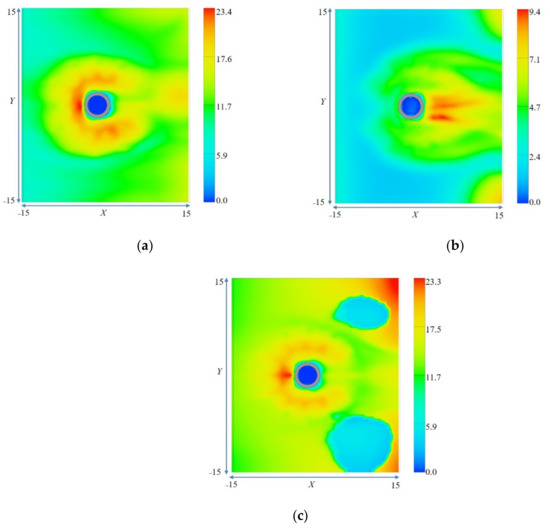
where, θ is shields parameter, θcr is critical shields parameter.

S/D=2.5(1−0.5u/uc)xrelxrel=xeff/(1+xeff)xeff=0.03(1−0.35ucr/u)(KC−6)⎫⎭⎬⎪⎪�/�=2.5(1−0.5�/��)��������=����/(1+����)����=0.03(1−0.35�cr/�)(��−6)(7)

where, u is near-bed orbital velocity amplitude, uc is critical velocity corresponding the onset of sediment motion.

S/D=1.3{1−exp[−0.03(KC2lnn+36)1/2−6]}�/�=1.31−exp−0.03(��2ln�+36)1/2−6(8)

where, n is the 1/n’th highest wave for random waves

For predicting equilibrium scour depth under irregular waves, i.e., random waves, Sumer and Fredsøe [16] found it’s suitable to take Equation (2) to predict equilibrium scour depth around pile under random waves with the root-mean-square (RMS) value of near-bed orbital velocity amplitude Um and peak wave period TP to calculate KC. Khalfin [35] recommended the RMS wave height Hrms and peak wave period TP were used to calculate KC for Equation (6). References [37,38,39,40] developed a series of stochastic theoretical models to predict equilibrium scour depth around pile under random waves, nonlinear random waves plus currents respectively. The stochastic approach thought the 1/n’th highest wave were responsible for scour in vicinity of pile under random waves, and the KC was calculated in Equation (8) with Um and mean zero-crossing wave period Tz. The results calculated by Equation (8) agree well with experimental values of Sumer and Fredsøe [16] if the 1/10′th highest wave was used. To author’s knowledge, the stochastic approach proposed by Myrhaug and Rue [37] is the only theoretical model to predict equilibrium scour depth around pile under random waves for the whole range of KC number in published documents. Other methods of predicting scour depth under random waves are mainly originated from the equation for regular waves-only, waves and currents combined, which are limited to the large KC number, such as KC > 6 for Equation (2) and KC > 4 for Equation (3) respectively. However, situations with relatively low KC number (KC < 4) often occur in reality, for example, monopile or suction anchor for OWT foundations in ocean environment. Moreover, local scour around OWT foundations under random waves has not yet been investigated fully. Therefore, further study are still needed in the aspect of scour around OWT foundations with low KC number under random waves. Given that, this study presents the scour sediment model around umbrella suction anchor foundation (USAF) under random waves. In this study, a comparison of equilibrium scour depth around USAF between this present numerical models and the previous theoretical models and experimental results was presented firstly. Then, this study gave a comprehensive analysis for the scour mechanisms around USAF. After that, two revised models were proposed according to the model of Raaijmakers and Rudolph [34] and the stochastic model developed by Myrhaug and Rue [37] respectively to predict the equilibrium scour depth. Finally, a parametric study was conducted to study the effects of the Froude number (Fr) and Euler number (Eu) to equilibrium scour depth respectively.

2. Numerical Method

2.1. Governing Equations of Flow

The following equations adopted in present model are already available in Flow 3D software. The authors used these theoretical equations to simulate scour in random waves without modification. The incompressible viscous fluid motion satisfies the Reynolds-averaged Navier-Stokes (RANS) equation, so the present numerical model solves RANS equations:

∂u∂t+1VF(uAx∂u∂x+vAy∂u∂y+wAz∂u∂z)=−1ρf∂p∂x+Gx+fx∂�∂�+1��(���∂�∂�+���∂�∂�+���∂�∂�)=−1�f∂�∂�+��+��(9)

∂v∂t+1VF(uAx∂v∂x+vAy∂v∂y+wAz∂v∂z)=−1ρf∂p∂y+Gy+fy∂�∂�+1��(���∂�∂�+���∂�∂�+���∂�∂�)=−1�f∂�∂�+��+��(10)

∂w∂t+1VF(uAx∂w∂x+vAy∂w∂y+wAz∂w∂z)=−1ρf∂p∂z+Gz+fz∂�∂�+1��(���∂�∂�+���∂�∂�+���∂�∂�)=−1�f∂�∂�+��+��(11)

where, VF is the volume fraction; uv, and w are the velocity components in xyz direction respectively with Cartesian coordinates; Ai is the area fraction; ρf is the fluid density, fi is the viscous fluid acceleration, Gi is the fluid body acceleration (i = xyz).

2.2. Turbulent Model

The turbulence closure is available by the turbulent model, such as one-equation, the one-equation k-ε model, the standard k-ε model, RNG k-ε turbulent model and large eddy simulation (LES) model. The LES model requires very fine mesh grid, so the computational time is large, which hinders the LES model application in engineering. The RNG k-ε model can reduce computational time greatly with high accuracy in the near-wall region. Furthermore, the RNG k-ε model computes the maximum turbulent mixing length dynamically in simulating sediment scour model. Therefore, the RNG k-ε model was adopted to study the scour around anchor under random waves [41,42].

∂kT∂T+1VF(uAx∂kT∂x+vAy∂kT∂y+wAz∂kT∂z)=PT+GT+DiffkT−εkT∂��∂�+1��(���∂��∂�+���∂��∂�+���∂��∂�)=��+��+������−���(12)

∂εT∂T+1VF(uAx∂εT∂x+vAy∂εT∂y+wAz∂εT∂z)=CDIS1εTkT(PT+CDIS3GT)+Diffε−CDIS2ε2TkT∂��∂�+1��(���∂��∂�+���∂��∂�+���∂��∂�)=����1����(��+����3��)+�����−����2��2��(13)

where, kT is specific kinetic energy involved with turbulent velocity, GT is the turbulent energy generated by buoyancy; εT is the turbulent energy dissipating rate, PT is the turbulent energy, Diffε and DiffkT are diffusion terms associated with VFAiCDIS1CDIS2 and CDIS3 are dimensionless parameters, and CDIS1CDIS3 have default values of 1.42, 0.2 respectively. CDIS2 can be obtained from PT and kT.

2.3. Sediment Scour Model

The sand particles may suffer four processes under waves, i.e., entrainment, bed load transport, suspended load transport, and deposition, so the sediment scour model should depict the above processes efficiently. In present numerical simulation, the sediment scour model includes the following aspects:

2.3.1. Entrainment and Deposition

The combination of entrainment and deposition determines the net scour rate of seabed in present sediment scour model. The entrainment lift velocity of sand particles was calculated as [43]:

ulift,i=αinsd0.3∗(θ−θcr)1.5∥g∥di(ρi−ρf)ρf−−−−−−−−−−−−√�lift,i=�����*0.3(�−�cr)1.5���(��−�f)�f(14)

where, αi is the entrainment parameter, ns is the outward point perpendicular to the seabed, d* is the dimensionless diameter of sand particles, which was calculated by Equation (15), θcr is the critical Shields parameter, g is the gravity acceleration, di is the diameter of sand particles, ρi is the density of seabed species.

d∗=di(∥g∥ρf(ρi−ρf)μ2f)1/3�*=��(��f(��−�f)�f2)1/3(15)

where μf is the fluid dynamic viscosity.

In Equation (14), the entrainment parameter αi confirms the rate at which sediment erodes when the given shear stress is larger than the critical shear stress, and the recommended value 0.018 was adopted according to the experimental data of Mastbergen and Von den Berg [43]. ns is the outward pointing normal to the seabed interface, and ns = (0,0,1) according to the Cartesian coordinates used in present numerical model.

The shields parameter was obtained from the following equation:

θ=U2f,m(ρi/ρf−1)gd50�=�f,m2(��/�f−1)��50(16)
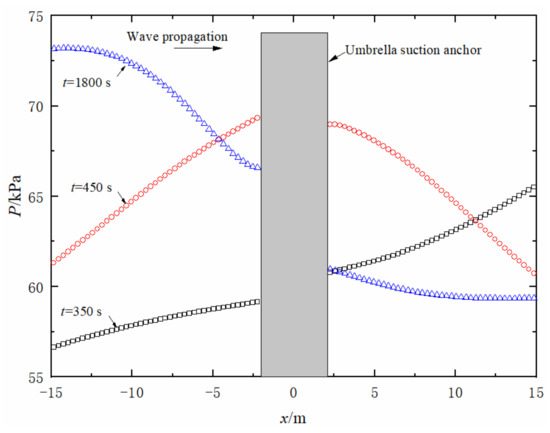
where, Uf,m is the maximum value of the near-bed friction velocity; d50 is the median diameter of sand particles. The detailed calculation procedure of θ was available in Soulsby [44].

The critical shields parameter θcr was obtained from the Equation (17) [44]
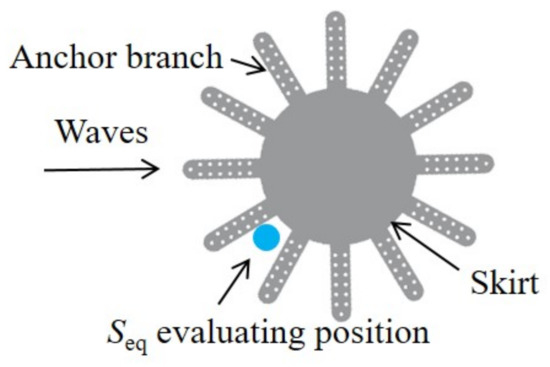
θcr=0.31+1.2d∗+0.055[1−exp(−0.02d∗)]�cr=0.31+1.2�*+0.0551−exp(−0.02�*)(17)

The sand particles begin to deposit on seabed when the turbulence energy weaken and cann’t support the particles suspending. The setting velocity of the particles was calculated from the following equation [44]:

usettling,i=νfdi[(10.362+1.049d3∗)0.5−10.36]�settling,�=�f��(10.362+1.049�*3)0.5−10.36(18)

where νf is the fluid kinematic viscosity.

2.3.2. Bed Load Transport

This is called bed load transport when the sand particles roll or bounce over the seabed and always have contact with seabed. The bed load transport velocity was computed by [45]:

ubedload,i=qb,iδicb,ifb�bedload,�=�b,����b,��b(19)

where, qb,i is the bed load transport rate, which was obtained from Equation (20), δi is the bed load thickness, which was calculated by Equation (21), cb,i is the volume fraction of sand i in the multiple species, fb is the critical packing fraction of the seabed.

qb,i=8[∥g∥(ρi−ρfρf)d3i]1/2�b,�=8�(��−�f�f)��31/2(20)

δi=0.3d0.7∗(θθcr−1)0.5di��=0.3�*0.7(��cr−1)0.5��(21)

2.3.3. Suspended Load Transport

Through the following transport equation, the suspended sediment concentration could be acquired.

∂Cs,i∂t+∇(us,iCs,i)=∇∇(DfCs,i)∂�s,�∂�+∇(�s,��s,�)=∇∇(�f�s,�)(22)

where, Cs,i is the suspended sand particles mass concentration of sand i in the multiple species, us,i is the sand particles velocity of sand iDf is the diffusivity.

The velocity of sand i in the multiple species could be obtained from the following equation:

us,i=u¯¯+usettling,ics,i�s,�=�¯+�settling,��s,�(23)

where, u¯�¯ is the velocity of mixed fluid-particles, which can be calculated by the RANS equation with turbulence model, cs,i is the suspended sand particles volume concentration, which was computed from Equation (24).

cs,i=Cs,iρi�s,�=�s,���(24)

3. Model Setup

The seabed-USAF-wave three-dimensional scour numerical model was built using Flow-3D software. As shown in Figure 2, the model includes sandy seabed, USAF model, sea water, two baffles and porous media. The dimensions of USAF are shown in Table 1. The sandy bed (210 m in length, 30 m in width and 11 m in height) is made up of uniform fine sand with median diameter d50 = 0.041 cm. The USAF model includes upper steel tube with the length of 20 m, which was installed in the middle of seabed. The location of USAF is positioned at 140 m from the upstream inflow boundary and 70 m from the downstream outflow boundary. Two baffles were installed at two ends of seabed. In order to eliminate the wave reflection basically, the porous media was set at the outflow side on the seabed.

Jmse 09 00886 g002 550

Figure 2. (a) The sketch of seabed-USAF-wave three-dimensional model; (b) boundary condation:Wv-wave boundary, S-symmetric boundary, O-outflow boundary; (c) USAF model.

Table 1. Numerical simulating cases.

Table

3.1. Mesh Geometric Dimensions

In the simulation of the scour under the random waves, the model includes the umbrella suction anchor foundation, seabed and fluid. As shown in Figure 3, the model mesh includes global mesh grid and nested mesh grid, and the total number of grids is 1,812,000. The basic procedure for building mesh grid consists of two steps. Step 1: Divide the global mesh using regular hexahedron with size of 0.6 × 0.6. The global mesh area is cubic box, embracing the seabed and whole fluid volume, and the dimensions are 210 m in length, 30 m in width and 32 m in height. The details of determining the grid size can see the following mesh sensitivity section. Step 2: Set nested fine mesh grid in vicinity of the USAF with size of 0.3 × 0.3 so as to shorten the computation cost and improve the calculation accuracy. The encryption range is −15 m to 15 m in x direction, −15 m to 15 m in y direction and 0 m to 32 m in z direction, respectively. In order to accurately capture the free-surface dynamics, such as the fluid-air interface, the volume of fluid (VOF) method was adopted for tracking the free water surface. One specific algorithm called FAVORTM (Fractional Area/Volume Obstacle Representation) was used to define the fractional face areas and fractional volumes of the cells which are open to fluid flow.

Jmse 09 00886 g003 550

Figure 3. The sketch of mesh grid.

3.2. Boundary Conditions

As shown in Figure 2, the initial fluid length is 210 m as long as seabed. A wave boundary was specified at the upstream offshore end. The details of determining the random wave spectrum can see the following wave parameters section. The outflow boundary was set at the downstream onshore end. The symmetry boundary was used at the top and two sides of the model. The symmetric boundaries were the better strategy to improve the computation efficiency and save the calculation cost [46]. At the seabed bottom, the wall boundary was adopted, which means the u = v = w= 0. Besides, the upper steel tube of USAF was set as no-slip condition.

3.3. Wave Parameters

The random waves with JONSWAP wave spectrum were used for all simulations as realistic representation of offshore conditions. The unidirectional JONSWAP frequency spectrum was described as [47]:

S(ω)=αg2ω5exp[−54(ωpω)4]γexp[−(ω−ωp)22σ2ω2p]�(�)=��2�5exp−54(�p�)4�exp−(�−�p)22�2�p2(25)

where, α is wave energy scale parameter, which is calculated by Equation (26), ω is frequency, ωp is wave spectrum peak frequency, which can be obtained from Equation (27). γ is wave spectrum peak enhancement factor, in this study γ = 3.3. σ is spectral width factor, σ equals 0.07 for ω ≤ ωp and 0.09 for ω > ωp respectively.

α=0.0076(gXU2)−0.22�=0.0076(���2)−0.22(26)

ωp=22(gU)(gXU2)−0.33�p=22(��)(���2)−0.33(27)

where, X is fetch length, U is average wind velocity at 10 m height from mean sea level.

In present numerical model, the input key parameters include X and U for wave boundary with JONSWAP wave spectrum. The objective wave height and period are available by different combinations of X and U. In this study, we designed 9 cases with different wave heights, periods and water depths for simulating scour around USAF under random waves (see Table 2). For random waves, the wave steepness ε and Ursell number Ur were acquired form Equations (28) and (29) respectively

ε=2πgHsT2a�=2���s�a2(28)

Ur=Hsk2h3w�r=�s�2ℎw3(29)

where, Hs is significant wave height, Ta is average wave period, k is wave number, hw is water depth. The Shield parameter θ satisfies θ > θcr for all simulations in current study, indicating the live bed scour prevails.

Table 2. Numerical simulating cases.

Table

3.4. Mesh Sensitivity

In this section, a mesh sensitivity analysis was conducted to investigate the influence of mesh grid size to results and make sure the calculation is mesh size independent and converged. Three mesh grid size were chosen: Mesh 1—global mesh grid size of 0.75 × 0.75, nested fine mesh grid size of 0.4 × 0.4, and total number of grids 1,724,000, Mesh 2—global mesh grid size of 0.6 × 0.6, nested fine mesh grid size of 0.3 × 0.3, and total number of grids 1,812,000, Mesh 3—global mesh grid size of 0.4 × 0.4, nested fine mesh grid size of 0.2 × 0.2, and total number of grids 1,932,000. The near-bed shear velocity U* is an important factor for influencing scour process [1,15], so U* at the position of (4,0,11.12) was evaluated under three mesh sizes. As the Figure 4 shown, the maximum error of shear velocity ∆U*1,2 is about 39.8% between the mesh 1 and mesh 2, and 4.8% between the mesh 2 and mesh 3. According to the mesh sensitivity criterion adopted by Pang et al. [48], it’s reasonable to think the results are mesh size independent and converged with mesh 2. Additionally, the present model was built according to prototype size, and the mesh size used in present model is larger than the mesh size adopted by Higueira et al. [49] and Corvaro et al. [50]. If we choose the smallest cell size, it will take too much time. For example, the simulation with Mesh3 required about 260 h by using a computer with Intel Xeon Scalable Gold 4214 CPU @24 Cores, 2.2 GHz and 64.00 GB RAM. Therefore, in this case, considering calculation accuracy and computation efficiency, the mesh 2 was chosen for all the simulation in this study.

Jmse 09 00886 g004 550

Figure 4. Comparison of near-bed shear velocity U* with different mesh grid size.

The nested mesh block was adopted for seabed in vicinity of the USAF, which was overlapped with the global mesh block. When two mesh blocks overlap each other, the governing equations are by default solved on the mesh block with smaller average cell size (i.e., higher grid resolution). It is should be noted that the Flow 3D software used the moving mesh captures the scour evolution and automatically adjusts the time step size to be as large as possible without exceeding any of the stability limits, affecting accuracy, or unduly increasing the effort required to enforce the continuity condition [51].

3.5. Model Validation

In order to verify the reliability of the present model, the results of present study were compared with the experimental data of Khosronejad et al. [52]. The experiment was conducted in an open channel with a slender vertical pile under unidirectional currents. The comparison of scour development between the present results and the experimental results is shown in Figure 5. The Figure 5 reveals that the present results agree well with the experimental data of Khosronejad et al. [52]. In the first stage, the scour depth increases rapidly. After that, the scour depth achieves a maximum value gradually. The equilibrium scour depth calculated by the present model is basically corresponding with the experimental results of Khosronejad et al. [52], although scour depth in the present model is slightly larger than the experimental results at initial stage.

Jmse 09 00886 g005 550

Figure 5. Comparison of time evolution of scour between the present study and Khosronejad et al. [52], Petersen et al. [17].

Secondly, another comparison was further conducted between the results of present study and the experimental data of Petersen et al. [17]. The experiment was carried out in a flume with a circular vertical pile in combined waves and current. Figure 4 shows a comparison of time evolution of scour depth between the simulating and the experimental results. As Figure 5 indicates, the scour depth in this study has good overall agreement with the experimental results proposed in Petersen et al. [17]. The equilibrium scour depth calculated by the present model is 0.399 m, which equals to the experimental value basically. Overall, the above verifications prove the present model is accurate and capable in dealing with sediment scour under waves.

In addition, in order to calibrate and validate the present model for hydrodynamic parameters, the comparison of water surface elevation was carried out with laboratory experiments conducted by Stahlmann [53] for wave gauge No. 3. The Figure 6 depicts the surface wave profiles between experiments and numerical model results. The comparison indicates that there is a good agreement between the model results and experimental values, especially the locations of wave crest and trough. Comparison of the surface elevation instructs the present model has an acceptable relative error, and the model is a calibrated in terms of the hydrodynamic parameters.

Jmse 09 00886 g006 550

Figure 6. Comparison of surface elevation between the present study and Stahlmann [53].

Finally, another comparison was conducted for equilibrium scour depth or maximum scour depth under random waves with the experimental data of Sumer and Fredsøe [16] and Schendel et al. [22]. The Figure 7 shows the comparison between the numerical results and experimental data of Run01, Run05, Run21 and Run22 in Sumer and Fredsøe [16] and test A05 and A09 in Schendel et al. [22]. As shown in Figure 7, the equilibrium scour depth or maximum scour depth distributed within the ±30 error lines basically, meaning the reliability and accuracy of present model for predicting equilibrium scour depth around foundation in random waves. However, compared with the experimental values, the present model overestimated the equilibrium scour depth generally. Given that, a calibration for scour depth was carried out by multiplying the mean reduced coefficient 0.85 in following section.

Jmse 09 00886 g007 550

Figure 7. Comparison of equilibrium (or maximum) scour depth between the present study and Sumer and Fredsøe [16], Schendel et al. [22].

Through the various examination for hydrodynamic and morphology parameters, it can be concluded that the present model is a validated and calibrated model for scour under random waves. Thus, the present numerical model would be utilized for scour simulation around foundation under random waves.

4. Numerical Results and Discussions

4.1. Scour Evolution

Figure 8 displays the scour evolution for case 1–9. As shown in Figure 8a, the scour depth increased rapidly at the initial stage, and then slowed down at the transition stage, which attributes to the backfilling occurred in scour holes under live bed scour condition, resulting in the net scour decreasing. Finally, the scour reached the equilibrium state when the amount of sediment backfilling equaled to that of scouring in the scour holes, i.e., the net scour transport rate was nil. Sumer and Fredsøe [16] proposed the following formula for the scour development under waves

St=Seq(1−exp(−t/Tc))�t=�eq(1−exp(−�/�c))(30)

where Tc is time scale of scour process.

Jmse 09 00886 g008 550

Figure 8. Time evolution of scour for case 1–9: (a) Case 1–5; (b) Case 6–9.

The computing time is 3600 s and the scour development curves in Figure 8 kept fluctuating, meaning it’s still not in equilibrium scour stage in these cases. According to Sumer and Fredsøe [16], the equilibrium scour depth can be acquired by fitting the data with Equation (30). From Figure 8, it can be seen that the scour evolution obtained from Equation (30) is consistent with the present study basically at initial stage, but the scour depth predicted by Equation (30) developed slightly faster than the simulating results and the Equation (30) overestimated the scour depth to some extent. Overall, the whole tendency of the results calculated by Equation (30) agrees well with the simulating results of the present study, which means the Equation (30) is applicable to depict the scour evolution around USAF under random waves.

4.2. Scour Mechanism under Random Waves

The scour morphology and scour evolution around USAF are similar under random waves in case 1~9. Taking case 7 as an example, the scour morphology is shown in Figure 9.

Jmse 09 00886 g009 550

Figure 9. Scour morphology under different times for case 7.

From Figure 9, at the initial stage (t < 1200 s), the scour occurred at upstream foundation edges between neighboring anchor branches. The maximum scour depth appeared at the lee-side of the USAF. Correspondingly, the sediments deposited at the periphery of the USAF, and the location of the maximum accretion depth was positioned at an angle of about 45° symmetrically with respect to the wave propagating direction in the lee-side of the USAF. After that, when t > 2400 s, the location of the maximum scour depth shifted to the upside of the USAF at an angle of about 45° with respect to the wave propagating direction.

According to previous studies [1,15,16,19,30,31], the horseshoe vortex, streamline compression and wake vortex shedding were responsible for scour around foundation. The Figure 10 displays the distribution of flow velocity in vicinity of foundation, which reflects the evolving processes of horseshoe vertex.

Jmse 09 00886 g010a 550
Jmse 09 00886 g010b 550

Figure 10. Velocity profile around USAF: (a) Flow runup and down stream at upstream anchor edges; (b) Horseshoe vortex at upstream anchor edges; (c) Flow reversal during wave through stage at lee side.

As shown in Figure 10, the inflow tripped to the upstream edges of the USAF and it was blocked by the upper tube of USAF. Then, the downflow formed the horizontal axis clockwise vortex and rolled on the seabed bypassing the tube, that is, the horseshoe vortex (Figure 11). The Figure 12 displays the turbulence intensity around the tube on the seabed. From Figure 12, it can be seen that the turbulence intensity was high-intensity with respect to the region of horseshoe vortex. This phenomenon occurred because of drastic water flow momentum exchanging in the horseshoe vortex. As a result, it created the prominent shear stress on the seabed, causing the local scour at the upstream edges of USAF. Besides, the horseshoe vortex moved downstream gradually along the periphery of the tube and the wake vortex shed off continually at the lee-side of the USAF, i.e., wake vortex.

Jmse 09 00886 g011 550

Figure 11. Sketch of scour mechanism around USAF under random waves.

Jmse 09 00886 g012 550

Figure 12. Turbulence intensity: (a) Turbulence intensity of horseshoe vortex; (b) Turbulence intensity of wake vortex; (c) Turbulence intensity of accretion area.

The core of wake vortex is a negative pressure center, liking a vacuum cleaner [11,42]. Hence, the soil particles were swirled into the negative pressure core and carried away by wake vortex. At the same time, the onset of scour at rear side occurred. Finally, the wake vortex became downflow at the downside of USAF. As is shown in Figure 12, the turbulence intensity was low where the downflow occurred at lee-side, which means the turbulence energy may not be able to support the survival of wake vortex, leading to accretion happening. As mentioned in previous section, the formation of horseshoe vortex was dependent with adverse pressure gradient at upside of foundation. As shown in Figure 13, the evaluated range of pressure distribution is −15 m to 15 m in x direction. The t = 450 s and t = 1800 s indicate that the wave crest and trough arrived at the upside and lee-side of the foundation respectively, and the t = 350 s was neither the wave crest nor trough. The adverse gradient pressure reached the maximum value at t = 450 s corresponding to the wave crest phase. In this case, it’s helpful for the wave boundary separating fully from seabed, which leads to the formation of horseshoe vortex with high turbulence intensity. Therefore, the horseshoe vortex is responsible for the local scour between neighboring anchor branches at upside of USAF. What’s more, due to the combination of the horseshoe vortex and streamline compression, the maximum scour depth occurred at the upside of the USAF with an angle of about 45° corresponding to the wave propagating direction. This is consistent with the findings of Pang et al. [48] and Sumer et al. [1,15] in case of regular waves. At the wave trough phase (t = 1800 s), the pressure gradient became positive at upstream USAF edges, which hindered the separating of wave boundary from seabed. In the meantime, the flow reversal occurred (Figure 10) and the adverse gradient pressure appeared at downstream USAF edges, but the magnitude of adverse gradient pressure at lee-side was lower than the upstream gradient pressure under wave crest. In this way, the intensity of horseshoe vortex behind the USAF under wave trough was low, which explains the difference of scour depth at upstream and downstream, i.e., the scour asymmetry. In other words, the scour asymmetry at upside and downside of USAF was attributed to wave asymmetry for random waves, and the phenomenon became more evident for nonlinear waves [21]. Briefly speaking, the vortex system at wave crest phase was mainly related to the scour process around USAF under random waves.

Jmse 09 00886 g013 550

Figure 13. Pressure distribution around USAF.

4.3. Equilibrium Scour Depth

The KC number is a key parameter for horseshoe vortex emerging and evolving under waves. According to Equation (1), when pile diameter D is fixed, the KC depends on the maximum near-bed velocity Uwm and wave period T. For random waves, the Uwm can be denoted by the root-mean-square (RMS) value of near-bed velocity amplitude Uwm,rms or the significant value of near-bed velocity amplitude Uwm,s. The Uwm,rms and Uwm,s for all simulating cases of the present study are listed in Table 3 and Table 4. The T can be denoted by the mean up zero-crossing wave period Ta, peak wave period Tp, significant wave period Ts, the maximum wave period Tm, 1/10′th highest wave period Tn = 1/10 and 1/5′th highest wave period Tn = 1/5 for random waves, so the different combinations of Uwm and T will acquire different KC. The Table 3 and Table 4 list 12 types of KC, for example, the KCrms,s was calculated by Uwm,rms and Ts. Sumer and Fredsøe [16] conducted a series of wave flume experiments to investigate the scour depth around monopile under random waves, and found the equilibrium scour depth predicting equation (Equation (2)) for regular waves was applicable for random waves with KCrms,p. It should be noted that the Equation (2) is only suitable for KC > 6 under regular waves or KCrms,p > 6 under random waves.

Table 3. Uwm,rms and KC for case 1~9.

Table

Table 4. Uwm,s and KC for case 1~9.

Table

Raaijmakers and Rudolph [34] proposed the equilibrium scour depth predicting model (Equation (5)) around pile under waves, which is suitable for low KC. The format of Equation (5) is similar with the formula proposed by Breusers [54], which can predict the equilibrium scour depth around pile at different scour stages. In order to verify the applicability of Raaijmakers’s model for predicting the equilibrium scour depth around USAF under random waves, a validation of the equilibrium scour depth Seq between the present study and Raaijmakers’s equation was conducted. The position where the scour depth Seq was evaluated is the location of the maximum scour depth, and it was depicted in Figure 14. The Figure 15 displays the comparison of Seq with different KC between the present study and Raaijmakers’s model.

Jmse 09 00886 g014 550

Figure 14. Sketch of the position where the Seq was evaluated.

Jmse 09 00886 g015a 550
Jmse 09 00886 g015b 550

Figure 15. Comparison of the equilibrium scour depth between the present model and the model of Raaijmakers and Rudolph [34]: (aKCrms,sKCrms,a; (bKCrms,pKCrms,m; (cKCrms,n = 1/10KCrms,n = 1/5; (dKCs,sKCs,a; (eKCs,pKCs,m; (fKCs,n = 1/10KCs,n = 1/5.

As shown in Figure 15, there is an error in predicting Seq between the present study and Raaijmakers’s model, and Raaijmakers’s model underestimates the results generally. Although the error exists, the varying trend of Seq with KC obtained from Raaijmakers’s model is consistent with the present study basically. What’s more, the error is minimum and the Raaijmakers’s model is of relatively high accuracy for predicting scour around USAF under random waves by using KCs,p. Based on this, a further revision was made to eliminate the error as much as possible, i.e., add the deviation value ∆S/D in the Raaijmakers’s model. The revised equilibrium scour depth predicting equation based on Raaijmakers’s model can be written as

S′eq/D=1.95[tanh(hD)](1−exp(−0.012KCs,p))+ΔS/D�eq′/�=1.95tanh(ℎ�)(1−exp(−0.012��s,p))+∆�/�(31)

As the Figure 16 shown, through trial-calculation, when ∆S/D = 0.05, the results calculated by Equation (31) show good agreement with the simulating results of the present study. The maximum error is about 18.2% and the engineering requirements have been met basically. In order to further verify the accuracy of the revised model for large KC (KCs,p > 4) under random waves, a validation between the revised model and the previous experimental results [21]. The experiment was conducted in a flume (50 m in length, 1.0 m in width and 1.3 m in height) with a slender vertical pile (D = 0.1 m) under random waves. The seabed is composed of 0.13 m deep layer of sand with d50 = 0.6 mm and the water depth is 0.5 m for all tests. The significant wave height is 0.12~0.21 m and the KCs,p is 5.52~11.38. The comparison between the predicting results by Equation (31) and the experimental results of Corvaro et al. [21] is shown in Figure 17. From Figure 17, the experimental data evenly distributes around the predicted results and the prediction accuracy is favorable when KCs,p < 8. However, the gap between the predicting results and experimental data becomes large and the Equation (31) overestimates the equilibrium scour depth to some extent when KCs,p > 8.

Jmse 09 00886 g016 550

Figure 16. Comparison of Seq between the simulating results and the predicting values by Equation (31).

Jmse 09 00886 g017 550

Figure 17. Comparison of Seq/D between the Experimental results of Corvaro et al. [21] and the predicting values by Equation (31).

In ocean environment, the waves are composed of a train of sinusoidal waves with different frequencies and amplitudes. The energy of constituent waves with very large and very small frequencies is relatively low, and the energy of waves is mainly concentrated in a certain range of moderate frequencies. Myrhaug and Rue [37] thought the 1/n’th highest wave was responsible for scour and proposed the stochastic model to predict the equilibrium scour depth around pile under random waves for full range of KC. Noteworthy is that the KC was denoted by KCrms,a in the stochastic model. To verify the application of the stochastic model for predicting scour depth around USAF, a validation between the simulating results of present study and predicting results by the stochastic model with n = 2,3,5,10,20,500 was carried out respectively.

As shown in Figure 18, compared with the simulating results, the stochastic model underestimates the equilibrium scour depth around USAF generally. Although the error exists, the varying trend of Seq with KCrms,a obtained from the stochastic model is consistent with the present study basically. What’s more, the gap between the predicting values by stochastic model and the simulating results decreases with the increase of n, but for large n, for example n = 500, the varying trend diverges between the predicting values and simulating results, meaning it’s not feasible only by increasing n in stochastic model to predict the equilibrium scour depth around USAF.

Jmse 09 00886 g018 550

Figure 18. Comparison of Seq between the simulating results and the predicting values by Equation (8).

The Figure 19 lists the deviation value ∆Seq/D′ between the predicting values and simulating results with different KCrms,a and n. Then, fitted the relationship between the ∆S′and n under different KCrms,a, and the fitting curve can be written by Equation (32). The revised stochastic model (Equation (33)) can be acquired by adding ∆Seq/D′ to Equation (8).

ΔSeq/D=0.052*exp(−n/6.566)+0.068∆�eq/�=0.052*exp(−�/6.566)+0.068(32)

S′eq¯/D=S′eq/D+0.052*exp(−n/6.566)+0.068�eq′¯/�=�eq′/�+0.052*exp(−�/6.566)+0.068(33)

Jmse 09 00886 g019 550

Figure 19. The fitting line between ∆S′and n.

The comparison between the predicting results by Equation (33) and the simulating results of present study is shown in Figure 20. According to the Figure 20, the varying trend of Seq with KCrms,a obtained from the stochastic model is consistent with the present study basically. Compared with predicting results by the stochastic model, the results calculated by Equation (33) is favorable. Moreover, comparison with simulating results indicates that the predicting results are the most favorable for n = 10, which is consistent with the findings of Myrhaug and Rue [37] for equilibrium scour depth predicting around slender pile in case of random waves.

Jmse 09 00886 g020 550

Figure 20. Comparison of Seq between the simulating results and the predicting values by Equation (33).

In order to further verify the accuracy of the Equation (33) for large KC (KCrms,a > 4) under random waves, a validation was conducted between the Equation (33) and the previous experimental results of Sumer and Fredsøe [16] and Corvaro et al. [21]. The details of experiments conducted by Corvaro et al. [21] were described in above section. Sumer and Fredsøe [16] investigated the local scour around pile under random waves. The experiments were conducted in a wave basin with a slender vertical pile (D = 0.032, 0.055 m). The seabed is composed of 0.14 m deep layer of sand with d50 = 0.2 mm and the water depth was maintained at 0.5 m. The JONSWAP wave spectrum was used and the KCrms,a was 5.29~16.95. The comparison between the predicting results by Equation (33) and the experimental results of Sumer and Fredsøe [16] and Corvaro et al. [21] are shown in Figure 21. From Figure 21, contrary to the case of low KCrms,a (KCrms,a < 4), the error between the predicting values and experimental results increases with decreasing of n for KCrms,a > 4. Therefore, the predicting results are the most favorable for n = 2 when KCrms,a > 4.

Jmse 09 00886 g021 550

Figure 21. Comparison of Seq between the experimental results of Sumer and Fredsøe [16] and Corvaro et al. [21] and the predicting values by Equation (33).

Noteworthy is that the present model was built according to prototype size, so the errors between the numerical results and experimental data of References [16,21] may be attribute to the scale effects. In laboratory experiments on scouring process, it is typically impossible to ensure a rigorous similarity of all physical parameters between the model and prototype structure, leading to the scale effects in the laboratory experiments. To avoid a cohesive behaviour, the bed material was not scaled geometrically according to model scale. As a consequence, the relatively large-scaled sediments sizes may result in the overestimation of bed load transport and underestimation of suspended load transport compared with field conditions. What’s more, the disproportional scaled sediment presumably lead to the difference of bed roughness between the model and prototype, and thus large influences for wave boundary layer on the seabed and scour process. Besides, according to Corvaro et al. [21] and Schendel et al. [55], the pile Reynolds numbers and Froude numbers both affect the scour depth for the condition of non fully developed turbulent flow in laboratory experiments.

4.4. Parametric Study

4.4.1. Influence of Froude Number

As described above, the set of foundation leads to the adverse pressure gradient appearing at upstream, leading to the wave boundary layer separating from seabed, then horseshoe vortex formatting and the horseshoe vortex are mainly responsible for scour around foundation (see Figure 22). The Froude number Fr is the key parameter to influence the scale and intensity of horseshoe vortex. The Fr under waves can be calculated by the following formula [42]

Fr=UwgD−−−√�r=�w��(34)

where Uw is the mean water particle velocity during 1/4 cycle of wave oscillation, obtained from the following formula. Noteworthy is that the root-mean-square (RMS) value of near-bed velocity amplitude Uwm,rms is used for calculating Uwm.

Uw=1T/4∫0T/4Uwmsin(t/T)dt=2πUwm�w=1�/4∫0�/4�wmsin(�/�)��=2��wm(35)

Jmse 09 00886 g022 550

Figure 22. Sketch of flow field at upstream USAF edges.

Tavouktsoglou et al. [25] proposed the following formula between Fr and the vertical location of the stagnation y

yh∝Fer�ℎ∝�r�(36)

where e is constant.

The Figure 23 displays the relationship between Seq/D and Fr of the present study. In order to compare with the simulating results, the experimental data of Corvaro et al. [21] was also depicted in Figure 23. As shown in Figure 23, the equilibrium scour depth appears a logarithmic increase as Fr increases and approaches the mathematical asymptotic value, which is also consistent with the experimental results of Corvaro et al. [21]. According to Figure 24, the adverse pressure gradient pressure at upstream USAF edges increases with the increase of Fr, which is benefit for the wave boundary layer separating from seabed, resulting in the high-intensity horseshoe vortex, hence, causing intensive scour around USAF. Based on the previous study of Tavouktsoglou et al. [25] for scour around pile under currents, the high Fr leads to the stagnation point is closer to the mean sea level for shallow water, causing the stronger downflow kinetic energy. As mentioned in previous section, the energy of downflow at upstream makes up the energy of the subsequent horseshoe vortex, so the stronger downflow kinetic energy results in the more intensive horseshoe vortex. Therefore, the higher Fr leads to the more intensive horseshoe vortex by influencing the position of stagnation point y presumably. Qi and Gao [19] carried out a series of flume tests to investigate the scour around pile under regular waves, and proposed the fitting formula between Seq/D and Fr as following

lg(Seq/D)=Aexp(B/Fr)+Clg(�eq/�)=�exp(�/�r)+�(37)

where AB and C are constant.

Jmse 09 00886 g023 550

Figure 23. The fitting curve between Seq/D and Fr.

Jmse 09 00886 g024 550

Figure 24. Sketch of adverse pressure gradient at upstream USAF edges.

Took the Equation (37) to fit the simulating results with A = −0.002, B = 0.686 and C = −0.808, and the results are shown in Figure 23. From Figure 23, the simulating results evenly distribute around the Equation (37) and the varying trend of Seq/D and Fr in present study is consistent with Equation (37) basically, meaning the Equation (37) is applicable to express the relationship of Seq/D with Fr around USAF under random waves.

4.4.2. Influence of Euler Number

The Euler number Eu is the influencing factor for the hydrodynamic field around foundation. The Eu under waves can be calculated by the following formula. The Eu can be represented by the Equation (38) for uniform cylinders [25]. The root-mean-square (RMS) value of near-bed velocity amplitude Um,rms is used for calculating Um.

Eu=U2mgD�u=�m2��(38)

where Um is depth-averaged flow velocity.

The Figure 25 displays the relationship between Seq/D and Eu of the present study. In order to compare with the simulating results, the experimental data of Sumer and Fredsøe [16] and Corvaro et al. [21] were also plotted in Figure 25. As shown in Figure 25, similar with the varying trend of Seq/D and Fr, the equilibrium scour depth appears a logarithmic increase as Eu increases and approaches the mathematical asymptotic value, which is also consistent with the experimental results of Sumer and Fredsøe [16] and Corvaro et al. [21]. According to Figure 24, the adverse pressure gradient pressure at upstream USAF edges increases with the increasing of Eu, which is benefit for the wave boundary layer separating from seabed, inducing the high-intensity horseshoe vortex, hence, causing intensive scour around USAF.

Jmse 09 00886 g025 550

Figure 25. The fitting curve between Seq/D and Eu.

Therefore, the variation of Fr and Eu reflect the magnitude of adverse pressure gradient pressure at upstream. Given that, the Equation (37) also was used to fit the simulating results with A = 8.875, B = 0.078 and C = −9.601, and the results are shown in Figure 25. From Figure 25, the simulating results evenly distribute around the Equation (37) and the varying trend of Seq/D and Eu in present study is consistent with Equation (37) basically, meaning the Equation (37) is also applicable to express the relationship of Seq/D with Eu around USAF under random waves. Additionally, according to the above description of Fr, it can be inferred that the higher Fr and Eu both lead to the more intensive horseshoe vortex by influencing the position of stagnation point y presumably.

5. Conclusions

A series of numerical models were established to investigate the local scour around umbrella suction anchor foundation (USAF) under random waves. The numerical model was validated for hydrodynamic and morphology parameters by comparing with the experimental data of Khosronejad et al. [52], Petersen et al. [17], Sumer and Fredsøe [16] and Schendel et al. [22]. Based on the simulating results, the scour evolution and scour mechanisms around USAF under random waves were analyzed respectively. Two revised models were proposed according to the model of Raaijmakers and Rudolph [34] and the stochastic model developed by Myrhaug and Rue [37] to predict the equilibrium scour depth around USAF under random waves. Finally, a parametric study was carried out with the present model to study the effects of the Froude number Fr and Euler number Eu to the equilibrium scour depth around USAF under random waves. The main conclusions can be described as follows.(1)

The packed sediment scour model and the RNG k−ε turbulence model were used to simulate the sand particles transport processes and the flow field around UASF respectively. The scour evolution obtained by the present model agrees well with the experimental results of Khosronejad et al. [52], Petersen et al. [17], Sumer and Fredsøe [16] and Schendel et al. [22], which indicates that the present model is accurate and reasonable for depicting the scour morphology around UASF under random waves.(2)

The vortex system at wave crest phase is mainly related to the scour process around USAF under random waves. The maximum scour depth appeared at the lee-side of the USAF at the initial stage (t < 1200 s). Subsequently, when t > 2400 s, the location of the maximum scour depth shifted to the upside of the USAF at an angle of about 45° with respect to the wave propagating direction.(3)

The error is negligible and the Raaijmakers’s model is of relatively high accuracy for predicting scour around USAF under random waves when KC is calculated by KCs,p. Given that, a further revision model (Equation (31)) was proposed according to Raaijmakers’s model to predict the equilibrium scour depth around USAF under random waves and it shows good agreement with the simulating results of the present study when KCs,p < 8.(4)

Another further revision model (Equation (33)) was proposed according to the stochastic model established by Myrhaug and Rue [37] to predict the equilibrium scour depth around USAF under random waves, and the predicting results are the most favorable for n = 10 when KCrms,a < 4. However, contrary to the case of low KCrms,a, the predicting results are the most favorable for n = 2 when KCrms,a > 4 by the comparison with experimental results of Sumer and Fredsøe [16] and Corvaro et al. [21].(5)

The same formula (Equation (37)) is applicable to express the relationship of Seq/D with Eu or Fr, and it can be inferred that the higher Fr and Eu both lead to the more intensive horseshoe vortex and larger Seq.

Author Contributions

Conceptualization, H.L. (Hongjun Liu); Data curation, R.H. and P.Y.; Formal analysis, X.W. and H.L. (Hao Leng); Funding acquisition, X.W.; Writing—original draft, R.H. and P.Y.; Writing—review & editing, X.W. and H.L. (Hao Leng); The final manuscript has been approved by all the authors. All authors have read and agreed to the published version of the manuscript.

Funding

This research was funded by the Fundamental Research Funds for the Central Universities (grant number 202061027) and the National Natural Science Foundation of China (grant number 41572247).

Institutional Review Board Statement

Not applicable.

Informed Consent Statement

Not applicable.

Data Availability Statement

The data presented in this study are available on request from the corresponding author.

Conflicts of Interest

The authors declare no conflict of interest.

References

  1. Sumer, B.M.; Fredsøe, J.; Christiansen, N. Scour Around Vertical Pile in Waves. J. Waterw. Port. Coast. Ocean Eng. 1992118, 15–31. [Google Scholar] [CrossRef]
  2. Rudolph, D.; Bos, K. Scour around a monopile under combined wave-current conditions and low KC-numbers. In Proceedings of the 6th International Conference on Scour and Erosion, Amsterdam, The Netherlands, 1–3 November 2006; pp. 582–588. [Google Scholar]
  3. Nielsen, A.W.; Liu, X.; Sumer, B.M.; Fredsøe, J. Flow and bed shear stresses in scour protections around a pile in a current. Coast. Eng. 201372, 20–38. [Google Scholar] [CrossRef]
  4. Ahmad, N.; Bihs, H.; Myrhaug, D.; Kamath, A.; Arntsen, Ø.A. Three-dimensional numerical modelling of wave-induced scour around piles in a side-by-side arrangement. Coast. Eng. 2018138, 132–151. [Google Scholar] [CrossRef]
  5. Li, H.; Ong, M.C.; Leira, B.J.; Myrhaug, D. Effects of Soil Profile Variation and Scour on Structural Response of an Offshore Monopile Wind Turbine. J. Offshore Mech. Arct. Eng. 2018140, 042001. [Google Scholar] [CrossRef]
  6. Li, H.; Liu, H.; Liu, S. Dynamic analysis of umbrella suction anchor foundation embedded in seabed for offshore wind turbines. Géoméch. Energy Environ. 201710, 12–20. [Google Scholar] [CrossRef]
  7. Fazeres-Ferradosa, T.; Rosa-Santos, P.; Taveira-Pinto, F.; Vanem, E.; Carvalho, H.; Correia, J.A.F.D.O. Editorial: Advanced research on offshore structures and foundation design: Part 1. Proc. Inst. Civ. Eng. Marit. Eng. 2019172, 118–123. [Google Scholar] [CrossRef]
  8. Chavez, C.E.A.; Stratigaki, V.; Wu, M.; Troch, P.; Schendel, A.; Welzel, M.; Villanueva, R.; Schlurmann, T.; De Vos, L.; Kisacik, D.; et al. Large-Scale Experiments to Improve Monopile Scour Protection Design Adapted to Climate Change—The PROTEUS Project. Energies 201912, 1709. [Google Scholar] [CrossRef][Green Version]
  9. Wu, M.; De Vos, L.; Chavez, C.E.A.; Stratigaki, V.; Fazeres-Ferradosa, T.; Rosa-Santos, P.; Taveira-Pinto, F.; Troch, P. Large Scale Experimental Study of the Scour Protection Damage Around a Monopile Foundation Under Combined Wave and Current Conditions. J. Mar. Sci. Eng. 20208, 417. [Google Scholar] [CrossRef]
  10. Sørensen, S.P.H.; Ibsen, L.B. Assessment of foundation design for offshore monopiles unprotected against scour. Ocean Eng. 201363, 17–25. [Google Scholar] [CrossRef]
  11. Prendergast, L.; Gavin, K.; Doherty, P. An investigation into the effect of scour on the natural frequency of an offshore wind turbine. Ocean Eng. 2015101, 1–11. [Google Scholar] [CrossRef][Green Version]
  12. Fazeres-Ferradosa, T.; Chambel, J.; Taveira-Pinto, F.; Rosa-Santos, P.; Taveira-Pinto, F.; Giannini, G.; Haerens, P. Scour Protections for Offshore Foundations of Marine Energy Harvesting Technologies: A Review. J. Mar. Sci. Eng. 20219, 297. [Google Scholar] [CrossRef]
  13. Yang, Q.; Yu, P.; Liu, Y.; Liu, H.; Zhang, P.; Wang, Q. Scour characteristics of an offshore umbrella suction anchor foundation under the combined actions of waves and currents. Ocean Eng. 2020202, 106701. [Google Scholar] [CrossRef]
  14. Yu, P.; Hu, R.; Yang, J.; Liu, H. Numerical investigation of local scour around USAF with different hydraulic conditions under currents and waves. Ocean Eng. 2020213, 107696. [Google Scholar] [CrossRef]
  15. Sumer, B.M.; Christiansen, N.; Fredsøe, J. The horseshoe vortex and vortex shedding around a vertical wall-mounted cylinder exposed to waves. J. Fluid Mech. 1997332, 41–70. [Google Scholar] [CrossRef]
  16. Sumer, B.M.; Fredsøe, J. Scour around Pile in Combined Waves and Current. J. Hydraul. Eng. 2001127, 403–411. [Google Scholar] [CrossRef]
  17. Petersen, T.U.; Sumer, B.M.; Fredsøe, J. Time scale of scour around a pile in combined waves and current. In Proceedings of the 6th International Conference on Scour and Erosion, Paris, France, 27–31 August 2012. [Google Scholar]
  18. Petersen, T.U.; Sumer, B.M.; Fredsøe, J.; Raaijmakers, T.C.; Schouten, J.-J. Edge scour at scour protections around piles in the marine environment—Laboratory and field investigation. Coast. Eng. 2015106, 42–72. [Google Scholar] [CrossRef]
  19. Qi, W.; Gao, F. Equilibrium scour depth at offshore monopile foundation in combined waves and current. Sci. China Ser. E Technol. Sci. 201457, 1030–1039. [Google Scholar] [CrossRef][Green Version]
  20. Larsen, B.E.; Fuhrman, D.R.; Baykal, C.; Sumer, B.M. Tsunami-induced scour around monopile foundations. Coast. Eng. 2017129, 36–49. [Google Scholar] [CrossRef][Green Version]
  21. Corvaro, S.; Marini, F.; Mancinelli, A.; Lorenzoni, C.; Brocchini, M. Hydro- and Morpho-dynamics Induced by a Vertical Slender Pile under Regular and Random Waves. J. Waterw. Port. Coast. Ocean Eng. 2018144, 04018018. [Google Scholar] [CrossRef]
  22. Schendel, A.; Welzel, M.; Schlurmann, T.; Hsu, T.-W. Scour around a monopile induced by directionally spread irregular waves in combination with oblique currents. Coast. Eng. 2020161, 103751. [Google Scholar] [CrossRef]
  23. Fazeres-Ferradosa, T.; Taveira-Pinto, F.; Romão, X.; Reis, M.; das Neves, L. Reliability assessment of offshore dynamic scour protections using copulas. Wind. Eng. 201843, 506–538. [Google Scholar] [CrossRef]
  24. Fazeres-Ferradosa, T.; Welzel, M.; Schendel, A.; Baelus, L.; Santos, P.R.; Pinto, F.T. Extended characterization of damage in rubble mound scour protections. Coast. Eng. 2020158, 103671. [Google Scholar] [CrossRef]
  25. Tavouktsoglou, N.S.; Harris, J.M.; Simons, R.R.; Whitehouse, R.J.S. Equilibrium Scour-Depth Prediction around Cylindrical Structures. J. Waterw. Port. Coast. Ocean Eng. 2017143, 04017017. [Google Scholar] [CrossRef][Green Version]
  26. Ettema, R.; Melville, B.; Barkdoll, B. Scale Effect in Pier-Scour Experiments. J. Hydraul. Eng. 1998124, 639–642. [Google Scholar] [CrossRef]
  27. Umeda, S. Scour Regime and Scour Depth around a Pile in Waves. J. Coast. Res. Spec. Issue 201164, 845–849. [Google Scholar]
  28. Umeda, S. Scour process around monopiles during various phases of sea storms. J. Coast. Res. 2013165, 1599–1604. [Google Scholar] [CrossRef]
  29. Baykal, C.; Sumer, B.; Fuhrman, D.R.; Jacobsen, N.; Fredsøe, J. Numerical simulation of scour and backfilling processes around a circular pile in waves. Coast. Eng. 2017122, 87–107. [Google Scholar] [CrossRef][Green Version]
  30. Miles, J.; Martin, T.; Goddard, L. Current and wave effects around windfarm monopile foundations. Coast. Eng. 2017121, 167–178. [Google Scholar] [CrossRef][Green Version]
  31. Miozzi, M.; Corvaro, S.; Pereira, F.A.; Brocchini, M. Wave-induced morphodynamics and sediment transport around a slender vertical cylinder. Adv. Water Resour. 2019129, 263–280. [Google Scholar] [CrossRef]
  32. Yu, T.; Zhang, Y.; Zhang, S.; Shi, Z.; Chen, X.; Xu, Y.; Tang, Y. Experimental study on scour around a composite bucket foundation due to waves and current. Ocean Eng. 2019189, 106302. [Google Scholar] [CrossRef]
  33. Carreiras, J.; Larroudé, P.; Seabra-Santos, F.; Mory, M. Wave Scour Around Piles. In Proceedings of the Coastal Engineering 2000, American Society of Civil Engineers (ASCE), Sydney, Australia, 16–21 July 2000; pp. 1860–1870. [Google Scholar]
  34. Raaijmakers, T.; Rudolph, D. Time-dependent scour development under combined current and waves conditions—Laboratory experiments with online monitoring technique. In Proceedings of the 4th International Conference on Scour and Erosion, Tokyo, Japan, 5–7 November 2008; pp. 152–161. [Google Scholar]
  35. Khalfin, I.S. Modeling and calculation of bed score around large-diameter vertical cylinder under wave action. Water Resour. 200734, 357. [Google Scholar] [CrossRef][Green Version]
  36. Zanke, U.C.; Hsu, T.-W.; Roland, A.; Link, O.; Diab, R. Equilibrium scour depths around piles in noncohesive sediments under currents and waves. Coast. Eng. 201158, 986–991. [Google Scholar] [CrossRef]
  37. Myrhaug, D.; Rue, H. Scour below pipelines and around vertical piles in random waves. Coast. Eng. 200348, 227–242. [Google Scholar] [CrossRef]
  38. Myrhaug, D.; Ong, M.C.; Føien, H.; Gjengedal, C.; Leira, B.J. Scour below pipelines and around vertical piles due to second-order random waves plus a current. Ocean Eng. 200936, 605–616. [Google Scholar] [CrossRef]
  39. Myrhaug, D.; Ong, M.C. Random wave-induced onshore scour characteristics around submerged breakwaters using a stochastic method. Ocean Eng. 201037, 1233–1238. [Google Scholar] [CrossRef]
  40. Ong, M.C.; Myrhaug, D.; Hesten, P. Scour around vertical piles due to long-crested and short-crested nonlinear random waves plus a current. Coast. Eng. 201373, 106–114. [Google Scholar] [CrossRef]
  41. Yakhot, V.; Orszag, S.A. Renormalization group analysis of turbulence. I. Basic theory. J. Sci. Comput. 19861, 3–51. [Google Scholar] [CrossRef]
  42. Yakhot, V.; Smith, L.M. The renormalization group, the e-expansion and derivation of turbulence models. J. Sci. Comput. 19927, 35–61. [Google Scholar] [CrossRef]
  43. Mastbergen, D.R.; Berg, J.V.D. Breaching in fine sands and the generation of sustained turbidity currents in submarine canyons. Sedimentology 200350, 625–637. [Google Scholar] [CrossRef]
  44. Soulsby, R. Dynamics of Marine Sands; Thomas Telford Ltd.: London, UK, 1998. [Google Scholar] [CrossRef]
  45. Van Rijn, L.C. Sediment Transport, Part I: Bed Load Transport. J. Hydraul. Eng. 1984110, 1431–1456. [Google Scholar] [CrossRef][Green Version]
  46. Zhang, Q.; Zhou, X.-L.; Wang, J.-H. Numerical investigation of local scour around three adjacent piles with different arrangements under current. Ocean Eng. 2017142, 625–638. [Google Scholar] [CrossRef]
  47. Yu, Y.X.; Liu, S.X. Random Wave and Its Applications to Engineering, 4th ed.; Dalian University of Technology Press: Dalian, China, 2011. [Google Scholar]
  48. Pang, A.; Skote, M.; Lim, S.; Gullman-Strand, J.; Morgan, N. A numerical approach for determining equilibrium scour depth around a mono-pile due to steady currents. Appl. Ocean Res. 201657, 114–124. [Google Scholar] [CrossRef]
  49. Higuera, P.; Lara, J.L.; Losada, I.J. Three-dimensional interaction of waves and porous coastal structures using Open-FOAM®. Part I: Formulation and validation. Coast. Eng. 201483, 243–258. [Google Scholar] [CrossRef]
  50. Corvaro, S.; Crivellini, A.; Marini, F.; Cimarelli, A.; Capitanelli, L.; Mancinelli, A. Experimental and Numerical Analysis of the Hydrodynamics around a Vertical Cylinder in Waves. J. Mar. Sci. Eng. 20197, 453. [Google Scholar] [CrossRef][Green Version]
  51. Flow3D User Manual, version 11.0.3; Flow Science, Inc.: Santa Fe, NM, USA, 2013.
  52. Khosronejad, A.; Kang, S.; Sotiropoulos, F. Experimental and computational investigation of local scour around bridge piers. Adv. Water Resour. 201237, 73–85. [Google Scholar] [CrossRef]
  53. Stahlmann, A. Experimental and Numerical Modeling of Scour at Foundation Structures for Offshore Wind Turbines. Ph.D. Thesis, Franzius-Institute for Hydraulic, Estuarine and Coastal Engineering, Leibniz Universität Hannover, Hannover, Germany, 2013. [Google Scholar]
  54. Breusers, H.N.C.; Nicollet, G.; Shen, H. Local Scour Around Cylindrical Piers. J. Hydraul. Res. 197715, 211–252. [Google Scholar] [CrossRef]
  55. Schendel, A.; Hildebrandt, A.; Goseberg, N.; Schlurmann, T. Processes and evolution of scour around a monopile induced by tidal currents. Coast. Eng. 2018139, 65–84. [Google Scholar] [CrossRef]
Publisher’s Note: MDPI stays neutral with regard to jurisdictional claims in published maps and institutional affiliations.

© 2021 by the authors. Licensee MDPI, Basel, Switzerland. This article is an open access article distributed under the terms and conditions of the Creative Commons Attribution (CC BY) license (https://creativecommons.org/licenses/by/4.0/).

Share and Cite


MDPI and ACS Style

Hu, R.; Liu, H.; Leng, H.; Yu, P.; Wang, X. Scour Characteristics and Equilibrium Scour Depth Prediction around Umbrella Suction Anchor Foundation under Random Waves. J. Mar. Sci. Eng. 20219, 886. https://doi.org/10.3390/jmse9080886

AMA Style

Hu R, Liu H, Leng H, Yu P, Wang X. Scour Characteristics and Equilibrium Scour Depth Prediction around Umbrella Suction Anchor Foundation under Random Waves. Journal of Marine Science and Engineering. 2021; 9(8):886. https://doi.org/10.3390/jmse9080886Chicago/Turabian Style

Hu, Ruigeng, Hongjun Liu, Hao Leng, Peng Yu, and Xiuhai Wang. 2021. “Scour Characteristics and Equilibrium Scour Depth Prediction around Umbrella Suction Anchor Foundation under Random Waves” Journal of Marine Science and Engineering 9, no. 8: 886. https://doi.org/10.3390/jmse9080886

Find Other Styles

Note that from the first issue of 2016, this journal uses article numbers instead of page numbers. See further details here.

For more information on the journal statistics, click here.

Multiple requests from the same IP address are counted as one view.

Figure 2 Modeling the plant with cylindrical tubes at the bottom of the canal.

Optimized Vegetation Density to Dissipate Energy of Flood Flow in Open Canals

열린 운하에서 홍수 흐름의 에너지를 분산시키기 위해 최적화된 식생 밀도

Mahdi Feizbahr,1Navid Tonekaboni,2Guang-Jun Jiang,3,4and Hong-Xia Chen3,4
Academic Editor: Mohammad Yazdi

Abstract

강을 따라 식생은 조도를 증가시키고 평균 유속을 감소시키며, 유동 에너지를 감소시키고 강 횡단면의 유속 프로파일을 변경합니다. 자연의 많은 운하와 강은 홍수 동안 초목으로 덮여 있습니다. 운하의 조도는 식물의 영향을 많이 받기 때문에 홍수시 유동저항에 큰 영향을 미친다. 식물로 인한 흐름에 대한 거칠기 저항은 흐름 조건과 식물에 따라 달라지므로 모델은 유속, 유속 깊이 및 수로를 따라 식생 유형의 영향을 고려하여 유속을 시뮬레이션해야 합니다. 총 48개의 모델을 시뮬레이션하여 근관의 거칠기 효과를 조사했습니다. 결과는 속도를 높임으로써 베드 속도를 감소시키는 식생의 영향이 무시할만하다는 것을 나타냅니다.

Abstract

Vegetation along the river increases the roughness and reduces the average flow velocity, reduces flow energy, and changes the flow velocity profile in the cross section of the river. Many canals and rivers in nature are covered with vegetation during the floods. Canal’s roughness is strongly affected by plants and therefore it has a great effect on flow resistance during flood. Roughness resistance against the flow due to the plants depends on the flow conditions and plant, so the model should simulate the current velocity by considering the effects of velocity, depth of flow, and type of vegetation along the canal. Total of 48 models have been simulated to investigate the effect of roughness in the canal. The results indicated that, by enhancing the velocity, the effect of vegetation in decreasing the bed velocity is negligible, while when the current has lower speed, the effect of vegetation on decreasing the bed velocity is obviously considerable.

1. Introduction

Considering the impact of each variable is a very popular field within the analytical and statistical methods and intelligent systems [114]. This can help research for better modeling considering the relation of variables or interaction of them toward reaching a better condition for the objective function in control and engineering [1527]. Consequently, it is necessary to study the effects of the passive factors on the active domain [2836]. Because of the effect of vegetation on reducing the discharge capacity of rivers [37], pruning plants was necessary to improve the condition of rivers. One of the important effects of vegetation in river protection is the action of roots, which cause soil consolidation and soil structure improvement and, by enhancing the shear strength of soil, increase the resistance of canal walls against the erosive force of water. The outer limbs of the plant increase the roughness of the canal walls and reduce the flow velocity and deplete the flow energy in vicinity of the walls. Vegetation by reducing the shear stress of the canal bed reduces flood discharge and sedimentation in the intervals between vegetation and increases the stability of the walls [3841].

One of the main factors influencing the speed, depth, and extent of flood in this method is Manning’s roughness coefficient. On the other hand, soil cover [42], especially vegetation, is one of the most determining factors in Manning’s roughness coefficient. Therefore, it is expected that those seasonal changes in the vegetation of the region will play an important role in the calculated value of Manning’s roughness coefficient and ultimately in predicting the flood wave behavior [4345]. The roughness caused by plants’ resistance to flood current depends on the flow and plant conditions. Flow conditions include depth and velocity of the plant, and plant conditions include plant type, hardness or flexibility, dimensions, density, and shape of the plant [46]. In general, the issue discussed in this research is the optimization of flood-induced flow in canals by considering the effect of vegetation-induced roughness. Therefore, the effect of plants on the roughness coefficient and canal transmission coefficient and in consequence the flow depth should be evaluated [4748].

Current resistance is generally known by its roughness coefficient. The equation that is mainly used in this field is Manning equation. The ratio of shear velocity to average current velocity  is another form of current resistance. The reason for using the  ratio is that it is dimensionless and has a strong theoretical basis. The reason for using Manning roughness coefficient is its pervasiveness. According to Freeman et al. [49], the Manning roughness coefficient for plants was calculated according to the Kouwen and Unny [50] method for incremental resistance. This method involves increasing the roughness for various surface and plant irregularities. Manning’s roughness coefficient has all the factors affecting the resistance of the canal. Therefore, the appropriate way to more accurately estimate this coefficient is to know the factors affecting this coefficient [51].

To calculate the flow rate, velocity, and depth of flow in canals as well as flood and sediment estimation, it is important to evaluate the flow resistance. To determine the flow resistance in open ducts, Manning, Chézy, and Darcy–Weisbach relations are used [52]. In these relations, there are parameters such as Manning’s roughness coefficient (n), Chézy roughness coefficient (C), and Darcy–Weisbach coefficient (f). All three of these coefficients are a kind of flow resistance coefficient that is widely used in the equations governing flow in rivers [53].

The three relations that express the relationship between the average flow velocity (V) and the resistance and geometric and hydraulic coefficients of the canal are as follows:where nf, and c are Manning, Darcy–Weisbach, and Chézy coefficients, respectively. V = average flow velocity, R = hydraulic radius, Sf = slope of energy line, which in uniform flow is equal to the slope of the canal bed,  = gravitational acceleration, and Kn is a coefficient whose value is equal to 1 in the SI system and 1.486 in the English system. The coefficients of resistance in equations (1) to (3) are related as follows:

Based on the boundary layer theory, the flow resistance for rough substrates is determined from the following general relation:where f = Darcy–Weisbach coefficient of friction, y = flow depth, Ks = bed roughness size, and A = constant coefficient.

On the other hand, the relationship between the Darcy–Weisbach coefficient of friction and the shear velocity of the flow is as follows:

By using equation (6), equation (5) is converted as follows:

Investigation on the effect of vegetation arrangement on shear velocity of flow in laboratory conditions showed that, with increasing the shear Reynolds number (), the numerical value of the  ratio also increases; in other words the amount of roughness coefficient increases with a slight difference in the cases without vegetation, checkered arrangement, and cross arrangement, respectively [54].

Roughness in river vegetation is simulated in mathematical models with a variable floor slope flume by different densities and discharges. The vegetation considered submerged in the bed of the flume. Results showed that, with increasing vegetation density, canal roughness and flow shear speed increase and with increasing flow rate and depth, Manning’s roughness coefficient decreases. Factors affecting the roughness caused by vegetation include the effect of plant density and arrangement on flow resistance, the effect of flow velocity on flow resistance, and the effect of depth [4555].

One of the works that has been done on the effect of vegetation on the roughness coefficient is Darby [56] study, which investigates a flood wave model that considers all the effects of vegetation on the roughness coefficient. There are currently two methods for estimating vegetation roughness. One method is to add the thrust force effect to Manning’s equation [475758] and the other method is to increase the canal bed roughness (Manning-Strickler coefficient) [455961]. These two methods provide acceptable results in models designed to simulate floodplain flow. Wang et al. [62] simulate the floodplain with submerged vegetation using these two methods and to increase the accuracy of the results, they suggested using the effective height of the plant under running water instead of using the actual height of the plant. Freeman et al. [49] provided equations for determining the coefficient of vegetation roughness under different conditions. Lee et al. [63] proposed a method for calculating the Manning coefficient using the flow velocity ratio at different depths. Much research has been done on the Manning roughness coefficient in rivers, and researchers [496366] sought to obtain a specific number for n to use in river engineering. However, since the depth and geometric conditions of rivers are completely variable in different places, the values of Manning roughness coefficient have changed subsequently, and it has not been possible to choose a fixed number. In river engineering software, the Manning roughness coefficient is determined only for specific and constant conditions or normal flow. Lee et al. [63] stated that seasonal conditions, density, and type of vegetation should also be considered. Hydraulic roughness and Manning roughness coefficient n of the plant were obtained by estimating the total Manning roughness coefficient from the matching of the measured water surface curve and water surface height. The following equation is used for the flow surface curve:where  is the depth of water change, S0 is the slope of the canal floor, Sf is the slope of the energy line, and Fr is the Froude number which is obtained from the following equation:where D is the characteristic length of the canal. Flood flow velocity is one of the important parameters of flood waves, which is very important in calculating the water level profile and energy consumption. In the cases where there are many limitations for researchers due to the wide range of experimental dimensions and the variety of design parameters, the use of numerical methods that are able to estimate the rest of the unknown results with acceptable accuracy is economically justified.

FLOW-3D software uses Finite Difference Method (FDM) for numerical solution of two-dimensional and three-dimensional flow. This software is dedicated to computational fluid dynamics (CFD) and is provided by Flow Science [67]. The flow is divided into networks with tubular cells. For each cell there are values of dependent variables and all variables are calculated in the center of the cell, except for the velocity, which is calculated at the center of the cell. In this software, two numerical techniques have been used for geometric simulation, FAVOR™ (Fractional-Area-Volume-Obstacle-Representation) and the VOF (Volume-of-Fluid) method. The equations used at this model for this research include the principle of mass survival and the magnitude of motion as follows. The fluid motion equations in three dimensions, including the Navier–Stokes equations with some additional terms, are as follows:where  are mass accelerations in the directions xyz and  are viscosity accelerations in the directions xyz and are obtained from the following equations:

Shear stresses  in equation (11) are obtained from the following equations:

The standard model is used for high Reynolds currents, but in this model, RNG theory allows the analytical differential formula to be used for the effective viscosity that occurs at low Reynolds numbers. Therefore, the RNG model can be used for low and high Reynolds currents.

Weather changes are high and this affects many factors continuously. The presence of vegetation in any area reduces the velocity of surface flows and prevents soil erosion, so vegetation will have a significant impact on reducing destructive floods. One of the methods of erosion protection in floodplain watersheds is the use of biological methods. The presence of vegetation in watersheds reduces the flow rate during floods and prevents soil erosion. The external organs of plants increase the roughness and decrease the velocity of water flow and thus reduce its shear stress energy. One of the important factors with which the hydraulic resistance of plants is expressed is the roughness coefficient. Measuring the roughness coefficient of plants and investigating their effect on reducing velocity and shear stress of flow is of special importance.

Roughness coefficients in canals are affected by two main factors, namely, flow conditions and vegetation characteristics [68]. So far, much research has been done on the effect of the roughness factor created by vegetation, but the issue of plant density has received less attention. For this purpose, this study was conducted to investigate the effect of vegetation density on flow velocity changes.

In a study conducted using a software model on three density modes in the submerged state effect on flow velocity changes in 48 different modes was investigated (Table 1).

Table 1 

The studied models.

The number of cells used in this simulation is equal to 1955888 cells. The boundary conditions were introduced to the model as a constant speed and depth (Figure 1). At the output boundary, due to the presence of supercritical current, no parameter for the current is considered. Absolute roughness for floors and walls was introduced to the model (Figure 1). In this case, the flow was assumed to be nonviscous and air entry into the flow was not considered. After  seconds, this model reached a convergence accuracy of .

Figure 1 

The simulated model and its boundary conditions.

Due to the fact that it is not possible to model the vegetation in FLOW-3D software, in this research, the vegetation of small soft plants was studied so that Manning’s coefficients can be entered into the canal bed in the form of roughness coefficients obtained from the studies of Chow [69] in similar conditions. In practice, in such modeling, the effect of plant height is eliminated due to the small height of herbaceous plants, and modeling can provide relatively acceptable results in these conditions.

48 models with input velocities proportional to the height of the regular semihexagonal canal were considered to create supercritical conditions. Manning coefficients were applied based on Chow [69] studies in order to control the canal bed. Speed profiles were drawn and discussed.

Any control and simulation system has some inputs that we should determine to test any technology [7077]. Determination and true implementation of such parameters is one of the key steps of any simulation [237881] and computing procedure [8286]. The input current is created by applying the flow rate through the VFR (Volume Flow Rate) option and the output flow is considered Output and for other borders the Symmetry option is considered.

Simulation of the models and checking their action and responses and observing how a process behaves is one of the accepted methods in engineering and science [8788]. For verification of FLOW-3D software, the results of computer simulations are compared with laboratory measurements and according to the values of computational error, convergence error, and the time required for convergence, the most appropriate option for real-time simulation is selected (Figures 2 and 3 ).

Figure 2 

Modeling the plant with cylindrical tubes at the bottom of the canal.

Figure 3 

Velocity profiles in positions 2 and 5.

The canal is 7 meters long, 0.5 meters wide, and 0.8 meters deep. This test was used to validate the application of the software to predict the flow rate parameters. In this experiment, instead of using the plant, cylindrical pipes were used in the bottom of the canal.

The conditions of this modeling are similar to the laboratory conditions and the boundary conditions used in the laboratory were used for numerical modeling. The critical flow enters the simulation model from the upstream boundary, so in the upstream boundary conditions, critical velocity and depth are considered. The flow at the downstream boundary is supercritical, so no parameters are applied to the downstream boundary.

The software well predicts the process of changing the speed profile in the open canal along with the considered obstacles. The error in the calculated speed values can be due to the complexity of the flow and the interaction of the turbulence caused by the roughness of the floor with the turbulence caused by the three-dimensional cycles in the hydraulic jump. As a result, the software is able to predict the speed distribution in open canals.

2. Modeling Results

After analyzing the models, the results were shown in graphs (Figures 414 ). The total number of experiments in this study was 48 due to the limitations of modeling.


(d)


(a)


(b)


(c)


(d)


(a)


(b)


(c)


(d)

  • (a)
    (a)
  • (b)
    (b)
  • (c)
    (c)
  • (d)
    (d)

Figure 4 

Flow velocity profiles for canals with a depth of 1 m and flow velocities of 3–3.3 m/s. Canal with a depth of 1 meter and a flow velocity of (a) 3 meters per second, (b) 3.1 meters per second, (c) 3.2 meters per second, and (d) 3.3 meters per second.

Figure 5 

Canal diagram with a depth of 1 meter and a flow rate of 3 meters per second.

Figure 6 

Canal diagram with a depth of 1 meter and a flow rate of 3.1 meters per second.

Figure 7 

Canal diagram with a depth of 1 meter and a flow rate of 3.2 meters per second.

Figure 8 

Canal diagram with a depth of 1 meter and a flow rate of 3.3 meters per second.


(d)


(a)


(b)


(c)


(d)


(a)


(b)


(c)


(d)

  • (a)
    (a)
  • (b)
    (b)
  • (c)
    (c)
  • (d)
    (d)

Figure 9 

Flow velocity profiles for canals with a depth of 2 m and flow velocities of 4–4.3 m/s. Canal with a depth of 2 meters and a flow rate of (a) 4 meters per second, (b) 4.1 meters per second, (c) 4.2 meters per second, and (d) 4.3 meters per second.

Figure 10 

Canal diagram with a depth of 2 meters and a flow rate of 4 meters per second.

Figure 11 

Canal diagram with a depth of 2 meters and a flow rate of 4.1 meters per second.

Figure 12 

Canal diagram with a depth of 2 meters and a flow rate of 4.2 meters per second.

Figure 13 

Canal diagram with a depth of 2 meters and a flow rate of 4.3 meters per second.


(d)


(a)


(b)


(c)


(d)


(a)


(b)


(c)


(d)

  • (a)
    (a)
  • (b)
    (b)
  • (c)
    (c)
  • (d)
    (d)

Figure 14 

Flow velocity profiles for canals with a depth of 3 m and flow velocities of 5–5.3 m/s. Canal with a depth of 2 meters and a flow rate of (a) 4 meters per second, (b) 4.1 meters per second, (c) 4.2 meters per second, and (d) 4.3 meters per second.

To investigate the effects of roughness with flow velocity, the trend of flow velocity changes at different depths and with supercritical flow to a Froude number proportional to the depth of the section has been obtained.

According to the velocity profiles of Figure 5, it can be seen that, with the increasing of Manning’s coefficient, the canal bed speed decreases.

According to Figures 5 to 8, it can be found that, with increasing the Manning’s coefficient, the canal bed speed decreases. But this deceleration is more noticeable than the deceleration of the models 1 to 12, which can be justified by increasing the speed and of course increasing the Froude number.

According to Figure 10, we see that, with increasing Manning’s coefficient, the canal bed speed decreases.

According to Figure 11, we see that, with increasing Manning’s coefficient, the canal bed speed decreases. But this deceleration is more noticeable than the deceleration of Figures 510, which can be justified by increasing the speed and, of course, increasing the Froude number.

With increasing Manning’s coefficient, the canal bed speed decreases (Figure 12). But this deceleration is more noticeable than the deceleration of the higher models (Figures 58 and 1011), which can be justified by increasing the speed and, of course, increasing the Froude number.

According to Figure 13, with increasing Manning’s coefficient, the canal bed speed decreases. But this deceleration is more noticeable than the deceleration of Figures 5 to 12, which can be justified by increasing the speed and, of course, increasing the Froude number.

According to Figure 15, with increasing Manning’s coefficient, the canal bed speed decreases.

Figure 15 

Canal diagram with a depth of 3 meters and a flow rate of 5 meters per second.

According to Figure 16, with increasing Manning’s coefficient, the canal bed speed decreases. But this deceleration is more noticeable than the deceleration of the higher model, which can be justified by increasing the speed and, of course, increasing the Froude number.

Figure 16 

Canal diagram with a depth of 3 meters and a flow rate of 5.1 meters per second.

According to Figure 17, it is clear that, with increasing Manning’s coefficient, the canal bed speed decreases. But this deceleration is more noticeable than the deceleration of the higher models, which can be justified by increasing the speed and, of course, increasing the Froude number.

Figure 17 

Canal diagram with a depth of 3 meters and a flow rate of 5.2 meters per second.

According to Figure 18, with increasing Manning’s coefficient, the canal bed speed decreases. But this deceleration is more noticeable than the deceleration of the higher models, which can be justified by increasing the speed and, of course, increasing the Froude number.

Figure 18 

Canal diagram with a depth of 3 meters and a flow rate of 5.3 meters per second.

According to Figure 19, it can be seen that the vegetation placed in front of the flow input velocity has negligible effect on the reduction of velocity, which of course can be justified due to the flexibility of the vegetation. The only unusual thing is the unexpected decrease in floor speed of 3 m/s compared to higher speeds.


(c)


(a)


(b)


(c)


(a)


(b)


(c)

  • (a)
    (a)
  • (b)
    (b)
  • (c)
    (c)

Figure 19 

Comparison of velocity profiles with the same plant densities (depth 1 m). Comparison of velocity profiles with (a) plant densities of 25%, depth 1 m; (b) plant densities of 50%, depth 1 m; and (c) plant densities of 75%, depth 1 m.

According to Figure 20, by increasing the speed of vegetation, the effect of vegetation on reducing the flow rate becomes more noticeable. And the role of input current does not have much effect in reducing speed.


(c)


(a)


(b)


(c)


(a)


(b)


(c)

  • (a)
    (a)
  • (b)
    (b)
  • (c)
    (c)

Figure 20 

Comparison of velocity profiles with the same plant densities (depth 2 m). Comparison of velocity profiles with (a) plant densities of 25%, depth 2 m; (b) plant densities of 50%, depth 2 m; and (c) plant densities of 75%, depth 2 m.

According to Figure 21, it can be seen that, with increasing speed, the effect of vegetation on reducing the bed flow rate becomes more noticeable and the role of the input current does not have much effect. In general, it can be seen that, by increasing the speed of the input current, the slope of the profiles increases from the bed to the water surface and due to the fact that, in software, the roughness coefficient applies to the channel floor only in the boundary conditions, this can be perfectly justified. Of course, it can be noted that, due to the flexible conditions of the vegetation of the bed, this modeling can show acceptable results for such grasses in the canal floor. In the next directions, we may try application of swarm-based optimization methods for modeling and finding the most effective factors in this research [27815188994]. In future, we can also apply the simulation logic and software of this research for other domains such as power engineering [9599].


(c)


(a)


(b)


(c)


(a)


(b)


(c)

  • (a)
    (a)
  • (b)
    (b)
  • (c)
    (c)

Figure 21 

Comparison of velocity profiles with the same plant densities (depth 3 m). Comparison of velocity profiles with (a) plant densities of 25%, depth 3 m; (b) plant densities of 50%, depth 3 m; and (c) plant densities of 75%, depth 3 m.

3. Conclusion

The effects of vegetation on the flood canal were investigated by numerical modeling with FLOW-3D software. After analyzing the results, the following conclusions were reached:(i)Increasing the density of vegetation reduces the velocity of the canal floor but has no effect on the velocity of the canal surface.(ii)Increasing the Froude number is directly related to increasing the speed of the canal floor.(iii)In the canal with a depth of one meter, a sudden increase in speed can be observed from the lowest speed and higher speed, which is justified by the sudden increase in Froude number.(iv)As the inlet flow rate increases, the slope of the profiles from the bed to the water surface increases.(v)By reducing the Froude number, the effect of vegetation on reducing the flow bed rate becomes more noticeable. And the input velocity in reducing the velocity of the canal floor does not have much effect.(vi)At a flow rate between 3 and 3.3 meters per second due to the shallow depth of the canal and the higher landing number a more critical area is observed in which the flow bed velocity in this area is between 2.86 and 3.1 m/s.(vii)Due to the critical flow velocity and the slight effect of the roughness of the horseshoe vortex floor, it is not visible and is only partially observed in models 1-2-3 and 21.(viii)As the flow rate increases, the effect of vegetation on the rate of bed reduction decreases.(ix)In conditions where less current intensity is passing, vegetation has a greater effect on reducing current intensity and energy consumption increases.(x)In the case of using the flow rate of 0.8 cubic meters per second, the velocity distribution and flow regime show about 20% more energy consumption than in the case of using the flow rate of 1.3 cubic meters per second.

Nomenclature

n:Manning’s roughness coefficient
C:Chézy roughness coefficient
f:Darcy–Weisbach coefficient
V:Flow velocity
R:Hydraulic radius
g:Gravitational acceleration
y:Flow depth
Ks:Bed roughness
A:Constant coefficient
:Reynolds number
y/∂x:Depth of water change
S0:Slope of the canal floor
Sf:Slope of energy line
Fr:Froude number
D:Characteristic length of the canal
G:Mass acceleration
:Shear stresses.

Data Availability

All data are included within the paper.

Conflicts of Interest

The authors declare that they have no conflicts of interest.

Acknowledgments

This work was partially supported by the National Natural Science Foundation of China under Contract no. 71761030 and Natural Science Foundation of Inner Mongolia under Contract no. 2019LH07003.

References

  1. H. Yu, L. Jie, W. Gui et al., “Dynamic Gaussian bare-bones fruit fly optimizers with abandonment mechanism: method and analysis,” Engineering with Computers, vol. 20, pp. 1–29, 2020.View at: Publisher Site | Google Scholar
  2. X. Zhao, D. Li, B. Yang, C. Ma, Y. Zhu, and H. Chen, “Feature selection based on improved ant colony optimization for online detection of foreign fiber in cotton,” Applied Soft Computing, vol. 24, pp. 585–596, 2014.View at: Publisher Site | Google Scholar
  3. J. Hu, H. Chen, A. A. Heidari et al., “Orthogonal learning covariance matrix for defects of grey wolf optimizer: insights, balance, diversity, and feature selection,” Knowledge-Based Systems, vol. 213, Article ID 106684, 2021.View at: Publisher Site | Google Scholar
  4. C. Yu, M. Chen, K. Chen et al., “SGOA: annealing-behaved grasshopper optimizer for global tasks,” Engineering with Computers, vol. 4, pp. 1–28, 2021.View at: Publisher Site | Google Scholar
  5. W. Shan, Z. Qiao, A. A. Heidari, H. Chen, H. Turabieh, and Y. Teng, “Double adaptive weights for stabilization of moth flame optimizer: balance analysis, engineering cases, and medical diagnosis,” Knowledge-Based Systems, vol. 8, Article ID 106728, 2020.View at: Google Scholar
  6. J. Tu, H. Chen, J. Liu et al., “Evolutionary biogeography-based whale optimization methods with communication structure: towards measuring the balance,” Knowledge-Based Systems, vol. 212, Article ID 106642, 2021.View at: Publisher Site | Google Scholar
  7. Y. Zhang, R. Liu, X. Wang et al., “Towards augmented kernel extreme learning models for bankruptcy prediction: algorithmic behavior and comprehensive analysis,” Neurocomputing, vol. 430, 2020.View at: Google Scholar
  8. H.-L. Chen, G. Wang, C. Ma, Z.-N. Cai, W.-B. Liu, and S.-J. Wang, “An efficient hybrid kernel extreme learning machine approach for early diagnosis of Parkinson׳s disease,” Neurocomputing, vol. 184, pp. 131–144, 2016.View at: Publisher Site | Google Scholar
  9. J. Xia, H. Chen, Q. Li et al., “Ultrasound-based differentiation of malignant and benign thyroid Nodules: an extreme learning machine approach,” Computer Methods and Programs in Biomedicine, vol. 147, pp. 37–49, 2017.View at: Publisher Site | Google Scholar
  10. C. Li, L. Hou, B. Y. Sharma et al., “Developing a new intelligent system for the diagnosis of tuberculous pleural effusion,” Computer Methods and Programs in Biomedicine, vol. 153, pp. 211–225, 2018.View at: Publisher Site | Google Scholar
  11. X. Xu and H.-L. Chen, “Adaptive computational chemotaxis based on field in bacterial foraging optimization,” Soft Computing, vol. 18, no. 4, pp. 797–807, 2014.View at: Publisher Site | Google Scholar
  12. M. Wang, H. Chen, B. Yang et al., “Toward an optimal kernel extreme learning machine using a chaotic moth-flame optimization strategy with applications in medical diagnoses,” Neurocomputing, vol. 267, pp. 69–84, 2017.View at: Publisher Site | Google Scholar
  13. L. Chao, K. Zhang, Z. Li, Y. Zhu, J. Wang, and Z. Yu, “Geographically weighted regression based methods for merging satellite and gauge precipitation,” Journal of Hydrology, vol. 558, pp. 275–289, 2018.View at: Publisher Site | Google Scholar
  14. F. J. Golrokh, G. Azeem, and A. Hasan, “Eco-efficiency evaluation in cement industries: DEA malmquist productivity index using optimization models,” ENG Transactions, vol. 1, 2020.View at: Google Scholar
  15. D. Zhao, L. Lei, F. Yu et al., “Chaotic random spare ant colony optimization for multi-threshold image segmentation of 2D Kapur entropy,” Knowledge-Based Systems, vol. 8, Article ID 106510, 2020.View at: Google Scholar
  16. Y. Zhang, R. Liu, X. Wang, H. Chen, and C. Li, “Boosted binary Harris hawks optimizer and feature selection,” Engineering with Computers, vol. 517, pp. 1–30, 2020.View at: Publisher Site | Google Scholar
  17. L. Hu, G. Hong, J. Ma, X. Wang, and H. Chen, “An efficient machine learning approach for diagnosis of paraquat-poisoned patients,” Computers in Biology and Medicine, vol. 59, pp. 116–124, 2015.View at: Publisher Site | Google Scholar
  18. L. Shen, H. Chen, Z. Yu et al., “Evolving support vector machines using fruit fly optimization for medical data classification,” Knowledge-Based Systems, vol. 96, pp. 61–75, 2016.View at: Publisher Site | Google Scholar
  19. X. Zhao, X. Zhang, Z. Cai et al., “Chaos enhanced grey wolf optimization wrapped ELM for diagnosis of paraquat-poisoned patients,” Computational Biology and Chemistry, vol. 78, pp. 481–490, 2019.View at: Publisher Site | Google Scholar
  20. Y. Xu, H. Chen, J. Luo, Q. Zhang, S. Jiao, and X. Zhang, “Enhanced Moth-flame optimizer with mutation strategy for global optimization,” Information Sciences, vol. 492, pp. 181–203, 2019.View at: Publisher Site | Google Scholar
  21. M. Wang and H. Chen, “Chaotic multi-swarm whale optimizer boosted support vector machine for medical diagnosis,” Applied Soft Computing Journal, vol. 88, Article ID 105946, 2020.View at: Publisher Site | Google Scholar
  22. Y. Chen, J. Li, H. Lu, and P. Yan, “Coupling system dynamics analysis and risk aversion programming for optimizing the mixed noise-driven shale gas-water supply chains,” Journal of Cleaner Production, vol. 278, Article ID 123209, 2020.View at: Google Scholar
  23. H. Tang, Y. Xu, A. Lin et al., “Predicting green consumption behaviors of students using efficient firefly grey wolf-assisted K-nearest neighbor classifiers,” IEEE Access, vol. 8, pp. 35546–35562, 2020.View at: Publisher Site | Google Scholar
  24. H.-J. Ma and G.-H. Yang, “Adaptive fault tolerant control of cooperative heterogeneous systems with actuator faults and unreliable interconnections,” IEEE Transactions on Automatic Control, vol. 61, no. 11, pp. 3240–3255, 2015.View at: Google Scholar
  25. H.-J. Ma and L.-X. Xu, “Decentralized adaptive fault-tolerant control for a class of strong interconnected nonlinear systems via graph theory,” IEEE Transactions on Automatic Control, vol. 66, 2020.View at: Google Scholar
  26. H. J. Ma, L. X. Xu, and G. H. Yang, “Multiple environment integral reinforcement learning-based fault-tolerant control for affine nonlinear systems,” IEEE Transactions on Cybernetics, vol. 51, pp. 1–16, 2019.View at: Publisher Site | Google Scholar
  27. J. Hu, M. Wang, C. Zhao, Q. Pan, and C. Du, “Formation control and collision avoidance for multi-UAV systems based on Voronoi partition,” Science China Technological Sciences, vol. 63, no. 1, pp. 65–72, 2020.View at: Publisher Site | Google Scholar
  28. C. Zhang, H. Li, Y. Qian, C. Chen, and X. Zhou, “Locality-constrained discriminative matrix regression for robust face identification,” IEEE Transactions on Neural Networks and Learning Systems, vol. 99, pp. 1–15, 2020.View at: Publisher Site | Google Scholar
  29. X. Zhang, D. Wang, Z. Zhou, and Y. Ma, “Robust low-rank tensor recovery with rectification and alignment,” IEEE Transactions on Pattern Analysis and Machine Intelligence, vol. 43, no. 1, pp. 238–255, 2019.View at: Google Scholar
  30. X. Zhang, J. Wang, T. Wang, R. Jiang, J. Xu, and L. Zhao, “Robust feature learning for adversarial defense via hierarchical feature alignment,” Information Sciences, vol. 560, 2020.View at: Google Scholar
  31. X. Zhang, R. Jiang, T. Wang, and J. Wang, “Recursive neural network for video deblurring,” IEEE Transactions on Circuits and Systems for Video Technology, vol. 03, p. 1, 2020.View at: Publisher Site | Google Scholar
  32. X. Zhang, T. Wang, J. Wang, G. Tang, and L. Zhao, “Pyramid channel-based feature attention network for image dehazing,” Computer Vision and Image Understanding, vol. 197-198, Article ID 103003, 2020.View at: Publisher Site | Google Scholar
  33. X. Zhang, T. Wang, W. Luo, and P. Huang, “Multi-level fusion and attention-guided CNN for image dehazing,” IEEE Transactions on Circuits and Systems for Video Technology, vol. 3, p. 1, 2020.View at: Publisher Site | Google Scholar
  34. L. He, J. Shen, and Y. Zhang, “Ecological vulnerability assessment for ecological conservation and environmental management,” Journal of Environmental Management, vol. 206, pp. 1115–1125, 2018.View at: Publisher Site | Google Scholar
  35. Y. Chen, W. Zheng, W. Li, and Y. Huang, “Large group Activity security risk assessment and risk early warning based on random forest algorithm,” Pattern Recognition Letters, vol. 144, pp. 1–5, 2021.View at: Publisher Site | Google Scholar
  36. J. Hu, H. Zhang, Z. Li, C. Zhao, Z. Xu, and Q. Pan, “Object traversing by monocular UAV in outdoor environment,” Asian Journal of Control, vol. 25, 2020.View at: Google Scholar
  37. P. Tian, H. Lu, W. Feng, Y. Guan, and Y. Xue, “Large decrease in streamflow and sediment load of Qinghai-Tibetan Plateau driven by future climate change: a case study in Lhasa River Basin,” Catena, vol. 187, Article ID 104340, 2020.View at: Publisher Site | Google Scholar
  38. A. Stokes, C. Atger, A. G. Bengough, T. Fourcaud, and R. C. Sidle, “Desirable plant root traits for protecting natural and engineered slopes against landslides,” Plant and Soil, vol. 324, no. 1, pp. 1–30, 2009.View at: Publisher Site | Google Scholar
  39. T. B. Devi, A. Sharma, and B. Kumar, “Studies on emergent flow over vegetative channel bed with downward seepage,” Hydrological Sciences Journal, vol. 62, no. 3, pp. 408–420, 2017.View at: Google Scholar
  40. G. Ireland, M. Volpi, and G. Petropoulos, “Examining the capability of supervised machine learning classifiers in extracting flooded areas from Landsat TM imagery: a case study from a Mediterranean flood,” Remote Sensing, vol. 7, no. 3, pp. 3372–3399, 2015.View at: Publisher Site | Google Scholar
  41. L. Goodarzi and S. Javadi, “Assessment of aquifer vulnerability using the DRASTIC model; a case study of the Dezful-Andimeshk Aquifer,” Computational Research Progress in Applied Science & Engineering, vol. 2, no. 1, pp. 17–22, 2016.View at: Google Scholar
  42. K. Zhang, Q. Wang, L. Chao et al., “Ground observation-based analysis of soil moisture spatiotemporal variability across a humid to semi-humid transitional zone in China,” Journal of Hydrology, vol. 574, pp. 903–914, 2019.View at: Publisher Site | Google Scholar
  43. L. De Doncker, P. Troch, R. Verhoeven, K. Bal, P. Meire, and J. Quintelier, “Determination of the Manning roughness coefficient influenced by vegetation in the river Aa and Biebrza river,” Environmental Fluid Mechanics, vol. 9, no. 5, pp. 549–567, 2009.View at: Publisher Site | Google Scholar
  44. M. Fathi-Moghadam and K. Drikvandi, “Manning roughness coefficient for rivers and flood plains with non-submerged vegetation,” International Journal of Hydraulic Engineering, vol. 1, no. 1, pp. 1–4, 2012.View at: Google Scholar
  45. F.-C. Wu, H. W. Shen, and Y.-J. Chou, “Variation of roughness coefficients for unsubmerged and submerged vegetation,” Journal of Hydraulic Engineering, vol. 125, no. 9, pp. 934–942, 1999.View at: Publisher Site | Google Scholar
  46. M. K. Wood, “Rangeland vegetation-hydrologic interactions,” in Vegetation Science Applications for Rangeland Analysis and Management, vol. 3, pp. 469–491, Springer, 1988.View at: Publisher Site | Google Scholar
  47. C. Wilson, O. Yagci, H.-P. Rauch, and N. Olsen, “3D numerical modelling of a willow vegetated river/floodplain system,” Journal of Hydrology, vol. 327, no. 1-2, pp. 13–21, 2006.View at: Publisher Site | Google Scholar
  48. R. Yazarloo, M. Khamehchian, and M. R. Nikoodel, “Observational-computational 3d engineering geological model and geotechnical characteristics of young sediments of golestan province,” Computational Research Progress in Applied Science & Engineering (CRPASE), vol. 03, 2017.View at: Google Scholar
  49. G. E. Freeman, W. H. Rahmeyer, and R. R. Copeland, “Determination of resistance due to shrubs and woody vegetation,” International Journal of River Basin Management, vol. 19, 2000.View at: Google Scholar
  50. N. Kouwen and T. E. Unny, “Flexible roughness in open channels,” Journal of the Hydraulics Division, vol. 99, no. 5, pp. 713–728, 1973.View at: Publisher Site | Google Scholar
  51. S. Hosseini and J. Abrishami, Open Channel Hydraulics, Elsevier, Amsterdam, Netherlands, 2007.
  52. C. S. James, A. L. Birkhead, A. A. Jordanova, and J. J. O’Sullivan, “Flow resistance of emergent vegetation,” Journal of Hydraulic Research, vol. 42, no. 4, pp. 390–398, 2004.View at: Publisher Site | Google Scholar
  53. F. Huthoff and D. Augustijn, “Channel roughness in 1D steady uniform flow: Manning or Chézy?,,” NCR-days, vol. 102, 2004.View at: Google Scholar
  54. M. S. Sabegh, M. Saneie, M. Habibi, A. A. Abbasi, and M. Ghadimkhani, “Experimental investigation on the effect of river bank tree planting array, on shear velocity,” Journal of Watershed Engineering and Management, vol. 2, no. 4, 2011.View at: Google Scholar
  55. A. Errico, V. Pasquino, M. Maxwald, G. B. Chirico, L. Solari, and F. Preti, “The effect of flexible vegetation on flow in drainage channels: estimation of roughness coefficients at the real scale,” Ecological Engineering, vol. 120, pp. 411–421, 2018.View at: Publisher Site | Google Scholar
  56. S. E. Darby, “Effect of riparian vegetation on flow resistance and flood potential,” Journal of Hydraulic Engineering, vol. 125, no. 5, pp. 443–454, 1999.View at: Publisher Site | Google Scholar
  57. V. Kutija and H. Thi Minh Hong, “A numerical model for assessing the additional resistance to flow introduced by flexible vegetation,” Journal of Hydraulic Research, vol. 34, no. 1, pp. 99–114, 1996.View at: Publisher Site | Google Scholar
  58. T. Fischer-Antze, T. Stoesser, P. Bates, and N. R. B. Olsen, “3D numerical modelling of open-channel flow with submerged vegetation,” Journal of Hydraulic Research, vol. 39, no. 3, pp. 303–310, 2001.View at: Publisher Site | Google Scholar
  59. U. Stephan and D. Gutknecht, “Hydraulic resistance of submerged flexible vegetation,” Journal of Hydrology, vol. 269, no. 1-2, pp. 27–43, 2002.View at: Publisher Site | Google Scholar
  60. F. G. Carollo, V. Ferro, and D. Termini, “Flow resistance law in channels with flexible submerged vegetation,” Journal of Hydraulic Engineering, vol. 131, no. 7, pp. 554–564, 2005.View at: Publisher Site | Google Scholar
  61. W. Fu-sheng, “Flow resistance of flexible vegetation in open channel,” Journal of Hydraulic Engineering, vol. S1, 2007.View at: Google Scholar
  62. P.-f. Wang, C. Wang, and D. Z. Zhu, “Hydraulic resistance of submerged vegetation related to effective height,” Journal of Hydrodynamics, vol. 22, no. 2, pp. 265–273, 2010.View at: Publisher Site | Google Scholar
  63. J. K. Lee, L. C. Roig, H. L. Jenter, and H. M. Visser, “Drag coefficients for modeling flow through emergent vegetation in the Florida Everglades,” Ecological Engineering, vol. 22, no. 4-5, pp. 237–248, 2004.View at: Publisher Site | Google Scholar
  64. G. J. Arcement and V. R. Schneider, Guide for Selecting Manning’s Roughness Coefficients for Natural Channels and Flood Plains, US Government Printing Office, Washington, DC, USA, 1989.
  65. Y. Ding and S. S. Y. Wang, “Identification of Manning’s roughness coefficients in channel network using adjoint analysis,” International Journal of Computational Fluid Dynamics, vol. 19, no. 1, pp. 3–13, 2005.View at: Publisher Site | Google Scholar
  66. E. T. Engman, “Roughness coefficients for routing surface runoff,” Journal of Irrigation and Drainage Engineering, vol. 112, no. 1, pp. 39–53, 1986.View at: Publisher Site | Google Scholar
  67. M. Feizbahr, C. Kok Keong, F. Rostami, and M. Shahrokhi, “Wave energy dissipation using perforated and non perforated piles,” International Journal of Engineering, vol. 31, no. 2, pp. 212–219, 2018.View at: Publisher Site | Google Scholar
  68. M. Farzadkhoo, A. Keshavarzi, H. Hamidifar, and M. Javan, “Sudden pollutant discharge in vegetated compound meandering rivers,” Catena, vol. 182, Article ID 104155, 2019.View at: Publisher Site | Google Scholar
  69. V. T. Chow, Open-channel Hydraulics, Mcgraw-Hill Civil Engineering Series, Chennai, TN, India, 1959.
  70. X. Zhang, R. Jing, Z. Li, Z. Li, X. Chen, and C.-Y. Su, “Adaptive pseudo inverse control for a class of nonlinear asymmetric and saturated nonlinear hysteretic systems,” IEEE/CAA Journal of Automatica Sinica, vol. 8, no. 4, pp. 916–928, 2020.View at: Google Scholar
  71. C. Zuo, Q. Chen, L. Tian, L. Waller, and A. Asundi, “Transport of intensity phase retrieval and computational imaging for partially coherent fields: the phase space perspective,” Optics and Lasers in Engineering, vol. 71, pp. 20–32, 2015.View at: Publisher Site | Google Scholar
  72. C. Zuo, J. Sun, J. Li, J. Zhang, A. Asundi, and Q. Chen, “High-resolution transport-of-intensity quantitative phase microscopy with annular illumination,” Scientific Reports, vol. 7, no. 1, pp. 7654–7722, 2017.View at: Publisher Site | Google Scholar
  73. B.-H. Li, Y. Liu, A.-M. Zhang, W.-H. Wang, and S. Wan, “A survey on blocking technology of entity resolution,” Journal of Computer Science and Technology, vol. 35, no. 4, pp. 769–793, 2020.View at: Publisher Site | Google Scholar
  74. Y. Liu, B. Zhang, Y. Feng et al., “Development of 340-GHz transceiver front end based on GaAs monolithic integration technology for THz active imaging array,” Applied Sciences, vol. 10, no. 21, p. 7924, 2020.View at: Publisher Site | Google Scholar
  75. J. Hu, H. Zhang, L. Liu, X. Zhu, C. Zhao, and Q. Pan, “Convergent multiagent formation control with collision avoidance,” IEEE Transactions on Robotics, vol. 36, no. 6, pp. 1805–1818, 2020.View at: Publisher Site | Google Scholar
  76. M. B. Movahhed, J. Ayoubinejad, F. N. Asl, and M. Feizbahr, “The effect of rain on pedestrians crossing speed,” Computational Research Progress in Applied Science & Engineering (CRPASE), vol. 6, no. 3, 2020.View at: Google Scholar
  77. A. Li, D. Spano, J. Krivochiza et al., “A tutorial on interference exploitation via symbol-level precoding: overview, state-of-the-art and future directions,” IEEE Communications Surveys & Tutorials, vol. 22, no. 2, pp. 796–839, 2020.View at: Publisher Site | Google Scholar
  78. W. Zhu, C. Ma, X. Zhao et al., “Evaluation of sino foreign cooperative education project using orthogonal sine cosine optimized kernel extreme learning machine,” IEEE Access, vol. 8, pp. 61107–61123, 2020.View at: Publisher Site | Google Scholar
  79. G. Liu, W. Jia, M. Wang et al., “Predicting cervical hyperextension injury: a covariance guided sine cosine support vector machine,” IEEE Access, vol. 8, pp. 46895–46908, 2020.View at: Publisher Site | Google Scholar
  80. Y. Wei, H. Lv, M. Chen et al., “Predicting entrepreneurial intention of students: an extreme learning machine with Gaussian barebone harris hawks optimizer,” IEEE Access, vol. 8, pp. 76841–76855, 2020.View at: Publisher Site | Google Scholar
  81. A. Lin, Q. Wu, A. A. Heidari et al., “Predicting intentions of students for master programs using a chaos-induced sine cosine-based fuzzy K-Nearest neighbor classifier,” Ieee Access, vol. 7, pp. 67235–67248, 2019.View at: Publisher Site | Google Scholar
  82. Y. Fan, P. Wang, A. A. Heidari et al., “Rationalized fruit fly optimization with sine cosine algorithm: a comprehensive analysis,” Expert Systems with Applications, vol. 157, Article ID 113486, 2020.View at: Publisher Site | Google Scholar
  83. E. Rodríguez-Esparza, L. A. Zanella-Calzada, D. Oliva et al., “An efficient Harris hawks-inspired image segmentation method,” Expert Systems with Applications, vol. 155, Article ID 113428, 2020.View at: Publisher Site | Google Scholar
  84. S. Jiao, G. Chong, C. Huang et al., “Orthogonally adapted Harris hawks optimization for parameter estimation of photovoltaic models,” Energy, vol. 203, Article ID 117804, 2020.View at: Publisher Site | Google Scholar
  85. Z. Xu, Z. Hu, A. A. Heidari et al., “Orthogonally-designed adapted grasshopper optimization: a comprehensive analysis,” Expert Systems with Applications, vol. 150, Article ID 113282, 2020.View at: Publisher Site | Google Scholar
  86. A. Abbassi, R. Abbassi, A. A. Heidari et al., “Parameters identification of photovoltaic cell models using enhanced exploratory salp chains-based approach,” Energy, vol. 198, Article ID 117333, 2020.View at: Publisher Site | Google Scholar
  87. M. Mahmoodi and K. K. Aminjan, “Numerical simulation of flow through sukhoi 24 air inlet,” Computational Research Progress in Applied Science & Engineering (CRPASE), vol. 03, 2017.View at: Google Scholar
  88. F. J. Golrokh and A. Hasan, “A comparison of machine learning clustering algorithms based on the DEA optimization approach for pharmaceutical companies in developing countries,” ENG Transactions, vol. 1, 2020.View at: Google Scholar
  89. H. Chen, A. A. Heidari, H. Chen, M. Wang, Z. Pan, and A. H. Gandomi, “Multi-population differential evolution-assisted Harris hawks optimization: framework and case studies,” Future Generation Computer Systems, vol. 111, pp. 175–198, 2020.View at: Publisher Site | Google Scholar
  90. J. Guo, H. Zheng, B. Li, and G.-Z. Fu, “Bayesian hierarchical model-based information fusion for degradation analysis considering non-competing relationship,” IEEE Access, vol. 7, pp. 175222–175227, 2019.View at: Publisher Site | Google Scholar
  91. J. Guo, H. Zheng, B. Li, and G.-Z. Fu, “A Bayesian approach for degradation analysis with individual differences,” IEEE Access, vol. 7, pp. 175033–175040, 2019.View at: Publisher Site | Google Scholar
  92. M. M. A. Malakoutian, Y. Malakoutian, P. Mostafapour, and S. Z. D. Abed, “Prediction for monthly rainfall of six meteorological regions and TRNC (case study: north Cyprus),” ENG Transactions, vol. 2, no. 2, 2021.View at: Google Scholar
  93. H. Arslan, M. Ranjbar, and Z. Mutlum, “Maximum sound transmission loss in multi-chamber reactive silencers: are two chambers enough?,,” ENG Transactions, vol. 2, no. 1, 2021.View at: Google Scholar
  94. N. Tonekaboni, M. Feizbahr, N. Tonekaboni, G.-J. Jiang, and H.-X. Chen, “Optimization of solar CCHP systems with collector enhanced by porous media and nanofluid,” Mathematical Problems in Engineering, vol. 2021, Article ID 9984840, 12 pages, 2021.View at: Publisher Site | Google Scholar
  95. Z. Niu, B. Zhang, J. Wang et al., “The research on 220GHz multicarrier high-speed communication system,” China Communications, vol. 17, no. 3, pp. 131–139, 2020.View at: Publisher Site | Google Scholar
  96. B. Zhang, Z. Niu, J. Wang et al., “Four‐hundred gigahertz broadband multi‐branch waveguide coupler,” IET Microwaves, Antennas & Propagation, vol. 14, no. 11, pp. 1175–1179, 2020.View at: Publisher Site | Google Scholar
  97. Z.-Q. Niu, L. Yang, B. Zhang et al., “A mechanical reliability study of 3dB waveguide hybrid couplers in the submillimeter and terahertz band,” Journal of Zhejiang University Science, vol. 1, no. 1, 1998.View at: Google Scholar
  98. B. Zhang, D. Ji, D. Fang, S. Liang, Y. Fan, and X. Chen, “A novel 220-GHz GaN diode on-chip tripler with high driven power,” IEEE Electron Device Letters, vol. 40, no. 5, pp. 780–783, 2019.View at: Publisher Site | Google Scholar
  99. M. Taleghani and A. Taleghani, “Identification and ranking of factors affecting the implementation of knowledge management engineering based on TOPSIS technique,” ENG Transactions, vol. 1, no. 1, 2020.View at: Google Scholar
Figure 5. Schematic view of flap and support structure [32]

Design Optimization of Ocean Renewable Energy Converter Using a Combined Bi-level Metaheuristic Approach

결합된 Bi-level 메타휴리스틱 접근법을 사용한 해양 재생 에너지 변환기의 설계 최적화

Erfan Amini a1, Mahdieh Nasiri b1, Navid Salami Pargoo a, Zahra Mozhgani c, Danial Golbaz d, Mehrdad Baniesmaeil e, Meysam Majidi Nezhad f, Mehdi Neshat gj, Davide Astiaso Garcia h, Georgios Sylaios i

Abstract

In recent years, there has been an increasing interest in renewable energies in view of the fact that fossil fuels are the leading cause of catastrophic environmental consequences. Ocean wave energy is a renewable energy source that is particularly prevalent in coastal areas. Since many countries have tremendous potential to extract this type of energy, a number of researchers have sought to determine certain effective factors on wave converters’ performance, with a primary emphasis on ambient factors. In this study, we used metaheuristic optimization methods to investigate the effects of geometric factors on the performance of an Oscillating Surge Wave Energy Converter (OSWEC), in addition to the effects of hydrodynamic parameters. To do so, we used CATIA software to model different geometries which were then inserted into a numerical model developed in Flow3D software. A Ribed-surface design of the converter’s flap is also introduced in this study to maximize wave-converter interaction. Besides, a Bi-level Hill Climbing Multi-Verse Optimization (HCMVO) method was also developed for this application. The results showed that the converter performs better with greater wave heights, flap freeboard heights, and shorter wave periods. Additionally, the added ribs led to more wave-converter interaction and better performance, while the distance between the flap and flume bed negatively impacted the performance. Finally, tracking the changes in the five-dimensional objective function revealed the optimum value for each parameter in all scenarios. This is achieved by the newly developed optimization algorithm, which is much faster than other existing cutting-edge metaheuristic approaches.

Keywords

Wave Energy Converter

OSWEC

Hydrodynamic Effects

Geometric Design

Metaheuristic Optimization

Multi-Verse Optimizer

1Introduction

The increase in energy demand, the limitations of fossil fuels, as well as environmental crises, such as air pollution and global warming, are the leading causes of calling more attention to harvesting renewable energy recently [1][2][3]. While still in its infancy, ocean wave energy has neither reached commercial maturity nor technological convergence. In recent decades, remarkable progress has been made in the marine energy domain, which is still in the early stage of development, to improve the technology performance level (TPL) [4][5]and technology readiness level (TRL) of wave energy converters (WECs). This has been achieved using novel modeling techniques [6][7][8][9][10][11][12][13][14] to gain the following advantages [15]: (i) As a source of sustainable energy, it contributes to the mix of energy resources that leads to greater diversity and attractiveness for coastal cities and suppliers. [16] (ii) Since wave energy can be exploited offshore and does not require any land, in-land site selection would be less expensive and undesirable visual effects would be reduced. [17] (iii) When the best layout and location of offshore site are taken into account, permanent generation of energy will be feasible (as opposed to using solar energy, for example, which is time-dependent) [18].

In general, the energy conversion process can be divided into three stages in a WEC device, including primary, secondary, and tertiary stages [19][20]. In the first stage of energy conversion, which is the subject of this study, the wave power is converted to mechanical power by wave-structure interaction (WSI) between ocean waves and structures. Moreover, the mechanical power is transferred into electricity in the second stage, in which mechanical structures are coupled with power take-off systems (PTO). At this stage, optimal control strategies are useful to tune the system dynamics to maximize power output [10][13][12]. Furthermore, the tertiary energy conversion stage revolves around transferring the non-standard AC power into direct current (DC) power for energy storage or standard AC power for grid integration [21][22]. We discuss only the first stage regardless of the secondary and tertiary stages. While Page 1 of 16 WECs include several categories and technologies such as terminators, point absorbers, and attenuators [15][23], we focus on oscillating surge wave energy converters (OSWECs) in this paper due to its high capacity for industrialization [24].

Over the past two decades, a number of studies have been conducted to understand how OSWECs’ structures and interactions between ocean waves and flaps affect converters performance. Henry et al.’s experiment on oscillating surge wave energy converters is considered as one of the most influential pieces of research [25], which demonstrated how the performance of oscillating surge wave energy converters (OSWECs) is affected by seven different factors, including wave period, wave power, flap’s relative density, water depth, free-board of the flap, the gap between the tubes, gap underneath the flap, and flap width. These parameters were assessed in their two models in order to estimate the absorbed energy from incoming waves [26][27]. In addition, Folly et al. investigated the impact of water depth on the OSWECs performance analytically, numerically, and experimentally. According to this and further similar studies, the average annual incident wave power is significantly reduced by water depth. Based on the experimental results, both the surge wave force and the power capture of OSWECs increase in shallow water [28][29]. Following this, Sarkar et al. found that under such circumstances, the device that is located near the coast performs much better than those in the open ocean [30]. On the other hand, other studies are showing that the size of the converter, including height and width, is relatively independent of the location (within similar depth) [31]. Subsequently, Schmitt et al. studied OSWECs numerically and experimentally. In fact, for the simulation of OSWEC, OpenFOAM was used to test the applicability of Reynolds-averaged Navier-Stokes (RANS) solvers. Then, the experimental model reproduced the numerical results with satisfying accuracy [32]. In another influential study, Wang et al. numerically assessed the effect of OSWEC’s width on their performance. According to their findings, as converter width increases, its efficiency decreases in short wave periods while increases in long wave periods [33]. One of the main challenges in the analysis of the OSWEC is the coupled effect of hydrodynamic and geometric variables. As a result, numerous cutting-edge geometry studies have been performed in recent years in order to find the optimal structure that maximizes power output and minimizes costs. Garcia et al. reviewed hull geometry optimization studies in the literature in [19]. In addition, Guo and Ringwood surveyed geometric optimization methods to improve the hydrodynamic performance of OSWECs at the primary stage [14]. Besides, they classified the hull geometry of OSWECs based on Figure 1. Subsequently, Whittaker et al. proposed a different design of OSWEC called Oyster2. There have been three examples of different geometries of oysters with different water depths. Based on its water depth, they determined the width and height of the converter. They also found that in the constant wave period the less the converter’s width, the less power captures the converter has [34]. Afterward, O’Boyle et al. investigated a type of OSWEC called Oyster 800. They compared the experimental and numerical models with the prototype model. In order to precisely reproduce the shape, mass distribution, and buoyancy properties of the prototype, a 40th-scale experimental model has been designed. Overall, all the models were fairly accurate according to the results [35].

Inclusive analysis of recent research avenues in the area of flap geometry has revealed that the interaction-based designs of such converters are emerging as a novel approach. An initiative workflow is designed in the current study to maximizing the wave energy extrication by such systems. To begin with, a sensitivity analysis plays its role of determining the best hydrodynamic values for installing the converter’s flap. Then, all flap dimensions and characteristics come into play to finalize the primary model. Following, interactive designs is proposed to increase the influence of incident waves on the body by adding ribs on both sides of the flap as a novel design. Finally, a new bi-level metaheuristic method is proposed to consider the effects of simultaneous changes in ribs properties and other design parameters. We hope this novel approach will be utilized to make big-scale projects less costly and justifiable. The efficiency of the method is also compared with four well known metaheuristic algorithms and out weight them for this application.

This paper is organized as follows. First, the research methodology is introduced by providing details about the numerical model implementation. To that end, we first introduced the primary model’s geometry and software details. That primary model is later verified with a benchmark study with regard to the flap angle of rotation and water surface elevation. Then, governing equations and performance criteria are presented. In the third part of the paper, we discuss the model’s sensitivity to lower and upper parts width (we proposed a two cross-sectional design for the flap), bottom elevation, and freeboard. Finally, the novel optimization approach is introduced in the final part and compared with four recent metaheuristic algorithms.

2. Numerical Methods

In this section, after a brief introduction of the numerical software, Flow3D, boundary conditions are defined. Afterwards, the numerical model implementation, along with primary model properties are described. Finally, governing equations, as part of numerical process, are discussed.

2.1Model Setup

FLOW-3D is a powerful and comprehensive CFD simulation platform for studying fluid dynamics. This software has several modules to solve many complex engineering problems. In addition, modeling complex flows is simple and effective using FLOW-3D’s robust meshing capabilities [36]. Interaction between fluid and moving objects might alter the computational range. Dynamic meshes are used in our modeling to take these changes into account. At each time step, the computational node positions change in order to adapt the meshing area to the moving object. In addition, to choose mesh dimensions, some factors are taken into account such as computational accuracy, computational time, and stability. The final grid size is selected based on the detailed procedure provided in [37]. To that end, we performed grid-independence testing on a CFD model using three different mesh grid sizes of 0.01, 0.015, and 0.02 meters. The problem geometry and boundary conditions were defined the same, and simulations were run on all three grids under the same conditions. The predicted values of the relevant variable, such as velocity, was compared between the grids. The convergence behavior of the numerical solution was analyzed by calculating the relative L2 norm error between two consecutive grids. Based on the results obtained, it was found that the grid size of 0.02 meters showed the least error, indicating that it provided the most accurate and reliable solution among the three grids. Therefore, the grid size of 0.02 meters was selected as the optimal spatial resolution for the mesh grid.

In this work, the flume dimensions are 10 meters long, 0.1 meters wide, and 2.2 meters high, which are shown in figure2. In addition, input waves with linear characteristics have a height of 0.1 meters and a period of 1.4 seconds. Among the linear wave methods included in this software, RNGk-ε and k- ε are appropriate for turbulence model. The research of Lopez et al. shows that RNGk- ε provides the most accurate simulation of turbulence in OSWECs [21]. We use CATIA software to create the flap primary model and other innovative designs for this project. The flap measures 0.1 m x 0.65 m x 0.360 m in x, y and z directions, respectively. In Figure 3, the primary model of flap and its dimensions are shown. In this simulation, five boundaries have been defined, including 1. Inlet, 2. Outlet, 3. Converter flap, 4. Bed flume, and 5. Water surface, which are shown in figure 2. Besides, to avoid wave reflection in inlet and outlet zones, Flow3D is capable of defining some areas as damping zones, the length of which has to be one to one and a half times the wavelength. Therefore, in the model, this length is considered equal to 2 meters. Furthermore, there is no slip in all the boundaries. In other words, at every single time step, the fluid velocity is zero on the bed flume, while it is equal to the flap velocity on the converter flap. According to the wave theory defined in the software, at the inlet boundary, the water velocity is called from the wave speed to be fed into the model.

2.2Verification

In the current study, we utilize the Schmitt experimental model as a benchmark for verification, which was developed at the Queen’s University of Belfast. The experiments were conducted on the flap of the converter, its rotation, and its interaction with the water surface. Thus, the details of the experiments are presented below based up on the experimental setup’s description [38]. In the experiment, the laboratory flume has a length of 20m and a width of 4.58m. Besides, in order to avoid incident wave reflection, a wave absorption source is devised at the end of the left flume. The flume bed, also, includes two parts with different slops. The flap position and dimensions of the flume can be seen in Figure4. In addition, a wave-maker with 6 paddles is installed at one end. At the opposite end, there is a beach with wire meshes. Additionally, there are 6 indicators to extract the water level elevation. In the flap model, there are three components: the fixed support structure, the hinge, and the flap. The flap measures 0.1m x 0.65m x 0.341m in x, y and z directions, respectively. In Figure5, the details are given [32]. The support structure consists of a 15 mm thick stainless steel base plate measuring 1m by 1.4m, which is screwed onto the bottom of the tank. The hinge is supported by three bearing blocks. There is a foam centerpiece on the front and back of the flap which is sandwiched between two PVC plates. Enabling changes of the flap, three metal fittings link the flap to the hinge. Moreover, in this experiment, the selected wave is generated based on sea wave data at scale 1:40. The wave height and the wave period are equal to 0.038 (m) and 2.0625 (s), respectively, which are tantamount to a wave with a period of 13 (s) and a height of 1.5 (m).

Two distinct graphs illustrate the numerical and experi-mental study results. Figure6 and Figure7 are denoting the angle of rotation of flap and surface elevation in computational and experimental models, respectively. The two figures roughly represent that the numerical and experimental models are a good match. However, for the purpose of verifying the match, we calculated the correlation coefficient (C) and root mean square error (RMSE). According to Figure6, correlation coefficient and RMSE are 0.998 and 0.003, respectively, and in Figure7 correlation coefficient and RMSE are respectively 0.999 and 0.001. Accordingly, there is a good match between the numerical and empirical models. It is worth mentioning that the small differences between the numerical and experimental outputs may be due to the error of the measuring devices and the calibration of the data collection devices.

Including continuity equation and momentum conserva- tion for incompressible fluid are given as [32][39]:(1)

where P represents the pressure, g denotes gravitational acceleration, u represents fluid velocity, and Di is damping coefficient. Likewise, the model uses the same equation. to calculate the fluid velocity in other directions as well. Considering the turbulence, we use the two-equation model of RNGK- ε. These equations are:

(3)��t(��)+����(����)=����[�eff�������]+��-��and(4)���(��)+����(����)=����[�eff�������]+�1�∗����-��2��2�Where �2� and �1� are constants. In addition, �� and �� represent the turbulent Prandtl number of � and k, respectively.

�� also denote the production of turbulent kinetic energy of k under the effect of velocity gradient, which is calculated as follows:(5)��=�eff[�����+�����]�����(6)�eff=�+��(7)�eff=�+��where � is molecular viscosity,�� represents turbulence viscosity, k denotes kinetic energy, and ∊∊ is energy dissipation rate. The values of constant coefficients in the two-equation RNGK ∊-∊ model is as shown in the Table 1 [40].Table 2.

Table 1. Constant coefficients in RNGK- model

Factors�0�1�2������
Quantity0.0124.381.421.681.391.390.084

Table 2. Flap properties

Joint height (m)0.476
Height of the center of mass (m)0.53
Weight (Kg)10.77

It is worth mentioning that the volume of fluid method is used to separate water and air phases in this software [41]. Below is the equation of this method [40].(8)����+����(���)=0where α and 1 − α are portion of water phase and air phase, respectively. As a weighting factor, each fluid phase portion is used to determine the mixture properties. Finally, using the following equations, we calculate the efficiency of converters [42][34][43]:(9)�=14|�|2�+�2+(�+�a)2(�n2-�2)2where �� represents natural frequency, I denotes the inertia of OSWEC, Ia is the added inertia, F is the complex wave force, and B denotes the hydrodynamic damping coefficient. Afterward, the capture factor of the converter is calculated by [44]:(10)��=�1/2��2����gw where �� represents the capture factor, which is the total efficiency of device per unit length of the wave crest at each time step [15], �� represent the dimensional amplitude of the incident wave, w is the flap’s width, and Cg is the group velocity of the incident wave, as below:(11)��=��0·121+2�0ℎsinh2�0ℎwhere �0 denotes the wave number, h is water depth, and H is the height of incident waves.

According to previous sections ∊,����-∊ modeling is used for all models simulated in this section. For this purpose, the empty boundary condition is used for flume walls. In order to preventing wave reflection at the inlet and outlet of the flume, the length of wave absorption is set to be at least one incident wavelength. In addition, the structured mesh is chosen, and the mesh dimensions are selected in two distinct directions. In each model, all grids have a length of 2 (cm) and a height of 1 (cm). Afterwards, as an input of the software for all of the models, we define the time step as 0.001 (s). Moreover, the run time of every simulation is 30 (s). As mentioned before, our primary model is Schmitt model, and the flap properties is given in table2. For all simulations, the flume measures 15 meters in length and 0.65 meters in width, and water depth is equal to 0.335 (m). The flap is also located 7 meters from the flume’s inlet.

Finally, in order to compare the results, the capture factor is calculated for each simulation and compared to the primary model. It is worth mentioning that capture factor refers to the ratio of absorbed wave energy to the input wave energy.

According to primary model simulation and due to the decreasing horizontal velocity with depth, the wave crest has the highest velocity. Considering the fact that the wave’s orbital velocity causes the flap to move, the contact between the upper edge of the flap and the incident wave can enhance its performance. Additionally, the numerical model shows that the dynamic pressure decreases as depth increases, and the hydrostatic pressure increases as depth increases.

To determine the OSWEC design, it is imperative to understand the correlation between the capture factor, wave period, and wave height. Therefore, as it is shown in Figure8, we plot the change in capture factor over the variations in wave period and wave height in 3D and 2D. In this diagram, the first axis features changes in wave period, the second axis displays changes in wave height, and the third axis depicts changes in capture factor. According to our wave properties in the numerical model, the wave period and wave height range from 2 to 14 seconds and 2 to 8 meters, respectively. This is due to the fact that the flap does not oscillate if the wave height is less than 2 (m), and it does not reverse if the wave height is more than 8 (m). In addition, with wave periods more than 14 (s), the wavelength would be so long that it would violate the deep-water conditions, and with wave periods less than 2 (s), the flap would not oscillate properly due to the shortness of wavelength. The results of simulation are shown in Figure 8. As it can be perceived from Figure 8, in a constant wave period, the capture factor is in direct proportion to the wave height. It is because of the fact that waves with more height have more energy to rotate the flap. Besides, in a constant wave height, the capture factor increases when the wave period increases, until a given wave period value. However, the capture factor falls after this point. These results are expected since the flap’s angular displacement is not high in lower wave periods, while the oscillating motion of that is not fast enough to activate the power take-off system in very high wave periods.

As is shown in Figure 9, we plot the change in capture factor over the variations in wave period (s) and water depth (m) in 3D. As it can be seen in this diagram, the first axis features changes in water depth (m), the second axis depicts the wave period (s), and the third axis displays OSWEC’s capture factor. The wave period ranges from 0 to 10 seconds based on our wave properties, which have been adopted from Schmitt’s model, while water depth ranges from 0 to 0.5 meters according to the flume and flap dimensions and laboratory limitations. According to Figure9, for any specific water depth, the capture factor increases in a varying rate when the wave period increases, until a given wave period value. However, the capture factor falls steadily after this point. In fact, the maximum capture factor occurs when the wave period is around 6 seconds. This trend is expected since, in a specific water depth, the flap cannot oscillate properly when the wavelength is too short. As the wave period increases, the flap can oscillate more easily, and consequently its capture factor increases. However, the capture factor drops in higher wave periods because the wavelength is too large to move the flap. Furthermore, in a constant wave period, by changing the water depth, the capture factor does not alter. In other words, the capture factor does not depend on the water depth when it is around its maximum value.

3Sensitivity Analysis

Based on previous studies, in addition to the flap design, the location of the flap relative to the water surface (freeboard) and its elevation relative to the flume bed (flap bottom elevation) play a significant role in extracting energy from the wave energy converter. This study measures the sensitivity of the model to various parameters related to the flap design including upper part width of the flap, lower part width of the flap, the freeboard, and the flap bottom elevation. Moreover, as a novel idea, we propose that the flap widths differ in the lower and upper parts. In Figure10, as an example, a flap with an upper thickness of 100 (mm) and a lower thickness of 50 (mm) and a flap with an upper thickness of 50 (mm) and a lower thickness of 100 (mm) are shown. The influence of such discrepancy between the widths of the upper and lower parts on the interaction between the wave and the flap, or in other words on the capture factor, is evaluated. To do so, other parameters are remained constant, such as the freeboard, the distance between the flap and the flume bed, and the wave properties.

In Figure11, models are simulated with distinct upper and lower widths. As it is clear in this figure, the first axis depicts the lower part width of the flap, the second axis indicates the upper part width of the flap, and the colors represent the capture factor values. Additionally, in order to consider a sufficient range of change, the flap thickness varies from half to double the value of the primary model for each part.

According to this study, the greater the discrepancy in these two parts, the lower the capture factor. It is on account of the fact that when the lower part of the flap is thicker than the upper part, and this thickness difference in these two parts is extremely conspicuous, the inertia against the motion is significant at zero degrees of rotation. Consequently, it is difficult to move the flap, which results in a low capture factor. Similarly, when the upper part of the flap is thicker than the lower part, and this thickness difference in these two parts is exceedingly noticeable, the inertia is so great that the flap can not reverse at the maximum degree of rotation. As the results indicate, the discrepancy can enhance the performance of the converter if the difference between these two parts is around 20%. As it is depicted in the Figure11, the capture factor reaches its own maximum amount, when the lower part thickness is from 5 to 6 (cm), and the upper part thickness is between 6 and 7 (cm). Consequently, as a result of this discrepancy, less material will be used, and therefore there will be less cost.

As illustrated in Figure12, this study examines the effects of freeboard (level difference between the flap top and water surface) and the flap bottom elevation (the distance between the flume bed and flap bottom) on the converter performance. In this diagram, the first axis demonstrates the freeboard and the second axis on the left side displays the flap bottom elevation, while the colors indicate the capture factor. In addition, the feasible range of freeboard is between -15 to 15 (cm) due to the limitation of the numerical model, so that we can take the wave slamming and the overtopping into consideration. Additionally, based on the Schmitt model and its scaled model of 1:40 of the base height, the flap bottom should be at least 9 (cm) high. Since the effect of surface waves is distributed over the depth of the flume, it is imperative to maintain a reasonable flap height exposed to incoming waves. Thus, the maximum flap bottom elevation is limited to 19 (cm). As the Figure12 pictures, at constant negative values of the freeboard, the capture factor is in inverse proportion with the flap bottom elevation, although slightly.

Furthermore, at constant positive values of the freeboard, the capture factor fluctuates as the flap bottom elevation decreases while it maintains an overall increasing trend. This is on account of the fact that increasing the flap bottom elevation creates turbulence flow behind the flap, which encumbers its rotation, as well as the fact that the flap surface has less interaction with the incoming waves. Furthermore, while keeping the flap bottom elevation constant, the capture factor increases by raising the freeboard. This is due to the fact that there is overtopping with adverse impacts on the converter performance when the freeboard is negative and the flap is under the water surface. Besides, increasing the freeboard makes the wave slam more vigorously, which improves the converter performance.

Adding ribs to the flap surface, as shown in Figure13, is a novel idea that is investigated in the next section. To achieve an optimized design for the proposed geometry of the flap, we determine the optimal number and dimensions of ribs based on the flap properties as our decision variables in the optimization process. As an example, Figure13 illustrates a flap with 3 ribs on each side with specific dimensions.

Figure14 shows the flow velocity field around the flap jointed to the flume bed. During the oscillation of the flap, the pressure on the upper and lower surfaces of the flap changes dynamically due to the changing angle of attack and the resulting change in the direction of fluid flow. As the flap moves upwards, the pressure on the upper surface decreases, and the pressure on the lower surface increases. Conversely, as the flap moves downwards, the pressure on the upper surface increases, and the pressure on the lower surface decreases. This results in a cyclic pressure variation around the flap. Under certain conditions, the pressure field around the flap can exhibit significant variations in magnitude and direction, forming vortices and other flow structures. These flow structures can affect the performance of the OSWEC by altering the lift and drag forces acting on the flap.

4Design Optimization

We consider optimizing the design parameters of the flap of converter using a nature-based swarm optimization method, that fall in the category of metaheuristic algorithms [45]. Accordingly, we choose four state-of-the-art algorithms to perform an optimization study. Then, based on their performances to achieve the highest capture factor, one of them will be chosen to be combined with the Hill Climb algorithm to carry out a local search. Therefore, in the remainder of this section, we discuss the search process of each algorithm and visualize their performance and convergence curve as they try to find the best values for decision variables.

4.1. Metaheuristic Approaches

As the first considered algorithm, the Gray Wolf Optimizer (GWO) algorithm simulates the natural leadership and hunting performance of gray wolves which tend to live in colonies. Hunters must obey the alpha wolf, the leader, who is responsible for hunting. Then, the beta wolf is at the second level of the gray wolf hierarchy. A subordinate of alpha wolf, beta stands under the command of the alpha. At the next level in this hierarchy, there are the delta wolves. They are subordinate to the alpha and beta wolves. This category of wolves includes scouts, sentinels, elders, hunters, and caretakers. In this ranking, omega wolves are at the bottom, having the lowest level and obeying all other wolves. They are also allowed to eat the prey just after others have eaten. Despite the fact that they seem less important than others, they are really central to the pack survival. Since, it has been shown that without omega wolves, the entire pack would experience some problems like fighting, violence, and frustration. In this simulation, there are three primary steps of hunting including searching, surrounding, and finally attacking the prey. Mathematically model of gray wolves’ hunting technique and their social hierarchy are applied in determined by optimization. this study. As mentioned before, gray wolves can locate their prey and surround them. The alpha wolf also leads the hunt. Assuming that the alpha, beta, and delta have more knowledge about prey locations, we can mathematically simulate gray wolf hunting behavior. Hence, in addition to saving the top three best solutions obtained so far, we compel the rest of the search agents (also the omegas) to adjust their positions based on the best search agent. Encircling behavior can be mathematically modeled by the following equations: [46].(12)�→=|�→·��→(�)-�→(�)|(13)�→(�+1)=��→(�)-�→·�→(14)�→=2.�2→(15)�→=2�→·�1→-�→Where �→indicates the position vector of gray wolf, ��→ defines the vector of prey, t indicates the current iteration, and �→and �→are coefficient vectors. To force the search agent to diverge from the prey, we use �→ with random values greater than 1 or less than -1. In addition, C→ contains random values in the range [0,2], and �→ 1 and �2→ are random vectors in [0,1]. The second considered technique is the Moth Flame Optimizer (MFO) algorithm. This method revolves around the moths’ navigation mechanism, which is realized by positioning themselves and maintaining a fixed angle relative to the moon while flying. This effective mechanism helps moths to fly in a straight path. However, when the source of light is artificial, maintaining an angle with the light leads to a spiral flying path towards the source that causes the moth’s death [47]. In MFO algorithm, moths and flames are both solutions. The moths are actual search agents that fly in hyper-dimensional space by changing their position vectors, and the flames are considered pins that moths drop when searching the search space [48]. The problem’s variables are the position of moths in the space. Each moth searches around a flame and updates it in case of finding a better solution. The fitness value is the return value of each moth’s fitness (objective) function. The position vector of each moth is passed to the fitness function, and the output of the fitness function is assigned to the corresponding moth. With this mechanism, a moth never loses its best solution [49]. Some attributes of this algorithm are as follows:

  • •It takes different values to converge moth in any point around the flame.
  • •Distance to the flame is lowered to be eventually minimized.
  • •When the position gets closer to the flame, the updated positions around the flame become more frequent.

As another method, the Multi-Verse Optimizer is based on a multiverse theory which proposes there are other universes besides the one in which we all live. According to this theory, there are more than one big bang in the universe, and each big bang leads to the birth of a new universe [50]. Multi-Verse Optimizer (MVO) is mainly inspired by three phenomena in cosmology: white holes, black holes, and wormholes. A white hole has never been observed in our universe, but physicists believe the big bang could be considered a white hole [51]. Black holes, which behave completely in contrast to white holes, attract everything including light beams with their extremely high gravitational force [52]. In the multiverse theory, wormholes are time and space tunnels that allow objects to move instantly between any two corners of a universe (or even simultaneously from one universe to another) [53]. Based on these three concepts, mathematical models are designed to perform exploration, exploitation, and local search, respectively. The concept of white and black holes is implied as an exploration phase, while the concept of wormholes is considered as an exploitation phase by MVO. Additionally, each solution is analogous to a universe, and each variable in the solution represents an object in that universe. Furthermore, each solution is assigned an inflation rate, and the time is used instead of iterations. Following are the universe rules in MVO:

  • •The possibility of having white hole increases with the inflation rate.
  • •The possibility of having black hole decreases with the inflation rate.
  • •Objects tend to pass through black holes more frequently in universes with lower inflation rates.
  • •Regardless of inflation rate, wormholes may cause objects in universes to move randomly towards the best universe. [54]

Modeling the white/black hole tunnels and exchanging objects of universes mathematically was accomplished by using the roulette wheel mechanism. With every iteration, the universes are sorted according to their inflation rates, then, based on the roulette wheel, the one with the white hole is selected as the local extremum solution. This is accomplished through the following steps:

Assume that

(16)���=����1<��(��)����1≥��(��)

Where ��� represents the jth parameter of the ith universe, Ui indicates the ith universe, NI(Ui) is normalized inflation rate of the ith universe, r1 is a random number in [0,1], and j xk shows the jth parameter of the kth universe selected by a roulette wheel selection mechanism [54]. It is assumed that wormhole tunnels always exist between a universe and the best universe formed so far. This mechanism is as follows:(17)���=if�2<���:��+���×((���-���)×�4+���)�3<0.5��-���×((���-���)×�4+���)�3≥0.5����:���where Xj indicates the jth parameter of the best universe formed so far, TDR and WEP are coefficients, where Xj indicates the jth parameter of the best universelbjshows the lower bound of the jth variable, ubj is the upper bound of the jth variable, and r2, r3, and r4 are random numbers in [1][54].

Finally, one of the newest optimization algorithms is WOA. The WOA algorithm simulates the movement of prey and the whale’s discipline when looking for their prey. Among several species, Humpback whales have a specific method of hunting [55]. Humpback whales can recognize the location of prey and encircle it before hunting. The optimal design position in the search space is not known a priori, and the WOA algorithm assumes that the best candidate solution is either the target prey or close to the optimum. This foraging behavior is called the bubble-net feeding method. Two maneuvers are associated with bubbles: upward spirals and double loops. A unique behavior exhibited only by humpback whales is bubble-net feeding. In fact, The WOA algorithm starts with a set of random solutions. At each iteration, search agents update their positions for either a randomly chosen search agent or the best solution obtained so far [56][55]. When the best search agent is determined, the other search agents will attempt to update their positions toward that agent. It is important to note that humpback whales swim around their prey simultaneously in a circular, shrinking circle and along a spiral-shaped path. By using a mathematical model, the spiral bubble-net feeding maneuver is optimized. The following equation represents this behavior:(18)�→(�+1)=�′→·�bl·cos(2��)+�∗→(�)

Where:(19)�′→=|�∗→(�)-�→(�)|

X→(t+ 1) indicates the distance of the it h whale to the prey (best solution obtained so far),� is a constant for defining the shape of the logarithmic spiral, l is a random number in [−1, 1], and dot (.) is an element-by-element multiplication [55].

Comparing the four above-mentioned methods, simulations are run with 10 search agents for 400 iterations. In Figure 15, there are 20 plots the optimal values of different parameters in optimization algorithms. The five parameters of this study are freeboard, bottom elevations, number of ribs on the converter, rib thickness, and rib Height. The optimal value for each was found by optimization algorithms, naming WOA, MVO, MFO, and GWO. By looking through the first row, the freeboard parameter converges to its maximum possible value in the optimization process of GWO after 300 iterations. Similarly, MFO finds the same result as GWO. In contrast, the freeboard converges to its minimum possible value in MVO optimizing process, which indicates positioning the converter under the water. Furthermore, WOA found the optimal value of freeboard as around 0.02 after almost 200 iterations. In the second row, the bottom elevation is found at almost 0.11 (m) in all algorithms; however, the curves follow different trends in each algorithm. The third row shows the number of ribs, where results immediately reveal that it should be over 4. All algorithms coincide at 5 ribs as the optimal number in this process. The fourth row displays the trends of algorithms to find optimal rib thickness. MFO finds the optimal value early and sets it to around 0.022, while others find the same value in higher iterations. Finally, regarding the rib height, MVO, MFO, and GWO state that the optimal value is 0.06 meters, but WOA did not find a higher value than 0.039.

4.2. HCMVO Bi-level Approach

Despite several strong search characteristics of MVO and its high performance in various optimization problems, it suffers from a few deficiencies in local and global search mechanisms. For instance, it is trapped in the local optimum when wormholes stochastically generate many solutions near the best universe achieved throughout iterations, especially in solving complex multimodal problems with high dimensions [57]. Furthermore, MVO needs to be modified by an escaping strategy from the local optima to enhance the global search abilities. To address these shortages, we propose a fast and effective meta-algorithm (HCMVO) to combine MVO with a Random-restart hill-climbing local search. This meta-algorithm uses MVO on the upper level to develop global tracking and provide a range of feasible and proper solutions. The hill-climbing algorithm is designed to develop a comprehensive neighborhood search around the best-found solution proposed by the upper-level (MVO) when MVO is faced with a stagnation issue or falling into a local optimum. The performance threshold is formulated as follows.(20)Δ����THD=∑�=1�����TH��-����TH��-1�where BestTHDis the best-found solution per generation, andM is related to the domain of iterations to compute the average performance of MVO. If the proposed best solution by the local search is better than the initial one, the global best of MVO will be updated. HCMVO iteratively runs hill climbing when the performance of MVO goes down, each time with an initial condition to prepare for escaping such undesirable situations. In order to get a better balance between exploration and exploitation, the search step size linearly decreases as follows:(21)��=��-����Ma�iter��+1where iter and Maxiter are the current iteration and maximum number of evaluation, respectively. �� stands for the step size of the neighborhood search. Meanwhile, this strategy can improve the convergence rate of MVO compared with other algorithms.

Algorithm 1 shows the technical details of the proposed optimization method (HCMVO). The initial solution includes freeboard (�), bottom elevation (�), number of ribs (Nr), rib thickness (�), and rib height(�).

5. Conclusion

The high trend of diminishing worldwide energy resources has entailed a great crisis upon vulnerable societies. To withstand this effect, developing renewable energy technologies can open doors to a more reliable means, among which the wave energy converters will help the coastal residents and infrastructure. This paper set out to determine the optimized design for such devices that leads to the highest possible power output. The main goal of this research was to demonstrate the best design for an oscillating surge wave energy converter using a novel metaheuristic optimization algorithm. In this regard, the methodology was devised such that it argued the effects of influential parameters, including wave characteristics, WEC design, and interaction criteria.

To begin with, a numerical model was developed in Flow 3D software to simulate the response of the flap of a wave energy converter to incoming waves, followed by a validation study based upon a well-reputed experimental study to verify the accuracy of the model. Secondly, the hydrodynamics of the flap was investigated by incorporating the turbulence. The effect of depth, wave height, and wave period are also investigated in this part. The influence of two novel ideas on increasing the wave-converter interaction was then assessed: i) designing a flap with different widths in the upper and lower part, and ii) adding ribs on the surface of the flap. Finally, four trending single-objective metaheuristic optimization methods

Empty CellAlgorithm 1: Hill Climb Multiverse Optimization
01:procedure HCMVO
02:�=30,�=5▹���������������������������������
03:�=〈F1,B1,N,R,H1〉,…〈FN,B2,N,R,HN〉⇒lb1N⩽�⩽ubN
04:Initialize parameters�ER,�DR,�EP,Best�,���ite��▹Wormhole existence probability (WEP)
05:��=����(��)
06:��=Normalize the inflation rate��
07:for iter in[1,⋯,���iter]do
08:for�in[1,⋯,�]do
09:Update�EP,�DR,Black����Index=�
10:for���[1,⋯,�]��
11:�1=����()
12:if�1≤��(��)then
13:White HoleIndex=Roulette�heelSelection(-��)
14:�(Black HoleIndex,�)=��(White HoleIndex,�)
15:end if
16:�2=����([0,�])
17:if�2≤�EPthen
18:�3=����(),�4=����()
19:if�3<0.5then
20:�1=((��(�)-��(�))�4+��(�))
21:�(�,�)=Best�(�)+�DR�
22:else
23:�(�,�)=Best�(�)-�DR�
24:end if
25:end if
26:end for
27:end for
28:�HD=����([�1,�2,⋯,�Np])
29:Bes�TH�itr=����HD
30:ΔBestTHD=∑�=1�BestTII��-BestTII��-1�
31:ifΔBestTHD<��then▹Perform hill climbing local search
32:BestTHD=����-�lim��������THD
33:end if
34:end for
35:return�,BestTHD▹Final configuration
36:end procedure

The implementation details of the hill-climbing algorithm applied in HCMPA can be seen in Algorithm 2. One of the critical parameters isg, which denotes the resolution of the neighborhood search around the proposed global best by MVO. If we set a small step size for hill-climbing, the convergence speed will be decreased. On the other hand, a large step size reinforces the exploration ability. Still, it may reduce the exploitation ability and in return increase the act of jumping from a global optimum or surfaces with high-potential solutions. Per each decision variable, the neighborhood search evaluates two different direct searches, incremental or decremental. After assessing the generated solutions, the best candidate will be selected to iterate the search algorithm. It is noted that the hill-climbing algorithm should not be applied in the initial iteration of the optimization process due to the immense tendency for converging to local optima. Meanwhile, for optimizing largescale problems, hill-climbing is not an appropriate selection. In order to improve understanding of the proposed hybrid optimization algorithm’s steps, the flowchart of HCMVO is designed and can be seen in Figure 16.

Figure 17 shows the observed capture factor (which is the absorbed energy with respect to the available energy) by each optimization algorithm from iterations 1 to 400. The algorithms use ten search agents in their modified codes to find the optimal solutions. While GWO and MFO remain roughly constant after iterations 54 and 40, the other three algorithms keep improving the capture factor. In this case, HCMVO and MVO worked very well in the optimizing process with a capture factor obtained by the former as 0.594 and by the latter as 0.593. MFO almost found its highest value before the iteration 50, which means the exploration part of the algorithm works out well. Similarly, HCMVO does the same. However, it keeps finding the better solution during the optimization process until the last iteration, indicating the strong exploitation part of the algorithm. GWO reveals a weakness in exploration and exploitation because not only does it evoke the least capture factor value, but also the curve remains almost unchanged throughout 350 iterations.

Figure 18 illustrates complex interactions between the five optimization parameters and the capture factor for HCMVO (a), MPA (b), and MFO (c) algorithms. The first interesting observation is that there is a high level of nonlinear relationships among the setting parameters that can make a multi-modal search space. The dark blue lines represent the best-found configuration throughout the optimisation process. Based on both HCMVO (a) and MVO (b), we can infer that the dark blue lines concentrate in a specific range, showing the high convergence ability of both HCMVO and MVO. However, MFO (c) could not find the exact optimal range of the decision variables, and the best-found solutions per generation distribute mostly all around the search space.

Empty CellAlgorithm 1: Hill Climb Multiverse Optimization
01:procedure HCMVO
02:Initialization
03:Initialize the constraints��1�,��1�
04:�1�=Mi�1�+���1�/�▹Compute the step size,�is search resolution
05:So�1=〈�,�,�,�,�〉▹���������������
06:�������1=����So�1▹���������ℎ���������
07:Main loop
08:for iter≤���ita=do
09:���=���±��
10:while�≤���(Sol1)do
11:���=���+�,▹����ℎ���ℎ��������ℎ
12:fitness��iter=�������
13:t = t+1
14:end while
15:〈�����,������max〉=����������
16:���itev=���Inde�max▹�������ℎ�������������������������������ℎ�������
17:��=��-����Max��+1▹�����������������
18:end for
19:return���iter,����
20:end procedure

were utilized to illuminate the optimum values of the design parameters, and the best method was chosen to develop a new algorithm that performs both local and global search methods.

The correlation between hydrodynamic parameters and the capture factor of the converter was supported by the results. For any given water depth, the capture factor increases as the wave period increases, until a certain wave period value (6 seconds) is reached, after which the capture factor gradually decreases. It is expected since the flap cannot oscillate effectively when the wavelength is too short for a certain water depth. Conversely, when the wavelength is too long, the capture factor decreases. Furthermore, under a constant wave period, increasing the water depth does not affect the capture factor. Regarding the sensitivity analysis, the study found that increasing the flap bottom elevation causes turbulence flow behind the flap and limitation of rotation, which leads to less interaction with the incoming waves. Furthermore, while keeping the flap bottom elevation constant, increasing the freeboard improves the capture factor. Overtopping happens when the freeboard is negative and the flap is below the water surface, which has a detrimental influence on converter performance. Furthermore, raising the freeboard causes the wave impact to become more violent, which increases converter performance.

In the last part, we discussed the search process of each algorithm and visualized their performance and convergence curves as they try to find the best values for decision variables. Among the four selected metaheuristic algorithms, the Multi-verse Optimizer proved to be the most effective in achieving the best answer in terms of the WEC capture factor. However, the MVO needed modifications regarding its escape approach from the local optima in order to improve its global search capabilities. To overcome these constraints, we presented a fast and efficient meta-algorithm (HCMVO) that combines MVO with a Random-restart hill-climbing local search. On a higher level, this meta-algorithm employed MVO to generate global tracking and present a range of possible and appropriate solutions. Taken together, the results demonstrated that there is a significant degree of nonlinearity among the setup parameters that might result in a multimodal search space. Since MVO was faced with a stagnation issue or fell into a local optimum, we constructed a complete neighborhood search around the best-found solution offered by the upper level. In sum, the newly-developed algorithm proved to be highly effective for the problem compared to other similar optimization methods. The strength of the current findings may encourage future investigation on design optimization of wave energy converters using developed geometry as well as the novel approach.

CRediT authorship contribution statement

Erfan Amini: Conceptualization, Methodology, Validation, Data curation, Writing – original draft, Writing – review & editing, Visualization. Mahdieh Nasiri: Conceptualization, Methodology, Validation, Data curation, Writing – original draft, Writing – review & editing, Visualization. Navid Salami Pargoo: Writing – original draft, Writing – review & editing. Zahra Mozhgani: Conceptualization, Methodology. Danial Golbaz: Writing – original draft. Mehrdad Baniesmaeil: Writing – original draft. Meysam Majidi Nezhad: . Mehdi Neshat: Supervision, Conceptualization, Writing – original draft, Writing – review & editing, Visualization. Davide Astiaso Garcia: Supervision. Georgios Sylaios: Supervision.

Declaration of Competing Interest

The authors declare that they have no known competing financial interests or personal relationships that could have appeared to influence the work reported in this paper.

Acknowledgement

This research has been carried out within ILIAD (Inte-grated Digital Framework for Comprehensive Maritime Data and Information Services) project that received funding from the European Union’s H2020 programme.

Data availability

Data will be made available on request.

References

Figure 15. Velocity distribution of impinging jet on a wall under different Reynolds numbers.

Hydraulic Characteristics of Continuous Submerged Jet Impinging on a Wall by Using Numerical Simulation and PIV Experiment

by Hongbo Mi 1,2, Chuan Wang 1,3, Xuanwen Jia 3,*, Bo Hu 2, Hongliang Wang 4, Hui Wang 3 and Yong Zhu 5

1College of Mechatronics Engineering, Hainan Vocational University of Science and Technology, Haikou 571126, China

2Department of Energy and Power Engineering, Tsinghua University, Beijing 100084, China

3College of Hydraulic Science and Engineering, Yangzhou University, Yangzhou 225009, China

4School of Aerospace and Mechanical Engineering/Flight College, Changzhou Institute of Technology, Changzhou 213032, China

5National Research Center of Pumps, Jiangsu University, Zhenjiang 212013, China

*Author to whom correspondence should be addressed.Sustainability202315(6), 5159; https://doi.org/10.3390/su15065159

Received: 30 January 2023 / Revised: 4 March 2023 / Accepted: 10 March 2023 / Published: 14 March 2023(This article belongs to the Special Issue Advanced Technologies of Renewable Energy and Water Management for Sustainable Environment

Abstract

Due to their high efficiency, low heat loss and associated sustainability advantages, impinging jets have been used extensively in marine engineering, geotechnical engineering and other engineering practices. In this paper, the flow structure and impact characteristics of impinging jets with different Reynolds numbers and impact distances are systematically studied by Flow-3D based on PIV experiments. In the study, the relevant state parameters of the jets are dimensionlessly treated, obtaining not only the linear relationship between the length of the potential nucleation zone and the impinging distance, but also the linear relationship between the axial velocity and the axial distance in the impinging zone. In addition, after the jet impinges on the flat plate, the vortex action range caused by the wall-attached flow of the jet gradually decreases inward with the increase of the impinging distance. By examining the effect of Reynolds number Re on the hydraulic characteristics of the submerged impact jet, it can be found that the structure of the continuous submerged impact jet is relatively independent of the Reynolds number. At the same time, the final simulation results demonstrate the applicability of the linear relationship between the length of the potential core region and the impact distance. This study provides methodological guidance and theoretical support for relevant engineering practice and subsequent research on impinging jets, which has strong theoretical and practical significance.

Keywords: 

PIVFlow-3Dimpinging jethydraulic characteristicsimpinging distance

Sustainability 15 05159 g001 550

Figure 1. Geometric model.

Sustainability 15 05159 g002 550

Figure 2. Model grid schematic.

Sustainability 15 05159 g003 550

Figure 3. (a) Schematic diagram of the experimental setup; (b) PIV images of vertical impinging jets with velocity fields.

Sustainability 15 05159 g004 550

Figure 4. (a) Velocity distribution verification at the outlet of the jet pipe; (b) Distribution of flow angle in the mid-axis of the jet [39].

Sustainability 15 05159 g005 550

Figure 5. Along-range distribution of the dimensionless axial velocity of the jet at different impact distances.Figure 6 shows the variation of H

Sustainability 15 05159 g006 550

Figure 6. Relationship between the distribution of potential core region and the impact height H/D.

Sustainability 15 05159 g007 550

Figure 7. The relationship between the potential core length 

Sustainability 15 05159 g008 550

Figure 8. Along-range distribution of the flow angle φ of the jet at different impact distances.

Sustainability 15 05159 g009 550

Figure 9. Velocity distribution along the axis of the jet at different impinging regions.

Sustainability 15 05159 g010 550

Figure 10. The absolute value distribution of slope under different impact distances.

Sustainability 15 05159 g011a 550
Sustainability 15 05159 g011b 550

Figure 11. Velocity distribution of impinging jet on wall under different impinging distances.

Sustainability 15 05159 g012 550

Figure 12. Along-range distribution of the dimensionless axial velocity of the jet at different Reynolds numbers.

Sustainability 15 05159 g013 550

Figure 13. Along-range distribution of the flow angle φ of the jet at different Reynolds numbers.

Sustainability 15 05159 g014 550

Figure 14. Velocity distribution along the jet axis at different Reynolds numbers.

Sustainability 15 05159 g015 550

Figure 15. Velocity distribution of impinging jet on a wall under different Reynolds numbers.

References

  1. Zhang, J.; Li, Y.; Zhang, Y.; Yang, F.; Liang, C.; Tan, S. Using a high-pressure water jet-assisted tunnel boring machine to break rock. Adv. Mech. Eng. 202012, 1687814020962290. [Google Scholar] [CrossRef]
  2. Shi, X.; Zhang, G.; Xu, G.; Ma, Y.; Wu, X. Inactivating Microorganism on Medical Instrument Using Plasma Jet. High Volt. Eng. 200935, 632–635. [Google Scholar]
  3. Gao, Y.; Han, P.; Wang, F.; Cao, J.; Zhang, S. Study on the Characteristics of Water Jet Breaking Coal Rock in a Drilling Hole. Sustainability 202214, 8258. [Google Scholar] [CrossRef]
  4. Xu, W.; Wang, C.; Zhang, L.; Ge, J.; Zhang, D.; Gao, Z. Numerical study of continuous jet impinging on a rotating wall based on Wray—Agarwal turbulence model. J. Braz. Soc. Mech. Sci. Eng. 202244, 433. [Google Scholar] [CrossRef]
  5. Hu, B.; Wang, C.; Wang, H.; Yu, Q.; Liu, J.; Zhu, Y.; Ge, J.; Chen, X.; Yang, Y. Numerical Simulation Study of the Horizontal Submerged Jet Based on the Wray—Agarwal Turbulence Model. J. Mar. Sci. Eng. 202210, 1217. [Google Scholar] [CrossRef]
  6. Dahiya, A.K.; Bhuyan, B.K.; Kumar, S. Perspective study of abrasive water jet machining of composites—A review. J. Mech. Sci. Technol. 202236, 213–224. [Google Scholar] [CrossRef]
  7. Abushanab, W.S.; Moustafa, E.B.; Harish, M.; Shanmugan, S.; Elsheikh, A.H. Experimental investigation on surface characteristics of Ti6Al4V alloy during abrasive water jet machining process. Alex. Eng. J. 202261, 7529–7539. [Google Scholar] [CrossRef]
  8. Hu, B.; Wang, H.; Liu, J.; Zhu, Y.; Wang, C.; Ge, J.; Zhang, Y. A numerical study of a submerged water jet impinging on a stationary wall. J. Mar. Sci. Eng. 202210, 228. [Google Scholar] [CrossRef]
  9. Peng, J.; Shen, H.; Xie, W.; Zhai, S.; Xi, G. Influence of flow fluctuation characteristics on flow and heat transfer in different regions. J. Drain. Irrig. Mach. Eng. 202240, 826–833. [Google Scholar]
  10. Zhai, S.; Xie, F.; Yin, G.; Xi, G. Effect of gap ratio on vortex-induced vibration characteristics of different blunt bodies near-wall. J. Drain. Irrig. Mach. Eng. 202139, 1132–1138. [Google Scholar]
  11. Lin, W.; Zhou, Y.; Wang, L.; Tao, L. PIV experiment and numerical simulation of trailing vortex structure of improved INTER-MIG impeller. J. Drain. Irrig. Mach. Eng. 202139, 158–164. [Google Scholar]
  12. Han, B.; Yao, Z.; Tang, R.; Xu, H. On the supersonic impinging jet by laser Doppler velocimetry. Exp. Meas. Fluid Mech. 200216, 99–103. [Google Scholar]
  13. Darisse, A.; Lemay, J.; Benaissa, A. LDV measurements of well converged third order moments in the far field of a free turbulent round jet. Exp. Therm. Fluid Sci. 201344, 825–833. [Google Scholar] [CrossRef]
  14. Kumar, S.; Kumar, A. Effect of initial conditions on mean flow characteristics of a three dimensional turbulent wall jet. Proc. Inst. Mech. Eng. Part C J. Mech. Eng. Sci. 2021235, 6177–6190. [Google Scholar] [CrossRef]
  15. Tao, D.; Zhang, R.; Ying, C. Development and application of the pollutant diffusion testing apparatus based on the image analysis. J. Saf. Environ. 201616, 247–251. [Google Scholar]
  16. Seo, H.; Kim, K.C. Experimental study on flow and turbulence characteristics of bubbly jet with low void fraction. Int. J. Multiph. Flow 2021142, 103738. [Google Scholar] [CrossRef]
  17. Wen, Q.; Sha, J.; Liu, Y. TR-PIV measurement of the turbulent submerged jet and POB analysis of the dynamic structure. J. Exp. Fluid Mech. 20144, 16–24. [Google Scholar]
  18. Yang, Y.; Zhou, L.; Shi, W.; He, Z.; Han, Y.; Xiao, Y. Interstage difference of pressure pulsation in a three-stage electrical submersible pump. J. Petrol. Sci. Eng. 2021196, 107653. [Google Scholar] [CrossRef]
  19. Tang, S.; Zhu, Y.; Yuan, S. An improved convolutional neural network with an adaptable learning rate towards multi-signal fault diagnosis of hydraulic piston pump. Adv. Eng. Inform. 202150, 101406. [Google Scholar] [CrossRef]
  20. Han, Y.; Song, X.; Li, K.; Yan, X. Hybrid modeling for submergence depth of the pumping well using stochastic configuration networks with random sampling. J. Petrol. Sci. Eng. 2022208, 109423. [Google Scholar] [CrossRef]
  21. Tang, S.; Zhu, Y.; Yuan, S. A novel adaptive convolutional neural network for fault diagnosis of hydraulic piston pump with acoustic images. Adv. Eng. Inform. 202252, 101554. [Google Scholar] [CrossRef]
  22. Long, J.; Song, X.; Shi, J.; Chen, J. Optimization and CFD Analysis on Nozzle Exit Position of Two-phase Ejector. J. Refrig. 202243, 39–45. [Google Scholar]
  23. Ni, Q.; Ruan, W. Optimization design of desilting jet pump parameters based on response surface model. J. Ship Mech. 202226, 365–374. [Google Scholar]
  24. Zhang, K.; Zhu, X.; Ren, X.; Qiu, Q.; Shen, S. Numerical investigation on the effect of nozzle position for design of high performance ejector. Appl. Therm. Eng. 2017126, 594–601. [Google Scholar] [CrossRef]
  25. Fu, W.; Liu, Z.; Li, Y.; Wu, H.; Tang, Y. Numerical study for the influences of primary steam nozzle distance and mixing chamber throat diameter on steam ejector performance. Int. J. Therm. Sci. 2018132, 509–516. [Google Scholar] [CrossRef]
  26. Lucas, C.; Rusche, H.; Schroeder, A.; Koehler, J. Numerical investigation of a two-phase CO2 ejector. Int. J. Refrigeration 201443, 154–166. [Google Scholar] [CrossRef]
  27. Ma, X.; Zhu, T.; Fu, Y.; Yan, Y.; Chen, W. Numerical simulation of rock breaking by abrasive water jet. J. Coast. Res. 201993, 274–283. [Google Scholar] [CrossRef]
  28. He, L.; Liu, Y.; Shen, K.; Yang, X.; Ba, Q.; Xiong, W. Numerical research on the dynamic rock-breaking process of impact drilling with multi-nozzle water jets. J. Pet. Sci. Eng. 2021207, 109145. [Google Scholar] [CrossRef]
  29. Yu, Z.; Wang, Z.; Lei, C.; Zhou, Y.; Qiu, X. Numerical Simulation on Internal Flow Field of a Self-excited Oscillation Pulsed Jet Nozzle with Back-flow. Mech. Sci. Technol. Aerosp. Eng. 202241, 998–1002. [Google Scholar]
  30. Huang, J.; Ni, F.; Gu, L. Numerical method of FLOW-3D for sediment erosion simulation. China Harb. Eng. 201939, 6–11. [Google Scholar]
  31. Al Shaikhli, H.I.; Khassaf, S.I. Using of flow 3d as CFD materials approach in waves generation. Mater. Today Proc. 202249, 2907–2911. [Google Scholar] [CrossRef]
  32. Kosaj, R.; Alboresha, R.S.; Sulaiman, S.O. Comparison Between Numerical Flow3d Software and Laboratory Data, For Sediment Incipient Motion. IOP Conf. Ser. Earth Environ. Sci. 2022961, 012031. [Google Scholar] [CrossRef]
  33. Du, C.; Liu, X.; Zhang, J.; Wang, B.; Chen, X.; Yu, X. Long-distance water hammer protection of pipeline after pump being first lowered and then rasied. J. Drain. Irrig. Mach. Eng. 202240, 1248–1253, 1267. [Google Scholar]
  34. Gao, F.; Li, X.; Gao, Q. Experiment and numerical simulation on hydraulic characteristics of novel trapezoidal measuring weir. J. Drain. Irrig. Mach. Eng. 202240, 1104–1111. [Google Scholar]
  35. Tu, A.; Nie, X.; Li, Y.; Li, H. Experimental and simulation study on water infiltration characteristics of layered red soil. J. Drain. Irrig. Mach. Eng. 202139, 1243–1249. [Google Scholar]
  36. Chen, J.; Zeng, B.; Liu, L.; Tao, K.; Zhao, H.; Zhang, C.; Zhang, J.; Li, D. Investigating the anchorage performance of full-grouted anchor bolts with a modified numerical simulation method. Eng. Fail. Anal. 2022141, 106640. [Google Scholar] [CrossRef]
  37. Hu, B.; Yao, Y.; Wang, M.; Wang, C.; Liu, Y. Flow and Performance of the Disk Cavity of a Marine Gas Turbine at Varying Nozzle Pressure and Low Rotation Speeds: A Numerical Investigation. Machines 202311, 68. [Google Scholar] [CrossRef]
  38. Yao, J.; Wang, X.; Zhang, S.; Xu, S.; Jin, B.; Ding, S. Orthogonal test of important parameters affecting hydraulic performance of negative pressure feedback jet sprinkler. J. Drain. Irrig. Mach. Eng. 202139, 966–972. [Google Scholar]
  39. Wang, C.; Wang, X.; Shi, W.; Lu, W.; Tan, S.K.; Zhou, L. Experimental investigation on impingement of a submerged circular water jet at varying impinging angles and Reynolds numbers. Exp. Therm. Fluid Sci. 201789, 189–198. [Google Scholar] [CrossRef]
  40. Speziale, C.G.; Thangam, S. Analysis of an RNG based turbulence model for separated flows. Int. J. Eng. Sci. 199230, 1379–1388. [Google Scholar] [CrossRef]
  41. El Hassan, M.; Assoum, H.H.; Sobolik, V.; Vétel, J.; Abed-Meraim, K.; Garon, A.; Sakout, A. Experimental investigation of the wall shear stress and the vortex dynamics in a circular impinging jet. Exp. Fluids 201252, 1475–1489. [Google Scholar] [CrossRef]
  42. Fairweather, M.; Hargrave, G. Experimental investigation of an axisymmetric, impinging turbulent jet. 1. Velocity field. Exp. Fluids 200233, 464–471. [Google Scholar] [CrossRef]
  43. Ashforth-Frost, S.; Jambunathan, K. Effect of nozzle geometry and semi-confinement on the potential core of a turbulent axisymmetric free jet. Int. Commun. Heat Mass Transf. 199623, 155–162. [Google Scholar] [CrossRef]
  44. Chen, M.; Huang, H.; Wang, D.; Lv, S.; Chen, Y. PIV tests for flow characteristics of impinging jet in a semi-closed circular pipe. J. Vib. Shock 202140, 90–97, 113. [Google Scholar]
Disclaimer/Publisher’s Note: The statements, opinions and data contained in all publications are solely those of the individual author(s) and contributor(s) and not of MDPI and/or the editor(s). MDPI and/or the editor(s) disclaim responsibility for any injury to people or property resulting from any ideas, methods, instructions or products referred to in the content.

© 2023 by the authors. Licensee MDPI, Basel, Switzerland. This article is an open access article distributed under the terms and conditions of the Creative Commons Attribution (CC BY) license (https://creativecommons.org/licenses/by/4.0/).

Share and Cite


MDPI and ACS Style

Mi, H.; Wang, C.; Jia, X.; Hu, B.; Wang, H.; Wang, H.; Zhu, Y. Hydraulic Characteristics of Continuous Submerged Jet Impinging on a Wall by Using Numerical Simulation and PIV Experiment. Sustainability 202315, 5159. https://doi.org/10.3390/su15065159

AMA Style

Mi H, Wang C, Jia X, Hu B, Wang H, Wang H, Zhu Y. Hydraulic Characteristics of Continuous Submerged Jet Impinging on a Wall by Using Numerical Simulation and PIV Experiment. Sustainability. 2023; 15(6):5159. https://doi.org/10.3390/su15065159Chicago/Turabian Style

Mi, Hongbo, Chuan Wang, Xuanwen Jia, Bo Hu, Hongliang Wang, Hui Wang, and Yong Zhu. 2023. “Hydraulic Characteristics of Continuous Submerged Jet Impinging on a Wall by Using Numerical Simulation and PIV Experiment” Sustainability 15, no. 6: 5159. https://doi.org/10.3390/su15065159

Figure 1: Mold drawings

3D Flow and Temperature Analysis of Filling a Plutonium Mold

플루토늄 주형 충전의 3D 유동 및 온도 분석

Authors: Orenstein, Nicholas P. [1]

Publication Date:2013-07-24
Research Org.: Los Alamos National Lab. (LANL), Los Alamos, NM (United States)
Sponsoring Org.: DOE/LANL
OSTI Identifier: 1088904
Report Number(s): LA-UR-13-25537
DOE Contract Number: AC52-06NA25396
Resource Type: Technical Report
Country of Publication: United States
Language: English
Subject: Engineering(42); Materials Science(36); Radiation Chemistry, Radiochemistry, & Nuclear Chemistry(38)

Introduction

The plutonium foundry at Los Alamos National Laboratory casts products for various special nuclear applications. However, plutonium’s radioactivity, material properties, and security constraints complicate the ability to perform experimental analysis of mold behavior. The Manufacturing Engineering and Technologies (MET-2) group previously developed a graphite mold to vacuum cast small plutonium disks to be used by the Department of Homeland Security as point sources for radiation sensor testing.

A two-stage pouring basin consisting of a funnel and an angled cavity directs the liquid into a vertical runner. A stack of ten disk castings connect to the runner by horizontal gates. Volumetric flow rates were implemented to limit overflow into the funnel and minimize foundry returns. Models using Flow-3D computational fluid dynamics software are employed here to determine liquid Pu flow paths, optimal pour regimes, temperature changes, and pressure variations.

Setup

Hardcopy drawings provided necessary information to create 3D .stl models for import into Flow-3D (Figs. 1 and 2). The mesh was refined over several iterations to isolate the disk cavities, runner, angled cavity, funnel, and input pour. The final flow and mold-filling simulation utilizes a fine mesh with ~5.5 million total cells. For the temperature study, the mesh contained 1/8 as many cells to reduce computational time and set temperatures to 850 °C for the molten plutonium and 500 °C for the solid graphite mold components (Fig. 3).

Flow-3D solves mass continuity and Navier-Stokes momentum equations over the structured rectangular grid model using finite difference and finite volume numerical algorithms. The solver includes terms in the momentum equation for body and viscous accelerations and uses convective heat transfer.

Simulation settings enabled Flow-3D physics calculations for gravity at 980.665 cm/s 2 in the negative Z direction (top of mold to bottom); viscous, turbulent, incompressible flow using dynamically-computed Renormalized Group Model turbulence calculations and no-slip/partial slip wall shear, and; first order, full energy equation heat transfer.

Mesh boundaries were all set to symmetric boundary conditions except for the Zmin boundary set to outflow and the Zmax boundary set to a volume flow. Vacuum casting conditions and the high reactivity of remaining air molecules with Pu validate the assumption of an initially fluidless void.

Results

The flow follows a unique three-dimensional path. The mold fills upwards with two to three disks receiving fluid in a staggered sequence. Figures 5-9 show how the fluid fills the cavity, and Figure 7 includes the color scale for pressure levels in these four figures. The narrow gate causes a high pressure region which forces the fluid to flow down the cavity centerline.

It proceeds to splash against the far wall and then wrap around the circumference back to the gate (Figs. 5 and 6). Flow in the angled region of the pouring basin cascades over the bottom ledge and attaches to the far wall of the runner, as seen in Figure 7.

This channeling becomes less pronounced as fluid volume levels increase. Finally, two similar but non-uniform depressed regions form about the centerline. These regions fill from their perimeter and bottom until completion (Fig. 8). Such a pattern is counter, for example, to a steady scenario in which a circle of molten Pu encompassing the entire bottom surface rises as a growing cylinder.

Cavity pressure becomes uniform when the cavity is full. Pressure levels build in the rising well section of the runner, where impurities were found to settle in actual casting. Early test simulations optimized the flow as three pours so that the fluid would never overflow to the funnel, the cavities would all fill completely, and small amounts of fluid would remain as foundry returns in the angled cavity.

These rates and durations were translated to the single 2.7s pour at 100 cm 3 per second used here. Figure 9 shows anomalous pressure fluctuations which occurred as the cavities became completely filled. Multiple simulations exhibited a rapid change in pressure from positive to negative and back within the newly-full disk and surrounding, already-full disks.

The time required to completely fill each cavity is plotted in Figure 10. Results show negligible temperature change within the molten Pu during mold filling and, as seen in Figure 11, at fill completion.

Figure 1: Mold drawings
Figure 2: Mold Assembly
Figure 4: Actual mold and cast Pu
Figure 5: Bottom cavity filling
from runner
Figure 5: Bottom cavity filling from runner
Figure 6: Pouring and filling
Figure 8: Edge detection of cavity fill geometry. Two similar depressed areas form
about the centerline. Top cavity shown; same pressure scale as other figures
Figure 8: Edge detection of cavity fill geometry. Two similar depressed areas form about the centerline. Top cavity shown; same pressure scale as other figures
Figure 10: Cavity fill times,from first fluid contact with pouring basin, Figure 11:Fluid temperature remains essentially constant

Conclusions

Non-uniform cavity filling could cause crystal microstructure irregularities during solidification. However, the small temperature changes seen – due to large differences in specific heat between Pu and graphite – over a relatively short time make such problems unlikely in this case.

In the actual casting, cooling required approximately ten minutes. This large difference in time scales further reduces the chance for temperature effects in such a superheated scenario. Pouring basin emptying decreases pressure at the gate which extends fill time of the top two cavities.

The bottom cavity takes longer to fill because fluid must first enter the runner and fill the well. Fill times continue linearly until the top two cavities. The anomalous pressure fluctuations may be due to physical attempts by the system to reach equilibrium, but they are more likely due to numerical errors in the Flow3D solver.

Unsuccessful tests were performed to remove them by halving fluid viscosity. The fine mesh reduced, but did not eliminate, the extent of the fluctuations. Future work is planned to study induction and heat transfer in the full Pu furnace system, including quantifying temporal lag of the cavity void temperature to the mold wall temperature during pre-heat and comparing heat flux levels between furnace components during cool-down.

Thanks to Doug Kautz for the opportunity to work with MET-2 and for assigning an interesting unclassified project. Additional thanks to Mike Bange for CFD guidance, insight of the project’s history, and draft review.

Figure 1.| Physical models of the vertical drop, backdrop and stepped drop developed in the Technical University of Lisbon.

Numerical modelling of air-water flows in sewer drops

하수구 방울의 공기-물 흐름 수치 모델링

Paula Beceiro (corresponding author)
Maria do Céu Almeida
Hydraulic and Environment Department (DHA), National Laboratory for Civil Engineering, Avenida do Brasil 101, 1700-066 Lisbon, Portugal
E-mail: pbeceiro@lnec.pt
Jorge Matos
Department of Civil Engineering, Arquitecture and Geosources,
Technical University of Lisbon (IST), Avenida Rovisco Pais 1, 1049-001 Lisbon, Portugal

ABSTRACT

물 흐름에 용존 산소(DO)의 존재는 해로운 영향의 발생을 방지하는 데 유익한 것으로 인식되는 호기성 조건을 보장하는 중요한 요소입니다.

하수도 시스템에서 흐르는 폐수에 DO를 통합하는 것은 공기-액체 경계면 또는 방울이나 접합부와 같은 특이점의 존재로 인해 혼입된 공기를 통한 연속 재방출의 영향을 정량화하기 위해 광범위하게 조사된 프로세스입니다. 공기 혼입 및 후속 환기를 향상시키기 위한 하수구 드롭의 위치는 하수구의 호기성 조건을 촉진하는 효과적인 방법입니다.

본 논문에서는 수직 낙하, 배경 및 계단식 낙하를 CFD(전산유체역학) 코드 FLOW-3D®를 사용하여 모델링하여 이러한 유형의 구조물의 존재로 인해 발생하는 난류로 인한 공기-물 흐름을 평가했습니다. 이용 가능한 실험적 연구에 기초한 수력학적 변수의 평가와 공기 혼입의 분석이 수행되었습니다.

이러한 구조물에 대한 CFD 모델의 결과는 Soares(2003), Afonso(2004) 및 Azevedo(2006)가 개발한 해당 물리적 모델에서 얻은 방류, 압력 헤드 및 수심의 측정을 사용하여 검증되었습니다.

유압 거동에 대해 매우 잘 맞았습니다. 수치 모델을 검증한 후 공기 연행 분석을 수행했습니다.

The presence of dissolved oxygen (DO) in water flows is an important factor to ensure the aerobic conditions recognised as beneficial to prevent the occurrence of detrimental effects. The incorporation of DO in wastewater flowing in sewer systems is a process widely investigated in order to quantify the effect of continuous reaeration through the air-liquid interface or air entrained due the presence of singularities such as drops or junctions. The location of sewer drops to enhance air entrainment and subsequently reaeration is an effective practice to promote aerobic conditions in sewers. In the present paper, vertical drops, backdrops and stepped drop was modelled using the computational fluid dynamics (CFD) code FLOW-3D® to evaluate the air-water flows due to the turbulence induced by the presence of this type of structures. The assessment of the hydraulic variables and an analysis of the air entrainment based in the available experimental studies were carried out. The results of the CFD models for these structures were validated using measurements of discharge, pressure head and water depth obtained in the corresponding physical models developed by Soares (2003), Afonso (2004) and Azevedo (2006). A very good fit was obtained for the hydraulic behaviour. After validation of numerical models, analysis of the air entrainment was carried out.

Key words | air entrainment, computational fluid dynamics (CFD), sewer drops

Figure 1.| Physical models of the vertical drop, backdrop and stepped drop developed in the Technical University of Lisbon.
Figure 3. Comparison between the experimental and numerical pressure head along of the invert of the outlet pipe.
Figure 4. Average void fraction along the longitudinal axis of the outlet pipe for the lower discharges in the vertical drop and backdrop.

REFERENCES

Afonso, J. Dissipação de energia e rearejamento em quedas em colectores. M.Sc. Thesis, UTL/IST, Lisboa, Portugal.
Almeida, M. C., Butler, D. & Matos, J. S. Reaeration by sewer drops. In: 8th Int. Conf. on Urban Storm Drainage, Sydney, Australia.
Azevedo, R. I. Transferência de oxigénio em quedas guiadas em colectores. M.Sc. Thesis, IST, Lisboa, Portugal.
Beceiro, P., Almeida, M. C. & Matos, J. Numerical Modelling of air-water flows in a vertical drop and a backdrop. In: 3rd IAHR Europe Congress, Porto, Portugal.
Bombardelli, F. A., Meireles, I. & Matos, J. S. Laboratory measurements and multi-block numerical simulations of the mean flow and turbulence in the non-aerated skimming flow region of step stepped spillways. Environ. Fluid Mech. 11 (3), 263–288.
Brethour, J. M. & Hirt, C. W. Drift Model for TwoComponent Flows. Flow Science, Inc., Los Alamos, NM, USA.
Chamani, M. R. Jet Flow on Stepped Spillways and Drops. M.Sc. Thesis, University of Alberta, Alberta, Canada.
Chanson, H. Air Bubble Entrainment in Free-Surface Turbulent Shear Flow. Academic Press Inc., California, USA.
Chanson, H. Air bubble entrainment in open channels: flow structure and bubble size distribution. Int. J. Multiphase 23 (1), 193–203.
Chanson, H. Hydraulics of aerated flows: qui pro quo? Journal of Hydraulic Research 51 (3), 223–243.
Dufresne, M., Vazques, J., Terfous, A., Ghenaim, A. & Poulet, J. Experimental investigation and CFD modelling of flow, sedimentation, and solids separation in a combined sewer detention tank. Computer and Fluids 38, 1042–1049.
Durve, A. P. & Patwardhan, A. W. Numerical and experimental investigation of onset of gas entrainment phenomenon. Chemical Engineering Science 73, 140–150.
Felder, S. & Chanson, H. Air–water flows and free-surface profiles on a non-uniform stepped chute. Journal of Hydraulic Research 52 (2), 253–263.
Flow Science FLOW-3D User’s Manuals Version 10.0. Vol.1/2. Flow Science Inc., Los Alamos, NM, USA.
Granata, F., Marinis, G., Gargano, R. & Hager, W. H. Energy loss in circular drop manholes. In: 33rd IAHR Congress: Water Engineering for Sustainable Environment, British
Columbia, Vancouver, Canada. Hirt, C. W. Modeling Turbulent Entrainment of air at A Free Surface. Flow Science Inc., Los Alamos, NM, USA.
Hirt, C. W. & Nichols, B. D. Volume of fluid (VOF) method for the dynamics of free boundaries. Journal of Computational Physics 39, 201–225.
Hirt, C. W. & Sicilian, J. M. A porosity technique for the definition of obstacles in rectangular cell meshes. In: Proc. 4th Int, Conf. Ship Hydro., National Academy of Science, Washington, DC, USA.
Isfahani, A. H. G. & Brethour, J. On the Implementation of Two-Equation Turbulence Models in FLOW-3D. Flow Science Inc., Los Alamos, NM, USA.
Kouyi, G. L., Bret, P., Didier, J. M., Chocat, B. & Billat, C. The use of CFD modelling to optimise measurement of overflow rates in a downstream-controlled dual-overflow structure. Water Science and Technology 64 (2), 521–527.
Lopes, P., Leandro, J., Carvalho, R. F., Páscoa, P. & Martins, R. Numerical and experimental investigation of a gully under surcharge conditions. Urban Water Journal 12 (6), 468–476.
Martins, R., Leandro, J. & Carvalho, R. F. Characterization of the hydraulic performance of a gully under drainage conditions. Water Science and Technology 69 (12), 2423–2430.
Matias, N., Nielsel, A. H., Vollertsen, J., Ferreira, F. & Matos, J. S. Reaeration and hydrogen sulfide release at drop structures. In: 8th International Conference on Sewer Processes and Networks (SPN8), Rotterdam, Netherlands.
Matos, J. S. & Sousa, E. R. Prediction of dissolved oxygen concentration along sanitary sewers. Water Science and Technology 34 (5–6), 525–532.
Mignot, E., Bonakdari, H., Knothe, P., Lipeme Kouyi, G., Bessette, A., Rivière, N. & Bertrand-Krajewski, J. L. Experiments and 3D simulations of flow structures in junctions and of their influence on location of flowmeters. In: 12th International Conference on Urban Drainage, Porto Alegre, Brazil.
Ozmen-Cagatay, H. & Kocaman, S. Dam-break flow in the presence of obstacle: experiment and CFD Simulation. Engineering Applications of Computational Fluid Mechanics 5 (4), 541–552.
Shojaee Fard, M. H. & Boyaghchi, F. A. Studies of the influence of various blade outlet angles in a centrifugal pump when handling viscous fluids. American Journal of Applied Sciences 4 (9), 718–724.
Soares, A. Rearejamento em Quedas em Colectores de Águas Residuais. M.Sc. Thesis, FCTUC, Coimbra, Portugal.
Sousa, C. M. & Lopes, R. R. Hidráulica e rearejamento em quedas verticais em colectores. Estudo Experimental. Research Report, UTL/IST, Lisboa, Portugal.
Sousa, V., Meireles, I., Matos, J. & Almeida, M. C. Numerical modelling of air-water flow in a vertical drop manhole. In: 7th International Conference on Sewer Processes and Networks (SPN7), Shefield, UK.
Stovin, V., Guymer, I. & Lau, S. D. Approaches to validating a 3D CFD manhole model. In: 11th International Conference on Urban Drainage, Edinburgh, Scotland, UK.
Tota, P. V. Turbulent Flow Over A Backward-Facing Step Using the RNG Model. Flow Science Inc., Los Alamos, NM, USA.
Valero, D. & García-Bartual, R. Calibration of an air entrainment model for CFD spillway applications. In: Advances in Hydroinformatics. Springer, Singapore, pp. 571–582.
Versteeg, H. K. & Malalasekera, W. An Introduction to Computational Fluid Dynamics. The Finite Volume Method. Longman Group limited, England.
Yang, Y., Yang, J., Zuo, J., Li, Y., He, S., Yang, X. & Zhang, K. Study on two operating conditions of a full-scale oxidation ditch for optimization of energy consumption and effluent quality by using CFD model. Water Research 45 (11), 3439–3452.
Zhai, A. J., Zhang, Z., Zhang, W. & Chen, Q. Y. Evaluation of various turbulence models in predicting airflow and turbulence in enclosed environments by CFD: part 1— summary of prevalent Turbulence models. HVAC&R Research 13 (6), 853–870.
Zhao, C., Zhu, D. Z. & Rajaratnam, N. Computational and experimental study of surcharged flow at a 90W combining sewer junction. Journal of Hydraulic Engineering 134 (6), 688–700.

Development of macro-defect-free PBF-EB-processed Ti–6Al–4V alloys with superior plasticity using PREP-synthesized powder and machine learning-assisted process optimization

Development of macro-defect-free PBF-EB-processed Ti–6Al–4V alloys with superior plasticity using PREP-synthesized powder and machine learning-assisted process optimization

Yunwei GuiabKenta Aoyagib Akihiko Chibab
aDepartment of Materials Processing, Graduate School of Engineering, Tohoku University, 6-6 Aramaki Aza Aoba, Aoba-ku, Sendai, 980-8579, Japan
bInstitute for Materials Research, Tohoku University, 2-1-1 Katahira, Aoba-ku, Sendai, 980-8577, Japan

Received 14 October 2022, Revised 23 December 2022, Accepted 3 January 2023, Available online 5 January 2023.Show lessAdd to MendeleyShareCite

https://doi.org/10.1016/j.msea.2023.144595Get rights and content

Abstract

The elimination of internal macro-defects is a key issue in Ti–6Al–4V alloys fabricated via powder bed fusion using electron beams (PBF-EB), wherein internal macro-defects mainly originate from the virgin powder and inappropriate printing parameters. This study compares different types powders by combining support vector machine techniques to determine the most suitable powder for PBF-EB and to predict the processing window for the printing parameters without internal macro-defects. The results show that powders fabricated via plasma rotating electrode process have the best sphericity, flowability, and minimal porosity and are most suitable for printing. Surface roughness criterion was also applied to determine the quality of the even surfaces, and support vector machine was used to construct processing maps capable of predicting a wide range of four-dimensional printing parameters to obtain macro-defect-free samples, offering the possibility of subsequent development of Ti–6Al–4V alloys with excellent properties. The macro-defect-free samples exhibited good elongation, with the best overall mechanical properties being the ultimate tensile strength and elongation of 934.7 MPa and 24.3%, respectively. The elongation of the three macro-defect-free samples was much higher than that previously reported for additively manufactured Ti–6Al–4V alloys. The high elongation of the samples in this work is mainly attributed to the elimination of internal macro-defects.

Introduction

Additive manufacturing (AM) technologies can rapidly manufacture complex or custom parts, reducing process steps and saving manufacturing time [[1], [2], [3], [4]], and are widely used in the aerospace, automotive, and other precision industries [5,6]. Powder bed fusion using an electron beam (PBF-EB) is an additive manufacturing method that uses a high-energy electron beam to melt metal powders layer by layer to produce parts. In contrast to selective laser melting, PBF-EB involves the preparation of samples in a high vacuum environment, which effectively prevents the introduction of impurities such as O and N. It also involves a preheating process for the print substrate and powder, which reduces residual thermal stress on the sample and subsequent heat treatment processes [[2], [3], [4],7]. Due to these features and advantages, PBF-EB technology is a very important AM technology with great potential in metallic materials. Moreover, PBF-EB is the ideal AM technology for the manufacture of complex components made of many alloys, such as titanium alloys, nickel-based superalloys, aluminum alloys and stainless steels [[2], [3], [4],8].

Ti–6Al–4V alloy is one of the prevalent commercial titanium alloys possessing high specific strength, excellent mechanical properties, excellent corrosion resistance, and good biocompatibility [9,10]. It is widely used in applications requiring low density and excellent corrosion resistance, such as the aerospace industry and biomechanical applications [11,12]. The mechanical properties of PBF-EB-processed Ti–6Al–4V alloys are superior to those fabricated by casting or forging, because the rapid cooling rate in PBF-EB results in finer grains [[12], [13], [14], [15], [16], [17], [18]]. However, the PBF-EB-fabricated parts often include internal macro-defects, which compromises their mechanical properties [[19], [20], [21], [22]]. This study focused on the elimination of macro-defects, such as porosity, lack of fusion, incomplete penetration and unmelted powders, which distinguishes them from micro-defects such as vacancies, dislocations, grain boundaries and secondary phases, etc. Large-sized fusion defects cause a severe reduction in mechanical strength. Smaller defects, such as pores and cracks, lead to the initiation of fatigue cracking and rapidly accelerate the cracking process [23]. The issue of internal macro-defects must be addressed to expand the application of the PBF-EB technology. The main studies for controlling internal macro-defects are online monitoring of defects, remelting and hot isostatic pressing (HIP). The literatures [24,25] report the use of infrared imaging or other imaging techniques to identify defects, but the monitoring of smaller sized defects is still not adequate. And in some cases remelting does not reduce the internal macro-defects of the part, but instead causes coarsening of the macrostructure and volatilization of some metal elements [23]. The HIP treatment does not completely eliminate the internal macro-defects, the original defect location may still act as a point of origin of the crack, and the subsequent treatment will consume more time and economic costs [23]. Therefore, optimizing suitable printing parameters to avoid internal macro-defects in printed parts at source is of great industrial value and research significance, and is an urgent issue in PBF-EB related technology.

There are two causes of internal macro-defects in the AM process: gas pores trapped in the virgin powder and the inappropriate printing parameters [7,23]. Gui et al. [26] classify internal macro-defects during PBF-EB process according to their shape, such as spherical defects, elongated shape defects, flat shape defects and other irregular shape defects. Of these, spherical defects mainly originate from raw material powders. Other shape defects mainly originate from lack of fusion or unmelted powders caused by unsuitable printing parameters, etc. The PBF-EB process requires powders with good flowability, and spherical powders are typically chosen as raw materials. The prevalent techniques for the fabrication of pre-alloyed powders are gas atomization (GA), plasma atomization (PA), and the plasma rotating electrode process (PREP) [27,28]. These methods yield powders with different characteristics that affect the subsequent fabrication. The selection of a suitable powder for PBF-EB is particularly important to produce Ti–6Al–4V alloys without internal macro-defects. The need to optimize several printing parameters such as beam current, scan speed, line offset, and focus offset make it difficult to eliminate internal macro-defects that occur during printing [23]. Most of the studies [11,12,22,[29], [30], [31], [32], [33]] on the optimization of AM processes for Ti–6Al–4V alloys have focused on samples with a limited set of parameters (e.g., power–scan speed) and do not allow for the guidance and development of unknown process windows for macro-defect-free samples. In addition, process optimization remains a time-consuming problem, with the traditional ‘trial and error’ method demanding considerable time and economic costs. The development of a simple and efficient method to predict the processing window for alloys without internal macro-defects is a key issue. In recent years, machine learning techniques have increasingly been used in the field of additive manufacturing and materials development [[34], [35], [36], [37]]. Aoyagi et al. [38] recently proposed a novel and efficient method based on a support vector machine (SVM) to optimize the two-dimensional process parameters (current and scan speed) and obtain PBF-EB-processed CoCr alloys without internal macro-defects. The method is one of the potential approaches toward effective optimization of more than two process parameters and makes it possible for the machine learning techniques to accelerate the development of alloys without internal macro-defects.

Herein, we focus on the elimination of internal macro-defects, such as pores, lack of fusion, etc., caused by raw powders and printing parameters. The Ti–6Al–4V powders produced by three different methods were compared, and the powder with the best sphericity, flowability, and minimal porosity was selected as the feedstock for subsequent printing. The relationship between the surface roughness and internal macro-defects in the Ti–6Al–4V components was also investigated. The combination of SVM and surface roughness indices (Sdr) predicted a wider four-dimensional processing window for obtaining Ti–6Al–4V alloys without internal macro-defects. Finally, we investigated the tensile properties of Ti–6Al–4V alloys at room temperature with different printing parameters, as well as the corresponding microstructures and fracture types.

Section snippets

Starting materials

Three types of Ti–6Al–4V alloy powders, produced by GA, PA, and PREP, were compared. The particle size distribution of the powders was determined using a laser particle size analyzer (LS230, Beckman Coulter, USA), and the flowability was measured using a Hall flowmeter (JIS-Z2502, Tsutsui Scientific Instruments Co., Ltd., Japan), according to the ASTM B213 standard. The powder morphology and internal macro-defects were determined using scanning electron microscopy (SEM, JEOL JCM-6000) and X-ray 

Comparison of the characteristics of GA, PA, and PREP Ti–6Al–4V powders

The particle size distributions (PSDs) and flowability of the three types of Ti–6Al–4V alloy powders produced by GA, PA, and PREP are shown in Fig. 2. Although the average particle sizes are similar (89.4 μm for GA, 82.5 μm for PA, and 86.1μm for PREP), the particle size range is different for the three types of powder (6.2–174.8 μm for GA, 27.3–139.2 μm for PA, and 39.4–133.9 μm for PREP). The flowability of the GA, PA, and PREP powders was 30.25 ± 0.98, 26.54 ± 0.37, and 25.03 ± 0.22 (s/50

Conclusions

The characteristics of the three types of Ti–6Al–4V alloy powders produced via GA, PA, and PREP were compared. The PREP powder with the best sphericity, flowability, and low porosity was found to be the most favorable powder for subsequent printing of Ti–6Al–4V alloys without internal macro-defects. The quantitative criterion of Sdr <0.015 for even surfaces was also found to be applicable to Ti–6Al–4V alloys. The process maps of Ti–6Al–4V alloys include two regions, high beam current/scan speed 

Uncited references

[55]; [56]; [57]; [58]; [59]; [60]; [61]; [62]; [63]; [64]; [65].

CRediT authorship contribution statement

Yunwei Gui: Writing – original draft, Visualization, Validation, Investigation. Kenta Aoyagi: Writing – review & editing, Supervision, Resources, Methodology, Funding acquisition, Conceptualization. Akihiko Chiba: Supervision, Funding acquisition.

Declaration of competing interest

The authors declare that they have no known competing financial interests or personal relationships that could have appeared to influence the work reported in this paper.

Acknowledgments

This study was based on the results obtained from project JPNP19007, commissioned by the New Energy and Industrial Technology Development Organization (NEDO). This work was also supported by JSPS KAKENHI (Proposal No. 21K03801) and the Inter-University Cooperative Research Program (Proposal nos. 18G0418, 19G0411, and 20G0418) of the Cooperative Research and Development Center for Advanced Materials, Institute for Materials Research, Tohoku University. It was also supported by the Council for

References (65)

View more references

Cited by (0)

Recommended articles (6)

Fig. 2 Modeling of bubble point test apparatus (left) and computational grid (righ

Flow-3d를 이용한 표면장력 탱크용메시스크린모델링

Modeling of Mesh Screen for Use in Surface TensionTankUsing Flow-3d Software

Hyuntak Kim․ Sang Hyuk Lim․Hosung Yoon․Jeong-Bae Park*․Sejin Kwon

ABSTRACT

Mesh screen modeling and liquid propellant discharge simulation of surface tension tank wereperformed using commercial CFD software Flow-3d. 350 × 2600, 400 × 3000 and 510 × 3600 DTW mesh screen were modeled using macroscopic porous media model. Porosity, capillary pressure, and drag
coefficient were assigned for each mesh screen model, and bubble point simulations were performed. The
mesh screen model was validated with the experimental data. Based on the screen modeling, liquidpropellant discharge simulation from PMD tank was performed. NTO was assigned as the liquidpropellant, and void was set to flow into the tank inlet to achieve an initial volume flowrate of
liquid propellant in 3 × 10⁻³ g acceleration condition. The intial flow pressure drop through the meshscreen was approximately 270 Pa, and the pressure drop increased with time. Liquid propellant
discharge was sustained until the flow pressure drop reached approximately 630 Pa, which was near
the estimated bubble point value of the screen model.

초 록

상용 CFD 프로그램 Flow-3d를 활용하여, 표면 장력 탱크 적용을 위한 메시 스크린의 모델링 및 추진제 배출 해석을 수행하였다. Flow-3d 내 거시적 다공성 매체 모델을 사용하였으며, 350 × 2600, 400× 3000, 510 × 3600 DTW 메시 스크린에 대한 공극률, 모세관압, 항력계수를 스크린 모델에 대입 후, 기포점 측정 시뮬레이션을 수행하였다.

시뮬레이션 결과를 실험 데이터와 비교하였으며, 메시 스크린 모델링의 적절성을 검증하였다. 이를 기반으로 스크린 모델을 포함한 PMD 구조체에 대한 추진제 배출 해석을 수행하였다. 추진제는 액상의 NTO를 가정하였으며, 3 × 10⁻³ g 가속 조건에서 초기 유량을만족하도록 void를 유입시켰다. 메시 스크린을 통한 차압은 초기 약 270 Pa에서 시간에 따라 증가하였으며, 스크린 모델의 예상 기포점과 유사한 630 Pa에 이르기까지 액상 추진제 배출을 지속하였다.

Key Words

Surface Tension Tank(표면장력 탱크), Propellant Management Device(추진제 관리 장치),
Mesh Screen(메시 스크린), Porous Media Model(다공성 매체 모델), Bubble Point(기포점)

서론

    우주비행체를 미소 중력 조건 내에서 운용하 는 경우, 가압 기체가 액상의 추진제와 혼합되어 엔진으로 공급될 우려가 있으므로 이를 방지하 기 위한 탱크의 설계가 필요하다.

    다이어프램 (Diaphragm), 피스톤(Piston) 등 다양한 장치들 이 활용되고 있으며, 이 중 표면 장력 탱크는 내 부의 메시 스크린(Mesh screen), 베인(Vane) 등 의 구조체에서 추진제의 표면장력을 활용함으로 써 액상 추진제의 이송 및 배출을 유도하는 방 식이다.

    표면 장력 탱크는 구동부가 없는 구조로 신뢰성이 높고, 전 부분을 티타늄 등의 금속 재 질로 구성함으로써 부식성 추진제의 사용 조건 에서도 장기 운용이 가능한 장점이 있다. 위에서 언급한 메시 스크린(Mesh screen)은 수 십 마이크로미터 두께의 금속 와이어를 직조한 다공성 재질로 표면 장력 탱크의 핵심 구성 요소 중 하나이다.

    미세 공극 상 추진제의 표면장력에 의해 기체와 액체 간 계면을 일정 차압 내에서 유지시킬 수 있다. 이러한 성질로 인해 일정 조 건에서 가압 기체가 메시 스크린을 통과하지 못 하게 되고, 스크린을 탱크 유로에 설치함으로써 액상의 추진제 배출을 유도할 수 있다.

    메시 스크린이 가압 기체를 통과시키기 직전 의 기체-액체 계면에 형성되는 최대 차압을 기포 점 (Bubble point) 이라 칭하며, 메시 스크린의 주 요 성능 지표 중 하나이다. IPA, 물, LH2, LCH4 등 다양한 기준 유체 및 추진제, 다양한 메시 스 크린 사양에 대해 기포점 측정 관련 실험적 연 구가 이루어져 왔다 [1-3].

    위 메시 스크린을 포함하여 표면 장력 탱크 내 액상의 추진제 배출을 유도하는 구조물 일체 를 PMD(Propellant management device)라 칭하 며, 갤러리(Gallery), 베인(Vane), 스펀지(Sponge), 트랩(Trap) 등 여러 종류의 구조물에 대해 각종 형상 변수를 내포한다[4, 5].

    따라서 다양한 파라미터를 고려한 실험적 연구는 제약이 따를 수 있으며, 베인 등 상대적으로 작은 미소 중력 조건에서 개방형 유로를 활용하는 경우 지상 추진제 배출 실험이 불가능하다[6]. 그러므로 CFD를 통한 표면장력 탱크 추진제 배출 해석은 다양한 작동 조건 및 PMD 형상 변수에 따른 추진제 거동을 이해하고, 탱크를 설계하는 데 유용하게 활용될 수 있다.

    상기 추진제 배출 해석을 수행하기 위해서는 핵심 요소 중 하나인 메시 스크린에 대한 모델링이 필수적이다. Chato, McQuillen 등은 상용 CFD 프로그램인 Fluent를 통해, 갤러리 내 유동 시뮬레이션을 수행하였으며, 이 때 메시 스크린에 ‘porous jump’ 경계 조건을 적용함으로써 액상의 추진제가 스크린을 통과할 때 생기는 압력 강하를 모델링하였다[7, 8].

    그러나 앞서 언급한 메시 스크린의 기포점 특성을 모델링한 사례는 찾아보기 힘들다. 이는 스크린을 활용하는 표면 장력 탱크 내 액상 추진제 배출 현상을 해석적으로 구현하기 위해 반드시 필요한 부분이다. 본 연구에서는 자유표면 해석에 상대적으로 강점을 지닌 상용 CFD 프로그램 Flow-3d를 사용하여, 메시 스크린을 모델링하였다.

    거시적 다공성 매체 모델(Macroscopic porous mediamodel)을 활용하여 메시 스크린 모델 영역에 공극률(Porosity), 모세관압(Capillary pressure), 항력 계수(Drag coefficient)를 지정하고, 이를 기반으로 기포점 측정 시뮬레이션을 수행, 해석 결과와 실험 데이터 간 비교 및 검증을 수행하였다.

    이를 기반으로 메시 스크린 및 PMD구조체를 포함한 탱크의 추진제 배출 해석을 수행하고, 기포점 특성의 반영 여부를 확인하였다.

    Fig. 1 Real geometry-based mesh screen model (left)
and mesh screen model based on macroscopic
porous media model in Flow-3d (righ
    Fig. 1 Real geometry-based mesh screen model (left) and mesh screen model based on macroscopic porous media model in Flow-3d (righ
    Fig. 2 Modeling of bubble point test apparatus (left)
and computational grid (righ
    Fig. 2 Modeling of bubble point test apparatus (left) and computational grid (righ)
    Fig. 3 Modeling of sump in a tank (left) and lower part
of the sump structure (right)
    Fig. 3 Modeling of sump in a tank (left) and lower part of the sump structure (right)

    참 고 문 헌

    1. David J. C and Maureen T. K, ScreenChannel Liquid Aquisition Devices for Cryogenic Propellants” NASA-TM-2005- 213638, 2005
    2. Hartwig, J., Mann, J. A. Jr., Darr, S. R., “Parametric Analysis of the LiquidHydrogen and Nitrogen Bubble Point Pressure for Cryogenic Liquid AcquisitionDevices”, Cryogenics, Vol. 63, 2014, pp. 25-36
    3. Jurns, J. M., McQuillen, J. B.,BubblePoint Measurement with Liquid Methane of a Screen Capillary Liquid AcquisitionDevice”, NASA-TM-2009-215496, 2009
    4. Jaekle, D. E. Jr., “Propellant Management Device: Conceptual Design and Analysis: Galleries”, AIAA 29th Joint PropulsionConference, AIAA-97-2811, 1997
    5. Jaekle, D. E. Jr., “Propellant Management Device: Conceptual Design and Analysis: Traps and Troughs”, AIAA 31th Joint Propulsion Conference, AIAA-95-2531, 1995
    6. Yu, A., Ji, B., Zhuang, B. T., Hu, Q., Luo, X. W., Xu, H. Y., “Flow Analysis inaVane-type Surface Tension Propellant Tank”, IOP Conference Series: MaterialsScience and Engineering, Vol. 52, No. 7, – 990 – 2013, Article number: 072018
    7. Chato, D. J., McQuillen, J. B., Motil, B. J., Chao, D. F., Zhang, N., CFD simulation of Pressure Drops in Liquid Acquisition Device Channel with Sub-Cooled Oxygen”, World Academy of Science, Engineering and Technology, Vol. 3, 2009, pp. 144-149
    8. McQuillen, J. B., Chao, D. F., Hall, N. R., Motil, B. J., Zhang, N., CFD simulation of Flow in Capillary Flow Liquid Acquisition Device Channel”, World Academy of Science, Engineering and Technology, Vol. 6, 2012, pp. 640-646
    9. Hartwig, J., Chato, D., McQuillen, J.,  Screen Channel LAD Bubble Point Tests in Liquid Hydrogen”, International Journal of Hydrogen Energy, Vol. 39, No. 2, 2014, pp. 853-861
    10. Fischer, A., Gerstmann, J., “Flow Resistance of Metallic Screens in Liquid, Gaseous and Cryogenic Flow”, 5th European Conferencefor Aeronautics and Space Sciences, Munich, Germany, 2013
    11. Fries, N., Odic, K., Dreyer, M., Wickingof Perfectly Wetting Liquids into a MetallicMesh”, 2nd International Conference onPorous Media and its Applications inScience and Engineering, 2007
    12. Seo, M, K., Kim, D, H., Seo, C, W., Lee, S, Y., Jang, S, P., Koo, J., “Experimental Study of Pressure Drop in CompressibleFluid through Porous Media”, Transactionsof the Korean Society of Mechanical Engineers – B, Vol. 37, No. 8, pp. 759-765, 2013.
    13. Hartwig, J., Mann, J. A., “Bubble Point Pressures of Binary Methanol/Water Mixtures in Fine-Mesh Screens”, AlChEJournal, Vol. 60, No. 2, 2014, pp. 730-739
    Fig. 1. (a) Dimensions of the casting with runners (unit: mm), (b) a melt flow simulation using Flow-3D software together with Reilly's model[44], predicted that a large amount of bifilms (denoted by the black particles) would be contained in the final casting. (c) A solidification simulation using Pro-cast software showed that no shrinkage defect was contained in the final casting.

    AZ91 합금 주물 내 연행 결함에 대한 캐리어 가스의 영향

    TianLiabJ.M.T.DaviesaXiangzhenZhuc
    aUniversity of Birmingham, Birmingham B15 2TT, United Kingdom
    bGrainger and Worrall Ltd, Bridgnorth WV15 5HP, United Kingdom
    cBrunel Centre for Advanced Solidification Technology, Brunel University London, Kingston Ln, London, Uxbridge UB8 3PH, United Kingdom

    Abstract

    An entrainment defect (also known as a double oxide film defect or bifilm) acts a void containing an entrapped gas when submerged into a light-alloy melt, thus reducing the quality and reproducibility of the final castings. Previous publications, carried out with Al-alloy castings, reported that this trapped gas could be subsequently consumed by the reaction with the surrounding melt, thus reducing the void volume and negative effect of entrainment defects. Compared with Al-alloys, the entrapped gas within Mg-alloy might be more efficiently consumed due to the relatively high reactivity of magnesium. However, research into the entrainment defects within Mg alloys has been significantly limited. In the present work, AZ91 alloy castings were produced under different carrier gas atmospheres (i.e., SF6/CO2, SF6/air). The evolution processes of the entrainment defects contained in AZ91 alloy were suggested according to the microstructure inspections and thermodynamic calculations. The defects formed in the different atmospheres have a similar sandwich-like structure, but their oxide films contained different combinations of compounds. The use of carrier gases, which were associated with different entrained-gas consumption rates, affected the reproducibility of AZ91 castings.

    연행 결함(이중 산화막 결함 또는 이중막이라고도 함)은 경합금 용융물에 잠길 때 갇힌 가스를 포함하는 공극으로 작용하여 최종 주물의 품질과 재현성을 저하시킵니다. Al-합금 주물을 사용하여 수행된 이전 간행물에서는 이 갇힌 가스가 주변 용융물과의 반응에 의해 후속적으로 소모되어 공극 부피와 연행 결함의 부정적인 영향을 줄일 수 있다고 보고했습니다. Al-합금에 비해 마그네슘의 상대적으로 높은 반응성으로 인해 Mg-합금 내에 포집된 가스가 더 효율적으로 소모될 수 있습니다. 그러나 Mg 합금 내 연행 결함에 대한 연구는 상당히 제한적이었습니다. 현재 작업에서 AZ91 합금 주물은 다양한 캐리어 가스 분위기(즉, SF6/CO2, SF6/공기)에서 생산되었습니다. AZ91 합금에 포함된 연행 결함의 진화 과정은 미세 조직 검사 및 열역학 계산에 따라 제안되었습니다. 서로 다른 분위기에서 형성된 결함은 유사한 샌드위치 구조를 갖지만 산화막에는 서로 다른 화합물 조합이 포함되어 있습니다. 다른 동반 가스 소비율과 관련된 운반 가스의 사용은 AZ91 주물의 재현성에 영향을 미쳤습니다.

    Keywords

    Magnesium alloy, Casting, Oxide film, Bifilm, Entrainment defect, Reproducibility

    1. Introduction

    As the lightest structural metal available on Earth, magnesium became one of the most attractive light metals over the last few decades. The magnesium industry has consequently experienced a rapid development in the last 20 years [1,2], indicating a large growth in demand for Mg alloys all over the world. Nowadays, the use of Mg alloys can be found in the fields of automobiles, aerospace, electronics and etc.[3,4]. It has been predicted that the global consumption of Mg metals will further increase in the future, especially in the automotive industry, as the energy efficiency requirement of both traditional and electric vehicles further push manufactures lightweight their design [3,5,6].

    The sustained growth in demand for Mg alloys motivated a wide interest in the improvement of the quality and mechanical properties of Mg-alloy castings. During a Mg-alloy casting process, surface turbulence of the melt can lead to the entrapment of a doubled-over surface film containing a small quantity of the surrounding atmosphere, thus forming an entrainment defect (also known as a double oxide film defect or bifilm) [7][8][9][10]. The random size, quantity, orientation, and placement of entrainment defects are widely accepted to be significant factors linked to the variation of casting properties [7]. In addition, Peng et al. [11] found that entrained oxides films in AZ91 alloy melt acted as filters to Al8Mn5 particles, trapping them as they settle. Mackie et al. [12] further suggested that entrained oxide films can act to trawl the intermetallic particles, causing them to cluster and form extremely large defects. The clustering of intermetallic compounds made the entrainment defects more detrimental for the casting properties.

    Most of the previous studies regarding entrainment defects were carried out on Al-alloys [7,[13][14][15][16][17][18], and a few potential methods have been suggested for diminishing their negative effect on the quality of Al-alloy castings. Nyahumwa et al.,[16] shows that the void volume within entrainment defects could be reduced by a hot isostatic pressing (HIP) process. Campbell [7] suggested the entrained gas within the defects could be consumed due to reaction with the surrounding melt, which was further verified by Raiszedeh and Griffiths [19].The effect of the entrained gas consumption on the mechanical properties of Al-alloy castings has been investigated by [8,9], suggesting that the consumption of the entrained gas promoted the improvement of the casting reproducibility.

    Compared with the investigation concerning the defects within Al-alloys, research into the entrainment defects within Mg-alloys has been significantly limited. The existence of entrainment defects has been demonstrated in Mg-alloy castings [20,21], but their behaviour, evolution, as well as entrained gas consumption are still not clear.

    In a Mg-alloy casting process, the melt is usually protected by a cover gas to avoid magnesium ignition. The cavities of sand or investment moulds are accordingly required to be flushed with the cover gas prior to the melt pouring [22]. Therefore, the entrained gas within Mg-alloy castings should contain the cover gas used in the casting process, rather than air only, which may complicate the structure and evolution of the corresponding entrainment defects.

    SF6 is a typical cover gas widely used for Mg-alloy casting processes [23][24][25]. Although this cover gas has been restricted to use in European Mg-alloy foundries, a commercial report has pointed out that this cover is still popular in global Mg-alloy industry, especially in the countries which dominated the global Mg-alloy production, such as China, Brazil, India, etc. [26]. In addition, a survey in academic publications also showed that this cover gas was widely used in recent Mg-alloy studies [27]. The protective mechanism of SF6 cover gas (i.e., the reaction between liquid Mg-alloy and SF6 cover gas) has been investigated by several previous researchers, but the formation process of the surface oxide film is still not clearly understood, and even some published results are conflicting with each other. In early 1970s, Fruehling [28] found that the surface film formed under SF6 was MgO mainly with traces of fluorides, and suggested that SF6 was absorbed in the Mg-alloy surface film. Couling [29] further noticed that the absorbed SF6 reacted with the Mg-alloy melt to form MgF2. In last 20 years, different structures of the Mg-alloy surface films have been reported, as detailed below.(1)

    Single-layered film. Cashion [30,31] used X-ray Photoelectron Spectroscopy (XPS) and Auger Spectroscopy (AES) to identify the surface film as MgO and MgF2. He also found that composition of the film was constant throughout the thickness and the whole experimental holding time. The film observed by Cashion had a single-layered structure created from a holding time from 10 min to 100 min.(2)

    Double-layered film. Aarstad et. al [32] reported a doubled-layered surface oxide film in 2003. They observed several well-distributed MgF2 particles attached to the preliminary MgO film and grew until they covered 25–50% of the total surface area. The inward diffusion of F through the outer MgO film was the driving force for the evolution process. This double-layered structure was also supported by Xiong’s group [25,33] and Shih et al. [34].(3)

    Triple-layered film. The triple-layered film and its evolution process were reported in 2002 by Pettersen [35]. Pettersen found that the initial surface film was a MgO phase and then gradually evolved to the stable MgF2 phase by the inward diffusion of F. In the final stage, the film has a triple-layered structure with a thin O-rich interlayer between the thick top and bottom MgF2 layers.(4)

    Oxide film consisted of discrete particles. Wang et al [36] stirred the Mg-alloy surface film into the melt under a SF6 cover gas, and then inspect the entrained surface film after the solidification. They found that the entrained surface films were not continues as the protective surface films reported by other researchers but composed of discrete particles. The young oxide film was composed of MgO nano-sized oxide particles, while the old oxide films consist of coarse particles (about 1  µm in average size) on one side that contained fluorides and nitrides.

    The oxide films of a Mg-alloy melt surface or an entrained gas are both formed due to the reaction between liquid Mg-alloy and the cover gas, thus the above-mentioned research regarding the Mg-alloy surface film gives valuable insights into the evolution of entrainment defects. The protective mechanism of SF6 cover gas (i.e., formation of a Mg-alloy surface film) therefore indicated a potential complicated evolution process of the corresponding entrainment defects.

    However, it should be noted that the formation of a surface film on a Mg-alloy melt is in a different situation to the consumption of an entrained gas that is submerged into the melt. For example, a sufficient amount of cover gas was supported during the surface film formation in the studies previously mentioned, which suppressed the depletion of the cover gas. In contrast, the amount of entrained gas within a Mg-alloy melt is finite, and the entrained gas may become fully depleted. Mirak [37] introduced 3.5%SF6/air bubbles into a pure Mg-alloy melt solidifying in a specially designed permanent mould. It was found that the gas bubbles were entirely consumed, and the corresponding oxide film was a mixture of MgO and MgF2. However, the nucleation sites (such as the MgF2 spots observed by Aarstad [32] and Xiong [25,33]) were not observed. Mirak also speculated that the MgF2 formed prior to MgO in the oxide film based on the composition analysis, which was opposite to the surface film formation process reported in previous literatures (i.e., MgO formed prior to MgF2). Mirak’s work indicated that the oxide-film formation of an entrained gas may be quite different from that of surface films, but he did not reveal the structure and evolution of the oxide films.

    In addition, the use of carrier gas in the cover gases also influenced the reaction between the cover gas and the liquid Mg-alloy. SF6/air required a higher content of SF6 than did a SF6/CO2 carrier gas [38], to avoid the ignition of molten magnesium, revealing different gas-consumption rates. Liang et.al [39] suggested that carbon was formed in the surface film when CO2 was used as a carrier gas, which was different from the films formed in SF6/air. An investigation into Mg combustion [40] reported a detection of Mg2C3 in the Mg-alloy sample after burning in CO2, which not only supported Liang’s results, but also indicated a potential formation of Mg carbides in double oxide film defects.

    The work reported here is an investigation into the behaviour and evolution of entrainment defects formed in AZ91 Mg-alloy castings, protected by different cover gases (i.e., SF6/air and SF6/CO2). These carrier gases have different protectability for liquid Mg alloy, which may be therefore associated with different consumption rates and evolution processes of the corresponding entrained gases. The effect of the entrained-gas consumption on the reproducibility of AZ91 castings was also studied.

    2. Experiment

    2.1. Melting and casting

    Three kilograms AZ91 alloy was melted in a mild steel crucible at 700 ± 5 °C. The composition of the AZ91 alloy has been shown in Table 1. Prior to heating, all oxide scale on the ingot surface was removed by machining. The cover gases used were 0.5%SF6/air or 0.5%SF6/CO2 (vol.%) at a flow rate of 6 L/min for different castings. The melt was degassed by argon with a flow rate of 0.3 L/min for 15 min [41,42], and then poured into sand moulds. Prior to pouring, the sand mould cavity was flushed with the cover gas for 20 min [22]. The residual melt (around 1 kg) was solidified in the crucible.

    Table 1. Composition (wt.%) of the AZ91 alloy used in this study.

    AlZnMnSiFeNiMg
    9.40.610.150.020.0050.0017Residual

    Fig. 1(a) shows the dimensions of the casting with runners. A top-filling system was deliberately used to generate entrainment defects in the final castings. Green and Campbell [7,43] suggested that a top-filling system caused more entrainment events (i.e., bifilms) during a casting process, compared with a bottom-filling system. A melt flow simulation (Flow-3D software) of this mould, using Reilly’s model [44] regarding the entrainment events, also predicted that a large amount of bifilms would be contained in the final casting (denoted by the black particles in Fig. 1b).

    Fig. 1. (a) Dimensions of the casting with runners (unit: mm), (b) a melt flow simulation using Flow-3D software together with Reilly's model[44], predicted that a large amount of bifilms (denoted by the black particles) would be contained in the final casting. (c) A solidification simulation using Pro-cast software showed that no shrinkage defect was contained in the final casting.

    Shrinkage defects also affect the mechanical properties and reproducibility of castings. Since this study focused on the effect of bifilms on the casting quality, the mould has been deliberately designed to avoid generating shrinkage defects. A solidification simulation using ProCAST software showed that no shrinkage defect would be contained in the final casting, as shown in Fig. 1c. The casting soundness has also been confirmed using a real time X-ray prior to the test bar machining.

    The sand moulds were made from resin-bonded silica sand, containing 1wt. % PEPSET 5230 resin and 1wt. % PEPSET 5112 catalyst. The sand also contained 2 wt.% Na2SiF6 to act as an inhibitor [45]. The pouring temperature was 700 ± 5 °C. After the solidification, a section of the runner bars was sent to the Sci-Lab Analytical Ltd for a H-content analysis (LECO analysis), and all the H-content measurements were carried out on the 5th day after the casting process. Each of the castings was machined into 40 test bars for a tensile strength test, using a Zwick 1484 tensile test machine with a clip extensometer. The fracture surfaces of the broken test bars were examined using Scanning Electron Microscope (SEM, Philips JEOL7000) with an accelerating voltage of 5–15 kV. The fractured test bars, residual Mg-alloy solidified in the crucible, and the casting runners were then sectioned, polished and also inspected using the same SEM. The cross-section of the oxide film found on the test-bar fracture surface was exposed by the Focused Ion Beam milling technique (FIB), using a CFEI Quanta 3D FEG FIB-SEM. The oxide film required to be analysed was coated with a platinum layer. Then, a gallium ion beam, accelerated to 30 kV, milled the material substrate surrounding the platinum coated area to expose the cross section of the oxide film. EDS analysis of the oxide film’s cross section was carried out using the FIB equipment at accelerating voltage of 30 kV.

    2.2. Oxidation cell

    As previously mentioned, several past researchers investigated the protective film formed on a Mg-alloy melt surface [38,39,[46][47][48], [49], [50][51][52]. During these experiments, the amount of cover gas used was sufficient, thus suppressing the depletion of fluorides in the cover gas. The experiment described in this section used a sealed oxidation cell, which limited the supply of cover gas, to study the evolution of the oxide films of entrainment defects. The cover gas contained in the oxidation cell was regarded as large-size “entrained bubble”.

    As shown in Fig. 2, the main body of the oxidation cell was a closed-end mild steel tube which had an inner length of 400 mm, and an inner diameter of 32 mm. A water-cooled copper tube was wrapped around the upper section of the cell. When the tube was heated, the cooling system created a temperature difference between the upper and lower sections, causing the interior gas to convect within the tube. The temperature was monitored by a type-K thermocouple located at the top of the crucible. Nie et al. [53] suggested that the SF6 cover gas would react with the steel wall of the holding furnace when they investigated the surface film of a Mg-alloy melt. To avoid this reaction, the interior surface of the steel oxidation cell (shown in Fig. 2) and the upper half section of the thermocouple were coated with boron nitride (the Mg-alloy was not in contact with boron nitride).

    Fig. 2. Schematic of the oxidation cell used to study the evolution of the oxide films of the entrainment defects (unit mm).

    During the experiment, a block of solid AZ91 alloy was placed in a magnesia crucible located at the bottom of the oxidation cell. The cell was heated to 100 °C in an electric resistance furnace under a gas flow rate of 1 L/min. The cell was held at this temperature for 20 min, to replace the original trapped atmosphere (i.e. air). Then, the oxidation cell was further heated to 700 °C, melting the AZ91 sample. The gas inlet and exit valves were then closed, creating a sealed environment for oxidation under a limited supply of cover gas. The oxidation cell was then held at 700 ± 10 °C for periods of time from 5 min to 30 min in 5-min intervals. At the end of each holding time, the cell was quenched in water. After cooling to room temperature, the oxidised sample was sectioned, polished, and subsequently examined by SEM.

    3. Results

    3.1. Structure and composition of the entrainment defects formed in SF6/air

    The structure and composition of the entrainment defect formed in the AZ91 castings under a cover gas of 0.5%SF6/air was observed by SEM and EDS. The results indicate that there exist two types of entrainment defects which are sketched in Fig. 3: (1) Type A defect whose oxide film has a traditional single-layered structure and (2) Type B defect, whose oxide film has two layers. The details of these defects were introduced in the following. Here it should be noticed that, as the entrainment defects are also known as biofilms or double oxide film, the oxide films of Type B defect were referred to as “multi-layered oxide film” or “multi-layered structure” in the present work to avoid a confusing description such as “the double-layered oxide film of a double oxide film defect”.

    Fig. 3. Schematic of the different types of entrainment defects found in AZ91 castings. (a) Type A defect with a single-layered oxide film and (b) Type B defect with two-layered oxide film.

    Fig. 4(a-b) shows a Type A defect having a compact single-layered oxide film with about 0.4 µm thickness. Oxygen, fluorine, magnesium and aluminium were detected in this film (Fig. 4c). It is speculated that oxide film is the mixture of fluoride and oxide of magnesium and aluminium. The detection of fluorine revealed that an entrained cover gas was contained in the formation of this defect. That is to say that the pores shown in Fig. 4(a) were not shrinkage defects or hydrogen porosity, but entrainment defects. The detection of aluminium was different with Xiong and Wang’s previous study [47,48], which showed that no aluminium was contained in their surface film of an AZ91 melt protected by a SF6 cover gas. Sulphur could not be clearly recognized in the element map, but there was a S-peak in the corresponding ESD spectrum.

    Fig. 4. (a) A Type A entrainment defect formed in SF6/air and having a single-layered oxide film, (b) the oxide film of this defect, (c) SEM-EDS element maps (using Philips JEOL7000) corresponding to the area highlighted in (b).

    Fig. 5(a-b) shows a Type B entrainment defect having a multi-layered oxide film. The compact outer layers of the oxide films were enriched with fluorine and oxygen (Fig. 5c), while their relatively porous inner layers were only enriched with oxygen (i.e., poor in fluorine) and partly grew together, thus forming a sandwich-like structure. Therefore, it is speculated that the outer layer is the mixture of fluoride and oxide, while the inner layer is mainly oxide. Sulphur could only be recognized in the EDX spectrum and could not be clearly identified in the element map, which might be due to the small S-content in the cover gas (i.e., 0.5% volume content of SF6 in the cover gas). In this oxide film, aluminium was contained in the outer layer of this oxide film but could not be clearly detected in the inner layer. Moreover, the distribution of Al seems to be uneven. It can be found that, in the right side of the defect, aluminium exists in the film but its concentration can not be identified to be higher than the matrix. However, there is a small area with much higher aluminium concentration in the left side of the defect. Such an uneven distribution of aluminium was also observed in other defects (shown in the following), and it is the result of the formation of some oxide particles in or under the film.

    Fig. 5. (a) A Type B entrainment defect formed in SF6/air and having a multi-layered oxide film, (b) the oxide films of this defect have grown together, (c) SEM-EDS element maps (using Philips JEOL7000) corresponding to the area shown in (b).

    Figs. 4 and 5 show cross sectional observations of the entrainment defects formed in the AZ91 alloy sample cast under a cover gas of SF6/air. It is not sufficient to characterize the entrainment defects only by the figures observed from the two-dimensional section. To have a further understanding, the surface of the entrainment defects (i.e. the oxide film) was further studied by observing the fracture surface of the test bars.

    Fig. 6(a) shows fracture surfaces of an AZ91 alloy tensile test bar produced in SF6/air. Symmetrical dark regions can be seen on both sides of the fracture surfaces. Fig. 6(b) shows boundaries between the dark and bright regions. The bright region consisted of jagged and broken features, while the surface of the dark region was relatively smooth and flat. In addition, the EDS results (Fig. 6c-d and Table 2) show that fluorine, oxygen, sulphur, and nitrogen were only detected in the dark regions, indicating that the dark regions were surface protective films entrained into the melt. Therefore, it could be suggested that the dark regions were an entrainment defect with consideration of their symmetrical nature. Similar defects on fracture surfaces of Al-alloy castings have been previously reported [7]Nitrides were only found in the oxide films on the test-bar fracture surfaces but never detected in the cross-sectional samples shown in Figs. 4 and 5. An underlying reason is that the nitrides contained in these samples may have hydrolysed during the sample polishing process [54].

    Fig. 6. (a) A pair of the fracture surfaces of a AZ91 alloy tensile test bar produced under a cover gas of SF6/air. The dimension of the fracture surface is 5 mm × 6 mm, (b) a section of the boundary between the dark and bright regions shown in (a), (c-d) EDS spectrum of the (c) bright regions and (d) dark regions, (e) schematic of an entrainment defect contained in a test bar.

    Table 2. EDS results (wt.%) corresponding to the regions shown in Fig. 6 (cover gas: SF6/air).

    Empty CellCOMgFAlZnSN
    Dark region in Fig. 6(b)3.481.3279.130.4713.630.570.080.73
    Bright region in Fig. 6(b)3.5884.4811.250.68

    In conjunction with the cross-sectional observation of the defects shown in Figs. 4 and 5, the structure of an entrainment defect contained in a tensile test bar was sketched as shown in Fig. 6(e). The defect contained an entrained gas enclosed by its oxide film, creating a void section inside the test bar. When the tensile force applied on the defect during the fracture process, the crack was initiated at the void section and propagated along the entrainment defect, since cracks would be propagated along the weakest path [55]. Therefore, when the test bar was finally fractured, the oxide films of entrainment defect appeared on both fracture surfaces of the test bar, as shown in Fig. 6(a).

    3.2. Structure and composition of the entrainment defects formed in SF6/CO2

    Similar to the entrainment defect formed in SF6/air, the defects formed under a cover gas of 0.5%SF6/CO2 also had two types of oxide films (i.e., single-layered and multi-layered types). Fig. 7(a) shows an example of the entrainment defects containing a multi-layered oxide film. A magnified observation to the defect (Fig. 7b) shows that the inner layers of the oxide films had grown together, presenting a sandwich-like structure, which was similar to the defects formed in an atmosphere of SF6/air (Fig. 5b). An EDS spectrum (Fig. 7c) revealed that the joint area (inner layer) of this sandwich-like structure mainly contained magnesium oxides. Peaks of fluorine, sulphur, and aluminium were recognized in this EDS spectrum, but their amount was relatively small. In contrast, the outer layers of the oxide films were compact and composed of a mixture of fluorides and oxides (Fig. 7d-e).

    Fig. 7. (a) An example of entrainment defects formed in SF6/CO2 and having a multi-layered oxide film, (b) magnified observation of the defect, showing the inner layer of the oxide films has grown together, (c) EDS spectrum of the point denoted in (b), (d) outer layer of the oxide film, (e) SEM-EDS element maps (using Philips JEOL7000) corresponding to the area shown in (d).

    Fig. 8(a) shows an entrainment defect on the fracture surfaces of an AZ91 alloy tensile test bar, which was produced in an atmosphere of 0.5%SF6/CO2. The corresponding EDS results (Table 3) showed that oxide film contained fluorides and oxides. Sulphur and nitrogen were not detected. Besides, a magnified observation (Fig. 8b) indicated spots on the oxide film surface. The diameter of the spots ranged from hundreds of nanometres to a few micron meters.

    Fig. 8. (a) A pair of the fracture surfaces of a AZ91 alloy tensile test bar, produced in an atmosphere of SF6/CO2. The dimension of the fracture surface is 5 mm × 6 mm, (b) surface appearance of the oxide films on the fracture surfaces, showing spots on the film surface.

    To further reveal the structure and composition of the oxide film clearly, the cross-section of the oxide film on a test-bar fracture surface was onsite exposed using the FIB technique (Fig. 9). As shown in Fig. 9a, a continuous oxide film was found between the platinum coating layer and the Mg-Al alloy substrate. Fig. 9 (b-c) shows a magnified observation to oxide films, indicating a multi-layered structure (denoted by the red box in Fig. 9c). The bottom layer was enriched with fluorine and oxygen and should be the mixture of fluoride and oxide, which was similar to the “outer layer” shown in Figs. 5 and 7, while the only-oxygen-enriched top layer was similar to the “inner layer” shown in Figs. 5 and 7.

    Fig. 9. (a) A cross-sectional observation of the oxide film on the fracture surface of the AZ91 casting produced in SF6/CO2, exposed by FIB, (b) a magnified observation of area highlighted in (a), and (c) SEM-EDS elements map of the area shown in (b), obtained by CFEI Quanta 3D FEG FIB-SEM.

    Except the continuous film, some individual particles were also observed in or below the continuous film, as shown in Fig. 9. An Al-enriched particle was detected in the left side of the oxide film shown in Fig. 9b and might be speculated to be spinel Mg2AlO4 because it also contains abundant magnesium and oxygen elements. The existing of such Mg2AlO4 particles is responsible for the high concentration of aluminium in small areas of the observed film and the uneven distribution of aluminium, as shown in Fig. 5(c). Here it should be emphasized that, although the other part of the bottom layer of the continuous oxide film contains less aluminium than this Al-enriched particle, the Fig. 9c indicated that the amount of aluminium in this bottom layer was still non-negligible, especially when comparing with the outer layer of the film. Below the right side of the oxide film shown in Fig. 9b, a particle was detected and speculated to be MgO because it is rich in Mg and O. According to Wang’s result [56], lots of discrete MgO particles can be formed on the surface of the Mg melt by the oxidation of Mg melt and Mg vapor. The MgO particles observed in our present work may be formed due to the same reasons. While, due to the differences in experimental conditions, less Mg melt can be vapored or react with O2, thus only a few of MgO particles formed in our work. An enrichment of carbon was also found in the film, revealing that CO2 was able to react with the melt, thus forming carbon or carbides. This carbon concentration was consistent with the relatively high carbon content of the oxide film shown in Table 3 (i.e., the dark region). In the area next to the oxide film.

    Table 3. EDS results (wt.%) corresponding to the regions shown in Fig. 8 (cover gas: SF6/ CO2).

    Empty CellCOMgFAlZnSN
    Dark region in Fig. 8(a)7.253.6469.823.827.030.86
    Bright region in Fig. 8(a)2.100.4482.8313.261.36

    This cross-sectional observation of the oxide film on a test bar fracture surface (Fig. 9) further verified the schematic of the entrainment defect shown in Fig. 6(e). The entrainment defects formed in different atmospheres of SF6/CO2 and SF6/air had similar structures, but their compositions were different.

    3.3. Evolution of the oxide films in the oxidation cell

    The results in Section 3.1 and 3.2 have shown the structures and compositions of entrainment defects formed in AZ91 castings under cover gases of SF6/air and SF6/CO2. Different stages of the oxidation reaction may lead to the different structures and compositions of entrainment defects. Although Campbell has conjectured that an entrained gas may react with the surrounding melt, it is rarely reported that the reaction occurring between the Mg-alloy melt and entrapped cover gas. Previous researchers normally focus on the reaction between a Mg-alloy melt and the cover gas in an open environment [38,39,[46][47][48], [49], [50][51][52], which was different from the situation of a cover gas trapped into the melt. To further understand the formation of the entrainment defect in an AZ91 alloy, the evolution process of oxide films of the entrainment defect was further studied using an oxidation cell.

    Fig. 10 (a and d) shows a surface film held for 5 min in the oxidation cell, protected by 0.5%SF6/air. There was only one single layer consisting of fluoride and oxide (MgF2 and MgO). In this surface film. Sulphur was detected in the EDS spectrum, but its amount was too small to be recognized in the element map. The structure and composition of this oxide film was similar to the single-layered films of entrainment defects shown in Fig. 4.

    Fig. 10. Oxide films formed in the oxidation cell under a cover gas of 0.5%SF6/air and held at 700 °C for (a) 5 min; (b) 10 min; (c) 30 min, and (d-f) the SEM-EDS element maps (using Philips JEOL7000) corresponding to the oxide film shown in (a-c) respectively, (d) 5 min; (e) 10 min; (f) 30 min. The red points in (c and f) are the location references, denoting the boundary of the F-enriched layer in different element maps.

    After a holding time of 10 min, a thin (O, S)-enriched top layer (around 700 nm) appeared upon the preliminary F-enriched film, forming a multi-layered structure, as shown in Fig. 10(b and e). The thickness of the (O, S)-enriched top layer increased with increased holding time. As shown in Fig. 10(c and f), the oxide film held for 30 min also had a multi-layered structure, but the thickness of its (O, S)-enriched top layer (around 2.5 µm) was higher than the that of the 10-min oxide film. The multi-layered oxide films shown in Fig. 10(b-c) presented a similar appearance to the films of the sandwich-like defect shown in Fig. 5.

    The different structures of the oxide films shown in Fig. 10 indicated that fluorides in the cover gas would be preferentially consumed due to the reaction with the AZ91 alloy melt. After the depletion of fluorides, the residual cover gas reacted further with the liquid AZ91 alloy, forming the top (O, S)-enriched layer in the oxide film. Therefore, the different structures and compositions of entrainment defects shown in Figs. 4 and 5 may be due to an ongoing oxidation reaction between melt and entrapped cover gas.

    This multi-layered structure has not been reported in previous publications concerning the protective surface film formed on a Mg-alloy melt [38,[46][47][48], [49], [50][51]. This may be due to the fact that previous researchers carried out their experiments with an un-limited amount of cover gas, creating a situation where the fluorides in the cover gas were not able to become depleted. Therefore, the oxide film of an entrainment defect had behaviour traits similar to the oxide films shown in Fig. 10, but different from the oxide films formed on the Mg-alloy melt surface reported in [38,[46][47][48], [49], [50][51].

    Similar with the oxide films held in SF6/air, the oxide films formed in SF6/CO2 also had different structures with different holding times in the oxidation cell. Fig. 11(a) shows an oxide film, held on an AZ91 melt surface under a cover gas of 0.5%SF6/CO2 for 5 min. This film had a single-layered structure consisting of MgF2. The existence of MgO could not be confirmed in this film. After the holding time of 30 min, the film had a multi-layered structure; the inner layer was of a compact and uniform appearance and composed of MgF2, while the outer layer is the mixture of MgF2 and MgO. Sulphur was not detected in this film, which was different from the surface film formed in 0.5%SF6/air. Therefore, fluorides in the cover gas of 0.5%SF6/CO2 were also preferentially consumed at an early stage of the film growth process. Compared with the film formed in SF6/air, the MgO in film formed in SF6/CO2 appeared later and sulphide did not appear within 30 min. It may mean that the formation and evolution of film in SF6/air is faster than SF6/CO2. CO2 may have subsequently reacted with the melt to form MgO, while sulphur-containing compounds accumulated in the cover gas and reacted to form sulphide in very late stage (may after 30 min in oxidation cell).

    Fig. 11. Oxide films formed in the oxidation cell under a cover gas of 0.5%SF6/CO2, and their SEM-EDS element maps (using Philips JEOL7000). They were held at 700 °C for (a) 5 min; (b) 30 min. The red points in (b) are the location references, denoting the boundary between the top and bottom layers in the oxide film.

    4. Discussion

    4.1. Evolution of entrainment defects formed in SF6/air

    HSC software from Outokumpu HSC Chemistry for Windows (http://www.hsc-chemistry.net/) was used to carry out thermodynamic calculations needed to explore the reactions which might occur between the trapped gases and liquid AZ91 alloy. The solutions to the calculations suggest which products are most likely to form in the reaction process between a small amount of cover gas (i.e., the amount within a trapped bubble) and the AZ91-alloy melt.

    In the trials, the pressure was set to 1 atm, and the temperature set to 700 °C. The amount of the cover gas was assumed to be 7 × 10−7 kg, with a volume of approximately 0.57 cm3 (3.14 × 10−8 kmol) for 0.5%SF6/air, and 0.35 cm3 (3.12 × 10−8 kmol) for 0.5%SF6/CO2. The amount of the AZ91 alloy melt in contact with the trapped gas was assumed to be sufficient to complete all reactions. The decomposition products of SF6 were SF5, SF4, SF3, SF2, F2, S(g), S2(g) and F(g) [57], [58][59][60].

    Fig. 12 shows the equilibrium diagram of the thermodynamic calculation of the reaction between the AZ91 alloy and 0.5%SF6/air. In the diagram, the reactants and products with less than 10−15 kmol have not been shown, as this was 5 orders of magnitude less than the amount of SF6 present (≈ 1.57 × 10−10 kmol) and therefore would not affect the observed process in a practical way.

    Fig. 12. An equilibrium diagram for the reaction between 7e-7 kg 0.5%SF6/air and a sufficient amount of AZ91 alloy. The X axis is the amount of AZ91 alloy melt having reacted with the entrained gas, and the vertical Y-axis is the amount of the reactants and products.

    This reaction process could be divided into 3 stages.

    Stage 1: The formation of fluorides. the AZ91 melt preferentially reacted with SF6 and its decomposition products, producing MgF2, AlF3, and ZnF2. However, the amount of ZnF2 may have been too small to be detected practically (1.25 × 10−12 kmol of ZnF2 compared with 3 × 10−10 kmol of MgF2), which may be the reason why Zn was not detected in any the oxide films shown in Sections 3.13.3. Meanwhile, sulphur accumulated in the residual gas as SO2.

    Stage 2: The formation of oxides. After the liquid AZ91 alloy had depleted all the available fluorides in the entrapped gas, the amount of AlF3 and ZnF2 quickly reduced due to a reaction with Mg. O2(g) and SO2 reacted with the AZ91 melt, forming MgO, Al2O3, MgAl2O4, ZnO, ZnSO4 and MgSO4. However, the amount of ZnO and ZnSO4 would have been too small to be found practically by EDS (e.g. 9.5 × 10−12 kmol of ZnO,1.38 × 10−14 kmol of ZnSO4, in contrast to 4.68 × 10−10 kmol of MgF2, when the amount of AZ91 on the X-axis is 2.5 × 10−9 kmol). In the experimental cases, the concentration of F in the cover gas is very low, whole the concentration f O is much higher. Therefore, the stage 1 and 2, i.e, the formation of fluoride and oxide may happen simultaneously at the beginning of the reaction, resulting in the formation of a singer-layered mixture of fluoride and oxide, as shown in Figs. 4 and 10(a). While an inner layer consisted of oxides but fluorides could form after the complete depletion of F element in the cover gas.

    Stages 1- 2 theoretically verified the formation process of the multi-layered structure shown in Fig. 10.

    The amount of MgAl2O4 and Al2O3 in the oxide film was of a sufficient amount to be detected, which was consistent with the oxide films shown in Fig. 4. However, the existence of aluminium could not be recognized in the oxide films grown in the oxidation cell, as shown in Fig. 10. This absence of Al may be due to the following reactions between the surface film and AZ91 alloy melt:(1)

    Al2O3 + 3Mg + = 3MgO + 2Al, △G(700 °C) = -119.82 kJ/mol(2)

    Mg + MgAl2O4 = MgO + Al, △G(700 °C) =-106.34 kJ/molwhich could not be simulated by the HSC software since the thermodynamic calculation was carried out under an assumption that the reactants were in full contact with each other. However, in a practical process, the AZ91 melt and the cover gas would not be able to be in contact with each other completely, due to the existence of the protective surface film.

    Stage 3: The formation of Sulphide and nitride. After a holding time of 30 min, the gas-phase fluorides and oxides in the oxidation cell had become depleted, allowing the melt reaction with the residual gas, forming an additional sulphur-enriched layer upon the initial F-enriched or (F, O)-enriched surface film, thus resulting in the observed multi-layered structure shown in Fig. 10 (b and c). Besides, nitrogen reacted with the AZ91 melt until all reactions were completed. The oxide film shown in Fig. 6 may correspond to this reaction stage due to its nitride content. However, the results shows that the nitrides were not detected in the polished samples shown in Figs. 4 and 5, but only found on the test bar fracture surfaces. The nitrides may have hydrolysed during the sample preparation process, as follows [54]:(3)

    Mg3N2 + 6H2O =3Mg(OH)2 + 2NH3↑(4)

    AlN+ 3H2O =Al(OH)3 + NH3

    In addition, Schmidt et al. [61] found that Mg3N2 and AlN could react to form ternary nitrides (Mg3AlnNn+2, n= 1, 2, 3…). HSC software did not contain the database of ternary nitrides, and it could not be added into the calculation. The oxide films in this stage may also contain ternary nitrides.

    4.2. Evolution of entrainment defects formed in SF6/CO2

    Fig. 13 shows the results of the thermodynamic calculation between AZ91 alloy and 0.5%SF6/CO2. This reaction processes can also be divided into three stages.

    Fig. 13. An equilibrium diagram for the reaction between 7e-7 kg 0.5%SF6/CO2 and a sufficient amount of AZ91 alloy. The X axis denotes the amount of Mg alloy melt having reacted with the entrained gas, and the vertical Y-axis denotes the amounts of the reactants and products.

    Stage 1: The formation of fluorides. SF6 and its decomposition products were consumed by the AZ91 melt, forming MgF2, AlF3, and ZnF2. As in the reaction of AZ91 in 0.5%SF6/air, the amount of ZnF2 was too small to be detected practically (1.51 × 10−13 kmol of ZnF2 compared with 2.67 × 10−10 kmol of MgF2). Sulphur accumulated in the residual trapped gas as S2(g) and a portion of the S2(g) reacted with CO2, to form SO2 and CO. The products in this reaction stage were consistent with the film shown in Fig. 11(a), which had a single layer structure that contained fluorides only.

    Stage 2: The formation of oxides. AlF3 and ZnF2 reacted with the Mg in the AZ91 melt, forming MgF2, Al and Zn. The SO2 began to be consumed, producing oxides in the surface film and S2(g) in the cover gas. Meanwhile, the CO2 directly reacted with the AZ91 melt, forming CO, MgO, ZnO, and Al2O3. The oxide films shown in Figs. 9 and 11(b) may correspond to this reaction stage due to their oxygen-enriched layer and multi-layered structure.

    The CO in the cover gas could further react with the AZ91 melt, producing C. This carbon may further react with Mg to form Mg carbides, when the temperature reduced (during solidification period) [62]. This may be the reason for the high carbon content in the oxide film shown in Figs. 89. Liang et al. [39] also reported carbon-detection in an AZ91 alloy surface film protected by SO2/CO2. The produced Al2O3 may be further combined with MgO, forming MgAl2O4 [63]. As discussed in Section 4.1, the alumina and spinel can react with Mg, causing an absence of aluminium in the surface films, as shown in Fig. 11.

    Stage 3: The formation of Sulphide. the AZ91 melt began to consume S2(g) in the residual entrapped gas, forming ZnS and MgS. These reactions did not occur until the last stage of the reaction process, which could be the reason why the S-content in the defect shown Fig. 7(c) was small.

    In summary, thermodynamic calculations indicate that the AZ91 melt will react with the cover gas to form fluorides firstly, then oxides and sulphides in the last. The oxide film in the different reaction stages would have different structures and compositions.

    4.3. Effect of the carrier gases on consumption of the entrained gas and the reproducibility of AZ91 castings

    The evolution processes of entrainment defects, formed in SF6/air and SF6/CO2, have been suggested in Sections 4.1 and 4.2. The theoretical calculations were verified with respect to the corresponding oxide films found in practical samples. The atmosphere within an entrainment defect could be efficiently consumed due to the reaction with liquid Mg-alloy, in a scenario dissimilar to the Al-alloy system (i.e., nitrogen in an entrained air bubble would not efficiently react with Al-alloy melt [64,65], however, nitrogen would be more readily consumed in liquid Mg alloys, commonly referred to as “nitrogen burning” [66]).

    The reaction between the entrained gas and the surrounding liquid Mg-alloy converted the entrained gas into solid compounds (e.g. MgO) within the oxide film, thus reducing the void volume of the entrainment defect and hence probably causing a collapse of the defect (e.g., if an entrained gas of air was depleted by the surrounding liquid Mg-alloy, under an assumption that the melt temperature is 700 °C and the depth of liquid Mg-alloy is 10 cm, the total volume of the final solid products would be 0.044% of the initial volume taken by the entrapped air).

    The relationship between the void volume reduction of entrainment defects and the corresponding casting properties has been widely studied in Al-alloy castings. Nyahumwa and Campbell [16] reported that the Hot Isostatic Pressing (HIP) process caused the entrainment defects in Al-alloy castings to collapse and their oxide surfaces forced into contact. The fatigue lives of their castings were improved after HIP. Nyahumwa and Campbell [16] also suggested a potential bonding of the double oxide films that were in contact with each other, but there was no direct evidence to support this. This binding phenomenon was further investigated by Aryafar et.al.[8], who re-melted two Al-alloy bars with oxide skins in a steel tube and then carried out a tensile strength test on the solidified sample. They found that the oxide skins of the Al-alloy bars strongly bonded with each other and became even stronger with an extension of the melt holding time, indicating a potential “healing” phenomenon due to the consumption of the entrained gas within the double oxide film structure. In addition, Raidszadeh and Griffiths [9,19] successfully reduced the negative effect of entrainment defects on the reproducibility of Al-alloy castings, by extending the melt holding time before solidification, which allowed the entrained gas to have a longer time to react with the surrounding melt.

    With consideration of the previous work mentioned, the consumption of the entrained gas in Mg-alloy castings may diminish the negative effect of entrainment defects in the following two ways.

    (1) Bonding phenomenon of the double oxide films. The sandwich-like structure shown in Fig. 5 and 7 indicated a potential bonding of the double oxide film structure. However, more evidence is required to quantify the increase in strength due to the bonding of the oxide films.

    (2) Void volume reduction of entrainment defects. The positive effect of void-volume reduction on the quality of castings has been widely demonstrated by the HIP process [67]. As the evolution processes discussed in Section 4.14.2, the oxide films of entrainment defects can grow together due to an ongoing reaction between the entrained gas and surrounding AZ91 alloy melt. The volume of the final solid products was significant small compared with the entrained gas (i.e., 0.044% as previously mentioned).

    Therefore, the consumption rate of the entrained gas (i.e., the growth rate of oxide films) may be a critical parameter for improving the quality of AZ91 alloy castings. The oxide film growth rate in the oxidization cell was accordingly further investigated.

    Fig. 14 shows a comparison of the surface film growth rates in different cover gases (i.e., 0.5%SF6/air and 0.5%SF6/CO2). 15 random points on each sample were selected for film thickness measurements. The 95% confidence interval (95%CI) was computed under an assumption that the variation of the film thickness followed a Gaussian distribution. It can be seen that all the surface films formed in 0.5%SF6/air grew faster than those formed in 0.5%SF6/CO2. The different growth rates suggested that the entrained-gas consumption rate of 0.5%SF6/air was higher than that of 0.5%SF6/CO2, which was more beneficial for the consumption of the entrained gas.

    Fig. 14. A comparison of the AZ91 alloy oxide film growth rates in 0.5%SF6/air and 0.5%SF6/CO2

    It should be noted that, in the oxidation cell, the contact area of liquid AZ91 alloy and cover gas (i.e. the size of the crucible) was relatively small with consideration of the large volume of melt and gas. Consequently, the holding time for the oxide film growth within the oxidation cell was comparatively long (i.e., 5–30 min). However, the entrainment defects contained in a real casting are comparatively very small (i.e., a few microns size as shown in Figs. 36, and [7]), and the entrained gas is fully enclosed by the surrounding melt, creating a relatively large contact area. Hence the reaction time for cover gas and the AZ91 alloy melt may be comparatively short. In addition, the solidification time of real Mg-alloy sand castings can be a few minutes (e.g. Guo [68] reported that a Mg-alloy sand casting with 60 mm diameter required 4 min to be solidified). Therefore, it can be expected that an entrained gas trapped during an Mg-alloy melt pouring process will be readily consumed by the surrounding melt, especially for sand castings and large-size castings, where solidification times are long.

    Therefore, the different cover gases (0.5%SF6/air and 0.5%SF6/CO2) associated with different consumption rates of the entrained gases may affect the reproducibility of the final castings. To verify this assumption, the AZ91 castings produced in 0.5%SF6/air and 0.5%SF6/CO2 were machined into test bars for mechanical evaluation. A Weibull analysis was carried out using both linear least square (LLS) method and non-linear least square (non-LLS) method [69].

    Fig. 15(a-b) shows a traditional 2-p linearized Weibull plot of the UTS and elongation of the AZ91 alloy castings, obtained by the LLS method. The estimator used is P= (i-0.5)/N, which was suggested to cause the lowest bias among all the popular estimators [69,70]. The casting produced in SF6/air has an UTS Weibull moduli of 16.9, and an elongation Weibull moduli of 5.0. In contrast, the UTS and elongation Weibull modulus of the casting produced in SF6/CO2 are 7.7 and 2.7 respectively, suggesting that the reproducibility of the casting protected by SF6/CO2 were much lower than that produced in SF6/air.

    Fig. 15. The Weibull modulus of AZ91 castings produced in different atmospheres, estimated by (a-b) the linear least square method, (c-d) the non-linear least square method, where SSR is the sum of residual squares.

    In addition, the author’s previous publication [69] demonstrated a shortcoming of the linearized Weibull plots, which may cause a higher bias and incorrect R2 interruption of the Weibull estimation. A Non-LLS Weibull estimation was therefore carried out, as shown in Fig. 15 (c-d). The UTS Weibull modulus of the SF6/air casting was 20.8, while the casting produced under SF6/CO2 had a lower UTS Weibull modulus of 11.4, showing a clear difference in their reproducibility. In addition, the SF6/air elongation (El%) dataset also had a Weibull modulus (shape = 5.8) higher than the elongation dataset of SF6/CO2 (shape = 3.1). Therefore, both the LLS and Non-LLS estimations suggested that the SF6/air casting has a higher reproducibility than the SF6/CO2 casting. It supports the method that the use of air instead of CO2 contributes to a quicker consumption of the entrained gas, which may reduce the void volume within the defects. Therefore, the use of 0.5%SF6/air instead of 0.5%SF6/CO2 (which increased the consumption rate of the entrained gas) improved the reproducibility of the AZ91 castings.

    However, it should be noted that not all the Mg-alloy foundries followed the casting process used in present work. The Mg-alloy melt in present work was degassed, thus reducing the effect of hydrogen on the consumption of the entrained gas (i.e., hydrogen could diffuse into the entrained gas, potentially suppressing the depletion of the entrained gas [7,71,72]). In contrast, in Mg-alloy foundries, the Mg-alloy melt is not normally degassed, since it was widely believed that there is not a ‘gas problem’ when casting magnesium and hence no significant change in tensile properties [73]. Although studies have shown the negative effect of hydrogen on the mechanical properties of Mg-alloy castings [41,42,73], a degassing process is still not very popular in Mg-alloy foundries.

    Moreover, in present work, the sand mould cavity was flushed with the SF6 cover gas prior to pouring [22]. However, not all the Mg-alloy foundries flushed the mould cavity in this way. For example, the Stone Foundry Ltd (UK) used sulphur powder instead of the cover-gas flushing. The entrained gas within their castings may be SO2/air, rather than the protective gas.

    Therefore, although the results in present work have shown that using air instead of CO2 improved the reproducibility of the final casting, it still requires further investigations to confirm the effect of carrier gases with respect to different industrial Mg-alloy casting processes.

    7. Conclusion

    Entrainment defects formed in an AZ91 alloy were observed. Their oxide films had two types of structure: single-layered and multi-layered. The multi-layered oxide film can grow together forming a sandwich-like structure in the final casting.2.

    Both the experimental results and the theoretical thermodynamic calculations demonstrated that fluorides in the trapped gas were depleted prior to the consumption of sulphur. A three-stage evolution process of the double oxide film defects has been suggested. The oxide films contained different combinations of compounds, depending on the evolution stage. The defects formed in SF6/air had a similar structure to those formed in SF6/CO2, but the compositions of their oxide films were different. The oxide-film formation and evolution process of the entrainment defects were different from that of the Mg-alloy surface films previous reported (i.e., MgO formed prior to MgF2).3.

    The growth rate of the oxide film was demonstrated to be greater under SF6/air than SF6/CO2, contributing to a quicker consumption of the damaging entrapped gas. The reproducibility of an AZ91 alloy casting improved when using SF6/air instead of SF6/CO2.

    Acknowledgements

    The authors acknowledge funding from the EPSRC LiME grant EP/H026177/1, and the help from Dr W.D. Griffiths and Mr. Adrian Carden (University of Birmingham). The casting work was carried out in University of Birmingham.

    Reference

    [1]

    M.K. McNutt, SALAZAR K.

    Magnesium, Compounds & Metal, U.S. Geological Survey and U.S. Department of the Interior

    Reston, Virginia (2013)

    Google Scholar[2]

    Magnesium

    Compounds & Metal, U.S. Geological Survey and U.S. Department of the Interior

    (1996)

    Google Scholar[3]

    I. Ostrovsky, Y. Henn

    ASTEC’07 International Conference-New Challenges in Aeronautics, Moscow (2007), pp. 1-5

    Aug 19-22

    View Record in ScopusGoogle Scholar[4]

    Y. Wan, B. Tang, Y. Gao, L. Tang, G. Sha, B. Zhang, N. Liang, C. Liu, S. Jiang, Z. Chen, X. Guo, Y. Zhao

    Acta Mater., 200 (2020), pp. 274-286

    ArticleDownload PDFView Record in Scopus[5]

    J.T.J. Burd, E.A. Moore, H. Ezzat, R. Kirchain, R. Roth

    Appl. Energy, 283 (2021), Article 116269

    ArticleDownload PDFView Record in Scopus[6]

    A.M. Lewis, J.C. Kelly, G.A. Keoleian

    Appl. Energy, 126 (2014), pp. 13-20

    ArticleDownload PDFView Record in Scopus[7]

    J. Campbell

    Castings

    Butterworth-Heinemann, Oxford (2004)

    Google Scholar[8]

    M. Aryafar, R. Raiszadeh, A. Shalbafzadeh

    J. Mater. Sci., 45 (2010), pp. 3041-3051 View PDF

    CrossRefView Record in Scopus[9]

    R. Raiszadeh, W.D. Griffiths

    Metall. Mater. Trans. B-Process Metall. Mater. Process. Sci., 42 (2011), pp. 133-143 View PDF

    CrossRefView Record in Scopus[10]

    R. Raiszadeh, W.D. Griffiths

    J. Alloy. Compd., 491 (2010), pp. 575-580

    ArticleDownload PDFView Record in Scopus[11]

    L. Peng, G. Zeng, T.C. Su, H. Yasuda, K. Nogita, C.M. Gourlay

    JOM, 71 (2019), pp. 2235-2244 View PDF

    CrossRefView Record in Scopus[12]

    S. Ganguly, A.K. Mondal, S. Sarkar, A. Basu, S. Kumar, C. Blawert

    Corros. Sci., 166 (2020)[13]

    G.E. Bozchaloei, N. Varahram, P. Davami, S.K. Kim

    Mater. Sci. Eng. A-Struct. Mater. Prop. Microstruct. Process., 548 (2012), pp. 99-105

    View Record in Scopus[14]

    S. Fox, J. Campbell

    Scr. Mater., 43 (2000), pp. 881-886

    ArticleDownload PDFView Record in Scopus[15]

    M. Cox, R.A. Harding, J. Campbell

    Mater. Sci. Technol., 19 (2003), pp. 613-625

    View Record in Scopus[16]

    C. Nyahumwa, N.R. Green, J. Campbell

    Metall. Mater. Trans. A-Phys. Metall. Mater. Sci., 32 (2001), pp. 349-358

    View Record in Scopus[17]

    A. Ardekhani, R. Raiszadeh

    J. Mater. Eng. Perform., 21 (2012), pp. 1352-1362 View PDF

    CrossRefView Record in Scopus[18]

    X. Dai, X. Yang, J. Campbell, J. Wood

    Mater. Sci. Technol., 20 (2004), pp. 505-513

    View Record in Scopus[19]

    E.M. Elgallad, M.F. Ibrahim, H.W. Doty, F.H. Samuel

    Philos. Mag., 98 (2018), pp. 1337-1359 View PDF

    CrossRefView Record in Scopus[20]

    W.D. Griffiths, N.W. Lai

    Metall. Mater. Trans. A-Phys. Metall. Mater. Sci., 38A (2007), pp. 190-196 View PDF

    CrossRefView Record in Scopus[21]

    A.R. Mirak, M. Divandari, S.M.A. Boutorabi, J. Campbell

    Int. J. Cast Met. Res., 20 (2007), pp. 215-220 View PDF

    CrossRefView Record in Scopus[22]

    C. Cingi

    Laboratory of Foundry Engineering

    Helsinki University of Technology, Espoo, Finland (2006)

    Google Scholar[23]

    Y. Jia, J. Hou, H. Wang, Q. Le, Q. Lan, X. Chen, L. Bao

    J. Mater. Process. Technol., 278 (2020), Article 116542

    ArticleDownload PDFView Record in Scopus[24]

    S. Ouyang, G. Yang, H. Qin, S. Luo, L. Xiao, W. Jie

    Mater. Sci. Eng. A, 780 (2020), Article 139138

    ArticleDownload PDFView Record in Scopus[25]

    S.-m. Xiong, X.-F. Wang

    Trans. Nonferrous Met. Soc. China, 20 (2010), pp. 1228-1234

    ArticleDownload PDFView Record in Scopus[26]

    G.V. Research

    Grand View Research

    (2018)

    USA

    Google Scholar[27]

    T. Li, J. Davies

    Metall. Mater. Trans. A, 51 (2020), pp. 5389-5400 View PDF

    CrossRefView Record in Scopus[28]J.F. Fruehling, The University of Michigan, 1970.

    Google Scholar[29]

    S. Couling

    36th Annual World Conference on Magnesium, Norway (1979), pp. 54-57

    View Record in ScopusGoogle Scholar[30]

    S. Cashion, N. Ricketts, P. Hayes

    J. Light Met., 2 (2002), pp. 43-47

    ArticleDownload PDFView Record in Scopus[31]

    S. Cashion, N. Ricketts, P. Hayes

    J. Light Met., 2 (2002), pp. 37-42

    ArticleDownload PDFView Record in Scopus[32]

    K. Aarstad, G. Tranell, G. Pettersen, T.A. Engh

    Various Techniques to Study the Surface of Magnesium Protected by SF6

    TMS (2003)

    Google Scholar[33]

    S.-M. Xiong, X.-L. Liu

    Metall. Mater. Trans. A, 38 (2007), pp. 428-434 View PDF

    CrossRefView Record in Scopus[34]

    T.-S. Shih, J.-B. Liu, P.-S. Wei

    Mater. Chem. Phys., 104 (2007), pp. 497-504

    ArticleDownload PDFView Record in Scopus[35]

    G. Pettersen, E. Øvrelid, G. Tranell, J. Fenstad, H. Gjestland

    Mater. Sci. Eng. A, 332 (2002), pp. 285-294

    ArticleDownload PDFView Record in Scopus[36]

    H. Bo, L.B. Liu, Z.P. Jin

    J. Alloy. Compd., 490 (2010), pp. 318-325

    ArticleDownload PDFView Record in Scopus[37]

    A. Mirak, C. Davidson, J. Taylor

    Corros. Sci., 52 (2010), pp. 1992-2000

    ArticleDownload PDFView Record in Scopus[38]

    B.D. Lee, U.H. Beak, K.W. Lee, G.S. Han, J.W. Han

    Mater. Trans., 54 (2013), pp. 66-73 View PDF

    View Record in Scopus[39]

    W.Z. Liang, Q. Gao, F. Chen, H.H. Liu, Z.H. Zhao

    China Foundry, 9 (2012), pp. 226-230 View PDF

    CrossRef[40]

    U.I. Gol’dshleger, E.Y. Shafirovich

    Combust. Explos. Shock Waves, 35 (1999), pp. 637-644[41]

    A. Elsayed, S.L. Sin, E. Vandersluis, J. Hill, S. Ahmad, C. Ravindran, S. Amer Foundry

    Trans. Am. Foundry Soc., 120 (2012), pp. 423-429[42]

    E. Zhang, G.J. Wang, Z.C. Hu

    Mater. Sci. Technol., 26 (2010), pp. 1253-1258

    View Record in Scopus[43]

    N.R. Green, J. Campbell

    Mater. Sci. Eng. A-Struct. Mater. Prop. Microstruct. Process., 173 (1993), pp. 261-266

    ArticleDownload PDFView Record in Scopus[44]

    C Reilly, MR Jolly, NR Green

    Proceedings of MCWASP XII – 12th Modelling of Casting, Welding and Advanced Solidifcation Processes, Vancouver, Canada (2009)

    Google Scholar[45]H.E. Friedrich, B.L. Mordike, Springer, Germany, 2006.

    Google Scholar[46]

    C. Zheng, B.R. Qin, X.B. Lou

    Proceedings of the 2010 International Conference on Mechanical, Industrial, and Manufacturing Technologies, ASME (2010), pp. 383-388

    Mimt 2010 View PDF

    CrossRefView Record in ScopusGoogle Scholar[47]

    S.M. Xiong, X.F. Wang

    Trans. Nonferrous Met. Soc. China, 20 (2010), pp. 1228-1234

    ArticleDownload PDFView Record in Scopus[48]

    S.M. Xiong, X.L. Liu

    Metall. Mater. Trans. A-Phys. Metall. Mater. Sci., 38A (2007), pp. 428-434 View PDF

    CrossRefView Record in Scopus[49]

    T.S. Shih, J.B. Liu, P.S. Wei

    Mater. Chem. Phys., 104 (2007), pp. 497-504

    ArticleDownload PDFView Record in Scopus[50]

    K. Aarstad, G. Tranell, G. Pettersen, T.A. Engh

    Magn. Technol. (2003), pp. 5-10[51]

    G. Pettersen, E. Ovrelid, G. Tranell, J. Fenstad, H. Gjestland

    Mater. Sci. Eng. A-Struct. Mater. Prop. Microstruct. Process., 332 (2002), pp. 285-294

    ArticleDownload PDFView Record in Scopus[52]

    X.F. Wang, S.M. Xiong

    Corros. Sci., 66 (2013), pp. 300-307

    ArticleDownload PDFView Record in Scopus[53]

    S.H. Nie, S.M. Xiong, B.C. Liu

    Mater. Sci. Eng. A-Struct. Mater. Prop. Microstruct. Process., 422 (2006), pp. 346-351

    ArticleDownload PDFView Record in Scopus[54]

    C. Bauer, A. Mogessie, U. Galovsky

    Zeitschrift Fur Metallkunde, 97 (2006), pp. 164-168 View PDF

    CrossRef[55]

    Q.G. Wang, D. Apelian, D.A. Lados

    J. Light Met., 1 (2001), pp. 73-84

    ArticleDownload PDFView Record in Scopus[56]

    S. Wang, Y. Wang, Q. Ramasse, Z. Fan

    Metall. Mater. Trans. A, 51 (2020), pp. 2957-2974[57]

    S. Hayashi, W. Minami, T. Oguchi, H.J. Kim

    Kag. Kog. Ronbunshu, 35 (2009), pp. 411-415 View PDF

    CrossRefView Record in Scopus[58]

    K. Aarstad

    Norwegian University of Science and Technology

    (2004)

    Google Scholar[59]

    R.L. Wilkins

    J. Chem. Phys., 51 (1969), p. 853

    -&

    View Record in Scopus[60]

    O. Kubaschewski, K. Hesselemam

    Thermo-Chemical Properties of Inorganic Substances

    Springer-Verlag, Belin (1991)

    Google Scholar[61]

    R. Schmidt, M. Strobele, K. Eichele, H.J. Meyer

    Eur. J. Inorg. Chem. (2017), pp. 2727-2735 View PDF

    CrossRefView Record in Scopus[62]

    B. Hu, Y. Du, H. Xu, W. Sun, W.W. Zhang, D. Zhao

    J. Min. Metall. Sect. B-Metall., 46 (2010), pp. 97-103

    View Record in Scopus[63]

    O. Salas, H. Ni, V. Jayaram, K.C. Vlach, C.G. Levi, R. Mehrabian

    J. Mater. Res., 6 (1991), pp. 1964-1981

    View Record in Scopus[64]

    S.S.S. Kumari, U.T.S. Pillai, B.C. Pai

    J. Alloy. Compd., 509 (2011), pp. 2503-2509

    ArticleDownload PDFView Record in Scopus[65]

    H. Scholz, P. Greil

    J. Mater. Sci., 26 (1991), pp. 669-677

    View Record in Scopus[66]

    P. Biedenkopf, A. Karger, M. Laukotter, W. Schneider

    Magn. Technol., 2005 (2005), pp. 39-42

    View Record in Scopus[67]

    H.V. Atkinson, S. Davies

    Metall. Mater. Trans. A, 31 (2000), pp. 2981-3000 View PDF

    CrossRefView Record in Scopus[68]

    E.J. Guo, L. Wang, Y.C. Feng, L.P. Wang, Y.H. Chen

    J. Therm. Anal. Calorim., 135 (2019), pp. 2001-2008 View PDF

    CrossRefView Record in Scopus[69]

    T. Li, W.D. Griffiths, J. Chen

    Metall. Mater. Trans. A-Phys. Metall. Mater. Sci., 48A (2017), pp. 5516-5528 View PDF

    CrossRefView Record in Scopus[70]

    M. Tiryakioglu, D. Hudak

    J. Mater. Sci., 42 (2007), pp. 10173-10179 View PDF

    CrossRefView Record in Scopus[71]

    Y. Yue, W.D. Griffiths, J.L. Fife, N.R. Green

    Proceedings of the 1st International Conference on 3d Materials Science (2012), pp. 131-136 View PDF

    CrossRefView Record in ScopusGoogle Scholar[72]

    R. Raiszadeh, W.D. Griffiths

    Metall. Mater. Trans. B-Process Metall. Mater. Process. Sci., 37 (2006), pp. 865-871

    View Record in Scopus[73]

    Z.C. Hu, E.L. Zhang, S.Y. Zeng

    Mater. Sci. Technol., 24 (2008), pp. 1304-1308 View PDF

    CrossRefView Record in Scopus

    Fig. 1 Multi-physics phenomena in the laser-material interaction zone

    COMPARISON BETWEEN GREEN AND
    INFRARED LASER IN LASER POWDER BED
    FUSION OF PURE COPPER THROUGH HIGH
    FIDELITY NUMERICAL MODELLING AT MESOSCALE

    316-L 스테인리스강의 레이저 분말 베드 융합 중 콜드 스패터 형성의 충실도 높은 수치 모델링

    W.E. ALPHONSO1*, M. BAYAT1 and J.H. HATTEL1
    *Corresponding author
    1Technical University of Denmark (DTU), 2800, Kgs, Lyngby, Denmark

    ABSTRACT

    L-PBF(Laser Powder Bed Fusion)는 금속 적층 제조(MAM) 기술로, 기존 제조 공정에 비해 부품 설계 자유도, 조립품 통합, 부품 맞춤화 및 낮은 툴링 비용과 같은 여러 이점을 산업에 제공합니다.

    전기 코일 및 열 관리 장치는 일반적으로 높은 전기 및 열 전도성 특성으로 인해 순수 구리로 제조됩니다. 따라서 순동의 L-PBF가 가능하다면 기하학적으로 최적화된 방열판과 자유형 전자코일을 제작할 수 있습니다.

    그러나 L-PBF로 조밀한 순동 부품을 생산하는 것은 적외선에 대한 낮은 광 흡수율과 높은 열전도율로 인해 어렵습니다. 기존의 L-PBF 시스템에서 조밀한 구리 부품을 생산하려면 적외선 레이저의 출력을 500W 이상으로 높이거나 구리의 광흡수율이 높은 녹색 레이저를 사용해야 합니다.

    적외선 레이저 출력을 높이면 후면 반사로 인해 레이저 시스템의 광학 구성 요소가 손상되고 렌즈의 열 광학 현상으로 인해 공정이 불안정해질 수 있습니다. 이 작업에서 FVM(Finite Volume Method)에 기반한 다중 물리학 중간 규모 수치 모델은 Flow-3D에서 개발되어 용융 풀 역학과 궁극적으로 부품 품질을 제어하는 ​​물리적 현상 상호 작용을 조사합니다.

    녹색 레이저 열원과 적외선 레이저 열원은 기판 위의 순수 구리 분말 베드에 단일 트랙 증착을 생성하기 위해 개별적으로 사용됩니다.

    용융 풀 역학에 대한 레이저 열원의 유사하지 않은 광학 흡수 특성의 영향이 탐구됩니다. 수치 모델을 검증하기 위해 단일 트랙이 구리 분말 베드에 증착되고 시뮬레이션된 용융 풀 모양과 크기가 비교되는 실험이 수행되었습니다.

    녹색 레이저는 광흡수율이 높아 전도 및 키홀 모드 용융이 가능하고 적외선 레이저는 흡수율이 낮아 키홀 모드 용융만 가능하다. 레이저 파장에 대한 용융 모드의 변화는 궁극적으로 기계적, 전기적 및 열적 특성에 영향을 미치는 열 구배 및 냉각 속도에 대한 결과를 가져옵니다.

    Laser Powder Bed Fusion (L-PBF) is a Metal Additive Manufacturing (MAM) technology which offers several advantages to industries such as part design freedom, consolidation of assemblies, part customization and low tooling cost over conventional manufacturing processes. Electric coils and thermal management devices are generally manufactured from pure copper due to its high electrical and thermal conductivity properties. Therefore, if L-PBF of pure copper is feasible, geometrically optimized heat sinks and free-form electromagnetic coils can be manufactured. However, producing dense pure copper parts by L-PBF is difficult due to low optical absorptivity to infrared radiation and high thermal conductivity. To produce dense copper parts in a conventional L-PBF system either the power of the infrared laser must be increased above 500W, or a green laser should be used for which copper has a high optical absorptivity. Increasing the infrared laser power can damage the optical components of the laser systems due to back reflections and create instabilities in the process due to thermal-optical phenomenon of the lenses. In this work, a multi-physics meso-scale numerical model based on Finite Volume Method (FVM) is developed in Flow-3D to investigate the physical phenomena interaction which governs the melt pool dynamics and ultimately the part quality. A green laser heat source and an infrared laser heat source are used individually to create single track deposition on pure copper powder bed above a substrate. The effect of the dissimilar optical absorptivity property of laser heat sources on the melt pool dynamics is explored. To validate the numerical model, experiments were conducted wherein single tracks are deposited on a copper powder bed and the simulated melt pool shape and size are compared. As the green laser has a high optical absorptivity, a conduction and keyhole mode melting is possible while for the infrared laser only keyhole mode melting is possible due to low absorptivity. The variation in melting modes with respect to the laser wavelength has an outcome on thermal gradient and cooling rates which ultimately affect the mechanical, electrical, and thermal properties.

    Keywords

    Pure Copper, Laser Powder Bed Fusion, Finite Volume Method, multi-physics

    Fig. 1 Multi-physics phenomena in the laser-material interaction zone
    Fig. 1 Multi-physics phenomena in the laser-material interaction zone
    Fig. 2 Framework for single laser track simulation model including powder bed and substrate (a) computational domain with boundaries (b) discretization of the domain with uniform quad mesh.
    Fig. 2 Framework for single laser track simulation model including powder bed and substrate (a) computational domain with boundaries (b) discretization of the domain with uniform quad mesh.
    Fig. 3 2D melt pool contours from the numerical model compared to experiments [16] for (a) VED = 65 J/mm3 at 7 mm from the beginning of the single track (b) VED = 103 J/mm3 at 3 mm from the beginning of the single track (c) VED = 103 J/mm3 at 7 mm from the beginning of the single track. In the 2D contour, the non-melted region is indicated in blue, and the melted region is indicated by red and green when the VED is 65 J/mm3 and 103 J/mm3 respectively.
    Fig. 3 2D melt pool contours from the numerical model compared to experiments [16] for (a) VED = 65 J/mm3 at 7 mm from the beginning of the single track (b) VED = 103 J/mm3 at 3 mm from the beginning of the single track (c) VED = 103 J/mm3 at 7 mm from the beginning of the single track. In the 2D contour, the non-melted region is indicated in blue, and the melted region is indicated by red and green when the VED is 65 J/mm3 and 103 J/mm3 respectively.
    Fig. 4 3D temperature contour plots of during single track L-PBF process at time1.8 µs when (a) VED = 65 J/mm3 (b) VED = 103 J/mm3 along with 2D melt pool contours at 5 mm from the laser initial position. In the 2D contour, the non-melted region is indicated in blue, and the melted region is indicated by red and green when the VED is 65 J/mm3 and 103 J/mm3 respectively.
    Fig. 4 3D temperature contour plots of during single track L-PBF process at time1.8 µs when (a) VED = 65 J/mm3 (b) VED = 103 J/mm3 along with 2D melt pool contours at 5 mm from the laser initial position. In the 2D contour, the non-melted region is indicated in blue, and the melted region is indicated by red and green when the VED is 65 J/mm3 and 103 J/mm3 respectively.

    References

    [1] L. Jyothish Kumar, P. M. Pandey, and D. I. Wimpenny, 3D printing and additive
    manufacturing technologies. Springer Singapore, 2018. doi: 10.1007/978-981-13-0305-0.
    [2] T. DebRoy et al., “Additive manufacturing of metallic components – Process, structure
    and properties,” Progress in Materials Science, vol. 92, pp. 112–224, 2018, doi:
    10.1016/j.pmatsci.2017.10.001.
    [3] C. S. Lefky, B. Zucker, D. Wright, A. R. Nassar, T. W. Simpson, and O. J. Hildreth,
    “Dissolvable Supports in Powder Bed Fusion-Printed Stainless Steel,” 3D Printing and
    Additive Manufacturing, vol. 4, no. 1, pp. 3–11, 2017, doi: 10.1089/3dp.2016.0043.
    [4] J. L. Bartlett and X. Li, “An overview of residual stresses in metal powder bed fusion,”
    Additive Manufacturing, vol. 27, no. January, pp. 131–149, 2019, doi:
    10.1016/j.addma.2019.02.020.
    [5] I. H. Ahn, “Determination of a process window with consideration of effective layer
    thickness in SLM process,” International Journal of Advanced Manufacturing
    Technology, vol. 105, no. 10, pp. 4181–4191, 2019, doi: 10.1007/s00170-019-04402-w.

    [6] R. McCann et al., “In-situ sensing, process monitoring and machine control in Laser
    Powder Bed Fusion: A review,” Additive Manufacturing, vol. 45, no. May, 2021, doi:
    10.1016/j.addma.2021.102058.
    [7] M. Bayat et al., “Keyhole-induced porosities in Laser-based Powder Bed Fusion (L-PBF)
    of Ti6Al4V: High-fidelity modelling and experimental validation,” Additive
    Manufacturing, vol. 30, no. August, p. 100835, 2019, doi: 10.1016/j.addma.2019.100835.
    [8] M. Bayat, S. Mohanty, and J. H. Hattel, “Multiphysics modelling of lack-of-fusion voids
    formation and evolution in IN718 made by multi-track/multi-layer L-PBF,” International
    Journal of Heat and Mass Transfer, vol. 139, pp. 95–114, 2019, doi:
    10.1016/j.ijheatmasstransfer.2019.05.003.
    [9] S. D. Jadhav, L. R. Goossens, Y. Kinds, B. van Hooreweder, and K. Vanmeensel, “Laserbased powder bed fusion additive manufacturing of pure copper,” Additive Manufacturing,
    vol. 42, no. March, 2021, doi: 10.1016/j.addma.2021.101990.
    [10] S. D. Jadhav, S. Dadbakhsh, L. Goossens, J. P. Kruth, J. van Humbeeck, and K.
    Vanmeensel, “Influence of selective laser melting process parameters on texture evolution
    in pure copper,” Journal of Materials Processing Technology, vol. 270, no. January, pp.
    47–58, 2019, doi: 10.1016/j.jmatprotec.2019.02.022.
    [11] H. Siva Prasad, F. Brueckner, J. Volpp, and A. F. H. Kaplan, “Laser metal deposition of
    copper on diverse metals using green laser sources,” International Journal of Advanced
    Manufacturing Technology, vol. 107, no. 3–4, pp. 1559–1568, 2020, doi: 10.1007/s00170-
    020-05117-z.
    [12] L. R. Goossens, Y. Kinds, J. P. Kruth, and B. van Hooreweder, “On the influence of
    thermal lensing during selective laser melting,” Solid Freeform Fabrication 2018:
    Proceedings of the 29th Annual International Solid Freeform Fabrication Symposium – An
    Additive Manufacturing Conference, SFF 2018, no. December, pp. 2267–2274, 2020.
    [13] M. Bayat, V. K. Nadimpalli, D. B. Pedersen, and J. H. Hattel, “A fundamental investigation
    of thermo-capillarity in laser powder bed fusion of metals and alloys,” International
    Journal of Heat and Mass Transfer, vol. 166, p. 120766, 2021, doi:
    10.1016/j.ijheatmasstransfer.2020.120766.
    [14] H. Chen, Q. Wei, Y. Zhang, F. Chen, Y. Shi, and W. Yan, “Powder-spreading mechanisms
    in powder-bed-based additive manufacturing: Experiments and computational modeling,”
    Acta Materialia, vol. 179, pp. 158–171, 2019, doi: 10.1016/j.actamat.2019.08.030.
    [15] S. K. Nayak, S. K. Mishra, C. P. Paul, A. N. Jinoop, and K. S. Bindra, “Effect of energy
    density on laser powder bed fusion built single tracks and thin wall structures with 100 µm
    preplaced powder layer thickness,” Optics and Laser Technology, vol. 125, May 2020, doi:
    10.1016/j.optlastec.2019.106016.
    [16] G. Nordet et al., “Absorptivity measurements during laser powder bed fusion of pure
    copper with a 1 kW cw green laser,” Optics & Laser Technology, vol. 147, no. April 2021,
    p. 107612, 2022, doi: 10.1016/j.optlastec.2021.107612.
    [17] M. Hummel, C. Schöler, A. Häusler, A. Gillner, and R. Poprawe, “New approaches on
    laser micro welding of copper by using a laser beam source with a wavelength of 450 nm,”
    Journal of Advanced Joining Processes, vol. 1, no. February, p. 100012, 2020, doi:
    10.1016/j.jajp.2020.100012.
    [18] M. Hummel, M. Külkens, C. Schöler, W. Schulz, and A. Gillner, “In situ X-ray
    tomography investigations on laser welding of copper with 515 and 1030 nm laser beam
    sources,” Journal of Manufacturing Processes, vol. 67, no. April, pp. 170–176, 2021, doi:
    10.1016/j.jmapro.2021.04.063.
    [19] L. Gargalis et al., “Determining processing behaviour of pure Cu in laser powder bed
    fusion using direct micro-calorimetry,” Journal of Materials Processing Technology, vol.
    294, no. March, p. 117130, 2021, doi: 10.1016/j.jmatprotec.2021.117130.
    [20] A. Mondal, D. Agrawal, and A. Upadhyaya, “Microwave heating of pure copper powder
    with varying particle size and porosity,” Journal of Microwave Power and
    Electromagnetic Energy, vol. 43, no. 1, pp. 4315–43110, 2009, doi:
    10.1080/08327823.2008.11688599.

    Gating System Design Based on Numerical Simulation and Production Experiment Verification of Aluminum Alloy Bracket Fabricated by Semi-solid Rheo-Die Casting Process

    Gating System Design Based on Numerical Simulation and Production Experiment Verification of Aluminum Alloy Bracket Fabricated by Semi-solid Rheo-Die Casting Process

    반고체 레오 다이 캐스팅 공정으로 제작된 알루미늄 합금 브래킷의 수치 시뮬레이션 및 생산 실험 검증을 기반으로 한 게이팅 시스템 설계

    International Journal of Metalcasting volume 16, pages878–893 (2022)Cite this article

    Abstract

    In this study a gating system including sprue, runner and overflows for semi-solid rheocasting of aluminum alloy was designed by means of numerical simulations with a commercial software. The effects of pouring temperature, mold temperature and injection speed on the filling process performance of semi-solid die casting were studied. Based on orthogonal test analysis, the optimal die casting process parameters were selected, which were metal pouring temperature 590 °C, mold temperature 260 °C and injection velocity 0.5 m/s. Semi-solid slurry preparation process of Swirled Enthalpy Equilibration Device (SEED) was used for die casting production experiment. Aluminum alloy semi-solid bracket components were successfully produced with the key die casting process parameters selected, which was consistent with the simulation result. The design of semi-solid gating system was further verified by observing and analyzing the microstructure of different zones of the casting. The characteristic parameters, particle size and shape factor of microstructure of the produced semi-solid casting showed that the semi-solid aluminum alloy components are of good quality.

    이 연구에서 알루미늄 합금의 반고체 레오캐스팅을 위한 스프루, 러너 및 오버플로를 포함하는 게이팅 시스템은 상용 소프트웨어를 사용한 수치 시뮬레이션을 통해 설계되었습니다. 주입 온도, 금형 온도 및 사출 속도가 반고체 다이캐스팅의 충전 공정 성능에 미치는 영향을 연구했습니다. 직교 테스트 분석을 기반으로 금속 주입 온도 590°C, 금형 온도 260°C 및 사출 속도 0.5m/s인 최적의 다이 캐스팅 공정 매개변수가 선택되었습니다. Swirled Enthalpy Equilibration Device(SEED)의 반고체 슬러리 제조 공정을 다이캐스팅 생산 실험에 사용하였다. 알루미늄 합금 반고체 브래킷 구성 요소는 시뮬레이션 결과와 일치하는 주요 다이 캐스팅 공정 매개변수를 선택하여 성공적으로 생산되었습니다. 반고체 게이팅 시스템의 설계는 주조의 다른 영역의 미세 구조를 관찰하고 분석하여 추가로 검증되었습니다. 생산된 반고체 주조물의 특성 매개변수, 입자 크기 및 미세 구조의 형상 계수는 반고체 알루미늄 합금 부품의 품질이 양호함을 보여주었습니다.

    Gating System Design Based on Numerical Simulation and Production Experiment Verification of Aluminum Alloy Bracket Fabricated by Semi-solid Rheo-Die Casting Process
    Gating System Design Based on Numerical Simulation and Production Experiment Verification of Aluminum Alloy Bracket Fabricated by Semi-solid Rheo-Die Casting Process

    References

    1. G. Li, H. Lu, X. Hu et al., Current progress in rheoforming of wrought aluminum alloys: a review. Met. Open Access Metall. J. 10(2), 238 (2020)CAS Google Scholar 
    2. G. Eisaabadi, A. Nouri, Effect of Sr on the microstructure of electromagnetically stirred semi-solid hypoeutectic Al–Si alloys. Int. J. Metalcast. 12, 292–297 (2018). https://doi.org/10.1007/s40962-017-0161-8CAS Article Google Scholar 
    3. C. Xghab, D. Qza, E. Spma et al., Blistering in semi-solid die casting of aluminium alloys and its avoidance. Acta Mater. 124, 446–455 (2017)Article Google Scholar 
    4. M. Modigell, J. Koke, Rheological modelling on semi-solid metal alloys and simulation of thixocasting processes. J. Mater. Process. Technol. 111(1–3), 53–58 (2001)CAS Article Google Scholar 
    5. A. Pola, M. Tocci, P. Kapranos, Microstructure and properties of semi-solid aluminum alloys: a literature review. Met. Open Access Metall. J. 8(3), 181 (2018)Google Scholar 
    6. M.C. Flemings, Behavior of metal alloys in the semisolid state. Metall. Trans. B 22, 269–293 (1991). https://doi.org/10.1007/BF02651227Article Google Scholar 
    7. Q. Zhu, Semi-solid moulding: competition to cast and machine from forging in making automotive complex components. Trans. Nonferrous Met. Soc. China 20, 1042–1047 (2010)Article Google Scholar 
    8. K. Prapasajchavet, Y. Harada, S. Kumai, Microstructure analysis of Al–5.5 at.%Mg alloy semi-solid slurry by Weck’s reagent. Int. J. Metalcast. 11(1), 123 (2017). https://doi.org/10.1007/s40962-016-0084-9Article Google Scholar 
    9. P. Das, S.K. Samanta, S. Tiwari, P. Dutta, Die filling behaviour of semi solid A356 Al alloy slurry during rheo pressure die casting. Trans. Indian Inst. Met. 68(6), 1215–1220 (2015). https://doi.org/10.1007/s12666-015-0706-6CAS Article Google Scholar 
    10. B. Zhou, S. Lu, K. Xu et al., Microstructure and simulation of semisolid aluminum alloy castings in the process of stirring integrated transfer-heat (SIT) with water cooling. Int. J. Metalcast. 14(2), 396–408 (2019). https://doi.org/10.1007/s40962-019-00357-6CAS Article Google Scholar 
    11. S. Ji, Z. Fan, Solidification behavior of Sn–15 wt Pct Pb alloy under a high shear rate and high intensity of turbulence during semisolid processing. Metall. Mater. Trans. A. 33(11), 3511–3520 (2002). https://doi.org/10.1007/s11661-002-0338-4Article Google Scholar 
    12. P. Kapranos, P.J. Ward, H.V. Atkinson, D.H. Kirkwood, Near net shaping by semi-solid metal processing. Mater. Des. 21, 387–394 (2000). https://doi.org/10.1016/S0261-3069(99)00077-1Article Google Scholar 
    13. H.V. Atkinson, Alloys for semi-solid processing. Solid State Phenom. 192–193, 16–27 (2013)Google Scholar 
    14. L. Rogal, Critical assessment: opportunities in developing semi-solid processing: aluminium, magnesium, and high-temperature alloys. Mater. Sci. Technol. Mst A Publ. Inst. Met. 33, 759–764 (2017)CAS Article Google Scholar 
    15. H. Guo, Rheo-diecasting process for semi-solid aluminum alloys. J. Wuhan Univ. Technol. Mater. Sci. Ed. 22(004), 590–595 (2007)CAS Article Google Scholar 
    16. T. Chucheep, J. Wannasin, R. Canyook, T. Rattanochaikul, S. Janudom, S. Wisutmethangoon, M.C. Flemings, Characterization of flow behavior of semi-solid slurries with low solid fractions. Metall. Mater. Trans. A 44(10), 4754–4763 (2013)CAS Article Google Scholar 
    17. M. Li, Y.D. Li, W.L. Yang et al., Effects of forming processes on microstructures and mechanical properties of A356 aluminum alloy prepared by self-inoculation method. Mater. Res. 22(3) (2019)
    18. P. Côté, M.E. Larouche, X.G. Chen et al., New developments with the SEED technology. Solid State Phenom. 192(3), 373–378 (2012)Article Google Scholar 
    19. I. Dumanić, S. Jozić, D. Bajić et al., Optimization of semi-solid high-pressure die casting process by computer simulation, Taguchi method and grey relational analysis. Inter Metalcast. 15, 108–118 (2021). https://doi.org/10.1007/s40962-020-00422-5Article Google Scholar 
    20. Y. Bai et al., Numerical simulation on the rheo-diecasting of the semi-solid A356 aluminum alloy. Int. J. Miner. Metall. Mater. 16, 422 (2009). https://doi.org/10.1016/S1674-4799(09)60074-1CAS Article Google Scholar 
    21. B.C. Bhunia, Studies on die filling of A356 Al alloy and development of a steering knuckle component using rheo pressure die casting system. J. Mater. Process. Technol. 271, 293–311 (2019). https://doi.org/10.1016/j.jmatprotec.2019.04.014CAS Article Google Scholar 
    22. A. Guo, J. Zhao, C. Xu et al., Effects of pouring temperature and electromagnetic stirring on porosity and mechanical properties of A357 aluminum alloy rheo-diecasting. J. Mater. Eng. Perform. (2018). https://doi.org/10.1007/s11665-018-3310-1Article Google Scholar 
    23. C.G. Kang, S.M. Lee, B.M. Kim, A study of die design of semi-solid die casting according to gate shape and solid fraction. J. Mater. Process. Technol. 204(1–3), 8–21 (2008)CAS Article Google Scholar 
    24. Z. Liu, W. Mao, T. Wan et al., Study on semi-solid A380 aluminum alloy slurry prepared by water-cooling serpentine channel and its rheo-diecasting. Met. Mater. Int. (2020). https://doi.org/10.1007/s12540-020-00672-2Article Google Scholar 
    25. Z.Y. Liu, W.M. Mao, W.P. Wang et al., Investigation of rheo-diecasting mold filling of semi-solid A380 aluminum alloy slurry. Int. J. Miner. Metall. Mater. 24(006), 691–700 (2017)CAS Article Google Scholar 
    26. M. Arif, M.Z. Omar, N. Muhamad et al., Microstructural evolution of solid-solution-treated Zn–22Al in the semisolid state. J. Mater. Sci. Technol. 29(008), 765–774 (2013)CAS Article Google Scholar 

    Keywords

    • semi-solid rheo-die casting
    • gating system
    • process parameters
    • numerical simulation
    • microstructure
    Figure 3: 3D temperature contours and 2D melt pool cross-sections where the melt pool is stabilized at x=500 µm from the start of the laser initial location for cases where (a) absorptivity = 0.1, Recoil pressure coefficient B = 1 and laser beam radius = 12 µm, (b) absorptivity = 0.1, Recoil pressure coefficient B = 20 and laser beam radius = 12 µm, (c) absorptivity = 0.1, Recoil pressure coefficient B = 1 and laser beam radius = 18 µm, (d) absorptivity = 0.45, Recoil pressure coefficient B = 1 and laser beam radius = 18 µm, (e) absorptivity = 0.45, Recoil pressure coefficient B = 20 and laser beam radius = 12 µm, (f) absorptivity = 0.45, Recoil pressure coefficient B = 20 and laser beam radius = 18 µm.

    MULTI-PHYSICS NUMERICAL MODELLING OF 316L AUSTENITIC STAINLESS STEEL IN LASER POWDER BED FUSION PROCESS AT MESO-SCALE

    W.E. Alphonso1, M.Bayat1,*, M. Baier 2, S. Carmignato2, J.H. Hattel1
    1Department of Mechanical Engineering, Technical University of Denmark (DTU), Lyngby, Denmark
    2Department of Management and Engineering – University of Padova, Padova, Italy

    ABSTRACT

    L-PBF(Laser Powder Bed Fusion)는 레이저 열원을 사용하여 선택적으로 통합되는 분말 층으로 복잡한 3D 금속 부품을 만드는 금속 적층 제조(MAM) 기술입니다. 처리 영역은 수십 마이크로미터 정도이므로 L-PBF를 다중 규모 제조 공정으로 만듭니다.

    기체 기공의 형성 및 성장 및 용융되지 않은 분말 영역의 생성은 다중물리 모델에 의해 예측할 수 있습니다. 또한 이러한 모델을 사용하여 용융 풀 모양 및 크기, 온도 분포, 용융 풀 유체 흐름 및 입자 크기 및 형태와 같은 미세 구조 특성을 계산할 수 있습니다.

    이 작업에서는 용융, 응고, 유체 흐름, 표면 장력, 열 모세관, 증발 및 광선 추적을 통한 다중 반사를 포함하는 스테인리스 스틸 316-L에 대한 충실도 다중 물리학 중간 규모 수치 모델이 개발되었습니다. 완전한 실험 설계(DoE) 방법을 사용하는 통계 연구가 수행되었으며, 여기서 불확실한 재료 특성 및 공정 매개변수, 즉 흡수율, 반동 압력(기화) 및 레이저 빔 크기가 용융수지 모양 및 크기에 미치는 영향을 분석했습니다.

    또한 용융 풀 역학에 대한 위에서 언급한 불확실한 입력 매개변수의 중요성을 강조하기 위해 흡수율이 가장 큰 영향을 미치고 레이저 빔 크기가 그 뒤를 잇는 주요 효과 플롯이 생성되었습니다. 용융 풀 크기에 대한 반동 압력의 중요성은 흡수율에 따라 달라지는 용융 풀 부피와 함께 증가합니다.

    모델의 예측 정확도는 유사한 공정 매개변수로 생성된 단일 트랙 실험과 시뮬레이션의 용융 풀 모양 및 크기를 비교하여 검증됩니다.

    더욱이, 열 렌즈 효과는 레이저 빔 크기를 증가시켜 수치 모델에서 고려되었으며 나중에 결과적인 용융 풀 프로파일은 모델의 견고성을 보여주기 위한 실험과 비교되었습니다.

    Laser Powder Bed Fusion (L-PBF) is a Metal Additive Manufacturing (MAM) technology where a complex 3D metal part is built from powder layers, which are selectively consolidated using a laser heat source. The processing zone is in the order of a few tenths of micrometer, making L-PBF a multi-scale manufacturing process. The formation and growth of gas pores and the creation of un-melted powder zones can be predicted by multiphysics models. Also, with these models, the melt pool shape and size, temperature distribution, melt pool fluid flow and its microstructural features like grain size and morphology can be calculated. In this work, a high fidelity multi-physics meso-scale numerical model is developed for stainless steel 316-L which includes melting, solidification, fluid flow, surface tension, thermo-capillarity, evaporation and multiple reflection with ray-tracing. A statistical study using a full Design of Experiments (DoE) method was conducted, wherein the impact of uncertain material properties and process parameters namely absorptivity, recoil pressure (vaporization) and laser beam size on the melt pool shape and size was analysed. Furthermore, to emphasize on the significance of the above mentioned uncertain input parameters on the melt pool dynamics, a main effects plot was created which showed that absorptivity had the highest impact followed by laser beam size. The significance of recoil pressure on the melt pool size increases with melt pool volume which is dependent on absorptivity. The prediction accuracy of the model is validated by comparing the melt pool shape and size from the simulation with single track experiments that were produced with similar process parameters. Moreover, the effect of thermal lensing was considered in the numerical model by increasing the laser beam size and later on the resultant melt pool profile was compared with experiments to show the robustness of the model.

    Figure 1: a) Computational domain for single track L-PBF which includes a 200 μm thick substrate and 45 μm powder layer thickness b) 3D temperature contour plot after scanning a single track with melt pool contours at two locations along the scanning direction where the green region indicates the melted regions.
    Figure 1: a) Computational domain for single track L-PBF which includes a 200 μm thick substrate and 45 μm powder layer thickness b) 3D temperature contour plot after scanning a single track with melt pool contours at two locations along the scanning direction where the green region indicates the melted regions.
    Figure 2: Main effects plot of uncertain parameters: absorptivity, recoil pressure coefficient and laser beam radius on the melt pool dimensions (width and depth)
    Figure 2: Main effects plot of uncertain parameters: absorptivity, recoil pressure coefficient and laser beam radius on the melt pool dimensions (width and depth)
    Figure 3: 3D temperature contours and 2D melt pool cross-sections where the melt pool is stabilized at x=500 µm from the start of the laser initial location for cases where (a) absorptivity = 0.1, Recoil pressure coefficient B = 1 and laser beam radius = 12 µm, (b) absorptivity = 0.1, Recoil pressure coefficient B = 20 and laser beam radius = 12 µm, (c) absorptivity = 0.1, Recoil pressure coefficient B = 1 and laser beam radius = 18 µm, (d) absorptivity = 0.45, Recoil pressure coefficient B = 1 and laser beam radius = 18 µm, (e) absorptivity = 0.45, Recoil pressure coefficient B = 20 and laser beam radius = 12 µm, (f) absorptivity = 0.45, Recoil pressure coefficient B = 20 and laser beam radius = 18 µm.
    Figure 3: 3D temperature contours and 2D melt pool cross-sections where the melt pool is stabilized at x=500 µm from the start of the laser initial location for cases where (a) absorptivity = 0.1, Recoil pressure coefficient B = 1 and laser beam radius = 12 µm, (b) absorptivity = 0.1, Recoil pressure coefficient B = 20 and laser beam radius = 12 µm, (c) absorptivity = 0.1, Recoil pressure coefficient B = 1 and laser beam radius = 18 µm, (d) absorptivity = 0.45, Recoil pressure coefficient B = 1 and laser beam radius = 18 µm, (e) absorptivity = 0.45, Recoil pressure coefficient B = 20 and laser beam radius = 12 µm, (f) absorptivity = 0.45, Recoil pressure coefficient B = 20 and laser beam radius = 18 µm.
    Figure 4: Validation of Numerical model with Recoil pressure coefficient B= 20, absorptivity = 0.45 and a) laser beam radius = 15 µm b) laser beam radius = 20 µm
    Figure 4: Validation of Numerical model with Recoil pressure coefficient B= 20, absorptivity = 0.45 and a) laser beam radius = 15 µm b) laser beam radius = 20 µm

    CONCLUSION

    In this work, a high-fidelity multi-physics numerical model was developed for L-PBF using the FVM method in Flow-3D. The impact of uncertainty in the input parameters including absorptivity, recoil pressure and laser beam size on the melt pool is addressed using a DoE method. The DoE analysis shows that absorptivity has the highest impact on the melt pool. The recoil pressure and laser beam size only become significant once absorptivity is 0.45. Furthermore, the numerical model is validated by comparing the predicted melt pool shape and size with experiments conducted with similar process parameters wherein a high prediction accuracy is achieved by the model. In addition, the impact of thermal lensing on the melt pool dimensions by increasing the laser beam spot size is considered in the validated numerical model and the resultant melt pool is compared with experiments.

    REFERENCES

    [1] T. Bonhoff, M. Schniedenharn, J. Stollenwerk, P. Loosen, Experimental and theoretical analysis of thermooptical effects in protective window for selective laser melting, Proc. Int. Conf. Lasers Manuf. LiM. (2017)
    26–29. https://www.wlt.de/lim/Proceedings2017/Data/PDF/Contribution31_final.pdf.
    [2] L.R. Goossens, Y. Kinds, J.P. Kruth, B. van Hooreweder, On the influence of thermal lensing during selective
    laser melting, Solid Free. Fabr. 2018 Proc. 29th Annu. Int. Solid Free. Fabr. Symp. – An Addit. Manuf. Conf.
    SFF 2018. (2020) 2267–2274.
    [3] J. Shinjo, C. Panwisawas, Digital materials design by thermal-fluid science for multi-metal additive
    manufacturing, Acta Mater. 210 (2021) 116825. https://doi.org/10.1016/j.actamat.2021.116825.
    [4] Z. Zhang, Y. Huang, A. Rani Kasinathan, S. Imani Shahabad, U. Ali, Y. Mahmoodkhani, E. Toyserkani, 3-
    Dimensional heat transfer modeling for laser powder-bed fusion additive manufacturing with volumetric heat
    sources based on varied thermal conductivity and absorptivity, Opt. Laser Technol. 109 (2019) 297–312.
    https://doi.org/10.1016/j.optlastec.2018.08.012.
    [5] M. Bayat, A. Thanki, S. Mohanty, A. Witvrouw, S. Yang, J. Thorborg, N.S. Tiedje, J.H. Hattel, Keyholeinduced porosities in Laser-based Powder Bed Fusion (L-PBF) of Ti6Al4V: High-fidelity modelling and
    experimental validation, Addit. Manuf. 30 (2019) 100835. https://doi.org/10.1016/j.addma.2019.100835.
    [6] M. Bayat, S. Mohanty, J.H. Hattel, Multiphysics modelling of lack-of-fusion voids formation and evolution
    in IN718 made by multi-track/multi-layer L-PBF, Int. J. Heat Mass Transf. 139 (2019) 95–114.
    https://doi.org/10.1016/j.ijheatmasstransfer.2019.05.003.
    [7] J. Metelkova, Y. Kinds, K. Kempen, C. de Formanoir, A. Witvrouw, B. Van Hooreweder, On the influence
    of laser defocusing in Selective Laser Melting of 316L, Addit. Manuf. 23 (2018) 161–169.
    https://doi.org/10.1016/j.addma.2018.08.006.

    Figure 2: Temperature contours and melt pool border lines at different times for the 50 % duty cycle case: (a) - (c) Δtcycle = 400 μs, (d) – (f) Δtcycle = 1000 μs and (g) – (i) Δtcycle = 3000 μs.

    MULTIPHYSICS SIMULATION OF THEMRAL AND FLUID DYNAMICS PHENOMENA DURING THE PULSED LASER POWDER BED FUSION PROCESS OF 316-L STEEL

    M. Bayat* , V. K. Nadimpalli, J. H. Hattel
    1Department of Mechanical Engineering, Technical University of Denmark (DTU), Produktionstorvet
    425, Kgs. 2800, Lyngby, Denmark

    ABSTRACT

    L-PBF(Laser Powder Bed Fusion)는 다양한 산업 분야에서 많은 관심을 받았으며, 주로 기존 제조 기술을 사용하여 만들 수 없었던 복잡한 토폴로지 최적화 구성 요소를 구현하는 잘 알려진 능력 덕분입니다. . 펄스 L-PBF(PL-PBF)에서 레이저의 시간적 프로파일은 주기 지속 시간과 듀티 주기 중 하나 또는 둘 다를 수정하여 변조할 수 있습니다. 따라서 레이저의 시간적 프로파일은 향후 적용을 위해 이 프로세스를 더 잘 제어할 수 있는 길을 열어주는 새로운 프로세스 매개변수로 간주될 수 있습니다. 따라서 이 작업에서 우리는 레이저의 시간적 프로파일을 변경하는 것이 PL-PBF 공정에서 용융 풀 조건과 트랙의 최종 모양 및 형상에 어떻게 영향을 미칠 수 있는지 조사하는 것을 목표로 합니다. 이와 관련하여 본 논문에서는 CFD(Computational Fluid Dynamics) 소프트웨어 패키지인 Flow-3D를 기반으로 하는 316-L 스테인리스강 PL-PBF 공정의 다중물리 수치 모델을 개발하고 이 모델을 사용하여 열과 유체를 시뮬레이션합니다. 다양한 펄스 모드에서 공정 과정 중 용융 풀 내부에서 발생하는 유동 조건. 따라서 고정된 레이저 듀티 사이클(50%)이 있는 레이저 주기 지속 시간이 용융 풀의 모양과 크기 및 최종 트랙 형태에 미치는 영향을 연구하기 위해 매개변수 연구가 수행됩니다. 더 긴 주기 기간에서 더 많은 재료가 더 큰 용융 풀 내에서 변위됨에 따라 용융 풀의 후류에 더 눈에 띄는 혹이 형성되며, 동시에 더 심각한 반동 압력을 받습니다. 또한 시뮬레이션에서 50% 듀티 사이클에서 1000μs에서 형성된 보다 대칭적인 용융 풀과 비교하여 400μs 사이클 주기에서 더 긴 용융 풀이 형성된다는 것이 관찰되었습니다. 풀 볼륨은 1000μs의 경우 더 큽니다. 매개변수 연구는 연속 트랙과 파손된 트랙 PL-PBF 사이의 경계를 설명하며, 여기서 연속 트랙은 항상 소량의 용융 재료를 유지함으로써 유지됩니다.

    English Abstract

    Laser Powder Bed Fusion (L-PBF) has attracted a lot of attention from various industrial sectors and mainly thanks to its well-proven well-known capacity of realizing complex topology-optimized components that have so far been impossible to make using conventional manufacturing techniques. In Pulsed L-PBF (PL-PBF), the laser’s temporal profile can be modulated via modifying either or both the cycle duration and the duty cycle. Thus, the laser’s temporal profile could be considered as a new process parameter that paves the way for a better control of this process for future applications. Therefore, in this work we aim to investigate how changing the laser’s temporal profile can affect the melt pool conditions and the final shape and geometry of a track in the PL-PBF process. In this respect, in this paper a multiphysics numerical model of the PL-PBF process of 316-L stainless steel is developed based on the computational fluid dynamics (CFD) software package Flow-3D and the model is used to simulate the heat and fluid flow conditions occurring inside the melt pool during the course of the process at different pulsing modes. Thus, a parametric study is carried out to study the influence of the laser’s cycle duration with a fixed laser duty cycle (50 %) on the shape and size of the melt pool and the final track morphology. It is noticed that at longer cycle periods, more noticeable humps form at the wake of the melt pool as more material is displaced within bigger melt pools, which are at the same time subjected to more significant recoil pressures. It is also observed in the simulations that at 50 % duty cycle, longer melt pools form at 400 μs cycle period compared to the more symmetrical melt pools formed at 1000 μs, primarily because of shorter laser off-times in the former, even though melt pool volume is bigger for the 1000 μs case. The parameteric study illustrates the boundary between a continuous track and a broken track PL-PBF wherein the continuous track is retained by always maintaining a small volume of molten material.

    Figure 1: Front and side views of the computational domain. Note that the region along z and from -100 μm to +50 μm is void.
    Figure 1: Front and side views of the computational domain. Note that the region along z and from -100 μm to +50 μm is void.
    Figure 2: Temperature contours and melt pool border lines at different times for the 50 % duty cycle case: (a) - (c) Δtcycle = 400 μs, (d) – (f) Δtcycle = 1000 μs and (g) – (i) Δtcycle = 3000 μs.
    Figure 2: Temperature contours and melt pool border lines at different times for the 50 % duty cycle case: (a) – (c) Δtcycle = 400 μs, (d) – (f) Δtcycle = 1000 μs and (g) – (i) Δtcycle = 3000 μs.
    Figure 3: Plot of melt pool volume versus time for four cases including continuous wave laser as well as 50 % duty cycle at 400 μs, 1000 μs and 3000 μs.
    Figure 3: Plot of melt pool volume versus time for four cases including continuous wave laser as well as 50 % duty cycle at 400 μs, 1000 μs and 3000 μs.

    CONCLUSIONS

    In this work a CFD model of the modulated PL-PBF process of stainless steel 316-L is developed in the commercial software package Flow-3D. The model involves physics such as solidification, melting, evaporation, convection, laser-material interaction, capillarity, Marangoni effect and the recoil pressure effect. In the current study, a parametric study is carried out to understand how the change in the cycle period duration affects the melt pool’s thermo-fluid conditions during the modulated PL-PBF process. It is observed that at the pulse mode with 50 % duty cycle and 400 μs cycle period, an overlapped chain of humps form at the wake of the melt pool and at a spatial frequency of occurrence of about 78 μm. Furthermore and as expected, it is noted that the melt pool volume, the size of the hump as well as the crater size at the end of the track, increase with increase in the cycle period duration, as more material is re-deposited at the back of the melt pool and that itself is caused by more pronounced recoil pressures. Moreover, it is noticed that due to the short off-time period of the laser in the 400 μs cycle period case, there is always an amount of liquid metal left from the previous cycle, at the time the new cycle starts. This is found to be the main reason why longer and elongated melt pools form at 400 μs cycle period, compared to the bigger, shorter and more symmetrical-like melt pools forming at the 1000 μs case. In this study PL-PBF single tracks including the broken track and the continuous track examples were studied to illustrate the boundary of this transition at a given laser scan parameter setting. At higher scan speeds, it is expected that the Plateau–Rayleigh instability will compete with the pulsing behavior to change the transition boundary between a broken and continuous track, which is suggested as future work from this study.

    REFERENCES

    [1] T. Craeghs, L. Thijs, F. Verhaeghe, J.-P. Kruth, J. Van Humbeeck, A study of the microstructural
    evolution during selective laser melting of Ti–6Al–4V, Acta Mater. 58 (2010) 3303–3312.
    https://doi.org/10.1016/j.actamat.2010.02.004.
    [2] J. Liu, A.T. Gaynor, S. Chen, Z. Kang, K. Suresh, A. Takezawa, L. Li, J. Kato, J. Tang, C.C.L. Wang, L.
    Cheng, X. Liang, A.C. To, Current and future trends in topology optimization for additive manufacturing,
    (2018) 2457–2483.
    [3] M. Bayat, W. Dong, J. Thorborg, A.C. To, J.H. Hattel, A review of multi-scale and multi-physics
    simulations of metal additive manufacturing processes with focus on modeling strategies, Addit. Manuf.
    47 (2021). https://doi.org/10.1016/j.addma.2021.102278.
    [4] A. Foroozmehr, M. Badrossamay, E. Foroozmehr, S. Golabi, Finite Element Simulation of Selective Laser
    Melting process considering Optical Penetration Depth of laser in powder bed, Mater. Des. 89 (2016)
    255–263. https://doi.org/10.1016/j.matdes.2015.10.002.
    [5] Y.S. Lee, W. Zhang, Modeling of heat transfer, fluid flow and solidification microstructure of nickel-base
    superalloy fabricated by laser powder bed fusion, Addit. Manuf. 12 (2016) 178–188.
    https://doi.org/10.1016/j.addma.2016.05.003.
    [6] S.A. Khairallah, A.T. Anderson, A. Rubenchik, W.E. King, Laser powder-bed fusion additive
    manufacturing: Physics of complex melt flow and formation mechanisms of pores, spatter, and denudation
    zones, Acta Mater. 108 (2016) 36–45. https://doi.org/10.1016/j.actamat.2016.02.014.
    [7] M. Bayat, A. Thanki, S. Mohanty, A. Witvrouw, S. Yang, J. Thorborg, N.S. Tiedje, J.H. Hattel, Keyholeinduced porosities in Laser-based Powder Bed Fusion (L-PBF) of Ti6Al4V: High-fidelity modelling and
    experimental validation, Addit. Manuf. 30 (2019). https://doi.org/10.1016/j.addma.2019.100835.
    [8] A. Charles, M. Bayat, A. Elkaseer, L. Thijs, J.H. Hattel, S. Scholz, Elucidation of dross formation in laser
    powder bed fusion at down-facing surfaces: phenomenon-oriented multiphysics simulation and
    experimental validation, Addit. Manuf. Under revi (2021).
    [9] M. Bayat, V.K. Nadimpalli, D.B. Pedersen, J.H. Hattel, A fundamental investigation of thermo-capillarity
    in laser powder bed fusion of metals and alloys, Int. J. Heat Mass Transf. 166 (2021) 120766.
    https://doi.org/10.1016/j.ijheatmasstransfer.2020.120766.
    [10] J.D. Roehling, S.A. Khairallah, Y. Shen, A. Bayramian, C.D. Boley, A.M. Rubenchik, J. Demuth, N.
    Duanmu, M.J. Matthews, Physics of large-area pulsed laser powder bed fusion, Addit. Manuf. 46 (2021) https://doi.org/10.1016/j.addma.2021.102186.
    [11] M. Zheng, L. Wei, J. Chen, Q. Zhang, J. Li, S. Sui, G. Wang, W. Huang, Surface morphology evolution
    during pulsed selective laser melting: Numerical and experimental investigations, Appl. Surf. Sci. 496
    (2019) 143649. https://doi.org/10.1016/j.apsusc.2019.143649.
    [12] M. Bayat, V.K. Nadimpalli, D.B. Pedersen, J.H. Hattel, A fundamental investigation of thermo-capillarity
    in laser powder bed fusion of metals and alloys, Int. J. Heat Mass Transf. 166 (2021).
    https://doi.org/10.1016/j.ijheatmasstransfer.2020.120766.

    Fig. 2: Scheme of the LED photo-crosslinking and 3D-printing section of the microfluidic/3D-printing device. The droplet train is transferred from the chip microchannel into a microtubing in a straight section with nearly identical inner channel and inner microtubing diameter. Further downstream, the microtubing passes an LED-section for fast photo cross-linking to generate the microgels. This section is contained in an aluminum encasing to avoid premature crosslinking of polymer precursor in upstream channel sections by stray light. Subsequently, the microtubing is integrated into a 3D-printhead, where the microgels are jammed into a filament that is directly 3D-printed into the scaffold.

    On-Chip Fabrication and In-Flow 3D-Printing of Cell-Laden Microgel Constructs: From Chip to Scaffold Materials in One Integral Process

    세포가 함유된 마이크로겔의 온칩 제작 및 인-플로우 3D 프린팅
    구성:하나의 통합 프로세스에서 칩에서 스캐폴드 재료까지

    Vollmer, Gültekin Tamgüney, Aldo Boccacini
    Submitted date: 10/05/2021 • Posted date: 11/05/2021
    Licence: CC BY-NC-ND 4.0

    바이오프린팅은 세포가 실린 스캐폴드의 제조를 위한 유력한 기술로 발전했습니다. 바이오잉크는 바이오프린팅의 가장 중요한 구성요소입니다. 최근 마이크로겔은 세포 보호 및 세포 미세 환경 제어를 가능하게 하는 매우 유망한 바이오 잉크로 도입되었습니다. 그러나 이들의 미세유체 제작은 본질적으로 한계가 있는 것으로 보입니다.

    여기에서 우리는 안정적인 스캐폴드에 직접 유입되는 바이오프린팅과 함께 세포가 실린 마이크로겔의 미세유체 생산을 위한 미세유체 및 3D 인쇄의 직접 결합을 소개합니다. 방법론은 세포를 단분산 미세 방울로 연속 온칩 캡슐화하여 후속 유입 교차 연결을 통해 세포가 함유된 마이크로겔을 생성할 수 있으며, 이는 미세관을 종료한 후 자동으로 얇은 연속 마이크로겔 필라멘트로 끼이게 됩니다.

    3D 프린트 헤드로의 통합으로 독립형 3차원 스캐폴드에 필라멘트를 직접 유입 인쇄할 수 있습니다. 이 방법은 다양한 교차 연결 방법 및 세포주에 대해 설명됩니다. 이러한 발전으로 미세유체학은 더 이상 바이오 제조의 병목을 초래하는 현상이 아닙니다.

    Bioprinting has evolved into a thriving technology for the fabrication of cell-laden scaffolds. Bioinks are the most critical component for bioprinting. Recently, microgels have been introduced as a very promising bioink enabling cell protection and the control of the cellular microenvironment. However, their microfluidic fabrication inherently seemed to be a limitation. Here we introduce a direct coupling of microfluidics and 3D-printing for the microfluidic production of cell-laden microgels with direct in-flow bioprinting into stable scaffolds. The methodology enables the continuous on-chip encapsulation of cells into monodisperse microdroplets with subsequent in-flow cross-linking to produce cell-laden microgels, which after exiting a microtubing are automatically jammed into thin continuous microgel filaments. The integration into a 3D printhead allows direct in-flow printing of the filaments into free-standing three-dimensional scaffolds. The method is demonstrated for different cross-linking methods and cell lines. With this advancement, microfluidics is no longer a bottleneck for biofabrication.

    Fig. 1: Three-dimensional schematic view of the multilayer double 3D-focusing microfluidic channel system, (b) control of droplet diameter via the Capiilary number Ca, and accessible hydrodynamic regimes for droplet production: squeezing (c), dripping (d) and jetting (e). The scale bars are 200 µm.
    Fig. 1: Three-dimensional schematic view of the multilayer double 3D-focusing microfluidic channel system, (b) control of droplet diameter via the Capiilary number Ca, and accessible hydrodynamic regimes for droplet production: squeezing (c), dripping (d) and jetting (e). The scale bars are 200 µm.
    Fig. 2: Scheme of the LED photo-crosslinking and 3D-printing section of the microfluidic/3D-printing device. The droplet train is transferred from the chip microchannel into a microtubing in a straight section with nearly identical inner channel and inner microtubing diameter. Further downstream, the microtubing passes an LED-section for fast photo cross-linking to generate the microgels. This section is contained in an aluminum encasing to avoid premature crosslinking of polymer precursor in upstream channel sections by stray light. Subsequently, the microtubing is integrated into a 3D-printhead, where the microgels are jammed into a filament that is directly 3D-printed into the scaffold.
    Fig. 2: Scheme of the LED photo-crosslinking and 3D-printing section of the microfluidic/3D-printing device. The droplet train is transferred from the chip microchannel into a microtubing in a straight section with nearly identical inner channel and inner microtubing diameter. Further downstream, the microtubing passes an LED-section for fast photo cross-linking to generate the microgels. This section is contained in an aluminum encasing to avoid premature crosslinking of polymer precursor in upstream channel sections by stray light. Subsequently, the microtubing is integrated into a 3D-printhead, where the microgels are jammed into a filament that is directly 3D-printed into the scaffold.
    Fig. 3: a) Photograph of a standard meander-shaped layer fabricated by microgel filament deposition printing. The lines have a thickness of 300 µm. b) photograph of a cross-bar pattern obtained by on-top deposition of several microgel filaments. The average linewidth is 1 mm. c) photograph of a donut-shaped microgel construct. The microgels have been fluorescently labelled by FITC-dextran to demonstrate the intrinsic microporosity corresponding to the black non-fluorescent regions, d) light microscopy image of a construct edge showing that fused adhesive microgels form a continuous, three-dimensional selfsupporting scaffold with intrinsic micropores.
    Fig. 3: a) Photograph of a standard meander-shaped layer fabricated by microgel filament deposition printing. The lines have a thickness of 300 µm. b) photograph of a cross-bar pattern obtained by on-top deposition of several microgel filaments. The average linewidth is 1 mm. c) photograph of a donut-shaped microgel construct. The microgels have been fluorescently labelled by FITC-dextran to demonstrate the intrinsic microporosity corresponding to the black non-fluorescent regions, d) light microscopy image of a construct edge showing that fused adhesive microgels form a continuous, three-dimensional selfsupporting scaffold with intrinsic micropores.
    Fig. 4: a) Scheme of the perfusion chamber consisting of an upstream and downstream chamber, perfusion ports, and removable scaffolds to stabilize the microgel construct during 3D-printing, b) photograph of a microgel construct in the perfusion chamber directly after printing and removal of the scaffolds, c) confocal microscopy image of the permeation front of a fluorescent dye, where the high dye concentration in the micropores can be clearly seen, d) confocal microscopy image of YFP-labelled HEK-cells within a microgel construct.
    Fig. 4: a) Scheme of the perfusion chamber consisting of an upstream and downstream chamber, perfusion ports, and removable scaffolds to stabilize the microgel construct during 3D-printing, b) photograph of a microgel construct in the perfusion chamber directly after printing and removal of the scaffolds, c) confocal microscopy image of the permeation front of a fluorescent dye, where the high dye concentration in the micropores can be clearly seen, d) confocal microscopy image of YFP-labelled HEK-cells within a microgel construct.
    Fig. 5: a) Layer-by-layer printing of microgel construct with integrated perfusion channel. After printing of the first layer, a hollow perfusion channel is inserted. Subsequently, the second and third layers are printed. b) The construct is directly printed into a perfusion chamber. The perfusion chamber provides whole construct permeation via flows cin and cout, as well as independent flow through the perfusion channel via flows vin and vout. c) Photograph of a perfusion chamber containing the construct directly after printing. The flow of the fluorescein solution through the integrated PVA hollow channel is clearly visible.
    Fig. 5: a) Layer-by-layer printing of microgel construct with integrated perfusion channel. After printing of the first layer, a hollow perfusion channel is inserted. Subsequently, the second and third layers are printed. b) The construct is directly printed into a perfusion chamber. The perfusion chamber provides whole construct permeation via flows cin and cout, as well as independent flow through the perfusion channel via flows vin and vout. c) Photograph of a perfusion chamber containing the construct directly after printing. The flow of the fluorescein solution through the integrated PVA hollow channel is clearly visible.
    Fig. 6: a) Photograph of an alginate capsule fiber formed after exiting the microtube. b) Confocal fluorescence microscopy image of part of a 3D-printed alginate capsule construct. The fluorescence arises from encapsulated fluorescently labelled polystyrene microbeads to demonstrate the integrity and stability of the alginate capsules.
    Fig. 6: a) Photograph of an alginate capsule fiber formed after exiting the microtube. b) Confocal fluorescence microscopy image of part of a 3D-printed alginate capsule construct. The fluorescence arises from encapsulated fluorescently labelled polystyrene microbeads to demonstrate the integrity and stability of the alginate capsules.

    Keywords

    biomaterials, microgels, microfluidics, 3D printing, bioprinting

    References

    1. A. Atala, Chem. Rev. 2020, 120, 10545-10546.
    2. J. Groll, J. A. Burdick, D. W. Cho, B. Derby, M. Gelinsky, S. C. Heilshorn, T. Jüngst, J. Malda, V. A
      Mironov, K. Nakayama, A. Ovisanikov, W. Sun, S. Takeuchi, J. J. Yoo, T. B. F. Woodfield,
      Biofabrication 2019, 11, 013001.
    3. W. Sun, B. Starly, A. C. Daly, J. A. Burdick, J. Groll, G. Skeldon, W. Shu, Y. Sakai, M. Shinohara,
      M. Nishikawa, J. Jang, D.-W. Cho, M. Nie, S. Takeuchi, S. Ostrovidov, A. Khademhosseini, R. D. Kamm,
      V. Mironov, L. Moroni, I. T. Ozbolat, Biofabrication 2020, 12, 022002.
    4. R. Levato, T. Juengst, R. G. Scheuring, T. Blunk, J. Groll, J. Malda, Adv. Mater. 2020, 32, 1906423.
    5. C. B. Highley, K. H. Song, A. C. Daly, J. A. Burdick, Adv. Sci. 2019, 6, 1801076.
    6. D. Velasco, E. Tumarkin, E. Kumacheva, Small 2012, 8, 1633-1642.
    7. W. Jiang, M. Li, Z. Chen, K. W. Leong, Lab Chip 2016, 16, 4482-4506.
    8. A. C. Daly, L. Riley, T. Segura, J. A. Burdick, Nat. Rev. 2020, 5, 20-43.
    9. A. S. Mao, B. Özkale, N. J. Shah, K. H. Vining, T. Descombes, L. Zhang, C. M. Tringides, S.-W.
      Wong, J.-W. Shin, D. T. Scadden, D. A. Weitz, D. J. Mooney, Proc. Natl. Acad. Sci. 2019, 116, 15392-15397.
    10. S. R. Pajoumshariati, M. Azizi, D. Wesner, P. G. Miller, M. L. Shuler, A. Abbaspourrad, ACS Appl.
      Mater. Interfaces 2018, 10, 9235-9246.
    11. A. S. Mao, J.-W. Shin, S. Utech, H. Wang, O. Uzun, W. Li, M. Cooper, Y. Hu, L. Zhang, D. A.
      Weitz, D. J. Mooney, Nat. Mater. 2017, 16, 236-243.
    12. P. S. Lienemann, T. Rossow, A. S. Mao, Q. Vallmajo-Martin, M. Ehrbar, D. J. Mooney, Lab Chip, 2017, 17, 727.
    13. F. Chen, J. Xue, J. Zhang, M. Bai, X. Yu, X.; C. Fan, Y. Zhao, J. Am. Chem. Soc. 2020, 142, 2889-2896.
    14. Q. Feng, Q. Li, H. Wen, J. Chen, M. Liang, H. Huang, D. Lan, H. Dong, X. Cao, Adv. Funct. Mater.,
      2019, 29, 1096690.
    15. L. P. B. Guerzoni, T. Yoshinari, D. B. Gehlen, D. Rommel, T. Haraszti, M. Akashi, L. De Laporte,
      Biomacromolecules 2019, 20, 3746-3754
    16. T. Rossow, J. A. Heyman, A. J. Ehrlicher, A. Langhoff, D. A. Weitz, R. Haag, S. Seiffert, J. Am.
      Chem. Soc. 2012, 134, 4983-4989.
    17. E. Kapourani, F. Neumann, K. Achazi, J. Dernedde, R. Haag, Macromol. Bioscience 2018, 18,1800116
    18. H. Wang, H. Liu, H. Liu, W. Su, W. Chen, J. Qin, Adv. Mater. Technol. 2019, 4, 1800632.
    19. C. Fan, S.-H. Zhan, Z.-X. Dong, W. Yang, W.-S. Deng, X. Liu, P. Suna, D.-A. Wang, Mater. Sci. Eng. C 2019, 108, 110399.
    20. A. M. Compaan, K. Song, W. Chai, Y. Huang, ACS Appl. Mater. Interfaces 2020, 12, 7855-7868.
    21. S. L. Anna, H. C. Mayer, Phys. Fluids 2006, 18, 121512.
    22. T. Ward, M. Faivre, M. Abkarian, H. A. Stone, Electrophoresis 2005, 26, 3716-3724.
    23. F. Lapierre, N. Wu, Y. Zhu, Proc. SPIE 2011, 8204, 82040H-1.
    24. C. A. Stan, S. K. Y. Tang, G. M. Whitesides, Anal. Chem. 2009, 81, 2399-2402.
    25. J. Tan, J. H. Xu, S. W. Li, G. S. Luo, Chem. Eng. J. 2008, 136, 306-311.
    26. R.-C. Luo, C.-H. Chen, Soft 2012, 1, 1-23.
    27. C. H. Choi, J. H. Jung, T. S. Hwang, C. S. Lee, Macromol. Res. 2009, 17, 163-167.
    28. A. J. D. Krüger, O. Bakirman, P. B. Guerzoni, A. Jans, D. B. Gehlen, D. Rommel, T. Haraszti, A. J.
      C. Kuehne, L. De Laporte, Adv. Mater. 2019, 31, 1903668.
    29. D. B. Kolesky, K. A. Homan, M. A. Skylar-Scott, J. A. Lewis, Proc. Natl. Acad. Sci. 2016, 113, 3179-3184
    30. A. K. Miri, I. Mirzaee, S. Hassan, S. M. Oskui, D. Nieto, A. Khademhosseini, Y. S. Zhang, Lab Chip 2019, 19, 2019.
    31. F. A. Plamper, W. Richtering Acc. Chem. Res. 2017, 50, 131-140.
    32. S. Sun, M. Li, A. Liu, Int. J. Adhesion Adhesives 2013, 41, 98-106.
    Figure 2. (a) Scanning electron microscopy images of Ti6Al4V powder particles and (b) simulated powder bed using discrete element modelling

    Laser Powder Bed에서 Laser Drilling에 의한 Keyhole 형성 Ti6Al4V 생체 의학 합금의 융합: 메조스코픽 전산유체역학 시뮬레이션 대 경험적 검증을 사용한 수학적 모델링

    Keyhole Formation by Laser Drilling in Laser Powder Bed Fusion of Ti6Al4V Biomedical Alloy: Mesoscopic Computational Fluid Dynamics Simulation versus Mathematical Modelling Using Empirical Validation

    Asif Ur Rehman 1,2,3,*
    ,† , Muhammad Arif Mahmood 4,*
    ,† , Fatih Pitir 1
    , Metin Uymaz Salamci 2,3
    ,
    Andrei C. Popescu 4 and Ion N. Mihailescu 4

    Abstract

    LPBF(Laser Powder Bed fusion) 공정에서 작동 조건은 열 분포를 기반으로 레이저 유도 키홀 영역을 결정하는 데 필수적입니다. 얕은 구멍과 깊은 구멍으로 분류되는 이러한 영역은 LPBF 프로세스에서 확률과 결함 형성 강도를 제어합니다.

    LPBF 프로세스의 핵심 구멍을 연구하고 제어하기 위해 수학적 및 CFD(전산 유체 역학) 모델이 제공됩니다. CFD의 경우 이산 요소 모델링 기법을 사용한 유체 체적 방법이 사용되었으며, 분말 베드 보이드 및 표면에 의한 레이저 빔 흡수를 포함하여 수학적 모델이 개발되었습니다.

    동적 용융 풀 거동을 자세히 살펴봅니다. 실험적, CFD 시뮬레이션 및 분석적 컴퓨팅 결과 간에 정량적 비교가 수행되어 좋은 일치를 얻습니다.

    LPBF에서 레이저 조사 영역 주변의 온도는 높은 내열성과 분말 입자 사이의 공기로 인해 분말층 주변에 비해 급격히 상승하여 레이저 횡방향 열파의 이동이 느려집니다. LPBF에서 키홀은 에너지 밀도에 의해 제어되는 얕고 깊은 키홀 모드로 분류될 수 있습니다. 에너지 밀도를 높이면 얕은 키홀 구멍 모드가 깊은 키홀 구멍 모드로 바뀝니다.

    깊은 키홀 구멍의 에너지 밀도는 다중 반사와 키홀 구멍 내의 2차 반사 빔의 집중으로 인해 더 높아져 재료가 빠르게 기화됩니다.

    깊은 키홀 구멍 모드에서는 온도 분포가 높기 때문에 액체 재료가 기화 온도에 가까우므로 얕은 키홀 구멍보다 구멍이 형성될 확률이 훨씬 높습니다. 온도가 급격히 상승하면 재료 밀도가 급격히 떨어지므로 비열과 융해 잠열로 인해 유체 부피가 증가합니다.

    그 대가로 표면 장력을 낮추고 용융 풀 균일성에 영향을 미칩니다.

    In the laser powder bed fusion (LPBF) process, the operating conditions are essential in determining laser-induced keyhole regimes based on the thermal distribution. These regimes, classified into shallow and deep keyholes, control the probability and defects formation intensity in the LPBF process. To study and control the keyhole in the LPBF process, mathematical and computational fluid dynamics (CFD) models are presented. For CFD, the volume of fluid method with the discrete element modeling technique was used, while a mathematical model was developed by including the laser beam absorption by the powder bed voids and surface. The dynamic melt pool behavior is explored in detail. Quantitative comparisons are made among experimental, CFD simulation and analytical computing results leading to a good correspondence. In LPBF, the temperature around the laser irradiation zone rises rapidly compared to the surroundings in the powder layer due to the high thermal resistance and the air between the powder particles, resulting in a slow travel of laser transverse heat waves. In LPBF, the keyhole can be classified into shallow and deep keyhole mode, controlled by the energy density. Increasing the energy density, the shallow keyhole mode transforms into the deep keyhole mode. The energy density in a deep keyhole is higher due to the multiple reflections and concentrations of secondary reflected beams within the keyhole, causing the material to vaporize quickly. Due to an elevated temperature distribution in deep keyhole mode, the probability of pores forming is much higher than in a shallow keyhole as the liquid material is close to the vaporization temperature. When the temperature increases rapidly, the material density drops quickly, thus, raising the fluid volume due to the specific heat and fusion latent heat. In return, this lowers the surface tension and affects the melt pool uniformity.

    Keywords: laser powder bed fusion; computational fluid dynamics; analytical modelling; shallow
    and deep keyhole modes; experimental correlation

    Figure 1. Powder bed schematic with voids.
    Figure 1. Powder bed schematic with voids.
    Figure 2. (a) Scanning electron microscopy images of Ti6Al4V powder particles and (b) simulated powder bed using discrete element modelling
    Figure 2. (a) Scanning electron microscopy images of Ti6Al4V powder particles and (b) simulated powder bed using discrete element modelling
    Figure 3. Temperature field contour formation at various time intervals (a) 0.695 ms, (b) 0.795 ms, (c) 0.995 ms and (d) 1.3 ms.
    Figure 3. Temperature field contour formation at various time intervals (a) 0.695 ms, (b) 0.795 ms, (c) 0.995 ms and (d) 1.3 ms.
    Figure 4. Detailed view of shallow depth melt mode with temperature field at 0.695 ms
    Figure 4. Detailed view of shallow depth melt mode with temperature field at 0.695 ms
    Figure 5. Melt flow stream traces formation at various time intervals (a) 0.695 ms, (b) 0.795 ms, (c) 0.995 ms and (d) 1.3 ms
    Figure 5. Melt flow stream traces formation at various time intervals (a) 0.695 ms, (b) 0.795 ms, (c) 0.995 ms and (d) 1.3 ms
    Figure 6. Density evolution of the melt pool at various time intervals (a) 0.695 ms, (b) 0.795 ms, (c) 0.995 ms and (d) 1.3 ms.
    Figure 6. Density evolution of the melt pool at various time intervals (a) 0.695 ms, (b) 0.795 ms, (c) 0.995 ms and (d) 1.3 ms.
    Figure 7. Un-melted and melted regions at different time intervals (a) 0.695 ms, (b) 0.795 ms, (c) 0.995 ms and (d) 1.3 ms
    Figure 7. Un-melted and melted regions at different time intervals (a) 0.695 ms, (b) 0.795 ms, (c) 0.995 ms and (d) 1.3 ms
    Figure 8. Transformation from shallow depth melt flow to deep keyhole formation when laser power increased from (a) 170 W to (b) 200 W
    Figure 8. Transformation from shallow depth melt flow to deep keyhole formation when laser power increased from (a) 170 W to (b) 200 W
    Figure 9. Stream traces and laser beam multiple reflections in deep keyhole melt flow mode
    Figure 9. Stream traces and laser beam multiple reflections in deep keyhole melt flow mode
    Figure 10. A comparison between analytical and CFD simulation results for peak thermal distribution value in the deep keyhole formation
    Figure 10. A comparison between analytical and CFD simulation results for peak thermal distribution value in the deep keyhole formation
    Figure 11. A comparison among experiments [49], CFD and analytical simulations for deep keyhole top width and bottom width
    Figure 11. A comparison among experiments [49], CFD and analytical simulations for deep keyhole top width and bottom width

    References

    1. Kok, Y.; Tan, X.P.; Wang, P.; Nai, M.L.S.; Loh, N.H.; Liu, E.; Tor, S.B. Anisotropy and heterogeneity of microstructure and
      mechanical properties in metal additive manufacturing: A critical review. Mater. Des. 2018, 139, 565–586. [CrossRef]
    2. Ansari, P.; Salamci, M.U. On the selective laser melting based additive manufacturing of AlSi10Mg: The process parameter
      investigation through multiphysics simulation and experimental validation. J. Alloys Compd. 2022, 890, 161873. [CrossRef]
    3. Guo, N.; Leu, M.C. Additive manufacturing: Technology, applications and research needs. Front. Mech. Eng. 2013, 8, 215–243.
      [CrossRef]
    4. Mohsin Raza, M.; Lo, Y.L. Experimental investigation into microstructure, mechanical properties, and cracking mechanism of
      IN713LC processed by laser powder bed fusion. Mater. Sci. Eng. A 2021, 819, 141527. [CrossRef]
    5. Dezfoli, A.R.A.; Lo, Y.L.; Raza, M.M. Prediction of Epitaxial Grain Growth in Single-Track Laser Melting of IN718 Using Integrated
      Finite Element and Cellular Automaton Approach. Materials 2021, 14, 5202. [CrossRef]
    6. Tiwari, S.K.; Pande, S.; Agrawal, S.; Bobade, S.M. Selection of selective laser sintering materials for different applications. Rapid
      Prototyp. J. 2015, 21, 630–648. [CrossRef]
    7. Liu, F.H. Synthesis of bioceramic scaffolds for bone tissue engineering by rapid prototyping technique. J. Sol-Gel Sci. Technol.
      2012, 64, 704–710. [CrossRef]
    8. Ur Rehman, A.; Sglavo, V.M. 3D printing of geopolymer-based concrete for building applications. Rapid Prototyp. J. 2020, 26,
      1783–1788. [CrossRef]
    9. Ur Rehman, A.; Sglavo, V.M. 3D printing of Portland cement-containing bodies. Rapid Prototyp. J. 2021. ahead of print. [CrossRef]
    10. Popovich, A.; Sufiiarov, V. Metal Powder Additive Manufacturing. In New Trends in 3D Printing; InTech: Rijeka, Croatia, 2016.
    11. Jia, T.; Zhang, Y.; Chen, J.K.; He, Y.L. Dynamic simulation of granular packing of fine cohesive particles with different size
      distributions. Powder Technol. 2012, 218, 76–85. [CrossRef]
    12. Ansari, P.; Ur Rehman, A.; Pitir, F.; Veziroglu, S.; Mishra, Y.K.; Aktas, O.C.; Salamci, M.U. Selective Laser Melting of 316L
      Austenitic Stainless Steel: Detailed Process Understanding Using Multiphysics Simulation and Experimentation. Metals 2021,
      11, 1076. [CrossRef]
    13. Ur Rehman, A.; Tingting, L.; Liao, W. 4D Printing; Printing Ceramics from Metals with Selective Oxidation. Patent No.
      W0/2019/052128, 21 March 2019.
    14. Ullah, A.; Wu, H.; Ur Rehman, A.; Zhu, Y.; Liu, T.; Zhang, K. Influence of laser parameters and Ti content on the surface
      morphology of L-PBF fabricated Titania. Rapid Prototyp. J. 2021, 27, 71–80. [CrossRef]
    15. Ur Rehman, A. Additive Manufacturing of Ceramic Materials and Combinations with New Laser Strategies. Master’s Thesis,
      Nanjing University of Science and Technology, Nanjing, China, 2017.
    16. Wong, K.V.; Hernandez, A. A Review of Additive Manufacturing. ISRN Mech. Eng. 2012, 2012, 1–10. [CrossRef]
    17. Körner, C. Additive manufacturing of metallic components by selective electron beam melting—A review. Int. Mater. Rev. 2016,
      61, 361–377. [CrossRef]
    18. Fayazfar, H.; Salarian, M.; Rogalsky, A.; Sarker, D.; Russo, P.; Paserin, V.; Toyserkani, E. A critical review of powder-based additive
      manufacturing of ferrous alloys: Process parameters, microstructure and mechanical properties. Mater. Des. 2018, 144, 98–128.
      [CrossRef]
    19. Everton, S.K.; Hirsch, M.; Stavroulakis, P.I.; Leach, R.K.; Clare, A.T. Review of in-situ process monitoring and in-situ metrology
      for metal additive manufacturing. Mater. Des. 2016, 95, 431–445. [CrossRef]
    20. Sing, S.L.; An, J.; Yeong, W.Y.; Wiria, F.E. Laser and electron-beam powder-bed additive manufacturing of metallic implants: A
      review on processes, materials and designs. J. Orthop. Res. 2016, 34, 369–385. [CrossRef] [PubMed]
    21. Olakanmi, E.O.; Cochrane, R.F.; Dalgarno, K.W. A review on selective laser sintering/melting (SLS/SLM) of aluminium alloy
      powders: Processing, microstructure, and properties. Prog. Mater. Sci. 2015, 74, 401–477. [CrossRef]
    22. Mahmood, M.A.; Popescu, A.C.; Hapenciuc, C.L.; Ristoscu, C.; Visan, A.I.; Oane, M.; Mihailescu, I.N. Estimation of clad geometry
      and corresponding residual stress distribution in laser melting deposition: Analytical modeling and experimental correlations.
      Int. J. Adv. Manuf. Technol. 2020, 111, 77–91. [CrossRef]
    23. Mahmood, M.A.; Popescu, A.C.; Oane, M.; Ristoscu, C.; Chioibasu, D.; Mihai, S.; Mihailescu, I.N. Three-jet powder flow
      and laser–powder interaction in laser melting deposition: Modelling versus experimental correlations. Metals 2020, 10, 1113.
      [CrossRef]
    24. King, W.; Anderson, A.T.; Ferencz, R.M.; Hodge, N.E.; Kamath, C.; Khairallah, S.A. Overview of modelling and simulation of
      metal powder bed fusion process at Lawrence Livermore National Laboratory. Mater. Sci. Technol. 2015, 31, 957–968. [CrossRef]
    1. Gong, H.; Rafi, K.; Gu, H.; Starr, T.; Stucker, B. Analysis of defect generation in Ti-6Al-4V parts made using powder bed fusion
      additive manufacturing processes. Addit. Manuf. 2014, 1, 87–98. [CrossRef]
    2. Frazier, W.E. Metal additive manufacturing: A review. J. Mater. Eng. Perform. 2014, 23, 1917–1928. [CrossRef]
    3. Panwisawas, C.; Qiu, C.L.; Sovani, Y.; Brooks, J.W.; Attallah, M.M.; Basoalto, H.C. On the role of thermal fluid dynamics into the
      evolution of porosity during selective laser melting. Scr. Mater. 2015, 105, 14–17. [CrossRef]
    4. Yan, W.; Ge, W.; Qian, Y.; Lin, S.; Zhou, B.; Liu, W.K.; Lin, F.; Wagner, G.J. Multi-physics modeling of single/multiple-track defect
      mechanisms in electron beam selective melting. Acta Mater. 2017, 134, 324–333. [CrossRef]
    5. Qian, Y.; Yan, W.; Lin, F. Parametric study and surface morphology analysis of electron beam selective melting. Rapid Prototyp. J.
      2018, 24, 1586–1598. [CrossRef]
    6. Panwisawas, C.; Perumal, B.; Ward, R.M.; Turner, N.; Turner, R.P.; Brooks, J.W.; Basoalto, H.C. Keyhole formation and thermal
      fluid flow-induced porosity during laser fusion welding in titanium alloys: Experimental and modelling. Acta Mater. 2017, 126,
      251–263. [CrossRef]
    7. King, W.E.; Barth, H.D.; Castillo, V.M.; Gallegos, G.F.; Gibbs, J.W.; Hahn, D.E.; Kamath, C.; Rubenchik, A.M. Observation of
      keyhole-mode laser melting in laser powder-bed fusion additive manufacturing. J. Mater. Process. Technol. 2014, 214, 2915–2925.
      [CrossRef]
    8. Panwisawas, C.; Sovani, Y.; Turner, R.P.; Brooks, J.W.; Basoalto, H.C.; Choquet, I. Modelling of thermal fluid dynamics for fusion
      welding. J. Mater. Process. Technol. 2018, 252, 176–182. [CrossRef]
    9. Martin, A.A.; Calta, N.P.; Hammons, J.A.; Khairallah, S.A.; Nielsen, M.H.; Shuttlesworth, R.M.; Sinclair, N.; Matthews, M.J.;
      Jeffries, J.R.; Willey, T.M.; et al. Ultrafast dynamics of laser-metal interactions in additive manufacturing alloys captured by in situ
      X-ray imaging. Mater. Today Adv. 2019, 1, 100002. [CrossRef]
    10. Cunningham, R.; Zhao, C.; Parab, N.; Kantzos, C.; Pauza, J.; Fezzaa, K.; Sun, T.; Rollett, A.D. Keyhole threshold and morphology
      in laser melting revealed by ultrahigh-speed x-ray imaging. Science 2019, 363, 849–852. [CrossRef] [PubMed]
    11. Tang, C.; Tan, J.L.; Wong, C.H. A numerical investigation on the physical mechanisms of single track defects in selective laser
      melting. Int. J. Heat Mass Transf. 2018, 126, 957–968. [CrossRef]
    12. Mirkoohi, E.; Ning, J.; Bocchini, P.; Fergani, O.; Chiang, K.-N.; Liang, S. Thermal Modeling of Temperature Distribution in Metal
      Additive Manufacturing Considering Effects of Build Layers, Latent Heat, and Temperature-Sensitivity of Material Properties. J.
      Manuf. Mater. Process. 2018, 2, 63. [CrossRef]
    13. Oane, M.; Sporea, D. Temperature profiles modeling in IR optical components during high power laser irradiation. Infrared Phys.
      Technol. 2001, 42, 31–40. [CrossRef]
    14. Cleary, P.W.; Sawley, M.L. DEM modelling of industrial granular flows: 3D case studies and the effect of particle shape on hopper
      discharge. Appl. Math. Model. 2002, 26, 89–111. [CrossRef]
    15. Parteli, E.J.R.; Pöschel, T. Particle-based simulation of powder application in additive manufacturing. Powder Technol. 2016, 288,
      96–102. [CrossRef]
    16. Cao, L. Numerical simulation of the impact of laying powder on selective laser melting single-pass formation. Int. J. Heat Mass
      Transf. 2019, 141, 1036–1048. [CrossRef]
    17. Tian, Y.; Yang, L.; Zhao, D.; Huang, Y.; Pan, J. Numerical analysis of powder bed generation and single track forming for selective
      laser melting of SS316L stainless steel. J. Manuf. Process. 2020, 58, 964–974. [CrossRef]
    18. Lee, Y.S.; Zhang, W. Modeling of heat transfer, fluid flow and solidification microstructure of nickel-base superalloy fabricated by
      laser powder bed fusion. Addit. Manuf. 2016, 12, 178–188. [CrossRef]
    19. Tang, M.; Pistorius, P.C.; Beuth, J.L. Prediction of lack-of-fusion porosity for powder bed fusion. Addit. Manuf. 2017, 14, 39–48.
      [CrossRef]
    20. Promoppatum, P.; Yao, S.C.; Pistorius, P.C.; Rollett, A.D. A Comprehensive Comparison of the Analytical and Numerical
      Prediction of the Thermal History and Solidification Microstructure of Inconel 718 Products Made by Laser Powder-Bed Fusion.
      Engineering 2017, 3, 685–694. [CrossRef]
    21. Rosenthal, D. Mathematical Theory of Heat Distribution During Welding and Cutting. Weld. J. 1941, 20, 220–234.
    22. Chen, Q.; Zhao, Y.Y.; Strayer, S.; Zhao, Y.Y.; Aoyagi, K.; Koizumi, Y.; Chiba, A.; Xiong, W.; To, A.C. Elucidating the Effect
      of Preheating Temperature on Melt Pool Morphology Variation in Inconel 718 Laser Powder Bed Fusion via Simulation and
      Experiment. Available online: https://www.sciencedirect.com/science/article/pii/S2214860420310149#bb8 (accessed on 30
      April 2021).
    23. Ur Rehman, A.; Pitir, F.; Salamci, M.U. Laser Powder Bed Fusion (LPBF) of In718 and the Impact of Pre-Heating at 500 and
      1000 ◦C: Operando Study. Materials 2021, 14, 6683. [CrossRef] [PubMed]
    24. Ur Rehman, A.; Pitir, F.; Salamci, M.U. Full-Field Mapping and Flow Quantification of Melt Pool Dynamics in Laser Powder Bed
      Fusion of SS316L. Materials 2021, 14, 6264. [CrossRef] [PubMed]
    25. Gong, H.; Gu, H.; Zeng, K.; Dilip, J.J.S.; Pal, D.; Stucker, B.; Christiansen, D.; Beuth, J.; Lewandowski, J.J. Melt Pool Characterization
      for Selective Laser Melting of Ti-6Al-4V Pre-alloyed Powder. In Proceedings of the International Solid Freeform Fabrication
      Symposium, Austin, TX, USA, 10–12 August 2014; 2014; pp. 256–267.
    26. Song, B.; Dong, S.; Liao, H.; Coddet, C. Process parameter selection for selective laser melting of Ti6Al4V based on temperature
      distribution simulation and experimental sintering. Int. J. Adv. Manuf. Technol. 2012, 61, 967–974. [CrossRef]
    27. Guo, Q.; Zhao, C.; Qu, M.; Xiong, L.; Hojjatzadeh, S.M.H.; Escano, L.I.; Parab, N.D.; Fezzaa, K.; Sun, T.; Chen, L. In-situ full-field
    28. mapping of melt flow dynamics in laser metal additive manufacturing. Addit. Manuf. 2020, 31, 100939. [CrossRef]
    29. Messler, J.R.W. Principles of Welding: Processes, Physics, Chemistry, and Metallurgy; John Wiley & Sons: New York, NY, USA, 2008;
    30. ISBN 9783527617494.
    31. Khairallah, S.A.; Anderson, A.T.; Rubenchik, A.M.; King, W.E. Laser powder-bed fusion additive manufacturing: Physics of
    32. complex melt flow and formation mechanisms of pores, spatter, and denudation zones. Acta Mater. 2016, 108, 36–45. [CrossRef]
    33. Ur Rehman, A.; Mahmood, M.A.; Pitir, F.; Salamci, M.U.; Popescu, A.C.; Mihailescu, I.N. Mesoscopic Computational Fluid
    34. Dynamics Modelling for the Laser-Melting Deposition of AISI 304 Stainless Steel Single Tracks with Experimental Correlation: A
    35. Novel Study. Metals 2021, 11, 1569. [CrossRef]
    36. Paul, A.; Debroy, T. Free surface flow and heat transfer in conduction mode laser welding. Metall. Trans. B 1988, 19, 851–858.
    37. [CrossRef]
    38. Aucott, L.; Dong, H.; Mirihanage, W.; Atwood, R.; Kidess, A.; Gao, S.; Wen, S.; Marsden, J.; Feng, S.; Tong, M.; et al. Revealing
    39. internal flow behaviour in arc welding and additive manufacturing of metals. Nat. Commun. 2018, 9, 5414. [CrossRef]
    40. Abderrazak, K.; Bannour, S.; Mhiri, H.; Lepalec, G.; Autric, M. Numerical and experimental study of molten pool formation
    41. during continuous laser welding of AZ91 magnesium alloy. Comput. Mater. Sci. 2009, 44, 858–866. [CrossRef]
    42. Bayat, M.; Thanki, A.; Mohanty, S.; Witvrouw, A.; Yang, S.; Thorborg, J.; Tiedje, N.S.; Hattel, J.H. Keyhole-induced porosities in
    43. Laser-based Powder Bed Fusion (L-PBF) of Ti6Al4V: High-fidelity modelling and experimental validation. Addit. Manuf. 2019,
    44. 30, 100835. [CrossRef]
    Figure 1- Schematic diagram of pooled stepped spillway conducted by Felder et al. (2012A): Notes: h step height (10 cm): w pool height (3.1 cm): l horizontal step length (20 cm): lw pool weir length (1.5 cm): d' is the water depth above the crest; y' is the distance normal to the crest invert

    Study of inception point, void fraction and pressure over pooled stepped spillways using Flow-3D

    Khosro Morovati , Afshin Eghbalzadeh 
    International Journal of Numerical Methods for Heat & Fluid Flow

    ISSN: 0961-5539

    Article publication date: 3 April 2018

    Abstract

    많은 계단식 배수로 지오메트리 설계 지침이 평평한 단계를 위해 개발되었지만 통합 단계를 설계하는 것이 더 효율적으로 작동하는 배수로에 대한 적절한 대안이 될 수 있습니다.

    이 논문은 POOL의 다른 높이에서 공기 연행과 보이드 비율의 시작점을 다루는 것을 목표로 합니다. 그 후, FLOW-3D 소프트웨어를 사용하여 POOL과 경사면의 높이를 다르게 하여 폭기된 지역과 폭기되지 않은 지역에서 압력 분포를 평가했습니다.

    얻어진 수치 결과와 실험 결과의 비교는 본 연구에 사용된 모든 방류에 대해 잘 일치했습니다. POOL 높이는 시작 지점 위치에 미미한 영향을 미쳤습니다. 공극률의 값은 높은 방류에 비해 낮은 방전에서 더 많은 영향을 받았습니다.

    여수로의 마루(통기되지 않은 지역)에서는 음압이 나타나지 않았으며 각 방류에서 마루를 따라 높이가 15cm인 수영장에서 최대 압력 값이 얻어졌습니다.

    모든 사면에서 웅덩이 및 평평한 계단형 여수로의 계단층 부근에서는 음압이 형성되지 않았습니다. 그러나 평단식 여수로에 비해 평단식 여수로의 수직면 부근에서 음압이 더 많이 형성되어 평단식 슈트에서 캐비테이션 현상이 발생할 확률이 증가하였습니다.

    Study of inception point, void fraction and pressure over pooled
    stWhile many stepped spillways geometry design guidelines were developed for flat steps, designing pooled steps might be an appropriate alternative to spillways working more efficiency. This paper aims to deal with the inception point of air-entrainment and void fraction in the different height of the pools. Following that, pressure distribution was evaluated in aerated and non-aerated regions under the effect of different heights of the pools and slopes through the use of the FLOW-3D software. Comparison of obtained numerical results with experimental ones was in good agreement for all discharges used in this study. Pools height had the insignificant effect on the inception point location. The value of void fraction was more affected in lower discharges in comparison with higher ones. Negative pressure was not seen over the crest of spillway (non-aerated region), and the maximum pressure values were obtained for pools with 15 cm height along the crest in each discharge. In all slopes, negative pressure was not formed near the step bed in the pooled and flat stepped spillways. However, negative pressure was formed in more area near the vertical face in the flat stepped spillway compared with the pooled stepped spillway which increases the probability of cavitation phenomenon in the flat stepped chute.

    Design/methodology/approach

    압력, 공극률 및 시작점을 평가하기 위해 POOL된 계단식 여수로가 사용되었습니다. 또한 POOL의 다른 높이가 사용되었습니다. 이 연구의 수치 시뮬레이션은 Flow-3D 소프트웨어를 통해 수행되었습니다. 얻어진 결과는 풀이 압력, 공극률 및 시작점을 포함한 2상 유동 특성에 영향을 미칠 수 있음을 나타냅니다.

    Findings

    마루 위에는 음압이 보이지 않았습니다. 압력 값은 사용된 모든 높이와 15cm 높이에서 얻은 최대 값에 대해 다릅니다. 또한, 풀링 스텝은 플랫 케이스에 비해 음압점 감소에 더 효과적인 역할을 하였습니다. 시작 지점 위치는 특히 9 및 15cm 높이에 대해 스키밍 흐름 영역과 비교하여 낮잠 및 전환 흐름 영역에서 더 많은 영향을 받았습니다.

    Keywords

    Citation

    Morovati, K. and Eghbalzadeh, A. (2018), “Study of inception point, void fraction and pressure over pooled stepped spillways using Flow-3D”, International Journal of Numerical Methods for Heat & Fluid Flow, Vol. 28 No. 4, pp. 982-998. https://doi.org/10.1108/HFF-03-2017-0112

    Figure 1- Schematic diagram of pooled stepped spillway conducted by Felder et al. (2012A): Notes: h  step height (10 cm): w pool height (3.1 cm): l horizontal step length (20 cm): lw pool weir length (1.5 cm):  d' is the water depth above the crest; y' is the distance normal to the crest invert
    Figure 1- Schematic diagram of pooled stepped spillway conducted by Felder et al. (2012A): Notes: h step height (10 cm): w pool height (3.1 cm): l horizontal step length (20 cm): lw pool weir length (1.5 cm): d’ is the water depth above the crest; y’ is the distance normal to the crest invert
    Figure 2- meshing domain and distribution of blocks
    Figure 2- meshing domain and distribution of blocks
    Figure 3- Comparison of numerical simulation with experimental data by Felder et al. (2012A);  mesh convergence analysis; pooled stepped spillway (slope: 26.6 0 )
    Figure 3- Comparison of numerical simulation with experimental data by Felder et al. (2012A); mesh convergence analysis; pooled stepped spillway (slope: 26.6 0 )
    Figure 4- Comparison of numerical simulation with experimental data by Felder et al. (2012A);  Flat stepped spillway (slope: 0 26 6. )
    Figure 4- Comparison of numerical simulation with experimental data by Felder et al. (2012A); Flat stepped spillway (slope: 0 26 6. )
    Figure 5-Comparison of numerical simulation with experimental data by Felder et al. (2012B); pooled  and flat stepped spillways (slope: 0 9.8 )
    Figure 5-Comparison of numerical simulation with experimental data by Felder et al. (2012B); pooled and flat stepped spillways (slope: 0 9.8 )
    Figure 6- TKE distribution on steps 8, 9 and 10 for four different mesh numbers: 261252 (model 1),  288941 (model 2), 323578 (model 3) and 343154 (model 4)
    Figure 6- TKE distribution on steps 8, 9 and 10 for four different mesh numbers: 261252 (model 1), 288941 (model 2), 323578 (model 3) and 343154 (model 4)
    Figure 7- Comparison of obtained Void fraction distribution on step 10 in numerical simulation with  experimental work conducted by Felder et al. (2012A); (slope 26.60 )
    Figure 7- Comparison of obtained Void fraction distribution on step 10 in numerical simulation with experimental work conducted by Felder et al. (2012A); (slope 26.60 )
    Figure 8- Results of inception point of air entrainment in different height of the pools: comparison with  empirical correlations (Eqs 8-9), experimental (Felder et al. (2012A)) and numerical data
    Figure 8- Results of inception point of air entrainment in different height of the pools: comparison with empirical correlations (Eqs 8-9), experimental (Felder et al. (2012A)) and numerical data
    Figure 9- Void fraction distribution for different pool heights on steps 10; slope 26.6 0
    Figure 9- Void fraction distribution for different pool heights on steps 10; slope 26.6 0
    Figure 10- Comparison of pressure distribution between numerical simulation and experimental work  conducted by Zhang and Chanson (2016); flat stepped spillway (slope: 0 45 )
    Figure 10- Comparison of pressure distribution between numerical simulation and experimental work conducted by Zhang and Chanson (2016); flat stepped spillway (slope: 0 45 )
    Figure 11- A comparison of the pressure distribution above the crest of the spillway; B comparison of the  free surface profile along the crest of the spillway.  Note: x' indicates the longitudinal distance from the starting point of the crest.
    Figure 11- A comparison of the pressure distribution above the crest of the spillway; B comparison of the free surface profile along the crest of the spillway. Note: x’ indicates the longitudinal distance from the starting point of the crest.
    Figure 12- pressure distribution along crest of spillway in different discharges; slope 26.6
    Figure 12- pressure distribution along crest of spillway in different discharges; slope 26.6
    Figure 13- Pressure distribution near the last step bed for different slopes and discharges: x'' indicatesthe  longitudinal distance from the intersection of the horizontal and vertical faces of step 10; y" is the distance from the intersection of the horizontal and vertical faces in the vertical direction
    Figure 13- Pressure distribution near the last step bed for different slopes and discharges: x” indicatesthe longitudinal distance from the intersection of the horizontal and vertical faces of step 10; y” is the distance from the intersection of the horizontal and vertical faces in the vertical direction
    Figure 14- Pressure distribution adjacent the vertical face of step 9 for different discharges and slopes
    Figure 14- Pressure distribution adjacent the vertical face of step 9 for different discharges and slopes
    Table1- Used discharges for assessments of mesh convergence analysis and hydraulic  characteristics
    Table1- Used discharges for assessments of mesh convergence analysis and hydraulic characteristics

    Conclusion

    본 연구에서는 자유표면을 모사하기 위해 VOF 방법과 k -ε (RNG) 난류 모델을 활용하여 FLOW-3D 소프트웨어를 사용하였고, 계단식 배수로의 유동을 모사하기 위한 목적으로 난류 특성을 모사하였다. 얻은 결과는 수치 모델이 시작점 위치, 보이드 비율 및 압력을 적절하게 시뮬레이션했음을 나타냅니다. 풀의 높이는 공기 유입 위치에 미미한 영향을 미치므로 얻은 결과는 이 문서에서 제시된 상관 관계와 잘 일치했습니다. 즉, 사용 가능한 상관 관계를 서로 다른 풀 높이에 사용할 수 있습니다. 공극률의 결과는 스텝 풀 근처의 나프 유동 영역에서 공극율 값이 다른 배출보다 더 큰 것으로 나타났다. 더욱이 고방출량 .0 113m3/s에서 수영장 높이를 변경해도 수영장 표면 근처의 공극률 값에는 영향을 미치지 않았습니다.

    낮잠 및 전환 체제의 압력 분포에 대한 0 및 3cm 높이의 수영장 효과는 많은 지점에서 대부분 유사했습니다. 더욱이 조사된 모든 높이에서 여수로의 마루를 따라 부압이 없었습니다. 여수로 끝단의 바닥 부근의 압력 결과는 평평하고 고인 경우 부압이 발생하지 않았음을 나타냅니다. 수직면 부근의 음압은 웅덩이에 비해 평평한 계단형 여수로의 깊이(w=0 cm)의 대부분에서 발생하였다. 또한 더 큰 사면에 대한 풀링 케이스에서 음압이 제거되었습니다. 평단식 여수로에서는 계단의 수직면에 인접한 더 넓은 지역에서 음압이 발생하였기 때문에 이 여수로에서는 고형단식여수로보다 캐비테이션 현상이 발생할 가능성이 더 큽니다.

    In this study, the FLOW-3D software was used through utilizing the VOF method and k −ε (RNG) turbulence model in order to simulate free surface, and turbulence characteristics for the purpose of simulating flow over pooled stepped spillway. The results obtained indicated that the numerical model properly simulated the inception point location, void fraction, and pressure. The height of the pools has the insignificant effect on the location of air entrainment, so that obtained results were in good agreement with the correlations presented in this paper. In other words, available correlations can be used for different pool heights. The results of void fraction showed that the void fraction values in nappe flow regime near the step pool were more than the other discharges. Furthermore in high discharge, 0.113m3/s, altering pool height had no effect on the value of void fraction near the pool surface.

    The effect of the pools with 0 and 3 cm heights over the pressure distribution in nappe and transition regimes was mostly similar in many points. Furthermore, in all examined heights there was no negative pressure along the crest of the spillway. The pressure results near the bed of the step at the end of the spillway indicated that negative pressure did not occur in the flat and pooled cases. Negative pressure near the vertical face occurred in the most part of the depth in the flat stepped spillway (w=0 cm) in comparison with the pooled case. Also, the negative pressure was eliminated in the pooled case for the larger slopes. Since negative pressure occurred in a larger area adjacent the vertical face of the steps in the flat stepped spillways, it is more likely that cavitation phenomenon occurs in this spillway rather than the pooled stepped spillways.

    References

    1. André, S. (2004), “High velocity aerated flows on stepped chutes with macro-roughness elements.” Ph.D. thesis,
      Laboratoire de Constructions Hydraulics (LCH), EPFL, Lausanne, Switzerland, 272 pages.
    2. Attarian, A. Hosseini, Kh. Abdi, H and Hosseini, M. (2014), “The Effect of the Step Height on Energy
      Dissipation in Stepped Spillways Using Numerical Simulation”. Arabian Journal for Science and
      Engineering, 39(4), 2587-2594.
    3. Bombardelli, F.A. Meireles. I. Matos, J. (2011), “Laboratory measurements and multi-block numerical
      simulations of the mean flow and turbulence in the non-aerated skimming flow region of steep stepped
      spillways”. Environmental fluid mechanics, 11(3) 263-288.
    4. Chakib, B. (2013), “Numerical Computation of Inception Point Location for Flat-sloped Stepped Spillway”.
      International Journal of Hydraulic Engineering; 2(3): 47-52.
    5. Chakib, B. Mohammed, H. (2015), “Numerical Simulation of Air Entrainment for Flat-Sloped Stepped Spillway.
      Journal of computational multiphase flows”, Volume 7. Number 1.
    6. Chanson, H. Toombes, L. (2002), “Air–water flows down stepped chutes: turbulence and flow structure
      observations”. International Journal of Multiphase Flow, 28(11) 1737-1761
    7. Chen, Q. Dai, G. Liu, H. (2002), “Volume of Fluid Model for Turbulence Numerical Simulation
      of Stepped Spillway Overflow”. DOI: 10.1061/(ASCE)0733-9429128:7(683).
    8. Cheng, X. Chen, Y. Luo, L. (2006), “Numerical simulation of air-water two-phase flow over stepped spillways”.
      Science in China Series E: Technological Sciences, 49(6), 674-684.
    9. Cheng, X. Luo, L. Zhao, W. (2004), “Study of aeration in the water flow over stepped spillway”. In: Proceedings
      of the world water congress.
    10. Chinnarasri, Ch. Kositgittiwong, D. Julien, Y. (2013), “Model of flow over spillways by computational fluid
      dynamics”. Proceedings of the ICE – Water Management, Volume 167(3) 164 –175.
    11. Dastgheib, A. Niksokhan, M.H. and Nowroozpour, A.R. (2012), “Comparing of Flow Pattern and Energy
      Dissipation over different forms of Stepped Spillway”. World Environmental and Water Resources
      Congress ASCE.
    12. Eghbalzadeh, A. Javan, M. (2012), “Comparison of mixture and VOF models for numerical simulation of air
      entrainment in skimming flow over stepped spillway”. Procedia Engineering, 28. 657-660.
    13. Felder, S, Chanson, H. (2012), “Free-surface Profiles, Velocity and Pressure Distributions on a
      Broad-Crested Weir: a Physical study “Free-surface Profiles, Velocity and Pressure Distributions on a
      Broad-Crested Weir: a Physical study
    14. Felder, S. Fromm, Ch. Chanson, H. (2012B), “Air entrainment and energy dissipation on a 8.9 slope stepped
      spillway with flat and pooled steps”, School of Civil Engineering, The University of Queensland,.
      Brisbane, Australia.
    15. Felder, S. Chanson, H. (2014A), Triple decomposition technique in air–water flows: application to instationary
      flows on a stepped spillway. International Journal of Multiphase Flow, 58, 139-153.
    16. Felder, S. Chanson, H. (2014B), Effects of step pool porosity upon flow aeration and energy dissipation on
      pooled stepped spillways. Journal of Hydraulic Engineering, 140(4), 04014002.
    17. Felder, S. Chanson, H. (2013A), “Air entrainment and energy dissipation on porous pooled stepped spillways”.
      Paper presented at the International Workshop on Hydraulic Design of Low-Head Structures.
    18. Felder, S. Chanson, H. (2013B), “Aeration, flow instabilities, and residual energy on pooled stepped spillways of
      embankment dams”. Journal of irrigation and drainage engineering, 139(10) 880-887.
    19. Felder, S. Guenther, Ph. Chanson, H. (2012A). “Air-water flow properties and energy dissipation on stepped
      spillways: a physical study of several pooled stepped configurations”, School of Civil Engineering, The
      University of Queensland,. Brisbane, Australia.
    20. Flow Science, (2013). “FLOW-3D user’s manual”, version 10.1. Flow Science, Inc, Los Alamos.
    21. Frizell, K.W. Renna, F.M. Matos, J. (2012), “Cavitation potential of flow on stepped spillways”. Journal of
      Hydraulic Engineering, 139(6), 630-636.
    22. Gonzalez, C. (2005), “An experimental study of free-surface aeration on embankment stepped chutes”,
      department of civil engineering, Brisbane, Australia, Phd thesis.
    23. Gonzalez, C.A. Chanson, H. (2008), “Turbulence manipulation in air–water flows on a stepped chute: An
      experimental study”. European Journal of Mechanics-B/Fluids, 27(4), 388-408.
    24. Guenther, Ph.. Felder, S. Chanson, H. (2013), “Flow aeration, cavity processes and energy dissipation on flat and
      pooled stepped spillways for embankments”. Environmental fluid mechanics, 13(5) 503-525.
    25. Hamedi, A. Mansoori, A. Malekmohamadi, I. Roshanaei, H. (2011), “Estimating Energy Dissipation in Stepped
      Spillways with Reverse Inclined Steps and End Sill”. World Environmental and Water Resources
      Congress, ASCE.
    26. Hirt, C.W. (2003), “Modeling Turbulent Entrainment of Air at a Free Surface”. Flow Science Inc.
    27. Hunt, S.L. Kadavy, K.C. (2013), “Inception point for enbankment dam stepped spillway”. J. Hydraul. Eng.,
      139(1), 60–64.
    28. Hunt, S.L. Kadavy, K.C. (2010), “Inception Point Relationship for Flat-Sloped Stepped
      Spillways”. DOI: 10.1061/ASCEHY.1943-7900.0000297.
    29. Matos, J. Quintela, A. (2000), “Air entrainment and safety against cavitation damage in stepped spillways over
      RCC dams. In: Proceeding Intl. Workshop on Hydraulics of Stepped Spillways”, VAW, ETH-Zurich, H.E.
      Minor and W.H. Hager. Balkema. 69–76.
    30. Meireles, I. Matos, J. (2009), “Skimming flow in the nonaerated region of stepped spillways over embankment
      dams”. J. Hydraul. Eng., 135(8), 685–689.
    31. Miang-liang, ZH. Yong-ming, SH. (2008), “Three dimentional simulation of meandering river basin on 3-D
      RNG k − ε turbulence model”. Journal of hydrodynamics, 20(4): 448-455.
    32. Morovati, Kh. Eghbalzadeh, A. Javan, M. (2015), “Numerical investigation of the configuration of the pools on
      the flowPattern passing over pooled stepped spillway in skimming flow regime. Acta Mech, DOI
      10.1007/s00707-015-1444-x
    33. Morovati, Kh. Eghbalzadeh, A. Soori, S. (2016), “Numerical Study of Energy Dissipation of Pooled Stepped
      spillway”. Civil Engineering Journal. Vol. 2, No. 5.
    34. Nikseresht, A.H. Talebbeydokhti, N. and Rezaei, M.J. (2013), “Numerical simulation of two-phase flow on steppool spillways”. Scientia Iranica, A 20 (2), 222–230.
    35. Peyras, L. Royet, P. Degoutte, G. (1990), “Flow and energy dissipation over stepped gabion weirs”. ASCE
      Convention.
    36. Qun, Ch. Guang-qing, D. Feu-qing, Zh. Qing, Y. (2004). “Three-dimensional turbulence numerical simulation of
      a stepped spillway overflow”. Journal of hydrodynamics, Ser. B, 1, 74-79.
    37. Relvas, A. T. Pinheiro, A. N. (2008), Inception point and air concentration in flows on stepped chutes lined with
      wedge-shaped concrete blocks. Journal of Hydraulic Engineering, 134(8), 1042-1051
    38. Sanchez, M. (2000), “Pressure field in skimming flow over a stepped spillways”. In: Proceeding Intl. Workshop
      on Hydraulics of Stepped Spillways, VAW, ETH-Zurich, H.E. Minor and W.H. Hager. Balkema,
      137–146.
    39. Sarfaraz, M. Attari, J. Pfister, M. (2012), “Numerical Computation of Inception Point Location for Steeply
      Sloping Stepped Spillways”. 9th International Congress on Civil Engineering, May 8-10. Isfahan
      University of Technology (IUT), Isfahan, Iran.
    40. Savage, Bruce M. Michael C. Johnson. (2001), “Flow over ogee spillway: Physical and numerical model case
      study.” Journal of Hydraulic Engineering 127.8:640-649.
    41. Shahhedari, H. Jafari Nodoshan, E. Barati, R. Azhdary moghadam, M. (2014). “Discharge coeficient and energy
      dissipation over stepped spillway under skimming flow regime”. KSCE Journal of Civil Engineering, DOI
      10.1007/s12205-013-0749-3.
    42. Tabbara, M. Chatila, J. Awwad, R. (2005), “Computational simulation of flow over stepped spillways”.
      Computers & structures, 83(27) 2215-2224.
    43. Thorwarth, J. (2008), “Hydraulisches Verhalten der Treppengerinne mit eingetieften Stufen—Selbstinduzierte
      Abflussinstationaritäten und Energiedissipation” [Hydraulics of pooled stepped spillways— Self-induced
      unsteady flow and energy dissipation]. Ph.D. thesis, Univ. of Aachen, Aachen, Germany (in German).
    44. WeiLin, XU. ShuJing, LUO, QiuWen, ZH. Jing, LUO. (2015), “Experimental study on pressure and aeration
      characteristics in stepped chute flows. SCIENCE CHINA. Vol.58 No.4: 720–726. doi: 10.1007/s11431-015-
      5783-6.
    45. Xiangju, Ch. Yongcan, C. Lin, L. (2006), “Numerical simulation of air-water two-phase flow over stepped
      spillways”. Science in China Series E: Technological Sciences, 49(6), 674-684.
    46. Zare, K.H. Doering, J.C. (2012), “Inception Point of Air Entrainment and Training Wall
      Characteristics of Baffles and Sills on Stepped Spillways”. DOI: 10.1061/(ASCE)HY
      .1943-7900.0000630.
    47. Zhan, J. Zhang, J. Gong, Y. (2016), “Numerical investigation of air-entrainment in skimming flow over stepped
      spillways”. Theoretical and Applied Mechanics Letters. Volume 6. Pages 139–142.
    48. Zhang, G. Chanson, H. (2016), Hydraulics of the developing flow region of stepped spillways. II: Pressure and
      velocity fields. Journal of Hydraulic Engineering, 142(7).
    49. Zhenwei, M. Zhiyan, Zh. Tao, Zh. (2012), “Numerical Simulation of 3-D Flow Field of Spillway based on VOF
      Method”. Procedia Engineering, 28, 808-812.
    50. Zhi-yong, D. Hun-wei, L.J. (2006), “Numerical simulation of skimming flow over mild stepped channel”.
      Journal of Hydrodynamics, Ser. B, 18(3) 367-371.
    51. ZhongDong, Q. XiaoQing, H. WenXin, H. António, A. (2009), “Numerical simulation and analysis of water
      flow over stepped spillways”. Science in China Series E: Technological Sciences, 52(7) 1958-1965.
    Flow velocity profiles for canals with a depth of 3 m and flow velocities of 5–5.3 m/s.

    Optimization Algorithms and Engineering: Recent Advances and Applications

    Mahdi Feizbahr,1 Navid Tonekaboni,2Guang-Jun Jiang,3,4 and Hong-Xia Chen3,4Show moreAcademic Editor: Mohammad YazdiReceived08 Apr 2021Revised18 Jun 2021Accepted17 Jul 2021Published11 Aug 2021

    Abstract

    Vegetation along the river increases the roughness and reduces the average flow velocity, reduces flow energy, and changes the flow velocity profile in the cross section of the river. Many canals and rivers in nature are covered with vegetation during the floods. Canal’s roughness is strongly affected by plants and therefore it has a great effect on flow resistance during flood. Roughness resistance against the flow due to the plants depends on the flow conditions and plant, so the model should simulate the current velocity by considering the effects of velocity, depth of flow, and type of vegetation along the canal. Total of 48 models have been simulated to investigate the effect of roughness in the canal. The results indicated that, by enhancing the velocity, the effect of vegetation in decreasing the bed velocity is negligible, while when the current has lower speed, the effect of vegetation on decreasing the bed velocity is obviously considerable.


    강의 식생은 거칠기를 증가시키고 평균 유속을 감소시키며, 유속 에너지를 감소시키고 강의 단면에서 유속 프로파일을 변경합니다. 자연의 많은 운하와 강은 홍수 동안 초목으로 덮여 있습니다. 운하의 조도는 식물의 영향을 많이 받으므로 홍수시 유동저항에 큰 영향을 미칩니다. 식물로 인한 흐름에 대한 거칠기 저항은 흐름 조건 및 식물에 따라 다르므로 모델은 유속, 흐름 깊이 및 운하를 따라 식생 유형의 영향을 고려하여 현재 속도를 시뮬레이션해야 합니다. 근관의 거칠기의 영향을 조사하기 위해 총 48개의 모델이 시뮬레이션되었습니다. 결과는 유속을 높임으로써 유속을 감소시키는 식생의 영향은 무시할 수 있는 반면, 해류가 더 낮은 유속일 때 유속을 감소시키는 식생의 영향은 분명히 상당함을 나타냈다.

    1. Introduction

    Considering the impact of each variable is a very popular field within the analytical and statistical methods and intelligent systems [114]. This can help research for better modeling considering the relation of variables or interaction of them toward reaching a better condition for the objective function in control and engineering [1527]. Consequently, it is necessary to study the effects of the passive factors on the active domain [2836]. Because of the effect of vegetation on reducing the discharge capacity of rivers [37], pruning plants was necessary to improve the condition of rivers. One of the important effects of vegetation in river protection is the action of roots, which cause soil consolidation and soil structure improvement and, by enhancing the shear strength of soil, increase the resistance of canal walls against the erosive force of water. The outer limbs of the plant increase the roughness of the canal walls and reduce the flow velocity and deplete the flow energy in vicinity of the walls. Vegetation by reducing the shear stress of the canal bed reduces flood discharge and sedimentation in the intervals between vegetation and increases the stability of the walls [3841].

    One of the main factors influencing the speed, depth, and extent of flood in this method is Manning’s roughness coefficient. On the other hand, soil cover [42], especially vegetation, is one of the most determining factors in Manning’s roughness coefficient. Therefore, it is expected that those seasonal changes in the vegetation of the region will play an important role in the calculated value of Manning’s roughness coefficient and ultimately in predicting the flood wave behavior [4345]. The roughness caused by plants’ resistance to flood current depends on the flow and plant conditions. Flow conditions include depth and velocity of the plant, and plant conditions include plant type, hardness or flexibility, dimensions, density, and shape of the plant [46]. In general, the issue discussed in this research is the optimization of flood-induced flow in canals by considering the effect of vegetation-induced roughness. Therefore, the effect of plants on the roughness coefficient and canal transmission coefficient and in consequence the flow depth should be evaluated [4748].

    Current resistance is generally known by its roughness coefficient. The equation that is mainly used in this field is Manning equation. The ratio of shear velocity to average current velocity  is another form of current resistance. The reason for using the  ratio is that it is dimensionless and has a strong theoretical basis. The reason for using Manning roughness coefficient is its pervasiveness. According to Freeman et al. [49], the Manning roughness coefficient for plants was calculated according to the Kouwen and Unny [50] method for incremental resistance. This method involves increasing the roughness for various surface and plant irregularities. Manning’s roughness coefficient has all the factors affecting the resistance of the canal. Therefore, the appropriate way to more accurately estimate this coefficient is to know the factors affecting this coefficient [51].

    To calculate the flow rate, velocity, and depth of flow in canals as well as flood and sediment estimation, it is important to evaluate the flow resistance. To determine the flow resistance in open ducts, Manning, Chézy, and Darcy–Weisbach relations are used [52]. In these relations, there are parameters such as Manning’s roughness coefficient (n), Chézy roughness coefficient (C), and Darcy–Weisbach coefficient (f). All three of these coefficients are a kind of flow resistance coefficient that is widely used in the equations governing flow in rivers [53].

    The three relations that express the relationship between the average flow velocity (V) and the resistance and geometric and hydraulic coefficients of the canal are as follows:where nf, and c are Manning, Darcy–Weisbach, and Chézy coefficients, respectively. V = average flow velocity, R = hydraulic radius, Sf = slope of energy line, which in uniform flow is equal to the slope of the canal bed,  = gravitational acceleration, and Kn is a coefficient whose value is equal to 1 in the SI system and 1.486 in the English system. The coefficients of resistance in equations (1) to (3) are related as follows:

    Based on the boundary layer theory, the flow resistance for rough substrates is determined from the following general relation:where f = Darcy–Weisbach coefficient of friction, y = flow depth, Ks = bed roughness size, and A = constant coefficient.

    On the other hand, the relationship between the Darcy–Weisbach coefficient of friction and the shear velocity of the flow is as follows:

    By using equation (6), equation (5) is converted as follows:

    Investigation on the effect of vegetation arrangement on shear velocity of flow in laboratory conditions showed that, with increasing the shear Reynolds number (), the numerical value of the  ratio also increases; in other words the amount of roughness coefficient increases with a slight difference in the cases without vegetation, checkered arrangement, and cross arrangement, respectively [54].

    Roughness in river vegetation is simulated in mathematical models with a variable floor slope flume by different densities and discharges. The vegetation considered submerged in the bed of the flume. Results showed that, with increasing vegetation density, canal roughness and flow shear speed increase and with increasing flow rate and depth, Manning’s roughness coefficient decreases. Factors affecting the roughness caused by vegetation include the effect of plant density and arrangement on flow resistance, the effect of flow velocity on flow resistance, and the effect of depth [4555].

    One of the works that has been done on the effect of vegetation on the roughness coefficient is Darby [56] study, which investigates a flood wave model that considers all the effects of vegetation on the roughness coefficient. There are currently two methods for estimating vegetation roughness. One method is to add the thrust force effect to Manning’s equation [475758] and the other method is to increase the canal bed roughness (Manning-Strickler coefficient) [455961]. These two methods provide acceptable results in models designed to simulate floodplain flow. Wang et al. [62] simulate the floodplain with submerged vegetation using these two methods and to increase the accuracy of the results, they suggested using the effective height of the plant under running water instead of using the actual height of the plant. Freeman et al. [49] provided equations for determining the coefficient of vegetation roughness under different conditions. Lee et al. [63] proposed a method for calculating the Manning coefficient using the flow velocity ratio at different depths. Much research has been done on the Manning roughness coefficient in rivers, and researchers [496366] sought to obtain a specific number for n to use in river engineering. However, since the depth and geometric conditions of rivers are completely variable in different places, the values of Manning roughness coefficient have changed subsequently, and it has not been possible to choose a fixed number. In river engineering software, the Manning roughness coefficient is determined only for specific and constant conditions or normal flow. Lee et al. [63] stated that seasonal conditions, density, and type of vegetation should also be considered. Hydraulic roughness and Manning roughness coefficient n of the plant were obtained by estimating the total Manning roughness coefficient from the matching of the measured water surface curve and water surface height. The following equation is used for the flow surface curve:where  is the depth of water change, S0 is the slope of the canal floor, Sf is the slope of the energy line, and Fr is the Froude number which is obtained from the following equation:where D is the characteristic length of the canal. Flood flow velocity is one of the important parameters of flood waves, which is very important in calculating the water level profile and energy consumption. In the cases where there are many limitations for researchers due to the wide range of experimental dimensions and the variety of design parameters, the use of numerical methods that are able to estimate the rest of the unknown results with acceptable accuracy is economically justified.

    FLOW-3D software uses Finite Difference Method (FDM) for numerical solution of two-dimensional and three-dimensional flow. This software is dedicated to computational fluid dynamics (CFD) and is provided by Flow Science [67]. The flow is divided into networks with tubular cells. For each cell there are values of dependent variables and all variables are calculated in the center of the cell, except for the velocity, which is calculated at the center of the cell. In this software, two numerical techniques have been used for geometric simulation, FAVOR™ (Fractional-Area-Volume-Obstacle-Representation) and the VOF (Volume-of-Fluid) method. The equations used at this model for this research include the principle of mass survival and the magnitude of motion as follows. The fluid motion equations in three dimensions, including the Navier–Stokes equations with some additional terms, are as follows:where  are mass accelerations in the directions xyz and  are viscosity accelerations in the directions xyz and are obtained from the following equations:

    Shear stresses  in equation (11) are obtained from the following equations:

    The standard model is used for high Reynolds currents, but in this model, RNG theory allows the analytical differential formula to be used for the effective viscosity that occurs at low Reynolds numbers. Therefore, the RNG model can be used for low and high Reynolds currents.

    Weather changes are high and this affects many factors continuously. The presence of vegetation in any area reduces the velocity of surface flows and prevents soil erosion, so vegetation will have a significant impact on reducing destructive floods. One of the methods of erosion protection in floodplain watersheds is the use of biological methods. The presence of vegetation in watersheds reduces the flow rate during floods and prevents soil erosion. The external organs of plants increase the roughness and decrease the velocity of water flow and thus reduce its shear stress energy. One of the important factors with which the hydraulic resistance of plants is expressed is the roughness coefficient. Measuring the roughness coefficient of plants and investigating their effect on reducing velocity and shear stress of flow is of special importance.

    Roughness coefficients in canals are affected by two main factors, namely, flow conditions and vegetation characteristics [68]. So far, much research has been done on the effect of the roughness factor created by vegetation, but the issue of plant density has received less attention. For this purpose, this study was conducted to investigate the effect of vegetation density on flow velocity changes.

    In a study conducted using a software model on three density modes in the submerged state effect on flow velocity changes in 48 different modes was investigated (Table 1).Table 1 The studied models.

    The number of cells used in this simulation is equal to 1955888 cells. The boundary conditions were introduced to the model as a constant speed and depth (Figure 1). At the output boundary, due to the presence of supercritical current, no parameter for the current is considered. Absolute roughness for floors and walls was introduced to the model (Figure 1). In this case, the flow was assumed to be nonviscous and air entry into the flow was not considered. After  seconds, this model reached a convergence accuracy of .

    Figure 1 The simulated model and its boundary conditions.

    Due to the fact that it is not possible to model the vegetation in FLOW-3D software, in this research, the vegetation of small soft plants was studied so that Manning’s coefficients can be entered into the canal bed in the form of roughness coefficients obtained from the studies of Chow [69] in similar conditions. In practice, in such modeling, the effect of plant height is eliminated due to the small height of herbaceous plants, and modeling can provide relatively acceptable results in these conditions.

    48 models with input velocities proportional to the height of the regular semihexagonal canal were considered to create supercritical conditions. Manning coefficients were applied based on Chow [69] studies in order to control the canal bed. Speed profiles were drawn and discussed.

    Any control and simulation system has some inputs that we should determine to test any technology [7077]. Determination and true implementation of such parameters is one of the key steps of any simulation [237881] and computing procedure [8286]. The input current is created by applying the flow rate through the VFR (Volume Flow Rate) option and the output flow is considered Output and for other borders the Symmetry option is considered.

    Simulation of the models and checking their action and responses and observing how a process behaves is one of the accepted methods in engineering and science [8788]. For verification of FLOW-3D software, the results of computer simulations are compared with laboratory measurements and according to the values of computational error, convergence error, and the time required for convergence, the most appropriate option for real-time simulation is selected (Figures 2 and 3 ).

    Figure 2 Modeling the plant with cylindrical tubes at the bottom of the canal.

    Figure 3 Velocity profiles in positions 2 and 5.

    The canal is 7 meters long, 0.5 meters wide, and 0.8 meters deep. This test was used to validate the application of the software to predict the flow rate parameters. In this experiment, instead of using the plant, cylindrical pipes were used in the bottom of the canal.

    The conditions of this modeling are similar to the laboratory conditions and the boundary conditions used in the laboratory were used for numerical modeling. The critical flow enters the simulation model from the upstream boundary, so in the upstream boundary conditions, critical velocity and depth are considered. The flow at the downstream boundary is supercritical, so no parameters are applied to the downstream boundary.

    The software well predicts the process of changing the speed profile in the open canal along with the considered obstacles. The error in the calculated speed values can be due to the complexity of the flow and the interaction of the turbulence caused by the roughness of the floor with the turbulence caused by the three-dimensional cycles in the hydraulic jump. As a result, the software is able to predict the speed distribution in open canals.

    2. Modeling Results

    After analyzing the models, the results were shown in graphs (Figures 414 ). The total number of experiments in this study was 48 due to the limitations of modeling.(a)
    (a)(b)
    (b)(c)
    (c)(d)
    (d)(a)
    (a)(b)
    (b)(c)
    (c)(d)
    (d)Figure 4 Flow velocity profiles for canals with a depth of 1 m and flow velocities of 3–3.3 m/s. Canal with a depth of 1 meter and a flow velocity of (a) 3 meters per second, (b) 3.1 meters per second, (c) 3.2 meters per second, and (d) 3.3 meters per second.

    Figure 5 Canal diagram with a depth of 1 meter and a flow rate of 3 meters per second.

    Figure 6 Canal diagram with a depth of 1 meter and a flow rate of 3.1 meters per second.

    Figure 7 Canal diagram with a depth of 1 meter and a flow rate of 3.2 meters per second.

    Figure 8 Canal diagram with a depth of 1 meter and a flow rate of 3.3 meters per second.(a)
    (a)(b)
    (b)(c)
    (c)(d)
    (d)(a)
    (a)(b)
    (b)(c)
    (c)(d)
    (d)Figure 9 Flow velocity profiles for canals with a depth of 2 m and flow velocities of 4–4.3 m/s. Canal with a depth of 2 meters and a flow rate of (a) 4 meters per second, (b) 4.1 meters per second, (c) 4.2 meters per second, and (d) 4.3 meters per second.

    Figure 10 Canal diagram with a depth of 2 meters and a flow rate of 4 meters per second.

    Figure 11 Canal diagram with a depth of 2 meters and a flow rate of 4.1 meters per second.

    Figure 12 Canal diagram with a depth of 2 meters and a flow rate of 4.2 meters per second.

    Figure 13 Canal diagram with a depth of 2 meters and a flow rate of 4.3 meters per second.(a)
    (a)(b)
    (b)(c)
    (c)(d)
    (d)(a)
    (a)(b)
    (b)(c)
    (c)(d)
    (d)Figure 14 Flow velocity profiles for canals with a depth of 3 m and flow velocities of 5–5.3 m/s. Canal with a depth of 2 meters and a flow rate of (a) 4 meters per second, (b) 4.1 meters per second, (c) 4.2 meters per second, and (d) 4.3 meters per second.

    To investigate the effects of roughness with flow velocity, the trend of flow velocity changes at different depths and with supercritical flow to a Froude number proportional to the depth of the section has been obtained.

    According to the velocity profiles of Figure 5, it can be seen that, with the increasing of Manning’s coefficient, the canal bed speed decreases.

    According to Figures 5 to 8, it can be found that, with increasing the Manning’s coefficient, the canal bed speed decreases. But this deceleration is more noticeable than the deceleration of the models 1 to 12, which can be justified by increasing the speed and of course increasing the Froude number.

    According to Figure 10, we see that, with increasing Manning’s coefficient, the canal bed speed decreases.

    According to Figure 11, we see that, with increasing Manning’s coefficient, the canal bed speed decreases. But this deceleration is more noticeable than the deceleration of Figures 510, which can be justified by increasing the speed and, of course, increasing the Froude number.

    With increasing Manning’s coefficient, the canal bed speed decreases (Figure 12). But this deceleration is more noticeable than the deceleration of the higher models (Figures 58 and 1011), which can be justified by increasing the speed and, of course, increasing the Froude number.

    According to Figure 13, with increasing Manning’s coefficient, the canal bed speed decreases. But this deceleration is more noticeable than the deceleration of Figures 5 to 12, which can be justified by increasing the speed and, of course, increasing the Froude number.

    According to Figure 15, with increasing Manning’s coefficient, the canal bed speed decreases.

    Figure 15 Canal diagram with a depth of 3 meters and a flow rate of 5 meters per second.

    According to Figure 16, with increasing Manning’s coefficient, the canal bed speed decreases. But this deceleration is more noticeable than the deceleration of the higher model, which can be justified by increasing the speed and, of course, increasing the Froude number.

    Figure 16 Canal diagram with a depth of 3 meters and a flow rate of 5.1 meters per second.

    According to Figure 17, it is clear that, with increasing Manning’s coefficient, the canal bed speed decreases. But this deceleration is more noticeable than the deceleration of the higher models, which can be justified by increasing the speed and, of course, increasing the Froude number.

    Figure 17 Canal diagram with a depth of 3 meters and a flow rate of 5.2 meters per second.

    According to Figure 18, with increasing Manning’s coefficient, the canal bed speed decreases. But this deceleration is more noticeable than the deceleration of the higher models, which can be justified by increasing the speed and, of course, increasing the Froude number.

    Figure 18 Canal diagram with a depth of 3 meters and a flow rate of 5.3 meters per second.

    According to Figure 19, it can be seen that the vegetation placed in front of the flow input velocity has negligible effect on the reduction of velocity, which of course can be justified due to the flexibility of the vegetation. The only unusual thing is the unexpected decrease in floor speed of 3 m/s compared to higher speeds.(a)
    (a)(b)
    (b)(c)
    (c)(a)
    (a)(b)
    (b)(c)
    (c)Figure 19 Comparison of velocity profiles with the same plant densities (depth 1 m). Comparison of velocity profiles with (a) plant densities of 25%, depth 1 m; (b) plant densities of 50%, depth 1 m; and (c) plant densities of 75%, depth 1 m.

    According to Figure 20, by increasing the speed of vegetation, the effect of vegetation on reducing the flow rate becomes more noticeable. And the role of input current does not have much effect in reducing speed.(a)
    (a)(b)
    (b)(c)
    (c)(a)
    (a)(b)
    (b)(c)
    (c)Figure 20 Comparison of velocity profiles with the same plant densities (depth 2 m). Comparison of velocity profiles with (a) plant densities of 25%, depth 2 m; (b) plant densities of 50%, depth 2 m; and (c) plant densities of 75%, depth 2 m.

    According to Figure 21, it can be seen that, with increasing speed, the effect of vegetation on reducing the bed flow rate becomes more noticeable and the role of the input current does not have much effect. In general, it can be seen that, by increasing the speed of the input current, the slope of the profiles increases from the bed to the water surface and due to the fact that, in software, the roughness coefficient applies to the channel floor only in the boundary conditions, this can be perfectly justified. Of course, it can be noted that, due to the flexible conditions of the vegetation of the bed, this modeling can show acceptable results for such grasses in the canal floor. In the next directions, we may try application of swarm-based optimization methods for modeling and finding the most effective factors in this research [27815188994]. In future, we can also apply the simulation logic and software of this research for other domains such as power engineering [9599].(a)
    (a)(b)
    (b)(c)
    (c)(a)
    (a)(b)
    (b)(c)
    (c)Figure 21 Comparison of velocity profiles with the same plant densities (depth 3 m). Comparison of velocity profiles with (a) plant densities of 25%, depth 3 m; (b) plant densities of 50%, depth 3 m; and (c) plant densities of 75%, depth 3 m.

    3. Conclusion

    The effects of vegetation on the flood canal were investigated by numerical modeling with FLOW-3D software. After analyzing the results, the following conclusions were reached:(i)Increasing the density of vegetation reduces the velocity of the canal floor but has no effect on the velocity of the canal surface.(ii)Increasing the Froude number is directly related to increasing the speed of the canal floor.(iii)In the canal with a depth of one meter, a sudden increase in speed can be observed from the lowest speed and higher speed, which is justified by the sudden increase in Froude number.(iv)As the inlet flow rate increases, the slope of the profiles from the bed to the water surface increases.(v)By reducing the Froude number, the effect of vegetation on reducing the flow bed rate becomes more noticeable. And the input velocity in reducing the velocity of the canal floor does not have much effect.(vi)At a flow rate between 3 and 3.3 meters per second due to the shallow depth of the canal and the higher landing number a more critical area is observed in which the flow bed velocity in this area is between 2.86 and 3.1 m/s.(vii)Due to the critical flow velocity and the slight effect of the roughness of the horseshoe vortex floor, it is not visible and is only partially observed in models 1-2-3 and 21.(viii)As the flow rate increases, the effect of vegetation on the rate of bed reduction decreases.(ix)In conditions where less current intensity is passing, vegetation has a greater effect on reducing current intensity and energy consumption increases.(x)In the case of using the flow rate of 0.8 cubic meters per second, the velocity distribution and flow regime show about 20% more energy consumption than in the case of using the flow rate of 1.3 cubic meters per second.

    Nomenclature

    n:Manning’s roughness coefficient
    C:Chézy roughness coefficient
    f:Darcy–Weisbach coefficient
    V:Flow velocity
    R:Hydraulic radius
    g:Gravitational acceleration
    y:Flow depth
    Ks:Bed roughness
    A:Constant coefficient
    :Reynolds number
    y/∂x:Depth of water change
    S0:Slope of the canal floor
    Sf:Slope of energy line
    Fr:Froude number
    D:Characteristic length of the canal
    G:Mass acceleration
    :Shear stresses.

    Data Availability

    All data are included within the paper.

    Conflicts of Interest

    The authors declare that they have no conflicts of interest.

    Acknowledgments

    This work was partially supported by the National Natural Science Foundation of China under Contract no. 71761030 and Natural Science Foundation of Inner Mongolia under Contract no. 2019LH07003.

    References

    1. H. Yu, L. Jie, W. Gui et al., “Dynamic Gaussian bare-bones fruit fly optimizers with abandonment mechanism: method and analysis,” Engineering with Computers, vol. 20, pp. 1–29, 2020.
    2. X. Zhao, D. Li, B. Yang, C. Ma, Y. Zhu, and H. Chen, “Feature selection based on improved ant colony optimization for online detection of foreign fiber in cotton,” Applied Soft Computing, vol. 24, pp. 585–596, 2014.
    3. J. Hu, H. Chen, A. A. Heidari et al., “Orthogonal learning covariance matrix for defects of grey wolf optimizer: insights, balance, diversity, and feature selection,” Knowledge-Based Systems, vol. 213, Article ID 106684, 2021.
    4. C. Yu, M. Chen, K. Chen et al., “SGOA: annealing-behaved grasshopper optimizer for global tasks,” Engineering with Computers, vol. 4, pp. 1–28, 2021.
    5. W. Shan, Z. Qiao, A. A. Heidari, H. Chen, H. Turabieh, and Y. Teng, “Double adaptive weights for stabilization of moth flame optimizer: balance analysis, engineering cases, and medical diagnosis,” Knowledge-Based Systems, vol. 8, Article ID 106728, 2020.
    6. J. Tu, H. Chen, J. Liu et al., “Evolutionary biogeography-based whale optimization methods with communication structure: towards measuring the balance,” Knowledge-Based Systems, vol. 212, Article ID 106642, 2021
    7. Y. Zhang, R. Liu, X. Wang et al., “Towards augmented kernel extreme learning models for bankruptcy prediction: algorithmic behavior and comprehensive analysis,” Neurocomputing, vol. 430, 2020.
    8. H.-L. Chen, G. Wang, C. Ma, Z.-N. Cai, W.-B. Liu, and S.-J. Wang, “An efficient hybrid kernel extreme learning machine approach for early diagnosis of Parkinson׳s disease,” Neurocomputing, vol. 184, pp. 131–144, 2016.
    9. J. Xia, H. Chen, Q. Li et al., “Ultrasound-based differentiation of malignant and benign thyroid Nodules: an extreme learning machine approach,” Computer Methods and Programs in Biomedicine, vol. 147, pp. 37–49, 2017.
    10. C. Li, L. Hou, B. Y. Sharma et al., “Developing a new intelligent system for the diagnosis of tuberculous pleural effusion,” Computer Methods and Programs in Biomedicine, vol. 153, pp. 211–225, 2018.
    11. X. Xu and H.-L. Chen, “Adaptive computational chemotaxis based on field in bacterial foraging optimization,” Soft Computing, vol. 18, no. 4, pp. 797–807, 2014.
    12. M. Wang, H. Chen, B. Yang et al., “Toward an optimal kernel extreme learning machine using a chaotic moth-flame optimization strategy with applications in medical diagnoses,” Neurocomputing, vol. 267, pp. 69–84, 2017.
    13. L. Chao, K. Zhang, Z. Li, Y. Zhu, J. Wang, and Z. Yu, “Geographically weighted regression based methods for merging satellite and gauge precipitation,” Journal of Hydrology, vol. 558, pp. 275–289, 2018.
    14. F. J. Golrokh, G. Azeem, and A. Hasan, “Eco-efficiency evaluation in cement industries: DEA malmquist productivity index using optimization models,” ENG Transactions, vol. 1, 2020.
    15. D. Zhao, L. Lei, F. Yu et al., “Chaotic random spare ant colony optimization for multi-threshold image segmentation of 2D Kapur entropy,” Knowledge-Based Systems, vol. 8, Article ID 106510, 2020.
    16. Y. Zhang, R. Liu, X. Wang, H. Chen, and C. Li, “Boosted binary Harris hawks optimizer and feature selection,” Engineering with Computers, vol. 517, pp. 1–30, 2020.
    17. L. Hu, G. Hong, J. Ma, X. Wang, and H. Chen, “An efficient machine learning approach for diagnosis of paraquat-poisoned patients,” Computers in Biology and Medicine, vol. 59, pp. 116–124, 2015.
    18. L. Shen, H. Chen, Z. Yu et al., “Evolving support vector machines using fruit fly optimization for medical data classification,” Knowledge-Based Systems, vol. 96, pp. 61–75, 2016.
    19. X. Zhao, X. Zhang, Z. Cai et al., “Chaos enhanced grey wolf optimization wrapped ELM for diagnosis of paraquat-poisoned patients,” Computational Biology and Chemistry, vol. 78, pp. 481–490, 2019.
    20. Y. Xu, H. Chen, J. Luo, Q. Zhang, S. Jiao, and X. Zhang, “Enhanced Moth-flame optimizer with mutation strategy for global optimization,” Information Sciences, vol. 492, pp. 181–203, 2019.
    21. M. Wang and H. Chen, “Chaotic multi-swarm whale optimizer boosted support vector machine for medical diagnosis,” Applied Soft Computing Journal, vol. 88, Article ID 105946, 2020.
    22. Y. Chen, J. Li, H. Lu, and P. Yan, “Coupling system dynamics analysis and risk aversion programming for optimizing the mixed noise-driven shale gas-water supply chains,” Journal of Cleaner Production, vol. 278, Article ID 123209, 2020.
    23. H. Tang, Y. Xu, A. Lin et al., “Predicting green consumption behaviors of students using efficient firefly grey wolf-assisted K-nearest neighbor classifiers,” IEEE Access, vol. 8, pp. 35546–35562, 2020.
    24. H.-J. Ma and G.-H. Yang, “Adaptive fault tolerant control of cooperative heterogeneous systems with actuator faults and unreliable interconnections,” IEEE Transactions on Automatic Control, vol. 61, no. 11, pp. 3240–3255, 2015.
    25. H.-J. Ma and L.-X. Xu, “Decentralized adaptive fault-tolerant control for a class of strong interconnected nonlinear systems via graph theory,” IEEE Transactions on Automatic Control, vol. 66, 2020.
    26. H. J. Ma, L. X. Xu, and G. H. Yang, “Multiple environment integral reinforcement learning-based fault-tolerant control for affine nonlinear systems,” IEEE Transactions on Cybernetics, vol. 51, pp. 1–16, 2019.
    27. J. Hu, M. Wang, C. Zhao, Q. Pan, and C. Du, “Formation control and collision avoidance for multi-UAV systems based on Voronoi partition,” Science China Technological Sciences, vol. 63, no. 1, pp. 65–72, 2020.
    28. C. Zhang, H. Li, Y. Qian, C. Chen, and X. Zhou, “Locality-constrained discriminative matrix regression for robust face identification,” IEEE Transactions on Neural Networks and Learning Systems, vol. 99, pp. 1–15, 2020.
    29. X. Zhang, D. Wang, Z. Zhou, and Y. Ma, “Robust low-rank tensor recovery with rectification and alignment,” IEEE Transactions on Pattern Analysis and Machine Intelligence, vol. 43, no. 1, pp. 238–255, 2019.
    30. X. Zhang, J. Wang, T. Wang, R. Jiang, J. Xu, and L. Zhao, “Robust feature learning for adversarial defense via hierarchical feature alignment,” Information Sciences, vol. 560, 2020.
    31. X. Zhang, R. Jiang, T. Wang, and J. Wang, “Recursive neural network for video deblurring,” IEEE Transactions on Circuits and Systems for Video Technology, vol. 03, p. 1, 2020.
    32. X. Zhang, T. Wang, J. Wang, G. Tang, and L. Zhao, “Pyramid channel-based feature attention network for image dehazing,” Computer Vision and Image Understanding, vol. 197-198, Article ID 103003, 2020.
    33. X. Zhang, T. Wang, W. Luo, and P. Huang, “Multi-level fusion and attention-guided CNN for image dehazing,” IEEE Transactions on Circuits and Systems for Video Technology, vol. 3, p. 1, 2020.
    34. L. He, J. Shen, and Y. Zhang, “Ecological vulnerability assessment for ecological conservation and environmental management,” Journal of Environmental Management, vol. 206, pp. 1115–1125, 2018.
    35. Y. Chen, W. Zheng, W. Li, and Y. Huang, “Large group Activity security risk assessment and risk early warning based on random forest algorithm,” Pattern Recognition Letters, vol. 144, pp. 1–5, 2021.
    36. J. Hu, H. Zhang, Z. Li, C. Zhao, Z. Xu, and Q. Pan, “Object traversing by monocular UAV in outdoor environment,” Asian Journal of Control, vol. 25, 2020.: 
    37. P. Tian, H. Lu, W. Feng, Y. Guan, and Y. Xue, “Large decrease in streamflow and sediment load of Qinghai-Tibetan Plateau driven by future climate change: a case study in Lhasa River Basin,” Catena, vol. 187, Article ID 104340, 2020.
    38. A. Stokes, C. Atger, A. G. Bengough, T. Fourcaud, and R. C. Sidle, “Desirable plant root traits for protecting natural and engineered slopes against landslides,” Plant and Soil, vol. 324, no. 1, pp. 1–30, 2009.
    39. T. B. Devi, A. Sharma, and B. Kumar, “Studies on emergent flow over vegetative channel bed with downward seepage,” Hydrological Sciences Journal, vol. 62, no. 3, pp. 408–420, 2017.: 
    40. G. Ireland, M. Volpi, and G. Petropoulos, “Examining the capability of supervised machine learning classifiers in extracting flooded areas from Landsat TM imagery: a case study from a Mediterranean flood,” Remote Sensing, vol. 7, no. 3, pp. 3372–3399, 2015.
    41. L. Goodarzi and S. Javadi, “Assessment of aquifer vulnerability using the DRASTIC model; a case study of the Dezful-Andimeshk Aquifer,” Computational Research Progress in Applied Science & Engineering, vol. 2, no. 1, pp. 17–22, 2016.: 
    42. K. Zhang, Q. Wang, L. Chao et al., “Ground observation-based analysis of soil moisture spatiotemporal variability across a humid to semi-humid transitional zone in China,” Journal of Hydrology, vol. 574, pp. 903–914, 2019.
    43. L. De Doncker, P. Troch, R. Verhoeven, K. Bal, P. Meire, and J. Quintelier, “Determination of the Manning roughness coefficient influenced by vegetation in the river Aa and Biebrza river,” Environmental Fluid Mechanics, vol. 9, no. 5, pp. 549–567, 2009.
    44. M. Fathi-Moghadam and K. Drikvandi, “Manning roughness coefficient for rivers and flood plains with non-submerged vegetation,” International Journal of Hydraulic Engineering, vol. 1, no. 1, pp. 1–4, 2012.: 
    45. F.-C. Wu, H. W. Shen, and Y.-J. Chou, “Variation of roughness coefficients for unsubmerged and submerged vegetation,” Journal of Hydraulic Engineering, vol. 125, no. 9, pp. 934–942, 1999.
    46. M. K. Wood, “Rangeland vegetation-hydrologic interactions,” in Vegetation Science Applications for Rangeland Analysis and Management, vol. 3, pp. 469–491, Springer, 1988.
    47. C. Wilson, O. Yagci, H.-P. Rauch, and N. Olsen, “3D numerical modelling of a willow vegetated river/floodplain system,” Journal of Hydrology, vol. 327, no. 1-2, pp. 13–21, 2006.
    48. R. Yazarloo, M. Khamehchian, and M. R. Nikoodel, “Observational-computational 3d engineering geological model and geotechnical characteristics of young sediments of golestan province,” Computational Research Progress in Applied Science & Engineering (CRPASE), vol. 03, 2017.: 
    49. G. E. Freeman, W. H. Rahmeyer, and R. R. Copeland, “Determination of resistance due to shrubs and woody vegetation,” International Journal of River Basin Management, vol. 19, 2000.: 
    50. N. Kouwen and T. E. Unny, “Flexible roughness in open channels,” Journal of the Hydraulics Division, vol. 99, no. 5, pp. 713–728, 1973.
    51. S. Hosseini and J. Abrishami, Open Channel Hydraulics, Elsevier, Amsterdam, Netherlands, 2007.
    52. C. S. James, A. L. Birkhead, A. A. Jordanova, and J. J. O’Sullivan, “Flow resistance of emergent vegetation,” Journal of Hydraulic Research, vol. 42, no. 4, pp. 390–398, 2004.
    53. F. Huthoff and D. Augustijn, “Channel roughness in 1D steady uniform flow: Manning or Chézy?,,” NCR-days, vol. 102, 2004.: 
    54. M. S. Sabegh, M. Saneie, M. Habibi, A. A. Abbasi, and M. Ghadimkhani, “Experimental investigation on the effect of river bank tree planting array, on shear velocity,” Journal of Watershed Engineering and Management, vol. 2, no. 4, 2011.: 
    55. A. Errico, V. Pasquino, M. Maxwald, G. B. Chirico, L. Solari, and F. Preti, “The effect of flexible vegetation on flow in drainage channels: estimation of roughness coefficients at the real scale,” Ecological Engineering, vol. 120, pp. 411–421, 2018.
    56. S. E. Darby, “Effect of riparian vegetation on flow resistance and flood potential,” Journal of Hydraulic Engineering, vol. 125, no. 5, pp. 443–454, 1999.
    57. V. Kutija and H. Thi Minh Hong, “A numerical model for assessing the additional resistance to flow introduced by flexible vegetation,” Journal of Hydraulic Research, vol. 34, no. 1, pp. 99–114, 1996.
    58. T. Fischer-Antze, T. Stoesser, P. Bates, and N. R. B. Olsen, “3D numerical modelling of open-channel flow with submerged vegetation,” Journal of Hydraulic Research, vol. 39, no. 3, pp. 303–310, 2001.
    59. U. Stephan and D. Gutknecht, “Hydraulic resistance of submerged flexible vegetation,” Journal of Hydrology, vol. 269, no. 1-2, pp. 27–43, 2002.
    60. F. G. Carollo, V. Ferro, and D. Termini, “Flow resistance law in channels with flexible submerged vegetation,” Journal of Hydraulic Engineering, vol. 131, no. 7, pp. 554–564, 2005.
    61. W. Fu-sheng, “Flow resistance of flexible vegetation in open channel,” Journal of Hydraulic Engineering, vol. S1, 2007.: 
    62. P.-f. Wang, C. Wang, and D. Z. Zhu, “Hydraulic resistance of submerged vegetation related to effective height,” Journal of Hydrodynamics, vol. 22, no. 2, pp. 265–273, 2010.
    63. J. K. Lee, L. C. Roig, H. L. Jenter, and H. M. Visser, “Drag coefficients for modeling flow through emergent vegetation in the Florida Everglades,” Ecological Engineering, vol. 22, no. 4-5, pp. 237–248, 2004.
    64. G. J. Arcement and V. R. Schneider, Guide for Selecting Manning’s Roughness Coefficients for Natural Channels and Flood Plains, US Government Printing Office, Washington, DC, USA, 1989.
    65. Y. Ding and S. S. Y. Wang, “Identification of Manning’s roughness coefficients in channel network using adjoint analysis,” International Journal of Computational Fluid Dynamics, vol. 19, no. 1, pp. 3–13, 2005.
    66. E. T. Engman, “Roughness coefficients for routing surface runoff,” Journal of Irrigation and Drainage Engineering, vol. 112, no. 1, pp. 39–53, 1986.
    67. M. Feizbahr, C. Kok Keong, F. Rostami, and M. Shahrokhi, “Wave energy dissipation using perforated and non perforated piles,” International Journal of Engineering, vol. 31, no. 2, pp. 212–219, 2018.
    68. M. Farzadkhoo, A. Keshavarzi, H. Hamidifar, and M. Javan, “Sudden pollutant discharge in vegetated compound meandering rivers,” Catena, vol. 182, Article ID 104155, 2019.
    69. V. T. Chow, Open-channel Hydraulics, Mcgraw-Hill Civil Engineering Series, Chennai, TN, India, 1959.
    70. X. Zhang, R. Jing, Z. Li, Z. Li, X. Chen, and C.-Y. Su, “Adaptive pseudo inverse control for a class of nonlinear asymmetric and saturated nonlinear hysteretic systems,” IEEE/CAA Journal of Automatica Sinica, vol. 8, no. 4, pp. 916–928, 2020.: 
    71. C. Zuo, Q. Chen, L. Tian, L. Waller, and A. Asundi, “Transport of intensity phase retrieval and computational imaging for partially coherent fields: the phase space perspective,” Optics and Lasers in Engineering, vol. 71, pp. 20–32, 2015.
    72. C. Zuo, J. Sun, J. Li, J. Zhang, A. Asundi, and Q. Chen, “High-resolution transport-of-intensity quantitative phase microscopy with annular illumination,” Scientific Reports, vol. 7, no. 1, pp. 7654–7722, 2017.
    73. B.-H. Li, Y. Liu, A.-M. Zhang, W.-H. Wang, and S. Wan, “A survey on blocking technology of entity resolution,” Journal of Computer Science and Technology, vol. 35, no. 4, pp. 769–793, 2020.
    74. Y. Liu, B. Zhang, Y. Feng et al., “Development of 340-GHz transceiver front end based on GaAs monolithic integration technology for THz active imaging array,” Applied Sciences, vol. 10, no. 21, p. 7924, 2020.
    75. J. Hu, H. Zhang, L. Liu, X. Zhu, C. Zhao, and Q. Pan, “Convergent multiagent formation control with collision avoidance,” IEEE Transactions on Robotics, vol. 36, no. 6, pp. 1805–1818, 2020.
    76. M. B. Movahhed, J. Ayoubinejad, F. N. Asl, and M. Feizbahr, “The effect of rain on pedestrians crossing speed,” Computational Research Progress in Applied Science & Engineering (CRPASE), vol. 6, no. 3, 2020.: 
    77. A. Li, D. Spano, J. Krivochiza et al., “A tutorial on interference exploitation via symbol-level precoding: overview, state-of-the-art and future directions,” IEEE Communications Surveys & Tutorials, vol. 22, no. 2, pp. 796–839, 2020.
    78. W. Zhu, C. Ma, X. Zhao et al., “Evaluation of sino foreign cooperative education project using orthogonal sine cosine optimized kernel extreme learning machine,” IEEE Access, vol. 8, pp. 61107–61123, 2020.
    79. G. Liu, W. Jia, M. Wang et al., “Predicting cervical hyperextension injury: a covariance guided sine cosine support vector machine,” IEEE Access, vol. 8, pp. 46895–46908, 2020.
    80. Y. Wei, H. Lv, M. Chen et al., “Predicting entrepreneurial intention of students: an extreme learning machine with Gaussian barebone harris hawks optimizer,” IEEE Access, vol. 8, pp. 76841–76855, 2020.
    81. A. Lin, Q. Wu, A. A. Heidari et al., “Predicting intentions of students for master programs using a chaos-induced sine cosine-based fuzzy K-Nearest neighbor classifier,” Ieee Access, vol. 7, pp. 67235–67248, 2019.
    82. Y. Fan, P. Wang, A. A. Heidari et al., “Rationalized fruit fly optimization with sine cosine algorithm: a comprehensive analysis,” Expert Systems with Applications, vol. 157, Article ID 113486, 2020.
    83. E. Rodríguez-Esparza, L. A. Zanella-Calzada, D. Oliva et al., “An efficient Harris hawks-inspired image segmentation method,” Expert Systems with Applications, vol. 155, Article ID 113428, 2020.
    84. S. Jiao, G. Chong, C. Huang et al., “Orthogonally adapted Harris hawks optimization for parameter estimation of photovoltaic models,” Energy, vol. 203, Article ID 117804, 2020.
    85. Z. Xu, Z. Hu, A. A. Heidari et al., “Orthogonally-designed adapted grasshopper optimization: a comprehensive analysis,” Expert Systems with Applications, vol. 150, Article ID 113282, 2020.
    86. A. Abbassi, R. Abbassi, A. A. Heidari et al., “Parameters identification of photovoltaic cell models using enhanced exploratory salp chains-based approach,” Energy, vol. 198, Article ID 117333, 2020.
    87. M. Mahmoodi and K. K. Aminjan, “Numerical simulation of flow through sukhoi 24 air inlet,” Computational Research Progress in Applied Science & Engineering (CRPASE), vol. 03, 2017.: 
    88. F. J. Golrokh and A. Hasan, “A comparison of machine learning clustering algorithms based on the DEA optimization approach for pharmaceutical companies in developing countries,” ENG Transactions, vol. 1, 2020.: 
    89. H. Chen, A. A. Heidari, H. Chen, M. Wang, Z. Pan, and A. H. Gandomi, “Multi-population differential evolution-assisted Harris hawks optimization: framework and case studies,” Future Generation Computer Systems, vol. 111, pp. 175–198, 2020.
    90. J. Guo, H. Zheng, B. Li, and G.-Z. Fu, “Bayesian hierarchical model-based information fusion for degradation analysis considering non-competing relationship,” IEEE Access, vol. 7, pp. 175222–175227, 2019.
    91. J. Guo, H. Zheng, B. Li, and G.-Z. Fu, “A Bayesian approach for degradation analysis with individual differences,” IEEE Access, vol. 7, pp. 175033–175040, 2019.
    92. M. M. A. Malakoutian, Y. Malakoutian, P. Mostafapour, and S. Z. D. Abed, “Prediction for monthly rainfall of six meteorological regions and TRNC (case study: north Cyprus),” ENG Transactions, vol. 2, no. 2, 2021.: 
    93. H. Arslan, M. Ranjbar, and Z. Mutlum, “Maximum sound transmission loss in multi-chamber reactive silencers: are two chambers enough?,,” ENG Transactions, vol. 2, no. 1, 2021.: 
    94. N. Tonekaboni, M. Feizbahr, N. Tonekaboni, G.-J. Jiang, and H.-X. Chen, “Optimization of solar CCHP systems with collector enhanced by porous media and nanofluid,” Mathematical Problems in Engineering, vol. 2021, Article ID 9984840, 12 pages, 2021.
    95. Z. Niu, B. Zhang, J. Wang et al., “The research on 220GHz multicarrier high-speed communication system,” China Communications, vol. 17, no. 3, pp. 131–139, 2020.
    96. B. Zhang, Z. Niu, J. Wang et al., “Four‐hundred gigahertz broadband multi‐branch waveguide coupler,” IET Microwaves, Antennas & Propagation, vol. 14, no. 11, pp. 1175–1179, 2020.
    97. Z.-Q. Niu, L. Yang, B. Zhang et al., “A mechanical reliability study of 3dB waveguide hybrid couplers in the submillimeter and terahertz band,” Journal of Zhejiang University Science, vol. 1, no. 1, 1998.
    98. B. Zhang, D. Ji, D. Fang, S. Liang, Y. Fan, and X. Chen, “A novel 220-GHz GaN diode on-chip tripler with high driven power,” IEEE Electron Device Letters, vol. 40, no. 5, pp. 780–783, 2019.
    99. M. Taleghani and A. Taleghani, “Identification and ranking of factors affecting the implementation of knowledge management engineering based on TOPSIS technique,” ENG Transactions, vol. 1, no. 1, 2020.
    Fig. 1. (a) Dimensions of the casting with runners (unit: mm), (b) a melt flow simulation using Flow-3D software together with Reilly's model[44], predicted that a large amount of bifilms (denoted by the black particles) would be contained in the final casting. (c) A solidification simulation using Pro-cast software showed that no shrinkage defect was contained in the final casting.

    AZ91 합금 주물 내 연행 결함에 대한 캐리어 가스의 영향

    Effect of carrier gases on the entrainment defects within AZ91 alloy castings

    Tian Liab J.M.T.Daviesa Xiangzhen Zhuc
    aUniversity of Birmingham, Birmingham B15 2TT, United Kingdom
    bGrainger and Worrall Ltd, Bridgnorth WV15 5HP, United Kingdom
    cBrunel Centre for Advanced Solidification Technology, Brunel University London, Kingston Ln, London, Uxbridge UB8 3PH, United Kingdom

    Abstract

    An entrainment defect (also known as a double oxide film defect or bifilm) acts a void containing an entrapped gas when submerged into a light-alloy melt, thus reducing the quality and reproducibility of the final castings. Previous publications, carried out with Al-alloy castings, reported that this trapped gas could be subsequently consumed by the reaction with the surrounding melt, thus reducing the void volume and negative effect of entrainment defects. Compared with Al-alloys, the entrapped gas within Mg-alloy might be more efficiently consumed due to the relatively high reactivity of magnesium. However, research into the entrainment defects within Mg alloys has been significantly limited. In the present work, AZ91 alloy castings were produced under different carrier gas atmospheres (i.e., SF6/CO2, SF6/air). The evolution processes of the entrainment defects contained in AZ91 alloy were suggested according to the microstructure inspections and thermodynamic calculations. The defects formed in the different atmospheres have a similar sandwich-like structure, but their oxide films contained different combinations of compounds. The use of carrier gases, which were associated with different entrained-gas consumption rates, affected the reproducibility of AZ91 castings.

    Keywords

    Magnesium alloyCastingOxide film, Bifilm, Entrainment defect, Reproducibility

    연행 결함(이중 산화막 결함 또는 이중막 결함이라고도 함)은 경합금 용융물에 잠길 때 갇힌 가스를 포함하는 공극으로 작용하여 최종 주물의 품질과 재현성을 저하시킵니다. Al-합금 주조로 수행된 이전 간행물에서는 이 갇힌 가스가 주변 용융물과의 반응에 의해 후속적으로 소모되어 공극 부피와 연행 결함의 부정적인 영향을 줄일 수 있다고 보고했습니다. Al-합금에 비해 마그네슘의 상대적으로 높은 반응성으로 인해 Mg-합금 내에 포집된 가스가 더 효율적으로 소모될 수 있습니다. 그러나 Mg 합금 내 연행 결함에 대한 연구는 상당히 제한적이었습니다. 현재 작업에서 AZ91 합금 주물은 다양한 캐리어 가스 분위기(즉, SF 6 /CO2 , SF 6 / 공기). AZ91 합금에 포함된 엔트레인먼트 결함의 진화 과정은 미세조직 검사 및 열역학적 계산에 따라 제안되었습니다. 서로 다른 분위기에서 형성된 결함은 유사한 샌드위치 구조를 갖지만 산화막에는 서로 다른 화합물 조합이 포함되어 있습니다. 다른 동반 가스 소비율과 관련된 운반 가스의 사용은 AZ91 주물의 재현성에 영향을 미쳤습니다.

    키워드

    마그네슘 합금주조Oxide film, Bifilm, Entrainment 불량, 재현성

    1 . 소개

    지구상에서 가장 가벼운 구조용 금속인 마그네슘은 지난 수십 년 동안 가장 매력적인 경금속 중 하나가 되었습니다. 결과적으로 마그네슘 산업은 지난 20년 동안 급속한 발전을 경험했으며 [1 , 2] , 이는 전 세계적으로 Mg 합금에 대한 수요가 크게 증가했음을 나타냅니다. 오늘날 Mg 합금의 사용은 자동차, 항공 우주, 전자 등의 분야에서 볼 수 있습니다. [3 , 4] . Mg 금속의 전 세계 소비는 특히 자동차 산업에서 앞으로 더욱 증가할 것으로 예측되었습니다. 기존 자동차와 전기 자동차 모두의 에너지 효율성 요구 사항이 설계를 경량화하도록 더욱 밀어붙이기 때문입니다 [3 , 56] .

    Mg 합금에 대한 수요의 지속적인 성장은 Mg 합금 주조의 품질 및 기계적 특성 개선에 대한 광범위한 관심을 불러일으켰습니다. Mg 합금 주조 공정 동안 용융물의 표면 난류는 소량의 주변 대기를 포함하는 이중 표면 필름의 포획으로 이어질 수 있으므로 동반 결함(이중 산화막 결함 또는 이중막 결함이라고도 함)을 형성합니다. ) [7] , [8] , [9] , [10] . 무작위 크기, 수량, 방향 및 연행 결함의 배치는 주조 특성의 변화와 관련된 중요한 요인으로 널리 받아들여지고 있습니다 [7] . 또한 Peng et al. [11]AZ91 합금 용융물에 동반된 산화물 필름이 Al 8 Mn 5 입자에 대한 필터 역할을 하여 침전될 때 가두는 것을 발견했습니다 . Mackie et al. [12]는 또한 동반된 산화막이 금속간 입자를 트롤(trawl)하는 작용을 하여 입자가 클러스터링되어 매우 큰 결함을 형성할 수 있다고 제안했습니다. 금속간 화합물의 클러스터링은 비말동반 결함을 주조 특성에 더 해롭게 만들었습니다.

    연행 결함에 관한 이전 연구의 대부분은 Al-합금에 대해 수행되었으며 [7 , [13] , [14] , [15] , [16] , [17] , [18] 몇 가지 잠재적인 방법이 제안되었습니다. 알루미늄 합금 주물의 품질에 대한 부정적인 영향을 줄이기 위해. Nyahumwa et al., [16] 은 연행 결함 내의 공극 체적이 열간 등방압 압축(HIP) 공정에 의해 감소될 수 있음을 보여줍니다. Campbell [7] 은 결함 내부의 동반된 가스가 주변 용융물과의 반응으로 인해 소모될 수 있다고 제안했으며, 이는 Raiszedeh와 Griffiths [19]에 의해 추가로 확인되었습니다 ..혼입 가스 소비가 Al-합금 주물의 기계적 특성에 미치는 영향은 [8 , 9]에 의해 조사되었으며 , 이는 혼입 가스의 소비가 주조 재현성의 개선을 촉진함을 시사합니다.

    Al-합금 내 결함에 대한 조사와 비교하여 Mg-합금 내 연행 결함에 대한 연구는 상당히 제한적입니다. 연행 결함의 존재는 Mg 합금 주물 [20 , 21] 에서 입증 되었지만 그 거동, 진화 및 연행 가스 소비는 여전히 명확하지 않습니다.

    Mg 합금 주조 공정에서 용융물은 일반적으로 마그네슘 점화를 피하기 위해 커버 가스로 보호됩니다. 따라서 모래 또는 매몰 몰드의 공동은 용융물을 붓기 전에 커버 가스로 세척해야 합니다 [22] . 따라서, Mg 합금 주물 내의 연행 가스는 공기만이 아니라 주조 공정에 사용되는 커버 가스를 포함해야 하며, 이는 구조 및 해당 연행 결함의 전개를 복잡하게 만들 수 있습니다.

    SF 6 은 Mg 합금 주조 공정에 널리 사용되는 대표적인 커버 가스입니다 [23] , [24] , [25] . 이 커버 가스는 유럽의 마그네슘 합금 주조 공장에서 사용하도록 제한되었지만 상업 보고서에 따르면 이 커버는 전 세계 마그네슘 합금 산업, 특히 다음과 같은 글로벌 마그네슘 합금 생산을 지배한 국가에서 여전히 인기가 있습니다. 중국, 브라질, 인도 등 [26] . 또한, 최근 학술지 조사에서도 이 커버가스가 최근 마그네슘 합금 연구에서 널리 사용된 것으로 나타났다 [27] . SF 6 커버 가스 의 보호 메커니즘 (즉, 액체 Mg 합금과 SF 6 사이의 반응Cover gas)에 대한 연구는 여러 선행연구자들에 의해 이루어졌으나 표면 산화막의 형성과정이 아직 명확하게 밝혀지지 않았으며, 일부 발표된 결과들도 상충되고 있다. 1970년대 초 Fruehling [28] 은 SF 6 아래에 형성된 표면 피막이 주로 미량의 불화물과 함께 MgO 임을 발견 하고 SF 6 이 Mg 합금 표면 피막에 흡수 된다고 제안했습니다 . Couling [29] 은 흡수된 SF 6 이 Mg 합금 용융물과 반응하여 MgF 2 를 형성함을 추가로 확인했습니다 . 지난 20년 동안 아래에 자세히 설명된 것처럼 Mg 합금 표면 필름의 다양한 구조가 보고되었습니다.(1)

    단층 필름 . Cashion [30 , 31] 은 X선 광전자 분광법(XPS)과 오제 분광법(AES)을 사용하여 표면 필름을 MgO 및 MgF 2 로 식별했습니다 . 그는 또한 필름의 구성이 두께와 전체 실험 유지 시간에 걸쳐 일정하다는 것을 발견했습니다. Cashion이 관찰한 필름은 10분에서 100분의 유지 시간으로 생성된 단층 구조를 가졌다.(2)

    이중층 필름 . Aarstad et. al [32] 은 2003년에 이중층 표면 산화막을 보고했습니다. 그들은 예비 MgO 막에 부착된 잘 분포된 여러 MgF 2 입자를 관찰 하고 전체 표면적의 25-50%를 덮을 때까지 성장했습니다. 외부 MgO 필름을 통한 F의 내부 확산은 진화 과정의 원동력이었습니다. 이 이중층 구조는 Xiong의 그룹 [25 , 33] 과 Shih et al. 도 지지했습니다 . [34] .(삼)

    트리플 레이어 필름 . 3층 필름과 그 진화 과정은 Pettersen [35]에 의해 2002년에 보고되었습니다 . Pettersen은 초기 표면 필름이 MgO 상이었고 F의 내부 확산에 의해 점차적으로 안정적인 MgF 2 상 으로 진화한다는 것을 발견했습니다 . 두꺼운 상부 및 하부 MgF 2 층.(4)

    산화물 필름은 개별 입자로 구성 됩니다. Wang et al [36] 은 Mg-alloy 표면 필름을 SF 6 커버 가스 하에서 용융물에 교반 한 다음 응고 후 동반된 표면 필름을 검사했습니다. 그들은 동반된 표면 필름이 다른 연구자들이 보고한 보호 표면 필름처럼 계속되지 않고 개별 입자로 구성된다는 것을 발견했습니다. 젊은 산화막은 MgO 나노 크기의 산화물 입자로 구성되어 있는 반면, 오래된 산화막은 한쪽 면에 불화물과 질화물이 포함된 거친 입자(평균 크기 약 1μm)로 구성되어 있습니다.

    Mg 합금 용융 표면의 산화막 또는 동반 가스는 모두 액체 Mg 합금과 커버 가스 사이의 반응으로 인해 형성되므로 Mg 합금 표면막에 대한 위에서 언급한 연구는 진화에 대한 귀중한 통찰력을 제공합니다. 연행 결함. 따라서 SF 6 커버 가스 의 보호 메커니즘 (즉, Mg-합금 표면 필름의 형성)은 해당 동반 결함의 잠재적인 복잡한 진화 과정을 나타냅니다.

    그러나 Mg 합금 용융물에 표면 필름을 형성하는 것은 용융물에 잠긴 동반된 가스의 소비와 다른 상황에 있다는 점에 유의해야 합니다. 예를 들어, 앞서 언급한 연구에서 표면 성막 동안 충분한 양의 커버 가스가 담지되어 커버 가스의 고갈을 억제했습니다. 대조적으로, Mg 합금 용융물 내의 동반된 가스의 양은 유한하며, 동반된 가스는 완전히 고갈될 수 있습니다. Mirak [37] 은 3.5% SF 6 /기포를 특별히 설계된 영구 금형에서 응고되는 순수한 Mg 합금 용융물에 도입했습니다. 기포가 완전히 소모되었으며, 해당 산화막은 MgO와 MgF 2 의 혼합물임을 알 수 있었다.. 그러나 Aarstad [32] 및 Xiong [25 , 33]에 의해 관찰된 MgF 2 스팟 과 같은 핵 생성 사이트 는 관찰되지 않았습니다. Mirak은 또한 조성 분석을 기반으로 산화막에서 MgO 이전에 MgF 2 가 형성 되었다고 추측했는데 , 이는 이전 문헌에서 보고된 표면 필름 형성 과정(즉, MgF 2 이전에 형성된 MgO)과 반대 입니다. Mirak의 연구는 동반된 가스의 산화막 형성이 표면막의 산화막 형성과 상당히 다를 수 있음을 나타내었지만 산화막의 구조와 진화에 대해서는 밝히지 않았습니다.

    또한 커버 가스에 캐리어 가스를 사용하는 것도 커버 가스와 액체 Mg 합금 사이의 반응에 영향을 미쳤습니다. SF 6 /air 는 용융 마그네슘의 점화를 피하기 위해 SF 6 /CO 2 운반 가스 [38] 보다 더 높은 함량의 SF 6을 필요로 하여 다른 가스 소비율을 나타냅니다. Liang et.al [39] 은 CO 2 가 캐리어 가스로 사용될 때 표면 필름에 탄소가 형성된다고 제안했는데 , 이는 SF 6 /air 에서 형성된 필름과 다릅니다 . Mg 연소 [40]에 대한 조사 에서 Mg 2 C 3 검출이 보고되었습니다.CO 2 연소 후 Mg 합금 샘플 에서 이는 Liang의 결과를 뒷받침할 뿐만 아니라 이중 산화막 결함에서 Mg 탄화물의 잠재적 형성을 나타냅니다.

    여기에 보고된 작업은 다양한 커버 가스(즉, SF 6 /air 및 SF 6 /CO 2 )로 보호되는 AZ91 Mg 합금 주물에서 형성된 연행 결함의 거동과 진화에 대한 조사 입니다. 이러한 캐리어 가스는 액체 Mg 합금에 대해 다른 보호성을 가지며, 따라서 상응하는 동반 가스의 다른 소비율 및 발생 프로세스와 관련될 수 있습니다. AZ91 주물의 재현성에 대한 동반 가스 소비의 영향도 연구되었습니다.

    2 . 실험

    2.1 . 용융 및 주조

    3kg의 AZ91 합금을 700 ± 5 °C의 연강 도가니에서 녹였습니다. AZ91 합금의 조성은 표 1 에 나타내었다 . 가열하기 전에 잉곳 표면의 모든 산화물 스케일을 기계가공으로 제거했습니다. 사용 된 커버 가스는 0.5 %이었다 SF 6 / 공기 또는 0.5 % SF 6 / CO 2 (부피. %) 다른 주물 6L / 분의 유량. 용융물은 15분 동안 0.3L/min의 유속으로 아르곤으로 가스를 제거한 다음 [41 , 42] , 모래 주형에 부었습니다. 붓기 전에 샌드 몰드 캐비티를 20분 동안 커버 가스로 플러싱했습니다 [22] . 잔류 용융물(약 1kg)이 도가니에서 응고되었습니다.

    표 1 . 본 연구에 사용된 AZ91 합금의 조성(wt%).

    아연미네소타마그네슘
    9.40.610.150.020.0050.0017잔여

    그림 1 (a)는 러너가 있는 주물의 치수를 보여줍니다. 탑 필링 시스템은 최종 주물에서 연행 결함을 생성하기 위해 의도적으로 사용되었습니다. Green과 Campbell [7 , 43] 은 탑 필링 시스템이 바텀 필링 시스템에 비해 주조 과정에서 더 많은 연행 현상(즉, 이중 필름)을 유발한다고 제안했습니다. 이 금형의 용융 흐름 시뮬레이션(Flow-3D 소프트웨어)은 연행 현상에 관한 Reilly의 모델 [44] 을 사용하여 최종 주조에 많은 양의 이중막이 포함될 것이라고 예측했습니다( 그림 1 에서 검은색 입자로 표시됨) . NS).

    그림 1

    수축 결함은 또한 주물의 기계적 특성과 재현성에 영향을 미칩니다. 이 연구는 주조 품질에 대한 이중 필름의 영향에 초점을 맞추었기 때문에 수축 결함이 발생하지 않도록 금형을 의도적으로 설계했습니다. ProCAST 소프트웨어를 사용한 응고 시뮬레이션은 그림 1c 와 같이 최종 주조에 수축 결함이 포함되지 않음을 보여주었습니다 . 캐스팅 건전함도 테스트바 가공 전 실시간 X-ray를 통해 확인했다.

    모래 주형은 1wt를 함유한 수지 결합된 규사로 만들어졌습니다. % PEPSET 5230 수지 및 1wt. % PEPSET 5112 촉매. 모래는 또한 억제제로 작용하기 위해 2중량%의 Na 2 SiF 6 을 함유했습니다 .. 주입 온도는 700 ± 5 °C였습니다. 응고 후 러너바의 단면을 Sci-Lab Analytical Ltd로 보내 H 함량 분석(LECO 분석)을 하였고, 모든 H 함량 측정은 주조 공정 후 5일째에 실시하였다. 각각의 주물은 인장 강도 시험을 위해 클립 신장계가 있는 Zwick 1484 인장 시험기를 사용하여 40개의 시험 막대로 가공되었습니다. 파손된 시험봉의 파단면을 주사전자현미경(SEM, Philips JEOL7000)을 이용하여 가속전압 5~15kV로 조사하였다. 파손된 시험 막대, 도가니에서 응고된 잔류 Mg 합금 및 주조 러너를 동일한 SEM을 사용하여 단면화하고 연마하고 검사했습니다. CFEI Quanta 3D FEG FIB-SEM을 사용하여 FIB(집속 이온 빔 밀링 기술)에 의해 테스트 막대 파괴 표면에서 발견된 산화막의 단면을 노출했습니다. 분석에 필요한 산화막은 백금층으로 코팅하였다. 그런 다음 30kV로 가속된 갈륨 이온 빔이 산화막의 단면을 노출시키기 위해 백금 코팅 영역을 둘러싼 재료 기판을 밀링했습니다. 산화막 단면의 EDS 분석은 30kV의 가속 전압에서 FIB 장비를 사용하여 수행되었습니다.

    2.2 . 산화 세포

    전술 한 바와 같이, 몇몇 최근 연구자들은 마그네슘 합금의 용탕 표면에 형성된 보호막 조사 [38 , 39 , [46] , [47] , [48] , [49] , [50] , [51] , [52 ] . 이 실험 동안 사용된 커버 가스의 양이 충분하여 커버 가스에서 불화물의 고갈을 억제했습니다. 이 섹션에서 설명하는 실험은 엔트레인먼트 결함의 산화막의 진화를 연구하기 위해 커버 가스의 공급을 제한하는 밀봉된 산화 셀을 사용했습니다. 산화 셀에 포함된 커버 가스는 큰 크기의 “동반된 기포”로 간주되었습니다.

    도 2에 도시된 바와 같이 , 산화셀의 본체는 내부 길이가 400mm, 내경이 32mm인 폐쇄형 연강관이었다. 수냉식 동관을 전지의 상부에 감았습니다. 튜브가 가열될 때 냉각 시스템은 상부와 하부 사이에 온도 차이를 만들어 내부 가스가 튜브 내에서 대류하도록 했습니다. 온도는 도가니 상단에 위치한 K형 열전대로 모니터링했습니다. Nieet al. [53] 은 Mg 합금 용융물의 표면 피막을 조사할 때 SF 6 커버 가스가 유지로의 강철 벽과 반응할 것이라고 제안했습니다 . 이 반응을 피하기 위해 강철 산화 전지의 내부 표면(그림 2 참조)) 및 열전대의 상반부는 질화붕소로 코팅되었습니다(Mg 합금은 질화붕소와 ​​접촉하지 않았습니다).

    그림 2

    실험 중에 고체 AZ91 합금 블록을 산화 셀 바닥에 위치한 마그네시아 도가니에 넣었습니다. 전지는 1L/min의 가스 유속으로 전기 저항로에서 100℃로 가열되었다. 원래의 갇힌 대기(즉, 공기)를 대체하기 위해 셀을 이 온도에서 20분 동안 유지했습니다. 그런 다음, 산화 셀을 700°C로 더 가열하여 AZ91 샘플을 녹였습니다. 그런 다음 가스 입구 및 출구 밸브가 닫혀 제한된 커버 가스 공급 하에서 산화를 위한 밀폐된 환경이 생성되었습니다. 그런 다음 산화 전지를 5분 간격으로 5분에서 30분 동안 700 ± 10°C에서 유지했습니다. 각 유지 시간이 끝날 때 세포를 물로 켄칭했습니다. 실온으로 냉각한 후 산화된 샘플을 절단하고 연마한 다음 SEM으로 검사했습니다.

    3 . 결과

    3.1 . SF 6 /air 에서 형성된 엔트레인먼트 결함의 구조 및 구성

    0.5 % SF의 커버 가스 하에서 AZ91 주물에 형성된 유입 결함의 구조 및 조성 6 / 공기는 SEM 및 EDS에 의해 관찰되었다. 결과는 그림 3에 스케치된 엔트레인먼트 결함의 두 가지 유형이 있음을 나타냅니다 . (1) 산화막이 전통적인 단층 구조를 갖는 유형 A 결함 및 (2) 산화막이 2개 층을 갖는 유형 B 결함. 이러한 결함의 세부 사항은 다음에 소개되었습니다. 여기에서 비말동반 결함은 생물막 또는 이중 산화막으로도 알려져 있기 때문에 B형 결함의 산화막은 본 연구에서 “다층 산화막” 또는 “다층 구조”로 언급되었습니다. “이중 산화막 결함의 이중층 산화막”과 같은 혼란스러운 설명을 피하기 위해.

    그림 3

    그림 4 (ab)는 약 0.4μm 두께의 조밀한 단일층 산화막을 갖는 Type A 결함을 보여줍니다. 이 필름에서 산소, 불소, 마그네슘 및 알루미늄이 검출되었습니다( 그림 4c). 산화막은 마그네슘과 알루미늄의 산화물과 불화물의 혼합물로 추측됩니다. 불소의 검출은 동반된 커버 가스가 이 결함의 형성에 포함되어 있음을 보여주었습니다. 즉, Fig. 4 (a)에 나타난 기공 은 수축결함이나 수소기공도가 아니라 연행결함이었다. 알루미늄의 검출은 Xiong과 Wang의 이전 연구 [47 , 48] 와 다르며 , SF 6으로 보호된 AZ91 용융물의 표면 필름에 알루미늄이 포함되어 있지 않음을 보여주었습니다.커버 가스. 유황은 원소 맵에서 명확하게 인식할 수 없었지만 해당 ESD 스펙트럼에서 S-피크가 있었습니다.

    그림 4

    도 5 (ab)는 다층 산화막을 갖는 Type B 엔트레인먼트 결함을 나타낸다. 산화막의 조밀한 외부 층은 불소와 산소가 풍부하지만( 그림 5c) 상대적으로 다공성인 내부 층은 산소만 풍부하고(즉, 불소가 부족) 부분적으로 함께 성장하여 샌드위치 모양을 형성합니다. 구조. 따라서 외층은 불화물과 산화물의 혼합물이며 내층은 주로 산화물로 추정된다. 황은 EDX 스펙트럼에서만 인식될 수 있었고 요소 맵에서 명확하게 식별할 수 없었습니다. 이는 커버 가스의 작은 S 함량(즉, SF 6 의 0.5% 부피 함량 때문일 수 있음)커버 가스). 이 산화막에서는 이 산화막의 외층에 알루미늄이 포함되어 있지만 내층에서는 명확하게 검출할 수 없었다. 또한 Al의 분포가 고르지 않은 것으로 보입니다. 결함의 우측에는 필름에 알루미늄이 존재하지만 그 농도는 매트릭스보다 높은 것으로 식별할 수 없음을 알 수 있다. 그러나 결함의 왼쪽에는 알루미늄 농도가 훨씬 높은 작은 영역이 있습니다. 이러한 알루미늄의 불균일한 분포는 다른 결함(아래 참조)에서도 관찰되었으며, 이는 필름 내부 또는 아래에 일부 산화물 입자가 형성된 결과입니다.

    그림 5

    무화과 도 4 및 5 는 SF 6 /air 의 커버 가스 하에 주조된 AZ91 합금 샘플에서 형성된 연행 결함의 횡단면 관찰을 나타낸다 . 2차원 단면에서 관찰된 수치만으로 연행 결함을 특성화하는 것만으로는 충분하지 않습니다. 더 많은 이해를 돕기 위해 테스트 바의 파단면을 관찰하여 엔트레인먼트 결함(즉, 산화막)의 표면을 더 연구했습니다.

    Fig. 6 (a)는 SF 6 /air 에서 생산된 AZ91 합금 인장시험봉의 파단면을 보여준다 . 파단면의 양쪽에서 대칭적인 어두운 영역을 볼 수 있습니다. 그림 6 (b)는 어두운 영역과 밝은 영역 사이의 경계를 보여줍니다. 밝은 영역은 들쭉날쭉하고 부서진 특징으로 구성되어 있는 반면, 어두운 영역의 표면은 비교적 매끄럽고 평평했습니다. 또한 EDS 결과( Fig. 6 c-d 및 Table 2) 불소, 산소, 황 및 질소는 어두운 영역에서만 검출되었으며, 이는 어두운 영역이 용융물에 동반된 표면 보호 필름임을 나타냅니다. 따라서 어두운 영역은 대칭적인 특성을 고려할 때 연행 결함이라고 제안할 수 있습니다. Al-합금 주조물의 파단면에서 유사한 결함이 이전에 보고되었습니다 [7] . 질화물은 테스트 바 파단면의 산화막에서만 발견되었지만 그림 1과 그림 4에 표시된 단면 샘플에서는 검출되지 않았습니다 4 및 5 . 근본적인 이유는 이러한 샘플에 포함된 질화물이 샘플 연마 과정에서 가수분해되었을 수 있기 때문입니다 [54] .

    그림 6

    표 2 . EDS 결과(wt.%)는 그림 6에 표시된 영역에 해당합니다 (커버 가스: SF 6 /공기).

    영형마그네슘NS아연NSNS
    그림 6 (b)의 어두운 영역3.481.3279.130.4713.630.570.080.73
    그림 6 (b)의 밝은 영역3.5884.4811.250.68

    도 1 및 도 2에 도시된 결함의 단면 관찰과 함께 도 4 및 도 5 를 참조하면, 인장 시험봉에 포함된 연행 결함의 구조를 도 6 (e) 와 같이 스케치하였다 . 결함에는 산화막으로 둘러싸인 동반된 가스가 포함되어 있어 테스트 바 내부에 보이드 섹션이 생성되었습니다. 파괴 과정에서 결함에 인장력이 가해지면 균열이 가장 약한 경로를 따라 전파되기 때문에 보이드 섹션에서 균열이 시작되어 연행 결함을 따라 전파됩니다 [55] . 따라서 최종적으로 시험봉이 파단되었을 때 Fig. 6 (a) 와 같이 시험봉의 양 파단면에 연행결함의 산화피막이 나타났다 .

    3.2 . SF 6 /CO 2 에 형성된 연행 결함의 구조 및 조성

    SF 6 /air 에서 형성된 엔트레인먼트 결함과 유사하게, 0.5% SF 6 /CO 2 의 커버 가스 아래에서 형성된 결함 도 두 가지 유형의 산화막(즉, 단층 및 다층 유형)을 가졌다. 도 7 (a)는 다층 산화막을 포함하는 엔트레인먼트 결함의 예를 도시한다. 결함에 대한 확대 관찰( 그림 7b )은 산화막의 내부 층이 함께 성장하여 SF 6 /air 의 분위기에서 형성된 결함과 유사한 샌드위치 같은 구조를 나타냄을 보여줍니다 ( 그림 7b). 5 나 ). EDS 스펙트럼( 그림 7c) 이 샌드위치형 구조의 접합부(내층)는 주로 산화마그네슘을 함유하고 있음을 보여주었다. 이 EDS 스펙트럼에서는 불소, 황, 알루미늄의 피크가 확인되었으나 그 양은 상대적으로 적었다. 대조적으로, 산화막의 외부 층은 조밀하고 불화물과 산화물의 혼합물로 구성되어 있습니다( 그림 7d-e).

    그림 7

    Fig. 8 (a)는 0.5%SF 6 /CO 2 분위기에서 제작된 AZ91 합금 인장시험봉의 파단면의 연행결함을 보여준다 . 상응하는 EDS 결과(표 3)는 산화막이 불화물과 산화물을 함유함을 보여주었다. 황과 질소는 검출되지 않았습니다. 게다가, 확대 관찰(  8b)은 산화막 표면에 반점을 나타내었다. 반점의 직경은 수백 나노미터에서 수 마이크론 미터까지 다양했습니다.

    그림 8

    산화막의 구조와 조성을 보다 명확하게 나타내기 위해 테스트 바 파단면의 산화막 단면을 FIB 기법을 사용하여 현장에서 노출시켰다( 그림 9 ). 도 9a에 도시된 바와 같이 , 백금 코팅층과 Mg-Al 합금 기재 사이에 연속적인 산화피막이 발견되었다. 그림 9 (bc)는 다층 구조( 그림 9c 에서 빨간색 상자로 표시)를 나타내는 산화막에 대한 확대 관찰을 보여줍니다 . 바닥층은 불소와 산소가 풍부하고 불소와 산화물의 혼합물이어야 합니다 . 5 와 7, 유일한 산소가 풍부한 최상층은 도 1 및 도 2에 도시 된 “내층”과 유사하였다 5 및 7 .

    그림 9

    연속 필름을 제외하고 도 9 에 도시된 바와 같이 연속 필름 내부 또는 하부에서도 일부 개별 입자가 관찰되었다 . 그림 9( b) 의 산화막 좌측에서 Al이 풍부한 입자가 검출되었으며, 마그네슘과 산소 원소도 풍부하게 함유하고 있어 스피넬 Mg 2 AlO 4 로 추측할 수 있다 . 이러한 Mg 2 AlO 4 입자의 존재는 Fig. 5 와 같이 관찰된 필름의 작은 영역에 높은 알루미늄 농도와 알루미늄의 불균일한 분포의 원인이 된다 .(씨). 여기서 강조되어야 할 것은 연속 산화막의 바닥층의 다른 부분이 이 Al이 풍부한 입자보다 적은 양의 알루미늄을 함유하고 있지만, 그림 9c는 이 바닥층의 알루미늄 양이 여전히 무시할 수 없는 수준임을 나타냅니다 . , 특히 필름의 외층과 비교할 때. 도 9b에 도시된 산화막의 우측 아래에서 입자가 검출되어 Mg와 O가 풍부하여 MgO인 것으로 추측되었다. Wang의 결과에 따르면 [56], Mg 용융물과 Mg 증기의 산화에 의해 Mg 용융물의 표면에 많은 이산 MgO 입자가 형성될 수 있다. 우리의 현재 연구에서 관찰된 MgO 입자는 같은 이유로 인해 형성될 수 있습니다. 실험 조건의 차이로 인해 더 적은 Mg 용융물이 기화되거나 O2와 반응할 수 있으므로 우리 작업에서 형성되는 MgO 입자는 소수에 불과합니다. 또한 필름에서 풍부한 탄소가 발견되어 CO 2 가 용융물과 반응하여 탄소 또는 탄화물을 형성할 수 있음을 보여줍니다 . 이 탄소 농도는 표 3에 나타낸 산화막의 상대적으로 높은 탄소 함량 (즉, 어두운 영역) 과 일치하였다 . 산화막 옆 영역.

    표 3 . 도 8에 도시된 영역에 상응하는 EDS 결과(wt.%) (커버 가스: SF 6 / CO 2 ).

    영형마그네슘NS아연NSNS
    그림 8 (a)의 어두운 영역7.253.6469.823.827.030.86
    그림 8 (a)의 밝은 영역2.100.4482.8313.261.36

    테스트 바 파단면( 도 9 ) 에서 산화막의 이 단면 관찰은 도 6 (e)에 도시된 엔트레인먼트 결함의 개략도를 추가로 확인했다 . SF 6 /CO 2 와 SF 6 /air 의 서로 다른 분위기에서 형성된 엔트레인먼트 결함 은 유사한 구조를 가졌지만 그 조성은 달랐다.

    3.3 . 산화 전지에서 산화막의 진화

    섹션 3.1 및 3.2 의 결과 는 SF 6 /air 및 SF 6 /CO 2 의 커버 가스 아래에서 AZ91 주조에서 형성된 연행 결함의 구조 및 구성을 보여줍니다 . 산화 반응의 다른 단계는 연행 결함의 다른 구조와 조성으로 이어질 수 있습니다. Campbell은 동반된 가스가 주변 용융물과 반응할 수 있다고 추측했지만 Mg 합금 용융물과 포획된 커버 가스 사이에 반응이 발생했다는 보고는 거의 없습니다. 이전 연구자들은 일반적으로 개방된 환경에서 Mg 합금 용융물과 커버 가스 사이의 반응에 초점을 맞췄습니다 [38 , 39 , [46] , [47][48] , [49] , [50] , [51] , [52] , 이는 용융물에 갇힌 커버 가스의 상황과 다릅니다. AZ91 합금에서 엔트레인먼트 결함의 형성을 더 이해하기 위해 엔트레인먼트 결함의 산화막의 진화 과정을 산화 셀을 사용하여 추가로 연구했습니다.

    .도 10 (a 및 d) 0.5 % 방송 SF 보호 산화 셀에서 5 분 동안 유지 된 표면 막 (6) / 공기. 불화물과 산화물(MgF 2 와 MgO) 로 이루어진 단 하나의 층이 있었습니다 . 이 표면 필름에서. 황은 EDS 스펙트럼에서 검출되었지만 그 양이 너무 적어 원소 맵에서 인식되지 않았습니다. 이 산화막의 구조 및 조성은 도 4 에 나타낸 엔트레인먼트 결함의 단층막과 유사하였다 .

    그림 10

    10분의 유지 시간 후, 얇은 (O,S)가 풍부한 상부층(약 700nm)이 예비 F-농축 필름에 나타나 그림 10 (b 및 e) 에서와 같이 다층 구조를 형성했습니다 . ). (O, S)가 풍부한 최상층의 두께는 유지 시간이 증가함에 따라 증가했습니다. Fig. 10 (c, f) 에서 보는 바와 같이 30분간 유지한 산화막도 다층구조를 가지고 있으나 (O,S)가 풍부한 최상층(약 2.5μm)의 두께가 10분 산화막의 그것. 도 10 (bc) 에 도시 된 다층 산화막 은 도 5에 도시된 샌드위치형 결함의 막과 유사한 외관을 나타냈다 .

    도 10에 도시된 산화막의 상이한 구조는 커버 가스의 불화물이 AZ91 합금 용융물과의 반응으로 인해 우선적으로 소모될 것임을 나타내었다. 불화물이 고갈된 후, 잔류 커버 가스는 액체 AZ91 합금과 추가로 반응하여 산화막에 상부 (O, S)가 풍부한 층을 형성했습니다. 따라서 도 1 및 도 3에 도시된 연행 결함의 상이한 구조 및 조성 4 와 5 는 용융물과 갇힌 커버 가스 사이의 진행 중인 산화 반응 때문일 수 있습니다.

    이 다층 구조는 Mg 합금 용융물에 형성된 보호 표면 필름에 관한 이전 간행물 [38 , [46] , [47] , [48] , [49] , [50] , [51] 에서 보고되지 않았습니다 . . 이는 이전 연구원들이 무제한의 커버 가스로 실험을 수행했기 때문에 커버 가스의 불화물이 고갈되지 않는 상황을 만들었기 때문일 수 있습니다. 따라서 엔트레인먼트 결함의 산화피막은 도 10에 도시된 산화피막과 유사한 거동특성을 가지나 [38 ,[46] , [47] , [48] , [49] , [50] , [51] .

    SF 유지 산화막와 마찬가지로 6 / 공기, SF에 형성된 산화물 막 (6) / CO 2는 또한 세포 산화 다른 유지 시간과 다른 구조를 가지고 있었다. .도 11 (a)는 AZ91 개최 산화막, 0.5 %의 커버 가스 하에서 SF 표면 용융 도시 6 / CO 2, 5 분. 이 필름은 MgF 2 로 이루어진 단층 구조를 가졌다 . 이 영화에서는 MgO의 존재를 확인할 수 없었다. 30분의 유지 시간 후, 필름은 다층 구조를 가졌다; 내부 층은 조밀하고 균일한 외관을 가지며 MgF 2 로 구성 되고 외부 층은 MgF 2 혼합물및 MgO. 0.5%SF 6 /air 에서 형성된 표면막과 다른 이 막에서는 황이 검출되지 않았다 . 따라서, 0.5%SF 6 /CO 2 의 커버 가스 내의 불화물 도 막 성장 과정의 초기 단계에서 우선적으로 소모되었다. SF 6 /air 에서 형성된 막과 비교하여 SF 6 /CO 2 에서 형성된 막에서 MgO 는 나중에 나타났고 황화물은 30분 이내에 나타나지 않았다. 이는 SF 6 /air 에서 필름의 형성과 진화 가 SF 6 /CO 2 보다 빠르다 는 것을 의미할 수 있습니다 . CO 2 후속적으로 용융물과 반응하여 MgO를 형성하는 반면, 황 함유 화합물은 커버 가스에 축적되어 반응하여 매우 늦은 단계에서 황화물을 형성할 수 있습니다(산화 셀에서 30분 후).

    그림 11

    4 . 논의

    4.1 . SF 6 /air 에서 형성된 연행 결함의 진화

    Outokumpu HSC Chemistry for Windows( http://www.hsc-chemistry.net/ )의 HSC 소프트웨어를 사용하여 갇힌 기체와 액체 AZ91 합금 사이에서 발생할 수 있는 반응을 탐색하는 데 필요한 열역학 계산을 수행했습니다. 계산에 대한 솔루션은 소량의 커버 가스(즉, 갇힌 기포 내의 양)와 AZ91 합금 용융물 사이의 반응 과정에서 어떤 생성물이 가장 형성될 가능성이 있는지 제안합니다.

    실험에서 압력은 1기압으로, 온도는 700°C로 설정했습니다. 커버 가스의 사용량은 7 × 10으로 가정 하였다 -7  약 0.57 cm의 양으로 kg 3 (3.14 × 10 -6  0.5 % SF위한 kmol) 6 / 공기, 0.35 cm (3) (3.12 × 10 – 8  kmol) 0.5%SF 6 /CO 2 . 포획된 가스와 접촉하는 AZ91 합금 용융물의 양은 모든 반응을 완료하기에 충분한 것으로 가정되었습니다. SF 6 의 분해 생성물 은 SF 5 , SF 4 , SF 3 , SF 2 , F 2 , S(g), S 2(g) 및 F(g) [57] , [58] , [59] , [60] .

    그림 12 는 AZ91 합금과 0.5%SF 6 /air 사이의 반응에 대한 열역학적 계산의 평형 다이어그램을 보여줍니다 . 다이어그램에서 10 -15  kmol 미만의 반응물 및 생성물은 표시되지 않았습니다. 이는 존재 하는 SF 6 의 양 (≈ 1.57 × 10 -10  kmol) 보다 5배 적 으므로 영향을 미치지 않습니다. 실제적인 방법으로 과정을 관찰했습니다.

    그림 12

    이 반응 과정은 3단계로 나눌 수 있다.

    1단계 : 불화물의 형성. AZ91 용융물은 SF 6 및 그 분해 생성물과 우선적으로 반응하여 MgF 2 , AlF 3 및 ZnF 2 를 생성 합니다. 그러나 ZnF 2 의 양 이 너무 적어서 실제적으로 검출되지  않았을 수 있습니다(  MgF 2 의 3 × 10 -10 kmol에 비해 ZnF 2 1.25 × 10 -12 kmol ). 섹션 3.1 – 3.3에 표시된 모든 산화막 . 한편, 잔류 가스에 황이 SO 2 로 축적되었다 .

    2단계 : 산화물의 형성. 액체 AZ91 합금이 포획된 가스에서 사용 가능한 모든 불화물을 고갈시킨 후, Mg와의 반응으로 인해 AlF 3 및 ZnF 2 의 양이 빠르게 감소했습니다. O 2 (g) 및 SO 2 는 AZ91 용융물과 반응하여 MgO, Al 2 O 3 , MgAl 2 O 4 , ZnO, ZnSO 4 및 MgSO 4 를 형성 합니다. 그러나 ZnO 및 ZnSO 4 의 양은 EDS에 의해 실제로 발견되기에는 너무 적었을 것입니다(예: 9.5 × 10 -12  kmol의 ZnO, 1.38 × 10 -14  kmol의 ZnSO 4 , 대조적으로 4.68 × 10⁻¹⁰  kmol의 MgF 2 , X 축의 AZ91 양 이 2.5 × 10 -9  kmol일 때). 실험 사례에서 커버 가스의 F 농도는 매우 낮고 전체 농도 f O는 훨씬 높습니다. 따라서 1단계와 2단계, 즉 불화물과 산화물의 형성은 반응 초기에 동시에 일어나 그림 1과 2와 같이 불화물과 산화물의 가수층 혼합물이 형성될 수 있다 . 4 및 10 (a). 내부 층은 산화물로 구성되어 있지만 불화물은 커버 가스에서 F 원소가 완전히 고갈된 후에 형성될 수 있습니다.

    단계 1-2는 도 10 에 도시 된 다층 구조의 형성 과정을 이론적으로 검증하였다 .

    산화막 내의 MgAl 2 O 4 및 Al 2 O 3 의 양은 도 4에 도시된 산화막과 일치하는 검출하기에 충분한 양이었다 . 그러나, 도 10 에 도시된 바와 같이, 산화셀에서 성장된 산화막에서는 알루미늄의 존재를 인식할 수 없었다 . 이러한 Al의 부재는 표면 필름과 AZ91 합금 용융물 사이의 다음 반응으로 인한 것일 수 있습니다.(1)

    Al 2 O 3  + 3Mg + = 3MgO + 2Al, △G(700°C) = -119.82 kJ/mol(2)

    Mg + MgAl 2 O 4  = MgO + Al, △G(700°C) = -106.34 kJ/mol이는 반응물이 서로 완전히 접촉한다는 가정 하에 열역학적 계산이 수행되었기 때문에 HSC 소프트웨어로 시뮬레이션할 수 없었습니다. 그러나 실제 공정에서 AZ91 용융물과 커버 가스는 보호 표면 필름의 존재로 인해 서로 완전히 접촉할 수 없습니다.

    3단계 : 황화물과 질화물의 형성. 30분의 유지 시간 후, 산화 셀의 기상 불화물 및 산화물이 고갈되어 잔류 가스와 용융 반응을 허용하여 초기 F-농축 또는 (F, O )이 풍부한 표면 필름, 따라서 그림 10 (b 및 c)에 표시된 관찰된 다층 구조를 생성합니다 . 게다가, 질소는 모든 반응이 완료될 때까지 AZ91 용융물과 반응했습니다. 도 6 에 도시 된 산화막 은 질화물 함량으로 인해 이 반응 단계에 해당할 수 있다. 그러나, 그 결과는 도 1 및 도 5에 도시 된 연마된 샘플에서 질화물이 검출되지 않음을 보여준다. 4 와 5, 그러나 테스트 바 파단면에서만 발견됩니다. 질화물은 다음과 같이 샘플 준비 과정에서 가수분해될 수 있습니다 [54] .(삼)

    Mg 3 N 2  + 6H 2 O = 3Mg(OH) 2  + 2NH 3 ↑(4)

    AlN+ 3H 2 O = Al(OH) 3  + NH 3 ↑

    또한 Schmidt et al. [61] 은 Mg 3 N 2 와 AlN이 반응하여 3원 질화물(Mg 3 Al n N n+2, n=1, 2, 3…) 을 형성할 수 있음을 발견했습니다 . HSC 소프트웨어에는 삼원 질화물 데이터베이스가 포함되어 있지 않아 계산에 추가할 수 없습니다. 이 단계의 산화막은 또한 삼원 질화물을 포함할 수 있습니다.

    4.2 . SF 6 /CO 2 에서 형성된 연행 결함의 진화

    도 13 은 AZ91 합금과 0.5%SF 6 /CO 2 사이의 열역학적 계산 결과를 보여준다 . 이 반응 과정도 세 단계로 나눌 수 있습니다.

    그림 13

    1단계 : 불화물의 형성. SF 6 및 그 분해 생성물은 AZ91 용융물에 의해 소비되어 MgF 2 , AlF 3 및 ZnF 2 를 형성했습니다 . 0.5% SF 6 /air 에서 AZ91의 반응에서와 같이 ZnF 2 의 양 이 너무 작아서 실제적으로 감지되지  않았습니다( 2.67 x 10 -10  kmol의 MgF 2 에 비해 ZnF 2 1.51 x 10 -13 kmol ). S와 같은 잔류 가스 트랩에 축적 유황 2 (g) 및 (S)의 일부분 (2) (g)가 CO와 반응하여 2 SO 형성하는 2및 CO. 이 반응 단계의 생성물은 도 11 (a)에 도시된 필름과 일치하며 , 이는 불화물만을 함유하는 단일 층 구조를 갖는다.

    2단계 : 산화물의 형성. ALF 3 및 ZnF 2 MgF로 형성 용융 AZ91 마그네슘의 반응 2 , Al 및 Zn으로한다. SO 2 는 소모되기 시작하여 표면 필름에 산화물을 생성 하고 커버 가스에 S 2 (g)를 생성했습니다. 한편, CO 2 는 AZ91 용융물과 직접 반응하여 CO, MgO, ZnO 및 Al 2 O 3 를 형성 합니다. 도 1에 도시 된 산화막 9 및 11 (b)는 산소가 풍부한 층과 다층 구조로 인해 이 반응 단계에 해당할 수 있습니다.

    커버 가스의 CO는 AZ91 용융물과 추가로 반응하여 C를 생성할 수 있습니다. 이 탄소는 온도가 감소할 때(응고 기간 동안) Mg와 추가로 반응하여 Mg 탄화물을 형성할 수 있습니다 [62] . 이것은 도 4에 도시된 산화막의 탄소 함량이 높은 이유일 수 있다 8 – 9 . Liang et al. [39] 또한 SO 2 /CO 2 로 보호된 AZ91 합금 표면 필름에서 탄소 검출을 보고했습니다 . 생성된 Al 2 O 3 는 MgO와 더 결합하여 MgAl 2 O [63]를 형성할 수 있습니다 . 섹션 4.1 에서 논의된 바와 같이, 알루미나 및 스피넬은 도 11 에 도시된 바와 같이 표면 필름에 알루미늄 부재를 야기하는 Mg와 반응할 수 있다 .

    3단계 : 황화물의 형성. AZ91은 용융물 S 소비하기 시작 2 인 ZnS와 MGS 형성 갇힌 잔류 가스 (g)를. 이러한 반응은 반응 과정의 마지막 단계까지 일어나지 않았으며, 이는 Fig. 7 (c)에 나타난 결함의 S-함량 이 적은 이유일 수 있다 .

    요약하면, 열역학적 계산은 AZ91 용융물이 커버 가스와 반응하여 먼저 불화물을 형성한 다음 마지막에 산화물과 황화물을 형성할 것임을 나타냅니다. 다른 반응 단계에서 산화막은 다른 구조와 조성을 가질 것입니다.

    4.3 . 운반 가스가 동반 가스 소비 및 AZ91 주물의 재현성에 미치는 영향

    SF 6 /air 및 SF 6 /CO 2 에서 형성된 연행 결함의 진화 과정은 4.1절 과 4.2  에서 제안되었습니다 . 이론적인 계산은 실제 샘플에서 발견되는 해당 산화막과 관련하여 검증되었습니다. 연행 결함 내의 대기는 Al-합금 시스템과 다른 시나리오에서 액체 Mg-합금과의 반응으로 인해 효율적으로 소모될 수 있습니다(즉, 연행된 기포의 질소가 Al-합금 용융물과 효율적으로 반응하지 않을 것입니다 [64 , 65] 그러나 일반적으로 “질소 연소”라고 하는 액체 Mg 합금에서 질소가 더 쉽게 소모될 것입니다 [66] ).

    동반된 가스와 주변 액체 Mg-합금 사이의 반응은 동반된 가스를 산화막 내에서 고체 화합물(예: MgO)로 전환하여 동반 결함의 공극 부피를 감소시켜 결함(예: 공기의 동반된 가스가 주변의 액체 Mg 합금에 의해 고갈되면 용융 온도가 700 °C이고 액체 Mg 합금의 깊이가 10 cm라고 가정할 때 최종 고체 제품의 총 부피는 0.044가 됩니다. 갇힌 공기가 취한 초기 부피의 %).

    연행 결함의 보이드 부피 감소와 해당 주조 특성 사이의 관계는 알루미늄 합금 주조에서 널리 연구되었습니다. Nyahumwa와 Campbell [16] 은 HIP(Hot Isostatic Pressing) 공정이 Al-합금 주물의 연행 결함이 붕괴되고 산화물 표면이 접촉하게 되었다고 보고했습니다. 주물의 피로 수명은 HIP 이후 개선되었습니다. Nyahumwa와 Campbell [16] 도 서로 접촉하고 있는 이중 산화막의 잠재적인 결합을 제안했지만 이를 뒷받침하는 직접적인 증거는 없었습니다. 이 결합 현상은 Aryafar et.al에 의해 추가로 조사되었습니다. [8], 그는 강철 튜브에서 산화물 스킨이 있는 두 개의 Al-합금 막대를 다시 녹인 다음 응고된 샘플에 대해 인장 강도 테스트를 수행했습니다. 그들은 Al-합금 봉의 산화물 스킨이 서로 강하게 결합되어 용융 유지 시간이 연장됨에 따라 더욱 강해짐을 발견했으며, 이는 이중 산화막 내 동반된 가스의 소비로 인한 잠재적인 “치유” 현상을 나타냅니다. 구조. 또한 Raidszadeh와 Griffiths [9 , 19] 는 연행 가스가 반응하는 데 더 긴 시간을 갖도록 함으로써 응고 전 용융 유지 시간을 연장함으로써 Al-합금 주물의 재현성에 대한 연행 결함의 부정적인 영향을 성공적으로 줄였습니다. 주변이 녹습니다.

    앞서 언급한 연구를 고려할 때, Mg 합금 주물에서 혼입 가스의 소비는 다음 두 가지 방식으로 혼입 결함의 부정적인 영향을 감소시킬 수 있습니다.

    (1) 이중 산화막의 결합 현상 . 도 5 및 도 7 에 도시 된 샌드위치형 구조 는 이중 산화막 구조의 잠재적인 결합을 나타내었다. 그러나 산화막의 결합으로 인한 강도 증가를 정량화하기 위해서는 더 많은 증거가 필요합니다.

    (2) 연행 결함의 보이드 체적 감소 . 주조품의 품질에 대한 보이드 부피 감소의 긍정적인 효과는 HIP 프로세스 [67]에 의해 널리 입증되었습니다 . 섹션 4.1 – 4.2 에서 논의된 진화 과정과 같이 , 동반된 가스와 주변 AZ91 합금 용융물 사이의 지속적인 반응으로 인해 동반 결함의 산화막이 함께 성장할 수 있습니다. 최종 고체 생성물의 부피는 동반된 기체에 비해 상당히 작았다(즉, 이전에 언급된 바와 같이 0.044%).

    따라서, 혼입 가스의 소모율(즉, 산화막의 성장 속도)은 AZ91 합금 주물의 품질을 향상시키는 중요한 매개변수가 될 수 있습니다. 이에 따라 산화 셀의 산화막 성장 속도를 추가로 조사했습니다.

    도 14 는 상이한 커버 가스(즉, 0.5%SF 6 /air 및 0.5%SF 6 /CO 2 ) 에서의 표면 필름 성장 속도의 비교를 보여준다 . 필름 두께 측정을 위해 각 샘플의 15개의 임의 지점을 선택했습니다. 95% 신뢰구간(95%CI)은 막두께의 변화가 가우시안 분포를 따른다는 가정하에 계산하였다. 0.5%SF 6 /air 에서 형성된 모든 표면막이 0.5%SF 6 /CO 2 에서 형성된 것보다 빠르게 성장함을 알 수 있다 . 다른 성장률은 0.5%SF 6 /air 의 연행 가스 소비율 이 0.5%SF 6 /CO 2 보다 더 높음 을 시사했습니다., 이는 동반된 가스의 소비에 더 유리했습니다.

    그림 14

    산화 셀에서 액체 AZ91 합금과 커버 가스의 접촉 면적(즉, 도가니의 크기)은 많은 양의 용융물과 가스를 고려할 때 상대적으로 작았다는 점에 유의해야 합니다. 결과적으로, 산화 셀 내에서 산화막 성장을 위한 유지 시간은 비교적 길었다(즉, 5-30분). 하지만, 실제 주조에 함유 된 혼입 결함은 (상대적으로 매우 적은, 즉, 수 미크론의 크기에 도시 된 바와 같이 ,도 3. – 6 및 [7]), 동반된 가스는 주변 용융물로 완전히 둘러싸여 상대적으로 큰 접촉 영역을 생성합니다. 따라서 커버 가스와 AZ91 합금 용융물의 반응 시간은 비교적 짧을 수 있습니다. 또한 실제 Mg 합금 모래 주조의 응고 시간은 몇 분일 수 있습니다(예: Guo [68] 은 직경 60mm의 Mg 합금 모래 주조가 응고되는 데 4분이 필요하다고 보고했습니다). 따라서 Mg-합금 용융주조 과정에서 포획된 동반된 가스는 특히 응고 시간이 긴 모래 주물 및 대형 주물의 경우 주변 용융물에 의해 쉽게 소모될 것으로 예상할 수 있습니다.

    따라서, 동반 가스의 다른 소비율과 관련된 다른 커버 가스(0.5%SF 6 /air 및 0.5%SF 6 /CO 2 )가 최종 주물의 재현성에 영향을 미칠 수 있습니다. 이 가정을 검증하기 위해 0.5%SF 6 /air 및 0.5%SF 6 /CO 2 에서 생산된 AZ91 주물 을 기계적 평가를 위해 테스트 막대로 가공했습니다. Weibull 분석은 선형 최소 자승(LLS) 방법과 비선형 최소 자승(비 LLS) 방법을 모두 사용하여 수행되었습니다 [69] .

    그림 15 (ab)는 LLS 방법으로 얻은 UTS 및 AZ91 합금 주물의 연신율의 전통적인 2-p 선형 Weibull 플롯을 보여줍니다. 사용된 추정기는 P= (i-0.5)/N이며, 이는 모든 인기 있는 추정기 중 가장 낮은 편향을 유발하는 것으로 제안되었습니다 [69 , 70] . SF 6 /air 에서 생산된 주물 은 UTS Weibull 계수가 16.9이고 연신율 Weibull 계수가 5.0입니다. 대조적으로, SF 6 /CO 2 에서 생산된 주물의 UTS 및 연신 Weibull 계수는 각각 7.7과 2.7로, SF 6 /CO 2 에 의해 보호된 주물의 재현성이 SF 6 /air 에서 생산된 것보다 훨씬 낮음을 시사합니다. .

    그림 15

    또한 저자의 이전 출판물 [69] 은 선형화된 Weibull 플롯의 단점을 보여주었으며, 이는 Weibull 추정 의 더 높은 편향과 잘못된 2 중단을 유발할 수 있습니다 . 따라서 그림 15 (cd) 와 같이 Non-LLS Weibull 추정이 수행되었습니다 . SF 6 /공기주조물 의 UTS Weibull 계수 는 20.8인 반면, SF 6 /CO 2 하에서 생산된 주조물의 UTS Weibull 계수는 11.4로 낮아 재현성에서 분명한 차이를 보였다. 또한 SF 6 /air elongation(El%) 데이터 세트는 SF 6 /CO 2 의 elongation 데이터 세트보다 더 높은 Weibull 계수(모양 = 5.8)를 가졌습니다.(모양 = 3.1). 따라서 LLS 및 Non-LLS 추정 모두 SF 6 /공기 주조가 SF 6 /CO 2 주조 보다 더 높은 재현성을 갖는다고 제안했습니다 . CO 2 대신 공기를 사용 하면 혼입된 가스의 더 빠른 소비에 기여하여 결함 내의 공극 부피를 줄일 수 있다는 방법을 지원합니다 . 따라서 0.5%SF 6 /CO 2 대신 0.5%SF 6 /air를 사용 하면(동반된 가스의 소비율이 증가함) AZ91 주물의 재현성이 향상되었습니다.

    그러나 모든 Mg 합금 주조 공장이 현재 작업에서 사용되는 주조 공정을 따랐던 것은 아니라는 점에 유의해야 합니다. Mg의 합금 용탕 본 작업은 탈기에 따라서, 동반 가스의 소비에 수소의 영향을 감소 (즉, 수소 잠재적 동반 가스의 고갈 억제, 동반 된 기체로 확산 될 수있다 [7 , 71 , 72] ). 대조적으로, 마그네슘 합금 주조 공장에서는 마그네슘을 주조할 때 ‘가스 문제’가 없고 따라서 인장 특성에 큰 변화가 없다고 널리 믿어지기 때문에 마그네슘 합금 용융물은 일반적으로 탈기되지 않습니다 [73] . 연구에 따르면 Mg 합금 주물의 기계적 특성에 대한 수소의 부정적인 영향 [41 ,42 , 73] , 탈기 공정은 마그네슘 합금 주조 공장에서 여전히 인기가 없습니다.

    또한 현재 작업에서 모래 주형 공동은 붓기 전에 SF 6 커버 가스 로 플러싱되었습니다 [22] . 그러나 모든 Mg 합금 주조 공장이 이러한 방식으로 금형 캐비티를 플러싱한 것은 아닙니다. 예를 들어, Stone Foundry Ltd(영국)는 커버 가스 플러싱 대신 유황 분말을 사용했습니다. 그들의 주물 내의 동반된 가스 는 보호 가스라기 보다는 SO 2 /공기일 수 있습니다 .

    따라서 본 연구의 결과는 CO 2 대신 공기를 사용 하는 것이 최종 주조의 재현성을 향상시키는 것으로 나타났지만 다른 산업용 Mg 합금 주조 공정과 관련하여 캐리어 가스의 영향을 확인하기 위해서는 여전히 추가 조사가 필요합니다.

    7 . 결론

    1.

    AZ91 합금에 형성된 연행 결함이 관찰되었습니다. 그들의 산화막은 단층과 다층의 두 가지 유형의 구조를 가지고 있습니다. 다층 산화막은 함께 성장하여 최종 주조에서 샌드위치 같은 구조를 형성할 수 있습니다.2.

    실험 결과와 이론적인 열역학적 계산은 모두 갇힌 가스의 불화물이 황을 소비하기 전에 고갈되었음을 보여주었습니다. 이중 산화막 결함의 3단계 진화 과정이 제안되었습니다. 산화막은 진화 단계에 따라 다양한 화합물 조합을 포함했습니다. SF 6 /air 에서 형성된 결함 은 SF 6 /CO 2 에서 형성된 것과 유사한 구조를 갖지만 산화막의 조성은 달랐다. 엔트레인먼트 결함의 산화막 형성 및 진화 과정은 이전에 보고된 Mg 합금 표면막(즉, MgF 2 이전에 형성된 MgO)의 것과 달랐다 .삼.

    산화막의 성장 속도는 SF하에 큰 것으로 입증되었다 (6) / SF보다 공기 6 / CO 2 손상 봉입 가스의 빠른 소비에 기여한다. AZ91 합금 주물의 재현성은 SF 6 /CO 2 대신 SF 6 /air를 사용할 때 향상되었습니다 .

    감사의 말

    저자는 EPSRC LiME 보조금 EP/H026177/1의 자금 지원 과 WD Griffiths 박사와 Adrian Carden(버밍엄 대학교)의 도움을 인정합니다. 주조 작업은 University of Birmingham에서 수행되었습니다.

    참조
    [1]
    MK McNutt , SALAZAR K.
    마그네슘, 화합물 및 금속, 미국 지질 조사국 및 미국 내무부
    레 스톤 , 버지니아 ( 2013 )
    Google 학술검색
    [2]
    마그네슘
    화합물 및 금속, 미국 지질 조사국 및 미국 내무부
    ( 1996 )
    Google 학술검색
    [삼]
    I. Ostrovsky , Y. Henn
    ASTEC’07 International Conference-New Challenges in Aeronautics , Moscow ( 2007 ) , pp. 1 – 5
    8월 19-22일
    Scopus에서 레코드 보기Google 학술검색
    [4]
    Y. Wan , B. Tang , Y. Gao , L. Tang , G. Sha , B. Zhang , N. Liang , C. Liu , S. Jiang , Z. Chen , X. Guo , Y. Zhao
    액타 메이터. , 200 ( 2020 ) , 274 – 286 페이지
    기사PDF 다운로드Scopus에서 레코드 보기
    [5]
    JTJ Burd , EA Moore , H. Ezzat , R. Kirchain , R. Roth
    적용 에너지 , 283 ( 2021 ) , 제 116269 조
    기사PDF 다운로드Scopus에서 레코드 보기
    [6]
    AM 루이스 , JC 켈리 , 조지아주 Keoleian
    적용 에너지 , 126 ( 2014 ) , pp. 13 – 20
    기사PDF 다운로드Scopus에서 레코드 보기
    [7]
    J. 캠벨
    주물
    버터워스-하이네만 , 옥스퍼드 ( 2004 )
    Google 학술검색
    [8]
    M. Aryafar , R. Raiszadeh , A. Shalbafzadeh
    J. 메이터. 과학. , 45 ( 2010 년 ) , PP. (3041) – 3051
    교차 참조Scopus에서 레코드 보기
    [9]
    R. 라이자데 , WD 그리피스
    메탈. 메이터. 트랜스. B-프로세스 메탈. 메이터. 프로세스. 과학. , 42 ( 2011 ) , 133 ~ 143페이지
    교차 참조Scopus에서 레코드 보기
    [10]
    R. 라이자데 , WD 그리피스
    J. 합금. Compd. , 491 ( 2010 ) , 575 ~ 580 쪽
    기사PDF 다운로드Scopus에서 레코드 보기
    [11]
    L. Peng , G. Zeng , TC Su , H. Yasuda , K. Nogita , CM Gourlay
    JOM , 71 ( 2019 ) , pp. 2235 – 2244
    교차 참조Scopus에서 레코드 보기
    [12]
    S. Ganguly , AK Mondal , S. Sarkar , A. Basu , S. Kumar , C. Blawert
    코로스. 과학. , 166 ( 2020 )
    [13]
    GE Bozchaloei , N. Varahram , P. Davami , SK 김
    메이터. 과학. 영어 A-구조체. 메이터. 소품 Microstruct. 프로세스. , 548 ( 2012 ) , 99 ~ 105페이지
    Scopus에서 레코드 보기
    [14]
    S. 폭스 , J. 캠벨
    Scr. 메이터. , 43 ( 2000 ) , PP. 881 – 886
    기사PDF 다운로드Scopus에서 레코드 보기
    [15]
    M. 콕스 , RA 하딩 , J. 캠벨
    메이터. 과학. 기술. , 19 ( 2003 ) , 613 ~ 625페이지
    Scopus에서 레코드 보기
    [16]
    C. Nyahumwa , NR Green , J. Campbell
    메탈. 메이터. 트랜스. A-Phys. 메탈. 메이터. 과학. , 32 ( 2001 ) , 349 ~ 358 쪽
    Scopus에서 레코드 보기
    [17]
    A. Ardekhani , R. Raiszadeh
    J. 메이터. 영어 공연하다. , 21 ( 2012 ) , pp. 1352 – 1362
    교차 참조Scopus에서 레코드 보기
    [18]
    X. Dai , X. Yang , J. Campbell , J. Wood
    메이터. 과학. 기술. , 20 ( 2004 ) , 505 ~ 513 쪽
    Scopus에서 레코드 보기
    [19]
    EM 엘갈라드 , MF 이브라힘 , HW 도티 , FH 사무엘
    필로스. 잡지. , 98 ( 2018 ) , PP. 1337 – 1359
    교차 참조Scopus에서 레코드 보기
    [20]
    WD 그리피스 , NW 라이
    메탈. 메이터. 트랜스. A-Phys. 메탈. 메이터. 과학. , 38A ( 2007 ) , PP. 190 – 196
    교차 참조Scopus에서 레코드 보기
    [21]
    AR Mirak , M. Divandari , SMA Boutorabi , J. 캠벨
    국제 J. 캐스트 만났습니다. 해상도 , 20 ( 2007 ) , PP. 215 – 220
    교차 참조Scopus에서 레코드 보기
    [22]
    C. 칭기
    주조공학 연구실
    Helsinki University of Technology , Espoo, Finland ( 2006 )
    Google 학술검색
    [23]
    Y. Jia , J. Hou , H. Wang , Q. Le , Q. Lan , X. Chen , L. Bao
    J. 메이터. 프로세스. 기술. , 278 ( 2020 ) , 제 116542 조
    기사PDF 다운로드Scopus에서 레코드 보기
    [24]
    S. Ouyang , G. Yang , H. Qin , S. Luo , L. Xiao , W. Jie
    메이터. 과학. 영어 A , 780 ( 2020 ) , 제 139138 조
    기사PDF 다운로드Scopus에서 레코드 보기
    [25]
    에스엠. Xiong , X.-F. 왕
    트랜스. 비철금속 사회 중국 , 20 ( 2010 ) , pp. 1228 – 1234
    기사PDF 다운로드Scopus에서 레코드 보기
    [26]
    지브이리서치
    그랜드뷰 리서치
    ( 2018 )
    미국
    Google 학술검색
    [27]
    T. 리 , J. 데이비스
    메탈. 메이터. 트랜스. , 51 ( 2020 ) , PP. 5,389 – (5400)
    교차 참조Scopus에서 레코드 보기
    [28]
    JF Fruehling, 미시간 대학, 1970.
    Google 학술검색
    [29]
    S. 쿨링
    제36회 세계 마그네슘 연례 회의 , 노르웨이 ( 1979 ) , pp. 54 – 57
    Scopus에서 레코드 보기Google 학술검색
    [30]
    S. Cashion , N. Ricketts , P. Hayes
    J. 가벼운 만남. , 2 ( 2002 ) , 43 ~ 47페이지
    기사PDF 다운로드Scopus에서 레코드 보기
    [31]
    S. Cashion , N. Ricketts , P. Hayes
    J. 가벼운 만남. , 2 ( 2002 ) , PP. 37 – 42
    기사PDF 다운로드Scopus에서 레코드 보기
    [32]
    K. Aarstad , G. Tranell , G. Pettersen , TA Engh
    SF6에 의해 보호되는 마그네슘의 표면을 연구하는 다양한 기술
    TMS ( 2003년 )
    Google 학술검색
    [33]
    에스엠 Xiong , X.-L. 리우
    메탈. 메이터. 트랜스. , 38 ( 2007 년 ) , PP. (428) – (434)
    교차 참조Scopus에서 레코드 보기
    [34]
    T.-S. 시 , J.-B. Liu , P.-S. 웨이
    메이터. 화학 물리. , 104 ( 2007 ) , 497 ~ 504페이지
    기사PDF 다운로드Scopus에서 레코드 보기
    [35]
    G. Pettersen , E. Øvrelid , G. Tranell , J. Fenstad , H. Gjestland
    메이터. 과학. 영어 , 332 ( 2002 ) , PP. (285) – (294)
    기사PDF 다운로드Scopus에서 레코드 보기
    [36]
    H. Bo , LB Liu , ZP Jin
    J. 합금. Compd. , 490 ( 2010 ) , 318 ~ 325 쪽
    기사PDF 다운로드Scopus에서 레코드 보기
    [37]
    A. 미락 , C. 데이비슨 , J. 테일러
    코로스. 과학. , 52 ( 2010 ) , PP. 1992 년 – 2000
    기사PDF 다운로드Scopus에서 레코드 보기
    [38]
    BD 리 , UH 부리 , KW 리 , GS 한강 , JW 한
    메이터. 트랜스. , 54 ( 2013 ) , 66 ~ 73페이지
    Scopus에서 레코드 보기
    [39]
    WZ Liang , Q. Gao , F. Chen , HH Liu , ZH Zhao
    China Foundry , 9 ( 2012 ) , pp. 226 – 230
    교차 참조Scopus에서 레코드 보기
    [40]
    UI 골드슐레거 , EY 샤피로비치
    연소. 폭발 충격파 , 35 ( 1999 ) , 637 ~ 644페이지
    Scopus에서 레코드 보기
    [41]
    A. Elsayed , SL Sin , E. Vandersluis , J. Hill , S. Ahmad , C. Ravindran , S. Amer Foundry
    트랜스. 오전. 파운드리 Soc. , 120 ( 2012 ) , 423 ~ 429페이지
    Scopus에서 레코드 보기
    [42]
    E. Zhang , GJ Wang , ZC Hu
    메이터. 과학. 기술. , 26 ( 2010 ) , 1253 ~ 1258페이지
    Scopus에서 레코드 보기
    [43]
    NR 그린 , J. 캠벨
    메이터. 과학. 영어 A-구조체. 메이터. 소품 Microstruct. 프로세스. , 173 ( 1993 ) , 261 ~ 266 쪽
    기사PDF 다운로드Scopus에서 레코드 보기
    [44]
    C 라일리 , MR 졸리 , NR 그린
    MCWASP XII 논문집 – 주조, 용접 및 고급 Solidifcation 프로세스의 12 모델링 , 밴쿠버, 캐나다 ( 2009 )
    Google 학술검색
    [45]
    HE Friedrich, BL Mordike, Springer, 독일, 2006.
    Google 학술검색
    [46]
    C. Zheng , BR Qin , XB Lou
    기계, 산업 및 제조 기술에 관한 2010 국제 회의 , ASME ( 2010 ) , pp. 383 – 388
    2010년 미트
    교차 참조Scopus에서 레코드 보기Google 학술검색
    [47]
    SM Xiong , XF 왕
    트랜스. 비철금속 사회 중국 , 20 ( 2010 ) , pp. 1228 – 1234
    기사PDF 다운로드Scopus에서 레코드 보기
    [48]
    SM Xiong , XL Liu
    메탈. 메이터. 트랜스. A-Phys. 메탈. 메이터. 과학. , 38A ( 2007 ) , PP. (428) – (434)
    교차 참조Scopus에서 레코드 보기
    [49]
    TS Shih , JB Liu , PS Wei
    메이터. 화학 물리. , 104 ( 2007 ) , 497 ~ 504페이지
    기사PDF 다운로드Scopus에서 레코드 보기
    [50]
    K. Aarstad , G. Tranell , G. Pettersen , TA Engh
    매그. 기술. ( 2003 ) , PP. (5) – (10)
    Scopus에서 레코드 보기
    [51]
    G. Pettersen , E. Ovrelid , G. Tranell , J. Fenstad , H. Gjestland
    메이터. 과학. 영어 A-구조체. 메이터. 소품 Microstruct. 프로세스. , 332 ( 2002 ) , 285 ~ 294페이지
    기사PDF 다운로드Scopus에서 레코드 보기
    [52]
    XF 왕 , SM Xiong
    코로스. 과학. , 66 ( 2013 ) , PP. 300 – 307
    기사PDF 다운로드Scopus에서 레코드 보기
    [53]
    SH Nie , SM Xiong , BC Liu
    메이터. 과학. 영어 A-구조체. 메이터. 소품 Microstruct. 프로세스. , 422 ( 2006 ) , 346 ~ 351페이지
    기사PDF 다운로드Scopus에서 레코드 보기
    [54]
    C. Bauer , A. Mogessie , U. Galovsky
    Zeitschrift 모피 Metallkunde , 97 ( 2006 ) , PP. (164) – (168)
    교차 참조Scopus에서 레코드 보기
    [55]
    QG 왕 , D. Apelian , DA Lados
    J. 가벼운 만남. , 1 ( 2001 ) , PP. (73) – 84
    기사PDF 다운로드Scopus에서 레코드 보기
    [56]
    S. Wang , Y. Wang , Q. Ramasse , Z. Fan
    메탈. 메이터. 트랜스. , 51 ( 2020 ) , PP. 2957 – 2974
    교차 참조Scopus에서 레코드 보기
    [57]
    S. Hayashi , W. Minami , T. Oguchi , HJ Kim
    카그. 코그. 론분슈 , 35 ( 2009 ) , 411 ~ 415페이지
    교차 참조Scopus에서 레코드 보기
    [58]
    K. 아르스타드
    노르웨이 과학 기술 대학교
    ( 2004년 )
    Google 학술검색
    [59]
    RL 윌킨스
    J. Chem. 물리. , 51 ( 1969 ) , p. 853
    -&
    Scopus에서 레코드 보기
    [60]
    O. Kubaschewski , K. Hesselemam
    무기물의 열화학적 성질
    Springer-Verlag , 벨린 ( 1991 )
    Google 학술검색
    [61]
    R. Schmidt , M. Strobele , K. Eichele , HJ Meyer
    유로 J. Inorg. 화학 ( 2017 ) , PP. 2727 – 2735
    교차 참조Scopus에서 레코드 보기
    [62]
    B. Hu , Y. Du , H. Xu , W. Sun , WW Zhang , D. Zhao
    제이민 메탈. 분파. B-금속. , 46 ( 2010 ) , 97 ~ 103페이지
    Scopus에서 레코드 보기
    [63]
    O. Salas , H. Ni , V. Jayaram , KC Vlach , CG Levi , R. Mehrabian
    J. 메이터. 해상도 , 6 ( 1991 ) , 1964 ~ 1981페이지
    Scopus에서 레코드 보기
    [64]
    SSS Kumari , UTS Pillai , BC 빠이
    J. 합금. Compd. , 509 ( 2011 ) , pp. 2503 – 2509
    기사PDF 다운로드Scopus에서 레코드 보기
    [65]
    H. Scholz , P. Greil
    J. 메이터. 과학. , 26 ( 1991 ) , 669 ~ 677 쪽
    Scopus에서 레코드 보기
    [66]
    P. Biedenkopf , A. Karger , M. Laukotter , W. Schneider
    매그. 기술. , 2005년 ( 2005년 ) , 39 ~ 42 쪽
    Scopus에서 레코드 보기
    [67]
    HV 앳킨슨 , S. 데이비스
    메탈. 메이터. 트랜스. , 31 ( 2000 ) , PP. 2981 – 3000
    교차 참조Scopus에서 레코드 보기
    [68]
    EJ Guo , L. Wang , YC Feng , LP Wang , YH Chen
    J. 썸. 항문. 칼로리. , 135 ( 2019 ) , PP. 2001 년 – 2008 년
    교차 참조Scopus에서 레코드 보기
    [69]
    T. Li , WD Griffiths , J. Chen
    메탈. 메이터. 트랜스. A-Phys. 메탈. 메이터. 과학. , 48A ( 2017 ) , PP. 5516 – 5528
    교차 참조Scopus에서 레코드 보기
    [70]
    M. Tiryakioglu , D. Hudak는
    J. 메이터. 과학. , 42 ( 2007 ) , pp. 10173 – 10179
    교차 참조Scopus에서 레코드 보기
    [71]
    Y. Yue , WD Griffiths , JL Fife , NR Green
    제1회 3d 재료과학 국제학술대회 논문집 ( 2012 ) , pp. 131 – 136
    교차 참조Scopus에서 레코드 보기Google 학술검색
    [72]
    R. 라이자데 , WD 그리피스
    메탈. 메이터. 트랜스. B-프로세스 메탈. 메이터. 프로세스. 과학. , 37 ( 2006 ) , PP. (865) – (871)
    Scopus에서 레코드 보기
    [73]
    ZC Hu , EL Zhang , SY Zeng
    메이터. 과학. 기술. , 24 ( 2008 ) , 1304 ~ 1308페이지
    교차 참조Scopus에서 레코드 보기

    Fig. 1. Hydraulic jump flow structure.

    Performance assessment of OpenFOAM and FLOW-3D in the numerical modeling of a low Reynolds number hydraulic jump

    낮은 레이놀즈 수 유압 점프의 수치 모델링에서 OpenFOAM 및 FLOW-3D의 성능 평가

    ArnauBayona DanielValerob RafaelGarcía-Bartuala Francisco ​JoséVallés-Morána P. AmparoLópez-Jiméneza

    Abstract

    A comparative performance analysis of the CFD platforms OpenFOAM and FLOW-3D is presented, focusing on a 3D swirling turbulent flow: a steady hydraulic jump at low Reynolds number. Turbulence is treated using RANS approach RNG k-ε. A Volume Of Fluid (VOF) method is used to track the air–water interface, consequently aeration is modeled using an Eulerian–Eulerian approach. Structured meshes of cubic elements are used to discretize the channel geometry. The numerical model accuracy is assessed comparing representative hydraulic jump variables (sequent depth ratio, roller length, mean velocity profiles, velocity decay or free surface profile) to experimental data. The model results are also compared to previous studies to broaden the result validation. Both codes reproduced the phenomenon under study concurring with experimental data, although special care must be taken when swirling flows occur. Both models can be used to reproduce the hydraulic performance of energy dissipation structures at low Reynolds numbers.

    CFD 플랫폼 OpenFOAM 및 FLOW-3D의 비교 성능 분석이 3D 소용돌이치는 난류인 낮은 레이놀즈 수에서 안정적인 유압 점프에 초점을 맞춰 제시됩니다. 난류는 RANS 접근법 RNG k-ε을 사용하여 처리됩니다.

    VOF(Volume Of Fluid) 방법은 공기-물 계면을 추적하는 데 사용되며 결과적으로 Eulerian-Eulerian 접근 방식을 사용하여 폭기가 모델링됩니다. 입방체 요소의 구조화된 메쉬는 채널 형상을 이산화하는 데 사용됩니다. 수치 모델 정확도는 대표적인 유압 점프 변수(연속 깊이 비율, 롤러 길이, 평균 속도 프로파일, 속도 감쇠 또는 자유 표면 프로파일)를 실험 데이터와 비교하여 평가됩니다.

    모델 결과는 또한 결과 검증을 확장하기 위해 이전 연구와 비교됩니다. 소용돌이 흐름이 발생할 때 특별한 주의가 필요하지만 두 코드 모두 실험 데이터와 일치하는 연구 중인 현상을 재현했습니다. 두 모델 모두 낮은 레이놀즈 수에서 에너지 소산 구조의 수리 성능을 재현하는 데 사용할 수 있습니다.

    Keywords

    CFDRANS, OpenFOAM, FLOW-3D ,Hydraulic jump, Air–water flow, Low Reynolds number

    References

    Ahmed, F., Rajaratnam, N., 1997. Three-dimensional turbulent boundary layers: a
    review. J. Hydraulic Res. 35 (1), 81e98.
    Ashgriz, N., Poo, J., 1991. FLAIR: Flux line-segment model for advection and interface
    reconstruction. Elsevier J. Comput. Phys. 93 (2), 449e468.
    Bakhmeteff, B.A., Matzke, A.E., 1936. .The hydraulic jump in terms dynamic similarity. ASCE Trans. Am. Soc. Civ. Eng. 101 (1), 630e647.
    Balachandar, S., Eaton, J.K., 2010. Turbulent dispersed multiphase flow. Annu. Rev.
    Fluid Mech. 42 (2010), 111e133.
    Bayon, A., Lopez-Jimenez, P.A., 2015. Numerical analysis of hydraulic jumps using

    OpenFOAM. J. Hydroinformatics 17 (4), 662e678.
    Belanger, J., 1841. Notes surl’Hydraulique, Ecole Royale des Ponts et Chaussees
    (Paris, France).
    Bennett, N.D., Crok, B.F.W., Guariso, G., Guillaume, J.H.A., Hamilton, S.H.,
    Jakeman, A.J., Marsili-Libelli, S., Newhama, L.T.H., Norton, J.P., Perrin, C.,
    Pierce, S.A., Robson, B., Seppelt, R., Voinov, A.A., Fath, B.D., Andreassian, V., 2013.
    Characterising performance of environmental models. Environ. Model. Softw.
    40, 1e20.
    Berberovic, E., 2010. Investigation of Free-surface Flow Associated with Drop
    Impact: Numerical Simulations and Theoretical Modeling. Imperial College of
    Science, Technology and Medicine, UK.
    Bidone, G., 1819. Report to Academie Royale des Sciences de Turin, s  eance. Le 
    Remou et sur la Propagation des Ondes, 12, pp. 21e112.
    Biswas, R., Strawn, R.C., 1998. Tetrahedral and hexahedral mesh adaptation for CFD
    problems. Elsevier Appl. Numer. Math. 26 (1), 135e151.
    Blocken, B., Gualtieri, C., 2012. Ten iterative steps for model development and
    evaluation applied to computational fluid dynamics for environmental fluid
    mechanics. Environ. Model. Softw. 33, 1e22.
    Bombardelli, F.A., Meireles, I., Matos, J., 2011. Laboratory measurements and multiblock numerical simulations of the mean flow and turbulence in the nonaerated skimming flow region of steep stepped spillways. Springer Environ.
    Fluid Mech. 11 (3), 263e288.
    Bombardelli, F.A., 2012. Computational multi-phase fluid dynamics to address flows
    past hydraulic structures. In: 4th IAHR International Symposium on Hydraulic
    Structures, 9e11 February 2012, Porto, Portugal, 978-989-8509-01-7.
    Borges, J.E., Pereira, N.H., Matos, J., Frizell, K.H., 2010. Performance of a combined
    three-hole conductivity probe for void fraction and velocity measurement in
    airewater flows. Exp. fluids 48 (1), 17e31.
    Borue, V., Orszag, S., Staroslesky, I., 1995. Interaction of surface waves with turbulence: direct numerical simulations of turbulent open channel flow. J. Fluid
    Mech. 286, 1e23.
    Boussinesq, J., 1871. Theorie de l’intumescence liquide, applelee onde solitaire ou de
    translation, se propageantdans un canal rectangulaire. Comptes Rendus l’Academie Sci. 72, 755e759.
    Bradley, J.N., Peterka, A.J., 1957. The hydraulic design of stilling Basins : hydraulic
    jumps on a horizontal Apron (Basin I). In: Proceedings ASCE, J. Hydraulics
    Division.
    Bradshaw, P., 1996. Understanding and prediction of turbulent flow. Elsevier Int. J.
    heat fluid flow 18 (1), 45e54.
    Bung, D.B., 2013. Non-intrusive detection of airewater surface roughness in selfaerated chute flows. J. Hydraulic Res. 51 (3), 322e329.
    Bung, D., Schlenkhoff, A., 2010. Self-aerated Skimming Flow on Embankment
    Stepped Spillways-the Effect of Additional Micro-roughness on Energy Dissipation and Oxygen Transfer. IAHR European Congress.
    Caisley, M.E., Bombardelli, F.A., Garcia, M.H., 1999. Hydraulic Model Study of a Canoe
    Chute for Low-head Dams in Illinois. Civil Engineering Studies, Hydraulic Engineering Series No-63. University of Illinois at Urbana-Champaign.
    Carvalho, R., Lemos, C., Ramos, C., 2008. Numerical computation of the flow in
    hydraulic jump stilling basins. J. Hydraulic Res. 46 (6), 739e752.
    Celik, I.B., Ghia, U., Roache, P.J., 2008. Procedure for estimation and reporting of
    uncertainty due to discretization in CFD applications. ASME J. Fluids Eng. 130
    (7), 1e4.
    Chachereau, Y., Chanson, H., 2011. .Free-surface fluctuations and turbulence in hydraulic jumps. Exp. Therm. Fluid Sci. 35 (6), 896e909.
    Chanson, H. (Ed.), 2015. Energy Dissipation in Hydraulic Structures. CRC Press.
    Chanson, H., 2007. Bubbly flow structure in hydraulic jump. Eur. J. Mechanics-B/
    Fluids 26.3(2007) 367e384.
    Chanson, H., Carvalho, R., 2015. Hydraulic jumps and stilling basins. Chapter 4. In:
    Chanson, H. (Ed.), Energy Dissipation in Hydraulic Structures. CRC Press, Taylor
    & Francis Group, ABalkema Book.
    Chanson, H., Gualtieri, C., 2008. Similitude and scale effects of air entrainment in
    hydraulic jumps. J. Hydraulic Res. 46 (1), 35e44.
    Chanson, H., Lubin, P., 2010. Discussion of “Verification and validation of a
    computational fluid dynamics (CFD) model for air entrainment at spillway
    aerators” Appears in the Canadian Journal of Civil Engineering 36(5): 826-838.
    Can. J. Civ. Eng. 37 (1), 135e138.
    Chanson, H., 1994. Drag reduction in open channel flow by aeration and suspended
    load. Taylor & Francis J. Hydraulic Res. 32, 87e101.
    Chanson, H., Montes, J.S., 1995. Characteristics of undular hydraulic jumps: experimental apparatus and flow patterns. J. hydraulic Eng. 121 (2), 129e144.
    Chanson, H., Brattberg, T., 2000. Experimental study of the airewater shear flow in
    a hydraulic jump. Int. J. Multiph. Flow 26 (4), 583e607.
    Chanson, H., 2013. Hydraulics of aerated flows: qui pro quo? Taylor & Francis
    J. Hydraulic Res. 51 (3), 223e243.
    Chaudhry, M.H., 2007. Open-channel Flow, Springer Science & Business Media.
    Chen, L., Li, Y., 1998. .A numerical method for two-phase flows with an interface.
    Environ. Model. Softw. 13 (3), 247e255.
    Chow, V.T., 1959. Open Channel Hydraulics. McGraw-Hill Book Company, Inc, New
    York.
    Daly, B.J., 1969. A technique for including surface tension effects in hydrodynamic
    calculations. Elsevier J. Comput. Phys. 4 (1), 97e117.
    De Padova, D., Mossa, M., Sibilla, S., Torti, E., 2013. 3D SPH modeling of hydraulic
    jump in a very large channel. Taylor & Francis J. Hydraulic Res. 51 (2), 158e173.
    Dewals, B., Andre, S., Schleiss, A., Pirotton, M., 2004. Validation of a quasi-2D model 
    for aerated flows over stepped spillways for mild and steep slopes. Proc. 6th Int.
    Conf. Hydroinformatics 1, 63e70.
    Falvey, H.T., 1980. Air-water flow in hydraulic structures. NASA STI Recon Tech. Rep.
    N. 81, 26429.
    Fawer, C., 1937. Etude de quelquesecoulements permanents 
    a filets courbes (‘Study
    of some Steady Flows with Curved Streamlines’). Thesis. Imprimerie La Concorde, Lausanne, Switzerland, 127 pages (in French).
    Gualtieri, C., Chanson, H., 2007. .Experimental analysis of Froude number effect on
    air entrainment in the hydraulic jump. Springer Environ. Fluid Mech. 7 (3),
    217e238.
    Gualtieri, C., Chanson, H., 2010. Effect of Froude number on bubble clustering in a
    hydraulic jump. J. Hydraulic Res. 48 (4), 504e508.
    Hager, W., Sinniger, R., 1985. Flow characteristics of the hydraulic jump in a stilling
    basin with an abrupt bottom rise. Taylor & Francis J. Hydraulic Res. 23 (2),
    101e113.
    Hager, W.H., 1992. Energy Dissipators and Hydraulic Jump, Springer.
    Hager, W.H., Bremen, R., 1989. Classical hydraulic jump: sequent depths. J. Hydraulic
    Res. 27 (5), 565e583.
    Hartanto, I.M., Beevers, L., Popescu, I., Wright, N.G., 2011. Application of a coastal
    modelling code in fluvial environments. Environ. Model. Softw. 26 (12),
    1685e1695.
    Hirsch, C., 2007. Numerical Computation of Internal and External Flows: the Fundamentals of Computational Fluid Dynamics. Butterworth-Heinemann, 1.
    Hirt, C., Nichols, B., 1981. .Volume of fluid (VOF) method for the dynamics of free
    boundaries. J. Comput. Phys. 39 (1), 201e225.
    Hyman, J.M., 1984. Numerical methods for tracking interfaces. Elsevier Phys. D.
    Nonlinear Phenom. 12 (1), 396e407.
    Juez, C., Murillo, J., Garcia-Navarro, P., 2013. Numerical assessment of bed-load
    discharge formulations for transient flow in 1D and 2D situations.
    J. Hydroinformatics 15 (4).
    Keyes, D., Ecer, A., Satofuka, N., Fox, P., Periaux, J., 2000. Parallel Computational Fluid
    Dynamics’ 99: towards Teraflops, Optimization and Novel Formulations.
    Elsevier.
    Kim, J.J., Baik, J.J., 2004. A numerical study of the effects of ambient wind direction
    on flow and dispersion in urban street canyons using the RNG keε turbulence
    model. Atmos. Environ. 38 (19), 3039e3048.
    Kim, S.-E., Boysan, F., 1999. Application of CFD to environmental flows. Elsevier
    J. Wind Eng. Industrial Aerodynamics 81 (1), 145e158.
    Liu, M., Rajaratnam, N., Zhu, D.Z., 2004. Turbulence structure of hydraulic jumps of
    low Froude numbers. J. Hydraulic Eng. 130 (6), 511e520.
    Lobosco, R., Schulz, H., Simoes, A., 2011. Analysis of Two Phase Flows on Stepped
    Spillways, Hydrodynamics – Optimizing Methods and Tools. Available from. :
    http://www.intechopen.com/books/hyd rodynamics-optimizing-methods-andtools/analysis-of-two-phase-flows-on-stepped-spillways. Accessed February
    27th 2014.
    Long, D., Rajaratnam, N., Steffler, P.M., Smy, P.R., 1991. Structure of flow in hydraulic
    jumps. Taylor & Francis J. Hydraulic Res. 29 (2), 207e218.
    Ma, J., Oberai, A.A., Lahey Jr., R.T., Drew, D.A., 2011. Modeling air entrainment and
    transport in a hydraulic jump using two-fluid RANS and DES turbulence
    models. Heat Mass Transf. 47 (8), 911e919.
    Matos, J., Frizell, K., Andre, S., Frizell, K., 2002. On the performance of velocity 
    measurement techniques in air-water flows. Hydraulic Meas. Exp. Methods
    2002, 1e11. http://dx.doi.org/10.1061/40655(2002)58.
    Meireles, I.C., Bombardelli, F.A., Matos, J., 2014. .Air entrainment onset in skimming
    flows on steep stepped spillways: an analysis. J. Hydraulic Res. 52 (3), 375e385.
    McDonald, P., 1971. The Computation of Transonic Flow through Two-dimensional
    Gas Turbine Cascades.
    Mossa, M., 1999. On the oscillating characteristics of hydraulic jumps, Journal of
    Hydraulic Research. Taylor &Francis 37 (4), 541e558.
    Murzyn, F., Chanson, H., 2009a. Two-phase Gas-liquid Flow Properties in the Hydraulic Jump: Review and Perspectives. Nova Science Publishers.
    Murzyn, F., Chanson, H., 2009b. Experimental investigation of bubbly flow and
    turbulence in hydraulic jumps. Environ. Fluid Mech. 2, 143e159.
    Murzyn, F., Mouaze, D., Chaplin, J.R., 2007. Airewater interface dynamic and free
    surface features in hydraulic jumps. J. Hydraulic Res. 45 (5), 679e685.
    Murzyn, F., Mouaze, D., Chaplin, J., 2005. Optical fiber probe measurements of
    bubbly flow in hydraulic jumps. Elsevier Int. J. Multiph. Flow 31 (1), 141e154.
    Nagosa, R., 1999. Direct numerical simulation of vortex structures and turbulence
    scalar transfer across a free surface in a fully developed turbulence. Phys. Fluids
    11, 1581e1595.
    Noh, W.F., Woodward, P., 1976. SLIC (Simple Line Interface Calculation), Proceedings
    of the Fifth International Conference on Numerical Methods in Fluid Dynamics
    June 28-July 2. 1976 Twente University, Enschede, pp. 330e340.
    Oertel, M., Bung, D.B., 2012. Initial stage of two-dimensional dam-break waves:
    laboratory versus VOF. J. Hydraulic Res. 50 (1), 89e97.
    Olivari, D., Benocci, C., 2010. Introduction to Mechanics of Turbulence. Von Karman
    Institute for Fluid Dynamics.
    Omid, M.H., Omid, M., Varaki, M.E., 2005. Modelling hydraulic jumps with artificial
    neural networks. Thomas Telford Proc. ICE-Water Manag. 158 (2), 65e70.
    OpenFOAM, 2011. OpenFOAM: the Open Source CFD Toolbox User Guide. The Free
    Software Foundation Inc.
    Peterka, A.J., 1984. Hydraulic design of spillways and energy dissipators. A water
    resources technical publication. Eng. Monogr. 25.
    Pope, S.B., 2000. Turbulent Flows. Cambridge university press.
    Pfister, M., 2011. Chute aerators: steep deflectors and cavity subpressure, Journal of
    hydraulic engineering. Am. Soc. Civ. Eng. 137 (10), 1208e1215.
    Prosperetti, A., Tryggvason, G., 2007. Computational Methods for Multiphase Flow.
    Cambridge University Press.
    Rajaratnam, N., 1965. The hydraulic jump as a Wall Jet. Proc. ASCE, J. Hydraul. Div. 91
    (HY5), 107e132.
    Resch, F., Leutheusser, H., 1972. Reynolds stress measurements in hydraulic jumps.
    Taylor & Francis J. Hydraulic Res. 10 (4), 409e430.
    Romagnoli, M., Portapila, M., Morvan, H., 2009. Computational simulation of a
    hydraulic jump (original title, in Spanish: “Simulacioncomputacional del
    resaltohidraulico”), MecanicaComputacional, XXVIII, pp. 1661e1672.
    Rouse, H., Siao, T.T., Nagaratnam, S., 1959. Turbulence characteristics of the hydraulic jump. Trans. ASCE 124, 926e966.
    Rusche, H., 2002. Computational Fluid Dynamics of Dispersed Two-phase Flows at
    High Phase Fractions. Imperial College of Science, Technology and Medicine, UK.
    Saint-Venant, A., 1871. Theorie du movement non permanent des eaux, avec
    application aux crues des riviereset a l’introduction de mareesdansleurslits.
    Comptesrendus des seances de l’Academie des Sciences.
    Schlichting, H., Gersten, K., 2000. Boundary-layer Theory. Springer.
    Spalart, P.R., 2000. Strategies for turbulence modelling and simulations. Int. J. Heat
    Fluid Flow 21 (3), 252e263.
    Speziale, C.G., Thangam, S., 1992. Analysis of an RNG based turbulence model for
    separated flows. Int. J. Eng. Sci. 30 (10), 1379eIN4.
    Toge, G.E., 2012. The Significance of Froude Number in Vertical Pipes: a CFD Study.
    University of Stavanger, Norway.
    Ubbink, O., 1997. Numerical Prediction of Two Fluid Systems with Sharp Interfaces.
    Imperial College of Science, Technology and Medicine, UK.
    Valero, D., García-Bartual, R., 2016. Calibration of an air entrainment model for CFD
    spillway applications. Adv. Hydroinformatics 571e582. http://dx.doi.org/
    10.1007/978-981-287-615-7_38. P. Gourbesville et al. Springer Water.
    Valero, D., Bung, D.B., 2015. Hybrid investigations of air transport processes in
    moderately sloped stepped spillway flows. In: E-Proceedings of the 36th IAHR
    World Congress, 28 June e 3 July, 2015 (The Hague, the Netherlands).
    Van Leer, B., 1977. Towards the ultimate conservative difference scheme III. Upstream-centered finite-difference schemes for ideal compressible flow. J.
    Comput. Phys 23 (3), 263e275.
    Von Karman, T., 1930. MechanischeAhnlichkeit und Turbulenz, Nachrichten von der
    Gesellschaft der WissenschaftenzuGottingen. Fachgr. 1 Math. 5, 58 € e76.
    Wang, H., Murzyn, F., Chanson, H., 2014a. Total pressure fluctuations and two-phase
    flow turbulence in hydraulic jumps. Exp. Fluids 55.11(2014) Pap. 1847, 1e16
    (DOI: 10.1007/s00348-014-1847-9).
    Wang, H., Felder, S., Chanson, H., 2014b. An experimental study of turbulent twophase flow in hydraulic jumps and application of a triple decomposition
    technique. Exp. Fluids 55.7(2014) Pap. 1775, 1e18. http://dx.doi.org/10.1007/
    s00348-014-1775-8.
    Wang, H., Chanson, H., 2015a. .Experimental study of turbulent fluctuations in
    hydraulic jumps. J. Hydraul. Eng. 141 (7) http://dx.doi.org/10.1061/(ASCE)
    HY.1943-7900.0001010. Paper 04015010, 10 pages.
    Wang, H., Chanson, H., 2015b. Integral turbulent length and time scales in hydraulic
    jumps: an experimental investigation at large Reynolds numbers. In: E-Proceedings of the 36th IAHR World Congress 28 June e 3 July, 2015, The
    Netherlands.
    Weller, H., Tabor, G., Jasak, H., Fureby, C., 1998. A tensorial approach to computational continuum mechanics using object-oriented techniques. Comput. Phys.
    12, 620e631.
    Wilcox, D., 1998. Turbulence Modeling for CFD, DCW Industries. La Canada, California (USA).
    Witt, A., Gulliver, J., Shen, L., June 2015. Simulating air entrainment and vortex
    dynamics in a hydraulic jump. Int. J. Multiph. Flow 72, 165e180. ISSN 0301-

    1. http://dx.doi.org/10.1016/j.ijmultiphaseflow.2015.02.012. http://www.
      sciencedirect.com/science/article/pii/S0301932215000336.
      Wood, I.R., 1991. Air Entrainment in Free-surface Flows, IAHR Hydraulic Design
      Manual No.4, Hydraulic Design Considerations. Balkema Publications, Rotterdam, The Netherlands.
      Yakhot, V., Orszag, S., Thangam, S., Gatski, T., Speziale, C., 1992. Development of
      turbulence models for shear flows by a double expansion technique, Physics of
      Fluids A: fluid Dynamics (1989-1993). AIP Publ. 4 (7), 1510e1520.
      Youngs, D.L., 1984. An interface tracking method for a 3D Eulerian hydrodynamics
      code. Tech. Rep. 44 (92), 35e35.
      Zhang, G., Wang, H., Chanson, H., 2013. Turbulence and aeration in hydraulic jumps:
      free-surface fluctuation and integral turbulent scale measurements. Environ.
      fluid Mech. 13 (2), 189e204.
      Zhang, W., Liu, M., Zhu, D.Z., Rajaratnam, N., 2014. Mean and turbulent bubble
      velocities in free hydraulic jumps for small to intermediate froude numbers.
      J. Hydraulic Eng.

    FLOW DEM

    FLOW-3D DEM Module 개요

    FLOW DEM 은 FLOW-3D 의 기체 및 액체 유동 해석에 DEM(Discrete Element Method : 개별 요소법)공법인 입자의 거동을 분석해주는 모듈입니다.

    dem9

    dem10
    주요 기능 :고체 요소의 충돌, 스프링(Spring) / 대시 포트(Dash Pot) 모델 적용 Void, 1 fluid, 2 fluid(자유 계면 포함) 각각의 모드에 대응 가변 밀도 / 가변 직경 입자 크기조절로 입자 특성을 유지하면서 입자 수를 감소 독립적인 DEM의 Sub Time Step 이용

    Discrete Element Method : 개별 요소법

    다수의 고체 요소의 충돌 운동을 분석하는 데 유용합니다. 유동 해석과 함께 사용하면 광범위한 용도에 응용을 할 수 있습니다.

    dem1

    입자 간의 충돌

    Voigt model은 스프링(Spring) 및 대시 포트(Dash pot)의 조합에 의해 입자 충돌 시의 힘을 평가합니다. 탄성력 부분은 스프링 모델에서,
    비탄성 충돌의 에너지 소산부분은 대시 포트 모델에서 시뮬레이션되고 있으며, 중량 및 항력은 작용하는 외력으로 고려 될 수 있습니다.

    분석 모드

    기본적으로 이용하는 운동 방정식은 FLOW-3D 에 사용되는 질량 입자의 운동 방정식과 같은 것이지만, 여기에 DEM으로
    평가되는 항목이 추가되기 형태로되어 있으며, 실제 시뮬레이션으로는 ‘void + DEM’, ‘1 Fluid + DEM’ , ‘ 1 Fluid 자유계면 + DEM ‘을 기본 유동 모드로 취급이 가능합니다.

    dem4

    입자 유형

    입자 타입도 표준 기능의 질량 입자 모델처럼 입자 크기 (반경)와 밀도가 동일한 것 외, 크기는 같지만 밀도가 다른 것이나 밀도는 같지만 크기가 다른 것 등도 취급 가능합니다. 이로 인해 표준 질량 입자 모델에서는 입자 간의 상호 작용이 고려되어 있지 않기 때문에 모든 아래에 가라 앉아 버리고 있었지만, FLOW DEM을 이용하여 기하학적 관계를 평가하는 것이 가능합니다.

    dem7

    응용 분야

    1. Mechanical Engineering 분야

    수지 충전, 스쿠류 이송, 분말 이송 / Resin filling, screw conveyance, powder conveyance

    2. Civil Engineering분야

    3. Civil Engineering 분야

    파편, 자갈, 낙 성/ Debris flow, gravel, falling rock

    dem11

    3. Chemical Engineering, Pharmaceutics 분야

    유동층, 사이클론, 교반기 / Fluidized bed, cyclone, stirrer

    dem12

    4. MEMS, Electrical Engineering 분야

    하전 입자를 포함한 전기장 해석 등

    dem15

    입자 그룹 가시화

    그룹 가시화

    DEM은 일반적으로 다수의 입자를 필요로하는 분석을 상정하고 있습니다. 
    다만 이 경우, 계산 부하가 높아 지므로 현실적인 계산자원을 고려하면, 입자 수가 너무 많아 현실적으로 취급 할 수 없는 경우 입자의 특성은 유지하고 숫자를 줄여 가시화할 필요가 있습니다 .
    일반적인 유동해석 계산의 메쉬 해상도에 해당합니다.
    메쉬 수 많음 (계산 부하 큼) → 소 (계산 부하 적음)
    입자 수 다 (계산 부하 큼) → 소 (계산 부하 적음)

    원래 입자수

    입자 사이즈를 키운경우

    그룹 가시화

    • 입자 수를 줄이기 위해 그대로 입경을 크게했을 경우와 그룹 가시화 한 경우의 비교.
    • 입자 크기를 크게하면 개별 입자 특성이 달라지기 때문에 거동이 달라진다. (본 사례에서는 부력이 커진다.)
    • 그룹 가시화의 경우 개별 특성은 동일 원래의 거동과 대체로 일치한다.

    주조 시뮬레이션에 DEM 적용

    그룹 가시화 비교 예

    그룹 가시화한 경우와 입경을 크게하여 수를 줄인 경우, 입경을 크게하면
    개별 입자 특성이 변화하여 거동이 바뀌어 버리기 때문에 실제 계산으로는 사용할 수 어렵습니다.

    중자 모래 분사 분석

    DEM에서의 계산부하를 생각할 때는 입자모델에 의한 안정제한을 고려해야 하지만 서브타임스텝이라는 개념을 도입함으로써 입자의 경우와 유체의 경우의 타임스텝을 바꾸고 필요이상으로 계산시간을 들이지 않고 효율적으로 계산하는 것을 가능하게 하고 있습니다.

    이를 통해 예를 들어 중자사 분사 시뮬레이션 실험에서는 이러한 문제로 자주 이용되는 빙엄 유체에서는 실험과의 정합성이 별로 좋지 않기 때문에 당사에서는 이전부터 입상류 모델이라는 모델을 개발하고 연속체로부터의 접근에서도 실험과의 높은 정합성을 실현할 수 있는 모델화를 해왔는데, 이번에 DEM을 사용해도 그것과 거의 같은 결과를 얻습니다. 할 수 있음을 확인할 수 있었다.

    Reference :

    • Lefebvre D., Mackenbrock A., Vidal V., Pavan V. and Haigh PM, 2004,
    • Development and use of simulation in the Design of Blown Cores and Moulds

    FLOW-3D AM

    FLOW-3D WELD 2025R1 변경점

    워크플로우 향상

    User Interface 통일

    FLOW-3D AM 2025R1은 FLOW-3D, FLOW-3D WELD, FLOW-3D DEM의 기능을 매끄럽게 통합하여 획기적인 사용 편의성을 제공합니다. 사용자는 하나의 간소화된 인터페이스 내에서 모든 관련 물리 모델을 활성화할 수 있으며, 단일 또는 이중 합금 적용을 위한 모든 필요한 재료 특성을 정의할 수 있습니다.

    신규 프로세스 탬플릿

    FLOW-3D AM 2025R1에 새로 추가된 사전 로드 템플릿은 복잡한 시뮬레이션 설정을 그 어느 때보다 쉽게 만들어 줍니다. 사용자는 분말 작업, 레이저 용융, 능동 입자가 포함된 레이저 용융의 세 가지 새로운 템플릿 중 하나로 시뮬레이션을 시작할 수 있습니다. 이후에는 프로세스 시뮬레이션의 다양한 단계 간을 손쉽게 이동할 수 있으며, FLOW-3D AM 내에서 프로젝트의 연속성을 완벽하게 유지할 수 있습니다.

    Restrat 워크플로우 향상

    모든 입자 데이터, 재료 및 유체 특성을 이제 Restart 시뮬레이션을 위한 초기 유체 영역으로 직접 변환할 수 있습니다. 또한 사용자는 이전 분말층 적층 시뮬레이션에서 생성된 입자층을 시각화하면서 레이저 용융 시뮬레이션을 설정할 수 있습니다.

    퍼포먼스 향상

    이번 릴리스를 통해 FLOW-3D AM 2025R1은 고성능 컴퓨팅(HPC) 플랫폼을 지원하여 시뮬레이션 처리 속도를 대폭 향상시킵니다. 코어 솔버의 고급 OpenMP – MPI 기능을 활용함으로써, HPC 플랫폼에서의 적층 제조(AM) 시뮬레이션은 일반 워크스테이션 대비 최대 약 9배 빠르게 실행됩니다. 이를 통해 적층 제조 전문가들은 보다 빠른 시뮬레이션 수행으로 핵심 AM 애플리케이션의 시장 출시 시간을 단축할 수 있습니다.

    고해상도 단일 트랙 레이저 용융 시뮬레이션에 대한 스케일링 비교

    반사 모델 향상

    용융 표면의 에너지 반사는 특히 키홀 영역을 시뮬레이션할 때 중요한 요소가 될 수 있습니다. FLOW-3D WELD의 개선된 반사 모델은 레이저 반사를 보다 정확하게 표현할 수 있습니다.

    열원 통합 및 개선

    업그레이드된 열원 정의 옵션을 통해 사용자는 나선형 및 스큐 라인과 같은 복잡한 레이저 경로를 더 정밀하게 정의할 수 있습니다. 추가적인 제어 기능을 통해 다중 소스 시뮬레이션을 위한 열원 속성을 전송할 수 있어 시간을 절약하고 오류 발생 가능성을 줄입니다.

    입자-입자 상호작용

    FLOW-3D AM에 새롭게 통합된 DEM 기능은 이제 파티클 위젯 내에서 기본적으로 제공되며, 다양한 입자 클래스에서 지원됩니다. DEM 모델은 병렬화되어 있으며 고성능 컴퓨팅(HPC) 플랫폼과도 호환됩니다.

    개선된 반사 모델은 실제 키홀(keyhole) 역학을 보다 정밀하게 재현하기 위해 에너지 반사를 정확하게 포착함

    FLOW-3D POST 지원

    유체, 용융 영역, 열원, 반사 및 입자를 위한 새로운 사전 구성 객체는 FLOW-3D WELD 시뮬레이션의 시각화를 용이하게 합니다. 일반적으로 사용되는 출력의 주석은 FLOW-3D POST에서 결과 파일을 열면 자동으로 제공되므로 후처리 워크플로우가 가속화됩니다.

    flow3d AM-product
    FLOW-3D AM-product

    와이어 파우더 기반 DED | Wire Powder Based DED

    일부 연구자들은 부품을 만들기 위해 더 넓은 범위의 처리 조건을 사용하여 하이브리드 와이어 분말 기반 DED 시스템을 찾고 있습니다. 예를 들어, 이 시뮬레이션은 다양한 분말 및 와이어 이송 속도를 가진 하이브리드 시스템을 살펴봅니다.

    와이어 기반 DED | Wire Based DED

    와이어 기반 DED는 분말 기반 DED보다 처리량이 높고 낭비가 적지만 재료 구성 및 증착 방향 측면에서 유연성이 떨어집니다. FLOW-3D AM 은 와이어 기반 DED의 처리 결과를 이해하는데 유용하며 최적화 연구를 통해 빌드에 대한 와이어 이송 속도 및 직경과 같은 최상의 처리 매개 변수를 찾을 수 있습니다.

    FLOW-3D AM은 레이저 파우더 베드 융합 (L-PBF), 바인더 제트 및 DED (Directed Energy Deposition)와 같은 적층 제조 공정 ( additive manufacturing )을 시뮬레이션하고 분석하는 CFD 소프트웨어입니다. FLOW-3D AM 의 다중 물리 기능은 공정 매개 변수의 분석 및 최적화를 위해 분말 확산 및 압축, 용융 풀 역학, L-PBF 및 DED에 대한 다공성 형성, 바인더 분사 공정을 위한 수지 침투 및 확산에 대해 매우 정확한 시뮬레이션을 제공합니다.

    3D 프린팅이라고도하는 적층 제조(additive manufacturing)는 일반적으로 층별 접근 방식을 사용하여, 분말 또는 와이어로 부품을 제조하는 방법입니다. 금속 기반 적층 제조 공정에 대한 관심은 지난 몇 년 동안 시작되었습니다. 오늘날 사용되는 3 대 금속 적층 제조 공정은 PBF (Powder Bed Fusion), DED (Directed Energy Deposition) 및 바인더 제트 ( Binder jetting ) 공정입니다.  FLOW-3D  AM  은 이러한 각 프로세스에 대한 고유 한 시뮬레이션 통찰력을 제공합니다.

    파우더 베드 융합 및 직접 에너지 증착 공정에서 레이저 또는 전자 빔을 열원으로 사용할 수 있습니다. 두 경우 모두 PBF용 분말 형태와 DED 공정용 분말 또는 와이어 형태의 금속을 완전히 녹여 융합하여 층별로 부품을 형성합니다. 그러나 바인더 젯팅(Binder jetting)에서는 결합제 역할을 하는 수지가 금속 분말에 선택적으로 증착되어 층별로 부품을 형성합니다. 이러한 부품은 더 나은 치밀화를 달성하기 위해 소결됩니다.

    FLOW-3D AM 의 자유 표면 추적 알고리즘과 다중 물리 모델은 이러한 각 프로세스를 높은 정확도로 시뮬레이션 할 수 있습니다. 레이저 파우더 베드 융합 (L-PBF) 공정 모델링 단계는 여기에서 자세히 설명합니다. DED 및 바인더 분사 공정에 대한 몇 가지 개념 증명 시뮬레이션도 표시됩니다.

    레이저 파우더 베드 퓨전 (L-PBF)

    LPBF 공정에는 유체 흐름, 열 전달, 표면 장력, 상 변화 및 응고와 같은 복잡한 다중 물리학 현상이 포함되어 공정 및 궁극적으로 빌드 품질에 상당한 영향을 미칩니다. FLOW-3D AM 의 물리적 모델은 질량, 운동량 및 에너지 보존 방정식을 동시에 해결하는 동시에 입자 크기 분포 및 패킹 비율을 고려하여 중규모에서 용융 풀 현상을 시뮬레이션합니다.

    FLOW-3D DEM FLOW-3D WELD 는 전체 파우더 베드 융합 공정을 시뮬레이션하는 데 사용됩니다. L-PBF 공정의 다양한 단계는 분말 베드 놓기, 분말 용융 및 응고,이어서 이전에 응고 된 층에 신선한 분말을 놓는 것, 그리고 다시 한번 새 층을 이전 층에 녹이고 융합시키는 것입니다. FLOW-3D AM  은 이러한 각 단계를 시뮬레이션하는 데 사용할 수 있습니다.

    파우더 베드 부설 공정

    FLOW-3D DEM을 통해 분말 크기 분포, 재료 특성, 응집 효과는 물론 롤러 또는 블레이드 움직임 및 상호 작용과 같은 기하학적 효과와 관련된 분말 확산 및 압축을 이해할 수 있습니다. 이러한 시뮬레이션은 공정 매개 변수가 후속 인쇄 공정에서 용융 풀 역학에 직접적인 영향을 미치는 패킹 밀도와 같은 분말 베드 특성에 어떻게 영향을 미치는지에 대한 정확한 이해를 제공합니다.

    다양한 파우더 베드 압축을 달성하는 한 가지 방법은 베드를 놓는 동안 다양한 입자 크기 분포를 선택하는 것입니다. 아래에서 볼 수 있듯이 세 가지 크기의 입자 크기 분포가 있으며, 이는 가장 높은 압축을 제공하는 Case 2와 함께 다양한 분말 베드 압축을 초래합니다.

    파우더 베드 분포 다양한 입자 크기 분포
    세 가지 다른 입자 크기 분포를 사용하여 파우더 베드 배치
    파우더 베드 압축 결과
    세 가지 다른 입자 크기 분포를 사용한 분말 베드 압축

    입자-입자 상호 작용, 유체-입자 결합 및 입자 이동 물체 상호 작용은 FLOW-3D DEM을 사용하여 자세히 분석 할 수도 있습니다 . 또한 입자간 힘을 지정하여 분말 살포 응용 분야를 보다 정확하게 연구 할 수도 있습니다.

    FLOW-3D AM  시뮬레이션은 이산 요소 방법 (DEM)을 사용하여 역 회전하는 원통형 롤러로 인한 분말 확산을 연구합니다. 비디오 시작 부분에서 빌드 플랫폼이 위로 이동하는 동안 분말 저장소가 아래로 이동합니다. 그 직후, 롤러는 분말 입자 (초기 위치에 따라 색상이 지정됨)를 다음 층이 녹고 구축 될 준비를 위해 구축 플랫폼으로 펼칩니다. 이러한 시뮬레이션은 저장소에서 빌드 플랫폼으로 전송되는 분말 입자의 선호 크기에 대한 추가 통찰력을 제공 할 수 있습니다.

    Melting | 파우더 베드 용해

    DEM 시뮬레이션에서 파우더 베드가 생성되면 STL 파일로 추출됩니다. 다음 단계는 CFD를 사용하여 레이저 용융 공정을 시뮬레이션하는 것입니다. 여기서는 레이저 빔과 파우더 베드의 상호 작용을 모델링 합니다. 이 프로세스를 정확하게 포착하기 위해 물리학에는 점성 흐름, 용융 풀 내의 레이저 반사 (광선 추적을 통해), 열 전달, 응고, 상 변화 및 기화, 반동 압력, 차폐 가스 압력 및 표면 장력이 포함됩니다. 이 모든 물리학은 이 복잡한 프로세스를 정확하게 시뮬레이션하기 위해 TruVOF 방법을 기반으로 개발되었습니다.

    레이저 출력 200W, 스캔 속도 3.0m / s, 스폿 반경 100μm에서 파우더 베드의 용융 풀 분석.

    용융 풀이 응고되면 FLOW-3D AM  압력 및 온도 데이터를 Abaqus 또는 MSC Nastran과 같은 FEA 도구로 가져와 응력 윤곽 및 변위 프로파일을 분석 할 수도 있습니다.

    Multilayer | 다층 적층 제조

    용융 풀 트랙이 응고되면 DEM을 사용하여 이전에 응고된 층에 새로운 분말 층의 확산을 시뮬레이션 할 수 있습니다. 유사하게, 레이저 용융은 새로운 분말 층에서 수행되어 후속 층 간의 융합 조건을 분석 할 수 있습니다.

    해석 진행 절차는 첫 번째 용융층이 응고되면 입자의 두 번째 층이 응고 층에 증착됩니다. 새로운 분말 입자 층에 레이저 공정 매개 변수를 지정하여 용융 풀 시뮬레이션을 다시 수행합니다. 이 프로세스를 여러 번 반복하여 연속적으로 응고된 층 간의 융합, 빌드 내 온도 구배를 평가하는 동시에 다공성 또는 기타 결함의 형성을 모니터링 할 수 있습니다.

    다층 적층 적층 제조 시뮬레이션

    LPBF의 키홀 링 | Keyholing in LPBF

    키홀링 중 다공성은 어떻게 형성됩니까? 이것은 TU Denmark의 연구원들이 FLOW-3D AM을 사용하여 답변한 질문이었습니다. 레이저 빔의 적용으로 기판이 녹으면 기화 및 상 변화로 인한 반동 압력이 용융 풀을 압박합니다. 반동 압력으로 인한 하향 흐름과 레이저 반사로 인한 추가 레이저 에너지 흡수가 공존하면 폭주 효과가 발생하여 용융 풀이 Keyholing으로 전환됩니다. 결국, 키홀 벽을 따라 온도가 변하기 때문에 표면 장력으로 인해 벽이 뭉쳐져서 진행되는 응고 전선에 의해 갇힐 수 있는 공극이 생겨 다공성이 발생합니다. FLOW-3D AM 레이저 파우더 베드 융합 공정 모듈은 키홀링 및 다공성 형성을 시뮬레이션 하는데 필요한 모든 물리 모델을 보유하고 있습니다.

    바인더 분사 (Binder jetting)

    Binder jetting 시뮬레이션은 모세관 힘의 영향을받는 파우더 베드에서 바인더의 확산 및 침투에 대한 통찰력을 제공합니다. 공정 매개 변수와 재료 특성은 증착 및 확산 공정에 직접적인 영향을 미칩니다.

    Scan Strategy | 스캔 전략

    스캔 전략은 온도 구배 및 냉각 속도에 영향을 미치기 때문에 미세 구조에 직접적인 영향을 미칩니다. 연구원들은 FLOW-3D AM 을 사용하여 결함 형성과 응고된 금속의 미세 구조에 영향을 줄 수 있는 트랙 사이에서 발생하는 재 용융을 이해하기 위한 최적의 스캔 전략을 탐색하고 있습니다. FLOW-3D AM 은 하나 또는 여러 레이저에 대해 시간에 따른 방향 속도를 구현할 때 완전한 유연성을 제공합니다.

    Beam Shaping | 빔 형성

    레이저 출력 및 스캔 전략 외에도 레이저 빔 모양과 열유속 분포는 LPBF 공정에서 용융 풀 역학에 큰 영향을 미칩니다. AM 기계 제조업체는 공정 안정성 및 처리량에 대해 다중 코어 및 임의 모양의 레이저 빔 사용을 모색하고 있습니다. FLOW-3D AM을 사용하면 멀티 코어 및 임의 모양의 빔 프로파일을 구현할 수 있으므로 생산량을 늘리고 부품 품질을 개선하기 위한 최상의 구성에 대한 통찰력을 제공 할 수 있습니다.

    이 영역에서 수행 된 일부 작업에 대해 자세히 알아 보려면 “The Next Frontier of Metal AM”웨비나를 시청하십시오.

    Multi-material Powder Bed Fusion | 다중 재료 분말 베드 융합

    이 시뮬레이션에서 스테인리스 강 및 알루미늄 분말은 FLOW-3D AM 이 용융 풀 역학을 정확하게 포착하기 위해 추적하는 독립적으로 정의 된 온도 의존 재료 특성을 가지고 있습니다. 시뮬레이션은 용융 풀에서 재료 혼합을 이해하는 데 도움이됩니다.

    다중 재료 용접 사례 연구

    이종 금속의 레이저 키홀 용접에서 금속 혼합 조사

    GM과 University of Utah의 연구원들은 FLOW-3D WELD 를 사용 하여 레이저 키홀 용접을 통한 이종 금속의 혼합을 이해했습니다. 그들은 반동 압력 및 Marangoni 대류와 관련하여 구리와 알루미늄의 혼합 농도에 대한 레이저 출력 및 스캔 속도의 영향을 조사했습니다. 그들은 시뮬레이션을 실험 결과와 비교했으며 샘플 내의 절단 단면에서 재료 농도 사이에 좋은 일치를 발견했습니다.

    이종 금속의 레이저 키홀 용접에서 금속 혼합 조사
    이종 금속의 레이저 키홀 용접에서 금속 혼합 조사
    참조 : Wenkang Huang, Hongliang Wang, Teresa Rinker, Wenda Tan, 이종 금속의 레이저 키홀 용접에서 금속 혼합 조사 , Materials & Design, Volume 195, (2020). https://doi.org/10.1016/j.matdes.2020.109056
    참조 : Wenkang Huang, Hongliang Wang, Teresa Rinker, Wenda Tan, 이종 금속의 레이저 키홀 용접에서 금속 혼합 조사 , Materials & Design, Volume 195, (2020). https://doi.org/10.1016/j.matdes.2020.109056

    방향성 에너지 증착

    FLOW-3D AM 의 내장 입자 모델 을 사용하여 직접 에너지 증착 프로세스를 시뮬레이션 할 수 있습니다. 분말 주입 속도와 고체 기질에 입사되는 열유속을 지정함으로써 고체 입자는 용융 풀에 질량, 운동량 및 에너지를 추가 할 수 있습니다. 다음 비디오에서 고체 금속 입자가 용융 풀에 주입되고 기판에서 용융 풀의 후속 응고가 관찰됩니다.

    Fig.1 Schematic diagram of the novel cytometric device

    Fabrication and Experimental Investigation of a Novel 3D Hydrodynamic Focusing Micro Cytometric Device

    Yongquan Wang*a , Jingyuan Wangb, Hualing Chenc

    School of Mechanical Engineering, Xi’an Jiaotong University, Xi’an, Shaanxi, 710049, P. R. China
    a yqwang@mail.xjtu.edu.cn,, bwjy2006@stu.xjtu.edu.cn,, c hlchen@mail.xjtu.edu.cn,

    Abstract:

    This paper presents the fabrication of a novel micro-machined cytometric device, and the experimental investigations for its 3D hydrodynamic focusing performance. The proposed device is simple in structure, with the uniqueness that the depth of its microchannels is non-uniform. Using the SU-8 soft lithography containing two exposures, as well as micro-molding techniques, the PDMS device is successfully fabricated. Two kinds of experiments, i.e., the red ink fluidity observation experiments and the fluorescent optical experiments, are then performed for the device prototypes with different step heights, or channel depth differences, to explore the influence laws of the feature parameter on the devices hydrodynamic focusing behaviors. The experimental results show that the introducing of the steps can efficiently enhance the vertical focusing performance of the device. At appropriate geometry and operating conditions, good 3D hydrodynamic focusing can be obtained.

    Korea Abstract

    이 논문은 새로운 마이크로 머신 세포 측정 장치의 제조와 3D 유체 역학적 초점 성능에 대한 실험적 조사를 제시합니다. 제안 된 장치는 구조가 단순하며, 마이크로 채널의 깊이가 균일하지 않다는 독특함이 있습니다. 두 가지 노출이 포함 된 SU-8 소프트 리소그래피와 마이크로 몰딩 기술을 사용하여 PDMS 장치가 성공적으로 제작되었습니다. 그런 다음 두 종류의 실험, 즉 적색 잉크 유동성 관찰 실험과 형광 광학 실험을 단계 높이 또는 채널 깊이 차이가 다른 장치 프로토 타입에 대해 수행하여 장치 유체 역학적 초점에 대한 기능 매개 변수의 영향 법칙을 탐색합니다. 행동. 실험 결과는 단계의 도입이 장치의 수직 초점 성능을 효율적으로 향상시킬 수 있음을 보여줍니다. 적절한 형상과 작동 조건에서 우수한 3D 유체 역학적 초점을 얻을 수 있습니다.

    Keywords

    Flow cytometer, Hydrodynamic focusing, Three-dimensional (3D), Micro-machined

    Fig.1 Schematic diagram of the novel cytometric device
    Fig.1 Schematic diagram of the novel cytometric device
    Fig.2 Overview of the cytometric device fabrication process
    Fig.2 Overview of the cytometric device fabrication process
    Fig.3 The fabricated micro cytometric device Fig.4 Experiment setup for focusing performance
    Fig.3 The fabricated micro cytometric device Fig. 4 Experiment setup for focusing performance
    Fig.5 Horizontal focusing images of two devices with and without steps
    Fig.5 Horizontal focusing images of two devices with and without steps
    Fig.6 Channel cross-section fluorescence images for different step heights
    Fig.6 Channel cross-section fluorescence images for different step heights

    References 

    Fig.7 Effect of the step height on the 3D focusing at different velocity ratios
    Fig.7 Effect of the step height on the 3D focusing at different velocity ratios

    Conclusions

    In this paper, we presented a novel micro-machined cytometric device and its fabrication process,
    emphasizing on the experimental investigations for its 3D hydrodynamic focusing performance. The
    proposed device is simple in structure, low cost, and easy to be batch produced. Besides this, as a
    device based on standard micro-fabrication methodology, it can be conveniently integrated with other
    micro-fluidic and/or micro-optical units to form a complete detection and analysis system.
    The experimental tests for the prototype devices not only verified the design conception, but also
    gave us a comprehensive understanding of the device hydro-focusing performance. The experimental
    results show that, as the uniqueness of this design, the introducing of the feature steps can
    significantly enhance the vertical focusing performance of the devices, which is crucial for the
    achievement of 3D focusing. In summary, for the proposed novel device, good 3D hydrodynamic
    focusing can be attained at appropriate geometry and operating conditions.
    In addition, an improved design can be obtained by replacing the flat cover with an identical
    device unit, in other words, the same two device units are bonded together (The channels are inward
    and aligned) to form a new device. Then the sample stream can focused to the center of the assembly
    outlet channel due to the hydrodynamic forces equally in both horizontal and vertical directions, and
    thus avoiding the adsorption or friction issues of cells/particles to the top channel wall.

    References

    [1] Mandy FF, Bergeron M, Minkus T, Principles of flow cytometry. Transfusion Science Transfusion Science, 16 (1995) 303.

    DOI: 10.1016/0955-3886(95)00041-0

    [2] Rieseberg M, Kasper C, Reardon KF, and Scheper T, Flow cytometry in biotechnology, Appl. Microbiol. Biotechnol. 56 (2001) 350.

    [3] Chung TD, Kim HC, Recent advances in miniaturized microfluidic flow cytometry for clinical use. Electrophoresis, Electrophoresis. 28(2007) 4511.

    DOI: 10.1002/elps.200700620

    [4] Xuan X, Zhu J, Church C, Particle focusing in microfluidic devices, Microfluid Nanofluid. 9(2010) 1-16.

    DOI: 10.1007/s10404-010-0602-7

    [5] Stone H A, Stroock A D and Ajdari A, Engineering flows in small devices: Microfluidics toward a lab-on-a-chip, Annu. Rev. Fluid Mech. 36 (2004) 381-411.

    [6] Fu LM, Yang RJ, Lin CH, Pan YJ, and Lee GB, Electrokinetically-driven microflow cytometers with integrated fiber optics for on-line cell/particle collection, Analytica Chimica Acta. 507(2004) 163-169.

    DOI: 10.1016/j.aca.2003.10.028

    [7] Applegate Jr RW, Schafer DN, Amir W, Squier J, Vestad T, Oakey J and Marr DWM, Optically integrated microfluidic systems for cellular characterization and manipulation, J. Opt. A: Pure Appl. Opt. 9(2007) 122-128.

    DOI: 10.1088/1464-4258/9/8/s03

    [8] Chang CM, Hsiung SK, Lee GB, Micro flow cytometer chip integrated with micro-pumps/micro-valves for multi-wavelength cell counting and sorting, Jpn. J. Appl. Phys. 46 (2007): 3126-3134.

    DOI: 10.1143/jjap.46.3126

    [9] Lee GB, Hung CI, Ke BJ, Huang GR, Hwei BH, and Lai Hui-Fang, Hydrodynamic focusing for a micromachined flow cytometer, J Fluids Engineering 123(2001) 672-679.

    DOI: 10.1115/1.1385514

    [10] Weigl BH, Bardell R, Schulte T, Battrell F and Hayenga J, Design and rapid prototyping of thin-film laminate-based microfluidic devices, Biomed Microdevices. 3(2001) 267-274.

    DOI: 10.1023/a:1012448412811

    [11] Yang AS, Hsieh WH, Hydrodynamic focusing investigation in a micro-flow cytometer, Biomed Microdevices, 9(2007) 113-122.

    DOI: 10.1007/s10544-006-9003-9

    [12] Ateya DA, Erickson JS, Howell PB Jr, Hilliard LR, Golden JP, Ligler FS, The good, the bad, and the tiny: a review of microflow cytometry, Anal Bioanal Chem. 391(2008) 1485-1498.

    DOI: 10.1007/s00216-007-1827-5

    [13] Goranovic G, Perch-Nielsen I, Larsen UD, Wolff A, Kutter J and Telleman P, Three-Dimensional Single Step Flow Sheathing in Micro Cell Sorters, Proceedings of MSM Conference. (2001) pp.242-245.

    [14] Lin CH, Lee GB, Fu LM, and Hwey BH, Vertical focusing device utilizing dielectrophoretic force and its application on mocroflow cytometer, J. Microelectromech. Syst. 13 (2004) 923-932.

    DOI: 10.1109/jmems.2004.838352

    [15] Yang R, Feeback DL, Wang W, Microfabrication and test of a three-dimensional polymer hydro-focusing unit for flow cytometry applications, Sens. Actuat. A. 118(2005) 259-267.

    DOI: 10.1016/j.sna.2004.09.001

    [16] Hairer G, Pärr GS, Svasek P, Jachimowicz A, and Vellekoop MJ, Investigations of micrometer sample stream profiles in a three-dimensional hydrodynamic focusing device, Sens. Actuat. B. 132 (2008) 518-524.

    DOI: 10.1016/j.snb.2007.11.018

    [17] Mao X, Lin SC, Dong C, and Huang TJ, Single-layer planar on-chip flow cytometer using microfluidic drifting based three-dimensional (3D) hydrodynamic focusing, Lab Chip. 9 (2009) 1583-1589.

    DOI: 10.1039/b820138b

    [18] Wang Y, Wang J, Chen H, Zhu Z, and Wang B, Prototype of a novel micro-machined cytometer and its 3D hydrodynamic focusing properties, Microsyst. Technol. 18(2012) 1991-(1997).

    DOI: 10.1007/s00542-012-1525-x

    Fig.4 Schematic of a package structure

    Three-Dimensional Flow Analysis of a Thermosetting Compound during Mold Filling

    Junichi Saeki and Tsutomu Kono
    Production Engineering Research Laboratory, Hitachi Ltd.
    292, Y shida-cho, Totsuka-ku, Yokohama, 244-0817 Japan

    Abstract

    Thermosetting molding compounds are widely used for encapsulating semiconductor devices and electronic modules. In recent years, the number of electronic parts encapsulated in an electronic module has increased, in order to meet the requirements for high performance. As a result, the configuration of inserted parts during molding has become very complicated. Meanwhile, package thickness has been reduced in response to consumer demands for miniaturization. These trends have led to complicated flow patterns of molten compounds in a mold cavity, increasing the difficulty of predicting the occurrence of void formation or gold-wire deformation.

    A method of three-dimensional (3-D) flow analysis of thermosetting compounds has been developed with the objective of minimizing the trial term before mass production and of enhancing the quality of molded products. A constitutive equation model was developed to describe isothermal viscosity changes as a function of time and temperature. This isothermal model was used for predicting non-isothermal viscosity changes. In addition, an empirical model was developed for calculating the amount of wire deformation as a function of viscosity, wire configuration, and other parameters. These models were integrated with FLOW-3D® software, which is used for multipurpose 3-D flow analysis.

    The mold-filling dynamics of an epoxy compound were analyzed using the newly developed modeling software during transfer molding of an actual high performance electronic module. The changes in the 3-D distributions of parameters such as temperature, viscosity, velocity, and pressure were compared with the flow front patterns. The predicted results of cavity filling behavior corresponded well with actual short shot data. As well, the predicted amount of gold-wire deformation at each LSI chip with a substrate connection also corresponded well with observed data obtained by X-ray inspection of the molded product.

    Korea Abstract

    열경화성 몰딩 컴파운드는 반도체 장치 및 전자 모듈을 캡슐화하는 데 널리 사용됩니다. 최근에는 고성능에 대한 요구 사항을 충족시키기 위해 전자 모듈에 캡슐화되는 전자 부품의 수가 증가하고 있습니다.

    그 결과 성형시 삽입 부품의 구성이 매우 복잡해졌습니다. 한편, 소비자의 소형화 요구에 부응하여 패키지 두께를 줄였다. 이러한 경향은 몰드 캐비티에서 용융된 화합물의 복잡한 흐름 패턴을 야기하여 보이드 형성 또는 금선 변형의 발생을 예측하기 어렵게합니다.

    열경화성 화합물의 3 차원 (3-D) 유동 분석 방법은 대량 생산 전에 시험 기간을 최소화하고 성형 제품의 품질을 향상시킬 목적으로 개발되었습니다. 시간과 온도의 함수로서 등온 점도 변화를 설명하기 위해 구성 방정식 모델이 개발되었습니다. 이 등온 모델은 비등 온 점도 변화를 예측하는 데 사용되었습니다.

    또한 점도, 와이어 구성 및 기타 매개 변수의 함수로 와이어 변형량을 계산하기위한 경험적 모델이 개발되었습니다. 이 모델은 다목적 3D 흐름 분석에 사용되는 FLOW-3D® 소프트웨어와 통합되었습니다.

    실제 고성능 전자 모듈의 트랜스퍼 몰딩 과정에서 새로 개발 된 모델링 소프트웨어를 사용하여 에폭시 화합물의 몰드 충전 역학을 분석했습니다. 온도, 점도, 속도 및 압력과 같은 매개 변수의 3D 분포 변화를 유동 선단 패턴과 비교했습니다.

    캐비티 충전 거동의 예측 결과는 실제 미 성형 데이터와 잘 일치했습니다. 또한, 기판 연결이 있는 각 LSI 칩에서 예상되는 금선 변형량은 성형품의 X-ray 검사에서 얻은 관찰 데이터와도 잘 일치했습니다.

    Fig.1 A system of three-dimensional flow analysis for thermosetting compounds
    Fig.1 A system of three-dimensional flow analysis for thermosetting compounds
    Fig.2 Procedure for determining viscosity changes of thermosetting compounds
    Fig.2 Procedure for determining viscosity changes of thermosetting compounds
    Fig.4 Schematic of a package structure
    Fig.4 Schematic of a package structure
    Fig.6 Calculated results of filling behavior and temperature  distribution in the runner
    Fig.6 Calculated results of filling behavior and temperature distribution in the runner
    Fig.8 Comparison of cavity filling
    Fig.8 Comparison of cavity filling

    References

    1)J.Saeki et al. ,6th annual meeting of PPS, 12KN1(1990)
    2)J.Saeki et al. , JSME International Journal Series Ⅱ, 33,486(1990)
    3)J.Saeki et al.,SEIKEI KAKOU,12,67(2000)
    4) J.Saeki et al.,SEIKEI KAKOU,12,788(2000)
    5) J.Saeki et al.,SEIKEI KAKOU,13,49(2001)

    Fig. 2: Scheme of the LED photo-crosslinking and 3D-printing section of the microfluidic/3D-printing device. The droplet train is transferred from the chip microchannel into a microtubing in a straight section with nearly identical inner channel and inner microtubing diameter. Further downstream, the microtubing passes an LED-section for fast photo cross-linking to generate the microgels. This section is contained in an aluminum encasing to avoid premature crosslinking of polymer precursor in upstream channel sections by stray light. Subsequently, the microtubing is integrated into a 3D-printhead, where the microgels are jammed into a filament that is directly 3D-printed into the scaffold.

    On-chip fabrication and in-flow 3D-printing of cellladen microgel constructs: From chip to scaffold materials in one integral process

    cellladen 마이크로 겔 구조의 온칩 제작 및 인플 로우 3D 프린팅 : 하나의 통합 프로세스에서 칩에서 스캐폴드 재료까지

    Benjamin Reineke 1,2, Ilona Paulus 3, Jonas Hazur 6, Madita Vollmer 4, Gültekin Tamgüney 4,5, Stephan Hauschild1
    , Aldo R. Boccacini 6, Jürgen Groll 3, Stephan Förster *1,2
    1 Jülich Centre for Neutron Science (JCNS-1/IBI-8), Forschungszentrum Jülich GmbH, 52425 Jülich, Germany
    2 Institute of Physical Chemistry, RWTH Aachen University, 52074 Aachen, Germany
    3 Department of Functional Materials in Medicine and Dentistry (FMZ) and Bavarian Polymer Institute (BPI),
    University of Würzburg, 97070 Würzburg, Germany
    4 Forschungszentrum Jülich GmbH, Institute of Biological Information Processing – Structural Biochemistry (IBI7), Jülich, Germany
    5 Heinrich-Heine-Universität Düsseldorf, Institut für Physikalische Biologie, Düsseldorf, Germany
    6 Institute of Biomaterials, University of Erlangen-Nuremberg, Cauerstr. 6, 91058, Erlangen, Germany

    Summary

    Bioprinting has evolved into a thriving technology for the fabrication of cell-laden scaffolds. Bioinks are the most critical component for bioprinting. Recently, microgels have been introduced as a very promising bioink enabling cell protection and the control of the cellular microenvironment. However, their microfluidic fabrication inherently seemed to be a limitation. Here we introduce a direct coupling of microfluidics and 3D-printing for the microfluidic production of cell-laden microgels with direct in-flow bioprinting into stable scaffolds. The methodology enables the continuous on-chip encapsulation of cells into monodisperse microdroplets with subsequent in-flow cross-linking to produce cell-laden microgels, which after exiting a microtubing are automatically jammed into thin continuous microgel filaments. The integration into a 3D printhead allows direct in-flow printing of the filaments into free-standing three-dimensional scaffolds. The method is demonstrated for different cross-linking methods and cell lines. With this advancement, microfluidics is no longer a bottleneck for biofabrication.

    Bioprinting은 세포가있는 스캐 폴드 제작을 위한 번성하는 기술로 진화했습니다. 바이오 잉크는 바이오 프린팅에 가장 중요한 구성 요소입니다. 최근 마이크로 젤은 세포 보호 및 세포 미세 환경 제어를 가능하게 하는 매우 유망한 바이오 잉크로 도입되었습니다.

    그러나 이들의 미세 유체 제작은 본질적으로 한계로 보였습니다. 여기에서 우리는 안정적인 스캐 폴드에 직접 유입 바이오 프린팅을 사용하여 세포가 실린 마이크로 겔의 미세 유체 생산을 위한 미세 유체 및 3D 프린팅의 직접 결합을 소개합니다.

    이 방법론은 세포를 단 분산 미세 방울로 연속 온칩 캡슐화하고 후속 유입 교차 연결을 통해 세포가 가득한 마이크로 겔을 생성 할 수 있으며, 이는 마이크로 튜브를 종료 한 후 얇은 연속 마이크로 겔 필라멘트에 자동으로 걸린다. 3D 프린트 헤드에 통합되어 필라멘트를 독립형 3 차원 스캐 폴드로 직접 유입 인쇄 할 수 있습니다.

    이 방법은 다양한 가교 방법 및 세포주에 대해 설명됩니다. 이러한 발전으로 미세 유체 학은 더 이상 바이오 패브리 케이션의 병목 현상이 아닙니다.

    Bioprinting은 신체 조직을 모방하거나 대체하기위한 3 차원 세포 실장 구조를 제작하는 새로운 기술입니다.

    (1) 조직 공학 및 약물 전달뿐만 아니라 질병 연구 및 치료 개발에 중요한 역할을합니다. 바이오 프린팅에서 세포와 물질은 바이오 잉크 (2,3)로 공식화되어 계층 적으로 구조화 된 3D 스캐 폴드로 직접 인쇄됩니다. 바이오 프린팅의 궁극적 인 목표는 3 차원 적으로 제작 된 구조적 배열이 생물학적 성숙을 촉진하고 가속화한다는 근거를 바탕으로 표적 조직 또는 기관의 전체 또는 부분 기능을 나타내는 세포가있는 스캐 폴드를 생산하는 것입니다.

    (4) 따라서 바이오 잉크는 바이오 프린팅 기술의 중요한 구성 요소입니다. 그들은 주로 세포와 생물 활성 분자를 캡슐화 할 수있는 물질, 즉 하이드로 겔에 의존하며 압출 인쇄와 같은 적합한 인쇄 기술에 사용하여 원하는 3 차원 스캐 폴드 또는 구조물을 제작할 수 있습니다. 바이오 잉크의 설계는 유동성 및 탄성 특성을 미세 조정하여 압출 중에 충분히 전단 얇게 만들고,이어서 응고 후 원하는 기계적 안정성과 탄성을 빠르게 개발하여 안정적인 스캐 폴드를 형성해야하기 때문에 까다롭습니다.

    또한, 바이오 잉크는 생체 적합성이어야하며 세포 생존력과 적절한 제조 후 행동을 촉진 할 수있을만큼 충분히 생체 기능적이어야하며 충분한 영양분과 산소를 ​​공급할 수 있어야합니다. 바이오 잉크로 가장 두드러진 하이드로 겔 전구체 용액이 사용되며, 때로는 약간 사전 가교된 형태로 사용되며, 프린팅 후 가교되어 구조를 안정화합니다.

    종종 발생하는 문제는 세포 침강, 불균일 혼합 및 생체 적합성 제형과 인쇄 사이의 상충 관계이며, 세포가 유동 제형에서 전단력을 직접 경험하기 때문에 결과적인 모양 충실도입니다. 이러한 한계를 극복하기 위해 Highley et al.

    (5) 최근 microgel bioinks의 사용을 제안했습니다. 콜로이드 특성으로 인해 마이크로 겔 바이오 잉크는 전단 얇아지고 정지 상태에서 빠르게 응고되는 반면 부드러운 콜로이드에로드 된 세포는 전단 보호됩니다. 인쇄 된 마이크로 겔 스캐 폴드는 계면 중합체 얽힘이 충분하지 않은 경우 2 차 가교에 의해 추가로 안정화 될 수 있습니다.

    Microgels는 세포 미세 환경을 조정하는 이점을 더 제공합니다. 따라서, 세포가 가득 찬 마이크로 겔을 제조하는 방법은 이미 개발되었으며, 특히 매우 균일 한 크기의 마이크로 겔을 연속 공정으로 제작할 수있는 마이크로 유체 학 분야에서 이미 개발되었습니다. (6-8) 마이크로 겔은 EDTA- 복합체 (11,12) 또는 열 유도에 의해 조절 될 수있는 알기 네이트 / Ca2 + 이온 복합체 형성 (9,10)과 같은 물리적 가교에 의해 형성 될 수 있음이 입증되었습니다. 젤라틴 용액을 20 ° C 이하로 냉각하는 것과 같은 겔화. (9,13) 화학적 가교 반응은 마이크로 겔의 더 큰 안정성과 더 나은 기계적 특성을 제공합니다.

    예를 들면 기능화 된 젤라틴, 히알루 노 레이트, 폴리에틸렌 글리콜 또는 폴리 글리세롤 (12, 14-16)에 대한 마이클 유형 반응, 폴리 글리세롤 (17) 및 광 가교 (18)에 대한 아 지드-알킨 클릭 반응은 다음과 같은 광개시제 및 가교기를 필요로 합니다. 폴리에틸렌 글리콜에 대해 나타났습니다.

    캡슐화된 세포에는 줄기 세포 (9,12,14,15), 크립트 및 페 이어 세포 (10), 간 세포 (HepG2) 및 내피 세포 (HUVEC) (18), NIH 3T3 섬유 아세포 (6)가 포함됩니다. 지금까지 Fan et al.에 의해 세포가 실린 마이크로 겔을 기반으로하는 기능성 스캐 폴드의 제작이 보여졌습니다.

    (19) 겔 -MA 마이크로 겔의 에멀젼 기반 제조 및 Compaan et al. (20) 젤라틴 마이크로 겔 충전제 입자. 미세 유체 생성 마이크로 겔의 경우 이것은 최근 Highley et al.에 의해 처음으로 입증되었습니다. (5). 마이크로 겔 기반 바이오 잉크 및 스캐 폴드에 대한 바이오 프린팅에 대한 지금까지 제한된 수의 연구에 대한 이유는 소량의 마이크로 겔을 생성하는 마이크로 유체의 필수 조합과 교차 결합, 준비를 포함하는 여러 포스트 칩 배치 공정 단계가 뒤 따르기 때문입니다. bioink의, 그리고 원하는 스캐 폴드에 후속 bioprinting.

    이것은 현재 microgel biofabrication을 시간 소모적이고 생산성이 낮은 다단계 공정으로 만듭니다. 따라서 원하는 스캐 폴드의 제조를위한 마이크로 겔 및 바이오 프린팅을위한 미세 유체가 하나의 연속적이고 자동화 가능한 프로세스에 통합 될 수 있다면 매우 바람직 할 것입니다.

    여기에서 우리는 미세 유체 칩이 세포를 방울로 온칩 캡슐화하도록 설계 될 수 있음을 보여줍니다. 이는 마이크로 겔을 생성하기 위해 흐름에서 광 가교 결합 된 다음 다운 스트림 마이크로 튜브에서 자동으로 잼되어 얇은 마이크로 겔 필라멘트를 지속적으로 형성합니다. 마이크로 튜브는 3D 프린터의 프린트 헤드에 통합되어 필라멘트를 독립형 3 차원으로 직접 유입 인쇄합니다.

    Results and discussion

    Microfluidic device and controlled droplet production

    우리의 목표는 (i) 낮은 전단 응력 세포 캡슐화, (ii) 물리적 또는 화학적 가교에 대한 가변성, (iii) 미세 액적 직경의 큰 변화, (iv)이를 결합 할 수 있는 기능을 위한 미세 유체 칩을 3D 프린터로 설계하는 것이었습니다.

    따라서 디자인은 높은 세포 생존력을 위해 좁은 채널 섹션 내의 세포에 대한 전단력을 최소화해야 합니다. 다양한 물리적 및 화학적 가교 반응을 수행 할 수 있도록 입구 채널 설계는 세포, 폴리머, 가교 및 추가 제제를 포함하는 용액의 순차적 혼합을 허용해야 합니다. 단일 세포 캡슐화가 필요한 경우 미세 방울은 300 µm에서 50 µm까지 제어 가능한 직경을 가져야 106 / ml의 세포 밀도에 도달 할 수 있습니다.

    Fig. 1: Three-dimensional schematic view of the multilayer double 3D-focusing microfluidic channel system, (b) control of droplet diameter via the Capiilary number Ca, and accessible hydrodynamic regimes for droplet production: squeezing (c), dripping (d) and jetting (e). The scale bars are 200 µm.
    Fig. 1: Three-dimensional schematic view of the multilayer double 3D-focusing microfluidic channel system, (b) control of droplet diameter via the Capiilary number Ca, and accessible hydrodynamic regimes for droplet production: squeezing (c), dripping (d) and jetting (e). The scale bars are 200 µm.

    따라서 우리는 두 개의 후속 혼합 교차로 3 차원 흐름 초점을 허용 한 다음 제어 된 액적 형성을위한 하류 좁은 오리피스가 뒤 따르는 채널 설계를 사용했습니다. 디자인은 그림 1에 개략적으로 표시되어 있습니다. 여기에는 세포와 전구체 폴리머를 포함하는 중앙 스트림 용액을위한 입구 채널과 완충 용액, 배양 배지, 생리 활성 물질 또는 가교제를 포함 할 수있는 두 개의 측면 채널이 있습니다. 측면 채널 흐름은 입구 채널 흐름을 세포에 대한 전단력이 최소 인 채널의 중앙에 3 차원 적으로 집중시킵니다. 그 후, 수성 스트림은 액적 형성을 제어하는 ​​좁은 오리피스 섹션으로 들어가기 위해 오일 상으로 3 차원 적으로 집중됩니다. 좁은 섹션은 다양한 유체 역학 체제에 액세스하여 다양한 범위에 걸쳐 액적 크기를 변경할 수 있습니다. 다운 스트림 채널은 방울이 채널 중심 유선에서 안정적인 방울 트레인을 형성하도록 충분히 좁게 유지됩니다. 3D 이중 초점 칩은 다층 기술을 사용하는 소프트 리소그래피로 제작되었으며 지원 정보 (그림 S2-S4, S7)에 설명 된대로 흐름이 시뮬레이션되었습니다. 액적 분해는 외부 유체에 의해 가해지는 점성 전단력 𝐹𝑠ℎ𝑒ar 표면 장력에서 발생하는 고정 계면 력 𝐹𝐹𝛾𝛾을 초과 할 때 발생합니다. 두 힘은 직접 연속 유상 η 평균 유입 흐름 속도 (V)의 점도 환산 수 무차 모세관 수가 CA = 𝐹𝑠ℎ𝑒ar/𝐹γ, 그리고 CA = 𝐹𝑠ℎ𝑒ar/𝐹γ = 같은 표면 장력 γ가 관련 𝜂𝜂 𝛾. 캐 필러 리 수에 따라 액적 생성을위한 다양한 유체 역학 체제를 구별 할 수 있습니다. c) 분사 체제 (Ca> 1). (21-25) 그림 1에서 볼 수 있듯이 가변 3D 수축 설계를 사용하면 액적 생산을위한 세 가지 유체 역학 체제에 모두 액세스 할 수 있으며 모세관 수는 액적 생산을위한 주요 제어 매개 변수입니다. 체적 유량, 오일 점도 및 계면 장력을 조정하여 50 ~ 300 µm 범위의 목표 범위에서 액적 직경을 정밀하게 제어 할 수 있습니다. 각 점도 및 계면 장력은 지원 정보의 표 SI에 요약되어 있습니다.

    Fig. 2: Scheme of the LED photo-crosslinking and 3D-printing section of the microfluidic/3D-printing device. The droplet train is transferred from the chip microchannel into a microtubing in a straight section with nearly identical inner channel and inner microtubing diameter. Further downstream, the microtubing passes an LED-section for fast photo cross-linking to generate the microgels. This section is contained in an aluminum encasing to avoid premature crosslinking of polymer precursor in upstream channel sections by stray light. Subsequently, the microtubing is integrated into a 3D-printhead, where the microgels are jammed into a filament that is directly 3D-printed into the scaffold.
    Fig. 2: Scheme of the LED photo-crosslinking and 3D-printing section of the microfluidic/3D-printing device. The droplet train is transferred from the chip microchannel into a microtubing in a straight section with nearly identical inner channel and inner microtubing diameter. Further downstream, the microtubing passes an LED-section for fast photo cross-linking to generate the microgels. This section is contained in an aluminum encasing to avoid premature crosslinking of polymer precursor in upstream channel sections by stray light. Subsequently, the microtubing is integrated into a 3D-printhead, where the microgels are jammed into a filament that is directly 3D-printed into the scaffold.
    Fig. 3: a) Photograph of a standard meander-shaped layer fabricated by microgel filament deposition printing. The lines have a thickness of 300 µm. b) photograph of a cross-bar pattern obtained by on-top deposition of several microgel filaments. The average linewidth is 1 mm. c) photograph of a donut-shaped microgel construct. The microgels have been fluorescently labelled by FITC-dextran to demonstrate the intrinsic microporosity corresponding to the black non-fluorescent regions, d) light microscopy image of a construct edge showing that fused adhesive microgels form a continuous, three-dimensional selfsupporting scaffold with intrinsic micropores.
    Fig. 3: a) Photograph of a standard meander-shaped layer fabricated by microgel filament deposition printing. The lines have a thickness of 300 µm. b) photograph of a cross-bar pattern obtained by on-top deposition of several microgel filaments. The average linewidth is 1 mm. c) photograph of a donut-shaped microgel construct. The microgels have been fluorescently labelled by FITC-dextran to demonstrate the intrinsic microporosity corresponding to the black non-fluorescent regions, d) light microscopy image of a construct edge showing that fused adhesive microgels form a continuous, three-dimensional selfsupporting scaffold with intrinsic micropores.
    Fig. 4: a) Scheme of the perfusion chamber consisting of an upstream and downstream chamber, perfusion ports, and removable scaffolds to stabilize the microgel construct during 3D-printing, b) photograph of a microgel construct in the perfusion chamber directly after printing and removal of the scaffolds, c) confocal microscopy image of the permeation front of a fluorescent dye, where the high dye concentration in the micropores can be clearly seen, d) confocal microscopy image of YFP-labelled HEK-cells within a microgel construct.
    Fig. 4: a) Scheme of the perfusion chamber consisting of an upstream and downstream chamber, perfusion ports, and removable scaffolds to stabilize the microgel construct during 3D-printing, b) photograph of a microgel construct in the perfusion chamber directly after printing and removal of the scaffolds, c) confocal microscopy image of the permeation front of a fluorescent dye, where the high dye concentration in the micropores can be clearly seen, d) confocal microscopy image of YFP-labelled HEK-cells within a microgel construct.
    Fig. 5: a) Layer-by-layer printing of microgel construct with integrated perfusion channel. After printing of the first layer, a hollow perfusion channel is inserted. Subsequently, the second and third layers are printed. b) The construct is directly printed into a perfusion chamber. The perfusion chamber provides whole construct permeation via flows cin and cout, as well as independent flow through the perfusion channel via flows vin and vout. c) Photograph of a perfusion chamber containing the construct directly after printing. The flow of the fluorescein solution through the integrated PVA hollow channel is clearly visible.
    Fig. 5: a) Layer-by-layer printing of microgel construct with integrated perfusion channel. After printing of the first layer, a hollow perfusion channel is inserted. Subsequently, the second and third layers are printed. b) The construct is directly printed into a perfusion chamber. The perfusion chamber provides whole construct permeation via flows cin and cout, as well as independent flow through the perfusion channel via flows vin and vout. c) Photograph of a perfusion chamber containing the construct directly after printing. The flow of the fluorescein solution through the integrated PVA hollow channel is clearly visible.
    Fig. 6: a) Photograph of an alginate capsule fiber formed after exiting the microtube. b) Confocal fluorescence microscopy image of part of a 3D-printed alginate capsule construct. The fluorescence arises from encapsulated fluorescently labelled polystyrene microbeads to demonstrate the integrity and stability of the alginate capsules.
    Fig. 6: a) Photograph of an alginate capsule fiber formed after exiting the microtube. b) Confocal fluorescence microscopy image of part of a 3D-printed alginate capsule construct. The fluorescence arises from encapsulated fluorescently labelled polystyrene microbeads to demonstrate the integrity and stability of the alginate capsules.

    1. A. Atala, Chem. Rev. 2020, 120, 10545-10546.
    2. J. Groll, J. A. Burdick, D. W. Cho, B. Derby, M. Gelinsky, S. C. Heilshorn, T. Jüngst, J. Malda, V. A
      Mironov, K. Nakayama, A. Ovisanikov, W. Sun, S. Takeuchi, J. J. Yoo, T. B. F. Woodfield,
      Biofabrication 2019, 11, 013001.
    3. W. Sun, B. Starly, A. C. Daly, J. A. Burdick, J. Groll, G. Skeldon, W. Shu, Y. Sakai, M. Shinohara,
      M. Nishikawa, J. Jang, D.-W. Cho, M. Nie, S. Takeuchi, S. Ostrovidov, A. Khademhosseini, R. D. Kamm,
      V. Mironov, L. Moroni, I. T. Ozbolat, Biofabrication 2020, 12, 022002.
    4. R. Levato, T. Juengst, R. G. Scheuring, T. Blunk, J. Groll, J. Malda, Adv. Mater. 2020, 32, 1906423.
    5. C. B. Highley, K. H. Song, A. C. Daly, J. A. Burdick, Adv. Sci. 2019, 6, 1801076.
    6. D. Velasco, E. Tumarkin, E. Kumacheva, Small 2012, 8, 1633-1642.
    7. W. Jiang, M. Li, Z. Chen, K. W. Leong, Lab Chip 2016, 16, 4482-4506.
    8. A. C. Daly, L. Riley, T. Segura, J. A. Burdick, Nat. Rev. 2020, 5, 20-43.
    9. A. S. Mao, B. Özkale, N. J. Shah, K. H. Vining, T. Descombes, L. Zhang, C. M. Tringides, S.-W.
      Wong, J.-W. Shin, D. T. Scadden, D. A. Weitz, D. J. Mooney, Proc. Natl. Acad. Sci. 2019, 116, 15392-
      15397.
    10. S. R. Pajoumshariati, M. Azizi, D. Wesner, P. G. Miller, M. L. Shuler, A. Abbaspourrad, ACS Appl.
      Mater. Interfaces 2018, 10, 9235-9246.
    11. A. S. Mao, J.-W. Shin, S. Utech, H. Wang, O. Uzun, W. Li, M. Cooper, Y. Hu, L. Zhang, D. A.
      Weitz, D. J. Mooney, Nat. Mater. 2017, 16, 236-243.
    12. P. S. Lienemann, T. Rossow, A. S. Mao, Q. Vallmajo-Martin, M. Ehrbar, D. J. Mooney, Lab Chip,
      2017, 17, 727.
    13. F. Chen, J. Xue, J. Zhang, M. Bai, X. Yu, X.; C. Fan, Y. Zhao, J. Am. Chem. Soc. 2020, 142, 2889-
      2896.
    14. Q. Feng, Q. Li, H. Wen, J. Chen, M. Liang, H. Huang, D. Lan, H. Dong, X. Cao, Adv. Funct. Mater.,
      2019, 29, 1096690.
    15. L. P. B. Guerzoni, T. Yoshinari, D. B. Gehlen, D. Rommel, T. Haraszti, M. Akashi, L. De Laporte,
      Biomacromolecules 2019, 20, 3746-3754
    16. T. Rossow, J. A. Heyman, A. J. Ehrlicher, A. Langhoff, D. A. Weitz, R. Haag, S. Seiffert, J. Am.
      Chem. Soc. 2012, 134, 4983-4989.
    17. E. Kapourani, F. Neumann, K. Achazi, J. Dernedde, R. Haag, Macromol. Bioscience 2018, 18,
      1800116
    18. H. Wang, H. Liu, H. Liu, W. Su, W. Chen, J. Qin, Adv. Mater. Technol. 2019, 4, 1800632.
    19. C. Fan, S.-H. Zhan, Z.-X. Dong, W. Yang, W.-S. Deng, X. Liu, P. Suna, D.-A. Wang, Mater. Sci.
      Eng. C 2019, 108, 110399.
    20. A. M. Compaan, K. Song, W. Chai, Y. Huang, ACS Appl. Mater. Interfaces 2020, 12, 7855-7868.
    21. S. L. Anna, H. C. Mayer, Phys. Fluids 2006, 18, 121512.
    22. T. Ward, M. Faivre, M. Abkarian, H. A. Stone, Electrophoresis 2005, 26, 3716-3724.
    23. F. Lapierre, N. Wu, Y. Zhu, Proc. SPIE 2011, 8204, 82040H-1.
    24. C. A. Stan, S. K. Y. Tang, G. M. Whitesides, Anal. Chem. 2009, 81, 2399-2402.
    25. J. Tan, J. H. Xu, S. W. Li, G. S. Luo, Chem. Eng. J. 2008, 136, 306-311.
    26. R.-C. Luo, C.-H. Chen, Soft 2012, 1, 1-23.
    27. C. H. Choi, J. H. Jung, T. S. Hwang, C. S. Lee, Macromol. Res. 2009, 17, 163-167.
    28. A. J. D. Krüger, O. Bakirman, P. B. Guerzoni, A. Jans, D. B. Gehlen, D. Rommel, T. Haraszti, A. J.
      C. Kuehne, L. De Laporte, Adv. Mater. 2019, 31, 1903668.
    29. D. B. Kolesky, K. A. Homan, M. A. Skylar-Scott, J. A. Lewis, Proc. Natl. Acad. Sci. 2016, 113,
      3179-3184
    30. A. K. Miri, I. Mirzaee, S. Hassan, S. M. Oskui, D. Nieto, A. Khademhosseini, Y. S. Zhang, Lab Chip
      2019, 19, 2019.
    31. F. A. Plamper, W. Richtering Acc. Chem. Res. 2017, 50, 131-140.
    32. S. Sun, M. Li, A. Liu, Int. J. Adhesion Adhesives 2013, 41, 98-106.
    The 3D computational domain model (50–18.6) slope change, and boundary condition for (50–30 slope change) model.

    Numerical investigation of flow characteristics over stepped spillways

    Güven, Aytaç
    Mahmood, Ahmed Hussein
    Water Supply (2021) 21 (3): 1344–1355.
    https://doi.org/10.2166/ws.2020.283Article history

    Abstract

    Spillways are constructed to evacuate flood discharge safely so that a flood wave does not overtop the dam body. There are different types of spillways, with the ogee type being the conventional one. A stepped spillway is an example of a nonconventional spillway. The turbulent flow over a stepped spillway was studied numerically by using the Flow-3D package. Different fluid flow characteristics such as longitudinal flow velocity, temperature distribution, density and chemical concentration can be well simulated by Flow-3D. In this study, the influence of slope changes on flow characteristics such as air entrainment, velocity distribution and dynamic pressures distribution over a stepped spillway was modelled by Flow-3D. The results from the numerical model were compared with an experimental study done by others in the literature. Two models of a stepped spillway with different discharge for each model were simulated. The turbulent flow in the experimental model was simulated by the Renormalized Group (RNG) turbulence scheme in the numerical model. A good agreement was achieved between the numerical results and the observed ones, which are exhibited in terms of graphics and statistical tables.

    배수로는 홍수가 댐 몸체 위로 넘치지 않도록 안전하게 홍수를 피할 수 있도록 건설되었습니다. 다른 유형의 배수로가 있으며, ogee 유형이 기존 유형입니다. 계단식 배수로는 비 전통적인 배수로의 예입니다. 계단식 배수로 위의 난류는 Flow-3D 패키지를 사용하여 수치적으로 연구되었습니다.

    세로 유속, 온도 분포, 밀도 및 화학 농도와 같은 다양한 유체 흐름 특성은 Flow-3D로 잘 시뮬레이션 할 수 있습니다. 이 연구에서는 계단식 배수로에 대한 공기 혼입, 속도 분포 및 동적 압력 분포와 같은 유동 특성에 대한 경사 변화의 영향을 Flow-3D로 모델링 했습니다.

    수치 모델의 결과는 문헌에서 다른 사람들이 수행한 실험 연구와 비교되었습니다. 각 모델에 대해 서로 다른 배출이 있는 계단식 배수로의 두 모델이 시뮬레이션되었습니다. 실험 모델의 난류 흐름은 수치 모델의 Renormalized Group (RNG) 난류 계획에 의해 시뮬레이션되었습니다. 수치 결과와 관찰 된 결과 사이에 좋은 일치가 이루어졌으며, 이는 그래픽 및 통계 테이블로 표시됩니다.

    HIGHLIGHTS

    ListenReadSpeaker webReader: Listen

    • A numerical model was developed for stepped spillways.
    • The turbulent flow was simulated by the Renormalized Group (RNG) model.
    • Both numerical and experimental results showed that flow characteristics are greatly affected by abrupt slope change on the steps.

    Keyword

    CFDnumerical modellingslope changestepped spillwayturbulent flow

    INTRODUCTION

    댐 구조는 물 보호가 생활의 핵심이기 때문에 물을 저장하거나 물을 운반하는 전 세계에서 가장 중요한 프로젝트입니다. 그리고 여수로는 댐의 가장 중요한 부분 중 하나로 분류됩니다. 홍수로 인한 파괴 나 피해로부터 댐을 보호하기 위해 여수로가 건설됩니다.

    수력 발전, 항해, 레크리에이션 및 어업의 중요성을 감안할 때 댐 건설 및 홍수 통제는 전 세계적으로 매우 중요한 문제로 간주 될 수 있습니다. 많은 유형의 배수로가 있지만 가장 일반적인 유형은 다음과 같습니다 : ogee 배수로, 자유 낙하 배수로, 사이펀 배수로, 슈트 배수로, 측면 채널 배수로, 터널 배수로, 샤프트 배수로 및 계단식 배수로.

    그리고 모든 여수로는 입구 채널, 제어 구조, 배출 캐리어 및 출구 채널의 네 가지 필수 구성 요소로 구성됩니다. 특히 롤러 압축 콘크리트 (RCC) 댐 건설 기술과 더 쉽고 빠르며 저렴한 건설 기술로 분류 된 계단식 배수로 건설과 관련하여 최근 수십 년 동안 많은 계단식 배수로가 건설되었습니다 (Chanson 2002; Felder & Chanson 2011).

    계단식 배수로 구조는 캐비테이션 위험을 감소시키는 에너지 소산 속도를 증가시킵니다 (Boes & Hager 2003b). 계단식 배수로는 다양한 조건에서 더 매력적으로 만드는 장점이 있습니다.

    계단식 배수로의 흐름 거동은 일반적으로 낮잠, 천이 및 스키밍 흐름 체제의 세 가지 다른 영역으로 분류됩니다 (Chanson 2002). 유속이 낮을 때 nappe 흐름 체제가 발생하고 자유 낙하하는 낮잠의 시퀀스로 특징 지워지는 반면, 스키밍 흐름 체제에서는 물이 외부 계단 가장자리 위의 유사 바닥에서 일관된 흐름으로 계단 위로 흐릅니다.

    또한 주요 흐름에서 3 차원 재순환 소용돌이가 발생한다는 것도 분명합니다 (예 : Chanson 2002; Gonzalez & Chanson 2008). 계단 가장자리 근처의 의사 바닥에서 흐름의 방향은 가상 바닥과 가상으로 정렬됩니다. Takahashi & Ohtsu (2012)에 따르면, 스키밍 흐름 체제에서 주어진 유속에 대해 흐름은 계단 가장자리 근처의 수평 계단면에 영향을 미치고 슈트 경사가 감소하면 충돌 영역의 면적이 증가합니다. 전이 흐름 체제는 나페 흐름과 스키밍 흐름 체제 사이에서 발생합니다. 계단식 배수로를 설계 할 때 스키밍 흐름 체계를 고려해야합니다 (예 : Chanson 1994, Matos 2000, Chanson 2002, Boes & Hager 2003a).

    CFD (Computational Fluid Dynamics), 즉 수력 공학의 수치 모델은 일반적으로 물리적 모델에 소요되는 총 비용과 시간을 줄여줍니다. 따라서 수치 모델은 실험 모델보다 빠르고 저렴한 것으로 분류되며 동시에 하나 이상의 목적으로 사용될 수도 있습니다. 사용 가능한 많은 CFD 소프트웨어 패키지가 있지만 가장 널리 사용되는 것은 FLOW-3D입니다. 이 연구에서는 Flow 3D 소프트웨어를 사용하여 유량이 서로 다른 두 모델에 대해 계단식 배수로에서 공기 농도, 속도 분포 및 동적 압력 분포를 시뮬레이션합니다.

    Roshan et al. (2010)은 서로 다른 수의 계단 및 배출을 가진 계단식 배수로의 두 가지 물리적 모델에 대한 흐름 체제 및 에너지 소산 조사를 연구했습니다. 실험 모델의 기울기는 각각 19.2 %, 12 단계와 23 단계의 수입니다. 결과는 23 단계 물리적 모델에서 관찰 된 흐름 영역이 12 단계 모델보다 더 수용 가능한 것으로 간주되었음을 보여줍니다. 그러나 12 단계 모델의 에너지 손실은 23 단계 모델보다 더 많았습니다. 그리고 실험은 스키밍 흐름 체제에서 23 단계 모델의 에너지 소산이 12 단계 모델보다 약 12 ​​% 더 적다는 것을 관찰했습니다.

    Ghaderi et al. (2020a)는 계단 크기와 유속이 다른 정련 매개 변수의 영향을 조사하기 위해 계단식 배수로에 대한 실험 연구를 수행했습니다. 그 결과, 흐름 체계가 냅페 흐름 체계에서 발생하는 최소 scouring 깊이와 같은 scouring 구멍 치수에 영향을 미친다는 것을 보여주었습니다. 또한 테일 워터 깊이와 계단 크기는 최대 scouring깊이에 대한 실제 매개 변수입니다. 테일 워터의 깊이를 6.31cm에서 8.54 및 11.82cm로 늘림으로써 수세 깊이가 각각 18.56 % 및 11.42 % 증가했습니다. 또한 이 증가하는 테일 워터 깊이는 scouring 길이를 각각 31.43 % 및 16.55 % 감소 시킵니다. 또한 유속을 높이면 Froude 수가 증가하고 흐름의 운동량이 증가하면 scouring이 촉진됩니다. 또한 결과는 중간의 scouring이 횡단면의 측벽보다 적다는 것을 나타냅니다. 계단식 배수로 하류의 최대 scouring 깊이를 예측 한 후 실험 결과와 비교하기 위한 실험식이 제안 되었습니다. 그리고 비교 결과 제안 된 공식은 각각 3.86 %와 9.31 %의 상대 오차와 최대 오차 내에서 scouring 깊이를 예측할 수 있음을 보여주었습니다.

    Ghaderi et al. (2020b)는 사다리꼴 미로 모양 (TLS) 단계의 수치 조사를 했습니다. 결과는 이러한 유형의 배수로가 확대 비율 LT / Wt (LT는 총 가장자리 길이, Wt는 배수로의 폭)를 증가시키기 때문에 더 나은 성능을 갖는 것으로 관찰되었습니다. 또한 사다리꼴 미로 모양의 계단식 배수로는 더 큰 마찰 계수와 더 낮은 잔류 수두를 가지고 있습니다. 마찰 계수는 다양한 배율에 대해 0.79에서 1.33까지 다르며 평평한 계단식 배수로의 경우 대략 0.66과 같습니다. 또한 TLS 계단식 배수로에서 잔류 수두의 비율 (Hres / dc)은 약 2.89이고 평평한 계단식 배수로의 경우 약 4.32와 같습니다.

    Shahheydari et al. (2015)는 Flow-3D 소프트웨어, RNG k-ε 모델 및 VOF (Volume of Fluid) 방법을 사용하여 배출 계수 및 에너지 소산과 같은 자유 표면 흐름의 프로파일을 연구하여 스키밍 흐름 체제에서 계단식 배수로에 대한 흐름을 조사했습니다. 실험 결과와 비교했습니다. 결과는 에너지 소산 율과 방전 계수율의 관계가 역으로 실험 모델의 결과와 잘 일치 함을 보여 주었다.

    Mohammad Rezapour Tabari & Tavakoli (2016)는 계단 높이 (h), 계단 길이 (L), 계단 수 (Ns) 및 단위 폭의 방전 (q)과 같은 다양한 매개 변수가 계단식 에너지 ​​소산에 미치는 영향을 조사했습니다. 방수로. 그들은 해석에 FLOW-3D 소프트웨어를 사용하여 계단식 배수로에서 에너지 손실과 임계 흐름 깊이 사이의 관계를 평가했습니다. 또한 유동 난류에 사용되는 방정식과 표준 k-ɛ 모델을 풀기 위해 유한 체적 방법을 적용했습니다. 결과에 따르면 스텝 수가 증가하고 유량 배출량이 증가하면 에너지 손실이 감소합니다. 얻은 결과를 다른 연구와 비교하고 경험적, 수학적 조사를 수행하여 결국 합격 가능한 결과를 얻었습니다.

    METHODOLOGY

    ListenReadSpeaker webReader: ListenFor all numerical models the basic principle is very similar: a set of partial differential equations (PDE) present the physical problems. The flow of fluids (gas and liquid) are governed by the conservation laws of mass, momentum and energy. For Computational Fluid Dynamics (CFD), the PDE system is substituted by a set of algebraic equations which can be worked out by using numerical methods (Versteeg & Malalasekera 2007). Flow-3D uses the finite volume approach to solve the Reynolds Averaged Navier-Stokes (RANS) equation, by applying the technique of Fractional Area/Volume Obstacle Representation (FAVOR) to define an obstacle (Flow Science Inc. 2012). Equations (1) and (2) are RANS and continuity equations with FAVOR variables that are applied for incompressible flows.

    formula

    (1)

    formula

    (2)where  is the velocity in xi direction, t is the time,  is the fractional area open to flow in the subscript directions,  is the volume fraction of fluid in each cell, p is the hydrostatic pressure,  is the density, is the gravitational force in subscript directions and  is the Reynolds stresses.

    Turbulence modelling is one of three key elements in CFD (Gunal 1996). There are many types of turbulence models, but the most common are Zero-equation models, One-equation models, Two-equation models, Reynolds Stress/Flux models and Algebraic Stress/Flux models. In FLOW-3D software, five turbulence models are available. The formulation used in the FLOW-3D software differs slightly from other formulations that includes the influence of the fractional areas/volumes of the FAVORTM method and generalizes the turbulence production (or decay) associated with buoyancy forces. The latter generalization, for example, includes buoyancy effects associated with non-inertial accelerations.

    The available turbulence models in Flow-3D software are the Prandtl Mixing Length Model, the One-Equation Turbulent Energy Model, the Two-Equation Standard  Model, the Two-Equation Renormalization-Group (RNG) Model and large Eddy Simulation Model (Flow Science Inc. 2012).In this research the RNG model was selected because this model is more commonly used than other models in dealing with particles; moreover, it is more accurate to work with air entrainment and other particles. In general, the RNG model is classified as a more widely-used application than the standard k-ɛ model. And in particular, the RNG model is more accurate in flows that have strong shear regions than the standard k-ɛ model and it is defined to describe low intensity turbulent flows. For the turbulent dissipation  it solves an additional transport equation:

    formula

    (3)where CDIS1, CDIS2, and CDIS3 are dimensionless parameters and the user can modify them. The diffusion of dissipation, Diff ɛ, is

    formula

    (4)where uv and w are the x, y and z coordinates of the fluid velocity; ⁠, ⁠,  and ⁠, are FLOW-3D’s FAVORTM defined terms;  and  are turbulence due to shearing and buoyancy effects, respectively. R and  are related to the cylindrical coordinate system. The default values of RMTKE, CDIS1 and CNU differ, being 1.39, 1.42 and 0.085 respectively. And CDIS2 is calculated from turbulent production (⁠⁠) and turbulent kinetic energy (⁠⁠).The kinematic turbulent viscosity is the same in all turbulence transport models and is calculated from

    formula

    (5)where ⁠: is the turbulent kinematic viscosity.  is defined as the numerical challenge between the RNG and the two-equation k-ɛ models, found in the equation below. To avoid an unphysically large result for  in Equation (3), since this equation could produce a value for  very close to zero and also because the physical value of  may approach to zero in such cases, the value of  is calculated from the following equation:

    formula

    (6)where ⁠: the turbulent length scale.

    VOF and FAVOR are classifications of volume-fraction methods. In these two methods, firstly the area should be subdivided into a control volume grid or a small element. Each flow parameter like velocity, temperature and pressure values within the element are computed for each element containing liquids. Generally, these values represent the volumetric average of values in the elements.Numerous methods have been used recently to solve free infinite boundaries in the various numerical simulations. VOF is an easy and powerful method created based on the concept of a fractional intensity of fluid. A significant number of studies have confirmed that this method is more flexible and efficient than others dealing with the configurations of a complex free boundary. By using VOF technology the Flow-3D free surface was modelled and first declared in Hirt & Nichols (1981). In the VOF method there are three ingredients: a planner to define the surface, an algorithm for tracking the surface as a net mediator moving over a computational grid, and application of the boundary conditions to the surface. Configurations of the fluids are defined in terms of VOF function, F (x, y, z, t) (Hirt & Nichols 1981). And this VOF function shows the volume of flow per unit volume

    formula

    (7)

    formula

    (8)

    formula

    (9)where  is the density of the fluid, is a turbulent diffusion term,  is a mass source,  is the fractional volume open to flow. The components of velocity (u, v, w) are in the direction of coordinates (x, y, z) or (r, ⁠).  in the x-direction is the fractional area open to flow,  and  are identical area fractions for flow in the y and z directions. The R coefficient is based on the selection of the coordinate system.

    The FAVOR method is a different method and uses another volume fraction technique, which is only used to define the geometry, such as the volume of liquid in each cell used to determine the position of fluid surfaces. Another fractional volume can be used to define the solid surface. Then, this information is used to determine the boundary conditions of the wall that the flow should be adapted for.

    Case study

    ListenReadSpeaker webReader: Listen

    In this study, the experimental results of Ostad Mirza (2016) was simulated. In a channel composed of two 4 m long modules, with a transparent sidewall of height 0.6 m and 0.5 m width. The upstream chute slope (i.e. pseudo-bottom angle) Ɵ1 = 50°, the downstream chute slope Ɵ2 = 30° or 18.6°, the step heights h = 0.06 m, the total number of steps along the 50° chute 41 steps, the total number of steps along the 30° chute 34 steps and the total number of steps along the 18.6° chute 20 steps.

    The flume inflow tool contained a jetbox with a maximum opening set to 0.12 meters, designed for passing the maximum unit discharge of 0.48 m2/s. The measurements of the flow properties (i.e. air concentration and velocity) were computed perpendicular to the pseudo-bottom as shown in Figure 1 at the centre of twenty stream-wise cross-sections, along the stepped chute, (i.e. in five steps up on the slope change and fifteen steps down on the slope change, namely from step number −09 to +23 on 50°–30° slope change, or from −09 to +15 on 50°–18.6° slope change, respectively).

    Sketch of the air concentration C and velocity V measured perpendicular to the pseudo-bottom used by Mirza (Ostad Mirza 2016).
    Sketch of the air concentration C and velocity V measured perpendicular to the pseudo-bottom used by Mirza (Ostad Mirza 2016).

    Sketch of the air concentration C and velocity V measured perpendicular to the pseudo-bottom used by Mirza (Ostad Mirza 2016).

    Pressure sensors were arranged with the x/l values for different slope change as shown in Table 1, where x is the distance from the step edge, along the horizontal step face, and l is the length of the horizontal step face. The location of pressure sensors is shown in Table 1.Table 1

    Location of pressure sensors on horizontal step faces

    Θ(°)L(m)x/l (–)
    50.0 0.050 0.35 0.64 – – – 
    30.0 0.104 0.17 0.50 0.84 – – 
    18.6 0.178 0.10 0.30 0.50 0.7 0.88 
    Location of pressure sensors on horizontal step faces
    Inlet boundary condition for Q = 0.235 m3/s and fluid elevation 4.21834 m.
    Inlet boundary condition for Q = 0.235 m3/s and fluid elevation 4.21834 m.

    Inlet boundary condition for Q = 0.235 m3/s and fluid elevation 4.21834 m.

    Numerical model set-up

    ListenReadSpeaker webReader: Listen

    A 3D numerical model of hydraulic phenomena was simulated based on an experimental study by Ostad Mirza (2016). The water surcharge and flow pressure over the stepped spillway was computed for two models of a stepped spillway with different discharge for each model. In this study, the package was used to simulate the flow parameters such as air entrainment, velocity distribution and dynamic pressures. The solver uses the finite volume technique to discretize the computational domain. In every test run, one incompressible fluid flow with a free surface flow selected at 20̊ was used for this simulation model. Table 2 shows the variables used in test runs.Table 2

    Variables used in test runs

    Test no.Θ1 (°)Θ2 (°)h(m)d0q (m3s1)dc/h (–)
    50 18.6 0.06 0.045 0.1 2.6 
    50 18.6 0.06 0.082 0.235 4.6 
    50 30.0 0.06 0.045 0.1 2.6 
    50 30.0 0.06 0.082 0.235 4.6 
    Table 2 Variables used in test runs

    For stepped spillway simulation, several parameters should be specified to get accurate simulations, which is the scope of this research. Viscosity and turbulent, gravity and non-inertial reference frame, air entrainment, density evaluation and drift-flux should be activated for these simulations. There are five different choices in the ‘viscosity and turbulent’ option, in the viscosity flow and Renormalized Group (RNG) model. Then a dynamical model is selected as the second option, the ‘gravity and non-inertial reference frame’. Only the z-component was inputted as a negative 9.81 m/s2 and this value represents gravitational acceleration but in the same option the x and y components will be zero. Air entrainment is selected. Finally, in the drift-flux model, the density of phase one is input as (water) 1,000 kg/m3 and the density of phase two (air) as 1.225 kg/m3. Minimum volume fraction of phase one is input equal to 0.1 and maximum volume fraction of phase two to 1 to allow air concentration to reach 90%, then the option allowing gas to escape at free surface is selected, to obtain closer simulation.

    The flow domain is divided into small regions relatively by the mesh in Flow-3D numerical model. Cells are the smallest part of the mesh, in which flow characteristics such as air concentration, velocity and dynamic pressure are calculated. The accuracy of the results and simulation time depends directly on the mesh block size so the cell size is very important. Orthogonal mesh was used in cartesian coordinate systems. A smaller cell size provides more accuracy for results, so we reduced the number of cells whilst including enough accuracy. In this study, the size of cells in x, y and z directions was selected as 0.015 m after several trials.

    Figure 3 shows the 3D computational domain model 50–18.6 slope change, that is 6.0 m length, 0.50 m width and 4.23 m height. The 3D model of the computational domain model 50–30 slope changes this to 6.0 m length, 0.50 m width and 5.068 m height and the size of meshes in x, y, and z directions are 0.015 m. For the 50–18.6 slope change model: both total number of active and passive cells = 4,009,952, total number of active cells = 3,352,307, include real cells (used for solving the flow equations) = 3,316,269, open real cells = 3,316,269, fully blocked real cells equal to zero, external boundary cells were 36,038, inter-block boundary cells = 0 (Flow-3D report). For 50–30 slope change model: both total number of active and passive cells = 4,760,002, total number of active cells equal to 4,272,109, including real cells (used for solving the flow equations) were 3,990,878, open real cells = 3,990,878 fully blocked real cells = zero, external boundary cells were 281,231, inter-block boundary cells = 0 (Flow-3D report).

    The 3D computational domain model (50–18.6) slope change, and boundary condition for (50–30 slope change) model.
    Figure3 The 3D computational domain model (50–18.6) slope change, and boundary condition for (50–30 slope change) model.

    Figure 3VIEW LARGEDOWNLOAD SLIDE

    The 3D computational domain model (50–18.6) slope change, and boundary condition for (50–30 slope change) model.

    When solving the Navier-Stokes equation and continuous equations, boundary conditions should be applied. The most important work of boundary conditions is to create flow conditions similar to physical status. The Flow-3D software has many types of boundary condition; each type can be used for the specific condition of the models. The boundary conditions in Flow-3D are symmetry, continuative, specific pressure, grid overlay, wave, wall, periodic, specific velocity, outflow, and volume flow rate.

    There are two options to input finite flow rate in the Flow-3D software either for inlet discharge of the system or for the outlet discharge of the domain: specified velocity and volume flow rate. In this research, the X-minimum boundary condition, volume flow rate, has been chosen. For X-maximum boundary condition, outflow was selected because there is nothing to be calculated at the end of the flume. The volume flow rate and the elevation of surface water was set for Q = 0.1 and 0.235 m3/s respectively (Figure 2).

    The bottom (Z-min) is prepared as a wall boundary condition and the top (Z-max) is computed as a pressure boundary condition, and for both (Y-min) and (Y-max) as symmetry.

    RESULTS AND DISCUSSION

    ListenReadSpeaker webReader: Listen

    The air concentration distribution profiles in two models of stepped spillway were obtained at an acquisition time equal to 25 seconds in skimming flow for both upstream and downstream of a slope change 50°–18.6° and 50°–30° for different discharge as in Table 2, and as shown in Figure 4 for 50°–18.6° slope change and Figure 5 for 50°–30° slope change configuration for dc/h = 4.6. The simulation results of the air concentration are very close to the experimental results in all curves and fairly close to that predicted by the advection-diffusion model for the air bubbles suggested by Chanson (1997) on a constant sloping chute.

    Figure 4 Experimental and simulated air concentration distribution for steps number −5, +1, +5, +8, +11 and +15 along the 50°–18.6° slope change for dc/h = 4.6. VIEW LARGEDOWNLOAD SLIDE Experimental and simulated air concentration distribution for steps number −5, +1, +5, +8, +11 and +15 along the 50°–18.6° slope change for dc/h = 4.6.
    Figure 4 Experimental and simulated air concentration distribution for steps number −5, +1, +5, +8, +11 and +15 along the 50°–18.6° slope change for dc/h = 4.6. VIEW LARGEDOWNLOAD SLIDE Experimental and simulated air concentration distribution for steps number −5, +1, +5, +8, +11 and +15 along the 50°–18.6° slope change for dc/h = 4.6.

    Figure 4VIEW LARGEDOWNLOAD SLIDE

    Experimental and simulated air concentration distribution for steps number −5, +1, +5, +8, +11 and +15 along the 50°–18.6° slope change for dc/h = 4.6.

    Figure5 Experimental and simulated air concentration distribution for steps number −5, +1, +5, +11, +19 and +22 along the 50°–30° slope change, for dc/h = 4.6.
    Figure5 Experimental and simulated air concentration distribution for steps number −5, +1, +5, +11, +19 and +22 along the 50°–30° slope change, for dc/h = 4.6.

    Figure 5VIEW LARGEDOWNLOAD SLIDE

    Experimental and simulated air concentration distribution for steps number −5, +1, +5, +11, +19 and +22 along the 50°–30° slope change, for dc/h = 4.6.

    Figure 6VIEW LARGEDOWNLOAD SLIDE

    Figure 6 Experimental and simulated dimensionless velocity distribution for steps number −5, −1, +1, +5, +8, +11 and +15 along the 50°–18.6° slope change for dc/h = 2.6.
    Figure 6 Experimental and simulated dimensionless velocity distribution for steps number −5, −1, +1, +5, +8, +11 and +15 along the 50°–18.6° slope change for dc/h = 2.6.

    Experimental and simulated dimensionless velocity distribution for steps number −5, −1, +1, +5, +8, +11 and +15 along the 50°–18.6° slope change for dc/h = 2.6.

    Figure 7 Experimental and simulated dimensionless velocity distribution for steps number −5, −1, +1, +5. +11, +15 and +22 along the 50°–30° slope change for dc/h = 2.6.
    Figure 7 Experimental and simulated dimensionless velocity distribution for steps number −5, −1, +1, +5. +11, +15 and +22 along the 50°–30° slope change for dc/h = 2.6.

    Figure 7VIEW LARGEDOWNLOAD SLIDE

    Experimental and simulated dimensionless velocity distribution for steps number −5, −1, +1, +5. +11, +15 and +22 along the 50°–30° slope change for dc/h = 2.6.

    But as is shown in all above mentioned figures it is clear that at the pseudo-bottom the CFD results of air concentration are less than experimental ones until the depth of water reaches a quarter of the total depth of water. Also the direction of the curves are parallel to each other when going up towards the surface water and are incorporated approximately near the surface water. For all curves, the cross-section is separate between upstream and downstream steps. Therefore the (-) sign for steps represents a step upstream of the slope change cross-section and the (+) sign represents a step downstream of the slope change cross-section.

    The dimensionless velocity distribution (V/V90) profile was acquired at an acquisition time equal to 25 seconds in skimming flow of the upstream and downstream slope change for both 50°–18.6° and 50°–30° slope change. The simulation results are compared with the experimental ones showing that for all curves there is close similarity for each point between the observed and experimental results. The curves increase parallel to each other and they merge near at the surface water as shown in Figure 6 for slope change 50°–18.6° configuration and Figure 7 for slope change 50°–30° configuration. However, at step numbers +1 and +5 in Figure 7 there are few differences between the simulated and observed results, namely the simulation curves ascend regularly meaning the velocity increases regularly from the pseudo-bottom up to the surface water.

    Figure 8 (50°–18.6° slope change) and Figure 9 (50°–30° slope change) compare the simulation results and the experimental results for the presented dimensionless dynamic pressure distribution for different points on the stepped spillway. The results show a good agreement with the experimental and numerical simulations in all curves. For some points, few discrepancies can be noted in pressure magnitudes between the simulated and the observed ones, but they are in the acceptable range. Although the experimental data do not completely agree with the simulated results, there is an overall agreement.

    Figure 8 Comparison between simulated and experimental results for the dimensionless pressure for steps number  −1, −2, −3 and +1, +2 +3 and +20 on the horizontal step faces of 50°–18.6° slope change configuration, for dc/h = 4.6, x is the distance from the step edge.
    Figure 8 Comparison between simulated and experimental results for the dimensionless pressure for steps number −1, −2, −3 and +1, +2 +3 and +20 on the horizontal step faces of 50°–18.6° slope change configuration, for dc/h = 4.6, x is the distance from the step edge.

    Figure 8VIEW LARGEDOWNLOAD SLIDE

    Comparison between simulated and experimental results for the dimensionless pressure for steps number −1, −2, −3 and +1, +2 +3 and +20 on the horizontal step faces of 50°–18.6° slope change configuration, for dc/h = 4.6, x is the distance from the step edge.

    Figure 9 Comparison between simulated and experimental results for the dimensionless pressure for steps number  −1, −2, −3 and +1, +2 and +30, +31 on the horizontal step face of 50°–30° slope change configuration, for dc/h = 4.6, x is the distance from the step edge.
    Figure 9 Comparison between simulated and experimental results for the dimensionless pressure for steps number −1, −2, −3 and +1, +2 and +30, +31 on the horizontal step face of 50°–30° slope change configuration, for dc/h = 4.6, x is the distance from the step edge.

    Figure 9VIEW LARGEDOWNLOAD SLIDE

    Comparison between simulated and experimental results for the dimensionless pressure for steps number −1, −2, −3 and +1, +2 and +30, +31 on the horizontal step face of 50°–30° slope change configuration, for dc/h = 4.6, x is the distance from the step edge.

    The pressure profiles were acquired at an acquisition time equal to 70 seconds in skimming flow on 50°–18.6°, where p is the measured dynamic pressure, h is step height and ϒ is water specific weight. A negative sign for steps represents a step upstream of the slope change cross-section and a positive sign represents a step downstream of the slope change cross-section.

    Figure 10 shows the experimental streamwise development of dimensionless pressure on the 50°–18.6° slope change for dc/h = 4.6, x/l = 0.35 on 50° sloping chute and x/l = 0.3 on 18.6° sloping chute compared with the numerical simulation. It is obvious from Figure 10 that the streamwise development of dimensionless pressure before slope change (steps number −1, −2 and −3) both of the experimental and simulated results are close to each other. However, it is clear that there is a little difference between the results of the streamwise development of dimensionless pressure at step numbers +1, +2 and +3. Moreover, from step number +3 to the end, the curves get close to each other.

    Figure 10 Comparison between experimental and simulated results for the streamwise development of the dimensionless pressure on the 50°–18.6° slope change, for dc/h = 4.6, and x/l = 0.35 on 50° sloping chute and x/l = 0.3 on 18.6° sloping chute.
    Figure 10 Comparison between experimental and simulated results for the streamwise development of the dimensionless pressure on the 50°–18.6° slope change, for dc/h = 4.6, and x/l = 0.35 on 50° sloping chute and x/l = 0.3 on 18.6° sloping chute.

    Figure 10VIEW LARGEDOWNLOAD SLIDE

    Comparison between experimental and simulated results for the streamwise development of the dimensionless pressure on the 50°–18.6° slope change, for dc/h = 4.6, and x/l = 0.35 on 50° sloping chute and x/l = 0.3 on 18.6° sloping chute.

    Figure 11 compares the experimental and the numerical results for the streamwise development of the dimensionless pressure on the 50°–30° slope change, for dc/h = 4.6, and x/l = 0.35 on 50° sloping chute and x/l = 0.17 on 30° sloping chute. It is apparent that the outcomes of the experimental work are close to the numerical results, however, the results of the simulation are above the experimental ones before the slope change, but the results of the simulation descend below the experimental ones after the slope change till the end.

    Figure 11 Comparison between experimental and simulated results for the streamwise development of the dimensionless pressure on the 50°–30° slope change, for dc/h = 4.6, and x/l = 0.35 on 50° sloping chute and x/l = 0.17 on 30° sloping chute.
    Figure 11 Comparison between experimental and simulated results for the streamwise development of the dimensionless pressure on the 50°–30° slope change, for dc/h = 4.6, and x/l = 0.35 on 50° sloping chute and x/l = 0.17 on 30° sloping chute.

    Figure 11VIEW LARGEDOWNLOAD SLIDE

    Comparison between experimental and simulated results for the streamwise development of the dimensionless pressure on the 50°–30° slope change, for dc/h = 4.6, and x/l = 0.35 on 50° sloping chute and x/l = 0.17 on 30° sloping chute.

    CONCLUSION

    ListenReadSpeaker webReader: Listen

    In this research, numerical modelling was attempted to investigate the effect of abrupt slope change on the flow properties (air entrainment, velocity distribution and dynamic pressure) over a stepped spillway with two different models and various flow rates in a skimming flow regime by using the CFD technique. The numerical model was verified and compared with the experimental results of Ostad Mirza (2016). The same domain of the numerical model was inputted as in experimental models to reduce errors as much as possible.

    Flow-3D is a well modelled tool that deals with particles. In this research, the model deals well with air entrainment particles by observing their results with experimental results. And the reason for the small difference between the numerical and the experimental results is that the program deals with particles more accurately than the laboratory. In general, both numerical and experimental results showed that near to the slope change the flow bulking, air entrainment, velocity distribution and dynamic pressure are greatly affected by abrupt slope change on the steps. Although the extent of the slope change was relatively small, the influence of the slope change was major on flow characteristics.

    The Renormalized Group (RNG) model was selected as a turbulence solver. For 3D modelling, orthogonal mesh was used as a computational domain and the mesh grid size used for X, Y, and Z direction was equal to 0.015 m. In CFD modelling, air concentration and velocity distribution were recorded for a period of 25 seconds, but dynamic pressure was recorded for a period of 70 seconds. The results showed that there is a good agreement between the numerical and the physical models. So, it can be concluded that the proposed CFD model is very suitable for use in simulating and analysing the design of hydraulic structures.

    이 연구에서 수치 모델링은 두 가지 다른 모델과 다양한 유속을 사용하여 스키밍 흐름 영역에서 계단식 배수로에 대한 유동 특성 (공기 혼입, 속도 분포 및 동적 압력)에 대한 급격한 경사 변화의 영향을 조사하기 위해 시도되었습니다. CFD 기술. 수치 모델을 검증하여 Ostad Mirza (2016)의 실험 결과와 비교 하였다. 오차를 최대한 줄이기 위해 실험 모형과 동일한 수치 모형을 입력 하였다.

    Flow-3D는 파티클을 다루는 잘 모델링 된 도구입니다. 이 연구에서 모델은 실험 결과를 통해 결과를 관찰하여 공기 혼입 입자를 잘 처리합니다. 그리고 수치와 실험 결과의 차이가 작은 이유는 프로그램이 실험실보다 입자를 더 정확하게 다루기 때문입니다. 일반적으로 수치 및 실험 결과는 경사에 가까워지면 유동 벌킹, 공기 혼입, 속도 분포 및 동적 압력이 계단의 급격한 경사 변화에 크게 영향을받는 것으로 나타났습니다. 사면 변화의 정도는 상대적으로 작았지만 사면 변화의 영향은 유동 특성에 큰 영향을 미쳤다.

    Renormalized Group (RNG) 모델이 난류 솔버로 선택되었습니다. 3D 모델링의 경우 계산 영역으로 직교 메쉬가 사용되었으며 X, Y, Z 방향에 사용 된 메쉬 그리드 크기는 0.015m입니다. CFD 모델링에서 공기 농도와 속도 분포는 25 초 동안 기록되었지만 동적 압력은 70 초 동안 기록되었습니다. 결과는 수치 모델과 물리적 모델간에 좋은 일치가 있음을 보여줍니다. 따라서 제안 된 CFD 모델은 수력 구조물의 설계 시뮬레이션 및 해석에 매우 적합하다는 결론을 내릴 수 있습니다.

    DATA AVAILABILITY STATEMENT

    ListenReadSpeaker webReader: Listen

    All relevant data are included in the paper or its Supplementary Information.

    REFERENCES

    Boes R. M. Hager W. H. 2003a Hydraulic design of stepped spillways. Journal of Hydraulic Engineering 129 (9), 671–679.
    Google Scholar
    Boes R. M. Hager W. H. 2003b Two-Phase flow characteristics of stepped spillways. Journal of Hydraulic Engineering 129 (9), 661–670.
    Google Scholar
    Chanson H. 1994 Hydraulics of skimming flows over stepped channels and spillways. Journal of Hydraulic Research 32 (3), 445–460.
    Google Scholar
    Chanson H. 1997 Air Bubble Entrainment in Free Surface Turbulent Shear Flows. Academic Press, London.
    Google Scholar
    Chanson H. 2002 The Hydraulics of Stepped Chutes and Spillways. Balkema, Lisse, The Netherlands.
    Google Scholar
    Felder S. Chanson H. 2011 Energy dissipation down a stepped spillway with nonuniform step heights. Journal of Hydraulic Engineering 137 (11), 1543–1548.
    Google Scholar
    Flow Science, Inc. 2012 FLOW-3D v10-1 User Manual. Flow Science, Inc., Santa Fe, CA.
    Ghaderi A. Daneshfaraz R. Torabi M. Abraham J. Azamathulla H. M. 2020a Experimental investigation on effective scouring parameters downstream from stepped spillways. Water Supply 20 (5), 1988–1998.
    Google Scholar
    Ghaderi A. Abbasi S. Abraham J. Azamathulla H. M. 2020b Efficiency of trapezoidal labyrinth shaped stepped spillways. Flow Measurement and Instrumentation 72, 101711.
    Google Scholar
    Gonzalez C. A. Chanson H. 2008 Turbulence and cavity recirculation in air-water skimming flows on a stepped spillway. Journal of Hydraulic Research 46 (1), 65–72.
    Google Scholar
    Gunal M. 1996 Numerical and Experimental Investigation of Hydraulic Jumps. PhD Thesis, University of Manchester, Institute of Science and Technology, Manchester, UK.
    Hirt C. W. Nichols B. D. 1981 Volume of fluid (VOF) method for the dynamics of free boundaries. Journal of Computational Physics 39 (1), 201–225.
    Google Scholar
    Matos J. 2000 Hydraulic design of stepped spillways over RCC dams. In: Intl Workshop on Hydraulics of Stepped Spillways (H.-E. Minor & W. Hager, eds). Balkema Publ, Zurich, pp. 187–194.
    Google Scholar
    Mohammad Rezapour Tabari M. Tavakoli S. 2016 Effects of stepped spillway geometry on flow pattern and energy dissipation. Arabian Journal for Science & Engineering (Springer Science & Business Media BV) 41 (4), 1215–1224.
    Google Scholar
    Ostad Mirza M. J. 2016 Experimental Study on the Influence of Abrupt Slope Changes on Flow Characteristics Over Stepped Spillways. Communications du Laboratoire de Constructions Hydrauliques, No. 64 (A. J. Schleiss, ed.). Swiss Federal Institute of Technology Lausanne (EPFL), Lausanne, Switzerland.
    Roshan R. Azamathulla H. M. Marosi M. Sarkardeh H. Pahlavan H. Ab Ghani A. 2010 Hydraulics of stepped spillways with different numbers of steps. Dams and Reservoirs 20 (3), 131–136.
    Google Scholar
    Shahheydari H. Nodoshan E. J. Barati R. Moghadam M. A. 2015 Discharge coefficient and energy dissipation over stepped spillway under skimming flow regime. KSCE Journal of Civil Engineering 19 (4), 1174–1182.
    Google Scholar
    Takahashi M. Ohtsu I. 2012 Aerated flow characteristics of skimming flow over stepped chutes. Journal of Hydraulic Research 50 (4), 427–434.
    Google Scholar
    Versteeg H. K. Malalasekera W. 2007 An Introduction to Computational Fluid Dynamics: The Finite Volume Method. Pearson Education, Harlow.
    Google Scholar
    © 2021 The Authors
    This is an Open Access article distributed under the terms of the Creative Commons Attribution Licence (CC BY 4.0), which permits copying, adaptation and redistribution, provided the original work is properly cited (http://creativecommons.org/licenses/by/4.0/).

    Fig. 1 Fixed staff gauge for head measurement at the upstream side of the Yuanshanzi Flood Diversion Work in the Keelung River, Taiwan

    Velocity distribution and discharge calculation at a sharp-crested weir

    Shun-Chung Tsung • Jihn-Sung Lai •
    Der-Liang Young

    sharp-crested weir에서 속도 분포 및 배출 계산

    개방 수로의 harp-crested 위어는 수두-방류 관계를 통해 방류를 계산하는데 유용한 장치입니다. 그러나 수위 측정 사이트와 배출 계수는 배출 계산 정확도에 큰 영향을 미칩니다. 따라서 본 연구는 각각 16MHz MicroADV와 FLOW-3D를 사용하여 위어 부분의 속도 분포를 측정하고 시뮬레이션합니다. 감마 확률 밀도 함수를 사용하여 속도 분포를 특성화하기 위해 위어 섹션의 수심 및 표면 속도가 선택됩니다. 본 연구에서는 측정된 수심과 수면 속도에서 도출된 속도 분포를 기반으로 속도-면적 통합 방법으로 정확한 배출을 계산합니다. 이 연구의 주요 기여는 정확한 측정 사이트를 제공하고, 속도 분포와 방류를 연결하고, 방류 계수 영향을 피하고, 방류 계산 정확도를 향상시키는 것입니다.

    A sharp-crested weir in open channel is a useful device to calculate discharge via head-discharge relationship. However, water stage measurement site and discharge coefficient significantly influence discharge calculation accuracy. Therefore, this study measures and simulates velocity distribution at the weir section using 16-MHz MicroADV and FLOW-3D, respectively. The water depth and surface velocity at the weir section are selected to characterize velocity distribution using gamma probability density function. In this study, accurate discharge is calculated by velocity–area integration method based on velocity distribution derived from measured water depth and surface velocity. The main contributions of this study are to give an exact measurement site, link velocity distribution and discharge, avoid discharge coefficient influence, and improve discharge calculation accuracy.

    Fig. 1 Fixed staff gauge for head measurement at the upstream side of the Yuanshanzi Flood Diversion Work in the Keelung River, Taiwan
    Fig. 1 Fixed staff gauge for head measurement at the upstream side of the Yuanshanzi Flood Diversion Work in the Keelung River, Taiwan

    References

    • Ackers P, White WR, Perkins JA, Harrison AJM (1978) Weirs and flumes for flow measurement. Wiley, New York
    • Bagheri S, Heidarpour M (2010) Application of free vortex theory to estimating discharge coefficient for sharp-crested weirs. Biosyst Eng 105:423–427
    • Chanson H, Montes JS (1998) Overflow characteristics of circular weirs: effects of inflow conditions. J Irrig Drain Eng 124(3):152–162
    • Costa JE, Cheng RT, Haeni FP, Melcher N, Spicer KR, Hayes E, Plant W, Hayes K, Teague C, Barrick D (2006) Use of radars to monitor stream discharge by noncontact methods. Water Resour Res 42:1–14
    • Ferrari A (2010) SPH simulation of free surface flow over a sharpcrested weir. Adv Water Resour 33:270–276
    • Ghodsian M (2003) Supercritical flow over a rectangular side weir. Can J Civ Eng 30:596–600
    • Hirt CW, Nichols BD (1981) Volume of fluid (VOF) method for the dynamics of free boundaries. J Comput Phys 39:201–225
    • Hirt CW, Sicilian JM (1985) A porosity technique for the definition of obstacles in rectangular cell meshes. In: Proc. 4th Int. Conf. Ship Hydrodynamics, National Academy of Science, Washington, DChttp://www.flow3d.com/. Accessed 20 Nov 2012
    • Kindsvater CE, Carter R (1957) Discharge characteristics of rectangular thin-plate weirs. J Hydraul Div 83(3):1–36
    • Lai JS, Tsorng SC, Tan YC, Hwang CY (2008) Measurements and analysis of flow field over sharp-crested weir. Taiwan Water Conservancy 56(1):49–59 (in Chinese)
    • Lin C, Huang WY, Suen HF, Hsieh SC (2002) Study on the characteristics of velocity field of free overfalls over a vertical drop. In: Proc. Hydraul Meas Exp Methods Conf, Estes Park, CO, USA
    • Muson BR, Young DF, Okiishi TH (1990) Fundamentals of fluid mechanics. Wiley, New York
    • Qu J, Ramamurthy AS, Tadayon R, Chen Z (2009) Numerical simulation of sharp-crested weir flows. Can J Civ Eng 36:1530–1534
    • Rajaratnam N, Muralidhar D (1971) Pressure and velocity distribution for sharp-crested weirs. J Hydraul Res 9(2):241–248
    • Ramamurthy AS, Tim US, Rao MV (1987) Flow over sharp-crested weirs. J Irrig Drain Eng 113(2):163–172
    • Rehbock T (1929) Discussion of ‘‘precise weir measurements’’ by Schoder EW and Turner KB Trans ASCE 93: 1143–1162
    • Rouse H (1936) Discharge characteristics of the free overfall. Civ Eng ASCE 6(4):257–260
    • Samani AK, Ansari A, Borghei SM (2010) Hydraulic behaviour of flow over an oblique weir. J Hydraul Res 48(5):669–673
    • Sargisonl JE, Percy A (2009) Hydraulics of broad-crested weirs with varying side slopes. J Irrig Drain Eng 135(1):115–118
    • Subramanya K (1986) Flow in open channels. Tata McGraw-Hill, New Delhi
    • Swamee PK (1988) Generalized rectangular weir equation. J Hydraul Eng 114(8):945–949
    • Tadayon R, Ramamurthy AS (2009) Turbulence modeling of flows over circular spillways. J Irrig Drain Eng 135(4):493–498
    • U.S. Bureau of Reclamation (1997) Water measurement manual. 3rd (ed.), U.S. Government Printing Office, Washington, DC
    • Versteeg HK, Malalasekera W (1995) An introduction to computational fluid dynamics: the finite volume method. Longman Scientific & Technical, UK
    • Zhang X, Yuan L, Peng R, Chen Z (2010) Hydraulic relations for clinging flow of sharp-crested weir. J Hydraul Eng 136(6): 385–390
    Fig. 9 (a) Velocity field, keyhole profile, and breakage of the keyhole to form bubble and (b) 2D temperature and velocity field along the longitudinal section

    A Numerical Study on the Keyhole Formation During Laser Powder Bed Fusion Process

    Keyhole에 대한 수치적 연구 : 레이저 분말 중 형성 베드 퓨전 공정

    Subin Shrestha1
    J.B. Speed School of Engineering,University of Louisville,Louisville, KY 40292
    e-mail: subin.shrestha@louisville.edu

    Y. Kevin Chou
    J.B. Speed School of Engineering,University of Louisville,Louisville, KY 40292
    e-mail: kevin.chou@louisville.edu

    LPBF (Laser Powder Bed fusion) 공정 중 용융 풀의 동적 현상은 복잡하고 공정 매개 변수에 민감합니다. 에너지 밀도 입력이 특정 임계 값을 초과하면 키홀이라고 하는 거대한 증기 함몰이 형성 될 수 있습니다.

    이 연구는 수치 분석을 통해 LPBF 과정에서 키홀 거동 및 관련 기공 형성을 이해하는 데 중점을 둡니다. 이를 위해 이산 분말 입자가 있는 열 유동 모델이 개발되었습니다.

    이산 요소 방법 (DEM)에서 얻은 분말 분포는 계산 영역에 통합되어 FLOW-3D를 사용하는 3D 프로세스 물리학 모델을 개발합니다.

    전도 모드 중 용융 풀 형성과 용융의 키홀 모드가 식별되고 설명되었습니다. 높은 에너지 밀도는 증기 기둥의 형성으로 이어지고 결과적으로 레이저 스캔 트랙 아래에 구멍이 생깁니다.

    또한 다양한 레이저 출력과 스캔 속도로 인한 Keyhole 모양을 조사합니다. 수치 결과는 동일한 에너지 밀도에서도 레이저 출력이 증가함에 따라 Keyhole크기가 증가 함을 나타냅니다. Keyhole은 더 높은 출력에서 ​​안정되어 레이저 스캔 중 Keyhole 발생을 줄일 수 있습니다.

    The dynamic phenomenon of a melt pool during the laser powder bed fusion (LPBF) process is complex and sensitive to process parameters. As the energy density input exceeds a certain threshold, a huge vapor depression may form, known as the keyhole. This study focuses on understanding the keyhole behavior and related pore formation during the LPBF process through numerical analysis. For this purpose, a thermo-fluid model with discrete powder particles is developed. The powder distribution, obtained from a discrete element method (DEM), is incorporated into the computational domain to develop a 3D process physics model using flow-3d. The melt pool formation during the conduction mode and the keyhole mode of melting has been discerned and explained. The high energy density leads to the formation of a vapor column and consequently pores under the laser scan track. Further, the keyhole shape resulted from different laser powers and scan speeds is investigated. The numerical results indicated that the keyhole size increases with the increase in the laser power even with the same energy density. The keyhole becomes stable at a higher power, which may reduce the occurrence of pores during laser scanning.

    Keywords: additive manufacturing, keyhole, laser powder bed fusion, porosity

    Fig. 1 (a) Powder added to the dispenser platform and (b) powder particles settled over build plate after the recoating process
    Fig. 1 (a) Powder added to the dispenser platform and (b) powder particles settled over build plate after the recoating process
    Fig. 2 3D computational domain used for single-track simulation
    Fig. 2 3D computational domain used for single-track simulation
    Fig. 3 Temperature-dependent material properties of Ti-6Al-4V
    Fig. 3 Temperature-dependent material properties of Ti-6Al-4V
    Fig. 4 Powder and substrate melting during laser application
    Fig. 4 Powder and substrate melting during laser application
    Fig. 5 Melt region formed after complete melting and solidification
    Fig. 5 Melt region formed after complete melting and solidification
    Fig. 6 Melt pool boundary comparison between the experiment [25] and the simulation
    Fig. 6 Melt pool boundary comparison between the experiment [25] and the simulation
    Fig. 7 Equilibrium points during the formation of vapor column [27]
    Fig. 7 Equilibrium points during the formation of vapor column [27]
    Fig. 8 Multiple reflection vectors from the keyhole wall
    Fig. 8 Multiple reflection vectors from the keyhole wall
    Fig. 9 (a) Velocity field, keyhole profile, and breakage of the keyhole to form bubble and (b) 2D temperature and velocity field along the longitudinal section
    Fig. 9 (a) Velocity field, keyhole profile, and breakage of the keyhole to form bubble and (b) 2D temperature and velocity field along the longitudinal section
    Fig. 10 Fluid flow in the transverse direction during keyhole melting
    Fig. 10 Fluid flow in the transverse direction during keyhole melting
    Fig. 11 Melt pool boundary compared with the experiment [21] for 195 W laser power and 400 mm/s scan speed
    Fig. 11 Melt pool boundary compared with the experiment [21] for 195 W laser power and 400 mm/s scan speed
    Fig. 12 Melt region formed after complete melting and solidification
    Fig. 12 Melt region formed after complete melting and solidification
    Fig. 13 2D images of the pores formed at the beginning of the single track and their 3D-rendered morphology
    Fig. 13 2D images of the pores formed at the beginning of the single track and their 3D-rendered morphology
    Fig. 14 Pore number and volume from a different level of power with LED = 0.4 J/mm [29]
    Fig. 14 Pore number and volume from a different level of power with LED = 0.4 J/mm [29]
    Fig. 15 Keyhole shape at different time steps from different parameters: (a) P = 100 W, v = 250 mm/s, (b) P = 200 W, v = 500 mm/s, (c) P = 300 W, v = 750 mm/s, and (d) P = 400 W, v = 1000 mm/s
    Fig. 15 Keyhole shape at different time steps from different parameters: (a) P = 100 W, v = 250 mm/s, (b) P = 200 W, v = 500 mm/s, (c) P = 300 W, v = 750 mm/s, and (d) P = 400 W, v = 1000 mm/s
    Fig. 16 Intensity dependence in the relationship between vapor column and evaporation pressure [27]
    Fig. 16 Intensity dependence in the relationship between vapor column and evaporation pressure [27]
    Fig. 17 Temperature distribution when laser has moved 0.8 mm with P = 300 W, v = 750 mm/s and P = 400 W, v = 1000 mm/s
    Fig. 17 Temperature distribution when laser has moved 0.8 mm with P = 300 W, v = 750 mm/s and P = 400 W, v = 1000 mm/s
    Fig. 18 Melt region with different level of power with LED of 0.4 J/mm
    Fig. 18 Melt region with different level of power with LED of 0.4 J/mm

    References

    [1] Bauereiß, A., Scharowsky, T., and Körner, C., 2014, “Defect Generation and
    Propagation Mechanism During Additive Manufacturing by Selective Beam
    Melting,” J. Mater. Process. Technol., 214(11), pp. 2522–2528.
    [2] Gong, H., Rafi, K., Gu, H., Starr, T., and Stucker, B., 2014, “Analysis of Defect
    Generation in Ti–6Al–4V Parts Made Using Powder Bed Fusion Additive
    Manufacturing Processes,” Add. Manuf., 1(2014), pp. 87–98.
    [3] Wang, Y., Kamath, C., Voisin, T., and Li, Z., 2018, “A Processing Diagram for
    High-Density Ti-6Al-4V by Selective Laser Melting,” Rapid Prototyping J., 24
    (9), pp. 1469–1478.
    [4] Khairallah, S. A., and Anderson, A., 2014, “Mesoscopic Simulation Model of
    Selective Laser Melting of Stainless Steel Powder,” J. Mater. Process. Technol.,
    214(11), pp. 2627–2636.
    [5] Yadroitsev, I., Gusarov, A., Yadroitsava, I., and Smurov, I., 2010, “Single Track
    Formation in Selective Laser Melting of Metal Powders,” J. Mater. Process.
    Technol., 210(12), pp. 1624–1631.
    [6] Xia, M., Gu, D., Yu, G., Dai, D., Chen, H., and Shi, Q., 2016, “Influence of Hatch
    Spacing on Heat and Mass Transfer, Thermodynamics and Laser Processability
    During Additive Manufacturing of Inconel 718 Alloy,” Int. J. Mach. Tools
    Manuf., 109(2016), pp. 147–157.
    [7] Lee, Y., and Zhang, W., 2016, “Modeling of Heat Transfer, Fluid Flow and
    Solidification Microstructure of Nickel-Base Superalloy Fabricated by Laser
    Powder bed Fusion,” Add. Manuf., 12(2016), pp. 178–188.
    [8] Wu, Y.-C., San, C.-H., Chang, C.-H., Lin, H.-J., Marwan, R., Baba, S., and
    Hwang, W.-S., 2018, “Numerical Modeling of Melt-Pool Behavior in Selective
    Laser Melting with Random Powder Distribution and Experimental
    Validation,” J. Mater. Process. Technol., 254(2018), pp. 72–78.
    [9] Khairallah, S. A., Anderson, A. T., Rubenchik, A., and King, W. E., 2016, “Laser
    Powder-bed Fusion Additive Manufacturing: Physics of Complex Melt Flow and
    Formation Mechanisms of Pores, Spatter, and Denudation Zones,” Acta
    Materialia, 108(2016), pp. 36–45.
    [10] Tan, J., Tang, C., and Wong, C., 2018, “A Computational Study on Porosity
    Evolution in Parts Produced by Selective Laser Melting,” Metall. Mater. Trans.
    A, 49A(8), pp. 3663–3673.
    [11] Leitz, K.-H., Singer, P., Plankensteiner, A., Tabernig, B., Kestler, H., and Sigl,
    L. J. M. P. R., 2017, “Multi-Physical Simulation of Selective Laser Melting,”
    Metal Powder Report, 72(5), pp. 331–338.
    [12] Zhao, C., Fezzaa, K., Cunningham, R. W., Wen, H., Carlo, F., Chen, L., Rollett,
    A. D., and Sun, T., 2017, “Real-time Monitoring of Laser Powder Bed Fusion
    Process Using High-Speed X-ray Imaging and Diffraction,” Sci. Rep., 7(1),
    p. 3602.
    [13] Parab, N. D., Zhao, C., Cunningham, R., Escano, L. I., Fezzaa, K., Everhart, W.,
    Rollett, A. D., Chen, L., and Sun, T., 2018, “Ultrafast X-ray Imaging of Laser–
    Metal Additive Manufacturing Processes,” J. Synchrotron Radiat., 25(5),
    pp. 1467–1477.
    [14] Cunningham, R., Zhao, C., Parab, N., Kantzos, C., Pauza, J., Fezzaa, K., Sun, T.,
    and Rollett, A. D., 2019, “Keyhole Threshold and Morphology in Laser Melting
    Revealed by Ultrahigh-Speed X-Ray Imaging,” Science, 363(6429), pp. 849–852.
    [15] Shrestha, S., Starr, T., and Chou, K., 2019, “A Study of Keyhole Porosity in
    Selective Laser Melting: Single Track Scanning With Micro-CT Analysis,”
    ASME J. Manuf. Sci. Eng., 141(7), pp. 1–23.
    [16] Ye, J., Rubenchik, A. M., Crumb, M. F., Guss, G., and Matthews, M. J., 2018,
    “Laser Absorption and Scaling Behavior in Powder Bed Fusion Additive
    Manufacturing of Metals,” Proceedings of the CLEO: Science and Innovations,
    Optical Society of America, San Jose, CA, May 13–18, Optical Society of
    America, p. JW2A.117.
    [17] Mishra, B., and Rajamani, R. K., 1992, “The Discrete Element Method for the
    Simulation of Ball Mills,” Appl. Math. Modell., 16(11), pp. 598–604.
    [18] Yan, W., Qian, Y., Ge, W., Lin, S., Liu, W. K., Lin, F., and Wagner, G. J., 2018,
    “Meso-Scale Modeling of Multiple-Layer Fabrication Process in Selective
    Electron Beam Melting: Inter-Layer/Track Voids Formation,” Materials and
    Design, 141(2018), pp. 210–219.
    [19] Kloss, C., Goniva, C., Hager, A., Amberger, S., and Pirker, S., 2012, “Models,
    Algorithms and Validation for Opensource DEM and CFD–DEM,” Prog.
    Comput. Fluid Dynam. Int. J., 12(2–3), pp. 140–152.
    [20] Escano, L. I., Parab, N. D., Xiong, L., Guo, Q., Zhao, C., Fezzaa, K., Everhart,
    W., Sun, T., and Chen, L., 2018, “Revealing Particle-Scale Powder Spreading
    Dynamics in Powder-Bed-Based Additive Manufacturing Process by
    High-Speed X-Ray Imaging,” Sci. Rep., 8(1), p. 15079.
    [21] Gong, H., Gu, H., Zeng, K., Dilip, J., Pal, D., Stucker, B., Christiansen, D., Beuth,
    J., and Lewandowski, J. J., 2014, “Melt Pool Characterization for Selective Laser
    Melting of Ti-6Al-4V Pre-Alloyed Powder,” Proceedings of the Solid Freeform
    Fabrication Symposium, Austin, TX, Aug. 4–6, pp. 256–267.
    [22] Mills, K. C., 2002, Recommended Values of Thermophysical Properties for
    Selected Commercial Alloys, Woodhead Publishing, Cambridge, UK.
    [23] Shrestha, S., and Chou, K., 2017, “A Build Surface Study of Powder-Bed
    Electron Beam Additive Manufacturing by 3D Thermo-Fluid Simulation and
    White-Light Interferometry,” Int. J. Mach. Tools Manuf., 121(2017), pp. 37–49.
    [24] Cho, J.-H., and Na, S.-J., 2006, “Implementation of Real-Time Multiple
    Reflection and Fresnel Absorption of Laser Beam in Keyhole,” J. Phys. D:
    Appl. Phys., 39(24), p. 5372.
    [25] Dilip, J., Zhang, S., Teng, C., Zeng, K., Robinson, C., Pal, D., and Stucker, B.,
    2017, “Influence of Processing Parameters on the Evolution of Melt Pool,
    Porosity, and Microstructures in Ti-6Al-4V Alloy Parts Fabricated by Selective
    Laser Melting,” Prog. Add. Manuf., 2(3), pp. 157–167.
    [26] Bertoli, U. S., Wolfer, A. J., Matthews, M. J., Delplanque, J.-P. R., and Schoenung,
    J. M., 2017, “On the Limitations of Volumetric Energy Density as a Design
    Parameter for Selective Laser Melting,” Mater. Des., 113(2017), pp. 331–340.
    [27] Kroos, J., Gratzke, U., and Simon, G., 1993, “Towards a Self-Consistent Model of
    the Keyhole in Penetration Laser Beam Welding,” J. Phys. D: Appl. Phys., 26(3),
    p. 474.
    [28] Martin, A., Calta, N., Hammons, J., Khairallah, S., Nielsen, M., Shuttlesworth, R.,
    Sinclair, N., Matthews, M., Jeffries, J., and Willey, T., 2019, “Ultrafast Dynamics
    of Laser-Metal Interactions in Additive Manufacturing Alloys Captured by In Situ
    X-Ray Imaging,” Mater. Today Adv., 1(2019), p. 100002.
    [29] Shrestha, S., Starr, T., and Chou, K., 2018, “Individual and coupled contributions
    of laser power and scanning speed towards process-induced porosity in selective
    laser melting,” Proceedings of the Solid Freeform Fabrication Symposium,
    Austin, TX, Aug. 13–15, pp. 1400–1409.
    [30] Hann, D., Iammi, J., and Folkes, J., 2011, “A Simple Methodology for Predicting
    Laser-Weld Properties From Material and Laser Parameters,” J. Phys. D: Appl.
    Phys., 44(44), p. 445401.
    [31] Trapp, J., Rubenchik, A. M., Guss, G., and Matthews, M. J., 2017, “In Situ
    Absorptivity Measurements of Metallic Powders During Laser Powder-bed
    Fusion Additive Manufacturing,” Appl. Mat. Today, 9(2017), pp. 341–349.

    FIG. 4: The RF of a lopsided neckpinch geometry through the Type-1 singularity using surgery and yielding the geometry as a direct product of two 3-spheres. We use axial symmetry of our model to suppress one dimension and the resulting two-lobed geometry can be visualized in Euclidean 3-space (our evolution was fortunately isometrically embeddable in R 3 ). The middle 3’rd and 4’th figure occur at the same time (t = 183.0) in the evolution. They illustrate the explicit manifold surgery, where the spherical caps (two icosahedrons )are placed on the ends of the left and right lobes. This is the first numerical illustration of Thurston’s geometrization procedure that we are aware of. This surface has 3438 edges, 1580 triangle-based frustum blocks and 960 vertices, although symmetry reduces the number of edges to 80 icosahedral {si} edges and 79 axial {ai} edges.

    A Realization of Thurstons Geometrization: Discrete Ricci Flow with Surgery∗

    Paul M. Alsing1
    , Warner A. Miller2† & Shing-Tung Yau3
    1 Air Force Research Laboratory, Information Directorate, Rome, NY 13441
    2 Department of Physics, Florida Atlantic University, Boca Raton, FL 33431
    3 Department of Mathematics, Harvard University, Cambridge, MA 02138

    Hamilton의 Ricci 흐름 (RF) 방정식은 최근 d 차원 부분 선형 (PL) 단순 기하학의 모서리 길이에 대한 자율 1 차 비선형 미분 방정식의 희소 결합 시스템으로 표현되었습니다. 더 최근에, 이 DRF (Discrete Ricci Flow) 방정식 시스템은 각 에지에 연결된 Forman-Ricci 텐서를 명시적으로 구성하여 1 차 미분 연산자를 대각화하고 각 시간 단계에서 큰 희소 행렬을 반전할 필요가 없도록 더욱 단순화되었습니다.

    우리는 최근에 이러한 방정식이 축 대칭 3-기하 구조에 대해 해당 연속체 RF 방정식에 수렴한다는 것을 분석적으로나 수치적으로 보여주었습니다.

    우리는 여기서 이러한 DRF 방정식이 수술을 사용하여 Type-1 넥 핀치 특이점을 통해 명시적으로 통합함으로써 이산 3D 축 대칭 넥 핀치 형상에 대한 Thurston의 형상화 절차에 대한 명시적인 수치 실현을 보여줍니다.

    진화를 완료하려면 입방 스플라인 기반 적응형 메시가 필요했습니다. 우리의 수치적으로 효율적인 시뮬레이션은 충분히 조여진 축 대칭 형상의 예상되는 Thurston 분해를 고유 한 기하학적 구조 (각각 3 구 형상으로 축소되는 두 로브의 직접 곱)로 산출합니다. 곡률의 구조는 Forman이 그래프에서 Ricci 곡률을 표현할 때 나타나는 정점 및 가장자리 가중치 중 하나를 더 잘 알리는 데 사용될 수 있습니다.

    Thurstons Geometrization의 실현 : Surgery을 통한 Discrete Ricci Flow

    FIG. 2: A two dimensional representation of the 3D neckpinch geometry of Angenent and Knopf (continuum on top, and discrete on bottom). In 3D the continuum cross-sections are 3-spheres and not circles, and in our discrete model the cross sections are icosahedrons and not hexagons. The 3D cells are triangle-based frustum blocks as opposed to the trapezoids depicted in the bottom of the figure. Here the variable ac measures the proper distance from the equator, and s is the length of the icosahedron edges
    FIG. 2: A two dimensional representation of the 3D neckpinch geometry of Angenent and Knopf (continuum on top, and discrete on bottom). In 3D the continuum cross-sections are 3-spheres and not circles, and in our discrete model the cross sections are icosahedrons and not hexagons. The 3D cells are triangle-based frustum blocks as opposed to the trapezoids depicted in the bottom of the figure. Here the variable ac measures the proper distance from the equator, and s is the length of the icosahedron edges
    FIG. 3: An illustration of the icosahedron neckpinch geometry for nine cross-sectional icosahedra (top), and its dual dodecahedral lattice (bottom). The lattice is composed of triangle-based frustum blocks, and the dual lattice is composed of pentagonal-based frustum blocks. The expressions for the sectional, scalar, and Ricci curvature uses the dual lattice with its dodecahedral cross sections.
    FIG. 3: An illustration of the icosahedron neckpinch geometry for nine cross-sectional icosahedra (top), and its dual dodecahedral lattice (bottom). The lattice is composed of triangle-based frustum blocks, and the dual lattice is composed of pentagonal-based frustum blocks. The expressions for the sectional, scalar, and Ricci curvature uses the dual lattice with its dodecahedral cross sections.
    FIG. 4: The RF of a lopsided neckpinch geometry through the Type-1 singularity using surgery and yielding the geometry as a direct product of two 3-spheres. We use axial symmetry of our model to suppress one dimension and the resulting two-lobed geometry can be visualized in Euclidean 3-space (our evolution was fortunately isometrically embeddable in R 3 ). The middle 3’rd and 4’th figure occur at the same time (t = 183.0) in the evolution. They illustrate the explicit manifold surgery, where the spherical caps (two icosahedrons )are placed on the ends of the left and right lobes. This is the first numerical illustration of Thurston’s geometrization procedure that we are aware of. This surface has 3438 edges, 1580 triangle-based frustum blocks and 960 vertices, although symmetry reduces the number of edges to 80 icosahedral {si} edges and 79 axial {ai} edges.
    FIG. 4: The RF of a lopsided neckpinch geometry through the Type-1 singularity using surgery and yielding the geometry as a direct product of two 3-spheres. We use axial symmetry of our model to suppress one dimension and the resulting two-lobed geometry can be visualized in Euclidean 3-space (our evolution was fortunately isometrically embeddable in R 3 ). The middle 3’rd and 4’th figure occur at the same time (t = 183.0) in the evolution. They illustrate the explicit manifold surgery, where the spherical caps (two icosahedrons )are placed on the ends of the left and right lobes. This is the first numerical illustration of Thurston’s geometrization procedure that we are aware of. This surface has 3438 edges, 1580 triangle-based frustum blocks and 960 vertices, although symmetry reduces the number of edges to 80 icosahedral {si} edges and 79 axial {ai} edges.
    FIG. 5: A 2-dimensional cross section of a lopsided neckpinch geometry evolving under RF through the Type-1 singularity. Surgery yields two disconnected 3D ovoids and each becomes spherical under the RF evolution. The resulting geometry is a direct product of two 3-spheres. As the lobed geometry collapses a pinch occurs at t= 183. At this point we remove the axial edges at the pinch and cap each end of the left and right lobe with a new icosahedra. These two surfaces (pre and post surgery) are the 3rd and 4th layers inside the initial surface. After surgery, we remesh both the left and right 3-dimensional ovoids using cubic spline interpolation. This is, to our knowledge, the first numerical realization for PL manifolds of Thurston’s geometrization procedure. This particular surface has 3348 edges, 1580 triangle-based frustum blocks and 960 vertices, although symmetry reduces the number of edges to 80 icosahedral {si} edges and 79 axial {ai} edges.
    FIG. 5: A 2-dimensional cross section of a lopsided neckpinch geometry evolving under RF through the Type-1 singularity. Surgery yields two disconnected 3D ovoids and each becomes spherical under the RF evolution. The resulting geometry is a direct product of two 3-spheres. As the lobed geometry collapses a pinch occurs at t= 183. At this point we remove the axial edges at the pinch and cap each end of the left and right lobe with a new icosahedra. These two surfaces (pre and post surgery) are the 3rd and 4th layers inside the initial surface. After surgery, we remesh both the left and right 3-dimensional ovoids using cubic spline interpolation. This is, to our knowledge, the first numerical realization for PL manifolds of Thurston’s geometrization procedure. This particular surface has 3348 edges, 1580 triangle-based frustum blocks and 960 vertices, although symmetry reduces the number of edges to 80 icosahedral {si} edges and 79 axial {ai} edges.
    FIG. 6: After the manifold surgery the lobe was closed using a spherical cap with proper matching conditions as illustrated in this figure. This involved reassigning the values to two of the s variables and two of the a values. This procedure offers no essential advantage over the simpler procedure consisting of just capping the surgery with an icosahedron and remeshing.
    FIG. 6: After the manifold surgery the lobe was closed using a spherical cap with proper matching conditions as illustrated in this figure. This involved reassigning the values to two of the s variables and two of the a values. This procedure offers no essential advantage over the simpler procedure consisting of just capping the surgery with an icosahedron and remeshing.
    FLOW-3D 용어 사전 테이블

    FLOW-3D Glossary | FLOW-3D 용어 사전

    FLOW-3D 용어 사전 / 용어 설명

    FLOW-3D 용어 사전 테이블
    FLOW-3D 용어 사전 테이블

    FLOW-3D 용어 사전 / 용어 설명

    Drift Flux

    드리프트 모델은 밀도가 서로 다른 두 혼합 유체 구성 요소의 상대적 흐름을 설명합니다. 구성 요소는 상이 다를 수도 있고, 상이 같지만(불가침) 유체가 다를 수도 있습니다. 분산된 위상 입자 크기가 클 경우 드리프트 모델의 적용성에 대한 제한이 존재할 수 있습니다. 이러한 제한은 일반적으로 메쉬 셀 크기의 10% 미만으로 분산된 위상 입자 크기를 유지함으로써 방지할 수 있습니다.

    배플

    얇은 형상 조각을 나타내는데 사용되는 2 차원 개체입니다. 이들은 전처리기에 의해 셀면으로 이동되고 유체의 흐름을 부분적으로 또는 완전히 차단하는 역할을 합니다. 배플은 지정된 열 전달 계수를 가질 수 있으며 배플을 통과하는 양(플럭스 표면)을 측정하는 데 사용할 수 있습니다.

    Two-dimensional objects that are used to represent thin pieces of geometry. They are moved by the preprocessor to cell faces and act to partially, or completely block the flow of fluid. Baffles can have heat transfer coefficients specified and can be used to measure quantities that pass through them (a flux surface).

    경계 조건

    도메인의 범위에서 솔루션을 정의합니다. 경계 위치에서 흐름의 실제 상태를 나타내는 경계 조건을 선택하는 것이 중요합니다.

    Defines the solution at the extents of the domain. It is important to choose boundary conditions that represent the true condition of the flow at the boundary location.

    CFD

    CFD (Computational Fluid Dynamics)는 수치 솔루션을 통해 컴퓨터의 유체 흐름을 시뮬레이션 하는 유체 역학의 한 분야입니다.

    Computational Fluid Dynamics (CFD), the branch of fluid mechanics dedicated to simulating the flow of fluid on a computer via numerical solutions.

    Complements

    Complements를 정의합니다. 예를 들어, 솔리드 구의 complements는 솔리드 재료로 둘러싸인 구형 구멍입니다.

    The inverse of a shape defines the complement. For example, the complement of a solid sphere is a spherical hole surrounded by solid material.

    Client

    클라이언트 컴퓨터는 자신이 FLOW-3D를 실행하고 있지만, FLOW-3D 소프트웨어 라이선스는 다른 컴퓨터 (서버 컴퓨터)에서 획득하는 컴퓨터를 의미합니다.

    A client machine is a computer that runs FLOW-3D  but acquires the software license from a different machine (the server machine)

    Components

    Components는 공간의 개체를 정의하며 하위 구성 요소로 구성됩니다. 구성 요소는 열 전도율, 비열 및 표면 거칠기와 같은 재료 특성을 가질 수 있습니다.

    Components define objects in space and are comprised of subcomponents. A component can have material properties such as thermal conductivity, specific heat and surface roughness.

    Custom result

    시뮬레이션 중 또는 완료 후 사용자가 생성한 데이터를 그래픽으로 표시합니다. 생성하려면 사용자가 flsgrf결과 파일을 연 다음 플로팅 매개 변수(예 : 플로팅 할 도메인 부분, 플로팅 할 수량 등)를 선택해야 합니다.

    Graphical displays of data generated by the user during the simulation or after it has completed. To generate, the user must open an flsgrf results file and then select the plotting parameter (e.g., portion of domain to plot, quantity to plot, etc.).

    Domain

    지배 방정식을 풀 영역입니다. 이것은 메쉬의 범위에 의해 정의됩니다.

    The region in which the governing equations are to be solved. This is defined by the extents of the mesh.

    Diagnostics

    전 처리기 및 솔버의 진행 상황과 오류 및 경고에 대한 정보가 포함된 파일 세트입니다.

    A suite of files that contain information on the progress of the preprocessor and solver as well as errors and warnings.

    EPSI

    압력/연속 반복이 어느 지점에서 수렴되는지를 결정하는데 사용된 수렴 기준입니다. 기본 숫자 설정을 사용하면 이 값은 FLOW-3D에 의해 자동으로 계산되며 시간 단계가 증가함에 따라 작아집니다.

    The convergence criterion that was used to determine at what point the pressure/continuity iterations have converged. With the default numerical settings, this value is automatically computed by FLOW-3D  and becomes smaller as the time step increases.

    Existing result

    prpplt.* 또는 flsplt.* 파일은 전처리 종료 솔버 실행 종료시 또는 자동으로 생성되는 플롯 파일입니다.

    A plot file that is automatically created, either at the end of preprocessing or the end of the solver run- prpplt.* or flsplt.*.

    F3D_HOME

    FLOW-3D 프로그램 파일이 있는 디렉토리를 정의하는 환경 변수.

    Environment variable that defines the directory where the FLOW-3D  program files are located.

    Floating license

    FLOW-3D는 서버 시스템에 라이센스를 액세스하는 각 클라이언트 컴퓨터와 컴퓨터 네트워크에서 실행합니다. 허용하는 라이센스 최대 동시 시뮬레이션 수는 구매한 솔버 토큰 수에 의해 제한됩니다.

    A license that allows FLOW-3D  to be run on a network of computers with each client machine accessing the license on a server machine. The maximum number of concurrent simulations is limited by the number of solver tokens purchased.

    Flsgrf file

    솔버가 생성한 결과 파일. 이 파일은 사전에 정의된 시간 간격으로 생성된 정보를 포함하며 그래픽 디스플레이를 생성하는 데 사용됩니다. 사용자 정의 플로팅 중에 포스트 프로세서에서 사용합니다.

    Results file produced by the solver. This file contains information produced at predefined time intervals and is used to produce graphical displays. Used by the postprocessor during custom plotting.

    Flsplt file

    솔버가 자동으로 생성한 플롯 파일입니다. 이 파일에는 시뮬레이션의 히스토리 데이터, 메시 등에 대한 기본 정보와의 $GRAFIC 이름 목록에 사전 정의된 그래픽 요청이 포함되어 prepin.* 파일 안에 있습니다.

    Plot file produced automatically by the solver. This file contains basic information on history data, mesh, etc. from the simulation as well as any pre-defined graphics requests in the $GRAFIC namelist in prepin.*.

    Fluid #1 surface area

    선택한 길이 단위의 자유 표면 영역을 제곱 됩니다. 인터페이스가 예리한 문제에만 해당됩니다.

    The free-surface area in the chosen length units squared. This is only relevant for problems with a sharp interface.

    Fluid thermal energy

    영역에 존재하는 모든 유체에 포함된 총 열 에너지 (에너지 전송이 켜져 있는 시뮬레이션에만 해당).

    The total thermal energy contained by all the fluid present in the domain (relevant only for simulations with energy transport turned on).

    Free surface

    유체와 유체 사이의 인터페이스. FLOW-3D에서 이 인터페이스는 전단이 없는 것으로 가정되며, 이는 빈 공간에 있는 가스가 유체에 무시할 수 있는 트랙션을 발휘함을 의미한다.

    The interface between fluid and void. In FLOW-3D , this interface is assumed to be shear-free, meaning that any gas in the void space exerted negligible traction on the fluid.

    GUI

    ” Graphical User Interface”.  GUI는 사용자가 FLOW-3D를 제어할 수 있는 그래픽 패널, 대화 상자 및 창을 제공합니다.

    “Graphical User Interface”. The GUI presents the graphical panels, dialog boxes and windows that allow the user to control FLOW-3D .

    Iteration count

    각 시간 단계에서 필요한 압력/연속 반복 횟수입니다. 압력/연속성 반복은 유체 볼륨이 유지되도록 하고 유체 전체에서 올바른 압력을 계산하는 데 필요합니다.

    The number of pressure/continuity iterations required at each time step. The pressure/continuity iterations are necessary to ensure that the fluid volume is maintained and to compute the correct pressure throughout the fluid.

    License file

    사용자가 FLOW-3D 를 실행할 수 있도록 암호화된 정보가 포함된 Flow Science에서 제공하는 전자 파일 입니다.

    Electronic file provided by Flow Science that contains encrypted information enabling the user to run FLOW-3D .

    License server

    플로팅 라이센스 시스템의 작동을 활성화하기 위해 FLEXlm 라이센스 소프트웨어가 설치된 시스템. FLOW-3D는 License Server에 설치할 필요가 없습니다.

    Computer on which the FLEXlm licensing software is installed to enable the operation of a floating license system. FLOW-3D  does not need to be installed on the license server.

    Licensing

    FLOW-3D 실행을 제어하는 ​​FLEXlm 소프트웨어.

    FLEXlm software that controls the running of FLOW-3D .

    Max. residual

    압력/연속성 반복의 최종 반복에서 연속성 방정식의 실제 발산. 이 값은 메시지가 나타나지 않는 한 일반적으로 epsi보다 작습니다 .

    The actual divergence of the continuity equation on the final iteration of the pressure/continuity iterations. This value is usually smaller than epsi unless the message, pressure iteration did not converge in xxxx iterations appears.

    Mean kinetic energy

    모든 계산 셀의 운동 에너지의 합을 도메인에 존재하는 총 유체 질량으로 나눈 값입니다. 이 양이 시간이 지남에 따라 변하지 않으면 정상 상태에 도달했음을 나타내는 좋은 지표입니다.

    The sum of kinetic energy of all the computational cells, divided by the total mass of fluid present in the domain. When this quantity ceases to change over time, it is a good indicator that steady-state has been reached.

    Node-locked license

    특정 컴퓨터에 고정된 라이센스. 노드 잠금 라이센스는 네트워크를 통해 액세스 할 수 없으므로 일반적으로 모든 작업을 한 컴퓨터에서 수행해야하는 경우에만 사용됩니다.

    A license that is locked to a particular computer. A node-locked license cannot be accessed across a network, and so is typically only used when all work is to be done on one computer.

    Non-inertial reference frame

    가속화되는 참조 프레임. 비 관성 참조 프레임은 움직이는 컨테이너를 모방하는 데 사용할 수 있습니다.

    A frame of reference that is accelerating. A non-inertial reference frame can be used to mimic a moving container.

    Pltfsi

    1D 및 2D 플롯을 생성하는 FLOW-3D에 포함된 그래픽 디스플레이 프로그램.

    Graphics display program included with FLOW-3D  that produces 1D and 2D plots.

    Postprocessor

    FLOW-3D 내의 Postprocessor 프로그램은 FLOW-3D 또는 타사 시각화 프로그램에서 읽을 수 있는 데이터 파일을 생성하거나 타사 소프트웨어 프로그램에서 읽을 텍스트 데이터를 생성하는 솔버 출력 데이터를 처리하는 프로그램입니다.

    The program within FLOW-3D  that processes the solver output data to produce data files that can be read by FLOW-3D ’s or third-party’s visualization programs, or produce text data to be read by third party software programs.

    Prepin file

    FLOW-3D 시뮬레이션을 실행하는데 필요한 모든 정보가 포함된 텍스트 파일 입니다. GUI를 사용하거나 텍스트 편집기를 사용하여 수동으로 작성할 수 있습니다.

    Text file that contains all of the information necessary to create a FLOW-3D  simulation. It can be created using the GUI or manually with a text editor.

    Preprocessor

    솔버의 실행을 준비하기 위해 입력 파일을 기반으로 메쉬 및 초기 조건을 생성하는 FLOW-3D 내의 프로그램 입니다.

    The program within FLOW-3D  that generates the mesh and initial conditions based on the input file in preparation for the running of the solver.

    Prpgrf file

    전처리기에 의해 생성된 결과 파일로 전 처리기의 정보를 포함하며 후 처리기에서 사용자 플롯을 생성하는 데 사용할 수 있습니다. 이 파일은 미리보기 버튼을 선택하거나 시뮬레이션에서 사전 프로세서(runpre 사용)를 실행하는 경우에만 실행됩니다.

    Results file produced by the preprocessor. Contains information from the preprocessor and can be used by the postprocessor to create custom plots. This file is produced only when the Preview button is selected or if only the pre-processor is run on the simulation (using runpre).

    Prpplt file

    전처리기에 의해 자동으로 생성된 파일을 플롯 합니다. 메시, 구성 요소, 초기 조건 및 재료 특성에 대한 정보가 포함되어 있습니다.

    Plot file produced automatically by the preprocessor. Contains information on meshing, components, initial conditions and material properties.

    Restart simulation

    이전 시뮬레이션에서 계속되는 시뮬레이션입니다. 이전 시뮬레이션의 결과는 다시 시작 시뮬레이션을 위한 초기 조건 및 (선택적으로) 경계 조건을 생성하는 데 사용됩니다.

    A simulation which continues from a previous simulation. The results from the previous simulation are used to generate the initial conditions and (optionally) boundary conditions for the restart simulation.

    Server

    라이센스 서버를 호스팅하는 시스템

    The machine that hosts the license server.

    Stability limit

    각 시간 단계에서 사용할 수 있는 최대 시간 단계. 더 큰 시간 단계는 수치적 불안정성과 비물리적 결과로 이어질 것이다.

    The maximum time step that can be used during each time step. A larger time step will lead to numerical instabilities and nonphysical results.

    STL (Stereolithography) File

    .STL 파일 형식은 일련의 삼각형이 있는 솔리드 모델의 표면에 근접한 표준 데이터 전송 형식이다. 삼각형은 가장자리에서 결합해야 하며 일관된 방향을 가리키는 정규식이 있어야 한다.

    The .STL file format is a standard data transmission format that approximates the surfaces of a solid model with a series of triangles. The triangles must join at the edges and must have normals that point in a consistent direction.

    Solid fraction

    응고된 영역의 유체 분율 (응고 모델이 켜져 있는 시뮬레이션에만 해당).

    The fraction of fluid in the domain that has become solidified (relevant only for simulations where the solidification model has been turned on).

    Solver

    입력 파일에 정의된 흐름 문제를 시뮬레이션하는 방정식을 계산하는 FLOW-3D 내의 솔버 프로그램 입니다.

    The program within FLOW-3D  that solves the system of equations that simulate the flow problem defined in the input file.

    STL Viewer

    스테레오리소그래피(STL) 파일을 표시하는 특수 유틸리티입니다. STL 파일은 CAD 소프트웨어로 제작되며 3 차원 객체의 표면을 형성하는 많은 삼각형으로 구성됩니다. 의 STL 뷰어 FLOW-3D는 메인 메뉴에서 유틸리티/STL 뷰어를 클릭하여 GUI를 통해 액세스 할 수 있습니다. 그러면 뷰어가 별도의 창에서 열립니다. 메쉬 및 형상 탭에서 STL 파일을 열고 볼 수도 있습니다.

    A special utility that displays stereolithography (STL) files. STL files are produced by CAD software and are composed of many triangles that form the surface of a three-dimensional object. The STL Viewer in FLOW-3D  is accessible via the GUI by clicking Utilities/STL Viewer in the main menu. This causes the viewer to open in a separate window. STL files can also be opened and viewed in the Meshing and Geometry tab.

    Subcomponents

    하위 구성 요소는 구성 요소라고하는 더 큰 모양을 형성하기 위해 결합할 수 있는 기하학적 모양입니다. 하위 구성 요소는 재료를 추가하거나 (고체로) 다른 하위 구성 요소에서 재료를 제거하거나 (구멍으로) 또는 모양 외부에 재료를 추가하도록 정의할 수 있습니다.

    Subcomponents are geometric shapes that can be combined to form larger shapes, called components. A subcomponent can be defined to add material (as solids), remove material from other subcomponents (as holes), or add material outside of the shape (as a complement).

    Time-step size

    계산에 사용된 실제 시간 단계. 이 값은 안정성 한계와 같거나 작을 수 있습니다.

    The actual time step used in the computation. This value can be equal to or less than the stability limit.

    Units

    Units are based upon the values set for the physical properties. Items such as mesh block extents and cell lengths automatically conform to the units used for setting these physical properties.

    단위는 물리적 특성에 설정된 값을 기반으로 합니다. 메쉬 블록 범위 및 셀 길이와 같은 항목은 이러한 물리적 속성을 설정하는 데 사용되는 단위를 자동으로 따릅니다.

    Volume error (%)

    주어진 시간에 도메인에 존재하는 총 유체의 백분율로 설명되지 않은 유체 부피의 백분율을 의미합니다. 따라서 단순히 총 부피가 작기 때문에 유체가 시스템 밖으로 배출되는 시뮬레이션에서 큰 비율의 부피 오류가 발생할 수 있습니다.

    The percentage of fluid volume not accounted for as a percentage of the total fluid present in the domain at a given time. Therefore, a large percentage volume error can occur for simulations where fluid is draining out of the system simply because the total volume present is small.

    Volume of fluid #1

    선택한 길이 단위로 입방체에 존재하는 유체 #1의 총 부피입니다. 2 유체 문제의 경우, 유체 #2의 부피는 항상 도메인 부피에서 유체 #1의 부피를 뺀 값입니다.

    The total volume of fluid #1 present in the system, in the chosen length units cubed. For two-fluid problems, the volume of fluid #2 is always the domain volume minus the volume of fluid #1.

    Wall shear stress

    FLOW-3D 옵션은 벽면 및 객체 인터페이스에서 전단 응력 계산을 켜거나 끌 수 있도록 해줍니다. “no-slip” 인터페이스의 효과를 모델링 하려면 벽면 전단 응력을 켜야 합니다.

    The FLOW-3D  option that allows the user to turn on or off the computation of shear stress at wall and object interfaces. Wall shear stress must be turned on to model the effect of “no-slip” interfaces.

    Workspace

    작업 공간은 시뮬레이션 프로젝트를 위한 파일 컨테이너입니다. 작업 공간은 사용자가 FLOW-3D 뿐만 아니라 하드 드라이브에서도 작업을 구성하는 데 도움이 됩니다.

    A workspace is a file container for simulation projects. Workspaces help the user organize their work, not only within FLOW-3D , but also on their hard drive.

    FLOW-3D 및TruVOF는 미국 및 기타 국가에서 등록 상표입니다.

    FLOW-3D 기술자료로 이동

    유압 헤드 계산에서는 유선이 평행하다고 가정

    FLOW-3D Output variables(출력 변수)

    Output variables(출력 변수)

    FLOW-3D에서 주어진 시뮬레이션의 정확한 출력은 어떤 물리적 모델, 출력 위젯에 정의된 추가 출력 및 특정 구성 요소별 출력에 따라 달라집니다. 이 문서는 FLOW-3D의 출력에 대해 좀 더 복잡한 출력 변수 중 일부를 참조하는 역할을 합니다.

    FLOW-3D Additional output
    FLOW-3D Additional output

    Distance Traveled by Fluid(유체로 이동 한 거리)

    때로는 유체 입자가 이동한 거리가 중요한 경우도 있습니다. FLOW-3D에서 사용자는 모델 설정 ‣ 출력 위젯에서 유체가 이동한 거리에 대한 출력을 요청할 수 있습니다. 이 기능은 유체가 흐름 영역(경계 또는 질량 소스를 통해)에 들어간 시간 또는 유체가 도메인을 통해 이동한 거리를 계산합니다. 이 기능은 모든 시뮬레이션에도 사용할 수 있으며, 특별한 모델을 사용할 필요가 없으며, 흐름에도 영향을 미치지 않습니다. 이 모델을 사용하려면 출력 위젯으로 이동하고 추가 출력 섹션에서 “Distance traveled by fluid” 옆의 체크상자를 선택하십시오.

     노트

    추가 출력 섹션은 출력 위젯의 모든 탭에서 사용할 수 있습니다.

    유체 도착 시간

    유체 도착 시간을 아는 것은 종종 유용합니다. 예를 들어 주조 시뮬레이션에서 주입 시간을 결정하는 데 사용할 수 있습니다. 제어 볼륨은 충전 프로세스 동안 여러 번 채워지고 비워지기 때문에 계산 셀이 채워지는 처음과 마지막 시간 모두 기록되고, 후 처리를 위해 저장될 수 있습니다. 이 작업은 출력 위젯과 추가 출력 섹션 내에서 유체 도착 시간 확인란을 선택하여 수행됩니다.

     노트

    이 출력 옵션은 1 유체 자유 표면 흐름에만 사용할 수 있습니다.

    유체 체류 시간

    때로는 유체가 계산 영역 내에서 보내는 시간인 체류시간을 아는 것이 유용합니다. 이는 출력 ‣ Output ‣ Additional Output ‣ Fluid residence time 확인란을 선택하여 수행합니다. 여기서 S로 지정된 이 변수에 대한 전송 방정식은 단위 소스 항과 함께 Solve됩니다.

    유체 체류 시간(Fluid residence time)
    유체 체류 시간(Fluid residence time)

    여기에서 t는 시간이며 u는 유체 속도입니다.

    S의 단위는 시간이다. 계산 도메인에 들어가는 모든 유체에 대한 S의 초기값은 0입니다.

    의 값은 항상 second order체계를 가진 데이터로부터 근사치를 구합니다.

    이 출력 옵션은 1 유체 및 2 유체 유량 모두에 사용할 수 있습니다.

     노트

    경계 조건 또는 소스에서 도메인으로 유입되는 유체가 이미 도메인에 있는 유체와 혼합될 때 체류가 감소하는 것처럼 보일 수 있습니다.

    Wall Contact Time

    벽면 접촉 시간 출력은 (1)개별 유체 요소가 특정 구성 요소와 접촉하는 시간 및 (2)특정 구성 요소가 유체와 접촉하는 시간을 추적합니다. 이 모델은 액체 금속이 모래 오염물과 접촉했을 때 오염과 상관 관계가 있는 proxy 변수를 제공하기 위한 것입니다. 이 출력은 최종 주조물에서 오염된 유체가 어디에 있는지 확인하는 데 사용될 수 있습니다. 접촉 시간 모델의 또 다른 해석은, 예를 들어, 용해를 통해 다소 일정한 비율로 화학물질을 방출하는 물에 잠긴 물체에 의한 강의 물의 오염입니다.

    모델은 Model Setup ‣ Output ‣ Wall contact time 박스를 확인하여 활성화됩니다. 또한 Model Setup ‣ Output ‣ Geometry Data section의 각 구성요소에 대해 해당 구성요소를 계산에 포함하기 위해 반드시 설정해야 하는 Contact time flag가 있습니다.

     추가 정보

    Wall Contact Time with Fluid and Component Properties: Contact Time with Fluid for more information on the input variables를 참조하십시오.

     노트

    이 모델은 실제 구성 요소, 즉 고체, 다공성 매체, 코어 가스 및 충전 퇴적물 구성 요소로 제한됩니다. 접촉 시간은 유체 # 1과 관련해서만 계산됩니다.

    2. 형상 데이터
    2. 형상 데이터

    Component wetted are

    Fluid 1과 접촉하는 구성 요소의 표면 영역은 관심 구성 요소에 대한 Model Setup ‣ Output ‣ Geometry Data ‣ Wetted area 옵션을 활성화하여 History Data로 출력 될 수 있습니다.

    구성 요소의 힘과 토크

    Forces

    Model Setup ‣ Output ‣ Geometry Data ‣ Forces 옵션을 활성화하면 부품에 대한 압력, 전단력, 탄성 및 벽 접착력을 History Data에 출력할 수 있습니다.

    압력을 가지지 않은 셀(즉, 도메인 외부에 있거나 다른 구성 요소 안에 있는 셀)이 구성 요소 주변의 각 셀에 대한 압력 영역 제품을 합산하는 동안 어떻게 처리되는지를 제어하는 압력 계산에 대한 몇 가지 추가 옵션이 있습니다. 기본 동작은 이러한 셀에서 사용자 정의 기준 압력을 사용하는 것입니다. 지정되지 않은 경우 기준 압력은 초기 무효 압력인 PVOID로 기본 설정됩니다. 또는, 코드는 Reference pressure is code calculated 옵션을 선택하여 구성요소의 노출된 표면에 대한 평균 압력을 사용할 수 있습니다.

    마지막으로, 일반 이동 물체의 경우, 규정된/제약을 받는 대로 물체를 이동시키는 힘을 나타내는 잔류 힘의 추가 출력이 있습니다.

    Torques

    Model Setup ‣ Output ‣ Force 옵션이 활성화되면 구성 요소의 토크가 계산되고 History Data에 출력됩니다. 토크는 힘-모멘트에 대한 기준점 X, 힘-모멘트에 대한 기준점 Y, 정지 구성 요소에 대한 힘-모멘트 입력에 대한 기준점 Z에 의해 지정된 지점에 대해 보고됩니다. 참조점의 기본 위치는 원점입니다.

    General Moving Objects에는 몇 가지 추가 참고 사항이 있습니다. 첫째, 토크는 (1) 6-DOF 동작의 질량 위치 중심 또는 (2)고정축 및 고정점 회전의 회전 축/점에 대해 보고됩니다. 힘에서 행해지는 것과 마찬가지로, 규정된/제한된 바와 같이 물체를 이동시키는 토크를 나타내는 잔류 토크의 출력도 있습니다.

     노트

    힘 및 토크 출력은 각 지오메트리 구성 요소의 일반 히스토리 데이터에 기록됩니다. 출력은 개별 힘/토크 기여 (예: 압력, 전단, 탄성, 벽 접착) 및 개별 기여도의 합으로 계산된 총 결합력/토크로 제공됩니다.

    Buoyancy center and metacentric height (부력 중심 및 메타 중심 높이)

    일반 이동 객체의 부력과 안정성에 대한 정보는 각 구성 요소에 대해 모델 설정 Setup 출력 ‣ 기하학적 데이터 ‣ 부력 중심 및 도량형 높이 옵션을 활성화하여 History Data에서 출력할 수 있습니다. 이렇게 하면 구성 요소의 중심 위치와 중심 높이가 출력됩니다.

    1. Advanced

    FLOW-3D Advanced Output Option
    FLOW-3D Advanced Output Option

    Fluid vorticity & Q-criterion(유체 와동 및 Q 기준)

    와동구성 요소뿐만 아니라 와동 구조를 위한 Q-criterion을 계산하고 내보내려면 Model Setup ‣ Output ‣ Advanced 탭에서 해당 확인란을 클릭하여 유체 와동 & Q-criterion을 활성화하십시오.

    여기에서:

    :  소용돌이 벡터의 다른 구성 요소

     Q-criterion은 속도 구배 텐서의 2차 불변성을 갖는 연결된 유체 영역으로 소용돌이를 정의합니다. 이는 전단 변형률과 와류 크기 사이의 국부적 균형을 나타내며, 와류 크기가 변형률의 크기보다 큰 영역으로 와류를 정의합니다.

    Hydraulic Data and Total Hydraulic Head 3D

    Hydraulic Data

    깊이 기준 유압 데이터를 요청하려면 출력 ‣ 고급으로 이동한 후 유압 데이터 옆의 확인란을 선택하십시오(심층 평균 값과 중력을 -Z 방향으로 가정).

    이 옵션은 FLOW-3D가 유압 시뮬레이션에 유용할 수 있는 추가 깊이 평균 데이터를 출력하도록 합니다.

    • Flow depth
    • Maximum flow depth
    • Free surface elevation
    • Velocity
    • Offset velocity
    • Froude number
    • Specific hydraulic head
    • Total hydraulic head

    이 수량 각각에 대해 하나의 값 이 메쉬의 모든 (x, y) 위치에서 계산되고 수직 열의 모든 셀에 저장됩니다 (이 수량이 깊이 평균이기 때문에 z 방향으로 데이터의 변화가 없습니다). 변수는 정확도를 보장하기 위해주기마다 계산됩니다. 모든 경우에,  깊이 평균 속도, z- 방향  의 중력 가속도, 유체 깊이, 및 컬럼 내 유체의 최소 z- 좌표입니다.

    • 자유 표면 고도는 수직 기둥의 맨 위 유체 요소에 있는 자유 표면의 z-좌표로 계산됩니다.
    • The Froude number 은   

    식으로 계산됩니다.

    • 유체 깊이는 깊이 평균 메쉬 열의 모든 유체의 합으로 계산됩니다.

    특정 유압 헤드 

    및 총 유압 헤드

    변수는 다음에서 계산됩니다.  

     노트

    • 깊이 기준 유압 출력 옵션은 예리한 인터페이스가 있고 중력이 음의 z 방향으로 향할 때에만 유체 1에 유효합니다.
    • 유압 헤드 계산은 스트림 라인이 평행하다고 가정한다는 점을 유념해야 합니다. 예를 들어 플럭스 표면이 재순환 흐름 영역에 배치되는 경우 이 문제가 발생할 수 있습니다. 이 경우, 유량 표면에서 보고된 유량 평균 유압 헤드는 헤드의 계산에서 흐름 방향이 무시되기 때문에 예상보다 클 수 있습니다.

    Total Hydraulic Head 3D(총 유압 헤드 3D)

    또한 총 유압 헤드 3D 옵션을 확인하여 국부적(3D) 속도 필드, 플럭스 표면에서의 유압 에너지(배플 참조) 및 플럭스 기반 유압 헤드를 사용하여 유체 1의 총 헤드를 계산할 수 있다. 3D 계산은 국부 압력을 사용하여 수행되며(즉, 압력이 유체 깊이와 관련이 있다고 가정하지 않음) 원통 좌표와 호환됩니다.

     노트

    • 유압 헤드 계산은 스트림 라인이 평행하다고 가정한다는 점을 유념해야 한다. 예를 들어 플럭스 표면이 재순환 흐름 영역에 배치되는 경우 문제가 발생할 수 있습니다. 이 경우, 플럭스 표면에서 보고된 유량 평균 유압 헤드는 헤드의 계산 시 흐름 방향이 무시되기 때문에 예상보다 클 수 있습니다.
    • 3D 유압 헤드 계산은 입력 파일에 중력이 정의되지 않은 경우 중력 벡터의 크기를 1로 가정합니다.

    Flux-averaged hydraulic head

    특정 위치 (즉, 배플)의 플럭스 평균 유압 헤드는 다음과 같이 계산됩니다.

    Flux-averaged hydraulic head
    Flux-averaged hydraulic head

    유압 헤드 계산에서는 유선이 평행하다고 가정합니다. 예를 들어 플럭스 표면이 재순환 흐름 영역에 배치된 경우 (예: 아래에 표시된 것과 같이) 문제가 될 수 있습니다.

    유압 헤드 계산에서는 유선이 평행하다고 가정


    유압 헤드 계산에서는 유선이 평행하다고 가정

    이 경우 플럭스 표면에 보고된 플럭스 평균 유압 헤드는 헤드 계산 시 흐름 방향이 무시되므로 예상보다 클 수 있습니다.

    FLOW-3D에는 History Probes, Flux surface, Sampling Volumes의 세 가지 주요 측정 장치가 있습니다. 이러한 장치를 시뮬레이션에 추가하는 방법은 모델 설정 섹션에 설명되어 있습니다(측정 장치 참조). 이들의 출력은 기록 데이터 편집 시간 간격으로 flsgrf 파일의 일반 기록 데이터 카탈로그에 저장됩니다. 이러한 결과는 Analyze ‣ Probe 탭에서 Probe Plots을 생성하여 액세스할 수 있습니다.

    히스토리 프로브 출력

    히스토리 프로브를 생성하는 단계는 모델 설정 섹션에 설명되어 있습니다(기록 프로브 참조). 시뮬레이션에 사용된 물리 모델에 따라 각각의 History Probe에서 서로 다른 출력을 사용할 수 있습니다. 프로브를 FSI/TSE로 지정하면 유한 요소 메시 안에 들어가야 하는 위치에서 응력/스트레인 데이터만 제공한다. 유체 프로브가 솔리드 형상 구성 요소에 의해 차단된 영역 내에 위치하는 경우, 기하학적 구조와 관련된 수량(예: 벽 온도)만 계산된다. 일반적으로 프로브 좌표에 의해 정의된 위치에서 이러한 양을 계산하려면 보간이 필요하다.

    플럭스 표면 출력

    플럭스 표면은 이를 통과하는 수량의 흐름을 측정하는데 사용되는 특별한 물체입니다. 플럭스 표면을 만드는 단계는 모델 설정 섹션에 설명되어 있습니다(플럭스 표면 참조). 각 플럭스 표면에 대해 계산된 수량은 다음과 같습니다.

    • Volume flow rate for fluid #1
    • Volume flow rate for fluid #2 (for two-fluid problems only)
    • Combined volume flow rate (for two-fluid problems only)
    • Total mass flow rate
    • Flux surface area wetted by fluid #1
    • Flux-averaged hydraulic head when 3D Hydraulic Head is requested from additional output options
    • Hydraulic energy flow when hydraulic data output is requested
    • Total number of particles of each defined species in each particle class crossing flux surface when the particle model is active
    • Flow rate for all active and passive scalars this includes scalar quantities associated with active physical models (eg. suspended sediment, air entrainment, ect.)

     노트

    • 유속과 입자수의 기호는 유동 표면을 설명하는 함수의 기호에 의해 정의된 대로 흐름이나 입자가 플럭스 표면의 음에서 양으로 교차할 때 양의 부호가 됩니다.
    • 플럭스 표면은 각 표면의 유량과 입자 수가 정확하도록 그들 사이에 적어도 두 개의 메쉬 셀이 있어야 합니다.
    • 유압 데이터 및 총 유압 헤드 3D 옵션을 사용할 때는 유압 헤드 계산이 스트림 라인이 평행하다고 가정한다는 점을 유념해야 한다. 예를 들어 플럭스 표면이 재순환 흐름 영역에 배치되는 경우 이 문제가 발생할 수 있습니다. 이 경우, 유량 표면에서 보고된 유량 평균 유압 헤드는 헤드의 계산에서 흐름 방향이 무시되기 때문에 예상보다 클 수 있습니다.

    샘플링 볼륨 출력

    샘플링 볼륨은 해당 범위 내에서 볼륨을 측정하는 3 차원 데이터 수집 영역입니다. 샘플링 볼륨을 만드는 단계는 모델 설정 섹션에 설명되어 있습니다(샘플링 볼륨 참조). 각 샘플링 볼륨의 계산 수량은 다음과 같습니다.

    • 시료채취량 내에서 #1 유체 총량
    • 시료채취량 내 #1 유체질량 중심
    • 샘플링 용적 가장자리에 위치한 솔리드 표면을 포함하여 샘플링 용적 내의 모든 벽 경계에 작용하는 좌표계의 원점에 상대적인 유압력 및 모멘트.
    • 샘플링 용적 내 총 스칼라 종량: 이것은 부피 적분으로 계산되므로 스칼라 양이 질량 농도를 나타내면 샘플링 용적 내의 총 질량이 계산된다. 거주 시간과 같은 일부 종의 경우, 평균 값이 대신 계산됩니다.
    • 샘플링 볼륨 내의 입자 수: 각 샘플링 볼륨 내에 있는 각 입자 등급의 정의된 각 종별 입자 수(입자 모델이 활성화된 경우)
    • 운동 에너지, 난류 에너지, 난류 소실율 및 와류에 대한 질량 평균
    • 표본 체적의 6개 경계 각각에서 열 유속: 유체 대류, 유체 및 고체 성분의 전도 및 유체/구성 요소 열 전달이 포함됩니다. 각 플럭스의 기호는 좌표 방향에 의해 결정되는데, 예를 들어, 양방향의 열 플럭스도 양수입니다. 출력에서 확장 또는 최대 디버그 수준을 선택하지 않는 한 이러한 디버그 수준은 fsplt에 자동으로 표시되지 않습니다.

    FLOW-3D 및TruVOF는 미국 및 기타 국가에서 등록 상표입니다.

    Figure 4 A view of the ogee spillway and Type 2 piers in the 3D CFD model

    NUMERICAL ANALYSIS AND THE REAL WORLD : IT LOOKS PRETTY BUT IS IT RIGHT?

    D. K. H. Ho, S. M. Donohoo, K. M. Boyes and C. C. Lock
    Advanced Analysis, Worley Pty Limited
    L7, 116 Miller Street, North Sydney, NSW 2060 Australia
    Tel: +61 2 8923 6817 e-mail: david.ho@worley.com.au

    Abstract

    엔지니어링 설계에서 유한 요소, 유한 차분 및 전산 유체 역학 분석 소프트웨어와 같은 수치 도구의 일상적인 사용이 최근 몇 년 동안 증가했습니다. 소프트웨어 및 하드웨어 기술의 발전은보다 비선형적이고 복잡한 3 차원 분석이 수행되고 있음을 의미합니다.

    그러나 본질적으로 “블랙 박스”인 이러한 강력한 소프트웨어는 “컴퓨팅”기술을 보유하고 있지만 광범위한 엔지니어링 경험이 필요하지 않은 분석가의 손에 “컴퓨터 보조 재해”로 이어질 수 있습니다. 품질 보증 절차의 엄격한 구현은 수치 모델이나 분석 기법이 정확한지 확인할 필요가 없을 수 있습니다.

    이 백서에서는 복잡성이 증가하는 세 가지 실제 토목 공학 응용 프로그램에서 수치 분석 결과를 검증하는 방법을 설명합니다. 여기에는 유한 요소법을 이용한 수조 탱크의 구조 해석, 전산 유체 역학법을 이용한 수력 구조물 위의 홍수 조사, 유한 ​​차분법을 이용한 안벽 시공 시뮬레이션 등이 있습니다. 입력 데이터의 불확실성 수준과 각 사례에 대한 계산 결과의 신뢰성에 대해 논의합니다. 분석 과정에서 몇 가지 흥미로운 결과가 발견되었습니다.

    첫 번째 사례 연구는 시공의 질이 구조물의 성능에 상당한 영향을 미친다는 것을 보여주었습니다. 그러나 설계자는 설계 단계에서 이러한 상황을 수량화하고 분석하지 못할 수도 있습니다. 필요할 경우 향후 역분석은 물론 설계 검증의 기준점이 될 수 있도록 공사 종료 시 모니터링의 중요성이 필수적입니다. 유한 요소 분석은 복잡한 문제를 분석할 수 있는 강력한 수치 도구이지만, 분석가들은 문제의 행동이 단순하고 잘 이해되는 것처럼 보일 수 있는 상황에서 예상치 못한 결과를 만날 수 있도록 준비해야 합니다.

    두 번째 사례 연구에서는 중요한 배수로 구조에 전산 유체 역학 분석이 처음으로 적용 되었기 때문에 엄격한 검증 프로세스가 강조됩니다. 그것은 2D ogee 방수로 프로파일로 시작하여 문제의 방수로의 3D 모델을 분석하기 위해 진행되는 방식으로 수행되었습니다.
    계산된 결과를 각 단계에서 이론 및 물리적 테스트 데이터와 비교했습니다. 유체 흐름 문제의 비선형적 특성에도 불구하고, 분석은 확신을 가지고 실제 설계 목적에 적합한 결과를 제공할 수 있었습니다.

    최종 사례 연구에서는 안벽의 거동이 시공 이력과 매립 방식에 영향을 받은 것으로 나타났습니다. 벽의 움직임은 매우 가변적인 토양 속성에도 불구하고 질적으로도 단순한 비선형 토양 모델을 사용하여 정확하게 예측되었습니다. 지속적인 모니터링 기록이 없기 때문에 검증은 어려웠습니다. 계산된 결과를 검증하는 열쇠는 수치 소프트웨어 도구를 사용하지 않는 독립적인 계산을 찾는 것입니다. 대부분의 경우 이러한 솔루션을 사용할 수 있습니다. 그러나 다른 경우에는 실험실 또는 현장 관찰에만 의존할 수 있습니다.

    Introduction

    오늘날 수치 해석은 대부분의 엔지니어링 설계에서 필수적인 부분을 형성합니다. 따라서 결과 검증의 필요성은 분석 기술 / 방법론을 신뢰할 수 있고 설계자가 계산 된 결과에 대한 확신을 가질 수 있도록 설계 프로세스 전반에 걸쳐 매우 중요합니다.

    일반적인 관행은 고전 이론, 실험 데이터, 게시 된 데이터, 유사한 구조의 성능 및 다른 사람이 수행 한 수치 계산에 대해 결과를 검증하는 것입니다. 때때로 소프트웨어 개발자가 제공 한 벤치 마크 또는 검증 예제가 이러한 목적으로 사용될 수 있지만 전체 범위의 문제를 포괄 할만큼 포괄적 인 경우는 거의 없습니다.

    수치 해석을 시작하기 전에 분석가는 입력 데이터의 신뢰성, 소프트웨어 도구가 문제의 문제를 해결할 수 있는지 여부 및 결과를 검증하는 방법을 결정해야합니다. 검증 프로세스가 많은 실무자들에 의해 품질 보증 절차의 일부로 채택되었지만 비용이 많이 드는 실패가 여전히 발생했습니다 [1].

    Validation

    결과 검증의 필요성은 수치 분석의 사용 (남용)에서 일부 나쁜 업계 관행을 관찰함으로써 강화 될 수 있습니다. 수치 계산을 수행하기 위해 고용 된 일부 엔지니어 / 분석가는 계산 뒤에있는 기본 이론을 완전히 이해하지 못하거나 숨겨진 함정을 처리 할 수있는 실제 엔지니어링 경험이 충분하지 않을 수 있습니다.

    일부 소프트웨어가 “CAD와 유사”해지고 많은 사람들이 작동하기 쉽다고 주장하기 때문에 엔지니어링 회사가 대학원 엔지니어 대신 초보를 고용하여 수치 모델링 및 분석을 수행하는 경향이 점차 증가하고 있습니다.

    사용자는 복잡한 지오메트리 모델을 생성하고, 적절한 요소와 메시를 만들고, 각 하중 케이스에 대한 경계 조건 (접촉, 하중 및 고정)을 적용하고, 속성을 할당하고, 제출에 필요한 모든 플래그 / 스위치 / 버튼을 설정하는 데 상당한 노력을 기울일 것입니다.

    분석이 실행됩니다. 자체 검사를위한 일부 품질 보증 절차는 전처리 단계에서 따를 수 있지만 계산이 완료되고 결과가 후 처리 될 때까지 많은 사용자는 출력이 어느 정도 정확하다고 쉽게 믿을 것입니다. 지오메트리 생성은 수치 모델링 프로세스의 일부일뿐입니다. 가장 어려운 문제 중 하나는 전체 설계 프로세스에서 불확실성을 다루는 것입니다. 재료 속성 및 로딩 순서와 같은 입력과 관련된 불확실성이 있습니다.

    예를 들어 모델이 선형 또는 비선형 방식으로 동작하는지 여부와 같이 솔루션 유형의 적절성과 관련된 불확실성이 있습니다. 마지막으로 결과 해석과 관련된 불확실성이 있습니다. 수치 분석에서 결과를 검증하고 문제를 발견하는 데있어 분석가를위한 좋은 방법에 대한 간단한 지침은 없습니다. 그러나 다음 방법을 통해 점차적으로 달성 할 수 있습니다.

    • 수치 적 방법 과정에 대한 좋은 이해 – 이것은 학부 및 / 또는 대학원 수준의 공식 교육을 통해 얻을 수 있으며 지속적인 전문성 개발의 일환으로 자습을 통해 더욱 향상 될 수 있습니다.
    • 특정 유형의 문제에 대한 기본 이론과 해결책의 범위를 잘 이해합니다. 이 역시 위와 같은 교육을 통해 이루어질 수 있습니다.
    • 실제 문제를 해결하는 데 공학적 판단을 사용하고 수치 분석을 수행 한 경험이 있습니다. 이는 숙련 된 엔지니어가 분석가를 적절하게 감독하는 환경에서 작업함으로써 얻을 수 있습니다.

    품질 보증 시스템의 구현이 실행 가능한 솔루션으로 이어지는 엔지니어링 판단을 대체하는 것은 아니라는 점에 유의해야합니다. 복잡한 대규모 모델을 분석하기 전에 시뮬레이션 기술과 문제의 근본적인 동작을 완전히 이해하기 위해 간단한 테스트 모델을 사용하여 수치 “실험”을 수행해야하는 경우가 매우 많습니다.

    경험에 따르면 때때로 테스트 모델 자체가 분석가가 최종 설계 솔루션에 도달 할 수있는 충분한 정보를 제공 할 수 있습니다. 해당 대형 복합 모델의 분석은 설계 기대치를 확인하는 것입니다. 다음 사례 연구는 결과 검증이 수행 된 방법과 신뢰 수준 및 불확실성이 해결된 방법을 보여줍니다.

    Applications

    일반적인 토목 공학 프로젝트에서 수치 분석은 구조 역학, 기하학 및 유체 역학의 세 가지 기본 분야 중 하나 또는 조합을 포함 할 수 있습니다. 문제의 성격은 토양-구조 상호 작용, 유체-구조 상호 작용 또는 토양-유체 상호 작용 중 하나로 분류 될 수 있습니다.

    어떤 경우에는 세 가지 모두를 포함 할 수 있습니다. 잠재적 인 복잡성을 고려하여, 정확도를 잃지 않고 실제 목적을 위해 중요한 동작을 캡처하지 않고 문제를 단순화하기 위해 몇 가지 가정과 이상화가 이루어져야합니다. 이러한 문제를 해결할 수있는 범용 및 특수 수치 분석 소프트웨어가 있습니다. 두 가지 유형의 소프트웨어가 사례 연구에 사용되었습니다.

    Case 1 – Deflection of a steel water tank

    직경 약 90m의 대형 원형 강철 물 탱크는 처음 채울 때 큰 벽면이 휘어지면서 탱크의 장기적인 구조적 무결성에 대한 우려를 불러 일으켰습니다.

    물의 높이는 전체 저장 용량에서 약 10m였습니다. 지붕 구조는 탱크 내부에있는 기둥으로 거의 전적으로지지되었습니다. 스트레이크(strakes)는 벽의 바닥 1/3이 더 두꺼운 고급 강판으로 구성되었습니다. 1 차 윈드 거더는 탱크 상단 주위에 용접되었고 2 차 윈드 거더는베이스 위 2/3에 위치했습니다. 하단 스트레이 크는 환형베이스 플레이트에 필렛 용접되었습니다. 내부 기둥의 기초를 제외한 전체 바닥은 용접 된 강판으로 덮여있었습니다.

    이 탱크는 유능한 중간층 사암과 미사암 기반암 위에 압축된 채움물 위에 세워졌습니다. 일련의 축 대칭 유한 요소 분석 (FEA)을 수행하여 관찰된 처짐을 예측할 수 있는지 여부를 결정하고 매일 물을 채우고 비울 때 피로 파괴가 발생할 가능성으로 인해 벽 바닥의 응력 상태를 계산했습니다.

    내부 기둥과 지붕 빔을 포함하는 탱크의 12 분의 1 섹터에 대한 3 차원 모델을 처음에 분석하여 벽이 얼마나 많은 지붕 자중을지지하고 축 대칭 가정의 타당성을 조사했는지 조사했습니다. 이 분석의 결과는 지붕 구조의 강성 기여도가 중요하지 않아 후속 축 대칭 모델에 포함되지 않았 음을 보여주었습니다.

    그러나 지붕 자체 무게의 작은 부분이 벽에 적용됩니다. 축 대칭 모델은 모든 강철 섹션, 필렛 및 맞대기 용접 및 기초로 구성되었습니다 (그림 1). 그것들은 몇 개의 3 노드 삼각형 축 대칭 요소가있는 4 노드 비 호환 모드 사변형으로 이산화되었습니다.

    용접 재료를 통해서만 하중 전달이 허용되도록 용접이 모델링되었습니다. 용접 연결부에 미세한 메시를 사용하여 응력 상태를 정확하게 포착했습니다. 롤러 지지대는 모델의 측면 및 하단 경계에 적용되었습니다. 다음과 같은 하중이 적용되었습니다 :

    철골 구조물의 자중, 지붕 자중, 벽의 정수압, 수위에 따른 바닥의 균일 한 압력. 한 모델은 용접 또는베이스의 강판이 플라스틱 힌지를 형성하기 위해 항복되었다고 가정했습니다. 이 경우 벽 바닥에서 핀 연결이 모델링되었습니다.

    Partial FE mesh of tank/foundation. Insert shows mesh and stress distribution at wall base
    그림2 Partial FE mesh of tank/foundation. Insert shows mesh and stress distribution at wall base

    벽 처짐은 그림 2에 나와 있습니다. 측정 범위와 계산 된 결과는 비교 목적으로 표시됩니다. 계산 된 벽 처짐을 검증하기 위해 두 벽 두께에 대한 Timoshenko 및 Woinowsky-Krieger [2]에 기반한 고전 이론도 그림에 표시되었습니다. 계산 된 편향은 이론적 계산에 의해 제한됨을 관찰 할 수 있습니다.

    벽 두께의 변화로 인한 전이가 분석에서 포착되었습니다. 이것은 유한 요소 모델에 대한 확신을 제공했습니다. 윈드 거더와 구속 된베이스의 영향도 볼 수 있습니다. 윈드 거더 설치로 인해 초기 변형이 발생하여 공사가 끝날 때 벽 상단이 안쪽으로 당겨질 수 있습니다. 굽힘 동작이 발생한베이스 근처를 제외하고는 후프 동작이 벽 동작을 지배했습니다.

    계산된 최대 처짐이 측정된 순서와 동일하더라도 최대 돌출이 발생한 높이는 예측되지 않았습니다. 실제로 조사 데이터는 몇 가지 가능한 시나리오를 제안했습니다.베이스에 플라스틱 힌지 형성 (그러나이 영역에서 계산 된 응력은 항복 강도를 초과하지 않았습니다). 지반 재료의 국부적 인 베어링 고장 (다시 현장에서 균열과 같은 명백한 지시 신호가 보이지 않음); 또는 탱크 건설이 끝날 때 내장 된 기하학적 결함이있었습니다. 사전 변형 된 탱크에서 역 분석을 수행하여 측정 된 처짐이 정수압 하에서 “회복”되었습니다. 그러나 계산된 응력은 수율을 훨씬 초과했습니다. 불행히도 탱크는 완성 후 첫 번째 충전 전에 즉시 조사되지 않았습니다.

    Figure 2 Wall deflection of water tank
    Figure 2 Wall deflection of water tank

    탱크의 원래 디자인과 건설이 2000 년대 초에 수행되었다는 점은 흥미 롭습니다. 설계 계산에 관련 표준 [3]을 사용했습니다. 이 표준은 탱크 벽이 후프 동작만으로 작용한다고 가정하고이 구조의 경우가 아닌베이스의 제약 조건을 무시합니다. 벽 처짐의 크기는 기초 강성을 고려한 Rish [4]가 개발 한 고전 이론 [2] 또는 FEA와 같은 수치 분석에 의해 결정될 수 있습니다. 고급 강철을 사용하면 설계자는 강도에는 적합하지만 서비스 가능성에는 필요하지 않은 더 얇은 섹션을 선택해야합니다. 굽힘 강성은 큐브 두께에 의해 결정됩니다. 수중 부하에서 후속 벽 변형 프로파일은 제작 품질에 영향을받습니다. 이것은 설계 단계에서 추정하기 어려웠을 것입니다.

    사례 2 – 배수로 배출

    호주의 많은 댐 구조는 제한된 수 문학적 정보로 1950 년대와 60 년대에 설계 및 건설되었습니다. 이러한 기존 방수로 구조는 수정 된 가능한 최대 홍수 수준에 대처하기 위해 크기가 작습니다. 증가 된 홍수 조건 하에서 방수로 꼭대기에 대한 음압 생성과 같은 잠재적 인 문제가 발생할 수 있습니다. 이는 방수로 및 게이트 구조에 불안정성 또는 캐비테이션 손상을 유발할 수 있습니다. 역사적으로 스케일링 된 물리적 모델은 이러한 동작을 연구하기 위해 수력 학 실험실에서 구성되었지만 비용이 많이 들고 시간이 많이 걸리며 스케일링 효과와 관련된 많은 어려움이 있습니다. 오늘날 고성능 컴퓨터와보다 효율적인 전산 유체 역학 (CFD) 코드를 사용하여 수리적 구조의 동작을 합리적인 시간과 비용으로 수치 적으로 조사 할 수 있습니다. 이 분석 기법은 대도시 지역에 주요 상수원을 제공하는 가장 큰 콘크리트 중력 댐에 호주에서 처음으로 적용 되었기 때문에 검증을 수행 할 필요가있었습니다. 이것은 그림 3과 같이 조사 프로세스에 통합되었습니다. 순서도는 간단한 2D에서 상세한 3D 방수로 모델로 어떻게 발전했는지 보여줍니다.

    Figure 3 Flowchart showing the validation process
    Figure 3 Flowchart showing the validation process

    미 육군 공병대 [5]에서 발표 한 광범위한 데이터가 있기 때문에 검증을 위해 ogee 방수로 프로필 (그림 4 참조)이 선택되었습니다. 계산 된 결과는 조사의 각 단계에서 검토되었습니다. 게시 된 데이터에서 크게 벗어나면 프로젝트가 중단됩니다. 이것은 프로젝트가 시작되기 전에 고객과 상호 합의되었습니다.

    Figure 4 A view of the ogee spillway and Type 2 piers in the 3D CFD model
    Figure 4 A view of the ogee spillway and Type 2 piers in the 3D CFD model

    이러한 종류의 분석의 초기 어려움 중 하나는 개방 채널 중력 흐름 문제에서 자유 표면의 정확한 계산이었습니다. 자유 표면을 추적하는 데 적응 형 메싱 및 반복 방법을 사용하는 것은 일부 유한 체적 CFD 코드에서 사용되었지만 성공은 제한적이었습니다. 본 연구에 사용 된 코드는 SOLA-VOF 방법으로 Navier-Stokes 방정식을 해결합니다. 유체 운동의 과도 동작을 해결하기 위해 유한 차분 방법이 사용되었습니다. 유체의 부피 (VOF) 함수는 자유 표면 운동을 계산하는 데 사용됩니다 [6].

    분석에 대한 자세한 내용은 [7]에 설명되어 있습니다. 계산 된 파고 압력 분포, 자유 표면 프로파일 및 정상 상태에서의 배출 속도는 검증 목적으로 사용되었습니다. 다른 상류 수두 (H) 아래의 배수로 꼭대기를 따라 압력 분포가 그림 5에 나와 있습니다. 일부 압력 진동은 코드가 일반 메시와 곡선 배수로 장애물 사이의 인터페이스에서 계산을 처리하는 방식에 기인 할 수 있습니다. 훨씬 더 미세한 메쉬는 이러한 불규칙성을 부드럽게 만들었습니다. 압력 분포에 대한 교각의 영향은 3D 모델에서 올바르게 예측되었습니다 (그림 6).

    계산된 자유 표면 프로파일 (그림 7)도 게시 된 데이터와 잘 일치했습니다. Savage와 Johnson [8]은 분석 기법에 대한 신뢰도를 높이는 동일한 CFD 코드를 사용하여 유사한 유효성 검사를 수행했습니다. 문제의 배수로에 대한 후속 분석은 스케일링 된 물리적 모델 테스트에서 얻은 결과와 비교할 때 상당히 좋은 결과를 제공했습니다.

    Figure 5 Comparison of crest pressure for various heads (2D model), Hd is the design head
    Figure 5 Comparison of crest pressure for various heads (2D model), Hd is the design head
    Figure 6 Comparison of crest pressure next to pier (3D model)
    Figure 6 Comparison of crest pressure next to pier (3D model)
    Figure 7 Upper nappe profile next to pier
    Figure 7 Upper nappe profile next to pier

    분석에서 배수로의 기하학적 구조와 물 속성이 잘 정의되었습니다. 물은 비압축성이며 고정 된 온도에서 일정한 특성을 가지고 있다고 가정했습니다. 실제로 좋은 품질의 콘크리트 표면 마감을 얻을 수 있기 때문에 배수로 경계는 매끄럽다 고 가정했습니다. 불확실성은 메쉬 밀도와 적절한 난류 모델의 선택이라는 두 가지 소스에서 비롯됩니다. 메쉬 크기는 메모리 양과 컴퓨터의 클럭 속도에 의해 제한됩니다.

    높은 레이놀즈 수의 난류 흐름은 소용돌이와 소용돌이의 형성을 포착 할 수있는 매우 미세한 메시로 계산할 수 있지만 현재 메시 밀도는 검증 및 설계 목적에 필요한 변수를 예측하기에 충분히 미세했습니다. 조사 결과는 큰 와류, k-ε 및 RNG 모델과 같은 난류 모델의 선택에 의해 크게 영향을받지 않는 것으로 나타났습니다. 분명히 벽 거칠기와 난류 모델의 도입은 방전율을 감소시킬 것입니다. 그러나 다시 분석 결과는 사용 된 메시에 거의 영향을 미치지 않음을 보여줍니다. 향후 분석은 다른 메쉬 밀도로 인한 이산화 오류를 조사 할 것입니다.

    사례 3 – 안벽 건설
    주요 컨테이너 항구 시설은 설계 단계에서 최소한의 수치 분석을 수행하여 약 25 년 전에 건설되었습니다. 당시에는 이러한 분석 도구를 사용하는 것이 비용 효율적이지 않은 것으로 간주되었습니다. 다수의 컨테이너 크레인이 측면을 따라 이어지는 2km 길이의 안벽을 건설하기 위해 광범위한 준설 및 매립 작업이 수행되었습니다.

    시설이 완공 된 이후 일련의 콘크리트 카운터 포트 유닛으로 구성된 안벽과 후방 크레인 빔은 크레인이 할 수 있도록 후방 빔에 대한 레벨 조정 작업이 수행 될 정도로 지속적으로 이동하고 있습니다. 정상적으로 작동합니다. 그러나 영향을받는 두 구조물의 움직임을 저지하기 위해보다 영구적 인 해결책을 모색했습니다. 토양-구조 상호 작용 및 시공 시뮬레이션을 처리 할 수있는 명시 적 유한 차이 분석을 사용하여 다양한 교정 옵션의 순위를 지정했습니다.

    그라우트 기둥, 타이백 앵커 및 말뚝 지지대와 같은 다양한 제안 된 개선을 분석하기 전에, 토양 및 구조적 특성과 시공 과정의 선택이 적절하도록 계산 모델을 관찰에 대해 보정해야한다고 결정했습니다. 지질 및 지질 공학 정보는 현장 및 실험실 테스트 데이터를 포함하는 현장 조사 보고서에서 평가되었습니다. 시설의 범위를 고려할 때 현장에서 만나는 특정 토양 유형에 대해 상당한 분산 테스트 데이터가 예상됩니다. 수력 모래 충전재에 대한 표준 침투 테스트 (SPT) 블로우 횟수 (N) 및 콘 침투 테스트 (CPT) 저항 (qc)에 대한 몇 가지 일반적인 기록이 그림 8과 9에 나와 있습니다.

    Figure 8 SPT ‘N’ profiles
    Figure 8 SPT ‘N’ profiles
    Figure 9 CPT profiles
    Figure 9 CPT profiles

    이 결과로부터 평균 해수면 위와 아래에있는 모래 채우기의 강도와 강성의 대비를 관찰 할 수 있습니다. 이 현상은 배치 방법에 기인한다고 제안되었다 [9]. 또한 기초 수준에서 진동 압축 된 모래의 특성에도 변동이있었습니다. 분석을 위해 선택된 토양 특성은 테스트 데이터, 인근 사이트의 경험 및 유사한 토양 조건에 대한 발표 된 데이터를 기반으로합니다. 그것들은 표 1에 요약되어 있습니다. 일반적으로 시설의 건설 순서는 다음과 같습니다.

    1. Removal of pockets of soft marine clay by dredging
    2. Dredging of sand to the required level
    3. Vibro-compaction of the sand on which the counterfort units were to be founded
    4. Placement of gravel for the quay wall foundation.
    5. Placement of concrete counterfort units weighing 360 tonne each
    6. Placement of hydraulic sand fill behind the units
    7. Surcharging the fill just behind the capping beam
    8. Construct capping beam and place more sand fill to the finished level
    9. Additional surcharge prior to the operation of container cranes.

    Table 1 Soil properties used in the construction
    simulation of the quay wall

    Table 1 Soil properties used in the construction simulation of the quay wal
    Table 1 Soil properties used in the construction simulation of the quay wal

    2D 평면 변형 모델의 수치 시뮬레이션에서 구성 순서 (그림 10)와 하중은 다음 단계에 따라 단순화 / 이상적입니다.

    1. The starting condition of the seabed consisted of the vibrocompacted sand, gravel bed, native sand, clay and fissured clay at depth. The “in-situ” stresses were also switched on in this step.
    2. Placement of counterfort unit (using equivalent linear elastic beam elements) with a vertical force applied through the centre of gravity of the unit to represent the buoyant self-weight.
    3. Sequentially placing hydraulic sand fill behind the unit to the level prior to surcharging.
    4. Apply an equivalent trapezoidal pressure to represent the surcharge.
    5. Placement of capping beam and the sand fill to the required level.
    6. Apply additional surcharge.
    7. Application of repeated loads from the crane seaward and landward legs.
    Figure 10 Construction sequence
    Figure 10 Construction sequence

    분석에서는 침수 된 물질과 평균 해수면 위에있는 물질을 나타 내기 위해 적절한 밀도를 사용했습니다. 안벽의 장기적인 움직임이 중요했기 때문에 배수 된 토양 매개 변수가 사용되었습니다. 토양은 분석에서 Mohr-Coulomb 실패 기준을 따르는 것으로 가정되었습니다. 단순한 탄성-완전 소성 응력-변형 거동이 가정되었습니다. 일련의 강체 다이어그램으로 표현 된 안벽 이동의 역사는 그림 11에 나와 있습니다. 벽의 상단과 바닥에서 계산 된 수직 및 수평 이동은 그림 12와 13에 표시됩니다. 수치는 모니터링 된 데이터와 해당 상한 및 하한 (해당 상자에 표시됨)입니다. 측정에서 산란의 양에도 불구하고 벽 건설에 대해 계산 된 움직임은 합리적으로 잘 비교되었습니다. 조사 데이터와 예측을 일치시키기 위해 분석에서 토양 속성을 변경하려는 시도가 없었습니다. 반복되는 크레인 하중의 래칫 효과를 관찰 할 수 있습니다. 불행히도 반복적 인 크레인 하중 하에서 벽 이동에 대한 기준이 없었기 때문에 이러한 예상 이동을 비교할 수 없었습니다. 문제의 복잡성과 고도로 가변적 인 토양 특성을 고려할 때 계산 된 결과는 매우 고무적입니다.

    Figure 11 Wall deformations
    Figure 11 Wall deformations

    토양에서 플라스틱 구역의 발달도 분석에서 계산되었습니다. 벽의 발가락 아래의 토양이 여러 번 과도하게 압박을받는 것으로 밝혀졌습니다. 접촉 압력은 경사 하중으로 인한 베어링 고장에 대한 안전 지표 (FOS)를 결정하는 데 사용되었습니다. 지지력은 계산 방법에 의해 크게 영향을 받았다고보고되었습니다 [10]. 원래의 기초 디자인은 덴마크 코드 [11]를 기반으로했기 때문에이 경우 일관성을 위해 사용되었습니다. 편심의 함수로서 FOS의 발전과 수평 대 수직 추력 (H / V)의 비율이 각각 그림 14와 15에 나와 있습니다.

    Figure 12 Wall top movements
    Figure 12 Wall top movements
    Figure 13 Wall base movements
    Figure 13 Wall base movements
    Figure 14 ‘FOS’ vs. eccentricity
    Figure 14 ‘FOS’ vs. eccentricity
    Figure 15 ‘FOS’ vs. H/V ratio
    Figure 15 ‘FOS’ vs. H/V ratio

    그림은 벽이 추가 요금과 반복적 인 적재 단계 동안 국부적 인 베어링 고장에 가까웠음을 보여줍니다. 크레인 하중 하에서 FOS의 명백한 증가는 벽에 대한 수직 하중이 증가하는 반면 유지된 토양의 수평 압력이 다소 일정하게 유지됨에 따라 편심이 감소했기 때문입니다.

    끝 맺는 말
    세 가지 매우 다른 실제 응용 프로그램의 유효성 검사 프로세스가 설명되었습니다. 각 사례의 주요 특징과 결과는 표 2에 요약되어 있습니다. 재료 및 하중 불확도 및 예상 결과가 강조 표시됩니다. 건설 품질은 구조의 성능에 상당한 영향을 미치는 것으로 나타났습니다.

    이는 분석가가 프로젝트의 설계 단계에서 정량화하고 정확하게 분석하지 못할 수도 있습니다. 구조가 완료된 직후 모니터링의 중요성을 간과해서는 안됩니다. 이것은 미래의 역 분석을위한 유용한 자료가 될 것입니다. 수치 도구가 이러한 복잡한 문제를 분석 할 수 있다는 사실에도 불구하고 분석가는 어떤 매개 변수가 중요하거나 중요하지 않은지 식별 할 준비가되어 있어야합니다.

    익숙하지 않은 문제를 분석 할 때 유효성 검사 프로세스를 점진적으로 수행해야합니다. 아마도 검증 방법을 찾는 핵심은 수치 분석 도구를 사용하지 않고 솔루션에 도달 할 수있는 다른 방법이 있는지 묻는 것입니다. 많은 경우 이러한 솔루션은 광범위한 문헌 검색 후에 존재합니다. 그러나 다른 경우에는 실험실 테스트와 현장 관찰이 유일한 대안이 될 것입니다.

    자세한 내용은 원문을 참고하시기 바랍니다.

    References
    [1] Puri, S.P.S. (1998) “Avoiding Engineering Failures Caused by Computer-Related Errors”, J. Comp. in Civil Engineering, ASCE, 12(4), 170-172.
    [2] Timoshenko, S.P. and Woinowsky-Krieger, S. (1959) Theory of Plates and Shells, 2nd edition, McGraw-Hill Kogakusha. p.580.
    [3] BS2654 (1989) Manufacturing of vertical steel welded non-refrigerated storage tanks with butt-welded shells for the petroleum industry.
    [4] Rish, R.F. (1977) “Design of Cylindrical Tanks on Elastic Foundations”, Civil Engineering Transactions, The Institution of Engineers, Australia, 192-195.
    [5] US Army Corps of Engineers (1990) Hydraulic Design of Spillways, Engineer Manual No. 1110-2-1603.
    [6] Hirt, C.W. and Nichols, B.D. (1981) “Volume of Fluid (VOF) Method for the Dynamics of Free Boundaries”, J. Comp. Phys. 39, 201- 225.
    [7] Ho, D.K.H., Boyes, K.M and Donohoo, S.M. (2001) “Investigation of Spillway Behaviour under Increased Maximum Flood by Computational Fluid Dynamics Technique”, Proc. Conf. 14th Australasian Fluid Mechanics, Adelaide, December, 577-580.
    [8] Savage, B.M. and Johnson, M.C. (2001) “Flow over Ogee Spillway: Physical and Numerical Model Case Study”, J. Hydraulic Engineering, ASCE, 127(8), 640-649.
    [9] Lee, K.M., Shen, C.K., Leung, D.H.K. and Mitchell, J.K. (1999) “Effects of placement method on geotechnical behaviour of hydraulic fill sands” J. Geotech. and Geoenviron. Engineering, ASCE, 125(10), 832-846.
    [10] Sieffert, J.G. and Bay-Gress, Ch. (2000) “Comparison of European bearing capacity calculation methods for shallow foundations”, Proceedings of the Institution of Civil Engineers, Geotechnical Engineering, 143, April, 65-74.
    [11] DS 415 (1984) Code of Practice for Foundation Engineering. Table 2 Summary of findings for the three case studies

    자유 표면 모델링 방법

    본 자료는 국내 사용자들의 편의를 위해 원문 번역을 해서 제공하기 때문에 일부 오역이 있을 수 있어서 원문과 함께 수록합니다. 자료를 이용하실 때 참고하시기 바랍니다.

    Free Surface Modeling Methods

    An interface between a gas and liquid is often referred to as a free surface. The reason for the “free” designation arises from the large difference in the densities of the gas and liquid (e.g., the ratio of density for water to air is 1000). A low gas density means that its inertia can generally be ignored compared to that of the liquid. In this sense the liquid moves independently, or freely, with respect to the gas. The only influence of the gas is the pressure it exerts on the liquid surface. In other words, the gas-liquid surface is not constrained, but free.

    자유 표면 모델링 방법

    기체와 액체 사이의 계면은 종종 자유 표면이라고합니다.  ‘자유’라는 호칭이 된 것은 기체와 액체의 밀도가 크게 다르기 때문입니다 (예를 들어, 물 공기에 대한 밀도 비는 1000입니다).  기체의 밀도가 낮다는 것은 액체의 관성에 비해 기체의 관성은 일반적으로 무시할 수 있다는 것을 의미합니다.  이러한 의미에서, 액체는 기체에 대해 독립적으로, 즉 자유롭게 움직입니다.  기체의 유일한 효과는 액체의 표면에 대한 압력입니다.  즉, 기체와 액체의 표면은 제약되어있는 것이 아니라 자유롭다는 것입니다.

    In heat-transfer texts the term ‘Stephen Problem’ is often used to describe free boundary problems. In this case, however, the boundaries are phase boundaries, e.g., the boundary between ice and water that changes in response to the heat supplied from convective fluid currents.

    열전달에 관한 문서는 자유 경계 문제를 묘사할 때 “Stephen Problem’”라는 용어가 자주 사용됩니다.  그러나 여기에서 경계는 상(phase) 경계, 즉 대류적인 유체의 흐름에 의해 공급된 열에 반응하여 변화하는 얼음과 물 사이의 경계 등을 말합니다.

    Whatever the name, it should be obvious that the presence of a free or moving boundary introduces serious complications for any type of analysis. For all but the simplest of problems, it is necessary to resort to numerical solutions. Even then, free surfaces require the introduction of special methods to define their location, their movement, and their influence on a flow.

    이름이 무엇이든, 자유 또는 이동 경계가 존재한다는 것은 어떤 유형의 분석에도 복잡한 문제를 야기한다는 것은 분명합니다. 가장 간단한 문제를 제외한 모든 문제에 대해서는 수치 해석에 의존할 필요가 있습니다. 그 경우에도 자유 표면은 위치, 이동 및 흐름에 미치는 영향을 정의하기 위한 특별한 방법이 필요합니다.

    In the following discussion we will briefly review the types of numerical approaches that have been used to model free surfaces, indicating the advantages and disadvantages of each method. Regardless of the method employed, there are three essential features needed to properly model free surfaces:

    1. A scheme is needed to describe the shape and location of a surface,
    2. An algorithm is required to evolve the shape and location with time, and
    3. Free-surface boundary conditions must be applied at the surface.

    다음 설명에서는 자유 표면 모델링에 사용되어 온 다양한 유형의 수치적 접근에 대해 간략하게 검토하고 각 방법의 장단점을 설명합니다. 어떤 방법을 사용하는지에 관계없이 자유롭게 표면을 적절히 모델화하는 다음의 3 가지 기능이 필요합니다.

    1. 표면의 형상과 위치를 설명하는 방식
    2. 시간에 따라 모양과 위치를 업데이트 하는 알고리즘
    3. 표면에 적용할 자유 표면 경계 조건

    Lagrangian Grid Methods

    Conceptually, the simplest means of defining and tracking a free surface is to construct a Lagrangian grid that is imbedded in and moves with the fluid. Many finite-element methods use this approach. Because the grid and fluid move together, the grid automatically tracks free surfaces.

    라그랑주 격자 법

    개념적으로 자유 표면을 정의하고 추적하는 가장 간단한 방법은 유체와 함께 이동하는 라그랑주 격자를 구성하는 것입니다. 많은 유한 요소 방법이 이 접근 방식을 사용합니다. 격자와 유체가 함께 움직이기 때문에 격자는 자동으로 자유 표면을 추적합니다.

    At a surface it is necessary to modify the approximating equations to include the proper boundary conditions and to account for the fact that fluid exists only on one side of the boundary. If this is not done, asymmetries develop that eventually destroy the accuracy of a simulation.

    표면에서 적절한 경계 조건을 포함하고 유체가 경계의 한면에만 존재한다는 사실을 설명하기 위해 근사 방정식을 수정해야합니다. 이것이 수행되지 않으면 결국 시뮬레이션의 정확도를 훼손하는 비대칭이 발생합니다.

    The principal limitation of Lagrangian methods is that they cannot track surfaces that break apart or intersect. Even large amplitude surface motions can be difficult to track without introducing regridding techniques such as the Arbitrary-Lagrangian-Eulerian (ALE) method. References 1970 and 1974 may be consulted for early examples of these approaches.

    라그랑지안 방법의 주요 제한은 분리되거나 교차하는 표면을 추적 할 수 없다는 것입니다. ALE (Arbitrary-Lagrangian-Eulerian) 방법과 같은 격자 재생성 기법을 도입하지 않으면 진폭이 큰 표면 움직임도 추적하기 어려울 수 있습니다. 이러한 접근법의 초기 예를 보려면 참고 문헌 1970 및 1974를 참조하십시오.

    The remaining free-surface methods discussed here use a fixed, Eulerian grid as the basis for computations so that more complicated surface motions may be treated.

    여기에서 논의된 나머지 자유 표면 방법은 보다 복잡한 표면 움직임을 처리할 수 있도록 고정된 오일러 그리드를 계산의 기준으로 사용합니다.

    Surface Height Method

    Low amplitude sloshing, shallow water waves, and other free-surface motions in which the surface does not deviate too far from horizontal, can be described by the height, H, of the surface relative to some reference elevation. Time evolution of the height is governed by the kinematic equation, where (u,v,w) are fluid velocities in the (x,y,z) directions. This equation is a mathematical expression of the fact that the surface must move with the fluid:

    표면 높이 법

    낮은 진폭의 슬로 싱, 얕은 물결 및 표면이 수평에서 너무 멀리 벗어나지 않는 기타 자유 표면 운동은 일부 기준 고도에 대한 표면의 높이 H로 설명 할 수 있습니다. 높이의 시간 진화는 운동학 방정식에 의해 제어되며, 여기서 (u, v, w)는 (x, y, z) 방향의 유체 속도입니다. 이 방정식은 표면이 유체와 함께 움직여야한다는 사실을 수학적으로 표현한 것입니다.

    Finite-difference approximations to this equation are easy to implement. Further, only the height values at a set of horizontal locations must be recorded so the memory requirements for a three-dimensional numerical solution are extremely small. Finally, the application of free-surface boundary conditions is also simplified by the condition on the surface that it remains nearly horizontal. Examples of this technique can be found in References 1971 and 1975.

    이 방정식의 유한 차분 근사를 쉽게 실행할 수 있습니다.  또한 3 차원 수치 해법의 메모리 요구 사항이 극도로 작아지도록 같은 높이의 위치 값만을 기록해야합니다.  마지막으로 자유 표면 경계 조건의 적용도 거의 수평을 유지하는 표면의 조건에 의해 간소화됩니다.  이 방법의 예는 참고 문헌의 1971 및 1975을 참조하십시오.

    Marker-and-Cell (MAC) Method

    The earliest numerical method devised for time-dependent, free-surface, flow problems was the Marker-and-Cell (MAC) method (see Ref. 1965). This scheme is based on a fixed, Eulerian grid of control volumes. The location of fluid within the grid is determined by a set of marker particles that move with the fluid, but otherwise have no volume, mass or other properties.

    MAC 방법

    시간 의존성을 가지는 자유 표면 흐름의 문제에 대해 처음 고안된 수치 법이 MAC (Marker-and-Cell) 법입니다 (참고 문헌 1965 참조).  이 구조는 컨트롤 볼륨 고정 오일러 격자를 기반으로합니다.  격자 내의 유체의 위치는 유체와 함께 움직이고, 그 이외는 부피, 질량, 기타 특성을 갖지 않는 일련의 마커 입자에 의해 결정됩니다.

    Grid cells containing markers are considered occupied by fluid, while those without markers are empty (or void). A free surface is defined to exist in any grid cell that contains particles and that also has at least one neighboring grid cell that is void. The location and orientation of the surface within the cell was not part of the original MAC method.

    마커를 포함한 격자 셀은 유체로 채워져있는 것으로 간주되며 마커가 없는 격자 셀은 빈(무효)것입니다.  입자를 포함하고, 적어도 하나의 인접 격자 셀이 무효인 격자의 자유 표면은 존재하는 것으로 정의됩니다.  셀 표면의 위치와 방향은 원래의 MAC 법에 포함되지 않았습니다.

    Evolution of surfaces was computed by moving the markers with locally interpolated fluid velocities. Some special treatments were required to define the fluid properties in newly filled grid cells and to cancel values in cells that are emptied.

    표면의 발전(개선)은 국소적으로 보간된 유체 속도로 마커를 이동하여 계산되었습니다.  새롭게 충전된 격자 셀의 유체 특성을 정의하거나 비어있는 셀의 값을 취소하거나 하려면 특별한 처리가 필요했습니다.

    The application of free-surface boundary conditions consisted of assigning the gas pressure to all surface cells. Also, velocity components were assigned to all locations on or immediately outside the surface in such a way as to approximate conditions of incompressibility and zero-surface shear stress.

    자유 표면 경계 조건의 적용은 모든 표면 셀에 가스 압력을 할당하는 것으로 구성되었습니다. 또한 속도 성분은 비압축성 및 제로 표면 전단 응력의 조건을 근사화하는 방식으로 표면 위 또는 외부의 모든 위치에 할당되었습니다.

    The extraordinary success of the MAC method in solving a wide range of complicated free-surface flow problems is well documented in numerous publications. One reason for this success is that the markers do not track surfaces directly, but instead track fluid volumes. Surfaces are simply the boundaries of the volumes, and in this sense surfaces may appear, merge or disappear as volumes break apart or coalesce.

    폭넓게 복잡한 자유 표면 흐름 문제 해결에 MAC 법이 놀라운 성공을 거두고 있는 것은 수많은 문헌에서 충분히 입증되고 있습니다.  이 성공 이유 중 하나는 마커가 표면을 직접 추적하는 것이 아니라 유체의 체적을 추적하는 것입니다.  표면은 체적의 경계에 불과하며, 그러한 의미에서 표면은 분할 또는 합체된 부피로 출현(appear), 병합, 소멸 할 가능성이 있습니다.

    A variety of improvements have contributed to an increase in the accuracy and applicability of the original MAC method. For example, applying gas pressures at interpolated surface locations within cells improves the accuracy in problems driven by hydrostatic forces, while the inclusion of surface tension forces extends the method to a wider class of problems (see Refs. 1969, 1975).

    다양한 개선으로 인해 원래 MAC 방법의 정확성과 적용 가능성이 증가했습니다. 예를 들어, 셀 내 보간 된 표면 위치에 가스 압력을 적용하면 정 수력으로 인한 문제의 정확도가 향상되는 반면 표면 장력의 포함은 방법을 더 광범위한 문제로 확장합니다 (참조 문헌. 1969, 1975).

    In spite of its successes, the MAC method has been used primarily for two-dimensional simulations because it requires considerable memory and CPU time to accommodate the necessary number of marker particles. Typically, an average of about 16 markers in each grid cell is needed to ensure an accurate tracking of surfaces undergoing large deformations.

    수많은 성공에도 불구하고 MAC 방법은 필요한 수의 마커 입자를 수용하기 위해 상당한 메모리와 CPU 시간이 필요하기 때문에 주로 2 차원 시뮬레이션에 사용되었습니다. 일반적으로 큰 변형을 겪는 표면의 정확한 추적을 보장하려면 각 그리드 셀에 평균 약 16 개의 마커가 필요합니다.

    Another limitation of marker particles is that they don’t do a very good job of following flow processes in regions involving converging/diverging flows. Markers are usually interpreted as tracking the centroids of small fluid elements. However, when those fluid elements get pulled into long convoluted strands, the markers may no longer be good indicators of the fluid configuration. This can be seen, for example, at flow stagnation points where markers pile up in one direction, but are drawn apart in a perpendicular direction. If they are pulled apart enough (i.e., further than one grid cell width) unphysical voids may develop in the flow.

    마커 입자의 또 다른 한계는 수렴 / 발산 흐름이 포함된 영역에서 흐름 프로세스를 따라가는 작업을 잘 수행하지 못한다는 것입니다. 마커는 일반적으로 작은 유체 요소의 중심을 추적하는 것으로 해석됩니다. 그러나 이러한 유체 요소가 길고 복잡한 가닥으로 당겨지면 마커가 더 이상 유체 구성의 좋은 지표가 될 수 없습니다. 예를 들어 마커가 한 방향으로 쌓여 있지만 수직 방향으로 떨어져 있는 흐름 정체 지점에서 볼 수 있습니다. 충분히 분리되면 (즉, 하나의 그리드 셀 너비 이상) 비 물리적 공극이 흐름에서 발생할 수 있습니다.

    Surface Marker Method

    One way to limit the memory and CPU time consumption of markers is to keep marker particles only on surfaces and not in the interior of fluid regions. Of course, this removes the volume tracking property of the MAC method and requires additional logic to determine when and how surfaces break apart or coalesce.

    표면 마커 법

    마커의 메모리 및 CPU 시간의 소비를 제한하는 방법 중 하나는 마커 입자를 유체 영역의 내부가 아니라 표면에만 보존하는 것입니다.  물론 이는 MAC 법의 체적 추적 특성이 배제되기 때문에 표면이 분할 또는 합체하는 방식과 시기를 특정하기위한 논리를 추가해야합니다.

    In two dimensions the marker particles on a surface can be arranged in a linear order along the surface. This arrangement introduces several advantages, such as being able to maintain a uniform particle spacing and simplifying the computation of intersections between different surfaces. Surface markers also provide a convenient way to locate the surface within a grid cell for the application of boundary conditions.

    2 차원의 경우 표면 마커 입자는 표면을 따라 선형으로 배치 할 수 있습니다.  이 배열은 입자의 간격을 균일하게 유지할 수있는 별도의 표면이 교차하는 부분의 계산이 쉽다는 등 몇 가지 장점이 있습니다.  또한 표면 마커를 사용하여 경계 조건을 적용하면 격자 셀의 표면을 간단한 방법으로 찾을 수 있습니다.

    Unfortunately, in three-dimensions there is no simple way to order particles on surfaces, and this leads to a major failing of the surface marker technique. Regions may exist where surfaces are expanding and no markers fill the space. Without markers the configuration of the surface is unknown, consequently there is no way to add markers. Reference 1975 contains examples that show the advantages and limitations of this method.

    불행히도 3 차원에서는 표면에 입자를 정렬하는 간단한 방법이 없으며 이로 인해 표면 마커 기술이 크게 실패합니다. 표면이 확장되고 마커가 공간을 채우지 않는 영역이 존재할 수 있습니다. 마커가 없으면 표면의 구성을 알 수 없으므로 마커를 추가 할 방법이 없습니다.
    참고 문헌 1975이 방법의 장점과 한계를 보여주는 예제가 포함되어 있습니다.

    Volume-of-Fluid (VOF) Method

    The last method to be discussed is based on the concept of a fluid volume fraction. The idea for this approach originated as a way to have the powerful volume-tracking feature of the MAC method without its large memory and CPU costs.

    VOF (Volume-of-Fluid) 법

    마지막으로 설명하는 방법은 유체 부피 분율의 개념을 기반으로합니다. 이 접근 방식에 대한 아이디어는 대용량 메모리 및 CPU 비용없이 MAC 방식의 강력한 볼륨 추적 기능을 갖는 방법에서 시작되었습니다.

    Within each grid cell (control volume) it is customary to retain only one value for each flow quantity (e.g., pressure, velocity, temperature, etc.) For this reason it makes little sense to retain more information for locating a free surface. Following this reasoning, the use of a single quantity, the fluid volume fraction in each grid cell, is consistent with the resolution of the other flow quantities.

    각 격자 셀 (제어 체적) 내에서 각 유량 (예 : 압력, 속도, 온도 등)에 대해 하나의 값만 유지하는 것이 일반적입니다. 이러한 이유로 자유 표면을 찾기 위해 더 많은 정보를 유지하는 것은 거의 의미가 없습니다. 이러한 추론에 따라 각 격자 셀의 유체 부피 분율인 단일 수량의 사용은 다른 유량의 해상도와 일치합니다.

    If we know the amount of fluid in each cell it is possible to locate surfaces, as well as determine surface slopes and surface curvatures. Surfaces are easy to locate because they lie in cells partially filled with fluid or between cells full of fluid and cells that have no fluid.

    각 셀 내의 유체의 양을 알고 있는 경우, 표면의 위치 뿐만 아니라  표면 경사와 표면 곡률을 결정하는 것이 가능합니다.  표면은 유체 가 부분 충전 된 셀 또는 유체가 전체에 충전 된 셀과 유체가 전혀없는 셀 사이에 존재하기 때문에 쉽게 찾을 수 있습니다.

    Slopes and curvatures are computed by using the fluid volume fractions in neighboring cells. It is essential to remember that the volume fraction should be a step function, i.e., having a value of either one or zero. Knowing this, the volume fractions in neighboring cells can then be used to locate the position of fluid (and its slope and curvature) within a particular cell.

    경사와 곡률은 인접 셀의 유체 체적 점유율을 사용하여 계산됩니다.  체적 점유율은 계단 함수(step function)이어야 합니다, 즉, 값이 1 또는 0 인 것을 기억하는 것이 중요합니다.  이 것을 안다면, 인접 셀의 부피 점유율을 사용하여 특정 셀 내의 유체의 위치 (및 그 경사와 곡률)을 찾을 수 있습니다.

    Free-surface boundary conditions must be applied as in the MAC method, i.e., assigning the proper gas pressure (plus equivalent surface tension pressure) as well as determining what velocity components outside the surface should be used to satisfy a zero shear-stress condition at the surface. In practice, it is sometimes simpler to assign velocity gradients instead of velocity components at surfaces.

    자유 표면 경계 조건을 MAC 법과 동일하게 적용해야 합니다.  즉, 적절한 기체 압력 (및 대응하는 표면 장력)을 할당하고, 또한 표면에서 제로 전단 응력을 충족 시키려면 표면 외부의 어떤 속도 성분을 사용할 필요가 있는지를 확인합니다.  사실, 표면에서의 속도 성분 대신 속도 구배를 지정하는 것이보다 쉬울 수 있습니다.

    Finally, to compute the time evolution of surfaces, a technique is needed to move volume fractions through a grid in such a way that the step-function nature of the distribution is retained. The basic kinematic equation for fluid fractions is similar to that for the height-function method, where F is the fraction of fluid function:

    마지막으로, 표면의 시간 변화를 계산하려면 분포의 계단 함수의 성질이 유지되는 방법으로 격자를 통과하고 부피 점유율을 이동하는 방법이 필요합니다.  유체 점유율의 기본적인 운동학방정식은 높이 함수(height-function) 법과 유사합니다.  F는 유체 점유율 함수입니다.

    A straightforward numerical approximation cannot be used to model this equation because numerical diffusion and dispersion errors destroy the sharp, step-function nature of the F distribution.

    이 방정식을 모델링 할 때 간단한 수치 근사는 사용할 수 없습니다.  수치의 확산과 분산 오류는 F 분포의 명확한 계단 함수(step-function)의 성질이 손상되기 때문입니다.

    It is easy to accurately model the solution to this equation in one dimension such that the F distribution retains its zero or one values. Imagine fluid is filling a column of cells from bottom to top. At some instant the fluid interface is in the middle region of a cell whose neighbor below is filled and whose neighbor above is empty. The fluid orientation in the neighboring cells means the interface must be located above the bottom of the cell by an amount equal to the fluid fraction in the cell. Then the computation of how much fluid to move into the empty cell above can be modified to first allow the empty region of the surface-containing cell to fill before transmitting fluid on to the next cell.

    F 분포가 0 또는 1의 값을 유지하는 같은 1 차원에서이 방정식의 해를 정확하게 모델링하는 것은 간단합니다.  1 열의 셀에 위에서 아래까지 유체가 충전되는 경우를 상상해보십시오.  어느 순간에 액체 계면은 셀의 중간 영역에 있고, 그 아래쪽의 인접 셀은 충전되어 있고, 상단 인접 셀은 비어 있습니다.  인접 셀 내의 유체의 방향은 계면과 셀의 하단과의 거리가 셀 내의 유체 점유율과 같아야 한다는 것을 의미합니다.  그 다음 먼저 표면을 포함하는 셀의 빈 공간을 충전 한 후 다음 셀로 유체를 보내도록 위쪽의 빈 셀에 이동하는 유체의 양의 계산을 변경할 수 있습니다.

    In two or three dimensions a similar procedure of using information from neighboring cells can be used, but it is not possible to be as accurate as in the one-dimensional case. The problem with more than one dimension is that an exact determination of the shape and location of the surface cannot be made. Nevertheless, this technique can be made to work well as evidenced by the large number of successful applications that have been completed using the VOF method. References 1975, 1980, and 1981 should be consulted for the original work on this technique.

    2 차원과 3 차원에서 인접 셀의 정보를 사용하는 유사한 절차를 사용할 수 있지만, 1 차원의 경우만큼 정확하게 하는 것은 불가능합니다.  2 차원 이상의 경우의 문제는 표면의 모양과 위치를 정확히 알 수없는 것입니다.  그래도 VOF 법을 사용하여 달성 된 다수의 성공 사례에서 알 수 있듯이 이 방법을 잘 작동시킬 수 있습니다.  이 기법에 관한 초기의 연구 내용은 참고 문헌 1975,1980,1981를 참조하십시오.

    The VOF method has lived up to its goal of providing a method that is as powerful as the MAC method without the overhead of that method. Its use of volume tracking as opposed to surface-tracking function means that it is robust enough to handle the breakup and coalescence of fluid masses. Further, because it uses a continuous function it does not suffer from the lack of divisibility that discrete particles exhibit.

    VOF 법은 MAC 법만큼 강력한 기술을 오버 헤드없이 제공한다는 목표를 달성 해 왔습니다.  표면 추적이 아닌 부피 추적 기능을 사용하는 것은 유체 질량의 분할과 합체를 처리하는 데 충분한 내구성을 가지고 있다는 것을 의미합니다.  또한 연속 함수를 사용하기 때문에 이산된 입자에서 발생하는 숫자를 나눌 수 없는 문제를 겪지 않게 됩니다.

    Variable-Density Approximation to the VOF Method

    One feature of the VOF method that requires special treatment is the application of boundary conditions. As a surface moves through a grid, the cells containing fluid continually change, which means that the solution region is also changing. At the free boundaries of this changing region the proper free surface stress conditions must also be applied.

    VOF 법의 가변 밀도 근사

    VOF 법의 특수 처리가 필요한 기능 중 하나는 경계 조건의 적용입니다.  표면이 격자를 통과하여 이동할 때 유체를 포함하는 셀은 끊임없이 변화합니다.  즉, 계산 영역도 변화하고 있다는 것입니다.  이 변화하고있는 영역의 자유 경계에는 적절한 자유 표면 응력 조건도 적용해야합니다.

    Updating the flow region and applying boundary conditions is not a trivial task. For this reason some approximations to the VOF method have been used in which flow is computed in both liquid and gas regions. Typically, this is done by treating the flow as a single fluid having a variable density. The F function is used to define the density. An argument is then made that because the flow equations are solved in both liquid and gas regions there is no need to set interfacial boundary conditions.

    유체 영역의 업데이트 및 경계 조건의 적용은 중요한 작업입니다.  따라서 액체와 기체의 두 영역에서 흐름이 계산되는 VOF 법에 약간의 근사가 사용되어 왔습니다.  일반적으로 가변 밀도를 가진 단일 유체로 흐름을 처리함으로써 이루어집니다.  밀도를 정의하려면 F 함수를 사용합니다.  그리고, 흐름 방정식은 액체와 기체의 두 영역에서 계산되기 때문에 계면의 경계 조건을 설정할 필요가 없다는 논증이 이루어집니다.

    Unfortunately, this approach does not work very well in practice for two reasons. First, the sensitivity of a gas region to pressure changes is generally much greater than that in liquid regions. This makes it difficult to achieve convergence in the coupled pressure-velocity solution. Sometimes very large CPU times are required with this technique.

    공교롭게도 이 방법은 두 가지 이유로 인해 실제로는 그다지 잘 작동하지 않습니다.  하나는 압력의 변화에 대한 기체 영역의 감도가 일반적으로 액체 영역보다 훨씬 큰 것입니다.  따라서 압력 – 속도 결합 해법 수렴을 달성하는 것은 어렵습니다.  이 기술은 필요한 CPU 시간이 매우 커질 수 있습니다.

    The second, and more significant, reason is associated with the possibility of a tangential velocity discontinuity at interfaces. Because of their different responses to pressure, gas and liquid velocities at an interface are usually quite different. In the Variable-Density model interfaces are moved with an average velocity, but this often leads to unrealistic movement of the interfaces.

    두 번째 더 중요한 이유는 계면에서 접선 속도가 불연속이되는 가능성에 관련이 있습니다.  압력에 대한 반응이 다르기 때문에 계면에서 기체와 액체의 속도는 일반적으로 크게 다릅니다.  가변 밀도 모델은 계면은 평균 속도로 동작하지만, 이는 계면의 움직임이 비현실적으로 되는 경우가 많습니다.

    Even though the Variable-Density method is sometimes referred to as a VOF method, because is uses a fraction-of-fluid function, this designation is incorrect. For accurately tracking sharp liquid-gas interfaces it is necessary to actually treat the interface as a discontinuity. This means it is necessary to have a technique to define an interface discontinuity, as well as a way to impose the proper boundary conditions at that interface. It is also necessary to use a special numerical method to track interface motions though a grid without destroying its character as a discontinuity.

    가변 밀도 방법은 유체 분율 함수를 사용하기 때문에 VOF 방법이라고도하지만 이것은 올바르지 않습니다. 날카로운 액체-가스 인터페이스를 정확하게 추적하려면 인터페이스를 실제로 불연속으로 처리해야합니다. 즉, 인터페이스 불연속성을 정의하는 기술과 해당 인터페이스에서 적절한 경계 조건을 적용하는 방법이 필요합니다. 또한 불연속성으로 특성을 훼손하지 않고 격자를 통해 인터페이스 동작을 추적하기 위해 특수한 수치 방법을 사용해야합니다.

    Summary

    A brief discussion of the various techniques used to numerically model free surfaces has been given here with some comments about their relative advantages and disadvantages. Readers should not be surprised to learn that there have been numerous variations of these basic techniques proposed over the years. Probably the most successful of the methods is the VOF technique because of its simplicity and robustness. It is this method, with some refinement, that is used in the FLOW-3D program.

    여기에서는 자유 표면을 수치적으로 모델링 할 때 사용하는 다양한 방법에 대해 상대적인 장점과 단점에 대한 설명을 포함하여 쉽게 설명하였습니다.  오랜 세월에 걸쳐 이러한 기본적인 방법이 많이 제안되어 온 것을 알고도 독자 여러분은 놀라지 않을 것입니다.  아마도 가장 성과를 거둔 방법은 간결하고 강력한 VOF 법 입니다.  이 방법에 일부 개량을 더한 것이 현재 FLOW-3D 프로그램에서 사용되고 있습니다.

    Attempts to improve the VOF method have centered on better, more accurate, ways to move fluid fractions through a grid. Other developments have attempted to apply the method in connection with body-fitted grids and to employ more than one fluid fraction function in order to model more than one fluid component. A discussion of these developments is beyond the scope of this introduction.

    VOF 법의 개선은 더 나은, 더 정확한 방법으로 유체 점유율을 격자를 통과하여 이동하는 것에 중점을 두어 왔습니다.  기타 개발은 물체 적합 격자(body-fitted grids) 관련 기법을 적용하거나 여러 유체 성분을 모델링하기 위해 여러 유체 점유율 함수를 채용하기도 했습니다.  이러한 개발에 대한 논의는 여기에서의 설명 범위를 벗어납니다.

    References

    1965 Harlow, F.H. and Welch, J.E., Numerical Calculation of Time-Dependent Viscous Incompressible Flow, Phys. Fluids 8, 2182.

    1969 Daly, B.J., Numerical Study of the Effect of Surface Tension on Interface Instability, Phys. Fluids 12, 1340.

    1970 Hirt, C.W., Cook, J.L. and Butler, T.D., A Lagrangian Method for Calculating the Dynamics of an Incompressible Fluid with Free Surface, J. Comp. Phys. 5, 103.

    1971 Nichols, B.D. and Hirt, C.W.,Calculating Three-Dimensional Free Surface Flows in the Vicinity of Submerged and Exposed Structures, J. Comp. Phys. 12, 234.

    1974 Hirt, C.W., Amsden, A.A., and Cook, J.L.,An Arbitrary Lagrangian-Eulerian Computing Method for all Flow Speeds, J. Comp. Phys., 14, 227.

    1975 Nichols, B.D. and Hirt, C.W., Methods for Calculating Multidimensional, Transient Free Surface Flows Past Bodies, Proc. of the First International Conf. On Num. Ship Hydrodynamics, Gaithersburg, ML, Oct. 20-23.

    1980 Nichols, B.D. and Hirt, C.W., Numerical Simulation of BWR Vent-Clearing Hydrodynamics, Nucl. Sci. Eng. 73, 196.

    1981 Hirt, C.W. and Nichols, B.D., Volume of Fluid (VOF) Method for the Dynamics of Free Boundaries, J. Comp. Phys. 39, 201.

    Oil & Gas Separators

    Oil & Gas Separators

    FLOW-3D는 오일 및 물과 같은 혼합 불가능한 유체를 모델링할 수 있으며, 개방된 환경(주변 공기)에 관련된 구성 요소 간의 고유한 인터페이스를 정확하게 추적할 수 있습니다.

    전체 영역에 영향을 미치는 역학 관계로 유체가 자유롭게 혼합될 수 있습니다. 시간이 지남에 따라 유체는 연속 위상과 분산 위상 사이의 표류 관계에 따라 다시 분리됩니다.

    중력 분리기의 성능은 CFD 모델링을 통해 향상 될 수 있습니다 :

    • Develop vessel inlet configurations to improve uniformity of gas and liquid flows and avoid mixing of oil & water due to wave-induced sloshing
    • Determine the influence of internal equipment on hydraulic efficiency and separation performance
    • Gauge the effects of changes in operating conditions
    • Accurately model small-scale phenomena (multi-phase flows, drops, particles, bubbles)

    Selective electron beam melting – void Formation (선택적 전자 빔 용해 – 빈 공간 형성)

    선택적 전자 빔 용해란?

    • L-PBF 프로세스와 매우 유사하지만 몇 가지 주요 차이점이 존재함
      – 레이저 소스 대신 사용되는 전자 빔
      – 진공 챔버에서 공정이 발생
      – 더 큰 층 / 분말 크기로 인해 만드는 속도는 높아지지만 표면 조도는 낮아짐
      – 고온에서 공정이 발생
      – 낮은 잔류 응력 및 더 조밀한 미세 구조
    • SEBM 프로세스 모델링
      – 깊이는 전자빔의 흡수를 기반함
      – 볼링이나 불균일성과 같은 용융지 결함은 여전히 연관됨

    스캔 전략 및 빈 공간 형성

    • Ti-6Al-4V에서 다중 트랙 및 다중 레이어의 SEBM 프로세스를 조사한 연구
      – 분말 확산의 이산 소자 방법 (DEM) 모델과 분말 용융의 (CFD) 모델을 통합
    • 스캔 전략은 빈 공간의 심각성에 어떤 영향을 미칠까?

    빈 공간 형성의 성향

    • 여러 트랙의 여러 레이어
      1. 단방향 케이스 (a)
      – 두 스캔 경로의 중간 부근에 빈 공간이 형성됨
      – 이 위치에서는 분말 입자의 두꺼운 층과 낮은 에너지 밀도를 가짐
      2. 반대 방향 케이스 (b)
      – 두 번째 레이어 트랙의 시작 근처에 추가로 빈 공간이 있는 중심으로부터 빈 위치 오프셋
      – 시작점 근처의 녹는 깊이는 트랙을 따라 멀어짐
      – 가장자리 근처의 빈 공간은 단방향보다 반대 방향의 경우 더 뚜렷함
    • 레이어 별로 회전하며 스캔하는 전략
      – 중심선 사이의 중간 지점에서 첫 번째 및 두 번째 레이어에서 빈 공간이 관찰 됨
      -빈 공간은 θ=0° 및 θ=180°에서 더 일반적임
    • 레이어 별로 엮어가며 스캔하는 전략
      – 제 2층 스캔 라인은 제 1층 스캔 라인의 중심을 따라 놓임
      – 두 번째 레이어 스캔 위치로 인한 빈 공간 제거가 보다 효과적임

    FLOW-3D What’s New Ver.12.0

    FLOW-3D v12는 그래픽 사용자 인터페이스 (GUI)의 설계 및 기능에서 매우 큰 변화를 이룬 제품으로 모델 설정을 단순화하고 사용자 워크 플로를 향상시킵니다. 최첨단 Immersed Boundary Method(침수경계 방법)은 FLOW-3D v12 솔루션의 정확성을 높여줍니다. 다른 주요 기능으로는 슬러지 침강 모델, 2-Fluid 2-Temperature 모델 및 Steady State Accelerator가 있으며,이를 통해 사용자는 자유 표면 흐름을 더욱 빠르게 모델링 할 수 있습니다.

    Physical and Numerical Model

    Immersed boundary method

    힘과 에너지 손실에 대한 정확한 예측은 고체 주위의 흐름과 관련된 많은 엔지니어링 문제를 모델링하는 데 중요합니다. 새 릴리스 FLOW-3D v12에는 이러한 문제점 해결을 위해 설계된 새로운 고스트 셀 기반 Immersed Boundary Method (IBM)가 있습니다. IBM은 내 외부 흐름 해석을 위해, 벽 근처에서 보다 정확한 해를 제공하여 드래그 앤 리프트 힘의 계산을 향상시킵니다.힘과 에너지 손실의 정확한 예측은 고체 주위의 흐름을 포함하는 많은 공학적 문제를 모델링 하는데 중요합니다.

    Two-field temperature for the two-fluid model

    2 유체 열전달 모델은 각 유체에 대한 에너지 전달 방정식을 분리하기 위해 확장되었습니다. 각 유체는 이제 자체 온도 변수를 가지므로 인터페이스 근처의 열 및 물질 전달 솔루션의 정확도가 향상됩니다. 인터페이스에서의 열전달은 이제 시간의 표 함수가 될 수 있는 사용자 정의 열전달 계수에 의해 제어됩니다.

    블로그 보기

    Sludge settling model

    새로운 슬러지 정착 모델은 수처리 애플리케이션에 부가되어 사용자들이 수 처리 탱크와 클래리퍼의 고형 폐기물 역학을 모델링 할 수 있게 해 줍니다. 침전 속도가 분산상의 액적 크기의 함수 인 드리프트-플럭스 모델과 달리, 침전 속도는 슬러지 농도의 함수이며 기능 및 표 형식으로 입력 할 수 있습니다.

    개발노트 읽기

    Steady-state accelerator for free surface flows

    이름에서 알 수 있듯이 정상 상태 가속기는 정상 상태 솔루션에 대한 접근을 빠르게합니다.
    이것은 작은 진폭 중력과 모세관 표면파를 감쇠시킴으로써 달성되며 자유 표면 흐름에만 적용 할 수 있습니다.

    개발노트 읽기

    Void particles

    Void particles 가 기포 및 상 변화 모델에 추가되었습니다. Void particles는 붕괴 된 Void 영역을 나타내며, 항력 및 압력을 통해 유체와 상호 작용하는 작은 기포로 작용합니다. 주변 유체 압력에 따라 크기가 변하고 시뮬레이션이 끝날 때의 최종 위치는 공기 유입 가능성을 나타냅니다.

    Sediment scour model

    퇴적물 수송 및 침식 모델은 정확성과 안정성을 향상시키기 위해 정비되었습니다. 특히 퇴적물 종의 질량 보존이 크게 개선되었습니다.

    개발 노트 읽기>

    Outflow pressure boundary condition

    고정 압력 경계 조건에는 압력 및 유체 분율을 제외한 모든 유량이 해당 경계의 상류의 유량 조건을 반영하는 ‘유출’옵션이 포함됩니다. 유출 압력 경계 조건은 고정 압력 및 연속 경계 조건의 하이브리드입니다.

    Moving particle sources

    시뮬레이션 중에 입자 소스를 이동할 수 있습니다. 시간에 따른 병진 및 회전 속도는 표 형식으로 정의됩니다. 입자 소스의 운동은 소스에서 방출 된 입자의 초기 속도에 추가됩니다.

    Variable center of gravity

    기변 무게중심은 중력 및 비관 성 기준 프레임 모델에서, 시간의 함수로서 무게 중심의 위치는 외부 파일에서 테이블로서 정의 될 수있다. 이 기능은 연료를 소비하고 분리 단계를 수행하는 로켓과 같은 모형을 모델링 할 때 유용합니다.

    공기 유입 모델

    가장 간단한 부피 기반 공기 유입 모델 옵션이 기존 질량 기반 모델로 대체되었습니다. 질량 기반 모델은 부피와 달리 주변 유체 압력에 따라 부피가 변화하는 동안 흡입된 공기량이 보존되기 때문에 물리학적 모델입니다.

    Tracer diffusion

    유동 표면에서 생성된 추적 물질은 분자 및 난류 확산 과정에 의해 확산될 수 있으며, 예를 들어 실제 오염 물질의 동작을 모방한다.

    Model Setup

    Simulation units

    온도를 포함하여 단위 시스템은 완전히 정의해야하는데 표준 단위 시스템이 제공됩니다. 또한 사용자는 다양한 옵션 중에서 질량, 시간 및 길이 단위를 정의 할 수 있으므로 사용자 정의가 가능한 편리한 단위를 사용할 수 있습니다. 사용자는 압력이 게이지 또는 절대 단위로 정의되는지 여부도 지정해야합니다. 기본 시뮬레이션 단위는 기본 설정에서 설정할 수 있습니다. 단위를 완전히 정의하면 FLOW-3D 가 물리량의 기본값을 정의하고 범용 상수를 설정하여 사용자가 요구하는 작업량을 최소화 할 수 있습니다.

    Shallow water model

    Manning’s roughness in shallow water model

    Manning의 거칠기 계수는 지형 표면의 전단 응력 평가를 위해 천수(shallow water) 모델에서 구현되었습니다. 표면 결함의 크기를 기반으로 기존 거칠기 모델을 보완하며 이 모델과 함께 사용할 수 있습니다. 표준 거칠기와 마찬가지로 매닝 계수는 구성 요소 또는 하위 구성 요소의 속성이거나 지형 래스터 데이터 세트에서 가져올 수 있습니다.

    Mesh generation

    하단 및 상단 경계 좌표의 정의만으로 수직 방향의 메시 설정이 단순화되었습니다.

    Component transformations

    사용자는 이제 여러 하위 구성 요소로 구성된 구성 요소에 회전, 변환 및 스케일링 변환을 적용하여 복잡한 형상 어셈블리 설정 프로세스를 단순화 할 수 있습니다. GMO (General Moving Object) 구성 요소의 경우, 이러한 변환을 구성 요소의 대칭 축과 정렬되도록 신체에 맞는 좌표계에 적용 할 수 있습니다.

    Changing the number of threads at runtime

    시뮬레이션 중에 솔버가 사용하는 스레드 수를 변경하는 기능이 런타임 옵션 대화 상자에 추가되어 사용 가능한 스레드를 추가하거나 다른 태스크에 자원이 필요한 경우 스레드 수를 줄일 수 있습니다.

    Probe-controlled heat sources

    활성 시뮬레이션 제어가 형상 구성 요소와 관련된 heat sources로 확장되었습니다. 히스토리 프로브로 열 방출을 제어 할 수 있습니다.

    Time-dependent temperature at sources     

    질량 및 질량 / 운동량 소스의 유체 온도는 이제 테이블 입력을 사용하여 시간의 함수로 정의 할 수 있습니다.

    Emissivity coefficients

    공극으로의 복사 열 전달을위한 방사율 계수는 이제 사용자가 방사율과 스테판-볼츠만 상수를 지정하도록 요구하지 않고 직접 정의됩니다. 후자는 이제 단위 시스템을 기반으로 솔버에 의해 자동으로 설정됩니다.

    Output

    • 등속 필드 솔버 옵션을 사용할 때 유량 속도를 선택한 데이터 로 출력 할 수 있습니다 .
    • 벽 접착력으로 인한 지오메트리 구성 요소의 토크 는 기존 벽 접착력의 출력 외에도 일반 이력 데이터에 별도의 수량으로 출력됩니다.
    • 난류 모델 출력이 요청 될 때 난류 에너지 및 소산과 함께 전단 속도 및 y +가 선택된 데이터로 자동 출력됩니다 .
    • 공기 유입 모델 출력에 몇 가지 수량이 추가되었습니다. 자유 표면을 포함하는 모든 셀에서 혼입 된 공기 및 빠져 나가는 공기의 체적 플럭스가 재시작 및 선택된 데이터로 출력되어 사용자에게 공기가 혼입 및 탈선되는 위치 및 시간에 대한 자세한 정보를 제공합니다. 전체 계산 영역 및 각 샘플링 볼륨 에 대해이 두 수량의 시간 및 공간 통합 등가물 이 일반 히스토리 로 출력됩니다.
    • 솔버의 출력 파일 flsgrf 의 최종 크기 는 시뮬레이션이 끝날 때보 고됩니다.
    • 2 유체 시뮬레이션의 경우, 기존의 출력 수량 유체 체류 시간 및 유체 가 이동 한 거리는 이제 유체 # 1 및 # 2와 유체의 혼합물에 대해 별도로 계산됩니다.
    • 질량 입자의 경우 각 종의 총 부피와 질량이 계산되어 전체 계산 영역, 샘플링 볼륨 및 플럭스 표면에 대한 일반 히스토리 로 출력되어 입자 종 수에 대한 현재 출력을 보완합니다.
    • 예를 들어 사용자가 가스 미순환을 식별하고 연료 탱크의 환기 시스템을 설계하는 데 도움이 되도록 마지막 국부적 가스 압력이 옵션 출력량으로 추가되었습니다. 이 양은 유체가 채워지기 전에 셀의 마지막 간극 압력을 기록하며, 단열 버블 모델과 함께 사용됩니다.

    New Customizable Source Routines

    사용자 정의 가능한 새로운 소스 루틴이 추가되었으며 사용자의 개발 환경에서 액세스 할 수 있습니다.

    소스 루틴 이름설명
    cav_prod_cal캐비 테이션 생산 및 확산 속도
    sldg_uset슬러지 정착 속도
    phchg_mass_flux증발 및 응축에 의한 질량 흐름
    flhtccl유체#1과#2사이의 열 전달 계수
    dsize_cal2상 유동에서의 동적 낙하 크기 모델의 충돌 및 이탈율
    elstc_custom.점탄성 유체에 대한 응력 방정식의 소스 용어

    Brand New User Interface

    FLOW-3D의 사용자 인터페이스가 완전히 재설계되어 사용자의 작업 흐름을 획기적으로 간소화하는 최신의 타일 구조를 제공합니다.

    Dock widgets 설정

    Physics, Fluids, Mesh 및 FAVOR ™를 포함한 모든 설정 작업이 형상 창 주위의 dock widgets으로 변환되어 모델 설정을 단일 탭으로 압축 할 수 있습니다. 이 전환을 통해 이전 버전의 복잡한 트리가 훨씬 깔끔하고 효율적인 메뉴 표시로 바뀌어 모델 설정 탭을 떠나지 않고도 모든 매개 변수에 쉽게 액세스 할 수 있습니다.

    New Model Setup icons
    With our new Model Setup design comes new icons, representing each step of the setup process.
    New Physics icons
    Our Physics icons are designed to be easily differentiated from one another at a glance, while providing clear visual representation of each model’s purpose and use.

    RSS feed

    새 RSS 피드부터 FLOW-3D v12.0 의 시뮬레이션 관리자 탭이 개선되었습니다 . FLOW-3D 를 시작하면 사용자에게 Flow Science의 최신 뉴스, 이벤트 및 블로그 게시물이 표시됩니다.

    Configurable simulation monitor

    시뮬레이션을 실행할 때 중요한 작업은 모니터링입니다. FLOW-3Dv12.0에서는 사용자가 시뮬레이션을 더 잘 모니터링할 수 있도록 Simulation Manager의 플로팅 기능이 향상되었습니다. 사용자는 시뮬레이션 런타임 그래프를 통해 모니터링할 사용 가능한 모든 일반 기록 데이터 변수를 선택하고 각 그래프에 여러 변수를 추가할 수 있습니다. 이제 런타임에서 사용할 수 있는 일반 기록 데이터는 다음과 같습니다.

    • 최소/최대 유체 온도
    • 프로브 위치의 온도
    • 유동 표면 위치에서의 유량
    • 시뮬레이션 진단(예:시간 단계, 안정성 한계)
    Runtime plots of the flow rate at the gates of the large dam / Large dam with flux surfaces at the gates

    Conforming mesh visualization

    사용자는 이제 새로운 FAVOR ™ 독 위젯을 통해 적합한 메쉬 블록을 시각화 할 수 있습니다 .

    Large raster and STL data

    데이터를 처리하는 데 걸리는 시간으로 인해 큰 형상 데이터를 처리하는 것은 어려울 수 있습니다. 대형 지오메트리 데이터를 처리하는 데 여전히 상당한 시간이 소요될 수 있지만 FLOW-3D는 이제 이러한 대형 데이터 세트를 백그라운드 작업으로로드하여 사용자가 데이터를 처리하는 동안 완벽하게 응답하고 중단없는 인터페이스에서 계속 작업 할 수 있습니다.

    Phase change-heat transfer-thermodynamics-Solidification

    Thermodynamic reactors… – on-a-chip

    David Sinton – Mechanical and Industrial Engineering – University of Toronto

    • Phase change


    • Heat and pressure control phase change and nucleation
    • Example of formation of void at heated plate nucleation site

    Solidification

    • Welding
    • Metal deposition
    • 3D printing – metal

    Particle DEM modeling