일반적으로 오리는 물을 차는 완벽한 수단을 가지고 있는 것으로 알려져 있습니다. 이전의 오래된 논문(A.B.D. Cassie and S. Baxter (Trans. Faraday Soc. 40, 1546, 1944)) 에서 오리는 어떤 화학적인 코팅이 아닌 그들의 깃털 특별한 micro-structure를 통해서 이런 것을 수행합니다. 오리의 깃털은 메인 축의 양쪽에 미늘(barb) 로 구성되어 있습니다. 이 미늘을 따라 양쪽에 바같으로 연장된 미세 섬유(fine fibers) 가 있습니다. 다른 측면에서 후크가 있지만 한쪽의 섬유는 노치(notch)를 가지고 있습니다. 이 배열은 이웃 미늘에서 섬유의 맞물림과 연결된 구조를 형성 함께 결합 할 수 있습니다.
미늘 섬유 구조는 많은 개방 공간을 가지고 있습니다. 섬유의 직경은 8㎛의 대 이지만 인접한 평행 섬유 중심 사이의 거리는 약 5㎛ 대 입니다. 실험은 오리의 깃털의 고형분에 물에 대한 정적 접촉각이 100 ° 정도인 것을 보여줍니다. 비 습윤 정적 접촉각(non-wetting static contact angle) 과 마이크로 구조물의 조합으로 깃털 위의 얹혀진 물은 깃털 사이로 쉽사리 빠지지 않고 이동되는 것입니다.
가속도 및 LNG 선 등의 글로벌 항해 선박 안에서 발생하는 내부 슬로싱으로 인해 발생하는 하중은 선박의 안전 설계에 매우 중요한 요소입니다. 선박들은 파 슬로싱 같은 중요한 내부 강제력을 경험할 수 있습니다. 여기에서 화물칸 탱크는 컨테이너 시스템에서 추가적인 하중을 경험하게 됩니다. FLOW-3D의 비 관성 기준 프레임 모델(Non-Inertial Reference Frame model )은 복잡한 운동 파라미터를 정확하게 용기 내의 액체의 움직임을 추적할 수 있도록 사용되어 집니다.
FLOW-3D’s TruVOF 접근 방식은“Green water” (hull over-topping 과 wave spray로 인해 선체를 덮은 물) 뿐 아니라 Slamming analysis같은 현상들에게 적절한 답을 줄 수 있습니다.
FLOW-3D accurately predicts liquid cargo and propellant motion in fuel tanks. Simulation courtesy of Bureau Veritas.
복잡한 지형과 해안 구조를 통해 큰 진폭의 비선형 파를 모델링 할 수 있는 FLOW-3D의 능력은 간단한 선형 파에서 복잡한 바다 상태에 이르기까지 파도의 강제 유체 역학적 방파제 구조물의 성능을 분석 할 수 있는 이상적인 도구입니다. 수신 파로부터 운동 에너지를 제거하여 구조물 의 강도를 측정하는 것 이외에도 FLOW-3D는 사용자로 하여금 퇴적물 전송의 상세한 분석을 수행 할 수 있게 하며 방파제 요소에 작용하는 힘의 평가도 가능합니다. 생태학적 요구로 인해 통합 연안 구조가 더 중요해 지는 상황에서 FLOW-3D는 엔지니어로 하여금 구조물의 주위에 흐름 패턴의 세부 사항을 평가할 수 있습니다.
Rubble-mound Breakwaters Simulation
Rubble-mound Breakwaters Simulation
테트라포드 방파제는 종종 극심한 파동 하중의 영향으로부터 해안선을 보호하고 긴 해안 표류를 막기 위해 사용됩니다. 엔지니어는 FLOW-3D를 사용하여 보호 레이어, 파동 반사 계수 및 이러한 구조와 관련된 볼륨 overtopping volumes 을 추정할 수 있습니다.
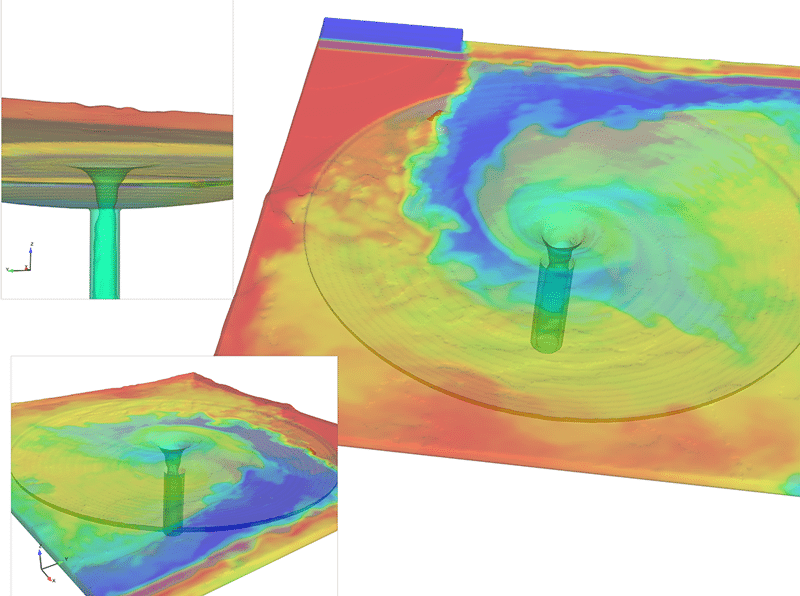
하수 유압, 특히 유압과 자유 표면 조건 둘다 표현할 수 있는 것은 FLOW-3D 의 매우 큰 강점입니다. 복합 하수 범람(CSO: CombinedHyundaioverflow)문제는 미국의 수많은 오래된 도시에서 발생하고 있는 복합적인 하수도 설계의 예로, 가압된 유압 제어 장치와 자유로운 노면 유압 제어 장치 간에 원활하게 전환할 수 있는 CFD접근 방식이 필요합니다. FLOW-3D는 유압 점프를 정확하게 포착할 뿐만 아니라 기포 포착 및 가압 효과를 동시에 해결합니다.
추가로 일반적인 응용 분야로는 municipal drop shaft vortex dynamics, air entrainment, air-driven bulking modeling, related wet tunnel modeling 등의 응용 분야가 있습니다.
FLOW-3D를 이용하여 수처리분야의 엔지니어가 정확하게 접촉조 모델링을 할 수 있습니다. 스칼라 전송 모델, 파티클 모델과 화학 모델은 차세대 시각화 도구인 FlowSight를 이용하여, 엔지니어가 정확하게 혼합 유압 효율을 결정하는 데드 존과 재순환 영역의 위치를 시각화할 수 있습니다.
FLOW-3D는 FAVOR™ 방법을 사용하므로, 형상 및 구조 요소가 수정된 형상을 re-meshing하는 어려움이 없습니다. 새로운 자동 등격자 생성 기능으로, 자동 격자 생성으로 일반 직각 격자 방식의 사용 편리성을 가지면서도 형상을 정확하게 구현할 수 있습니다.
이것은 수처리 시설물의 소독조 유동 해석 결과입니다. 염소 농도는 체적 측정으로 시간에 따른 농도 C (t)와 함께, 측정 위치에서의 단위 시간당 E (t)농도의 변화를 보여줍니다.
폐수 처리, 자원 채취, 하구와 해안 지역 개발에 의한 영향 등의 인간의 활동은 강 및 해양 환경에 영향을 미칩니다. 물자원을 이용하고 관리하는 것은 환경 보호를 유지하는 데 중요한 과제이며, FLOW-3D 는 이에 중요한 역할을 할 수 있습니다. 구체적으로 석유 생산 플랫폼, 기름 유출 모델링 관련 개선 방안, 원양 선박의 개선된 디자인 등 환경 문제를 해결하기 위해 FLOW-3D 를 사용할 수 있습니다. 인구 증가에 따라 천연 자원과 그에 따른 해양 생물의 성장이 고갈되었습니다. 이 해양 환경에 미치는 영향을 최소화하기 위해, FLOW-3D 를 이용하여 개선 조치 수행이 가능합니다.
Tracers are a powerful tool to visualize the movement of fluids in environmental applications of FLOW-3D.
This movie represents the new volume rendering capability in FlowSight, FLOW-3D‘s powerful post-processor.
위 해석 결과는 상류 제방 근처에서 방출된 오염물의 흐름을 나타냅니다. 오염물이 하류로 흐르게 되면 수직 및 수평 유동에 의해 흐름이 분산됩니다. 하단의 강한 cross-stream 흐름으로 오염 물질의 수직 혼합이 발생합니다. 유동의 유형을 volume rendering을 사용하지 않고 확인하기는 매우 어렵습니다.
FLOW-3D의 Sediment Scour Model 은 강이나 하천에서 수리학적으로 복잡한 교각과 지형에 따라 여러가지 퇴적물들의 높이 변화를 해석할 수 있습니다. 세굴 모델은 FLOW-3D 난류 모델들로 적분하여 3차원 분석이 가능합니다. FLOW-3D의 Shallow Water Model로 더 넓은 범위의 세굴 분석이 가능합니다.
교각 주위의 세굴 해석
세굴 모델은 deposition, packing, entrainment and drift-flux 메커니즘으로 되어있습니다. FLOW-3D v11 에서는 퇴적층의 형상을 FAVOR 하여 좀 더 정확하게 bed net 높이 변화를 시각화 할 수 있습니다. 시공간적으로 침전물의 변화뿐 아니라 유체의 부유물들, 바닥/유체 계면에서의 전단응력들을 분석할 수 있습니다.
Modeling Hydraulic Control Structures
In addition to the flow rates and detail of hydraulic behaviors associated with the control gate structures and powerhouse operation, FLOW-3D‘s sediment and scour model allows users to identify regions of high scour both near the control structure and further downstream in the vicinity of the bridge piers.
Bridge Pier Simulations
The first video shows a FLOW-3D simulation of the erosion that occurs around a group of three 2.4 m diameter piers as river water flows past at 1.5 m/s. The river depth is 15.8 m and the mean sediment size was presumed to be 0.35 mm.
하천의 역학은 물, 퇴적물 이동과 바닥의 형상 간의 복잡한 상호 작용을 포함합니다. 하천과 강의 관리는 단면의 변화, 유입 및 유출, 생태에 영향을 미치는 관리 전략에 따른 열 및 유동패턴의 효과 등 이러한 상호 작용의 효과를 예측하는 것에 의존합니다. FLOW-3D는복잡한 강의 역학관계와 하천의 변화를 예측하기 위해 수자원 분야에서 널리 사용되는 소프트웨어입니다. FLOW-3D는 자유표면 흐름의 패턴을 해석하는 것 외에도, 강이나 하천의 관리 문제를 해결할 수 있는 다양한 물리적 패키지를 제공합니다. FLOW-3D가 적용된 예로는 열, 염류의 이동, 층류, 오염물질의 거동 및 이동(반응성 및 비반응성), 난류의 유입과 체류(침식과 퇴적 포함) 및 퇴적물 이동 등을 검토하는데 사용됩니다.
High flow condition hydraulic analysis of San Antonio river junction
Simulation of a 6-km long reach of Fraser River in Vancouver, BC. Courtesy of Northwest Hydraulic Consultants. Image shows overall velocity flow field.
A closer view of the piers of three bridge crossings. Courtesy of Northwest Hydraulic Consultants. Image shows velocity field around piers.
Flows over submerged vanes for control of river bank erosion are shown colored by velocity magnitude (by University of Illinois; images generated with Tecplot)
실제 일어나는 많은 현상들은 복잡한 형상의 자유 표면을 포함하여 지진 해일 모델링의 경우와 관련이 있습니다. 물론 쓰나미는 모두의 생명과 재산을 파괴하는 엄청난 것 입니다. 계산적으로 정확한 모델을 시뮬레이션함으로써 쓰나미 피해를 줄일 수 있습니다. 예를 들어, 아래와 같이 지진해일에 의한 와류가 나타날 것을 알아낼 수 있습니다. 이러한 와류의 크기와 위치를 알면, 엔지니어들은 미래에 대해 더 잘 준비 할 수 있습니다.
많은 컴퓨터 프로그램들은 유체 역학을 설명하는 결합된 편미분 방정식을 풀 수 있습니다. 끊임없이 계산 영역의 경계가 변하고 있기 때문에 자유 표면 계산은 복잡합니다. 또한 솔버에 정확한 유체-고체 상호작용 알고리즘이 필요한 지형과 유체로 구성되어있는 복잡한 형상이 있습니다. FLOW-3D 는 솔버에 내장되어있는 유체-고체 경계에 대한 FAVORTM 기법과 자유 표면 분석에 대한 TruVOF 알고리즘 덕분에 이런 시나리오에 특히 유용합니다.
위의 동영상은 임원항에서 일어난 쓰나미 현상을 해석한 결과입니다. FLOW-3D 는 항구의 중심부에서 일어나는 지진 해일에 의한 소용돌이를 정확하에 구현합니다. 이러한 와류 현상으로 항구의 형상 및 방파제 레이아웃에 따른 해일의 효과를 이해하는데 도움이 됩니다. FLOW-3D 의 post-processor인 FlowSight 는 Eigen 값 분석을 수행하여 vortex core strengths를 계산할 수 있습니다.
Vortex core formation in a tsunami simulation, visualized with FlowSight.
갑작스러운 홍수는 짧은 시간동안 급류같은 위험한 흐름으로 병합할 수있는 호우로 될 수 있습니다. 유동 특성은 자유 표면 제어 뿐 아니라, 지표층의 다공도와 포화 상태에 따라 달라지고, 3차원 적으로 복잡한 지형에 밀접하게 관련이 있습니다. 이러한 모든 역학들은 FLOW-3D의 장점들과 일치합니다. 특히:
FLOW-3D의 porosity 모델은 포화 또는 비포화된 토양을 통한 물의 배출정도를 예측합니다.
그 강수 모델은 지표층 빗물의 시공간적인 축적을 정확히 포착합니다.
FLOW-3D‘s Volume of Fluid (TruVOF) approach to free-surface flow dynamics captures transient waves and run-ups
An advanced sediment and deposition model ties in seamlessly to these simulations when needed
강수 이벤트가 일어나는 동안 표면층에 서서히 표면층은 포화상태에 도달합니다. 지표수는 영역의 왼쪽에서 저수지에 인접한 부분으로 강한 유출과 중앙 계곡으로 급류가 빠르게 형성됩니다.
산사태와 눈사태는 파편들이나 육지의 영향으로 인해 저수지에 엄청난 홍수파를 일으킬 가능성이 있습니다. FLOW-3D 는 산사태 현상 자체와 홍수파의 전파 모두 모델링 할 수 있습니다. Moving Objects Model 은 지형위의 물체 처럼 강체 방식으로 미끄러지는 지평면으로 고려한다. Granular flow 모델은 산사태 현상을 좀 더 상세하게 시뮬레이션 할 수 있다. 두 경우 모두, 관련된 홍수파와 함께 질량의 지표면 전파와 영향을 볼 수 있습니다. 산사태는 수역 전체에 걸쳐 일어나지 않습니다. 예를 들어 tailings 같은 경우에 FLOW-3D의 non-newtonian fluid 모델을 이용하여 개개인의 요구에 맞춘 구조적 관계를 쉽게 구현할 수 있습니다.
기후 변화로 인한 환경 영향이 지속적으로 증가함에 따라, 전 세계적으로 많은 지역과 사람들이 홍수, 해일 또는 오래된 건축물들의 붕괴 등의 형향을 받고 있거나, 심각한 기상 현상에 견디지 못하고 있습니다. FLOW-3D 는 엔지니어들이 이런 재해들에 대한 수자원 분야의 설계를 할 수 있도록 하고, 정부 규제를 충족하고 기존 설계안들의 안전을 평가하는데 사용합니다.
홍수로 인해 발생하는 댐의 범람은 치명적인 결과를 초래하기 때문에 댐의 안전 전문가에게는 매우 중요한 문제입니다. 다수의 방법들이 댐 범람에 의해 발생하는 유체 거동, 침수 위치, 깊이와 손상 범위 등 댐 범람의 결과를 예측하기 위해 개발되었습니다. FLOW-3D는 안전 및 환경 기준에 대한 설계 및 검증을 해야 하는 수자원 관련 엔지니어링 업계에서 비용적으로 가장 효율적인 방법들 중 하나입니다. 물리모델이나 2D코드로 예상하기에는 유동이 꽤 복잡하고 어려운 곳에 특히 유용합니다.
강 생태와 어류의 이동에 대한 댐의 처리방안은 전 세계적인 관심사입니다. 어도의 활용성이 떨어지는 문제점을 해결하기 위해 전문 설계자와 연구자에게 FLOW-3D는 큰 도움이 됩니다. FLOW-3D는 내부 속도, 혼합, 압력, 난류 강도와 소산, 그리고 자유 표면 프로파일 같은 중요한 매개 변수를 검토하는 3차원 유동해석을 할 수 있습니다. 설계 디자인을 제안하여 특정 지역의 고유한 환경적 특성을 고려하여 설계를 수정하거나, 다른 어류의 생리적 기능 및 활동에 맞는 새로운 설계 방안을 개발하여 기존 어도를 개선하거나 비교해 볼 수 있습니다. FLOW-3D는 모델링 및 저산소 용존수에 대한 폭기 시스템의 설계, 저수지의 방류에서 원치 않는 공기 유입 및 총 용존 가스를 완화하는 데 사용할 수 있습니다.
Simulation of the weir of the Third Dam on Somes Brook. Analysis of the fish passage was performed to appropriately repair structure so that the alewife can navigate it. Image colored by velocity magnitude.
FLOW-3D는 댐 모델링 및 여수로 구조물에서 유체의 흐름을 모사할 수 있는 정확하고 강력한 이상적인 CFD 도구입니다. 세계적인 댐 안전 전문가 및 설계 엔지니어들은 댐 및 여수로의 설계, 운영 및 유지 보수의 전과정을 FLOW-3D로 해석해 봄으로써, FLOW-3D의 효율성과 정확성에 의존하고 있습니다. FLOW-3D는 기포 발생 및 유체의 유동을 포함한 복잡한 spillways 의 현상에 대해 rating curves와 상세한 속도 프로파일을 생성 할 수 있습니다. FLOW-3D는 또한 게이트 운영시 일시적인 효과를 포함하여, 정상 및 최대 조건으로 운영중 구조 응력 (압력과 전단력)을 정량화 할 수 있습니다. FLOW-3D는 여수로 설계 시, 압력 성능을 확인하고 전문가들이 댐 안전 요구 사항을 확인하는 데 사용되기도 합니다.
플립 버켓 유동 해석
플립 버켓은 옆수로 여수로의 일반적인 구성입니다. FLOW-3D 는 상세한 에너지 손실 성능 뿐 아니라, 중요한 유동 특성, 전체 난류와 aeration 모델에 대해 빠르고 정확한 해석이 가능합니다. 모델 형상 과 유동 변수들은 re-meshing 작업 없이 쉽게 수정할 수 있습니다.
Advanced Spillway Hydraulics
labyrinth weir 구조에서 홍수 조건에 대한 수리학적 여수로 범람 모델링. FLOW-3D 의 최첨단 시각화 및 분석 도구인 FlowSight 를 이용한 결과.
Spillway Simulations
How Manitoba Hydro Uses FLOW-3D to Design Spillways
Manitoba Hydro에 의한 연구에 따르면, 사소한 설계 변경 사항이 있는 경우, 북부 Manitoba에 있는 Wuskwatim 수력발전 프로젝트의 3개의 게이트 인공 수로에서 측면 수축 효과가 실질적으로 감소될 수 있다고 합니다. 그 결과, 설계 수두가 실현되어 여수로 용량이 대략 5% 증가되었습니다. 이는 전체 공사 비용을 줄여주었습니다.
수력 발전 프로젝트들은 3차원 유동 영향에 민감하고, 그 효율성을 최적화할 수 있는 유동 패턴을 정확하게 예측하는 것이 중요합니다. FLOW-3D 는 자유표면 유동 모델링에 가장 적합한 프로그램이며, 댐 전문가들이 기존안 및 변경된 프로젝트들에 대한 설계 문제점들을 넓은 범위에 걸쳐 검토합니다. FLOW-3D 가 해결할 수 있는 일반적인 문제들은 어도 를 설계하고 최적화하는 것, 댐의 복잡한 환경적인 영향을 평가하고, 취수설비들과 여수로들에 유동 효율성을 최적화하는 것 입니다.
FLOW-3D/MP v6.1 은 FLOW-3D v11.1 솔버에 기초하여 물리 모델, 특징 및 그래픽 사용자 인터페이스가 동일합니다. FLOW-3D v11.1의 새로운 기능은 아래 파란색으로 표시되어 있으며 FLOW-3D/MP v6.1 에서 사용할 수 있습니다. 새로운 개발 기능에 대한 자세한 설명은 FLOW-3D v11.1에서 새로운 기능을 참조하십시오.
Meshing & Geometry
Structured finite difference/control volume meshes for fluid and thermal solutions
Finite element meshes in Cartesian and cylindrical coordinates for structural analysis
Multi-Block gridding with nested, linked, partially overlapping and conforming mesh blocks
Fractional areas/volumes (FAVOR™) for efficient & accurate geometry definition
Mesh quality checking
Basic Solids Modeler
Import CAD data
Import/export finite element meshes via Exodus-II file format
Grid & geometry independence
Cartesian or cylindrical coordinates
Flow Type Options
Internal, external & free-surface flows
3D, 2D & 1D problems
Transient flows
Inviscid, viscous laminar & turbulent flows
Hybrid shallow water/3D flows
Non-inertial reference frame motion
Multiple scalar species
Two-phase flows
Heat transfer with phase change
Saturated & unsaturated porous media
Physical Modeling Options
Fluid structure interaction
Thermally-induced stresses
Plastic deformation of solids
Granular flow
Moisture drying
Solid solute dissolution
Sediment transport and scour
Cavitation (potential, passive tracking, active tracking)
Phase change (liquid-vapor, liquid-solid)
Surface tension
Thermocapillary effects
Wall adhesion
Wall roughness
Vapor & gas bubbles
Solidification & melting
Mass/momentum/energy sources
Shear, density & temperature-dependent viscosity
Thixotropic viscosity
Visco-elastic-plastic fluids
Elastic membranes & walls
Evaporation residue
Electro-mechanical effects
Dielectric phenomena
Electro-osmosis
Electrostatic particles
Joule heating
Air entrainment
Molecular & turbulent diffusion
Temperature-dependent material properties
Spray cooling
Flow Definition Options
General boundary conditions
Symmetry
Rigid and flexible walls
Continuative
Periodic
Specified pressure
Specified velocity
Outflow
Grid overlay
Hydrostatic pressure
Volume flow rate
Non-linear periodic and solitary surface waves
Rating curve and natural hydraulics
Wave absorbing layer
Restart from previous simulation
Continuation of a simulation
Overlay boundary conditions
Change mesh and modeling options
Change model parameters
Thermal Modeling Options
Natural convection
Forced convection
Conduction in fluid & solid
Fluid-solid heat transfer
Distributed energy sources/sinks in fluids and solids
Radiation
Viscous heating
Orthotropic thermal conductivity
Thermally-induced stresses
Turbulence Models
RNG model
Two-equation k-epsilon model
Two-equation k-omega model
Large eddy simulation
Metal Casting Models
Thermal stress & deformations
Iron solidification
Sand core blowing
Sand core drying
Permeable molds
Solidification & melting
Solidification shrinkage with interdendritic feeding
Micro & macro porosity
Binary alloy segregation
Thermal die cycling
Surface oxide defects
Cavitation potential
Lost-foam casting
Semi-solid material
Core gas generation
Back pressure & vents
Shot sleeves
PQ2 diagram
Squeeze pins
Filters
Air entrainment
Temperature-dependent material properties
Cooling channels
Fluid/wall contact time
Numerical Modeling Options
TruVOF Volume-of-Fluid (VOF) method for fluid interfaces
First and second order advection
Sharp and diffuse interface tracking
Implicit & explicit numerical methods
GMRES, point and line relaxation pressure solvers
User-defined variables, subroutines & output
Utilities for runtime interaction during execution
Fluid Modeling Options
One incompressible fluid – confined or with free surfaces
Two incompressible fluids – miscible or with sharp interfaces
FLOW-3D는아래 시설물과 같은 도시의 수처리 시설물 설계와 분석에 매우 활발하게 사용되고 있습니다:
Mixing, settling, and contact tanks
Control structures like weirs, gates, ramps, and orifices
Combined sewer (CSO) and stormwater sewer (SSO) overflow facilities
Pump and lift stations
Treatment plant headworks
Filtration systems and passive earth and stone filters
Baffle and wall placement
Hydraulic efficiency and short-circuiting
Vortex formation simulated with FLOW-3D
FLOW-3D는 자유표면, 가압(pressurized), 미임계(sub-critical)와 초임계(super-critical) 흐름조건 등을 전환하는 자유표면과 제한된 흐름패턴 모두와 균일한 모델 상태에 최적화되어 있습니다. 추가 물리 패키지를 포함하여 대부분의 복잡한 상황을 모델링 FLOW-3D에 포함되어 있습니다 :
Flow bulking due to air entrainment
Air bubble escape and air pocket pressurization
Drifting and settling particulate matter and the effect on the flow pattern of sediment accumulation
Chemical reactions
Moving gates and paddles
Fast-spinning bladed objects, pumps, and impellers
Dissolving and eroding solids
Granular flow (slurries)
적용사례
정수장 : DAF SYSTEMS
용존공기부상법 (DAF Systems: Dissolved Air Floation )
가압상태에서 과포화된 물을 감압시키면, 미세기포가 발생되어 상승하면서 수중의콜로이드물질과 충돌/부착되는 원리를 이용하여 수중의 부유물질을 제거하는 수처리 방법
Two Phase(Water+Air)/Drift Flux을 이용 기포에 의한 지내의 유동양상을 파악
해석을 통한 기존 구조물의 문제점 파악하여 개선
정수장 : 펌프장 해석
정수장: 분말활성탄접촉조
v분말활성탄 접촉조 : 유입구의 구조, 수로의 장폭비, 도류벽구조에 의한 변화 -> 최적형상 도출
v해석을 통해 각종 Index(Morill Index, Modal Index 등) 분석
정수장: 응집제의 확산
G, 혼화지 구조에 따른 turn over time, 지내 속도 분포, 체류시간(t), 등 분석
완속 혼화기, 급속혼화기에서 응집제의 혼화 및 분산 효과 파악
정수장: 분배수로 유량분배
분배수로의 기능 : 응집지 및 침전비 별로 균일하게 물을 분배함
분배수로의 구조에 따른 응집지 유입수의 유량분배 해석
구조별 유량분배 문제점 파악 및 개선방안 제시
구조별 유량분배를 정량화하여 정수장 효율 향상에 기여함.
정수장: 응집지 속도구배(du/dy) 검증
응집기내부의 유동양상 및 속도구배(G)를 규명하여 최적의 운영조건 도출
정수장: 여과지 역세척
Strainer를 통한 역세척수 유입 시 유동양상 해석 실시
역세척 시 압력분포의 균일성, 사수부, 침전수의 월류여부 파악
여과 및 역세척의 문제점 파악하여 효율향상 극대화
정수장: 정수지 실험–해석 비교
정수지의 기능 : 염소를 균일하게 혼화
정수지 유동양상 및 염소 농도, 체류시간 해석으로 CT 값 예측 및 문제점 개선
실험과의 비교를 통하여 정확성 확보
기존 정수지의 효율향상 및 최적 정수지 형태 제안
정수지는 분말활성탄접촉조와 기능과 형상 유사
정수장 : 침전지– 대기온도, 일사량 등 외부조건 고려
대기온도, 일사량 등 외부조건을 고려한 침전지 유동해석 실시
침전지 내부의 밀도류 발생 원인 분석 및 Floc의 운동양상, 제거효율을 해석
실험과의 비교를 통하여 정확성 확보
정수장: 취수탑 선택취수
v취수탑 : 상수도·관개·수력발전용 물을 저수지나 하천으로부터 끌어들이기 위한 구조물
v취수탑의 선택취수 문제 해석 사례
v취수탑 개도 조건에 따른 유출수온도, 조류 유입, 수심별 유입량 등을 예측
하수처리장 : 침전지
침전지 : 하수와 슬러지의 분리 및 배출 기능
해석목적
2차 침전지에서 유량 분배 문제점 파악
2차 침전지에서 유입부 개선안 도출
2차 침전지내의 슬러지 배출 개선안 도출
하수처리장 : 침전지 유량분배 및 유속
구조물의 형상, 유량에 따른 침전지 유동해석
각 지별 유량 분배 균등 여부 파악
슬러지의 재부상(scouring) 여부 예측 및 방지 방안 검토
월류형식, 유입부의 위치 및 규격, 등 설계 요소를 조절하여 균등 분배 유도
하수처리장 : 침전지 월류부 해석
침전지 월류부 유동양상 파악
침전지 형상, 월류부 형상에 따른 유속분포 비교
사수부 파악 및 단락류 최소화를 위한 월류부 형상 결정
슬러지의 월류부 개선을 통한 효율 향상
하수처리장 : 침전지 침전효율
구조물의 형상별, 처리 유량별 침전효율, 사수부 평가
균일한 유속분포에 의한 침전효율 향상
침전지 형상, 유입부 위치, 등을 변경하여 효율 비교
체류시간 검토를 통한 효율 비교
슬러지 침전형태의 비교
하수처리장 : 무산소조
하수처리장 : 무산소조
하수 및 반송슬러지의 혼합, 임펠러의 회전에 의한 혼합양상 해석 실시
유입수 및 내부반송수의 유속분포, 혼합농도 평가
단락류 발생정도 파악 및 완전교반 유도에 유리한 설계방안 검토
내부반송량, 반송슬러지 유입관의 위치 개선으로 효율 향상
하수처리장 : 담체의 부상
설계 요소에 따른 담체의 분포 및 흐름 양상 예측
해석 설계 요소 : 조의 형상, 펌프의 용량 및 위치, 내부 배플의 형상
하수처리장 : 호기조 (Aerator)
호기조내 체류시간 분석
기포의 분포, 조내 위치별 D.O 예측
단락류 발생 정도 및 사수부 파악
폭기량 및 폭기 방식에 따른 내부 유동양상을 통한 효율예측
하수처리장 : 호기조 (D.O 예측)
용존산소량 (Dissolved Oxygen) : 물 속에 녹아 있는 산소량 è 수온이 높아지거나 오염되면 DO감소
조내 산기관에 의해 오염수를 전체적으로 용존산소량 증가 목적 è 조내 사수부, 체류시간 분석
산기관에 의한 공기 방울의 분포 및 D.O 분포를 수류의 흐름을 고려하여 예측
호기조의 구조 및 산기관의 배치에 따른 효율 분석
하수처리장 : 막분리조
막분리조내의 수류순환 유동해석 실시
Air 유입과 Membrane내의 수류순환 유동 검토
사수부 최소화를 위한 구조 변경 (유입부 방식, 위치 및 산기관 위치, 등)
처리 유량에 따른 내부 효율 변화 검토 – 운영조건 제시
하수처리장 : SBR/PSBR 호기공정
송풍기 작동시 원수와 슬러지의 혼합양상 분석
수중포기기와 송풍기의 작동에 의해 조 내의 슬러지 혼합 활성화 여부 판단 : 수중포기기와 송풍기의 적절한 위치 및 회전수 조절에 의해 개선안 제시 가능
하수처리장 : SBR/PSBR 배출공정
조 내의 유출게이트 OPEN하여 조 내의 상등수 배출양상 분석
바닥의 슬러지 유출없이 배출가능 여부 해석을 통하여 파악 슬러지가 배출되지 않도록 내의 형상 및 문제점 개서안 제시
Gravity Pour 중력 주조 High Pressure Die Casting 고압 다이캐스팅 Tilt Casting 경동 주조 Centrifugal Casting 원심 주조 Investment Casting 정밀 주조 Vacuum Casting 진공 주조 Continuous Casting 연속 주조 Lost Foam Casting 소실 모형 주조 Fill and Defects Tracking 용탕 주입 및 결함 추적 Solidification and Shrinkage 응고 및 수축 해석 Thermal Stress Evolution and Deformation 열응력 및 변형 해석
물 및 환경 응용 분야
Wastewater Treatment and Recovery 폐수 처리 및 복구 Pump Stations 펌프장 Dams, Weirs, Spillways 댐, 위어, 여수로 River Hydraulics 강 유역 Inundation & Flooding 침수 및 범람 Open Channel Flow 개수로 흐름 Sediment and Scour 퇴적 및 세굴(쇄굴) Plumes, Hydraulic Zones of Influence 기둥, 수리 영향 구역 Coastal and Critical Infrastructure Wave Run-Up 연안 및 핵심 인프라 웨이브 런업
에너지 분야
Fuel/cargo sloshing in oceangoing containers 해양 컨테이너 용 연료 /화물 슬로싱 Offshore platform wave effects 근해 플랫폼 파 영향 Separation devices undergoing 6 DOF motion 6 자유도 운동을 하는 분리 장치 Wave energy converters 파동 에너지 변환기
미세유체
Continuous-Flow 연속 흐름 Droplet, Digital 물방울, 디지털 Molecular Biology 분자 생물학 Opto-Microfluidics 광 마이크로 유체 Cell Behavior 세포 행동 Fuel Cells 연료 전지들
용접 제조
Laser Welding 레이저 용접 Laser Metal Deposition 레이저 금속 증착 Additive Manufacturing 첨가제 제조 Multi-Layer Build 다중 레이어 빌드 Polymer 3D Printing 폴리머 3D 프린팅
Active Mixing 액티브 믹싱 Chemical Reactions 화학 반응 Dissolution 용해 Drug Delivery 약물 전달 Drug Particles 마약 입자 Microdispensers 마이크로 디스펜서 Passive Mixing 패시브 믹싱 Piezo Driven Pumps 피에조 구동 펌프
자동차 분야
Fuel Tanks 연료 탱크 Early Fuel Shut-Off 초기 연료 차단 Gear Interaction 기어 상호 작용 Filters 필터 Degas Bottles 병의 가스제거


 Courtesy URS Corporation
 Courtesy of
  Courtesy Tecsult
 Courtesy Worley-Parsons


 High flow condition hydraulic analysis of San Antonio river junction
 Simulation of a 6-km long reach of Fraser River in Vancouver, BC. Courtesy of Northwest Hydraulic Consultants. Image shows overall velocity flow field.
 A closer view of the piers of three bridge crossings. Courtesy of Northwest Hydraulic Consultants. Image shows velocity field around piers.
 Flows over submerged vanes for control of river bank erosion are shown colored by velocity magnitude (by University of Illinois; images generated with Tecplot)
 Vortex core formation in a tsunami simulation, visualized with FlowSight.
 강수 이벤트가 일어나는 동안 표면층에 서서히 표면층은 포화상태에 도달합니다. 지표수는 영역의 왼쪽에서 저수지에 인접한 부분으로 강한 유출과 중앙 계곡으로 급류가 빠르게 형성됩니다.
 Results of a simulation with FLOW-3D (including added original stl-geometry) of a stopped and restarted avalanche model before it reaches the reservoir – colored by the depth-averaged velocities in [ms-1]. Results taken from R. Gabl, J. Seibl, B. Gems, and M. Aufleger,
  Dam break analysis
 Simulation of the weir of the Third Dam on Somes Brook. Analysis of the fish passage was performed to appropriately repair structure so that the alewife can navigate it. Image colored by velocity magnitude.

 Manitoba Hydro에 의한 연구에 따르면, 사소한 설계 변경 사항이 있는 경우, 북부 Manitoba에 있는 Wuskwatim 수력발전 프로젝트의 3개의 게이트 인공 수로에서 측면 수축 효과가 실질적으로 감소될 수 있다고 합니다. 그 결과, 설계 수두가 실현되어 여수로 용량이 대략 5% 증가되었습니다. 이는 전체 공사 비용을 줄여주었습니다.