Water Catastrophic Events Flash Floods

Flash Floods

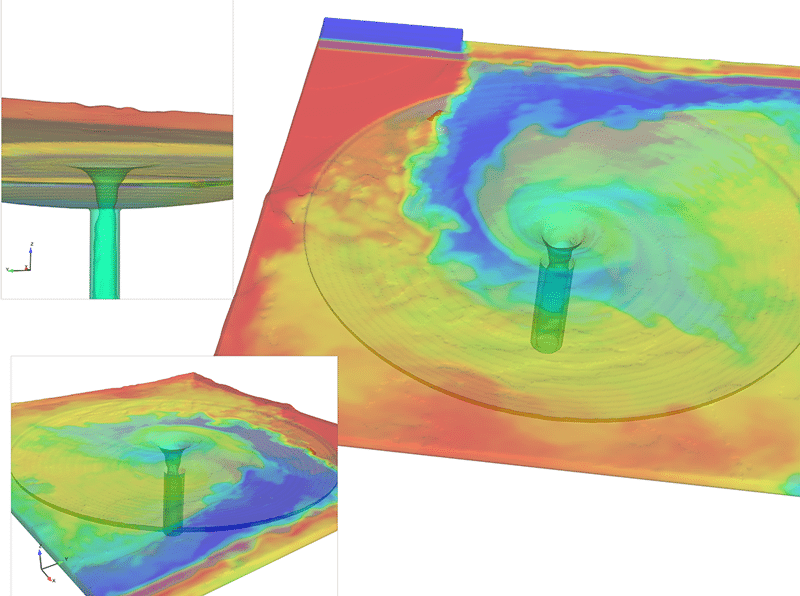
갑작스러운 홍수는 짧은 시간동안 급류같은 위험한 흐름으로 병합할 수있는 호우로 될 수 있습니다. 유동 특성은 자유 표면 제어 뿐 아니라, 지표층의 다공도와 포화 상태에 따라 달라지고, 3차원 적으로 복잡한 지형에 밀접하게 관련이 있습니다. 이러한 모든 역학들은 FLOW-3D의 장점들과 일치합니다. 특히:

  • FLOW-3D의 porosity 모델은 포화 또는 비포화된 토양을 통한 물의 배출정도를 예측합니다.
  • 그 강수 모델은 지표층 빗물의 시공간적인 축적을 정확히 포착합니다.
  • FLOW-3D‘s Volume of Fluid (TruVOF) approach to free-surface flow dynamics captures transient waves and run-ups
  • An advanced sediment and deposition model ties in seamlessly to these simulations when needed

강수 이벤트가 일어나는 동안 표면층에 서서히 표면층은 포화상태에 도달합니다. 지표수는 영역의 왼쪽에서 저수지에 인접한 부분으로 강한 유출과 중앙 계곡으로 급류가 빠르게 형성됩니다.

Water Catastrophic Events Avalanches

Avalanches

산사태와 눈사태는 파편들이나 육지의 영향으로 인해 저수지에 엄청난 홍수파를 일으킬 가능성이 있습니다. FLOW-3D 는 산사태 현상 자체와 홍수파의 전파 모두 모델링 할 수 있습니다. Moving Objects Model 은 지형위의 물체 처럼 강체 방식으로 미끄러지는 지평면으로 고려한다. Granular flow 모델은 산사태 현상을 좀 더 상세하게 시뮬레이션 할 수 있다. 두 경우 모두, 관련된 홍수파와 함께 질량의 지표면 전파와 영향을 볼 수 있습니다. 산사태는 수역 전체에 걸쳐 일어나지 않습니다. 예를 들어 tailings 같은 경우에 FLOW-3D의 non-newtonian fluid 모델을 이용하여 개개인의 요구에 맞춘 구조적 관계를 쉽게 구현할 수 있습니다.


Results of a simulation with FLOW-3D (including added original stl-geometry) of a stopped and restarted avalanche model before it reaches the reservoir – colored by the depth-averaged velocities in [ms-1]. Results taken from R. Gabl, J. Seibl, B. Gems, and M. Aufleger, 3-D-numerical approach to simulate an avalanche impact into a reservoir, Nat. Hazards Earth Syst. Sci. Discuss., 3, 4121–4157, 2015, www.nat-hazards-earth-syst-sci-discuss.net/3/4121/2015/, doi:10.5194/nhessd-3-4121-2015, © Author(s) 2015. CC Attribution 3.0 License.

More Avalanche Simulation Examples

FLOW-3D Features

The features in blue are newly-released in FLOW-3D v12.0.

Meshing & Geometry

  • Structured finite difference/control volume meshes for fluid and thermal solutions
  • Finite element meshes in Cartesian and cylindrical coordinates for structural analysis
  • Multi-Block gridding with nested, linked, partially overlapping and conforming mesh blocks
  • Conforming meshes extended to arbitrary shapes
  • Fractional areas/volumes (FAVOR™) for efficient & accurate geometry definition
  • Closing gaps in geometry
  • Mesh quality checking
  • Basic Solids Modeler
  • Import CAD data
  • Import/export finite element meshes via Exodus-II file format
  • Grid & geometry independence
  • Cartesian or cylindrical coordinates

Flow Type Options

  • Internal, external & free-surface flows
  • 3D, 2D & 1D problems
  • Transient flows
  • Inviscid, viscous laminar & turbulent flows
  • Hybrid shallow water/3D flows
  • Non-inertial reference frame motion
  • Multiple scalar species
  • Two-phase flows
  • Heat transfer with phase change
  • Saturated & unsaturated porous media

Physical Modeling Options

  • Fluid structure interaction
  • Thermally-induced stresses
  • Plastic deformation of solids
  • Granular flow
  • Moisture drying
  • Solid solute dissolution
  • Sediment transport and scour
  • Sludge settling
  • Cavitation (potential, passive tracking, active tracking)
  • Phase change (liquid-vapor, liquid-solid)
  • Surface tension
  • Thermocapillary effects
  • Wall adhesion
  • Wall roughness
  • Vapor & gas bubbles
  • Solidification & melting
  • Mass/momentum/energy sources
  • Shear, density & temperature-dependent viscosity
  • Thixotropic viscosity
  • Visco-elastic-plastic fluids
  • Elastic membranes & walls
  • Evaporation residue
  • Electro-mechanical effects
  • Dielectric phenomena
  • Electro-osmosis
  • Electrostatic particles
  • Joule heating
  • Air entrainment
  • Molecular & turbulent diffusion
  • Temperature-dependent material properties
  • Spray cooling

Flow Definition Options

  • General boundary conditions
    • Symmetry
    • Rigid and flexible walls
    • Continuative
    • Periodic
    • Specified pressure
    • Specified velocity
    • Outflow
    • Outflow pressure
    • Outflow boundaries with wave absorbing layers
    • Grid overlay
    • Hydrostatic pressure
    • Volume flow rate
    • Non-linear periodic and solitary surface waves
    • Rating curve and natural hydraulics
    • Wave absorbing layer
  • Restart from previous simulation
  • Continuation of a simulation
  • Overlay boundary conditions
  • Change mesh and modeling options
  • Change model parameters

Thermal Modeling Options

  • Natural convection
  • Forced convection
  • Conduction in fluid & solid
  • Fluid-solid heat transfer
  • Distributed energy sources/sinks in fluids and solids
  • Radiation
  • Viscous heating
  • Orthotropic thermal conductivity
  • Thermally-induced stresses

Numerical Modeling Options

  • TruVOF Volume-of-Fluid (VOF) method for fluid interfaces
  • Steady state accelerator for free-surface flows
  • First and second order advection
  • Sharp and diffuse interface tracking
  • Implicit & explicit numerical methods
  • Immersed boundary method
  • GMRES, point and line relaxation pressure solvers
  • User-defined variables, subroutines & output
  • Utilities for runtime interaction during execution

Fluid Modeling Options

  • One incompressible fluid – confined or with free surfaces
  • Two incompressible fluids – miscible or with sharp interfaces
  • Compressible fluid – subsonic, transonic, supersonic
  • Stratified fluid
  • Acoustic phenomena
  • Mass particles with variable density or diameter

Shallow Flow Models

  • General topography
  • Raster data interface
  • Subcomponent-specific surface roughness
  • Wind shear
  • Ground roughness effects
  • Manning’s roughness
  • Laminar & turbulent flow
  • Sediment transport and scour
  • Surface tension
  • Heat transfer
  • Wetting & drying

Turbulence Models

  • RNG model
  • Two-equation k-epsilon model
  • Two-equation k-omega model
  • Large eddy simulation

Advanced Physical Models

  • General Moving Object model with 6 DOF–prescribed and fully-coupled motion
  • Rotating/spinning objects
  • Collision model
  • Tethered moving objects (springs, ropes, breaking mooring lines)
  • Flexing membranes and walls
  • Porosity
  • Finite element based elastic-plastic deformation
  • Finite element based thermal stress evolution due to thermal changes in a solidifying fluid
  • Combusting solid components

Chemistry Models

  • Stiff equation solver for chemical rate equations
  • Stationary or advected species

Porous Media Models

  • Saturated and unsaturated flow
  • Variable porosity
  • Directional porosity
  • General flow losses (linear & quadratic)
  • Capillary pressure
  • Heat transfer in porous media
  • Van Genunchten model for unsaturated flow

Discrete Particle Models

  • Massless marker particles
  • Multi-species material particles of variable size and mass
  • Solid, fluid, gas particles
  • Void particles tracking collapsed void regions
  • Non-linear fluid-dynamic drag
  • Added mass effects
  • Monte-Carlo diffusion
  • Particle-fluid momentum coupling
  • Coefficient of restitution or sticky particles
  • Point or volumetric particle sources
  • Initial particle blocks
  • Heat transfer with fluid
  • Evaporation and condensation
  • Solidification and melting
  • Coulomb and dielectric forces
  • Probe particles

Two-Phase & Two-Component Models

  • Liquid/liquid & gas/liquid interfaces
  • Variable density mixtures
  • Compressible fluid with a dispersed incompressible component
  • Drift flux with dynamic droplet size
  • Two-component, vapor/non-condensable gases
  • Phase transformations for gas-liquid & liquid-solid
  • Adiabatic bubbles
  • Bubbles with phase change
  • Continuum fluid with discrete particles
  • Scalar transport
  • Homogeneous bubbles
  • Super-cooling
  • Two-field temperature

Coupling with Other Programs

  • Geometry input from Stereolithography (STL) files – binary or ASCII
  • Direct interfaces with EnSight®, FieldView® & Tecplot® visualization software
  • Finite element solution import/export via Exodus-II file format
  • PLOT3D output
  • Neutral file output
  • Extensive customization possibilities
  • Solid Properties Materials Database

Data Processing Options

  • State-of-the-art post-processing tool, FlowSight™
  • Batch post-processing
  • Report generation
  • Automatic or custom results analysis
  • High-quality OpenGL-based graphics
  • Color or B/W vector, contour, 3D surface & particle plots
  • Moving and stationary probes
  • Visualization of non-inertial reference frame motion
  • Measurement baffles
  • Arbitrary sampling volumes
  • Force & moment output
  • Animation output
  • PostScript, JPEG & Bitmap output
  • Streamlines
  • Flow tracers

User Conveniences

  • Active simulation control (based on measurement of probes)
  • Mesh generators
  • Mesh quality checking
  • Tabular time-dependent input using external files
  • Automatic time-step control for accuracy & stability
  • Automatic convergence control
  • Mentor help to optimize efficiency
  • Units on all variables
  • Custom units
  • Component transformations
  • Moving particle sources
  • Change simulation parameters while solver runs
  • Launch and manage multiple simulations
  • Automatic simulation termination based on user-defined criteria
  • Run simulation on remote servers using remote solving
  • Copy boundary conditions to other mesh blocks

Multi-Processor Computing

  • Shared memory computers
  • Distributed memory clusters

FlowSight

  • Particle visualization
  • Velocity vector fields
  • Streamlines & pathlines
  • Iso-surfaces
  • 2D, 3D and arbitrary clips
  • Volume render
  • Probe data
  • History data
  • Vortex cores
  • Link multiple results
  • Multiple data views
  • Non-inertial reference frame
  • Spline clip

전산유체역학(CFD)의 기초

전산유체역학(CFD)의 기초

Dr. Tony Hirt, Founder of Flow Science

CFD-101은 FlowScience의 창립자이자 VOF(Volume-of-Fluid)개척자인 Dr. C.W. (Tony) Hirt에 의해 작성된 전산 유체 역학 기초를 위한 가장 포괄적인 온라인 자료 중 하나입니다. CFD-101은 전산 유체 역학과 관련된 다양한 문제에 대한 일반적인 소개와 개요를 제공하도록 설계되었습니다. 

우리는 유용하고 정확하며 효율적인 계산 모델을 만들 때 고려해야 할 많은 기능 중 몇 가지만 다루었습니다. CFD의 기초를 쌓는 데 사용할 수있는 많은 논문과 책이 있습니다. 여기서는 일반적으로 표준 참조에 포함되지 않은 몇 가지 주제에 주로 초점을 맞추도록 선택했습니다. 이 CFD 참조 도구를 탐색하려면 오른쪽 메뉴를 사용하십시오.

CFD-101 is one of the most comprehensive online resources for Computational Fluid Dynamics basics, edited by Flow Science’s founder and Volume-of-Fluid (VOF) pioneer, Dr. C.W. (Tony) Hirt. CFD-101 is designed to give a general introduction and overview of a variety of issues concerning computational fluid dynamics. We have only touched on a few of the many features that must be considered when attempting to make useful, accurate and efficient computational models. There are many papers and books available for gaining a basic grounding in CFD. We have chosen here to focus primarily on a few topics that are not generally included in standard references. Please use the menu on the right to explore this CFD reference tool.

CFD for Beginners

CFD (전산 유체 역학)에 대해 생각하는 방법에 대한 일반적인 설명은 자유 표면을 사용한 유체 흐름 시뮬레이션 기사에 나와 있습니다. 이 기사에서는 시뮬레이션 영역을 작은 볼륨 제어 요소로 축소하는 아이디어를 소개합니다. 이 요소에 대한 대수 방정식은 인접한 요소와의 질량, 운동량 및 에너지 교환을 설명하기 위해 구성됩니다. 또한 제어 요소 영역 내에서 자유 유체 인터페이스의 움직임을 설명하는 방법에 대한 간단한 방법이 도입되었습니다.

A general description of how to think about computational fluid dynamics (CFD) is given in the article, Simulating Fluid Flow with Free Surfaces. This article introduces the idea of reducing a simulation region into small volume control elements for which algebraic equations are constructed to describe the conservation of mass, momentum and energy exchanges with neighboring elements. Additionally, a simple method is introduced for a means of describing the motion of free fluid interfaces within the region of control elements.

또한 초보자를 위해 CFD 소프트웨어를 선택할 때 CFD 모델링에 대해 알아야 할 사항에는 유체 역학 문제에 대한 수치적 해결책을 구성하는데 중요한 고려 사항인 다양한 문제에 대한 간략한 요약이 포함되어 있습니다. 메싱, 지오메트리 표현, 암시적 대 명시적 수치 방법 및 완화/수렴 매개 변수와 같은 많은 문제는 CFD-101의 나머지 기사에서 자세히 살펴 봅니다.

Also for beginners, the article, What you should know about CFD modeling when selecting a CFD software, contains brief summaries of a variety of issues that are important considerations for constructing numerical solutions to fluid dynamic problems. Many of these issues, such as meshing, geometry representation, implicit versus explicit numerical methods and relaxation/convergence parameters are explored in greater detail in the remaining articles in CFD-101.

Beyond CFD-101

본 자료의 일부 주제는 CFD를 공부하는 고급수준 학생들에게도 흥미로울 수 있습니다. 예를 들어, 유체가 “비압축성”으로 설명 될 때 의미하는 것은 충족되어야 하는 두 가지 제한 조건을 포함합니다. 또 다른 예는 보존 조건을 완화하는 것이 바람직한 시기를 설명합니다. 그리고 마지막으로 레이놀즈수 의존성을 어떻게 평가해야 하는지 입니다.

Some of the topics in this series of articles may also be of interest to more advanced students of CFD. For example, what is meant when a fluid is described as “incompressible” includes two limit conditions that should be satisfied. Another example describes when it is preferable to relax conservation conditions. And, finally, how should Reynolds number dependencies be evaluated?

본 자료는 국내 사용자들의 편의를 위해 원문 번역을 해서 제공하기 때문에 일부 오역이 있을 수 있어서 원문과 함께 수록합니다. 자료를 이용하실 때 참고하시기 바랍니다.

수처리 분야

Municipal

FLOW-3D는아래 시설물과 같은 도시의 수처리 시설물 설계와 분석에 매우 활발하게 사용되고 있습니다:

  • Mixing, settling, and contact tanks
  • Control structures like weirs, gates, ramps, and orifices
  • Combined sewer (CSO) and stormwater sewer (SSO) overflow facilities
  • Pump and lift stations
  • Treatment plant headworks
  • Filtration systems and passive earth and stone filters
  • Baffle and wall placement
  • Hydraulic efficiency and short-circuiting

Vortex simulation municipal application with FLOW-3D

Vortex formation simulated with FLOW-3D

FLOW-3D는 자유표면, 가압(pressurized), 미임계(sub-critical)와 초임계(super-critical) 흐름조건 등을 전환하는 자유표면과 제한된 흐름패턴 모두와 균일한 모델 상태에 최적화되어 있습니다. 추가 물리 패키지를 포함하여 대부분의 복잡한 상황을 모델링 FLOW-3D에 포함되어 있습니다 :

  • Flow bulking due to air entrainment
  • Air bubble escape and air pocket pressurization
  • Drifting and settling particulate matter and the effect on the flow pattern of sediment accumulation
  • Chemical reactions
  • Moving gates and paddles
  • Fast-spinning bladed objects, pumps, and impellers
  • Dissolving and eroding solids
  • Granular flow (slurries)

적용사례

정수장 : DAF SYSTEMS

  • 용존공기부상법 (DAF Systems: Dissolved Air Floation )
    • 가압상태에서 과포화된 물을 감압시키면, 미세기포가 발생되어 상승하면서 수중의콜로이드물질과 충돌/부착되는 원리를 이용하여 수중의 부유물질을 제거하는 수처리 방법
  • Two Phase(Water+Air)/Drift Flux을 이용 기포에 의한 지내의 유동양상을 파악
  • 해석을 통한 기존 구조물의 문제점 파악하여 개선
  • 정수장_DAF_시스템

정수장 : 펌프장 해석

정수장_펌프장_모델해석결과

정수장_펌프장_모델

정수장 : 분말활성탄접촉조

  • v분말활성탄 접촉조 : 유입구의 구조, 수로의 장폭비, 도류벽구조에 의한 변화 -> 최적형상 도출
  • v해석을 통해 각종 Index(Morill Index, Modal Index 등) 분석

분말활성탄접촉초

정수장 : 응집제의 확산

  • G, 혼화지 구조에 따른 turn over time, 지내 속도 분포, 체류시간(t), 등 분석
  • 완속 혼화기, 급속혼화기에서 응집제의 혼화 및 분산 효과 파악

고속분사기_응집제확산

정수장 : 분배수로 유량분배

  • 분배수로의 기능 : 응집지 및 침전비 별로 균일하게 물을 분배함
  • 분배수로의 구조에 따른 응집지 유입수의 유량분배 해석
  • 구조별 유량분배 문제점 파악 및 개선방안 제시
  • 구조별 유량분배를 정량화하여 정수장 효율 향상에 기여함.

분배수로_유량분배

정수장 : 응집지 속도구배(du/dy) 검증

  • 응집기내부의 유동양상 및 속도구배(G)를 규명하여 최적의 운영조건 도출

응집지속도구배

정수장 : 여과지 역세척

  • Strainer를 통한 역세척수 유입 시 유동양상 해석 실시
  • 역세척 시 압력분포의 균일성, 사수부, 침전수의 월류여부 파악
  • 여과 및 역세척의 문제점 파악하여 효율향상 극대화

여과지_역세척

정수장 : 정수지 실험해석 비교

  • 정수지의 기능 : 염소를 균일하게 혼화
  • 정수지 유동양상 및 염소 농도, 체류시간 해석으로 CT 값 예측 및 문제점 개선
  • 실험과의 비교를 통하여 정확성 확보
  • 기존 정수지의 효율향상 및 최적 정수지 형태 제안
  • 정수지는 분말활성탄접촉조와 기능과 형상 유사

정수장_정수지해석

정수장 : 침전지대기온도, 일사량 등 외부조건 고려

  • 대기온도, 일사량 등 외부조건을 고려한 침전지 유동해석 실시
  • 침전지 내부의 밀도류 발생 원인 분석 및 Floc의 운동양상, 제거효율을 해석
  • 실험과의 비교를 통하여 정확성 확보

정수장_침전지_외부조건고려해석

정수장 : 취수탑 선택취수

  • v취수탑 : 상수도·관개·수력발전용 물을 저수지나 하천으로부터 끌어들이기 위한 구조물
  • v취수탑의 선택취수 문제 해석 사례
  • v취수탑 개도 조건에 따른 유출수온도, 조류 유입, 수심별 유입량 등을 예측

취수탑해석


하수처리장 : 침전지

  • 침전지 : 하수와 슬러지의 분리 및 배출 기능
    • 해석목적
    • 2차 침전지에서 유량 분배 문제점 파악
    • 2차 침전지에서 유입부 개선안 도출
    • 2차 침전지내의 슬러지 배출 개선안 도출

하수처리장_침전지_모델 하수처리장_침전지_모델_해석결과


하수처리장 : 침전지 유량분배 및 유속

  • 구조물의 형상, 유량에 따른 침전지 유동해석
  • 각 지별 유량 분배 균등 여부 파악
  • 슬러지의 재부상(scouring) 여부 예측 및 방지 방안 검토
  • 월류형식, 유입부의 위치 및 규격, 등 설계 요소를 조절하여 균등 분배 유도
    • 하수처리장_침전지_유량분배_해석결과

하수처리장 : 침전지 월류부 해석

  • 침전지 월류부 유동양상 파악
  • 침전지 형상, 월류부 형상에 따른 유속분포 비교
  • 사수부 파악 및 단락류 최소화를 위한 월류부 형상 결정
  • 슬러지의 월류부 개선을 통한 효율 향상

하수처리장_침전지_월류부해석

하수처리장 : 침전지 침전효율

  • 구조물의 형상별, 처리 유량별 침전효율, 사수부 평가
  • 균일한 유속분포에 의한 침전효율 향상
  • 침전지 형상, 유입부 위치, 등을 변경하여 효율 비교
  • 체류시간 검토를 통한 효율 비교
  • 슬러지 침전형태의 비교

하수처리장_침전지_침전효율

하수처리장 : 무산소조

  • 하수처리장 : 무산소조
  • 하수 및 반송슬러지의 혼합, 임펠러의 회전에 의한 혼합양상 해석 실시
  • 유입수 및 내부반송수의 유속분포, 혼합농도 평가
  • 단락류 발생정도 파악 및 완전교반 유도에 유리한 설계방안 검토
  • 내부반송량, 반송슬러지 유입관의 위치 개선으로 효율 향상

하수처리장_무산소조

하수처리장 : 담체의 부상

  • 설계 요소에 따른 담체의 분포 및 흐름 양상 예측
  • 해석 설계 요소 : 조의 형상, 펌프의 용량 및 위치, 내부 배플의 형상

하수처리장_담체의부상

하수처리장 : 호기조 (Aerator)

  • 호기조내 체류시간 분석
  • 기포의 분포, 조내 위치별 D.O 예측
  • 단락류 발생 정도 및 사수부 파악
  • 폭기량 및 폭기 방식에 따른 내부 유동양상을 통한 효율예측

하수처리장_호기조

하수처리장 : 호기조 (D.O 예측)

  • 용존산소량 (Dissolved Oxygen) : 물 속에 녹아 있는 산소량 è 수온이 높아지거나 오염되면 DO감소
  • 조내 산기관에 의해 오염수를 전체적으로 용존산소량 증가 목적 è 조내 사수부, 체류시간 분석
  • 산기관에 의한 공기 방울의 분포 및 D.O 분포를 수류의 흐름을 고려하여 예측
  • 호기조의 구조 및 산기관의 배치에 따른 효율 분석

하수처리장_호기조_용존산소량

하수처리장 : 막분리조

  • 막분리조내의 수류순환 유동해석 실시
  • Air 유입과 Membrane내의 수류순환 유동 검토
  • 사수부 최소화를 위한 구조 변경 (유입부 방식, 위치 및 산기관 위치, 등)
  • 처리 유량에 따른 내부 효율 변화 검토 – 운영조건 제시

하수처리장_막분리조


하수처리장 : SBR/PSBR 호기공정

  • 송풍기 작동시 원수와 슬러지의 혼합양상 분석
  • 수중포기기와 송풍기의 작동에 의해 조 내의 슬러지 혼합 활성화 여부 판단 : 수중포기기와 송풍기의 적절한 위치 및 회전수 조절에 의해 개선안 제시 가능

하수처리장_SBR_호기공정

하수처리장 : SBR/PSBR 배출공정

  • 조 내의 유출게이트 OPEN하여 조 내의 상등수 배출양상 분석
  • 바닥의 슬러지 유출없이 배출가능 여부 해석을 통하여 파악 슬러지가 배출되지 않도록 내의 형상 및 문제점 개서안 제시

하수처리장_SBR_배출공정