Figure 6. The roller arrangement of the sinusoidal curvature–quartic even polynomial continuous bending and straightening caster layout curve.

고온 크리프(Creep) 변형을 활용한 연속 주조 공정 혁신: 균열 없는 고품질 슬래브 생산의 새로운 길

이 기술 요약은 Yunhuan Sui 외 저자들이 Metals (2025)에 발표한 논문 “A New Continuous Bending and Straightening Curve Based on the High-Temperature Creep Property of a Low-Alloy Steel Continuous Casting Slab”을 기반으로 하며, STI C&D에서 기술 전문가를 위해 분석 및 요약했습니다.

키워드

  • Primary Keyword: 고온 크리프 (High-temperature creep)
  • Secondary Keywords: 연속 주조 (Continuous casting), 벤딩 (bending), 스트레이트닝 (straightening), 캐스터 커브 설계 (caster curve design), 균열 저감 (crack reduction)

Executive Summary

  • The Challenge: 기존 연속 주조 공정의 벤딩 및 스트레이트닝 구간에서 발생하는 소성 변형은 슬래브 내부에 균열과 같은 결함을 유발하여 최종 제품의 품질을 저하시킵니다.
  • The Method: 유해한 것으로만 여겨졌던 고온 크리프(creep) 변형을 역으로 활용하여, 기존의 기본 원호 구간을 없애고 벤딩과 스트레이트닝 구간을 부드럽게 연결하는 새로운 캐스터 커브를 설계했습니다.
  • The Key Breakthrough: 새로운 커브 설계를 통해 변형 시간을 크게 늘리고 변형률을 낮춤으로써, 특정 온도 구간(1100°C ~ 1150°C)에서 소성 변형 없이 오직 크리프 변형만으로 슬래브의 벤딩 및 스트레이트닝을 완수할 수 있음을 입증했습니다.
  • The Bottom Line: 고온 크리프 현상을 제어하고 적극적으로 활용하면, 연속 주조 공정에서 내부 균열 발생 가능성을 획기적으로 줄여 최종 제품의 품질과 생산 효율성을 동시에 향상시킬 수 있습니다.

The Challenge: Why This Research Matters for CFD Professionals

연속 주조는 용강을 냉각하여 슬래브 형태로 직접 생산하는 핵심 기술로, 효율성, 수율, 에너지 절감 측면에서 큰 장점을 가집니다. 이 공정에서 벤딩(bending)과 스트레이트닝(straightening)은 최종 슬래브 제품의 품질을 결정하는 매우 중요한 단계입니다. 하지만 기존의 방식은 슬래브에 소성 변형을 가하는 것을 기본 메커니즘으로 삼기 때문에, 응고 과정에 있는 슬래브 내부에 응력이 집중되어 균열이 발생할 위험이 큽니다.

특히, 주조 공정의 상당 부분에서 슬래브 표면 온도는 1000°C 이상으로 유지되며, 이러한 고온 환경에서 재료는 항복 강도보다 낮은 응력에서도 영구 변형이 발생하는 ‘크리프(creep)’ 현상을 보입니다. 이 크리프 변형은 슬래브의 벤딩 및 스트레이트닝에 상당한 영향을 미치지만, 관련 실험 데이터의 부족으로 인해 그동안 정밀하게 고려되지 못했습니다. 본 연구는 이러한 문제점을 해결하기 위해, 제어하기 어려운 현상으로만 여겨졌던 고온 크리프를 오히려 벤딩 및 스트레이트닝의 주된 동력으로 활용하는 혁신적인 접근법을 제시합니다.

Figure 1. Schematic diagram of a casting slab cross-section.

The Approach: Unpacking the Methodology

본 연구팀은 기존의 소성 변형에 의존하는 방식의 한계를 극복하기 위해, 크리프 변형을 기반으로 한 새로운 연속 벤딩 및 스트레이트닝 커브를 설계했습니다. 연구의 핵심 방법론은 다음과 같습니다.

  1. 새로운 커브 설계: 기존 설비(Ansteel의 R9300 수직-원호형 연속 주조기)의 파라미터를 참조하여, 전통적인 ‘기본 원호 구간(basic arc segment)’을 과감히 제거했습니다. 대신, 곡률이 사인 함수 형태로 변하는 벤딩 구간과 4차 짝수 다항식(quartic even polynomial)으로 정의된 스트레이트닝 구간을 부드럽게 직접 연결하는 새로운 커브를 고안했습니다. 이 설계는 변형이 일어나는 전체 구간의 길이를 늘려 변형 시간을 확보하고 변형률을 낮추는 것을 목표로 합니다.
  2. 온도장 시뮬레이션: 설계된 새로운 커브와 공정 파라미터를 적용하여, 유한요소해석 소프트웨어(MARC/Mentat 3.1)를 통해 연속 주조 슬래브의 온도장 변화를 시뮬레이션했습니다. 이를 통해 특정 위치와 시간에 따른 슬래브 내부의 온도 분포 및 응고된 쉘(shell)의 두께를 계산했습니다.
  3. 변형률 계산 및 비교: 시뮬레이션 결과를 바탕으로, 슬래브가 새로운 커브를 따라 이동할 때 특정 온도(1100°C, 1150°C, 1200°C) 지점에서 발생하는 변형률(strain rate)을 계산했습니다. 최종적으로, 이 계산된 변형률을 이전 연구에서 확보한 실험적 정상 상태 크리프율(steady-state creep rate)과 비교하여, 벤딩 및 스트레이트닝이 전적으로 크리프 변형만으로 달성 가능한지 검증했습니다.

이러한 접근을 통해, 연구팀은 크리프 변형을 제어하여 슬래브 품질을 향상시킬 수 있는 구체적인 설계 조건과 공학적 가능성을 제시했습니다.

The Breakthrough: Key Findings & Data

본 연구는 새로운 캐스터 커브 설계를 통해 고온 크리프를 성공적으로 활용할 수 있음을 데이터로 입증했습니다. 주요 발견은 다음과 같습니다.

Finding 1: 변형 시간의 획기적 연장을 통한 변형률 감소

새로운 커브 설계의 가장 큰 특징은 기존의 기본 원호 구간을 없애고 벤딩과 스트레이트닝 구간을 직접 연결한 것입니다. 이로 인해 기존 R9300 설비 대비 벤딩 구간의 길이는 7,606mm, 스트레이트닝 구간의 길이는 11,186mm나 증가했습니다(Figure 6 참조). 이렇게 유효 변형 구간이 길어짐에 따라 슬래브가 변형을 겪는 시간이 크게 늘어났고, 이는 전체 공정에서 슬래브가 받는 변형률을 낮추는 결정적인 역할을 했습니다. 또한, 새로운 커브는 곡률이 급격하게 변하는 지점 없이 전체 구간에 걸쳐 연속적으로 변하여(Figure 7 참조), 응력 집중으로 인한 균열 발생 가능성을 원천적으로 줄였습니다.

Finding 2: 크리프 변형만으로 완벽한 벤딩 및 스트레이트닝 달성

연구의 핵심은 계산된 슬래브 변형률과 실험적으로 측정한 정상 상태 크리프율을 비교하여 크리프 변형의 기여도를 정량화한 것입니다. 그 결과, 연성(ductility)이 좋은 특정 온도 구간에서 괄목할 만한 성과를 확인했습니다.

  • 1100°C 조건: 슬래브의 최대 변형률은 7.32 × 10⁻⁵ s⁻¹로, 18MPa 응력 하에서의 정상 상태 크리프율인 7.81 × 10⁻⁵ s⁻¹보다 낮았습니다.
  • 1150°C 조건: 슬래브의 최대 변형률은 7.19 × 10⁻⁵ s⁻¹로, 16MPa 응력 하에서의 정상 상태 크리프율인 9.09 × 10⁻⁵ s⁻¹보다 낮았습니다.

이 데이터는 1100°C와 1150°C의 온도 구간에서는 외부에서 가해지는 벤딩 및 스트레이트닝 변형이 재료의 항복을 유발하는 소성 변형 없이, 전적으로 고온 크리프 변형만으로 수용될 수 있음을 의미합니다. 이는 균열 발생의 주된 원인인 소성 변형을 배제하고 더 안전하고 안정적인 공정 운영이 가능함을 시사합니다.

Practical Implications for R&D and Operations

본 연구 결과는 연속 주조 공정의 설계 및 운영에 있어 다음과 같은 실질적인 시사점을 제공합니다.

  • For Process Engineers: 이 연구는 특정 공정 파라미터(캐스터 커브 형상)를 조정하여 슬래브의 변형률을 제어하고, 이를 통해 특정 결함(내부 균열)을 줄이거나 효율성을 개선할 수 있음을 시사합니다. 특히, 1100°C ~ 1150°C 온도 구간을 적극적으로 활용하는 냉각 패턴 설계가 중요해질 수 있습니다.
  • For Quality Control Teams: 논문의 데이터(Figure 14 등)는 특정 온도 조건이 슬래브의 변형 메커니즘에 미치는 영향을 명확히 보여줍니다. 이는 새로운 품질 검사 기준을 수립하거나, 특정 위치의 균열 발생 원인을 분석하는 데 중요한 근거 자료로 활용될 수 있습니다.
  • For Design Engineers: 이 연구 결과는 응고 중 특정 설계 형상(캐스터 커브)이 결함 형성에 직접적인 영향을 미칠 수 있음을 나타냅니다. 기본 원호 구간을 제거하고 곡률이 연속적으로 변하는 새로운 커브 설계 철학은 차세대 연속 주조기 설계의 초기 단계에서 중요한 고려사항이 될 것입니다.

Paper Details


A New Continuous Bending and Straightening Curve Based on the High-Temperature Creep Property of a Low-Alloy Steel Continuous Casting Slab

1. Overview:

  • Title: A New Continuous Bending and Straightening Curve Based on the High-Temperature Creep Property of a Low-Alloy Steel Continuous Casting Slab
  • Author: Yunhuan Sui, Haiqing Lu and Xingzhong Zhang
  • Year of publication: 2025
  • Journal/academic society of publication: Metals
  • Keywords: bending; straightening; continuous casting; caster curve design; high-temperature creep

2. Abstract:

기존의 연속 주조기 레이아웃 커브는 벤딩 및 스트레이트닝 구간에서 슬래브의 소성 변형을 유발하는 반면, 기본 원호 구간에서는 효과적인 변형이 발생하지 않아 균열과 같은 결함을 유도하고 슬래브 품질을 저하시키는 경향이 있다. 고온 크리프 변형은 일반적으로 재료 성능에 해로운 것으로 간주된다. 만약 연속 주조 중 슬래브의 중요하고 불가피한 크리프 변형을 벤딩 및 스트레이트닝 변형을 달성하는 데 활용할 수 있다면, 잠재적인 해를 이점으로 전환하여 궁극적으로 생산 효율성과 최종 제품 품질을 모두 향상시킬 수 있을 것이다. 따라서, 저합금강 슬래브의 고온 크리프 특성에 기반한 새로운 연속 벤딩 및 스트레이트닝 커브가 설계되었다. 새로운 커브는 기존의 기본 원호 구간을 없애고 벤딩 및 스트레이트닝 구간을 부드럽게 연결하여, 효과적인 벤딩 및 스트레이트닝 변형 시간을 실질적으로 연장했을 뿐만 아니라 크리프 시간도 연장했다. 시뮬레이션된 온도장 결과로부터 1100°C에서 1200°C의 온도 범위에 해당하는 슬래브 내 위치를 얻었다. 계산된 변형률을 정상 상태 크리프율과 비교한 결과, 양호한 고온 연성을 나타내는 온도 범위 내에서 슬래브의 벤딩 및 스트레이트닝 변형이 전적으로 크리프 변형을 통해 달성될 수 있음을 밝혔다.

3. Introduction:

연속 주조는 용강을 강제 냉각을 통해 형상으로 응고시켜 주조 슬래브로 직접 출력하는 공정으로, 전 세계적으로 지배적인 철강 생산 기술이 되었다. 효율성, 재료 수율, 에너지 절약 및 공정 단순화에서의 상당한 이점으로 인해 널리 채택되었다. 최근 몇 년 동안, 고효율 연속 주조는 주조 효율성을 더욱 향상시키고, 생산 비용을 절감하며, 에너지 및 자원 소비를 최소화하는 것을 목표로 하는 핵심 연구 초점이 되었다. 이 과정에서 벤딩 및 스트레이트닝은 중요한 단계를 구성하며, 최종 주조 슬래브 제품의 품질에 직접적인 영향을 미치기 때문에 중요한 역할을 한다. 제품 품질을 개선하기 위한 노력으로, 연구자들은 연속 주조 공정 중 슬래브의 주요 부분에서 균열 형성에 대해 광범위하게 연구해왔다.

4. Summary of the study:

Background of the research topic:

연속 주조 공정에서 벤딩 및 스트레이트닝 단계는 슬래브 품질에 결정적인 영향을 미친다. 기존 공정은 소성 변형에 의존하여 슬래브 내부 균열을 유발할 위험이 크다. 특히 고온 환경에서 발생하는 크리프 변형은 중요한 변수이지만, 그동안 공정에 적극적으로 활용되지 못했다.

Status of previous research:

과거 연구들은 단일 지점 또는 다중 지점 스트레이트닝 방식의 단점을 개선하기 위해 점진적 스트레이트닝, Concast 연속 스트레이트닝 커브, 최적화된 3차 다항식 커브 등 다양한 커브 설계를 제안해왔다. 일부 연구에서 고온 크리프 거동을 고려했지만, 관련 실험 데이터 부족으로 정확한 예측에 한계가 있었다.

Purpose of the study:

본 연구의 목적은 유해한 것으로만 여겨졌던 고온 크리프 변형을 연속 주조 슬래브의 벤딩 및 스트레이트닝을 달성하는 주된 메커니즘으로 활용하는 것이다. 이를 위해, 크리프 변형을 극대화할 수 있는 새로운 연속 벤딩 및 스트레이트닝 커브를 설계하고, 수치 시뮬레이션을 통해 그 성능을 평가하여 완전한 크리프 기반 벤딩 및 스트레이트닝의 실현 가능성을 검증하고자 한다.

Core study:

연구의 핵심은 저합금강의 고온 크리프 특성을 기반으로 새로운 캐스터 커브를 설계하는 것이다. 이를 위해 (1) 크리프 변형을 통한 벤딩/스트레이트닝 실현 조건을 도출하고, (2) 기존의 기본 원호 구간을 제거한 새로운 커브(사인 곡선형 벤딩 구간 + 4차 짝수 다항식 스트레이트닝 구간)를 설계했으며, (3) 유한요소해석을 통해 슬래브의 온도 분포와 변형률을 계산하고, (4) 이를 실험적 크리프율 데이터와 비교하여 설계의 타당성을 검증했다.

5. Research Methodology

Research Design:

본 연구는 기존 R9300 연속 주조기의 파라미터를 기반으로 새로운 캐스터 레이아웃 커브를 이론적으로 설계하고, 수치 시뮬레이션을 통해 그 효과를 검증하는 방식으로 설계되었다. 크리프 변형을 활용하기 위한 조건식을 먼저 유도한 후, 이를 만족시키는 새로운 커브 형상을 제안하고, 유한요소해석을 통해 제안된 커브가 실제 공정 조건에서 의도한 대로 작동하는지 평가했다.

Data Collection and Analysis Methods:

  • 커브 설계: 벤딩 구간은 사인 함수 형태의 곡률 변화(Sinusoidally Varying Curvature) 커브로, 스트레이트닝 구간은 4차 짝수 다항식(Quartic Even Polynomial) 커브로 정의하고, 두 구간이 부드럽게 연결되도록 수학적으로 모델링했다.
  • 온도장 시뮬레이션: 유한요소해석 소프트웨어 MARC/Mentat 3.1을 사용하여 2차원 단면 모델에 대한 비정상 열전달 해석을 수행했다. 몰드 내 열유속은 경험식(Equation 24)을, 2차 냉각 구간의 열전달 계수는 경험식(Equation 26)을 적용했다.
  • 데이터 분석: 시뮬레이션으로 얻은 온도 분포를 바탕으로 특정 온도(1100~1200°C)에 해당하는 위치를 파악하고, 해당 위치에서 새로운 커브의 곡률 변화율을 이용하여 변형률(Equation 4)을 계산했다. 이 계산된 변형률을 이전 연구[29]에서 실험적으로 얻은 정상 상태 크리프율과 비교 분석했다.

Research Topics and Scope:

본 연구는 저합금강 연속 주조 슬래브를 대상으로 하며, 고온 크리프 특성을 이용한 새로운 벤딩 및 스트레이트닝 커브 설계에 초점을 맞춘다. 연구 범위는 커브의 수학적 설계, 롤러 배치, 설계된 커브에 대한 온도장 시뮬레이션, 그리고 계산된 변형률과 실험적 크리프율의 비교를 통한 크리프 변형의 실현 가능성 검증까지를 포함한다.

6. Key Results:

Key Results:

  • 기존의 기본 원호 구간을 제거하고, 사인 곡선형 벤딩 구간(길이 8,636mm)과 4차 짝수 다항식 스트레이트닝 구간(길이 12,706mm)을 부드럽게 연결하는 새로운 연속 벤딩 및 스트레이트닝 커브를 성공적으로 설계했다.
  • 새로운 커브는 기존 R9300 설비 대비 벤딩 구간 길이를 7,606mm, 스트레이트닝 구간 길이를 11,186mm 연장하여, 슬래브의 유효 변형 시간을 크게 늘리고 변형률을 낮추었다.
  • 새로운 커브의 곡률 및 곡률 변화율은 전체 구간에 걸쳐 급격한 변화 없이 연속적으로 변하여, 내부 균열 발생 가능성을 감소시켰다.
  • 온도장 시뮬레이션 및 변형률 계산 결과, 1100°C 및 1150°C 온도 구간에서 슬래브의 최대 변형률은 실험적으로 측정한 정상 상태 크리프율보다 낮아, 벤딩 및 스트레이트닝이 전적으로 크리프 변형만으로 달성 가능함을 확인했다.
  • 1200°C에서는 슬래브의 최대 변형률이 정상 상태 크리프율보다 높아 크리프 변형만으로는 불충분했으나, 해당 온도에서 재료의 고온 연성이 좋지 않다는 점을 고려할 때, 크리프 변형이 변형의 일부를 담당하여 벤딩 및 스트레이트닝 힘을 줄이는 데 기여할 수 있다.
Figure 6. The roller arrangement of the sinusoidal curvature–quartic even polynomial continuous
bending and straightening caster layout curve.
Figure 6. The roller arrangement of the sinusoidal curvature–quartic even polynomial continuous bending and straightening caster layout curve.

Figure List:

  • Figure 1. Schematic diagram of a casting slab cross-section.
  • Figure 2. Flowchart of the creep-based bending and straightening curve design steps.
  • Figure 3. The curve of a quartic even polynomial.
  • Figure 4. The combined bending and straightening curves in the same coordinate system.
  • Figure 5. The combined continuous bending and straightening curve.
  • Figure 6. The roller arrangement of the sinusoidal curvature-quartic even polynomial continuous bending and straightening caster layout curve.
  • Figure 7. The curvature comparison between the new continuous bending and straightening curve and the R9300 five-point bending and five-point straightening curve.
  • Figure 8. The curvature variation rate of the new caster layout curve.
  • Figure 9. The continuous casting slab: (a) three-dimensional slab along the casting direction; (b) thin cross-section of the two-dimensional model.
  • Figure 10. Finite element model of half of the continuous casting slab cross-section.
  • Figure 11. Shell thickness at different moments: (a) mold exit; (b) onset of bending; (c) a specific moment during bending; (d) completion of bending (onset of straightening); (e) a specific moment during straightening; (f) completion of straightening.
  • Figure 12. Shell thickness of the continuous casting slab during the solidification process.
  • Figure 13. Strain rates of the continuous casting slab along the new caster layout curve at 1100~1200 °C.
  • Figure 14. Creep rate (a) of steady state under various test conditions and (b) of maximum creep stress under corresponding testing temperature.

7. Conclusion:

저합금강 연속 주조 슬래브의 고온 크리프 특성을 기반으로 한 새로운 연속 벤딩 및 스트레이트닝 커브가 설계되었다. 주요 결론은 다음과 같다. 1. 연속 주조 슬래브의 고온 크리프 특성을 이용하여 벤딩 및 스트레이트닝 변형을 달성하기 위한 조건, 즉 응고된 쉘 내 특정 위치의 국부 변형률이 해당 위치의 국부 정상 상태 크리프율보다 작아야 한다는 조건을 도출했다. 2. 기존 R9300 수직-원호형 연속 주조기를 기반으로, 곡률이 사인 함수 형태로 변하는 벤딩 구간 커브와 4차 짝수 다항식에 따라 변하는 스트레이트닝 구간 커브를 통합한 새로운 캐스터 레이아웃 커브를 설계했다. 이 구간들은 부드럽게 연결되어 곡률과 곡률 변화율이 연속적인 연속 벤딩 및 스트레이트닝 캐스터 레이아웃 커브를 형성했다. 새로운 캐스터 레이아웃 커브는 전체 높이를 159.45mm 증가시켰지만, 벤딩 구간을 7,606mm, 스트레이트닝 구간을 11,186mm로 크게 연장했다. 새롭게 설계된 커브는 벤딩 및 스트레이트닝 변형의 유효 지속 시간을 실질적으로 연장하여 관련 변형률을 감소시켰을 뿐만 아니라, 크리프 변형에 사용할 수 있는 시간도 연장했다. 결과적으로 크리프 변형의 역할을 더욱 효과적으로 활용할 수 있었다. 3. 시뮬레이션된 온도장 결과로부터, 1100°C에서 1200°C의 온도 범위에 해당하는 연속 주조 슬래브 내 위치를 확인했다. 계산된 변형률과 고온 인장 크리프 시험에서 얻은 정상 상태 크리프율을 비교한 결과, 양호한 고온 연성을 나타내는 온도 범위 내에서 슬래브의 벤딩 및 스트레이트닝 변형이 전적으로 크리프 변형을 통해 달성될 수 있음을 밝혔다. 그러나 고온 연성이 상대적으로 좋지 않은 1200°C의 일부 위치에서는 벤딩 및 스트레이트닝 변형이 크리프 변형에 의해 부분적으로 달성될 수 있었다. 이러한 크리프 변형의 부분적 기여는 벤딩 및 스트레이트닝 힘의 크기를 줄이는 데도 도움이 되어, 균열 형성 확률을 감소시키고 최종 주조 제품의 품질을 향상시켰다.

8. References:

  1. Luo, X.; Xie, Q.; Wang, Y.; Yang, C. Estimation of heat transfer coefficients in continuous casting under large disturbance by Gaussian kernel particle swarm optimization method. Int. J. Heat Mass Tran. 2017, 11, 1087–1097.
  2. Qiu, D.; Zhang, Z.; Li, X.; Lv, M.; Mi, X.; Xi, X. Numerical simulation of the flow field in an ultrahigh-speed continuous casting billet mold. Metals 2023, 13, 964.
  3. Pang, X.; Li, H.; Wang, J.; Zhu, L.; Sun, L. Optimization of billet tube mold designs for high-speed continuous casting. Processes 2023, 11, 3367.
  4. Sun, L.; Li, H.; Song, Z.; Guo, G.; Wang, C.; Matsveichuk, N.M.; Sotskov, Y.N. A review of dynamic flexible regulation strategies for multi-energy coupled steelmaking-continuous casting production. Eng. Appl. Artif. Intel. 2025, 160, 111799.
  5. Ai, S.; Long, M.; Yang, X.; Chen, D.; Xu, P.; Duan, H. Prediction model for crack sensitive temperature region and phase fractions of slab under continuous casting cooling rates based on finite element number of experiments. J. Mater. Res. Technol. 2023, 22, 1103–1117.
  6. Yang, J.; Zhang, F.; Li, J.; Liu, W.; Wang, T.; Yuan, H.; Cang, D. Bending and straightening of a medium carbon steel continuous casting slab with low temperature end plastic groove. Materials 2022, 15, 2609.
  7. Zhou, Q.; Yin, Y.; Liu, Z.; Zhang, J.; Zhang, J. Research mechanism of formation on transverse corner cracks in the continuous casting slab of peritectic steel. Steel Res. Int. 2022, 93, 2200336.
  8. Zhang, Z.; Ji, C.; Ju, J.; Li, K.; Zhu, M. Micromechanical behavior and microcrack evolution in continuous casting slab: Experimental characterization, multiscale simulation and industrial validation. J. Mater. Process Tech. 2025, 340, 118866.
  9. Luo, Z. Steelmaking Machinery, 2nd ed.; Metallurgical Industry Press: Beijing, China, 1989; p. 220.
  10. Cheng, N.; Wang, H. Investigation and practice on single-point straightening caster with liquid core straightening. Continuous casting. Cont. Cast. 2005, 2, 29–31.
  11. Sun, L.; Liu, Y.; Ren, Y.; Liu, Z.; Zhu, L. Research on solidification behavior and process optimization in single point straightening rectangular billet continuous casting for 65Mn steel. Iron Steel Vanadium Titan. 2015, 36, 120–125.
  12. Xing, G.; Zhu, M.; Lin, Q.; Liu, X. Finite element simulation of stress and strain of concasting slab during straightening. Spec. Steel 2006, 27, 10–12.
  13. Zhou, L. Design & calculation of multipoint straightening. CFHI Technol. 2009, 6, 10–12.
  14. Deisinger, M.; Tacke, K.H. Unbending of continuously cast slabs with liquid core. Ironmak. Steelmak. 1997, 24, 321–328.
  15. Wu, J.; Du, S. Application of VAI high-efficiency billet caster technology in Maanshan steel. Cont. Cast. 2004, 6, 23–24.
  16. Wang, M.; Hu, L.; Yan, Z.; Tian, X.; Su, Q. Production practice of steel continuous casting machine introduced by VAI. Iron Steel 2004, 39 (Suppl. S1), 173–175.
  17. Li, X.; Shi, C. Improvement of Concast continuous straightening curve. Chin. J. Mech. Eng. 1996, 32, 106–110.
  18. Li, X. Low-head continuous casting machine with two smooth continuous straightening areas. Iron Steel 1996, 31, 31–35.
  19. Jing, F.; Li, X.; Yang, L.; Sun, H.; Wang, T.; Chen, Z. Optimization of continuous bending and straightening curve of vertical-arc slab caster. Iron Steel 2009, 44, 23–27.
  20. Jing, F.; Li, X.; Wang, T.; Chen, Z.; Sun, H. Research and application of strand’s new-ideal continuous straightening curve. China Mech. Eng. 2009, 20, 1240–1244.
  21. Jing, F.; Zhang, X.; Meng, J.; Guo, W. Analysis of the numerical solution to the ideal straightening curve equation of continuous casting slab. Heavy Mach. 2004, 3, 49–52.
  22. Wang, T.; Chen, Z.; Li, X.; Man, Y. Application of continuous straightening on slab casting. Cont. Cast. 2007, 5, 9–11.
  23. Liu, C.; Gadelmeier, C.; Lu, S.; Yeh, J.; Yen, H.; Gorsse, S.; Glatzel, U.; Yeh, A. Tensile creep behavior of HfNbTaTiZr refractory high entropy alloy at elevated temperatures. Acta Mater. 2022, 237, 118188.
  24. Dong, S.; Gong, Z.; Chen, Z.; Qu, Y.; Chen, R.; Liu, S.; Li, G. High temperature tensile creep behavior and microstructure evolution of Ti60 alloy rolled sheet. Mater. Today Commun. 2024, 41, 110805.
  25. Wang, T.; Kai, X.; Huang, L.; Peng, Q.; Sun, K.; Zhao, Y. High temperature creep behavior and creep mechanism of in situ (ZrB2+Al2O3)np/7055 Al nanocomposites. J. Alloys Compd. 2024, 981, 173662.
  26. Pan, X.; Jia, C.; Qiu, C. On the high-temperature creep and fatigue behaviours of an advanced hot-extruded nickel-based alloy. Mater. Des. 2025, 257, 114514.
  27. Gai, Y.; Zhang, R.; Cui, C.; Zhou, Z.; Tao, X.; Tan, Y.; Zhou, Y. Creep behavior and microstructure evolution of a novel Ni-Co-based superalloy with long-life designed for high temperature application. Mat. Sci. Eng. A 2025, 935, 148396.
  28. Zhang, X.; Guo, L. Creep straightening technology of continuous casting slab based on high-temperature creep property. ISIJ Int. 2017, 57, 76–83.
  29. Sui, Y.; Zhang, H.; Zhang, X. Study on the creep behavior and microstructure evolution of a low alloy steel in continuous casting processing. Mat. Sci. Eng. A 2022, 838, 142828.
  30. Han, Z.; Feng, K.; Qu, T.; Cao, J.; Ren, B.; Mao, J. The discussion about the determination of basic radius for extra-thick slab caster. Ind. Heat. 2013, 42, 19–21.
  31. Chen, C.; Zhang, J. Determination of reasonable basic arc radius for bloom casters. Heavy Mach. 2010, S1, 119–124.
  32. Savage, J.; Pritchard, W. The problem of rupture of the billet in the continuous casting of steel. J. Iron Steel Inst. 1954, 178, 269–277.
  33. Sun, J. Heat Transfer Analysis in the Continuous Casting and Rolling Process; Metallurgical Industry Press: Beijing, China, 2010; pp. 93–94.

Expert Q&A: Your Top Questions Answered

Q1: 새로운 커브 설계에서 기존의 ‘기본 원호 구간’을 제거한 이유는 무엇인가요?

A1: 기본 원호 구간은 곡률이 일정하여 슬래브에 효과적인 변형이 일어나지 않는 구간입니다. 이 구간을 제거하고 벤딩과 스트레이트닝 구간을 직접 연결함으로써, 슬래브가 변형을 겪는 전체 유효 길이를 극대화할 수 있었습니다. 이는 변형 시간을 연장하고 전체적인 변형률을 낮추는 효과를 가져와, 슬래브가 소성 변형 없이 고온 크리프만으로 천천히 형상을 바꿀 수 있는 충분한 시간을 확보하기 위한 핵심적인 설계 전략이었습니다.

Q2: 커브의 곡률이 ‘연속적으로’ 변하는 것이 왜 중요한가요?

A2: 기존의 다중 지점 스트레이트닝 방식에서는 각 구간이 연결되는 지점에서 곡률이 불연속적으로, 즉 급격하게 변했습니다. 이러한 지점은 슬래브에 국부적인 응력 집중을 유발하여 내부 균열이 시작되는 주요 원인이 됩니다. 본 연구에서 제안된 새로운 커브는 전체 구간에 걸쳐 곡률과 곡률 변화율이 모두 연속적이므로(Figure 7, 8 참조), 슬래브가 받는 응력과 변형이 부드럽게 분산됩니다. 이는 균열 발생 가능성을 획기적으로 줄여 최종 제품의 품질을 높이는 데 결정적인 역할을 합니다.

Q3: 1200°C에서는 왜 크리프 변형만으로 스트레이트닝이 불가능했나요? 그리고 이것이 실제 공정에서 문제가 되나요?

A3: 1200°C에서 계산된 슬래브의 최대 변형률(7.04 × 10⁻⁵ s⁻¹)은 해당 온도와 응력 조건에서의 정상 상태 크리프율(3.49 × 10⁻⁵ s⁻¹)보다 높았습니다. 이는 크리프 현상만으로는 변형 속도를 따라갈 수 없음을 의미합니다. 하지만 이는 큰 문제가 되지 않습니다. 이전 연구[29]에 따르면, 이 저합금강은 1200°C에서 고온 연성이 좋지 않아 어차피 큰 변형을 가하는 것이 위험합니다. 오히려 크리프가 변형의 일부를 담당하여 전체적인 벤딩 및 스트레이트닝 힘을 줄여주므로, 균열 위험을 낮추는 데 긍정적으로 기여합니다.

Q4: 새로운 커브 설계를 위해 특별히 ‘사인 곡선형’과 ‘4차 짝수 다항식’을 선택한 이유가 있나요?

A4: 네, 두 함수는 커브의 경계 조건과 연속성을 만족시키기 위해 전략적으로 선택되었습니다. 벤딩 구간에 사용된 ‘사인 곡선형 곡률 커브’는 시작점(수직 구간)에서 곡률과 곡률 변화율이 0이고, 끝점에서 목표 곡률에 도달하는 조건을 부드럽게 만족시킵니다. 스트레이트닝 구간에 사용된 ‘4차 짝수 다항식’은 y축 대칭 특성을 이용하여 계산을 용이하게 하고, 연결점에서의 곡률과 끝점(수평 구간)에서의 곡률(0) 및 기울기(0) 조건을 모두 만족시키는 데 최적화된 함수입니다.

Q5: 연구에 사용된 크리프율 데이터는 어떻게 확보되었나요?

A5: 본 연구에서 슬래브 변형률과 비교하는 데 사용된 정상 상태 크리프율 데이터는 연구팀이 이전에 수행한 별도의 실험 연구(참고문헌 [29])를 통해 확보되었습니다. 해당 연구에서는 동일한 저합금강 시편을 사용하여 다양한 온도와 응력 조건에서 고온 인장 크리프 시험을 수행했으며, 이를 통해 신뢰성 있는 크리프 거동 데이터를 구축했습니다. 이 실험 데이터가 있었기에 본 연구의 시뮬레이션 결과와 비교하여 크리프 변형의 실현 가능성을 정량적으로 검증할 수 있었습니다.


Conclusion: Paving the Way for Higher Quality and Productivity

본 연구는 연속 주조 공정에서 발생하는 균열 문제를 해결하기 위해, 기존의 소성 변형에 의존하던 패러다임을 전환하는 중요한 돌파구를 제시했습니다. 유해한 현상으로만 간주되던 고온 크리프를 공학적으로 제어하고 적극 활용하는 새로운 캐스터 커브를 설계함으로써, 슬래브의 벤딩 및 스트레이트닝을 균열 위험 없이 달성할 수 있는 가능성을 입증했습니다. 이는 최종 제품의 품질을 향상시킬 뿐만 아니라, 공정 안정성을 높여 생산성 증대에도 기여할 수 있는 혁신적인 접근법입니다.

“At STI C&D, we are committed to applying the latest industry research to help our customers achieve higher productivity and quality. If the challenges discussed in this paper align with your operational goals, contact our engineering team to explore how these principles can be implemented in your components.”

(주)에스티아이씨앤디에서는 고객이 수치해석을 직접 수행하고 싶지만 경험이 없거나, 시간이 없어서 용역을 통해 수치해석 결과를 얻고자 하는 경우 전문 엔지니어를 통해 CFD consulting services를 제공합니다. 귀하께서 당면하고 있는 연구프로젝트를 최소의 비용으로, 최적의 해결방안을 찾을 수 있도록 지원합니다.

  • 연락처 : 02-2026-0450
  • 이메일 : flow3d@stikorea.co.kr

Copyright Information

  • This content is a summary and analysis based on the paper “A New Continuous Bending and Straightening Curve Based on the High-Temperature Creep Property of a Low-Alloy Steel Continuous Casting Slab” by “Yunhuan Sui, Haiqing Lu and Xingzhong Zhang”.
  • Source: https://doi.org/10.3390/met15091059

This material is for informational purposes only. Unauthorized commercial use is prohibited. Copyright © 2025 STI C&D. All rights reserved.

Fig 1: Horizontal Centrifugal Casting Pro-E Model

원심주조 공정 최적화: Al-7%Si 합금의 응고 시간 예측 및 제어

이 기술 요약은 P.Shaliesh 외 저자가 2014년 International Journal of Current Engineering and Technology에 발표한 논문 “Determination of the Solidification Time of Al-7%Si Alloy during Centrifugal Casting”을 기반으로 하며, STI C&D의 기술 전문가에 의해 분석 및 요약되었습니다.

키워드

  • Primary Keyword: 원심주조 공정 최적화
  • Secondary Keywords: 응고 시간 예측, Al-Si 합금, 수치 해석, 열전달 해석, 주조 결함

Executive Summary

  • 도전 과제: 알루미늄 합금의 수평 원심주조 공정에서 응고 시간을 정확히 예측하는 것은 품질 불량 및 결함 발생을 줄이는 데 필수적이지만 매우 어렵습니다.
  • 해결 방법: 본 연구는 온도 의존적 물성치, 대류 및 복사 열전달을 모두 고려한 극좌표계 기반의 수학적 모델을 개발하여 응고 시간을 실험 및 이론적으로 분석했습니다.
  • 핵심 발견: 응고 시간은 금형 예열 온도와 용탕 주입 온도에 매우 큰 영향을 받지만, 일반적인 공정 범위(900-1440 rpm) 내의 회전 속도에는 거의 영향을 받지 않는 것으로 나타났습니다.
  • 핵심 결론: 금형 및 용탕 온도를 정밀하게 제어함으로써 제조업체는 응고 공정을 최적화하고 고온 균열과 같은 결함을 줄여 부품 품질을 획기적으로 향상시킬 수 있습니다.

도전 과제: 이 연구가 CFD 전문가에게 중요한 이유

원심주조는 높은 기계적 강도와 조직의 치밀성이 요구되는 고품질 알루미늄 부품 생산에 널리 사용되는 공정입니다. 하지만 용탕이 고속으로 회전하는 금형 내에서 응고되는 과정은 복잡한 열전달 메커니즘을 포함하기 때문에 최종 제품의 품질을 일관되게 유지하기 어렵습니다. 특히, 응고 시간 제어에 실패할 경우 고온 균열(hot cracking)과 같은 심각한 결함이 발생할 수 있습니다.

기존 연구에서는 이러한 수평 원심주조 공정에 대한 수치 해석적 시뮬레이션이 거의 이루어지지 않아, 현장에서는 경험에 의존한 공정 제어가 주를 이루었습니다. 이는 생산성 저하와 품질 불량의 주요 원인이었습니다. 따라서, 공정 변수가 응고 시간에 미치는 영향을 정량적으로 분석하고 예측할 수 있는 신뢰성 높은 모델의 개발이 시급한 과제였습니다.

접근 방식: 연구 방법론 분석

본 연구는 Al-7%Si 합금(4450)의 수평 원심주조 공정을 대상으로 실험과 수치 해석을 병행했습니다. 연구진은 원통형 주조품의 특성을 효과적으로 분석하기 위해 극좌표계를 사용한 열전달 모델을 개발했습니다.

  • 지배 방정식: 원통형 극좌표계에서의 반경 방향 1차원 열전도 방정식을 사용하여 금형과 용탕 내부의 온도 분포를 계산했습니다.
  • 물성치 고려: 합금의 밀도, 비열, 열전도도 등 주요 물성치가 온도에 따라 변하는 특성을 모델에 반영하여 해석의 정확도를 높였습니다. 또한, 응고 과정에서 발생하는 잠열(latent heat)도 고려했습니다.
  • 경계 조건:
    • 금형 외벽: 실제 주조 환경을 모사하기 위해 금형 외부 표면에서 발생하는 대류(convection)와 복사(radiation)에 의한 열 손실을 모두 계산에 포함했습니다. 특히 복사 열전달이 전체 열 손실의 약 35%를 차지함을 확인하여, 이를 무시할 수 없는 중요한 변수로 다루었습니다.
    • 용탕 내벽: 회전하는 공기에 의한 열 손실은 미미하다고 가정하여 단열 조건(Adiabatic)을 적용했습니다.
    • 금형/용탕 경계면: 금형과 응고된 금속 사이의 열유속(heat flux) 연속성을 적용하여 정확한 열전달을 계산했습니다.
Fig 1: Horizontal Centrifugal Casting Pro-E Model

이 모델을 기반으로 FORTRAN 코드를 개발하여 다양한 주입 온도, 금형 온도, 회전 속도 조건에서 응고 시간을 예측하고 실험 결과와 비교 검증했습니다.

핵심 발견: 주요 결과 및 데이터

결과 1: 금형 예열 온도가 응고 시간을 결정하는 핵심 변수임이 입증되었습니다.

데이터는 금형의 예열 온도가 응고 시간에 직접적이고 강력한 영향을 미친다는 것을 명확히 보여줍니다.

용탕 주입 온도를 720°C로 고정했을 때, 금형 온도를 35°C에서 100°C로, 그리고 200°C로 높이자 응고 시간은 각각 11.2초, 15초, 22.42초로 급격히 증가했습니다. 이는 금형 예열이 냉각 속도를 제어하고, 결과적으로 고온 균열과 같은 열응력 관련 결함을 방지하는 데 가장 효과적인 수단임을 시사합니다. (Fig. 3, 4, 5 참조)

결과 2: 공정 범위 내 회전 속도는 응고 시간에 미미한 영향을 미칩니다.

많은 현장 엔지니어들이 회전 속도가 냉각에 큰 영향을 줄 것이라고 예상하지만, 본 연구 결과는 다른 결론을 제시합니다.

금형의 회전 속도를 900 rpm에서 1440 rpm으로 증가시켰을 때, 응고 시간에는 유의미한 변화가 관찰되지 않았습니다. 이는 해당 공정 범위 내에서는 회전 속도 증가로 인한 대류 열전달 계수의 증가 효과가 전체 응고 시간에 미치는 영향이 미미하다는 것을 의미합니다. 따라서 응고 시간 제어를 위해 회전 속도를 조정하는 것은 비효율적인 접근일 수 있습니다.

R&D 및 운영을 위한 실질적 시사점

  • 공정 엔지니어: 이 연구는 금형 예열 온도가 냉각 속도를 제어하는 가장 중요한 변수임을 보여줍니다. 고온 균열 발생 가능성을 줄이고자 할 때, 회전 속도나 다른 변수보다 금형 예열 조건을 우선적으로 최적화하는 것이 효과적일 수 있습니다.
  • 품질 관리팀: 논문의 그림 3, 4, 5에 제시된 데이터는 특정 주입 온도와 금형 온도 조건이 응고 시간에 미치는 영향을 명확하게 보여줍니다. 이 데이터를 활용하여 일관된 품질의 제품을 생산하기 위한 공정 윈도우(process window)를 설정하고 새로운 품질 검사 기준을 수립하는 데 참고할 수 있습니다.
  • 설계 엔지니어: 연구 결과는 금형 예열 전략이 부품의 최종 품질, 특히 고온 균열과 같은 결함 형성에 직접적인 영향을 미친다는 것을 시사합니다. 따라서 부품 설계 초기 단계부터 생산 공정에서의 예열 조건을 고려하는 것이 중요합니다.

논문 상세 정보


Determination of the Solidification Time of Al-7%Si Alloy during Centrifugal Casting

1. 개요:

  • 제목: Determination of the Solidification Time of Al-7%Si Alloy during Centrifugal Casting
  • 저자: P.Shaliesh, B. Praveen Kumar, K Vijaya Kumar, A Nagendra
  • 발표 연도: 2014
  • 발표 학술지/학회: International Journal of Current Engineering and Technology
  • 키워드: Al-Si Alloy, Centrifugal Casting, Solidification Time

2. 초록:

본 연구는 다양한 속도의 원심주조 방식으로 생산된 주조 부품의 응고 시간을 결정하기 위한 실험적 및 이론적 조사를 다룬다. Al-7%Si 합금을 다른 주입 온도와 회전 속도에서 고려하였다. 응고 시간을 측정하고 동결 시간을 추정하기 위한 적절한 수학적 공식이 제안되었다. 본 연구에서는 수평축 원심주조를 실험 및 수치적으로 연구하였다. 분석 및 수치 조사 중에는 극좌표계가 고려되었다. 응고 시간 추정을 위해 알루미늄 합금의 온도 의존적 특성이 고려되었다. 회전하는 주철 금형의 외부 표면으로부터의 복사 열전달도 대류 열전달과 함께 고려되었다. 결과는 표와 그래프 형태로 제시되고 비교되었다.

3. 서론:

원심주조는 알루미늄 합금으로 만들어진 부품의 많은 응용 분야에서 광범위하게 사용된다. 원심주조로 만들어진 제품은 영구 금형 주조 공정으로 만들어진 부품보다 더 나은 건전성(integrity)을 가진다. 주조기는 수평축을 중심으로 금형을 회전시킨다. 약 720°C와 780°C의 Al-Si 합금이 주입구를 통해 금형으로 공급된다. 액체 Al-Si 합금이 금형과 접촉하면서 원심력에 의해 표면에 퍼지고 응고된다. 이 시간 동안 금형의 외부 표면과 뜨거운 Al-Si 합금 사이에서 열이 전도된다. 수평 원심주조에 사용되는 금속 금형의 내부 표면은 일반적으로 용탕과 접촉하기 전에 얇은 절연재 층으로 코팅된다. 본 연구에서는 금형 내 반경 방향 온도 분포와 용탕에 대한 분석을 Al-Si(IS 617:1975의 4450)에 대해 수행하였으며, 이 방법들은 응고 시간을 추정하는 데 활용되었다.

4. 연구 요약:

연구 주제의 배경:

원심주조는 고품질 알루미늄 부품 생산에 중요하지만, 응고 시간과 같은 핵심 공정 변수를 제어하기 어렵다. 특히 수평 원심주조 공정의 수치적 시뮬레이션에 대한 연구가 부족하여 공정 최적화에 어려움이 있었다.

이전 연구 현황:

일부 연구에서 강철 주물의 응고나 수직 원심주조 공정에 대한 기술이 있었지만, 수평 원심주조 공정, 특히 알루미늄 합금에 대한 포괄적인 수치 해석 모델은 문헌에서 찾아보기 어려웠다.

연구 목적:

다양한 주입 온도와 회전 속도 조건에서 Al-7%Si 합금의 수평 원심주조 공정 시 응고 시간을 실험적으로 측정하고, 이를 예측할 수 있는 신뢰성 있는 수학적 모델을 개발하는 것을 목적으로 한다.

핵심 연구:

실험과 수치 해석을 통해 주입 온도, 금형 예열 온도, 회전 속도가 응고 시간에 미치는 영향을 정량적으로 분석하였다. 특히, 금형 외부 표면에서의 대류 및 복사 열전달을 모두 고려한 포괄적인 열전달 모델을 수립하고 검증하였다.

5. 연구 방법론

연구 설계:

실험적 조사와 이론적(수치적) 조사를 병행하였다. 실험을 통해 특정 공정 조건에서의 응고 시간을 측정하고, 이를 수치 해석 모델의 검증 데이터로 사용하였다.

데이터 수집 및 분석 방법:

  • 실험: 특정 주입 온도 및 금형 온도에서 Al-7%Si 합금을 수평 원심주조기에 주입하고, 용탕의 내부 표면 온도가 고상선(solidus) 온도 이하로 떨어지는 시간을 측정하여 응고 시간을 결정했다.
  • 수치 해석: 원통형 극좌표계 기반의 1차원 열전도 방정식을 유한 차분법으로 이산화하였다. TDMA(Tridiagonal Matrix Algorithm)를 사용하여 매 시간 단계별 온도 분포를 계산했다. 개발된 FORTRAN 프로그램을 사용하여 다양한 조건에서의 응고 시간을 시뮬레이션했다.
Fig: 2Graphical diagram Horizontal Centrifugal Casting
Fig: 2 Graphical diagram Horizontal Centrifugal Casting

연구 주제 및 범위:

  • 합금: 4450 (Al-6.5-7.5%Si) 합금
  • 공정: 수평 원심주조
  • 변수:
    • 주입 온도: 720°C, 750°C, 780°C
    • 금형 온도: 35°C, 100°C, 200°C
    • 회전 속도: 900 rpm, 1440 rpm

6. 주요 결과:

주요 결과:

  • 금형 예열 온도가 증가할수록 응고 시간이 크게 증가했다. (예: 주입 온도 720°C에서 금형 온도가 35°C일 때 11.2초, 200°C일 때 22.42초)
  • 용탕 주입 온도가 높을수록 응고 시간이 증가했다.
  • 금형 회전 속도를 900 rpm에서 1440 rpm으로 증가시켜도 응고 시간에는 유의미한 변화가 없었다.
  • 수치 해석 결과는 실험적으로 관찰된 값과 잘 일치하였다.

Figure 목록:

  • Fig 1: Horizontal Centrifugal Casting Pro-E Model
  • Fig 2: Graphical diagram Horizontal Centrifugal Casting
  • Fig. 3 shows pouring temperature Vs Time (Sec) at 35° C mould temperature
  • Fig. 4. Shows pouring temperature Vs Time (Sec) at 100°C mould temperature
  • Fig. 5 Shows pouring temperature Vs Time (Sec) at 200° C mould temperature

7. 결론:

  • 다이캐스트 금형의 예열 온도가 증가하면 응고층의 두께가 감소하며, 이는 합금의 고온 균열 경향을 제거하는 데 바람직하다.
  • 원심주조에서 용탕의 응고 시간은 금형 온도와 주입 온도의 강력한 함수이다.
  • 본 연구에서 고려된 범위 내에서 응고 시간은 금형의 회전 속도와는 완전히 무관하다.
  • 개발된 수치 코드의 예측 능력은 실험값과의 비교를 통해 입증되었다.

8. 참고 문헌:

  1. H.Md. Roshan, (1947), Analytical Solution to the Heat Transfer in Mould walls during solidification of metals, AFS Cast Metals Research Journal, pp 39-47.
  2. Bahadori M.N (1971), Control of Solidification Rate by Application of Heat Pipe Principle, Cast Metals Research Journal, pp.62-66.
  3. E Kaschnitz (2012) Numerical simulation of centrifugal casting of pipes IOP Conf. Series: Materials Science and Engineering33012031.
  4. Jezierski J(1970), Analysis of the State of Thermal Stress in Moulds during Centrifugal Casting, AFS Cast Metals Research Journal, pp.75-79.
  5. LazardisA (1970), Thermal Analysis of Centrifugal Casting Moulds, AFS Cast Metals Research Journal, pp.153-160.
  6. Tae-Gyu Kim (1997), Time Varying Heat Transfer Coefficients between Tube Shaped Casting and Metal Mould, Pergamon, pp.3513-3525.
  7. Minosyan Ya P (1983), Mathematical Simulation of Centrifugal Casting of Pipes, Heat Transfer Soviet Research Journal, pp.134-140.

전문가 Q&A: 자주 묻는 질문

Q1: 수치 모델에서 왜 극좌표계를 선택했나요?

A1: 주조품이 원통형이기 때문에 극좌표계를 사용하면 반경 방향으로의 열전달을 효과적으로 모델링할 수 있습니다. 이는 직교 좌표계보다 계산이 단순하고 이 형상에 더 정확한 결과를 제공하기 때문에 원심주조와 같은 축대칭 공정 해석에 매우 적합합니다.

Q2: 연구에서는 회전 속도가 응고 시간에 미미한 영향을 미친다고 했는데, RPM이 높아지면 공기 흐름이 증가하여 냉각이 더 빨라지지 않나요?

A2: 모델 분석 결과, 회전 속도가 증가하면 레이놀즈 수가 커져 대류 열전달 계수가 증가하는 것은 사실입니다. 하지만 금형 외부 표면에서의 전체 열전달은 대류뿐만 아니라 복사와 금형을 통한 전도에 의해 결정됩니다. 본 연구의 공정 범위(900-1440 rpm) 내에서는 속도 증가에 따른 대류 효과의 변화가 전체 응고 시간을 크게 바꿀 만큼 지배적이지 않았습니다.

Q3: 금형 외부 표면에서 복사 열전달과 대류 열전달을 모두 고려한 이유는 무엇인가요?

A3: 분석 결과, 금형 외부 표면에서 발생하는 전체 열전달 중 복사가 차지하는 비중이 약 35%에 달했습니다. 만약 복사 열전달을 무시했다면, 전체 냉각 속도를 실제보다 현저히 낮게 예측하게 되어 응고 시간 계산에 큰 오차를 유발했을 것입니다. 따라서 정확한 시뮬레이션을 위해 두 메커니즘을 모두 고려하는 것이 필수적이었습니다.

Q4: 결론에서 ‘예열이 응고층의 두께를 감소시킨다’는 부분이 직관적이지 않습니다. 어떻게 해석해야 하나요?

A4: 해당 내용은 논문의 결론에 명시된 부분입니다. 이는 예열로 인해 냉각 속도가 느려지면서 특정 시간 동안 성장하는 응고층의 성장 ‘속도’가 감소한다는 의미로 해석하는 것이 타당합니다. 즉, 전체 응고는 더 오래 걸리지만, 급격한 냉각으로 인한 열응력을 줄여 고온 균열을 방지하는 데는 더 유리합니다. 이는 더 건전한 주조품을 얻기 위한 바람직한 현상입니다.

Q5: 이 연구 결과를 다른 알루미늄 합금이나 다른 크기의 주조품에도 적용할 수 있을까요?

A5: 본 연구에서 개발된 수학적 모델링 접근 방식은 원칙적으로 다른 합금이나 다른 치수의 원통형 주조품에도 적용할 수 있습니다. 다만, 해당 합금의 정확한 온도 의존적 물성치(밀도, 비열, 열전도도, 잠열 등)와 주조품의 기하학적 치수를 모델에 정확히 입력해야 신뢰성 있는 결과를 얻을 수 있습니다.


결론: 더 높은 품질과 생산성을 향한 길

이 연구는 Al-7%Si 합금의 원심주조 공정 최적화를 위해 응고 시간에 영향을 미치는 핵심 변수들을 명확히 규명했습니다. 핵심은 금형의 예열 온도와 용탕의 주입 온도를 정밀하게 제어하는 것이며, 일반적인 공정 범위 내에서 회전 속도는 부차적인 변수라는 점입니다. 이러한 발견은 제조업체가 경험에 의존하던 기존 방식에서 벗어나, 데이터를 기반으로 공정을 최적화하고 고질적인 품질 문제를 해결할 수 있는 과학적 근거를 제공합니다.

STI C&D는 최신 산업 연구 결과를 적용하여 고객이 더 높은 생산성과 품질을 달성할 수 있도록 지원하는 데 전념하고 있습니다. 이 백서에서 논의된 과제가 귀사의 운영 목표와 일치한다면, 저희 엔지니어링 팀에 연락하여 이러한 원칙을 귀사의 부품에 어떻게 구현할 수 있는지 논의해 보십시오.

(주)에스티아이씨앤디에서는 고객이 수치해석을 직접 수행하고 싶지만 경험이 없거나, 시간이 없어서 용역을 통해 수치해석 결과를 얻고자 하는 경우 전문 엔지니어를 통해 CFD consulting services를 제공합니다. 귀하께서 당면하고 있는 연구프로젝트를 최소의 비용으로, 최적의 해결방안을 찾을 수 있도록 지원합니다.

  • 연락처 : 02-2026-0450
  • 이메일 : flow3d@stikorea.co.kr

저작권 정보

  • 이 콘텐츠는 “P.Shaliesh” 외 저자의 논문 “[Determination of the Solidification Time of Al-7%Si Alloy during Centrifugal Casting]”을 기반으로 한 요약 및 분석 자료입니다.
  • 출처: http://dx.doi.org/10.14741/ijcet/spl.2.2014.40

이 자료는 정보 제공 목적으로만 사용됩니다. 무단 상업적 사용을 금지합니다. Copyright © 2025 STI C&D. All rights reserved.

Welding part

Numerical Study of Laser Welding of 270 µm Thick Silicon–Steel Sheets for Electrical Motors

전기 모터용 270µm 두께의 실리콘-강판 레이저 용접에 대한 수치 연구

연구 배경 및 목적

문제 정의: 전기차(EV) 및 수소 연료전지 자동차(HFCV)의 확산으로 인해 트랙션 모터(traction motor)의 생산성이 중요해지고 있으며, 이에 따라 전기 강판(electrical steel sheet)의 자동 용접 시스템 개발이 필요하다.
연구 목적:

  • FLOW-3D 기반 레이저 용접 시뮬레이션을 활용하여 실리콘-강판의 비드 형상 분석.
  • 용접 공정 중 발생하는 용접 결함(undercut, void, spatter 등)의 원인 규명.
  • 레이저 출력과 주사 속도(scan speed)에 따른 비드 높이 비교를 통해 용접 품질 최적화 방법을 제시.

연구 방법

레이저 용접 공정 개요

  • 사용된 레이저: 섬유(Fiber) 레이저.
  • 레이저 용접 모드: 전도(conduction) 모드.
  • 레이저 출력: 700W, 800W.
  • 주사 속도: 0.10 ~ 0.15 m/s (0.01 m/s 간격으로 총 12개 케이스 분석).

FLOW-3D 기반 수치 모델링

  • VOF(Volume of Fluid) 기법을 사용하여 자유 표면 추적.
  • Navier-Stokes 방정식열전달 방정식을 활용하여 용융 풀(melt pool) 해석.
  • Marangoni 효과 및 반동압력(recoil pressure) 고려.
  • 메쉬 설정: 총 2,340,438개 격자 사용하여 정밀 해석 수행.
  • 레이저 흡수율 측정: UV-VIS-NIR 분광계를 이용하여 700~1100nm 파장 범위의 반사율을 측정하고, 이를 통해 흡수율 도출.

평가 지표

  • 비드 형상 및 높이(Weld Bead Geometry & Height): 용접부의 높이 및 모양 분석.
  • 열전달 및 용융 풀 거동(Heat Transfer & Melt Pool Behavior): 용접부의 온도 분포 및 냉각 속도 분석.
  • 용접 결함 분석(Welding Defects Analysis): 언더컷(undercut), 용융 풀 변형(melt drop) 등 발생 여부 확인.

주요 결과

비드 형상 및 높이 분석

  • 주사 속도가 증가할수록 비드 높이 감소.
  • 800W, 0.10m/s 조건에서 최대 비드 높이(93µm) 관찰, 반면 700W, 0.15m/s에서는 최소 비드 높이(56µm) 기록.
  • 0.13m/s ~ 0.14m/s 구간에서는 비드 높이 변화가 적었음, 하지만 0.10m/s와 0.15m/s에서는 큰 차이 발생.
  • 최적 조건: 800W, 0.11m/s 및 700W, 0.11m/s에서 가장 낮은 비드 형성, 이는 높은 용접 품질을 의미.

온도 분포 및 열전달 분석

  • 최대 온도 2393K 도달 후 냉각 진행, 0.8ms 이내에 급격한 온도 상승 확인.
  • 주사 속도가 빠를수록 냉각 속도가 증가, 이는 비드 형상에 영향을 미침.

용접 결함 분석

  • 언더컷(undercut) 발생: 주사 속도가 0.12m/s 이상일 때 일부 발생.
  • 완전 용입(complete penetration) 실패: 모든 실험 조건에서 관찰되지 않음.
  • 냉각 속도가 빠른 경우 표면 변형이 줄어듦, 이는 적절한 주사 속도 설정이 중요함을 시사.

결론 및 향후 연구

결론

  • FLOW-3D를 활용한 수치 시뮬레이션이 실험 결과와 높은 정확도로 일치함을 확인.
  • 레이저 출력 및 주사 속도에 따른 비드 형상 변화를 정량적으로 분석.
  • 최적의 용접 조건(800W, 0.11m/s & 700W, 0.11m/s)을 도출, 이는 산업적 응용에 활용 가능.
  • 냉각 속도가 비드 형상과 용접 품질에 중요한 영향을 미침을 확인.

향후 연구 방향

  • 다양한 재료(Al, Ti 합금)와 용접 공정 비교 연구.
  • 실제 실험을 통한 추가 검증 및 데이터 보완.
  • AI 기반 머신러닝 기법을 활용하여 최적 용접 조건 자동 도출 연구 수행.

연구의 의의

이 연구는 FLOW-3D를 활용하여 전기 강판의 레이저 용접 공정을 정량적으로 분석하고, 최적의 용접 조건을 도출하는 방법론을 제시하였다. EV 및 산업용 전기 모터 제조에 적용 가능하며, 자동화 용접 시스템 개발에 기여할 수 있음을 시사한다​.

Reference

  1. Kim, N.; Park, J.; Lee, H.; Moon, S.; Shin, J.; Park, G. Development of Laser Welding Automation System for Electric Coil Joining to Manufacture Electrical Vehicle Motors. J. Weld. Join. 2021, 73, 143.
  2. Deepak, J.R.; Anirudh, R.P.; Saran Sundar, S. Applications of Lasers in Industries and Laser Welding: A Review. Mater. Today Proc. 2023.
  3. Gonçalves, L.F.F.F.; Duarte, F.M.; Martins, C.I.; Paiva, M.C. Laser Welding of Thermoplastics: An Overview on Lasers, Materials, Processes and Quality. Infrared Phys. Technol. 2021, 119, 103931.
  4. Kovacs, T. Laser Welding Process Specification Base on Welding Theories. Procedia Manuf. 2018, 22, 147–153.
  5. Allu, P. CFD Simulations for Laser Welding of Al Alloys. Laser Manuf. WLT 2019.
  6. Benyounis, K.Y.; Olabi, A.G.; Hashmi, M.S.J. Effect of Laser Welding Parameters on the Heat Input and Weld-Bead Profile. J Mater. Process. Technol. 2005, 164–165, 978–985.
  7. Lee, M.; Kim, J. A Study for the Characteristics of Laser Welding on Over-Lap Joint of Thin Magnesium Alloy Sheet. J. Weld. Join. 2019, 37, 293–298.
  8. Ionita, I.; Broscareanu, I.; Poinescu, A.A.; Daniela, A.; Stoian, E.V.; Hossu, A.-M. Investigations of Non-Grain Oriented Si Steel Sheets. Microelectron. Nanotechnologies X 2020, 11718, 116–123.
  9. Kim, C.; Kim, J.; Kim, K. A Study on the Distortion of a Thin Plate Panel by Laser Welding. J. Weld. Join. 2007, 25, 49–56.
  10. Kik, T. Computational Techniques in Numerical Simulations of Arc and Laser Welding Processes. Materials 2020, 13, 608.
  11. Evdokimov, A.; Doynov, N.; Ossenbrink, R.; Obrosov, A.; Weiß, S.; Michailov, V. Thermomechanical Laser Welding Simulation of Dissimilar Steel-Aluminum Overlap Joints. Int. J. Mech. Sci. 2021, 190, 106019.
  12. Katayama, S. Handbook of Laser Welding Technologies; Elsevier: Amsterdam, The Netherlands, 2013.
  13. Datta, S.; Das, A.K.; Raza, M.S.; Saha, P.; Pratihar, D.K. Study on Laser Beam Butt-Welding of NiTinol Sheet and Input-Output Modelling Using Neural Networks Trained by Metaheuristic Algorithms. Mater. Today Commun. 2022, 32, 104089.
  14. He, Y.; Zeng, Y.; Li, Z.; Guo, Z.; Fang, P.; Liu, Z.; Liu, Z.; Yang, Z.; Manladan, S.M. The Effect of Laser Segmented Skip Welding on Welding Distortion and Residual Stress in Butt Weld of 6061 Aluminum Alloy Thin Plate. Int. J. Adv. Manuf. Technol. 2023, 124, 3293–3309.
  15. Zhao, Y.; Long, Y.; Li, Z. Research Progress of Transition Layer and Filler Wire for Laser Welding of Steel and Aluminum Dissimilar Metals. Int. J. Adv. Manuf. Technol. 2022, 119, 4149–4158.
  16. Wallerstein, D.; Salminen, A.; Lusquiños, F.; Comesaña, R.; García, J.D.V.; Rodríguez, A.R.; Badaoui, A.; Pou, J. Recent Developments in Laser Welding of Aluminum Alloys to Steel. Metals 2021, 11, 622.
  17. Omoniyi, P.; Mahamood, R.; Arthur, N.; Pityana, S.; Skhosane, S.; Okamoto, Y.; Shinonaga, T.; Maina, M.; Jen, T.C.; Akinlabi, E. Laser Butt Welding of Thin Ti6al4v Sheets: Effects of Welding Parameters. J. Compos. Sci. 2021, 5, 246.
  18. Zhang, Y.; Gao, X.; You, D.; Jiang, X.; Ge, W. Investigation of Laser Butt Welding of AISI 304L and Q235 Steels Based on Numerical and Experimental Analyses. Metals 2022, 12, 803.
  19. Tlili, I.; Baleanu, D.; Mohammad Sajadi, S.; Ghaemi, F.; Fagiry, M.A. Numerical and Experimental Analysis of Temperature Distribution and Melt Flow in Fiber Laser Welding of Inconel 625. Int. J. Adv. Manuf. Technol. 2022, 121, 765–784.
  20. Bang, H.; Oh, C.; Ro, C.; Park, C.; Bang, H. Analysis of Thermal and Welding Residual Stress for Hybrid Welded Joint by Finite Element Method. J. Weld. Join. 2007, 25, 11–16.
  21. Ahamad, N.A.; Soudagar, M.E.M.; Kamangar, S.; Badruddin, I.A. Fem Formulation of Coupled Partial Differential Equations for Heat Transfer. IOP Conf. Ser. Mater. Sci. Eng. 2017, 225, 012023.
  22. Choi, D.; Shin, J. Weld Shape Analysis Using Central Composite Design in the Laser Welding of Aluminum Alloys. J. Weld. Join. 2020, 38, 502–507.
  23. Tomasz, K. Heat Source Models in Numerical Simulations of Laser Welding. Materials 2020, 13, 2653.
  24. Salminen, A.; Piili, H.; Purtonen, T. The Characteristics of High Power Fiber Laser Welding. Proc. Inst. Mech. Eng. 2010, 224, 1019–1029.
  25. Dimatteo, V.; Ascari, A.; Liverani, E.; Fortunato, A. Experimental Investigation on the Effect of Spot Diameter on Continuous-Wave Laser Welding of Copper and Aluminum Thin Sheets for Battery Manufacturing. Opt. Laser Technol. 2022, 145, 107495.
  26. Moon, S.; Hatano, M.; Lee, M.; Grigoropoulos, C.P. Grigoropoulos, Thermal Conductivity of Amorphous Silicon Thin Films. Int. J. Heat Mass Transf. 2002, 45, 2439–2447.
  27. Cang, S. Improved Explicit Method for Structural Dynamics. Mechanics 2007, 133, 748–760.
  28. Awbi, H. Calculation of Convective Heat Transfer Coefficients of Room Surfaces for Natural Convection. Energy Build. 1998, 28, 219–227.
  29. Flow Science, Inc. FLOW-3D WELD V12 Theory Manual; Flow Science, Inc.: Pasadena, CA, USA, 2019.
  30. Ayoola, W.A.; Suder, W.J.; Williams, S.W. Parameters Controlling Weld Bead Profile in Conduction Laser Welding. J. Mater. Process. Technol. 2017, 249, 522–530.
The experimental layout

Strength Prediction for Pearlitic Lamellar Graphite Iron: Model Validation

펄라이트 라멜라 흑연 철의 강도 예측: 모델 검증

Vasilios Fourlakidis, Ilia Belov, Attila Diószegi

Abstract


The present work provides validation of the ultimate tensile strength computational models, based on full-scale lamellar graphite iron casting process simulation, against previously obtained experimental data. Microstructure models have been combined with modified Griffith and Hall–Petch equations, and incorporated into casting simulation software, to enable the strength prediction for four pearlitic lamellar cast iron alloys with various carbon contents. The results show that the developed models can be successfully applied within the strength prediction methodology along with the simulation tools, for a wide range of carbon contents and for different solidification rates typical for both thin- and thick-walled complex-shaped iron castings.

Keywords


lamellar graphite iron; ultimate tensile strength; primary austenite; gravity casting process simulation

1. Introduction


Nowadays, there is a great need to further improve both the material properties and the prediction models for optimization of the heavy truck engine components aimed to fulfil the rigorous environmental legislations, sustainability goals, and customer demands. Cylinder blocks and cylinder heads are the primary components of these engines, and the majority of them are composed of lamellar graphite iron (LGI). The ultimate tensile strength (UTS) of LGI is an essential material property that determines the engine performance and the fuel consumption. The complex geometry and variation of the wall thickness in the cylinder blocks result in different solidification times through the component, and thus, different tensile properties.
A number of investigators [1,2,3,4,5,6] underlined the major influence of the graphite flake size on the strength of LGI. It is believed that under stress, the graphite flakes are dispersed in the metal matrix act as notches that decrease the material strength. Modified Griffith and Hall–Petch models were introduced for the prediction of UTS in LGI, where the maximum graphite length was considered as the maximum defect size [3,7,8,9]. Recently, it was found that the maximum defect size can never be larger than the interdendritic space between the primary austenite dendrites formed during the solidification process [10]. The length scale of the interdendritic space was characterized by the hydraulic diameter of the interdendritic phase (DIPHyde), which proved to be the most suitable parameter to express the detrimental effect of the graphite lamella in the metallic matrix. Thus, the DIPHyde
parameter was introduced as the maximum defect size in the modified Griffith and Hall–Petch equations [10,11].
Over the past decades, computer simulations of LGI solidification were carried out by several researchers [7,8,9,12,13] to describe the thermal history and the microstructure evolution of LGI castings. The main objective of these studies was prediction of the UTS. Macroscopic heat flow modeling, coupled with growth kinetic equations, was introduced in [7] to predict various microstructure features of LGI. Consequently, a modified Griffith fracture relation was applied to determine the UTS of a commercial LGI alloy. A similar solidification model was developed in [8], where a microstructure evolution model was employed together with the modified Hall–Petch equation for calculation of the UTS. Note that in [8], two different cooling rates resulted in two different relationships between the UTS and the maximum graphite flake length. Similar observations were made in [10], where three different cooling rates led to providing three different linear dependencies between the eutectic cell size (direct proportional to the maximum graphite length) and the UTS.
The present work provides validation of the UTS computational models against experimental data, based on full-scale pearlitic LGI gravity casting process simulation. We investigated whether the models recently developed in [10,11] can be applied within the UTS prediction methodology, along with the simulation tools, for different alloy compositions and for different solidification rates. The novel methodology for UTS prediction, presented in this paper, involves DIPHyde as the key morphological parameter, along with the pearlite lamellar spacing. These parameters are dependent on solidification time, cooling rate, and alloy composition. The proposed approach bears simplicity compared to the microstructure modelling methods [7,8]. The methodology is validated to include analytical formulation of the UTS prediction models and robust experimental thermal analysis, to obtain latent heat of solidification and solid-state transformation as input data for the simulation. First, the UTS modeling methods are elaborated followed by the details on the experimental setup and alloy composition. Casting simulation model is then introduced, as well as the simulation procedure. The results are discussed in comparison with the temperature and UTS measurements, followed by conclusions regarding applicability and limitations of the proposed UTS prediction methodology.

2. UTS Modeling


The modified Griffith fracture relation is given by Equation (1) [3], and the modified Hall–Petch strengthening model is represented by Equation (2) [8].

where 𝜎𝑈𝑇𝑆 is the ultimate tensile strength, α is the maximum defect size, and kt is the stress intensity factor of the metallic matrix, k1 and k2 are the contributions from other strengthening mechanisms, and d is the grain size. The maximum defect size and grain size, α and d, are provided in μm, parameters kt and k2 are in MPa, √μm, and k1 is in MPa.

It was found in [10] that DIPHyde is the dominant factor that reduces the UTS in lamellar graphite iron alloys. A modified Griffith equation was obtained in [10] as result of the linear regression analysis of the experimental data, Equation (3).

According to this model, if a tensile force is applied on the microstructure, a crack will start to form at a certain stress level. The crack will propagate relatively easily through the numerous interconnected graphite particles that are embedded in the metallic matrix of the eutectic cell. When the crack reaches the metallic matrix (pearlite) that was originated from the primary austenite (dendritic phase), the relatively rapid crack extension will be halted, due to the fact that much larger stresses are required for the fracture of this phase. The magnitude of the additional stress is proportional to the pearlite lamellar spacing (λpearlite). Based on this assumption, it becomes apparent that the effect of λpearlite on the UTS must be taken into consideration. Thus, linear multiple regression analysis was made to determine the simultaneous influence of the DIPHyde and the λpearlite on the UTS. The model obtained is based on the modified Hall–Petch relation, and is expressed by Equation (4) [11].

The DIPHyde parameter was found to be related to the solidification time (ts) and the fraction of primary austenite (fγ), as seen from Equation (5) [14].

The λpearlite parameter at room temperature was assumed to be dependent on the cooling rate in the eutectoid transformation region. The empirical relationship between λpearlite at room temperature, and the cooling rate at the temperature intervals between 700 and 740 °C, is shown in Figure 1. The experimentally derived relation Equation (6) was used for investigating the effect of different λpearlite prediction models on simulated UTS. The measurements techniques, the microstructure and thermal data that resulted in Equation (6), are presented elsewhere [11,12]. Briefly, the pearlite lamellar spacing was measured using SEM and a linear intercept method. The minimum value was considered to be the correct spacing (perpendicular to the lamellae). The distance between 11 adjacent ferrite lamellas was measured and divided by 10 for estimation of a single interlamellar spacing.

Metals 08 00684 g001 550

Figure 1. Pearlite lamellar spacing as function of cooling rate between 700 and 740 °C.

3. Materials and Methods

3.1. Cylindrical Castings

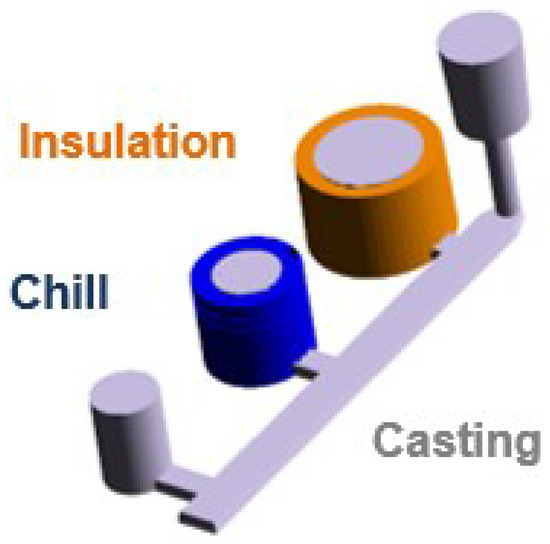
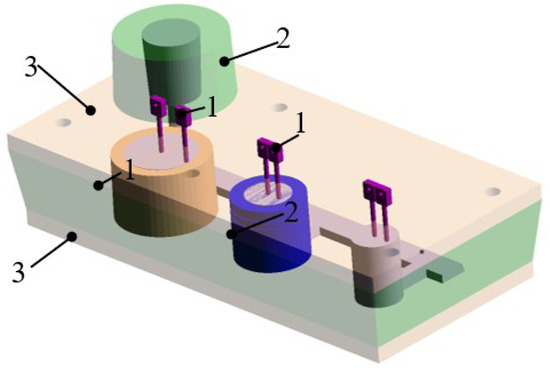
The experimental layout contained three cylindrical cavities, each one surrounded by a different material (steel chill, sand, and insulation) intended to provide three different cooling rates. The entire assembly was enclosed by a furan-bounded sand mold. The dimensions of the cylinders surrounded by sand and chill were ∅50 × 70 mm, and the insulated cylinder dimensions were ∅80 × 70 mm. A lateral 2-D heat flow condition was induced by placing an insulation plate at the top and bottom of the cylindrical castings. The design of the cylindrical castings and arrangement of the experimental layout are shown in Figure 2 and Figure 3, respectively.

Metals 08 00684 g002 550

Figure 2. Cylindrical castings with the insulation and chill.

Metals 08 00684 g003 550

Figure 3. The experimental layout. (1) Thermocouples, (2) sand mold, and (3) insulation plates.

Two type S thermocouples with glass tube protection were embedded in every cylindrical casting. A central thermocouple was located on the central axis of the cylinder. The distance between the central and the lateral thermocouple was 20 mm for the ∅50 mm cylinder and 30 mm for the ∅80 mm cylinder. The thermocouples were placed at the mid-height of each cylinder and the temperatures were recorded at approximately 0.2 s interval. A 16-bit resolution data acquisition system with the sampling rate 100 Hz was employed [12].
The mold-filling time was 12 s. The solidification times of the metal in the chill, sand, and insulation were roughly 80, 400, and 1500 s, respectively. An electric induction furnace was utilized for melting of the charge material. The cast iron base alloy was inoculated with a constant level of a standard Sr-based inoculant. Four hypoeutectic lamellar graphite iron heats with varying carbon contents were produced. The alloy with the higher carbon content was cast first, and steel scraps were added to the furnace for the adjustment of the carbon content in the following casting. Coin-shaped specimens were extracted for chemical analysis. The chemical compositions of the four different alloys are presented in Table 1. All the castings had a fully pearlitic microstructure.

Table 1. Chemical composition (wt %) and carbon equivalent (Ceq = %C + %Si/3 + %P/3).

AlloyCSiMnPSCrCuCeq
A3.621.880.570.040.080.140.384.26
B3.341.830.560.040.080.150.373.96
C3.051.770.540.040.080.140.363.65
D2.801.750.540.040.080.150.353.40

Tensile strength measurements were performed using a dog bone-shaped specimen with 6 mm diameter in the gauge section, 35 mm gauge length, and a 3 μm surface finish. The tests were conducted at a strain rate of 0.035 mm/s and at room temperature. The experimental tensile samples were machined at the distance ~10 mm (sand, chill) and ~20 mm (insulation) from the cylinder axis. The load cell error of the tensile testing machine was <0.5%.

3.2. Simulation Model and Assumptions

A CFD software (Flow-3D CAST, v.5.0 from Flow Science, Inc., Santa Fe, NM, USA) [15] was employed to develop a full-scale 3D model of the casting process for the experimental layout. Mold filling and the cooling/solidification stages were simulated, and local UTS computations were performed on the customized models. Mold-filling time was 12 s, and the laminar flow model was applied. The casting temperature was 1360 °C, and the metal input diameter was 3 cm. The ambient temperature was set to 20 °C. Symmetry boundary conditions were used on the faces of the computational domain, except for the upper face, where the pressure boundary condition was applied. A computational grid of cubical control elements was generated with the cell size 3 mm. The computational grid had a total of ~1 million cells. Different grid densities were tested, and grid-independent results were obtained. The explicit solver was employed during the mold filling, whereas the implicit solver was used for heat transfer simulation in the solidification phase. Since the focus was on heat transfer and the UTS computation methodology, shrinkage and micro-porosity models were not included in the solidification phase.
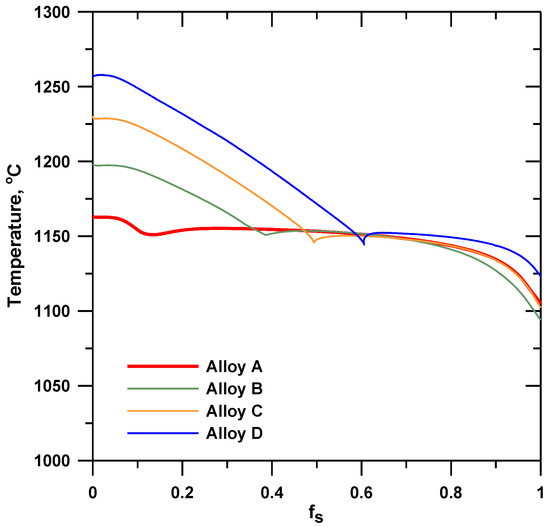
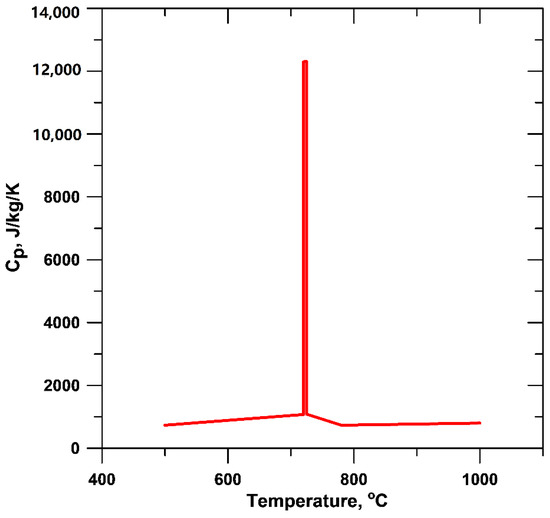
In this work, the amount of latent heat release due to solidification was related to the solid fraction curves, seen in Figure 4, for the studied alloys. These curves were calculated from the registered experimental cooling curves by using the Fourier thermal analysis method [16,17]. The latent heat of solidification was considered equal to 240 kJ/kg for all studied alloys [18]. Fourier thermal analysis was also applied on cooling curves for the determination of the latent heat release during the eutectoid transformation. The latent heat releases at the eutectoid transformation was found to be similar for all alloys and were incorporated into the specific heat curve as it is shown in Figure 5. The temperature dependent cast iron thermophysical properties [12], and the calibrated heat transfer coefficients applied in the simulation are presented in Table 2.

Metals 08 00684 g004 550

Figure 4. Solid fraction variation with temperature.

Metals 08 00684 g005 550

Figure 5. Specific heat as function of temperature.

Table 2. Temperature dependent properties of the cast iron and heat transfer coefficients *.

Temperature (°C)Cast Iron Thermophysical PropertiesHeat Transfer Coefficient
DensitySpecific HeatThermal ConductivitySand-CastingChill-CastingInsulation-Casting
[kg/m3][J/kg/K][W/m/K][W/m2/K][W/m2/K][W/m2/K]
6007146700404010010
7201074300
72112301
72412308
72510825010
750733
9008015
1000699480015025
1100825250130055
11546960837401450
11707016
12006985160060
12276939749
13006876771380180
17006395807389402700940
* Piecewise linear interpolation was made between neighboring points in the table.

3.3. Simulation Procedure

The simulation procedure consisted of model calibration with respect to the experimental cooling curves available at the location of the central thermocouple. Correct reproduction of the experimental cooling curves is the key for the UTS computation methodology, and one is free to choose methods for model calibration. In this work, the calibration was done by adjustment of the typical heat transfer coefficients between the metal and the insulation, sand, and chill. The UTS calculations for the cylinders were performed during post-processing, by applying local solidification times, local cooling rates in the eutectoid transformation region, and the experimentally determined fraction of primary austenite (fγ) for each alloy: 0.3 for alloy A, 0.4 for alloy B, 0.51 for alloy C, and 0.61 for alloy D [16].

4. Results and Discussion

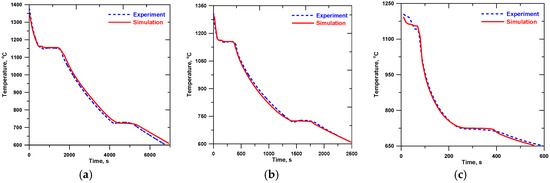
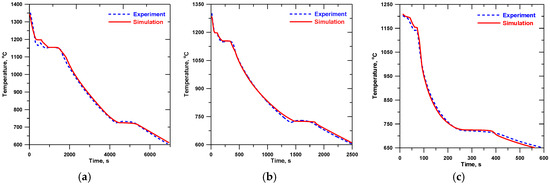
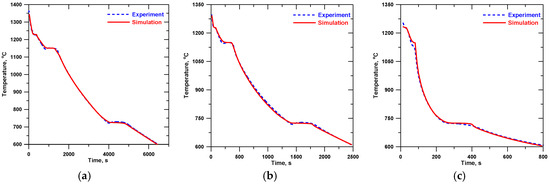
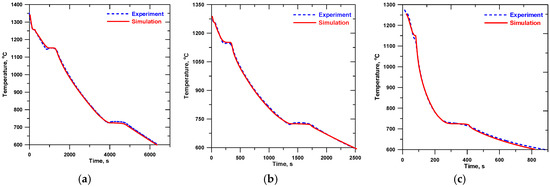
The general agreement within 7% was achieved between the simulated and measured cooling curves for insulation-, sand-, and chill-encapsulated cylinders; see Figure 6, Figure 7, Figure 8 and Figure 9. The larger differences were observed in the solidification region of the chill castings where the eutectic reaction was predicted at higher temperature than measured. This is because the solid fraction-temperature curves were derived from the sand-casting thermal histories, where the undercooling was much lower. Moreover, the solidification model in the simulation used the enthalpy method [19] and ignored the kinetics of phase transformation and, therefore, the undercooling and recalescence of solidification were not predicted. However, the simulated solidification times were in good agreement with the experiment.

Metals 08 00684 g006 550

Figure 6. Simulated and experimental cooling curves (central thermocouple) for alloy A: (a) insulation, (b) sand, and (c) chill.

Metals 08 00684 g007 550

Figure 7. Simulated and experimental cooling curves (central thermocouple) for alloy B: (a) insulation, (b) sand, and (c) chill.

Metals 08 00684 g008 550

Figure 8. Simulated and experimental cooling curves (central thermocouple) for alloy C: (a) insulation, (b) sand, and (c) chill.

Metals 08 00684 g009 550

Figure 9. Simulated and experimental cooling curves (central thermocouple) for alloy D: (a) insulation (b) sand, and (c) chill.

The measurement accuracy of the type S thermocouples was ±1.5 °C. It is worth noting that some of the thermocouples inserted in the melt could be slightly displaced from their intended positions during the solidification, which created an additional source of the measurement error; this can be seen clearly, e.g., from the solidification part of the experimental cooling curve for the insulated cylinder in Figure 7.
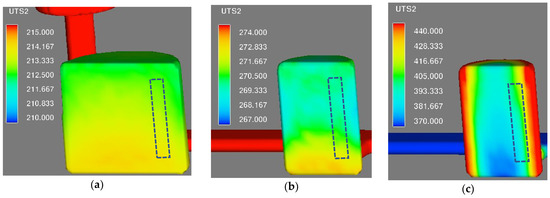
The simulated solidification times and cooling rates were used in Equations (3) and (4) for the calculation of UTS. The predicted UTS distribution, substituted in the middle cross-section of the alloy B casting, is shown in Figure 10. The figure illustrates the inhomogeneous material strength in the casting. It is directly related to the temperature gradient and the cooling rate distribution during solidification and solid-state transformation. The reduced UTS is the result of the microstructure coarseness that is related to the solidification time and the cooling rate. Moreover, large UTS gradients on the chilled cylinder can be explained by the large temperature gradients at high solidification rate. Intermediate and slow solidification rates on sand- and insulation-encapsulated cylinders resulted in more uniform distribution of UTS values, due to the smaller temperature gradients during solidification. It should be noted that the variation of UTS magnitude within the tensile bar positions (shown with dashed lines) complicates the model validation.

Metals 08 00684 g010 550

Figure 10. Distribution of ultimate tensile strength (UTS) calculated from Equations (4) and (6) for alloy B: (a) insulation-, (b) sand-, and (c) chill-encapsulated cylinder; the dashed lines indicate the position of the tensile bars.

The obtained values were compared to the measured UTS. Table 3 presents the experimental and simulated UTS results for different cooling rates and for each alloy. The simulated UTS values in Table 3 were picked from the mid-height locations of the tensile bar regions, indicated in Figure 10 with dashed lines. This would correspond to the failure location in the tensile test. However, the exact fracture location might be influenced by several other factors, such as microporosities, graphite flakes that are in contact with the casting surface, or other casting impurities. All of these can cause the crack initiation at positions where the theoretical material strength is not the lowest. Apparently, the fracture analysis is out of scope of the present work. There are quite small differences between simulated and measured UTS values, with the exception of the intermediate and slow cooling rates (sand and insulation) for alloy A, where all the models predicted the UTS with less accuracy. Relatively high, but still acceptable average percentage errors are also observed for the insulated cylinders cast of alloys C and D.

Table 3. Experimental and simulated UTS.

AlloyUTS, [MPa]Average Percentage Error, [%]
ExperimentSimulation
Equation (3) 1Equation (4) 2Equation (3) 1Equation (4) 2
AInsulation1541802001730
Sand1952302501828
Chill363340–350340–35055
BInsulation21120421331
Sand25425526916
Chill368365–375385–39516
CInsulation25023323676
Sand28629330025
Chill440420–435435–44530
DInsulation2892602531012
Sand33732532344
Chill447440–455475–49008
1 Modified Griffith model; 2 Modified Hall–Petch model.

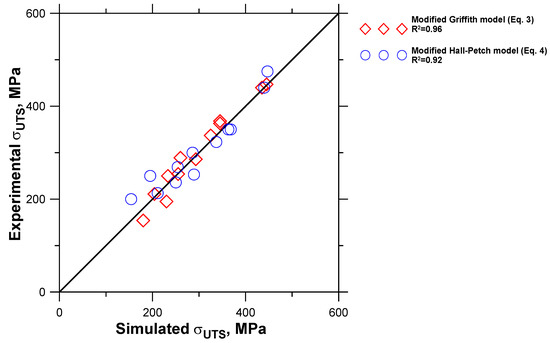
Comparisons between the calculated and the measured data are demonstrated in Figure 11. The graph reveals a relatively strong correlation between the measured and computed UTS. The R2 values show that Equation (3) predicts the UTS with better accuracy than Equation (4). This indicates the need to develop further the model for prediction of the λpearlite parameter.

Metals 08 00684 g011 550

Figure 11. Correlation between measured and simulated UTS values.

The observed deviations between the simulated and measured UTS can be also attributed to the limited number of tensile specimens [10] and to uncertainties regarding the measurements accuracy of the 𝐷𝐻𝑦𝑑𝐼𝑃
parameter, especially for the low cooling rate samples [20] that were used to develop the UTS models.
The presented results should be related to two fundamental publications on computer simulations of LGI solidification coupled with the Griffiths and Hall–Petch models [7,8]. The models for UTS calculation utilized in these works were based on a narrow carbon content interval, and on a limited cooling rate variation, in comparison. Moreover, growth kinetic equations were employed in [7,8]. On the contrary, the latent heat release model by the “enthalpy method” [19] was adopted for the solidification simulation in the present work. Furthermore, the presented way to determine the key parameters and incorporate them into material property prediction is novel. In [7,8], the key parameter was the eutectic cell diameter. It is evident that the modified Griffith and Hall–Petch equations are applicable once the eutectic diameter can be predicted, as well as the pearlite lamellar spacing in the Hall–Patch equation. A completely different approach validated in this work involved the hydraulic diameter as the key morphological parameter, along with the pearlite lamellar spacing introduced in [8]. The presented methodology to calculate the UTS features the simplicity of determining the key parameters by simulation (solidification time, cooling rate, and composition dependent). While [7] and [8] introduce complex microstructure models valid for small process intervals (with respect to composition and cooling condition), the current methodology lays back to a robust experimental thermal analysis [16], providing accurate input data (latent heat of both solidification and solid-state transformation) for the simulation. A robust iteration process for tuning up the heat transfer coefficient results in the accurately predicted cooling rate.

5. Conclusions

The novel UTS prediction methodology for fully pearlitic LGI alloys presented in this paper involves hydraulic diameter as the key morphological parameter, along with the pearlite lamellar spacing. It is characterized by simplicity, in comparison to the microstructure modelling methods. The methodology includes analytical formulation of the UTS prediction models, and robust experimental thermal analysis. The latter provides the latent heat of solidification and solid-state transformation as input data for the solidification simulation. In turn, the simulation delivers the solidification time and cooling rates for the UTS prediction models.

Microstructure models for the prediction of hydraulic diameter and the pearlite lamellar spacing, combined with modified Griffith and Hall–Petch equations, were incorporated into casting simulation software for the prediction of UTS in fully pearlitic LGI alloys. Overall, the simulation UTS results were found to be in good agreement (within 9% on the average) with the measurements. However, high average percentage errors were observed for the intermediate and slow cooling rates (sand and insulation) for the alloy with the higher carbon content (alloy A). This study revealed the necessity for development of a more advanced model for the prediction of the λpearlite parameter. The results demonstrated the applicability of the novel UTS prediction models for different chemical compositions and cooling conditions.

Further development of the microstructure modelling would enable determination of the key parameters (hydraulic diameter and pearlite lamellar spacing). However, it seems not to be critical for the presented novel UTS prediction methodology which is valid for the wide process interval.

Author Contributions

A.D. designed the experiment and supervised the work, I.B. performed the simulations, V.F. analyzed the data and wrote the paper, A.D. and I.B. reviewed the paper.

Funding

This research received no external funding.

Acknowledgments

This work was performed within the Swedish Casting Innovation Centre. Cooperating parties are Jönköping University, Scania CV AB, Swerea SWECAST AB and Volvo Powertrain Production Gjuteriet AB. Participating persons from these institutions/companies are acknowledged.

Conflicts of Interest

The authors declare no conflict of interest.

References

  1. Collini, L.; Nicoletto, G.; Konecná, R. Microstrucure and mechanical properties of pearlitic lamellar cast iron. Mater. Sci. Eng. A 2008, 488, 529–539.
  2. Ruff, G.F.; Wallace, J.F. Effects of solidification structure on the tensile properties of lamellar iron. AFS Trans. 1977, 56, 179–202.
  3. Bates, C. Alloy element effect on lamellar iron properties: Part II. AFS Trans. 1986, 94, 889–905.
  4. Nakae, H.; Shin, H. Effect of graphite morphology on tensile properties of flake graphite cast iron. Mater. Trans. 2001, 42, 1428–1434.
  5. Baker, T.J. The fracture resistance of the flake graphite cast iron. Mater. Eng. Appl. 1978, 1, 13–18.
  6. Griffin, J.A.; Bates, C.E. Predicting in-situ lamellar cast iron properties: Effects of the pouring temperature and manganese and sulfur concentration. AFS Trans. 1988, 88, 481–496.
  7. Goettsch, D.D.; Dantzig, J.A. Modeling microstructure development in gray cast irons. Metall. Trans. A 1994, 25, 1063–1079.
  8. Catalina, A.; Guo, X.; Stefanescu, D.M.; Chuzhoy, L.; Pershing, M.A. Prediction of room temperature microstructure and mechanical properties in lamellar iron castings. AFS Trans. 2000, 94, 889–912.
  9. Urrutia, A.; Celentano, J.D.; Dayalan, R. Modeling and Simulation of the Gray-to-White Transition during Solidification of a Hypereutectic Gray Cast Iron: Application to a Stub-to-Carbon Connection used in Smelting Processes. Metals 2017, 7, 549.
  10. Fourlakidis, V.; Diószegi, A. A generic model to predict the ultimate tensile strength in pearlitic lamellar graphite iron. Mater. Sci. Eng. A 2014, 618, 161–167.
  11. Fourlakidis, V.; Diaconu, L.; Diószegi, A. Strength prediction of Lamellar Graphite Iron: From Griffith’s to Hall-Petch modified equation. Mater. Sci. Forum 2018, 925, 272–279.
  12. Diószegi, A. On the Microstructure Formation and Mechanical Properties in Grey Cast Iron. In Linköping Studies in Science and Technology; Dissertation No. 871; Jönköping: Jönköping, Sweden, 2004; p. 25. ISBN 91-7373-939-1.
  13. Leube, B.; Arnberg, L. Modeling gray iron solidification microstructure for prediction of mechanical properties. Int. J. Cast Metals Res. 1999, 11, 507–514.
  14. Fourlakidis, V.; Diószegi, A. Dynamic Coarsening of Austenite Dendrite in Lamellar Cast Iron Part 2—The influence of carbon composition. Mater. Sci. Forum 2014, 790–791, 211–216.
  15. Barkhudarov, M.R.; Hirt, C.W. Casting simulation: Mold filling and solidification—Benchmark calculations using FLOW-3D. In Proceedings of the 7th Conference on Modeling of Casting, Welding and Advanced Solidification Processes, London, UK, 10–15 September 1995.
  16. Diószegi, A.; Diaconu, L.; Fourlakidis, V. Prediction of volume fraction of primary austenite at solidification of lamellar graphite cast iron using thermal analyses. J. Therm. Anal. Calorim. 2016, 124, 215–225.
  17. Svidró, P.; Diószegi, A.; Pour, M.S.; Jönsson, P. Investigation of Dendrite Coarsening in Complex Shaped Lamellar Graphite Iron Castings. Metals 2017, 7, 244.
  18. Diószegi, A.; Hattel, J. An inverse thermal analysis method to study the solidification in cast iron. Int. J. Cast Met. Res. 2004, 17, 311–318.
  19. Hattel, J.H. Fundamentals of Numerical Modelling of Casting Processes, 1st ed.; Polyteknisk Forlag: Lyngby, Denmark, 2005.
  20. Diószegi, A.; Fourlakidis, V.; Lora, R. Austenite Dendrite Morphology in Lamellar Cast Iron. Int. J. Cast Met. Res. 2015, 28, 310–317.
FLOW-3D 용어 사전 테이블

FLOW-3D Glossary | FLOW-3D 용어 사전

FLOW-3D 용어 사전 / 용어 설명

FLOW-3D 용어 사전 테이블
FLOW-3D 용어 사전 테이블

FLOW-3D 용어 사전 / 용어 설명

Drift Flux

드리프트 모델은 밀도가 서로 다른 두 혼합 유체 구성 요소의 상대적 흐름을 설명합니다. 구성 요소는 상이 다를 수도 있고, 상이 같지만(불가침) 유체가 다를 수도 있습니다. 분산된 위상 입자 크기가 클 경우 드리프트 모델의 적용성에 대한 제한이 존재할 수 있습니다. 이러한 제한은 일반적으로 메쉬 셀 크기의 10% 미만으로 분산된 위상 입자 크기를 유지함으로써 방지할 수 있습니다.

배플

얇은 형상 조각을 나타내는데 사용되는 2 차원 개체입니다. 이들은 전처리기에 의해 셀면으로 이동되고 유체의 흐름을 부분적으로 또는 완전히 차단하는 역할을 합니다. 배플은 지정된 열 전달 계수를 가질 수 있으며 배플을 통과하는 양(플럭스 표면)을 측정하는 데 사용할 수 있습니다.

Two-dimensional objects that are used to represent thin pieces of geometry. They are moved by the preprocessor to cell faces and act to partially, or completely block the flow of fluid. Baffles can have heat transfer coefficients specified and can be used to measure quantities that pass through them (a flux surface).

경계 조건

도메인의 범위에서 솔루션을 정의합니다. 경계 위치에서 흐름의 실제 상태를 나타내는 경계 조건을 선택하는 것이 중요합니다.

Defines the solution at the extents of the domain. It is important to choose boundary conditions that represent the true condition of the flow at the boundary location.

CFD

CFD (Computational Fluid Dynamics)는 수치 솔루션을 통해 컴퓨터의 유체 흐름을 시뮬레이션 하는 유체 역학의 한 분야입니다.

Computational Fluid Dynamics (CFD), the branch of fluid mechanics dedicated to simulating the flow of fluid on a computer via numerical solutions.

Complements

Complements를 정의합니다. 예를 들어, 솔리드 구의 complements는 솔리드 재료로 둘러싸인 구형 구멍입니다.

The inverse of a shape defines the complement. For example, the complement of a solid sphere is a spherical hole surrounded by solid material.

Client

클라이언트 컴퓨터는 자신이 FLOW-3D를 실행하고 있지만, FLOW-3D 소프트웨어 라이선스는 다른 컴퓨터 (서버 컴퓨터)에서 획득하는 컴퓨터를 의미합니다.

A client machine is a computer that runs FLOW-3D  but acquires the software license from a different machine (the server machine)

Components

Components는 공간의 개체를 정의하며 하위 구성 요소로 구성됩니다. 구성 요소는 열 전도율, 비열 및 표면 거칠기와 같은 재료 특성을 가질 수 있습니다.

Components define objects in space and are comprised of subcomponents. A component can have material properties such as thermal conductivity, specific heat and surface roughness.

Custom result

시뮬레이션 중 또는 완료 후 사용자가 생성한 데이터를 그래픽으로 표시합니다. 생성하려면 사용자가 flsgrf결과 파일을 연 다음 플로팅 매개 변수(예 : 플로팅 할 도메인 부분, 플로팅 할 수량 등)를 선택해야 합니다.

Graphical displays of data generated by the user during the simulation or after it has completed. To generate, the user must open an flsgrf results file and then select the plotting parameter (e.g., portion of domain to plot, quantity to plot, etc.).

Domain

지배 방정식을 풀 영역입니다. 이것은 메쉬의 범위에 의해 정의됩니다.

The region in which the governing equations are to be solved. This is defined by the extents of the mesh.

Diagnostics

전 처리기 및 솔버의 진행 상황과 오류 및 경고에 대한 정보가 포함된 파일 세트입니다.

A suite of files that contain information on the progress of the preprocessor and solver as well as errors and warnings.

EPSI

압력/연속 반복이 어느 지점에서 수렴되는지를 결정하는데 사용된 수렴 기준입니다. 기본 숫자 설정을 사용하면 이 값은 FLOW-3D에 의해 자동으로 계산되며 시간 단계가 증가함에 따라 작아집니다.

The convergence criterion that was used to determine at what point the pressure/continuity iterations have converged. With the default numerical settings, this value is automatically computed by FLOW-3D  and becomes smaller as the time step increases.

Existing result

prpplt.* 또는 flsplt.* 파일은 전처리 종료 솔버 실행 종료시 또는 자동으로 생성되는 플롯 파일입니다.

A plot file that is automatically created, either at the end of preprocessing or the end of the solver run- prpplt.* or flsplt.*.

F3D_HOME

FLOW-3D 프로그램 파일이 있는 디렉토리를 정의하는 환경 변수.

Environment variable that defines the directory where the FLOW-3D  program files are located.

Floating license

FLOW-3D는 서버 시스템에 라이센스를 액세스하는 각 클라이언트 컴퓨터와 컴퓨터 네트워크에서 실행합니다. 허용하는 라이센스 최대 동시 시뮬레이션 수는 구매한 솔버 토큰 수에 의해 제한됩니다.

A license that allows FLOW-3D  to be run on a network of computers with each client machine accessing the license on a server machine. The maximum number of concurrent simulations is limited by the number of solver tokens purchased.

Flsgrf file

솔버가 생성한 결과 파일. 이 파일은 사전에 정의된 시간 간격으로 생성된 정보를 포함하며 그래픽 디스플레이를 생성하는 데 사용됩니다. 사용자 정의 플로팅 중에 포스트 프로세서에서 사용합니다.

Results file produced by the solver. This file contains information produced at predefined time intervals and is used to produce graphical displays. Used by the postprocessor during custom plotting.

Flsplt file

솔버가 자동으로 생성한 플롯 파일입니다. 이 파일에는 시뮬레이션의 히스토리 데이터, 메시 등에 대한 기본 정보와의 $GRAFIC 이름 목록에 사전 정의된 그래픽 요청이 포함되어 prepin.* 파일 안에 있습니다.

Plot file produced automatically by the solver. This file contains basic information on history data, mesh, etc. from the simulation as well as any pre-defined graphics requests in the $GRAFIC namelist in prepin.*.

Fluid #1 surface area

선택한 길이 단위의 자유 표면 영역을 제곱 됩니다. 인터페이스가 예리한 문제에만 해당됩니다.

The free-surface area in the chosen length units squared. This is only relevant for problems with a sharp interface.

Fluid thermal energy

영역에 존재하는 모든 유체에 포함된 총 열 에너지 (에너지 전송이 켜져 있는 시뮬레이션에만 해당).

The total thermal energy contained by all the fluid present in the domain (relevant only for simulations with energy transport turned on).

Free surface

유체와 유체 사이의 인터페이스. FLOW-3D에서 이 인터페이스는 전단이 없는 것으로 가정되며, 이는 빈 공간에 있는 가스가 유체에 무시할 수 있는 트랙션을 발휘함을 의미한다.

The interface between fluid and void. In FLOW-3D , this interface is assumed to be shear-free, meaning that any gas in the void space exerted negligible traction on the fluid.

GUI

” Graphical User Interface”.  GUI는 사용자가 FLOW-3D를 제어할 수 있는 그래픽 패널, 대화 상자 및 창을 제공합니다.

“Graphical User Interface”. The GUI presents the graphical panels, dialog boxes and windows that allow the user to control FLOW-3D .

Iteration count

각 시간 단계에서 필요한 압력/연속 반복 횟수입니다. 압력/연속성 반복은 유체 볼륨이 유지되도록 하고 유체 전체에서 올바른 압력을 계산하는 데 필요합니다.

The number of pressure/continuity iterations required at each time step. The pressure/continuity iterations are necessary to ensure that the fluid volume is maintained and to compute the correct pressure throughout the fluid.

License file

사용자가 FLOW-3D 를 실행할 수 있도록 암호화된 정보가 포함된 Flow Science에서 제공하는 전자 파일 입니다.

Electronic file provided by Flow Science that contains encrypted information enabling the user to run FLOW-3D .

License server

플로팅 라이센스 시스템의 작동을 활성화하기 위해 FLEXlm 라이센스 소프트웨어가 설치된 시스템. FLOW-3D는 License Server에 설치할 필요가 없습니다.

Computer on which the FLEXlm licensing software is installed to enable the operation of a floating license system. FLOW-3D  does not need to be installed on the license server.

Licensing

FLOW-3D 실행을 제어하는 ​​FLEXlm 소프트웨어.

FLEXlm software that controls the running of FLOW-3D .

Max. residual

압력/연속성 반복의 최종 반복에서 연속성 방정식의 실제 발산. 이 값은 메시지가 나타나지 않는 한 일반적으로 epsi보다 작습니다 .

The actual divergence of the continuity equation on the final iteration of the pressure/continuity iterations. This value is usually smaller than epsi unless the message, pressure iteration did not converge in xxxx iterations appears.

Mean kinetic energy

모든 계산 셀의 운동 에너지의 합을 도메인에 존재하는 총 유체 질량으로 나눈 값입니다. 이 양이 시간이 지남에 따라 변하지 않으면 정상 상태에 도달했음을 나타내는 좋은 지표입니다.

The sum of kinetic energy of all the computational cells, divided by the total mass of fluid present in the domain. When this quantity ceases to change over time, it is a good indicator that steady-state has been reached.

Node-locked license

특정 컴퓨터에 고정된 라이센스. 노드 잠금 라이센스는 네트워크를 통해 액세스 할 수 없으므로 일반적으로 모든 작업을 한 컴퓨터에서 수행해야하는 경우에만 사용됩니다.

A license that is locked to a particular computer. A node-locked license cannot be accessed across a network, and so is typically only used when all work is to be done on one computer.

Non-inertial reference frame

가속화되는 참조 프레임. 비 관성 참조 프레임은 움직이는 컨테이너를 모방하는 데 사용할 수 있습니다.

A frame of reference that is accelerating. A non-inertial reference frame can be used to mimic a moving container.

Pltfsi

1D 및 2D 플롯을 생성하는 FLOW-3D에 포함된 그래픽 디스플레이 프로그램.

Graphics display program included with FLOW-3D  that produces 1D and 2D plots.

Postprocessor

FLOW-3D 내의 Postprocessor 프로그램은 FLOW-3D 또는 타사 시각화 프로그램에서 읽을 수 있는 데이터 파일을 생성하거나 타사 소프트웨어 프로그램에서 읽을 텍스트 데이터를 생성하는 솔버 출력 데이터를 처리하는 프로그램입니다.

The program within FLOW-3D  that processes the solver output data to produce data files that can be read by FLOW-3D ’s or third-party’s visualization programs, or produce text data to be read by third party software programs.

Prepin file

FLOW-3D 시뮬레이션을 실행하는데 필요한 모든 정보가 포함된 텍스트 파일 입니다. GUI를 사용하거나 텍스트 편집기를 사용하여 수동으로 작성할 수 있습니다.

Text file that contains all of the information necessary to create a FLOW-3D  simulation. It can be created using the GUI or manually with a text editor.

Preprocessor

솔버의 실행을 준비하기 위해 입력 파일을 기반으로 메쉬 및 초기 조건을 생성하는 FLOW-3D 내의 프로그램 입니다.

The program within FLOW-3D  that generates the mesh and initial conditions based on the input file in preparation for the running of the solver.

Prpgrf file

전처리기에 의해 생성된 결과 파일로 전 처리기의 정보를 포함하며 후 처리기에서 사용자 플롯을 생성하는 데 사용할 수 있습니다. 이 파일은 미리보기 버튼을 선택하거나 시뮬레이션에서 사전 프로세서(runpre 사용)를 실행하는 경우에만 실행됩니다.

Results file produced by the preprocessor. Contains information from the preprocessor and can be used by the postprocessor to create custom plots. This file is produced only when the Preview button is selected or if only the pre-processor is run on the simulation (using runpre).

Prpplt file

전처리기에 의해 자동으로 생성된 파일을 플롯 합니다. 메시, 구성 요소, 초기 조건 및 재료 특성에 대한 정보가 포함되어 있습니다.

Plot file produced automatically by the preprocessor. Contains information on meshing, components, initial conditions and material properties.

Restart simulation

이전 시뮬레이션에서 계속되는 시뮬레이션입니다. 이전 시뮬레이션의 결과는 다시 시작 시뮬레이션을 위한 초기 조건 및 (선택적으로) 경계 조건을 생성하는 데 사용됩니다.

A simulation which continues from a previous simulation. The results from the previous simulation are used to generate the initial conditions and (optionally) boundary conditions for the restart simulation.

Server

라이센스 서버를 호스팅하는 시스템

The machine that hosts the license server.

Stability limit

각 시간 단계에서 사용할 수 있는 최대 시간 단계. 더 큰 시간 단계는 수치적 불안정성과 비물리적 결과로 이어질 것이다.

The maximum time step that can be used during each time step. A larger time step will lead to numerical instabilities and nonphysical results.

STL (Stereolithography) File

.STL 파일 형식은 일련의 삼각형이 있는 솔리드 모델의 표면에 근접한 표준 데이터 전송 형식이다. 삼각형은 가장자리에서 결합해야 하며 일관된 방향을 가리키는 정규식이 있어야 한다.

The .STL file format is a standard data transmission format that approximates the surfaces of a solid model with a series of triangles. The triangles must join at the edges and must have normals that point in a consistent direction.

Solid fraction

응고된 영역의 유체 분율 (응고 모델이 켜져 있는 시뮬레이션에만 해당).

The fraction of fluid in the domain that has become solidified (relevant only for simulations where the solidification model has been turned on).

Solver

입력 파일에 정의된 흐름 문제를 시뮬레이션하는 방정식을 계산하는 FLOW-3D 내의 솔버 프로그램 입니다.

The program within FLOW-3D  that solves the system of equations that simulate the flow problem defined in the input file.

STL Viewer

스테레오리소그래피(STL) 파일을 표시하는 특수 유틸리티입니다. STL 파일은 CAD 소프트웨어로 제작되며 3 차원 객체의 표면을 형성하는 많은 삼각형으로 구성됩니다. 의 STL 뷰어 FLOW-3D는 메인 메뉴에서 유틸리티/STL 뷰어를 클릭하여 GUI를 통해 액세스 할 수 있습니다. 그러면 뷰어가 별도의 창에서 열립니다. 메쉬 및 형상 탭에서 STL 파일을 열고 볼 수도 있습니다.

A special utility that displays stereolithography (STL) files. STL files are produced by CAD software and are composed of many triangles that form the surface of a three-dimensional object. The STL Viewer in FLOW-3D  is accessible via the GUI by clicking Utilities/STL Viewer in the main menu. This causes the viewer to open in a separate window. STL files can also be opened and viewed in the Meshing and Geometry tab.

Subcomponents

하위 구성 요소는 구성 요소라고하는 더 큰 모양을 형성하기 위해 결합할 수 있는 기하학적 모양입니다. 하위 구성 요소는 재료를 추가하거나 (고체로) 다른 하위 구성 요소에서 재료를 제거하거나 (구멍으로) 또는 모양 외부에 재료를 추가하도록 정의할 수 있습니다.

Subcomponents are geometric shapes that can be combined to form larger shapes, called components. A subcomponent can be defined to add material (as solids), remove material from other subcomponents (as holes), or add material outside of the shape (as a complement).

Time-step size

계산에 사용된 실제 시간 단계. 이 값은 안정성 한계와 같거나 작을 수 있습니다.

The actual time step used in the computation. This value can be equal to or less than the stability limit.

Units

Units are based upon the values set for the physical properties. Items such as mesh block extents and cell lengths automatically conform to the units used for setting these physical properties.

단위는 물리적 특성에 설정된 값을 기반으로 합니다. 메쉬 블록 범위 및 셀 길이와 같은 항목은 이러한 물리적 속성을 설정하는 데 사용되는 단위를 자동으로 따릅니다.

Volume error (%)

주어진 시간에 도메인에 존재하는 총 유체의 백분율로 설명되지 않은 유체 부피의 백분율을 의미합니다. 따라서 단순히 총 부피가 작기 때문에 유체가 시스템 밖으로 배출되는 시뮬레이션에서 큰 비율의 부피 오류가 발생할 수 있습니다.

The percentage of fluid volume not accounted for as a percentage of the total fluid present in the domain at a given time. Therefore, a large percentage volume error can occur for simulations where fluid is draining out of the system simply because the total volume present is small.

Volume of fluid #1

선택한 길이 단위로 입방체에 존재하는 유체 #1의 총 부피입니다. 2 유체 문제의 경우, 유체 #2의 부피는 항상 도메인 부피에서 유체 #1의 부피를 뺀 값입니다.

The total volume of fluid #1 present in the system, in the chosen length units cubed. For two-fluid problems, the volume of fluid #2 is always the domain volume minus the volume of fluid #1.

Wall shear stress

FLOW-3D 옵션은 벽면 및 객체 인터페이스에서 전단 응력 계산을 켜거나 끌 수 있도록 해줍니다. “no-slip” 인터페이스의 효과를 모델링 하려면 벽면 전단 응력을 켜야 합니다.

The FLOW-3D  option that allows the user to turn on or off the computation of shear stress at wall and object interfaces. Wall shear stress must be turned on to model the effect of “no-slip” interfaces.

Workspace

작업 공간은 시뮬레이션 프로젝트를 위한 파일 컨테이너입니다. 작업 공간은 사용자가 FLOW-3D 뿐만 아니라 하드 드라이브에서도 작업을 구성하는 데 도움이 됩니다.

A workspace is a file container for simulation projects. Workspaces help the user organize their work, not only within FLOW-3D , but also on their hard drive.

FLOW-3D 및TruVOF는 미국 및 기타 국가에서 등록 상표입니다.

FLOW-3D 기술자료로 이동